Cambridge IGCSE Sciences - Co-ordinated (Double) 0654 — 2025 May/June Paper 2 · Variant 1
0654/21/M/J/25 · 40 questions · 40 marks · 45 min
The question paper and its mark scheme, free to read here and free to download. This is Cambridge’s own paper, exactly as it was sat.
Question paper16 pages
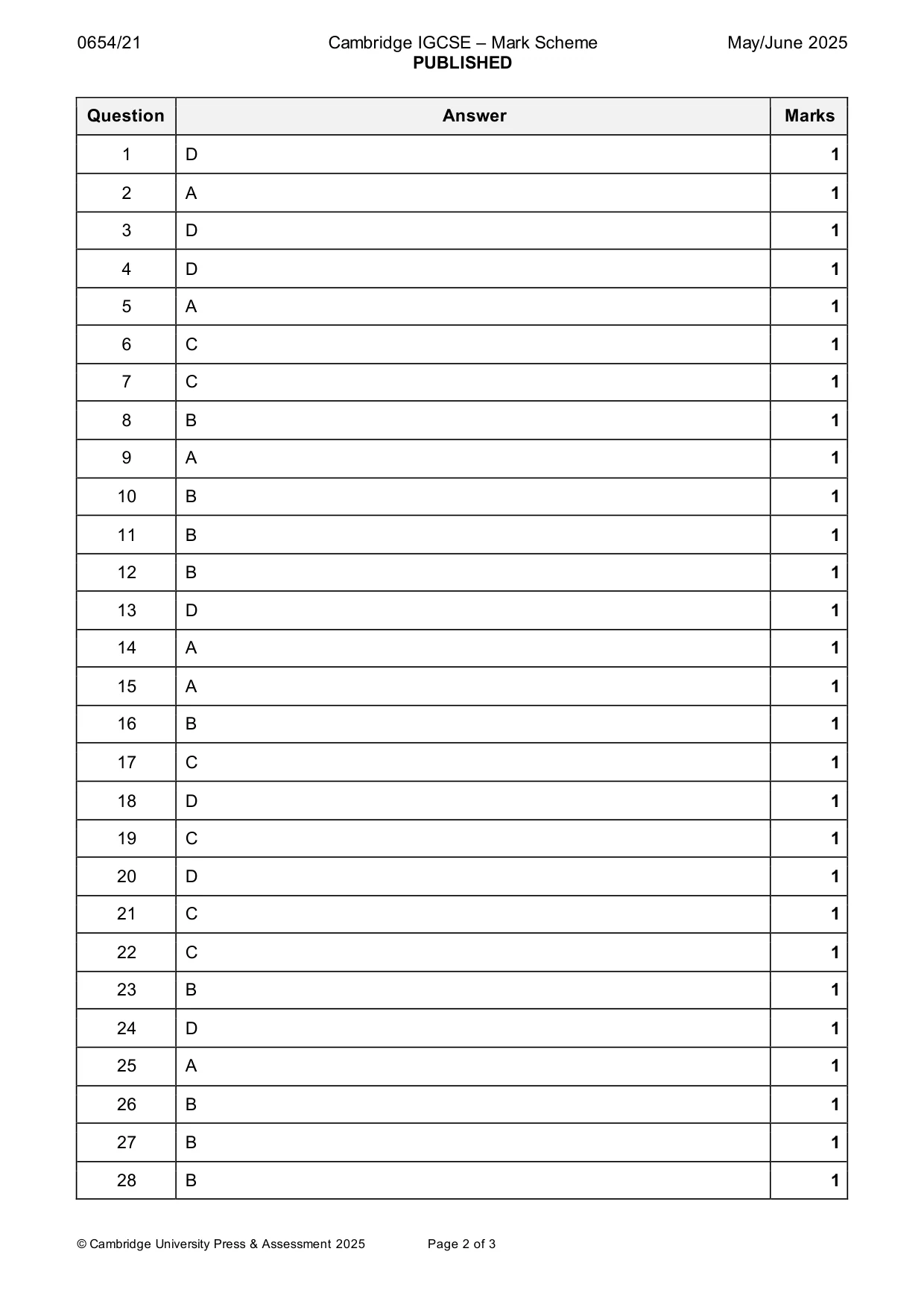
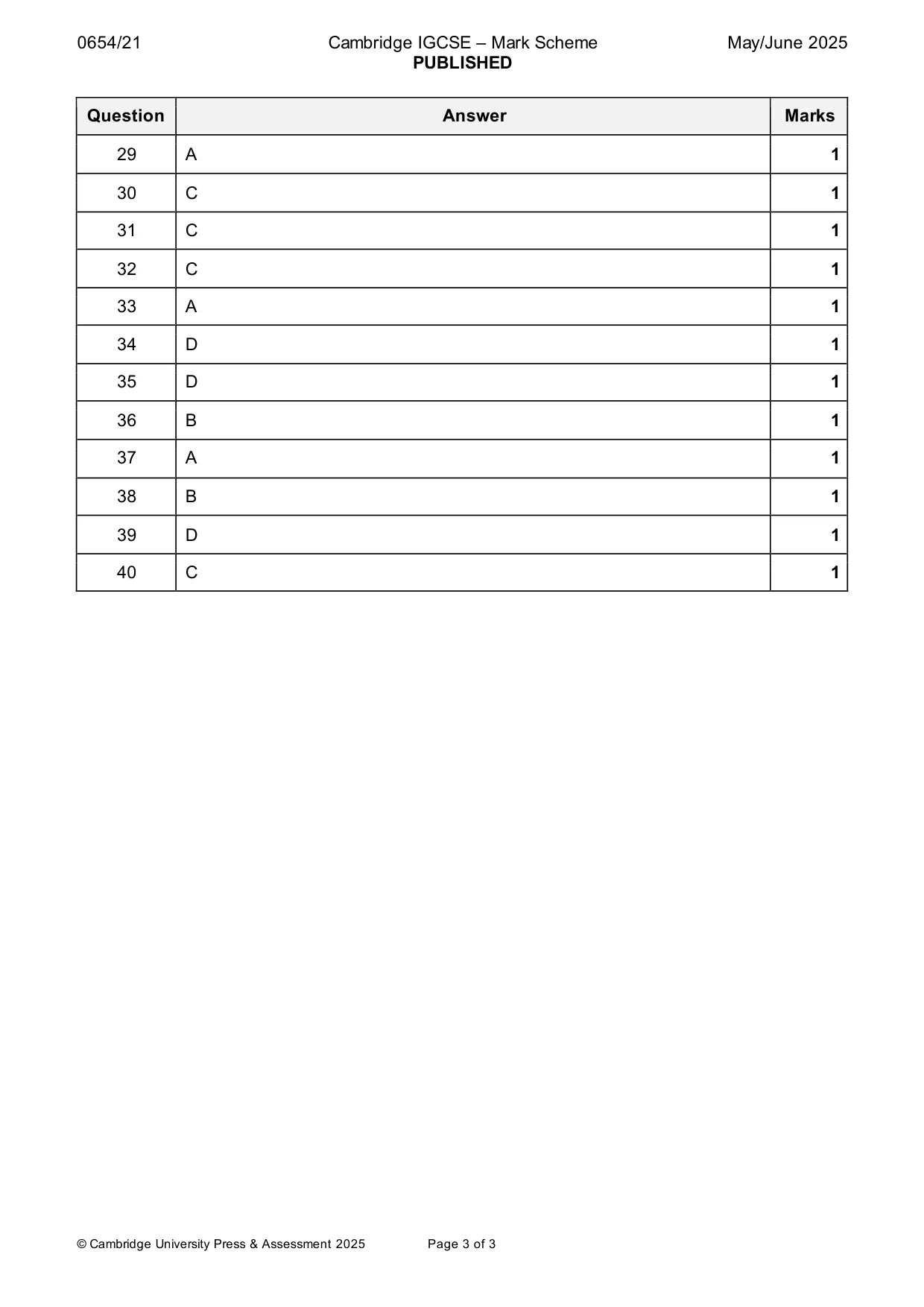
Mark scheme3 pages
Answers below. Sit the paper first if you are practising.
Questions as text
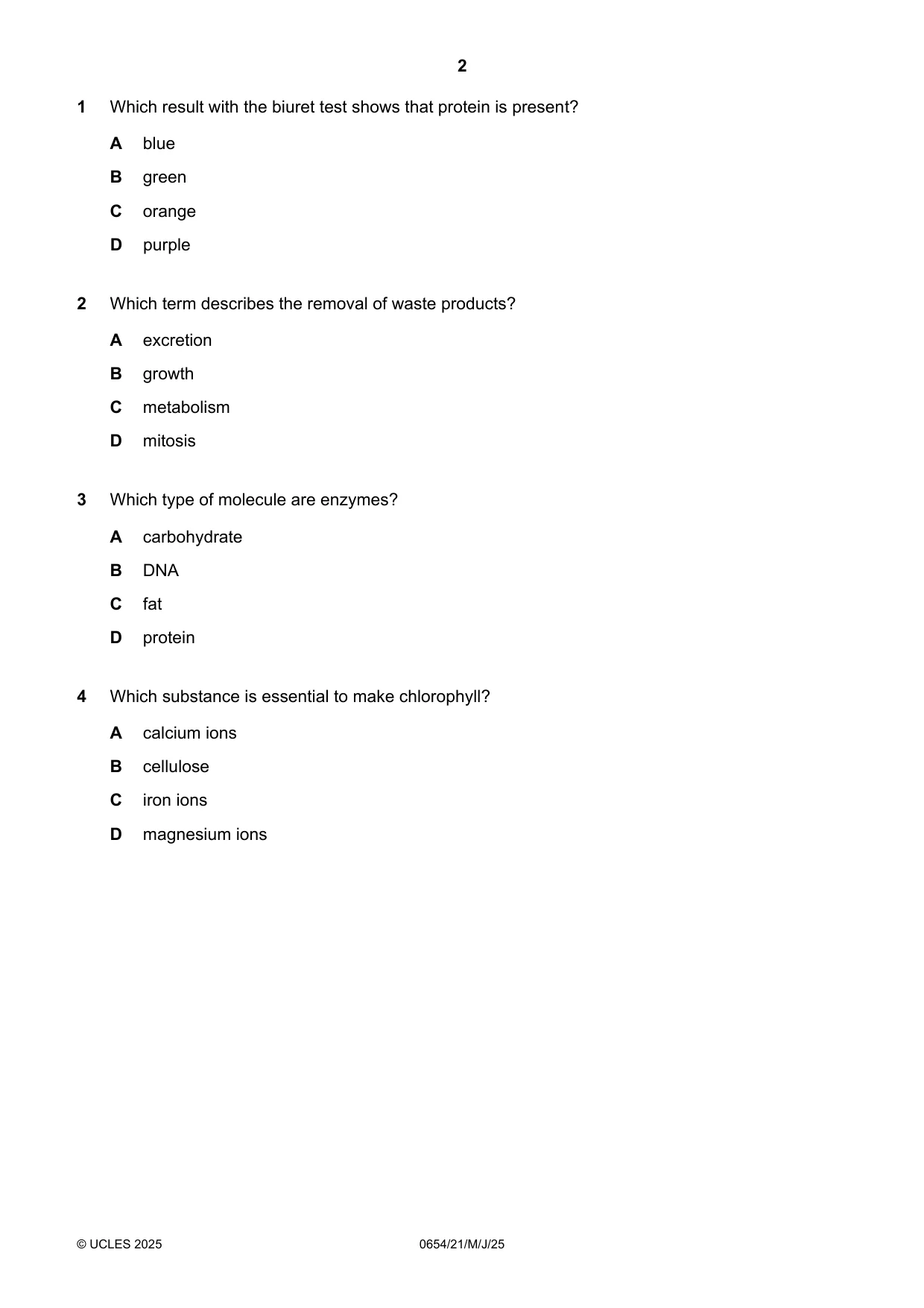
Q1 · Which result with the biuret test shows that protein is present?
1 Which result with the biuret test shows that protein is present? A blue B green C orange D purple
Mark scheme: D
Q2 · Which term describes the removal of waste products?
2 Which term describes the removal of waste products? A excretion B growth C metabolism D mitosis
Mark scheme: A
Q3 · Which type of molecule are enzymes?
3 Which type of molecule are enzymes? A carbohydrate B DNA C fat D protein
Mark scheme: D
Q4 · Which substance is essential to make chlorophyll?
4 Which substance is essential to make chlorophyll? A calcium ions B cellulose C iron ions D magnesium ions
Mark scheme: D
Q5 · The table shows the energy demand of males and females of different ages
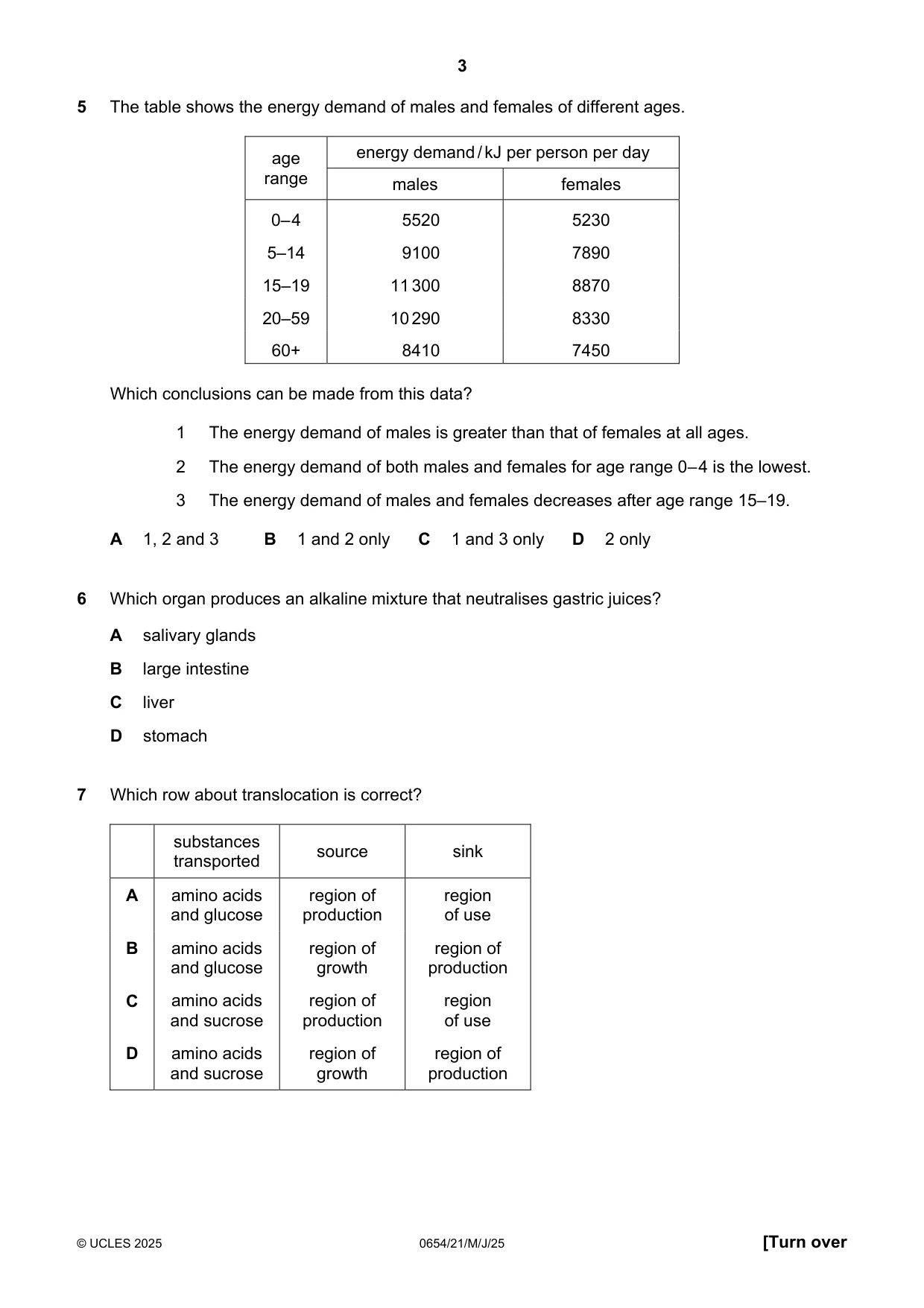
5 The table shows the energy demand of males and females of different ages. age energy demand / kJ per person per day range males females 0– 4 5520 5230 5–14 9100 7890 15–19 11 300 8870 20–59 10 290 8330 60+ 8410 7450 Which conclusions can be made from this data? 1 The energy demand of males is greater than that of females at all ages. 2 The energy demand of both males and females for age range 0– 4 is the lowest. 3 The energy demand of males and females decreases after age range 15–19. A 1, 2 and 3 B 1 and 2 only C 1 and 3 only D 2 only
Mark scheme: A
Q6 · Which organ produces an alkaline mixture that neutralises gastric juices?
6 Which organ produces an alkaline mixture that neutralises gastric juices? A salivary glands B large intestine C liver D stomach
Mark scheme: C
Q7 · Which row about translocation is correct?
7 Which row about translocation is correct? substances source sink transported A amino acids region of region and glucose production of use B amino acids region of region of and glucose growth production C amino acids region of region and sucrose production of use D amino acids region of region of and sucrose growth production
Mark scheme: C
Q8 · Yogurt is a food made by adding bacteria to milk
8 Yogurt is a food made by adding bacteria to milk. The bacteria feed on sugars in the milk and produce lactic acid. The lactic acid denatures the milk protein. Which process produces the lactic acid? A aerobic respiration B anaerobic respiration C assimilation D decomposition
Mark scheme: B
Q9 · What is secreted by the pancreas?
9 What is secreted by the pancreas? A glucagon B glucose C glycerol D glycogen
Mark scheme: A
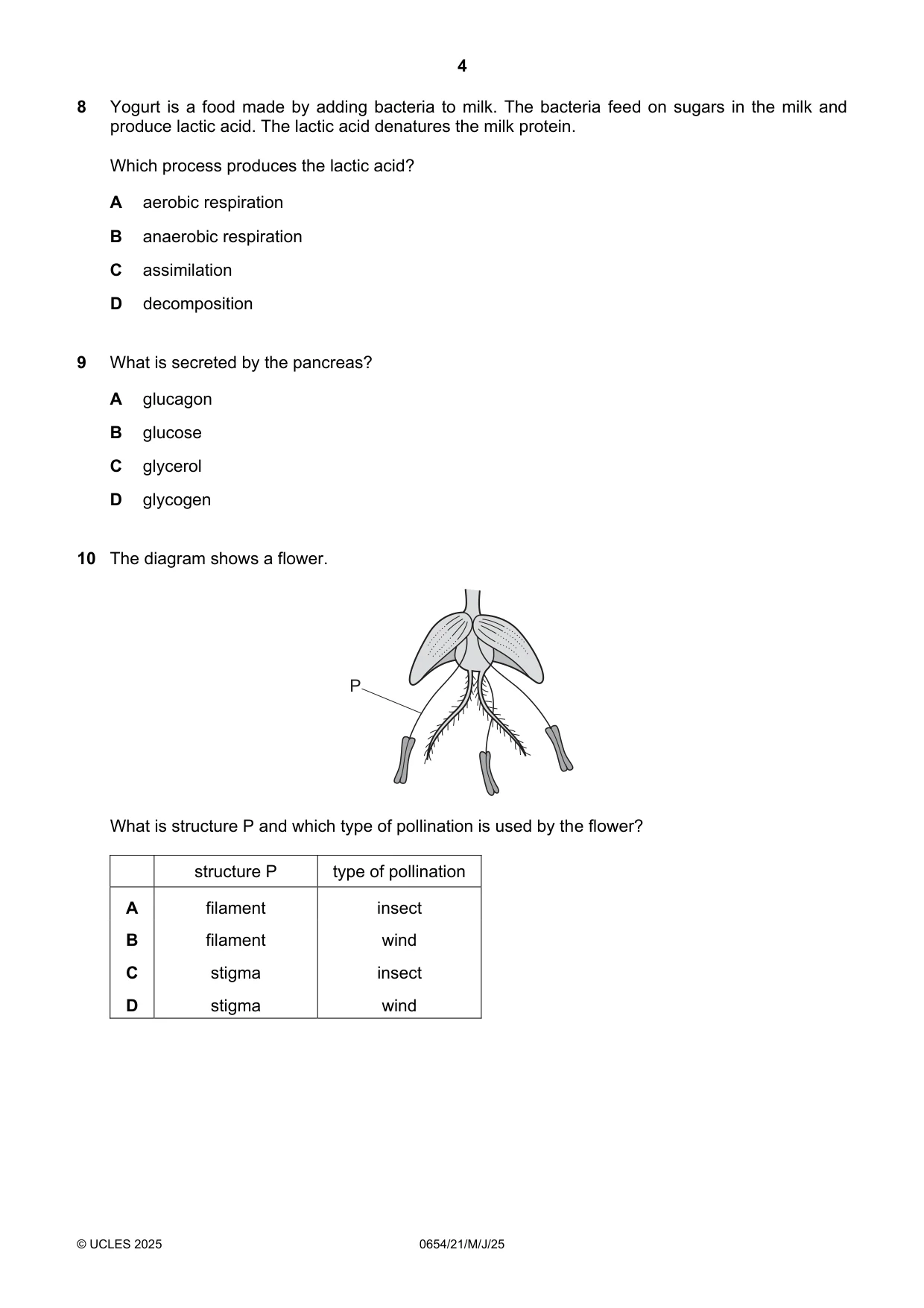
Q10 · The diagram shows a flower
10 The diagram shows a flower. P What is structure P and which type of pollination is used by the flower? structure P type of pollination A filament insect B filament wind C stigma insect D stigma wind
Mark scheme: B
Q11 · Polydactyly is the possession of additional fingers or toes
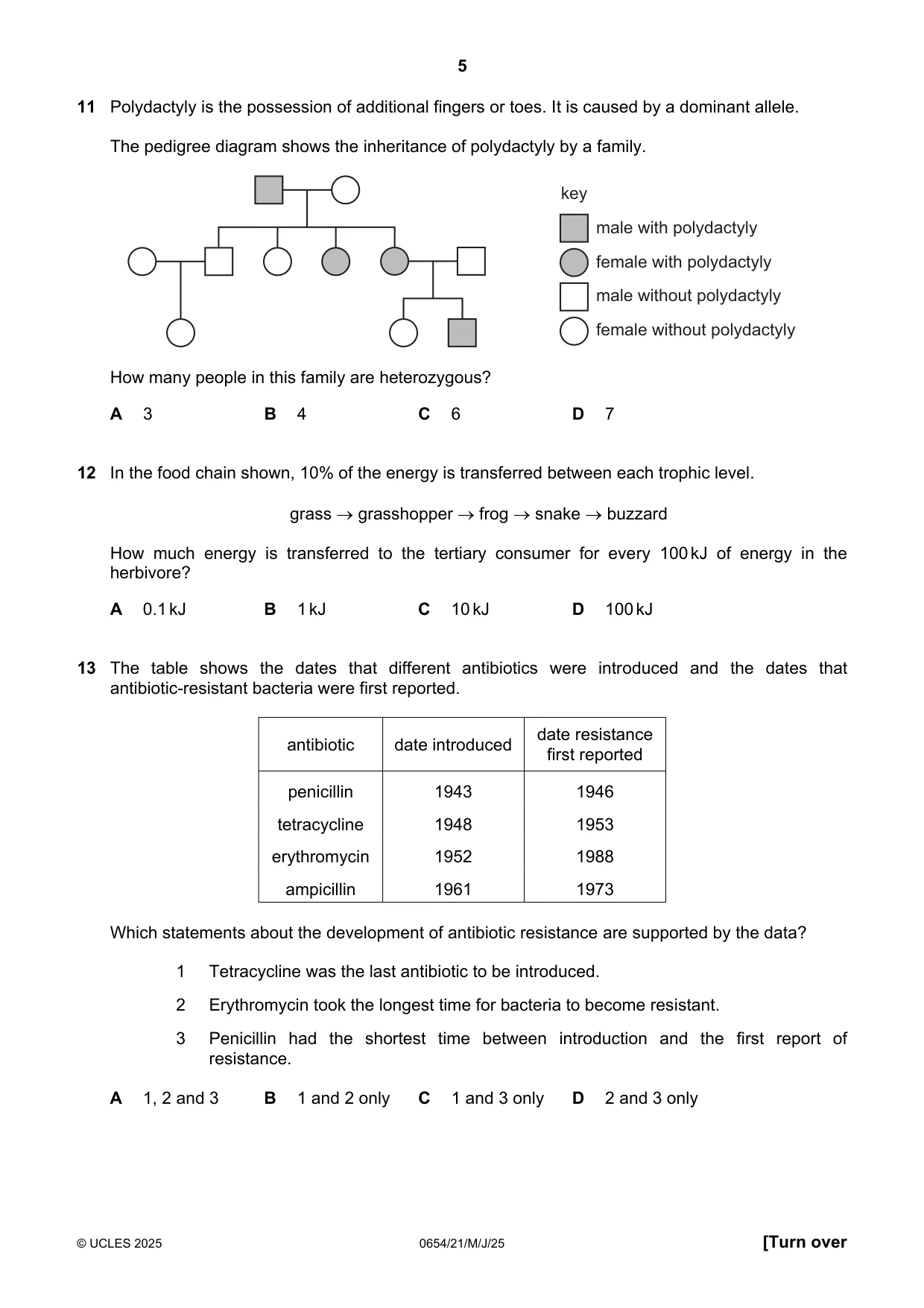
11 Polydactyly is the possession of additional fingers or toes. It is caused by a dominant allele. The pedigree diagram shows the inheritance of polydactyly by a family. key male with polydactyly female with polydactyly male without polydactyly female without polydactyly How many people in this family are heterozygous? A 3 B 4 C 6 D 7
Mark scheme: B
Q12 · In the food chain shown, 10% of the energy is transferred between each trophic level
12 In the food chain shown, 10% of the energy is transferred between each trophic level. grass grasshopper frog snake buzzard How much energy is transferred to the tertiary consumer for every 100 kJ of energy in the herbivore? A 0.1 kJ B 1 kJ C 10 kJ D 100 kJ
Mark scheme: B
Q13 · The table shows the dates that different antibiotics were introduced and the dates that…
13 The table shows the dates that different antibiotics were introduced and the dates that antibiotic-resistant bacteria were first reported. date resistance antibiotic date introduced first reported penicillin 1943 1946 tetracycline 1948 1953 erythromycin 1952 1988 ampicillin 1961 1973 Which statements about the development of antibiotic resistance are supported by the data? 1 Tetracycline was the last antibiotic to be introduced. 2 Erythromycin took the longest time for bacteria to become resistant. 3 Penicillin had the shortest time between introduction and the first report of resistance. A 1, 2 and 3 B 1 and 2 only C 1 and 3 only D 2 and 3 only
Mark scheme: D
Q14 · Which graph shows the temperature change when an impure, solid substance is heated?
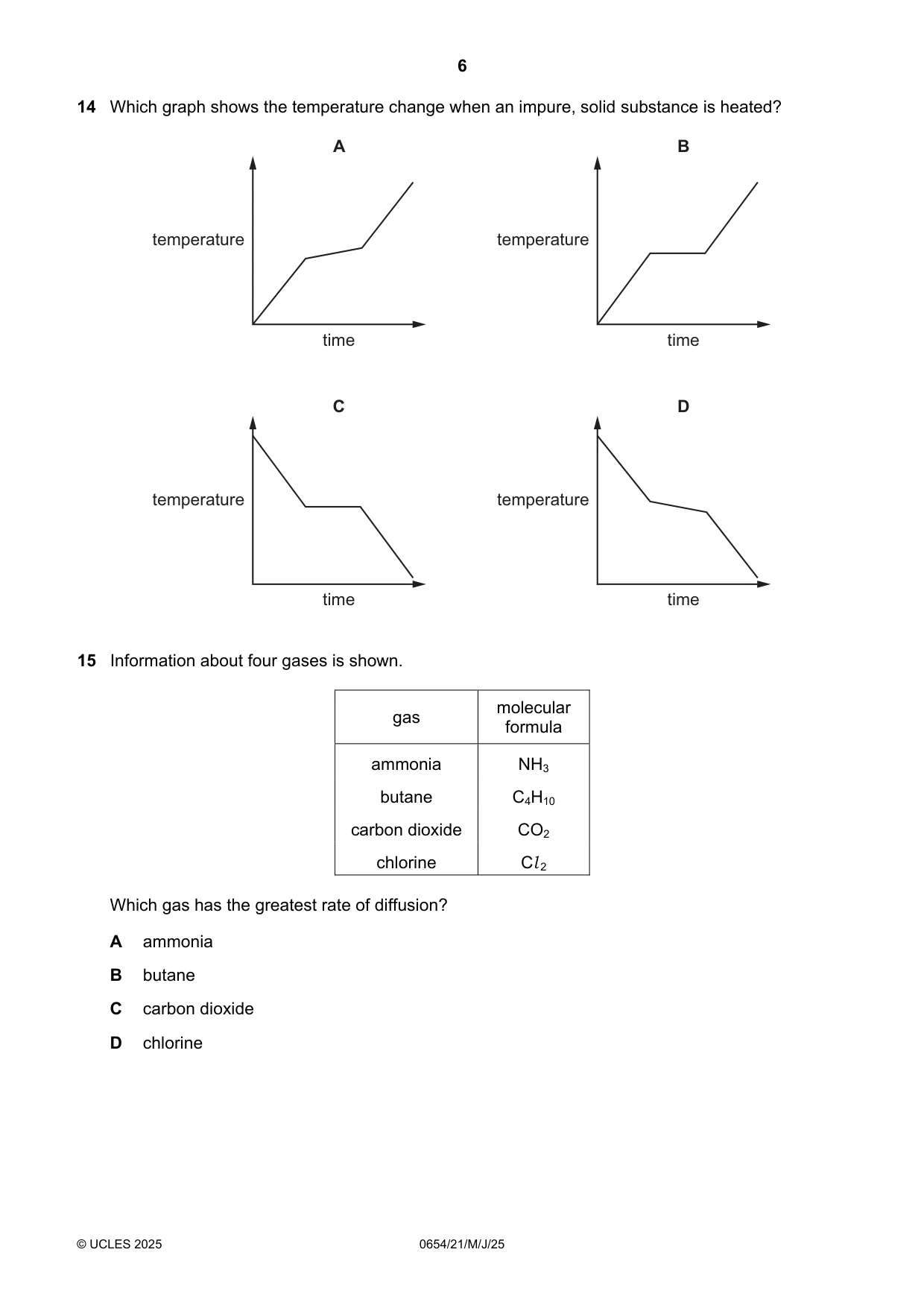
14 Which graph shows the temperature change when an impure, solid substance is heated? A B temperature temperature time time C D temperature temperature time time
Mark scheme: A
Q15 · Information about four gases is shown
15 Information about four gases is shown. molecular gas formula ammonia NH3 butane C4H10 carbon dioxide CO2 chlorine Cl 2 Which gas has the greatest rate of diffusion? A ammonia B butane C carbon dioxide D chlorine
Mark scheme: A
Q16 · The electronic configurations of four particles are shown
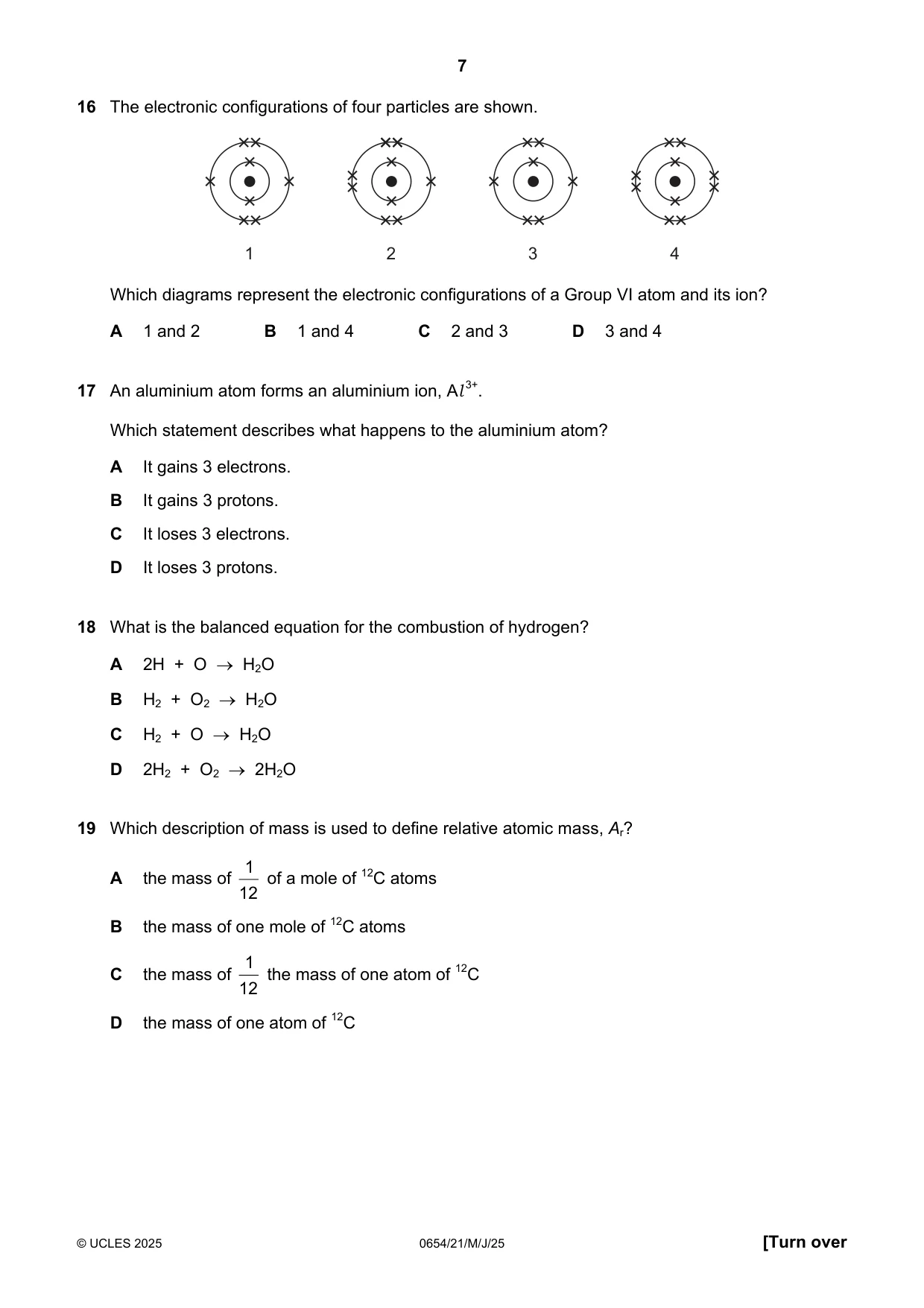
16 The electronic configurations of four particles are shown. 1 2 3 4 Which diagrams represent the electronic configurations of a Group VI atom and its ion? A 1 and 2 B 1 and 4 C 2 and 3 D 3 and 4
Mark scheme: B
Q17 · An aluminium atom forms an aluminium ion, Al 3+
17 An aluminium atom forms an aluminium ion, Al 3+. Which statement describes what happens to the aluminium atom? A It gains 3 electrons. B It gains 3 protons. C It loses 3 electrons. D It loses 3 protons.
Mark scheme: C
Q18 · What is the balanced equation for the combustion of hydrogen?
18 What is the balanced equation for the combustion of hydrogen? A 2H + O H2O B H2 + O2 H2O C H2 + O H2O D 2H2 + O2 2H2O
Mark scheme: D
Q19 · Which description of mass is used to define relative atomic mass, Ar?
19 Which description of mass is used to define relative atomic mass, Ar? 1 of a mole of 12C atoms A the mass of 12 B the mass of one mole of 12C atoms 1 the mass of one atom of 12C C the mass of 12 D the mass of one atom of 12C
Mark scheme: C
Q20 · Which quantities, when measured at room temperature and pressure, contain one mole of…
20 Which quantities, when measured at room temperature and pressure, contain one mole of oxygen molecules? 1 16 g of oxygen molecules 2 12 dm3 of oxygen molecules 3 the Avogadro constant number of oxygen molecules 4 24 dm3 of oxygen molecules A 1 and 2 B 1 and 4 C 2 and 3 D 3 and 4
Mark scheme: D
Q21 · Which gas is formed at the cathode during electrolysis?
21 Which gas is formed at the cathode during electrolysis? A carbon dioxide B chlorine C hydrogen D oxygen
Mark scheme: C
Q22 · A reaction pathway diagram for a reaction is shown
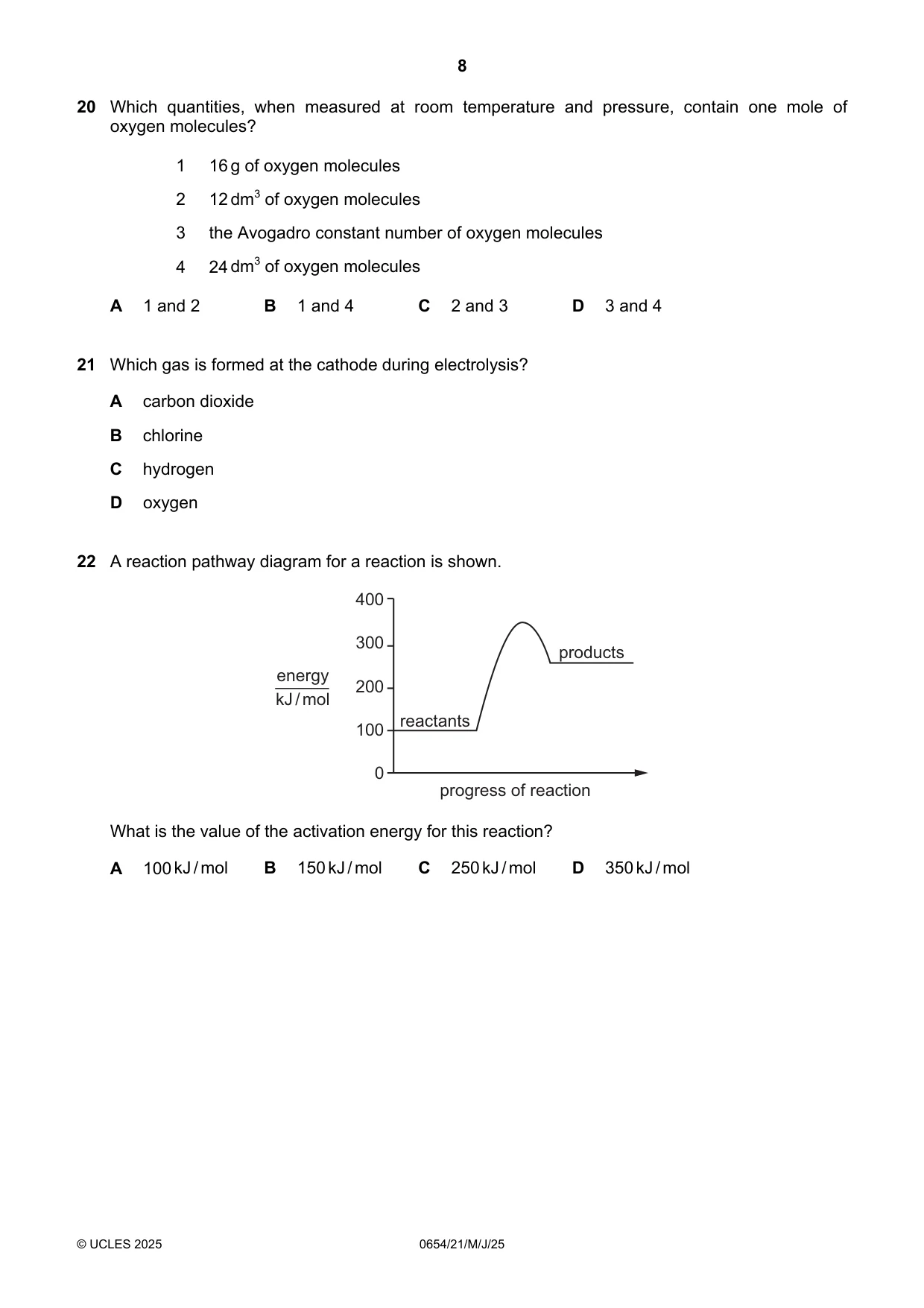
22 A reaction pathway diagram for a reaction is shown. 400 300 products energy 200 kJ / mol reactants 100 0 progress of reaction What is the value of the activation energy for this reaction? A 100 kJ / mol B 150 kJ / mol C 250 kJ / mol D 350 kJ / mol
Mark scheme: C
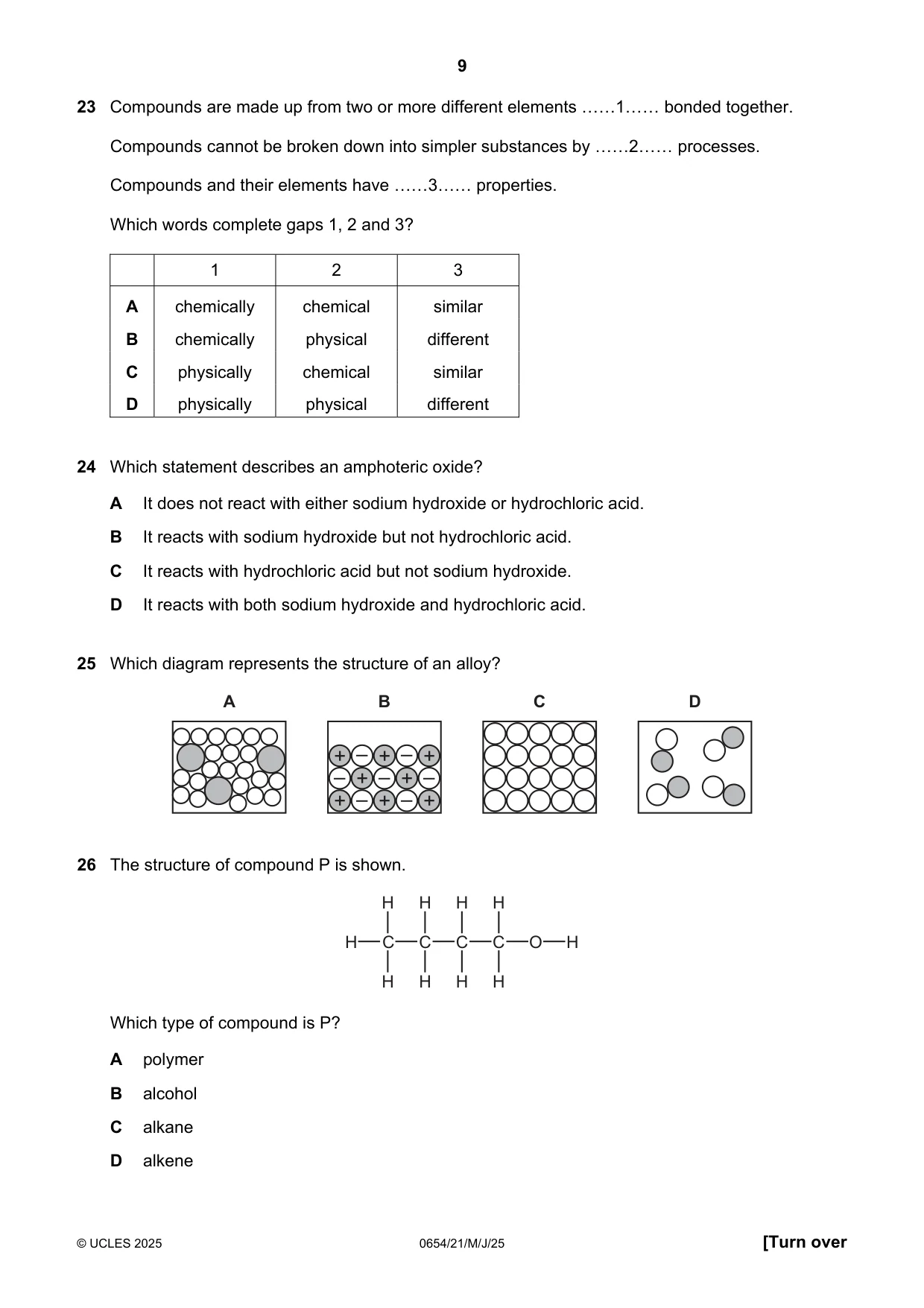
Q23 · Compounds are made up from two or more different elements ……1…… bonded together
23 Compounds are made up from two or more different elements ……1…… bonded together. Compounds cannot be broken down into simpler substances by ……2…… processes. Compounds and their elements have ……3…… properties. Which words complete gaps 1, 2 and 3? 1 2 3 A chemically chemical similar B chemically physical different C physically chemical similar D physically physical different
Mark scheme: B
Q24 · Which statement describes an amphoteric oxide?
24 Which statement describes an amphoteric oxide? A It does not react with either sodium hydroxide or hydrochloric acid. B It reacts with sodium hydroxide but not hydrochloric acid. C It reacts with hydrochloric acid but not sodium hydroxide. D It reacts with both sodium hydroxide and hydrochloric acid.
Mark scheme: D
Q25 · Which diagram represents the structure of an alloy?
25 Which diagram represents the structure of an alloy? A B C D + – + – + – + – + – + – + – +
Mark scheme: A
Q26 · The structure of compound P is shown
26 The structure of compound P is shown. H H H H H C C C C O H H H H H Which type of compound is P? A polymer B alcohol C alkane D alkene
Mark scheme: B
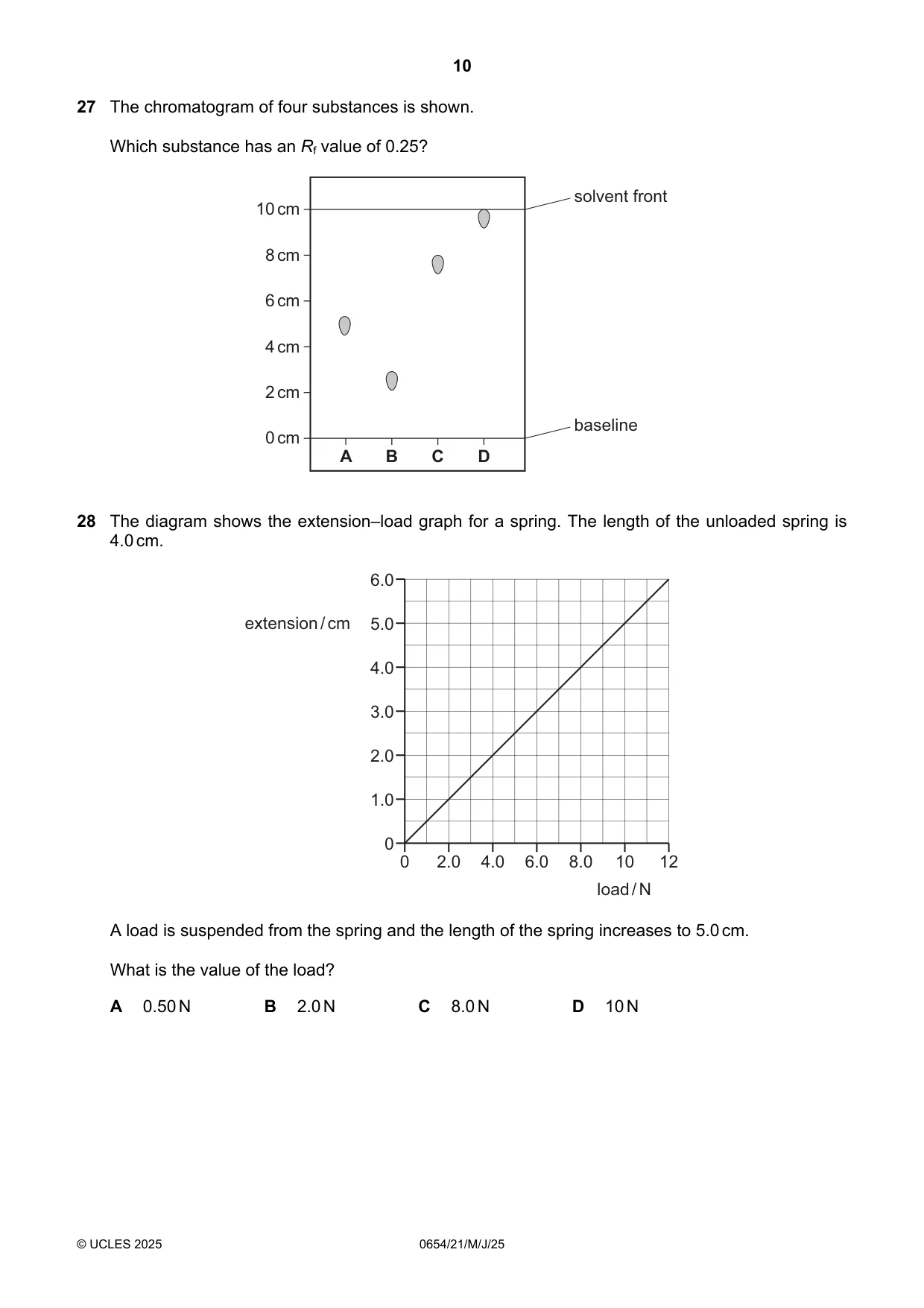
Q27 · The chromatogram of four substances is shown
27 The chromatogram of four substances is shown. Which substance has an Rf value of 0.25? solvent front 10 cm 8 cm 6 cm 4 cm 2 cm baseline 0 cm A B C D
Mark scheme: B
Q28 · The diagram shows the extension–load graph for a spring
28 The diagram shows the extension–load graph for a spring. The length of the unloaded spring is 4.0 cm. 6.0 extension / cm 5.0 4.0 3.0 2.0 1.0 0 0 2.0 4.0 6.0 8.0 10 12 load / N A load is suspended from the spring and the length of the spring increases to 5.0 cm. What is the value of the load? A 0.50 N B 2.0 N C 8.0 N D 10 N
Mark scheme: B
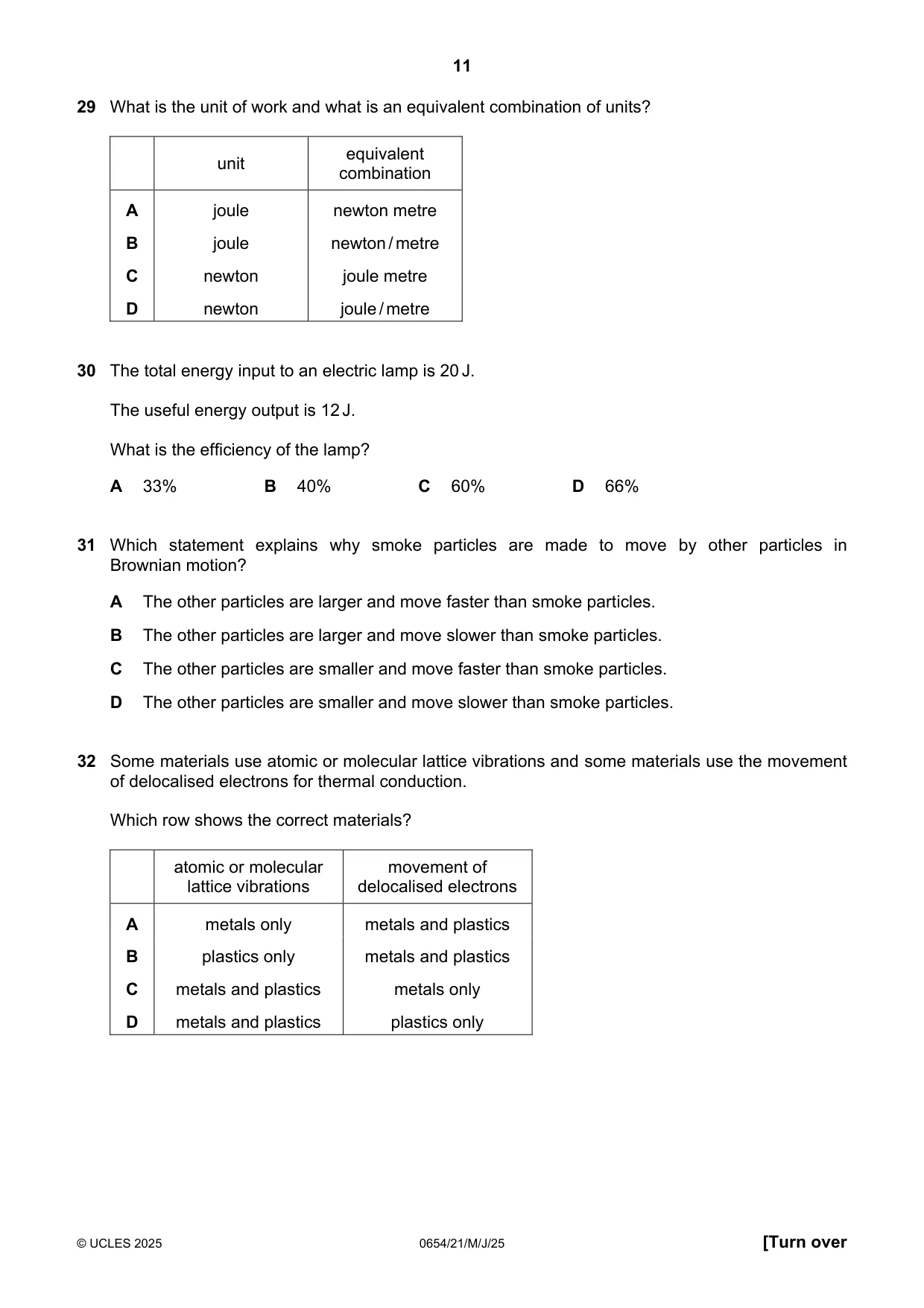
Q29 · What is the unit of work and what is an equivalent combination of units?
29 What is the unit of work and what is an equivalent combination of units? equivalent unit combination A joule newton metre B joule newton / metre C newton joule metre D newton joule / metre
Mark scheme: A
Q30 · The total energy input to an electric lamp is 20 J
30 The total energy input to an electric lamp is 20 J. The useful energy output is 12 J. What is the efficiency of the lamp? A 33% B 40% C 60% D 66%
Mark scheme: C
Q31 · Which statement explains why smoke particles are made to move by other particles in…
31 Which statement explains why smoke particles are made to move by other particles in Brownian motion? A The other particles are larger and move faster than smoke particles. B The other particles are larger and move slower than smoke particles. C The other particles are smaller and move faster than smoke particles. D The other particles are smaller and move slower than smoke particles.
Mark scheme: C
Q32 · Some materials use atomic or molecular lattice vibrations and some materials use the…
32 Some materials use atomic or molecular lattice vibrations and some materials use the movement of delocalised electrons for thermal conduction. Which row shows the correct materials? atomic or molecular movement of lattice vibrations delocalised electrons A metals only metals and plastics B plastics only metals and plastics C metals and plastics metals only D metals and plastics plastics only
Mark scheme: C
Q33 · Which surface is the best absorber of thermal radiation?
33 Which surface is the best absorber of thermal radiation? A dull black B dull white C shiny black D shiny white
Mark scheme: A
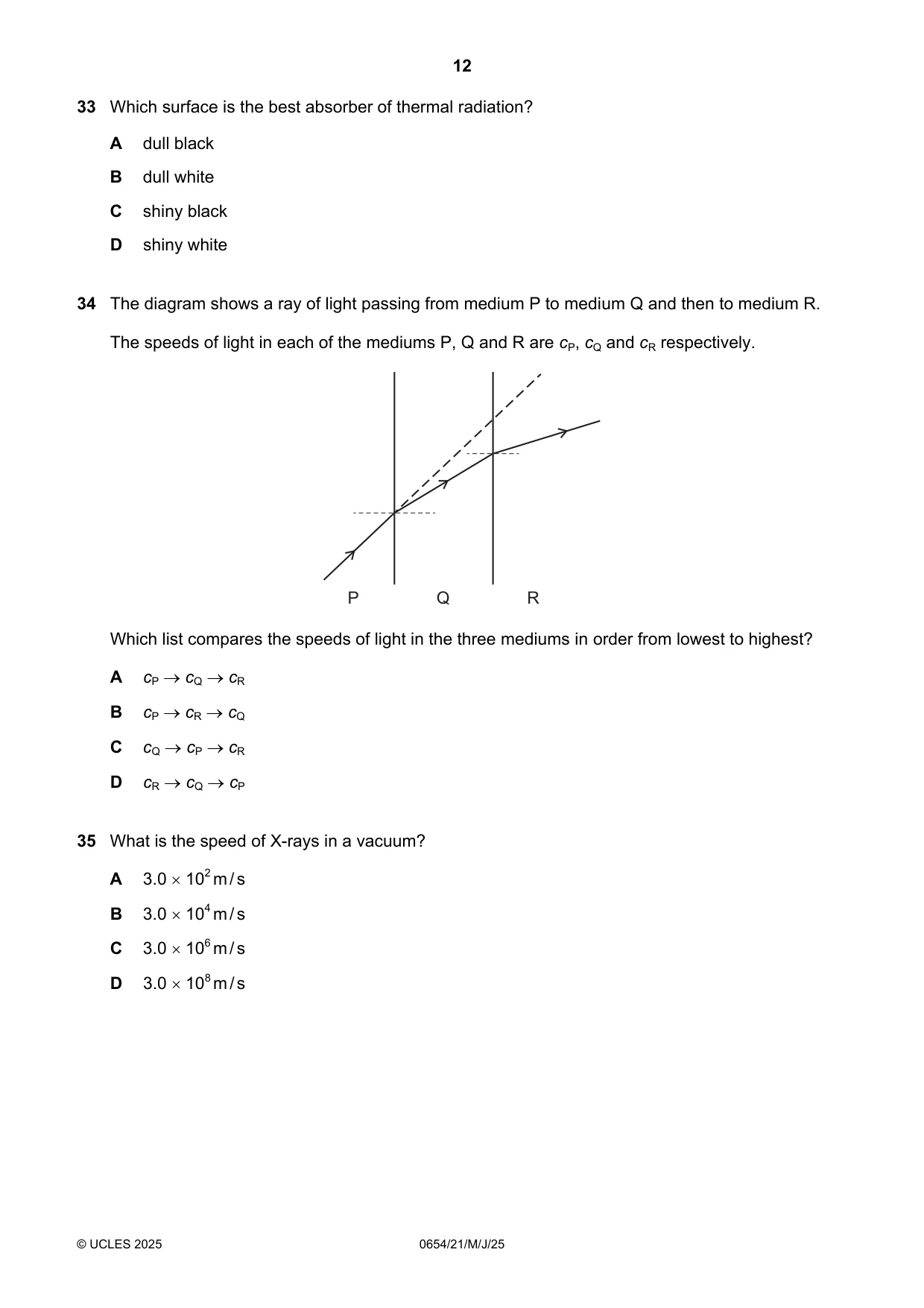
Q34 · The diagram shows a ray of light passing from medium P to medium Q and then to medium R
34 The diagram shows a ray of light passing from medium P to medium Q and then to medium R. The speeds of light in each of the mediums P, Q and R are cP, cQ and cR respectively. P Q R Which list compares the speeds of light in the three mediums in order from lowest to highest? A cP cQ cR B cP cR cQ C cQ cP cR D cR cQ cP
Mark scheme: D
Q35 · What is the speed of X-rays in a vacuum?
35 What is the speed of X-rays in a vacuum? A 3.0 102 m / s B 3.0 104 m / s C 3.0 106 m / s D 3.0 108 m / s
Mark scheme: D
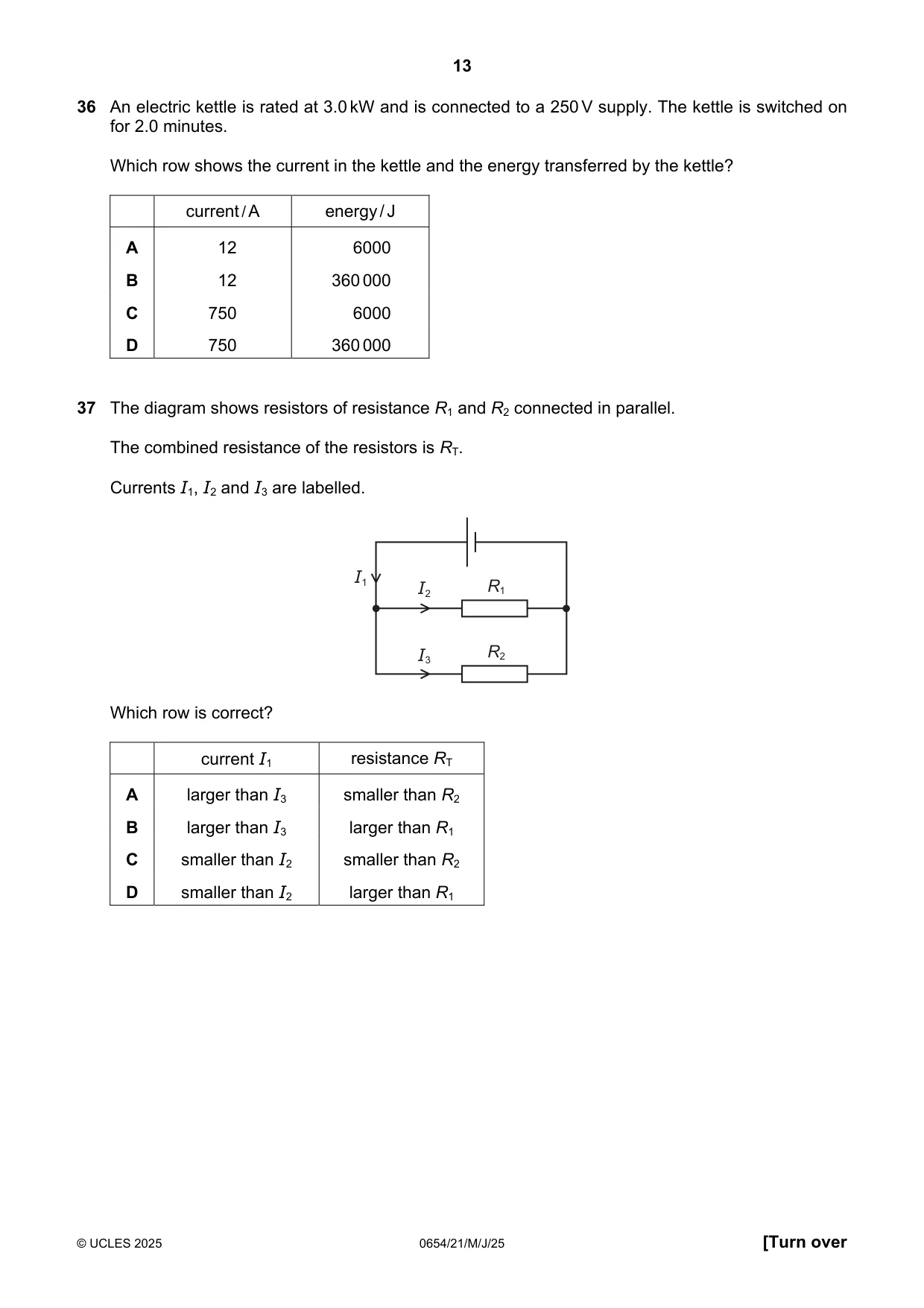
Q36 · An electric kettle is rated at 3.0 kW and is connected to a 250 V supply
36 An electric kettle is rated at 3.0 kW and is connected to a 250 V supply. The kettle is switched on for 2.0 minutes. Which row shows the current in the kettle and the energy transferred by the kettle? current / A energy / J A 12 6000 B 12 360 000 C 750 6000 D 750 360 000
Mark scheme: B
Q37 · The diagram shows resistors of resistance R1 and R2 connected in parallel
37 The diagram shows resistors of resistance R1 and R2 connected in parallel. The combined resistance of the resistors is RT. Currents I1, I2 and I3 are labelled. I1 I2 R1 I3 R2 Which row is correct? current I1 resistance RT A larger than I3 smaller than R2 B larger than I3 larger than R1 C smaller than I2 smaller than R2 D smaller than I2 larger than R1
Mark scheme: A
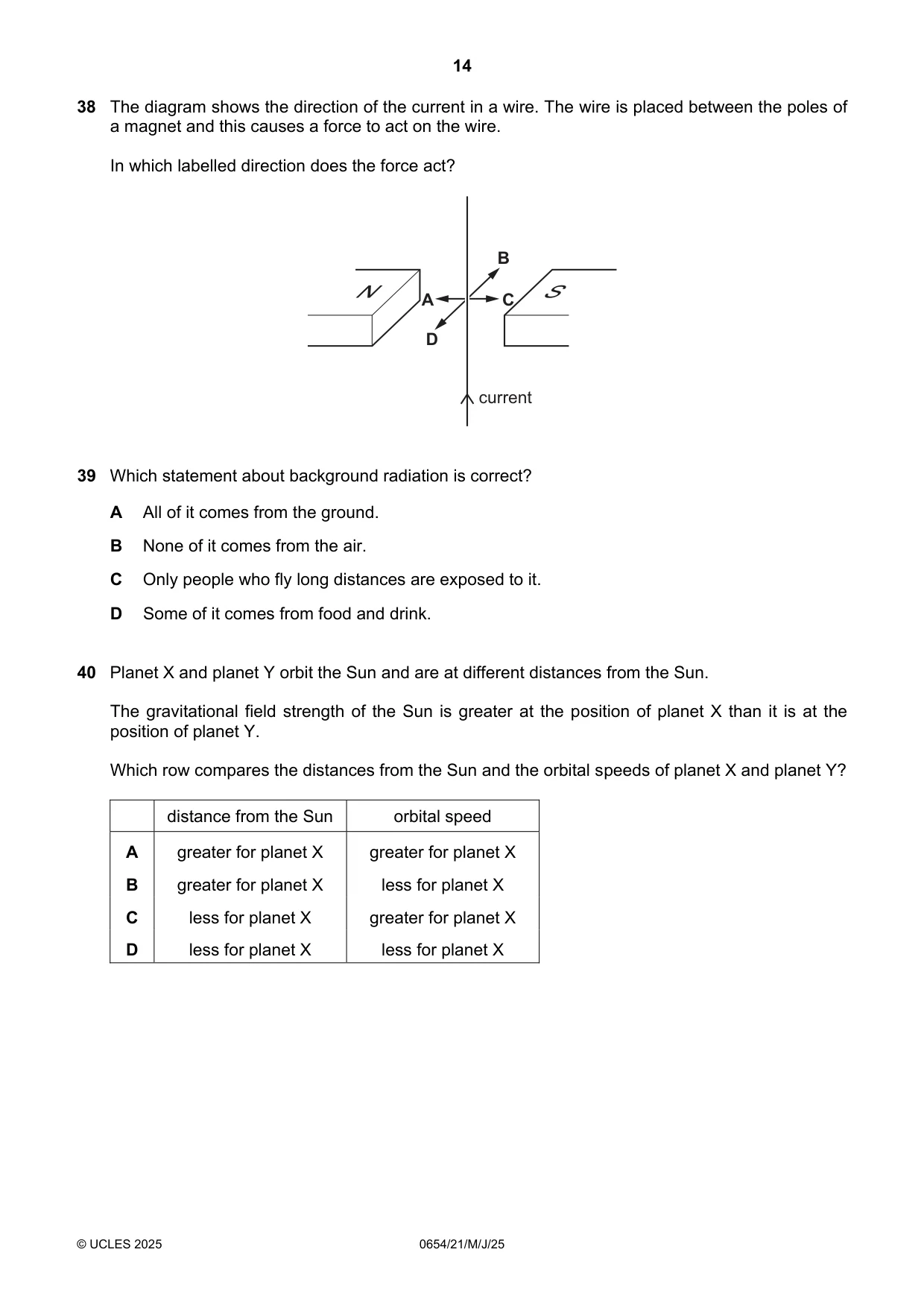
Q38 · The diagram shows the direction of the current in a wire
38 The diagram shows the direction of the current in a wire. The wire is placed between the poles of a magnet and this causes a force to act on the wire. In which labelled direction does the force act? B N A C S D current
Mark scheme: B
Q39 · Which statement about background radiation is correct?
39 Which statement about background radiation is correct? A All of it comes from the ground. B None of it comes from the air. C Only people who fly long distances are exposed to it. D Some of it comes from food and drink.
Mark scheme: D
Q40 · Planet X and planet Y orbit the Sun and are at different distances from the Sun
40 Planet X and planet Y orbit the Sun and are at different distances from the Sun. The gravitational field strength of the Sun is greater at the position of planet X than it is at the position of planet Y. Which row compares the distances from the Sun and the orbital speeds of planet X and planet Y? distance from the Sun orbital speed A greater for planet X greater for planet X B greater for planet X less for planet X C less for planet X greater for planet X D less for planet X less for planet X
Mark scheme: C
What was in this paper
The subtopics covered by these 40 questions, and how many questions each got. Open one in a new tab to see every Cambridge question on it.
2Energy, work and power2Transfer of thermal energy2Alcohols1Alloys and their properties1Atomic structure and the Periodic Table1Biological molecules1Characteristics of living organisms1Chromatography1Diffusion1Digestive system1Electrical circuits1Electrical quantities1Electrolysis1Electromagnetic effects1Electromagnetic spectrum1Elements, compounds and mixtures1Enzymes1Exothermic and endothermic reactions1Food chains and food webs1Forces1Formulas1Hormones1Ions and ionic bonds1Kinetic particle model of matter1Light1Monohybrid inheritance1Oxides1Physical and chemical changes1Radioactivity1Relative masses of atoms and molecules1Respiration1Selection1Sexual reproduction in plants1The mole and the Avogadro constant1The Solar System1Translocation1What you needed in this session
Cambridge’s own grade thresholds for 2025 May/June, Paper 2 · Variant 1. A higher threshold means an easier paper — the bar moves with how the cohort did.