Cambridge IGCSE Sciences - Co-ordinated (Double) 0654 — 2022 Feb/March Paper 2 · Variant 2
0654/22/F/M/22 · 40 questions · 40 marks · ≈45 min
The question paper and its mark scheme, free to read here and free to download. This is Cambridge’s own paper, exactly as it was sat.
Question paper20 pages

Mark scheme3 pages
Answers below. Sit the paper first if you are practising.
Questions as text
Q1 · Plant nutrition needs light and water
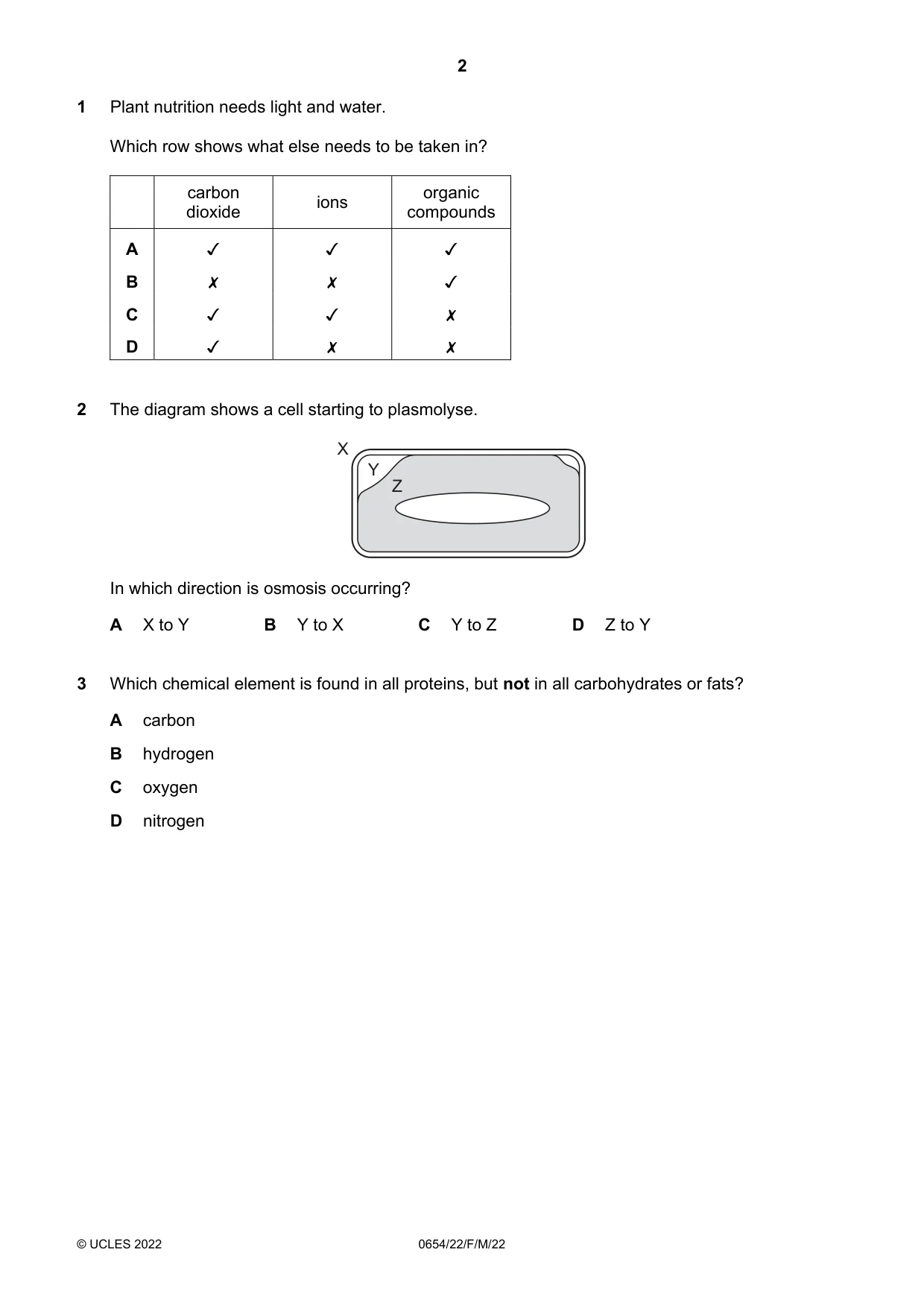
1 Plant nutrition needs light and water. Which row shows what else needs to be taken in? x v v carbon organic dioxide compounds v v v x x
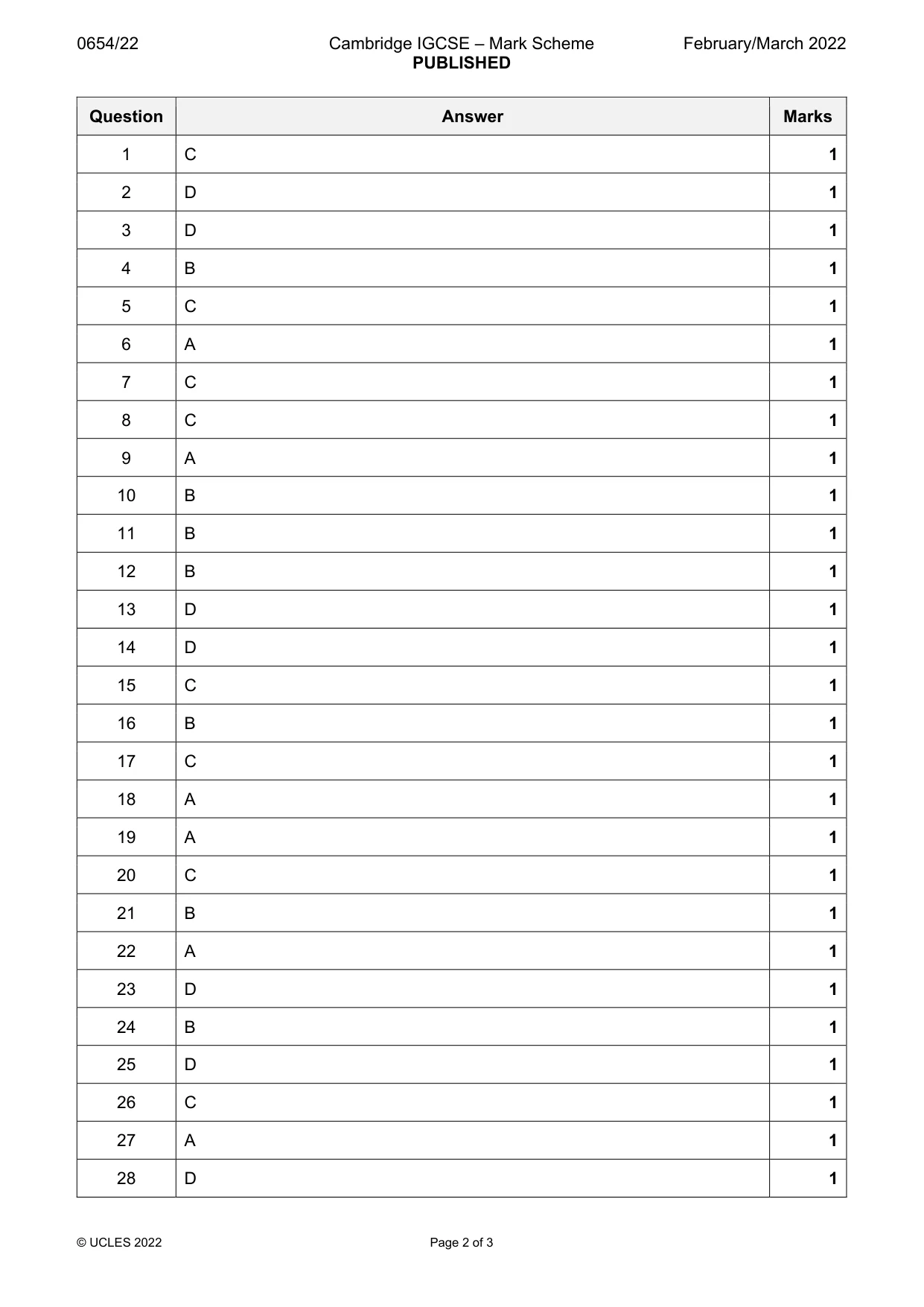
Mark scheme: C
Q2 · The diagram shows a cell starting to plasmolyse
2 The diagram shows a cell starting to plasmolyse. X Y Z In which direction is osmosis occurring? A X to Y B Y to X C Y to Z D Z to Y
Mark scheme: D
Q3 · Which chemical element is found in all proteins, but not in all carbohydrates or fats?
3 Which chemical element is found in all proteins, but not in all carbohydrates or fats? A carbon B hydrogen C oxygen D nitrogen
Mark scheme: D
Q4 · The Pompeii worm lives in deep-sea hydrothermal vents where average temperatures are…
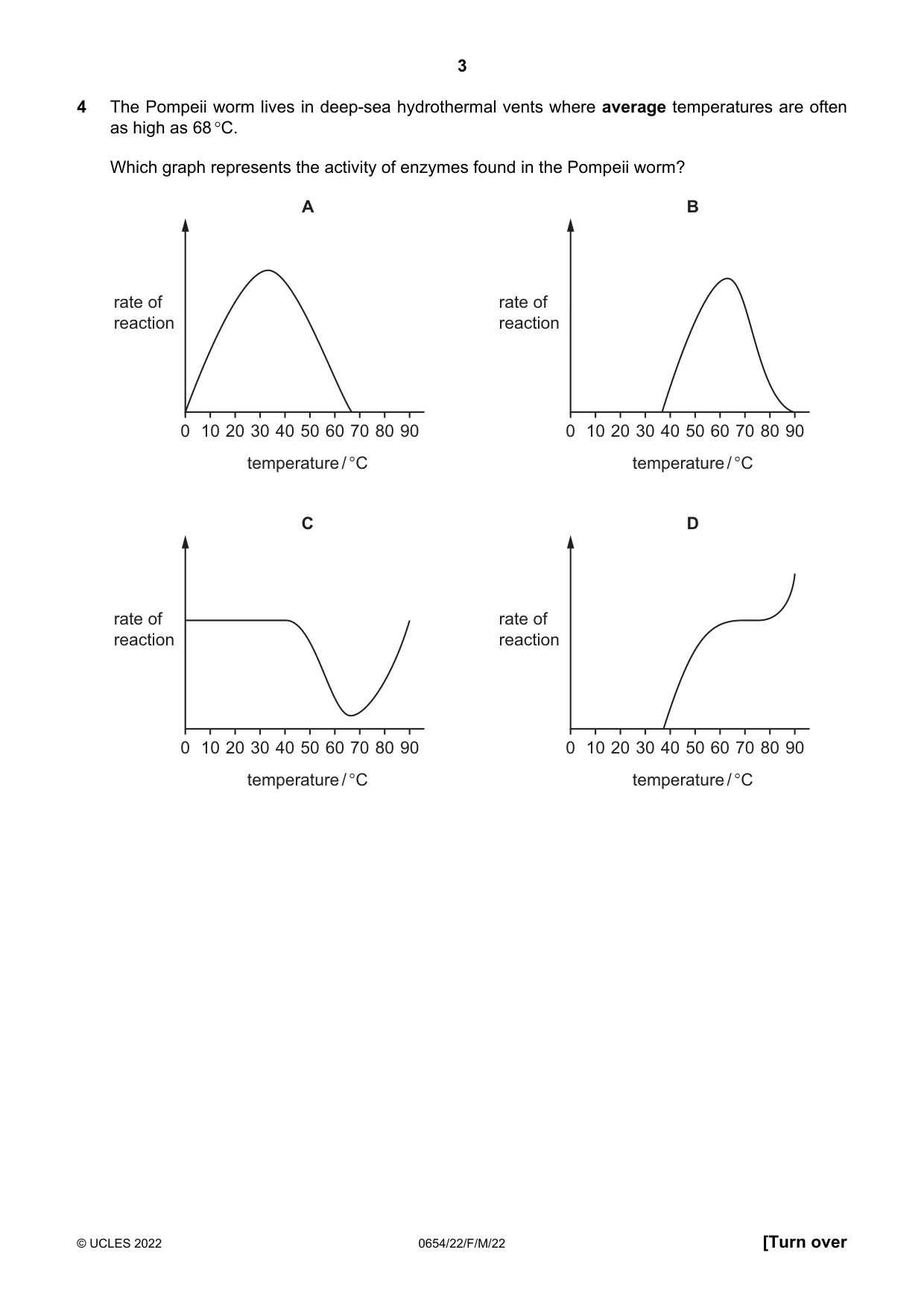
4 The Pompeii worm lives in deep-sea hydrothermal vents where average temperatures are often as high as 68 C. Which graph represents the activity of enzymes found in the Pompeii worm? A B rate of rate of reaction reaction 0 10 20 30 40 50 60 70 80 90 0 10 20 30 40 50 60 70 80 90 temperature / °C temperature / °C C D rate of rate of reaction reaction 0 10 20 30 40 50 60 70 80 90 0 10 20 30 40 50 60 70 80 90 temperature / °C temperature / °C
Mark scheme: B
Q5 · A plant has leaves which have white parts and green parts
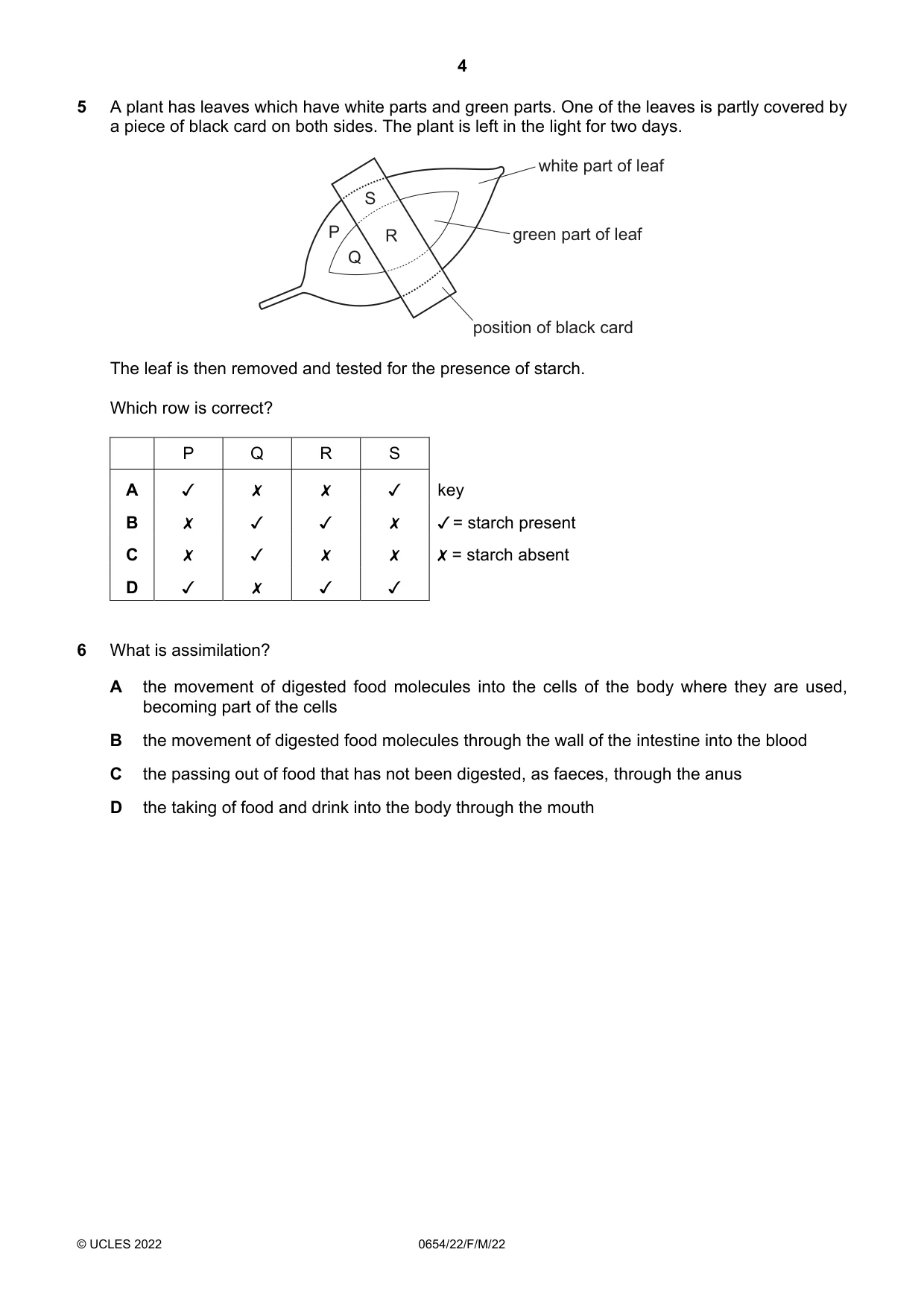
5 A plant has leaves which have white parts and green parts. One of the leaves is partly covered by a piece of black card on both sides. The plant is left in the light for two days. white part of leaf green part of leaf position of black card The leaf is then removed and tested for the presence of starch. Which row is correct? key /¥ = starch present X = starch absent 09 WD > \ & & \] TU x \ & «10 \ & \ x 1] \ & & \ ] Oo
Mark scheme: C
Question 6
6 What is assimilation? A the movement of digested food molecules into the cells of the body where they are used, becoming part of the cells B the movement of digested food molecules through the wall of the intestine into the blood C the passing out of food that has not been digested, as faeces, through the anus D the taking of food and drink into the body through the mouth
Mark scheme: A
Q7 · The diagram shows a plant shoot that is ringed
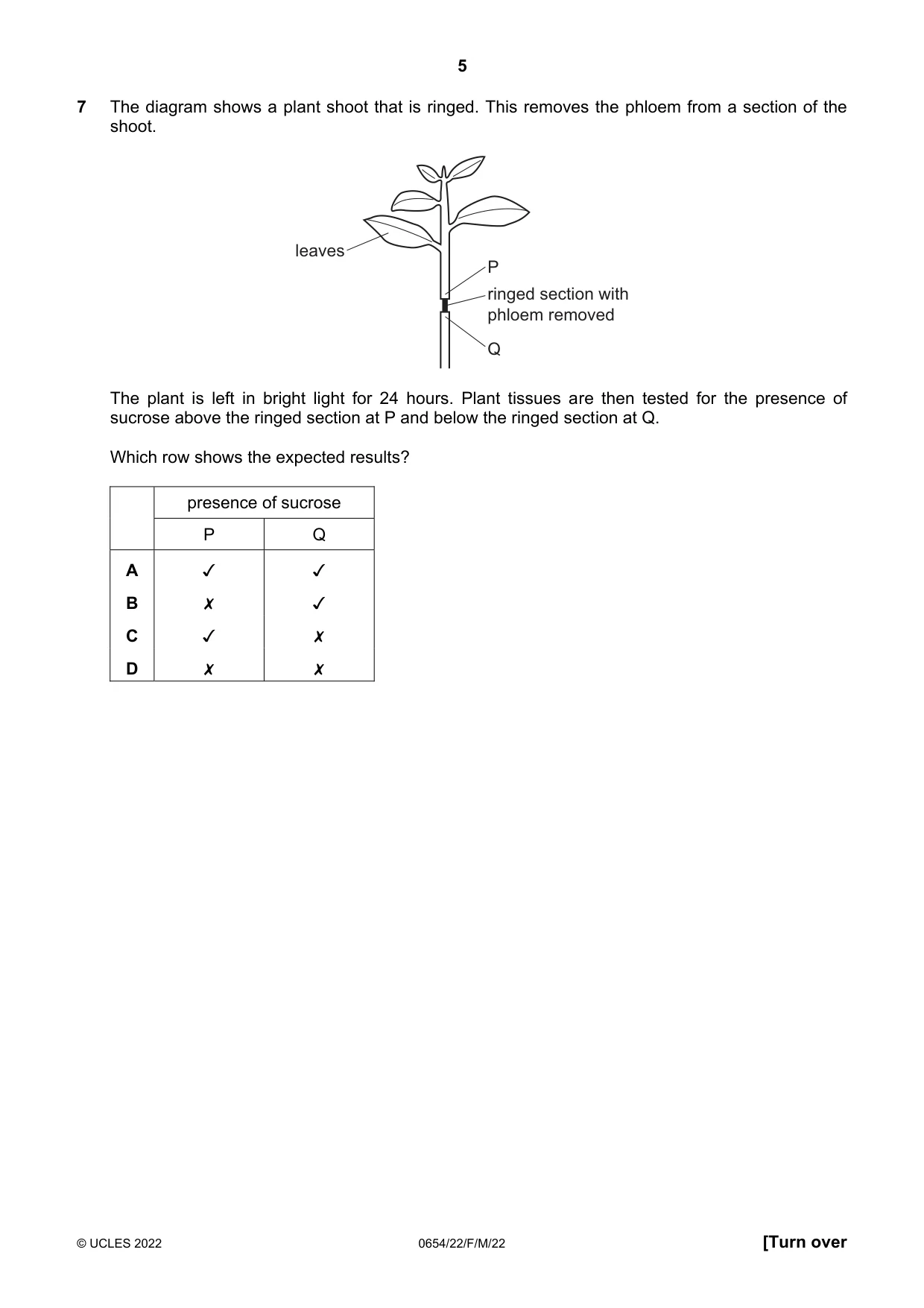
7 The diagram shows a plant shoot that is ringed. This removes the phloem from a section of the shoot. P ringed section with phloem removed Q The plant is left in bright light for 24 hours. Plant tissues are then tested for the presence of sucrose above the ringed section at P and below the ringed section at Q. Which row shows the expected results? presence of sucrose P Q
Mark scheme: C
Q8 · The diagram shows the main structures in the breathing system of humans
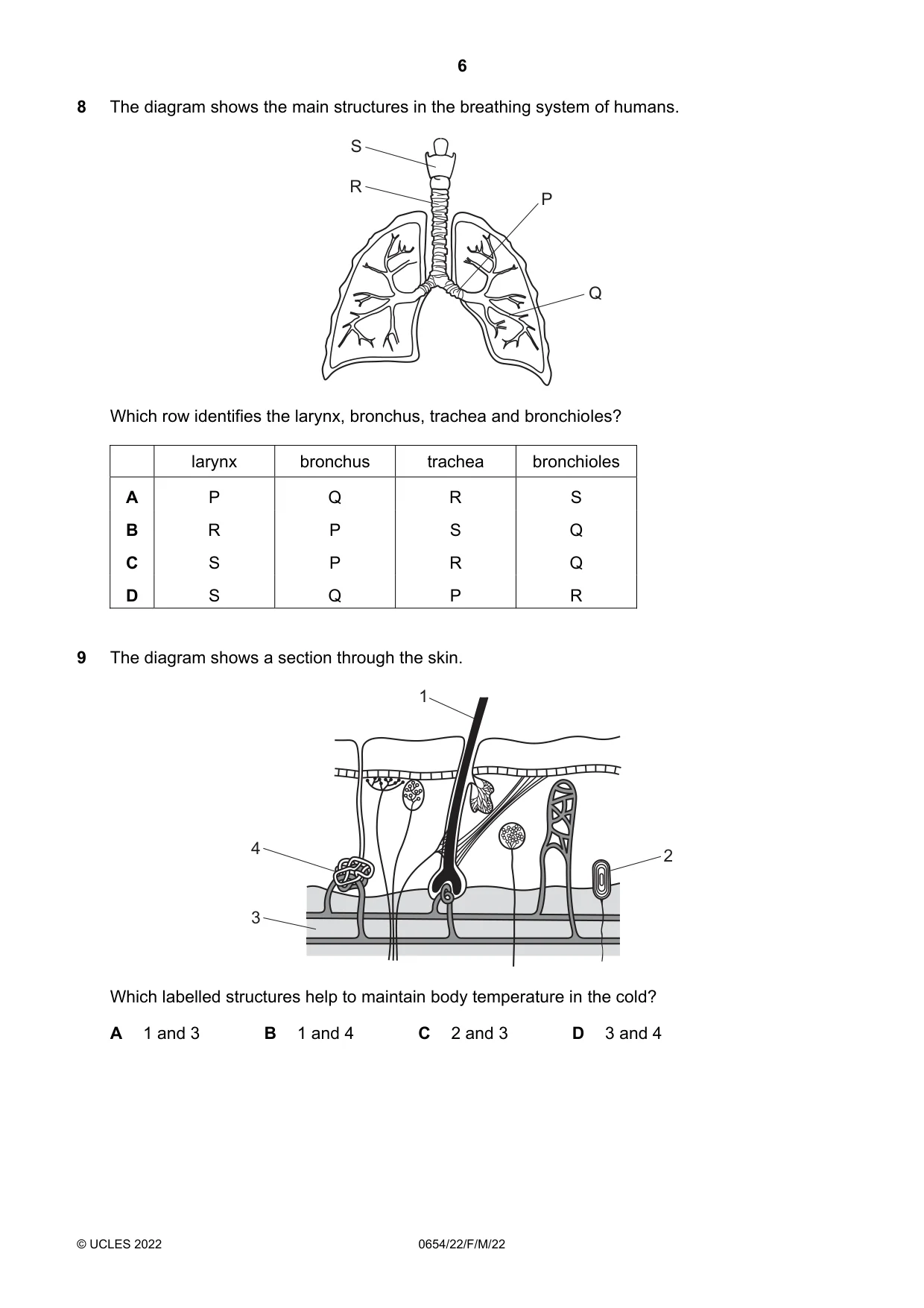
8 The diagram shows the main structures in the breathing system of humans. S R P Q Which row identifies the larynx, bronchus, trachea and bronchioles? larynx bronchus trachea bronchioles A P Q R S B R P S Q C S P R Q D S Q P R
Mark scheme: C
Q9 · The diagram shows a section through the skin
9 The diagram shows a section through the skin. 1 4 2 3 Which labelled structures help to maintain body temperature in the cold? A 1 and 3 B 1 and 4 C 2 and 3 D 3 and 4
Mark scheme: A
Q10 · Which statements correctly describe the human male gamete?
10 Which statements correctly describe the human male gamete? 1 contains enzymes 2 food stores present 3 flagellum present 4 surrounded by a jelly coating A 1 and 2 B 1 and 3 C 2 and 3 D 3 and 4
Mark scheme: B
Q11 · The table gives statements about a human haploid nucleus
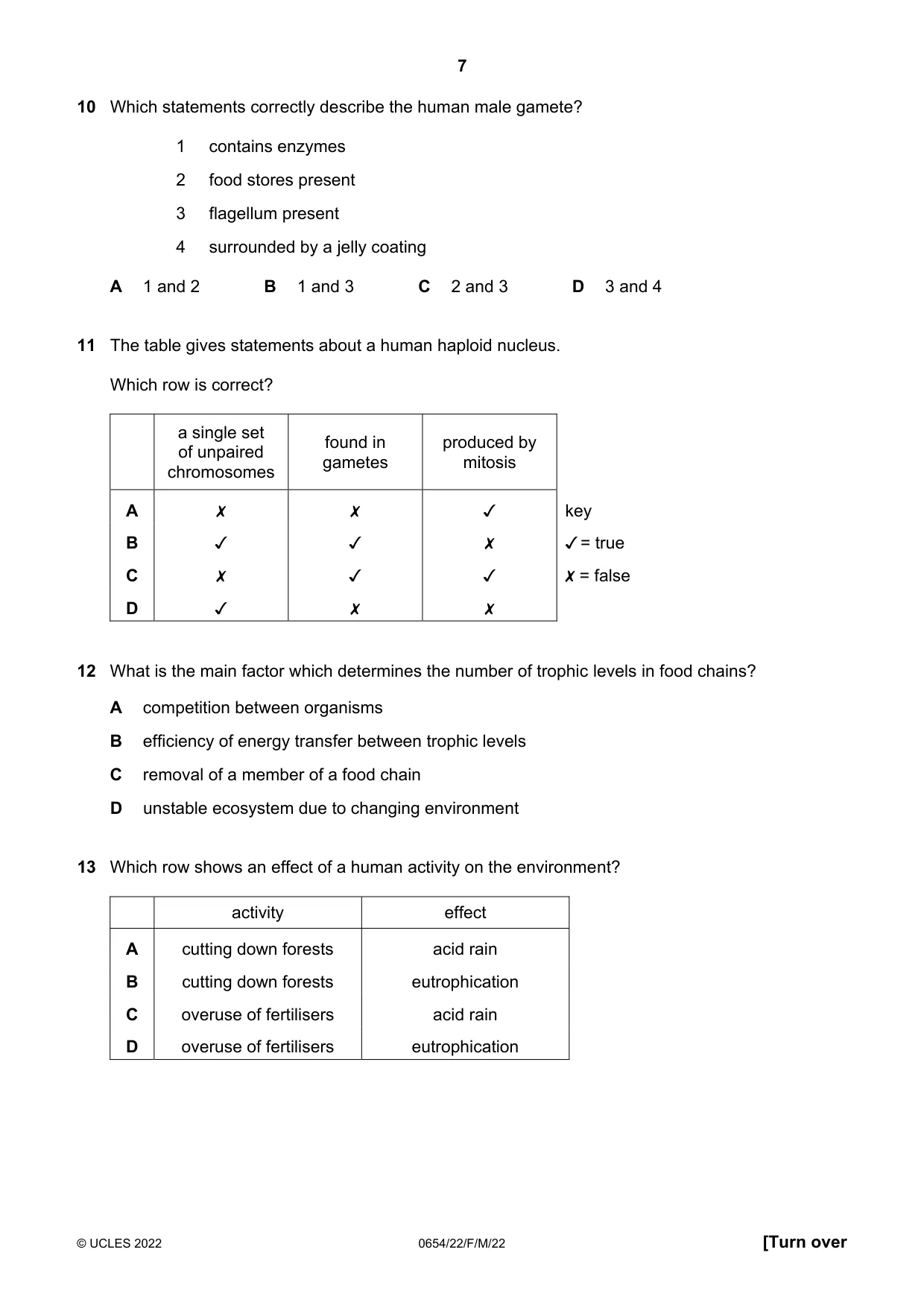
11 The table gives statements about a human haploid nucleus. Which row is correct? a single set of unpaired found in produced by chromosomes gametes mitosis A x x v key 6 v v x / = true c x v v X = false D WA x x
Mark scheme: B
Q12 · What is the main factor which determines the number of trophic levels in food chains?
12 What is the main factor which determines the number of trophic levels in food chains? A competition between organisms B efficiency of energy transfer between trophic levels C removal of a member of a food chain D unstable ecosystem due to changing environment
Mark scheme: B
Q13 · Which row shows an effect of a human activity on the environment?
13 Which row shows an effect of a human activity on the environment? activity effect A cutting down forests acid rain B cutting down forests eutrophication C overuse of fertilisers acid rain D overuse of fertilisers eutrophication
Mark scheme: D
Q14 · Substance P is separated into different parts using simple physical techniques
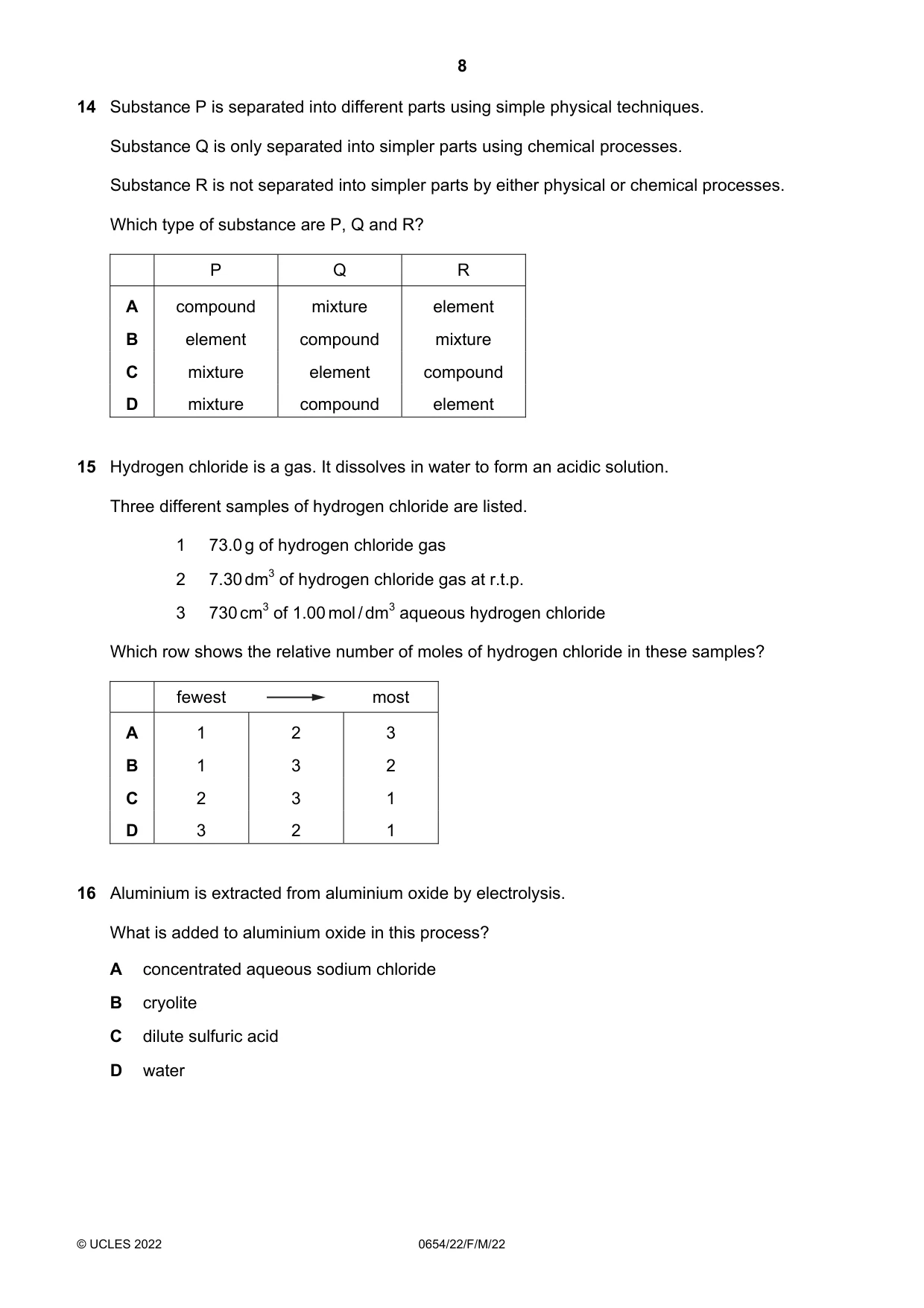
14 Substance P is separated into different parts using simple physical techniques. Substance Q is only separated into simpler parts using chemical processes. Substance R is not separated into simpler parts by either physical or chemical processes. Which type of substance are P, Q and R? P Q R A compound mixture element B element compound mixture C mixture element compound D mixture compound element
Mark scheme: D
Q15 · Hydrogen chloride is a gas
15 Hydrogen chloride is a gas. It dissolves in water to form an acidic solution. Three different samples of hydrogen chloride are listed. 1 73.0 g of hydrogen chloride gas 2 7.30 dm3 of hydrogen chloride gas at r.t.p. 3 730 cm3 of 1.00 mol / dm3 aqueous hydrogen chloride Which row shows the relative number of moles of hydrogen chloride in these samples? fewest most A 1 2 3 B 1 3 2 C 2 3 1 D 3 2 1
Mark scheme: C
Q16 · Aluminium is extracted from aluminium oxide by electrolysis
16 Aluminium is extracted from aluminium oxide by electrolysis. What is added to aluminium oxide in this process? A concentrated aqueous sodium chloride B cryolite C dilute sulfuric acid D water
Mark scheme: B
Q17 · Which statements about the reduction of copper(II) oxide by heating with carbon are…
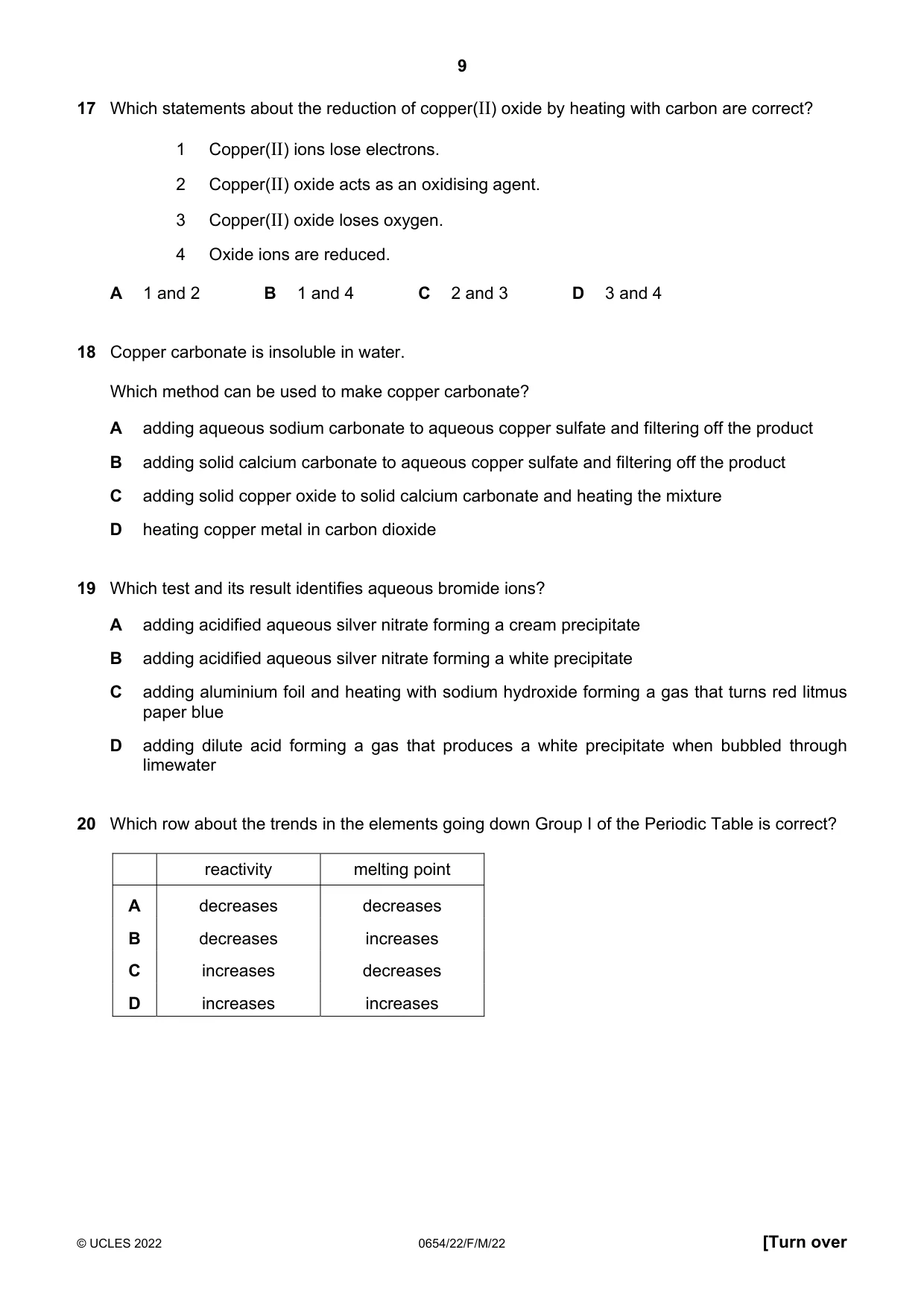
17 Which statements about the reduction of copper(II) oxide by heating with carbon are correct? 1 Copper(II) ions lose electrons. 2 Copper(II) oxide acts as an oxidising agent. 3 Copper(II) oxide loses oxygen. 4 Oxide ions are reduced. A 1 and 2 B 1 and 4 C 2 and 3 D 3 and 4
Mark scheme: C
Q18 · Copper carbonate is insoluble in water
18 Copper carbonate is insoluble in water. Which method can be used to make copper carbonate? A adding aqueous sodium carbonate to aqueous copper sulfate and filtering off the product B adding solid calcium carbonate to aqueous copper sulfate and filtering off the product C adding solid copper oxide to solid calcium carbonate and heating the mixture D heating copper metal in carbon dioxide
Mark scheme: A
Q19 · Which test and its result identifies aqueous bromide ions?
19 Which test and its result identifies aqueous bromide ions? A adding acidified aqueous silver nitrate forming a cream precipitate B adding acidified aqueous silver nitrate forming a white precipitate C adding aluminium foil and heating with sodium hydroxide forming a gas that turns red litmus paper blue D adding dilute acid forming a gas that produces a white precipitate when bubbled through limewater
Mark scheme: A
Q20 · Which row about the trends in the elements going down Group I of the Periodic Table is…
20 Which row about the trends in the elements going down Group I of the Periodic Table is correct? reactivity melting point A decreases decreases B decreases increases C increases decreases D increases increases
Mark scheme: C
Q21 · An airship containing an unreactive gas floats in air, as shown
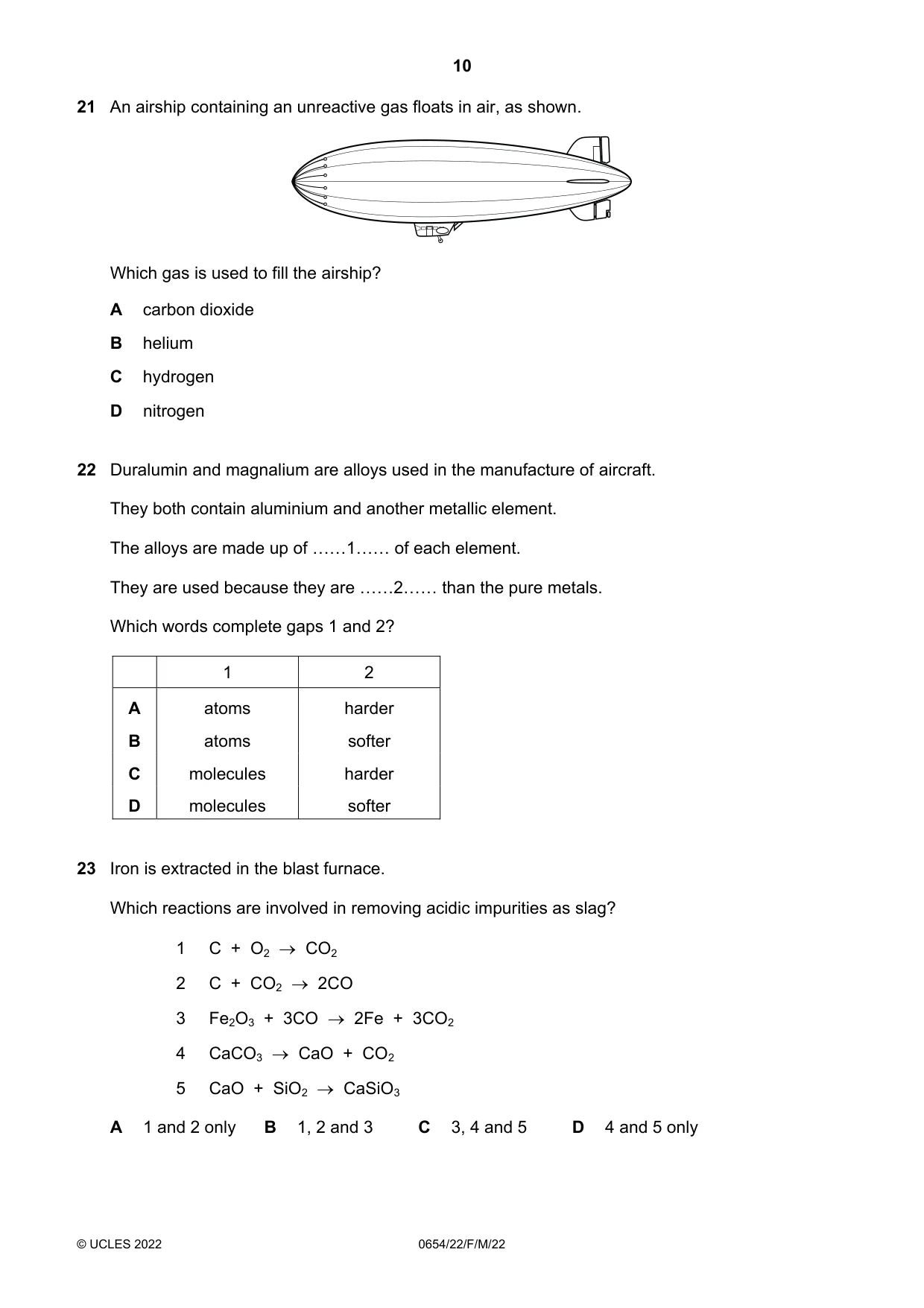
21 An airship containing an unreactive gas floats in air, as shown. Which gas is used to fill the airship? A carbon dioxide B helium C hydrogen D nitrogen
Mark scheme: B
Q22 · Duralumin and magnalium are alloys used in the manufacture of aircraft
22 Duralumin and magnalium are alloys used in the manufacture of aircraft. They both contain aluminium and another metallic element. The alloys are made up of ……1…… of each element. They are used because they are ……2…… than the pure metals. Which words complete gaps 1 and 2? 1 2 A atoms harder B atoms softer C molecules harder D molecules softer
Mark scheme: A
Q23 · Iron is extracted in the blast furnace
23 Iron is extracted in the blast furnace. Which reactions are involved in removing acidic impurities as slag? 1 C + O2 CO2 2 C + CO2 2CO 3 Fe2O3 + 3CO 2Fe + 3CO2 4 CaCO3 CaO + CO2 5 CaO + SiO2 CaSiO3 A 1 and 2 only B 1, 2 and 3 C 3, 4 and 5 D 4 and 5 only
Mark scheme: D
Q24 · Which statements about the reactions in a catalytic converter are correct?
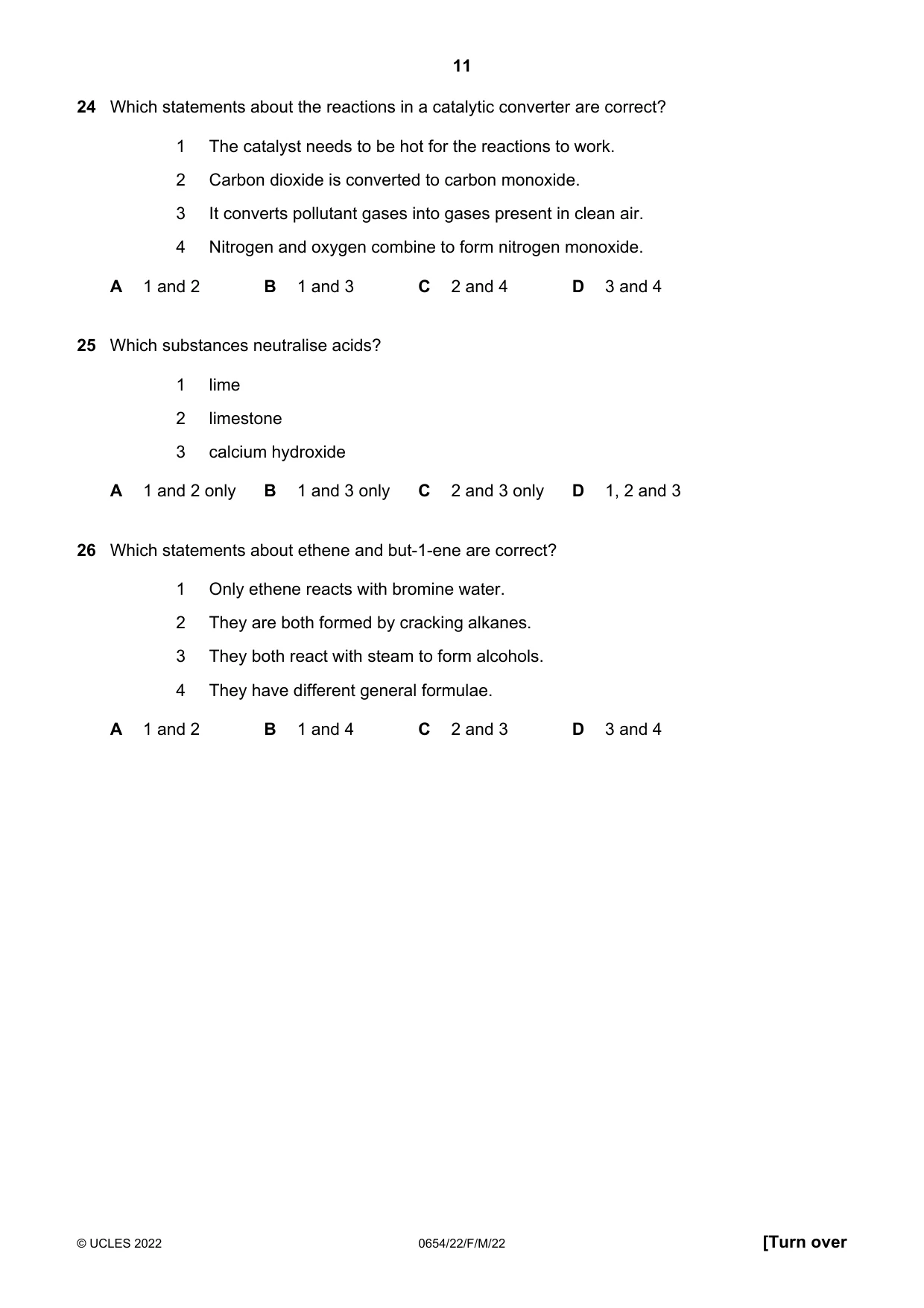
24 Which statements about the reactions in a catalytic converter are correct? 1 The catalyst needs to be hot for the reactions to work. 2 Carbon dioxide is converted to carbon monoxide. 3 It converts pollutant gases into gases present in clean air. 4 Nitrogen and oxygen combine to form nitrogen monoxide. A 1 and 2 B 1 and 3 C 2 and 4 D 3 and 4
Mark scheme: B
Q25 · Which substances neutralise acids?
25 Which substances neutralise acids? 1 lime 2 limestone 3 calcium hydroxide A 1 and 2 only B 1 and 3 only C 2 and 3 only D 1, 2 and 3
Mark scheme: D
More questions on The characteristic properties of acids and bases
Q26 · Which statements about ethene and but-1-ene are correct?
26 Which statements about ethene and but-1-ene are correct? 1 Only ethene reacts with bromine water. 2 They are both formed by cracking alkanes. 3 They both react with steam to form alcohols. 4 They have different general formulae. A 1 and 2 B 1 and 4 C 2 and 3 D 3 and 4
Mark scheme: C
Q27 · The flow chart shows some chemical substances and processes
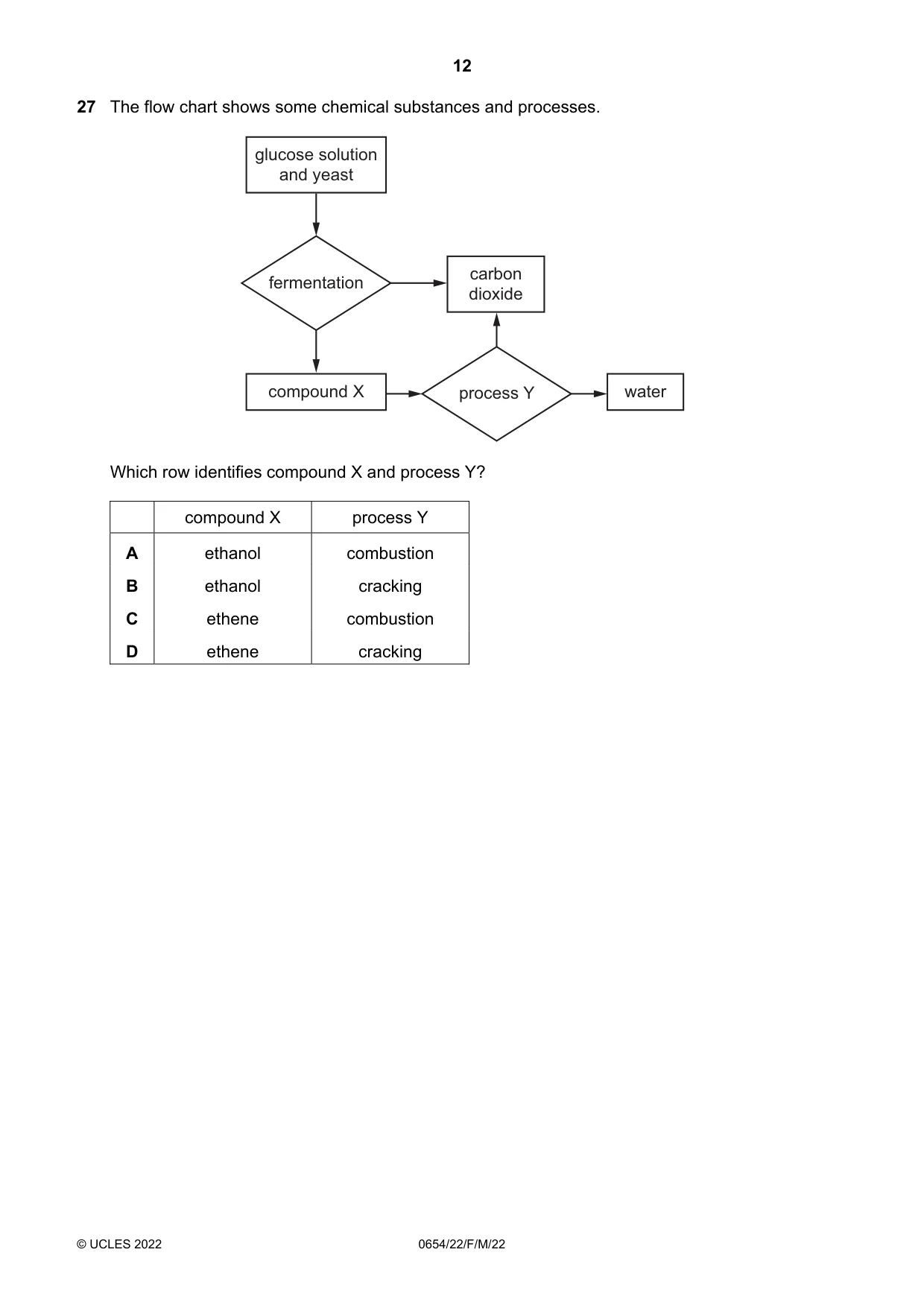
27 The flow chart shows some chemical substances and processes. glucose solution and yeast carbon fermentation dioxide compound X process Y water Which row identifies compound X and process Y? compound X process Y A ethanol combustion B ethanol cracking C ethene combustion D ethene cracking
Mark scheme: A
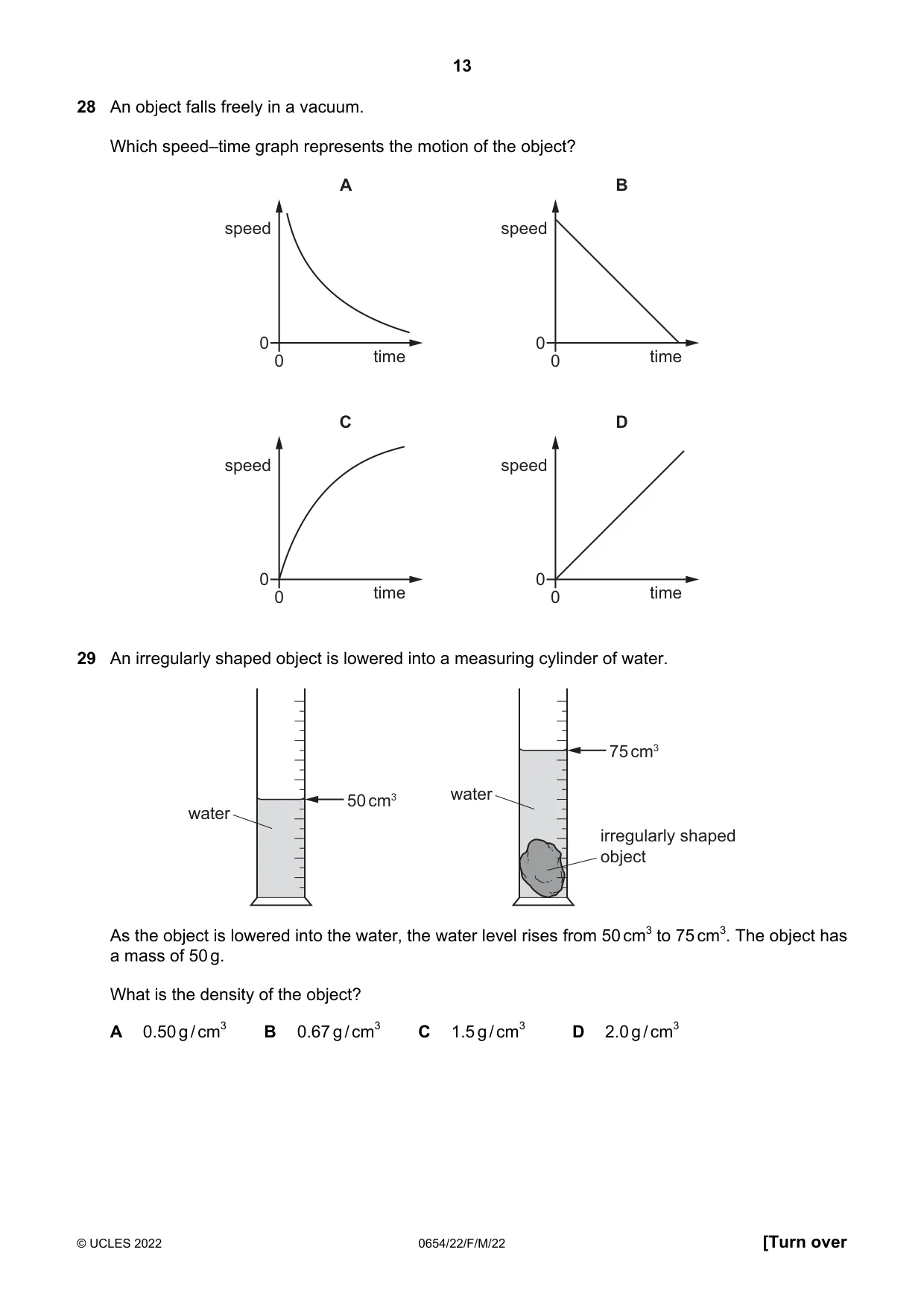
Q28 · An object falls freely in a vacuum
28 An object falls freely in a vacuum. Which speed–time graph represents the motion of the object? A B speed speed 0 0 0 time 0 time C D speed speed 0 0 0 time 0 time
Mark scheme: D
Q29 · An irregularly shaped object is lowered into a measuring cylinder of water
29 An irregularly shaped object is lowered into a measuring cylinder of water. 75 cm3 50 cm3 water water irregularly shaped object As the object is lowered into the water, the water level rises from 50 cm3 to 75 cm3. The object has a mass of 50 g. What is the density of the object? A 0.50 g / cm3 B 0.67 g / cm3 C 1.5 g / cm3 D 2.0 g / cm3
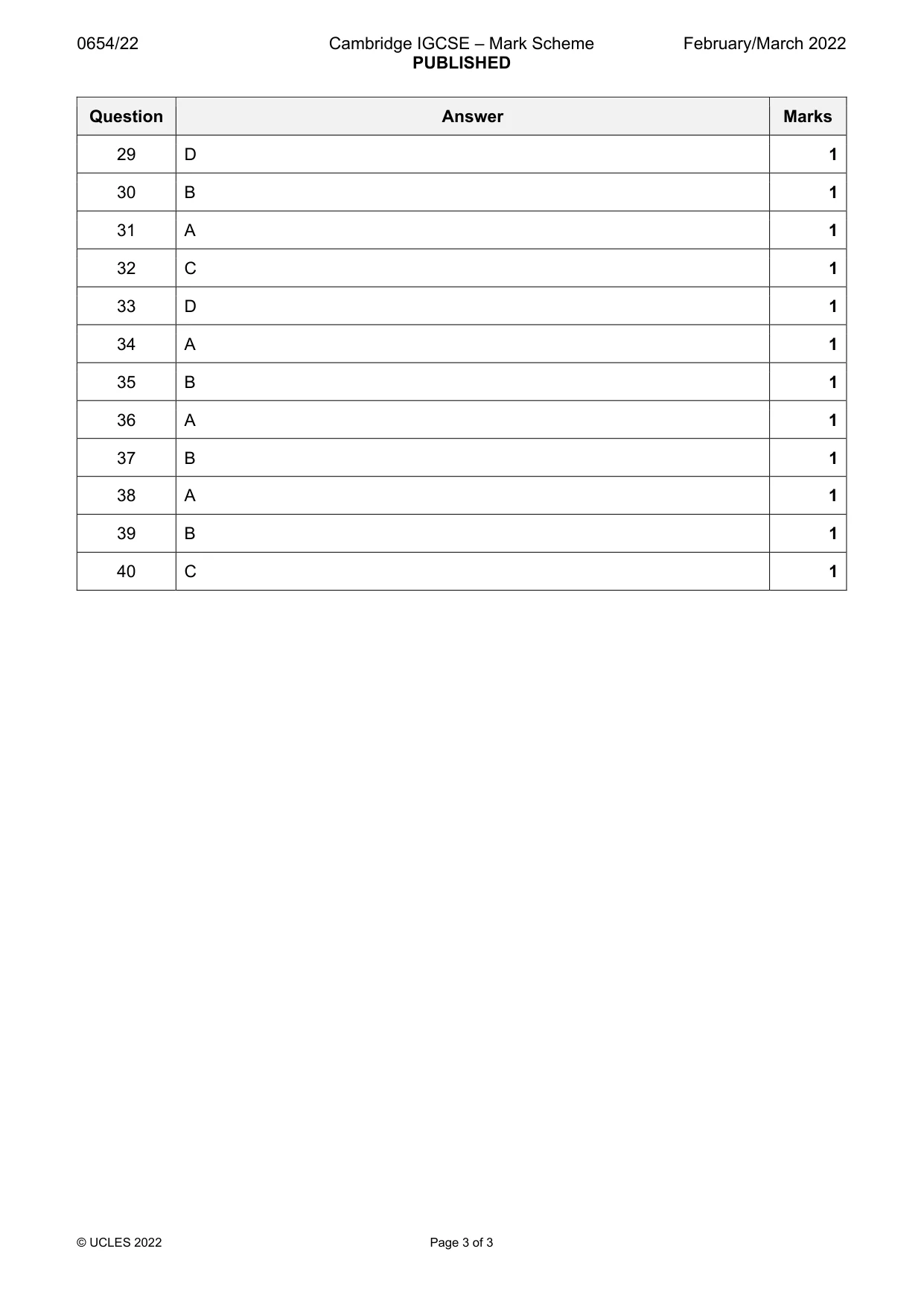
Mark scheme: D
Q30 · Which source of energy is non-renewable?
30 Which source of energy is non-renewable? A hydroelectric B nuclear fission C tides D waves
Mark scheme: B
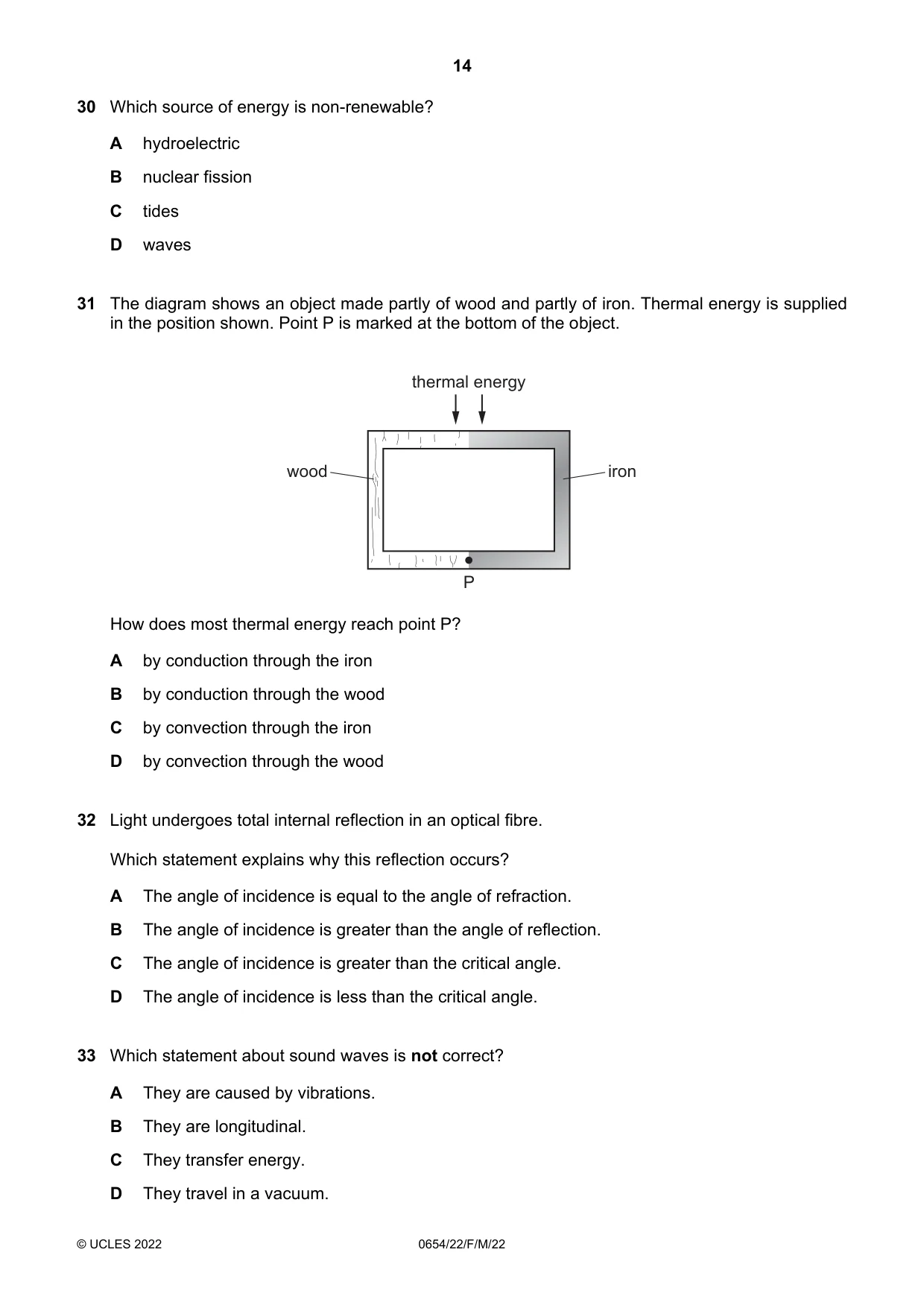
Q31 · The diagram shows an object made partly of wood and partly of iron
31 The diagram shows an object made partly of wood and partly of iron. Thermal energy is supplied in the position shown. Point P is marked at the bottom of the object. thermal energy wood iron P How does most thermal energy reach point P? A by conduction through the iron B by conduction through the wood C by convection through the iron D by convection through the wood
Mark scheme: A
Q32 · Light undergoes total internal reflection in an optical fibre
32 Light undergoes total internal reflection in an optical fibre. Which statement explains why this reflection occurs? A The angle of incidence is equal to the angle of refraction. B The angle of incidence is greater than the angle of reflection. C The angle of incidence is greater than the critical angle. D The angle of incidence is less than the critical angle.
Mark scheme: C
Q33 · Which statement about sound waves is not correct?
33 Which statement about sound waves is not correct? A They are caused by vibrations. B They are longitudinal. C They transfer energy. D They travel in a vacuum.
Mark scheme: D
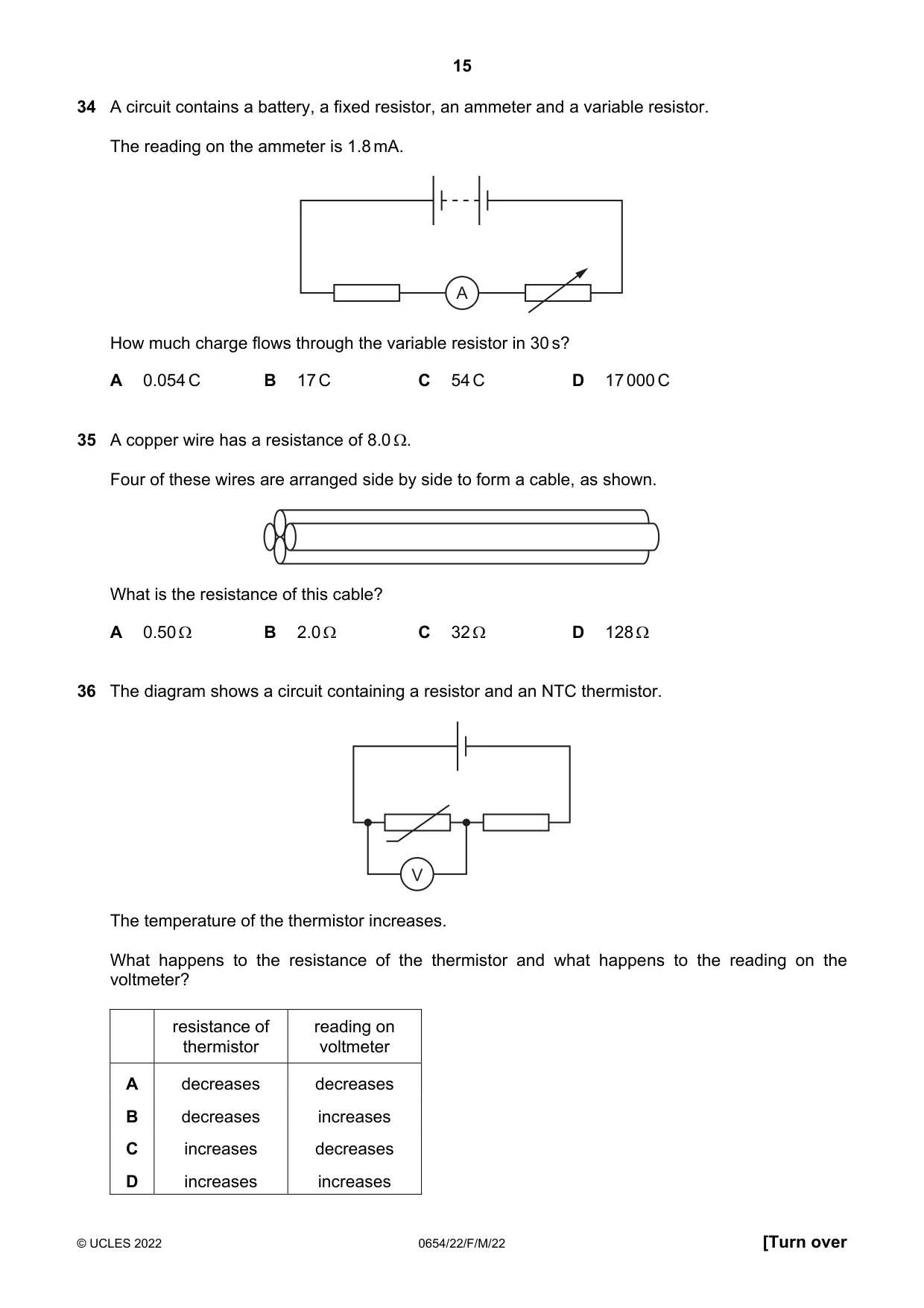
Q34 · A circuit contains a battery, a fixed resistor, an ammeter and a variable resistor
34 A circuit contains a battery, a fixed resistor, an ammeter and a variable resistor. The reading on the ammeter is 1.8 mA. A How much charge flows through the variable resistor in 30 s? A 0.054 C B 17 C C 54 C D 17 000 C
Mark scheme: A
Q35 · A copper wire has a resistance of 8.0
35 A copper wire has a resistance of 8.0 . Four of these wires are arranged side by side to form a cable, as shown. What is the resistance of this cable? A 0.50 B 2.0 C 32 D 128
Mark scheme: B
Q36 · The diagram shows a circuit containing a resistor and an NTC thermistor
36 The diagram shows a circuit containing a resistor and an NTC thermistor. V The temperature of the thermistor increases. What happens to the resistance of the thermistor and what happens to the reading on the voltmeter? resistance of reading on thermistor voltmeter A decreases decreases B decreases increases C increases decreases D increases increases
Mark scheme: A
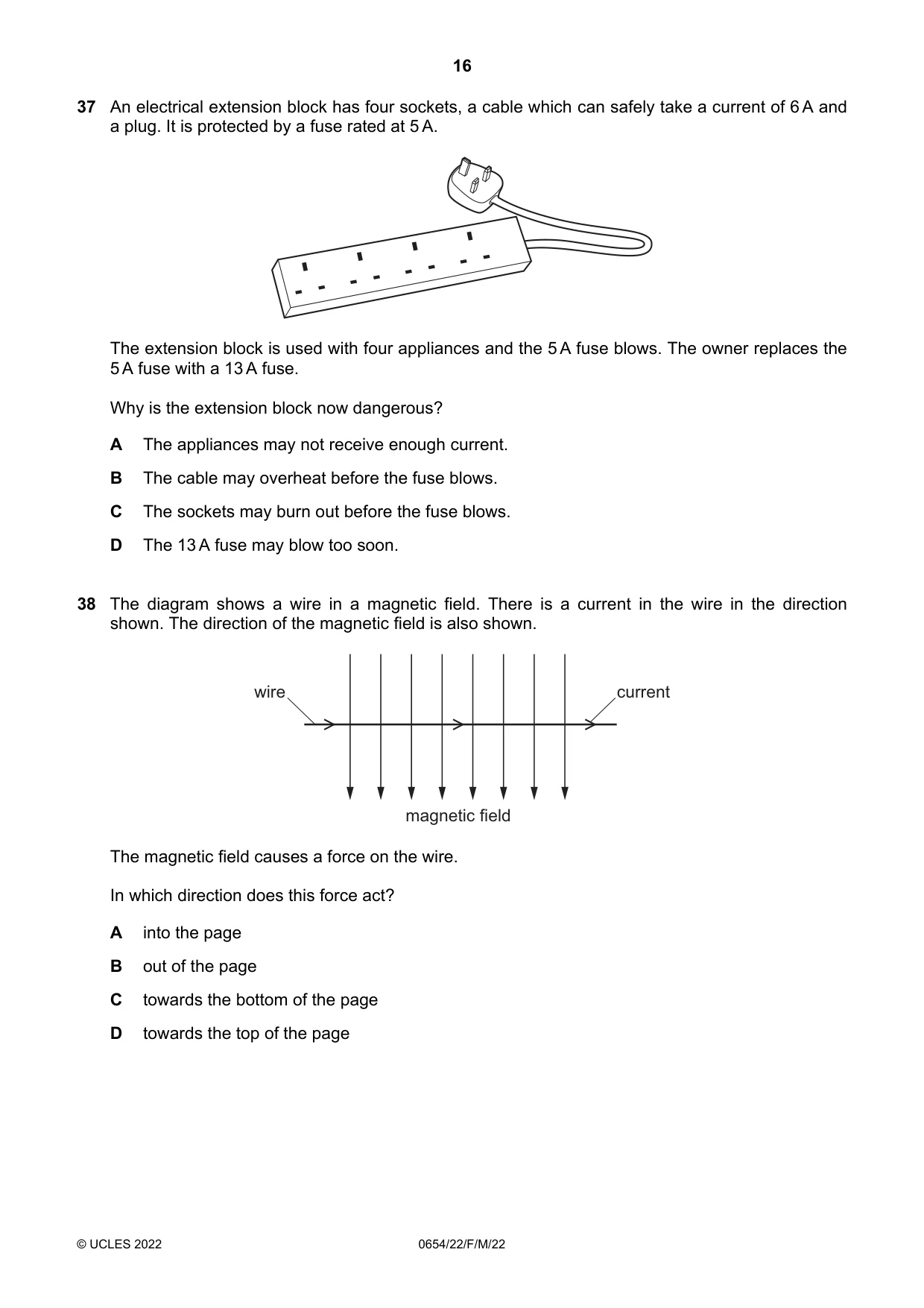
Q37 · An electrical extension block has four sockets, a cable which can safely take a current…
37 An electrical extension block has four sockets, a cable which can safely take a current of 6 A and a plug. It is protected by a fuse rated at 5 A. The extension block is used with four appliances and the 5 A fuse blows. The owner replaces the 5 A fuse with a 13 A fuse. Why is the extension block now dangerous? A The appliances may not receive enough current. B The cable may overheat before the fuse blows. C The sockets may burn out before the fuse blows. D The 13 A fuse may blow too soon.
Mark scheme: B
Q38 · The diagram shows a wire in a magnetic field
38 The diagram shows a wire in a magnetic field. There is a current in the wire in the direction shown. The direction of the magnetic field is also shown. wire current magnetic field The magnetic field causes a force on the wire. In which direction does this force act? A into the page B out of the page C towards the bottom of the page D towards the top of the page
Mark scheme: A
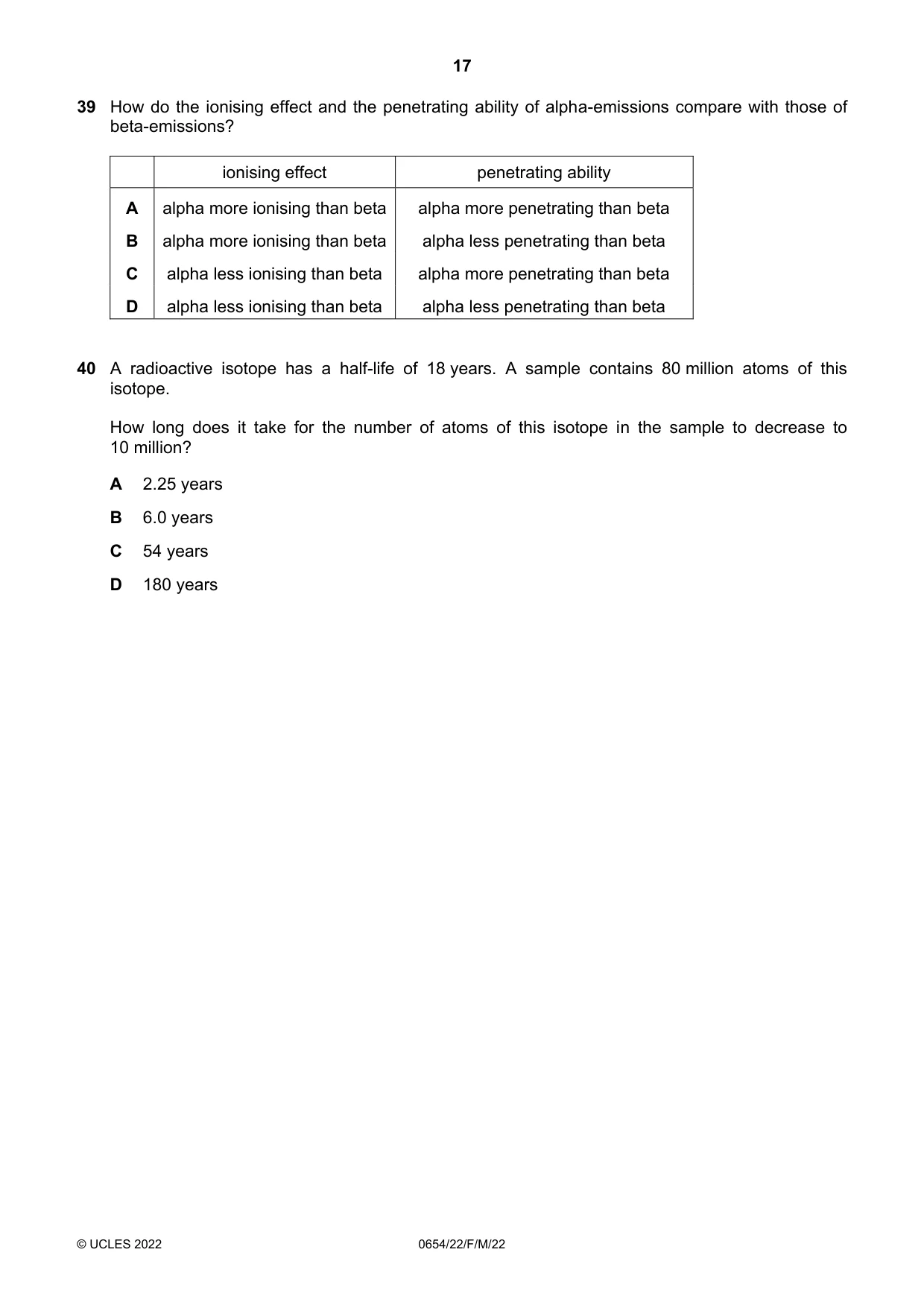
Q39 · How do the ionising effect and the penetrating ability of alpha-emissions compare with…
39 How do the ionising effect and the penetrating ability of alpha-emissions compare with those of beta-emissions? ionising effect penetrating ability A alpha more ionising than beta alpha more penetrating than beta B alpha more ionising than beta alpha less penetrating than beta C alpha less ionising than beta alpha more penetrating than beta D alpha less ionising than beta alpha less penetrating than beta
Mark scheme: B
Q40 · A radioactive isotope has a half-life of 18 years
40 A radioactive isotope has a half-life of 18 years. A sample contains 80 million atoms of this isotope. How long does it take for the number of atoms of this isotope in the sample to decrease to 10 million? A 2.25 years B 6.0 years C 54 years D 180 years
Mark scheme: C
What was in this paper
The subtopics covered by these 40 questions, and how many questions each got. Open one in a new tab to see every Cambridge question on it.
2Photosynthesis2Radioactivity2Air quality and climate1Alcohols1Alkenes1Alloys and their properties1Biological molecules1Cell division1Density1Digestion1Electrical quantities1Electrical safety1Electrolysis1Electromagnetic effects1Elements, compounds and mixtures1Energy flow1Energy, work and power1Enzymes1Extraction of metals1Gas exchange in humans1Group I properties1Habitat destruction1Homeostasis1Identification of ions and gases1Light1Motion1Noble gases1Osmosis1Preparation of salts1Redox1Sexual reproduction in humans1Sound1The characteristic properties of acids and bases1The mole and the Avogadro constant1Transfer of thermal energy1Translocation1What you needed in this session
Cambridge’s own grade thresholds for 2022 Feb/March, Paper 2 · Variant 2. A higher threshold means an easier paper — the bar moves with how the cohort did.