Cambridge IGCSE Sciences - Co-ordinated (Double) 0654 — 2021 Oct/Nov Paper 2 · Variant 3
0654/23/O/N/21 · 40 questions · 40 marks · ≈45 min
The question paper and its mark scheme, free to read here and free to download. This is Cambridge’s own paper, exactly as it was sat.
Question paper16 pages
Mark scheme3 pages
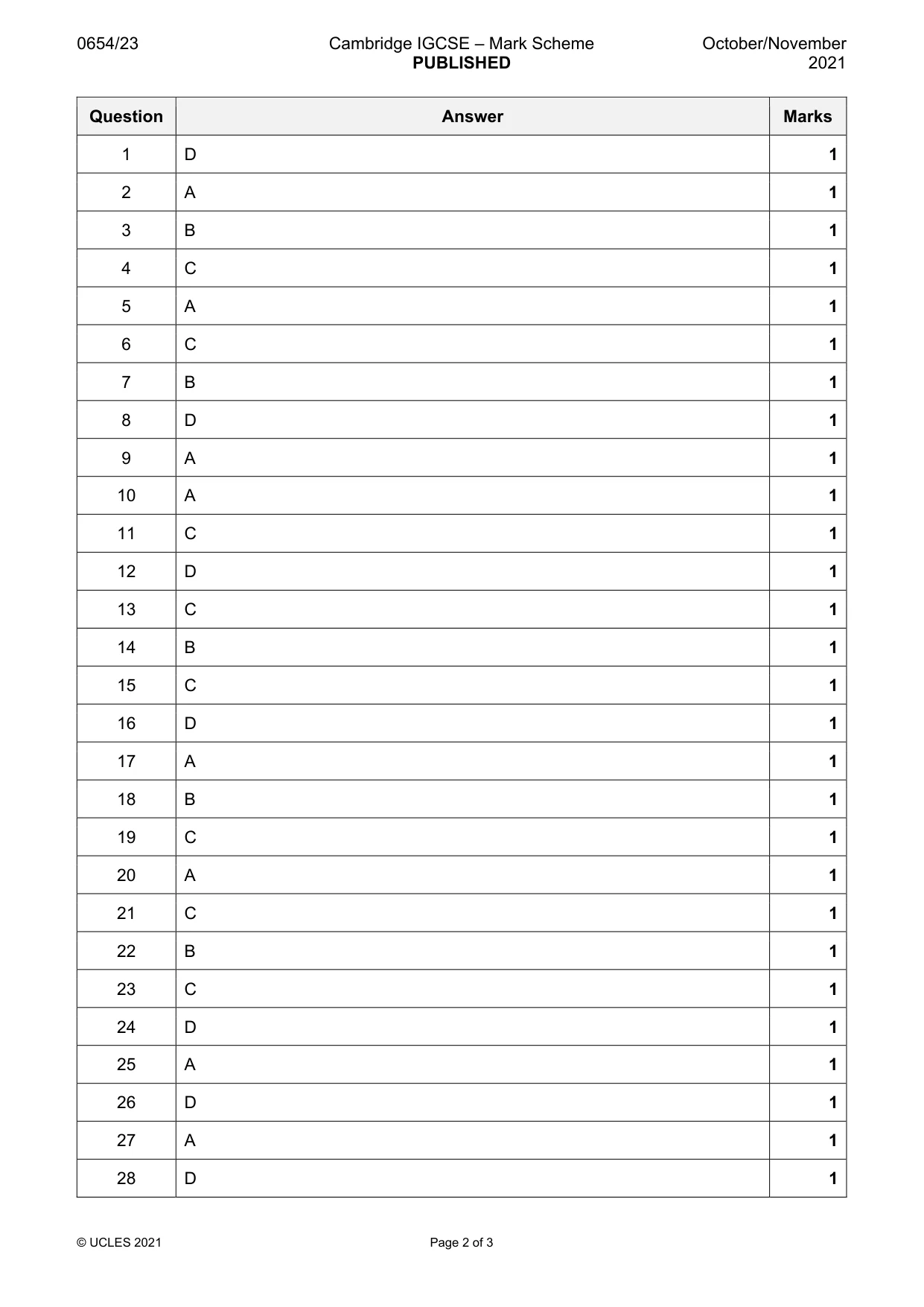
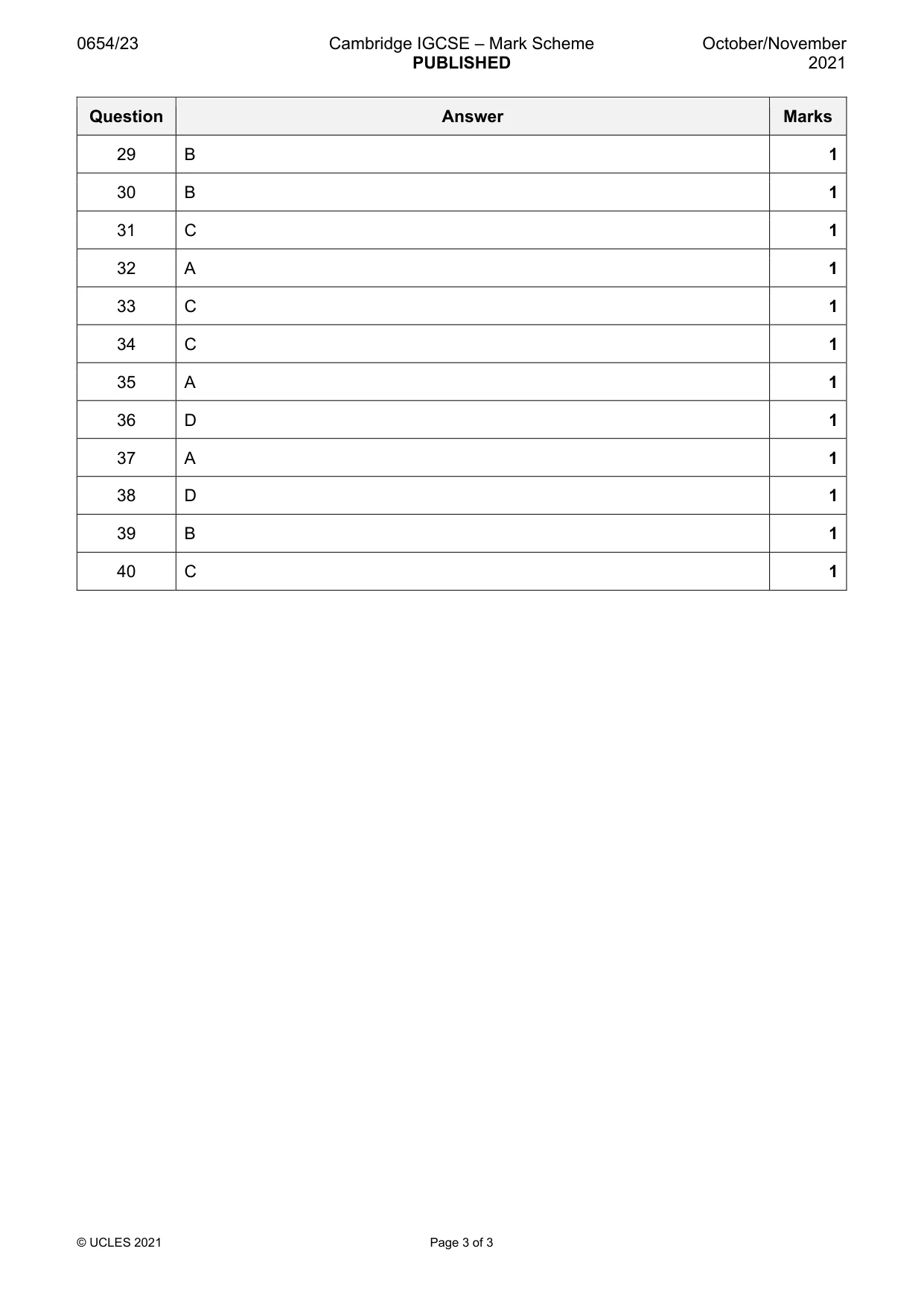
Answers below. Sit the paper first if you are practising.
Questions as text
Q1 · Ten woodlice were placed in a dish
1 Ten woodlice were placed in a dish. Half of the dish was dark and the other half of the dish was light. At the end of one hour, all of the woodlice had moved to the dark side of the dish. Which characteristic of living organisms does this experiment demonstrate in woodlice? A respiration B excretion C nutrition D sensitivity
Mark scheme: D
Q2 · What is an example of osmosis?
2 What is an example of osmosis? A a dried out piece of leaf stalk swelling up when placed in a bowl of water B carbon dioxide entering a leaf when it is photosynthesising C red blood cells travelling to the lungs to collect oxygen D the passage of digested food molecules through the wall of the small intestine
Mark scheme: A
Q3 · Which molecule contains carbon?
3 Which molecule contains carbon? A ammonia B fat C sulfuric acid D water
Mark scheme: B
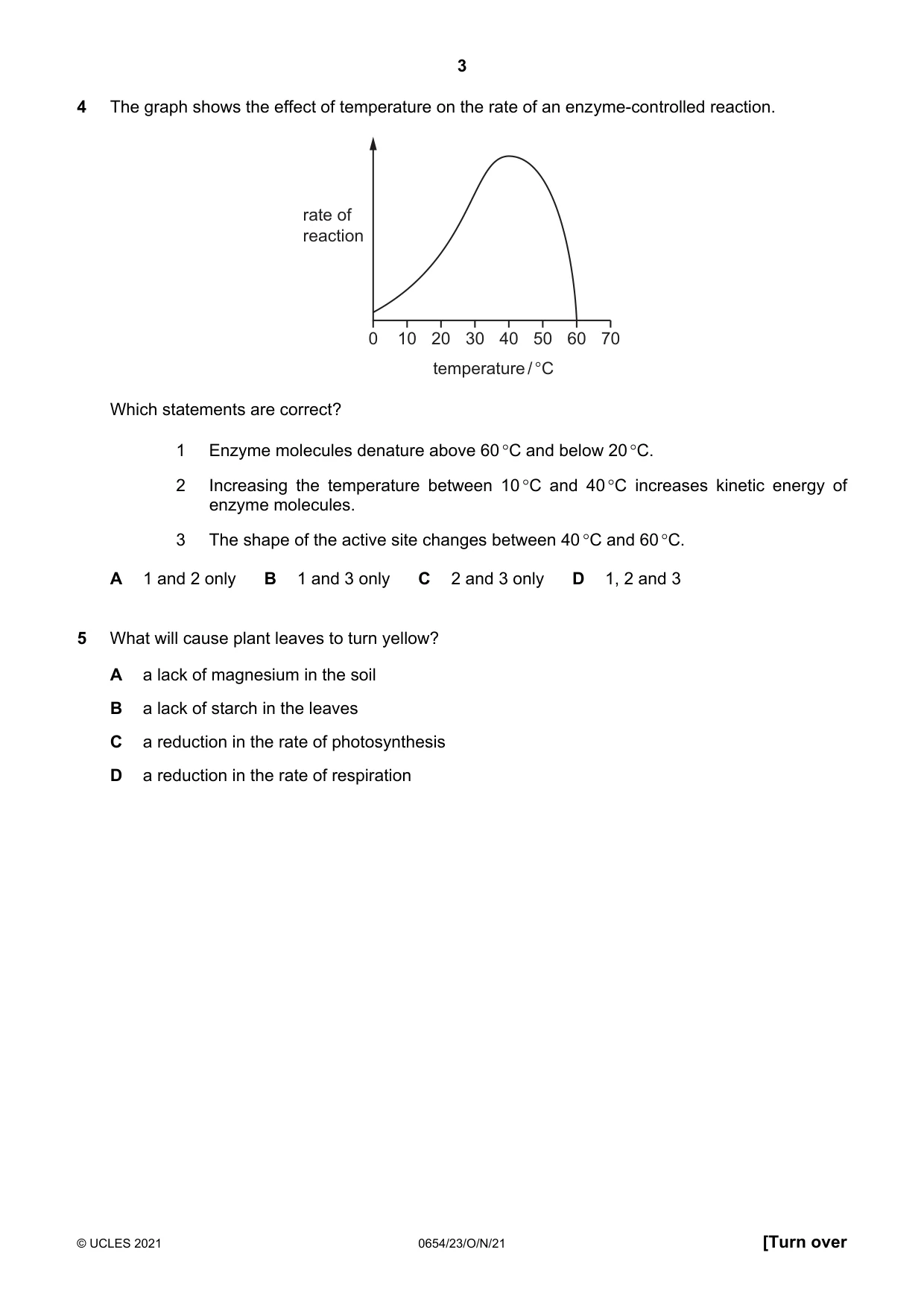
Q4 · The graph shows the effect of temperature on the rate of an enzyme-controlled reaction
4 The graph shows the effect of temperature on the rate of an enzyme-controlled reaction. rate of reaction 0 10 20 30 40 50 60 70 temperature / °C Which statements are correct? 1 Enzyme molecules denature above 60 C and below 20 C. 2 Increasing the temperature between 10 C and 40 C increases kinetic energy of enzyme molecules. 3 The shape of the active site changes between 40 C and 60 C. A 1 and 2 only B 1 and 3 only C 2 and 3 only D 1, 2 and 3
Mark scheme: C
Q5 · What will cause plant leaves to turn yellow?
5 What will cause plant leaves to turn yellow? A a lack of magnesium in the soil B a lack of starch in the leaves C a reduction in the rate of photosynthesis D a reduction in the rate of respiration
Mark scheme: A
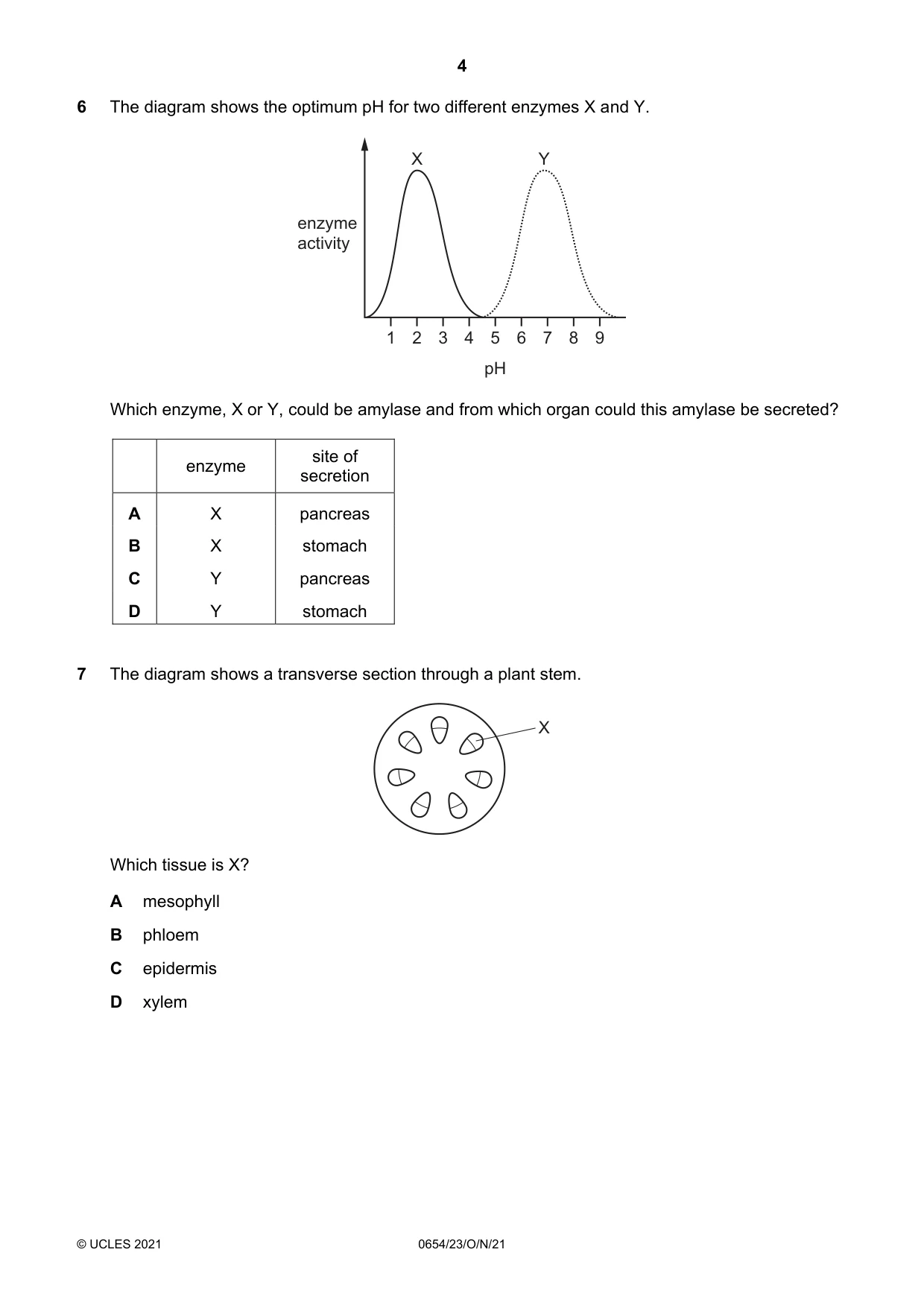
Q6 · The diagram shows the optimum pH for two different enzymes X and Y
6 The diagram shows the optimum pH for two different enzymes X and Y. X Y enzyme activity 1 2 3 4 5 6 7 8 9 pH Which enzyme, X or Y, could be amylase and from which organ could this amylase be secreted? site of enzyme secretion A X pancreas B X stomach C Y pancreas D Y stomach
Mark scheme: C
Q7 · The diagram shows a transverse section through a plant stem
7 The diagram shows a transverse section through a plant stem. X Which tissue is X? A mesophyll B phloem C epidermis D xylem
Mark scheme: B
Q8 · A person ran up as many stairs as they could in one minute
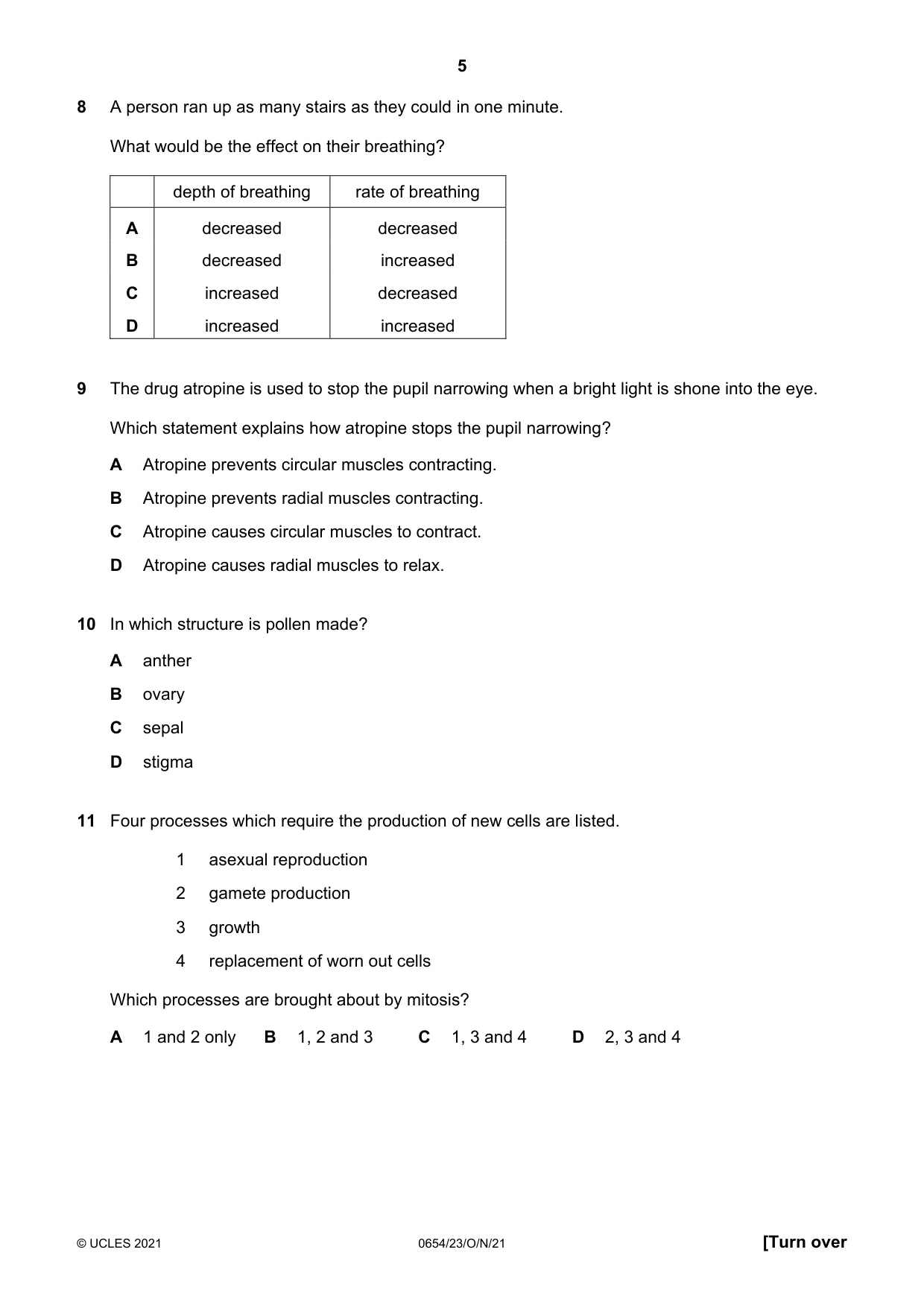
8 A person ran up as many stairs as they could in one minute. What would be the effect on their breathing? depth of breathing rate of breathing A decreased decreased B decreased increased C increased decreased D increased increased
Mark scheme: D
Q9 · The drug atropine is used to stop the pupil narrowing when a bright light is shone into…
9 The drug atropine is used to stop the pupil narrowing when a bright light is shone into the eye. Which statement explains how atropine stops the pupil narrowing? A Atropine prevents circular muscles contracting. B Atropine prevents radial muscles contracting. C Atropine causes circular muscles to contract. D Atropine causes radial muscles to relax.
Mark scheme: A
Q10 · In which structure is pollen made?
10 In which structure is pollen made? A anther B ovary C sepal D stigma
Mark scheme: A
Q11 · Four processes which require the production of new cells are listed
11 Four processes which require the production of new cells are listed. 1 asexual reproduction 2 gamete production 3 growth 4 replacement of worn out cells Which processes are brought about by mitosis? A 1 and 2 only B 1, 2 and 3 C 1, 3 and 4 D 2, 3 and 4
Mark scheme: C
Q12 · What is an ecosystem?
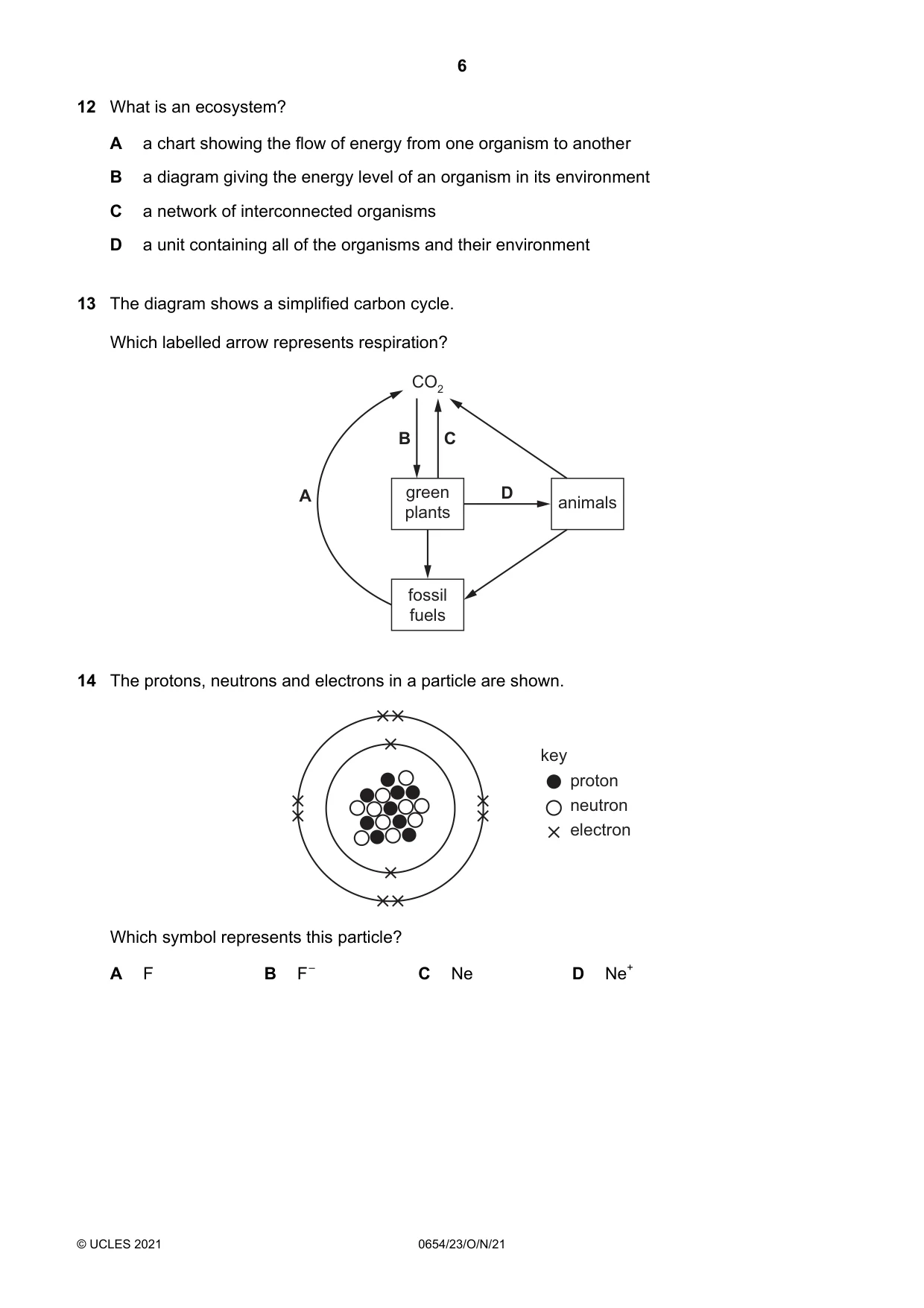
12 What is an ecosystem? A a chart showing the flow of energy from one organism to another B a diagram giving the energy level of an organism in its environment C a network of interconnected organisms D a unit containing all of the organisms and their environment
Mark scheme: D
Q13 · The diagram shows a simplified carbon cycle
13 The diagram shows a simplified carbon cycle. Which labelled arrow represents respiration? CO2 B C A green D animals plants fossil fuels
Mark scheme: C
Q14 · The protons, neutrons and electrons in a particle are shown
14 The protons, neutrons and electrons in a particle are shown. key proton neutron electron Which symbol represents this particle? A F B F – C Ne D Ne+
Mark scheme: B
Q15 · Which statements explain why graphite conducts electricity and acts as a lubricant?
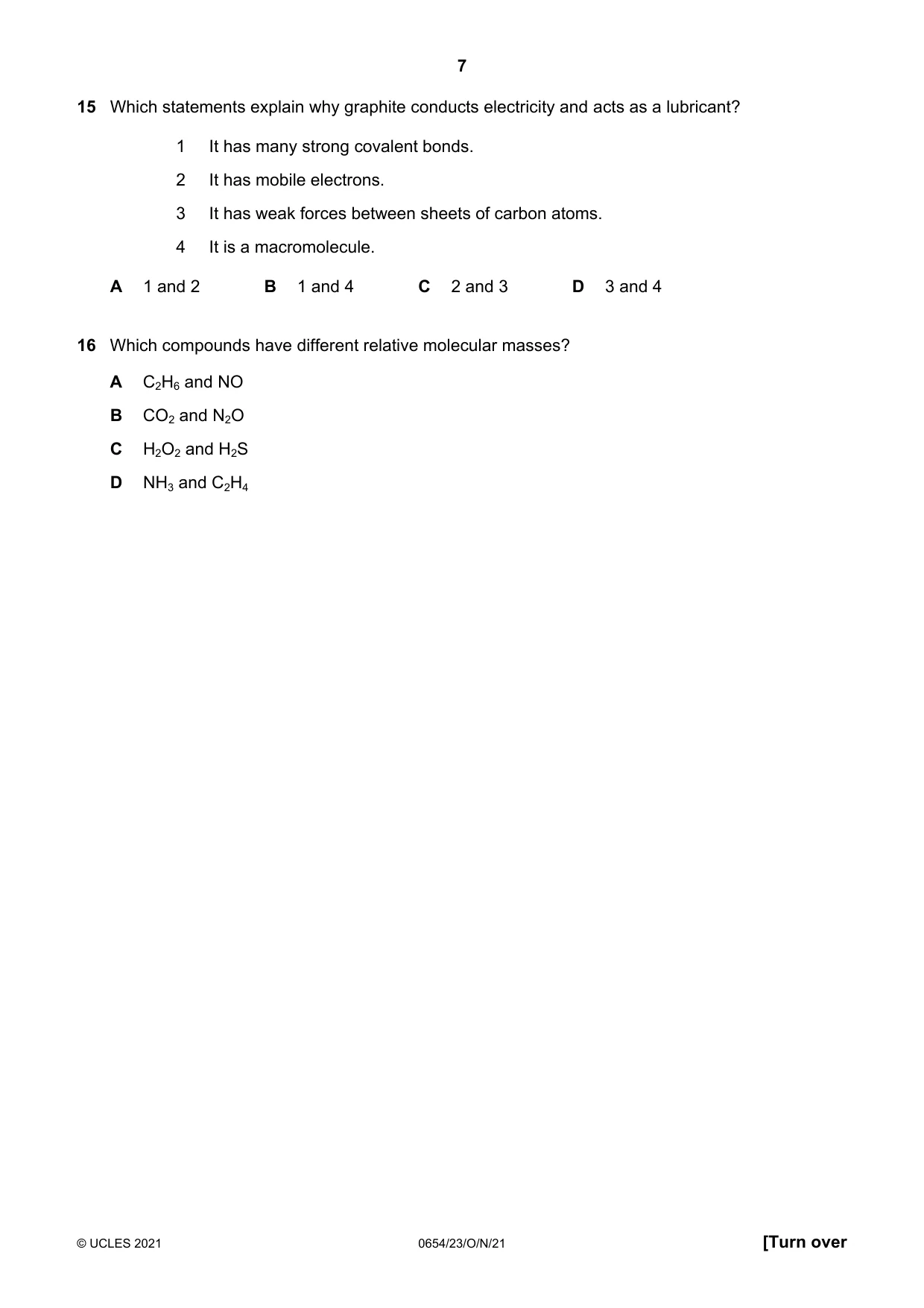
15 Which statements explain why graphite conducts electricity and acts as a lubricant? 1 It has many strong covalent bonds. 2 It has mobile electrons. 3 It has weak forces between sheets of carbon atoms. 4 It is a macromolecule. A 1 and 2 B 1 and 4 C 2 and 3 D 3 and 4
Mark scheme: C
Q16 · Which compounds have different relative molecular masses?
16 Which compounds have different relative molecular masses? A C2H6 and NO B CO2 and N2O C H2O2 and H2S D NH3 and C2H4
Mark scheme: D
Q17 · The diagram shows the electrolysis of a compound
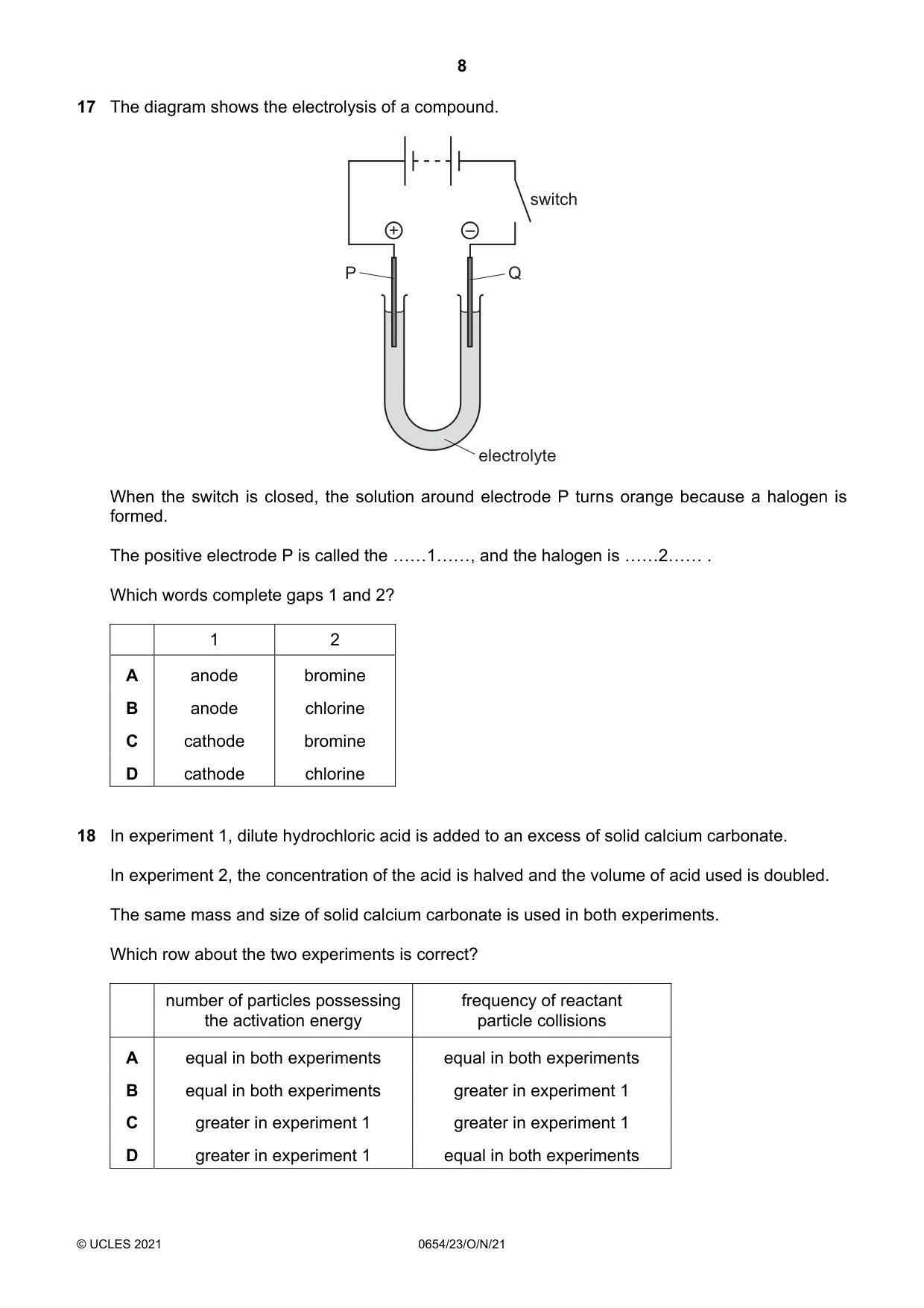
17 The diagram shows the electrolysis of a compound. switch + – P Q electrolyte When the switch is closed, the solution around electrode P turns orange because a halogen is formed. The positive electrode P is called the ……1……, and the halogen is ……2…… . Which words complete gaps 1 and 2? 1 2 A anode bromine B anode chlorine C cathode bromine D cathode chlorine
Mark scheme: A
Q18 · In experiment 1, dilute hydrochloric acid is added to an excess of solid calcium carbonate
18 In experiment 1, dilute hydrochloric acid is added to an excess of solid calcium carbonate. In experiment 2, the concentration of the acid is halved and the volume of acid used is doubled. The same mass and size of solid calcium carbonate is used in both experiments. Which row about the two experiments is correct? number of particles possessing frequency of reactant the activation energy particle collisions A equal in both experiments equal in both experiments B equal in both experiments greater in experiment 1 C greater in experiment 1 greater in experiment 1 D greater in experiment 1 equal in both experiments
Mark scheme: B
Q19 · The ionic equation for the reaction between chlorine and potassium bromide is shown
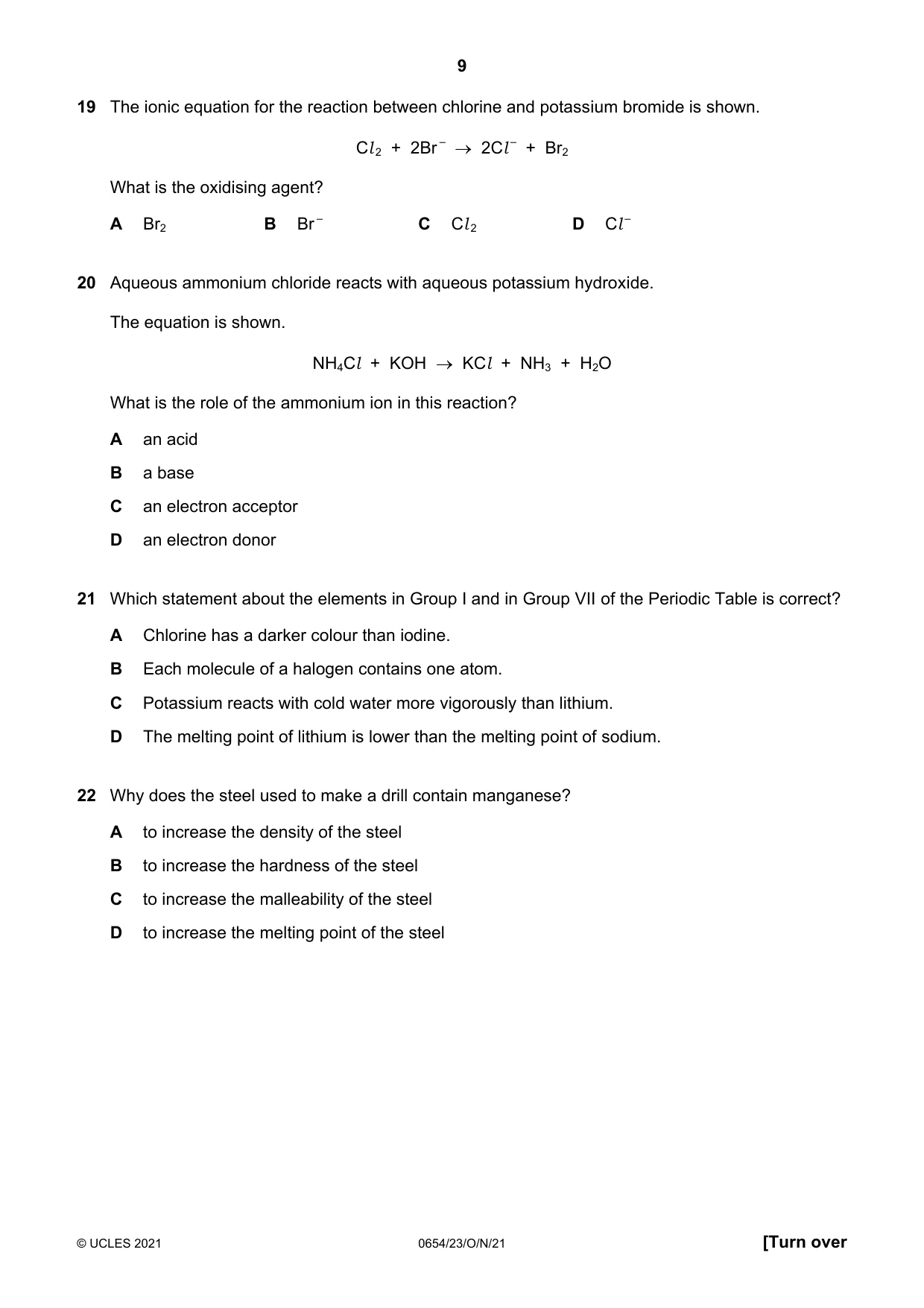
19 The ionic equation for the reaction between chlorine and potassium bromide is shown. Cl 2 + 2Br – 2Cl – + Br2 What is the oxidising agent? A Br2 B Br – C Cl 2 D Cl –
Mark scheme: C
Q20 · Aqueous ammonium chloride reacts with aqueous potassium hydroxide
20 Aqueous ammonium chloride reacts with aqueous potassium hydroxide. The equation is shown. NH4Cl + KOH KCl + NH3 + H2O What is the role of the ammonium ion in this reaction? A an acid B a base C an electron acceptor D an electron donor
Mark scheme: A
More questions on The characteristic properties of acids and bases
Q21 · Which statement about the elements in Group I and in Group VII of the Periodic Table is…
21 Which statement about the elements in Group I and in Group VII of the Periodic Table is correct? A Chlorine has a darker colour than iodine. B Each molecule of a halogen contains one atom. C Potassium reacts with cold water more vigorously than lithium. D The melting point of lithium is lower than the melting point of sodium.
Mark scheme: C
Q22 · Why does the steel used to make a drill contain manganese?
22 Why does the steel used to make a drill contain manganese? A to increase the density of the steel B to increase the hardness of the steel C to increase the malleability of the steel D to increase the melting point of the steel
Mark scheme: B
Q23 · A block of zinc is attached to an underground steel pipe as shown
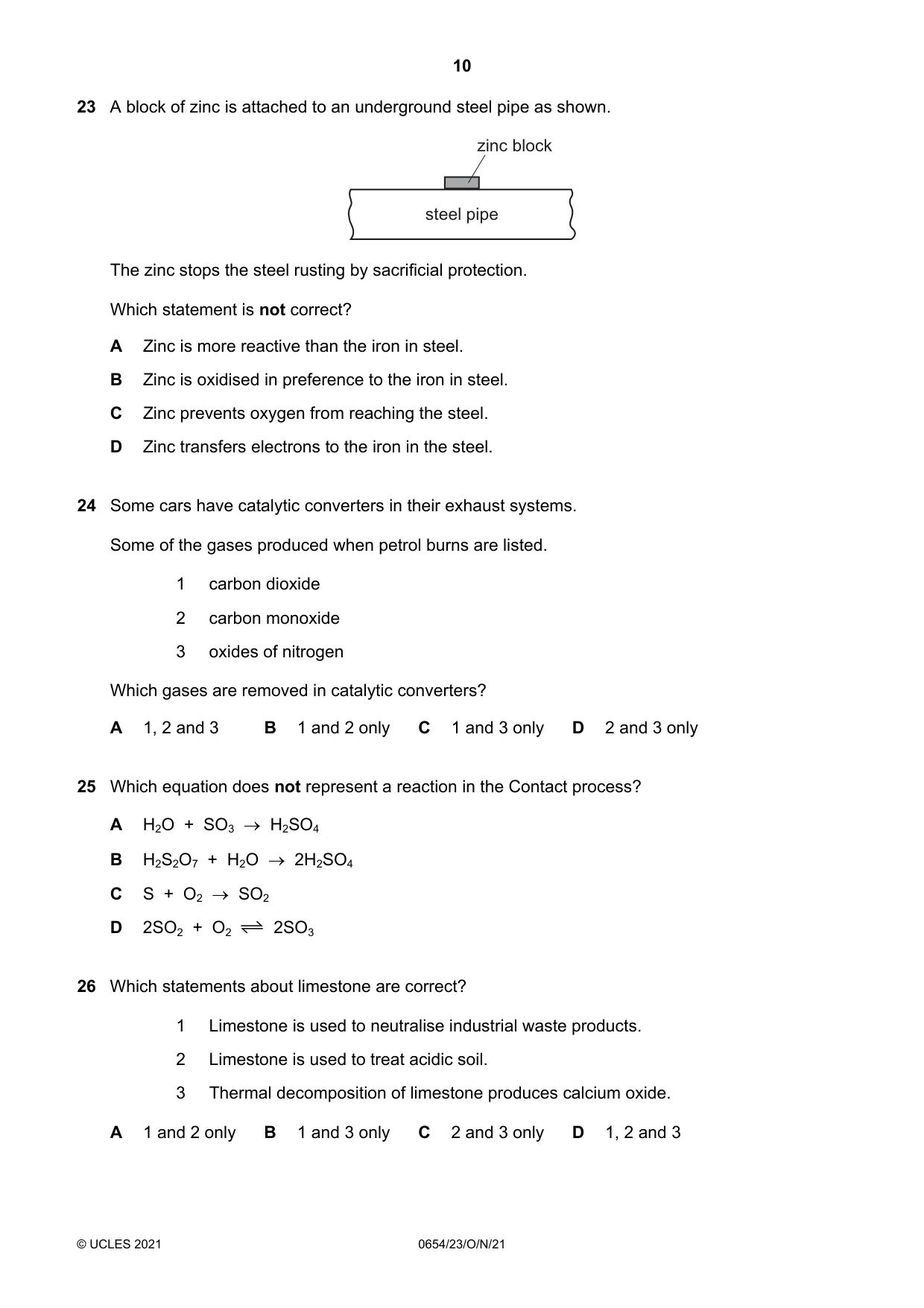
23 A block of zinc is attached to an underground steel pipe as shown. zinc block steel pipe The zinc stops the steel rusting by sacrificial protection. Which statement is not correct? A Zinc is more reactive than the iron in steel. B Zinc is oxidised in preference to the iron in steel. C Zinc prevents oxygen from reaching the steel. D Zinc transfers electrons to the iron in the steel.
Mark scheme: C
Q24 · Some cars have catalytic converters in their exhaust systems
24 Some cars have catalytic converters in their exhaust systems. Some of the gases produced when petrol burns are listed. 1 carbon dioxide 2 carbon monoxide 3 oxides of nitrogen Which gases are removed in catalytic converters? A 1, 2 and 3 B 1 and 2 only C 1 and 3 only D 2 and 3 only
Mark scheme: D
Q25 · Which equation does not represent a reaction in the Contact process?
25 Which equation does not represent a reaction in the Contact process? A H2O + SO3 H2SO4 B H2S2O7 + H2O 2H2SO4 C S + O2 SO2 D 2SO2 + O2 2SO3
Mark scheme: A
Q26 · Which statements about limestone are correct?
26 Which statements about limestone are correct? 1 Limestone is used to neutralise industrial waste products. 2 Limestone is used to treat acidic soil. 3 Thermal decomposition of limestone produces calcium oxide. A 1 and 2 only B 1 and 3 only C 2 and 3 only D 1, 2 and 3
Mark scheme: D
Q27 · Four molecules are shown
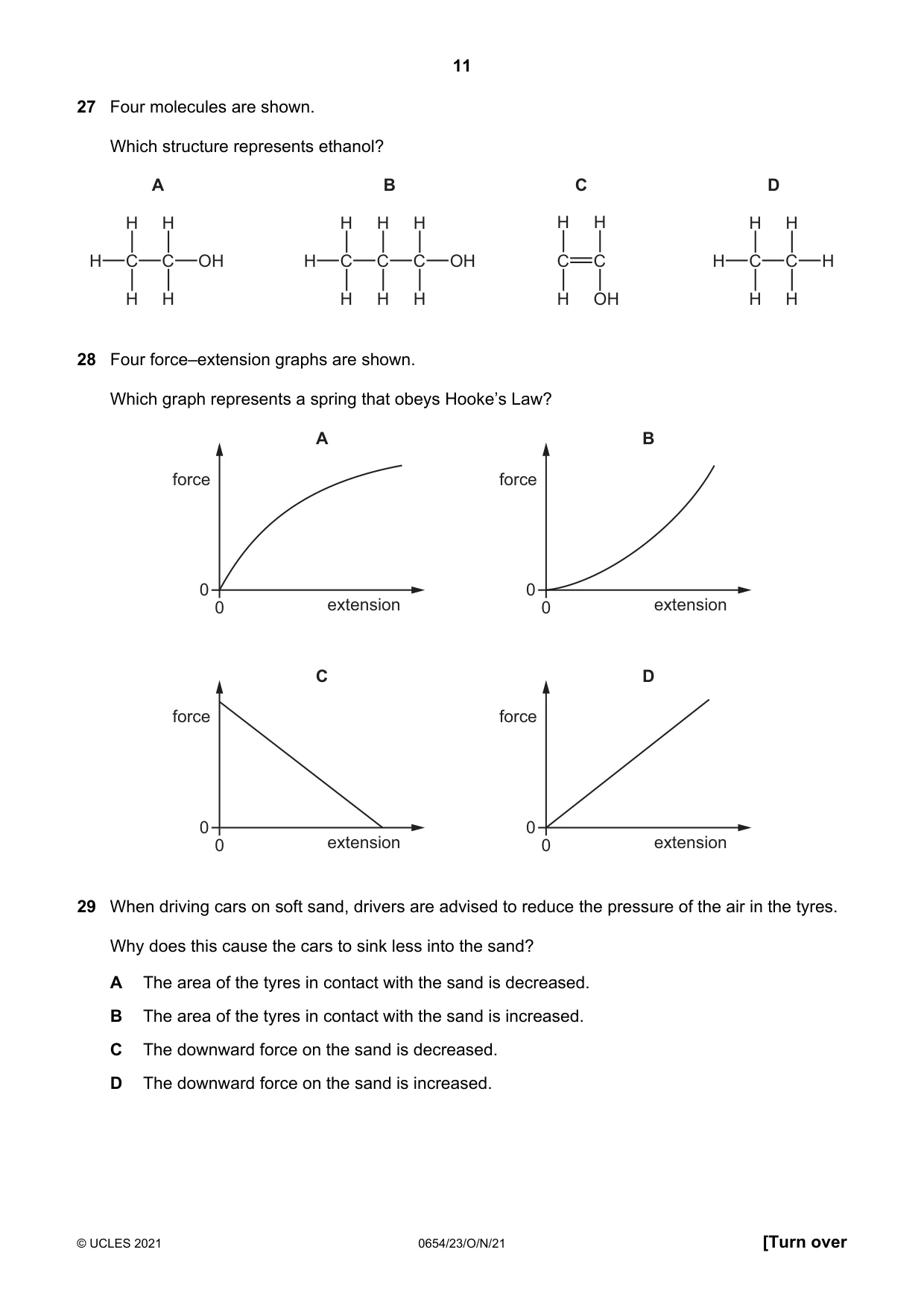
27 Four molecules are shown. Which structure represents ethanol? A B C D H H H H H H H H H H C C OH H C C C OH C C H C C H H H H H H H OH H H
Mark scheme: A
Q28 · Four force–extension graphs are shown
28 Four force–extension graphs are shown. Which graph represents a spring that obeys Hooke’s Law? A B force force 0 0 0 extension 0 extension C D force force 0 0 0 extension 0 extension
Mark scheme: D
Q29 · When driving cars on soft sand, drivers are advised to reduce the pressure of the air in…
29 When driving cars on soft sand, drivers are advised to reduce the pressure of the air in the tyres. Why does this cause the cars to sink less into the sand? A The area of the tyres in contact with the sand is decreased. B The area of the tyres in contact with the sand is increased. C The downward force on the sand is decreased. D The downward force on the sand is increased.
Mark scheme: B
Q30 · A ball of mass 0.25 kg is thrown from the ground to a height of 5.0 m
30 A ball of mass 0.25 kg is thrown from the ground to a height of 5.0 m. The gravitational field strength g is 10 N / kg. Which expression gives the increase in gravitational potential energy of the ball? A [(0.25 10) + 5.0] J B [0.25 10 5.0] J 5.0 C J (0.25 10) D [(5.0 + 0.25) 10] J
Mark scheme: B
Q31 · A lamp produces 760 J of wasted energy for every 1000 J of electrical energy supplied to…
31 A lamp produces 760 J of wasted energy for every 1000 J of electrical energy supplied to it. What is the efficiency of the lamp? A 0.24% B 0.76% C 24% D 76%
Mark scheme: C
Q32 · Which labelled arrow on the diagram represents condensation?
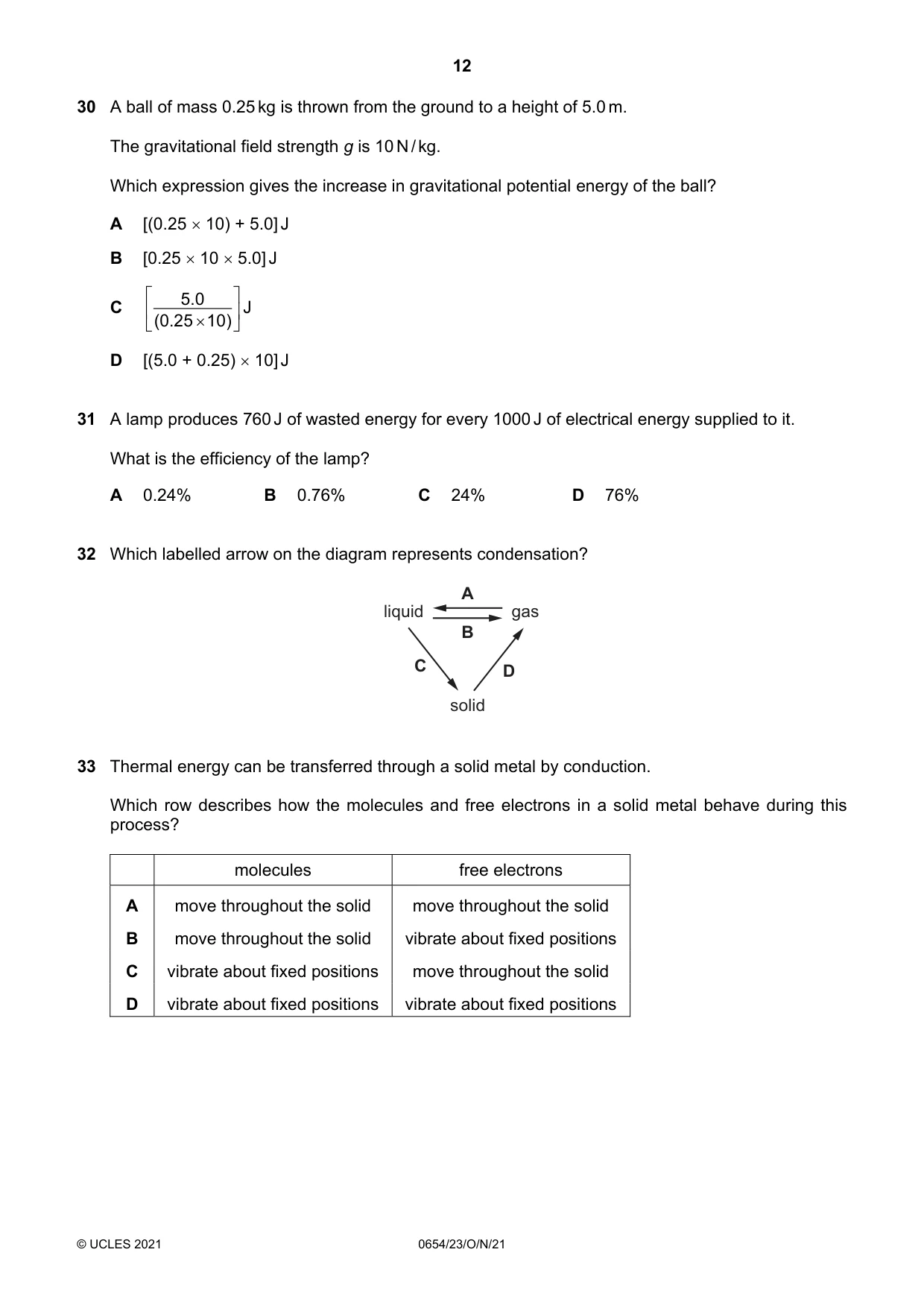
32 Which labelled arrow on the diagram represents condensation? A liquid gas B C D solid
Mark scheme: A
Q33 · Thermal energy can be transferred through a solid metal by conduction
33 Thermal energy can be transferred through a solid metal by conduction. Which row describes how the molecules and free electrons in a solid metal behave during this process? molecules free electrons A move throughout the solid move throughout the solid B move throughout the solid vibrate about fixed positions C vibrate about fixed positions move throughout the solid D vibrate about fixed positions vibrate about fixed positions
Mark scheme: C
Q34 · The diagram shows a ray of light striking a plane mirror
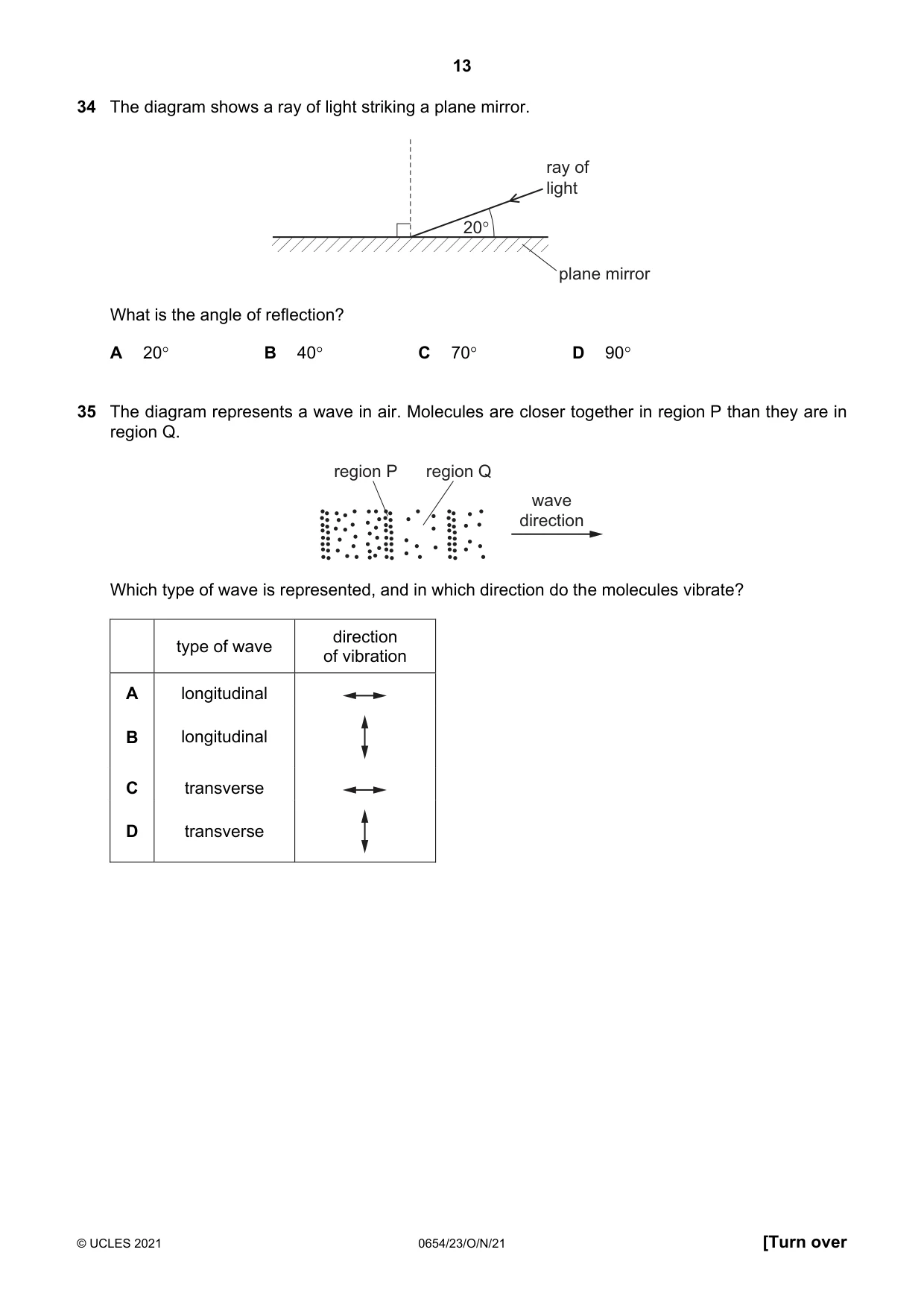
34 The diagram shows a ray of light striking a plane mirror. ray of light 20° plane mirror What is the angle of reflection? A 20 B 40 C 70 D 90
Mark scheme: C
Q35 · The diagram represents a wave in air
35 The diagram represents a wave in air. Molecules are closer together in region P than they are in region Q. region P region Q wave direction Which type of wave is represented, and in which direction do the molecules vibrate? direction type of wave of vibration A longitudinal B longitudinal C transverse D transverse
Mark scheme: A
Q36 · A rod is rubbed with a dry piece of cloth
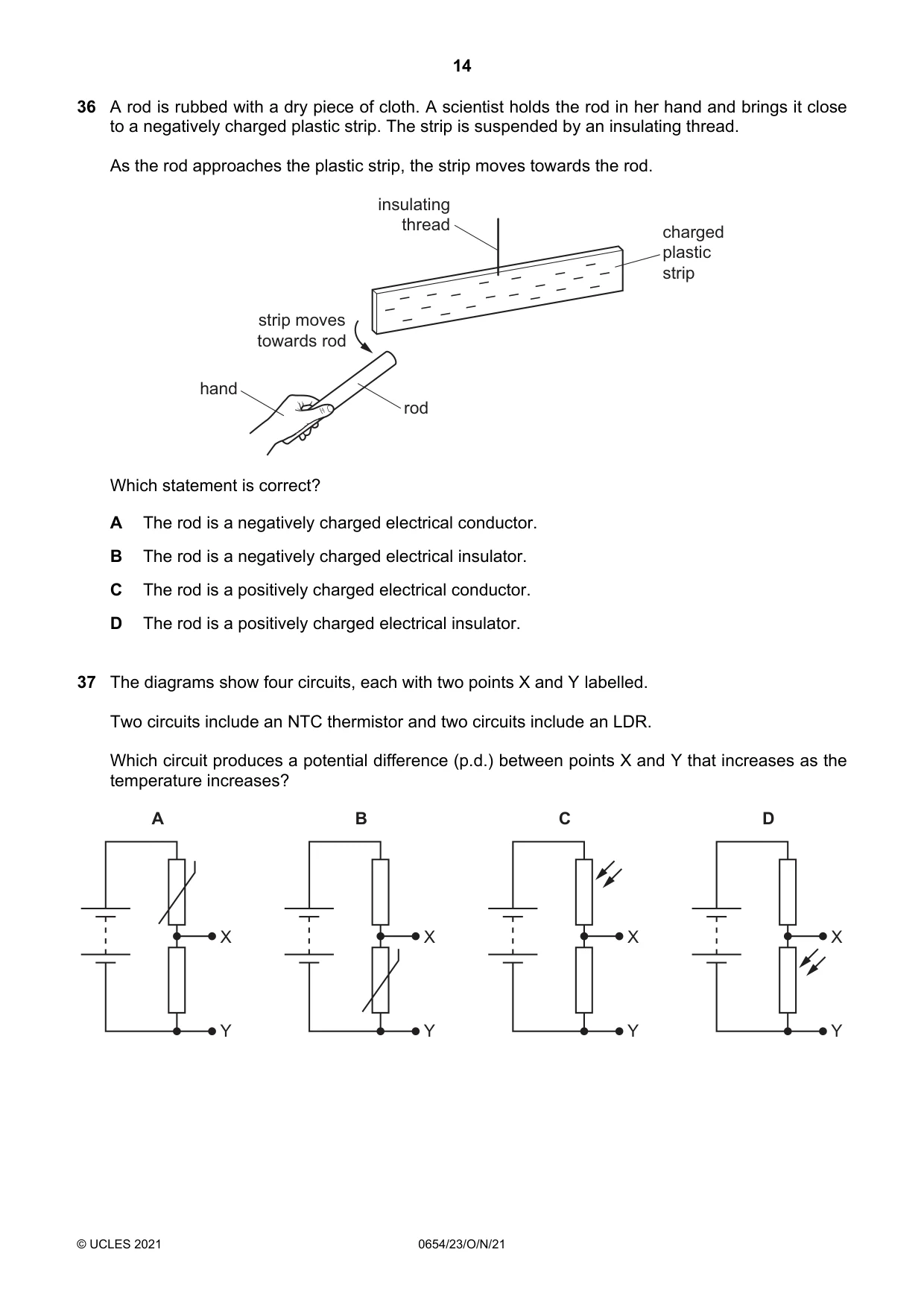
36 A rod is rubbed with a dry piece of cloth. A scientist holds the rod in her hand and brings it close to a negatively charged plastic strip. The strip is suspended by an insulating thread. As the rod approaches the plastic strip, the strip moves towards the rod. insulating thread charged plastic – – – – – –– strip – – – – – – – – – – – – strip moves – towards rod hand rod Which statement is correct? A The rod is a negatively charged electrical conductor. B The rod is a negatively charged electrical insulator. C The rod is a positively charged electrical conductor. D The rod is a positively charged electrical insulator.
Mark scheme: D
Q37 · The diagrams show four circuits, each with two points X and Y labelled
37 The diagrams show four circuits, each with two points X and Y labelled. Two circuits include an NTC thermistor and two circuits include an LDR. Which circuit produces a potential difference (p.d.) between points X and Y that increases as the temperature increases? A B C D X X X X Y Y Y Y
Mark scheme: A
Q38 · A hairdryer is protected by a 10 A fuse
38 A hairdryer is protected by a 10 A fuse. What is the purpose of the fuse? A It decreases the current in the hairdryer to 10 A when the current is more than 10 A. B It increases the current in the hairdryer to 10 A when the current is less than 10 A. C It maintains a constant temperature in the hairdryer. D It melts when the current in the hairdryer is greater than 10 A.
Mark scheme: D
Q39 · The diagram shows a wire carrying an electric current in the direction shown
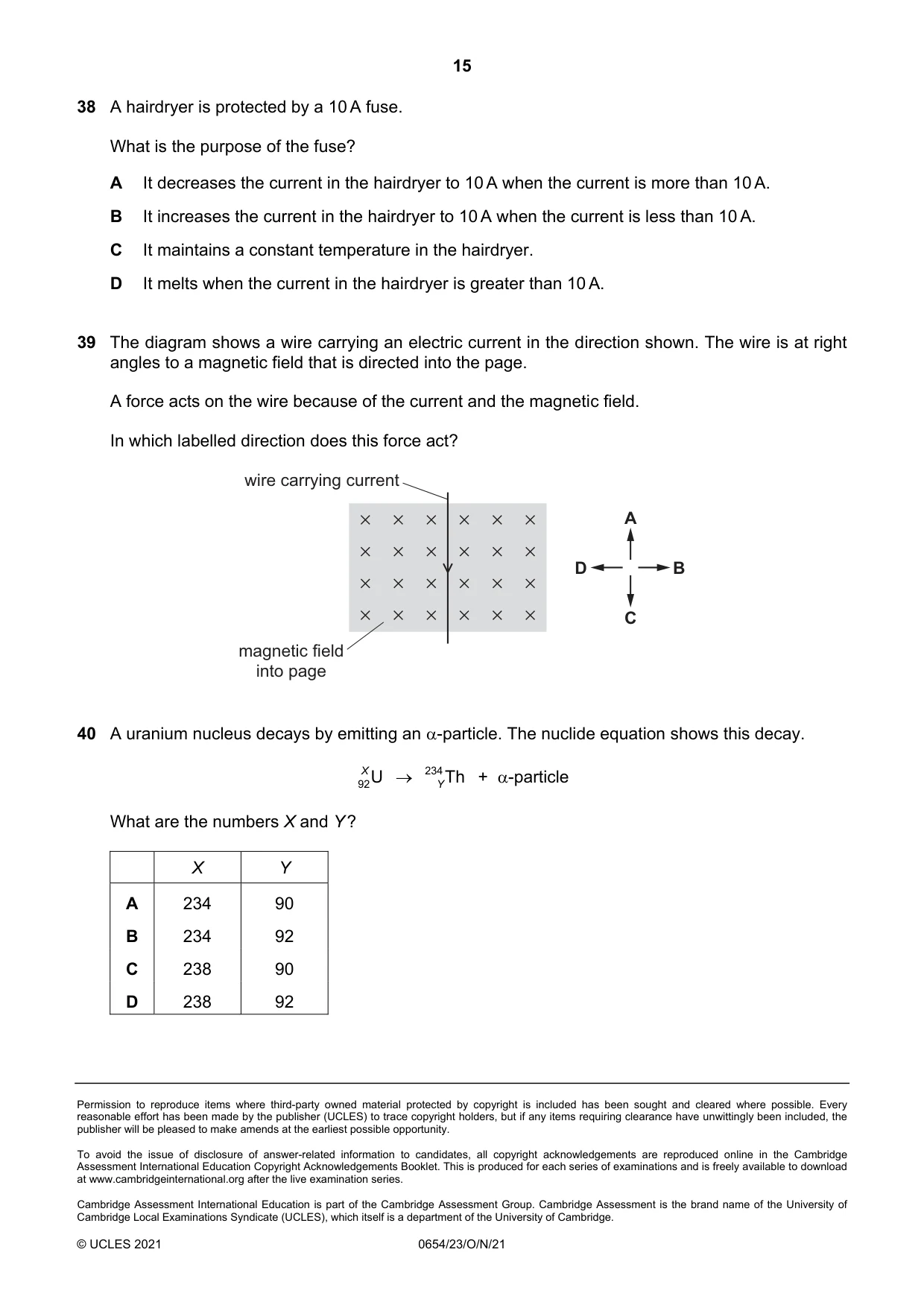
39 The diagram shows a wire carrying an electric current in the direction shown. The wire is at right angles to a magnetic field that is directed into the page. A force acts on the wire because of the current and the magnetic field. In which labelled direction does this force act? wire carrying current A D B C magnetic field into page
Mark scheme: B
Q40 · A uranium nucleus decays by emitting an -particle
40 A uranium nucleus decays by emitting an -particle. The nuclide equation shows this decay. 92U X 234Th + -particle Y What are the numbers X and Y ? X Y A 234 90 B 234 92 C 238 90 D 238 92
Mark scheme: C
What was in this paper
The subtopics covered by these 40 questions, and how many questions each got. Open one in a new tab to see every Cambridge question on it.
2Air quality and climate1Alcohols1Alloys and their properties1Atomic structure and the Periodic Table1Biological molecules1Carbon cycle1Cell division1Characteristics of living organisms1Coordination and response1Corrosion of metals1Digestion1Electrical circuits1Electrical safety1Electrolysis1Electromagnetic effects1Energy flow1Enzymes1Forces1Gas exchange in humans1General properties of waves1Giant covalent structures1Group I properties1Kinetic particle model of matter1Light1Osmosis1Oxides1Photosynthesis1Physical and chemical changes1Pressure1Radioactivity1Rate of reaction1Redox1Relative masses of atoms and molecules1Sexual reproduction in plants1Simple phenomena of magnetism1The characteristic properties of acids and bases1Transfer of thermal energy1Xylem and phloem1What you needed in this session
Cambridge’s own grade thresholds for 2021 Oct/Nov, Paper 2 · Variant 3. A higher threshold means an easier paper — the bar moves with how the cohort did.