Cambridge IGCSE Sciences - Co-ordinated (Double) 0654 — 2023 Oct/Nov Paper 2 · Variant 3
0654/23/O/N/23 · 40 questions · 40 marks · ≈45 min
The question paper and its mark scheme, free to read here and free to download. This is Cambridge’s own paper, exactly as it was sat.
Question paper16 pages
Mark scheme3 pages
Answers below. Sit the paper first if you are practising.
Questions as text
Q1 · A person throws a ball which their dog runs after and brings back to them
1 A person throws a ball which their dog runs after and brings back to them. Which characteristics of living things is the dog showing by this action? A growth and nutrition B movement and nutrition C movement and sensitivity D sensitivity and growth
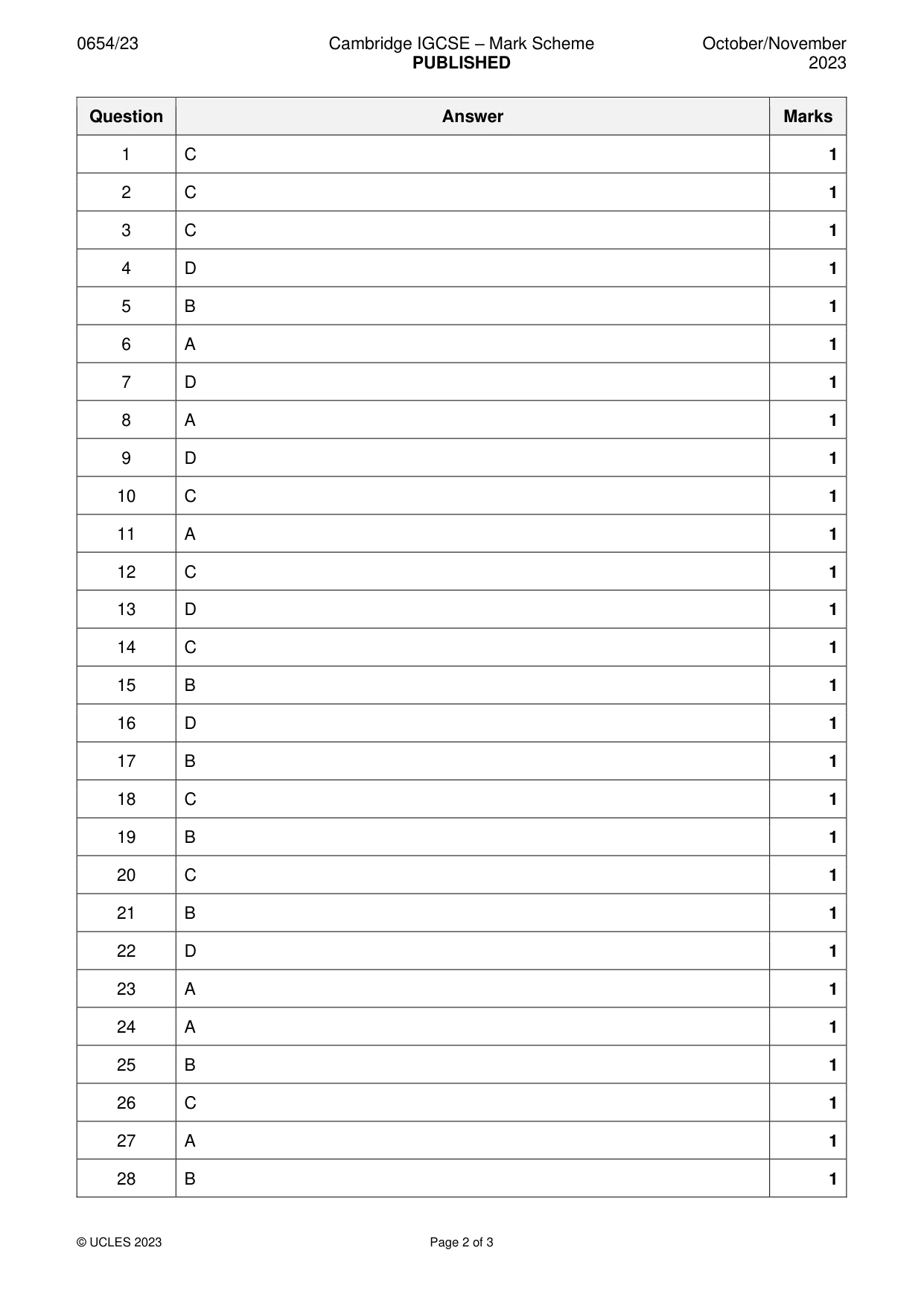
Mark scheme: C
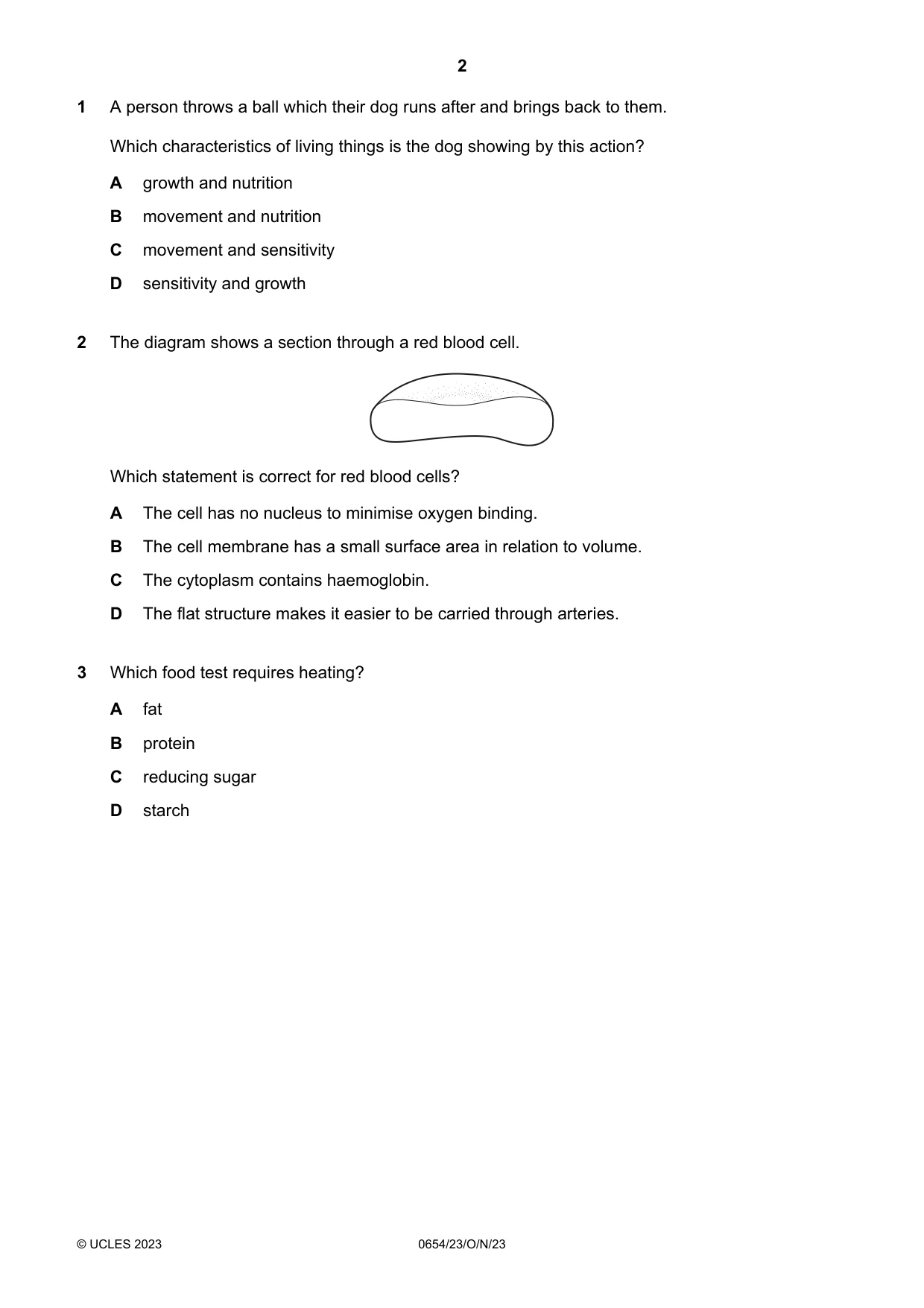
Q2 · The diagram shows a section through a red blood cell
2 The diagram shows a section through a red blood cell. Which statement is correct for red blood cells? A The cell has no nucleus to minimise oxygen binding. B The cell membrane has a small surface area in relation to volume. C The cytoplasm contains haemoglobin. D The flat structure makes it easier to be carried through arteries.
Mark scheme: C
Q3 · Which food test requires heating?
3 Which food test requires heating? A fat B protein C reducing sugar D starch
Mark scheme: C
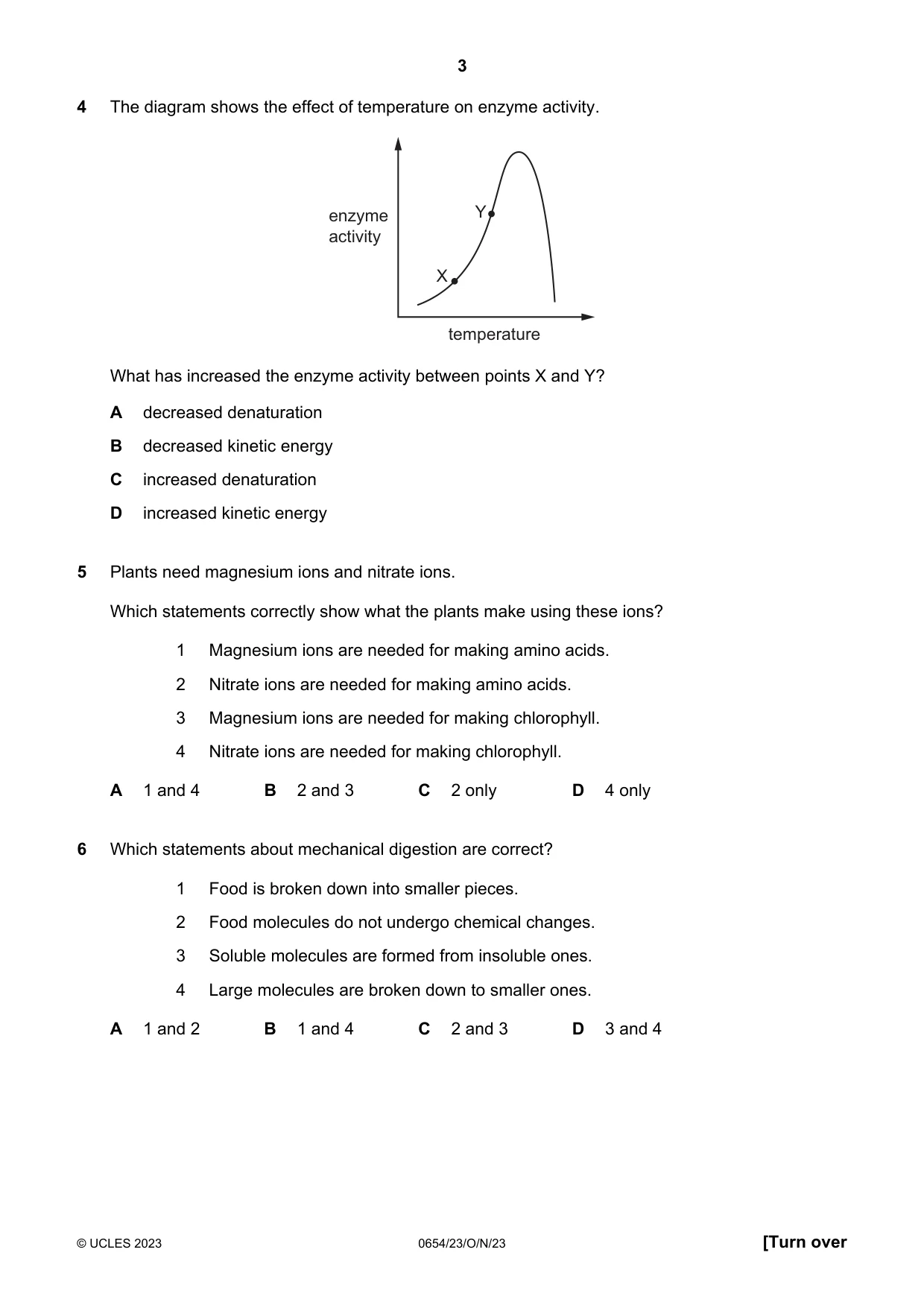
Q4 · The diagram shows the effect of temperature on enzyme activity
4 The diagram shows the effect of temperature on enzyme activity. enzyme Y activity X temperature What has increased the enzyme activity between points X and Y? A decreased denaturation B decreased kinetic energy C increased denaturation D increased kinetic energy
Mark scheme: D
Q5 · Plants need magnesium ions and nitrate ions
5 Plants need magnesium ions and nitrate ions. Which statements correctly show what the plants make using these ions? 1 Magnesium ions are needed for making amino acids. 2 Nitrate ions are needed for making amino acids. 3 Magnesium ions are needed for making chlorophyll. 4 Nitrate ions are needed for making chlorophyll. A 1 and 4 B 2 and 3 C 2 only D 4 only
Mark scheme: B
Q6 · Which statements about mechanical digestion are correct?
6 Which statements about mechanical digestion are correct? 1 Food is broken down into smaller pieces. 2 Food molecules do not undergo chemical changes. 3 Soluble molecules are formed from insoluble ones. 4 Large molecules are broken down to smaller ones. A 1 and 2 B 1 and 4 C 2 and 3 D 3 and 4
Mark scheme: A
Q7 · Which row names the substances carried by xylem vessels and the direction of travel?
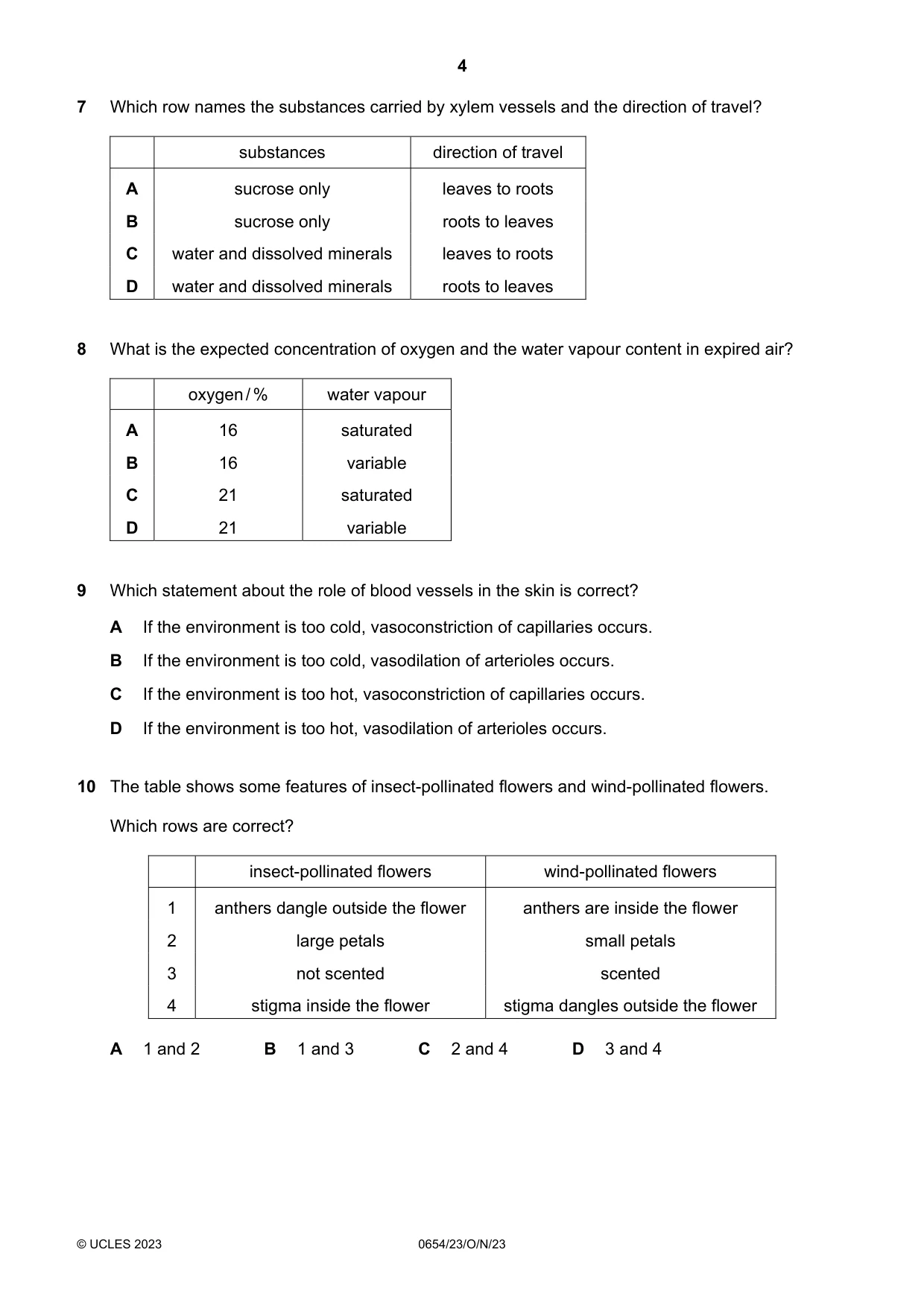
7 Which row names the substances carried by xylem vessels and the direction of travel? substances direction of travel A sucrose only leaves to roots B sucrose only roots to leaves C water and dissolved minerals leaves to roots D water and dissolved minerals roots to leaves
Mark scheme: D
Q8 · What is the expected concentration of oxygen and the water vapour content in expired air?
8 What is the expected concentration of oxygen and the water vapour content in expired air? oxygen / % water vapour A 16 saturated B 16 variable C 21 saturated D 21 variable
Mark scheme: A
Q9 · Which statement about the role of blood vessels in the skin is correct?
9 Which statement about the role of blood vessels in the skin is correct? A If the environment is too cold, vasoconstriction of capillaries occurs. B If the environment is too cold, vasodilation of arterioles occurs. C If the environment is too hot, vasoconstriction of capillaries occurs. D If the environment is too hot, vasodilation of arterioles occurs.
Mark scheme: D
Q10 · The table shows some features of insect-pollinated flowers and wind-pollinated flowers
10 The table shows some features of insect-pollinated flowers and wind-pollinated flowers. Which rows are correct? insect-pollinated flowers wind-pollinated flowers 1 anthers dangle outside the flower anthers are inside the flower 2 large petals small petals 3 not scented scented 4 stigma inside the flower stigma dangles outside the flower A 1 and 2 B 1 and 3 C 2 and 4 D 3 and 4
Mark scheme: C
Q11 · What is a difference between a haploid nucleus and a diploid nucleus from the same plant?
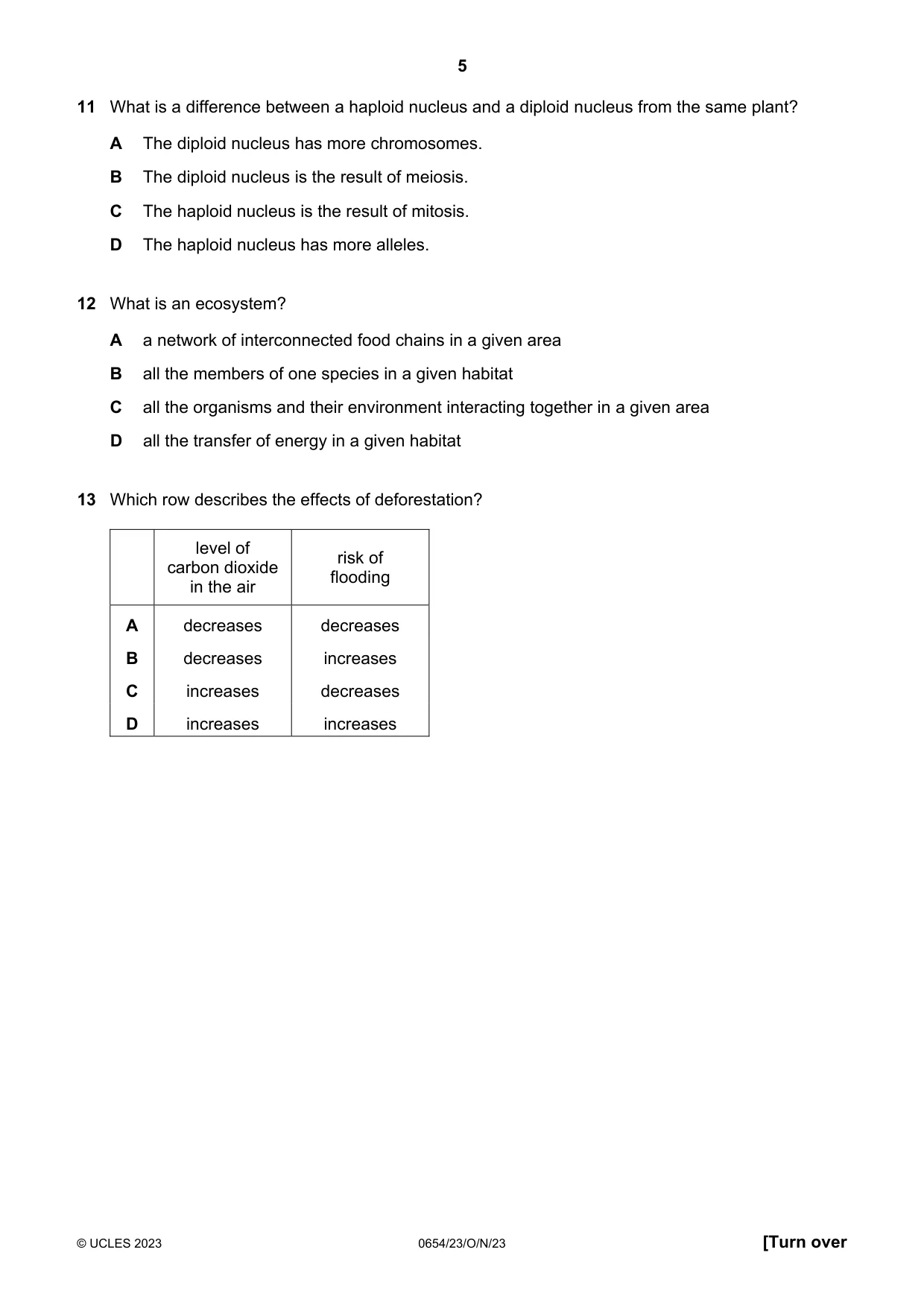
11 What is a difference between a haploid nucleus and a diploid nucleus from the same plant? A The diploid nucleus has more chromosomes. B The diploid nucleus is the result of meiosis. C The haploid nucleus is the result of mitosis. D The haploid nucleus has more alleles.
Mark scheme: A
Q12 · What is an ecosystem?
12 What is an ecosystem? A a network of interconnected food chains in a given area B all the members of one species in a given habitat C all the organisms and their environment interacting together in a given area D all the transfer of energy in a given habitat
Mark scheme: C
Q13 · Which row describes the effects of deforestation?
13 Which row describes the effects of deforestation? level of risk of carbon dioxide flooding in the air A decreases decreases B decreases increases C increases decreases D increases increases
Mark scheme: D
Q14 · The colours in an ink are separated by chromatography
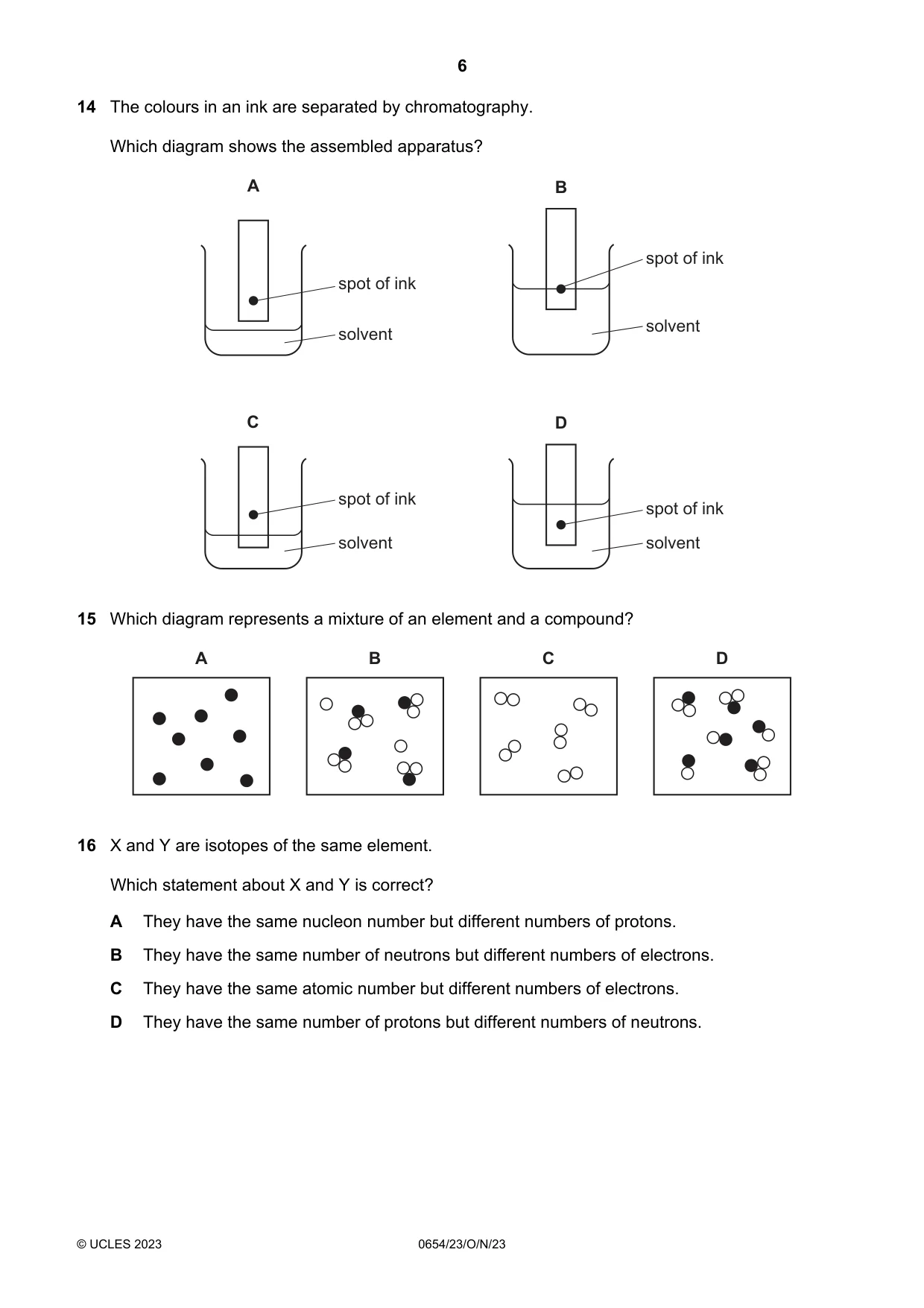
14 The colours in an ink are separated by chromatography. Which diagram shows the assembled apparatus? A B spot of ink spot of ink solvent solvent C D spot of ink spot of ink solvent solvent
Mark scheme: C
Q15 · Which diagram represents a mixture of an element and a compound?
15 Which diagram represents a mixture of an element and a compound? A B C D
Mark scheme: B
Q16 · X and Y are isotopes of the same element
16 X and Y are isotopes of the same element. Which statement about X and Y is correct? A They have the same nucleon number but different numbers of protons. B They have the same number of neutrons but different numbers of electrons. C They have the same atomic number but different numbers of electrons. D They have the same number of protons but different numbers of neutrons.
Mark scheme: D
Q17 · Nonane, C9H20, burns in oxygen to form carbon dioxide and water
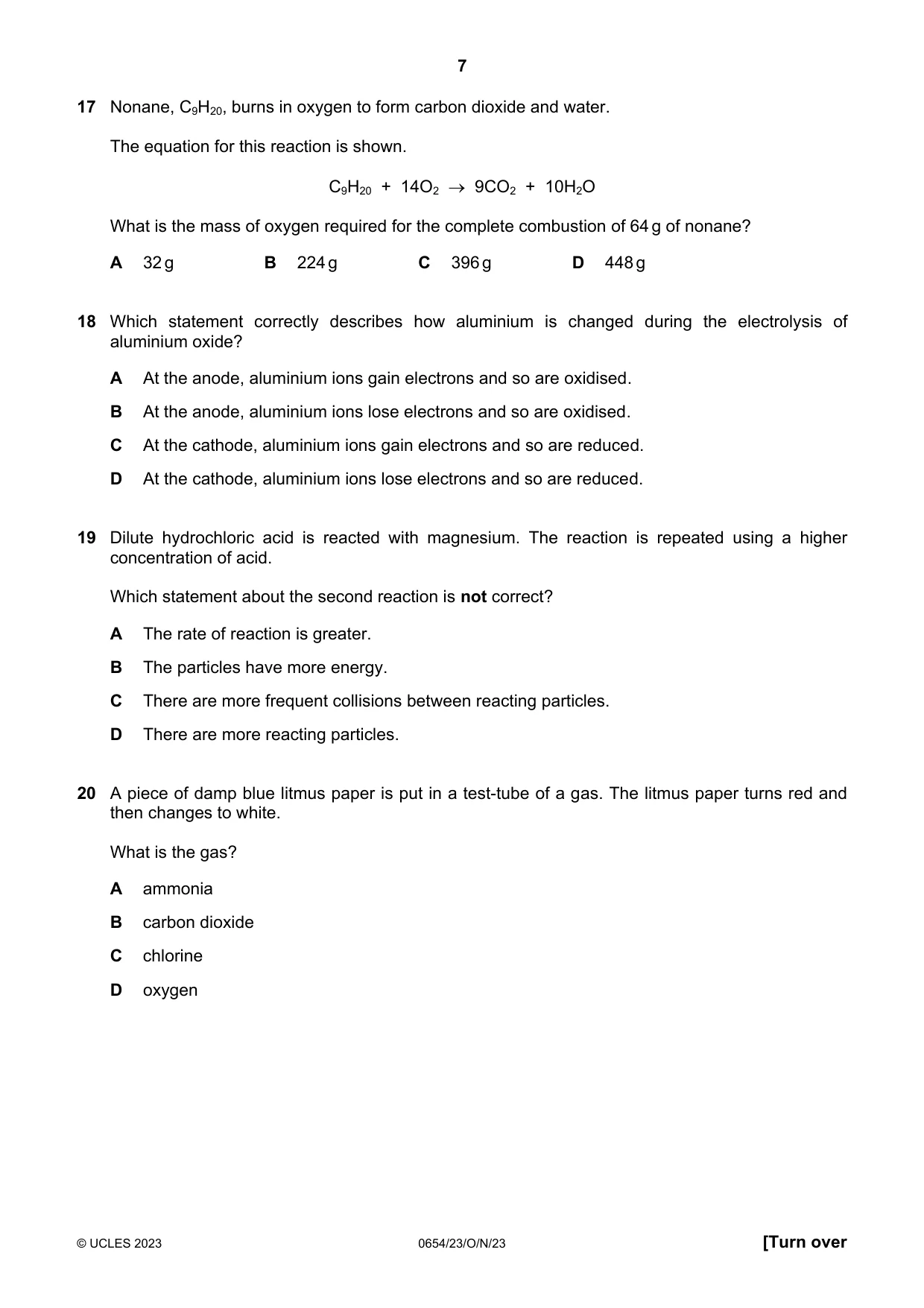
17 Nonane, C9H20, burns in oxygen to form carbon dioxide and water. The equation for this reaction is shown. C9H20 + 14O2 9CO2 + 10H2O What is the mass of oxygen required for the complete combustion of 64 g of nonane? A 32 g B 224 g C 396 g D 448 g
Mark scheme: B
Q18 · Which statement correctly describes how aluminium is changed during the electrolysis of…
18 Which statement correctly describes how aluminium is changed during the electrolysis of aluminium oxide? A At the anode, aluminium ions gain electrons and so are oxidised. B At the anode, aluminium ions lose electrons and so are oxidised. C At the cathode, aluminium ions gain electrons and so are reduced. D At the cathode, aluminium ions lose electrons and so are reduced.
Mark scheme: C
Q19 · Dilute hydrochloric acid is reacted with magnesium
19 Dilute hydrochloric acid is reacted with magnesium. The reaction is repeated using a higher concentration of acid. Which statement about the second reaction is not correct? A The rate of reaction is greater. B The particles have more energy. C There are more frequent collisions between reacting particles. D There are more reacting particles.
Mark scheme: B
Q20 · A piece of damp blue litmus paper is put in a test-tube of a gas
20 A piece of damp blue litmus paper is put in a test-tube of a gas. The litmus paper turns red and then changes to white. What is the gas? A ammonia B carbon dioxide C chlorine D oxygen
Mark scheme: C
Q21 · The elements in Group I of the Periodic Table are metals
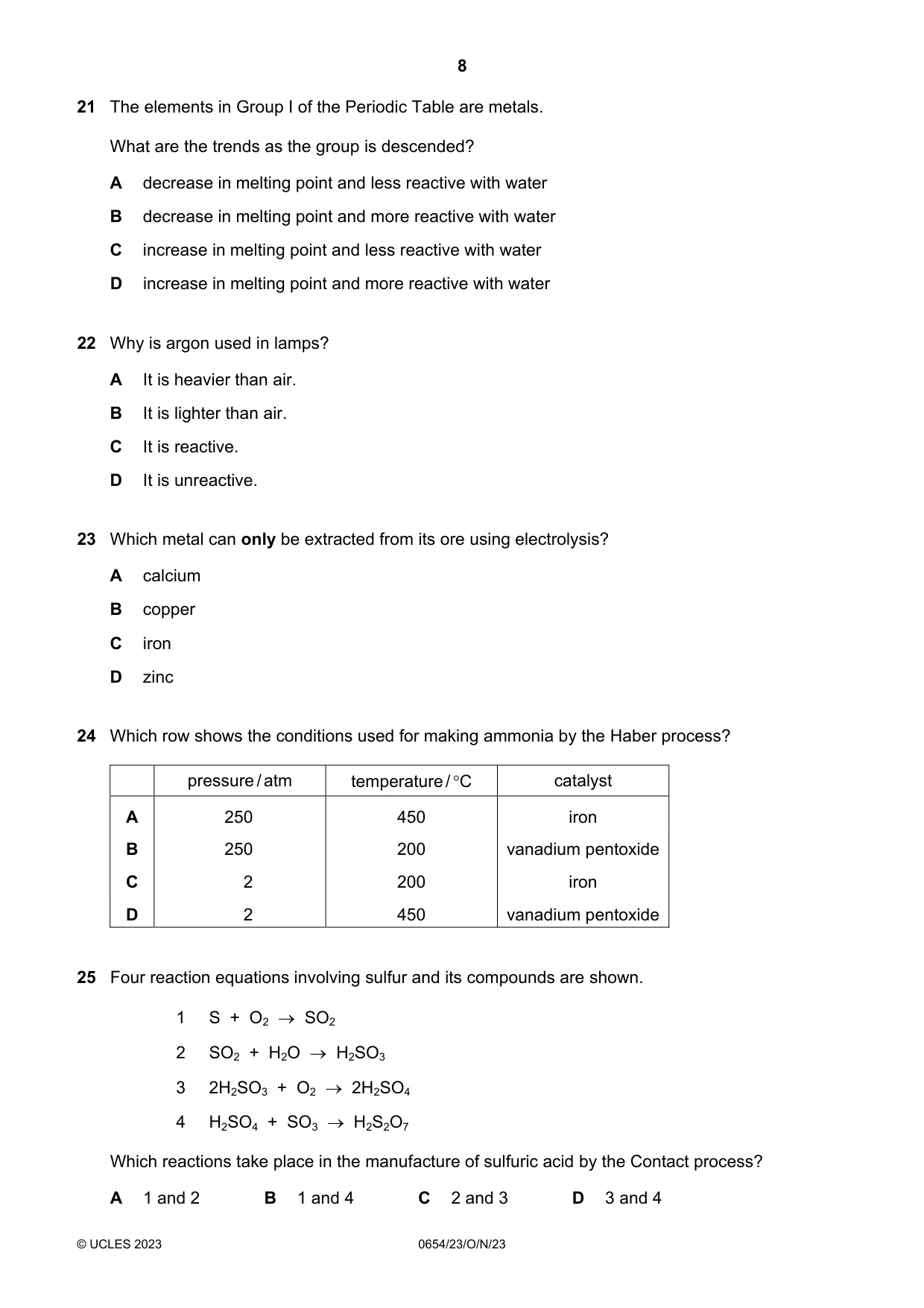
21 The elements in Group I of the Periodic Table are metals. What are the trends as the group is descended? A decrease in melting point and less reactive with water B decrease in melting point and more reactive with water C increase in melting point and less reactive with water D increase in melting point and more reactive with water
Mark scheme: B
Q22 · Why is argon used in lamps?
22 Why is argon used in lamps? A It is heavier than air. B It is lighter than air. C It is reactive. D It is unreactive.
Mark scheme: D
Q23 · Which metal can only be extracted from its ore using electrolysis?
23 Which metal can only be extracted from its ore using electrolysis? A calcium B copper C iron D zinc
Mark scheme: A
Q24 · Which row shows the conditions used for making ammonia by the Haber process?
24 Which row shows the conditions used for making ammonia by the Haber process? pressure / atm temperature / C catalyst A 250 450 iron B 250 200 vanadium pentoxide C 2 200 iron D 2 450 vanadium pentoxide
Mark scheme: A
Q25 · Four reaction equations involving sulfur and its compounds are shown
25 Four reaction equations involving sulfur and its compounds are shown. 1 S + O2 SO2 2 SO2 + H2O H2SO3 3 2H2SO3 + O2 2H2SO4 4 H2SO4 + SO3 H2S2O7 Which reactions take place in the manufacture of sulfuric acid by the Contact process? A 1 and 2 B 1 and 4 C 2 and 3 D 3 and 4
Mark scheme: B
Q26 · Which formula represents but-1-ene?
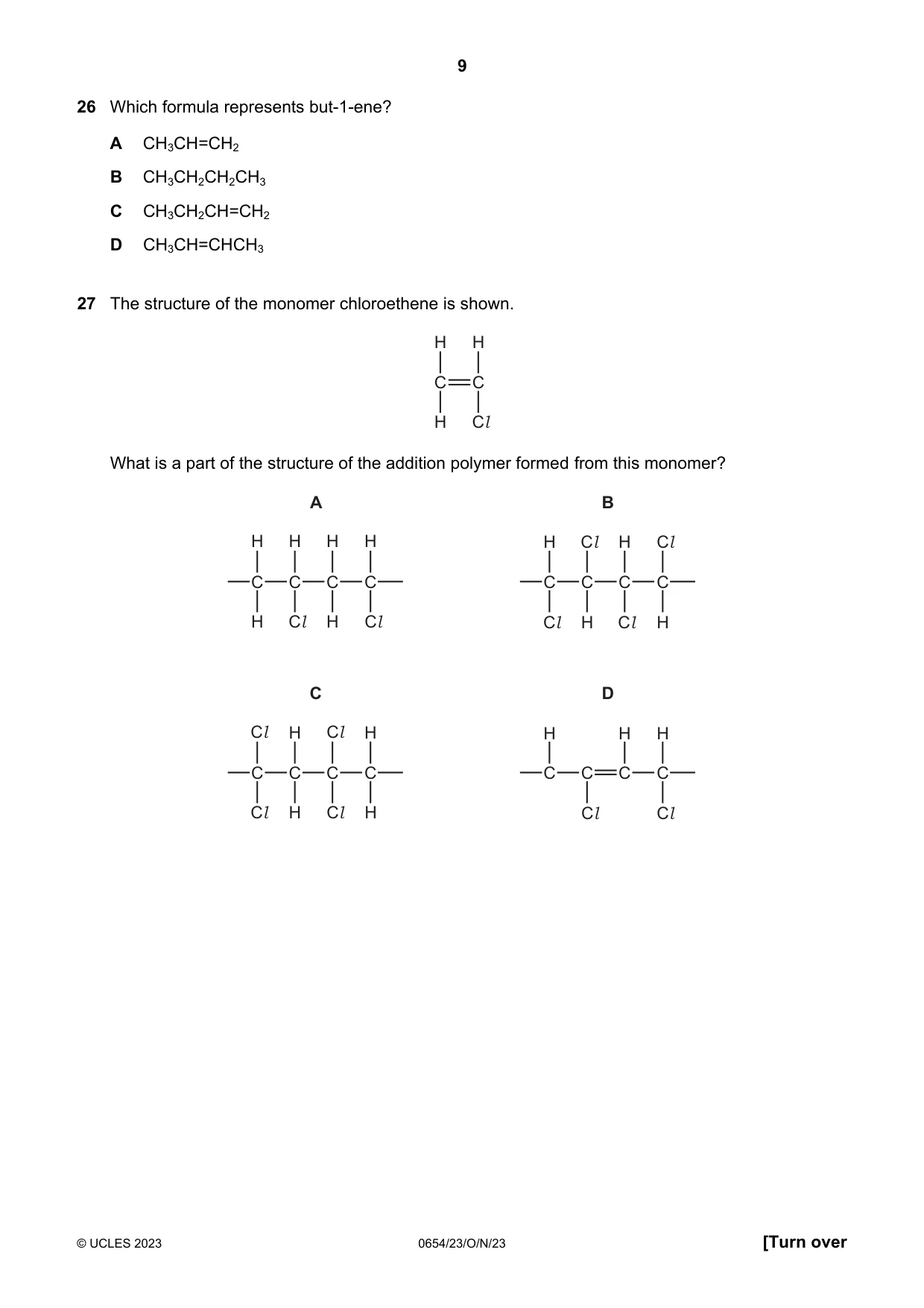
26 Which formula represents but-1-ene? A CH3CH=CH2 B CH3CH2CH2CH3 C CH3CH2CH=CH2 D CH3CH=CHCH3
Mark scheme: C
Q27 · The structure of the monomer chloroethene is shown
27 The structure of the monomer chloroethene is shown. H H C C H Cl What is a part of the structure of the addition polymer formed from this monomer? A B H H H H H Cl H Cl C C C C C C C C H Cl H Cl Cl H Cl H C D Cl H Cl H H H H C C C C C C C C Cl H Cl H Cl Cl
Mark scheme: A
Q28 · The graph shows the variation of speed with time for an object moving in a straight line
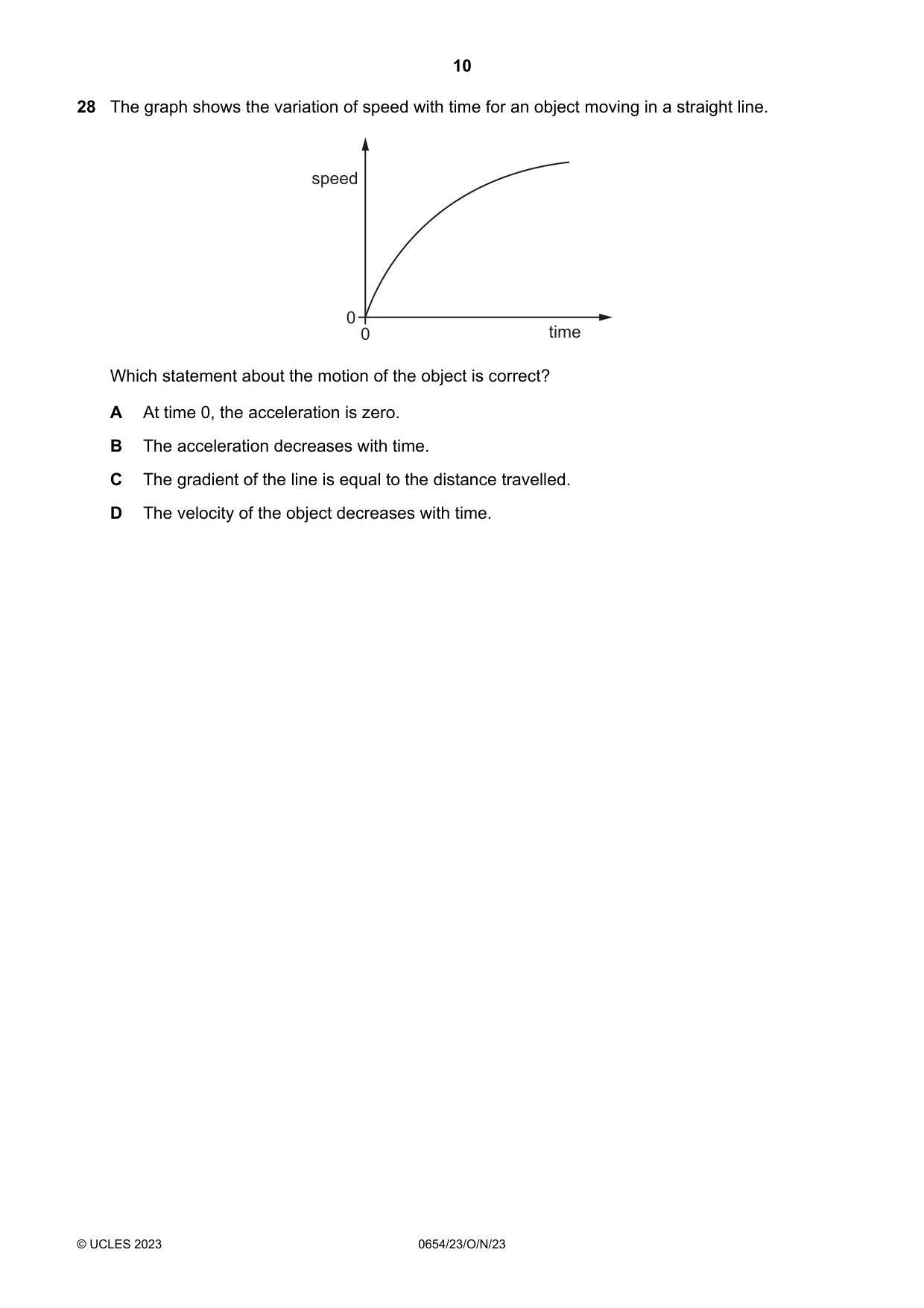
28 The graph shows the variation of speed with time for an object moving in a straight line. speed 0 0 time Which statement about the motion of the object is correct? A At time 0, the acceleration is zero. B The acceleration decreases with time. C The gradient of the line is equal to the distance travelled. D The velocity of the object decreases with time.
Mark scheme: B
Q29 · A spring with its length indicated
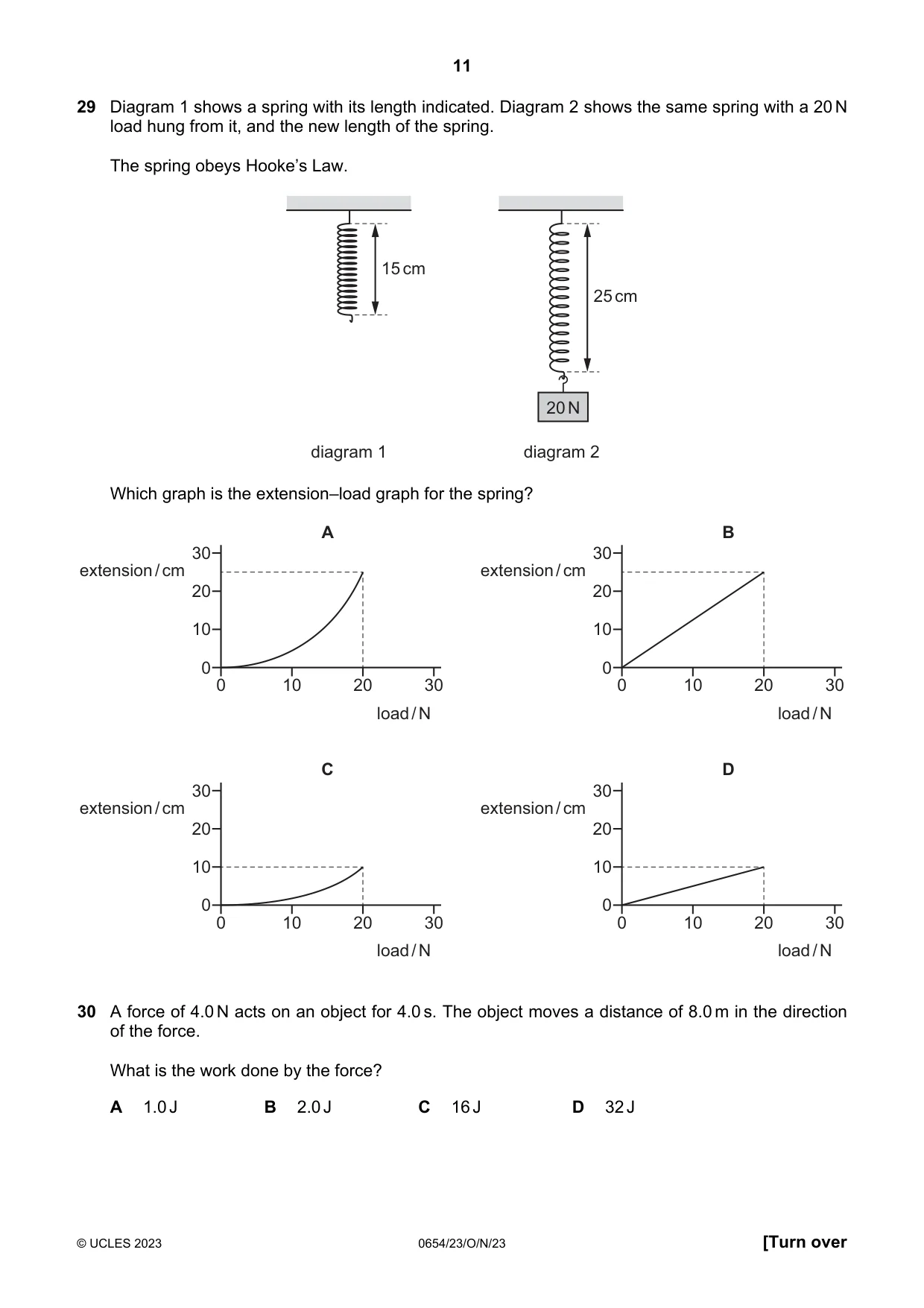
29 Diagram 1 shows a spring with its length indicated. Diagram 2 shows the same spring with a 20 N load hung from it, and the new length of the spring. The spring obeys Hooke’s Law. 15 cm 25 cm 20 N diagram 1 diagram 2 Which graph is the extension–load graph for the spring? A B 30 30 extension / cm extension / cm 20 20 10 10 0 0 0 10 20 30 0 10 20 30 load / N load / N C D 30 30 extension / cm extension / cm 20 20 10 10 0 0 0 10 20 30 0 10 20 30 load / N load / N
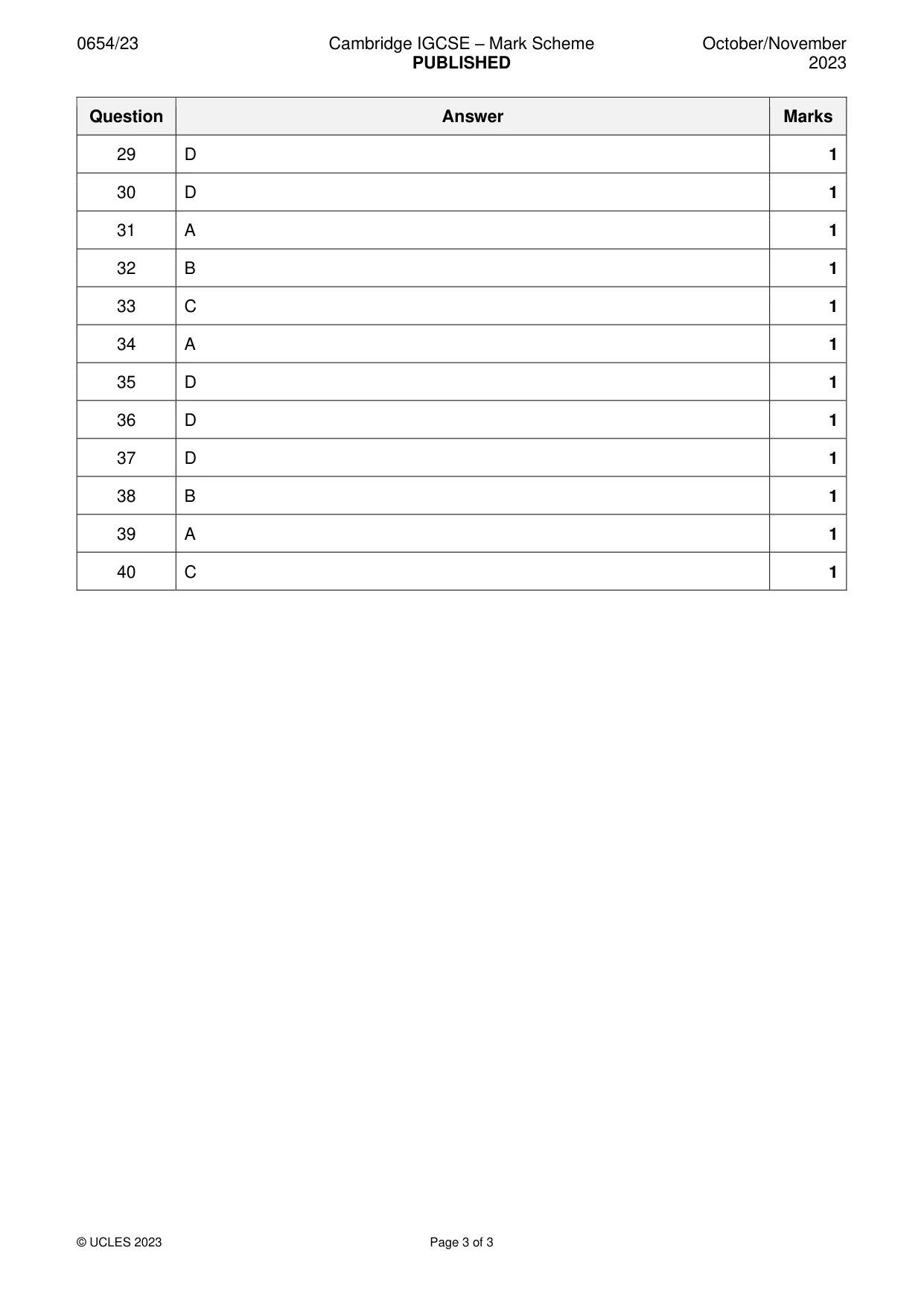
Mark scheme: D
Q30 · A force of 4.0 N acts on an object for 4.0 s
30 A force of 4.0 N acts on an object for 4.0 s. The object moves a distance of 8.0 m in the direction of the force. What is the work done by the force? A 1.0 J B 2.0 J C 16 J D 32 J
Mark scheme: D
Q31 · An electric motor transfers 4000 J of electrical energy to useful energy and 12 000 J of…
31 An electric motor transfers 4000 J of electrical energy to useful energy and 12 000 J of electrical energy is wasted. What is the efficiency of the motor? A 25% B 33% C 50% D 75%
Mark scheme: A
Q32 · The pressure of a gas in a container is caused by gas molecules colliding with the walls
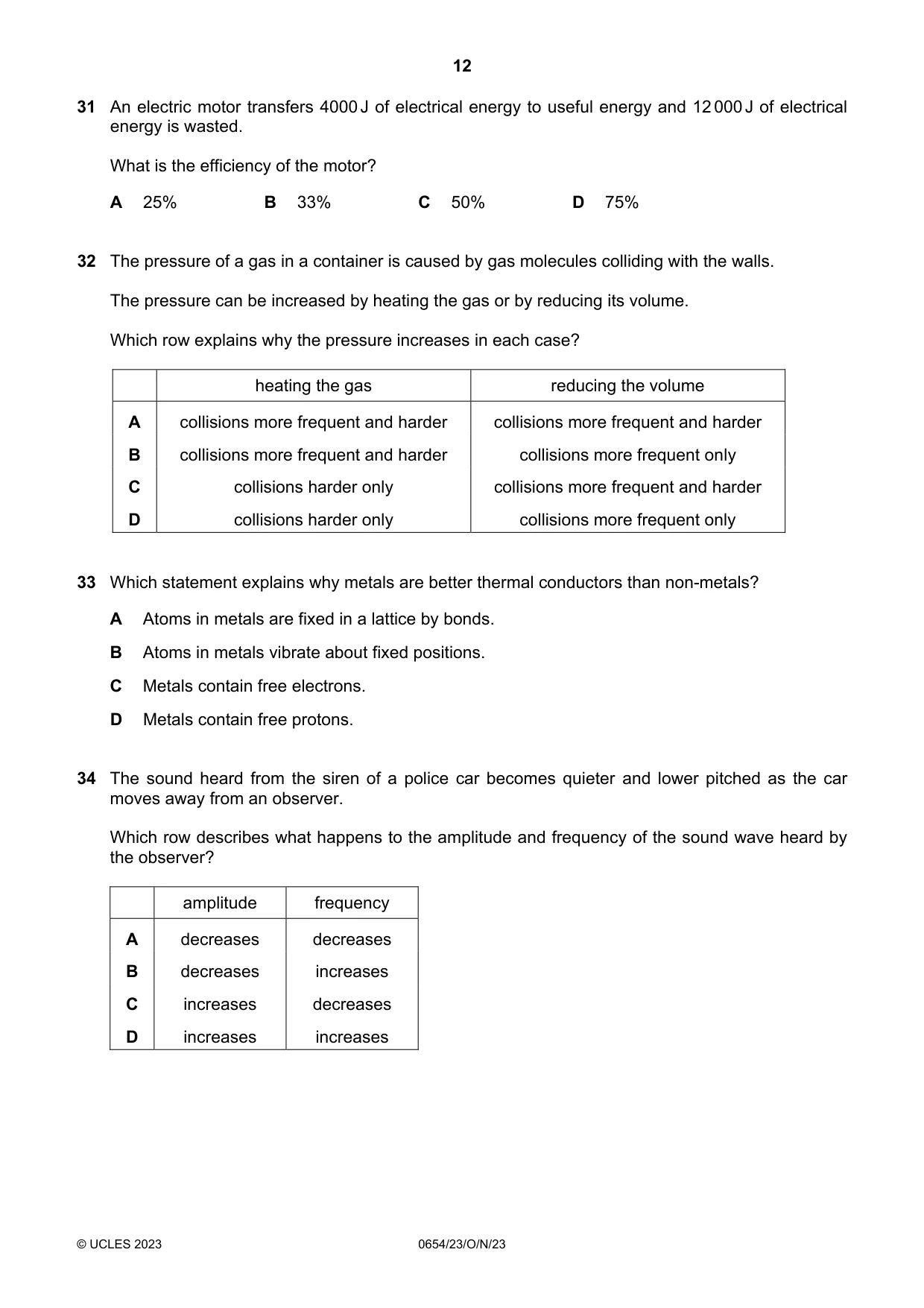
32 The pressure of a gas in a container is caused by gas molecules colliding with the walls. The pressure can be increased by heating the gas or by reducing its volume. Which row explains why the pressure increases in each case? heating the gas reducing the volume A collisions more frequent and harder collisions more frequent and harder B collisions more frequent and harder collisions more frequent only C collisions harder only collisions more frequent and harder D collisions harder only collisions more frequent only
Mark scheme: B
Q33 · Which statement explains why metals are better thermal conductors than non-metals?
33 Which statement explains why metals are better thermal conductors than non-metals? A Atoms in metals are fixed in a lattice by bonds. B Atoms in metals vibrate about fixed positions. C Metals contain free electrons. D Metals contain free protons.
Mark scheme: C
Q34 · The sound heard from the siren of a police car becomes quieter and lower pitched as the…
34 The sound heard from the siren of a police car becomes quieter and lower pitched as the car moves away from an observer. Which row describes what happens to the amplitude and frequency of the sound wave heard by the observer? amplitude frequency A decreases decreases B decreases increases C increases decreases D increases increases
Mark scheme: A
Q35 · A bar magnet is brought near to a metal rod
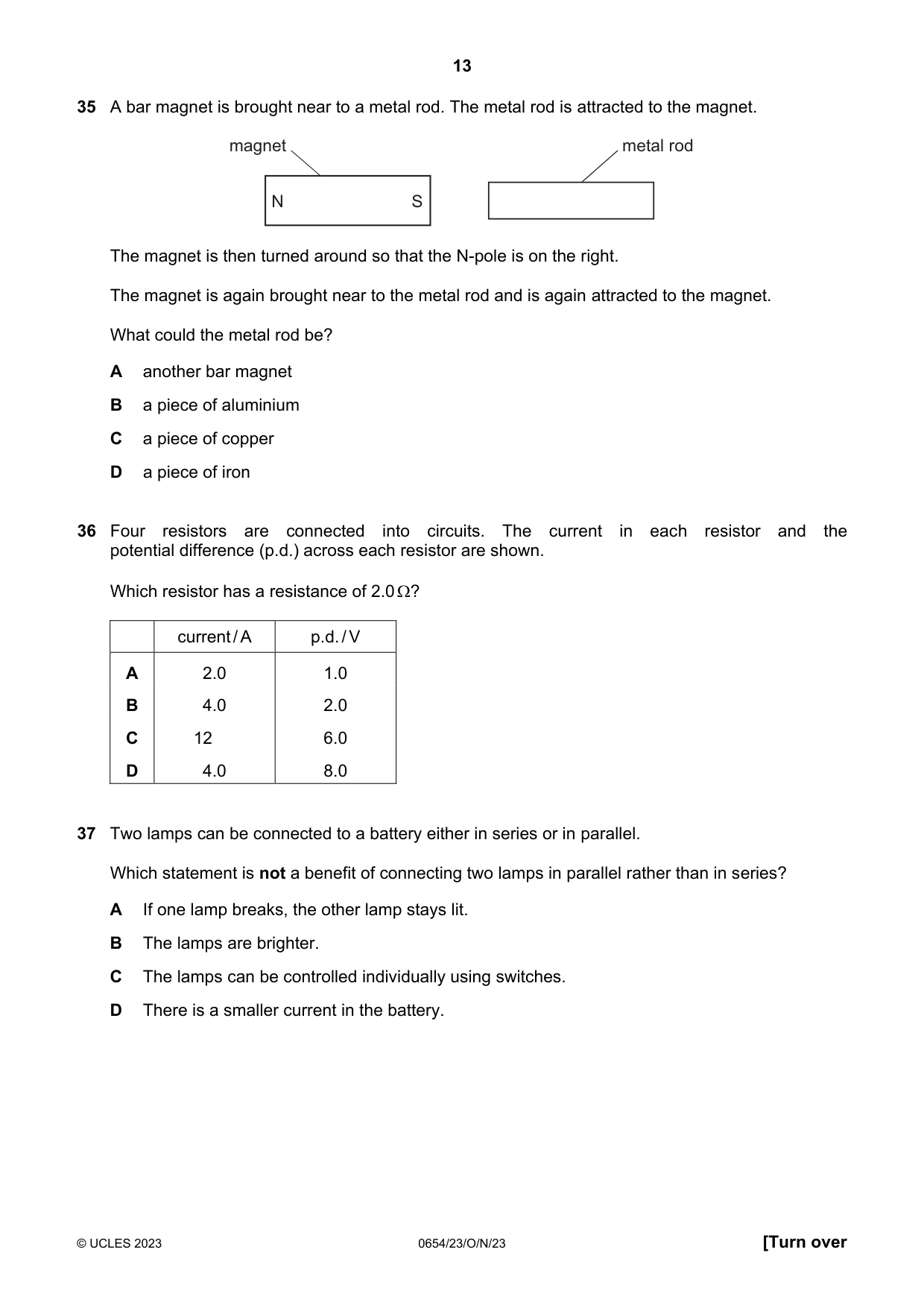
35 A bar magnet is brought near to a metal rod. The metal rod is attracted to the magnet. magnet metal rod N S The magnet is then turned around so that the N-pole is on the right. The magnet is again brought near to the metal rod and is again attracted to the magnet. What could the metal rod be? A another bar magnet B a piece of aluminium C a piece of copper D a piece of iron
Mark scheme: D
Q36 · Four resistors are connected into circuits
36 Four resistors are connected into circuits. The current in each resistor and the potential difference (p.d.) across each resistor are shown. Which resistor has a resistance of 2.0 ? current / A p.d. / V A 2.0 1.0 B 4.0 2.0 C 12 6.0 D 4.0 8.0
Mark scheme: D
Q37 · Two lamps can be connected to a battery either in series or in parallel
37 Two lamps can be connected to a battery either in series or in parallel. Which statement is not a benefit of connecting two lamps in parallel rather than in series? A If one lamp breaks, the other lamp stays lit. B The lamps are brighter. C The lamps can be controlled individually using switches. D There is a smaller current in the battery.
Mark scheme: D
Q38 · What is the purpose of a fuse in an electric circuit?
38 What is the purpose of a fuse in an electric circuit? A to make the circuit more efficient B to protect the circuit from damage by a large current C to provide a constant current in the circuit D to provide a constant potential difference (p.d.) across the circuit
Mark scheme: B
Q39 · A current-carrying wire is placed between the poles P and Q of a magnet, as shown
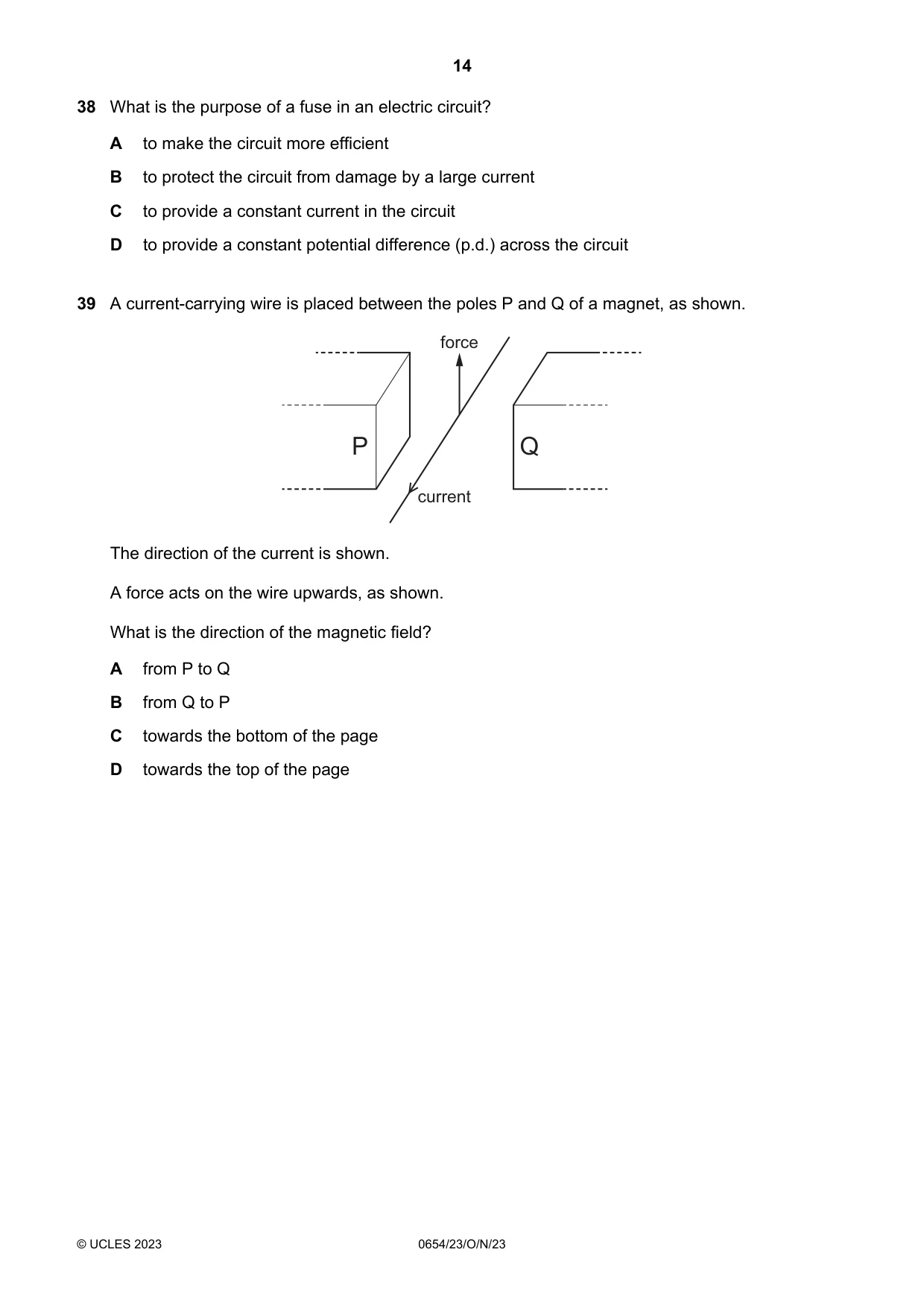
39 A current-carrying wire is placed between the poles P and Q of a magnet, as shown. force P Q current The direction of the current is shown. A force acts on the wire upwards, as shown. What is the direction of the magnetic field? A from P to Q B from Q to P C towards the bottom of the page D towards the top of the page
Mark scheme: A
Q40 · The diagram shows a beam of -particles and a beam of -rays entering the electric field…
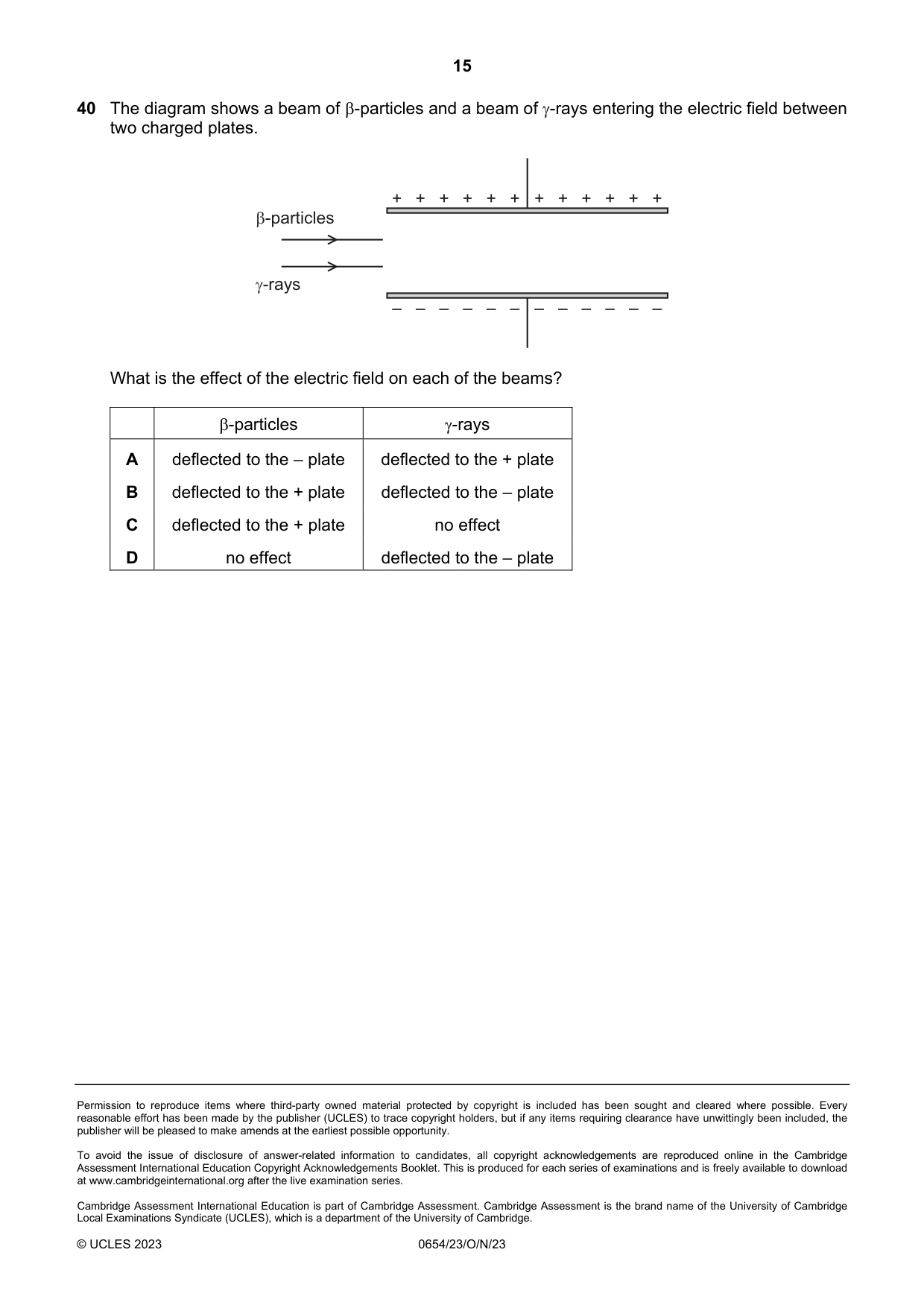
40 The diagram shows a beam of -particles and a beam of -rays entering the electric field between two charged plates. + + + + + + + + + + + + β-particles γ-rays – – – – – – – – – – – – What is the effect of the electric field on each of the beams? -particles -rays A deflected to the – plate deflected to the + plate B deflected to the + plate deflected to the – plate C deflected to the + plate no effect D no effect deflected to the – plate
Mark scheme: C
What was in this paper
The subtopics covered by these 40 questions, and how many questions each got. Open one in a new tab to see every Cambridge question on it.
2Identification of ions and gases2Air quality and climate1Blood1Cell division1Characteristics of living organisms1Chromatography1Digestion1Electrical circuits1Electrical quantities1Electrical safety1Electrolysis1Electromagnetic effects1Elements, compounds and mixtures1Energy flow1Enzymes1Extraction of metals1Forces1Gas exchange in humans1Group I properties1Habitat destruction1Homeostasis1Isotopes1Kinetic particle model of matter1Motion1Naming organic compounds1Noble gases1Photosynthesis1Physical and chemical changes1Polymers1Radioactivity1Rate of reaction1Sexual reproduction in plants1Simple phenomena of magnetism1Sound1The mole and the Avogadro constant1Transfer of thermal energy1Xylem and phloem1What you needed in this session
Cambridge’s own grade thresholds for 2023 Oct/Nov, Paper 2 · Variant 3. A higher threshold means an easier paper — the bar moves with how the cohort did.