Cambridge IGCSE Sciences - Co-ordinated (Double) 0654 — 2023 May/June Paper 2 · Variant 1
0654/21/M/J/23 · 40 questions · 40 marks · ≈45 min
The question paper and its mark scheme, free to read here and free to download. This is Cambridge’s own paper, exactly as it was sat.
Question paper16 pages
Mark scheme3 pages
Answers below. Sit the paper first if you are practising.
Questions as text
Q1 · What is meant by respiration?
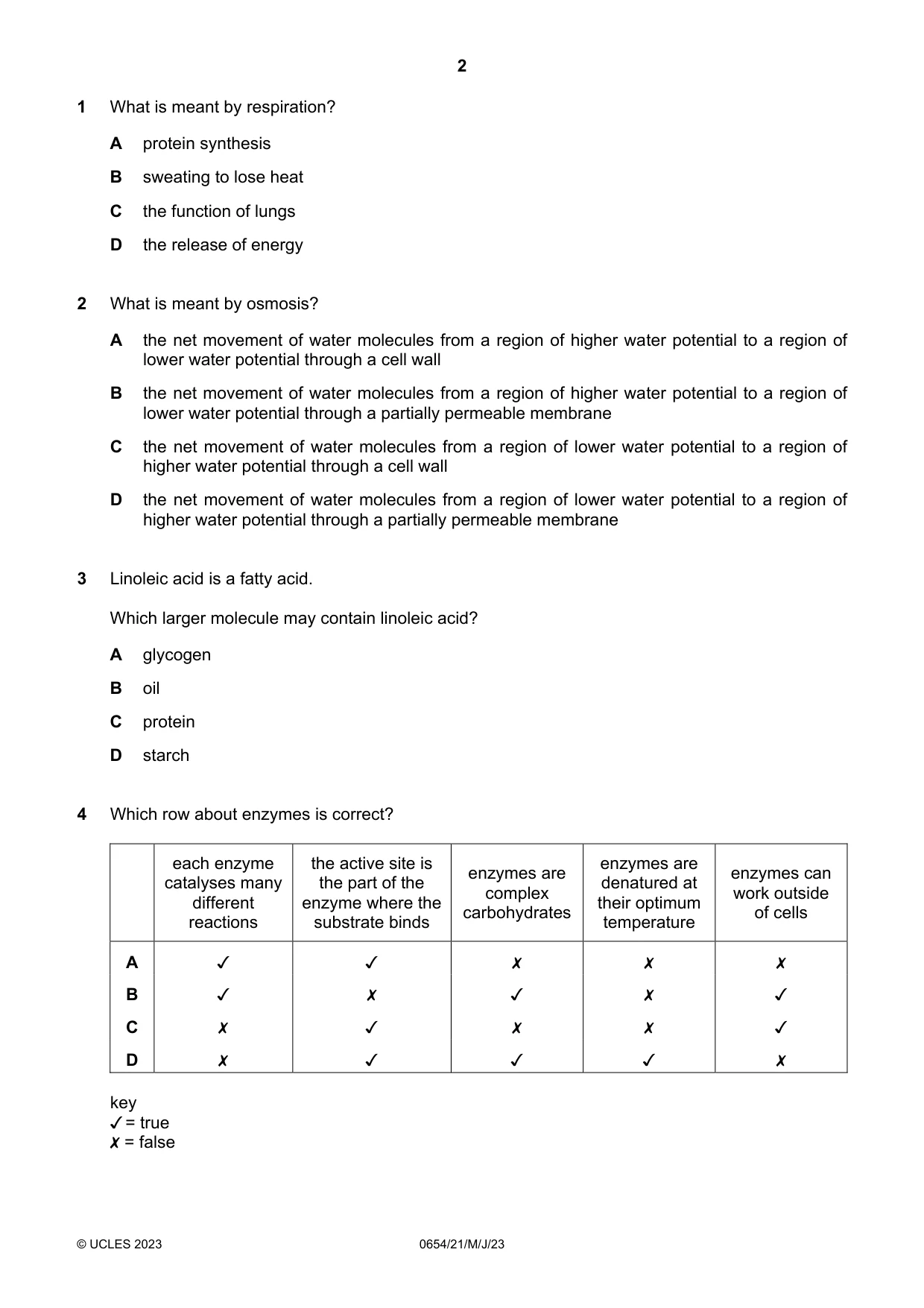
1 What is meant by respiration? A protein synthesis B sweating to lose heat C the function of lungs D the release of energy
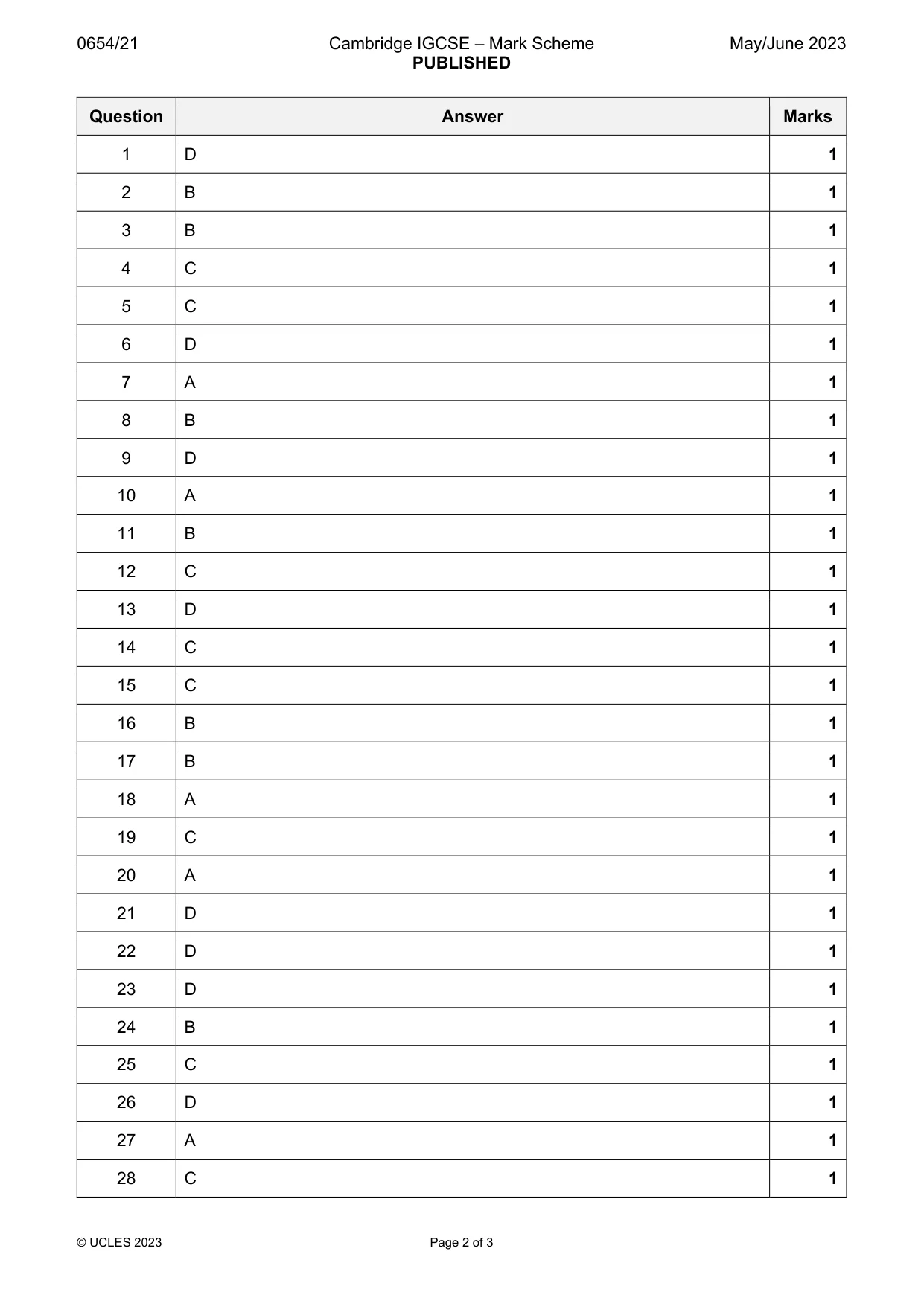
Mark scheme: D
Q2 · What is meant by osmosis?
2 What is meant by osmosis? A the net movement of water molecules from a region of higher water potential to a region of lower water potential through a cell wall B the net movement of water molecules from a region of higher water potential to a region of lower water potential through a partially permeable membrane C the net movement of water molecules from a region of lower water potential to a region of higher water potential through a cell wall D the net movement of water molecules from a region of lower water potential to a region of higher water potential through a partially permeable membrane
Mark scheme: B
Q3 · Linoleic acid is a fatty acid
3 Linoleic acid is a fatty acid. Which larger molecule may contain linoleic acid? A glycogen B oil C protein D starch
Mark scheme: B
Q4 · Which row about enzymes is correct?
4 Which row about enzymes is correct? each enzyme the active site is enzymes are catalyses many the part of the comple . denatured at work outside different enzyme where the their optimum reactions substrate binds carbohydrates temperature of cells A v v x x x B v x v x v Cc x J x x Jv D x v v v x key J/ = true X = false
Mark scheme: C
Q5 · An experiment is set up to investigate the effect of changing the light intensity on the…
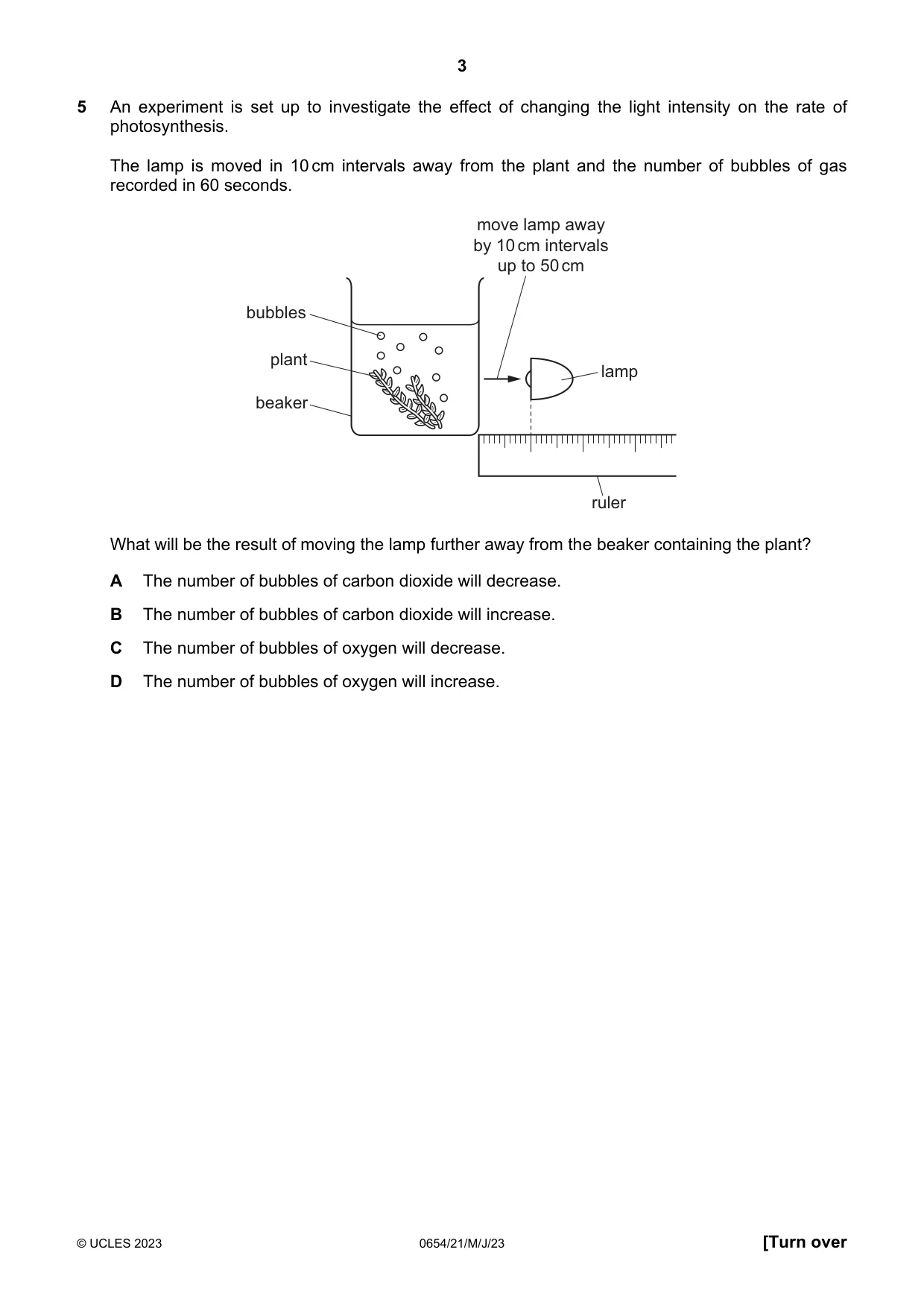
5 An experiment is set up to investigate the effect of changing the light intensity on the rate of photosynthesis. The lamp is moved in 10 cm intervals away from the plant and the number of bubbles of gas recorded in 60 seconds. move lamp away by 10 cm intervals up to 50 cm bubbles plant lamp beaker ruler What will be the result of moving the lamp further away from the beaker containing the plant? A The number of bubbles of carbon dioxide will decrease. B The number of bubbles of carbon dioxide will increase. C The number of bubbles of oxygen will decrease. D The number of bubbles of oxygen will increase.
Mark scheme: C
Q6 · Some processes that occur in the alimentary canal and associated organs are listed
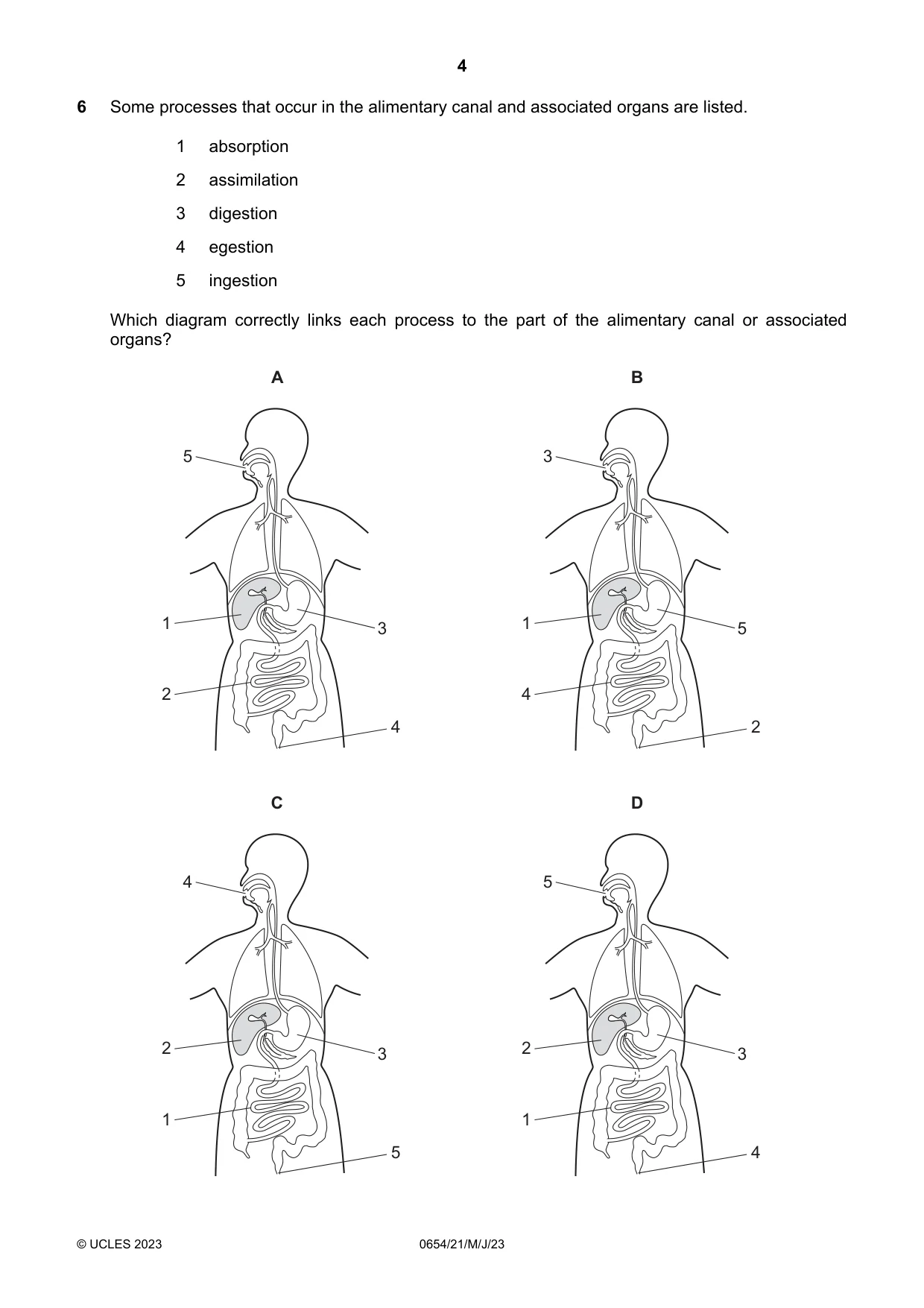
6 Some processes that occur in the alimentary canal and associated organs are listed. 1 absorption 2 assimilation 3 digestion 4 egestion 5 ingestion Which diagram correctly links each process to the part of the alimentary canal or associated organs? A B 5 3 1 3 1 5 2 4 4 2 C D 4 5 2 3 2 3 1 1 5 4
Mark scheme: D
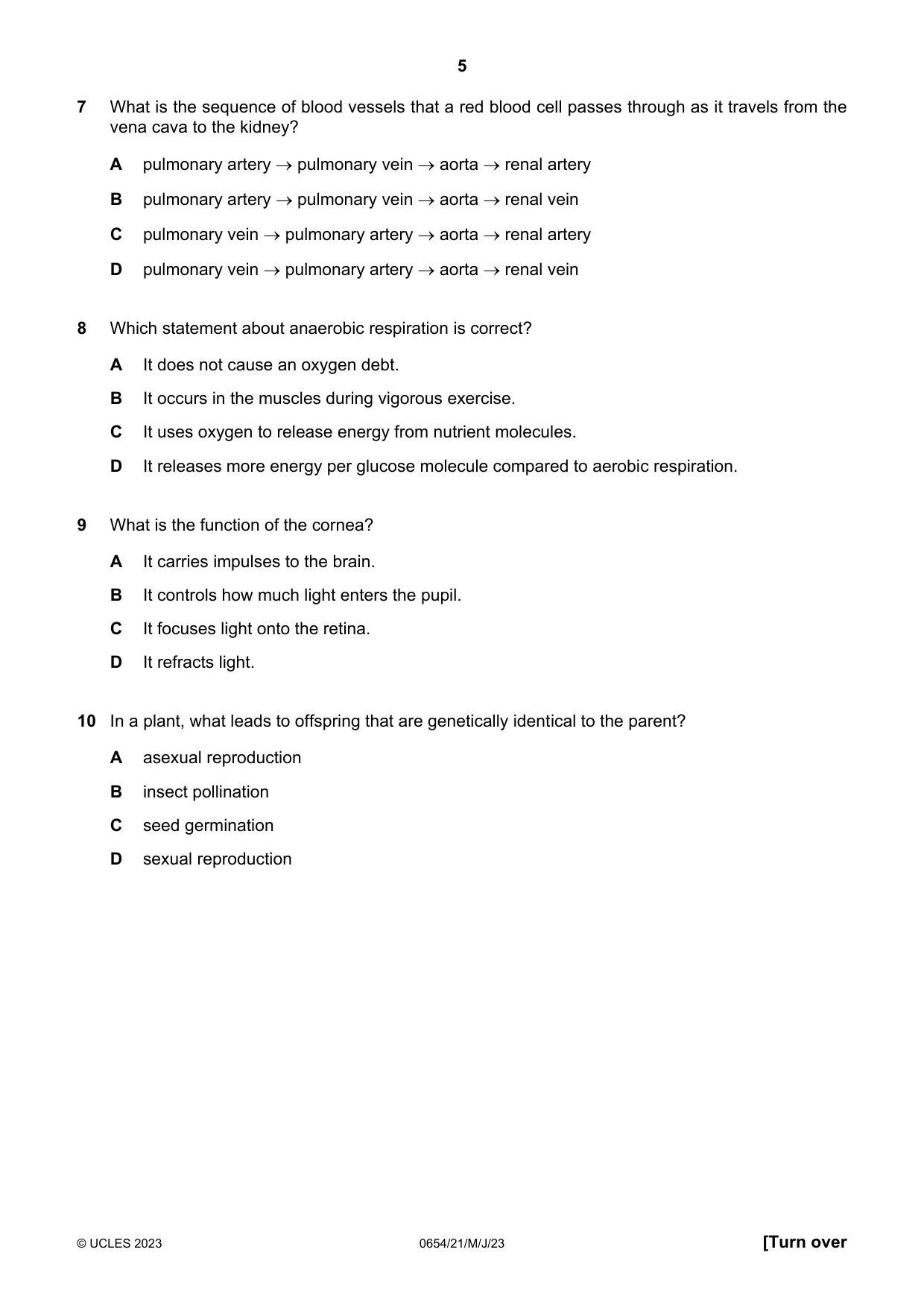
Q7 · What is the sequence of blood vessels that a red blood cell passes through as it travels…
7 What is the sequence of blood vessels that a red blood cell passes through as it travels from the vena cava to the kidney? A pulmonary artery pulmonary vein aorta renal artery B pulmonary artery pulmonary vein aorta renal vein C pulmonary vein pulmonary artery aorta renal artery D pulmonary vein pulmonary artery aorta renal vein
Mark scheme: A
Q8 · Which statement about anaerobic respiration is correct?
8 Which statement about anaerobic respiration is correct? A It does not cause an oxygen debt. B It occurs in the muscles during vigorous exercise. C It uses oxygen to release energy from nutrient molecules. D It releases more energy per glucose molecule compared to aerobic respiration.
Mark scheme: B
Q9 · What is the function of the cornea?
9 What is the function of the cornea? A It carries impulses to the brain. B It controls how much light enters the pupil. C It focuses light onto the retina. D It refracts light.
Mark scheme: D
Q10 · In a plant, what leads to offspring that are genetically identical to the parent?
10 In a plant, what leads to offspring that are genetically identical to the parent? A asexual reproduction B insect pollination C seed germination D sexual reproduction
Mark scheme: A
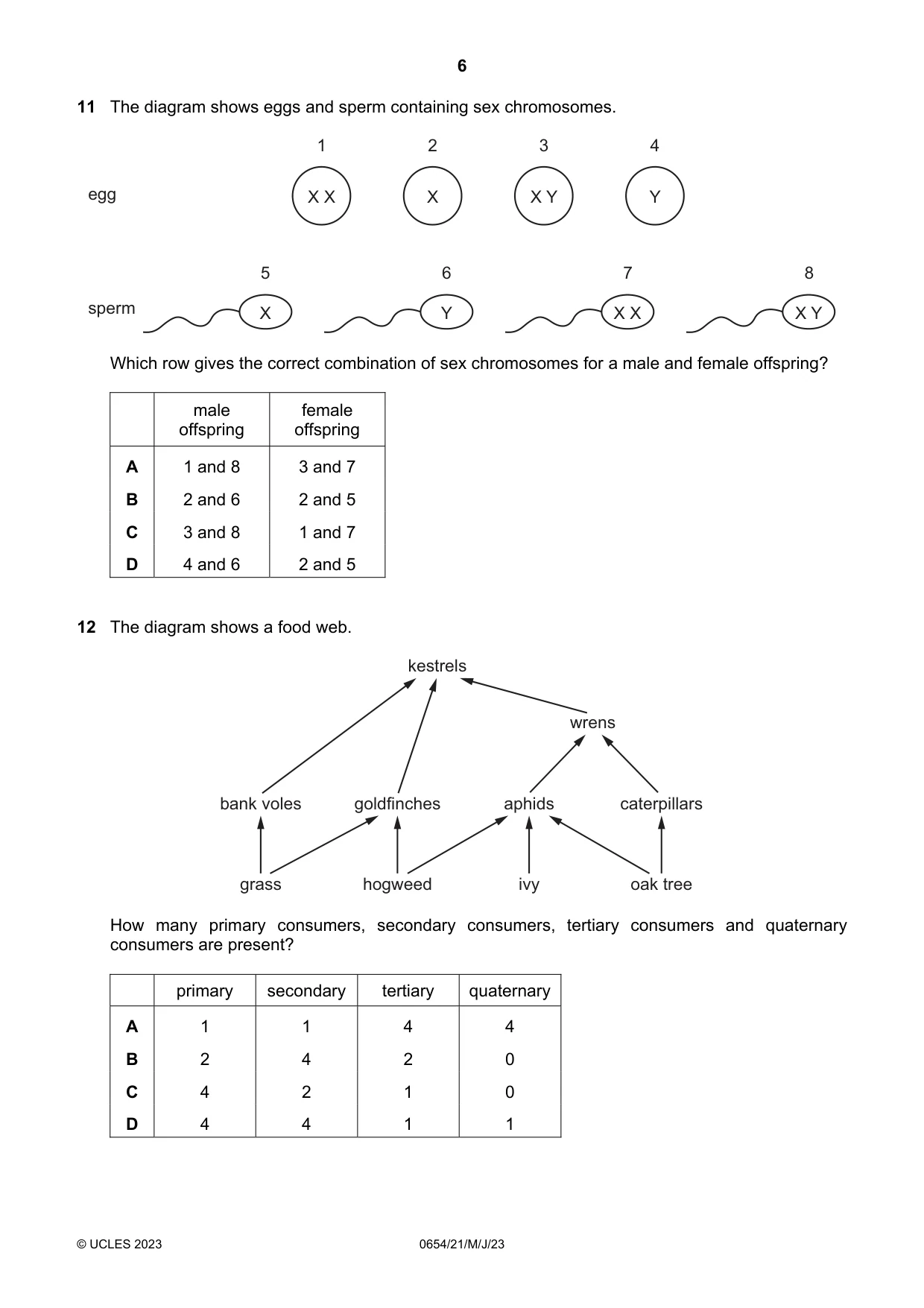
Q11 · The diagram shows eggs and sperm containing sex chromosomes
11 The diagram shows eggs and sperm containing sex chromosomes. 1 2 3 4 egg X X X X Y Y 5 6 7 8 sperm X Y X X X Y Which row gives the correct combination of sex chromosomes for a male and female offspring? male female offspring offspring A 1 and 8 3 and 7 B 2 and 6 2 and 5 C 3 and 8 1 and 7 D 4 and 6 2 and 5
Mark scheme: B
Q12 · The diagram shows a food web
12 The diagram shows a food web. kestrels wrens bank voles goldfinches aphids caterpillars grass hogweed ivy oak tree How many primary consumers, secondary consumers, tertiary consumers and quaternary consumers are present? primary secondary tertiary quaternary A 1 1 4 4 B 2 4 2 0 C 4 2 1 0 D 4 4 1 1
Mark scheme: C
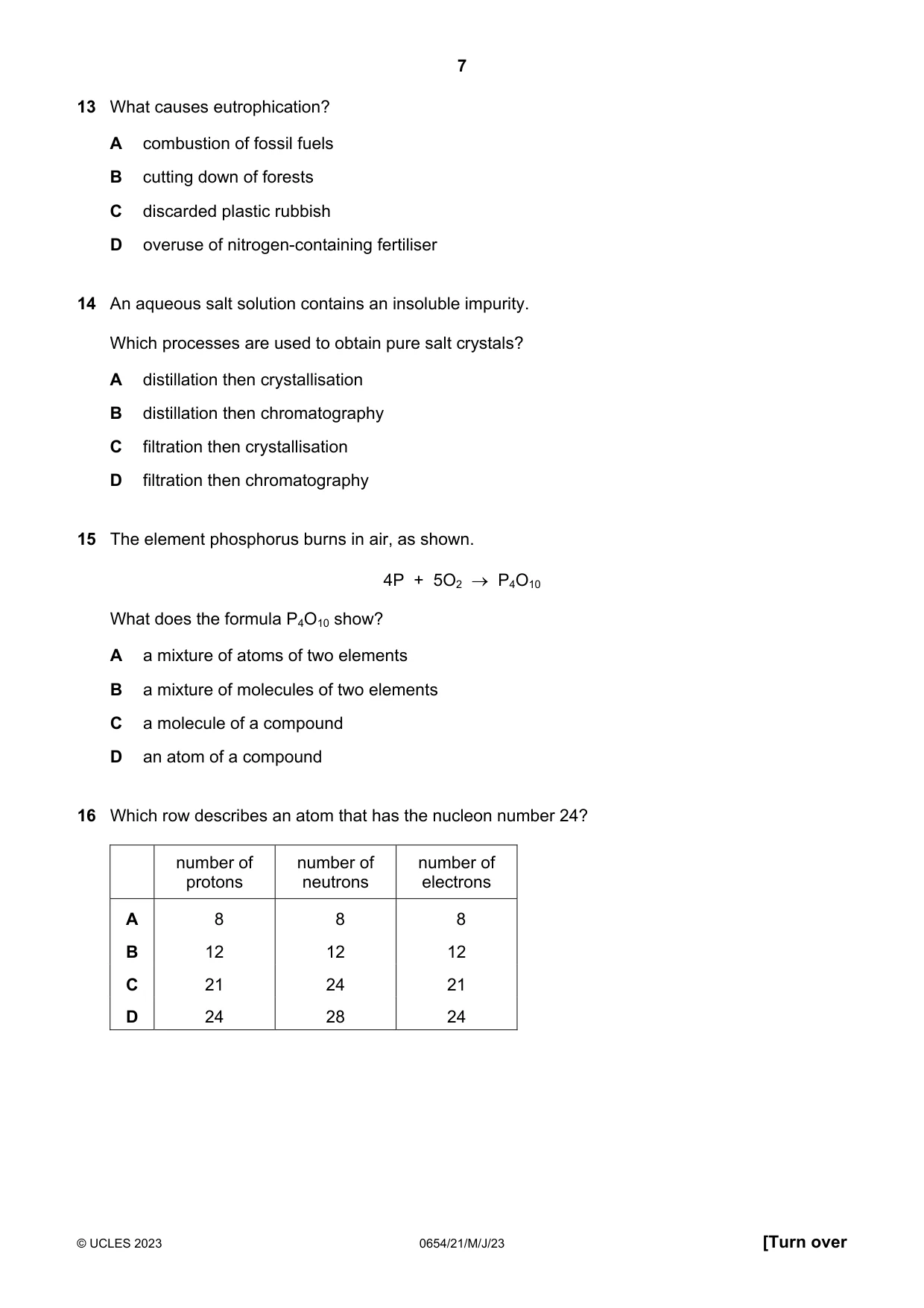
Question 13
13 What causes eutrophication? A combustion of fossil fuels B cutting down of forests C discarded plastic rubbish D overuse of nitrogen-containing fertiliser
Mark scheme: D
Q14 · An aqueous salt solution contains an insoluble impurity
14 An aqueous salt solution contains an insoluble impurity. Which processes are used to obtain pure salt crystals? A distillation then crystallisation B distillation then chromatography C filtration then crystallisation D filtration then chromatography
Mark scheme: C
Q15 · The element phosphorus burns in air, as shown
15 The element phosphorus burns in air, as shown. 4P + 5O2 P4O10 What does the formula P4O10 show? A a mixture of atoms of two elements B a mixture of molecules of two elements C a molecule of a compound D an atom of a compound
Mark scheme: C
Q16 · Which row describes an atom that has the nucleon number 24?
16 Which row describes an atom that has the nucleon number 24? number of number of number of protons neutrons electrons A 8 8 8 B 12 12 12 C 21 24 21 D 24 28 24
Mark scheme: B
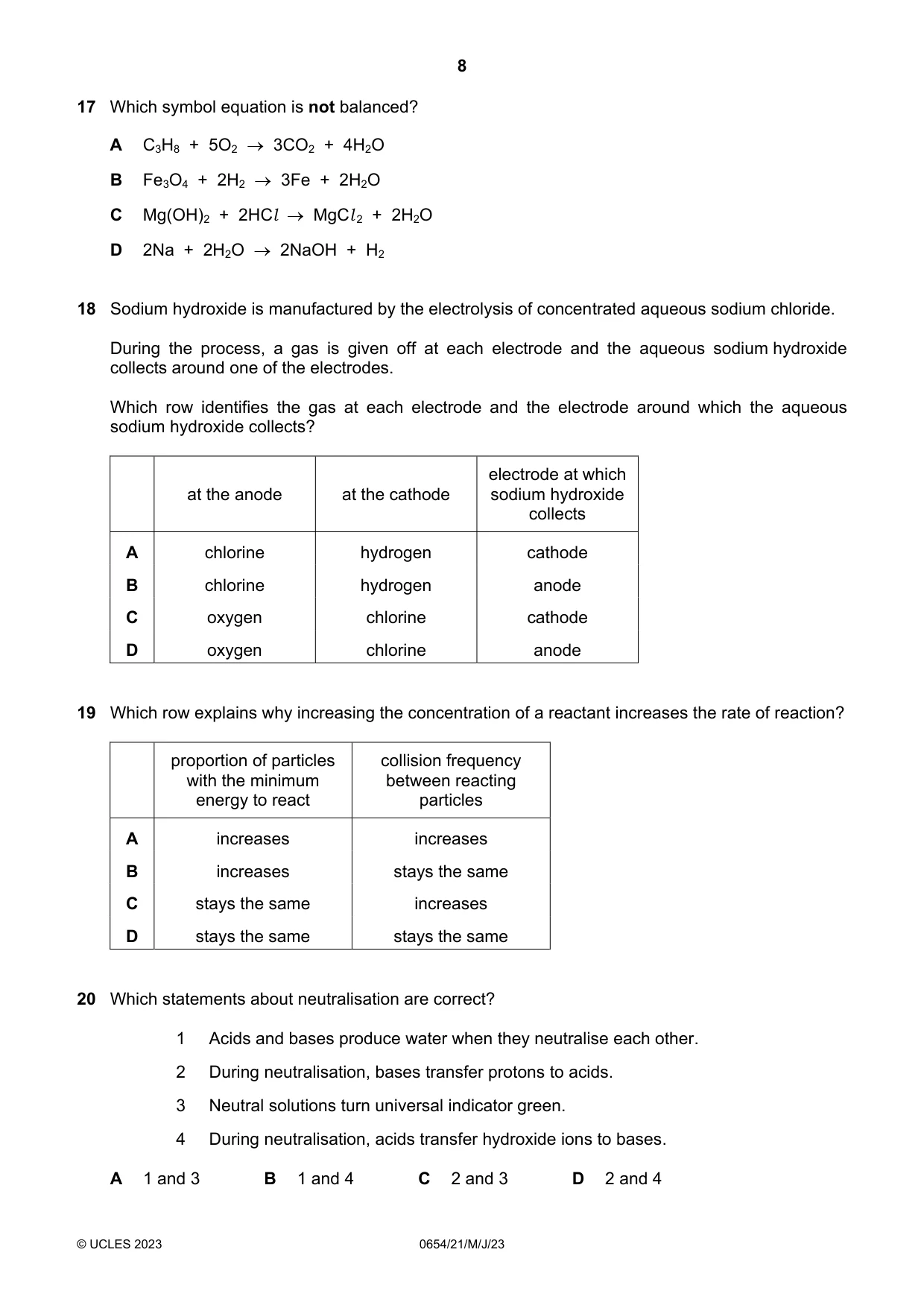
Q17 · Which symbol equation is not balanced?
17 Which symbol equation is not balanced? A C3H8 + 5O2 3CO2 + 4H2O B Fe3O4 + 2H2 3Fe + 2H2O C Mg(OH)2 + 2HCl MgCl 2 + 2H2O D 2Na + 2H2O 2NaOH + H2
Mark scheme: B
Q18 · Sodium hydroxide is manufactured by the electrolysis of concentrated aqueous sodium…
18 Sodium hydroxide is manufactured by the electrolysis of concentrated aqueous sodium chloride. During the process, a gas is given off at each electrode and the aqueous sodium hydroxide collects around one of the electrodes. Which row identifies the gas at each electrode and the electrode around which the aqueous sodium hydroxide collects? electrode at which at the anode at the cathode sodium hydroxide collects A chlorine hydrogen cathode B chlorine hydrogen anode C oxygen chlorine cathode D oxygen chlorine anode
Mark scheme: A
Q19 · Which row explains why increasing the concentration of a reactant increases the rate of…
19 Which row explains why increasing the concentration of a reactant increases the rate of reaction? proportion of particles collision frequency with the minimum between reacting energy to react particles A increases increases B increases stays the same C stays the same increases D stays the same stays the same
Mark scheme: C
Q20 · Which statements about neutralisation are correct?
20 Which statements about neutralisation are correct? 1 Acids and bases produce water when they neutralise each other. 2 During neutralisation, bases transfer protons to acids. 3 Neutral solutions turn universal indicator green. 4 During neutralisation, acids transfer hydroxide ions to bases. A 1 and 3 B 1 and 4 C 2 and 3 D 2 and 4
Mark scheme: A
More questions on The characteristic properties of acids and bases
Q21 · The properties of some substances are listed
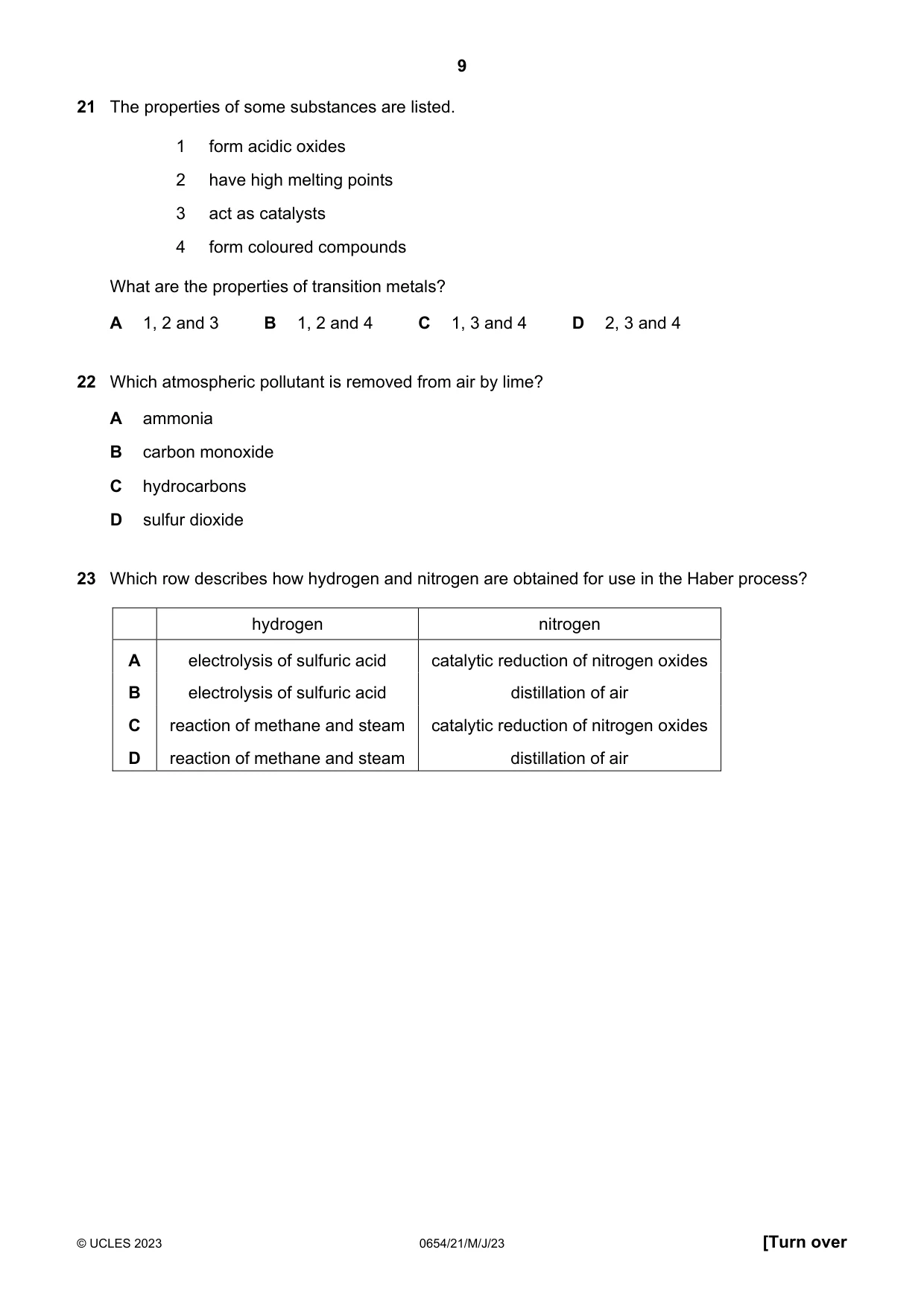
21 The properties of some substances are listed. 1 form acidic oxides 2 have high melting points 3 act as catalysts 4 form coloured compounds What are the properties of transition metals? A 1, 2 and 3 B 1, 2 and 4 C 1, 3 and 4 D 2, 3 and 4
Mark scheme: D
Q22 · Which atmospheric pollutant is removed from air by lime?
22 Which atmospheric pollutant is removed from air by lime? A ammonia B carbon monoxide C hydrocarbons D sulfur dioxide
Mark scheme: D
Q23 · Which row describes how hydrogen and nitrogen are obtained for use in the Haber process?
23 Which row describes how hydrogen and nitrogen are obtained for use in the Haber process? hydrogen nitrogen A electrolysis of sulfuric acid catalytic reduction of nitrogen oxides B electrolysis of sulfuric acid distillation of air C reaction of methane and steam catalytic reduction of nitrogen oxides D reaction of methane and steam distillation of air
Mark scheme: D
Q24 · Equations representing reactions in the Contact process are listed
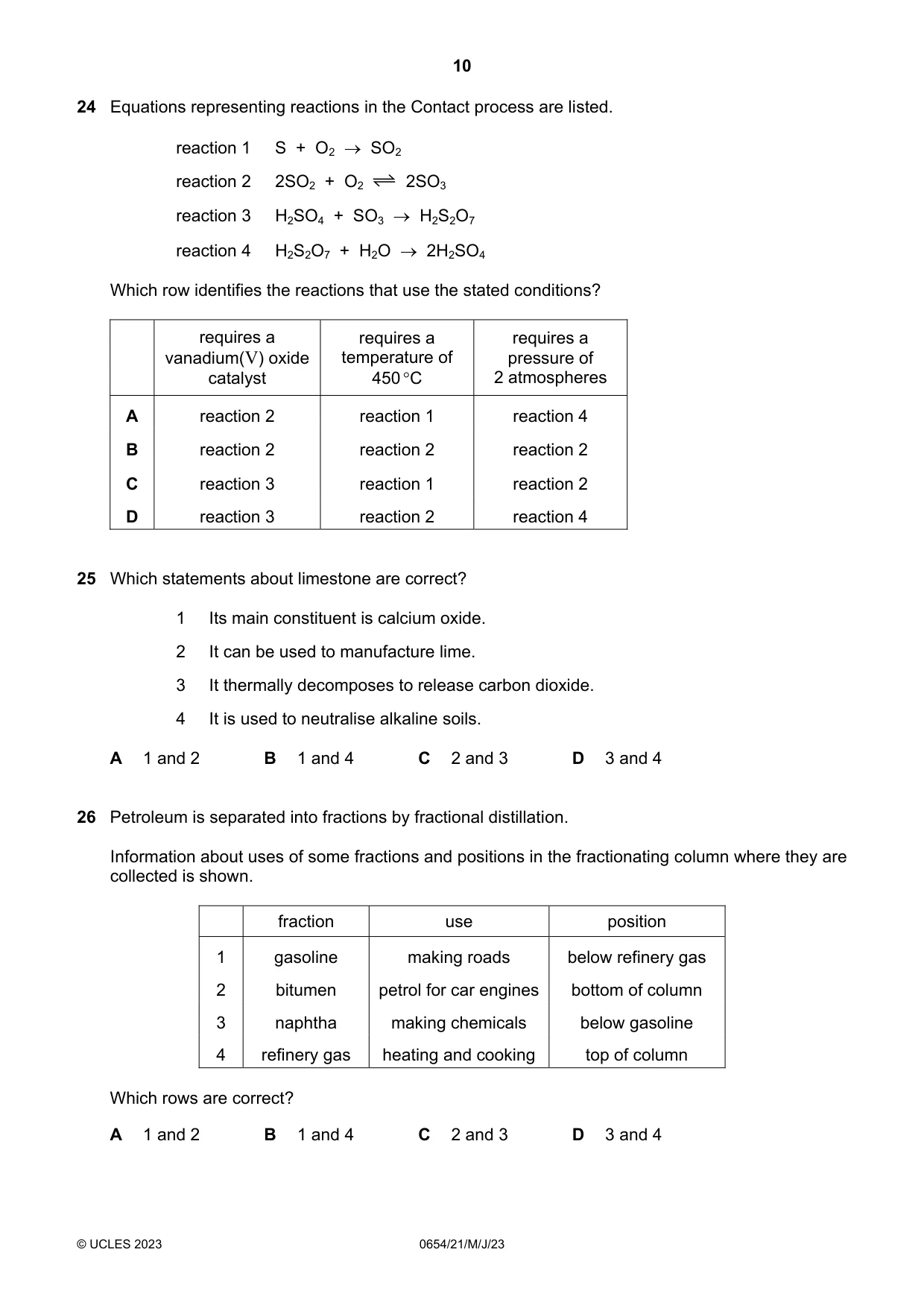
24 Equations representing reactions in the Contact process are listed. reaction 1 S + O2 SO2 reaction 2 2SO2 + O2 2SO3 reaction 3 H2SO4 + SO3 H2S2O7 reaction 4 H2S2O7 + H2O 2H2SO4 Which row identifies the reactions that use the stated conditions? requires a requires a requires a vanadium(V) oxide temperature of pressure of catalyst 450 C 2 atmospheres A reaction 2 reaction 1 reaction 4 B reaction 2 reaction 2 reaction 2 C reaction 3 reaction 1 reaction 2 D reaction 3 reaction 2 reaction 4
Mark scheme: B
Q25 · Which statements about limestone are correct?
25 Which statements about limestone are correct? 1 Its main constituent is calcium oxide. 2 It can be used to manufacture lime. 3 It thermally decomposes to release carbon dioxide. 4 It is used to neutralise alkaline soils. A 1 and 2 B 1 and 4 C 2 and 3 D 3 and 4
Mark scheme: C
Q26 · Petroleum is separated into fractions by fractional distillation
26 Petroleum is separated into fractions by fractional distillation. Information about uses of some fractions and positions in the fractionating column where they are collected is shown. fraction use position 1 gasoline making roads below refinery gas 2 bitumen petrol for car engines bottom of column 3 naphtha making chemicals below gasoline 4 refinery gas heating and cooking top of column Which rows are correct? A 1 and 2 B 1 and 4 C 2 and 3 D 3 and 4
Mark scheme: D
Q27 · Which structure represents the addition polymer made from the monomer propene, C3H6?
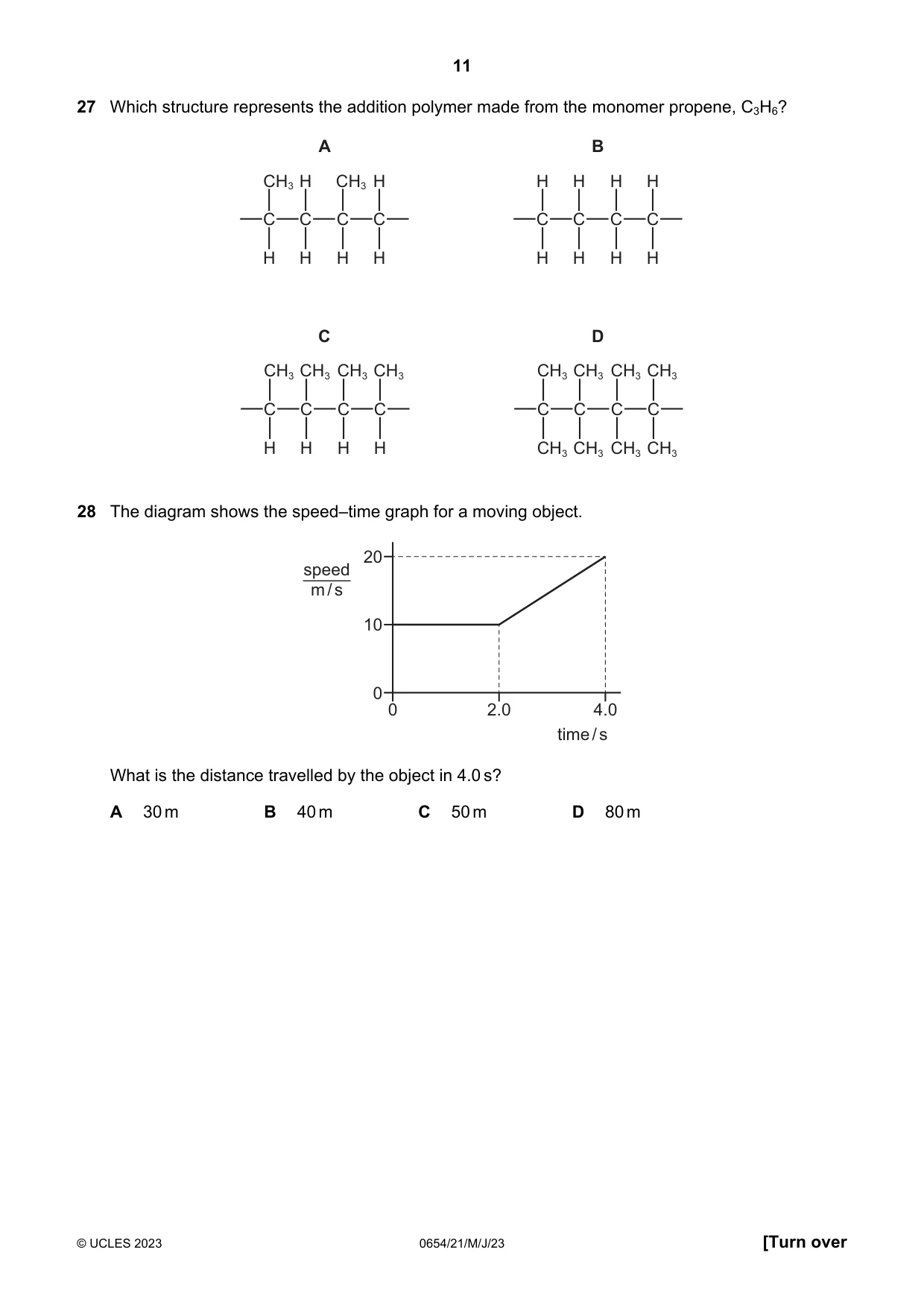
27 Which structure represents the addition polymer made from the monomer propene, C3H6? A B CH3 H CH3 H H H H H C C C C C C C C H H H H H H H H C D CH3 CH3 CH3 CH3 CH3 CH3 CH3 CH3 C C C C C C C C H H H H CH3 CH3 CH3 CH3
Mark scheme: A
Q28 · The diagram shows the speed–time graph for a moving object
28 The diagram shows the speed–time graph for a moving object. 20 speed m / s 10 0 0 2.0 4.0 time / s What is the distance travelled by the object in 4.0 s? A 30 m B 40 m C 50 m D 80 m
Mark scheme: C
Q29 · The diagram shows a triangular sheet of metal with sides of length 50 cm, 40 cm and 30 cm
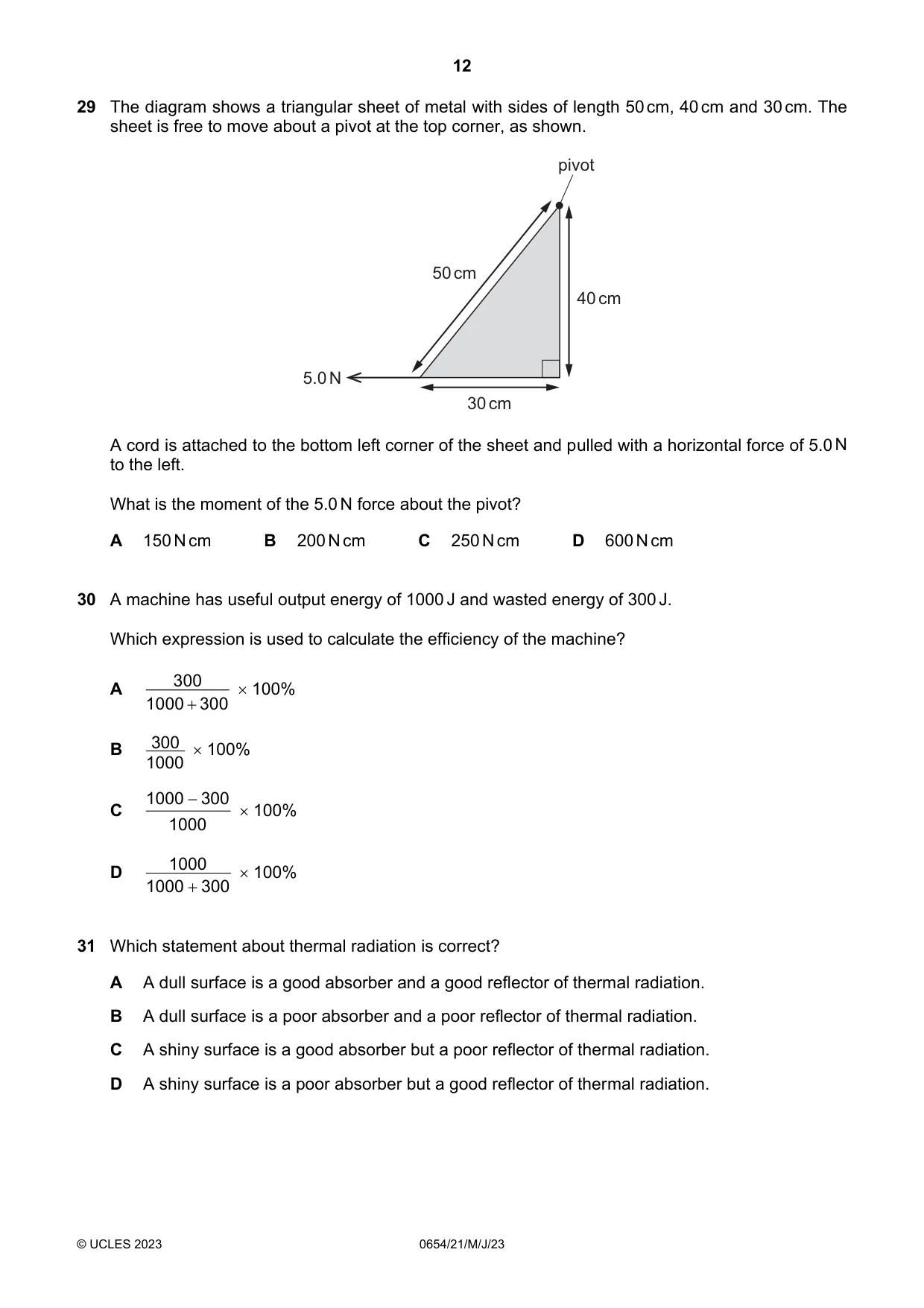
29 The diagram shows a triangular sheet of metal with sides of length 50 cm, 40 cm and 30 cm. The sheet is free to move about a pivot at the top corner, as shown. pivot 50 cm 40 cm 5.0 N 30 cm A cord is attached to the bottom left corner of the sheet and pulled with a horizontal force of 5.0 N to the left. What is the moment of the 5.0 N force about the pivot? A 150 N cm B 200 N cm C 250 N cm D 600 N cm
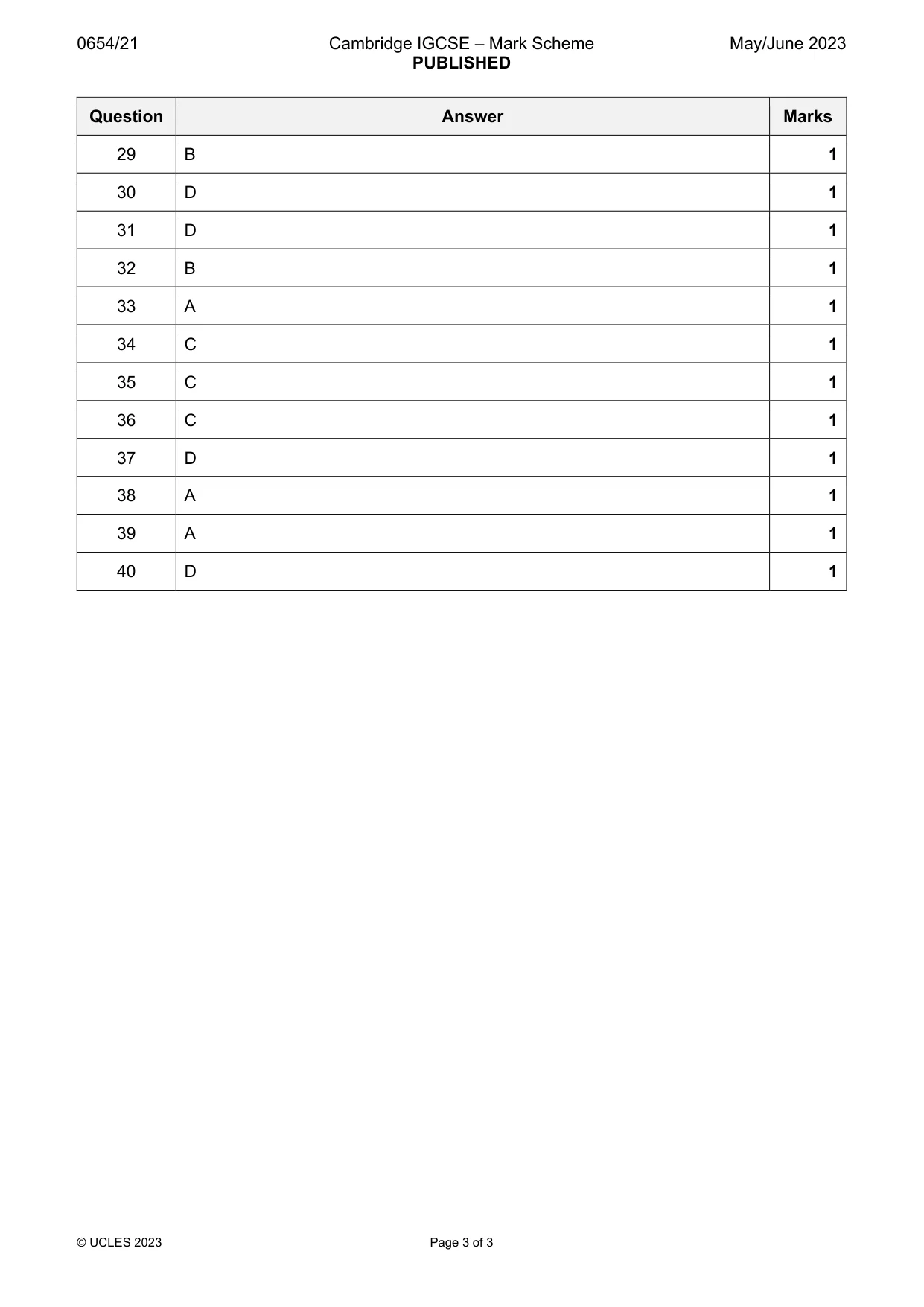
Mark scheme: B
Q30 · A machine has useful output energy of 1000 J and wasted energy of 300 J
30 A machine has useful output energy of 1000 J and wasted energy of 300 J. Which expression is used to calculate the efficiency of the machine? 300 100% A 1000 300 B 300 100% 1000 1000 300 C 100% 1000 1000 100% D 1000 300
Mark scheme: D
Q31 · Which statement about thermal radiation is correct?
31 Which statement about thermal radiation is correct? A A dull surface is a good absorber and a good reflector of thermal radiation. B A dull surface is a poor absorber and a poor reflector of thermal radiation. C A shiny surface is a good absorber but a poor reflector of thermal radiation. D A shiny surface is a poor absorber but a good reflector of thermal radiation.
Mark scheme: D
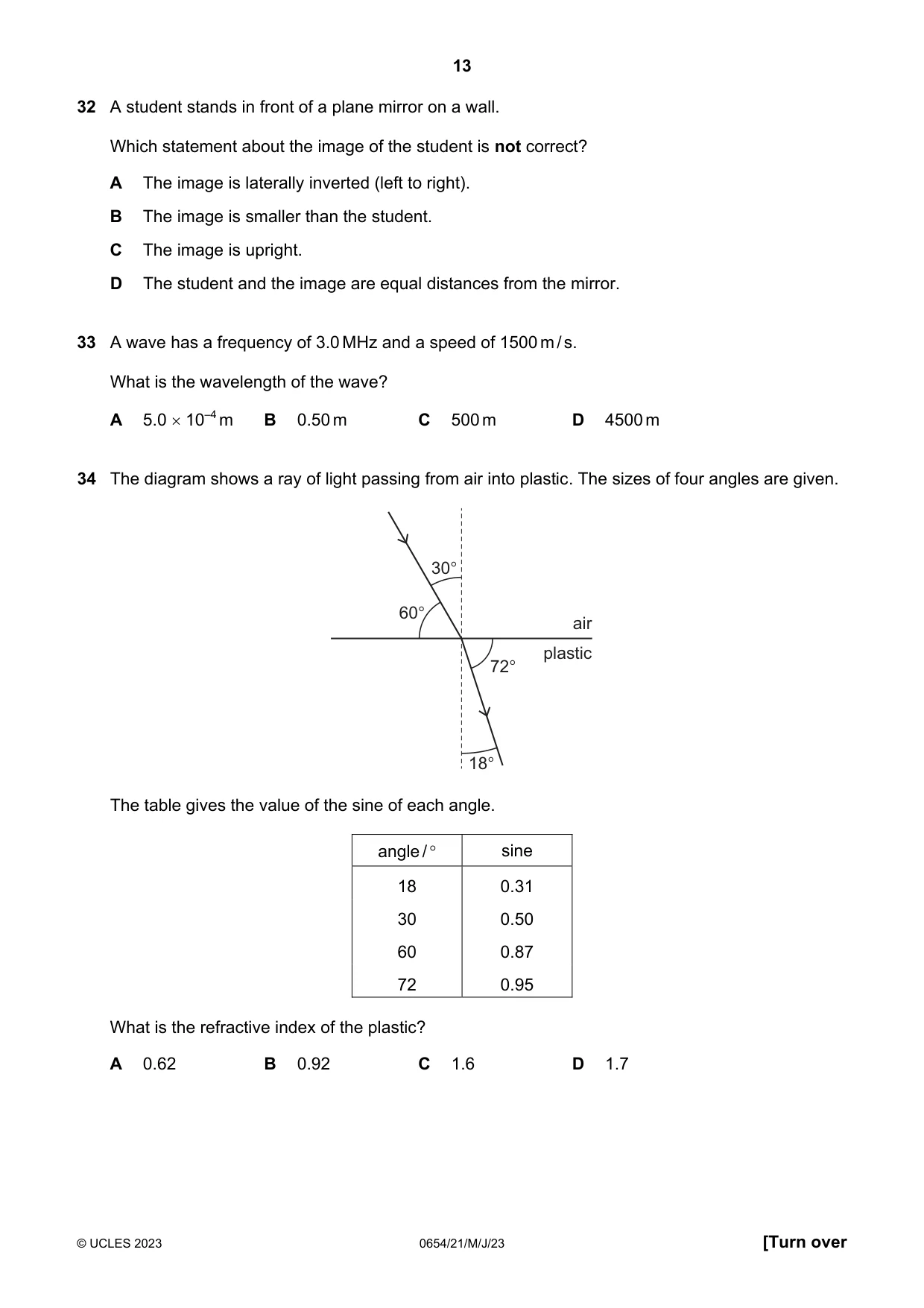
Q32 · A student stands in front of a plane mirror on a wall
32 A student stands in front of a plane mirror on a wall. Which statement about the image of the student is not correct? A The image is laterally inverted (left to right). B The image is smaller than the student. C The image is upright. D The student and the image are equal distances from the mirror.
Mark scheme: B
Q33 · A wave has a frequency of 3.0 MHz and a speed of 1500 m / s
33 A wave has a frequency of 3.0 MHz and a speed of 1500 m / s. What is the wavelength of the wave? A 5.0 10–4 m B 0.50 m C 500 m D 4500 m
Mark scheme: A
Q34 · The diagram shows a ray of light passing from air into plastic
34 The diagram shows a ray of light passing from air into plastic. The sizes of four angles are given. 30° 60° air plastic 72° 18° The table gives the value of the sine of each angle. angle / sine 18 0.31 30 0.50 60 0.87 72 0.95 What is the refractive index of the plastic? A 0.62 B 0.92 C 1.6 D 1.7
Mark scheme: C
Q35 · Two insulators are charged by rubbing them with a cloth
35 Two insulators are charged by rubbing them with a cloth. After this, the charged insulators repel each other. Which statement is a possible description of how the insulators become charged? A One gained electrons and the other gained protons. B One gained electrons and the other lost electrons. C They both lost electrons. D They both lost protons.
Mark scheme: C
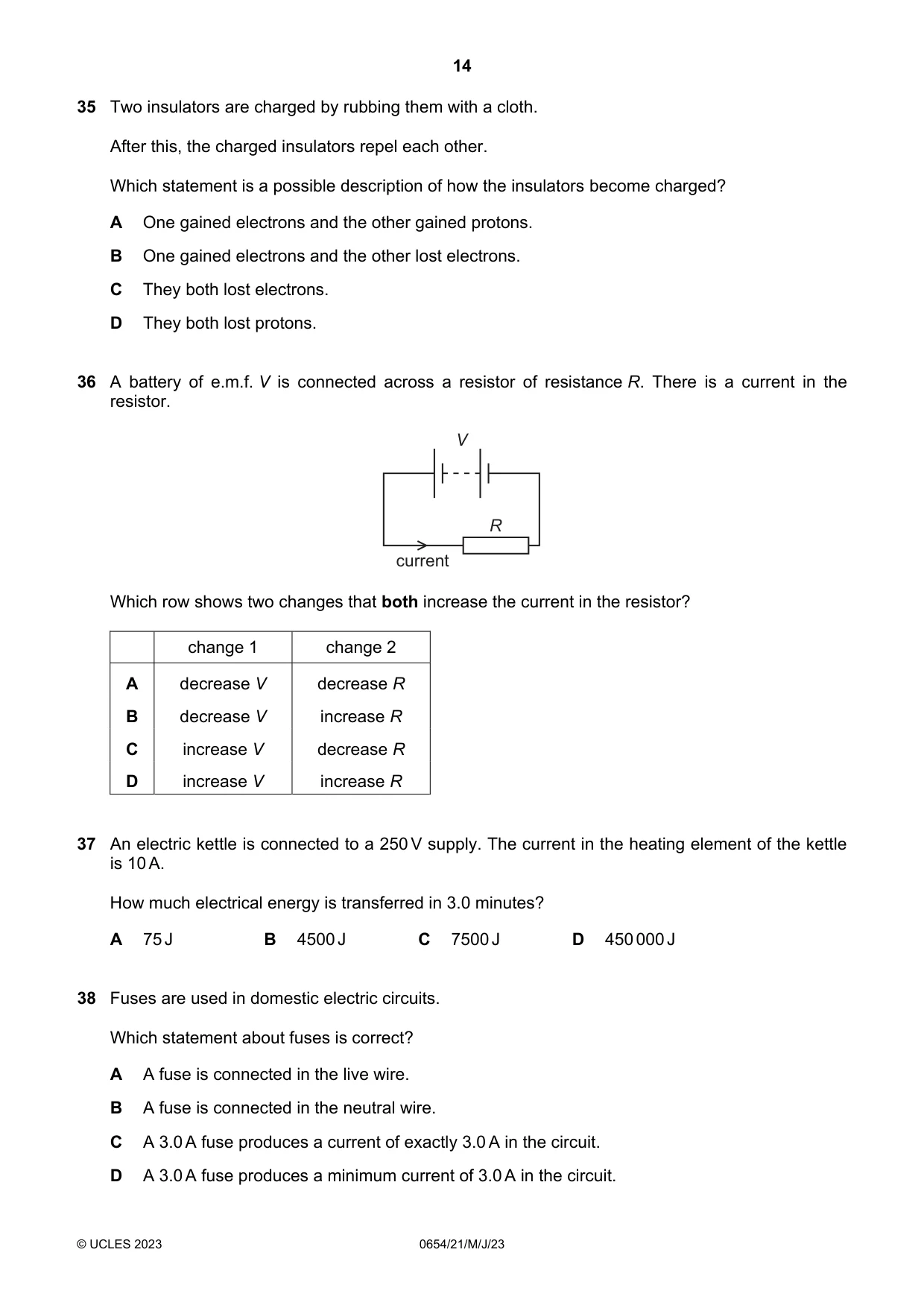
Q36 · A battery of e.m.f
36 A battery of e.m.f. V is connected across a resistor of resistance R. There is a current in the resistor. V R current Which row shows two changes that both increase the current in the resistor? change 1 change 2 A decrease V decrease R B decrease V increase R C increase V decrease R D increase V increase R
Mark scheme: C
Q37 · An electric kettle is connected to a 250 V supply
37 An electric kettle is connected to a 250 V supply. The current in the heating element of the kettle is 10 A. How much electrical energy is transferred in 3.0 minutes? A 75 J B 4500 J C 7500 J D 450 000 J
Mark scheme: D
Q38 · Fuses are used in domestic electric circuits
38 Fuses are used in domestic electric circuits. Which statement about fuses is correct? A A fuse is connected in the live wire. B A fuse is connected in the neutral wire. C A 3.0 A fuse produces a current of exactly 3.0 A in the circuit. D A 3.0 A fuse produces a minimum current of 3.0 A in the circuit.
Mark scheme: A
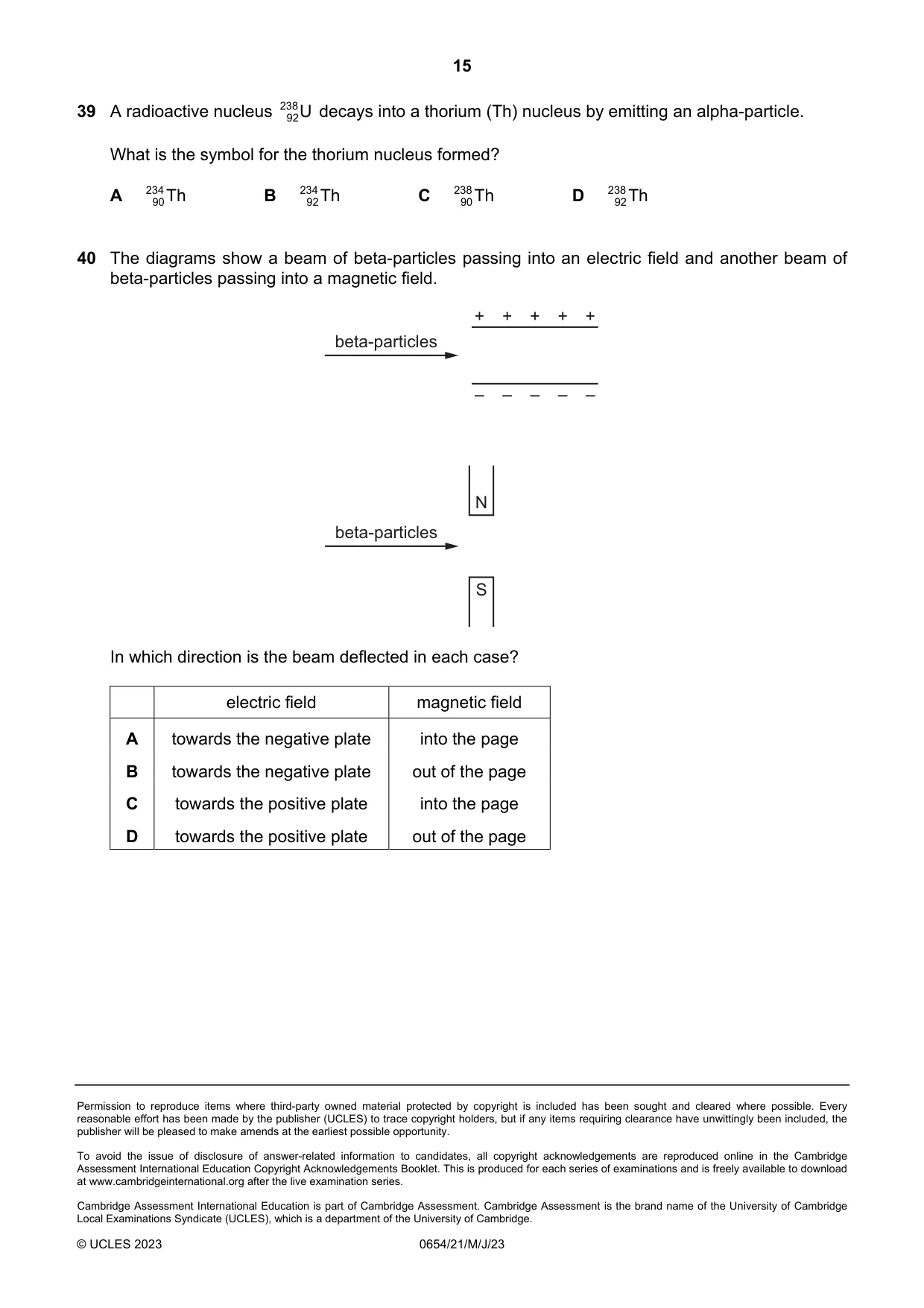
Q39 · A radioactive nucleus 238 U decays into a thorium (Th) nucleus by emitting an…
39 A radioactive nucleus 238 U decays into a thorium (Th) nucleus by emitting an alpha-particle. 92 What is the symbol for the thorium nucleus formed? A 234 Th B 234 Th C 238 Th D 238 Th 90 92 90 92
Mark scheme: A
Q40 · The diagrams show a beam of beta-particles passing into an electric field and another…
40 The diagrams show a beam of beta-particles passing into an electric field and another beam of beta-particles passing into a magnetic field. + + + + + beta-particles – – – – – N beta-particles S In which direction is the beam deflected in each case? electric field magnetic field A towards the negative plate into the page B towards the negative plate out of the page C towards the positive plate into the page D towards the positive plate out of the page
Mark scheme: D
What was in this paper
The subtopics covered by these 40 questions, and how many questions each got. Open one in a new tab to see every Cambridge question on it.
2Fuels2Light2Radioactivity2Rate of reaction2Respiration2Air quality and climate1Asexual reproduction1Atomic structure and the Periodic Table1Biological molecules1Chromosomes and genes1Circulatory systems1Coordination and response1Digestive system1Electrical safety1Electrolysis1Energy, work and power1Enzymes1Food chains and food webs1Forces1Formulas1General properties of waves1Habitat destruction1Motion1Osmosis1Oxides1Photosynthesis1Polymers1Separation and purification1Simple molecules and covalent bonds1Simple phenomena of magnetism1The characteristic properties of acids and bases1Transfer of thermal energy1Transition elements1What you needed in this session
Cambridge’s own grade thresholds for 2023 May/June, Paper 2 · Variant 1. A higher threshold means an easier paper — the bar moves with how the cohort did.