Cambridge IGCSE Sciences - Co-ordinated (Double) 0654 — 2024 Oct/Nov Paper 2 · Variant 2
0654/22/O/N/24 · 40 questions · 40 marks · ≈45 min
The question paper and its mark scheme, free to read here and free to download. This is Cambridge’s own paper, exactly as it was sat.
Question paper16 pages
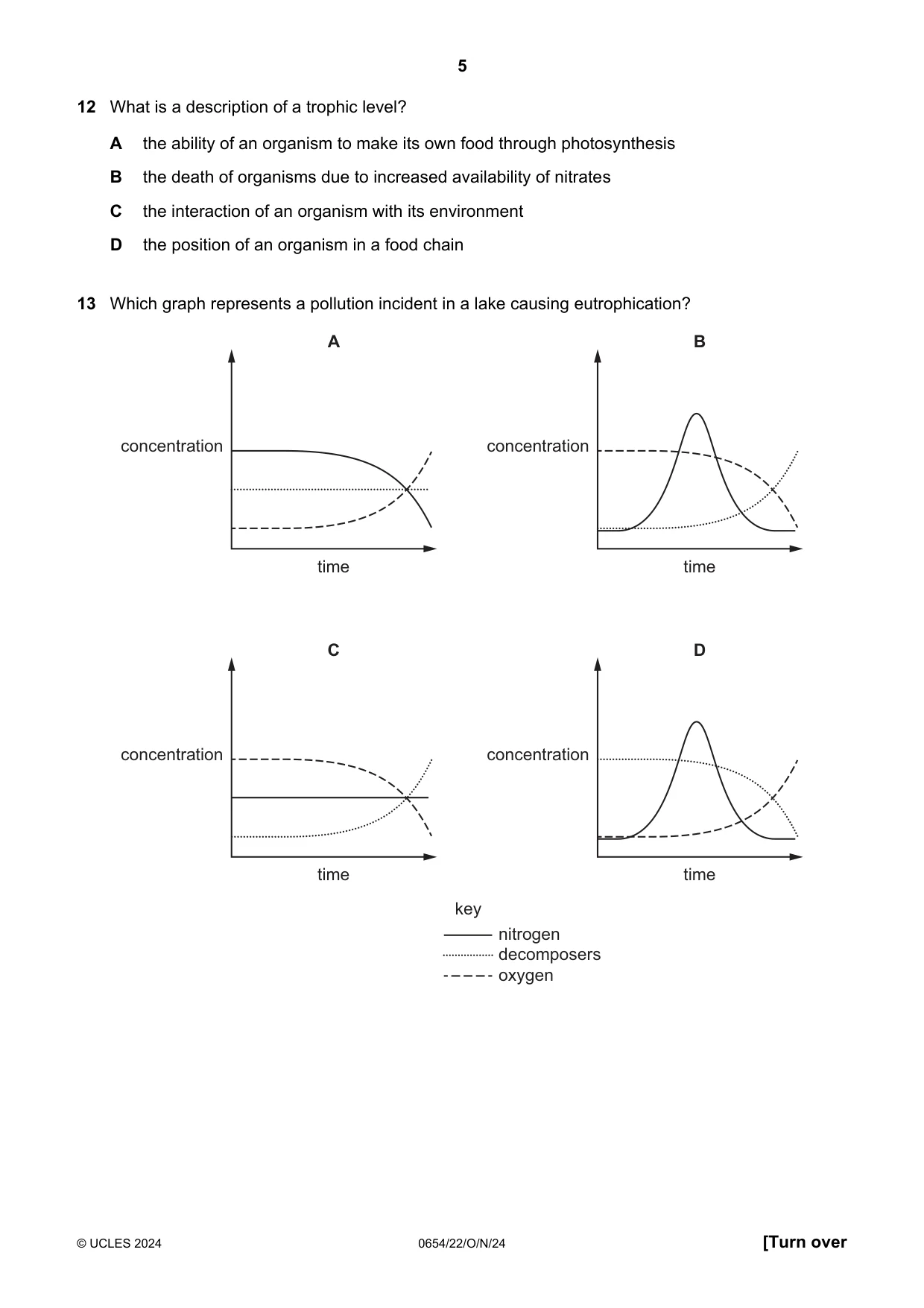
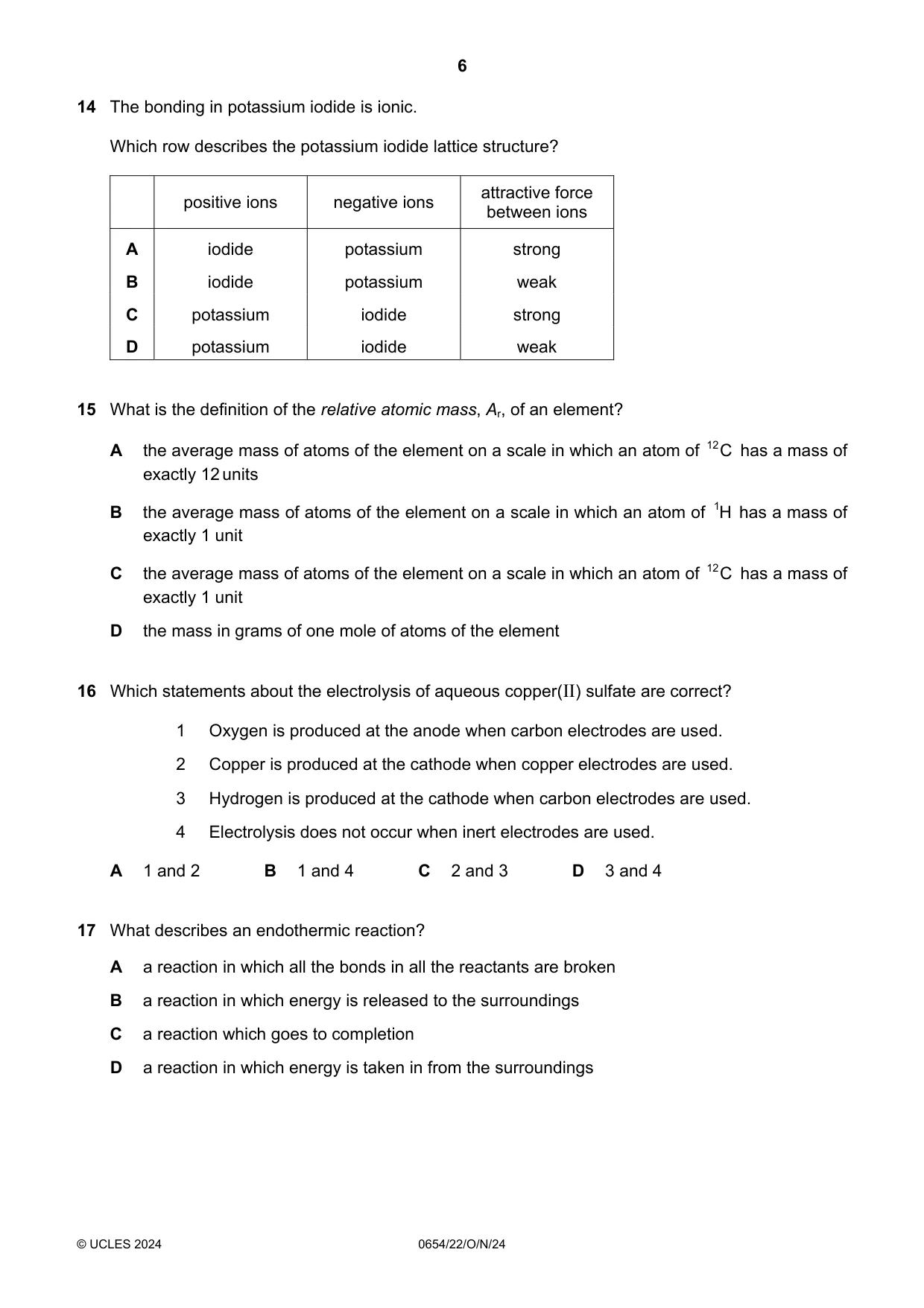
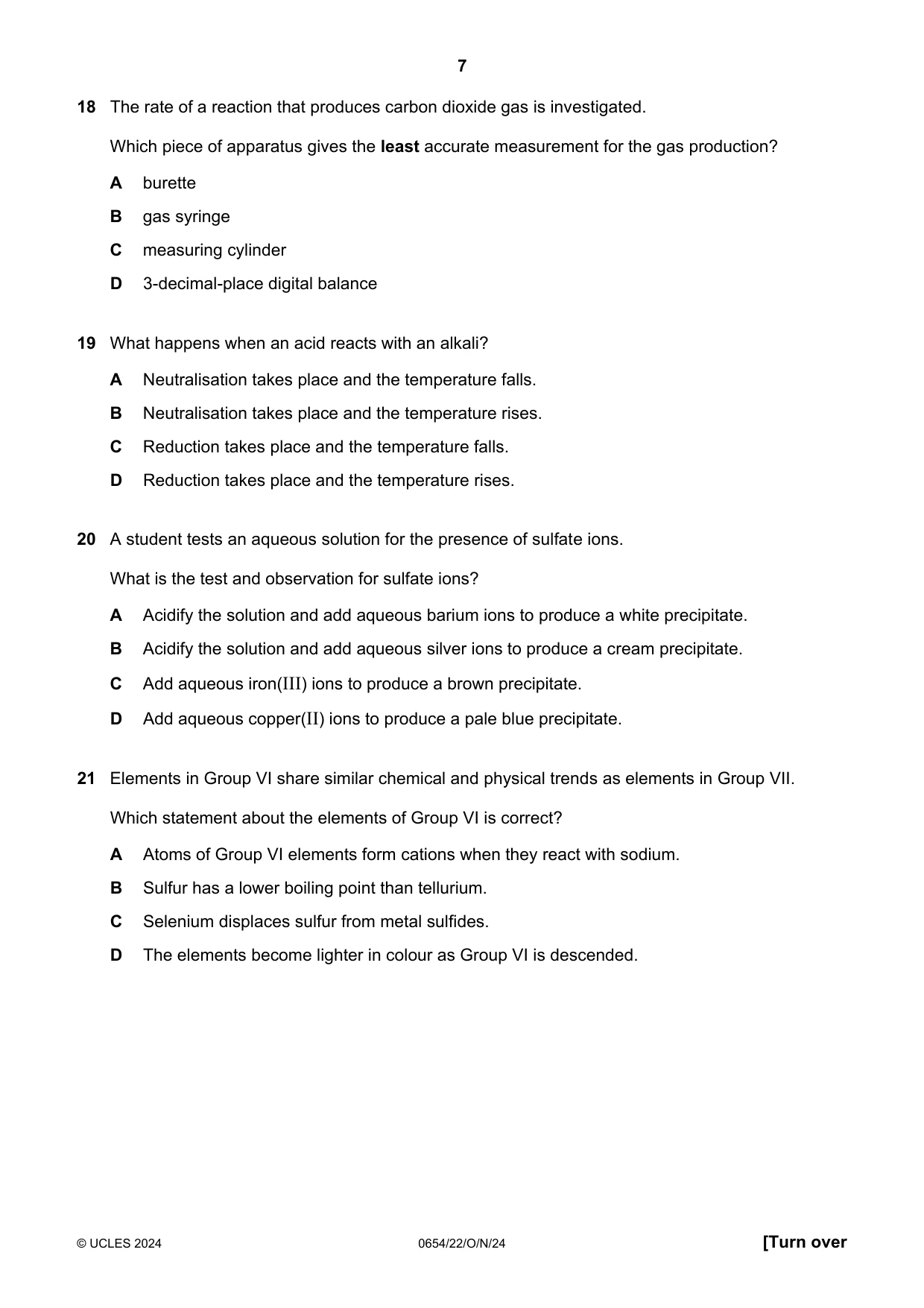
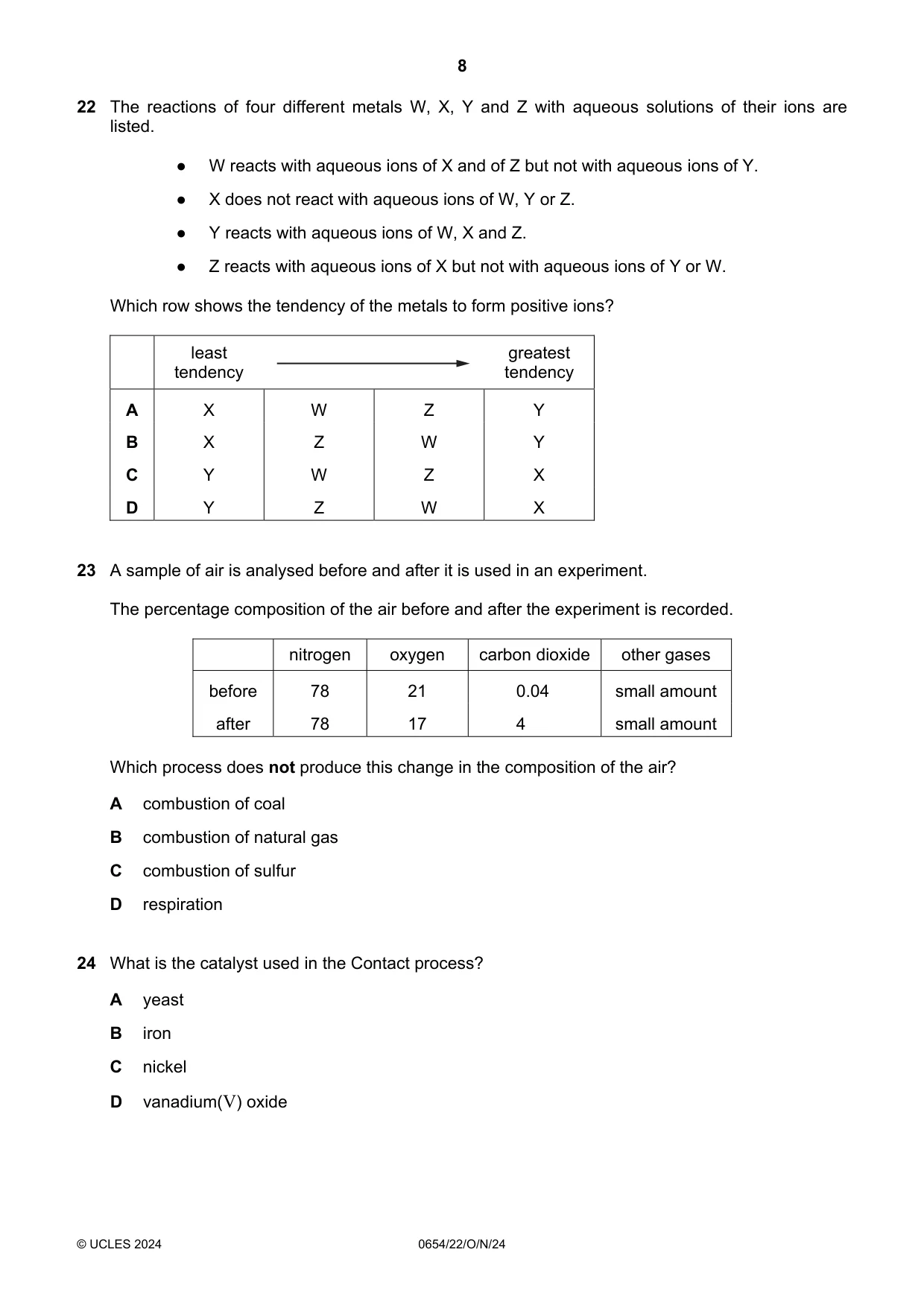

Mark scheme3 pages
Answers below. Sit the paper first if you are practising.
Questions as text
Q1 · Auxinis a chemical that is produced in shoot tips
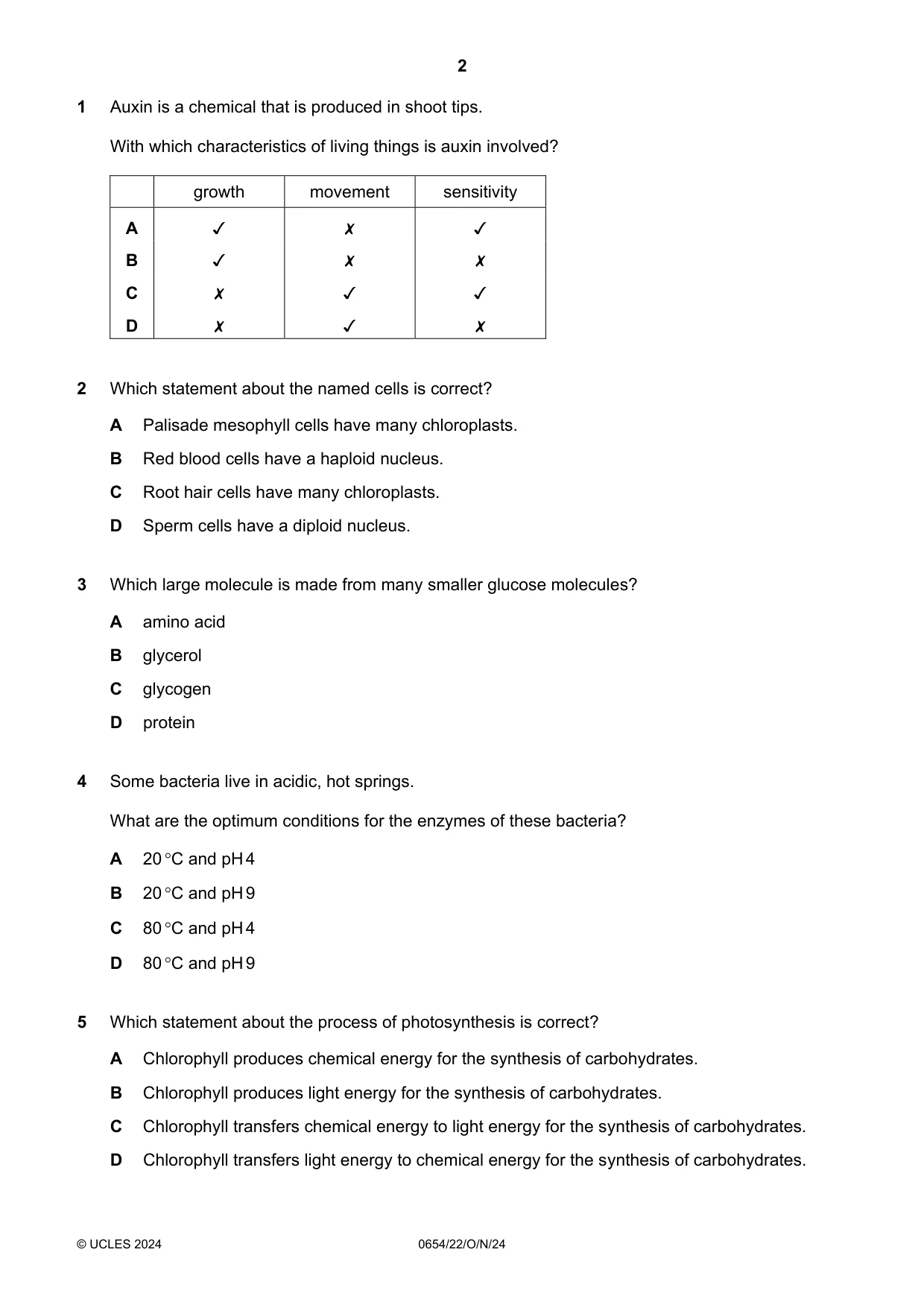
1. Auxinis a chemical that is produced in shoot tips. With which characteristics of living things is auxin involved? growth movement sensitivity 0 OW PD «x Me \ \ x <x \ x
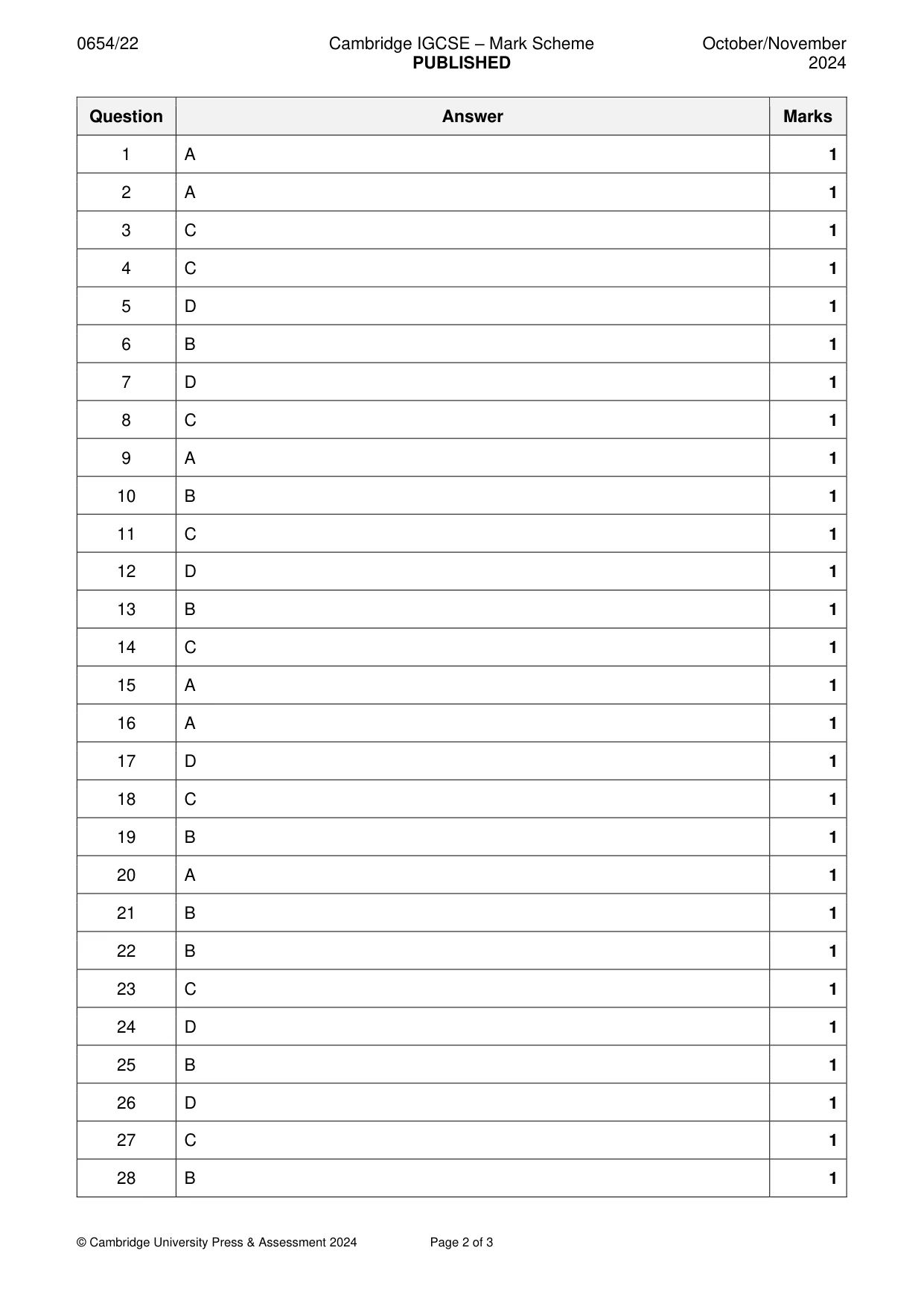
Mark scheme: A
Q2 · Which statement about the named cells is correct?
2 Which statement about the named cells is correct? A Palisade mesophyll cells have many chloroplasts. B Red blood cells have a haploid nucleus. C Root hair cells have many chloroplasts. D Sperm cells have a diploid nucleus.
Mark scheme: A
Q3 · Which large molecule is made from many smaller glucose molecules?
3 Which large molecule is made from many smaller glucose molecules? A amino acid B glycerol C glycogen D protein
Mark scheme: C
Q4 · Some bacteria live in acidic, hot springs
4 Some bacteria live in acidic, hot springs. What are the optimum conditions for the enzymes of these bacteria? A 20 C and pH 4 B 20 C and pH 9 C 80 C and pH 4 D 80 C and pH 9
Mark scheme: C
Q5 · Which statement about the process of photosynthesis is correct?
5 Which statement about the process of photosynthesis is correct? A Chlorophyll produces chemical energy for the synthesis of carbohydrates. B Chlorophyll produces light energy for the synthesis of carbohydrates. C Chlorophyll transfers chemical energy to light energy for the synthesis of carbohydrates. D Chlorophyll transfers light energy to chemical energy for the synthesis of carbohydrates.
Mark scheme: D
Q6 · Protein shakes are used by athletes to supplement their diet
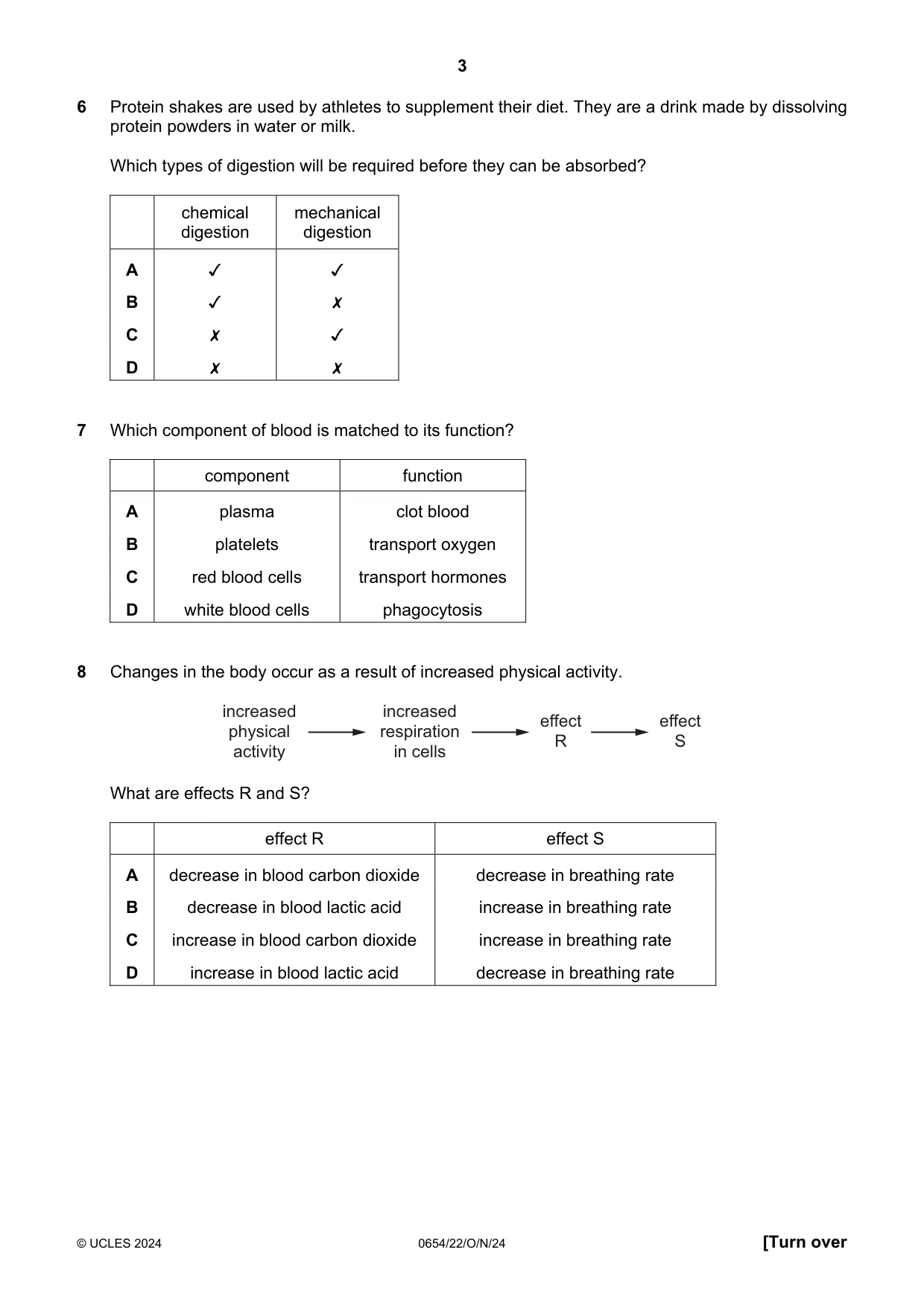
6 Protein shakes are used by athletes to supplement their diet. They are a drink made by dissolving protein powders in water or milk. Which types of digestion will be required before they can be absorbed? chemical mechanical digestion digestion WA J 0 0O WwW D> v x x v x x
Mark scheme: B
Q7 · Which component of blood is matched to its function?
7 Which component of blood is matched to its function? component function A plasma clot blood B platelets transport oxygen C red blood cells transport hormones D white blood cells phagocytosis
Mark scheme: D
Q8 · Changes in the body occur as a result of increased physical activity
8 Changes in the body occur as a result of increased physical activity. increased increased effect effect physical respiration R S activity in cells What are effects R and S? effect R effect S A decrease in blood carbon dioxide decrease in breathing rate B decrease in blood lactic acid increase in breathing rate C increase in blood carbon dioxide increase in breathing rate D increase in blood lactic acid decrease in breathing rate
Mark scheme: C
Q9 · A plant was placed horizontally in complete darkness
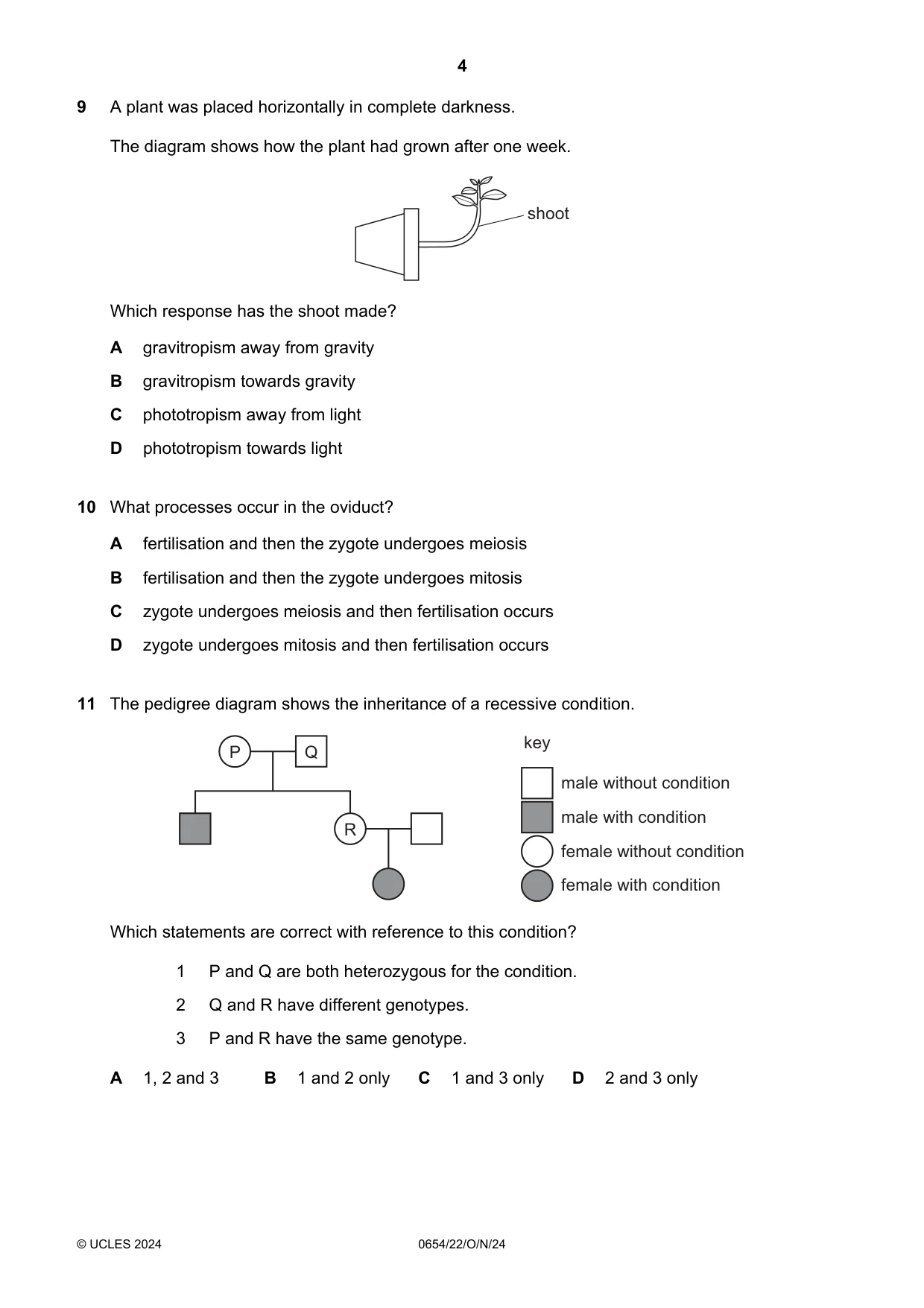
9 A plant was placed horizontally in complete darkness. The diagram shows how the plant had grown after one week. shoot Which response has the shoot made? A gravitropism away from gravity B gravitropism towards gravity C phototropism away from light D phototropism towards light
Mark scheme: A
Q10 · What processes occur in the oviduct?
10 What processes occur in the oviduct? A fertilisation and then the zygote undergoes meiosis B fertilisation and then the zygote undergoes mitosis C zygote undergoes meiosis and then fertilisation occurs D zygote undergoes mitosis and then fertilisation occurs
Mark scheme: B
Q11 · The pedigree diagram shows the inheritance of a recessive condition
11 The pedigree diagram shows the inheritance of a recessive condition. key P Q male without condition male with condition R female without condition female with condition Which statements are correct with reference to this condition? 1 P and Q are both heterozygous for the condition. 2 Q and R have different genotypes. 3 P and R have the same genotype. A 1, 2 and 3 B 1 and 2 only C 1 and 3 only D 2 and 3 only
Mark scheme: C
Q12 · What is a description of a trophic level?
12 What is a description of a trophic level? A the ability of an organism to make its own food through photosynthesis B the death of organisms due to increased availability of nitrates C the interaction of an organism with its environment D the position of an organism in a food chain
Mark scheme: D
Q13 · Which graph represents a pollution incident in a lake causing eutrophication?
13 Which graph represents a pollution incident in a lake causing eutrophication? A B concentration concentration time time C D concentration concentration time time key nitrogen decomposers oxygen
Mark scheme: B
Q14 · The bonding in potassium iodide is ionic
14 The bonding in potassium iodide is ionic. Which row describes the potassium iodide lattice structure? attractive force positive ions negative ions between ions A iodide potassium strong B iodide potassium weak C potassium iodide strong D potassium iodide weak
Mark scheme: C
Q15 · What is the definition of the relative atomic mass, Ar, of an element?
15 What is the definition of the relative atomic mass, Ar, of an element? A the average mass of atoms of the element on a scale in which an atom of 12C has a mass of exactly 12 units B the average mass of atoms of the element on a scale in which an atom of 1H has a mass of exactly 1 unit C the average mass of atoms of the element on a scale in which an atom of 12C has a mass of exactly 1 unit D the mass in grams of one mole of atoms of the element
Mark scheme: A
Q16 · Which statements about the electrolysis of aqueous copper(II) sulfate are correct?
16 Which statements about the electrolysis of aqueous copper(II) sulfate are correct? 1 Oxygen is produced at the anode when carbon electrodes are used. 2 Copper is produced at the cathode when copper electrodes are used. 3 Hydrogen is produced at the cathode when carbon electrodes are used. 4 Electrolysis does not occur when inert electrodes are used. A 1 and 2 B 1 and 4 C 2 and 3 D 3 and 4
Mark scheme: A
Q17 · What describes an endothermic reaction?
17 What describes an endothermic reaction? A a reaction in which all the bonds in all the reactants are broken B a reaction in which energy is released to the surroundings C a reaction which goes to completion D a reaction in which energy is taken in from the surroundings
Mark scheme: D
Q18 · The rate of a reaction that produces carbon dioxide gas is investigated
18 The rate of a reaction that produces carbon dioxide gas is investigated. Which piece of apparatus gives the least accurate measurement for the gas production? A burette B gas syringe C measuring cylinder D 3-decimal-place digital balance
Mark scheme: C
Q19 · What happens when an acid reacts with an alkali?
19 What happens when an acid reacts with an alkali? A Neutralisation takes place and the temperature falls. B Neutralisation takes place and the temperature rises. C Reduction takes place and the temperature falls. D Reduction takes place and the temperature rises.
Mark scheme: B
More questions on The characteristic properties of acids and bases
Q20 · A student tests an aqueous solution for the presence of sulfate ions
20 A student tests an aqueous solution for the presence of sulfate ions. What is the test and observation for sulfate ions? A Acidify the solution and add aqueous barium ions to produce a white precipitate. B Acidify the solution and add aqueous silver ions to produce a cream precipitate. C Add aqueous iron(III) ions to produce a brown precipitate. D Add aqueous copper(II) ions to produce a pale blue precipitate.
Mark scheme: A
Q21 · Elements in Group VI share similar chemical and physical trends as elements in Group VII
21 Elements in Group VI share similar chemical and physical trends as elements in Group VII. Which statement about the elements of Group VI is correct? A Atoms of Group VI elements form cations when they react with sodium. B Sulfur has a lower boiling point than tellurium. C Selenium displaces sulfur from metal sulfides. D The elements become lighter in colour as Group VI is descended.
Mark scheme: B
Q22 · The reactions of four different metals W, X, Y and Z with aqueous solutions of their ions…
22 The reactions of four different metals W, X, Y and Z with aqueous solutions of their ions are listed. ● W reacts with aqueous ions of X and of Z but not with aqueous ions of Y. ● X does not react with aqueous ions of W, Y or Z. ● Y reacts with aqueous ions of W, X and Z. ● Z reacts with aqueous ions of X but not with aqueous ions of Y or W. Which row shows the tendency of the metals to form positive ions? least greatest tendency tendency A X W Z Y B X Z W Y C Y W Z X D Y Z W X
Mark scheme: B
Q23 · A sample of air is analysed before and after it is used in an experiment
23 A sample of air is analysed before and after it is used in an experiment. The percentage composition of the air before and after the experiment is recorded. nitrogen oxygen carbon dioxide other gases before 78 21 0.04 small amount after 78 17 4 small amount Which process does not produce this change in the composition of the air? A combustion of coal B combustion of natural gas C combustion of sulfur D respiration
Mark scheme: C
Q24 · What is the catalyst used in the Contact process?
24 What is the catalyst used in the Contact process? A yeast B iron C nickel D vanadium(V) oxide
Mark scheme: D
Q25 · What is the word equation for the manufacture of lime?
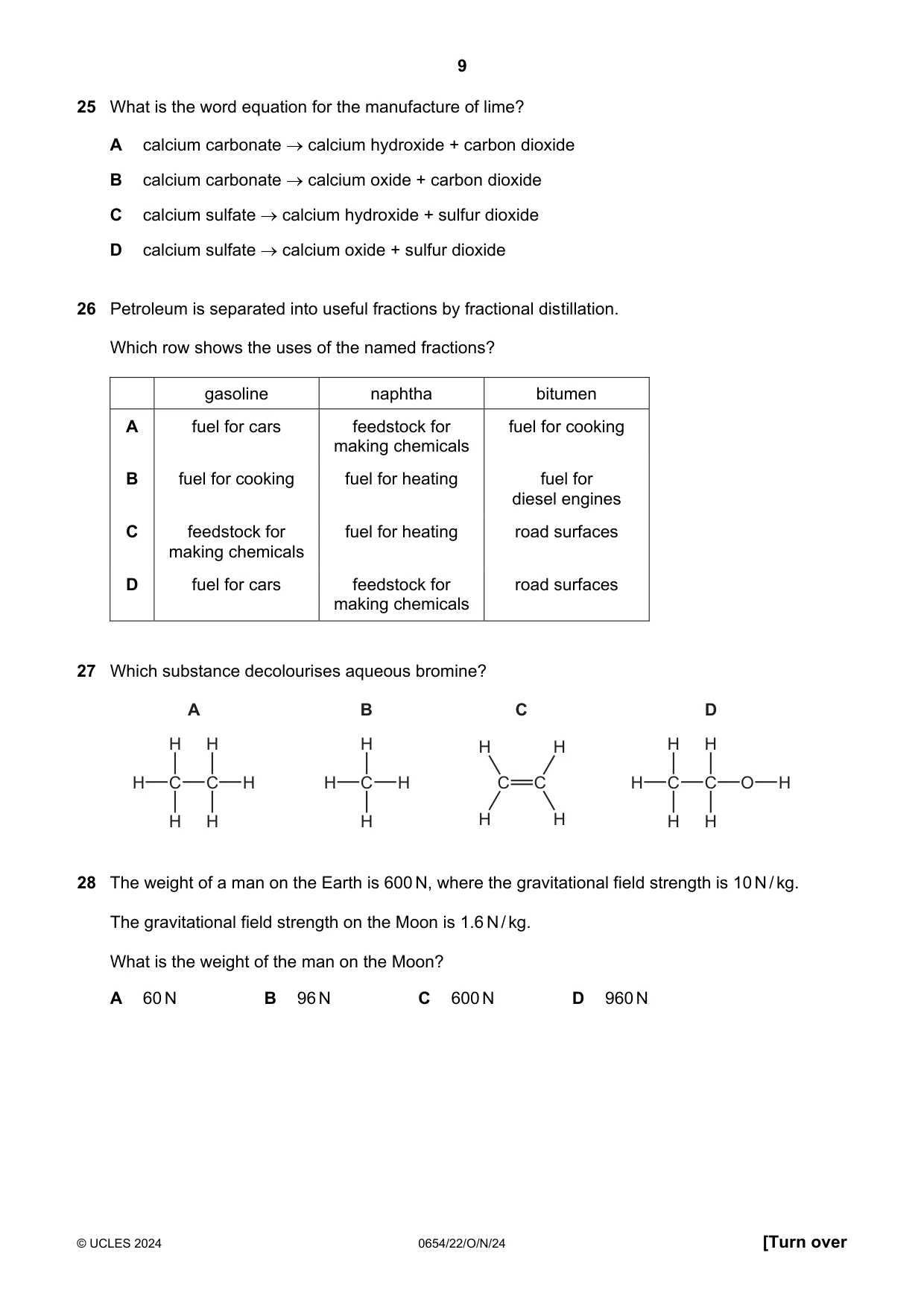
25 What is the word equation for the manufacture of lime? A calcium carbonate calcium hydroxide + carbon dioxide B calcium carbonate calcium oxide + carbon dioxide C calcium sulfate calcium hydroxide + sulfur dioxide D calcium sulfate calcium oxide + sulfur dioxide
Mark scheme: B
Q26 · Petroleum is separated into useful fractions by fractional distillation
26 Petroleum is separated into useful fractions by fractional distillation. Which row shows the uses of the named fractions? gasoline naphtha bitumen A fuel for cars feedstock for fuel for cooking making chemicals B fuel for cooking fuel for heating fuel for diesel engines C feedstock for fuel for heating road surfaces making chemicals D fuel for cars feedstock for road surfaces making chemicals
Mark scheme: D
Q27 · Which substance decolourises aqueous bromine?
27 Which substance decolourises aqueous bromine? A B C D H H H H H H H H C C H H C H C C H C C O H H H H H H H H
Mark scheme: C
Q28 · The weight of a man on the Earth is 600 N, where the gravitational field strength is 10 N…
28 The weight of a man on the Earth is 600 N, where the gravitational field strength is 10 N / kg. The gravitational field strength on the Moon is 1.6 N / kg. What is the weight of the man on the Moon? A 60 N B 96 N C 600 N D 960 N
Mark scheme: B
Q29 · A uniform beam of length 20 cm is balanced on a pivot at its centre
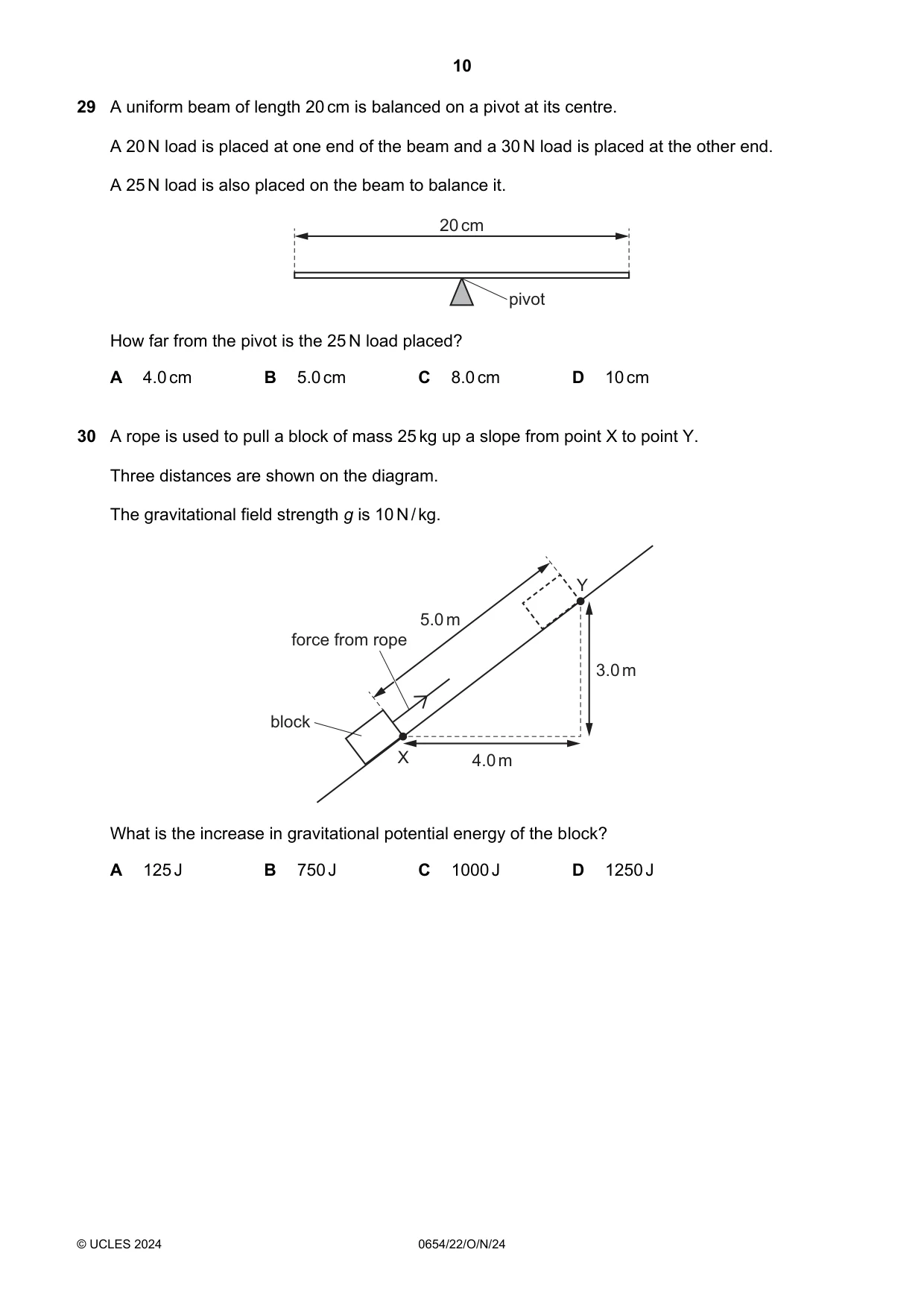
29 A uniform beam of length 20 cm is balanced on a pivot at its centre. A 20 N load is placed at one end of the beam and a 30 N load is placed at the other end. A 25 N load is also placed on the beam to balance it. 20 cm pivot How far from the pivot is the 25 N load placed? A 4.0 cm B 5.0 cm C 8.0 cm D 10 cm
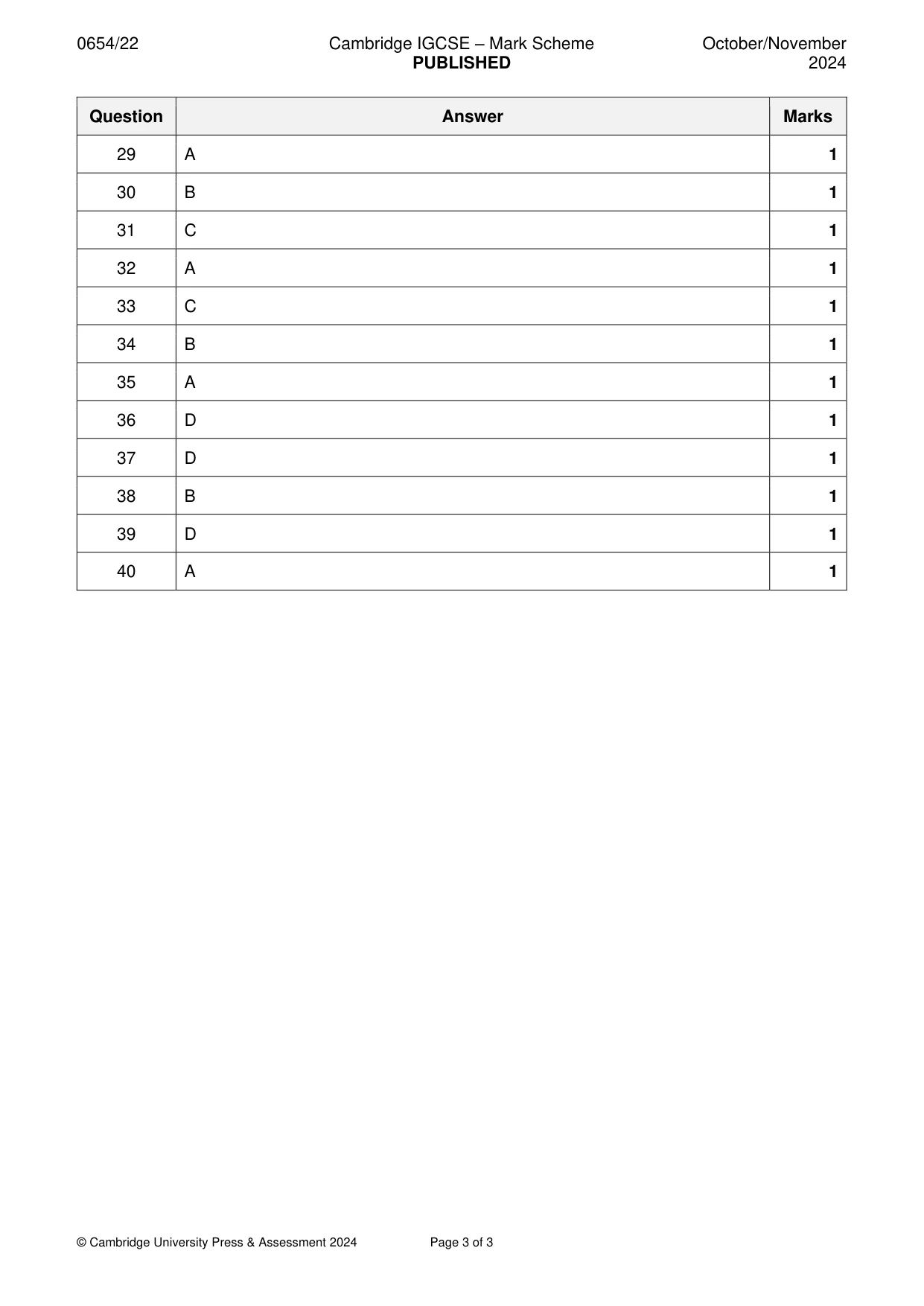
Mark scheme: A
Q30 · A rope is used to pull a block of mass 25 kg up a slope from point X to point Y
30 A rope is used to pull a block of mass 25 kg up a slope from point X to point Y. Three distances are shown on the diagram. The gravitational field strength g is 10 N / kg. Y 5.0 m force from rope 3.0 m block X 4.0 m What is the increase in gravitational potential energy of the block? A 125 J B 750 J C 1000 J D 1250 J
Mark scheme: B
Q31 · A liquid starts to evaporate
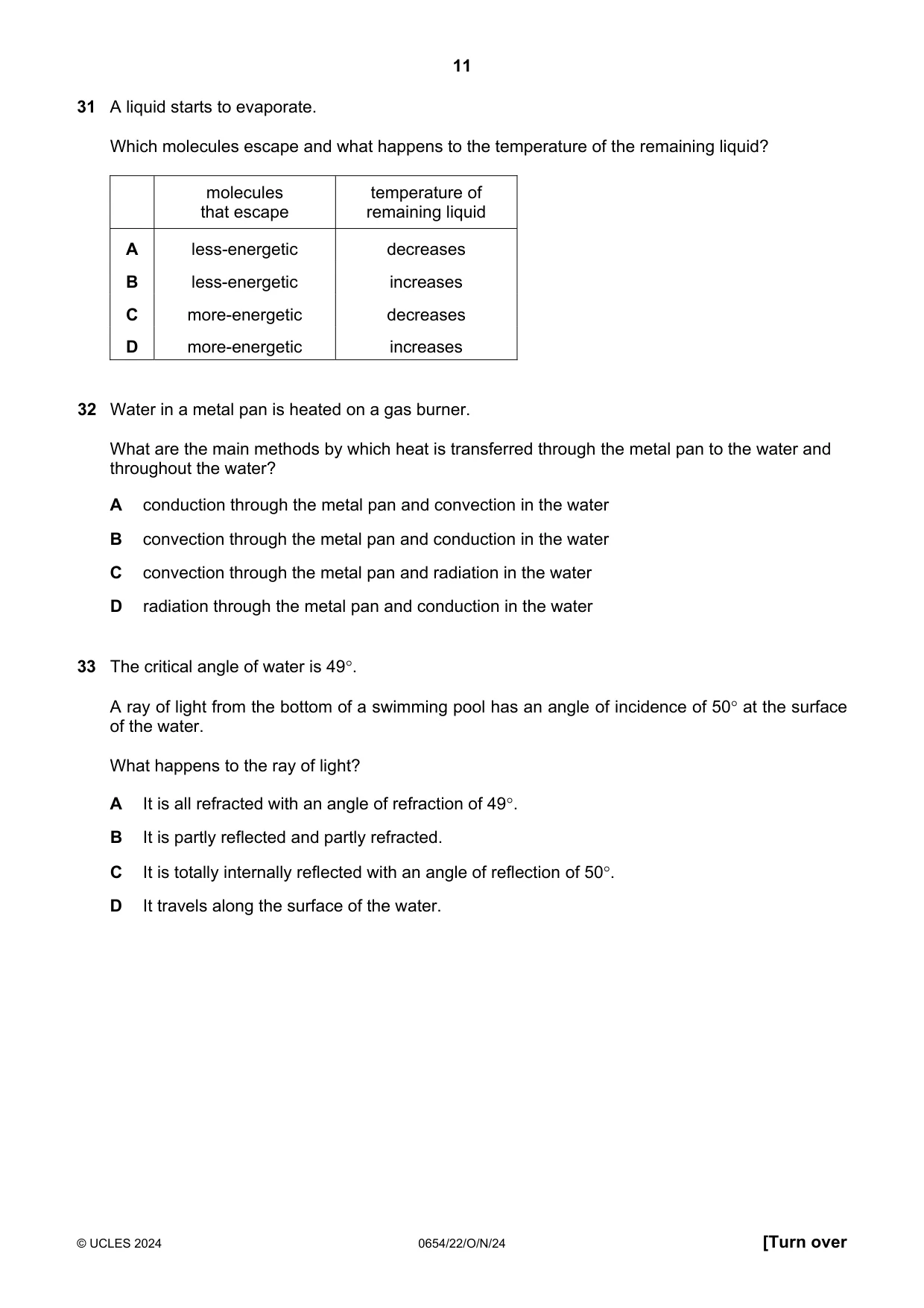
31 A liquid starts to evaporate. Which molecules escape and what happens to the temperature of the remaining liquid? molecules temperature of that escape remaining liquid A less-energetic decreases B less-energetic increases C more-energetic decreases D more-energetic increases
Mark scheme: C
Q32 · Water in a metal pan is heated on a gas burner
32 Water in a metal pan is heated on a gas burner. What are the main methods by which heat is transferred through the metal pan to the water and throughout the water? A conduction through the metal pan and convection in the water B convection through the metal pan and conduction in the water C convection through the metal pan and radiation in the water D radiation through the metal pan and conduction in the water
Mark scheme: A
Q33 · The critical angle of water is 49
33 The critical angle of water is 49. A ray of light from the bottom of a swimming pool has an angle of incidence of 50 at the surface of the water. What happens to the ray of light? A It is all refracted with an angle of refraction of 49. B It is partly reflected and partly refracted. C It is totally internally reflected with an angle of reflection of 50. D It travels along the surface of the water.
Mark scheme: C
Q34 · Humans can hear sounds with a range of frequencies
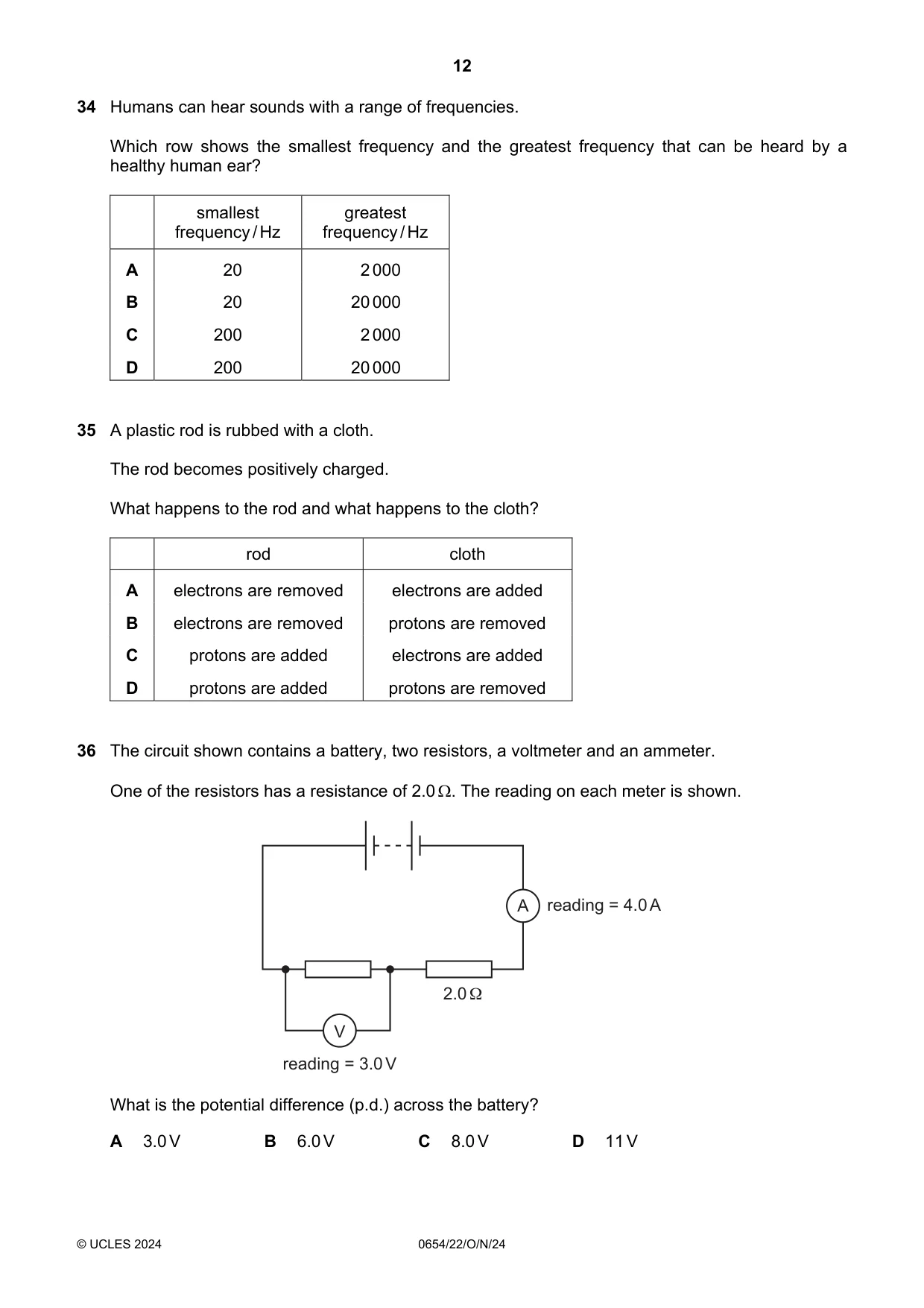
34 Humans can hear sounds with a range of frequencies. Which row shows the smallest frequency and the greatest frequency that can be heard by a healthy human ear? smallest greatest frequency / Hz frequency / Hz A 20 2 000 B 20 20 000 C 200 2 000 D 200 20 000
Mark scheme: B
Q35 · A plastic rod is rubbed with a cloth
35 A plastic rod is rubbed with a cloth. The rod becomes positively charged. What happens to the rod and what happens to the cloth? rod cloth A electrons are removed electrons are added B electrons are removed protons are removed C protons are added electrons are added D protons are added protons are removed
Mark scheme: A
Q36 · The circuit shown contains a battery, two resistors, a voltmeter and an ammeter
36 The circuit shown contains a battery, two resistors, a voltmeter and an ammeter. One of the resistors has a resistance of 2.0 . The reading on each meter is shown. A reading = 4.0 A 2.0 Ω V reading = 3.0 V What is the potential difference (p.d.) across the battery? A 3.0 V B 6.0 V C 8.0 V D 11 V
Mark scheme: D
Q37 · A heating element in an electric kettle has a resistance of 24
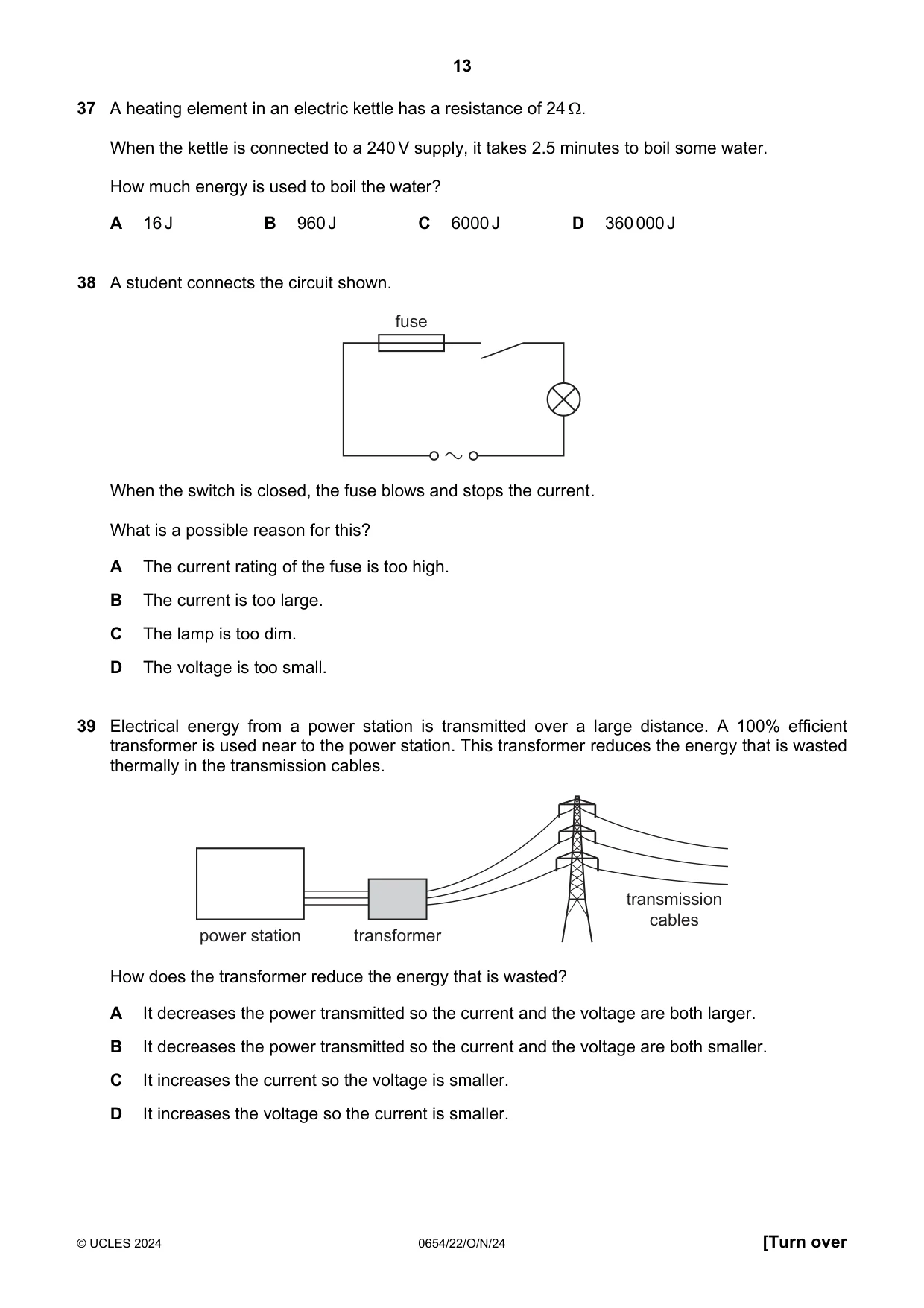
37 A heating element in an electric kettle has a resistance of 24 . When the kettle is connected to a 240 V supply, it takes 2.5 minutes to boil some water. How much energy is used to boil the water? A 16 J B 960 J C 6000 J D 360 000 J
Mark scheme: D
Q38 · A student connects the circuit shown
38 A student connects the circuit shown. fuse When the switch is closed, the fuse blows and stops the current. What is a possible reason for this? A The current rating of the fuse is too high. B The current is too large. C The lamp is too dim. D The voltage is too small.
Mark scheme: B
Q39 · Electrical energy from a power station is transmitted over a large distance
39 Electrical energy from a power station is transmitted over a large distance. A 100% efficient transformer is used near to the power station. This transformer reduces the energy that is wasted thermally in the transmission cables. transmission cables power station transformer How does the transformer reduce the energy that is wasted? A It decreases the power transmitted so the current and the voltage are both larger. B It decreases the power transmitted so the current and the voltage are both smaller. C It increases the current so the voltage is smaller. D It increases the voltage so the current is smaller.
Mark scheme: D
Q40 · The diagram shows a radioactive source emitting three types of ionising radiation, X, Y…
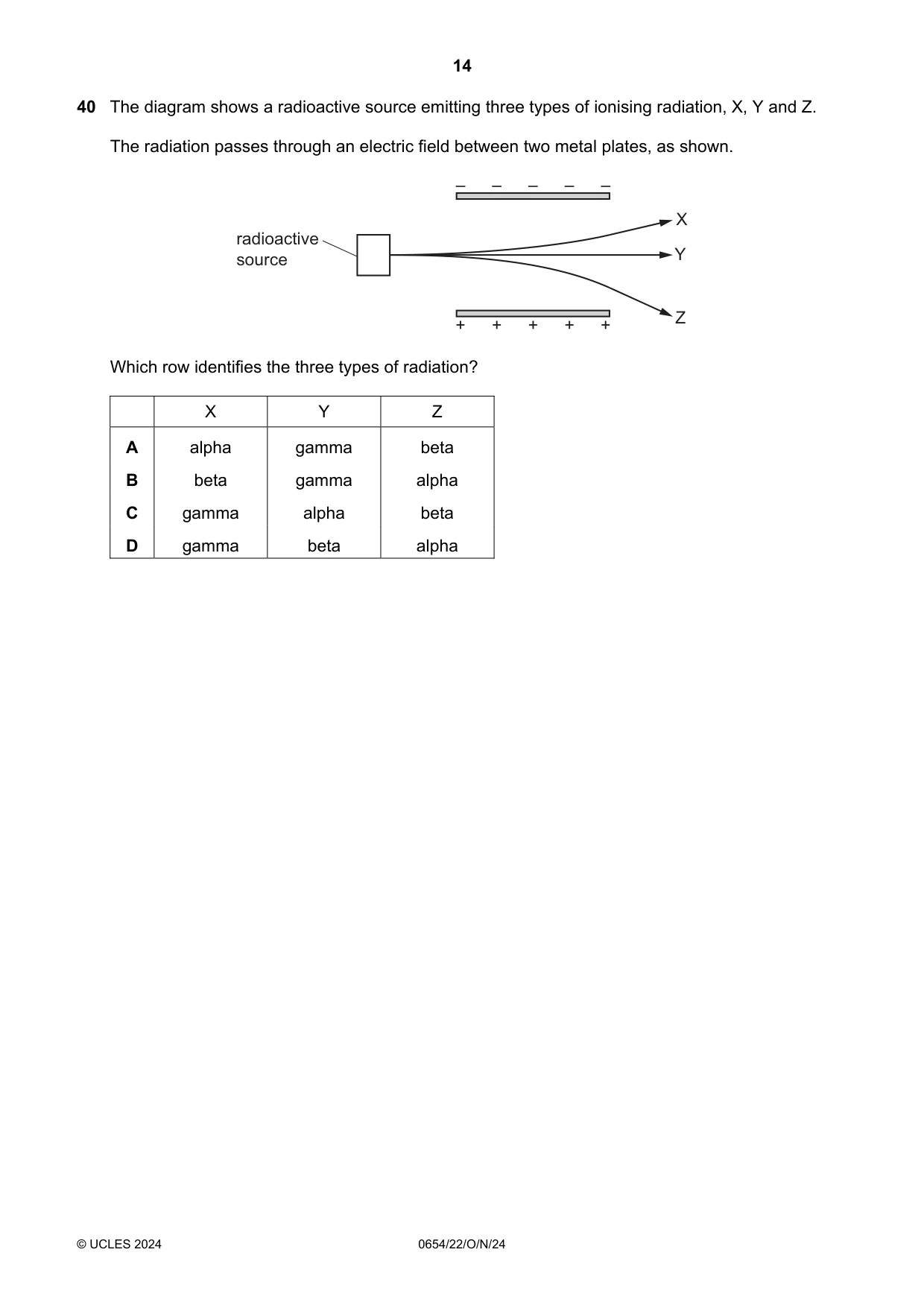
40 The diagram shows a radioactive source emitting three types of ionising radiation, X, Y and Z. The radiation passes through an electric field between two metal plates, as shown. – – – – – X radioactive source Y + + + + + Z Which row identifies the three types of radiation? X Y Z A alpha gamma beta B beta gamma alpha C gamma alpha beta D gamma beta alpha
Mark scheme: A
What was in this paper
The subtopics covered by these 40 questions, and how many questions each got. Open one in a new tab to see every Cambridge question on it.
2Coordination and response2Alkenes1Arrangement of elements1Biological molecules1Blood1Cell structure1Digestion1Electrical circuits1Electrical quantities1Electrical safety1Electrolysis1Electromagnetic effects1Energy, work and power1Enzymes1Exothermic and endothermic reactions1Experimental design1Food chains and food webs1Forces1Fuels1Gas exchange in humans1Habitat destruction1Identification of ions and gases1Ions and ionic bonds1Kinetic particle model of matter1Light1Mass and weight1Monohybrid inheritance1Oxides1Photosynthesis1Radioactivity1Reactivity series1Relative masses of atoms and molecules1Sexual reproduction in humans1Simple phenomena of magnetism1Sound1The characteristic properties of acids and bases1Transfer of thermal energy1What you needed in this session
Cambridge’s own grade thresholds for 2024 Oct/Nov, Paper 2 · Variant 2. A higher threshold means an easier paper — the bar moves with how the cohort did.