Cambridge IGCSE Sciences - Co-ordinated (Double) 0654 — 2021 May/June Paper 2 · Variant 3
0654/23/M/J/21 · 40 questions · 40 marks · ≈45 min
The question paper and its mark scheme, free to read here and free to download. This is Cambridge’s own paper, exactly as it was sat.
Question paper16 pages
Mark scheme3 pages
Answers below. Sit the paper first if you are practising.
Questions as text
Question 1
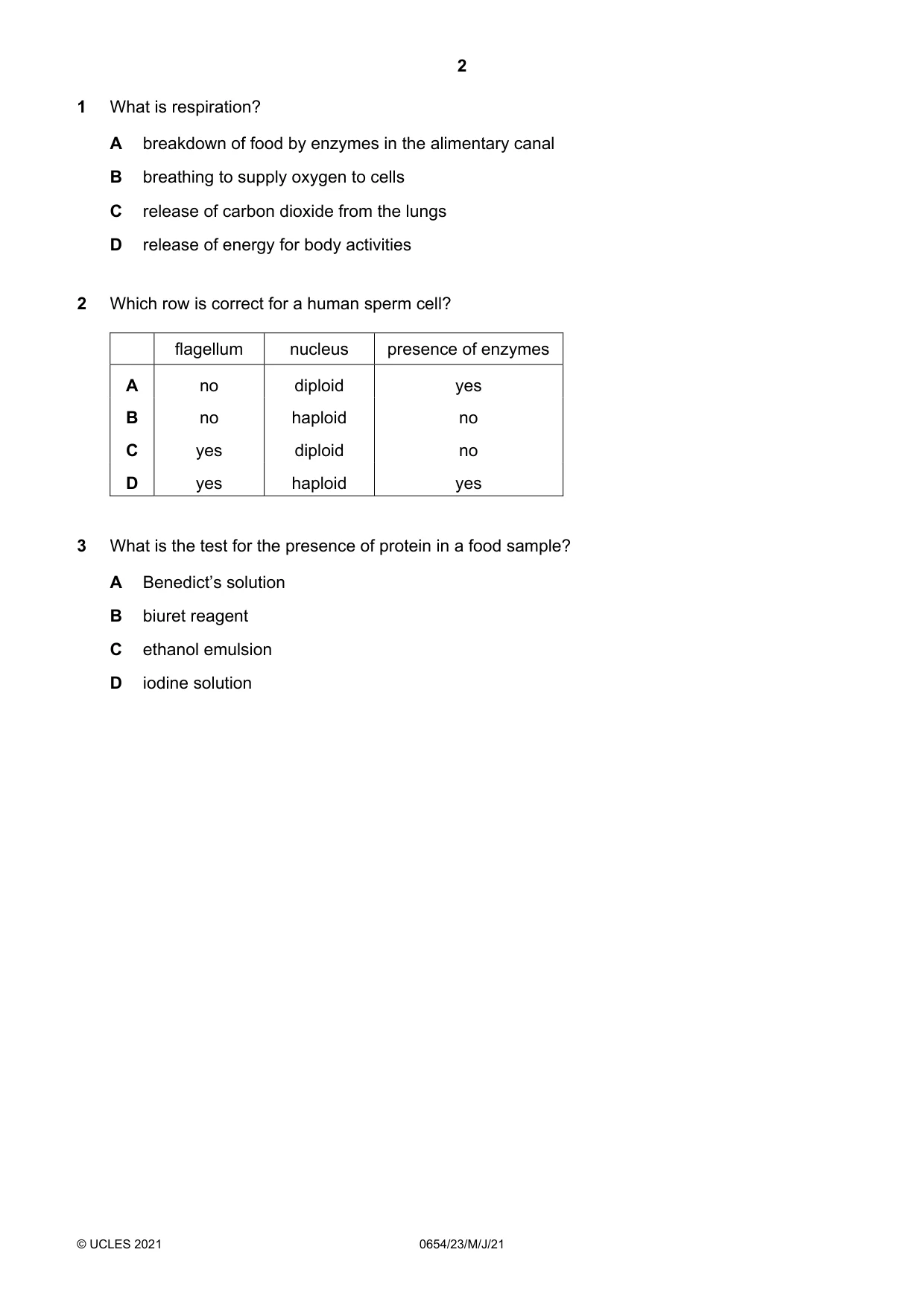
1 What is respiration? A breakdown of food by enzymes in the alimentary canal B breathing to supply oxygen to cells C release of carbon dioxide from the lungs D release of energy for body activities
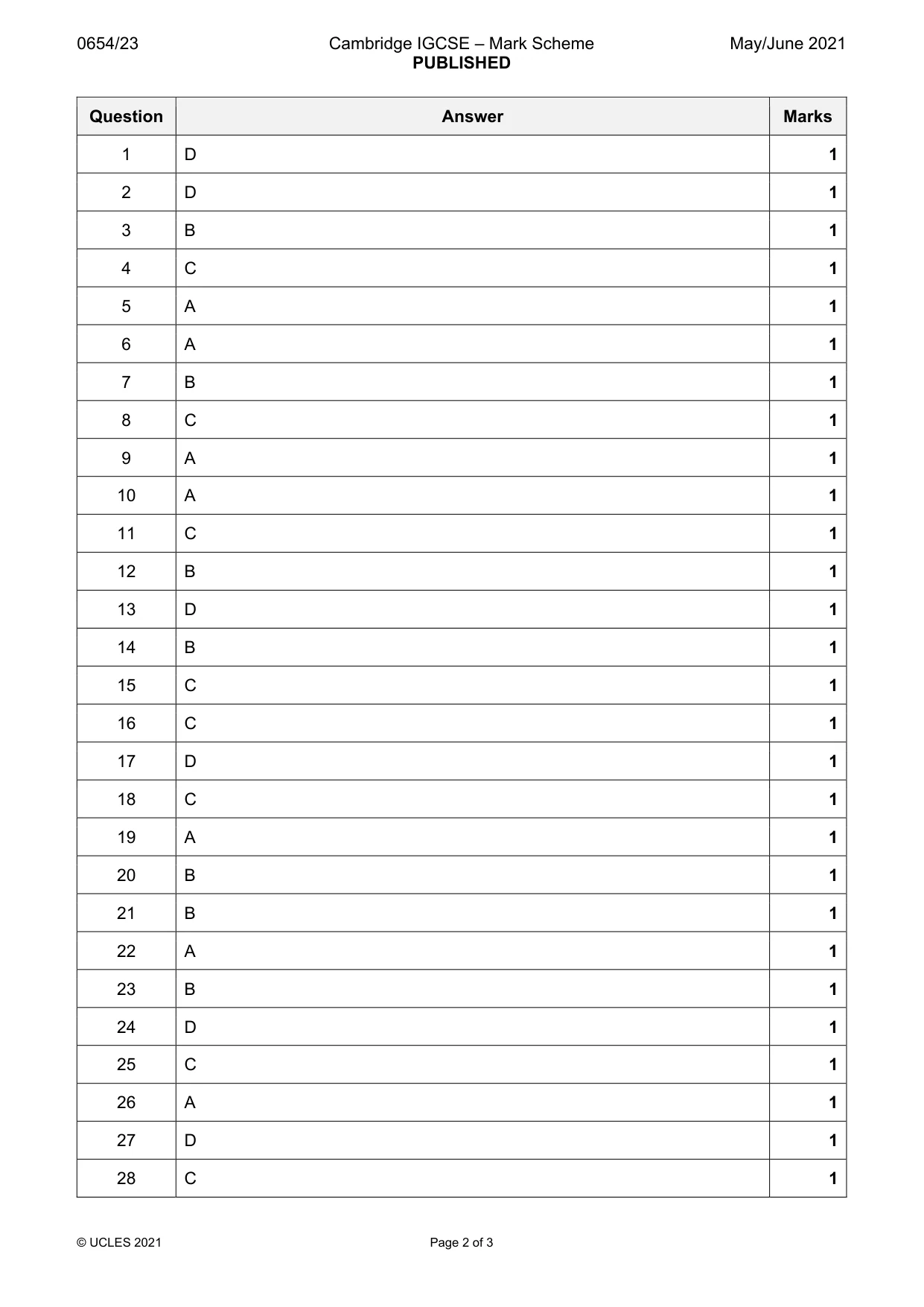
Mark scheme: D
Q2 · Which row is correct for a human sperm cell?
2 Which row is correct for a human sperm cell? flagellum nucleus presence of enzymes A no diploid yes B no haploid no C yes diploid no D yes haploid yes
Mark scheme: D
Q3 · What is the test for the presence of protein in a food sample?
3 What is the test for the presence of protein in a food sample? A Benedict’s solution B biuret reagent C ethanol emulsion D iodine solution
Mark scheme: B
Q4 · Which graph shows the effect of temperature on the rate of an enzyme-controlled reaction?
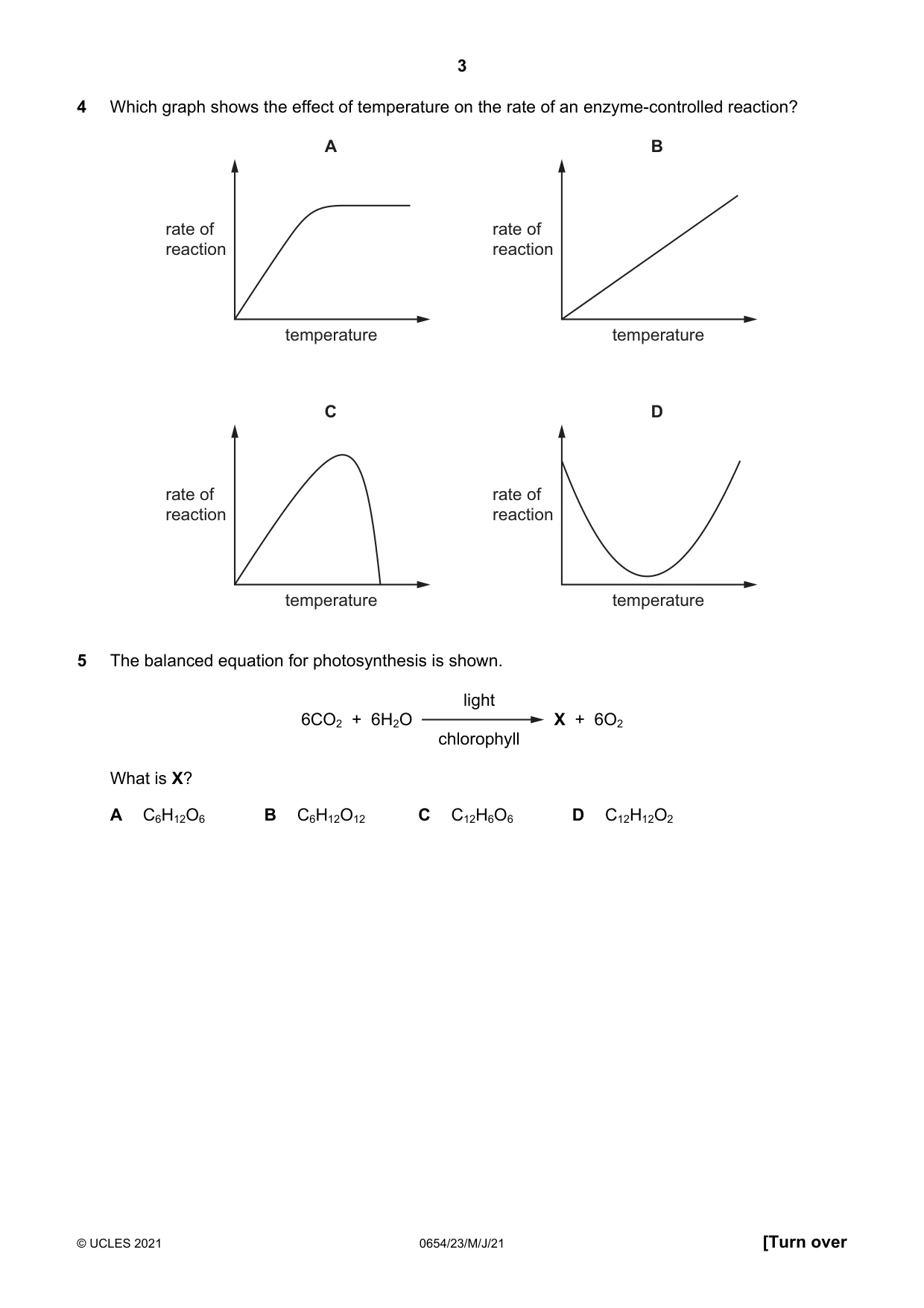
4 Which graph shows the effect of temperature on the rate of an enzyme-controlled reaction? A B rate of rate of reaction reaction temperature temperature C D rate of rate of reaction reaction temperature temperature
Mark scheme: C
Q5 · The balanced equation for photosynthesis is shown
5 The balanced equation for photosynthesis is shown. light 6CO2 + 6H2O X + 6O2 chlorophyll What is X? A C6H12O6 B C6H12O12 C C12H6O6 D C12H12O2
Mark scheme: A
Q6 · A mixture of starch suspension and saliva is placed inside a bag with a partially…
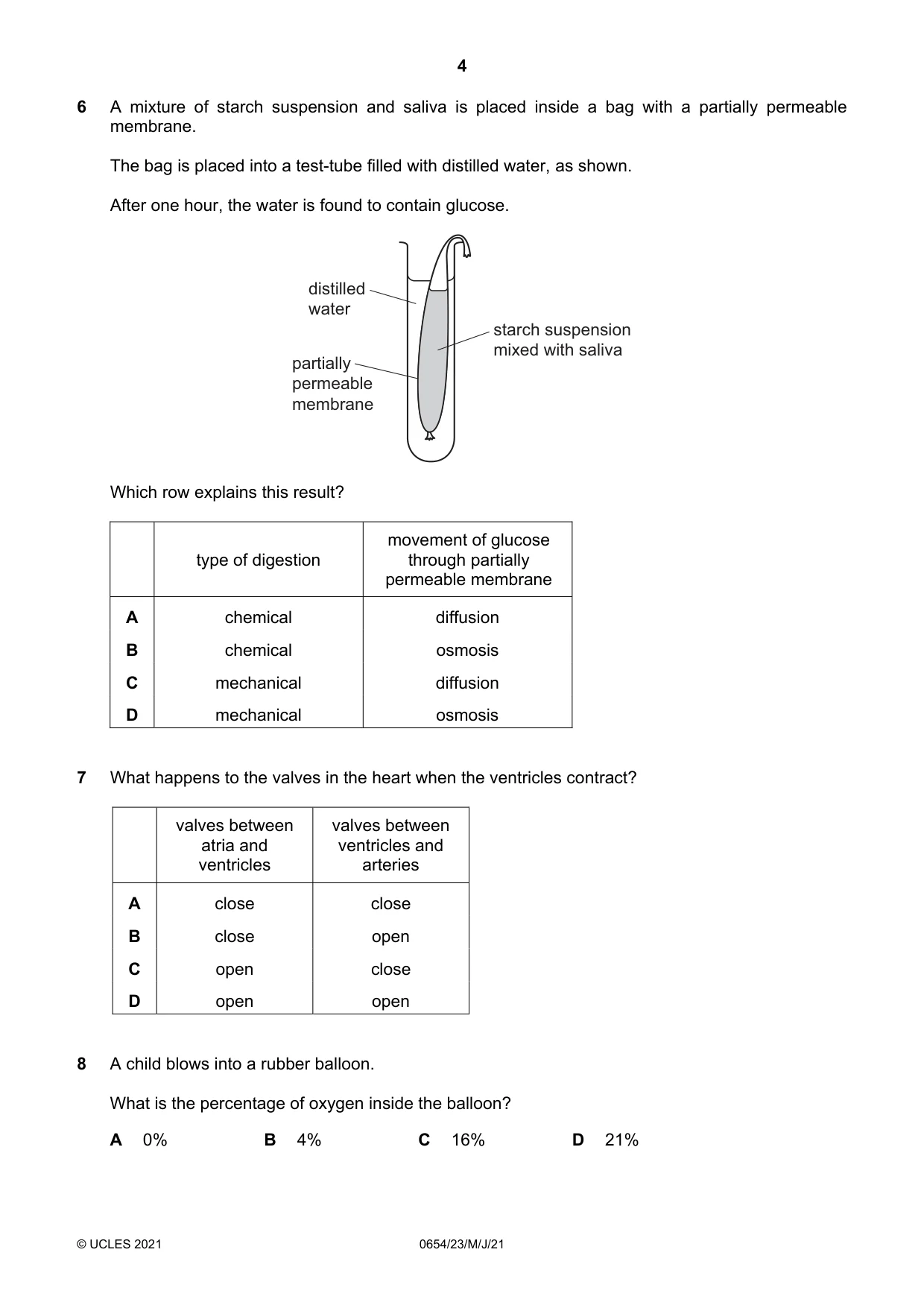
6 A mixture of starch suspension and saliva is placed inside a bag with a partially permeable membrane. The bag is placed into a test-tube filled with distilled water, as shown. After one hour, the water is found to contain glucose. distilled water starch suspension mixed with saliva partially permeable membrane Which row explains this result? movement of glucose type of digestion through partially permeable membrane A chemical diffusion B chemical osmosis C mechanical diffusion D mechanical osmosis
Mark scheme: A
Q7 · What happens to the valves in the heart when the ventricles contract?
7 What happens to the valves in the heart when the ventricles contract? valves between valves between atria and ventricles and ventricles arteries A close close B close open C open close D open open
Mark scheme: B
Q8 · A child blows into a rubber balloon
8 A child blows into a rubber balloon. What is the percentage of oxygen inside the balloon? A 0% B 4% C 16% D 21%
Mark scheme: C
Q9 · A plant was placed horizontally in complete darkness
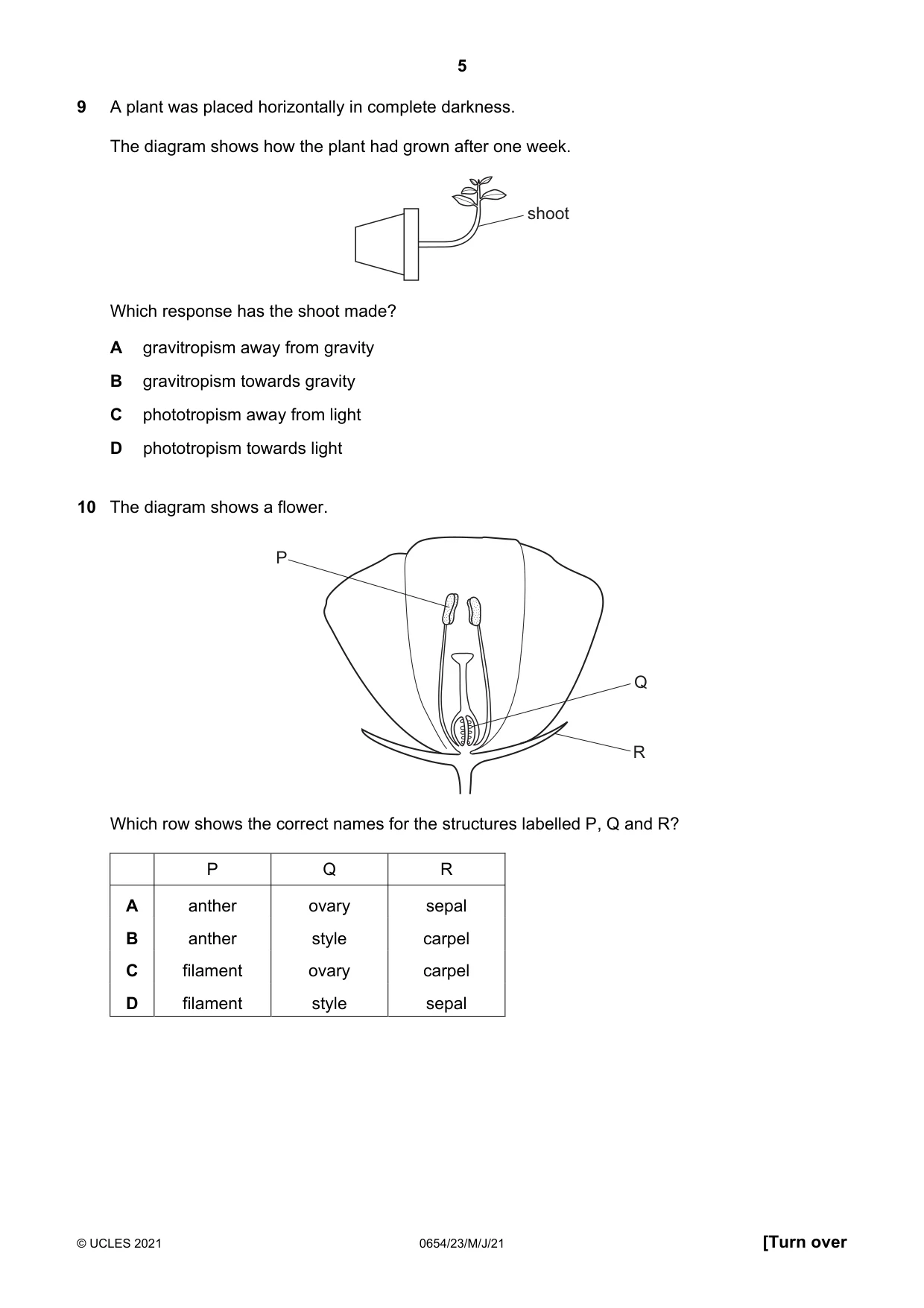
9 A plant was placed horizontally in complete darkness. The diagram shows how the plant had grown after one week. shoot Which response has the shoot made? A gravitropism away from gravity B gravitropism towards gravity C phototropism away from light D phototropism towards light
Mark scheme: A
Q10 · The diagram shows a flower
10 The diagram shows a flower. P Q R Which row shows the correct names for the structures labelled P, Q and R? P Q R A anther ovary sepal B anther style carpel C filament ovary carpel D filament style sepal
Mark scheme: A
Q11 · Which row about cell division is correct?
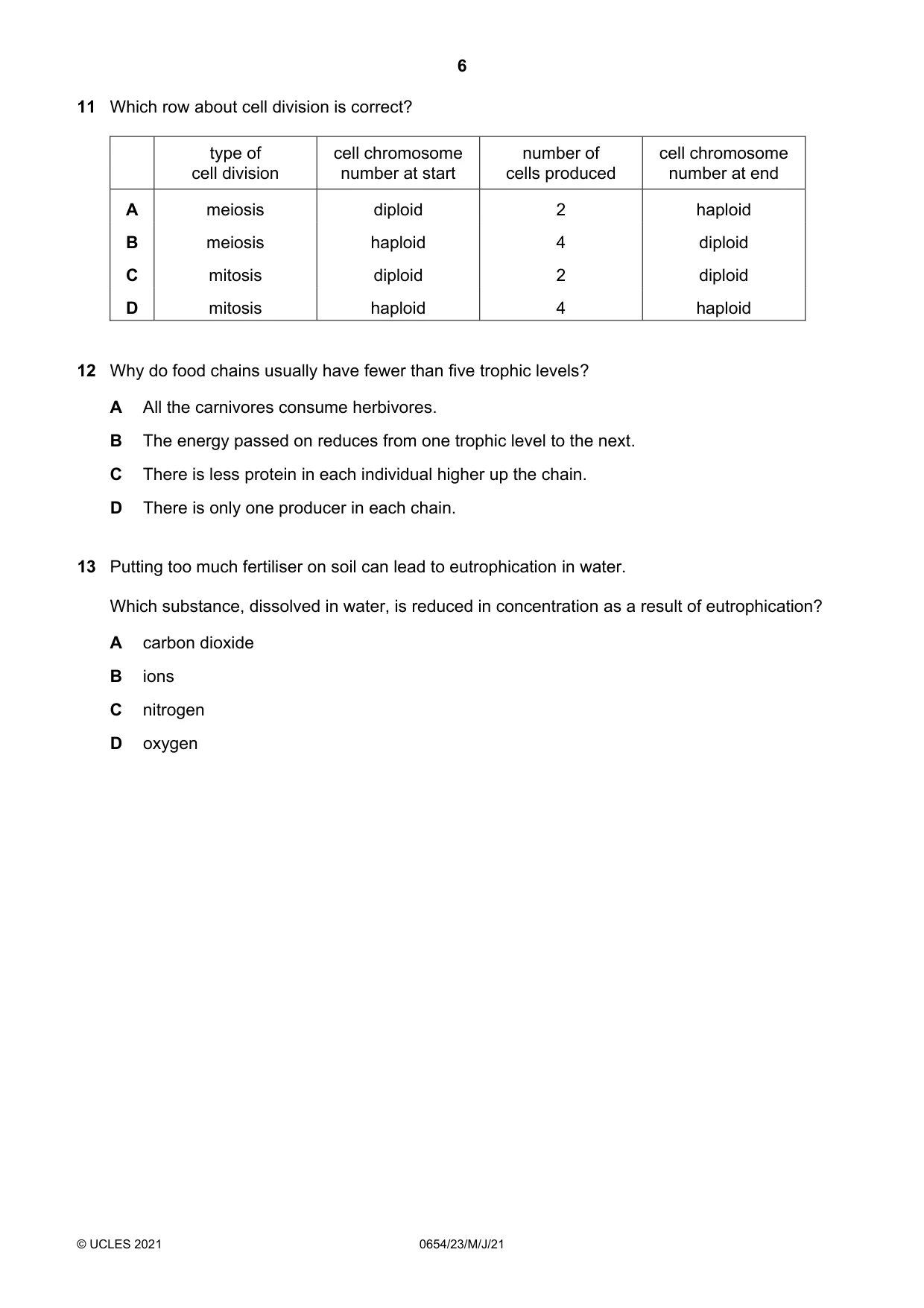
11 Which row about cell division is correct? type of cell chromosome number of cell chromosome cell division number at start cells produced number at end A meiosis diploid 2 haploid B meiosis haploid 4 diploid C mitosis diploid 2 diploid D mitosis haploid 4 haploid
Mark scheme: C
Q12 · Why do food chains usually have fewer than five trophic levels?
12 Why do food chains usually have fewer than five trophic levels? A All the carnivores consume herbivores. B The energy passed on reduces from one trophic level to the next. C There is less protein in each individual higher up the chain. D There is only one producer in each chain.
Mark scheme: B
Q13 · Putting too much fertiliser on soil can lead to eutrophication in water
13 Putting too much fertiliser on soil can lead to eutrophication in water. Which substance, dissolved in water, is reduced in concentration as a result of eutrophication? A carbon dioxide B ions C nitrogen D oxygen
Mark scheme: D
Q14 · The structures of some substances are shown
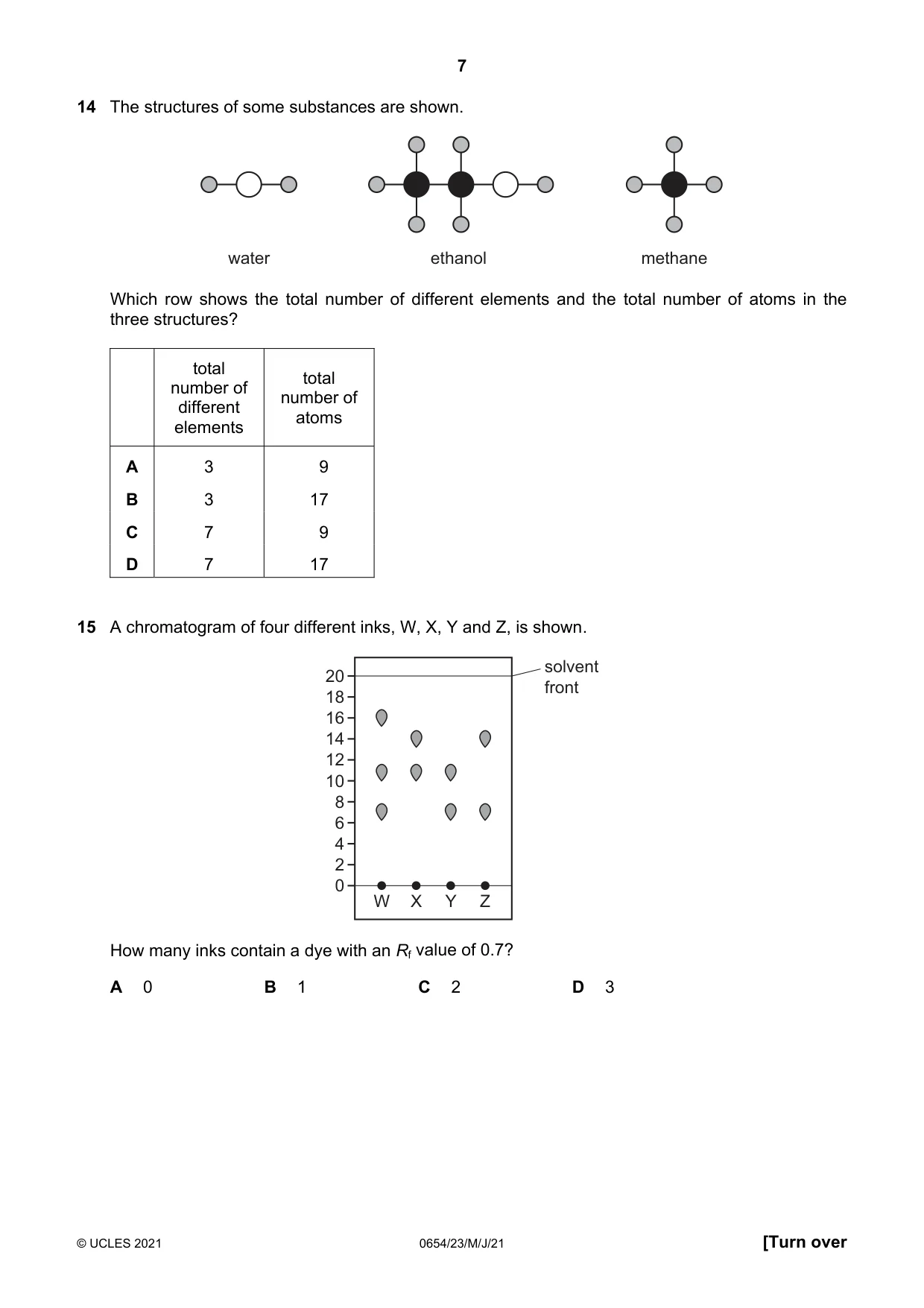
14 The structures of some substances are shown. water ethanol methane Which row shows the total number of different elements and the total number of atoms in the three structures? total total number of number of different atoms elements A 3 9 B 3 17 C 7 9 D 7 17
Mark scheme: B
Q15 · A chromatogram of four different inks, W, X, Y and Z, is shown
15 A chromatogram of four different inks, W, X, Y and Z, is shown. solvent 20 front 18 16 14 12 10 8 6 4 2 0 W X Y Z How many inks contain a dye with an Rf value of 0.7? A 0 B 1 C 2 D 3
Mark scheme: C
Q16 · Which dot-and-cross diagram represents a molecule of carbon dioxide?
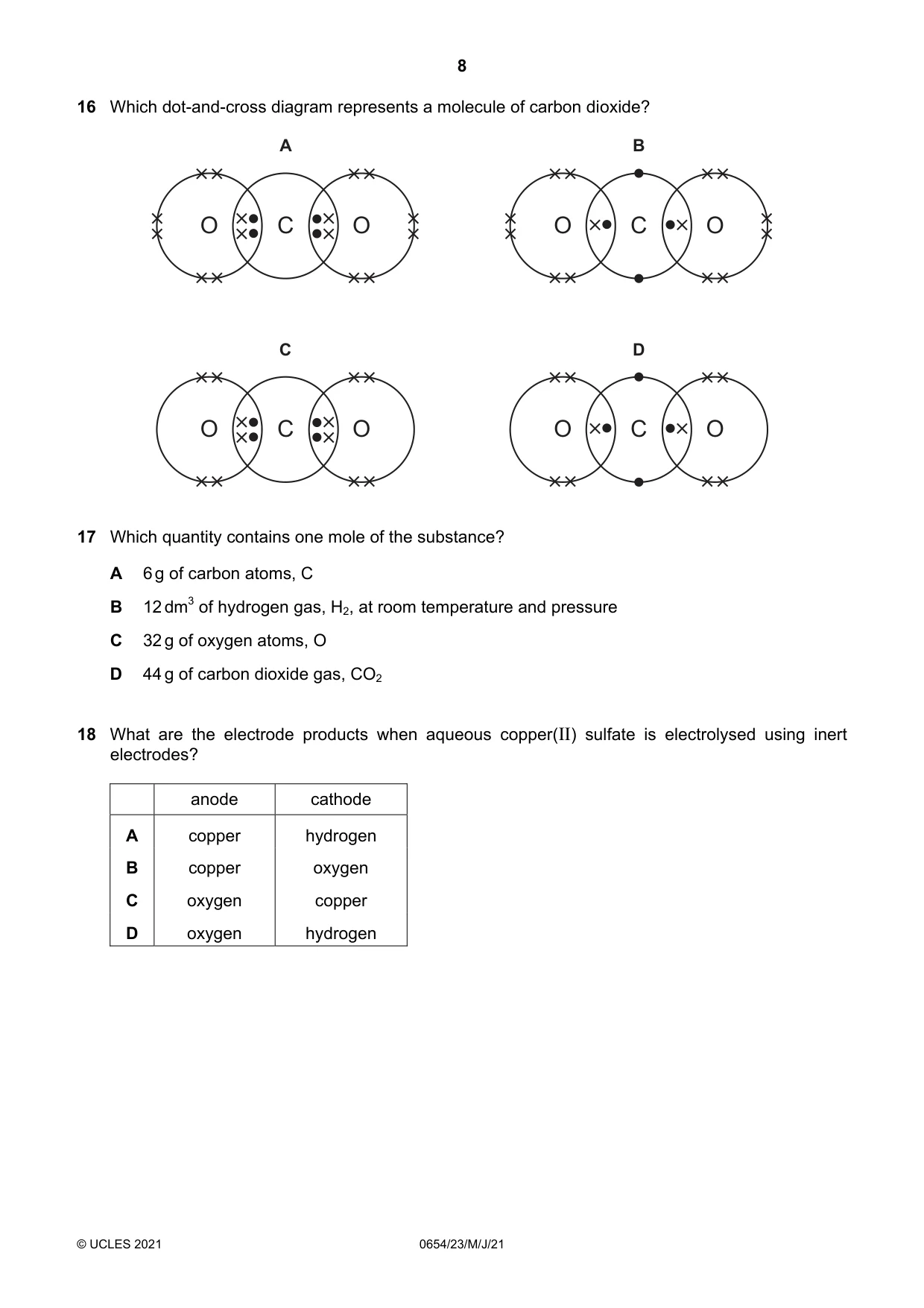
16 Which dot-and-cross diagram represents a molecule of carbon dioxide? A B O C O O C O C D O C O O C O
Mark scheme: C
Q17 · Which quantity contains one mole of the substance?
17 Which quantity contains one mole of the substance? A 6 g of carbon atoms, C B 12 dm3 of hydrogen gas, H2, at room temperature and pressure C 32 g of oxygen atoms, O D 44 g of carbon dioxide gas, CO2
Mark scheme: D
Q18 · What are the electrode products when aqueous copper(II) sulfate is electrolysed using…
18 What are the electrode products when aqueous copper(II) sulfate is electrolysed using inert electrodes? anode cathode A copper hydrogen B copper oxygen C oxygen copper D oxygen hydrogen
Mark scheme: C
Q19 · Chlorine displaces iodine from a solution of sodium iodide in a redox reaction
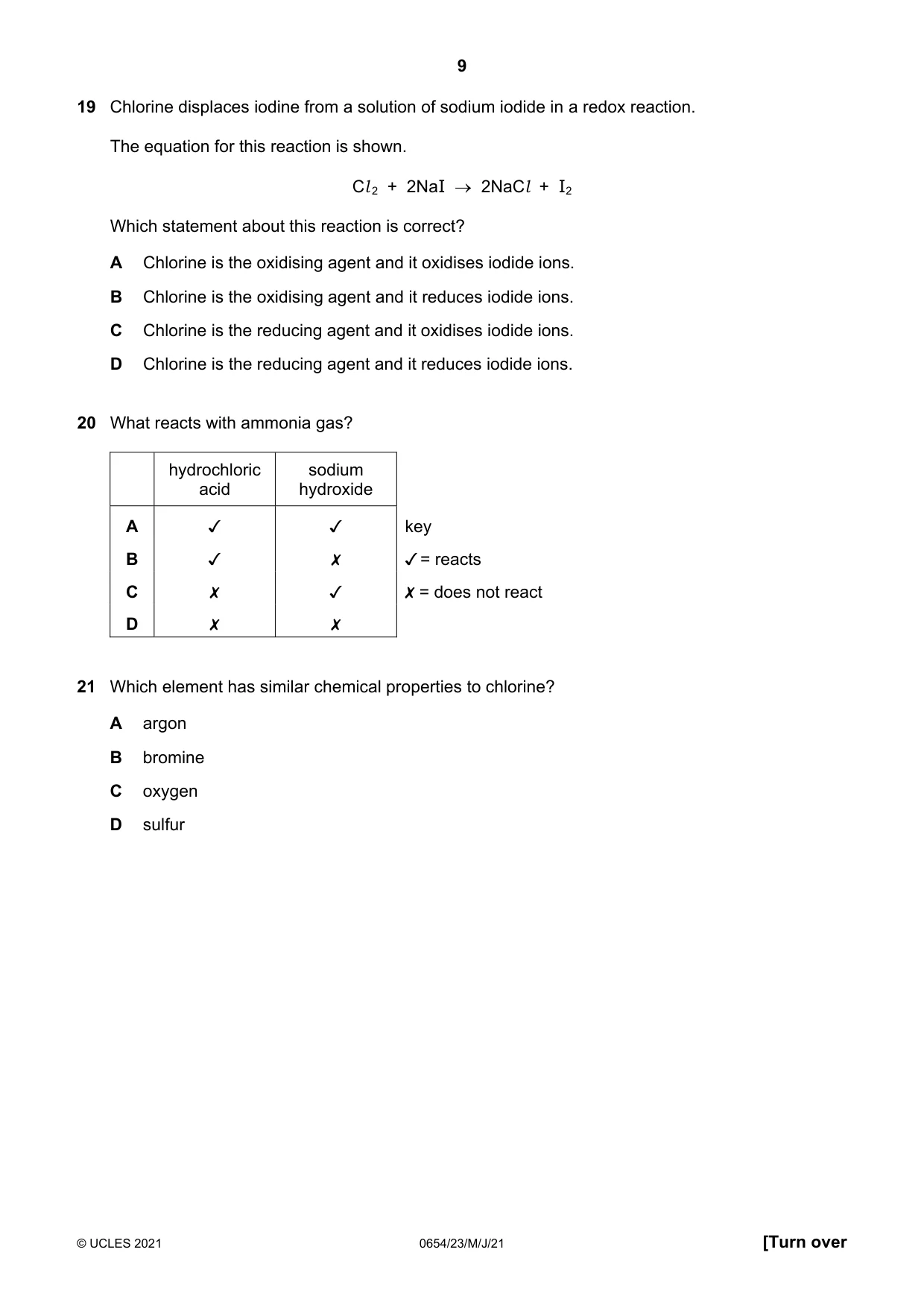
19 Chlorine displaces iodine from a solution of sodium iodide in a redox reaction. The equation for this reaction is shown. Cl 2 + 2NaI 2NaCl + I2 Which statement about this reaction is correct? A Chlorine is the oxidising agent and it oxidises iodide ions. B Chlorine is the oxidising agent and it reduces iodide ions. C Chlorine is the reducing agent and it oxidises iodide ions. D Chlorine is the reducing agent and it reduces iodide ions.
Mark scheme: A
Q20 · What reacts with ammonia gas?
20 What reacts with ammonia gas? hydrochloric acid ~ «KX sodium hydroxide <x \ x key Jv = reacts X = does not react
Mark scheme: B
More questions on The characteristic properties of acids and bases
Q21 · Which element has similar chemical properties to chlorine?
21 Which element has similar chemical properties to chlorine? A argon B bromine C oxygen D sulfur
Mark scheme: B
Q22 · An experiment is carried out to investigate the reactions of four metals M, N, O and P…
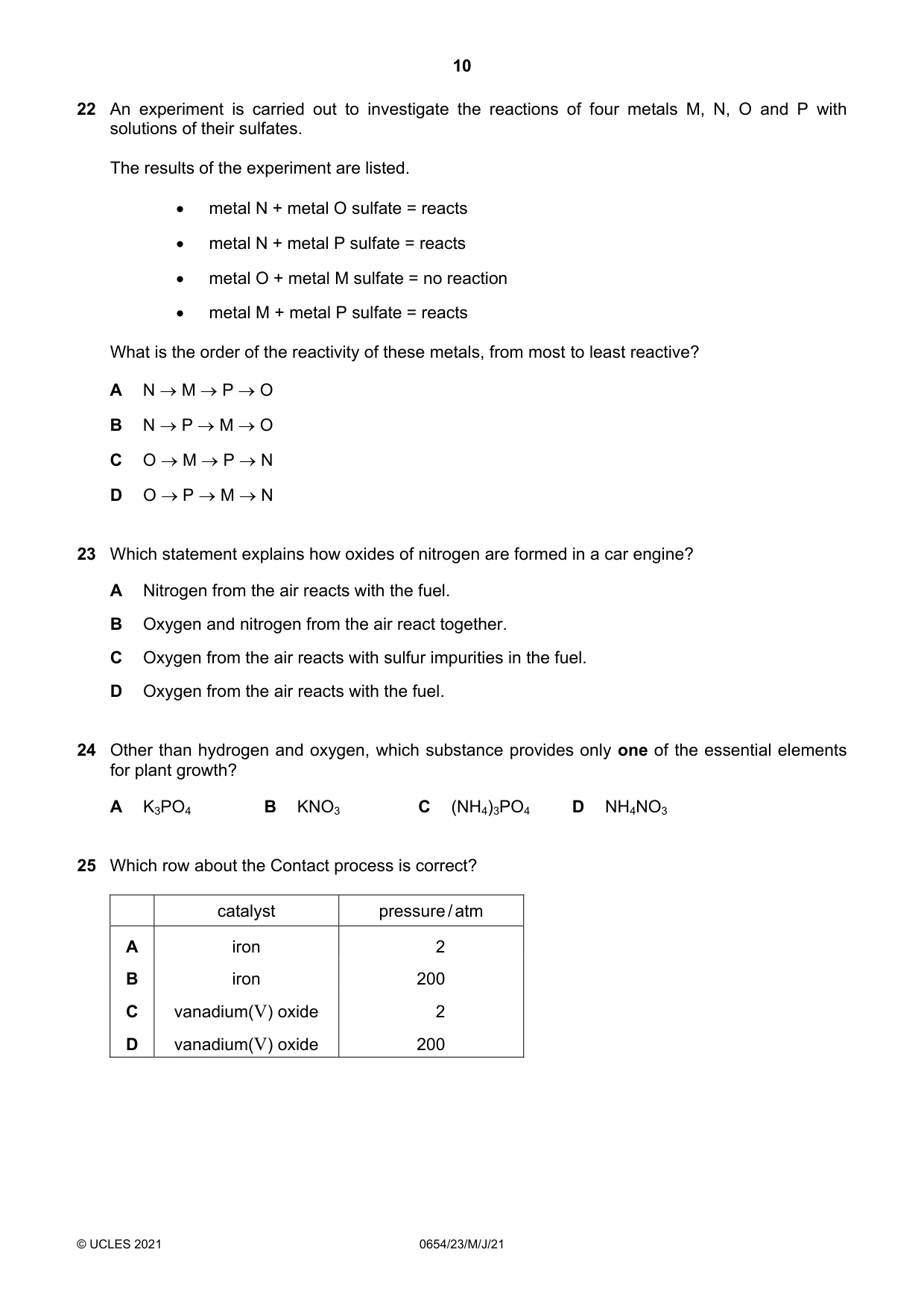
22 An experiment is carried out to investigate the reactions of four metals M, N, O and P with solutions of their sulfates. The results of the experiment are listed. metal N + metal O sulfate = reacts metal N + metal P sulfate = reacts metal O + metal M sulfate = no reaction metal M + metal P sulfate = reacts What is the order of the reactivity of these metals, from most to least reactive? A N M P O B N P M O C O M P N D O P M N
Mark scheme: A
Q23 · Which statement explains how oxides of nitrogen are formed in a car engine?
23 Which statement explains how oxides of nitrogen are formed in a car engine? A Nitrogen from the air reacts with the fuel. B Oxygen and nitrogen from the air react together. C Oxygen from the air reacts with sulfur impurities in the fuel. D Oxygen from the air reacts with the fuel.
Mark scheme: B
Q24 · Other than hydrogen and oxygen, which substance provides only one of the essential…
24 Other than hydrogen and oxygen, which substance provides only one of the essential elements for plant growth? A K3PO4 B KNO3 C (NH4)3PO4 D NH4NO3
Mark scheme: D
Q25 · Which row about the Contact process is correct?
25 Which row about the Contact process is correct? catalyst pressure / atm A iron 2 B iron 200 C vanadium(V) oxide 2 D vanadium(V) oxide 200
Mark scheme: C
Q26 · Which equation represents a thermal decomposition reaction?
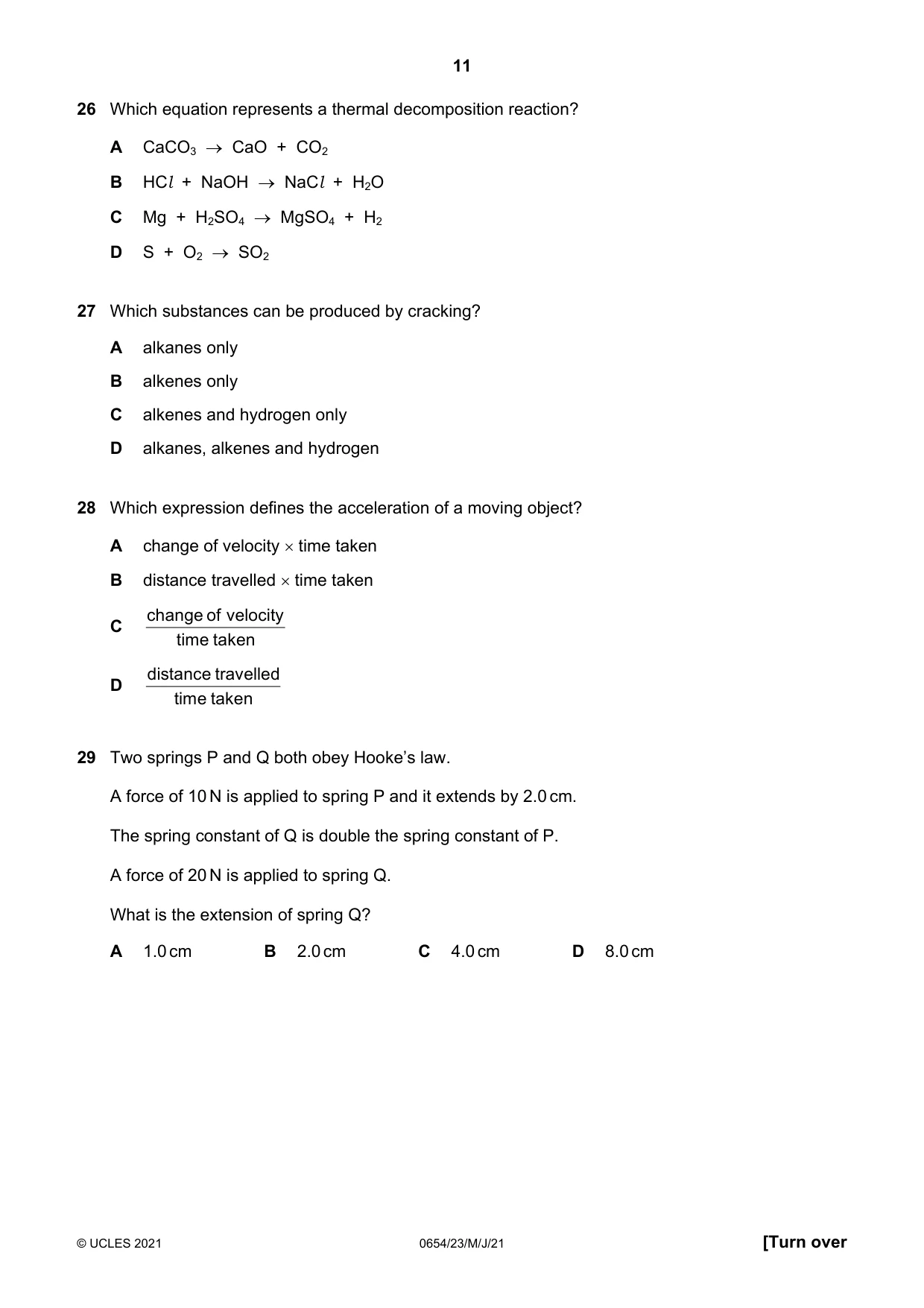
26 Which equation represents a thermal decomposition reaction? A CaCO3 CaO + CO2 B HCl + NaOH NaCl + H2O C Mg + H2SO4 MgSO4 + H2 D S + O2 SO2
Mark scheme: A
Q27 · Which substances can be produced by cracking?
27 Which substances can be produced by cracking? A alkanes only B alkenes only C alkenes and hydrogen only D alkanes, alkenes and hydrogen
Mark scheme: D
Q28 · Which expression defines the acceleration of a moving object?
28 Which expression defines the acceleration of a moving object? A change of velocity time taken B distance travelled time taken change of veloci t y C time take n distance travell e d D time take n
Mark scheme: C
Q29 · Two springs P and Q both obey Hooke’s law
29 Two springs P and Q both obey Hooke’s law. A force of 10 N is applied to spring P and it extends by 2.0 cm. The spring constant of Q is double the spring constant of P. A force of 20 N is applied to spring Q. What is the extension of spring Q? A 1.0 cm B 2.0 cm C 4.0 cm D 8.0 cm
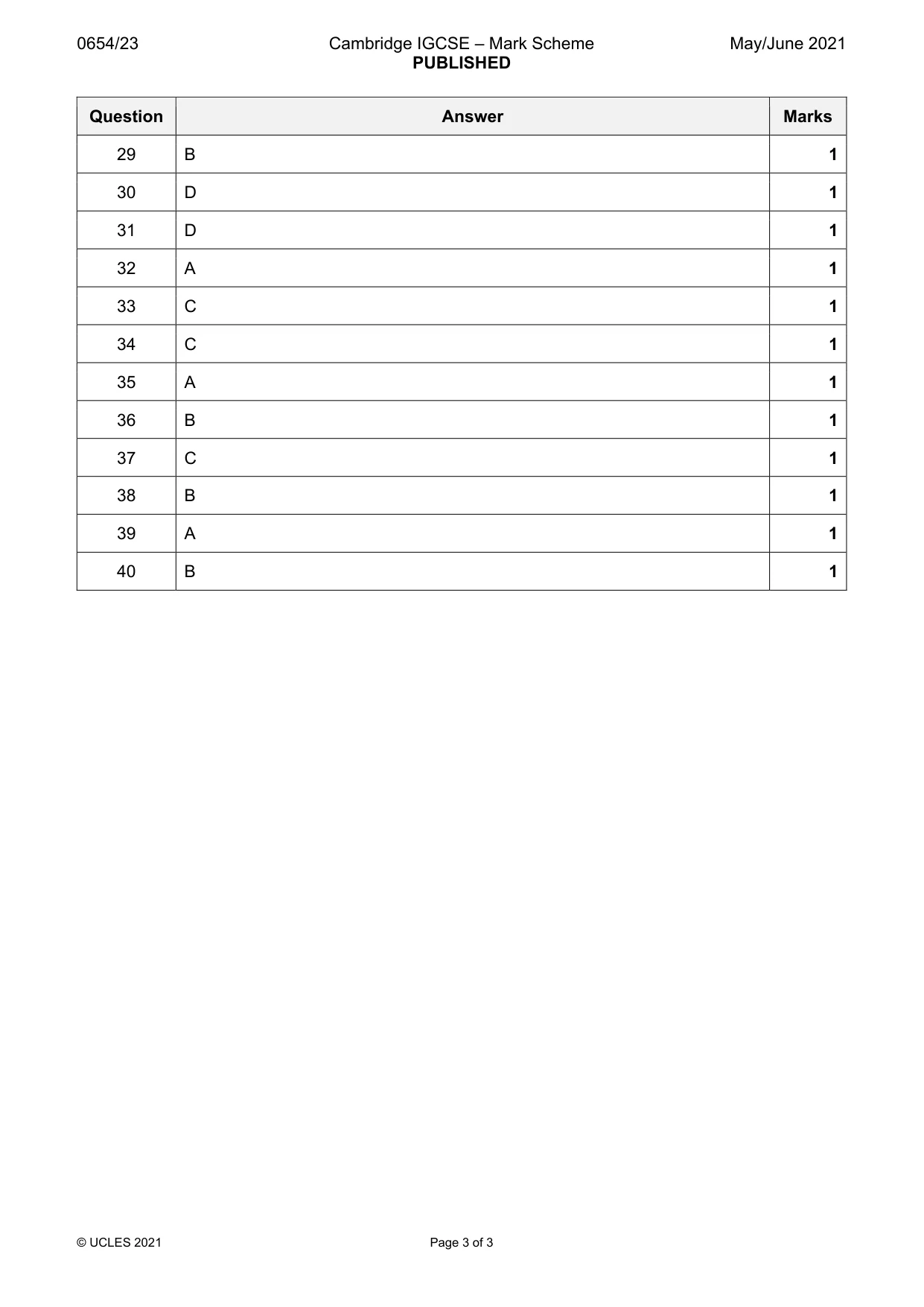
Mark scheme: B
Q30 · The diagram shows a man diving into water
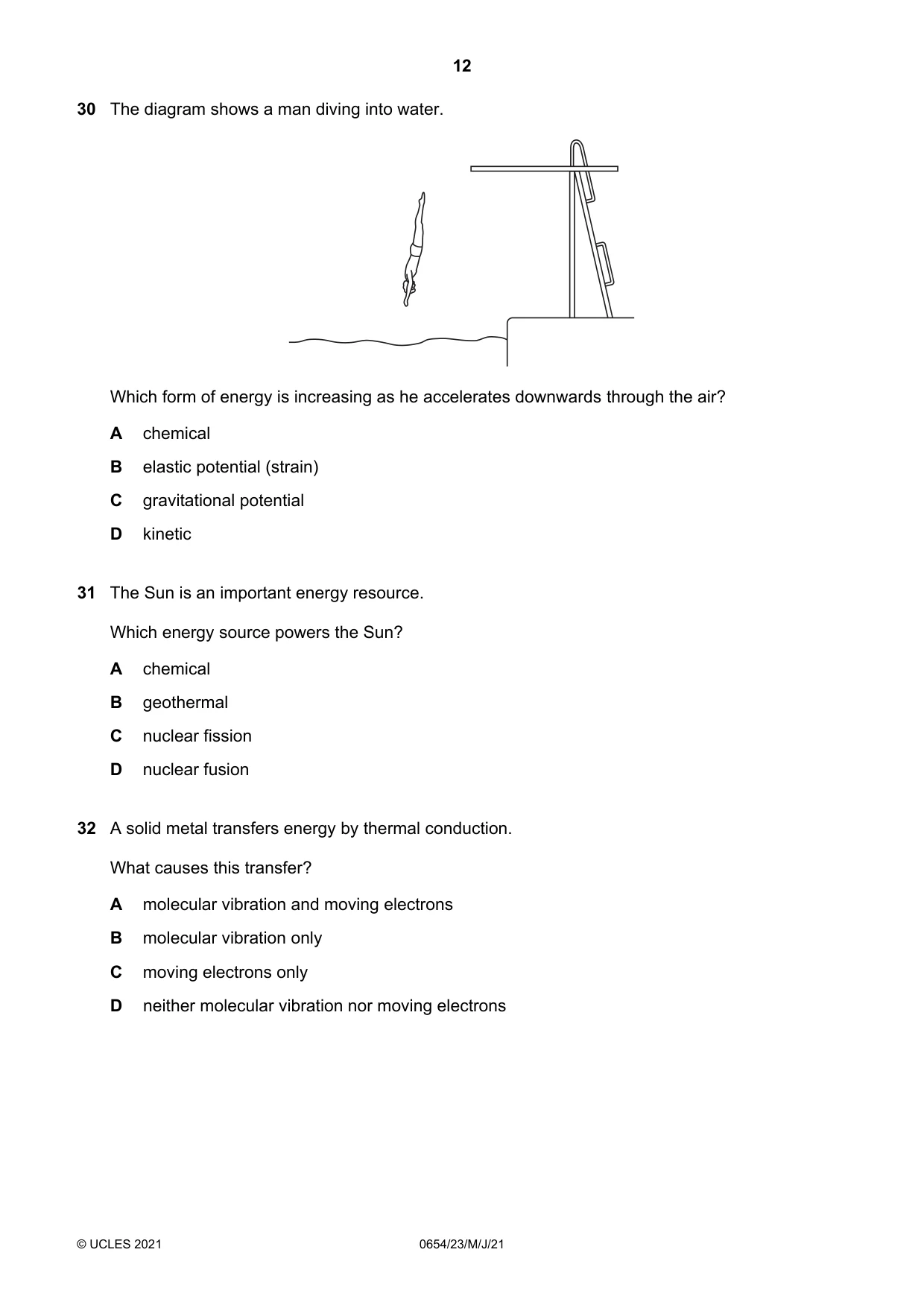
30 The diagram shows a man diving into water. Which form of energy is increasing as he accelerates downwards through the air? A chemical B elastic potential (strain) C gravitational potential D kinetic
Mark scheme: D
Q31 · The Sun is an important energy resource
31 The Sun is an important energy resource. Which energy source powers the Sun? A chemical B geothermal C nuclear fission D nuclear fusion
Mark scheme: D
Q32 · A solid metal transfers energy by thermal conduction
32 A solid metal transfers energy by thermal conduction. What causes this transfer? A molecular vibration and moving electrons B molecular vibration only C moving electrons only D neither molecular vibration nor moving electrons
Mark scheme: A
Q33 · Which statement about waves is correct?
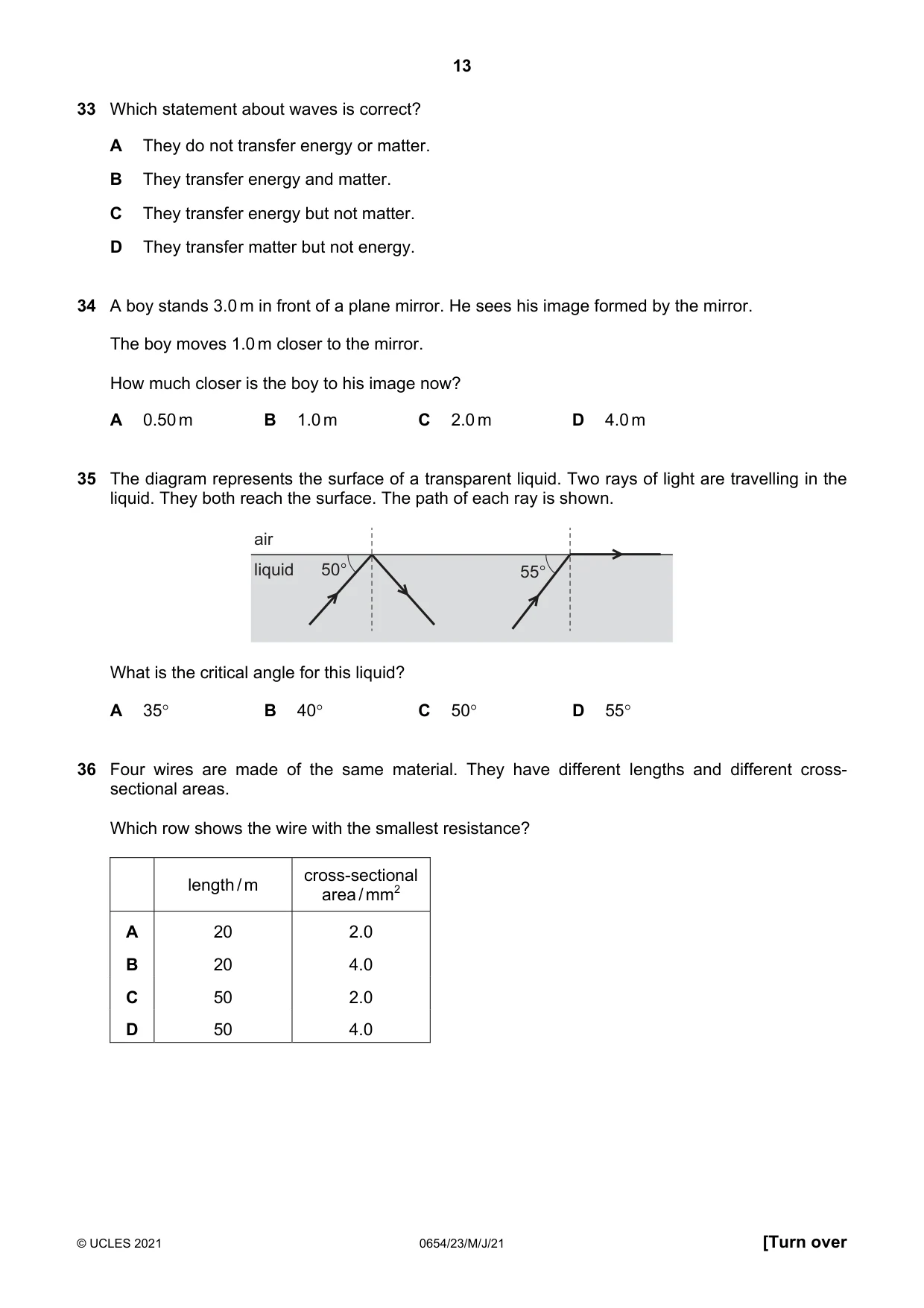
33 Which statement about waves is correct? A They do not transfer energy or matter. B They transfer energy and matter. C They transfer energy but not matter. D They transfer matter but not energy.
Mark scheme: C
Q34 · A boy stands 3.0 m in front of a plane mirror
34 A boy stands 3.0 m in front of a plane mirror. He sees his image formed by the mirror. The boy moves 1.0 m closer to the mirror. How much closer is the boy to his image now? A 0.50 m B 1.0 m C 2.0 m D 4.0 m
Mark scheme: C
Q35 · The diagram represents the surface of a transparent liquid
35 The diagram represents the surface of a transparent liquid. Two rays of light are travelling in the liquid. They both reach the surface. The path of each ray is shown. air liquid 50° 55° What is the critical angle for this liquid? A 35 B 40 C 50 D 55
Mark scheme: A
Q36 · Four wires are made of the same material
36 Four wires are made of the same material. They have different lengths and different cross- sectional areas. Which row shows the wire with the smallest resistance? cross-sectional length / m area / mm2 A 20 2.0 B 20 4.0 C 50 2.0 D 50 4.0
Mark scheme: B
Q37 · A 4.0 resistor and an 8.0 resistor are connected in series with a power supply
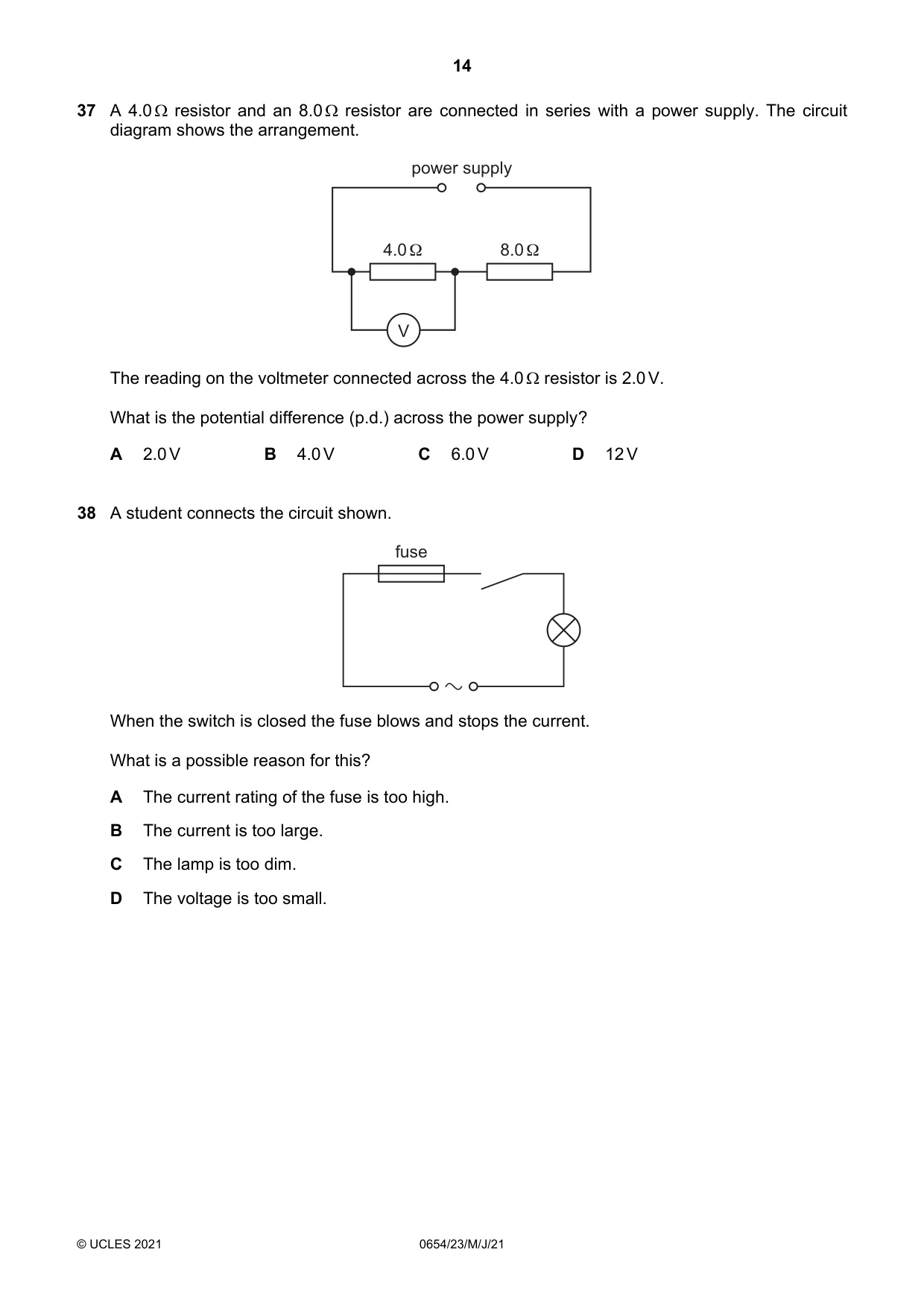
37 A 4.0 resistor and an 8.0 resistor are connected in series with a power supply. The circuit diagram shows the arrangement. power supply 4.0 Ω 8.0 Ω V The reading on the voltmeter connected across the 4.0 resistor is 2.0 V. What is the potential difference (p.d.) across the power supply? A 2.0 V B 4.0 V C 6.0 V D 12 V
Mark scheme: C
Q38 · A student connects the circuit shown
38 A student connects the circuit shown. fuse When the switch is closed the fuse blows and stops the current. What is a possible reason for this? A The current rating of the fuse is too high. B The current is too large. C The lamp is too dim. D The voltage is too small.
Mark scheme: B
Q39 · The primary coil of a 100% efficient transformer has Np turns and the secondary coil has…
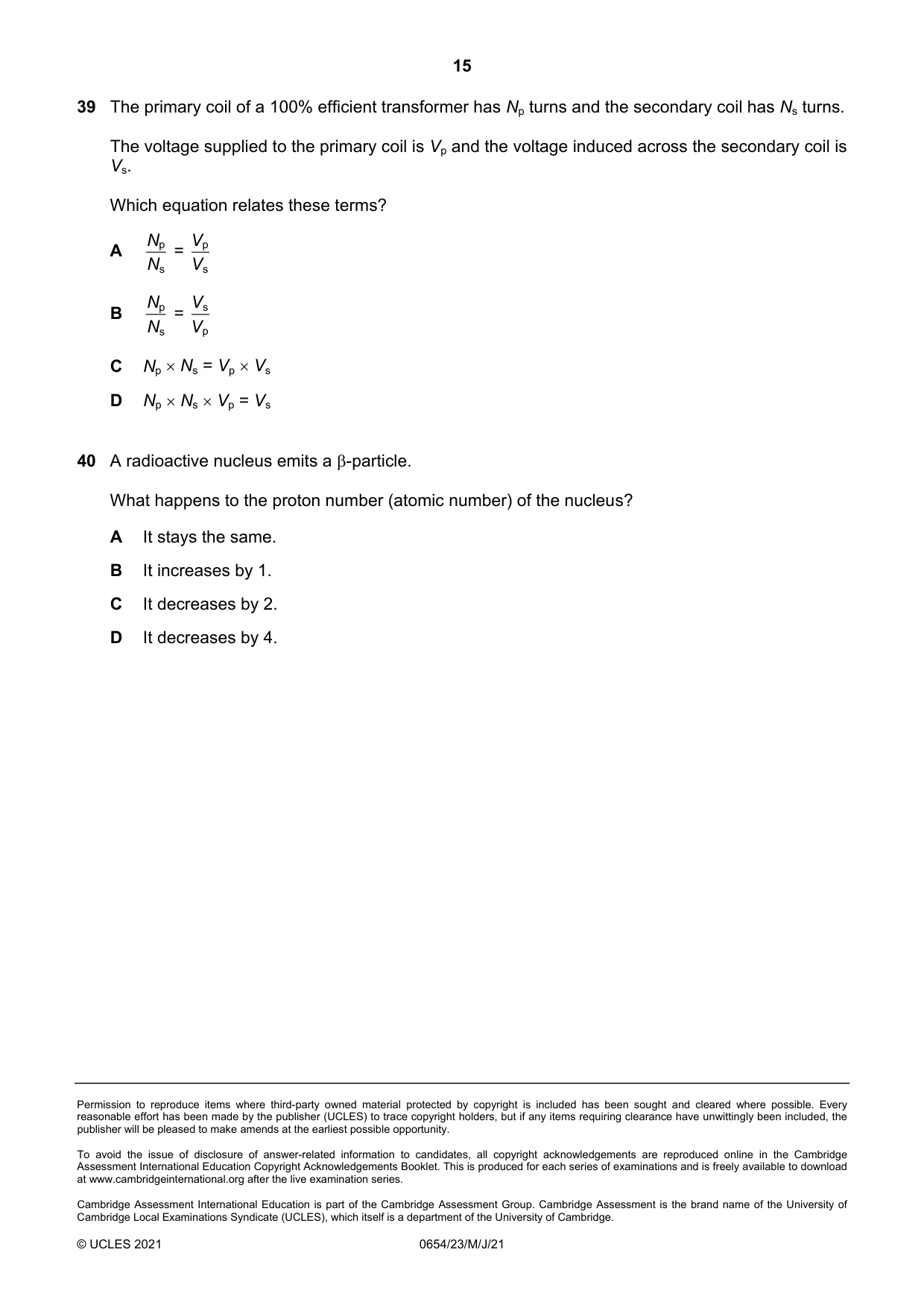
39 The primary coil of a 100% efficient transformer has Np turns and the secondary coil has Ns turns. The voltage supplied to the primary coil is Vp and the voltage induced across the secondary coil is Vs. Which equation relates these terms? N V A N = p V p s s N V B N = p V s s p C Np Ns = Vp Vs D Np Ns Vp = Vs
Mark scheme: A
Q40 · A radioactive nucleus emits a -particle
40 A radioactive nucleus emits a -particle. What happens to the proton number (atomic number) of the nucleus? A It stays the same. B It increases by 1. C It decreases by 2. D It decreases by 4.
Mark scheme: B
What was in this paper
The subtopics covered by these 40 questions, and how many questions each got. Open one in a new tab to see every Cambridge question on it.
2Air quality and climate1Alkenes1Cell division1Chromatography1Coordination and response1Diffusion1Electrical circuits1Electrical quantities1Electrical safety1Electrolysis1Electromagnetic effects1Elements, compounds and mixtures1Energy flow1Energy, work and power1Enzymes1Forces1Gas exchange in humans1General properties of waves1Group VII properties1Habitat destruction1Heart1Identification of ions and gases1Motion1Photosynthesis1Physical and chemical changes1Radioactivity1Reactivity series1Redox1Respiration1Sexual reproduction in humans1Sexual reproduction in plants1Simple molecules and covalent bonds1The characteristic properties of acids and bases1The mole and the Avogadro constant1The nucleus1Transfer of thermal energy1Transition elements1Water1What you needed in this session
Cambridge’s own grade thresholds for 2021 May/June, Paper 2 · Variant 3. A higher threshold means an easier paper — the bar moves with how the cohort did.