Cambridge IGCSE Sciences - Co-ordinated (Double) 0654 — 2024 May/June Paper 2 · Variant 2
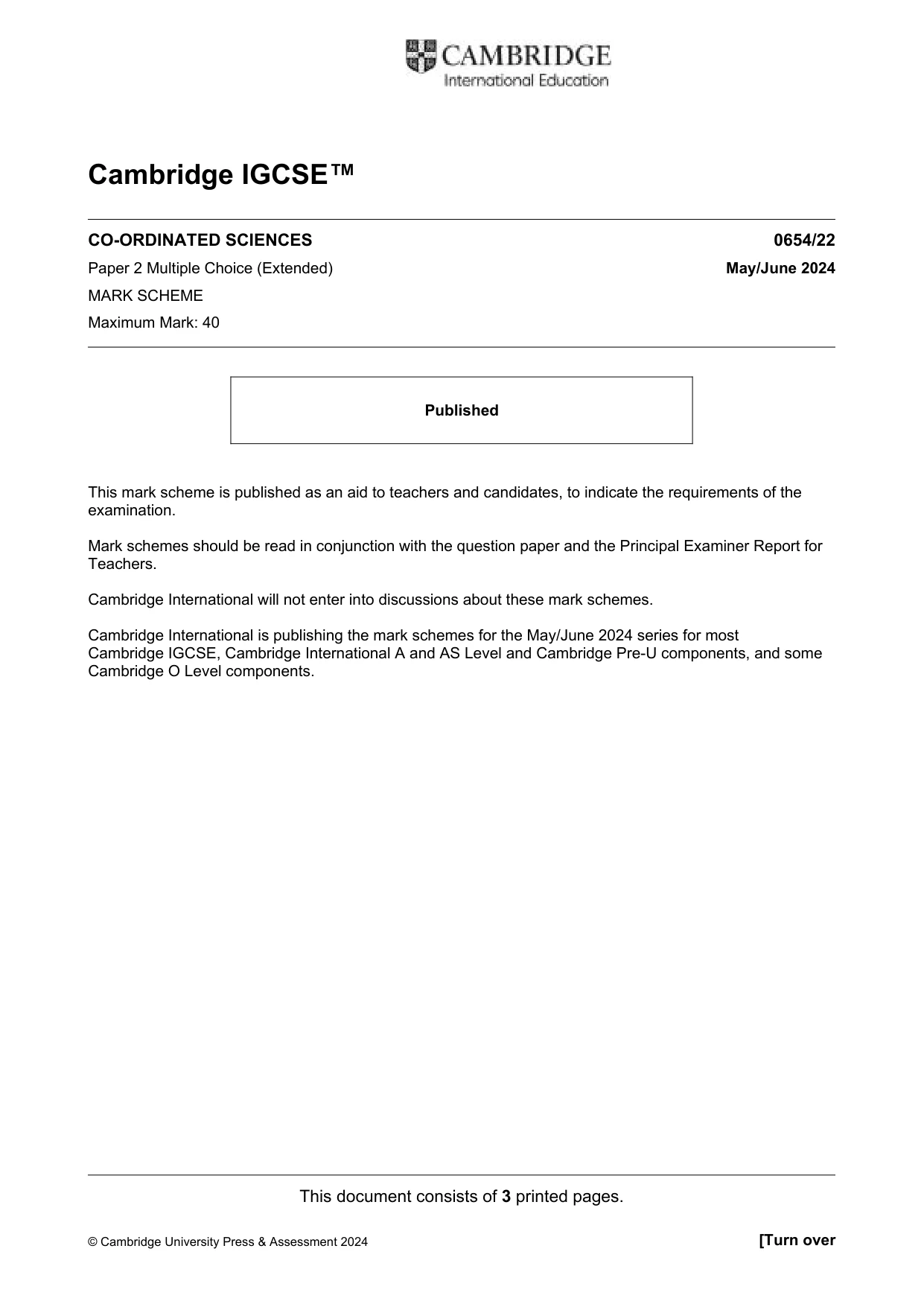
0654/22/M/J/24 · 40 questions · 40 marks · ≈45 min
The question paper and its mark scheme, free to read here and free to download. This is Cambridge’s own paper, exactly as it was sat.
Question paper16 pages
Mark scheme3 pages
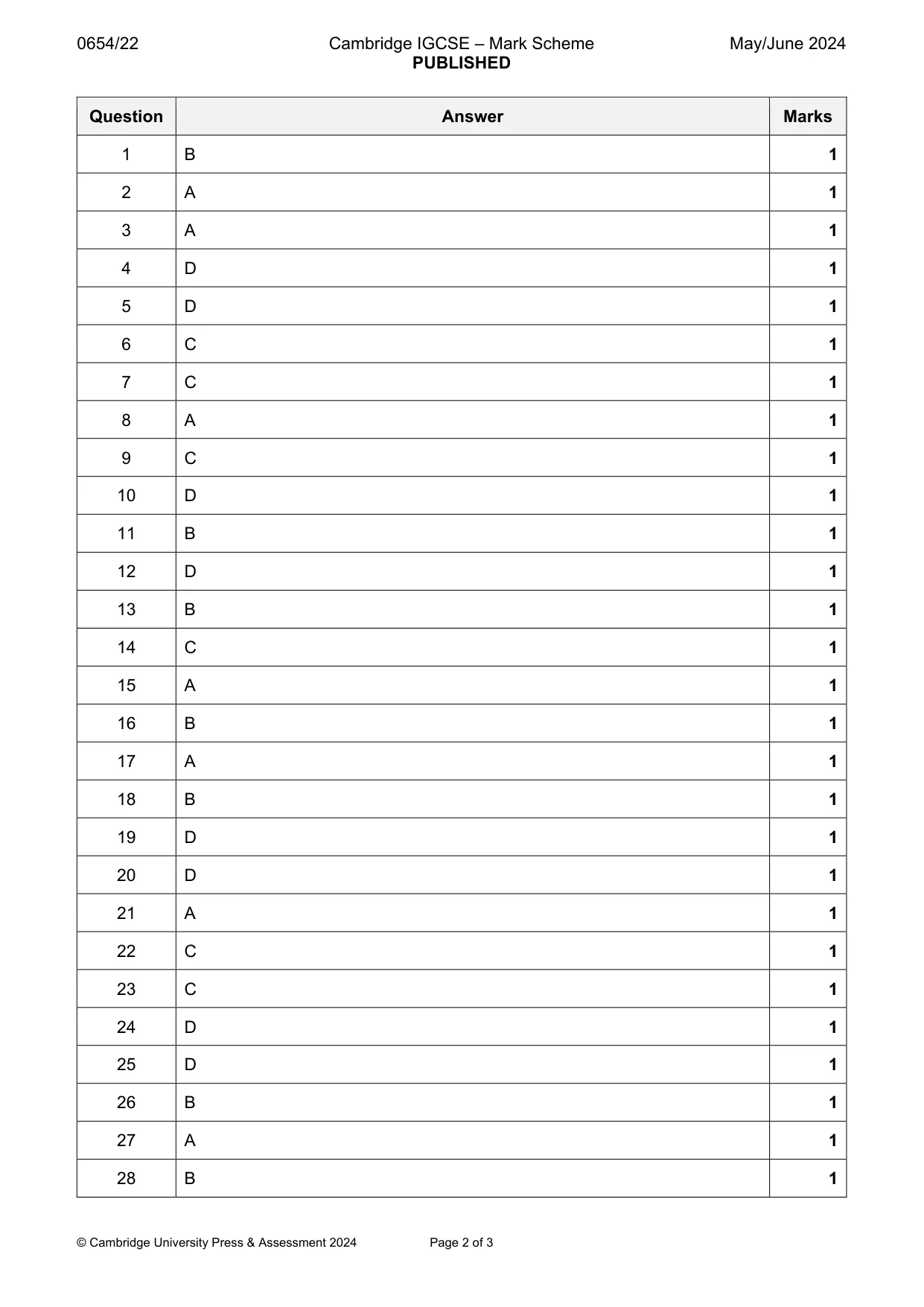
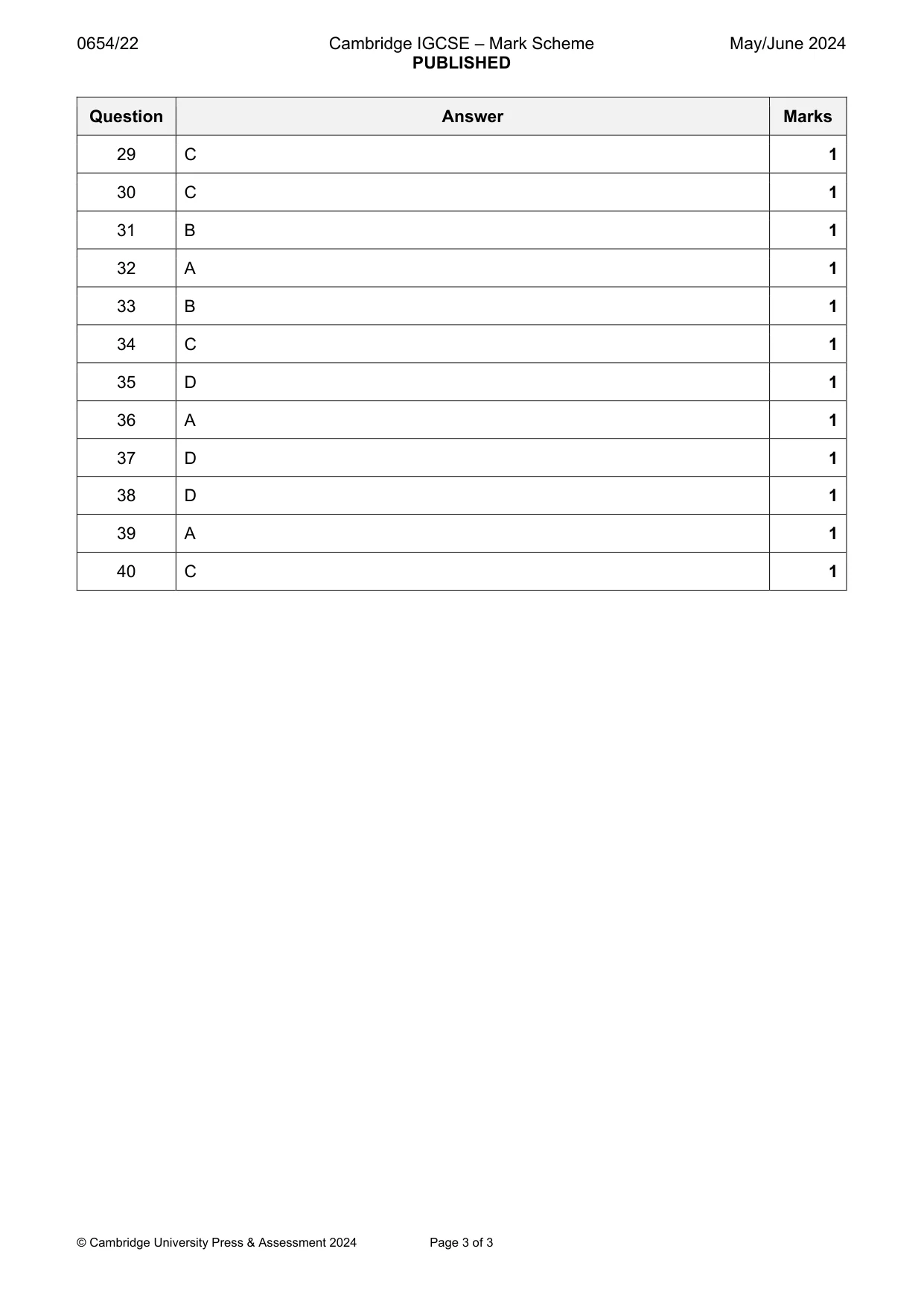
Answers below. Sit the paper first if you are practising.
Questions as text
Q1 · Which processes are examples of excretion?
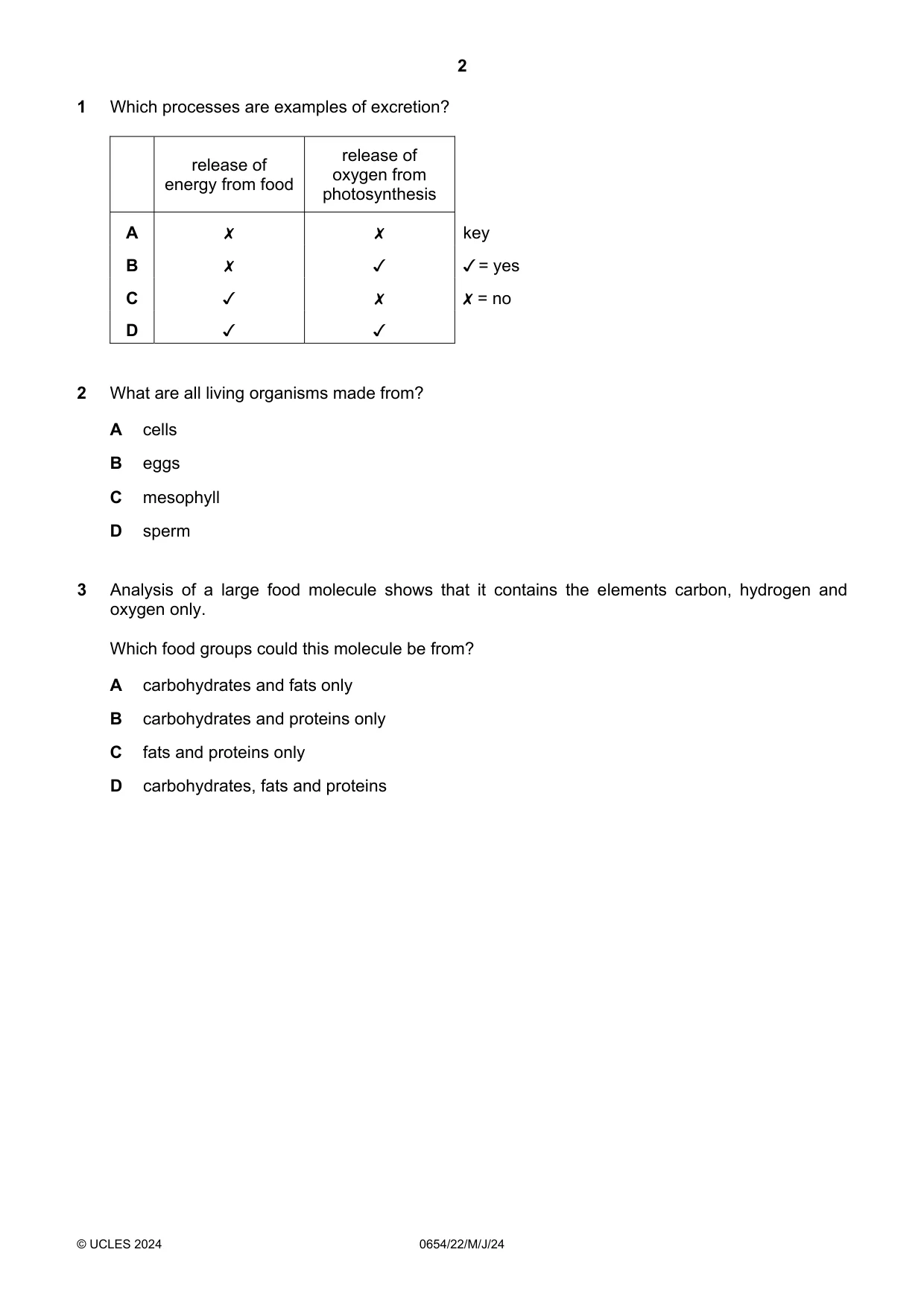
1. Which processes are examples of excretion? release of oxygen from photosynthesis release of energy from food A x x key B x v /=yes Cc v x X=no D Jv J
Mark scheme: B
Q2 · What are all living organisms made from?
2 What are all living organisms made from? A cells B eggs C mesophyll D sperm
Mark scheme: A
Q3 · Analysis of a large food molecule shows that it contains the elements carbon, hydrogen…
3 Analysis of a large food molecule shows that it contains the elements carbon, hydrogen and oxygen only. Which food groups could this molecule be from? A carbohydrates and fats only B carbohydrates and proteins only C fats and proteins only D carbohydrates, fats and proteins
Mark scheme: A
Q4 · The graph shows the mass of product produced by an enzyme-controlled reaction over time…
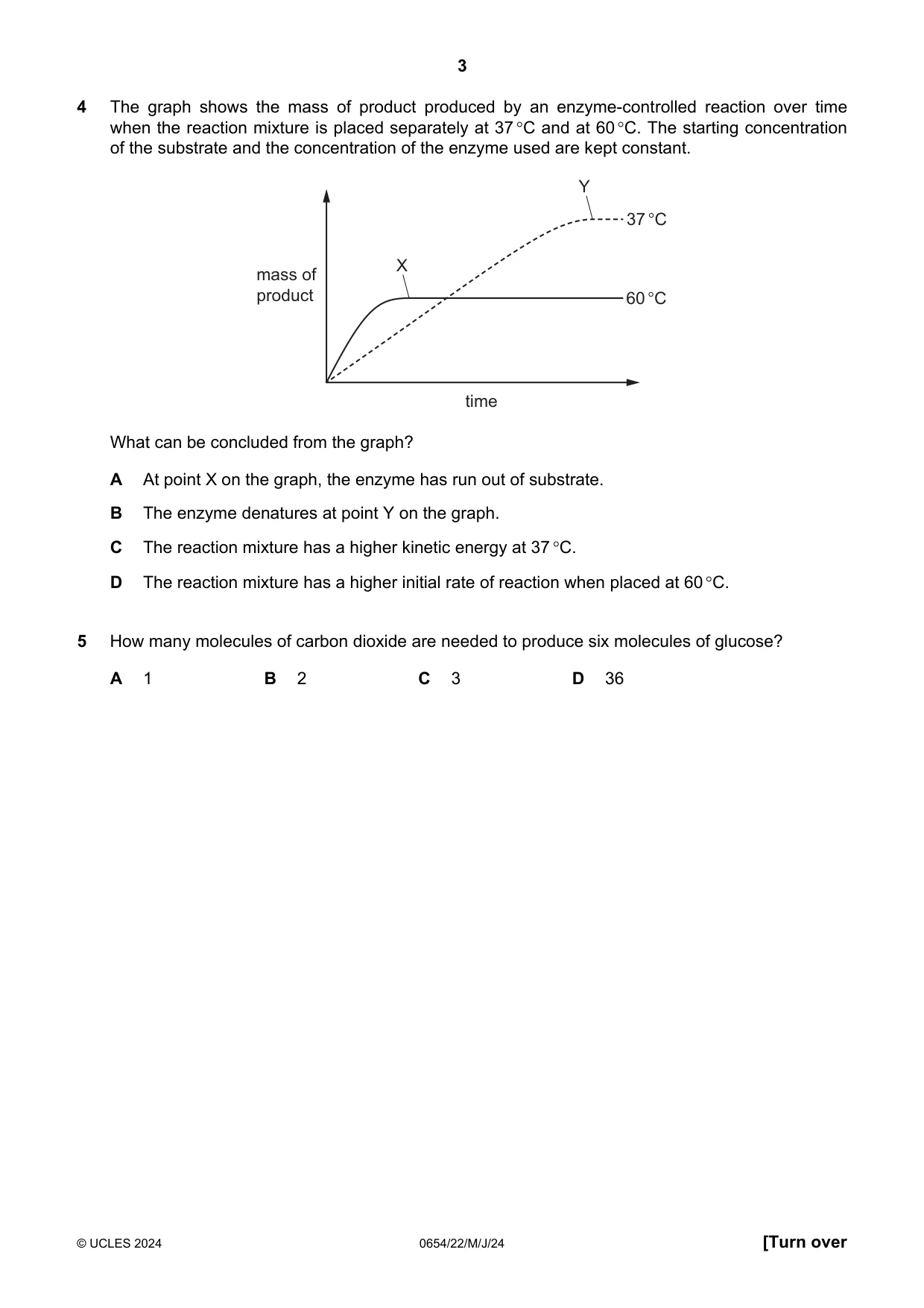
4 The graph shows the mass of product produced by an enzyme-controlled reaction over time when the reaction mixture is placed separately at 37 C and at 60 C. The starting concentration of the substrate and the concentration of the enzyme used are kept constant. Y 37 °C X mass of product 60 °C time What can be concluded from the graph? A At point X on the graph, the enzyme has run out of substrate. B The enzyme denatures at point Y on the graph. C The reaction mixture has a higher kinetic energy at 37 C. D The reaction mixture has a higher initial rate of reaction when placed at 60 C.
Mark scheme: D
Q5 · How many molecules of carbon dioxide are needed to produce six molecules of glucose?
5 How many molecules of carbon dioxide are needed to produce six molecules of glucose? A 1 B 2 C 3 D 36
Mark scheme: D
Q6 · A student investigates the effect of size of gelatine cubes on the rate of digestion by…
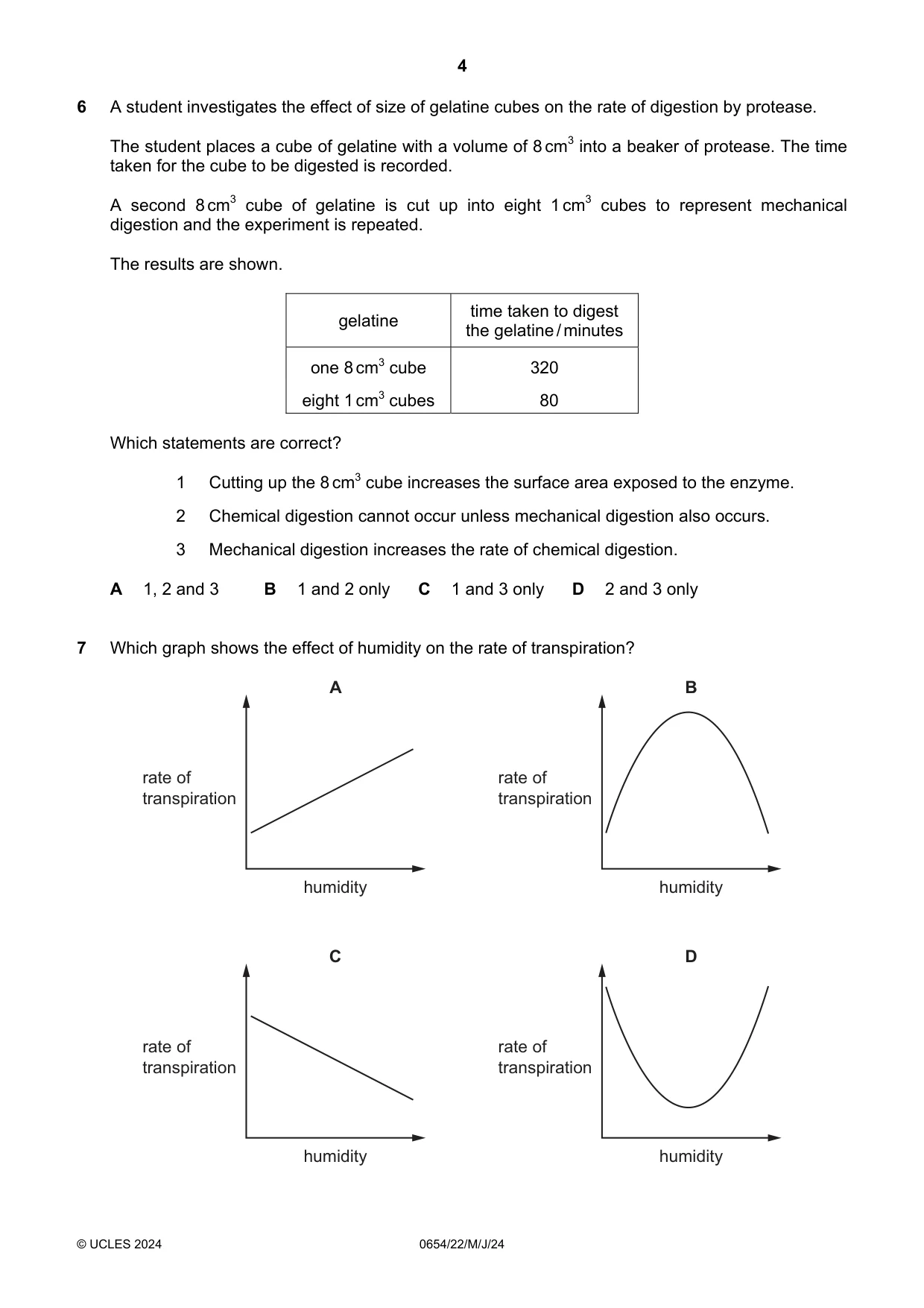
6 A student investigates the effect of size of gelatine cubes on the rate of digestion by protease. The student places a cube of gelatine with a volume of 8 cm3 into a beaker of protease. The time taken for the cube to be digested is recorded. A second 8 cm3 cube of gelatine is cut up into eight 1 cm3 cubes to represent mechanical digestion and the experiment is repeated. The results are shown. time taken to digest gelatine the gelatine / minutes one 8 cm3 cube 320 eight 1 cm3 cubes 80 Which statements are correct? 1 Cutting up the 8 cm3 cube increases the surface area exposed to the enzyme. 2 Chemical digestion cannot occur unless mechanical digestion also occurs. 3 Mechanical digestion increases the rate of chemical digestion. A 1, 2 and 3 B 1 and 2 only C 1 and 3 only D 2 and 3 only
Mark scheme: C
Q7 · Which graph shows the effect of humidity on the rate of transpiration?
7 Which graph shows the effect of humidity on the rate of transpiration? A B rate of rate of transpiration transpiration humidity humidity C D rate of rate of transpiration transpiration humidity humidity
Mark scheme: C
Q8 · A student places a mixture of yeast and glucose in a boiling tube, as shown in the diagram
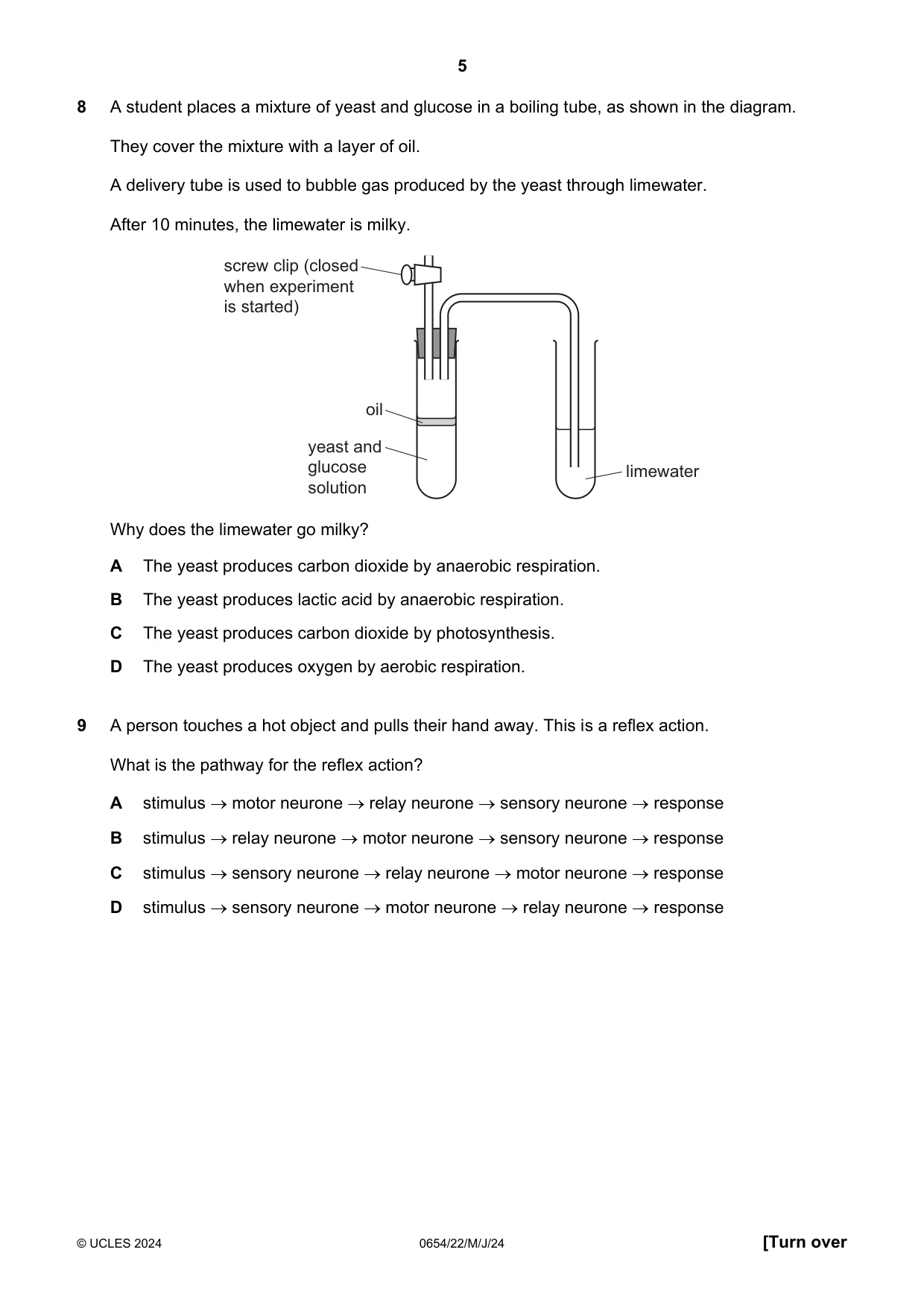
8 A student places a mixture of yeast and glucose in a boiling tube, as shown in the diagram. They cover the mixture with a layer of oil. A delivery tube is used to bubble gas produced by the yeast through limewater. After 10 minutes, the limewater is milky. screw clip (closed when experiment is started) oil yeast and glucose limewater solution Why does the limewater go milky? A The yeast produces carbon dioxide by anaerobic respiration. B The yeast produces lactic acid by anaerobic respiration. C The yeast produces carbon dioxide by photosynthesis. D The yeast produces oxygen by aerobic respiration.
Mark scheme: A
Q9 · A person touches a hot object and pulls their hand away
9 A person touches a hot object and pulls their hand away. This is a reflex action. What is the pathway for the reflex action? A stimulus motor neurone relay neurone sensory neurone response B stimulus relay neurone motor neurone sensory neurone response C stimulus sensory neurone relay neurone motor neurone response D stimulus sensory neurone motor neurone relay neurone response
Mark scheme: C
Q10 · The diagram shows the human male reproductive system
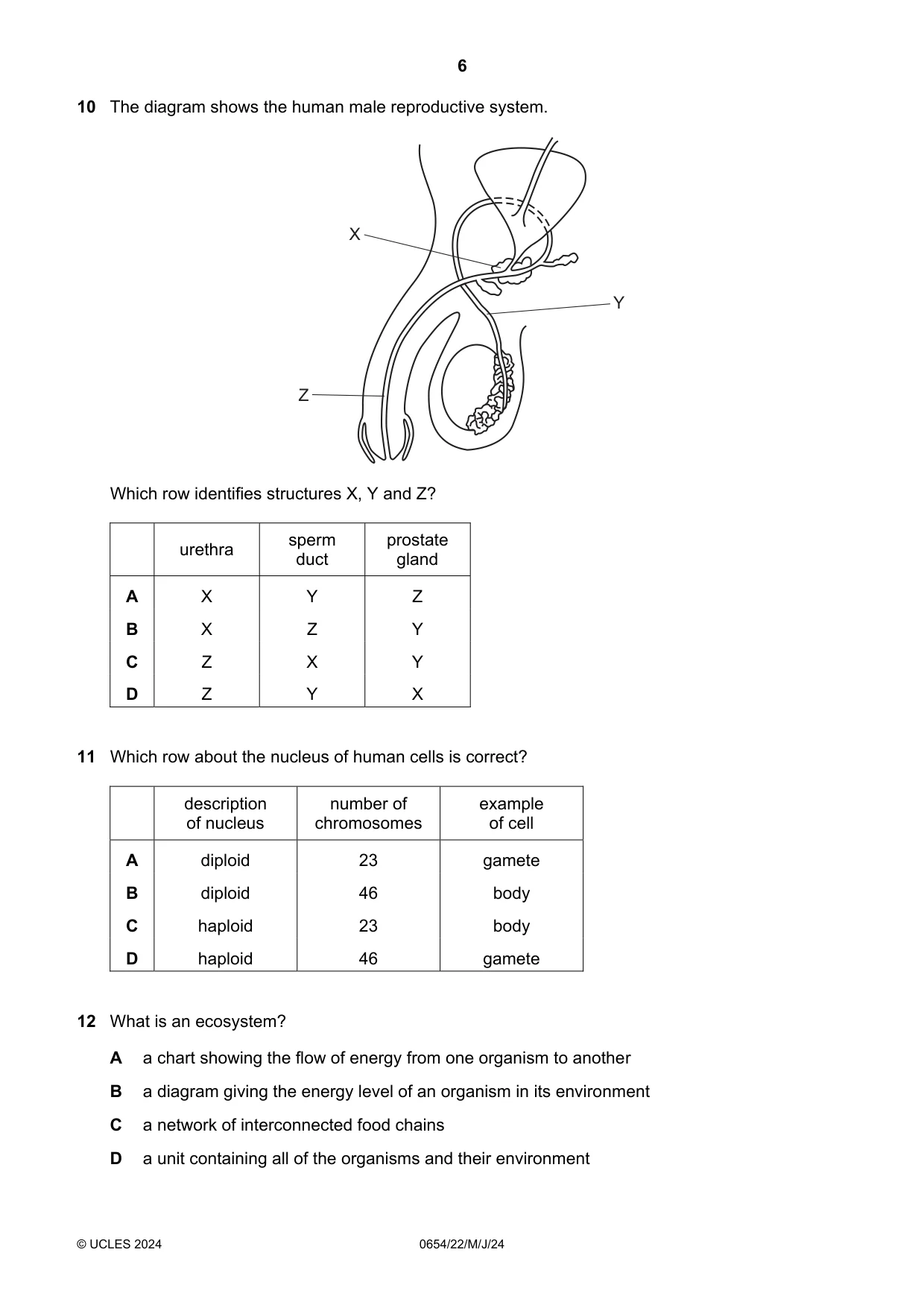
10 The diagram shows the human male reproductive system. X Y Z Which row identifies structures X, Y and Z? sperm prostate urethra duct gland A X Y Z B X Z Y C Z X Y D Z Y X
Mark scheme: D
Q11 · Which row about the nucleus of human cells is correct?
11 Which row about the nucleus of human cells is correct? description number of example of nucleus chromosomes of cell A diploid 23 gamete B diploid 46 body C haploid 23 body D haploid 46 gamete
Mark scheme: B
Q12 · What is an ecosystem?
12 What is an ecosystem? A a chart showing the flow of energy from one organism to another B a diagram giving the energy level of an organism in its environment C a network of interconnected food chains D a unit containing all of the organisms and their environment
Mark scheme: D
Q13 · Which line shows how the oxygen concentration of the water changes after excess…
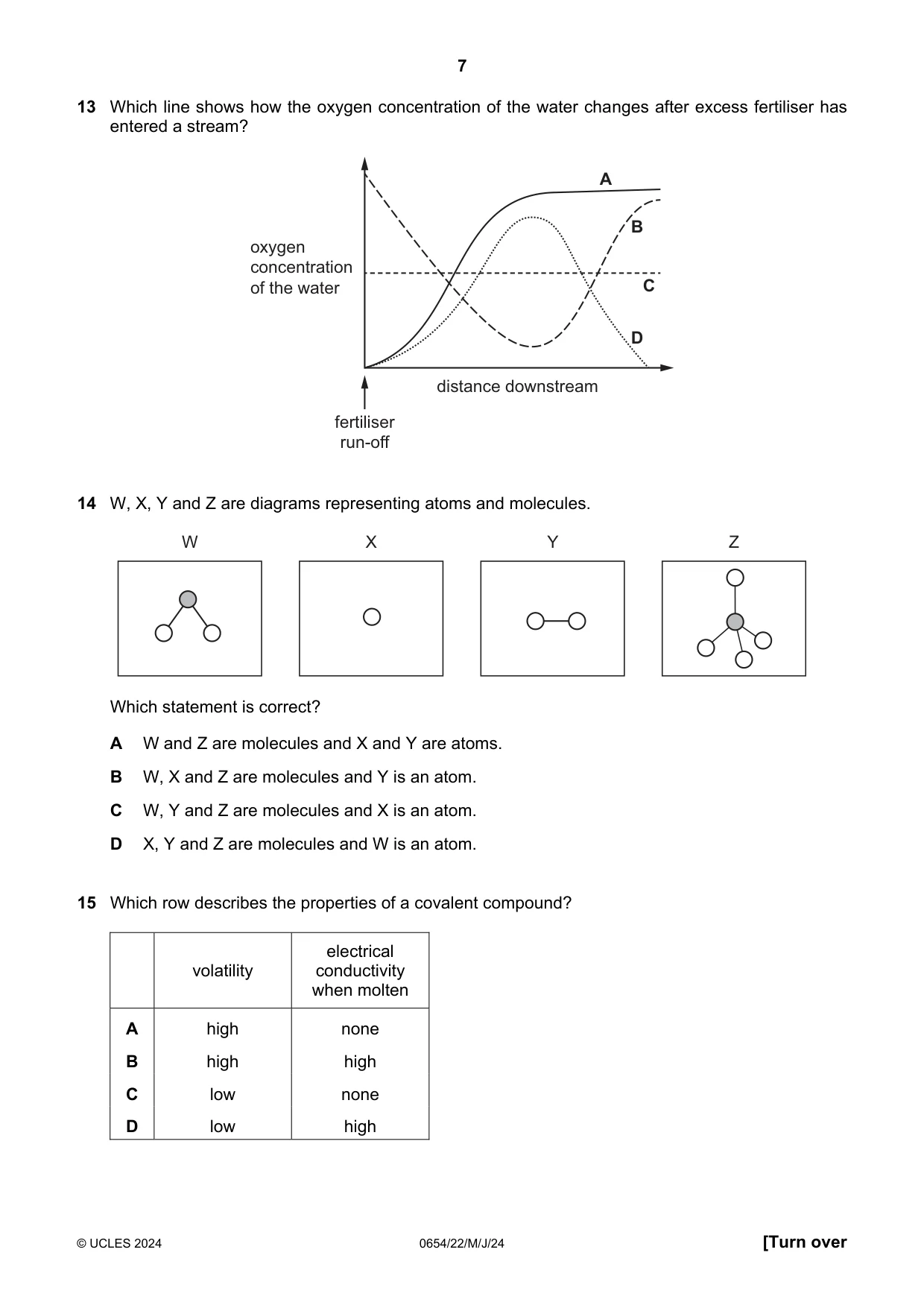
13 Which line shows how the oxygen concentration of the water changes after excess fertiliser has entered a stream? A B oxygen concentration of the water C D distance downstream fertiliser run-off
Mark scheme: B
Q14 · W, X, Y and Z are diagrams representing atoms and molecules
14 W, X, Y and Z are diagrams representing atoms and molecules. W X Y Z Which statement is correct? A W and Z are molecules and X and Y are atoms. B W, X and Z are molecules and Y is an atom. C W, Y and Z are molecules and X is an atom. D X, Y and Z are molecules and W is an atom.
Mark scheme: C
Q15 · Which row describes the properties of a covalent compound?
15 Which row describes the properties of a covalent compound? electrical volatility conductivity when molten A high none B high high C low none D low high
Mark scheme: A
Q16 · The equation for the reaction of sodium with water is shown
16 The equation for the reaction of sodium with water is shown. 2Na(s) + 2H2O(l) 2NaOH(aq) + H2(g) Which mass of sodium produces 30 cm3 of hydrogen? A 0.0288 g B 0.0575 g C 28.8 g D 57.5 g
Mark scheme: B
Q17 · Aqueous copper(II) sulfate is electrolysed using carbon electrodes
17 Aqueous copper(II) sulfate is electrolysed using carbon electrodes. What is the ionic half-equation for the reaction at the cathode? A Cu2+ + 2e– Cu B 2H+ + 2e– H2 C Cu Cu2+ + 2e– D 4OH– O2 + 2H2O + 4e–
Mark scheme: A
Q18 · The energy level diagram for a reaction is shown
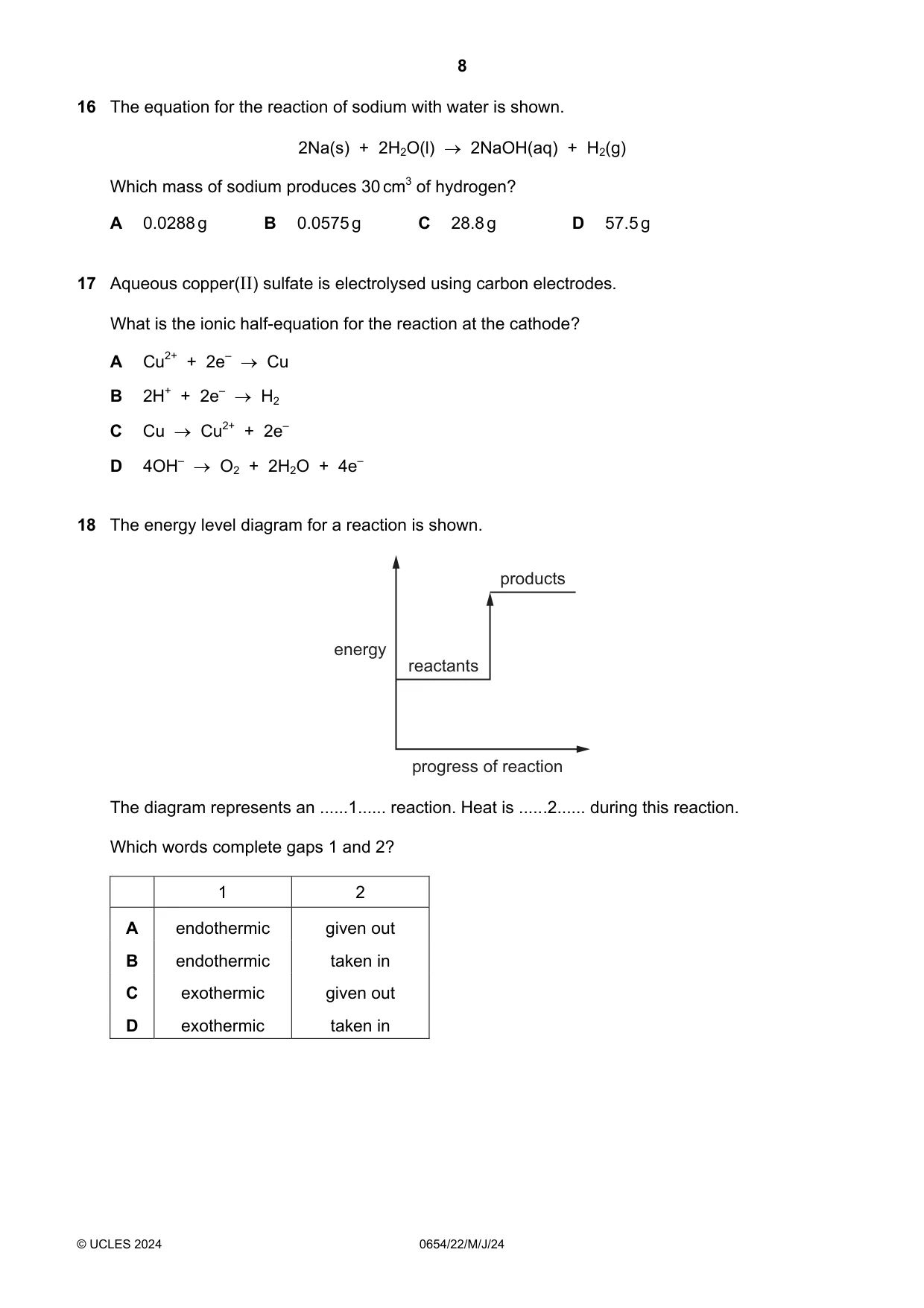
18 The energy level diagram for a reaction is shown. products energy reactants progress of reaction The diagram represents an ......1...... reaction. Heat is ......2...... during this reaction. Which words complete gaps 1 and 2? 1 2 A endothermic given out B endothermic taken in C exothermic given out D exothermic taken in
Mark scheme: B
Q19 · In which equation is the underlined substance acting as an oxidising agent?
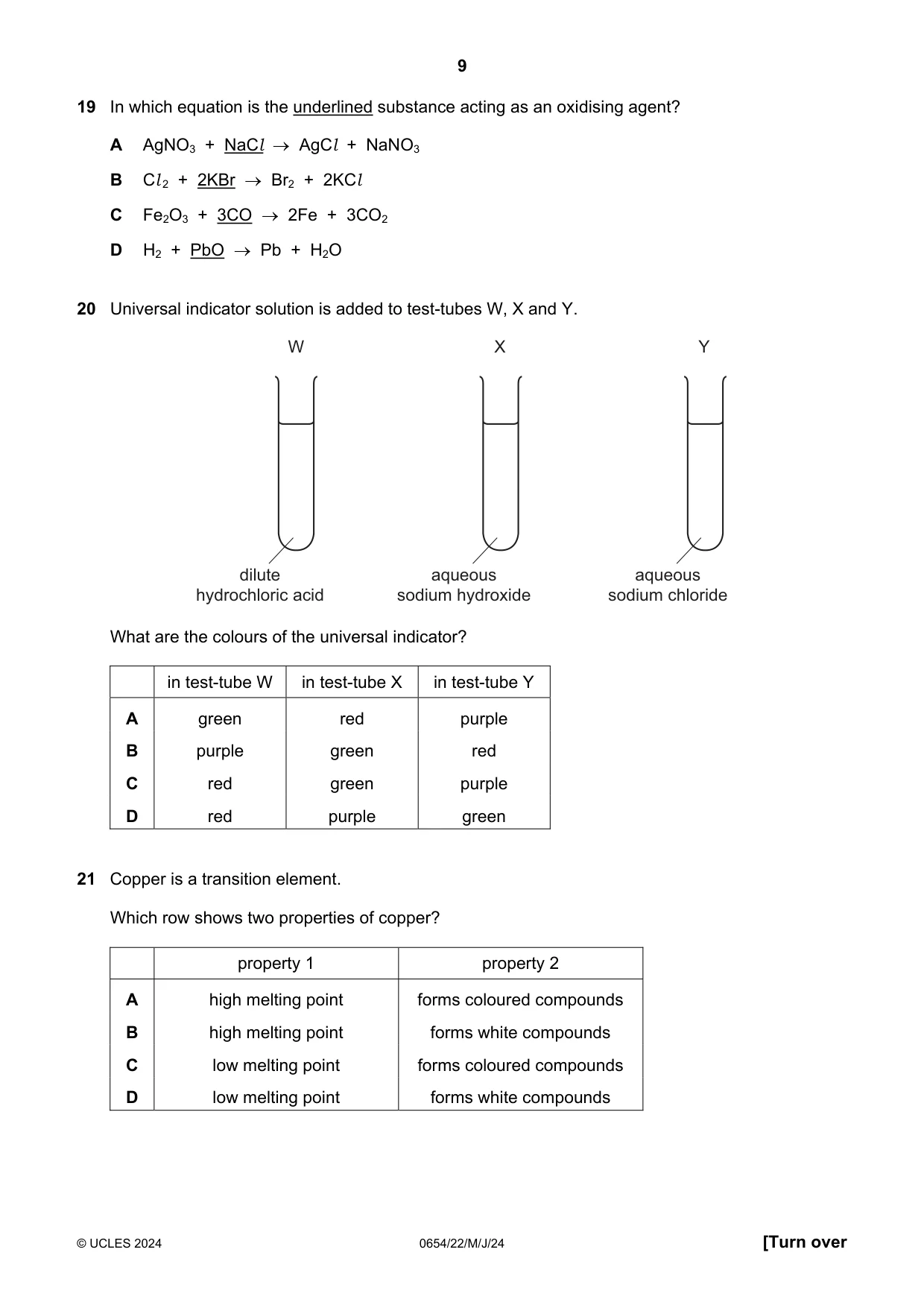
19 In which equation is the underlined substance acting as an oxidising agent? A AgNO3 + NaCl AgCl + NaNO3 B Cl 2 + 2KBr Br2 + 2KCl C Fe2O3 + 3CO 2Fe + 3CO2 D H2 + PbO Pb + H2O
Mark scheme: D
Q20 · Universal indicator solution is added to test-tubes W, X and Y
20 Universal indicator solution is added to test-tubes W, X and Y. W X Y dilute aqueous aqueous hydrochloric acid sodium hydroxide sodium chloride What are the colours of the universal indicator? in test-tube W in test-tube X in test-tube Y A green red purple B purple green red C red green purple D red purple green
Mark scheme: D
More questions on The characteristic properties of acids and bases
Q21 · Copper is a transition element
21 Copper is a transition element. Which row shows two properties of copper? property 1 property 2 A high melting point forms coloured compounds B high melting point forms white compounds C low melting point forms coloured compounds D low melting point forms white compounds
Mark scheme: A
Q22 · Metal X reacts with aqueous metal Y2+ ions
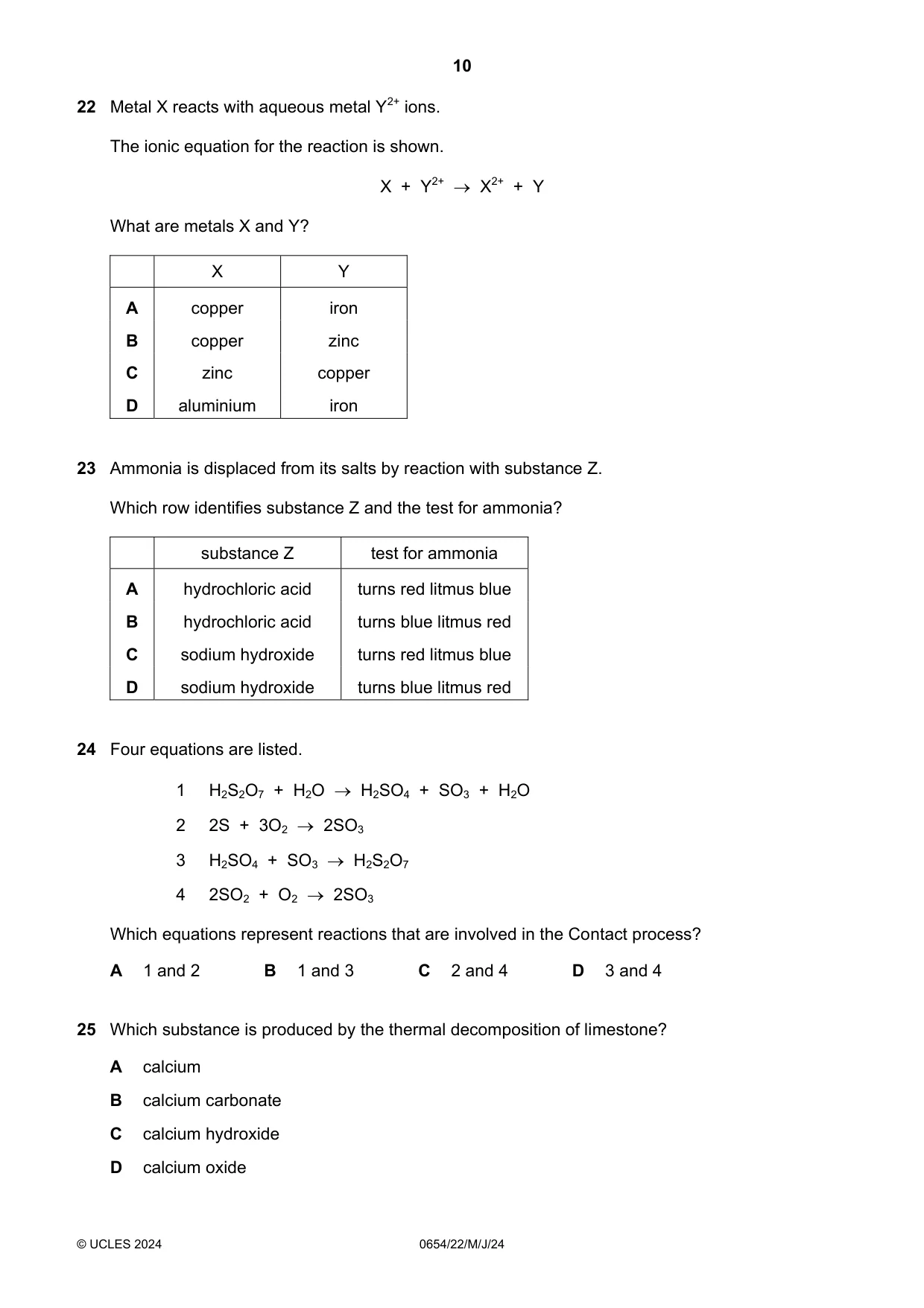
22 Metal X reacts with aqueous metal Y2+ ions. The ionic equation for the reaction is shown. X + Y2+ X2+ + Y What are metals X and Y? X Y A copper iron B copper zinc C zinc copper D aluminium iron
Mark scheme: C
Q23 · Ammonia is displaced from its salts by reaction with substance Z
23 Ammonia is displaced from its salts by reaction with substance Z. Which row identifies substance Z and the test for ammonia? substance Z test for ammonia A hydrochloric acid turns red litmus blue B hydrochloric acid turns blue litmus red C sodium hydroxide turns red litmus blue D sodium hydroxide turns blue litmus red
Mark scheme: C
Q24 · Four equations are listed
24 Four equations are listed. 1 H2S2O7 + H2O H2SO4 + SO3 + H2O 2 2S + 3O2 2SO3 3 H2SO4 + SO3 H2S2O7 4 2SO2 + O2 2SO3 Which equations represent reactions that are involved in the Contact process? A 1 and 2 B 1 and 3 C 2 and 4 D 3 and 4
Mark scheme: D
Q25 · Which substance is produced by the thermal decomposition of limestone?
25 Which substance is produced by the thermal decomposition of limestone? A calcium B calcium carbonate C calcium hydroxide D calcium oxide
Mark scheme: D
Q26 · A gasoline fraction from the fractional distillation of petroleum includes compounds with…
26 A gasoline fraction from the fractional distillation of petroleum includes compounds with the formulas C6H14 and C12H26. Which statements about these compounds are correct? 1 C12H26 has a higher boiling point than C6H14. 2 C12H26 has a lower relative molecular mass than C6H14. 3 C6H14 and C12H26 are members of different homologous series. 4 C6H14 and C12H26 both undergo complete combustion to form carbon dioxide and water. A 1 and 3 B 1 and 4 C 2 and 3 D 2 and 4 O
Mark scheme: B
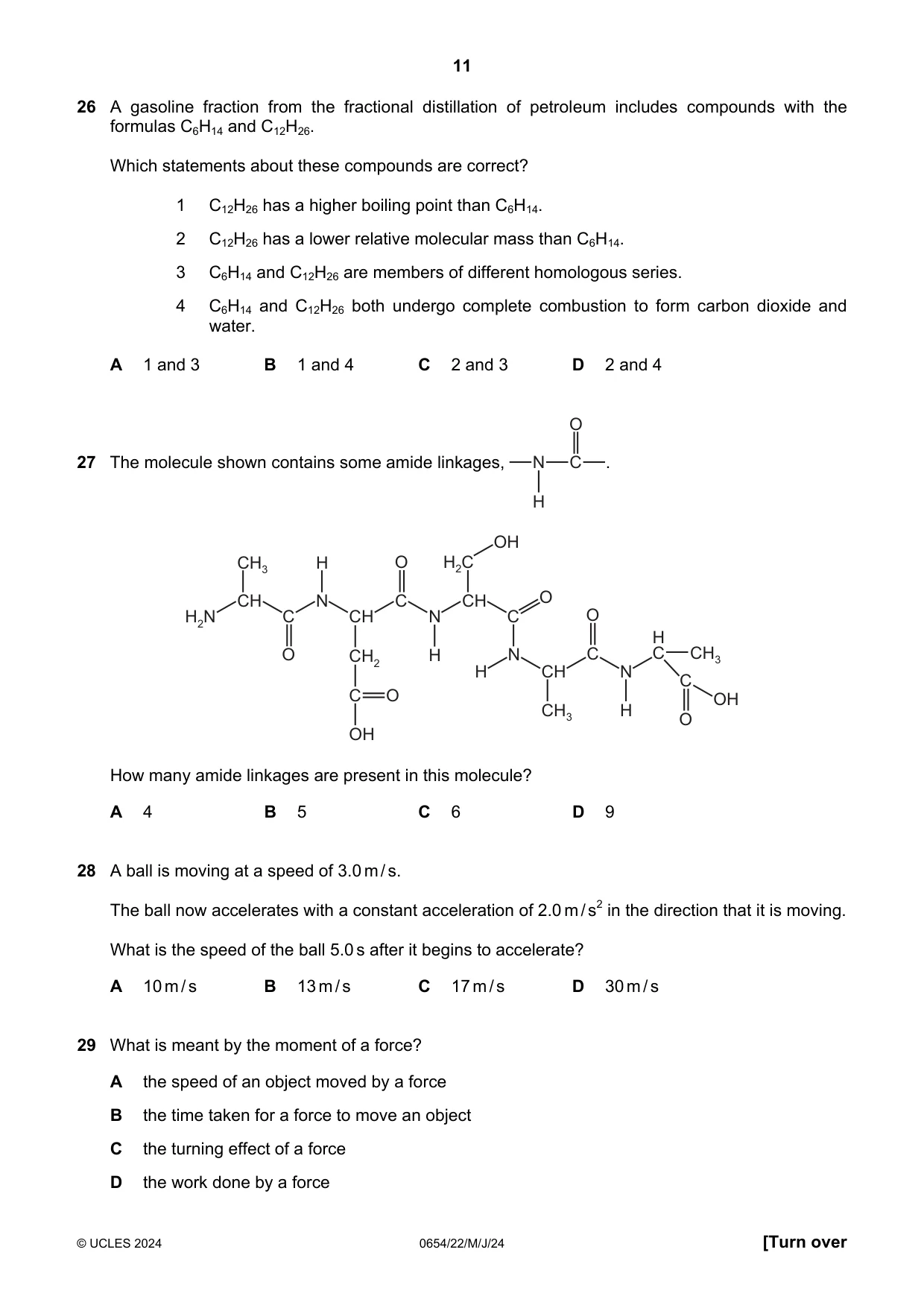
Q27 · The molecule shown contains some amide linkages, N C
27 The molecule shown contains some amide linkages, N C . H OH CH3 H O H2C CH N C CH O H2N C CH N C O H O CH2 H N C C CH3 H CH N C C O OH CH3 H O OH How many amide linkages are present in this molecule? A 4 B 5 C 6 D 9
Mark scheme: A
Q28 · A ball is moving at a speed of 3.0 m / s
28 A ball is moving at a speed of 3.0 m / s. The ball now accelerates with a constant acceleration of 2.0 m / s2 in the direction that it is moving. What is the speed of the ball 5.0 s after it begins to accelerate? A 10 m / s B 13 m / s C 17 m / s D 30 m / s
Mark scheme: B
Q29 · What is meant by the moment of a force?
29 What is meant by the moment of a force? A the speed of an object moved by a force B the time taken for a force to move an object C the turning effect of a force D the work done by a force
Mark scheme: C
Q30 · A paralympic athlete of mass 70 kg uses a wheelchair of mass 10 kg in a race
30 A paralympic athlete of mass 70 kg uses a wheelchair of mass 10 kg in a race. What is the kinetic energy of the athlete and wheelchair when they are moving at 6.0 m / s? A 240 J B 480 J C 1440 J D 2880 J
Mark scheme: C
Q31 · The table shows four sources of energy used to generate electricity
31 The table shows four sources of energy used to generate electricity. Which row about the energy source is correct? source renewable reliable at all times A coal yes no B nuclear fission no yes C tides no no D wind yes yes
Mark scheme: B
Q32 · Which region of the electromagnetic spectrum is often involved in heat transfer by…
32 Which region of the electromagnetic spectrum is often involved in heat transfer by radiation? A infrared B radio C ultraviolet D X-rays
Mark scheme: A
Q33 · The diagram shows the direction of a wave that passes a particle
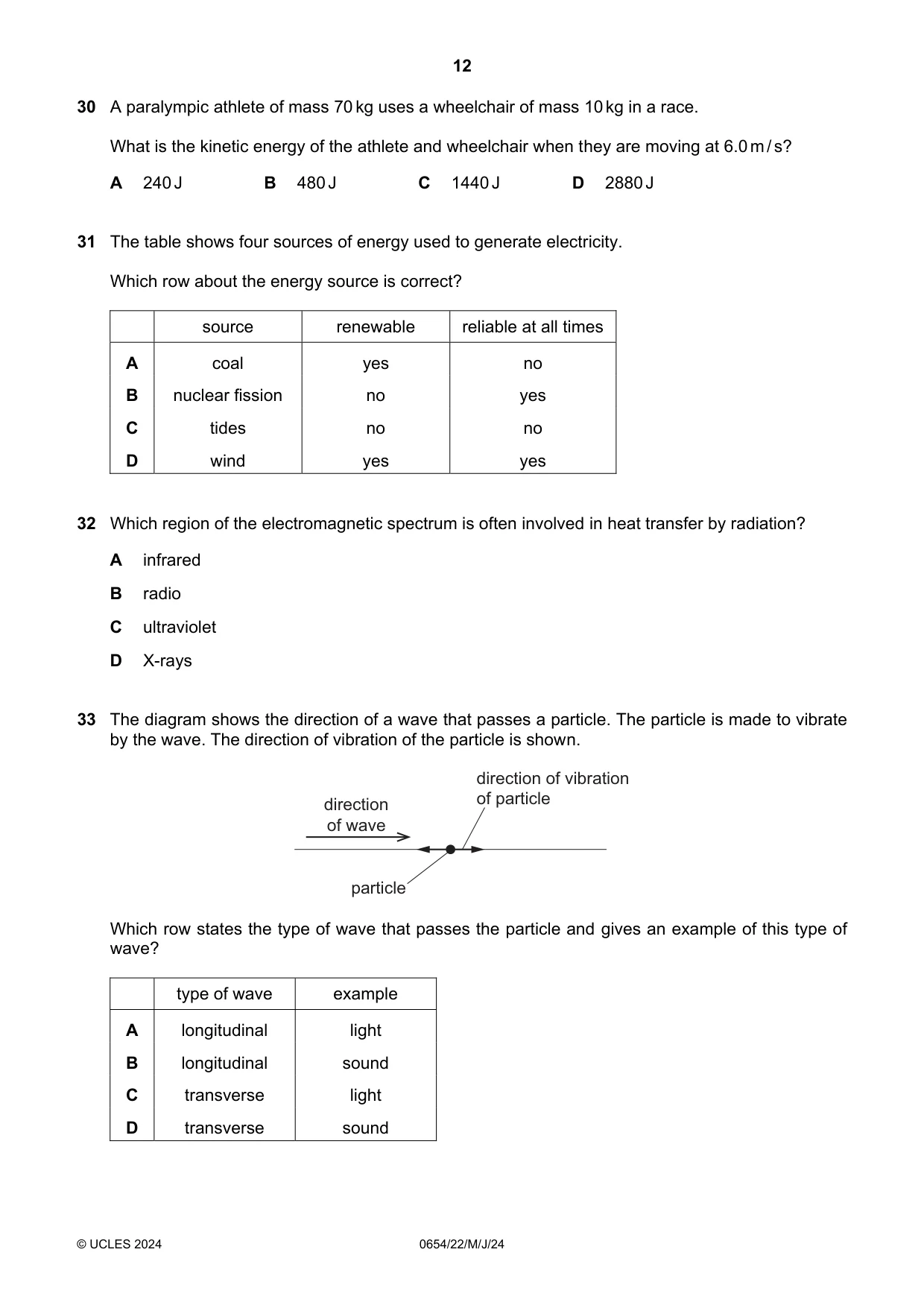
33 The diagram shows the direction of a wave that passes a particle. The particle is made to vibrate by the wave. The direction of vibration of the particle is shown. direction of vibration direction of particle of wave particle Which row states the type of wave that passes the particle and gives an example of this type of wave? type of wave example A longitudinal light B longitudinal sound C transverse light D transverse sound
Mark scheme: B
Q34 · A plane mirror is fixed to a vertical wall and forms an image of an object
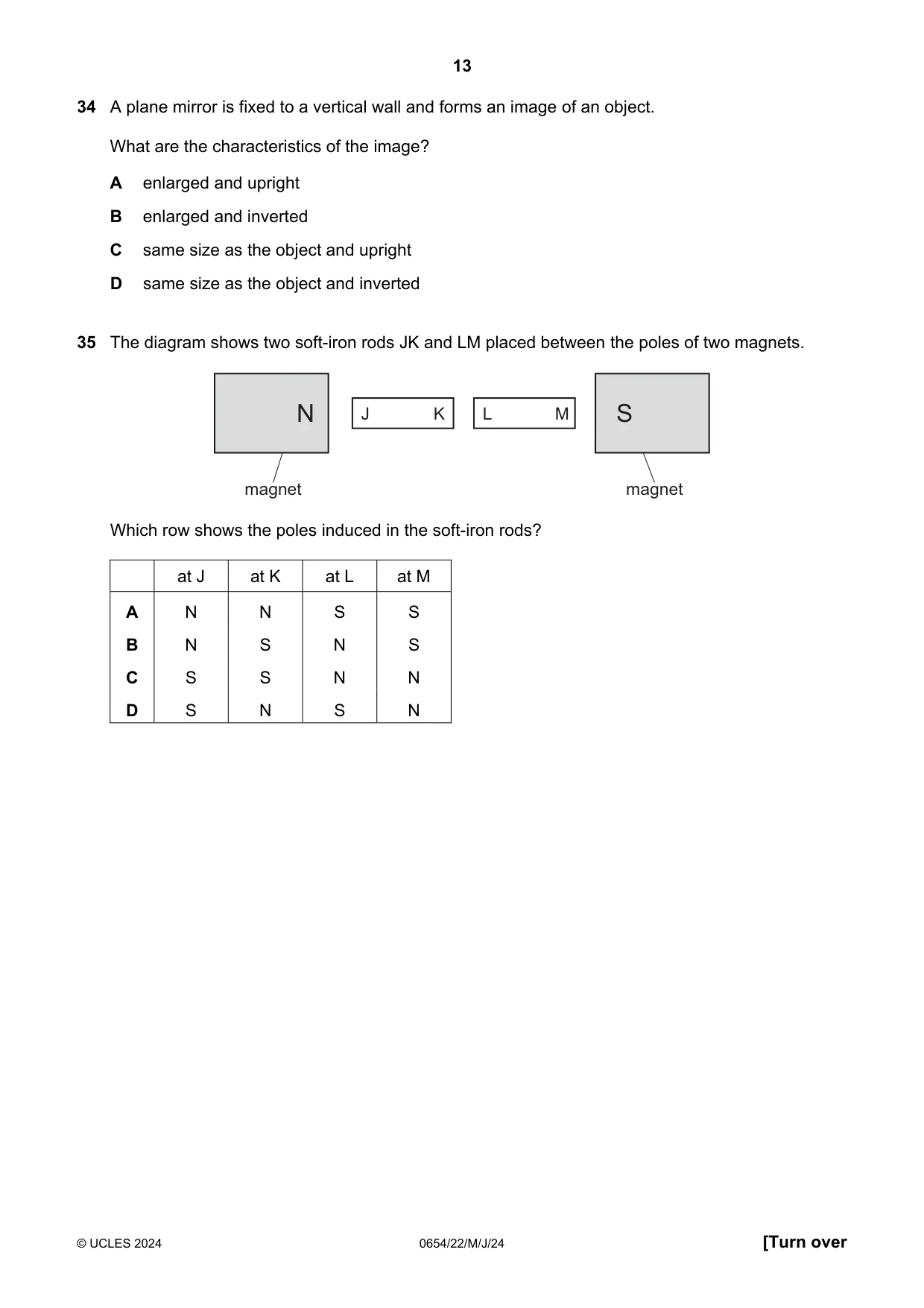
34 A plane mirror is fixed to a vertical wall and forms an image of an object. What are the characteristics of the image? A enlarged and upright B enlarged and inverted C same size as the object and upright D same size as the object and inverted
Mark scheme: C
Q35 · The diagram shows two soft-iron rods JK and LM placed between the poles of two magnets
35 The diagram shows two soft-iron rods JK and LM placed between the poles of two magnets. N J K L M S magnet magnet Which row shows the poles induced in the soft-iron rods? at J at K at L at M A N N S S B N S N S C S S N N D S N S N
Mark scheme: D
Q36 · The graph shows how the resistance of a thermistor changes with temperature
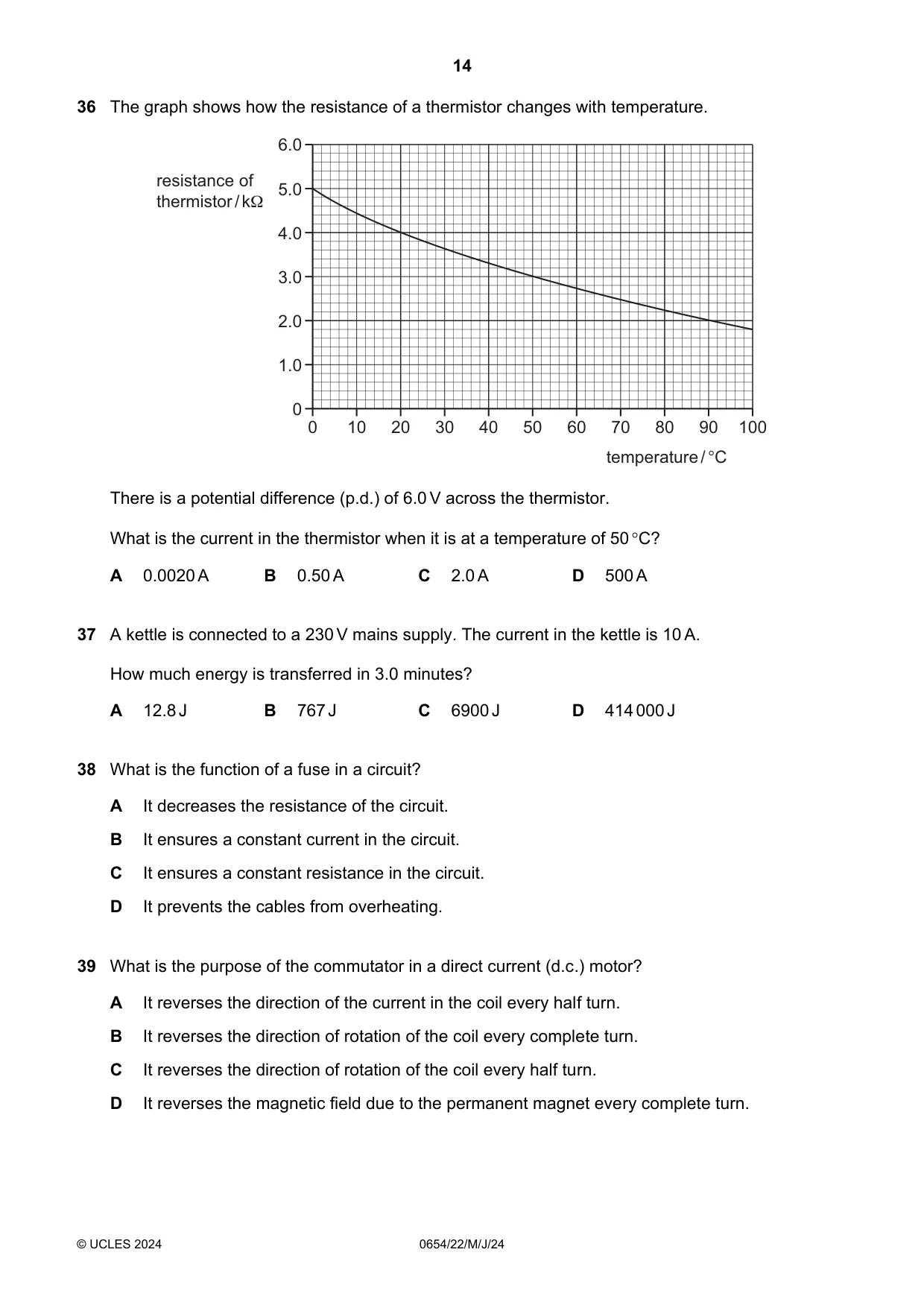
36 The graph shows how the resistance of a thermistor changes with temperature. 6.0 resistance of 5.0 thermistor / kΩ 4.0 3.0 2.0 1.0 0 0 10 20 30 40 50 60 70 80 90 100 temperature / °C There is a potential difference (p.d.) of 6.0 V across the thermistor. What is the current in the thermistor when it is at a temperature of 50 C? A 0.0020 A B 0.50 A C 2.0 A D 500 A
Mark scheme: A
Q37 · A kettle is connected to a 230 V mains supply
37 A kettle is connected to a 230 V mains supply. The current in the kettle is 10 A. How much energy is transferred in 3.0 minutes? A 12.8 J B 767 J C 6900 J D 414 000 J
Mark scheme: D
Q38 · What is the function of a fuse in a circuit?
38 What is the function of a fuse in a circuit? A It decreases the resistance of the circuit. B It ensures a constant current in the circuit. C It ensures a constant resistance in the circuit. D It prevents the cables from overheating.
Mark scheme: D
Q39 · What is the purpose of the commutator in a direct current (d.c.) motor?
39 What is the purpose of the commutator in a direct current (d.c.) motor? A It reverses the direction of the current in the coil every half turn. B It reverses the direction of rotation of the coil every complete turn. C It reverses the direction of rotation of the coil every half turn. D It reverses the magnetic field due to the permanent magnet every complete turn.
Mark scheme: A
Q40 · A uranium nucleus decays by emitting an alpha ()-particle
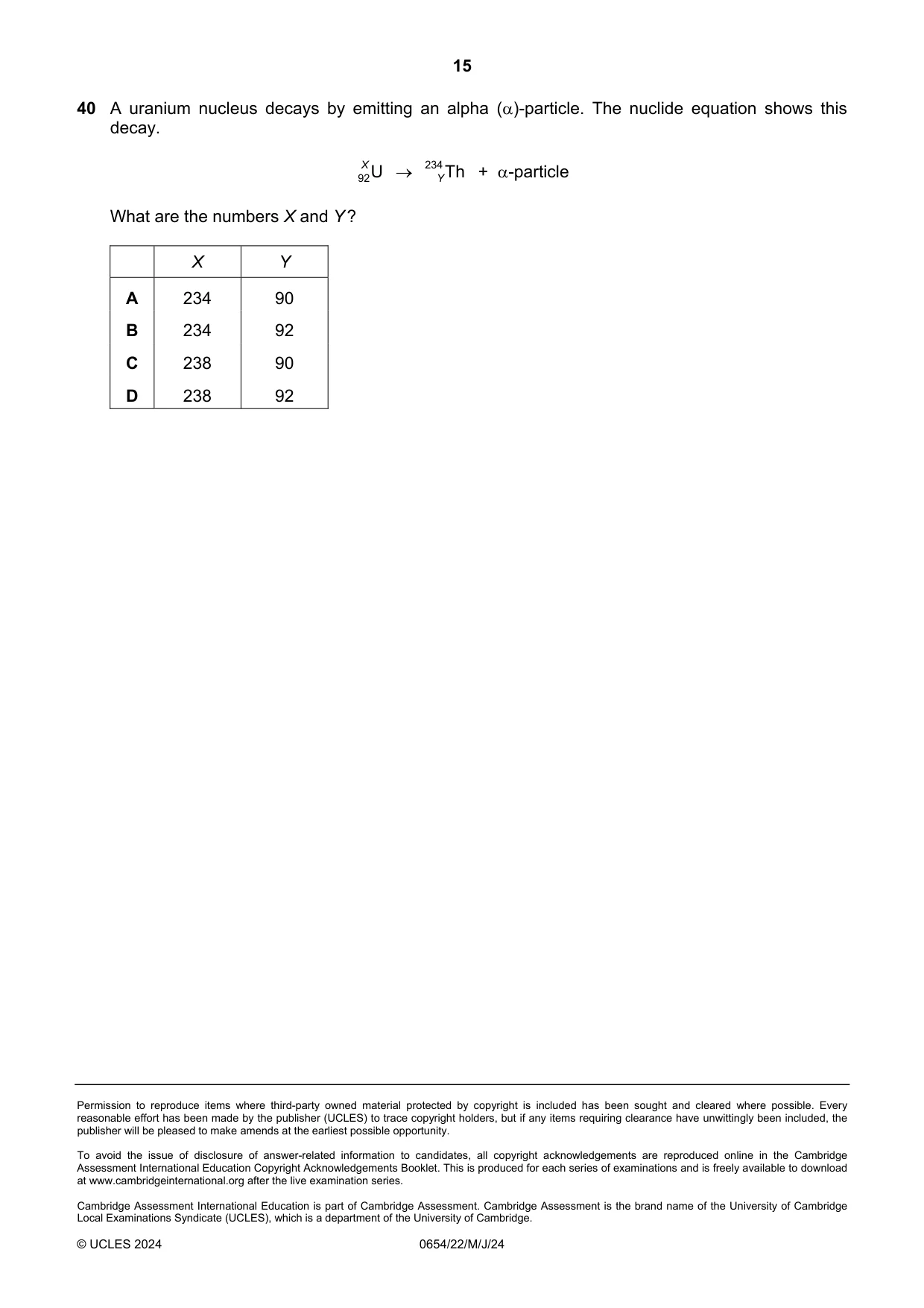
40 A uranium nucleus decays by emitting an alpha ()-particle. The nuclide equation shows this decay. 92U X 234Th + -particle Y What are the numbers X and Y ? X Y A 234 90 B 234 92 C 238 90 D 238 92
Mark scheme: C
What was in this paper
The subtopics covered by these 40 questions, and how many questions each got. Open one in a new tab to see every Cambridge question on it.
2Energy, work and power2Alkanes1Biological molecules1Cell division1Cell structure1Characteristics of living organisms1Conservation1Coordination and response1Digestion1Electrical safety1Electrolysis1Electromagnetic effects1Elements, compounds and mixtures1Energy flow1Enzymes1Exothermic and endothermic reactions1Forces1General properties of waves1Identification of ions and gases1Light1Motion1Oxides1Photosynthesis1Polymers1Radioactivity1Rate of reaction1Reactivity series1Redox1Respiration1Sexual reproduction in humans1Simple molecules and covalent bonds1Simple phenomena of magnetism1The characteristic properties of acids and bases1The mole and the Avogadro constant1Transfer of thermal energy1Transition elements1Transpiration1What you needed in this session
Cambridge’s own grade thresholds for 2024 May/June, Paper 2 · Variant 2. A higher threshold means an easier paper — the bar moves with how the cohort did.