Cambridge IGCSE Sciences - Co-ordinated (Double) 0654 — 2017 Oct/Nov Paper 2 · Variant 2
0654/22/O/N/17 · 40 questions · 40 marks · ≈45 min
The question paper and its mark scheme, free to read here and free to download. This is Cambridge’s own paper, exactly as it was sat.
Question paper16 pages
Mark scheme3 pages
Answers below. Sit the paper first if you are practising.
Questions as text
Question 1
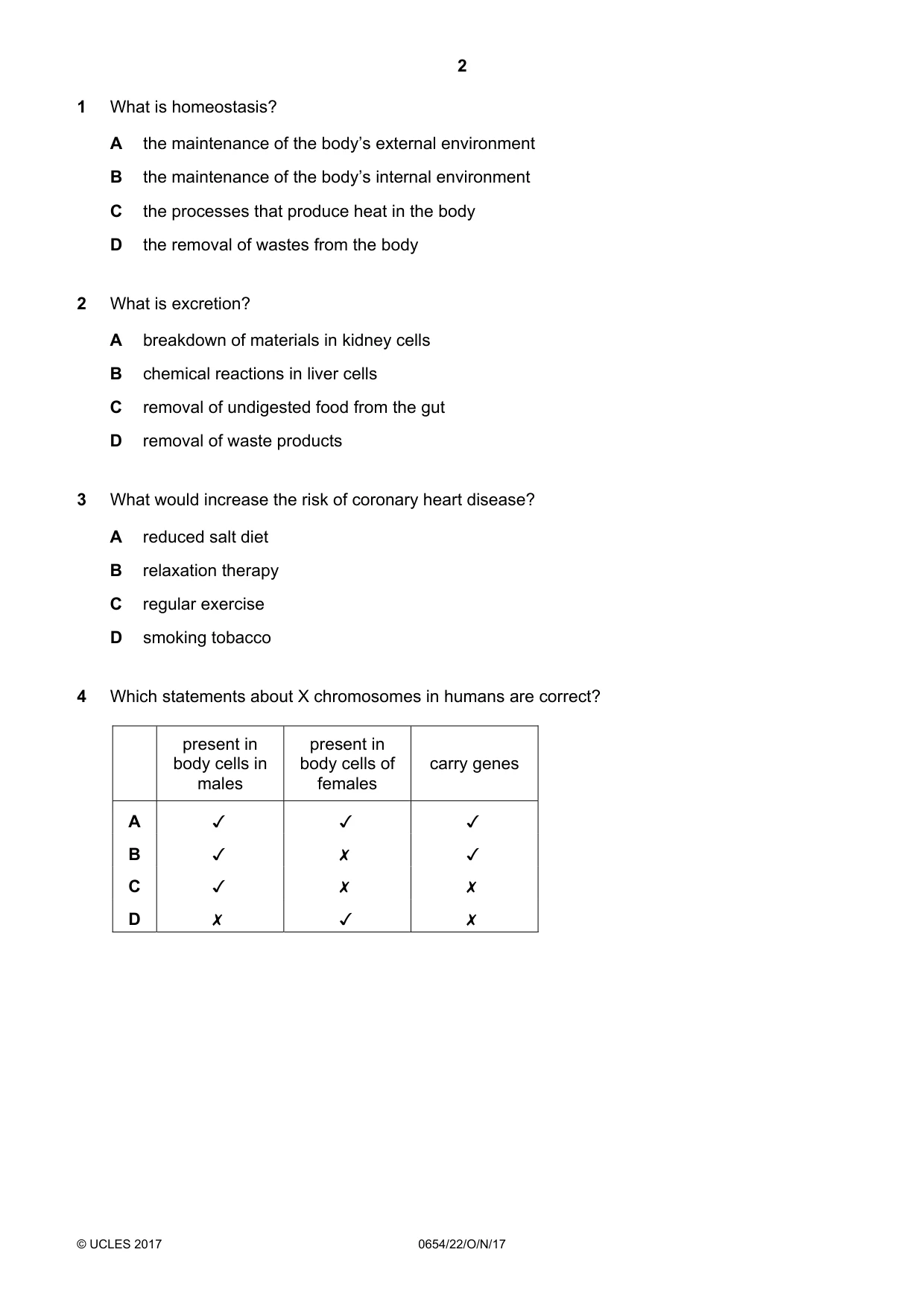
1 What is homeostasis? A the maintenance of the body’s external environment B the maintenance of the body’s internal environment C the processes that produce heat in the body D the removal of wastes from the body
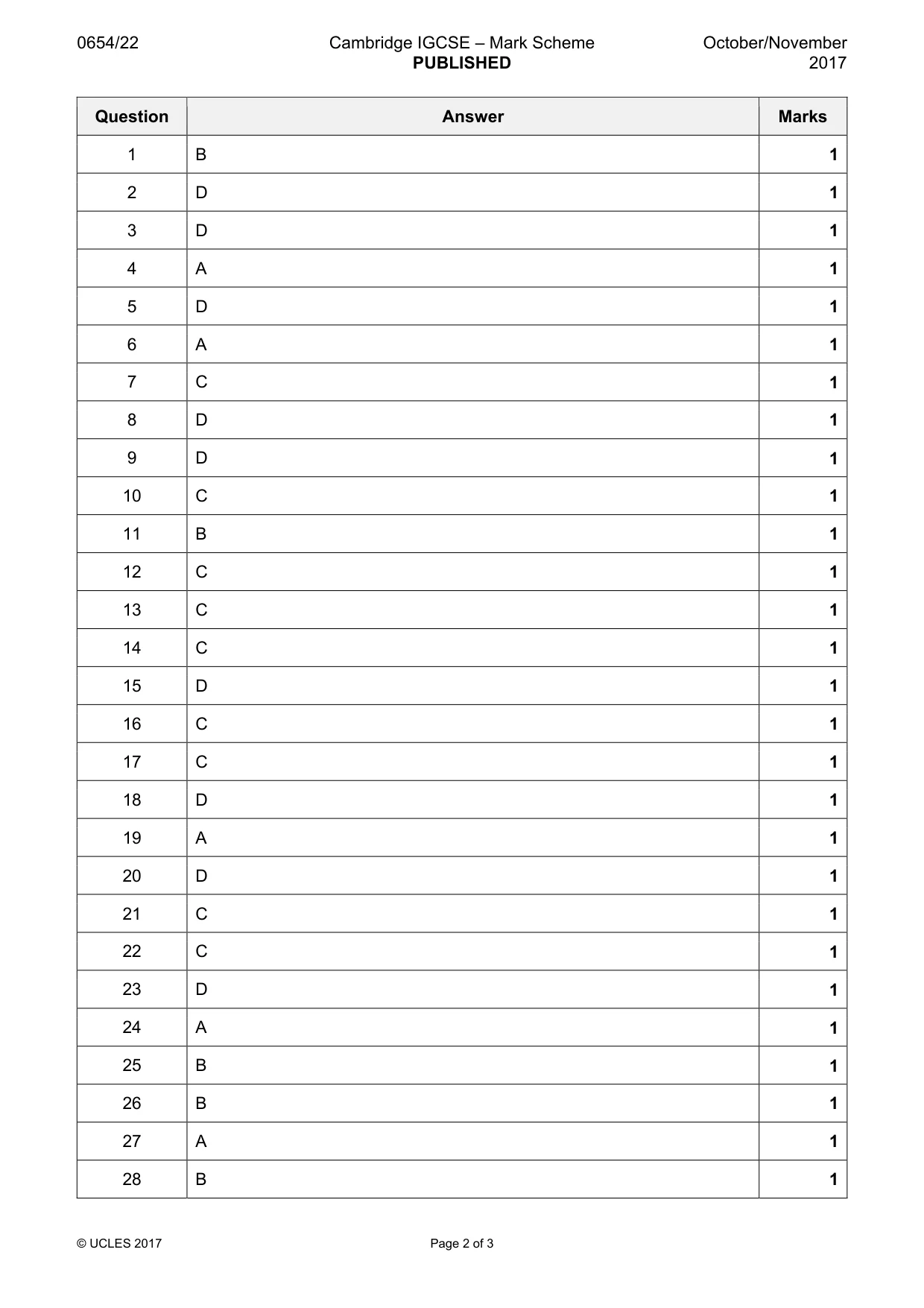
Mark scheme: B
Question 2
2 What is excretion? A breakdown of materials in kidney cells B chemical reactions in liver cells C removal of undigested food from the gut D removal of waste products
Mark scheme: D
Q3 · What would increase the risk of coronary heart disease?
3 What would increase the risk of coronary heart disease? A reduced salt diet B relaxation therapy C regular exercise D smoking tobacco
Mark scheme: D
Q4 · Which statements about X chromosomes in humans are correct?
4 Which statements about X chromosomes in humans are correct? present in present in body cells in body cells of carry genes males females A v v v B v x v Cc J x x D x v x
Mark scheme: A
Q5 · The test-tube shows gelatine with a layer of black dye
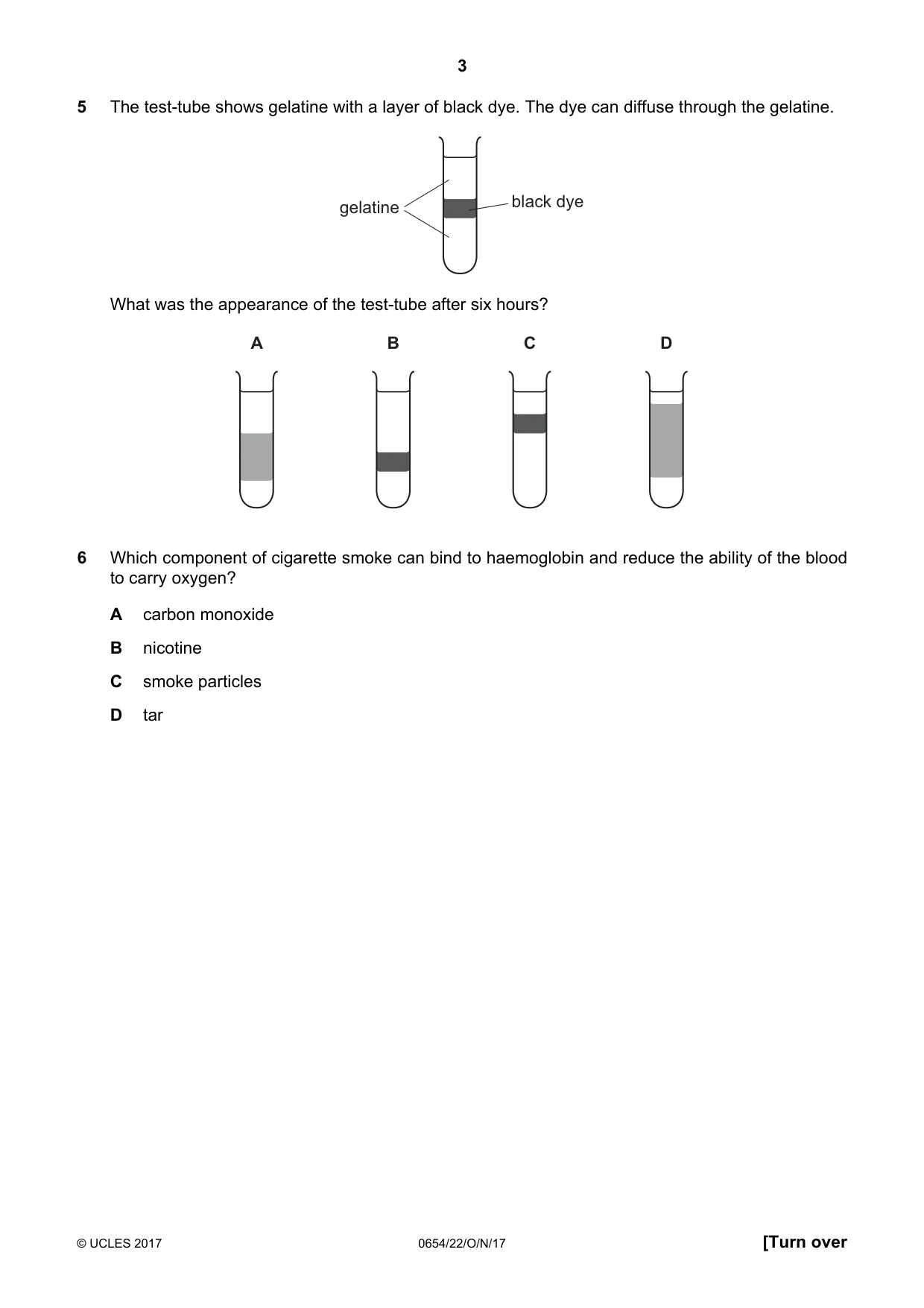
5 The test-tube shows gelatine with a layer of black dye. The dye can diffuse through the gelatine. gelatine black dye What was the appearance of the test-tube after six hours? A B C D
Mark scheme: D
Q6 · Which component of cigarette smoke can bind to haemoglobin and reduce the ability of the…
6 Which component of cigarette smoke can bind to haemoglobin and reduce the ability of the blood to carry oxygen? A carbon monoxide B nicotine C smoke particles D tar
Mark scheme: A
Q7 · When a suspension of powdered milk is completely digested by a protease enzyme it becomes…
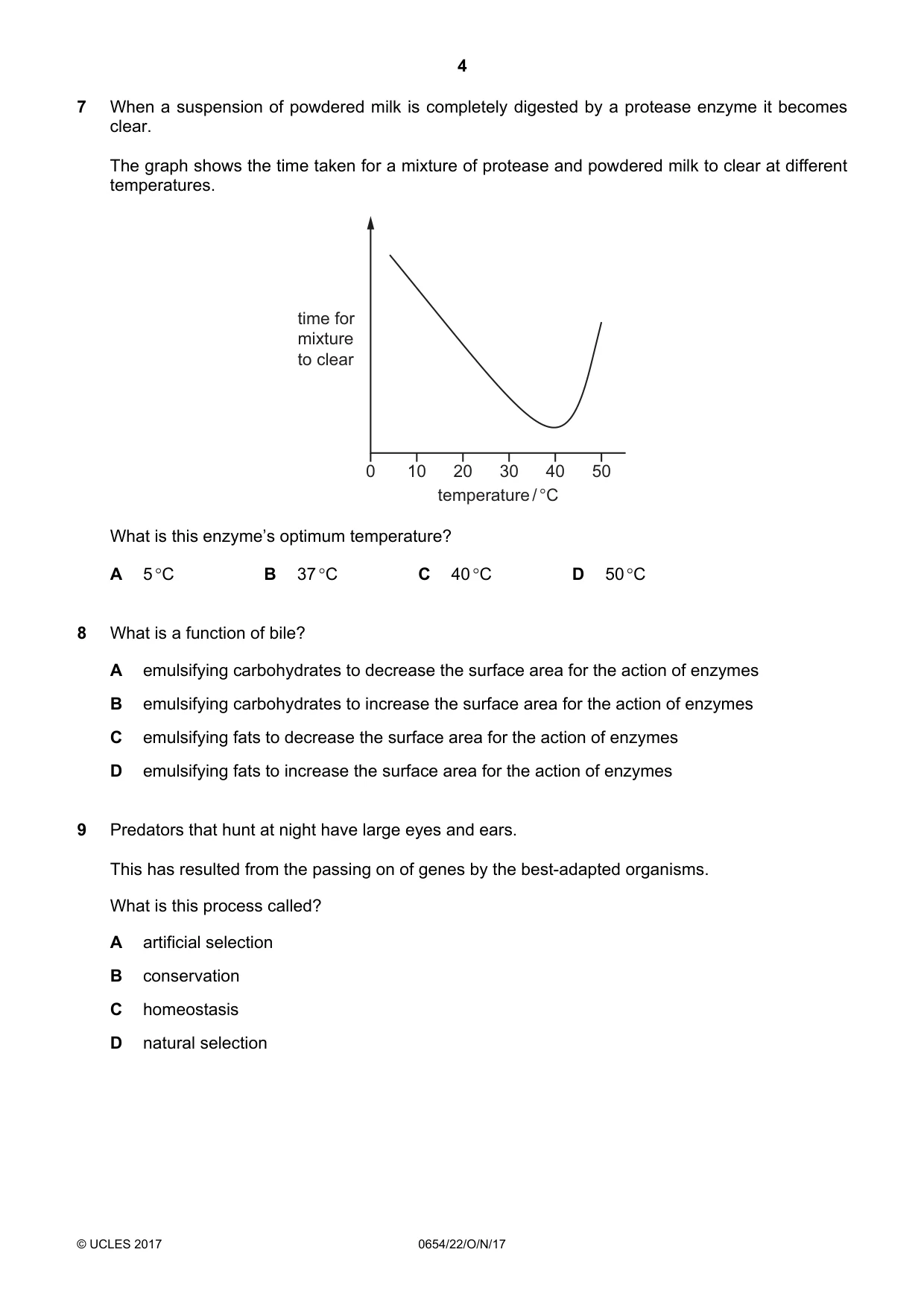
7 When a suspension of powdered milk is completely digested by a protease enzyme it becomes clear. The graph shows the time taken for a mixture of protease and powdered milk to clear at different temperatures. time for mixture to clear 0 10 20 30 40 50 temperature / °C What is this enzyme’s optimum temperature? A 5 °C B 37 °C C 40 °C D 50 °C
Mark scheme: C
Q8 · What is a function of bile?
8 What is a function of bile? A emulsifying carbohydrates to decrease the surface area for the action of enzymes B emulsifying carbohydrates to increase the surface area for the action of enzymes C emulsifying fats to decrease the surface area for the action of enzymes D emulsifying fats to increase the surface area for the action of enzymes
Mark scheme: D
Q9 · Predators that hunt at night have large eyes and ears
9 Predators that hunt at night have large eyes and ears. This has resulted from the passing on of genes by the best-adapted organisms. What is this process called? A artificial selection B conservation C homeostasis D natural selection
Mark scheme: D
Q10 · Why might auxins be used in the commercial growth of plants?
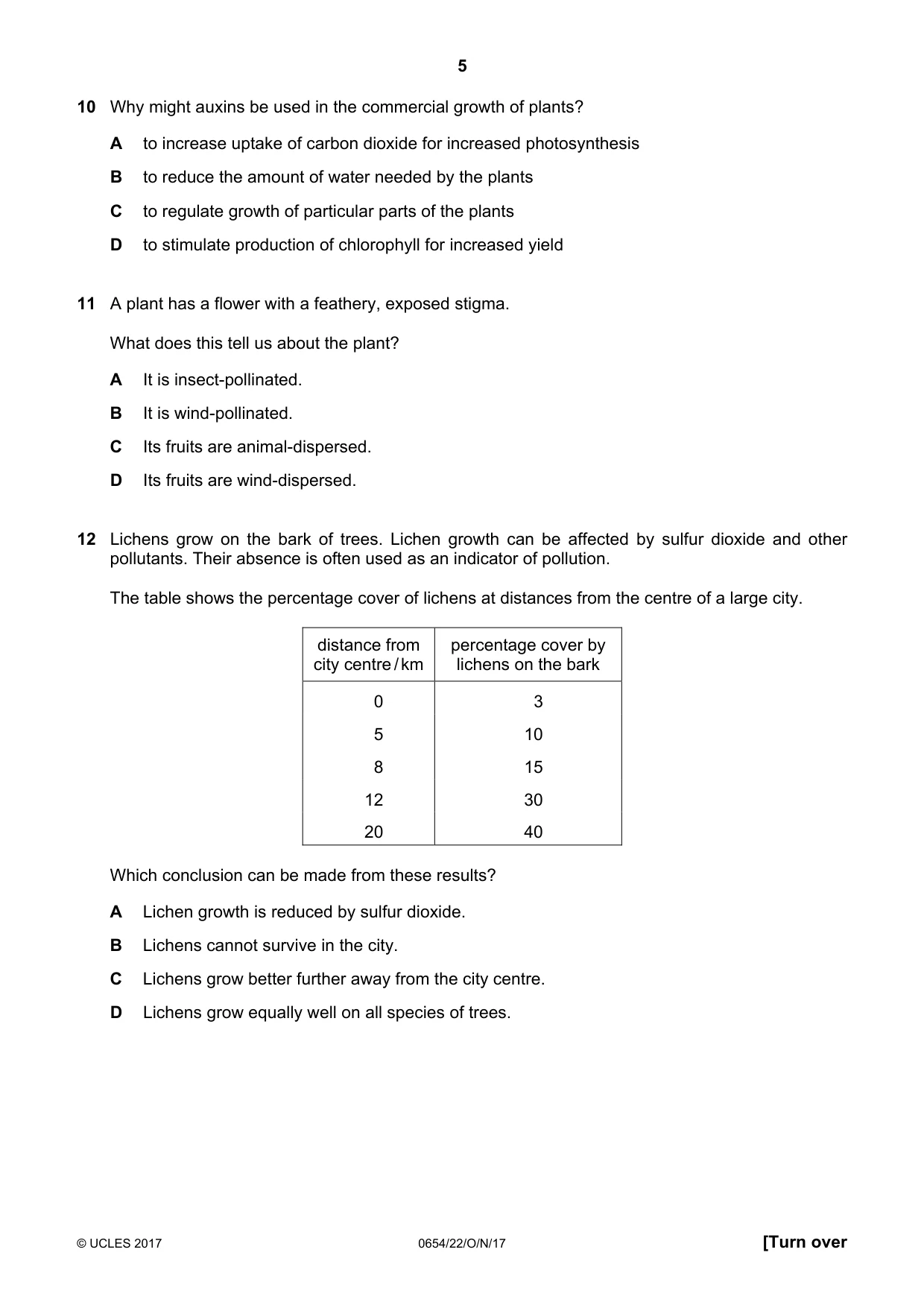
10 Why might auxins be used in the commercial growth of plants? A to increase uptake of carbon dioxide for increased photosynthesis B to reduce the amount of water needed by the plants C to regulate growth of particular parts of the plants D to stimulate production of chlorophyll for increased yield
Mark scheme: C
Q11 · A plant has a flower with a feathery, exposed stigma
11 A plant has a flower with a feathery, exposed stigma. What does this tell us about the plant? A It is insect-pollinated. B It is wind-pollinated. C Its fruits are animal-dispersed. D Its fruits are wind-dispersed.
Mark scheme: B
Q12 · Lichens grow on the bark of trees
12 Lichens grow on the bark of trees. Lichen growth can be affected by sulfur dioxide and other pollutants. Their absence is often used as an indicator of pollution. The table shows the percentage cover of lichens at distances from the centre of a large city. distance from percentage cover by city centre / km lichens on the bark 0 3 5 10 8 15 12 30 20 40 Which conclusion can be made from these results? A Lichen growth is reduced by sulfur dioxide. B Lichens cannot survive in the city. C Lichens grow better further away from the city centre. D Lichens grow equally well on all species of trees.
Mark scheme: C
Q13 · Which statement about food chains is correct?
13 Which statement about food chains is correct? A A carnivore is a consumer that gets its energy from plants. B A carnivore is a producer that gets its energy from animals. C A herbivore is a consumer that gets its energy from plants. D A herbivore is a producer that gets its energy from animals.
Mark scheme: C
Q14 · Which row describes the melting point and boiling point of salt water?
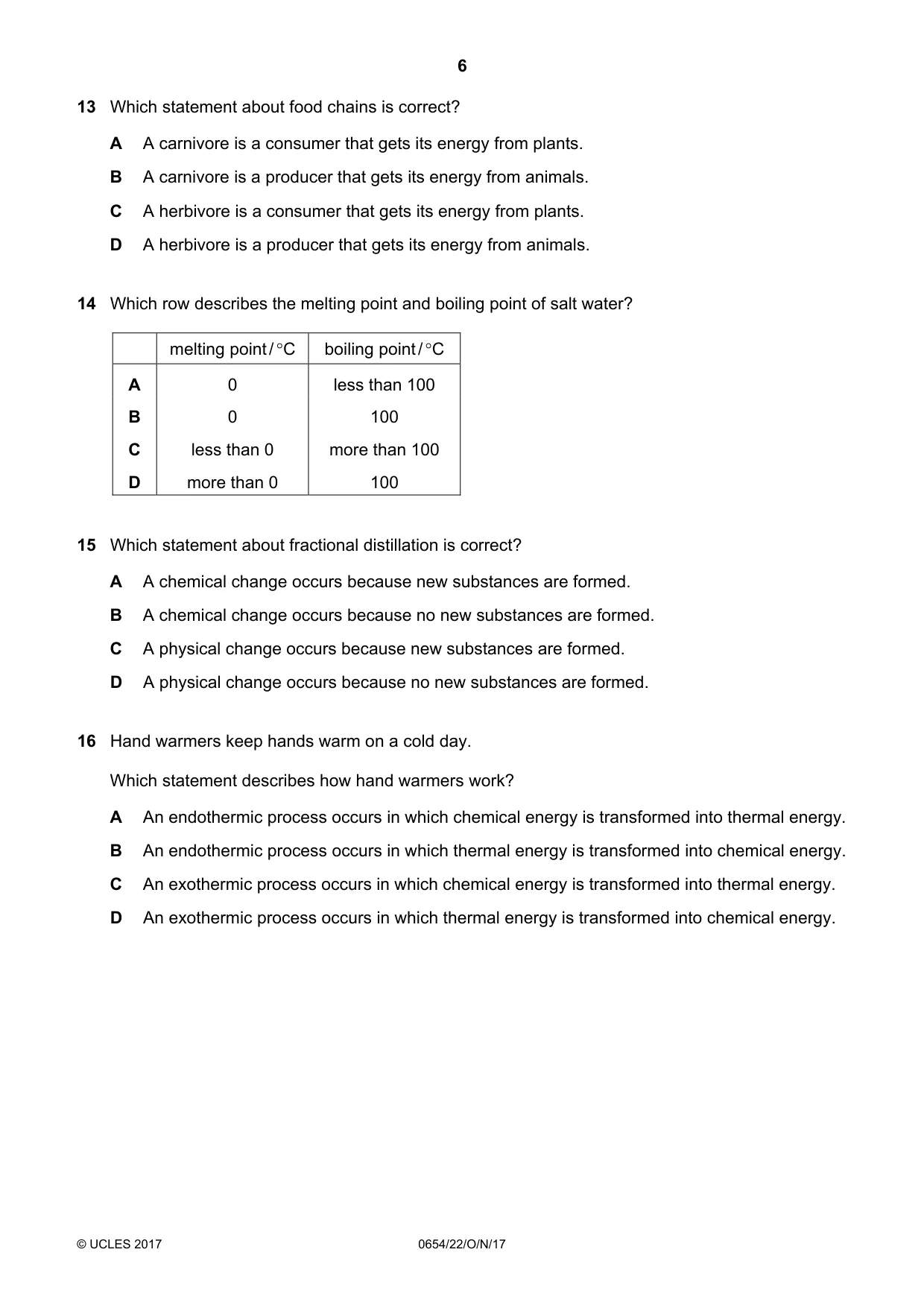
14 Which row describes the melting point and boiling point of salt water? melting point / °C boiling point / °C A 0 less than 100 B 0 100 C less than 0 more than 100 D more than 0 100
Mark scheme: C
Q15 · Which statement about fractional distillation is correct?
15 Which statement about fractional distillation is correct? A A chemical change occurs because new substances are formed. B A chemical change occurs because no new substances are formed. C A physical change occurs because new substances are formed. D A physical change occurs because no new substances are formed.
Mark scheme: D
Q16 · Hand warmers keep hands warm on a cold day
16 Hand warmers keep hands warm on a cold day. Which statement describes how hand warmers work? A An endothermic process occurs in which chemical energy is transformed into thermal energy. B An endothermic process occurs in which thermal energy is transformed into chemical energy. C An exothermic process occurs in which chemical energy is transformed into thermal energy. D An exothermic process occurs in which thermal energy is transformed into chemical energy.
Mark scheme: C
Q17 · Ammonia is oxidised as shown
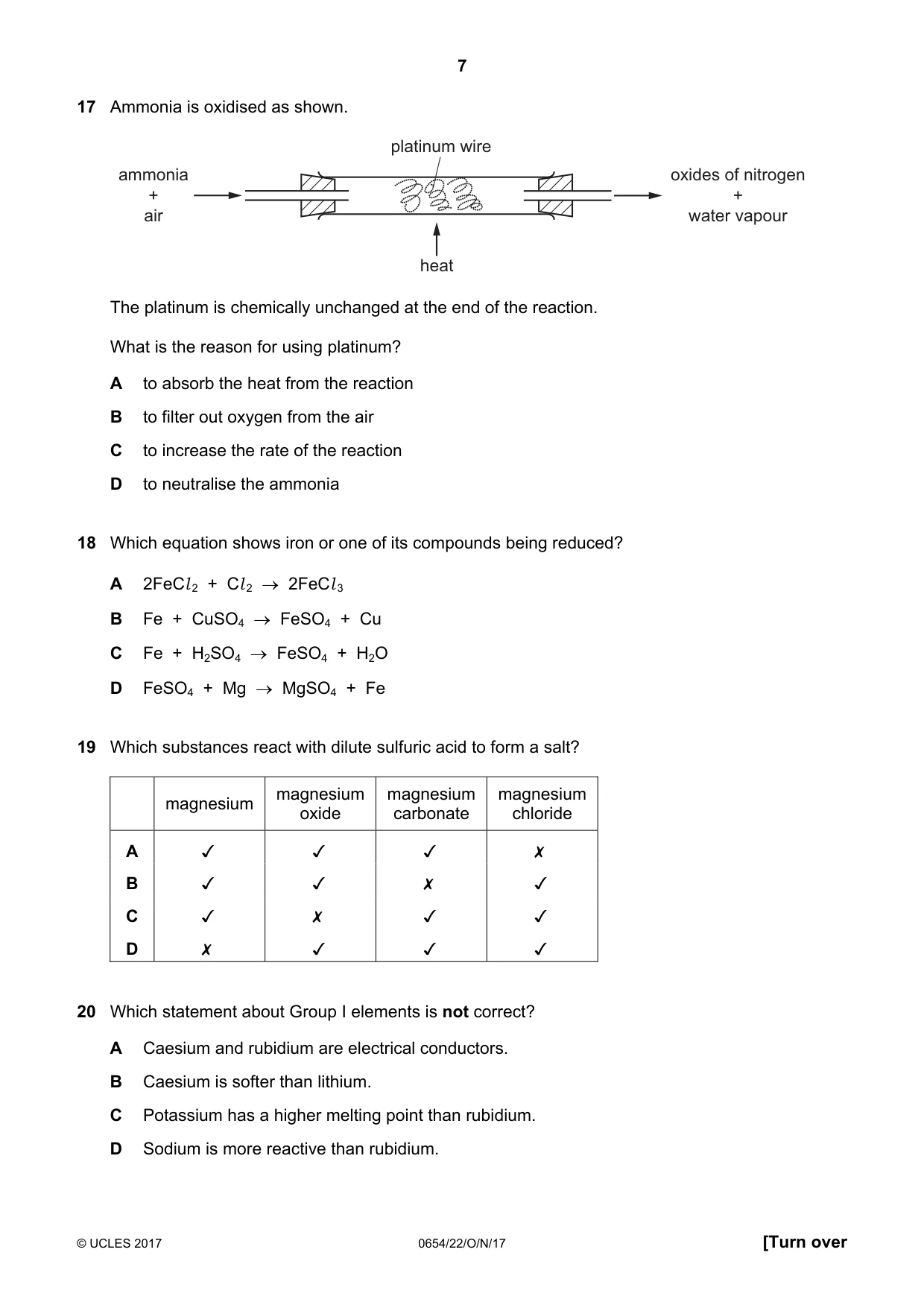
17 Ammonia is oxidised as shown. platinum wire ammonia oxides of nitrogen + + air water vapour heat The platinum is chemically unchanged at the end of the reaction. What is the reason for using platinum? A to absorb the heat from the reaction B to filter out oxygen from the air C to increase the rate of the reaction D to neutralise the ammonia
Mark scheme: C
Q18 · Which equation shows iron or one of its compounds being reduced?
18 Which equation shows iron or one of its compounds being reduced? A 2FeCl 2 + Cl 2 → 2FeCl 3 B Fe + CuSO4 → FeSO4 + Cu C Fe + H2SO4 → FeSO4 + H2O D FeSO4 + Mg → MgSO4 + Fe
Mark scheme: D
Q19 · Which substances react with dilute sulfuric acid to form a salt?
19 Which substances react with dilute sulfuric acid to form a salt? magnesium oxide magnesium carbonate magnesium chloride magnesium v v ~*~ KKK v x x v v v
Mark scheme: A
Q20 · Which statement about Group I elements is not correct?
20 Which statement about Group I elements is not correct? A Caesium and rubidium are electrical conductors. B Caesium is softer than lithium. C Potassium has a higher melting point than rubidium. D Sodium is more reactive than rubidium.
Mark scheme: D
Q21 · Sodium is a metal in Group I of the Periodic Table
21 Sodium is a metal in Group I of the Periodic Table. Some of the properties of sodium are listed. 1 It conducts electricity. 2 It forms white compounds. 3 It forms a basic oxide. 4 It is malleable. Nickel is a transition metal. Which properties are shown by nickel as well as by sodium? A 1, 2 and 3 B 1, 2 and 4 C 1, 3 and 4 D 2, 3 and 4
Mark scheme: C
Q22 · Which reaction does not occur in the blast furnace?
22 Which reaction does not occur in the blast furnace? A C + O2 → CO2 B C + CO2 → 2CO C 4Fe + 3O2 → 2Fe2O3 D Fe2O3 + 3CO → 2Fe + 3CO2
Mark scheme: C
Q23 · Gases from a car engine pass through the catalytic converter in the exhaust system of the…
23 Gases from a car engine pass through the catalytic converter in the exhaust system of the car. Which gases are at lower concentrations when they leave the catalytic converter? A carbon dioxide and nitrogen B carbon dioxide and nitrogen oxides C carbon monoxide and nitrogen D carbon monoxide and nitrogen oxides
Mark scheme: D
Q24 · Which row shows the conditions used for making sulfur trioxide in the Contact process?
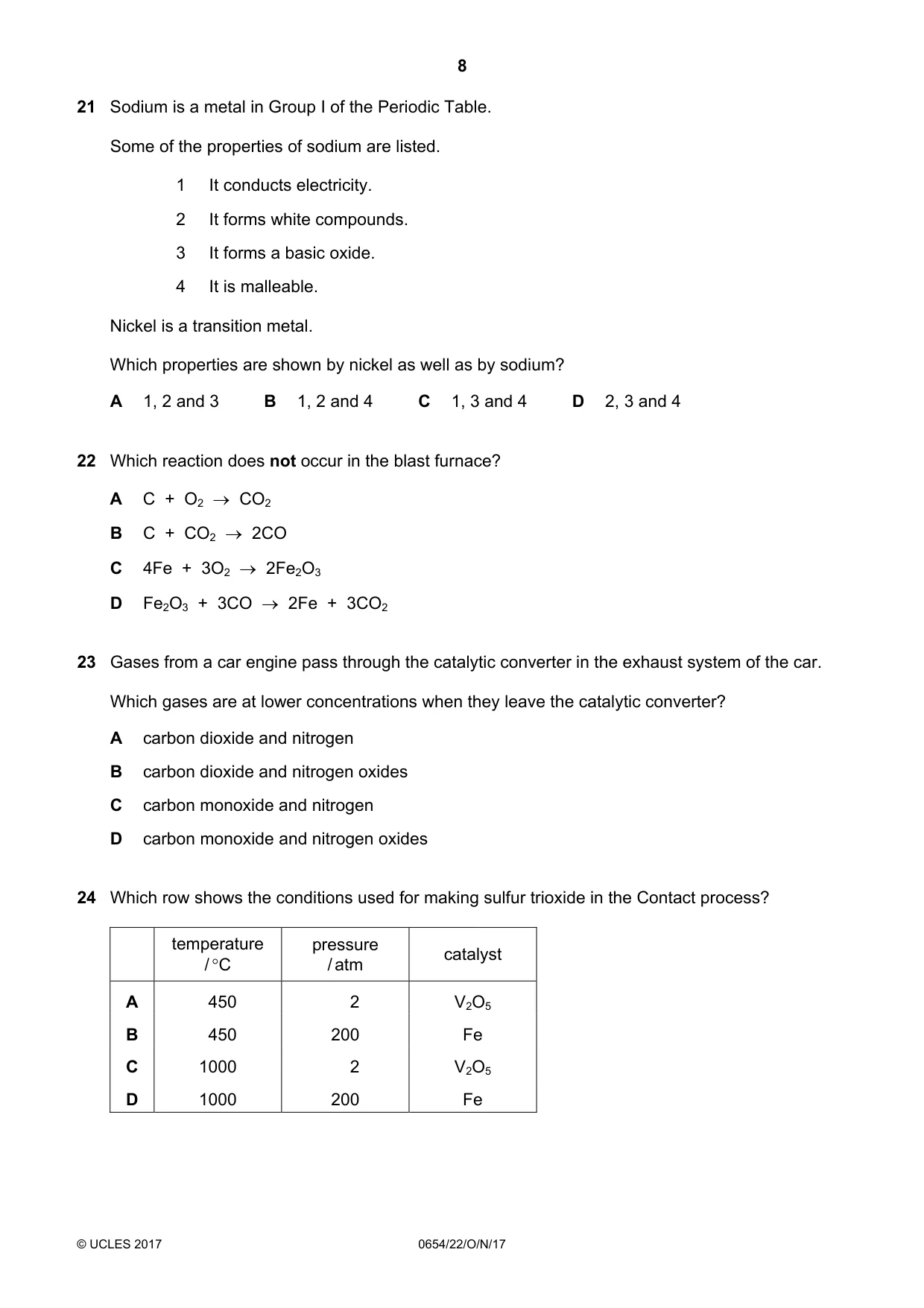
24 Which row shows the conditions used for making sulfur trioxide in the Contact process? temperature pressure catalyst / °C / atm A 450 2 V2O5 B 450 200 Fe C 1000 2 V2O5 D 1000 200 Fe
Mark scheme: A
Q25 · Which word equation describes the manufacture of lime from limestone?
25 Which word equation describes the manufacture of lime from limestone? A calcium carbonate → calcium hydroxide + carbon dioxide B calcium carbonate → calcium oxide + carbon dioxide C calcium hydroxide → calcium oxide + water D calcium oxide + carbon dioxide → calcium carbonate
Mark scheme: B
Q26 · What is the structure of but-2-ene?
26 What is the structure of but-2-ene? A CH3–CH2–CH=CH2 B CH3–CH=CH–CH3 C CH3–CH=CH2 D CH3–CH2–CH3
Mark scheme: B
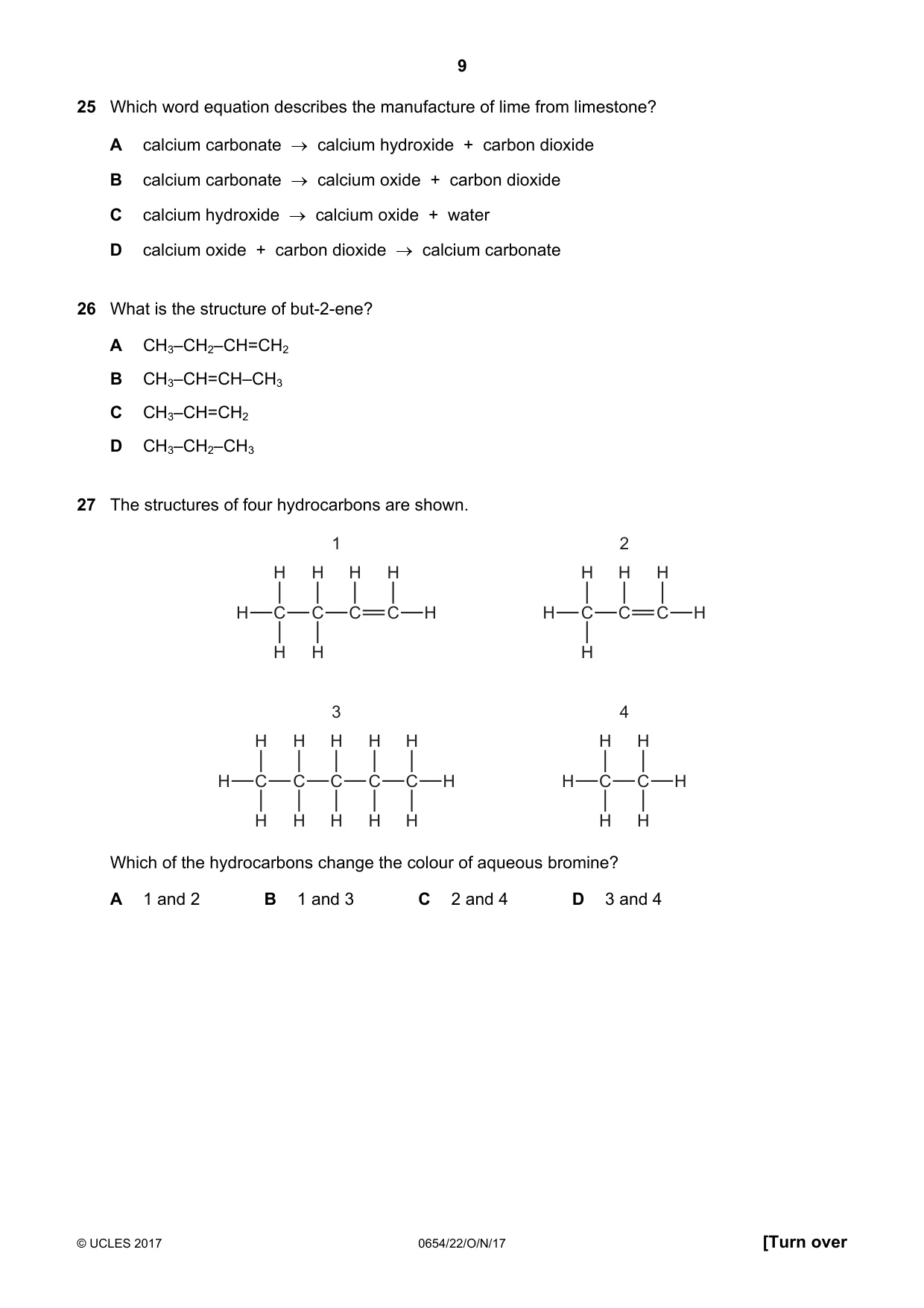
Q27 · The structures of four hydrocarbons are shown
27 The structures of four hydrocarbons are shown. 1 2 H H H H H H H H C C C C H H C C C H H H H 3 4 H H H H H H H H C C C C C H H C C H H H H H H H H Which of the hydrocarbons change the colour of aqueous bromine? A 1 and 2 B 1 and 3 C 2 and 4 D 3 and 4
Mark scheme: A
Q28 · A car moves with a constant speed of 15 m / s along a road for 20 s
28 A car moves with a constant speed of 15 m / s along a road for 20 s. After this, the car is 100 m from where it started, measured in a straight line. Which statement about the car is correct? A It has travelled a distance of 100 m along the road. B It has travelled a distance of 300 m along the road. C Its direction was constant. D Its velocity was constant.
Mark scheme: B
Q29 · A load is applied to a spring
29 A load is applied to a spring. The load is gradually increased from zero until the limit of proportionality of the spring is passed. What must happen as soon as the limit of proportionality is passed? A The extension becomes equal to the original length. B The extension stops increasing. C The spring breaks. D The spring stops obeying Hooke’s Law.
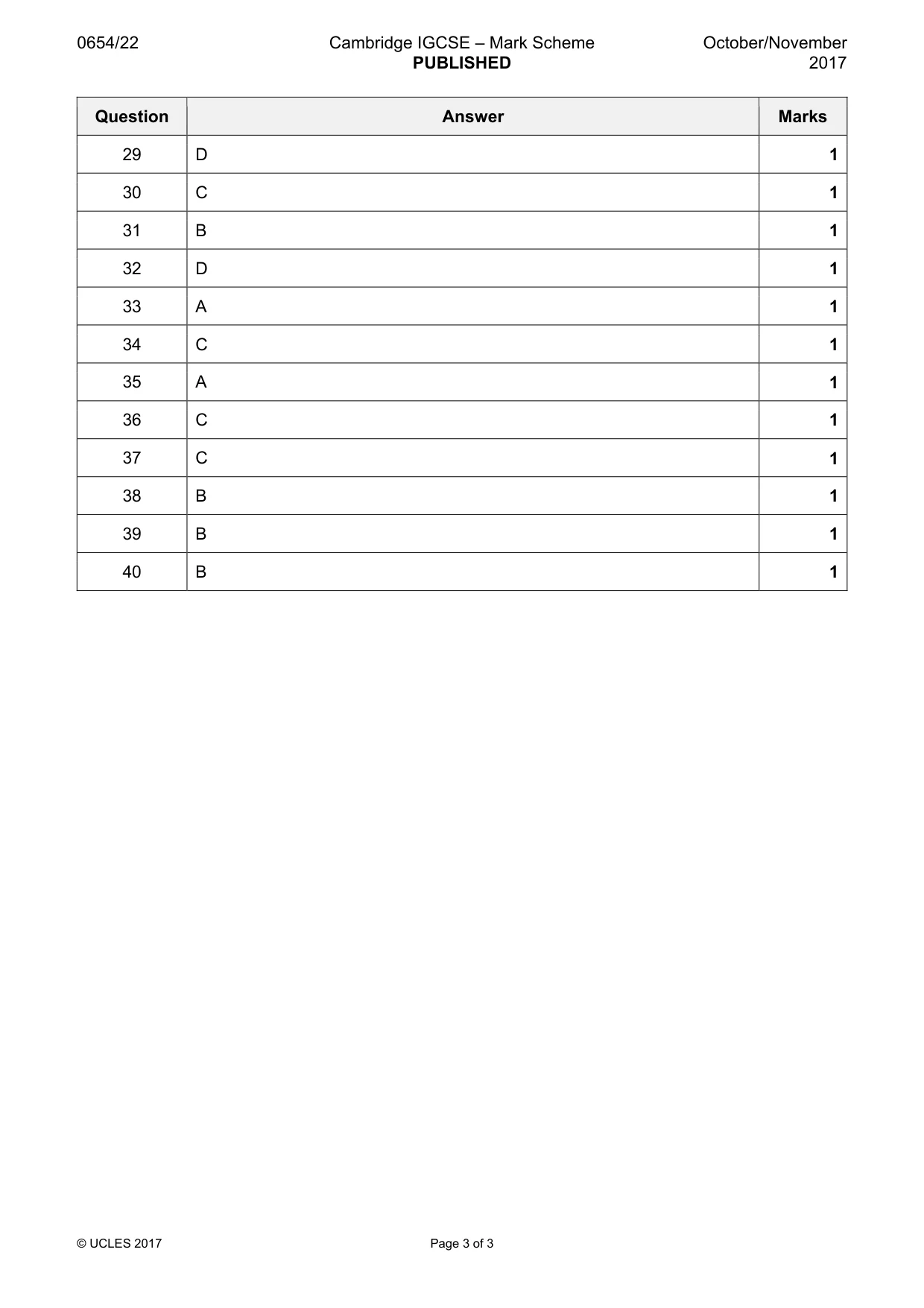
Mark scheme: D
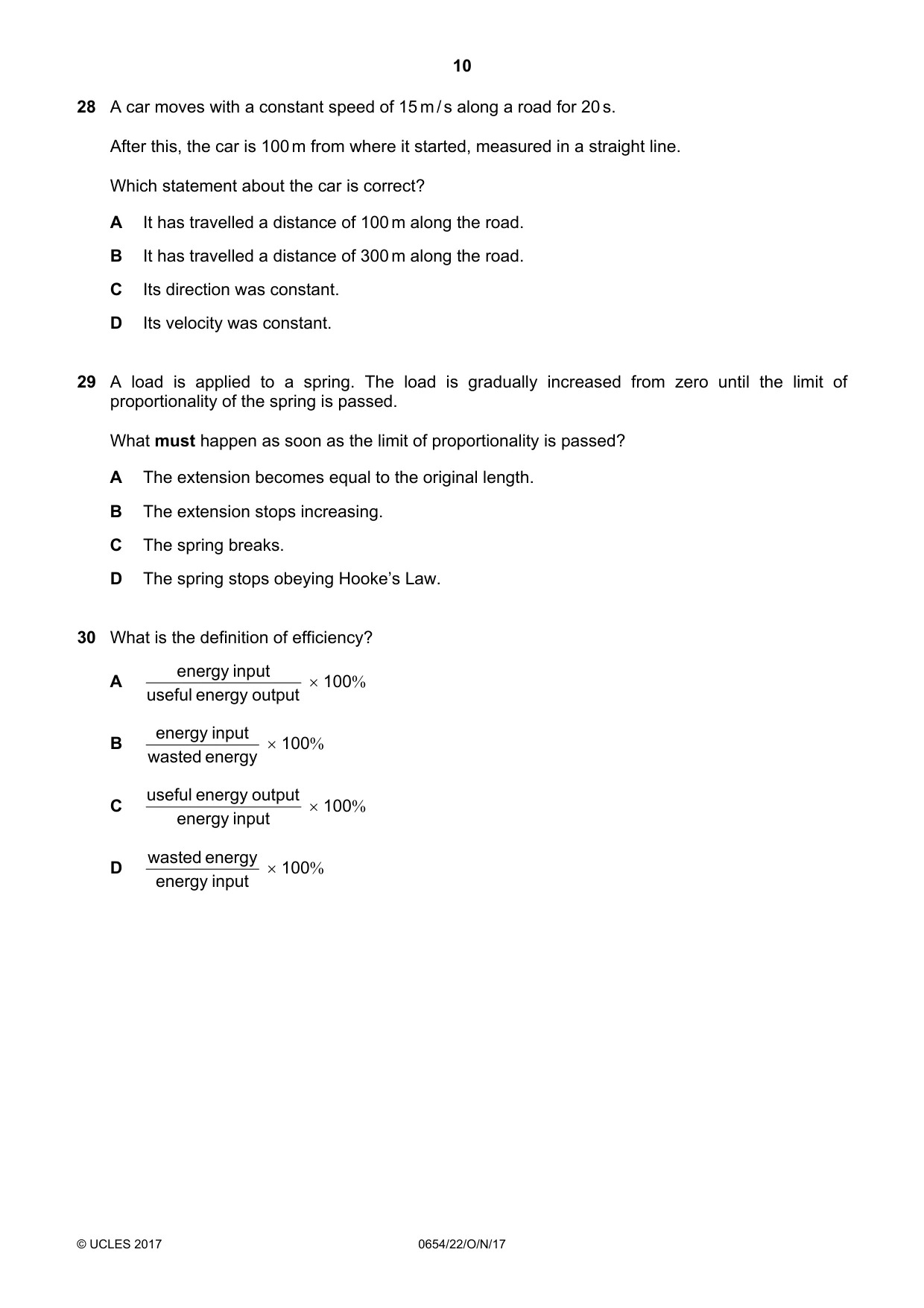
Q30 · What is the definition of efficiency?
30 What is the definition of efficiency? energy input A × 100% useful energy output energy input B × 100% wasted energy useful energy output C × 100% energy input wasted energy D × 100% energy input
Mark scheme: C
Q31 · A worker carries bricks up a ladder
31 A worker carries bricks up a ladder. The following quantities are known. ● the height the bricks are lifted up ● the time taken for the worker to lift the bricks ● the volume of the bricks ● the weight of the bricks Which quantities are needed to calculate the useful power produced by the worker as he carries the bricks up the ladder? A height, time and volume B height, time and weight C height, volume and weight D time, volume and weight
Mark scheme: B
Q32 · Water in a beaker is heated in a laboratory
32 Water in a beaker is heated in a laboratory. Which statement about boiling and evaporation of the water is correct? A Boiling and evaporation both occur at any temperature. B Boiling only occurs at the surface of water. C Evaporation only occurs at one temperature. D Evaporation only occurs at the surface of water.
Mark scheme: D
Q33 · Which statement describes why convection is the main method of heat transfer in liquids?
33 Which statement describes why convection is the main method of heat transfer in liquids? A Heating a liquid decreases its density. B Heating a liquid decreases its thermal capacity. C Heating a liquid increases its density. D Heating a liquid increases its thermal capacity.
Mark scheme: A
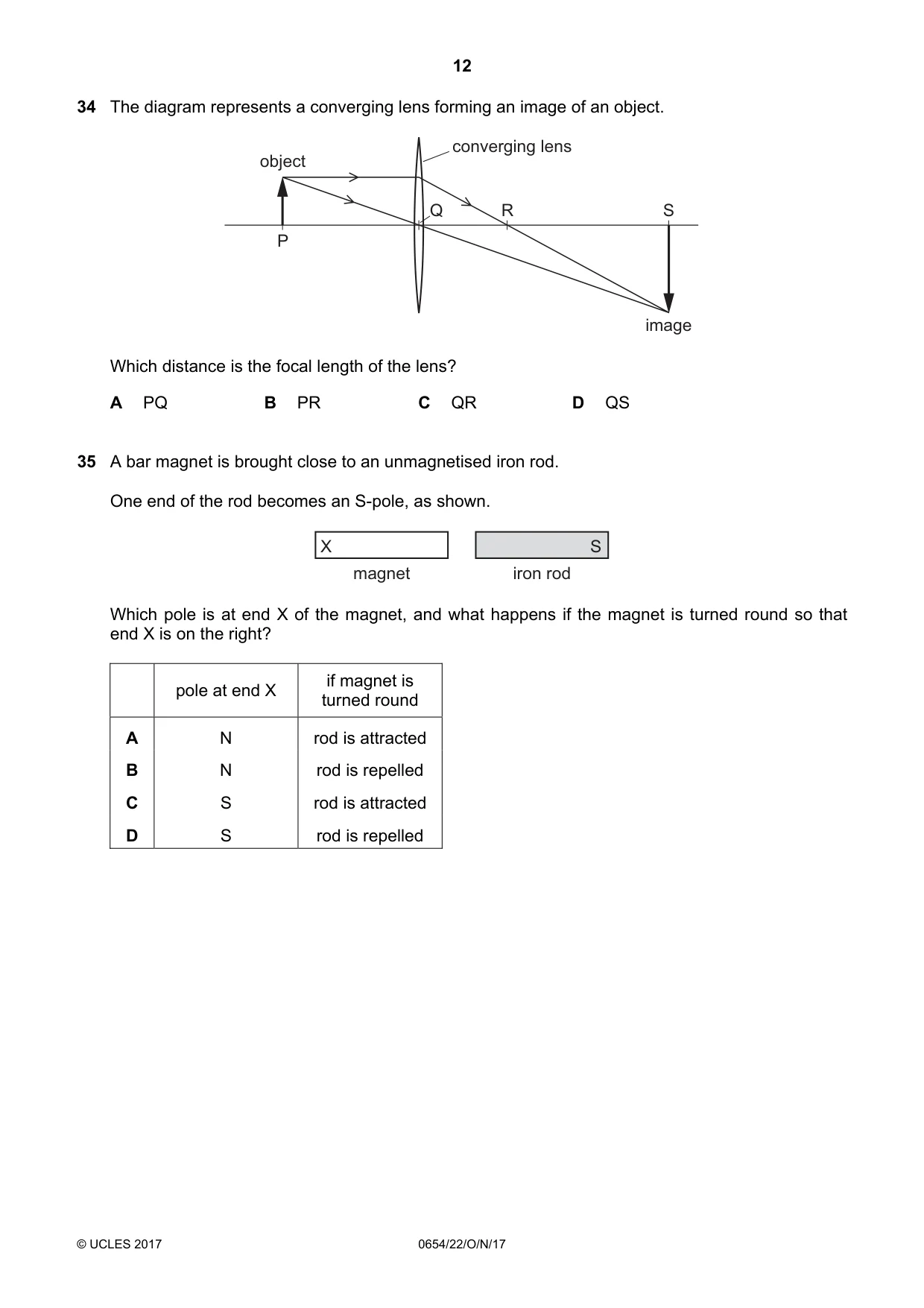
Q34 · The diagram represents a converging lens forming an image of an object
34 The diagram represents a converging lens forming an image of an object. converging lens object Q R S P image Which distance is the focal length of the lens? A PQ B PR C QR D QS
Mark scheme: C
Q35 · A bar magnet is brought close to an unmagnetised iron rod
35 A bar magnet is brought close to an unmagnetised iron rod. One end of the rod becomes an S-pole, as shown. X S magnet iron rod Which pole is at end X of the magnet, and what happens if the magnet is turned round so that end X is on the right? if magnet is pole at end X turned round A N rod is attracted B N rod is repelled C S rod is attracted D S rod is repelled
Mark scheme: A
Q36 · A battery of e.m.f
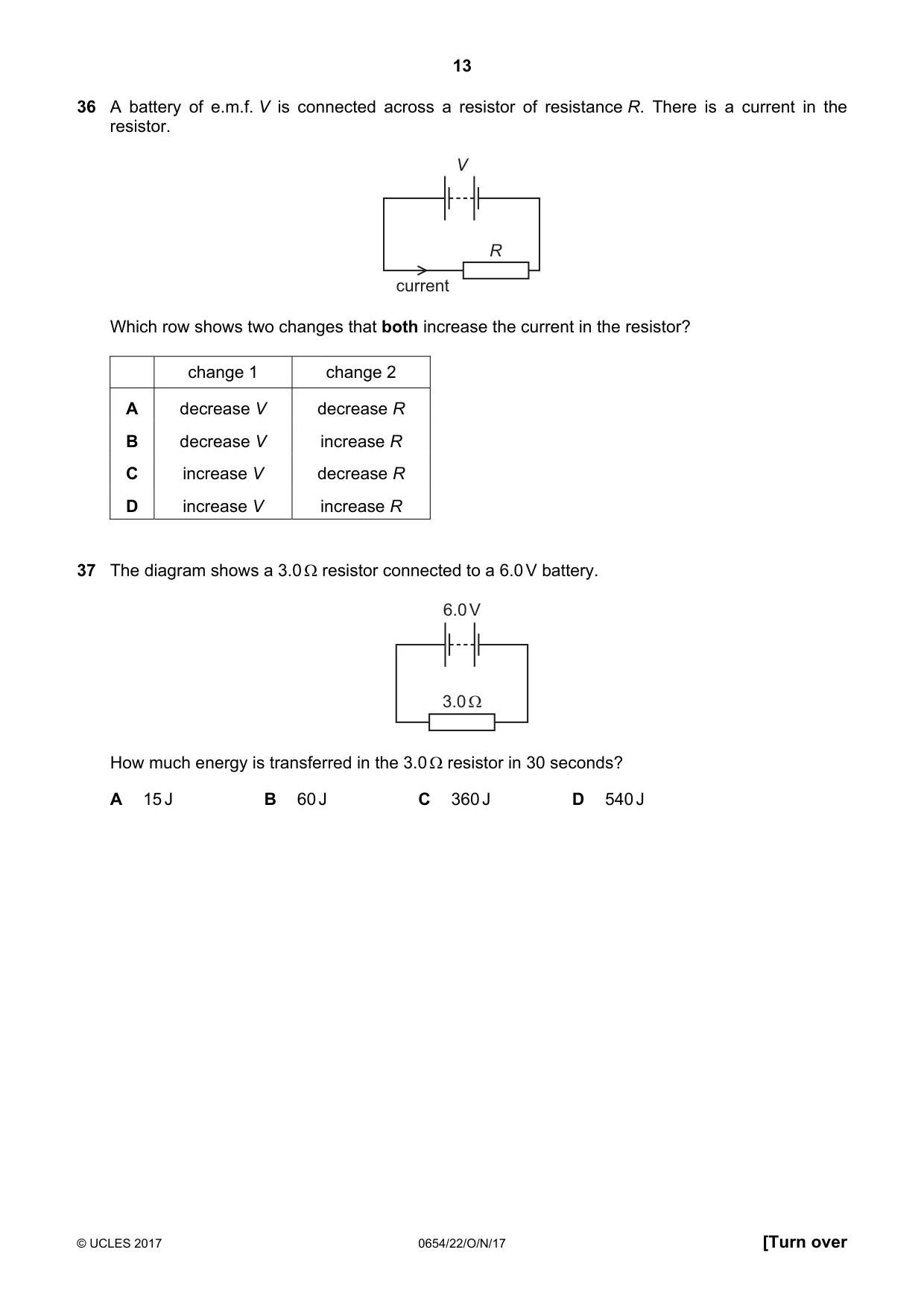
36 A battery of e.m.f. V is connected across a resistor of resistance R. There is a current in the resistor. V R current Which row shows two changes that both increase the current in the resistor? change 1 change 2 A decrease V decrease R B decrease V increase R C increase V decrease R D increase V increase R
Mark scheme: C
Q37 · The diagram shows a 3.0 Ω resistor connected to a 6.0 V battery
37 The diagram shows a 3.0 Ω resistor connected to a 6.0 V battery. 6.0 V 3.0 Ω How much energy is transferred in the 3.0 Ω resistor in 30 seconds? A 15 J B 60 J C 360 J D 540 J
Mark scheme: C
Q38 · Three charged balls P, Q and R are suspended by insulating threads
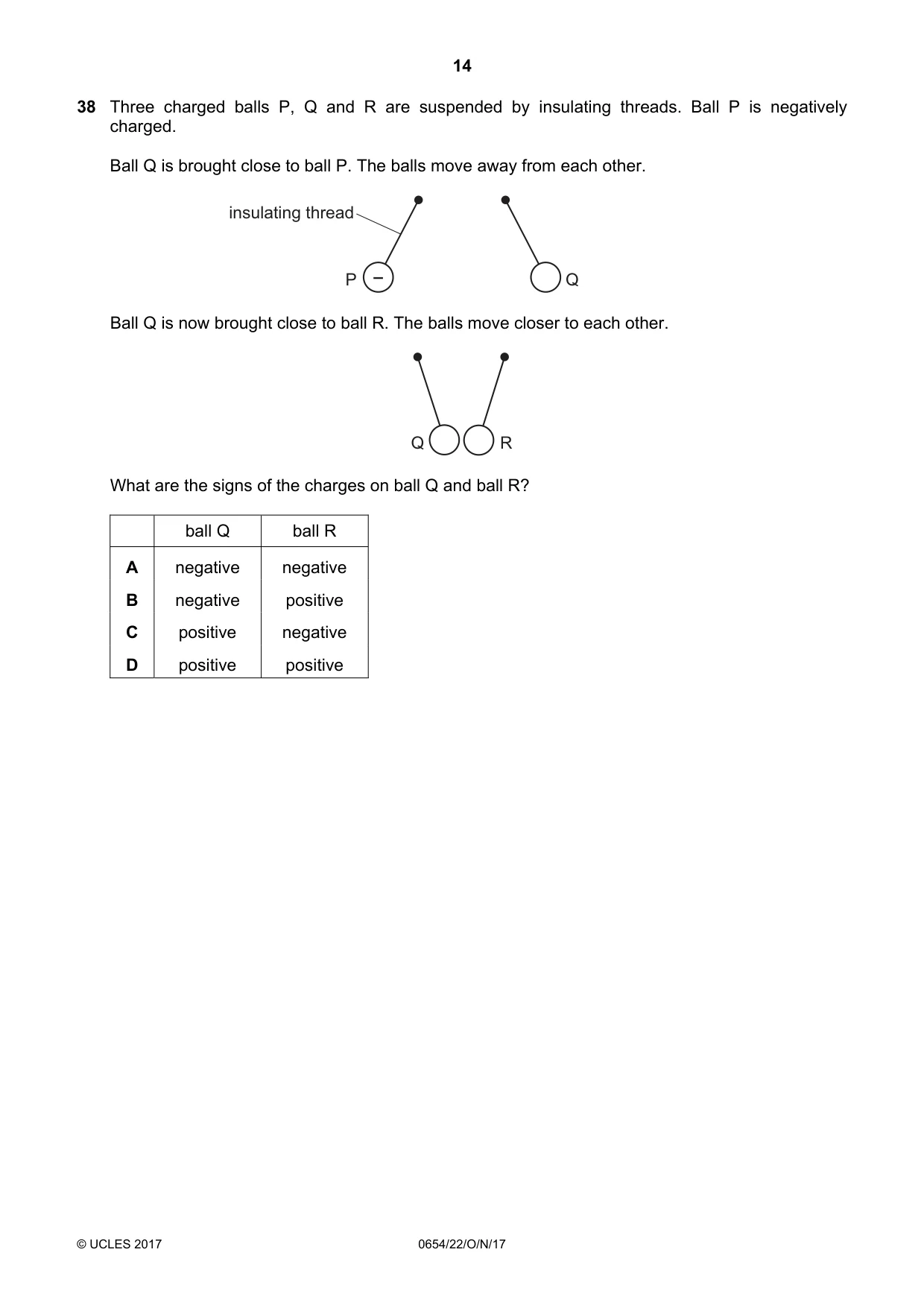
38 Three charged balls P, Q and R are suspended by insulating threads. Ball P is negatively charged. Ball Q is brought close to ball P. The balls move away from each other. insulating thread P – Q Ball Q is now brought close to ball R. The balls move closer to each other. Q R What are the signs of the charges on ball Q and ball R? ball Q ball R A negative negative B negative positive C positive negative D positive positive
Mark scheme: B
Q39 · The circuit in the diagram contains two resistors
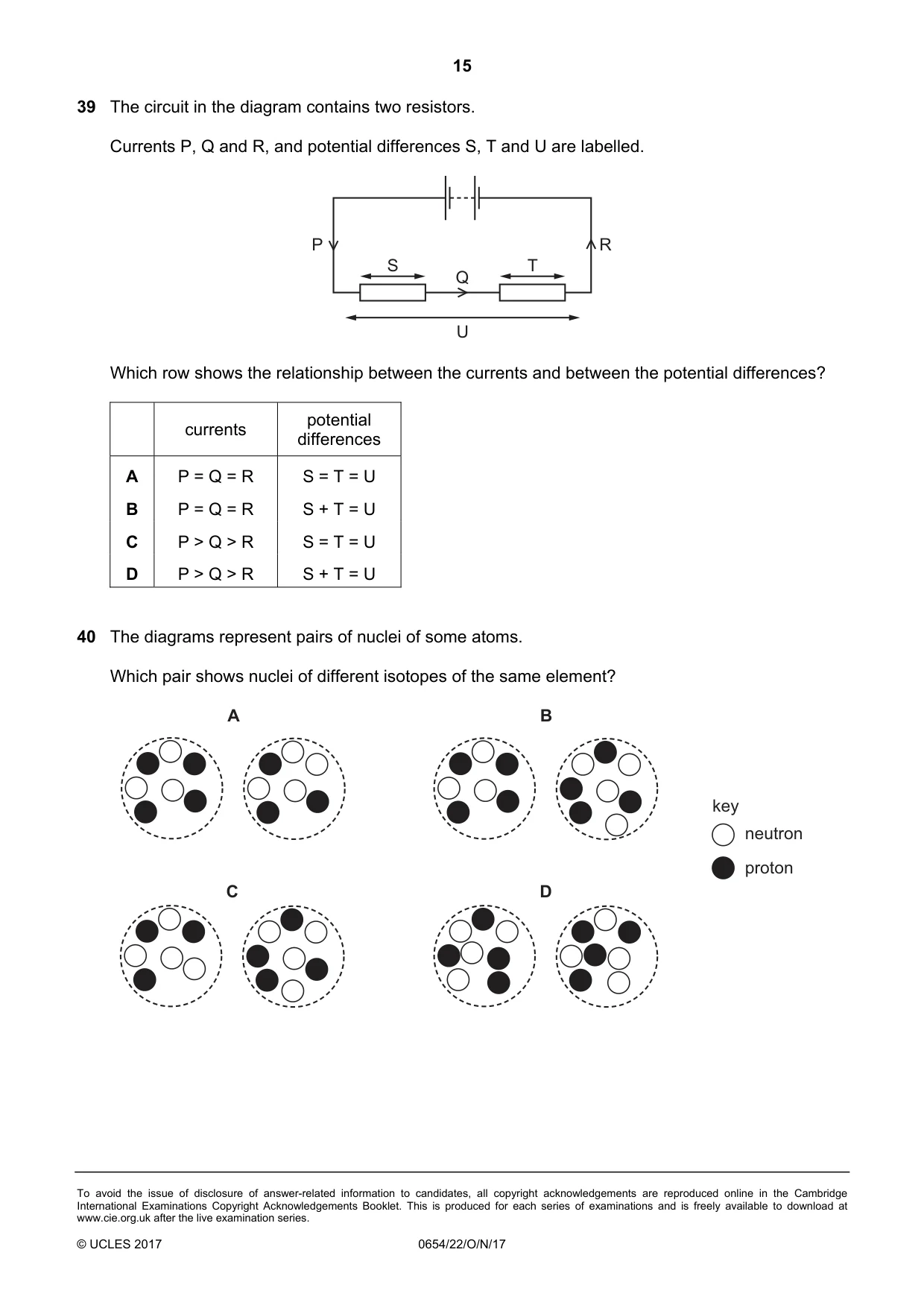
39 The circuit in the diagram contains two resistors. Currents P, Q and R, and potential differences S, T and U are labelled. P R S T Q U Which row shows the relationship between the currents and between the potential differences? potential currents differences A P = Q = R S = T = U B P = Q = R S + T = U C P > Q > R S = T = U D P > Q > R S + T = U
Mark scheme: B
Q40 · The diagrams represent pairs of nuclei of some atoms
40 The diagrams represent pairs of nuclei of some atoms. Which pair shows nuclei of different isotopes of the same element? A B key neutron proton C D
Mark scheme: B
What was in this paper
The subtopics covered by these 40 questions, and how many questions each got. Open one in a new tab to see every Cambridge question on it.
2Energy, work and power2Homeostasis2Rate of reaction2Simple phenomena of magnetism2Air quality and climate1Alkenes1Chromosomes and genes1Circulatory systems1Coordination and response1Diffusion1Digestion1Drugs1Electrical circuits1Enzymes1Exothermic and endothermic reactions1Extraction of metals1Food chains and food webs1Forces1Group I properties1Habitat destruction1Isotopes1Kinetic particle model of matter1Light1Motion1Naming organic compounds1Oxides1Physical and chemical changes1Preparation of salts1Redox1Selection1Sexual reproduction in plants1Solids, liquids and gases1Transfer of thermal energy1Transition elements1What you needed in this session
Cambridge’s own grade thresholds for 2017 Oct/Nov, Paper 2 · Variant 2. A higher threshold means an easier paper — the bar moves with how the cohort did.