Cambridge IGCSE Sciences - Co-ordinated (Double) 0654 — 2025 Feb/March Paper 2 · Variant 2
0654/22/F/M/25 · 40 questions · 40 marks · 45 min
The question paper and its mark scheme, free to read here and free to download. This is Cambridge’s own paper, exactly as it was sat.
Question paper16 pages
Mark scheme3 pages
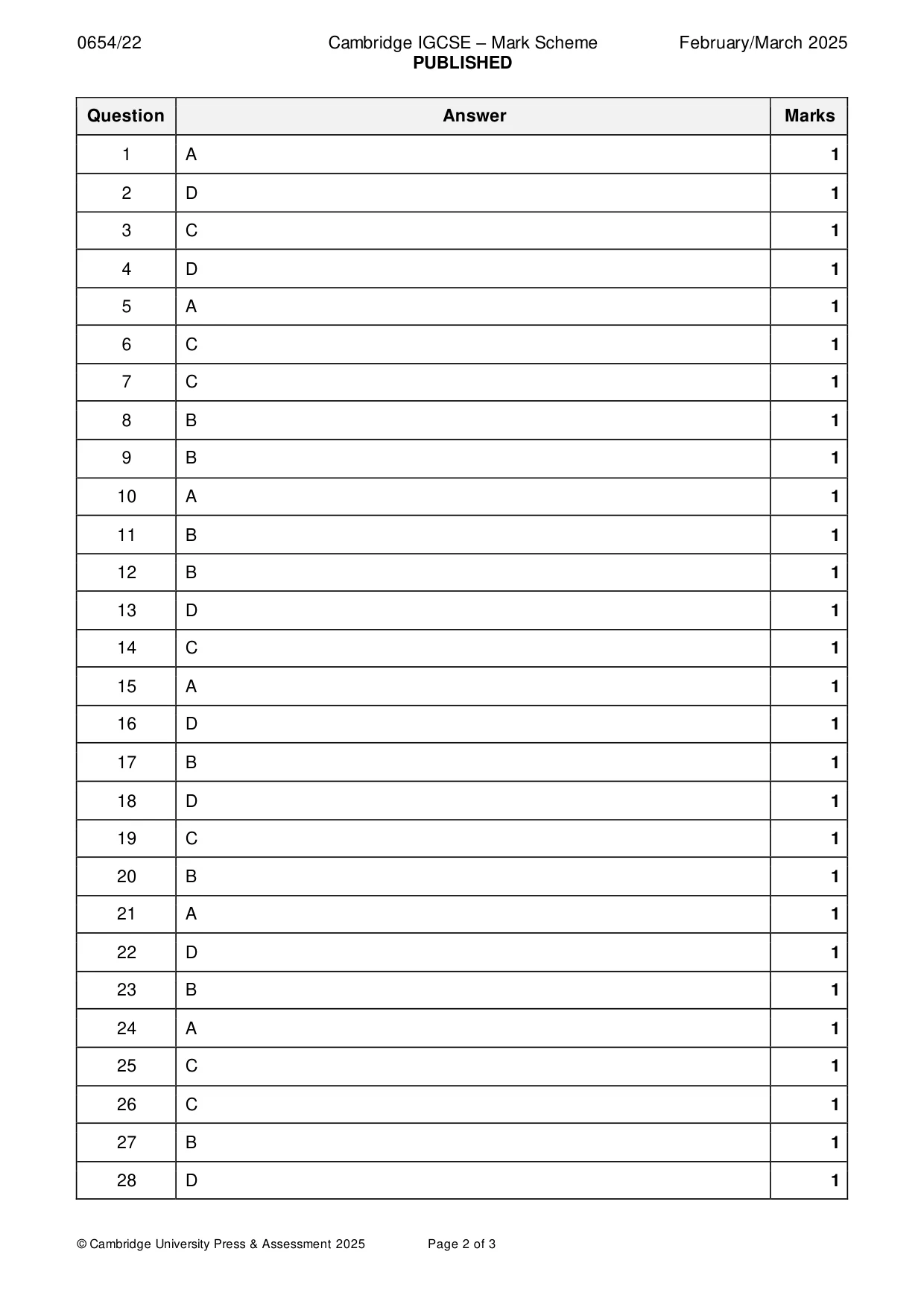
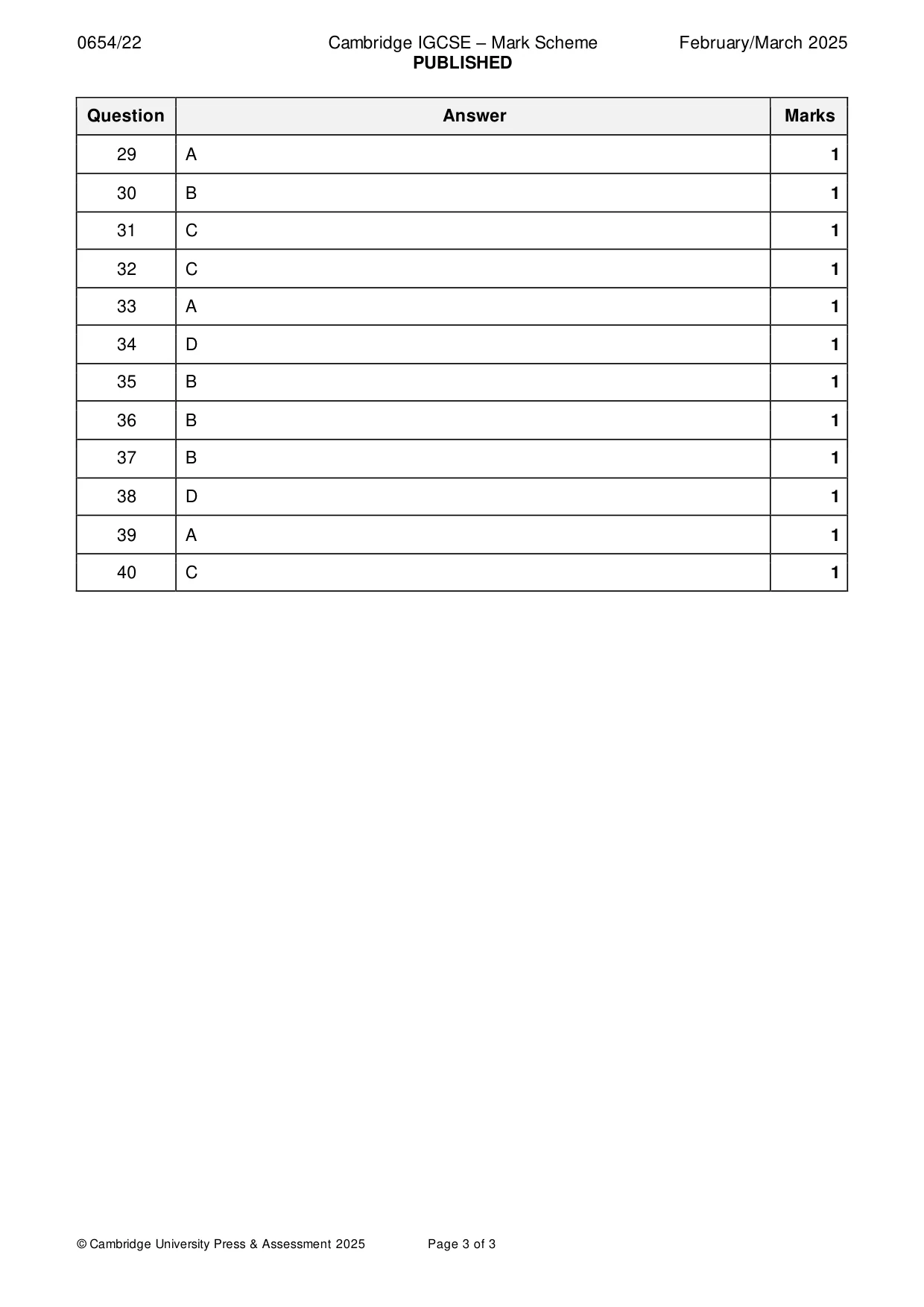
Answers below. Sit the paper first if you are practising.
Questions as text
Q1 · Which feature of a red blood cell allows it to transport oxygen?
1 Which feature of a red blood cell allows it to transport oxygen? A presence of haemoglobin B presence of a nucleus C small surface area to volume ratio D spherical shape
Mark scheme: A
Q2 · A salmon is a fish that can live in both fresh and salt water
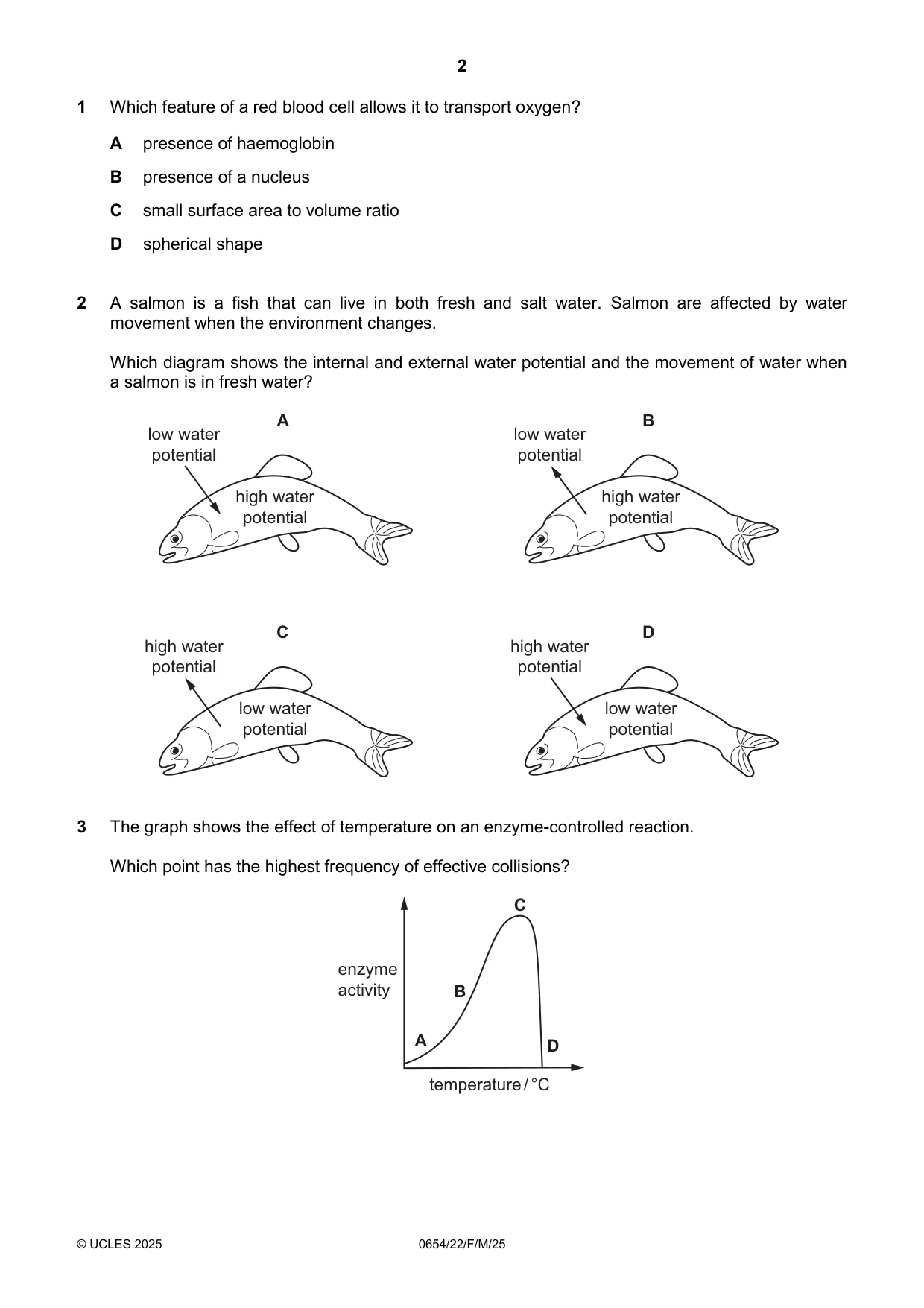
2 A salmon is a fish that can live in both fresh and salt water. Salmon are affected by water movement when the environment changes. Which diagram shows the internal and external water potential and the movement of water when a salmon is in fresh water? A B low water low water potential potential high water high water potential potential C D high water high water potential potential low water low water potential potential
Mark scheme: D
Q3 · The graph shows the effect of temperature on an enzyme-controlled reaction
3 The graph shows the effect of temperature on an enzyme-controlled reaction. Which point has the highest frequency of effective collisions? C enzyme activity B A D temperature / °C
Mark scheme: C
Q4 · Plants do not grow well when they are deficient in magnesium ions
4 Plants do not grow well when they are deficient in magnesium ions. What is the reason for this? A increased water uptake from the soil B not able to synthesise proteins from carbohydrates C reduced diffusion of carbon dioxide into the leaf D reduced production of chlorophyll
Mark scheme: D
Q5 · What is a definition of translocation?
5 What is a definition of translocation? A the movement of amino acids and sucrose in phloem B the movement of amino acids and sucrose in xylem C the movement of glucose and amino acids in phloem D the movement of glucose and amino acids in xylem
Mark scheme: A
Q6 · The diagram shows a section through the human heart
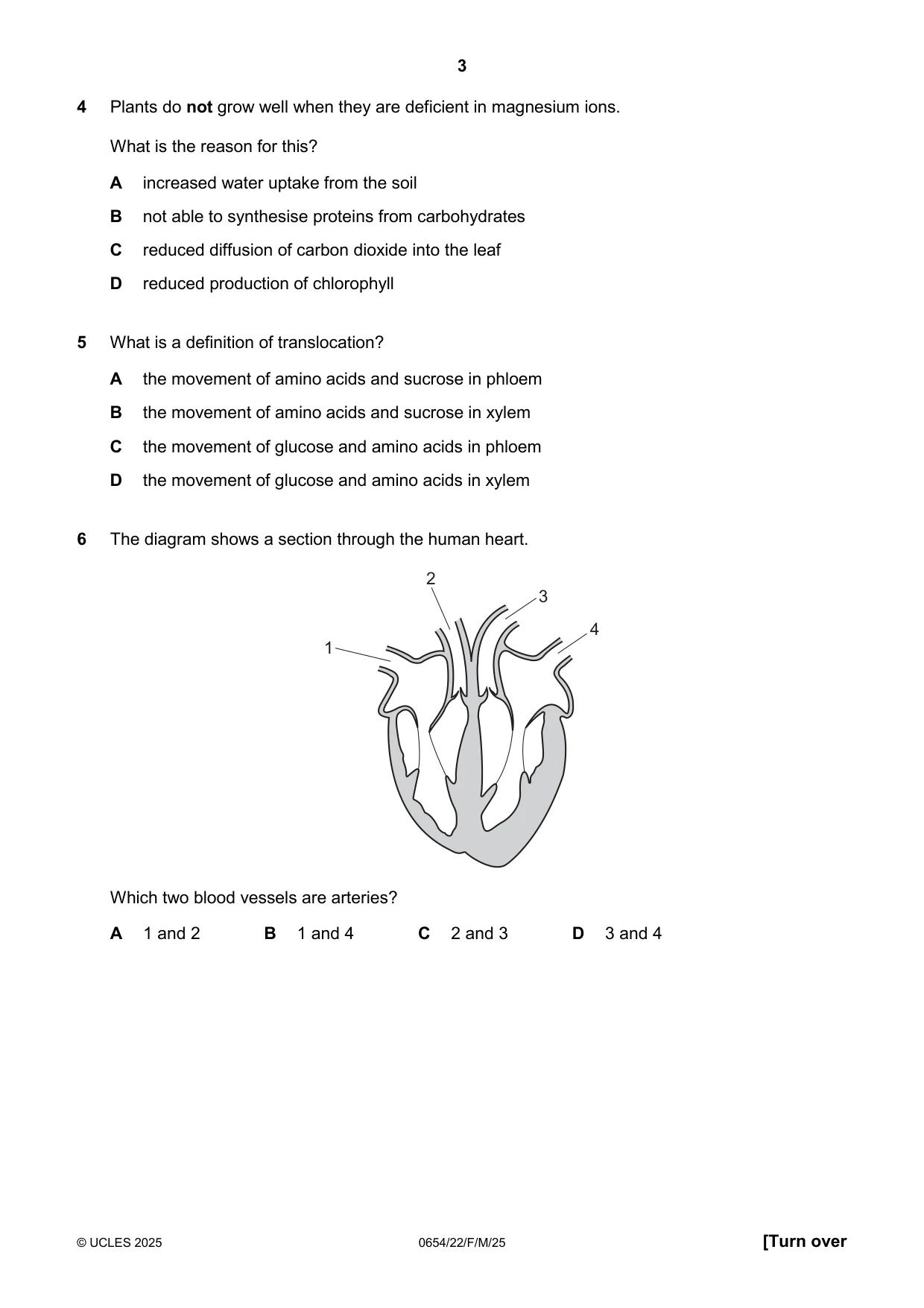
6 The diagram shows a section through the human heart. 2 3 4 1 Which two blood vessels are arteries? A 1 and 2 B 1 and 4 C 2 and 3 D 3 and 4
Mark scheme: C
Q7 · An athlete runs as fast as possible
7 An athlete runs as fast as possible. After 200 m, the athlete cannot continue and is breathing deeply. What accumulated in the athlete’s muscles? A alcohol B carbon dioxide C lactic acid D water
Mark scheme: C
Q8 · Which row names a hormone, the organ that produces it and the hormone’s effect on blood…
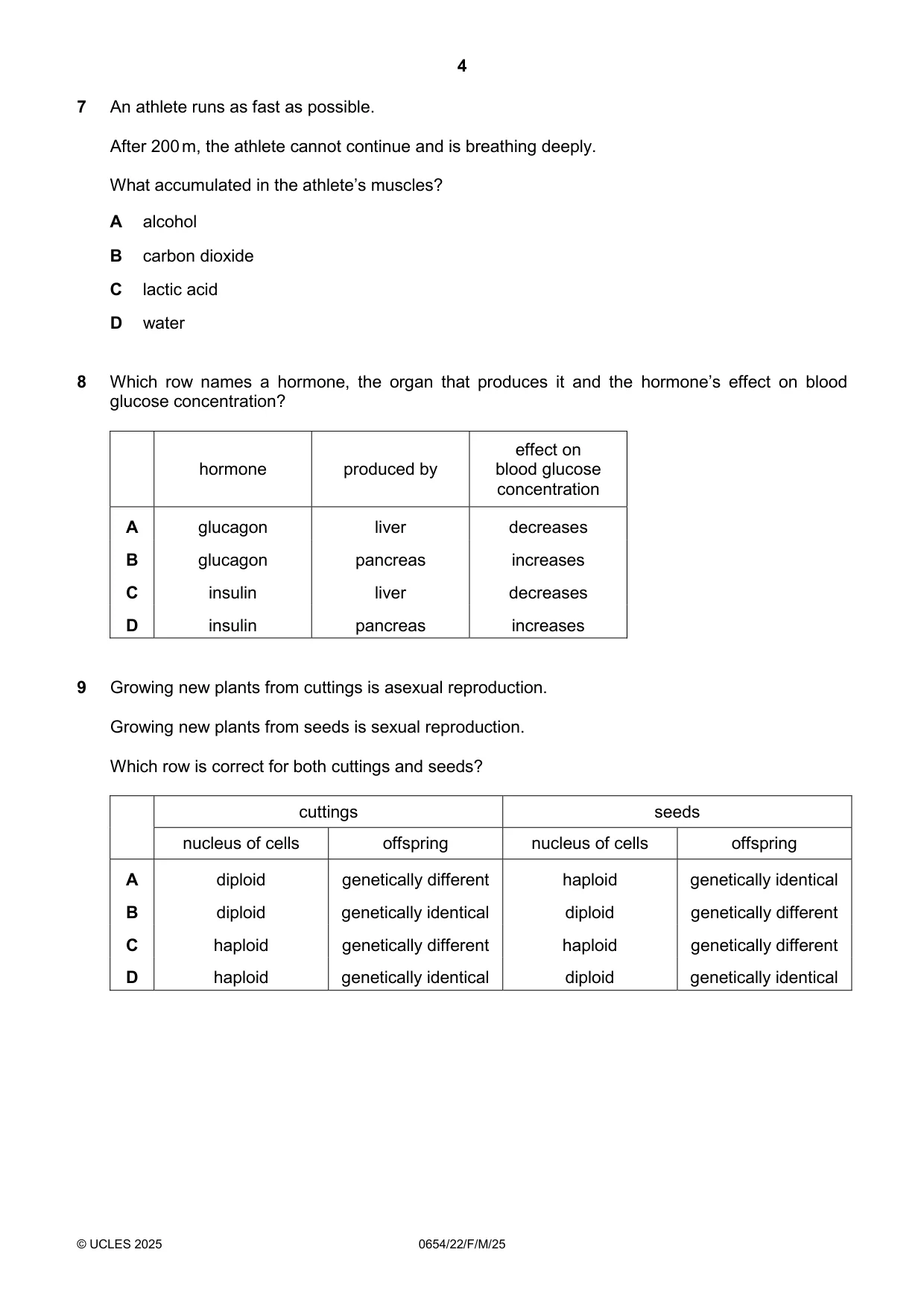
8 Which row names a hormone, the organ that produces it and the hormone’s effect on blood glucose concentration? effect on hormone produced by blood glucose concentration A glucagon liver decreases B glucagon pancreas increases C insulin liver decreases D insulin pancreas increases
Mark scheme: B
Q9 · Growing new plants from cuttings is asexual reproduction
9 Growing new plants from cuttings is asexual reproduction. Growing new plants from seeds is sexual reproduction. Which row is correct for both cuttings and seeds? cuttings seeds nucleus of cells offspring nucleus of cells offspring A diploid genetically different haploid genetically identical B diploid genetically identical diploid genetically different C haploid genetically different haploid genetically different D haploid genetically identical diploid genetically identical
Mark scheme: B
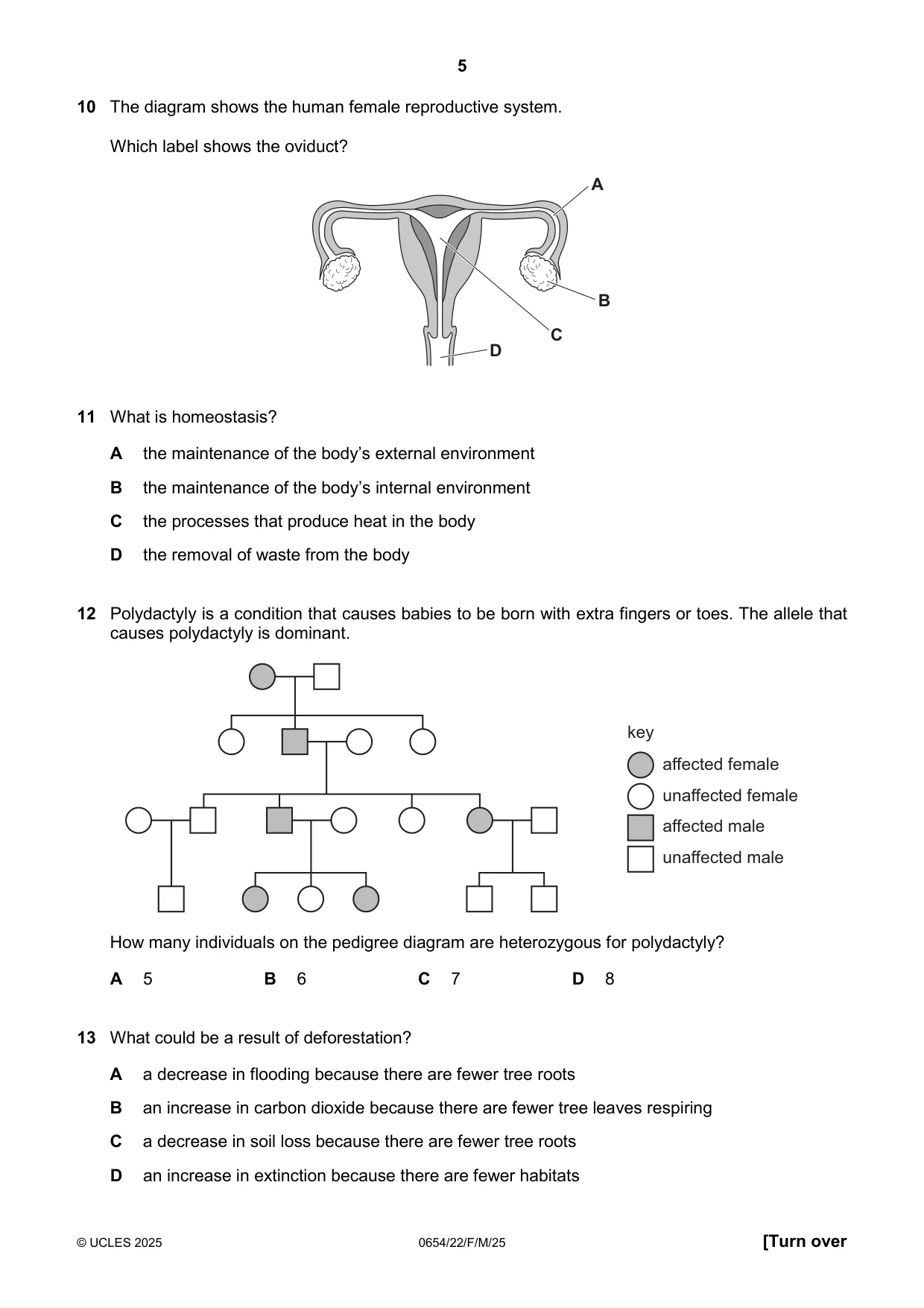
Q10 · The diagram shows the human female reproductive system
10 The diagram shows the human female reproductive system. Which label shows the oviduct? A B C D
Mark scheme: A
Question 11
11 What is homeostasis? A the maintenance of the body’s external environment B the maintenance of the body’s internal environment C the processes that produce heat in the body D the removal of waste from the body
Mark scheme: B
Q12 · Polydactyly is a condition that causes babies to be born with extra fingers or toes
12 Polydactyly is a condition that causes babies to be born with extra fingers or toes. The allele that causes polydactyly is dominant. key affected female unaffected female affected male unaffected male How many individuals on the pedigree diagram are heterozygous for polydactyly? A 5 B 6 C 7 D 8
Mark scheme: B
Q13 · What could be a result of deforestation?
13 What could be a result of deforestation? A a decrease in flooding because there are fewer tree roots B an increase in carbon dioxide because there are fewer tree leaves respiring C a decrease in soil loss because there are fewer tree roots D an increase in extinction because there are fewer habitats
Mark scheme: D
Q14 · Which row compares the rates of diffusion of fluorine and hydrogen?
14 Which row compares the rates of diffusion of fluorine and hydrogen? diffuses faster reason A fluorine higher molecular mass B fluorine lower molecular mass C hydrogen lower molecular mass D hydrogen higher molecular mass
Mark scheme: C
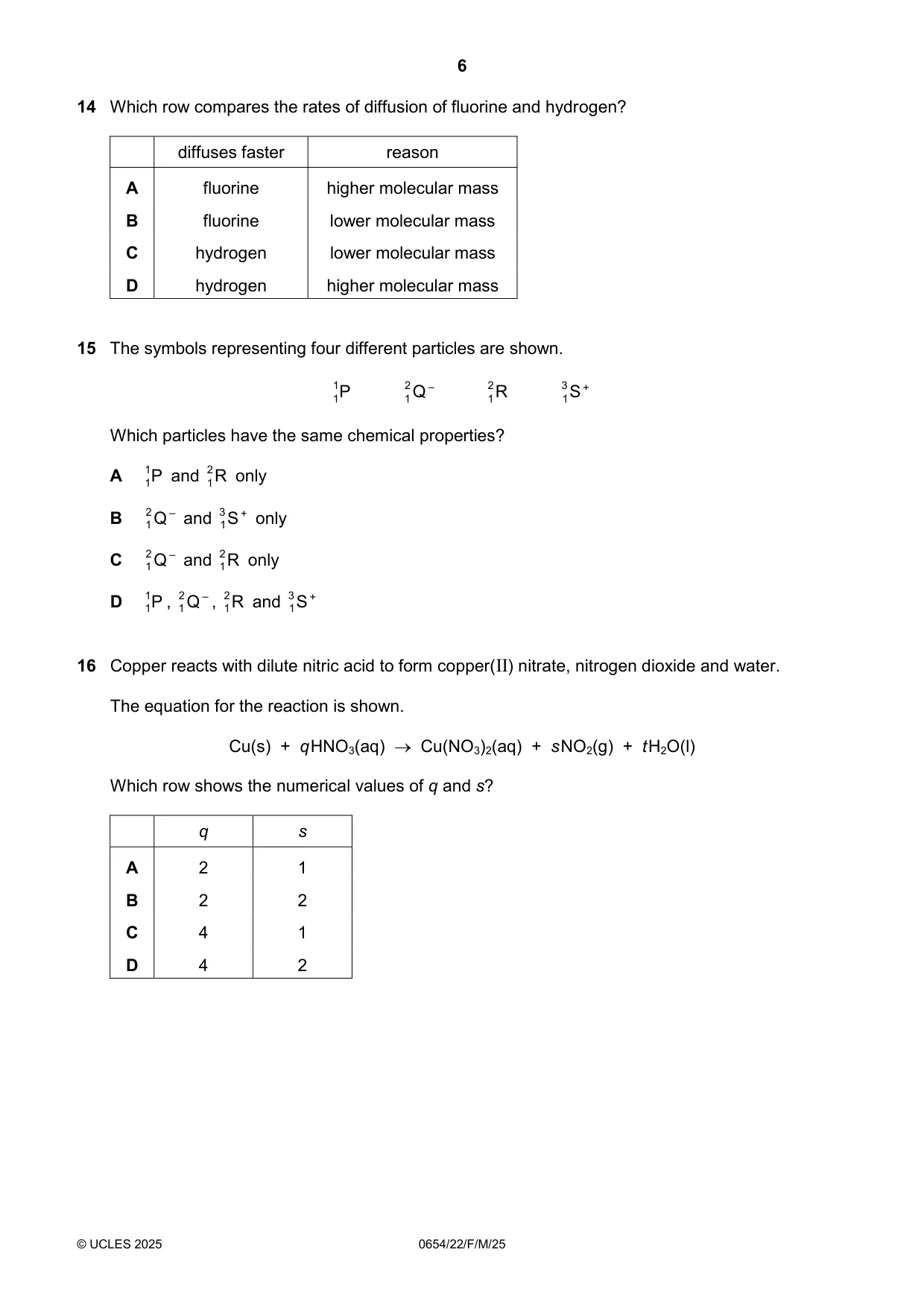
Q15 · The symbols representing four different particles are shown
15 The symbols representing four different particles are shown. 1 P 1Q R 2 – 2 3 1S + 1 1 Which particles have the same chemical properties? A 1 P and R 2 only 1 1 B 1Q and 2 – 3 1S only + C 1Q and R 2 – 2 only 1 D 1 P , 1Q , R 2 – 2 and 3 1S + 1 1
Mark scheme: A
Q16 · Copper reacts with dilute nitric acid to form copper(II) nitrate, nitrogen dioxide and…
16 Copper reacts with dilute nitric acid to form copper(II) nitrate, nitrogen dioxide and water. The equation for the reaction is shown. Cu(s) + q HNO3(aq) Cu(NO3)2(aq) + s NO2(g) + t H2O(l) Which row shows the numerical values of q and s? q s A 2 1 B 2 2 C 4 1 D 4 2
Mark scheme: D
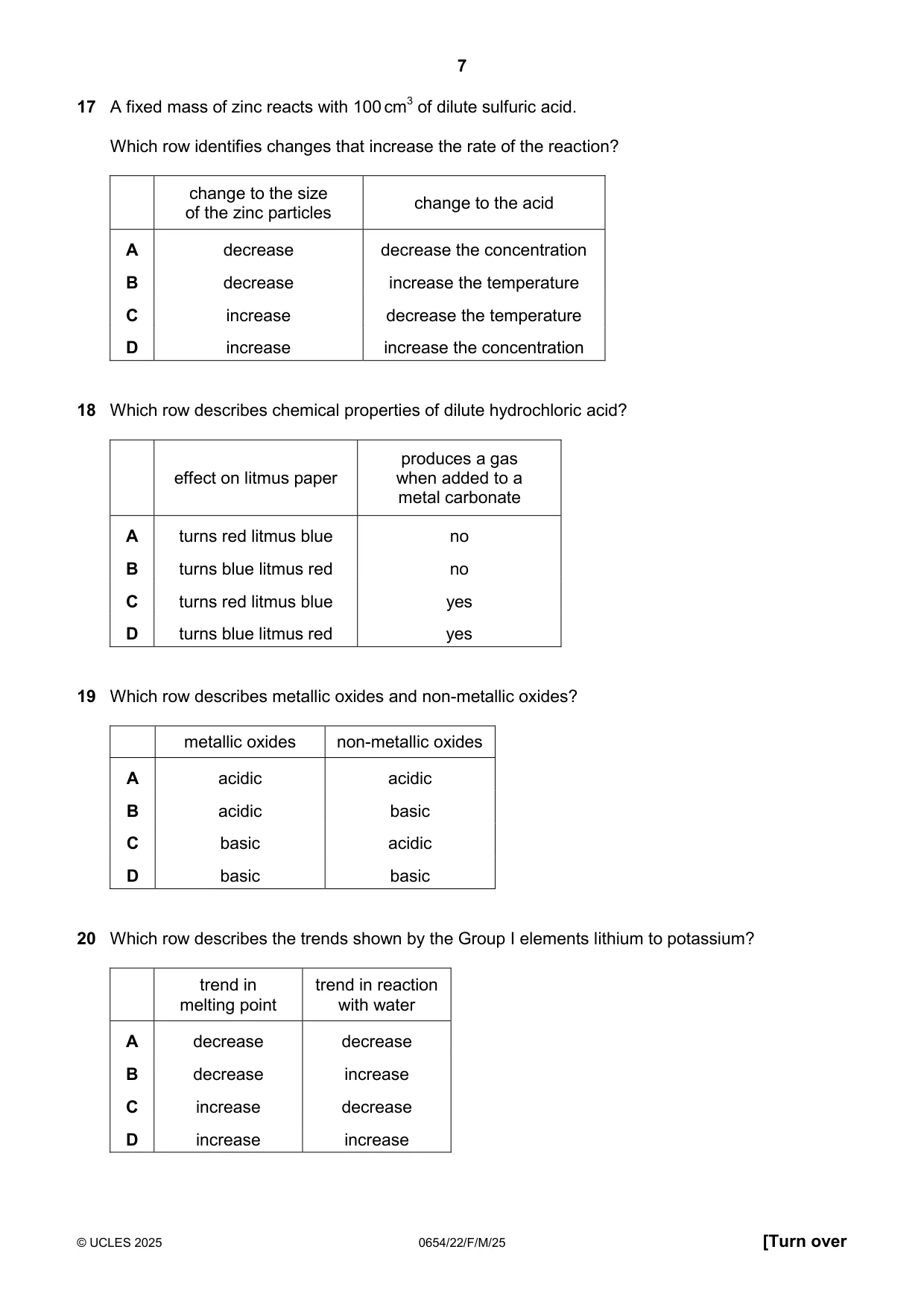
Q17 · A fixed mass of zinc reacts with 100 cm3 of dilute sulfuric acid
17 A fixed mass of zinc reacts with 100 cm3 of dilute sulfuric acid. Which row identifies changes that increase the rate of the reaction? change to the size change to the acid of the zinc particles A decrease decrease the concentration B decrease increase the temperature C increase decrease the temperature D increase increase the concentration
Mark scheme: B
Q18 · Which row describes chemical properties of dilute hydrochloric acid?
18 Which row describes chemical properties of dilute hydrochloric acid? produces a gas effect on litmus paper when added to a metal carbonate A turns red litmus blue no B turns blue litmus red no C turns red litmus blue yes D turns blue litmus red yes
Mark scheme: D
More questions on The characteristic properties of acids and bases
Q19 · Which row describes metallic oxides and non-metallic oxides?
19 Which row describes metallic oxides and non-metallic oxides? metallic oxides non-metallic oxides A acidic acidic B acidic basic C basic acidic D basic basic
Mark scheme: C
Q20 · Which row describes the trends shown by the Group I elements lithium to potassium?
20 Which row describes the trends shown by the Group I elements lithium to potassium? trend in trend in reaction melting point with water A decrease decrease B decrease increase C increase decrease D increase increase
Mark scheme: B
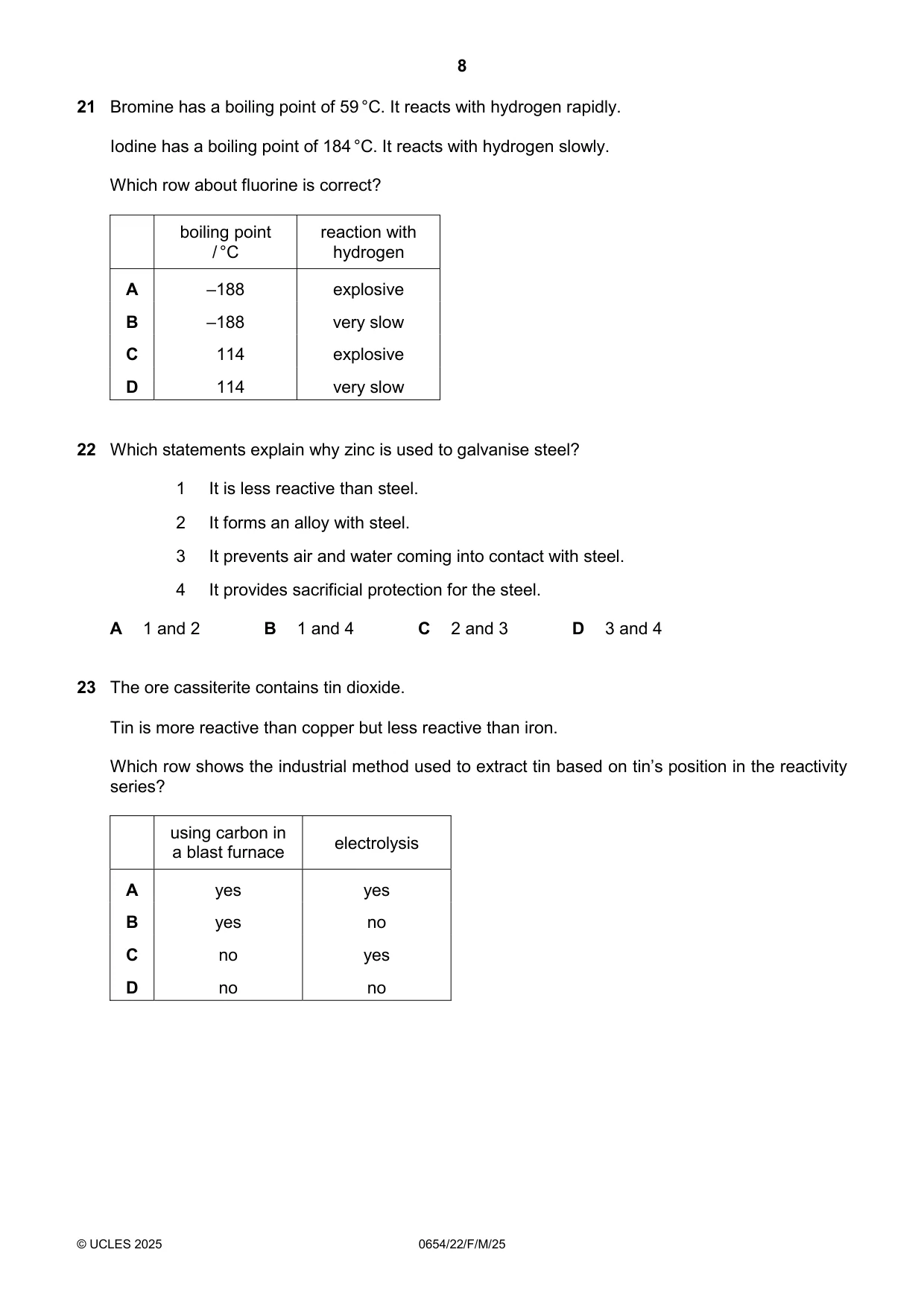
Q21 · Bromine has a boiling point of 59 °C
21 Bromine has a boiling point of 59 °C. It reacts with hydrogen rapidly. Iodine has a boiling point of 184 °C. It reacts with hydrogen slowly. Which row about fluorine is correct? boiling point reaction with / °C hydrogen A –188 explosive B –188 very slow C 114 explosive D 114 very slow
Mark scheme: A
Q22 · Which statements explain why zinc is used to galvanise steel?
22 Which statements explain why zinc is used to galvanise steel? 1 It is less reactive than steel. 2 It forms an alloy with steel. 3 It prevents air and water coming into contact with steel. 4 It provides sacrificial protection for the steel. A 1 and 2 B 1 and 4 C 2 and 3 D 3 and 4
Mark scheme: D
Q23 · The ore cassiterite contains tin dioxide
23 The ore cassiterite contains tin dioxide. Tin is more reactive than copper but less reactive than iron. Which row shows the industrial method used to extract tin based on tin’s position in the reactivity series? using carbon in electrolysis a blast furnace A yes yes B yes no C no yes D no no
Mark scheme: B
Q24 · Which statements about global warming are correct?
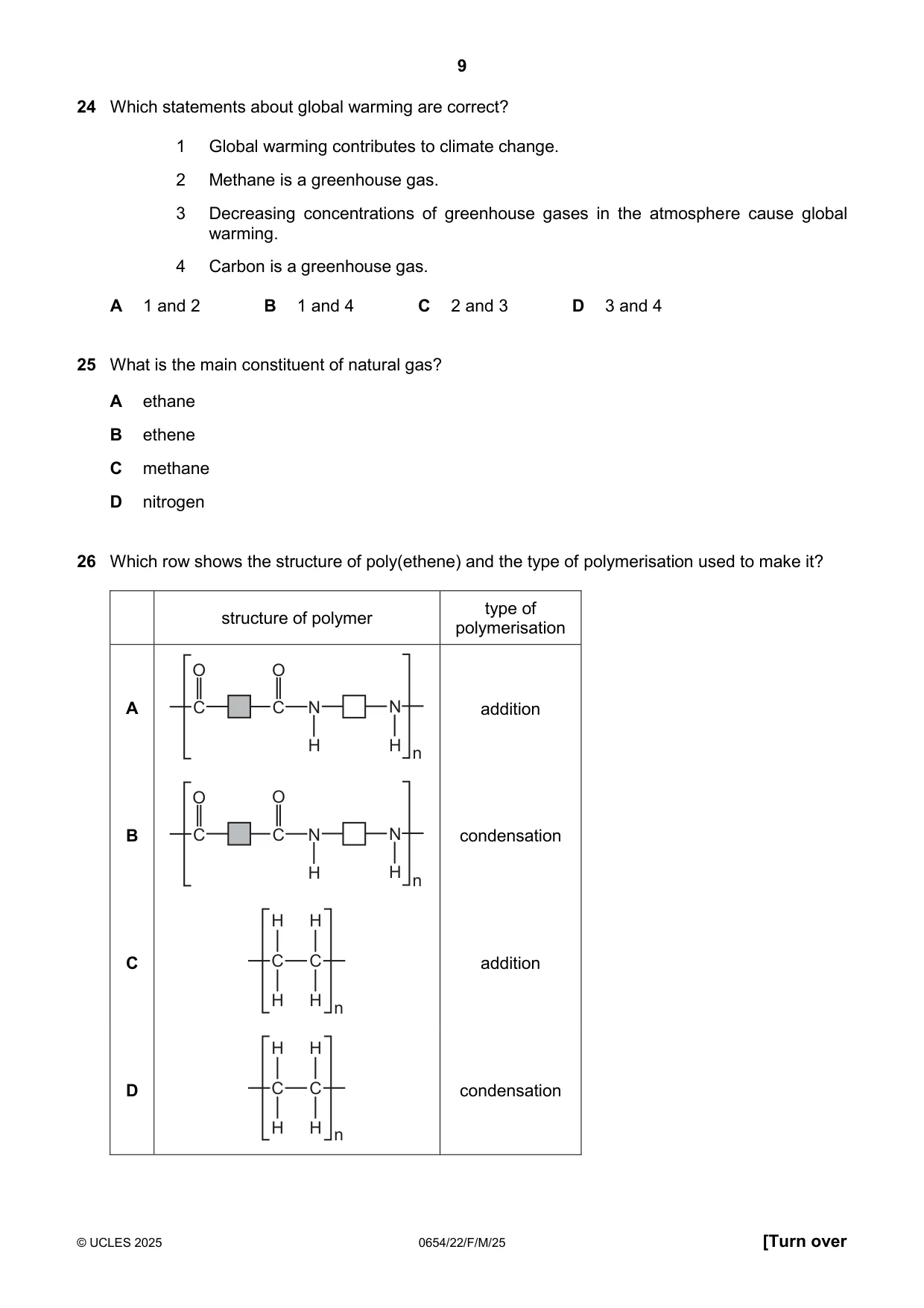
24 Which statements about global warming are correct? 1 Global warming contributes to climate change. 2 Methane is a greenhouse gas. 3 Decreasing concentrations of greenhouse gases in the atmosphere cause global warming. 4 Carbon is a greenhouse gas. A 1 and 2 B 1 and 4 C 2 and 3 D 3 and 4
Mark scheme: A
Q25 · What is the main constituent of natural gas?
25 What is the main constituent of natural gas? A ethane B ethene C methane D nitrogen
Mark scheme: C
Q26 · Which row shows the structure of poly(ethene) and the type of polymerisation used to make…
26 Which row shows the structure of poly(ethene) and the type of polymerisation used to make it? type of structure of polymer polymerisation O O A C C N N addition H H n O O B C C N N condensation H H n H H C C C addition H H n H H D C C condensation H H n
Mark scheme: C
Q27 · The chromatogram of four different inks is shown
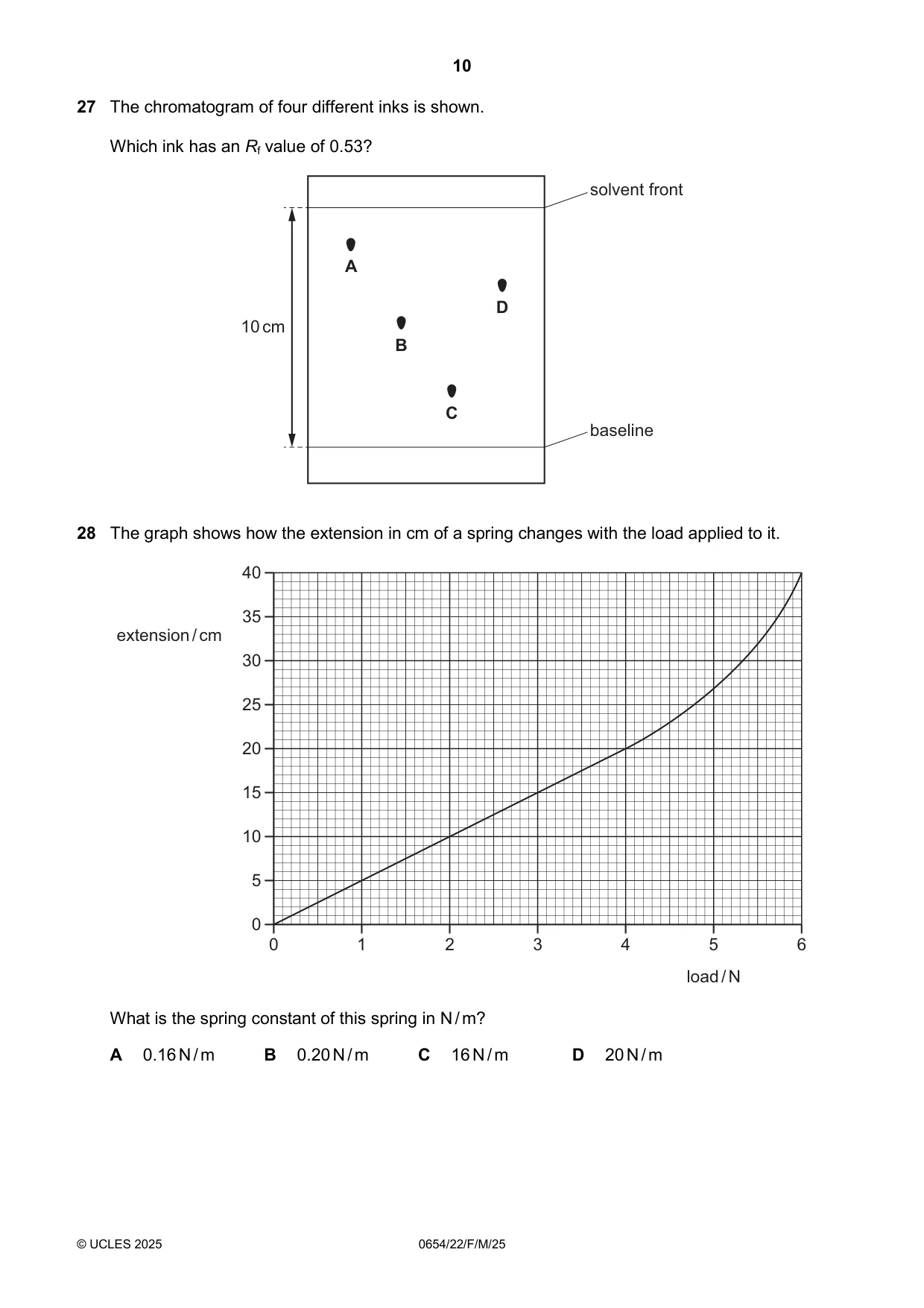
27 The chromatogram of four different inks is shown. Which ink has an Rf value of 0.53? solvent front A D 10 cm B C baseline
Mark scheme: B
Q28 · The graph shows how the extension in cm of a spring changes with the load applied to it
28 The graph shows how the extension in cm of a spring changes with the load applied to it. 40 35 extension / cm 30 25 20 15 10 5 0 0 1 2 3 4 5 6 load / N What is the spring constant of this spring in N / m? A 0.16 N / m B 0.20 N / m C 16 N / m D 20 N / m
Mark scheme: D
Q29 · The diagrams show uniform metre rulers each pivoted at the 50 cm mark
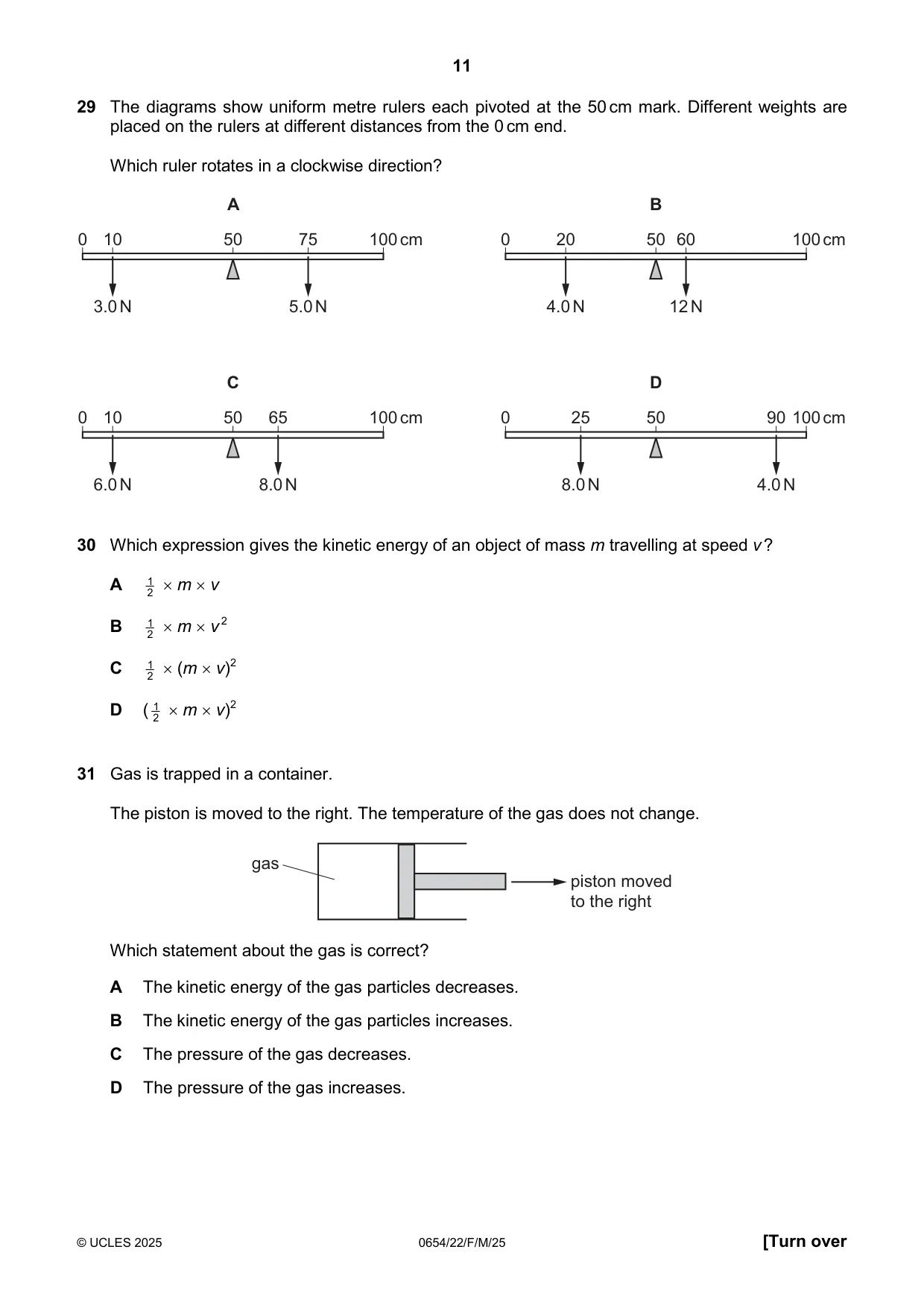
29 The diagrams show uniform metre rulers each pivoted at the 50 cm mark. Different weights are placed on the rulers at different distances from the 0 cm end. Which ruler rotates in a clockwise direction? A B 0 10 50 75 100 cm 0 20 50 60 100 cm 3.0 N 5.0 N 4.0 N 12 N C D 0 10 50 65 100 cm 0 25 50 90 100 cm 6.0 N 8.0 N 8.0 N 4.0 N
Mark scheme: A
Q30 · Which expression gives the kinetic energy of an object of mass m travelling at speed v ?
30 Which expression gives the kinetic energy of an object of mass m travelling at speed v ? A 1 m v 2 B 1 m v 2 2 C 1 (m v)2 2 D ( 2 1 m v)2
Mark scheme: B
Q31 · Gas is trapped in a container
31 Gas is trapped in a container. The piston is moved to the right. The temperature of the gas does not change. gas piston moved to the right Which statement about the gas is correct? A The kinetic energy of the gas particles decreases. B The kinetic energy of the gas particles increases. C The pressure of the gas decreases. D The pressure of the gas increases.
Mark scheme: C
Q32 · Which method of thermal energy transfer occurs in a vacuum and which region of the…
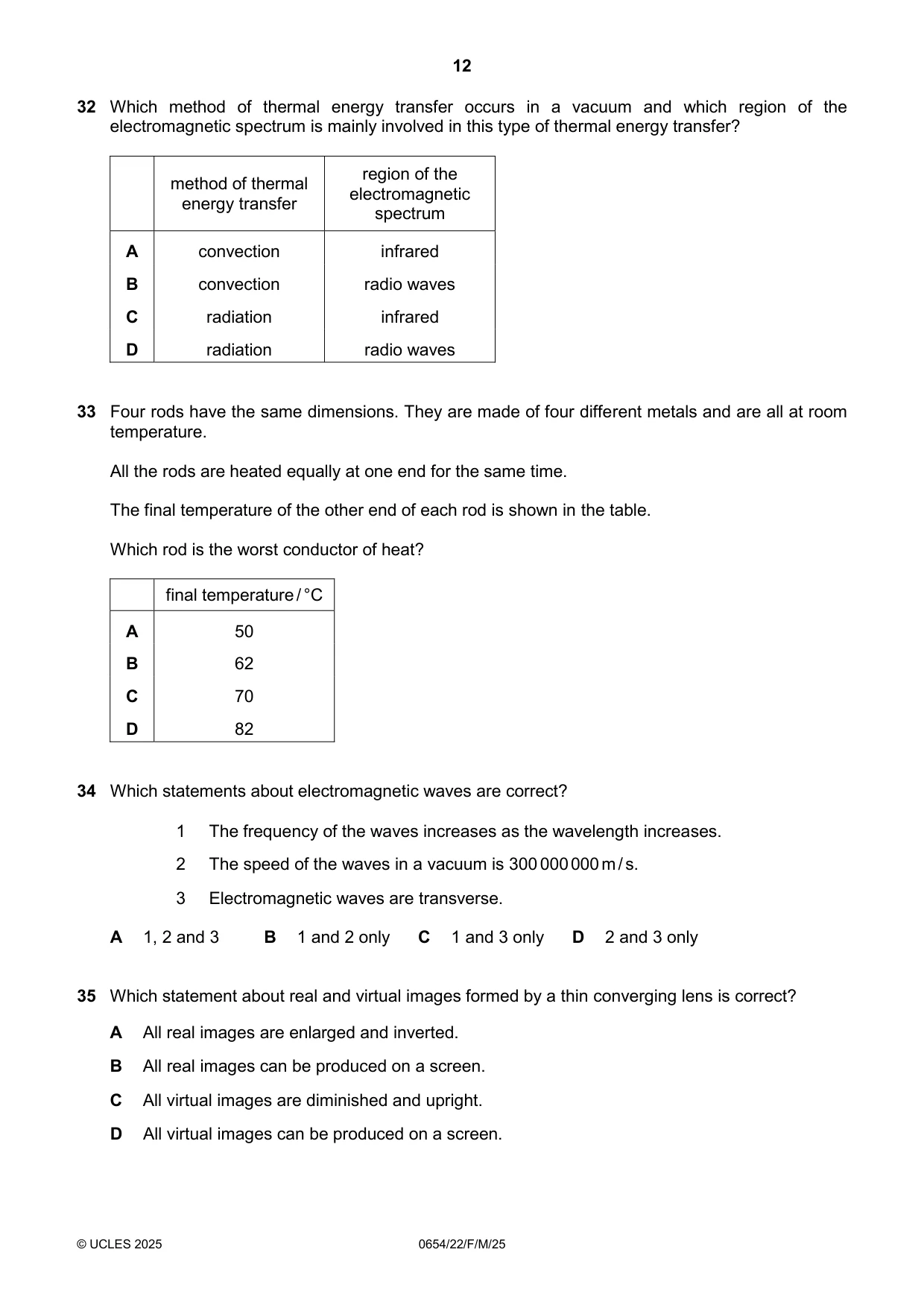
32 Which method of thermal energy transfer occurs in a vacuum and which region of the electromagnetic spectrum is mainly involved in this type of thermal energy transfer? region of the method of thermal electromagnetic energy transfer spectrum A convection infrared B convection radio waves C radiation infrared D radiation radio waves
Mark scheme: C
Q33 · Four rods have the same dimensions
33 Four rods have the same dimensions. They are made of four different metals and are all at room temperature. All the rods are heated equally at one end for the same time. The final temperature of the other end of each rod is shown in the table. Which rod is the worst conductor of heat? final temperature / °C A 50 B 62 C 70 D 82
Mark scheme: A
Q34 · Which statements about electromagnetic waves are correct?
34 Which statements about electromagnetic waves are correct? 1 The frequency of the waves increases as the wavelength increases. 2 The speed of the waves in a vacuum is 300 000 000 m / s. 3 Electromagnetic waves are transverse. A 1, 2 and 3 B 1 and 2 only C 1 and 3 only D 2 and 3 only
Mark scheme: D
Q35 · Which statement about real and virtual images formed by a thin converging lens is correct?
35 Which statement about real and virtual images formed by a thin converging lens is correct? A All real images are enlarged and inverted. B All real images can be produced on a screen. C All virtual images are diminished and upright. D All virtual images can be produced on a screen.
Mark scheme: B
Q36 · A guitar produces a loud sound with a low pitch
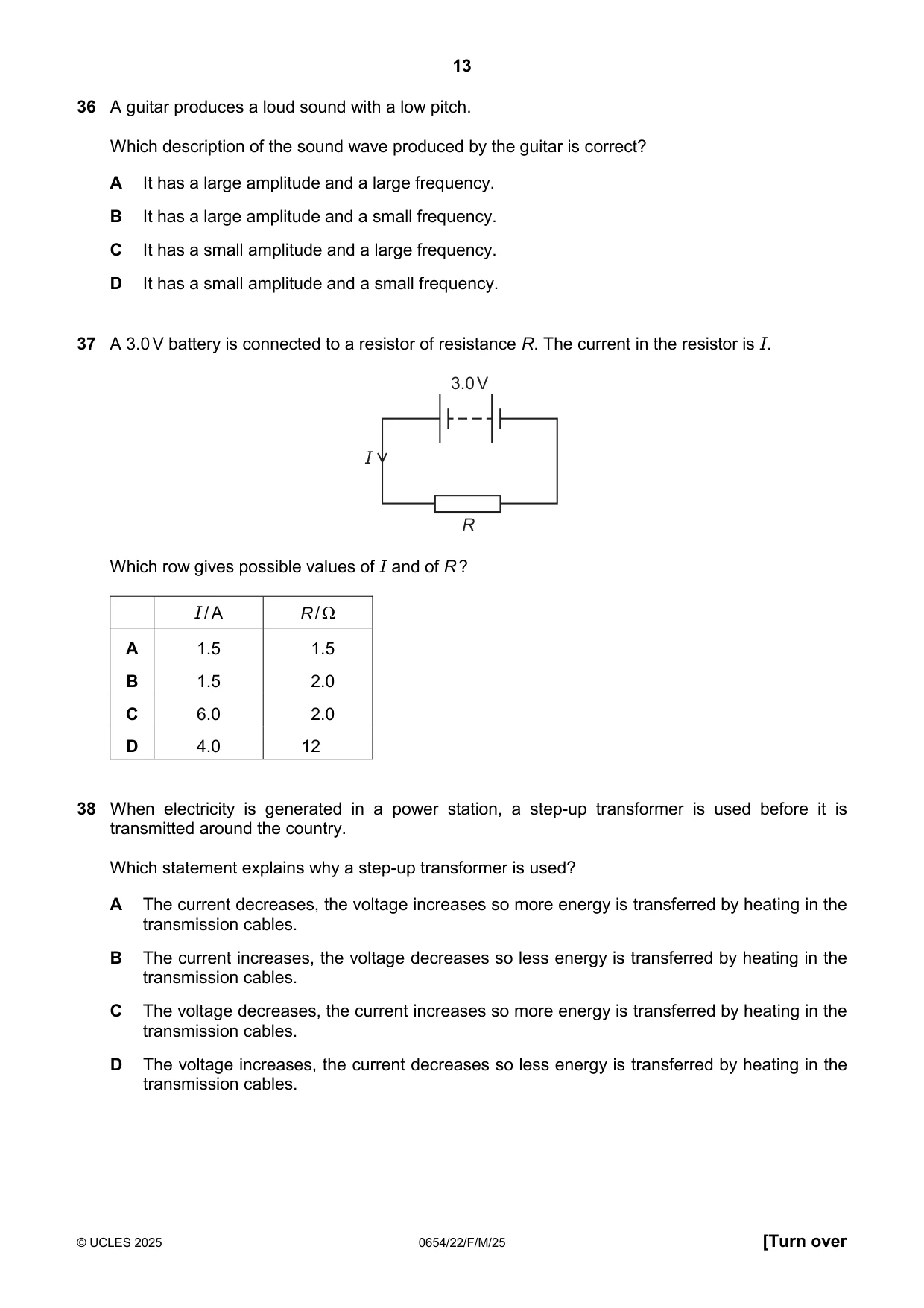
36 A guitar produces a loud sound with a low pitch. Which description of the sound wave produced by the guitar is correct? A It has a large amplitude and a large frequency. B It has a large amplitude and a small frequency. C It has a small amplitude and a large frequency. D It has a small amplitude and a small frequency.
Mark scheme: B
Q37 · A 3.0 V battery is connected to a resistor of resistance R
37 A 3.0 V battery is connected to a resistor of resistance R. The current in the resistor is I. 3.0 V I R Which row gives possible values of I and of R ? I / A R / A 1.5 1.5 B 1.5 2.0 C 6.0 2.0 D 4.0 12
Mark scheme: B
Q38 · When electricity is generated in a power station, a step-up transformer is used before it…
38 When electricity is generated in a power station, a step-up transformer is used before it is transmitted around the country. Which statement explains why a step-up transformer is used? A The current decreases, the voltage increases so more energy is transferred by heating in the transmission cables. B The current increases, the voltage decreases so less energy is transferred by heating in the transmission cables. C The voltage decreases, the current increases so more energy is transferred by heating in the transmission cables. D The voltage increases, the current decreases so less energy is transferred by heating in the transmission cables.
Mark scheme: D
Q39 · The isotope uranium-238 (U) decays by alpha emission to thorium (Th)
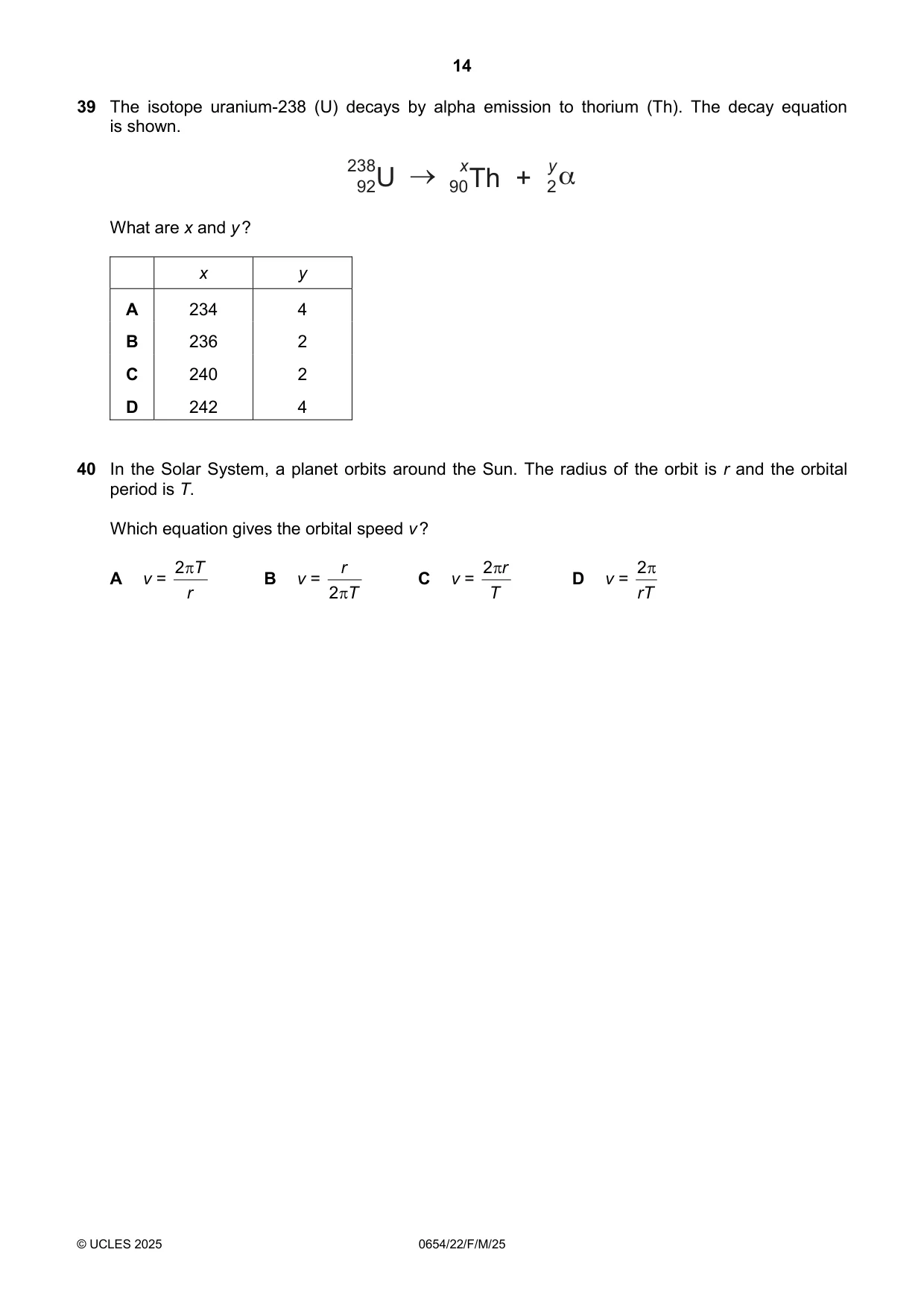
39 The isotope uranium-238 (U) decays by alpha emission to thorium (Th). The decay equation is shown. 238 92U x 2α y 90Th + What are x and y ? x y A 234 4 B 236 2 C 240 2 D 242 4
Mark scheme: A
Q40 · In the Solar System, a planet orbits around the Sun
40 In the Solar System, a planet orbits around the Sun. The radius of the orbit is r and the orbital period is T. Which equation gives the orbital speed v ? 2 T r 2 r 2 A v = B v = C v = D v = r 2 T T rT
Mark scheme: C
What was in this paper
The subtopics covered by these 40 questions, and how many questions each got. Open one in a new tab to see every Cambridge question on it.
2Transfer of thermal energy2Air quality and climate1Asexual reproduction1Blood1Chromatography1Corrosion of metals1Diffusion1Electrical quantities1Electromagnetic effects1Electromagnetic spectrum1Energy, work and power1Enzymes1Extraction of metals1Formulas1Fuels1Group I properties1Group VII properties1Habitat destruction1Heart1Homeostasis1Hormones1Isotopes1Kinetic particle model of matter1Light1Monohybrid inheritance1Osmosis1Oxides1Photosynthesis1Polymers1Radioactivity1Rate of reaction1Respiration1Sexual reproduction in humans1Sound1The characteristic properties of acids and bases1The Solar System1Translocation1What you needed in this session
Cambridge’s own grade thresholds for 2025 Feb/March, Paper 2 · Variant 2. A higher threshold means an easier paper — the bar moves with how the cohort did.