Cambridge IGCSE Sciences - Co-ordinated (Double) 0654 — 2018 Oct/Nov Paper 2 · Variant 1
0654/21/O/N/18 · 40 questions · 40 marks · ≈45 min
The question paper and its mark scheme, free to read here and free to download. This is Cambridge’s own paper, exactly as it was sat.
Question paper16 pages
Mark scheme3 pages
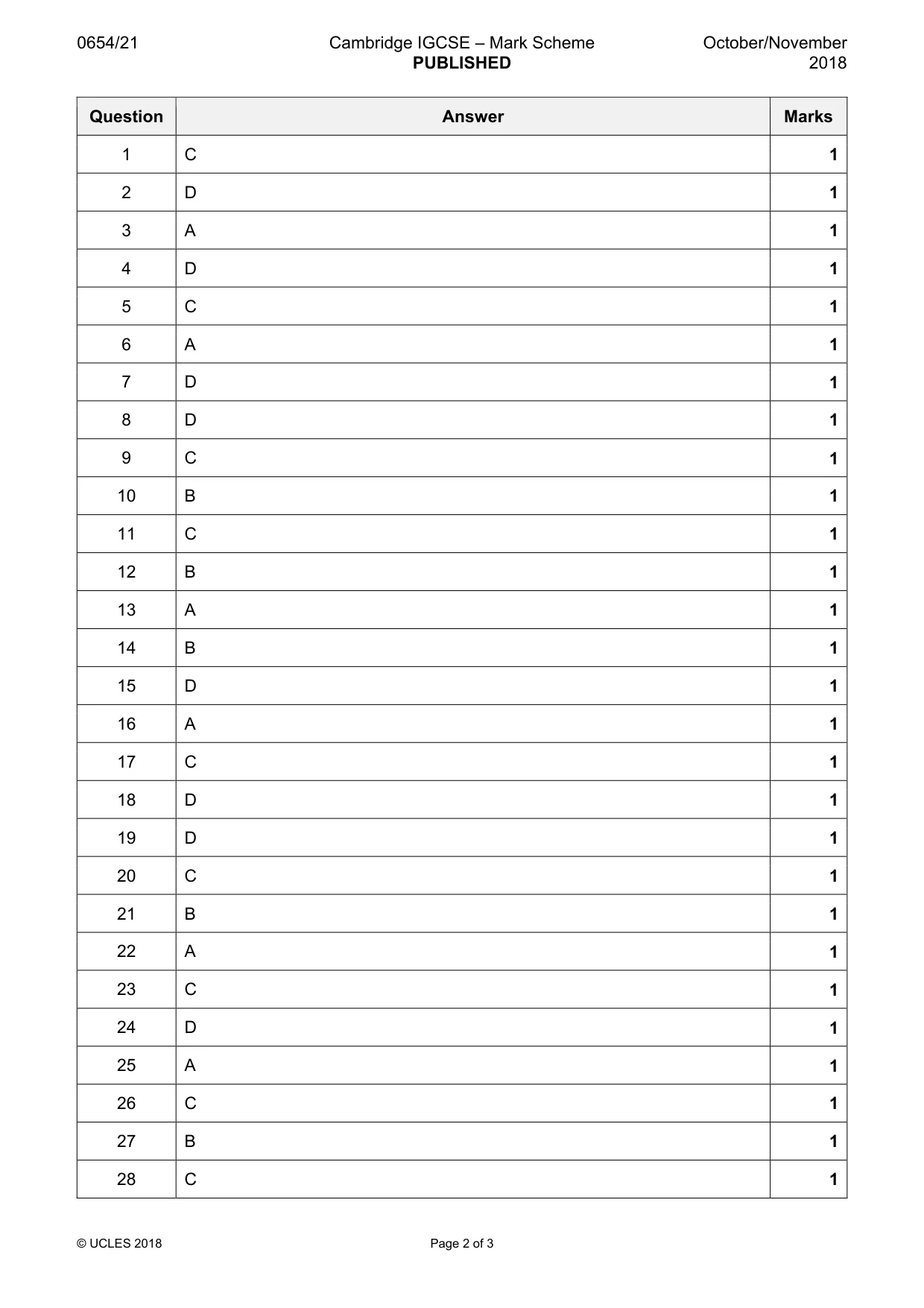
Answers below. Sit the paper first if you are practising.
Questions as text
Q1 · Which is a characteristic of all living things?
1 Which is a characteristic of all living things? A a heart B breathing C excretion D sexual reproduction
Mark scheme: C
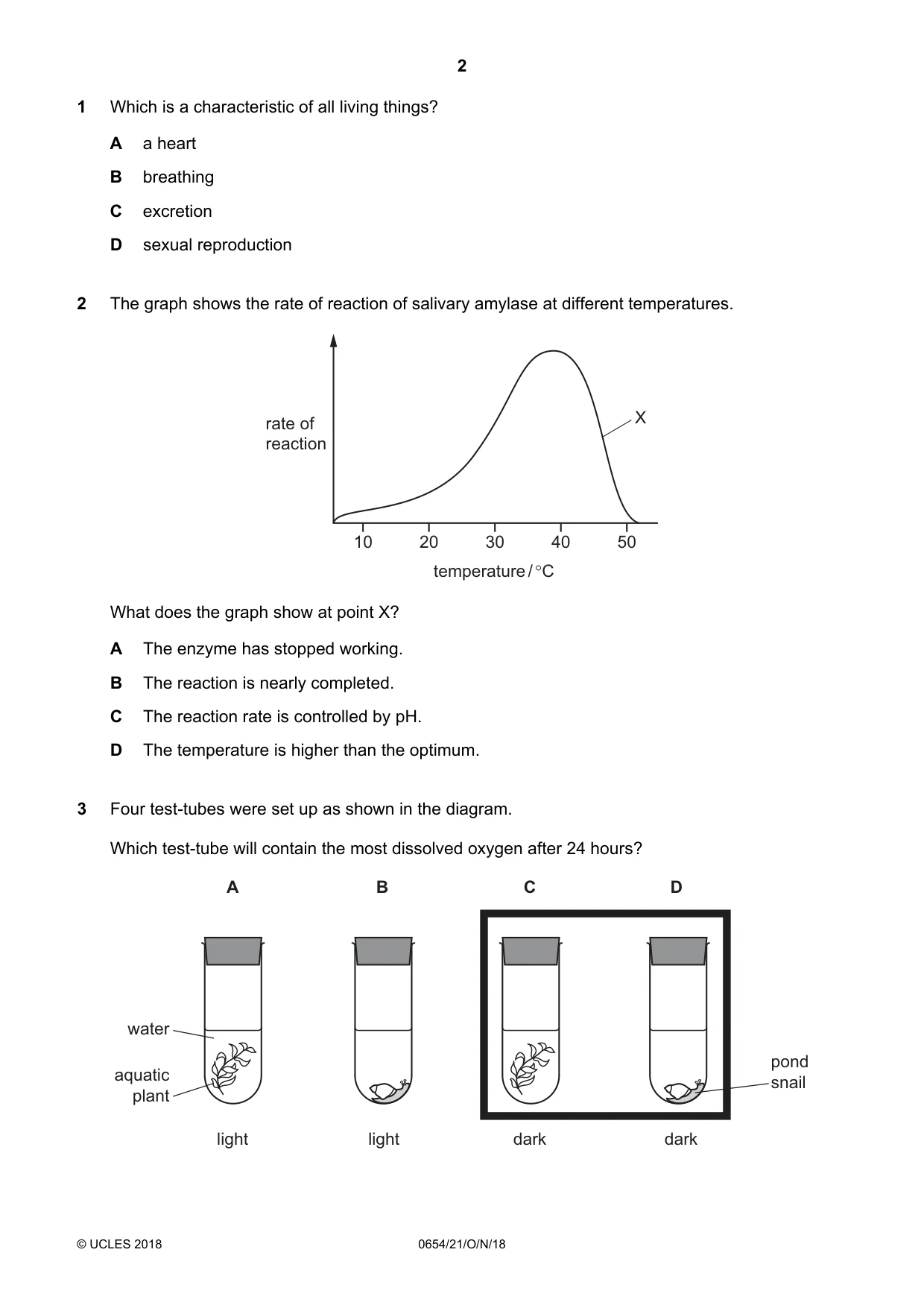
Q2 · The graph shows the rate of reaction of salivary amylase at different temperatures
2 The graph shows the rate of reaction of salivary amylase at different temperatures. rate of X reaction 10 20 30 40 50 temperature / °C What does the graph show at point X? A The enzyme has stopped working. B The reaction is nearly completed. C The reaction rate is controlled by pH. D The temperature is higher than the optimum.
Mark scheme: D
Q3 · Four test-tubes were set up as shown in the diagram
3 Four test-tubes were set up as shown in the diagram. Which test-tube will contain the most dissolved oxygen after 24 hours? A B C D water pond aquatic snail plant light light dark dark
Mark scheme: A
Q4 · Water is taken in through the roots and lost from the leaves of tall trees
4 Water is taken in through the roots and lost from the leaves of tall trees. What enables this to happen? A active transport by the xylem vessels B pressure from the roots C translocation in the phloem D transpiration loss from the leaves
Mark scheme: D
Q5 · The diagram shows a section through a red blood cell
5 The diagram shows a section through a red blood cell. How is the structure of the cell related to its function? A The cell has no nucleus to use up oxygen. B The cell membrane has a small surface area in relation to volume. C The cytoplasm contains haemoglobin. D The flat structure makes it easier to be carried through arteries.
Mark scheme: C
Q6 · Which word equation for anaerobic respiration in yeast is correct?
6 Which word equation for anaerobic respiration in yeast is correct? A glucose → carbon dioxide + alcohol B glucose → carbon dioxide + water C glucose → lactic acid + alcohol D glucose → lactic acid + water
Mark scheme: A
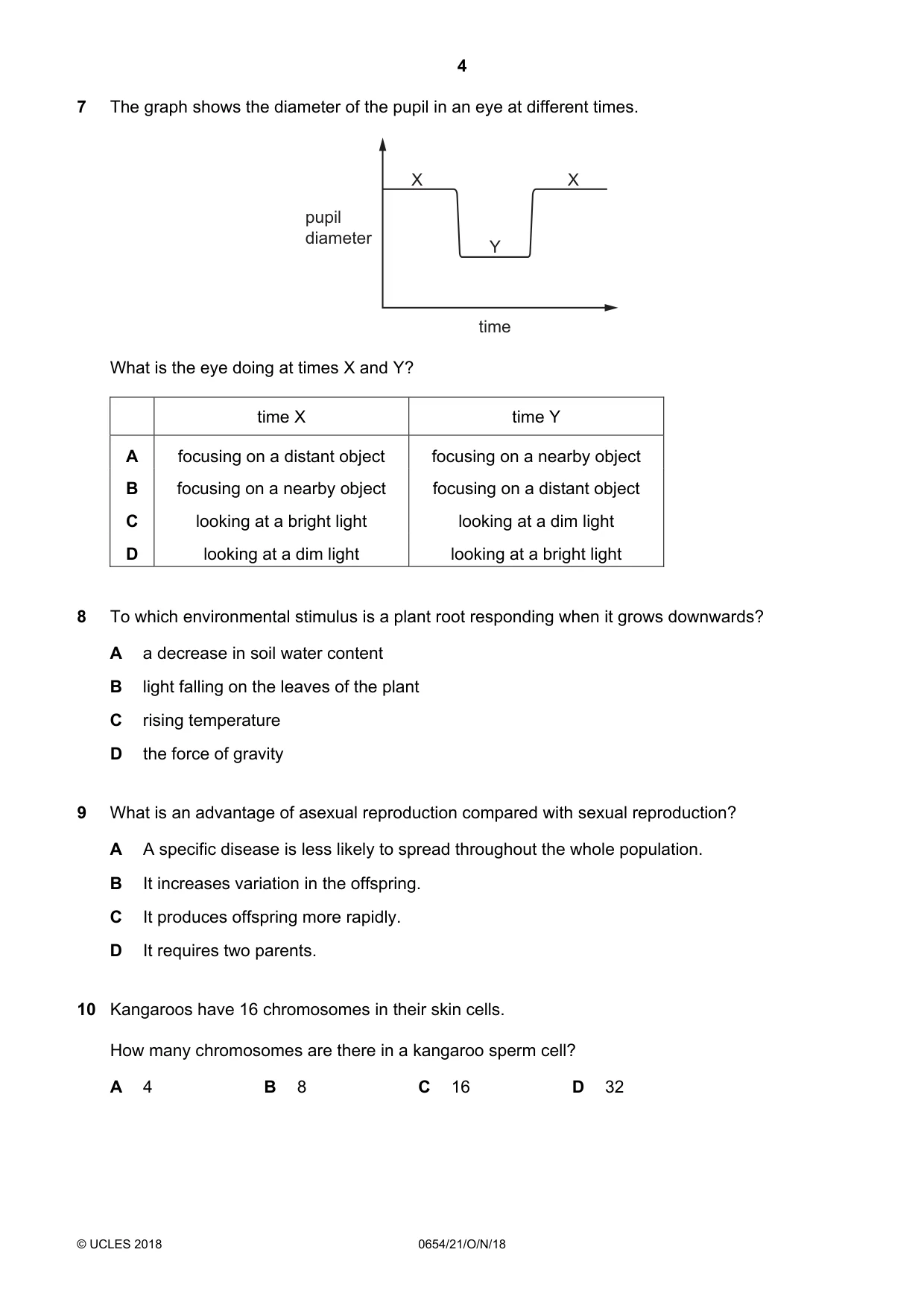
Q7 · The graph shows the diameter of the pupil in an eye at different times
7 The graph shows the diameter of the pupil in an eye at different times. X X pupil diameter Y time What is the eye doing at times X and Y? time X time Y A focusing on a distant object focusing on a nearby object B focusing on a nearby object focusing on a distant object C looking at a bright light looking at a dim light D looking at a dim light looking at a bright light
Mark scheme: D
Q8 · To which environmental stimulus is a plant root responding when it grows downwards?
8 To which environmental stimulus is a plant root responding when it grows downwards? A a decrease in soil water content B light falling on the leaves of the plant C rising temperature D the force of gravity
Mark scheme: D
Q9 · What is an advantage of asexual reproduction compared with sexual reproduction?
9 What is an advantage of asexual reproduction compared with sexual reproduction? A A specific disease is less likely to spread throughout the whole population. B It increases variation in the offspring. C It produces offspring more rapidly. D It requires two parents.
Mark scheme: C
Q10 · Kangaroos have 16 chromosomes in their skin cells
10 Kangaroos have 16 chromosomes in their skin cells. How many chromosomes are there in a kangaroo sperm cell? A 4 B 8 C 16 D 32
Mark scheme: B
Q11 · What contains only the information to produce a specific protein?
11 What contains only the information to produce a specific protein? A chromosome B cytoplasm C gene D nucleus
Mark scheme: C
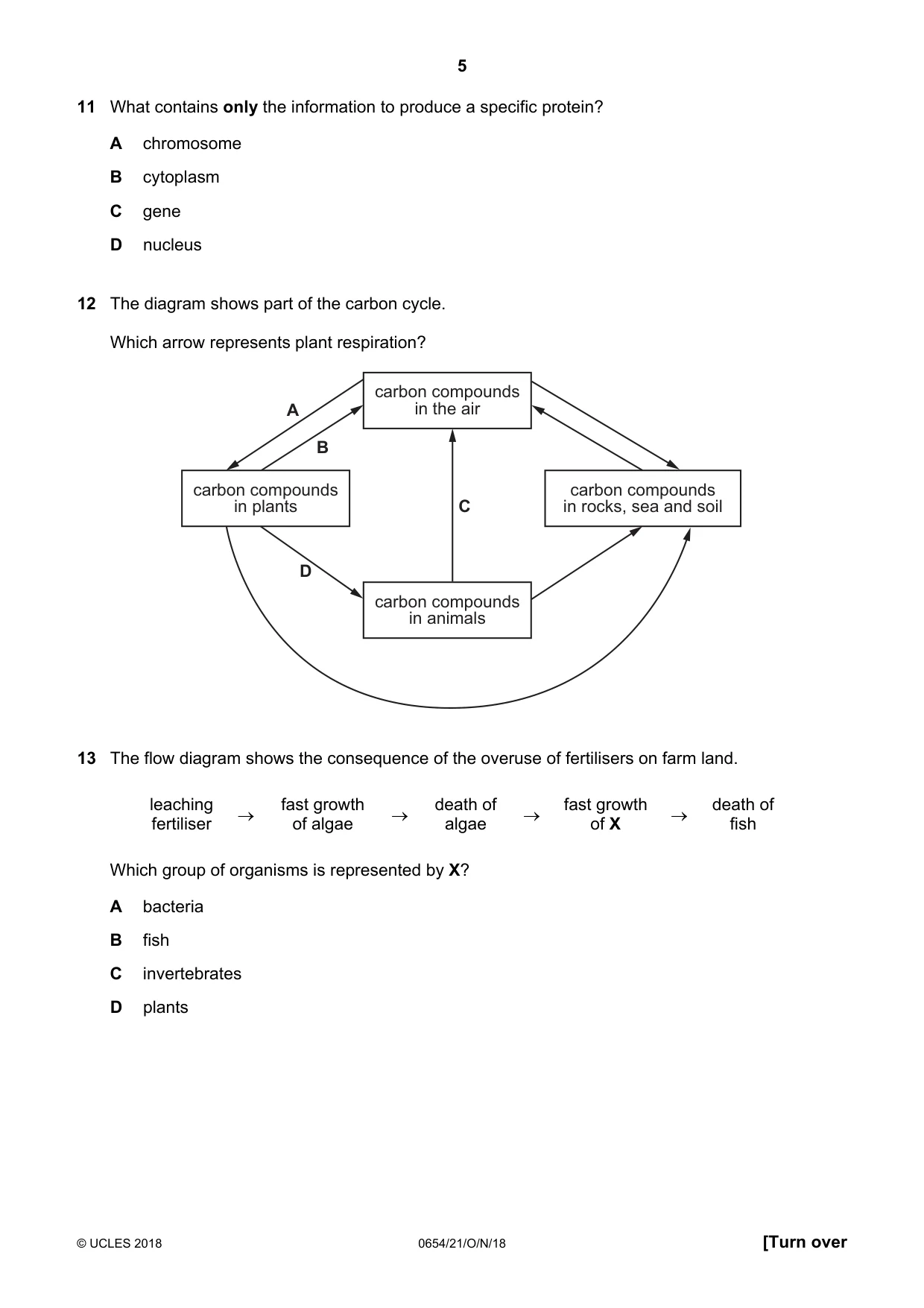
Q12 · The diagram shows part of the carbon cycle
12 The diagram shows part of the carbon cycle. Which arrow represents plant respiration? carbon compounds A in the air B carbon compounds carbon compounds in plants C in rocks, sea and soil D carbon compounds in animals
Mark scheme: B
Q13 · The flow diagram shows the consequence of the overuse of fertilisers on farm land
13 The flow diagram shows the consequence of the overuse of fertilisers on farm land. leaching fast growth death of fast growth death of → → → → fertiliser of algae algae of X fish Which group of organisms is represented by X? A bacteria B fish C invertebrates D plants
Mark scheme: A
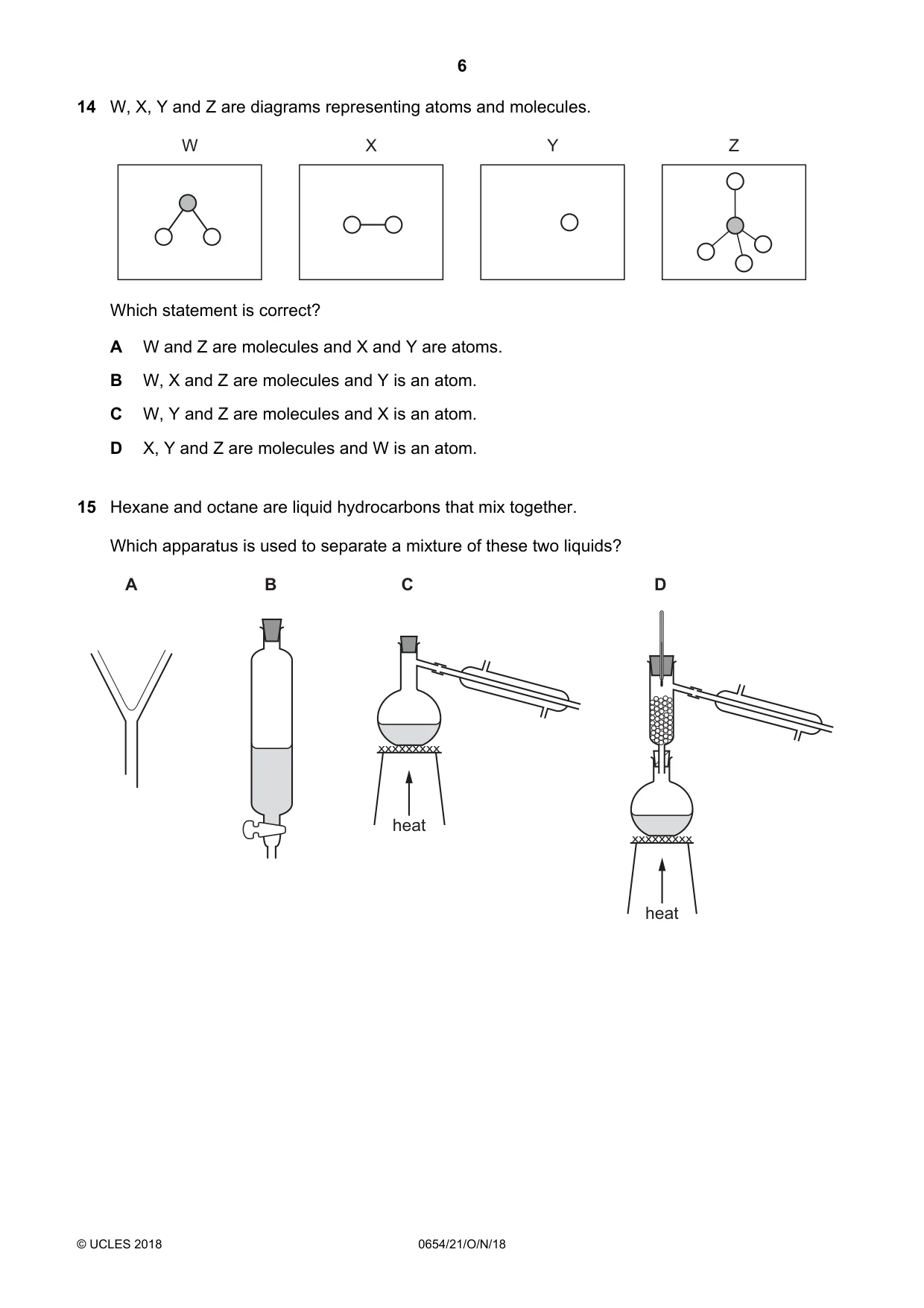
Q14 · W, X, Y and Z are diagrams representing atoms and molecules
14 W, X, Y and Z are diagrams representing atoms and molecules. W X Y Z Which statement is correct? A W and Z are molecules and X and Y are atoms. B W, X and Z are molecules and Y is an atom. C W, Y and Z are molecules and X is an atom. D X, Y and Z are molecules and W is an atom.
Mark scheme: B
Q15 · Hexane and octane are liquid hydrocarbons that mix together
15 Hexane and octane are liquid hydrocarbons that mix together. Which apparatus is used to separate a mixture of these two liquids? A B C D xxxxxxxxx heat xxxxxxxxx heat
Mark scheme: D
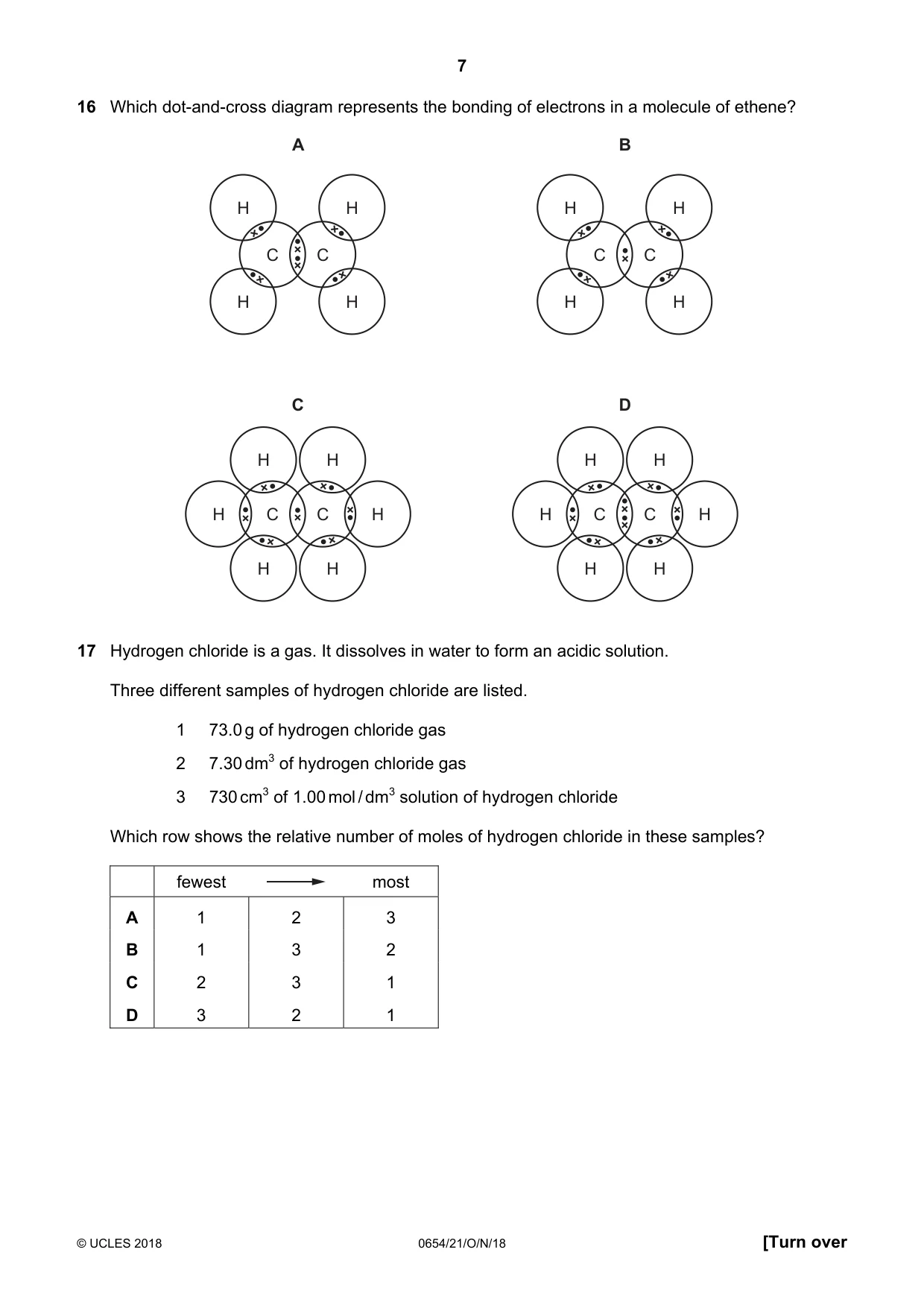
Q16 · Which dot-and-cross diagram represents the bonding of electrons in a molecule of ethene?
16 Which dot-and-cross diagram represents the bonding of electrons in a molecule of ethene? A B H H H H C C C C H H H H C D H H H H H C C H H C C H H H H H
Mark scheme: A
Q17 · Hydrogen chloride is a gas
17 Hydrogen chloride is a gas. It dissolves in water to form an acidic solution. Three different samples of hydrogen chloride are listed. 1 73.0 g of hydrogen chloride gas 2 7.30 dm3 of hydrogen chloride gas 3 730 cm3 of 1.00 mol / dm3 solution of hydrogen chloride Which row shows the relative number of moles of hydrogen chloride in these samples? fewest most A 1 2 3 B 1 3 2 C 2 3 1 D 3 2 1
Mark scheme: C
Q18 · Which statement describes what happens during electrolysis?
18 Which statement describes what happens during electrolysis? A Covalent compounds produce more complex substances. B Covalent compounds produce simpler substances. C Ionic compounds produce more complex substances. D Ionic compounds produce simpler substances.
Mark scheme: D
Q19 · Methane is used as a fuel
19 Methane is used as a fuel. Which row describes the temperature change and the type of reaction when methane burns? temperature type of change reaction A decrease endothermic B decrease exothermic C increase endothermic D increase exothermic
Mark scheme: D
Q20 · Which word equation represents a redox reaction?
20 Which word equation represents a redox reaction? A calcium carbonate → calcium oxide + carbon dioxide B calcium oxide + hydrochloric acid → calcium chloride + water C copper oxide + carbon → copper + carbon dioxide D sodium oxide + water → sodium hydroxide
Mark scheme: C
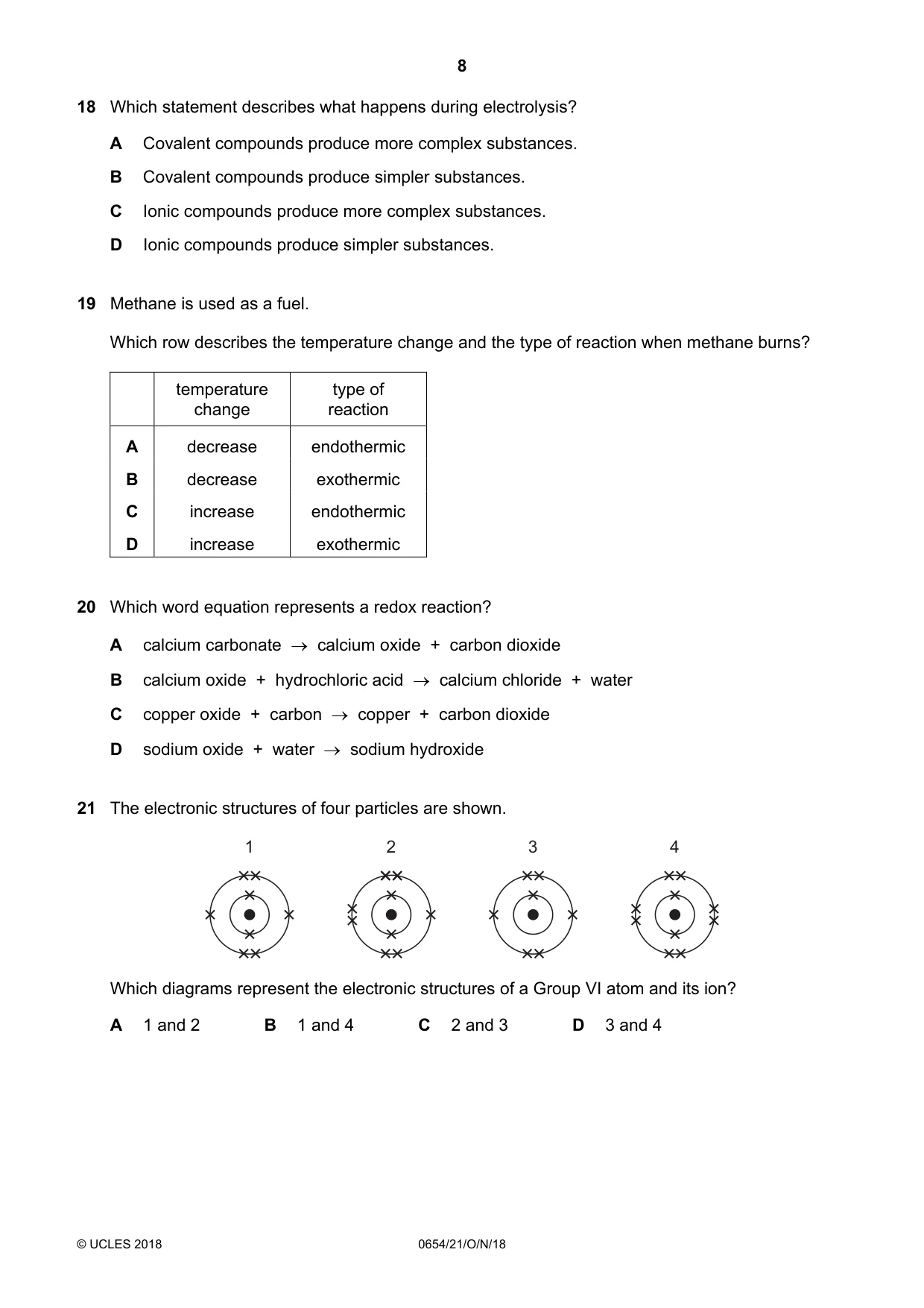
Q21 · The electronic structures of four particles are shown
21 The electronic structures of four particles are shown. 1 2 3 4 Which diagrams represent the electronic structures of a Group VI atom and its ion? A 1 and 2 B 1 and 4 C 2 and 3 D 3 and 4
Mark scheme: B
Q22 · Part of the reactivity series is shown
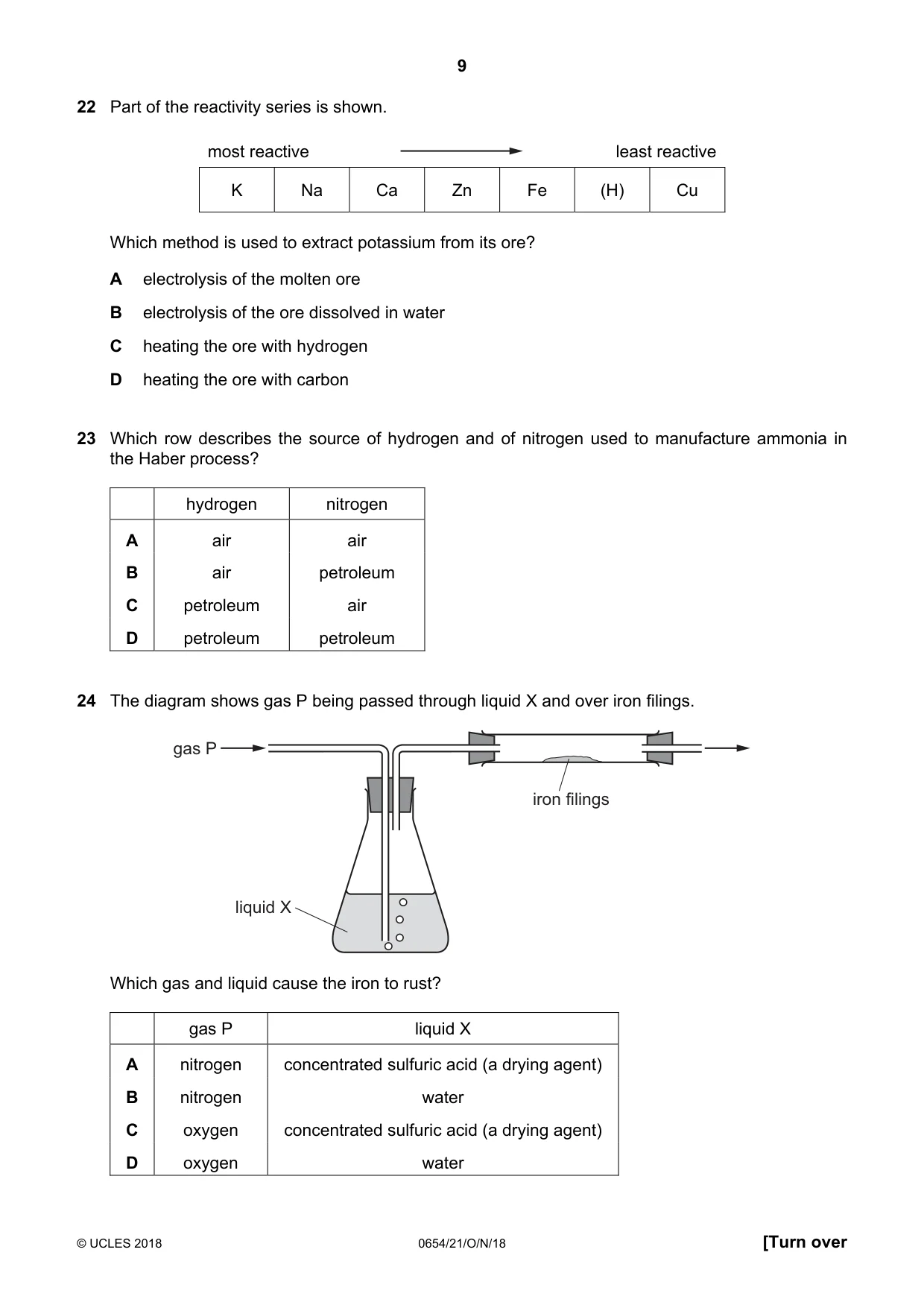
22 Part of the reactivity series is shown. most reactive least reactive K Na Ca Zn Fe (H) Cu Which method is used to extract potassium from its ore? A electrolysis of the molten ore B electrolysis of the ore dissolved in water C heating the ore with hydrogen D heating the ore with carbon
Mark scheme: A
Q23 · Which row describes the source of hydrogen and of nitrogen used to manufacture ammonia in…
23 Which row describes the source of hydrogen and of nitrogen used to manufacture ammonia in the Haber process? hydrogen nitrogen A air air B air petroleum C petroleum air D petroleum petroleum
Mark scheme: C
Q24 · The diagram shows gas P being passed through liquid X and over iron filings
24 The diagram shows gas P being passed through liquid X and over iron filings. gas P iron filings liquid X Which gas and liquid cause the iron to rust? gas P liquid X A nitrogen concentrated sulfuric acid (a drying agent) B nitrogen water C oxygen concentrated sulfuric acid (a drying agent) D oxygen water
Mark scheme: D
Q25 · Sulfuric acid is manufactured by the Contact process
25 Sulfuric acid is manufactured by the Contact process. Which conditions are used in this process? A 2 atmospheres pressure and a vanadium pentoxide catalyst B 2 atmospheres pressure and an iron catalyst C 200 atmospheres pressure and a vanadium pentoxide catalyst D 200 atmospheres pressure and an iron catalyst
Mark scheme: A
Q26 · Which formula represents but-1-ene?
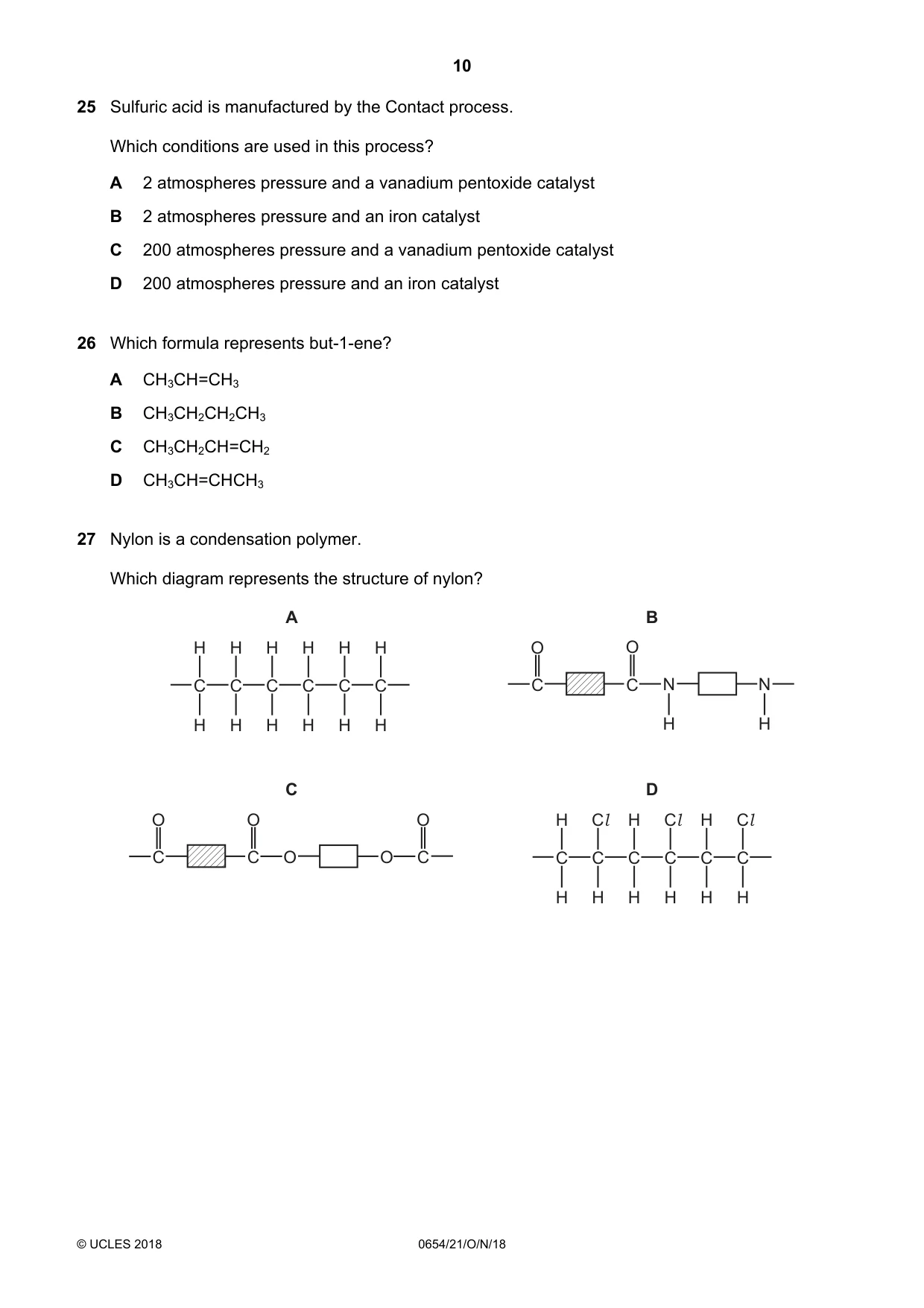
26 Which formula represents but-1-ene? A CH3CH=CH3 B CH3CH2CH2CH3 C CH3CH2CH=CH2 D CH3CH=CHCH3
Mark scheme: C
Q27 · Nylon is a condensation polymer
27 Nylon is a condensation polymer. Which diagram represents the structure of nylon? A B H H H H H H O O C C C C C C C C N N H H H H H H H H C D O O O H Cl H Cl H Cl C C O O C C C C C C C H H H H H H
Mark scheme: B
Q28 · The diagram shows the speed-time graph for a car
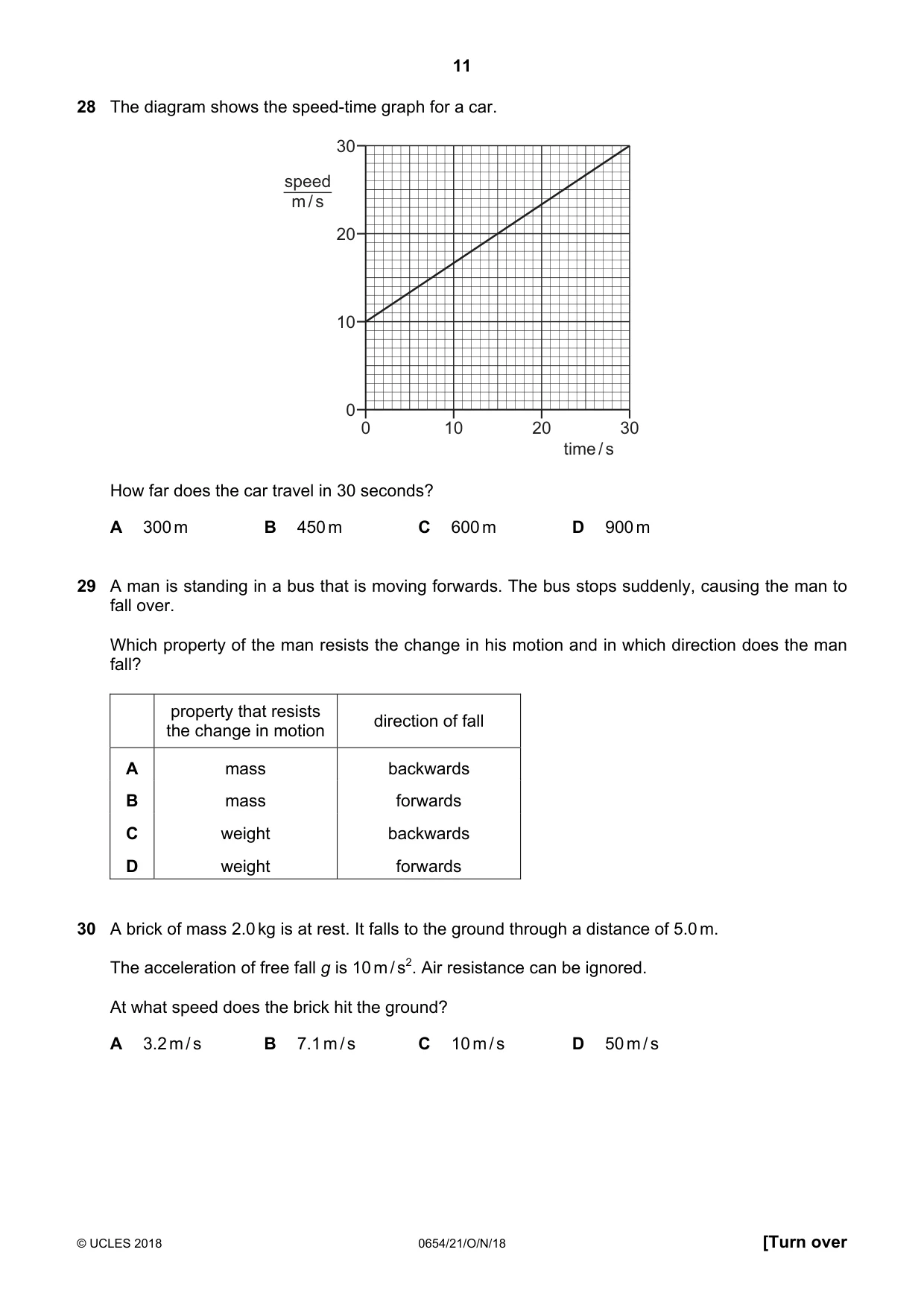
28 The diagram shows the speed-time graph for a car. 30 speed m / s 20 10 0 0 10 20 30 time / s How far does the car travel in 30 seconds? A 300 m B 450 m C 600 m D 900 m
Mark scheme: C
Q29 · A man is standing in a bus that is moving forwards
29 A man is standing in a bus that is moving forwards. The bus stops suddenly, causing the man to fall over. Which property of the man resists the change in his motion and in which direction does the man fall? property that resists direction of fall the change in motion A mass backwards B mass forwards C weight backwards D weight forwards
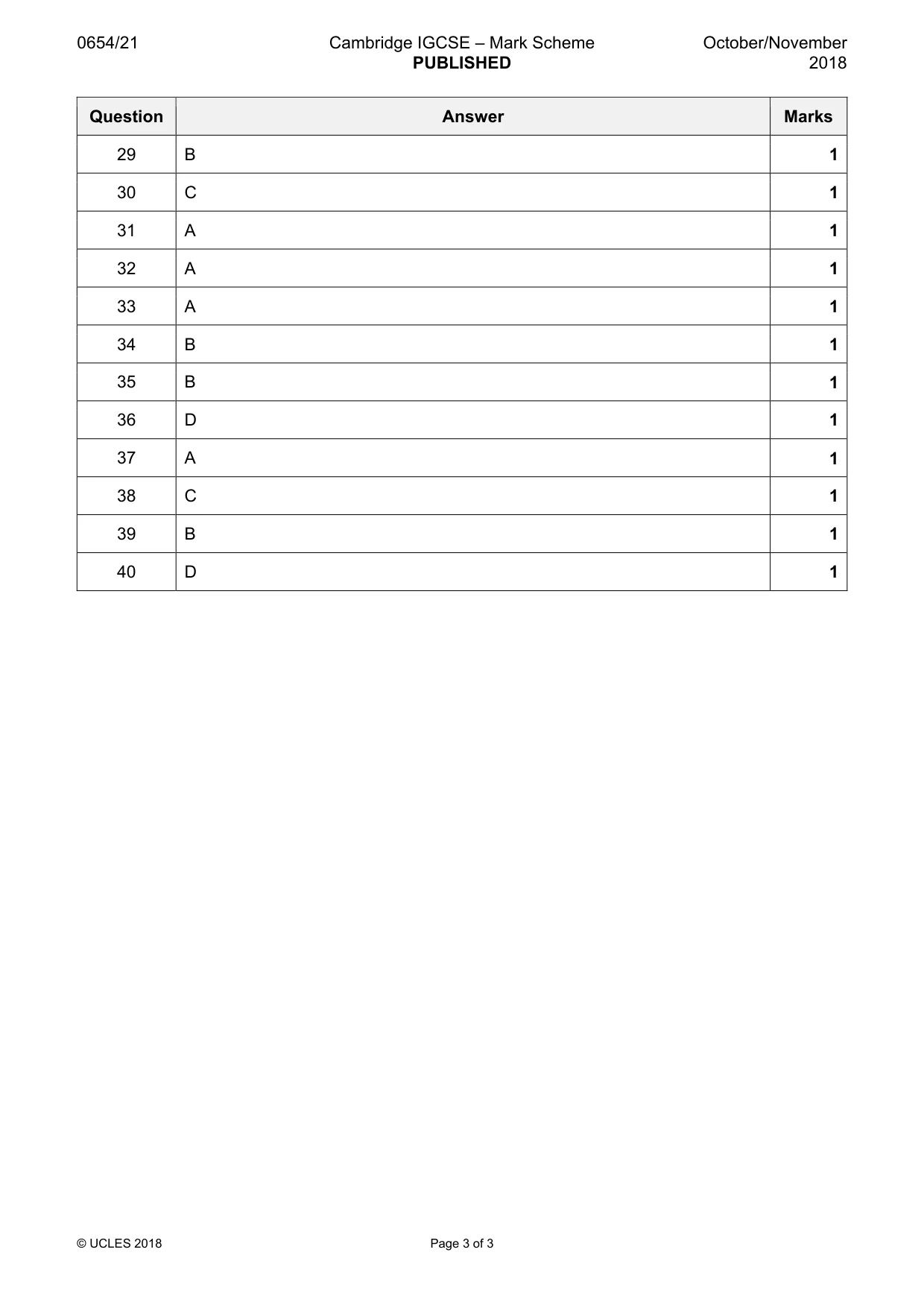
Mark scheme: B
Q30 · A brick of mass 2.0 kg is at rest
30 A brick of mass 2.0 kg is at rest. It falls to the ground through a distance of 5.0 m. The acceleration of free fall g is 10 m / s2. Air resistance can be ignored. At what speed does the brick hit the ground? A 3.2 m / s B 7.1 m / s C 10 m / s D 50 m / s
Mark scheme: C
Q31 · Which source of energy is renewable?
31 Which source of energy is renewable? A geothermal B natural gas C nuclear fission D oil
Mark scheme: A
Q32 · Two substances X and Y are in different states
32 Two substances X and Y are in different states. Substance X has a definite shape and has a definite volume. Substance Y has no definite shape but has a definite volume. Which row gives the state of each substance? substance X substance Y A solid liquid B solid gas C liquid solid D liquid gas
Mark scheme: A
Q33 · An axle is slightly larger than the hole in a wheel made from the same metal
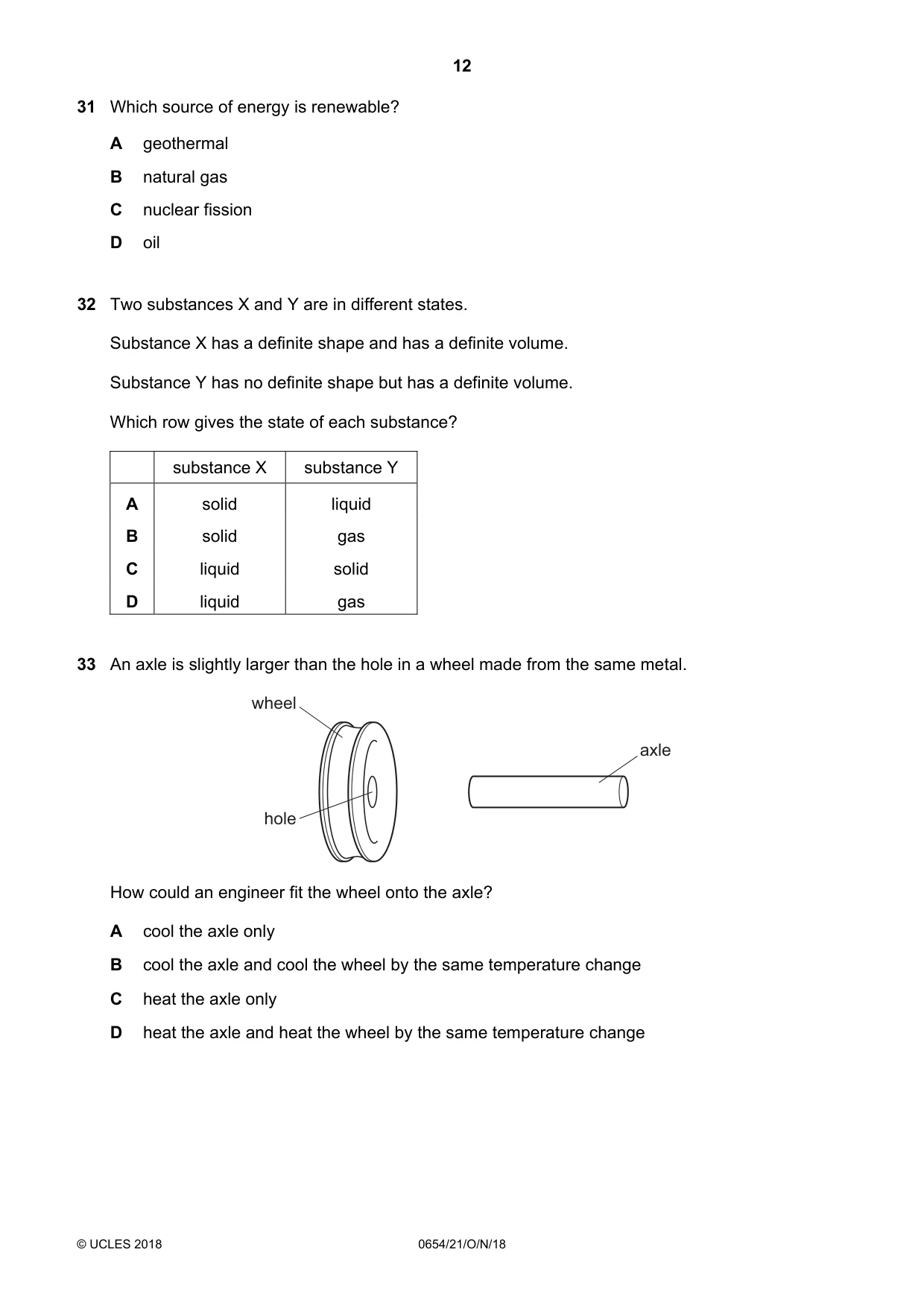
33 An axle is slightly larger than the hole in a wheel made from the same metal. wheel axle hole How could an engineer fit the wheel onto the axle? A cool the axle only B cool the axle and cool the wheel by the same temperature change C heat the axle only D heat the axle and heat the wheel by the same temperature change
Mark scheme: A
Q34 · There is a vacuum between the double walls of a vacuum flask
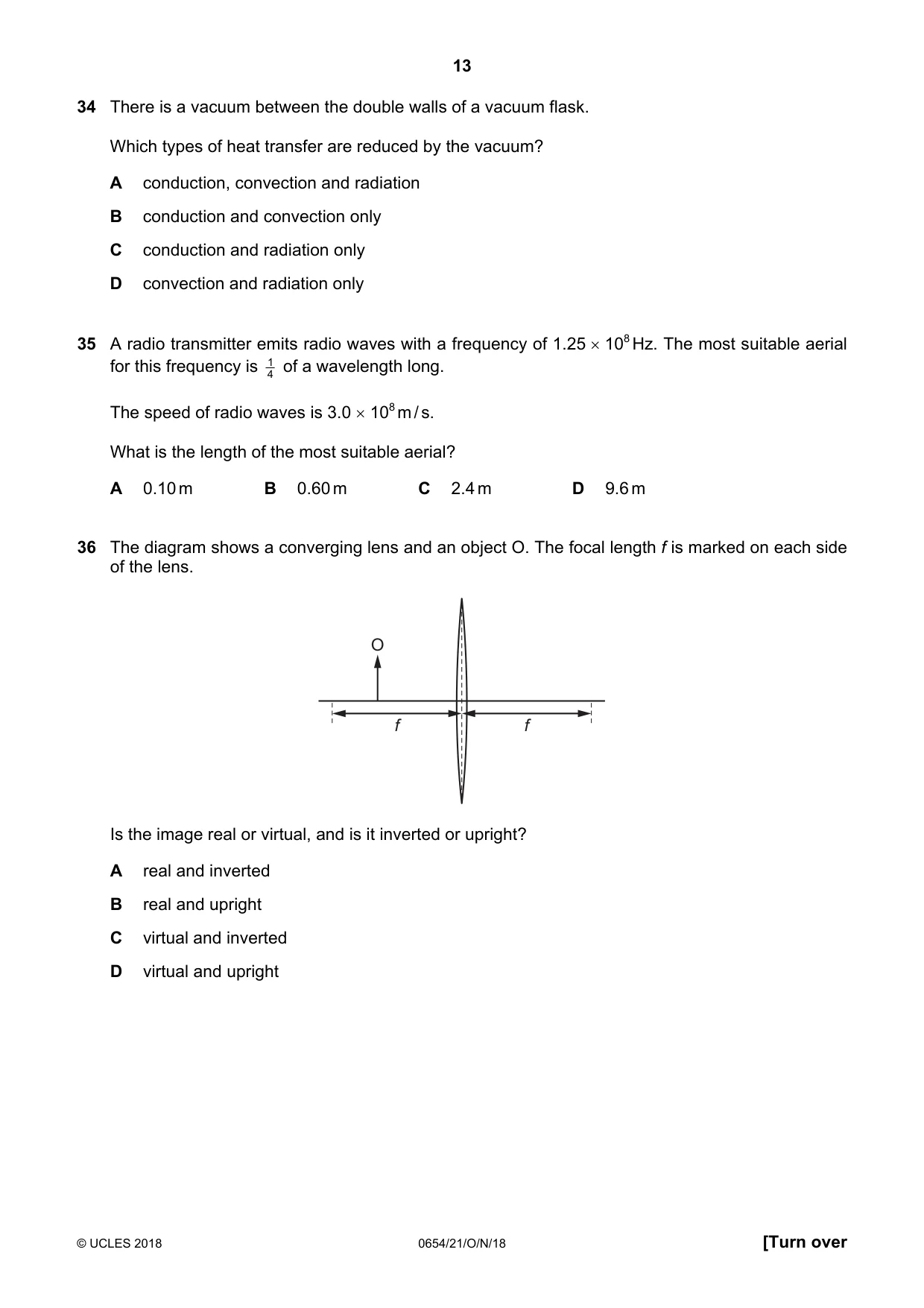
34 There is a vacuum between the double walls of a vacuum flask. Which types of heat transfer are reduced by the vacuum? A conduction, convection and radiation B conduction and convection only C conduction and radiation only D convection and radiation only
Mark scheme: B
Q35 · A radio transmitter emits radio waves with a frequency of 1.25 × 10⁸ Hz
35 A radio transmitter emits radio waves with a frequency of 1.25 × 10⁸ Hz. The most suitable aerial for this frequency is 4 1 of a wavelength long. The speed of radio waves is 3.0 × 10⁸ m / s. What is the length of the most suitable aerial? A 0.10 m B 0.60 m C 2.4 m D 9.6 m
Mark scheme: B
Q36 · The diagram shows a converging lens and an object O
36 The diagram shows a converging lens and an object O. The focal length f is marked on each side of the lens. O f f Is the image real or virtual, and is it inverted or upright? A real and inverted B real and upright C virtual and inverted D virtual and upright
Mark scheme: D
Q37 · A wave in air consists of a series of regions called compressions and rarefactions
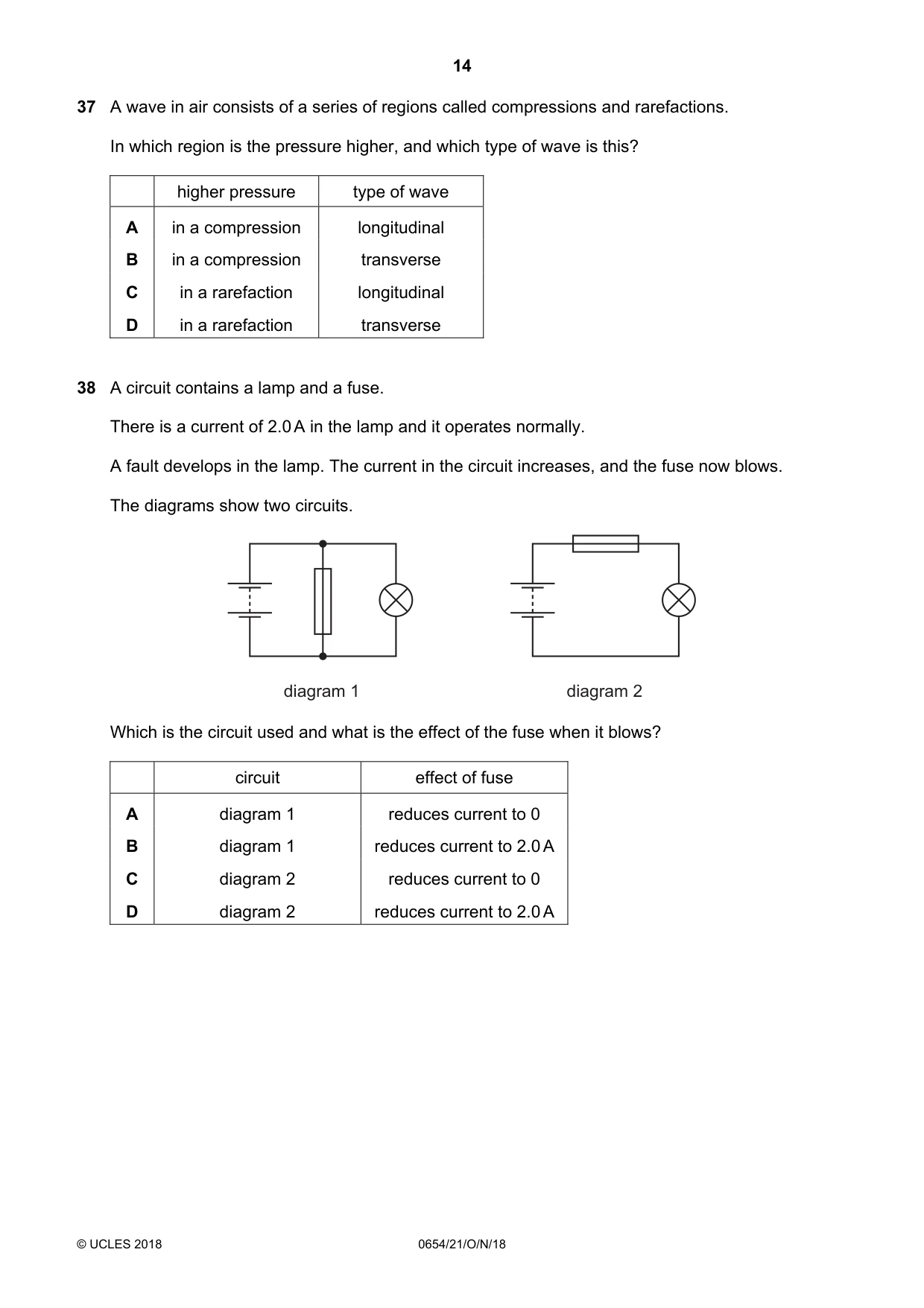
37 A wave in air consists of a series of regions called compressions and rarefactions. In which region is the pressure higher, and which type of wave is this? higher pressure type of wave A in a compression longitudinal B in a compression transverse C in a rarefaction longitudinal D in a rarefaction transverse
Mark scheme: A
Q38 · A circuit contains a lamp and a fuse
38 A circuit contains a lamp and a fuse. There is a current of 2.0 A in the lamp and it operates normally. A fault develops in the lamp. The current in the circuit increases, and the fuse now blows. The diagrams show two circuits. diagram 1 diagram 2 Which is the circuit used and what is the effect of the fuse when it blows? circuit effect of fuse A diagram 1 reduces current to 0 B diagram 1 reduces current to 2.0 A C diagram 2 reduces current to 0 D diagram 2 reduces current to 2.0 A
Mark scheme: C
Q39 · A 6.0 V battery is connected to three 10 Ω resistors, as shown
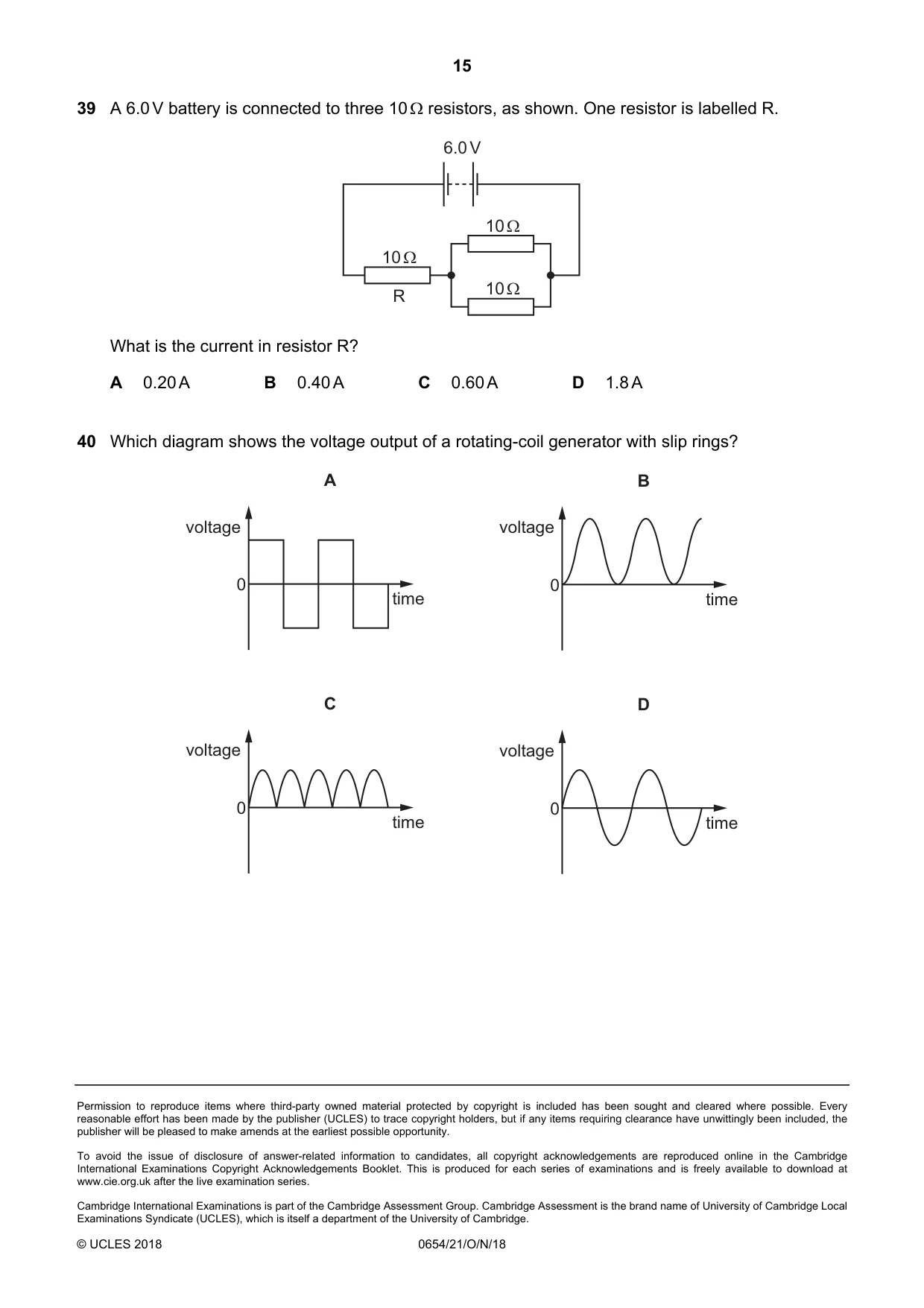
39 A 6.0 V battery is connected to three 10 Ω resistors, as shown. One resistor is labelled R. 6.0 V 10 Ω 10 Ω 10 Ω R What is the current in resistor R? A 0.20 A B 0.40 A C 0.60 A D 1.8 A
Mark scheme: B
Q40 · Which diagram shows the voltage output of a rotating-coil generator with slip rings?
40 Which diagram shows the voltage output of a rotating-coil generator with slip rings? A B voltage voltage 0 0 time time C D voltage voltage 0 0 time time
Mark scheme: D
What was in this paper
The subtopics covered by these 40 questions, and how many questions each got. Open one in a new tab to see every Cambridge question on it.
2Energy, work and power2Air quality and climate1Asexual reproduction1Atomic structure and the Periodic Table1Blood1Carbon cycle1Cell division1Characteristics of living organisms1Chromosomes and genes1Corrosion of metals1Electrical circuits1Electrical safety1Electrolysis1Electromagnetic effects1Electromagnetic spectrum1Elements, compounds and mixtures1Enzymes1Exothermic and endothermic reactions1Extraction of metals1Forces1Habitat destruction1Kinetic particle model of matter1Light1Motion1Naming organic compounds1Photosynthesis1Polymers1Redox1Respiration1Separation and purification1Simple molecules and covalent bonds1Sound1The mole and the Avogadro constant1Thermal properties and temperature1Transfer of thermal energy1Transition elements1Transpiration1What you needed in this session
Cambridge’s own grade thresholds for 2018 Oct/Nov, Paper 2 · Variant 1. A higher threshold means an easier paper — the bar moves with how the cohort did.