Cambridge IGCSE Sciences - Co-ordinated (Double) 0654 — 2023 Feb/March Paper 2 · Variant 2
0654/22/F/M/23 · 40 questions · 40 marks · ≈45 min
The question paper and its mark scheme, free to read here and free to download. This is Cambridge’s own paper, exactly as it was sat.
Question paper16 pages
Mark scheme3 pages
Answers below. Sit the paper first if you are practising.
Questions as text
Q1 · The diagram shows how an aquatic carnivorous bladderwort plant reacts to tiny aquatic…
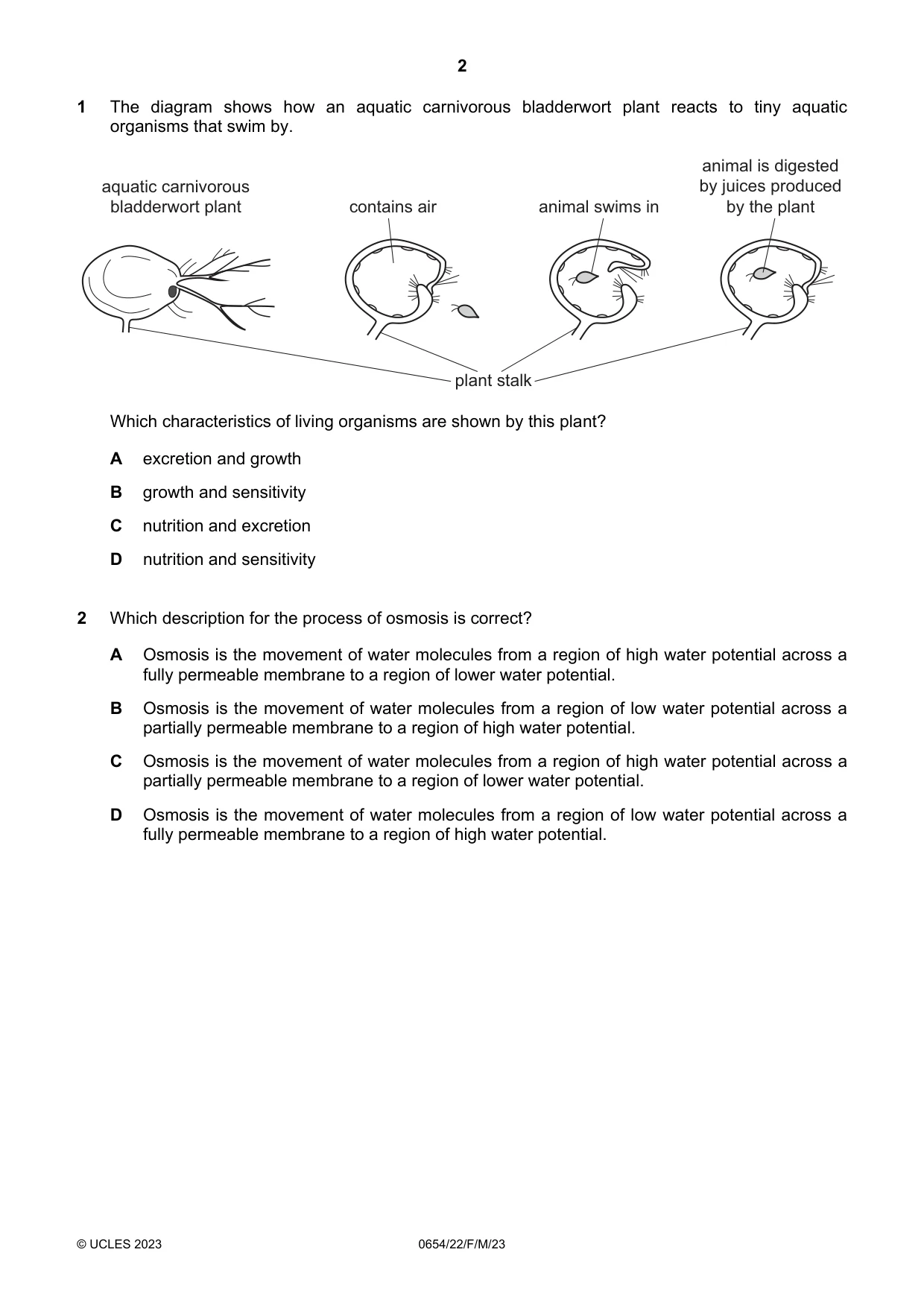
1 The diagram shows how an aquatic carnivorous bladderwort plant reacts to tiny aquatic organisms that swim by. animal is digested aquatic carnivorous by juices produced bladderwort plant contains air animal swims in by the plant plant stalk Which characteristics of living organisms are shown by this plant? A excretion and growth B growth and sensitivity C nutrition and excretion D nutrition and sensitivity
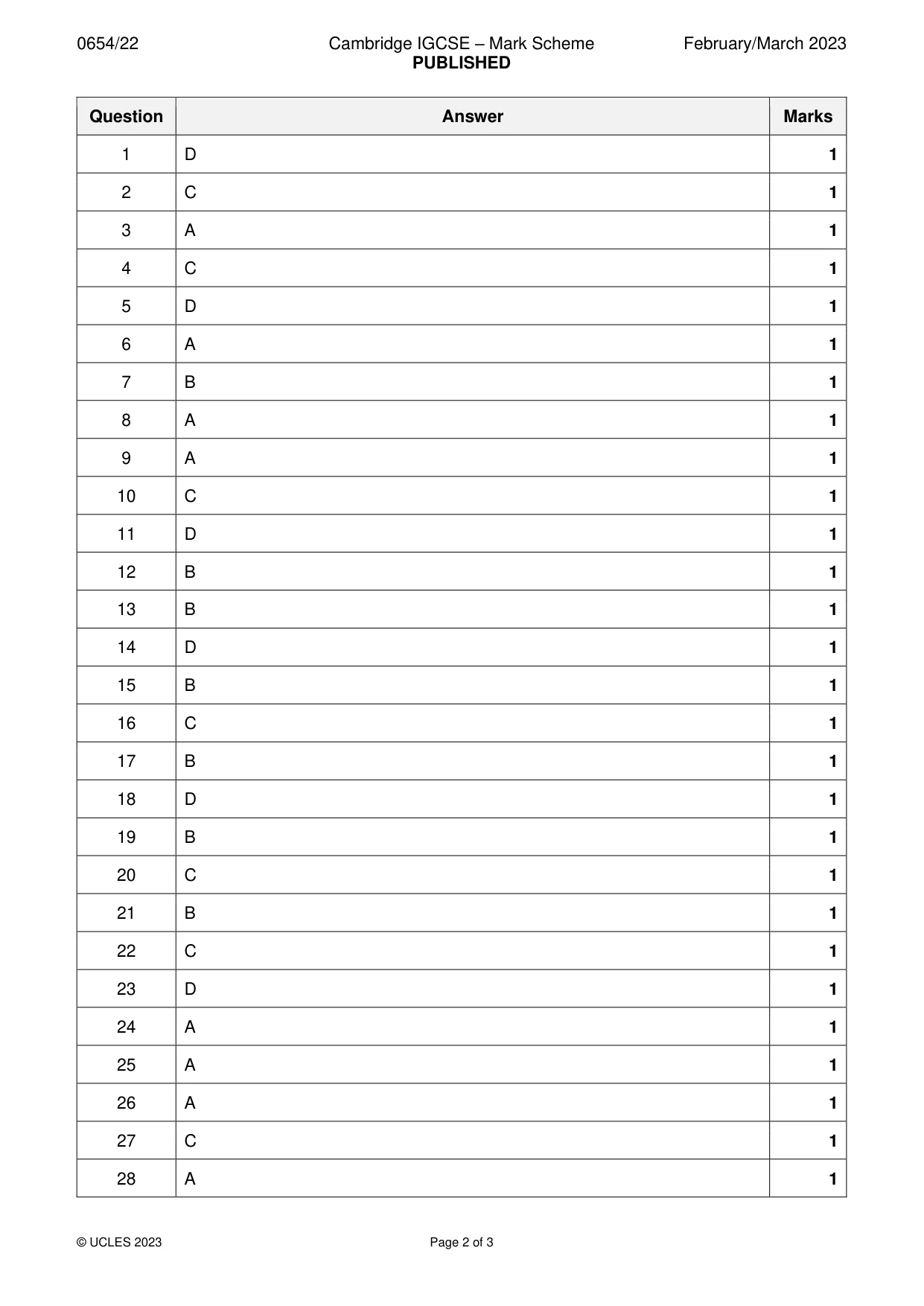
Mark scheme: D
Q2 · Which description for the process of osmosis is correct?
2 Which description for the process of osmosis is correct? A Osmosis is the movement of water molecules from a region of high water potential across a fully permeable membrane to a region of lower water potential. B Osmosis is the movement of water molecules from a region of low water potential across a partially permeable membrane to a region of high water potential. C Osmosis is the movement of water molecules from a region of high water potential across a partially permeable membrane to a region of lower water potential. D Osmosis is the movement of water molecules from a region of low water potential across a fully permeable membrane to a region of high water potential.
Mark scheme: C
Q3 · Tests are carried out on a colourless liquid
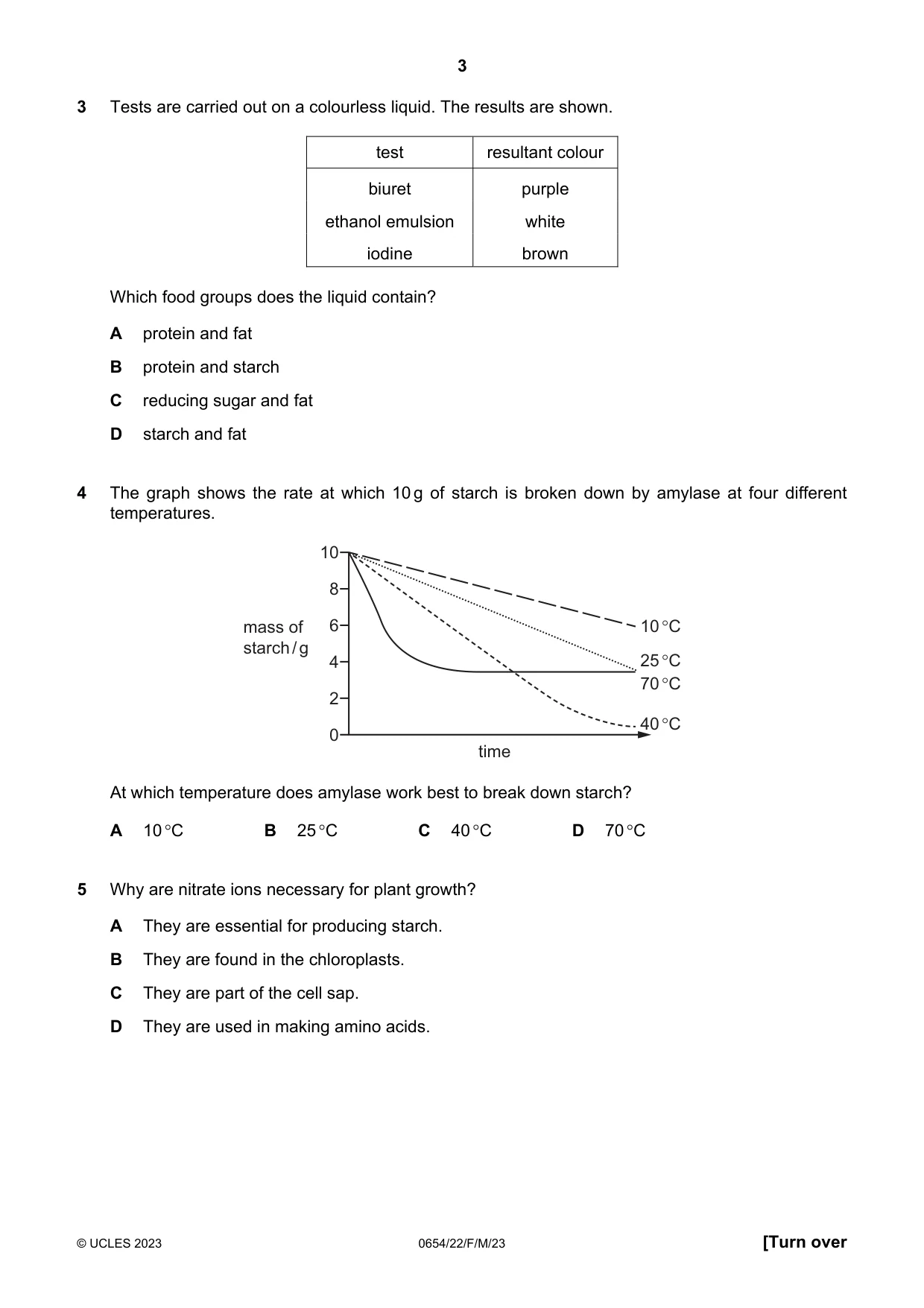
3 Tests are carried out on a colourless liquid. The results are shown. test resultant colour biuret purple ethanol emulsion white iodine brown Which food groups does the liquid contain? A protein and fat B protein and starch C reducing sugar and fat D starch and fat
Mark scheme: A
Q4 · The graph shows the rate at which 10 g of starch is broken down by amylase at four…
4 The graph shows the rate at which 10 g of starch is broken down by amylase at four different temperatures. 10 8 mass of 6 10 °C starch / g 4 25 °C 70 °C 2 40 °C 0 time At which temperature does amylase work best to break down starch? A 10 C B 25 C C 40 C D 70 C
Mark scheme: C
Q5 · Why are nitrate ions necessary for plant growth?
5 Why are nitrate ions necessary for plant growth? A They are essential for producing starch. B They are found in the chloroplasts. C They are part of the cell sap. D They are used in making amino acids.
Mark scheme: D
Q6 · The diagram shows the human alimentary canal
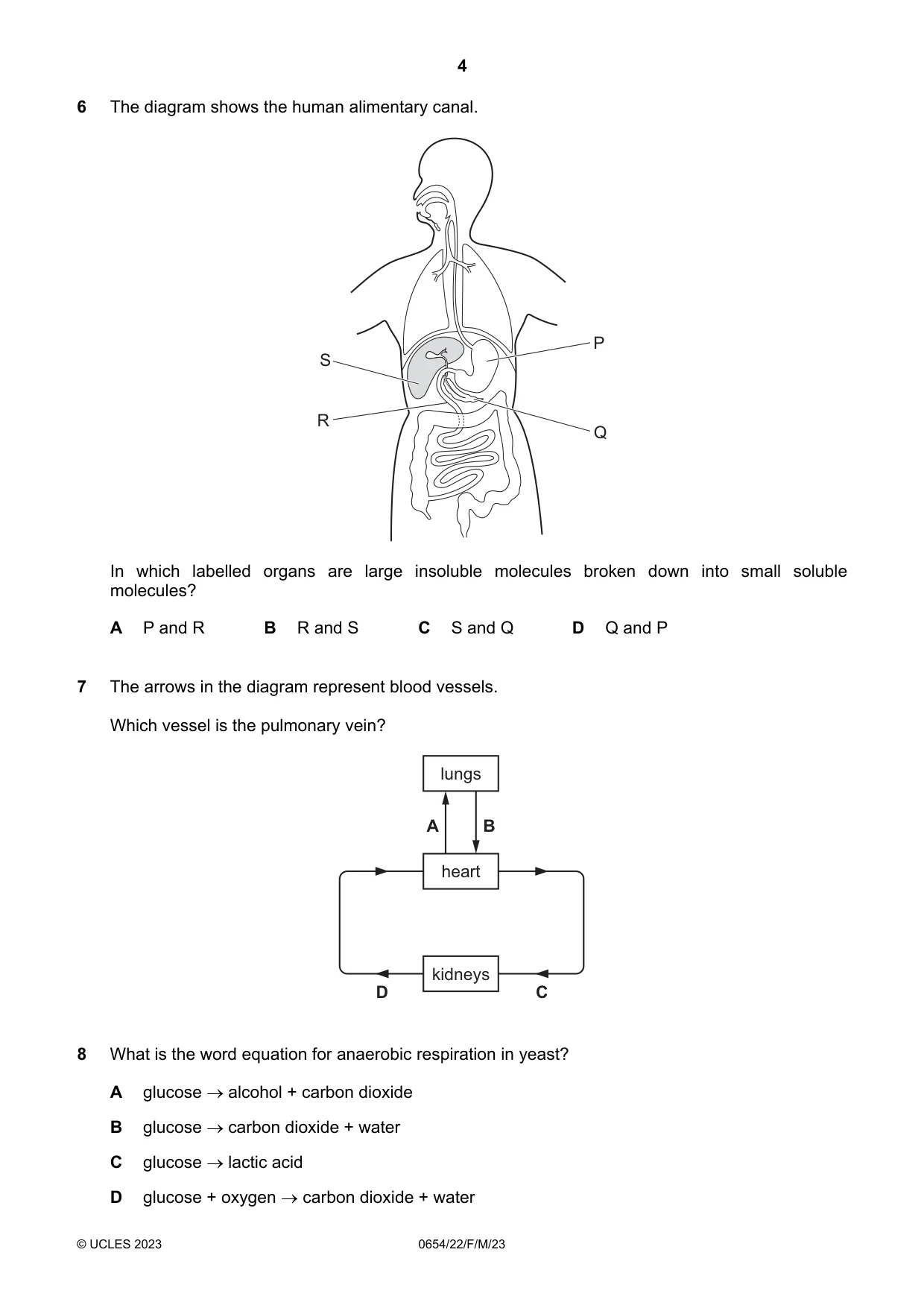
6 The diagram shows the human alimentary canal. P S R Q In which labelled organs are large insoluble molecules broken down into small soluble molecules? A P and R B R and S C S and Q D Q and P
Mark scheme: A
Q7 · The arrows in the diagram represent blood vessels
7 The arrows in the diagram represent blood vessels. Which vessel is the pulmonary vein? lungs A B heart kidneys D C
Mark scheme: B
Q8 · What is the word equation for anaerobic respiration in yeast?
8 What is the word equation for anaerobic respiration in yeast? A glucose alcohol + carbon dioxide B glucose carbon dioxide + water C glucose lactic acid D glucose + oxygen carbon dioxide + water
Mark scheme: A
Q9 · Which statement explains how the iris responds to an increase in light intensity?
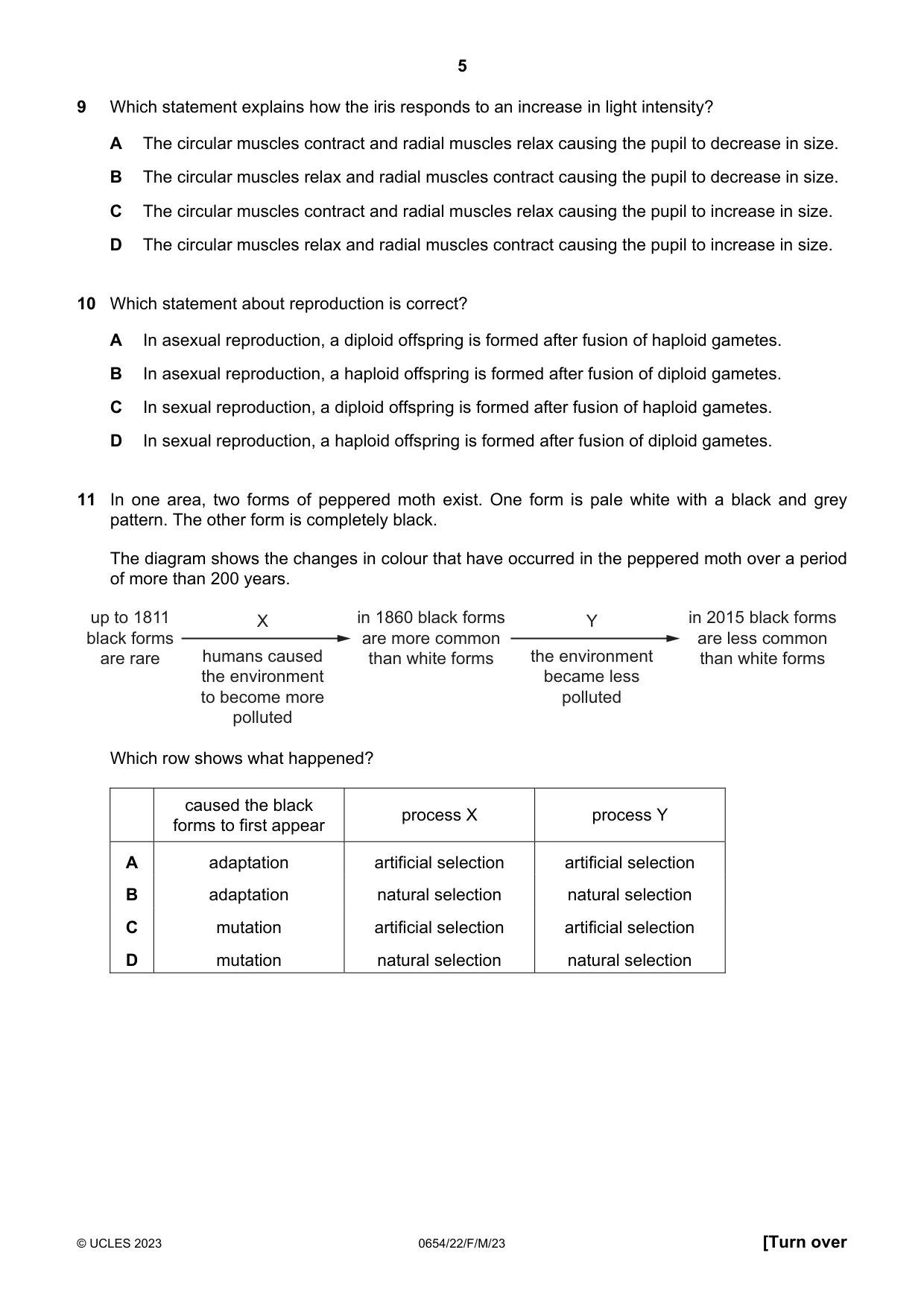
9 Which statement explains how the iris responds to an increase in light intensity? A The circular muscles contract and radial muscles relax causing the pupil to decrease in size. B The circular muscles relax and radial muscles contract causing the pupil to decrease in size. C The circular muscles contract and radial muscles relax causing the pupil to increase in size. D The circular muscles relax and radial muscles contract causing the pupil to increase in size.
Mark scheme: A
Q10 · Which statement about reproduction is correct?
10 Which statement about reproduction is correct? A In asexual reproduction, a diploid offspring is formed after fusion of haploid gametes. B In asexual reproduction, a haploid offspring is formed after fusion of diploid gametes. C In sexual reproduction, a diploid offspring is formed after fusion of haploid gametes. D In sexual reproduction, a haploid offspring is formed after fusion of diploid gametes.
Mark scheme: C
Q11 · In one area, two forms of peppered moth exist
11 In one area, two forms of peppered moth exist. One form is pale white with a black and grey pattern. The other form is completely black. The diagram shows the changes in colour that have occurred in the peppered moth over a period of more than 200 years. up to 1811 X in 1860 black forms Y in 2015 black forms black forms are more common are less common are rare humans caused than white forms the environment than white forms the environment became less to become more polluted polluted Which row shows what happened? caused the black process X process Y forms to first appear A adaptation artificial selection artificial selection B adaptation natural selection natural selection C mutation artificial selection artificial selection D mutation natural selection natural selection
Mark scheme: D
Q12 · The diagram shows the energy flow in part of an ecosystem
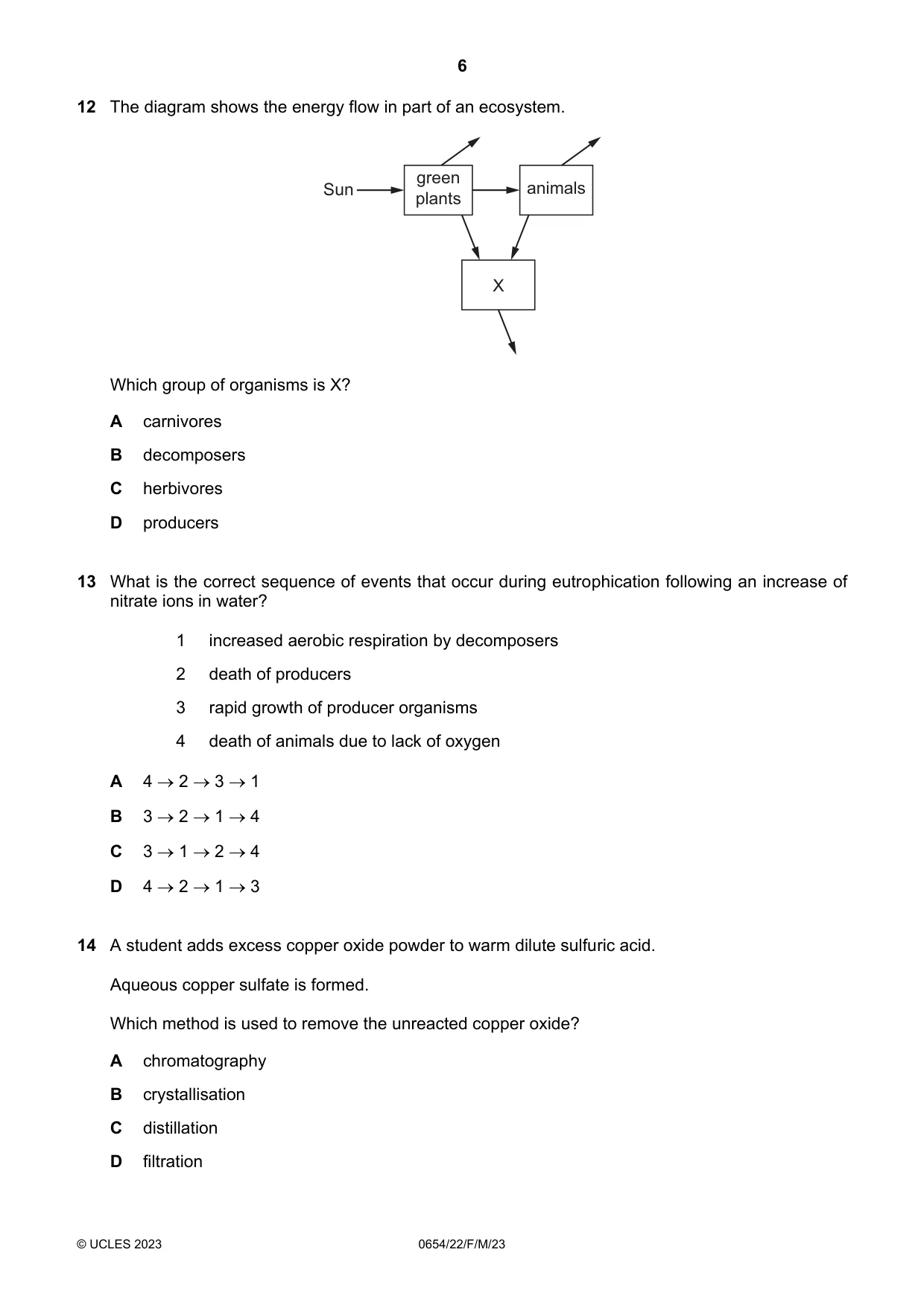
12 The diagram shows the energy flow in part of an ecosystem. green Sun animals plants X Which group of organisms is X? A carnivores B decomposers C herbivores D producers
Mark scheme: B
Q13 · What is the correct sequence of events that occur during eutrophication following an…
13 What is the correct sequence of events that occur during eutrophication following an increase of nitrate ions in water? 1 increased aerobic respiration by decomposers 2 death of producers 3 rapid growth of producer organisms 4 death of animals due to lack of oxygen A 4 2 3 1 B 3 2 1 4 C 3 1 2 4 D 4 2 1 3
Mark scheme: B
Q14 · A student adds excess copper oxide powder to warm dilute sulfuric acid
14 A student adds excess copper oxide powder to warm dilute sulfuric acid. Aqueous copper sulfate is formed. Which method is used to remove the unreacted copper oxide? A chromatography B crystallisation C distillation D filtration
Mark scheme: D
Q15 · Which diagram represents molecules of a compound?
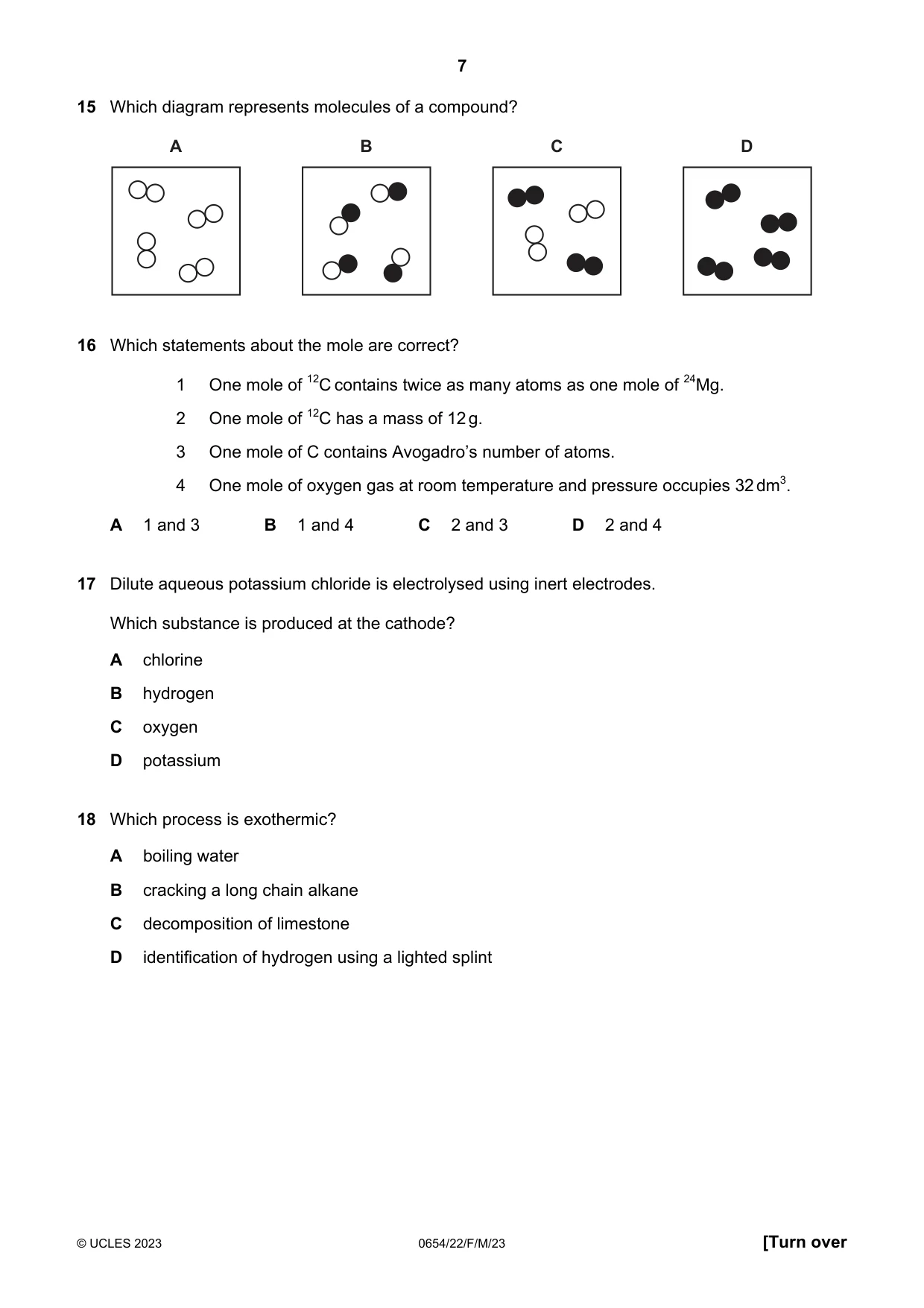
15 Which diagram represents molecules of a compound? A B C D
Mark scheme: B
Q16 · Which statements about the mole are correct?
16 Which statements about the mole are correct? 1 One mole of 12C contains twice as many atoms as one mole of 24Mg. 2 One mole of 12C has a mass of 12 g. 3 One mole of C contains Avogadro’s number of atoms. 4 One mole of oxygen gas at room temperature and pressure occupies 32 dm3. A 1 and 3 B 1 and 4 C 2 and 3 D 2 and 4
Mark scheme: C
Q17 · Dilute aqueous potassium chloride is electrolysed using inert electrodes
17 Dilute aqueous potassium chloride is electrolysed using inert electrodes. Which substance is produced at the cathode? A chlorine B hydrogen C oxygen D potassium
Mark scheme: B
Q18 · Which process is exothermic?
18 Which process is exothermic? A boiling water B cracking a long chain alkane C decomposition of limestone D identification of hydrogen using a lighted splint
Mark scheme: D
Q19 · Dilute hydrochloric acid reacts with calcium carbonate
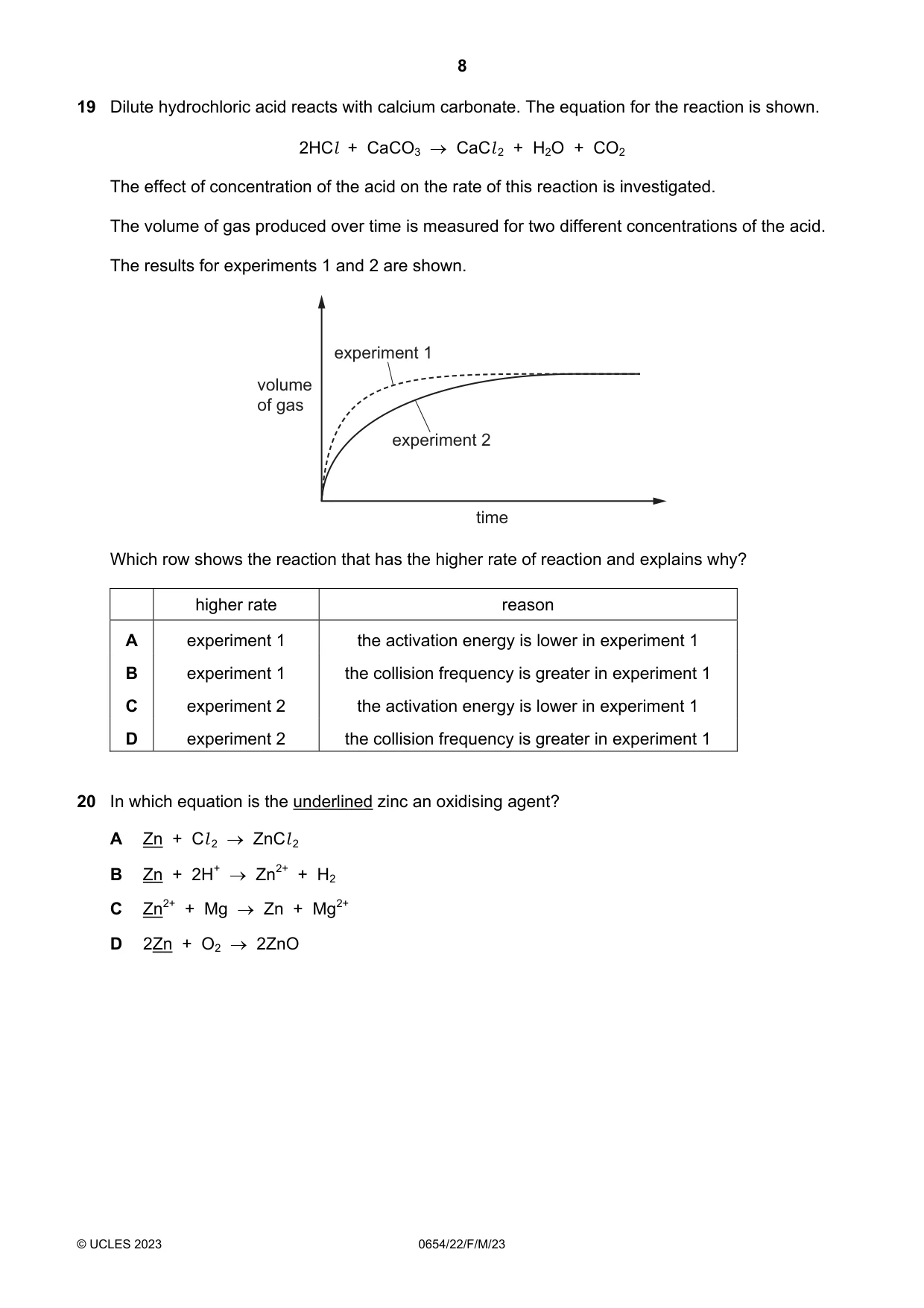
19 Dilute hydrochloric acid reacts with calcium carbonate. The equation for the reaction is shown. 2HCl + CaCO3 CaCl 2 + H2O + CO2 The effect of concentration of the acid on the rate of this reaction is investigated. The volume of gas produced over time is measured for two different concentrations of the acid. The results for experiments 1 and 2 are shown. experiment 1 volume of gas experiment 2 time Which row shows the reaction that has the higher rate of reaction and explains why? higher rate reason A experiment 1 the activation energy is lower in experiment 1 B experiment 1 the collision frequency is greater in experiment 1 C experiment 2 the activation energy is lower in experiment 1 D experiment 2 the collision frequency is greater in experiment 1
Mark scheme: B
Q20 · In which equation is the underlined zinc an oxidising agent?
20 In which equation is the underlined zinc an oxidising agent? A Zn + Cl 2 ZnCl 2 B Zn + 2H+ Zn2+ + H2 C Zn2+ + Mg Zn + Mg2+ D 2Zn + O2 2ZnO
Mark scheme: C
Q21 · A student makes lists of acidic oxides and basic oxides
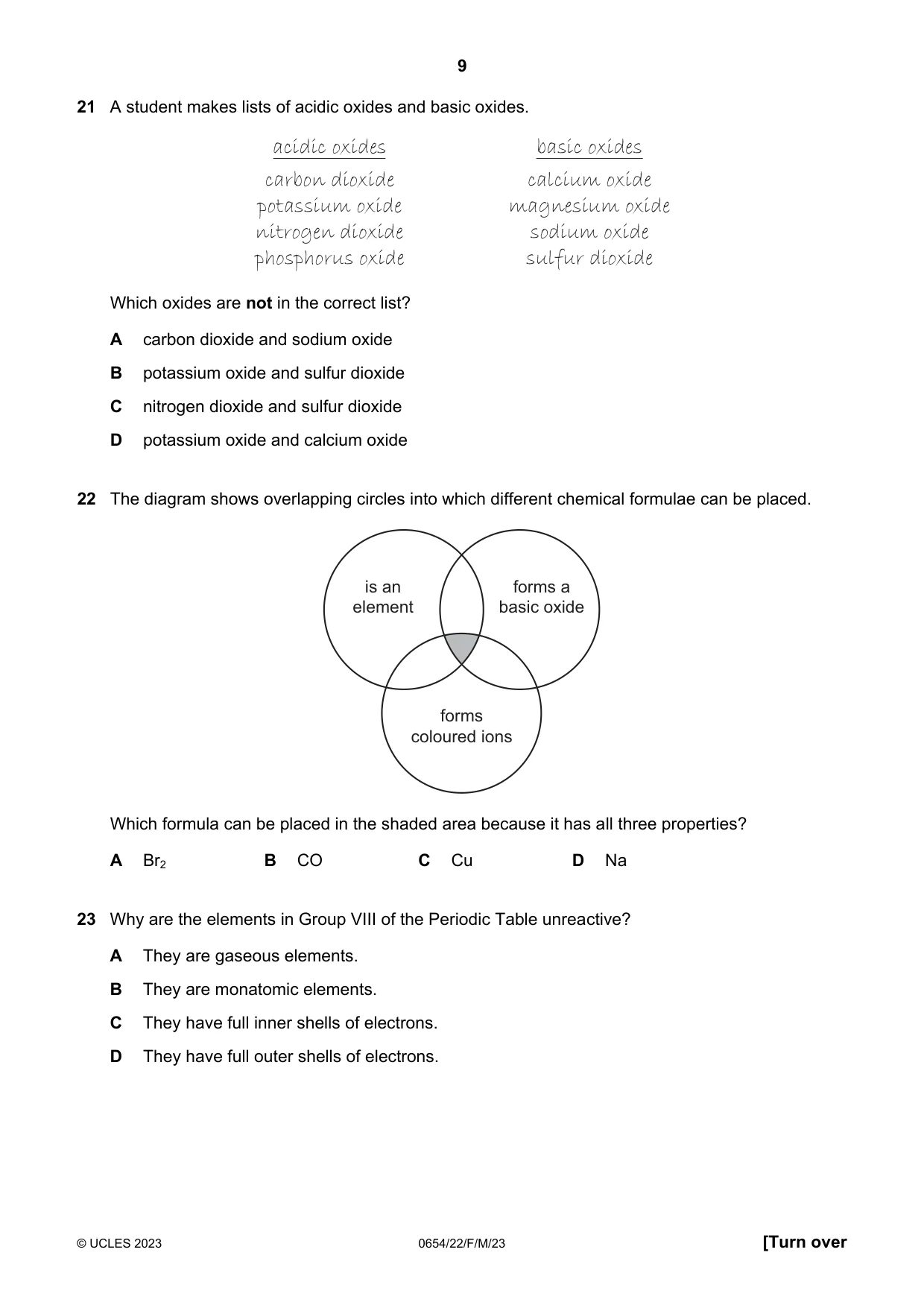
21 A student makes lists of acidic oxides and basic oxides. acidic oxides basic oxides carbon dioxide calcium oxide potassium oxide magnesium oxide nitrogen dioxide sodium oxide phosphorus oxide sulfur dioxide Which oxides are not in the correct list? A carbon dioxide and sodium oxide B potassium oxide and sulfur dioxide C nitrogen dioxide and sulfur dioxide D potassium oxide and calcium oxide
Mark scheme: B
Q22 · The diagram shows overlapping circles into which different chemical formulae can be placed
22 The diagram shows overlapping circles into which different chemical formulae can be placed. is an forms a element basic oxide forms coloured ions Which formula can be placed in the shaded area because it has all three properties? A Br2 B CO C Cu D Na
Mark scheme: C
Q23 · Why are the elements in Group VIII of the Periodic Table unreactive?
23 Why are the elements in Group VIII of the Periodic Table unreactive? A They are gaseous elements. B They are monatomic elements. C They have full inner shells of electrons. D They have full outer shells of electrons.
Mark scheme: D
Q24 · Which metal cannot be extracted from its ore by heating with carbon?
24 Which metal cannot be extracted from its ore by heating with carbon? A aluminium B copper C iron D zinc
Mark scheme: A
Q25 · Four watch-glasses contain solid salts as shown
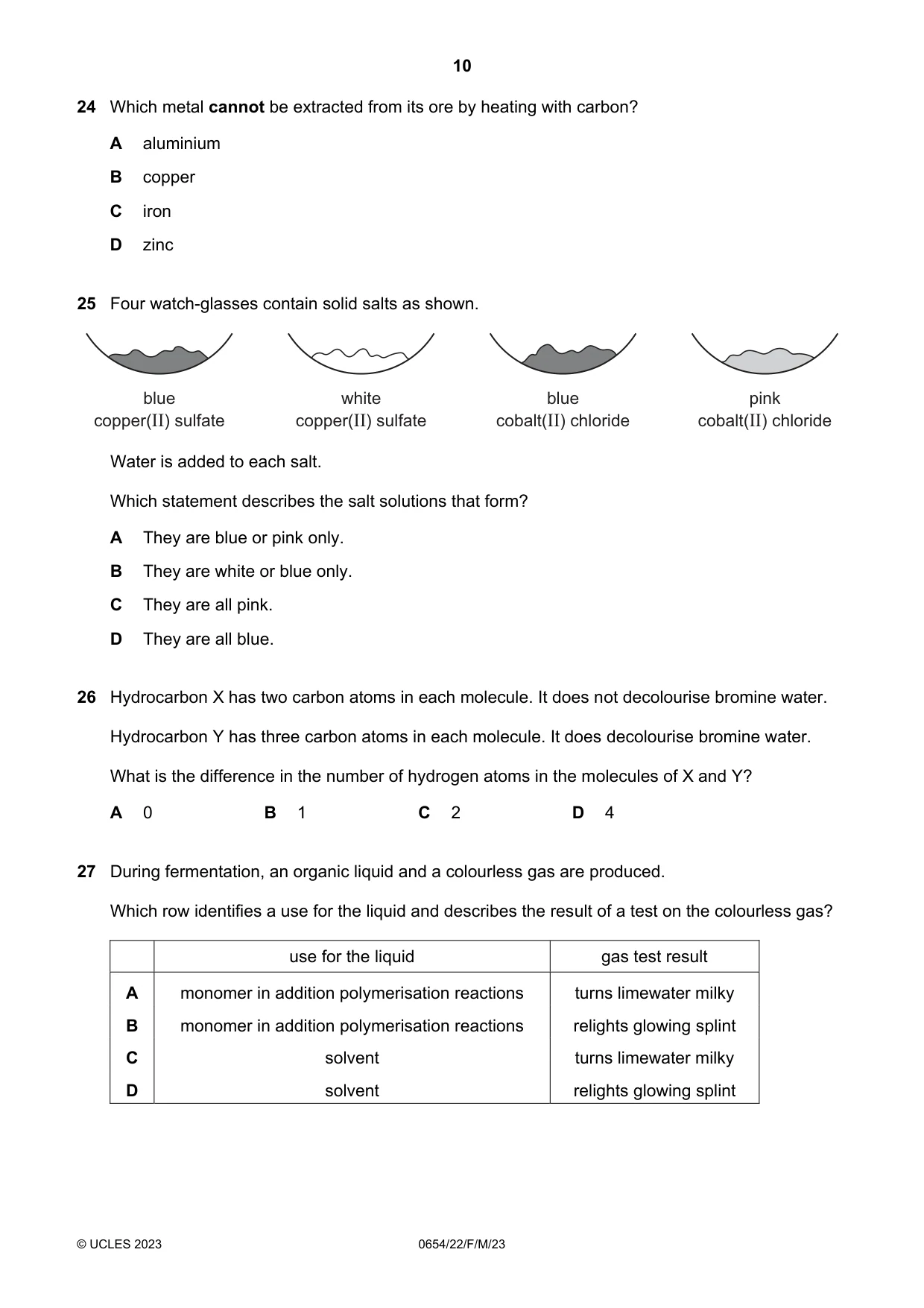
25 Four watch-glasses contain solid salts as shown. blue white blue pink copper(II) sulfate copper(II) sulfate cobalt(II) chloride cobalt(II) chloride Water is added to each salt. Which statement describes the salt solutions that form? A They are blue or pink only. B They are white or blue only. C They are all pink. D They are all blue.
Mark scheme: A
Q26 · Hydrocarbon X has two carbon atoms in each molecule
26 Hydrocarbon X has two carbon atoms in each molecule. It does not decolourise bromine water. Hydrocarbon Y has three carbon atoms in each molecule. It does decolourise bromine water. What is the difference in the number of hydrogen atoms in the molecules of X and Y? A 0 B 1 C 2 D 4
Mark scheme: A
Q27 · During fermentation, an organic liquid and a colourless gas are produced
27 During fermentation, an organic liquid and a colourless gas are produced. Which row identifies a use for the liquid and describes the result of a test on the colourless gas? use for the liquid gas test result A monomer in addition polymerisation reactions turns limewater milky B monomer in addition polymerisation reactions relights glowing splint C solvent turns limewater milky D solvent relights glowing splint
Mark scheme: C
Q28 · Which diagram shows the distance–time graph for an object moving with constant speed?
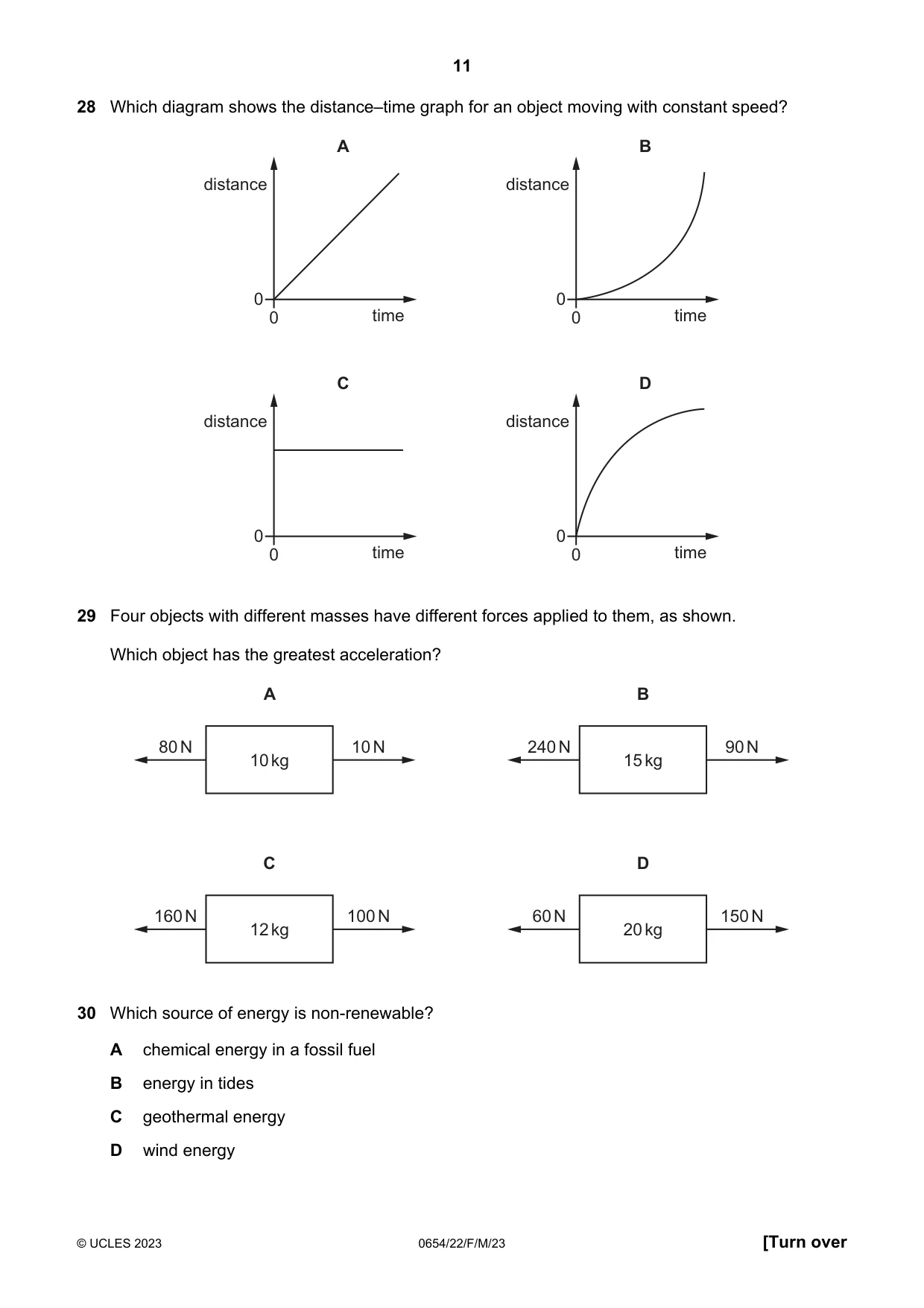
28 Which diagram shows the distance–time graph for an object moving with constant speed? A B distance distance 0 0 0 time 0 time C D distance distance 0 0 0 time 0 time
Mark scheme: A
Q29 · Four objects with different masses have different forces applied to them, as shown
29 Four objects with different masses have different forces applied to them, as shown. Which object has the greatest acceleration? A B 80 N 10 N 240 N 90 N 10 kg 15 kg C D 160 N 100 N 60 N 150 N 12 kg 20 kg
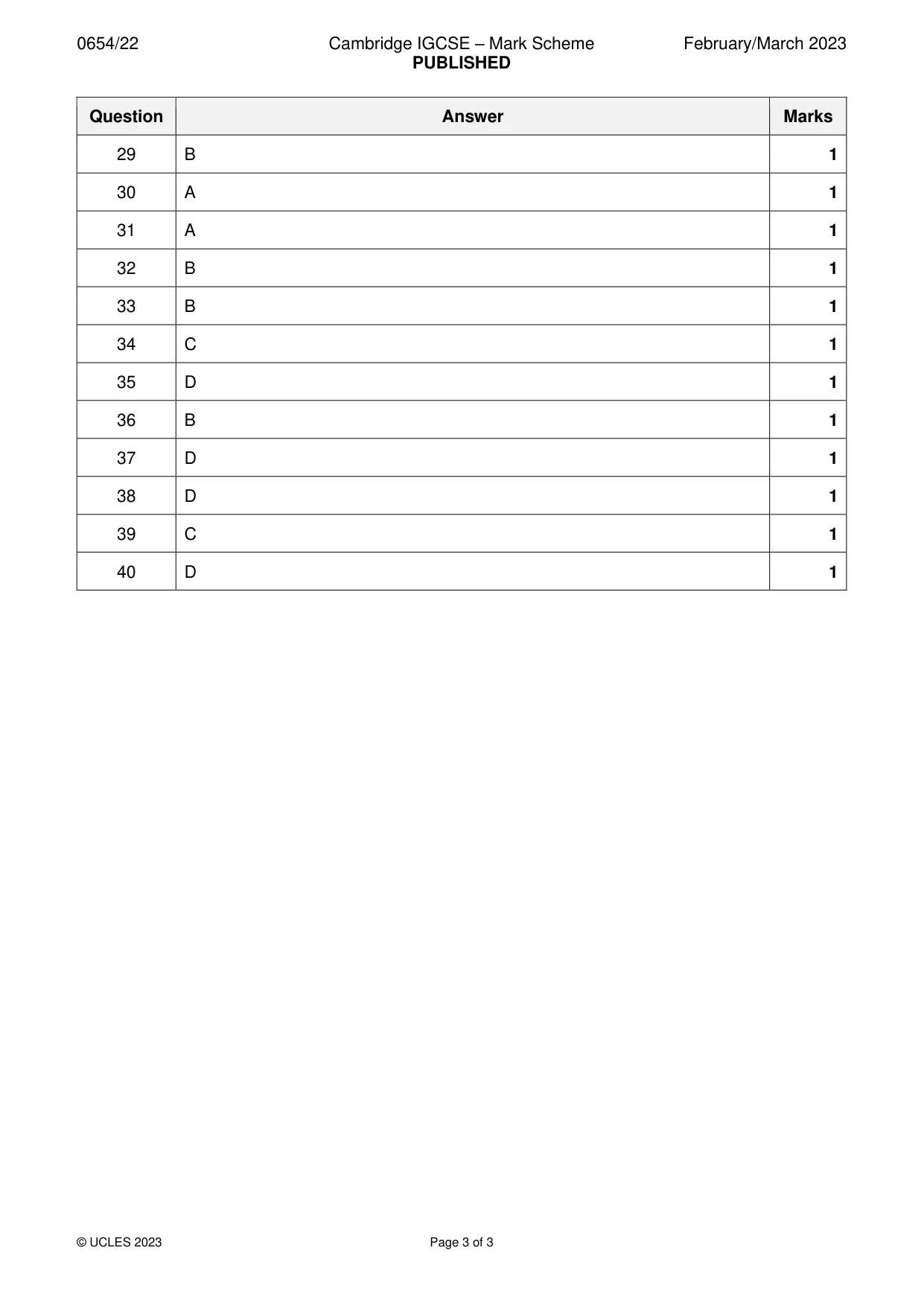
Mark scheme: B
Q30 · Which source of energy is non-renewable?
30 Which source of energy is non-renewable? A chemical energy in a fossil fuel B energy in tides C geothermal energy D wind energy
Mark scheme: A
Q31 · Some gas is put in a sealed metal container of constant volume
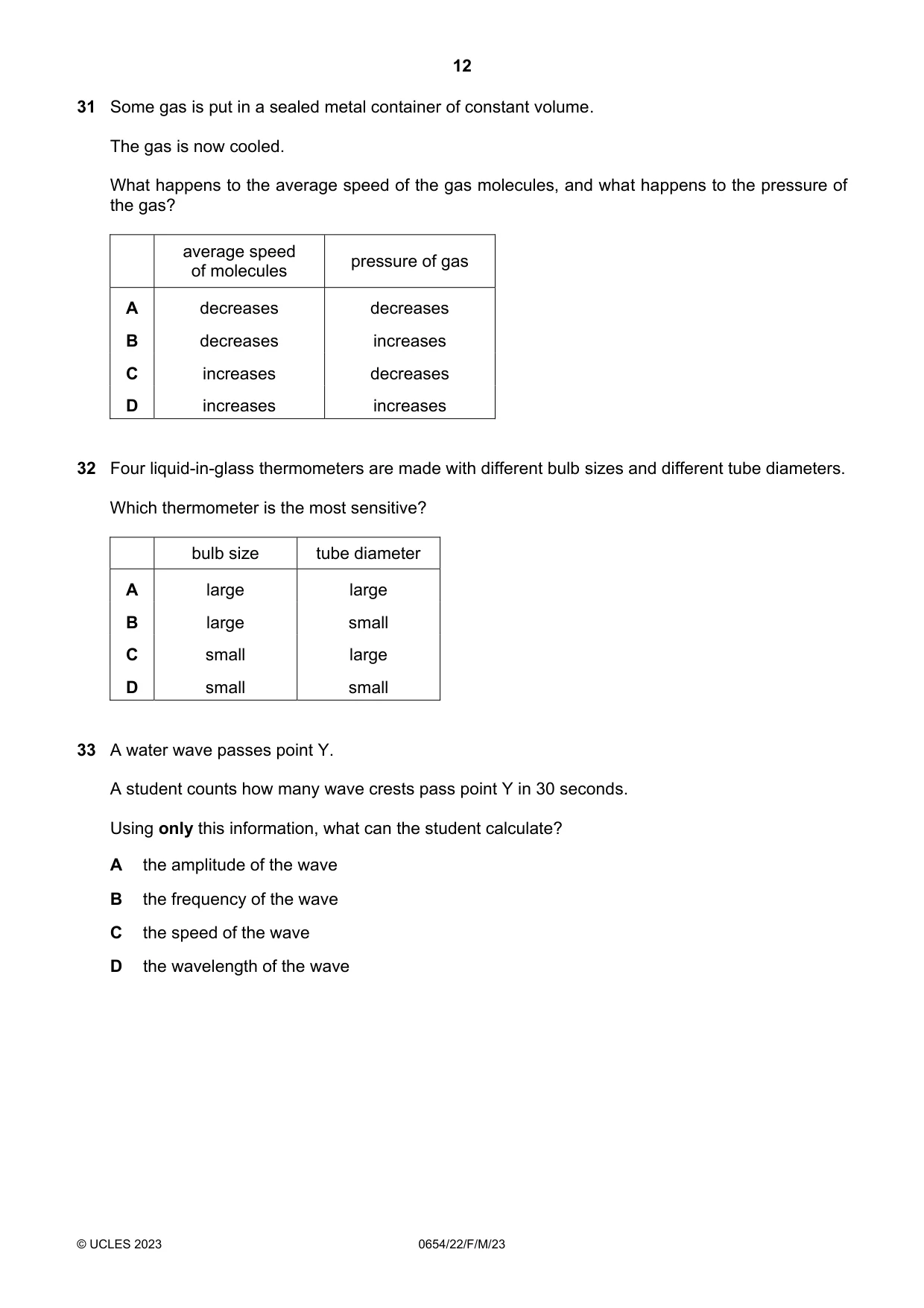
31 Some gas is put in a sealed metal container of constant volume. The gas is now cooled. What happens to the average speed of the gas molecules, and what happens to the pressure of the gas? average speed pressure of gas of molecules A decreases decreases B decreases increases C increases decreases D increases increases
Mark scheme: A
Q32 · Four liquid-in-glass thermometers are made with different bulb sizes and different tube…
32 Four liquid-in-glass thermometers are made with different bulb sizes and different tube diameters. Which thermometer is the most sensitive? bulb size tube diameter A large large B large small C small large D small small
Mark scheme: B
Q33 · A water wave passes point Y
33 A water wave passes point Y. A student counts how many wave crests pass point Y in 30 seconds. Using only this information, what can the student calculate? A the amplitude of the wave B the frequency of the wave C the speed of the wave D the wavelength of the wave
Mark scheme: B
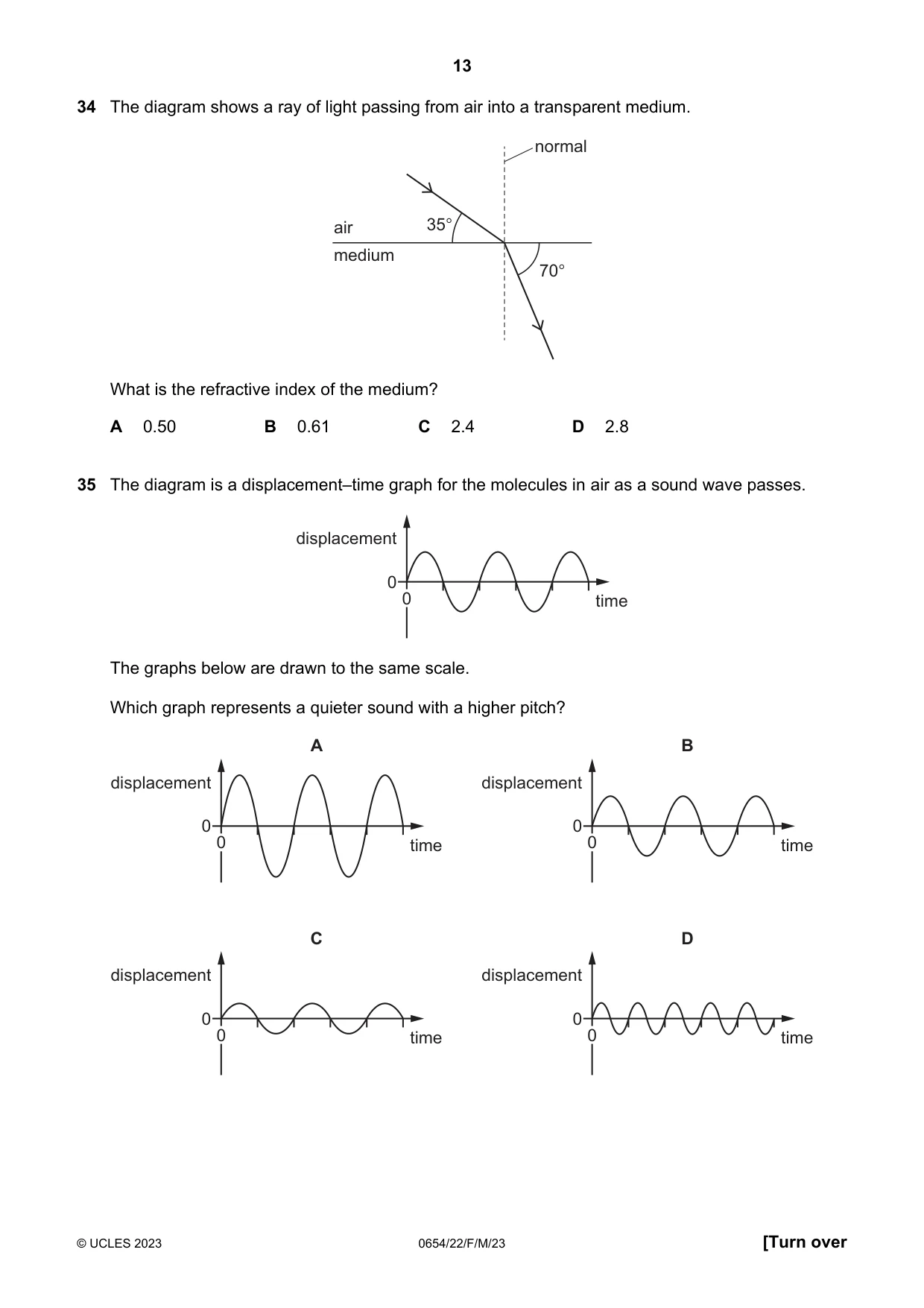
Q34 · The diagram shows a ray of light passing from air into a transparent medium
34 The diagram shows a ray of light passing from air into a transparent medium. normal air 35° medium 70° What is the refractive index of the medium? A 0.50 B 0.61 C 2.4 D 2.8
Mark scheme: C
Q35 · The diagram is a displacement–time graph for the molecules in air as a sound wave passes
35 The diagram is a displacement–time graph for the molecules in air as a sound wave passes. displacement 0 0 time The graphs below are drawn to the same scale. Which graph represents a quieter sound with a higher pitch? A B displacement displacement 0 0 0 time 0 time C D displacement displacement 0 0 0 time 0 time
Mark scheme: D
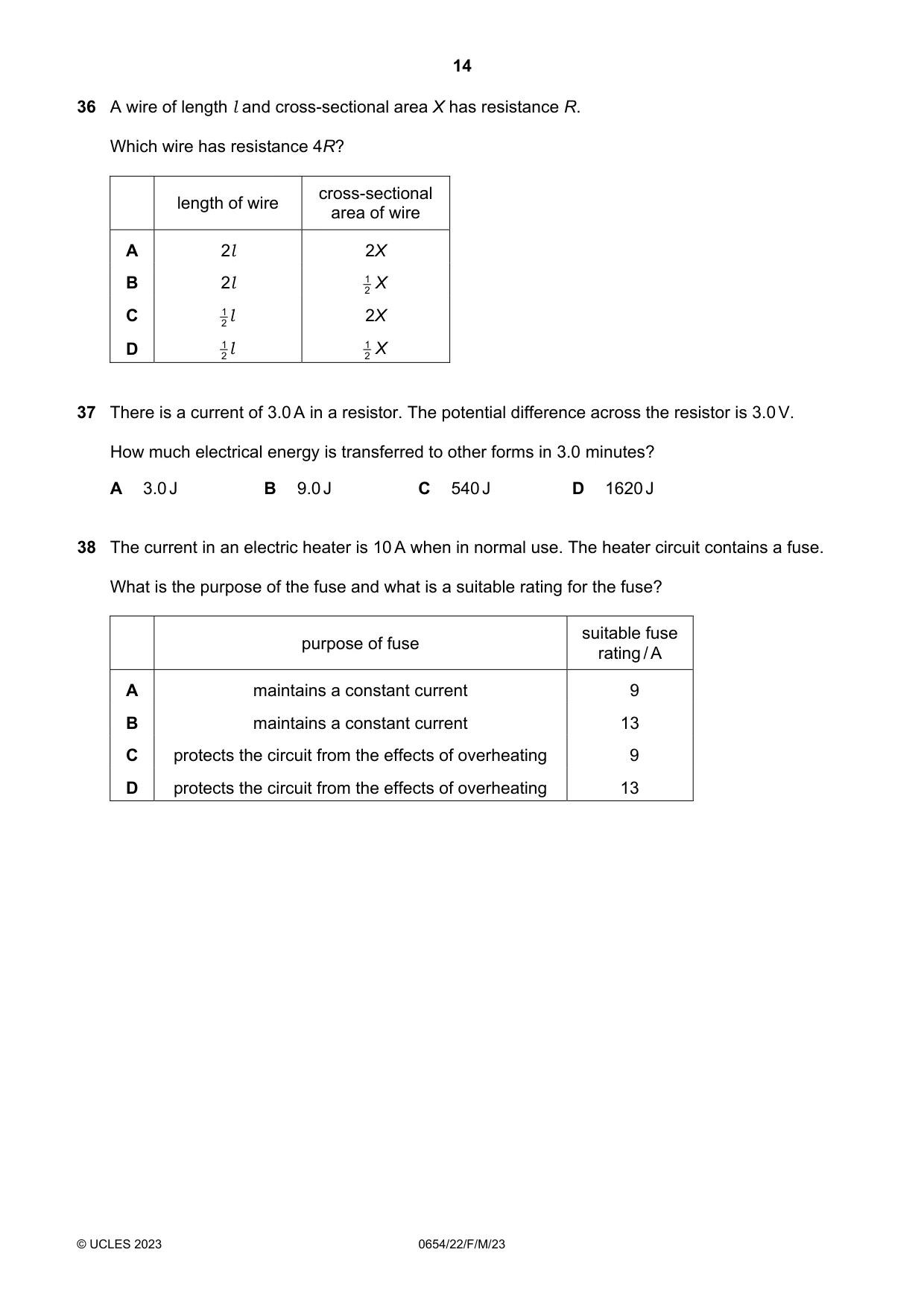
Q36 · A wire of length l and cross-sectional area X has resistance R
36 A wire of length l and cross-sectional area X has resistance R. Which wire has resistance 4R? cross-sectional length of wire area of wire A 2l 2X B 2l 2 X 1 C 2l 1 2X D 2l 1 2 X 1
Mark scheme: B
Q37 · There is a current of 3.0 A in a resistor
37 There is a current of 3.0 A in a resistor. The potential difference across the resistor is 3.0 V. How much electrical energy is transferred to other forms in 3.0 minutes? A 3.0 J B 9.0 J C 540 J D 1620 J
Mark scheme: D
Q38 · The current in an electric heater is 10 A when in normal use
38 The current in an electric heater is 10 A when in normal use. The heater circuit contains a fuse. What is the purpose of the fuse and what is a suitable rating for the fuse? suitable fuse purpose of fuse rating / A A maintains a constant current 9 B maintains a constant current 13 C protects the circuit from the effects of overheating 9 D protects the circuit from the effects of overheating 13
Mark scheme: D
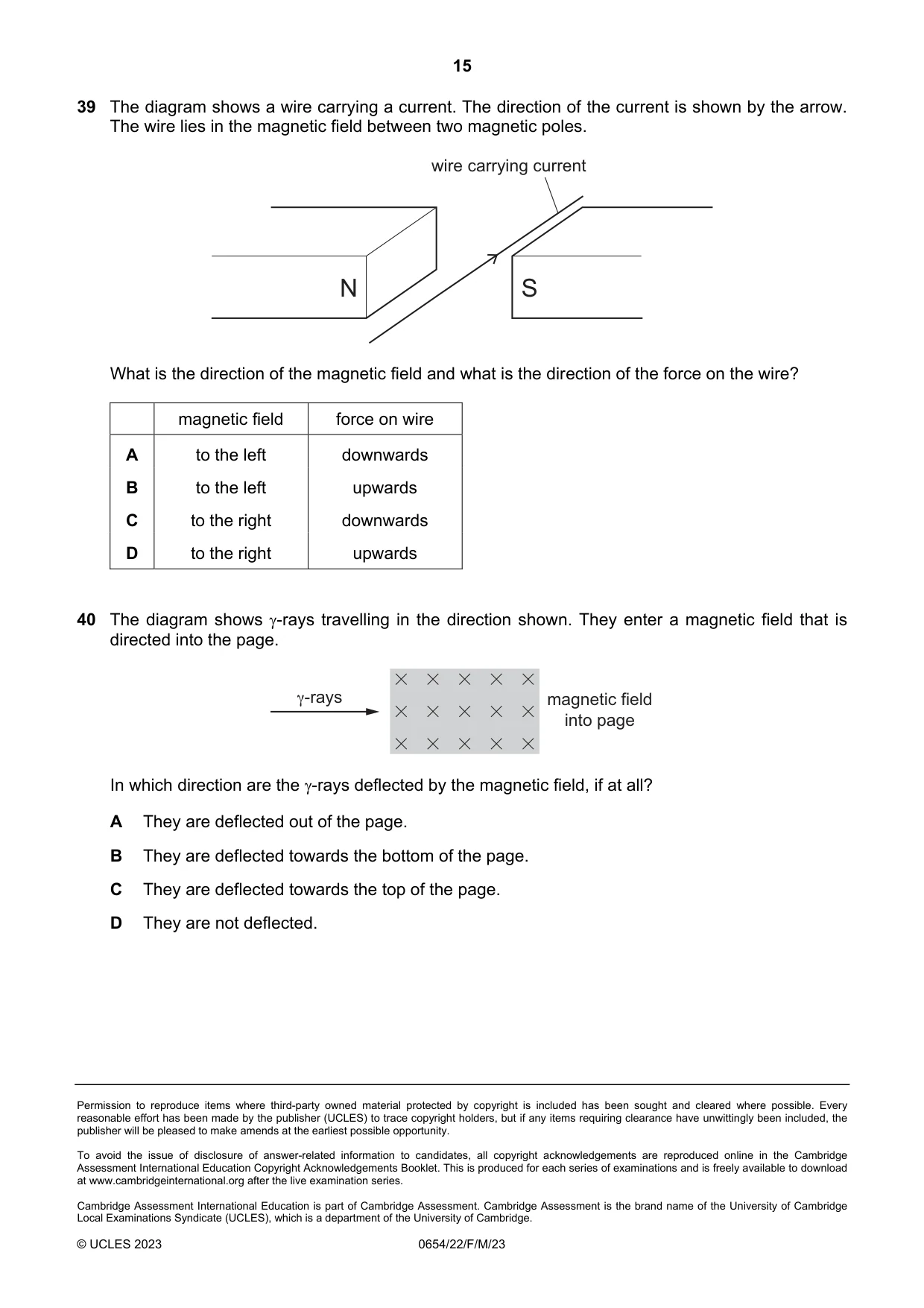
Q39 · The diagram shows a wire carrying a current
39 The diagram shows a wire carrying a current. The direction of the current is shown by the arrow. The wire lies in the magnetic field between two magnetic poles. wire carrying current N S What is the direction of the magnetic field and what is the direction of the force on the wire? magnetic field force on wire A to the left downwards B to the left upwards C to the right downwards D to the right upwards
Mark scheme: C
Q40 · The diagram shows -rays travelling in the direction shown
40 The diagram shows -rays travelling in the direction shown. They enter a magnetic field that is directed into the page. γ-rays magnetic field into page In which direction are the -rays deflected by the magnetic field, if at all? A They are deflected out of the page. B They are deflected towards the bottom of the page. C They are deflected towards the top of the page. D They are not deflected.
Mark scheme: D
What was in this paper
The subtopics covered by these 40 questions, and how many questions each got. Open one in a new tab to see every Cambridge question on it.
2Alcohols1Alkenes1Biological molecules1Characteristics of living organisms1Conservation1Coordination and response1Diet1Digestion1Electrical quantities1Electrical safety1Electrolysis1Electromagnetic effects1Elements, compounds and mixtures1Energy flow1Enzymes1Exothermic and endothermic reactions1Extraction of metals1Forces1General properties of waves1Heart1Identification of ions and gases1Kinetic particle model of matter1Light1Motion1Noble gases1Osmosis1Oxides1Radioactivity1Rate of reaction1Redox1Respiration1Selection1Separation and purification1Sexual reproduction1Sound1The mole and the Avogadro constant1Thermal properties and temperature1Transition elements1What you needed in this session
Cambridge’s own grade thresholds for 2023 Feb/March, Paper 2 · Variant 2. A higher threshold means an easier paper — the bar moves with how the cohort did.