Cambridge IGCSE Sciences - Co-ordinated (Double) 0654 — 2021 May/June Paper 2 · Variant 1
0654/21/M/J/21 · 40 questions · 40 marks · ≈45 min
The question paper and its mark scheme, free to read here and free to download. This is Cambridge’s own paper, exactly as it was sat.
Question paper16 pages

Mark scheme3 pages
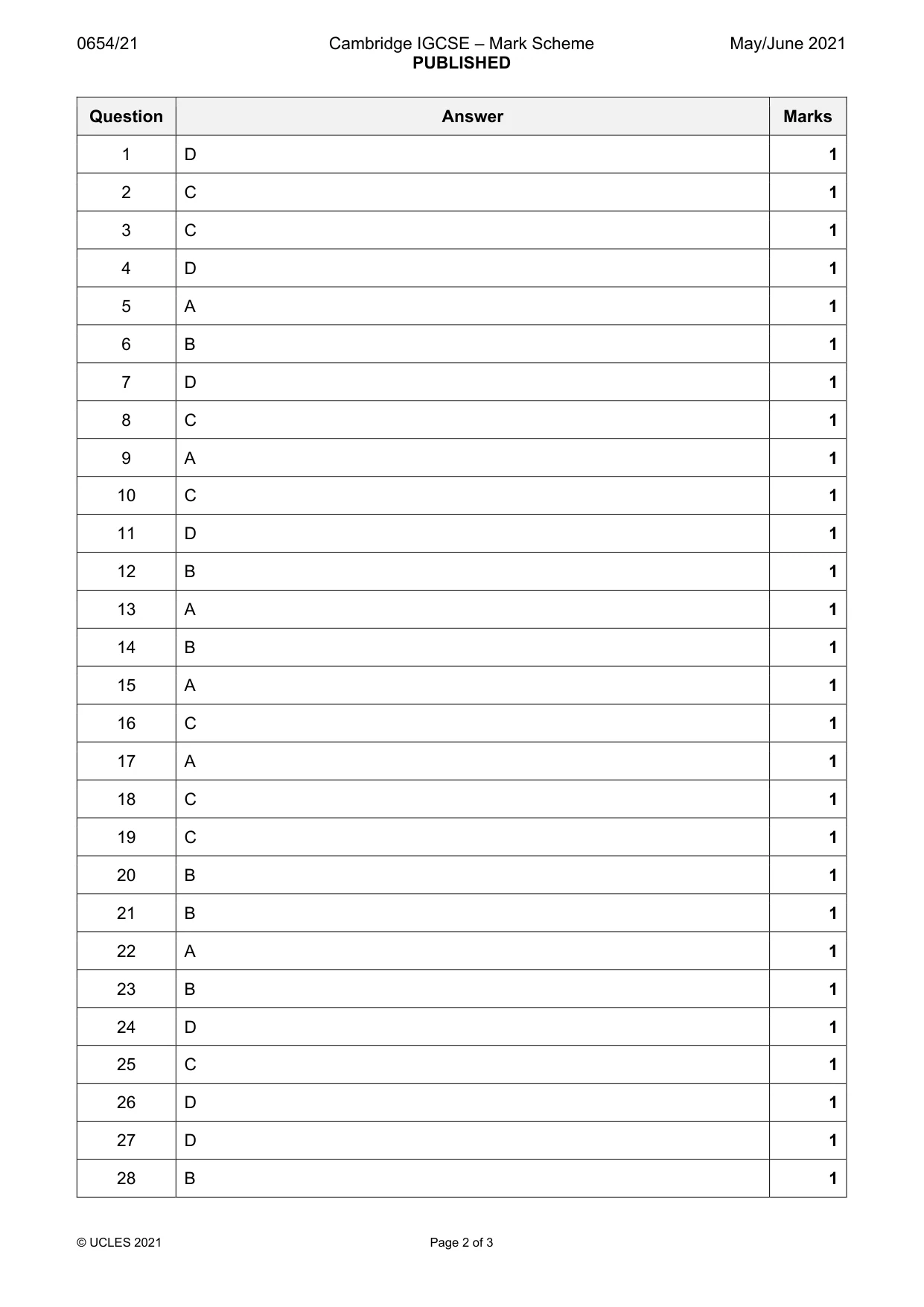
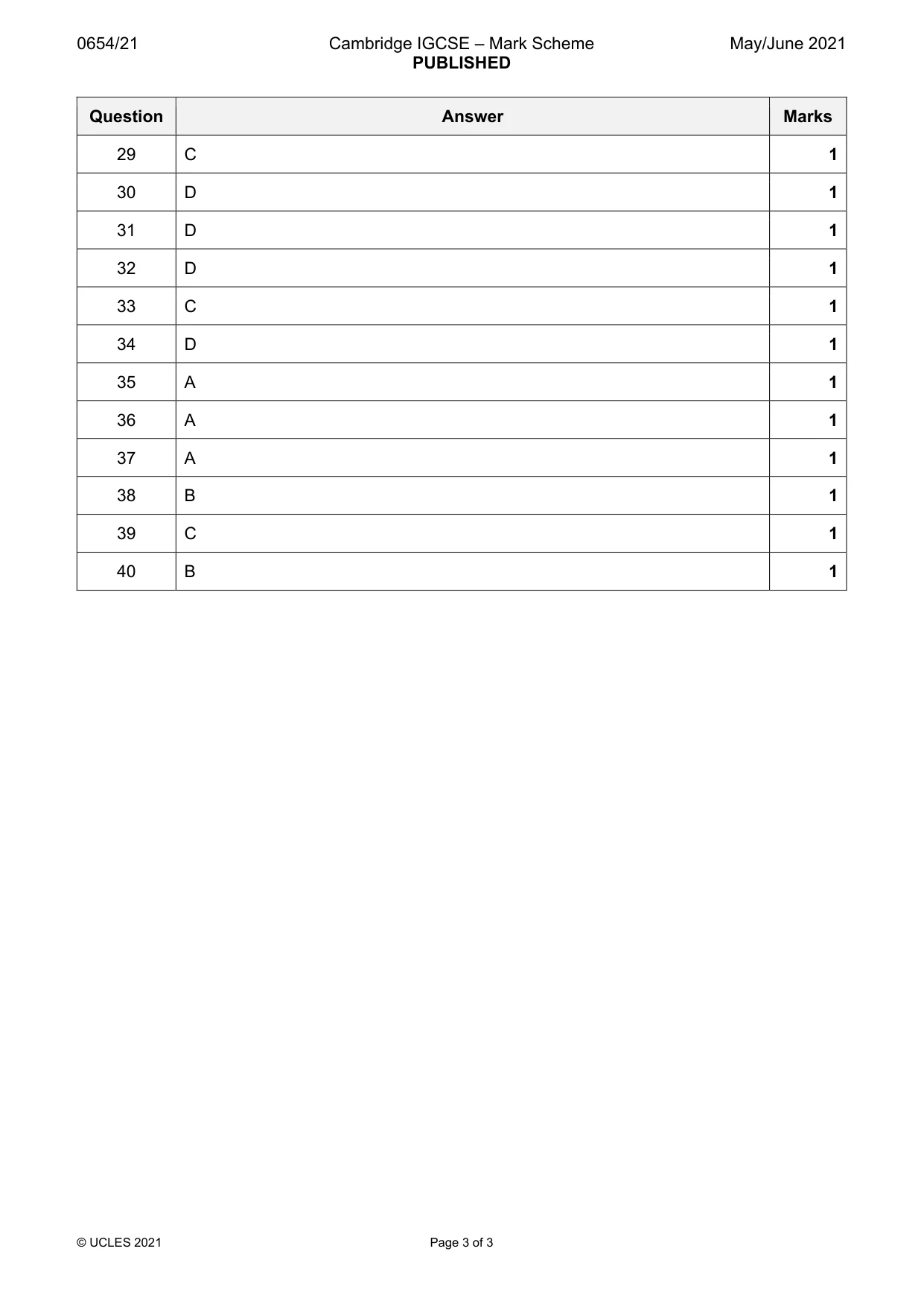
Answers below. Sit the paper first if you are practising.
Questions as text
Question 1
1 What is respiration? A breakdown of food by enzymes in the alimentary canal B breathing to supply oxygen to cells C release of carbon dioxide from the lungs D release of energy for body activities
Mark scheme: D
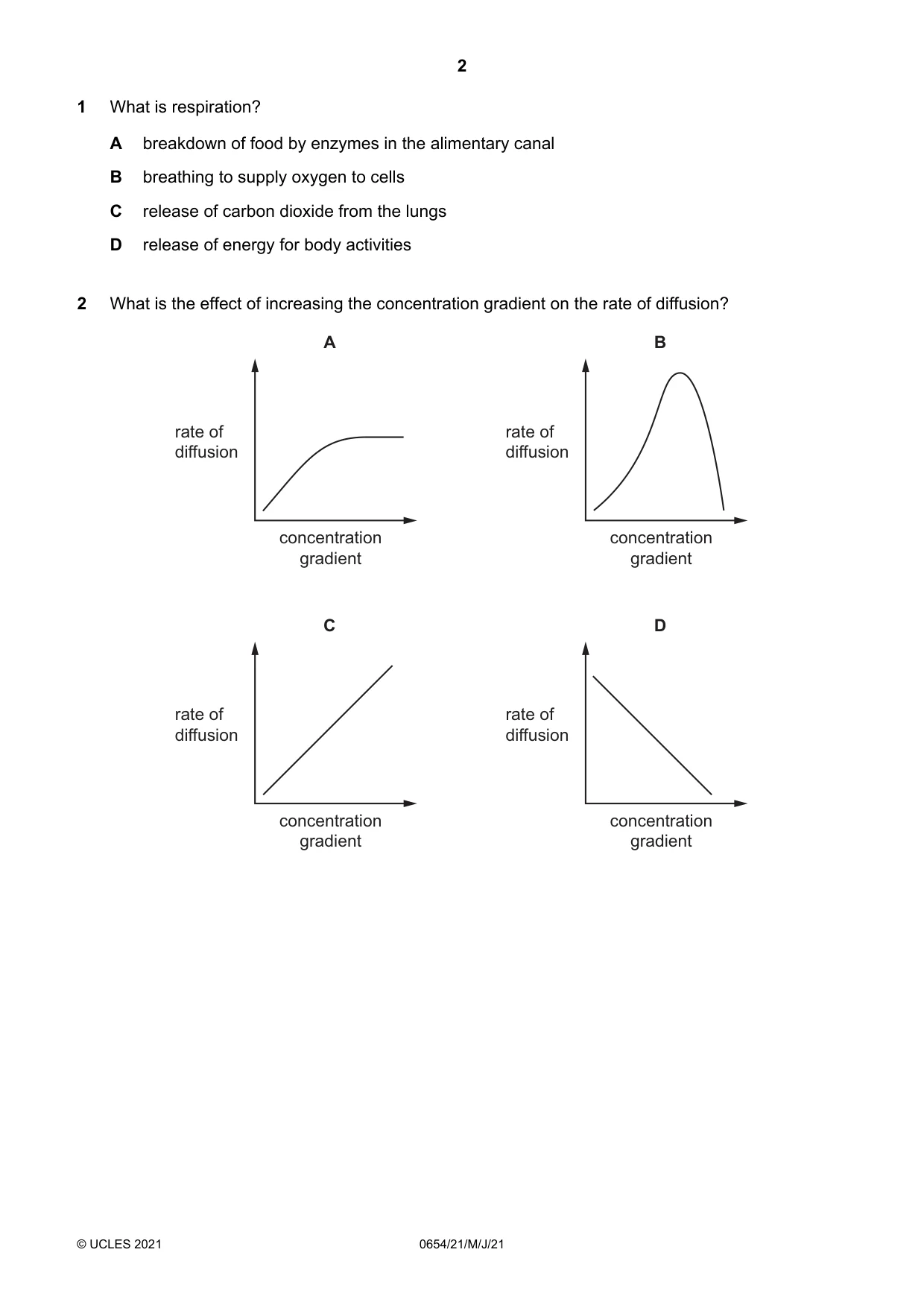
Q2 · What is the effect of increasing the concentration gradient on the rate of diffusion?
2 What is the effect of increasing the concentration gradient on the rate of diffusion? A B rate of rate of diffusion diffusion concentration concentration gradient gradient C D rate of rate of diffusion diffusion concentration concentration gradient gradient
Mark scheme: C
Q3 · Three food tests are carried out on a sample of food
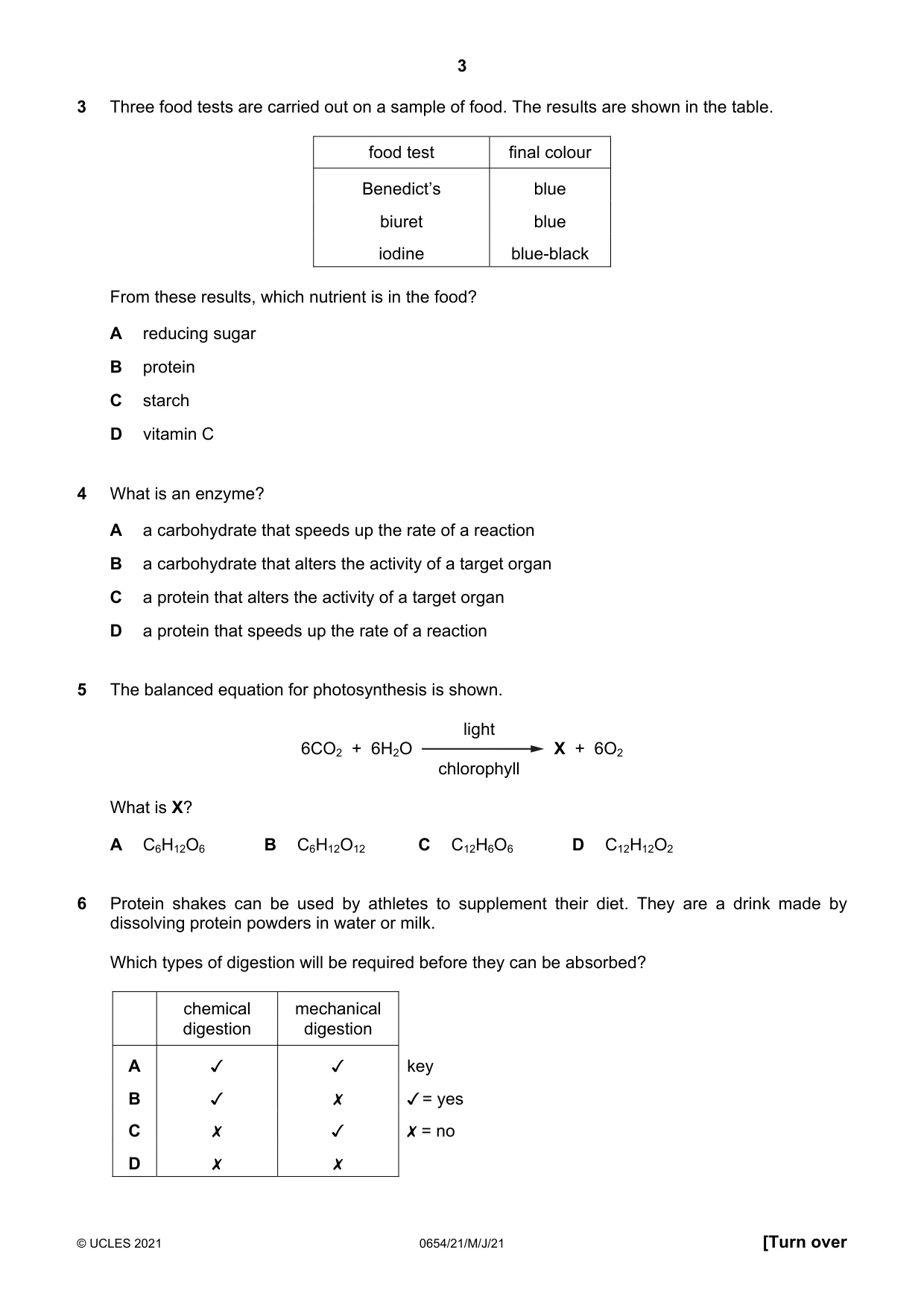
3 Three food tests are carried out on a sample of food. The results are shown in the table. food test final colour Benedict’s blue biuret blue iodine blue-black From these results, which nutrient is in the food? A reducing sugar B protein C starch D vitamin C
Mark scheme: C
Q4 · What is an enzyme?
4 What is an enzyme? A a carbohydrate that speeds up the rate of a reaction B a carbohydrate that alters the activity of a target organ C a protein that alters the activity of a target organ D a protein that speeds up the rate of a reaction
Mark scheme: D
Q5 · The balanced equation for photosynthesis is shown
5 The balanced equation for photosynthesis is shown. light 6CO2 + 6H2O X + 6O2 chlorophyll What is X? A C6H12O6 B C6H12O12 C C12H6O6 D C12H12O2
Mark scheme: A
Q6 · Protein shakes can be used by athletes to supplement their diet
6 Protein shakes can be used by athletes to supplement their diet. They are a drink made by dissolving protein powders in water or milk. Which types of digestion will be required before they can be absorbed? chemical mechanical digestion digestion Jv v key /=yes 0 Oo WwW > Jv x x v X=no x x
Mark scheme: B
Q7 · A student investigates the effect of humidity on transpiration rate
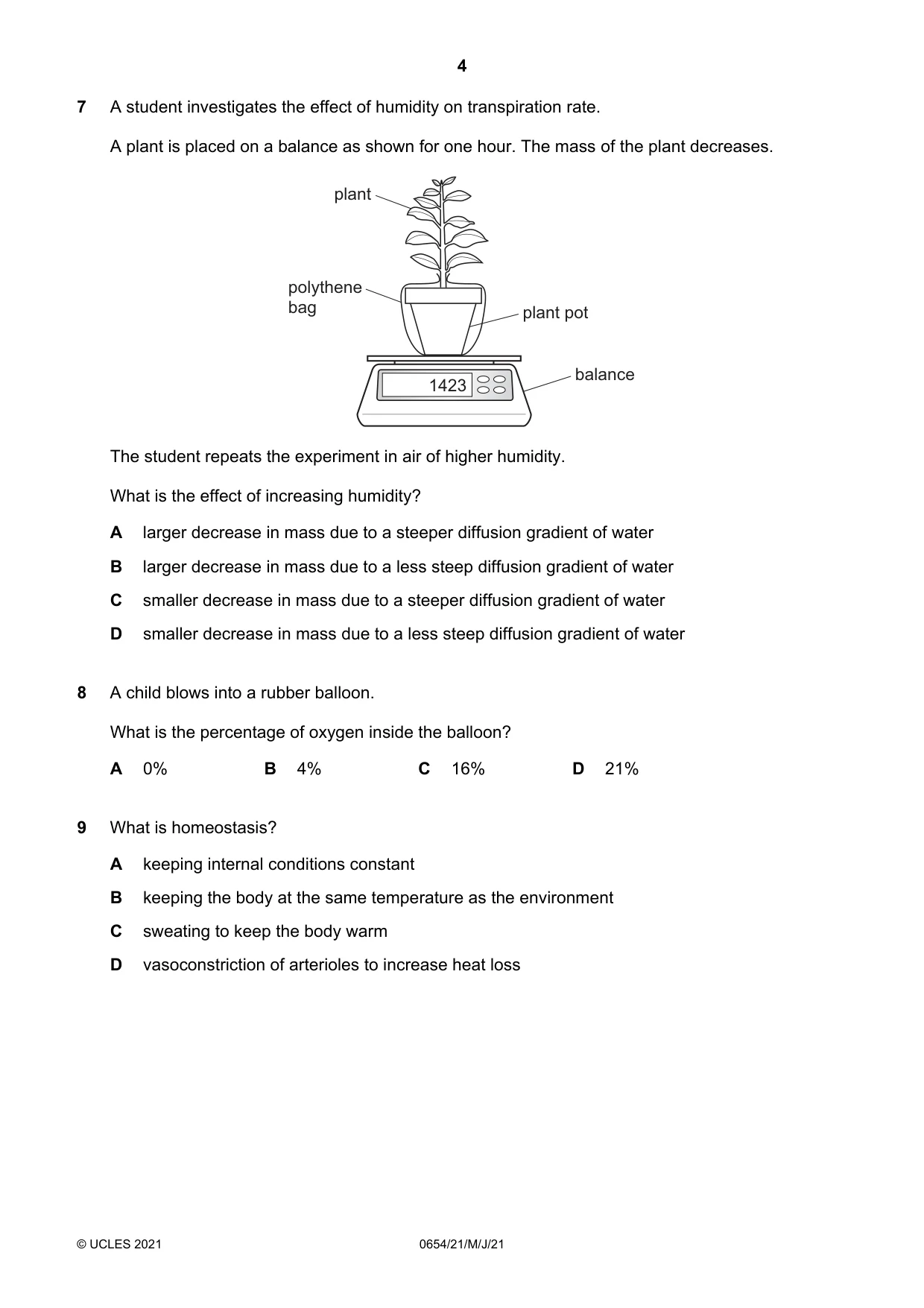
7 A student investigates the effect of humidity on transpiration rate. A plant is placed on a balance as shown for one hour. The mass of the plant decreases. plant polythene bag plant pot balance 1423 The student repeats the experiment in air of higher humidity. What is the effect of increasing humidity? A larger decrease in mass due to a steeper diffusion gradient of water B larger decrease in mass due to a less steep diffusion gradient of water C smaller decrease in mass due to a steeper diffusion gradient of water D smaller decrease in mass due to a less steep diffusion gradient of water
Mark scheme: D
Q8 · A child blows into a rubber balloon
8 A child blows into a rubber balloon. What is the percentage of oxygen inside the balloon? A 0% B 4% C 16% D 21%
Mark scheme: C
Question 9
9 What is homeostasis? A keeping internal conditions constant B keeping the body at the same temperature as the environment C sweating to keep the body warm D vasoconstriction of arterioles to increase heat loss
Mark scheme: A
Q10 · Which row about these human cells is correct?
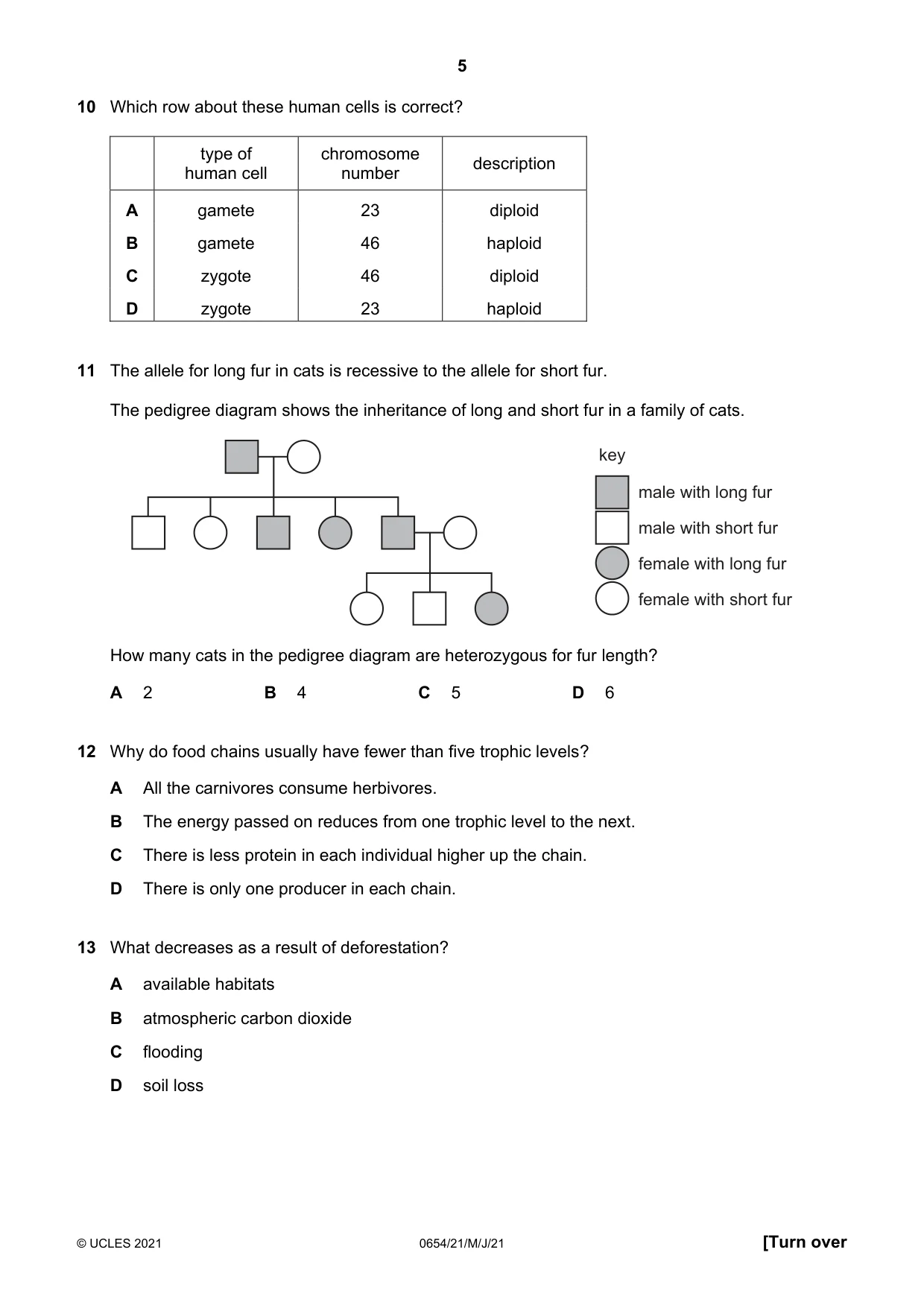
10 Which row about these human cells is correct? type of chromosome description human cell number A gamete 23 diploid B gamete 46 haploid C zygote 46 diploid D zygote 23 haploid
Mark scheme: C
Q11 · The allele for long fur in cats is recessive to the allele for short fur
11 The allele for long fur in cats is recessive to the allele for short fur. The pedigree diagram shows the inheritance of long and short fur in a family of cats. key male with long fur male with short fur female with long fur female with short fur How many cats in the pedigree diagram are heterozygous for fur length? A 2 B 4 C 5 D 6
Mark scheme: D
Q12 · Why do food chains usually have fewer than five trophic levels?
12 Why do food chains usually have fewer than five trophic levels? A All the carnivores consume herbivores. B The energy passed on reduces from one trophic level to the next. C There is less protein in each individual higher up the chain. D There is only one producer in each chain.
Mark scheme: B
Q13 · What decreases as a result of deforestation?
13 What decreases as a result of deforestation? A available habitats B atmospheric carbon dioxide C flooding D soil loss
Mark scheme: A
Q14 · The structures of some substances are shown
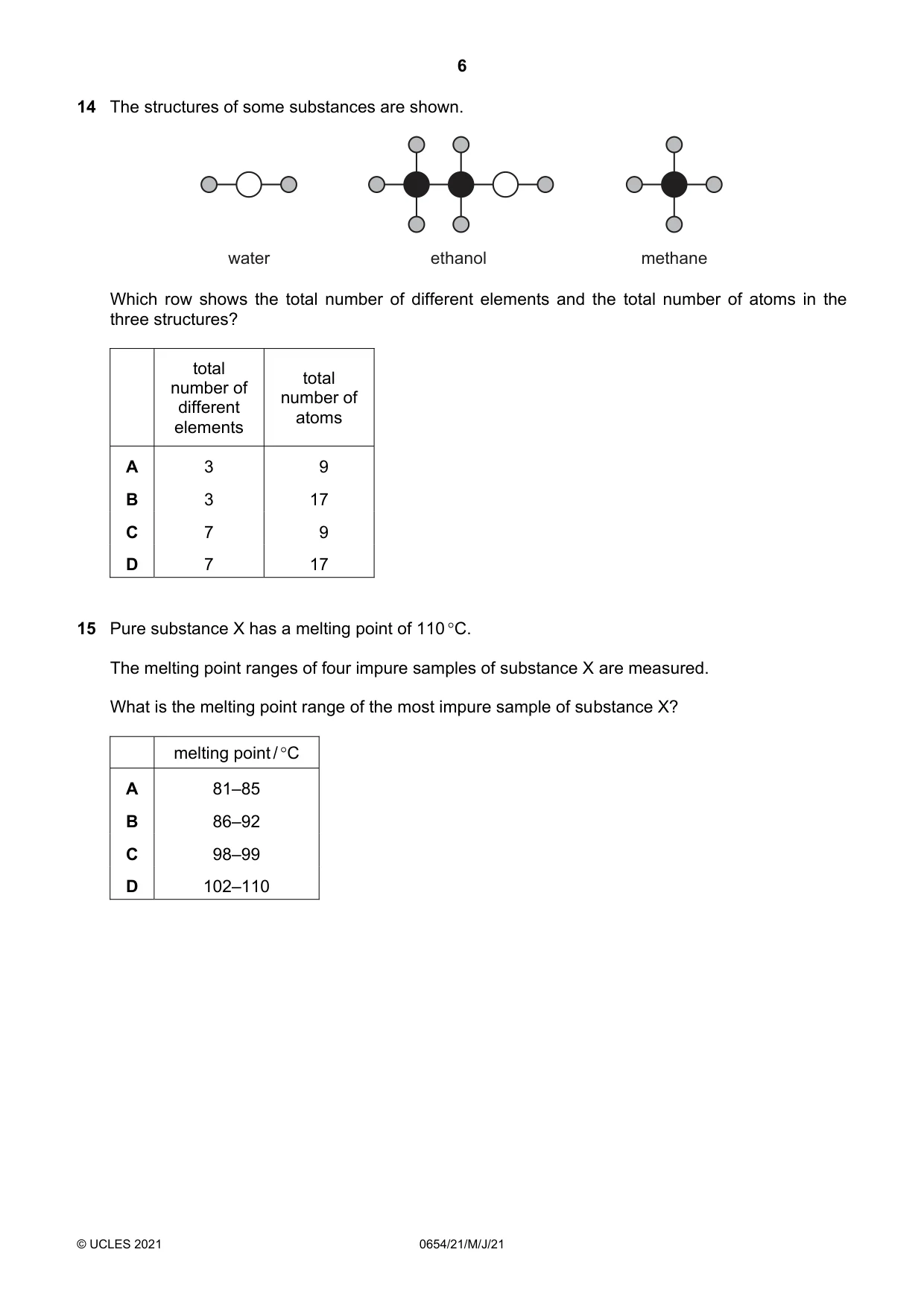
14 The structures of some substances are shown. water ethanol methane Which row shows the total number of different elements and the total number of atoms in the three structures? total total number of number of different atoms elements A 3 9 B 3 17 C 7 9 D 7 17
Mark scheme: B
Q15 · Pure substance X has a melting point of 110 C
15 Pure substance X has a melting point of 110 C. The melting point ranges of four impure samples of substance X are measured. What is the melting point range of the most impure sample of substance X? melting point / C A 81–85 B 86–92 C 98–99 D 102–110
Mark scheme: A
Q16 · Which row explains why the melting points of covalent compounds are lower than those of…
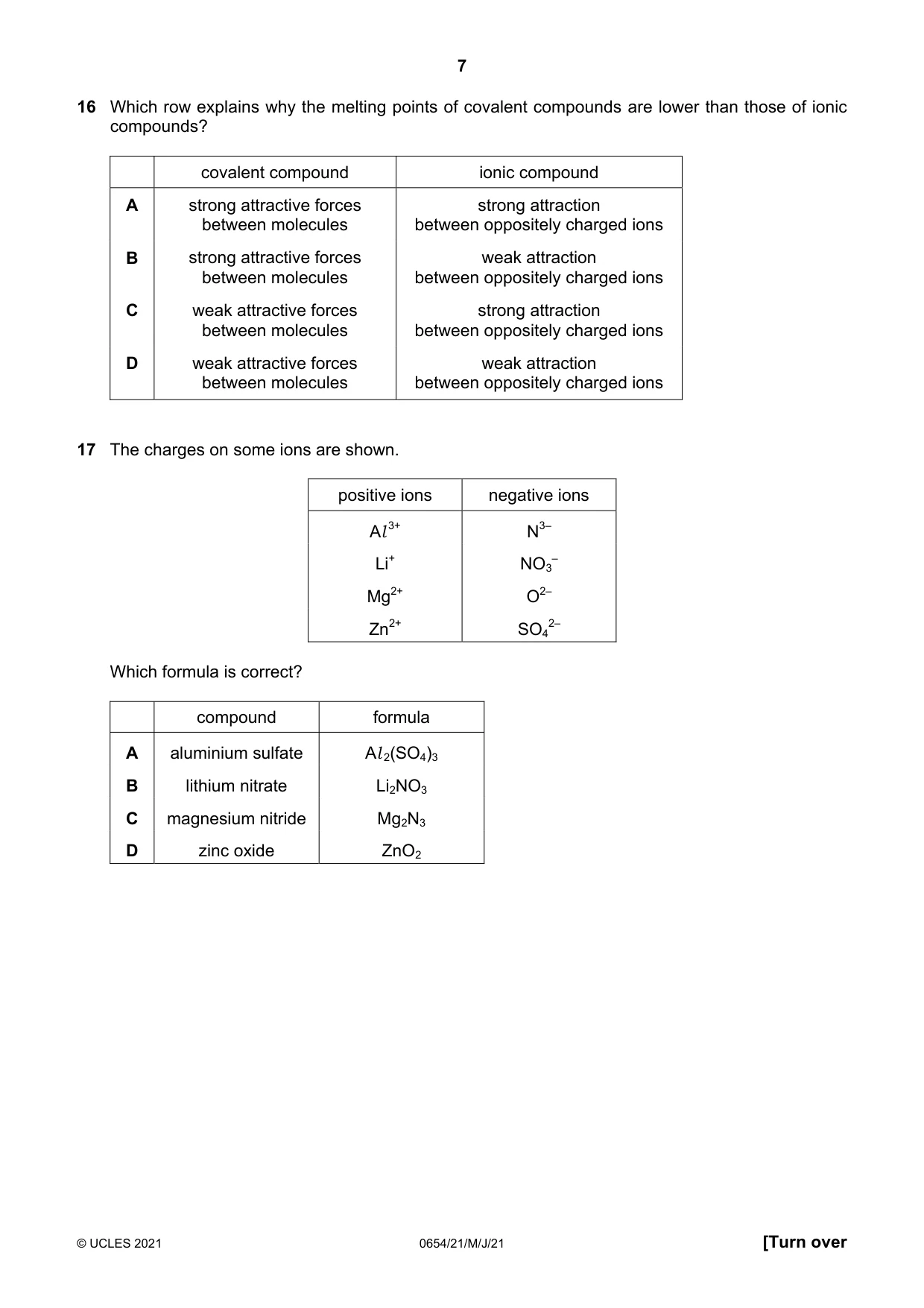
16 Which row explains why the melting points of covalent compounds are lower than those of ionic compounds? covalent compound ionic compound A strong attractive forces strong attraction between molecules between oppositely charged ions B strong attractive forces weak attraction between molecules between oppositely charged ions C weak attractive forces strong attraction between molecules between oppositely charged ions D weak attractive forces weak attraction between molecules between oppositely charged ions
Mark scheme: C
Q17 · The charges on some ions are shown
17 The charges on some ions are shown. positive ions negative ions Al 3+ N3– Li+ NO3 – Mg2+ O2– Zn2+ SO4 2– Which formula is correct? compound formula A aluminium sulfate Al 2(SO4)3 B lithium nitrate Li2NO3 C magnesium nitride Mg2N3 D zinc oxide ZnO2
Mark scheme: A
Q18 · An energy level diagram for a chemical reaction is shown
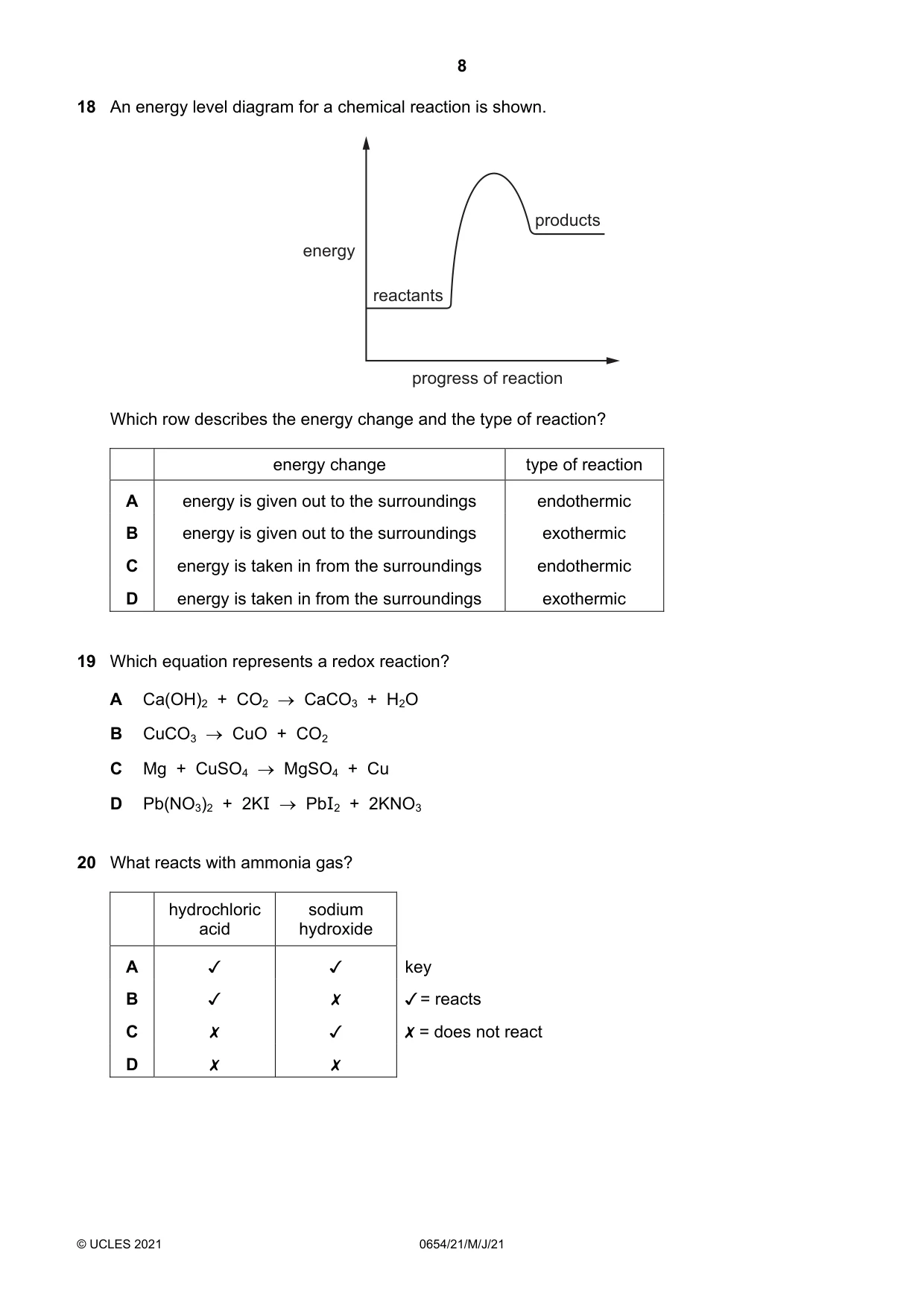
18 An energy level diagram for a chemical reaction is shown. products energy reactants progress of reaction Which row describes the energy change and the type of reaction? energy change type of reaction A energy is given out to the surroundings endothermic B energy is given out to the surroundings exothermic C energy is taken in from the surroundings endothermic D energy is taken in from the surroundings exothermic
Mark scheme: C
Q19 · Which equation represents a redox reaction?
19 Which equation represents a redox reaction? A Ca(OH)2 + CO2 CaCO3 + H2O B CuCO3 CuO + CO2 C Mg + CuSO4 MgSO4 + Cu D Pb(NO3)2 + 2KI PbI2 + 2KNO3
Mark scheme: C
Q20 · What reacts with ammonia gas?
20 What reacts with ammonia gas? hydrochloric sodium acid hydroxide A Jv J B Jv x Cc x v D x x key Jv = reacts X = does not react
Mark scheme: B
More questions on The characteristic properties of acids and bases
Q21 · Substance Q is added to cold water
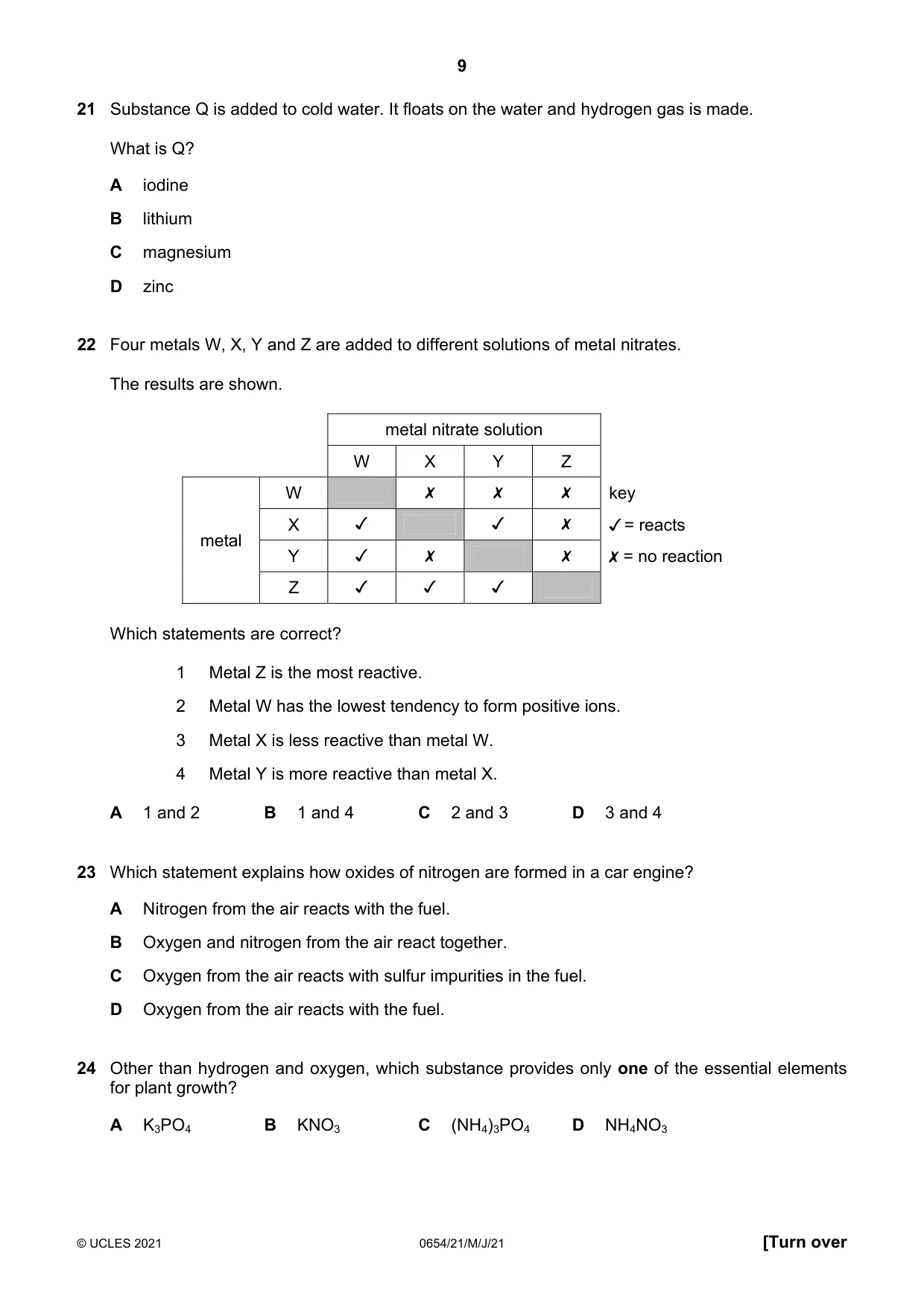
21 Substance Q is added to cold water. It floats on the water and hydrogen gas is made. What is Q? A iodine B lithium C magnesium D zinc
Mark scheme: B
Q22 · Four metals W, X, Y and Z are added to different solutions of metal nitrates
22 Four metals W, X, Y and Z are added to different solutions of metal nitrates. The results are shown. metal nitrate solution WwW Xx Y Z Ww x x x key Xx Jv v x J/ = reacts metal Y Jv x x X = no reaction Z v Jv J Which statements are correct? A 1 2 3 4 1 and 2 Metal Z is the most reactive. Metal W has the lowest tendency to form positive ions. Metal X is less reactive than metal W. Metal Y is more reactive than metal X. B 1and4 C 2and3 D 3and4
Mark scheme: A
Q23 · Which statement explains how oxides of nitrogen are formed in a car engine?
23 Which statement explains how oxides of nitrogen are formed in a car engine? A Nitrogen from the air reacts with the fuel. B Oxygen and nitrogen from the air react together. C Oxygen from the air reacts with sulfur impurities in the fuel. D Oxygen from the air reacts with the fuel.
Mark scheme: B
Q24 · Other than hydrogen and oxygen, which substance provides only one of the essential…
24 Other than hydrogen and oxygen, which substance provides only one of the essential elements for plant growth? A K3PO4 B KNO3 C (NH4)3PO4 D NH4NO3
Mark scheme: D
Q25 · What is the chemical name for lime?
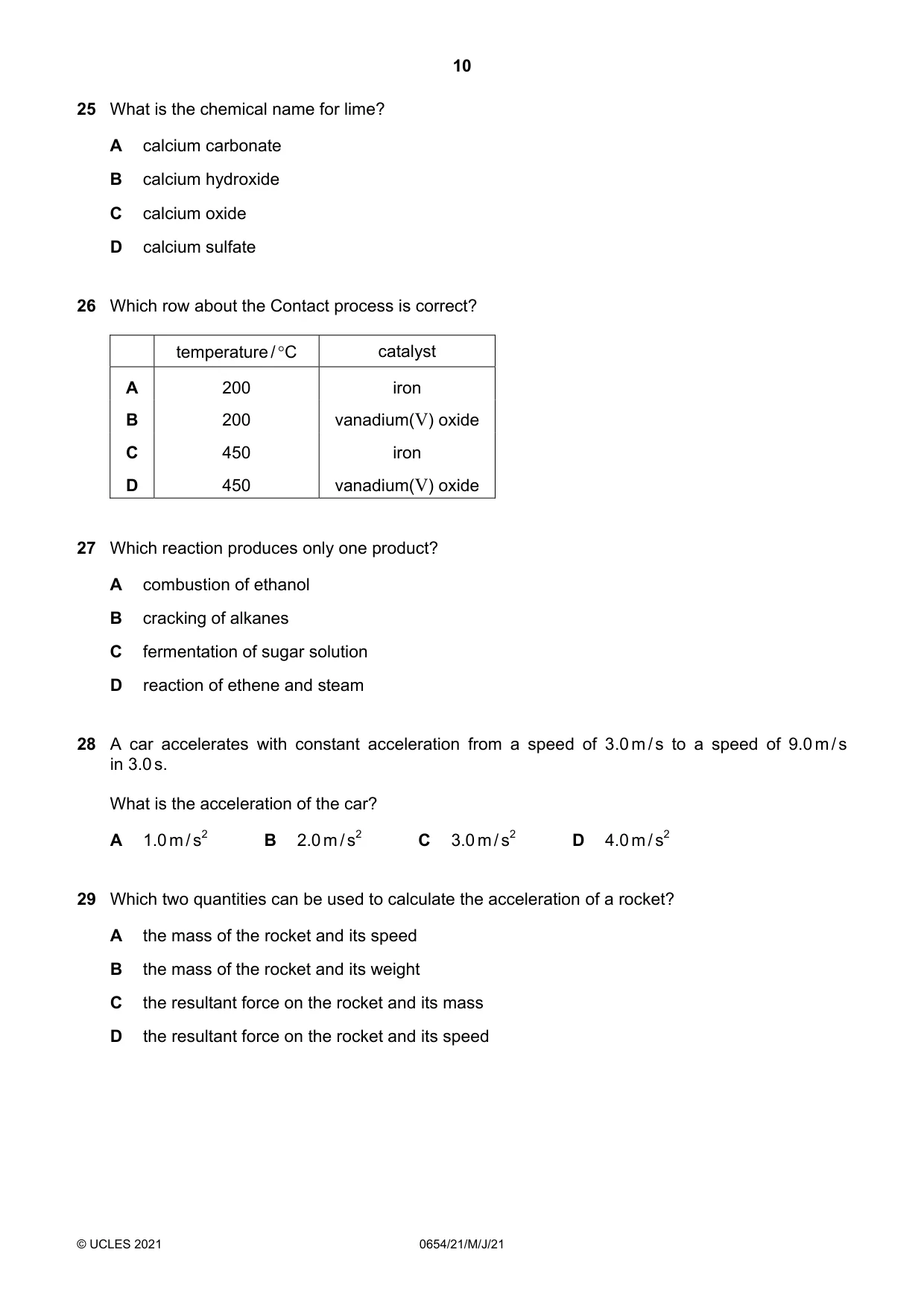
25 What is the chemical name for lime? A calcium carbonate B calcium hydroxide C calcium oxide D calcium sulfate
Mark scheme: C
Q26 · Which row about the Contact process is correct?
26 Which row about the Contact process is correct? temperature / C catalyst A 200 iron B 200 vanadium(V) oxide C 450 iron D 450 vanadium(V) oxide
Mark scheme: D
Q27 · Which reaction produces only one product?
27 Which reaction produces only one product? A combustion of ethanol B cracking of alkanes C fermentation of sugar solution D reaction of ethene and steam
Mark scheme: D
Q28 · A car accelerates with constant acceleration from a speed of 3.0 m / s to a speed of 9.0…
28 A car accelerates with constant acceleration from a speed of 3.0 m / s to a speed of 9.0 m / s in 3.0 s. What is the acceleration of the car? A 1.0 m / s2 B 2.0 m / s2 C 3.0 m / s2 D 4.0 m / s2
Mark scheme: B
Q29 · Which two quantities can be used to calculate the acceleration of a rocket?
29 Which two quantities can be used to calculate the acceleration of a rocket? A the mass of the rocket and its speed B the mass of the rocket and its weight C the resultant force on the rocket and its mass D the resultant force on the rocket and its speed
Mark scheme: C
Q30 · Which statement applies to a system in equilibrium?
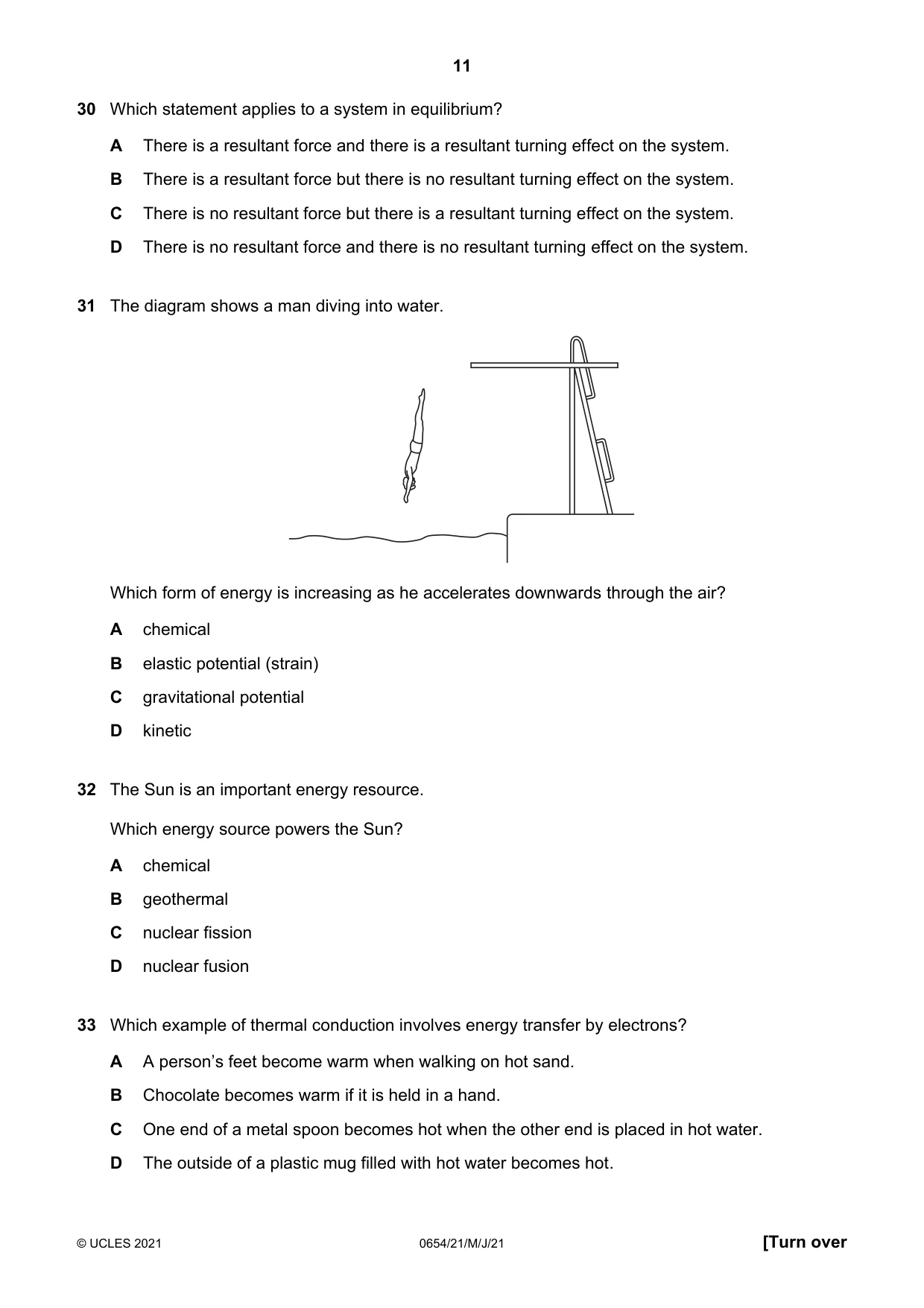
30 Which statement applies to a system in equilibrium? A There is a resultant force and there is a resultant turning effect on the system. B There is a resultant force but there is no resultant turning effect on the system. C There is no resultant force but there is a resultant turning effect on the system. D There is no resultant force and there is no resultant turning effect on the system.
Mark scheme: D
Q31 · The diagram shows a man diving into water
31 The diagram shows a man diving into water. Which form of energy is increasing as he accelerates downwards through the air? A chemical B elastic potential (strain) C gravitational potential D kinetic
Mark scheme: D
Q32 · The Sun is an important energy resource
32 The Sun is an important energy resource. Which energy source powers the Sun? A chemical B geothermal C nuclear fission D nuclear fusion
Mark scheme: D
Q33 · Which example of thermal conduction involves energy transfer by electrons?
33 Which example of thermal conduction involves energy transfer by electrons? A A person’s feet become warm when walking on hot sand. B Chocolate becomes warm if it is held in a hand. C One end of a metal spoon becomes hot when the other end is placed in hot water. D The outside of a plastic mug filled with hot water becomes hot.
Mark scheme: C
Q34 · Which colour of outer clothing helps to keep the wearer cool on a hot, sunny day, and why…
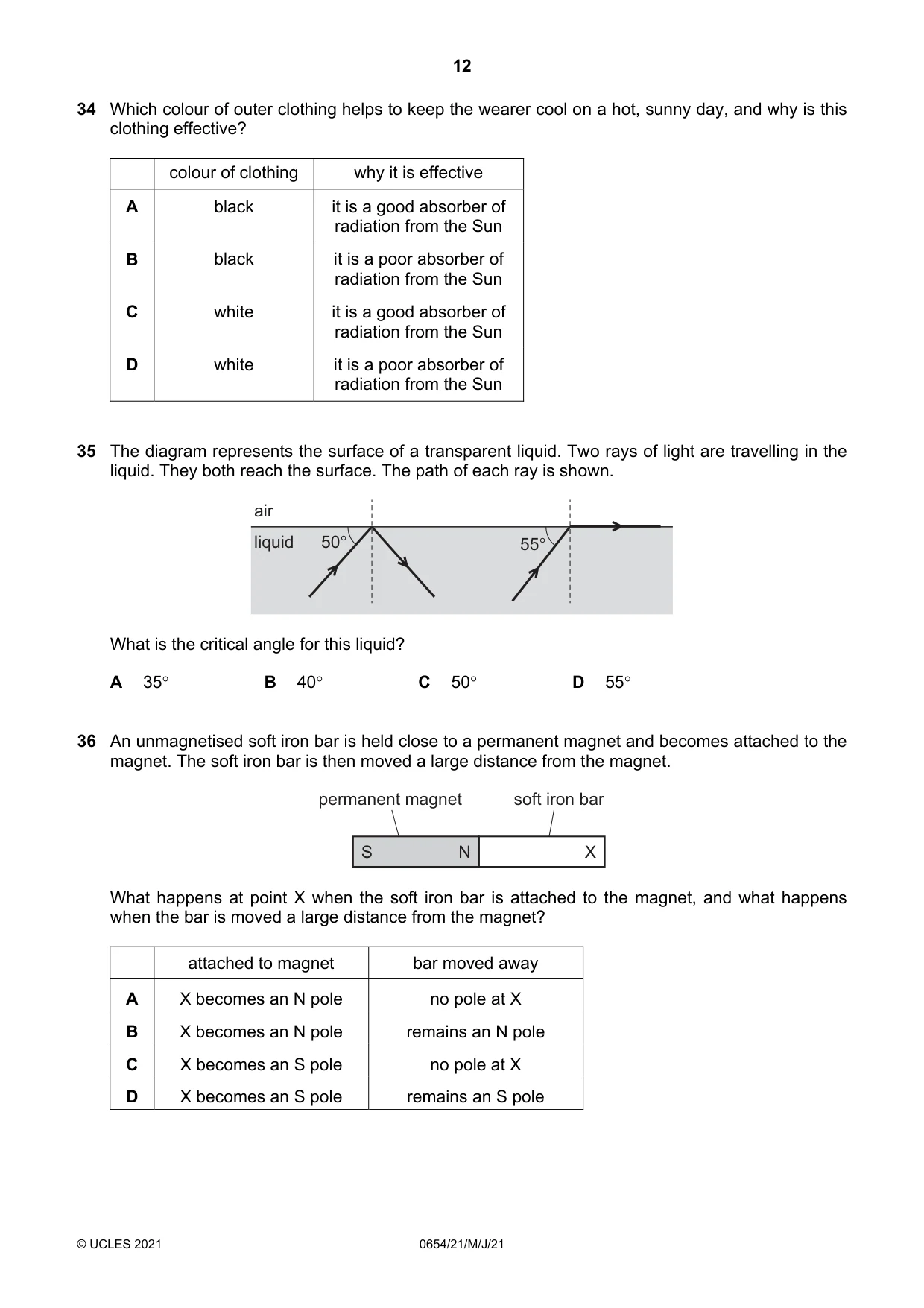
34 Which colour of outer clothing helps to keep the wearer cool on a hot, sunny day, and why is this clothing effective? colour of clothing why it is effective A black it is a good absorber of radiation from the Sun B black it is a poor absorber of radiation from the Sun C white it is a good absorber of radiation from the Sun D white it is a poor absorber of radiation from the Sun
Mark scheme: D
Q35 · The diagram represents the surface of a transparent liquid
35 The diagram represents the surface of a transparent liquid. Two rays of light are travelling in the liquid. They both reach the surface. The path of each ray is shown. air liquid 50° 55° What is the critical angle for this liquid? A 35 B 40 C 50 D 55
Mark scheme: A
Q36 · An unmagnetised soft iron bar is held close to a permanent magnet and becomes attached to…
36 An unmagnetised soft iron bar is held close to a permanent magnet and becomes attached to the magnet. The soft iron bar is then moved a large distance from the magnet. permanent magnet soft iron bar S N X What happens at point X when the soft iron bar is attached to the magnet, and what happens when the bar is moved a large distance from the magnet? attached to magnet bar moved away A X becomes an N pole no pole at X B X becomes an N pole remains an N pole C X becomes an S pole no pole at X D X becomes an S pole remains an S pole
Mark scheme: A
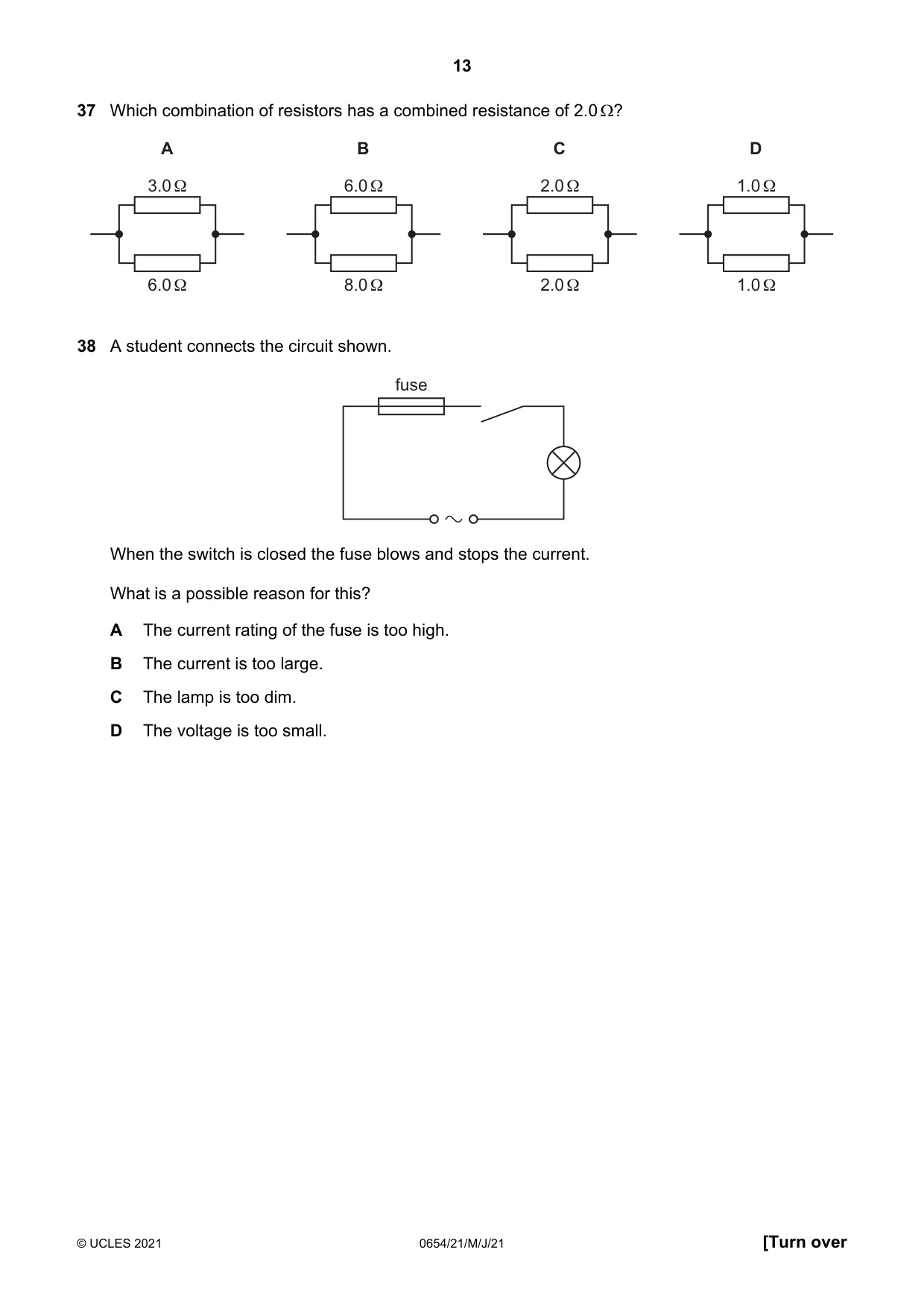
Q37 · Which combination of resistors has a combined resistance of 2.0 ?
37 Which combination of resistors has a combined resistance of 2.0 ? A B C D 3.0 Ω 6.0 Ω 2.0 Ω 1.0 Ω 6.0 Ω 8.0 Ω 2.0 Ω 1.0 Ω
Mark scheme: A
Q38 · A student connects the circuit shown
38 A student connects the circuit shown. fuse When the switch is closed the fuse blows and stops the current. What is a possible reason for this? A The current rating of the fuse is too high. B The current is too large. C The lamp is too dim. D The voltage is too small.
Mark scheme: B
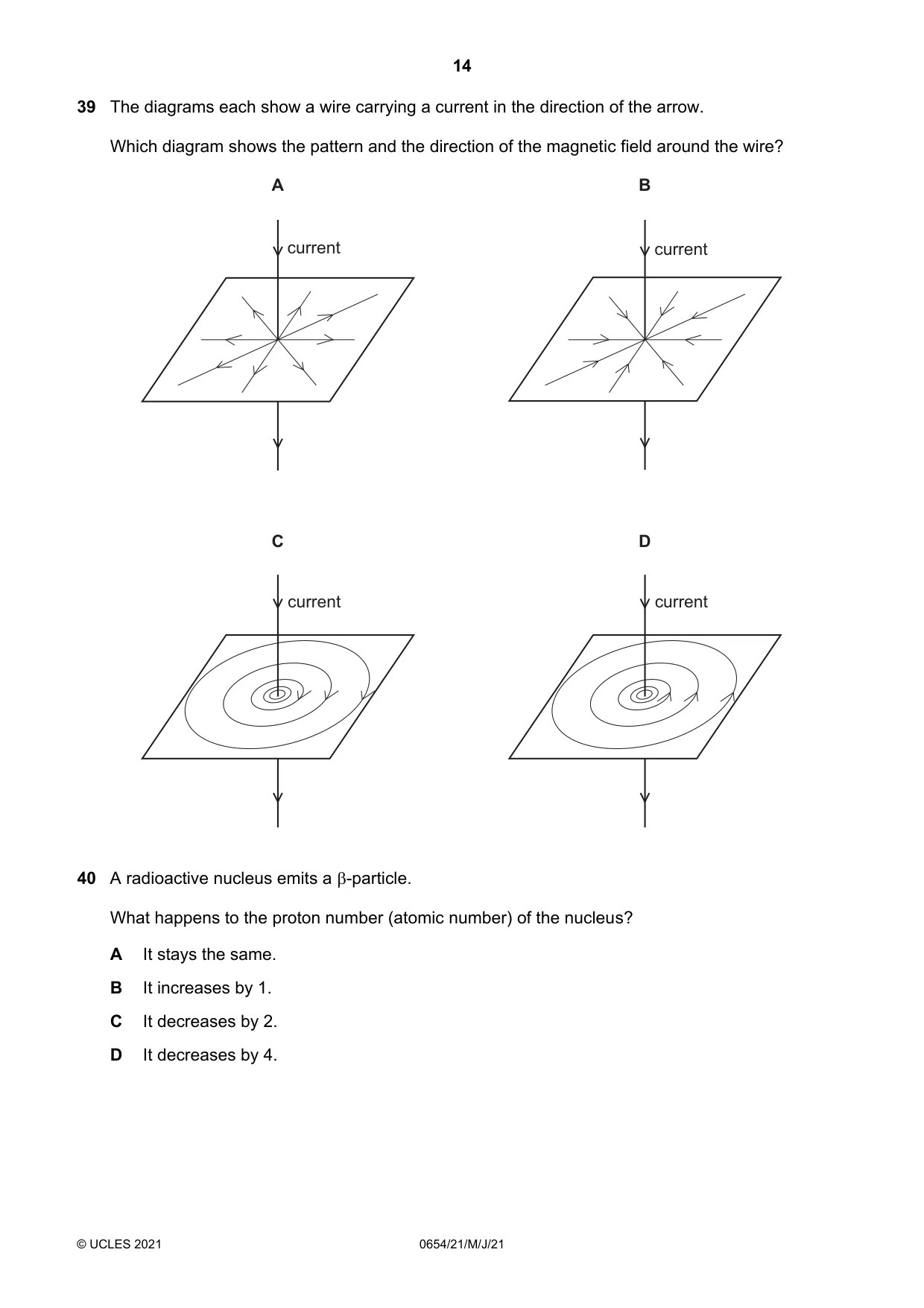
Q39 · The diagrams each show a wire carrying a current in the direction of the arrow
39 The diagrams each show a wire carrying a current in the direction of the arrow. Which diagram shows the pattern and the direction of the magnetic field around the wire? A B current current C D current current
Mark scheme: C
Q40 · A radioactive nucleus emits a -particle
40 A radioactive nucleus emits a -particle. What happens to the proton number (atomic number) of the nucleus? A It stays the same. B It increases by 1. C It decreases by 2. D It decreases by 4.
Mark scheme: B
What was in this paper
The subtopics covered by these 40 questions, and how many questions each got. Open one in a new tab to see every Cambridge question on it.
2Transfer of thermal energy2Air quality and climate1Alkenes1Biological molecules1Cell division1Diffusion1Digestion1Electrical circuits1Electrical safety1Electromagnetic effects1Elements, compounds and mixtures1Energy flow1Energy, work and power1Enzymes1Exothermic and endothermic reactions1Formulas1Gas exchange in humans1Group I properties1Habitat destruction1Homeostasis1Light1Monohybrid inheritance1Motion1Oxides1Photosynthesis1Radioactivity1Reactivity series1Redox1Respiration1Separation and purification1Simple molecules and covalent bonds1Simple phenomena of magnetism1The characteristic properties of acids and bases1The nucleus1Transition elements1Transpiration1Water1What you needed in this session
Cambridge’s own grade thresholds for 2021 May/June, Paper 2 · Variant 1. A higher threshold means an easier paper — the bar moves with how the cohort did.