Cambridge IGCSE Sciences - Co-ordinated (Double) 0654 — 2019 Oct/Nov Paper 2 · Variant 3
0654/23/O/N/19 · 40 questions · 40 marks · ≈45 min
The question paper and its mark scheme, free to read here and free to download. This is Cambridge’s own paper, exactly as it was sat.
Question paper16 pages
Mark scheme3 pages
Answers below. Sit the paper first if you are practising.
Questions as text
Q1 · What is a plant demonstrating when carbon dioxide is released from its cells?
1 What is a plant demonstrating when carbon dioxide is released from its cells? A assimilation B egestion C excretion D nutrition
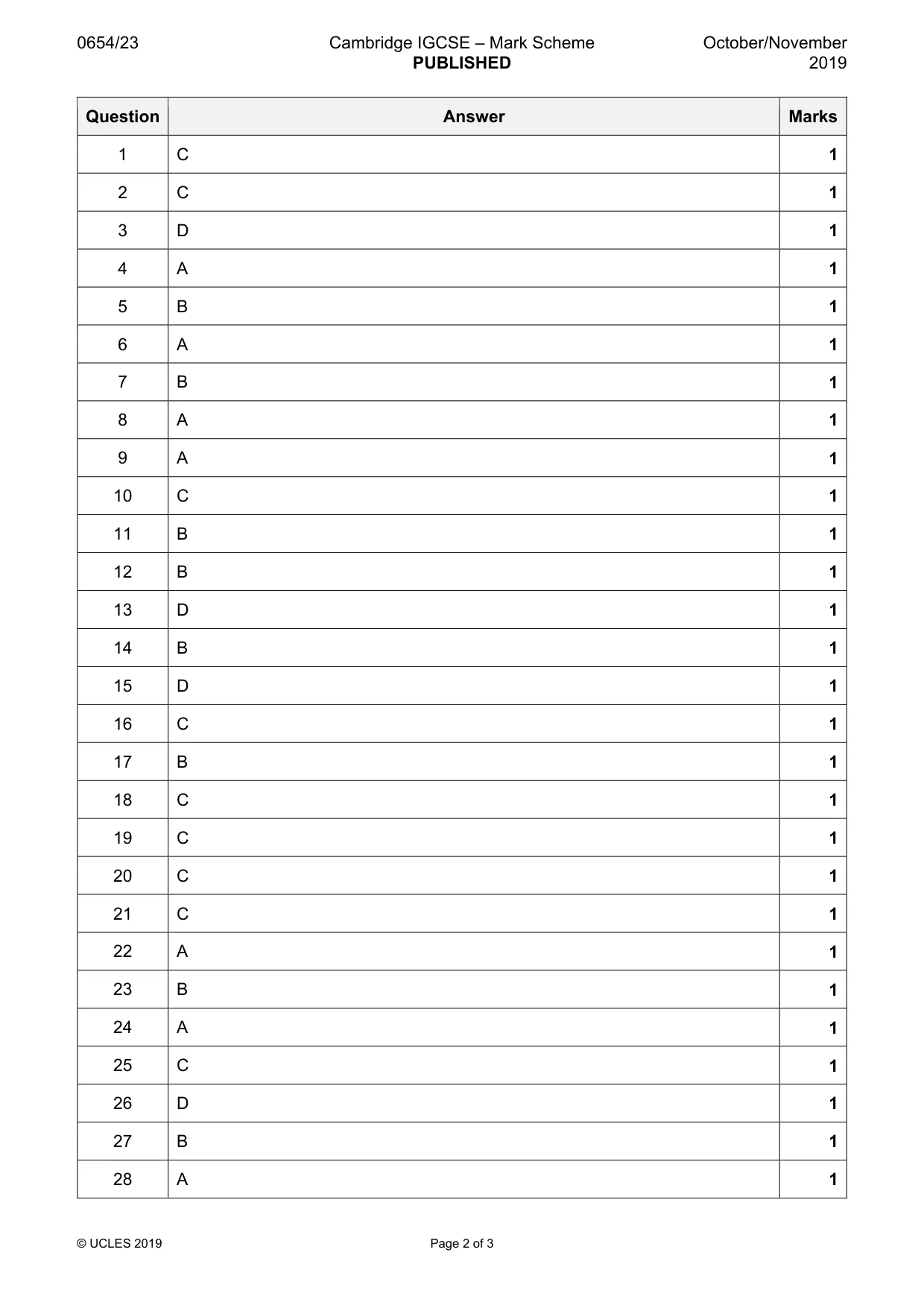
Mark scheme: C
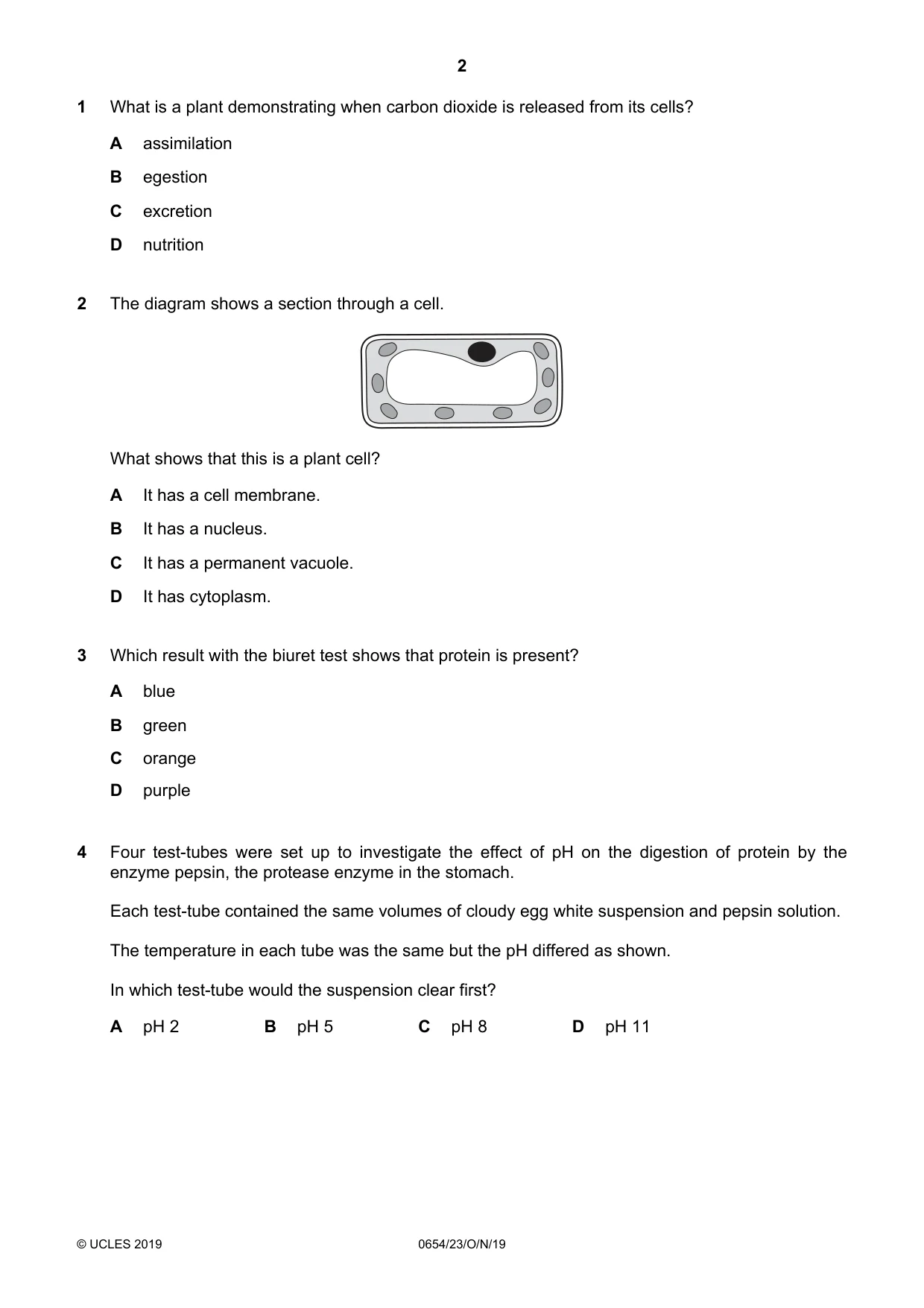
Q2 · The diagram shows a section through a cell
2 The diagram shows a section through a cell. What shows that this is a plant cell? A It has a cell membrane. B It has a nucleus. C It has a permanent vacuole. D It has cytoplasm.
Mark scheme: C
Q3 · Which result with the biuret test shows that protein is present?
3 Which result with the biuret test shows that protein is present? A blue B green C orange D purple
Mark scheme: D
Q4 · Four test-tubes were set up to investigate the effect of pH on the digestion of protein…
4 Four test-tubes were set up to investigate the effect of pH on the digestion of protein by the enzyme pepsin, the protease enzyme in the stomach. Each test-tube contained the same volumes of cloudy egg white suspension and pepsin solution. The temperature in each tube was the same but the pH differed as shown. In which test-tube would the suspension clear first? A pH 2 B pH 5 C pH 8 D pH 11
Mark scheme: A
Q5 · Green plants need magnesium ions
5 Green plants need magnesium ions. Which plant process is limited when magnesium is deficient? A meiosis B photosynthesis C pollination D respiration
Mark scheme: B
Q6 · Where is bile stored?
6 Where is bile stored? A gall bladder B liver C pancreas D stomach
Mark scheme: A
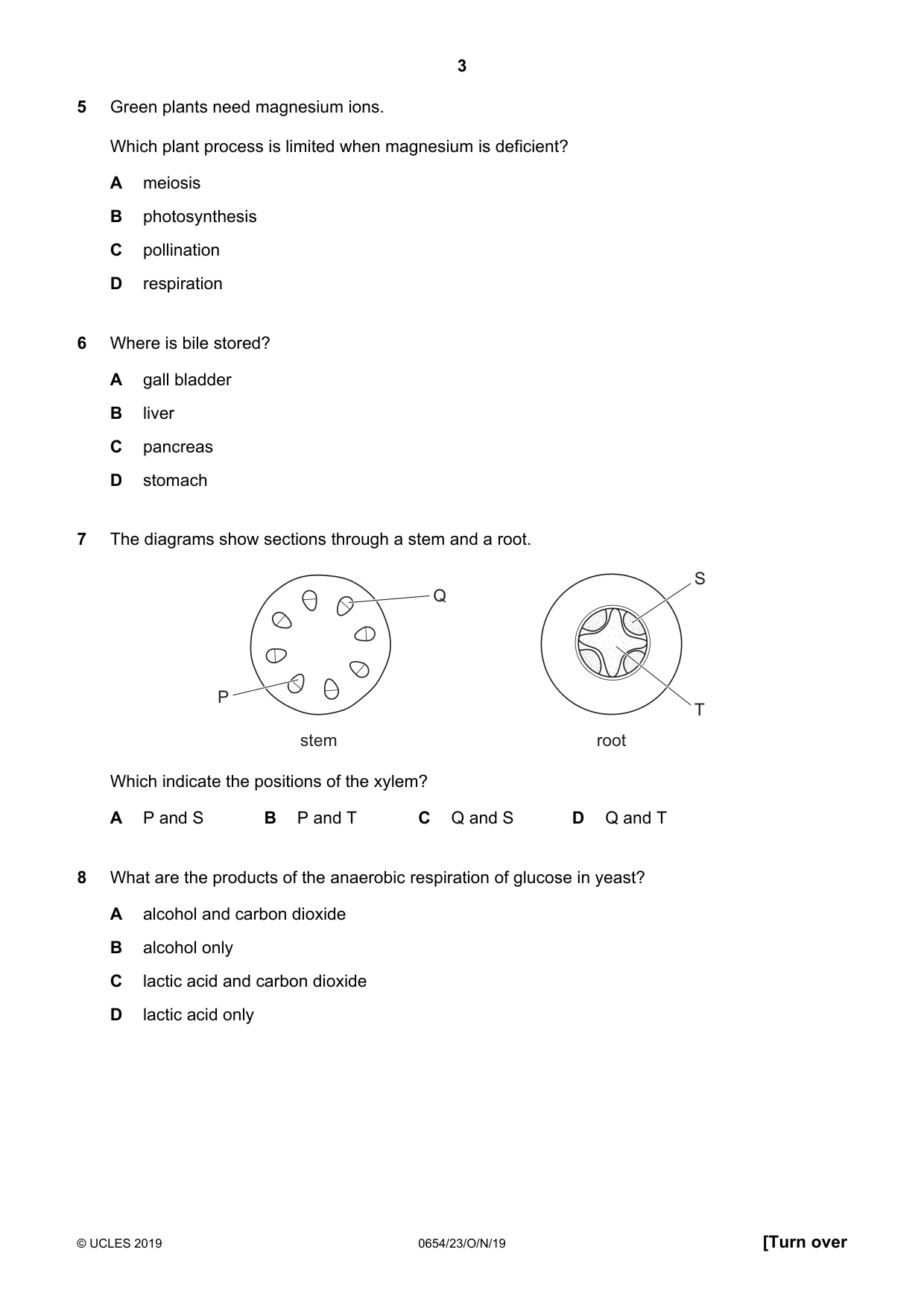
Q7 · The diagrams show sections through a stem and a root
7 The diagrams show sections through a stem and a root. S Q P T stem root Which indicate the positions of the xylem? A P and S B P and T C Q and S D Q and T
Mark scheme: B
Q8 · What are the products of the anaerobic respiration of glucose in yeast?
8 What are the products of the anaerobic respiration of glucose in yeast? A alcohol and carbon dioxide B alcohol only C lactic acid and carbon dioxide D lactic acid only
Mark scheme: A
Q9 · Which actions are voluntary and which are involuntary?
9 Which actions are voluntary and which are involuntary? a change in pupil size due the lens in the eye changing to a change in light intensity shape during accommodation A involuntary involuntary B involuntary voluntary C voluntary involuntary D voluntary voluntary
Mark scheme: A
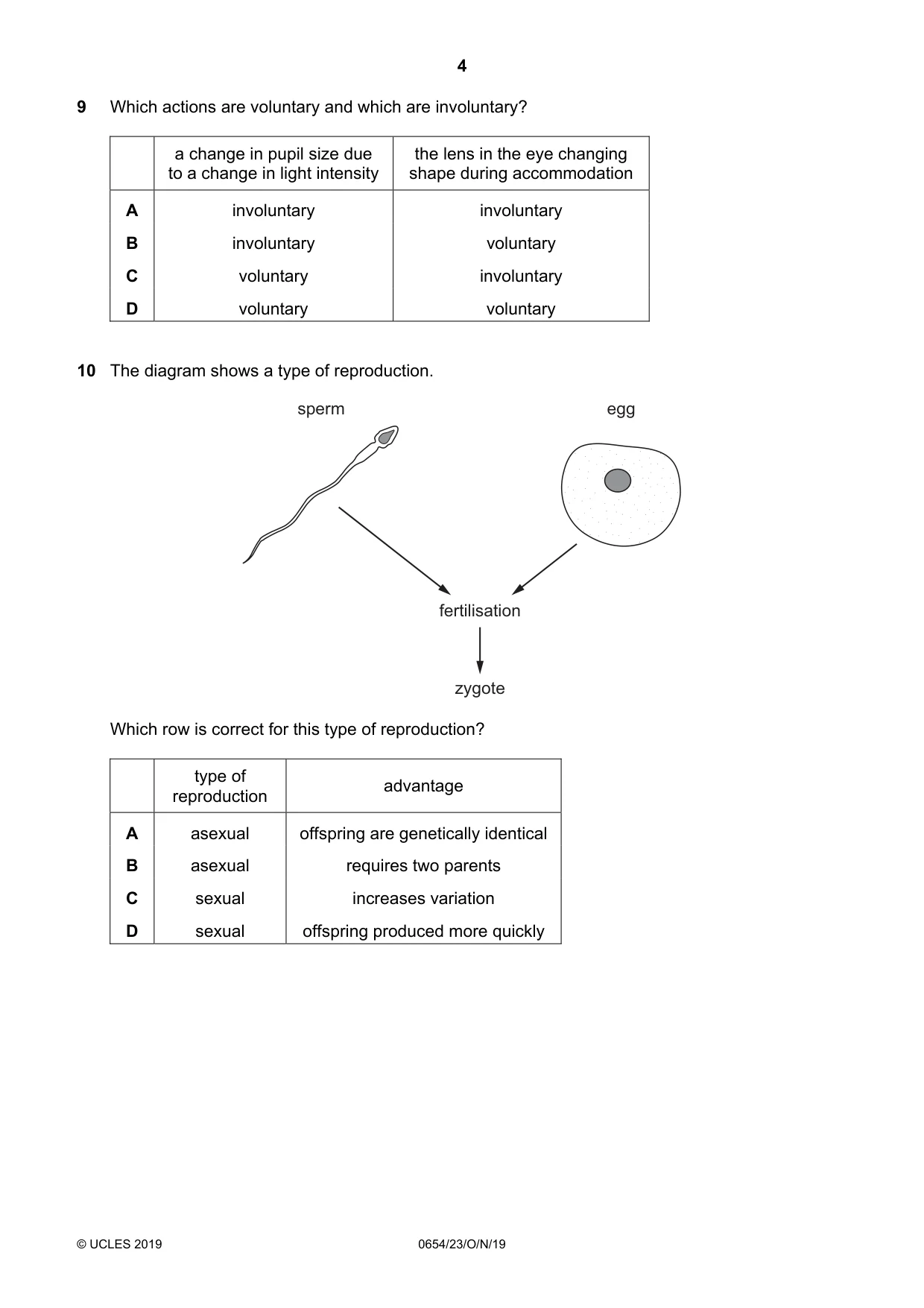
Q10 · The diagram shows a type of reproduction
10 The diagram shows a type of reproduction. sperm egg fertilisation zygote Which row is correct for this type of reproduction? type of advantage reproduction A asexual offspring are genetically identical B asexual requires two parents C sexual increases variation D sexual offspring produced more quickly
Mark scheme: C
Q11 · A body cell taken from a male kangaroo contains 16 chromosomes in the nucleus
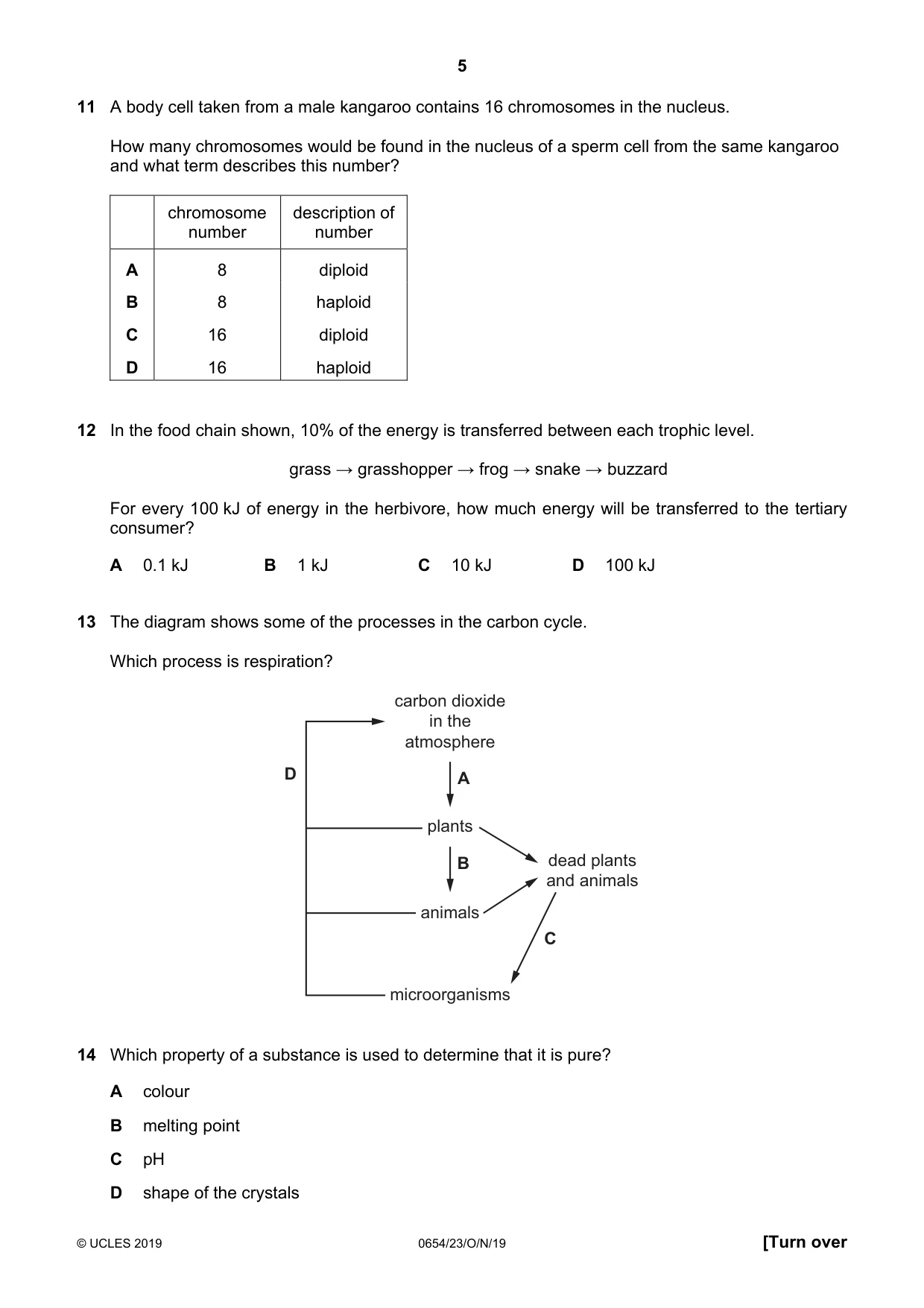
11 A body cell taken from a male kangaroo contains 16 chromosomes in the nucleus. How many chromosomes would be found in the nucleus of a sperm cell from the same kangaroo and what term describes this number? chromosome description of number number A 8 diploid B 8 haploid C 16 diploid D 16 haploid
Mark scheme: B
Q12 · In the food chain shown, 10% of the energy is transferred between each trophic level
12 In the food chain shown, 10% of the energy is transferred between each trophic level. grass → grasshopper → frog → snake → buzzard For every 100 kJ of energy in the herbivore, how much energy will be transferred to the tertiary consumer? A 0.1 kJ B 1 kJ C 10 kJ D 100 kJ
Mark scheme: B
Q13 · The diagram shows some of the processes in the carbon cycle
13 The diagram shows some of the processes in the carbon cycle. Which process is respiration? carbon dioxide in the atmosphere D A plants B dead plants and animals animals C microorganisms
Mark scheme: D
Q14 · Which property of a substance is used to determine that it is pure?
14 Which property of a substance is used to determine that it is pure? A colour B melting point C pH D shape of the crystals
Mark scheme: B
Q15 · Which processes are chemical changes?
15 Which processes are chemical changes? 1 conversion of steam to liquid water 2 cracking of alkanes 3 fractional distillation of petroleum 4 thermal decomposition of calcium carbonate A 1 and 3 B 1 and 4 C 2 and 3 D 2 and 4
Mark scheme: D
Q16 · Silicon(IV) oxide has a giant molecular structure
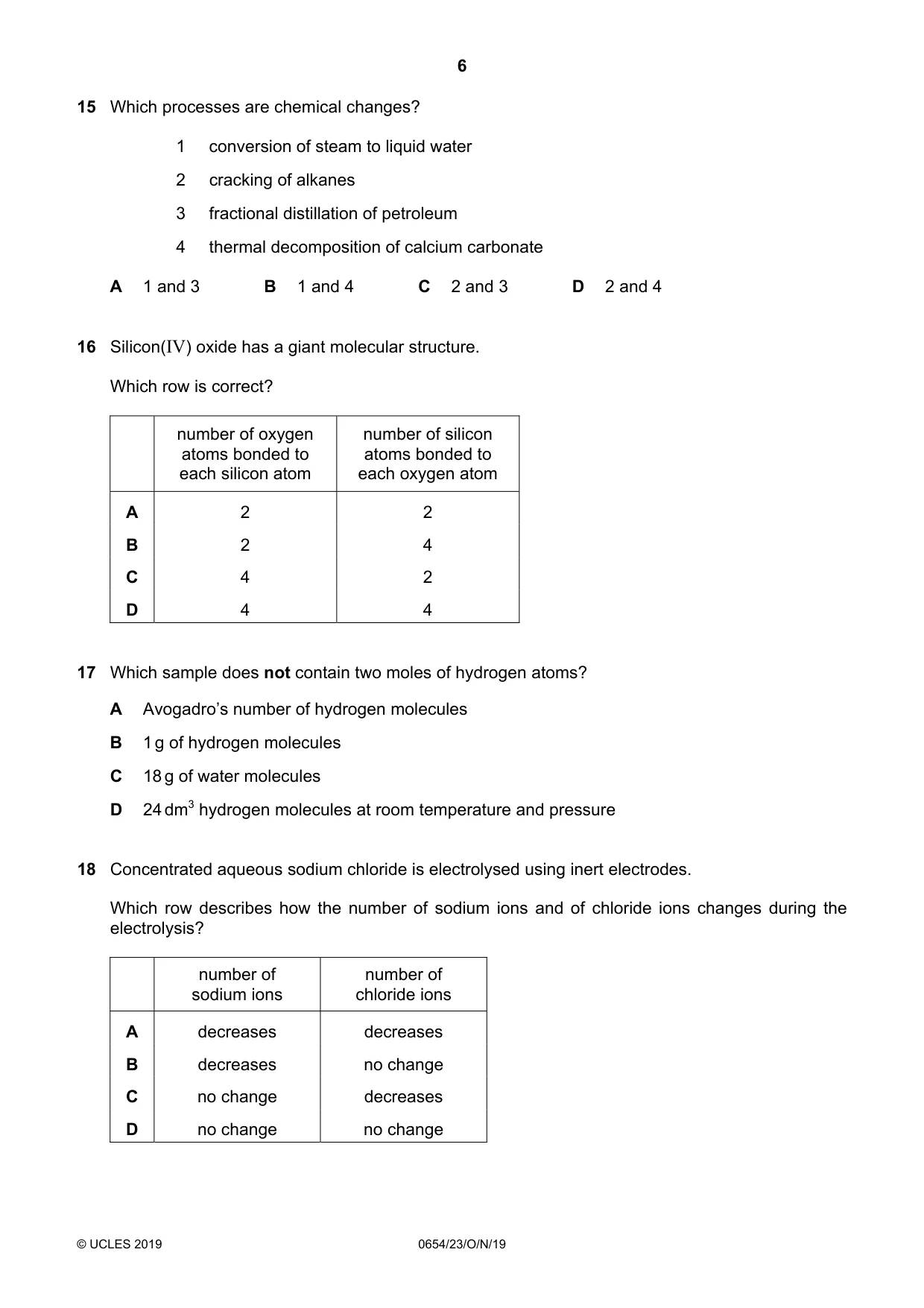
16 Silicon(IV) oxide has a giant molecular structure. Which row is correct? number of oxygen number of silicon atoms bonded to atoms bonded to each silicon atom each oxygen atom A 2 2 B 2 4 C 4 2 D 4 4
Mark scheme: C
Q17 · Which sample does not contain two moles of hydrogen atoms?
17 Which sample does not contain two moles of hydrogen atoms? A Avogadro’s number of hydrogen molecules B 1 g of hydrogen molecules C 18 g of water molecules D 24 dm3 hydrogen molecules at room temperature and pressure
Mark scheme: B
Q18 · Concentrated aqueous sodium chloride is electrolysed using inert electrodes
18 Concentrated aqueous sodium chloride is electrolysed using inert electrodes. Which row describes how the number of sodium ions and of chloride ions changes during the electrolysis? number of number of sodium ions chloride ions A decreases decreases B decreases no change C no change decreases D no change no change
Mark scheme: C
Q19 · A redox reaction is shown
19 A redox reaction is shown. Fe + Cu2+ → Fe2+ + Cu Which substance is the reducing agent? A Cu B Cu2+ C Fe D Fe2+
Mark scheme: C
Q20 · The colours in an ink can be separated by chromatography
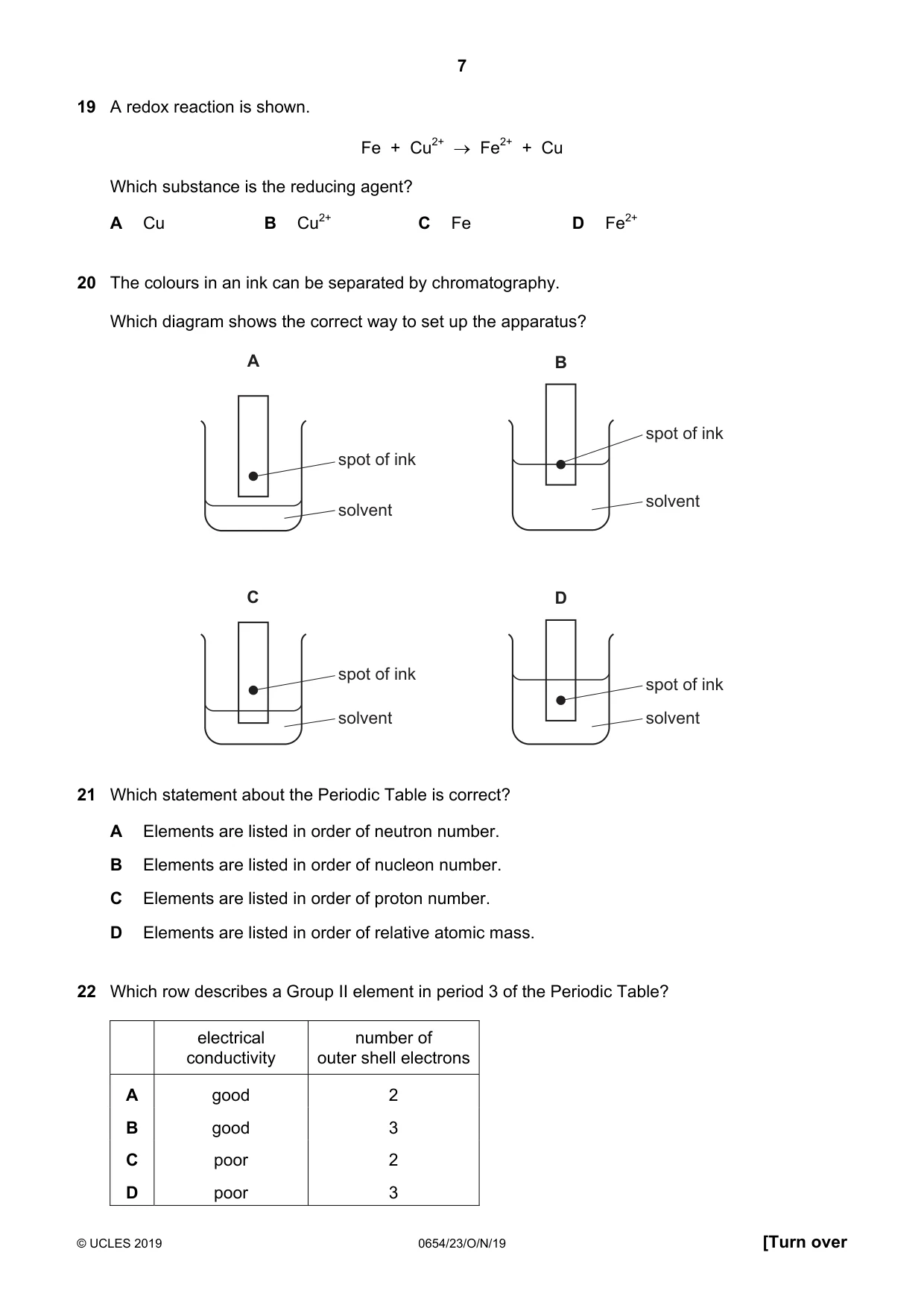
20 The colours in an ink can be separated by chromatography. Which diagram shows the correct way to set up the apparatus? A B spot of ink spot of ink solvent solvent C D spot of ink spot of ink solvent solvent
Mark scheme: C
Q21 · Which statement about the Periodic Table is correct?
21 Which statement about the Periodic Table is correct? A Elements are listed in order of neutron number. B Elements are listed in order of nucleon number. C Elements are listed in order of proton number. D Elements are listed in order of relative atomic mass.
Mark scheme: C
Q22 · Which row describes a Group II element in period 3 of the Periodic Table?
22 Which row describes a Group II element in period 3 of the Periodic Table? electrical number of conductivity outer shell electrons A good 2 B good 3 C poor 2 D poor 3
Mark scheme: A
Q23 · Which statement describes all metals?
23 Which statement describes all metals? A They break when hit with a hammer. B They conduct electricity. C They dissolve in water. D They have high densities.
Mark scheme: B
Q24 · Which pair of substances do not react with each other?
24 Which pair of substances do not react with each other? A copper and aqueous magnesium sulfate B iron and aqueous copper(II) sulfate C magnesium and aqueous zinc sulfate D zinc and aqueous iron(II) sulfate
Mark scheme: A
Q25 · Which processes produce carbon dioxide?
25 Which processes produce carbon dioxide? 1 acid reacting with a metal 2 respiration 3 combustion of ethanol 4 acid reacting with a metal oxide A 1 and 2 B 1 and 4 C 2 and 3 D 3 and 4
Mark scheme: C
Q26 · Which structure represents ethanol?
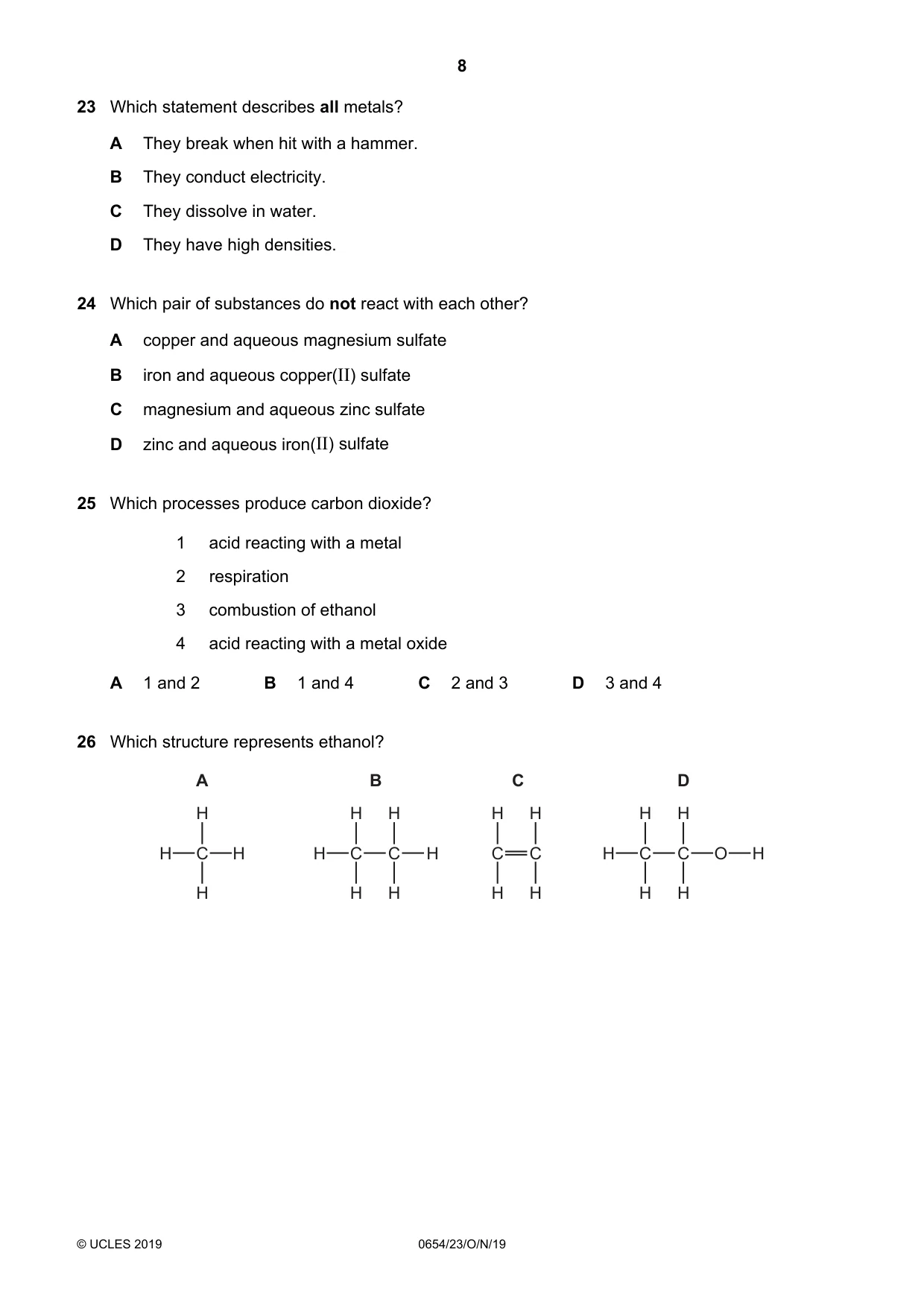
26 Which structure represents ethanol? A B C D H H H H H H H H C H H C C H C C H C C O H H H H H H H H
Mark scheme: D
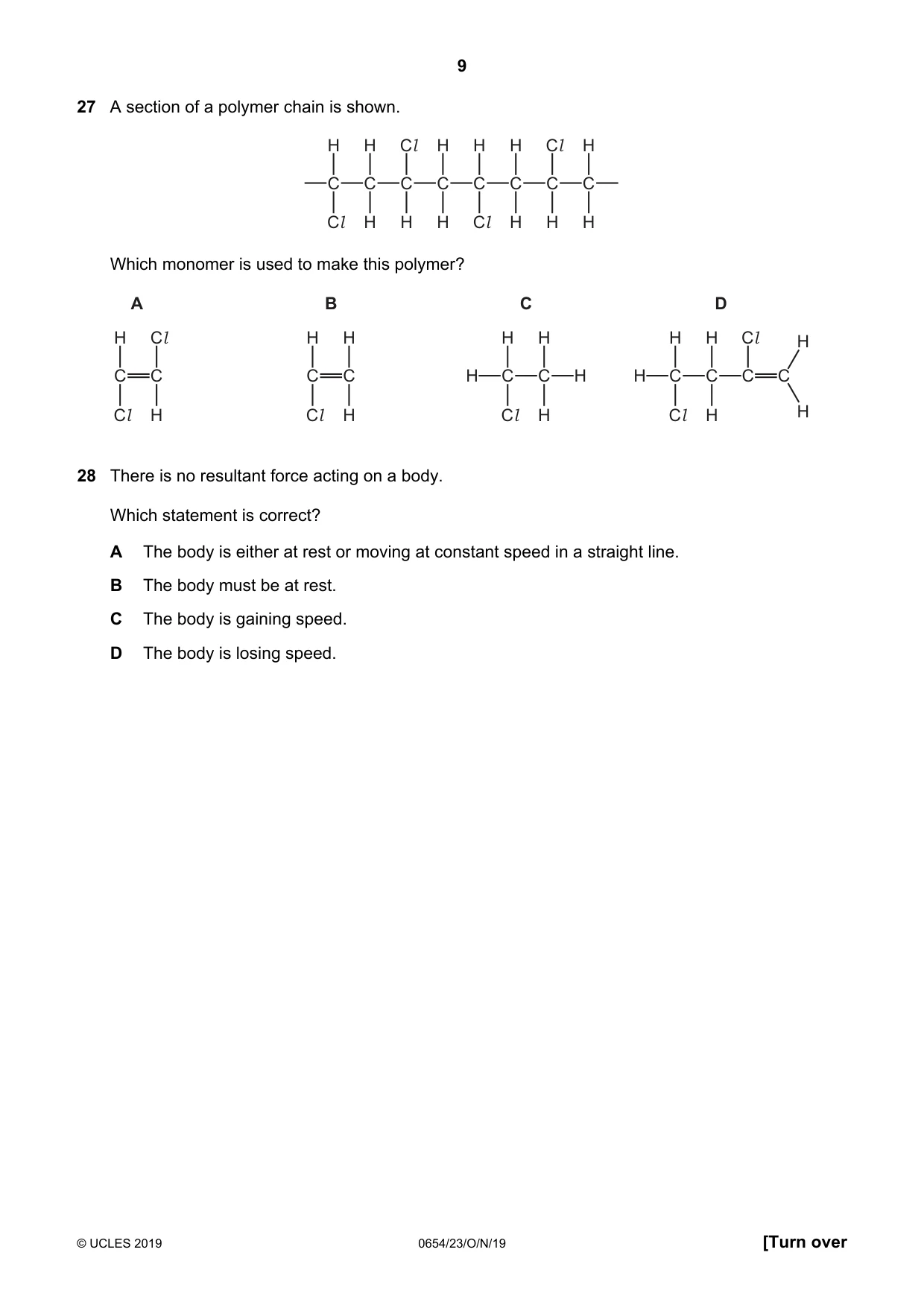
Q27 · A section of a polymer chain is shown
27 A section of a polymer chain is shown. H H Cl H H H Cl H C C C C C C C C Cl H H H Cl H H H Which monomer is used to make this polymer? A B C D H Cl H H H H H H Cl H C C C C H C C H H C C C C Cl H Cl H Cl H Cl H H
Mark scheme: B
Q28 · There is no resultant force acting on a body
28 There is no resultant force acting on a body. Which statement is correct? A The body is either at rest or moving at constant speed in a straight line. B The body must be at rest. C The body is gaining speed. D The body is losing speed.
Mark scheme: A
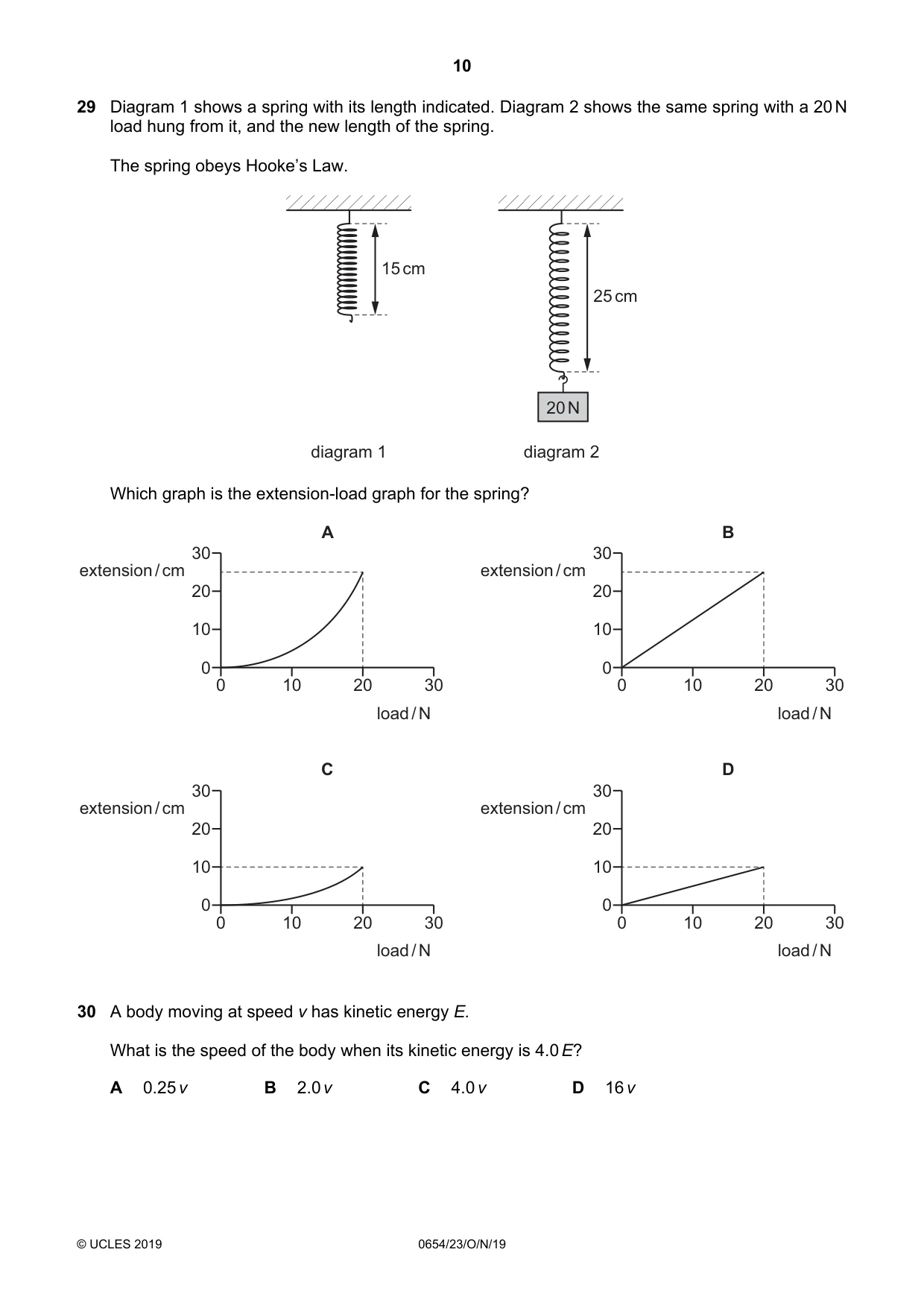
Q29 · A spring with its length indicated
29 Diagram 1 shows a spring with its length indicated. Diagram 2 shows the same spring with a 20 N load hung from it, and the new length of the spring. The spring obeys Hooke’s Law. 15 cm 25 cm 20 N diagram 1 diagram 2 Which graph is the extension-load graph for the spring? A B 30 30 extension / cm extension / cm 20 20 10 10 0 0 0 10 20 30 0 10 20 30 load / N load / N C D 30 30 extension / cm extension / cm 20 20 10 10 0 0 0 10 20 30 0 10 20 30 load / N load / N
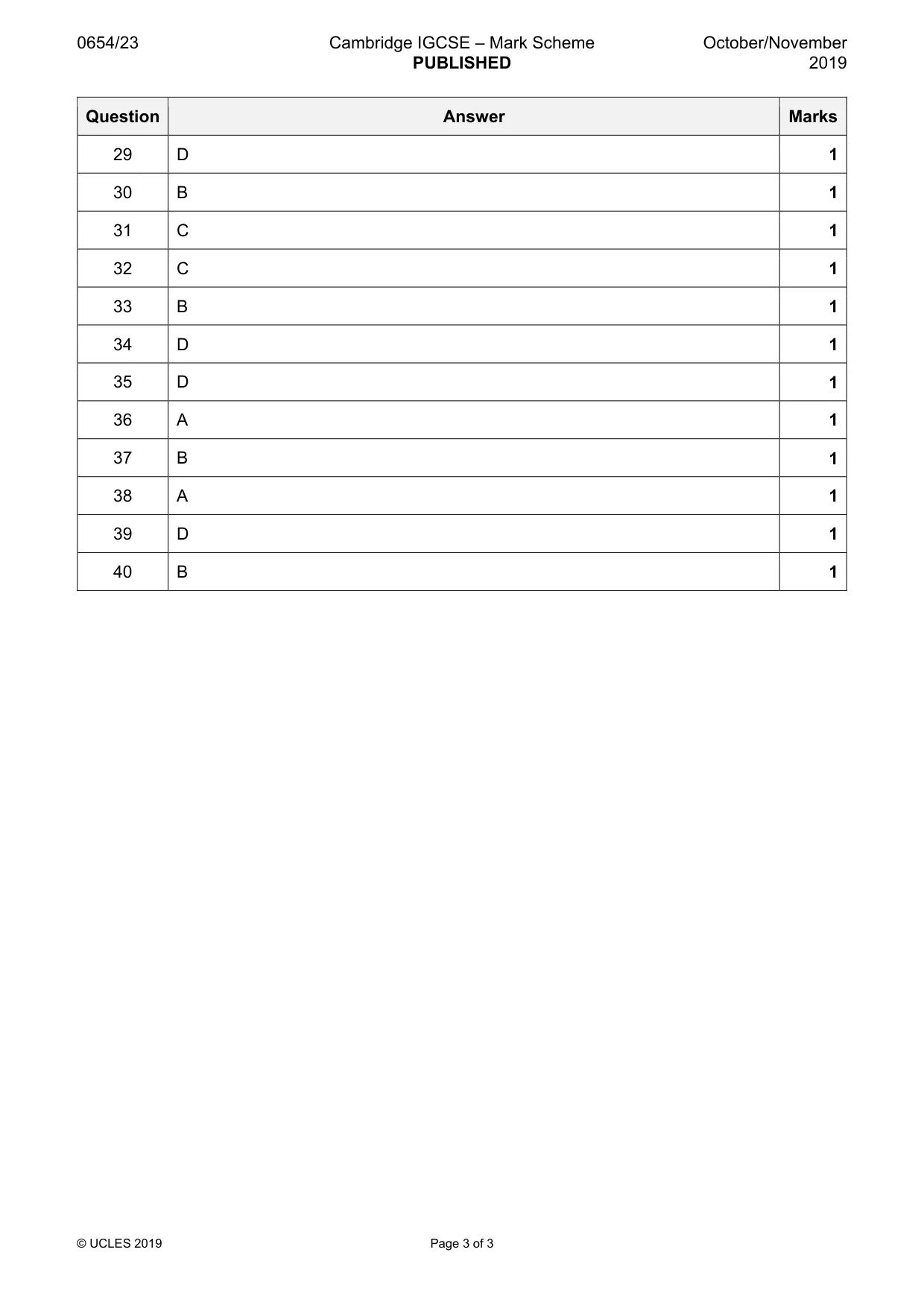
Mark scheme: D
Q30 · A body moving at speed v has kinetic energy E
30 A body moving at speed v has kinetic energy E. What is the speed of the body when its kinetic energy is 4.0 E? A 0.25 v B 2.0 v C 4.0 v D 16 v
Mark scheme: B
Q31 · A student wishes to measure his average power when running up a flight of steps
31 A student wishes to measure his average power when running up a flight of steps. The energy transferred is 7.0 kJ and the time taken is 14 seconds. What is the student’s average power? A 0.0020 W B 98 W C 500 W D 98 000 W
Mark scheme: C
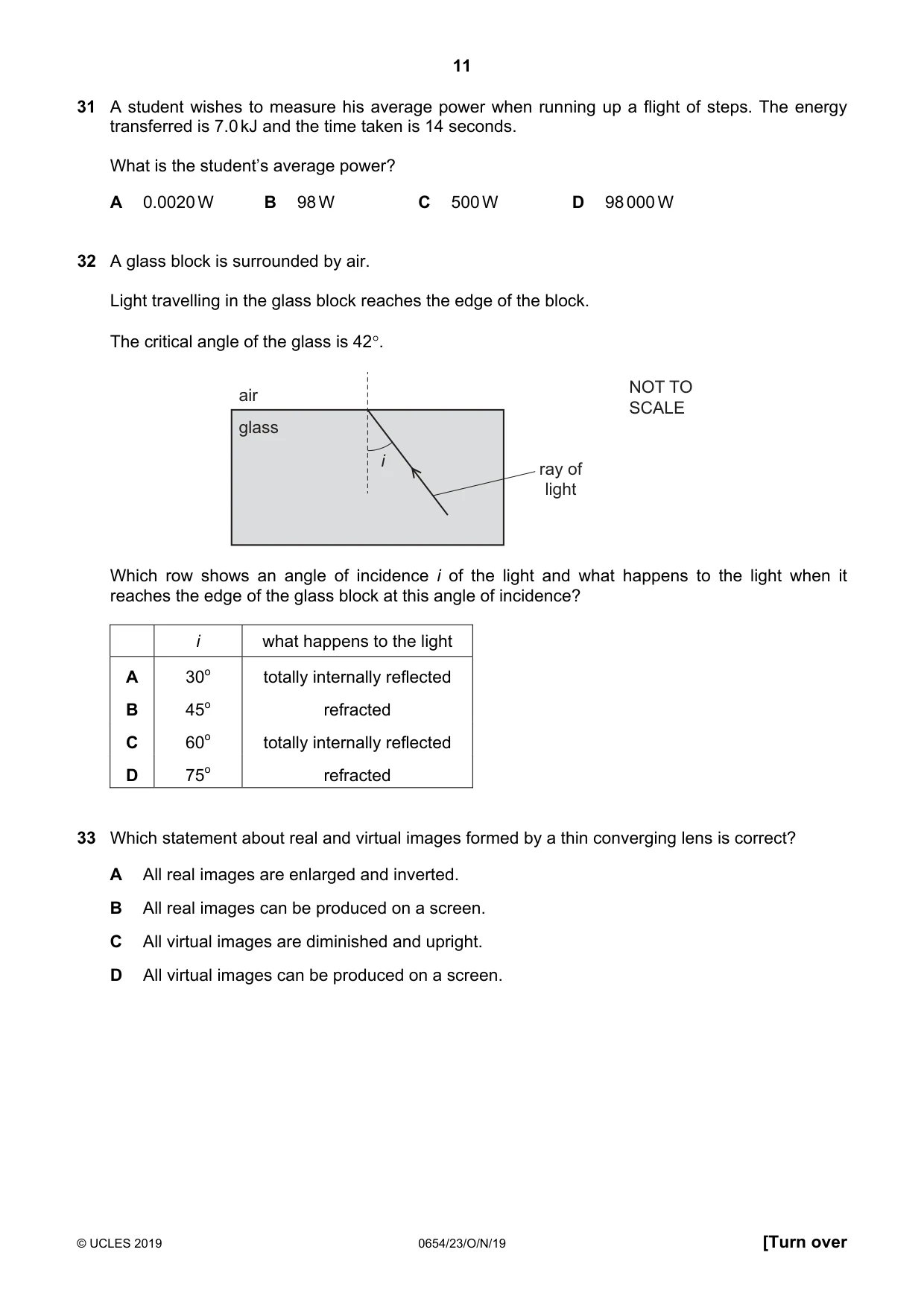
Q32 · A glass block is surrounded by air
32 A glass block is surrounded by air. Light travelling in the glass block reaches the edge of the block. The critical angle of the glass is 42°. NOT TO air SCALE glass i ray of light Which row shows an angle of incidence i of the light and what happens to the light when it reaches the edge of the glass block at this angle of incidence? i what happens to the light A 30o totally internally reflected B 45o refracted C 60o totally internally reflected D 75o refracted
Mark scheme: C
Q33 · Which statement about real and virtual images formed by a thin converging lens is correct?
33 Which statement about real and virtual images formed by a thin converging lens is correct? A All real images are enlarged and inverted. B All real images can be produced on a screen. C All virtual images are diminished and upright. D All virtual images can be produced on a screen.
Mark scheme: B
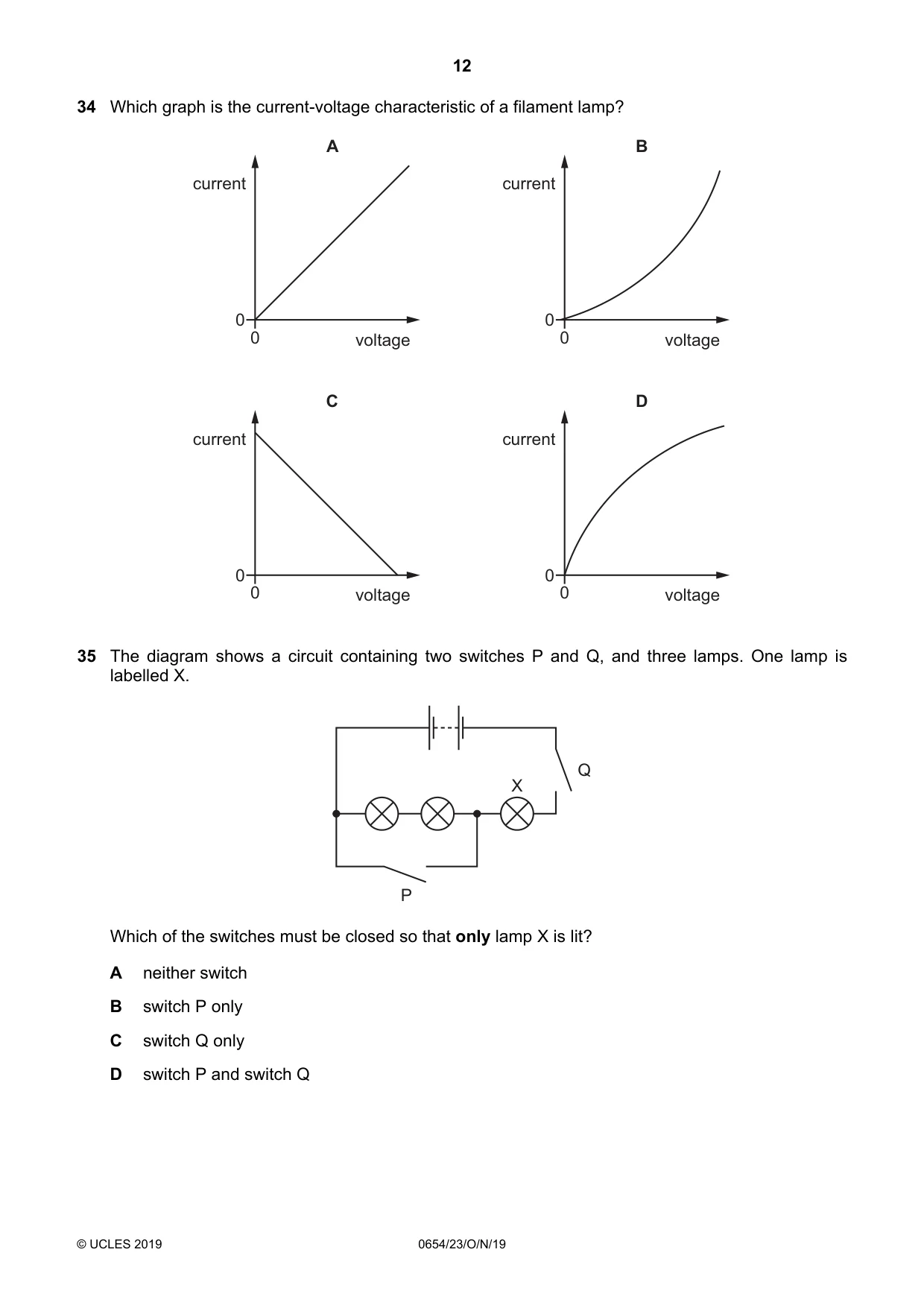
Q34 · Which graph is the current-voltage characteristic of a filament lamp?
34 Which graph is the current-voltage characteristic of a filament lamp? A B current current 0 0 0 voltage 0 voltage C D current current 0 0 0 voltage 0 voltage
Mark scheme: D
Q35 · The diagram shows a circuit containing two switches P and Q, and three lamps
35 The diagram shows a circuit containing two switches P and Q, and three lamps. One lamp is labelled X. Q X P Which of the switches must be closed so that only lamp X is lit? A neither switch B switch P only C switch Q only D switch P and switch Q
Mark scheme: D
Q36 · Which row shows how lamps are connected in a lighting circuit in a house and gives an…
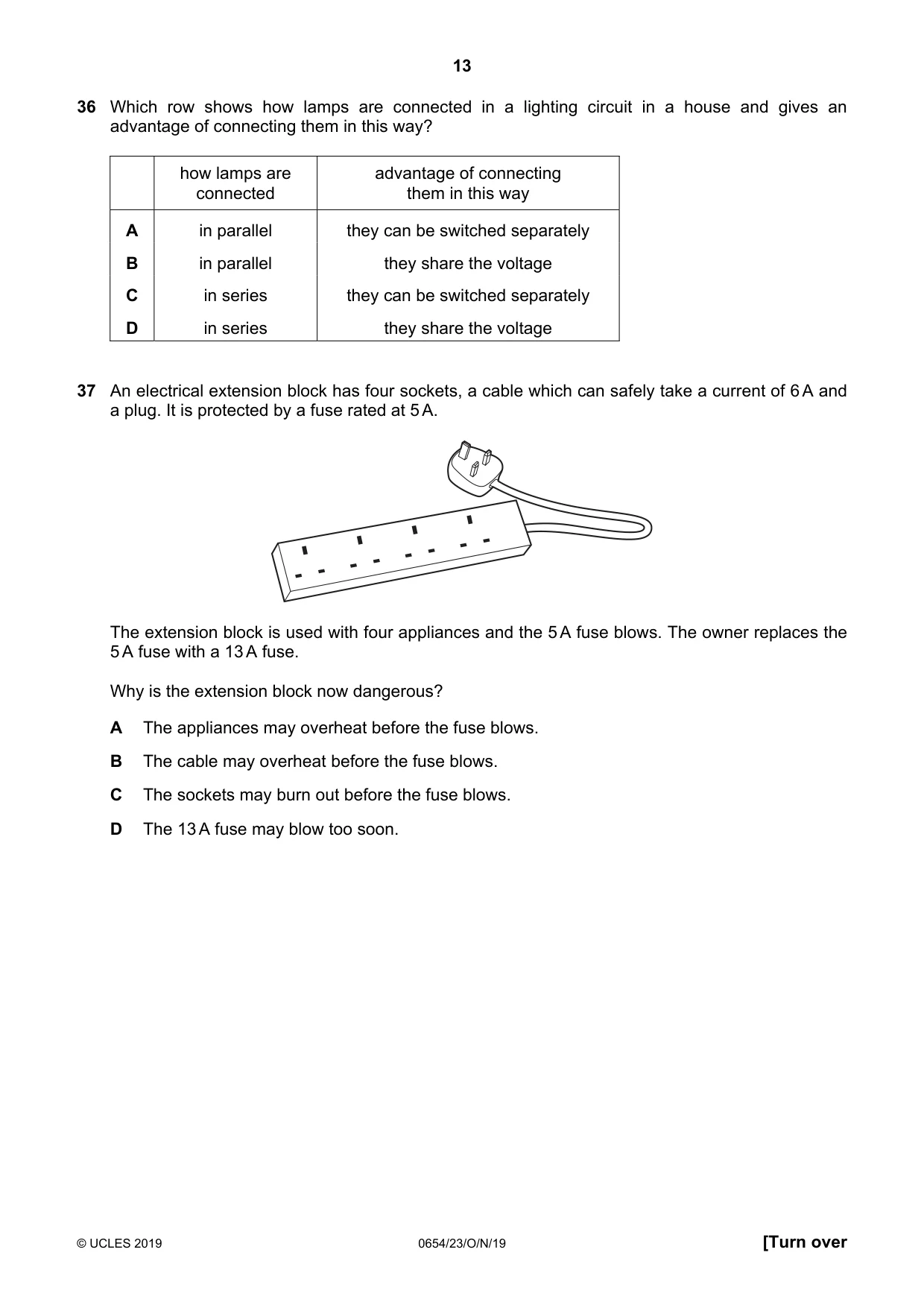
36 Which row shows how lamps are connected in a lighting circuit in a house and gives an advantage of connecting them in this way? how lamps are advantage of connecting connected them in this way A in parallel they can be switched separately B in parallel they share the voltage C in series they can be switched separately D in series they share the voltage
Mark scheme: A
Q37 · An electrical extension block has four sockets, a cable which can safely take a current…
37 An electrical extension block has four sockets, a cable which can safely take a current of 6 A and a plug. It is protected by a fuse rated at 5 A. The extension block is used with four appliances and the 5 A fuse blows. The owner replaces the 5 A fuse with a 13 A fuse. Why is the extension block now dangerous? A The appliances may overheat before the fuse blows. B The cable may overheat before the fuse blows. C The sockets may burn out before the fuse blows. D The 13 A fuse may blow too soon.
Mark scheme: B
Q38 · The diagram shows a current-carrying conductor between the poles of a magnet
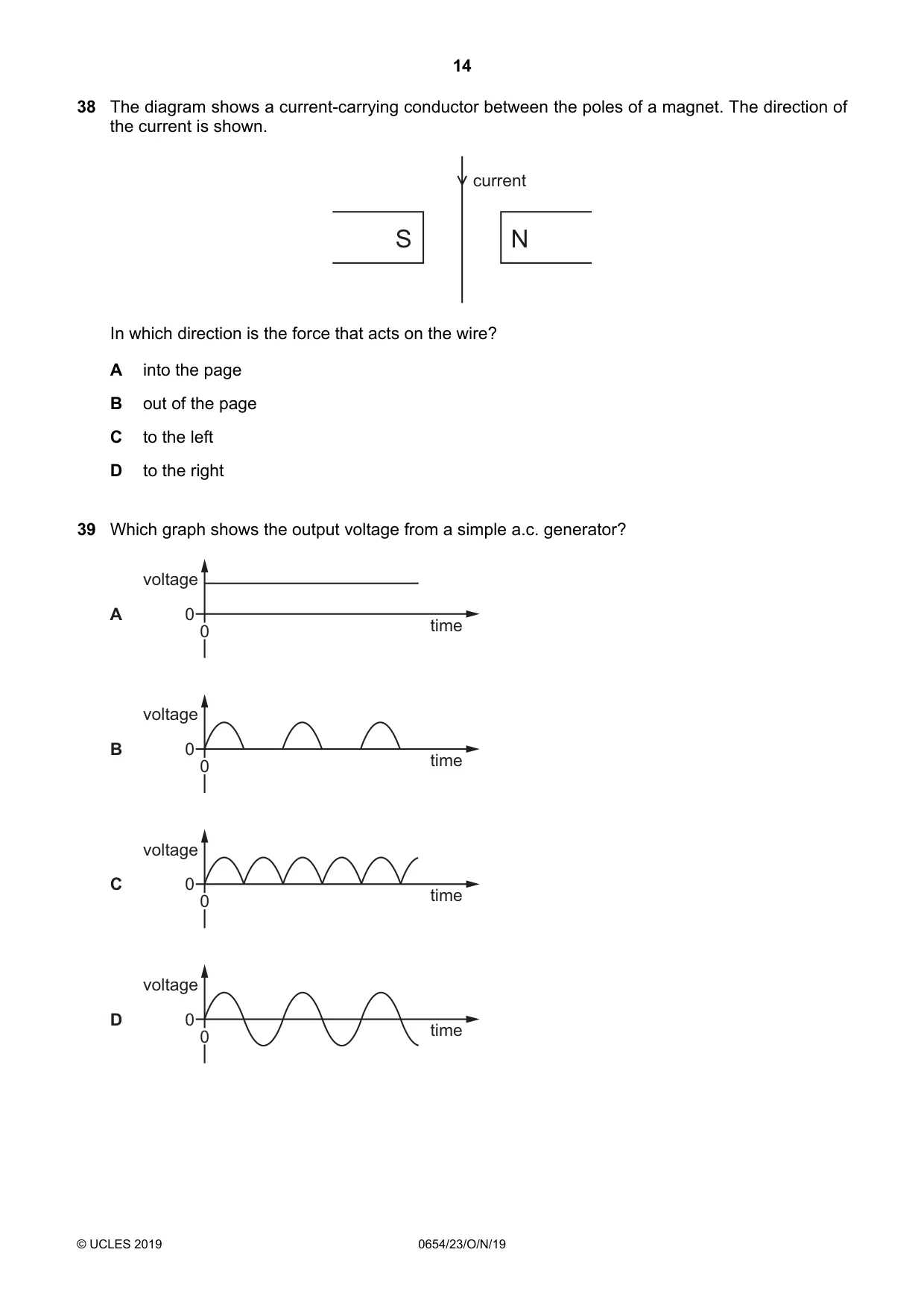
38 The diagram shows a current-carrying conductor between the poles of a magnet. The direction of the current is shown. current S N In which direction is the force that acts on the wire? A into the page B out of the page C to the left D to the right
Mark scheme: A
Q39 · Which graph shows the output voltage from a simple a.c
39 Which graph shows the output voltage from a simple a.c. generator? voltage A 0 0 time voltage B 0 0 time voltage C 0 0 time voltage D 0 0 time
Mark scheme: D
Q40 · Which type of radiation has the greatest ionising effect, and which is the most…
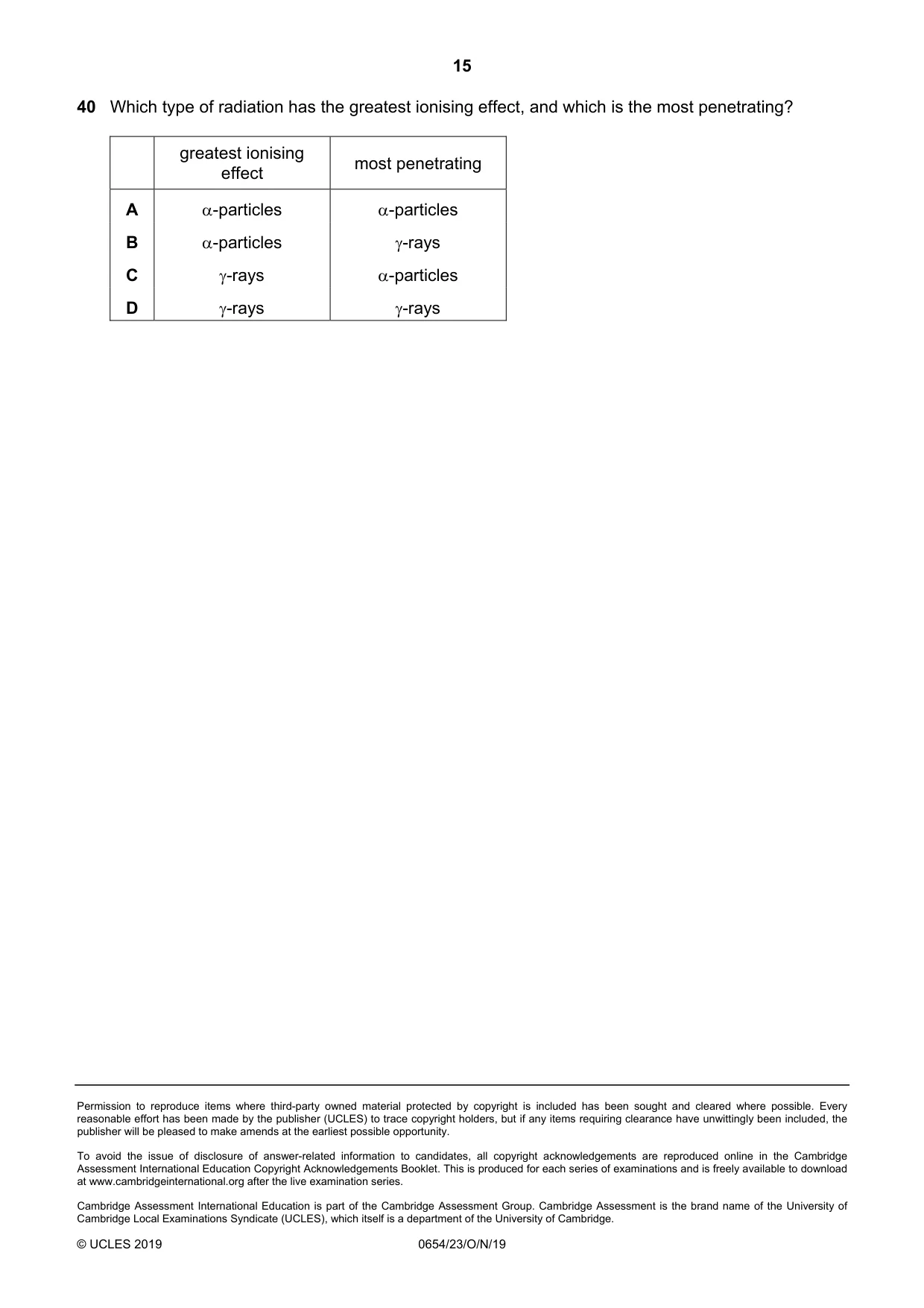
40 Which type of radiation has the greatest ionising effect, and which is the most penetrating? greatest ionising most penetrating effect A α-particles α-particles B α-particles γ-rays C γ-rays α-particles D γ-rays γ-rays
Mark scheme: B
What was in this paper
The subtopics covered by these 40 questions, and how many questions each got. Open one in a new tab to see every Cambridge question on it.
2Electrical circuits2Electromagnetic effects2Energy, work and power2Forces2Light2Physical and chemical changes2Alcohols1Biological molecules1Carbon cycle1Cell division1Cell structure1Characteristics of living organisms1Chromatography1Coordination and response1Digestion1Electrical quantities1Electrical safety1Electrolysis1Energy flow1Enzymes1Experimental design1Giant covalent structures1Photosynthesis1Polymers1Properties of metals1Radioactivity1Reactivity series1Redox1Respiration1Sexual reproduction1The mole and the Avogadro constant1Xylem and phloem1What you needed in this session
Cambridge’s own grade thresholds for 2019 Oct/Nov, Paper 2 · Variant 3. A higher threshold means an easier paper — the bar moves with how the cohort did.