Cambridge IGCSE Sciences - Co-ordinated (Double) 0654 — 2023 Oct/Nov Paper 2 · Variant 2
0654/22/O/N/23 · 40 questions · 40 marks · ≈45 min
The question paper and its mark scheme, free to read here and free to download. This is Cambridge’s own paper, exactly as it was sat.
Question paper20 pages



Mark scheme3 pages
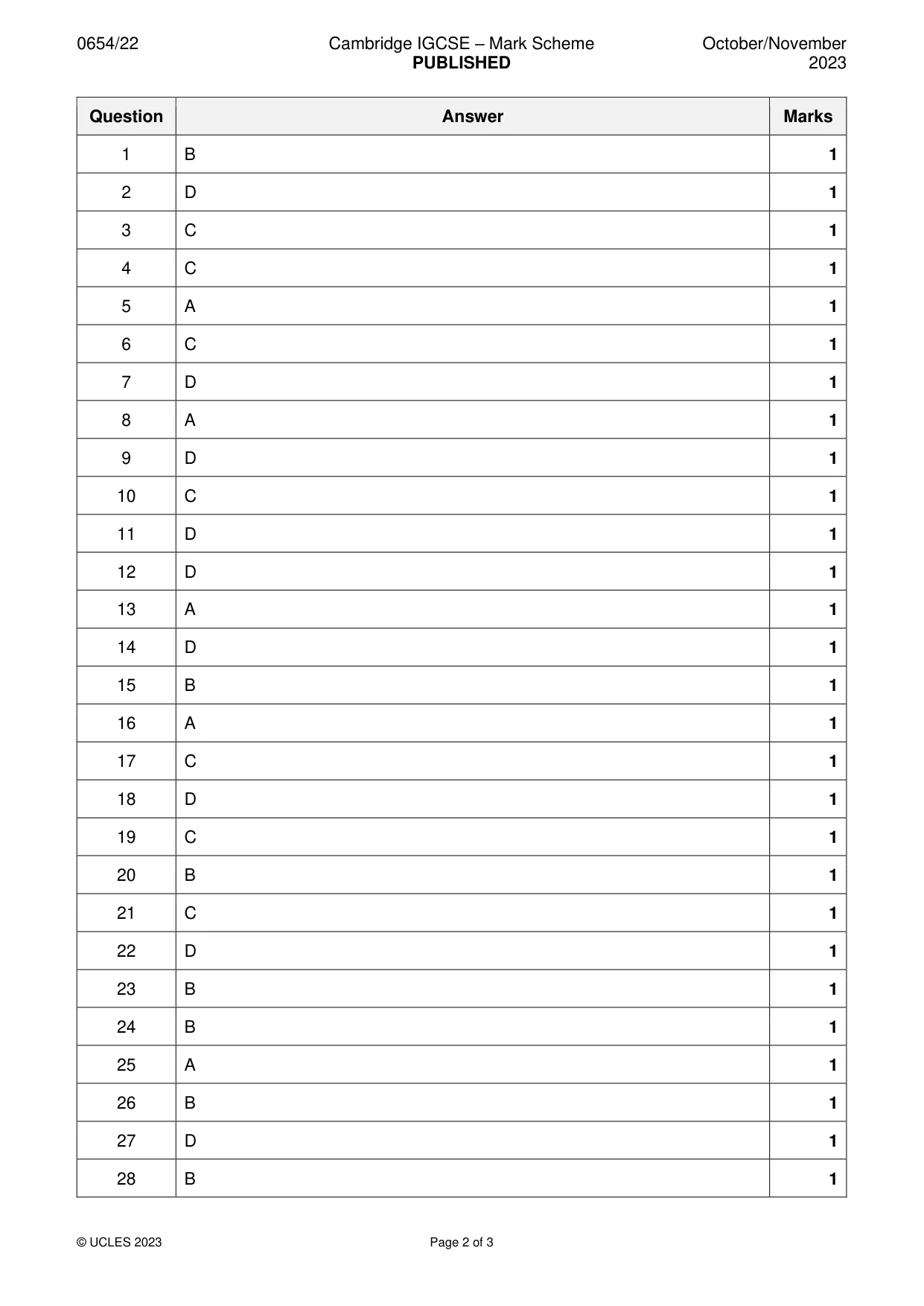
Answers below. Sit the paper first if you are practising.
Questions as text
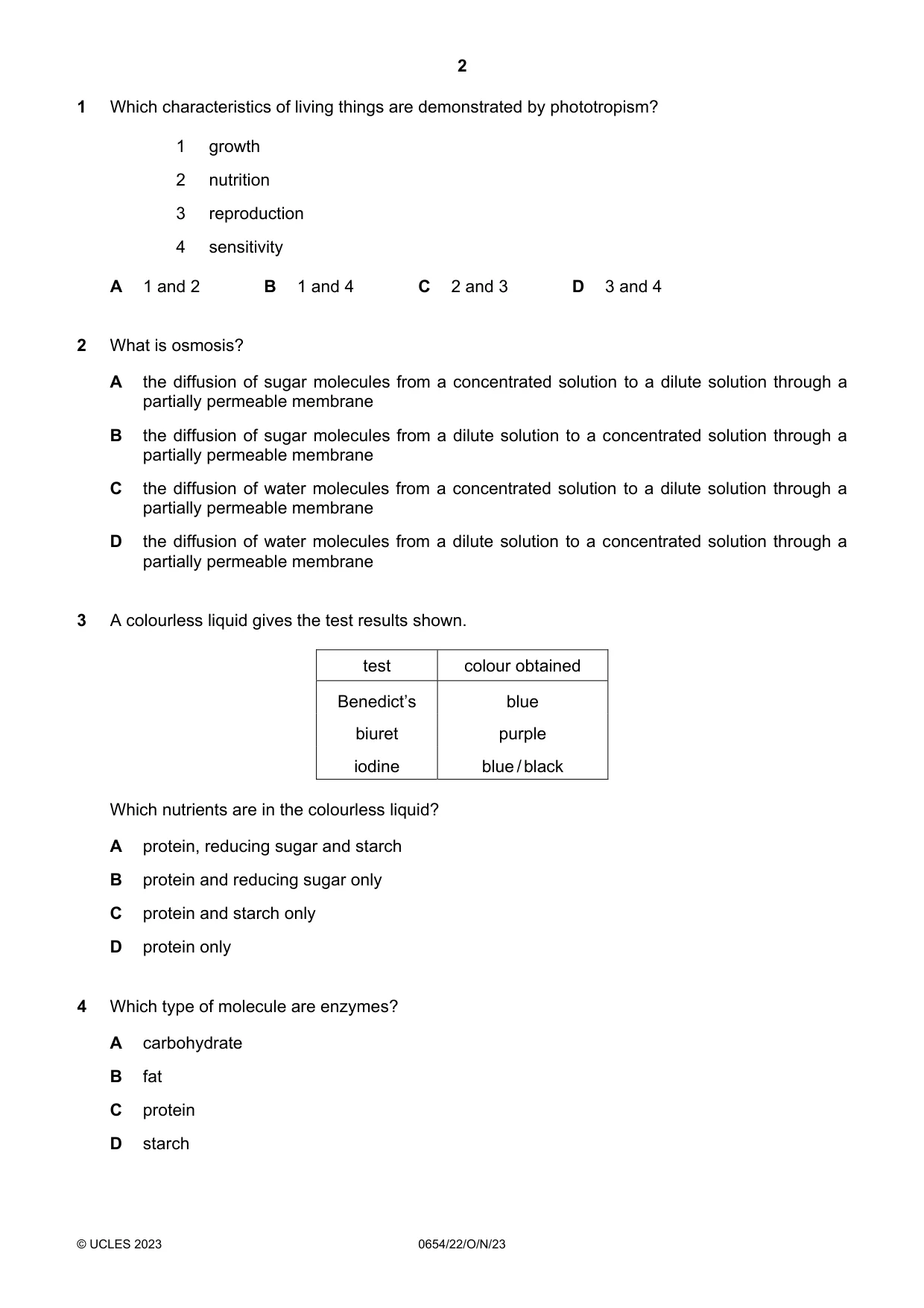
Q1 · Which characteristics of living things are demonstrated by phototropism?
1 Which characteristics of living things are demonstrated by phototropism? 1 growth 2 nutrition 3 reproduction 4 sensitivity A 1 and 2 B 1 and 4 C 2 and 3 D 3 and 4
Mark scheme: B
Question 2
2 What is osmosis? A the diffusion of sugar molecules from a concentrated solution to a dilute solution through a partially permeable membrane B the diffusion of sugar molecules from a dilute solution to a concentrated solution through a partially permeable membrane C the diffusion of water molecules from a concentrated solution to a dilute solution through a partially permeable membrane D the diffusion of water molecules from a dilute solution to a concentrated solution through a partially permeable membrane
Mark scheme: D
Q3 · A colourless liquid gives the test results shown
3 A colourless liquid gives the test results shown. test colour obtained Benedict’s blue biuret purple iodine blue / black Which nutrients are in the colourless liquid? A protein, reducing sugar and starch B protein and reducing sugar only C protein and starch only D protein only
Mark scheme: C
Q4 · Which type of molecule are enzymes?
4 Which type of molecule are enzymes? A carbohydrate B fat C protein D starch
Mark scheme: C
Q5 · Which row shows the correct raw materials and products of photosynthesis?
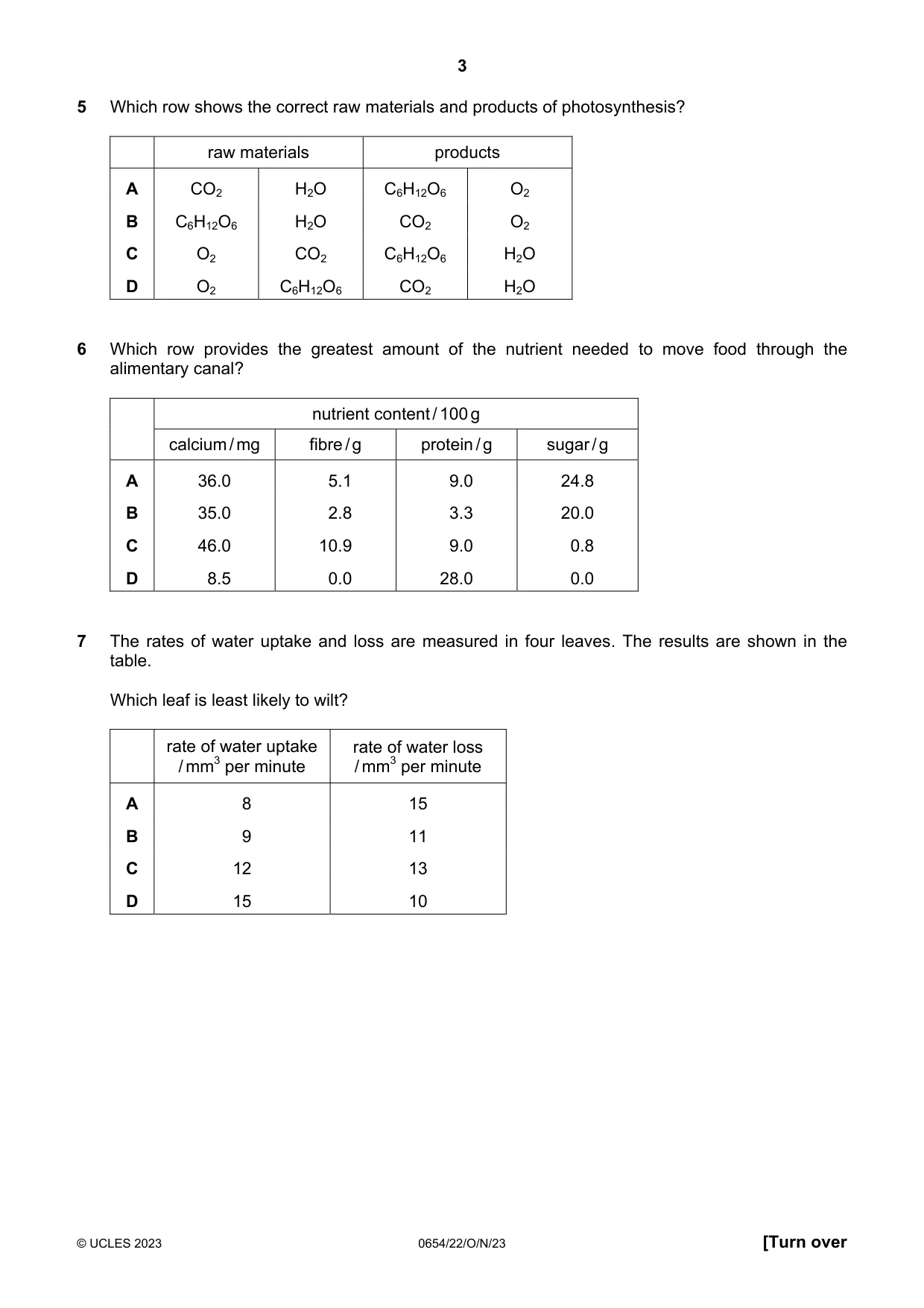
5 Which row shows the correct raw materials and products of photosynthesis? raw materials products A CO2 H2O C6H12O6 O2 B C6H12O6 H2O CO2 O2 C O2 CO2 C6H12O6 H2O D O2 C6H12O6 CO2 H2O
Mark scheme: A
Q6 · Which row provides the greatest amount of the nutrient needed to move food through the…
6 Which row provides the greatest amount of the nutrient needed to move food through the alimentary canal? nutrient content / 100 g calcium / mg fibre / g protein / g sugar / g A 36.0 5.1 9.0 24.8 B 35.0 2.8 3.3 20.0 C 46.0 10.9 9.0 0.8 D 8.5 0.0 28.0 0.0
Mark scheme: C
Q7 · The rates of water uptake and loss are measured in four leaves
7 The rates of water uptake and loss are measured in four leaves. The results are shown in the table. Which leaf is least likely to wilt? rate of water uptake rate of water loss / mm3 per minute / mm3 per minute A 8 15 B 9 11 C 12 13 D 15 10
Mark scheme: D
Q8 · An experiment is set up, as shown
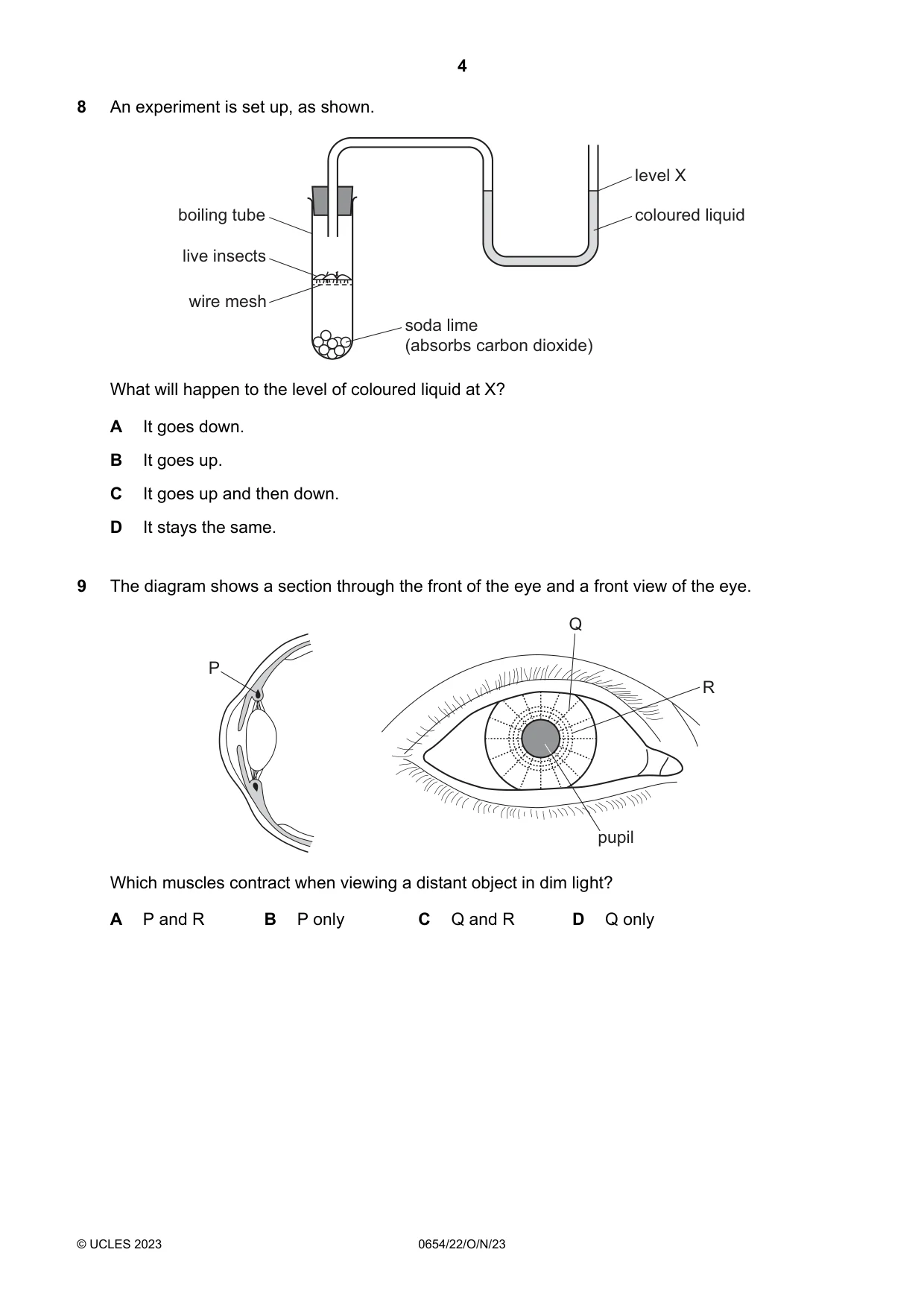
8 An experiment is set up, as shown. level X boiling tube coloured liquid live insects wire mesh soda lime (absorbs carbon dioxide) What will happen to the level of coloured liquid at X? A It goes down. B It goes up. C It goes up and then down. D It stays the same.
Mark scheme: A
Q9 · The diagram shows a section through the front of the eye and a front view of the eye
9 The diagram shows a section through the front of the eye and a front view of the eye. Q P R pupil Which muscles contract when viewing a distant object in dim light? A P and R B P only C Q and R D Q only
Mark scheme: D
Q10 · The diagram shows human gamete formation and fertilisation
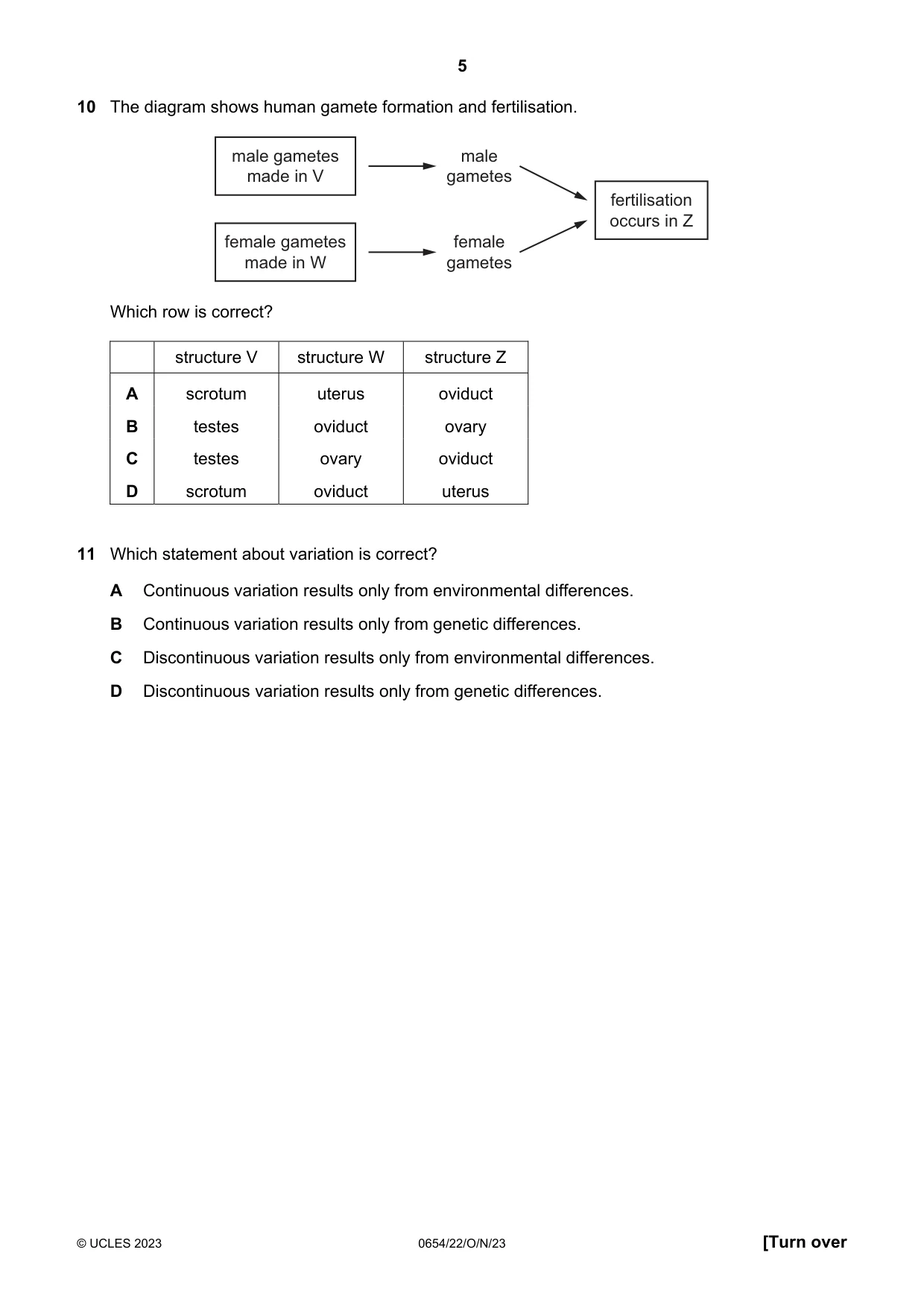
10 The diagram shows human gamete formation and fertilisation. male gametes male made in V gametes fertilisation occurs in Z female gametes female made in W gametes Which row is correct? structure V structure W structure Z A scrotum uterus oviduct B testes oviduct ovary C testes ovary oviduct D scrotum oviduct uterus
Mark scheme: C
Q11 · Which statement about variation is correct?
11 Which statement about variation is correct? A Continuous variation results only from environmental differences. B Continuous variation results only from genetic differences. C Discontinuous variation results only from environmental differences. D Discontinuous variation results only from genetic differences.
Mark scheme: D
Q12 · The diagram shows a North American food web
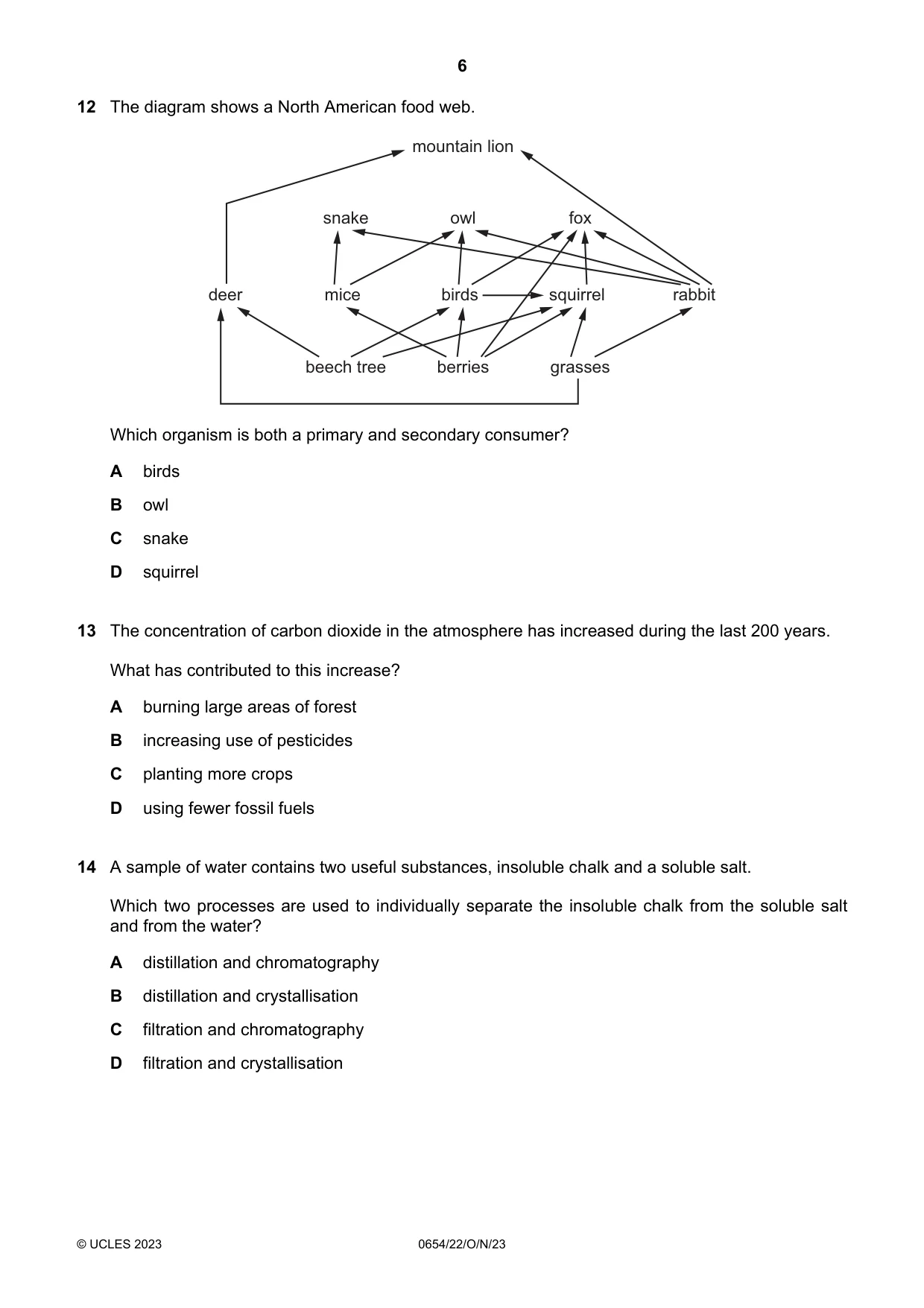
12 The diagram shows a North American food web. mountain lion snake owl fox deer mice birds squirrel rabbit beech tree berries grasses Which organism is both a primary and secondary consumer? A birds B owl C snake D squirrel
Mark scheme: D
Q13 · The concentration of carbon dioxide in the atmosphere has increased during the last 200…
13 The concentration of carbon dioxide in the atmosphere has increased during the last 200 years. What has contributed to this increase? A burning large areas of forest B increasing use of pesticides C planting more crops D using fewer fossil fuels
Mark scheme: A
Q14 · A sample of water contains two useful substances, insoluble chalk and a soluble salt
14 A sample of water contains two useful substances, insoluble chalk and a soluble salt. Which two processes are used to individually separate the insoluble chalk from the soluble salt and from the water? A distillation and chromatography B distillation and crystallisation C filtration and chromatography D filtration and crystallisation
Mark scheme: D
Q15 · Which statement about isotopes of the same element is correct?
15 Which statement about isotopes of the same element is correct? A They have the same number of protons but different number of electrons. B They have the same number of protons but different number of neutrons. C They have the same number of neutrons but different number of electrons. D They have the same number of neutrons but different number of protons.
Mark scheme: B
Q16 · When dilute sodium hydroxide is added to aqueous iron(II) sulfate, insoluble iron(II)…
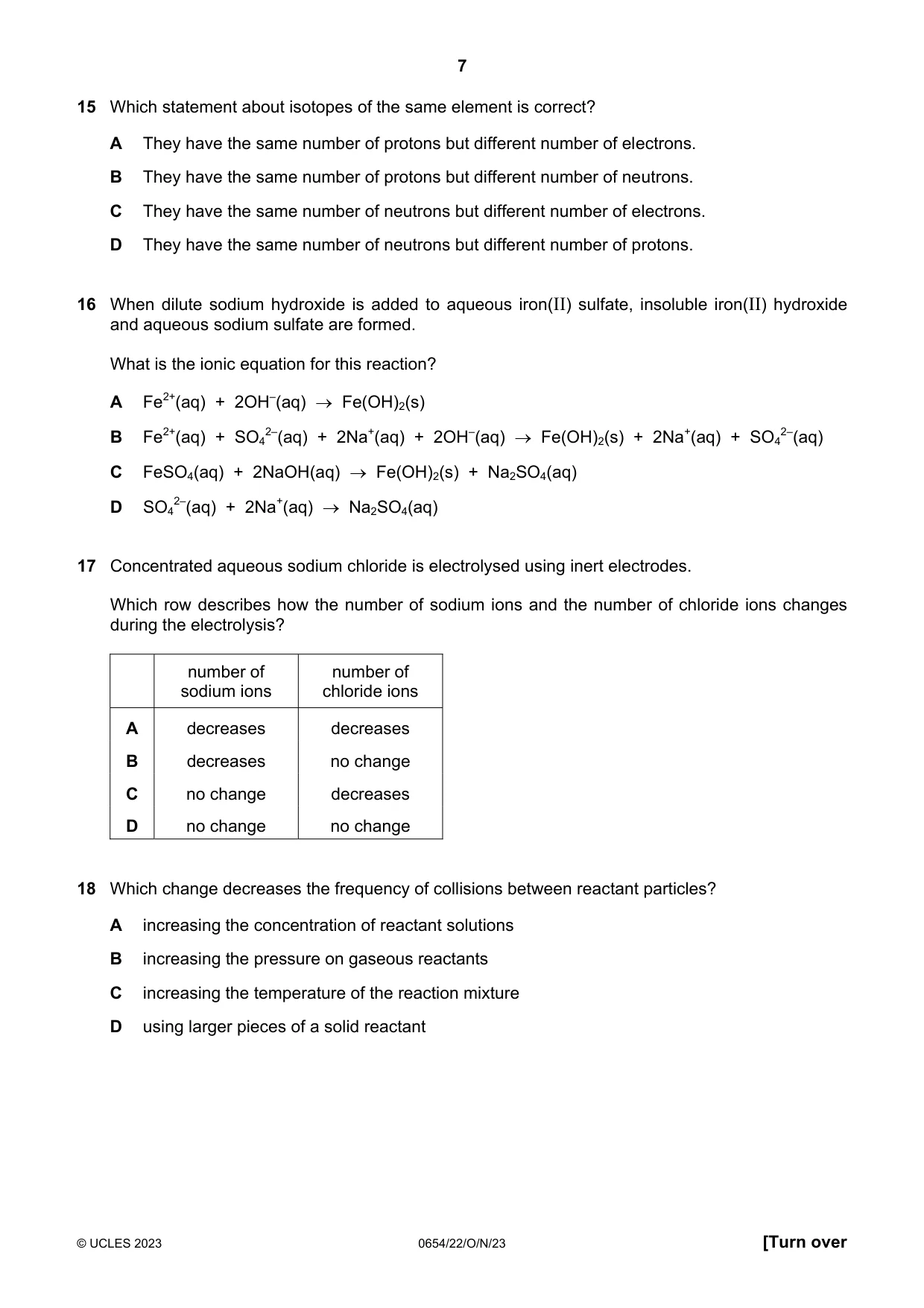
16 When dilute sodium hydroxide is added to aqueous iron(II) sulfate, insoluble iron(II) hydroxide and aqueous sodium sulfate are formed. What is the ionic equation for this reaction? A Fe2+(aq) + 2OH–(aq) Fe(OH)2(s) B Fe2+(aq) + SO4 2–(aq) + 2Na+(aq) + 2OH–(aq) Fe(OH)2(s) + 2Na+(aq) + SO4 2–(aq) C FeSO4(aq) + 2NaOH(aq) Fe(OH)2(s) + Na2SO4(aq) D SO4 2–(aq) + 2Na+(aq) Na2SO4(aq)
Mark scheme: A
Q17 · Concentrated aqueous sodium chloride is electrolysed using inert electrodes
17 Concentrated aqueous sodium chloride is electrolysed using inert electrodes. Which row describes how the number of sodium ions and the number of chloride ions changes during the electrolysis? number of number of sodium ions chloride ions A decreases decreases B decreases no change C no change decreases D no change no change
Mark scheme: C
Q18 · Which change decreases the frequency of collisions between reactant particles?
18 Which change decreases the frequency of collisions between reactant particles? A increasing the concentration of reactant solutions B increasing the pressure on gaseous reactants C increasing the temperature of the reaction mixture D using larger pieces of a solid reactant
Mark scheme: D
Q19 · Iron displaces copper ions from its aqueous salts
19 Iron displaces copper ions from its aqueous salts. An equation for this reaction is shown. Fe + Cu2+ Fe2+ + Cu What is the reducing agent in this reaction? A Cu B Cu2+ C Fe D Fe2+
Mark scheme: C
Q20 · Solid S is added to dilute hydrochloric acid in the apparatus shown
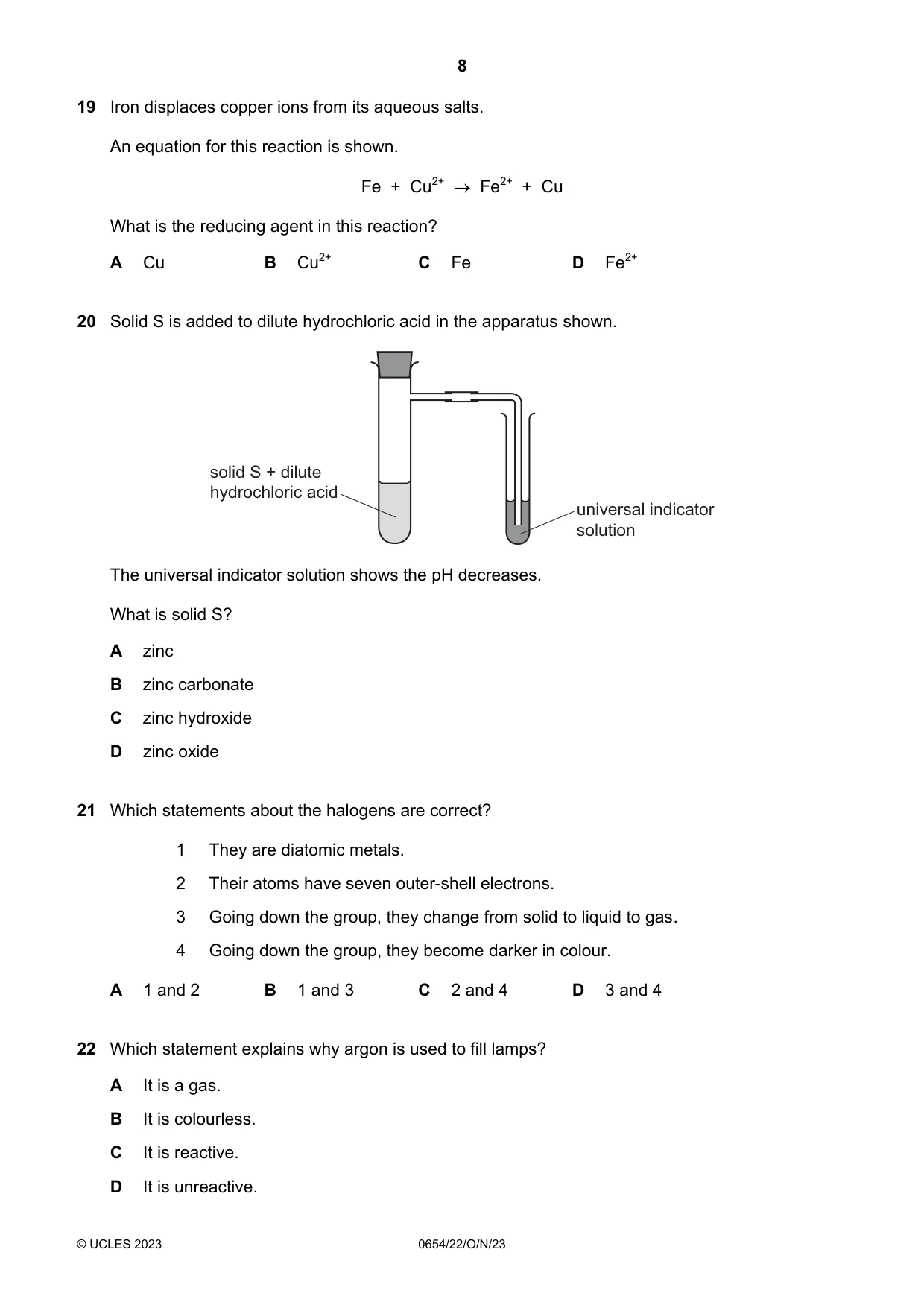
20 Solid S is added to dilute hydrochloric acid in the apparatus shown. solid S + dilute hydrochloric acid universal indicator solution The universal indicator solution shows the pH decreases. What is solid S? A zinc B zinc carbonate C zinc hydroxide D zinc oxide
Mark scheme: B
More questions on The characteristic properties of acids and bases
Q21 · Which statements about the halogens are correct?
21 Which statements about the halogens are correct? 1 They are diatomic metals. 2 Their atoms have seven outer-shell electrons. 3 Going down the group, they change from solid to liquid to gas. 4 Going down the group, they become darker in colour. A 1 and 2 B 1 and 3 C 2 and 4 D 3 and 4
Mark scheme: C
Q22 · Which statement explains why argon is used to fill lamps?
22 Which statement explains why argon is used to fill lamps? A It is a gas. B It is colourless. C It is reactive. D It is unreactive.
Mark scheme: D
Q23 · W, X, Y and Z are metals
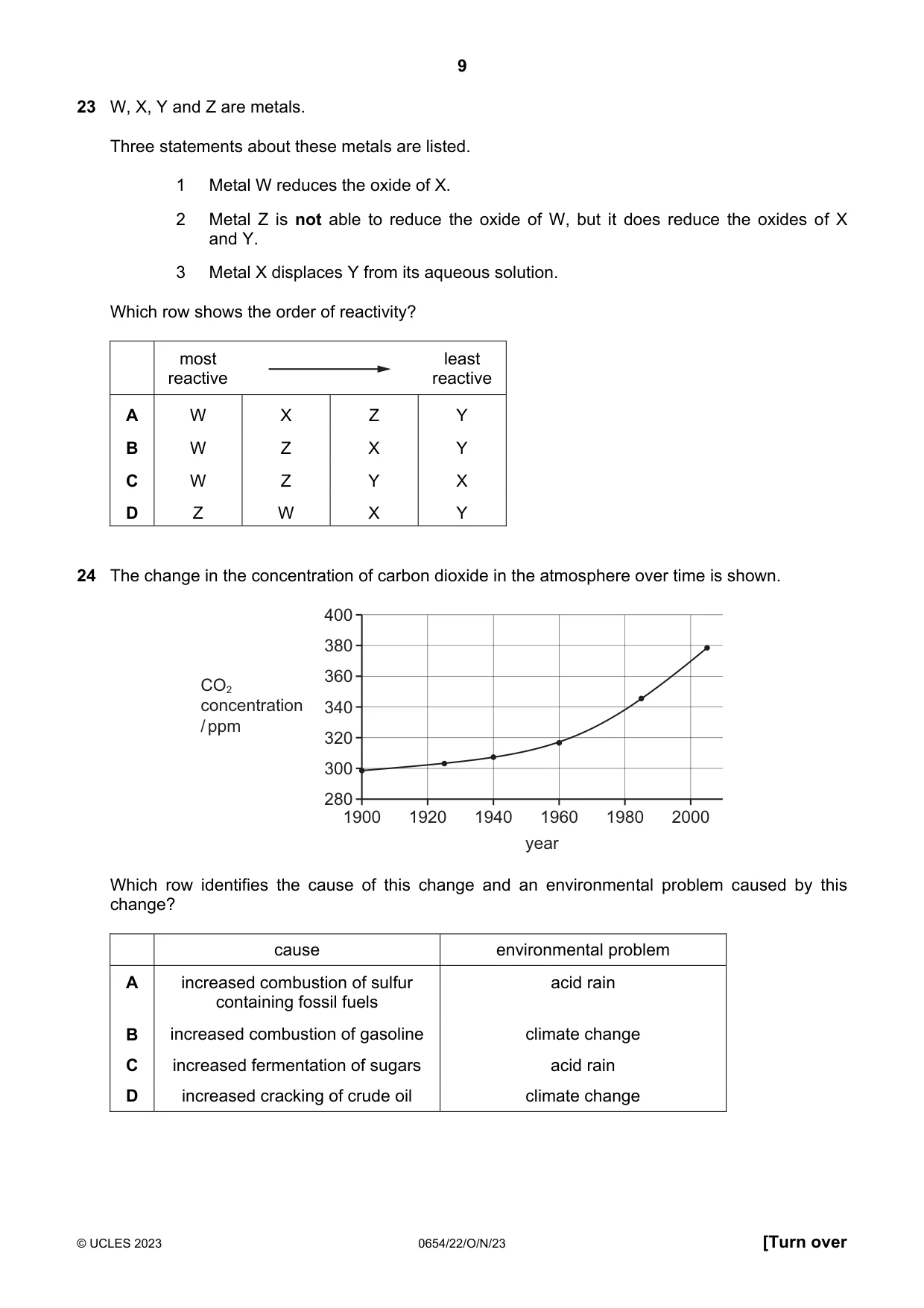
23 W, X, Y and Z are metals. Three statements about these metals are listed. 1 Metal W reduces the oxide of X. 2 Metal Z is not able to reduce the oxide of W, but it does reduce the oxides of X and Y. 3 Metal X displaces Y from its aqueous solution. Which row shows the order of reactivity? most least reactive reactive A W X Z Y B W Z X Y C W Z Y X D Z W X Y
Mark scheme: B
Q24 · The change in the concentration of carbon dioxide in the atmosphere over time is shown
24 The change in the concentration of carbon dioxide in the atmosphere over time is shown. 400 380 360 CO2 concentration 340 / ppm 320 300 280 1900 1920 1940 1960 1980 2000 year Which row identifies the cause of this change and an environmental problem caused by this change? cause environmental problem A increased combustion of sulfur acid rain containing fossil fuels B increased combustion of gasoline climate change C increased fermentation of sugars acid rain D increased cracking of crude oil climate change
Mark scheme: B
Q25 · Which equation does not represent a reaction that occurs in the Contact process?
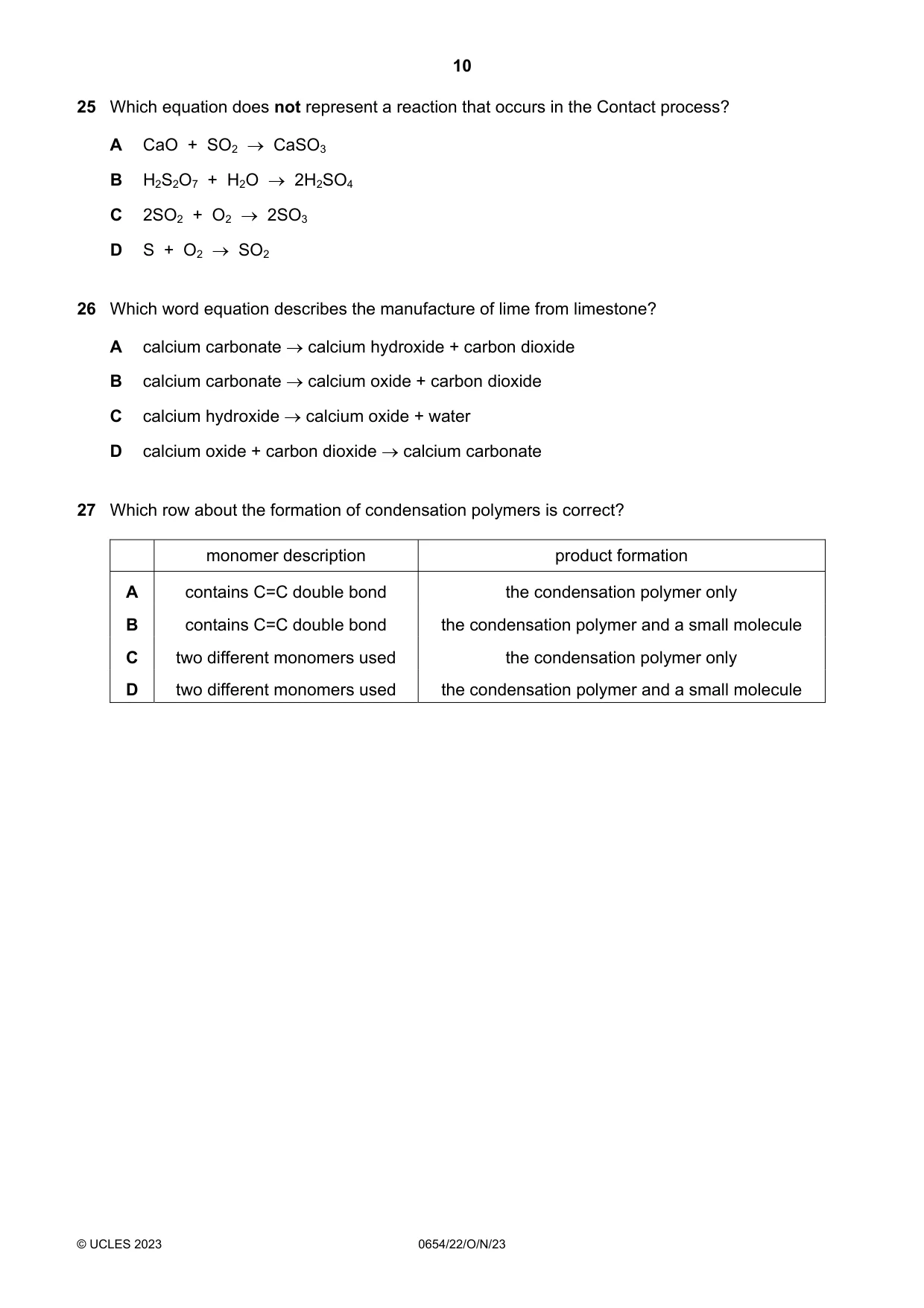
25 Which equation does not represent a reaction that occurs in the Contact process? A CaO + SO2 CaSO3 B H2S2O7 + H2O 2H2SO4 C 2SO2 + O2 2SO3 D S + O2 SO2
Mark scheme: A
Q26 · Which word equation describes the manufacture of lime from limestone?
26 Which word equation describes the manufacture of lime from limestone? A calcium carbonate calcium hydroxide + carbon dioxide B calcium carbonate calcium oxide + carbon dioxide C calcium hydroxide calcium oxide + water D calcium oxide + carbon dioxide calcium carbonate
Mark scheme: B
Q27 · Which row about the formation of condensation polymers is correct?
27 Which row about the formation of condensation polymers is correct? monomer description product formation A contains C=C double bond the condensation polymer only B contains C=C double bond the condensation polymer and a small molecule C two different monomers used the condensation polymer only D two different monomers used the condensation polymer and a small molecule
Mark scheme: D
Q28 · A student tests three identical springs that obey Hooke’s Law
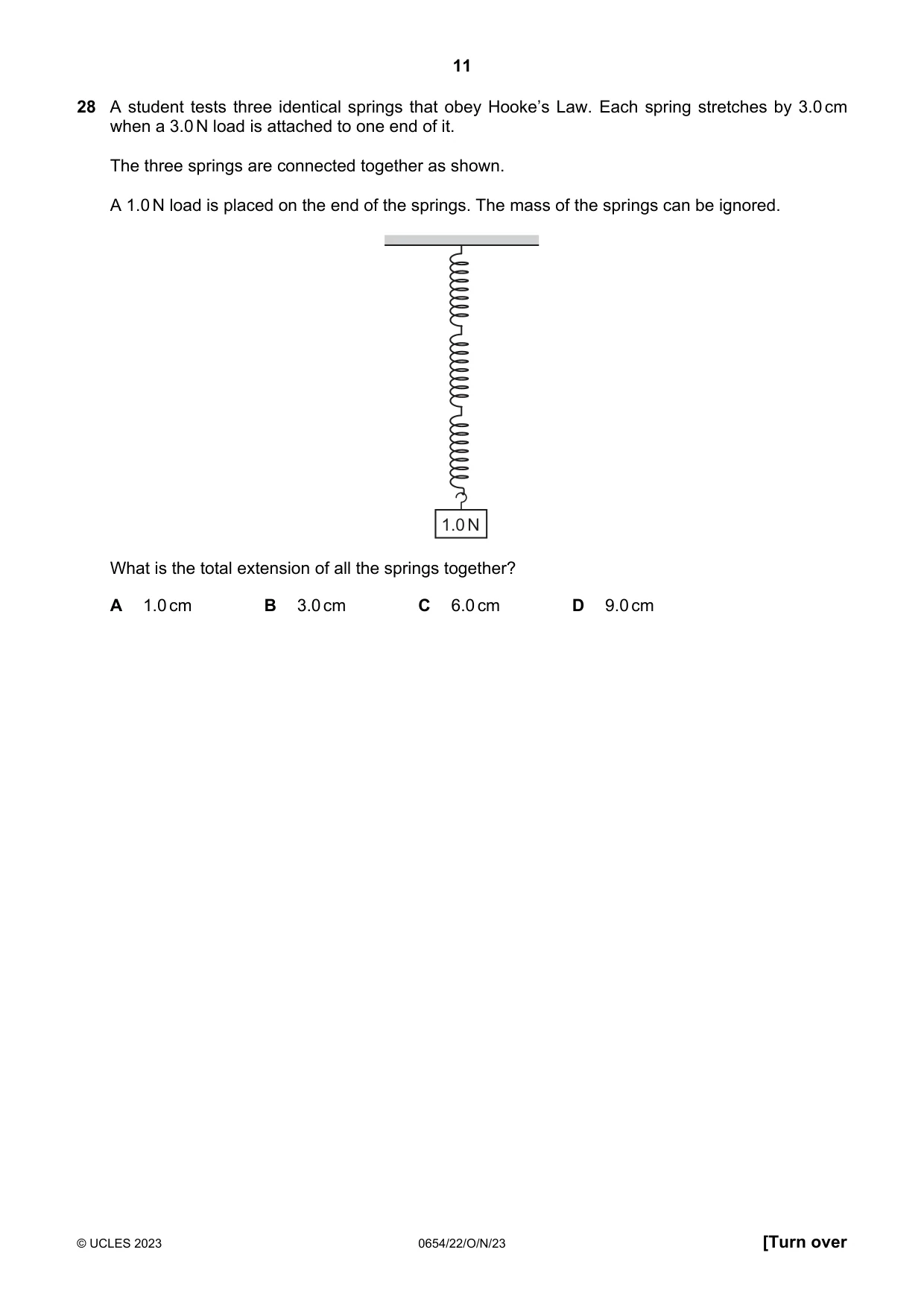
28 A student tests three identical springs that obey Hooke’s Law. Each spring stretches by 3.0 cm when a 3.0 N load is attached to one end of it. The three springs are connected together as shown. A 1.0 N load is placed on the end of the springs. The mass of the springs can be ignored. 1.0 N What is the total extension of all the springs together? A 1.0 cm B 3.0 cm C 6.0 cm D 9.0 cm
Mark scheme: B
Q29 · The diagram shows a crane supporting a load of 6000 N
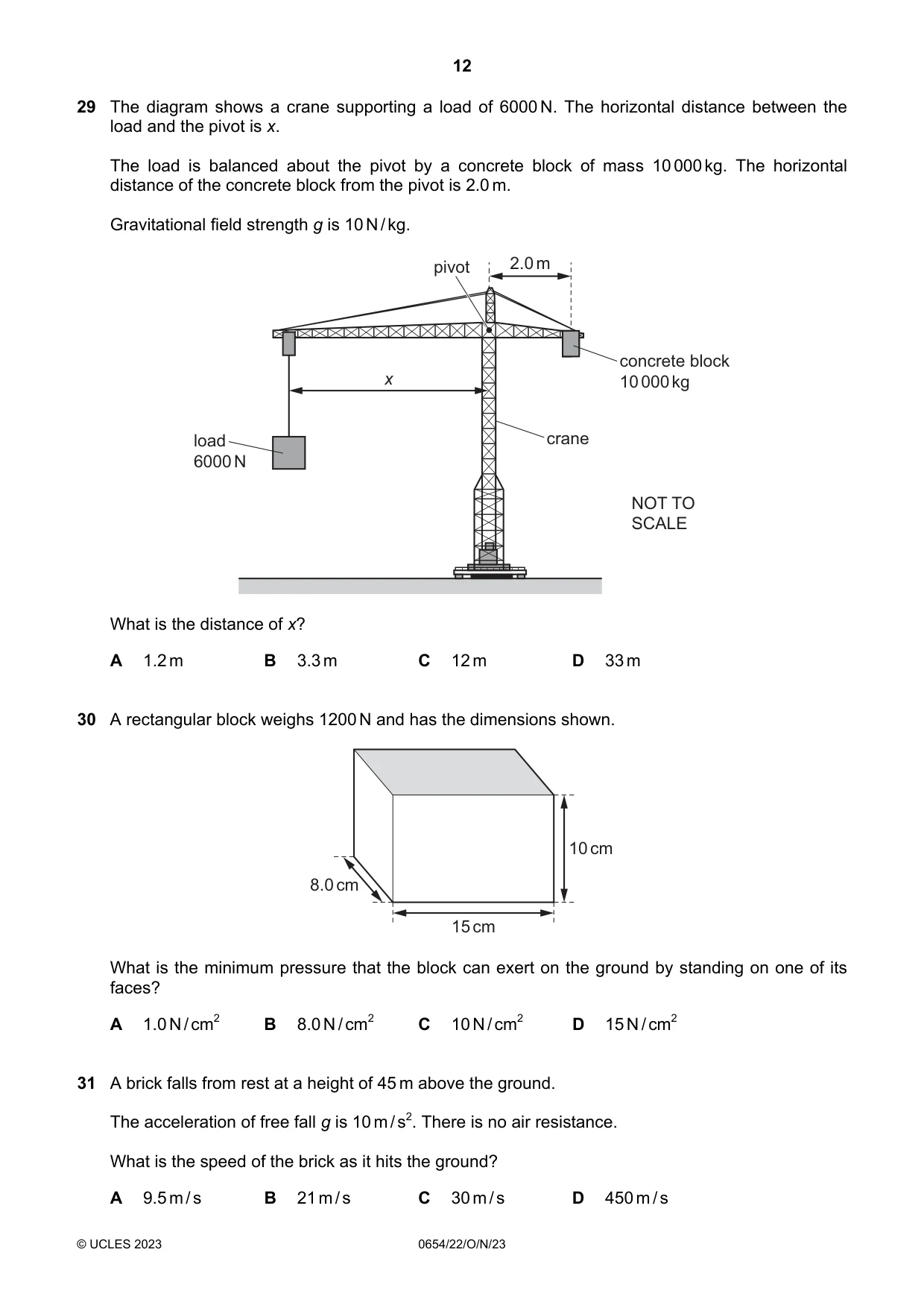
29 The diagram shows a crane supporting a load of 6000 N. The horizontal distance between the load and the pivot is x. The load is balanced about the pivot by a concrete block of mass 10 000 kg. The horizontal distance of the concrete block from the pivot is 2.0 m. Gravitational field strength g is 10 N / kg. pivot 2.0 m concrete block x 10 000 kg load crane 6000 N NOT TO SCALE What is the distance of x? A 1.2 m B 3.3 m C 12 m D 33 m
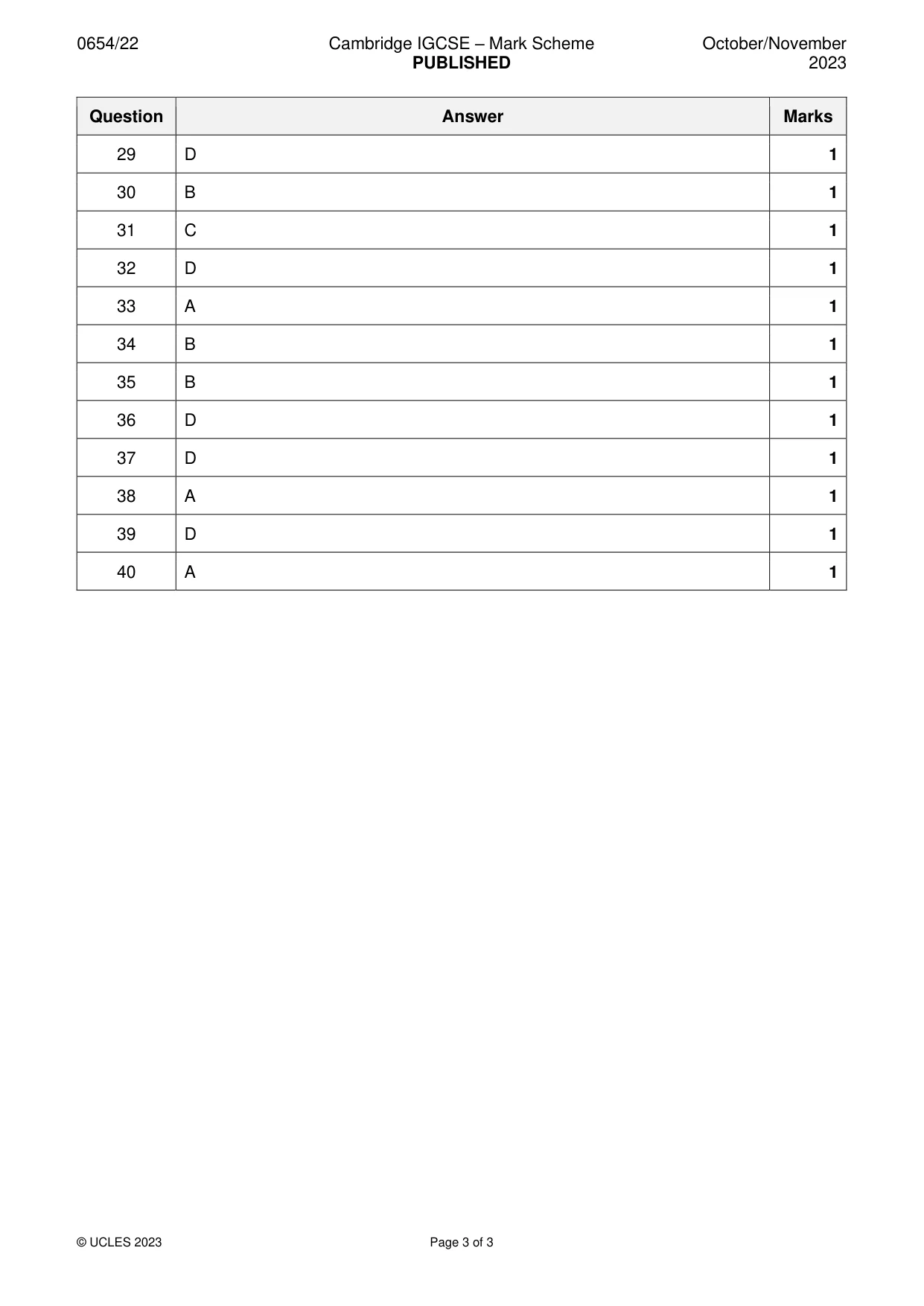
Mark scheme: D
Q30 · A rectangular block weighs 1200 N and has the dimensions shown
30 A rectangular block weighs 1200 N and has the dimensions shown. 10 cm 8.0 cm 15 cm What is the minimum pressure that the block can exert on the ground by standing on one of its faces? A 1.0 N / cm2 B 8.0 N / cm2 C 10 N / cm2 D 15 N / cm2
Mark scheme: B
Q31 · A brick falls from rest at a height of 45 m above the ground
31 A brick falls from rest at a height of 45 m above the ground. The acceleration of free fall g is 10 m / s2. There is no air resistance. What is the speed of the brick as it hits the ground? A 9.5 m / s B 21 m / s C 30 m / s D 450 m / s
Mark scheme: C
Q32 · For which energy resource is the Sun the source of all the energy stored?
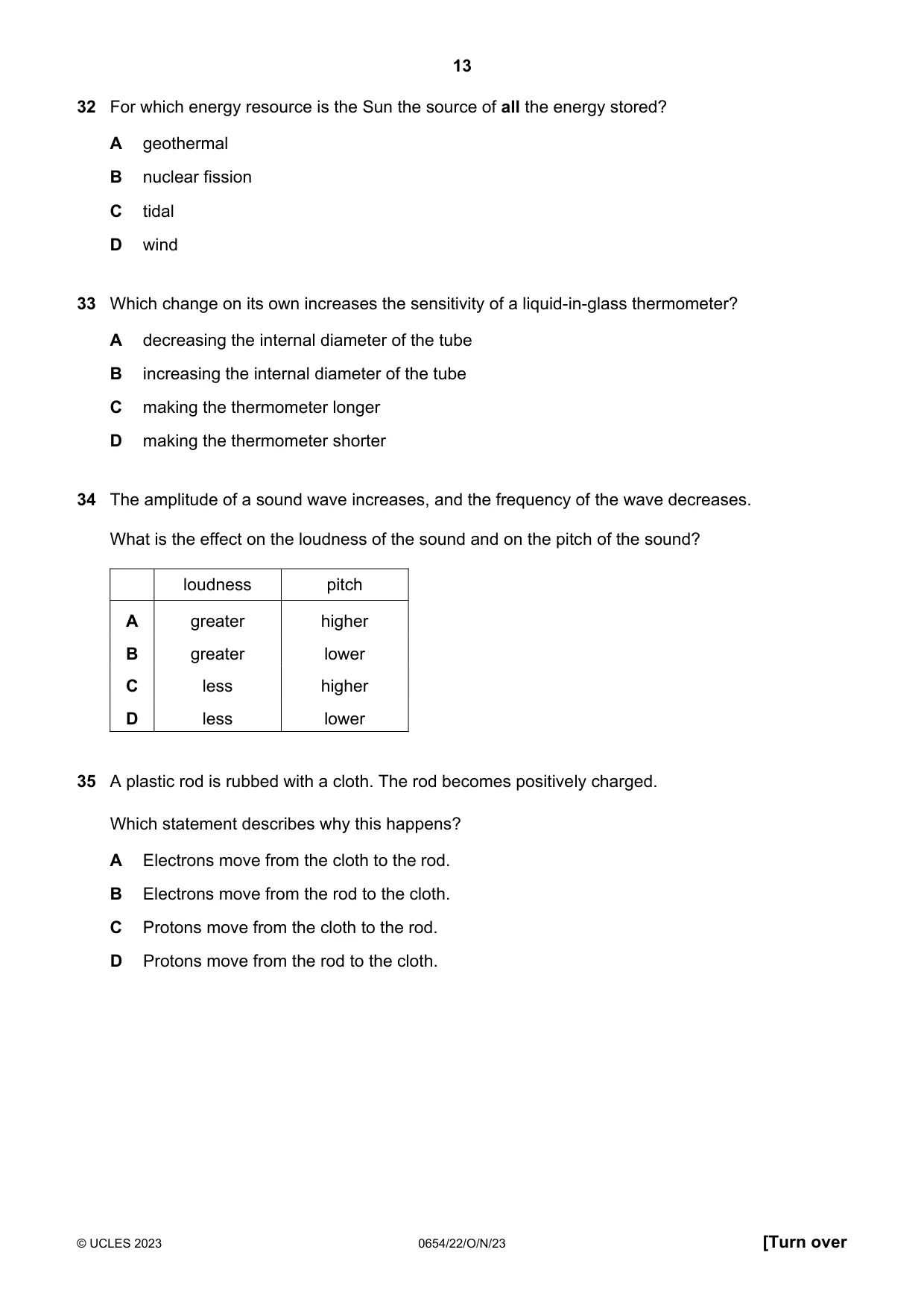
32 For which energy resource is the Sun the source of all the energy stored? A geothermal B nuclear fission C tidal D wind
Mark scheme: D
Q33 · Which change on its own increases the sensitivity of a liquid-in-glass thermometer?
33 Which change on its own increases the sensitivity of a liquid-in-glass thermometer? A decreasing the internal diameter of the tube B increasing the internal diameter of the tube C making the thermometer longer D making the thermometer shorter
Mark scheme: A
Q34 · The amplitude of a sound wave increases, and the frequency of the wave decreases
34 The amplitude of a sound wave increases, and the frequency of the wave decreases. What is the effect on the loudness of the sound and on the pitch of the sound? loudness pitch A greater higher B greater lower C less higher D less lower
Mark scheme: B
Q35 · A plastic rod is rubbed with a cloth
35 A plastic rod is rubbed with a cloth. The rod becomes positively charged. Which statement describes why this happens? A Electrons move from the cloth to the rod. B Electrons move from the rod to the cloth. C Protons move from the cloth to the rod. D Protons move from the rod to the cloth.
Mark scheme: B
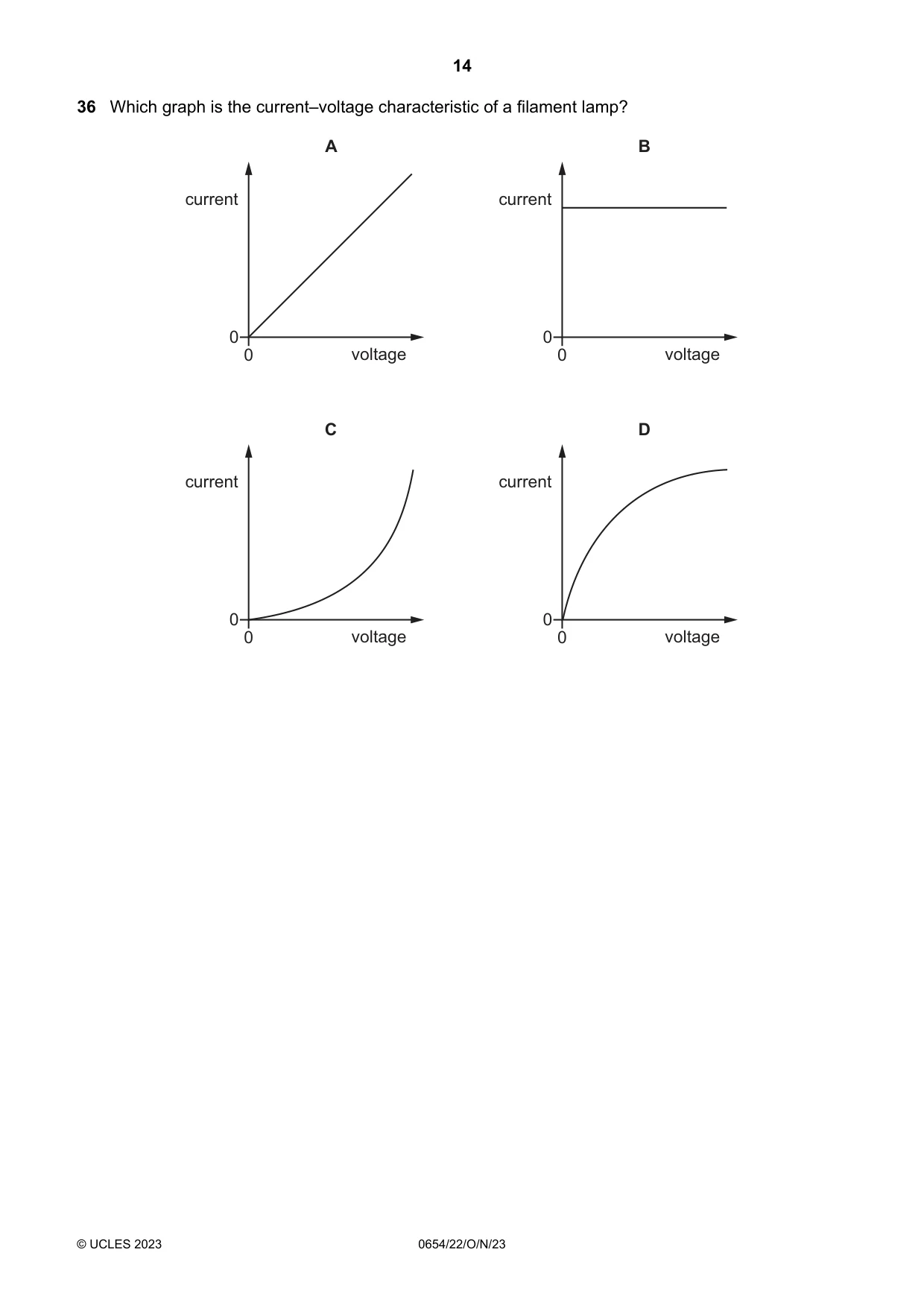
Q36 · Which graph is the current–voltage characteristic of a filament lamp?
36 Which graph is the current–voltage characteristic of a filament lamp? A B current current 0 0 0 voltage 0 voltage C D current current 0 0 0 voltage 0 voltage
Mark scheme: D
Q37 · A lamp is connected in four circuits in turn
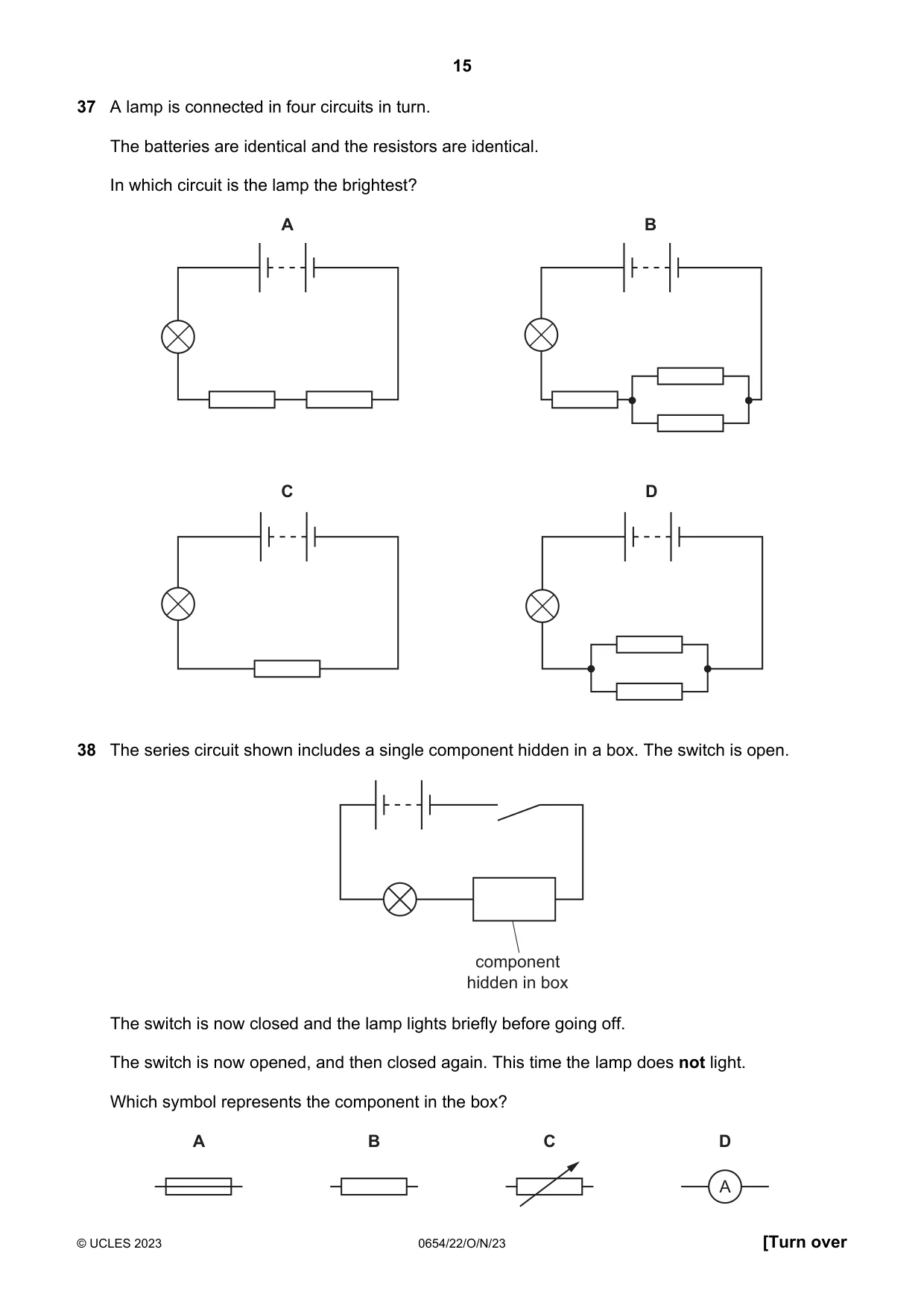
37 A lamp is connected in four circuits in turn. The batteries are identical and the resistors are identical. In which circuit is the lamp the brightest? A B C D
Mark scheme: D
Q38 · The series circuit shown includes a single component hidden in a box
38 The series circuit shown includes a single component hidden in a box. The switch is open. component hidden in box The switch is now closed and the lamp lights briefly before going off. The switch is now opened, and then closed again. This time the lamp does not light. Which symbol represents the component in the box? A B C D A
Mark scheme: A
Q39 · The diagrams show a wire carrying a current out of the page
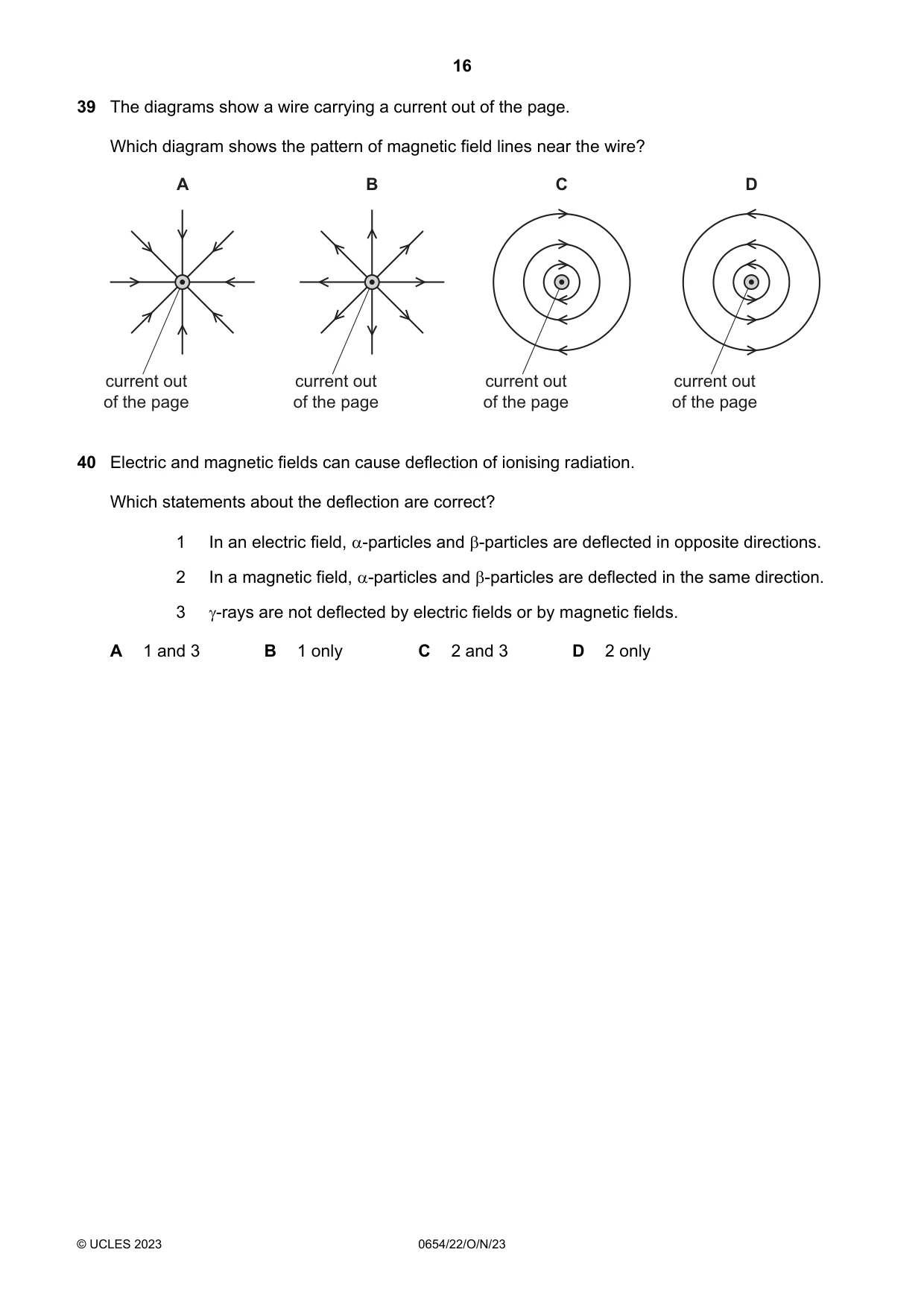
39 The diagrams show a wire carrying a current out of the page. Which diagram shows the pattern of magnetic field lines near the wire? A B C D current out current out current out current out of the page of the page of the page of the page
Mark scheme: D
Q40 · Electric and magnetic fields can cause deflection of ionising radiation
40 Electric and magnetic fields can cause deflection of ionising radiation. Which statements about the deflection are correct? 1 In an electric field, -particles and -particles are deflected in opposite directions. 2 In a magnetic field, -particles and -particles are deflected in the same direction. 3 -rays are not deflected by electric fields or by magnetic fields. A 1 and 3 B 1 only C 2 and 3 D 2 only
Mark scheme: A
What was in this paper
The subtopics covered by these 40 questions, and how many questions each got. Open one in a new tab to see every Cambridge question on it.
2Forces2Oxides2Simple phenomena of magnetism2Air quality and climate1Biological molecules1Carbon cycle1Characteristics of living organisms1Coordination and response1Diet1Electrical quantities1Electrolysis1Energy, work and power1Enzymes1Food chains and food webs1Formulas1Group VII properties1Isotopes1Motion1Noble gases1Osmosis1Photosynthesis1Polymers1Pressure1Radioactivity1Rate of reaction1Reactivity series1Redox1Respiration1Separation and purification1Sexual reproduction in humans1Sound1The characteristic properties of acids and bases1Thermal properties and temperature1Transpiration1Variation1What you needed in this session
Cambridge’s own grade thresholds for 2023 Oct/Nov, Paper 2 · Variant 2. A higher threshold means an easier paper — the bar moves with how the cohort did.