Cambridge IGCSE Sciences - Co-ordinated (Double) 0654 — 2023 May/June Paper 2 · Variant 2
0654/22/M/J/23 · 40 questions · 40 marks · ≈45 min
The question paper and its mark scheme, free to read here and free to download. This is Cambridge’s own paper, exactly as it was sat.
Question paper16 pages
Mark scheme3 pages
Answers below. Sit the paper first if you are practising.
Questions as text
Q1 · Which is not a characteristic of all living organisms?
1 Which is not a characteristic of all living organisms? A excretion B growth C photosynthesis D sensitivity
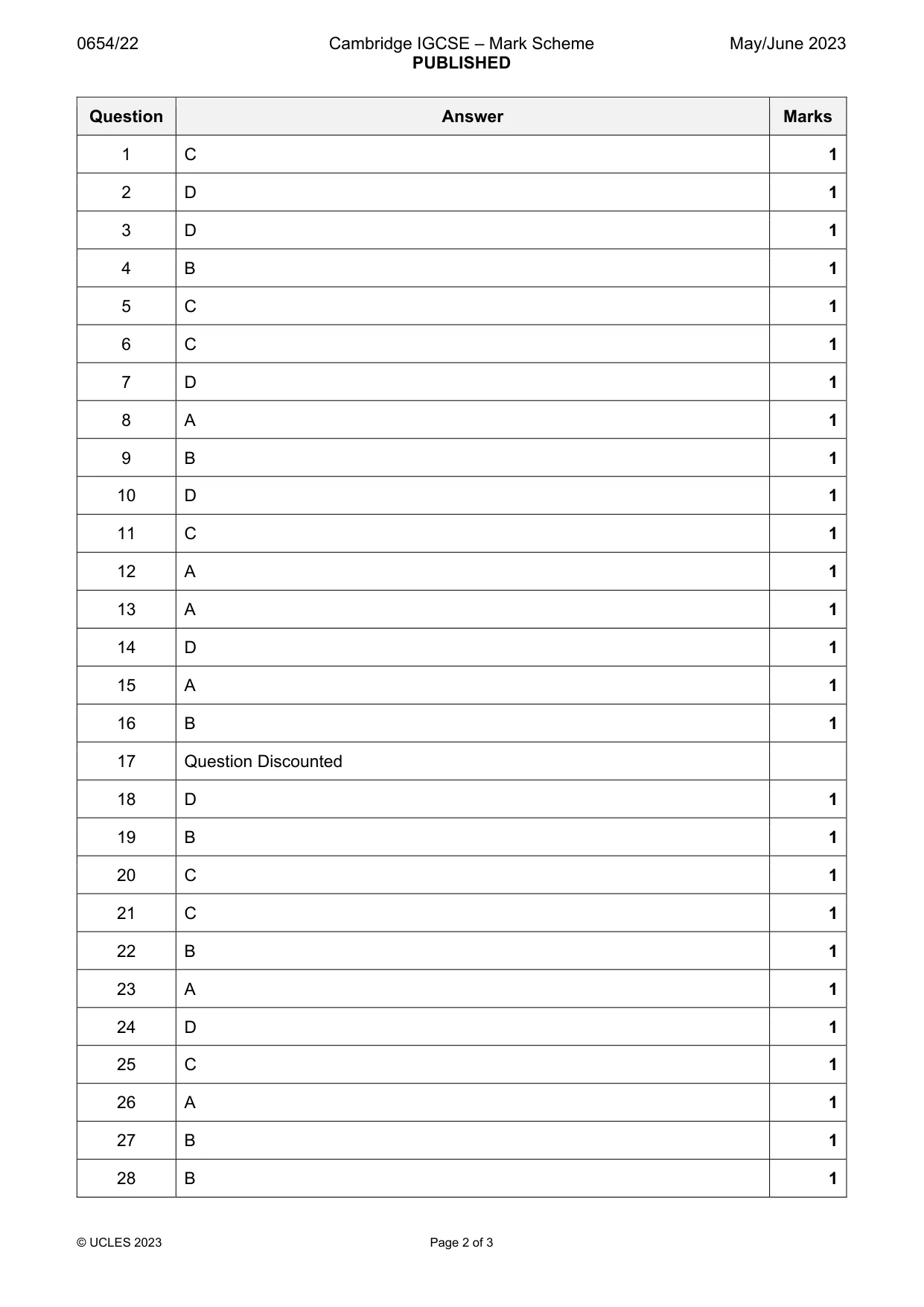
Mark scheme: C
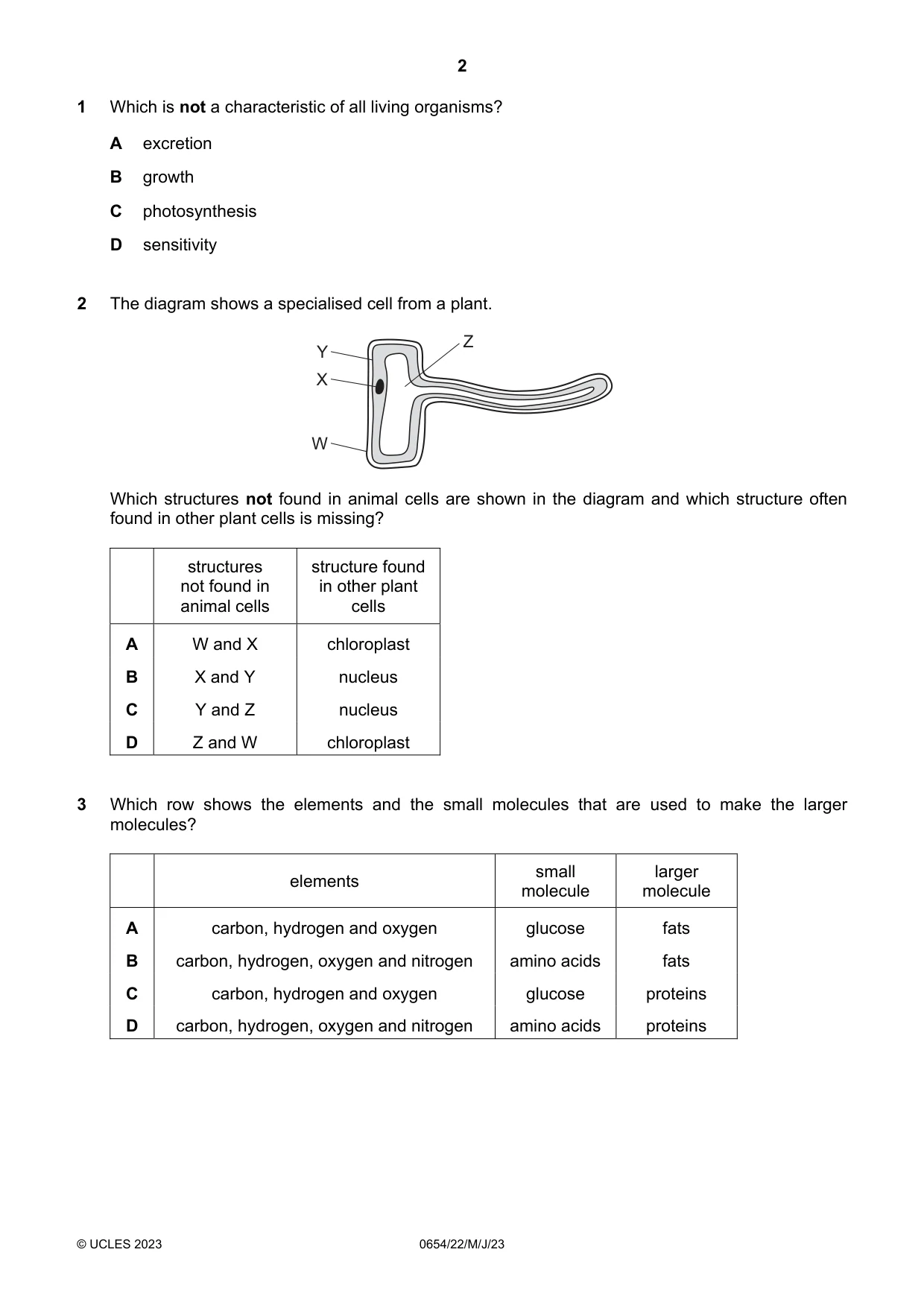
Q2 · The diagram shows a specialised cell from a plant
2 The diagram shows a specialised cell from a plant. Z Y X W Which structures not found in animal cells are shown in the diagram and which structure often found in other plant cells is missing? structures structure found not found in in other plant animal cells cells A W and X chloroplast B X and Y nucleus C Y and Z nucleus D Z and W chloroplast
Mark scheme: D
Q3 · Which row shows the elements and the small molecules that are used to make the larger…
3 Which row shows the elements and the small molecules that are used to make the larger molecules? small larger elements molecule molecule A carbon, hydrogen and oxygen glucose fats B carbon, hydrogen, oxygen and nitrogen amino acids fats C carbon, hydrogen and oxygen glucose proteins D carbon, hydrogen, oxygen and nitrogen amino acids proteins
Mark scheme: D
Q4 · Which type of molecules speed up chemical digestion?
4 Which type of molecules speed up chemical digestion? A carbohydrates B enzymes C hormones D fatty acids
Mark scheme: B
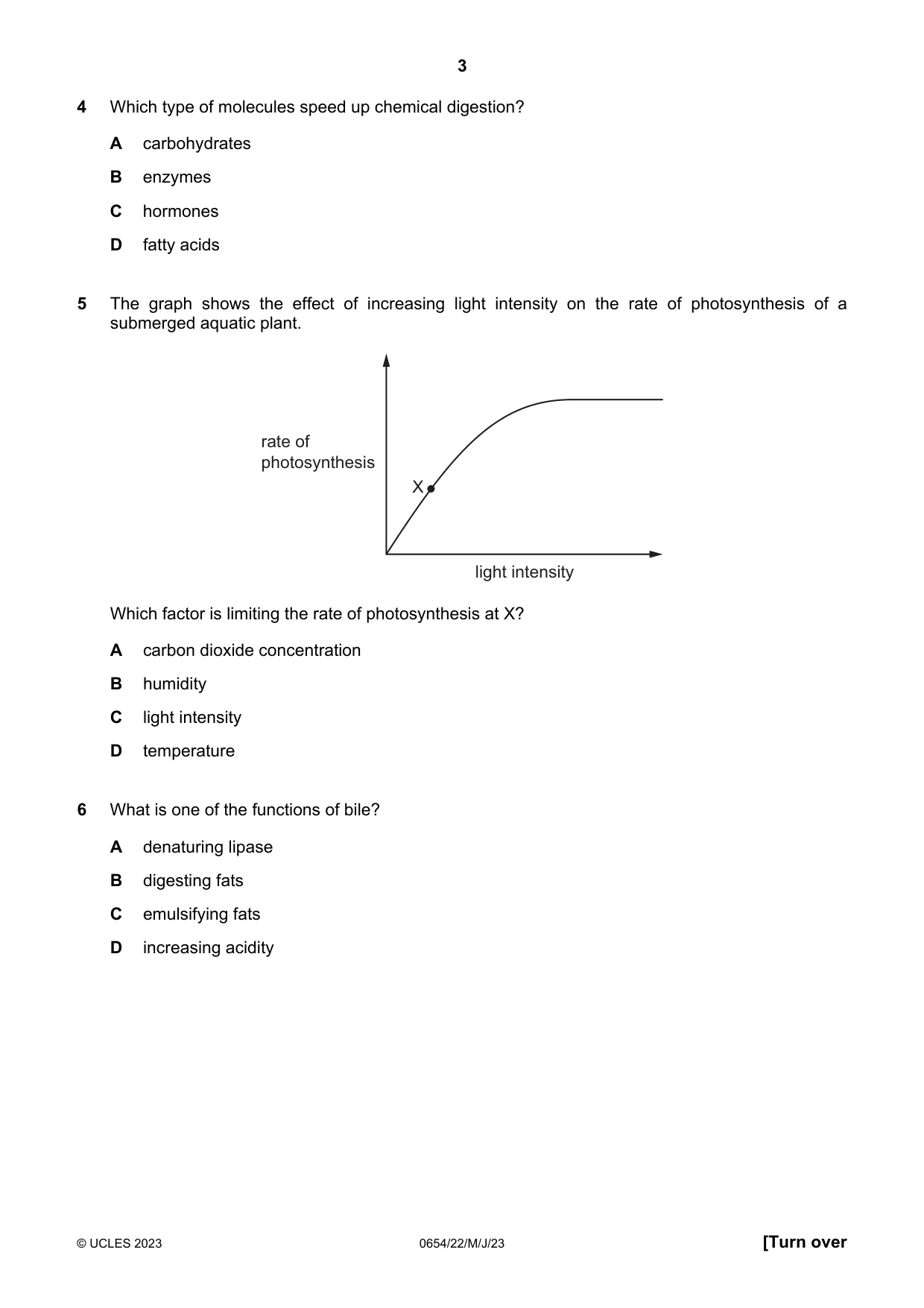
Q5 · The graph shows the effect of increasing light intensity on the rate of photosynthesis of…
5 The graph shows the effect of increasing light intensity on the rate of photosynthesis of a submerged aquatic plant. rate of photosynthesis X light intensity Which factor is limiting the rate of photosynthesis at X? A carbon dioxide concentration B humidity C light intensity D temperature
Mark scheme: C
Q6 · What is one of the functions of bile?
6 What is one of the functions of bile? A denaturing lipase B digesting fats C emulsifying fats D increasing acidity
Mark scheme: C
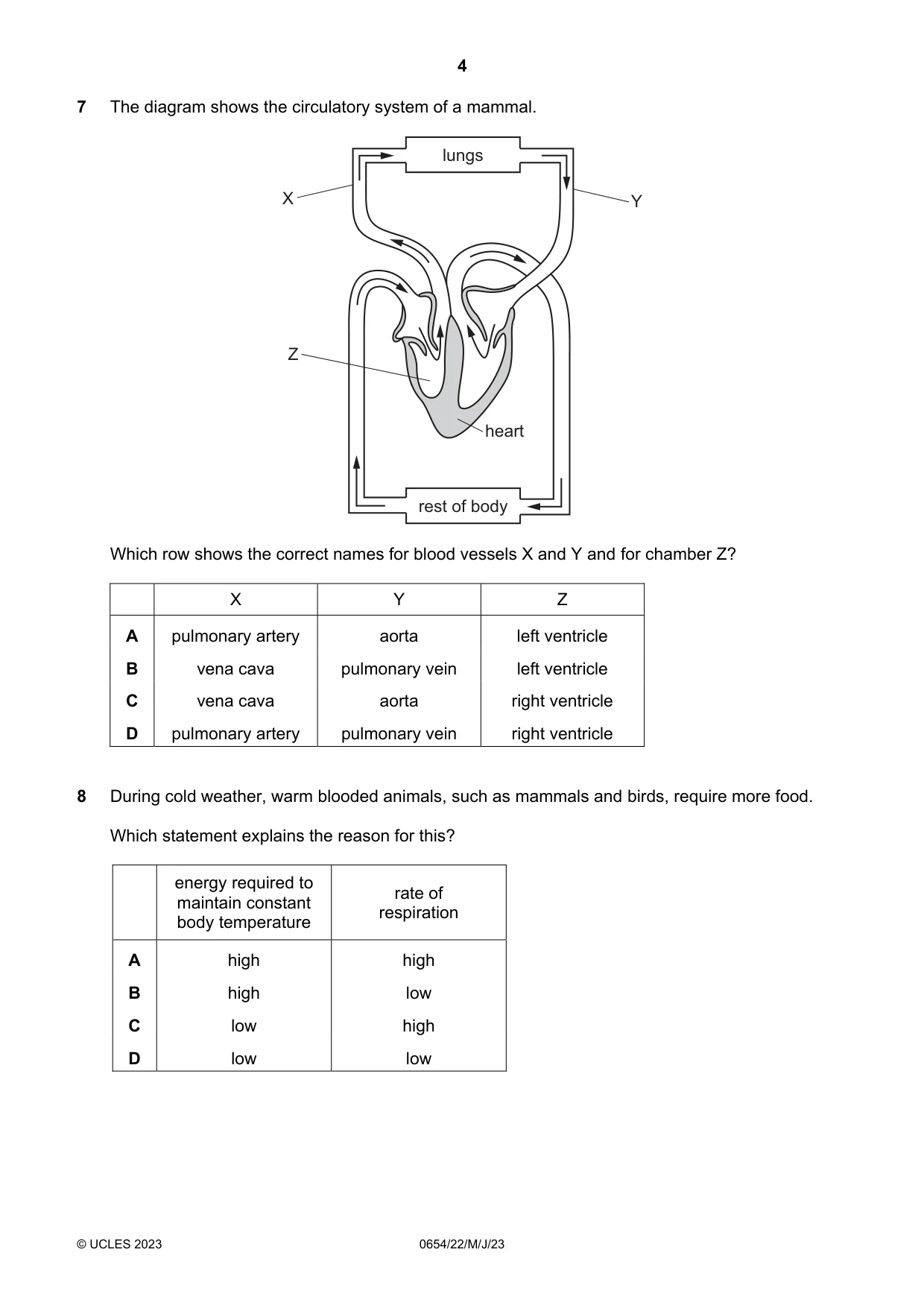
Q7 · The diagram shows the circulatory system of a mammal
7 The diagram shows the circulatory system of a mammal. lungs X Y Z heart rest of body Which row shows the correct names for blood vessels X and Y and for chamber Z? X Y Z A pulmonary artery aorta left ventricle B vena cava pulmonary vein left ventricle C vena cava aorta right ventricle D pulmonary artery pulmonary vein right ventricle
Mark scheme: D
Q8 · During cold weather, warm blooded animals, such as mammals and birds, require more food
8 During cold weather, warm blooded animals, such as mammals and birds, require more food. Which statement explains the reason for this? energy required to rate of maintain constant respiration body temperature A high high B high low C low high D low low
Mark scheme: A
Q9 · The diagram shows an experiment using the shoots of seedlings
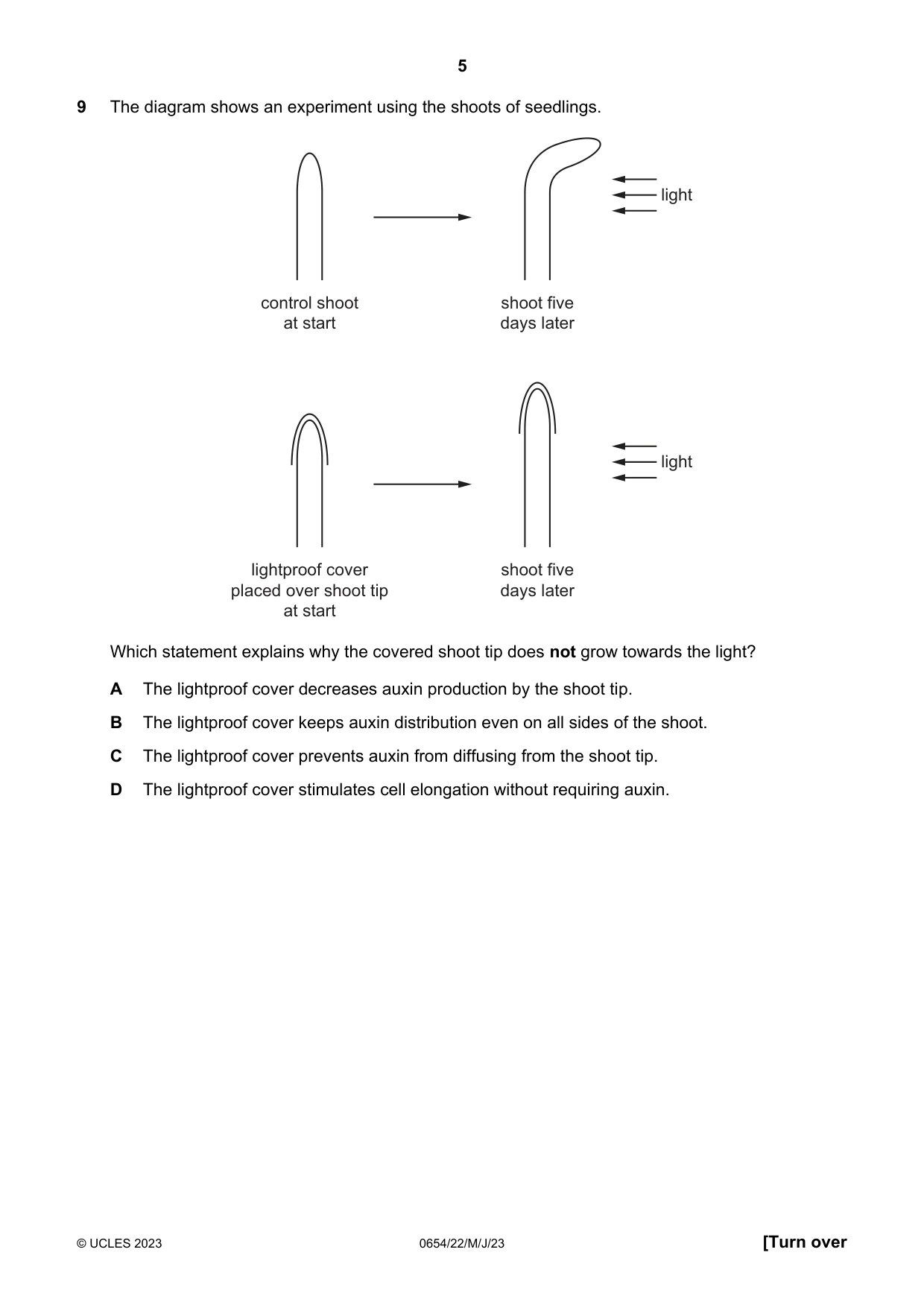
9 The diagram shows an experiment using the shoots of seedlings. light control shoot shoot five at start days later light lightproof cover shoot five placed over shoot tip days later at start Which statement explains why the covered shoot tip does not grow towards the light? A The lightproof cover decreases auxin production by the shoot tip. B The lightproof cover keeps auxin distribution even on all sides of the shoot. C The lightproof cover prevents auxin from diffusing from the shoot tip. D The lightproof cover stimulates cell elongation without requiring auxin.
Mark scheme: B
Q10 · The diagram shows a section through a flower
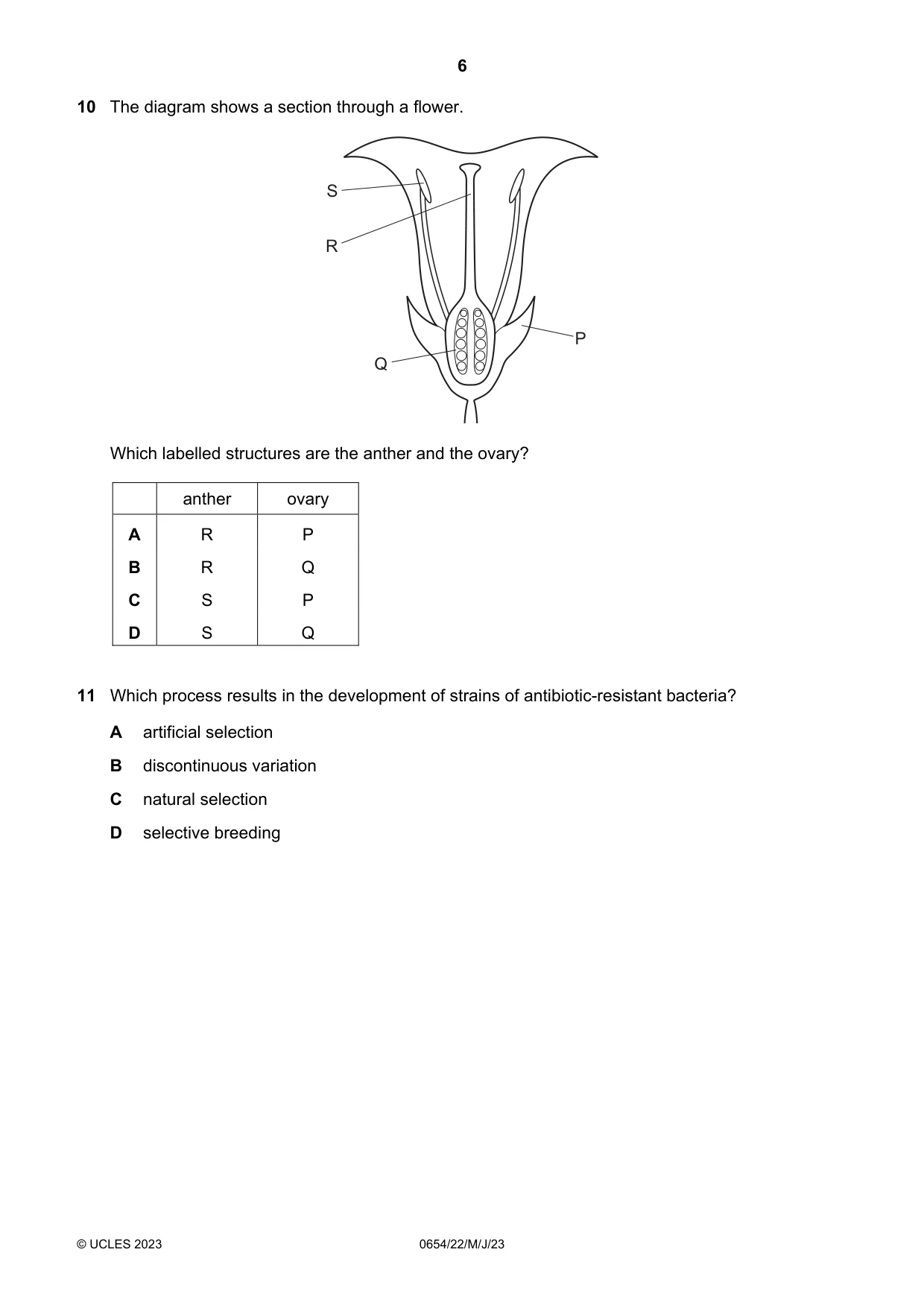
10 The diagram shows a section through a flower. S R P Q Which labelled structures are the anther and the ovary? anther ovary A R P B R Q C S P D S Q
Mark scheme: D
Q11 · Which process results in the development of strains of antibiotic-resistant bacteria?
11 Which process results in the development of strains of antibiotic-resistant bacteria? A artificial selection B discontinuous variation C natural selection D selective breeding
Mark scheme: C
Q12 · The diagram shows a food web
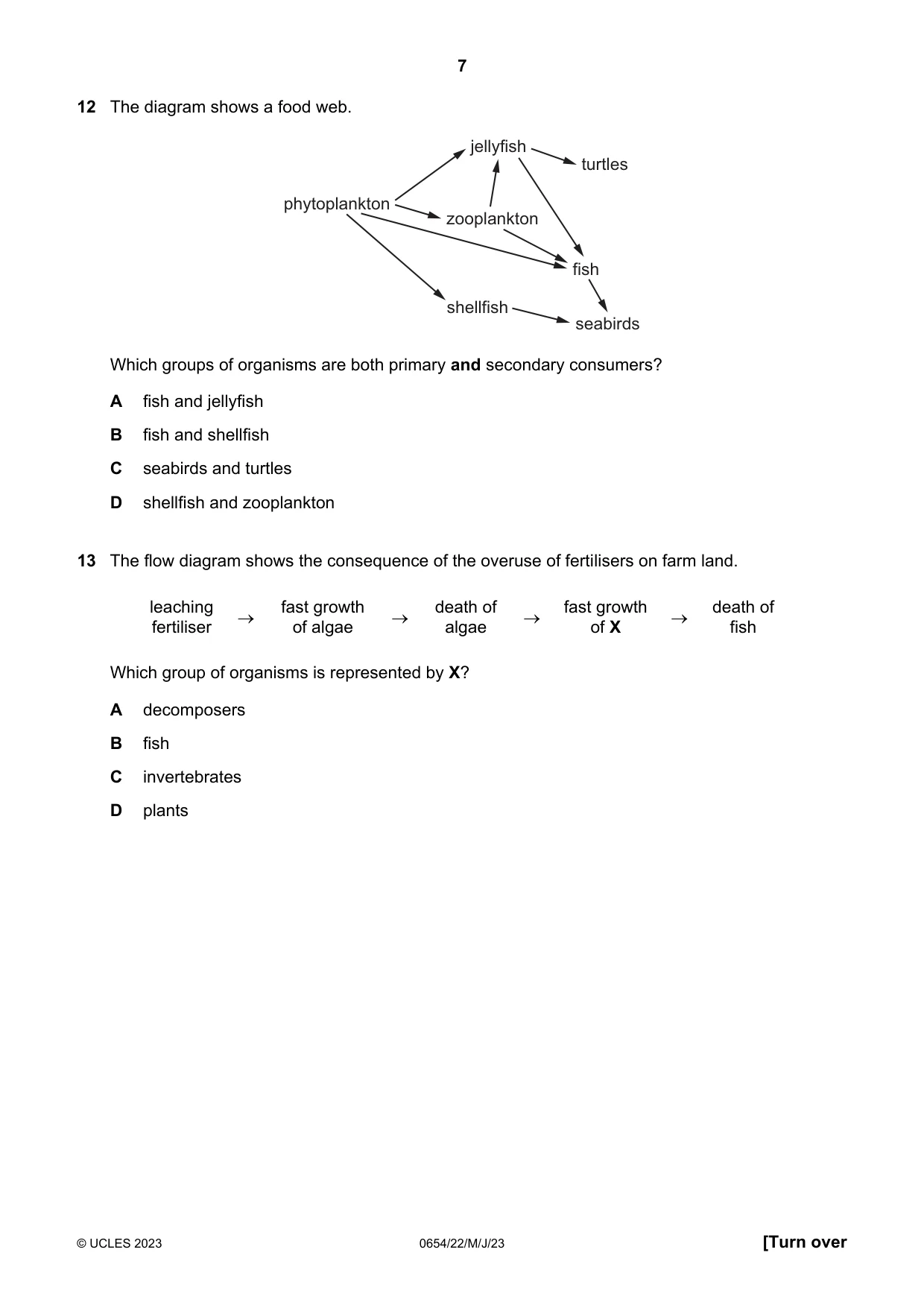
12 The diagram shows a food web. jellyfish turtles phytoplankton zooplankton fish shellfish seabirds Which groups of organisms are both primary and secondary consumers? A fish and jellyfish B fish and shellfish C seabirds and turtles D shellfish and zooplankton
Mark scheme: A
Q13 · The flow diagram shows the consequence of the overuse of fertilisers on farm land
13 The flow diagram shows the consequence of the overuse of fertilisers on farm land. leaching fast growth death of fast growth death of fertiliser of algae algae of X fish Which group of organisms is represented by X? A decomposers B fish C invertebrates D plants
Mark scheme: A
Q14 · Hexane and octane are liquid hydrocarbons that mix together
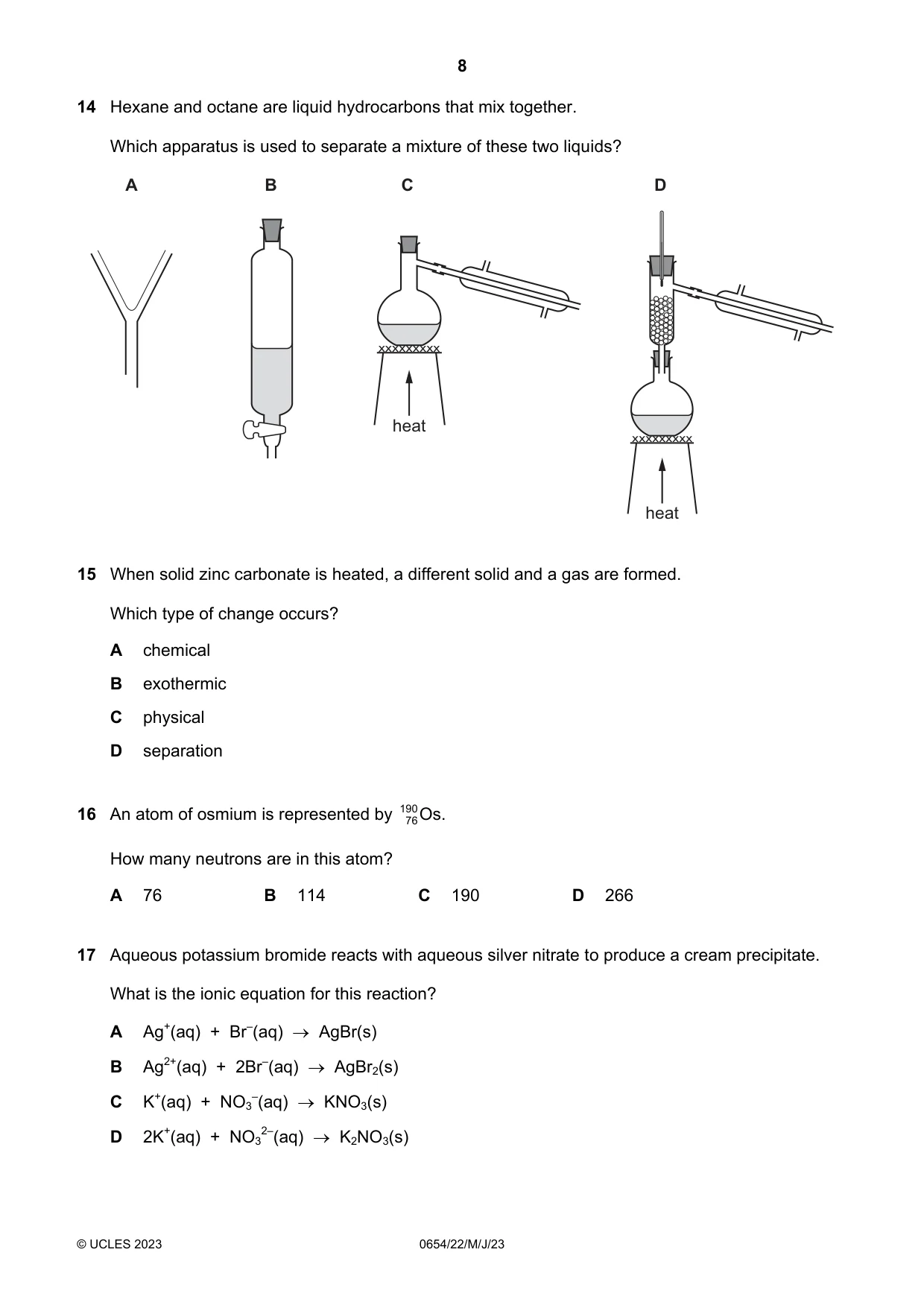
14 Hexane and octane are liquid hydrocarbons that mix together. Which apparatus is used to separate a mixture of these two liquids? A B C D xxxxxxxxx heat xxxxxxxxx heat
Mark scheme: D
Q15 · When solid zinc carbonate is heated, a different solid and a gas are formed
15 When solid zinc carbonate is heated, a different solid and a gas are formed. Which type of change occurs? A chemical B exothermic C physical D separation
Mark scheme: A
Q16 · An atom of osmium is represented by 190 76Os
16 An atom of osmium is represented by 190 76Os. How many neutrons are in this atom? A 76 B 114 C 190 D 266
Mark scheme: B
Q17 · Aqueous potassium bromide reacts with aqueous silver nitrate to produce a cream…
17 Aqueous potassium bromide reacts with aqueous silver nitrate to produce a cream precipitate. What is the ionic equation for this reaction? A Ag+(aq) + Br–(aq) AgBr(s) B Ag2+(aq) + 2Br–(aq) AgBr2(s) C K+(aq) + NO3 –(aq) KNO3(s) D 2K+(aq) + NO3 2–(aq) K2NO3(s)
Q18 · Which statement about the extraction of aluminium from its ore by electrolysis is correct?
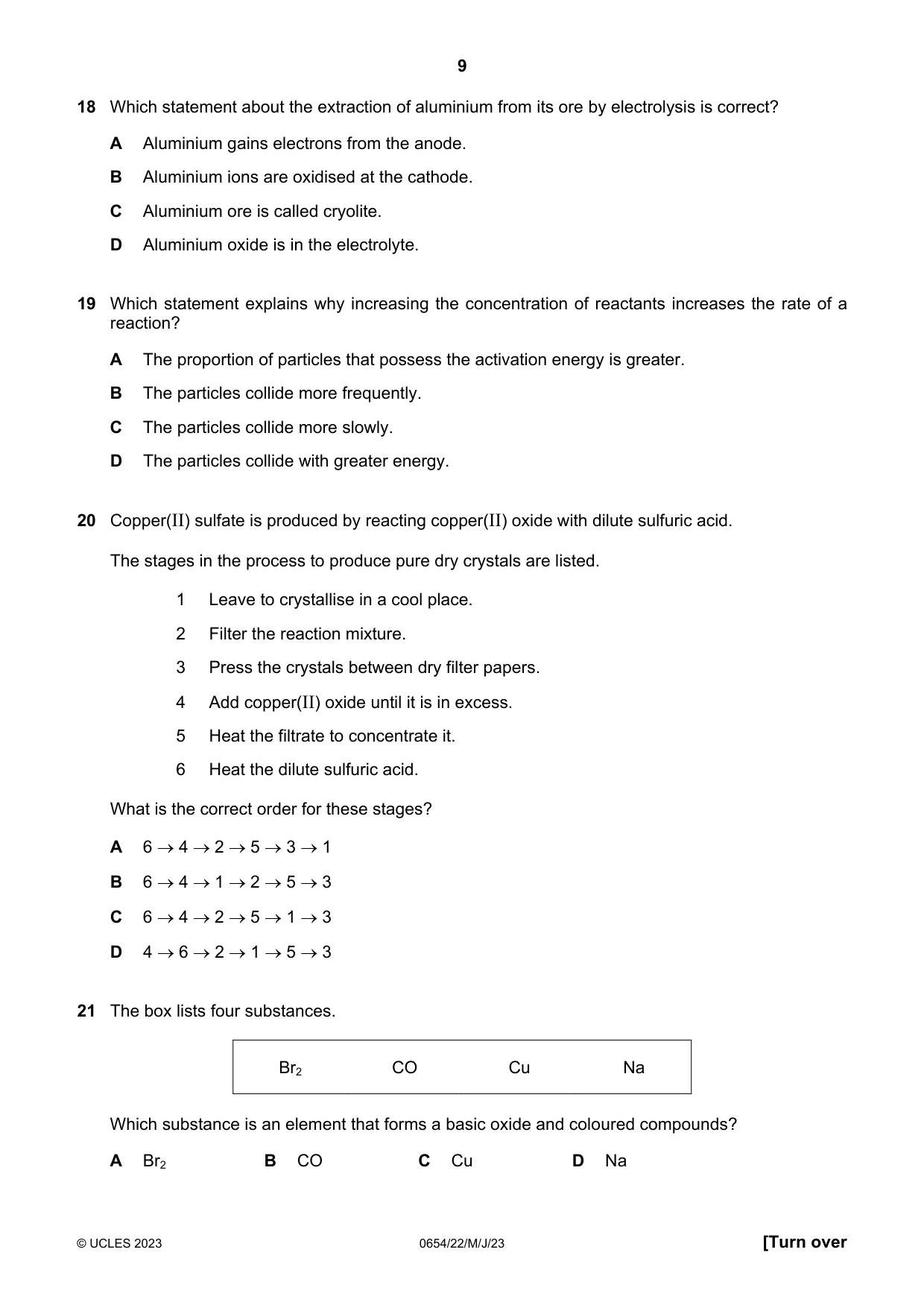
18 Which statement about the extraction of aluminium from its ore by electrolysis is correct? A Aluminium gains electrons from the anode. B Aluminium ions are oxidised at the cathode. C Aluminium ore is called cryolite. D Aluminium oxide is in the electrolyte.
Mark scheme: D
Q19 · Which statement explains why increasing the concentration of reactants increases the rate…
19 Which statement explains why increasing the concentration of reactants increases the rate of a reaction? A The proportion of particles that possess the activation energy is greater. B The particles collide more frequently. C The particles collide more slowly. D The particles collide with greater energy.
Mark scheme: B
Q20 · Copper(II) sulfate is produced by reacting copper(II) oxide with dilute sulfuric acid
20 Copper(II) sulfate is produced by reacting copper(II) oxide with dilute sulfuric acid. The stages in the process to produce pure dry crystals are listed. 1 Leave to crystallise in a cool place. 2 Filter the reaction mixture. 3 Press the crystals between dry filter papers. 4 Add copper(II) oxide until it is in excess. 5 Heat the filtrate to concentrate it. 6 Heat the dilute sulfuric acid. What is the correct order for these stages? A 6 4 2 5 3 1 B 6 4 1 2 5 3 C 6 4 2 5 1 3 D 4 6 2 1 5 3
Mark scheme: C
Q21 · The box lists four substances
21 The box lists four substances. Br2 CO Cu Na Which substance is an element that forms a basic oxide and coloured compounds? A Br2 B CO C Cu D Na
Mark scheme: C
Q22 · Car engines produce pollutant gases
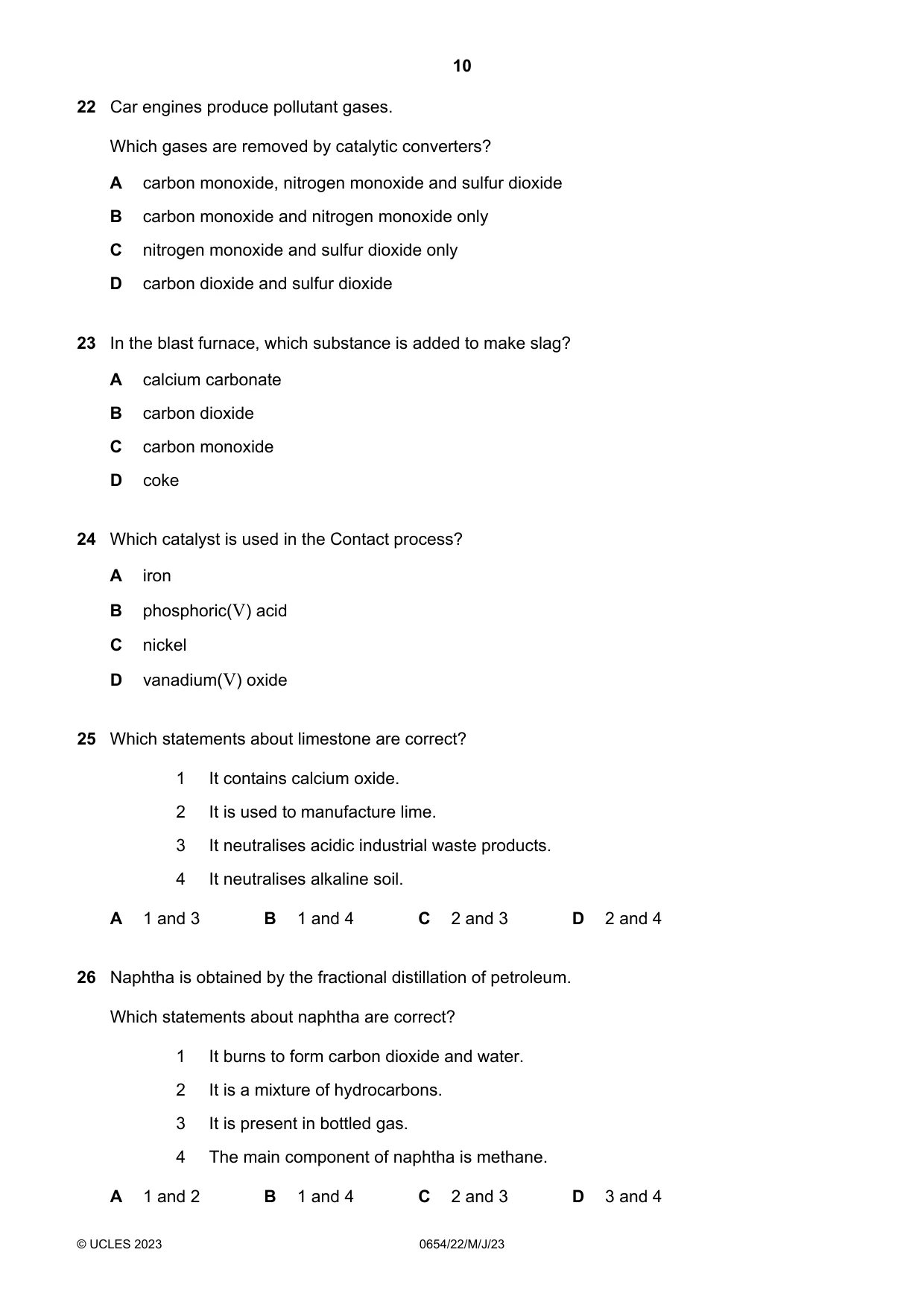
22 Car engines produce pollutant gases. Which gases are removed by catalytic converters? A carbon monoxide, nitrogen monoxide and sulfur dioxide B carbon monoxide and nitrogen monoxide only C nitrogen monoxide and sulfur dioxide only D carbon dioxide and sulfur dioxide
Mark scheme: B
Q23 · In the blast furnace, which substance is added to make slag?
23 In the blast furnace, which substance is added to make slag? A calcium carbonate B carbon dioxide C carbon monoxide D coke
Mark scheme: A
Q24 · Which catalyst is used in the Contact process?
24 Which catalyst is used in the Contact process? A iron B phosphoric(V) acid C nickel D vanadium(V) oxide
Mark scheme: D
Q25 · Which statements about limestone are correct?
25 Which statements about limestone are correct? 1 It contains calcium oxide. 2 It is used to manufacture lime. 3 It neutralises acidic industrial waste products. 4 It neutralises alkaline soil. A 1 and 3 B 1 and 4 C 2 and 3 D 2 and 4
Mark scheme: C
More questions on The characteristic properties of acids and bases
Q26 · Naphtha is obtained by the fractional distillation of petroleum
26 Naphtha is obtained by the fractional distillation of petroleum. Which statements about naphtha are correct? 1 It burns to form carbon dioxide and water. 2 It is a mixture of hydrocarbons. 3 It is present in bottled gas. 4 The main component of naphtha is methane. A 1 and 2 B 1 and 4 C 2 and 3 D 3 and 4
Mark scheme: A
Q27 · The structure of an addition polymer is shown
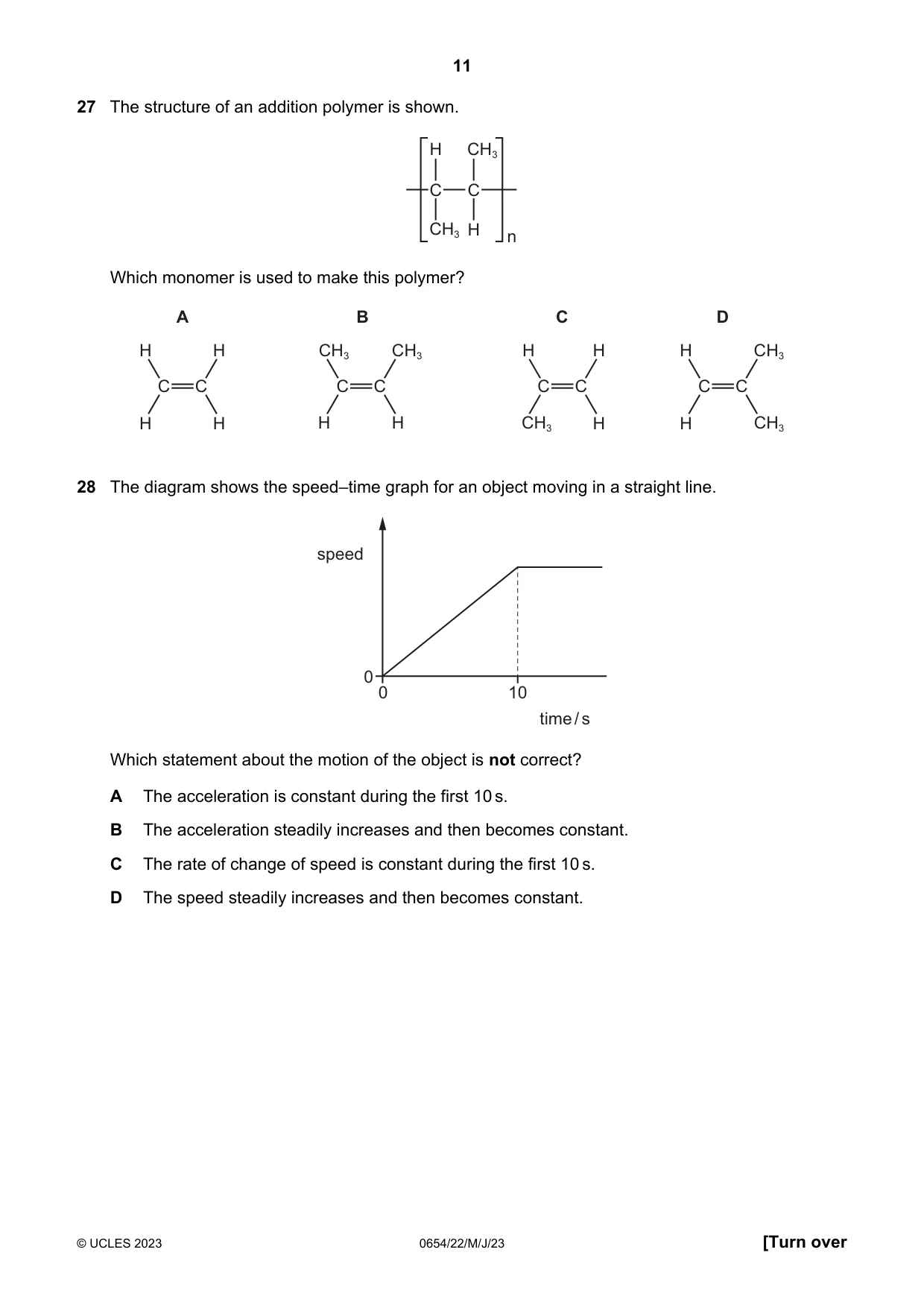
27 The structure of an addition polymer is shown. H CH3 C C CH3 H n Which monomer is used to make this polymer? A B C D H H CH3 CH3 H H H CH3 C C C C C C C C H H H H CH3 H H CH3
Mark scheme: B
Q28 · The diagram shows the speed–time graph for an object moving in a straight line
28 The diagram shows the speed–time graph for an object moving in a straight line. speed 0 0 10 time / s Which statement about the motion of the object is not correct? A The acceleration is constant during the first 10 s. B The acceleration steadily increases and then becomes constant. C The rate of change of speed is constant during the first 10 s. D The speed steadily increases and then becomes constant.
Mark scheme: B
Q29 · A uniform beam has a mass of 12 kg and a length of 4.0 m
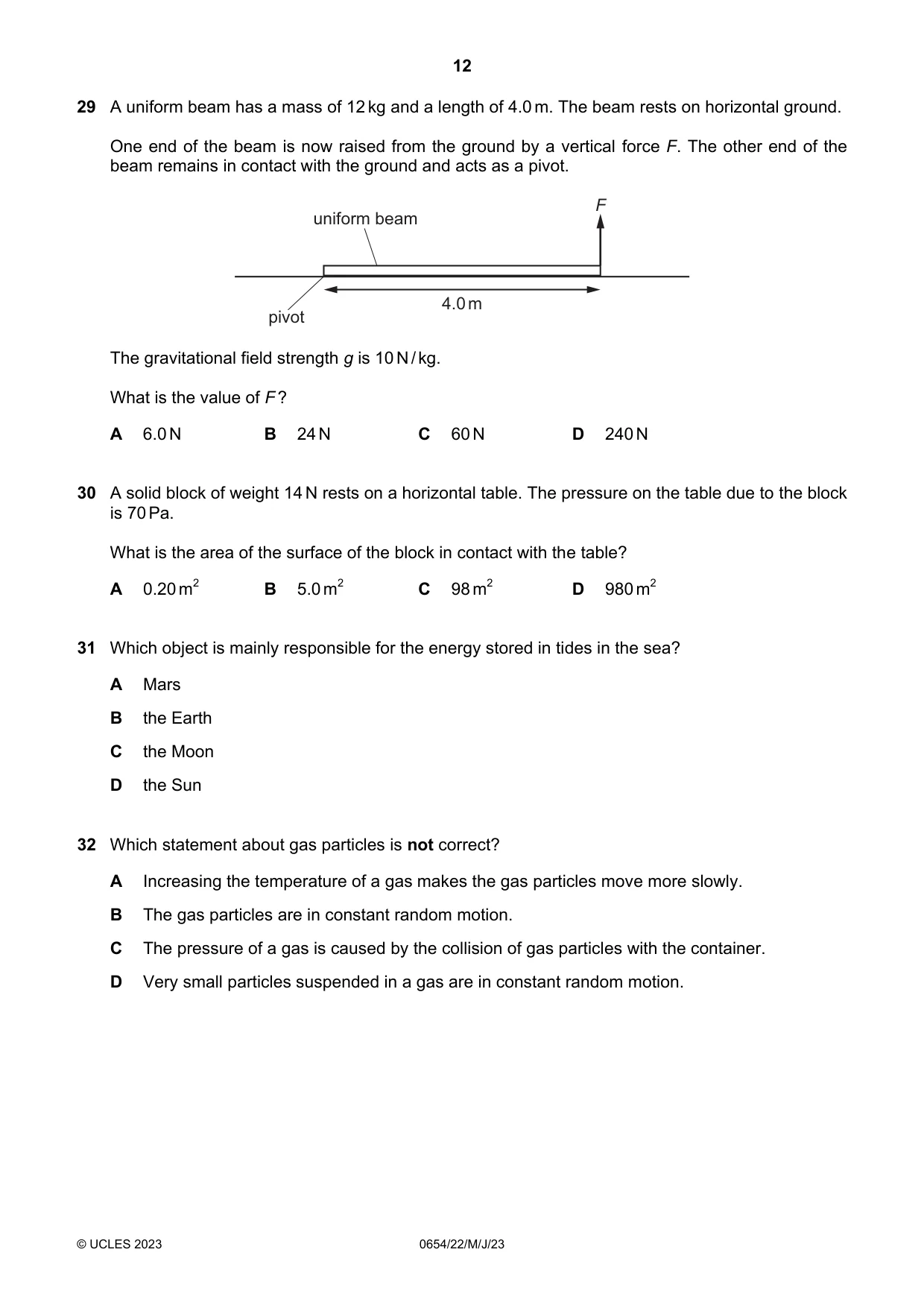
29 A uniform beam has a mass of 12 kg and a length of 4.0 m. The beam rests on horizontal ground. One end of the beam is now raised from the ground by a vertical force F. The other end of the beam remains in contact with the ground and acts as a pivot. F uniform beam 4.0 m pivot The gravitational field strength g is 10 N / kg. What is the value of F ? A 6.0 N B 24 N C 60 N D 240 N
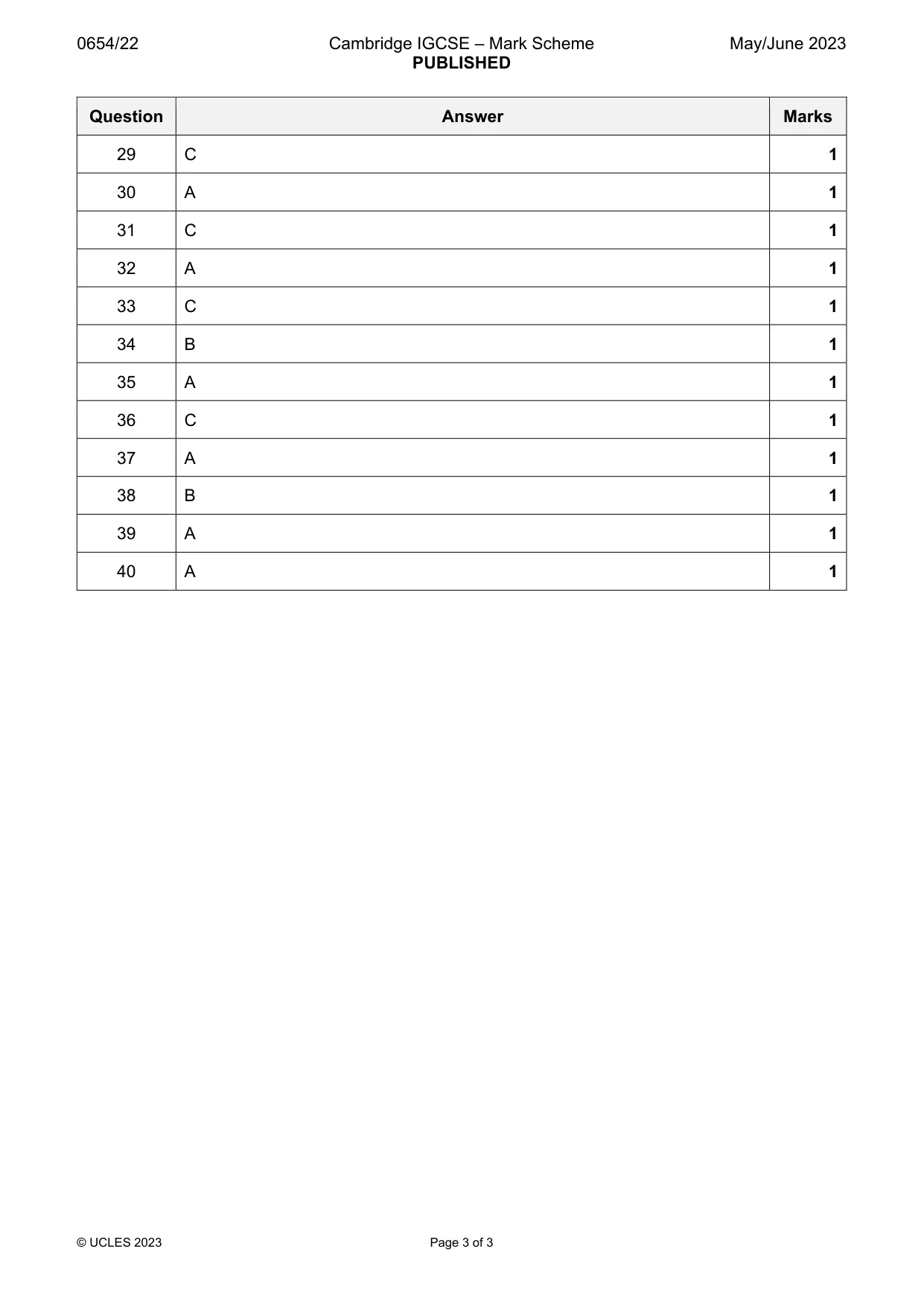
Mark scheme: C
Q30 · A solid block of weight 14 N rests on a horizontal table
30 A solid block of weight 14 N rests on a horizontal table. The pressure on the table due to the block is 70 Pa. What is the area of the surface of the block in contact with the table? A 0.20 m2 B 5.0 m2 C 98 m2 D 980 m2
Mark scheme: A
Q31 · Which object is mainly responsible for the energy stored in tides in the sea?
31 Which object is mainly responsible for the energy stored in tides in the sea? A Mars B the Earth C the Moon D the Sun
Mark scheme: C
Q32 · Which statement about gas particles is not correct?
32 Which statement about gas particles is not correct? A Increasing the temperature of a gas makes the gas particles move more slowly. B The gas particles are in constant random motion. C The pressure of a gas is caused by the collision of gas particles with the container. D Very small particles suspended in a gas are in constant random motion.
Mark scheme: A
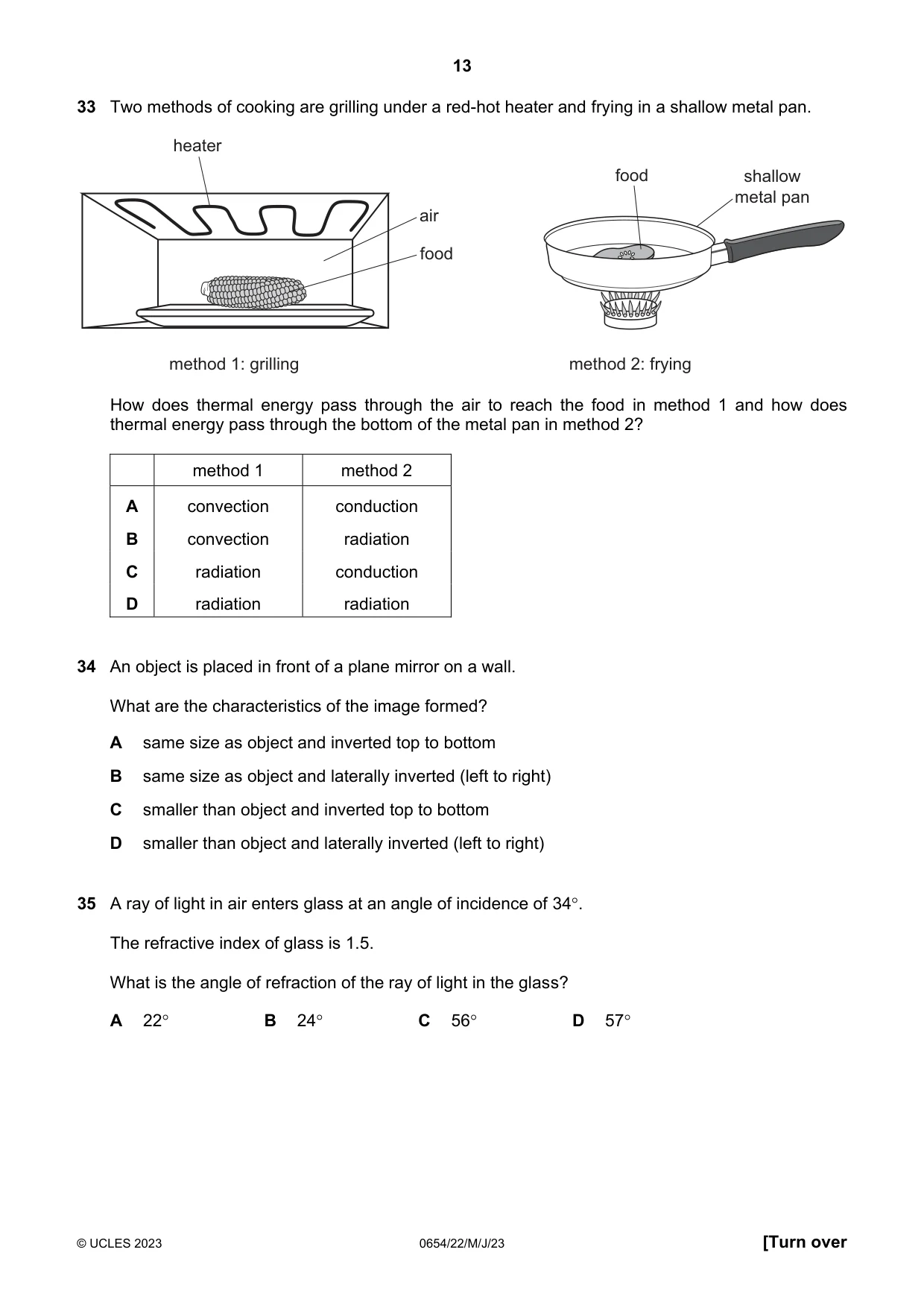
Q33 · Two methods of cooking are grilling under a red-hot heater and frying in a shallow metal…
33 Two methods of cooking are grilling under a red-hot heater and frying in a shallow metal pan. heater food shallow metal pan air food method 1: grilling method 2: frying How does thermal energy pass through the air to reach the food in method 1 and how does thermal energy pass through the bottom of the metal pan in method 2? method 1 method 2 A convection conduction B convection radiation C radiation conduction D radiation radiation
Mark scheme: C
Q34 · An object is placed in front of a plane mirror on a wall
34 An object is placed in front of a plane mirror on a wall. What are the characteristics of the image formed? A same size as object and inverted top to bottom B same size as object and laterally inverted (left to right) C smaller than object and inverted top to bottom D smaller than object and laterally inverted (left to right)
Mark scheme: B
Q35 · A ray of light in air enters glass at an angle of incidence of 34
35 A ray of light in air enters glass at an angle of incidence of 34. The refractive index of glass is 1.5. What is the angle of refraction of the ray of light in the glass? A 22 B 24 C 56 D 57
Mark scheme: A
Q36 · Which material is used for the core of an electromagnet?
36 Which material is used for the core of an electromagnet? A aluminium B copper C iron D steel
Mark scheme: C
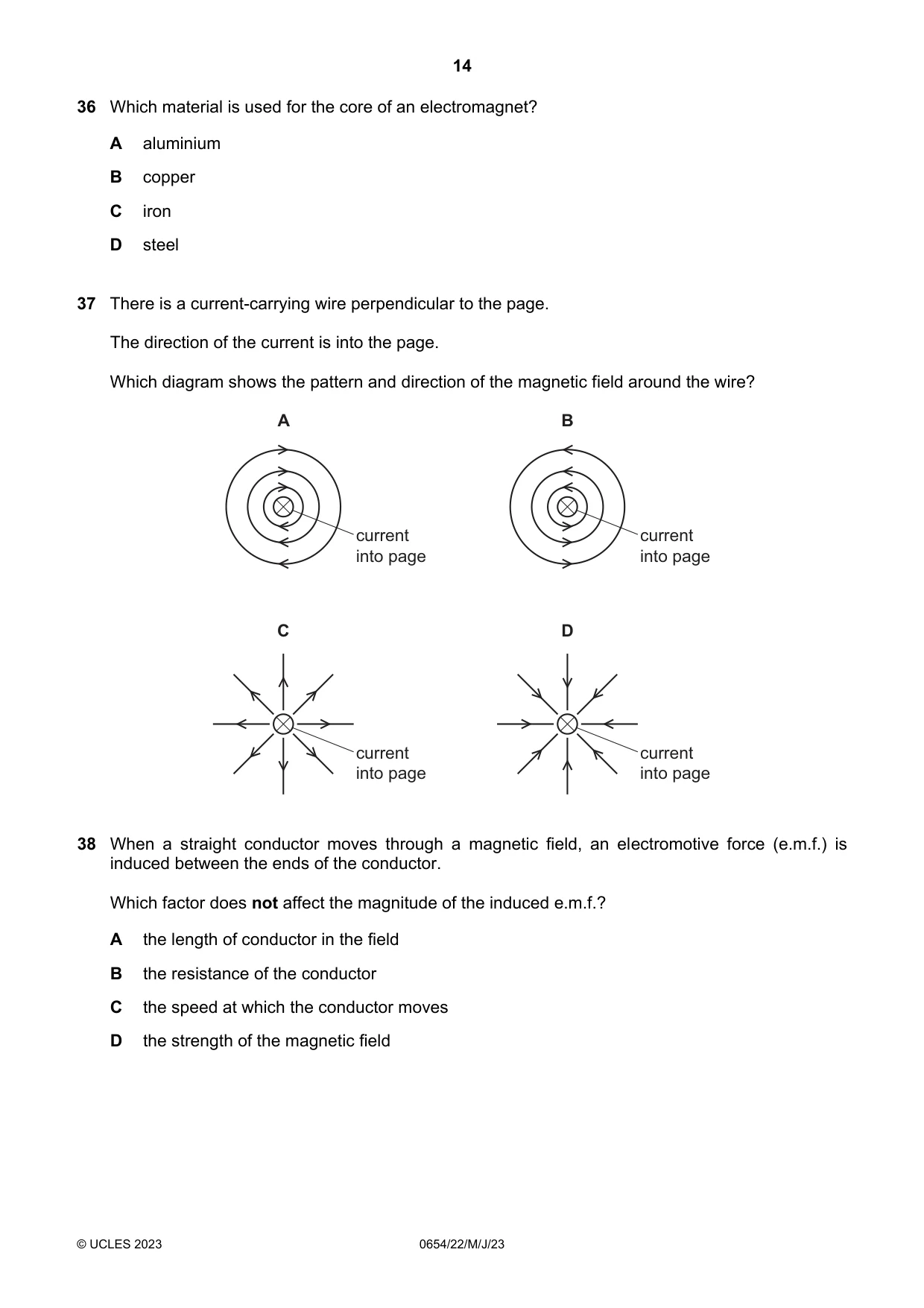
Q37 · There is a current-carrying wire perpendicular to the page
37 There is a current-carrying wire perpendicular to the page. The direction of the current is into the page. Which diagram shows the pattern and direction of the magnetic field around the wire? A B current current into page into page C D current current into page into page
Mark scheme: A
Q38 · When a straight conductor moves through a magnetic field, an electromotive force (e.m.f.)…
38 When a straight conductor moves through a magnetic field, an electromotive force (e.m.f.) is induced between the ends of the conductor. Which factor does not affect the magnitude of the induced e.m.f.? A the length of conductor in the field B the resistance of the conductor C the speed at which the conductor moves D the strength of the magnetic field
Mark scheme: B
Q39 · Cables transmit electrical power
39 Cables transmit electrical power. The power input to the cables is constant, but the voltage input is increased. What happens to the power loss from the cables, and what happens to the current in the cables? power loss current in from cables cables A decreases decreases B decreases increases C increases decreases D increases increases
Mark scheme: A
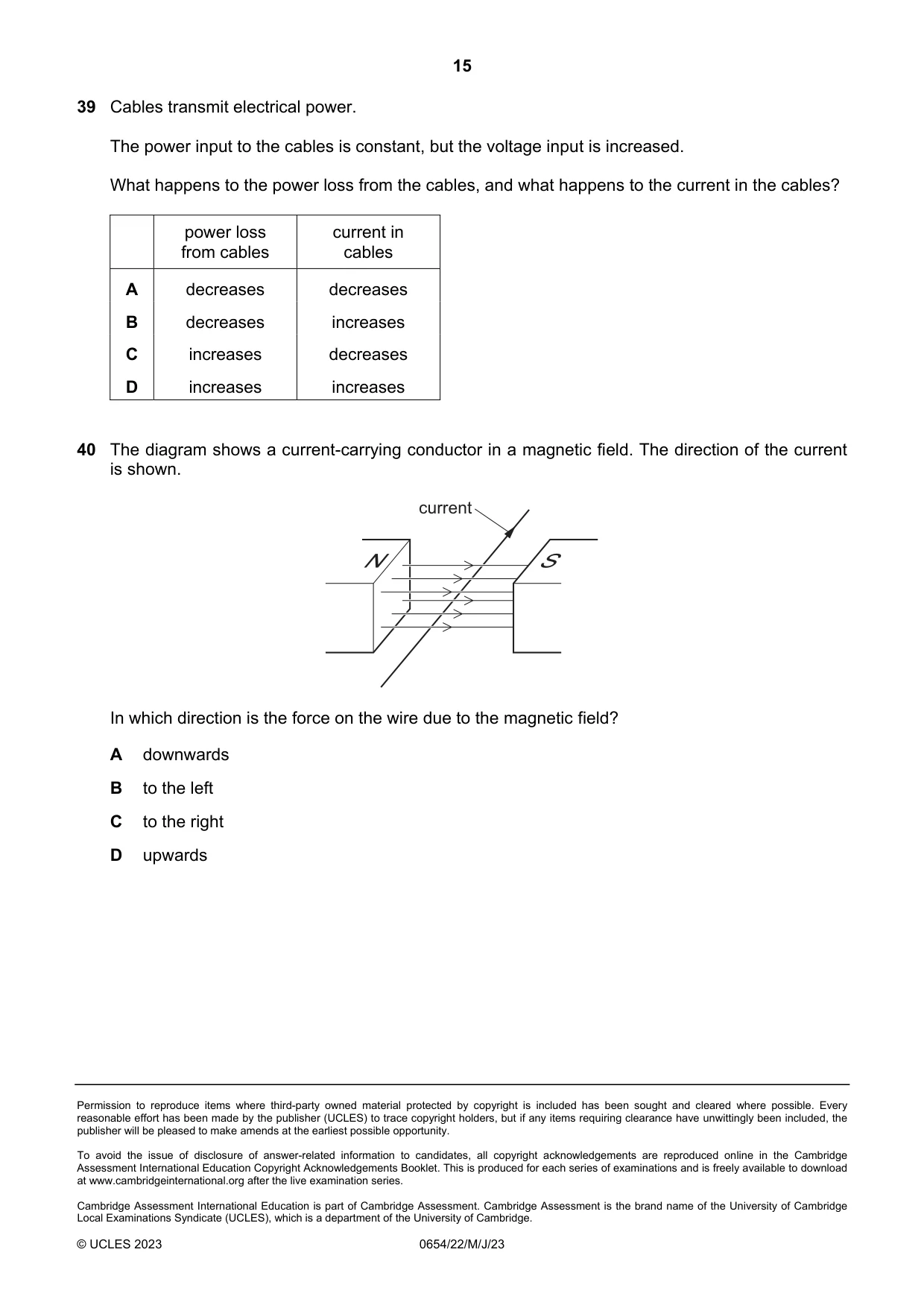
Q40 · The diagram shows a current-carrying conductor in a magnetic field
40 The diagram shows a current-carrying conductor in a magnetic field. The direction of the current is shown. current N S In which direction is the force on the wire due to the magnetic field? A downwards B to the left C to the right D upwards
Mark scheme: A
What was in this paper
The subtopics covered by these 40 questions, and how many questions each got. Open one in a new tab to see every Cambridge question on it.
2Light2Rate of reaction2Simple phenomena of magnetism2Air quality and climate1Biological molecules1Cell structure1Characteristics of living organisms1Coordination and response1Digestion1Electrical circuits1Electrolysis1Enzymes1Extraction of metals1Food chains and food webs1Forces1Fuels1Habitat destruction1Heart1Homeostasis1Identification of ions and gases1Isotopes1Kinetic particle model of matter1Motion1Photosynthesis1Physical and chemical changes1Polymers1Preparation of salts1Pressure1Selection1Separation and purification1Sexual reproduction in plants1The characteristic properties of acids and bases1The Solar System1Transfer of thermal energy1Transition elements1What you needed in this session
Cambridge’s own grade thresholds for 2023 May/June, Paper 2 · Variant 2. A higher threshold means an easier paper — the bar moves with how the cohort did.