Cambridge IGCSE Sciences - Co-ordinated (Double) 0654 — 2022 Oct/Nov Paper 2 · Variant 3
0654/23/O/N/22 · 40 questions · 40 marks · ≈45 min
The question paper and its mark scheme, free to read here and free to download. This is Cambridge’s own paper, exactly as it was sat.
Question paper16 pages
Mark scheme3 pages
Answers below. Sit the paper first if you are practising.
Questions as text
Q1 · What do plants need for their nutrition?
1 What do plants need for their nutrition? A carbon dioxide, ions, organic compounds and light B carbon dioxide, ions, organic compounds and water C carbon dioxide, ions, light and water D carbon dioxide, organic compounds, light and water
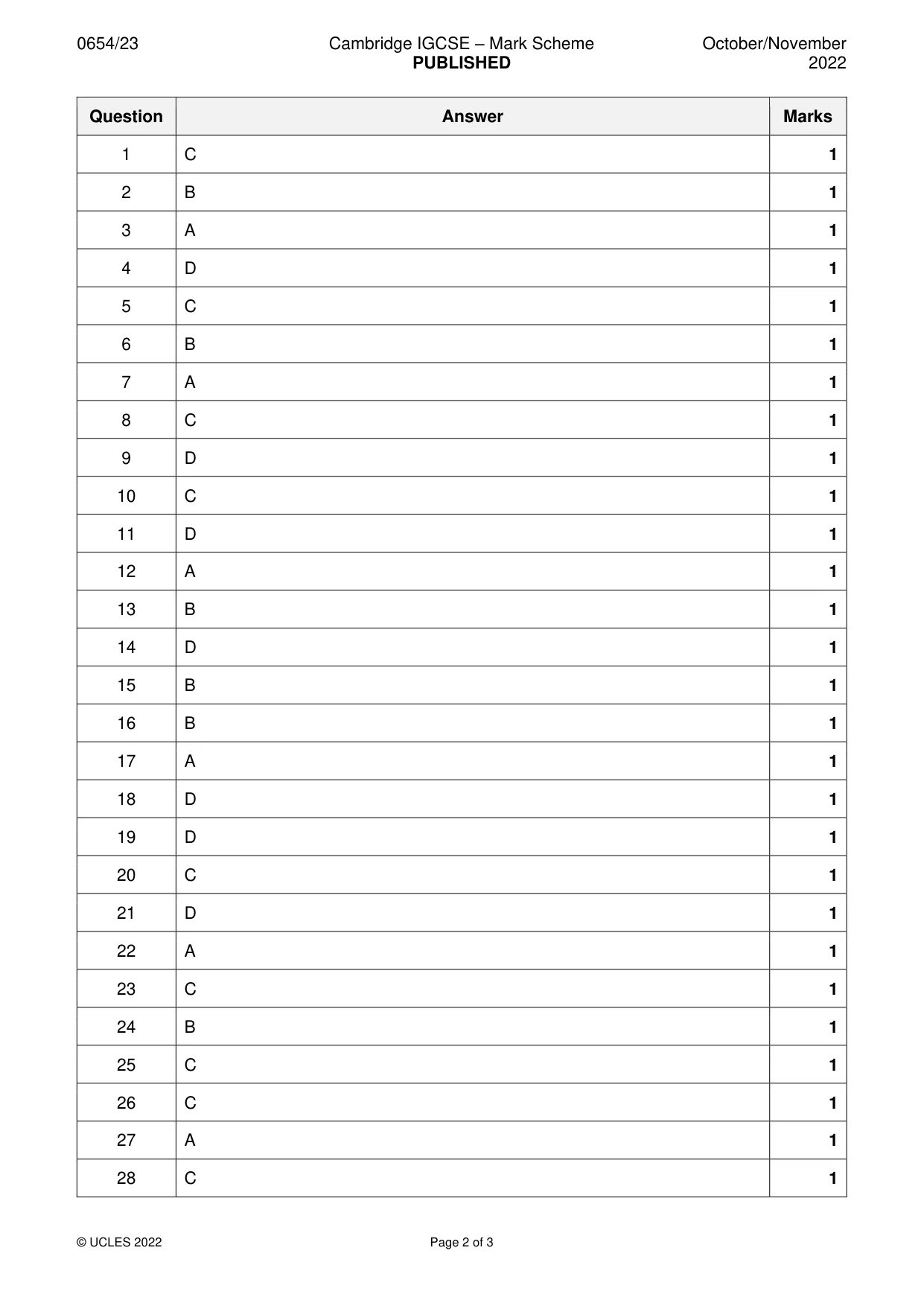
Mark scheme: C
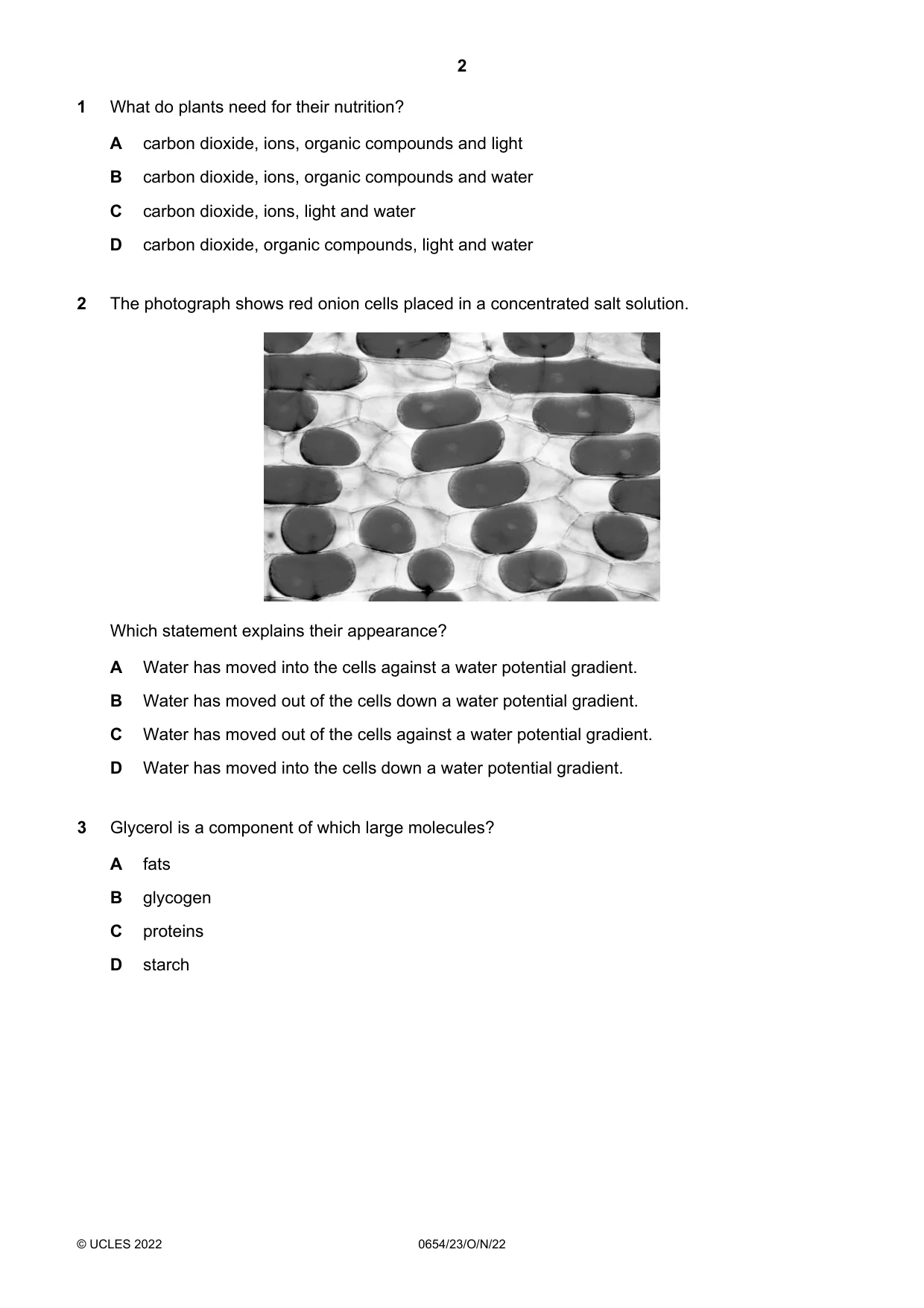
Q2 · The photograph shows red onion cells placed in a concentrated salt solution
2 The photograph shows red onion cells placed in a concentrated salt solution. Which statement explains their appearance? A Water has moved into the cells against a water potential gradient. B Water has moved out of the cells down a water potential gradient. C Water has moved out of the cells against a water potential gradient. D Water has moved into the cells down a water potential gradient.
Mark scheme: B
Q3 · Glycerol is a component of which large molecules?
3 Glycerol is a component of which large molecules? A fats B glycogen C proteins D starch
Mark scheme: A
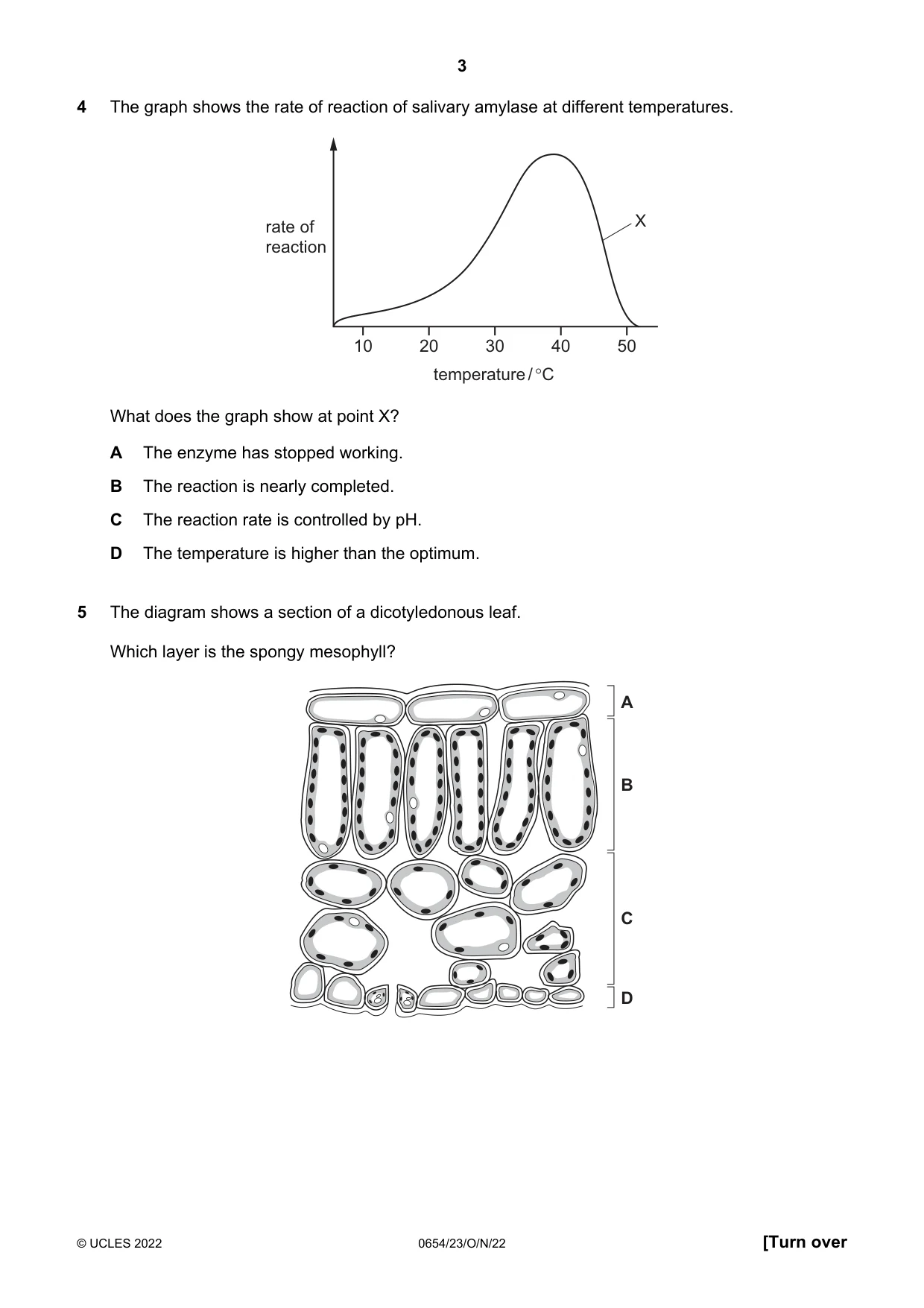
Q4 · The graph shows the rate of reaction of salivary amylase at different temperatures
4 The graph shows the rate of reaction of salivary amylase at different temperatures. rate of X reaction 10 20 30 40 50 temperature / °C What does the graph show at point X? A The enzyme has stopped working. B The reaction is nearly completed. C The reaction rate is controlled by pH. D The temperature is higher than the optimum.
Mark scheme: D
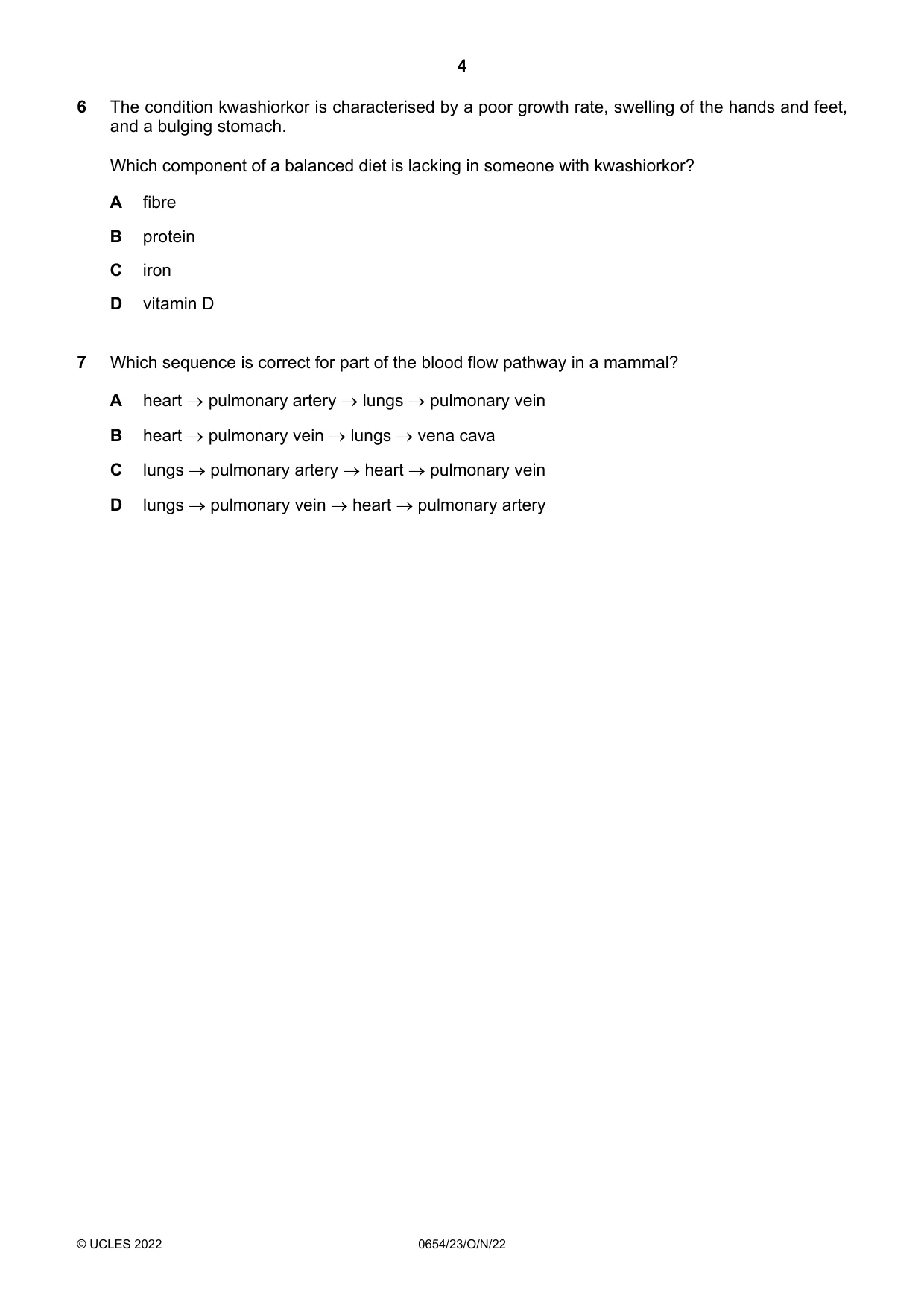
Q5 · The diagram shows a section of a dicotyledonous leaf
5 The diagram shows a section of a dicotyledonous leaf. Which layer is the spongy mesophyll? A B C D
Mark scheme: C
Q6 · The condition kwashiorkor is characterised by a poor growth rate, swelling of the hands…
6 The condition kwashiorkor is characterised by a poor growth rate, swelling of the hands and feet, and a bulging stomach. Which component of a balanced diet is lacking in someone with kwashiorkor? A fibre B protein C iron D vitamin D
Mark scheme: B
Q7 · Which sequence is correct for part of the blood flow pathway in a mammal?
7 Which sequence is correct for part of the blood flow pathway in a mammal? A heart → pulmonary artery → lungs → pulmonary vein B heart → pulmonary vein → lungs → vena cava C lungs → pulmonary artery → heart → pulmonary vein D lungs → pulmonary vein → heart → pulmonary artery
Mark scheme: A
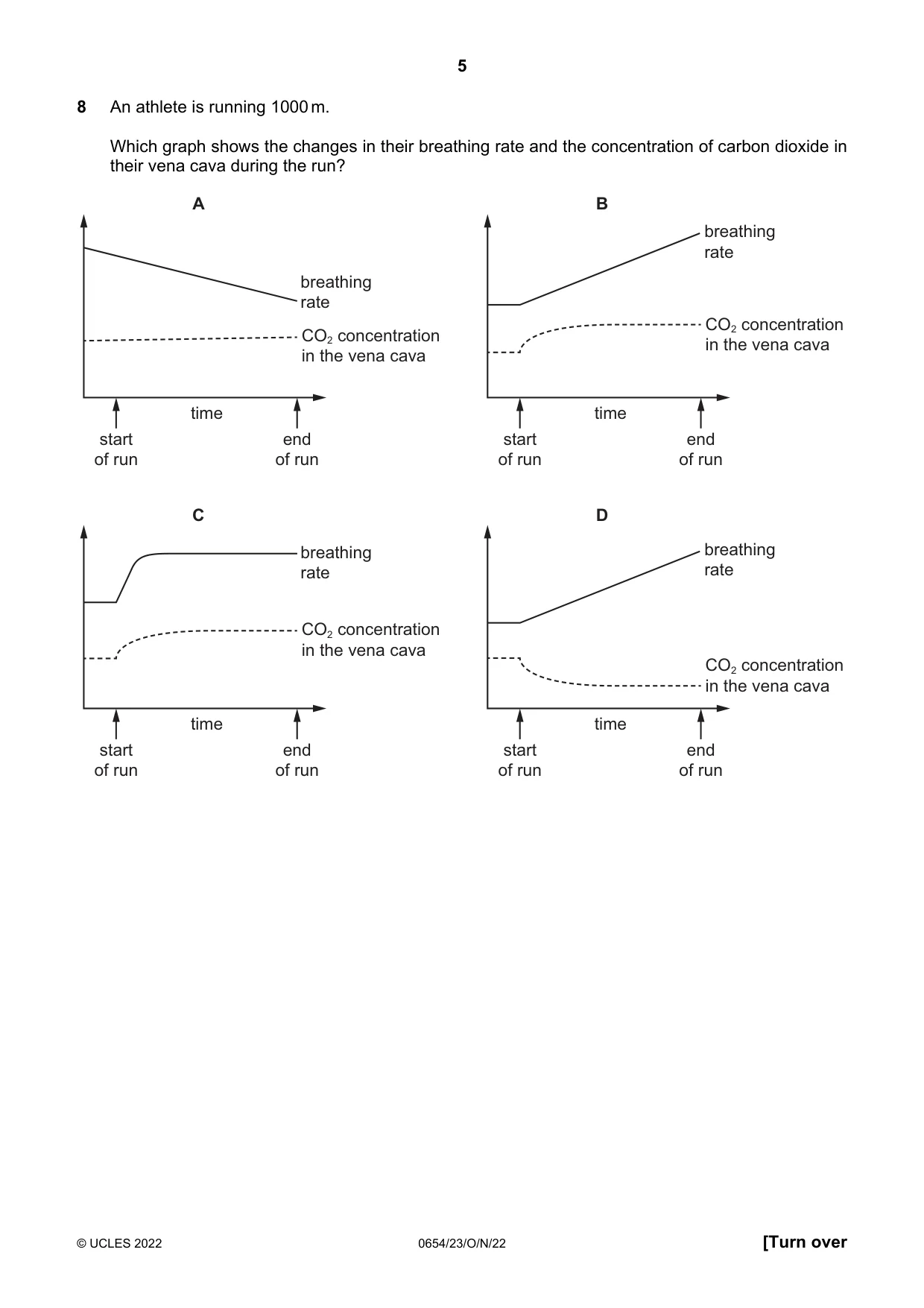
Q8 · An athlete is running 1000 m
8 An athlete is running 1000 m. Which graph shows the changes in their breathing rate and the concentration of carbon dioxide in their vena cava during the run? A B breathing rate breathing rate CO2 concentration CO2 concentration in the vena cava in the vena cava time time start end start end of run of run of run of run C D breathing breathing rate rate CO2 concentration in the vena cava CO2 concentration in the vena cava time time start end start end of run of run of run of run
Mark scheme: C
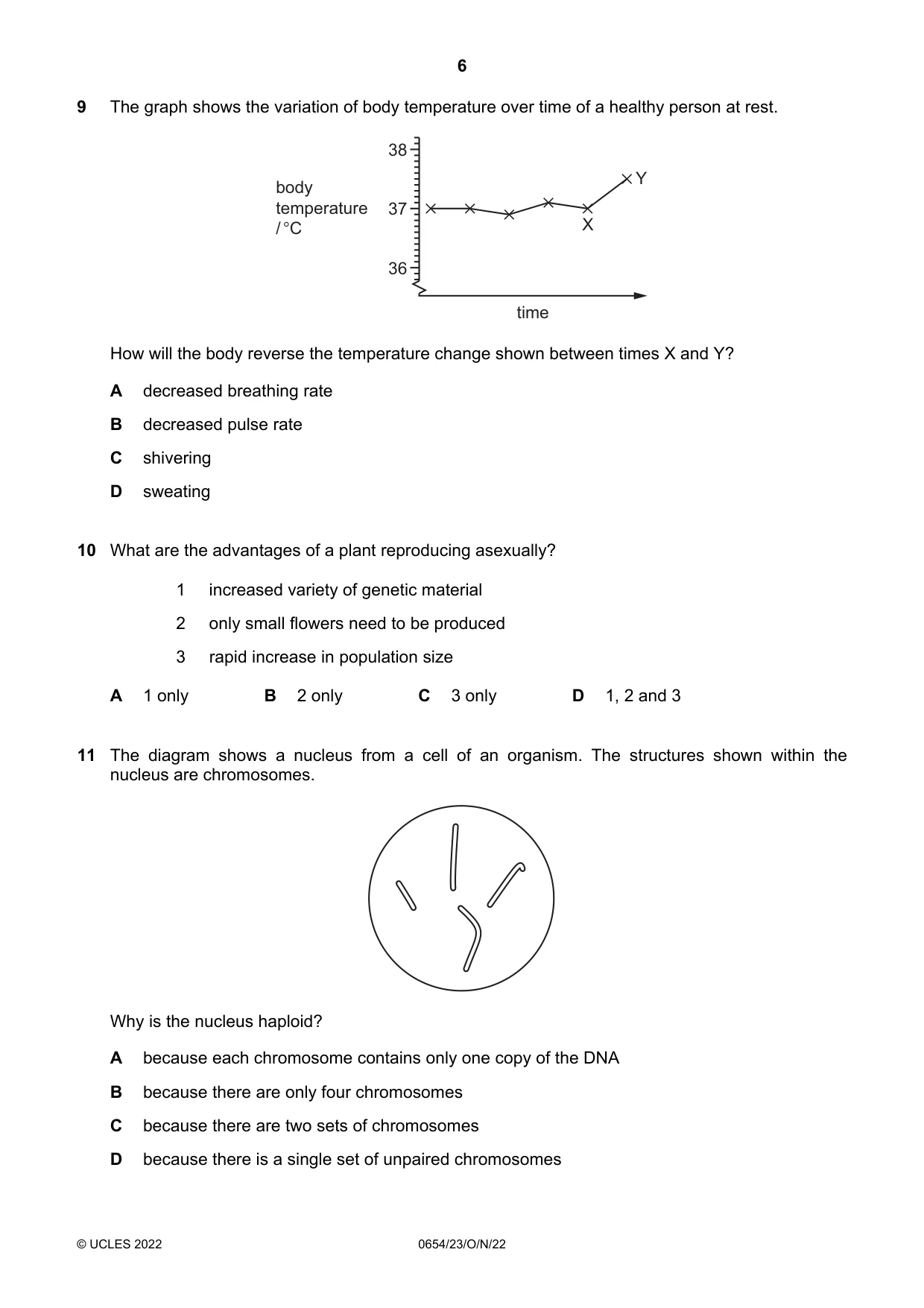
Q9 · The graph shows the variation of body temperature over time of a healthy person at rest
9 The graph shows the variation of body temperature over time of a healthy person at rest. 38 Y body temperature 37 / °C X 36 time How will the body reverse the temperature change shown between times X and Y? A decreased breathing rate B decreased pulse rate C shivering D sweating
Mark scheme: D
Q10 · What are the advantages of a plant reproducing asexually?
10 What are the advantages of a plant reproducing asexually? 1 increased variety of genetic material 2 only small flowers need to be produced 3 rapid increase in population size A 1 only B 2 only C 3 only D 1, 2 and 3
Mark scheme: C
Q11 · The diagram shows a nucleus from a cell of an organism
11 The diagram shows a nucleus from a cell of an organism. The structures shown within the nucleus are chromosomes. Why is the nucleus haploid? A because each chromosome contains only one copy of the DNA B because there are only four chromosomes C because there are two sets of chromosomes D because there is a single set of unpaired chromosomes
Mark scheme: D
Q12 · What is a carnivore?
12 What is a carnivore? A an organism that gets its energy by eating animals B an organism that gets its energy by eating plants C an organism that gets its energy from dead matter D an organism that makes its own organic matter
Mark scheme: A
Q13 · What is an undesirable effect of deforestation?
13 What is an undesirable effect of deforestation? A It increases the oxygen concentration of the atmosphere. B It leads to erosion and loss of soil. C It makes land available for agriculture. D It pollutes the air with methane.
Mark scheme: B
Q14 · In which substance are the particles closest together at room temperature?
14 In which substance are the particles closest together at room temperature? A CO2 B Ne C N2 D Zn
Mark scheme: D
Q15 · How many neutrons are in one atom of the isotope 35 17C ?
15 How many neutrons are in one atom of the isotope 35 17C ? l A 17 B 18 C 35 D 52
Mark scheme: B
Q16 · Which statement about ions is not correct?
16 Which statement about ions is not correct? A Atoms form ions by gaining or losing electrons. B Ions are formed by non-metal atoms only when they lose electrons. C Ions in a solid ionic compound form a lattice structure. D Ions with opposite charges attract each other.
Mark scheme: B
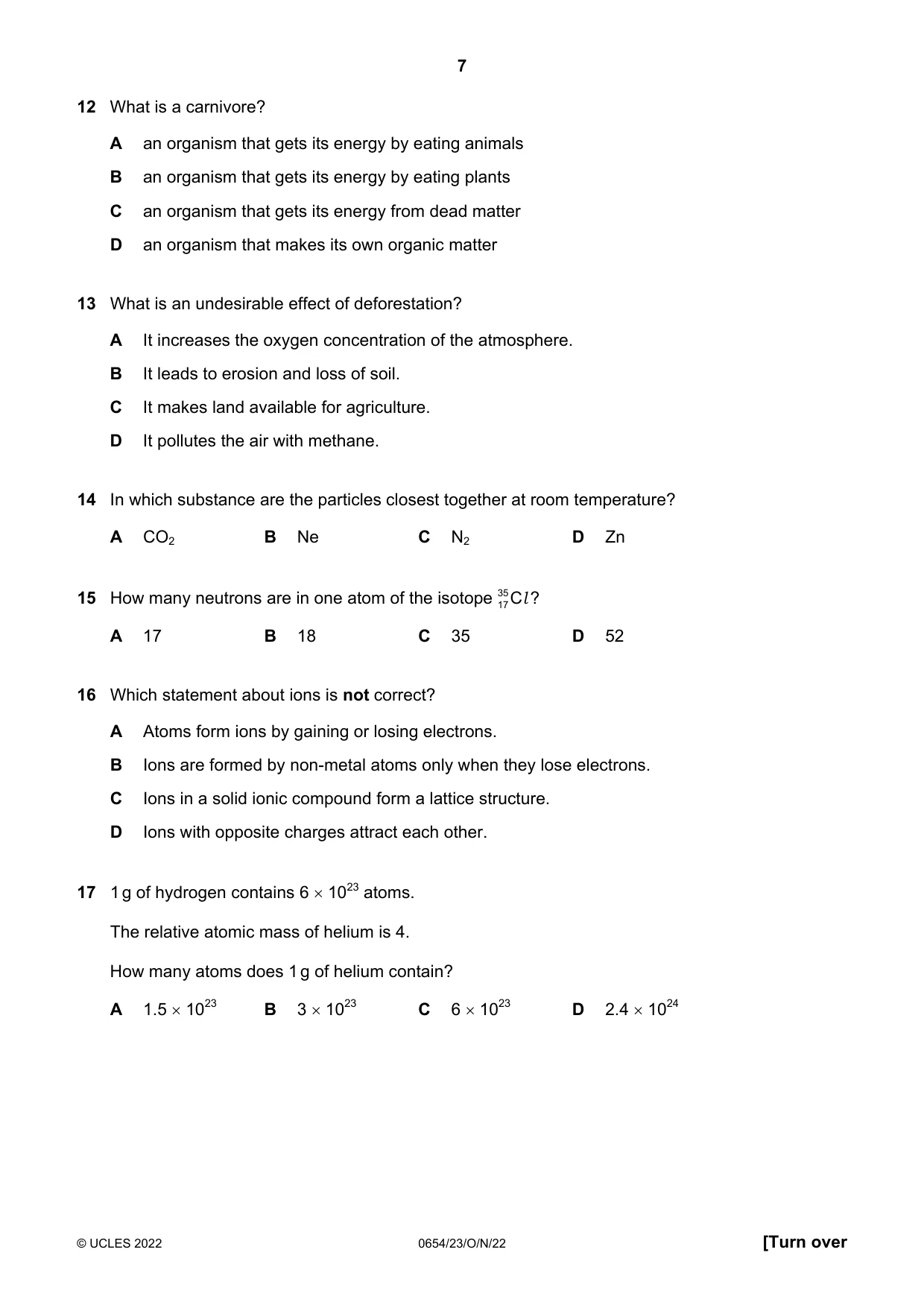
Q17 · 1 g of hydrogen contains 6 × 10²³ atoms
17 1 g of hydrogen contains 6 × 10²³ atoms. The relative atomic mass of helium is 4. How many atoms does 1 g of helium contain? A 1.5 × 10²³ B 3 × 10²³ C 6 × 10²³ D 2.4 × 1024
Mark scheme: A
Q18 · Molten calcium bromide is electrolysed using inert electrodes
18 Molten calcium bromide is electrolysed using inert electrodes. What is the ionic half-equation at the cathode? A Ca+ → Ca + e– B Ca+ + e– → Ca C Ca2+ → Ca + 2e– D Ca2+ + 2e– → Ca
Mark scheme: D
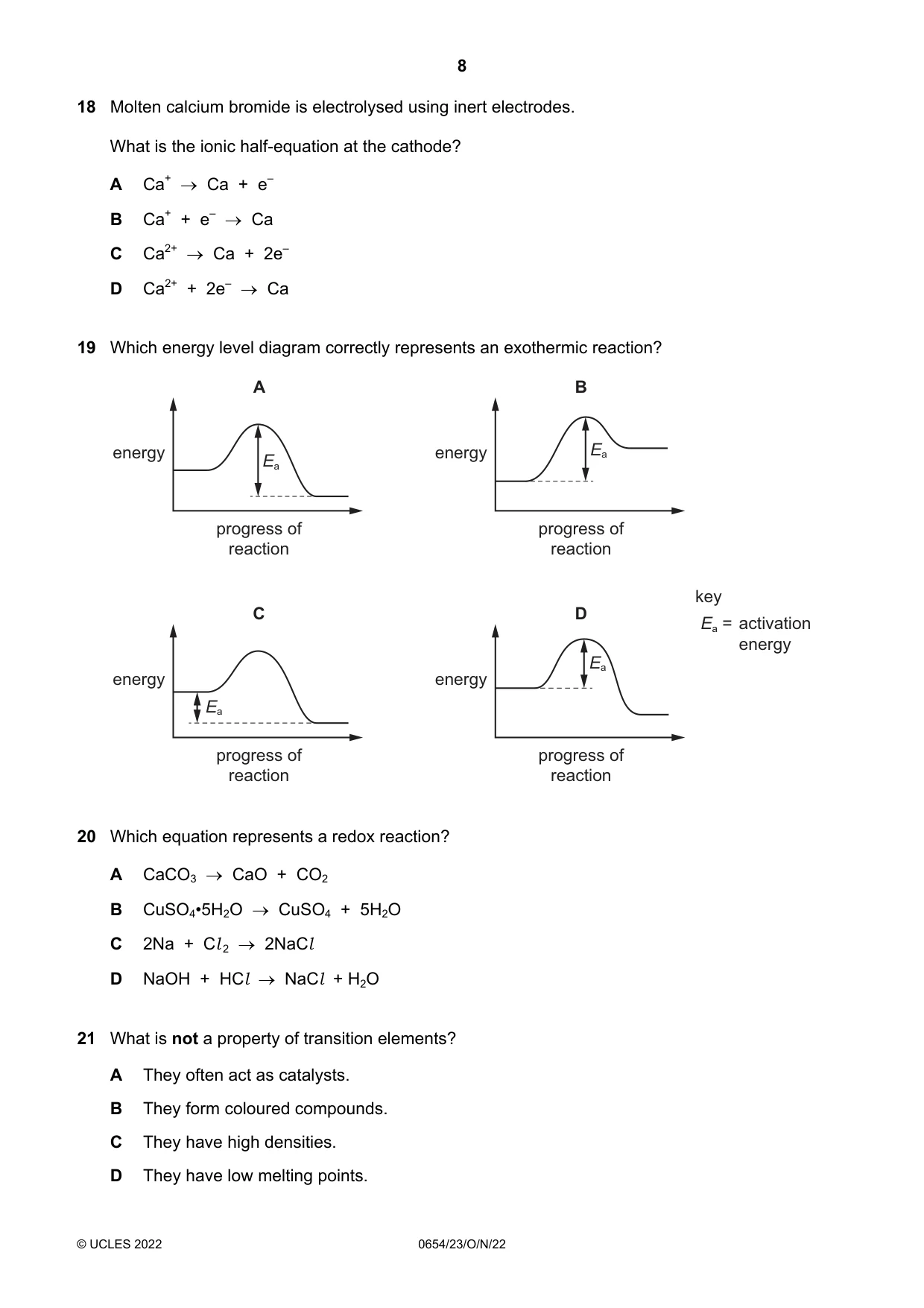
Q19 · Which energy level diagram correctly represents an exothermic reaction?
19 Which energy level diagram correctly represents an exothermic reaction? A B energy energy Ea Ea progress of progress of reaction reaction key C D Ea = activation energy Ea energy energy Ea progress of progress of reaction reaction
Mark scheme: D
Q20 · Which equation represents a redox reaction?
20 Which equation represents a redox reaction? A CaCO3 → CaO + CO2 B CuSO4•5H2O → CuSO4 + 5H2O C 2Na + Cl 2 → 2NaCl D NaOH + HCl → NaCl + H2O
Mark scheme: C
Q21 · What is not a property of transition elements?
21 What is not a property of transition elements? A They often act as catalysts. B They form coloured compounds. C They have high densities. D They have low melting points.
Mark scheme: D
Q22 · Filament lamps require an inert atmosphere
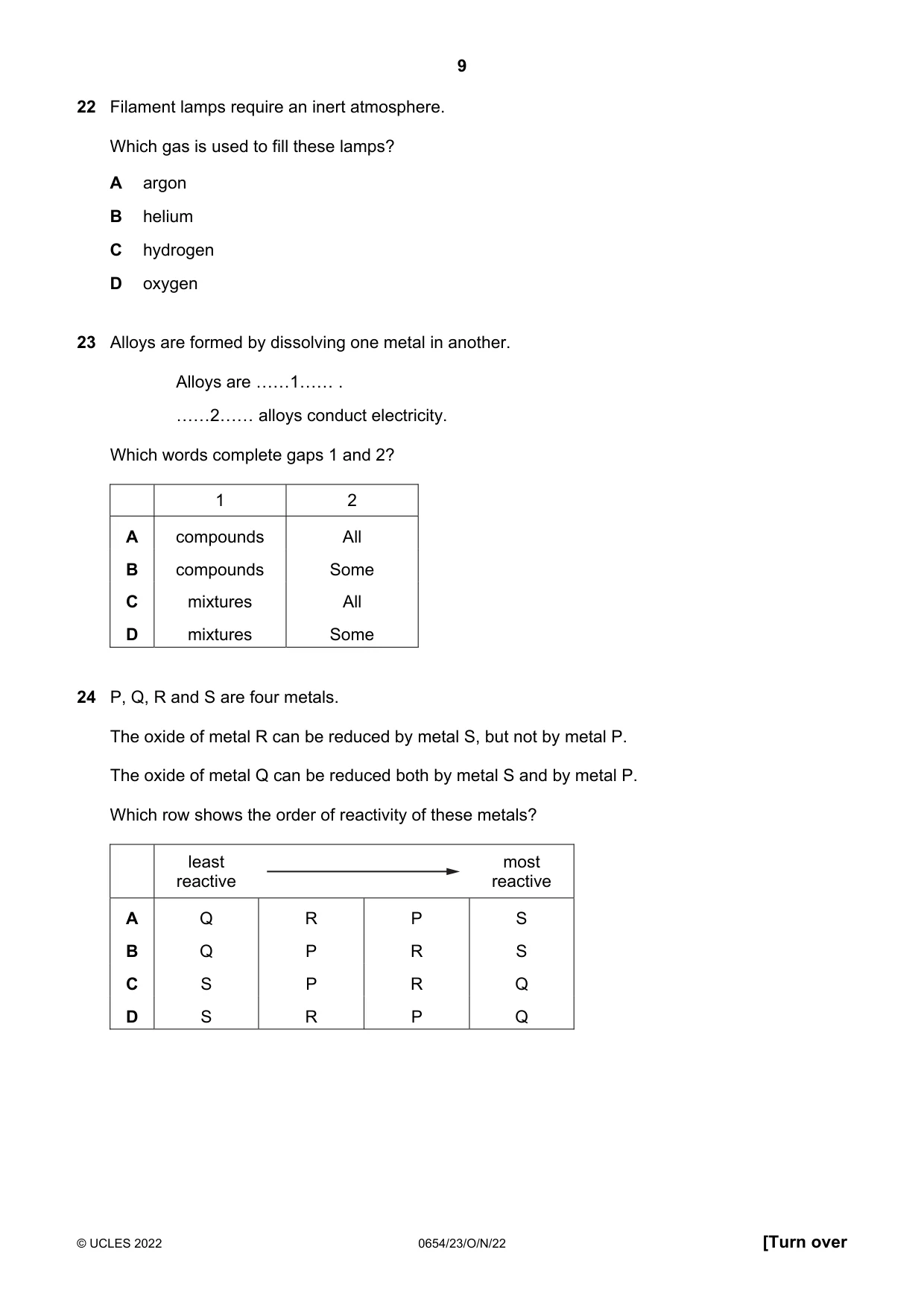
22 Filament lamps require an inert atmosphere. Which gas is used to fill these lamps? A argon B helium C hydrogen D oxygen
Mark scheme: A
Q23 · Alloys are formed by dissolving one metal in another
23 Alloys are formed by dissolving one metal in another. Alloys are ««1«« . ««2«« alloys conduct electricity. Which words complete gaps 1 and 2? 1 2 A compounds All B compounds Some C mixtures All D mixtures Some
Mark scheme: C
Q24 · P, Q, R and S are four metals
24 P, Q, R and S are four metals. The oxide of metal R can be reduced by metal S, but not by metal P. The oxide of metal Q can be reduced both by metal S and by metal P. Which row shows the order of reactivity of these metals? least most reactive reactive A Q R P S B Q P R S C S P R Q D S R P Q
Mark scheme: B
Q25 · Which statements about the Contact process are correct?
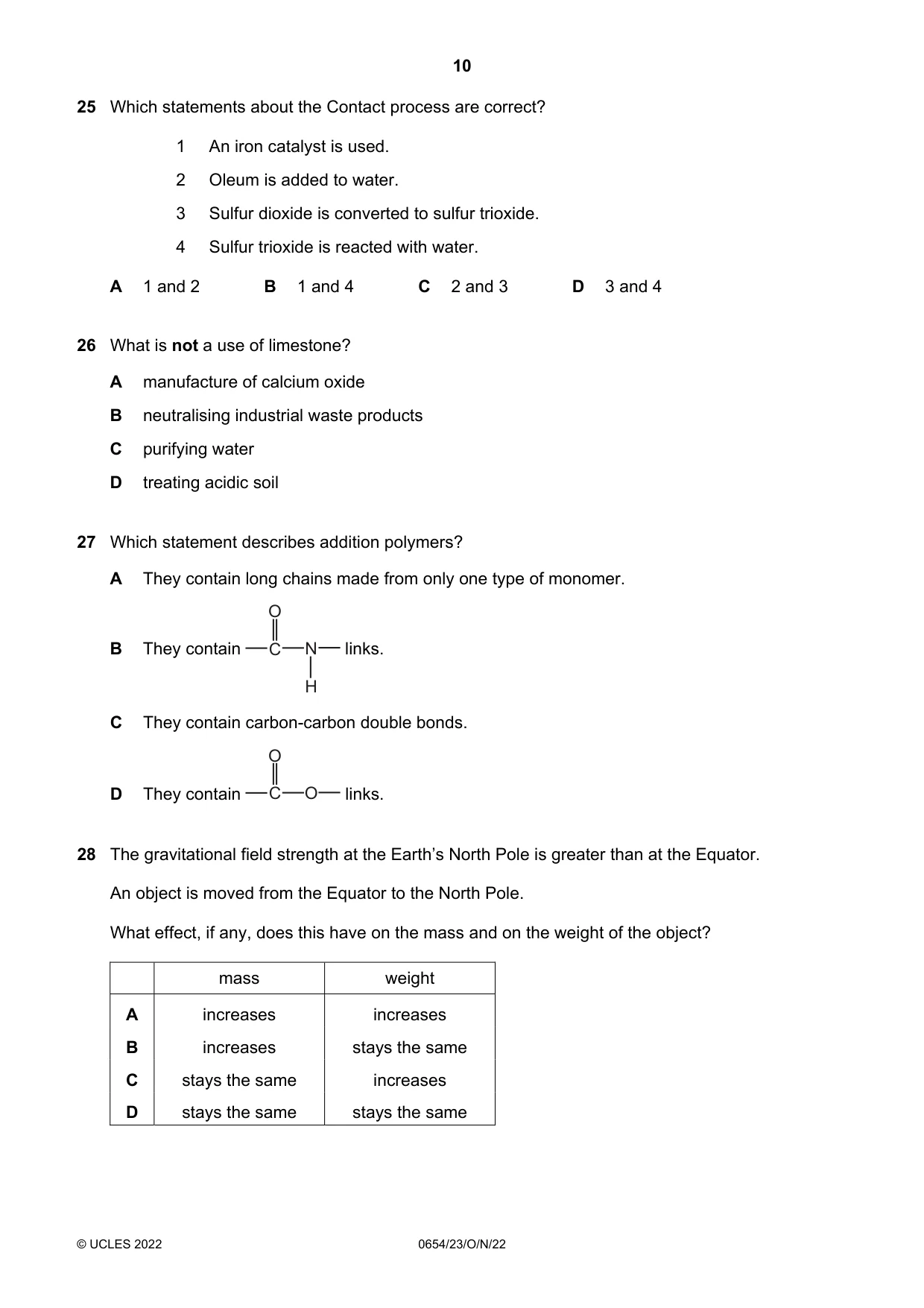
25 Which statements about the Contact process are correct? 1 An iron catalyst is used. 2 Oleum is added to water. 3 Sulfur dioxide is converted to sulfur trioxide. 4 Sulfur trioxide is reacted with water. A 1 and 2 B 1 and 4 C 2 and 3 D 3 and 4
Mark scheme: C
Q26 · What is not a use of limestone?
26 What is not a use of limestone? A manufacture of calcium oxide B neutralising industrial waste products C purifying water D treating acidic soil
Mark scheme: C
Q27 · Which statement describes addition polymers?
27 Which statement describes addition polymers? A They contain long chains made from only one type of monomer. O B They contain C N links. H C They contain carbon-carbon double bonds. O D They contain C O links.
Mark scheme: A
Q28 · The gravitational field strength at the Earth’s North Pole is greater than at the Equator
28 The gravitational field strength at the Earth’s North Pole is greater than at the Equator. An object is moved from the Equator to the North Pole. What effect, if any, does this have on the mass and on the weight of the object? mass weight A increases increases B increases stays the same C stays the same increases D stays the same stays the same
Mark scheme: C
Q29 · A brick has a mass of 1.5 kg
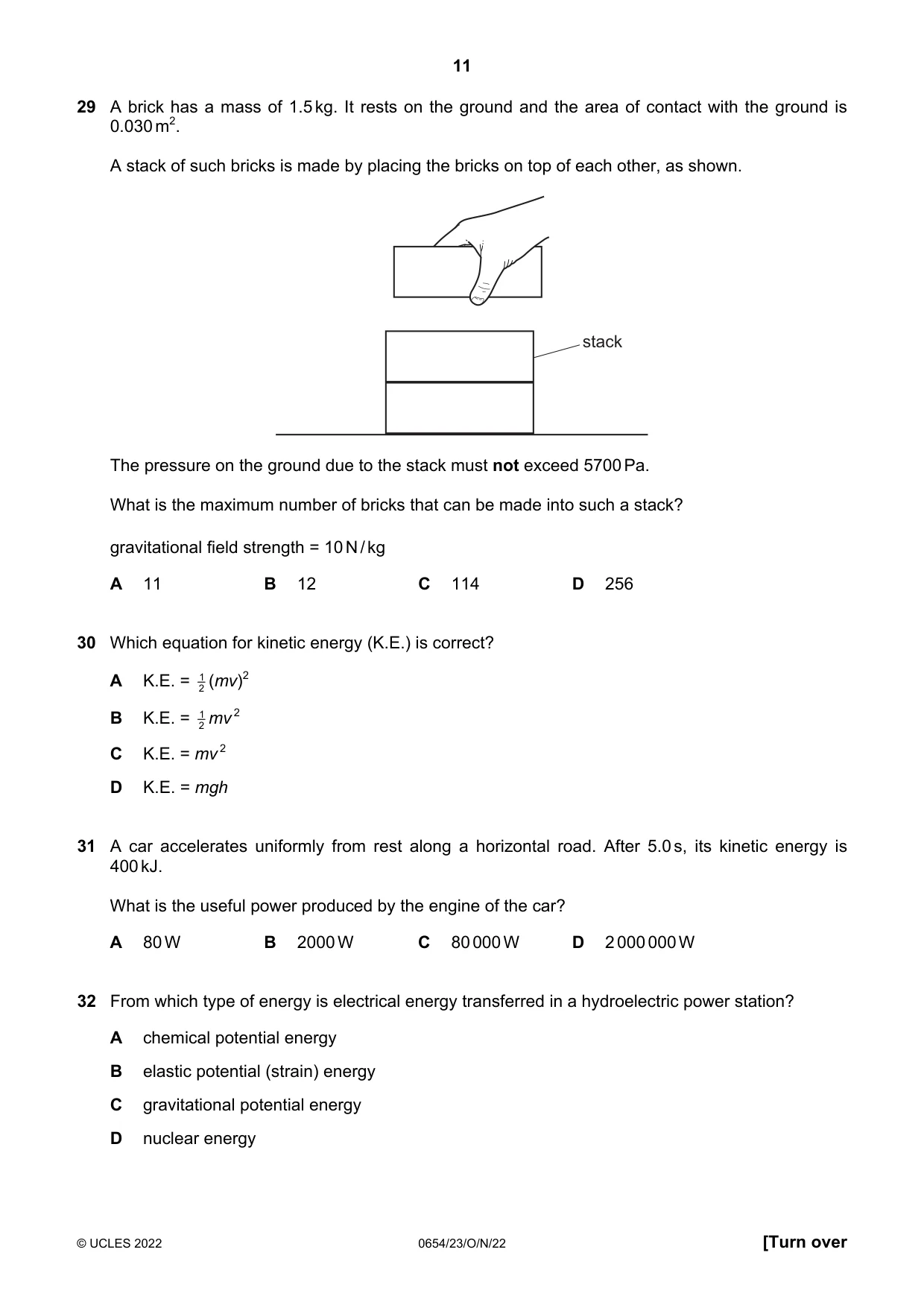
29 A brick has a mass of 1.5 kg. It rests on the ground and the area of contact with the ground is 0.030 m2. A stack of such bricks is made by placing the bricks on top of each other, as shown. stack The pressure on the ground due to the stack must not exceed 5700 Pa. What is the maximum number of bricks that can be made into such a stack? gravitational field strength = 10 N / kg A 11 B 12 C 114 D 256
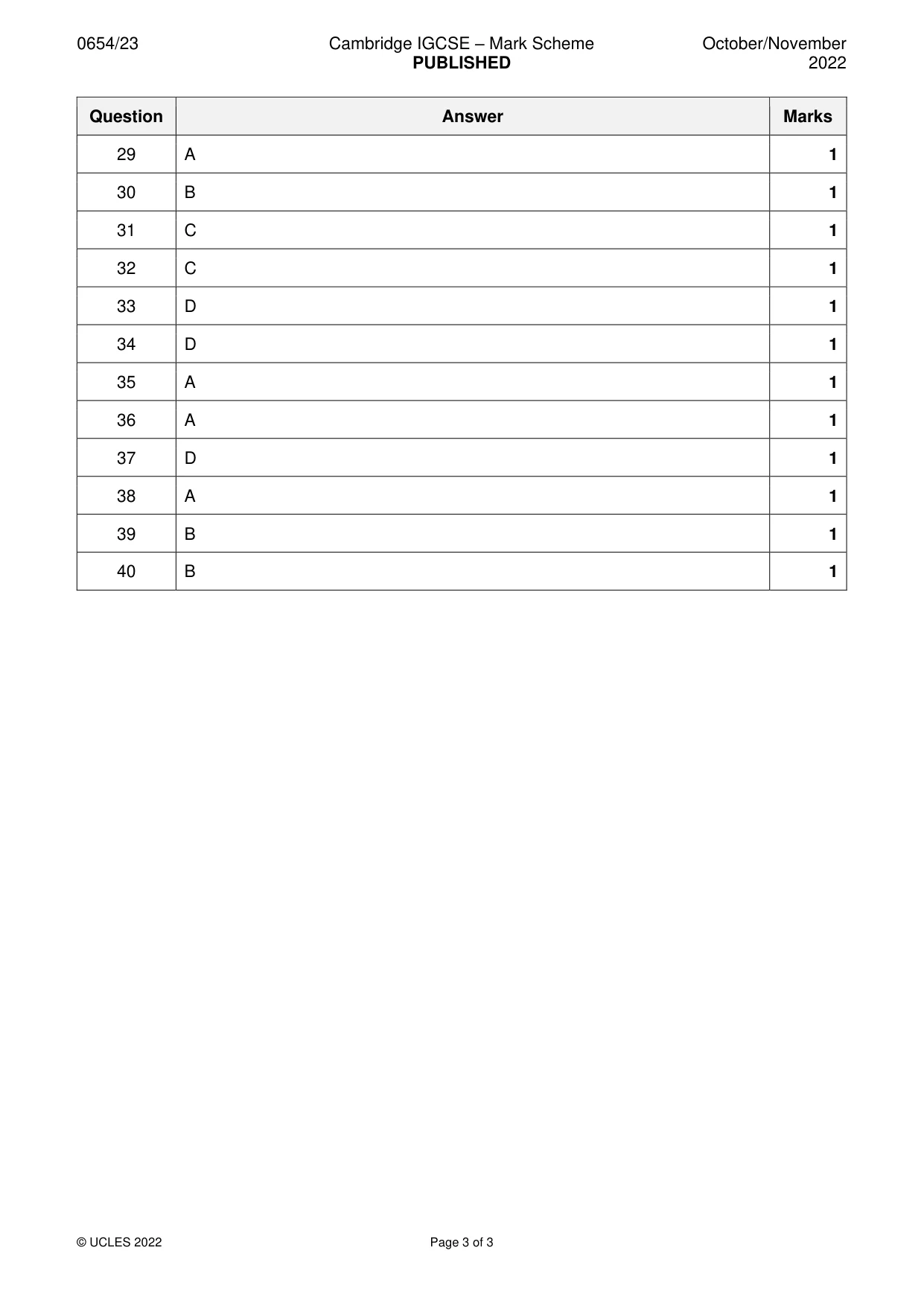
Mark scheme: A
Q30 · Which equation for kinetic energy (K.E.) is correct?
30 Which equation for kinetic energy (K.E.) is correct? A K.E. = 1 2 (mv)2 B K.E. = 1 2 mv 2 C K.E. = mv 2 D K.E. = mgh
Mark scheme: B
Q31 · A car accelerates uniformly from rest along a horizontal road
31 A car accelerates uniformly from rest along a horizontal road. After 5.0 s, its kinetic energy is 400 kJ. What is the useful power produced by the engine of the car? A 80 W B 2000 W C 80 000 W D 2 000 000 W
Mark scheme: C
Q32 · From which type of energy is electrical energy transferred in a hydroelectric power…
32 From which type of energy is electrical energy transferred in a hydroelectric power station? A chemical potential energy B elastic potential (strain) energy C gravitational potential energy D nuclear energy
Mark scheme: C
Q33 · A fixed mass of gas is trapped in a container
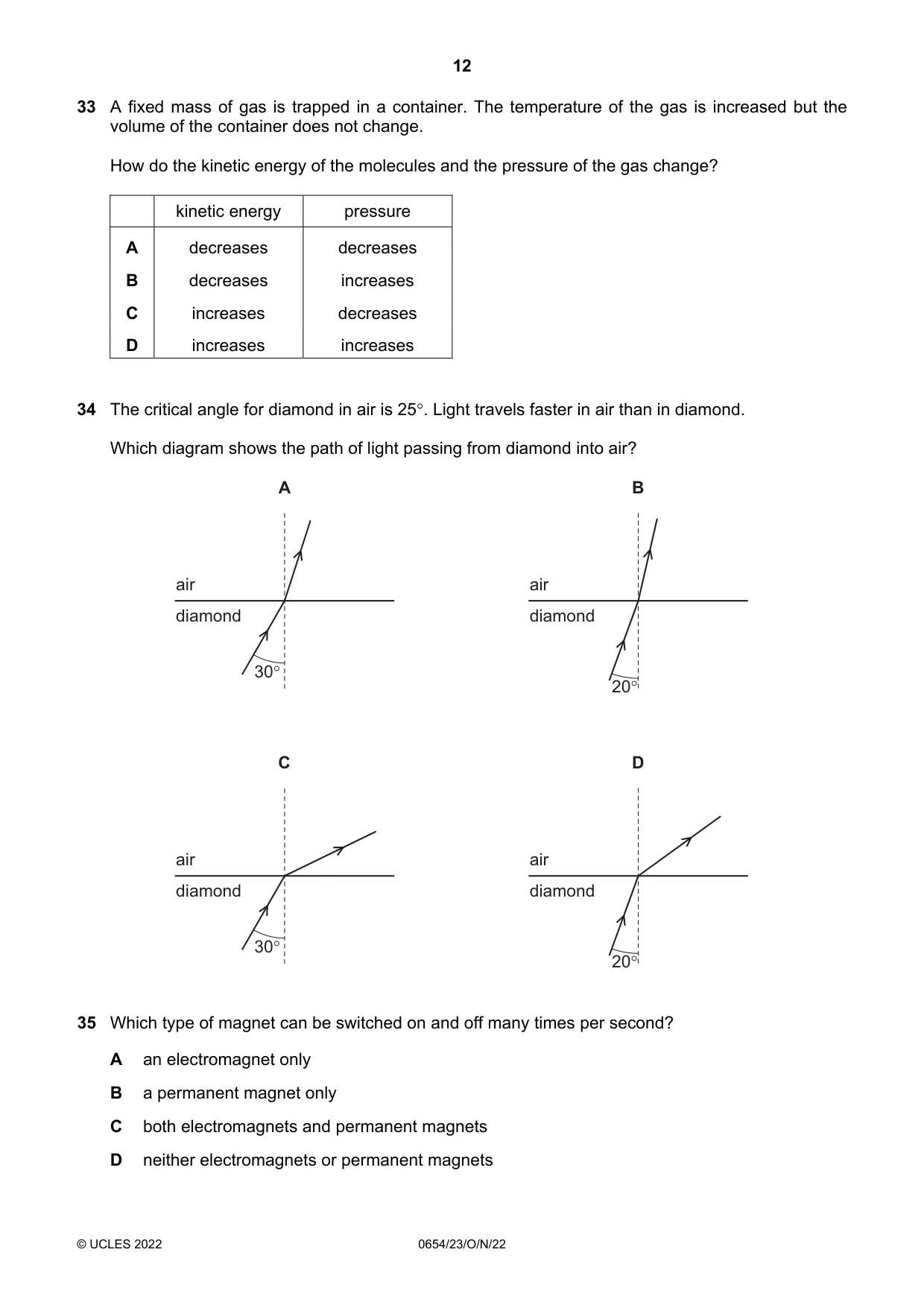
33 A fixed mass of gas is trapped in a container. The temperature of the gas is increased but the volume of the container does not change. How do the kinetic energy of the molecules and the pressure of the gas change? kinetic energy pressure A decreases decreases B decreases increases C increases decreases D increases increases
Mark scheme: D
Q34 · The critical angle for diamond in air is 25°
34 The critical angle for diamond in air is 25°. Light travels faster in air than in diamond. Which diagram shows the path of light passing from diamond into air? A B air air diamond diamond 30° 20° C D air air diamond diamond 30° 20°
Mark scheme: D
Q35 · Which type of magnet can be switched on and off many times per second?
35 Which type of magnet can be switched on and off many times per second? A an electromagnet only B a permanent magnet only C both electromagnets and permanent magnets D neither electromagnets or permanent magnets
Mark scheme: A
Q36 · A charge of 480 C passes through a wire in 3.0 minutes
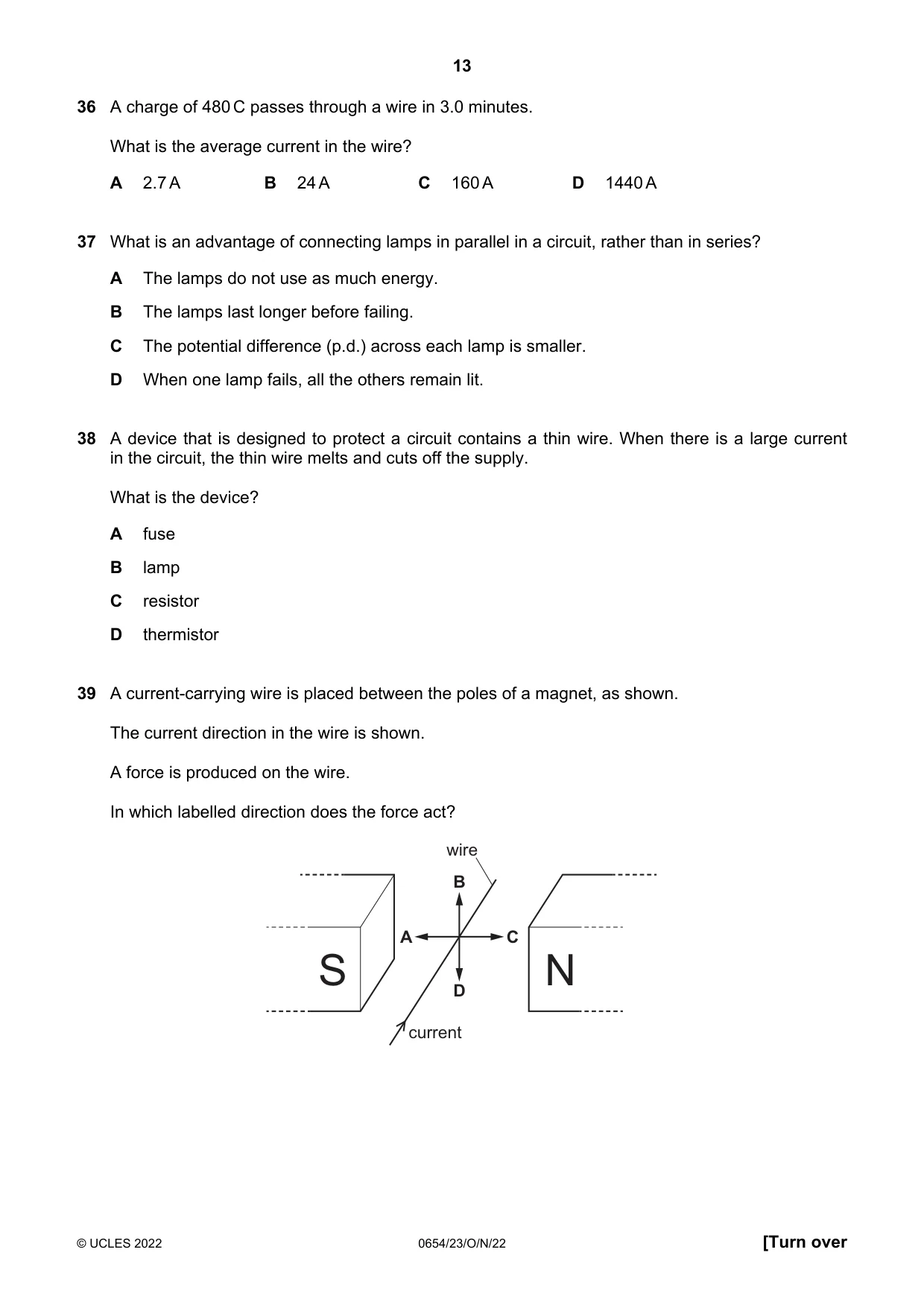
36 A charge of 480 C passes through a wire in 3.0 minutes. What is the average current in the wire? A 2.7 A B 24 A C 160 A D 1440 A
Mark scheme: A
Q37 · What is an advantage of connecting lamps in parallel in a circuit, rather than in series?
37 What is an advantage of connecting lamps in parallel in a circuit, rather than in series? A The lamps do not use as much energy. B The lamps last longer before failing. C The potential difference (p.d.) across each lamp is smaller. D When one lamp fails, all the others remain lit.
Mark scheme: D
Q38 · A device that is designed to protect a circuit contains a thin wire
38 A device that is designed to protect a circuit contains a thin wire. When there is a large current in the circuit, the thin wire melts and cuts off the supply. What is the device? A fuse B lamp C resistor D thermistor
Mark scheme: A
Q39 · A current-carrying wire is placed between the poles of a magnet, as shown
39 A current-carrying wire is placed between the poles of a magnet, as shown. The current direction in the wire is shown. A force is produced on the wire. In which labelled direction does the force act? wire B A C S N D current
Mark scheme: B
Q40 · The diagrams represent pairs of nuclei of some atoms
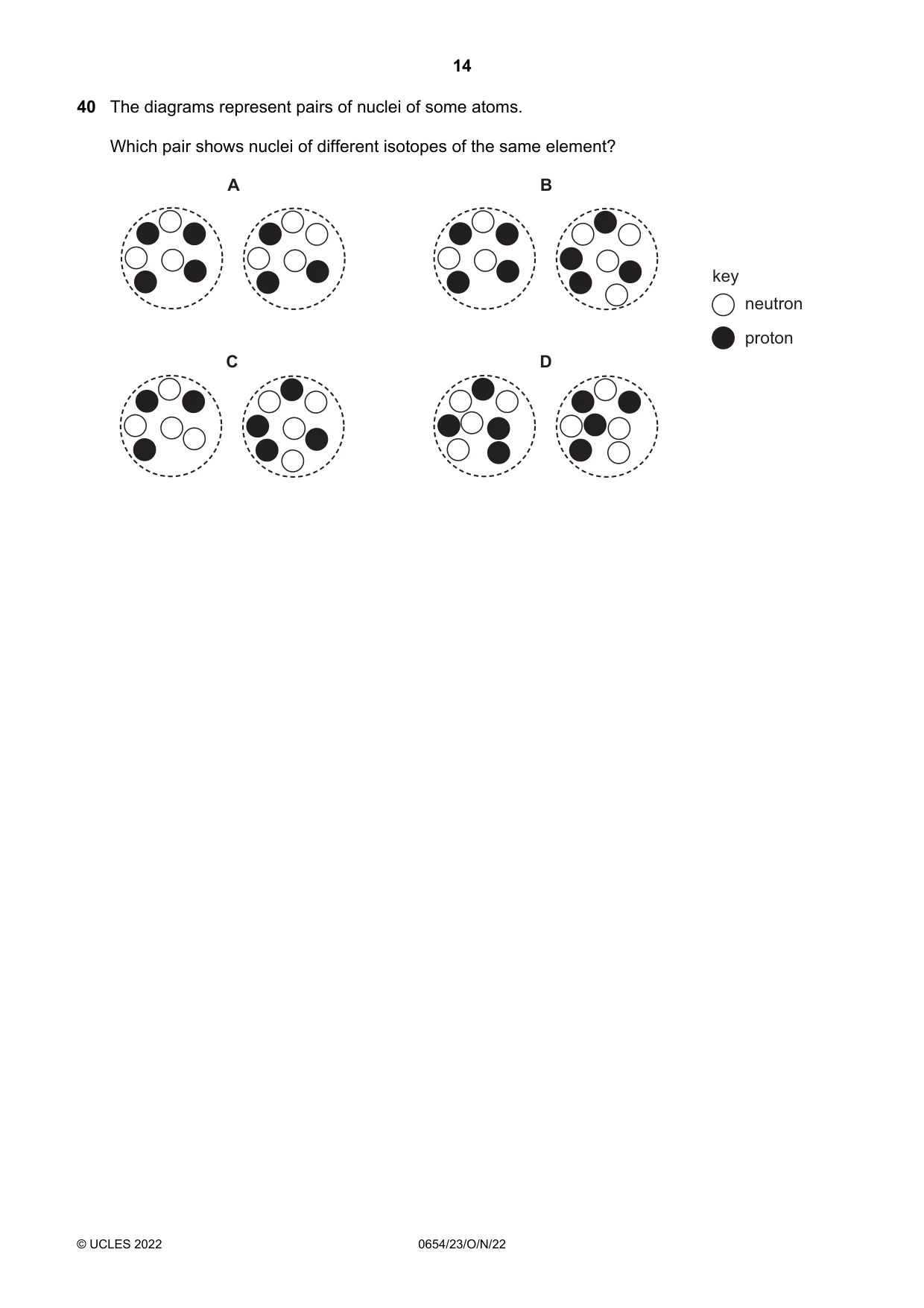
40 The diagrams represent pairs of nuclei of some atoms. Which pair shows nuclei of different isotopes of the same element? A B key neutron proton C D
Mark scheme: B
What was in this paper
The subtopics covered by these 40 questions, and how many questions each got. Open one in a new tab to see every Cambridge question on it.
3Alloys and their properties1Asexual reproduction1Biological molecules1Cell division1Circulatory systems1Diet1Electrical circuits1Electrical quantities1Electrical safety1Electrolysis1Electromagnetic effects1Enzymes1Exothermic and endothermic reactions1Experimental design1Food chains and food webs1Gas exchange in humans1Habitat destruction1Homeostasis1Ions and ionic bonds1Isotopes1Kinetic particle model of matter1Leaf structure1Light1Mass and weight1Noble gases1Osmosis1Photosynthesis1Polymers1Pressure1Reactivity series1Redox1Simple phenomena of magnetism1Solids, liquids and gases1The mole and the Avogadro constant1The nucleus1Transition elements1Water1What you needed in this session
Cambridge’s own grade thresholds for 2022 Oct/Nov, Paper 2 · Variant 3. A higher threshold means an easier paper — the bar moves with how the cohort did.