Cambridge IGCSE Sciences - Co-ordinated (Double) 0654 — 2021 Feb/March Paper 2 · Variant 2
0654/22/F/M/21 · 40 questions · 40 marks · ≈45 min
The question paper and its mark scheme, free to read here and free to download. This is Cambridge’s own paper, exactly as it was sat.
Question paper16 pages
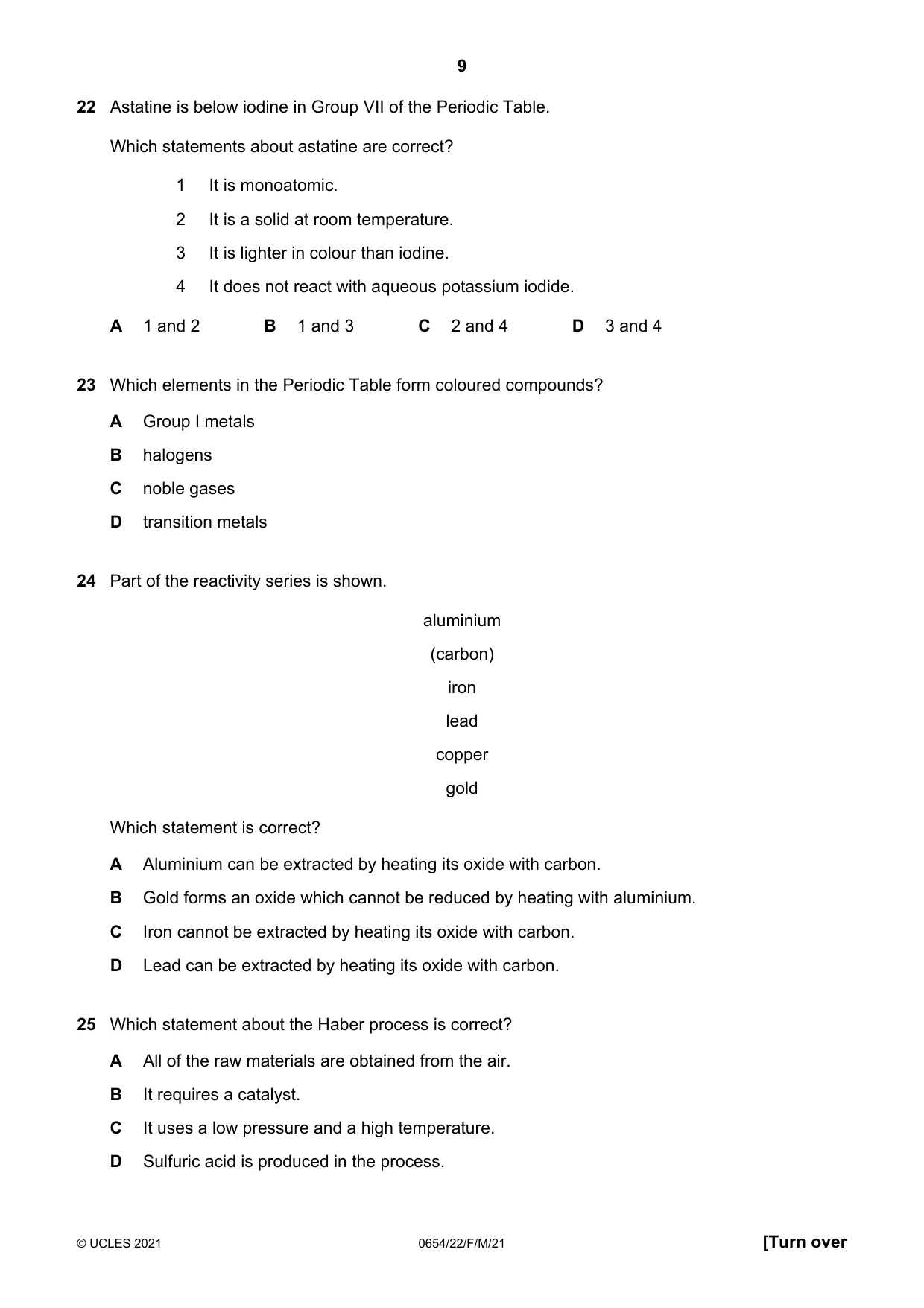
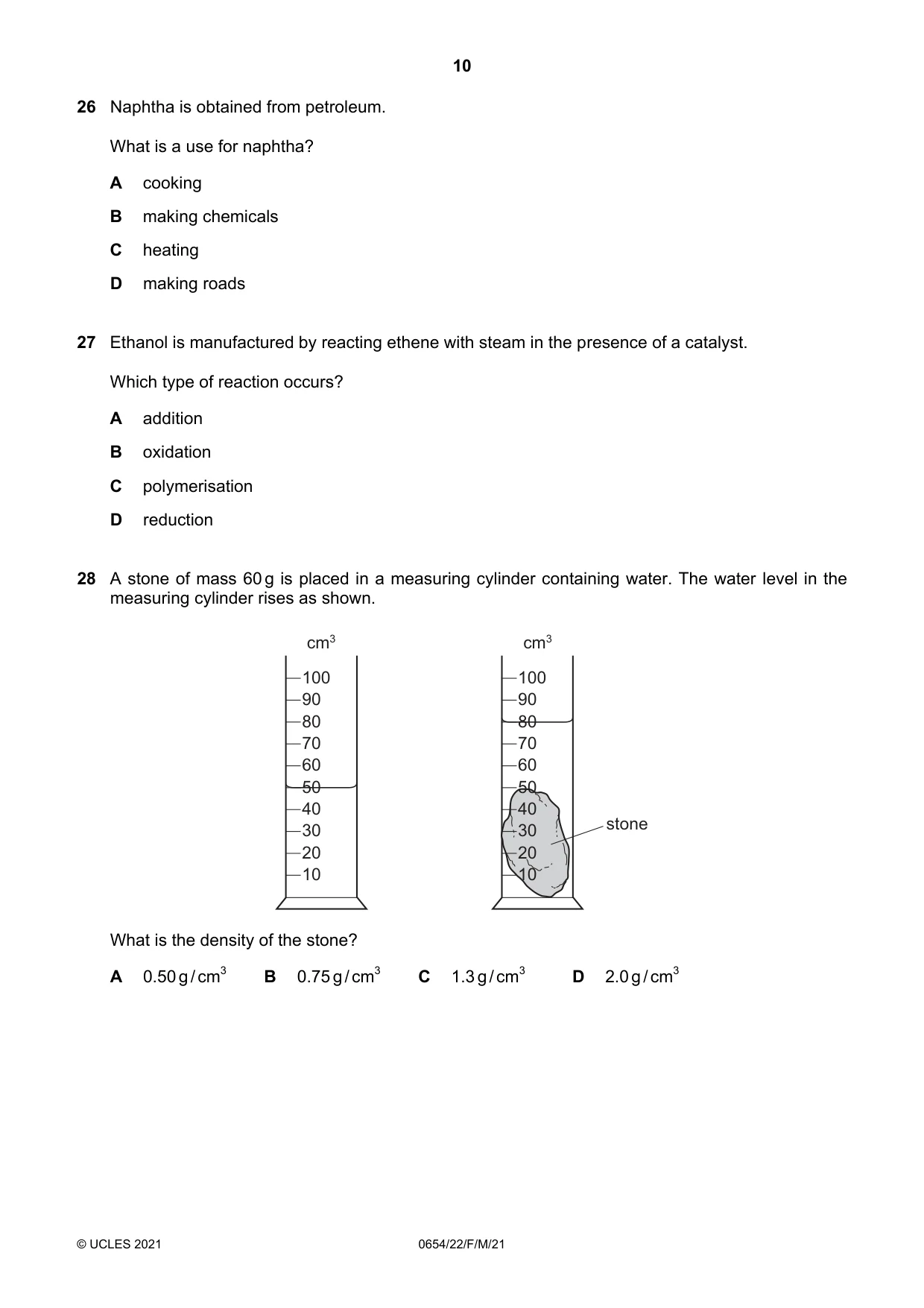
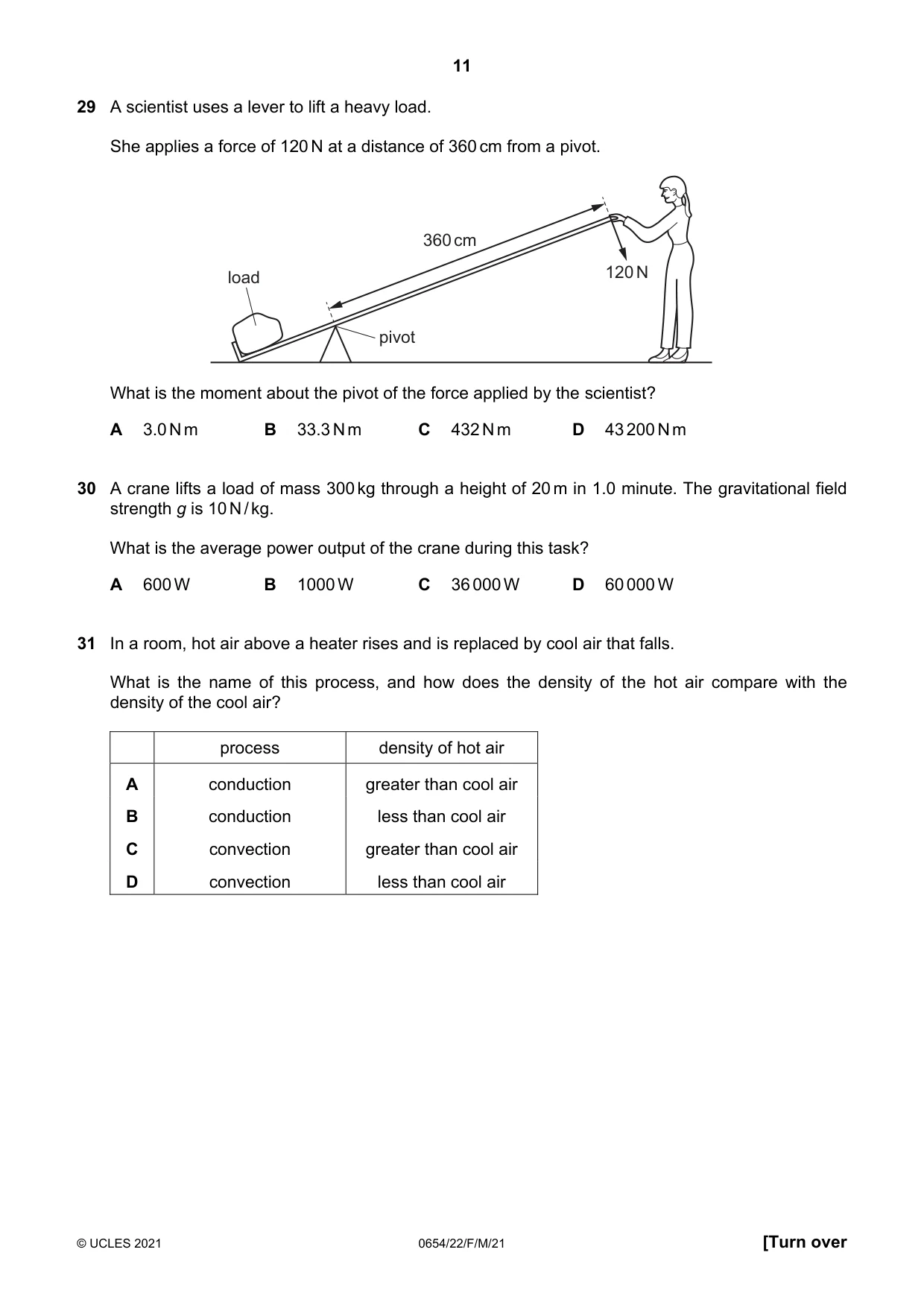
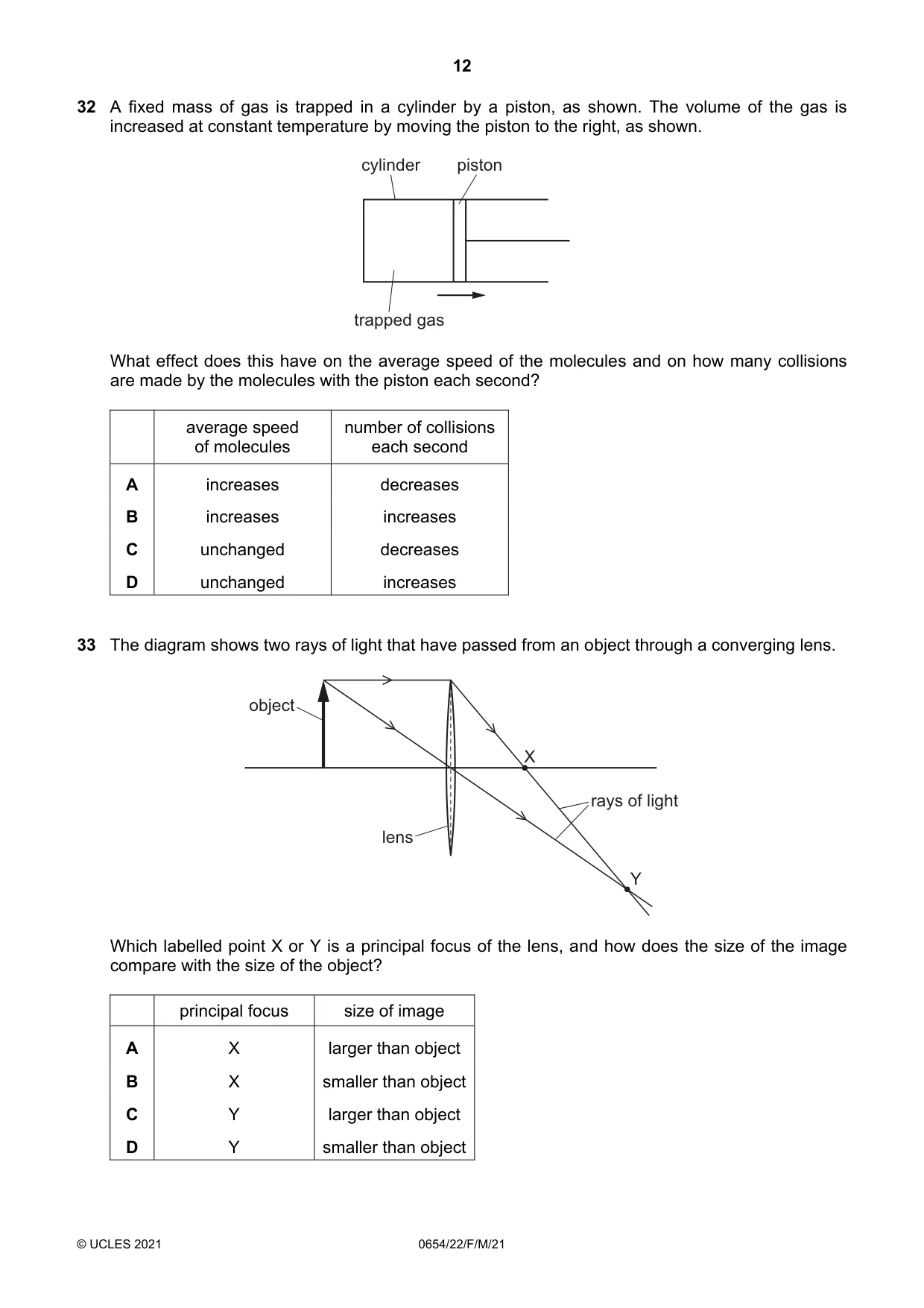
Mark scheme3 pages
Answers below. Sit the paper first if you are practising.
Questions as text
Q1 · Which statement defines excretion?
1 Which statement defines excretion? A the chemical reactions in cells that break down nutrient molecules and release energy for metabolism B the removal from organisms of the waste products of metabolism C the taking in of materials for energy, growth and development D the ability to detect or sense stimuli in the internal or external environment and to make appropriate responses
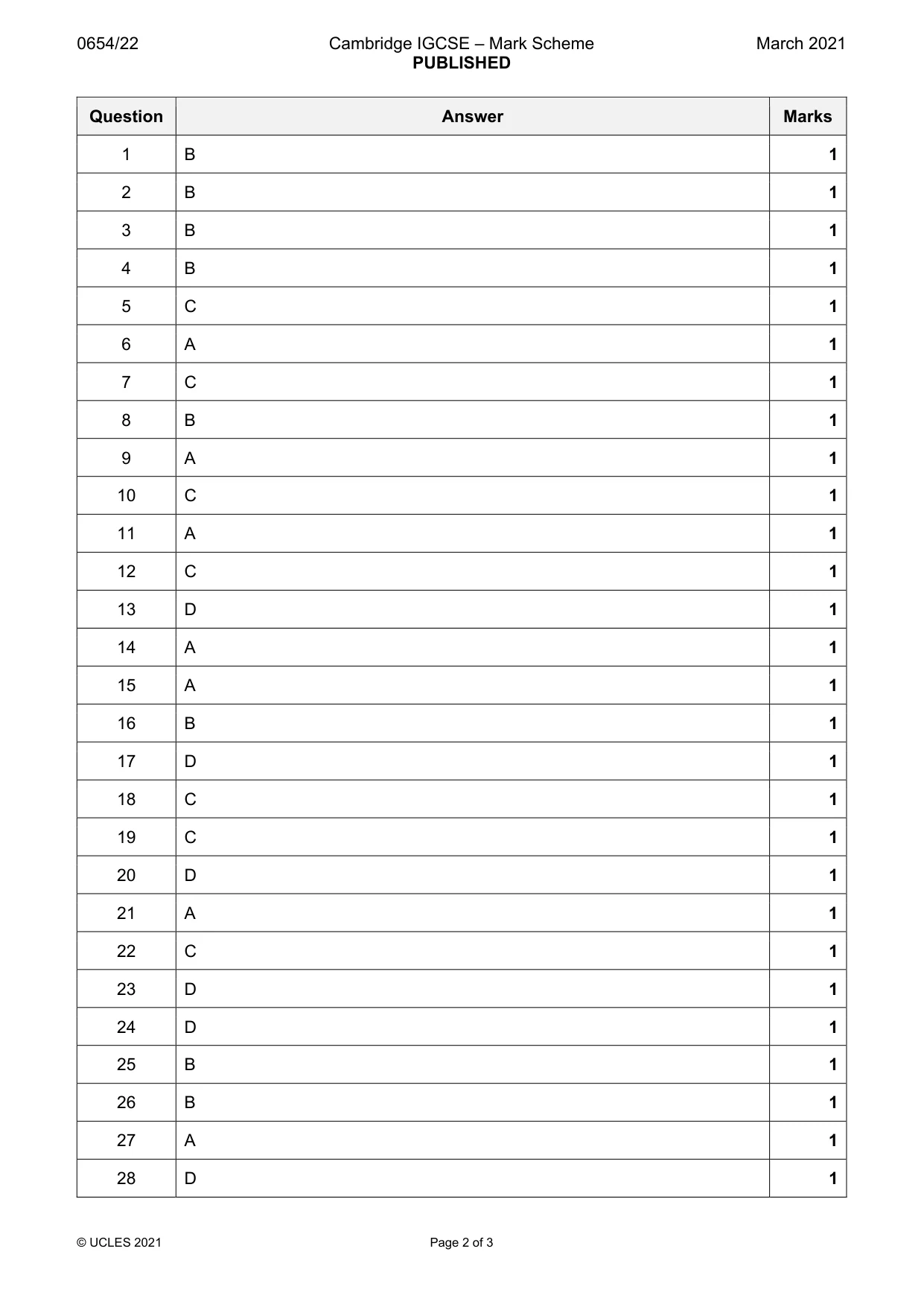
Mark scheme: B
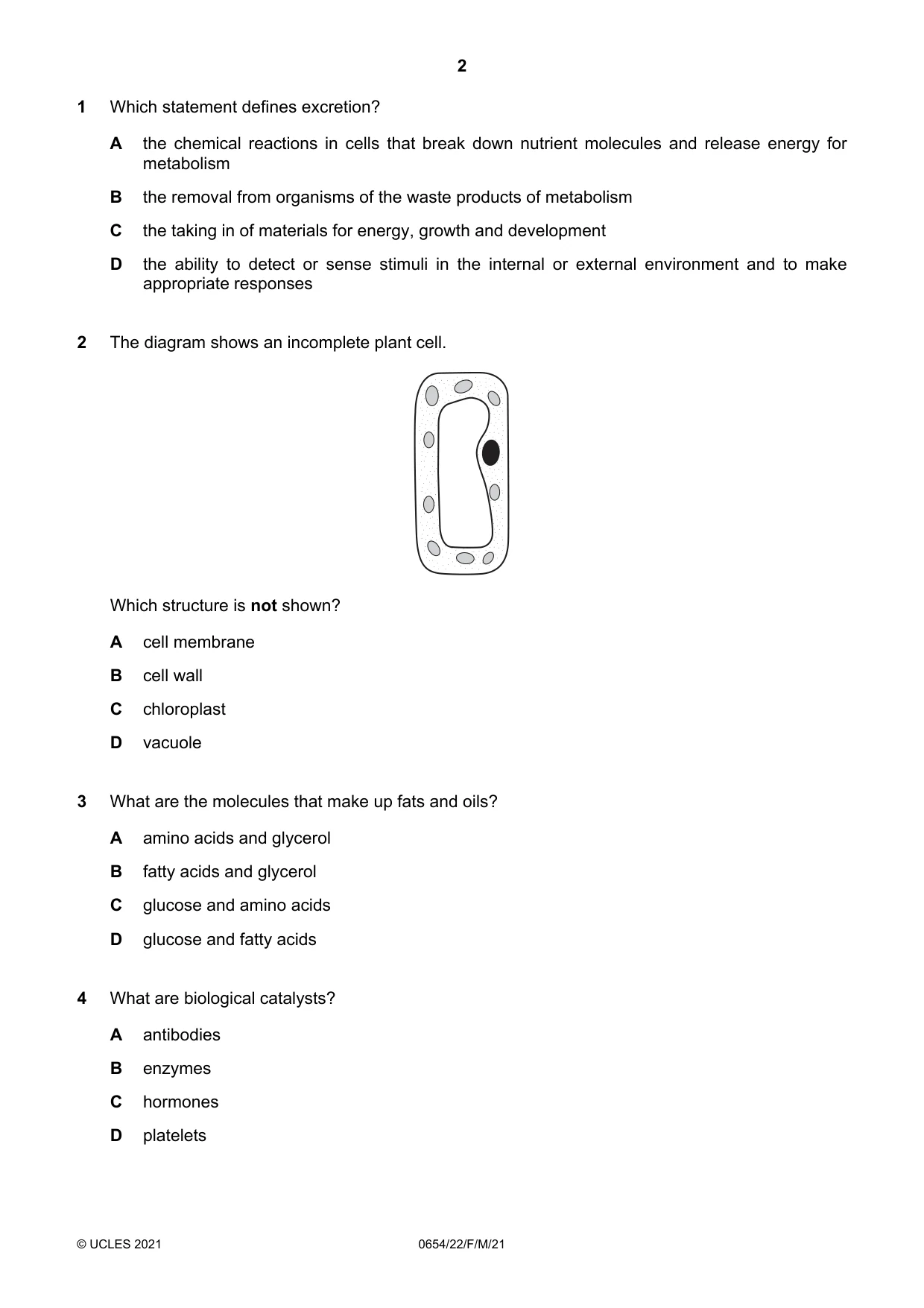
Q2 · The diagram shows an incomplete plant cell
2 The diagram shows an incomplete plant cell. Which structure is not shown? A cell membrane B cell wall C chloroplast D vacuole
Mark scheme: B
Q3 · What are the molecules that make up fats and oils?
3 What are the molecules that make up fats and oils? A amino acids and glycerol B fatty acids and glycerol C glucose and amino acids D glucose and fatty acids
Mark scheme: B
Q4 · What are biological catalysts?
4 What are biological catalysts? A antibodies B enzymes C hormones D platelets
Mark scheme: B
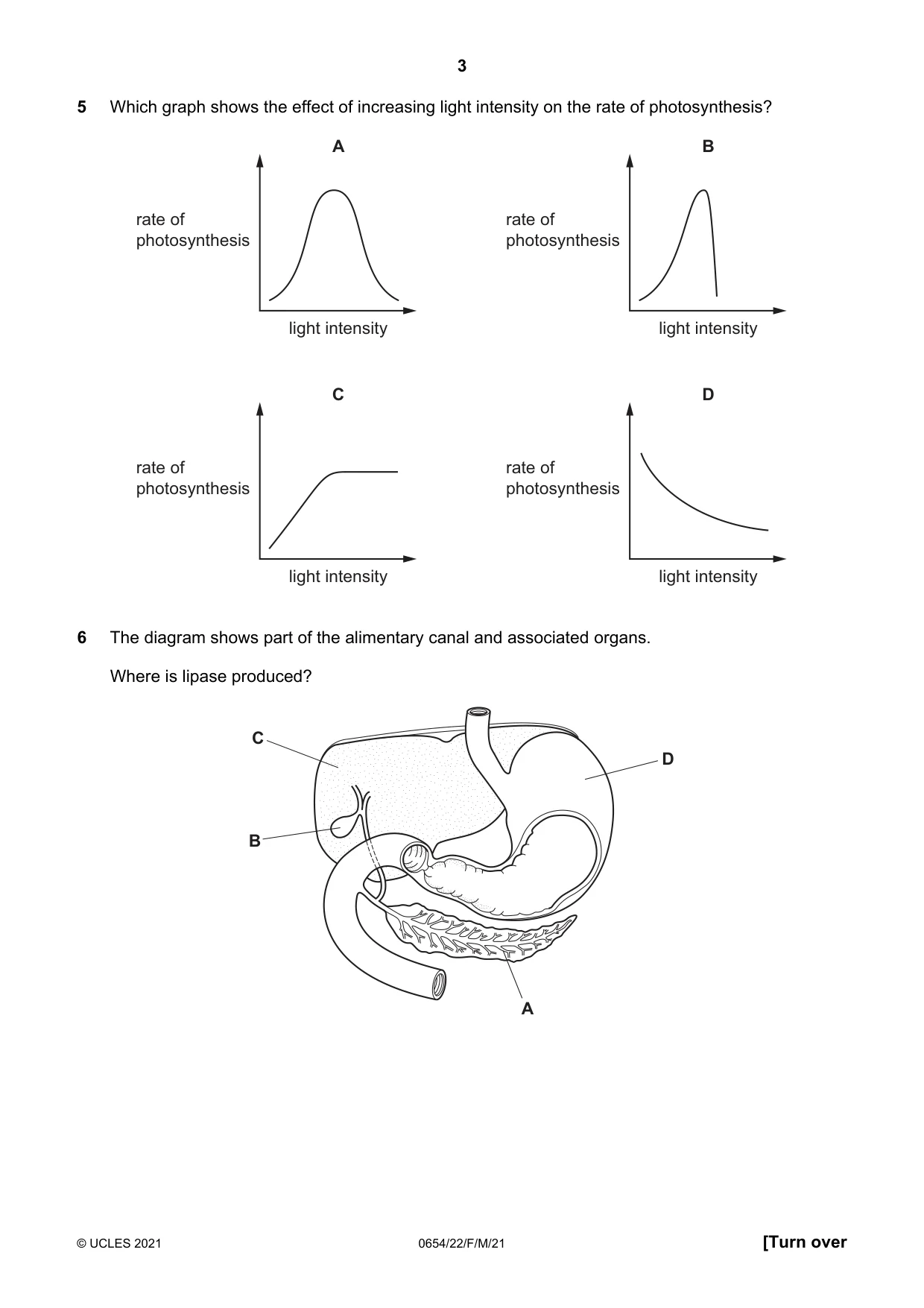
Q5 · Which graph shows the effect of increasing light intensity on the rate of photosynthesis?
5 Which graph shows the effect of increasing light intensity on the rate of photosynthesis? A B rate of rate of photosynthesis photosynthesis light intensity light intensity C D rate of rate of photosynthesis photosynthesis light intensity light intensity
Mark scheme: C
Q6 · The diagram shows part of the alimentary canal and associated organs
6 The diagram shows part of the alimentary canal and associated organs. Where is lipase produced? C D B A
Mark scheme: A
Q7 · In which weather conditions is the rate of transpiration fastest?
7 In which weather conditions is the rate of transpiration fastest? A cold and dry B cold and wet C warm and dry D warm and wet
Mark scheme: C
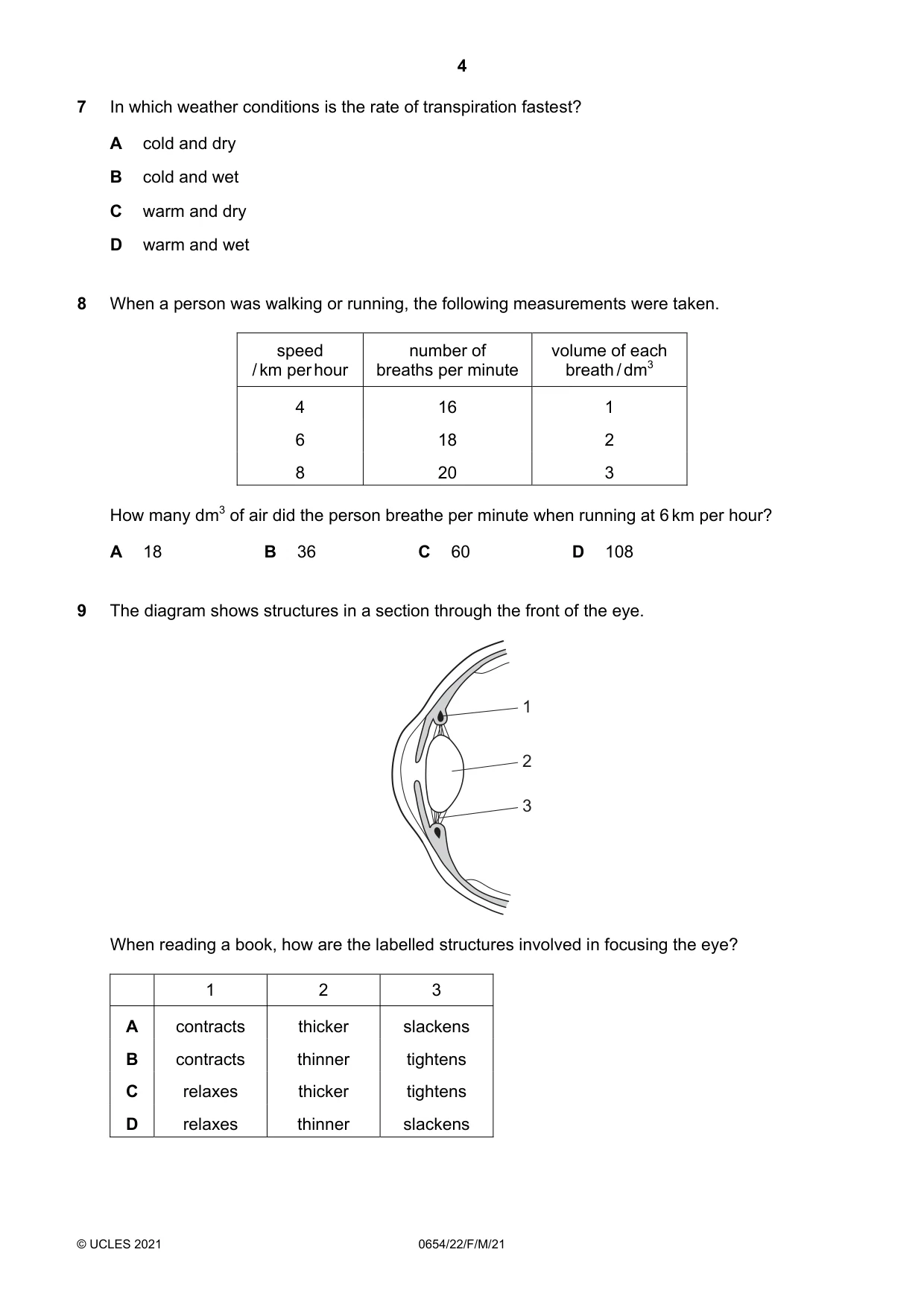
Q8 · When a person was walking or running, the following measurements were taken
8 When a person was walking or running, the following measurements were taken. speed number of volume of each / km per hour breaths per minute breath / dm3 4 16 1 6 18 2 8 20 3 How many dm3 of air did the person breathe per minute when running at 6 km per hour? A 18 B 36 C 60 D 108
Mark scheme: B
Q9 · The diagram shows structures in a section through the front of the eye
9 The diagram shows structures in a section through the front of the eye. 1 2 3 When reading a book, how are the labelled structures involved in focusing the eye? 1 2 3 A contracts thicker slackens B contracts thinner tightens C relaxes thicker tightens D relaxes thinner slackens
Mark scheme: A
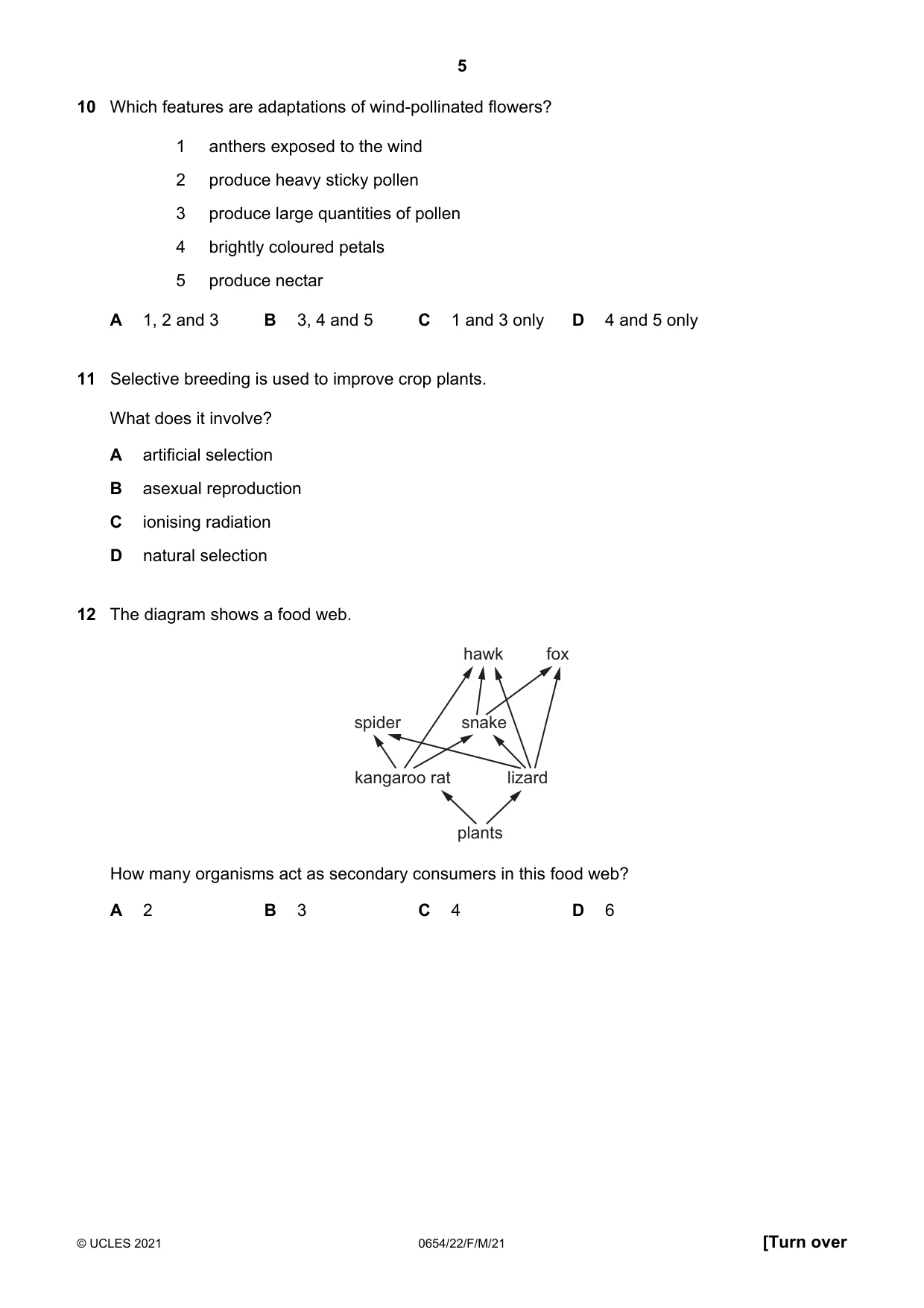
Q10 · Which features are adaptations of wind-pollinated flowers?
10 Which features are adaptations of wind-pollinated flowers? 1 anthers exposed to the wind 2 produce heavy sticky pollen 3 produce large quantities of pollen 4 brightly coloured petals 5 produce nectar A 1, 2 and 3 B 3, 4 and 5 C 1 and 3 only D 4 and 5 only
Mark scheme: C
Q11 · Selective breeding is used to improve crop plants
11 Selective breeding is used to improve crop plants. What does it involve? A artificial selection B asexual reproduction C ionising radiation D natural selection
Mark scheme: A
Q12 · The diagram shows a food web
12 The diagram shows a food web. hawk fox spider snake kangaroo rat lizard plants How many organisms act as secondary consumers in this food web? A 2 B 3 C 4 D 6
Mark scheme: C
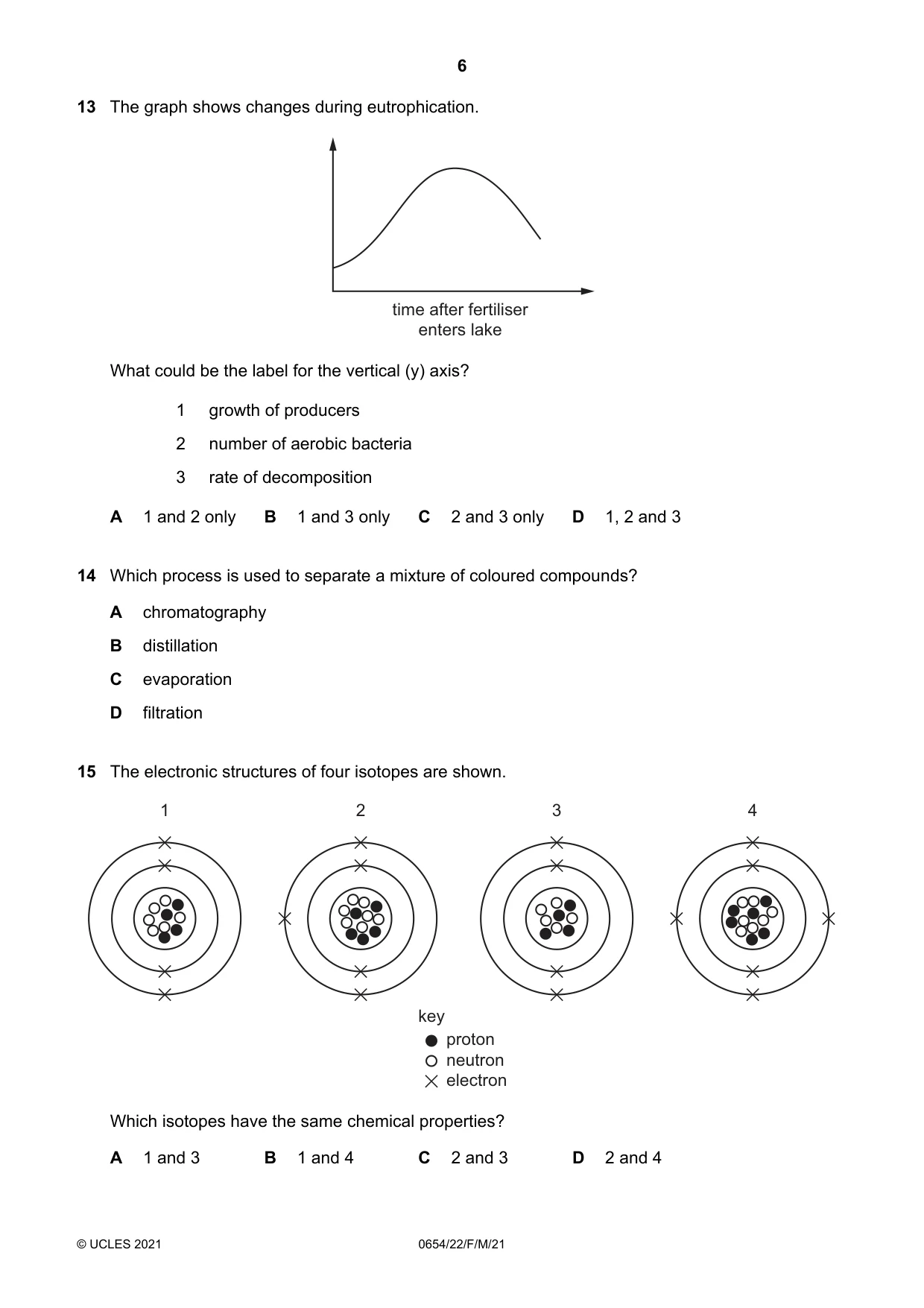
Q13 · The graph shows changes during eutrophication
13 The graph shows changes during eutrophication. time after fertiliser enters lake What could be the label for the vertical (y) axis? 1 growth of producers 2 number of aerobic bacteria 3 rate of decomposition A 1 and 2 only B 1 and 3 only C 2 and 3 only D 1, 2 and 3
Mark scheme: D
Q14 · Which process is used to separate a mixture of coloured compounds?
14 Which process is used to separate a mixture of coloured compounds? A chromatography B distillation C evaporation D filtration
Mark scheme: A
Q15 · The electronic structures of four isotopes are shown
15 The electronic structures of four isotopes are shown. 1 2 3 4 key proton neutron electron Which isotopes have the same chemical properties? A 1 and 3 B 1 and 4 C 2 and 3 D 2 and 4
Mark scheme: A
Q16 · What is the mass of hydrogen in 51 g of ammonia, NH3?
16 What is the mass of hydrogen in 51 g of ammonia, NH3? A 3 g B 9 g C 14 g D 17 g
Mark scheme: B
Q17 · Molten lead(II) bromide is electrolysed
17 Molten lead(II) bromide is electrolysed. Which equation represents the reaction at the cathode? A 2Br – Br2 + 2e– B Br2 + 2e– 2Br – C Pb2+ Pb + 2e– D Pb2+ + 2e– Pb
Mark scheme: D
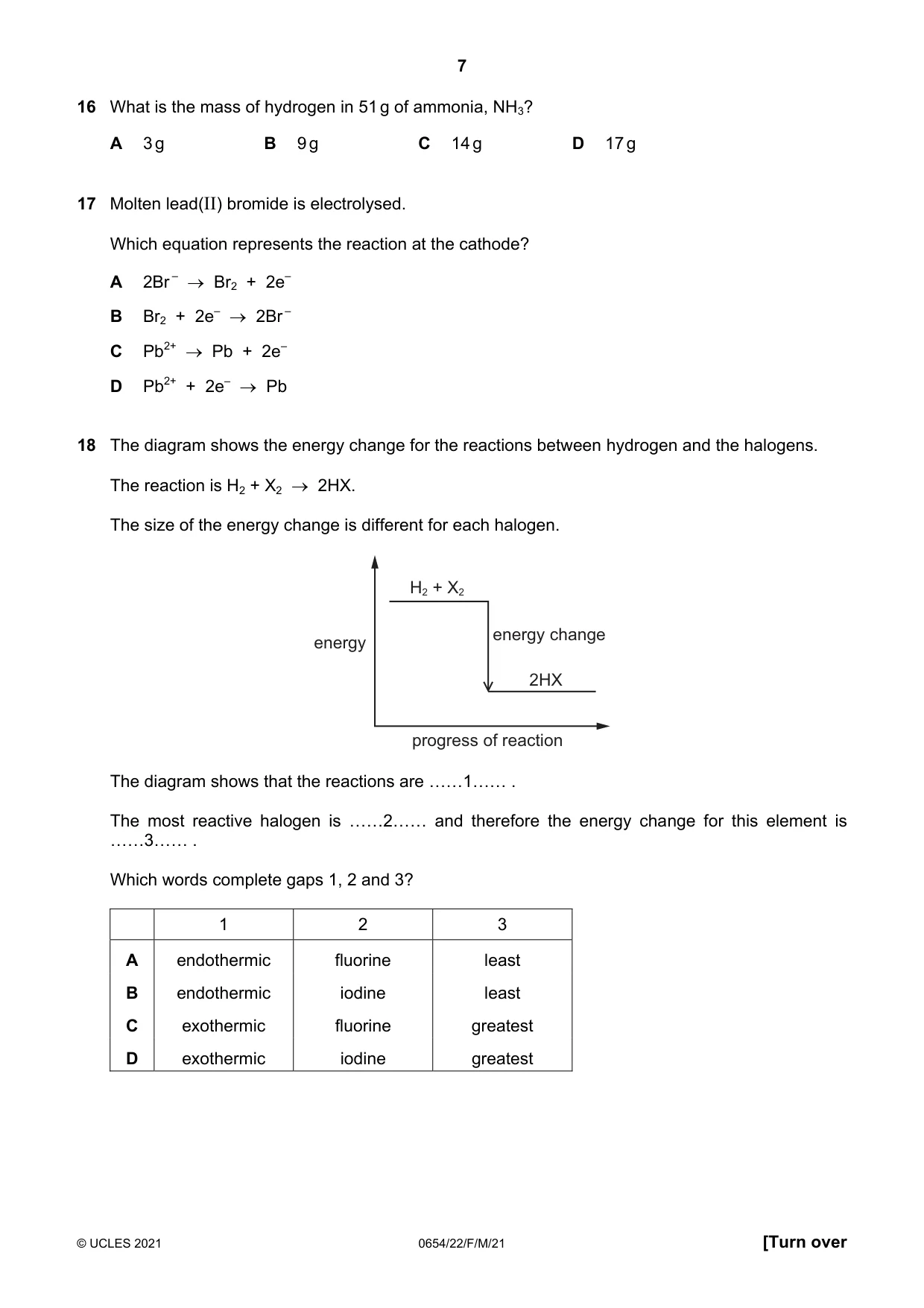
Q18 · The diagram shows the energy change for the reactions between hydrogen and the halogens
18 The diagram shows the energy change for the reactions between hydrogen and the halogens. The reaction is H2 + X2 2HX. The size of the energy change is different for each halogen. H2 + X2 energy change energy 2HX progress of reaction The diagram shows that the reactions are ……1…… . The most reactive halogen is ……2…… and therefore the energy change for this element is ……3…… . Which words complete gaps 1, 2 and 3? 1 2 3 A endothermic fluorine least B endothermic iodine least C exothermic fluorine greatest D exothermic iodine greatest
Mark scheme: C
Q19 · In which equation is the underlined substance acting as an oxidising agent?
19 In which equation is the underlined substance acting as an oxidising agent? A CuO + H2 Cu + H2O B CuSO4 + Mg MgSO4 + Cu C H2 + Cl 2 2HCl D Zn + 2HCl ZnCl 2 + H2
Mark scheme: C
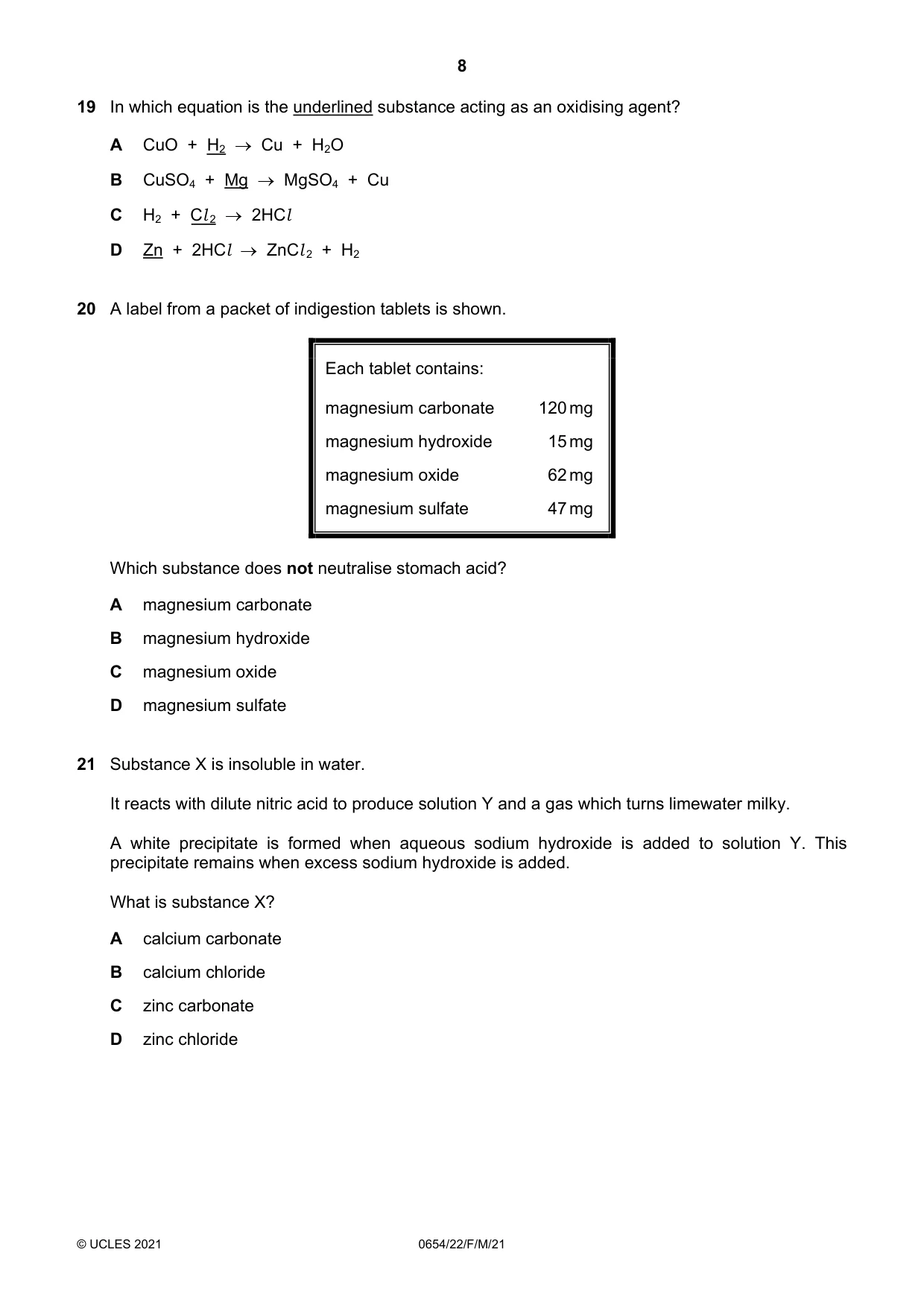
Q20 · A label from a packet of indigestion tablets is shown
20 A label from a packet of indigestion tablets is shown. Each tablet contains: magnesium carbonate 120 mg magnesium hydroxide 15 mg magnesium oxide 62 mg magnesium sulfate 47 mg Which substance does not neutralise stomach acid? A magnesium carbonate B magnesium hydroxide C magnesium oxide D magnesium sulfate
Mark scheme: D
More questions on The characteristic properties of acids and bases
Q21 · Substance X is insoluble in water
21 Substance X is insoluble in water. It reacts with dilute nitric acid to produce solution Y and a gas which turns limewater milky. A white precipitate is formed when aqueous sodium hydroxide is added to solution Y. This precipitate remains when excess sodium hydroxide is added. What is substance X? A calcium carbonate B calcium chloride C zinc carbonate D zinc chloride
Mark scheme: A
Q22 · Astatine is below iodine in Group VII of the Periodic Table
22 Astatine is below iodine in Group VII of the Periodic Table. Which statements about astatine are correct? 1 It is monoatomic. 2 It is a solid at room temperature. 3 It is lighter in colour than iodine. 4 It does not react with aqueous potassium iodide. A 1 and 2 B 1 and 3 C 2 and 4 D 3 and 4
Mark scheme: C
Q23 · Which elements in the Periodic Table form coloured compounds?
23 Which elements in the Periodic Table form coloured compounds? A Group I metals B halogens C noble gases D transition metals
Mark scheme: D
Q24 · Part of the reactivity series is shown
24 Part of the reactivity series is shown. aluminium (carbon) iron lead copper gold Which statement is correct? A Aluminium can be extracted by heating its oxide with carbon. B Gold forms an oxide which cannot be reduced by heating with aluminium. C Iron cannot be extracted by heating its oxide with carbon. D Lead can be extracted by heating its oxide with carbon.
Mark scheme: D
Q25 · Which statement about the Haber process is correct?
25 Which statement about the Haber process is correct? A All of the raw materials are obtained from the air. B It requires a catalyst. C It uses a low pressure and a high temperature. D Sulfuric acid is produced in the process.
Mark scheme: B
Q26 · Naphtha is obtained from petroleum
26 Naphtha is obtained from petroleum. What is a use for naphtha? A cooking B making chemicals C heating D making roads
Mark scheme: B
Q27 · Ethanol is manufactured by reacting ethene with steam in the presence of a catalyst
27 Ethanol is manufactured by reacting ethene with steam in the presence of a catalyst. Which type of reaction occurs? A addition B oxidation C polymerisation D reduction
Mark scheme: A
Q28 · A stone of mass 60 g is placed in a measuring cylinder containing water
28 A stone of mass 60 g is placed in a measuring cylinder containing water. The water level in the measuring cylinder rises as shown. cm3 cm3 100 100 90 90 80 80 70 70 60 60 50 50 40 40 30 30 stone 20 20 10 10 What is the density of the stone? A 0.50 g / cm3 B 0.75 g / cm3 C 1.3 g / cm3 D 2.0 g / cm3
Mark scheme: D
Q29 · A scientist uses a lever to lift a heavy load
29 A scientist uses a lever to lift a heavy load. She applies a force of 120 N at a distance of 360 cm from a pivot. 360 cm load 120 N pivot What is the moment about the pivot of the force applied by the scientist? A 3.0 N m B 33.3 N m C 432 N m D 43 200 N m
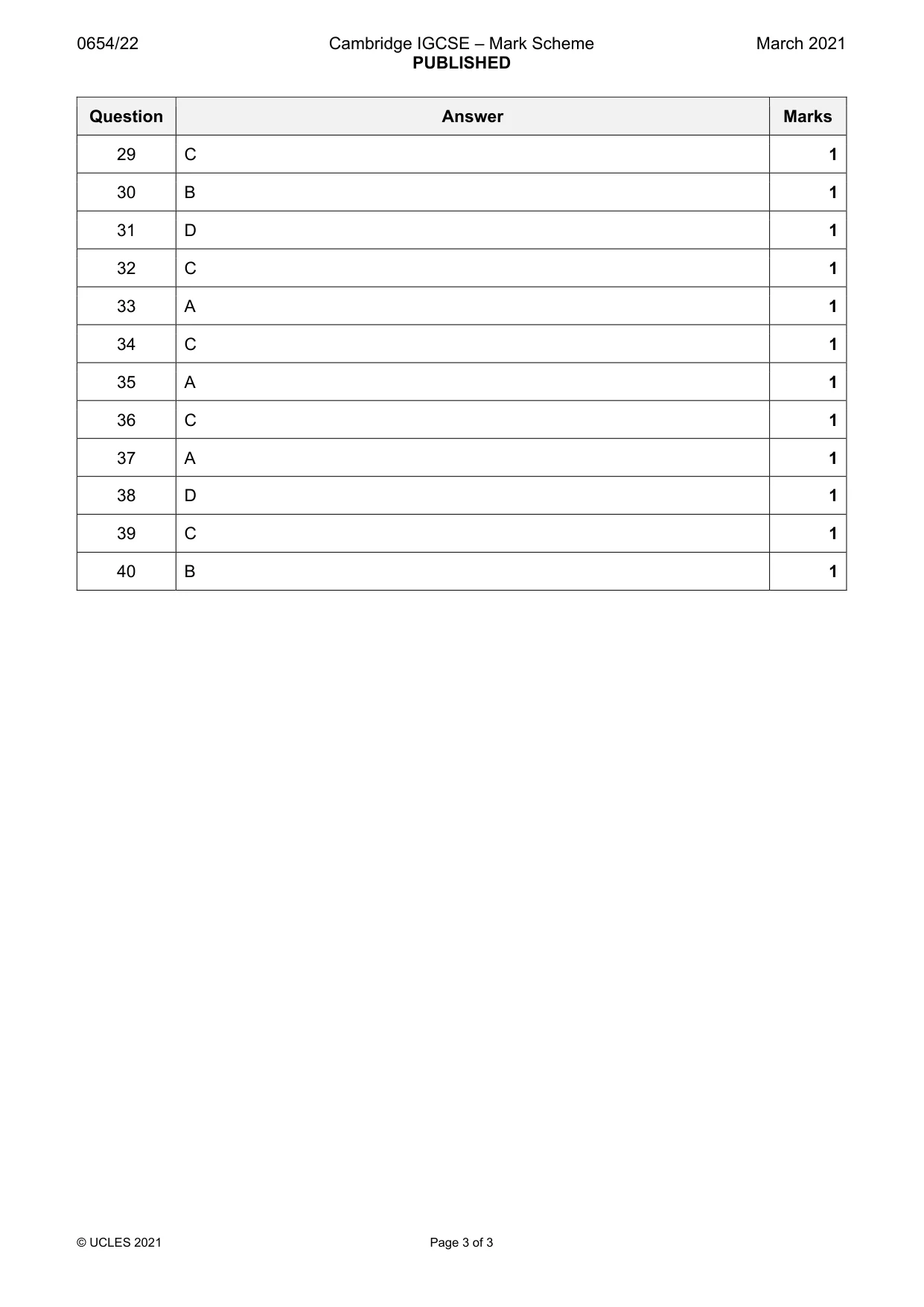
Mark scheme: C
Q30 · A crane lifts a load of mass 300 kg through a height of 20 m in 1.0 minute
30 A crane lifts a load of mass 300 kg through a height of 20 m in 1.0 minute. The gravitational field strength g is 10 N / kg. What is the average power output of the crane during this task? A 600 W B 1000 W C 36 000 W D 60 000 W
Mark scheme: B
Q31 · In a room, hot air above a heater rises and is replaced by cool air that falls
31 In a room, hot air above a heater rises and is replaced by cool air that falls. What is the name of this process, and how does the density of the hot air compare with the density of the cool air? process density of hot air A conduction greater than cool air B conduction less than cool air C convection greater than cool air D convection less than cool air
Mark scheme: D
Q32 · A fixed mass of gas is trapped in a cylinder by a piston, as shown
32 A fixed mass of gas is trapped in a cylinder by a piston, as shown. The volume of the gas is increased at constant temperature by moving the piston to the right, as shown. cylinder piston trapped gas What effect does this have on the average speed of the molecules and on how many collisions are made by the molecules with the piston each second? average speed number of collisions of molecules each second A increases decreases B increases increases C unchanged decreases D unchanged increases
Mark scheme: C
Q33 · The diagram shows two rays of light that have passed from an object through a converging…
33 The diagram shows two rays of light that have passed from an object through a converging lens. object X rays of light lens Y Which labelled point X or Y is a principal focus of the lens, and how does the size of the image compare with the size of the object? principal focus size of image A X larger than object B X smaller than object C Y larger than object D Y smaller than object
Mark scheme: A
Q34 · Sound travels at different speeds in water, in steel and in air
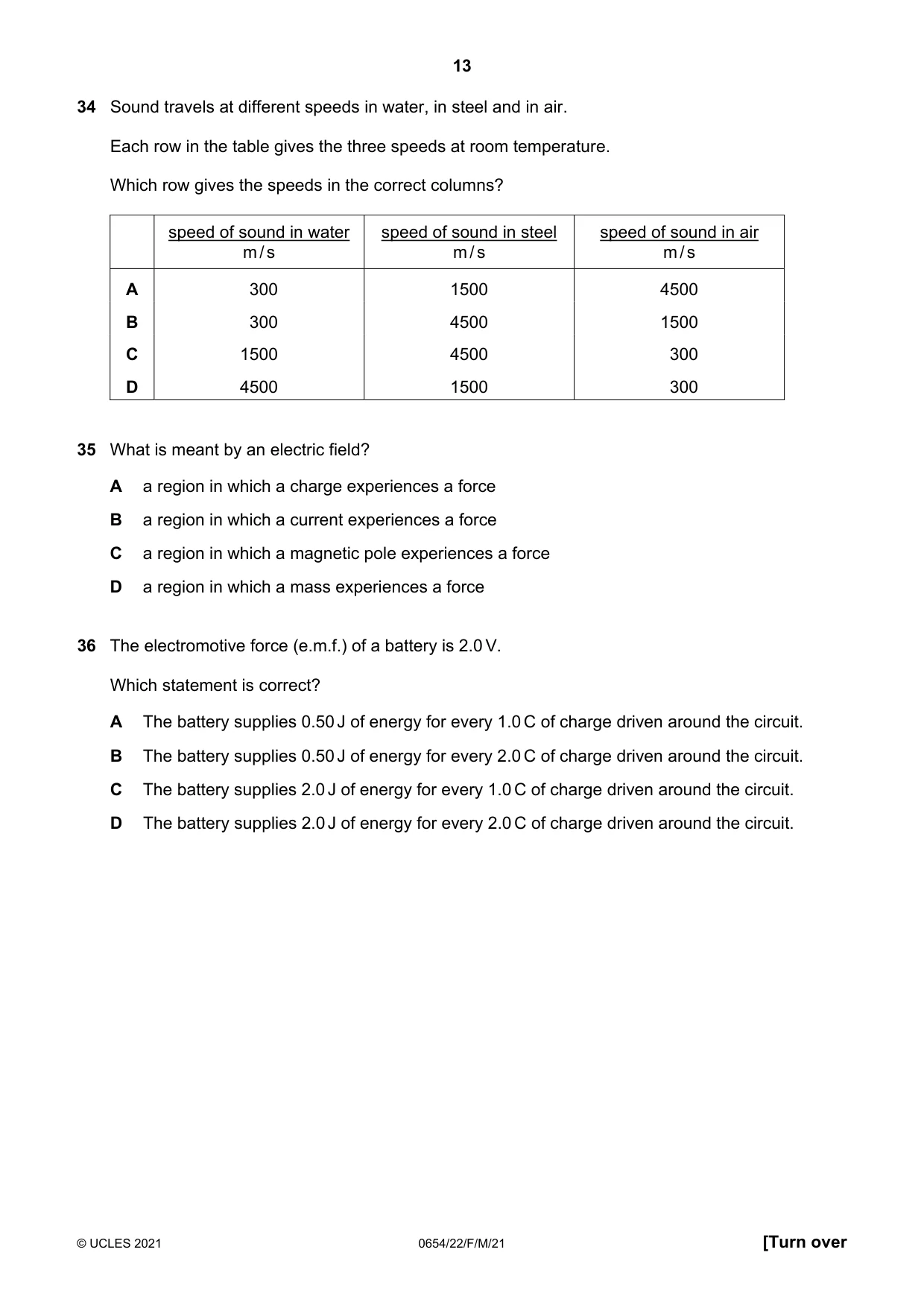
34 Sound travels at different speeds in water, in steel and in air. Each row in the table gives the three speeds at room temperature. Which row gives the speeds in the correct columns? speed of sound in water speed of sound in steel speed of sound in air m / s m / s m / s A 300 1500 4500 B 300 4500 1500 C 1500 4500 300 D 4500 1500 300
Mark scheme: C
Q35 · What is meant by an electric field?
35 What is meant by an electric field? A a region in which a charge experiences a force B a region in which a current experiences a force C a region in which a magnetic pole experiences a force D a region in which a mass experiences a force
Mark scheme: A
Q36 · The electromotive force (e.m.f.) of a battery is 2.0 V
36 The electromotive force (e.m.f.) of a battery is 2.0 V. Which statement is correct? A The battery supplies 0.50 J of energy for every 1.0 C of charge driven around the circuit. B The battery supplies 0.50 J of energy for every 2.0 C of charge driven around the circuit. C The battery supplies 2.0 J of energy for every 1.0 C of charge driven around the circuit. D The battery supplies 2.0 J of energy for every 2.0 C of charge driven around the circuit.
Mark scheme: C
Q37 · Which diagram shows the pattern of the magnetic field due to a current in a straight wire?
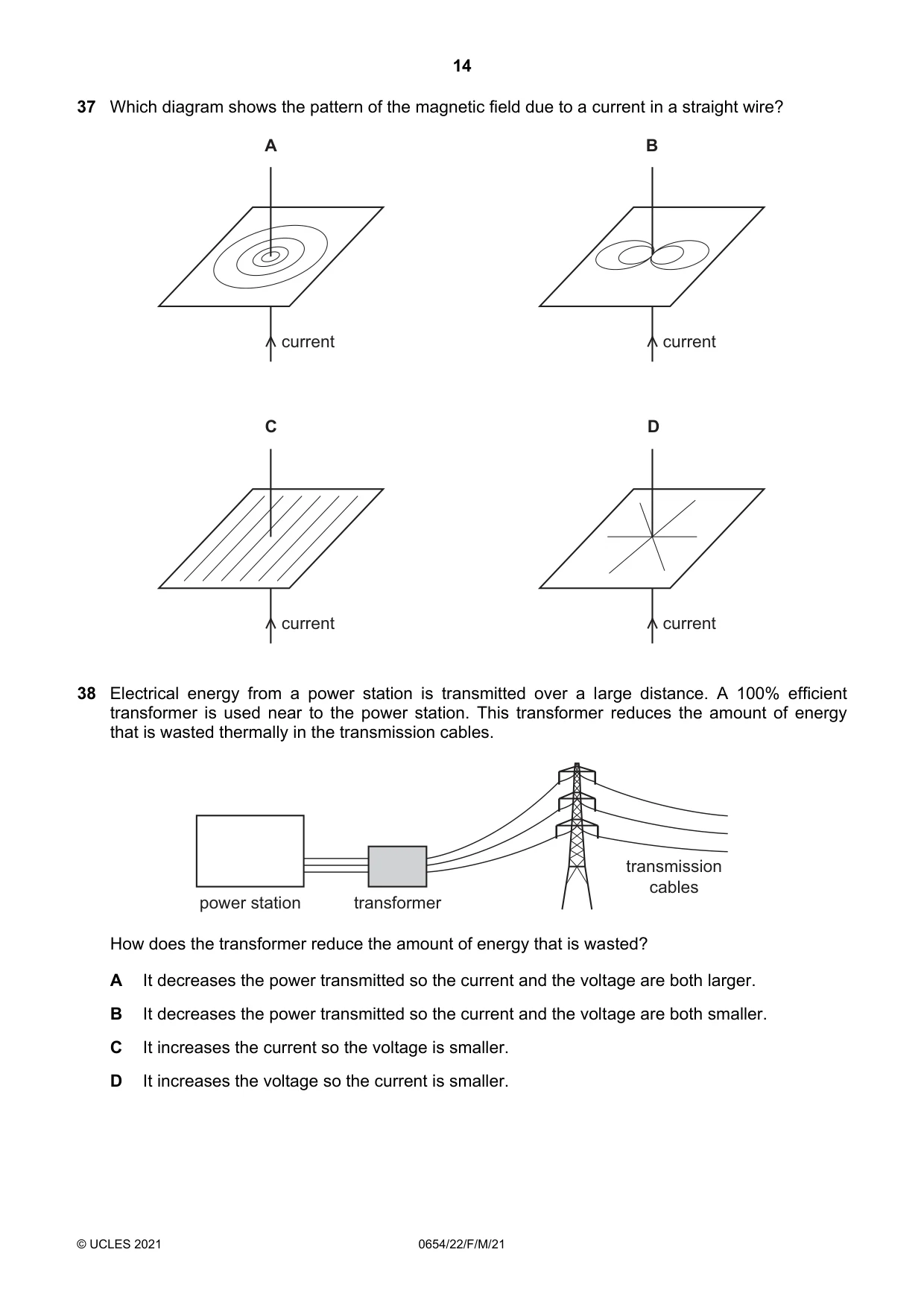
37 Which diagram shows the pattern of the magnetic field due to a current in a straight wire? A B current current C D current current
Mark scheme: A
Q38 · Electrical energy from a power station is transmitted over a large distance
38 Electrical energy from a power station is transmitted over a large distance. A 100% efficient transformer is used near to the power station. This transformer reduces the amount of energy that is wasted thermally in the transmission cables. transmission cables power station transformer How does the transformer reduce the amount of energy that is wasted? A It decreases the power transmitted so the current and the voltage are both larger. B It decreases the power transmitted so the current and the voltage are both smaller. C It increases the current so the voltage is smaller. D It increases the voltage so the current is smaller.
Mark scheme: D
Q39 · The table compares an atom of carbon-13 and an atom of nitrogen-14
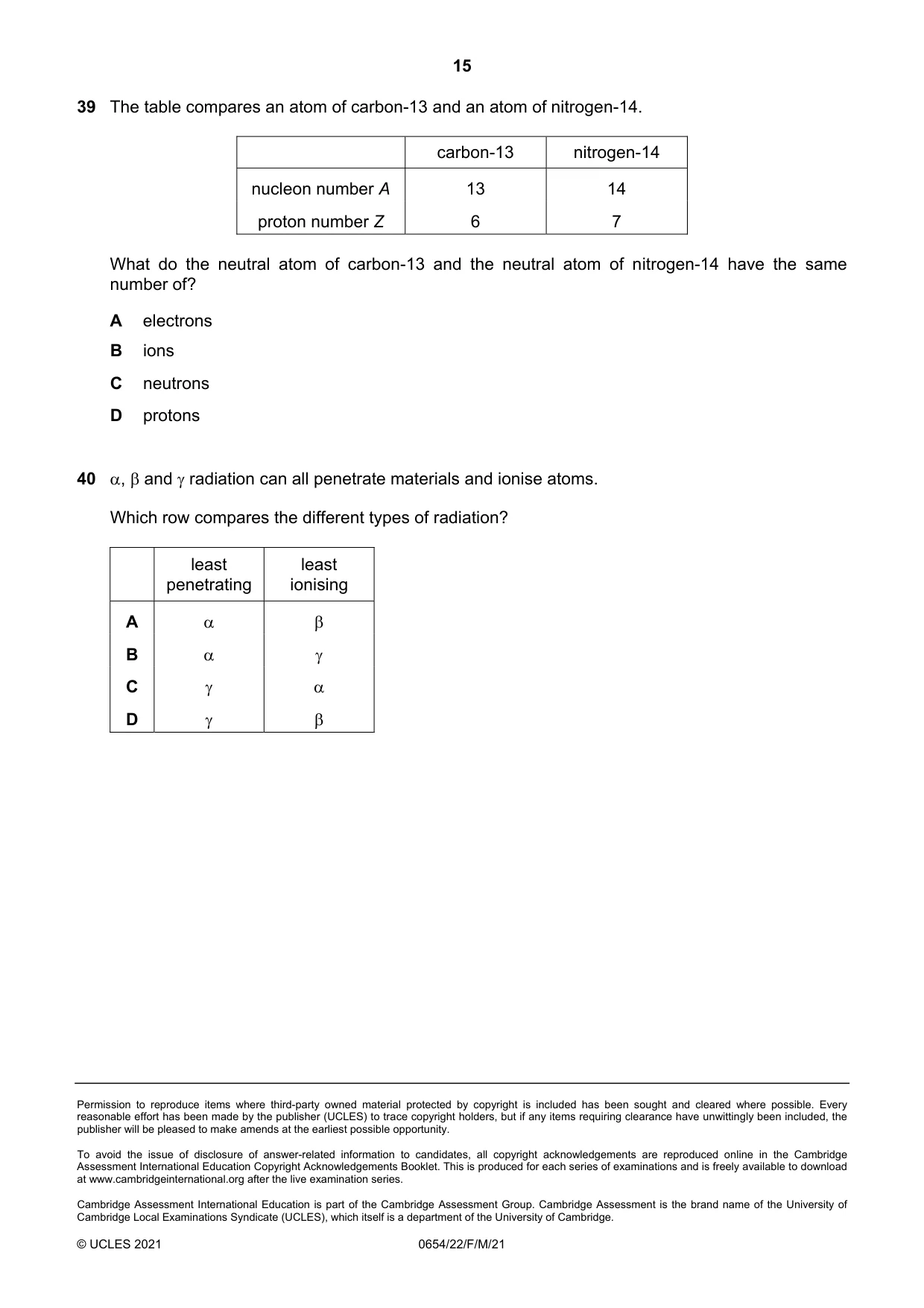
39 The table compares an atom of carbon-13 and an atom of nitrogen-14. carbon-13 nitrogen-14 nucleon number A 13 14 proton number Z 6 7 What do the neutral atom of carbon-13 and the neutral atom of nitrogen-14 have the same number of? A electrons B ions C neutrons D protons
Mark scheme: C
Q40 · , and radiation can all penetrate materials and ionise atoms
40 , and radiation can all penetrate materials and ionise atoms. Which row compares the different types of radiation? least least penetrating ionising A B C D
Mark scheme: B
What was in this paper
The subtopics covered by these 40 questions, and how many questions each got. Open one in a new tab to see every Cambridge question on it.
2Alcohols1Biological molecules1Cell structure1Characteristics of living organisms1Chromatography1Conservation1Coordination and response1Density1Digestive system1Electrical circuits1Electrical quantities1Electrolysis1Energy, work and power1Enzymes1Exothermic and endothermic reactions1Extraction of metals1Food chains and food webs1Forces1Fuels1Gas exchange in humans1Group VII properties1Identification of ions and gases1Isotopes1Kinetic particle model of matter1Light1Photosynthesis1Radioactivity1Reactivity series1Redox1Selection1Sexual reproduction in plants1Sound1The characteristic properties of acids and bases1The mole and the Avogadro constant1The nucleus1Transfer of thermal energy1Transition elements1Transpiration1What you needed in this session
Cambridge’s own grade thresholds for 2021 Feb/March, Paper 2 · Variant 2. A higher threshold means an easier paper — the bar moves with how the cohort did.