Cambridge IGCSE Sciences - Co-ordinated (Double) 0654 — 2024 Feb/March Paper 2 · Variant 2
0654/22/F/M/24 · 40 questions · 40 marks · ≈45 min
The question paper and its mark scheme, free to read here and free to download. This is Cambridge’s own paper, exactly as it was sat.
Question paper16 pages
Mark scheme3 pages
Answers below. Sit the paper first if you are practising.
Questions as text
Q1 · Which characteristic of living things is shown when a green plant absorbs light energy…
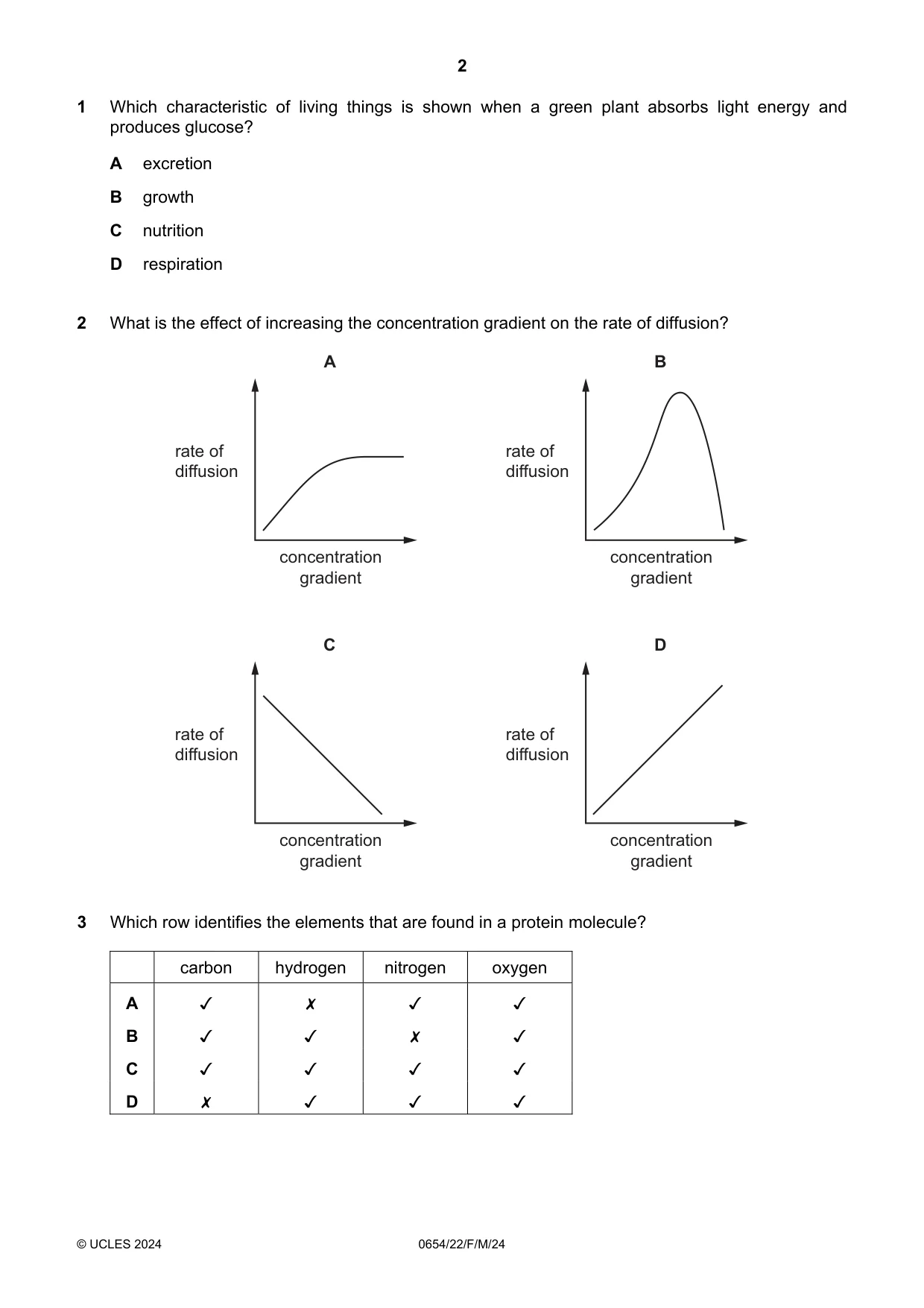
1 Which characteristic of living things is shown when a green plant absorbs light energy and produces glucose? A excretion B growth C nutrition D respiration
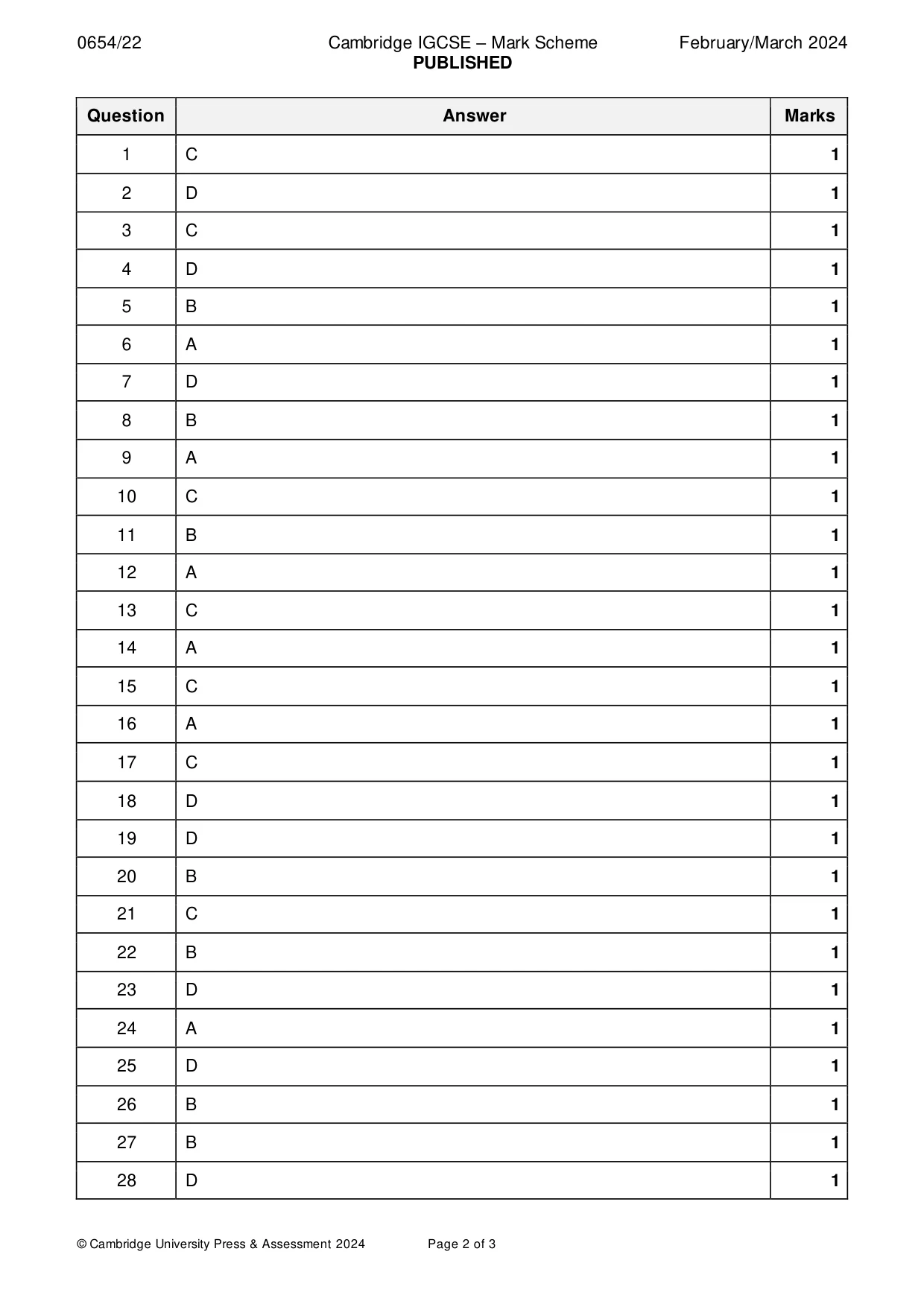
Mark scheme: C
Q2 · What is the effect of increasing the concentration gradient on the rate of diffusion?
2 What is the effect of increasing the concentration gradient on the rate of diffusion? A B rate of rate of diffusion diffusion concentration concentration gradient gradient C D rate of rate of diffusion diffusion concentration concentration gradient gradient
Mark scheme: D
Q3 · Which row identifies the elements that are found in a protein molecule?
3 Which row identifies the elements that are found in a protein molecule? carbon hydrogen nitrogen oxygen 00 WwW > x NON SN 48 \ \ x SN 48
Mark scheme: C
Q4 · Which statements explain why an enzyme stops working when heated to high temperatures?
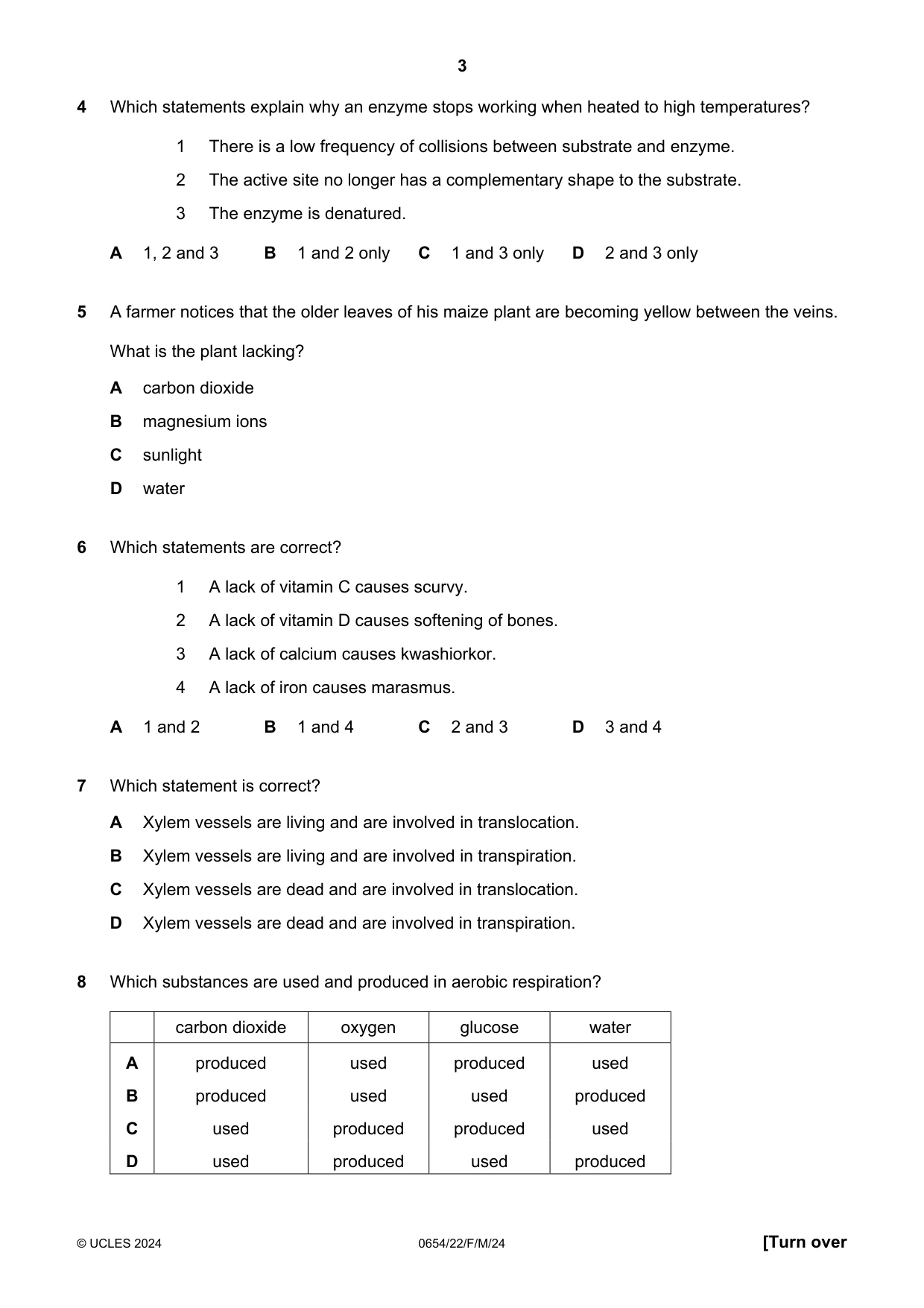
4 Which statements explain why an enzyme stops working when heated to high temperatures? 1 There is a low frequency of collisions between substrate and enzyme. 2 The active site no longer has a complementary shape to the substrate. 3 The enzyme is denatured. A 1, 2 and 3 B 1 and 2 only C 1 and 3 only D 2 and 3 only
Mark scheme: D
Q5 · A farmer notices that the older leaves of his maize plant are becoming yellow between the…
5 A farmer notices that the older leaves of his maize plant are becoming yellow between the veins. What is the plant lacking? A carbon dioxide B magnesium ions C sunlight D water
Mark scheme: B
Q6 · Which statements are correct?
6 Which statements are correct? 1 A lack of vitamin C causes scurvy. 2 A lack of vitamin D causes softening of bones. 3 A lack of calcium causes kwashiorkor. 4 A lack of iron causes marasmus. A 1 and 2 B 1 and 4 C 2 and 3 D 3 and 4
Mark scheme: A
Q7 · Which statement is correct?
7 Which statement is correct? A Xylem vessels are living and are involved in translocation. B Xylem vessels are living and are involved in transpiration. C Xylem vessels are dead and are involved in translocation. D Xylem vessels are dead and are involved in transpiration.
Mark scheme: D
Q8 · Which substances are used and produced in aerobic respiration?
8 Which substances are used and produced in aerobic respiration? carbon dioxide oxygen glucose water A produced used produced used B produced used used produced C used produced produced used D used produced used produced
Mark scheme: B
Q9 · The diagram shows a neurone and associated structures
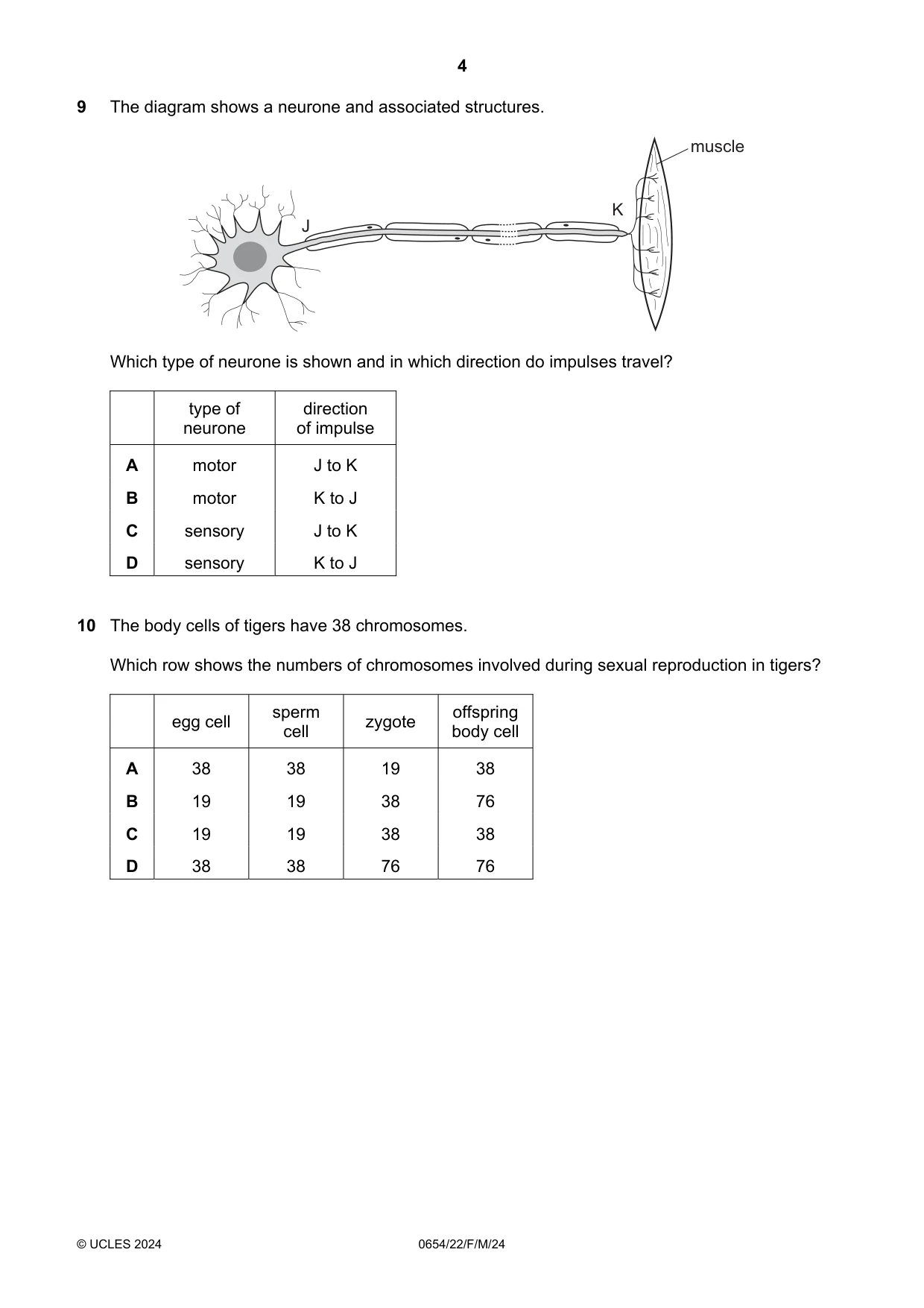
9 The diagram shows a neurone and associated structures. muscle K J Which type of neurone is shown and in which direction do impulses travel? type of direction neurone of impulse A motor J to K B motor K to J C sensory J to K D sensory K to J
Mark scheme: A
Q10 · The body cells of tigers have 38 chromosomes
10 The body cells of tigers have 38 chromosomes. Which row shows the numbers of chromosomes involved during sexual reproduction in tigers? sperm offspring egg cell zygote cell body cell A 38 38 19 38 B 19 19 38 76 C 19 19 38 38 D 38 38 76 76
Mark scheme: C
Q11 · Cystic fibrosis is a genetic condition
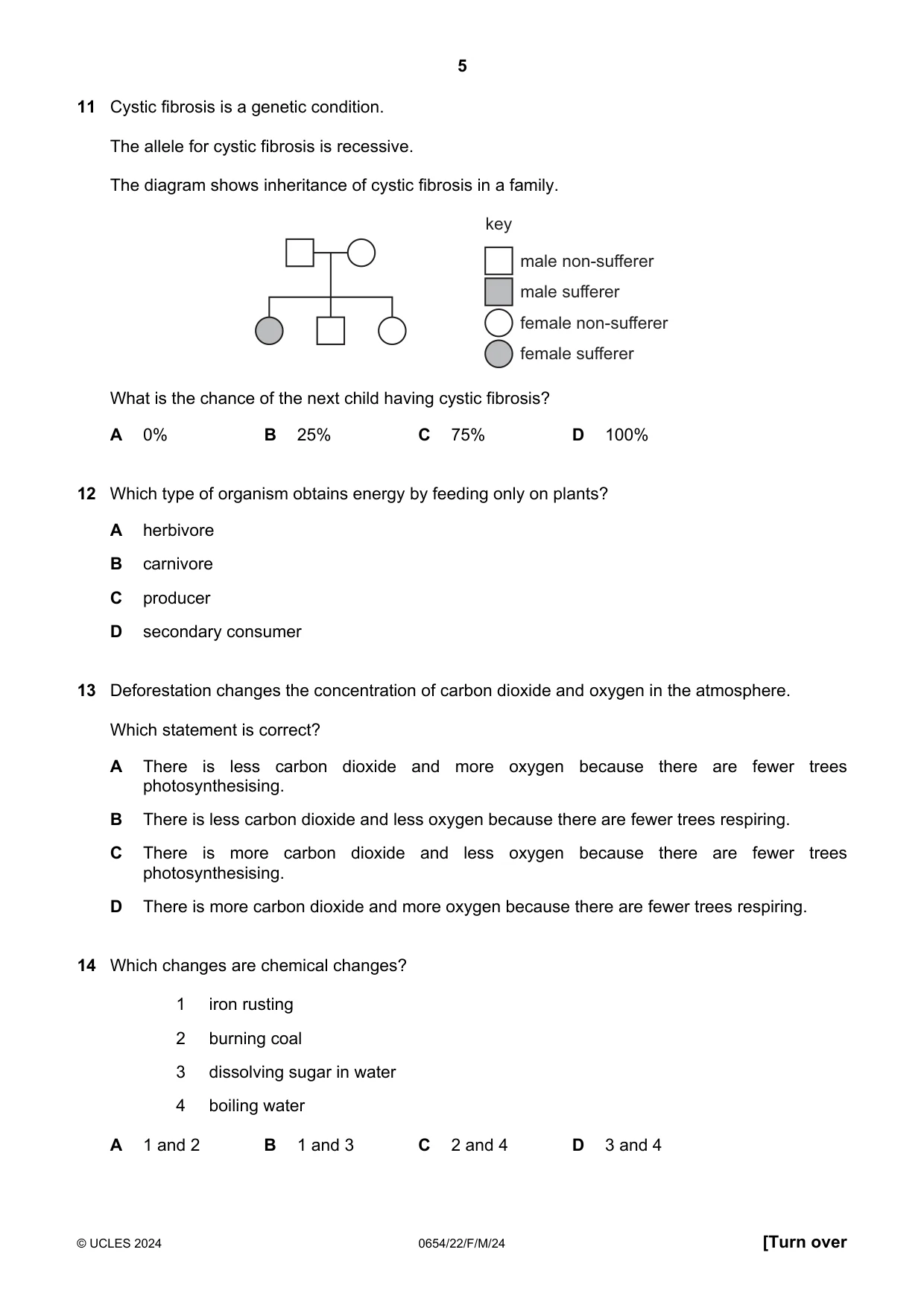
11 Cystic fibrosis is a genetic condition. The allele for cystic fibrosis is recessive. The diagram shows inheritance of cystic fibrosis in a family. key male non-sufferer male sufferer female non-sufferer female sufferer What is the chance of the next child having cystic fibrosis? A 0% B 25% C 75% D 100%
Mark scheme: B
Q12 · Which type of organism obtains energy by feeding only on plants?
12 Which type of organism obtains energy by feeding only on plants? A herbivore B carnivore C producer D secondary consumer
Mark scheme: A
Q13 · Deforestation changes the concentration of carbon dioxide and oxygen in the atmosphere
13 Deforestation changes the concentration of carbon dioxide and oxygen in the atmosphere. Which statement is correct? A There is less carbon dioxide and more oxygen because there are fewer trees photosynthesising. B There is less carbon dioxide and less oxygen because there are fewer trees respiring. C There is more carbon dioxide and less oxygen because there are fewer trees photosynthesising. D There is more carbon dioxide and more oxygen because there are fewer trees respiring.
Mark scheme: C
Q14 · Which changes are chemical changes?
14 Which changes are chemical changes? 1 iron rusting 2 burning coal 3 dissolving sugar in water 4 boiling water A 1 and 2 B 1 and 3 C 2 and 4 D 3 and 4
Mark scheme: A
Q15 · Which row identifies the types of elements that form covalent compounds and a physical…
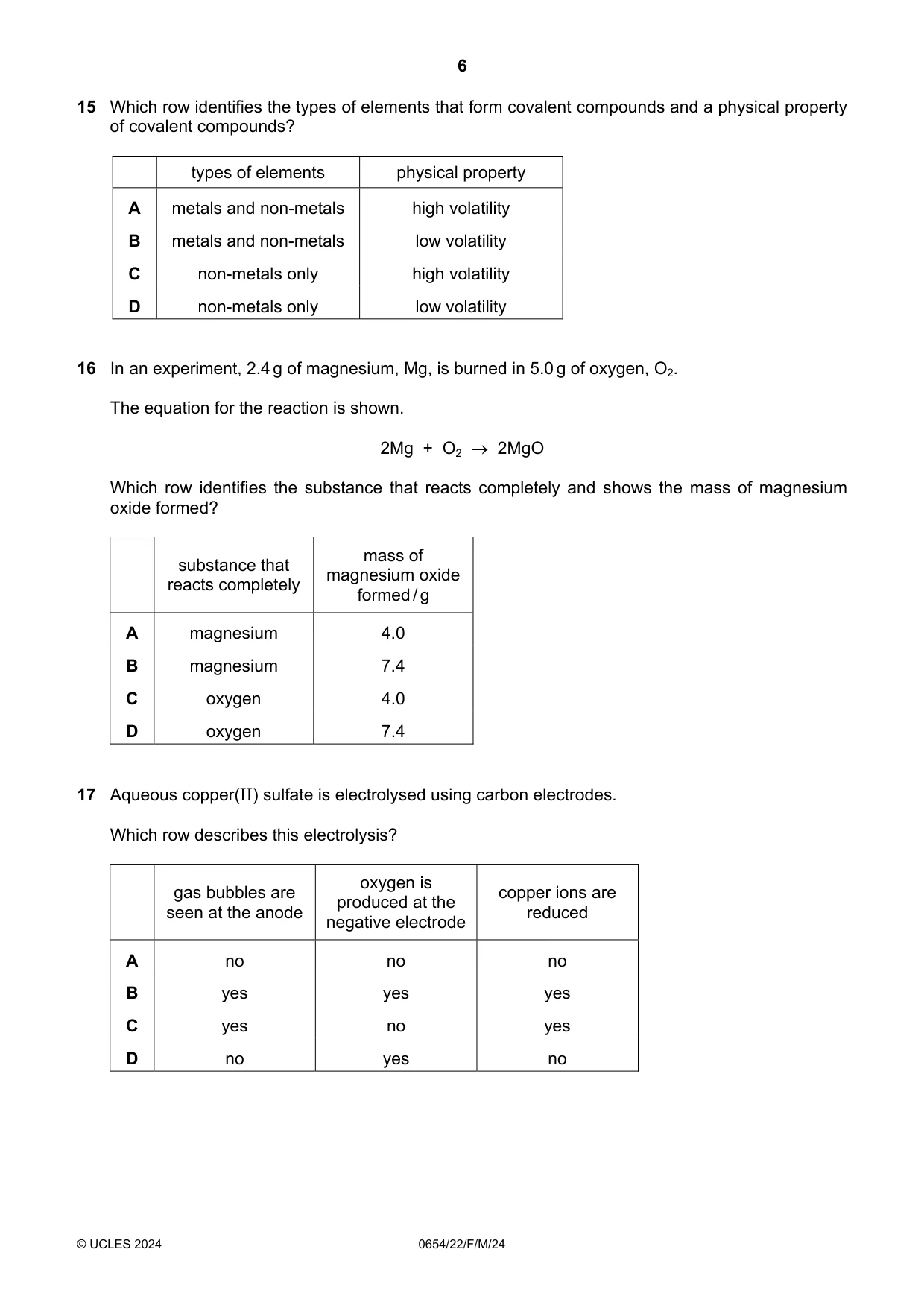
15 Which row identifies the types of elements that form covalent compounds and a physical property of covalent compounds? types of elements physical property A metals and non-metals high volatility B metals and non-metals low volatility C non-metals only high volatility D non-metals only low volatility
Mark scheme: C
Q16 · In an experiment, 2.4 g of magnesium, Mg, is burned in 5.0 g of oxygen, O2
16 In an experiment, 2.4 g of magnesium, Mg, is burned in 5.0 g of oxygen, O2. The equation for the reaction is shown. 2Mg + O2 2MgO Which row identifies the substance that reacts completely and shows the mass of magnesium oxide formed? mass of substance that magnesium oxide reacts completely formed / g A magnesium 4.0 B magnesium 7.4 C oxygen 4.0 D oxygen 7.4
Mark scheme: A
Q17 · Aqueous copper(II) sulfate is electrolysed using carbon electrodes
17 Aqueous copper(II) sulfate is electrolysed using carbon electrodes. Which row describes this electrolysis? oxygen is gas bubbles are copper ions are produced at the seen at the anode reduced negative electrode A no no no B yes yes yes C yes no yes D no yes no
Mark scheme: C
Q18 · Ultraviolet light causes a chlorine molecule to break down to form two chlorine atoms
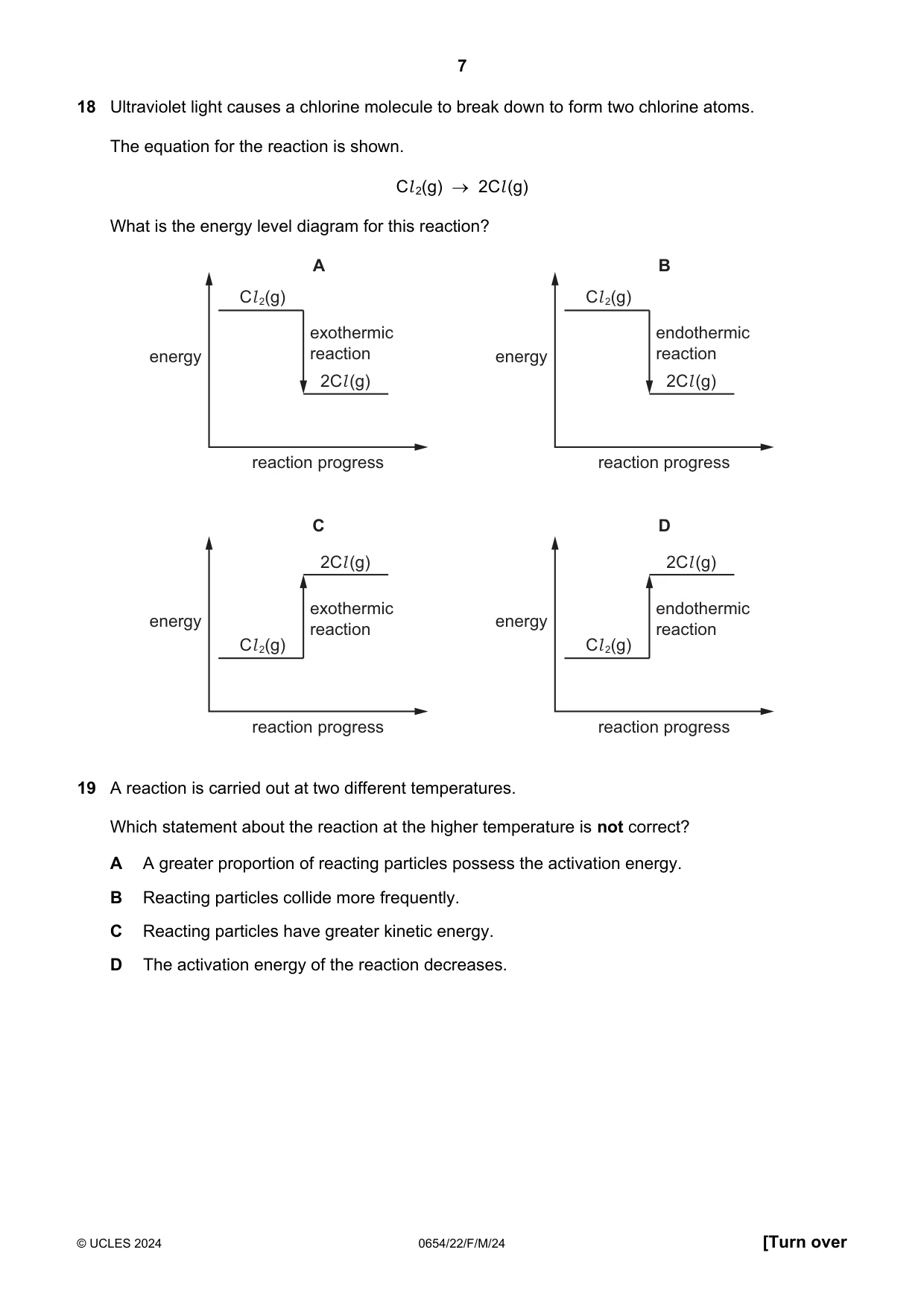
18 Ultraviolet light causes a chlorine molecule to break down to form two chlorine atoms. The equation for the reaction is shown. Cl 2(g) 2Cl (g) What is the energy level diagram for this reaction? A B Cl 2(g) Cl 2(g) exothermic endothermic energy reaction energy reaction 2Cl (g) 2Cl (g) reaction progress reaction progress C D 2Cl (g) 2Cl (g) exothermic endothermic energy energy reaction reaction Cl 2(g) Cl 2(g) reaction progress reaction progress
Mark scheme: D
Q19 · A reaction is carried out at two different temperatures
19 A reaction is carried out at two different temperatures. Which statement about the reaction at the higher temperature is not correct? A A greater proportion of reacting particles possess the activation energy. B Reacting particles collide more frequently. C Reacting particles have greater kinetic energy. D The activation energy of the reaction decreases.
Mark scheme: D
Q20 · The equation for the reaction between sodium bromide and concentrated sulfuric acid is…
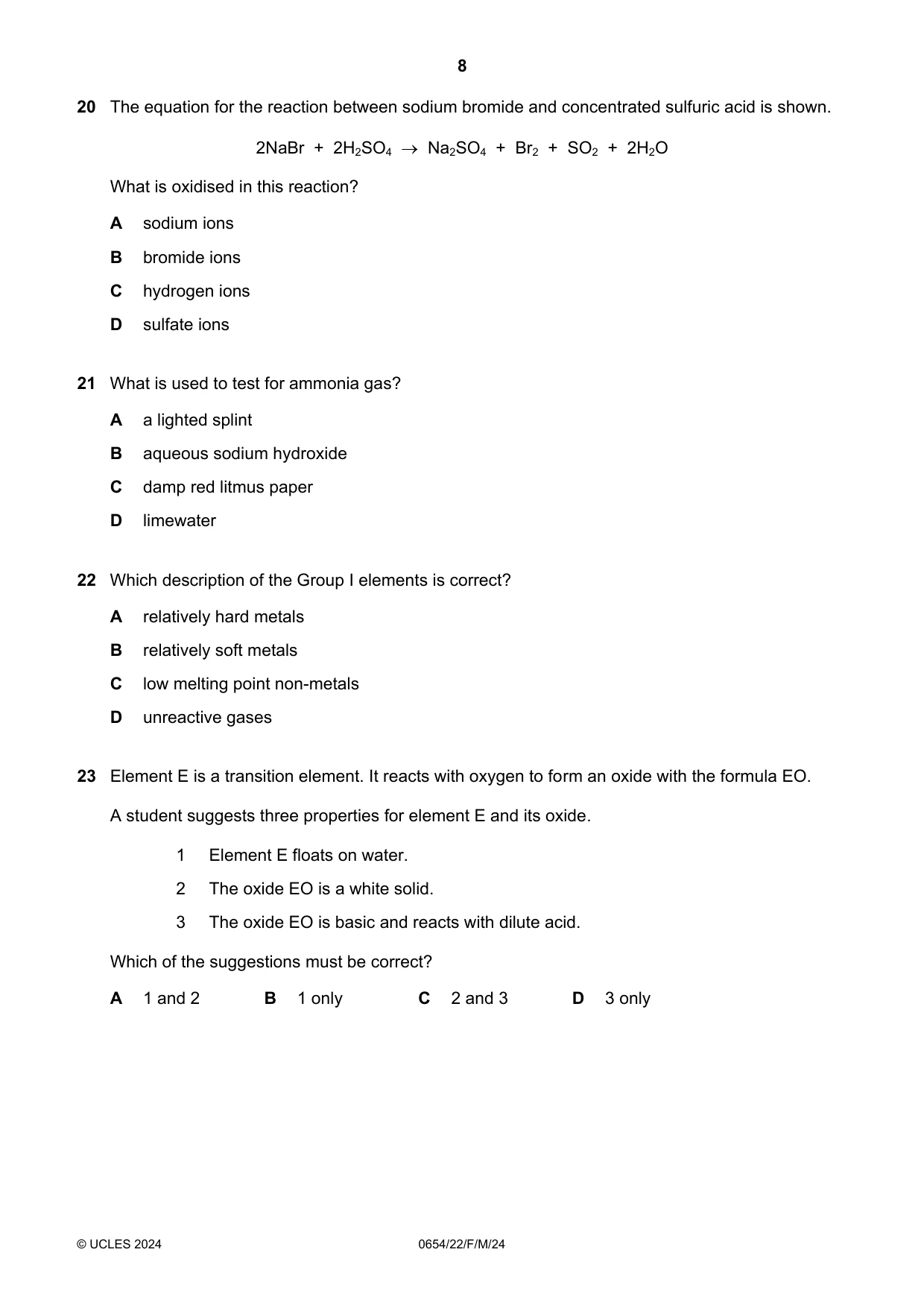
20 The equation for the reaction between sodium bromide and concentrated sulfuric acid is shown. 2NaBr + 2H2SO4 Na2SO4 + Br2 + SO2 + 2H2O What is oxidised in this reaction? A sodium ions B bromide ions C hydrogen ions D sulfate ions
Mark scheme: B
Q21 · What is used to test for ammonia gas?
21 What is used to test for ammonia gas? A a lighted splint B aqueous sodium hydroxide C damp red litmus paper D limewater
Mark scheme: C
Q22 · Which description of the Group I elements is correct?
22 Which description of the Group I elements is correct? A relatively hard metals B relatively soft metals C low melting point non-metals D unreactive gases
Mark scheme: B
Q23 · Element E is a transition element
23 Element E is a transition element. It reacts with oxygen to form an oxide with the formula EO. A student suggests three properties for element E and its oxide. 1 Element E floats on water. 2 The oxide EO is a white solid. 3 The oxide EO is basic and reacts with dilute acid. Which of the suggestions must be correct? A 1 and 2 B 1 only C 2 and 3 D 3 only
Mark scheme: D
Q24 · Elements Q, T, X and Z are metals
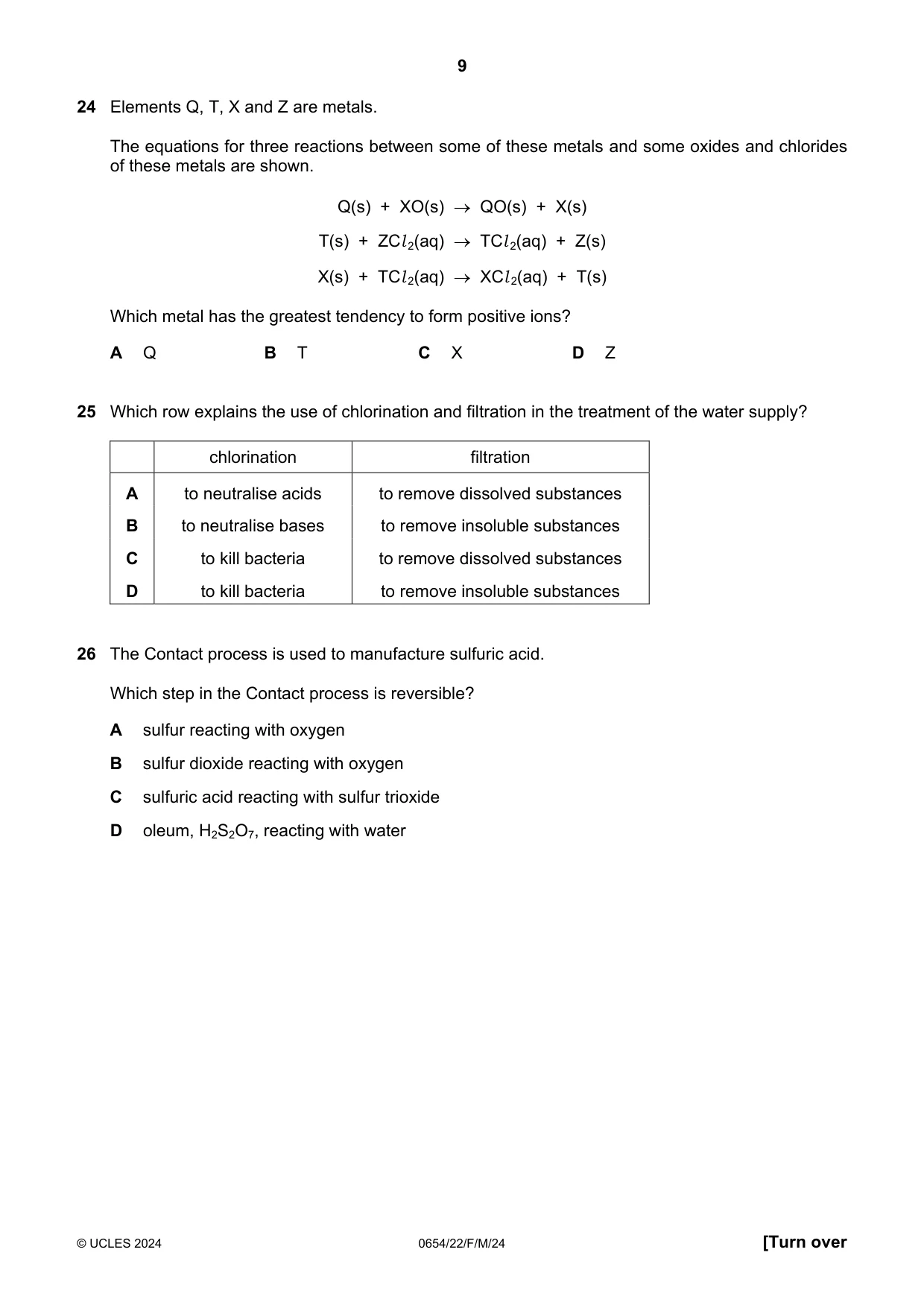
24 Elements Q, T, X and Z are metals. The equations for three reactions between some of these metals and some oxides and chlorides of these metals are shown. Q(s) + XO(s) QO(s) + X(s) T(s) + ZCl 2(aq) TCl 2(aq) + Z(s) X(s) + TCl 2(aq) XCl 2(aq) + T(s) Which metal has the greatest tendency to form positive ions? A Q B T C X D Z
Mark scheme: A
Q25 · Which row explains the use of chlorination and filtration in the treatment of the water…
25 Which row explains the use of chlorination and filtration in the treatment of the water supply? chlorination filtration A to neutralise acids to remove dissolved substances B to neutralise bases to remove insoluble substances C to kill bacteria to remove dissolved substances D to kill bacteria to remove insoluble substances
Mark scheme: D
Q26 · The Contact process is used to manufacture sulfuric acid
26 The Contact process is used to manufacture sulfuric acid. Which step in the Contact process is reversible? A sulfur reacting with oxygen B sulfur dioxide reacting with oxygen C sulfuric acid reacting with sulfur trioxide D oleum, H2S2O7, reacting with water
Mark scheme: B
Q27 · Which compound name matches the structure shown?
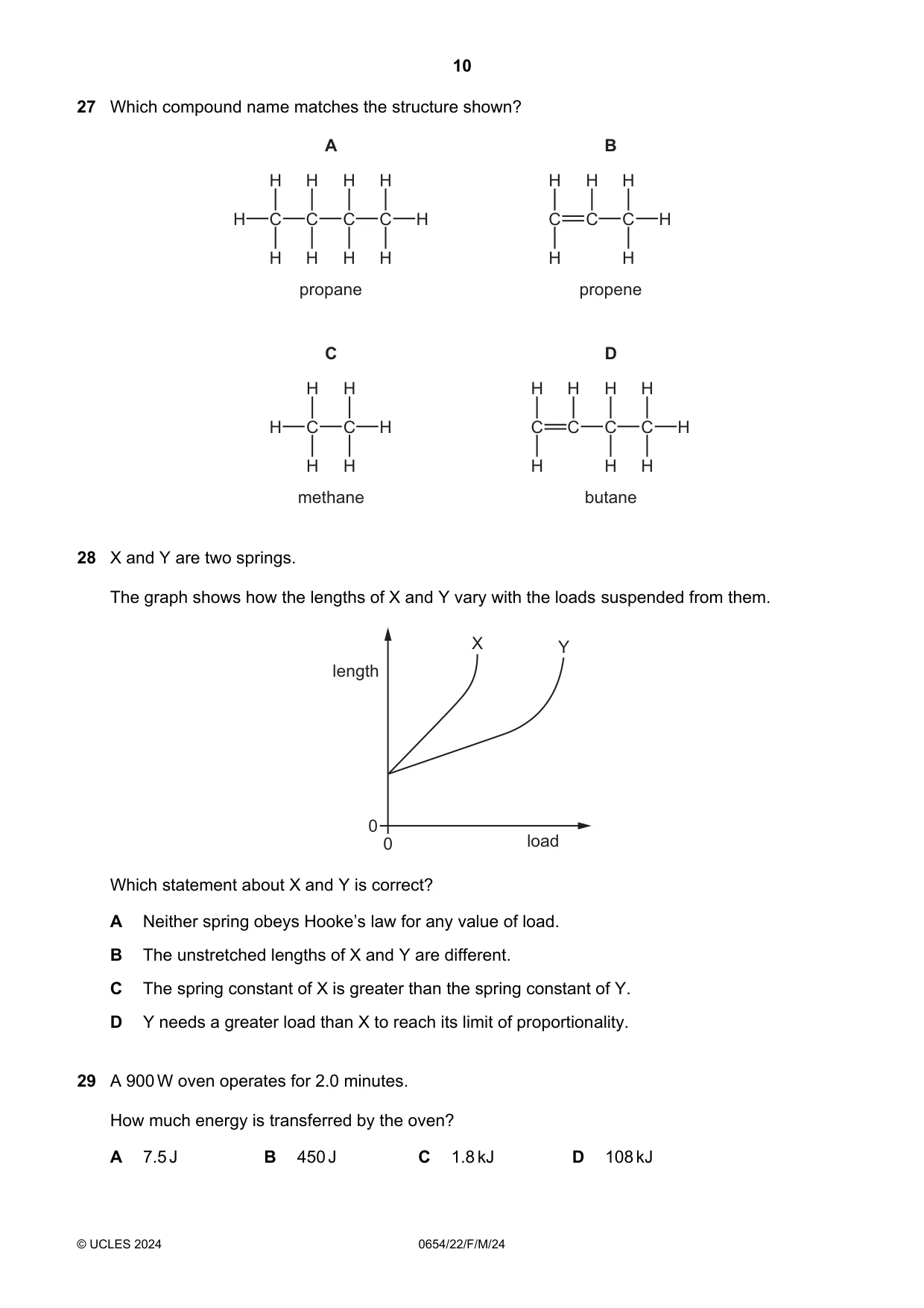
27 Which compound name matches the structure shown? A B H H H H H H H H C C C C H C C C H H H H H H H propane propene C D H H H H H H H C C H C C C C H H H H H H methane butane
Mark scheme: B
Q28 · X and Y are two springs
28 X and Y are two springs. The graph shows how the lengths of X and Y vary with the loads suspended from them. X Y length 0 0 load Which statement about X and Y is correct? A Neither spring obeys Hooke’s law for any value of load. B The unstretched lengths of X and Y are different. C The spring constant of X is greater than the spring constant of Y. D Y needs a greater load than X to reach its limit of proportionality.
Mark scheme: D
Q29 · A 900 W oven operates for 2.0 minutes
29 A 900 W oven operates for 2.0 minutes. How much energy is transferred by the oven? A 7.5 J B 450 J C 1.8 kJ D 108 kJ
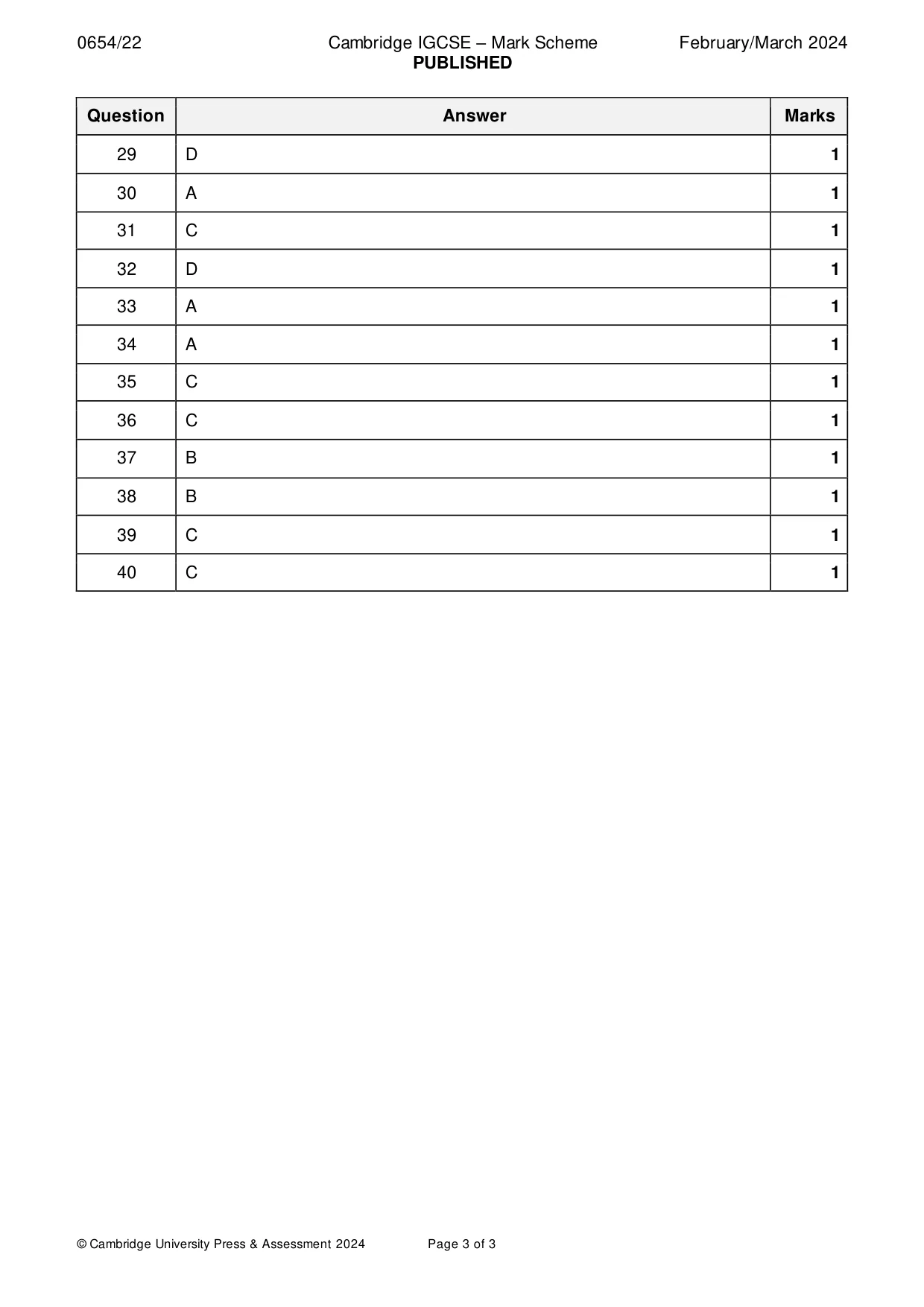
Mark scheme: D
Q30 · Which list of energy sources contains only non-renewable sources?
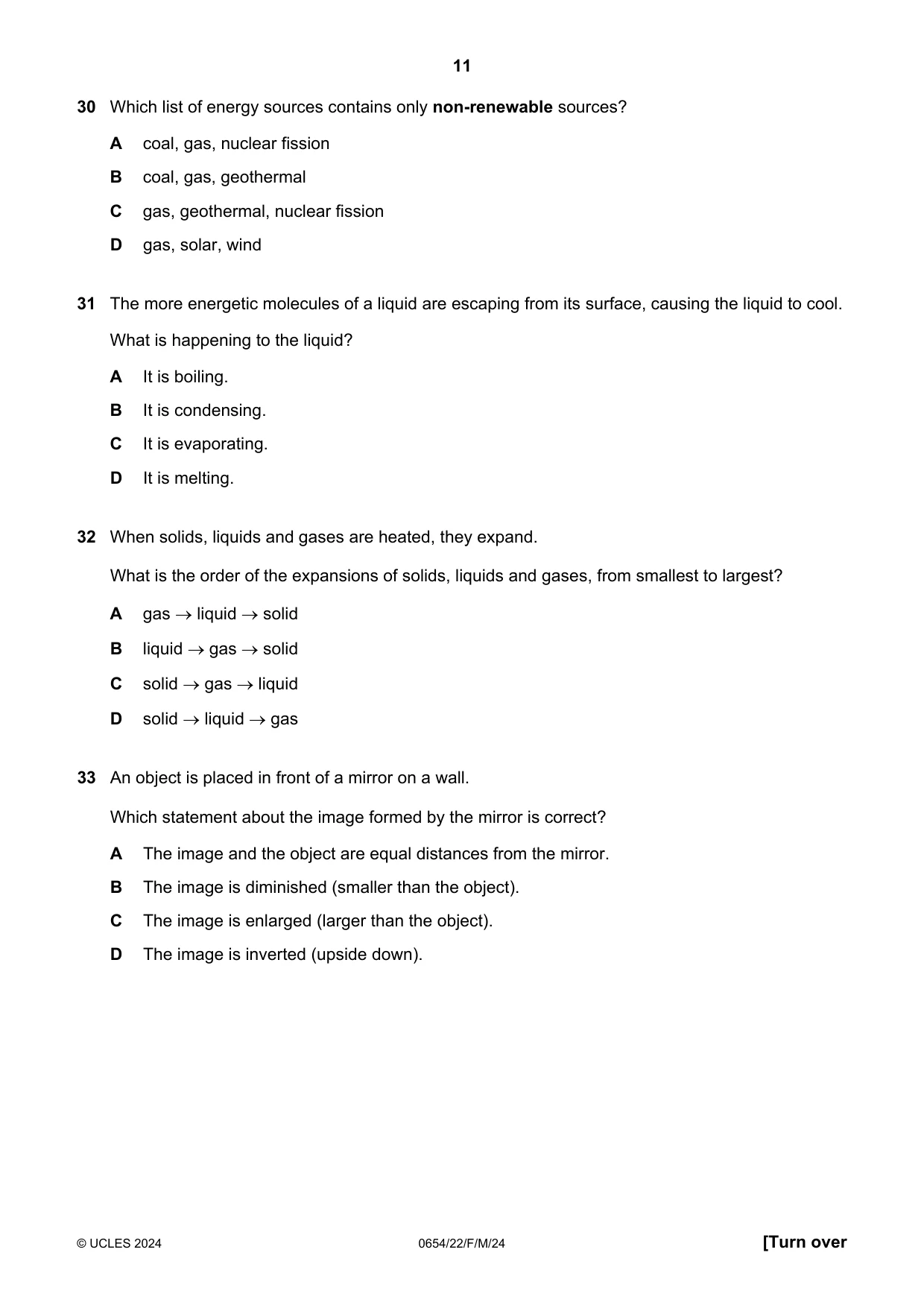
30 Which list of energy sources contains only non-renewable sources? A coal, gas, nuclear fission B coal, gas, geothermal C gas, geothermal, nuclear fission D gas, solar, wind
Mark scheme: A
Q31 · The more energetic molecules of a liquid are escaping from its surface, causing the…
31 The more energetic molecules of a liquid are escaping from its surface, causing the liquid to cool. What is happening to the liquid? A It is boiling. B It is condensing. C It is evaporating. D It is melting.
Mark scheme: C
Q32 · When solids, liquids and gases are heated, they expand
32 When solids, liquids and gases are heated, they expand. What is the order of the expansions of solids, liquids and gases, from smallest to largest? A gas liquid solid B liquid gas solid C solid gas liquid D solid liquid gas
Mark scheme: D
Q33 · An object is placed in front of a mirror on a wall
33 An object is placed in front of a mirror on a wall. Which statement about the image formed by the mirror is correct? A The image and the object are equal distances from the mirror. B The image is diminished (smaller than the object). C The image is enlarged (larger than the object). D The image is inverted (upside down).
Mark scheme: A
Q34 · What is the definition of the refractive index n of a substance?
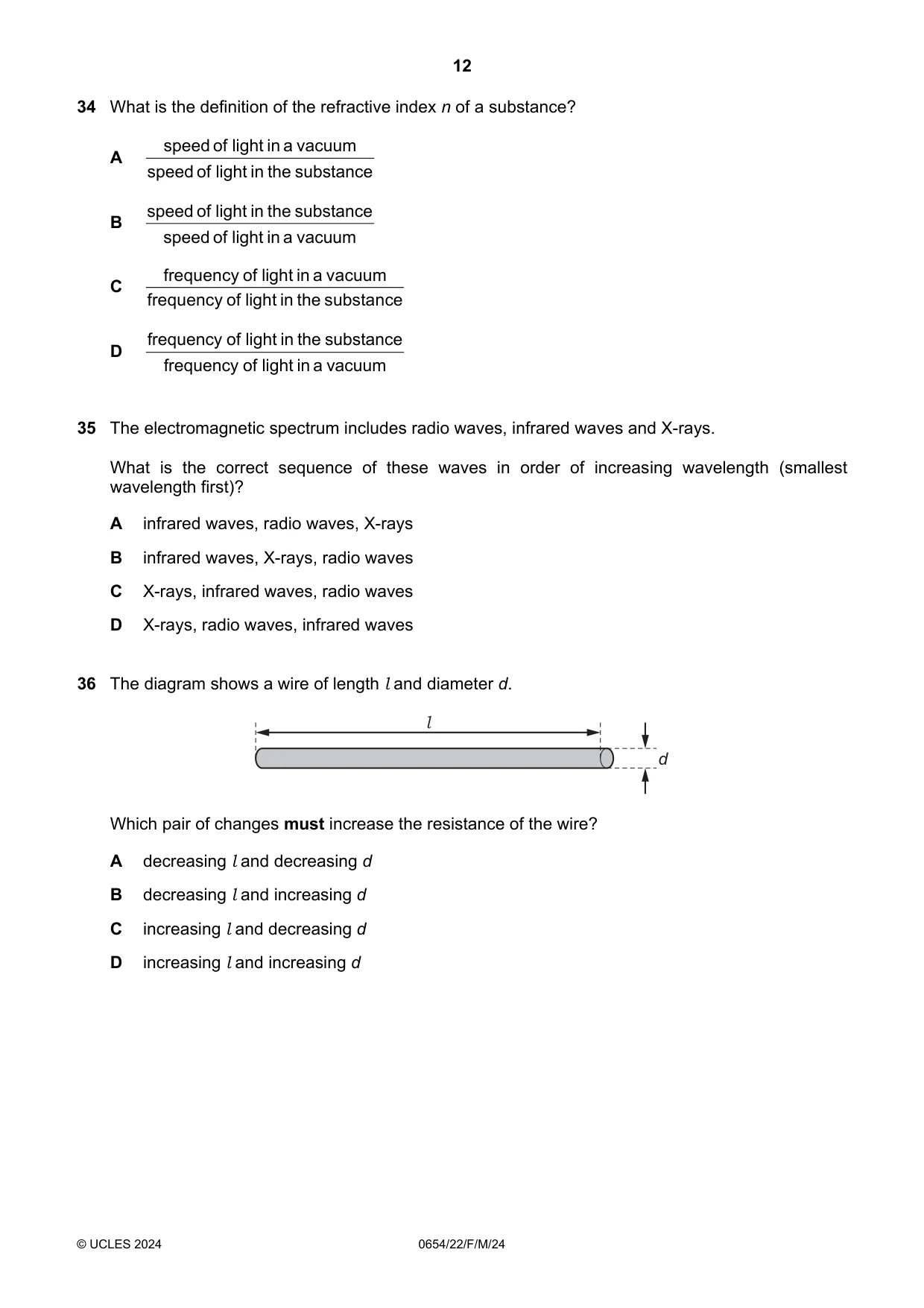
34 What is the definition of the refractive index n of a substance? speed of light in a vacuum A speed of light in the substance speed of light in the substance B speed of light in a vacuum frequency of light in a vacuum C frequency of light in the substance frequency of light in the substance D frequency of light in a vacuum
Mark scheme: A
Q35 · The electromagnetic spectrum includes radio waves, infrared waves and X-rays
35 The electromagnetic spectrum includes radio waves, infrared waves and X-rays. What is the correct sequence of these waves in order of increasing wavelength (smallest wavelength first)? A infrared waves, radio waves, X-rays B infrared waves, X-rays, radio waves C X-rays, infrared waves, radio waves D X-rays, radio waves, infrared waves
Mark scheme: C
Q36 · The diagram shows a wire of length l and diameter d
36 The diagram shows a wire of length l and diameter d. l d Which pair of changes must increase the resistance of the wire? A decreasing l and decreasing d B decreasing l and increasing d C increasing l and decreasing d D increasing l and increasing d
Mark scheme: C
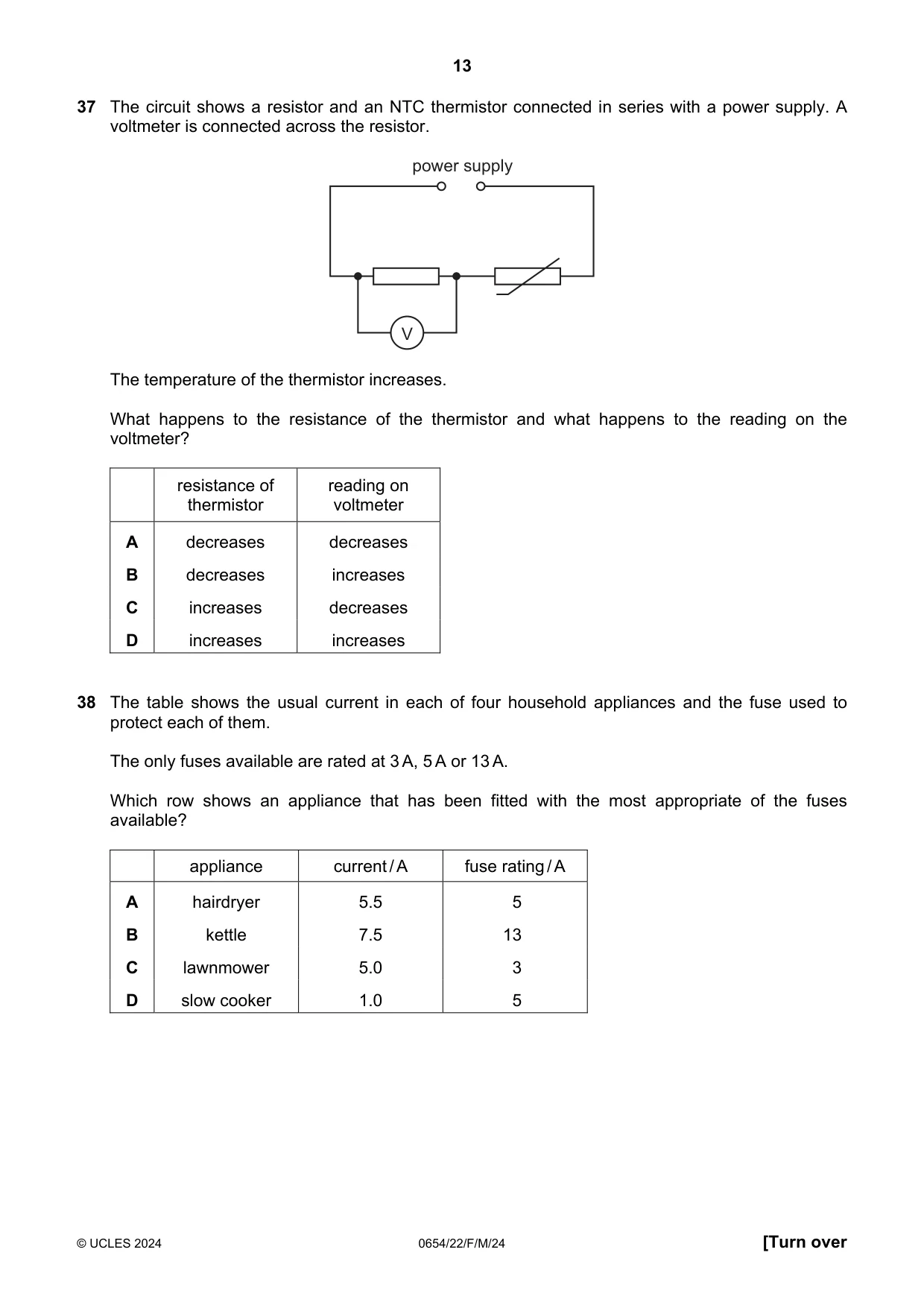
Q37 · The circuit shows a resistor and an NTC thermistor connected in series with a power supply
37 The circuit shows a resistor and an NTC thermistor connected in series with a power supply. A voltmeter is connected across the resistor. power supply V The temperature of the thermistor increases. What happens to the resistance of the thermistor and what happens to the reading on the voltmeter? resistance of reading on thermistor voltmeter A decreases decreases B decreases increases C increases decreases D increases increases
Mark scheme: B
Q38 · The table shows the usual current in each of four household appliances and the fuse used…
38 The table shows the usual current in each of four household appliances and the fuse used to protect each of them. The only fuses available are rated at 3 A, 5 A or 13 A. Which row shows an appliance that has been fitted with the most appropriate of the fuses available? appliance current / A fuse rating / A A hairdryer 5.5 5 B kettle 7.5 13 C lawnmower 5.0 3 D slow cooker 1.0 5
Mark scheme: B
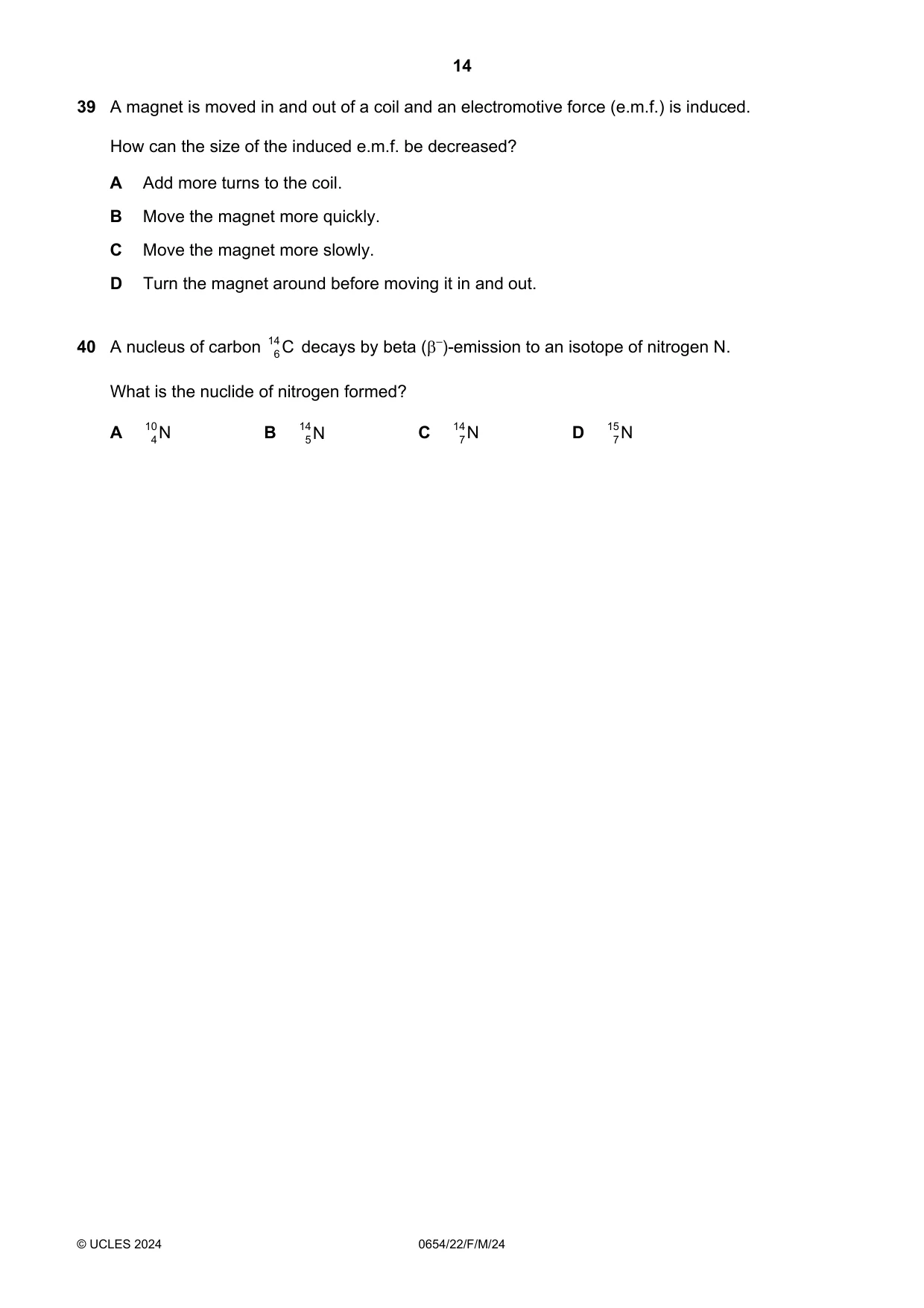
Q39 · A magnet is moved in and out of a coil and an electromotive force (e.m.f.) is induced
39 A magnet is moved in and out of a coil and an electromotive force (e.m.f.) is induced. How can the size of the induced e.m.f. be decreased? A Add more turns to the coil. B Move the magnet more quickly. C Move the magnet more slowly. D Turn the magnet around before moving it in and out.
Mark scheme: C
Q40 · A nucleus of carbon 14 C decays by beta (–)-emission to an isotope of nitrogen N
40 A nucleus of carbon 14 C decays by beta (–)-emission to an isotope of nitrogen N. 6 What is the nuclide of nitrogen formed? A 10 N B 14 N C 14 N D 15 N 4 5 7 7
Mark scheme: C
What was in this paper
The subtopics covered by these 40 questions, and how many questions each got. Open one in a new tab to see every Cambridge question on it.
2Energy, work and power2Kinetic particle model of matter2Light2Rate of reaction2Biological molecules1Carbon cycle1Characteristics of living organisms1Coordination and response1Diffusion1Electrical circuits1Electrical quantities1Electrical safety1Electrolysis1Electromagnetic effects1Electromagnetic spectrum1Enzymes1Exothermic and endothermic reactions1Food chains and food webs1Forces1Group I properties1Identification of ions and gases1Monohybrid inheritance1Naming organic compounds1Physical and chemical changes1Radioactivity1Reactivity series1Redox1Respiration1Sexual reproduction in humans1Simple molecules and covalent bonds1The mole and the Avogadro constant1Transition elements1Transpiration1Water1What you needed in this session
Cambridge’s own grade thresholds for 2024 Feb/March, Paper 2 · Variant 2. A higher threshold means an easier paper — the bar moves with how the cohort did.