Cambridge IGCSE Sciences - Co-ordinated (Double) 0654 — 2020 May/June Paper 2 · Variant 1
0654/21/M/J/20 · 40 questions · 40 marks · ≈45 min
The question paper and its mark scheme, free to read here and free to download. This is Cambridge’s own paper, exactly as it was sat.
Question paper16 pages

Mark scheme3 pages
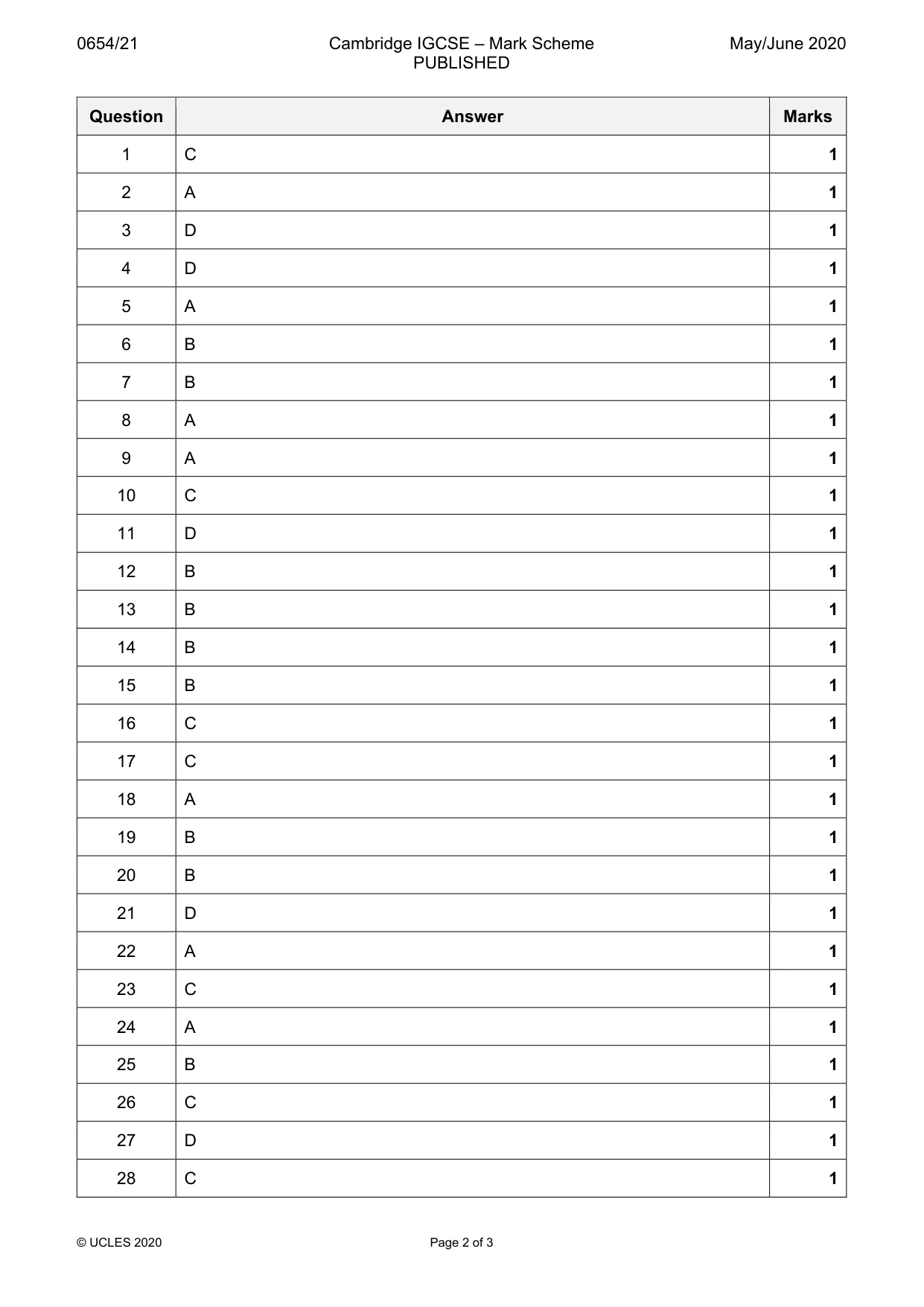
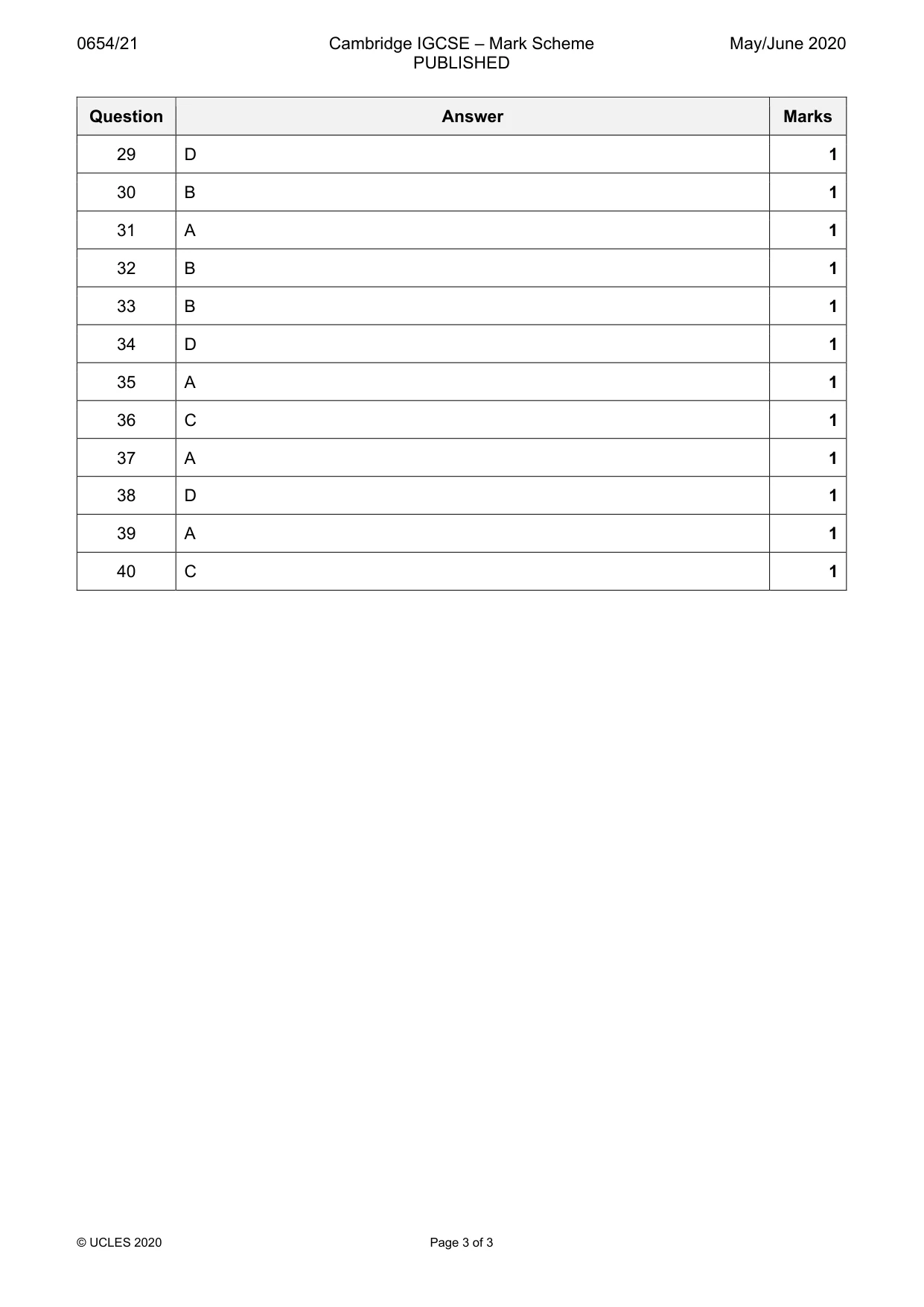
Answers below. Sit the paper first if you are practising.
Questions as text
Q1 · Which characteristic of living organisms is defined as the chemical reactions that break…
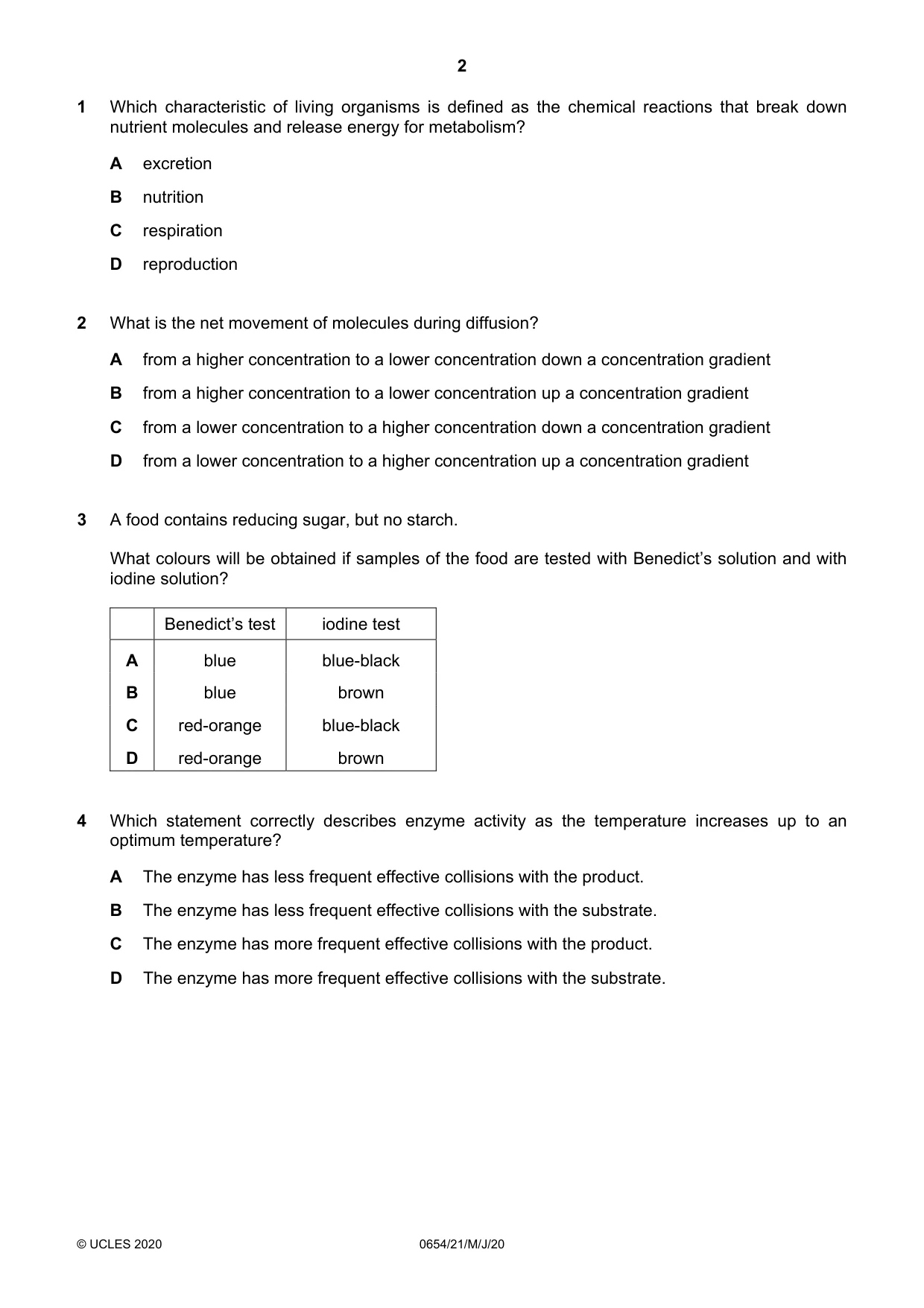
1 Which characteristic of living organisms is defined as the chemical reactions that break down nutrient molecules and release energy for metabolism? A excretion B nutrition C respiration D reproduction
Mark scheme: C
Q2 · What is the net movement of molecules during diffusion?
2 What is the net movement of molecules during diffusion? A from a higher concentration to a lower concentration down a concentration gradient B from a higher concentration to a lower concentration up a concentration gradient C from a lower concentration to a higher concentration down a concentration gradient D from a lower concentration to a higher concentration up a concentration gradient
Mark scheme: A
Q3 · A food contains reducing sugar, but no starch
3 A food contains reducing sugar, but no starch. What colours will be obtained if samples of the food are tested with Benedict’s solution and with iodine solution? Benedict’s test iodine test A blue blue-black B blue brown C red-orange blue-black D red-orange brown
Mark scheme: D
Q4 · Which statement correctly describes enzyme activity as the temperature increases up to an…
4 Which statement correctly describes enzyme activity as the temperature increases up to an optimum temperature? A The enzyme has less frequent effective collisions with the product. B The enzyme has less frequent effective collisions with the substrate. C The enzyme has more frequent effective collisions with the product. D The enzyme has more frequent effective collisions with the substrate.
Mark scheme: D
Q5 · A plant which is deficient in nitrates and magnesium has yellow leaves and poor growth
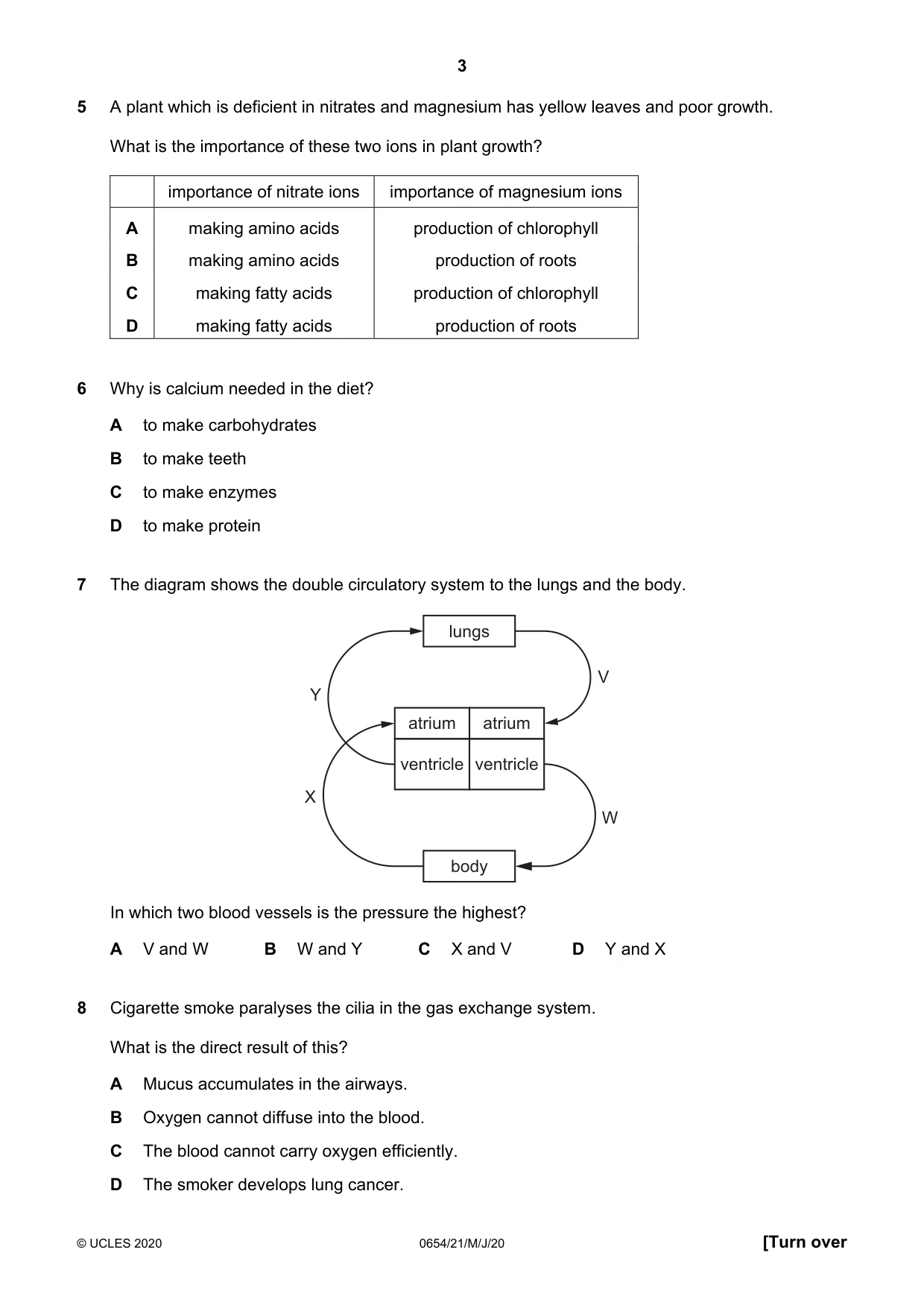
5 A plant which is deficient in nitrates and magnesium has yellow leaves and poor growth. What is the importance of these two ions in plant growth? importance of nitrate ions importance of magnesium ions A making amino acids production of chlorophyll B making amino acids production of roots C making fatty acids production of chlorophyll D making fatty acids production of roots
Mark scheme: A
Q6 · Why is calcium needed in the diet?
6 Why is calcium needed in the diet? A to make carbohydrates B to make teeth C to make enzymes D to make protein
Mark scheme: B
Q7 · The diagram shows the double circulatory system to the lungs and the body
7 The diagram shows the double circulatory system to the lungs and the body. lungs V Y atrium atrium ventricle ventricle X W body In which two blood vessels is the pressure the highest? A V and W B W and Y C X and V D Y and X
Mark scheme: B
Q8 · Cigarette smoke paralyses the cilia in the gas exchange system
8 Cigarette smoke paralyses the cilia in the gas exchange system. What is the direct result of this? A Mucus accumulates in the airways. B Oxygen cannot diffuse into the blood. C The blood cannot carry oxygen efficiently. D The smoker develops lung cancer.
Mark scheme: A
Q9 · What happens when the body temperature falls below normal?
9 What happens when the body temperature falls below normal? A Arterioles supplying the skin constrict. B Arterioles supplying the skin dilate. C Capillaries move towards the skin surface. D Capillaries move away from the skin surface.
Mark scheme: A
Q10 · An experiment using germinating seeds is set up as shown, and left at room temperature…
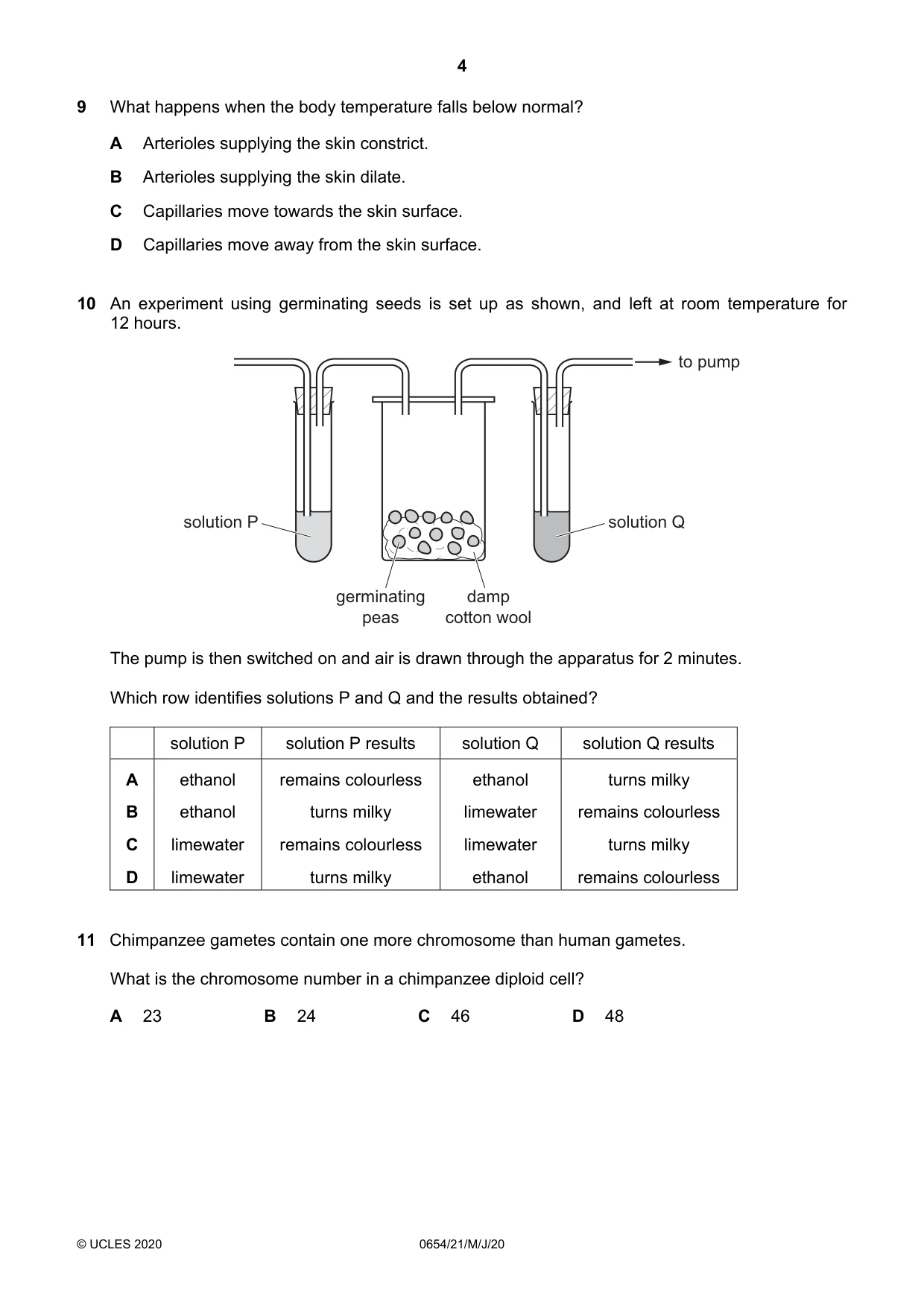
10 An experiment using germinating seeds is set up as shown, and left at room temperature for 12 hours. to pump solution P solution Q germinating damp peas cotton wool The pump is then switched on and air is drawn through the apparatus for 2 minutes. Which row identifies solutions P and Q and the results obtained? solution P solution P results solution Q solution Q results A ethanol remains colourless ethanol turns milky B ethanol turns milky limewater remains colourless C limewater remains colourless limewater turns milky D limewater turns milky ethanol remains colourless
Mark scheme: C
Q11 · Chimpanzee gametes contain one more chromosome than human gametes
11 Chimpanzee gametes contain one more chromosome than human gametes. What is the chromosome number in a chimpanzee diploid cell? A 23 B 24 C 46 D 48
Mark scheme: D
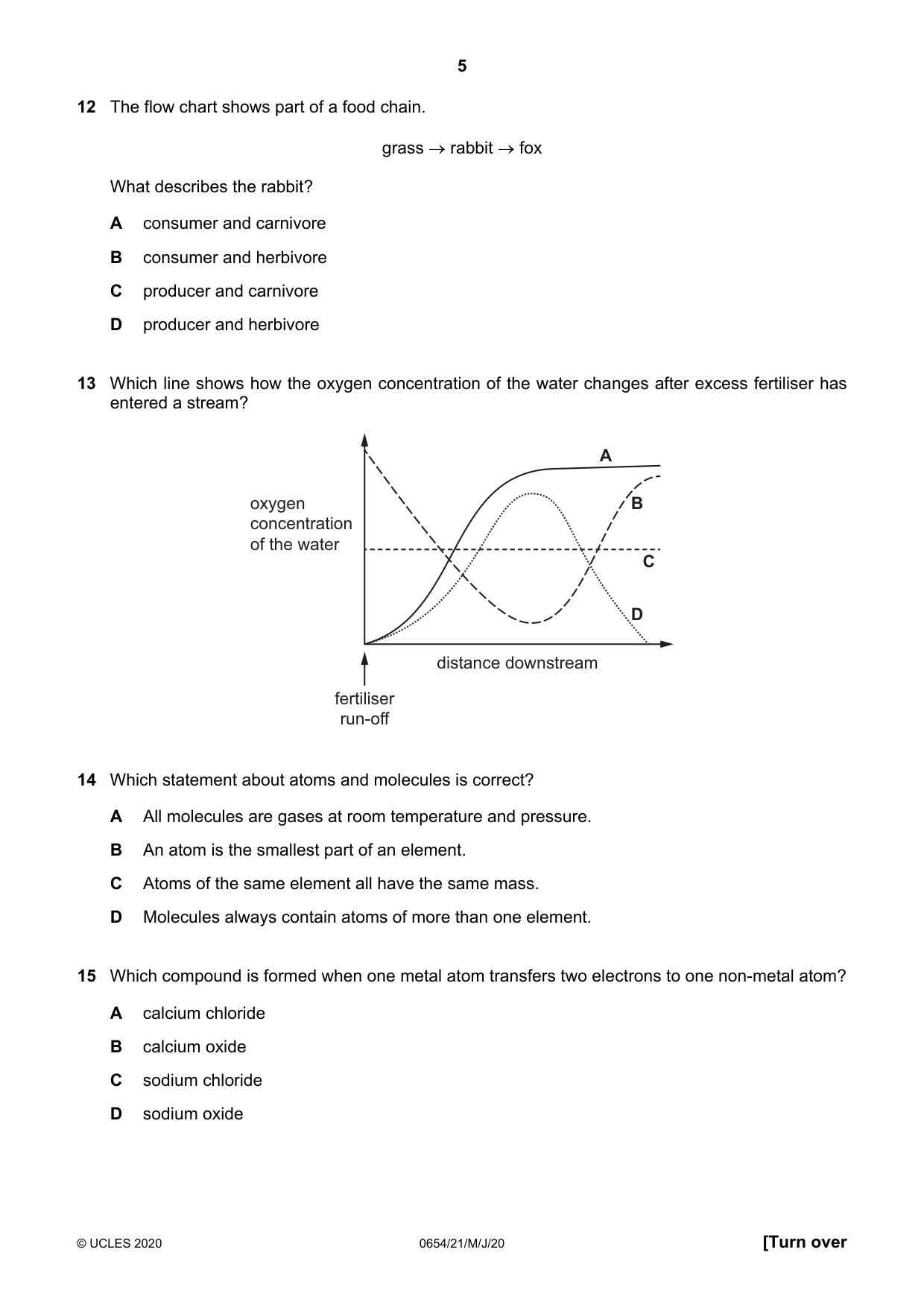
Q12 · The flow chart shows part of a food chain
12 The flow chart shows part of a food chain. grass rabbit fox What describes the rabbit? A consumer and carnivore B consumer and herbivore C producer and carnivore D producer and herbivore
Mark scheme: B
Q13 · Which line shows how the oxygen concentration of the water changes after excess…
13 Which line shows how the oxygen concentration of the water changes after excess fertiliser has entered a stream? A oxygen B concentration of the water C D distance downstream fertiliser run-off
Mark scheme: B
Q14 · Which statement about atoms and molecules is correct?
14 Which statement about atoms and molecules is correct? A All molecules are gases at room temperature and pressure. B An atom is the smallest part of an element. C Atoms of the same element all have the same mass. D Molecules always contain atoms of more than one element.
Mark scheme: B
Q15 · Which compound is formed when one metal atom transfers two electrons to one non-metal…
15 Which compound is formed when one metal atom transfers two electrons to one non-metal atom? A calcium chloride B calcium oxide C sodium chloride D sodium oxide
Mark scheme: B
Q16 · What is the volume of 0.35 mol of hydrogen gas at room temperature and pressure?
16 What is the volume of 0.35 mol of hydrogen gas at room temperature and pressure? A 2.1 dm3 B 4.2 dm3 C 8.4 dm3 D 16.8 dm3
Mark scheme: C
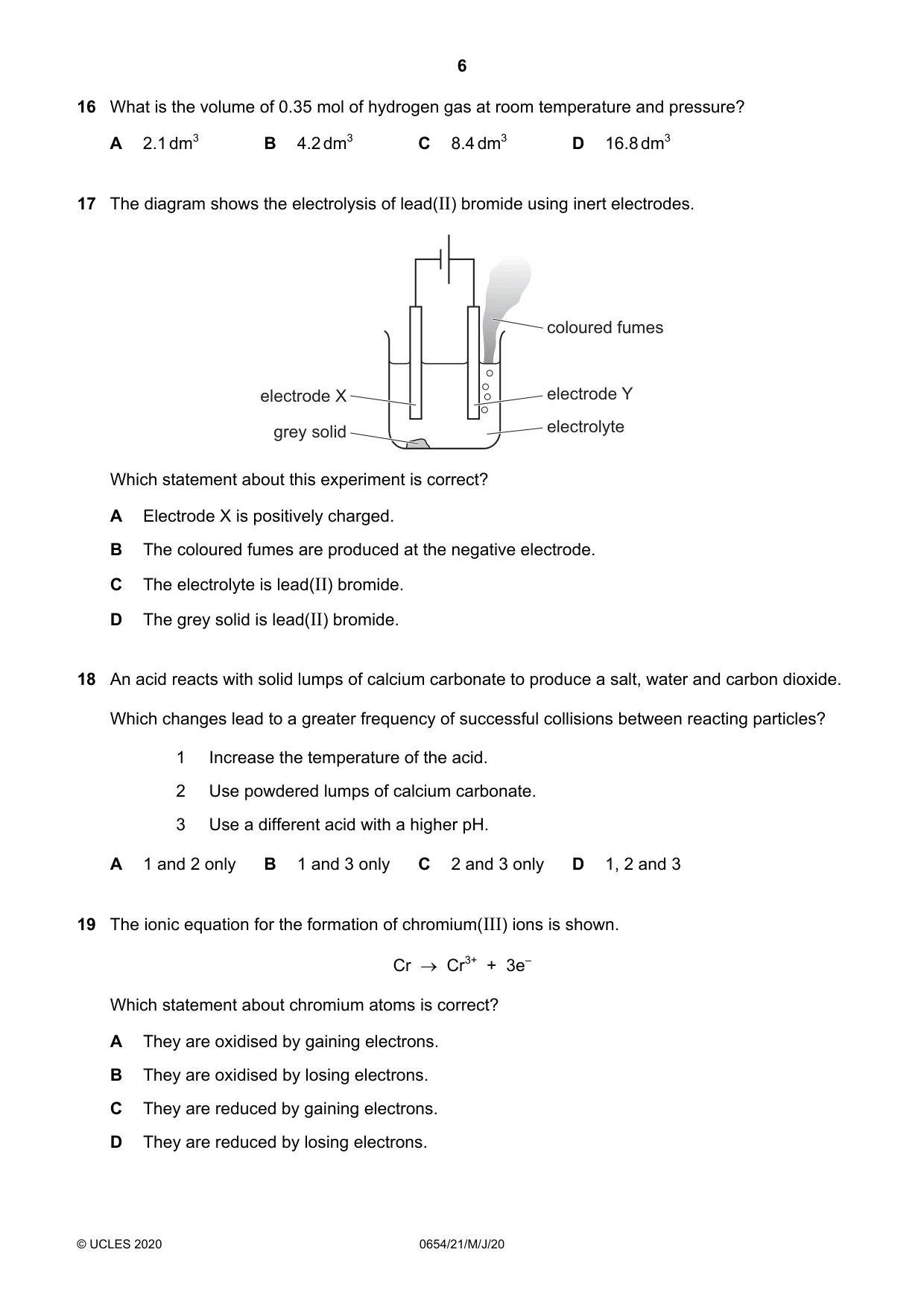
Q17 · The diagram shows the electrolysis of lead(II) bromide using inert electrodes
17 The diagram shows the electrolysis of lead(II) bromide using inert electrodes. coloured fumes electrode X electrode Y grey solid electrolyte Which statement about this experiment is correct? A Electrode X is positively charged. B The coloured fumes are produced at the negative electrode. C The electrolyte is lead(II) bromide. D The grey solid is lead(II) bromide.
Mark scheme: C
Q18 · An acid reacts with solid lumps of calcium carbonate to produce a salt, water and carbon…
18 An acid reacts with solid lumps of calcium carbonate to produce a salt, water and carbon dioxide. Which changes lead to a greater frequency of successful collisions between reacting particles? 1 Increase the temperature of the acid. 2 Use powdered lumps of calcium carbonate. 3 Use a different acid with a higher pH. A 1 and 2 only B 1 and 3 only C 2 and 3 only D 1, 2 and 3
Mark scheme: A
Q19 · The ionic equation for the formation of chromium(III) ions is shown
19 The ionic equation for the formation of chromium(III) ions is shown. Cr Cr3+ + 3e– Which statement about chromium atoms is correct? A They are oxidised by gaining electrons. B They are oxidised by losing electrons. C They are reduced by gaining electrons. D They are reduced by losing electrons.
Mark scheme: B
Q20 · X is an oxide
20 X is an oxide. When solid X is added to dilute hydrochloric acid, the pH of the solution increases. When solid X is added to aqueous sodium hydroxide, the pH of the solution decreases. Which type of oxide is X? A acidic B amphoteric C basic D neutral
Mark scheme: B
Q21 · Copper sulfate is made by adding an excess of copper carbonate to dilute sulfuric acid…
21 Copper sulfate is made by adding an excess of copper carbonate to dilute sulfuric acid and stirring. The excess solid is removed. Most of the water is then removed. The solution is left for solid copper sulfate to form. In which order is apparatus used? A Bunsen burner, tripod and flask filter funnel crystallising dish B Bunsen burner, tripod and flask crystallising dish filter funnel C filter funnel crystallising dish Bunsen burner, tripod and flask D filter funnel Bunsen burner, tripod and flask crystallising dish
Mark scheme: D
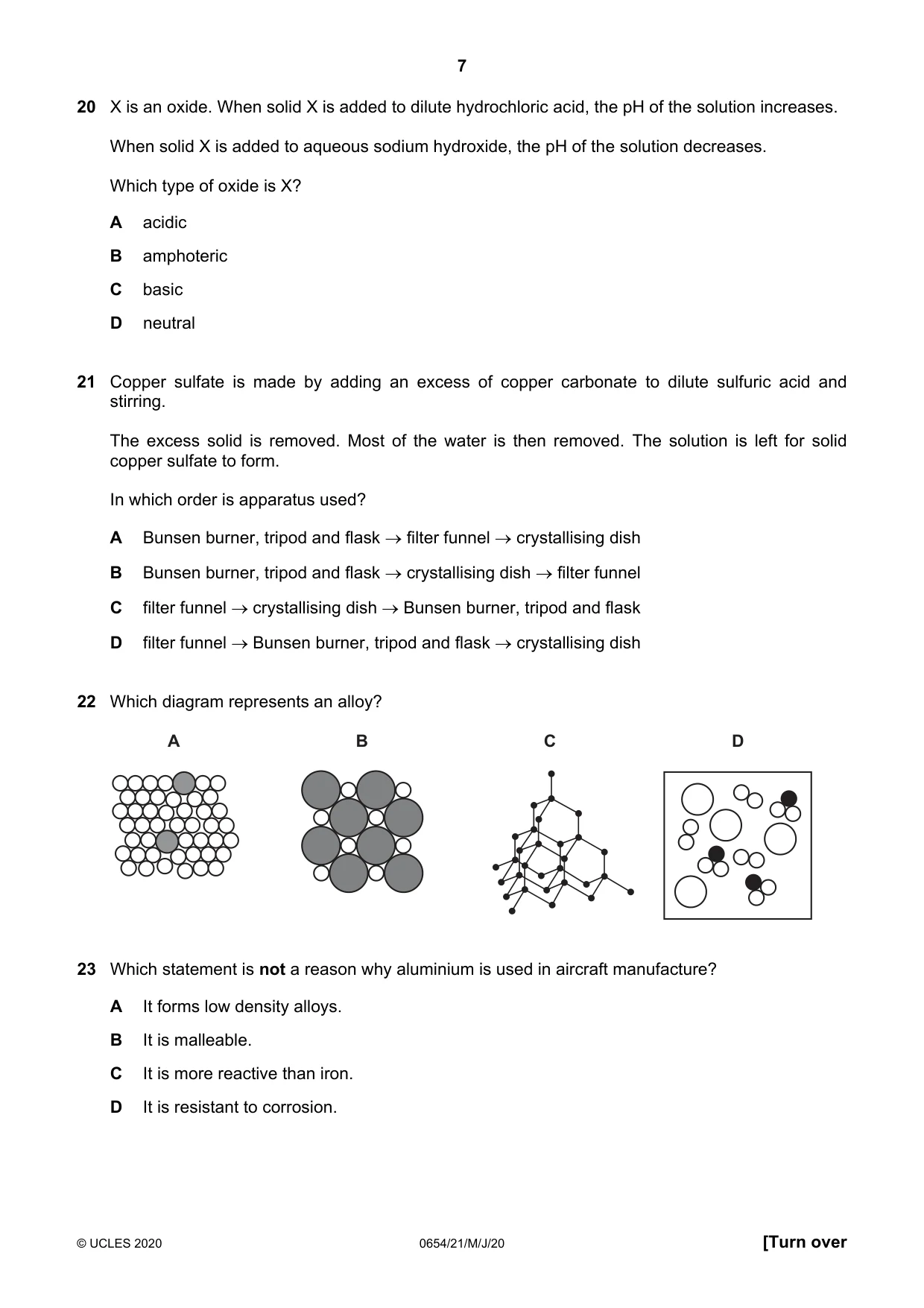
Q22 · Which diagram represents an alloy?
22 Which diagram represents an alloy? A B C D
Mark scheme: A
Q23 · Which statement is not a reason why aluminium is used in aircraft manufacture?
23 Which statement is not a reason why aluminium is used in aircraft manufacture? A It forms low density alloys. B It is malleable. C It is more reactive than iron. D It is resistant to corrosion.
Mark scheme: C
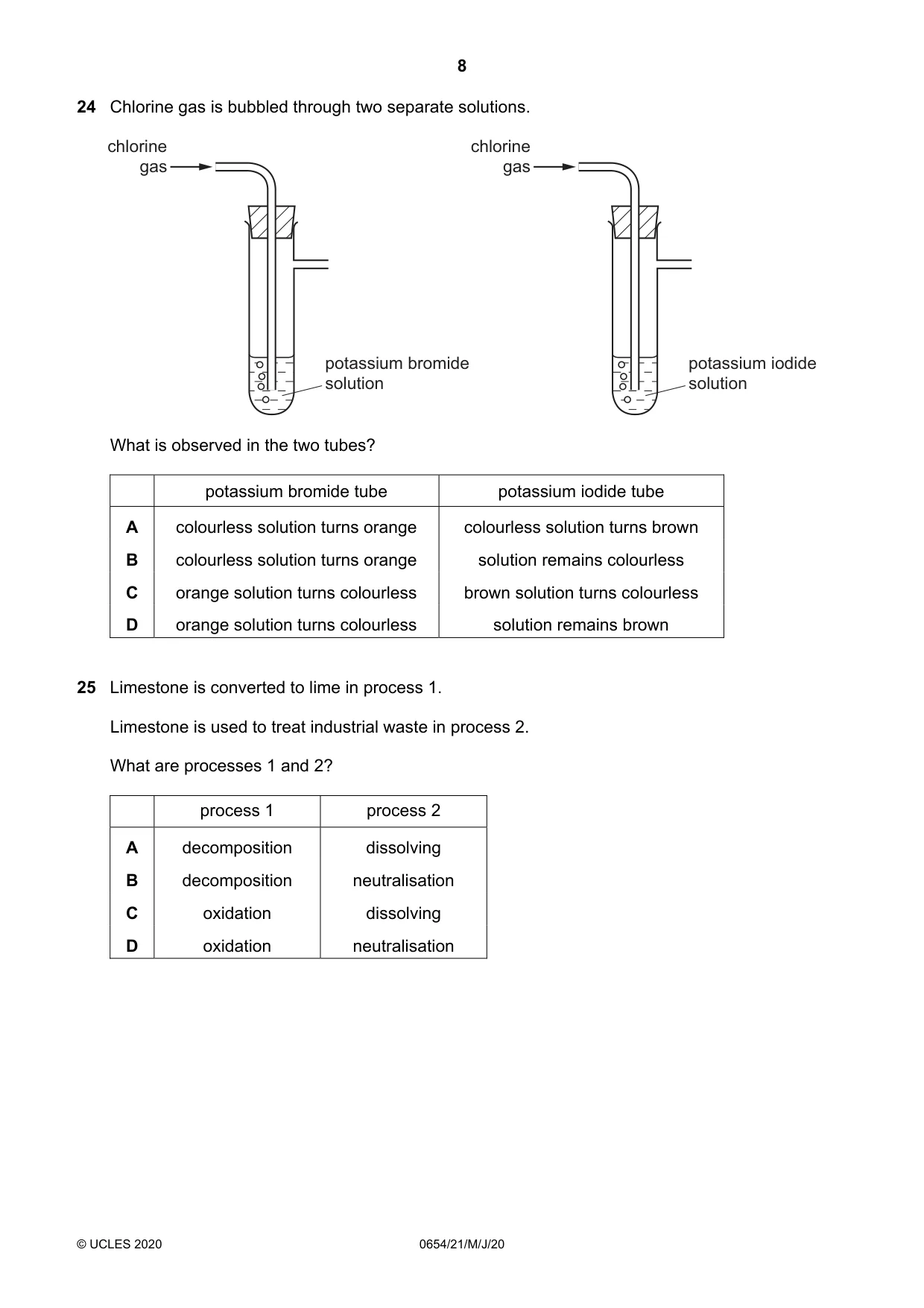
Q24 · Chlorine gas is bubbled through two separate solutions
24 Chlorine gas is bubbled through two separate solutions. chlorine chlorine gas gas potassium bromide potassium iodide solution solution What is observed in the two tubes? potassium bromide tube potassium iodide tube A colourless solution turns orange colourless solution turns brown B colourless solution turns orange solution remains colourless C orange solution turns colourless brown solution turns colourless D orange solution turns colourless solution remains brown
Mark scheme: A
Q25 · Limestone is converted to lime in process 1
25 Limestone is converted to lime in process 1. Limestone is used to treat industrial waste in process 2. What are processes 1 and 2? process 1 process 2 A decomposition dissolving B decomposition neutralisation C oxidation dissolving D oxidation neutralisation
Mark scheme: B
More questions on The characteristic properties of acids and bases
Q26 · The structures of three organic compounds are shown
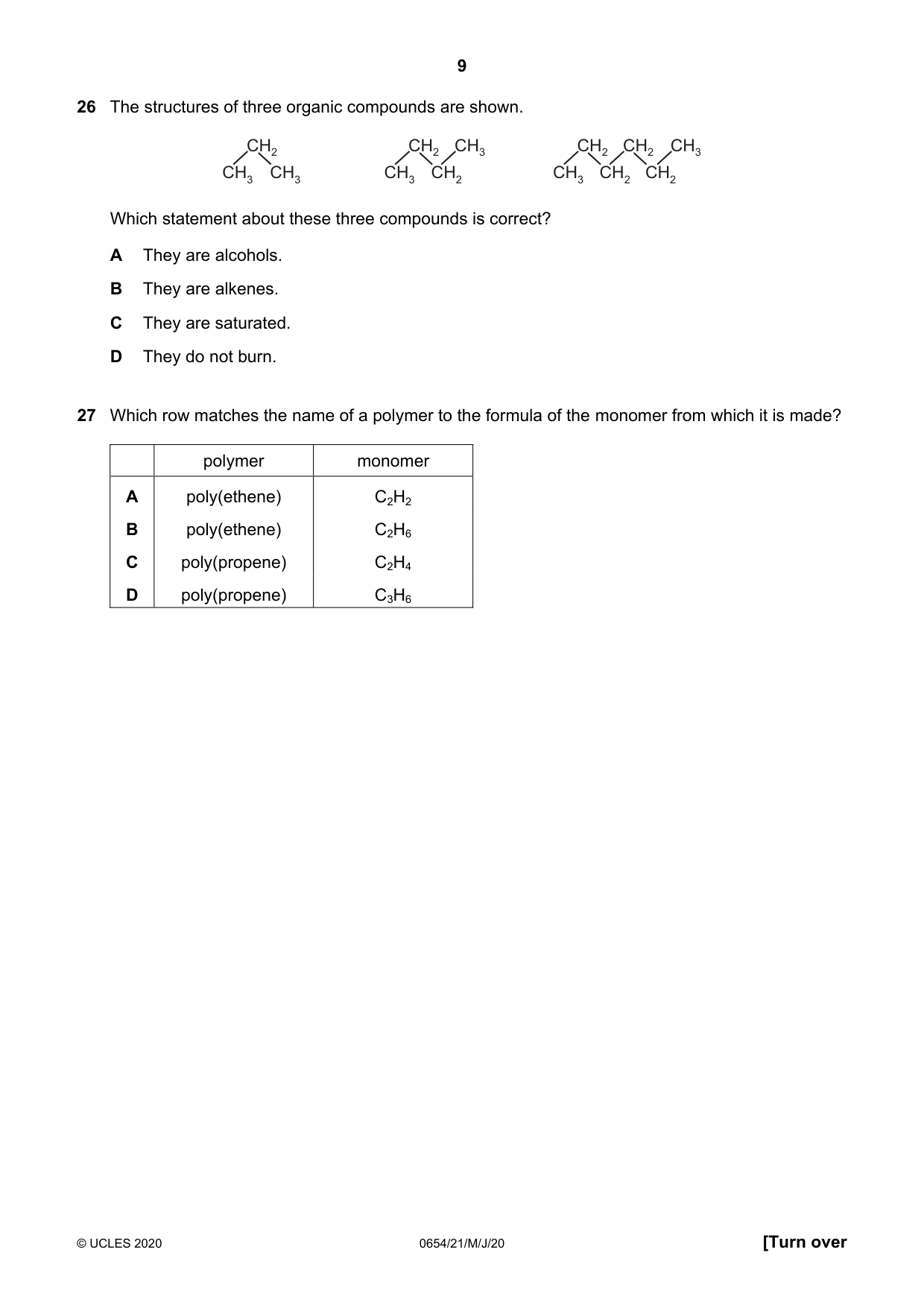
26 The structures of three organic compounds are shown. CH2 CH2 CH3 CH2 CH2 CH3 CH3 CH3 CH3 CH2 CH3 CH2 CH2 Which statement about these three compounds is correct? A They are alcohols. B They are alkenes. C They are saturated. D They do not burn.
Mark scheme: C
Q27 · Which row matches the name of a polymer to the formula of the monomer from which it is…
27 Which row matches the name of a polymer to the formula of the monomer from which it is made? polymer monomer A poly(ethene) C2H2 B poly(ethene) C2H6 C poly(propene) C2H4 D poly(propene) C3H6
Mark scheme: D
Q28 · The diagrams show two distance–time graphs and two speed–time graphs for objects…
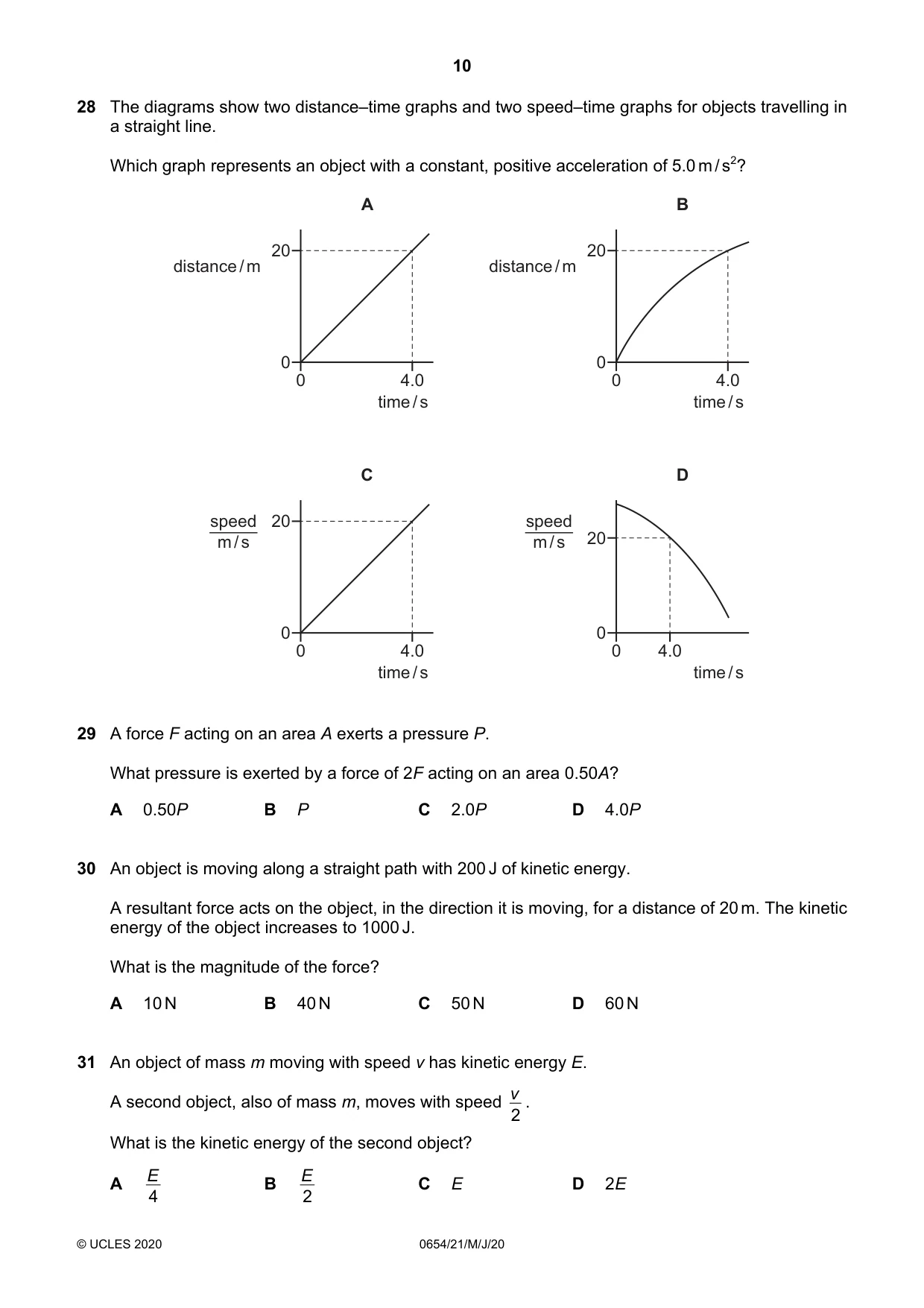
28 The diagrams show two distance–time graphs and two speed–time graphs for objects travelling in a straight line. Which graph represents an object with a constant, positive acceleration of 5.0 m / s2? A B 20 20 distance / m distance / m 0 0 0 4.0 0 4.0 time / s time / s C D speed 20 speed m / s m / s 20 0 0 0 4.0 0 4.0 time / s time / s
Mark scheme: C
Q29 · A force F acting on an area A exerts a pressure P
29 A force F acting on an area A exerts a pressure P. What pressure is exerted by a force of 2F acting on an area 0.50A? A 0.50P B P C 2.0P D 4.0P
Mark scheme: D
Q30 · An object is moving along a straight path with 200 J of kinetic energy
30 An object is moving along a straight path with 200 J of kinetic energy. A resultant force acts on the object, in the direction it is moving, for a distance of 20 m. The kinetic energy of the object increases to 1000 J. What is the magnitude of the force? A 10 N B 40 N C 50 N D 60 N
Mark scheme: B
Q31 · An object of mass m moving with speed v has kinetic energy E
31 An object of mass m moving with speed v has kinetic energy E. v . A second object, also of mass m, moves with speed 2 What is the kinetic energy of the second object? E E A B C E D 2E 4 2
Mark scheme: A
Q32 · Which statement describes the production of electricity from a renewable energy source?
32 Which statement describes the production of electricity from a renewable energy source? A Coal is burnt to release energy to make steam that turns a generator. B Moving air passes over blades that rotate and turn a generator. C Nuclear fission releases energy to make steam that turns a generator. D Oil is burnt to release energy to make steam that turns a generator.
Mark scheme: B
Q33 · A liquid-in-glass thermometer contains mercury
33 A liquid-in-glass thermometer contains mercury. The thermometer is moved from cold water into hot water. What happens to the mercury? A It contracts. B It expands. C It freezes. D It melts.
Mark scheme: B
Q34 · A hot water tank is fitted with two identical heaters P and Q
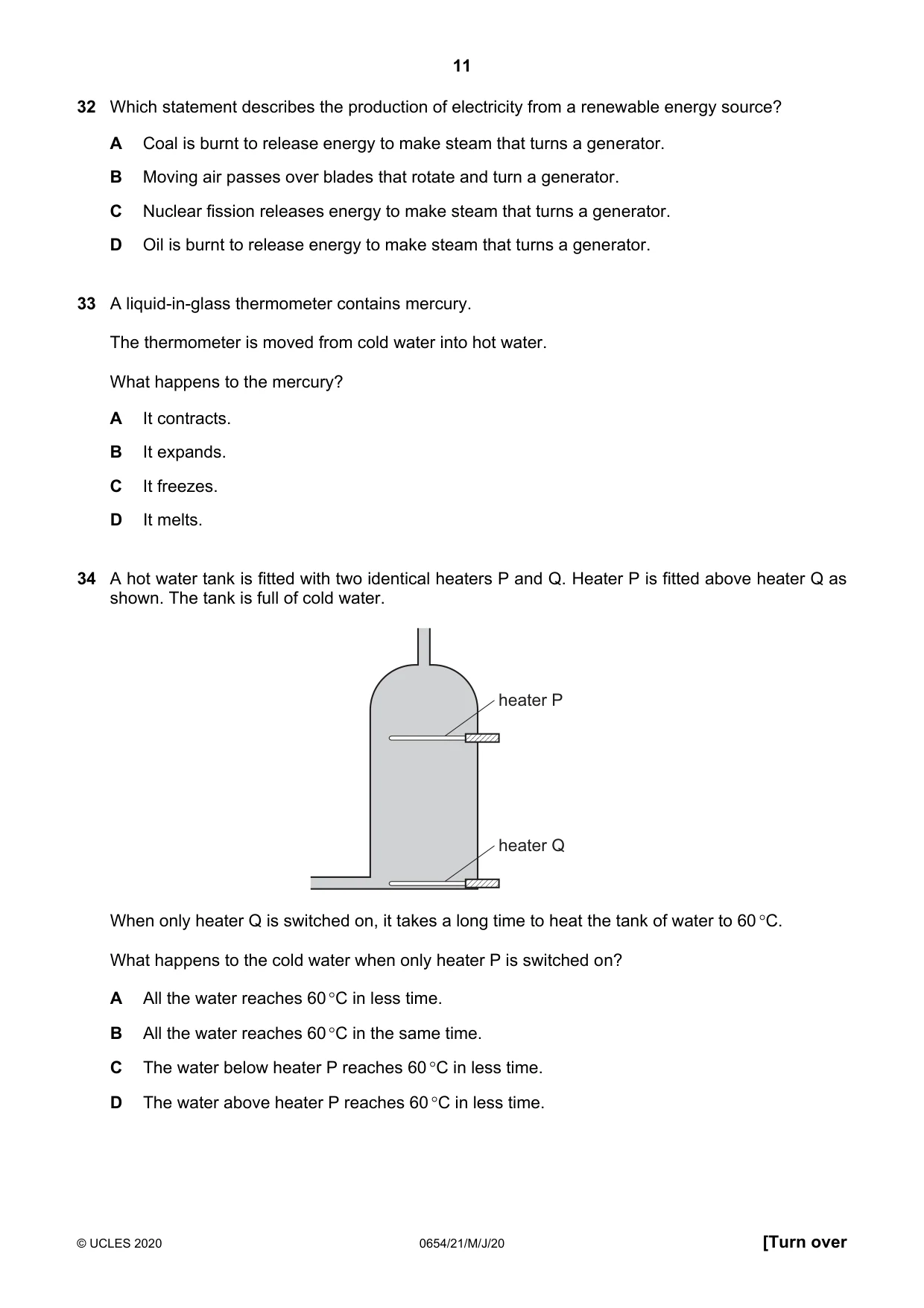
34 A hot water tank is fitted with two identical heaters P and Q. Heater P is fitted above heater Q as shown. The tank is full of cold water. heater P heater Q When only heater Q is switched on, it takes a long time to heat the tank of water to 60 C. What happens to the cold water when only heater P is switched on? A All the water reaches 60 C in less time. B All the water reaches 60 C in the same time. C The water below heater P reaches 60 C in less time. D The water above heater P reaches 60 C in less time.
Mark scheme: D
Q35 · Which ray diagram represents the formation of a virtual image I of an object O?
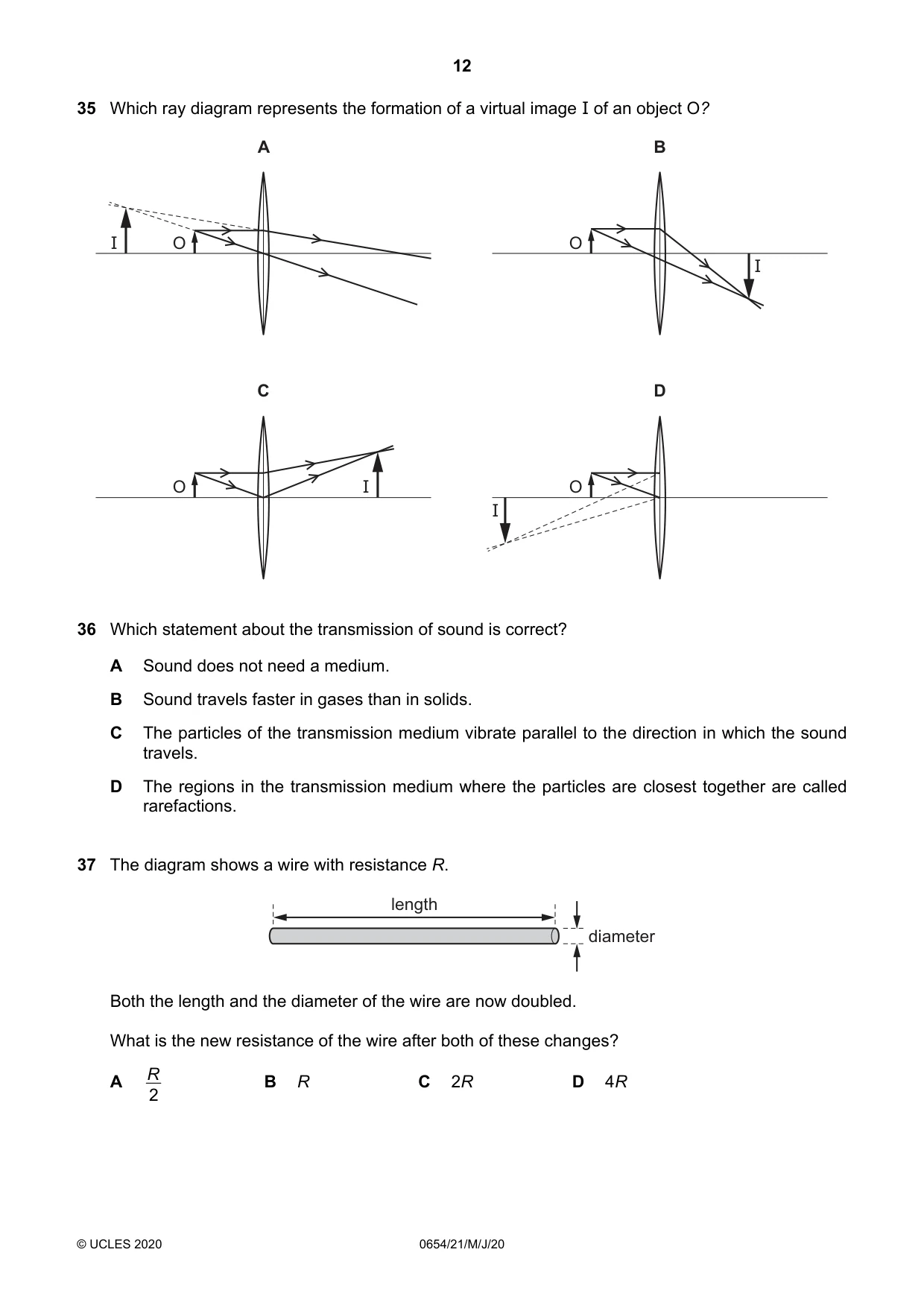
35 Which ray diagram represents the formation of a virtual image I of an object O? A B I O O I C D O I O I
Mark scheme: A
Q36 · Which statement about the transmission of sound is correct?
36 Which statement about the transmission of sound is correct? A Sound does not need a medium. B Sound travels faster in gases than in solids. C The particles of the transmission medium vibrate parallel to the direction in which the sound travels. D The regions in the transmission medium where the particles are closest together are called rarefactions.
Mark scheme: C
Q37 · The diagram shows a wire with resistance R
37 The diagram shows a wire with resistance R. length diameter Both the length and the diameter of the wire are now doubled. What is the new resistance of the wire after both of these changes? A R B R C 2R D 4R 2
Mark scheme: A
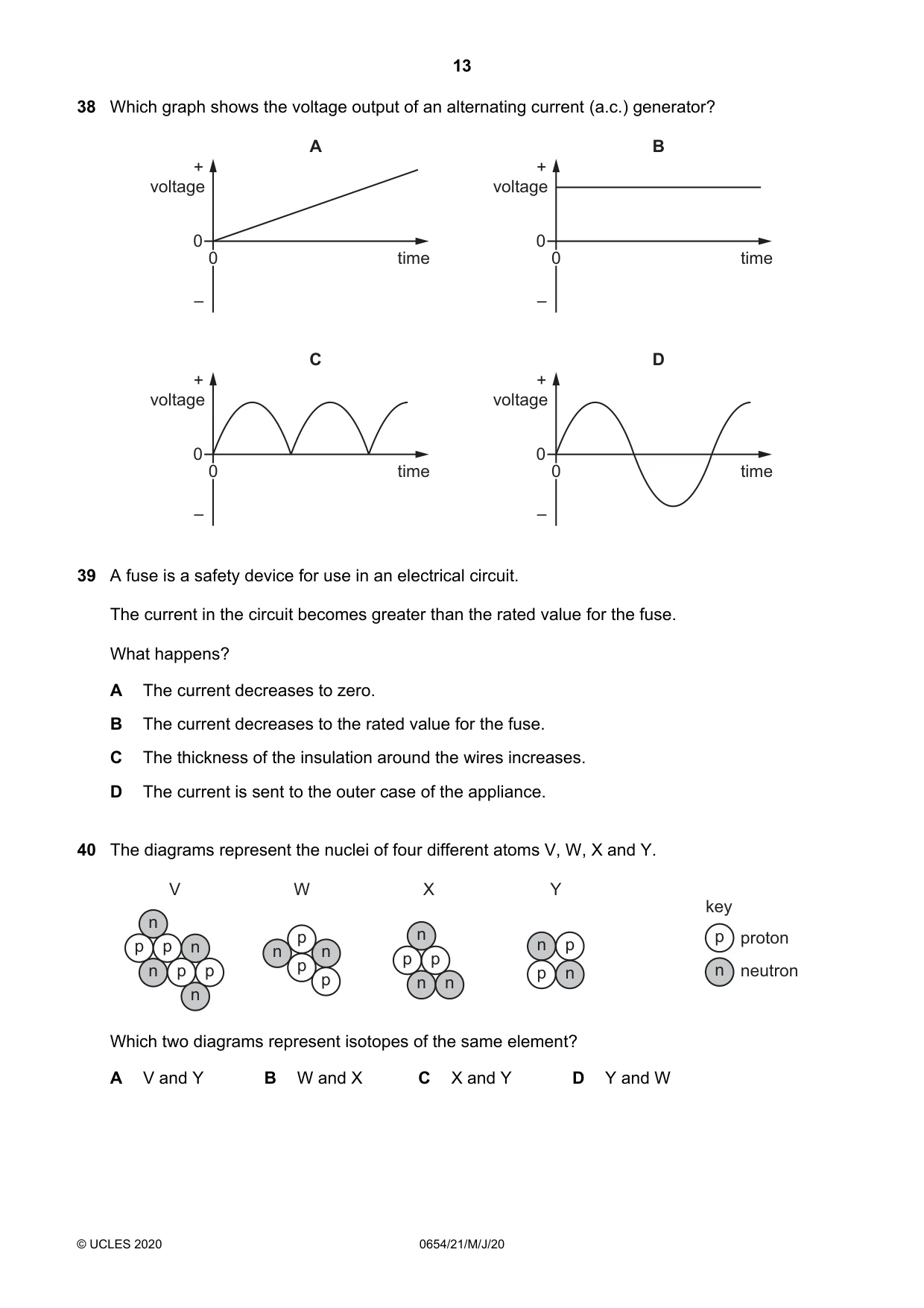
Q38 · Which graph shows the voltage output of an alternating current (a.c.) generator?
38 Which graph shows the voltage output of an alternating current (a.c.) generator? A B + + voltage voltage 0 0 0 time 0 time – – C D + + voltage voltage 0 0 0 time 0 time – –
Mark scheme: D
Q39 · A fuse is a safety device for use in an electrical circuit
39 A fuse is a safety device for use in an electrical circuit. The current in the circuit becomes greater than the rated value for the fuse. What happens? A The current decreases to zero. B The current decreases to the rated value for the fuse. C The thickness of the insulation around the wires increases. D The current is sent to the outer case of the appliance.
Mark scheme: A
Q40 · The diagrams represent the nuclei of four different atoms V, W, X and Y
40 The diagrams represent the nuclei of four different atoms V, W, X and Y. V W X Y key n p n p proton p p n n n n p p p p n p p p n n neutron p n n n Which two diagrams represent isotopes of the same element? A V and Y B W and X C X and Y D Y and W
Mark scheme: C
What was in this paper
The subtopics covered by these 40 questions, and how many questions each got. Open one in a new tab to see every Cambridge question on it.
3Alkanes1Alloys and their properties1Biological molecules1Characteristics of living organisms1Chromosomes and genes1Circulatory systems1Diet1Diffusion1Electrical quantities1Electrical safety1Electrolysis1Electromagnetic effects1Elements, compounds and mixtures1Enzymes1Food chains and food webs1Gas exchange in humans1Group VII properties1Habitat destruction1Homeostasis1Ions and ionic bonds1Light1Motion1Oxides1Photosynthesis1Polymers1Preparation of salts1Pressure1Rate of reaction1Redox1Respiration1Sound1The characteristic properties of acids and bases1The mole and the Avogadro constant1The nucleus1Thermal properties and temperature1Transfer of thermal energy1Uses of metals1