Cambridge IGCSE Sciences - Co-ordinated (Double) 0654 — 2017 May/June Paper 2 · Variant 3
0654/23/M/J/17 · 40 questions · 40 marks · ≈45 min
The question paper and its mark scheme, free to read here and free to download. This is Cambridge’s own paper, exactly as it was sat.
Question paper16 pages

Mark scheme3 pages
Answers below. Sit the paper first if you are practising.
Questions as text
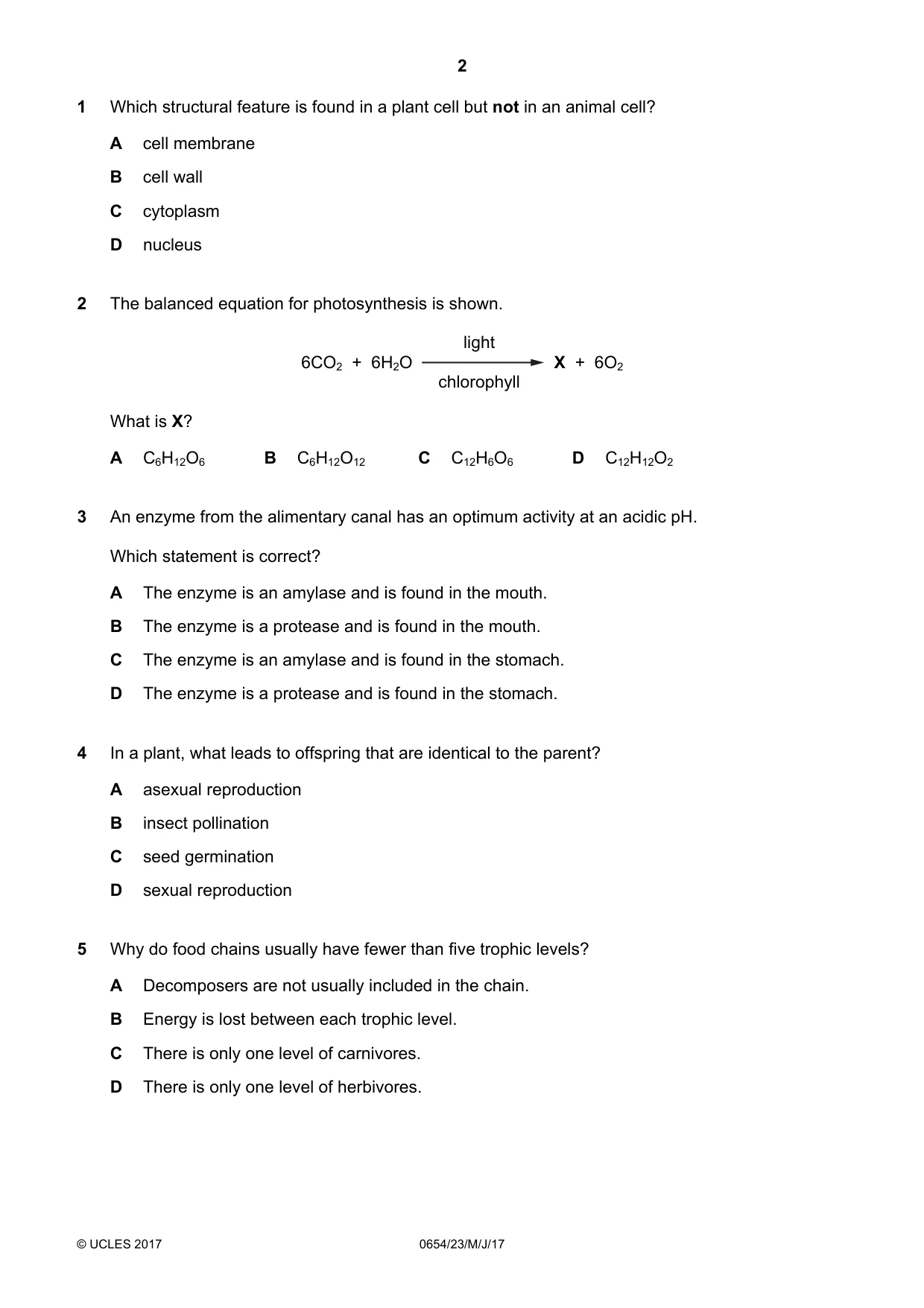
Q1 · Which structural feature is found in a plant cell but not in an animal cell?
1 Which structural feature is found in a plant cell but not in an animal cell? A cell membrane B cell wall C cytoplasm D nucleus
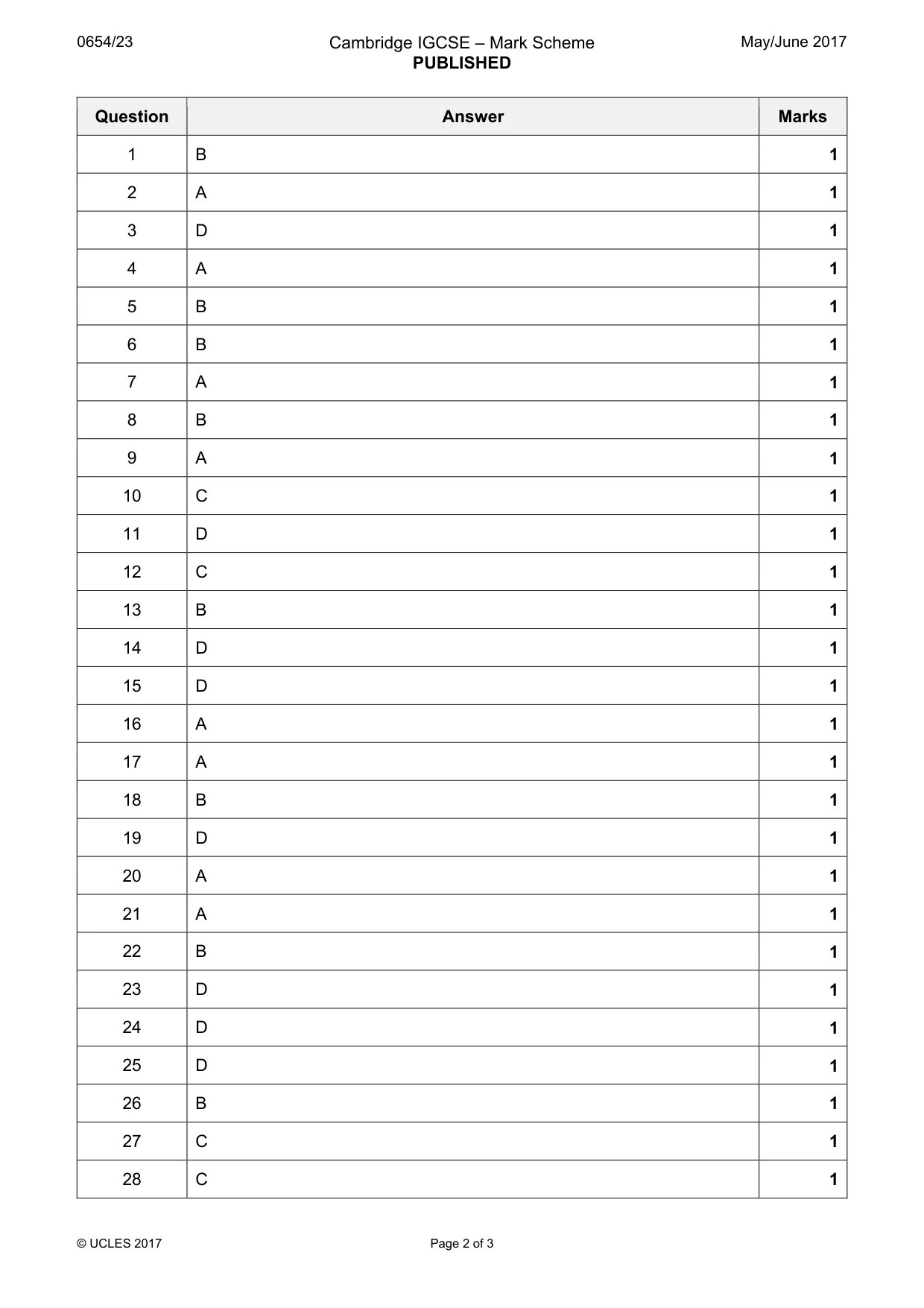
Mark scheme: B
Q2 · The balanced equation for photosynthesis is shown
2 The balanced equation for photosynthesis is shown. light 6CO2 + 6H2O X + 6O2 chlorophyll What is X? A C6H12O6 B C6H12O12 C C12H6O6 D C12H12O2
Mark scheme: A
Q3 · An enzyme from the alimentary canal has an optimum activity at an acidic pH
3 An enzyme from the alimentary canal has an optimum activity at an acidic pH. Which statement is correct? A The enzyme is an amylase and is found in the mouth. B The enzyme is a protease and is found in the mouth. C The enzyme is an amylase and is found in the stomach. D The enzyme is a protease and is found in the stomach.
Mark scheme: D
Q4 · In a plant, what leads to offspring that are identical to the parent?
4 In a plant, what leads to offspring that are identical to the parent? A asexual reproduction B insect pollination C seed germination D sexual reproduction
Mark scheme: A
Q5 · Why do food chains usually have fewer than five trophic levels?
5 Why do food chains usually have fewer than five trophic levels? A Decomposers are not usually included in the chain. B Energy is lost between each trophic level. C There is only one level of carnivores. D There is only one level of herbivores.
Mark scheme: B
Q6 · What is the function of microorganisms in yoghurt making?
6 What is the function of microorganisms in yoghurt making? A They make the sugar in milk become solid. B They produce lactic acid. C They raise the pH of the mixture. D They reduce the fat content of the milk.
Mark scheme: B
Q7 · Which statement about how the eye views near objects (accommodation) is correct?
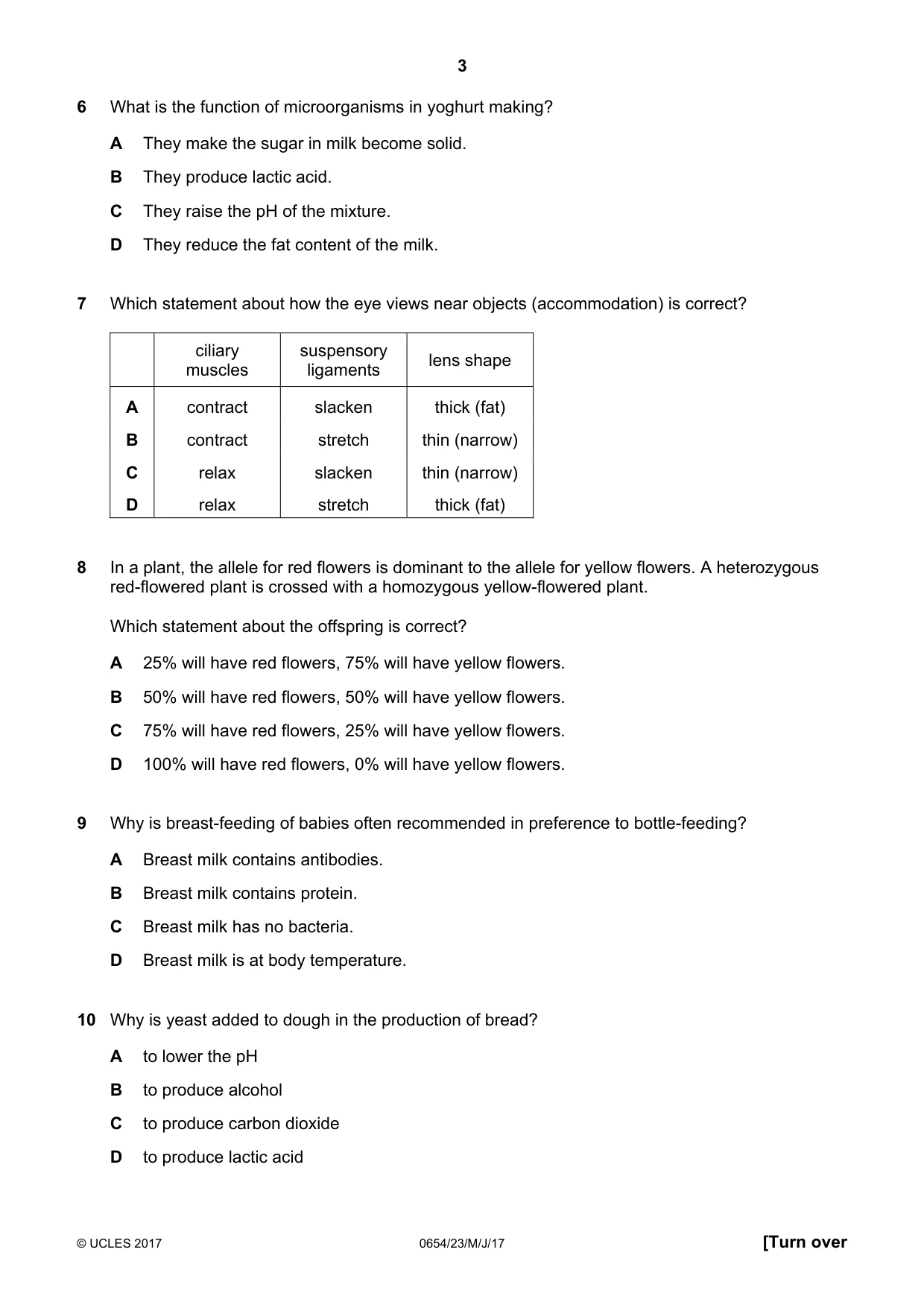
7 Which statement about how the eye views near objects (accommodation) is correct? ciliary suspensory lens shape muscles ligaments A contract slacken thick (fat) B contract stretch thin (narrow) C relax slacken thin (narrow) D relax stretch thick (fat)
Mark scheme: A
Q8 · In a plant, the allele for red flowers is dominant to the allele for yellow flowers
8 In a plant, the allele for red flowers is dominant to the allele for yellow flowers. A heterozygous red-flowered plant is crossed with a homozygous yellow-flowered plant. Which statement about the offspring is correct? A 25% will have red flowers, 75% will have yellow flowers. B 50% will have red flowers, 50% will have yellow flowers. C 75% will have red flowers, 25% will have yellow flowers. D 100% will have red flowers, 0% will have yellow flowers.
Mark scheme: B
Q9 · Why is breast-feeding of babies often recommended in preference to bottle-feeding?
9 Why is breast-feeding of babies often recommended in preference to bottle-feeding? A Breast milk contains antibodies. B Breast milk contains protein. C Breast milk has no bacteria. D Breast milk is at body temperature.
Mark scheme: A
Q10 · Why is yeast added to dough in the production of bread?
10 Why is yeast added to dough in the production of bread? A to lower the pH B to produce alcohol C to produce carbon dioxide D to produce lactic acid
Mark scheme: C
Q11 · A blood cell is travelling through the hepatic vein
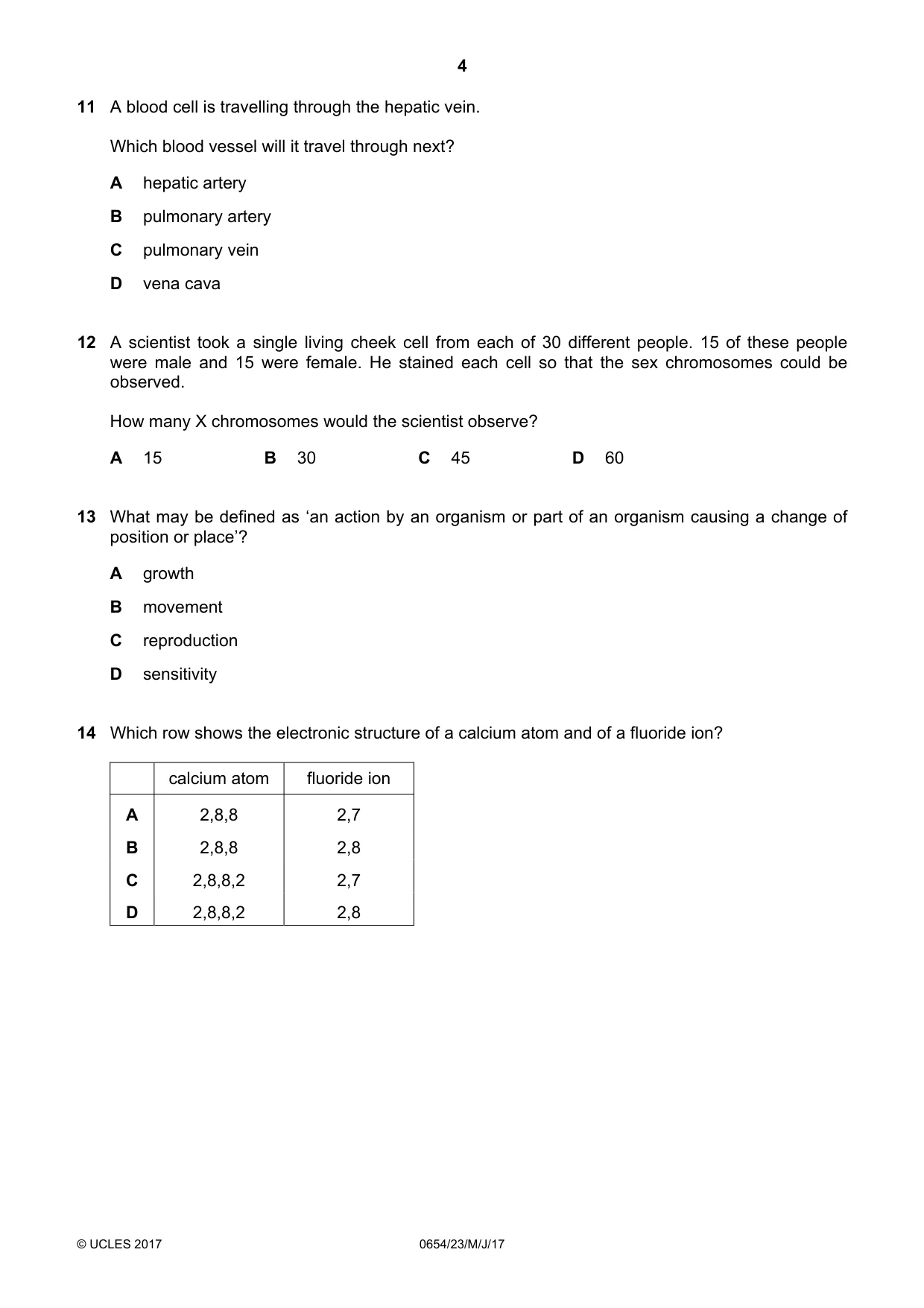
11 A blood cell is travelling through the hepatic vein. Which blood vessel will it travel through next? A hepatic artery B pulmonary artery C pulmonary vein D vena cava
Mark scheme: D
Q12 · A scientist took a single living cheek cell from each of 30 different people
12 A scientist took a single living cheek cell from each of 30 different people. 15 of these people were male and 15 were female. He stained each cell so that the sex chromosomes could be observed. How many X chromosomes would the scientist observe? A 15 B 30 C 45 D 60
Mark scheme: C
Q13 · What may be defined as ‘an action by an organism or part of an organism causing a change…
13 What may be defined as ‘an action by an organism or part of an organism causing a change of position or place’? A growth B movement C reproduction D sensitivity
Mark scheme: B
Q14 · Which row shows the electronic structure of a calcium atom and of a fluoride ion?
14 Which row shows the electronic structure of a calcium atom and of a fluoride ion? calcium atom fluoride ion A 2,8,8 2,7 B 2,8,8 2,8 C 2,8,8,2 2,7 D 2,8,8,2 2,8
Mark scheme: D
Q15 · How many atoms of metals and of non-metals are shown in the formula Na2SO4?
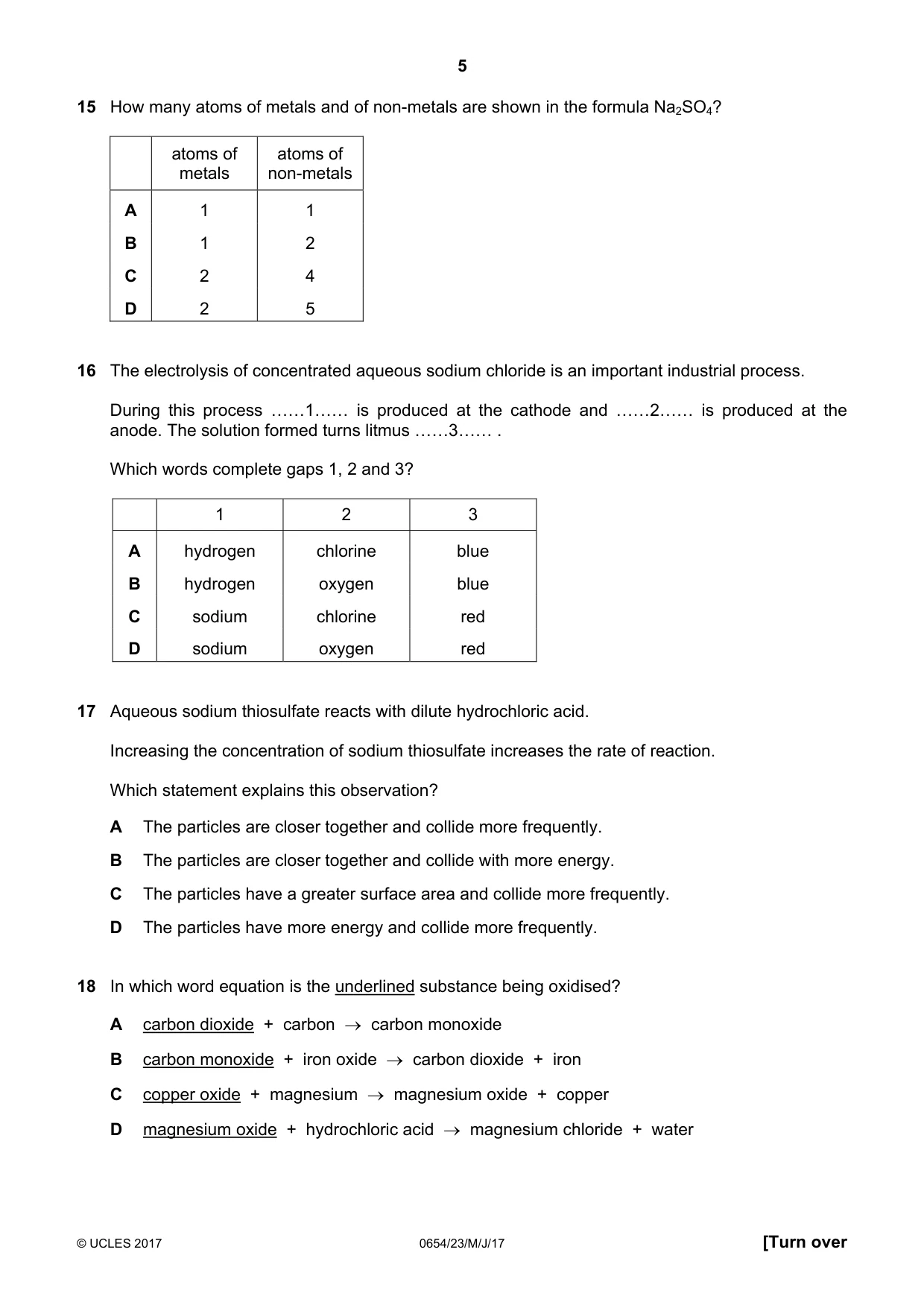
15 How many atoms of metals and of non-metals are shown in the formula Na2SO4? atoms of atoms of metals non-metals A 1 1 B 1 2 C 2 4 D 2 5
Mark scheme: D
Q16 · The electrolysis of concentrated aqueous sodium chloride is an important industrial…
16 The electrolysis of concentrated aqueous sodium chloride is an important industrial process. During this process ««1«« is produced at the cathode and ««2«« is produced at the anode. The solution formed turns litmus ««3«« . Which words complete gaps 1, 2 and 3? 1 2 3 A hydrogen chlorine blue B hydrogen oxygen blue C sodium chlorine red D sodium oxygen red
Mark scheme: A
Q17 · Aqueous sodium thiosulfate reacts with dilute hydrochloric acid
17 Aqueous sodium thiosulfate reacts with dilute hydrochloric acid. Increasing the concentration of sodium thiosulfate increases the rate of reaction. Which statement explains this observation? A The particles are closer together and collide more frequently. B The particles are closer together and collide with more energy. C The particles have a greater surface area and collide more frequently. D The particles have more energy and collide more frequently.
Mark scheme: A
Q18 · In which word equation is the underlined substance being oxidised?
18 In which word equation is the underlined substance being oxidised? A carbon dioxide + carbon → carbon monoxide B carbon monoxide + iron oxide → carbon dioxide + iron C copper oxide + magnesium → magnesium oxide + copper D magnesium oxide + hydrochloric acid → magnesium chloride + water
Mark scheme: B
Q19 · The pH of water changes when ammonia is bubbled into it
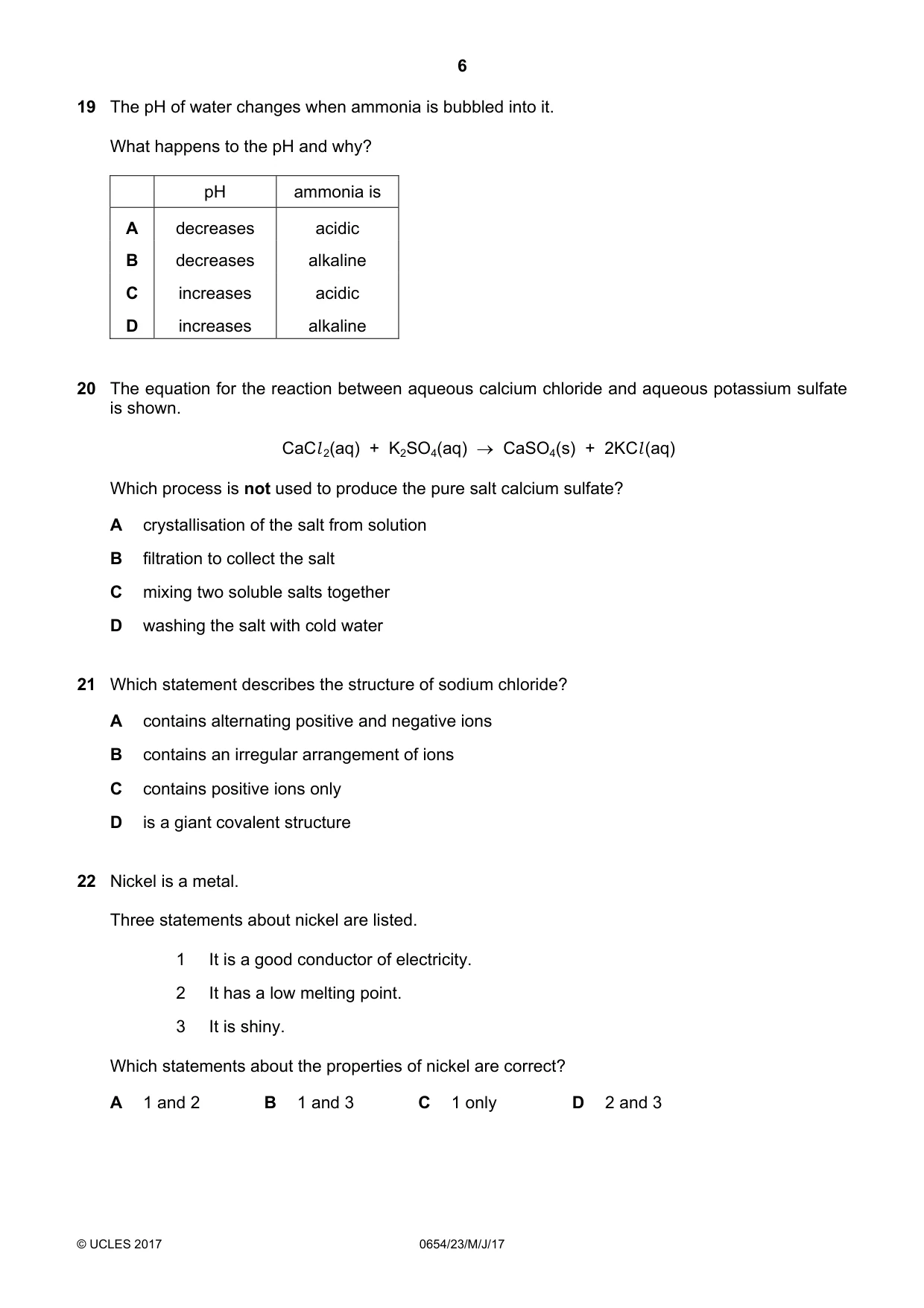
19 The pH of water changes when ammonia is bubbled into it. What happens to the pH and why? pH ammonia is A decreases acidic B decreases alkaline C increases acidic D increases alkaline
Mark scheme: D
More questions on The characteristic properties of acids and bases
Q20 · The equation for the reaction between aqueous calcium chloride and aqueous potassium…
20 The equation for the reaction between aqueous calcium chloride and aqueous potassium sulfate is shown. CaCl 2(aq) + K2SO4(aq) → CaSO4(s) + 2KCl (aq) Which process is not used to produce the pure salt calcium sulfate? A crystallisation of the salt from solution B filtration to collect the salt C mixing two soluble salts together D washing the salt with cold water
Mark scheme: A
Q21 · Which statement describes the structure of sodium chloride?
21 Which statement describes the structure of sodium chloride? A contains alternating positive and negative ions B contains an irregular arrangement of ions C contains positive ions only D is a giant covalent structure
Mark scheme: A
Q22 · Nickel is a metal
22 Nickel is a metal. Three statements about nickel are listed. 1 It is a good conductor of electricity. 2 It has a low melting point. 3 It is shiny. Which statements about the properties of nickel are correct? A 1 and 2 B 1 and 3 C 1 only D 2 and 3
Mark scheme: B
Q23 · Which row shows a chemical test for the presence of water?
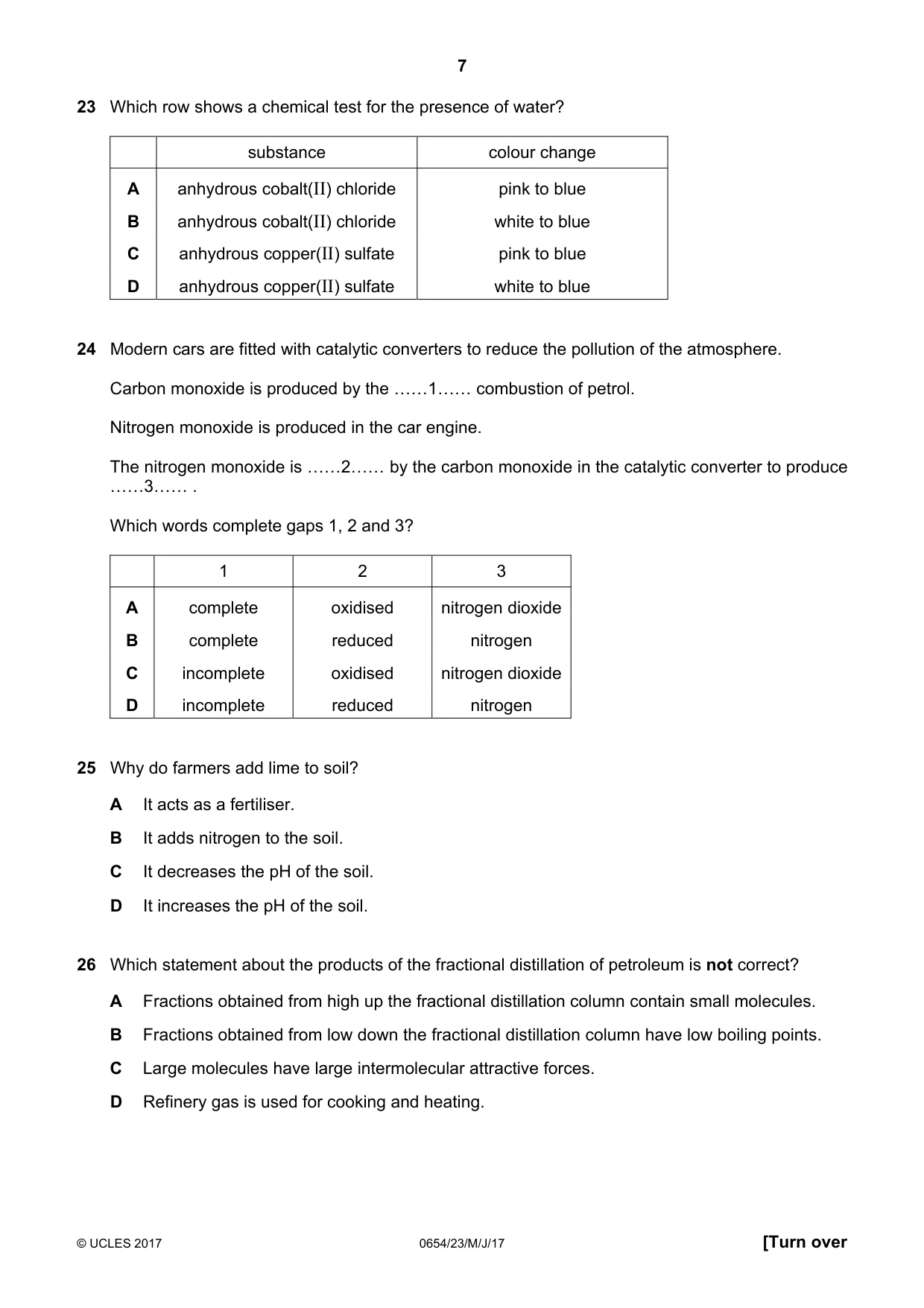
23 Which row shows a chemical test for the presence of water? substance colour change A anhydrous cobalt(II) chloride pink to blue B anhydrous cobalt(II) chloride white to blue C anhydrous copper(II) sulfate pink to blue D anhydrous copper(II) sulfate white to blue
Mark scheme: D
Q24 · Modern cars are fitted with catalytic converters to reduce the pollution of the atmosphere
24 Modern cars are fitted with catalytic converters to reduce the pollution of the atmosphere. Carbon monoxide is produced by the ««1«« combustion of petrol. Nitrogen monoxide is produced in the car engine. The nitrogen monoxide is ««2«« by the carbon monoxide in the catalytic converter to produce ««3«« . Which words complete gaps 1, 2 and 3? 1 2 3 A complete oxidised nitrogen dioxide B complete reduced nitrogen C incomplete oxidised nitrogen dioxide D incomplete reduced nitrogen
Mark scheme: D
Q25 · Why do farmers add lime to soil?
25 Why do farmers add lime to soil? A It acts as a fertiliser. B It adds nitrogen to the soil. C It decreases the pH of the soil. D It increases the pH of the soil.
Mark scheme: D
More questions on The characteristic properties of acids and bases
Q26 · Which statement about the products of the fractional distillation of petroleum is not…
26 Which statement about the products of the fractional distillation of petroleum is not correct? A Fractions obtained from high up the fractional distillation column contain small molecules. B Fractions obtained from low down the fractional distillation column have low boiling points. C Large molecules have large intermolecular attractive forces. D Refinery gas is used for cooking and heating.
Mark scheme: B
Q27 · What is the structure of poly(ethene) and what type of polymerisation is used to make it?
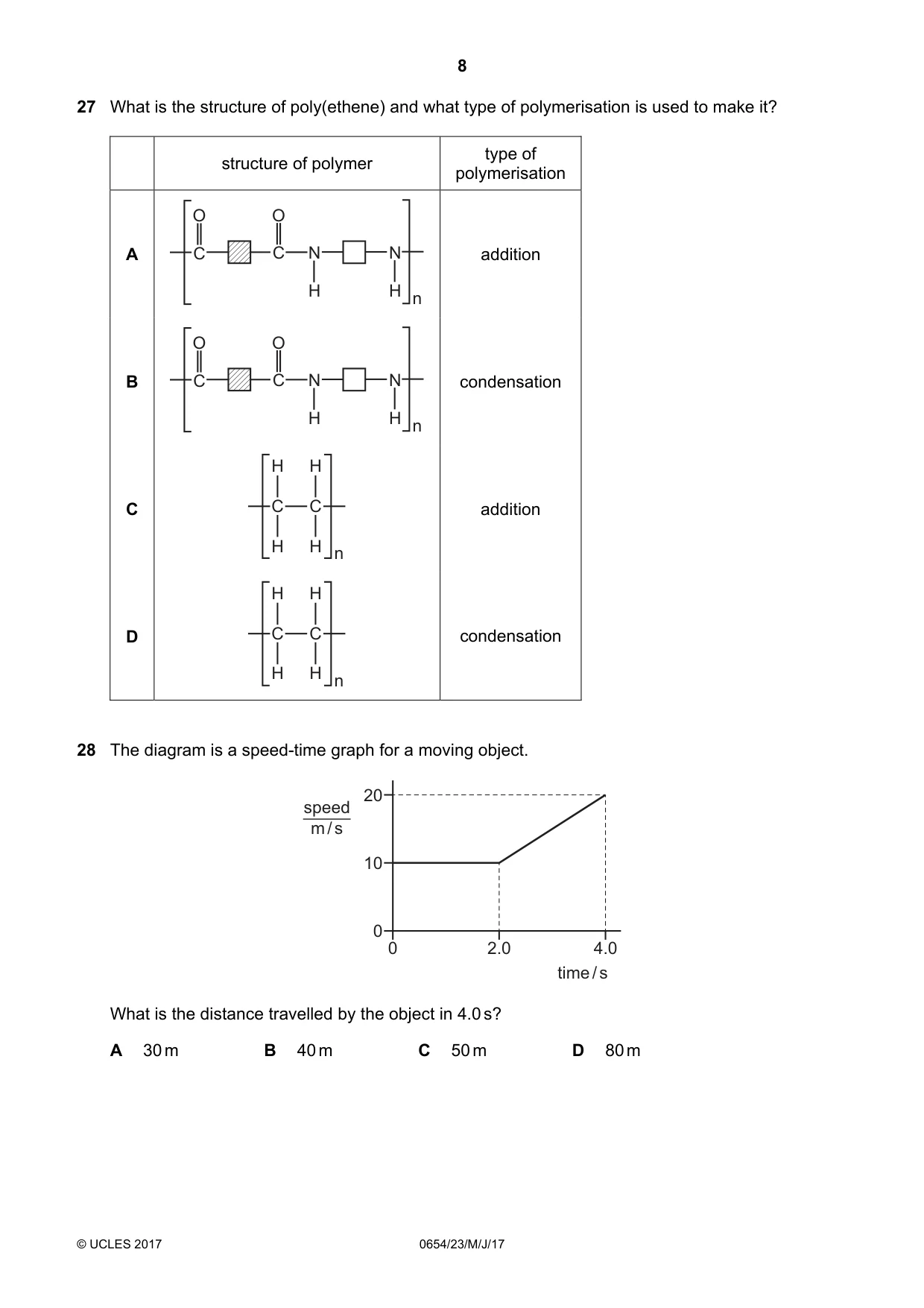
27 What is the structure of poly(ethene) and what type of polymerisation is used to make it? type of structure of polymer polymerisation O O A C C N N addition H H n O O B C C N N condensation H H n H H C C C addition H H n H H D C C condensation H H n
Mark scheme: C
Q28 · The diagram is a speed-time graph for a moving object
28 The diagram is a speed-time graph for a moving object. 20 speed m / s 10 0 0 2.0 4.0 time / s What is the distance travelled by the object in 4.0 s? A 30 m B 40 m C 50 m D 80 m
Mark scheme: C
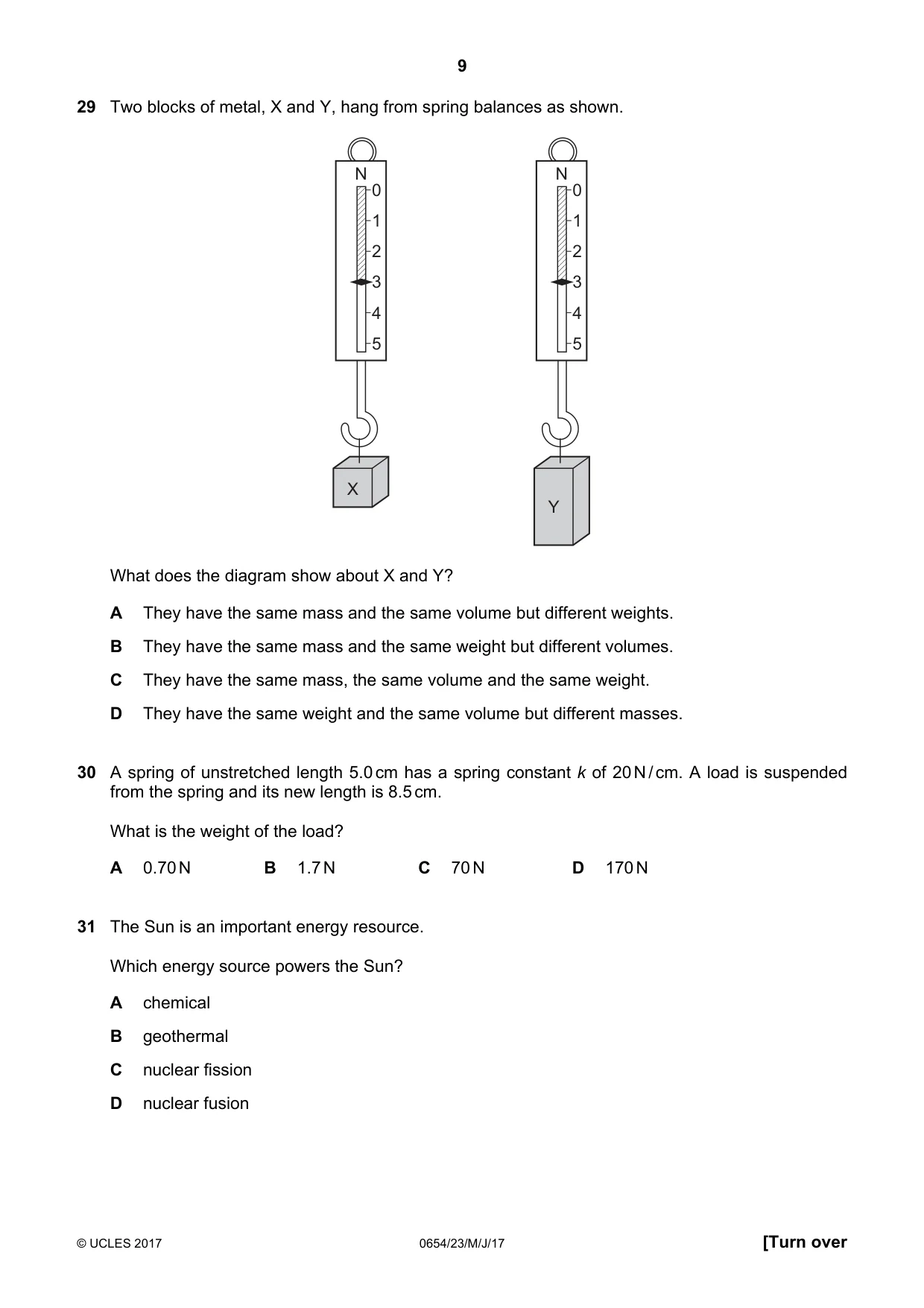
Q29 · Two blocks of metal, X and Y, hang from spring balances as shown
29 Two blocks of metal, X and Y, hang from spring balances as shown. N N 0 0 1 1 2 2 3 3 4 4 5 5 X Y What does the diagram show about X and Y? A They have the same mass and the same volume but different weights. B They have the same mass and the same weight but different volumes. C They have the same mass, the same volume and the same weight. D They have the same weight and the same volume but different masses.
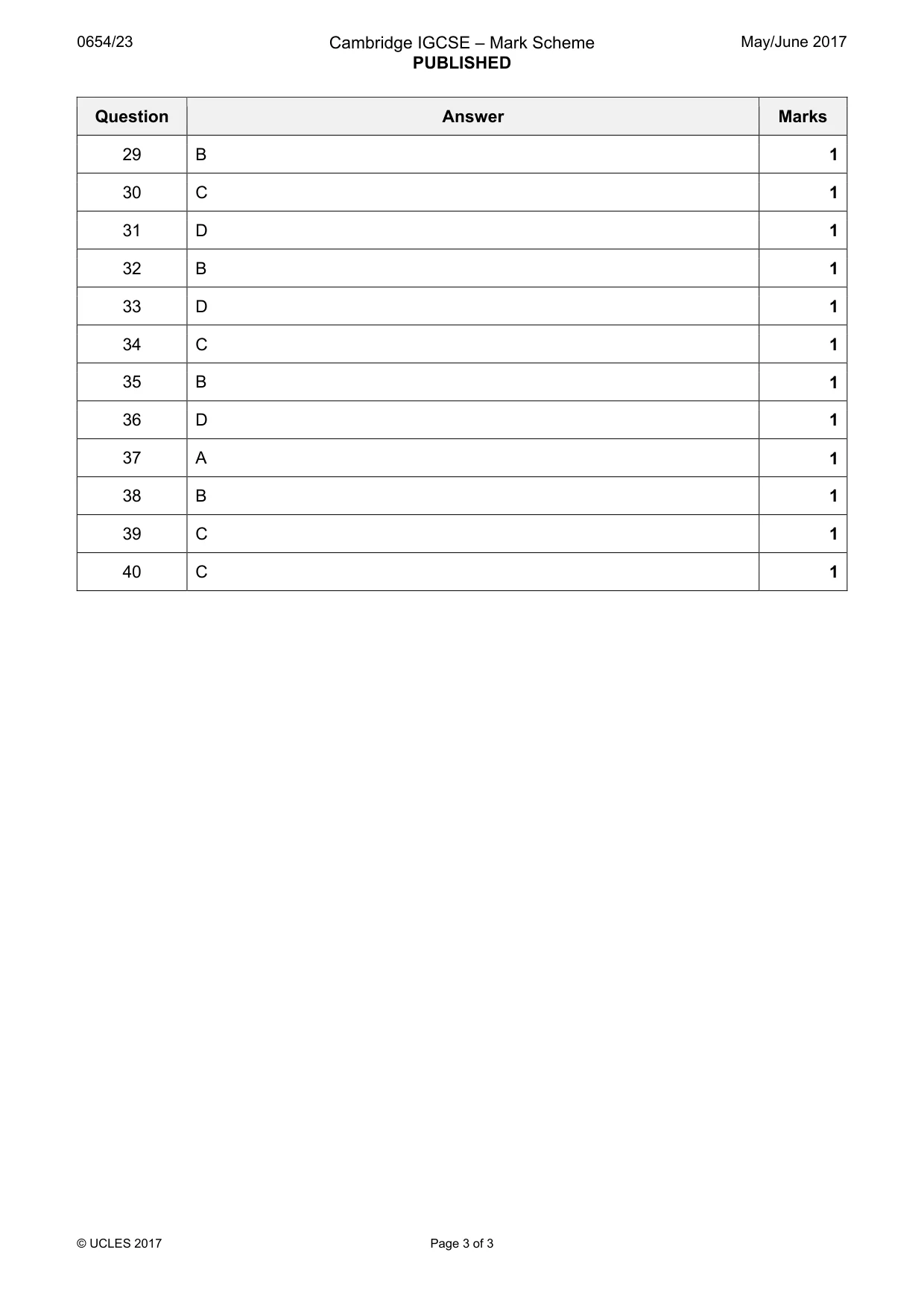
Mark scheme: B
Q30 · A spring of unstretched length 5.0 cm has a spring constant k of 20 N / cm
30 A spring of unstretched length 5.0 cm has a spring constant k of 20 N / cm. A load is suspended from the spring and its new length is 8.5 cm. What is the weight of the load? A 0.70 N B 1.7 N C 70 N D 170 N
Mark scheme: C
Q31 · The Sun is an important energy resource
31 The Sun is an important energy resource. Which energy source powers the Sun? A chemical B geothermal C nuclear fission D nuclear fusion
Mark scheme: D
Q32 · A sample of a substance has a mass of 2.0 kg
32 A sample of a substance has a mass of 2.0 kg. The sample gains 40 000 J of energy and this causes its temperature to change from 10 °C to 50 °C. What is the specific heat capacity of the substance? A 400 J / (kg °C) B 500 J / (kg °C) C 800 J / (kg °C) D 1000 J / (kg °C)
Mark scheme: B
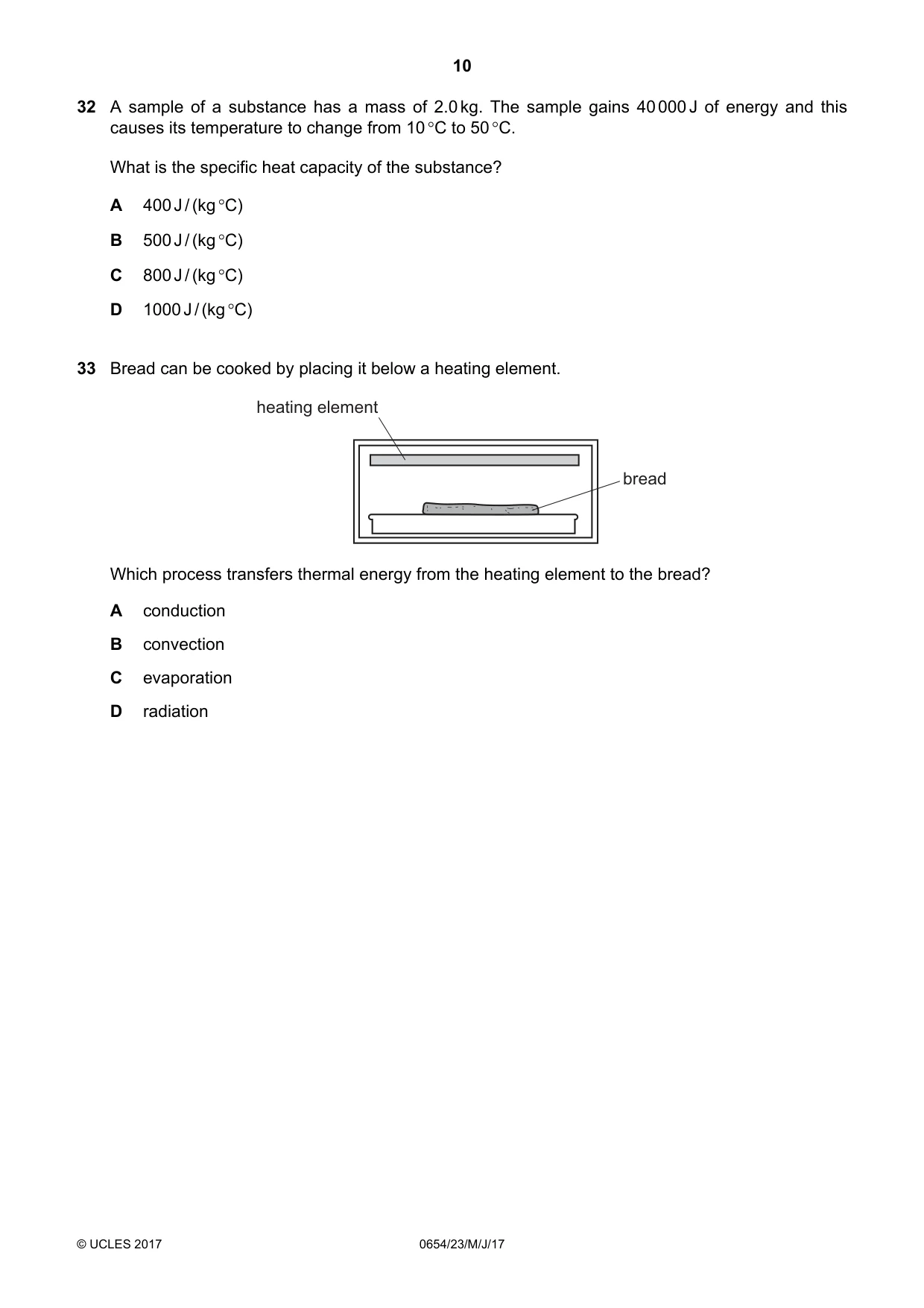
Q33 · Bread can be cooked by placing it below a heating element
33 Bread can be cooked by placing it below a heating element. heating element bread Which process transfers thermal energy from the heating element to the bread? A conduction B convection C evaporation D radiation
Mark scheme: D
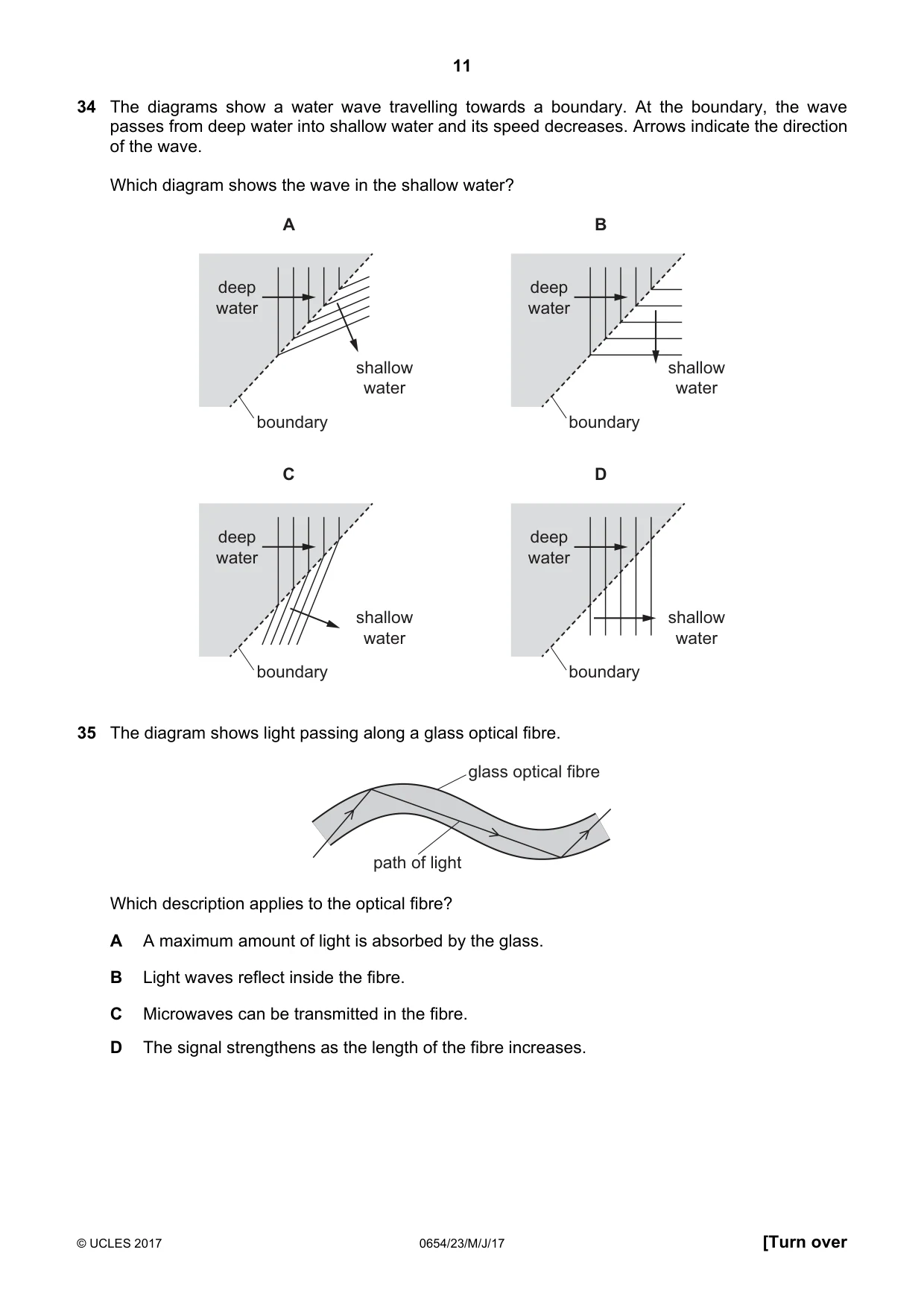
Q34 · The diagrams show a water wave travelling towards a boundary
34 The diagrams show a water wave travelling towards a boundary. At the boundary, the wave passes from deep water into shallow water and its speed decreases. Arrows indicate the direction of the wave. Which diagram shows the wave in the shallow water? A B deep deep water water shallow shallow water water boundary boundary C D deep deep water water shallow shallow water water boundary boundary
Mark scheme: C
Q35 · The diagram shows light passing along a glass optical fibre
35 The diagram shows light passing along a glass optical fibre. glass optical fibre path of light Which description applies to the optical fibre? A A maximum amount of light is absorbed by the glass. B Light waves reflect inside the fibre. C Microwaves can be transmitted in the fibre. D The signal strengthens as the length of the fibre increases.
Mark scheme: B
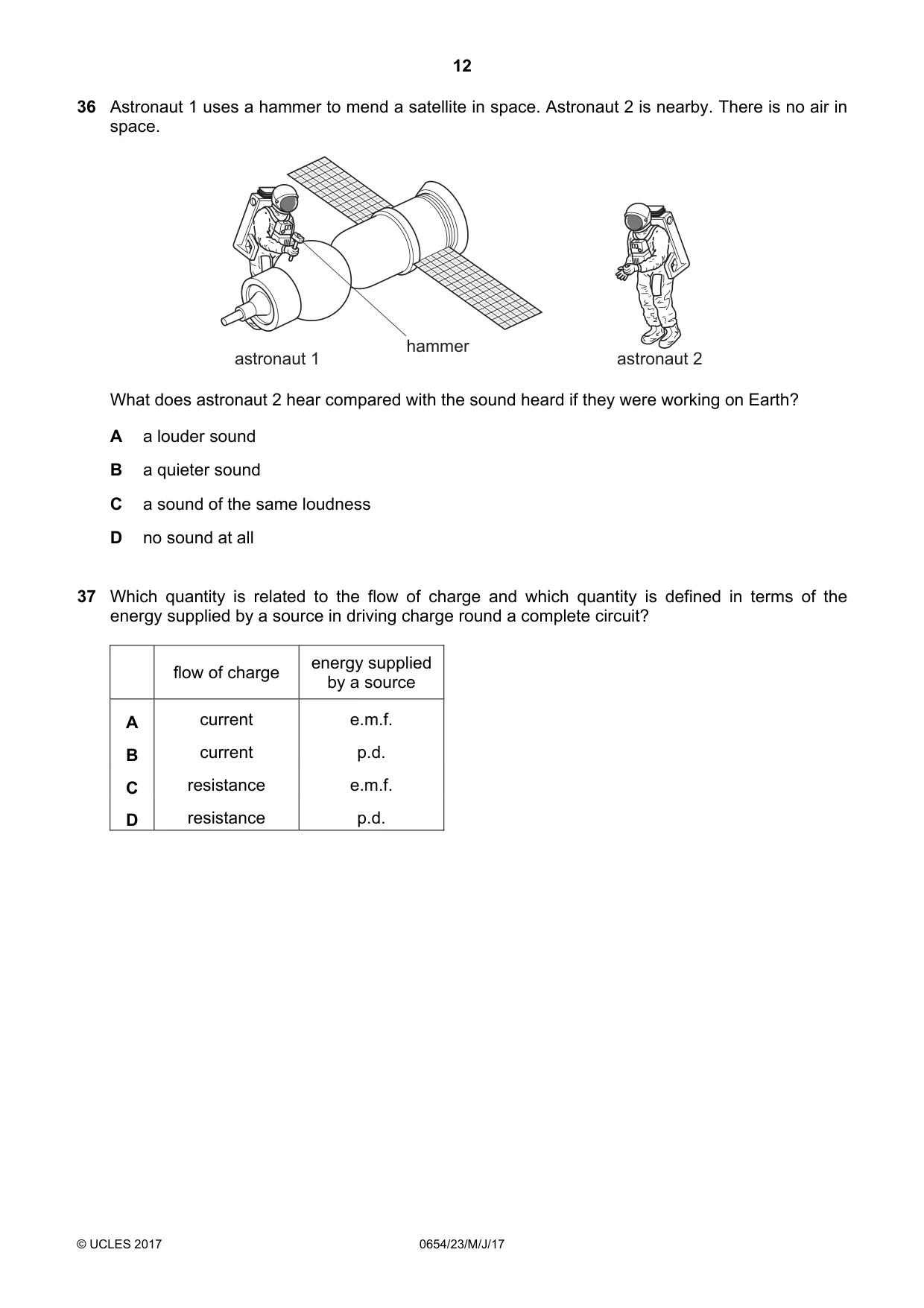
Q36 · Astronaut 1 uses a hammer to mend a satellite in space
36 Astronaut 1 uses a hammer to mend a satellite in space. Astronaut 2 is nearby. There is no air in space. hammer astronaut 1 astronaut 2 What does astronaut 2 hear compared with the sound heard if they were working on Earth? A a louder sound B a quieter sound C a sound of the same loudness D no sound at all
Mark scheme: D
Q37 · Which quantity is related to the flow of charge and which quantity is defined in terms of…
37 Which quantity is related to the flow of charge and which quantity is defined in terms of the energy supplied by a source in driving charge round a complete circuit? energy supplied flow of charge by a source A current e.m.f. B current p.d. C resistance e.m.f. D resistance p.d.
Mark scheme: A
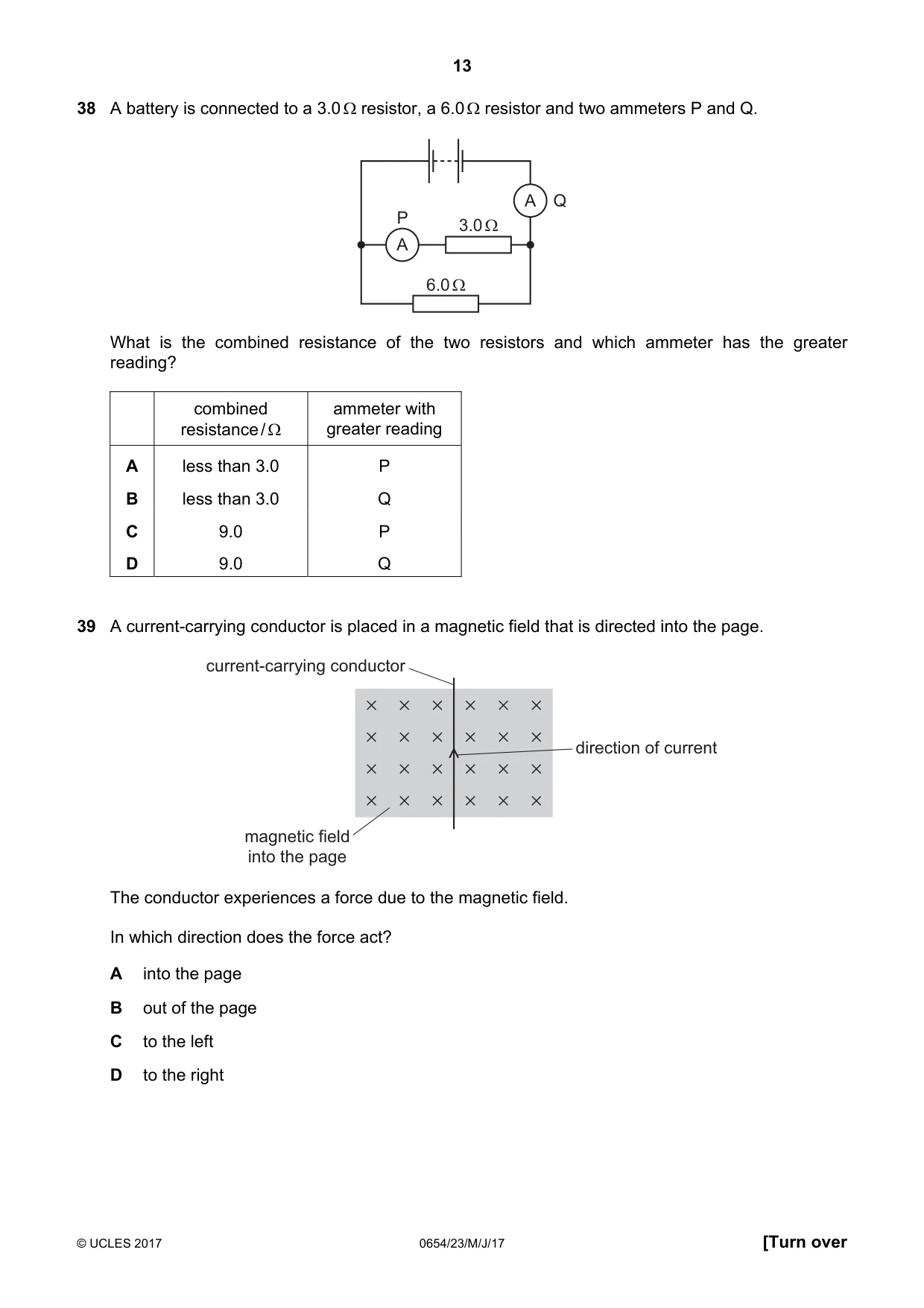
Q38 · A battery is connected to a 3.0 Ω resistor, a 6.0 Ω resistor and two ammeters P and Q
38 A battery is connected to a 3.0 Ω resistor, a 6.0 Ω resistor and two ammeters P and Q. A Q P 3.0 Ω A 6.0 Ω What is the combined resistance of the two resistors and which ammeter has the greater reading? combined ammeter with resistance / Ω greater reading A less than 3.0 P B less than 3.0 Q C 9.0 P D 9.0 Q
Mark scheme: B
Q39 · A current-carrying conductor is placed in a magnetic field that is directed into the page
39 A current-carrying conductor is placed in a magnetic field that is directed into the page. current-carrying conductor direction of current magnetic field into the page The conductor experiences a force due to the magnetic field. In which direction does the force act? A into the page B out of the page C to the left D to the right
Mark scheme: C
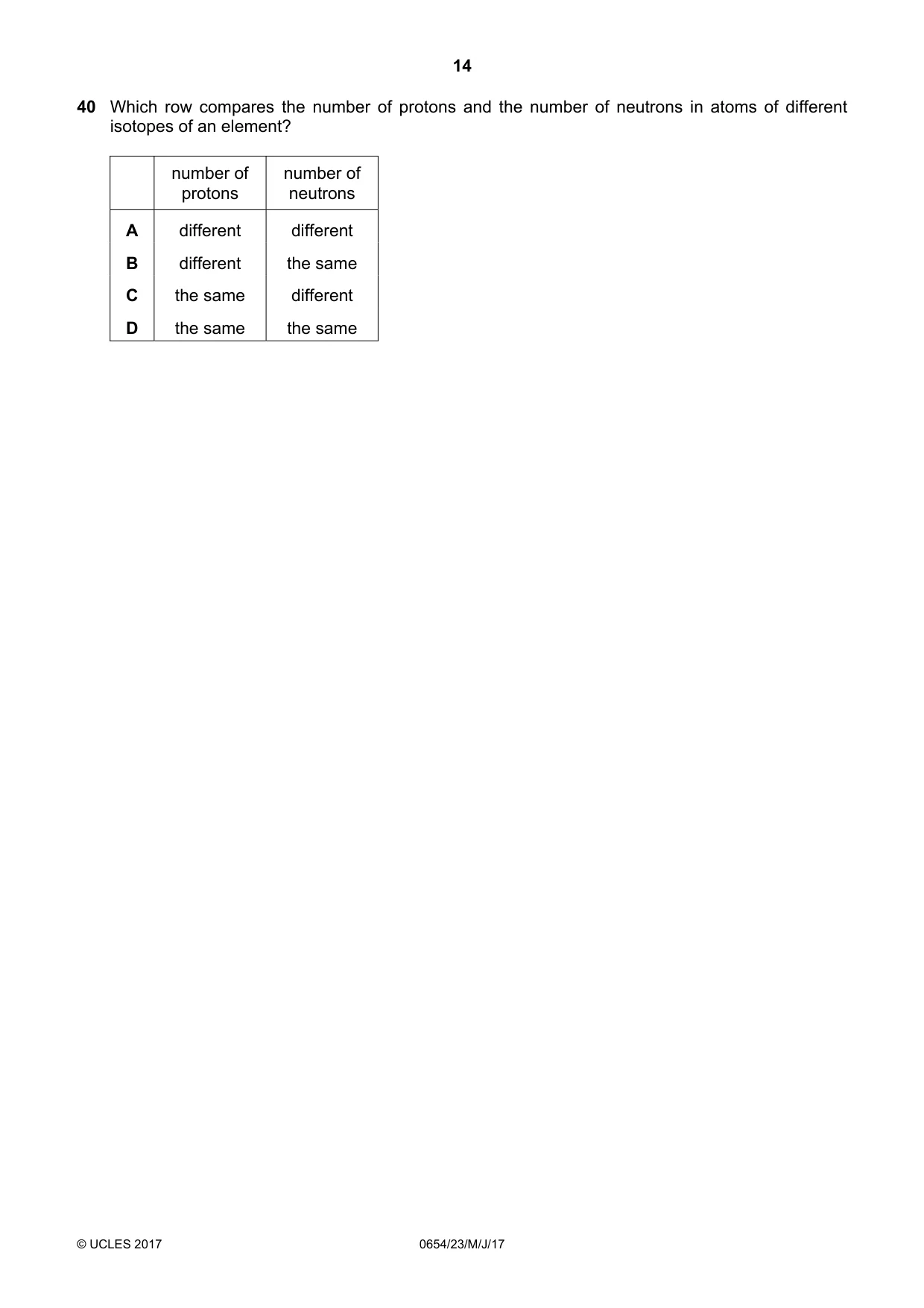
Q40 · Which row compares the number of protons and the number of neutrons in atoms of different…
40 Which row compares the number of protons and the number of neutrons in atoms of different isotopes of an element? number of number of protons neutrons A different different B different the same C the same different D the same the same
Mark scheme: C
What was in this paper
The subtopics covered by these 40 questions, and how many questions each got. Open one in a new tab to see every Cambridge question on it.
2The characteristic properties of acids and bases2Air quality and climate1Asexual reproduction1Atomic structure and the Periodic Table1Cell structure1Characteristics of living organisms1Chromosomes and genes1Circulatory systems1Coordination and response1Diseases and immunity1Electrical circuits1Electrical quantities1Electrolysis1Electromagnetic effects1Energy flow1Enzymes1Forces1Formulas1Fuels1General properties of waves1Identification of ions and gases1Ions and ionic bonds1Isotopes1Light1Mass and weight1Monohybrid inheritance1Motion1Photosynthesis1Polymers1Preparation of salts1Properties of metals1Radioactivity1Rate of reaction1Redox1Sound1Thermal properties and temperature1Transfer of thermal energy1What you needed in this session
Cambridge’s own grade thresholds for 2017 May/June, Paper 2 · Variant 3. A higher threshold means an easier paper — the bar moves with how the cohort did.