Cambridge IGCSE Sciences - Co-ordinated (Double) 0654 — 2025 Oct/Nov Paper 2 · Variant 3
0654/23/O/N/25 · 40 questions · 40 marks · 45 min
The question paper and its mark scheme, free to read here and free to download. This is Cambridge’s own paper, exactly as it was sat.
Question paper16 pages
Mark scheme3 pages
Answers below. Sit the paper first if you are practising.
Questions as text
Q1 · Which rows match characteristics of living things with their descriptions?
1 Which rows match characteristics of living things with their descriptions? characteristic description 1 excretion removal of waste products of metabolism and substances in excess of requirements 2 growth processes that make more of the same kind of organism 3 nutrition taking in of materials for energy, growth and development 4 respiration chemical reactions in cells that break down nutrient molecules and release energy for metabolism A 1, 2 and 4 B 1, 3 and 4 C 1 and 3 only D 2 and 4 only
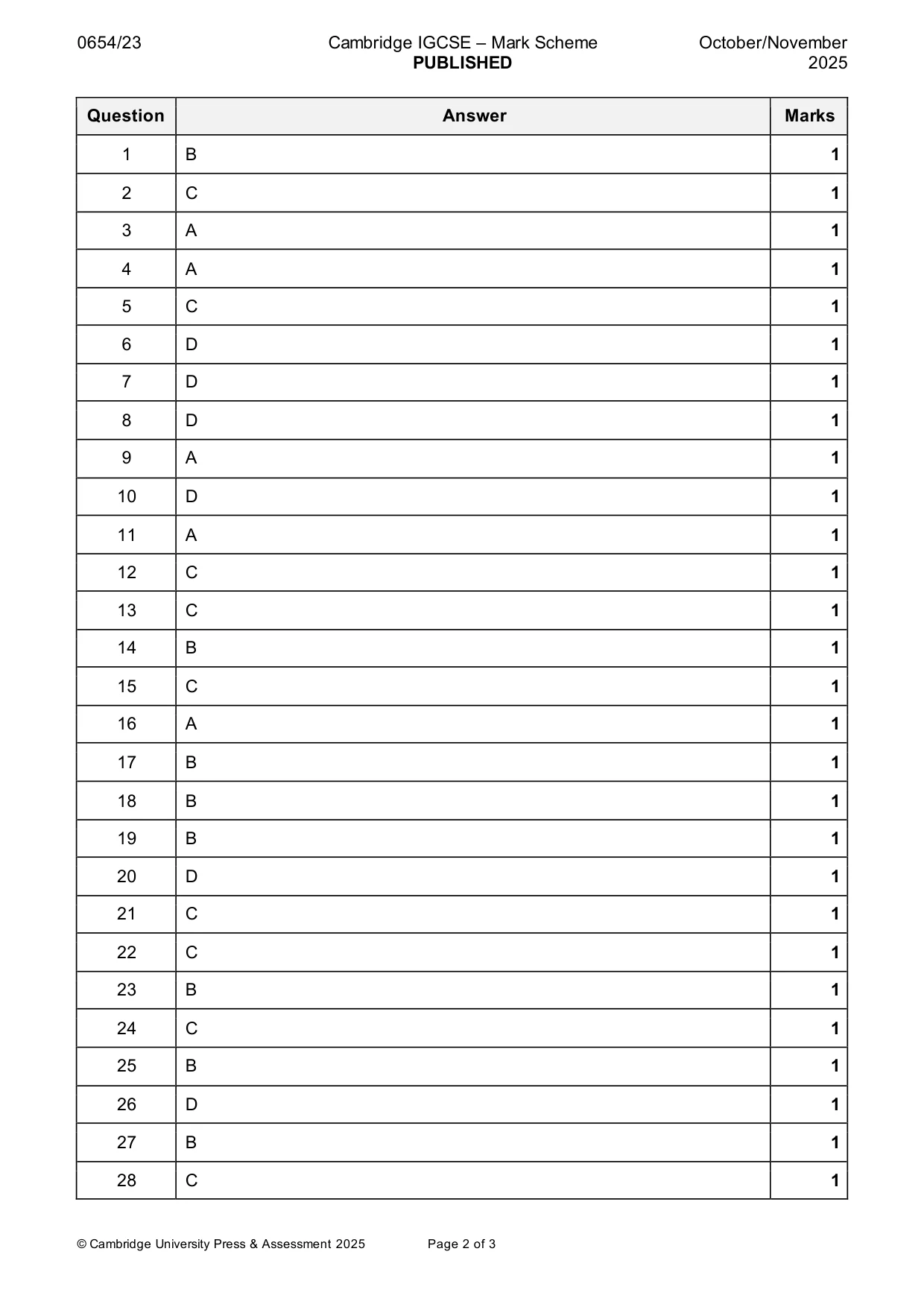
Mark scheme: B
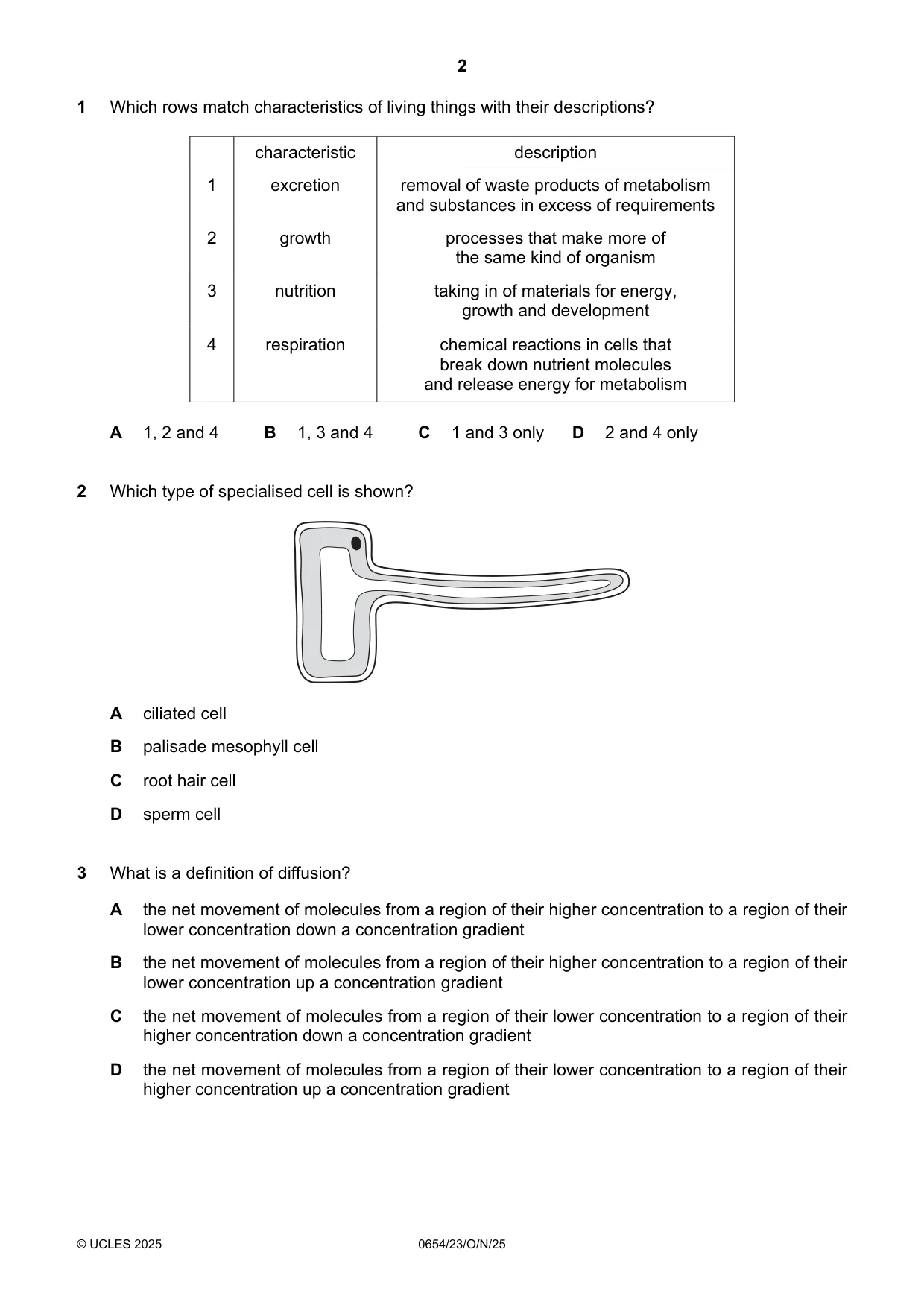
Q2 · Which type of specialised cell is shown?
2 Which type of specialised cell is shown? A ciliated cell B palisade mesophyll cell C root hair cell D sperm cell
Mark scheme: C
Q3 · What is a definition of diffusion?
3 What is a definition of diffusion? A the net movement of molecules from a region of their higher concentration to a region of their lower concentration down a concentration gradient B the net movement of molecules from a region of their higher concentration to a region of their lower concentration up a concentration gradient C the net movement of molecules from a region of their lower concentration to a region of their higher concentration down a concentration gradient D the net movement of molecules from a region of their lower concentration to a region of their higher concentration up a concentration gradient
Mark scheme: A
Q4 · Enzymes work best at an optimum pH
4 Enzymes work best at an optimum pH. Protease in the stomach works best at pH 1.6. What is a reason why the activity of protease decreases at pH values greater than 1.6? A The enzyme’s active site changes shape. B The kinetic energy of the molecules increases. C There are more effective collisions. D There is a higher substrate concentration.
Mark scheme: A
Q5 · Which statement about transport in plants is correct?
5 Which statement about transport in plants is correct? A Amino acids are moved from source to sink in the xylem. B Glucose is moved from sink to source in the xylem. C Sucrose is moved from source to sink in the phloem. D Starch is moved from sink to source in the phloem.
Mark scheme: C
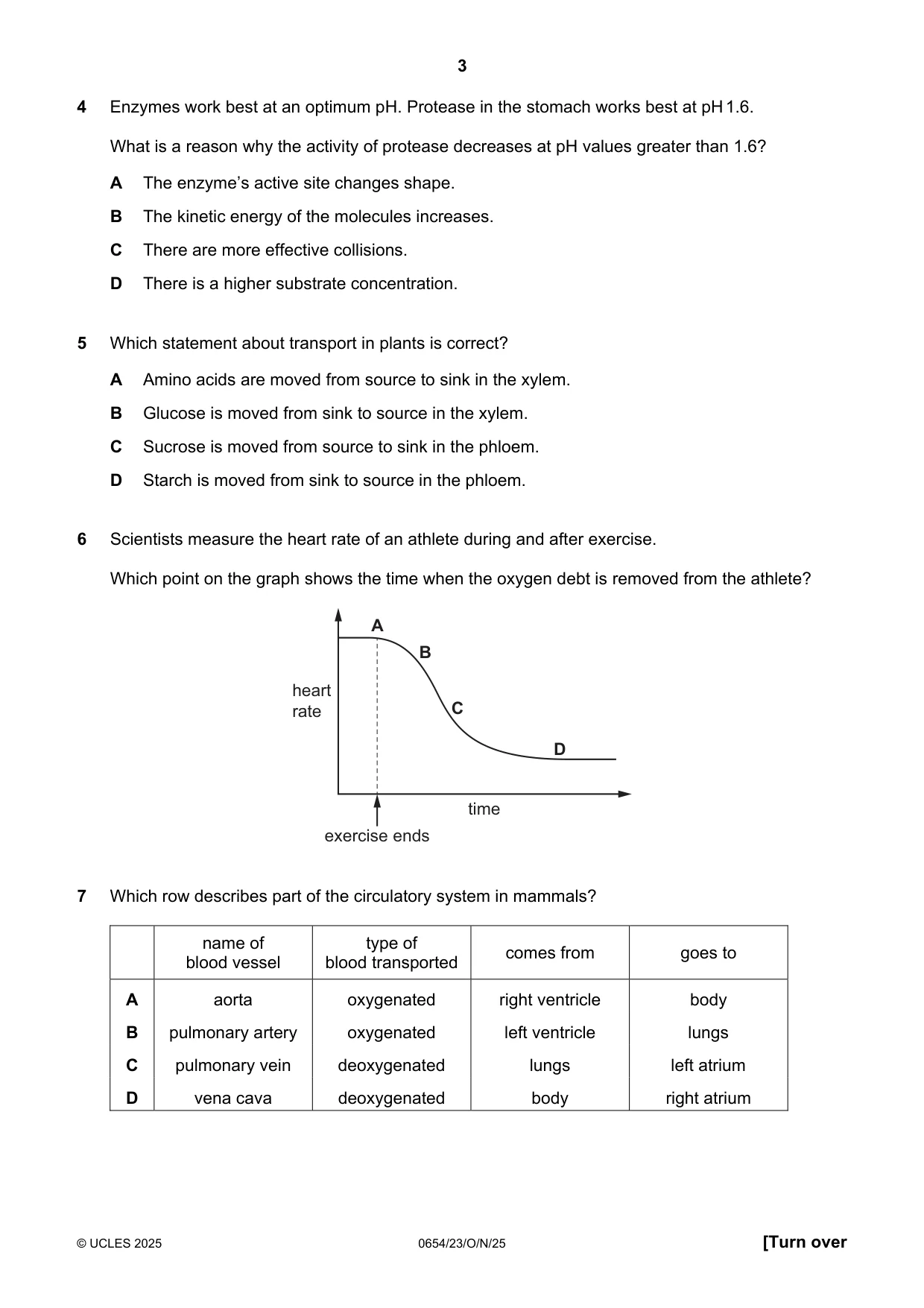
Q6 · Scientists measure the heart rate of an athlete during and after exercise
6 Scientists measure the heart rate of an athlete during and after exercise. Which point on the graph shows the time when the oxygen debt is removed from the athlete? A B heart rate C D time exercise ends
Mark scheme: D
Q7 · Which row describes part of the circulatory system in mammals?
7 Which row describes part of the circulatory system in mammals? name of type of comes from goes to blood vessel blood transported A aorta oxygenated right ventricle body B pulmonary artery oxygenated left ventricle lungs C pulmonary vein deoxygenated lungs left atrium D vena cava deoxygenated body right atrium
Mark scheme: D
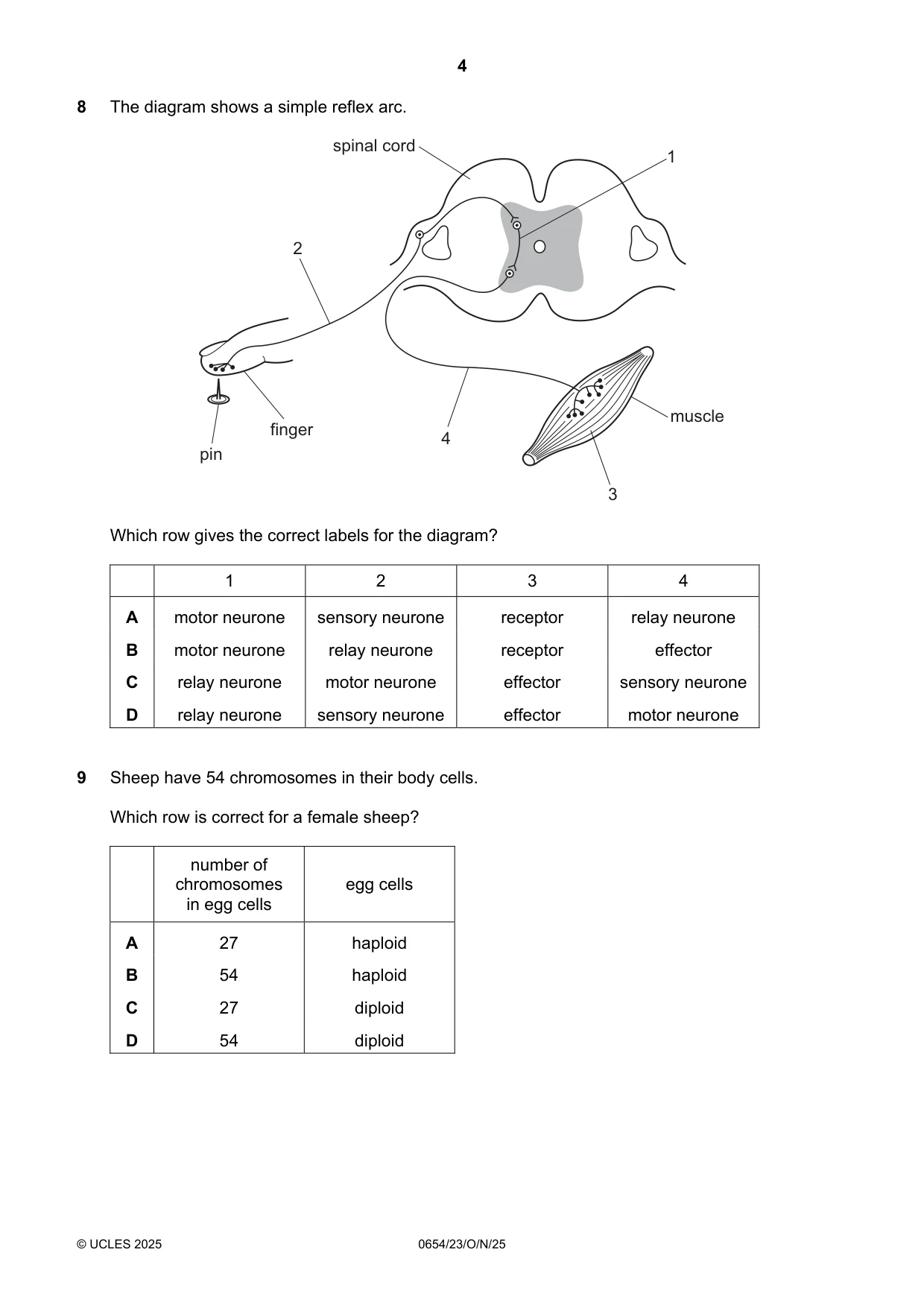
Q8 · The diagram shows a simple reflex arc
8 The diagram shows a simple reflex arc. spinal cord 1 2 muscle finger 4 pin 3 Which row gives the correct labels for the diagram? 1 2 3 4 A motor neurone sensory neurone receptor relay neurone B motor neurone relay neurone receptor effector C relay neurone motor neurone effector sensory neurone D relay neurone sensory neurone effector motor neurone
Mark scheme: D
Q9 · Sheep have 54 chromosomes in their body cells
9 Sheep have 54 chromosomes in their body cells. Which row is correct for a female sheep? number of chromosomes egg cells in egg cells A 27 haploid B 54 haploid C 27 diploid D 54 diploid
Mark scheme: A
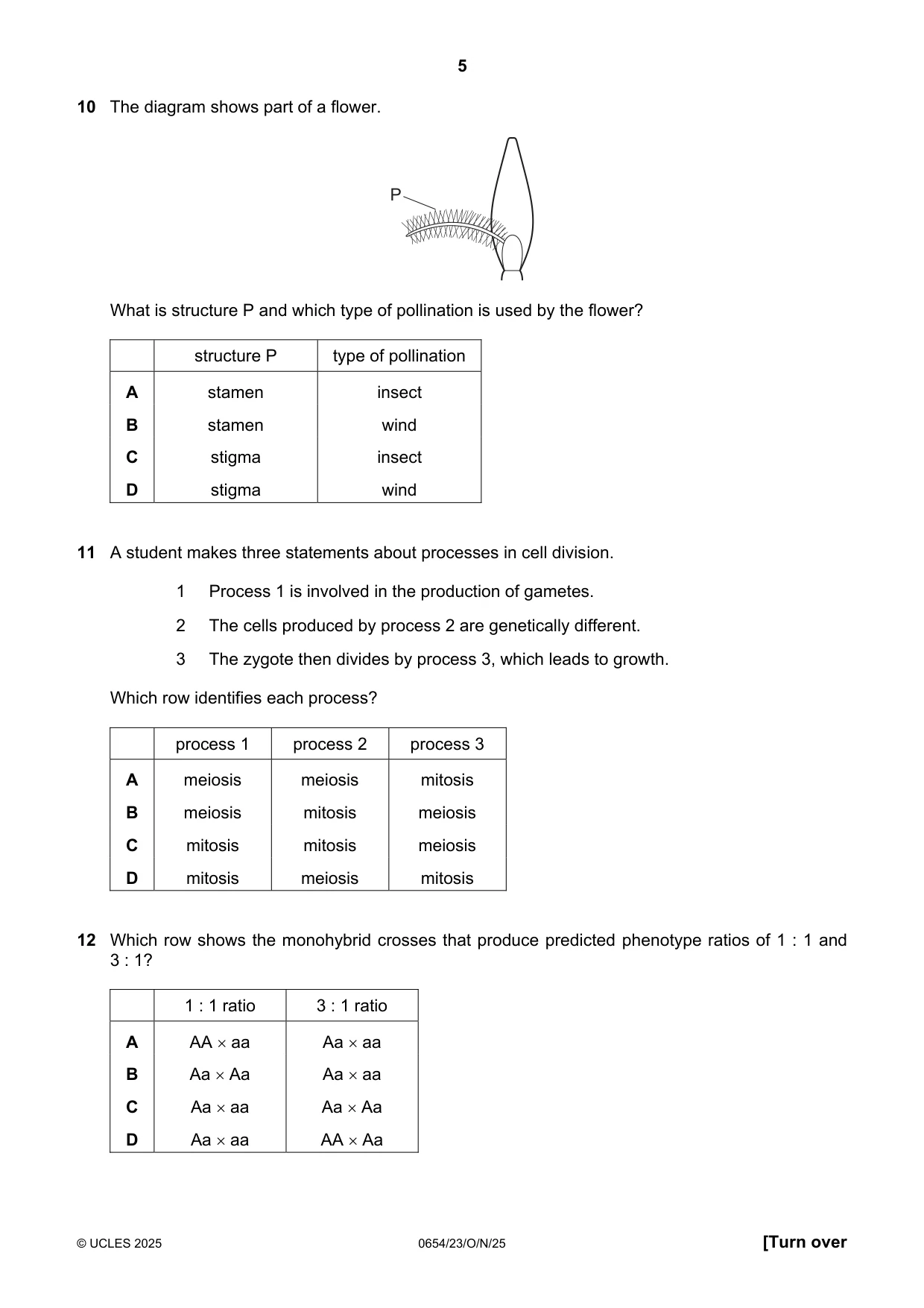
Q10 · The diagram shows part of a flower
10 The diagram shows part of a flower. P What is structure P and which type of pollination is used by the flower? structure P type of pollination A stamen insect B stamen wind C stigma insect D stigma wind
Mark scheme: D
Q11 · A student makes three statements about processes in cell division
11 A student makes three statements about processes in cell division. 1 Process 1 is involved in the production of gametes. 2 The cells produced by process 2 are genetically different. 3 The zygote then divides by process 3, which leads to growth. Which row identifies each process? process 1 process 2 process 3 A meiosis meiosis mitosis B meiosis mitosis meiosis C mitosis mitosis meiosis D mitosis meiosis mitosis
Mark scheme: A
Q12 · Which row shows the monohybrid crosses that produce predicted phenotype ratios of 1 : 1…
12 Which row shows the monohybrid crosses that produce predicted phenotype ratios of 1 : 1 and 3 : 1? 1 : 1 ratio 3 : 1 ratio A AA aa Aa aa B Aa Aa Aa aa C Aa aa Aa Aa D Aa aa AA Aa
Mark scheme: C
Q13 · What is the most energy efficient resource for humans to eat?
13 What is the most energy efficient resource for humans to eat? A herbivores B primary consumers C producers D secondary consumers
Mark scheme: C
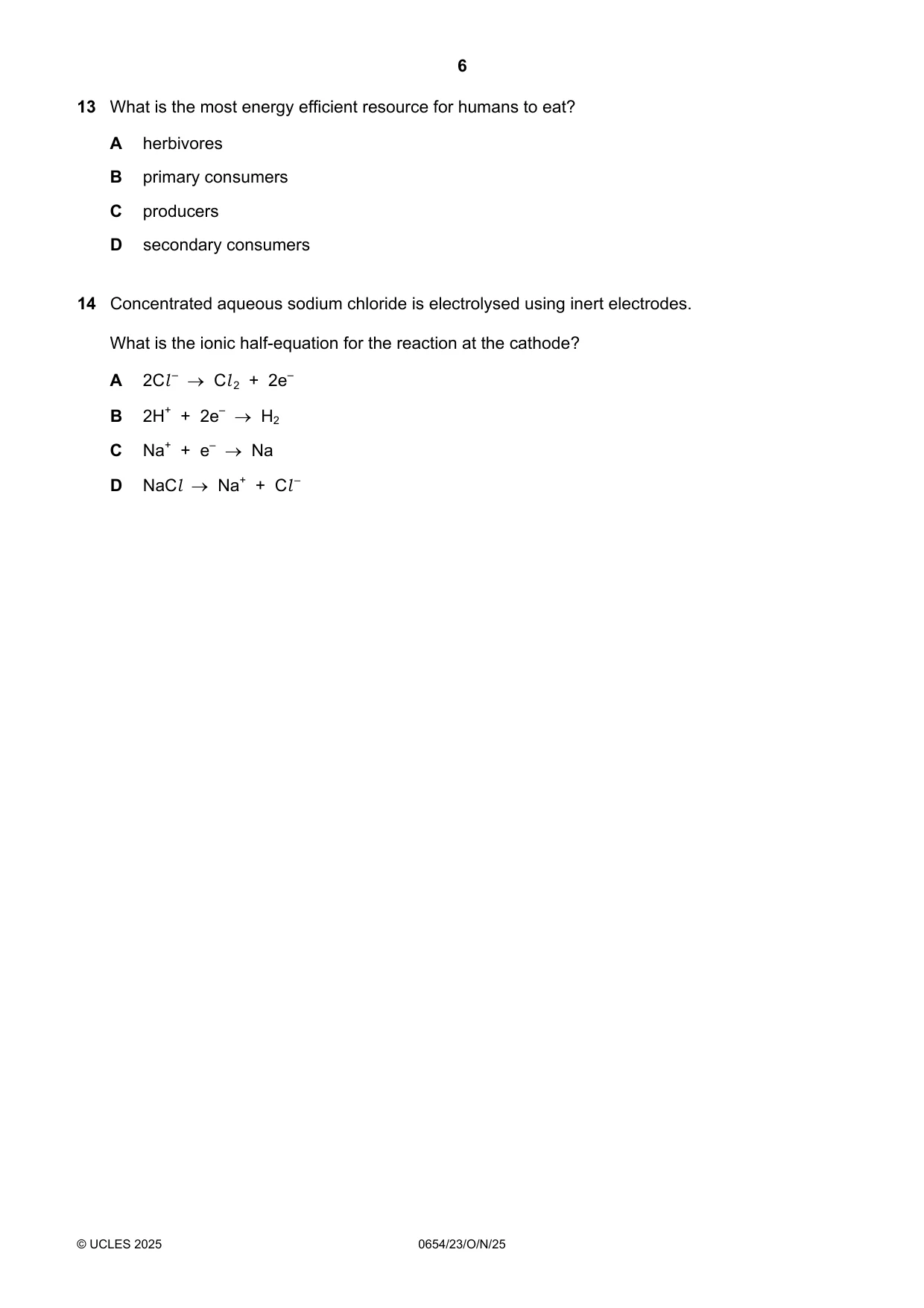
Q14 · Concentrated aqueous sodium chloride is electrolysed using inert electrodes
14 Concentrated aqueous sodium chloride is electrolysed using inert electrodes. What is the ionic half-equation for the reaction at the cathode? A 2Cl – Cl 2 + 2e– B 2H+ + 2e– H2 C Na+ + e– Na D NaCl Na+ + Cl –
Mark scheme: B
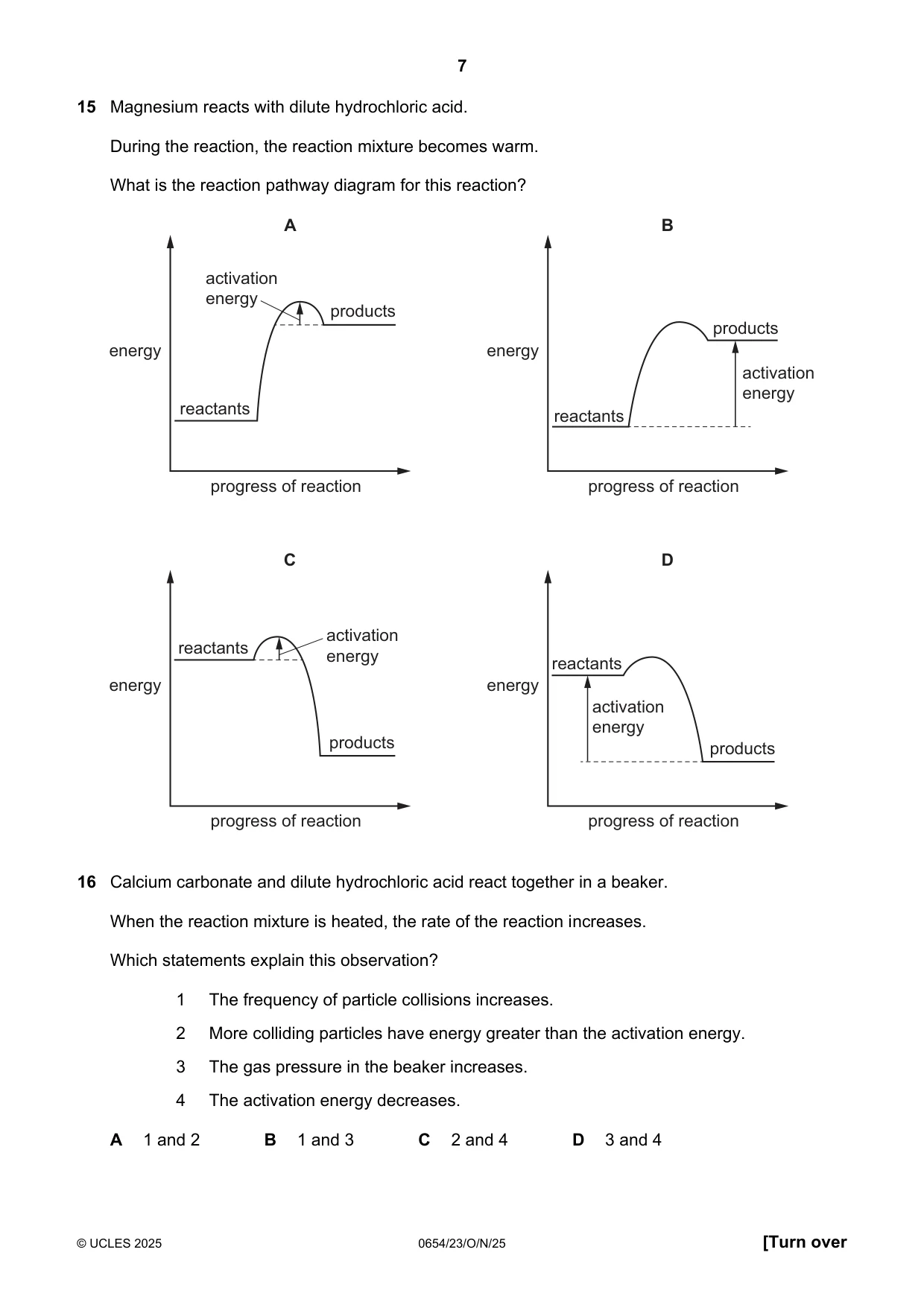
Q15 · Magnesium reacts with dilute hydrochloric acid
15 Magnesium reacts with dilute hydrochloric acid. During the reaction, the reaction mixture becomes warm. What is the reaction pathway diagram for this reaction? A B activation energy products products energy energy activation energy reactants reactants progress of reaction progress of reaction C D activation reactants energy reactants energy energy activation energy products products progress of reaction progress of reaction
Mark scheme: C
Q16 · Calcium carbonate and dilute hydrochloric acid react together in a beaker
16 Calcium carbonate and dilute hydrochloric acid react together in a beaker. When the reaction mixture is heated, the rate of the reaction increases. Which statements explain this observation? 1 The frequency of particle collisions increases. 2 More colliding particles have energy greater than the activation energy. 3 The gas pressure in the beaker increases. 4 The activation energy decreases. A 1 and 2 B 1 and 3 C 2 and 4 D 3 and 4
Mark scheme: A
Q17 · Which element in Period 3 of the Periodic Table has the greatest metallic character?
17 Which element in Period 3 of the Periodic Table has the greatest metallic character? A the element with the highest relative atomic mass B the element with the lowest group number C the element with the most outer-shell electrons D the element with the most protons
Mark scheme: B
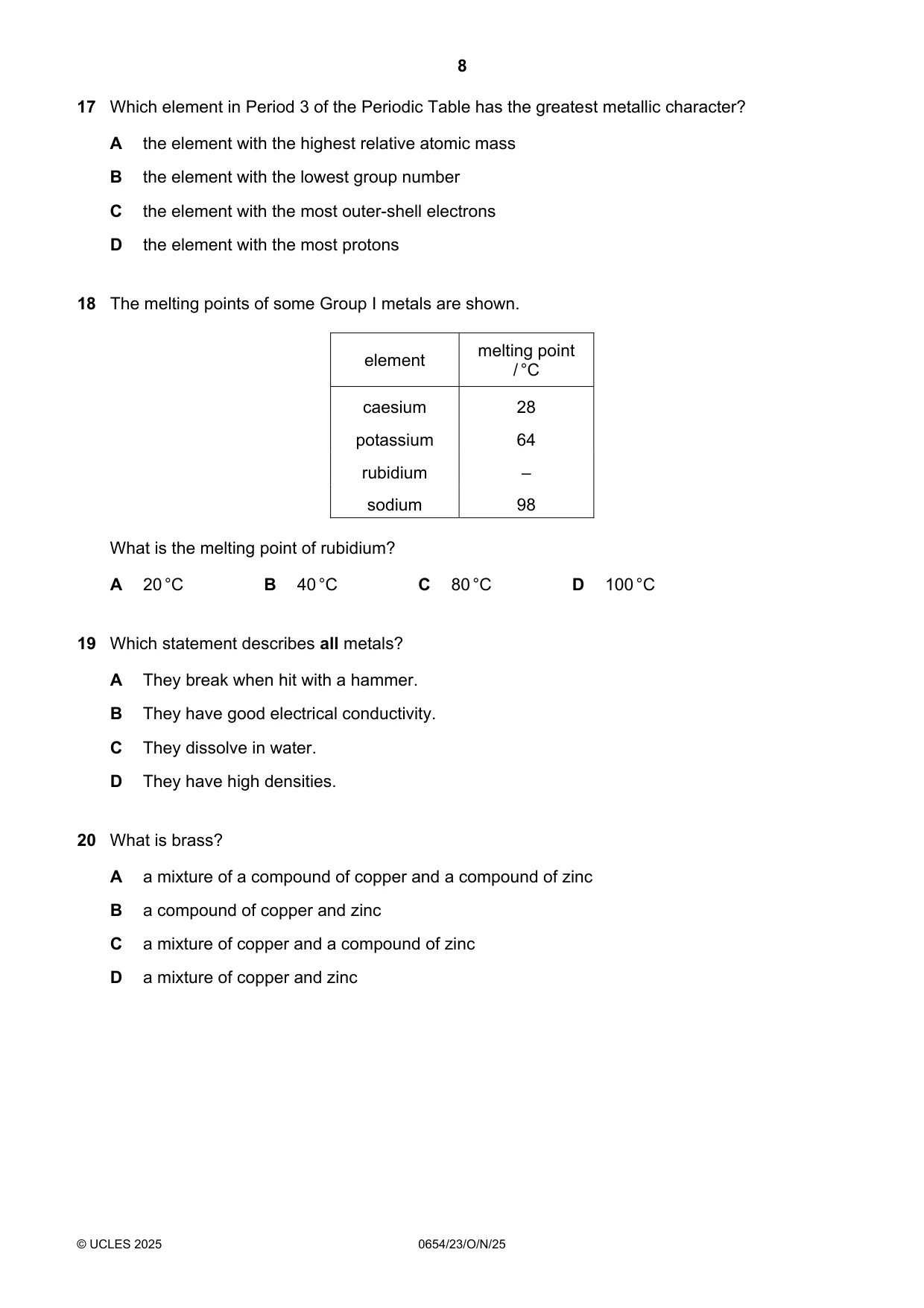
Q18 · The melting points of some Group I metals are shown
18 The melting points of some Group I metals are shown. melting point element / °C caesium 28 potassium 64 rubidium – sodium 98 What is the melting point of rubidium? A 20 °C B 40 °C C 80 °C D 100 °C
Mark scheme: B
Q19 · Which statement describes all metals?
19 Which statement describes all metals? A They break when hit with a hammer. B They have good electrical conductivity. C They dissolve in water. D They have high densities.
Mark scheme: B
Question 20
20 What is brass? A a mixture of a compound of copper and a compound of zinc B a compound of copper and zinc C a mixture of copper and a compound of zinc D a mixture of copper and zinc
Mark scheme: D
Q21 · Metal X reacts rapidly with steam but only very slowly with cold water
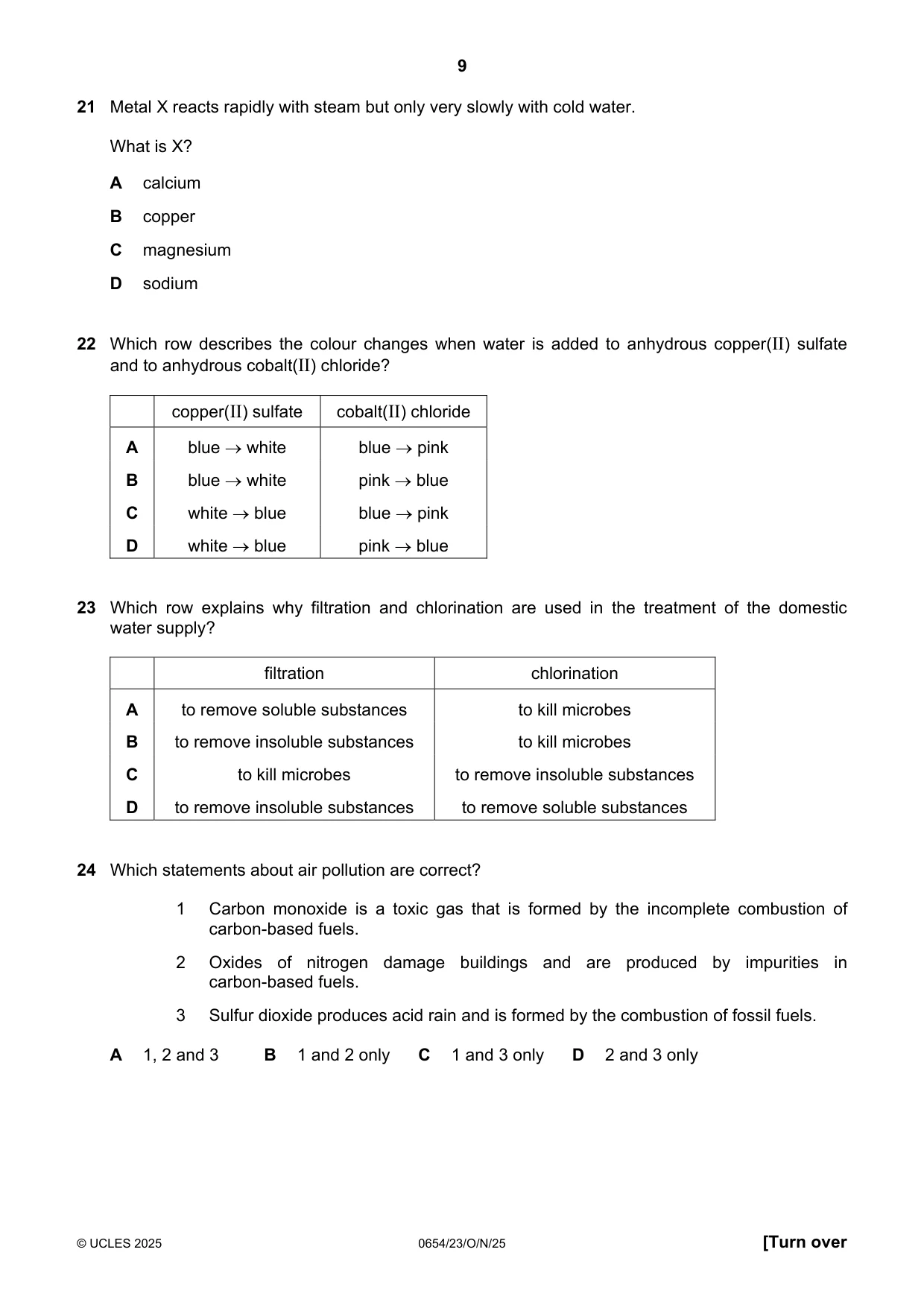
21 Metal X reacts rapidly with steam but only very slowly with cold water. What is X? A calcium B copper C magnesium D sodium
Mark scheme: C
Q22 · Which row describes the colour changes when water is added to anhydrous copper(II)…
22 Which row describes the colour changes when water is added to anhydrous copper(II) sulfate and to anhydrous cobalt(II) chloride? copper(II) sulfate cobalt(II) chloride A blue white blue pink B blue white pink blue C white blue blue pink D white blue pink blue
Mark scheme: C
Q23 · Which row explains why filtration and chlorination are used in the treatment of the…
23 Which row explains why filtration and chlorination are used in the treatment of the domestic water supply? filtration chlorination A to remove soluble substances to kill microbes B to remove insoluble substances to kill microbes C to kill microbes to remove insoluble substances D to remove insoluble substances to remove soluble substances
Mark scheme: B
Q24 · Which statements about air pollution are correct?
24 Which statements about air pollution are correct? 1 Carbon monoxide is a toxic gas that is formed by the incomplete combustion of carbon-based fuels. 2 Oxides of nitrogen damage buildings and are produced by impurities in carbon-based fuels. 3 Sulfur dioxide produces acid rain and is formed by the combustion of fossil fuels. A 1, 2 and 3 B 1 and 2 only C 1 and 3 only D 2 and 3 only
Mark scheme: C
Q25 · The structures of four organic compounds, P, Q, R and S, are shown
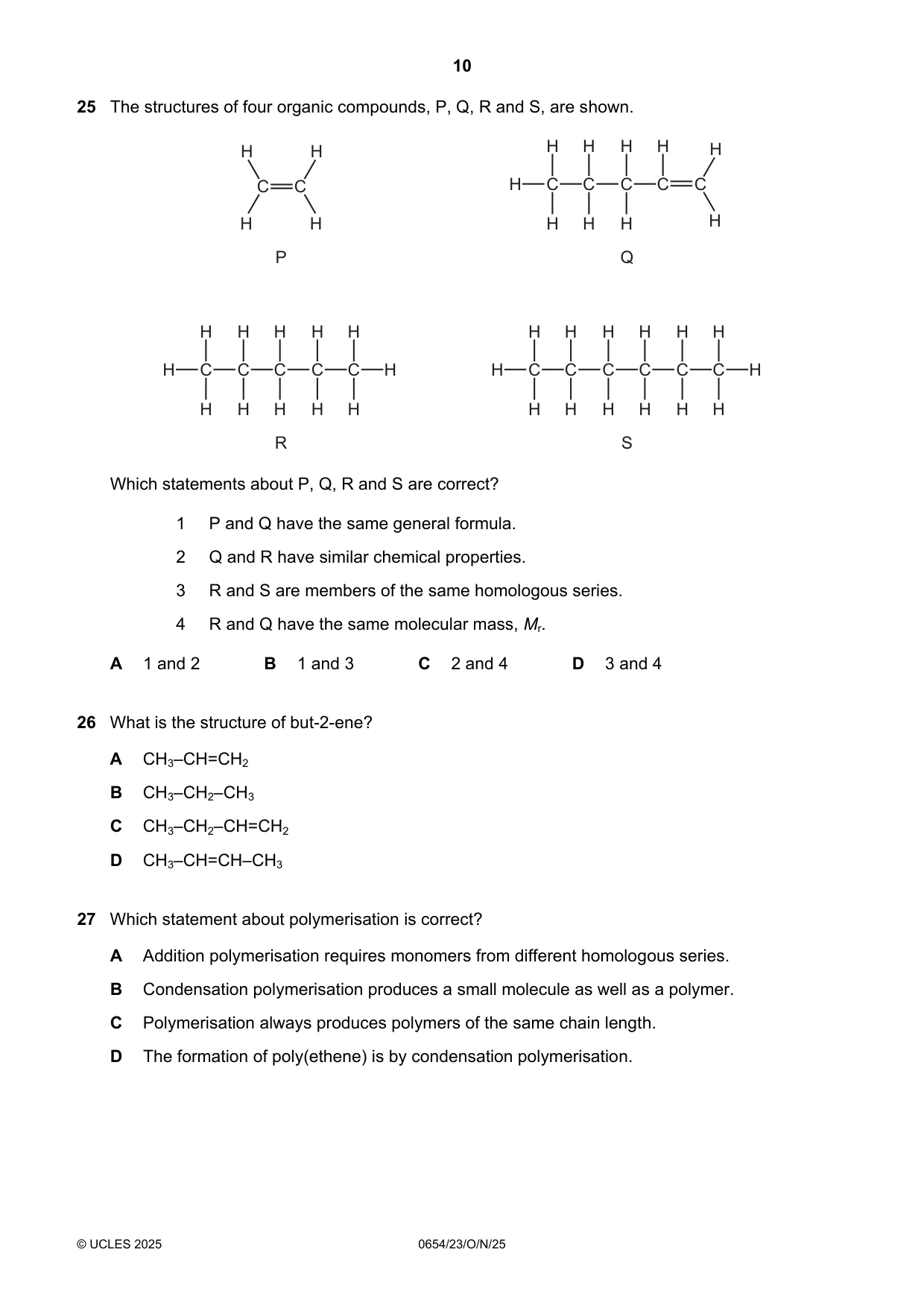
25 The structures of four organic compounds, P, Q, R and S, are shown. H H H H H H H C C H C C C C C H H H H H H P Q H H H H H H H H H H H H C C C C C H H C C C C C C H H H H H H H H H H H H R S Which statements about P, Q, R and S are correct? 1 P and Q have the same general formula. 2 Q and R have similar chemical properties. 3 R and S are members of the same homologous series. 4 R and Q have the same molecular mass, Mr. A 1 and 2 B 1 and 3 C 2 and 4 D 3 and 4
Mark scheme: B
Q26 · What is the structure of but-2-ene?
26 What is the structure of but-2-ene? A CH3–CH=CH2 B CH3–CH2–CH3 C CH3–CH2–CH=CH2 D CH3–CH=CH–CH3
Mark scheme: D
Q27 · Which statement about polymerisation is correct?
27 Which statement about polymerisation is correct? A Addition polymerisation requires monomers from different homologous series. B Condensation polymerisation produces a small molecule as well as a polymer. C Polymerisation always produces polymers of the same chain length. D The formation of poly(ethene) is by condensation polymerisation.
Mark scheme: B
Q28 · A spring is 16 cm long when it supports a load of 12 N
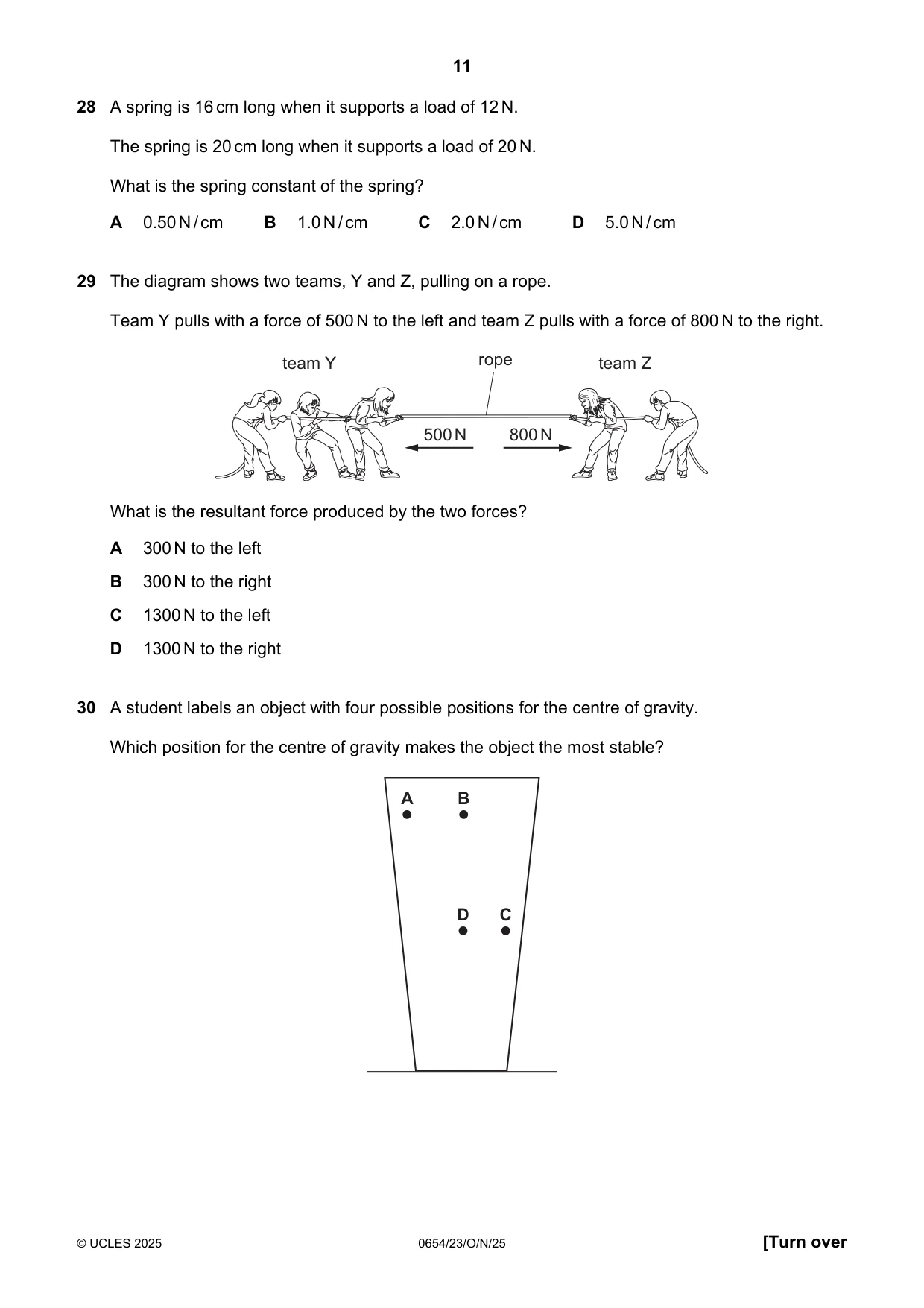
28 A spring is 16 cm long when it supports a load of 12 N. The spring is 20 cm long when it supports a load of 20 N. What is the spring constant of the spring? A 0.50 N / cm B 1.0 N / cm C 2.0 N / cm D 5.0 N / cm
Mark scheme: C
Q29 · The diagram shows two teams, Y and Z, pulling on a rope
29 The diagram shows two teams, Y and Z, pulling on a rope. Team Y pulls with a force of 500 N to the left and team Z pulls with a force of 800 N to the right. team Y rope team Z 500 N 800 N What is the resultant force produced by the two forces? A 300 N to the left B 300 N to the right C 1300 N to the left D 1300 N to the right
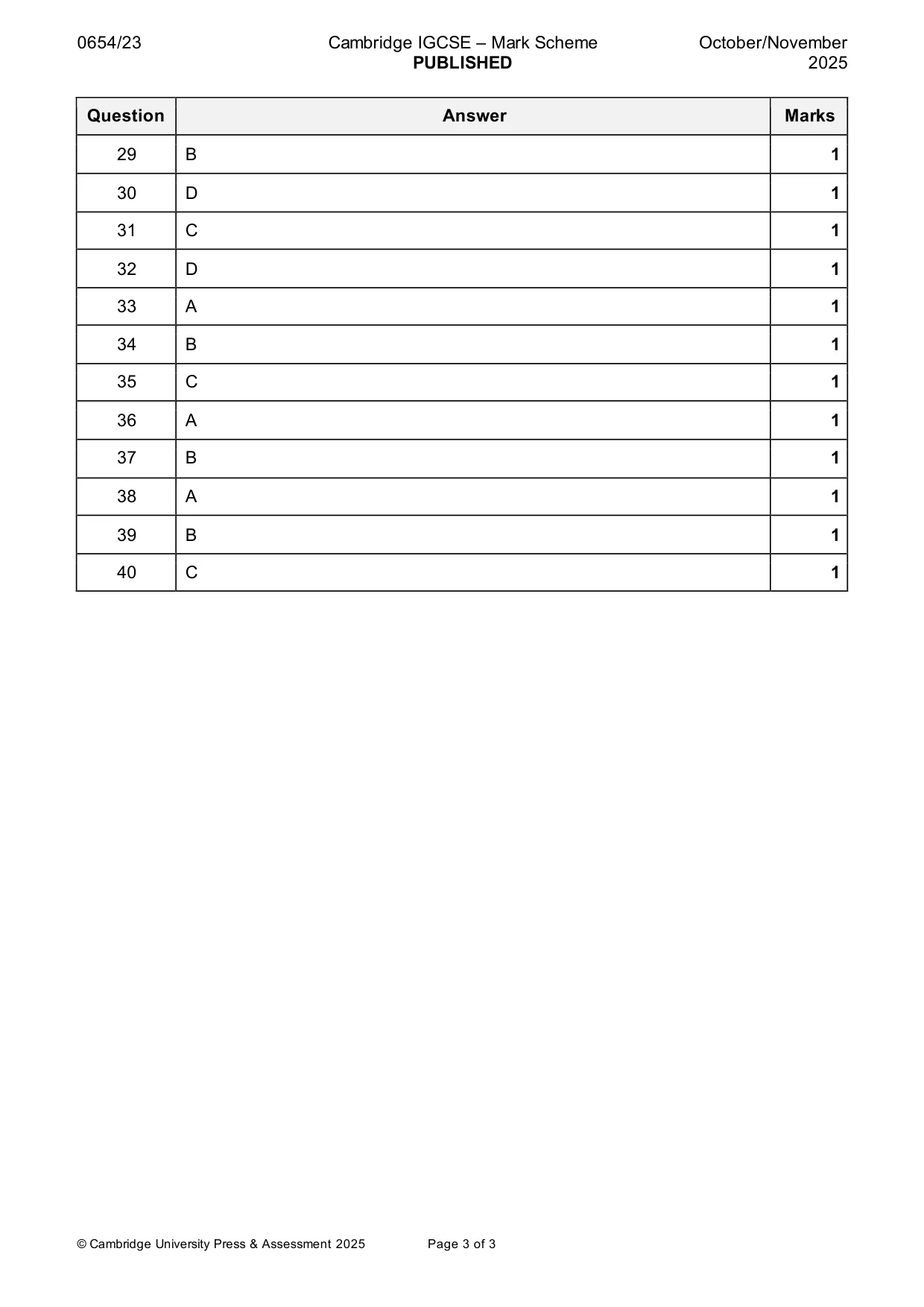
Mark scheme: B
Q30 · A student labels an object with four possible positions for the centre of gravity
30 A student labels an object with four possible positions for the centre of gravity. Which position for the centre of gravity makes the object the most stable? A B D C
Mark scheme: D
Q31 · When a liquid evaporates, particles escape from the surface of the liquid
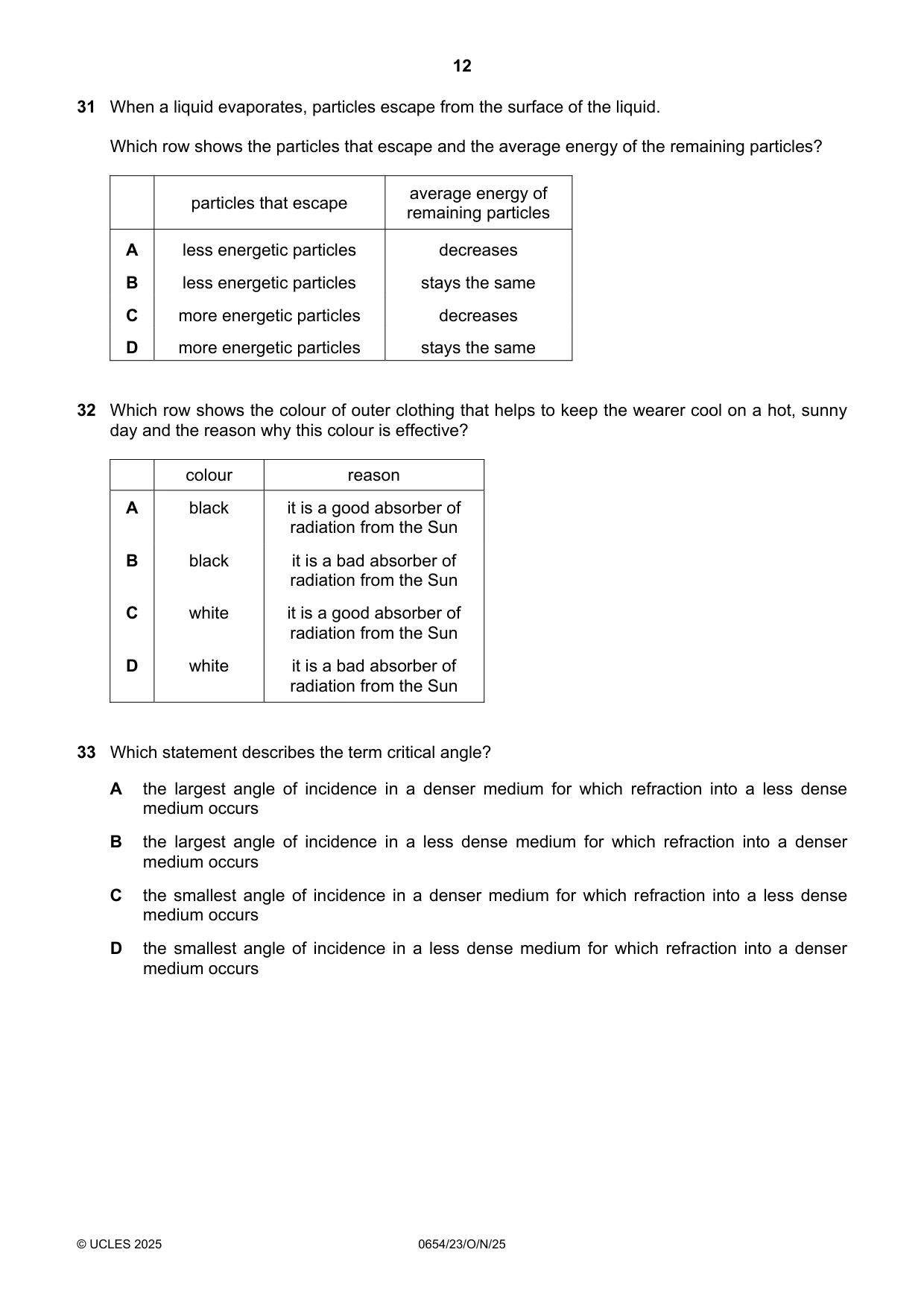
31 When a liquid evaporates, particles escape from the surface of the liquid. Which row shows the particles that escape and the average energy of the remaining particles? average energy of particles that escape remaining particles A less energetic particles decreases B less energetic particles stays the same C more energetic particles decreases D more energetic particles stays the same
Mark scheme: C
Q32 · Which row shows the colour of outer clothing that helps to keep the wearer cool on a hot…
32 Which row shows the colour of outer clothing that helps to keep the wearer cool on a hot, sunny day and the reason why this colour is effective? colour reason A black it is a good absorber of radiation from the Sun B black it is a bad absorber of radiation from the Sun C white it is a good absorber of radiation from the Sun D white it is a bad absorber of radiation from the Sun
Mark scheme: D
Q33 · Which statement describes the term critical angle?
33 Which statement describes the term critical angle? A the largest angle of incidence in a denser medium for which refraction into a less dense medium occurs B the largest angle of incidence in a less dense medium for which refraction into a denser medium occurs C the smallest angle of incidence in a denser medium for which refraction into a less dense medium occurs D the smallest angle of incidence in a less dense medium for which refraction into a denser medium occurs
Mark scheme: A
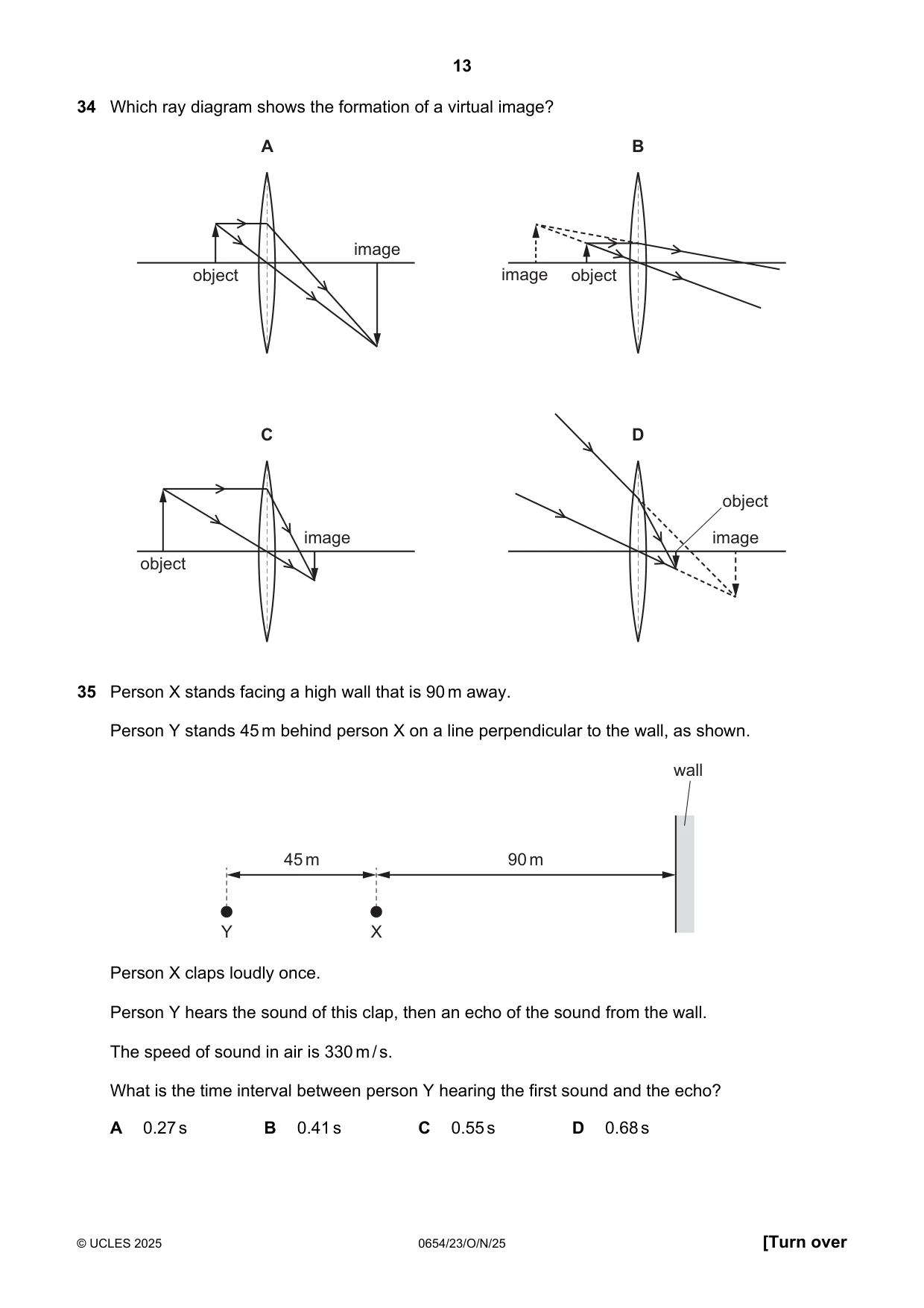
Q34 · Which ray diagram shows the formation of a virtual image?
34 Which ray diagram shows the formation of a virtual image? A B image object image object C D object image image object
Mark scheme: B
Q35 · Person X stands facing a high wall that is 90 m away
35 Person X stands facing a high wall that is 90 m away. Person Y stands 45 m behind person X on a line perpendicular to the wall, as shown. wall 45 m 90 m Y X Person X claps loudly once. Person Y hears the sound of this clap, then an echo of the sound from the wall. The speed of sound in air is 330 m / s. What is the time interval between person Y hearing the first sound and the echo? A 0.27 s B 0.41 s C 0.55 s D 0.68 s
Mark scheme: C
Q36 · What is defined in terms of the electrical work done by a source in moving unit charge…
36 What is defined in terms of the electrical work done by a source in moving unit charge around a complete circuit? A electromotive force (e.m.f.) B current C potential difference (p.d.) D power
Mark scheme: A
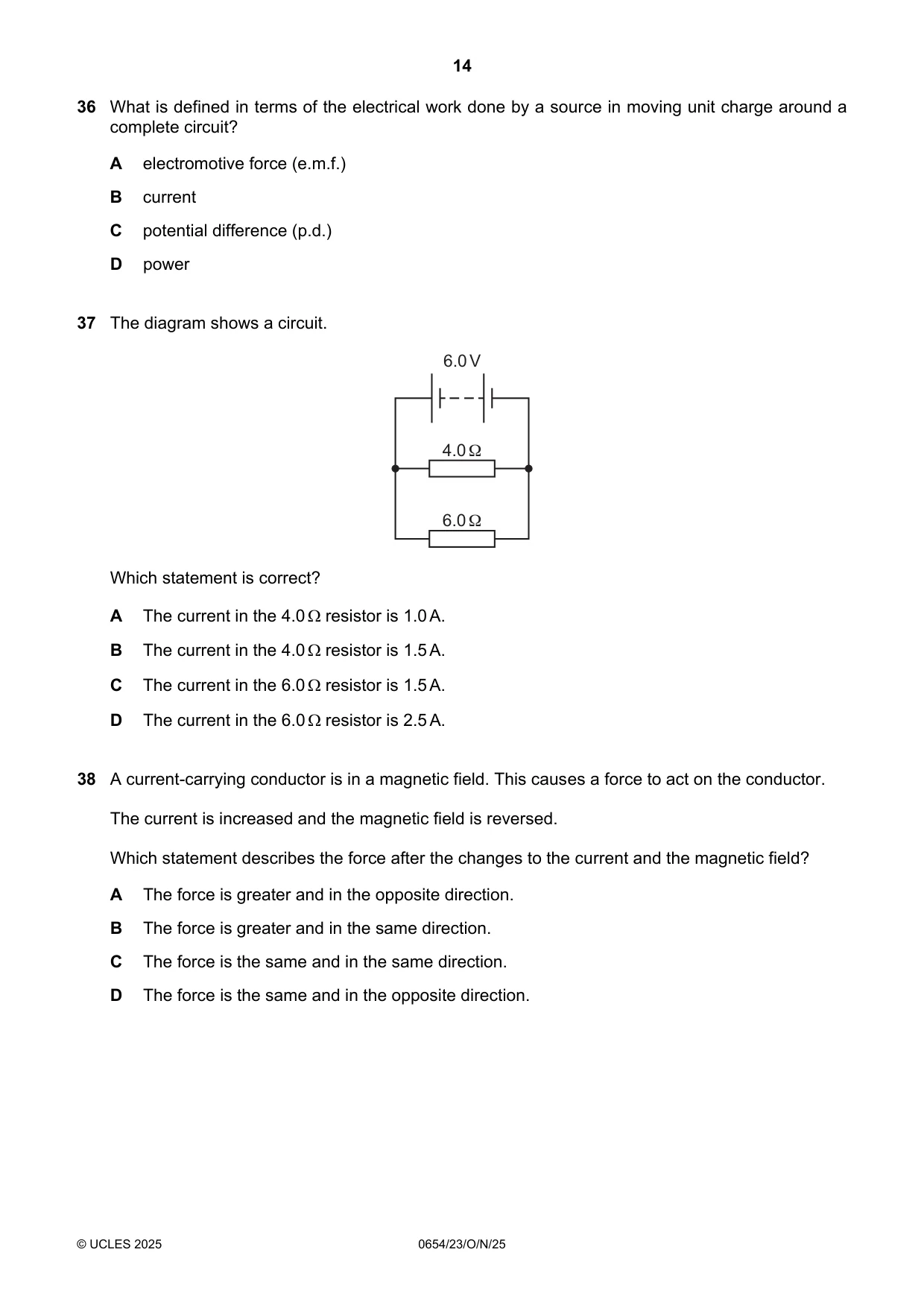
Q37 · The diagram shows a circuit
37 The diagram shows a circuit. 6.0 V 4.0 Ω 6.0 Ω Which statement is correct? A The current in the 4.0 resistor is 1.0 A. B The current in the 4.0 resistor is 1.5 A. C The current in the 6.0 resistor is 1.5 A. D The current in the 6.0 resistor is 2.5 A.
Mark scheme: B
Q38 · A current-carrying conductor is in a magnetic field
38 A current-carrying conductor is in a magnetic field. This causes a force to act on the conductor. The current is increased and the magnetic field is reversed. Which statement describes the force after the changes to the current and the magnetic field? A The force is greater and in the opposite direction. B The force is greater and in the same direction. C The force is the same and in the same direction. D The force is the same and in the opposite direction.
Mark scheme: A
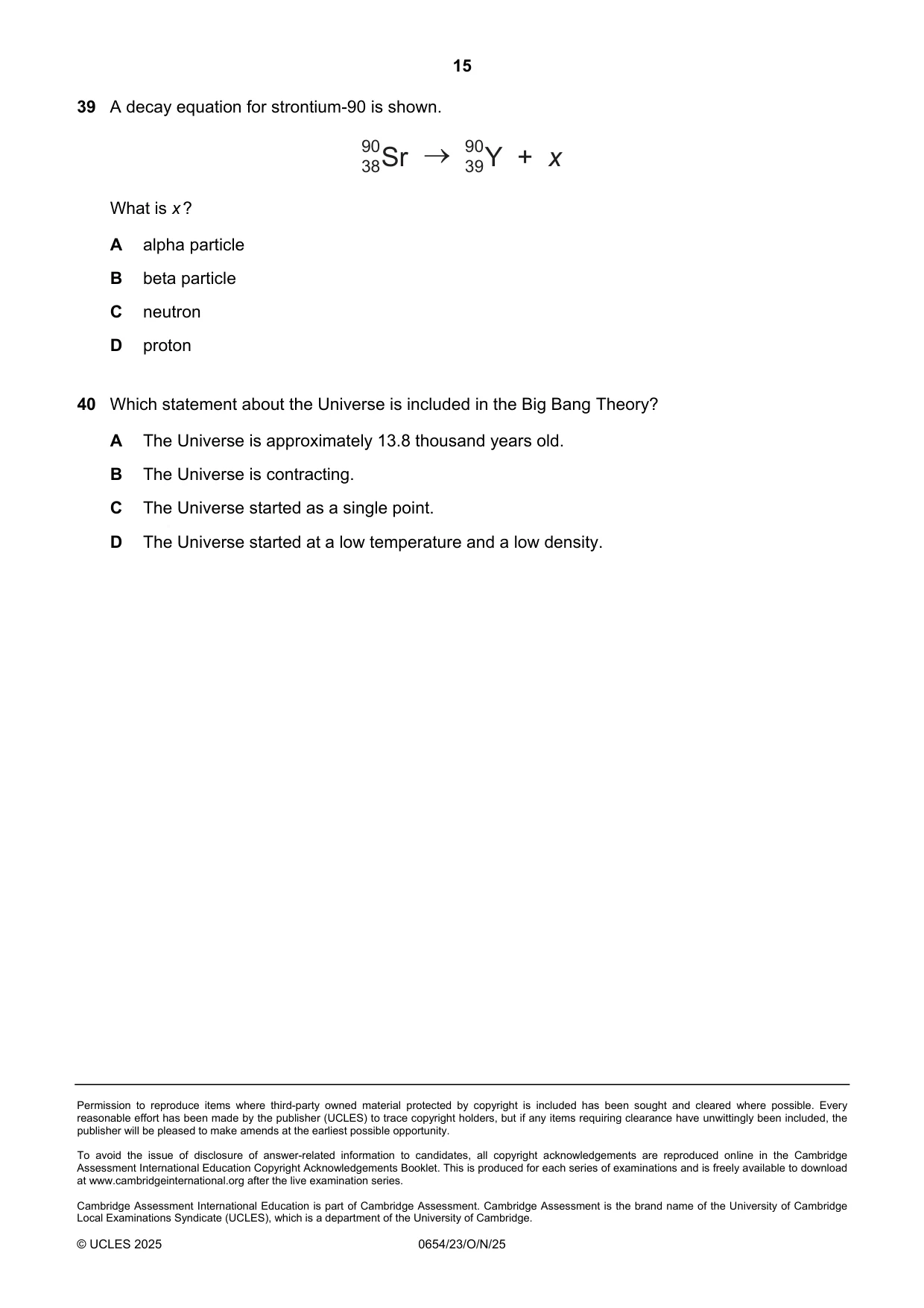
Q39 · A decay equation for strontium-90 is shown
39 A decay equation for strontium-90 is shown. 90 38Sr 90 39Y + x What is x ? A alpha particle B beta particle C neutron D proton
Mark scheme: B
Q40 · Which statement about the Universe is included in the Big Bang Theory?
40 Which statement about the Universe is included in the Big Bang Theory? A The Universe is approximately 13.8 thousand years old. B The Universe is contracting. C The Universe started as a single point. D The Universe started at a low temperature and a low density.
Mark scheme: C
What was in this paper
The subtopics covered by these 40 questions, and how many questions each got. Open one in a new tab to see every Cambridge question on it.
3Light2Air quality and climate1Alloys and their properties1Arrangement of elements1Cell division1Cell structure1Characteristics of living organisms1Chromosomes and genes1Circulatory systems1Coordination and response1Diffusion1Electrical circuits1Electrical quantities1Electrolysis1Electromagnetic effects1Energy flow1Enzymes1Exothermic and endothermic reactions1Formulas and terminology1Group I properties1Identification of ions and gases1Kinetic particle model of matter1Monohybrid inheritance1Naming organic compounds1Polymers1Properties of metals1Radioactivity1Rate of reaction1Reactivity series1Respiration1Sexual reproduction in plants1Sound1Stars and the Universe1Transfer of thermal energy1Translocation1Water1What you needed in this session
Cambridge’s own grade thresholds for 2025 Oct/Nov, Paper 2 · Variant 3. A higher threshold means an easier paper — the bar moves with how the cohort did.