Cambridge IGCSE Sciences - Co-ordinated (Double) 0654 — 2020 Oct/Nov Paper 2 · Variant 1
0654/21/O/N/20 · 40 questions · 40 marks · ≈45 min
The question paper and its mark scheme, free to read here and free to download. This is Cambridge’s own paper, exactly as it was sat.
Question paper16 pages

Mark scheme3 pages
Answers below. Sit the paper first if you are practising.
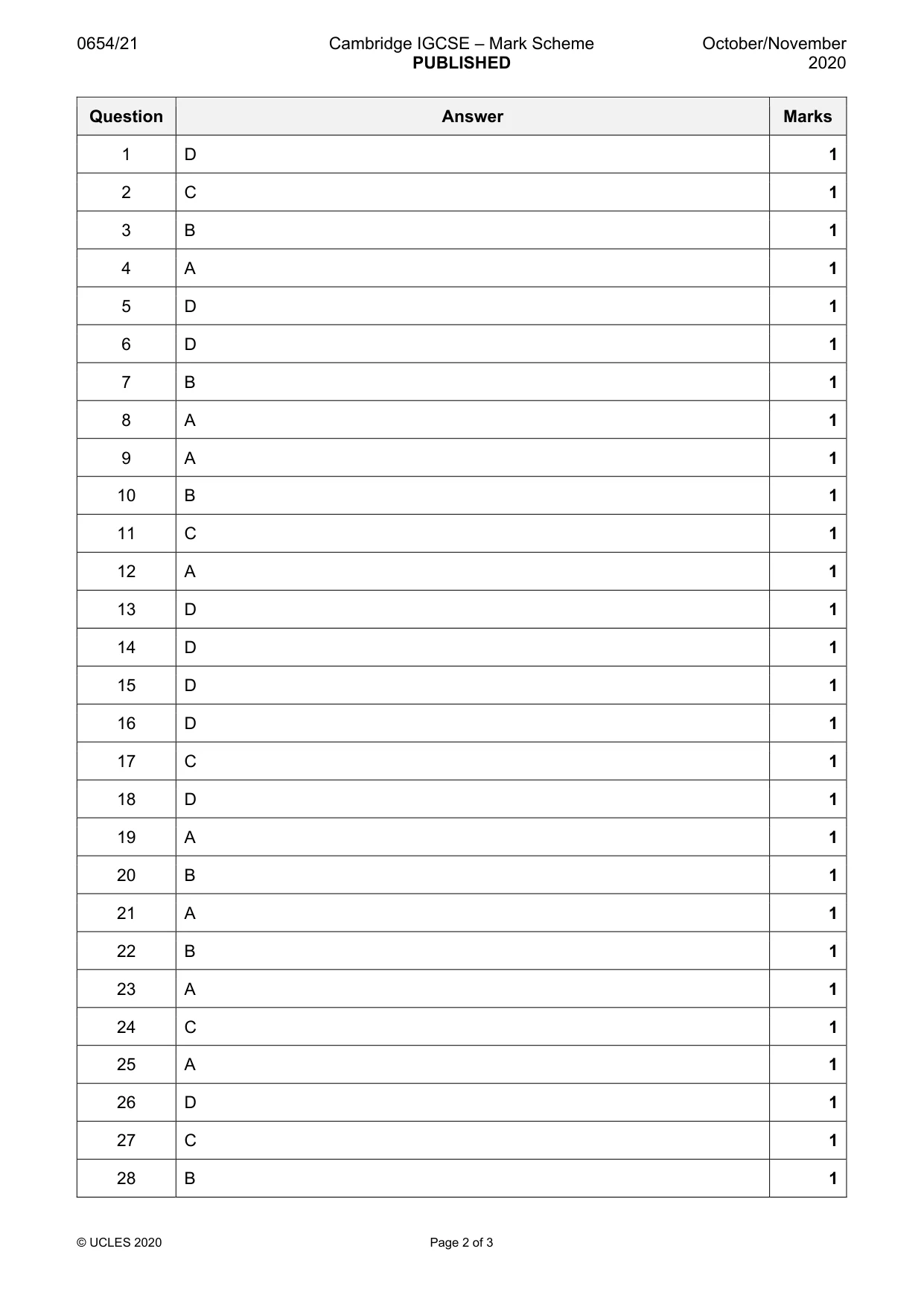
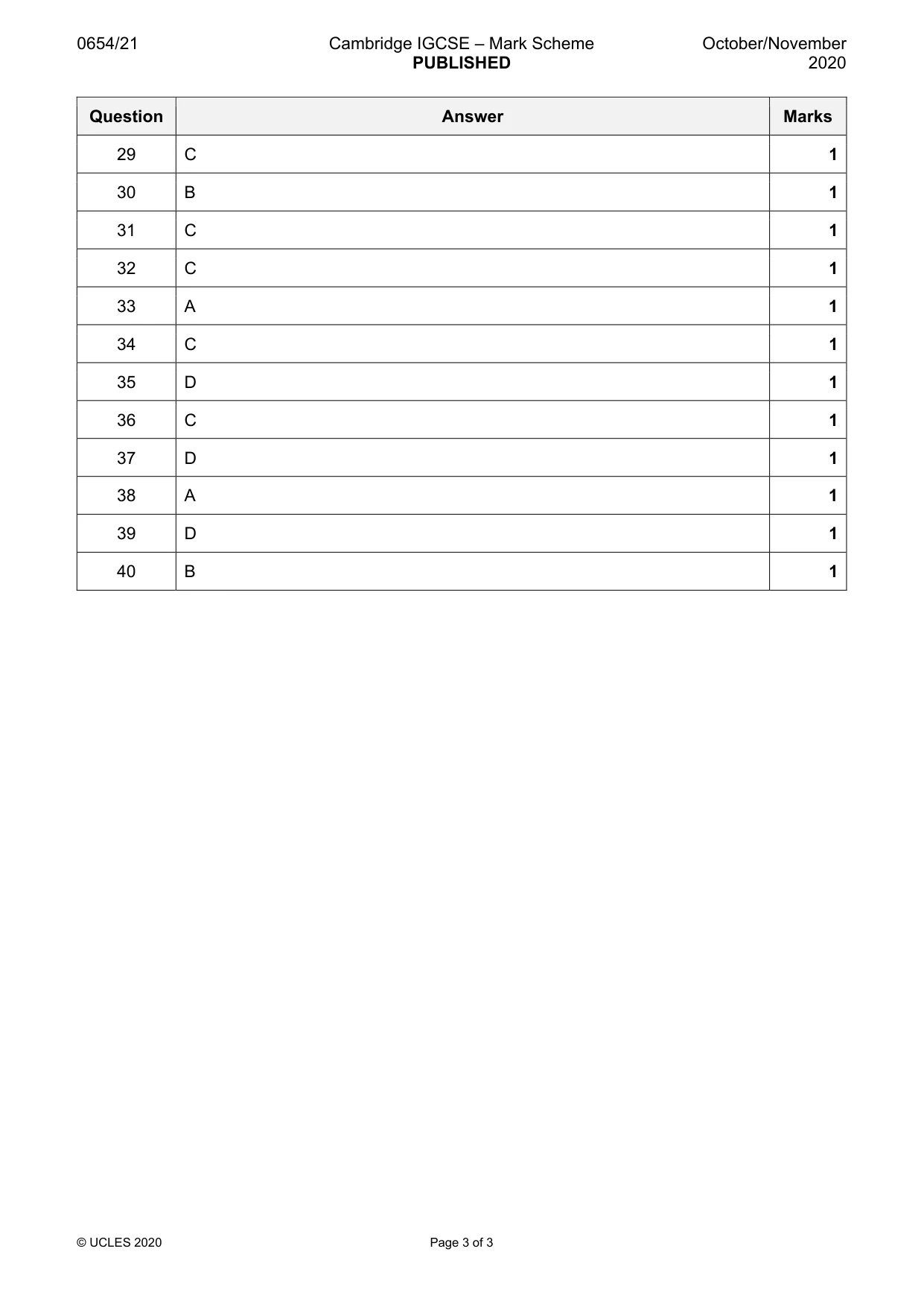
Questions as text
Q1 · Which statement is the definition of nutrition?
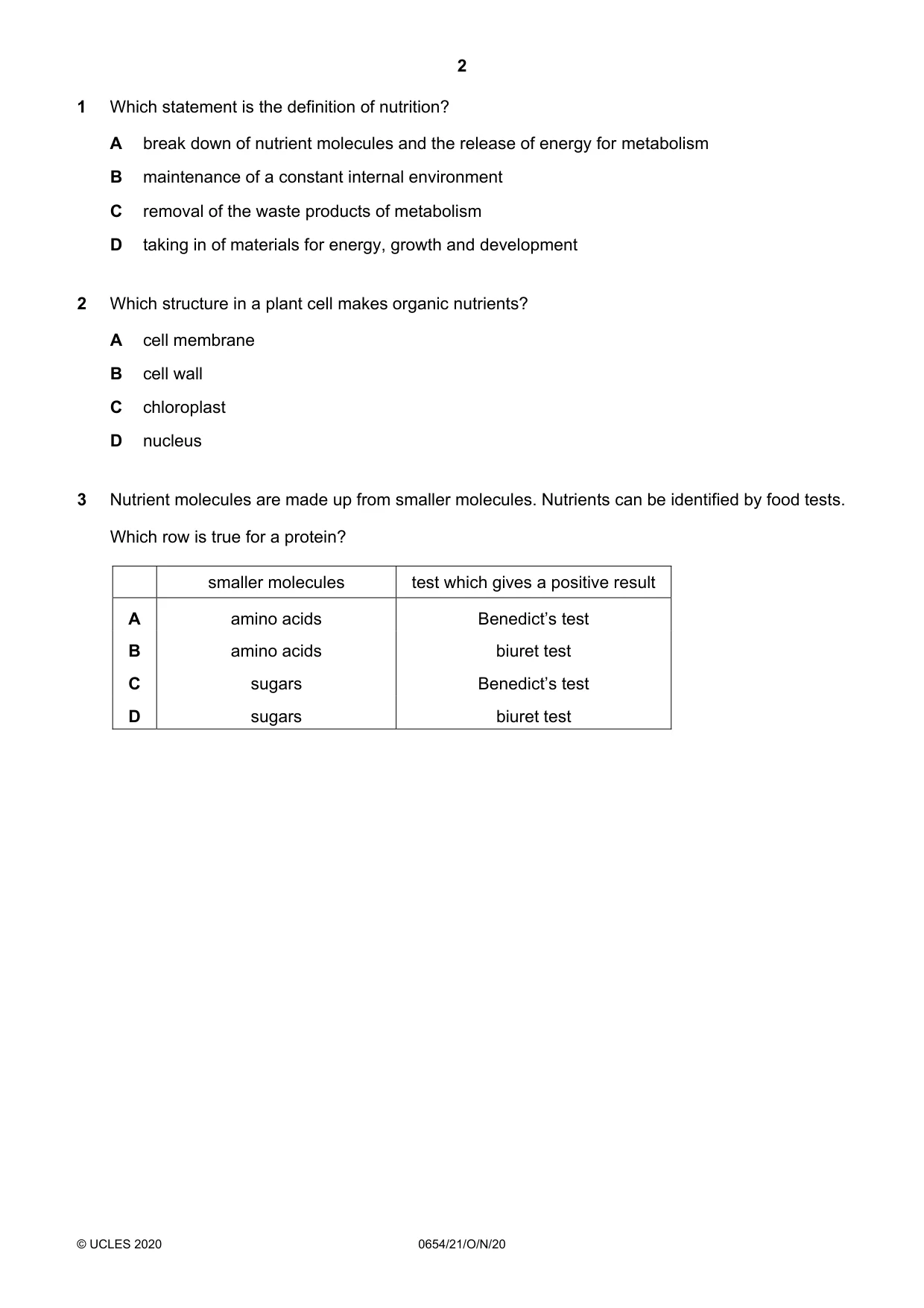
1 Which statement is the definition of nutrition? A break down of nutrient molecules and the release of energy for metabolism B maintenance of a constant internal environment C removal of the waste products of metabolism D taking in of materials for energy, growth and development
Mark scheme: D
Q2 · Which structure in a plant cell makes organic nutrients?
2 Which structure in a plant cell makes organic nutrients? A cell membrane B cell wall C chloroplast D nucleus
Mark scheme: C
Q3 · Nutrient molecules are made up from smaller molecules
3 Nutrient molecules are made up from smaller molecules. Nutrients can be identified by food tests. Which row is true for a protein? smaller molecules test which gives a positive result A amino acids Benedict’s test B amino acids biuret test C sugars Benedict’s test D sugars biuret test
Mark scheme: B
Q4 · A mixture of starch and saliva was set up at four different temperatures
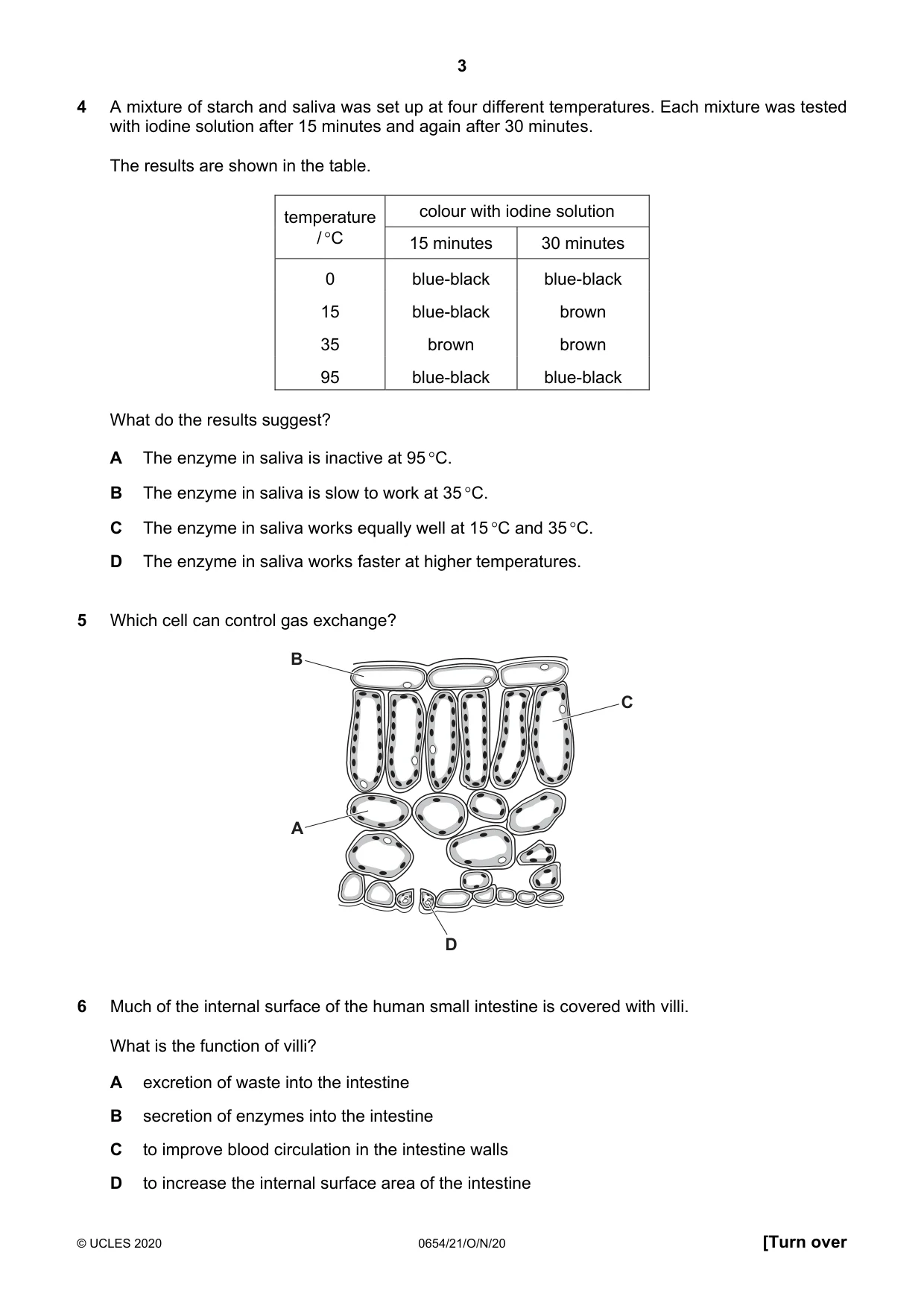
4 A mixture of starch and saliva was set up at four different temperatures. Each mixture was tested with iodine solution after 15 minutes and again after 30 minutes. The results are shown in the table. temperature colour with iodine solution / C 15 minutes 30 minutes 0 blue-black blue-black 15 blue-black brown 35 brown brown 95 blue-black blue-black What do the results suggest? A The enzyme in saliva is inactive at 95 C. B The enzyme in saliva is slow to work at 35 C. C The enzyme in saliva works equally well at 15 C and 35 C. D The enzyme in saliva works faster at higher temperatures.
Mark scheme: A
Q5 · Which cell can control gas exchange?
5 Which cell can control gas exchange? B C A D
Mark scheme: D
Q6 · Much of the internal surface of the human small intestine is covered with villi
6 Much of the internal surface of the human small intestine is covered with villi. What is the function of villi? A excretion of waste into the intestine B secretion of enzymes into the intestine C to improve blood circulation in the intestine walls D to increase the internal surface area of the intestine
Mark scheme: D
Q7 · Under which conditions will transpiration from a plant be fastest?
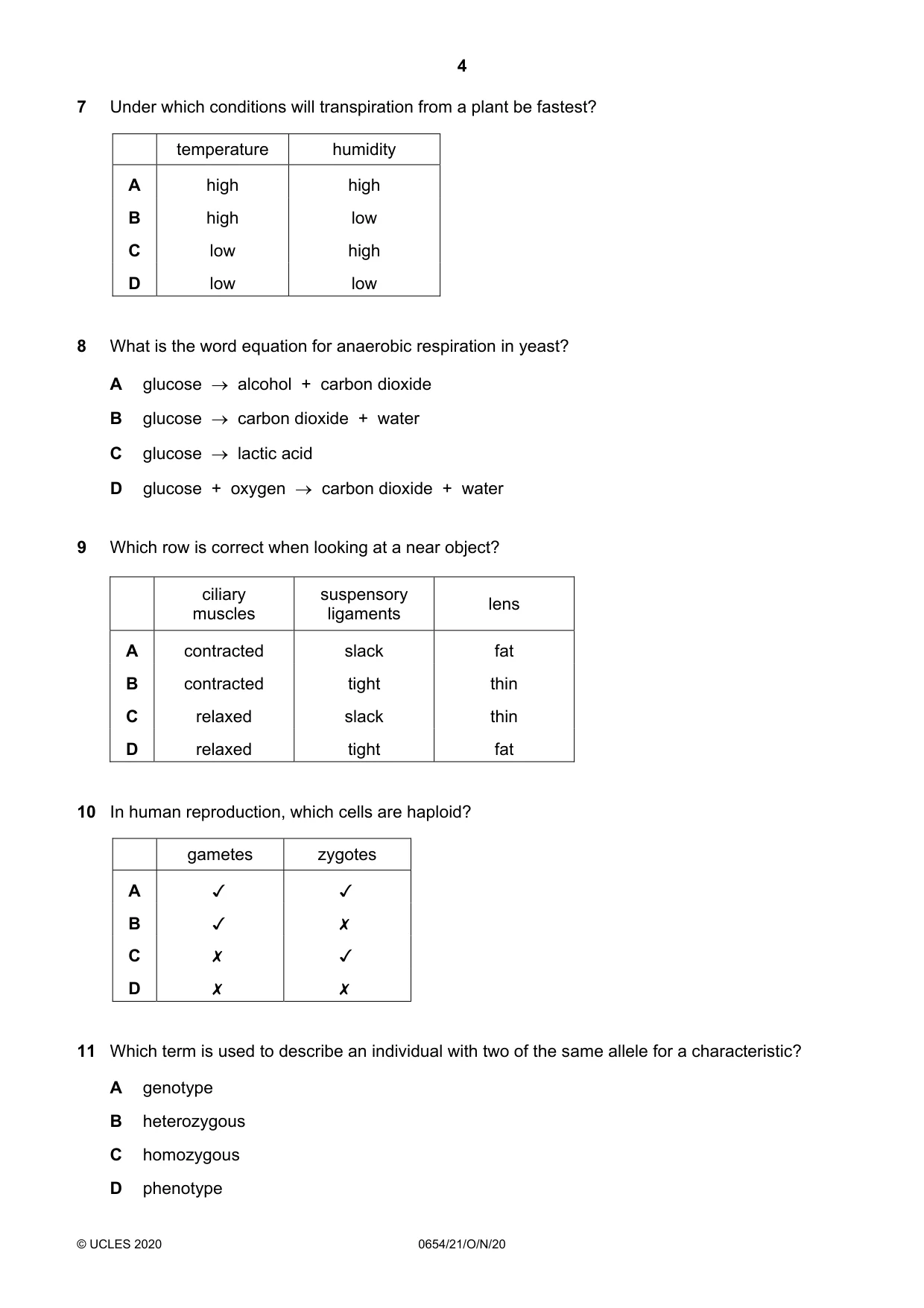
7 Under which conditions will transpiration from a plant be fastest? temperature humidity A high high B high low C low high D low low
Mark scheme: B
Q8 · What is the word equation for anaerobic respiration in yeast?
8 What is the word equation for anaerobic respiration in yeast? A glucose alcohol + carbon dioxide B glucose carbon dioxide + water C glucose lactic acid D glucose + oxygen carbon dioxide + water
Mark scheme: A
Q9 · Which row is correct when looking at a near object?
9 Which row is correct when looking at a near object? ciliary suspensory lens muscles ligaments A contracted slack fat B contracted tight thin C relaxed slack thin D relaxed tight fat
Mark scheme: A
Q10 · In human reproduction, which cells are haploid?
10 In human reproduction, which cells are haploid? gametes zygotes v v 0 Oo WwW > v x x v x x
Mark scheme: B
Q11 · Which term is used to describe an individual with two of the same allele for a…
11 Which term is used to describe an individual with two of the same allele for a characteristic? A genotype B heterozygous C homozygous D phenotype
Mark scheme: C
Q12 · Which organism in the food web is a secondary and a tertiary consumer?
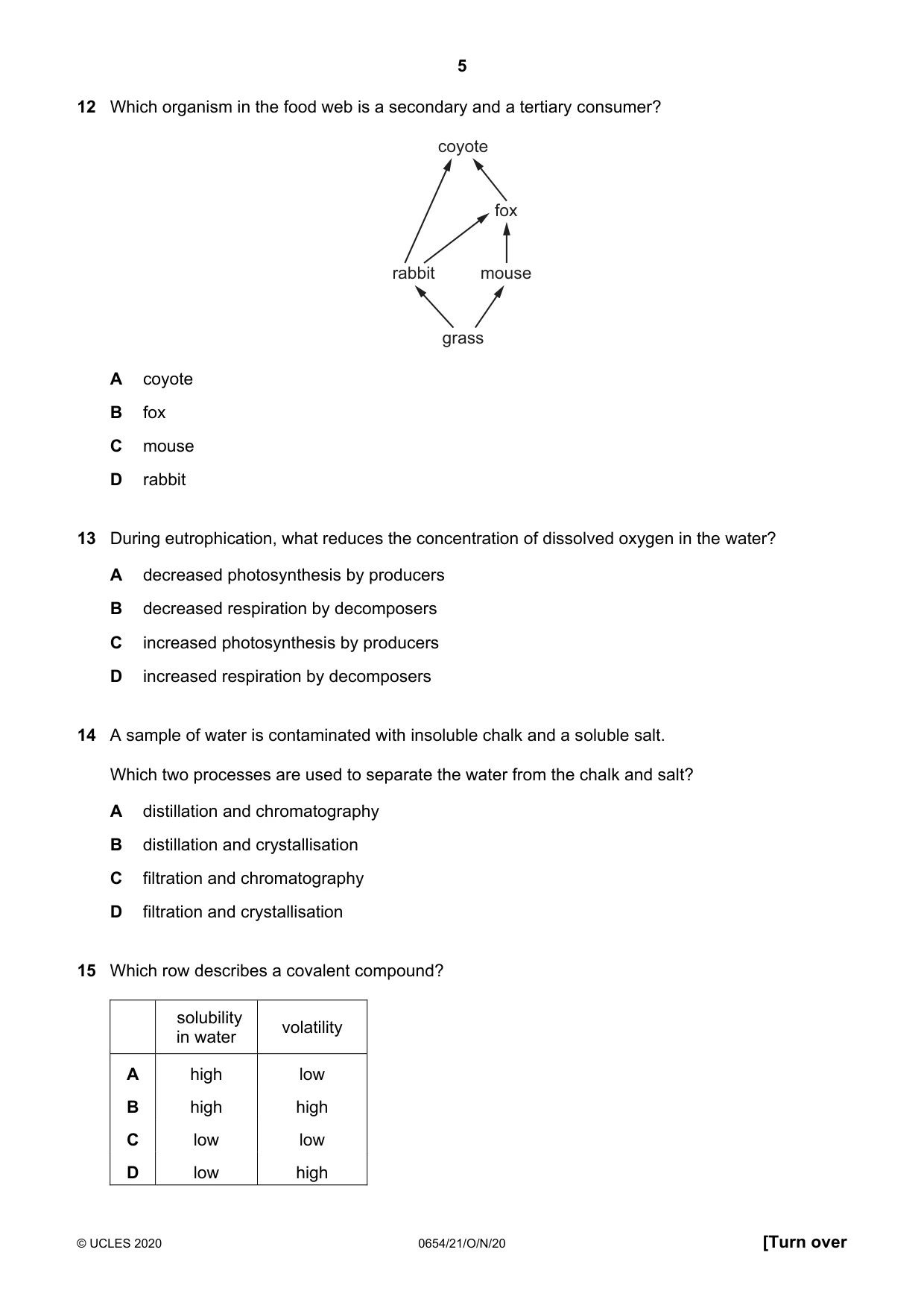
12 Which organism in the food web is a secondary and a tertiary consumer? coyote fox rabbit mouse grass A coyote B fox C mouse D rabbit
Mark scheme: A
Q13 · During eutrophication, what reduces the concentration of dissolved oxygen in the water?
13 During eutrophication, what reduces the concentration of dissolved oxygen in the water? A decreased photosynthesis by producers B decreased respiration by decomposers C increased photosynthesis by producers D increased respiration by decomposers
Mark scheme: D
Q14 · A sample of water is contaminated with insoluble chalk and a soluble salt
14 A sample of water is contaminated with insoluble chalk and a soluble salt. Which two processes are used to separate the water from the chalk and salt? A distillation and chromatography B distillation and crystallisation C filtration and chromatography D filtration and crystallisation
Mark scheme: D
Q15 · Which row describes a covalent compound?
15 Which row describes a covalent compound? solubility volatility in water A high low B high high C low low D low high
Mark scheme: D
Q16 · The equation for the complete combustion of methane is shown
16 The equation for the complete combustion of methane is shown. CH4 + 2O2 CO2 + 2H2O What is the mass of oxygen that is required for the complete combustion of 16 g of methane? A 8 g B 16 g C 32 g D 64 g
Mark scheme: D
Q17 · Which statement describes an endothermic reaction?
17 Which statement describes an endothermic reaction? A The products have less energy than the reactants and the temperature decreases. B The products have less energy than the reactants and the temperature increases. C The products have more energy than the reactants and the temperature decreases. D The products have more energy than the reactants and the temperature increases.
Mark scheme: C
Q18 · Which row describes how the number of effective collisions and the rate of reaction are…
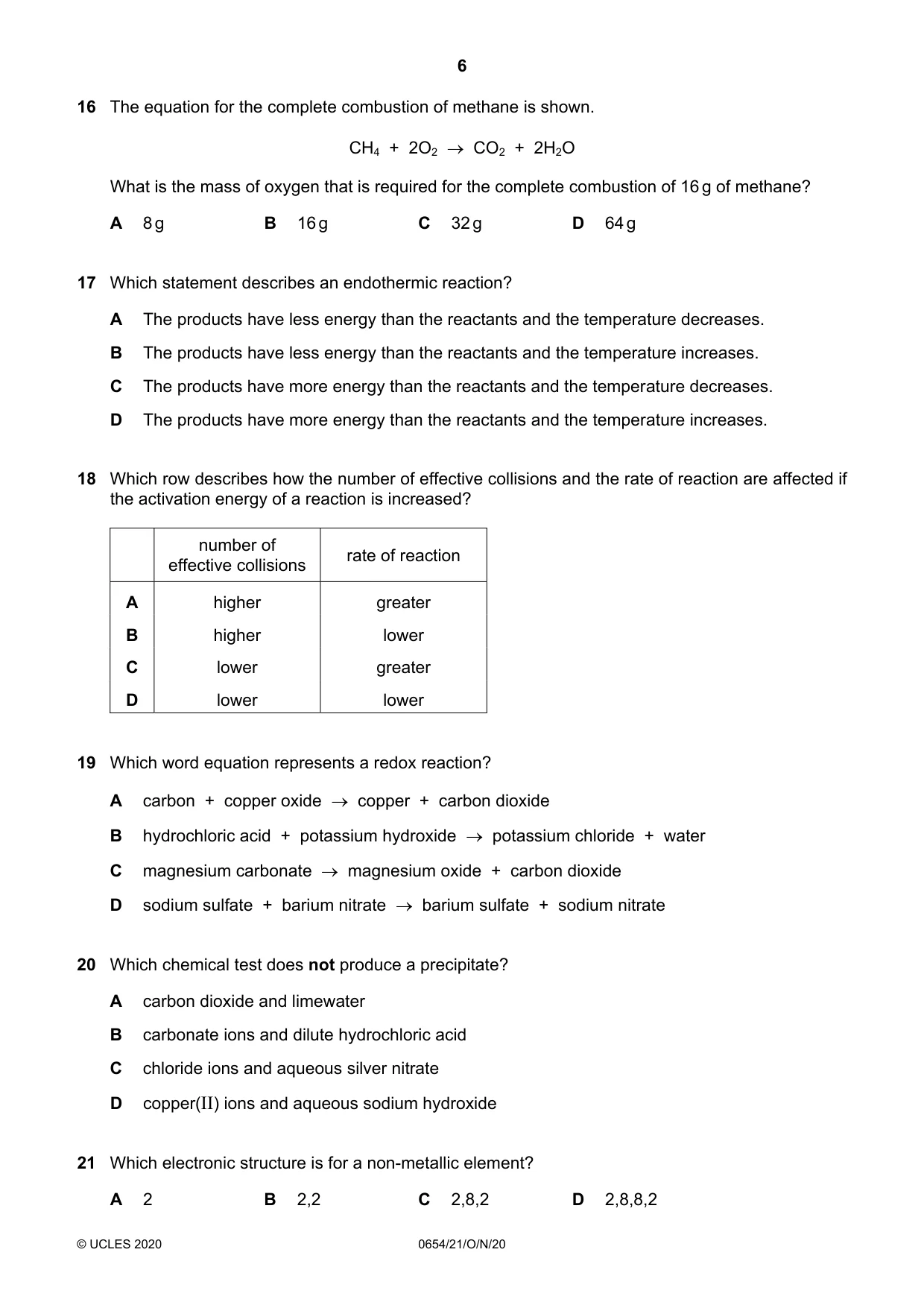
18 Which row describes how the number of effective collisions and the rate of reaction are affected if the activation energy of a reaction is increased? number of rate of reaction effective collisions A higher greater B higher lower C lower greater D lower lower
Mark scheme: D
Q19 · Which word equation represents a redox reaction?
19 Which word equation represents a redox reaction? A carbon + copper oxide copper + carbon dioxide B hydrochloric acid + potassium hydroxide potassium chloride + water C magnesium carbonate magnesium oxide + carbon dioxide D sodium sulfate + barium nitrate barium sulfate + sodium nitrate
Mark scheme: A
Q20 · Which chemical test does not produce a precipitate?
20 Which chemical test does not produce a precipitate? A carbon dioxide and limewater B carbonate ions and dilute hydrochloric acid C chloride ions and aqueous silver nitrate D copper(II) ions and aqueous sodium hydroxide
Mark scheme: B
Q21 · Which electronic structure is for a non-metallic element?
21 Which electronic structure is for a non-metallic element? A 2 B 2,2 C 2,8,2 D 2,8,8,2
Mark scheme: A
Q22 · The equations for four reactions are shown
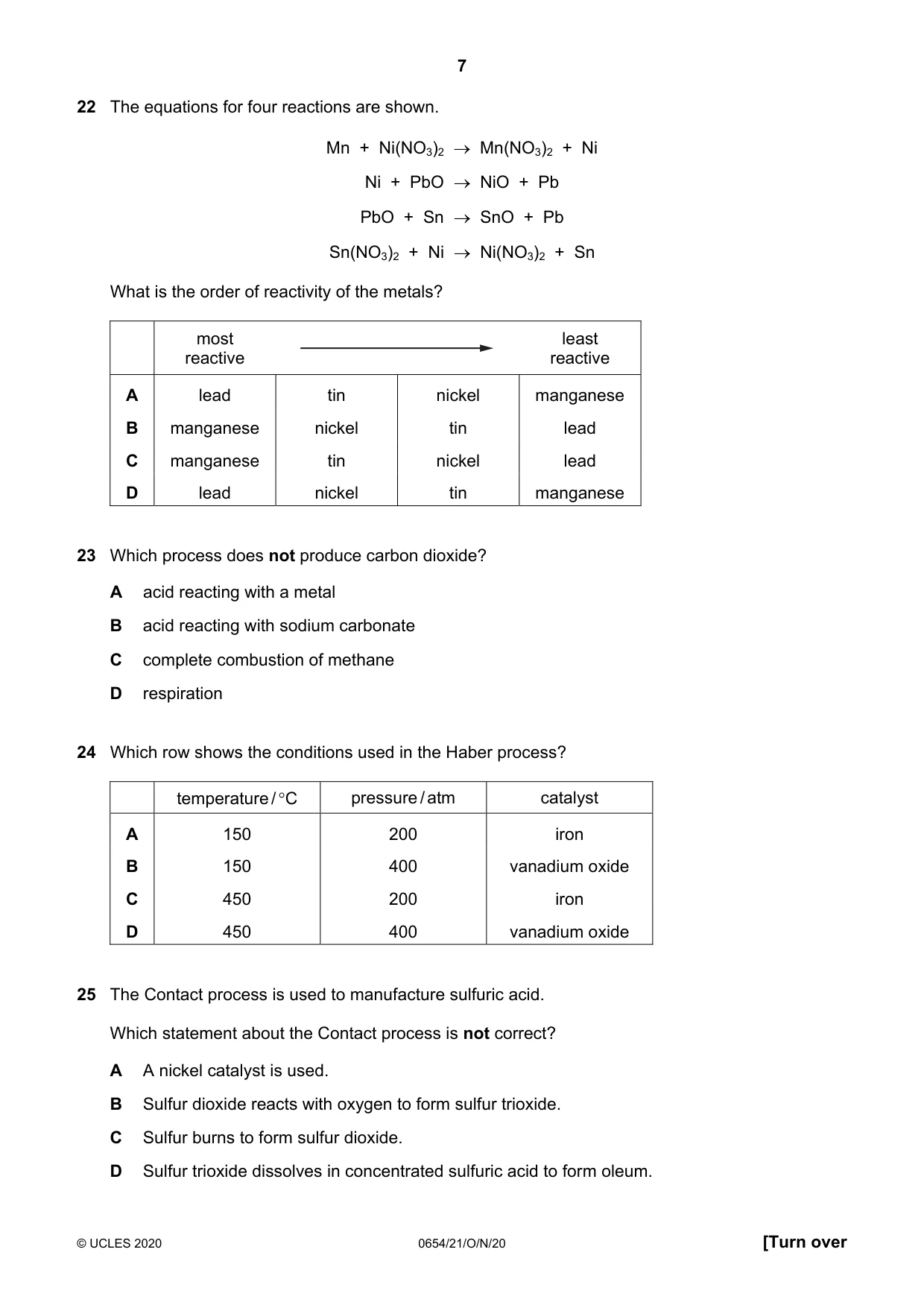
22 The equations for four reactions are shown. Mn + Ni(NO3)2 Mn(NO3)2 + Ni Ni + PbO NiO + Pb PbO + Sn SnO + Pb Sn(NO3)2 + Ni Ni(NO3)2 + Sn What is the order of reactivity of the metals? most least reactive reactive A lead tin nickel manganese B manganese nickel tin lead C manganese tin nickel lead D lead nickel tin manganese
Mark scheme: B
Q23 · Which process does not produce carbon dioxide?
23 Which process does not produce carbon dioxide? A acid reacting with a metal B acid reacting with sodium carbonate C complete combustion of methane D respiration
Mark scheme: A
Q24 · Which row shows the conditions used in the Haber process?
24 Which row shows the conditions used in the Haber process? temperature / C pressure / atm catalyst A 150 200 iron B 150 400 vanadium oxide C 450 200 iron D 450 400 vanadium oxide
Mark scheme: C
Q25 · The Contact process is used to manufacture sulfuric acid
25 The Contact process is used to manufacture sulfuric acid. Which statement about the Contact process is not correct? A A nickel catalyst is used. B Sulfur dioxide reacts with oxygen to form sulfur trioxide. C Sulfur burns to form sulfur dioxide. D Sulfur trioxide dissolves in concentrated sulfuric acid to form oleum.
Mark scheme: A
Q26 · What reacts with ethene to form ethanol?
26 What reacts with ethene to form ethanol? A bromine B hydrogen C oxygen D steam
Mark scheme: D
Q27 · Poly(ethene) is made from ethene by the process of addition polymerisation
27 Poly(ethene) is made from ethene by the process of addition polymerisation. Which word describes ethene in this process? A fuel B catalyst C monomer D solvent
Mark scheme: C
Q28 · Which speed–time graph represents an object moving with an acceleration of 2.0 m / s2?
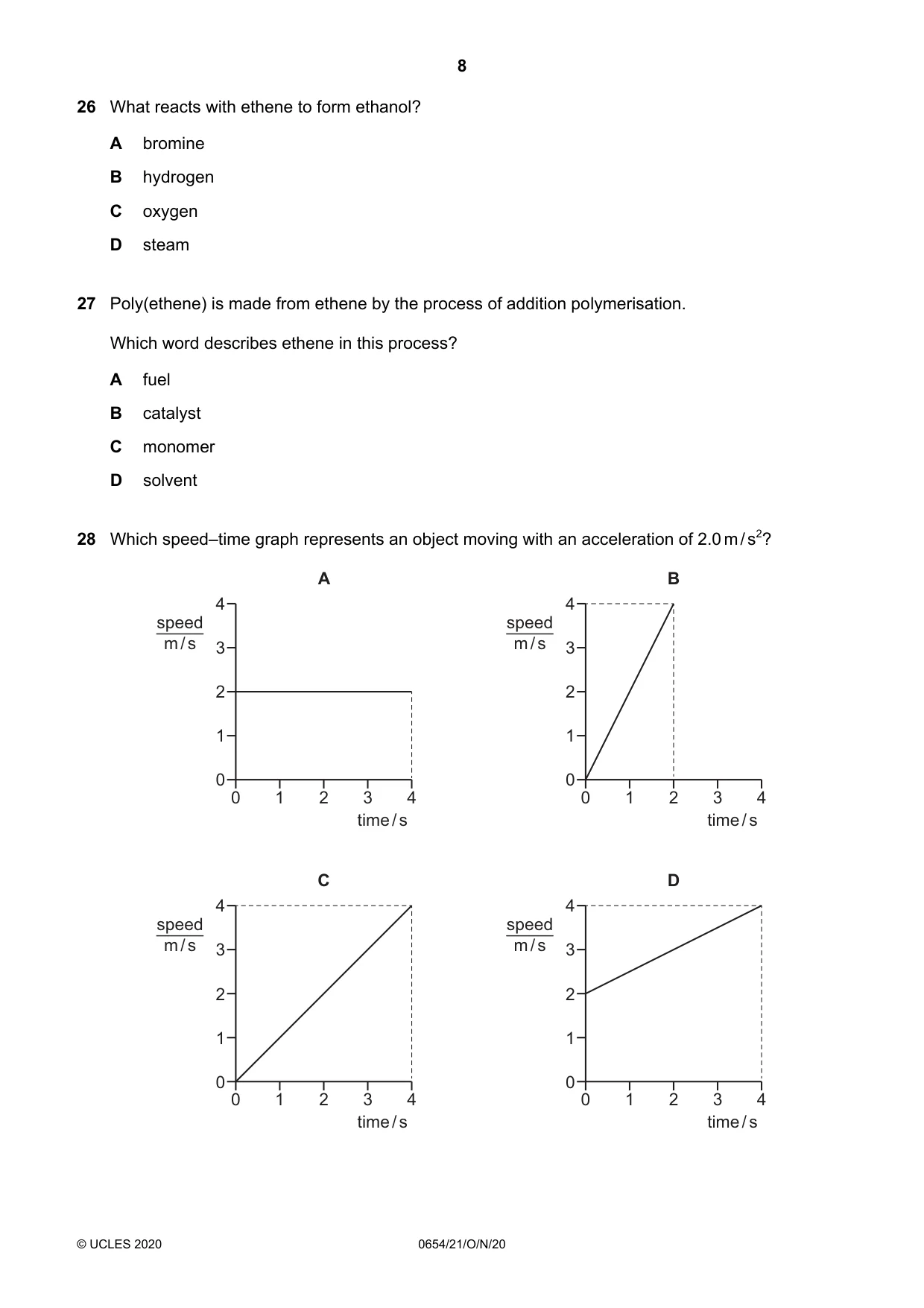
28 Which speed–time graph represents an object moving with an acceleration of 2.0 m / s2? A B 4 4 speed speed m / s 3 m / s 3 2 2 1 1 0 0 0 1 2 3 4 0 1 2 3 4 time / s time / s C D 4 4 speed speed m / s 3 m / s 3 2 2 1 1 0 0 0 1 2 3 4 0 1 2 3 4 time / s time / s
Mark scheme: B
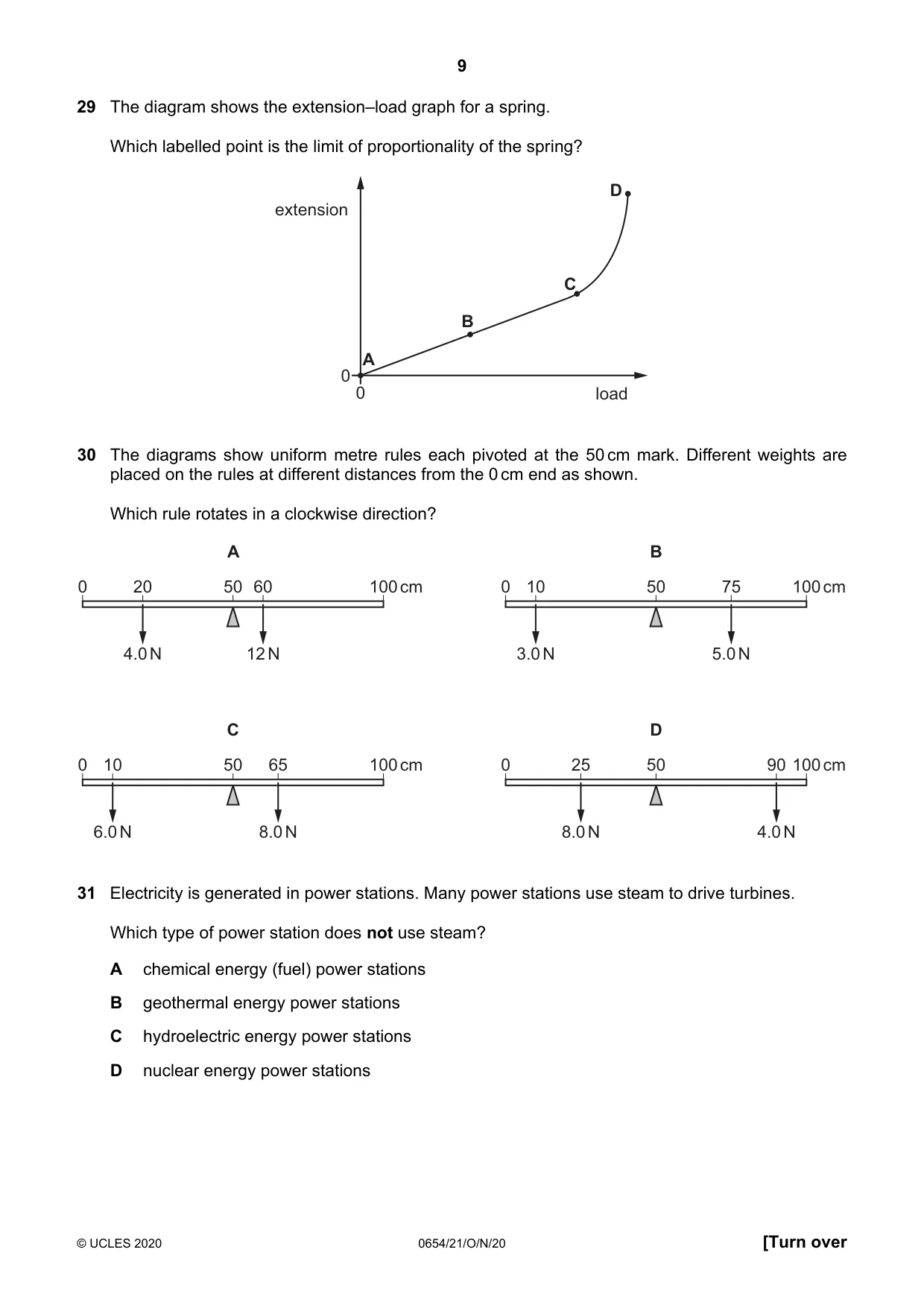
Q29 · The diagram shows the extension–load graph for a spring
29 The diagram shows the extension–load graph for a spring. Which labelled point is the limit of proportionality of the spring? D extension C B A 0 0 load
Mark scheme: C
Q30 · The diagrams show uniform metre rules each pivoted at the 50 cm mark
30 The diagrams show uniform metre rules each pivoted at the 50 cm mark. Different weights are placed on the rules at different distances from the 0 cm end as shown. Which rule rotates in a clockwise direction? A B 0 20 50 60 100 cm 0 10 50 75 100 cm 4.0 N 12 N 3.0 N 5.0 N C D 0 10 50 65 100 cm 0 25 50 90 100 cm 6.0 N 8.0 N 8.0 N 4.0 N
Mark scheme: B
Q31 · Electricity is generated in power stations
31 Electricity is generated in power stations. Many power stations use steam to drive turbines. Which type of power station does not use steam? A chemical energy (fuel) power stations B geothermal energy power stations C hydroelectric energy power stations D nuclear energy power stations
Mark scheme: C
Q32 · What is meant by the sensitivity of a liquid-in-glass thermometer?
32 What is meant by the sensitivity of a liquid-in-glass thermometer? A how quickly the thermometer shows a change in temperature B the accuracy of the thermometer C the amount of change in the length of the liquid column per degree Celsius temperature rise D the difference between the maximum and the minimum temperatures that the thermometer can measure
Mark scheme: C
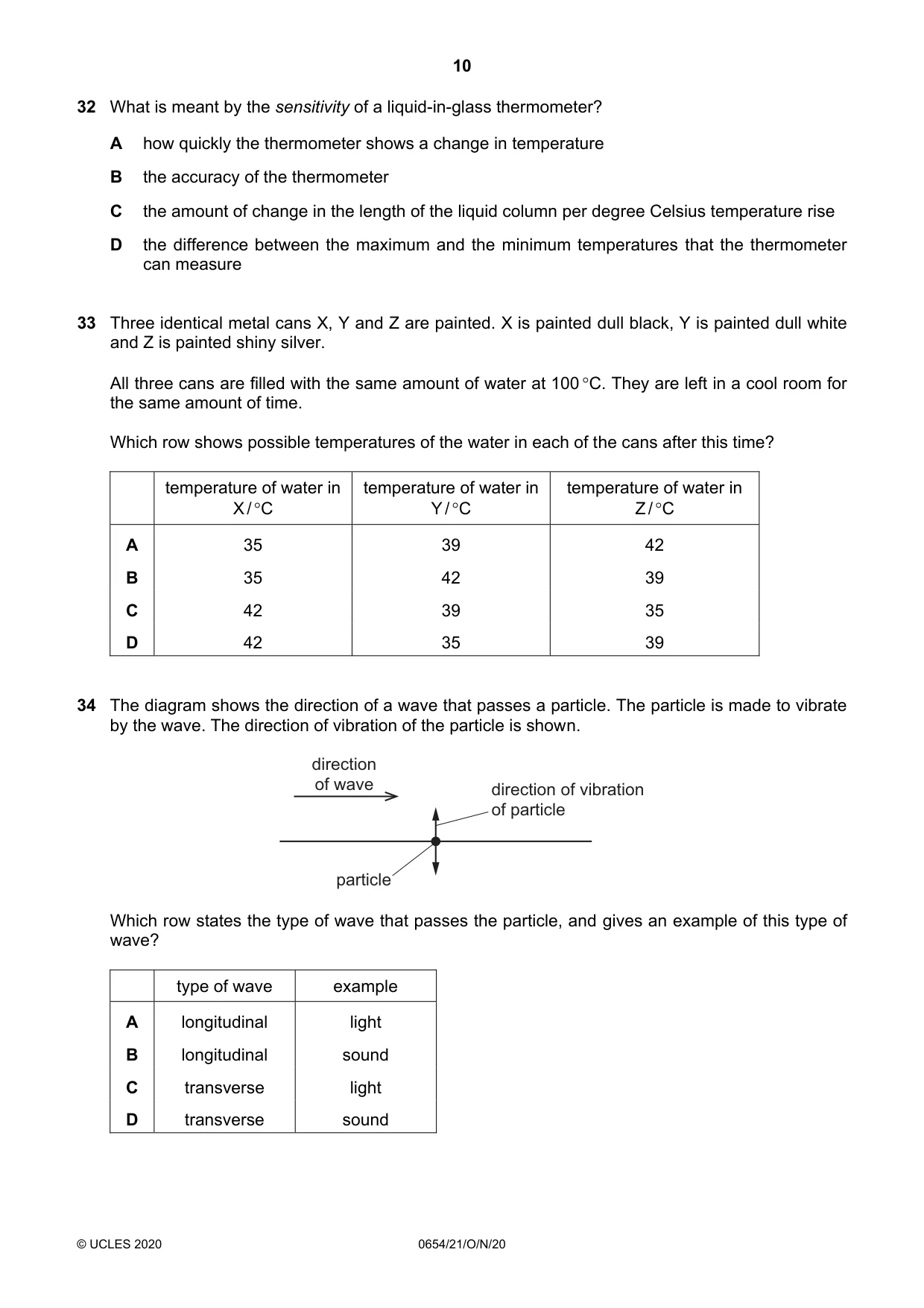
Q33 · Three identical metal cans X, Y and Z are painted
33 Three identical metal cans X, Y and Z are painted. X is painted dull black, Y is painted dull white and Z is painted shiny silver. All three cans are filled with the same amount of water at 100 C. They are left in a cool room for the same amount of time. Which row shows possible temperatures of the water in each of the cans after this time? temperature of water in temperature of water in temperature of water in X / C Y / C Z / C A 35 39 42 B 35 42 39 C 42 39 35 D 42 35 39
Mark scheme: A
Q34 · The diagram shows the direction of a wave that passes a particle
34 The diagram shows the direction of a wave that passes a particle. The particle is made to vibrate by the wave. The direction of vibration of the particle is shown. direction of wave direction of vibration of particle particle Which row states the type of wave that passes the particle, and gives an example of this type of wave? type of wave example A longitudinal light B longitudinal sound C transverse light D transverse sound
Mark scheme: C
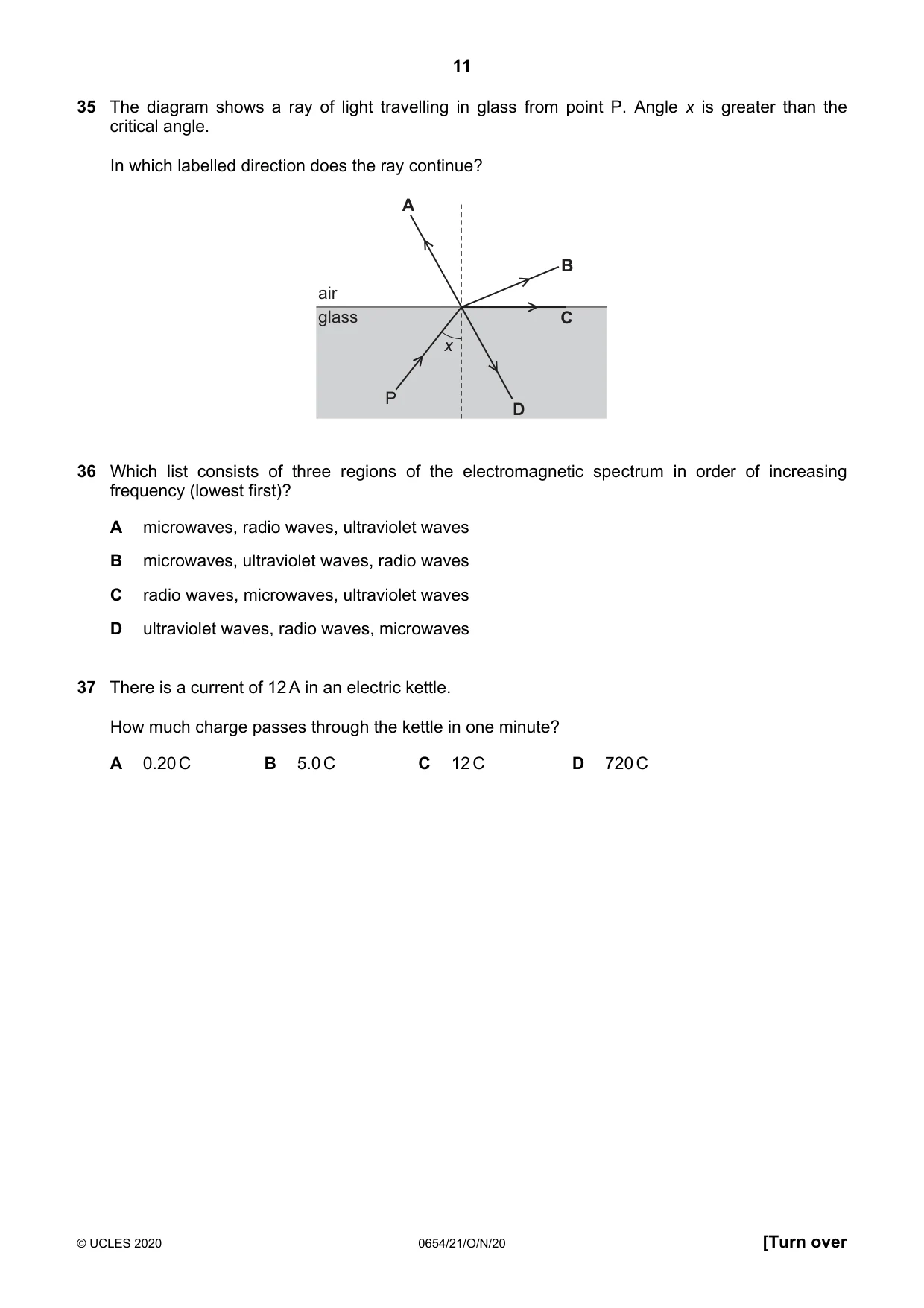
Q35 · The diagram shows a ray of light travelling in glass from point P
35 The diagram shows a ray of light travelling in glass from point P. Angle x is greater than the critical angle. In which labelled direction does the ray continue? A B air glass C x P D
Mark scheme: D
Q36 · Which list consists of three regions of the electromagnetic spectrum in order of…
36 Which list consists of three regions of the electromagnetic spectrum in order of increasing frequency (lowest first)? A microwaves, radio waves, ultraviolet waves B microwaves, ultraviolet waves, radio waves C radio waves, microwaves, ultraviolet waves D ultraviolet waves, radio waves, microwaves
Mark scheme: C
Q37 · There is a current of 12 A in an electric kettle
37 There is a current of 12 A in an electric kettle. How much charge passes through the kettle in one minute? A 0.20 C B 5.0 C C 12 C D 720 C
Mark scheme: D
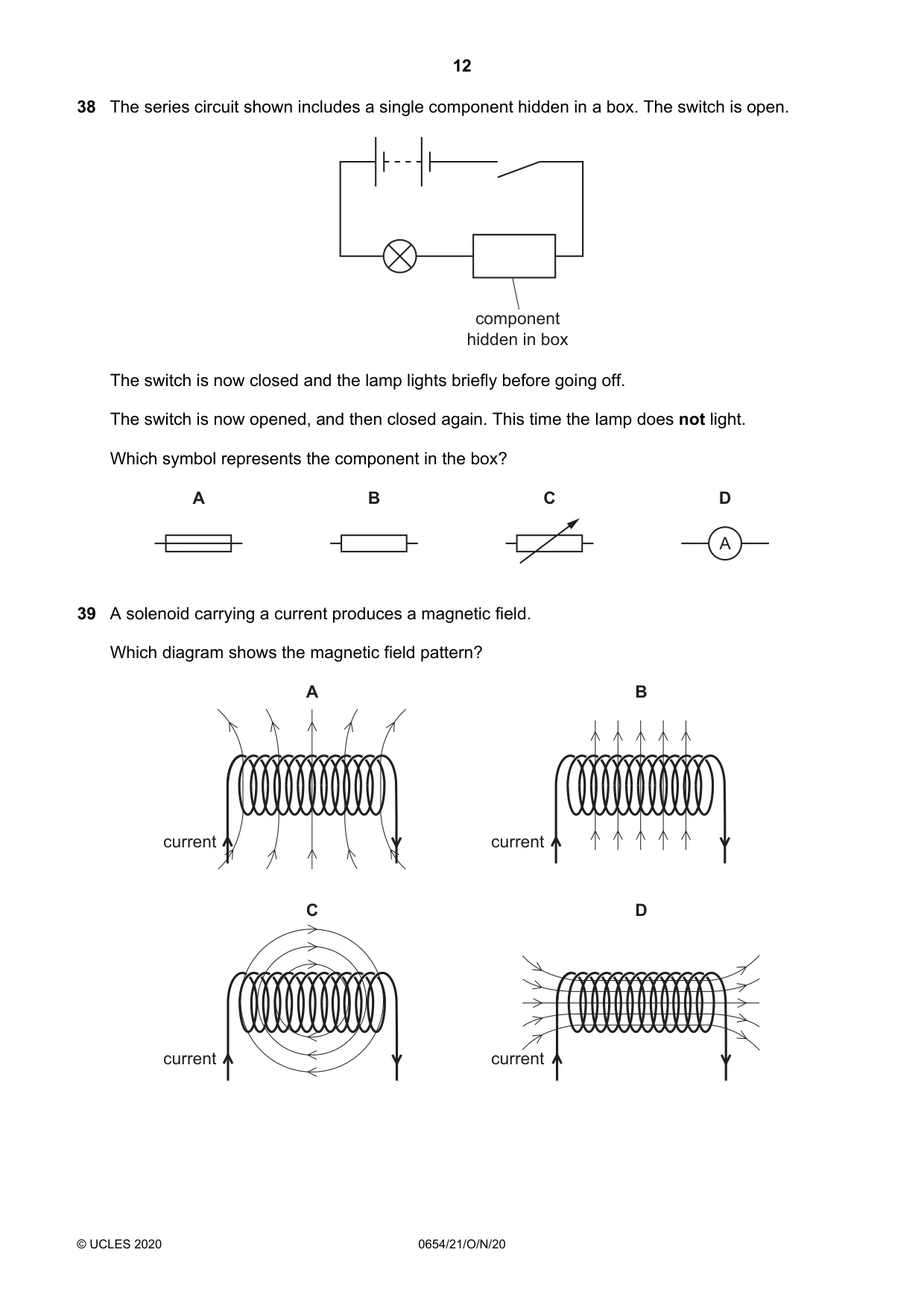
Q38 · The series circuit shown includes a single component hidden in a box
38 The series circuit shown includes a single component hidden in a box. The switch is open. component hidden in box The switch is now closed and the lamp lights briefly before going off. The switch is now opened, and then closed again. This time the lamp does not light. Which symbol represents the component in the box? A B C D A
Mark scheme: A
Q39 · A solenoid carrying a current produces a magnetic field
39 A solenoid carrying a current produces a magnetic field. Which diagram shows the magnetic field pattern? A B current current C D current current
Mark scheme: D
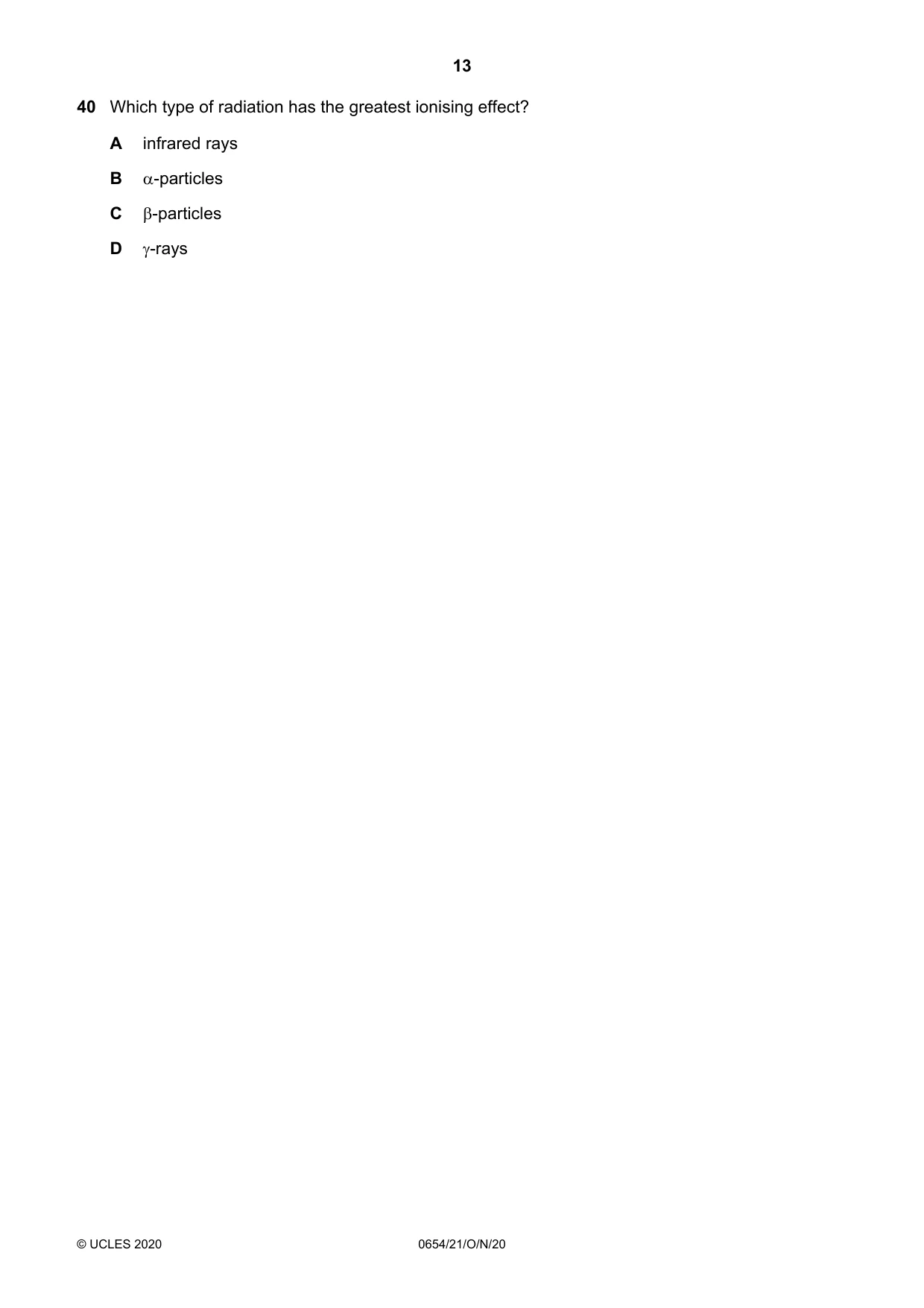
Q40 · Which type of radiation has the greatest ionising effect?
40 Which type of radiation has the greatest ionising effect? A infrared rays B -particles C -particles D -rays
Mark scheme: B
What was in this paper
The subtopics covered by these 40 questions, and how many questions each got. Open one in a new tab to see every Cambridge question on it.
2Rate of reaction2Alkenes1Atomic structure and the Periodic Table1Biological molecules1Cell structure1Characteristics of living organisms1Coordination and response1Digestive system1Electrical circuits1Electrical quantities1Electromagnetic spectrum1Energy, work and power1Enzymes1Exothermic and endothermic reactions1Food chains and food webs1General properties of waves1Habitat destruction1Identification of ions and gases1Leaf structure1Light1Monohybrid inheritance1Motion1Polymers1Preparation of salts1Radioactivity1Reactivity series1Redox1Respiration1Separation and purification1Sexual reproduction in humans1Simple molecules and covalent bonds1Simple phenomena of magnetism1The mole and the Avogadro constant1Thermal properties and temperature1Transfer of thermal energy1Transition elements1Transpiration1What you needed in this session
Cambridge’s own grade thresholds for 2020 Oct/Nov, Paper 2 · Variant 1. A higher threshold means an easier paper — the bar moves with how the cohort did.