Cambridge IGCSE Sciences - Co-ordinated (Double) 0654 — 2022 May/June Paper 2 · Variant 3
0654/23/M/J/22 · 40 questions · 40 marks · ≈45 min
The question paper and its mark scheme, free to read here and free to download. This is Cambridge’s own paper, exactly as it was sat.
Question paper16 pages

Mark scheme3 pages
Answers below. Sit the paper first if you are practising.
Questions as text
Q1 · During a sunny day, stomata are open to allow gas exchange
1 During a sunny day, stomata are open to allow gas exchange. Oxygen moves out of the plant through the stomata. Which characteristic of living things is described? A excretion B movement C reproduction D respiration
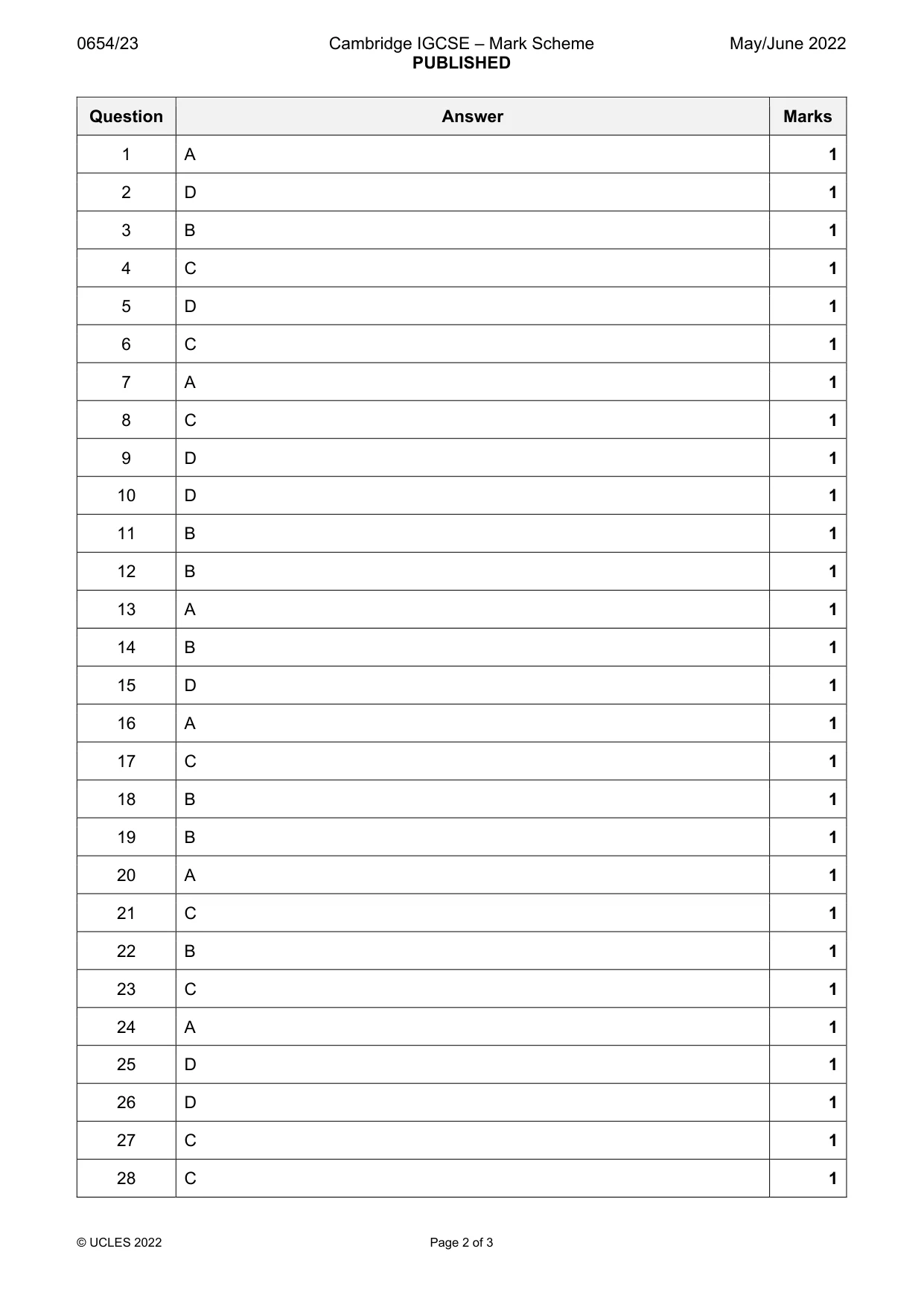
Mark scheme: A
Q2 · Which statement about cells is correct?
2 Which statement about cells is correct? A Cell membranes are found only in animal cells. B Cell membranes are found only in plant cells. C Cell walls are found only in animal cells. D Cell walls are found only in plant cells.
Mark scheme: D
Q3 · Large biological molecules are made from smaller molecules joined together
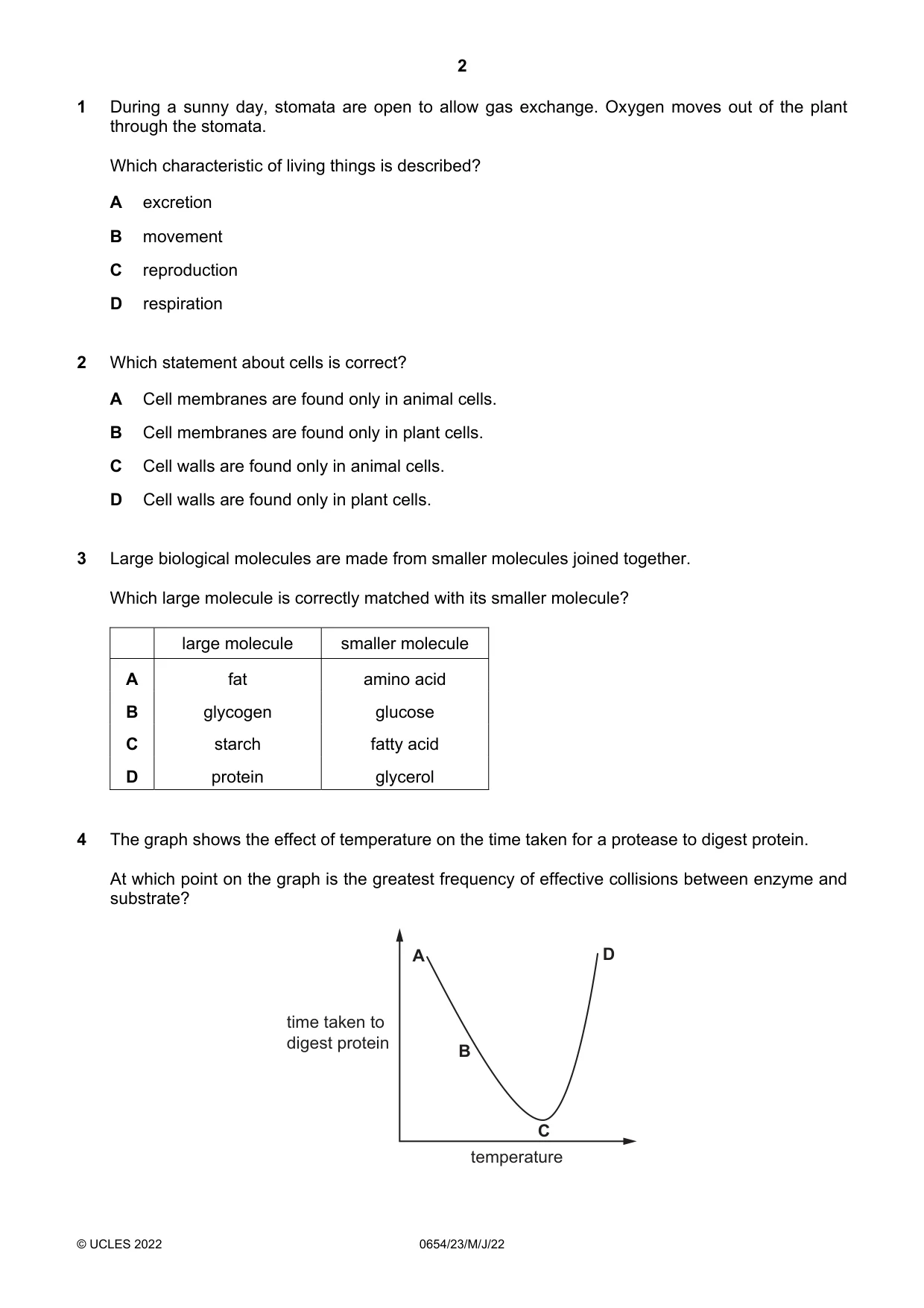
3 Large biological molecules are made from smaller molecules joined together. Which large molecule is correctly matched with its smaller molecule? large molecule smaller molecule A fat amino acid B glycogen glucose C starch fatty acid D protein glycerol
Mark scheme: B
Q4 · The graph shows the effect of temperature on the time taken for a protease to digest…
4 The graph shows the effect of temperature on the time taken for a protease to digest protein. At which point on the graph is the greatest frequency of effective collisions between enzyme and substrate? A D time taken to digest protein B C temperature
Mark scheme: C
Q5 · Which graph shows the effect of light intensity on the rate of photosynthesis, if all…
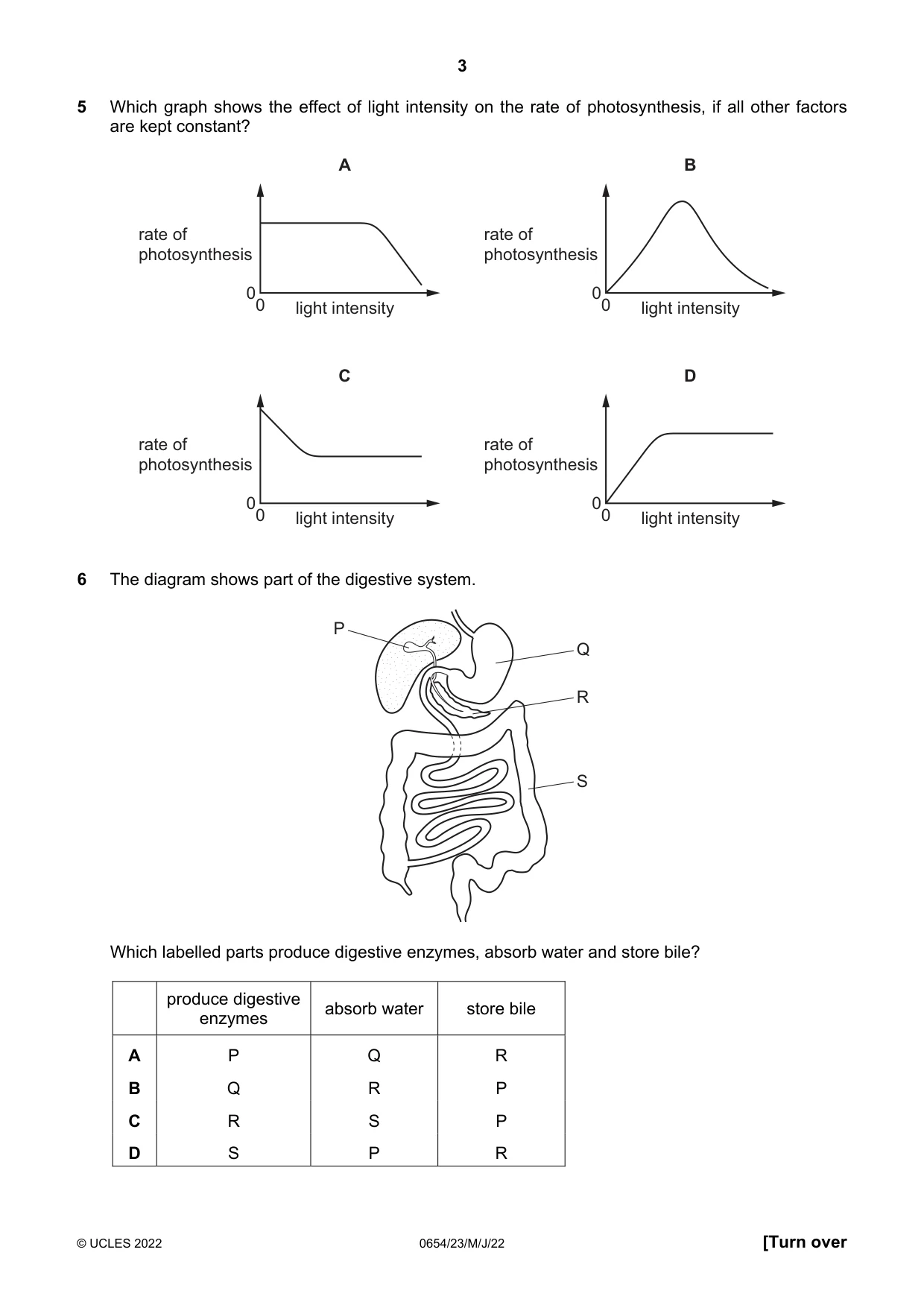
5 Which graph shows the effect of light intensity on the rate of photosynthesis, if all other factors are kept constant? A B rate of rate of photosynthesis photosynthesis 0 0 0 light intensity 0 light intensity C D rate of rate of photosynthesis photosynthesis 0 0 0 light intensity 0 light intensity
Mark scheme: D
Q6 · The diagram shows part of the digestive system
6 The diagram shows part of the digestive system. P Q R S Which labelled parts produce digestive enzymes, absorb water and store bile? produce digestive absorb water store bile enzymes A P Q R B Q R P C R S P D S P R
Mark scheme: C
Q7 · Students investigate the effect of exercise on heart rate
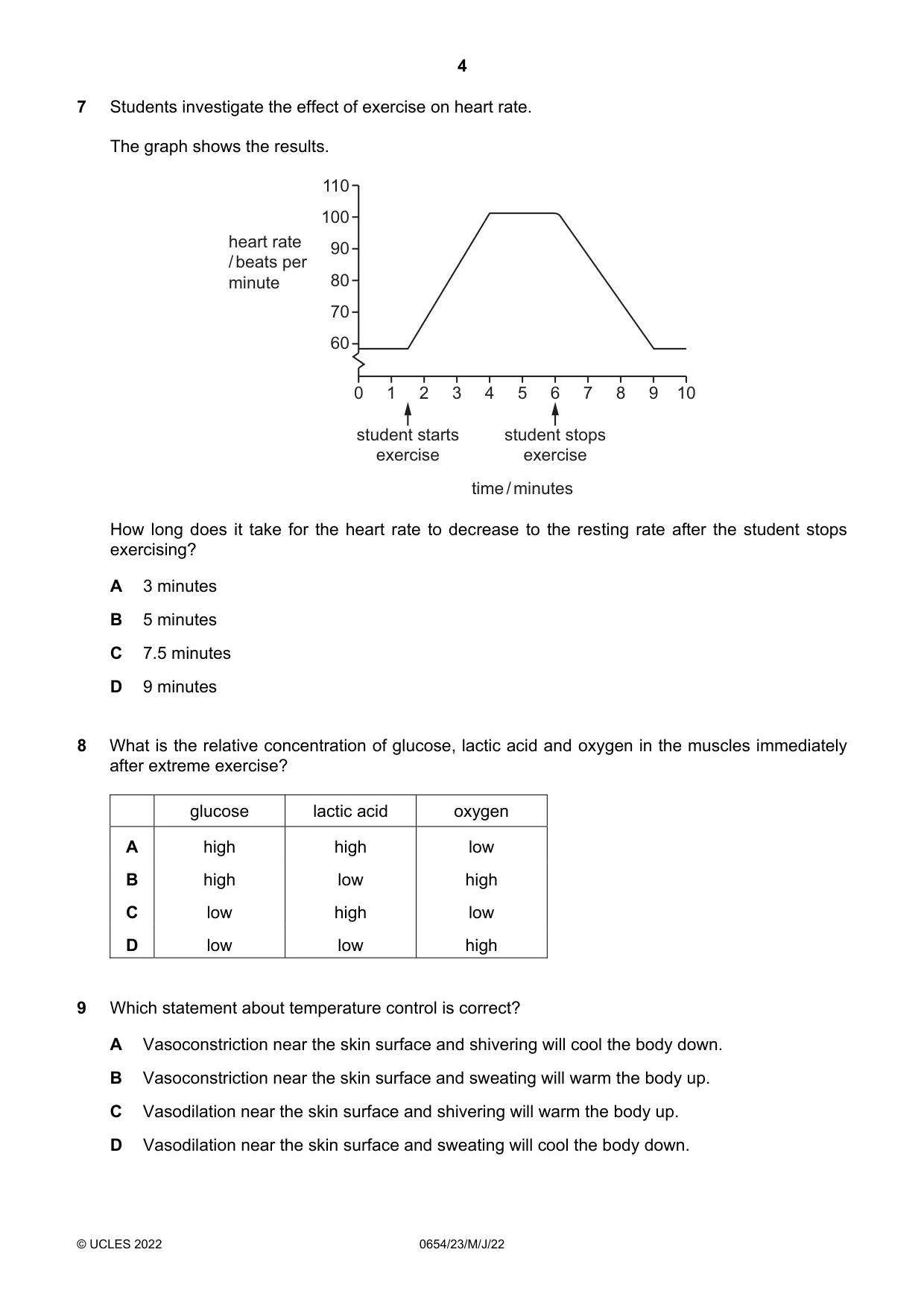
7 Students investigate the effect of exercise on heart rate. The graph shows the results. 110 100 heart rate 90 / beats per minute 80 70 60 0 1 2 3 4 5 6 7 8 9 10 student starts student stops exercise exercise time / minutes How long does it take for the heart rate to decrease to the resting rate after the student stops exercising? A 3 minutes B 5 minutes C 7.5 minutes D 9 minutes
Mark scheme: A
Q8 · What is the relative concentration of glucose, lactic acid and oxygen in the muscles…
8 What is the relative concentration of glucose, lactic acid and oxygen in the muscles immediately after extreme exercise? glucose lactic acid oxygen A high high low B high low high C low high low D low low high
Mark scheme: C
Q9 · Which statement about temperature control is correct?
9 Which statement about temperature control is correct? A Vasoconstriction near the skin surface and shivering will cool the body down. B Vasoconstriction near the skin surface and sweating will warm the body up. C Vasodilation near the skin surface and shivering will warm the body up. D Vasodilation near the skin surface and sweating will cool the body down.
Mark scheme: D
Q10 · The diagram shows the life cycle of a marine organism called a hydrozoan
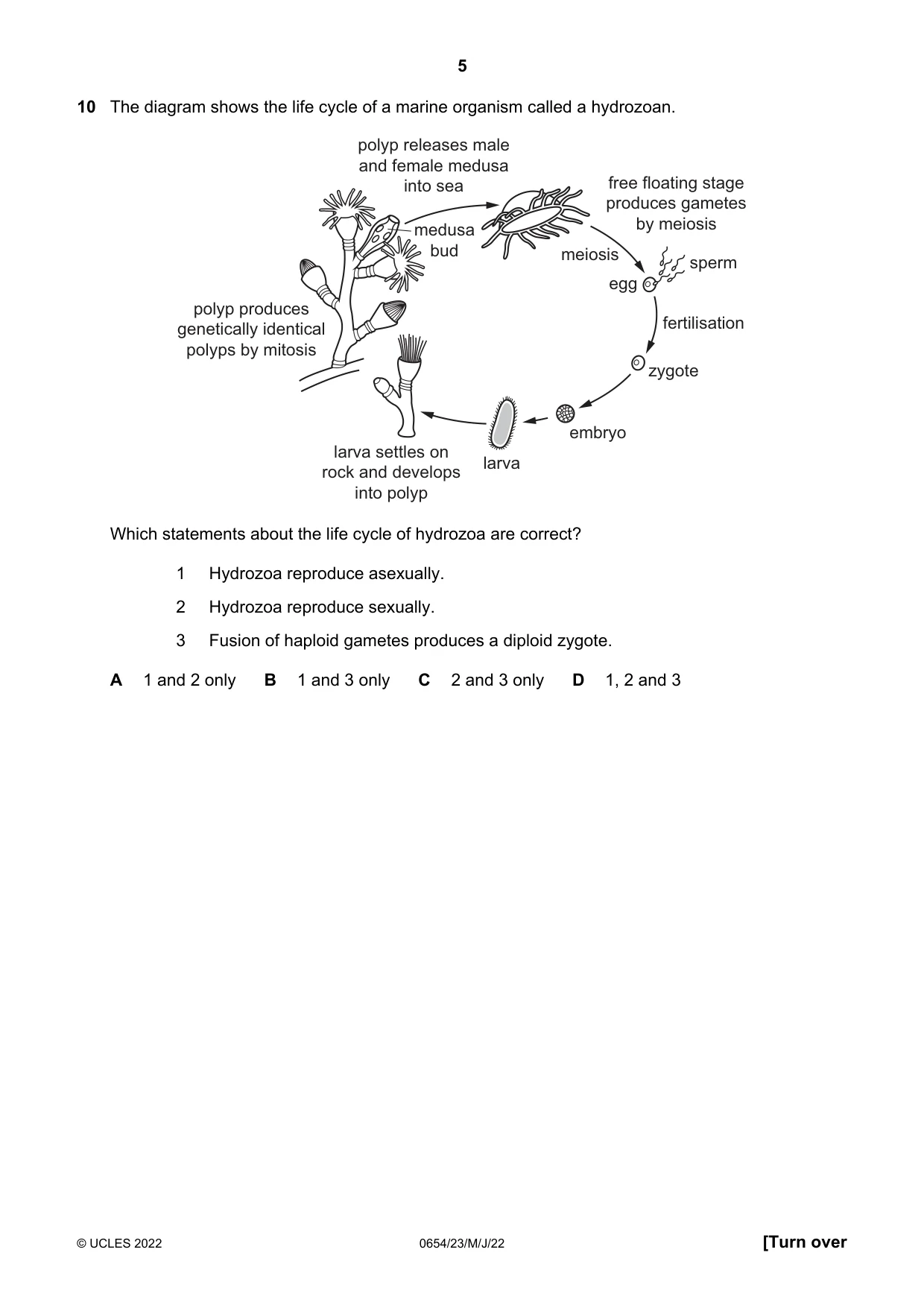
10 The diagram shows the life cycle of a marine organism called a hydrozoan. polyp releases male and female medusa into sea free floating stage produces gametes medusa by meiosis bud meiosis sperm egg polyp produces genetically identical fertilisation polyps by mitosis zygote embryo larva settles on larva rock and develops into polyp Which statements about the life cycle of hydrozoa are correct? 1 Hydrozoa reproduce asexually. 2 Hydrozoa reproduce sexually. 3 Fusion of haploid gametes produces a diploid zygote. A 1 and 2 only B 1 and 3 only C 2 and 3 only D 1, 2 and 3
Mark scheme: D
Q11 · Which diagram about haploid and diploid cells in humans is correct?
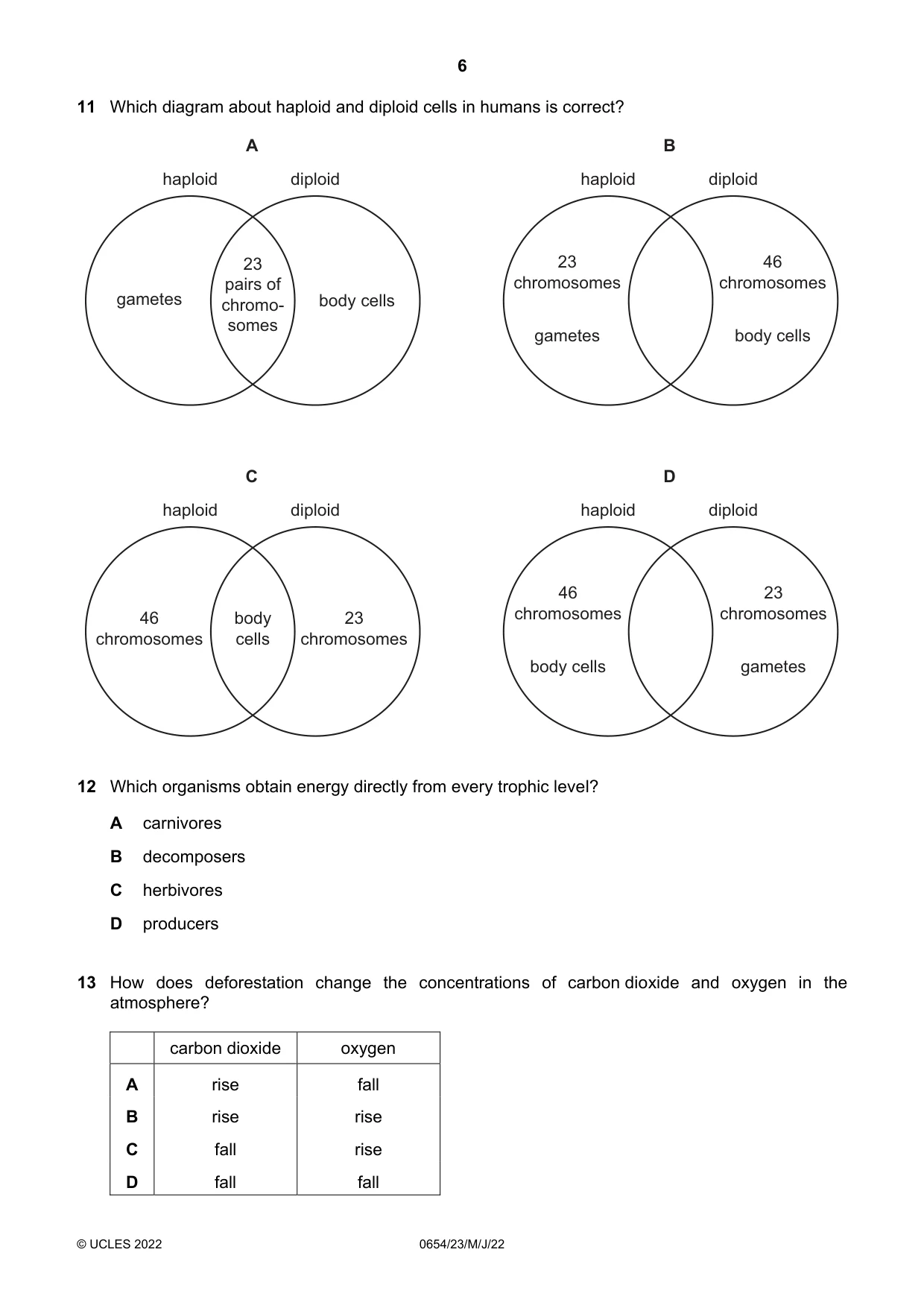
11 Which diagram about haploid and diploid cells in humans is correct? A B haploid diploid haploid diploid 23 23 46 pairs of chromosomes chromosomes gametes chromo- body cells somes gametes body cells C D haploid diploid haploid diploid 46 23 46 body 23 chromosomes chromosomes chromosomes cells chromosomes body cells gametes
Mark scheme: B
Q12 · Which organisms obtain energy directly from every trophic level?
12 Which organisms obtain energy directly from every trophic level? A carnivores B decomposers C herbivores D producers
Mark scheme: B
Q13 · How does deforestation change the concentrations of carbon dioxide and oxygen in the…
13 How does deforestation change the concentrations of carbon dioxide and oxygen in the atmosphere? carbon dioxide oxygen A rise fall B rise rise C fall rise D fall fall
Mark scheme: A
Q14 · Information about the solubility in water of some calcium compounds is listed
14 Information about the solubility in water of some calcium compounds is listed. Calcium hydroxide is soluble. Calcium carbonate is insoluble. Calcium chloride is soluble. Which method is used to prepare pure calcium chloride? A Add excess calcium hydroxide to dilute hydrochloric acid, filter, then crystallise. B Add excess calcium carbonate to dilute hydrochloric acid, filter, then crystallise. C Add excess dilute hydrochloric acid to calcium hydroxide, filter, then crystallise. D Add excess dilute hydrochloric acid to calcium carbonate, filter, then crystallise.
Mark scheme: B
Q15 · Which process is a chemical change?
15 Which process is a chemical change? A boiling B dissolving C melting D neutralisation
Mark scheme: D
Q16 · Sodium phosphate, Na3PO4, contains sodium ions, Na+
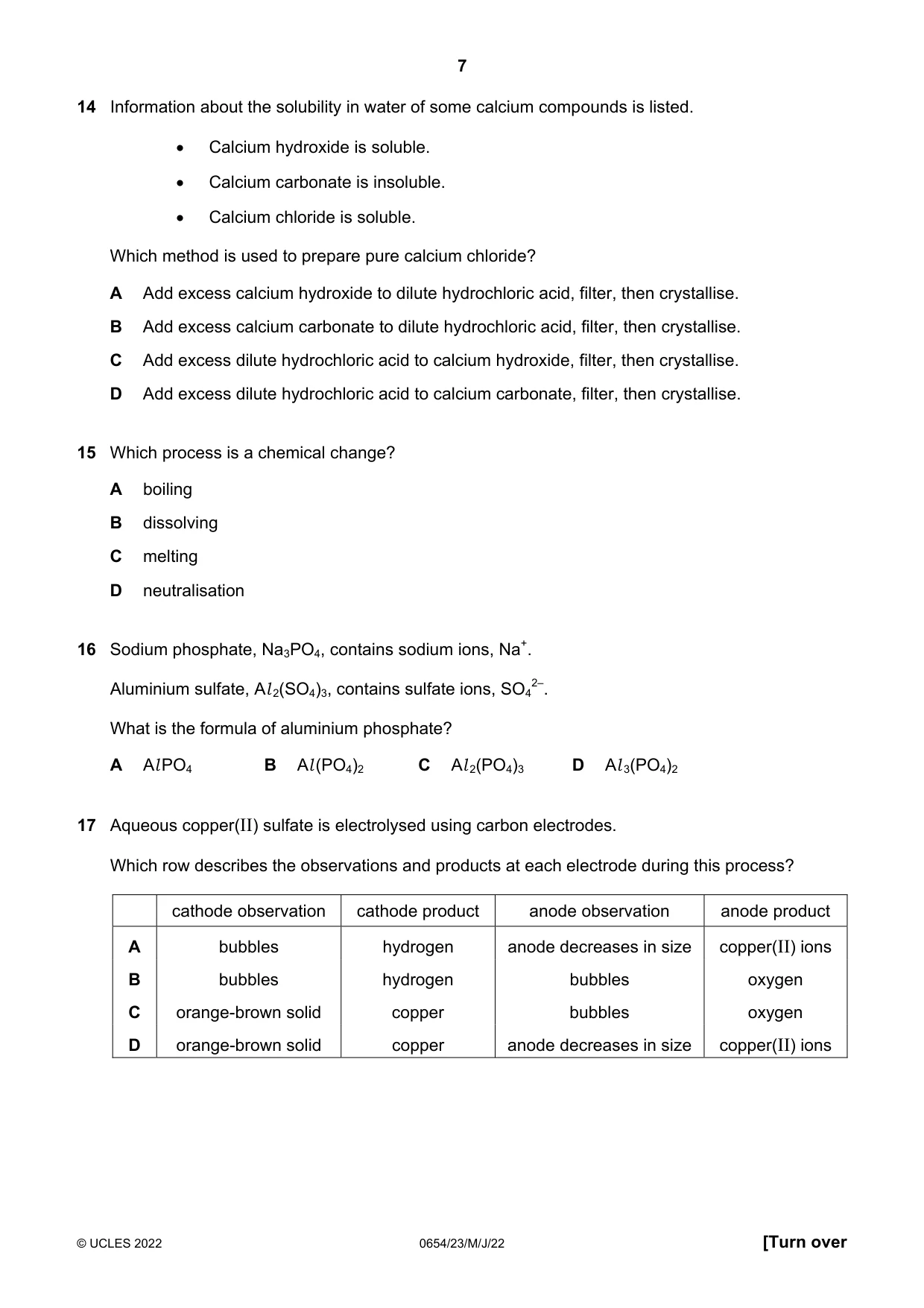
16 Sodium phosphate, Na3PO4, contains sodium ions, Na+. Aluminium sulfate, Al 2(SO4)3, contains sulfate ions, SO4 2–. What is the formula of aluminium phosphate? A Al PO4 B Al (PO4)2 C Al 2(PO4)3 D Al 3(PO4)2
Mark scheme: A
Q17 · Aqueous copper(II) sulfate is electrolysed using carbon electrodes
17 Aqueous copper(II) sulfate is electrolysed using carbon electrodes. Which row describes the observations and products at each electrode during this process? cathode observation cathode product anode observation anode product A bubbles hydrogen anode decreases in size copper(II) ions B bubbles hydrogen bubbles oxygen C orange-brown solid copper bubbles oxygen D orange-brown solid copper anode decreases in size copper(II) ions
Mark scheme: C
Q18 · Magnesium reacts with chlorine to form magnesium chloride
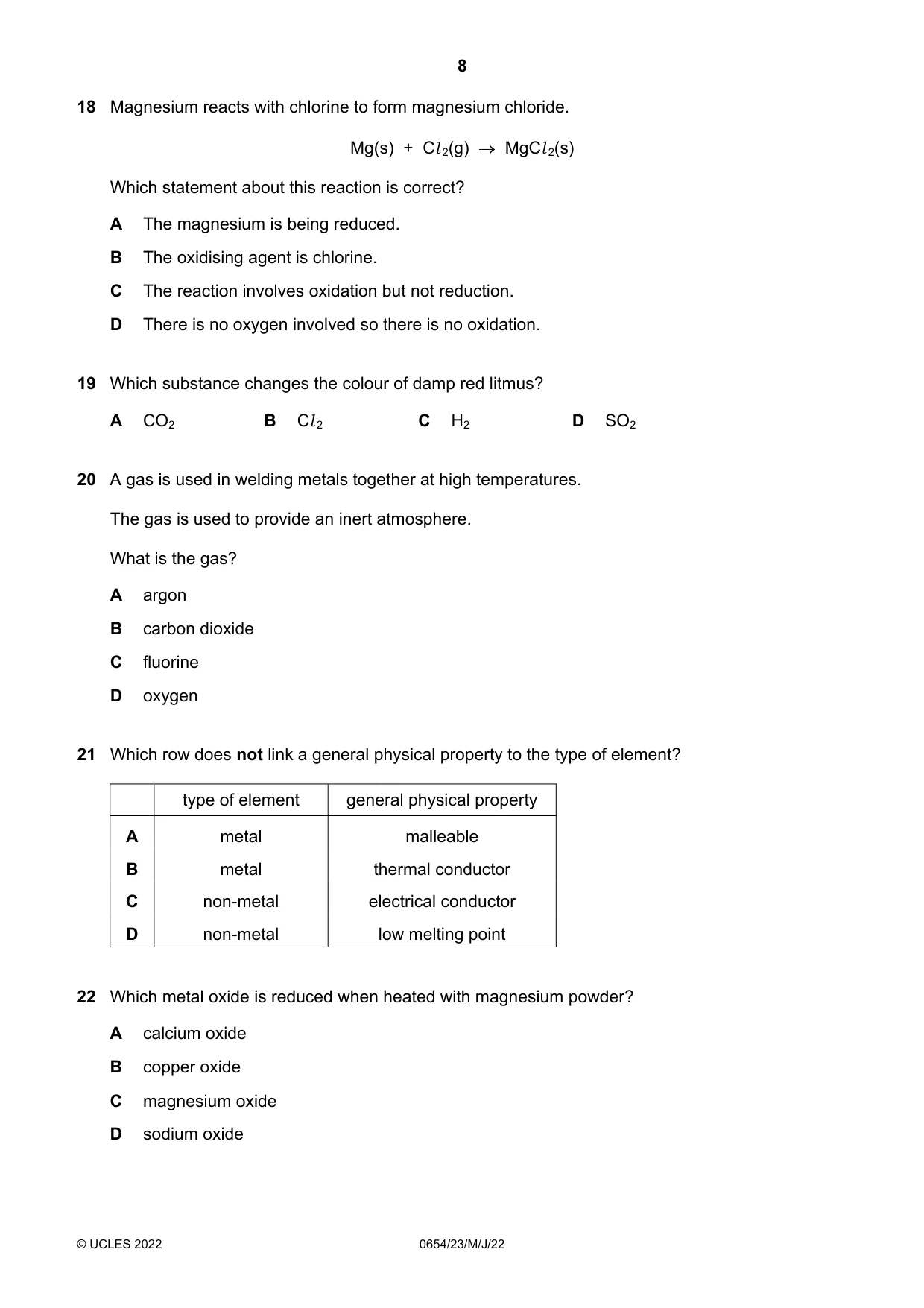
18 Magnesium reacts with chlorine to form magnesium chloride. Mg(s) + Cl 2(g) MgCl 2(s) Which statement about this reaction is correct? A The magnesium is being reduced. B The oxidising agent is chlorine. C The reaction involves oxidation but not reduction. D There is no oxygen involved so there is no oxidation.
Mark scheme: B
Q19 · Which substance changes the colour of damp red litmus?
19 Which substance changes the colour of damp red litmus? A CO2 B Cl 2 C H2 D SO2
Mark scheme: B
Q20 · A gas is used in welding metals together at high temperatures
20 A gas is used in welding metals together at high temperatures. The gas is used to provide an inert atmosphere. What is the gas? A argon B carbon dioxide C fluorine D oxygen
Mark scheme: A
Q21 · Which row does not link a general physical property to the type of element?
21 Which row does not link a general physical property to the type of element? type of element general physical property A metal malleable B metal thermal conductor C non-metal electrical conductor D non-metal low melting point
Mark scheme: C
Q22 · Which metal oxide is reduced when heated with magnesium powder?
22 Which metal oxide is reduced when heated with magnesium powder? A calcium oxide B copper oxide C magnesium oxide D sodium oxide
Mark scheme: B
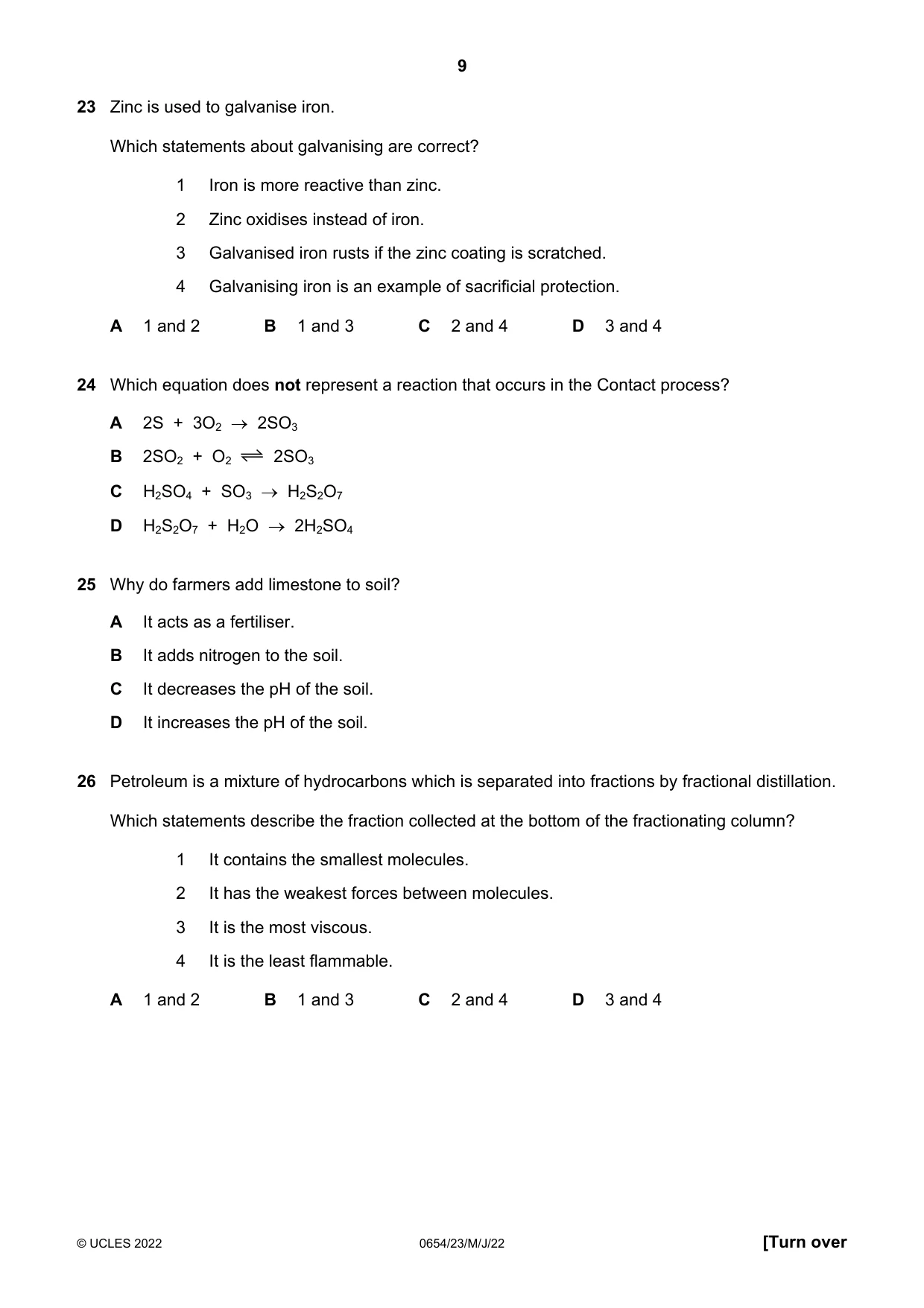
Q23 · Zinc is used to galvanise iron
23 Zinc is used to galvanise iron. Which statements about galvanising are correct? 1 Iron is more reactive than zinc. 2 Zinc oxidises instead of iron. 3 Galvanised iron rusts if the zinc coating is scratched. 4 Galvanising iron is an example of sacrificial protection. A 1 and 2 B 1 and 3 C 2 and 4 D 3 and 4
Mark scheme: C
Q24 · Which equation does not represent a reaction that occurs in the Contact process?
24 Which equation does not represent a reaction that occurs in the Contact process? A 2S + 3O2 2SO3 B 2SO2 + O2 2SO3 C H2SO4 + SO3 H2S2O7 D H2S2O7 + H2O 2H2SO4
Mark scheme: A
Q25 · Why do farmers add limestone to soil?
25 Why do farmers add limestone to soil? A It acts as a fertiliser. B It adds nitrogen to the soil. C It decreases the pH of the soil. D It increases the pH of the soil.
Mark scheme: D
More questions on The characteristic properties of acids and bases
Q26 · Petroleum is a mixture of hydrocarbons which is separated into fractions by fractional…
26 Petroleum is a mixture of hydrocarbons which is separated into fractions by fractional distillation. Which statements describe the fraction collected at the bottom of the fractionating column? 1 It contains the smallest molecules. 2 It has the weakest forces between molecules. 3 It is the most viscous. 4 It is the least flammable. A 1 and 2 B 1 and 3 C 2 and 4 D 3 and 4
Mark scheme: D
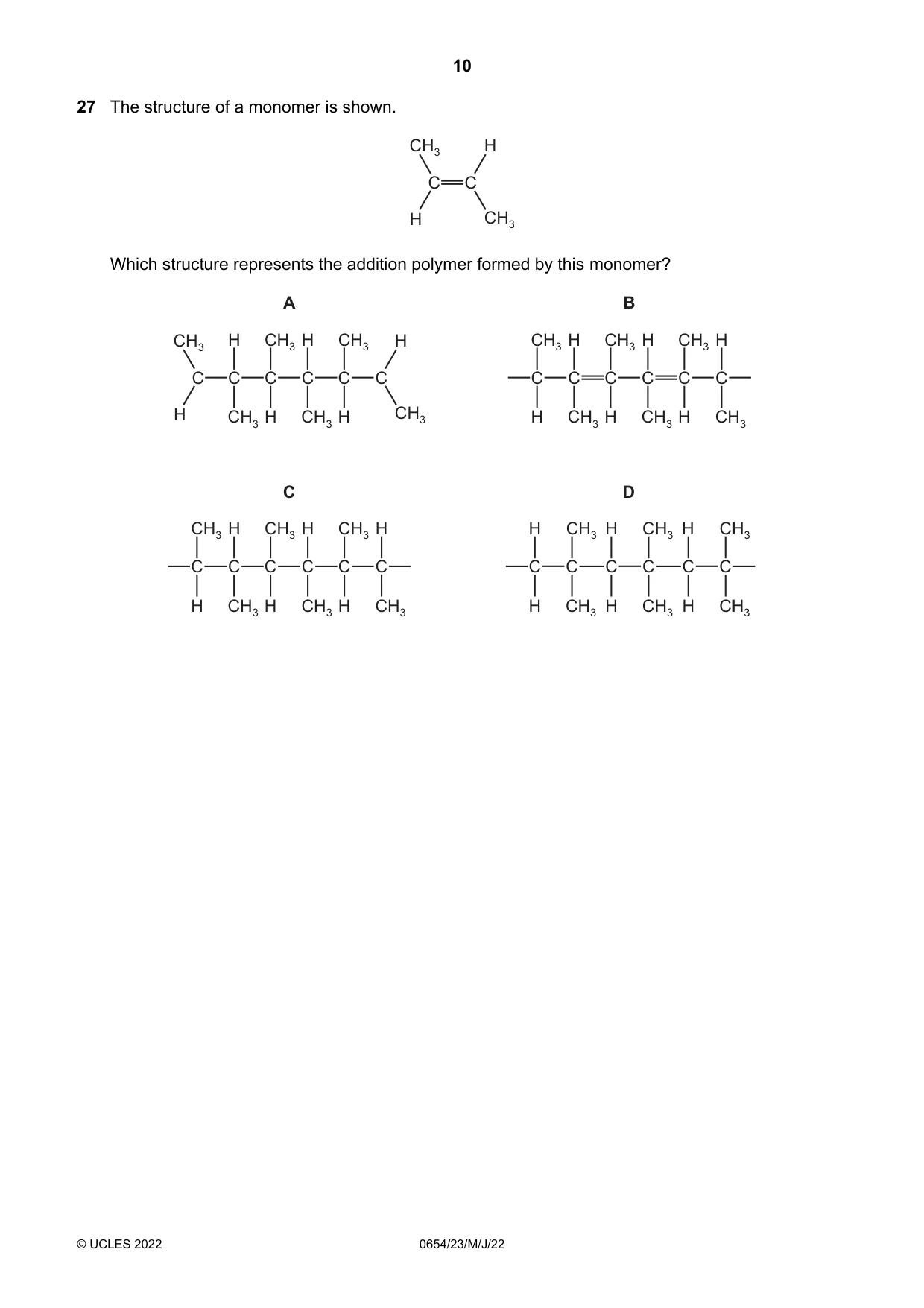
Q27 · The structure of a monomer is shown
27 The structure of a monomer is shown. CH3 H C C H CH3 Which structure represents the addition polymer formed by this monomer? A B CH3 H CH3 H CH3 H CH3 H CH3 H CH3 H C C C C C C C C C C C C H CH3 H CH3 H CH3 H CH3 H CH3 H CH3 C D CH3 H CH3 H CH3 H H CH3 H CH3 H CH3 C C C C C C C C C C C C H CH3 H CH3 H CH3 H CH3 H CH3 H CH3
Mark scheme: C
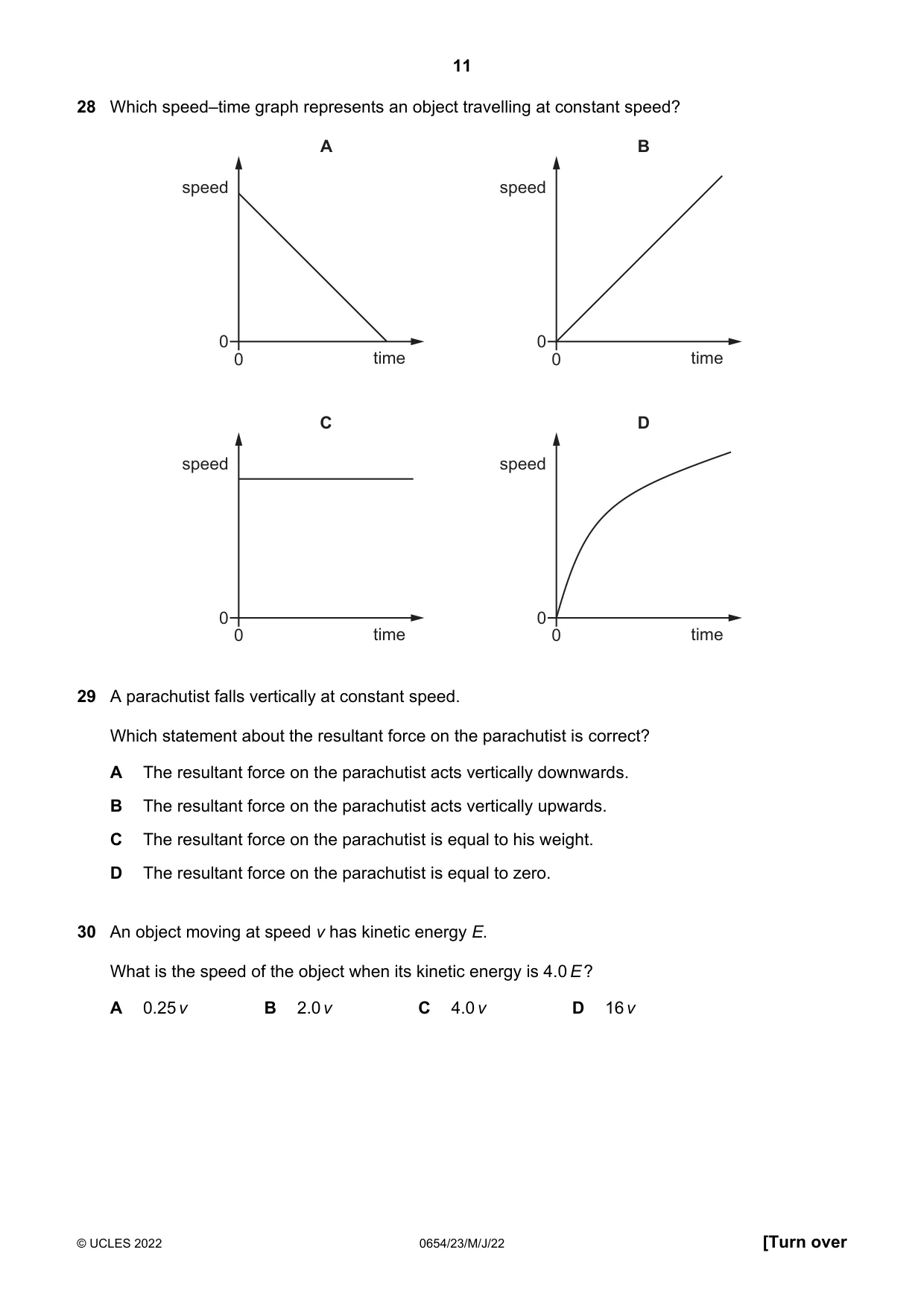
Q28 · Which speed–time graph represents an object travelling at constant speed?
28 Which speed–time graph represents an object travelling at constant speed? A B speed speed 0 0 0 time 0 time C D speed speed 0 0 0 time 0 time
Mark scheme: C
Q29 · A parachutist falls vertically at constant speed
29 A parachutist falls vertically at constant speed. Which statement about the resultant force on the parachutist is correct? A The resultant force on the parachutist acts vertically downwards. B The resultant force on the parachutist acts vertically upwards. C The resultant force on the parachutist is equal to his weight. D The resultant force on the parachutist is equal to zero.
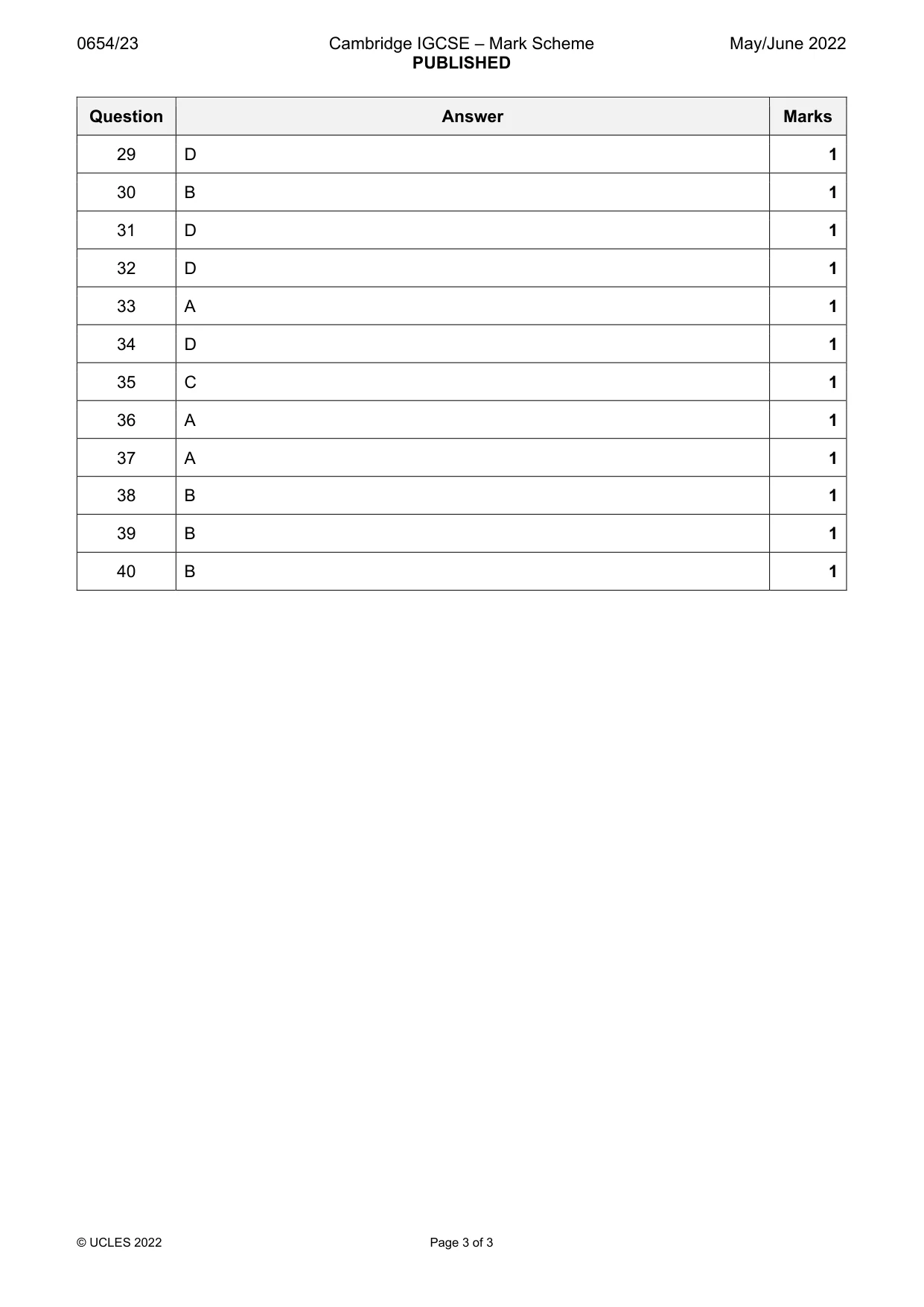
Mark scheme: D
Q30 · An object moving at speed v has kinetic energy E
30 An object moving at speed v has kinetic energy E. What is the speed of the object when its kinetic energy is 4.0 E ? A 0.25 v B 2.0 v C 4.0 v D 16 v
Mark scheme: B
Q31 · What is the name of the process by which energy is released in the Sun?
31 What is the name of the process by which energy is released in the Sun? A background radiation B chemical reaction C nuclear fission D nuclear fusion
Mark scheme: D
Q32 · What happens to the temperature of a substance as it is melting and as it is boiling?
32 What happens to the temperature of a substance as it is melting and as it is boiling? melting boiling A decreases increases B decreases no change C increases increases D no change no change
Mark scheme: D
Q33 · A loudspeaker produces a sound wave that has a frequency of 3300 Hz
33 A loudspeaker produces a sound wave that has a frequency of 3300 Hz. The speed of sound in air is 330 m / s. What is the wavelength of the sound wave? A 0.10 m B 1.0 m C 11 m D 1.1 106 m
Mark scheme: A
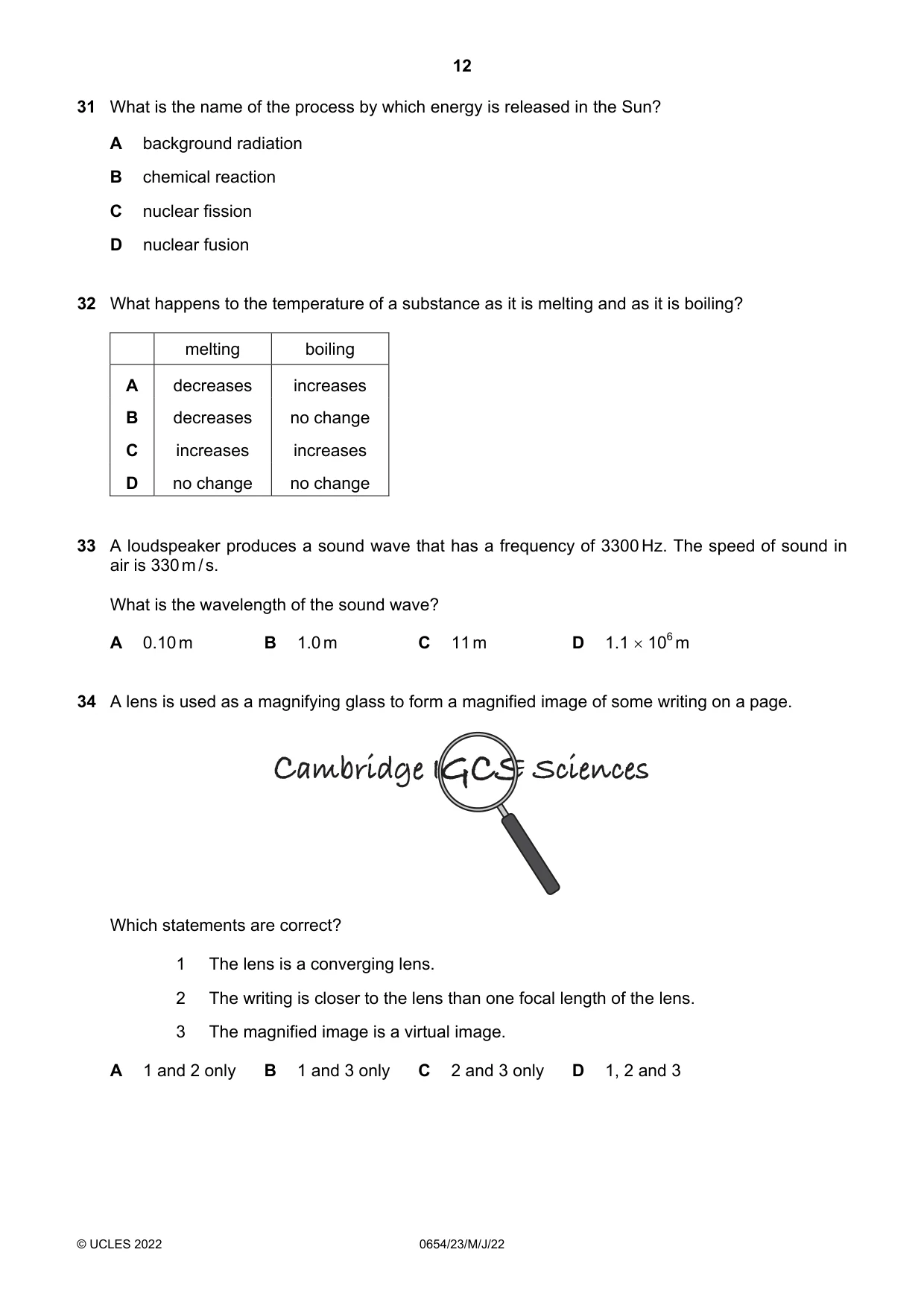
Q34 · A lens is used as a magnifying glass to form a magnified image of some writing on a page
34 A lens is used as a magnifying glass to form a magnified image of some writing on a page. ambridge I E Sciences Which statements are correct? 1 The lens is a converging lens. 2 The writing is closer to the lens than one focal length of the lens. 3 The magnified image is a virtual image. A 1 and 2 only B 1 and 3 only C 2 and 3 only D 1, 2 and 3
Mark scheme: D
Q35 · An iron bar XY is brought near to a magnet
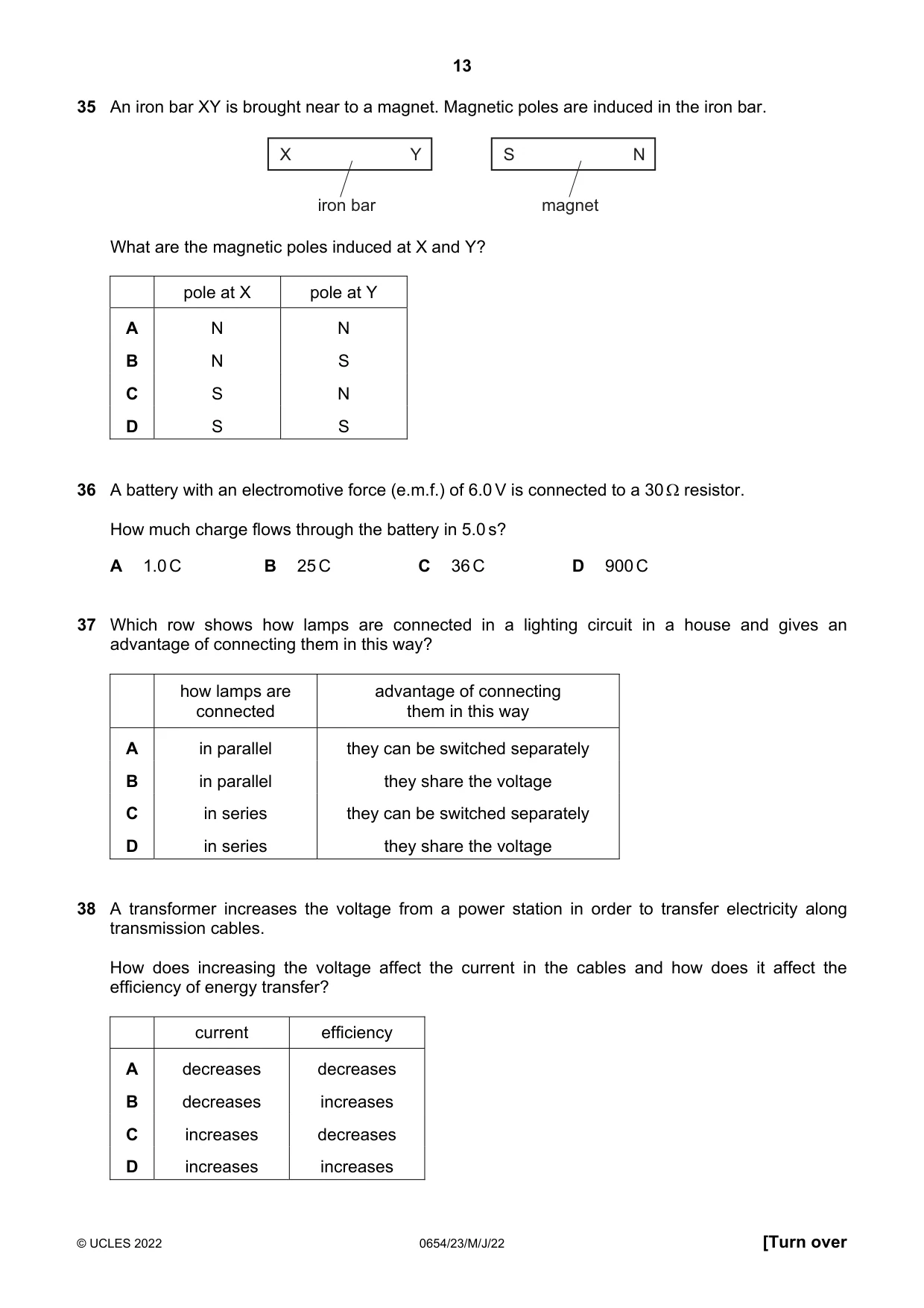
35 An iron bar XY is brought near to a magnet. Magnetic poles are induced in the iron bar. X Y S N iron bar magnet What are the magnetic poles induced at X and Y? pole at X pole at Y A N N B N S C S N D S S
Mark scheme: C
Q36 · A battery with an electromotive force (e.m.f.) of 6.0 V is connected to a 30 resistor
36 A battery with an electromotive force (e.m.f.) of 6.0 V is connected to a 30 resistor. How much charge flows through the battery in 5.0 s? A 1.0 C B 25 C C 36 C D 900 C
Mark scheme: A
Q37 · Which row shows how lamps are connected in a lighting circuit in a house and gives an…
37 Which row shows how lamps are connected in a lighting circuit in a house and gives an advantage of connecting them in this way? how lamps are advantage of connecting connected them in this way A in parallel they can be switched separately B in parallel they share the voltage C in series they can be switched separately D in series they share the voltage
Mark scheme: A
Q38 · A transformer increases the voltage from a power station in order to transfer electricity…
38 A transformer increases the voltage from a power station in order to transfer electricity along transmission cables. How does increasing the voltage affect the current in the cables and how does it affect the efficiency of energy transfer? current efficiency A decreases decreases B decreases increases C increases decreases D increases increases
Mark scheme: B
Q39 · An atom of beryllium is represented by Be
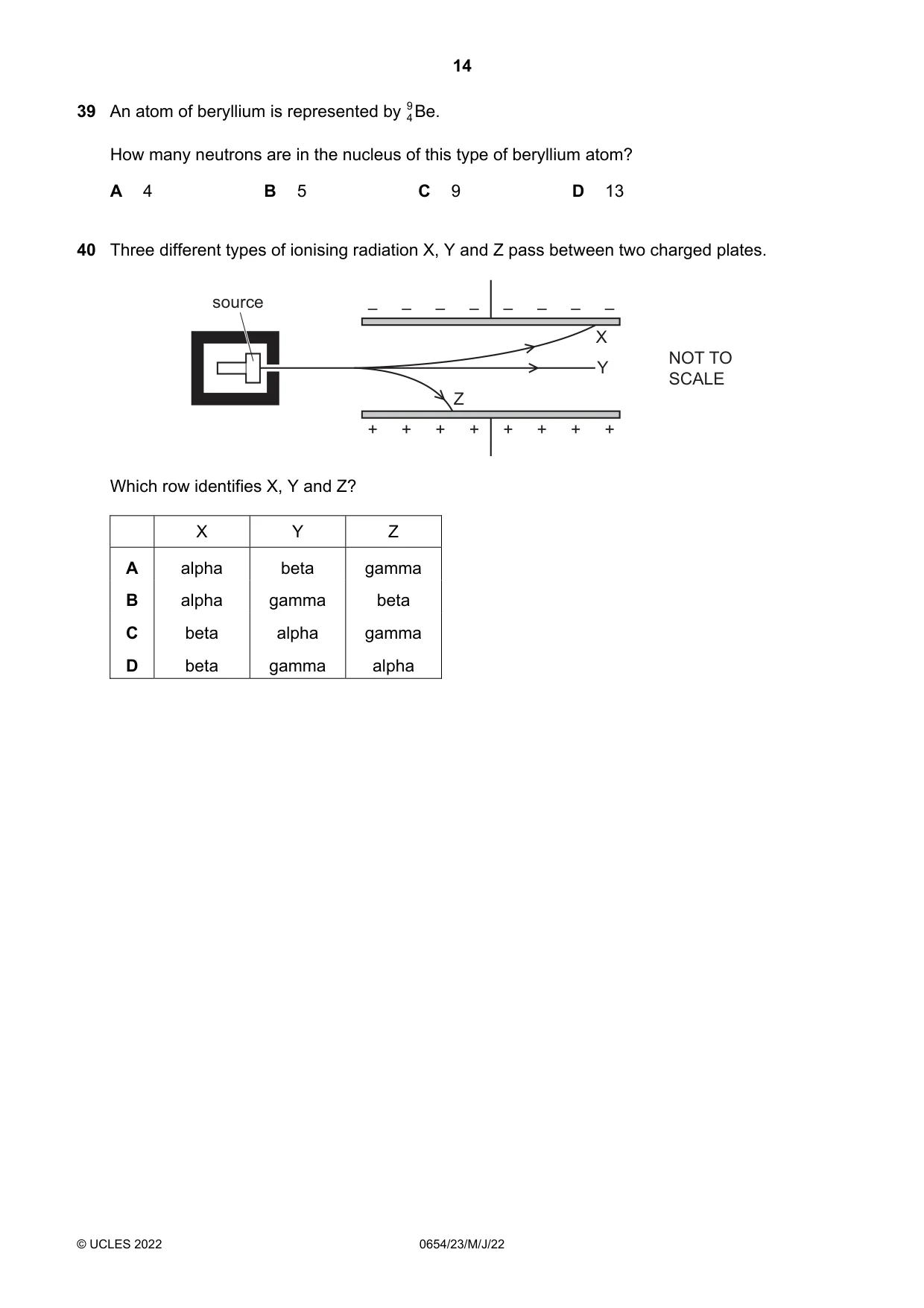
39 An atom of beryllium is represented by Be. 9 4 How many neutrons are in the nucleus of this type of beryllium atom? A 4 B 5 C 9 D 13
Mark scheme: B
Q40 · Three different types of ionising radiation X, Y and Z pass between two charged plates
40 Three different types of ionising radiation X, Y and Z pass between two charged plates. source – – – – – – – – X NOT TO Y SCALE Z + + + + + + + + Which row identifies X, Y and Z? X Y Z A alpha beta gamma B alpha gamma beta C beta alpha gamma D beta gamma alpha
Mark scheme: B
What was in this paper
The subtopics covered by these 40 questions, and how many questions each got. Open one in a new tab to see every Cambridge question on it.
2Asexual reproduction1Biological molecules1Cell division1Cell structure1Characteristics of living organisms1Circulatory systems1Corrosion of metals1Digestive system1Electrical circuits1Electrical quantities1Electrolysis1Electromagnetic effects1Energy, work and power1Enzymes1Food chains and food webs1Forces1Formulas1General properties of waves1Group VII properties1Habitat destruction1Homeostasis1Light1Motion1Noble gases1Photosynthesis1Physical and chemical changes1Polymers1Preparation of salts1Properties of metals1Radioactivity1Rate of reaction1Reactivity series1Redox1Respiration1Separation and purification1Simple phenomena of magnetism1The characteristic properties of acids and bases1Thermal properties and temperature1What you needed in this session
Cambridge’s own grade thresholds for 2022 May/June, Paper 2 · Variant 3. A higher threshold means an easier paper — the bar moves with how the cohort did.