Cambridge IGCSE Sciences - Co-ordinated (Double) 0654 — 2018 Oct/Nov Paper 2 · Variant 3
0654/23/O/N/18 · 40 questions · 40 marks · ≈45 min
The question paper and its mark scheme, free to read here and free to download. This is Cambridge’s own paper, exactly as it was sat.
Question paper16 pages
Mark scheme3 pages
Answers below. Sit the paper first if you are practising.
Questions as text
Q1 · One way to test for microscopic life in soil is to see if carbon dioxide is released
1 One way to test for microscopic life in soil is to see if carbon dioxide is released. Which characteristic of living things is being tested? A growth B nutrition C reproduction D respiration
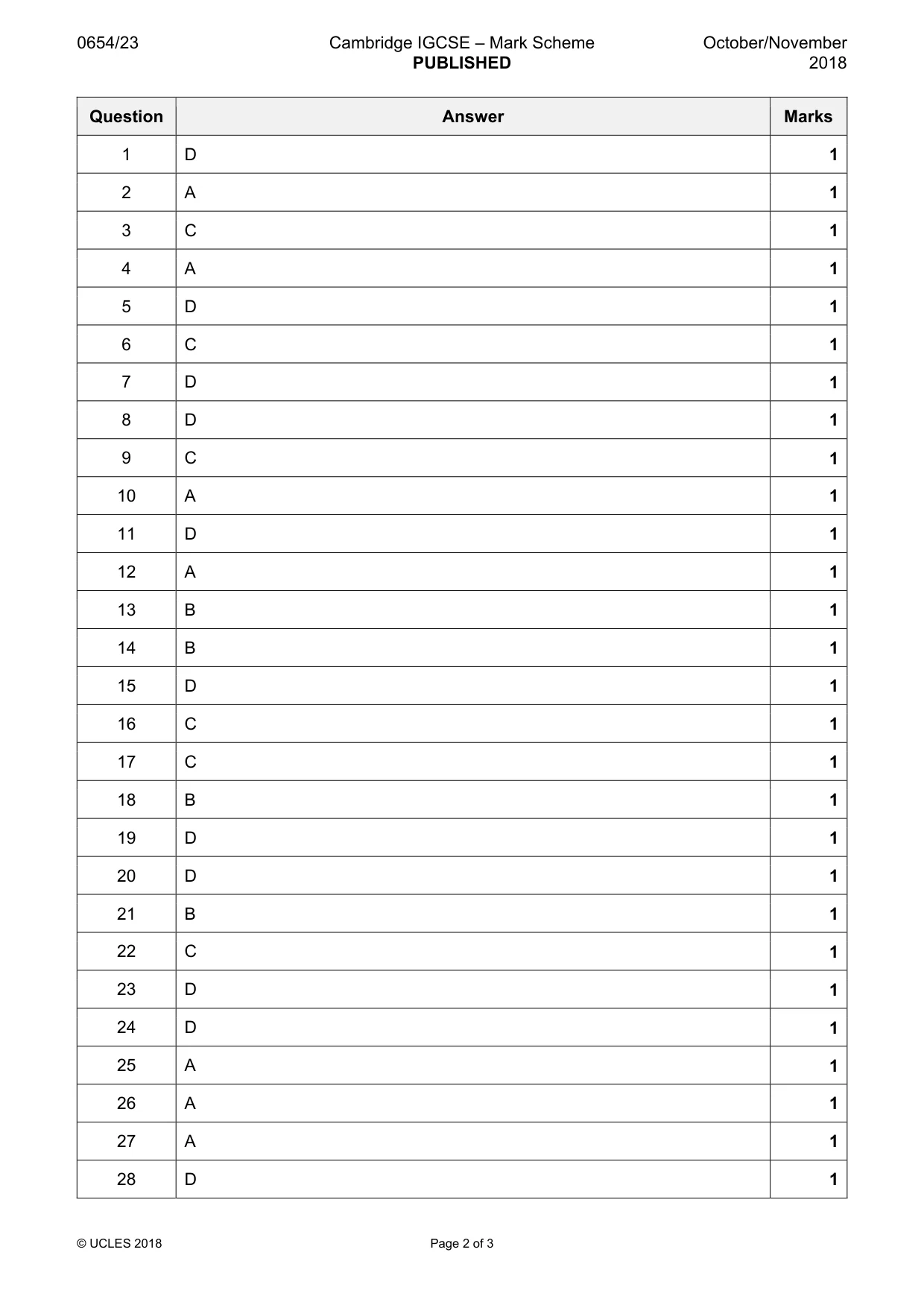
Mark scheme: D
Q2 · The diagram shows a red blood cell
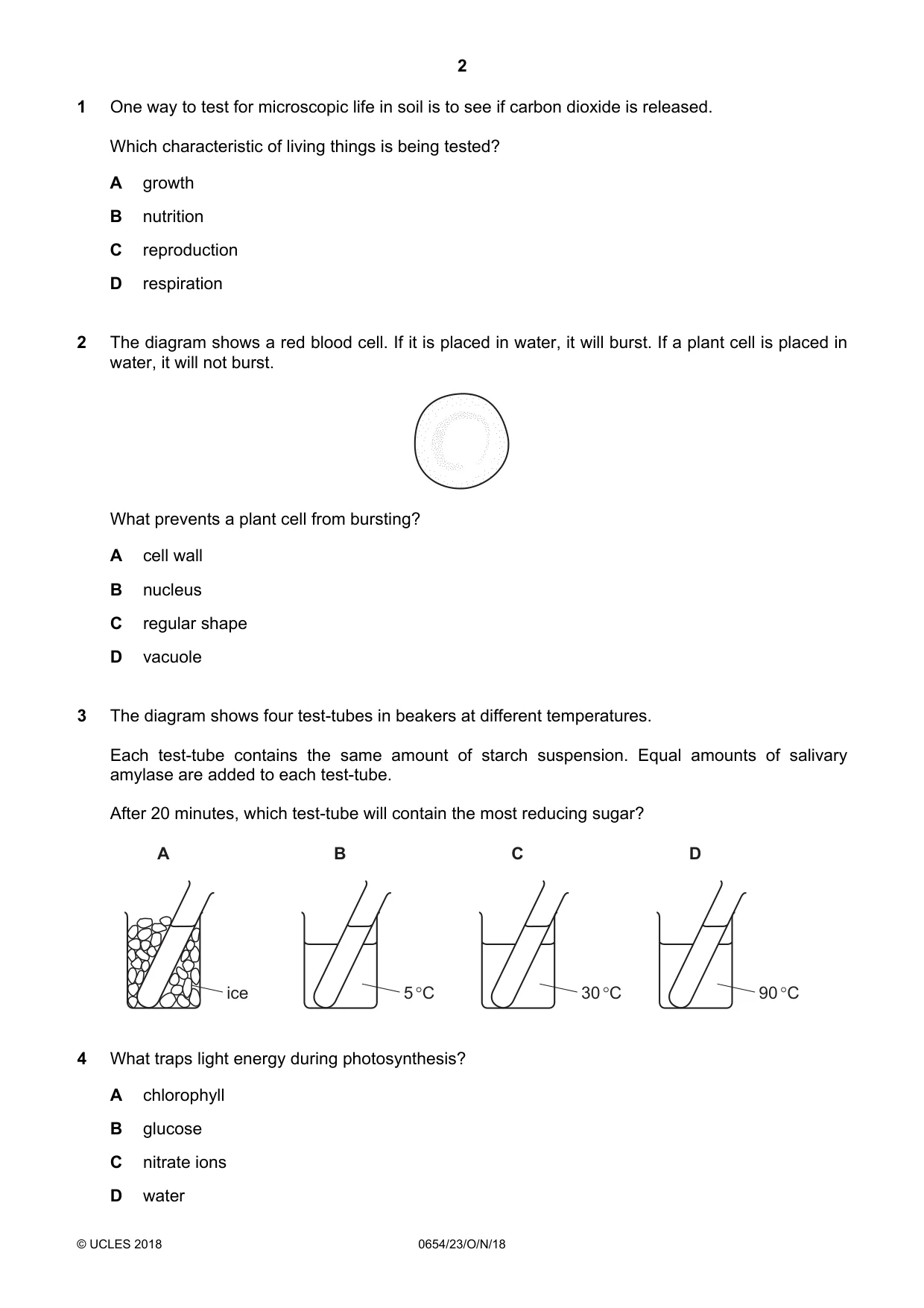
2 The diagram shows a red blood cell. If it is placed in water, it will burst. If a plant cell is placed in water, it will not burst. What prevents a plant cell from bursting? A cell wall B nucleus C regular shape D vacuole
Mark scheme: A
Q3 · The diagram shows four test-tubes in beakers at different temperatures
3 The diagram shows four test-tubes in beakers at different temperatures. Each test-tube contains the same amount of starch suspension. Equal amounts of salivary amylase are added to each test-tube. After 20 minutes, which test-tube will contain the most reducing sugar? A B C D ice 5 °C 30 °C 90 °C
Mark scheme: C
Q4 · What traps light energy during photosynthesis?
4 What traps light energy during photosynthesis? A chlorophyll B glucose C nitrate ions D water
Mark scheme: A
Q5 · Water is taken in through the roots and lost from the leaves of tall trees
5 Water is taken in through the roots and lost from the leaves of tall trees. What enables this to happen? A active transport by the xylem vessels B pressure from the roots C translocation in the phloem D transpiration loss from the leaves
Mark scheme: D
Q6 · The diagram shows the structure of a villus
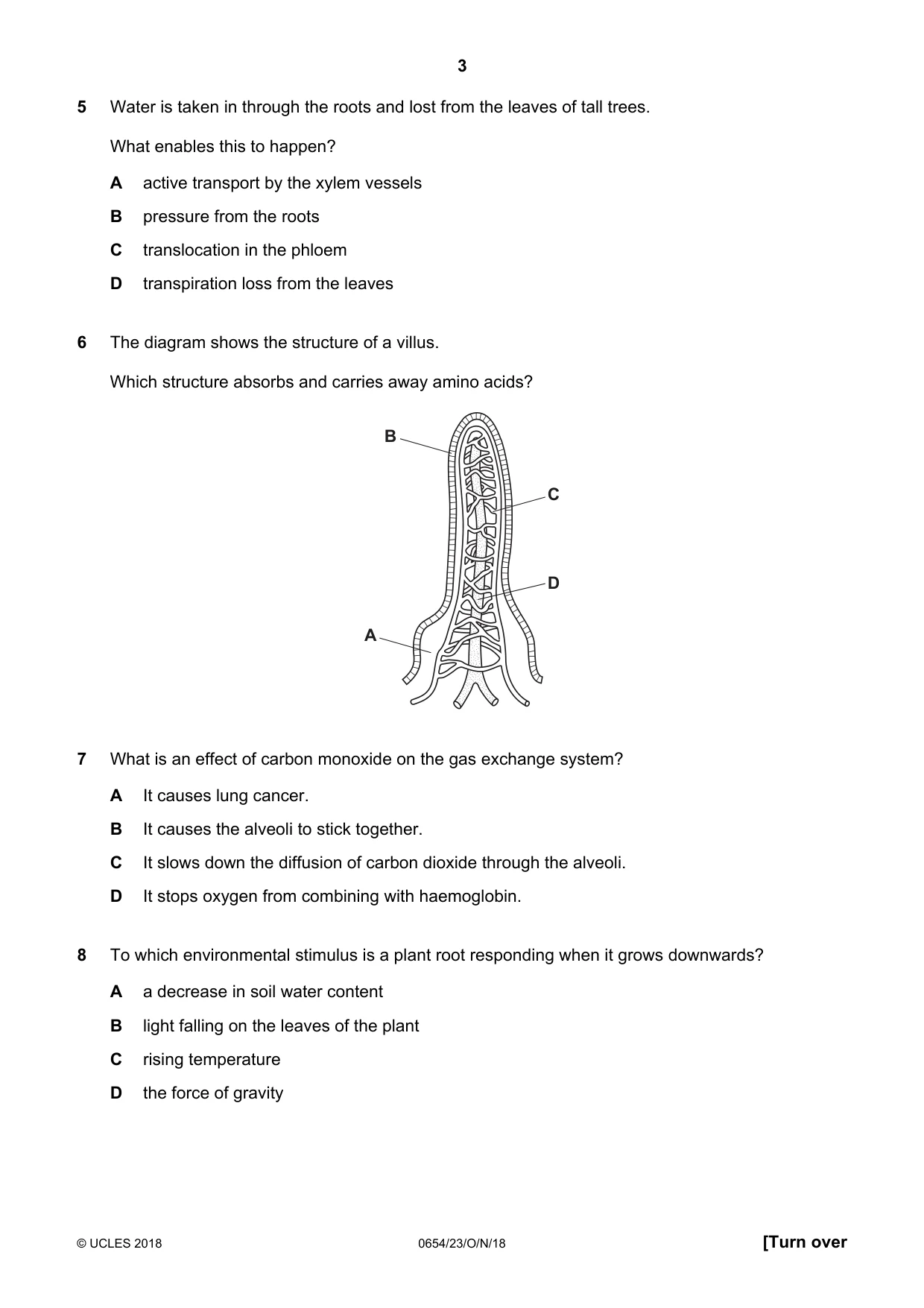
6 The diagram shows the structure of a villus. Which structure absorbs and carries away amino acids? B C D A
Mark scheme: C
Q7 · What is an effect of carbon monoxide on the gas exchange system?
7 What is an effect of carbon monoxide on the gas exchange system? A It causes lung cancer. B It causes the alveoli to stick together. C It slows down the diffusion of carbon dioxide through the alveoli. D It stops oxygen from combining with haemoglobin.
Mark scheme: D
Q8 · To which environmental stimulus is a plant root responding when it grows downwards?
8 To which environmental stimulus is a plant root responding when it grows downwards? A a decrease in soil water content B light falling on the leaves of the plant C rising temperature D the force of gravity
Mark scheme: D
Q9 · What is an advantage of asexual reproduction compared with sexual reproduction?
9 What is an advantage of asexual reproduction compared with sexual reproduction? A A specific disease is less likely to spread throughout the whole population. B It increases variation in the offspring. C It produces offspring more rapidly. D It requires two parents.
Mark scheme: C
Q10 · Which part of a flower produces pollen grains?
10 Which part of a flower produces pollen grains? A anther B ovary C sepal D stigma
Mark scheme: A
Q11 · In pea plants, the allele for purple flowers is dominant to the allele for white flowers
11 In pea plants, the allele for purple flowers is dominant to the allele for white flowers. Two heterozygous purple-flowered plants are crossed. What will be the expected flower colour of the offspring plants? A all purple B all white C 1 purple : 1 white D 3 purple : 1 white
Mark scheme: D
Q12 · Some strains of bacteria developed resistance to certain antibiotics
12 Some strains of bacteria developed resistance to certain antibiotics. What does this not involve? A artificial selection B mutation C natural selection D survival of the fittest
Mark scheme: A
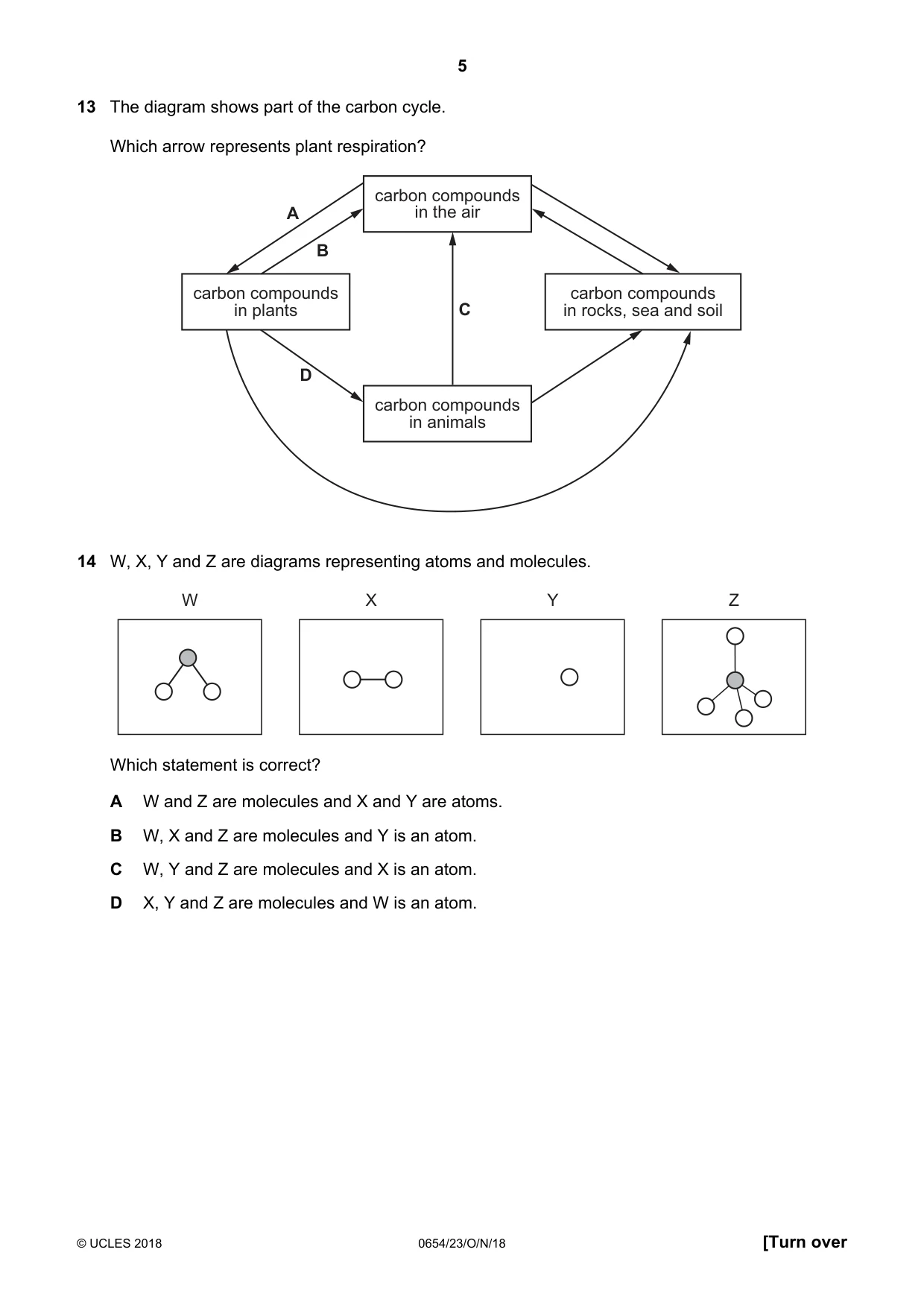
Q13 · The diagram shows part of the carbon cycle
13 The diagram shows part of the carbon cycle. Which arrow represents plant respiration? carbon compounds A in the air B carbon compounds carbon compounds in plants C in rocks, sea and soil D carbon compounds in animals
Mark scheme: B
Q14 · W, X, Y and Z are diagrams representing atoms and molecules
14 W, X, Y and Z are diagrams representing atoms and molecules. W X Y Z Which statement is correct? A W and Z are molecules and X and Y are atoms. B W, X and Z are molecules and Y is an atom. C W, Y and Z are molecules and X is an atom. D X, Y and Z are molecules and W is an atom.
Mark scheme: B
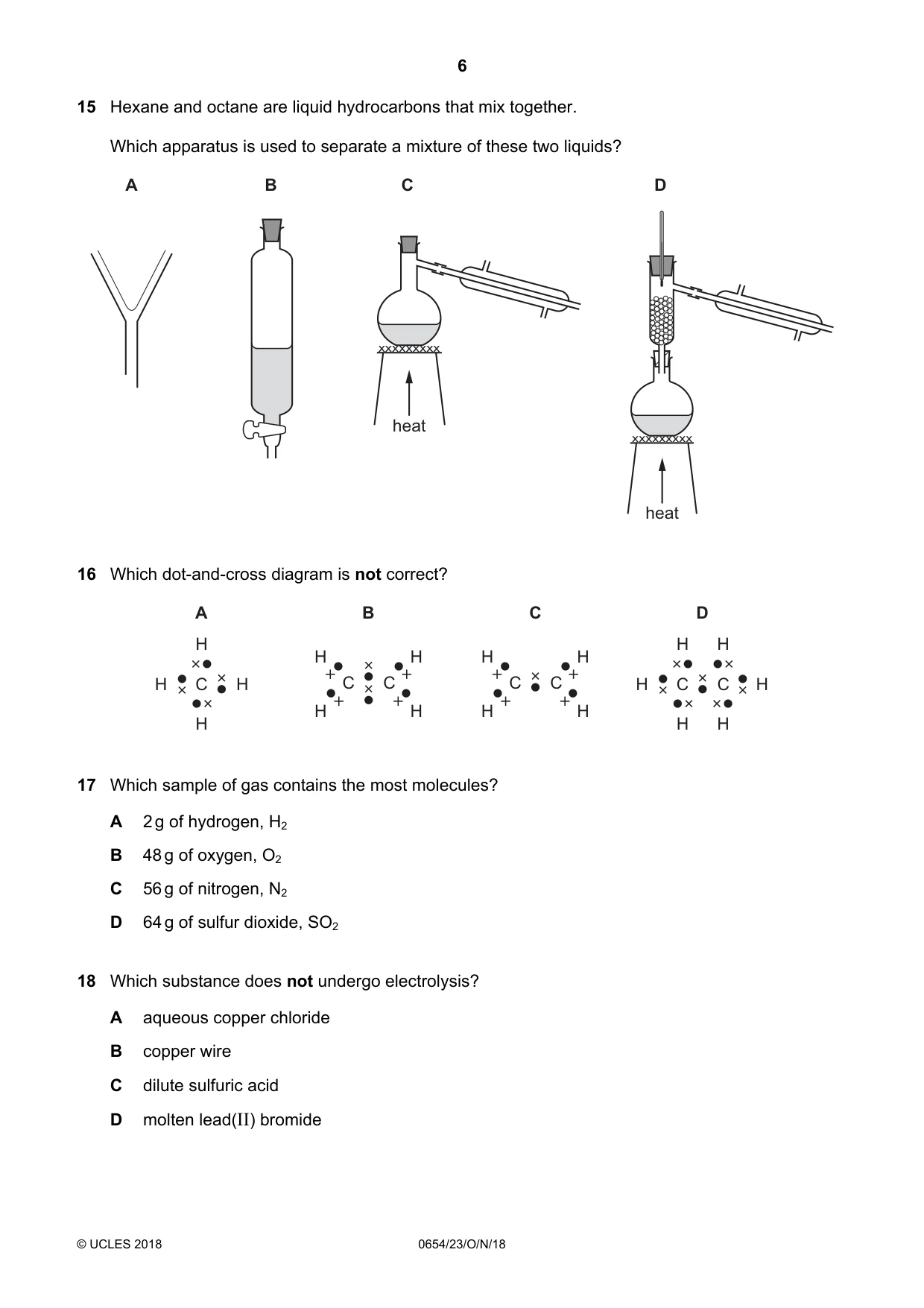
Q15 · Hexane and octane are liquid hydrocarbons that mix together
15 Hexane and octane are liquid hydrocarbons that mix together. Which apparatus is used to separate a mixture of these two liquids? A B C D xxxxxxxxx heat xxxxxxxxx heat
Mark scheme: D
Q16 · Which dot-and-cross diagram is not correct?
16 Which dot-and-cross diagram is not correct? A B C D H H H H H H H H C H C C C C H C C H H H H H H H H
Mark scheme: C
Q17 · Which sample of gas contains the most molecules?
17 Which sample of gas contains the most molecules? A 2 g of hydrogen, H2 B 48 g of oxygen, O2 C 56 g of nitrogen, N2 D 64 g of sulfur dioxide, SO2
Mark scheme: C
Q18 · Which substance does not undergo electrolysis?
18 Which substance does not undergo electrolysis? A aqueous copper chloride B copper wire C dilute sulfuric acid D molten lead(II) bromide
Mark scheme: B
Q19 · Solid sodium hydroxide reacts with dilute hydrochloric acid
19 Solid sodium hydroxide reacts with dilute hydrochloric acid. Which change shows that the reaction is exothermic? A A gas is produced. B The mass increases. C The pH increases. D The temperature increases.
Mark scheme: D
Q20 · Iron oxide reacts with carbon monoxide
20 Iron oxide reacts with carbon monoxide. The word equation is iron oxide + carbon monoxide → iron + carbon dioxide Which statement describes what happens to the iron oxide? A It is oxidised because it gains oxygen. B It is oxidised because it loses oxygen. C It is reduced because it gains oxygen. D It is reduced because it loses oxygen.
Mark scheme: D
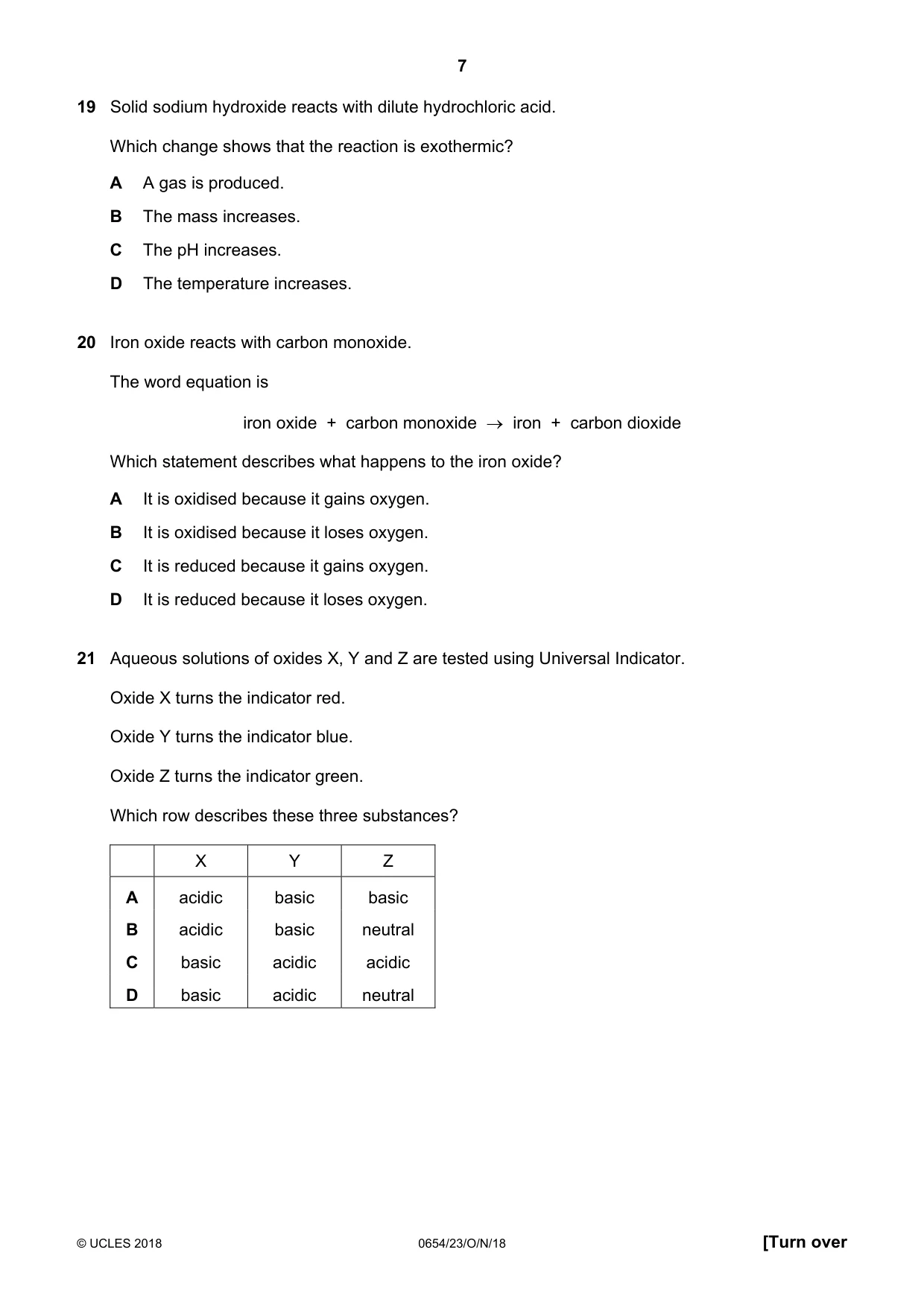
Q21 · Aqueous solutions of oxides X, Y and Z are tested using Universal Indicator
21 Aqueous solutions of oxides X, Y and Z are tested using Universal Indicator. Oxide X turns the indicator red. Oxide Y turns the indicator blue. Oxide Z turns the indicator green. Which row describes these three substances? X Y Z A acidic basic basic B acidic basic neutral C basic acidic acidic D basic acidic neutral
Mark scheme: B
More questions on The characteristic properties of acids and bases
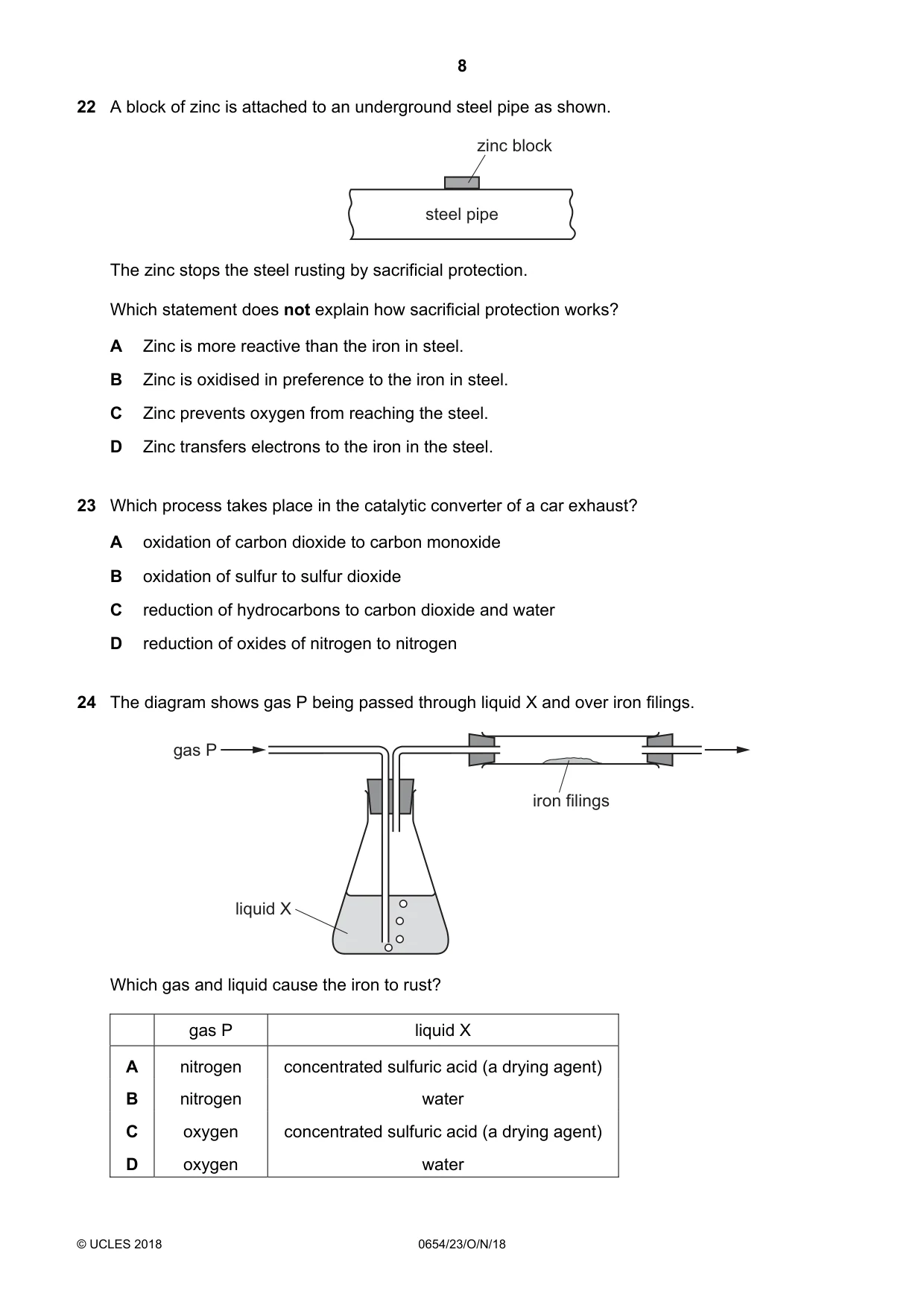
Q22 · A block of zinc is attached to an underground steel pipe as shown
22 A block of zinc is attached to an underground steel pipe as shown. zinc block steel pipe The zinc stops the steel rusting by sacrificial protection. Which statement does not explain how sacrificial protection works? A Zinc is more reactive than the iron in steel. B Zinc is oxidised in preference to the iron in steel. C Zinc prevents oxygen from reaching the steel. D Zinc transfers electrons to the iron in the steel.
Mark scheme: C
Q23 · Which process takes place in the catalytic converter of a car exhaust?
23 Which process takes place in the catalytic converter of a car exhaust? A oxidation of carbon dioxide to carbon monoxide B oxidation of sulfur to sulfur dioxide C reduction of hydrocarbons to carbon dioxide and water D reduction of oxides of nitrogen to nitrogen
Mark scheme: D
Q24 · The diagram shows gas P being passed through liquid X and over iron filings
24 The diagram shows gas P being passed through liquid X and over iron filings. gas P iron filings liquid X Which gas and liquid cause the iron to rust? gas P liquid X A nitrogen concentrated sulfuric acid (a drying agent) B nitrogen water C oxygen concentrated sulfuric acid (a drying agent) D oxygen water
Mark scheme: D
Q25 · Sulfuric acid is manufactured by the Contact process
25 Sulfuric acid is manufactured by the Contact process. Which conditions are used in this process? A 2 atmospheres pressure and a vanadium pentoxide catalyst B 2 atmospheres pressure and an iron catalyst C 200 atmospheres pressure and a vanadium pentoxide catalyst D 200 atmospheres pressure and an iron catalyst
Mark scheme: A
Q26 · Ethene is manufactured from alkanes
26 Ethene is manufactured from alkanes. Ethene is used to manufacture ethanol. Which statement about these processes is not correct? A Ethanol is made by reacting ethene with oxygen. B Ethene is converted to ethanol by an addition reaction. C Ethene is made by cracking. D The manufacture of ethanol uses a catalyst.
Mark scheme: A
Q27 · The molecule shown contains some amide linkages
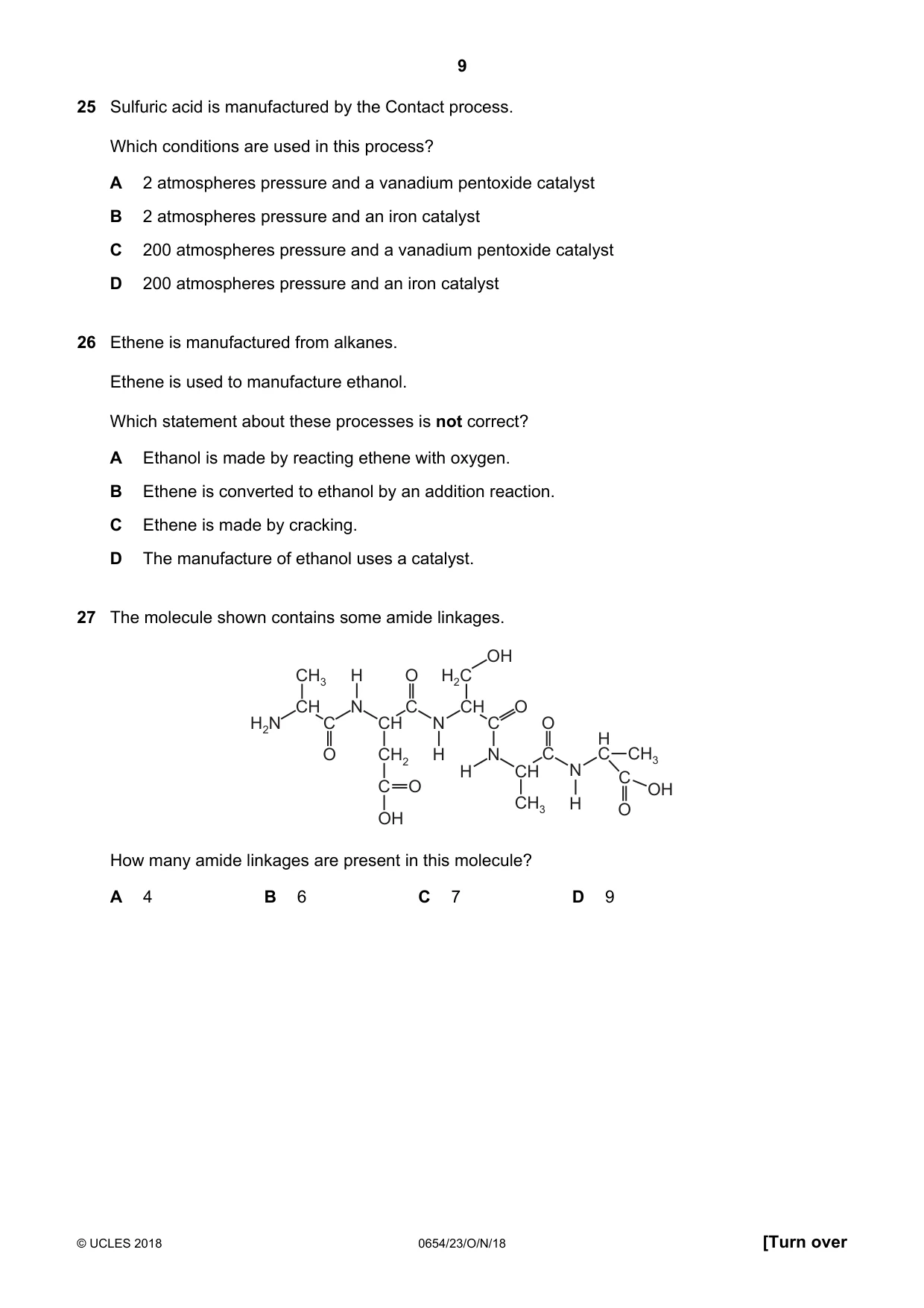
27 The molecule shown contains some amide linkages. OH CH3 H O H2C CH N C CH O H2N C CH N C O H O CH2 H N C C CH3 H CH N C C O OH CH3 H O OH How many amide linkages are present in this molecule? A 4 B 6 C 7 D 9
Mark scheme: A
Q28 · The diagrams show the speed-time graphs for four objects
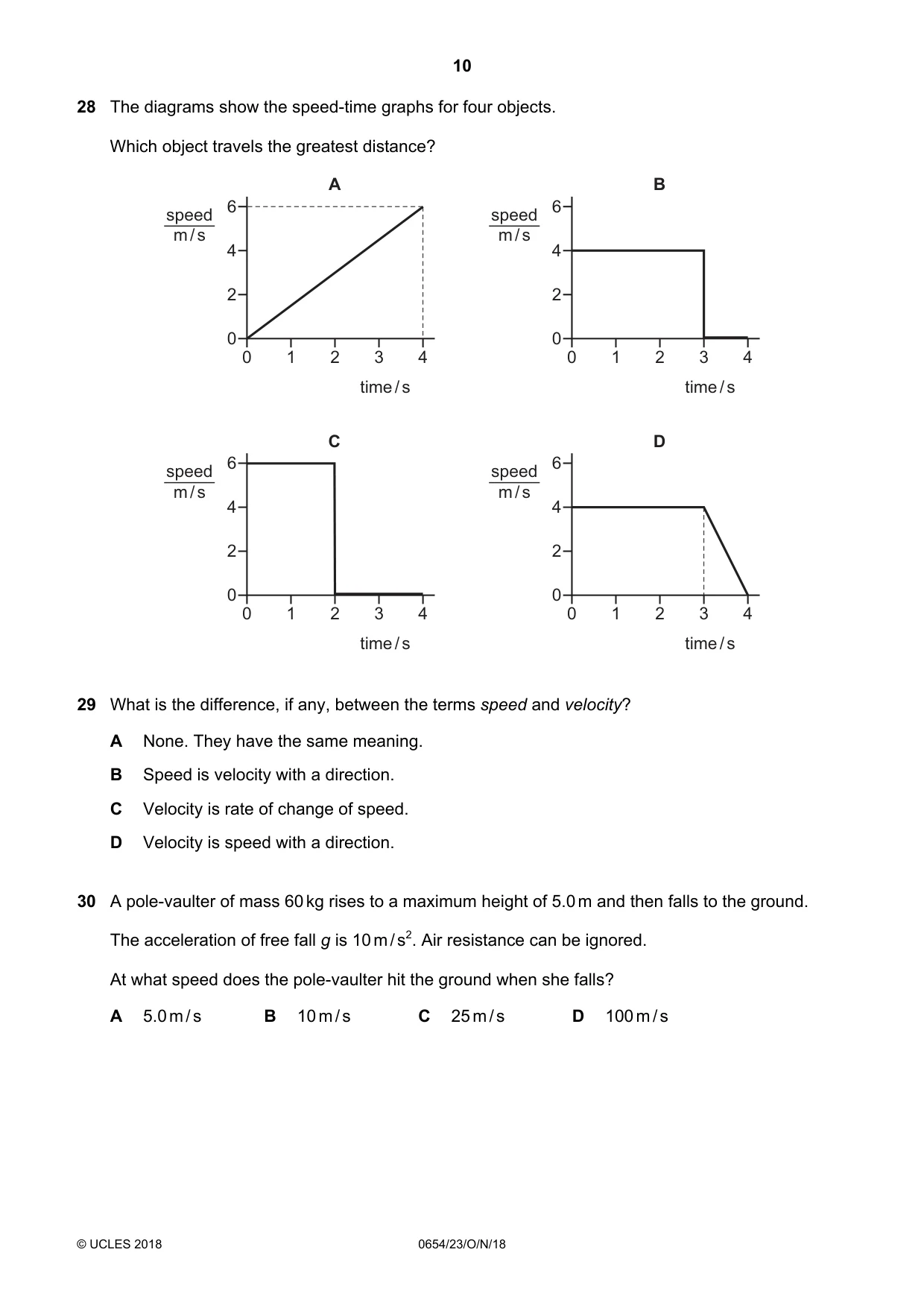
28 The diagrams show the speed-time graphs for four objects. Which object travels the greatest distance? A B 6 6 speed speed m / s m / s 4 4 2 2 0 0 0 1 2 3 4 0 1 2 3 4 time / s time / s C D 6 6 speed speed m / s m / s 4 4 2 2 0 0 0 1 2 3 4 0 1 2 3 4 time / s time / s
Mark scheme: D
Q29 · What is the difference, if any, between the terms speed and velocity?
29 What is the difference, if any, between the terms speed and velocity? A None. They have the same meaning. B Speed is velocity with a direction. C Velocity is rate of change of speed. D Velocity is speed with a direction.
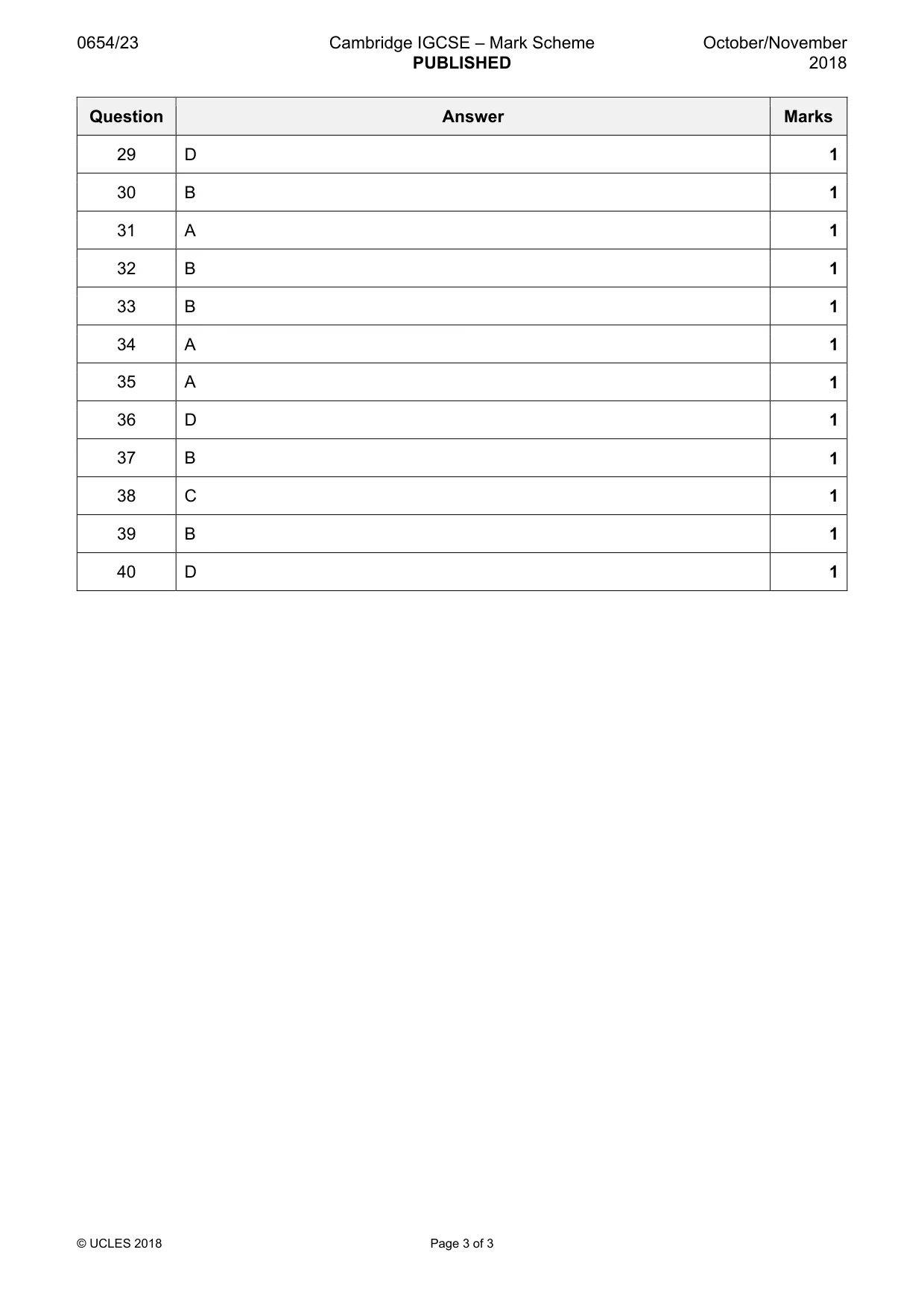
Mark scheme: D
Q30 · A pole-vaulter of mass 60 kg rises to a maximum height of 5.0 m and then falls to the…
30 A pole-vaulter of mass 60 kg rises to a maximum height of 5.0 m and then falls to the ground. The acceleration of free fall g is 10 m / s2. Air resistance can be ignored. At what speed does the pole-vaulter hit the ground when she falls? A 5.0 m / s B 10 m / s C 25 m / s D 100 m / s
Mark scheme: B
Q31 · An axle is slightly larger than the hole in a wheel made from the same metal
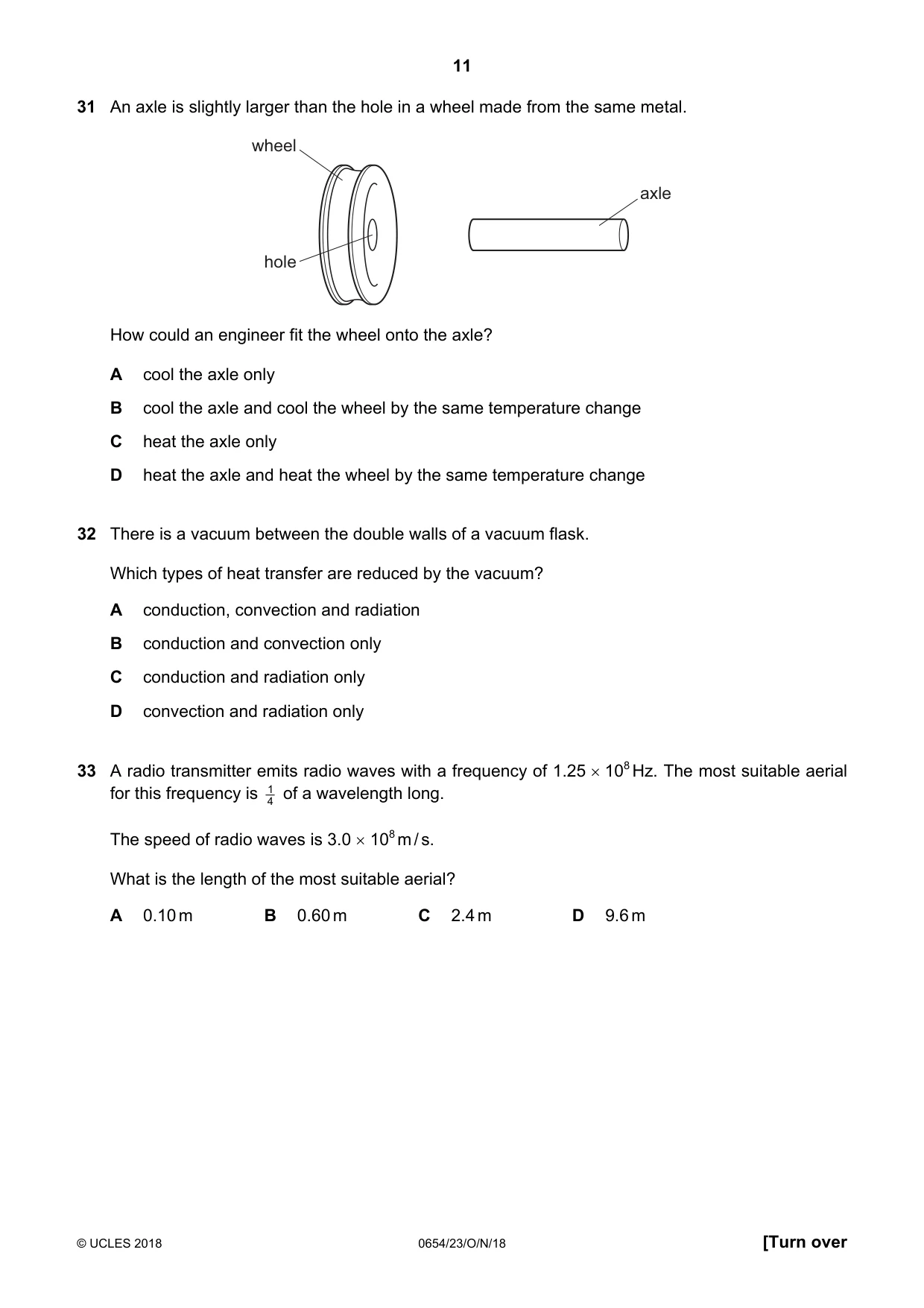
31 An axle is slightly larger than the hole in a wheel made from the same metal. wheel axle hole How could an engineer fit the wheel onto the axle? A cool the axle only B cool the axle and cool the wheel by the same temperature change C heat the axle only D heat the axle and heat the wheel by the same temperature change
Mark scheme: A
Q32 · There is a vacuum between the double walls of a vacuum flask
32 There is a vacuum between the double walls of a vacuum flask. Which types of heat transfer are reduced by the vacuum? A conduction, convection and radiation B conduction and convection only C conduction and radiation only D convection and radiation only
Mark scheme: B
Q33 · A radio transmitter emits radio waves with a frequency of 1.25 × 10⁸ Hz
33 A radio transmitter emits radio waves with a frequency of 1.25 × 10⁸ Hz. The most suitable aerial for this frequency is 4 1 of a wavelength long. The speed of radio waves is 3.0 × 10⁸ m / s. What is the length of the most suitable aerial? A 0.10 m B 0.60 m C 2.4 m D 9.6 m
Mark scheme: B
Q34 · The ray diagram shows two rays of light that have passed from an object through a…
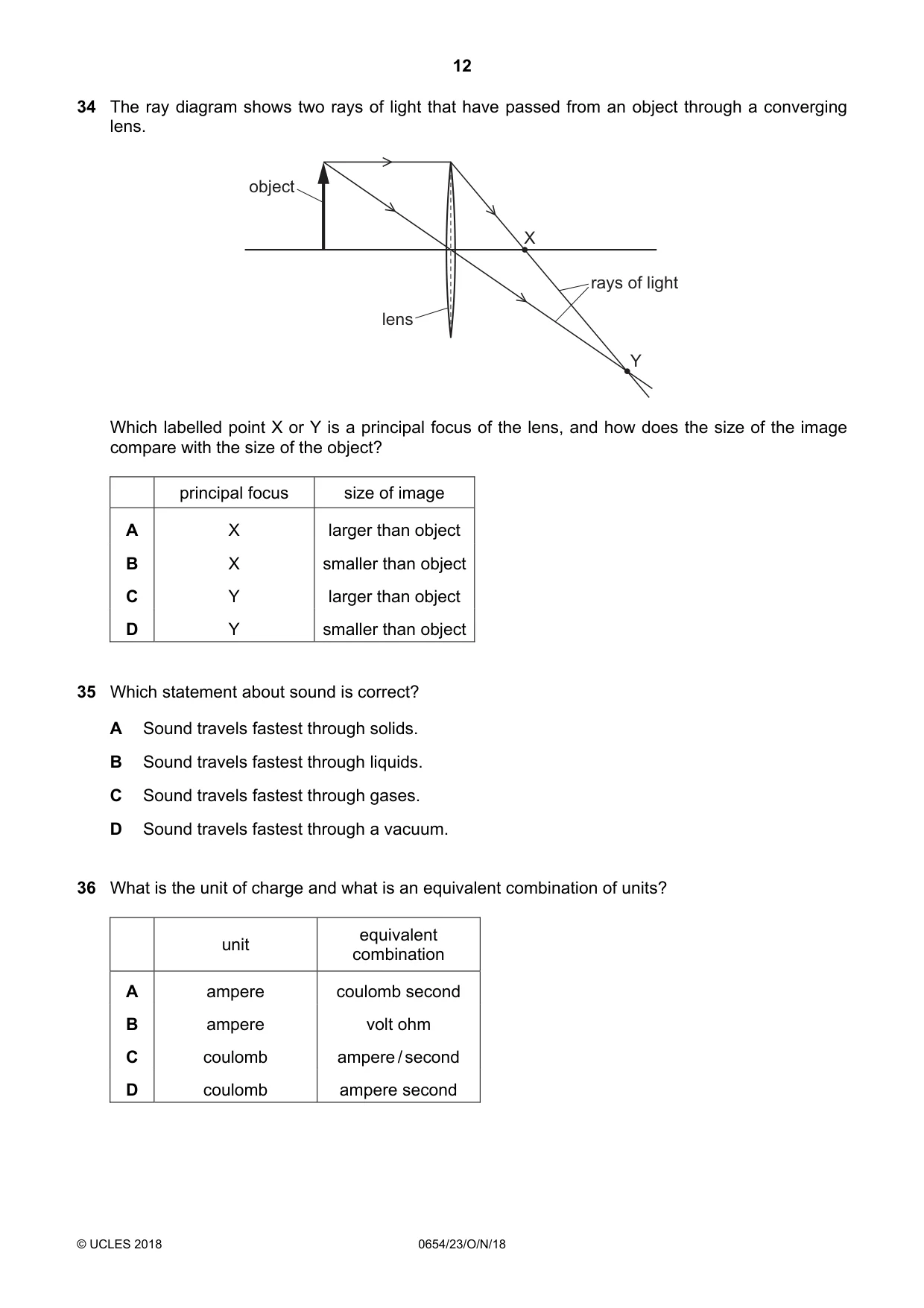
34 The ray diagram shows two rays of light that have passed from an object through a converging lens. object X rays of light lens Y Which labelled point X or Y is a principal focus of the lens, and how does the size of the image compare with the size of the object? principal focus size of image A X larger than object B X smaller than object C Y larger than object D Y smaller than object
Mark scheme: A
Q35 · Which statement about sound is correct?
35 Which statement about sound is correct? A Sound travels fastest through solids. B Sound travels fastest through liquids. C Sound travels fastest through gases. D Sound travels fastest through a vacuum.
Mark scheme: A
Q36 · What is the unit of charge and what is an equivalent combination of units?
36 What is the unit of charge and what is an equivalent combination of units? equivalent unit combination A ampere coulomb second B ampere volt ohm C coulomb ampere / second D coulomb ampere second
Mark scheme: D
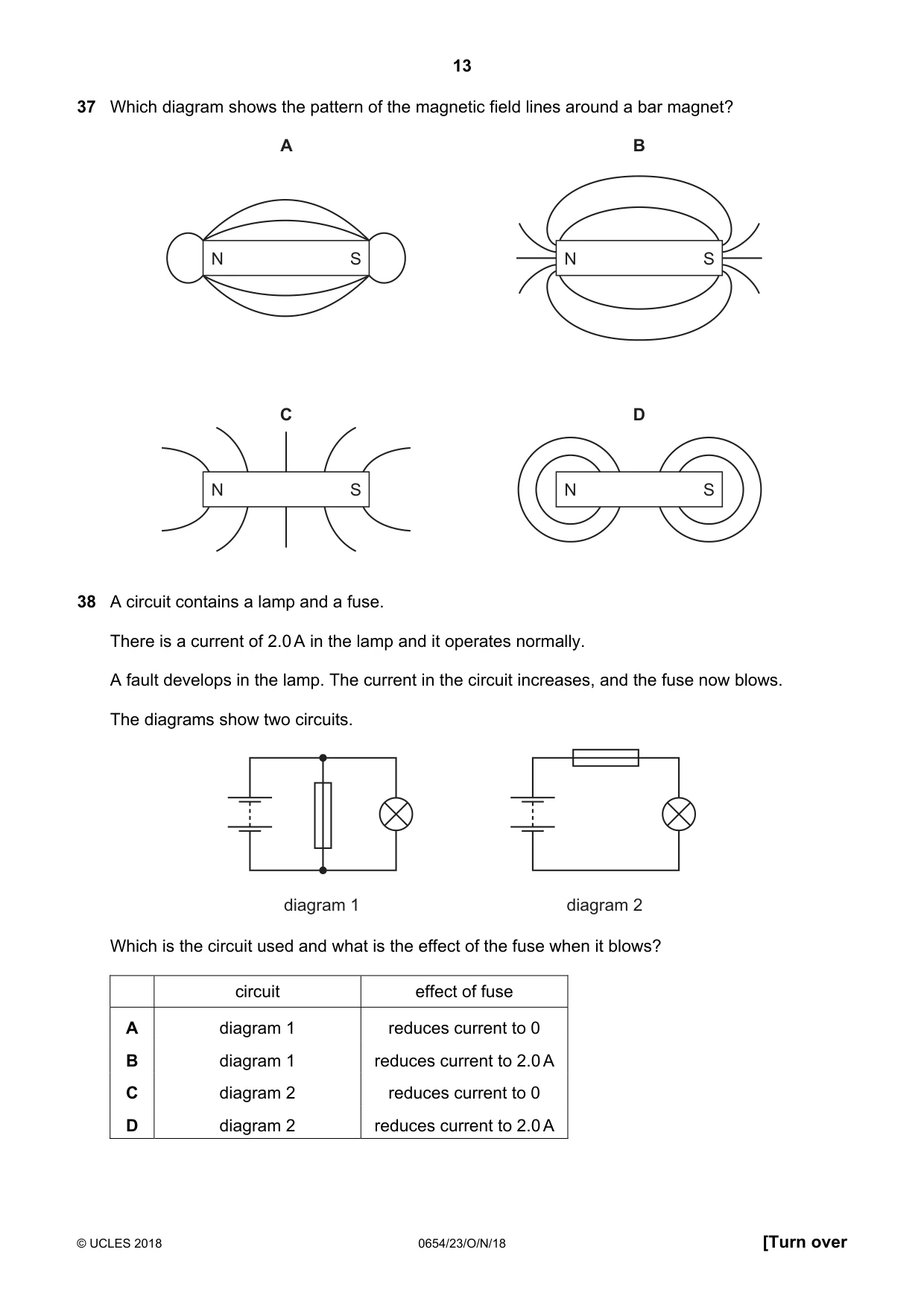
Q37 · Which diagram shows the pattern of the magnetic field lines around a bar magnet?
37 Which diagram shows the pattern of the magnetic field lines around a bar magnet? A B N S N S C D N S N S
Mark scheme: B
Q38 · A circuit contains a lamp and a fuse
38 A circuit contains a lamp and a fuse. There is a current of 2.0 A in the lamp and it operates normally. A fault develops in the lamp. The current in the circuit increases, and the fuse now blows. The diagrams show two circuits. diagram 1 diagram 2 Which is the circuit used and what is the effect of the fuse when it blows? circuit effect of fuse A diagram 1 reduces current to 0 B diagram 1 reduces current to 2.0 A C diagram 2 reduces current to 0 D diagram 2 reduces current to 2.0 A
Mark scheme: C
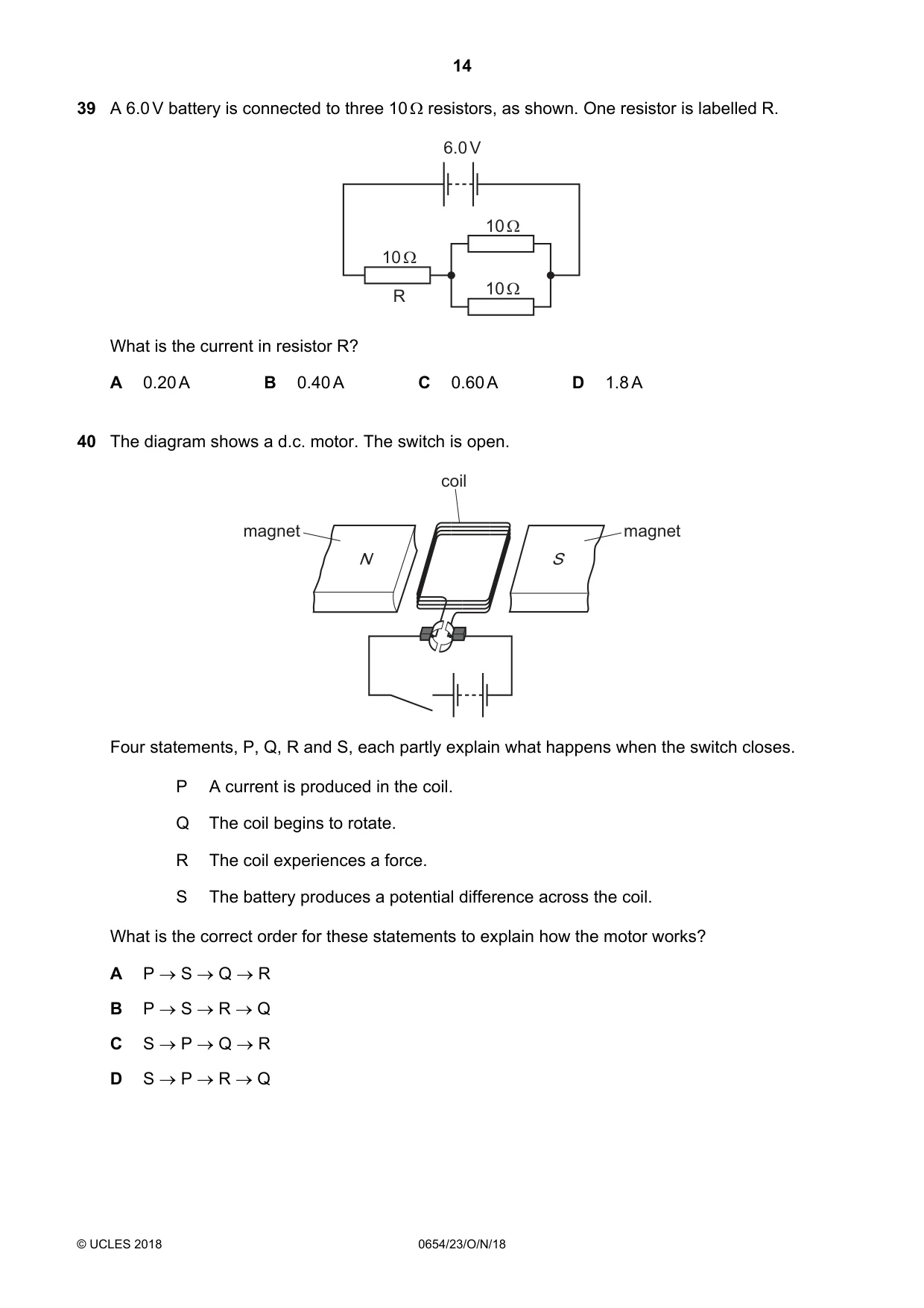
Q39 · A 6.0 V battery is connected to three 10 Ω resistors, as shown
39 A 6.0 V battery is connected to three 10 Ω resistors, as shown. One resistor is labelled R. 6.0 V 10 Ω 10 Ω 10 Ω R What is the current in resistor R? A 0.20 A B 0.40 A C 0.60 A D 1.8 A
Mark scheme: B
Q40 · The diagram shows a d.c
40 The diagram shows a d.c. motor. The switch is open. coil magnet magnet N S Four statements, P, Q, R and S, each partly explain what happens when the switch closes. P A current is produced in the coil. Q The coil begins to rotate. R The coil experiences a force. S The battery produces a potential difference across the coil. What is the correct order for these statements to explain how the motor works? A P → S → Q → R B P → S → R → Q C S → P → Q → R D S → P → R → Q
Mark scheme: D
What was in this paper
The subtopics covered by these 40 questions, and how many questions each got. Open one in a new tab to see every Cambridge question on it.
2Motion2Air quality and climate1Alcohols1Asexual reproduction1Carbon cycle1Characteristics of living organisms1Coordination and response1Digestion1Drugs1Electrical circuits1Electrical quantities1Electrical safety1Electrolysis1Electromagnetic effects1Elements, compounds and mixtures1Energy, work and power1Enzymes1Exothermic and endothermic reactions1Experimental design1General properties of waves1Light1Monohybrid inheritance1Osmosis1Photosynthesis1Polymers1Redox1Selection1Separation and purification1Sexual reproduction in plants1Simple molecules and covalent bonds1Simple phenomena of magnetism1Sound1The characteristic properties of acids and bases1The mole and the Avogadro constant1Thermal properties and temperature1Transfer of thermal energy1Transpiration1What you needed in this session
Cambridge’s own grade thresholds for 2018 Oct/Nov, Paper 2 · Variant 3. A higher threshold means an easier paper — the bar moves with how the cohort did.