Cambridge IGCSE Sciences - Co-ordinated (Double) 0654 — 2019 Oct/Nov Paper 2 · Variant 2
0654/22/O/N/19 · 40 questions · 40 marks · ≈45 min
The question paper and its mark scheme, free to read here and free to download. This is Cambridge’s own paper, exactly as it was sat.
Question paper16 pages
Mark scheme3 pages
Answers below. Sit the paper first if you are practising.
Questions as text
Q1 · What do plants need for their nutrition?
1 What do plants need for their nutrition? A carbon dioxide, ions, organic compounds and light B carbon dioxide, ions, organic compounds and water C carbon dioxide, ions, light and water D carbon dioxide, organic compounds, light and water
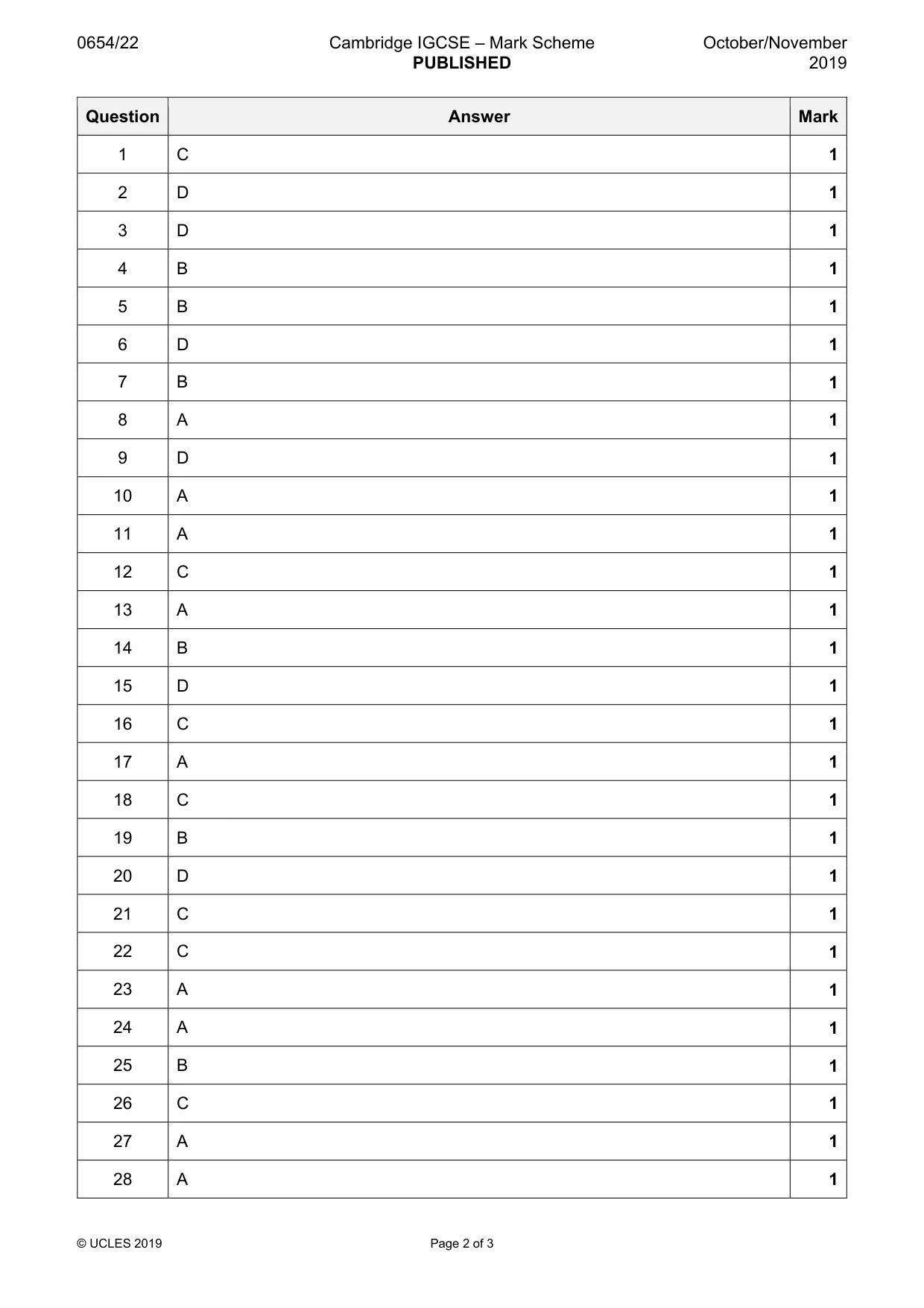
Mark scheme: C
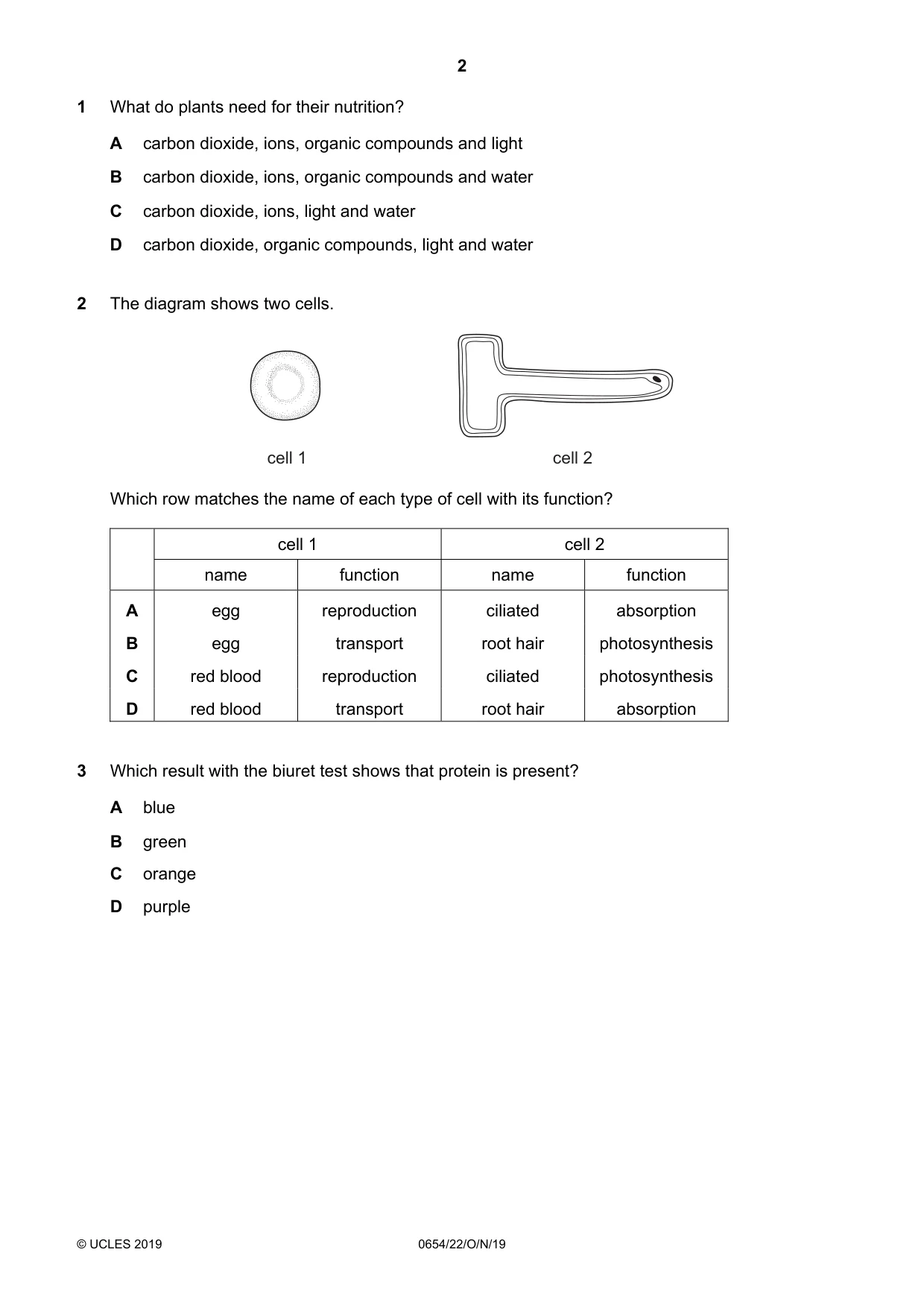
Q2 · The diagram shows two cells
2 The diagram shows two cells. cell 1 cell 2 Which row matches the name of each type of cell with its function? cell 1 cell 2 name function name function A egg reproduction ciliated absorption B egg transport root hair photosynthesis C red blood reproduction ciliated photosynthesis D red blood transport root hair absorption
Mark scheme: D
Q3 · Which result with the biuret test shows that protein is present?
3 Which result with the biuret test shows that protein is present? A blue B green C orange D purple
Mark scheme: D
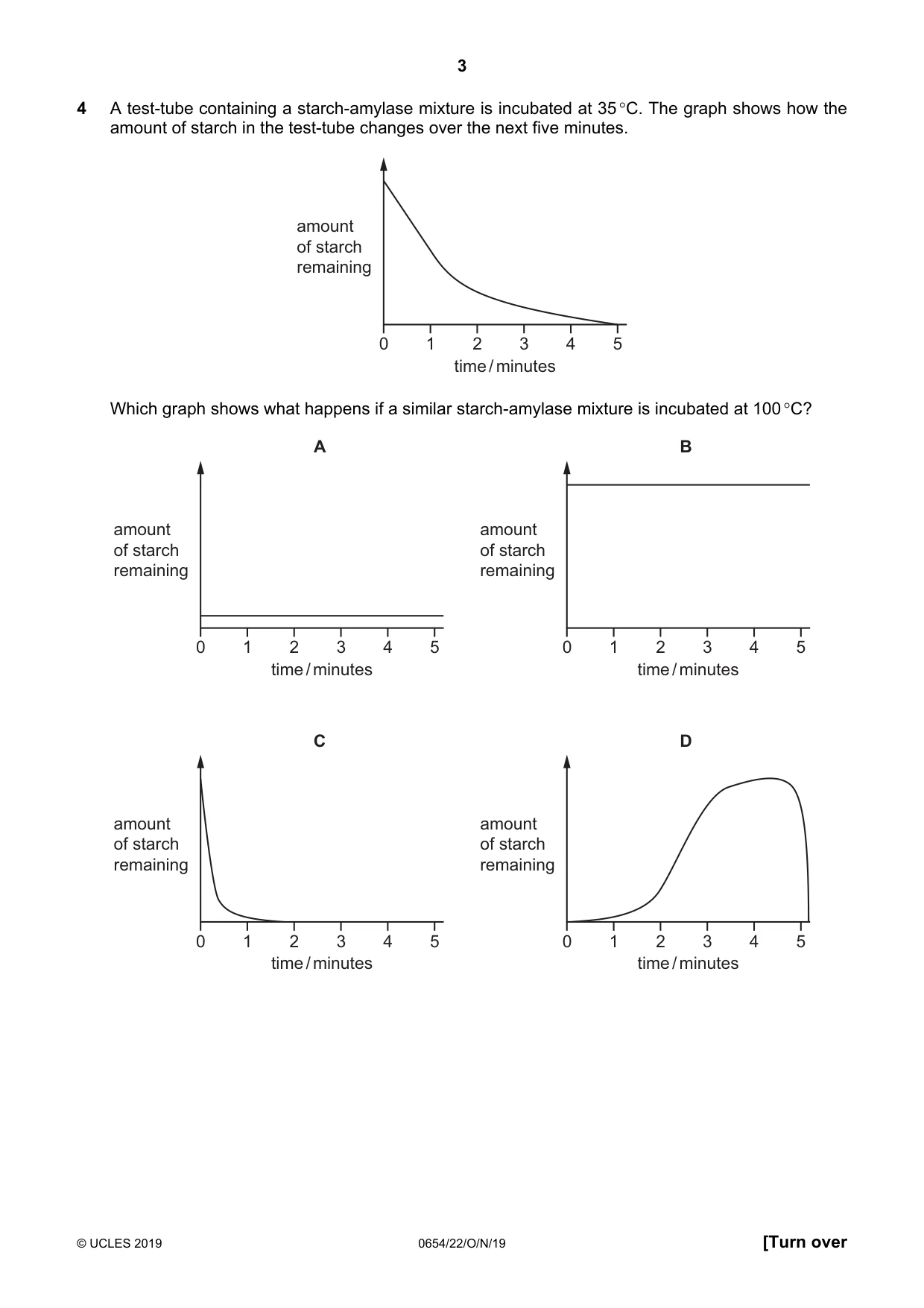
Q4 · A test-tube containing a starch-amylase mixture is incubated at 35 °C
4 A test-tube containing a starch-amylase mixture is incubated at 35 °C. The graph shows how the amount of starch in the test-tube changes over the next five minutes. amount of starch remaining 0 1 2 3 4 5 time / minutes Which graph shows what happens if a similar starch-amylase mixture is incubated at 100 °C? A B amount amount of starch of starch remaining remaining 0 1 2 3 4 5 0 1 2 3 4 5 time / minutes time / minutes C D amount amount of starch of starch remaining remaining 0 1 2 3 4 5 0 1 2 3 4 5 time / minutes time / minutes
Mark scheme: B
Q5 · Green plants need magnesium ions
5 Green plants need magnesium ions. Which plant process is limited when magnesium is deficient? A meiosis B photosynthesis C pollination D respiration
Mark scheme: B
Q6 · Which diet would be most likely to prevent anaemia and rickets?
6 Which diet would be most likely to prevent anaemia and rickets? A high in calcium and vitamin C B high in calcium and vitamin D C high in iron and vitamin C D high in iron and vitamin D
Mark scheme: D
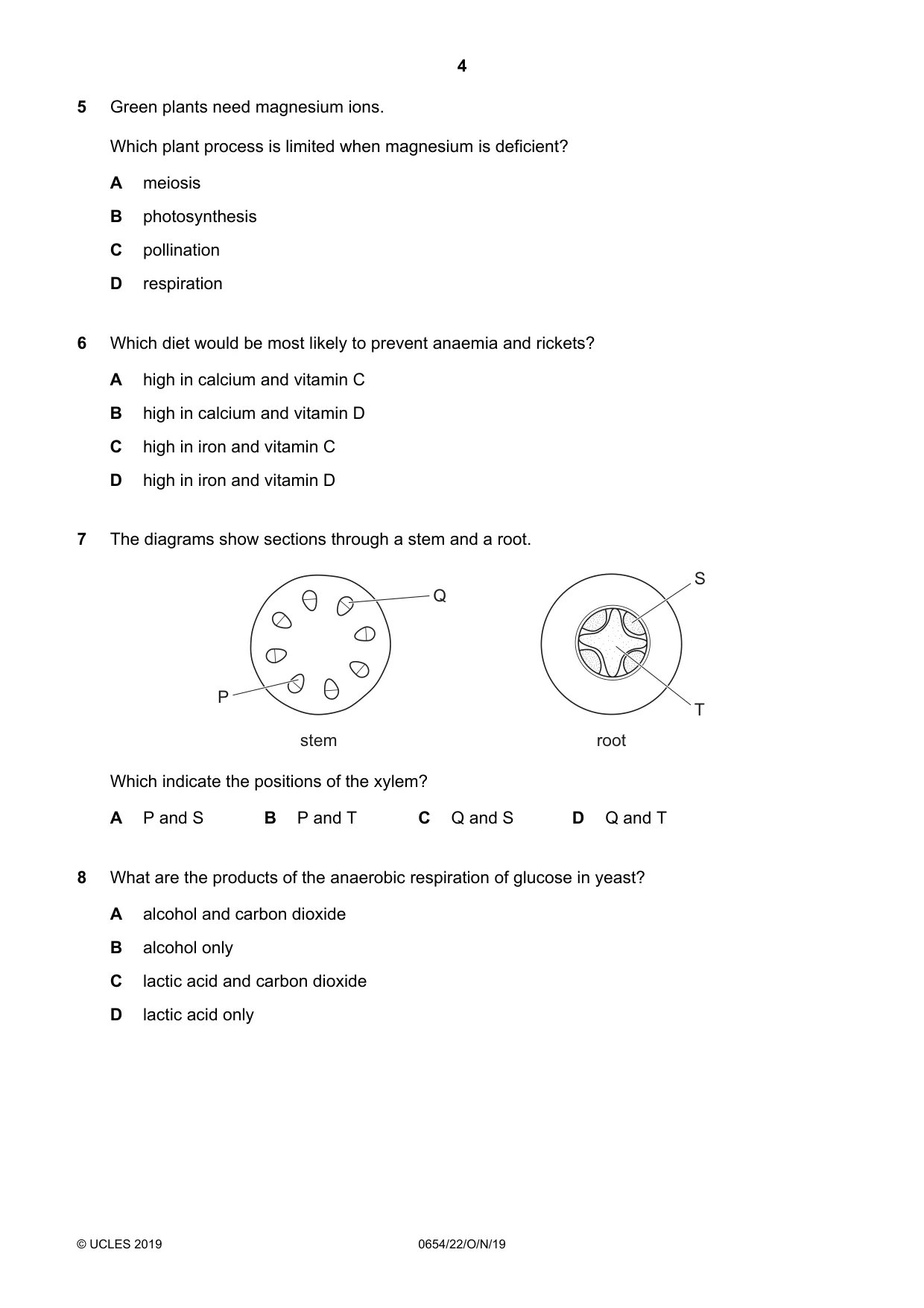
Q7 · The diagrams show sections through a stem and a root
7 The diagrams show sections through a stem and a root. S Q P T stem root Which indicate the positions of the xylem? A P and S B P and T C Q and S D Q and T
Mark scheme: B
Q8 · What are the products of the anaerobic respiration of glucose in yeast?
8 What are the products of the anaerobic respiration of glucose in yeast? A alcohol and carbon dioxide B alcohol only C lactic acid and carbon dioxide D lactic acid only
Mark scheme: A
Q9 · Auxin is a chemical involved in phototropism of plant shoots
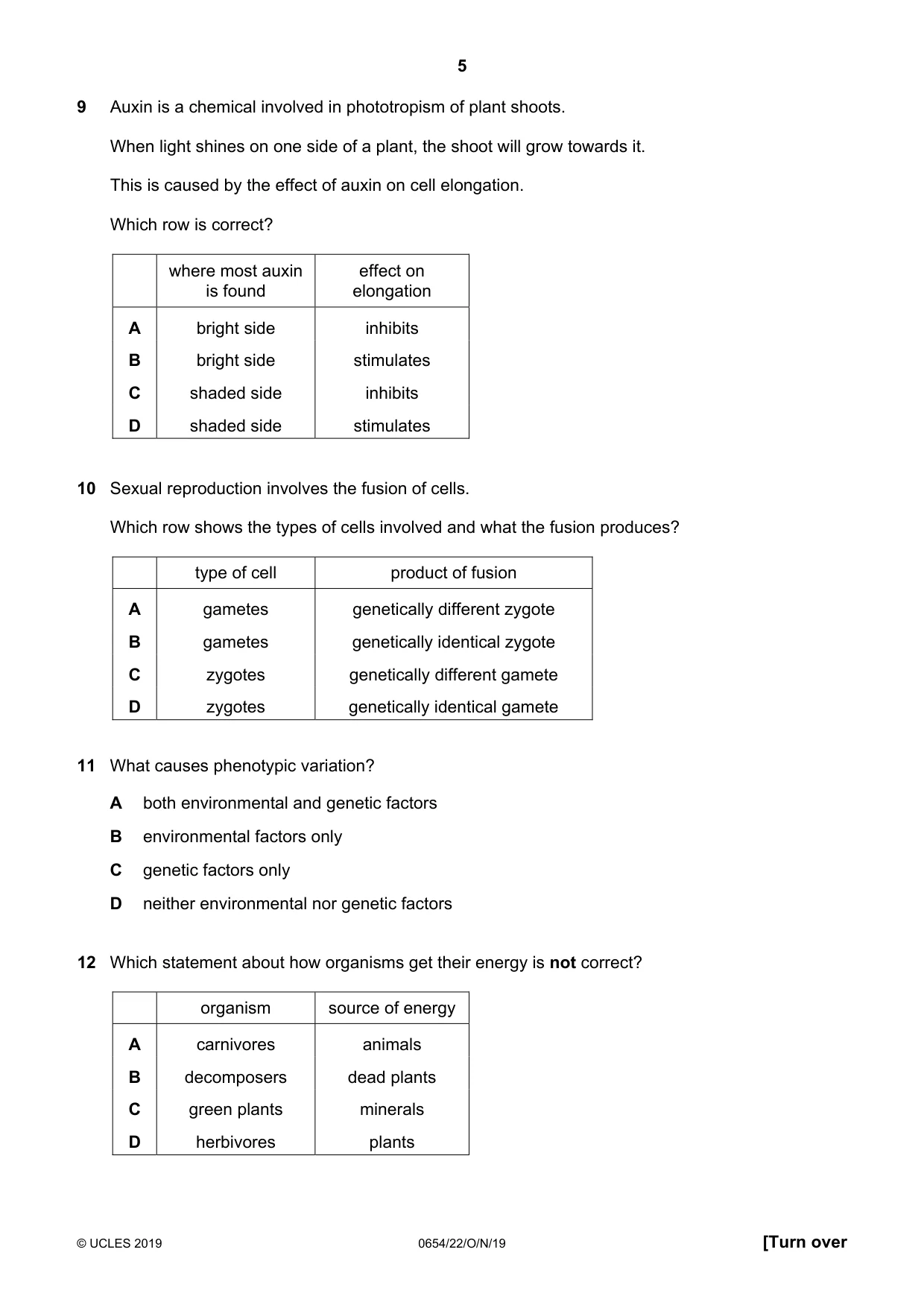
9 Auxin is a chemical involved in phototropism of plant shoots. When light shines on one side of a plant, the shoot will grow towards it. This is caused by the effect of auxin on cell elongation. Which row is correct? where most auxin effect on is found elongation A bright side inhibits B bright side stimulates C shaded side inhibits D shaded side stimulates
Mark scheme: D
Q10 · Sexual reproduction involves the fusion of cells
10 Sexual reproduction involves the fusion of cells. Which row shows the types of cells involved and what the fusion produces? type of cell product of fusion A gametes genetically different zygote B gametes genetically identical zygote C zygotes genetically different gamete D zygotes genetically identical gamete
Mark scheme: A
Q11 · What causes phenotypic variation?
11 What causes phenotypic variation? A both environmental and genetic factors B environmental factors only C genetic factors only D neither environmental nor genetic factors
Mark scheme: A
Q12 · Which statement about how organisms get their energy is not correct?
12 Which statement about how organisms get their energy is not correct? organism source of energy A carnivores animals B decomposers dead plants C green plants minerals D herbivores plants
Mark scheme: C
Q13 · The list shows changes that occur in a lake which is polluted by nitrogen-containing…
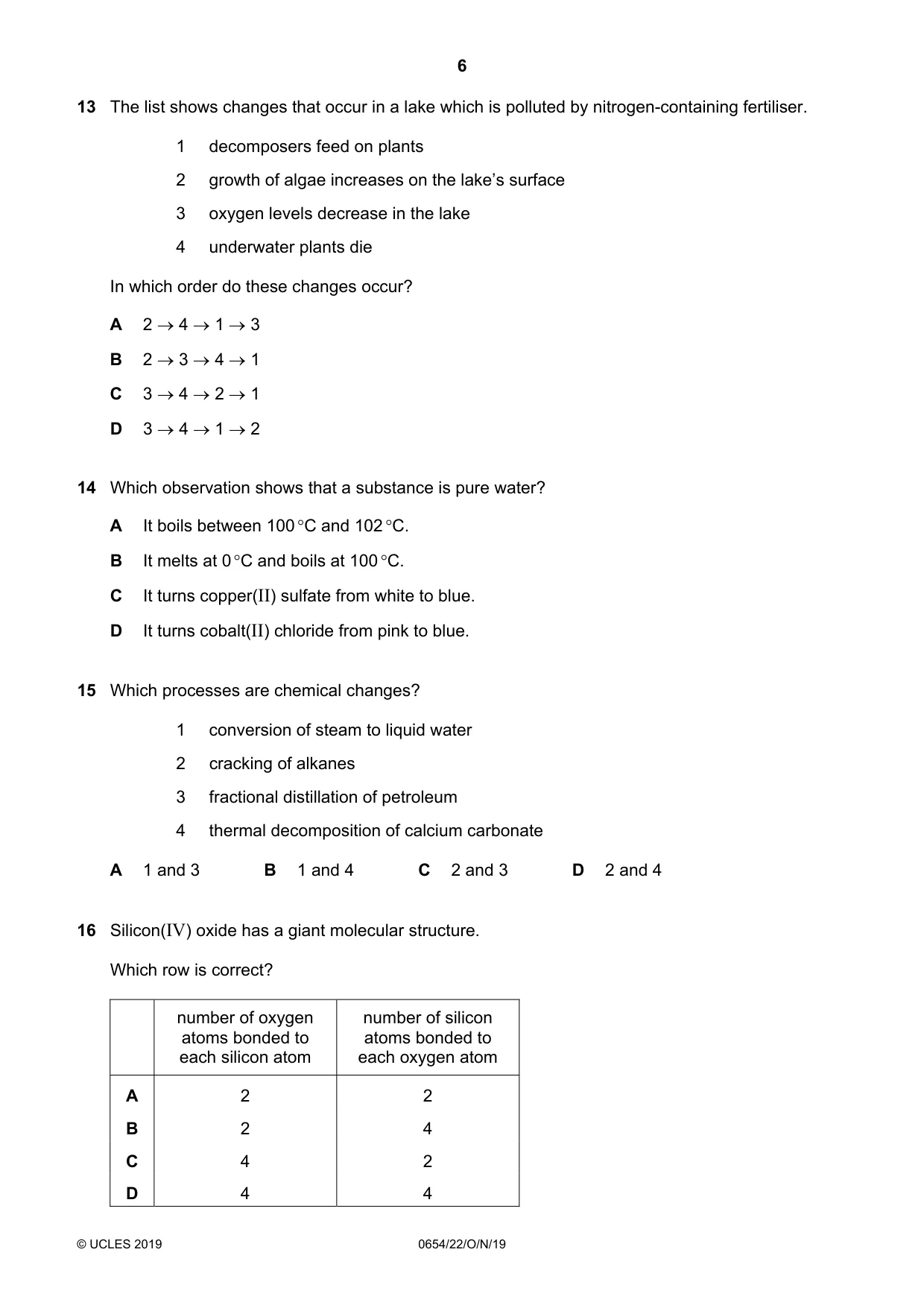
13 The list shows changes that occur in a lake which is polluted by nitrogen-containing fertiliser. 1 decomposers feed on plants 2 growth of algae increases on the lake’s surface 3 oxygen levels decrease in the lake 4 underwater plants die In which order do these changes occur? A 2 → 4 → 1 → 3 B 2 → 3 → 4 → 1 C 3 → 4 → 2 → 1 D 3 → 4 → 1 → 2
Mark scheme: A
Q14 · Which observation shows that a substance is pure water?
14 Which observation shows that a substance is pure water? A It boils between 100 °C and 102 °C. B It melts at 0 °C and boils at 100 °C. C It turns copper(II) sulfate from white to blue. D It turns cobalt(II) chloride from pink to blue.
Mark scheme: B
Q15 · Which processes are chemical changes?
15 Which processes are chemical changes? 1 conversion of steam to liquid water 2 cracking of alkanes 3 fractional distillation of petroleum 4 thermal decomposition of calcium carbonate A 1 and 3 B 1 and 4 C 2 and 3 D 2 and 4
Mark scheme: D
Q16 · Silicon(IV) oxide has a giant molecular structure
16 Silicon(IV) oxide has a giant molecular structure. Which row is correct? number of oxygen number of silicon atoms bonded to atoms bonded to each silicon atom each oxygen atom A 2 2 B 2 4 C 4 2 D 4 4
Mark scheme: C
Q17 · What is the definition of the relative atomic mass, Ar, of an element?
17 What is the definition of the relative atomic mass, Ar, of an element? A the average mass of atoms of the element on a scale in which an atom of 12C has a mass of exactly 12 units B the average mass of atoms of the element on a scale in which an atom of 1H has a mass of exactly 1 unit C the average mass of atoms of the element on a scale in which an atom of 12C has a mass of exactly 1 unit D the mass in grams of one mole of atoms of the element
Mark scheme: A
Q18 · Which particle is oxidised at the anode during the electrolysis of aqueous copper(II)…
18 Which particle is oxidised at the anode during the electrolysis of aqueous copper(II) sulfate using inert electrodes? A Cu2+ B H+ C OH– D SO4 2–
Mark scheme: C
Q19 · A 2 cm strip of magnesium ribbon, painted on one side, is placed in dilute hydrochloric…
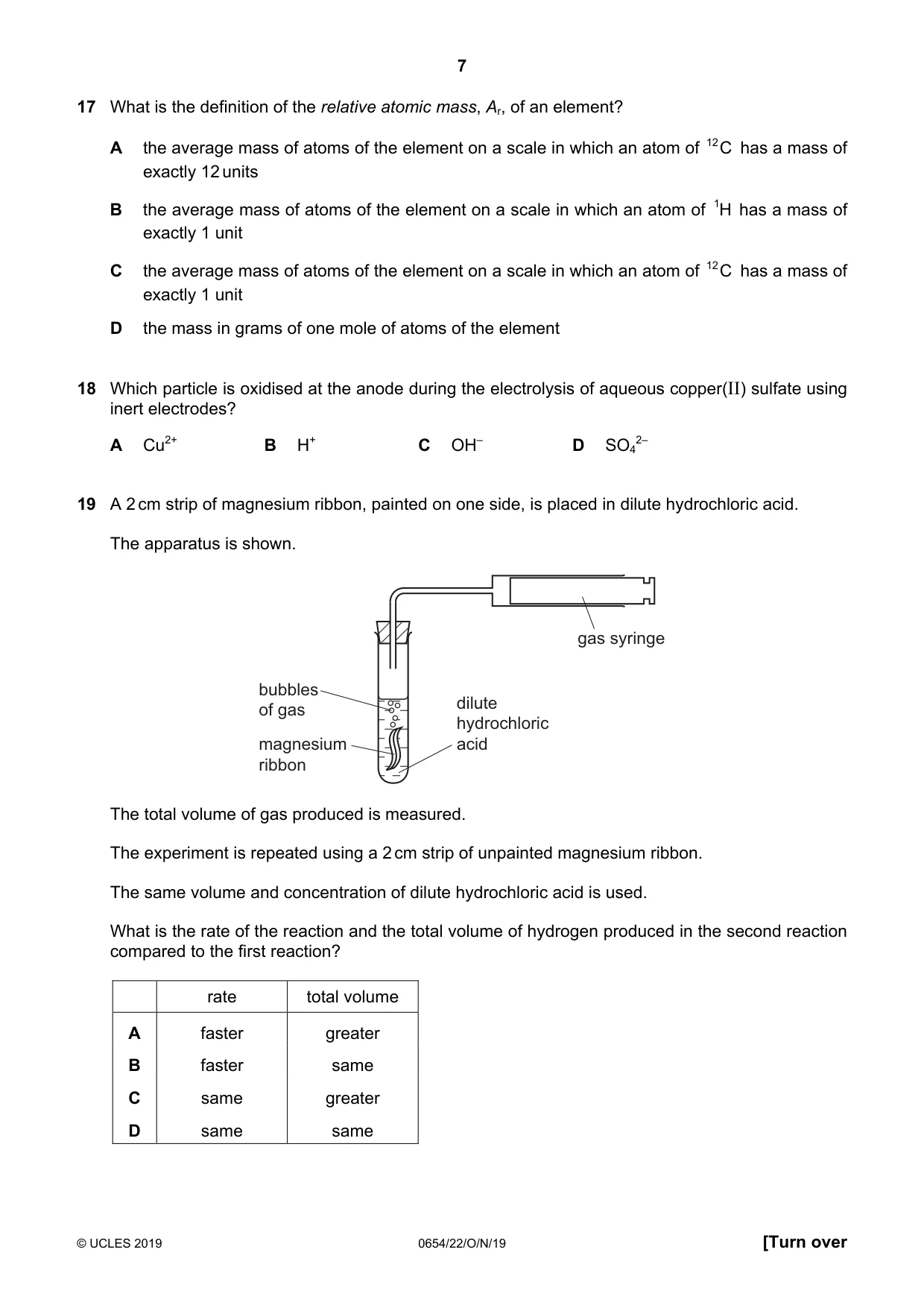
19 A 2 cm strip of magnesium ribbon, painted on one side, is placed in dilute hydrochloric acid. The apparatus is shown. gas syringe bubbles of gas dilute hydrochloric magnesium acid ribbon The total volume of gas produced is measured. The experiment is repeated using a 2 cm strip of unpainted magnesium ribbon. The same volume and concentration of dilute hydrochloric acid is used. What is the rate of the reaction and the total volume of hydrogen produced in the second reaction compared to the first reaction? rate total volume A faster greater B faster same C same greater D same same
Mark scheme: B
Q20 · An acid neutralises solution X
20 An acid neutralises solution X. A neutral solution is formed. What are the pH values of solution X and of the neutral solution? pH of solution X pH of neutral solution A 2 7 B 2 12 C 12 2 D 12 7
Mark scheme: D
More questions on The characteristic properties of acids and bases
Q21 · The colours in an ink can be separated by chromatography
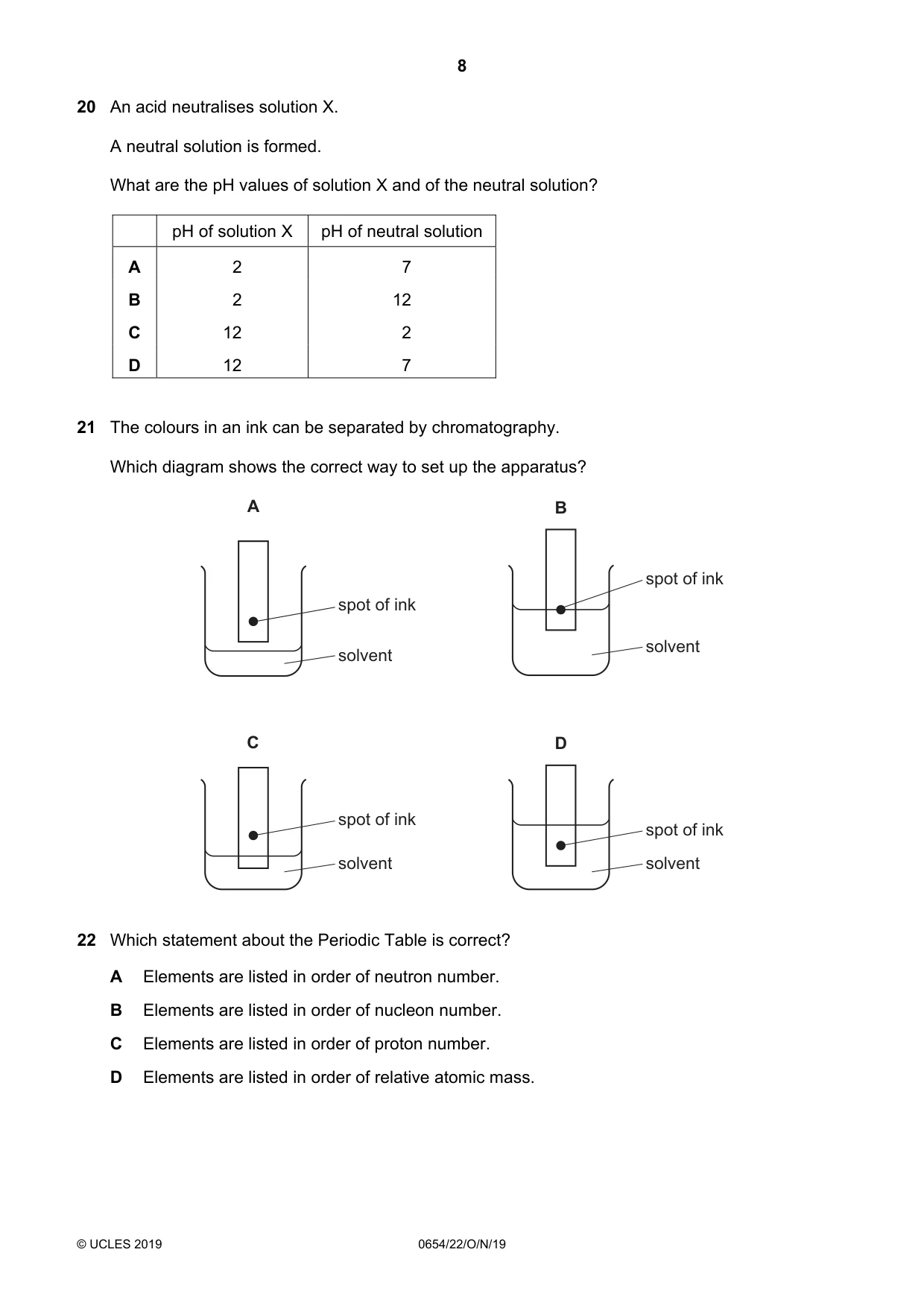
21 The colours in an ink can be separated by chromatography. Which diagram shows the correct way to set up the apparatus? A B spot of ink spot of ink solvent solvent C D spot of ink spot of ink solvent solvent
Mark scheme: C
Q22 · Which statement about the Periodic Table is correct?
22 Which statement about the Periodic Table is correct? A Elements are listed in order of neutron number. B Elements are listed in order of nucleon number. C Elements are listed in order of proton number. D Elements are listed in order of relative atomic mass.
Mark scheme: C
Q23 · Zinc is mixed with molten element X
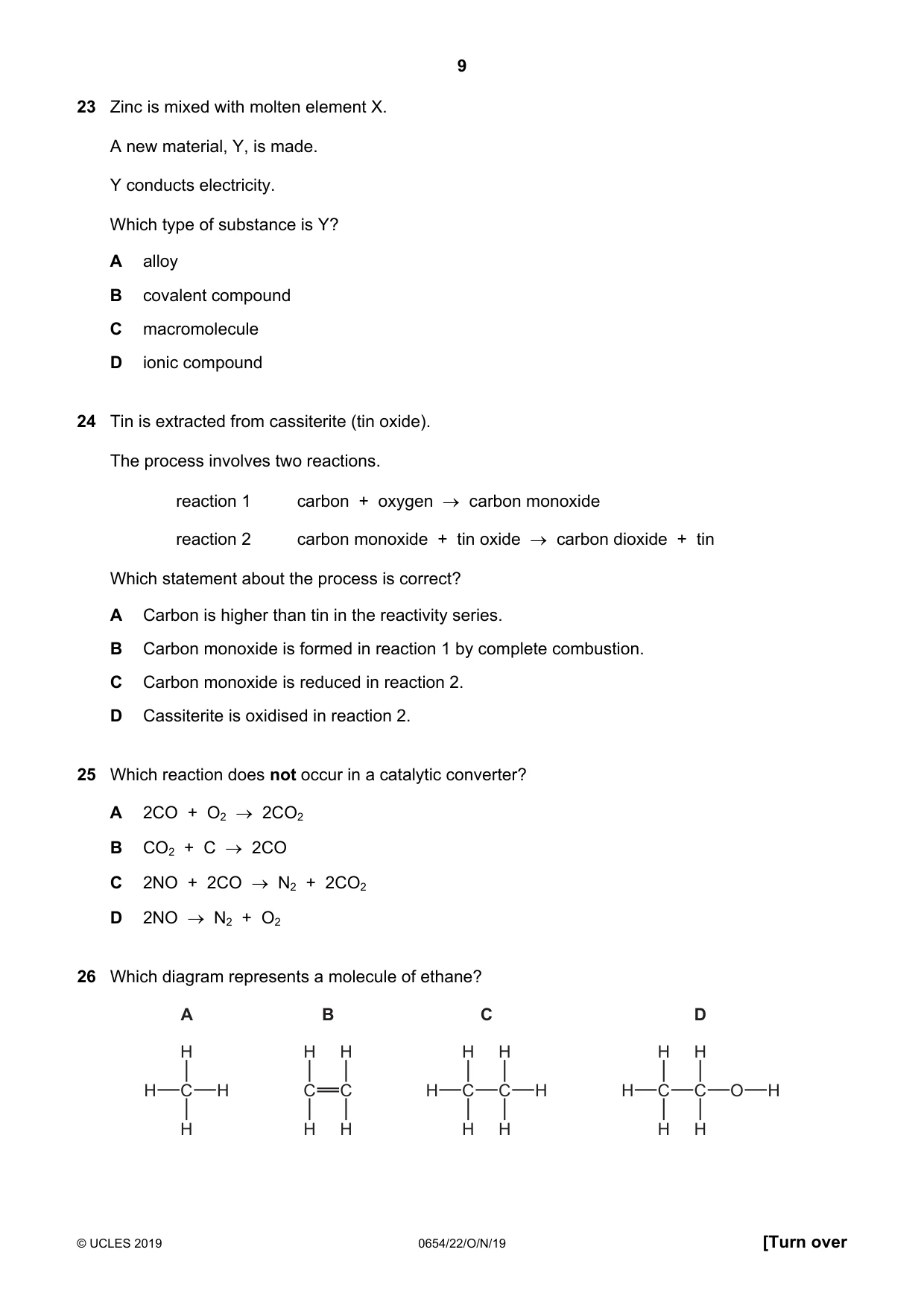
23 Zinc is mixed with molten element X. A new material, Y, is made. Y conducts electricity. Which type of substance is Y? A alloy B covalent compound C macromolecule D ionic compound
Mark scheme: A
Q24 · Tin is extracted from cassiterite (tin oxide)
24 Tin is extracted from cassiterite (tin oxide). The process involves two reactions. reaction 1 carbon + oxygen → carbon monoxide reaction 2 carbon monoxide + tin oxide → carbon dioxide + tin Which statement about the process is correct? A Carbon is higher than tin in the reactivity series. B Carbon monoxide is formed in reaction 1 by complete combustion. C Carbon monoxide is reduced in reaction 2. D Cassiterite is oxidised in reaction 2.
Mark scheme: A
Q25 · Which reaction does not occur in a catalytic converter?
25 Which reaction does not occur in a catalytic converter? A 2CO + O2 → 2CO2 B CO2 + C → 2CO C 2NO + 2CO → N2 + 2CO2 D 2NO → N2 + O2
Mark scheme: B
Q26 · Which diagram represents a molecule of ethane?
26 Which diagram represents a molecule of ethane? A B C D H H H H H H H H C H C C H C C H H C C O H H H H H H H H
Mark scheme: C
Q27 · One molecule of hydrocarbon Q undergoes complete combustion to produce four molecules of…
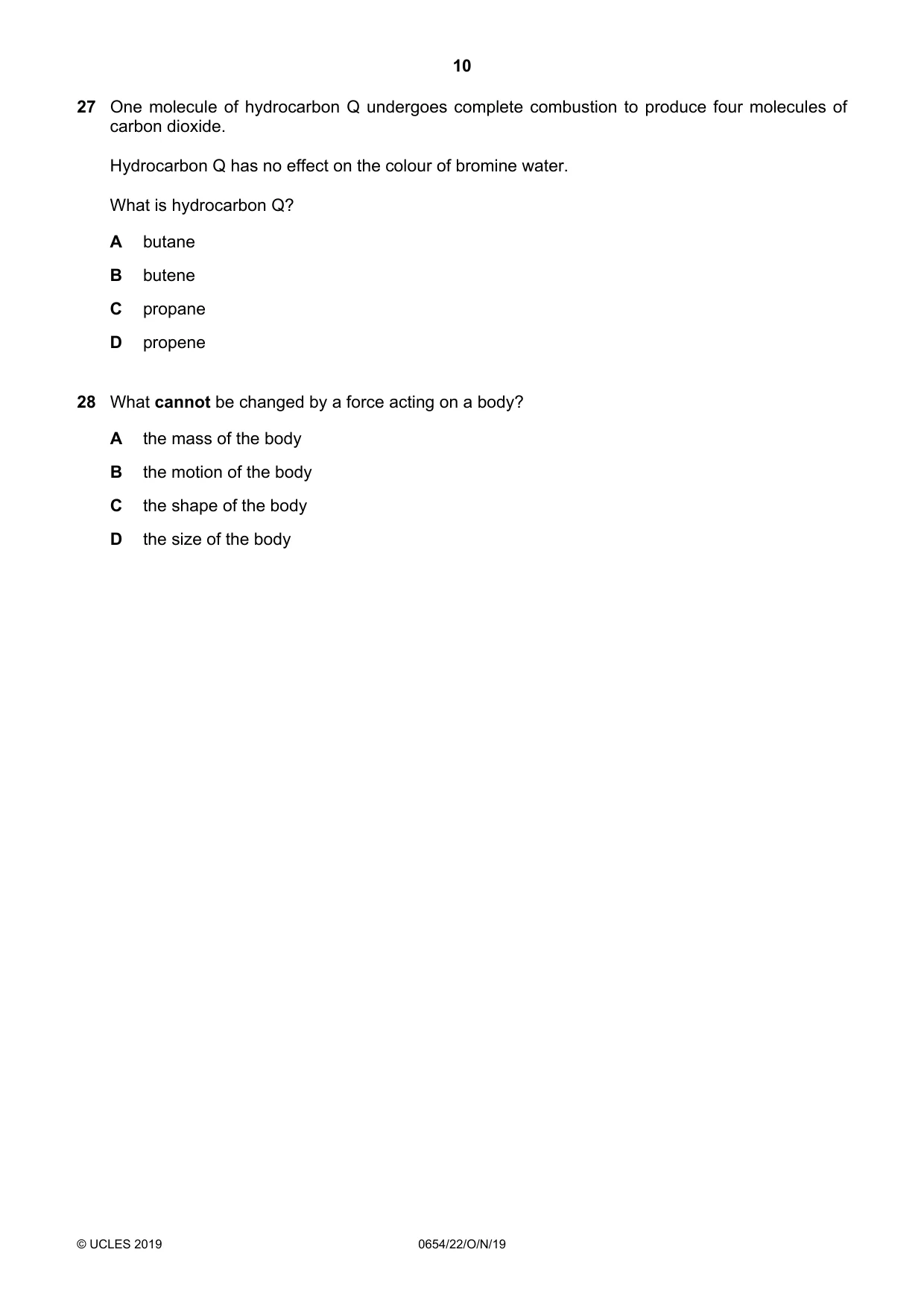
27 One molecule of hydrocarbon Q undergoes complete combustion to produce four molecules of carbon dioxide. Hydrocarbon Q has no effect on the colour of bromine water. What is hydrocarbon Q? A butane B butene C propane D propene
Mark scheme: A
Q28 · What cannot be changed by a force acting on a body?
28 What cannot be changed by a force acting on a body? A the mass of the body B the motion of the body C the shape of the body D the size of the body
Mark scheme: A
Q29 · A spring with its length indicated
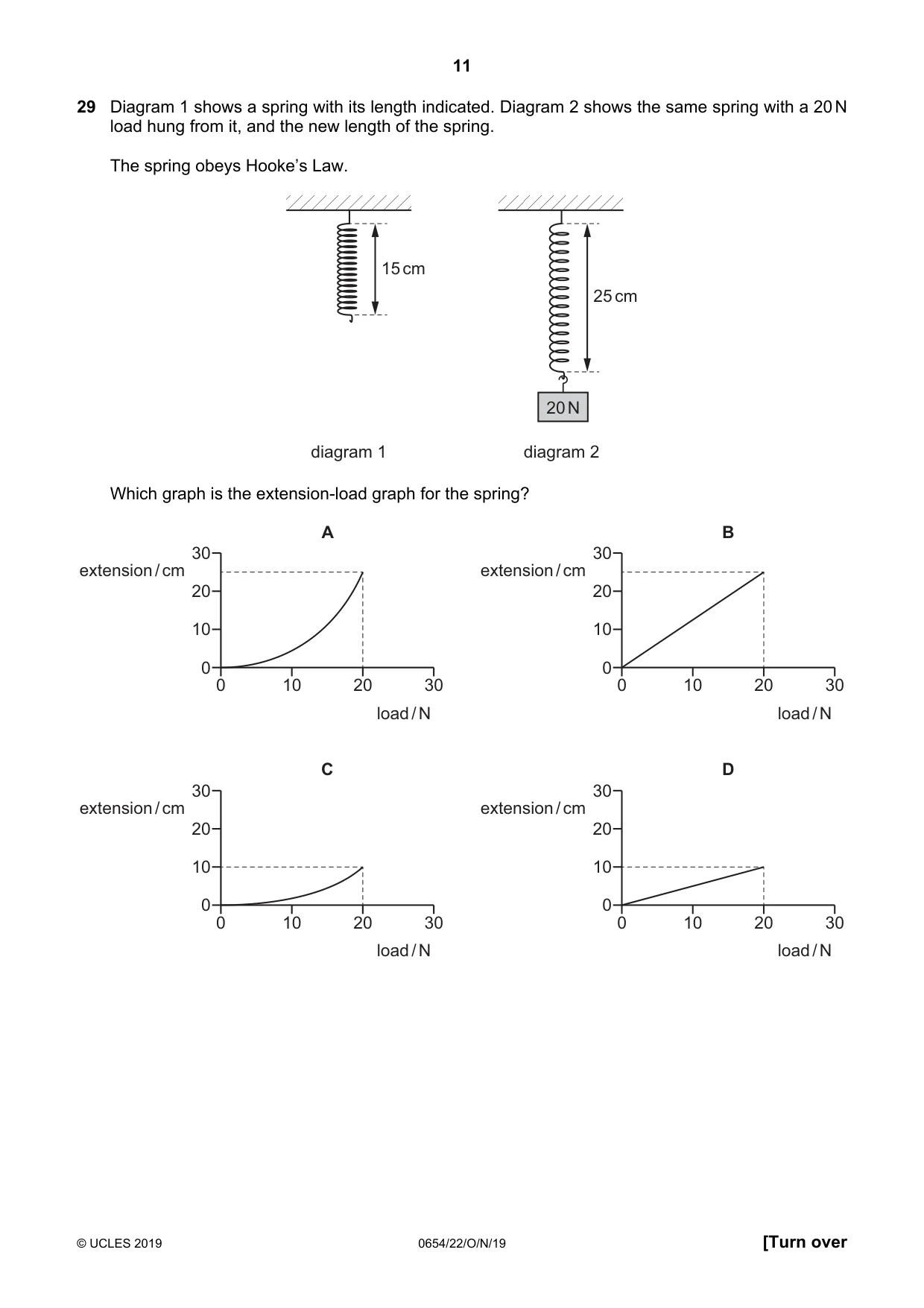
29 Diagram 1 shows a spring with its length indicated. Diagram 2 shows the same spring with a 20 N load hung from it, and the new length of the spring. The spring obeys Hooke’s Law. 15 cm 25 cm 20 N diagram 1 diagram 2 Which graph is the extension-load graph for the spring? A B 30 30 extension / cm extension / cm 20 20 10 10 0 0 0 10 20 30 0 10 20 30 load / N load / N C D 30 30 extension / cm extension / cm 20 20 10 10 0 0 0 10 20 30 0 10 20 30 load / N load / N
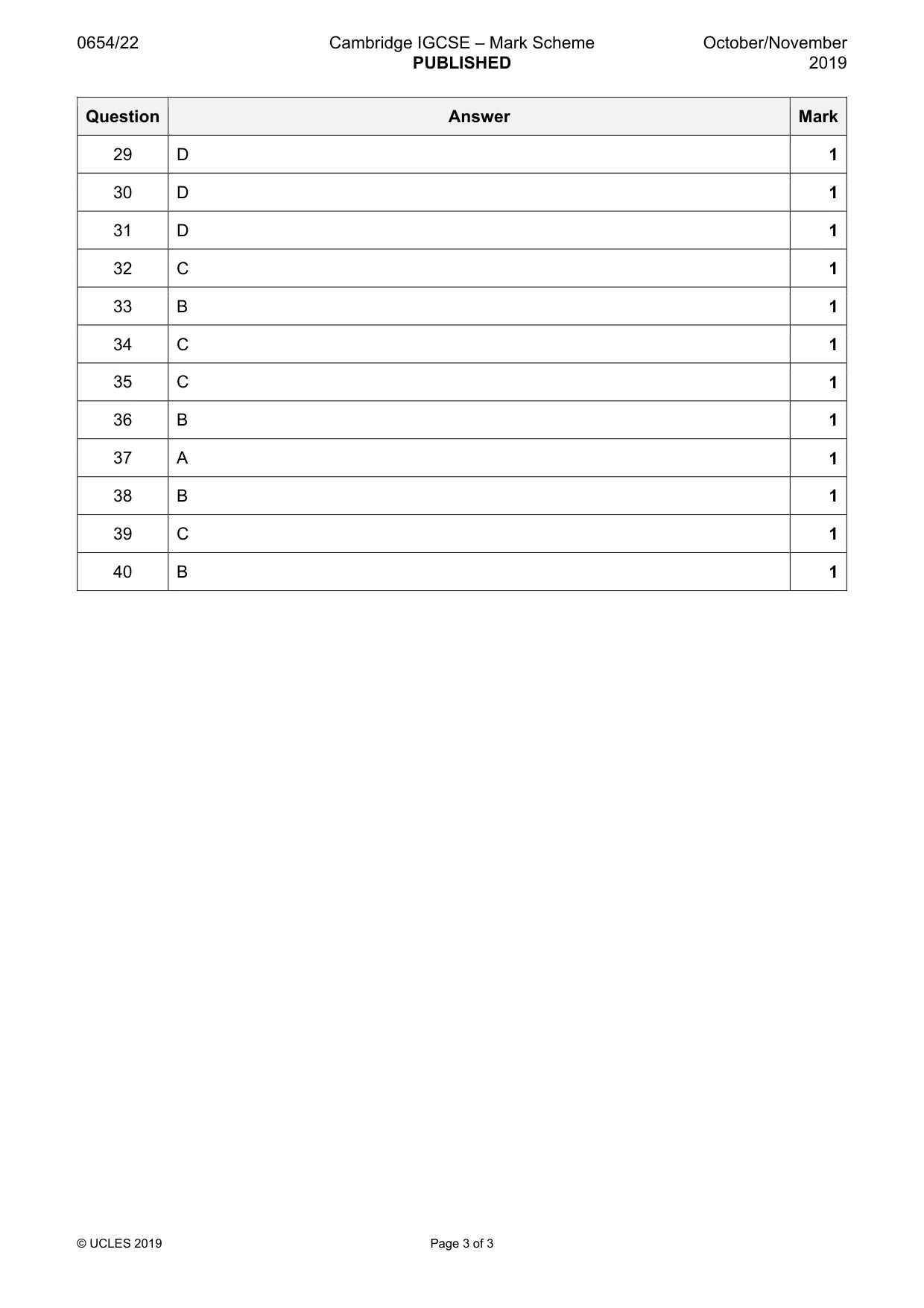
Mark scheme: D
Q30 · A force acts on an object and moves it a certain distance in the direction of the force
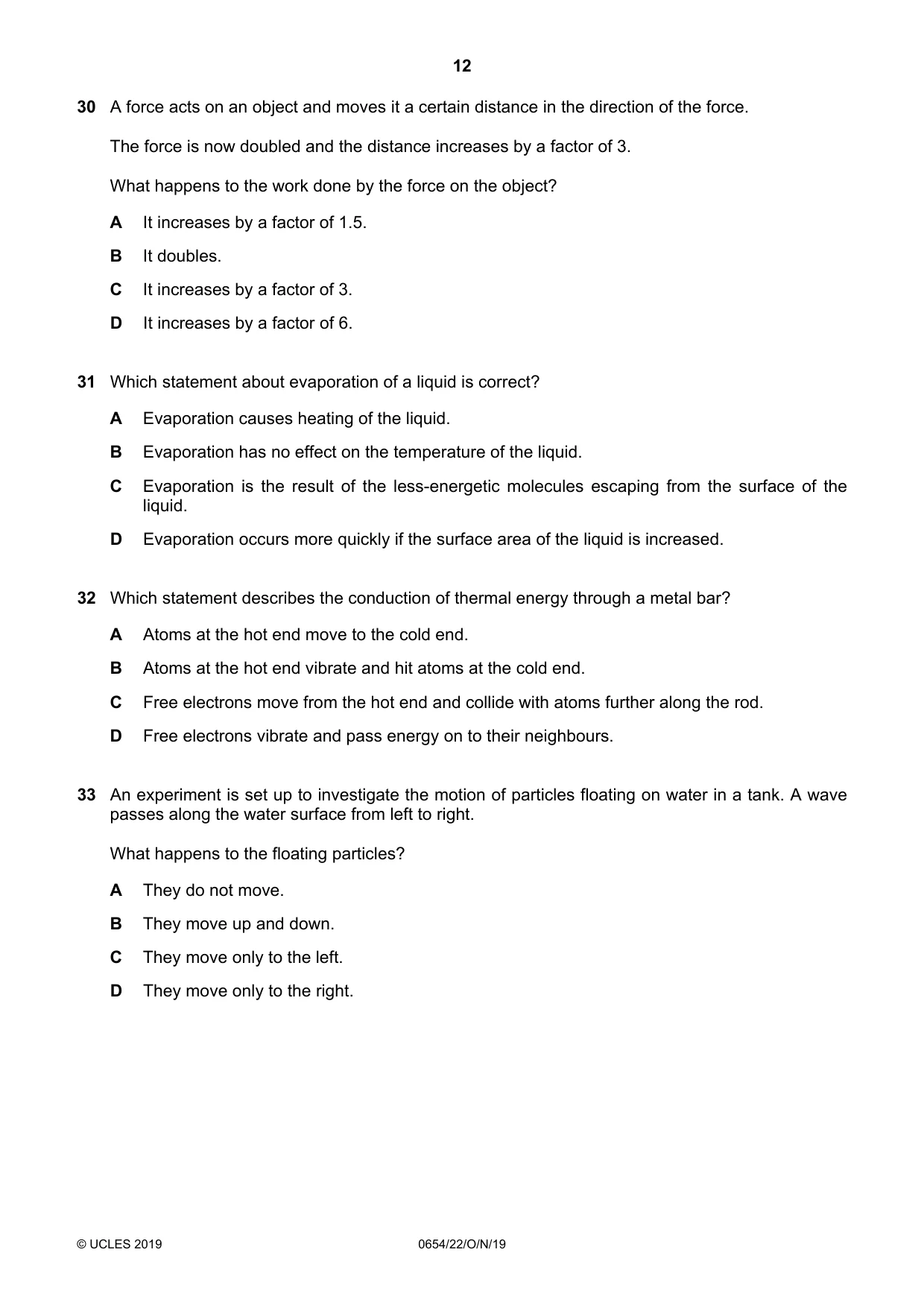
30 A force acts on an object and moves it a certain distance in the direction of the force. The force is now doubled and the distance increases by a factor of 3. What happens to the work done by the force on the object? A It increases by a factor of 1.5. B It doubles. C It increases by a factor of 3. D It increases by a factor of 6.
Mark scheme: D
Q31 · Which statement about evaporation of a liquid is correct?
31 Which statement about evaporation of a liquid is correct? A Evaporation causes heating of the liquid. B Evaporation has no effect on the temperature of the liquid. C Evaporation is the result of the less-energetic molecules escaping from the surface of the liquid. D Evaporation occurs more quickly if the surface area of the liquid is increased.
Mark scheme: D
Q32 · Which statement describes the conduction of thermal energy through a metal bar?
32 Which statement describes the conduction of thermal energy through a metal bar? A Atoms at the hot end move to the cold end. B Atoms at the hot end vibrate and hit atoms at the cold end. C Free electrons move from the hot end and collide with atoms further along the rod. D Free electrons vibrate and pass energy on to their neighbours.
Mark scheme: C
Q33 · An experiment is set up to investigate the motion of particles floating on water in a tank
33 An experiment is set up to investigate the motion of particles floating on water in a tank. A wave passes along the water surface from left to right. What happens to the floating particles? A They do not move. B They move up and down. C They move only to the left. D They move only to the right.
Mark scheme: B
Q34 · A glass block is surrounded by air
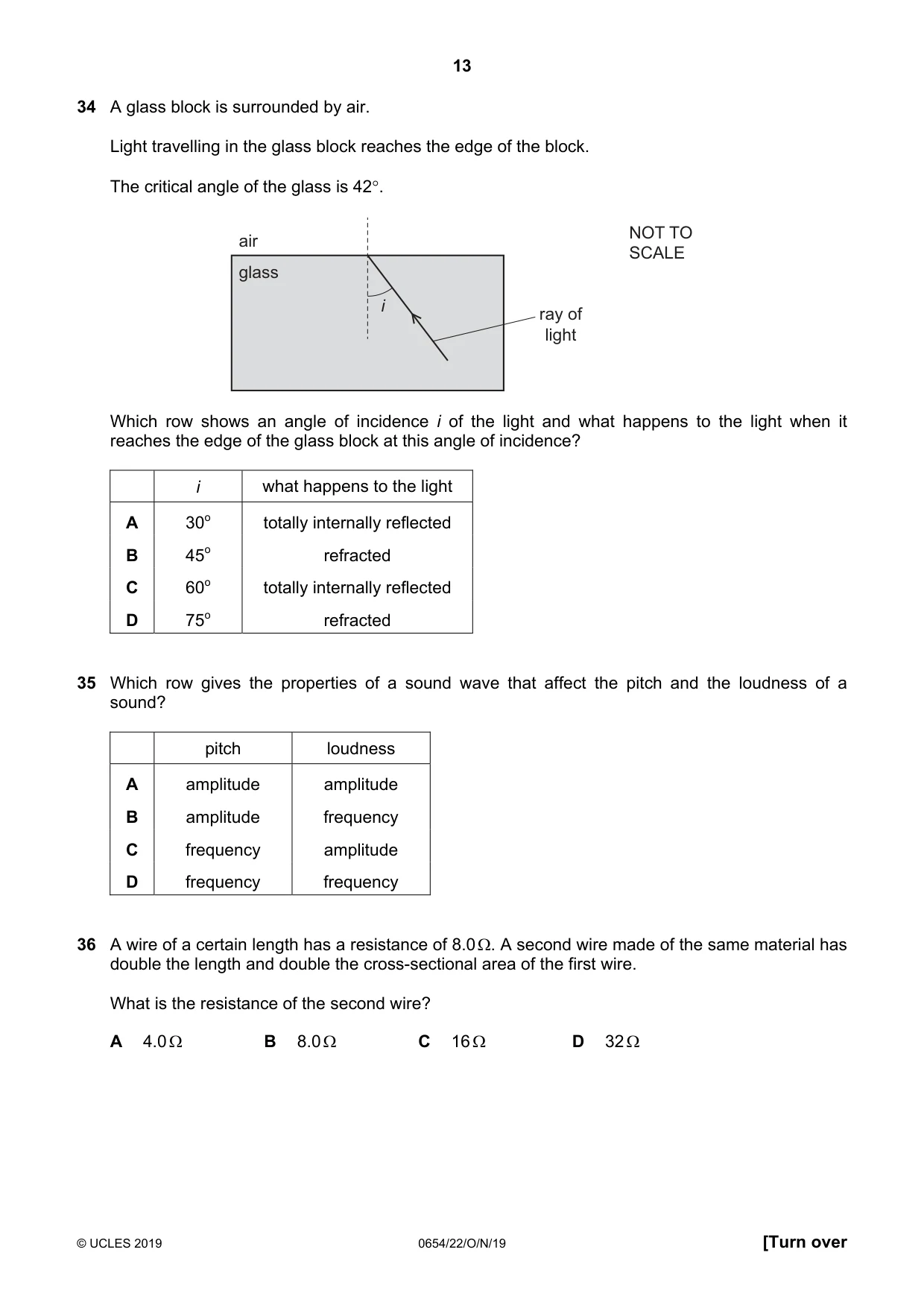
34 A glass block is surrounded by air. Light travelling in the glass block reaches the edge of the block. The critical angle of the glass is 42°. NOT TO air SCALE glass i ray of light Which row shows an angle of incidence i of the light and what happens to the light when it reaches the edge of the glass block at this angle of incidence? i what happens to the light A 30o totally internally reflected B 45o refracted C 60o totally internally reflected D 75o refracted
Mark scheme: C
Q35 · Which row gives the properties of a sound wave that affect the pitch and the loudness of…
35 Which row gives the properties of a sound wave that affect the pitch and the loudness of a sound? pitch loudness A amplitude amplitude B amplitude frequency C frequency amplitude D frequency frequency
Mark scheme: C
Q36 · A wire of a certain length has a resistance of 8.0 Ω
36 A wire of a certain length has a resistance of 8.0 Ω. A second wire made of the same material has double the length and double the cross-sectional area of the first wire. What is the resistance of the second wire? A 4.0 Ω B 8.0 Ω C 16 Ω D 32 Ω
Mark scheme: B
Q37 · Which row shows how lamps are connected in a lighting circuit in a house and gives an…
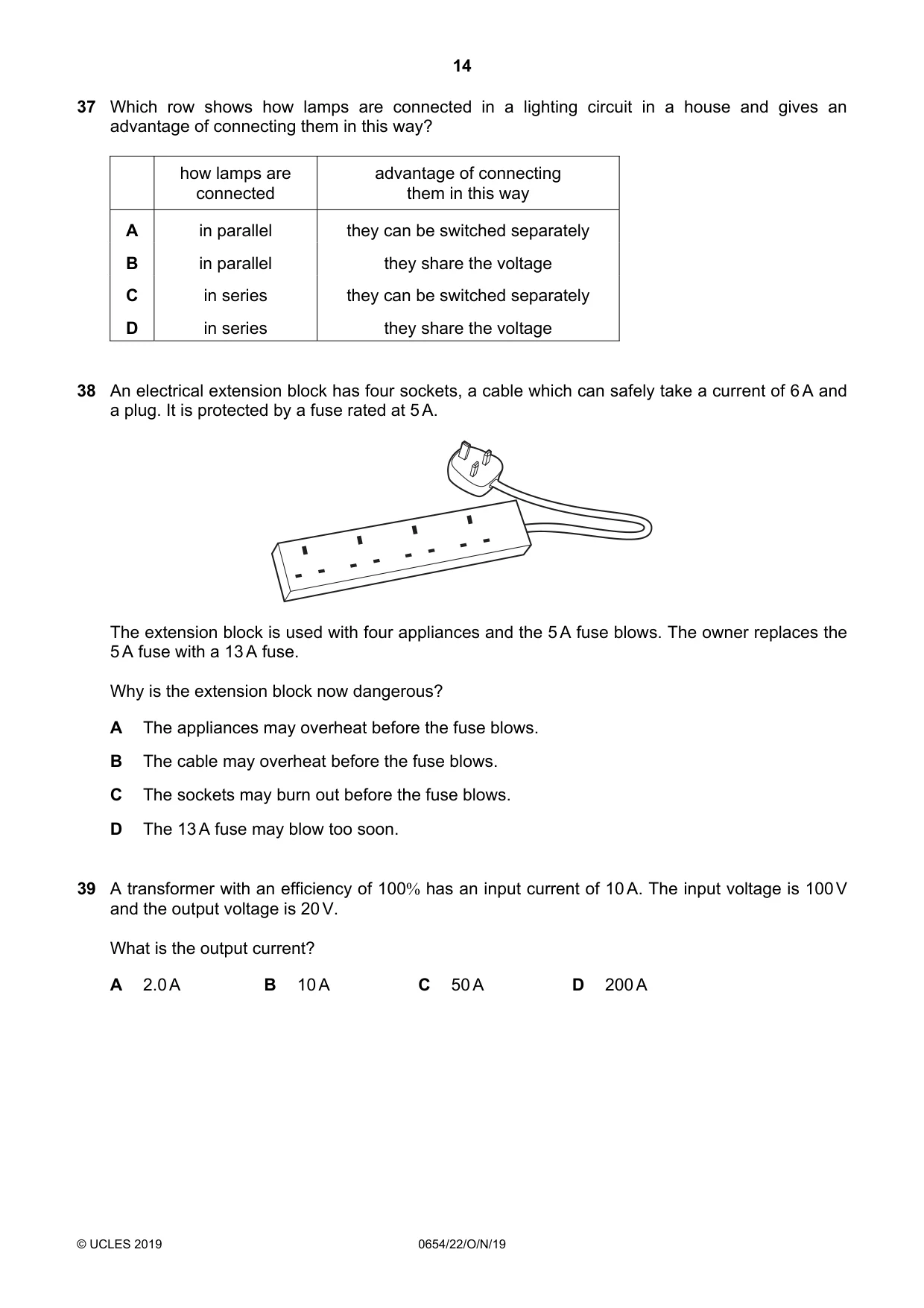
37 Which row shows how lamps are connected in a lighting circuit in a house and gives an advantage of connecting them in this way? how lamps are advantage of connecting connected them in this way A in parallel they can be switched separately B in parallel they share the voltage C in series they can be switched separately D in series they share the voltage
Mark scheme: A
Q38 · An electrical extension block has four sockets, a cable which can safely take a current…
38 An electrical extension block has four sockets, a cable which can safely take a current of 6 A and a plug. It is protected by a fuse rated at 5 A. The extension block is used with four appliances and the 5 A fuse blows. The owner replaces the 5 A fuse with a 13 A fuse. Why is the extension block now dangerous? A The appliances may overheat before the fuse blows. B The cable may overheat before the fuse blows. C The sockets may burn out before the fuse blows. D The 13 A fuse may blow too soon.
Mark scheme: B
Q39 · A transformer with an efficiency of 100% has an input current of 10 A
39 A transformer with an efficiency of 100% has an input current of 10 A. The input voltage is 100 V and the output voltage is 20 V. What is the output current? A 2.0 A B 10 A C 50 A D 200 A
Mark scheme: C
Q40 · Which type of radiation has the greatest ionising effect, and which is the most…
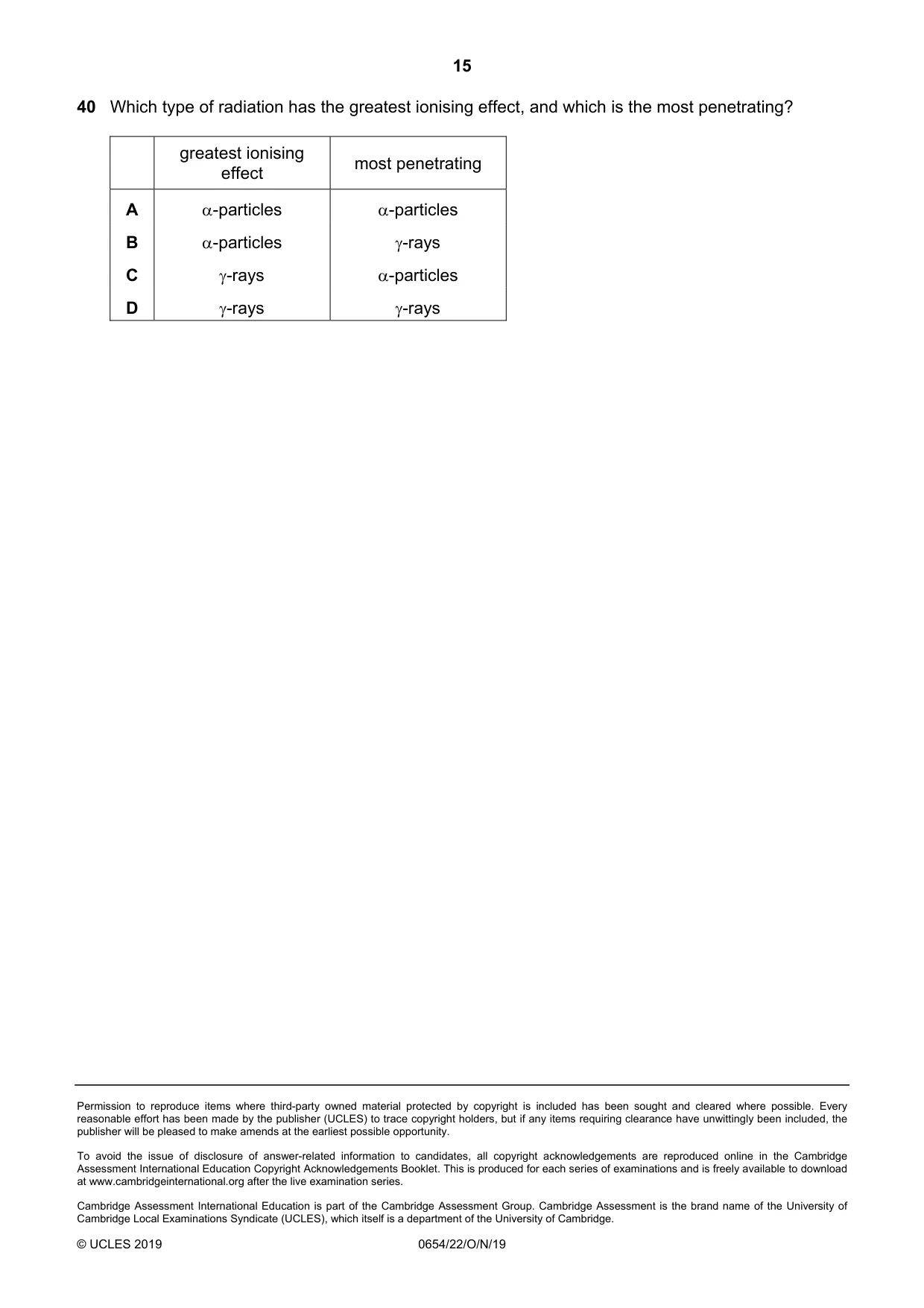
40 Which type of radiation has the greatest ionising effect, and which is the most penetrating? greatest ionising most penetrating effect A α-particles α-particles B α-particles γ-rays C γ-rays α-particles D γ-rays γ-rays
Mark scheme: B
What was in this paper
The subtopics covered by these 40 questions, and how many questions each got. Open one in a new tab to see every Cambridge question on it.
2Forces2Photosynthesis2Air quality and climate1Alloys and their properties1Arrangement of elements1Biological molecules1Cell structure1Chromatography1Coordination and response1Diet1Electrical circuits1Electrical quantities1Electrical safety1Electrolysis1Electromagnetic effects1Energy flow1Energy, work and power1Enzymes1Extraction of metals1General properties of waves1Giant covalent structures1Habitat destruction1Identification of ions and gases1Kinetic particle model of matter1Leaf structure1Light1Physical and chemical changes1Radioactivity1Rate of reaction1Relative masses of atoms and molecules1Respiration1Sexual reproduction1Sound1The characteristic properties of acids and bases1Transfer of thermal energy1Variation1What you needed in this session
Cambridge’s own grade thresholds for 2019 Oct/Nov, Paper 2 · Variant 2. A higher threshold means an easier paper — the bar moves with how the cohort did.