Questions as text
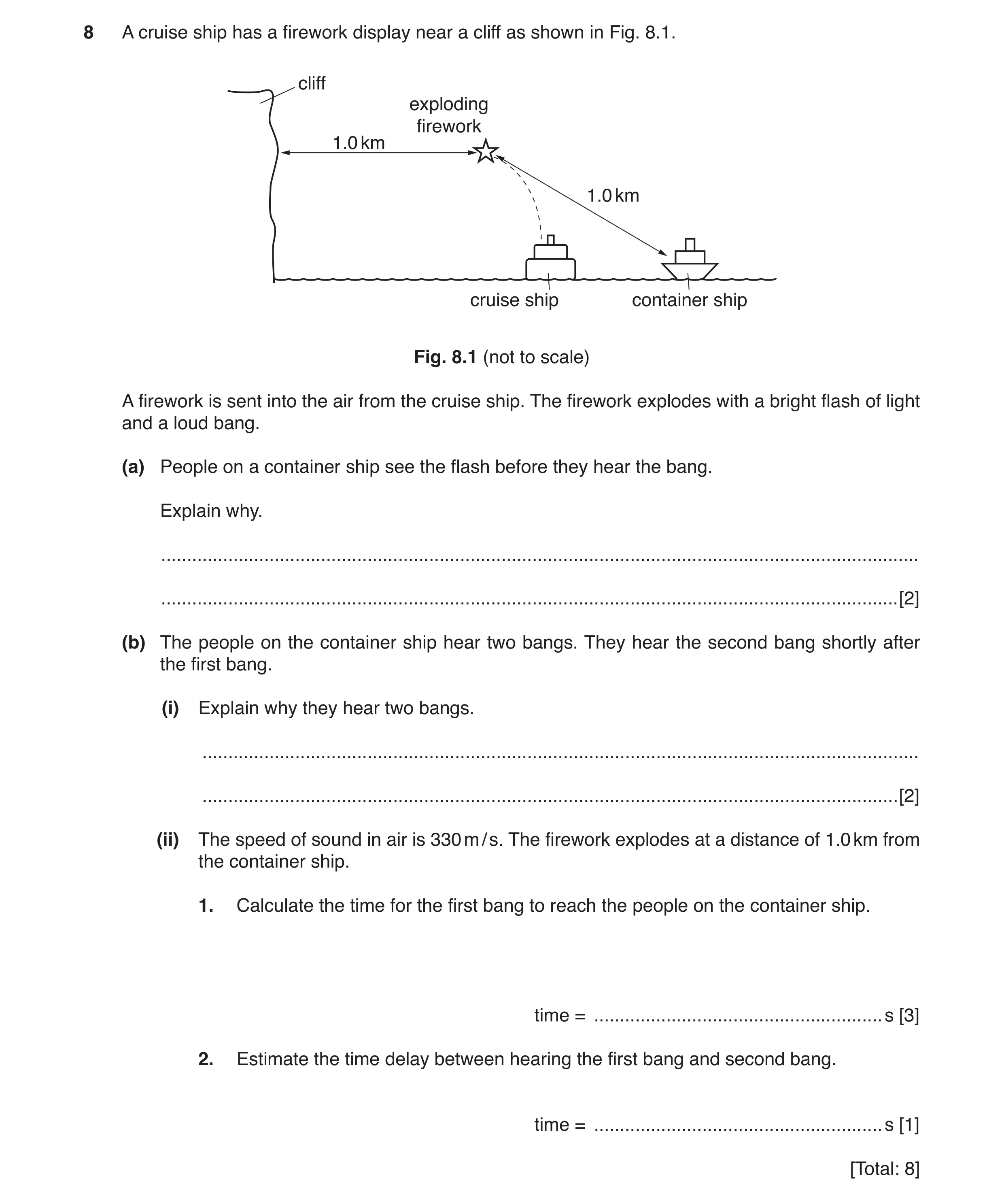
Q1 · A cruise ship has a firework display near a cliff as shown in Fig 0625/32 Feb/March 2017
8 A cruise ship has a firework display near a cliff as shown in Fig. 8.1. cliff exploding firework 1.0 km 1.0 km cruise ship container ship Fig. 8.1 (not to scale) A firework is sent into the air from the cruise ship. The firework explodes with a bright flash of light and a loud bang. (a) People on a container ship see the flash before they hear the bang. Explain why. … … [2] (b) The people on the container ship hear two bangs. They hear the second bang shortly after the first bang. (i) Explain why they hear two bangs. … … [2] (ii) The speed of sound in air is 330 m / s. The firework explodes at a distance of 1.0 km from the container ship. 1. Calculate the time for the first bang to reach the people on the container ship. time = … s [3] 2. Estimate the time delay between hearing the first bang and second bang. time = … s [1] [Total: 8]
8 marks
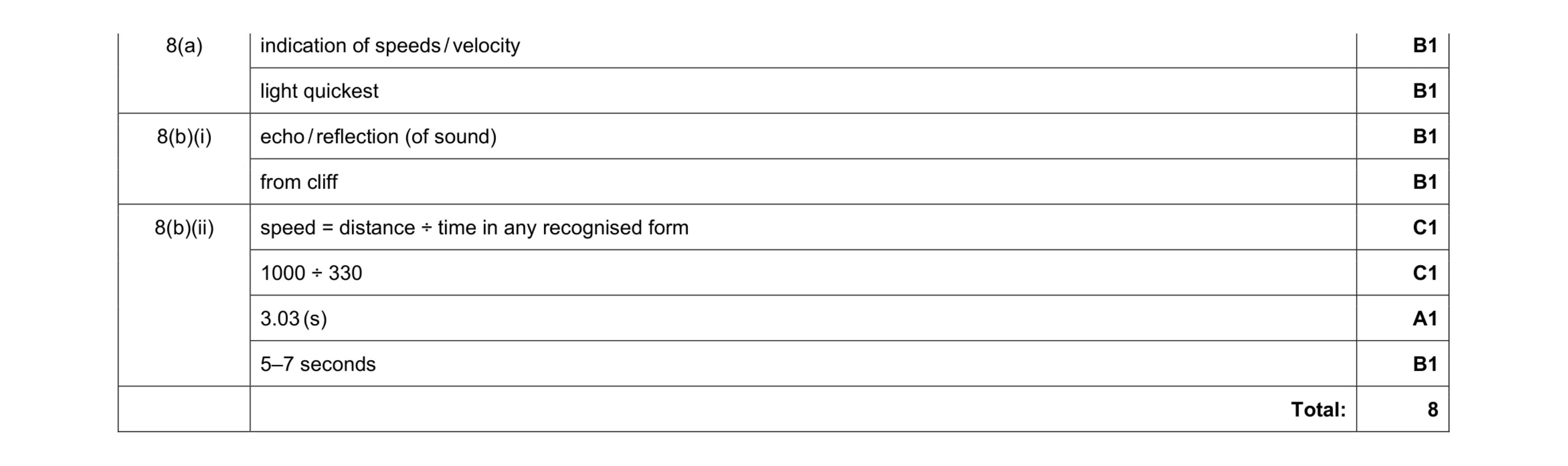
Mark scheme: 8(a) indication of speeds / velocity B1 light quickest B1 8(b)(i) echo / reflection (of sound) B1 from cliff B1 8(b)(ii) speed = distance ÷ time in any recognised form C1 1000 ÷ 330 C1 3.03 (s) A1 5–7 seconds B1 Total: 8
This question in 0625/32 Feb/March 2017
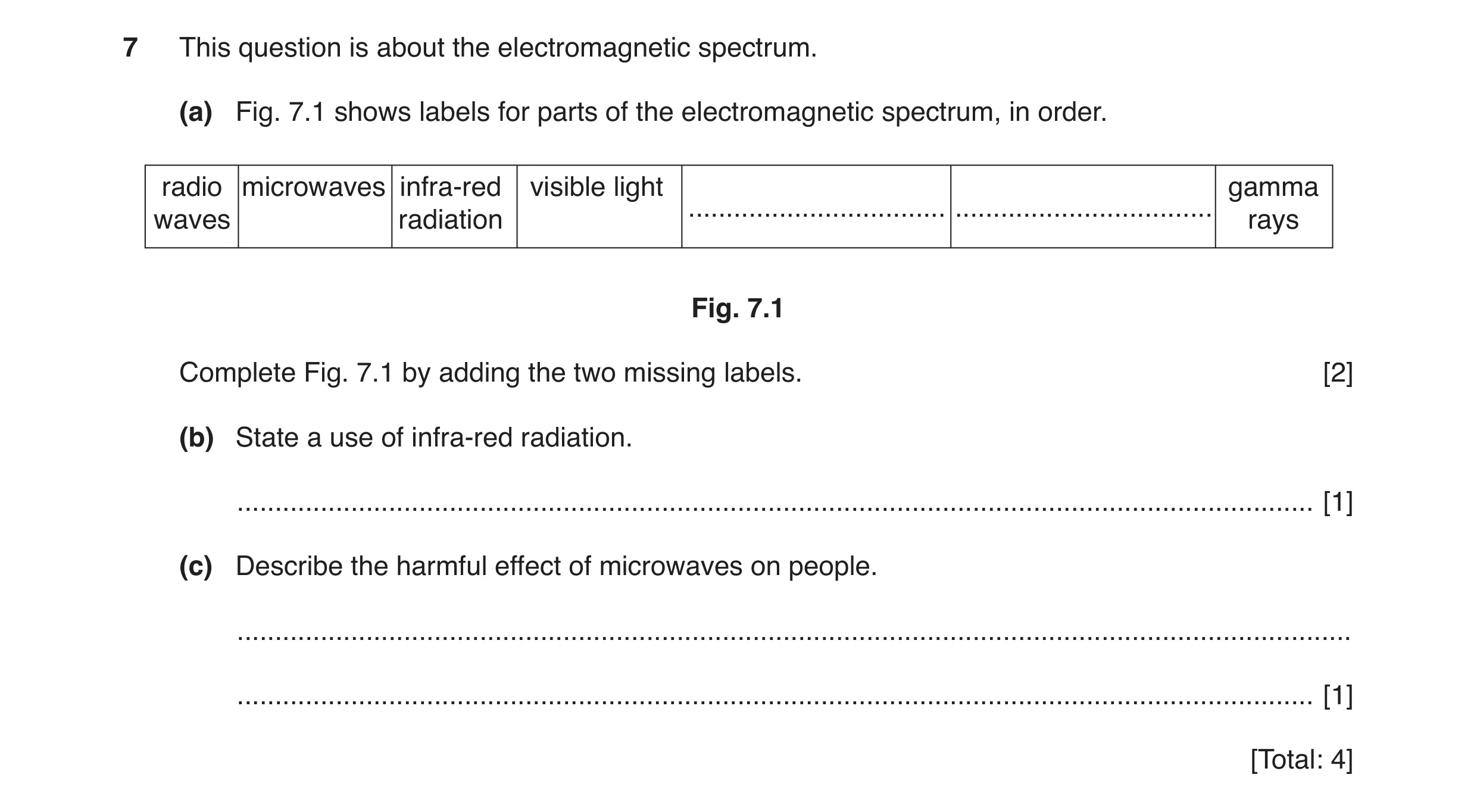
Q2 · This question is about the electromagnetic spectrum 0625/31 May/June 2017
7 This question is about the electromagnetic spectrum. (a) Fig. 7.1 shows labels for parts of the electromagnetic spectrum, in order. radio microwaves infra-red visible light gamma … … waves radiation rays Fig. 7.1 Complete Fig. 7.1 by adding the two missing labels. [2] (b) State a use of infra-red radiation. … [1] (c) Describe the harmful effect of microwaves on people. … … [1] [Total: 4]
4 marks
Mark scheme: 7(a) ultra violet/UV B1 X-rays B1 7(b) remote controller/burglar detection systems/grills/incubators/cable TV systems/thermal imaging/optical fibre communication B1 7(c) heats cells/tissue (inside the body) B1 Total: 4
This question in 0625/31 May/June 2017
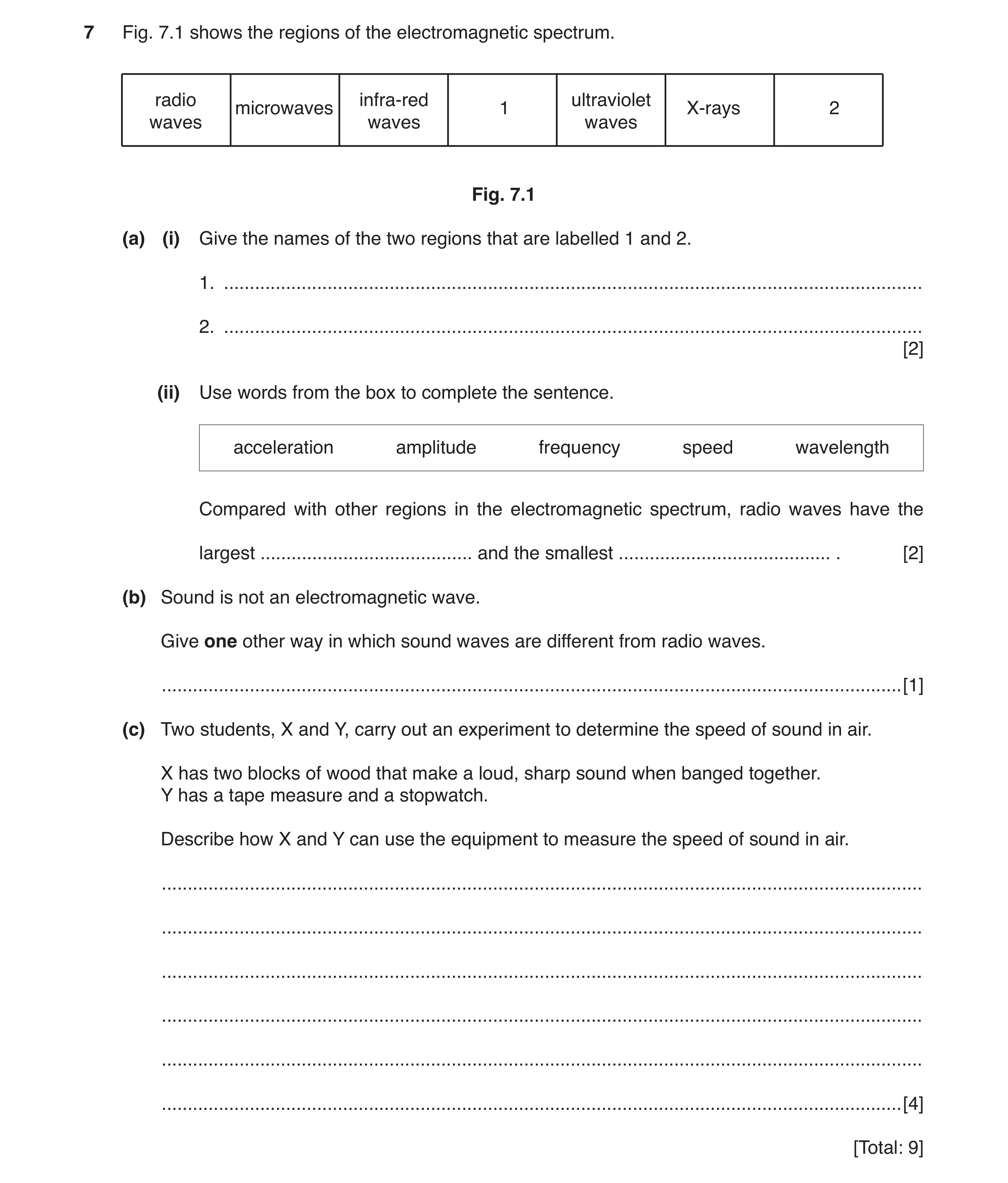
Q3 · The regions of the electromagnetic spectrum 0625/32 May/June 2017
7 Fig. 7.1 shows the regions of the electromagnetic spectrum. radio infra-red ultraviolet microwaves 1 X-rays 2 waves waves waves Fig. 7.1 (a) (i) Give the names of the two regions that are labelled 1 and 2. 1. … 2. … [2] (ii) Use words from the box to complete the sentence. acceleration amplitude frequency speed wavelength Compared with other regions in the electromagnetic spectrum, radio waves have the largest … and the smallest … . [2] (b) Sound is not an electromagnetic wave. Give one other way in which sound waves are different from radio waves. … [1] (c) Two students, X and Y, carry out an experiment to determine the speed of sound in air. X has two blocks of wood that make a loud, sharp sound when banged together. Y has a tape measure and a stopwatch. Describe how X and Y can use the equipment to measure the speed of sound in air. … … … … … … [4] [Total: 9]
9 marks
Mark scheme: 7(a)(i) visible light B1 gamma rays B1 7(a)(ii) wavelength B1 frequency B1 7(b) (sound) is a longitudinal wave (radio waves are transverse) (sound) needs a medium to be transmitted (but radio waves do not) B1 7(c) any four from: only award 4 marks if valid procedure (use tape measure) to measure distance of at least 100 m blocks banged together stopwatch started when blocks are SEEN to hit stopwatch stopped when sound heard time taken recorded/calculated speed = distance ÷ time B4 Total: 9
This question in 0625/32 May/June 2017
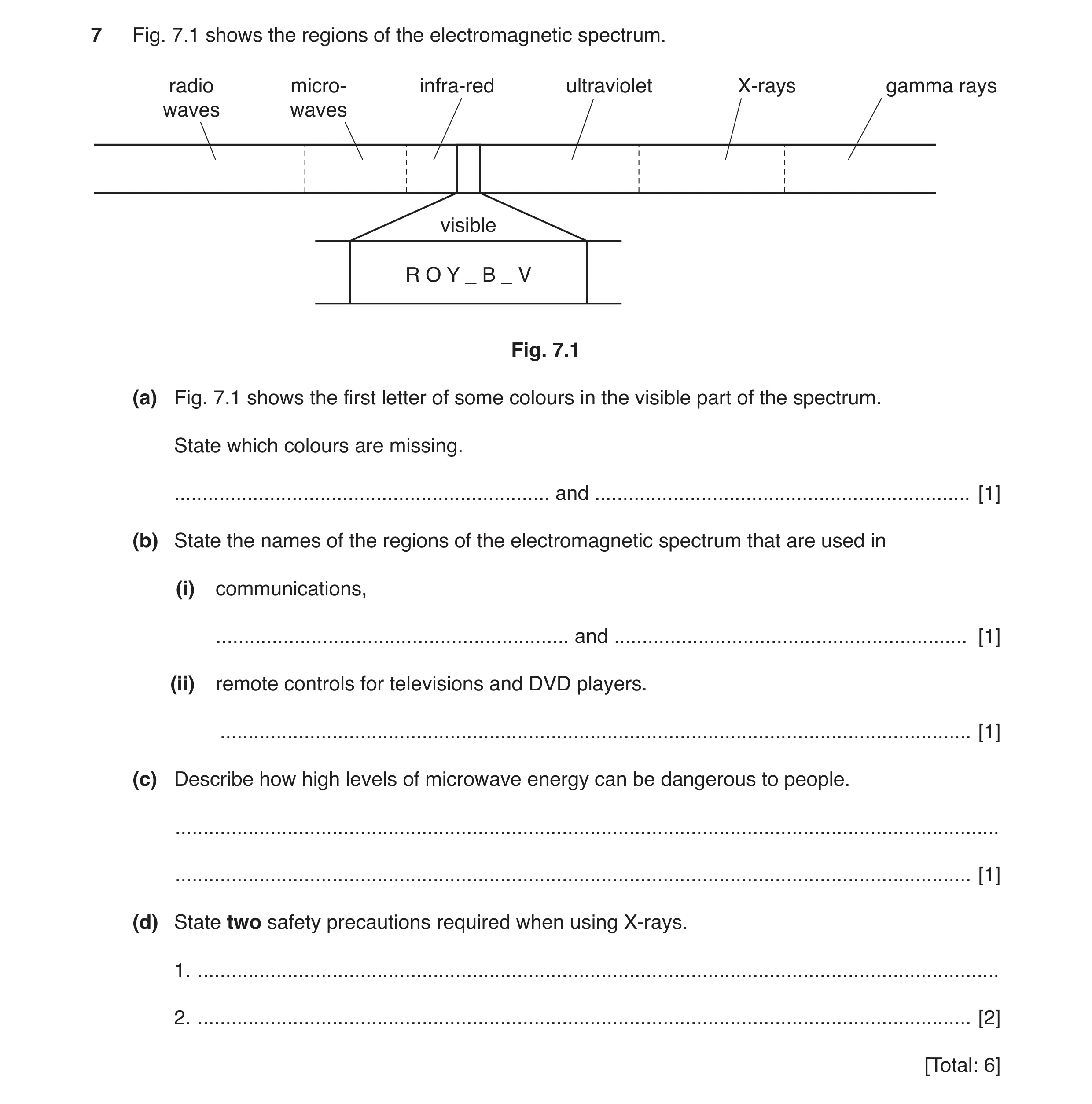
Q4 · The regions of the electromagnetic spectrum 0625/32 Oct/Nov 2017
7 Fig. 7.1 shows the regions of the electromagnetic spectrum. radio micro- infra-red ultraviolet X-rays gamma rays waves waves visible R O Y _ B _ V Fig. 7.1 (a) Fig. 7.1 shows the first letter of some colours in the visible part of the spectrum. State which colours are missing. … and … [1] (b) State the names of the regions of the electromagnetic spectrum that are used in (i) communications, … and … [1] (ii) remote controls for televisions and DVD players. … [1] (c) Describe how high levels of microwave energy can be dangerous to people. … … [1] (d) State two safety precautions required when using X-rays. 1. … 2. … [2] [Total: 6]
6 marks
Mark scheme: 7(a) green and indigo B1 7(b) radio and microwaves B1 infra-red B1 7(c) damages cells / heats cells B1 7(d) reduced exposure / leave room / move far away B1 metal apron / exposure badge / metal shielding B1
This question in 0625/32 Oct/Nov 2017
Q5 · A floating plastic ball attached by a long rope to a weight on the bottom of a lake 0625/33 Oct/Nov 2017
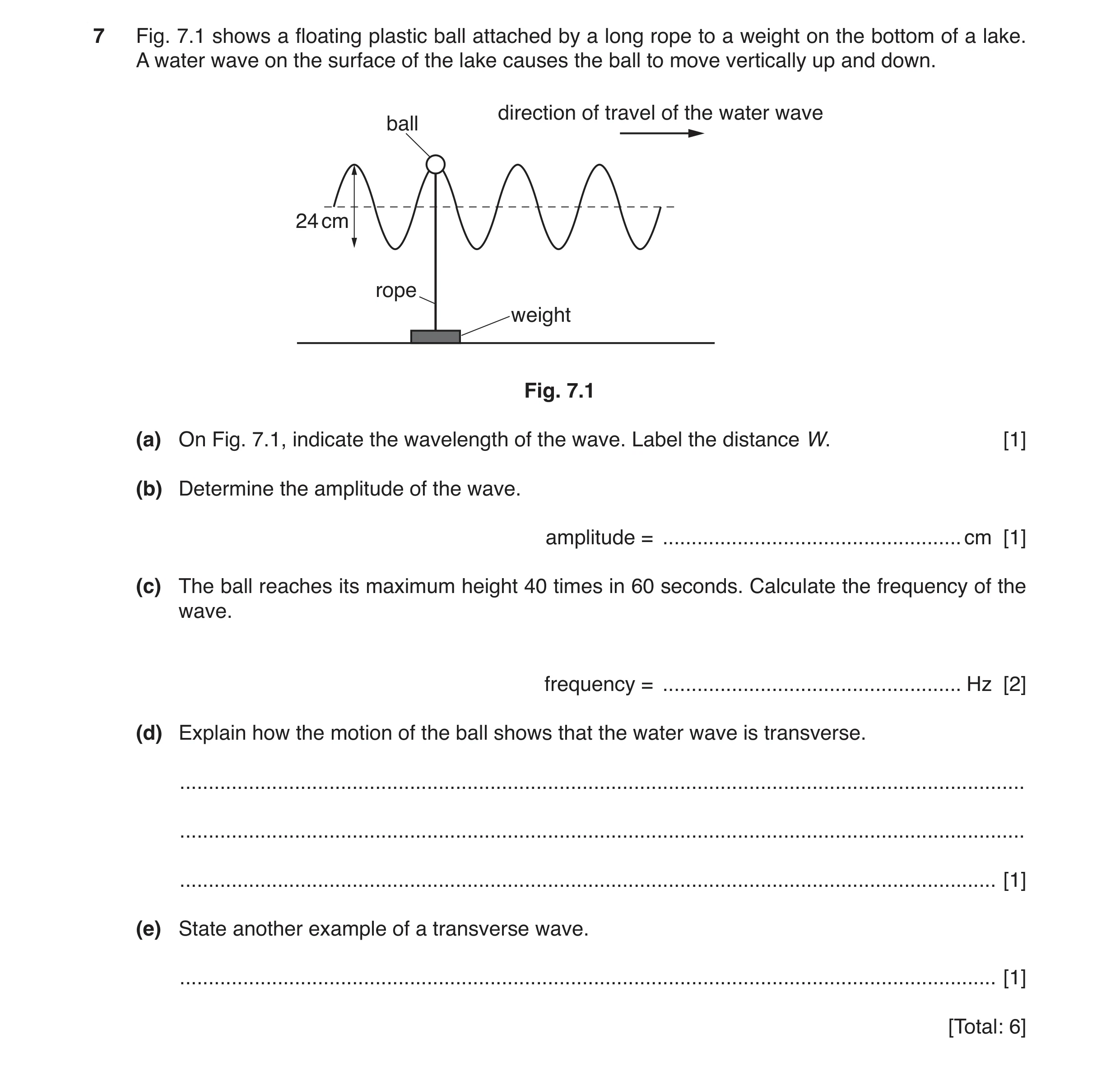
7 Fig. 7.1 shows a floating plastic ball attached by a long rope to a weight on the bottom of a lake. A water wave on the surface of the lake causes the ball to move vertically up and down. direction of travel of the water wave ball 24 cm rope weight Fig. 7.1 (a) On Fig. 7.1, indicate the wavelength of the wave. Label the distance W. [1] (b) Determine the amplitude of the wave. amplitude = … cm [1] (c) The ball reaches its maximum height 40 times in 60 seconds. Calculate the frequency of the wave. frequency = … Hz [2] (d) Explain how the motion of the ball shows that the water wave is transverse. … … … [1] (e) State another example of a transverse wave. … [1] [Total: 6]
6 marks
Mark scheme: 7(a) wavelength correctly indicated B1 7(b) 12 (cm) B1 7(c) 40 / 60 C1 0.67 (Hz) A1 7(d) direction of travel perpendicular to direction of vibration owtte B1 7(e) any component of the electromagnetic spectrum B1
This question in 0625/33 Oct/Nov 2017
Q6 · A partially-labelled diagram of the electromagnetic spectrum 0625/31 May/June 2018
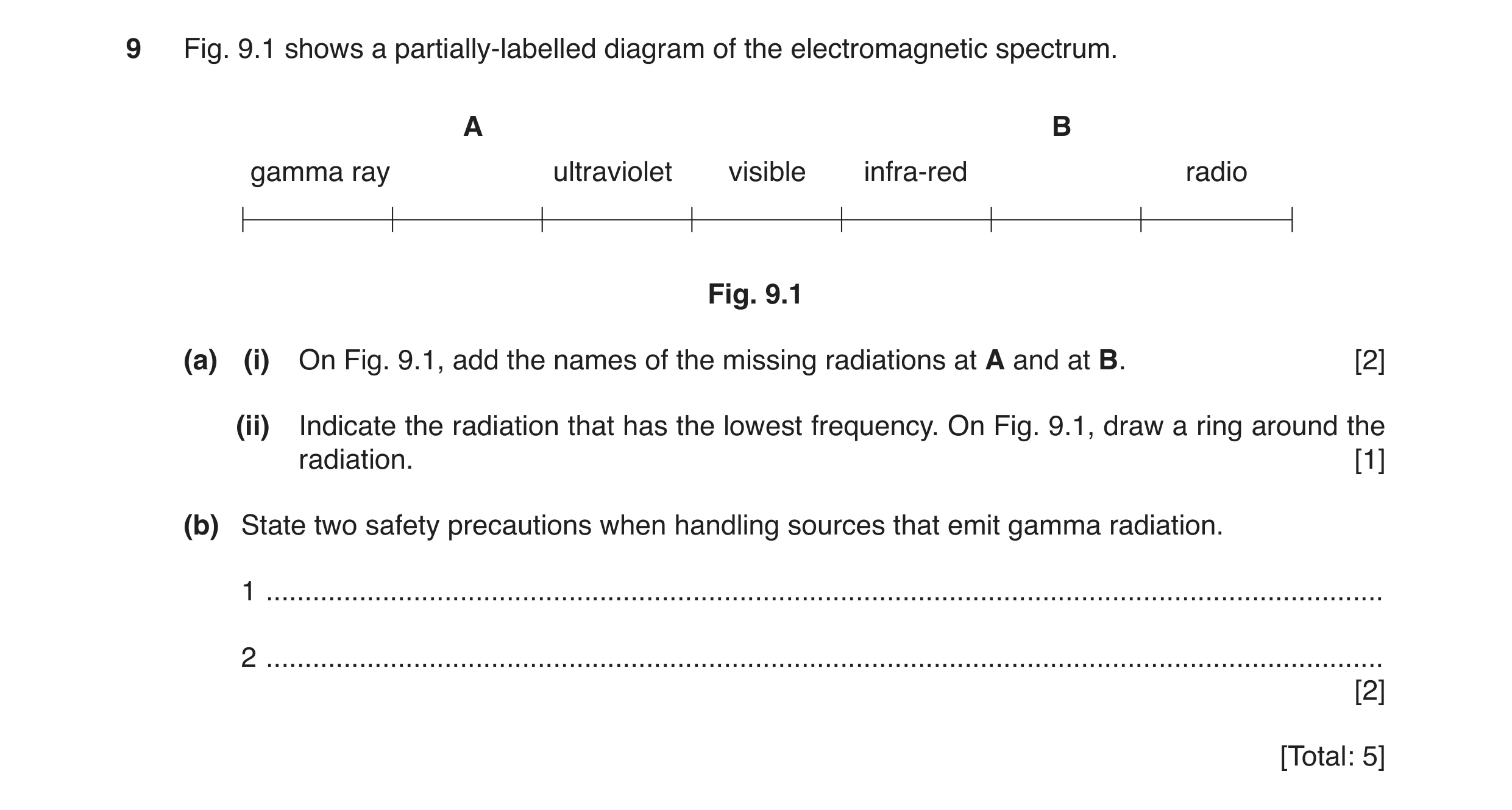
9 Fig. 9.1 shows a partially-labelled diagram of the electromagnetic spectrum. A B gamma ray ultraviolet visible infra-red radio Fig. 9.1 (a) (i) On Fig. 9.1, add the names of the missing radiations at A and at B. [2] (ii) Indicate the radiation that has the lowest frequency. On Fig. 9.1, draw a ring around the radiation. [1] (b) State two safety precautions when handling sources that emit gamma radiation. 1 … 2 … [2] [Total: 5]
5 marks
Mark scheme: 9(a)(i) X-rays between gamma rays and ultraviolet 1 microwaves between infra-red and radio 1 9(a)(ii) ring drawn around radio on Fig.9.1 1 9(b) any two from: lead/metal apron (use long) tongs limit (time of) exposure point source away (from you) owtte 2
This question in 0625/31 May/June 2018
Q7 · Some parts of the electromagnetic spectrum 0625/32 May/June 2018
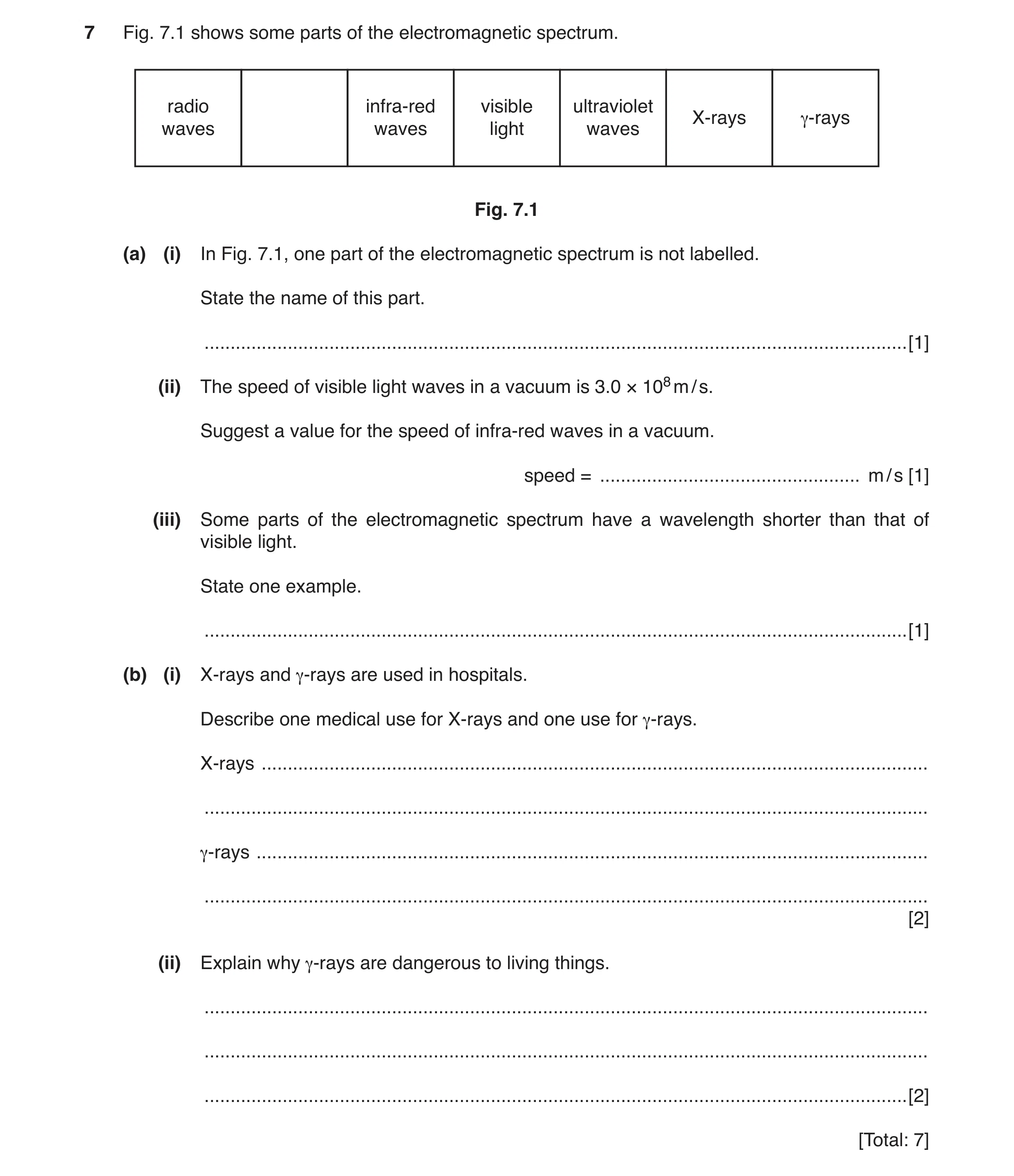
7 Fig. 7.1 shows some parts of the electromagnetic spectrum. radio infra-red visible ultraviolet X-rays γ-rays waves waves light waves Fig. 7.1 (a) (i) In Fig. 7.1, one part of the electromagnetic spectrum is not labelled. State the name of this part. … [1] (ii) The speed of visible light waves in a vacuum is 3.0 × 10⁸ m / s. Suggest a value for the speed of infra-red waves in a vacuum. speed = … m / s [1] (iii) Some parts of the electromagnetic spectrum have a wavelength shorter than that of visible light. State one example. … [1] (b) (i) X-rays and γ-rays are used in hospitals. Describe one medical use for X-rays and one use for γ-rays. X-rays … … γ-rays … … [2] (ii) Explain why γ-rays are dangerous to living things. … … … [2] [Total: 7]
7 marks
Mark scheme: 7(a)(i) microwaves 1 7(a)(ii) 3.0 × 10⁸ (m / s) 1 7(a)(iii) ultraviolet or X-rays or gamma/γ-rays 1 7(b)(i) X-rays any one from: detecting broken bones/damaged teeth or detecting/treating cancer 1 gamma: any one from: detecting/treating cancer or sterilising (hospital) equipment/food 1 7(b)(ii) any two from: ionising radiations/high frequency/high energy (e-m radiation) (may) damage or mutate cells/DNA (may) cause radiation burns 2
This question in 0625/32 May/June 2018
Q8 · An incomplete diagram of the electromagnetic spectrum 0625/33 May/June 2018
7 Fig. 7.1 shows an incomplete diagram of the electromagnetic spectrum. wavelength / m 1m 10−1 10−2 10−3 10−4 10−5 10−6 10−7 10−8 10−9 10−10 10−11 10−12 10−13 A microwaves infra-red B ultraviolet X-rays γ-rays Fig. 7.1
0 marks
Mark scheme: 7(a) (part A) radio 1 (part B) visible/light 1 7(b) transverse 1 7(c)(i) IR/infra-red 1 7(c)(ii) gamma OR γ OR X-rays OR ultraviolet 1
This question in 0625/33 May/June 2018
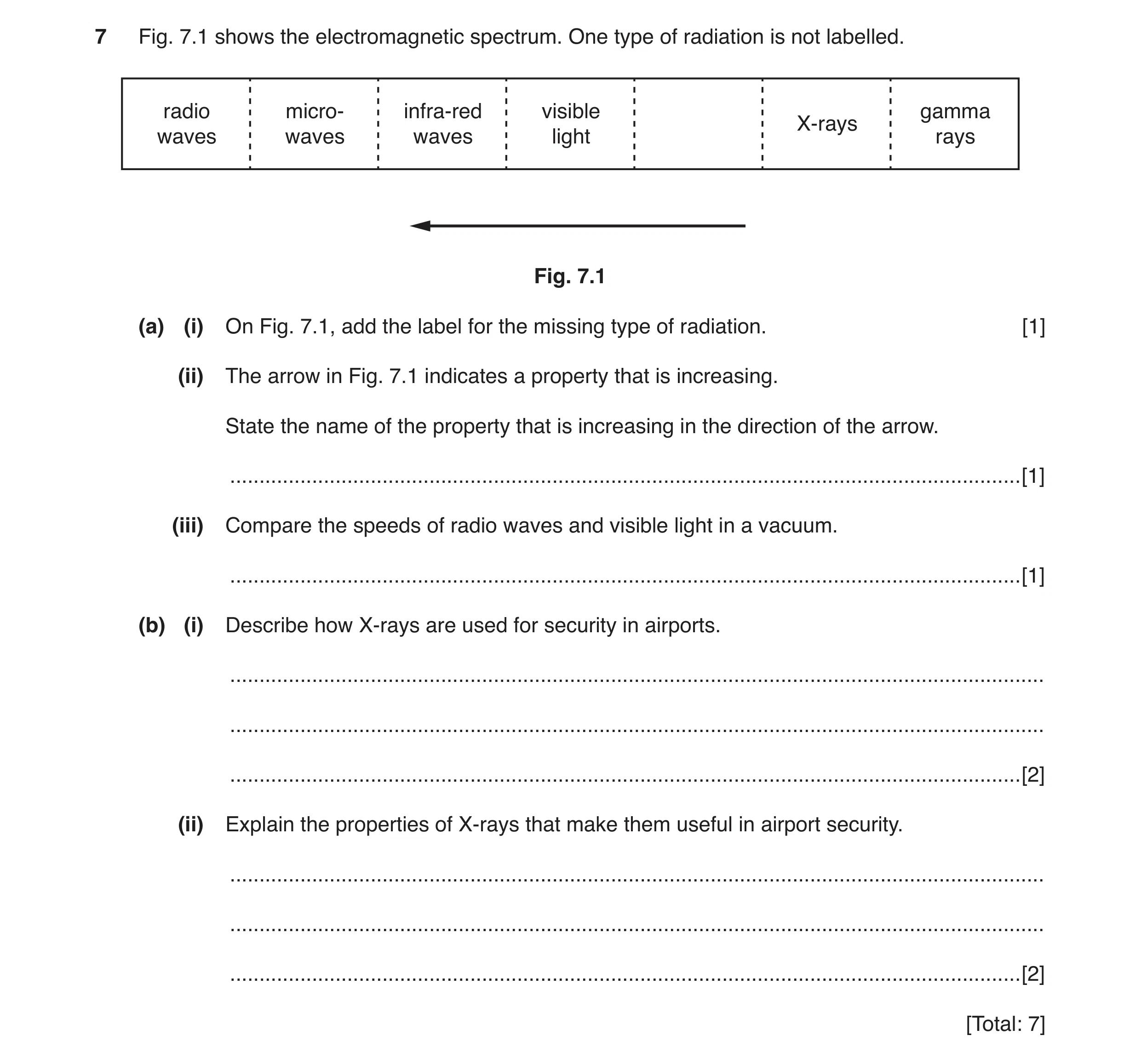
Question 9 0625/31 Oct/Nov 2018
7 Fig. 7.1 shows the electromagnetic spectrum. One type of radiation is not labelled. radio micro- infra-red visible gamma X-rays waves waves waves light rays Fig. 7.1 (a) (i) On Fig. 7.1, add the label for the missing type of radiation. [1] (ii) The arrow in Fig. 7.1 indicates a property that is increasing. State the name of the property that is increasing in the direction of the arrow. … [1] (iii) Compare the speeds of radio waves and visible light in a vacuum. … [1] (b) (i) Describe how X-rays are used for security in airports. … … … [2] (ii) Explain the properties of X-rays that make them useful in airport security. … … … [2] [Total: 7]
7 marks
Mark scheme: 7(a)(i) ultraviolet (waves / radiation) B1 7(a)(ii) wavelength B1 7(a)(iii) (visible light and radio waves) / (they have) the same (speed) B1 7(b)(i) Any 2 from: Checking bags or people or packages For hidden objects shadow / image on screen / monitor B2 7(b)(ii) Transmission (of X-rays) through less dense materials owtte OR absorption (of X-rays) by dense materials B2
This question in 0625/31 Oct/Nov 2018
Q10 · A ray of white light is incident on a glass prism 0625/32 Oct/Nov 2018
7 (a) A ray of white light is incident on a glass prism. It forms a spectrum that is visible on the screen. Fig. 7.1 shows the arrangement. screen narrow slit ray of white light red violet Fig. 7.1 Two of the colours in the visible spectrum are listed in the box below. Complete the box. List the five missing colours of the visible spectrum, in the correct order. red … … … … … violet [2] (b) Electromagnetic radiation has many uses. (i) Draw a line from each use to the type of radiation it requires. use type of radiation radio waves detecting an intruder at night microwaves infra-red communicating by satellite visible light for a telephone ultraviolet detecting broken bones in X-rays the body gamma rays [3] (ii) The types of radiation listed in (b)(i) form the electromagnetic spectrum. amplitude frequency velocity Complete the sentence. Choose a word from the box. The position of each type of radiation in the electromagnetic spectrum depends on its … . [1] [Total: 6]
6 marks
Mark scheme: 7(a) orange yellow green blue indigo B2 7(b)(i) detecting an intruder to infra-red B1 communicating by satellite to microwaves B1 detecting broken bones to X-rays B1 7(b)(ii) frequency B1
This question in 0625/32 Oct/Nov 2018
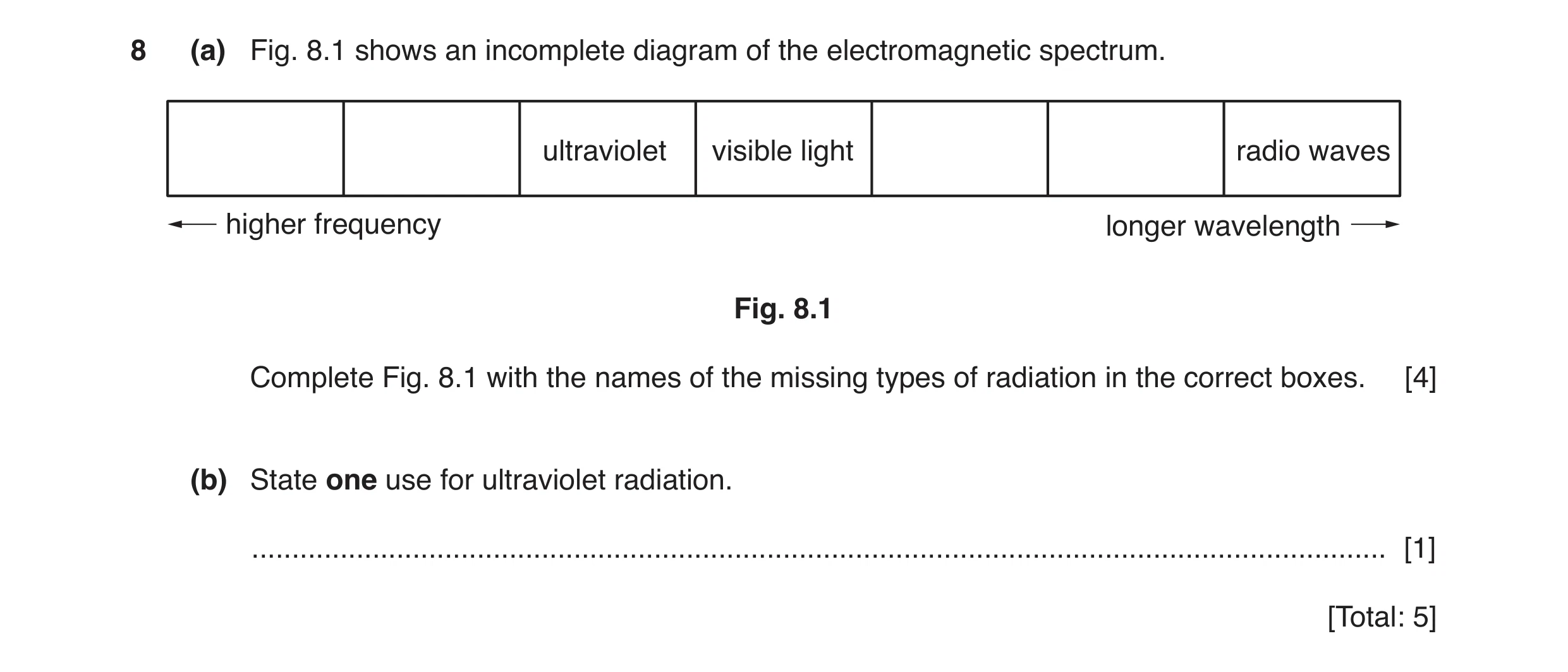
Q11 · An incomplete diagram of the electromagnetic spectrum 0625/32 Feb/March 2019
8 (a) Fig. 8.1 shows an incomplete diagram of the electromagnetic spectrum. ultraviolet visible light radio waves higher frequency longer wavelength Fig. 8.1 Complete Fig. 8.1 with the names of the missing types of radiation in the correct boxes. [4] (b) State one use for ultraviolet radiation. … [1] [Total: 5]
5 marks
Mark scheme: 8(a) In order from left to right: γ / gamma (rays) X-rays infrared (rays / waves) microwaves B4 8(b) sun beds OR security marking B1
This question in 0625/32 Feb/March 2019
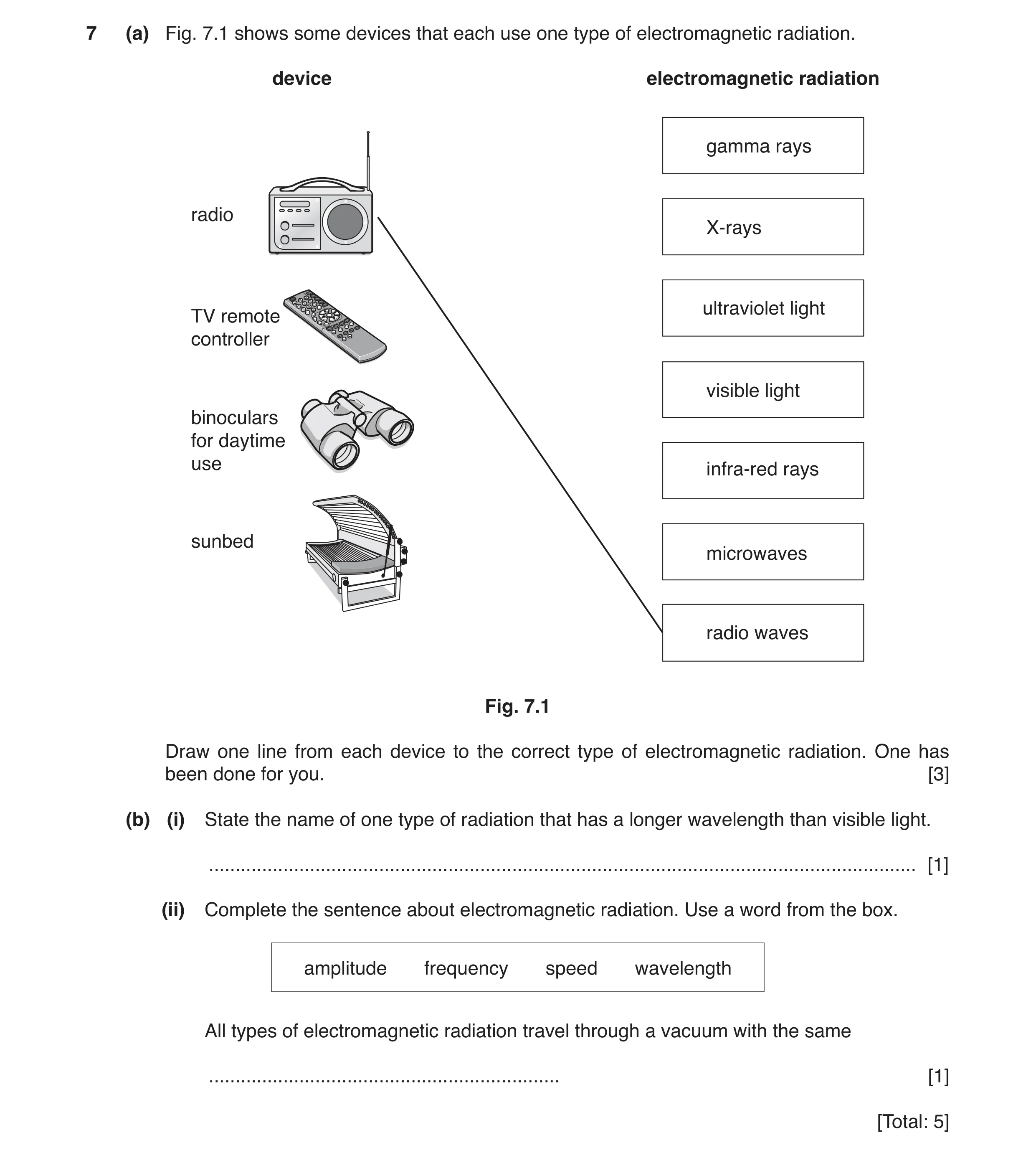
Q12 · Some devices that each use one type of electromagnetic radiation 0625/31 May/June 2019
7 (a) Fig. 7.1 shows some devices that each use one type of electromagnetic radiation. device electromagnetic radiation gamma rays radio X-rays ultraviolet light TV remote controller visible light binoculars for daytime use infra-red rays sunbed microwaves radio waves Fig. 7.1 Draw one line from each device to the correct type of electromagnetic radiation. One has been done for you. [3] (b) (i) State the name of one type of radiation that has a longer wavelength than visible light. … [1] (ii) Complete the sentence about electromagnetic radiation. Use a word from the box. amplitude frequency speed wavelength All types of electromagnetic radiation travel through a vacuum with the same … [1] [Total: 5]
5 marks
Mark scheme: 7(a) B1 B1 B1 7(b)(i) infrared OR microwaves OR radio waves B1 7(b)(ii) speed B1
This question in 0625/31 May/June 2019
Q13 · A ray of red light being reflected at the flat surface of a glass block 0625/33 May/June 2019
7 Fig. 7.1 shows a ray of red light being reflected at the flat surface of a glass block. glass block ray of air red light Fig. 7.1 (a) Explain why the ray of red light is totally internally reflected by the surface of the glass block. … … [1] (b) A ray of white light passes through a prism and produces a spectrum of colours on a screen, as shown in Fig. 7.2. screen ray of white light A spectrum of colours B Fig. 7.2 (i) State the name of the process of separating white light into a spectrum. … [1] (ii) Write the names of the seven colours that appear on the screen between A and B. colour at A … … … … … … colour at B … [1] (c) Visible light is one part of the electromagnetic spectrum. State the name of one other part of the electromagnetic spectrum and describe a use of this type of radiation. name of radiation … use of radiation … [2] [Total: 5]
5 marks
Mark scheme: 7(a) Any one from: angle of incidence is greater than the critical angle light is travelling from a(n optically) more dense medium to(wards an optically) less dense medium (at a large angle) B1 7(b)(i) dispersion B1 7(b)(ii) From A to B: red, orange, yellow, green, blue, indigo, violet B1 7(c) correct name for any part of em spectrum other than visible light M1 correct use of named part of em spectrum A1
This question in 0625/33 May/June 2019
Q14 · A travelling wave at an instant in time 0625/32 Feb/March 2020
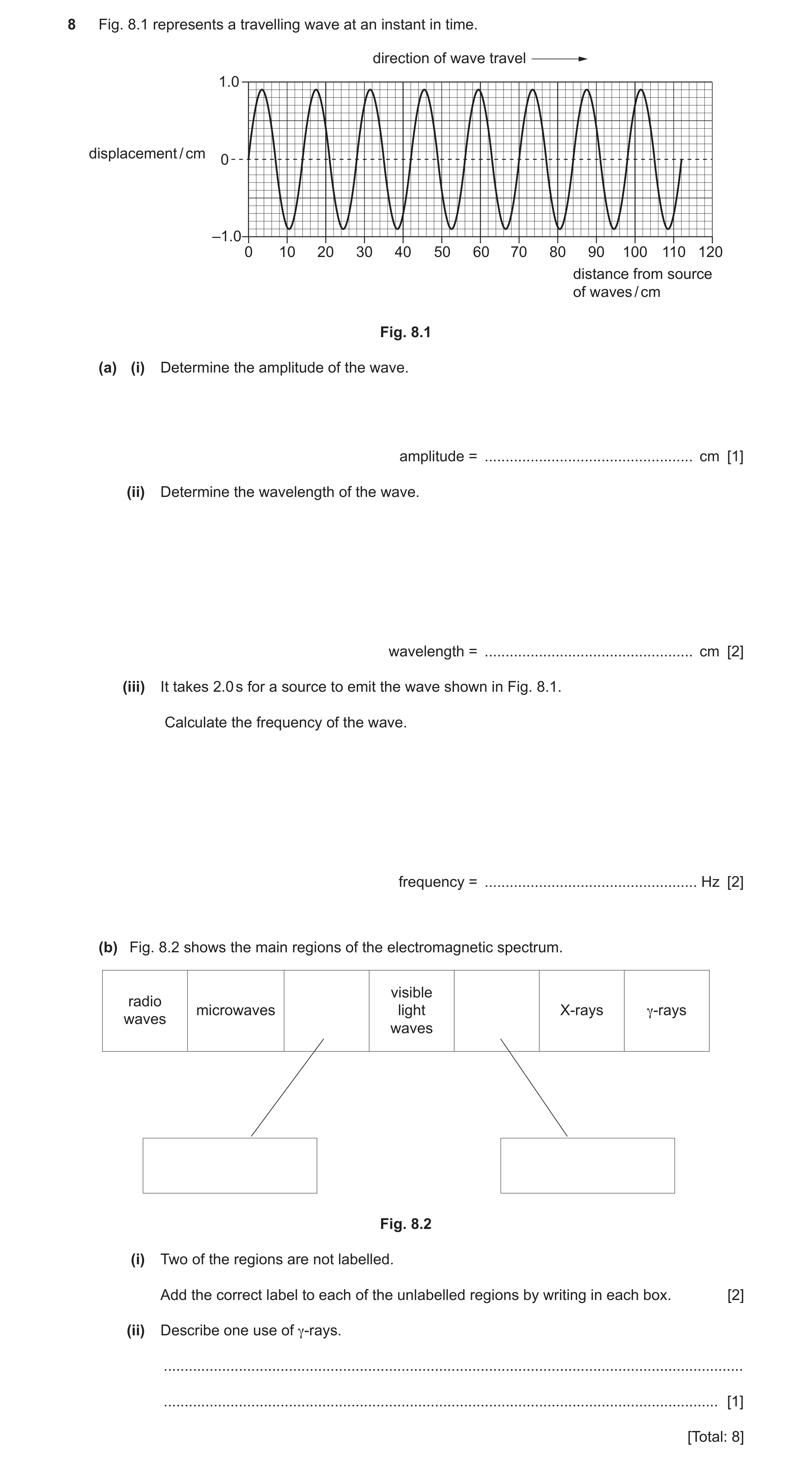
8 Fig. 8.1 represents a travelling wave at an instant in time. direction of wave travel 1.0 displacement / cm 0 –1.0 0 10 20 30 40 50 60 70 80 90 100 110 120 distance from source of waves / cm Fig. 8.1 (a) (i) Determine the amplitude of the wave. amplitude = … cm [1] (ii) Determine the wavelength of the wave. wavelength = … cm [2] (iii) It takes 2.0 s for a source to emit the wave shown in Fig. 8.1. Calculate the frequency of the wave. frequency = … Hz [2] (b) Fig. 8.2 shows the main regions of the electromagnetic spectrum. visible radio microwaves light X-rays γ-rays waves waves Fig. 8.2 (i) Two of the regions are not labelled. Add the correct label to each of the unlabelled regions by writing in each box. [2] (ii) Describe one use of γ-rays. … … [1] [Total: 8]
8 marks
Mark scheme: 8(a)(i) (amplitude =) 0.9 (cm) B1 8(a)(ii) (wavelength =) 112 ÷ 8 C1 (wavelength =) 14 (cm) A1 8(a)(iii) (frequency =) 8 ÷ 2 C1 (frequency =) 4 (Hz) A1 8(b)(i) bottom left box labelled infrared B1 bottom right box labelled ultraviolet B1 8(b)(ii) treating cancer / identifying cancer / gamma ray photography / sterilise medical equipment B1
This question in 0625/32 Feb/March 2020
Q15 · A diagram of the main regions of the electromagnetic spectrum 0625/32 May/June 2020
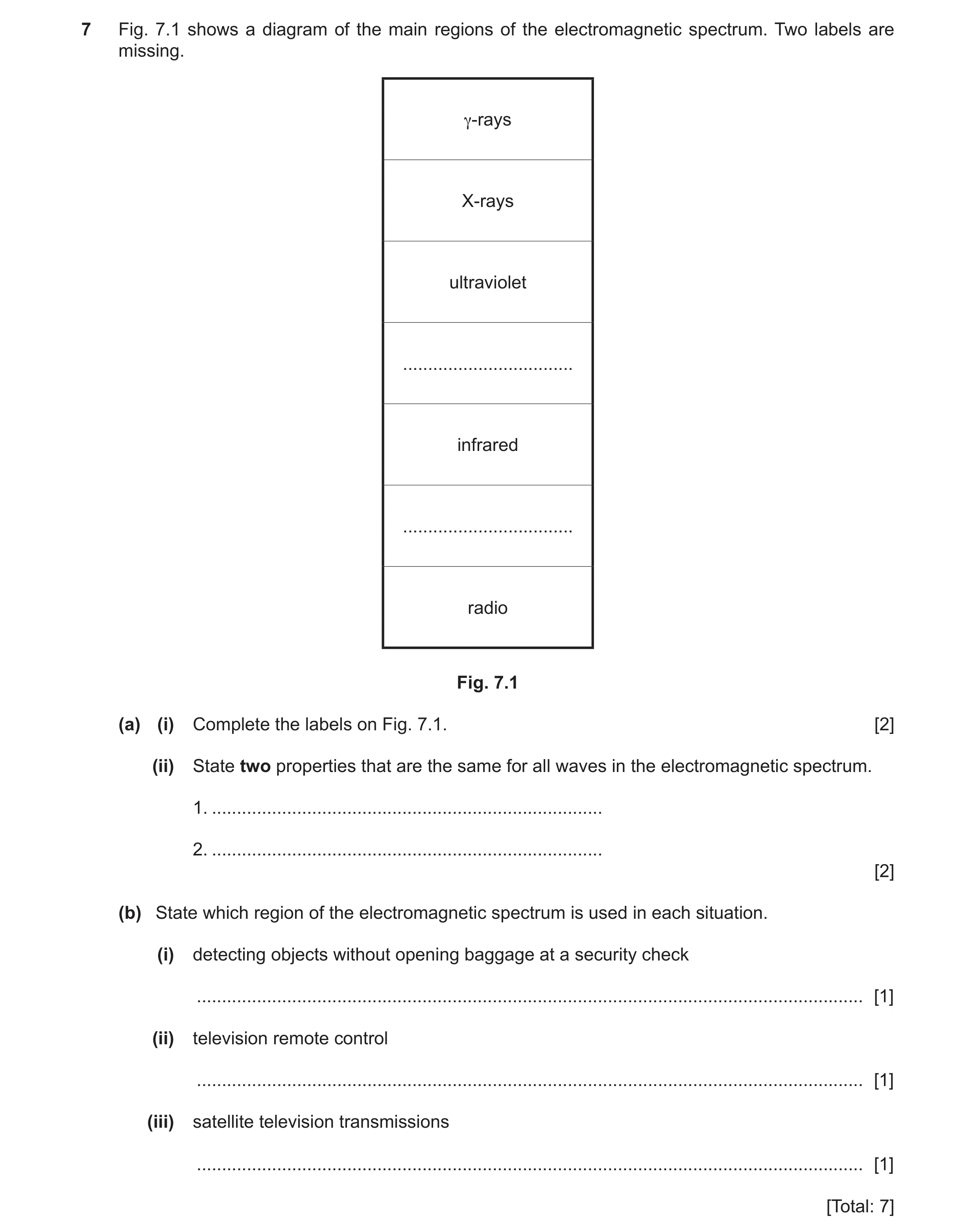
7 Fig. 7.1 shows a diagram of the main regions of the electromagnetic spectrum. Two labels are missing. γ-rays X-rays ultraviolet … infrared … radio Fig. 7.1 (a) (i) Complete the labels on Fig. 7.1. [2] (ii) State two properties that are the same for all waves in the electromagnetic spectrum. 1. … 2. … [2] (b) State which region of the electromagnetic spectrum is used in each situation. (i) detecting objects without opening baggage at a security check … [1] (ii) television remote control … [1] (iii) satellite television transmissions … [1] [Total: 7]
7 marks
Mark scheme: 7(a)(i) top – visible light B1 bottom – microwaves B1 Question Answer Marks 7(a)(ii) any two from: transverse wave travel at same speed do not need a medium B2 7(b)(i) X-rays B1 7(b)(ii) infrared B1 7(b)(iii) microwaves B1
This question in 0625/32 May/June 2020
Q16 · A mobile (cell) phone 0625/31 Oct/Nov 2020
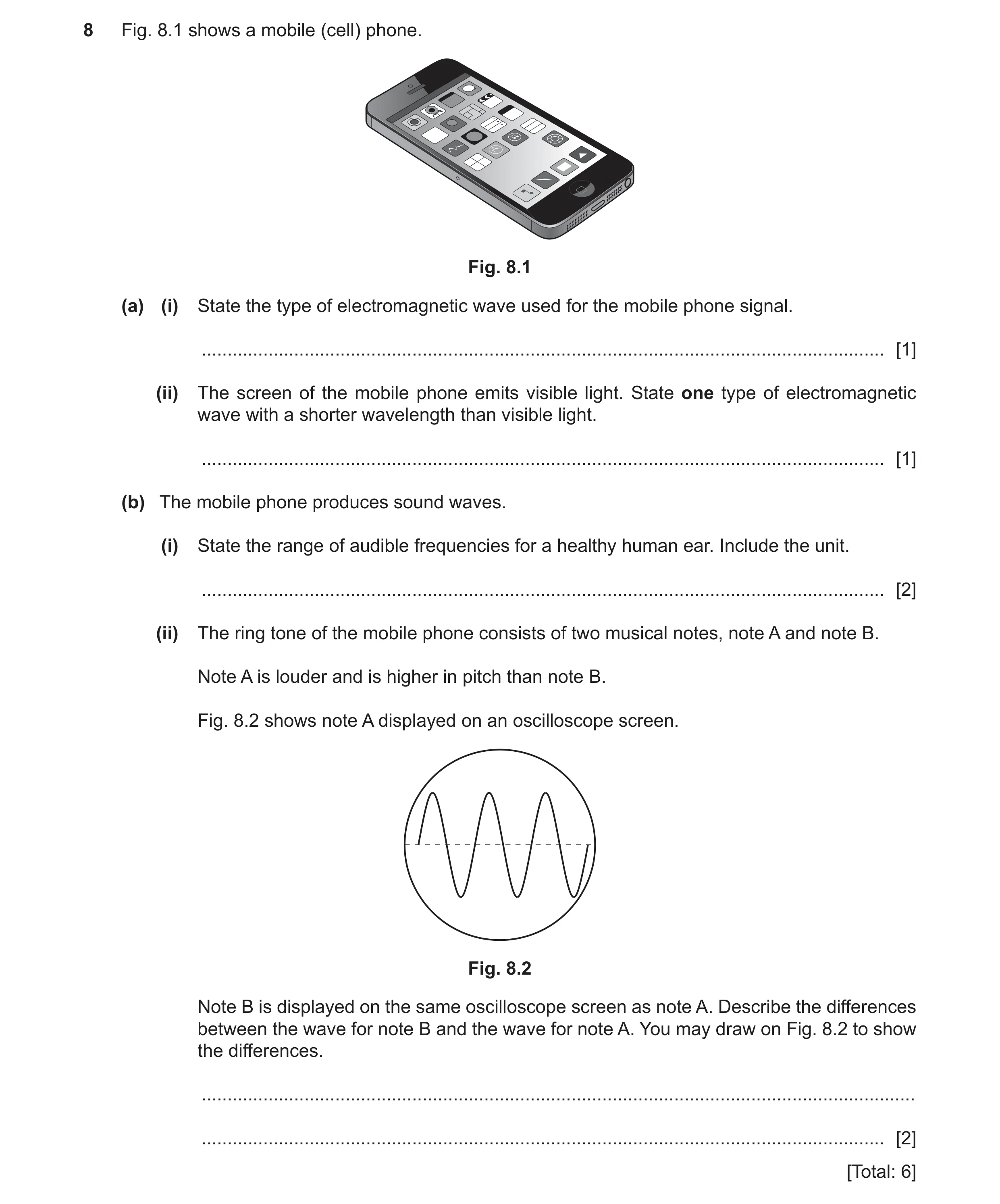
8 Fig. 8.1 shows a mobile (cell) phone. Fig. 8.1 (a) (i) State the type of electromagnetic wave used for the mobile phone signal. … [1] (ii) The screen of the mobile phone emits visible light. State one type of electromagnetic wave with a shorter wavelength than visible light. … [1] (b) The mobile phone produces sound waves. (i) State the range of audible frequencies for a healthy human ear. Include the unit. … [2] (ii) The ring tone of the mobile phone consists of two musical notes, note A and note B. Note A is louder and is higher in pitch than note B. Fig. 8.2 shows note A displayed on an oscilloscope screen. Fig. 8.2 Note B is displayed on the same oscilloscope screen as note A. Describe the differences between the wave for note B and the wave for note A. You may draw on Fig. 8.2 to show the differences. … … [2] [Total: 6]
6 marks
Mark scheme: 8(a)(i) microwave B1 8(a)(ii) ultraviolet / UV OR X-ray OR γ- / gamma (rays) B1 8(b)(i) 20 to 20 000 B1 Hz or hertz B1 8(b)(ii) (note B has) smaller amplitude OR note A has larger amplitude B1 (note B has) lower frequency OR longer wavelength OR note A has higher frequency OR shorter wavelength B1
This question in 0625/31 Oct/Nov 2020
Q17 · Complete the following sentences about light 0625/33 Oct/Nov 2020
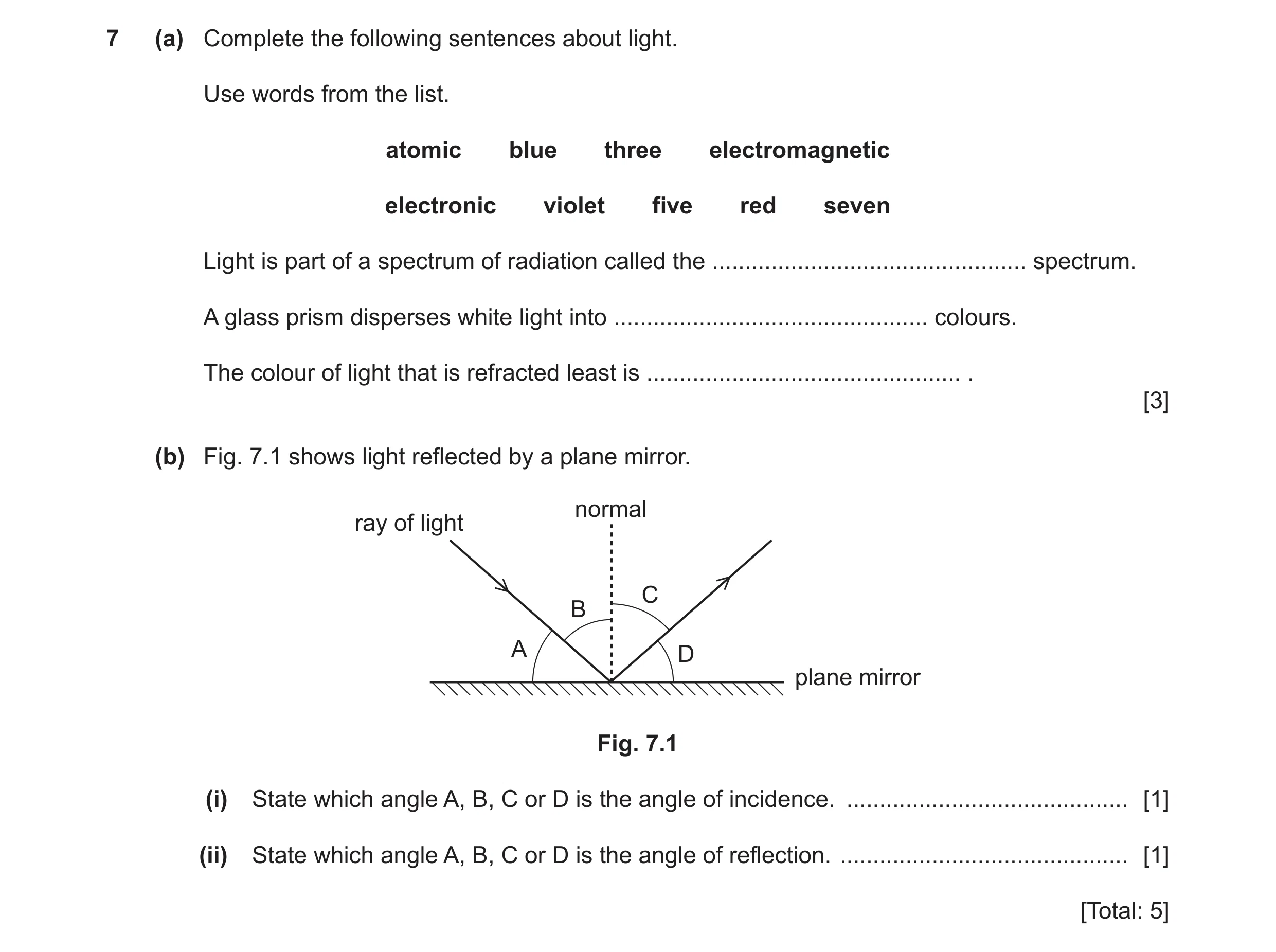
7 (a) Complete the following sentences about light. Use words from the list. atomic blue three electromagnetic electronic violet five red seven Light is part of a spectrum of radiation called the … spectrum. A glass prism disperses white light into … colours. The colour of light that is refracted least is … . [3] (b) Fig. 7.1 shows light reflected by a plane mirror. normal ray of light C B A D plane mirror Fig. 7.1 (i) State which angle A, B, C or D is the angle of incidence. … [1] (ii) State which angle A, B, C or D is the angle of reflection. … [1] [Total: 5]
5 marks
Mark scheme: 7(a) electromagnetic B1 seven B1 red B1 7(b)(i) B B1 7(b)(ii) C B1
This question in 0625/33 Oct/Nov 2020
Q18 · A narrow beam of white light enters a glass prism and splits into the colours of the… 0625/31 May/June 2021
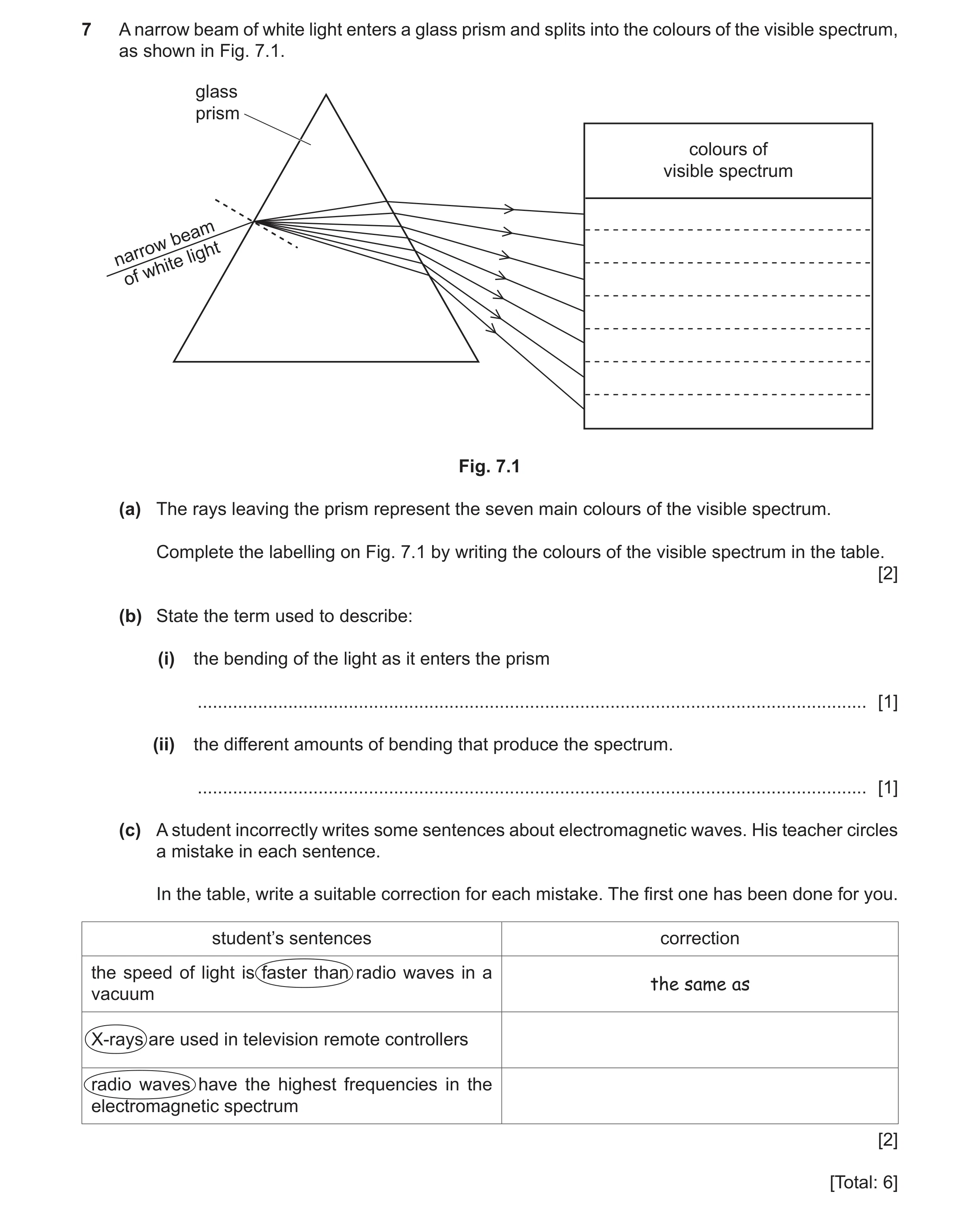
7 A narrow beam of white light enters a glass prism and splits into the colours of the visible spectrum, as shown in Fig. 7.1. glass prism colours of visible spectrum beam narrow light white of Fig. 7.1 (a) The rays leaving the prism represent the seven main colours of the visible spectrum. Complete the labelling on Fig. 7.1 by writing the colours of the visible spectrum in the table. [2] (b) State the term used to describe: (i) the bending of the light as it enters the prism … [1] (ii) the different amounts of bending that produce the spectrum. … [1] (c) A student incorrectly writes some sentences about electromagnetic waves. His teacher circles a mistake in each sentence. In the table, write a suitable correction for each mistake. The first one has been done for you. student’s sentences correction the speed of light is faster than radio waves in a the same as vacuum X-rays are used in television remote controllers radio waves have the highest frequencies in the electromagnetic spectrum [2] [Total: 6]
6 marks
Mark scheme: 7(a) any 6 correct colours from: red, orange, yellow, green, blue, indigo, violet M1 candidate’s colours in correct order A1 7(b)(i) refraction B1 7(b)(ii) dispersion B1 7(c) infrared (rays/waves) (are used in tv remote controllers) B1 gamma (rays/waves) (have the highest frequencies in em spectrum) B1
This question in 0625/31 May/June 2021
Q19 · Both radio waves and γ-rays (gamma) are radiations in the electromagnetic spectrum 0625/32 May/June 2021
7 (a) Both radio waves and γ-rays (gamma) are radiations in the electromagnetic spectrum. Fig. 7.1 shows the main regions of the electromagnetic spectrum. Most regions are labelled. radio microwave infrared … … visible light γ-rays waves radiation radiation … … Fig. 7.1 (i) On Fig. 7.1, write the names of the radiations in the other two parts of the electromagnetic spectrum. [2] (ii) State one use of γ-rays. … [1] (iii) A star emits radio waves and γ-rays at the same time. They all travel across the vacuum of space to the Earth’s atmosphere. State whether the radio waves or the γ-rays, if either, arrive first at the Earth’s atmosphere. Give a reason for your answer. statement … reason … [2] (b) Fig. 7.2 shows pulses of a signal from a star. amplitude of signal 0 0.0 0.2 0.4 0.6 0.8 1.0 1.2 1.4 1.6 1.8 2.0 time / s Fig. 7.2 (i) Use the graph in Fig. 7.2 to determine the time between pulses. time between pulses = … s [2] (ii) Determine the frequency of the pulses in Fig. 7.2. frequency = … Hz [2] [Total: 9]
9 marks
Mark scheme: 7(a)(i) (2nd box/next to gamma) X-rays B1 7(a)(ii) detection and treatment of cancer OR imaging/gamma photography OR (space) telescopes OR sterilisation of food/medical equipment B1 7(a)(iii) statement: (radiations arrive) at same time M1 reason: (because they have) same speed (in a vacuum) A1 7(b)(i) use of peaks to find time interval C1 0.2 (s) A1 7(b)(ii) frequency = number of pulses per s C1 5 (Hz) A1
This question in 0625/32 May/June 2021
Q20 · This question is about the electromagnetic spectrum 0625/33 May/June 2021
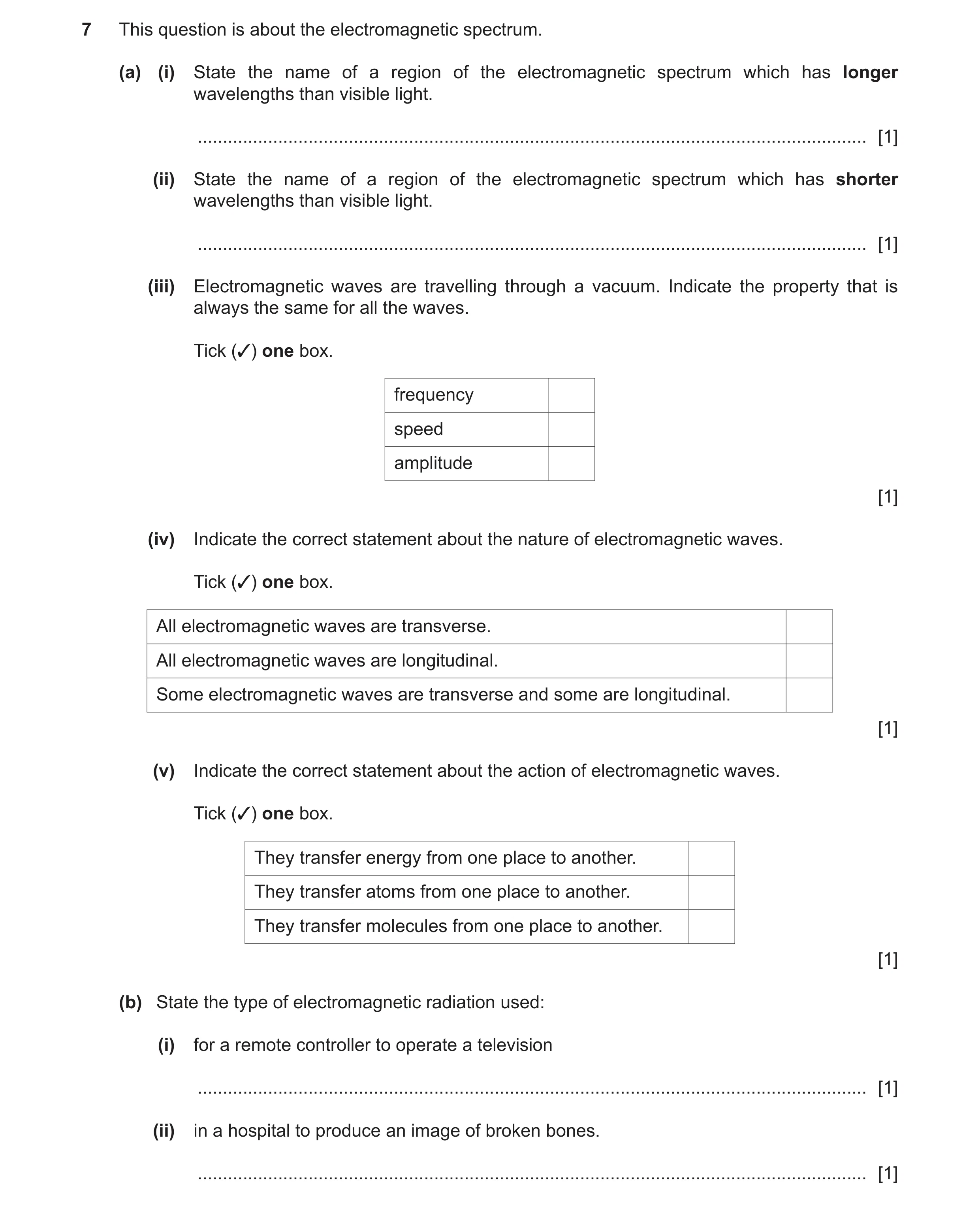
7 This question is about the electromagnetic spectrum. (a) (i) State the name of a region of the electromagnetic spectrum which has longer wavelengths than visible light. … [1] (ii) State the name of a region of the electromagnetic spectrum which has shorter wavelengths than visible light. … [1] (iii) Electromagnetic waves are travelling through a vacuum. Indicate the property that is always the same for all the waves. Tick (3) one box. frequency speed amplitude [1] (iv) Indicate the correct statement about the nature of electromagnetic waves. Tick (3) one box. All electromagnetic waves are transverse. All electromagnetic waves are longitudinal. Some electromagnetic waves are transverse and some are longitudinal. [1] (v) Indicate the correct statement about the action of electromagnetic waves. Tick (3) one box. They transfer energy from one place to another. They transfer atoms from one place to another. They transfer molecules from one place to another. [1] (b) State the type of electromagnetic radiation used: (i) for a remote controller to operate a television … [1] (ii) in a hospital to produce an image of broken bones. … [1]
7 marks
Mark scheme: 7(a)(i) infrared / microwaves / radio waves B1 7(a)(ii) ultraviolet / X-rays / gamma rays B1 7(a)(iii) middle box ticked (speed) B1 7(a)(iv) top box ticked (All electromagnetic waves are transverse.) B1 7(a)(v) top box ticked (They transfer energy from one place to another.) B1 7(b)(i) infrared B1 7(b)(ii) X-rays B1
This question in 0625/33 May/June 2021
Q21 · A ray of red light entering a semicircular glass block 0625/31 Oct/Nov 2021
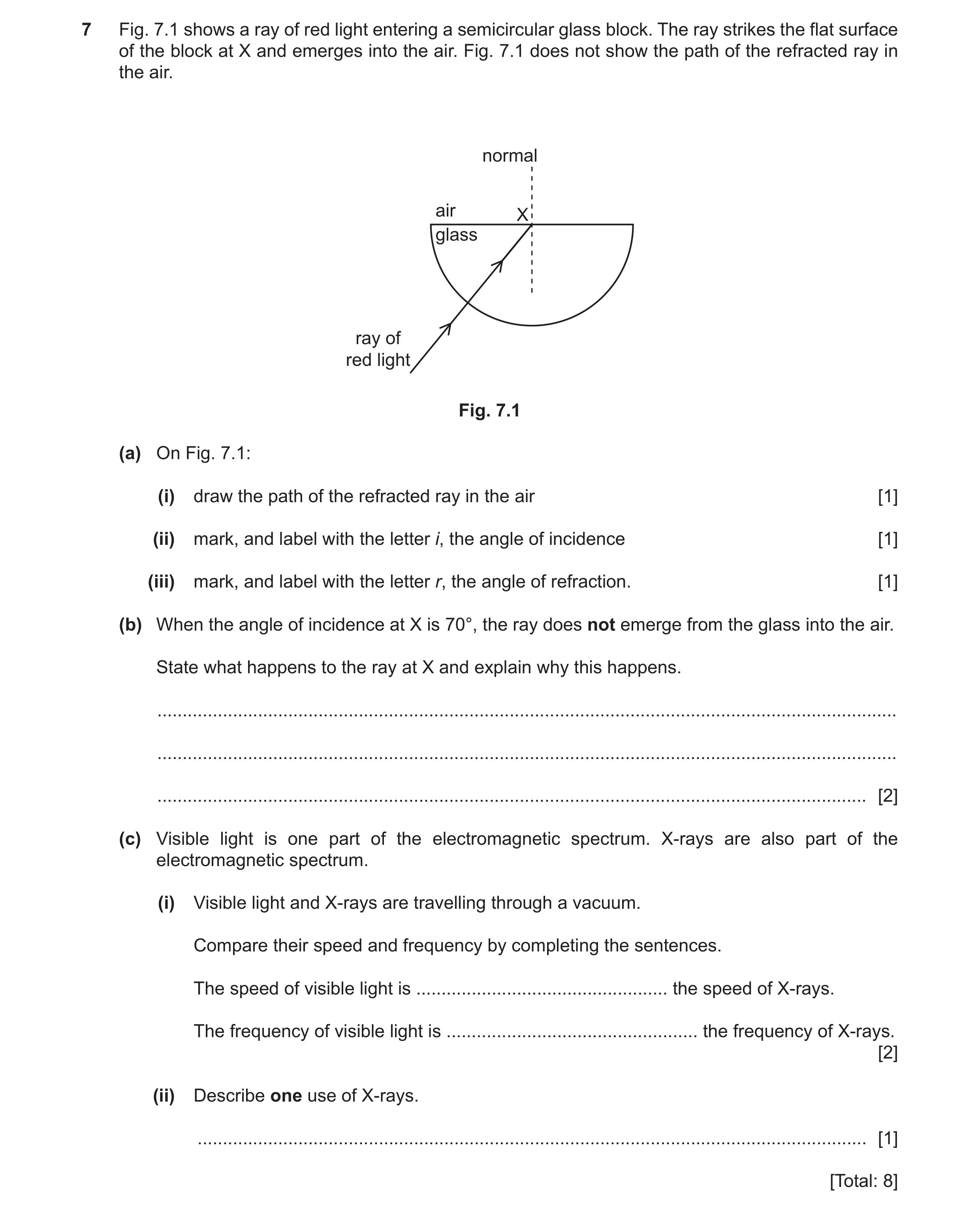
7 Fig. 7.1 shows a ray of red light entering a semicircular glass block. The ray strikes the flat surface of the block at X and emerges into the air. Fig. 7.1 does not show the path of the refracted ray in the air. normal air X glass ray of red light Fig. 7.1 (a) On Fig. 7.1: (i) draw the path of the refracted ray in the air [1] (ii) mark, and label with the letter i, the angle of incidence [1] (iii) mark, and label with the letter r, the angle of refraction. [1] (b) When the angle of incidence at X is 70°, the ray does not emerge from the glass into the air. State what happens to the ray at X and explain why this happens. … … … [2] (c) Visible light is one part of the electromagnetic spectrum. X‑rays are also part of the electromagnetic spectrum. (i) Visible light and X‑rays are travelling through a vacuum. Compare their speed and frequency by completing the sentences. The speed of visible light is … the speed of X‑rays. The frequency of visible light is … the frequency of X‑rays. [2] (ii) Describe one use of X‑rays. … [1] [Total: 8]
8 marks
Mark scheme: 7(a)(i) ray drawn refracted away from normal B1 7(a)(ii) angle of incidence correctly identified B1 7(a)(iii) angle of refraction correctly identified B1 7(b) total internal reflection (at flat surface) B1 angle (of incidence) is greater than the critical angle B1 7(c)(i) (The speed of visible light is) same (as) (the speed of X-rays.) B1 (The frequency of visible light is) lower OR smaller (than the frequency of X-rays) B1 7(c)(ii) example of medical / security imaging or treatment of cancer B1
This question in 0625/31 Oct/Nov 2021
Q22 · The regions of the electromagnetic spectrum 0625/32 Feb/March 2022
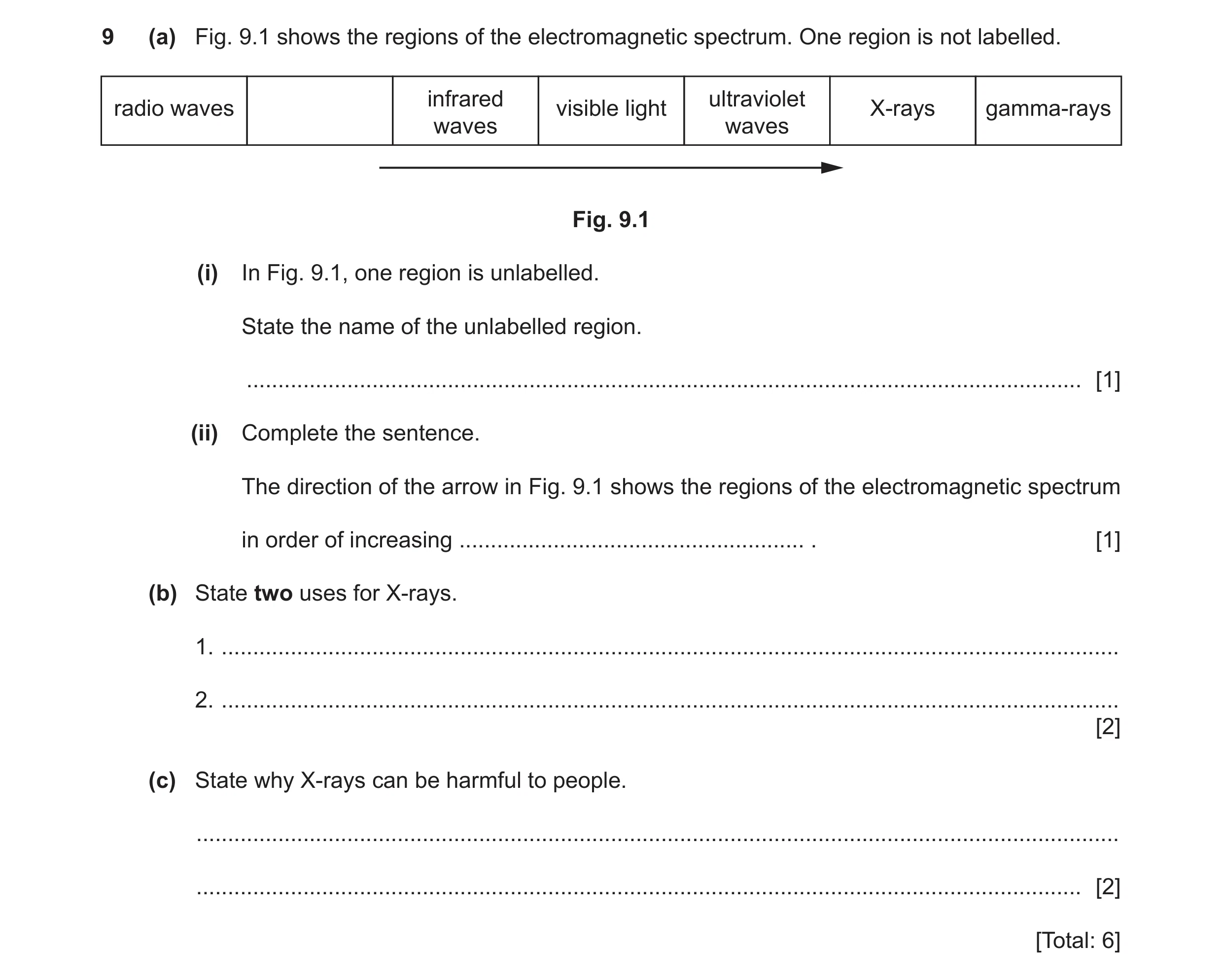
9 (a) Fig. 9.1 shows the regions of the electromagnetic spectrum. One region is not labelled. infrared ultraviolet radio waves visible light X-rays gamma-rays waves waves Fig. 9.1 (i) In Fig. 9.1, one region is unlabelled. State the name of the unlabelled region. … [1] (ii) Complete the sentence. The direction of the arrow in Fig. 9.1 shows the regions of the electromagnetic spectrum in order of increasing … . [1] (b) State two uses for X-rays. 1. … 2. … [2] (c) State why X-rays can be harmful to people. … … [2] [Total: 6]
6 marks
Mark scheme: 9(a)(i) microwaves B1 9(a)(ii) frequency B1 9(b) any two from: imaging / scanning bones / internal organs owtte treating cancer bone density measurements security scans (of baggage / parcels / freight at port / airport) space telescopes B2 9(c) any two from: (X-rays OR they) are ionising radiations (X-rays) damage (body) cells / tissue / DNA cause mutations / cancer B2
This question in 0625/32 Feb/March 2022
Q23 · The displacement of particles in a water wave 0625/31 May/June 2022
7 (a) Fig. 7.1 shows the displacement of particles in a water wave. 2.0 displacement / cm 1.0 0 4.0 8.0 12.0 16.0 20.0 24.0 distance / cm –1.0 –2.0 Fig. 7.1 Using the information in Fig. 7.1, determine: (i) the wavelength of the wave wavelength = … cm [1] (ii) the amplitude of the wave. amplitude = … cm [1] (b) The water waves travel from deep water into shallow water. The water waves have a lower speed in the shallow water. Fig. 7.2 shows wavefronts for the waves in deep water to the left of the boundary. wavefronts deep water boundary wave direction shallow water Fig. 7.2 (i) On Fig. 7.2, complete three wavefronts for the waves in shallow water to the right of the boundary. [2] (ii) State the term for the process at the boundary in Fig. 7.2. … [1] (c) (i) State the name of one type of electromagnetic wave with a wavelength shorter than that of visible light. … [1] (ii) State one use of the type of wave you have given in (c)(i). … [1] [Total: 7]
7 marks
Mark scheme: 7(a)(i) 8.0 (cm) B1 7(a)(ii) 1.5 (cm) B1 7(b)(i) wavefronts at different angle to boundary B1 wavefronts towards left AND all with smaller wavelength B1 7(b)(ii) refraction B1 Question Answer Marks 7(c)(i) ultraviolet OR X-rays OR gamma rays B1 7(c)(ii) correct use for wave in (c)(i) B1
This question in 0625/31 May/June 2022
Q24 · The main regions of the electromagnetic spectrum 0625/32 May/June 2022
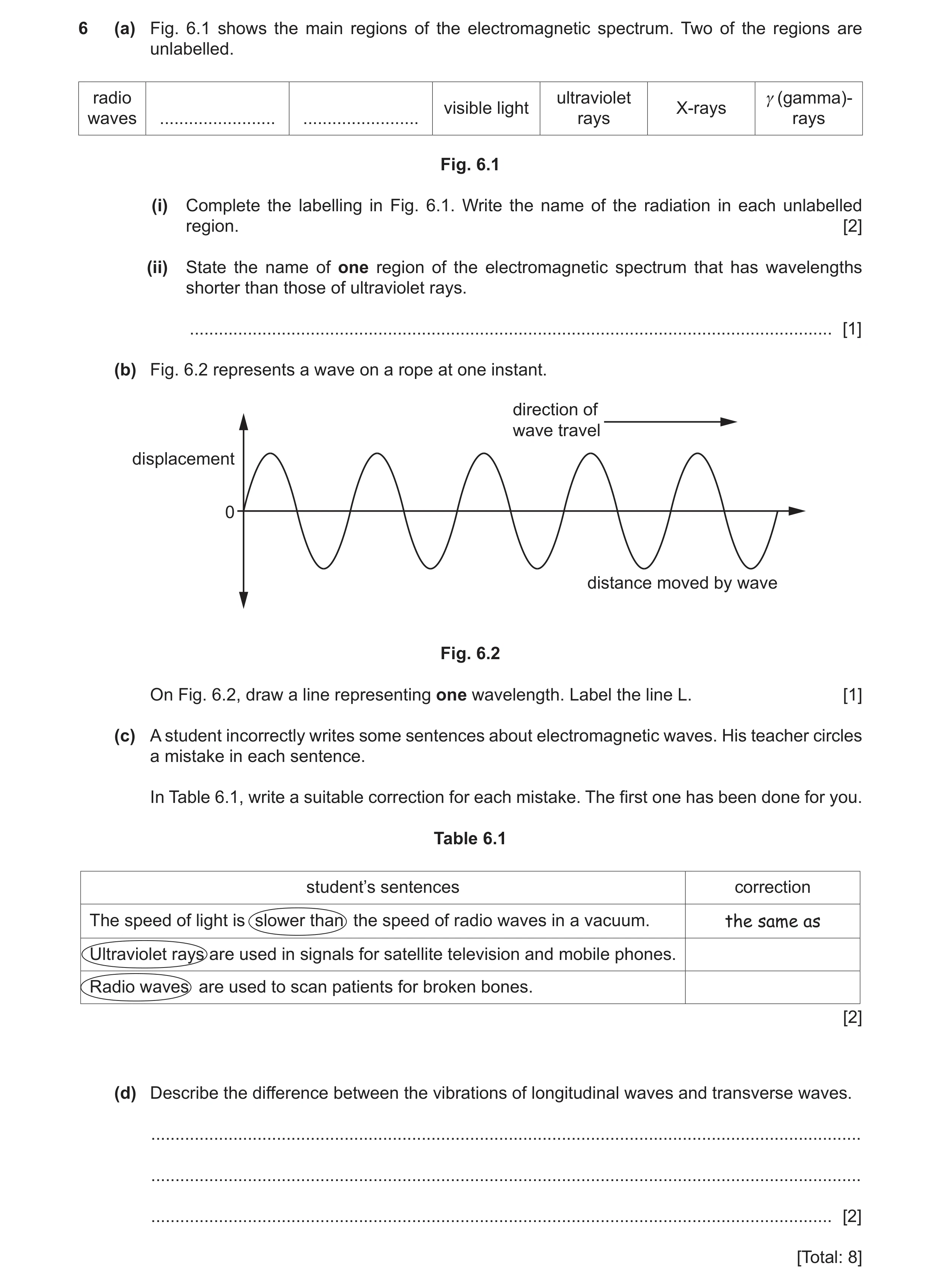
6 (a) Fig. 6.1 shows the main regions of the electromagnetic spectrum. Two of the regions are unlabelled. radio ultraviolet γ (gamma)- visible light X-rays waves … … rays rays Fig. 6.1 (i) Complete the labelling in Fig. 6.1. Write the name of the radiation in each unlabelled region. [2] (ii) State the name of one region of the electromagnetic spectrum that has wavelengths shorter than those of ultraviolet rays. … [1] (b) Fig. 6.2 represents a wave on a rope at one instant. direction of wave travel displacement 0 distance moved by wave Fig. 6.2 On Fig. 6.2, draw a line representing one wavelength. Label the line L. [1] (c) A student incorrectly writes some sentences about electromagnetic waves. His teacher circles a mistake in each sentence. In Table 6.1, write a suitable correction for each mistake. The first one has been done for you. Table 6.1 student’s sentences correction The speed of light is slower than the speed of radio waves in a vacuum. the same as Ultraviolet rays are used in signals for satellite television and mobile phones. Radio waves are used to scan patients for broken bones. [2] (d) Describe the difference between the vibrations of longitudinal waves and transverse waves. … … … [2] [Total: 8]
8 marks
Mark scheme: 6(a)(i) (1st box) microwaves B1 (2nd box) infrared B1 6(a)(ii) X-rays OR gamma rays B1 6(b) horizontal line drawn between 2 peaks OR any 2 adjacent similar points on the wave B1 6(c) microwaves B1 X-rays B1 6(d) longitudinal (vibrations) are parallel to the direction of propagation B1 transverse (vibrations) are perpendicular/at right angles to the direction of propagation B1
This question in 0625/32 May/June 2022
Q25 · This question is about the following four types of wave 0625/33 May/June 2022
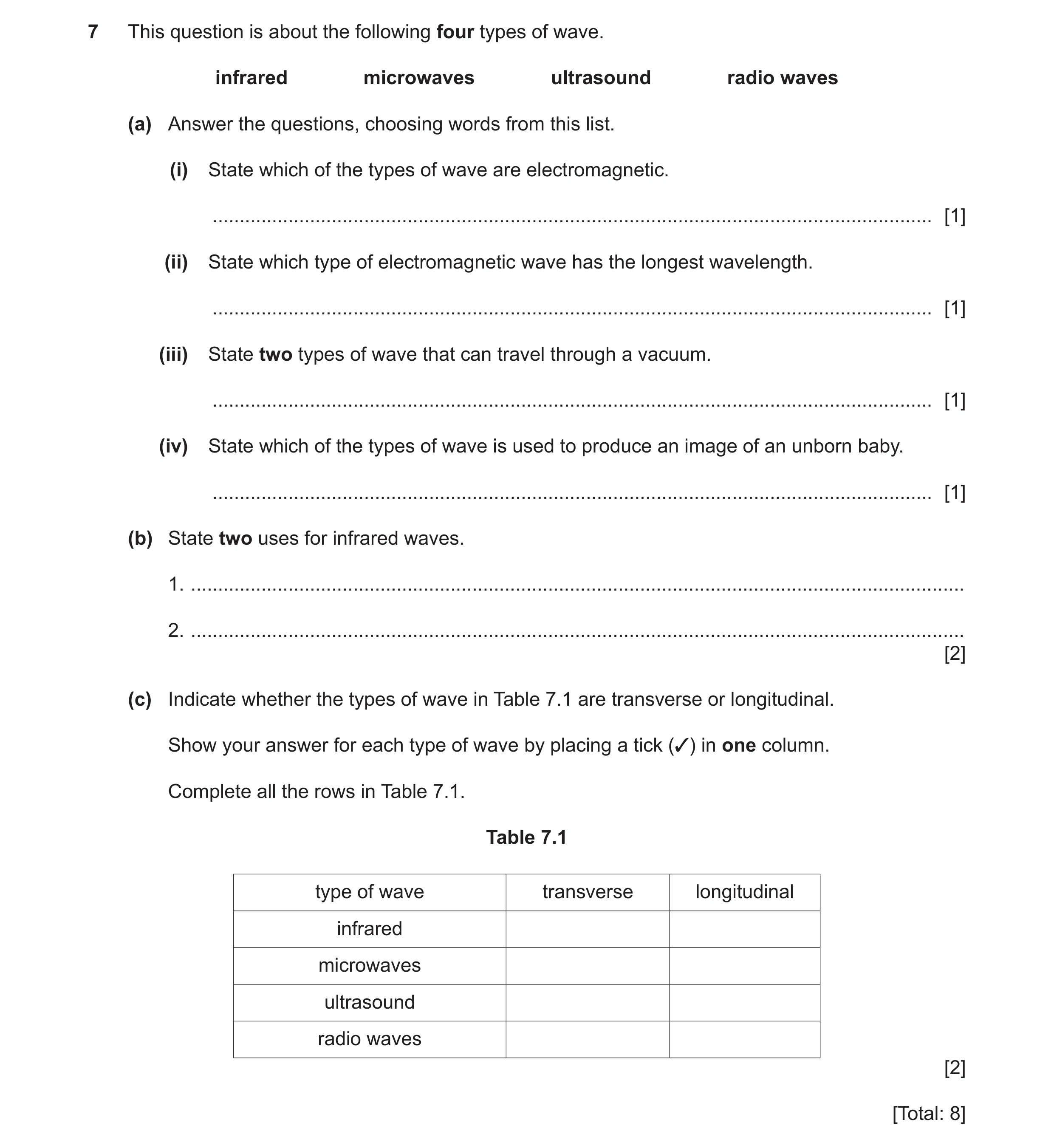
7 This question is about the following four types of wave. infrared microwaves ultrasound radio waves (a) Answer the questions, choosing words from this list. (i) State which of the types of wave are electromagnetic. … [1] (ii) State which type of electromagnetic wave has the longest wavelength. … [1] (iii) State two types of wave that can travel through a vacuum. … [1] (iv) State which of the types of wave is used to produce an image of an unborn baby. … [1] (b) State two uses for infrared waves. 1. … 2. … [2] (c) Indicate whether the types of wave in Table 7.1 are transverse or longitudinal. Show your answer for each type of wave by placing a tick (3) in one column. Complete all the rows in Table 7.1. Table 7.1 type of wave transverse longitudinal infrared microwaves ultrasound radio waves [2] [Total: 8]
8 marks
Mark scheme: 7(a)(i) infrared AND microwaves AND radio waves B1 7(a)(ii) radio waves B1 7(a)(iii) any two from: infrared microwaves radio waves B1 7(a)(iv) ultrasound B1 7(b) remote controls/heat lamps/heaters/thermal imaging/night vision/security cameras/heaters/grills/measuring blood B1 oxygen/pulse oximeters/measuring body temperature/thermal thermometer B1 Question Answer Marks 7(c) wave transverse longitudinal infrared microwaves ultrasound radio waves B2
This question in 0625/33 May/June 2022
Q26 · The diagram in Fig 0625/32 Oct/Nov 2022
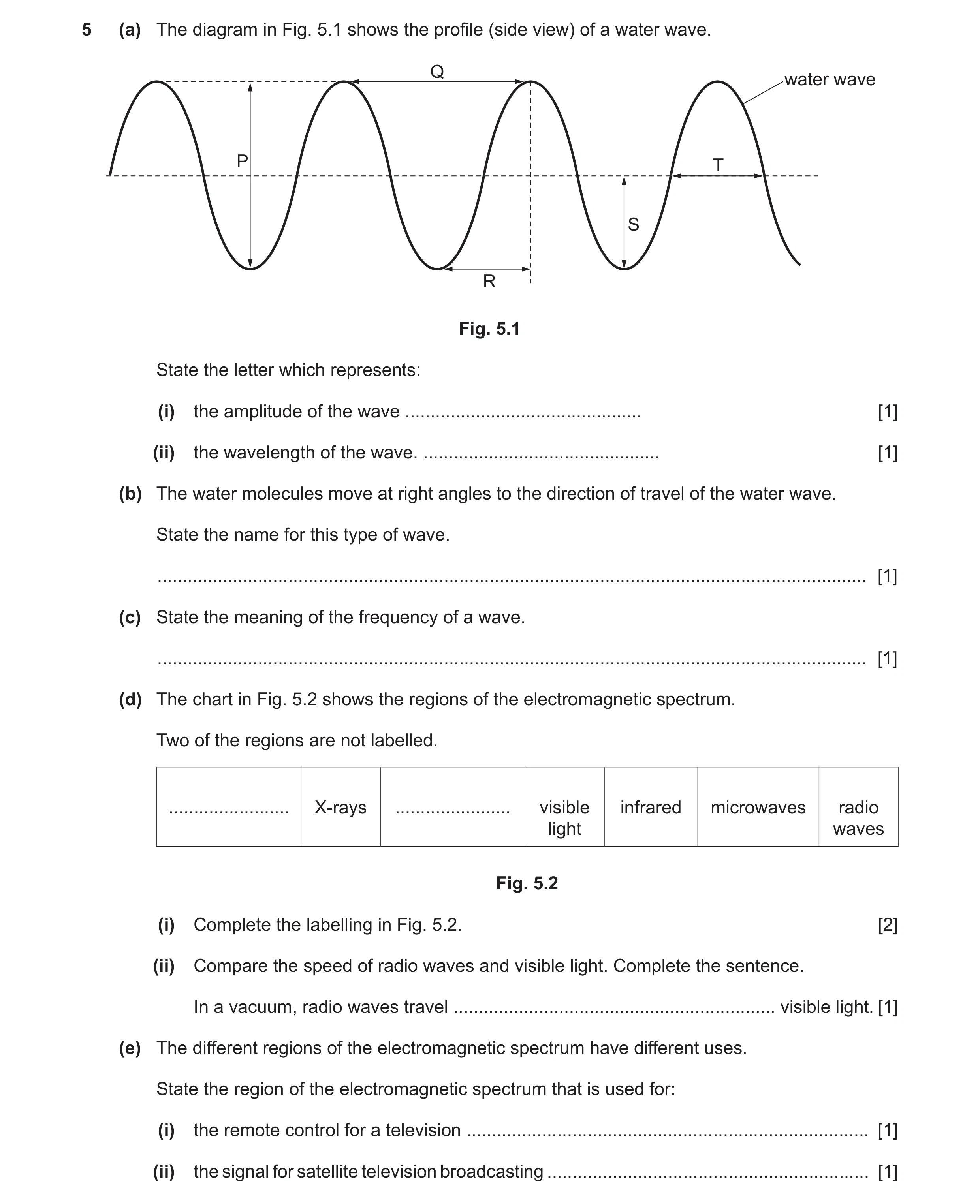
5 (a) The diagram in Fig. 5.1 shows the profile (side view) of a water wave. Q water wave P T S R Fig. 5.1 State the letter which represents: (i) the amplitude of the wave … [1] (ii) the wavelength of the wave. … [1] (b) The water molecules move at right angles to the direction of travel of the water wave. State the name for this type of wave. … [1] (c) State the meaning of the frequency of a wave. … [1] (d) The chart in Fig. 5.2 shows the regions of the electromagnetic spectrum. Two of the regions are not labelled. … X-rays … visible infrared microwaves radio light waves Fig. 5.2 (i) Complete the labelling in Fig. 5.2. [2] (ii) Compare the speed of radio waves and visible light. Complete the sentence. In a vacuum, radio waves travel … visible light. [1] (e) The different regions of the electromagnetic spectrum have different uses. State the region of the electromagnetic spectrum that is used for: (i) the remote control for a television … [1] (ii) the signal for satellite television broadcasting … [1]
9 marks
Mark scheme: 5(a)(i) S B1 5(a)(ii) Q B1 5(b) transverse B1 5(c) (number of) cycles / vibrations / waves per unit time / second B1 5(d)(i) gamma / (rays) on lhs B1 ultraviolet / uv (rays) between X rays and visible B1 5(d)(ii) the same (speed) B1 5(e)(i) infrared B1 5(e)(ii) microwaves B1
This question in 0625/32 Oct/Nov 2022
Q27 · A student shines a ray of red light towards a large glass prism, as shown in Fig 0625/33 Oct/Nov 2022
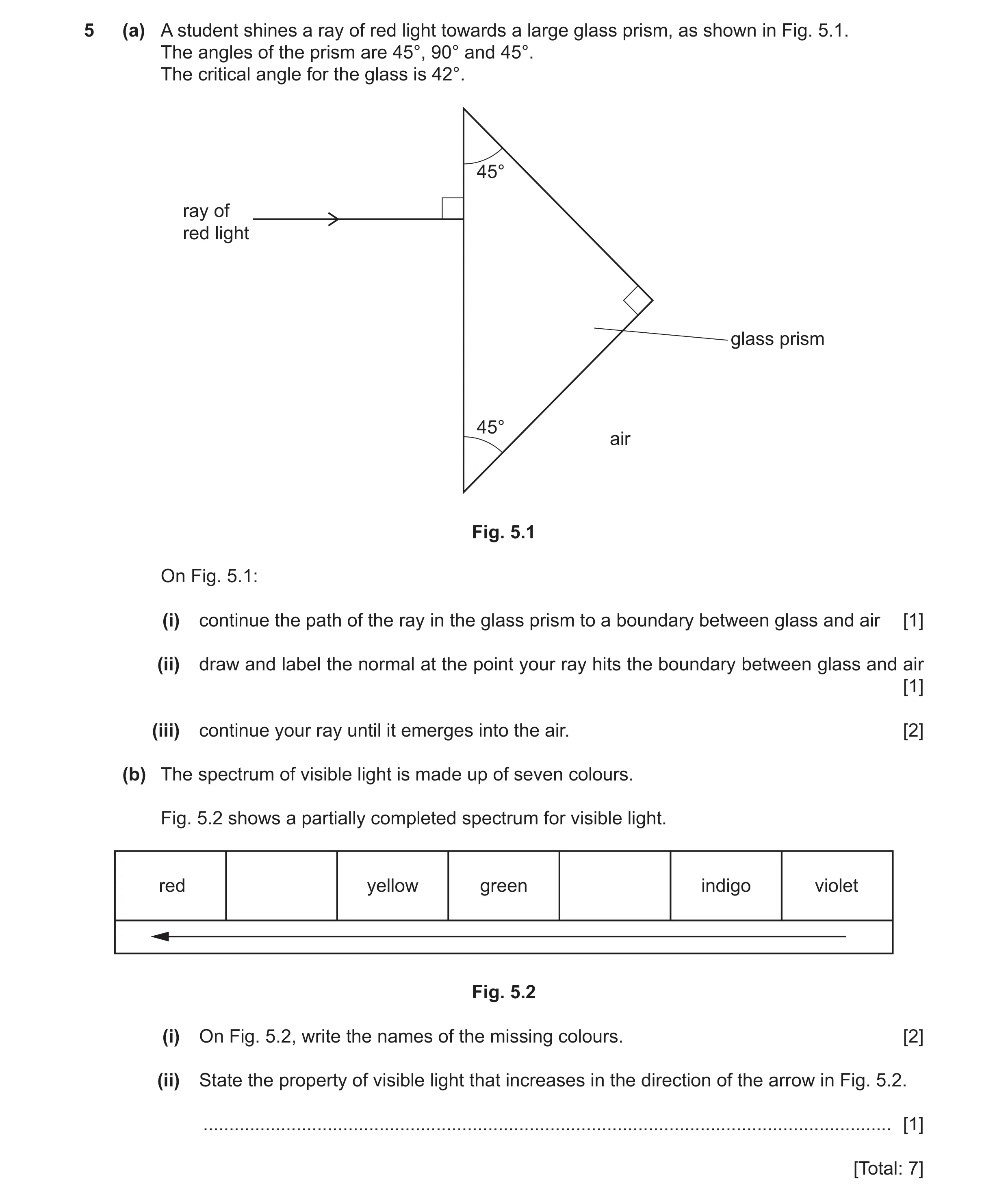
5 (a) A student shines a ray of red light towards a large glass prism, as shown in Fig. 5.1. The angles of the prism are 45°, 90° and 45°. The critical angle for the glass is 42°. 45° ray of red light glass prism 45° air Fig. 5.1 On Fig. 5.1: (i) continue the path of the ray in the glass prism to a boundary between glass and air [1] (ii) draw and label the normal at the point your ray hits the boundary between glass and air [1] (iii) continue your ray until it emerges into the air. [2] (b) The spectrum of visible light is made up of seven colours. Fig. 5.2 shows a partially completed spectrum for visible light. red yellow green indigo violet Fig. 5.2 (i) On Fig. 5.2, write the names of the missing colours. [2] (ii) State the property of visible light that increases in the direction of the arrow in Fig. 5.2. … [1] [Total: 7]
7 marks
Mark scheme: 5(a)(i) ray continues normally into glass B1 5(a)(ii) one correct normal seen B1 5(a)(iii) ray is totally internally reflected at a glass / air boundary B1 ray emerging from hypotenuse B1 5(b)(i) orange – between red and yellow B1 blue – between green and indigo B1 5(b)(ii) wavelength B1
This question in 0625/33 Oct/Nov 2022
Q28 · The security and waiting areas at an airport 0625/33 Oct/Nov 2022
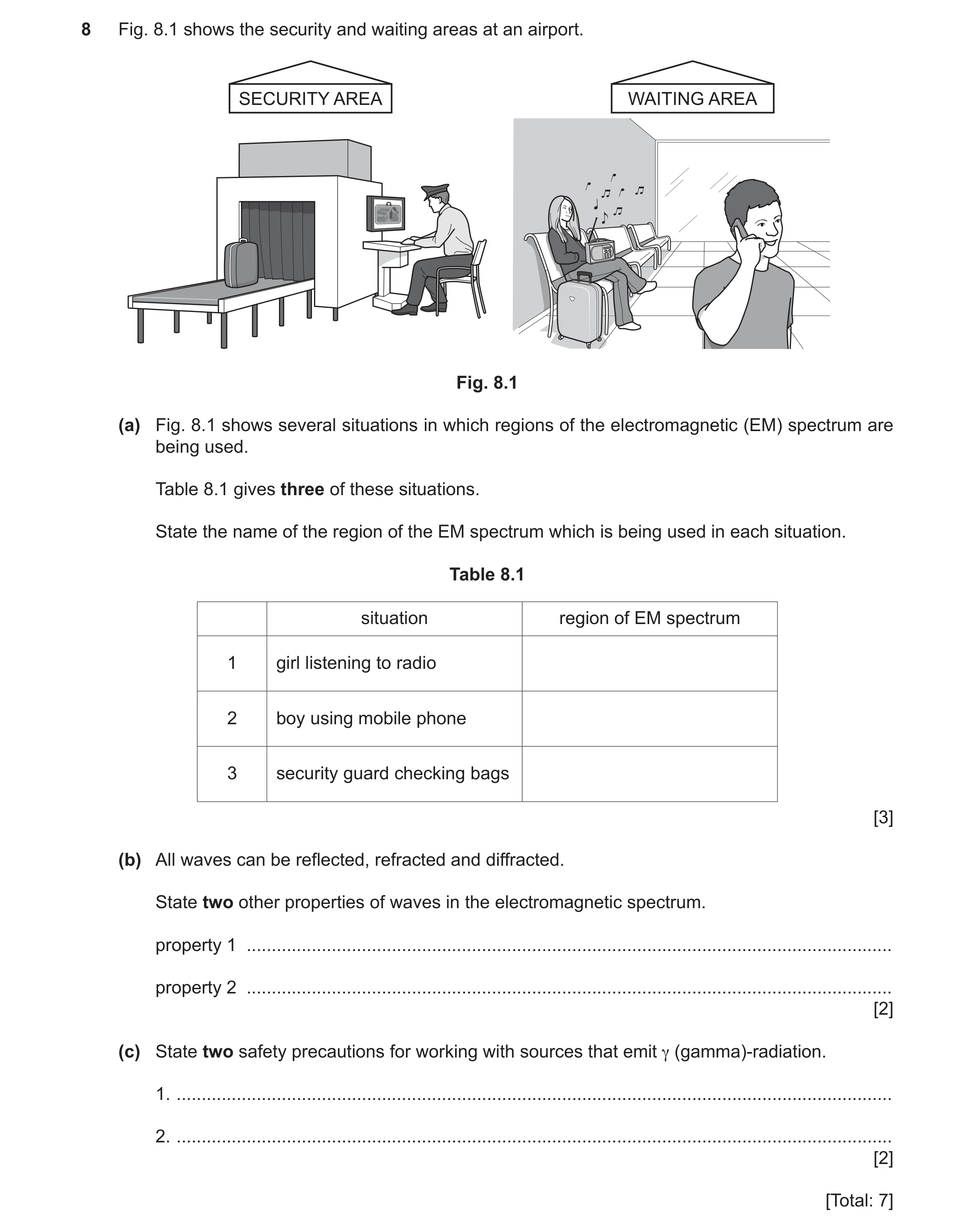
8 Fig. 8.1 shows the security and waiting areas at an airport. SECURITY AREA WAITING AREA Fig. 8.1 (a) Fig. 8.1 shows several situations in which regions of the electromagnetic (EM) spectrum are being used. Table 8.1 gives three of these situations. State the name of the region of the EM spectrum which is being used in each situation. Table 8.1 situation region of EM spectrum 1 girl listening to radio 2 boy using mobile phone 3 security guard checking bags [3] (b) All waves can be reflected, refracted and diffracted. State two other properties of waves in the electromagnetic spectrum. property 1 … property 2 … [2] (c) State two safety precautions for working with sources that emit γ (gamma)-radiation. 1. … 2. … [2] [Total: 7]
7 marks
Mark scheme: 8(a) radio waves B1 microwaves B1 X-rays OR (visible) light B1 8(b) any two from the following: B2 travel through a vacuum travel at same speed / 3 108 (m / s) transverse 8(c) any two from the following: B2 limit exposure time use tongs / distance / remote working lead shield / gloves / apron wear dosimeter owtte
This question in 0625/33 Oct/Nov 2022
Q29 · A student places a book in front of a plane mirror 0625/32 Feb/March 2023
7 (a) A student places a book in front of a plane mirror. State three characteristics of the image of the book formed by the plane mirror. 1 … 2 … 3 … [3] (b) Visible light is one region of the electromagnetic spectrum. Another region is ultraviolet radiation. (i) Give one use of ultraviolet radiation. … [1] (ii) Give one possible harmful effect of excessive exposure to ultraviolet radiation. … [1] [Total: 5]
5 marks
Mark scheme: 7(a) same size (as object / book) B1 same distance from mirror (as book / object) B1 virtual B1 7(b) (use:) security marking OR detecting fake bank notes OR sterilising water B1 (harmful effect:) damage to surface cells / skin OR eyes OR damage to cells / genes / DNA OR skin cancer B1
This question in 0625/32 Feb/March 2023
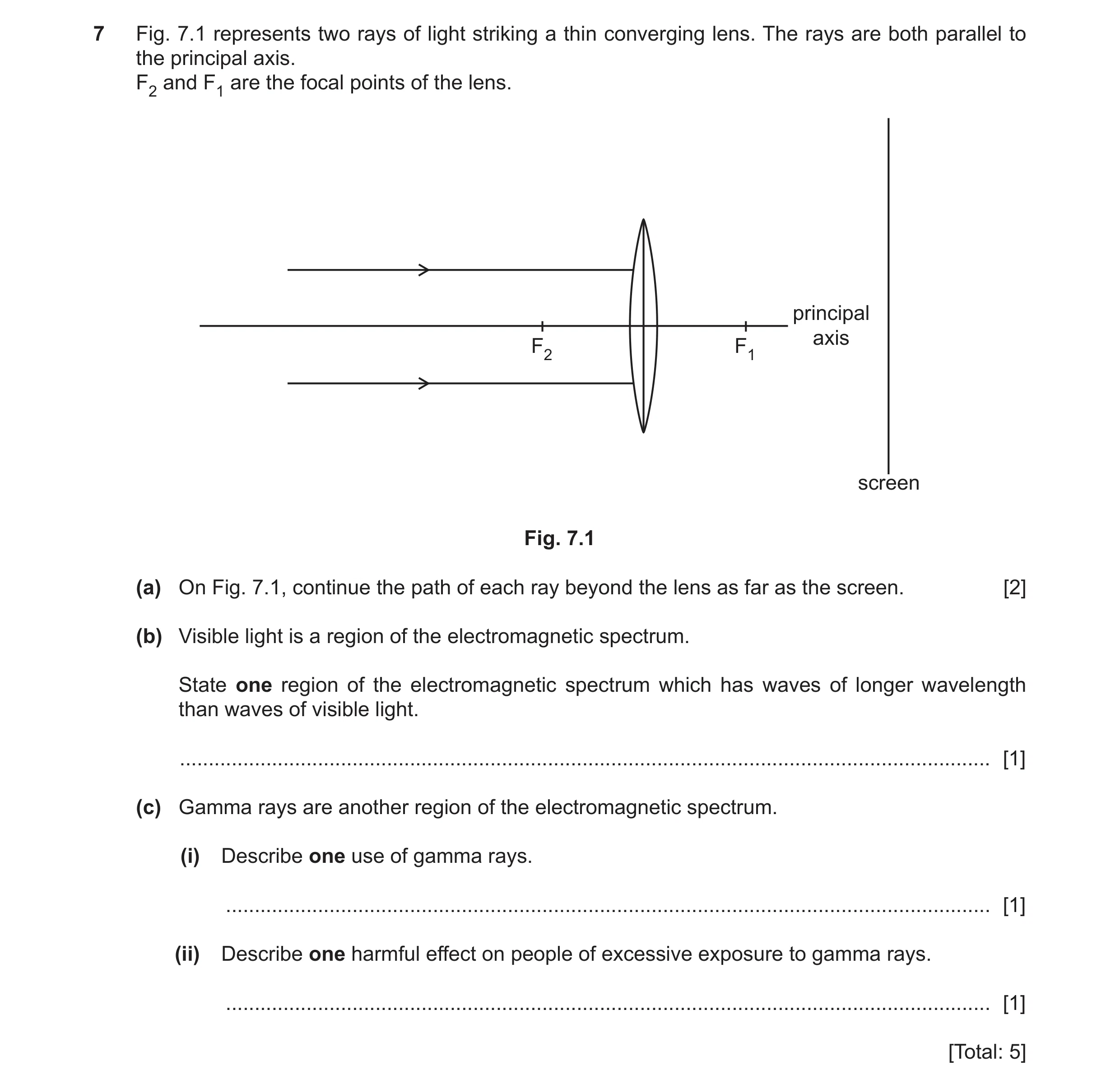
Q30 · Two rays of light striking a thin converging lens 0625/31 May/June 2023
7 Fig. 7.1 represents two rays of light striking a thin converging lens. The rays are both parallel to the principal axis. F2 and F1 are the focal points of the lens. principal axis F2 F1 screen Fig. 7.1 (a) On Fig. 7.1, continue the path of each ray beyond the lens as far as the screen. [2] (b) Visible light is a region of the electromagnetic spectrum. State one region of the electromagnetic spectrum which has waves of longer wavelength than waves of visible light. … [1] (c) Gamma rays are another region of the electromagnetic spectrum. (i) Describe one use of gamma rays. … [1] (ii) Describe one harmful effect on people of excessive exposure to gamma rays. … [1] [Total: 5]
5 marks
Mark scheme: 7(a) both rays refracted toward principal axis B1 both rays meet at F1 B1 7(b) infrared (rays / waves) OR microwaves OR radio (waves) B1 7(c)(i) any one from: sterilising food / water sterilising (medical) equipment detection of cancer treatment of cancer space telescopes B1 7(c)(ii) mutation (of cells / DNA) OR damage to cells / DNA B1
This question in 0625/31 May/June 2023
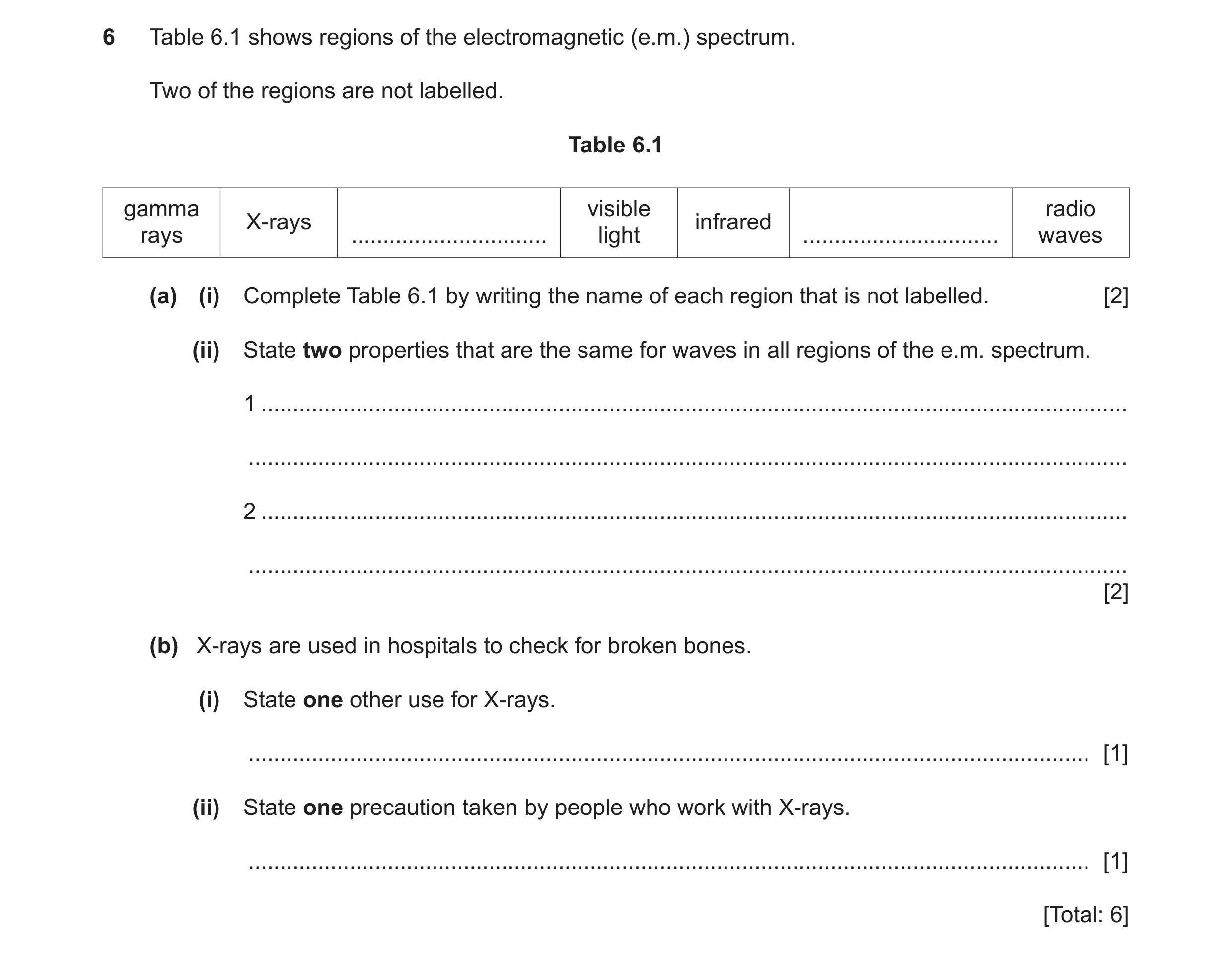
Q31 · Regions of the electromagnetic (e.m.) spectrum 0625/33 May/June 2023
6 Table 6.1 shows regions of the electromagnetic (e.m.) spectrum. Two of the regions are not labelled. Table 6.1 gamma visible radio X-rays infrared rays … light … waves (a) (i) Complete Table 6.1 by writing the name of each region that is not labelled. [2] (ii) State two properties that are the same for waves in all regions of the e.m. spectrum. 1 … … 2 … … [2] (b) X-rays are used in hospitals to check for broken bones. (i) State one other use for X-rays. … [1] (ii) State one precaution taken by people who work with X-rays. … [1] [Total: 6]
6 marks
Mark scheme: 6(a)(i) ultraviolet / UV (in LH space) B1 microwaves (in RH space) B1 6(a)(ii) any two from: transverse wave do not need a medium / travel through a vacuum (travel) the same speed / 3 108 m / s (in vacuum / air) B2 6(b)(i) security scanners / kill cancer cells / shrink tumours / detecting art fraud B1 6(b)(ii) limited exposure owtte / shield using screen / lead apron / increase distance from source owtte B1
This question in 0625/33 May/June 2023
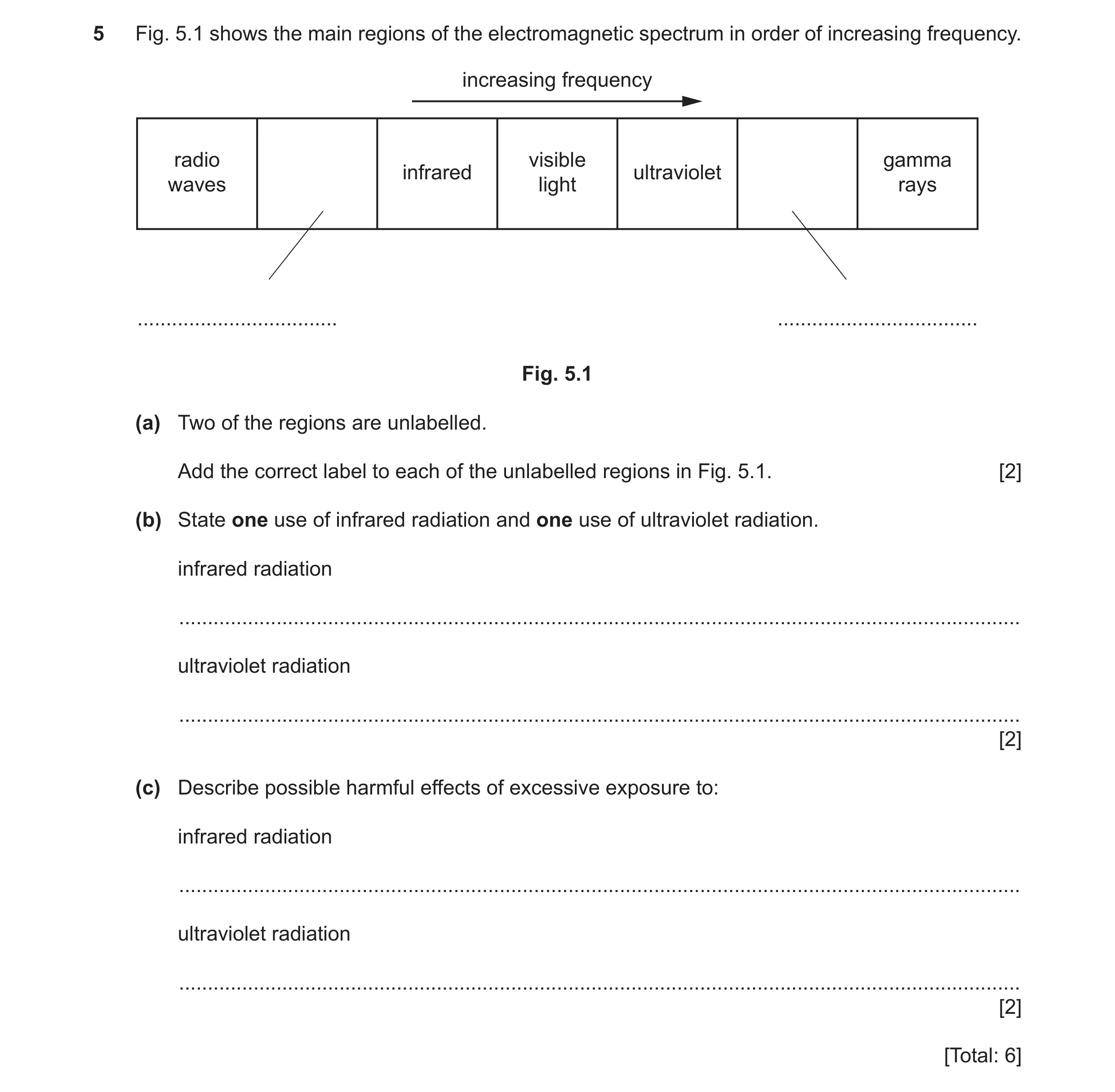
Q32 · The main regions of the electromagnetic spectrum in order of increasing frequency 0625/31 Oct/Nov 2023
5 Fig. 5.1 shows the main regions of the electromagnetic spectrum in order of increasing frequency. increasing frequency radio visible gamma infrared ultraviolet waves light rays … … Fig. 5.1 (a) Two of the regions are unlabelled. Add the correct label to each of the unlabelled regions in Fig. 5.1. [2] (b) State one use of infrared radiation and one use of ultraviolet radiation. infrared radiation … ultraviolet radiation … [2] (c) Describe possible harmful effects of excessive exposure to: infrared radiation … ultraviolet radiation … [2] [Total: 6]
6 marks
Mark scheme: 5(a) microwaves (after radio waves) B1 X-rays (after ultraviolet) B1 5(b) (use of infrared) any one from: electric grills, short range communications such as remote controllers for televisions, B1 intruder alarms, thermal imaging, optical fibres, (heating) solar panels (use of ultraviolet) any one from: security marking, detecting fake bank notes, sterilising water / food B1 5(c) (infrared can cause) (skin) burns B1 (ultraviolet can cause) damage to (surface / skin) cells / eyes OR skin cancer OR can cause eye conditions e.g. cataracts B1
This question in 0625/31 Oct/Nov 2023
Q33 · Regions of the electromagnetic spectrum in order of increasing wavelength 0625/33 Oct/Nov 2023
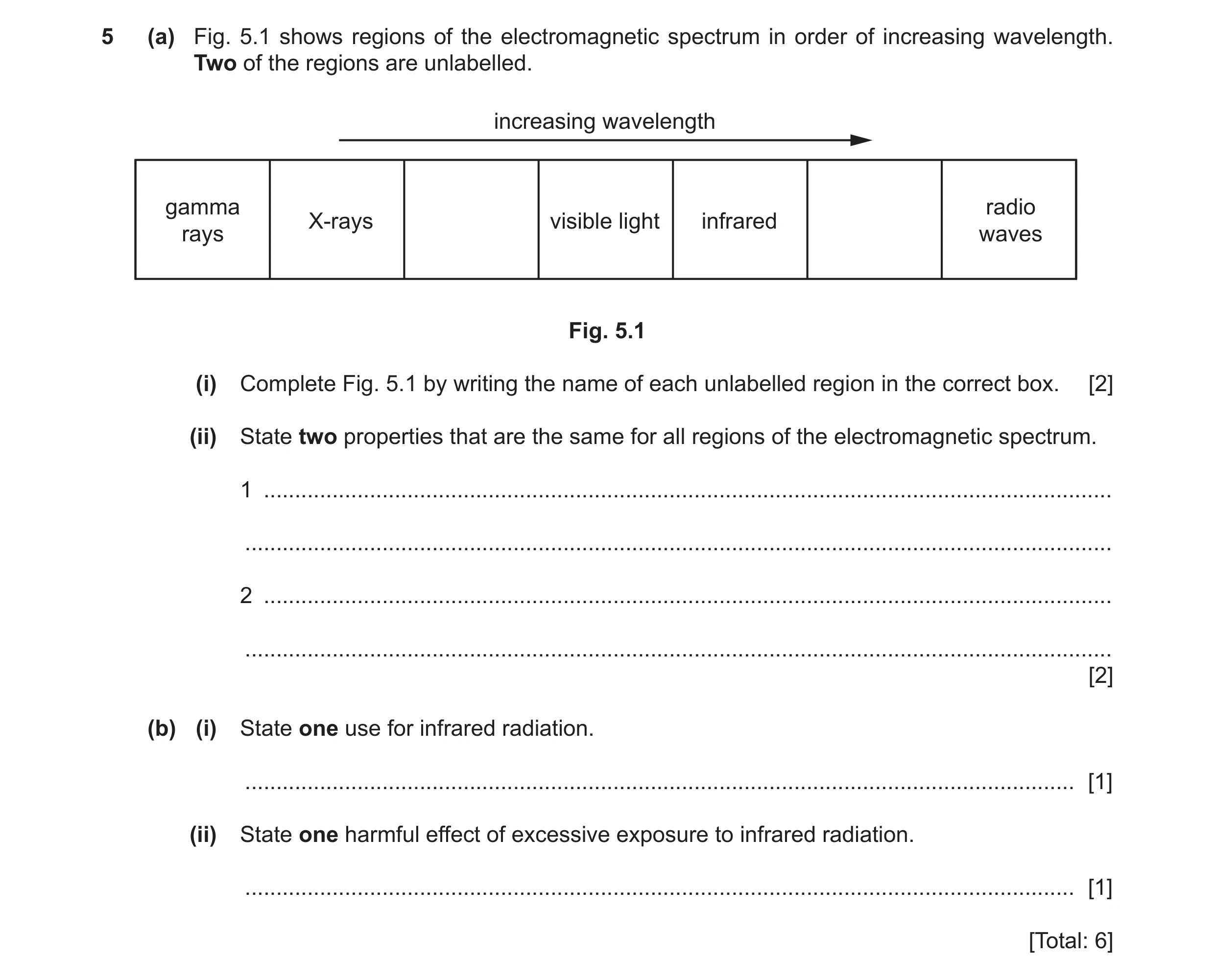
5 (a) Fig. 5.1 shows regions of the electromagnetic spectrum in order of increasing wavelength. Two of the regions are unlabelled. increasing wavelength gamma radio X-rays visible light infrared rays waves Fig. 5.1 (i) Complete Fig. 5.1 by writing the name of each unlabelled region in the correct box. [2] (ii) State two properties that are the same for all regions of the electromagnetic spectrum. 1 … … 2 … … [2] (b) (i) State one use for infrared radiation. … [1] (ii) State one harmful effect of excessive exposure to infrared radiation. … [1] [Total: 6]
6 marks
Mark scheme: 5(a)(i) ultraviolet in LH box B1 microwaves in RH box B1 5(a)(ii) any two from: B2 transverse do not need a medium OR travel through a vacuum (all have) same speed OR travel at 3 108 m / s (in a vacuum) 5(b)(i) electric grills / remote controllers (for televisions) / intruder alarms / thermal imaging / optical fibres / thermometers / treatment B1 of damaged muscles 5(b)(ii) (skin) burns B1
This question in 0625/33 Oct/Nov 2023
Q34 · The Earth in orbit around the Sun 0625/33 Oct/Nov 2023
11 Fig. 11.1 represents the Earth in orbit around the Sun. the Earth the Sun 1.5 × 10¹¹ m Fig. 11.1 (not to scale) (a) (i) State the name of the force that keeps the Earth in orbit around the Sun. … [1] (ii) State the time taken by the Earth to complete one orbit of the Sun. Include the unit. time for one orbit = … [1] (iii) State the time taken by the Earth to rotate once on its axis. Include the unit. time for one rotation = … [1] (iv) The Sun consists mainly of two gases. State the names of the two gases. … and … [2] Question continued on next side (b) (i) Most of the radiation from the Sun consists of visible light and two other regions of the electromagnetic spectrum. State the name of one of the other two regions. … [1] (ii) The speed of visible light is 3.0 × 10⁸ m / s. Calculate the time taken for visible light to travel from the Sun to the Earth when the Earth is in the position shown in Fig. 11.1. time taken = … s [3] [Total: 9]
9 marks
Mark scheme: 11(a)(i) gravitational (attraction) B1 11(a)(ii) 365 (¼) days B1 11(a)(iii) 24 hours B1 11(a)(iv) helium B1 hydrogen B1 11(b)(i) infrared OR ultraviolet B1 11(b)(ii) 500 (s) A3 1.5 1011 / 3.0 108 (C2) (time =) distance / speed (C1)
This question in 0625/33 Oct/Nov 2023
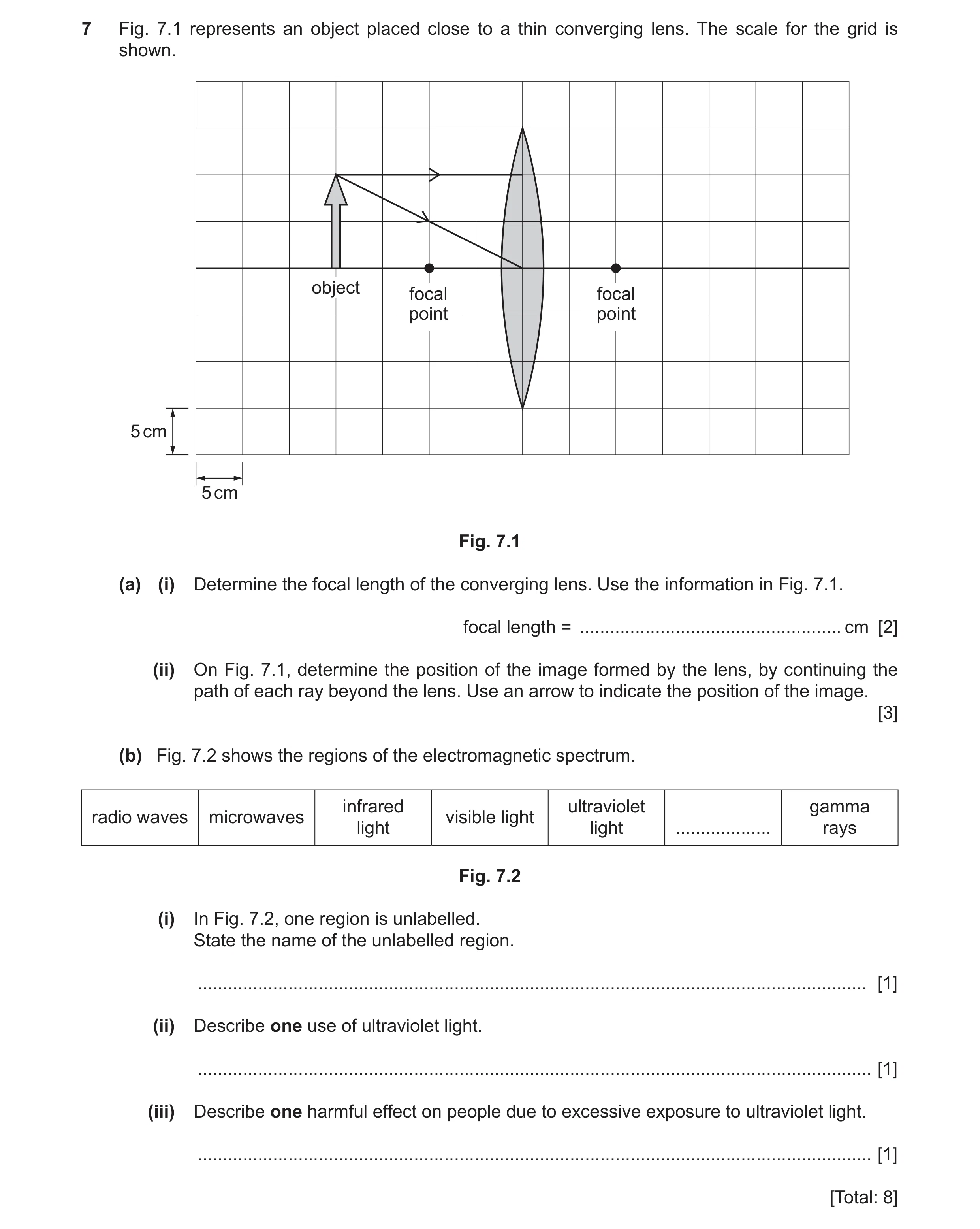
Q35 · An object placed close to a thin converging lens 0625/32 Feb/March 2024
7 Fig. 7.1 represents an object placed close to a thin converging lens. The scale for the grid is shown. object focal focal point point 5 cm 5 cm Fig. 7.1 (a) (i) Determine the focal length of the converging lens. Use the information in Fig. 7.1. focal length = … cm [2] (ii) On Fig. 7.1, determine the position of the image formed by the lens, by continuing the path of each ray beyond the lens. Use an arrow to indicate the position of the image. [3] (b) Fig. 7.2 shows the regions of the electromagnetic spectrum. infrared ultraviolet gamma radio waves microwaves visible light light light … rays Fig. 7.2 (i) In Fig. 7.2, one region is unlabelled. State the name of the unlabelled region. … [1] (ii) Describe one use of ultraviolet light. … [1] (iii) Describe one harmful effect on people due to excessive exposure to ultraviolet light. … [1] [Total: 8]
8 marks
Mark scheme: 7(a)(i) 10 (cm) A2 (focal length =) 2 5 (C1) 7(a)(ii) ray continued in straight line through centre of lens B1 ray parallel to axis continued to pass through focal point B1 (top of) image position indicated as where rays cross B1 7(b)(i) X-rays B1 7(b)(ii) security marker OR detecting fake bank notes OR sterilising food / water B1 7(b)(iii) damage to (surface) cells / skin / eyes B1 OR (leading to) cancer / eye conditions
This question in 0625/32 Feb/March 2024
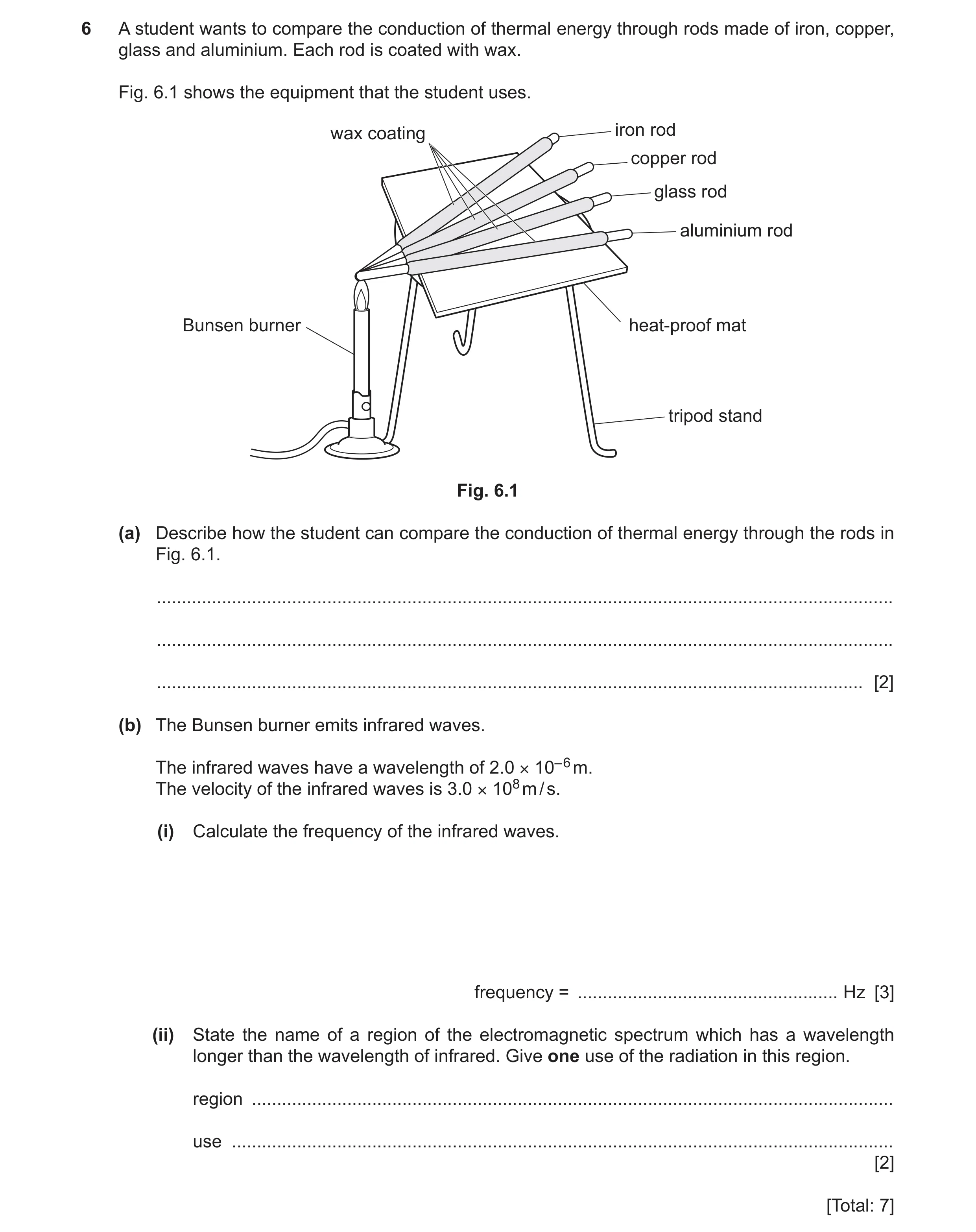
Q36 · A student wants to compare the conduction of thermal energy through rods made of iron… 0625/31 May/June 2024
6 A student wants to compare the conduction of thermal energy through rods made of iron, copper, glass and aluminium. Each rod is coated with wax. Fig. 6.1 shows the equipment that the student uses. wax coating iron rod copper rod glass rod aluminium rod Bunsen burner heat-proof mat tripod stand Fig. 6.1 (a) Describe how the student can compare the conduction of thermal energy through the rods in Fig. 6.1. … … … [2] (b) The Bunsen burner emits infrared waves. The infrared waves have a wavelength of 2.0 × 10– 6 m. The velocity of the infrared waves is 3.0 × 10⁸ m / s. (i) Calculate the frequency of the infrared waves. frequency = … Hz [3] (ii) State the name of a region of the electromagnetic spectrum which has a wavelength longer than the wavelength of infrared. Give one use of the radiation in this region. region … use … [2] [Total: 7]
7 marks
Mark scheme: 6(a) idea of measure / read / note / compare how much wax melts (along each rod) OR how quickly the wax melts B1 idea of: the better the conductor the shorter the length of unmelted wax (remaining) OR the better the conductor the further the wax melts (along rod) OR the better the conductor the shorter the time for the wax to melt B1 6(b)(i) (frequency =) 1.5 1014 (Hz) A3 (frequency =) 3(.0) 108 ÷ 2(.0) 10–6 (C2) velocity = frequency wavelength (C1) 6(b)(ii) (region) microwaves OR radio waves B1 valid use that is consistent with radiation in stated region B1
This question in 0625/31 May/June 2024
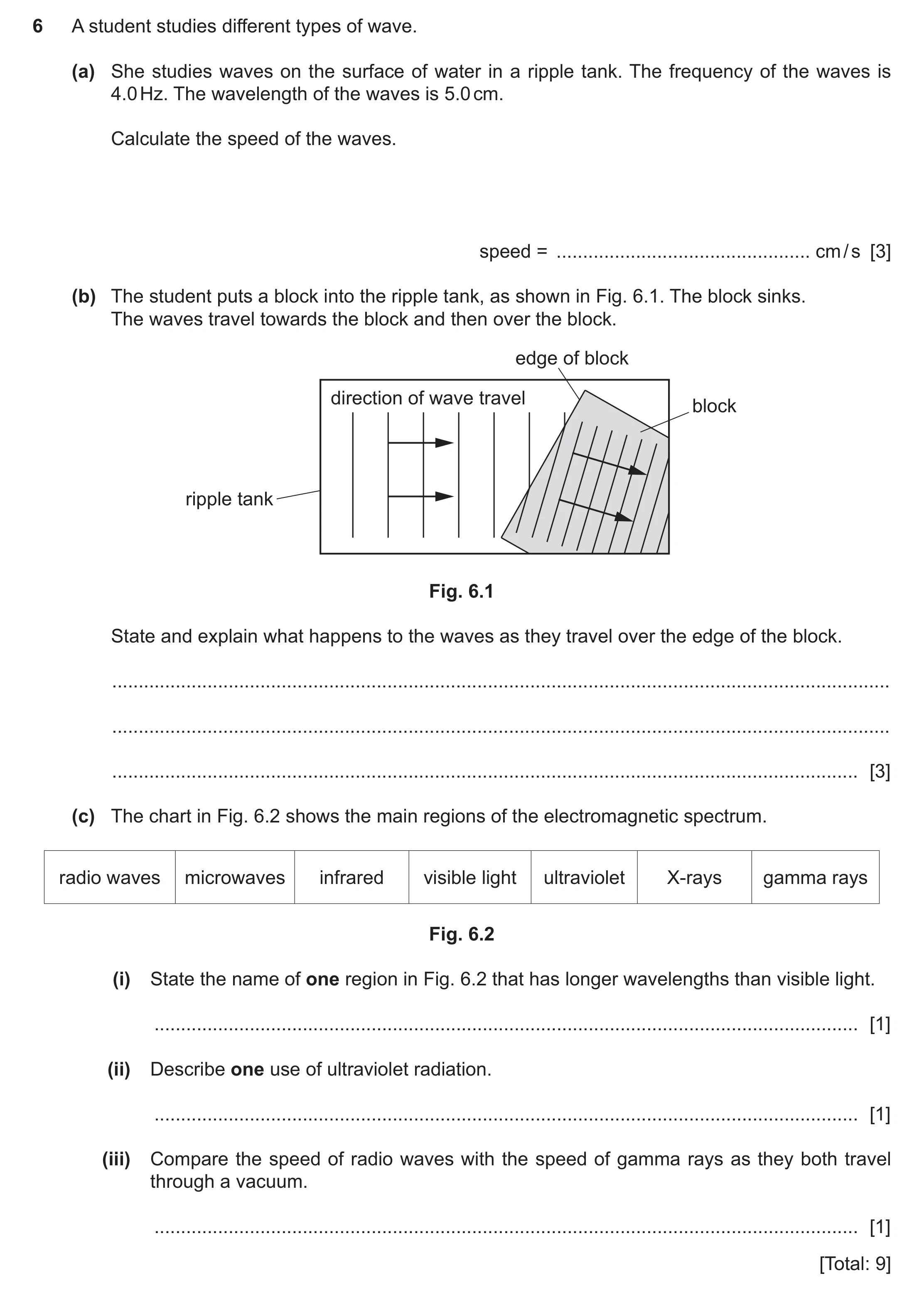
Q37 · A student studies different types of wave 0625/32 May/June 2024
6 A student studies different types of wave. (a) She studies waves on the surface of water in a ripple tank. The frequency of the waves is 4.0 Hz. The wavelength of the waves is 5.0 cm. Calculate the speed of the waves. speed = … cm / s [3] (b) The student puts a block into the ripple tank, as shown in Fig. 6.1. The block sinks. The waves travel towards the block and then over the block. edge of block direction of wave travel block ripple tank Fig. 6.1 State and explain what happens to the waves as they travel over the edge of the block. … … … [3] (c) The chart in Fig. 6.2 shows the main regions of the electromagnetic spectrum. radio waves microwaves infrared visible light ultraviolet X-rays gamma rays Fig. 6.2 (i) State the name of one region in Fig. 6.2 that has longer wavelengths than visible light. … [1] (ii) Describe one use of ultraviolet radiation. … [1] (iii) Compare the speed of radio waves with the speed of gamma rays as they both travel through a vacuum. … [1] [Total: 9]
9 marks
Mark scheme: 6(a) (v =) 20 (cm / s) A3 (v =) 4(.0) 5(.0) (C2) (v =) f (C1) 6(b) any three from: refraction direction of waves / wavefronts changes (due to) change in speed wavelength changes as depth of water changes B3 6(c)(i) radio waves OR microwaves OR infrared B1 6(c)(ii) security marking OR detecting forged bank notes OR sterilising food / water B1 6(c)(iii) (both have) same speed owtte B1
This question in 0625/32 May/June 2024
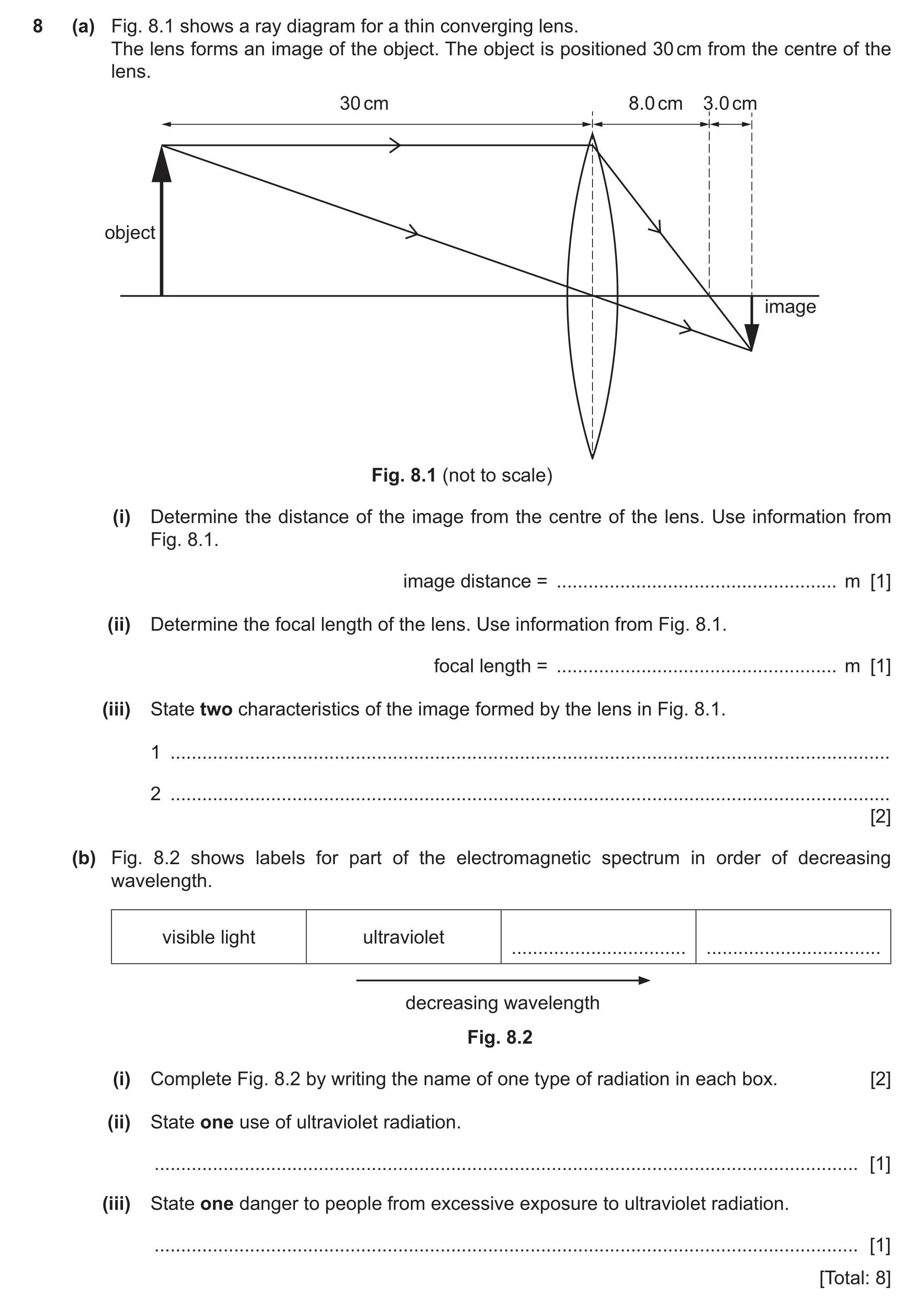
Q38 · A ray diagram for a thin converging lens 0625/31 Oct/Nov 2024
8 (a) Fig. 8.1 shows a ray diagram for a thin converging lens. The lens forms an image of the object. The object is positioned 30 cm from the centre of the lens. 30 cm 8.0 cm 3.0 cm object image Fig. 8.1 (not to scale) (i) Determine the distance of the image from the centre of the lens. Use information from Fig. 8.1. image distance = … m [1] (ii) Determine the focal length of the lens. Use information from Fig. 8.1. focal length = … m [1] (iii) State two characteristics of the image formed by the lens in Fig. 8.1. 1 … 2 … [2] (b) Fig. 8.2 shows labels for part of the electromagnetic spectrum in order of decreasing wavelength. visible light ultraviolet … … decreasing wavelength Fig. 8.2 (i) Complete Fig. 8.2 by writing the name of one type of radiation in each box. [2] (ii) State one use of ultraviolet radiation. … [1] (iii) State one danger to people from excessive exposure to ultraviolet radiation. … [1] [Total: 8]
8 marks
Mark scheme: 8(a)(i) 0.11 (m) B1 8(a)(ii) 0.08 (m) B1 8(a)(iii) any two from: B2 • diminished OR smaller • inverted OR upside down • real 8(b)(i) X (–rays) (box on left) B1 gamma (rays / radiation) (box on right) B1 8(b)(ii) security marker OR detecting fake bank notes OR sterilising (medical instruments / water / food) B1 8(b)(iii) damage to skin OR (surface) cells OR eyes B1
This question in 0625/31 Oct/Nov 2024
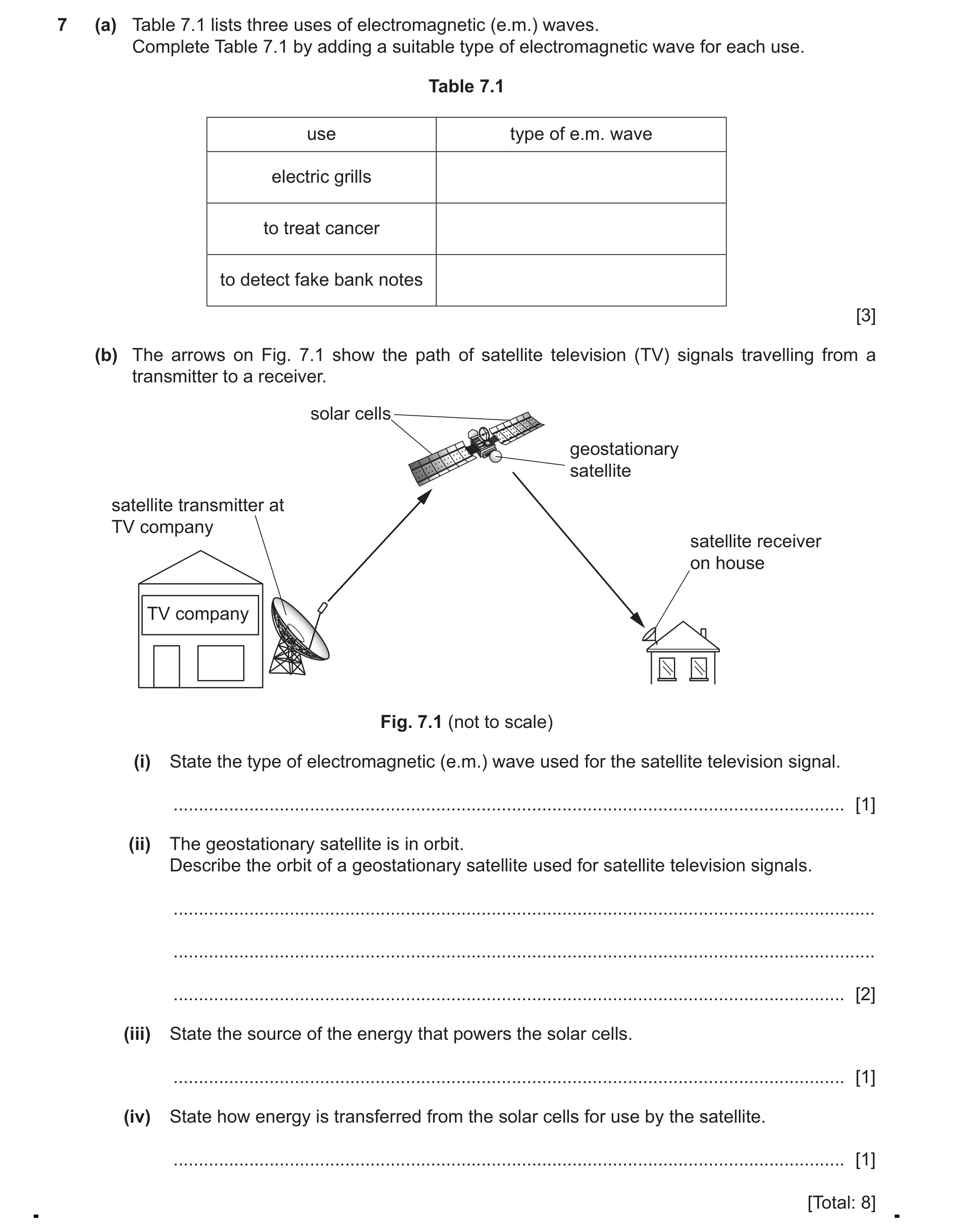
Q39 · Table 7.1 lists three uses of electromagnetic (e.m.) waves 0625/33 Oct/Nov 2024
7 (a) Table 7.1 lists three uses of electromagnetic (e.m.) waves. Complete Table 7.1 by adding a suitable type of electromagnetic wave for each use. Table 7.1 use type of e.m. wave electric grills to treat cancer to detect fake bank notes [3] (b) The arrows on Fig. 7.1 show the path of satellite television (TV) signals travelling from a transmitter to a receiver. solar cells geostationary satellite satellite transmitter at TV company satellite receiver on house TV company Fig. 7.1 (not to scale) (i) State the type of electromagnetic (e.m.) wave used for the satellite television signal. … [1] (ii) The geostationary satellite is in orbit. Describe the orbit of a geostationary satellite used for satellite television signals. … … … [2] (iii) State the source of the energy that powers the solar cells. … [1] (iv) State how energy is transferred from the solar cells for use by the satellite. … [1] [Total: 8]
8 marks
Mark scheme: 7(a) use type of e.m. wave B1 used in electric grills infrared B1 used to kill cancerous cells also cause cancer gamma / (rays) OR X–rays used to detect fake bank notes ultraviolet B1 7(b)(i) microwaves B1 7(b)(ii) orbits the earth B1 appears to remain in the same place above the earth B1 7(b)(iii) light or Sun B1 7(b)(iv) electrical current B1
This question in 0625/33 Oct/Nov 2024
Q40 · A ray of red light entering one side of a glass block 0625/32 Feb/March 2025
7 (a) Fig. 7.1 represents a ray of red light entering one side of a glass block. glass block air air ray of red light Fig. 7.1 On Fig. 7.1 draw the path of the ray of red light through the glass block and into the air. [2] (b) Fig. 7.2 represents the dispersion of white light by a glass prism. air air white light red light violet light glass prism Fig. 7.2 Two of the colours of the visible spectrum are shown in Fig. 7.2. State the other five colours of the visible spectrum in the correct order. red … … … … … violet [1] (c) Fig. 7.3 represents the regions of the electromagnetic spectrum. infrared gamma radio waves microwaves visible light X-rays waves rays Fig. 7.3 (i) In Fig. 7.3, one region is unlabelled. State the name of the unlabelled region. … [1] (ii) Describe one use of gamma rays. … [1] (iii) Describe one harmful effect on people of excessive exposure to gamma rays. … [1] [Total: 6]
6 marks
Mark scheme: 7(a) ray refracted toward normal as it enters glass (by eye) B1 ray refracted away from normal on leaving glass (by eye) B1 OR emergent ray parallel with incident ray (by eye) 7(b) orange B1 yellow green blue indigo 7(c)(i) ultraviolet (rays / light) B1 7(c)(ii) detecting / treating cancer OR sterilising food / medical equipment B1 OR (medical) imaging OR detecting leaks in (underground) pipes 7(c)(iii) mutation or damage to cells / organs / DNA OR cancer B1
This question in 0625/32 Feb/March 2025
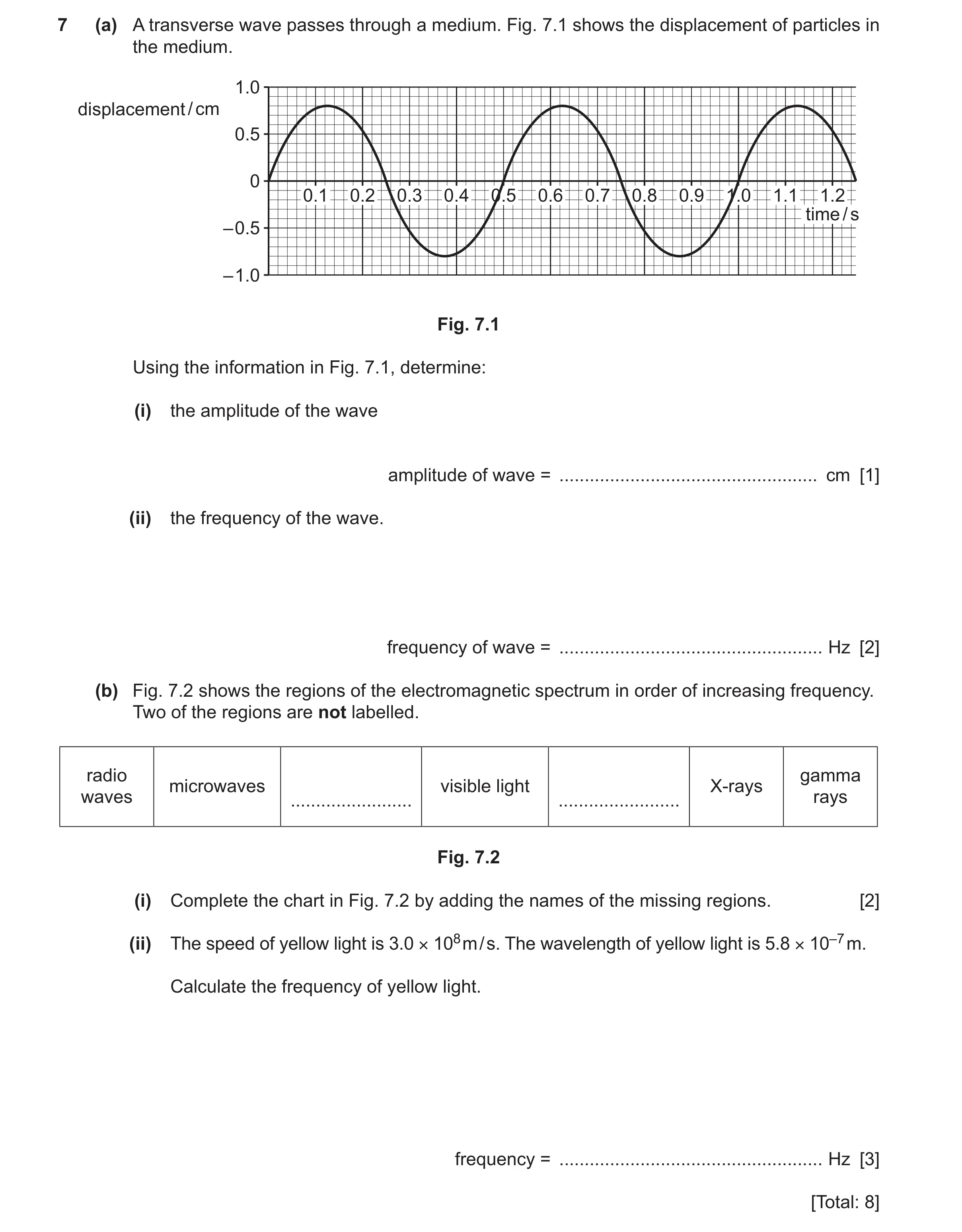
Q41 · A transverse wave passes through a medium 0625/31 May/June 2025
7 (a) A transverse wave passes through a medium. Fig. 7.1 shows the displacement of particles in the medium. 1.0 displacement / cm 0.5 0 0.1 0.2 0.3 0.4 0.5 0.6 0.7 0.8 0.9 1.0 1.1 1.2 time / s – 0.5 – 1.0 Fig. 7.1 Using the information in Fig. 7.1, determine: (i) the amplitude of the wave amplitude of wave = … cm [1] (ii) the frequency of the wave. frequency of wave = … Hz [2] (b) Fig. 7.2 shows the regions of the electromagnetic spectrum in order of increasing frequency. Two of the regions are not labelled. radio gamma microwaves visible light X-rays waves … … rays Fig. 7.2 (i) Complete the chart in Fig. 7.2 by adding the names of the missing regions. [2] (ii) The speed of yellow light is 3.0 × 10⁸ m / s. The wavelength of yellow light is 5.8 × 10⁻⁷ m. Calculate the frequency of yellow light. frequency = … Hz [3] [Total: 8]
8 marks
Mark scheme: 7(a)(i) 0.8 (cm) B1 7(a)(ii) (frequency =) 2(.0) (Hz) A2 idea that frequency is number of waves (sent out) in one second C1 7(b)(i) infrared (waves) (in left box) B1 ultraviolet (light / waves) (in right box) B1 7(b)(ii) 5.2 1014 (Hz) A3 3.0 108 = f 5.8 10−7 OR (f =) 3.0 10N ÷ 5.8 10N C2 v = fin any form OR (f =) v ÷ C1
This question in 0625/31 May/June 2025
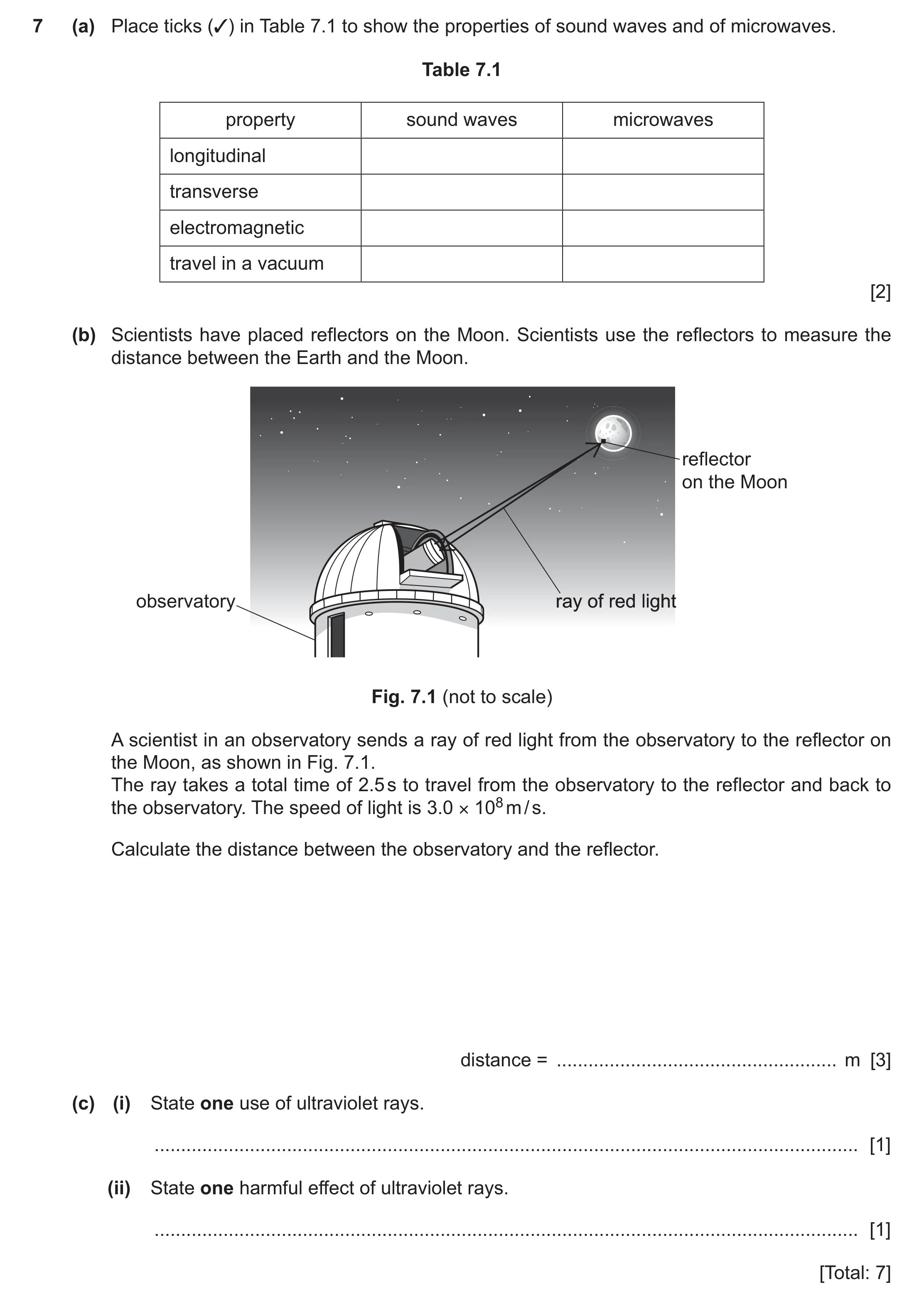
Q42 · Place ticks (✓) in Table 7.1 to show the properties of sound waves and of microwaves 0625/32 May/June 2025
7 (a) Place ticks (✓) in Table 7.1 to show the properties of sound waves and of microwaves. Table 7.1 property sound waves microwaves longitudinal transverse electromagnetic travel in a vacuum [2] (b) Scientists have placed reflectors on the Moon. Scientists use the reflectors to measure the distance between the Earth and the Moon. reflector on the Moon observatory rayray ofof redred lightlight Fig. 7.1 (not to scale) A scientist in an observatory sends a ray of red light from the observatory to the reflector on the Moon, as shown in Fig. 7.1. The ray takes a total time of 2.5 s to travel from the observatory to the reflector and back to the observatory. The speed of light is 3.0 × 10⁸ m / s. Calculate the distance between the observatory and the reflector. distance = … m [3] (c) (i) State one use of ultraviolet rays. … [1] (ii) State one harmful effect of ultraviolet rays. … [1] [Total: 7]
7 marks
Mark scheme: 7(a) B2 property sound waves microwaves longitudinal ✓ transverse ✓ electromagnetic ✓ travel in a vacuum ✓ 4 correct – 2 marks 2 or 3 correct – 1 mark 7(b) 3.8 108 (m) A3 3(.0) 108 1.25 OR 3(.0) 108 (2.5 ÷ 2) OR 7.5 108 C2 (distance =) speed time C1 7(c)(i) security marking OR detecting fake bank notes OR sterilising water OR fluorescent effects B1 7(c)(ii) damage to surface cells / skin / eyes OR damage to genes / DNA OR skin cancer B1
This question in 0625/32 May/June 2025
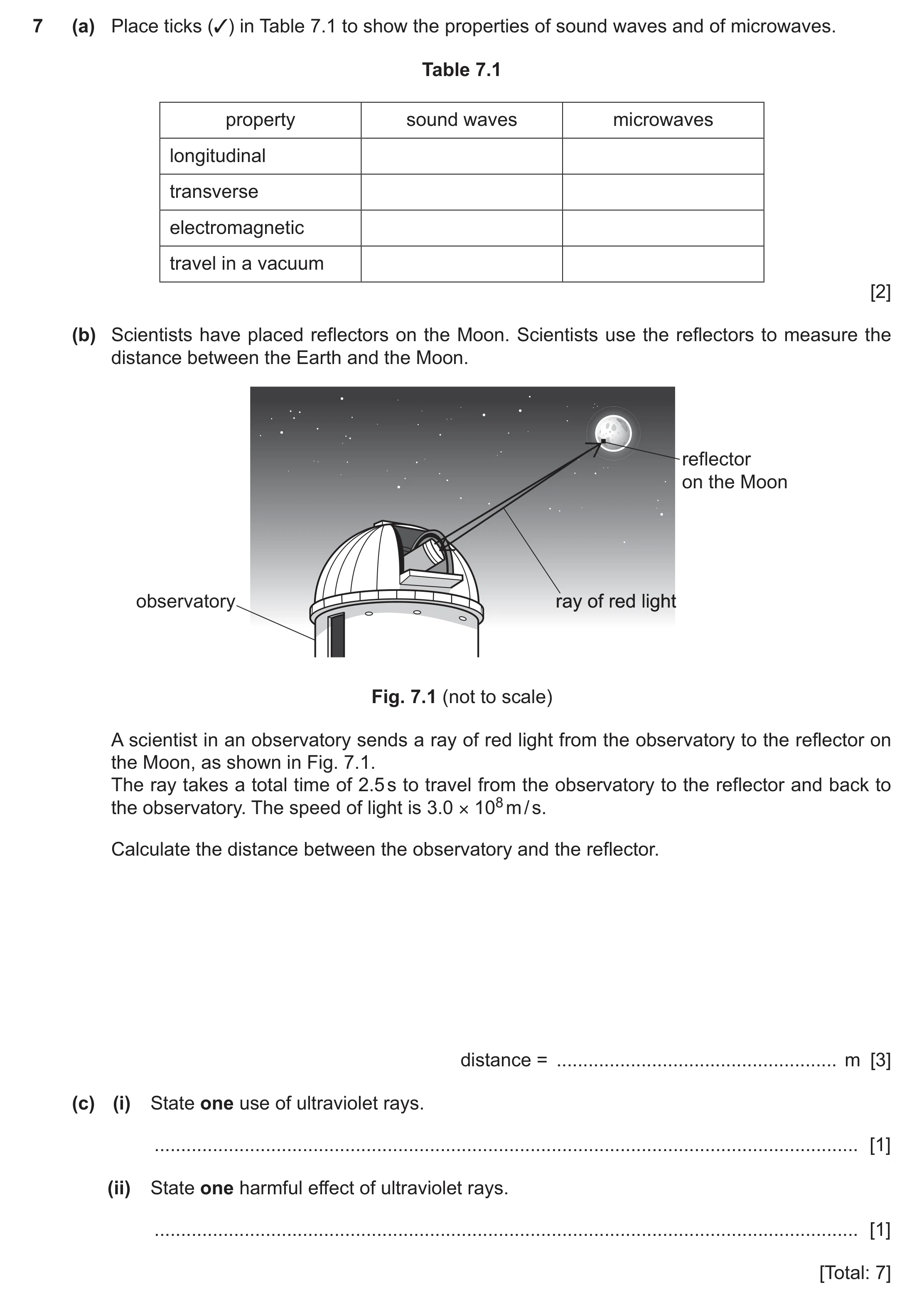
Q43 · Place ticks (✓) in Table 7.1 to show the properties of sound waves and of microwaves 0625/33 May/June 2025
7 (a) Place ticks (✓) in Table 7.1 to show the properties of sound waves and of microwaves. Table 7.1 property sound waves microwaves longitudinal transverse electromagnetic travel in a vacuum [2] (b) Scientists have placed reflectors on the Moon. Scientists use the reflectors to measure the distance between the Earth and the Moon. reflector on the Moon observatory rayray ofof redred lightlight Fig. 7.1 (not to scale) A scientist in an observatory sends a ray of red light from the observatory to the reflector on the Moon, as shown in Fig. 7.1. The ray takes a total time of 2.5 s to travel from the observatory to the reflector and back to the observatory. The speed of light is 3.0 × 10⁸ m / s. Calculate the distance between the observatory and the reflector. distance = … m [3] (c) (i) State one use of ultraviolet rays. … [1] (ii) State one harmful effect of ultraviolet rays. … [1] [Total: 7]
7 marks
Mark scheme: 7(a) B2 property sound waves microwaves longitudinal ✓ transverse ✓ electromagnetic ✓ travel in a vacuum ✓ 4 correct – 2 marks 2 or 3 correct – 1 mark 7(b) 3.8 108 (m) A3 3(.0) 108 1.25 OR 3(.0) 108 (2.5 ÷ 2) OR 7.5 108 C2 (distance =) speed time C1 7(c)(i) security marking OR detecting fake bank notes OR sterilising water OR fluorescent effects B1 7(c)(ii) damage to surface cells / skin / eyes OR damage to genes / DNA OR skin cancer B1
This question in 0625/33 May/June 2025
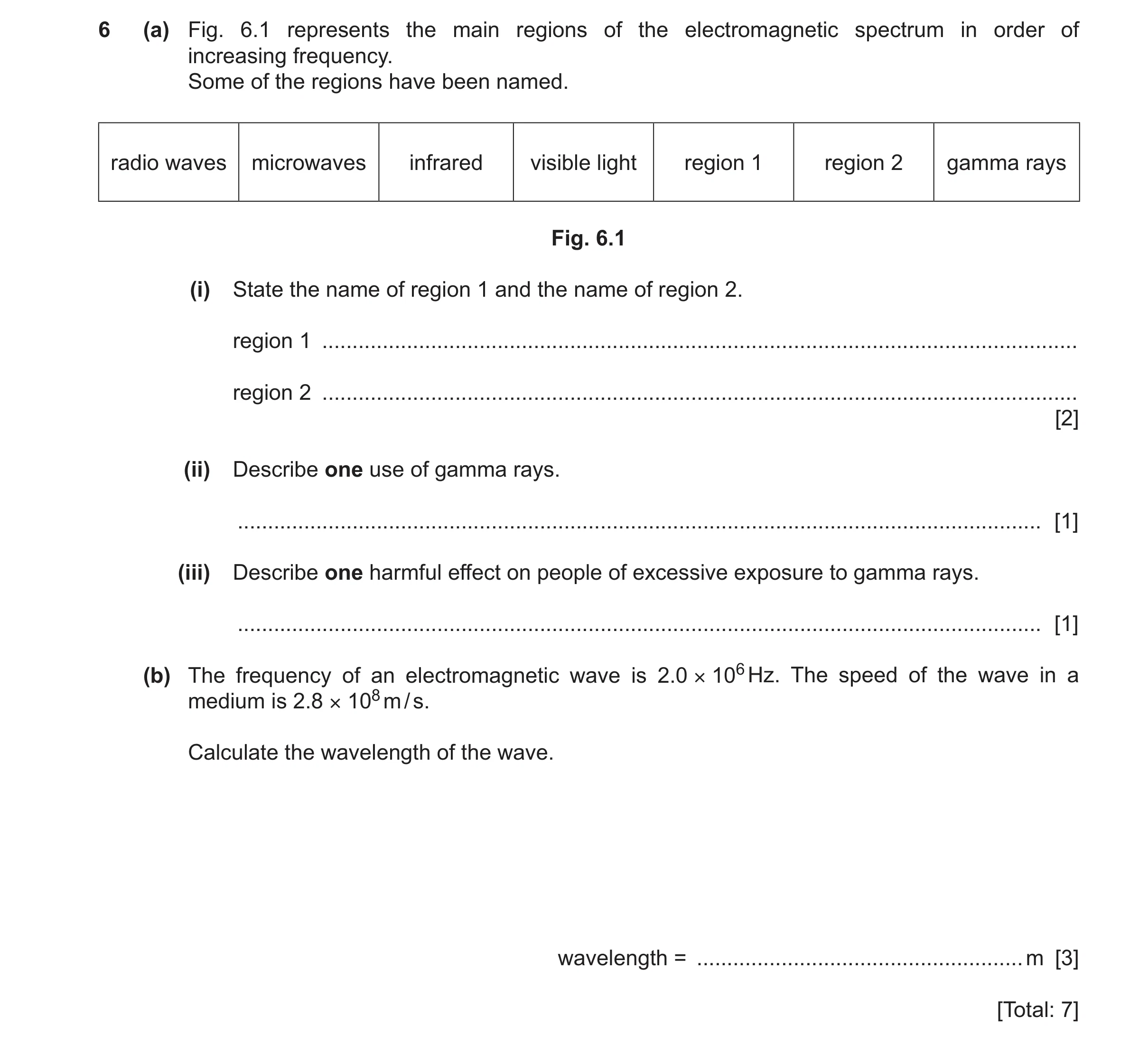
Q44 · The main regions of the electromagnetic spectrum in order of increasing frequency 0625/31 Oct/Nov 2025
6 (a) Fig. 6.1 represents the main regions of the electromagnetic spectrum in order of increasing frequency. Some of the regions have been named. radio waves microwaves infrared visible light region 1 region 2 gamma rays Fig. 6.1 (i) State the name of region 1 and the name of region 2. region 1 … region 2 … [2] (ii) Describe one use of gamma rays. … [1] (iii) Describe one harmful effect on people of excessive exposure to gamma rays. … [1] (b) The frequency of an electromagnetic wave is 2.0 × 10⁶ Hz. The speed of the wave in a medium is 2.8 × 10⁸ m / s. Calculate the wavelength of the wave. wavelength = … m [3] [Total: 7]
7 marks
Mark scheme: 6(a)(i) (1) ultraviolet (light/rays) B1 (2) X-rays B1 6(a)(ii) sterilising (food or medical dressings/equipment) OR detection/treatment of cancer OR B1 (gamma) imaging OR tracing detection of (underground) leaking pipes/(metal) cracks owtte 6(a)(iii) mutation of cells/DNA OR damage to cells/DNA B1 6(b) (λ = ) 1.4 102 (m) A3 (λ = ) 2.8 ( 108) ÷ 2.0 ( 106) (C2) v = f × λ OR (λ = ) v ÷ f (C1)
This question in 0625/31 Oct/Nov 2025
Q45 · Whether some energy resources are renewable and whether they cause air pollution when… 0625/33 Oct/Nov 2025
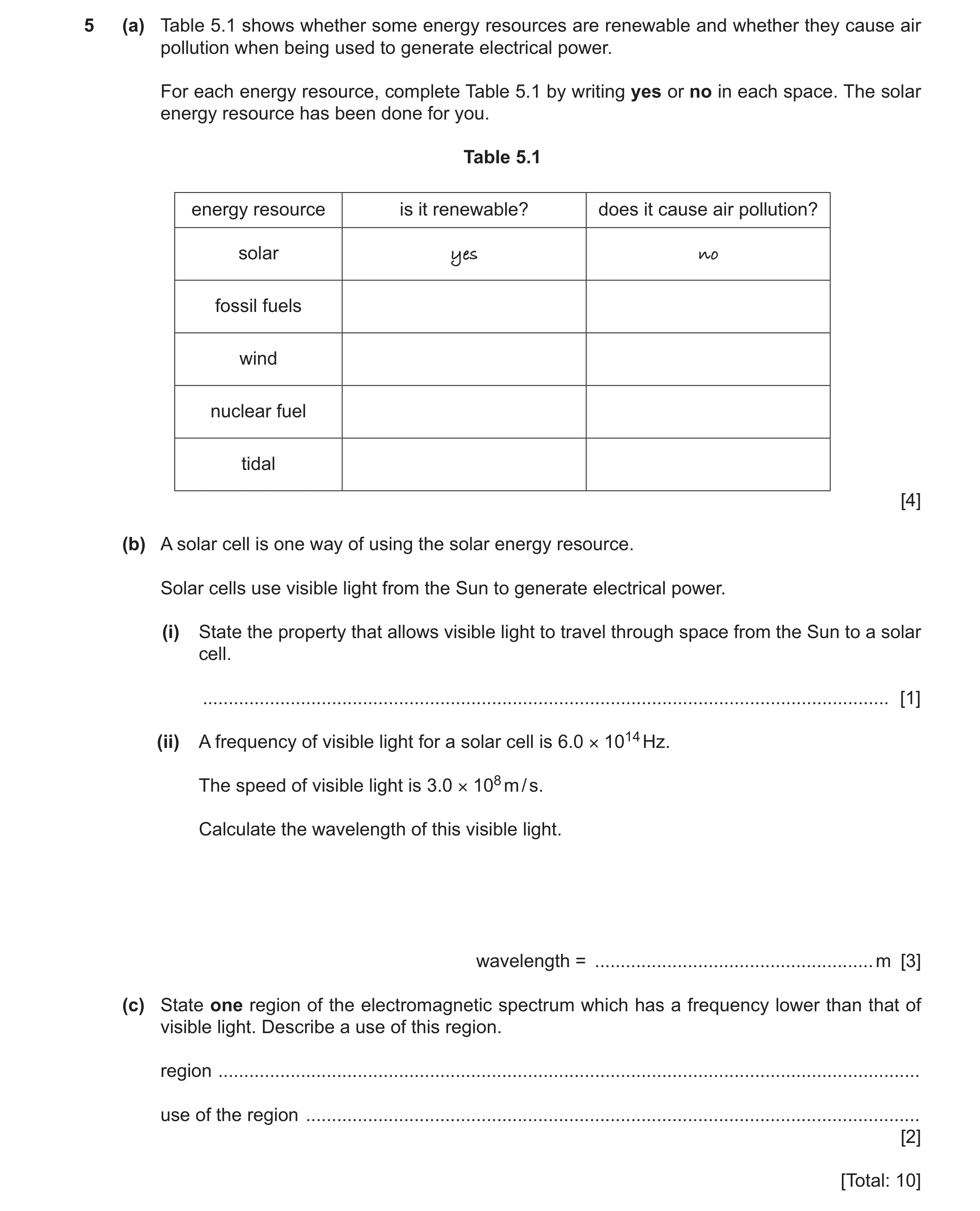
5 (a) Table 5.1 shows whether some energy resources are renewable and whether they cause air pollution when being used to generate electrical power. For each energy resource, complete Table 5.1 by writing yes or no in each space. The solar energy resource has been done for you. Table 5.1 energy resource is it renewable? does it cause air pollution? solar yes no fossil fuels wind nuclear fuel tidal [4] (b) A solar cell is one way of using the solar energy resource. Solar cells use visible light from the Sun to generate electrical power. (i) State the property that allows visible light to travel through space from the Sun to a solar cell. … [1] (ii) A frequency of visible light for a solar cell is 6.0 × 10¹⁴ Hz. The speed of visible light is 3.0 × 10⁸ m / s. Calculate the wavelength of this visible light. wavelength = … m [3] (c) State one region of the electromagnetic spectrum which has a frequency lower than that of visible light. Describe a use of this region. region … use of the region … [2] [Total: 10]
10 marks
Mark scheme: 5(a) B1 energy resource is it renewable? does it cause air pollution? B1 solar yes no B1 fossil fuels no yes B1 wind yes no nuclear fuel no no tidal yes no 5(b)(i) (light) travels through a vacuum or (light) does not need a medium B1 5(b)(ii) 5(.0) 10–7 (m) A3 3.0 ( 108) ÷ 6.0 ( 1014) C2 (wavelength =) speed ÷ frequency C1 5(c) infrared or microwaves or radio (waves) B1 matching use B1
This question in 0625/33 Oct/Nov 2025
 1 / 47
 2 / 47
 3 / 47
 4 / 47
 5 / 47
 6 / 47
 7 / 47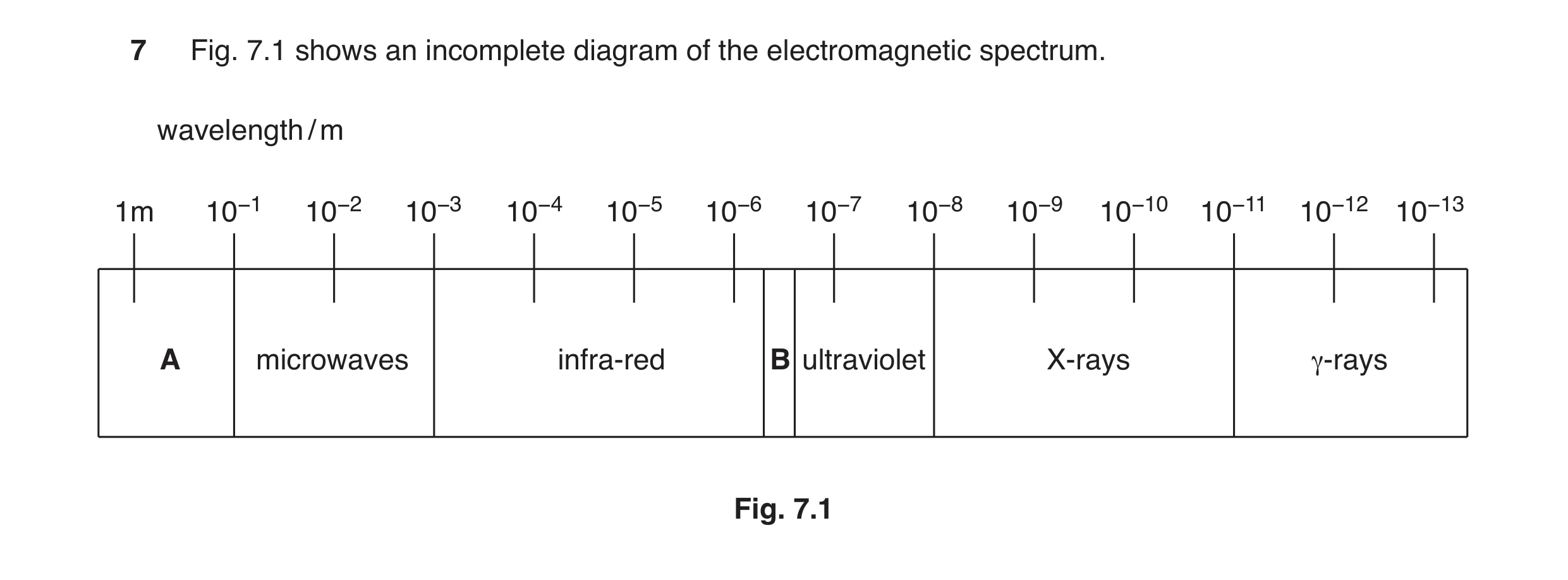
 8 / 47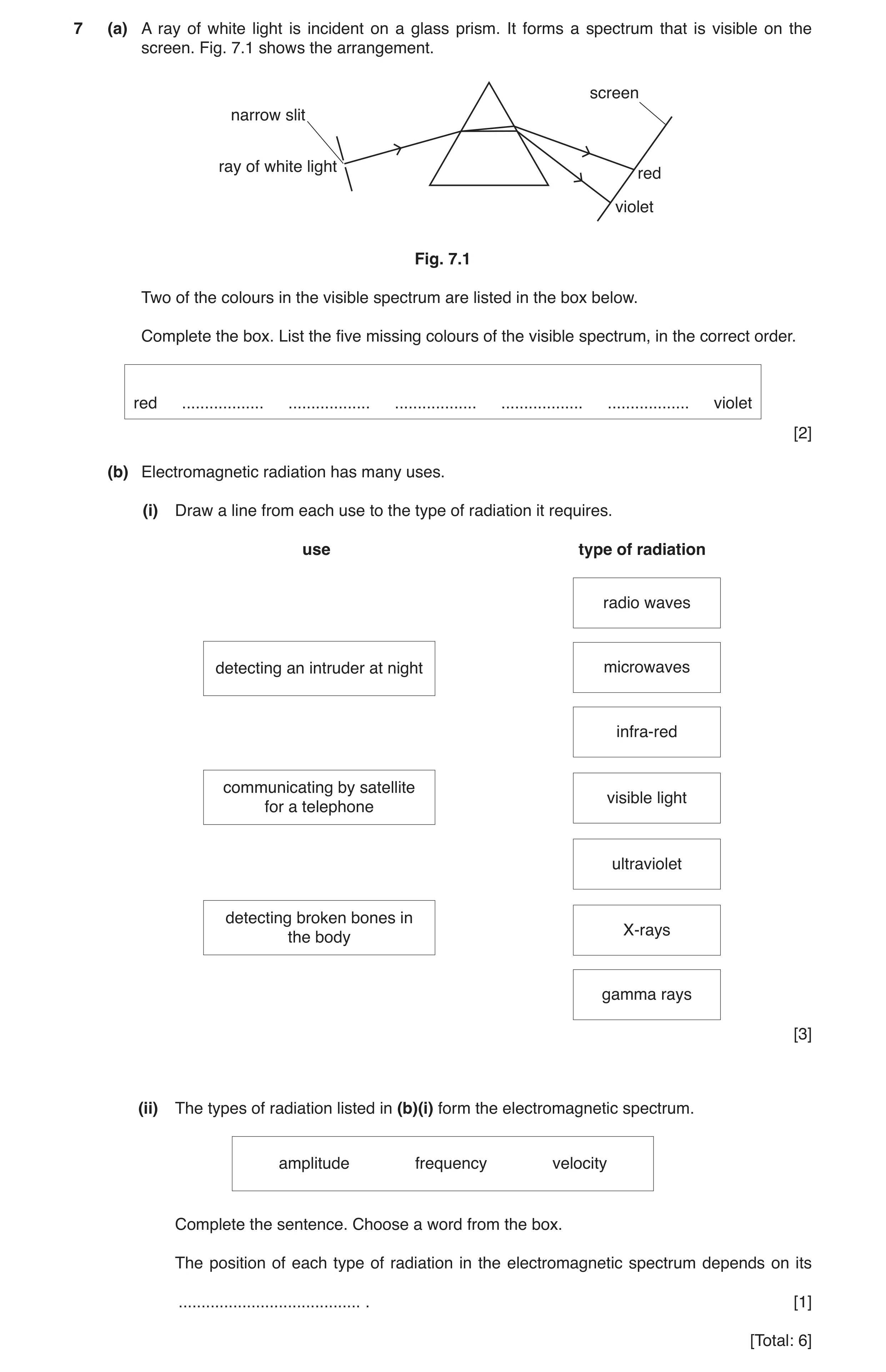
 10 / 47
 11 / 47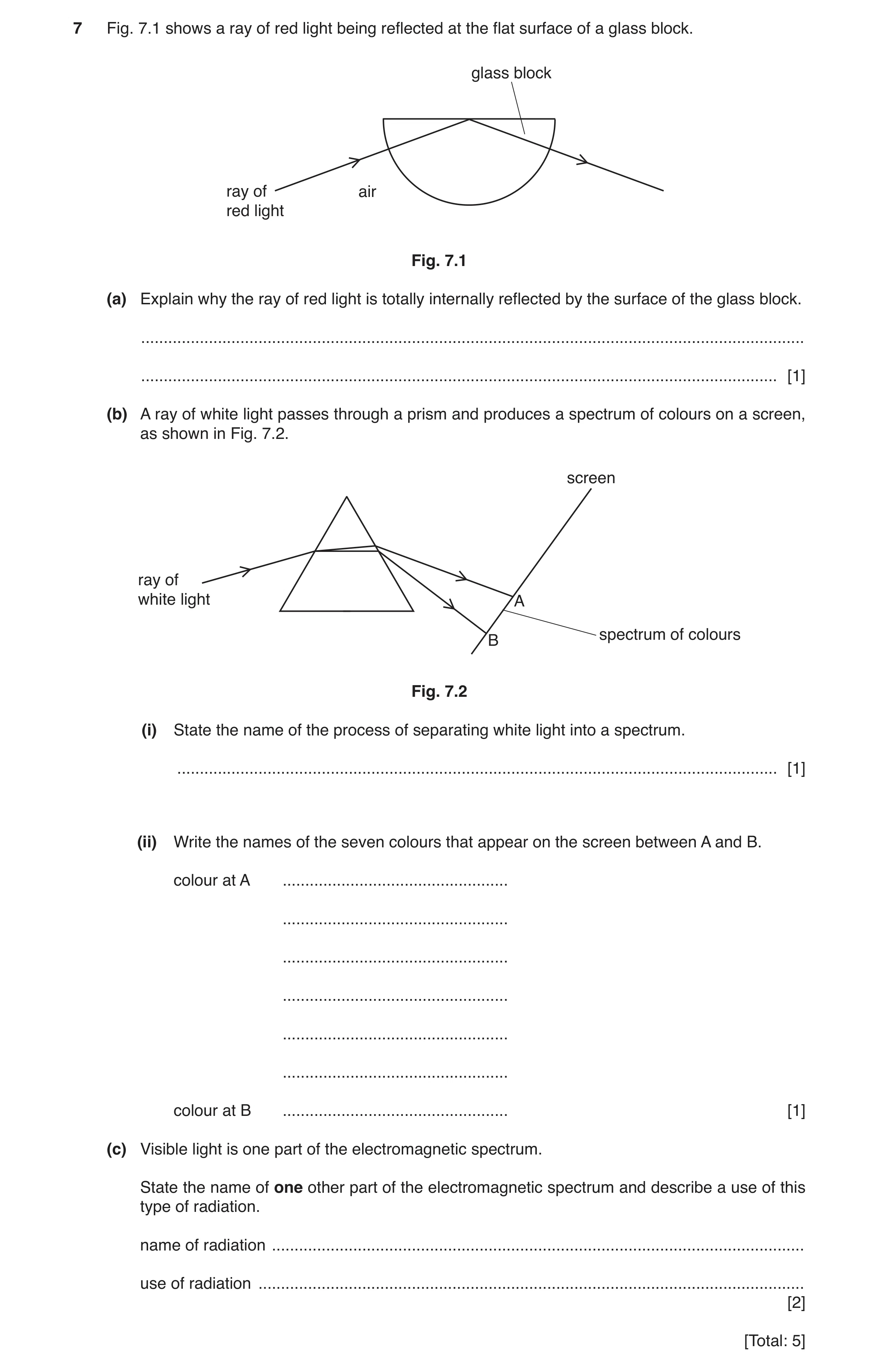
 15 / 47
 16 / 47
 17 / 47
 18 / 47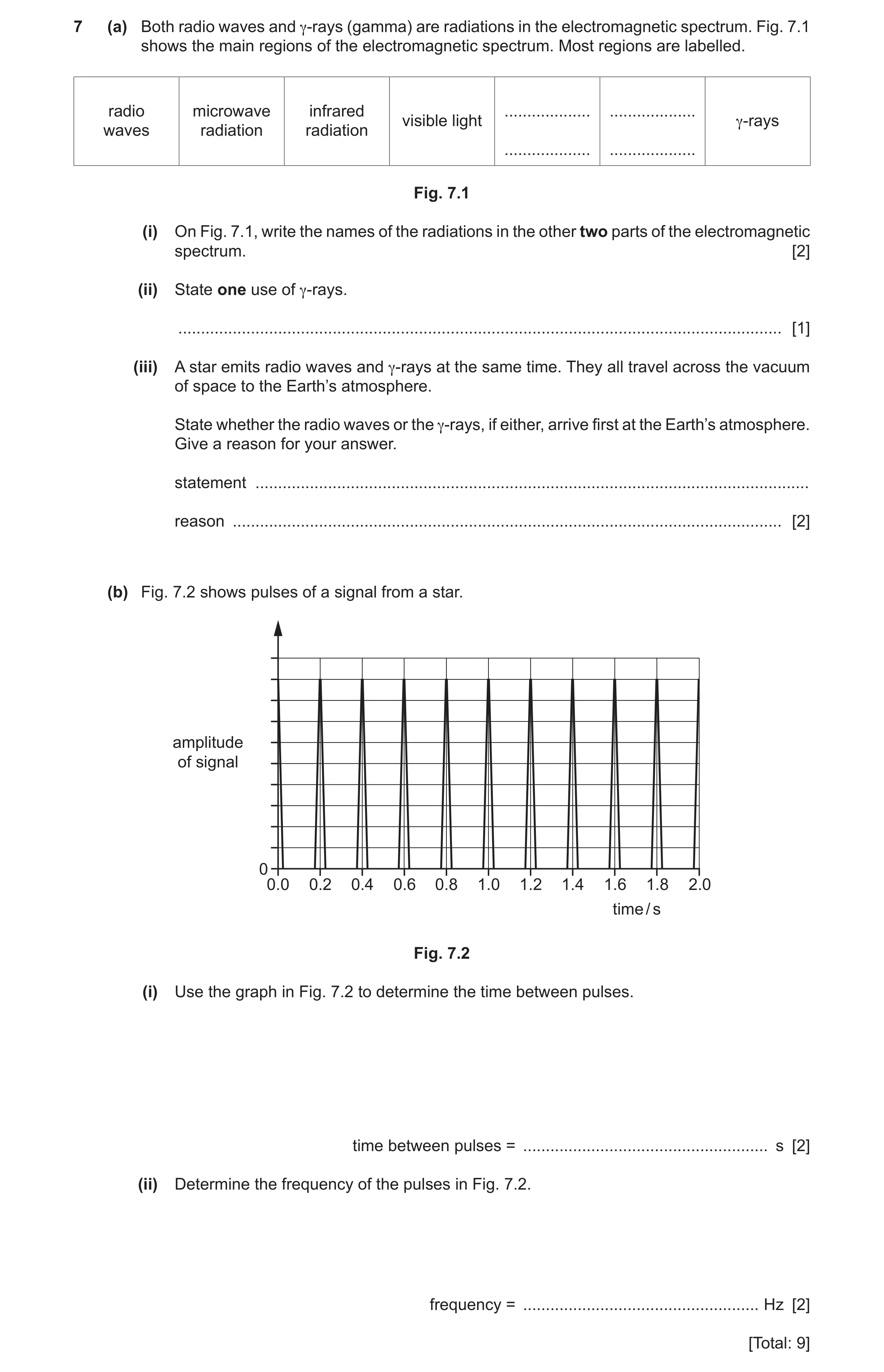
 21 / 47
 22 / 47
 23 / 47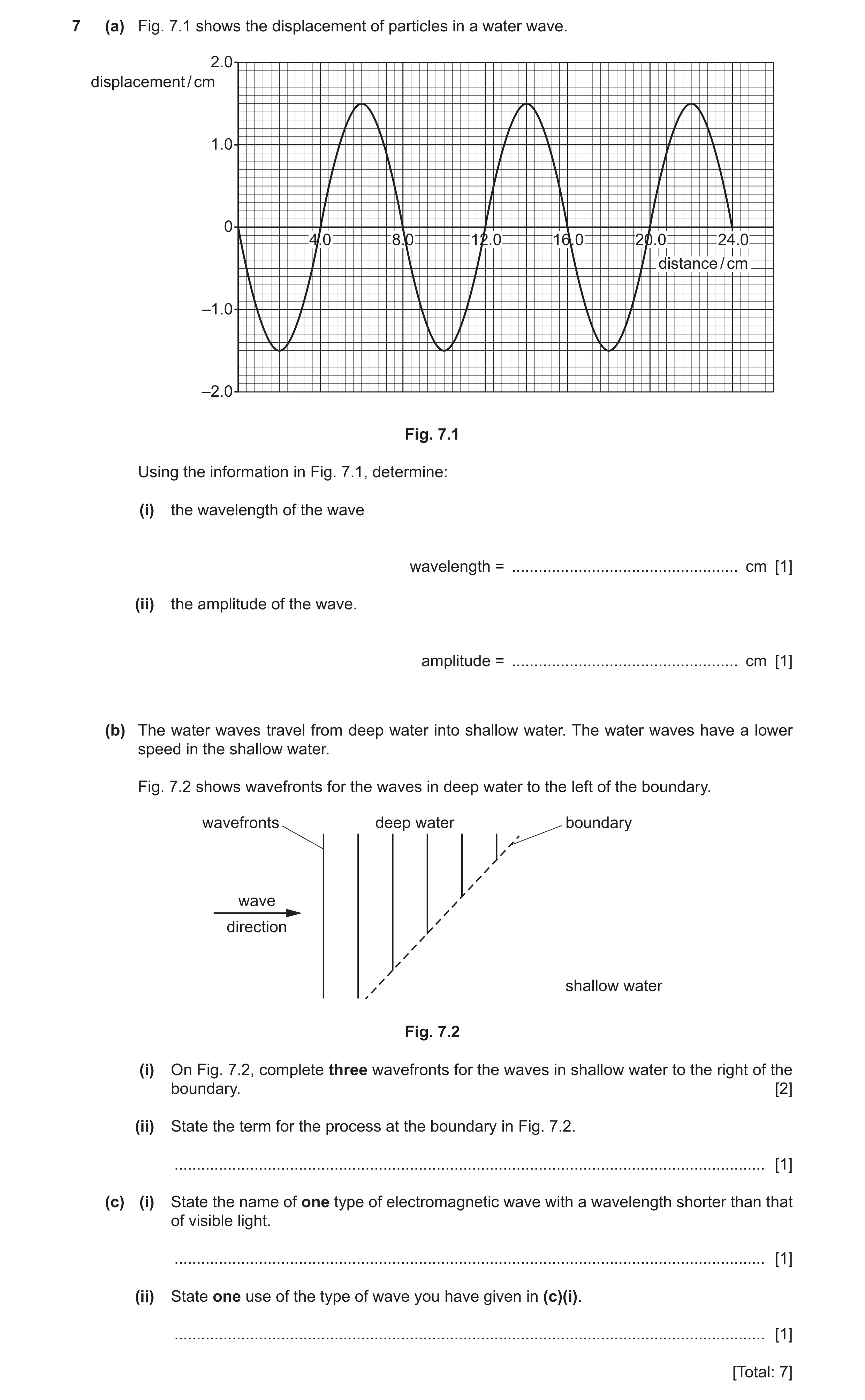
 25 / 47
 26 / 47
 27 / 47
 28 / 47
 29 / 47
 30 / 47
 31 / 47
 32 / 47
 33 / 47
 34 / 47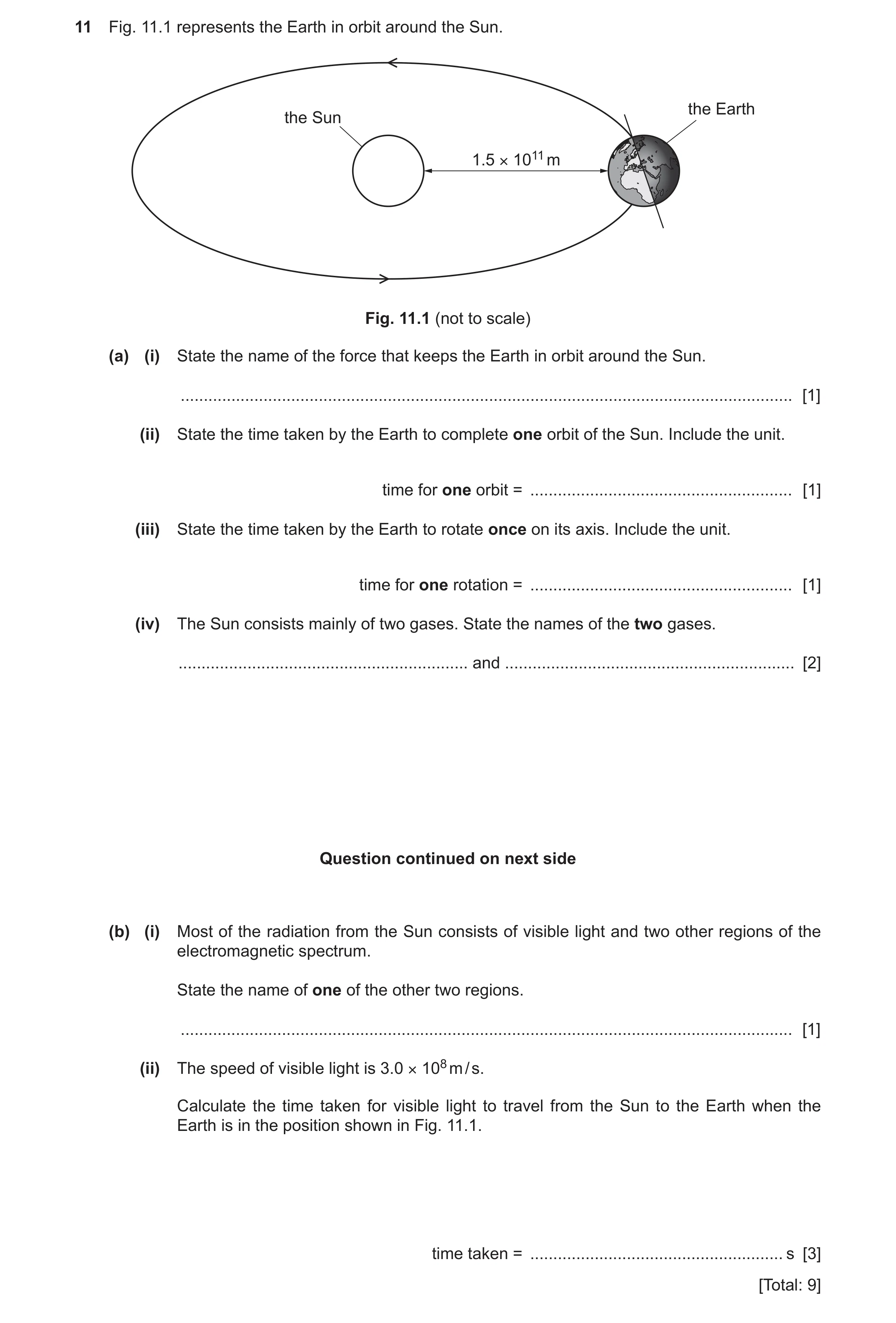
 36 / 47
 37 / 47
 38 / 47
 39 / 47
 40 / 47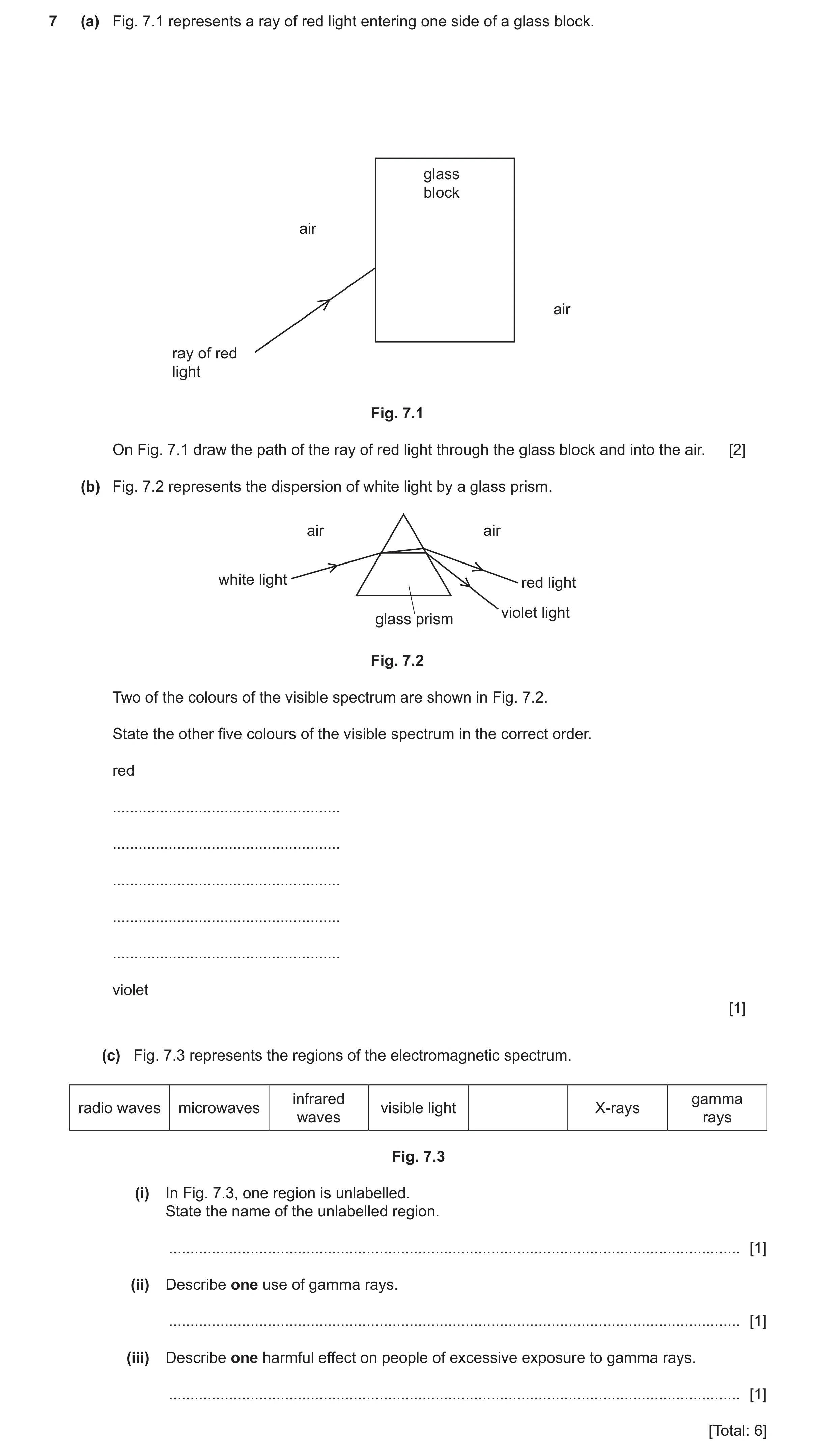
 43 / 47
 44 / 47
 45 / 47
 46 / 47
 47 / 47
 8
8 4
4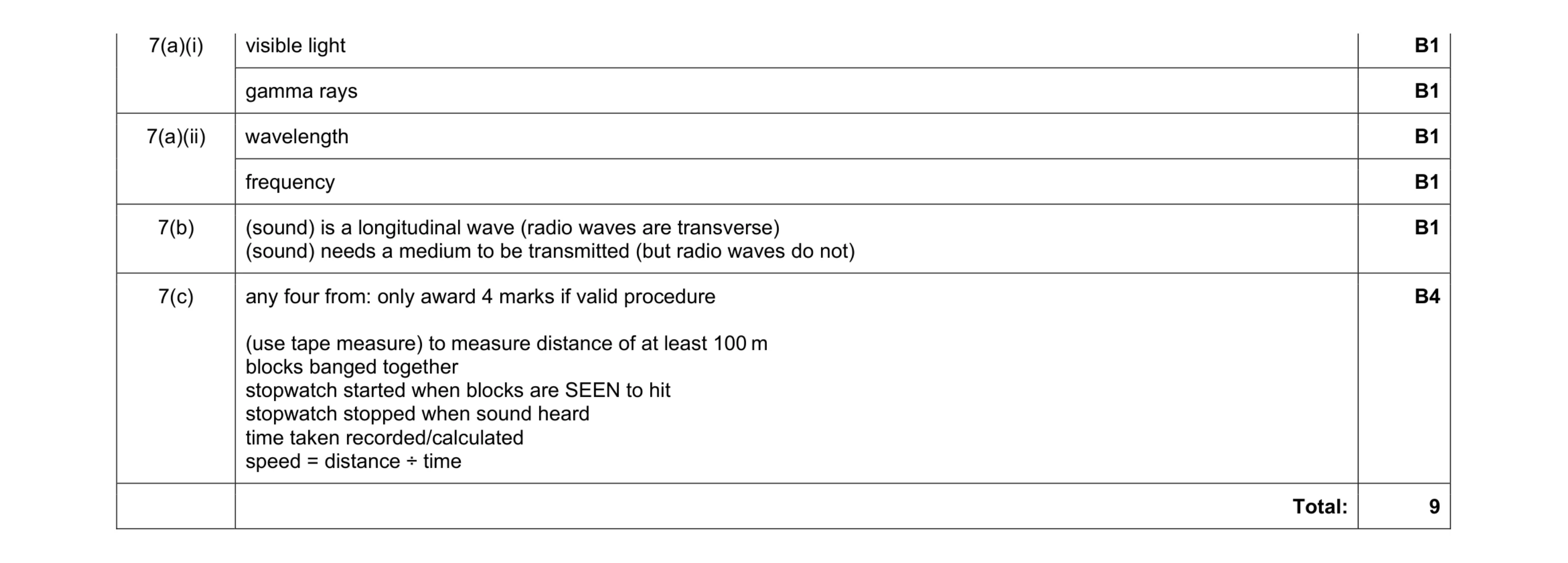 9
9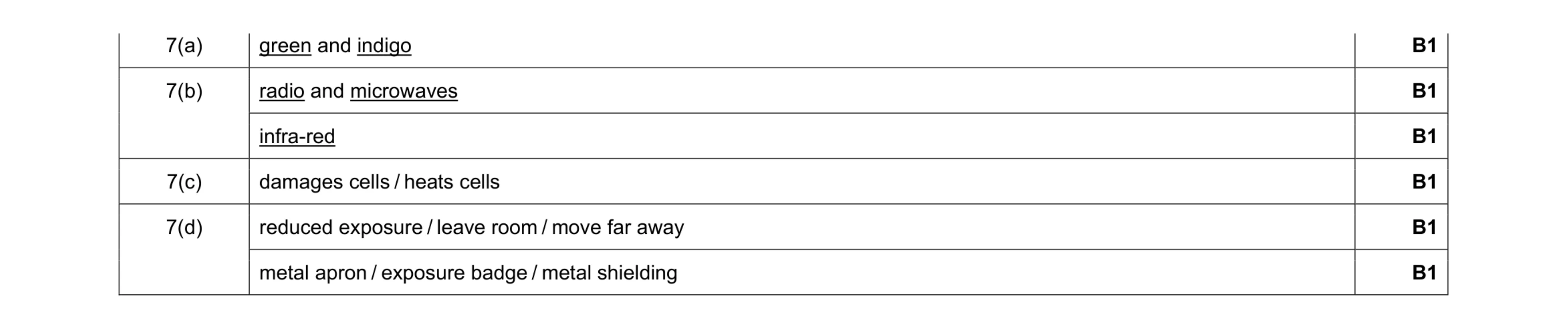 6
6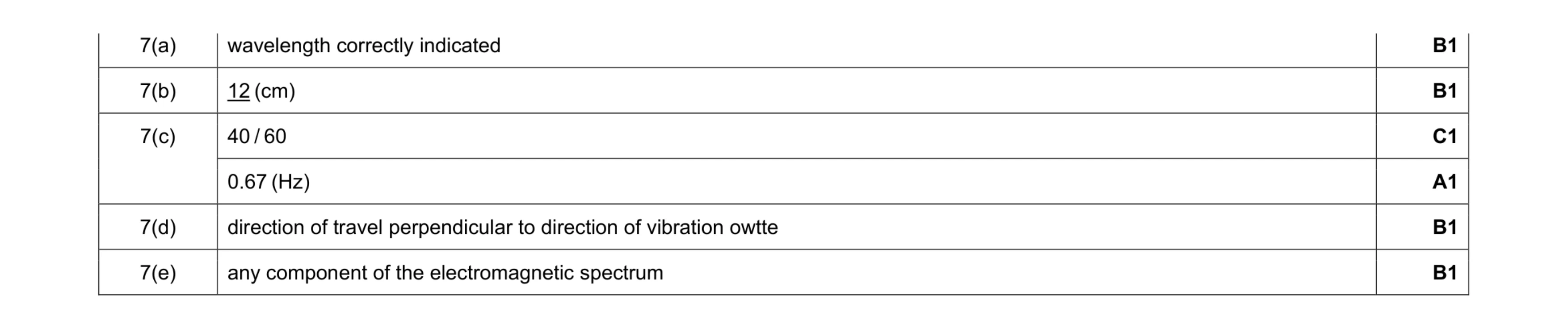 6
6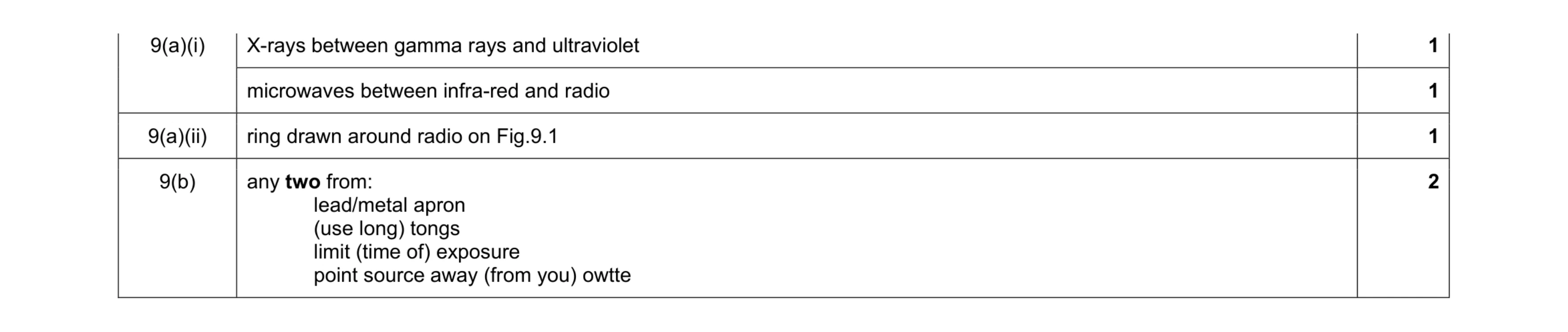 5
5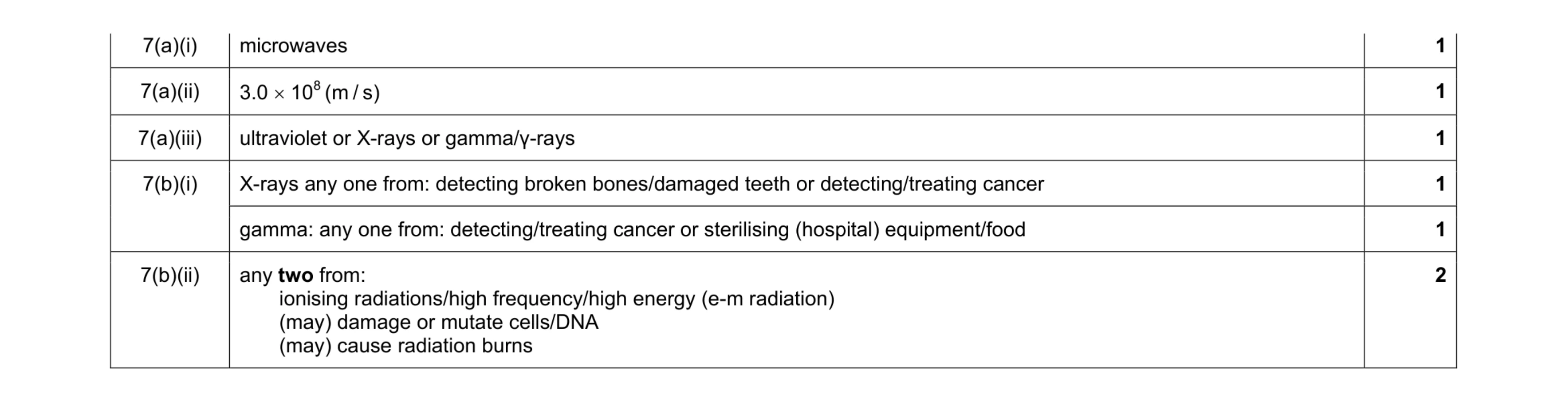 7
7 0
0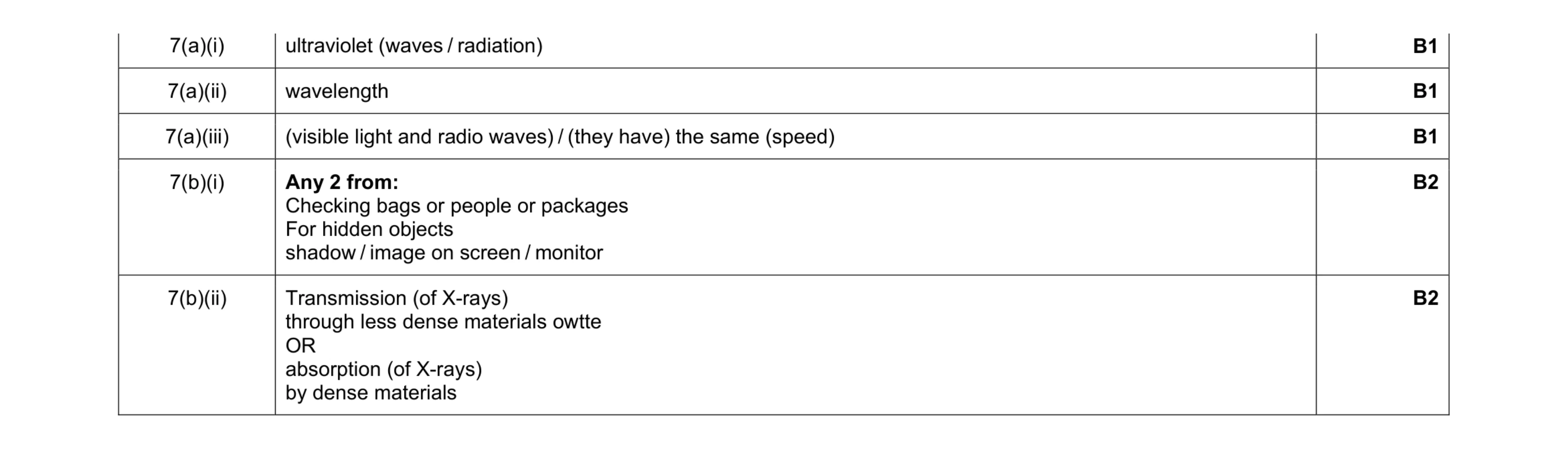 7
7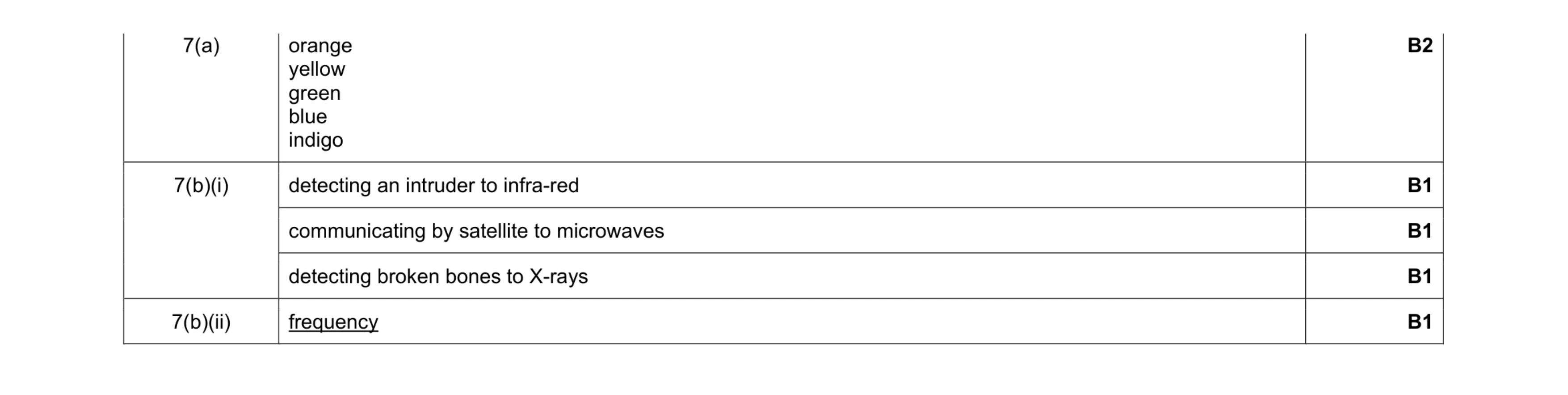 6
6 5
5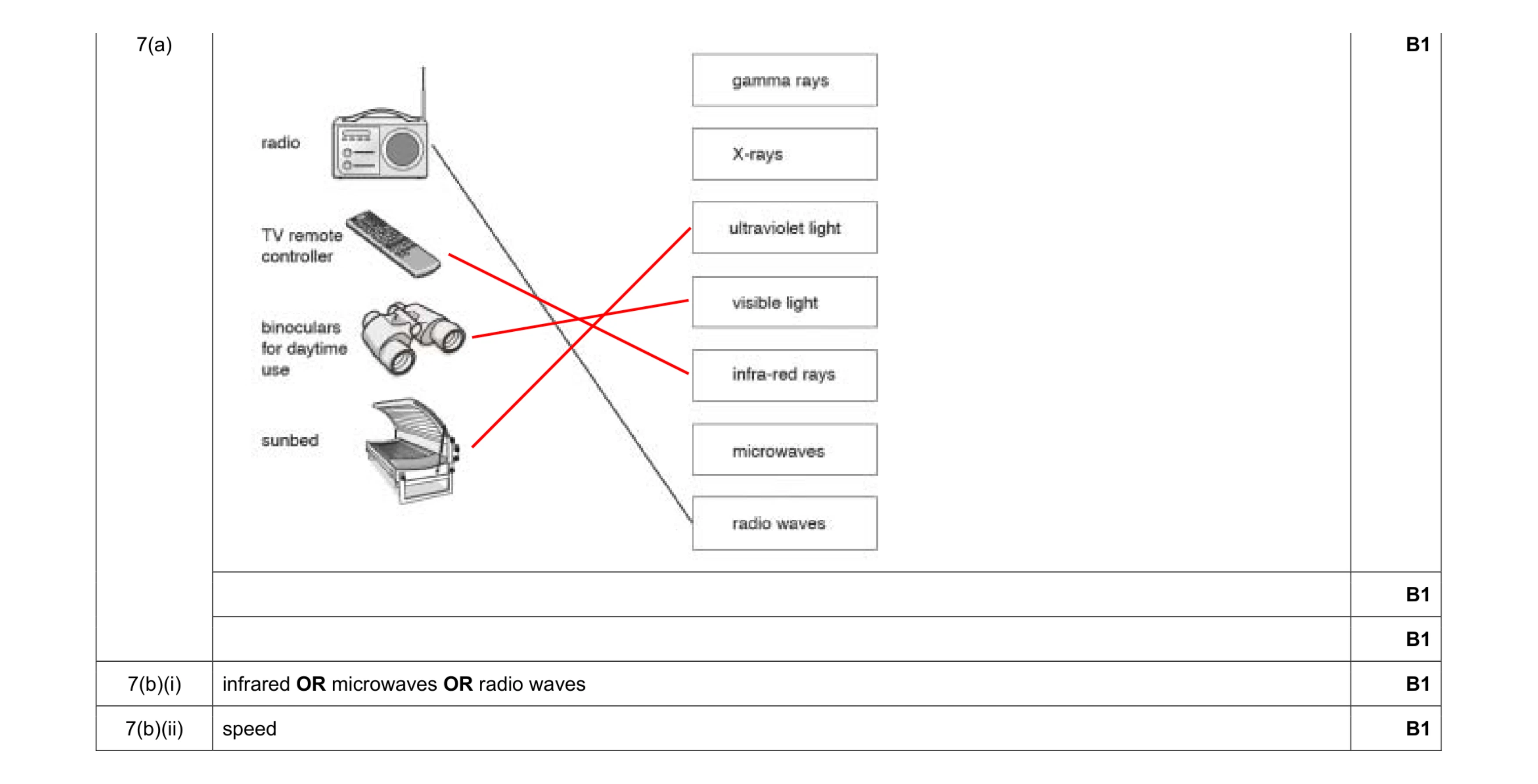 5
5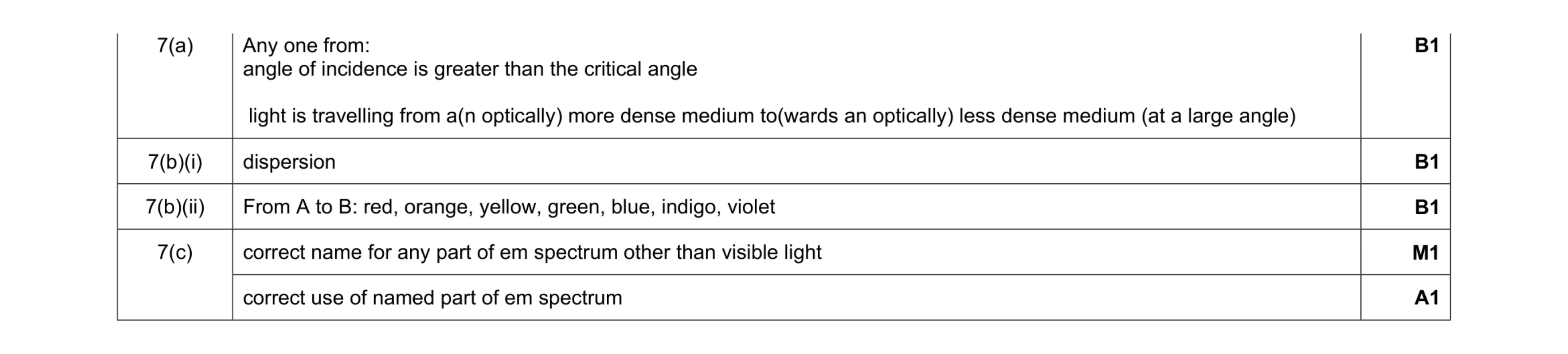 5
5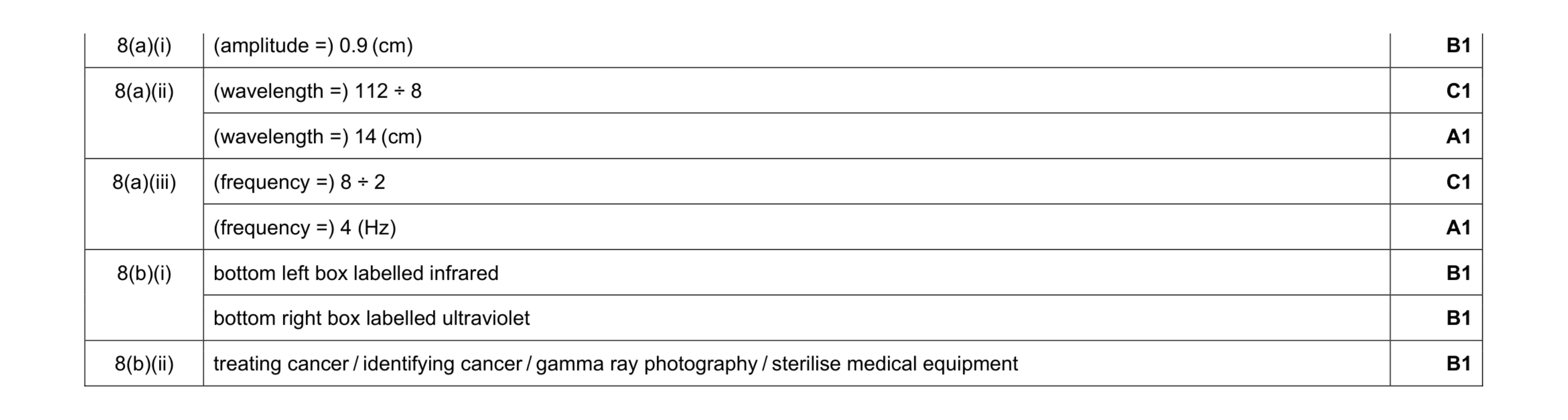 8
8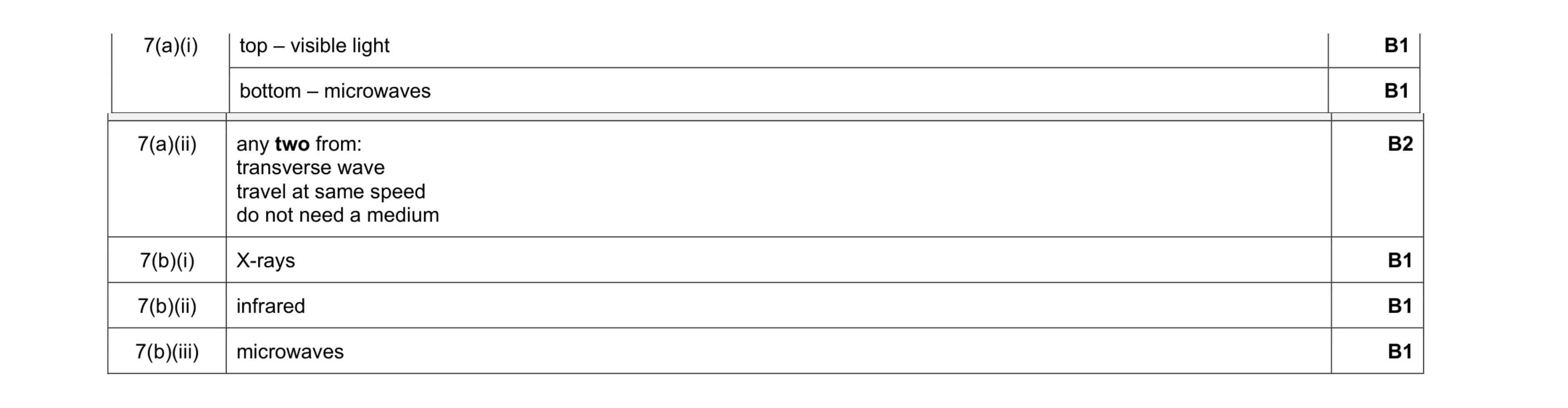 7
7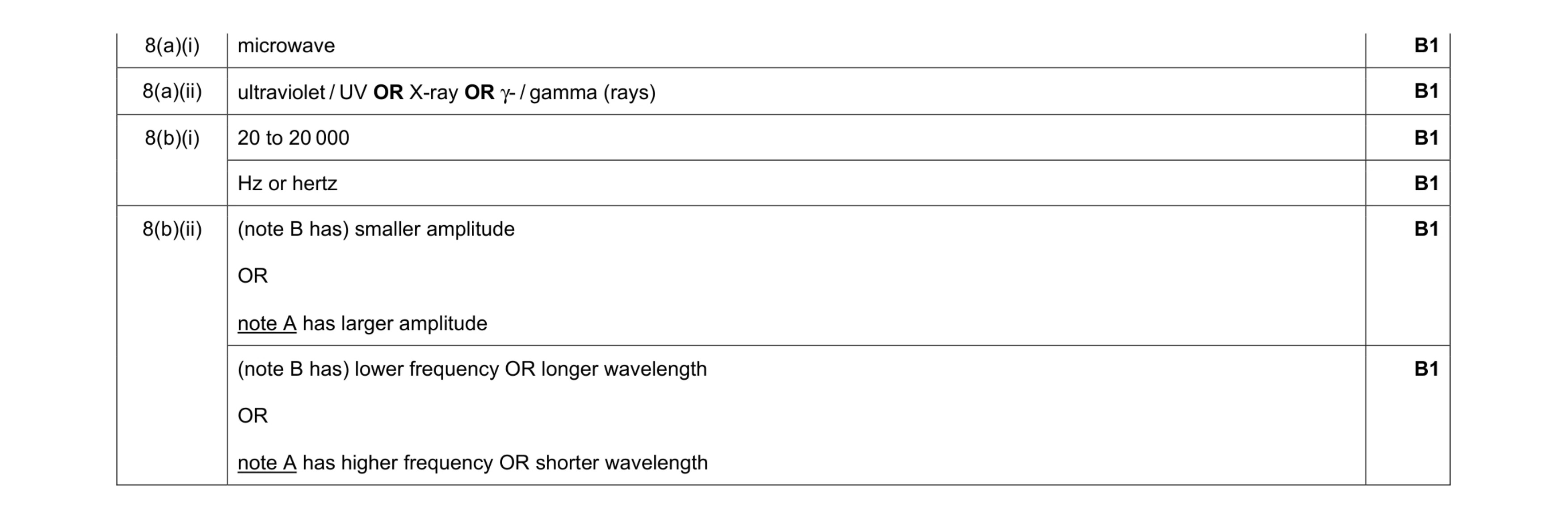 6
6 5
5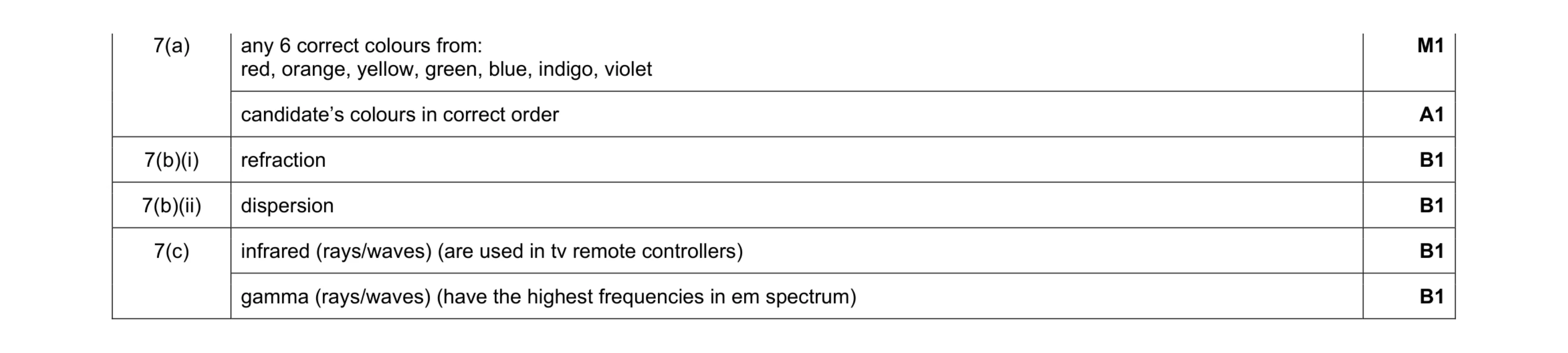 6
6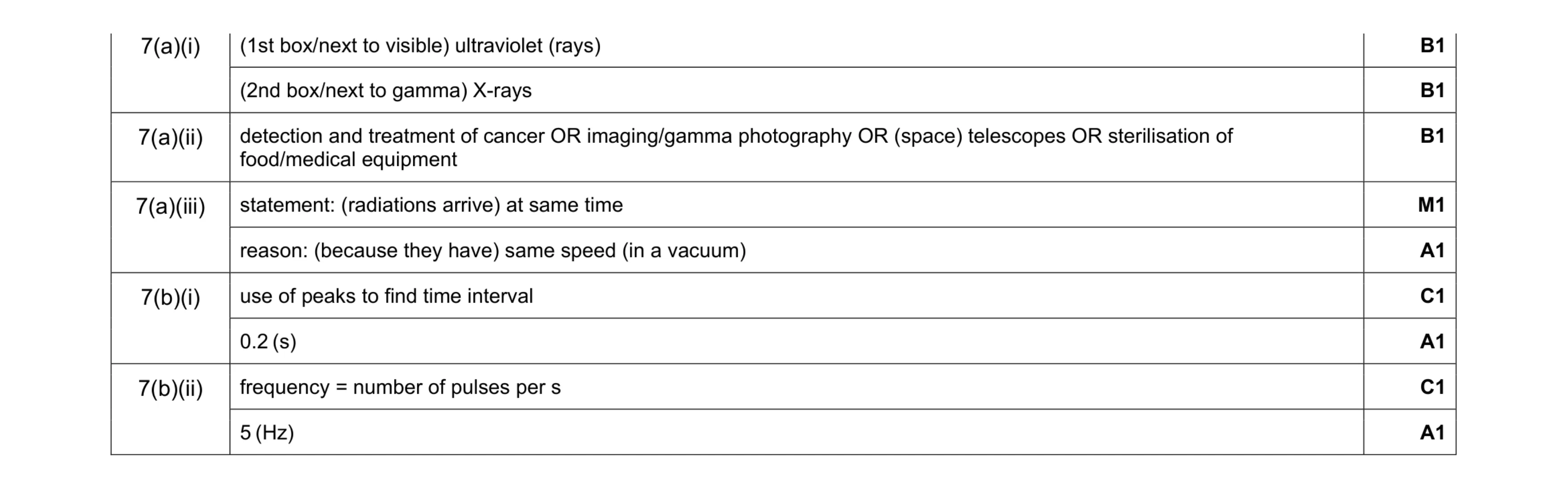 9
9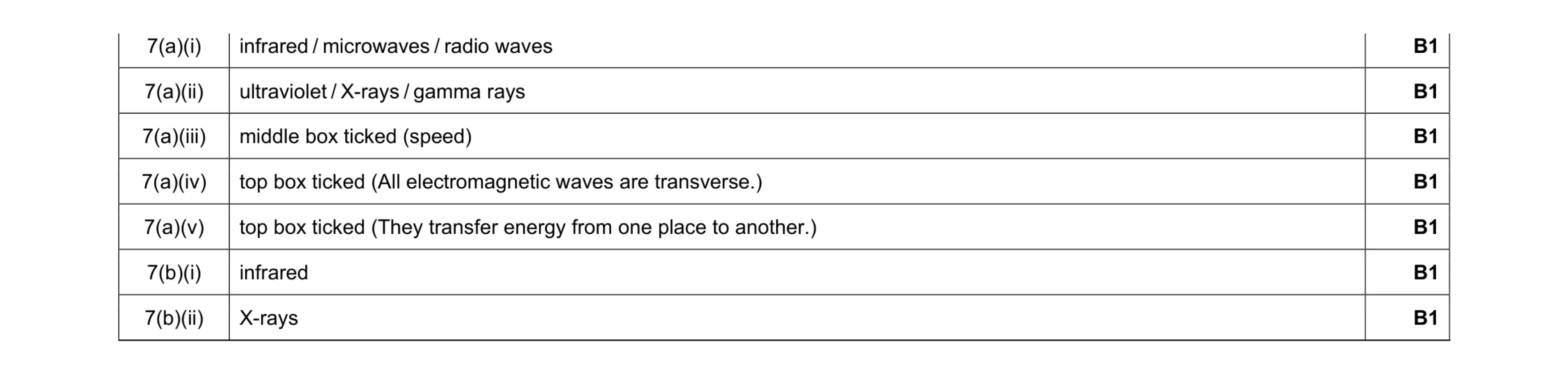 7
7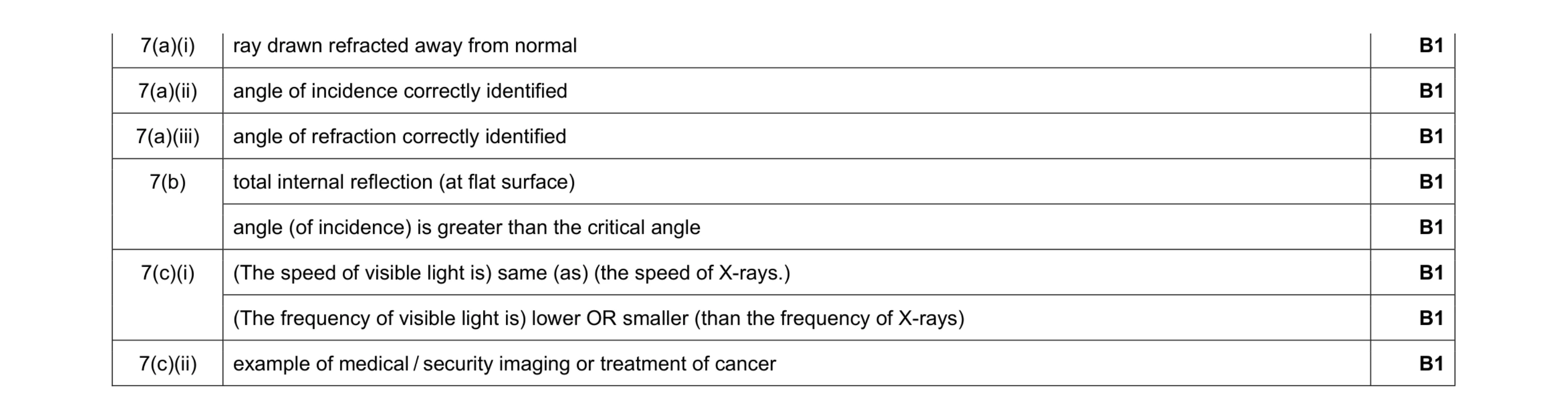 8
8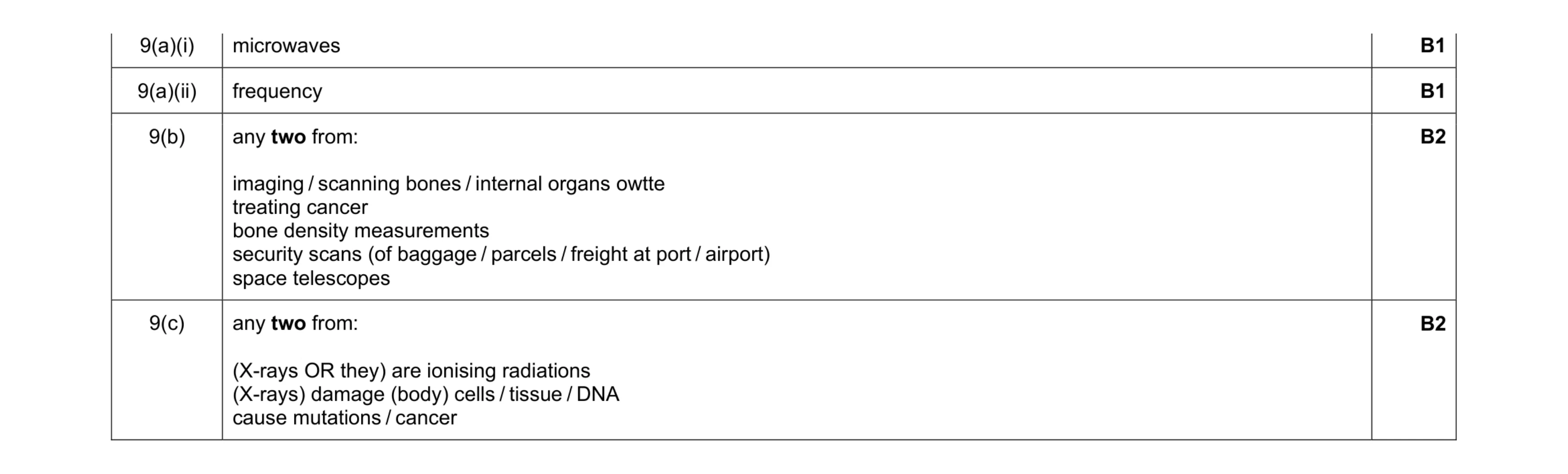 6
6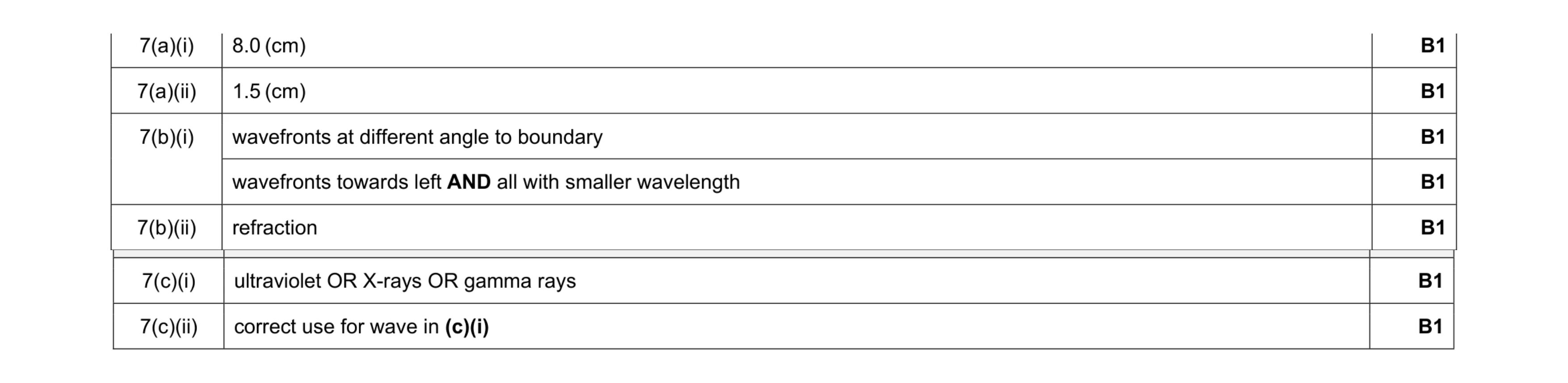 7
7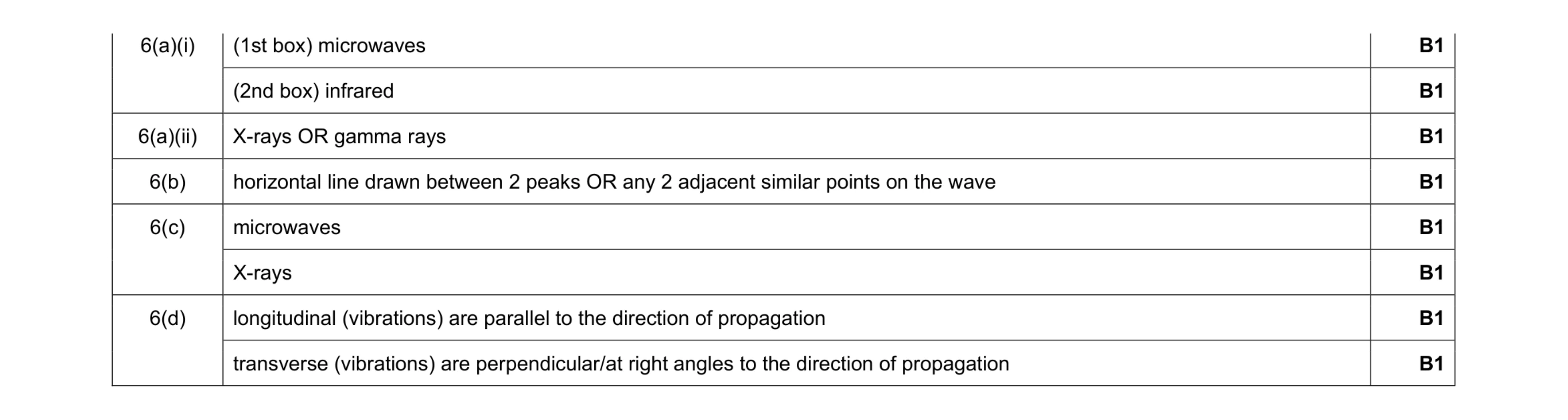 8
8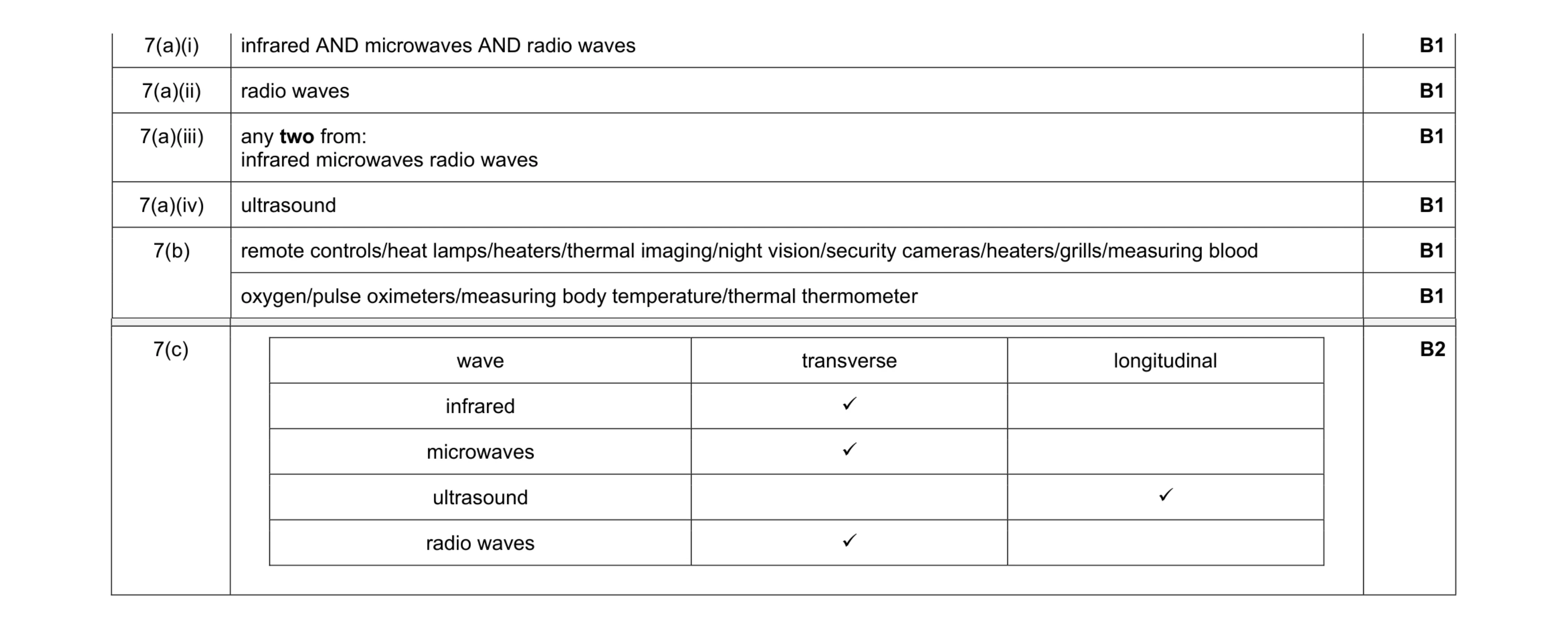 8
8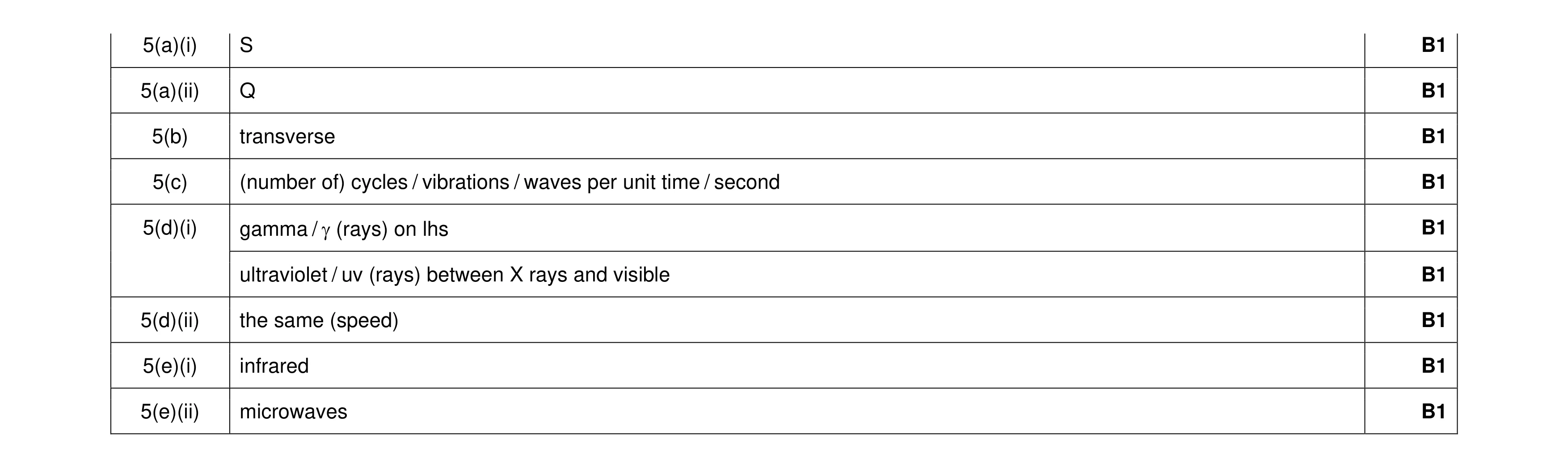 9
9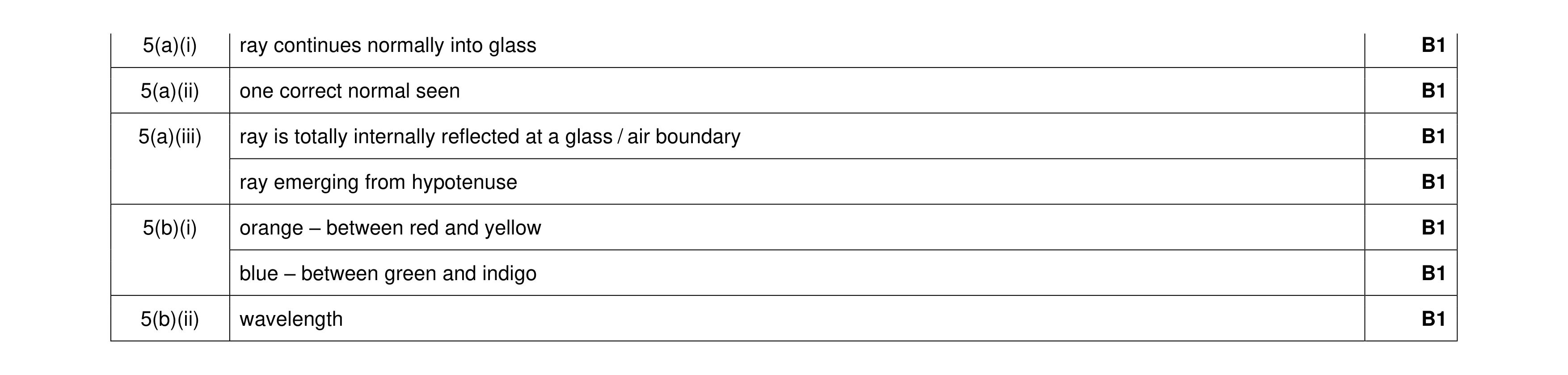 7
7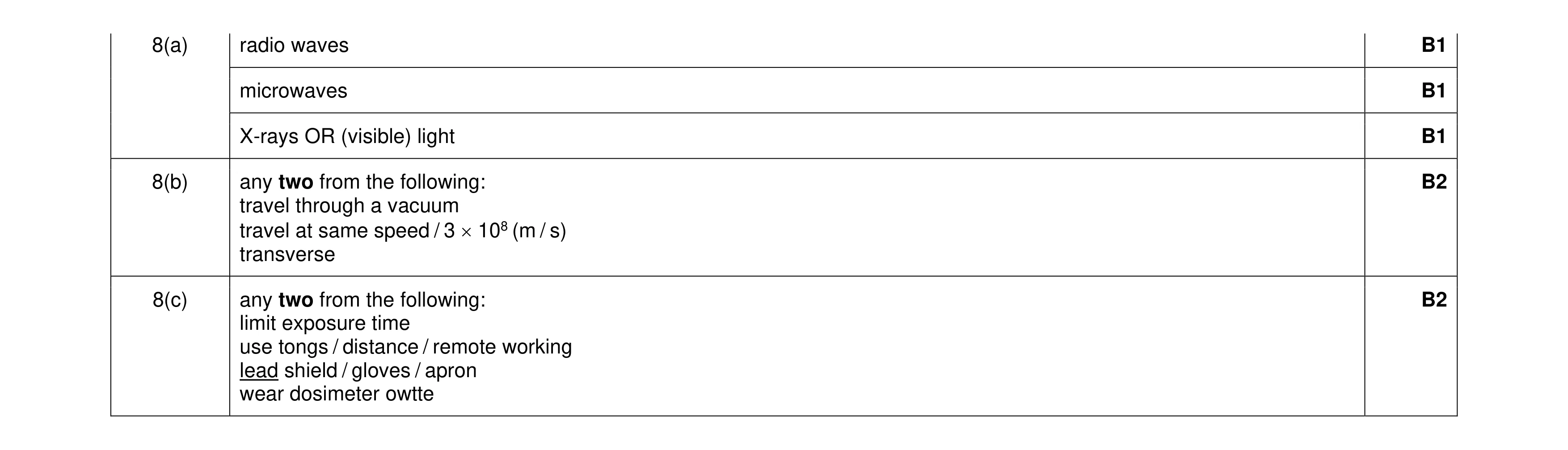 7
7 5
5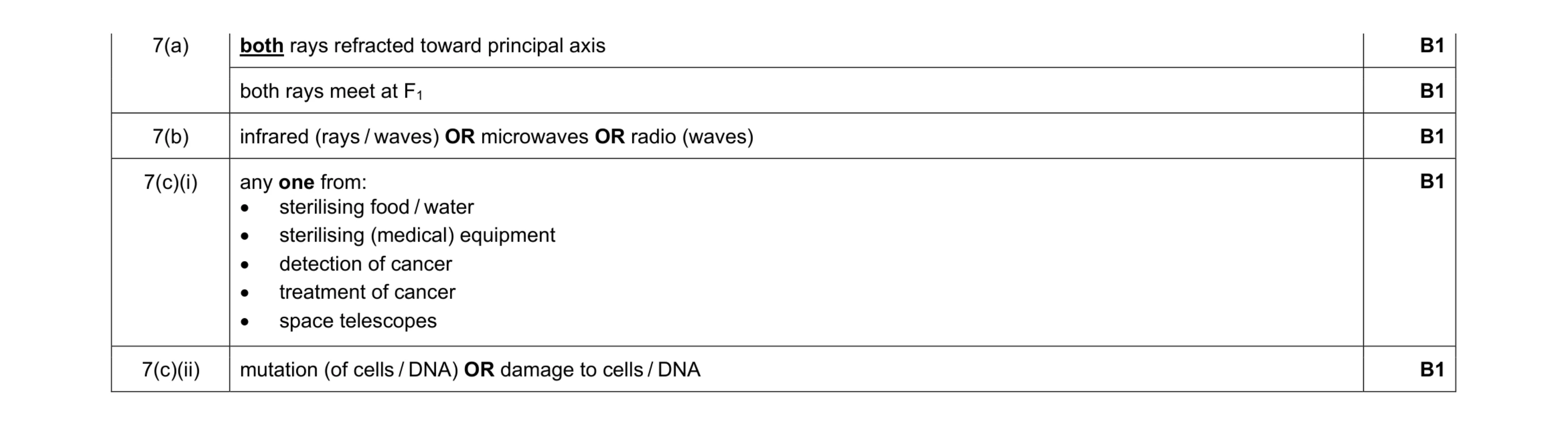 5
5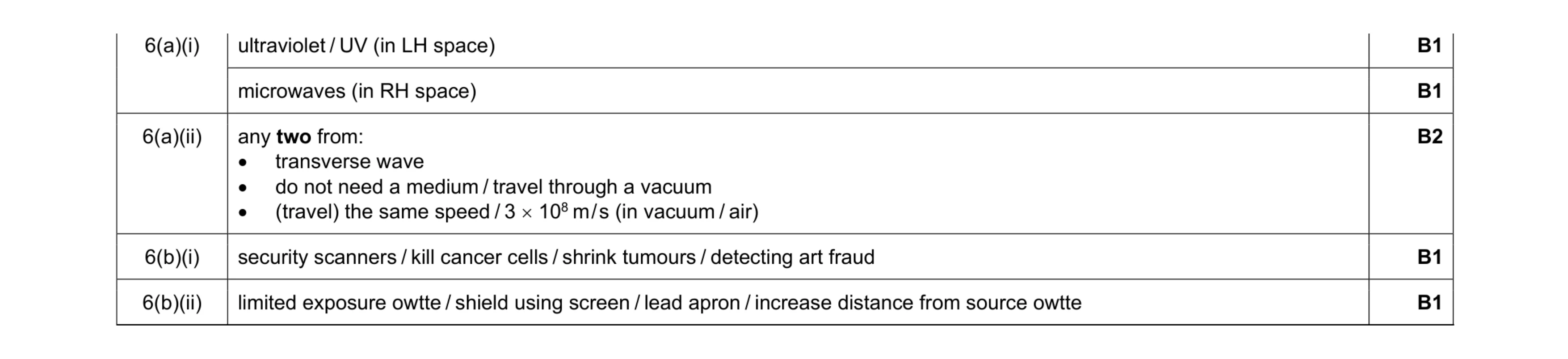 6
6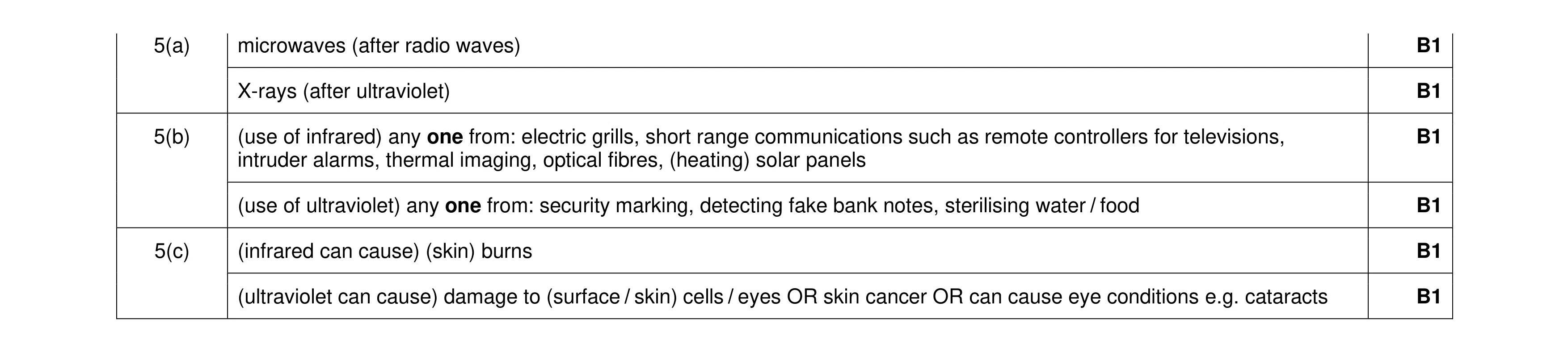 6
6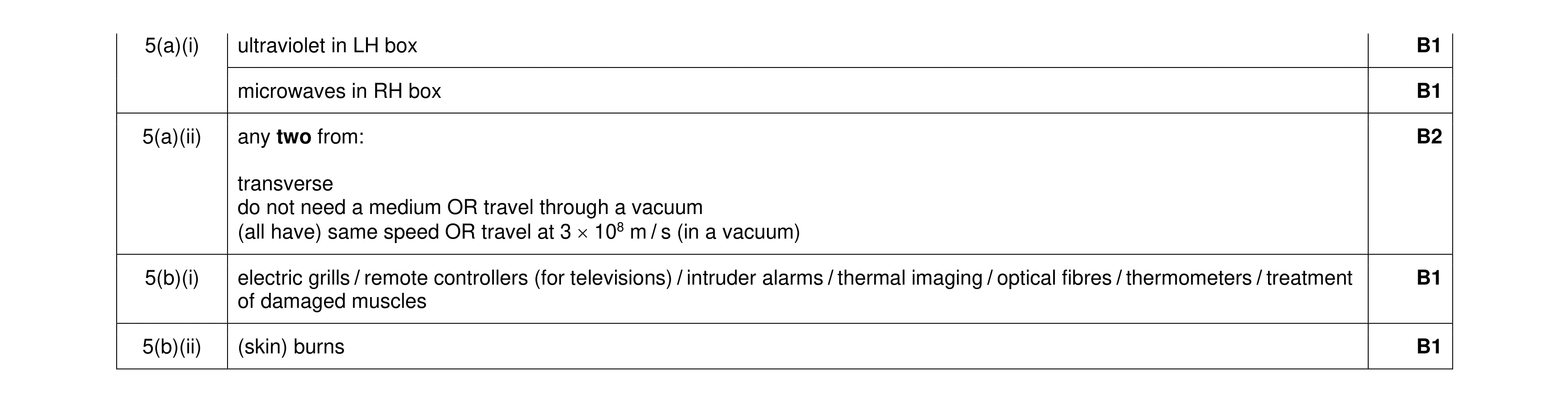 6
6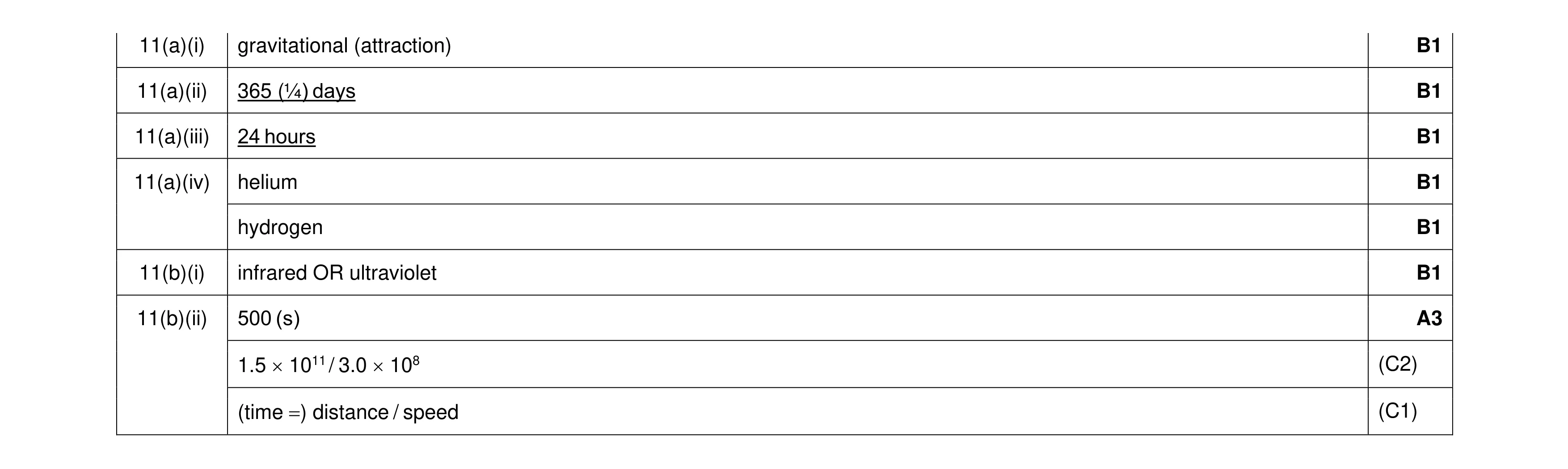 9
9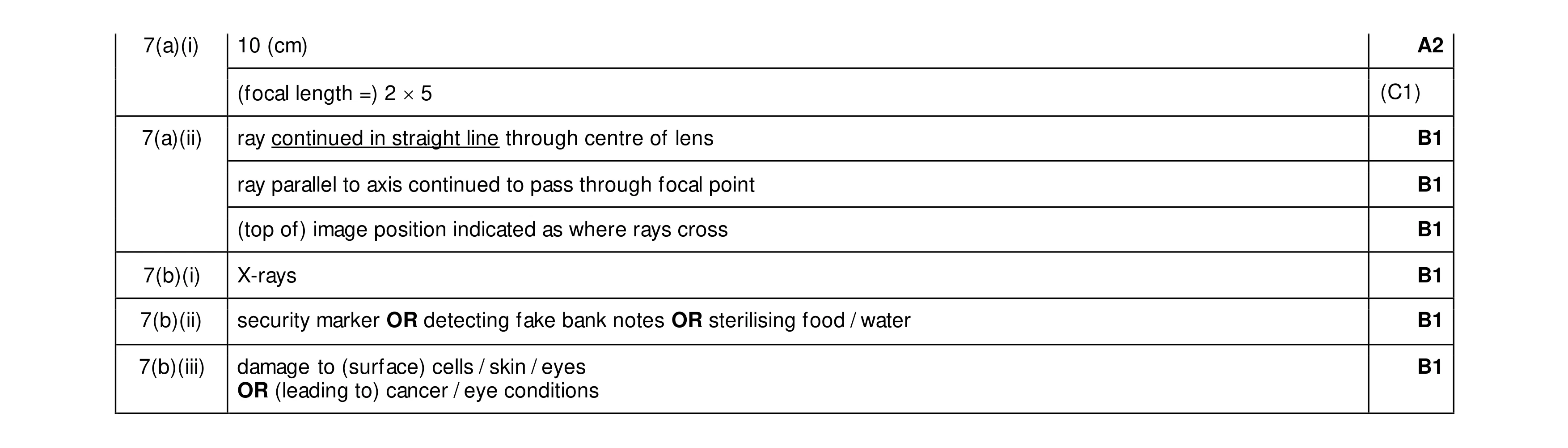 8
8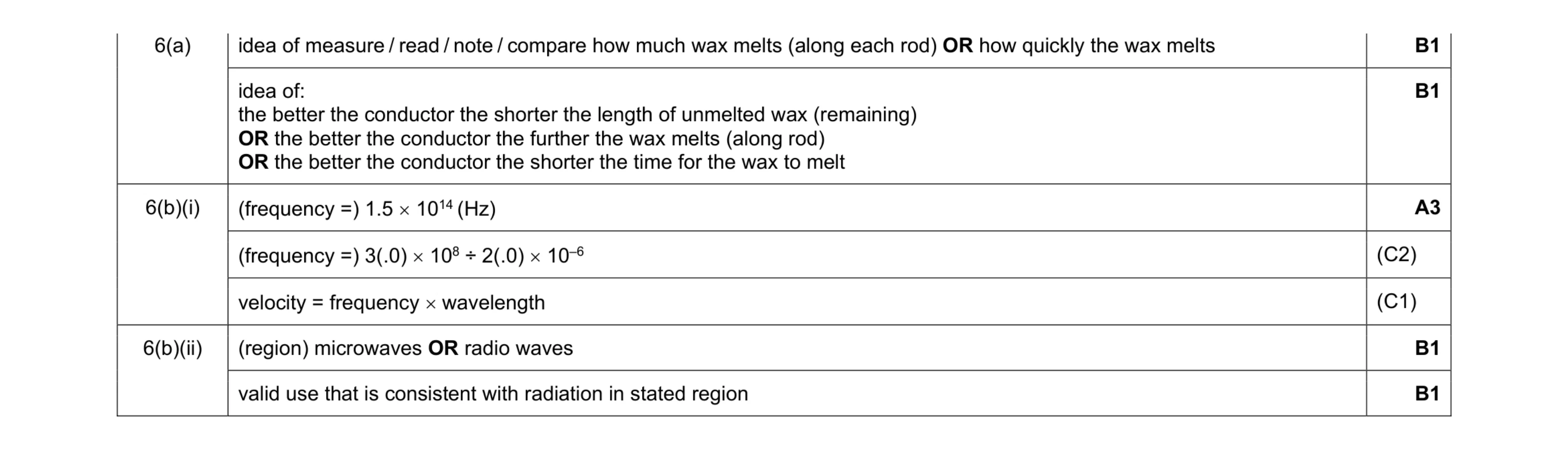 7
7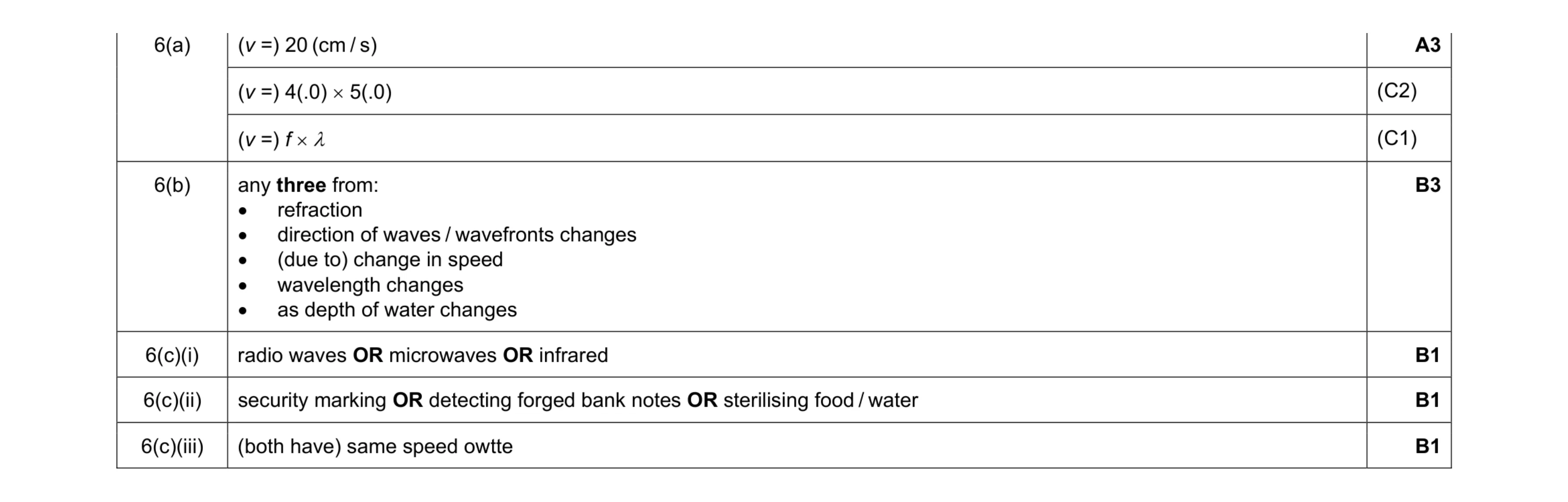 9
9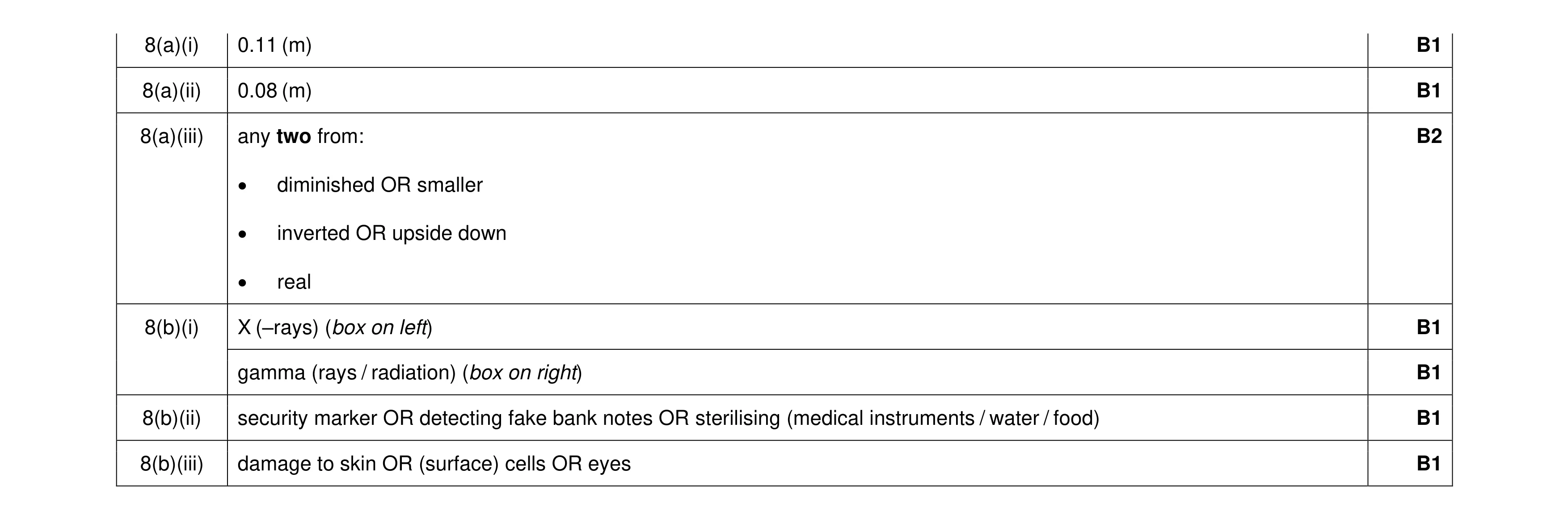 8
8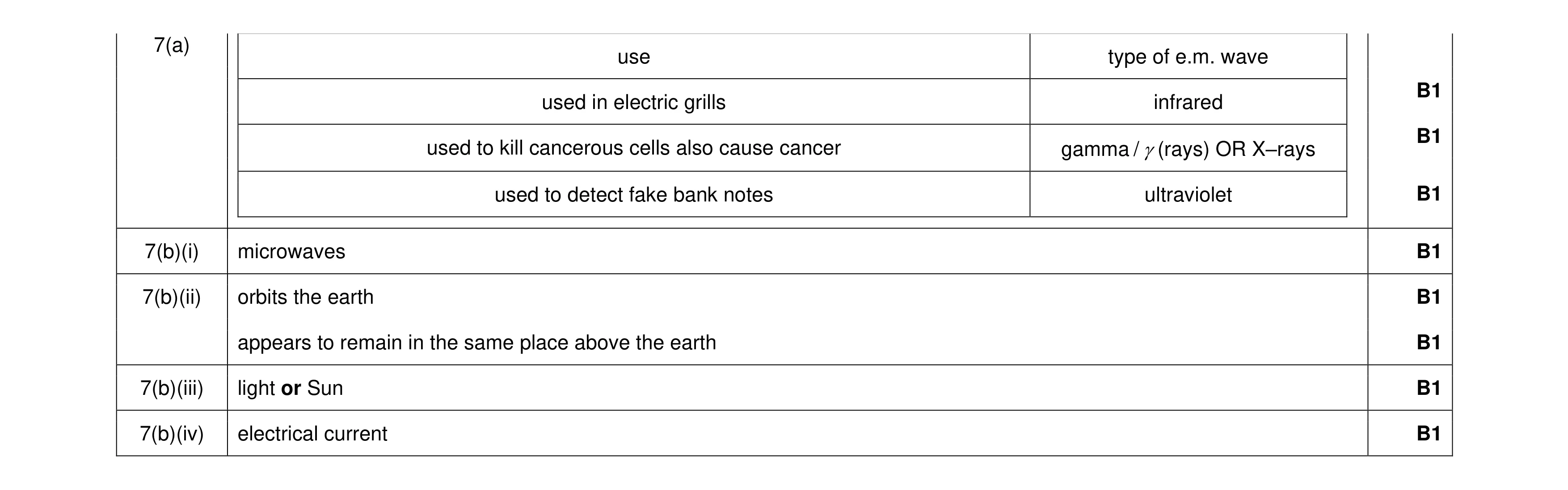 8
8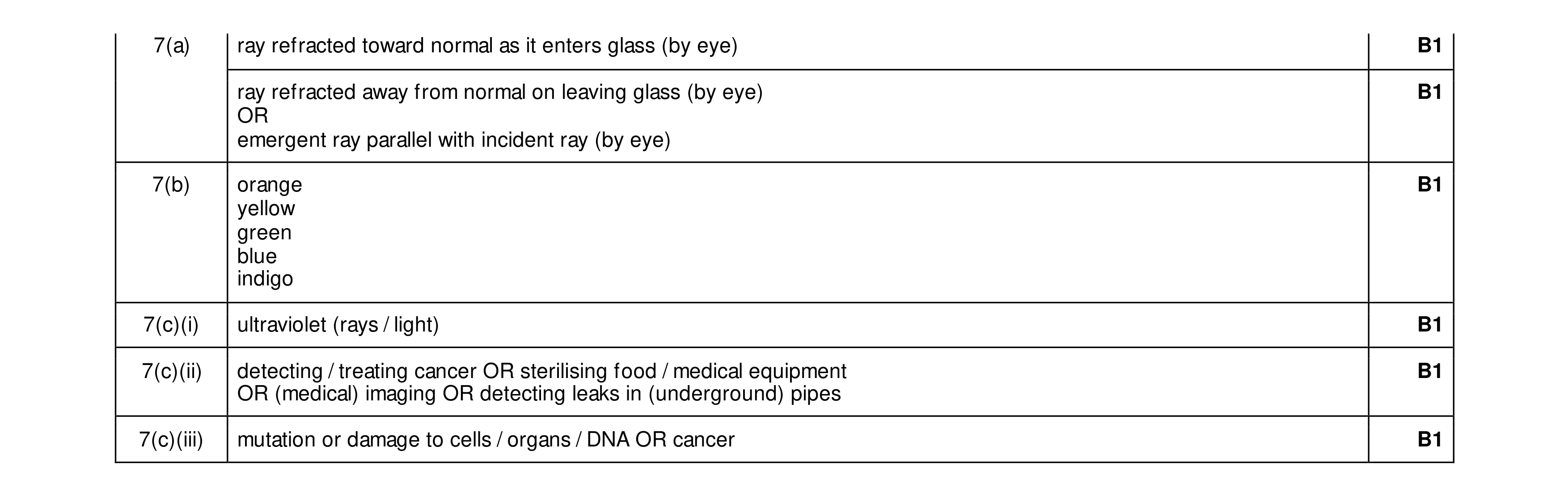 6
6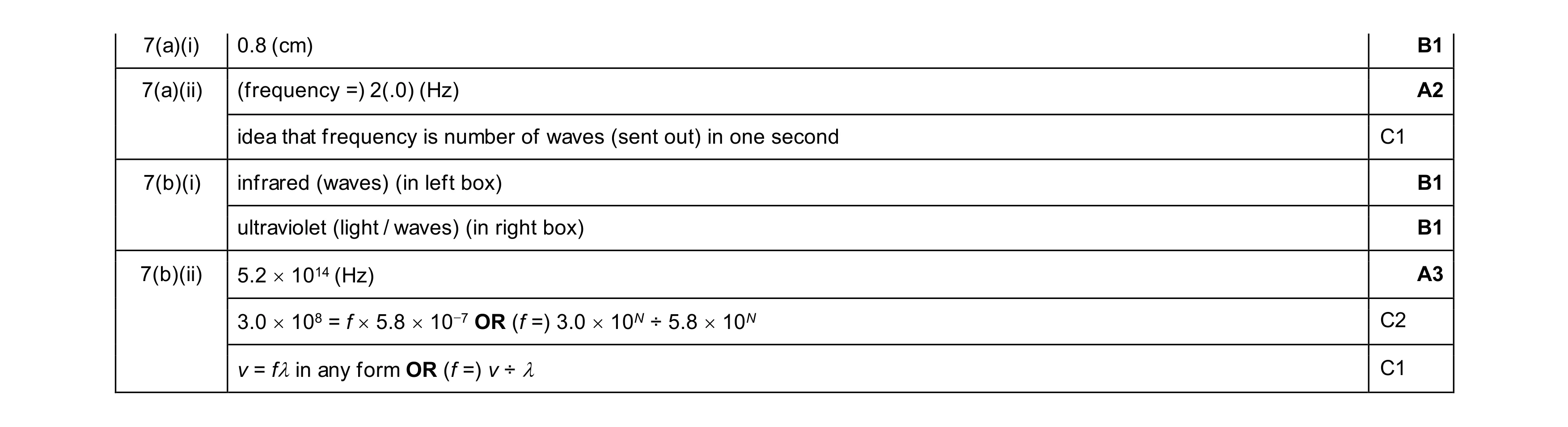 8
8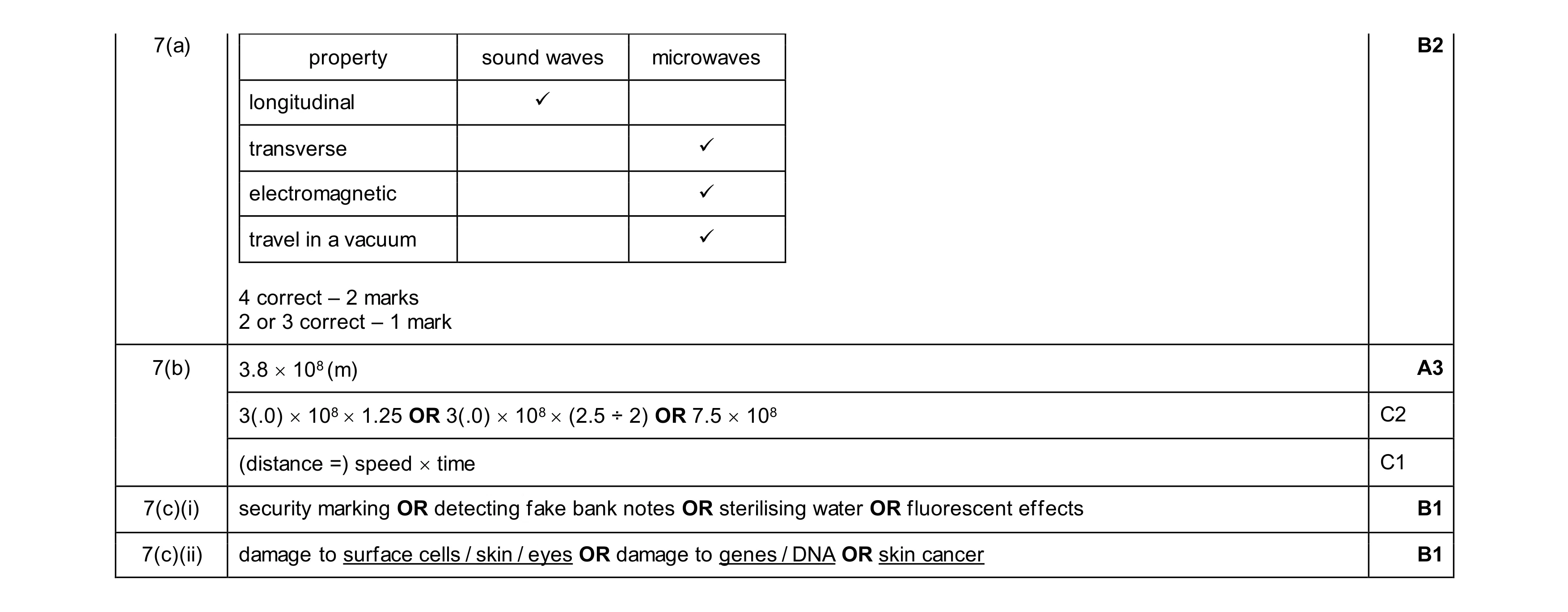 7
7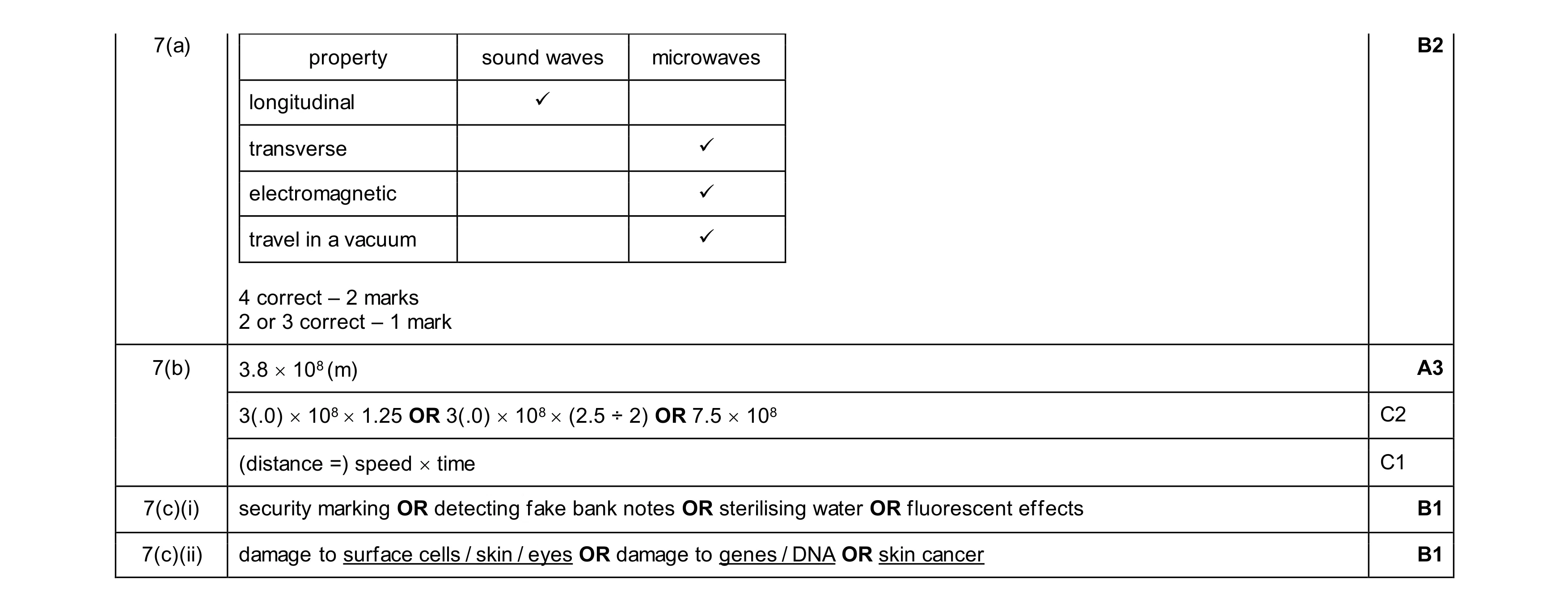 7
7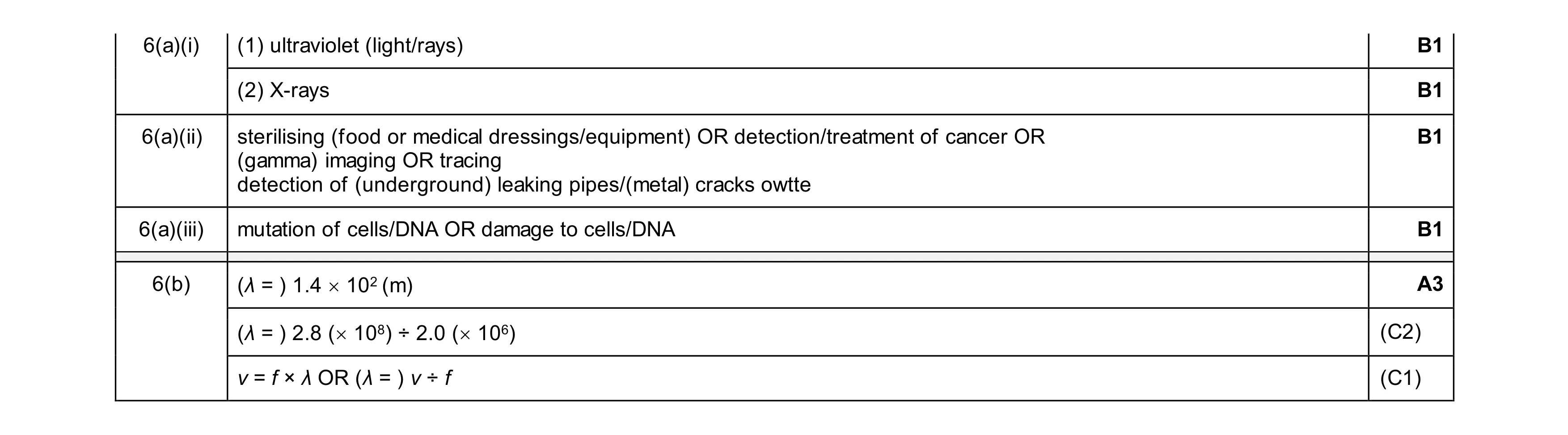 7
7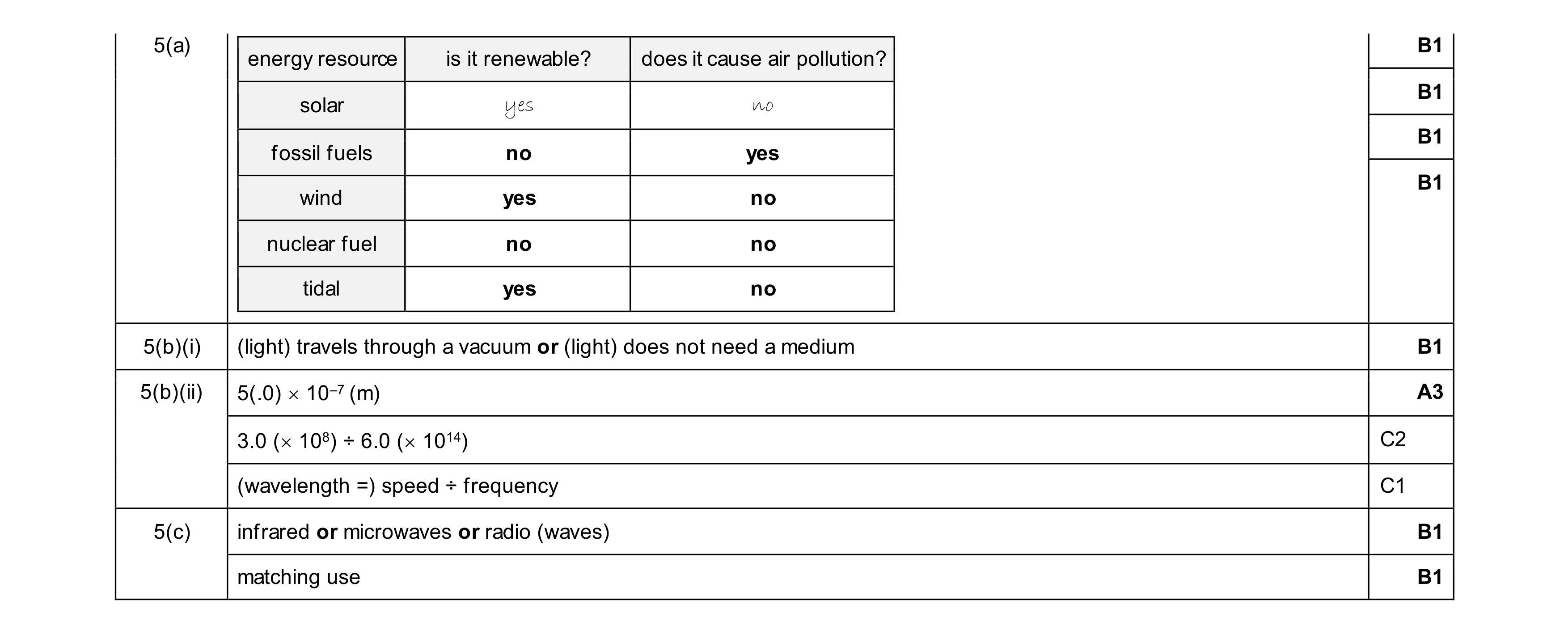 10
10