Questions as text
Q1 · Apparatus that is used to demonstrate some effects of the transfer of energy by radiation 0625/42 Feb/March 2017
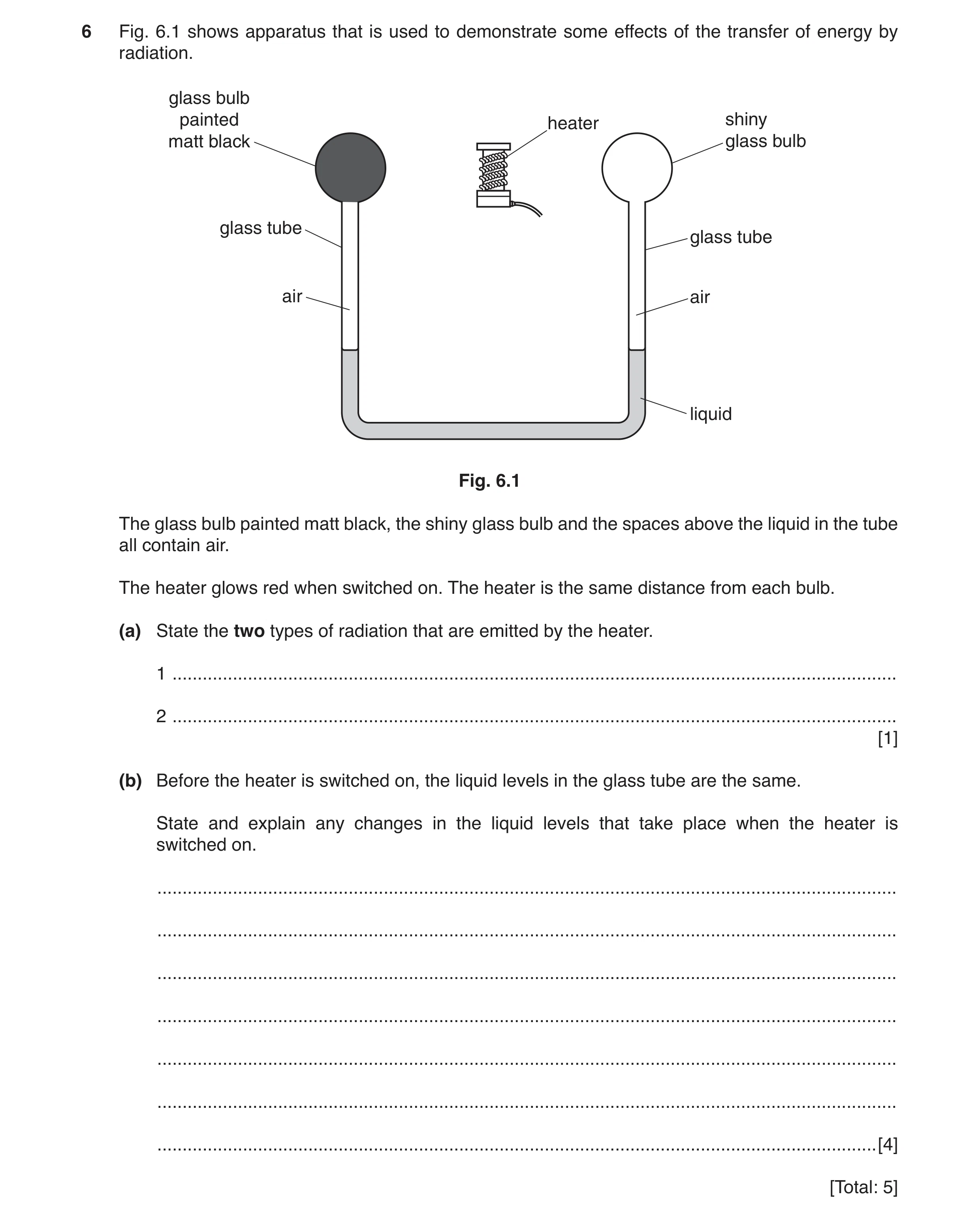
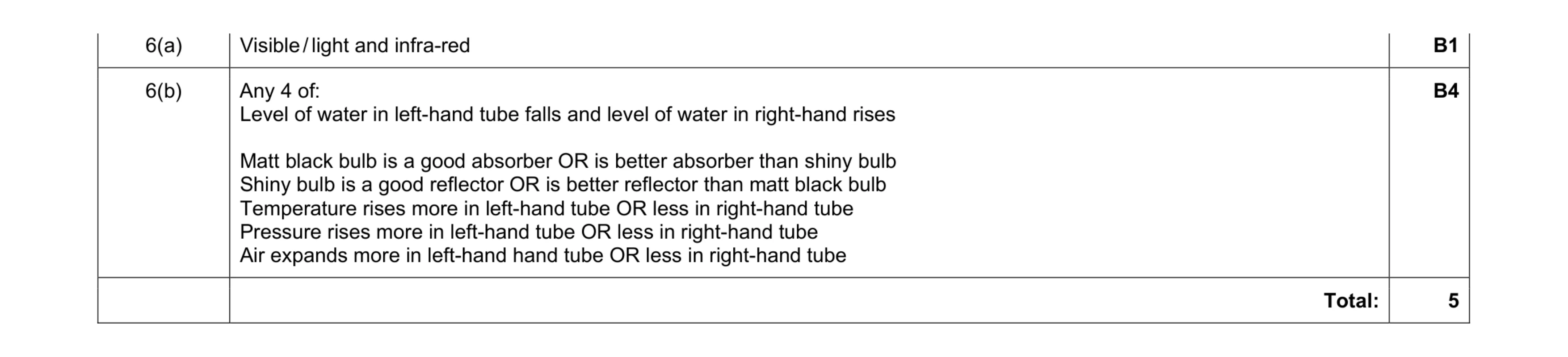
6 Fig. 6.1 shows apparatus that is used to demonstrate some effects of the transfer of energy by radiation. glass bulb painted heater shiny matt black glass bulb glass tube glass tube air air liquid Fig. 6.1 The glass bulb painted matt black, the shiny glass bulb and the spaces above the liquid in the tube all contain air. The heater glows red when switched on. The heater is the same distance from each bulb. (a) State the two types of radiation that are emitted by the heater. 1 … 2 … [1] (b) Before the heater is switched on, the liquid levels in the glass tube are the same. State and explain any changes in the liquid levels that take place when the heater is switched on. … … … … … … … [4] [Total: 5]
5 marks
Mark scheme: 6(a) Visible / light and infra-red B1 6(b) Any 4 of: Level of water in left-hand tube falls and level of water in right-hand rises Matt black bulb is a good absorber OR is better absorber than shiny bulb Shiny bulb is a good reflector OR is better reflector than matt black bulb Temperature rises more in left-hand tube OR less in right-hand tube Pressure rises more in left-hand tube OR less in right-hand tube Air expands more in left-hand hand tube OR less in right-hand tube B4 Total: 5
This question in 0625/42 Feb/March 2017
Q2 · Visible light is one component of the electromagnetic spectrum 0625/43 Oct/Nov 2017
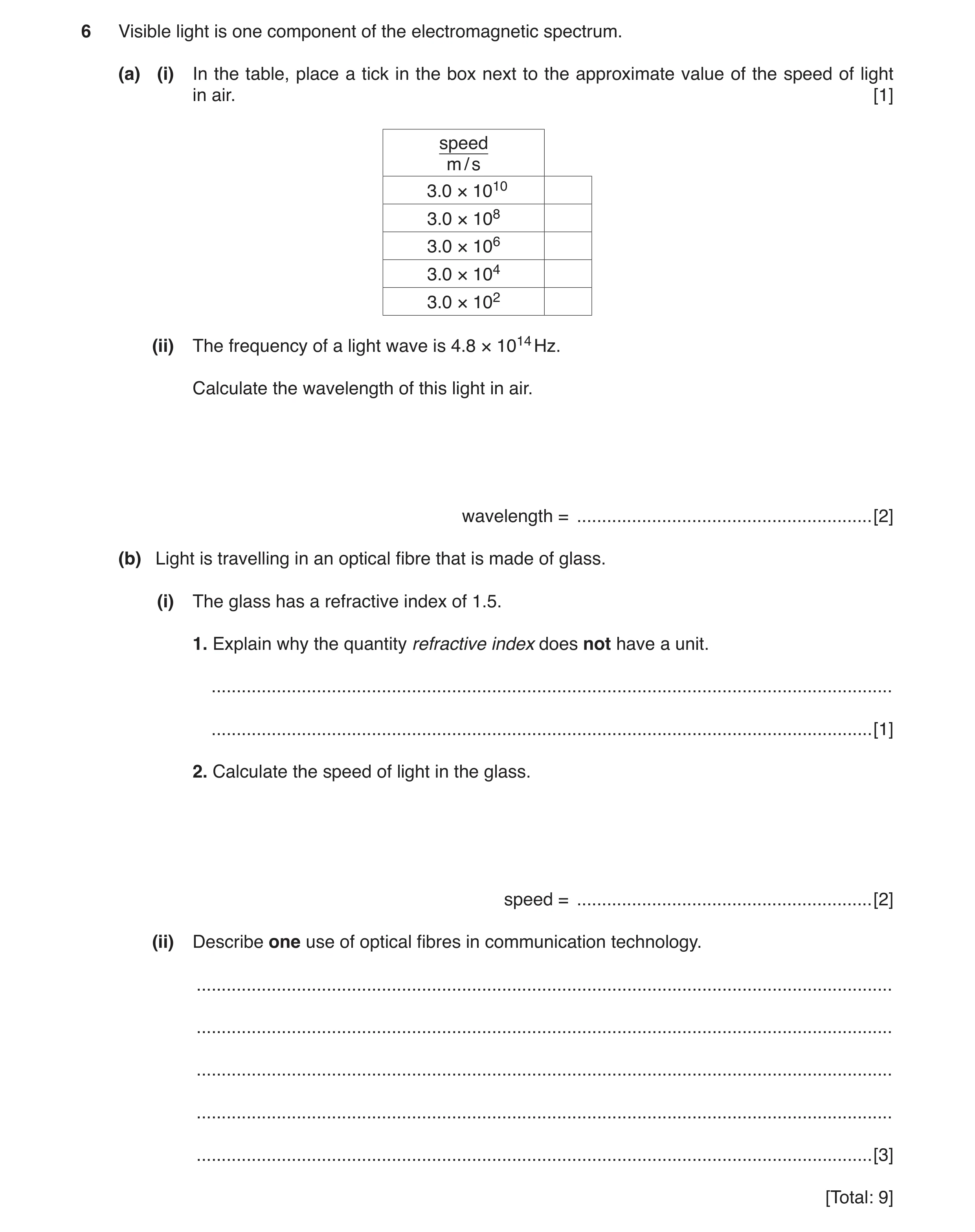
6 Visible light is one component of the electromagnetic spectrum. (a) (i) In the table, place a tick in the box next to the approximate value of the speed of light in air. [1] speed m / s 3.0 × 10¹⁰ 3.0 × 10⁸ 3.0 × 10⁶ 3.0 × 10⁴ 3.0 × 10² (ii) The frequency of a light wave is 4.8 × 10¹⁴ Hz. Calculate the wavelength of this light in air. wavelength = … [2] (b) Light is travelling in an optical fibre that is made of glass. (i) The glass has a refractive index of 1.5. 1. Explain why the quantity refractive index does not have a unit. … … [1] 2. Calculate the speed of light in the glass. speed = … [2] (ii) Describe one use of optical fibres in communication technology. … … … … … [3] [Total: 9]
9 marks
Mark scheme: 6(a)(i) B1 6(a)(ii) (λ = )c / f or 3.0 × 10⁸ / 4.8 × 10¹⁴ C1 6.2 / 6.25 / 6.3 × 10⁻⁷ m A1 6(b)(i) 1. sines have no unit or sines are ratio of two lengths or ratio of two speeds (whose units cancel) or units cancel B1 2. (v =) c / n or 3.0 × 10⁸ / 1.5 C1 2.0 × 10⁸ m / s A1 6(b)(ii) information / message / music/sound / signal / data (encoded as pulses of light) sent B1 light (travels along fibre) or infra-red (radiation) B1 light detected (at far end) or message decoded or total internal reflection mentioned B1
This question in 0625/43 Oct/Nov 2017
Q3 · State the nature of γ-rays 0625/43 Oct/Nov 2017
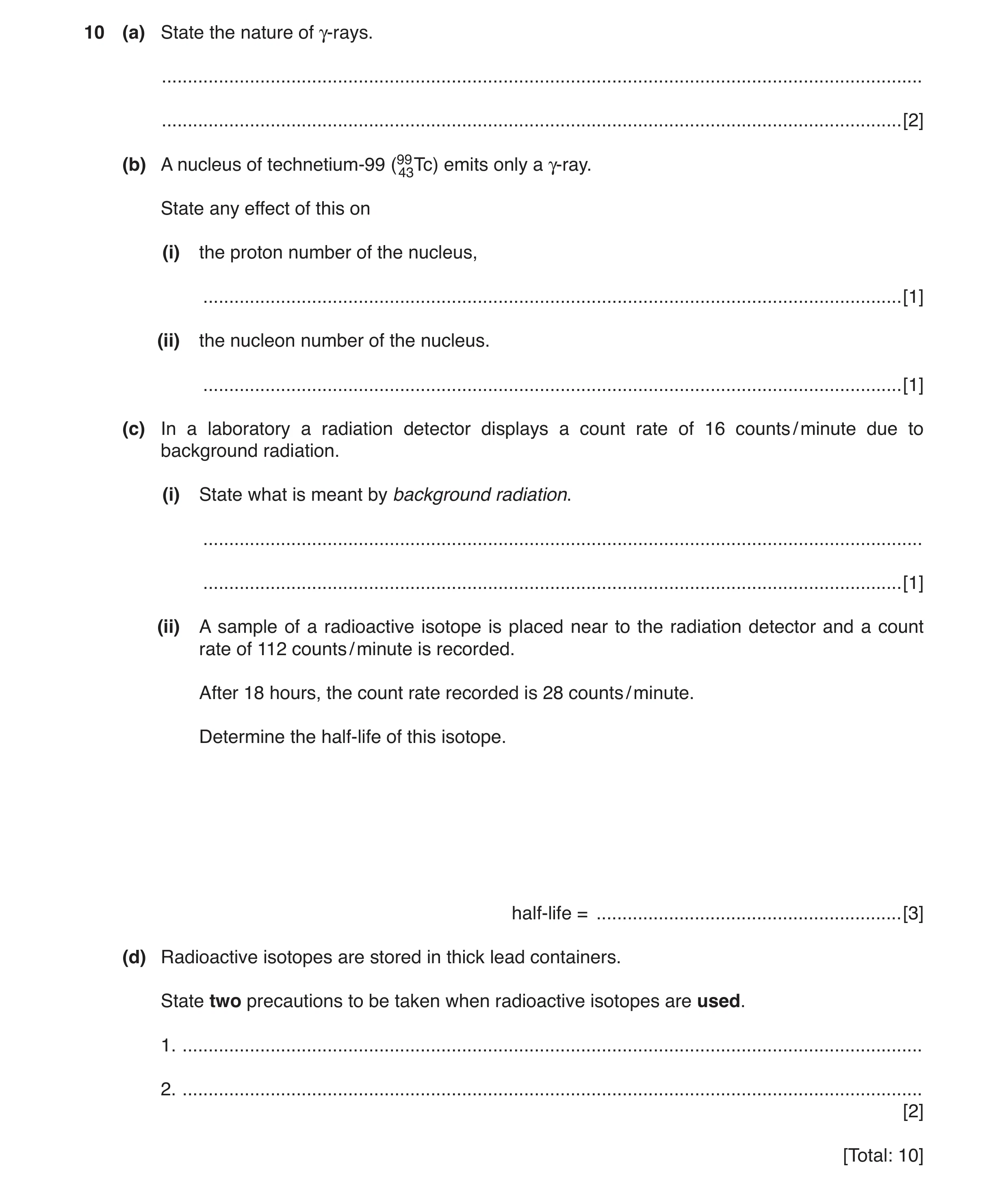
10 (a) State the nature of γ-rays. … … [2] (b) A nucleus of technetium-99 (9943Tc) emits only a γ-ray. State any effect of this on (i) the proton number of the nucleus, … [1] (ii) the nucleon number of the nucleus. … [1] (c) In a laboratory a radiation detector displays a count rate of 16 counts / minute due to background radiation. (i) State what is meant by background radiation. … … [1] (ii) A sample of a radioactive isotope is placed near to the radiation detector and a count rate of 112 counts / minute is recorded. After 18 hours, the count rate recorded is 28 counts / minute. Determine the half-life of this isotope. half-life = … [3] (d) Radioactive isotopes are stored in thick lead containers. State two precautions to be taken when radioactive isotopes are used. 1. … 2. … [2] [Total: 10]
10 marks
Mark scheme: 10(a) electromagnetic (waves / rays / radiation) M1 high frequency / energy or short wavelength A1 10(b)(i) no change or (stays at) 43 B1 10(b)(ii) no change or (stays at) 99 B1 10(c)(i) (radiation) always present / due to environment / in absence of radioactive sample / natural (radiation) B1 10(c)(ii) 112 – 16 or 96 or 112 / 28 or ¼ or 18 / 2 C1 28 – 16 or 12 or 1 / 8 or 18 / 3 or 9.0 (hours) C1 6.0 hours A1 10(d) any two of: • (distance): tongs / manipulator / centre of cardboard box • (absorption): lead gloves / suit / lead glass screen / googles / glasses • (time): limit exposure time / keep in box until needed / film badge B2
This question in 0625/43 Oct/Nov 2017
Q4 · Circle two of the following that apply to an ultrasound wave travelling in air 0625/42 May/June 2018
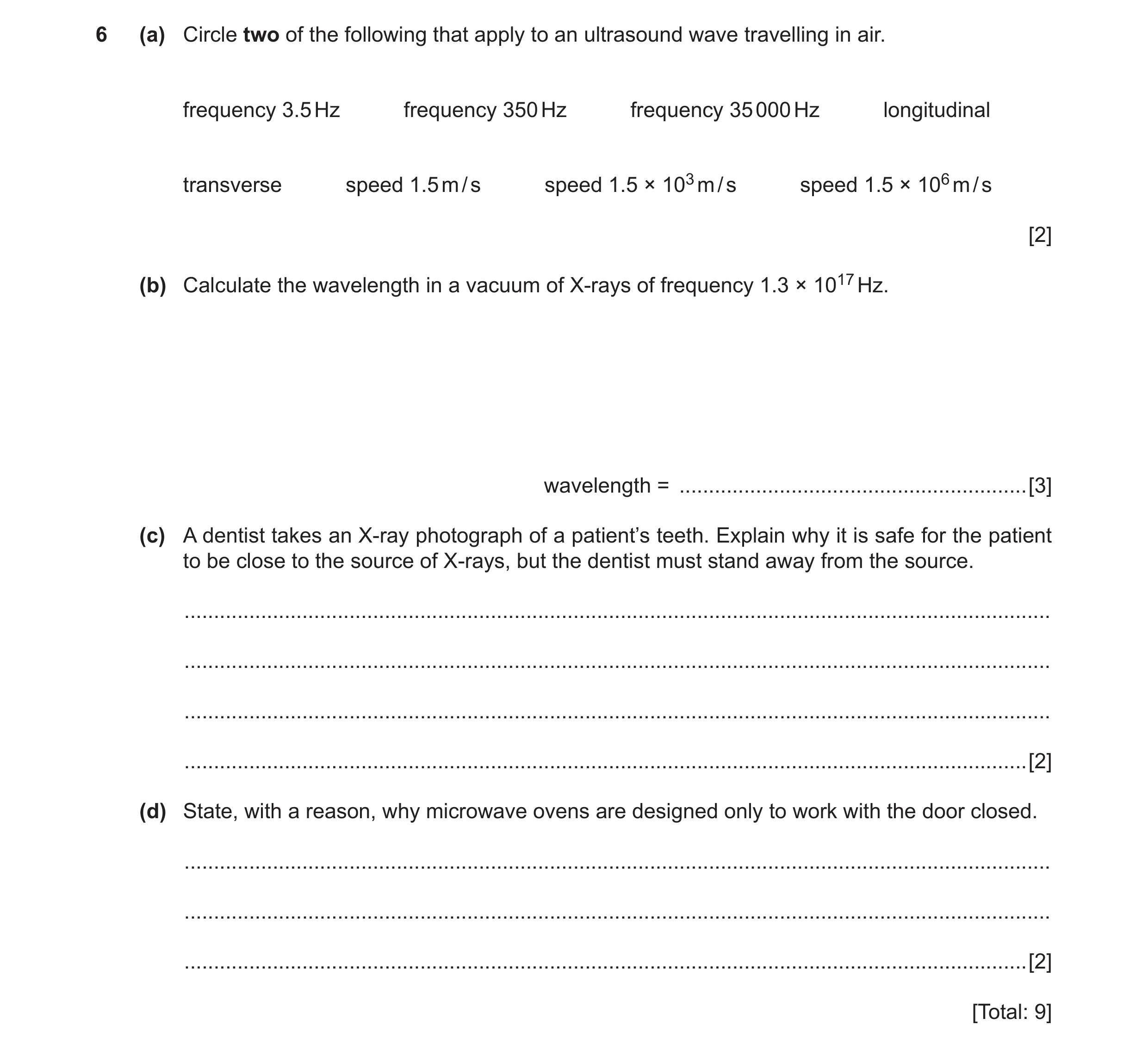
6 (a) Circle two of the following that apply to an ultrasound wave travelling in air. frequency 3.5 Hz frequency 350 Hz frequency 35 000 Hz longitudinal transverse speed 1.5 m / s speed 1.5 × 10³ m / s speed 1.5 × 10⁶ m / s [2] (b) Calculate the wavelength in a vacuum of X-rays of frequency 1.3 × 10¹⁷ Hz. wavelength = … [3] (c) A dentist takes an X-ray photograph of a patient’s teeth. Explain why it is safe for the patient to be close to the source of X-rays, but the dentist must stand away from the source. … … … … [2] (d) State, with a reason, why microwave ovens are designed only to work with the door closed. … … … [2] [Total: 9]
9 marks
Mark scheme: 6(a) frequency 35 000 Hz ringed 1 longitudinal ringed 1 6(b) v = f λ OR (λ = ) v ÷ f 1 (λ=) 3 × 10⁸ ÷ 1.3 × 10¹⁷ 1 (λ =) 2.3 × 10⁻⁹ m 1 6(c) X-rays ionising/harmful/dangerous (to humans) 1 Any one from: patient rarely exposed low total dose on patient meaningful comment about benefit outweighs danger dentist frequently exposed total dose on dentist would be high if stayed in room 1 6(d) microwaves harmful/dangerous (to humans) 1 microwaves would pass through open door 1
This question in 0625/42 May/June 2018
Q5 · Wavefronts of a wave approaching a narrow gap and passing through the gap 0625/43 May/June 2019
6 (a) Fig. 6.1 shows wavefronts of a wave approaching a narrow gap and passing through the gap. The wavelength is λ. wavefronts gap barrier direction of travel λ barrier Fig. 6.1 (i) State the name of the process that occurs as the wave passes through the gap. … [1] (ii) A wave with a wavelength λ approaches the same gap. 2 On Fig. 6.2, draw three wavefronts for this wave as it approaches the gap and three more wavefronts as the wave continues beyond it. [3] Fig. 6.2 (b) Table 6.1 shows 5 different types of electromagnetic wave. In the blank column in Table 6.1, write the numbers 1 to 5 to show the order of wavelength. Write 1 for the wave with the shortest wavelength and 5 for the wave with the longest wavelength. [2] Table 6.1 type of electromagnetic wave order of wavelength gamma rays light microwaves ultraviolet X‑rays (c) (i) State the speed of radio waves in air. … [1] (ii) A radio station transmits radio waves with a frequency of 96 MHz. Calculate the wavelength of these radio waves. wavelength = … [3] [Total: 10]
10 marks
Mark scheme: 6(a)(i) diffraction B1 6(a)(ii) wave on left half the wavelength of waves in Fig 6.1 B1 both wavelengths on right same wavelength as on left B1 much less spreading than in Fig 6.1 B1 6(b) 3 numbers correct B1 all 5 numbers correct (Correct answer: 1, 4, 5, 3, 2) B1 6(c)(i) 3.0 × 10⁸ m/s B1 6(c)(ii) v = fλ in any form OR (λ = v/f ) C1 96 × 106 seen C1 (λ = 8 6 3.0 10 96 10 × × = ) 3.1 m A1
This question in 0625/43 May/June 2019
Q6 · State two uses for infrared radiation 0625/43 Oct/Nov 2020
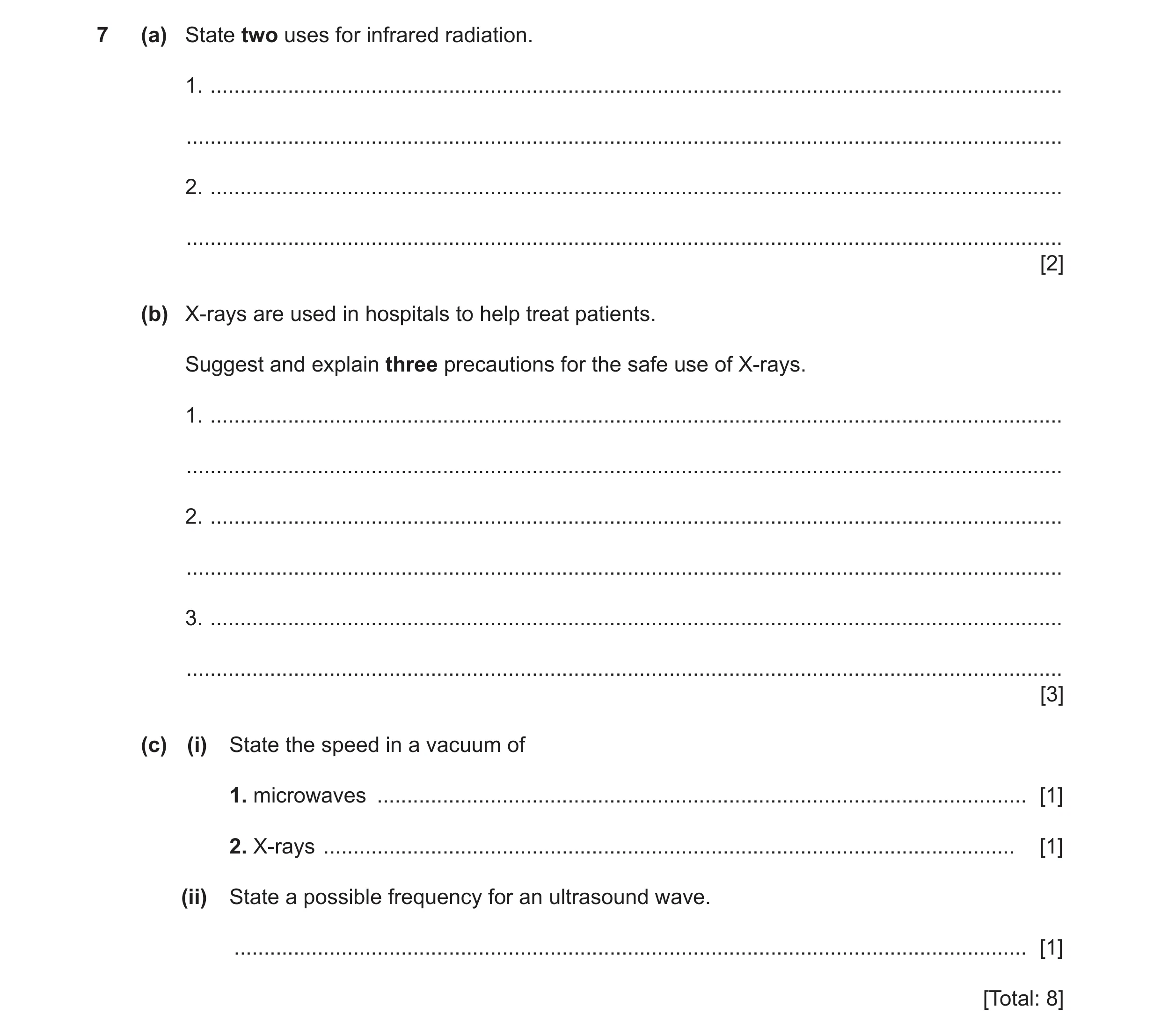
7 (a) State two uses for infrared radiation. 1. … … 2. … … [2] (b) X-rays are used in hospitals to help treat patients. Suggest and explain three precautions for the safe use of X-rays. 1. … … 2. … … 3. … … [3] (c) (i) State the speed in a vacuum of 1. microwaves … [1] 2. X-rays … [1] (ii) State a possible frequency for an ultrasound wave. … [1] [Total: 8]
8 marks
Mark scheme: 7(a) any two from: remote controls (infrared) sensors / alarms specific electrical appliances thermal imaging B2 7(b) Any three from • shielding of operator behind screen / lead apron / out of room AND to absorb radiation • shielding of other parts of patient with lead / shielding of other parts of patient AND to absorb radiation • distance from source AND reduces intensity / amount of radiation / exposure • limit time of exposure / not too frequent / max number of X-rays per year AND to limit dose • limit strength / intensity of X-ray beam AND to limit dose B3 7(c)(i) 1 3 × 10⁸ m / s B1 2 3 × 10⁸ m / s B1 7(c)(ii) > 20 000 Hz B1
This question in 0625/43 Oct/Nov 2020
Q7 · X‑rays are electromagnetic waves 0625/41 Oct/Nov 2021
6 X‑rays are electromagnetic waves. Fig. 6.1 shows the position of X‑rays in the electromagnetic spectrum arranged according to increasing wavelength. gamma-rays X-rays J K microwaves L visible light increasing wavelength Fig. 6.1 (a) Three components of the spectrum are unnamed but labelled J, K and L. (i) State the names of these three components. J … K … L … [2] (ii) State which of these three components has the lowest frequency. … [1] (b) Calculate the frequency of X‑rays that have a wavelength of 1.2 × 10⁻⁹ m in a vacuum. frequency = … [3] (c) (i) Describe one medical use of X‑rays. … … … … … [3] (ii) State one reason why it is necessary to take safety precautions when X‑rays are used. … … [1] [Total: 10]
10 marks
Mark scheme: 6(a)(i) (J) ultraviolet (radiation) (K) infrared (radiation) (L) radio (waves) two correct C1 all three correct A1 6(a)(ii) L or radio (waves) B1 6(b) (c =) 3.0 × 10⁸ (m / s) seen C1 (f =) v / λ in any form or 3.0 × 10⁸ / 1.2 × 10⁻⁹ C1 2.5 × 10¹⁷ Hz A1 6(c)(i) stated medical use (e.g. treating cancer / X-ray shadowgraph / sterilising equipment) B1 statement of what happens to the X-rays (e.g. absorbed by tumour / bones / bacteria) B1 stated consequence (e.g. tumour killed or image / picture / shadow / photograph produced) B1 6(c)(ii) can cause burns / (cell) mutation / cell damage / tumours / cancer / damages DNA etc. B1
This question in 0625/41 Oct/Nov 2021
Q8 · Sound waves are longitudinal and electromagnetic waves are transverse 0625/42 May/June 2022
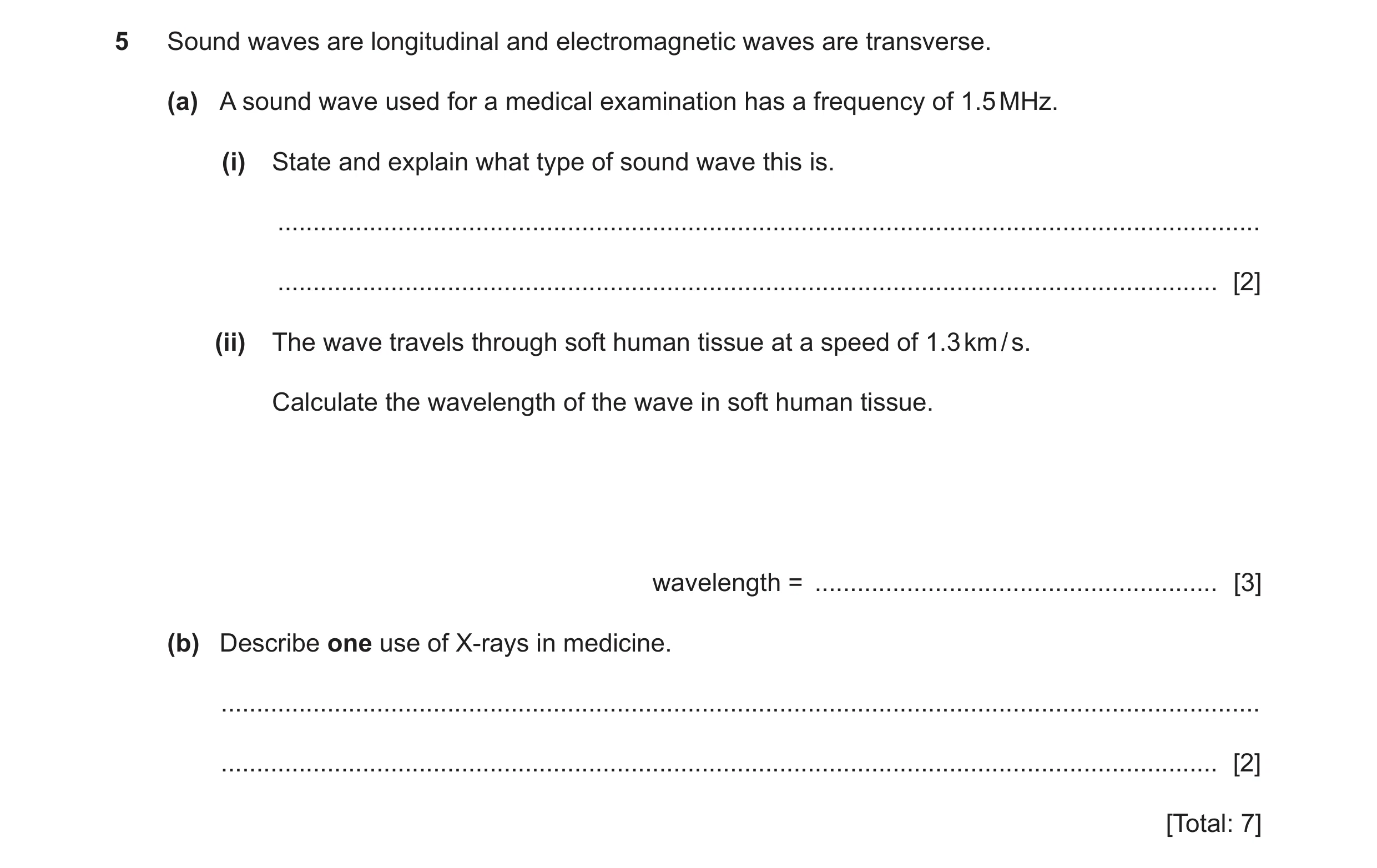
5 Sound waves are longitudinal and electromagnetic waves are transverse. (a) A sound wave used for a medical examination has a frequency of 1.5 MHz. (i) State and explain what type of sound wave this is. … … [2] (ii) The wave travels through soft human tissue at a speed of 1.3 km / s. Calculate the wavelength of the wave in soft human tissue. wavelength = … [3] (b) Describe one use of X-rays in medicine. … … [2] [Total: 7]
7 marks
Mark scheme: 5(a)(i) ultrasound OR sound (frequency) above audible range B1 frequency > 20 kHz OR 20 000 Hz B1 5(a)(ii) 8.7 10–4 m A3 ( =) v / f OR v = f in any form C1 ( =) 1.3 103 / 1.5 106 OR 8.7 10n C1 5(b) basic description of use e.g. X-rays for detecting broken bones B1 additional detail e.g. X-rays pass through soft tissue AND not through bone B1
This question in 0625/42 May/June 2022
Q9 · A plan view of a room 0625/43 May/June 2022
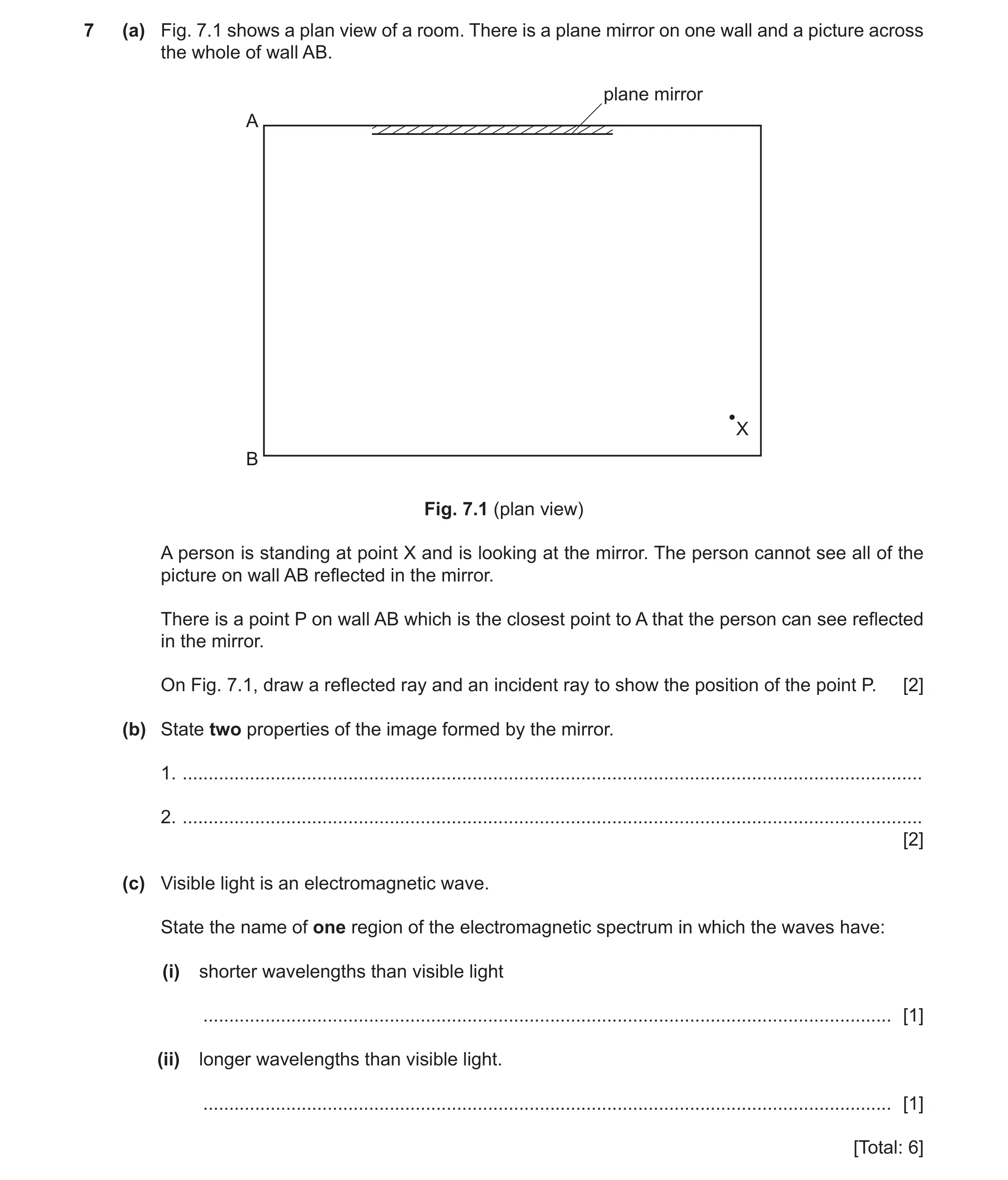
7 (a) Fig. 7.1 shows a plan view of a room. There is a plane mirror on one wall and a picture across the whole of wall AB. plane mirror A X B Fig. 7.1 (plan view) A person is standing at point X and is looking at the mirror. The person cannot see all of the picture on wall AB reflected in the mirror. There is a point P on wall AB which is the closest point to A that the person can see reflected in the mirror. On Fig. 7.1, draw a reflected ray and an incident ray to show the position of the point P. [2] (b) State two properties of the image formed by the mirror. 1. … 2. … [2] (c) Visible light is an electromagnetic wave. State the name of one region of the electromagnetic spectrum in which the waves have: (i) shorter wavelengths than visible light … [1] (ii) longer wavelengths than visible light. … [1] [Total: 6]
6 marks
Mark scheme: 7(a) ray from left hand corner of the mirror to the eye B1 angle of incidence = angle of reflection B1 7(b) any two from: virtual upright same size as object laterally inverted B2 7(c)(i) ultraviolet / X-rays / gamma rays B1 7(c)(ii) infrared / microwaves / radio (waves) B1
This question in 0625/43 May/June 2022
Q10 · A heater in a bathroom 0625/41 Oct/Nov 2022
5 Fig. 5.1 shows a heater in a bathroom. heater Fig. 5.1 The heater is at a very high temperature and it glows red. The manufacturer states: “The heater emits light and radiation and it transfers thermal energy by radiation.” (a) State the part of the electromagnetic spectrum that transfers thermal energy. … [1] (b) State: (i) one way in which visible light and the radiation identified in (a) are similar … … [1] (ii) one way in which visible light differs from the radiation identified in (a). … … [1] (c) Some surfaces are better at emitting radiation than others. (i) Describe an experiment to show whether a black surface or a white surface is the better emitter of radiation. You may draw a diagram. … … … … … [3] (ii) To ensure that the conclusion reached in the experiment in (c)(i) is correct, several details of the experiment must be identical when testing the two different surfaces. State two quantities in the experiment that you described that must be identical during the test. 1. … … 2. … … [2] [Total: 8]
8 marks
Mark scheme: 5(a) infrared B1 5(b)(i) (both) transverse / electromagnetic / travel in a vacuum / have the same (high) speed (in a vacuum) B1 5(b)(ii) (it / visible light) compared with an e.m. radiation stated by candidate in 5(a) in terms of frequency / wavelength B1 5(c)(i) B3 equipment B1 e.g. black container, white container, thermometers or Leslie’s cube and detector measurements made B1 warm / hot water in container and temperature decreases recorded or time to reach a given temperature / to cool or warm / hot water in cube and meter readings recorded how a conclusion is reached B1 better emitter surface cools quicker or greater reading from better emitter surface 5(c)(ii) any two appropriate quantities B2 e.g. initial temperature of water mass / volume of water dimensions / surface area of container time of cooling mass of container shape of container smoothness of surface or surface area of face (of cube) distance of detector temperature of water at time of measurement smoothness of surface
This question in 0625/41 Oct/Nov 2022
Q11 · A mobile phone (cell phone) network uses microwaves of frequency 1.9 × 10⁹ Hz to transmit… 0625/41 May/June 2023
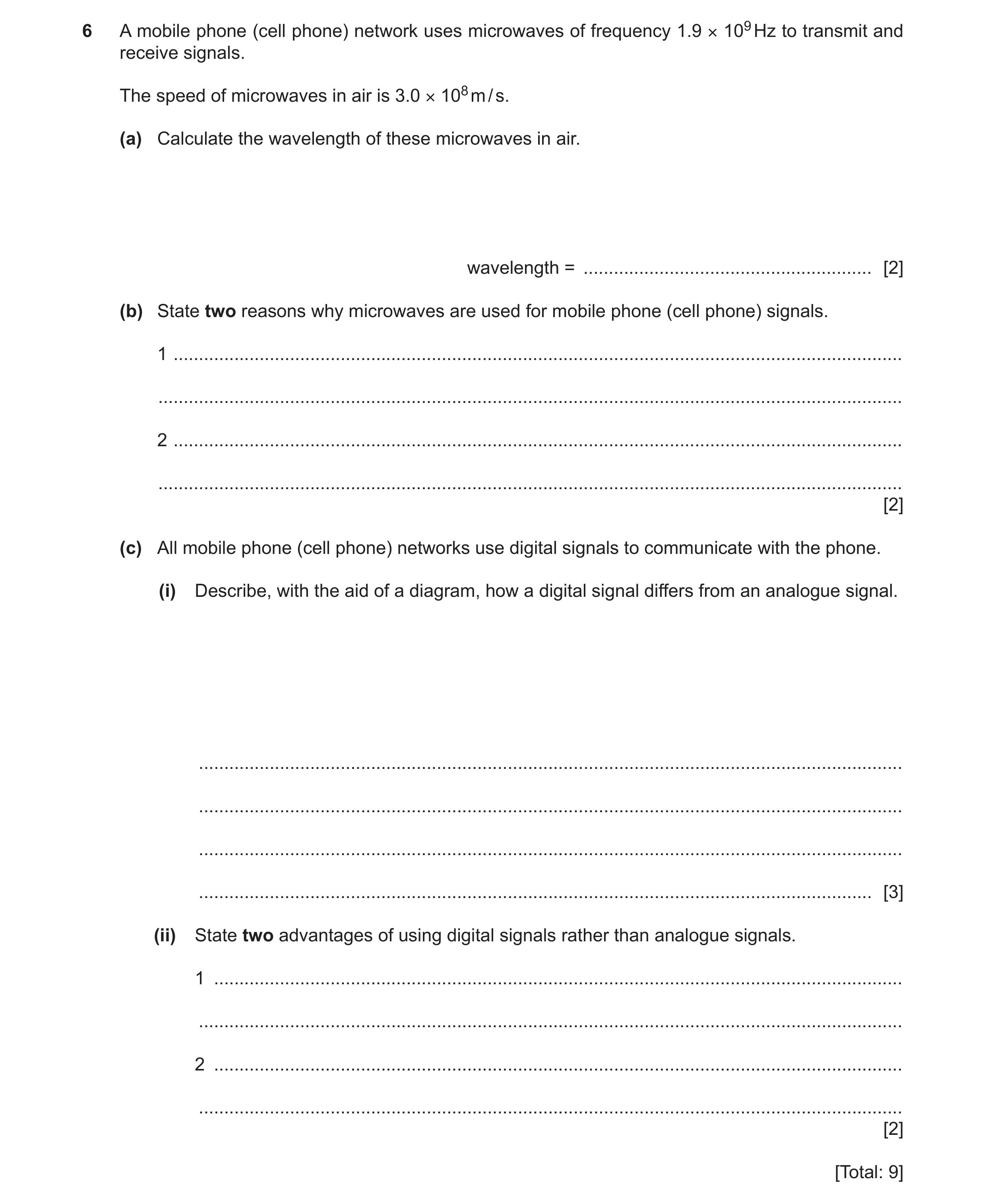
6 A mobile phone (cell phone) network uses microwaves of frequency 1.9 × 10⁹ Hz to transmit and receive signals. The speed of microwaves in air is 3.0 × 10⁸ m / s. (a) Calculate the wavelength of these microwaves in air. wavelength = … [2] (b) State two reasons why microwaves are used for mobile phone (cell phone) signals. 1 … … 2 … … [2] (c) All mobile phone (cell phone) networks use digital signals to communicate with the phone. (i) Describe, with the aid of a diagram, how a digital signal differs from an analogue signal. … … … … [3] (ii) State two advantages of using digital signals rather than analogue signals. 1 … … 2 … … [2] [Total: 9]
9 marks
Mark scheme: 6(a) (wavelength =) 0.16 m A2 v = f OR ( =) v / f OR ( =) 3 108 / 1.9 109 C1 6(b) (microwaves) only need short aerials / antennas B1 (microwaves) penetrate (some) walls B1 Question Answer Marks 6(c)(i) labelled diagram of digital (signal) with blocks of high (1) and low (0) AND labelled diagram of analogue with continuously variable signal B1 digital (signal) consists of two values owtte B1 analogue (signal) varies over a range (of values) owtte B1 6(c)(ii) any two from: faster (data) transmission rate OR data can be compressed data / signal transmitted over long(er) distances (as signal can be regenerated) noise easily removed (from signal / data) OR signal can be regenerated B2
This question in 0625/41 May/June 2023
Q12 · A radio transmitter is a very tall, thin cylinder 0625/41 Oct/Nov 2023
4 A radio transmitter is a very tall, thin cylinder. It is prevented from falling over by wires which have one end fixed to the transmitter and the other end fixed in the ground. The ends of the wires in the ground are a long distance from the transmitter. Fig. 4.1 shows the transmitter and two of the wires. transmitter G wire W base ground Fig. 4.1 (a) The centre of gravity G is shown on Fig. 4.1. (i) State what is meant by centre of gravity. … … [1] (ii) Explain why the radio transmitter without the wires is a very unstable structure. … … [1] (b) Wire W is under tension and it exerts a force T on the transmitter. (i) On Fig. 4.1, mark an arrow to show the force T exerted by wire W on the transmitter. [1] (ii) The force T produces a moment on the transmitter about its base. Describe how the moment produced by T is calculated and indicate on Fig. 4.1 what is meant by any other terms in the description. … … [3] (c) The radio transmitter uses radio waves to transmit radio and television programmes. State one other use of radio waves. … … [1] [Total: 7]
7 marks
Mark scheme: 4(a)(i) (point / place / position) where (all) the weight (seems to) acts B1 4(a)(ii) a small tilt / rotation makes G no longer vertically above the base OR small tilt / rotation produces moment (that topples B1 transmitter) 4(b)(i) arrow(head) marked along wire W towards ground B1 4(b)(ii) moment = F d AND correct indication of F and d on Fig. 4.1. A3 (moment is ) force (perpendicular) distance (from base / pivot) C1 (moment is ) force perpendicular distance (from base / pivot) C1 4(c) a use of radio waves, e.g. RFID / astronomy / Bluetooth / RADAR / wifi B1
This question in 0625/41 Oct/Nov 2023
Q13 · Some uses of electromagnetic radiation and different regions of the electromagnetic… 0625/42 Oct/Nov 2023
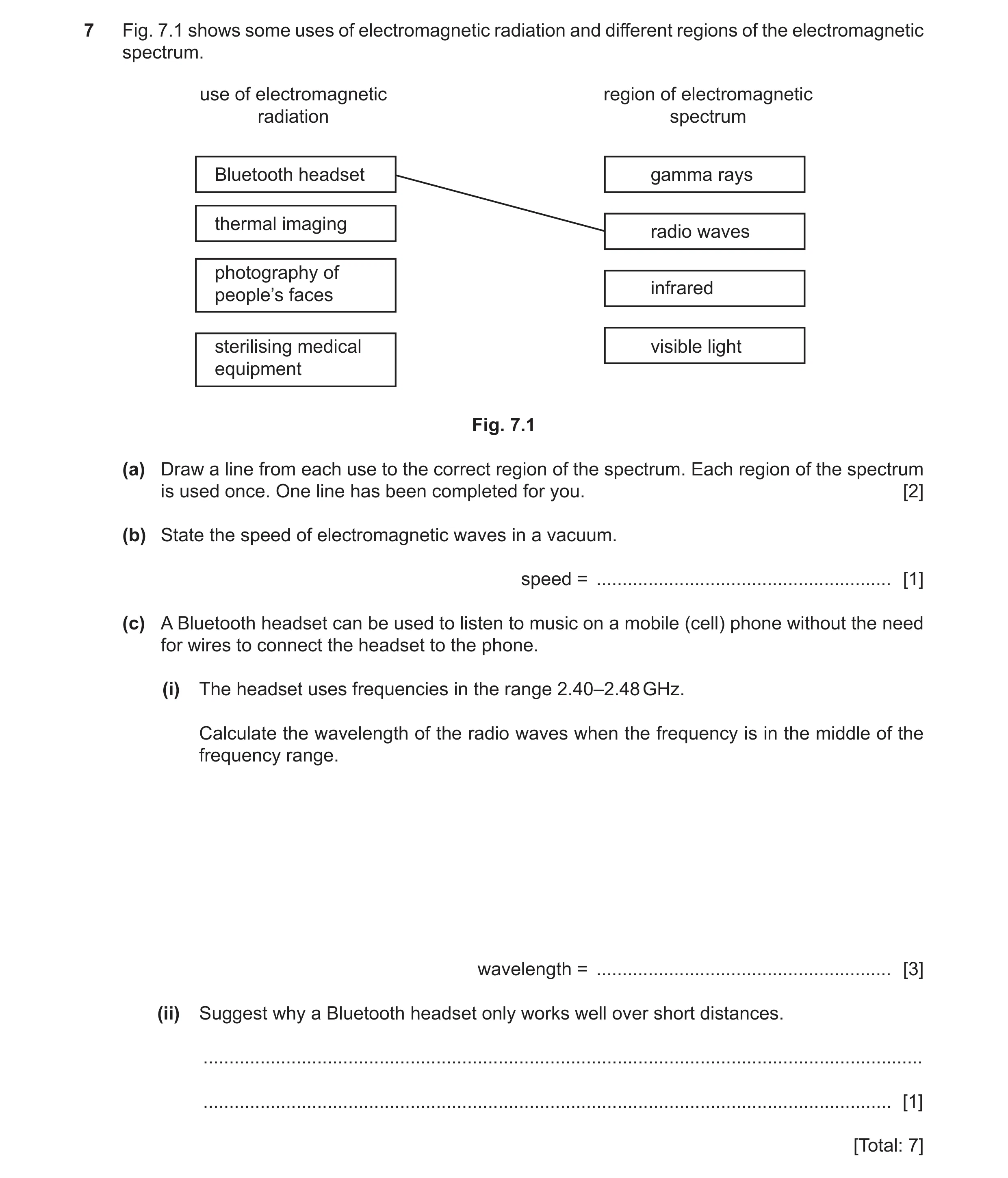
7 Fig. 7.1 shows some uses of electromagnetic radiation and different regions of the electromagnetic spectrum. use of electromagnetic region of electromagnetic radiation spectrum Bluetooth headset gamma rays thermal imaging radio waves photography of infrared people’s faces sterilising medical visible light equipment Fig. 7.1 (a) Draw a line from each use to the correct region of the spectrum. Each region of the spectrum is used once. One line has been completed for you. [2] (b) State the speed of electromagnetic waves in a vacuum. speed = … [1] (c) A Bluetooth headset can be used to listen to music on a mobile (cell) phone without the need for wires to connect the headset to the phone. (i) The headset uses frequencies in the range 2.40–2.48 GHz. Calculate the wavelength of the radio waves when the frequency is in the middle of the frequency range. wavelength = … [3] (ii) Suggest why a Bluetooth headset only works well over short distances. … … [1] [Total: 7]
7 marks
Mark scheme: 7(a) B2 all correct 2 marks 1 or 2 correct 1 mark 7(b) 3.0 108 m / s B1 7(c)(i) 0.12 m A3 (mid-point of frequency range identified as) 2.44 (GHz) C1 v = fOR (=) v / f OR (=) 3.0 108 / 2.44 109 OR (=) 1.2 10N C1 7(c)(ii) (radio waves / signal) lose energy / get weaker / lose (signal) strength (passing through walls) owtte B1
This question in 0625/42 Oct/Nov 2023
Q14 · Applications of regions of the electromagnetic spectrum 0625/42 Feb/March 2024
5 (a) (i) Table 5.1 shows applications of regions of the electromagnetic spectrum. Complete the second column of the table with the region of the electromagnetic spectrum used for each application. Choose from the regions in this list: gamma rays infrared microwaves radio waves ultraviolet Each region may be used once, more than once or not at all. Table 5.1 application region of electromagnetic spectrum cancer treatment gamma rays Bluetooth data connection optical fibres security marking sterilising food wireless internet [3] (ii) State the approximate speed of radio waves in air. speed = … m / s [1] (b) Fig. 5.1 shows successive crests of a wave after a plane wave has passed through a gap. Fig. 5.1 (i) On Fig. 5.1 draw three successive crests before the wave reaches the gap. [2] (ii) Fig. 5.2 shows a much wider gap. A plane wave of the same wavelength as in (b)(i) is incident on the gap from the left side of the barrier. Fig. 5.2 On Fig. 5.2, draw three successive crests of the wave after the wave has passed through the gap. [2] [Total: 8]
8 marks
Mark scheme: 5(a)(i) B3 application region of electromagnetic spectrum cancer treatment gamma rays bluetooth radio waves optical fibres infrared security marking ultraviolet sterilising food gamma rays wireless internet Microwaves 5(a)(ii) 3.0 108 (m / s) OR 300 000 000 (m / s) B1 5(b)(i) three crests parallel to the barrier B1 same wavelength as wave after the gap B1 5(b)(ii) central part of crest (parallel to the (gap in the) barrier) is straight B1 crests have curved ends B1
This question in 0625/42 Feb/March 2024
Q15 · The Sun is one of many billions of stars in the Milky Way 0625/41 May/June 2024
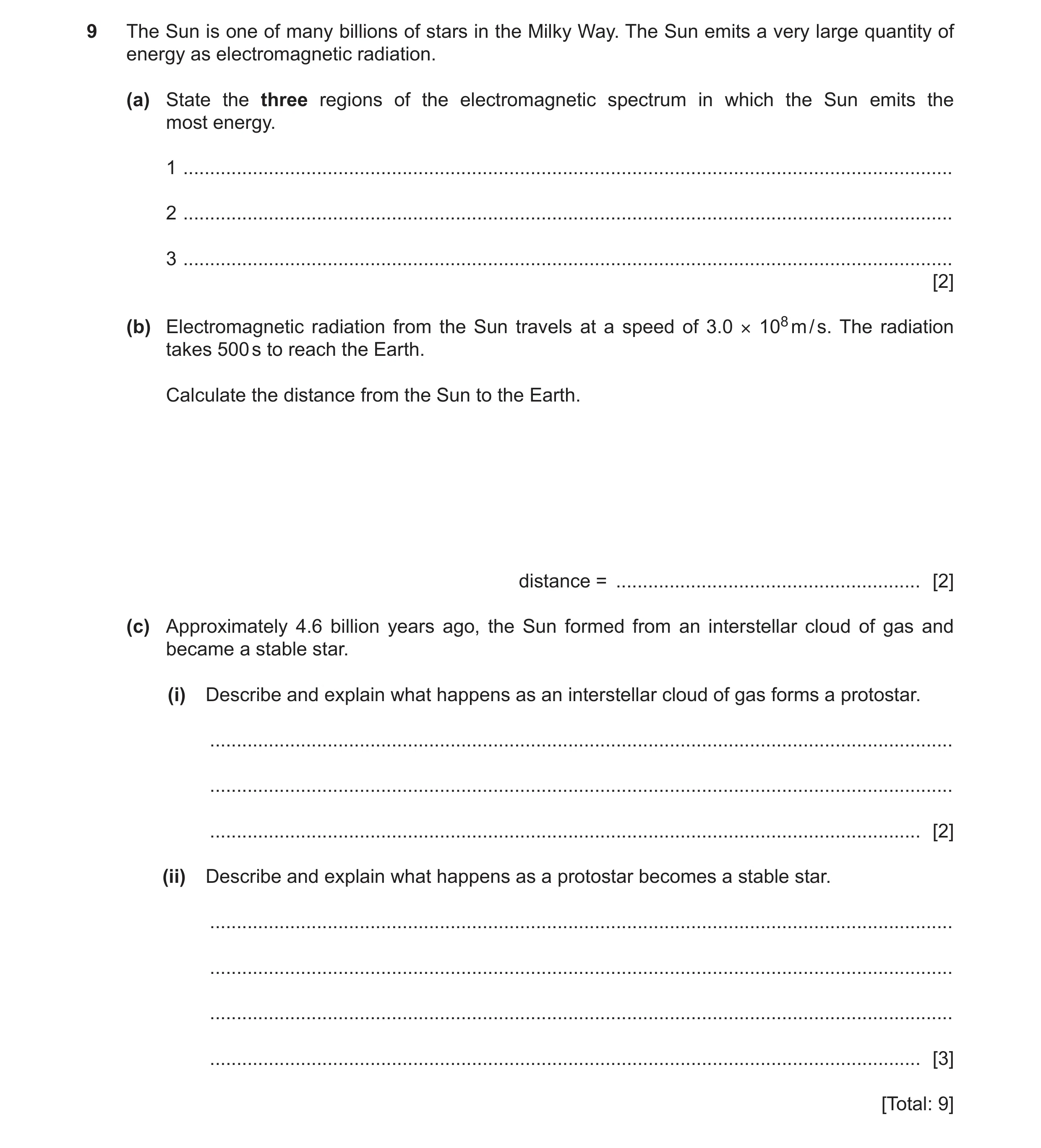
9 The Sun is one of many billions of stars in the Milky Way. The Sun emits a very large quantity of energy as electromagnetic radiation. (a) State the three regions of the electromagnetic spectrum in which the Sun emits the most energy. 1 … 2 … 3 … [2] (b) Electromagnetic radiation from the Sun travels at a speed of 3.0 × 10⁸ m / s. The radiation takes 500 s to reach the Earth. Calculate the distance from the Sun to the Earth. distance = … [2] (c) Approximately 4.6 billion years ago, the Sun formed from an interstellar cloud of gas and became a stable star. (i) Describe and explain what happens as an interstellar cloud of gas forms a protostar. … … … [2] (ii) Describe and explain what happens as a protostar becomes a stable star. … … … … [3] [Total: 9]
9 marks
Mark scheme: 9(a) ultraviolet AND visible light AND infrared only A2 any two from: ultraviolet; visible light; infrared and no more than one incorrect addition C1 9(b) 1.5 1011 m A2 v = s / t OR (s =) vt OR 3.0 108 500 OR 1.5 10N C1 9(c)(i) any two from: cloud / nebula / it collapses due to (internal) gravitational attraction (internal) temperature increases B2 Question Answer Marks 9(c)(ii) any three from: (nuclear) fusion / nuclear reactions (in the star) forces are balanced gravitational force is inwards outwards force is due to high temperature B3
This question in 0625/41 May/June 2024
Q16 · A mains electric heater used to heat a small room 0625/42 Feb/March 2025
3 Fig. 3.1 shows a mains electric heater used to heat a small room. shiny metal surface heating elements Fig. 3.1 (a) State the region of the electromagnetic spectrum which radiates thermal energy from the heater. … [1] (b) Explain why the shiny metal surface behind the heating elements increases the thermal energy radiated into the room. … … … [2] (c) The metal outer casing of the heater is earthed. State why this is an important safety feature. … … [1] (d) The mains voltage is 230 V. The two identical heating elements are connected in parallel. Each heating element has a resistance of 89 Ω. (i) Calculate the current in one heating element. current = … [2] (ii) Show that the electrical power of the heater is approximately 1200 W. State any equation you use in words or symbols. [2] (iii) The heater is 95% efficient at converting electrical work done to thermal energy. Calculate the thermal energy emitted by the heater in (d)(ii) in 60 s. Give your answer to two significant figures. thermal energy = … [3] [Total: 11]
11 marks
Mark scheme: 3(a) infrared B1 3(b) shiny surface / it is a good reflector of radiation A2 Any one from: C1 • it is a good reflector • it reflects radiation 3(c) Any one from: B1 • prevents (electric) shock (if live wire touches the metal casing) owtte • if live wire touches the metal casing the current goes to earth 3(d)(i) 2.6 A A2 R = V / I OR (I=) V/R OR (I=) 230 / 89 C1 3(d)(ii) P = IV B1 (I =) 5.2 (A) OR (P =) 2 power of one element OR B1 3(d)(iii) 68 000 J OR 68 kJ A3 E = Pt OR (E =) Pt OR (E =) 1200 60 C1 efficiency = useful energy out / total energy (in) OR 95 100 E C1 (power output of heater =) 95% 1200
This question in 0625/42 Feb/March 2025
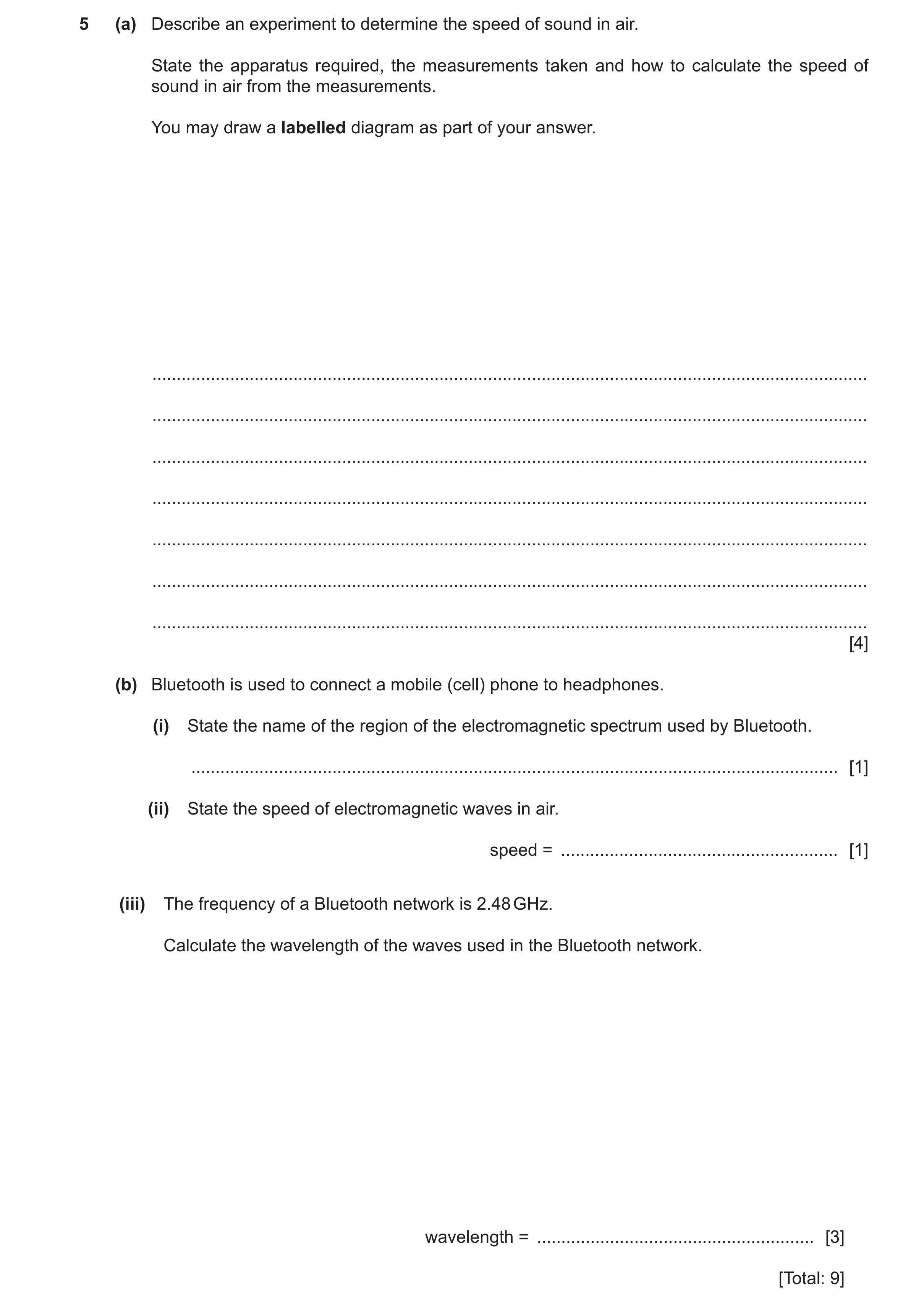
Q17 · Describe an experiment to determine the speed of sound in air 0625/42 May/June 2025
5 (a) Describe an experiment to determine the speed of sound in air. State the apparatus required, the measurements taken and how to calculate the speed of sound in air from the measurements. You may draw a labelled diagram as part of your answer. … … … … … … … [4] (b) Bluetooth is used to connect a mobile (cell) phone to headphones. (i) State the name of the region of the electromagnetic spectrum used by Bluetooth. … [1] (ii) State the speed of electromagnetic waves in air. speed = … [1] (iii) The frequency of a Bluetooth network is 2.48 GHz. Calculate the wavelength of the waves used in the Bluetooth network. wavelength = … [3] [Total: 9]
9 marks
Mark scheme: 5(a) echo method (outside): B4 1 method of producing short, loud sound (e.g. clap / shout / cry out / bang 2 pieces of wood together) 2 measuring tape or trundle wheel, stopwatch and wall 3 (person) starts stopwatch when clap etc heard and stops it when echo heard 4 speed = 2 measured distance ÷ time OR direct method outside: B4 1 method of producing short, loud sound (e.g. fire gun) 2 measuring tape or trundle wheel, stopwatch 3 (student at one end) starts stopwatch when smoke seen from gun and stops it when sound heard 4 speed = distance ÷ time OR direct method (using digital): B4 1 method of producing short sound e.g. clap or hammer striking block 2 measuring tape or metre ruler, digital timer and microphones 3 digital timer starts when sound reaches first microphone and stops when sound reaches second microphone. Time difference is recorded on digital timer owtte 4 speed = distance ÷ time for direct method 5(b)(i) radio waves B1 5(b)(ii) 3(.0) 108 m / s B1 5(b)(iii) 0.12 m A3 v = fOR (=) v ÷ f OR (=) {3(.0) 108} ÷ {2.48 109} C1 (=) {3(.0) 108} ÷ {2.48 109} OR (=) 1.2 10N C1
This question in 0625/42 May/June 2025
 1 / 20
 2 / 20
 3 / 20
 4 / 20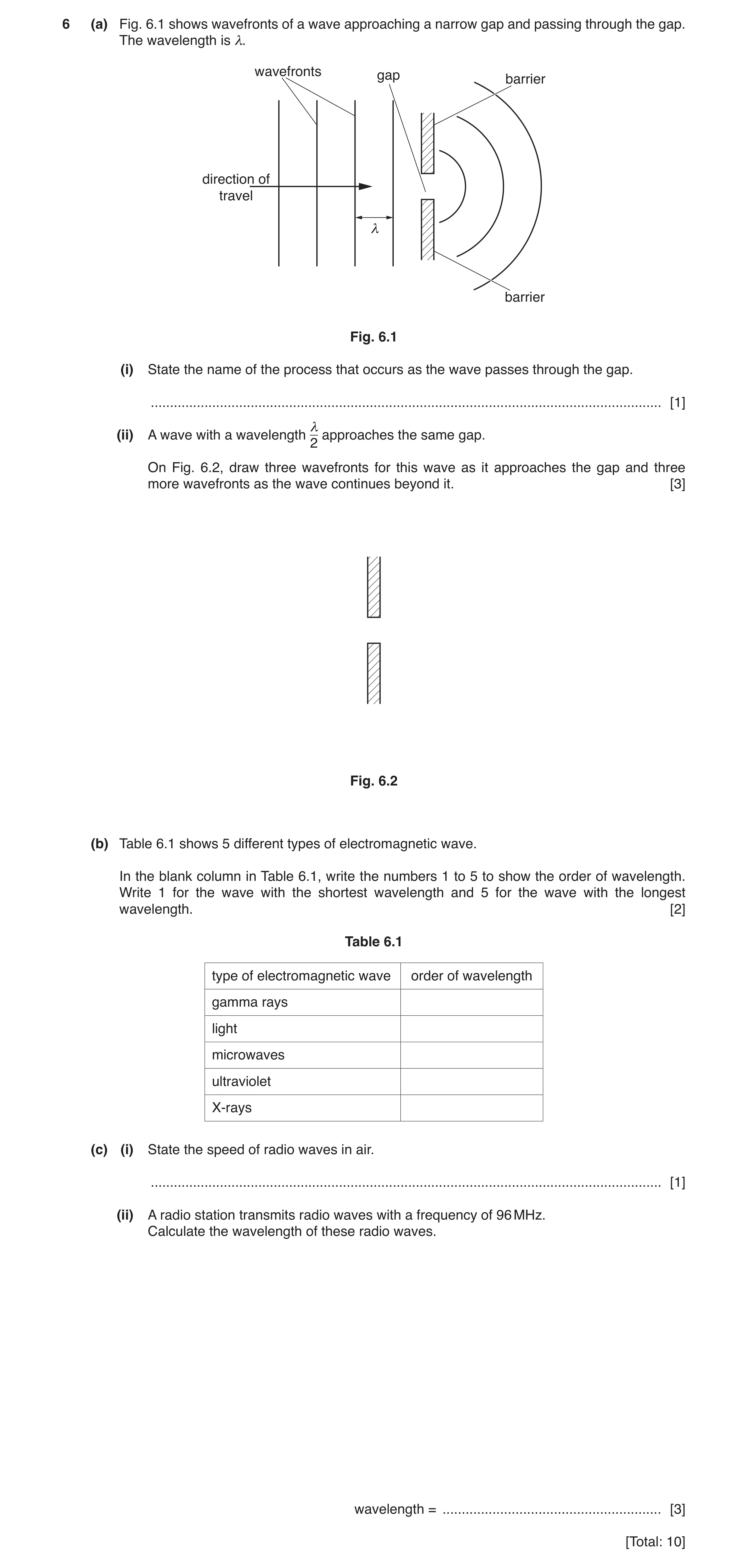
 6 / 20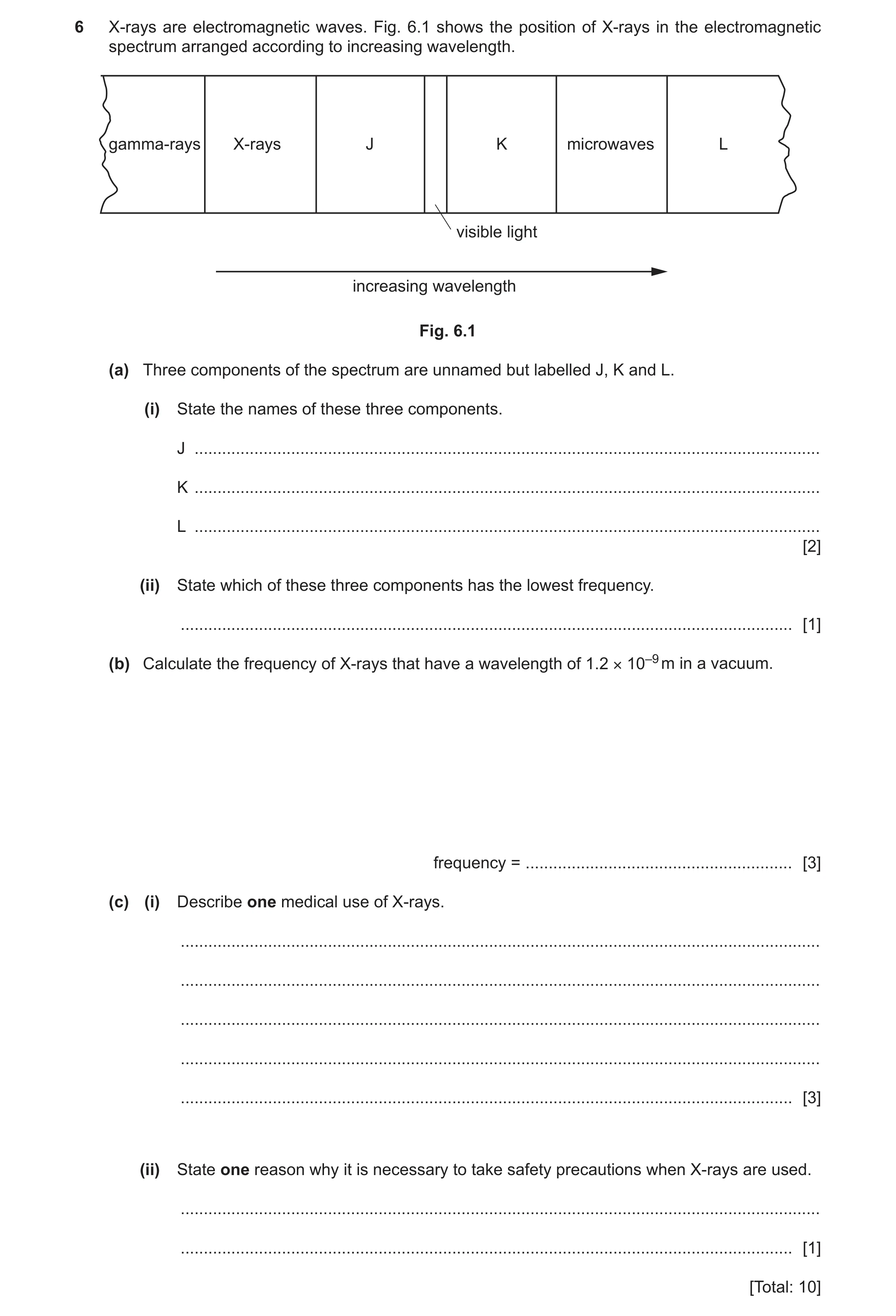
 8 / 20
 9 / 20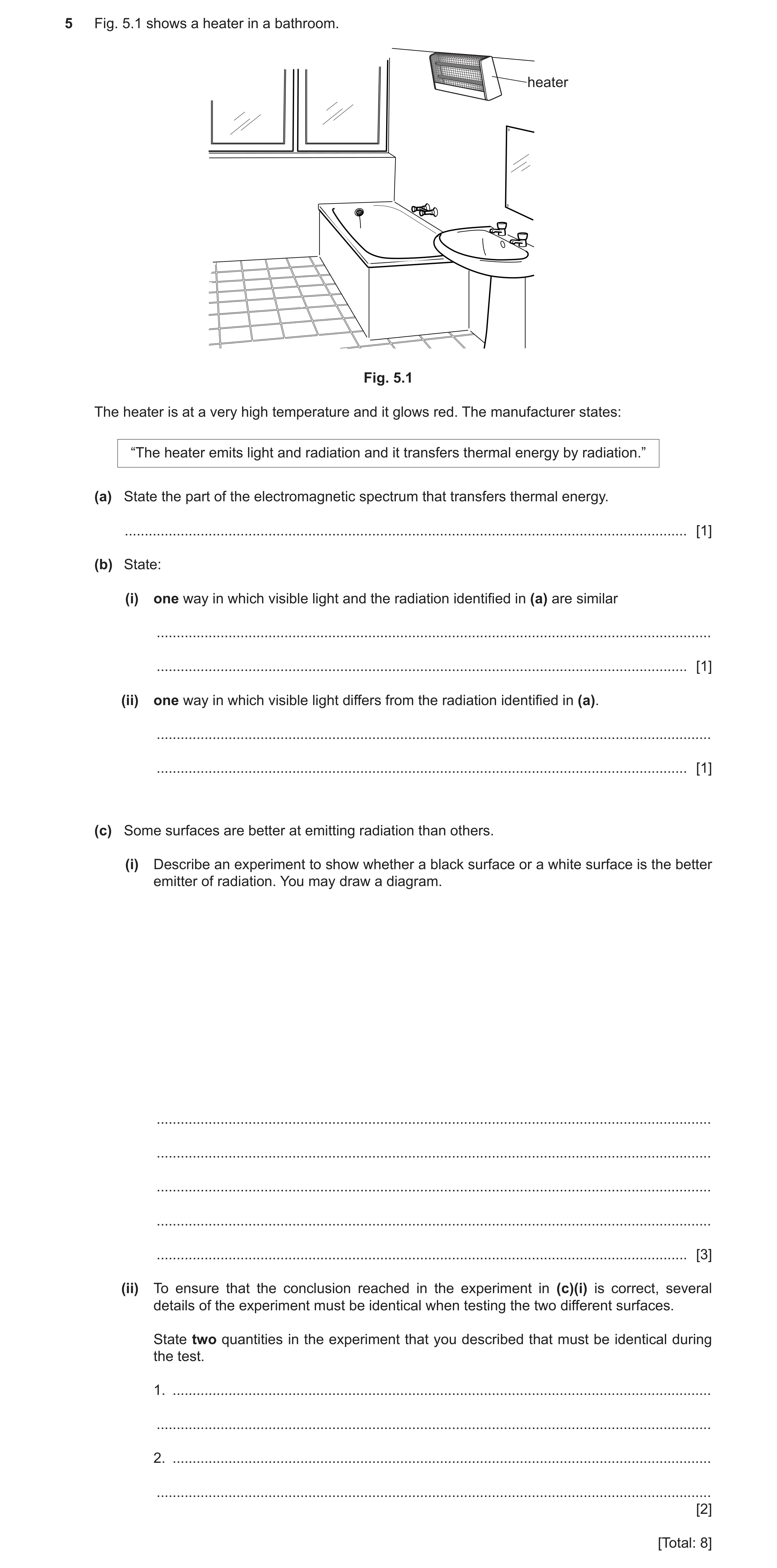
 12 / 20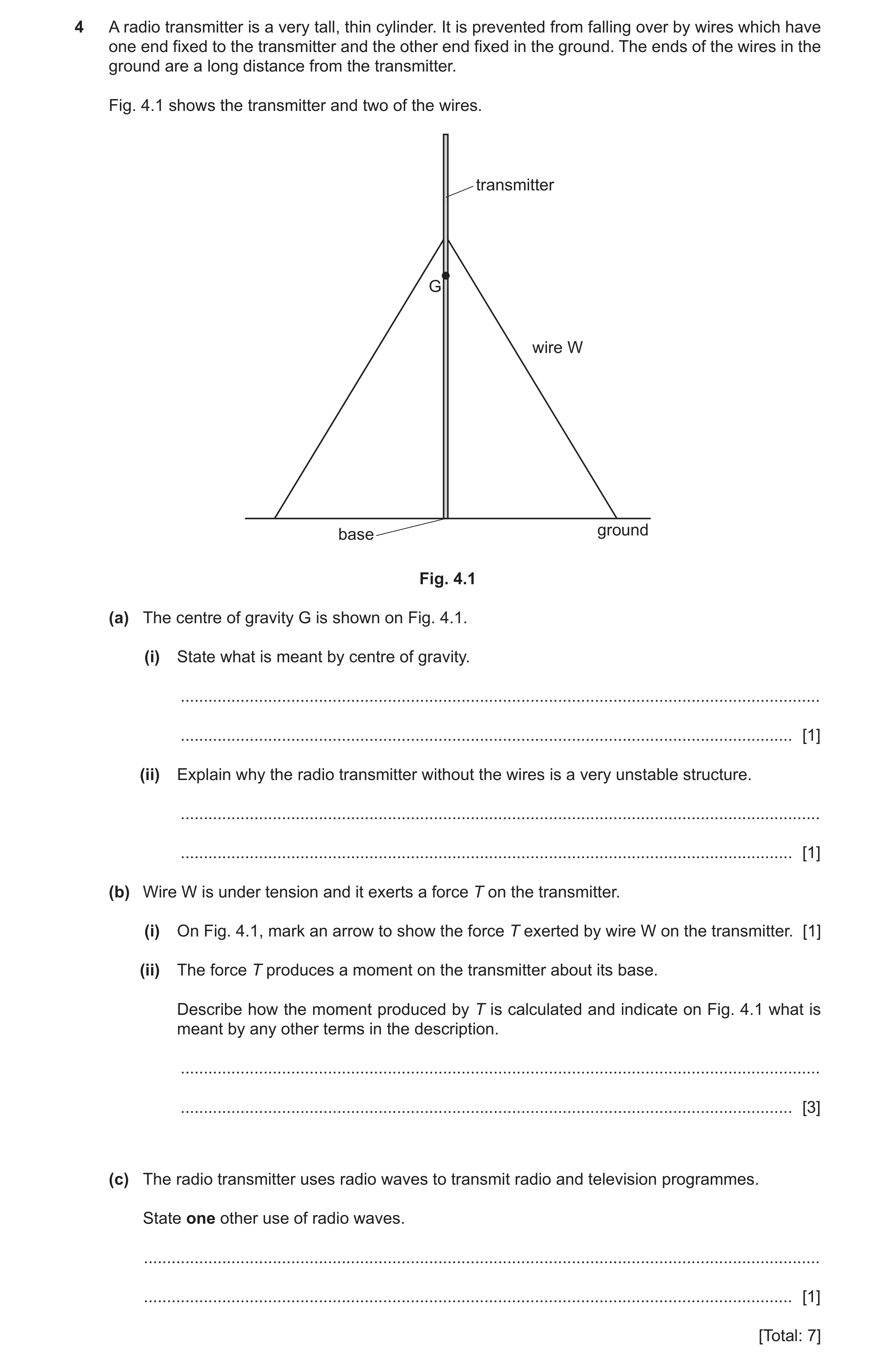
 14 / 20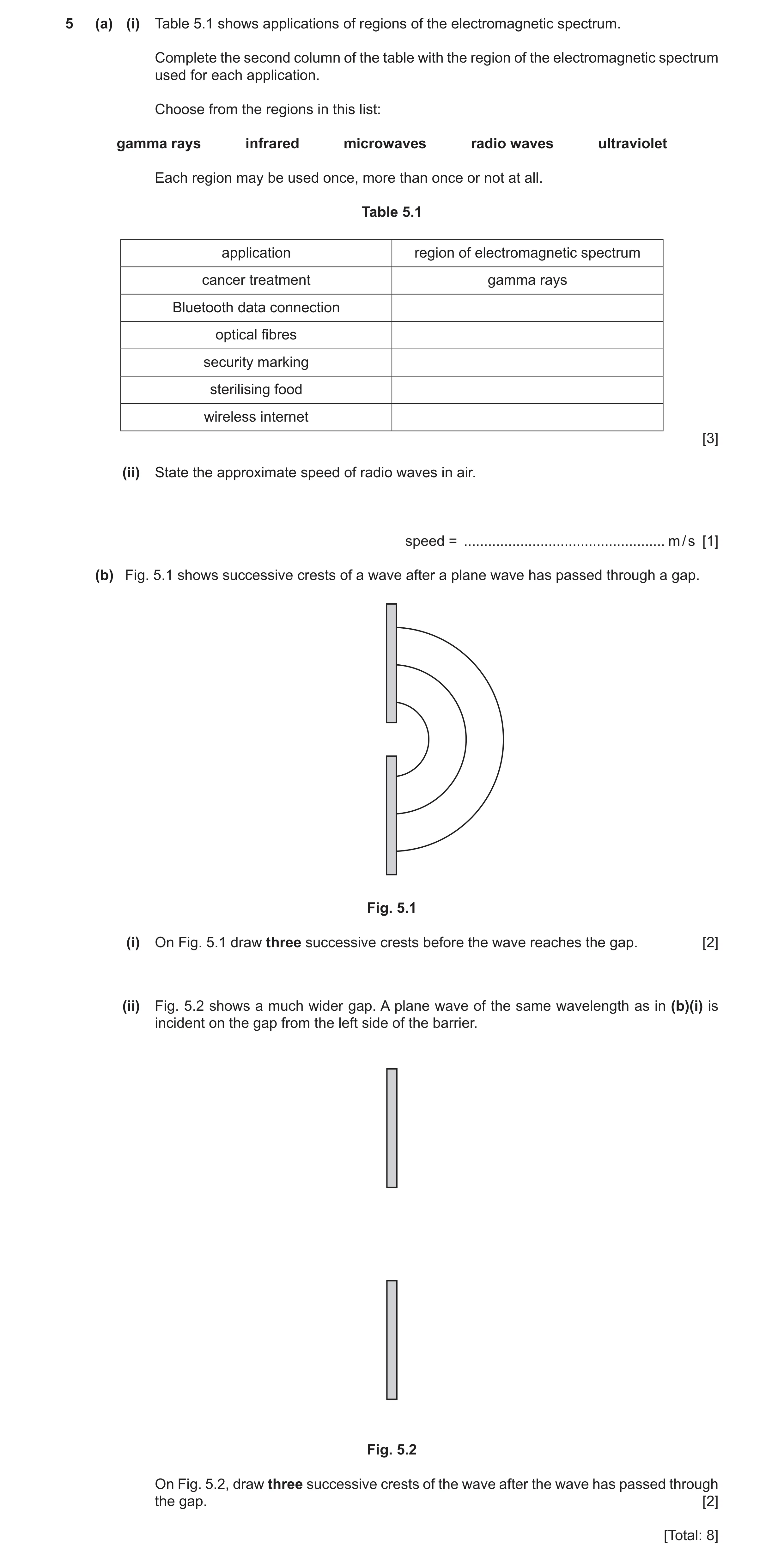
 17 / 20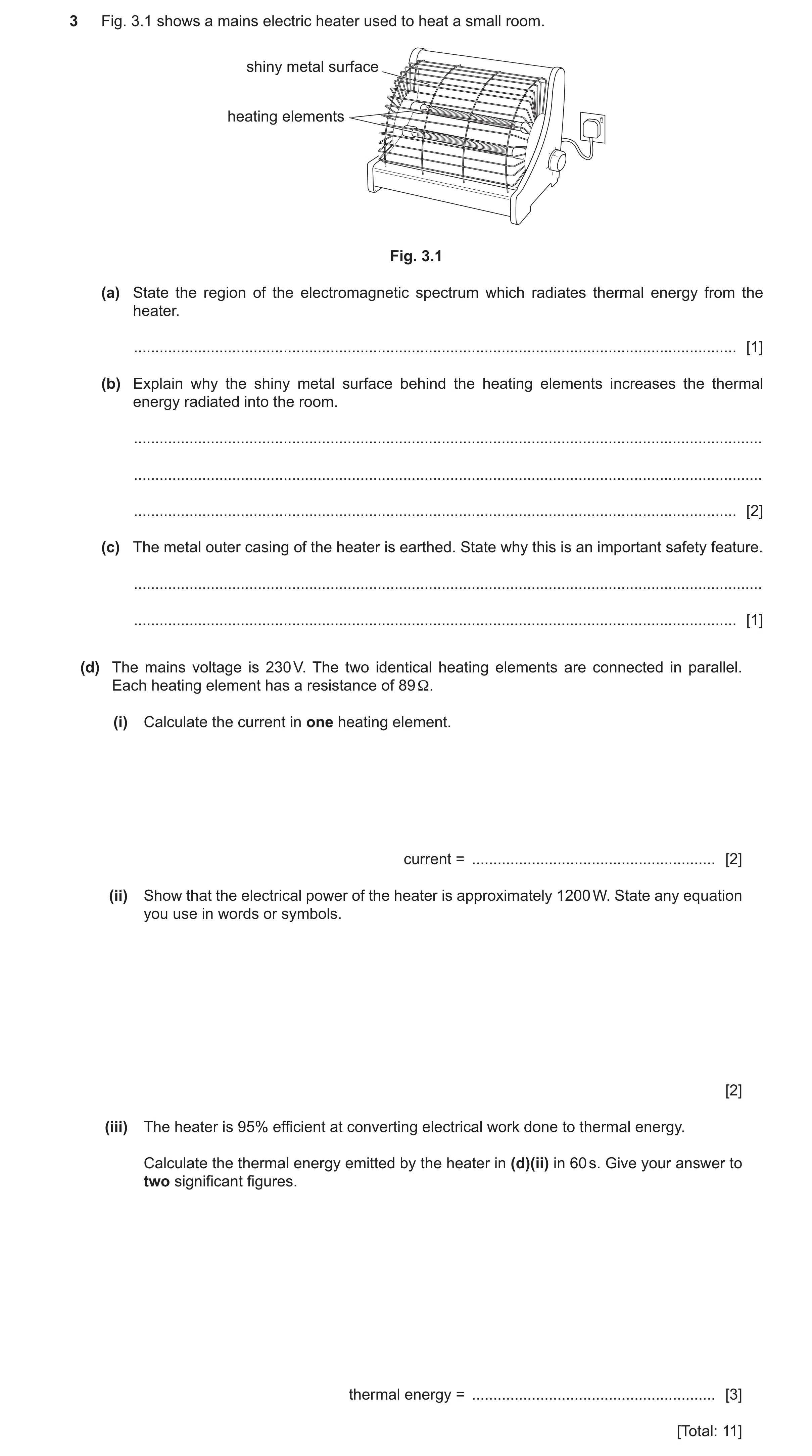
 20 / 20
 5
5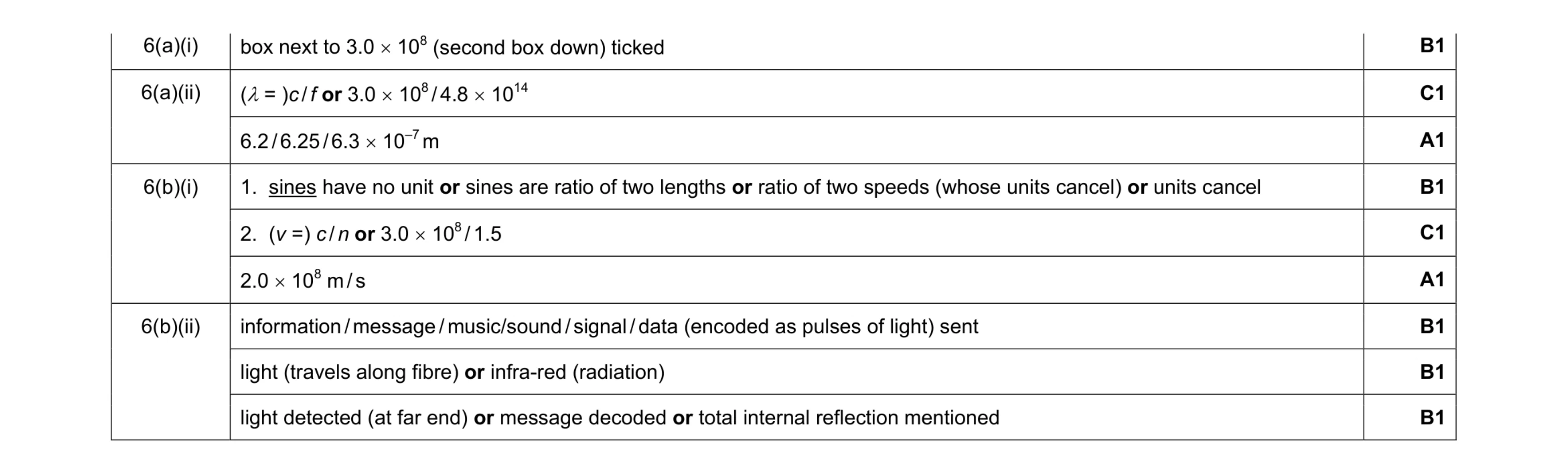 9
9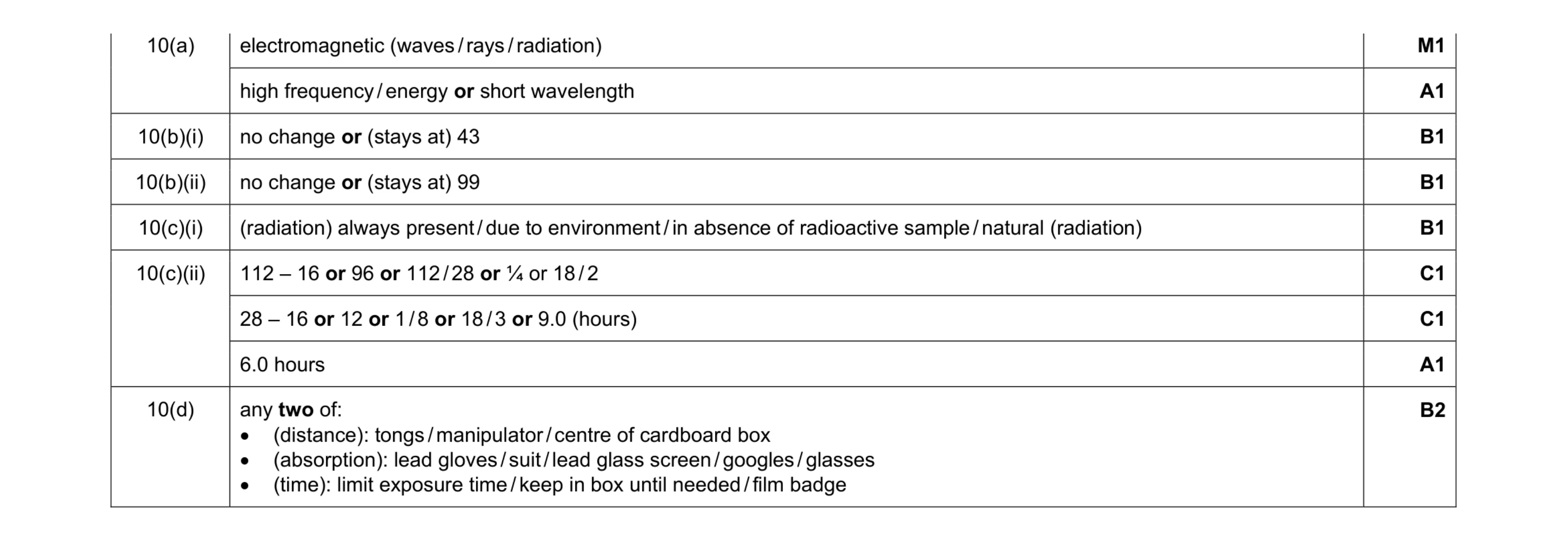 10
10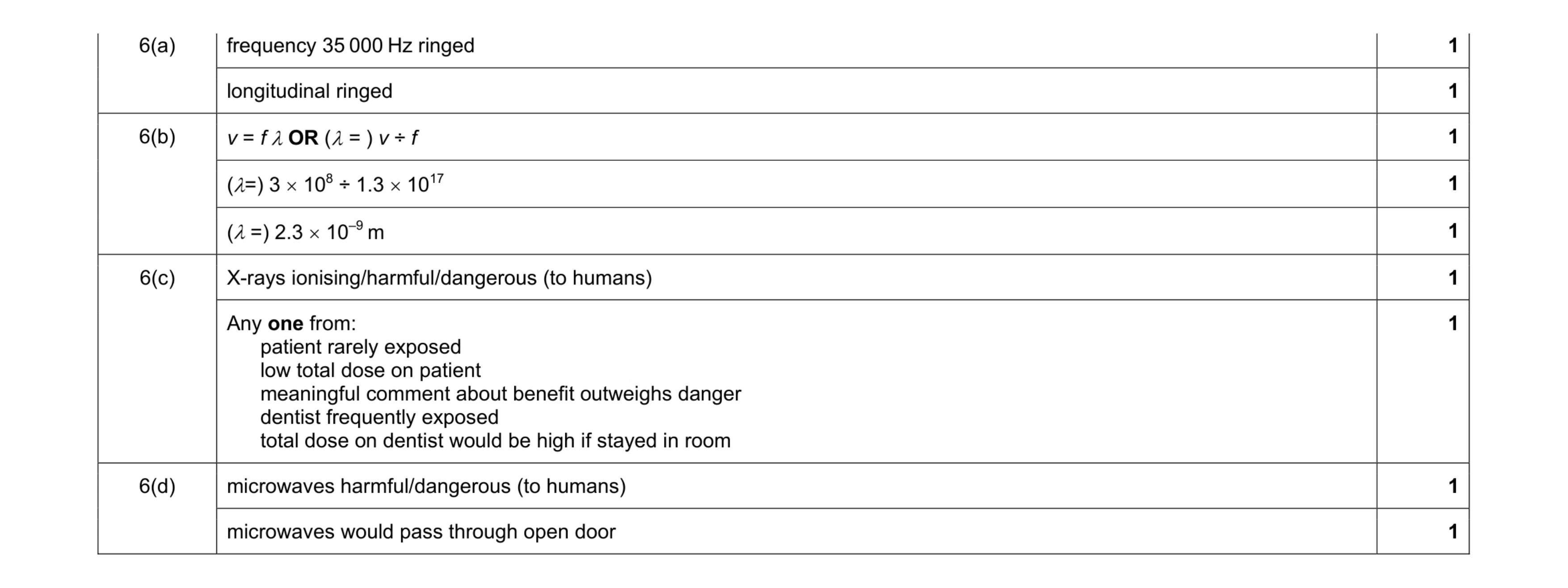 9
9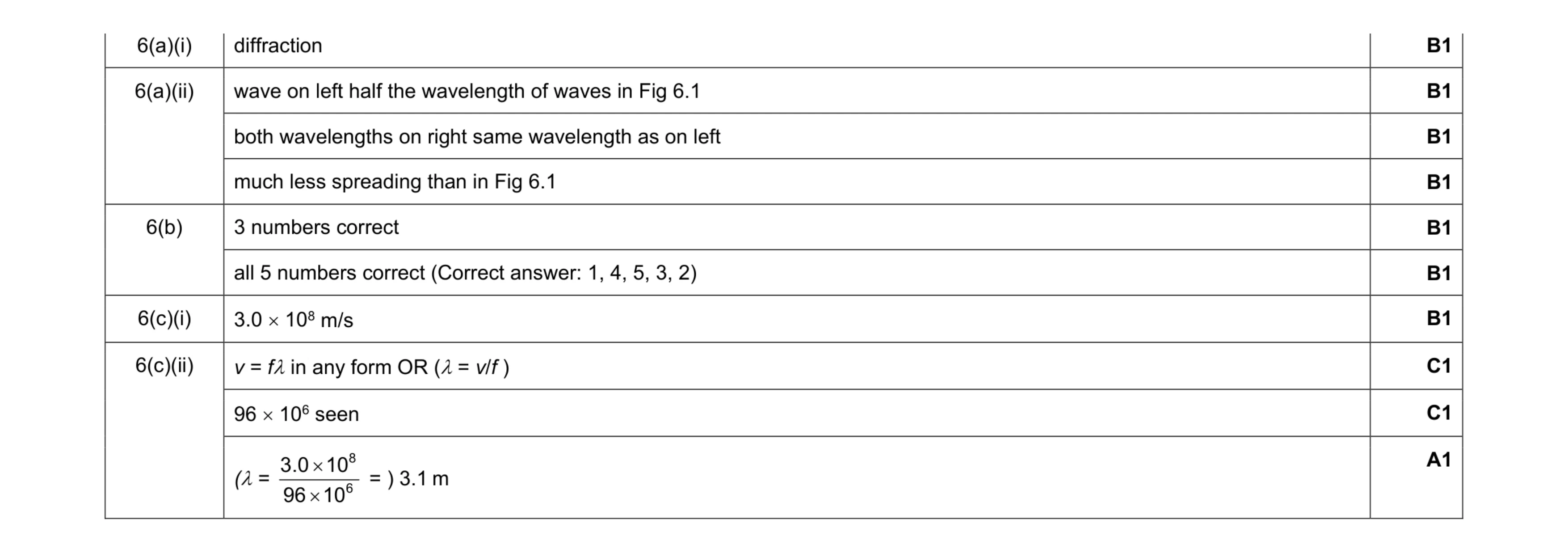 10
10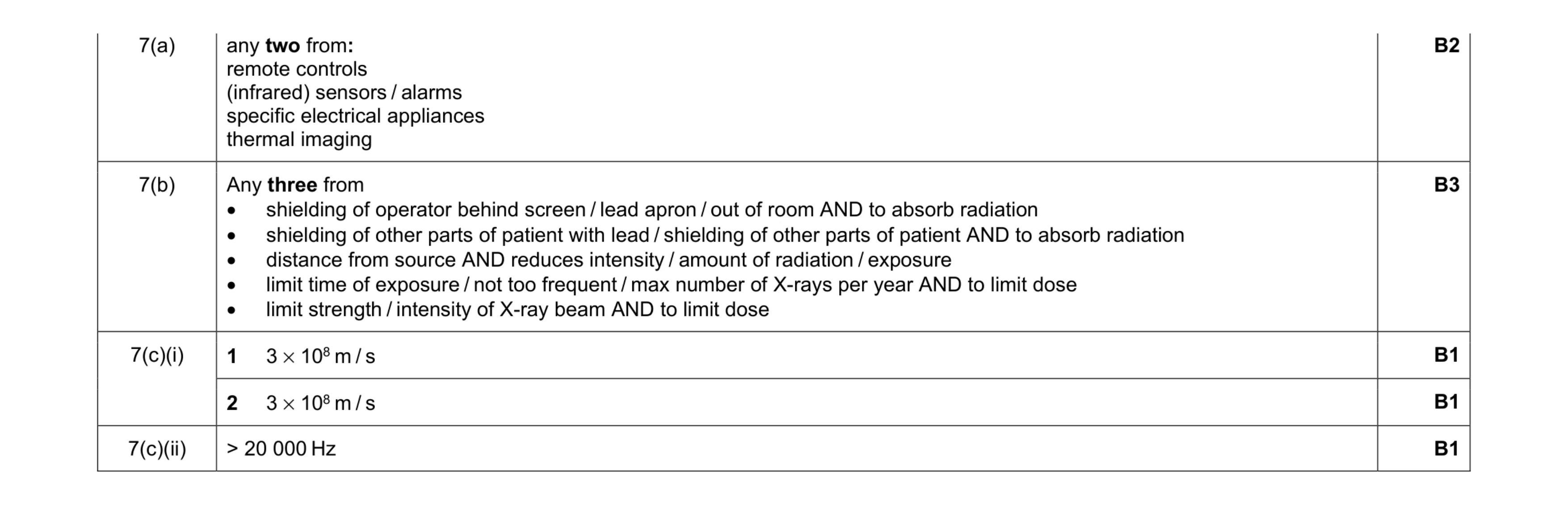 8
8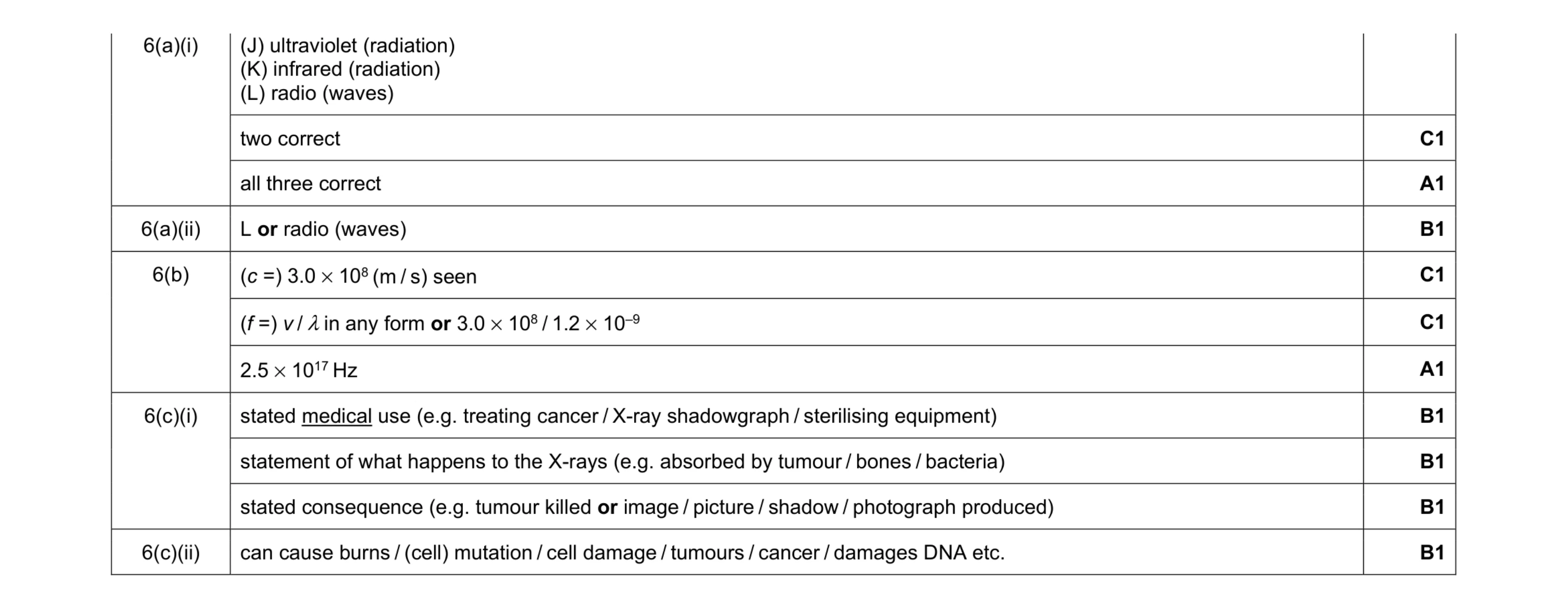 10
10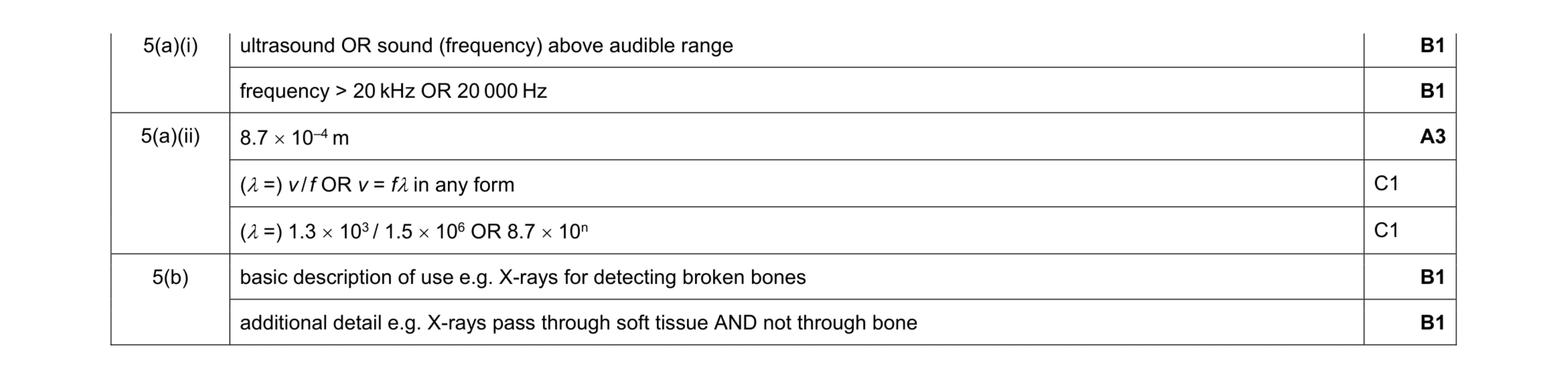 7
7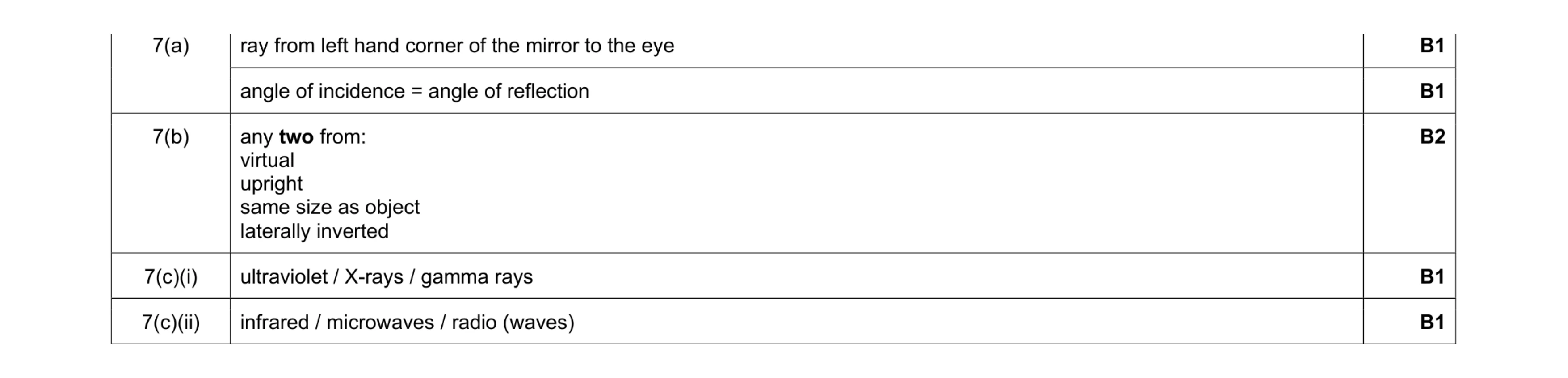 6
6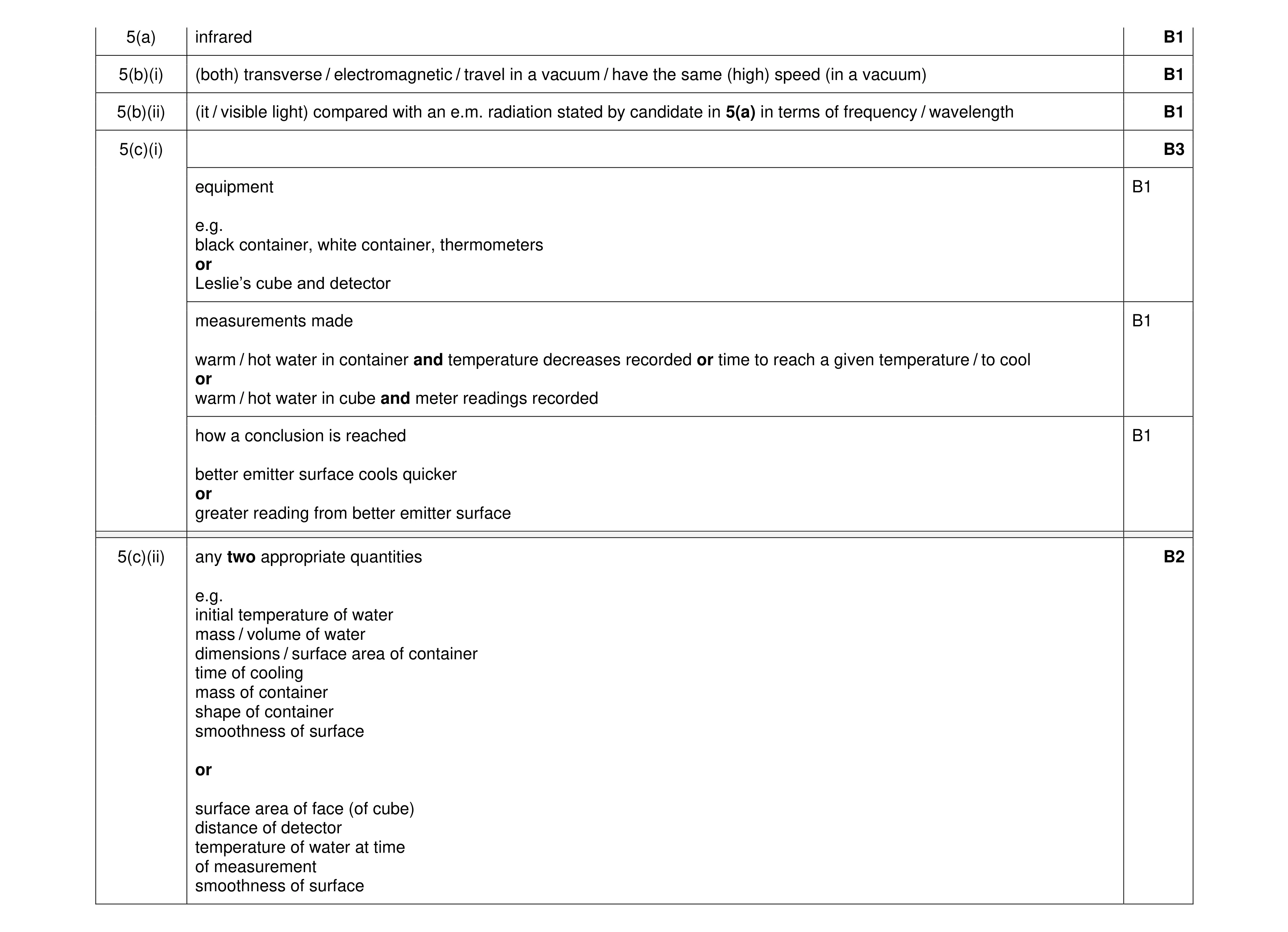 8
8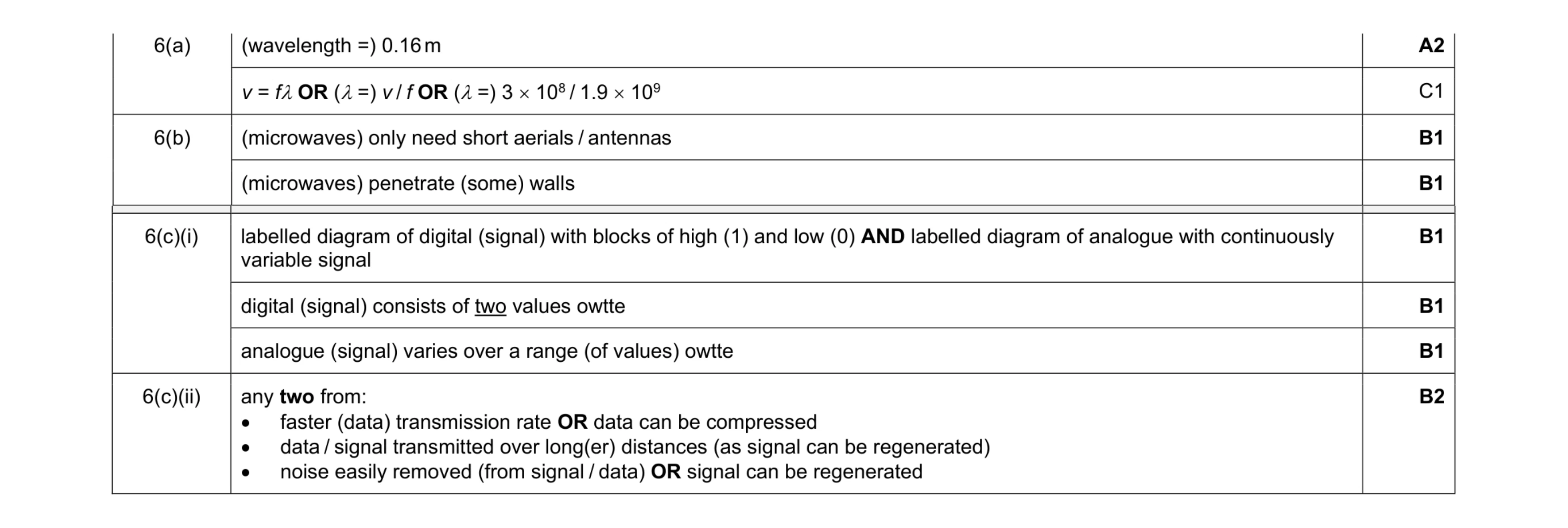 9
9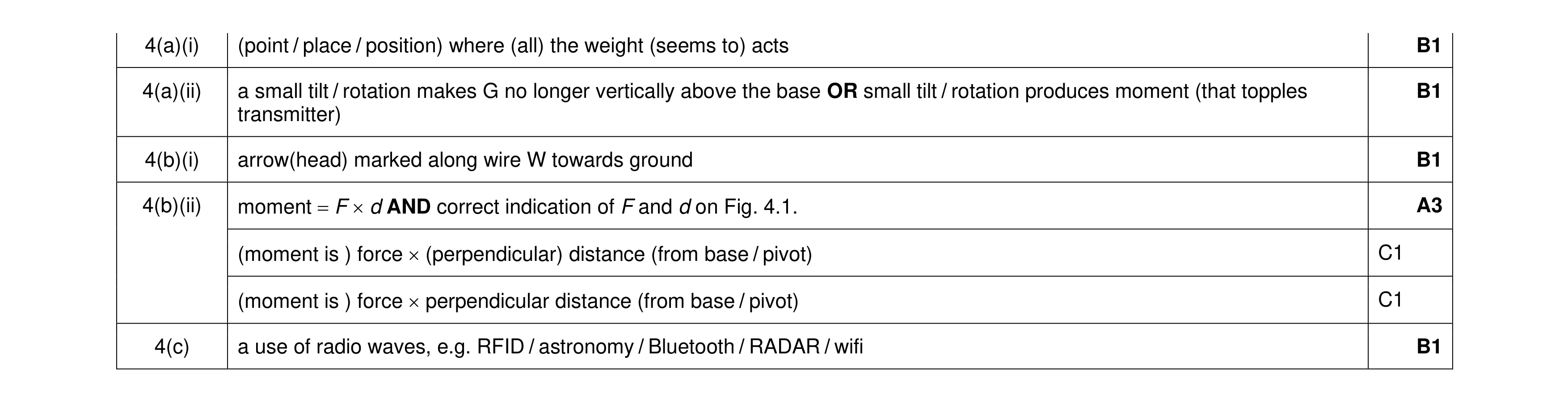 7
7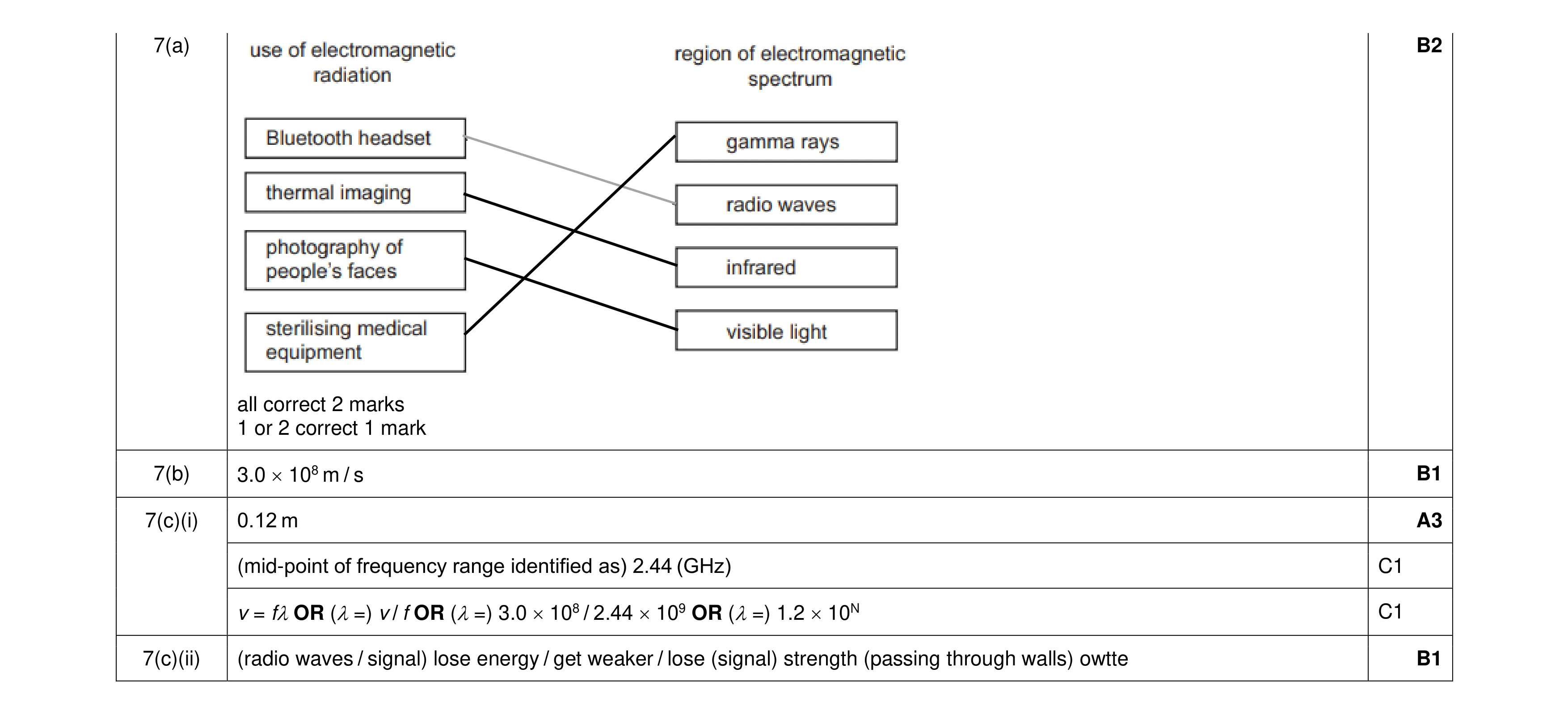 7
7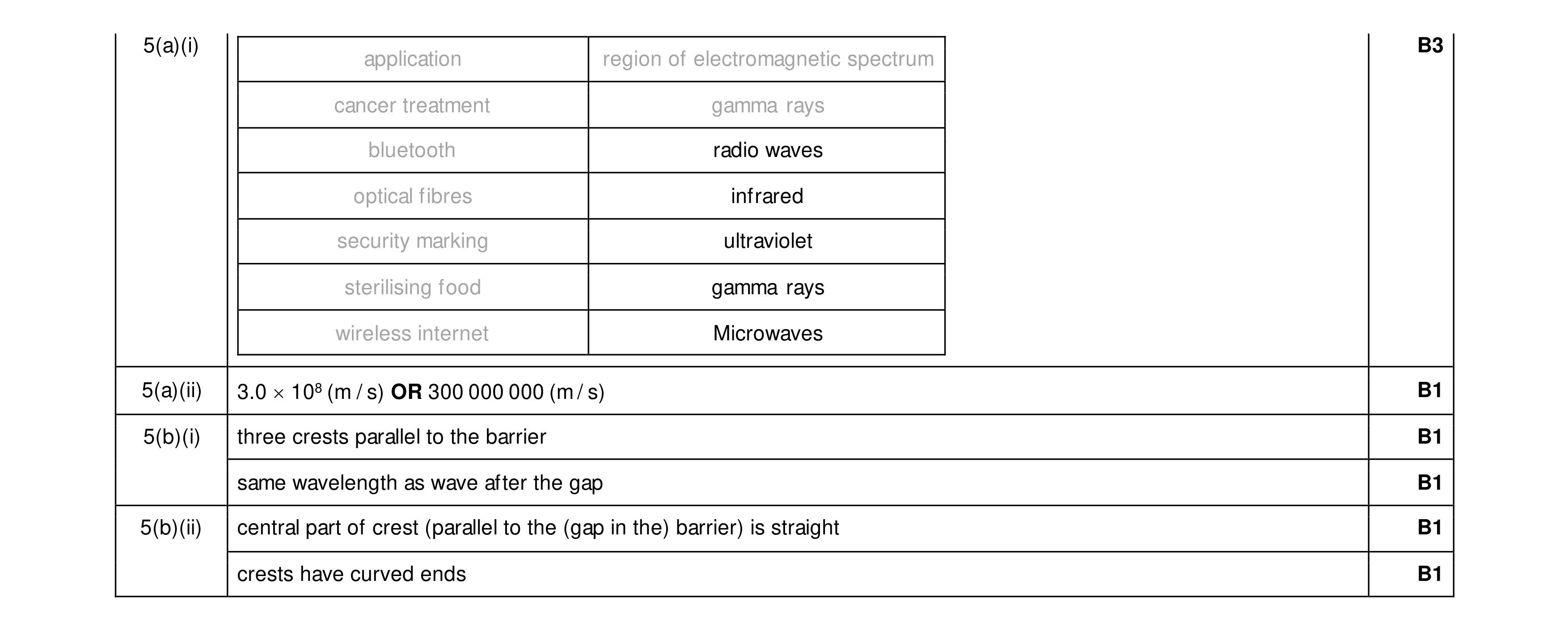 8
8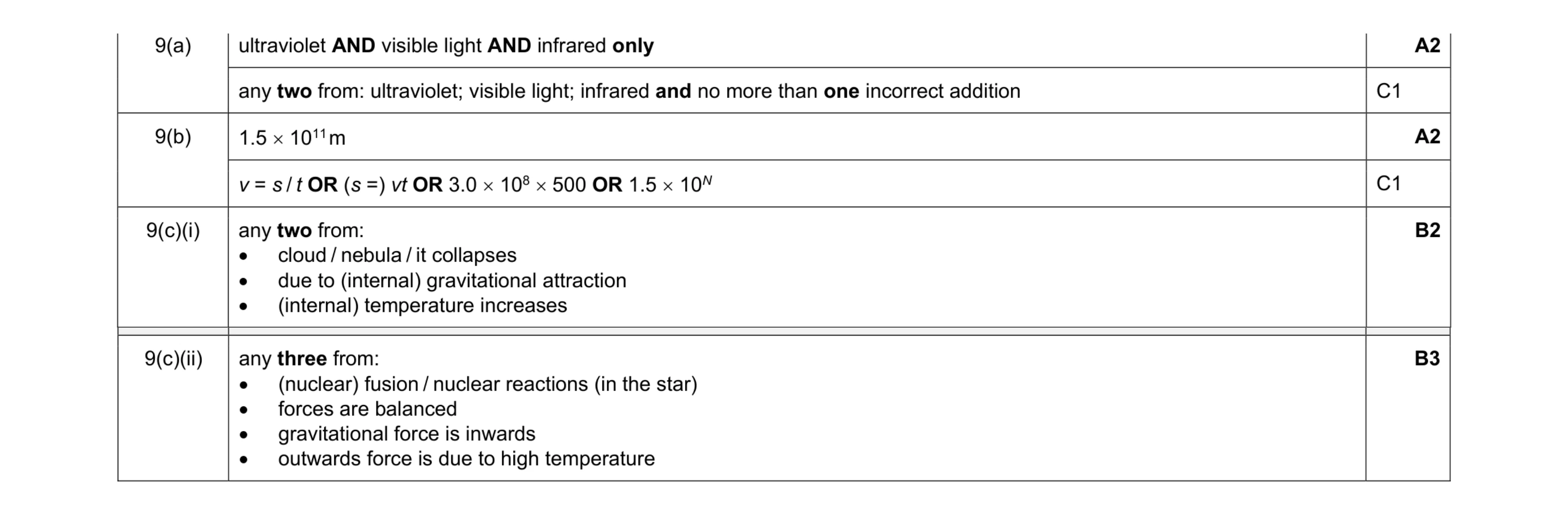 9
9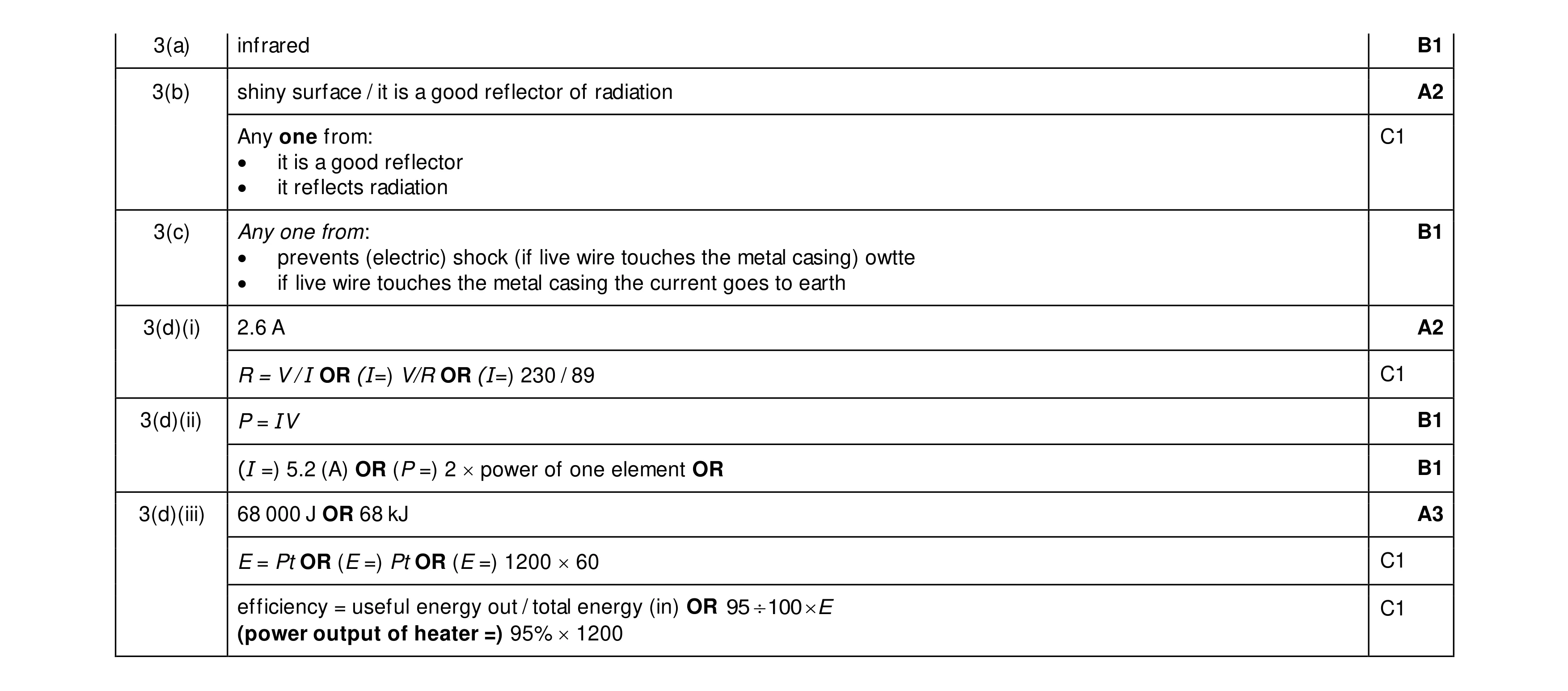 11
11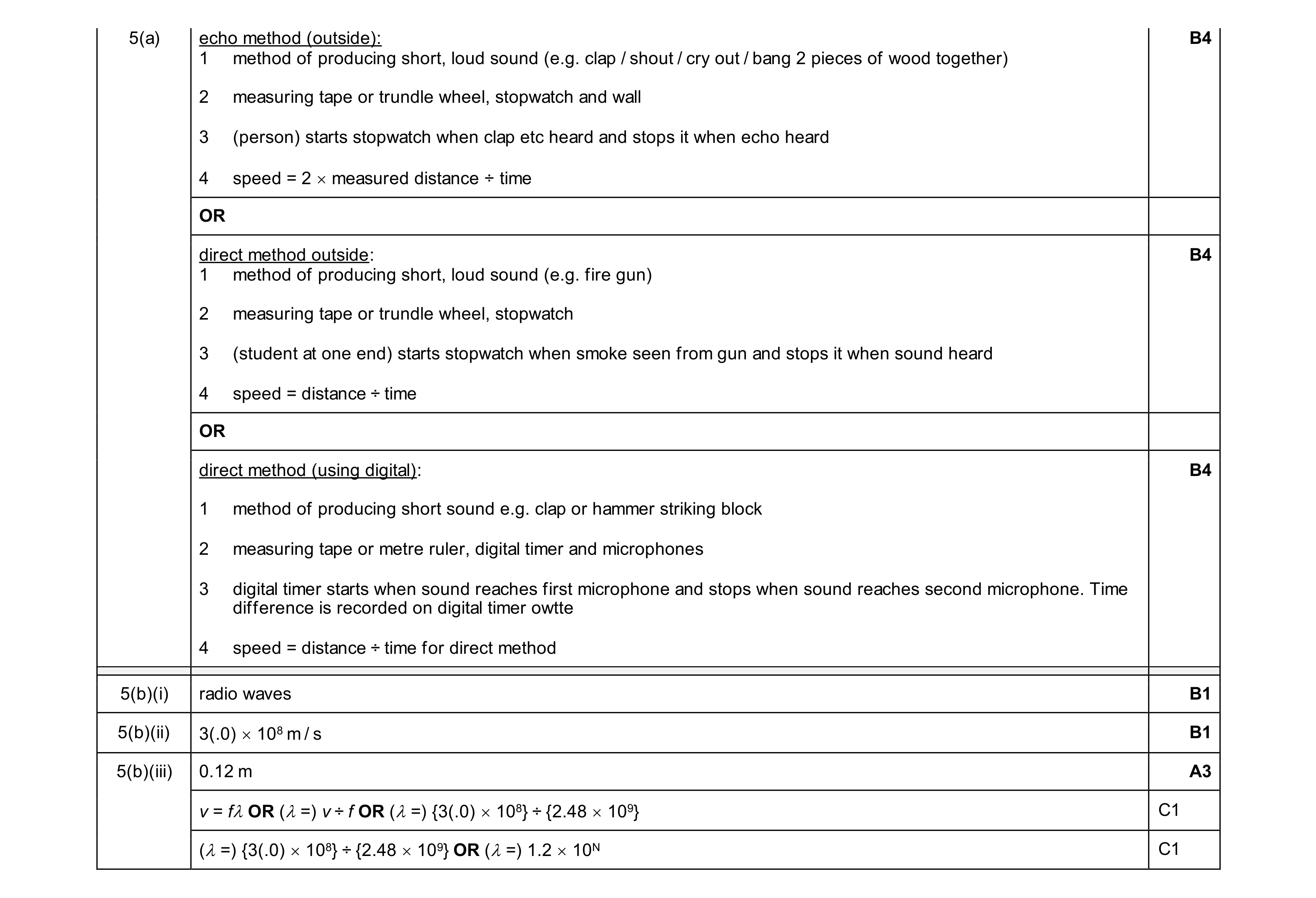 9
9