Questions as text
Q1 · The diagrams represent total cost curves (TC) of four firms in the short run 0455/11 Oct/Nov 2004
21 The diagrams represent total cost curves (TC) of four firms in the short run. Which firm has only fixed costs? A B C D TC TC costs TC costs costs costs TC O quantity O quantity O quantity O quantity
1 marks
Answer: C
This question in 0455/11 Oct/Nov 2004
Q2 · Which cost incurred by a firm manufacturing shirts is a variable cost? 0455/11 Oct/Nov 2004
22 Which cost incurred by a firm manufacturing shirts is a variable cost? A buildings insurance B interest on bank loans C raw materials D rent on property
1 marks
Answer: C
This question in 0455/11 Oct/Nov 2004
Q3 · The table shows a firm’s total revenue and total cost 0455/11 Oct/Nov 2004
23 The table shows a firm’s total revenue and total cost. What level of output, A, B, C or D, gives maximum profit? output total revenue total cost (units) ($) ($) A 10 15 15 B 20 20 18 C 30 25 20 D 40 30 21
1 marks
Answer: D
This question in 0455/11 Oct/Nov 2004
Q4 · The diagram shows two cost curves of a firm in producing different outputs in the short… 0455/11 Oct/Nov 2004
24 The diagram shows two cost curves of a firm in producing different outputs in the short run. 1 cost 2 O output How should the curves be labelled? curve 1 curve 2 A total cost total variable cost B total cost total fixed cost C total fixed cost total cost D total variable cost total fixed cost
1 marks
Answer: B
This question in 0455/11 Oct/Nov 2004
Q5 · A firm’s average revenue is $10 0455/11 May/June 2006
18 A firm’s average revenue is $10. It sells 2000 units. What is the firm’s total revenue and the price of the product? Total revenue ($) Price ($) A 10 10 B 2 000 200 C 20 000 10 D 20 000 200
1 marks
Answer: C
This question in 0455/11 May/June 2006
Q6 · The table shows the demand schedule for maize 0455/11 May/June 2006
19 The table shows the demand schedule for maize. price per kilo quantity demanded ($) (kilos per day) 3 300 4 240 5 200 6 150 7 140 8 100 What will happen if price rises from $5 to $6 per kilo? A Total revenue will rise. B Demand will rise. C Total revenue will fall. D Total costs will rise.
1 marks
Answer: C
This question in 0455/11 May/June 2006
Q7 · What is a variable cost for a firm? 0455/11 May/June 2006
20 What is a variable cost for a firm? A the cost of raw materials B the interest payments on loans C the rent of the factory D the insurance on the factory buildings
1 marks
Answer: A
This question in 0455/11 May/June 2006
Q8 · A firm adds up the costs of rent, insurance and initial investment in machinery 0455/11 May/June 2006
22 A firm adds up the costs of rent, insurance and initial investment in machinery. It then divides that total by the number of units produced. What has been calculated? A average fixed cost B average revenue C average total cost D average variable cost
1 marks
Answer: A
This question in 0455/11 May/June 2006
Q9 · What is most likely to increase a firm’s profits? 0455/11 Oct/Nov 2006
18 What is most likely to increase a firm’s profits? A government controls on its prices B grants for the purchase of new machines C an increase in the wages paid to its workers D rising costs of its raw materials
1 marks
Answer: B
This question in 0455/11 Oct/Nov 2006
Q10 · How is the average cost of a product calculated? 0455/11 Oct/Nov 2006
21 How is the average cost of a product calculated? A by adding total variable and total fixed costs B by dividing total cost by output C by multiplying total variable cost by output D by subtracting fixed cost from total cost
1 marks
Answer: B
This question in 0455/11 Oct/Nov 2006
Q11 · Which of a firm’s costs do not change as production changes? 0455/11 Oct/Nov 2006
22 Which of a firm’s costs do not change as production changes? A average cost B fixed cost C total cost D variable cost
1 marks
Answer: B
This question in 0455/11 Oct/Nov 2006
Q12 · A British firm, Dyson, moved production of its vacuum cleaners from the UK to Malaysia 0455/11 May/June 2007
20 A British firm, Dyson, moved production of its vacuum cleaners from the UK to Malaysia. Why might it have made this change? A average costs would fall B average revenue would rise C market share would fall D transport costs would rise
1 marks
Answer: A
This question in 0455/11 May/June 2007
Q13 · What is a fixed cost of production? 0455/11 May/June 2007
21 What is a fixed cost of production? A the commission paid to sales staff B the cost of using the telephone C the interest paid on a bank loan D the money spent on repairs
1 marks
Answer: C
This question in 0455/11 May/June 2007
Q14 · What is not equal to the average revenue? 0455/11 May/June 2007
22 What is not equal to the average revenue? A the price of each unit B the profit from each unit C the revenue from each unit D the total revenue divided by output
1 marks
Answer: B
This question in 0455/11 May/June 2007
Q15 · A firm manufactures toys 0455/11 Oct/Nov 2007
19 A firm manufactures toys. Which cost will vary least as output and sales increase? A distribution to retailers B insurance payments on the factory C wages of production workers D raw materials
1 marks
Answer: B
This question in 0455/11 Oct/Nov 2007
Q16 · In 2005, world oil prices increased significantly 0455/11 Oct/Nov 2007
20 In 2005, world oil prices increased significantly. What effect would an increase in oil prices have on a firm that transports products for other firms? A average fixed costs would increase B profits would increase C total fixed costs would increase D variable costs would increase
1 marks
Answer: D
This question in 0455/11 Oct/Nov 2007
Q17 · Which statement is correct? 0455/11 Oct/Nov 2007
21 Which statement is correct? A Average revenue is total revenue divided by output. B Fixed cost is total cost plus variable cost. C Total cost is variable cost multiplied by fixed cost. D Total revenue is fixed revenue minus variable revenue.
1 marks
Answer: A
This question in 0455/11 Oct/Nov 2007
Q18 · What is a firm seeking profit maximisation trying to achieve? 0455/11 Oct/Nov 2007
22 What is a firm seeking profit maximisation trying to achieve? A the fastest rate of profit growth B the highest level of profit per unit produced C the highest level of total profit D the lowest level of total cost
1 marks
Answer: C
This question in 0455/11 Oct/Nov 2007
Q19 · An Economics student made the following statements about costs of production 0455/11 May/June 2008
20 An Economics student made the following statements about costs of production. Average costs remain the same at all levels of output. Fixed costs can exist when there is no output. Total costs can include both fixed and variable costs. Total variable costs fall as output increases. How many of these statements are correct? A 1 B 2 C 3 D 4
1 marks
Answer: B
This question in 0455/11 May/June 2008
Q20 · A Japanese company which has spare capacity has agreed to refine 20 000 barrels of oil a… 0455/11 May/June 2008
22 A Japanese company which has spare capacity has agreed to refine 20 000 barrels of oil a day for a Chinese company. What is likely to happen in the Japanese firm to fixed cost, to variable cost and to total cost? fixed cost variable cost total cost A rise rise rise B rise fall stay the same C stay the same rise rise D stay the same fall fall
1 marks
Answer: C
This question in 0455/11 May/June 2008
Q21 · The table shows a firm’s total revenue and total cost 0455/11 May/June 2008
23 The table shows a firm’s total revenue and total cost. output (units) total revenue ($) total cost ($) 10 20 14 20 25 17 30 30 21 40 35 27 What level of output gives maximum profit? A 10 units B 20 units C 30 units D 40 units
1 marks
Answer: C
This question in 0455/11 May/June 2008
Q22 · As output increases, what happens to the average fixed cost of production? 0455/11 May/June 2008
24 As output increases, what happens to the average fixed cost of production? A It falls continuously. B It falls and then rises. C It remains constant. D It rises and then falls.
1 marks
Answer: A
This question in 0455/11 May/June 2008
Q23 · The purchase of new machinery enables a firm to increase output with fewer workers 0455/11 Oct/Nov 2008
3 The purchase of new machinery enables a firm to increase output with fewer workers. What is the effect on labour productivity and total costs? change in labour change in total costs productivity A fall constant B rise rise C rise uncertain D uncertain fall
1 marks
Answer: C
This question in 0455/11 Oct/Nov 2008
Q24 · The financial director of a company adds up the expenditure on items such as electricity… 0455/11 Oct/Nov 2008
20 The financial director of a company adds up the expenditure on items such as electricity, petrol (gas) and diesel fuel and raw materials. The director then divides that total by the firm’s output. What has the director calculated? A average revenue B average fixed cost C average variable cost D average total cost
1 marks
Answer: C
This question in 0455/11 Oct/Nov 2008
Q25 · What must a firm do which aims to make as much profit as possible? 0455/11 Oct/Nov 2008
21 What must a firm do which aims to make as much profit as possible? A make revenue and costs equal B maximise the difference between total revenue and total cost C maximise revenue D minimise costs of production
1 marks
Answer: B
This question in 0455/11 Oct/Nov 2008
Q26 · The following report appeared in a newspaper 0455/11 Oct/Nov 2008
22 The following report appeared in a newspaper. ‘British American Tobacco (BAT), the cigarette producer, said it would invest $1.5 million in China during the next two years as it set up new factories. China is estimated to be the world’s most important market for the sale of cigarettes.’ What is likely to happen to the total cost, total revenue and profit of BAT? total cost total revenue profit A decrease increase uncertain B decrease decrease increase C increase increase uncertain D increase decrease increase
1 marks
Answer: C
This question in 0455/11 Oct/Nov 2008
Q27 · The diagram shows the cost curves of a firm 0455/11 Oct/Nov 2008
24 The diagram shows the cost curves of a firm. 60 40 costs ($ 000) 20 0 100 output What is the firm’s total variable cost at an output of 100 units? A 0 B $20 000 C $40 000 D $60 000
1 marks
Answer: C
This question in 0455/11 Oct/Nov 2008
Q28 · How does a firm guarantee that it makes the maximum profit? 0455/11 May/June 2009
14 How does a firm guarantee that it makes the maximum profit? A by maximising the difference between its total revenue and total cost B by maximising the number of goods that it sells C by minimising the amount of goods that it keeps in stock D by minimising the difference between average revenue and average cost
1 marks
Answer: A
This question in 0455/11 May/June 2009
Q29 · Some travellers complain about the disturbance caused when other people use their mobile… 0455/11 May/June 2009
15 Some travellers complain about the disturbance caused when other people use their mobile (cell) phones. As a result, a UK train operator announces that it will buy some new trains that will have a device fitted to prevent the use of mobile (cell) phones. What will definitely happen to the train operator? A Its average revenue will decrease. B Its total revenue will increase. C Its fixed cost will increase. D Its total cost will decrease.
1 marks
Answer: C
This question in 0455/11 May/June 2009
Q30 · The diagram shows the fixed costs, variable costs and total costs of a firm 0455/11 May/June 2009
17 The diagram shows the fixed costs, variable costs and total costs of a firm. 60 50 40 costs 30 ($000) 20 10 0 100 units What is the firm’s variable cost at an output of 100 units? A $500 B $10 000 C $50 000 D $60 000
1 marks
Answer: C
This question in 0455/11 May/June 2009
Q31 · Cadbury Schweppes, the confectionery business, is reported to want to reduce the number… 0455/11 Oct/Nov 2009
14 Cadbury Schweppes, the confectionery business, is reported to want to reduce the number of its offices in an attempt to decrease its general and administrative costs. Which type of cost does Cadbury Schweppes hope to decrease? A average variable cost B marginal cost C total fixed cost D total variable cost
1 marks
Answer: C
This question in 0455/11 Oct/Nov 2009
Q32 · The table shows the total cost of a firm 0455/11 Oct/Nov 2009
17 The table shows the total cost of a firm. It can sell the units for $4 each. quantity produced (units) 5 6 7 8 total cost $ 17 18 21 23 How many units will the firm produce to maximise profits? A 5 B 6 C 7 D 8
1 marks
Answer: D
This question in 0455/11 Oct/Nov 2009
Q33 · The diagram shows a market for wheat that is in equilibrium 0455/11 May/June 2010
7 The diagram shows a market for wheat that is in equilibrium. T S X price V W D O Y Z quantity Which area represents the total revenue for wheat farmers? A OTXY B OVXZ C OVXY D OWXY
1 marks
Answer: C
This question in 0455/11 May/June 2010
Q34 · What is correct about a monopoly? 0455/11 May/June 2010
15 What is correct about a monopoly? A It may benefit from economies of scale. B It must be privately not state owned. C Its costs are always higher than those of a firm in perfect competition. D It sells only one product.
1 marks
Answer: A
This question in 0455/11 May/June 2010
Q35 · Barilla, an Italian company, is the world’s largest pasta maker 0455/11 May/June 2010
17 Barilla, an Italian company, is the world’s largest pasta maker. It also produces bread. In 2006 its bread production contributed $1.5 billion (bn) to its total revenue of $5.1 bn. Overall profit was $0.6 bn. What was the total cost to Barilla of producing pasta and bread in 2006? A $2.1 bn B $3.0 bn C $3.6 bn D $4.5 bn
1 marks
Answer: D
This question in 0455/11 May/June 2010
Q36 · A firm which sells its product for $6 has the following total costs 0455/11 May/June 2010
18 A firm which sells its product for $6 has the following total costs. output (units) 0 10 20 30 total costs ($) 40 100 120 150 Which statement is correct? A Average cost is lowest when 10 units are produced. B The firm breaks even when 20 units are sold. C The firm has no fixed costs. D Total variable costs fall continuously over these outputs.
1 marks
Answer: B
This question in 0455/11 May/June 2010
Q37 · The diagram shows a market for wheat that is in equilibrium 0455/12 May/June 2010
8 The diagram shows a market for wheat that is in equilibrium. T S X price V W D O Y Z quantity Which area represents the total revenue for wheat farmers? A OTXY B OVXZ C OVXY D OWXY
1 marks
Answer: C
This question in 0455/12 May/June 2010
Q38 · A firm which sells its product for $6 has the following total costs 0455/12 May/June 2010
14 A firm which sells its product for $6 has the following total costs. output (units) 0 10 20 30 total costs ($) 40 100 120 150 Which statement is correct? A Average cost is lowest when 10 units are produced. B The firm breaks even when 20 units are sold. C The firm has no fixed costs. D Total variable costs fall continuously over these outputs.
1 marks
Answer: B
This question in 0455/12 May/June 2010
Q39 · Barilla, an Italian company, is the world’s largest pasta maker 0455/12 May/June 2010
16 Barilla, an Italian company, is the world’s largest pasta maker. It also produces bread. In 2006 its bread production contributed $1.5 billion (bn) to its total revenue of $5.1 bn. Overall profit was $0.6 bn. What was the total cost to Barilla of producing pasta and bread in 2006? A $2.1 bn B $3.0 bn C $3.6 bn D $4.5 bn
1 marks
Answer: D
This question in 0455/12 May/June 2010
Q40 · In 2008, the world’s largest metal mining company, BHP, increased its profits by 20 % 0455/11 Oct/Nov 2010
17 In 2008, the world’s largest metal mining company, BHP, increased its profits by 20 %. What could have helped that happen? A a decrease in economic growth in the UK and the US B an increase in demand from China C more competition from other companies D more difficult mining conditions
1 marks
Answer: B
This question in 0455/11 Oct/Nov 2010
Q41 · The table shows a firm’s fixed and variable costs at four levels of output 0455/11 Oct/Nov 2010
18 The table shows a firm’s fixed and variable costs at four levels of output. output (units) fixed costs ($) variable costs ($) 2 50 110 3 50 130 4 50 210 5 50 300 At which level of output is average cost at its lowest? A 2 B 3 C 4 D 5
1 marks
Answer: B
This question in 0455/11 Oct/Nov 2010
Q42 · The table shows a firm’s fixed and variable costs at four levels of output 0455/12 Oct/Nov 2010
14 The table shows a firm’s fixed and variable costs at four levels of output. output (units) fixed costs ($) variable costs ($) 2 50 110 3 50 130 4 50 210 5 50 300 At which level of output is average cost at its lowest? A 2 B 3 C 4 D 5
1 marks
Answer: B
This question in 0455/12 Oct/Nov 2010
Q43 · In 2008, the world’s largest metal mining company, BHP, increased its profits by 20 % 0455/12 Oct/Nov 2010
18 In 2008, the world’s largest metal mining company, BHP, increased its profits by 20 %. What could have helped that happen? A a decrease in economic growth in the UK and the US B an increase in demand from China C more competition from other companies D more difficult mining conditions
1 marks
Answer: B
This question in 0455/12 Oct/Nov 2010
Q44 · The table shows a firm’s fixed and variable costs at four levels of output 0455/13 Oct/Nov 2010
15 The table shows a firm’s fixed and variable costs at four levels of output. output (units) fixed costs ($) variable costs ($) 2 50 110 3 50 130 4 50 210 5 50 300 At which level of output is average cost at its lowest? A 2 B 3 C 4 D 5
1 marks
Answer: B
This question in 0455/13 Oct/Nov 2010
Q45 · In 2008, XL, the UK’s third largest tour operator went out of business 0455/13 Oct/Nov 2010
18 In 2008, XL, the UK’s third largest tour operator went out of business. What would have been the effect of this on the level of competition in the industry, the external economies of scale experienced by the remaining firms and the level of business confidence in the UK? external economies UK business level of competition of scale confidence A increase increase reduce B increase reduce increase C reduce increase increase D reduce reduce reduce
1 marks
Answer: D
This question in 0455/13 Oct/Nov 2010
Q46 · A major computer company announced that its profits had fallen below the level predicted 0455/11 May/June 2011
15 A major computer company announced that its profits had fallen below the level predicted. What might have caused this? A increased advertising costs that greatly improved sales B low prices that made the company’s product competitive C new technology that reduced costs D reduced sales and low prices
1 marks
Answer: D
This question in 0455/11 May/June 2011
Q47 · A firm raised the price of its product from $10 to $15 and as a result its sales fell… 0455/11 May/June 2011
16 A firm raised the price of its product from $10 to $15 and as a result its sales fell from 200 units to 150 units. What happened to its average revenue and total revenue? average revenue total revenue A decreased decreased B decreased increased C increased decreased D increased increased
1 marks
Answer: D
This question in 0455/11 May/June 2011
Q48 · Which change must occur when a firm starts to experience diseconomies of scale? 0455/11 May/June 2011
17 Which change must occur when a firm starts to experience diseconomies of scale? A Average costs begin to rise. B Employees are made redundant. C Profits turn into losses. D Variable costs become fixed.
1 marks
Answer: A
This question in 0455/11 May/June 2011
Q49 · If a firm increases its output in the short run, what will happen to its average fixed… 0455/11 May/June 2011
18 If a firm increases its output in the short run, what will happen to its average fixed cost (AFC)? A AFC will decrease continually. B AFC will equal zero. C AFC will increase then decrease. D AFC will increase continually.
1 marks
Answer: A
This question in 0455/11 May/June 2011
Q50 · A firm raised the price of its product from $10 to $15 and as a result its sales fell… 0455/12 May/June 2011
15 A firm raised the price of its product from $10 to $15 and as a result its sales fell from 200 units to 150 units. What happened to its average revenue and total revenue? average revenue total revenue A decreased decreased B decreased increased C increased decreased D increased increased
1 marks
Answer: D
This question in 0455/12 May/June 2011
Q51 · Which change must occur when a firm starts to experience diseconomies of scale? 0455/12 May/June 2011
16 Which change must occur when a firm starts to experience diseconomies of scale? A Average costs begin to rise. B Employees are made redundant. C Profits turn into losses. D Variable costs become fixed.
1 marks
Answer: A
This question in 0455/12 May/June 2011
Q52 · If a firm increases its output in the short run, what will happen to its average fixed… 0455/12 May/June 2011
17 If a firm increases its output in the short run, what will happen to its average fixed cost (AFC)? A AFC will decrease continually. B AFC will equal zero. C AFC will increase then decrease. D AFC will increase continually.
1 marks
Answer: A
This question in 0455/12 May/June 2011
Q53 · A major computer company announced that its profits had fallen below the level predicted 0455/12 May/June 2011
19 A major computer company announced that its profits had fallen below the level predicted. What might have caused this? A increased advertising costs that greatly improved sales B low prices that made the company’s product competitive C new technology that reduced costs D reduced sales and low prices
1 marks
Answer: D
This question in 0455/12 May/June 2011
Q54 · A firm raised the price of its product from $10 to $15 and as a result its sales fell… 0455/13 May/June 2011
15 A firm raised the price of its product from $10 to $15 and as a result its sales fell from 200 units to 150 units. What happened to its average revenue and total revenue? average revenue total revenue A decreased decreased B decreased increased C increased decreased D increased increased
1 marks
Answer: D
This question in 0455/13 May/June 2011
Q55 · Which change must occur when a firm starts to experience diseconomies of scale? 0455/13 May/June 2011
16 Which change must occur when a firm starts to experience diseconomies of scale? A Average costs begin to rise. B Employees are made redundant. C Profits turn into losses. D Variable costs become fixed.
1 marks
Answer: A
This question in 0455/13 May/June 2011
Q56 · If a firm increases its output in the short run, what will happen to its average fixed… 0455/13 May/June 2011
17 If a firm increases its output in the short run, what will happen to its average fixed cost (AFC)? A AFC will decrease continually. B AFC will equal zero. C AFC will increase then decrease. D AFC will increase continually.
1 marks
Answer: A
This question in 0455/13 May/June 2011
Q57 · A major computer company announced that its profits had fallen below the level predicted 0455/13 May/June 2011
19 A major computer company announced that its profits had fallen below the level predicted. What might have caused this? A increased advertising costs that greatly improved sales B low prices that made the company’s product competitive C new technology that reduced costs D reduced sales and low prices
1 marks
Answer: D
This question in 0455/13 May/June 2011
Q58 · The graphs, drawn to the same scale, show the demand curves of four firms 0455/11 Oct/Nov 2011
7 The graphs, drawn to the same scale, show the demand curves of four firms. The market price is $10. The price then falls to $8. Which firm will have the largest increase in total revenue? A B C D D D price price price price $ $ $ $ 10 D 10 10 10 D 0 Q1 0 Q1 0 Q1 0 Q1 quantity quantity quantity quantity
1 marks
Answer: A
This question in 0455/11 Oct/Nov 2011
Q59 · The table shows how a firm’s total cost rises with changes in output 0455/11 Oct/Nov 2011
15 The table shows how a firm’s total cost rises with changes in output. output total cost ($) 0 20 000 1000 30 000 2000 35 000 3000 40 000 4000 45 000 5000 50 000 What is the average fixed cost of producing 5000 units? A $4 B $5 C $6 D $10
1 marks
Answer: A
This question in 0455/11 Oct/Nov 2011
Q60 · A firm is producing an output which enables it to make more than normal profit 0455/11 Oct/Nov 2011
17 A firm is producing an output which enables it to make more than normal profit. What must be true at that output? A Average revenue must be greater than total revenue. B Average revenue must equal average cost. C Total revenue must be greater than total cost. D Variable cost must equal price.
1 marks
Answer: C
This question in 0455/11 Oct/Nov 2011
Q61 · Which statement about total fixed cost is correct? 0455/11 Oct/Nov 2011
18 Which statement about total fixed cost is correct? A It falls as output increases. B It is calculated by adding total cost and total variable cost. C It is calculated by dividing total cost by output. D It must be paid even if output is zero.
1 marks
Answer: D
This question in 0455/11 Oct/Nov 2011
Q62 · The graphs, drawn to the same scale, show the demand curves of four firms 0455/12 Oct/Nov 2011
8 The graphs, drawn to the same scale, show the demand curves of four firms. The market price is $10. The price then falls to $8. Which firm will have the largest increase in total revenue? A B C D D D price price price price $ $ $ $ 10 D 10 10 10 D 0 Q1 0 Q1 0 Q1 0 Q1 quantity quantity quantity quantity
1 marks
Answer: A
This question in 0455/12 Oct/Nov 2011
Q63 · The table shows how a firm’s total cost rises with changes in output 0455/12 Oct/Nov 2011
16 The table shows how a firm’s total cost rises with changes in output. output total cost ($) 0 20 000 1000 30 000 2000 35 000 3000 40 000 4000 45 000 5000 50 000 What is the average fixed cost of producing 5000 units? A $4 B $5 C $6 D $10
1 marks
Answer: A
This question in 0455/12 Oct/Nov 2011
Q64 · A firm is producing an output which enables it to make more than normal profit 0455/12 Oct/Nov 2011
18 A firm is producing an output which enables it to make more than normal profit. What must be true at that output? A Average revenue must be greater than total revenue. B Average revenue must equal average cost. C Total revenue must be greater than total cost. D Variable cost must equal price.
1 marks
Answer: C
This question in 0455/12 Oct/Nov 2011
Q65 · Which statement about total fixed cost is correct? 0455/12 Oct/Nov 2011
19 Which statement about total fixed cost is correct? A It falls as output increases. B It is calculated by adding total cost and total variable cost. C It is calculated by dividing total cost by output. D It must be paid even if output is zero.
1 marks
Answer: D
This question in 0455/12 Oct/Nov 2011
Q66 · The graphs, drawn to the same scale, show the demand curves of four firms 0455/13 Oct/Nov 2011
9 The graphs, drawn to the same scale, show the demand curves of four firms. The market price is $10. The price then falls to $8. Which firm will have the largest increase in total revenue? A B C D D D price price price price $ $ $ $ 10 D 10 10 10 D 0 Q1 0 Q1 0 Q1 0 Q1 quantity quantity quantity quantity
1 marks
Answer: A
This question in 0455/13 Oct/Nov 2011
Q67 · Which statement about total fixed cost is correct? 0455/13 Oct/Nov 2011
15 Which statement about total fixed cost is correct? A It falls as output increases. B It is calculated by adding total cost and total variable cost. C It is calculated by dividing total cost by output. D It must be paid even if output is zero.
1 marks
Answer: D
This question in 0455/13 Oct/Nov 2011
Q68 · The table shows how a firm’s total cost rises with changes in output 0455/13 Oct/Nov 2011
17 The table shows how a firm’s total cost rises with changes in output. output total cost ($) 0 20 000 1000 30 000 2000 35 000 3000 40 000 4000 45 000 5000 50 000 What is the average fixed cost of producing 5000 units? A $4 B $5 C $6 D $10
1 marks
Answer: A
This question in 0455/13 Oct/Nov 2011
Q69 · A firm is producing an output which enables it to make more than normal profit 0455/13 Oct/Nov 2011
19 A firm is producing an output which enables it to make more than normal profit. What must be true at that output? A Average revenue must be greater than total revenue. B Average revenue must equal average cost. C Total revenue must be greater than total cost. D Variable cost must equal price.
1 marks
Answer: C
This question in 0455/13 Oct/Nov 2011
Q70 · A trade union negotiates a basic weekly wage for its members with all employers in an… 0455/11 May/June 2012
11 A trade union negotiates a basic weekly wage for its members with all employers in an industry. In addition to the basic wage, one company also operates a production bonus at factory level. What is the aim of this company? A to give equal wages to all workers B to increase the efficiency of the workers C to introduce a minimum wage D to reduce its total wage bill
1 marks
Answer: B
This question in 0455/11 May/June 2012
Q71 · The financial director of a company adds up the cost for the firm of rent, insurance, new… 0455/11 May/June 2012
16 The financial director of a company adds up the cost for the firm of rent, insurance, new machinery and the chief executive’s basic salary. The director then divides that total by the firm’s output. What has the director calculated? A average fixed cost B average revenue C average total cost D average variable cost
1 marks
Answer: A
This question in 0455/11 May/June 2012
Q72 · The table shows a firm’s average revenue and average cost 0455/11 May/June 2012
18 The table shows a firm’s average revenue and average cost. What level of output, A, B, C or D, gives maximum profit? output (units) average revenue ($) average cost ($) A 5 10 30 B 10 20 20 C 15 25 15 D 20 30 18
1 marks
Answer: D
This question in 0455/11 May/June 2012
Q73 · When would a firm achieve maximum profits? 0455/12 May/June 2012
16 When would a firm achieve maximum profits? A when average revenue equals average cost B when average revenue minus variable cost is greatest C when fixed costs are equal to variable costs D when total revenue minus total cost is greatest
1 marks
Answer: D
This question in 0455/12 May/June 2012
Q74 · The table shows the total costs of a firm 0455/12 May/June 2012
18 The table shows the total costs of a firm. It can sell the units for $4 each. quantity produced and sold (units) 5 6 7 8 total cost $ 17 18 21 23 How many units will the firm produce to maximise profits? A 5 B 6 C 7 D 8
1 marks
Answer: D
This question in 0455/12 May/June 2012
Q75 · When would a firm achieve maximum profits? 0455/13 May/June 2012
16 When would a firm achieve maximum profits? A when average revenue equals average cost B when average revenue minus variable cost is greatest C when fixed costs are equal to variable costs D when total revenue minus total cost is greatest
1 marks
Answer: D
This question in 0455/13 May/June 2012
Q76 · The table shows the total costs of a firm 0455/13 May/June 2012
18 The table shows the total costs of a firm. It can sell the units for $4 each. quantity produced and sold (units) 5 6 7 8 total cost $ 17 18 21 23 How many units will the firm produce to maximise profits? A 5 B 6 C 7 D 8
1 marks
Answer: D
This question in 0455/13 May/June 2012
Q77 · What is a variable cost to a firm producing bicycles? 0455/11 Oct/Nov 2012
7 What is a variable cost to a firm producing bicycles? A the component parts of the bicycles B the interest on money borrowed C the rent of the bicycle factory D the salaries of the senior managers
1 marks
Answer: A
This question in 0455/11 Oct/Nov 2012
Q78 · The graphs show the average total cost (ATC) curves of four firms and how they change as… 0455/11 Oct/Nov 2012
9 The graphs show the average total cost (ATC) curves of four firms and how they change as output increases. Which firm has the highest fixed costs? A B C D ATC ATC cost cost cost cost $ $ $ $ ATC ATC O output O output O output O output
1 marks
Answer: A
This question in 0455/11 Oct/Nov 2012
Q79 · What is a variable cost to a firm producing bicycles? 0455/12 Oct/Nov 2012
16 What is a variable cost to a firm producing bicycles? A the component parts of the bicycles B the interest on money borrowed C the rent of the bicycle factory D the salaries of the senior managers
1 marks
Answer: A
This question in 0455/12 Oct/Nov 2012
Q80 · The graphs show the average total cost (ATC) curves of four firms and how they change as… 0455/12 Oct/Nov 2012
18 The graphs show the average total cost (ATC) curves of four firms and how they change as output increases. Which firm has the highest fixed costs? A B C D ATC ATC cost cost cost cost $ $ $ $ ATC ATC O output O output O output O output
1 marks
Answer: A
This question in 0455/12 Oct/Nov 2012
Q81 · As a firm increases its weekly output from 10 units to 20 units, its average cost falls… 0455/13 Oct/Nov 2012
16 As a firm increases its weekly output from 10 units to 20 units, its average cost falls from $15 to $10. Which of its costs have risen? A fixed costs and variable costs only B fixed costs, variable costs and total costs C total costs only D variable costs and total costs only
1 marks
Answer: D
This question in 0455/13 Oct/Nov 2012
Q82 · The graphs show the average total cost (ATC) curves of four firms and how they change as… 0455/13 Oct/Nov 2012
18 The graphs show the average total cost (ATC) curves of four firms and how they change as output increases. Which firm has the highest fixed costs? A B C D ATC ATC cost cost cost cost $ $ $ $ ATC ATC O output O output O output O output
1 marks
Answer: A
This question in 0455/13 Oct/Nov 2012
Q83 · Cocoa and sugar are used in a factory to produce chocolate 0455/11 May/June 2013
16 Cocoa and sugar are used in a factory to produce chocolate. What is a fixed cost in the production of chocolate? A cocoa B electricity C rent D sugar
1 marks
Answer: C
This question in 0455/11 May/June 2013
Q84 · The table shows the costs of a firm 0455/11 May/June 2013
19 The table shows the costs of a firm. units of output variable costs ($) total costs ($) 10 20 80 20 50 110 30 80 140 40 110 170 What is the value of the firm’s fixed costs? A $20 B $30 C $60 D $80
1 marks
Answer: C
This question in 0455/11 May/June 2013
Q85 · What will happen to a firm that expands to take advantage of economies of scale? 0455/12 May/June 2013
15 What will happen to a firm that expands to take advantage of economies of scale? A Average costs of production will decrease. B Average costs of production will increase. C Profits will decrease. D The price of the firm’s products will increase.
1 marks
Answer: A
This question in 0455/12 May/June 2013
Q86 · Cocoa and sugar are used in a factory to produce chocolate 0455/12 May/June 2013
16 Cocoa and sugar are used in a factory to produce chocolate. What is a fixed cost in the production of chocolate? A cocoa B electricity C rent D sugar
1 marks
Answer: C
This question in 0455/12 May/June 2013
Q87 · An entrepreneur buys a workshop for $200 000 to make plastic boxes 0455/12 May/June 2013
19 An entrepreneur buys a workshop for $200 000 to make plastic boxes. In the first year of operation he spends $70 000 on materials, employs ten production workers paid by the amount produced (piece rate) at a total cost of $80 000 and buys two delivery vehicles for $10 000 each. What are his total variable costs? A $100 000 B $150 000 C $220 000 D $370 000
1 marks
Answer: B
This question in 0455/12 May/June 2013
Q88 · Cocoa and sugar are used in a factory to produce chocolate 0455/13 May/June 2013
2 Cocoa and sugar are used in a factory to produce chocolate. What is a fixed cost in the production of chocolate? A cocoa B electricity C rent D sugar
1 marks
Answer: C
This question in 0455/13 May/June 2013
Q89 · The table shows the costs of a firm 0455/13 May/June 2013
5 The table shows the costs of a firm. units of output variable costs ($) total costs ($) 10 20 80 20 50 110 30 80 140 40 110 170 What is the value of the firm’s fixed costs? A $20 B $30 C $60 D $80
1 marks
Answer: C
This question in 0455/13 May/June 2013
Q90 · Which group linked to a firm always bears the risk of the decision to produce? 0455/13 May/June 2013
12 Which group linked to a firm always bears the risk of the decision to produce? A creditors B managers C owners D workers
1 marks
Answer: C
This question in 0455/13 May/June 2013
Q91 · The diagrams represent total cost curves (TC) of four firms in the short run 0455/11 Oct/Nov 2013
2 The diagrams represent total cost curves (TC) of four firms in the short run. Which firm has only fixed costs? A B C D TC TC TC costs costs costs TC costs O quantity O quantity O quantity O quantity
1 marks
Answer: C
This question in 0455/11 Oct/Nov 2013
Q92 · An entrepreneur started a small business making candles 0455/11 Oct/Nov 2013
5 An entrepreneur started a small business making candles. In the first month 1000 candles were made. The costs were $ raw materials 1000 packaging 800 insurance 100 depreciation 100 rent 500 What were the average variable costs for the month? A $1.00 B $1.80 C $1.90 D $2.00
1 marks
Answer: B
This question in 0455/11 Oct/Nov 2013
Q93 · The diagrams represent total cost curves (TC) of four firms in the short run 0455/12 Oct/Nov 2013
16 The diagrams represent total cost curves (TC) of four firms in the short run. Which firm has only fixed costs? A B C D TC TC TC costs costs costs TC costs O quantity O quantity O quantity O quantity
1 marks
Answer: C
This question in 0455/12 Oct/Nov 2013
Q94 · An entrepreneur started a small business making candles 0455/12 Oct/Nov 2013
19 An entrepreneur started a small business making candles. In the first month 1000 candles were made. The costs were $ raw materials 1000 packaging 800 insurance 100 depreciation 100 rent 500 What were the average variable costs for the month? A $1.00 B $1.80 C $1.90 D $2.00
1 marks
Answer: B
This question in 0455/12 Oct/Nov 2013
Q95 · The diagrams represent total cost curves (TC) of four firms in the short run 0455/13 Oct/Nov 2013
16 The diagrams represent total cost curves (TC) of four firms in the short run. Which firm has only fixed costs? A B C D TC TC TC costs costs costs TC costs O quantity O quantity O quantity O quantity
1 marks
Answer: C
This question in 0455/13 Oct/Nov 2013
Q96 · When a firm produces 500 units its total variable cost is $1000 0455/13 Oct/Nov 2013
18 When a firm produces 500 units its total variable cost is $1000. Its total fixed cost is $1500. What is the average cost of 500 units? A $2 B $3 C $5 D $2500
1 marks
Answer: C
This question in 0455/13 Oct/Nov 2013
Q97 · What is an external economy of scale for a firm? 0455/13 Oct/Nov 2013
22 What is an external economy of scale for a firm? A agreeing to produce large quantities exclusively for a major retailer B bulk buying of raw materials C obtaining discount rates from suppliers D sharing research from other firms
1 marks
Answer: D
This question in 0455/13 Oct/Nov 2013
Q98 · The diagram shows the fixed costs, variable costs and total costs of a firm 0455/11 May/June 2014
14 The diagram shows the fixed costs, variable costs and total costs of a firm. P Q costs R O S output Which distance represents the firm’s fixed costs? A PS B QR C QS D RS
1 marks
Answer: D
This question in 0455/11 May/June 2014
Q99 · When it produces 100 units, a firm’s total variable cost is $300 and its total fixed cost… 0455/11 May/June 2014
15 When it produces 100 units, a firm’s total variable cost is $300 and its total fixed cost is $2700. What is the average cost? A $3 B $24 C $27 D $30
1 marks
Answer: D
This question in 0455/11 May/June 2014
Q100 · The diagram shows the fixed costs, variable costs and total costs of a firm 0455/12 May/June 2014
14 The diagram shows the fixed costs, variable costs and total costs of a firm. P Q costs R O S output Which distance represents the firm’s fixed costs? A PS B QR C QS D RS
1 marks
Answer: D
This question in 0455/12 May/June 2014
Q101 · When it produces 100 units, a firm’s total variable cost is $300 and its total fixed cost… 0455/12 May/June 2014
15 When it produces 100 units, a firm’s total variable cost is $300 and its total fixed cost is $2700. What is the average cost? A $3 B $24 C $27 D $30
1 marks
Answer: D
This question in 0455/12 May/June 2014
Q102 · When it produces 100 units, a firm’s total variable cost is $300 and its total fixed cost… 0455/13 May/June 2014
8 When it produces 100 units, a firm’s total variable cost is $300 and its total fixed cost is $2700. What is the average cost? A $3 B $24 C $27 D $30
1 marks
Answer: D
This question in 0455/13 May/June 2014
Q103 · The diagram shows the fixed costs, variable costs and total costs of a firm 0455/13 May/June 2014
9 The diagram shows the fixed costs, variable costs and total costs of a firm. P Q costs R O S output Which distance represents the firm’s fixed costs? A PS B QR C QS D RS
1 marks
Answer: D
This question in 0455/13 May/June 2014
Q104 · Asda, a supermarket chain, noticed a regular, sharp decrease in sales in the third week… 0455/11 Oct/Nov 2014
10 Asda, a supermarket chain, noticed a regular, sharp decrease in sales in the third week of the month as people ran out of cash before their next wage payment. The supermarket offered their biggest price reductions at that time. Why might this policy increase total revenue? A because consumers’ demand curve shifts to the left in the third week of the month B because consumers’ demand curve shifts to the right in the third week of the month C because the price elasticity of demand for Asda’s products decreases in the third week of the month D because the price elasticity of demand for Asda’s products increases in the third week of the month
1 marks
Answer: D
This question in 0455/11 Oct/Nov 2014
Q105 · The diagram shows the cost and revenue curves of a firm which starts to make a profit… 0455/11 Oct/Nov 2014
12 The diagram shows the cost and revenue curves of a firm which starts to make a profit only after producing 100 units of output. 1 2 costs and revenue $ 500 0 100 output What are the correct labels for line 1 and line 2? line 1 line 2 A average cost average revenue B total cost total revenue C total revenue total cost D variable cost price
1 marks
Answer: C
This question in 0455/11 Oct/Nov 2014
Q106 · The table shows output and total costs of production of a firm with three workers 0455/11 Oct/Nov 2014
17 The table shows output and total costs of production of a firm with three workers. output total costs ($) week 1 5 1500 week 2 6 1600 week 3 7 1700 week 4 8 1800 How did output per worker and average cost of the product change over the period? output per worker average cost A decrease no change B increase decrease C increase no change D no change increase
1 marks
Answer: B
This question in 0455/11 Oct/Nov 2014
Q107 · The diagram shows the cost and revenue curves of a firm which starts to make a profit… 0455/12 Oct/Nov 2014
14 The diagram shows the cost and revenue curves of a firm which starts to make a profit only after producing 100 units of output. 1 2 costs and revenue $ 500 0 100 output What are the correct labels for line 1 and line 2? line 1 line 2 A average cost average revenue B total cost total revenue C total revenue total cost D variable cost price
1 marks
Answer: C
This question in 0455/12 Oct/Nov 2014
Q108 · The table shows output and total costs of production of a firm with three workers 0455/12 Oct/Nov 2014
15 The table shows output and total costs of production of a firm with three workers. output total costs ($) week 1 5 1500 week 2 6 1600 week 3 7 1700 week 4 8 1800 How did output per worker and average cost of the product change over the period? output per worker average cost A decrease no change B increase decrease C increase no change D no change increase
1 marks
Answer: B
This question in 0455/12 Oct/Nov 2014
Q109 · What must occur if a firm experiences economies of scale? 0455/13 Oct/Nov 2014
13 What must occur if a firm experiences economies of scale? A average costs decrease B profits decrease C the number of workers increases D total advertising costs decrease
1 marks
Answer: A
This question in 0455/13 Oct/Nov 2014
Q110 · The diagram shows the cost and revenue curves of a firm which starts to make a profit… 0455/13 Oct/Nov 2014
14 The diagram shows the cost and revenue curves of a firm which starts to make a profit only after producing 100 units of output. 1 2 costs and revenue $ 500 0 100 output What are the correct labels for line 1 and line 2? line 1 line 2 A average cost average revenue B total cost total revenue C total revenue total cost D variable cost price
1 marks
Answer: C
This question in 0455/13 Oct/Nov 2014
Q111 · The table shows output and total costs of production of a firm with three workers 0455/13 Oct/Nov 2014
15 The table shows output and total costs of production of a firm with three workers. output total costs ($) week 1 5 1500 week 2 6 1600 week 3 7 1700 week 4 8 1800 How did output per worker and average cost of the product change over the period? output per worker average cost A decrease no change B increase decrease C increase no change D no change increase
1 marks
Answer: B
This question in 0455/13 Oct/Nov 2014
Q112 · In 2009, Gulf Airlines, which was making a loss, stated it would reduce the number of new… 0455/11 May/June 2015
14 In 2009, Gulf Airlines, which was making a loss, stated it would reduce the number of new aircraft on order. If it did this, which of its costs would be directly affected? A fixed costs B marginal costs C opportunity costs D variable costs
1 marks
Answer: A
This question in 0455/11 May/June 2015
Q113 · The diagram shows the costs of a firm 0455/11 May/June 2015
15 The diagram shows the costs of a firm. 60 50 40 cost 30 ($ 000s) 20 10 0 100 output What is the firm's total variable cost at an output of 100 units? A $100 B $500 C $10 000 D $50 000
1 marks
Answer: D
This question in 0455/11 May/June 2015
Q114 · In 2013, Barclays Bank had two branches in a city 0455/12 May/June 2015
14 In 2013, Barclays Bank had two branches in a city. It decided to close them both, move to a different building and employ fewer hourly-paid staff. What is likely to have happened to the bank’s fixed and variable costs? fixed cost variable cost A fall fall B fall rise C rise fall D rise rise
1 marks
Answer: A
This question in 0455/12 May/June 2015
Q115 · The diagram shows the costs of a firm 0455/12 May/June 2015
15 The diagram shows the costs of a firm. 60 50 40 cost 30 ($ 000s) 20 10 0 100 output What is the firm's total variable cost at an output of 100 units? A $100 B $500 C $10 000 D $50 000
1 marks
Answer: D
This question in 0455/12 May/June 2015
Q116 · Large-scale organisations can suffer from problems of coordination between departments… 0455/13 May/June 2015
14 Large-scale organisations can suffer from problems of coordination between departments which cause diseconomies of scale in the long-run. What indicates that diseconomies of scale have set in? A average fixed costs begin to decrease B average variable costs begin to decrease C rate of growth of output begins to decrease D total revenue begins to decrease
1 marks
Answer: C
This question in 0455/13 May/June 2015
Q117 · The diagram shows the costs of a firm 0455/13 May/June 2015
15 The diagram shows the costs of a firm. 60 50 40 cost 30 ($ 000s) 20 10 0 100 output What is the firm's total variable cost at an output of 100 units? A $100 B $500 C $10 000 D $50 000
1 marks
Answer: D
This question in 0455/13 May/June 2015
Q118 · A company decided to reduce the price of its product by 10% 0455/11 Oct/Nov 2015
13 A company decided to reduce the price of its product by 10%. What would happen? A The firm’s costs would decrease if the elasticity of demand was greater than one. B The firm’s profits would increase if the elasticity of demand was greater than one. C The firm’s revenue would increase if the elasticity of demand was greater than one. D The quantity sold would decrease if the elasticity of demand was less than one.
1 marks
Answer: C
This question in 0455/11 Oct/Nov 2015
Q119 · The table shows the information that managers of a company have from a week of business… 0455/11 Oct/Nov 2015
15 The table shows the information that managers of a company have from a week of business activity. number of employees 100 average wage $900 value of output $100 000 rent $10 000 raw materials $20 000 Assuming there are no other costs, what is the value of the fixed costs? A $300 B $10 000 C $20 000 D $30 000
1 marks
Answer: B
This question in 0455/11 Oct/Nov 2015
Q120 · What must be falling if a firm is experiencing economies of scale? 0455/12 Oct/Nov 2015
13 What must be falling if a firm is experiencing economies of scale? A average costs B external costs C fixed costs D total costs
1 marks
Answer: A
This question in 0455/12 Oct/Nov 2015
Q121 · A company supplying water spent $470 million creating a network of pipes to distribute… 0455/12 Oct/Nov 2015
14 A company supplying water spent $470 million creating a network of pipes to distribute water more efficiently. It employed local workers and boosted the local economy. It also provided better facilities for the tourist industry. What cannot be concluded from the above? A The company increased its profits. B There was a decrease in regional unemployment. C There were fixed costs of $470 million. D There were positive externalities.
1 marks
Answer: A
This question in 0455/12 Oct/Nov 2015
Q122 · The table shows the information that managers of a company have from a week of business… 0455/12 Oct/Nov 2015
15 The table shows the information that managers of a company have from a week of business activity. number of employees 100 average wage $900 value of output $100 000 rent $10 000 raw materials $20 000 Assuming there are no other costs, what is the value of the fixed costs? A $300 B $10 000 C $20 000 D $30 000
1 marks
Answer: B
This question in 0455/12 Oct/Nov 2015
Q123 · What is most likely to increase a firm’s profits? 0455/12 Feb/March 2016
12 What is most likely to increase a firm’s profits? A government controls on its prices B grants for the purchase of new machines C an increase in the wages paid to its workers D rising costs of its raw materials
1 marks
Answer: B
This question in 0455/12 Feb/March 2016
Q124 · A firm’s average revenue is $20 0455/12 Feb/March 2016
14 A firm’s average revenue is $20. It sells 1000 units. What is the firm’s total revenue and the price of the product? total revenue price ($) ($) A 20 20 B 1 000 500 C 20 000 20 D 20 000 500
1 marks
Answer: C
This question in 0455/12 Feb/March 2016
Q125 · The table shows the daily output and costs of four firms making chairs 0455/12 Feb/March 2016
15 The table shows the daily output and costs of four firms making chairs. Which firm has the highest average cost of production? fixed costs variable costs output (units) ($) ($) A 6 100 140 B 9 30 150 C 12 200 160 D 15 120 330
1 marks
Answer: A
This question in 0455/12 Feb/March 2016
Q126 · How does a firm guarantee that it makes the maximum profit? 0455/11 May/June 2016
12 How does a firm guarantee that it makes the maximum profit? A by maximising the difference between its total revenue and total cost B by maximising the number of goods that it sells C by minimising the number of goods that it keeps in stock D by minimising the difference between average revenue and average cost
1 marks
Answer: A
This question in 0455/11 May/June 2016
Q127 · How does a firm guarantee that it makes the maximum profit? 0455/12 May/June 2016
12 How does a firm guarantee that it makes the maximum profit? A by maximising the difference between its total revenue and total cost B by maximising the number of goods that it sells C by minimising the number of goods that it keeps in stock D by minimising the difference between average revenue and average cost
1 marks
Answer: A
This question in 0455/12 May/June 2016
Q128 · How does a firm guarantee that it makes the maximum profit? 0455/13 May/June 2016
12 How does a firm guarantee that it makes the maximum profit? A by maximising the difference between its total revenue and total cost B by maximising the number of goods that it sells C by minimising the number of goods that it keeps in stock D by minimising the difference between average revenue and average cost
1 marks
Answer: A
This question in 0455/13 May/June 2016
Q129 · A manufacturing firm increases the scale of its production 0455/13 May/June 2016
14 A manufacturing firm increases the scale of its production. Its average total cost curve in the long run (LRAC) is shown below. At which point on the LRAC curve is the firm experiencing diseconomies of scale? A LRAC cost D B C O output
1 marks
Answer: D
This question in 0455/13 May/June 2016
Q130 · The table shows the units of factors of production that a firm needs to employ for two… 0455/13 May/June 2016
15 The table shows the units of factors of production that a firm needs to employ for two different levels of output. land labour capital output 4 3 5 20 8 6 10 40 What is the firm experiencing? A constant returns to scale B economies of scale C external diseconomies of scale D external economies of scale
1 marks
Answer: A
This question in 0455/13 May/June 2016
Q131 · A survey of managers in the USA revealed that most businessmen feel that a company’s… 0455/12 Oct/Nov 2016
12 A survey of managers in the USA revealed that most businessmen feel that a company’s responsibility is ‘to serve the interests of owners, employees, customers and the public’. The idea of profit maximisation, in contrast, implies that a company’s main responsibility should be to the A customers B employees C owners D public
1 marks
This question in 0455/12 Oct/Nov 2016
Q132 · A firm has fixed costs of $200 for its daily output 0455/12 Oct/Nov 2016
14 A firm has fixed costs of $200 for its daily output. The table shows its daily total variable costs. output (units) 1 2 3 4 total variable costs ($) 300 400 700 800 What can be concluded about the firm’s average total cost? A it falls continuously B it is highest at output 4 units C it is lowest at output 4 units D it rises continuously
1 marks
This question in 0455/12 Oct/Nov 2016
Q133 · A survey of managers in the USA revealed that most businessmen feel that a company’s… 0455/13 Oct/Nov 2016
12 A survey of managers in the USA revealed that most businessmen feel that a company’s responsibility is ‘to serve the interests of owners, employees, customers and the public’. The idea of profit maximisation, in contrast, implies that a company’s main responsibility should be to the A customers. B employees. C owners. D public.
1 marks
Answer: C
This question in 0455/13 Oct/Nov 2016
Q134 · A firm has fixed costs of $100 for its daily output 0455/13 Oct/Nov 2016
15 A firm has fixed costs of $100 for its daily output. The table shows its daily total variable costs. output (units) 1 2 3 4 total variable costs ($) 200 360 500 720 What can be concluded about the firm’s average total cost? A It falls continuously. B It is highest at output 4 units. C It is lowest at output 3 units. D It rises continuously.
1 marks
Answer: C
This question in 0455/13 Oct/Nov 2016
Q135 · The diagram shows a market for rice that is in equilibrium 0455/12 Feb/March 2017
6 The diagram shows a market for rice that is in equilibrium. price T S X V W D O Y Z quantity Which area represents the total revenue for rice farmers? A OTXY B OVXY C OVXZ D OWXY
1 marks
Answer: B
This question in 0455/12 Feb/March 2017
Q136 · A product has a price elasticity of demand that is greater than one 0455/12 Feb/March 2017
7 A product has a price elasticity of demand that is greater than one. What will happen to total revenue if the price of the product is reduced by 3%? A It will fall by more than 3%. B It will fall to zero. C It will be unchanged. D It will rise.
1 marks
Answer: D
This question in 0455/12 Feb/March 2017
Q137 · A firm produces five units of output at an average cost of $20 per unit 0455/12 Feb/March 2017
15 A firm produces five units of output at an average cost of $20 per unit. The cost of the sixth unit is $26. What is the average cost of six units? A $4.33 B $6 C $8.33 D $21
1 marks
Answer: D
This question in 0455/12 Feb/March 2017
Q138 · Which cost would be considered variable by a bus company? 0455/11 May/June 2017
13 Which cost would be considered variable by a bus company? A a new bus B diesel fuel C loan repayment D rent
1 marks
Answer: B
This question in 0455/11 May/June 2017
Q139 · Which costs will necessarily fall continuously as output increases? 0455/12 May/June 2017
13 Which costs will necessarily fall continuously as output increases? A average fixed costs B average variable costs C opportunity costs D repayment costs of borrowing
1 marks
Answer: A
This question in 0455/12 May/June 2017
Q140 · The table shows the costs of a firm 0455/12 May/June 2017
15 The table shows the costs of a firm. units of output variable cost ($) total cost ($) 10 15 85 20 25 95 30 35 105 40 45 115 What is the value of the firm’s fixed costs? A $10 B $15 C $70 D $85
1 marks
Answer: C
This question in 0455/12 May/June 2017
Q141 · A company produces an electric car that can be driven much further than other electric… 0455/13 May/June 2017
6 A company produces an electric car that can be driven much further than other electric cars without needing recharging. The car does not emit the dangerous fumes that petrol cars do. The batteries that power the car are very expensive and the company is building a huge factory to produce batteries more cheaply. Which concepts can be applied to the above statement? A average cost and mergers B external costs and mixed economy C private costs and economies of scale D public sector and market failure
1 marks
Answer: C
This question in 0455/13 May/June 2017
Q142 · The table shows the total costs of a firm 0455/13 May/June 2017
15 The table shows the total costs of a firm. It can sell the units for $10 each. quantity produced (units) 7 8 9 10 total cost ($) 10 15 20 25 How many units will the firm produce to maximise profits? A 7 B 8 C 9 D 10
1 marks
Answer: D
This question in 0455/13 May/June 2017
Q143 · Which is an internal diseconomy of scale? 0455/11 Oct/Nov 2017
12 Which is an internal diseconomy of scale? A a lack of communication in a firm B a reduction of cost by buying in bulk C a shortage of skilled labour in an area D traffic congestion in a particular area
1 marks
Answer: A
This question in 0455/11 Oct/Nov 2017
Q144 · A major computer company announced that its profits had fallen below the level predicted 0455/11 Oct/Nov 2017
14 A major computer company announced that its profits had fallen below the level predicted. What might have caused this? A increased advertising costs that greatly improved sales B low prices that made the company’s product competitive C new technology that reduced costs D reduced sales and low prices
1 marks
Answer: D
This question in 0455/11 Oct/Nov 2017
Q145 · The diagram shows the fixed costs, variable costs and total costs of a firm 0455/11 Oct/Nov 2017
15 The diagram shows the fixed costs, variable costs and total costs of a firm. T costs S R O Q output At output Q, which distance represents the firm’s variable cost? A QR B QT C RT D ST
1 marks
Answer: C
This question in 0455/11 Oct/Nov 2017
Q146 · A major computer company announced that its profits had fallen below the level predicted 0455/12 Oct/Nov 2017
14 A major computer company announced that its profits had fallen below the level predicted. What might have caused this? A increased advertising costs that greatly improved sales B low prices that made the company’s product competitive C new technology that reduced costs D reduced sales and low prices
1 marks
Answer: D
This question in 0455/12 Oct/Nov 2017
Q147 · The table shows the variable costs of a firm 0455/12 Oct/Nov 2017
15 The table shows the variable costs of a firm. It can sell the units for $5 each. Its fixed costs are $10. quantity produced (units) 10 11 12 13 variable cost ($) 20 30 40 50 How many units will the firm produce to maximise profits? A 10 B 11 C 12 D 13
1 marks
Answer: A
This question in 0455/12 Oct/Nov 2017
Q148 · Which is an internal diseconomy of scale? 0455/13 Oct/Nov 2017
12 Which is an internal diseconomy of scale? A a lack of communication in a firm B a reduction of cost by buying in bulk C a shortage of skilled labour in an area D traffic congestion in a particular area
1 marks
Answer: A
This question in 0455/13 Oct/Nov 2017
Q149 · A major computer company announced that its profits had fallen below the level predicted 0455/13 Oct/Nov 2017
14 A major computer company announced that its profits had fallen below the level predicted. What might have caused this? A increased advertising costs that greatly improved sales B low prices that made the company’s product competitive C new technology that reduced costs D reduced sales and low prices
1 marks
Answer: D
This question in 0455/13 Oct/Nov 2017
Q150 · An entrepreneur buys a workshop for $10 000 to make picture frames 0455/13 Oct/Nov 2017
15 An entrepreneur buys a workshop for $10 000 to make picture frames. In the first year he spent $40 000 on materials and employed two workers. He paid the workers for each frame produced with a total cost of $30 000. He bought a vehicle to deliver the frames for $10 000. What were his total variable costs? A $40 000 B $70 000 C $80 000 D $100 000
1 marks
Answer: B
This question in 0455/13 Oct/Nov 2017
Q151 · An industry is experiencing diseconomies of scale 0455/11 May/June 2018
13 An industry is experiencing diseconomies of scale. What will be happening to long run average cost and total cost? long run total cost average cost A decreasing decreasing B decreasing increasing C increasing decreasing D increasing increasing
1 marks
Answer: D
This question in 0455/11 May/June 2018
Q152 · A firm that sells its product for $6 a unit has the following total costs 0455/11 May/June 2018
14 A firm that sells its product for $6 a unit has the following total costs. output (units) 0 10 20 30 total costs ($) 40 100 120 150 Which statement is correct? A Average cost is lowest when 10 units are produced. B The firm does not make any profit when 20 units are sold. C The firm has no fixed costs. D Total variable costs fall continuously over these outputs.
1 marks
Answer: B
This question in 0455/11 May/June 2018
Q153 · Which statement about fixed costs is correct? 0455/11 May/June 2018
15 Which statement about fixed costs is correct? A They exist only in the long run. B They include raw material and direct labour costs. C They increase at the same rate as output. D They must be paid even if there is no output.
1 marks
Answer: D
This question in 0455/11 May/June 2018
Q154 · What is a possible cause of diseconomies of scale? 0455/12 May/June 2018
13 What is a possible cause of diseconomies of scale? A an increase in extra administration B an increase in raw materials costs C an increase in taxation on company profits D an increase in the national minimum wage
1 marks
Answer: A
This question in 0455/12 May/June 2018
Q155 · A firm that sells its product for $6 a unit has the following total costs 0455/12 May/June 2018
14 A firm that sells its product for $6 a unit has the following total costs. output (units) 0 10 20 30 total costs ($) 40 100 120 150 Which statement is correct? A Average cost is lowest when 10 units are produced. B The firm does not make any profit when 20 units are sold. C The firm has no fixed costs. D Total variable costs fall continuously over these outputs.
1 marks
Answer: B
This question in 0455/12 May/June 2018
Q156 · Which statement about fixed costs is correct? 0455/12 May/June 2018
15 Which statement about fixed costs is correct? A They exist only in the long run. B They include raw material and direct labour costs. C They increase at the same rate as output. D They must be paid even if there is no output.
1 marks
Answer: D
This question in 0455/12 May/June 2018
Q157 · A firm that sells its product for $6 a unit has the following total costs 0455/13 May/June 2018
14 A firm that sells its product for $6 a unit has the following total costs. output (units) 0 10 20 30 total costs ($) 40 100 120 150 Which statement is correct? A Average cost is lowest when 10 units are produced. B The firm does not make any profit when 20 units are sold. C The firm has no fixed costs. D Total variable costs fall continuously over these outputs.
1 marks
Answer: B
This question in 0455/13 May/June 2018
Q158 · Which statement about fixed costs is correct? 0455/13 May/June 2018
15 Which statement about fixed costs is correct? A They exist only in the long run. B They include raw material and direct labour costs. C They increase at the same rate as output. D They must be paid even if there is no output.
1 marks
Answer: D
This question in 0455/13 May/June 2018
Q159 · The table shows a firm’s average revenue and average cost at different levels of output 0455/11 Oct/Nov 2018
14 The table shows a firm’s average revenue and average cost at different levels of output. When all output is sold, which level of output gives maximum profit? output average average (units) revenue (US$) cost (US$) A 5 10 30 B 10 20 20 C 15 25 15 D 20 30 18
1 marks
Answer: D
This question in 0455/11 Oct/Nov 2018
Q160 · Which statement about total fixed cost is correct? 0455/11 Oct/Nov 2018
15 Which statement about total fixed cost is correct? A It falls as output increases. B It is calculated by adding total cost and total variable cost. C It is calculated by dividing total cost by output. D It must be paid even if output is zero.
1 marks
Answer: D
This question in 0455/11 Oct/Nov 2018
Q161 · The table shows a firm’s average revenue and average cost at different levels of output 0455/12 Oct/Nov 2018
14 The table shows a firm’s average revenue and average cost at different levels of output. When all output is sold, which level of output gives maximum profit? output average average (units) revenue (US$) cost (US$) A 5 10 30 B 10 20 20 C 15 25 15 D 20 30 18
1 marks
Answer: D
This question in 0455/12 Oct/Nov 2018
Q162 · Which statement about total fixed cost is correct? 0455/12 Oct/Nov 2018
15 Which statement about total fixed cost is correct? A It falls as output increases. B It is calculated by adding total cost and total variable cost. C It is calculated by dividing total cost by output. D It must be paid even if output is zero.
1 marks
Answer: D
This question in 0455/12 Oct/Nov 2018
Q163 · The table shows a firm’s average revenue and average cost at different levels of output 0455/13 Oct/Nov 2018
14 The table shows a firm’s average revenue and average cost at different levels of output. When all output is sold, which level of output gives maximum profit? output average average (units) revenue (US$) cost (US$) A 5 10 30 B 10 20 20 C 15 25 15 D 20 30 18
1 marks
Answer: D
This question in 0455/13 Oct/Nov 2018
Q164 · Which statement about total fixed cost is correct? 0455/13 Oct/Nov 2018
15 Which statement about total fixed cost is correct? A It falls as output increases. B It is calculated by adding total cost and total variable cost. C It is calculated by dividing total cost by output. D It must be paid even if output is zero.
1 marks
Answer: D
This question in 0455/13 Oct/Nov 2018
Q165 · When will a firm maximise its profits? 0455/12 Feb/March 2019
13 When will a firm maximise its profits? A when it excludes a rival supplier from the market B when it produces where average cost and average revenue are equal C when it sells as many products in as many different markets as it can D when the difference between total cost and total revenue is greatest
1 marks
Answer: D
This question in 0455/12 Feb/March 2019
Q166 · The table shows the costs of a firm 0455/12 Feb/March 2019
14 The table shows the costs of a firm. units of variable costs total costs output ($) ($) 10 20 80 20 50 110 30 80 140 40 110 170 What is the value of the firm’s fixed costs? A $20 B $30 C $60 D $80
1 marks
Answer: C
This question in 0455/12 Feb/March 2019
Q167 · A firm’s average revenue is $10 0455/12 Feb/March 2019
15 A firm’s average revenue is $10. It sells 2000 units. What is the firm’s total revenue and the price of the product? total revenue price ($) ($) A 10 10 B 2 000 200 C 20 000 10 D 20 000 200
1 marks
Answer: C
This question in 0455/12 Feb/March 2019
Q168 · Why is the energy supply industry dominated by very large firms in many economies? 0455/11 May/June 2019
13 Why is the energy supply industry dominated by very large firms in many economies? A Government controls prevent the exploitation of consumers. B High fixed capital costs exist. C Labour-intensive production techniques are used. D Non-price advertising increases competition.
1 marks
Answer: B
This question in 0455/11 May/June 2019
Q169 · The diagram shows the fixed costs, variable costs and total costs of a firm 0455/11 May/June 2019
14 The diagram shows the fixed costs, variable costs and total costs of a firm. costs W X Y O Z output Which distance represents the firm’s fixed costs? A WX B WY C XY D XZ
1 marks
Answer: A
This question in 0455/11 May/June 2019
Q170 · An entrepreneur buys a workshop for $200 000 to make plastic boxes 0455/11 May/June 2019
15 An entrepreneur buys a workshop for $200 000 to make plastic boxes. In the first year of operation he spends $70 000 on materials, employs ten production workers paid by the amount produced (piece rate) at a total cost of $80 000 and buys two delivery vehicles for $10 000 each. What are his total variable costs? A $100 000 B $150 000 C $220 000 D $370 000
1 marks
Answer: B
This question in 0455/11 May/June 2019
Q171 · An airline upgrades its services by providing bigger aircraft 0455/12 May/June 2019
5 An airline upgrades its services by providing bigger aircraft. The airline claims it will reduce catering waste and lower carbon (CO2) emissions per passenger journey although fares may rise. What is a private cost and an external benefit of this decision? private cost external benefit A bigger aircraft higher fares B higher fares lower CO2 C less catering waste bigger aircraft D lower CO2 less catering waste
1 marks
Answer: B
This question in 0455/12 May/June 2019
Q172 · What is the definition of diseconomies of scale? 0455/12 May/June 2019
13 What is the definition of diseconomies of scale? A the decrease in average revenue as output increases B the decrease in fixed cost as output increases C the increase in average total costs as output increases D the increase in total costs as output increases
1 marks
Answer: C
This question in 0455/12 May/June 2019
Q173 · The diagram shows the fixed costs, variable costs and total costs of a firm 0455/12 May/June 2019
14 The diagram shows the fixed costs, variable costs and total costs of a firm. costs W X Y O Z output Which distance represents the firm’s fixed costs? A WX B WY C XY D XZ
1 marks
Answer: A
This question in 0455/12 May/June 2019
Q174 · An entrepreneur buys a workshop for $200 000 to make plastic boxes 0455/12 May/June 2019
15 An entrepreneur buys a workshop for $200 000 to make plastic boxes. In the first year of operation he spends $70 000 on materials, employs ten production workers paid by the amount produced (piece rate) at a total cost of $80 000 and buys two delivery vehicles for $10 000 each. What are his total variable costs? A $100 000 B $150 000 C $220 000 D $370 000
1 marks
Answer: B
This question in 0455/12 May/June 2019
Q175 · The diagram shows the fixed costs, variable costs and total costs of a firm 0455/13 May/June 2019
14 The diagram shows the fixed costs, variable costs and total costs of a firm. costs W X Y O Z output Which distance represents the firm’s fixed costs? A WX B WY C XY D XZ
1 marks
Answer: A
This question in 0455/13 May/June 2019
Q176 · An entrepreneur buys a workshop for $200 000 to make plastic boxes 0455/13 May/June 2019
15 An entrepreneur buys a workshop for $200 000 to make plastic boxes. In the first year of operation he spends $70 000 on materials, employs ten production workers paid by the amount produced (piece rate) at a total cost of $80 000 and buys two delivery vehicles for $10 000 each. What are his total variable costs? A $100 000 B $150 000 C $220 000 D $370 000
1 marks
Answer: B
This question in 0455/13 May/June 2019
Q177 · What must result from an increase in output? 0455/11 Oct/Nov 2019
12 What must result from an increase in output? A a decrease in the average cost B a decrease in the total costs C an increase in the fixed costs D an increase in the variable costs
1 marks
Answer: D
This question in 0455/11 Oct/Nov 2019
Q178 · A firm producing bicycles has the following costs at different levels of output 0455/11 Oct/Nov 2019
15 A firm producing bicycles has the following costs at different levels of output. total fixed costs total variable costs output ($) ($) 10 300 800 20 300 1500 30 300 3300 What happens to the average total cost over this range of output? A It falls continuously. B It falls then rises. C It rises continuously. D It rises then falls.
1 marks
Answer: B
This question in 0455/11 Oct/Nov 2019
Q179 · A firm producing bicycles has the following costs at different levels of output 0455/12 Oct/Nov 2019
15 A firm producing bicycles has the following costs at different levels of output. total fixed costs total variable costs output ($) ($) 10 300 800 20 300 1500 30 300 3300 What happens to the average total cost over this range of output? A It falls continuously. B It falls then rises. C It rises continuously. D It rises then falls.
1 marks
Answer: B
This question in 0455/12 Oct/Nov 2019
Q180 · A firm producing bicycles has the following costs at different levels of output 0455/13 Oct/Nov 2019
15 A firm producing bicycles has the following costs at different levels of output. total fixed costs total variable costs output ($) ($) 10 300 800 20 300 1500 30 300 3300 What happens to the average total cost over this range of output? A It falls continuously. B It falls then rises. C It rises continuously. D It rises then falls.
1 marks
Answer: B
This question in 0455/13 Oct/Nov 2019
Q181 · The table shows the costs of a firm 0455/12 Feb/March 2020
12 The table shows the costs of a firm. variable cost fixed cost per good $2 $40 What is the average total cost if the firm produces 20 goods? A $1 B $2 C $4 D $80
1 marks
This question in 0455/12 Feb/March 2020
Q182 · When is profit maximisation achieved? 0455/12 Feb/March 2020
13 When is profit maximisation achieved? A when average fixed cost is at a minimum B when average revenue is at a maximum C when the firm produces the largest output it can with the resources it has available D when there is the greatest possible difference between total revenue and total cost
1 marks
This question in 0455/12 Feb/March 2020
Q183 · The table shows total fixed and total variable costs at different levels of output for a… 0455/11 May/June 2020
12 The table shows total fixed and total variable costs at different levels of output for a firm. At which level of output is average total cost lowest? total total output fixed cost variable cost (tonnes) ($) ($) A 100 1200 1200 B 200 1200 2000 C 300 1200 2700 D 400 1200 3600
1 marks
Answer: D
This question in 0455/11 May/June 2020
Q184 · The following information refers to a firm producing shoes 0455/11 May/June 2020
13 The following information refers to a firm producing shoes. At which level of output does the firm maximise profits? total output of total cost total revenue pairs of shoes ($) ($) A 100 1000 1300 B 200 1800 2200 C 300 2700 3000 D 400 3200 3400
1 marks
Answer: B
This question in 0455/11 May/June 2020
Q185 · The table shows total fixed and total variable costs at different levels of output for a… 0455/12 May/June 2020
12 The table shows total fixed and total variable costs at different levels of output for a firm. total total output fixed cost variable cost $ $ 100 1000 1000 200 1000 1500 300 1000 2000 400 1000 2500 What happens as output rises? A Average fixed cost falls. B Average fixed cost rises. C Average variable cost remains constant. D Average variable cost rises.
1 marks
Answer: A
This question in 0455/12 May/June 2020
Q186 · The following information refers to a firm producing shoes 0455/12 May/June 2020
13 The following information refers to a firm producing shoes. At which level of output does the firm maximise profits? total output of total cost total revenue pairs of shoes ($) ($) A 100 1000 1300 B 200 1800 2200 C 300 2700 3000 D 400 3200 3400
1 marks
Answer: B
This question in 0455/12 May/June 2020
Q187 · When do economies of scale take place? 0455/12 May/June 2020
15 When do economies of scale take place? A in the short run B if variable factors become fixed C when all factors of production are fixed D when all factors of production are variable
1 marks
Answer: D
This question in 0455/12 May/June 2020
Q188 · A firm produces 1000 units and has a total cost of $50 000 0455/13 May/June 2020
12 A firm produces 1000 units and has a total cost of $50 000. The variable cost per unit produced is $40. What is the total fixed cost of the firm? A $1000 B $4000 C $10 000 D $40 000
1 marks
Answer: C
This question in 0455/13 May/June 2020
Q189 · The following information refers to a firm producing shoes 0455/13 May/June 2020
13 The following information refers to a firm producing shoes. At which level of output does the firm maximise profits? total output of total cost total revenue pairs of shoes ($) ($) A 100 1000 1300 B 200 1800 2200 C 300 2700 3000 D 400 3200 3400
1 marks
Answer: B
This question in 0455/13 May/June 2020
Q190 · In the short run, a firm calculates its total fixed cost, total variable cost and total… 0455/11 Oct/Nov 2020
12 In the short run, a firm calculates its total fixed cost, total variable cost and total cost. It then plots a graph showing how they change as output increases. What happens to the lines showing the total variable cost and total cost as output increases? A They merge to become one curve. B They move closer together. C They move further apart. D They remain a constant distance apart.
1 marks
Answer: D
This question in 0455/11 Oct/Nov 2020
Q191 · A firm has fixed costs of $1000 0455/11 Oct/Nov 2020
13 A firm has fixed costs of $1000. The table shows the variable cost at different levels of output. output (units) 1 2 3 4 variable cost ($) 100 190 270 350 If the goods are sold for $500 each, how much profit will be made from the sale of 4 units? A $650 B $1000 C $1650 D $2000
1 marks
Answer: A
This question in 0455/11 Oct/Nov 2020
Q192 · The table shows the output and total costs of a small firm 0455/12 Oct/Nov 2020
12 The table shows the output and total costs of a small firm. output total costs (units) ($) 0 50 000 1 000 100 000 5 000 400 000 10 000 600 000 What is the average fixed cost of producing 10 000 units? A $5 B $6 C $55 D $60
1 marks
Answer: A
This question in 0455/12 Oct/Nov 2020
Q193 · A firm has fixed costs of $1000 0455/12 Oct/Nov 2020
13 A firm has fixed costs of $1000. The table shows the variable cost at different levels of output. output (units) 1 2 3 4 variable cost ($) 100 190 270 350 If the goods are sold for $500 each, how much profit will be made from the sale of 4 units? A $650 B $1000 C $1650 D $2000
1 marks
Answer: A
This question in 0455/12 Oct/Nov 2020
Q194 · The table shows the total cost of firm X at each level of output 0455/13 Oct/Nov 2020
12 The table shows the total cost of firm X at each level of output. output total cost 0 3 1 5 2 6 3 9 At which level of output does total variable cost exceed total fixed cost? A 0 B 1 C 2 D 3
1 marks
Answer: D
This question in 0455/13 Oct/Nov 2020
Q195 · A firm has fixed costs of $1000 0455/13 Oct/Nov 2020
13 A firm has fixed costs of $1000. The table shows the variable cost at different levels of output. output (units) 1 2 3 4 variable cost ($) 100 190 270 350 If the goods are sold for $500 each, how much profit will be made from the sale of 4 units? A $650 B $1000 C $1650 D $2000
1 marks
Answer: A
This question in 0455/13 Oct/Nov 2020
Q196 · The diagram shows a firm’s total cost (TC) curve 0455/12 Feb/March 2021
12 The diagram shows a firm’s total cost (TC) curve. TC cost Y X W O Q output What is the average variable cost if the firm produces an output of OQ? OX OW WX WY A OQ B OQ C OQ D OQ
1 marks
Answer: C
This question in 0455/12 Feb/March 2021
Q197 · What is total revenue? 0455/12 Feb/March 2021
14 What is total revenue? A the money received by the firm for each additional unit of output sold B the price of the good multiplied by the total quantity sold C the revenue per unit sold divided by the quantity sold D the revenue per unit sold minus the cost per unit sold
1 marks
Answer: B
This question in 0455/12 Feb/March 2021
Q198 · A tailor has four customers for her range of suits 0455/11 May/June 2021
7 A tailor has four customers for her range of suits. The table shows the yearly demand for the suits she makes. demand for suits suit price customer R customer S customer T customer U ($) 800 4 1 2 2 900 4 0 1 2 1000 3 0 1 1 1100 2 0 0 1 Which price should be charged to maximise the tailor’s yearly revenue? A $800 B $900 C $1000 D $1100
1 marks
Answer: A
This question in 0455/11 May/June 2021
Q199 · A company mining cobalt, invests in machinery to replace some workers 0455/11 May/June 2021
12 A company mining cobalt, invests in machinery to replace some workers. Eventually diseconomies of scale occur. What could cause this situation? A As more cobalt is mined average costs increase. B Fewer workers are needed to produce the required output. C Output per hour increases as more machinery is used. D Overhead costs are spread as output increases.
1 marks
Answer: A
This question in 0455/11 May/June 2021
Q200 · Why are many hairdressers able to operate as small businesses? 0455/11 May/June 2021
13 Why are many hairdressers able to operate as small businesses? A high level of competition B high scope for economies of scale C long period of training required D low start-up and running costs
1 marks
Answer: D
This question in 0455/11 May/June 2021
Q201 · Dimitry owns a firm that produces and sells bottles of lemonade 0455/11 May/June 2021
14 Dimitry owns a firm that produces and sells bottles of lemonade. He only sells one size of bottle. How would Dimitry calculate the total revenue of the firm? A multiply the quantity sold by the cost per bottle B multiply the quantity sold by the price per bottle C multiply the quantity sold by the profit per bottle D multiply the quantity sold by the tax per bottle
1 marks
Answer: B
This question in 0455/11 May/June 2021
Q202 · Which cost of production falls continuously as output increases? 0455/12 May/June 2021
12 Which cost of production falls continuously as output increases? A average fixed cost B average total cost C average variable cost D total variable cost
1 marks
Answer: A
This question in 0455/12 May/June 2021
Q203 · What is calculated when price is multiplied by the quantity demanded of a product? 0455/12 May/June 2021
14 What is calculated when price is multiplied by the quantity demanded of a product? A average revenue B profit C total cost D total revenue
1 marks
Answer: D
This question in 0455/12 May/June 2021
Q204 · A firm employs 10 workers 0455/13 May/June 2021
12 A firm employs 10 workers. Each worker is paid a weekly wage of $200 and produces 50 goods per week. What is the average cost of labour per good produced? A $0.4 B $4 C $20 D $200
1 marks
Answer: B
This question in 0455/13 May/June 2021
Q205 · What describes the total revenue of a firm? 0455/13 May/June 2021
14 What describes the total revenue of a firm? A fixed costs plus variable costs B income from sales minus total costs C quantity of goods sold multiplied by unit price D variable costs divided by output
1 marks
Answer: C
This question in 0455/13 May/June 2021
Q206 · The diagram shows the total revenue (TR) and total cost (TC) of a firm in a market 0455/13 May/June 2021
15 The diagram shows the total revenue (TR) and total cost (TC) of a firm in a market. At which level of output will the firm maximise profits? TC cost and revenue TR O A B C D output
1 marks
Answer: B
This question in 0455/13 May/June 2021
Q207 · The table shows the average revenue of a firm at various levels of output 0455/11 Oct/Nov 2021
12 The table shows the average revenue of a firm at various levels of output. average output revenue ($) 1 10 2 8 3 6 4 4 What happens to total revenue as output rises? A It falls and then rises. B It falls continuously. C It rises and then falls. D It rises continuously.
1 marks
Answer: C
This question in 0455/11 Oct/Nov 2021
Q208 · For some months the price of petrol (gas) decreased significantly 0455/11 Oct/Nov 2021
13 For some months the price of petrol (gas) decreased significantly. How would this affect a delivery firm that delivers goods for other firms using petrol (gas) powered vehicles? A Average fixed costs would decrease. B Profits would decrease. C Total fixed costs would decrease. D Variable costs would decrease.
1 marks
Answer: D
This question in 0455/11 Oct/Nov 2021
Q209 · The diagram shows the total cost curve for a firm 0455/12 Oct/Nov 2021
13 The diagram shows the total cost curve for a firm. costs TC O quantity What can be concluded about the firm? A It has no fixed costs. B It has no variable costs. C Its average fixed cost increases. D Its average variable cost is constant.
1 marks
Answer: D
This question in 0455/12 Oct/Nov 2021
Q210 · The table shows the average total cost of a firm over a range of output 0455/12 Oct/Nov 2021
14 The table shows the average total cost of a firm over a range of output. output average total (units) cost ($) 1 10 2 8 3 6 4 5 5 7 6 9 What happens after 4 units are produced? A The firm experiences management problems. B The firm gains the benefits of merging with another firm. C The firm pays lower interest rates to banks. D The firm receives significant discounts from bulk buying.
1 marks
Answer: A
This question in 0455/12 Oct/Nov 2021
Q211 · A firm imports 20 high quality bicycles into the US at a cost of $3000 each 0455/13 Oct/Nov 2021
12 A firm imports 20 high quality bicycles into the US at a cost of $3000 each. It sells them all, making a profit of $1000 per bicycle. What is the firm’s average revenue? A $1000 B $2000 C $3000 D $4000
1 marks
Answer: D
This question in 0455/13 Oct/Nov 2021
Q212 · The diagram shows total cost (TC), total fixed cost (TFC) and total variable cost (TVC) 0455/13 Oct/Nov 2021
13 The diagram shows total cost (TC), total fixed cost (TFC) and total variable cost (TVC). W costs X Y O output Which costs are shown by W, X and Y? W X Y A TC TFC TVC B TC TVC TFC C TFC TC TVC D TVC TC TFC
1 marks
Answer: B
This question in 0455/13 Oct/Nov 2021
Q213 · The diagram shows the fixed costs, variable costs and total costs of a firm at output S 0455/11 May/June 2022
7 The diagram shows the fixed costs, variable costs and total costs of a firm at output S. costs P Q R O S output Which distance represents the firm’s variable costs? A PQ B PS C QR D QS
1 marks
Answer: D
This question in 0455/11 May/June 2022
Q214 · The diagram shows the fixed costs, variable costs and total costs of a firm at output S 0455/12 May/June 2022
9 The diagram shows the fixed costs, variable costs and total costs of a firm at output S. costs P Q R O S output Which distance represents the firm’s variable costs? A PQ B PS C QR D QS
1 marks
Answer: D
This question in 0455/12 May/June 2022
Q215 · What could cause profits to be high in a monopoly market? 0455/12 May/June 2022
10 What could cause profits to be high in a monopoly market? A barriers to entry B diseconomies of scale C elastic demand for the product D high number of substitutes for the product
1 marks
Answer: A
This question in 0455/12 May/June 2022
Q216 · A bank continues to operate loss-making branches 0455/12 May/June 2022
13 A bank continues to operate loss-making branches. Which objective is the bank trying to achieve? A growth B efficiency C profit maximisation D social welfare
1 marks
Answer: D
This question in 0455/12 May/June 2022
Q217 · The diagram shows the fixed costs, variable costs and total costs of a firm at output S 0455/13 May/June 2022
9 The diagram shows the fixed costs, variable costs and total costs of a firm at output S. costs P Q R O S output Which distance represents the firm’s variable costs? A PQ B PS C QR D QS
1 marks
Answer: D
This question in 0455/13 May/June 2022
Q218 · A cinema has 500 seats 0455/13 May/June 2022
10 A cinema has 500 seats. It raised its admission price from $2 to $5 and daily revenue increased from $800 to $1500. What can be concluded from this information? A Price elasticity of demand for cinema seats was elastic. B Price elasticity of supply of cinema seats was elastic. C The cinema operated below full capacity. D The cinema’s profits rose by $700.
1 marks
Answer: C
This question in 0455/13 May/June 2022
Q219 · What is the significance to firms of price elasticity of demand? 0455/11 Oct/Nov 2022
7 What is the significance to firms of price elasticity of demand? A It allows firms to measure the effect of a change in the price of their competitors. B It allows firms to measure their ability to change production due to a change in price. C It allows firms to predict the change in costs of production. D It allows firms to predict the effect of a change in price on their total revenue.
1 marks
Answer: D
This question in 0455/11 Oct/Nov 2022
Q220 · A firm sells 50 units at a price of $3 per product 0455/11 Oct/Nov 2022
13 A firm sells 50 units at a price of $3 per product. What is the firm’s total revenue and average revenue? total revenue average revenue $ $ A 50 3 B 50 50 C 150 3 D 150 50
1 marks
Answer: C
This question in 0455/11 Oct/Nov 2022
Q221 · Which statement is correct when comparing small firms with large firms? 0455/12 Oct/Nov 2022
15 Which statement is correct when comparing small firms with large firms? A Small firms are more able to adapt to changes in market conditions. B Small firms are more able to reduce competition through barriers to entry. C Small firms benefit from lower cost per unit from economies of scale. D Small firms have higher total fixed costs and lower average fixed costs.
1 marks
Answer: A
This question in 0455/12 Oct/Nov 2022
Q222 · A government decides to move towards a market economy by selling state-owned enterprises 0455/13 Oct/Nov 2022
4 A government decides to move towards a market economy by selling state-owned enterprises. What is a possible motive for this? A to create greater income equality B to extend government control of the economy C to increase efficiency of production D to take account of external costs
1 marks
Answer: C
This question in 0455/13 Oct/Nov 2022
Q223 · What will happen to a firm that expands to take advantage of economies of scale? 0455/12 Feb/March 2023
15 What will happen to a firm that expands to take advantage of economies of scale? A Average costs of production will decrease. B Average costs of production will increase. C Profits will decrease. D The price of the firm’s products will increase.
1 marks
Answer: A
This question in 0455/12 Feb/March 2023
Q224 · The table shows total fixed and total variable costs at different levels of output for a… 0455/12 Feb/March 2023
16 The table shows total fixed and total variable costs at different levels of output for a firm. total total output fixed cost variable cost $ $ 100 1000 1000 200 1000 1500 300 1000 2000 400 1000 2500 What happens as output rises? A Average fixed cost falls. B Average fixed cost rises. C Average variable cost remains constant. D Average variable cost rises.
1 marks
Answer: A
This question in 0455/12 Feb/March 2023
Q225 · Which conditions are most likely to attract small firms to enter a market? 0455/11 May/June 2023
14 Which conditions are most likely to attract small firms to enter a market? fixed costs of the market for entering the the product industry A local high B local low C national high D national low
1 marks
Answer: B
This question in 0455/11 May/June 2023
Q226 · The diagram shows a firm’s total cost (TC) curve 0455/11 May/June 2023
15 The diagram shows a firm’s total cost (TC) curve. TC 50 cost $ 10 0 10 units of output What is the average variable cost if the firm produces 10 units of output? A $4 B $5 C $40 D $50
1 marks
Answer: A
This question in 0455/11 May/June 2023
Q227 · The diagram shows the supply curve for coffee 0455/12 May/June 2023
7 The diagram shows the supply curve for coffee. supply price P2 P1 O Q1 Q2 quantity The price of coffee increases from P1 to P2. How would this benefit firms in the coffee industry? A A higher price gives firms the ability to increase profits. B A higher price gives firms the incentive to reduce total fixed costs. C A higher price will encourage consumers to buy more coffee increasing total revenue. D A higher price will encourage less firms to enter the market to supply coffee.
1 marks
Answer: A
This question in 0455/12 May/June 2023
Q228 · What is not a variable cost of production? 0455/12 May/June 2023
14 What is not a variable cost of production? A cost of fuel B cost of raw materials C extra pay for working additional hours D rent of offices
1 marks
Answer: D
This question in 0455/12 May/June 2023
Q229 · What is a definition of a firm’s revenue? 0455/12 May/June 2023
15 What is a definition of a firm’s revenue? A money received from sales B sales volume C surplus over costs D tax payments
1 marks
Answer: A
This question in 0455/12 May/June 2023
Q230 · What is a likely reason why firms do not grow in size? 0455/13 May/June 2023
14 What is a likely reason why firms do not grow in size? A External diseconomies of scale occur at high levels of output. B Internal economies of scale occur at high levels of output. C Internal economies of scale occur at low levels of output. D Internal diseconomies of scale occur at low levels of output.
1 marks
Answer: D
This question in 0455/13 May/June 2023
Q231 · A person sets up a street food stall 0455/11 Oct/Nov 2023
14 A person sets up a street food stall. What is necessary for the food stall to survive in the long run? growth profitability A no no B no yes C yes no D yes yes
1 marks
Answer: B
This question in 0455/11 Oct/Nov 2023
Q232 · When a firm produces 200 units, its total variable cost is $600 and its total fixed cost… 0455/11 Oct/Nov 2023
16 When a firm produces 200 units, its total variable cost is $600 and its total fixed cost is $2000. What is the average cost at this output? A $3 B $10 C $13 D $2600
1 marks
Answer: C
This question in 0455/11 Oct/Nov 2023
Q233 · A firm produces five units of output at an average cost of $20 per unit 0455/12 Oct/Nov 2023
16 A firm produces five units of output at an average cost of $20 per unit. The cost of the sixth unit is $26. What is the average cost of six units? A $4.33 B $6 C $8.33 D $21
1 marks
Answer: D
This question in 0455/12 Oct/Nov 2023
Q234 · The table shows the costs incurred by a firm producing computers 0455/13 Oct/Nov 2023
16 The table shows the costs incurred by a firm producing computers. output total costs (thousands) ($ thousands) 0 20 1 1200 2 1350 3 1450 What are the fixed costs if 3000 computers are produced? A $20000 B $1430000 C $1450000 D $4020000
1 marks
Answer: A
This question in 0455/13 Oct/Nov 2023
Q235 · When a firm produces 100 units, its total variable cost is $1000 and its total fixed cost… 0455/12 Feb/March 2024
14 When a firm produces 100 units, its total variable cost is $1000 and its total fixed cost is $4000. What is the firm’s average total cost? A $10 B $30 C $40 D $50
1 marks
Answer: D
This question in 0455/12 Feb/March 2024
Q236 · At a price of $5, the demand for a firm’s product is 1000 units per week 0455/12 Feb/March 2024
15 At a price of $5, the demand for a firm’s product is 1000 units per week. When its price rises to $10, the demand for its product falls to 600 units per week. What are the changes in the firm’s average revenue (AR) and total revenue (TR) per week when the price of its product rises? change in TR change in AR per week $ $ A +5 +1000 B +5 +6000 C +10 +1000 D +10 +6000
1 marks
Answer: A
This question in 0455/12 Feb/March 2024
Q237 · What is a variable cost for a firm? 0455/12 May/June 2024
13 What is a variable cost for a firm? A the cost of raw materials B the interest payment on existing loans C the rent on the factory D the insurance on the factory buildings
1 marks
Answer: A
This question in 0455/12 May/June 2024
Q238 · The table shows the daily average revenue and units of output sold for a firm producing… 0455/12 May/June 2024
14 The table shows the daily average revenue and units of output sold for a firm producing bicycles over a five day period. average units of day revenue ($) output sold 1 200 2 2 160 4 3 120 8 4 80 14 5 40 16 What can be concluded from the table? A The firm's highest total revenue occurs at 2 units of output sold. B The firm's highest total revenue occurs at 14 units of output sold. C The firm's prices are always greater than total revenue. D The firm's total revenue always increases as output rises.
1 marks
Answer: B
This question in 0455/12 May/June 2024
Q239 · A firm changes from producing individual pieces of wooden furniture by hand to a… 0455/13 May/June 2024
11 A firm changes from producing individual pieces of wooden furniture by hand to a mechanised production process using the division of labour. What is the most likely set of outcomes as a result? outcome 1 outcome 2 outcome 3 A worker motivation average total cost total costs will will increase will increase increase B worker motivation average total cost total costs will will decrease will increase increase C worker motivation average total cost total costs will will decrease will decrease increase D worker motivation average total cost total costs will will decrease will decrease decrease
1 marks
Answer: C
This question in 0455/13 May/June 2024
Q240 · What is most likely to be a disadvantage when operating a small firm? 0455/13 May/June 2024
13 What is most likely to be a disadvantage when operating a small firm? A a lack of external economies of scale B a lack of external diseconomies of scale C a lack of internal economies of scale D a lack of internal diseconomies of scale
1 marks
Answer: C
This question in 0455/13 May/June 2024
Q241 · A firm increased output from Q1 to Q2 and achieved economies of scale 0455/13 May/June 2024
14 A firm increased output from Q1 to Q2 and achieved economies of scale. How is this shown on the firm's average total cost curve (ATC)? A B costs ATC costs ATC C1 C2 C2 C1 O Q1 Q2 O Q1 Q2 output output C D costs C2 costs C2 C1 C1 ATC ATC O Q1 Q2 O Q2 Q1 output output
1 marks
Answer: A
This question in 0455/13 May/June 2024
Q242 · How is the average cost of a product calculated? 0455/13 May/June 2024
16 How is the average cost of a product calculated? A by adding total variable and total fixed costs B by dividing total cost by output C by multiplying total variable cost by output D by subtracting fixed cost from total cost
1 marks
Answer: B
This question in 0455/13 May/June 2024
Q243 · What is meant by internal diseconomies of scale? 0455/11 Oct/Nov 2024
13 What is meant by internal diseconomies of scale? A average cost for the firm decreases when the output of the firm increases B average cost for the firm decreases when the output of the industry increases C average cost for the firm increases when the output of the firm increases D average cost for the firm increases when the output of the industry increases
1 marks
Answer: C
This question in 0455/11 Oct/Nov 2024
Q244 · A food-processing firm decides to change from a labour-intensive production method to a… 0455/11 Oct/Nov 2024
14 A food-processing firm decides to change from a labour-intensive production method to a capital-intensive production method. What is likely to decrease as a result of the change? A fixed costs as a percentage of total cost B output per worker per hour C the level of total output D variable costs as a percentage of total cost
1 marks
Answer: D
This question in 0455/11 Oct/Nov 2024
Q245 · What is an example of a fixed cost? 0455/11 Oct/Nov 2024
15 What is an example of a fixed cost? A electricity B insurance C raw materials D wages
1 marks
Answer: B
This question in 0455/11 Oct/Nov 2024
Q246 · What is the definition of profit maximisation? 0455/11 Oct/Nov 2024
16 What is the definition of profit maximisation? A The firm is allocating a proportion of profit to other business objectives. B The firm is making as much profit as possible. C The firm is making higher levels of profit this year than last year. D The firm is making the same amount of profit this year as last year.
1 marks
Answer: B
This question in 0455/11 Oct/Nov 2024
Q247 · The diagram shows the average total cost (ATC) for a firm, in the long run 0455/12 Oct/Nov 2024
13 The diagram shows the average total cost (ATC) for a firm, in the long run. costs ATC1 ATC2 O output What would cause the shift from ATC1 to ATC2? A difficulties in controlling the firm B external economies of scale C managerial economies of scale D technical economies of scale
1 marks
Answer: B
This question in 0455/12 Oct/Nov 2024
Q248 · What are the firm’s total revenue and the price of the product? 0455/12 Oct/Nov 2024
15 What are the firm’s total revenue and the price of the product? total revenue price ($) ($) A 20 20 B 1 000 50 C 20 000 20 D 20 000 50
1 marks
Answer: C
This question in 0455/12 Oct/Nov 2024
Q249 · The table shows the amounts demanded and supplied of tomatoes at different prices 0455/13 Oct/Nov 2024
5 The table shows the amounts demanded and supplied of tomatoes at different prices. The initial equilibrium is at a price of $40. price demand supply ($) (kg) (kg) 10 20 2 20 16 5 30 12 8 40 10 10 50 8 12 The following year, more efficient harvesting means that the supply increases by 50% at each price. What will happen to the suppliers’ total revenue? A It will fall by $10. B It will fall by $40. C It will rise by $10. D It will rise by $200.
1 marks
Answer: B
This question in 0455/13 Oct/Nov 2024
Q250 · How is total revenue calculated? 0455/13 Oct/Nov 2024
15 How is total revenue calculated? A price divided by the total output B total output divided by the price C total output multiplied by the price D total output multiplied by total costs
1 marks
Answer: C
This question in 0455/13 Oct/Nov 2024
Q251 · The diagram shows the fixed costs, variable costs and total costs of a firm 0455/12 Feb/March 2025
15 The diagram shows the fixed costs, variable costs and total costs of a firm. 35 costs 30 ($000) 25 20 15 10 5 0 100 output What is the firm’s total variable cost at an output of 100 units? A $25 B $5000 C $25000 D $30000
1 marks
Answer: C
This question in 0455/12 Feb/March 2025
Q252 · The table shows the average revenue of a firm at various levels of output 0455/12 Feb/March 2025
16 The table shows the average revenue of a firm at various levels of output. average output revenue ($) 1 10 2 8 3 6 4 4 What happens to total revenue as output rises? A Total revenue falls and then rises. B Total revenue falls continuously. C Total revenue rises and then falls. D Total revenue rises continuously.
1 marks
Answer: C
This question in 0455/12 Feb/March 2025
Q253 · The diagram shows the average total costs (ATC) and average fixed costs (AFC) for a firm 0455/11 May/June 2025
16 The diagram shows the average total costs (ATC) and average fixed costs (AFC) for a firm. ATC 14 cost $ 10 6 AFC 2 0 W X Y Z output Which statement is correct? A At output X, average variable costs are lower than average fixed costs. B At output Y, total variable costs are greater than total fixed costs. C Between outputs W and Z, total fixed costs are falling. D Between outputs W and Y, average variable costs have not changed.
1 marks
Answer: A
This question in 0455/11 May/June 2025
Q254 · The diagram shows the average total cost curve (ATC) for a firm after a merger 0455/12 May/June 2025
11 The diagram shows the average total cost curve (ATC) for a firm after a merger. costs ATC Y X O output Why is the movement from X to Y likely to result from this merger? A Consumer demand is rising. B Marketing economies of scale occur at higher levels of output. C The firm faces problems of co-ordination between departments. D The firm is negotiating discounts through bulk buying.
1 marks
Answer: C
This question in 0455/12 May/June 2025
Q255 · What are fixed costs? 0455/12 May/June 2025
13 What are fixed costs? A costs that are divided by the amount produced B costs that are present when output is zero C costs that change according to the level of output D costs that decrease when output increases
1 marks
Answer: B
This question in 0455/12 May/June 2025
Q256 · The table shows the daily output and costs of four firms making chairs 0455/12 May/June 2025
14 The table shows the daily output and costs of four firms making chairs. Which firm has the highest average cost of production? fixed costs variable costs output (units) ($) ($) A 6 100 140 B 9 30 150 C 12 200 160 D 15 120 330
1 marks
Answer: A
This question in 0455/12 May/June 2025
Q257 · The only information known about a firm is the price it charges for its product and the… 0455/12 May/June 2025
15 The only information known about a firm is the price it charges for its product and the quantity it sells. What else can be concluded from this? A its average cost and profit B its average cost and total revenue C its average revenue and profit D its average revenue and total revenue
1 marks
Answer: D
This question in 0455/12 May/June 2025
Q258 · A manufacturing firm increases the scale of its production 0455/13 May/June 2025
13 A manufacturing firm increases the scale of its production. Its average total cost (ATC) curve in the long run is shown below. At which point on the ATC curve is the firm experiencing diseconomies of scale? cost A ATC D B C O output
1 marks
Answer: D
This question in 0455/13 May/June 2025
Q259 · A firm has fixed costs of $100 for its daily output 0455/13 May/June 2025
15 A firm has fixed costs of $100 for its daily output. The table shows its daily total variable costs. output (units) 1 2 3 4 total variable 200 360 500 720 costs ($) What can be concluded about the firm’s average total cost? A It falls continuously. B It is highest at output 4 units. C It is lowest at output 3 units. D It rises continuously.
1 marks
Answer: C
This question in 0455/13 May/June 2025
Q260 · The price elasticity of demand (PED) of a good is –1 0455/11 Oct/Nov 2025
7 The price elasticity of demand (PED) of a good is –1. What will happen to both demand and total revenue as price increases? A demand will fall and total revenue will not change B demand will fall and total revenue will rise C demand will rise and total revenue will not change D demand will rise and total revenue will rise
1 marks
Answer: A
This question in 0455/11 Oct/Nov 2025
Q261 · What must occur if a firm experiences economies of scale? 0455/11 Oct/Nov 2025
14 What must occur if a firm experiences economies of scale? A average costs decrease B profits decrease C the number of workers increases D total advertising costs decrease
1 marks
Answer: A
This question in 0455/11 Oct/Nov 2025
Q262 · The diagram shows the costs of a firm 0455/11 Oct/Nov 2025
15 The diagram shows the costs of a firm. 60 cost 50 ($ 000s) 40 30 20 10 0 100 output What is the firm's total variable cost at an output of 100 units? A $100 B $500 C $10000 D $50000
1 marks
Answer: D
This question in 0455/11 Oct/Nov 2025
Q263 · If the average revenue of a firm increases from $4 to $5 and quantity demanded decreases… 0455/11 Oct/Nov 2025
16 If the average revenue of a firm increases from $4 to $5 and quantity demanded decreases from 20 units to 10 units, what will be the effect on the firm’s total revenue? A decreases by $20 B decreases by $30 C increases by $20 D increases by $30
1 marks
Answer: B
This question in 0455/11 Oct/Nov 2025
Q264 · When it produces 100 units, a firm’s total variable cost is $300 and its total fixed cost… 0455/12 Oct/Nov 2025
15 When it produces 100 units, a firm’s total variable cost is $300 and its total fixed cost is $2700. What is the average total cost? A $3 B $24 C $27 D $30
1 marks
Answer: D
This question in 0455/12 Oct/Nov 2025
Q265 · The size of the domestic car industry in Japan has enabled Japanese car producers to be… 0455/13 Oct/Nov 2025
13 The size of the domestic car industry in Japan has enabled Japanese car producers to be more price competitive than rival car producers. What is an explanation for this? A Economies of scale are present in the Japanese car industry. B Managerial problems exist in the Japanese car industry. C Productivity is low in Japan. D The Japanese car industry is very labour-intensive.
1 marks
Answer: A
This question in 0455/13 Oct/Nov 2025
Q266 · When all output is sold, which level of output generates the most profit? 0455/13 Oct/Nov 2025
15 When all output is sold, which level of output generates the most profit? output average average (units) revenue (US$) cost (US$) A 5 10 30 B 10 20 20 C 15 25 15 D 20 30 18
1 marks
Answer: D
This question in 0455/13 Oct/Nov 2025
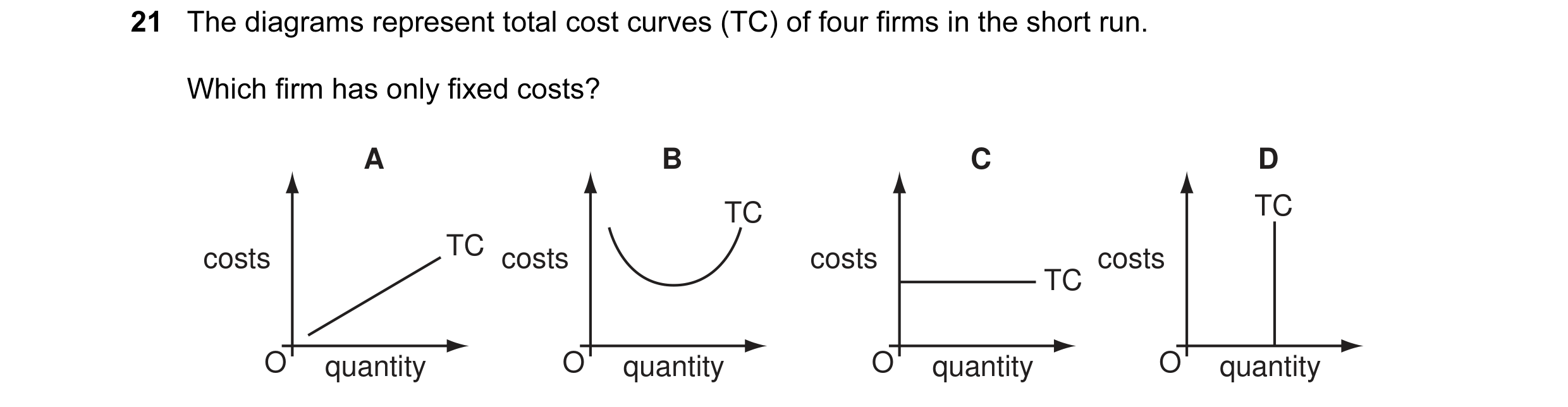

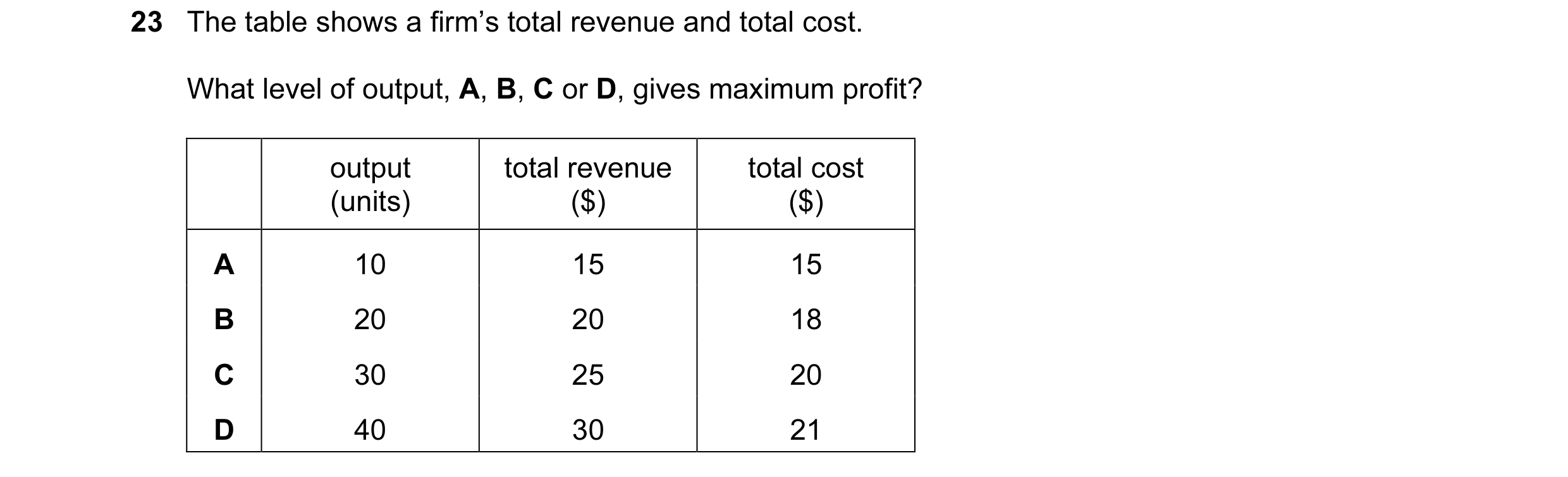
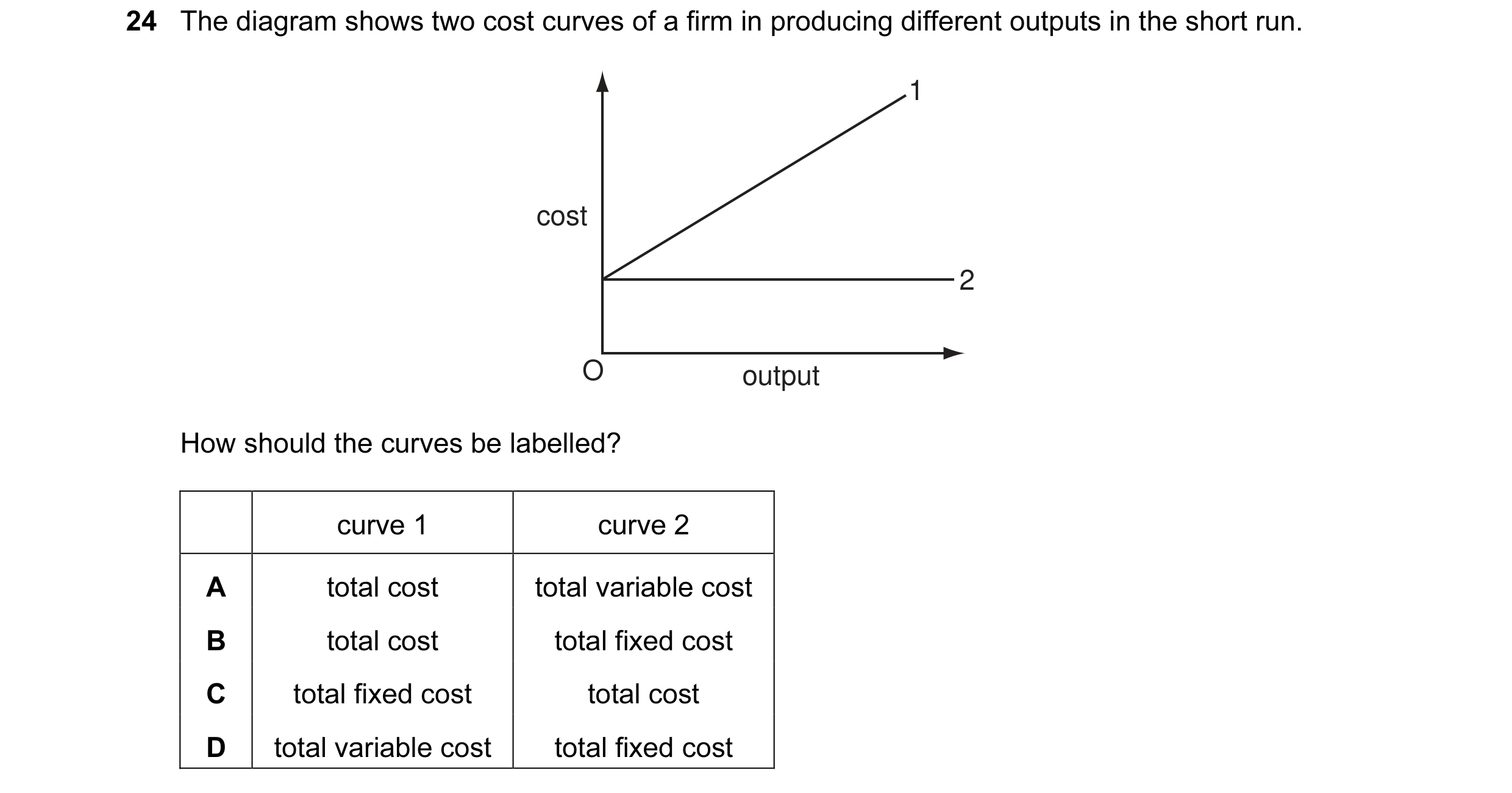 1 / 64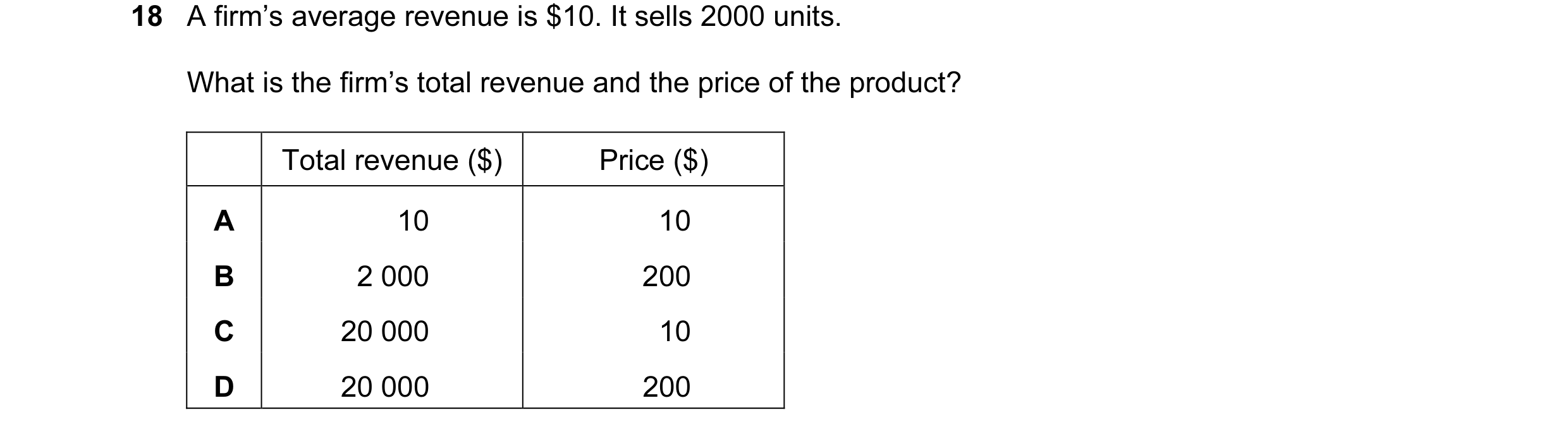
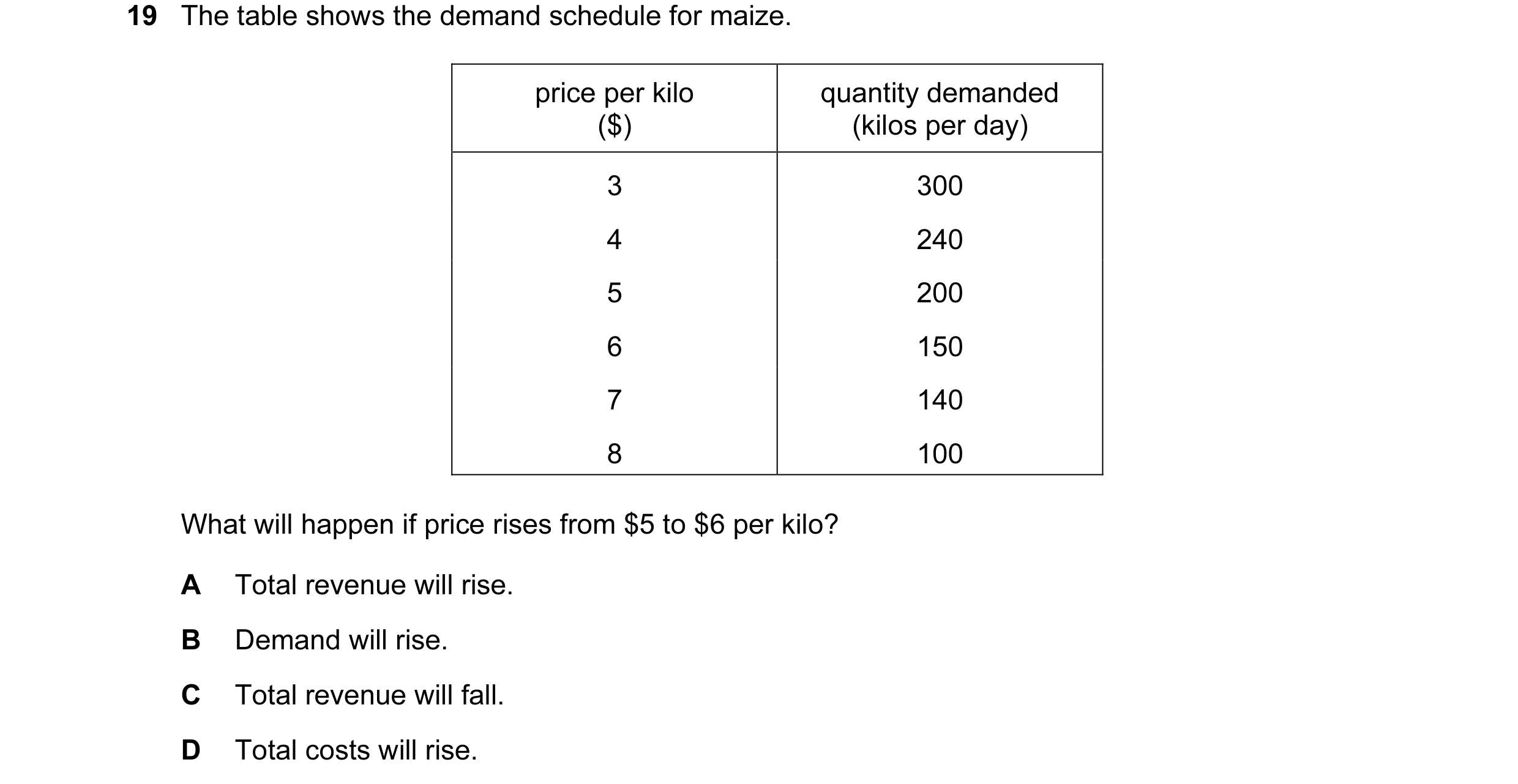

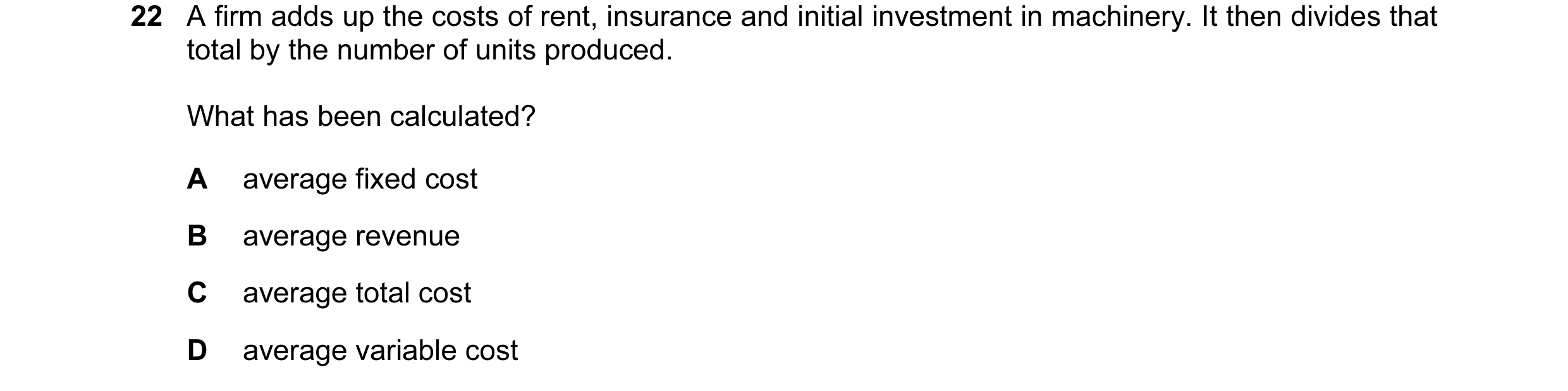 2 / 64


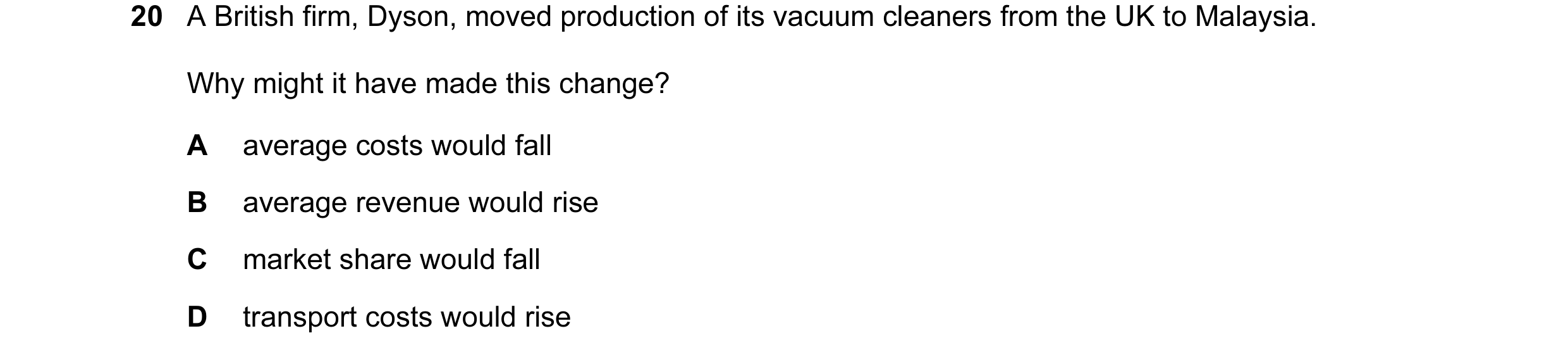

 3 / 64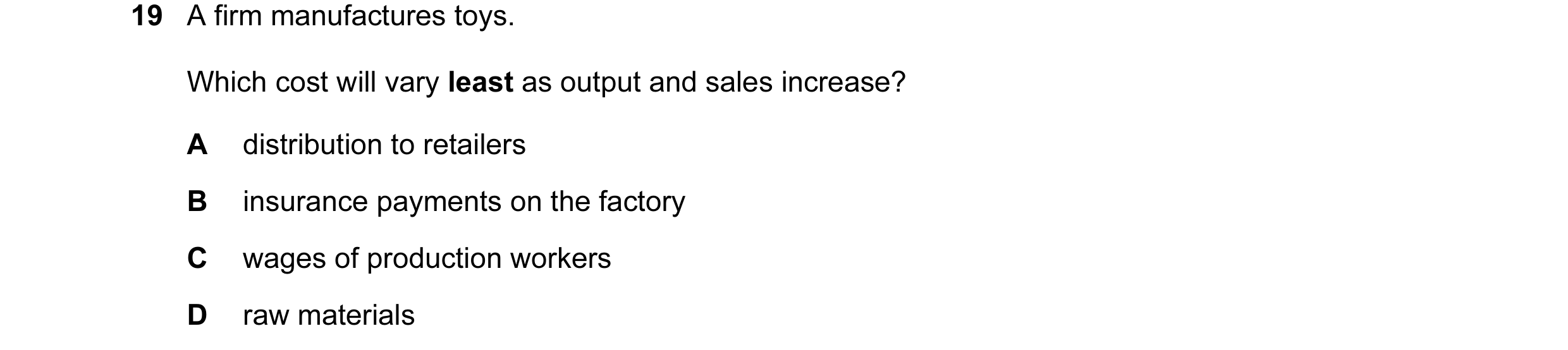
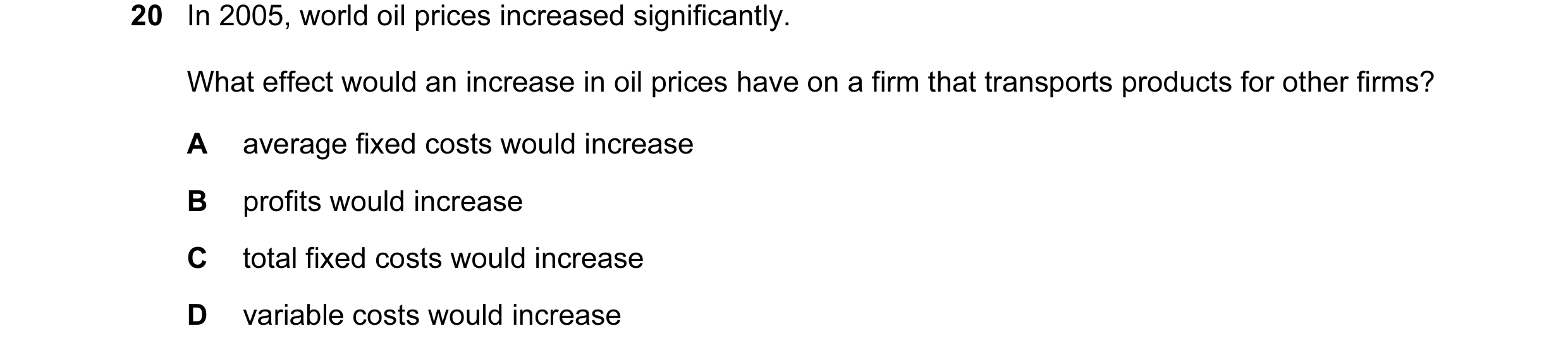


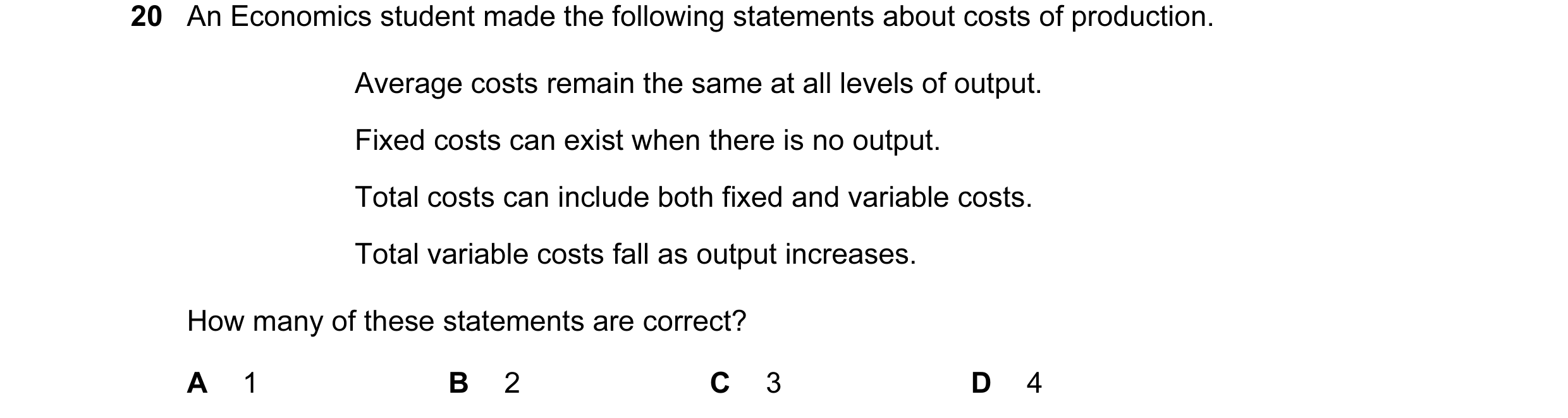 4 / 64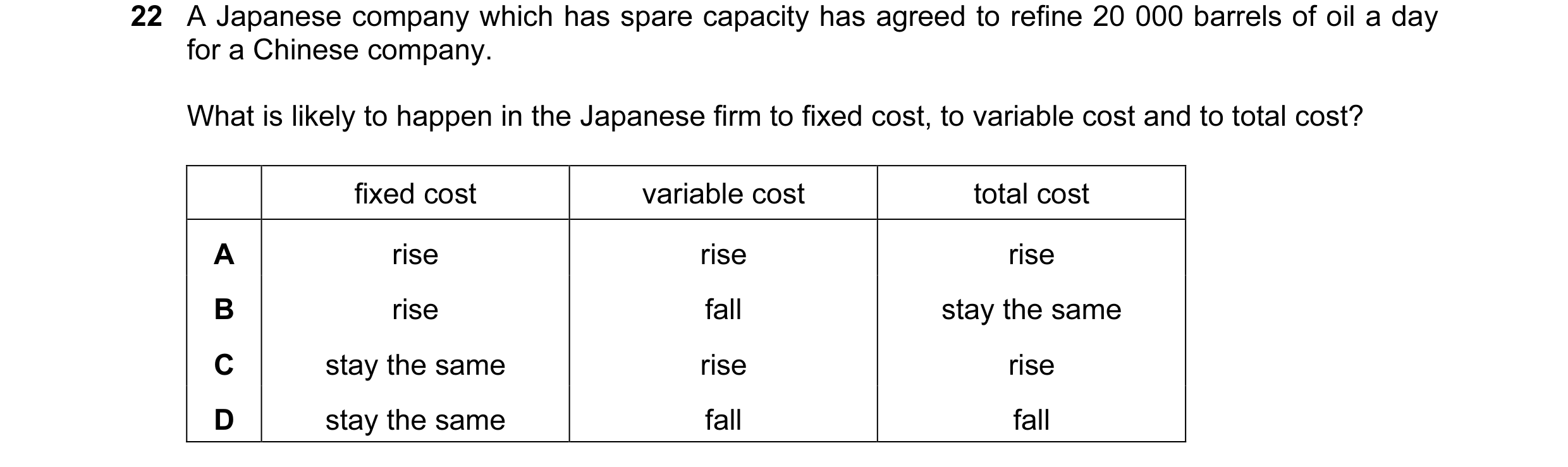
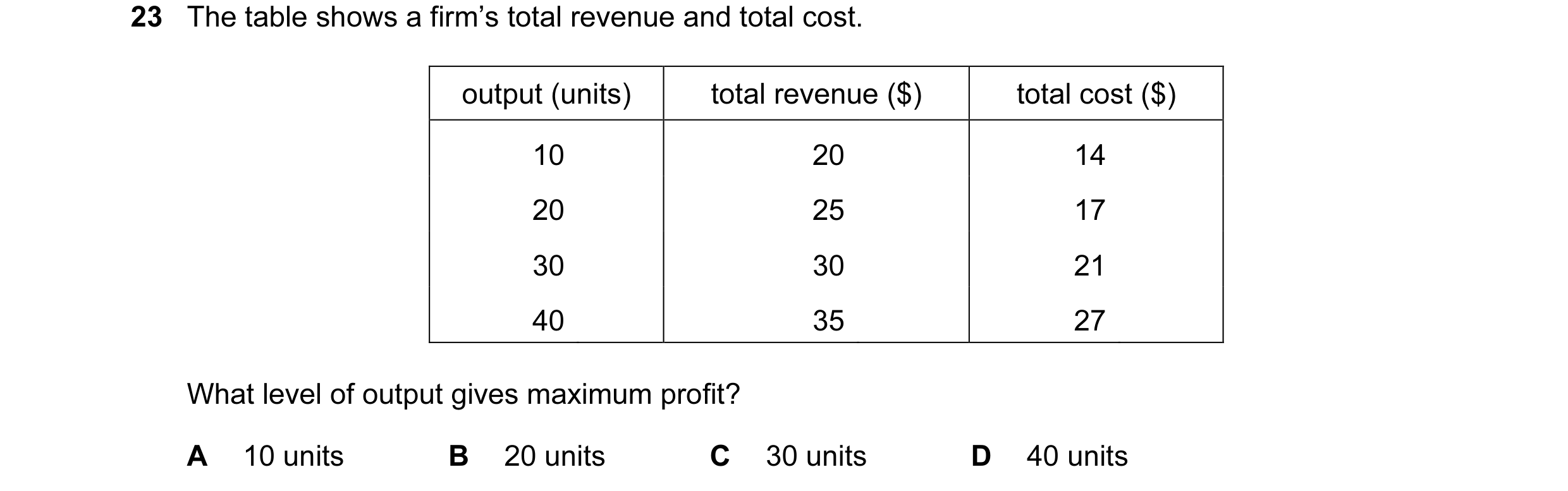

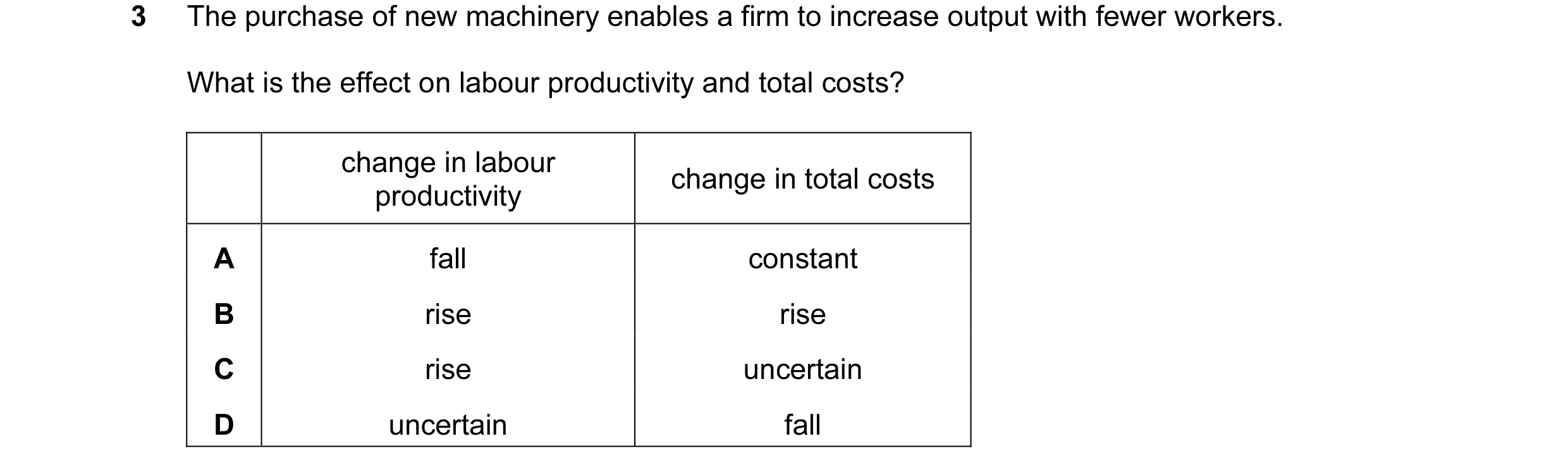 5 / 64

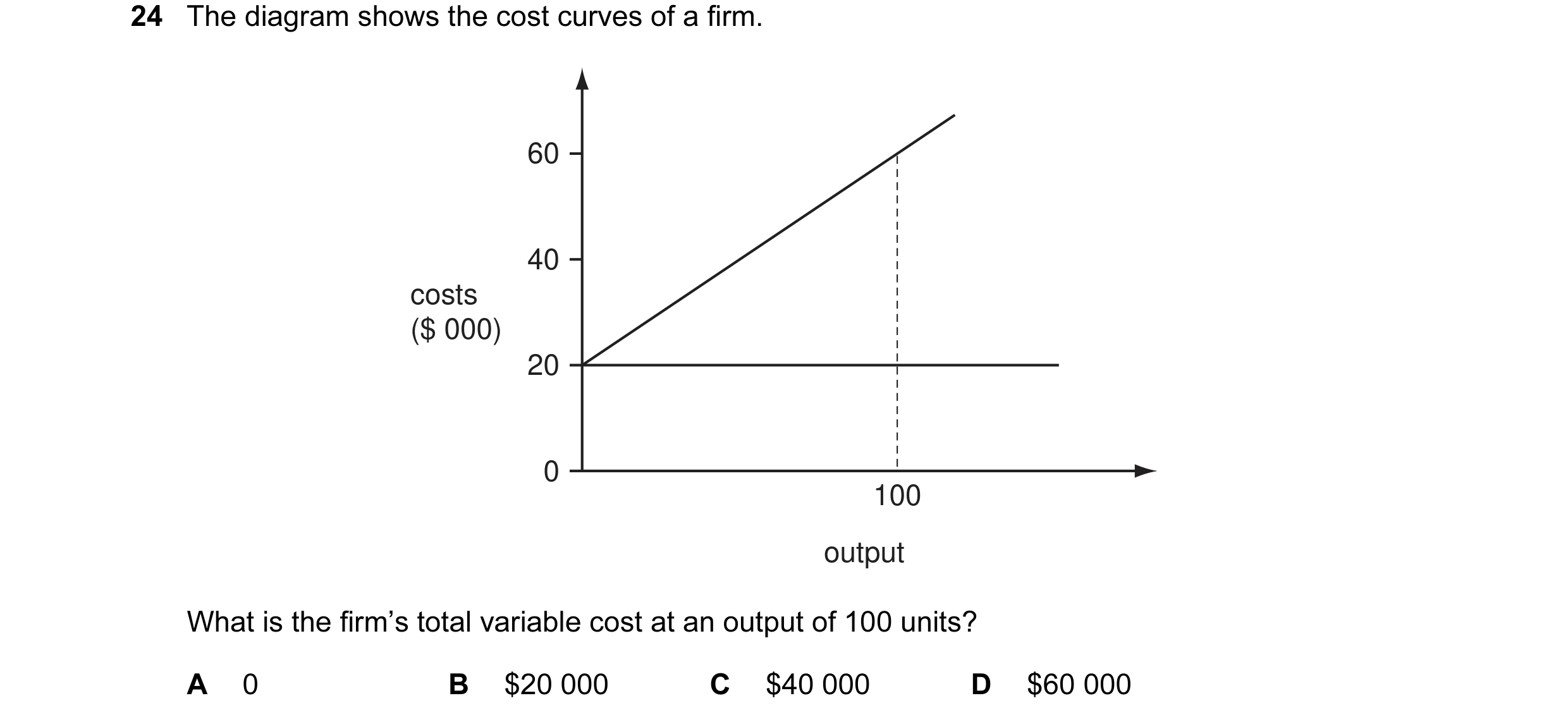 6 / 64
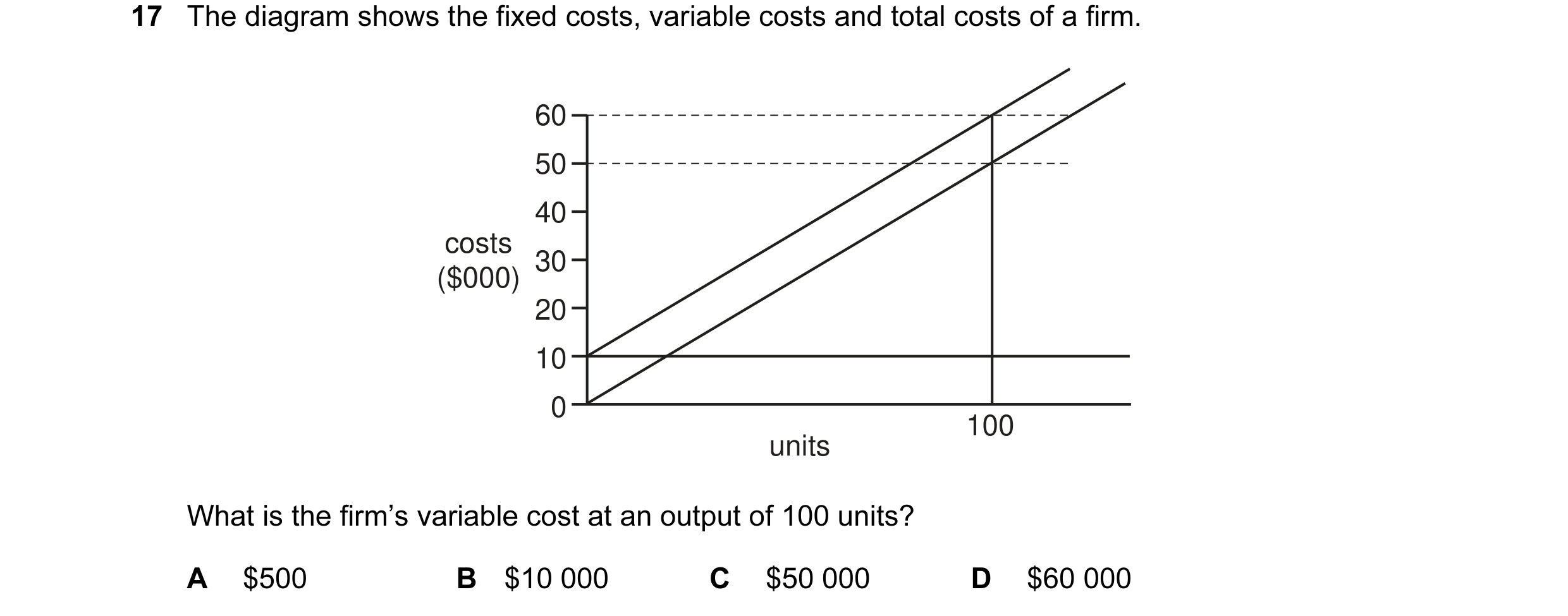
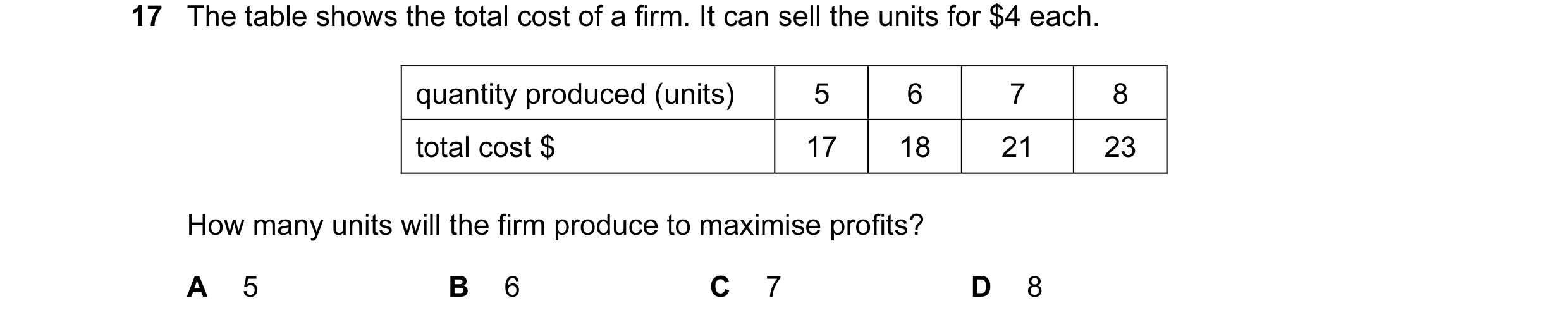 7 / 64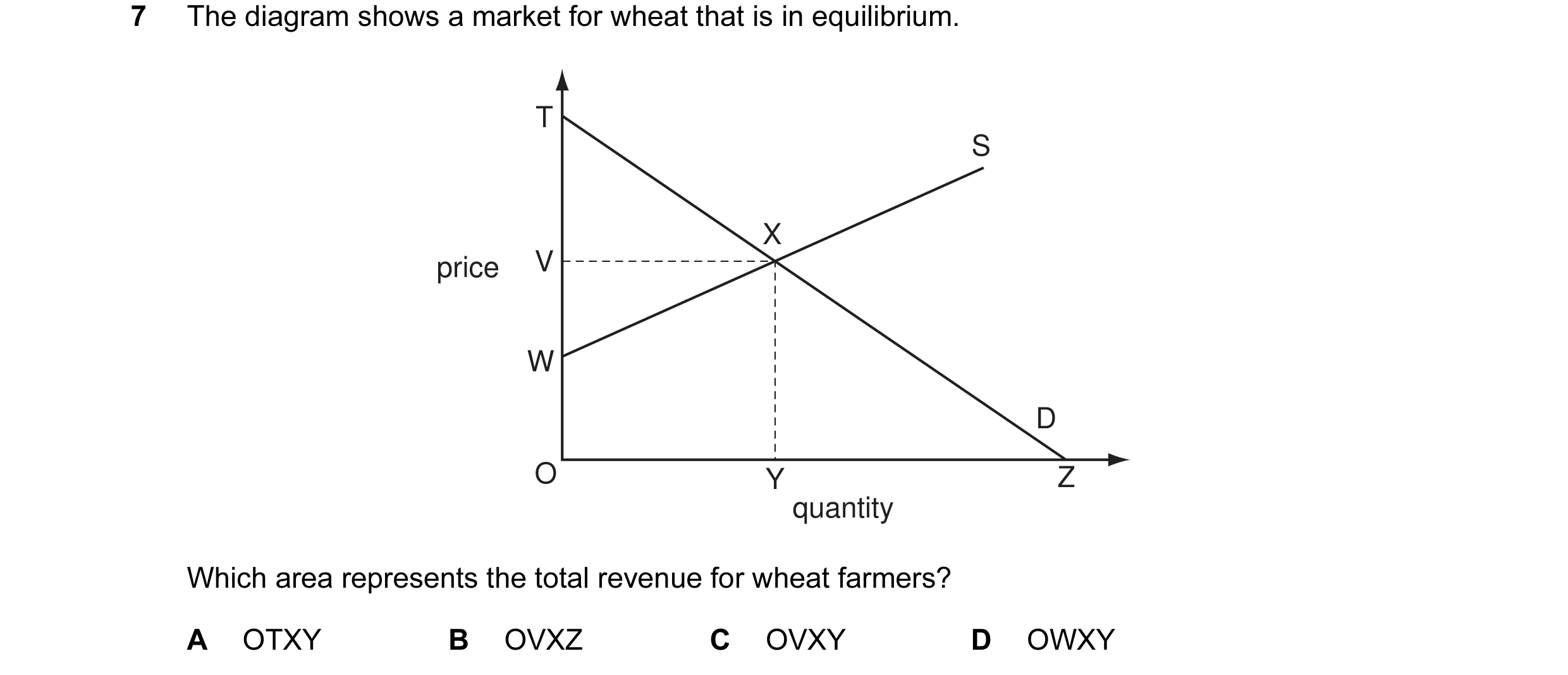


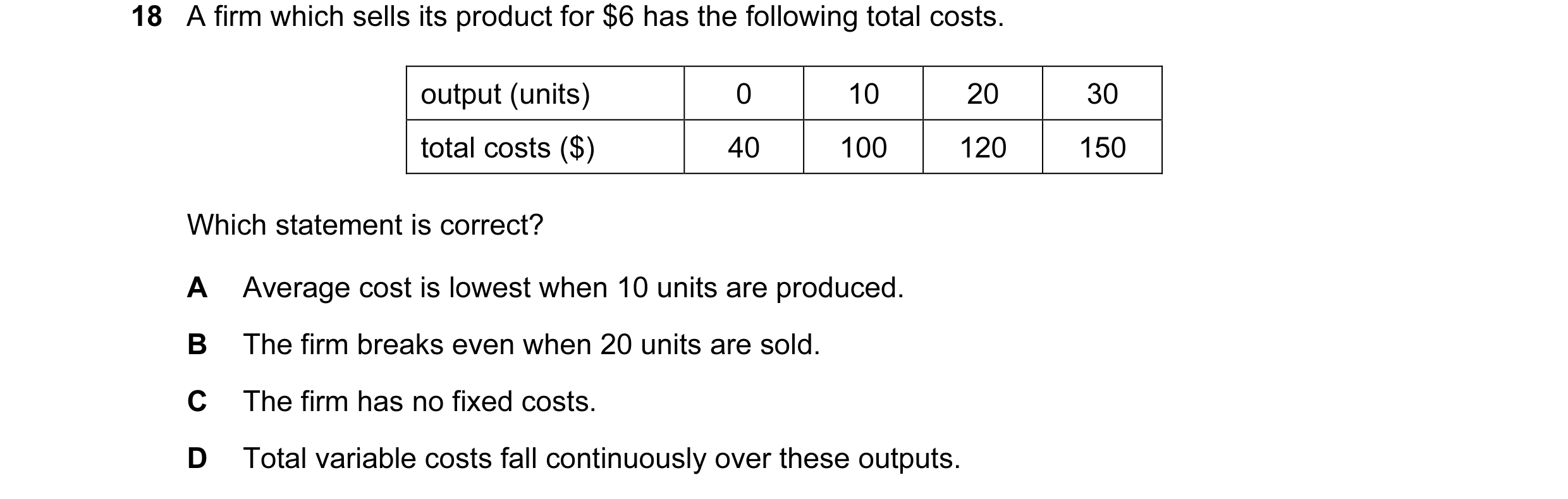 8 / 64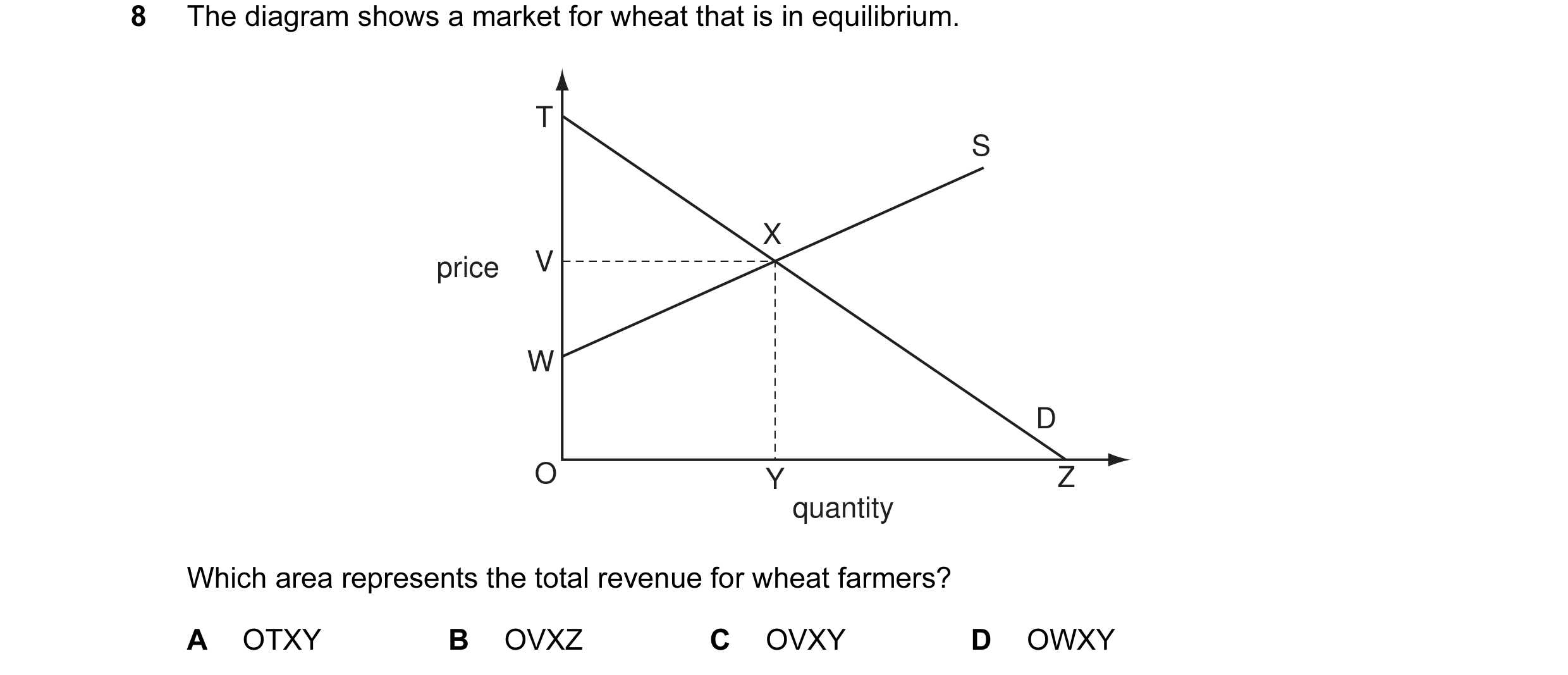
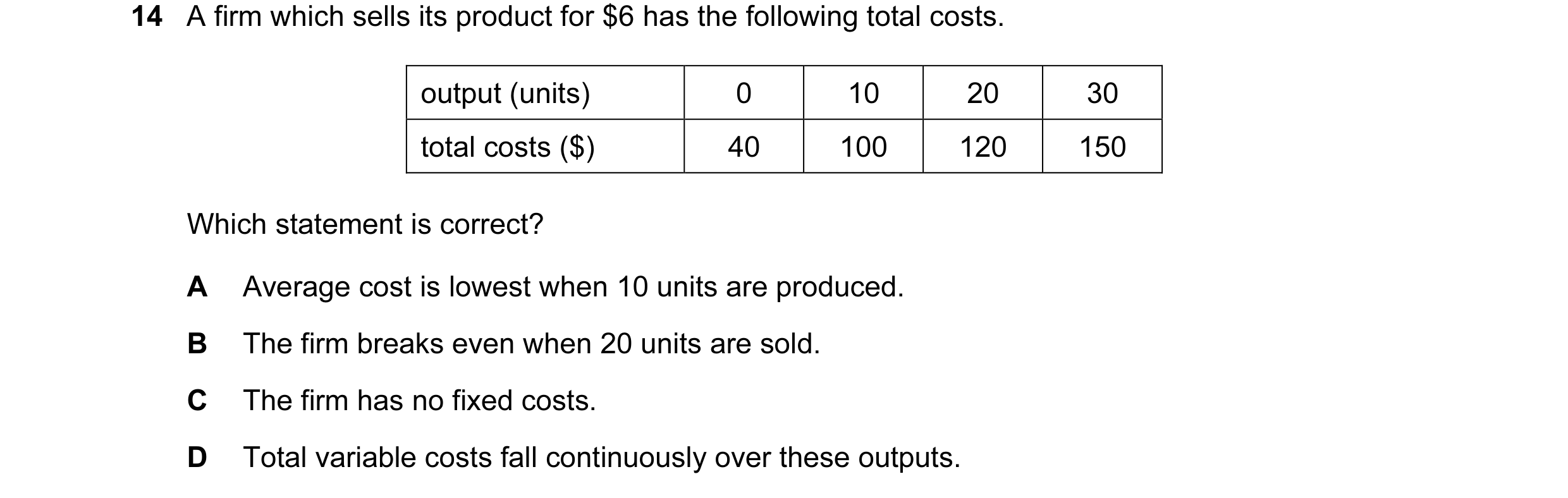

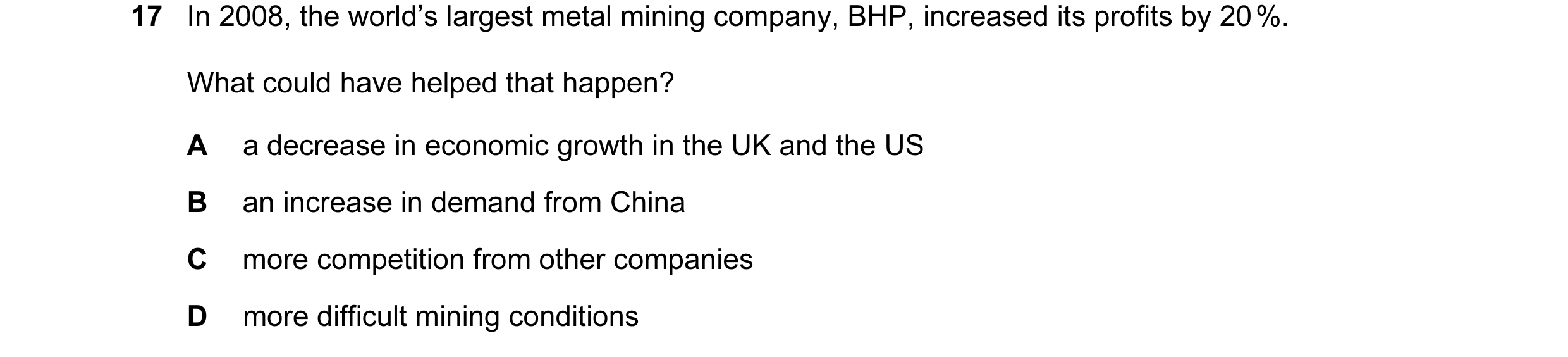 9 / 64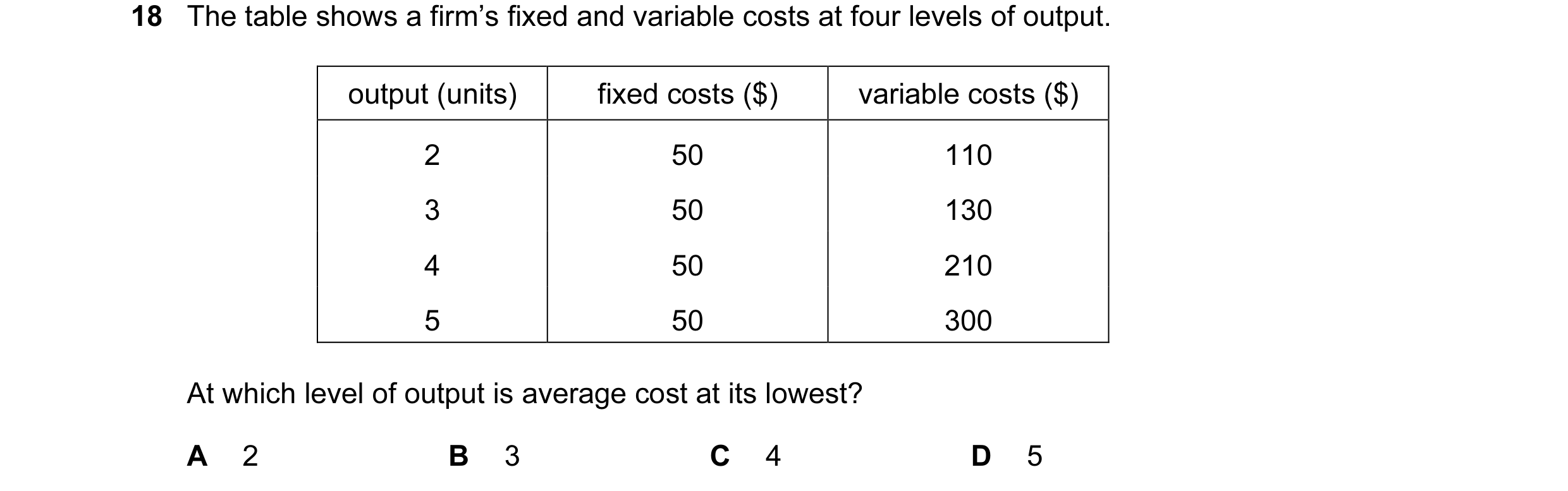
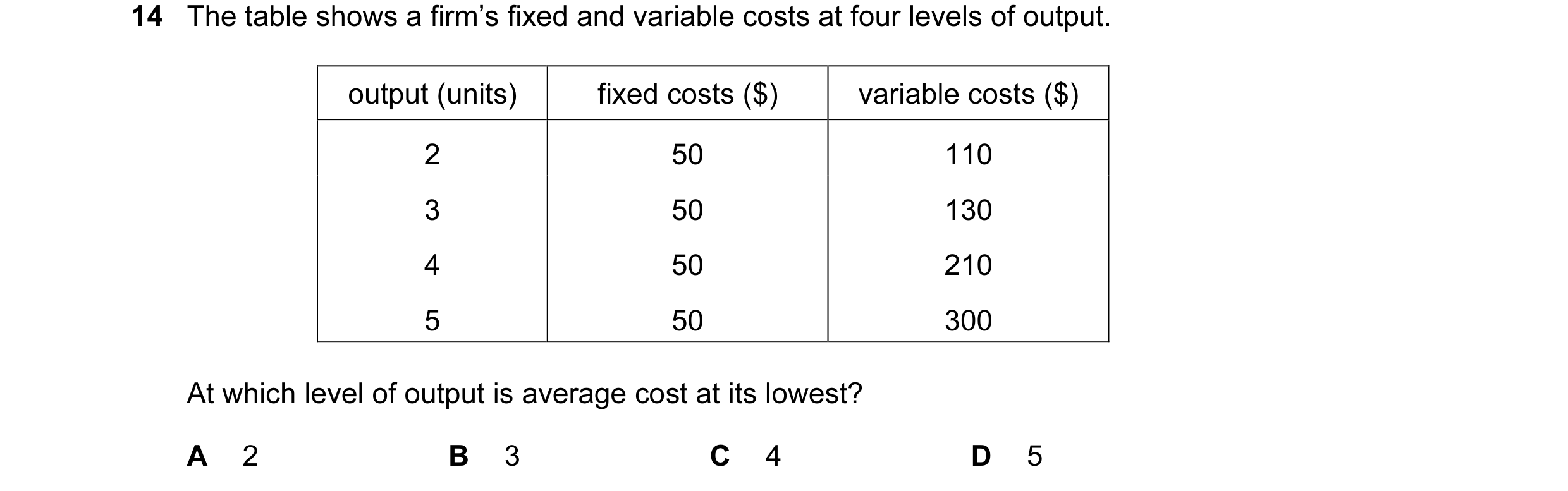
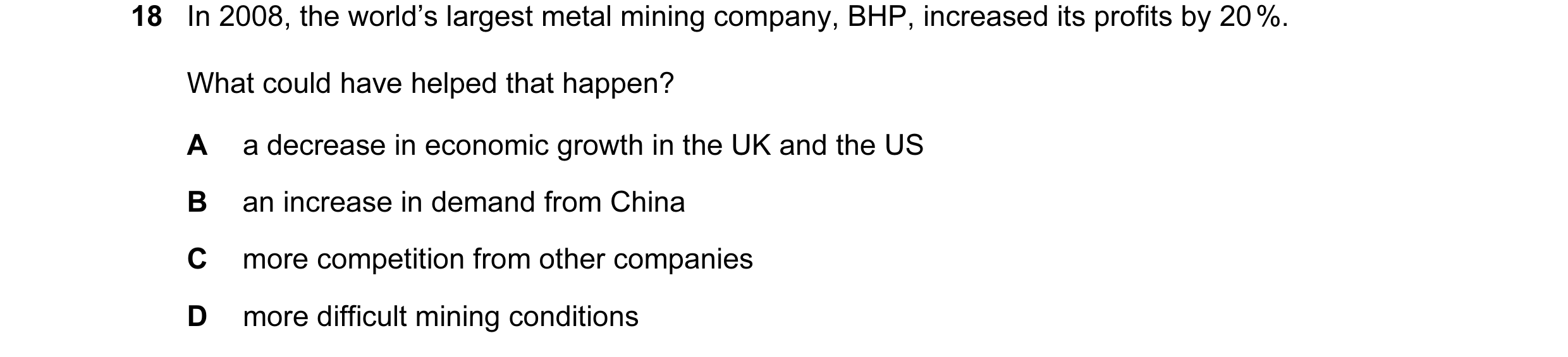
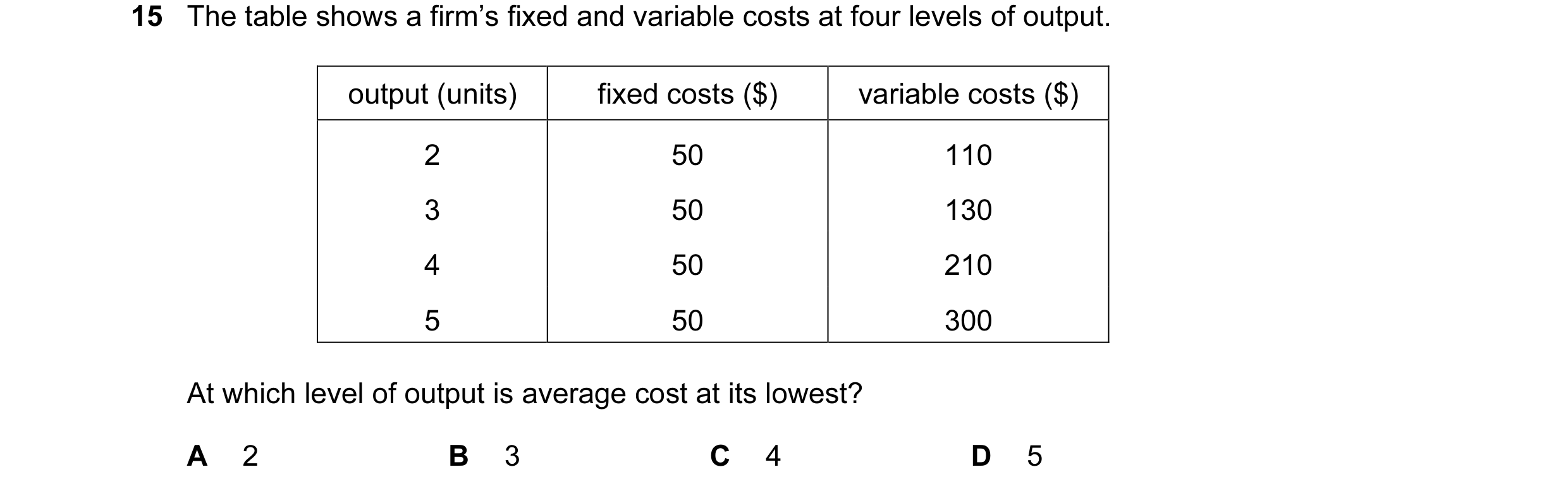 10 / 64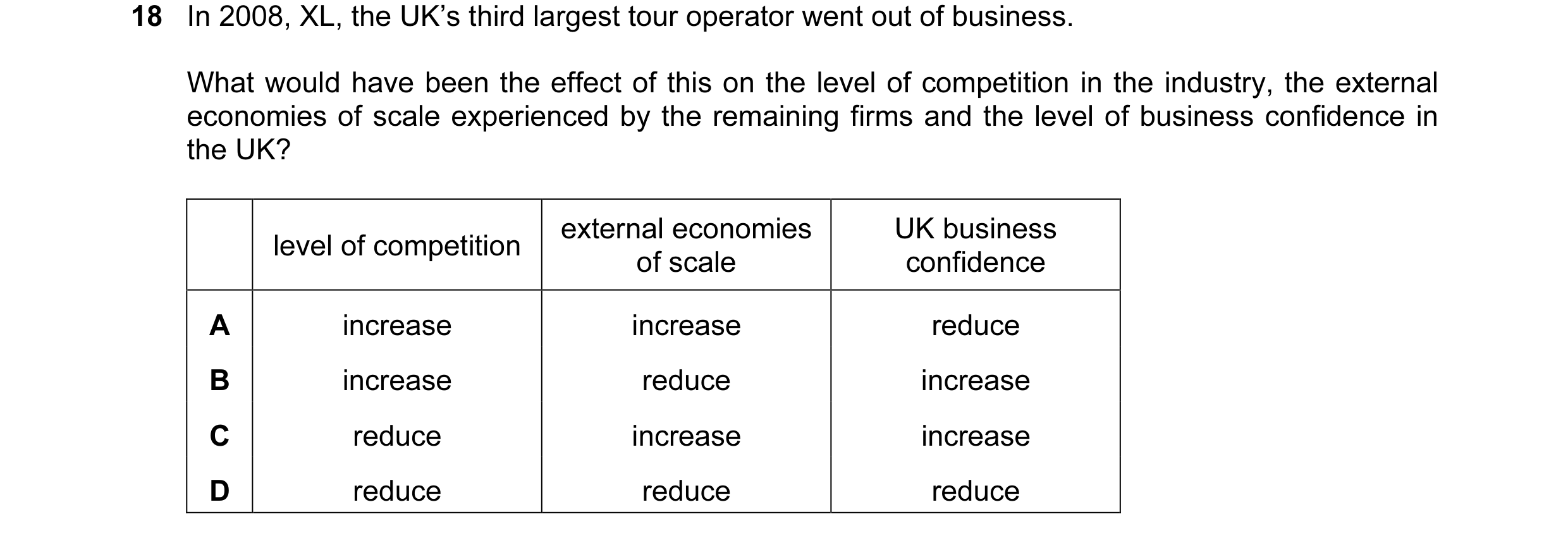
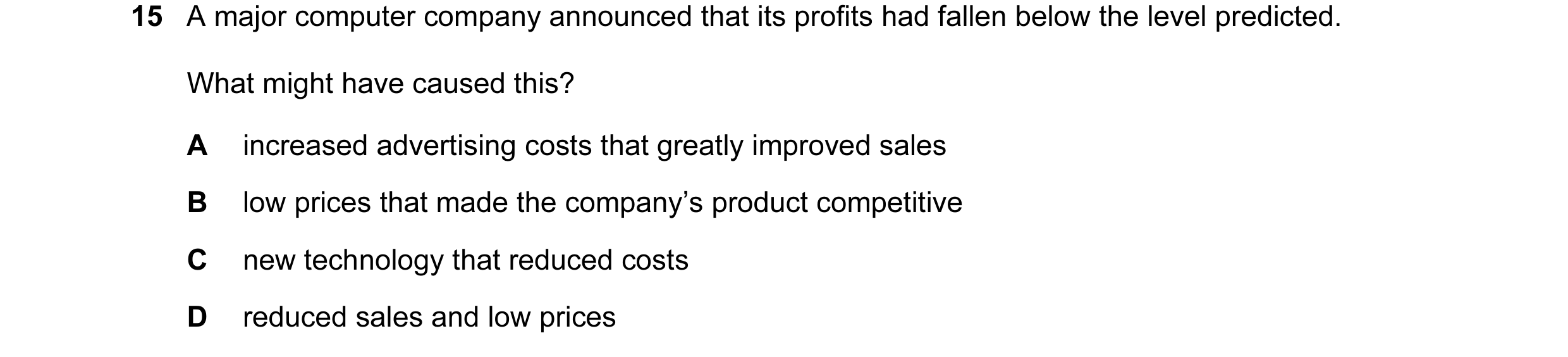
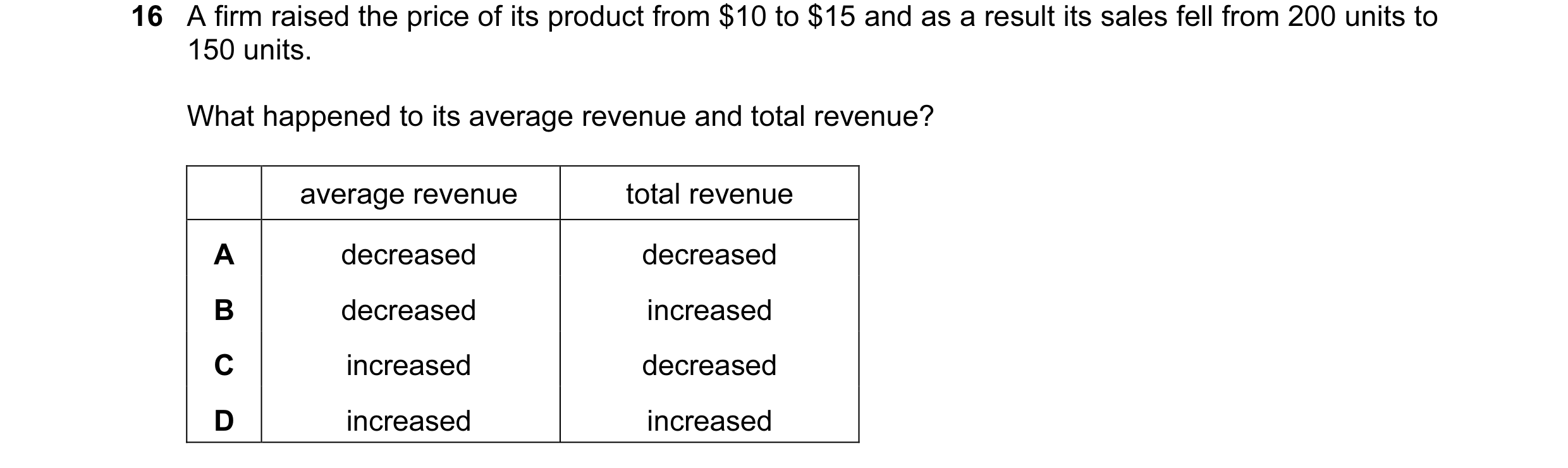

 11 / 64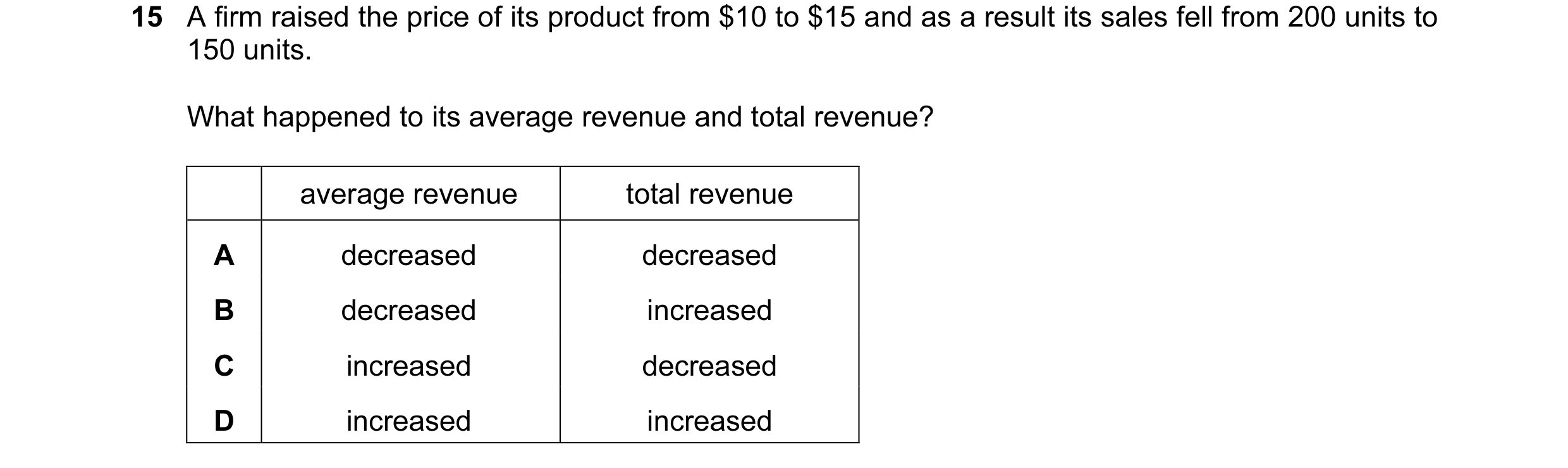


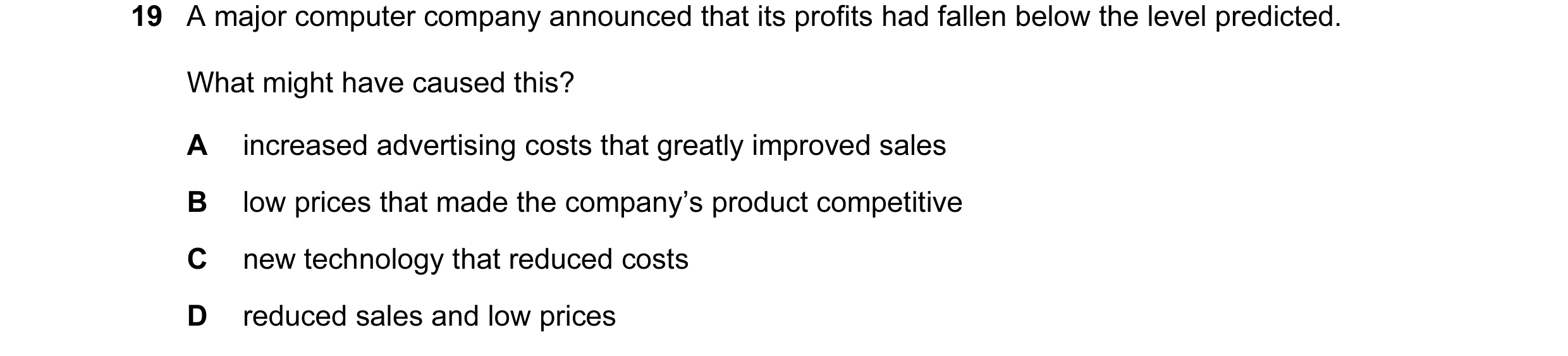
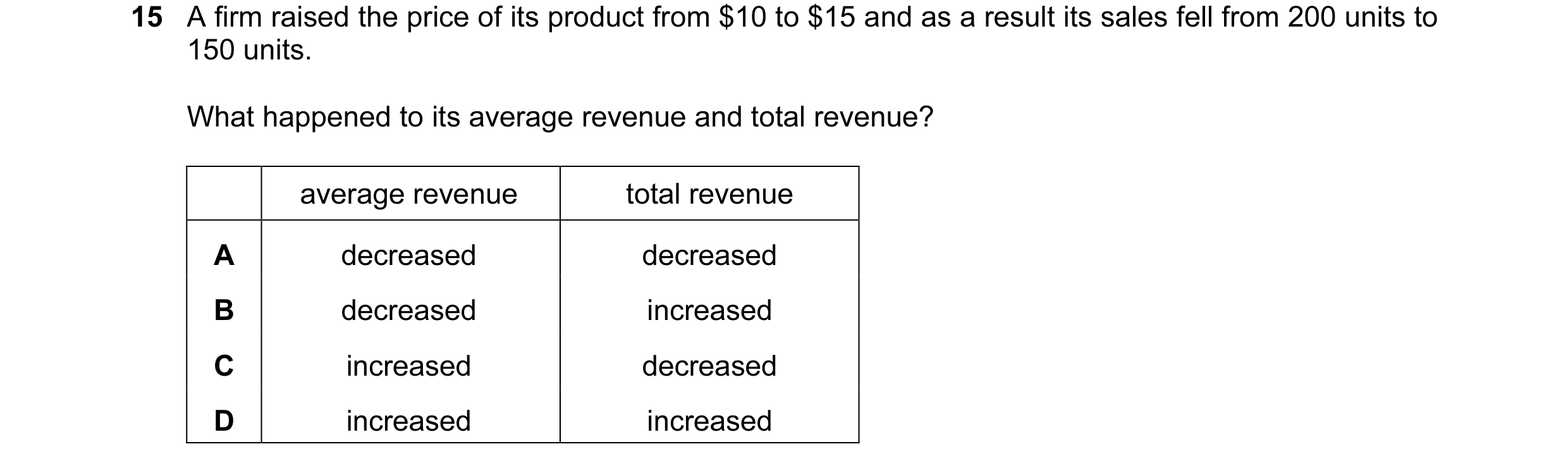 12 / 64

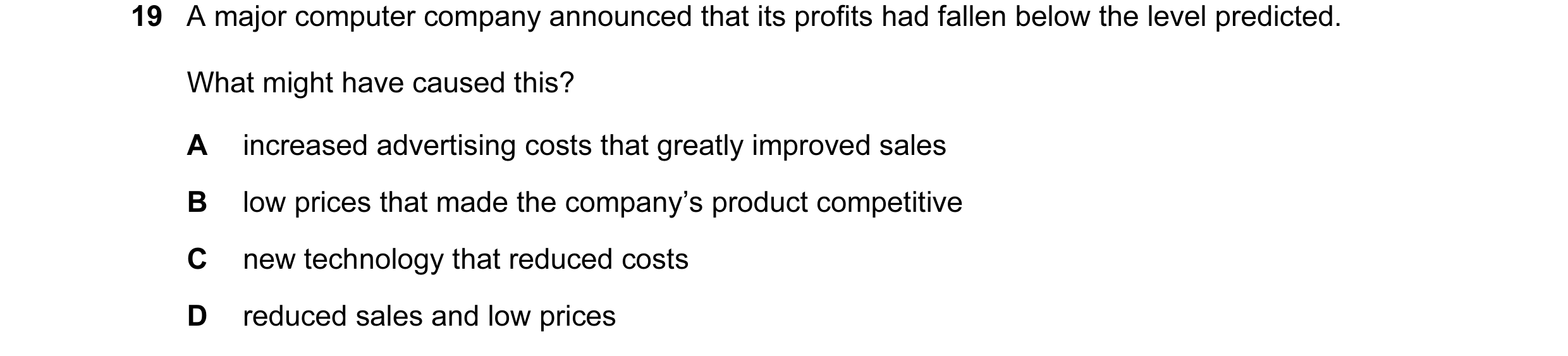
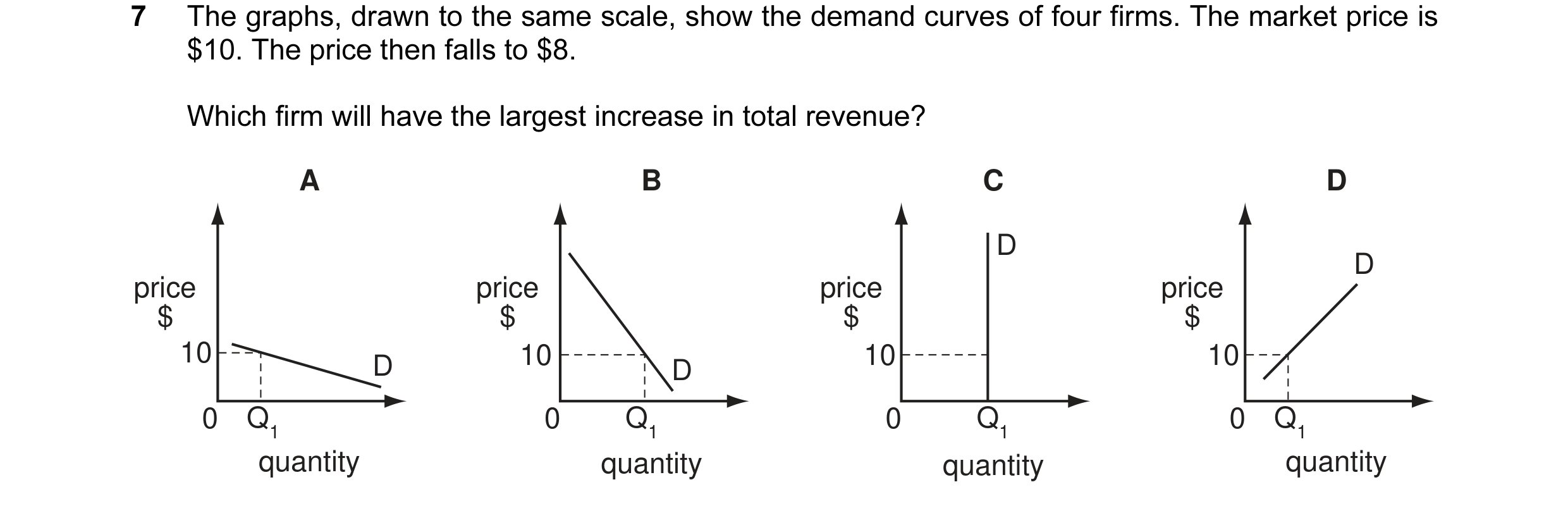
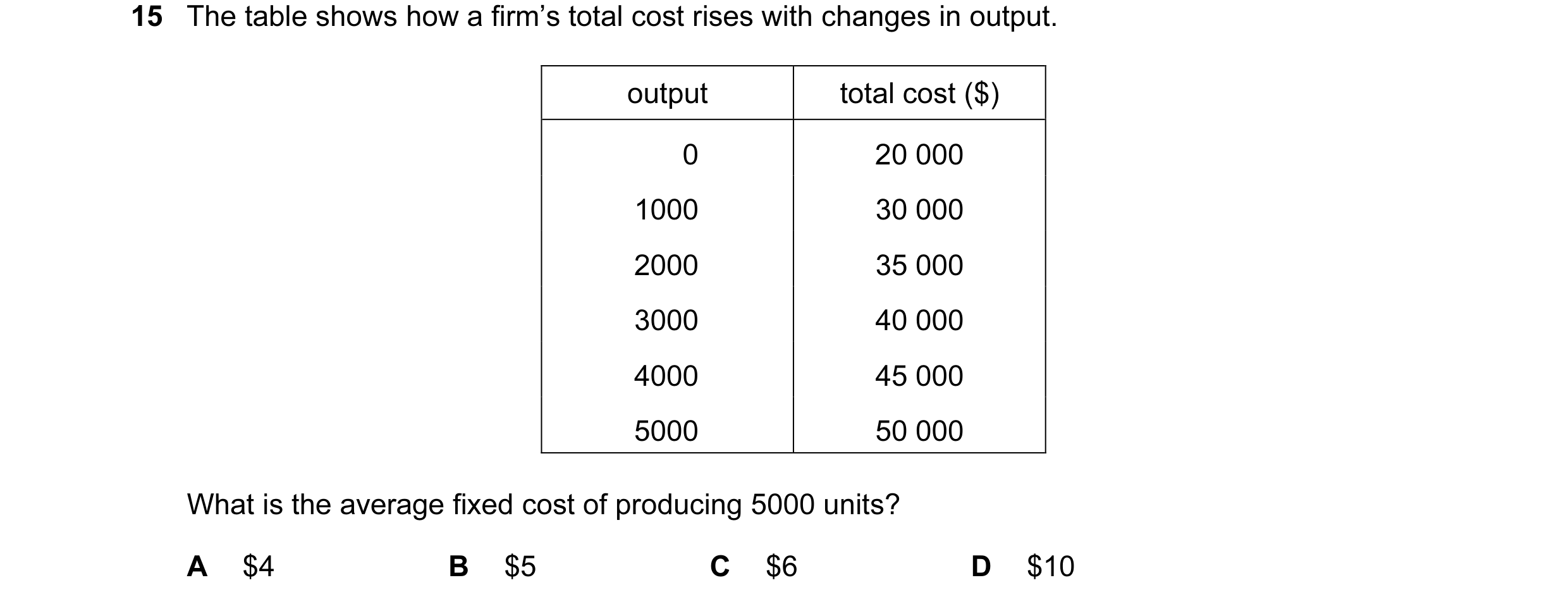 13 / 64

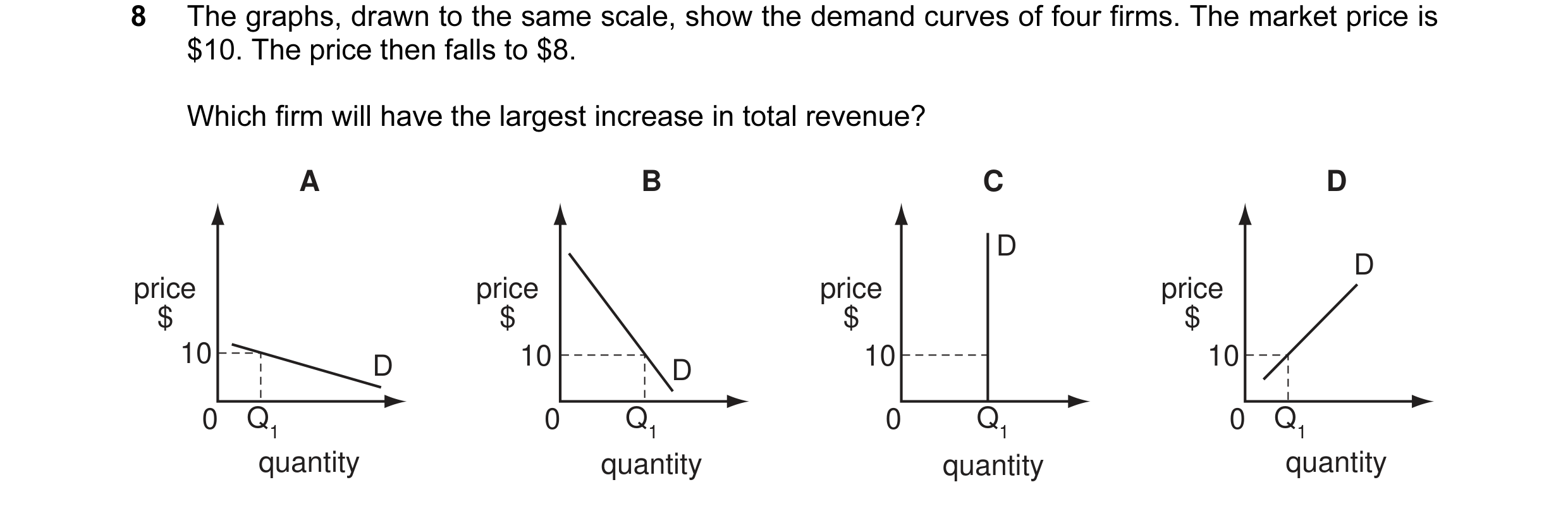
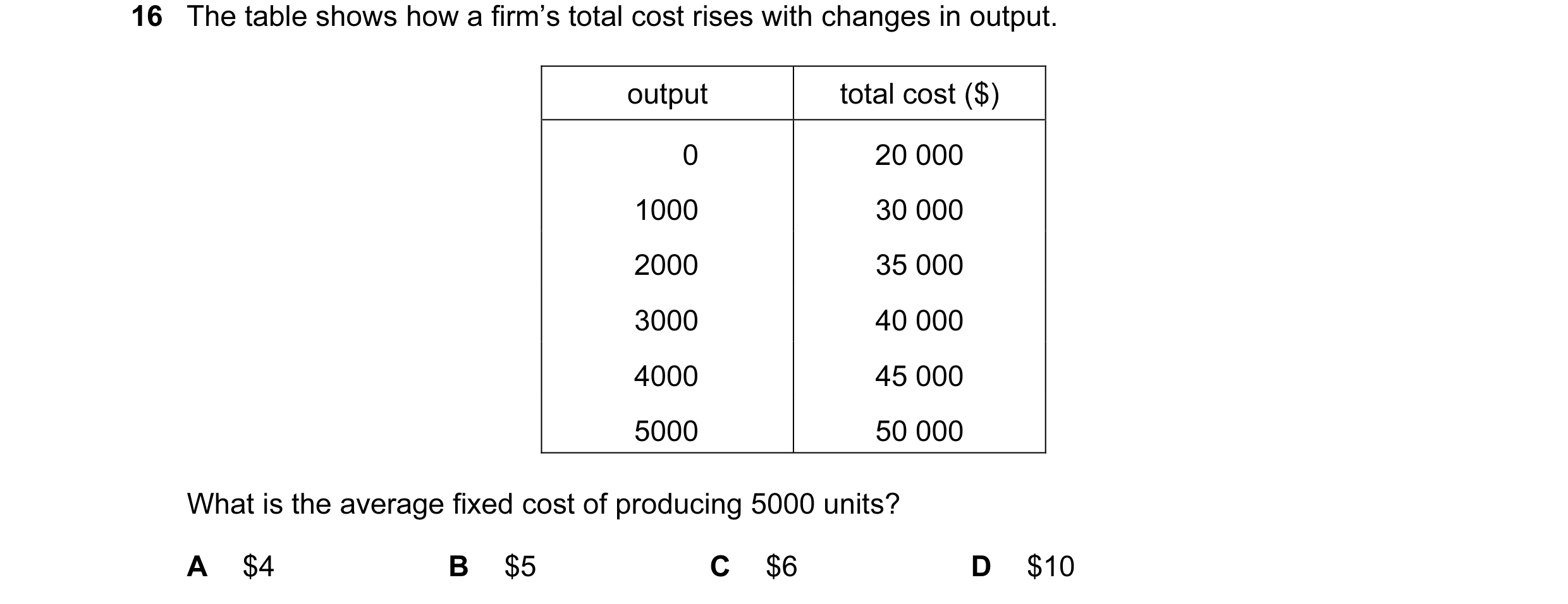 14 / 64

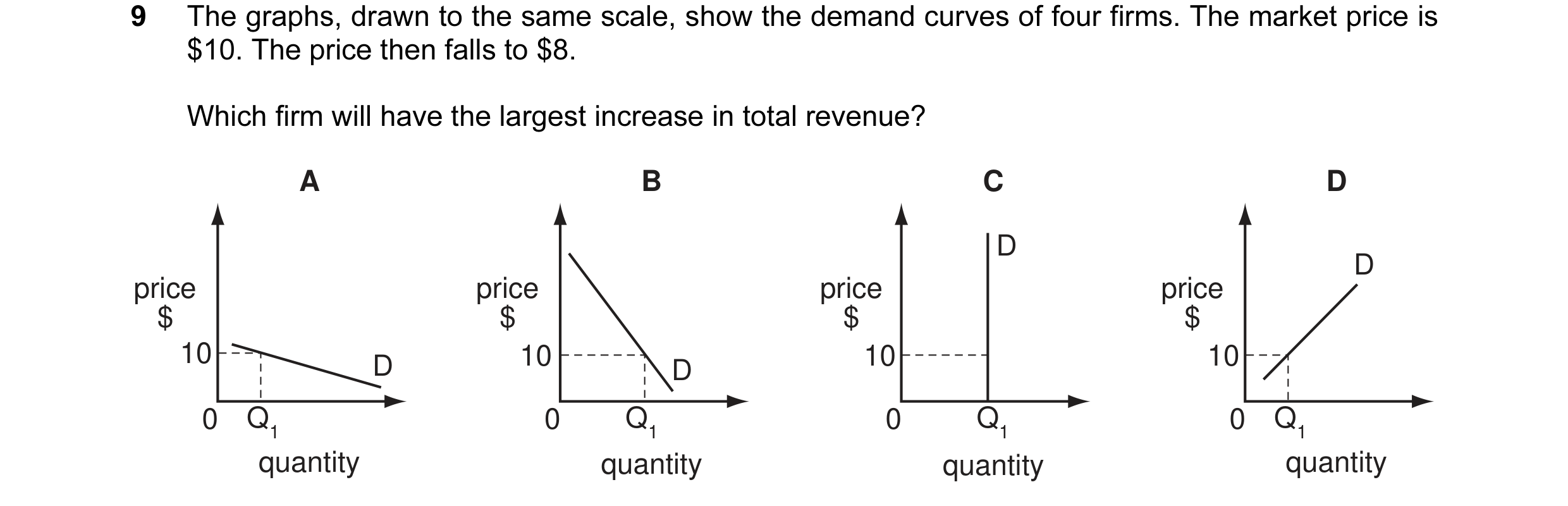

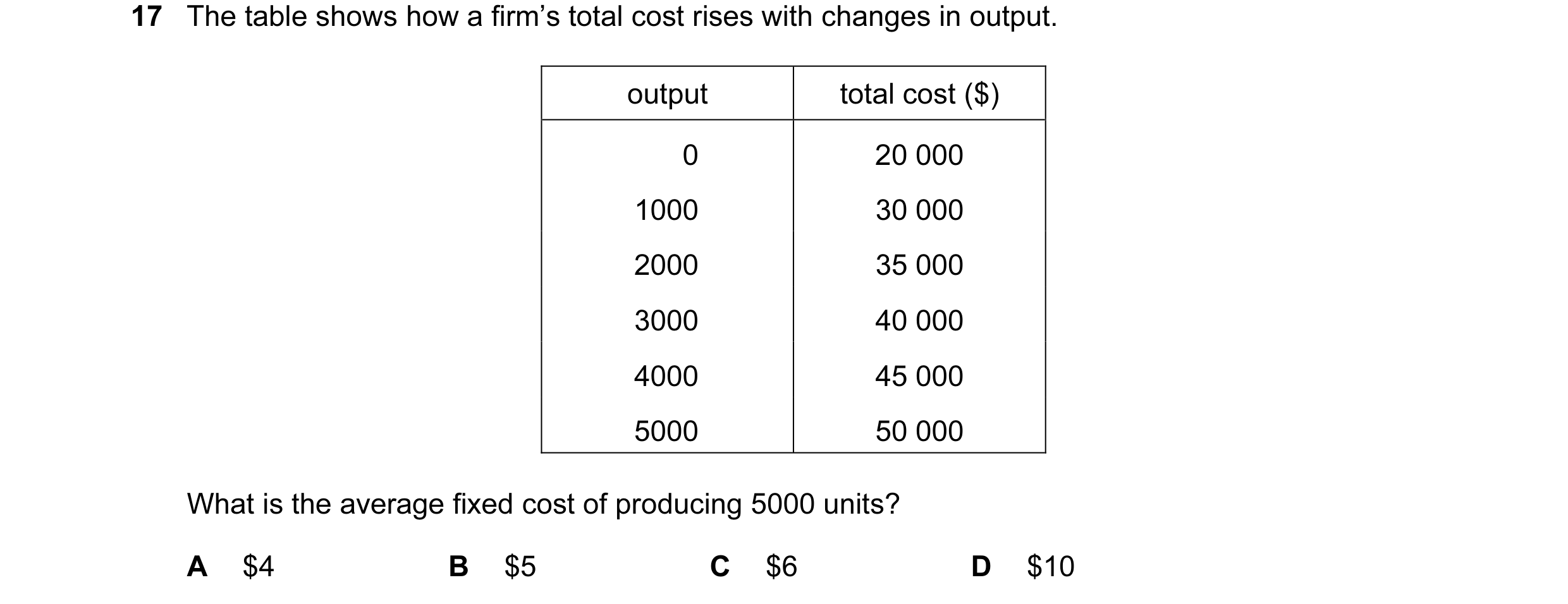 15 / 64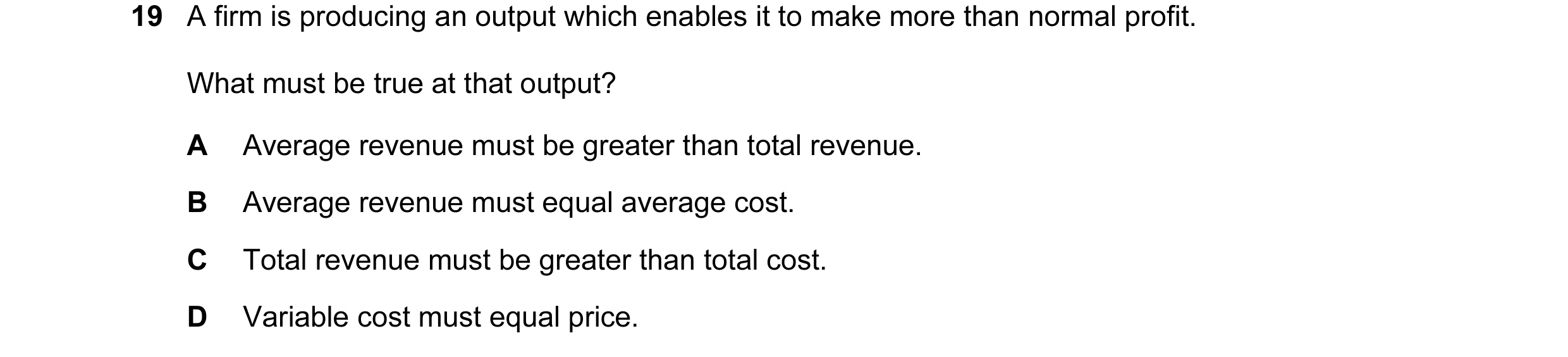
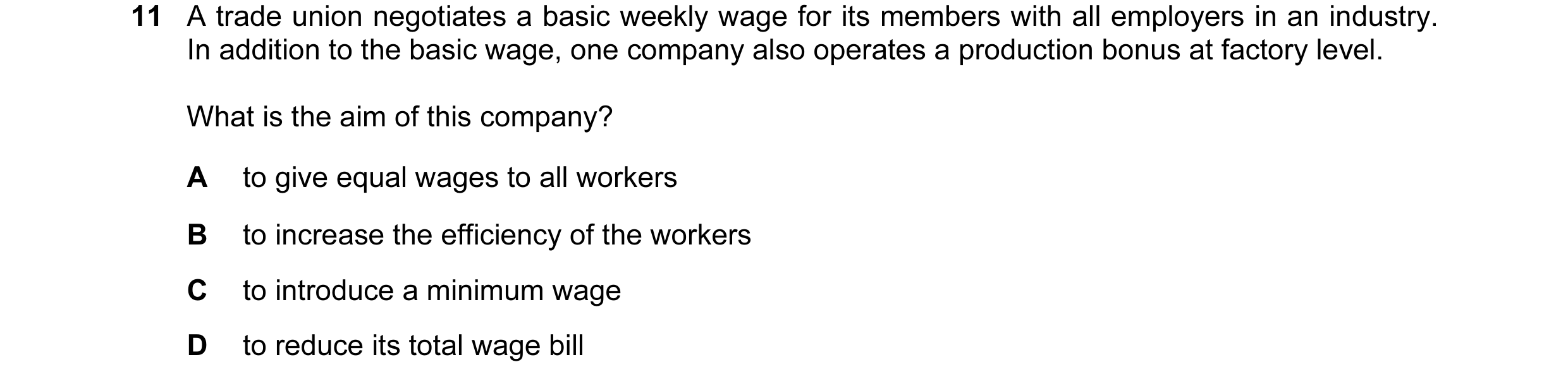
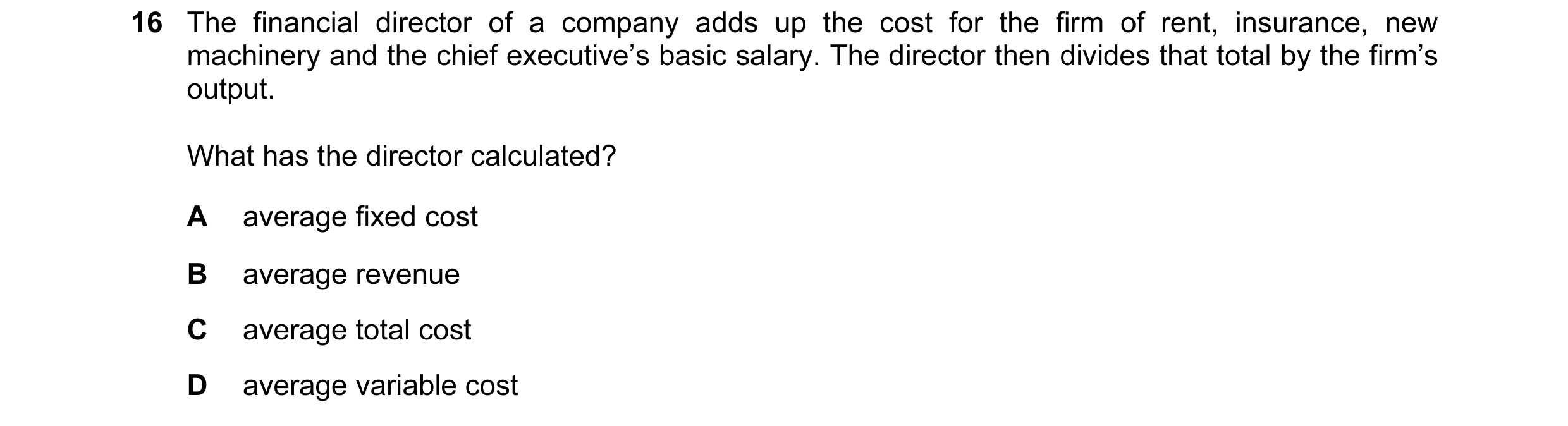
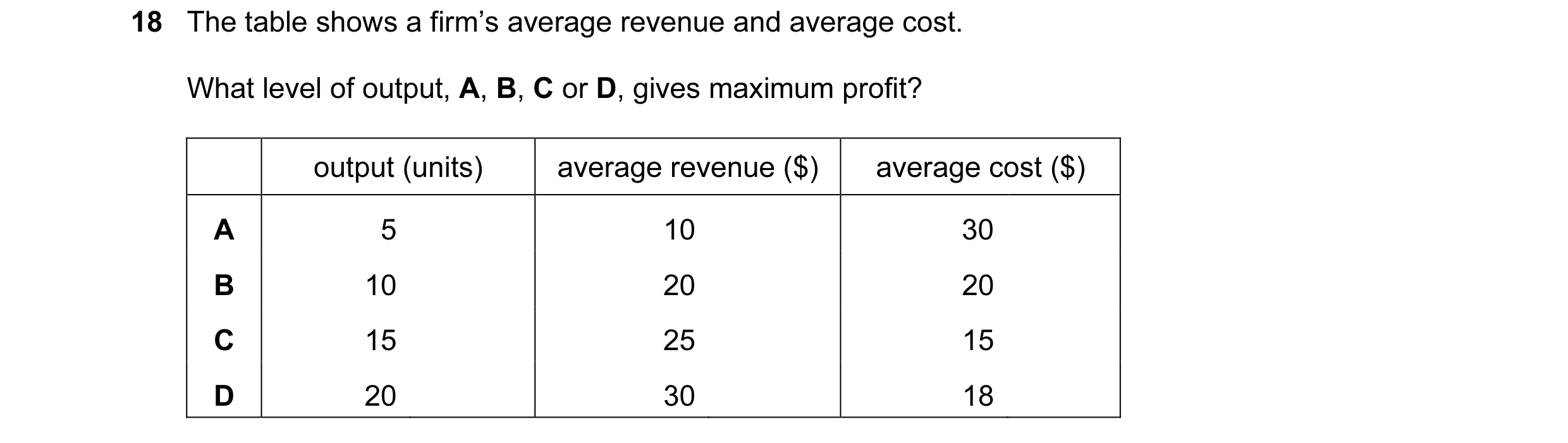
 16 / 64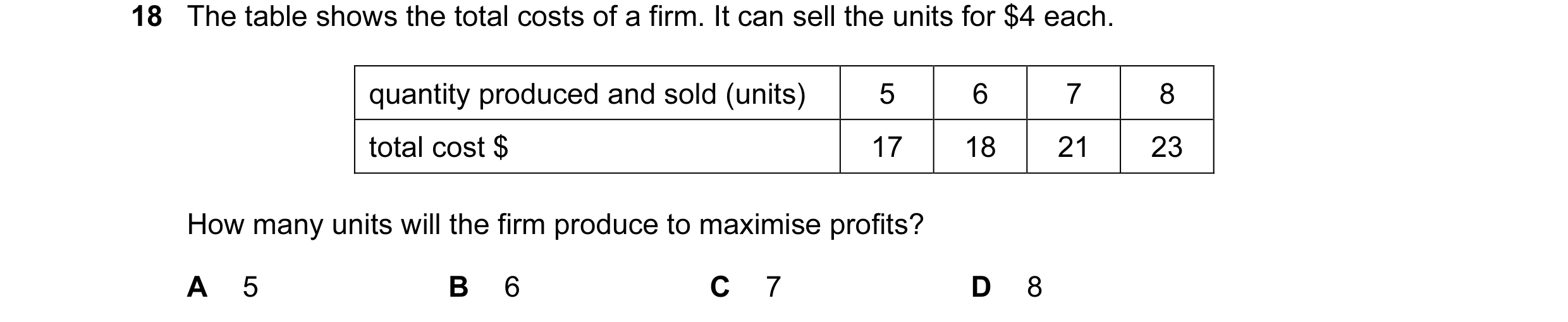

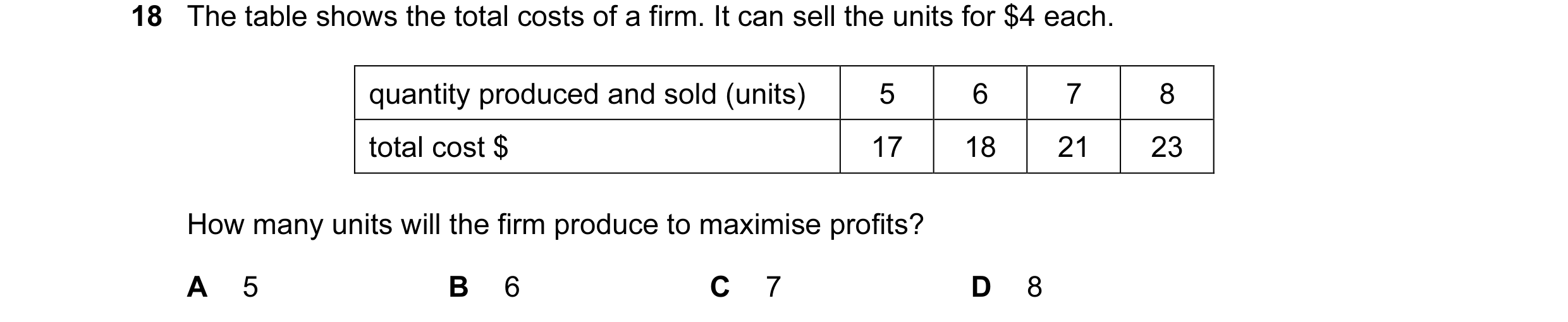

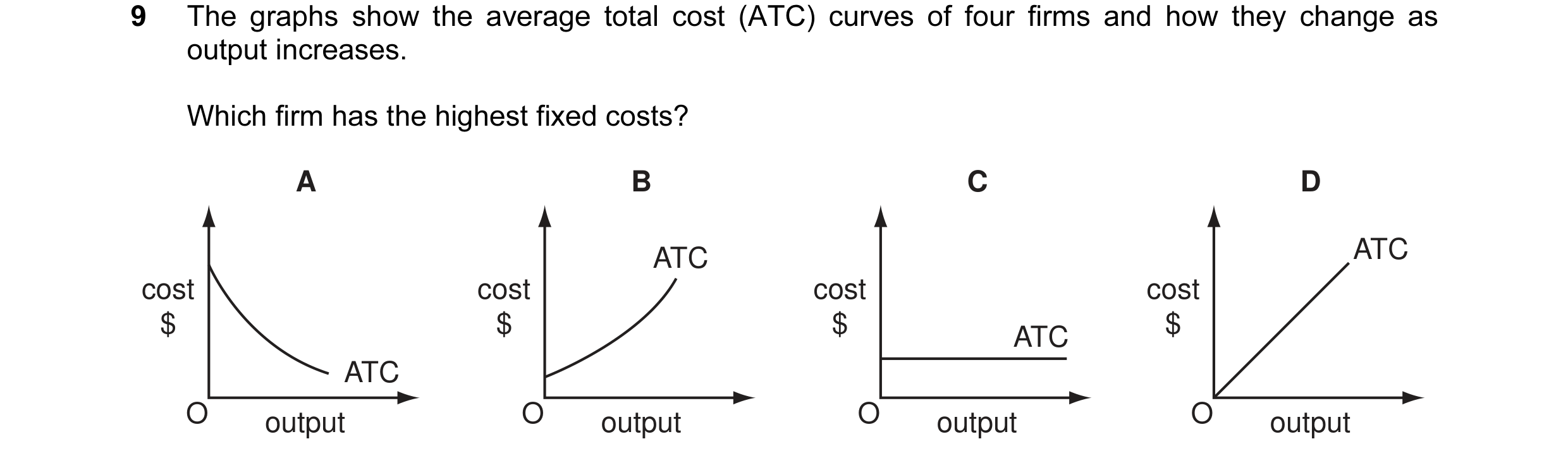
 17 / 64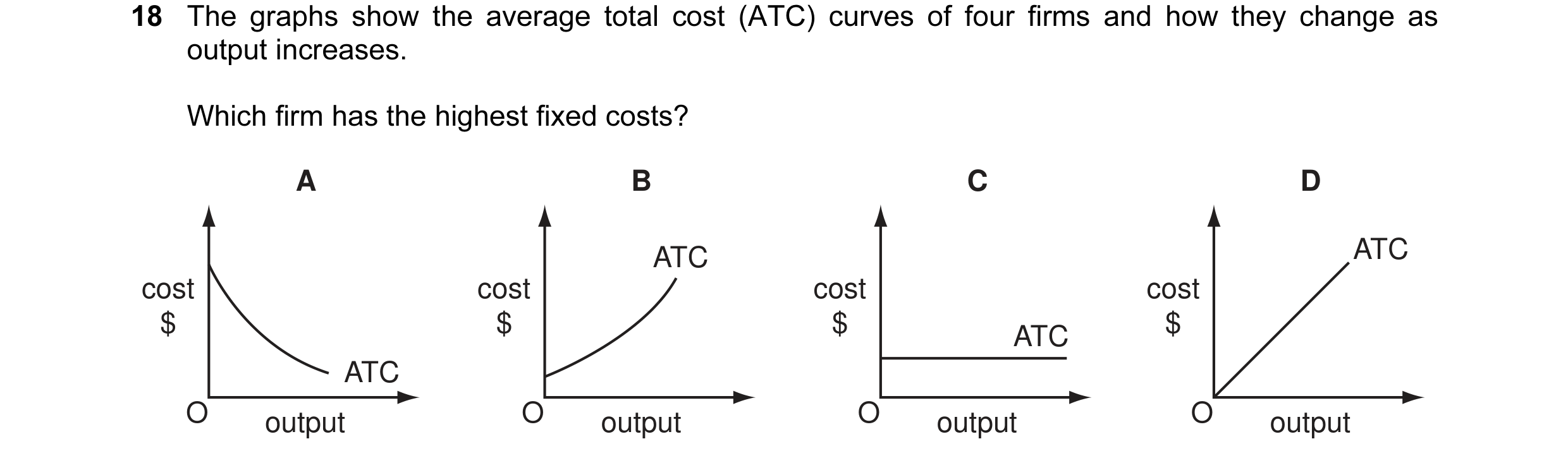
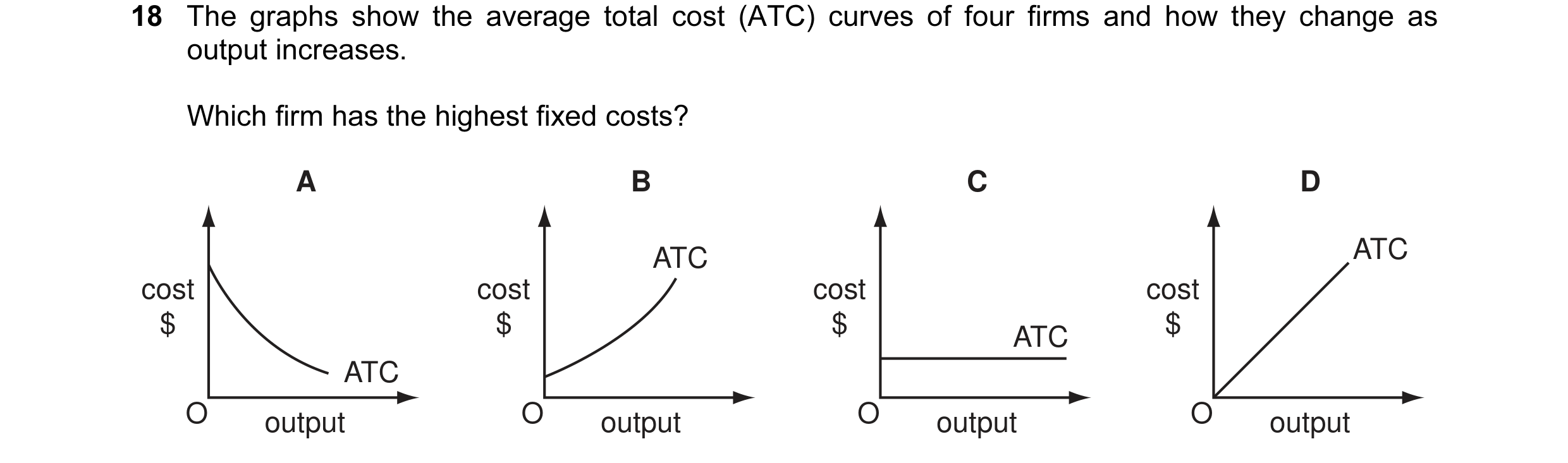
 18 / 64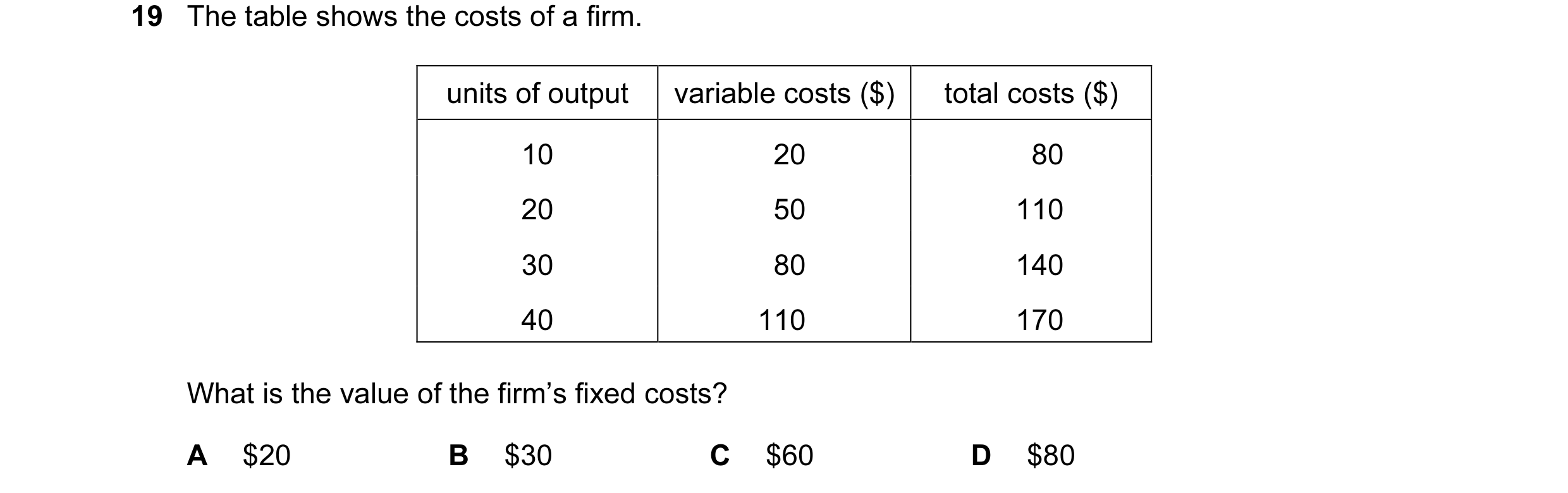

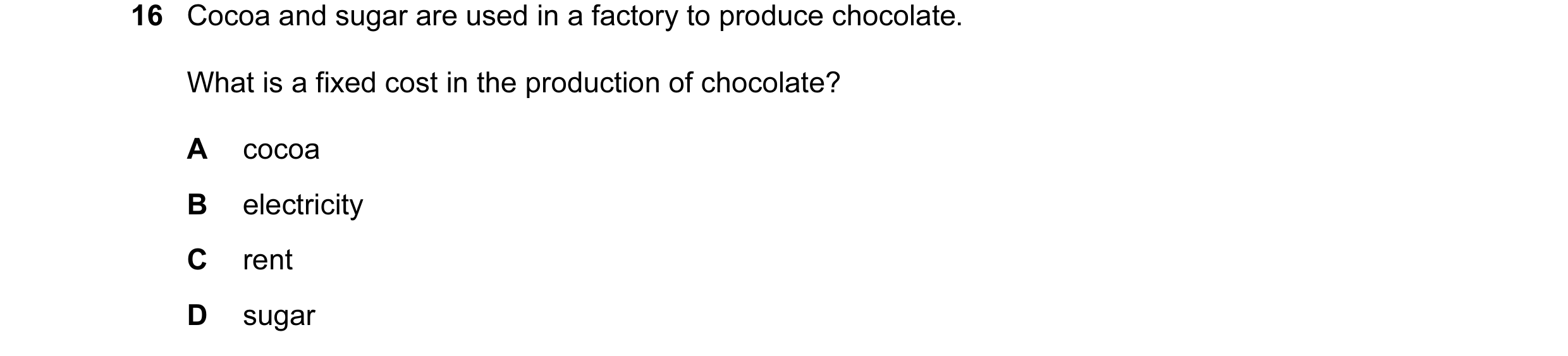

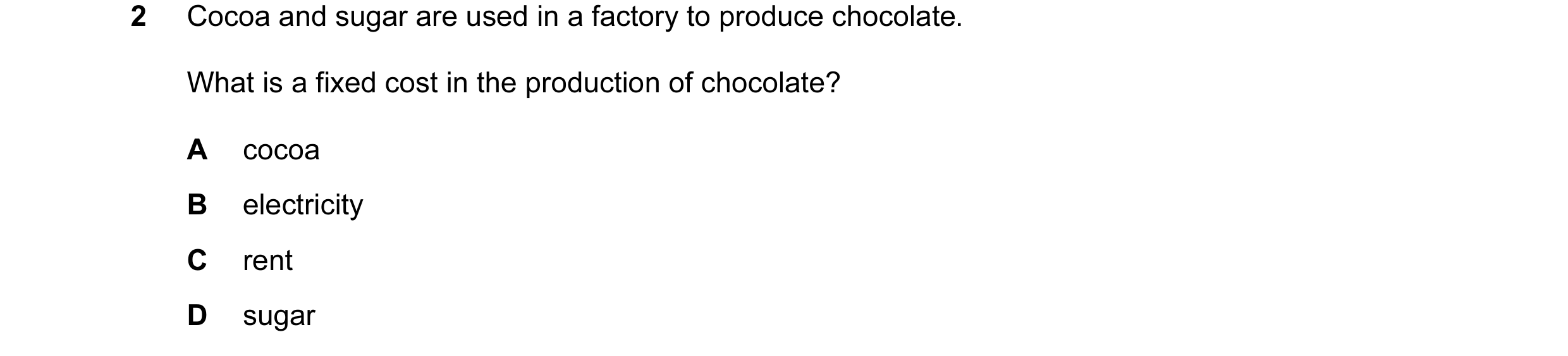 19 / 64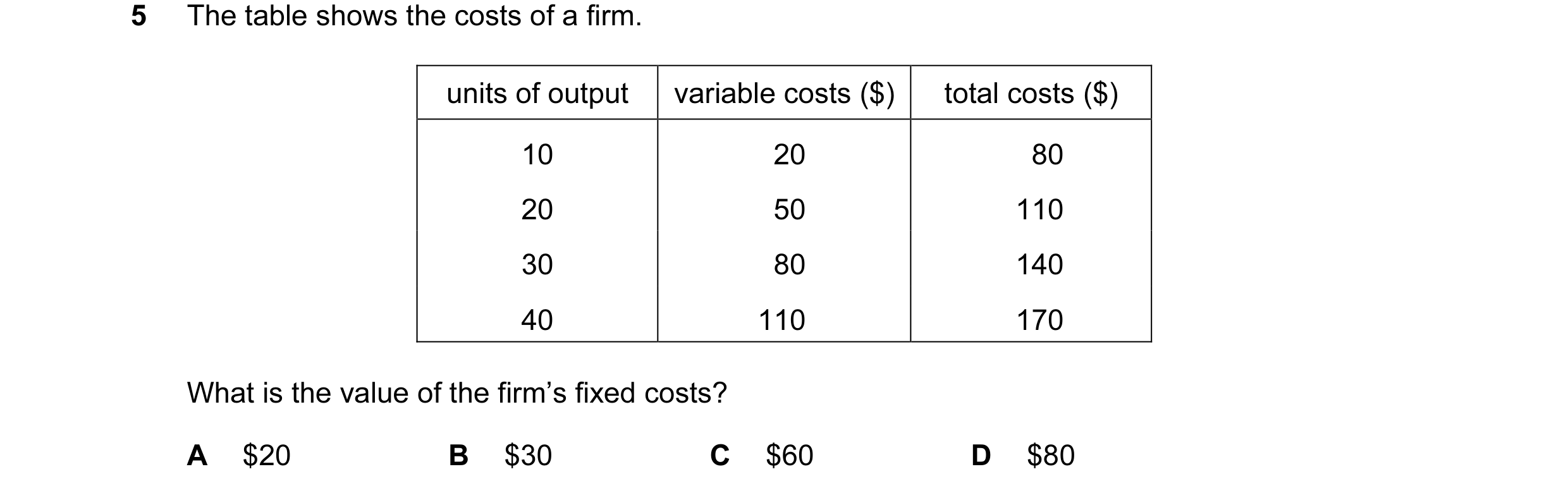

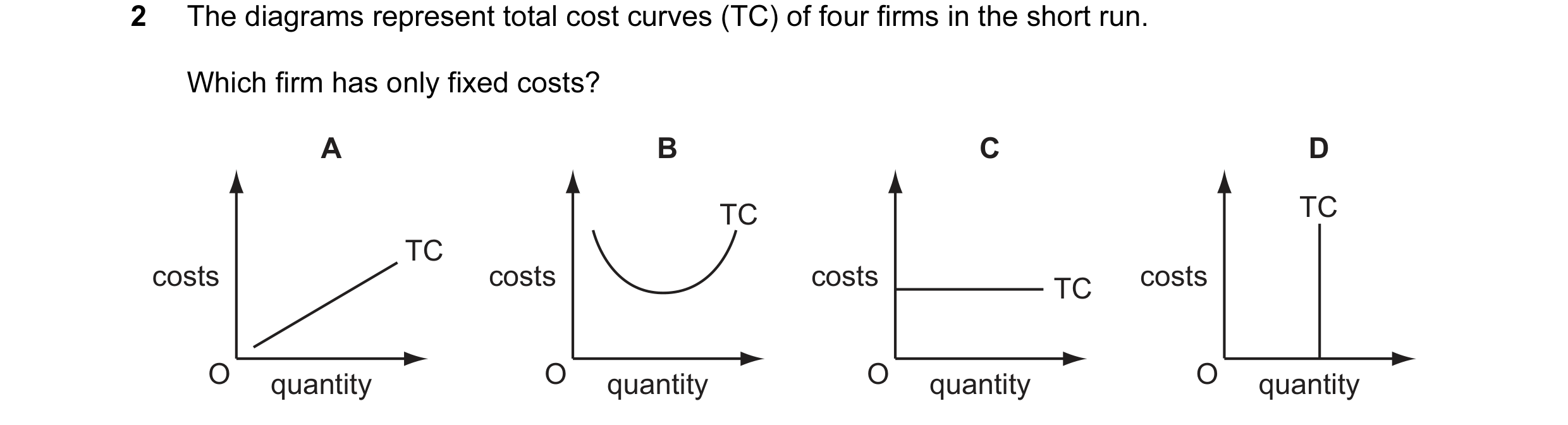
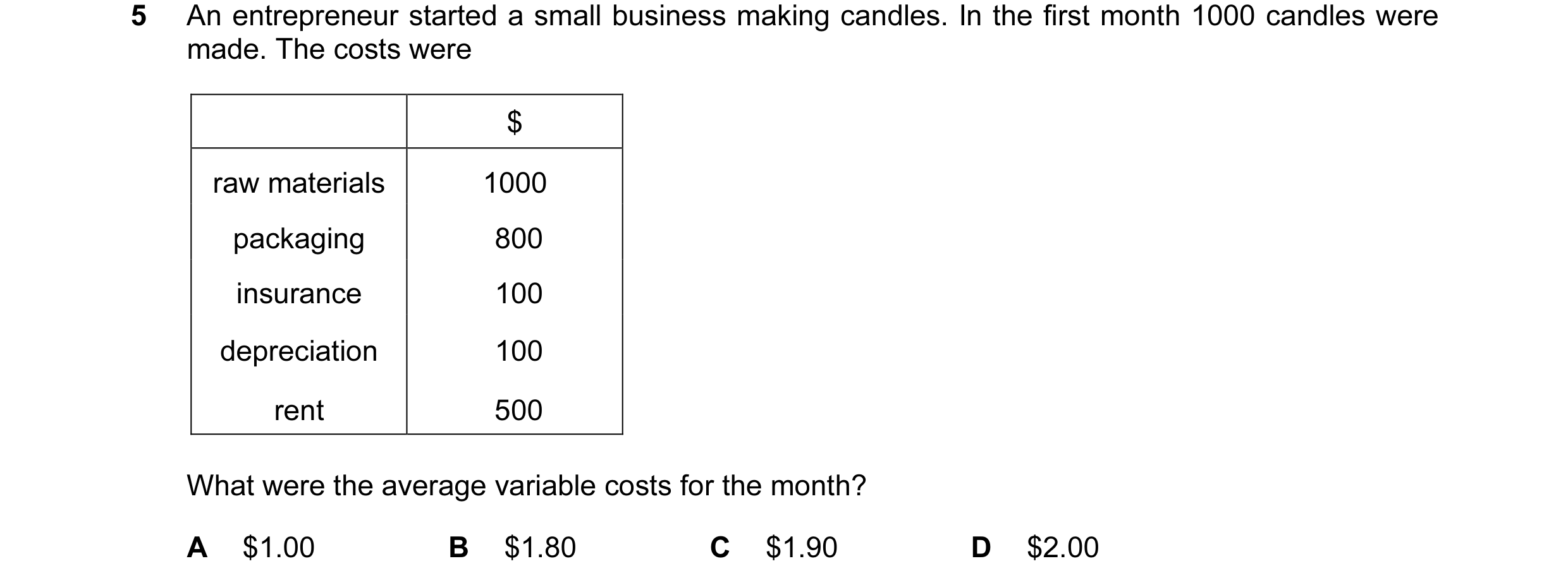 20 / 64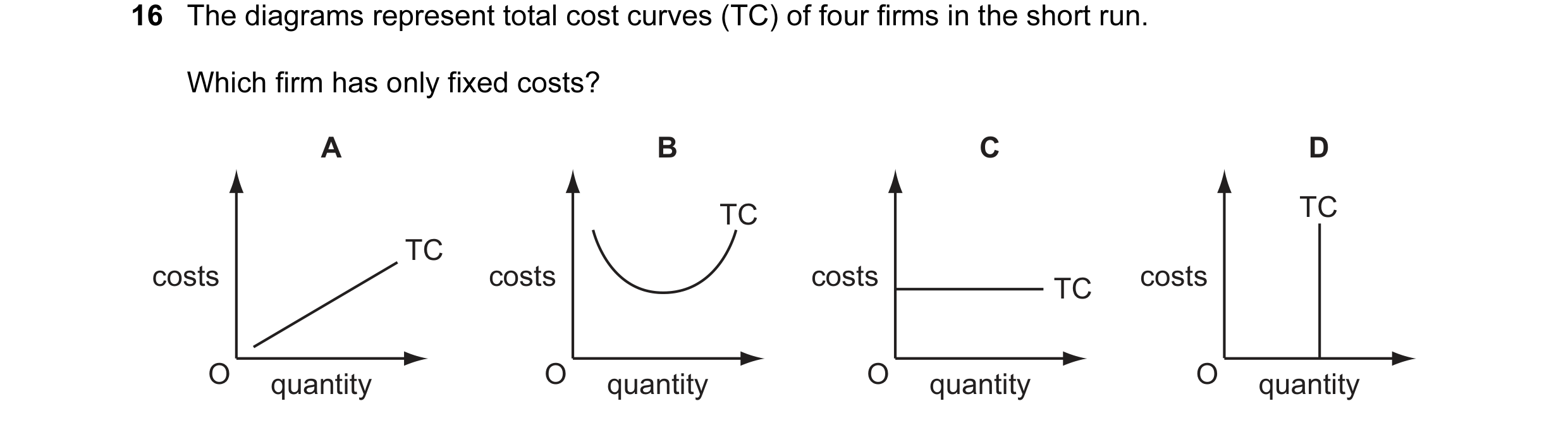
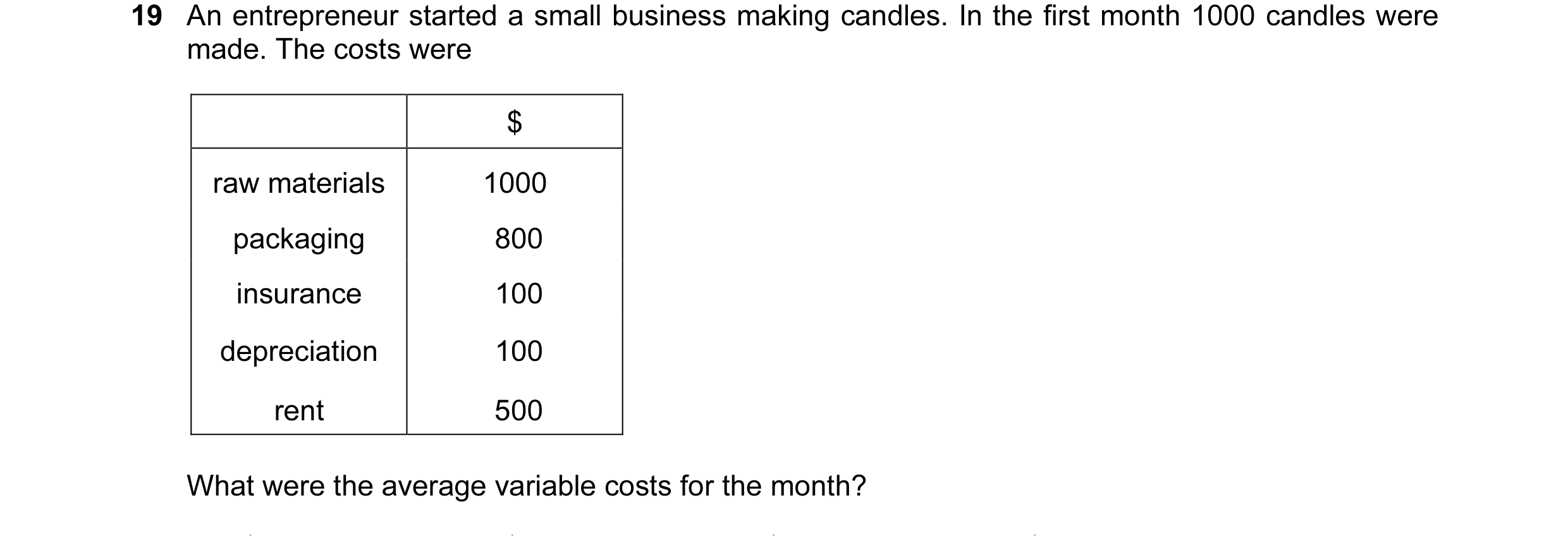
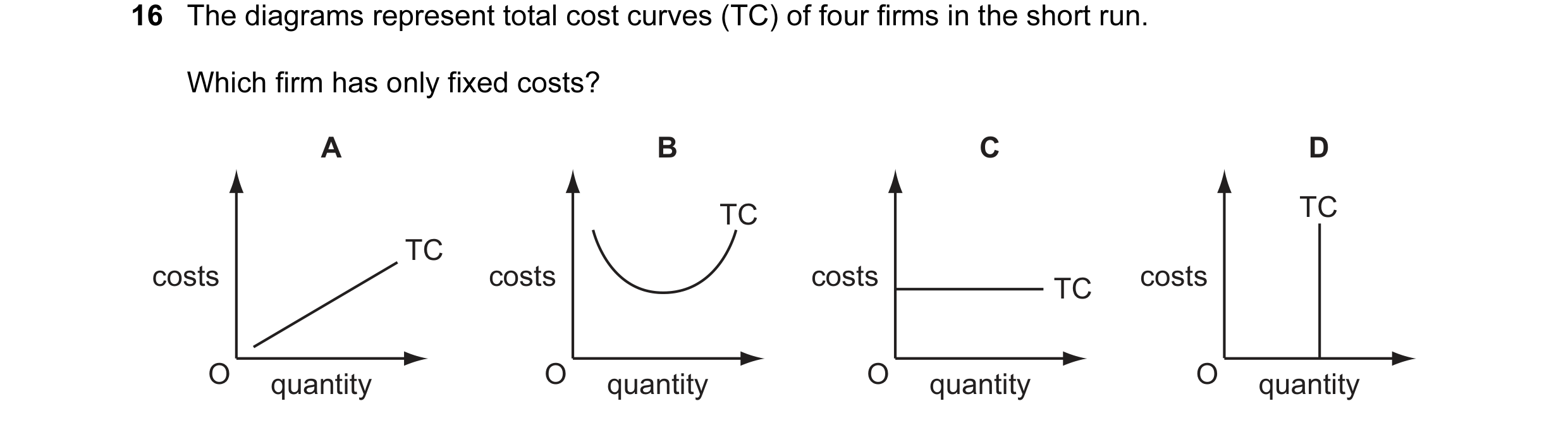

 21 / 64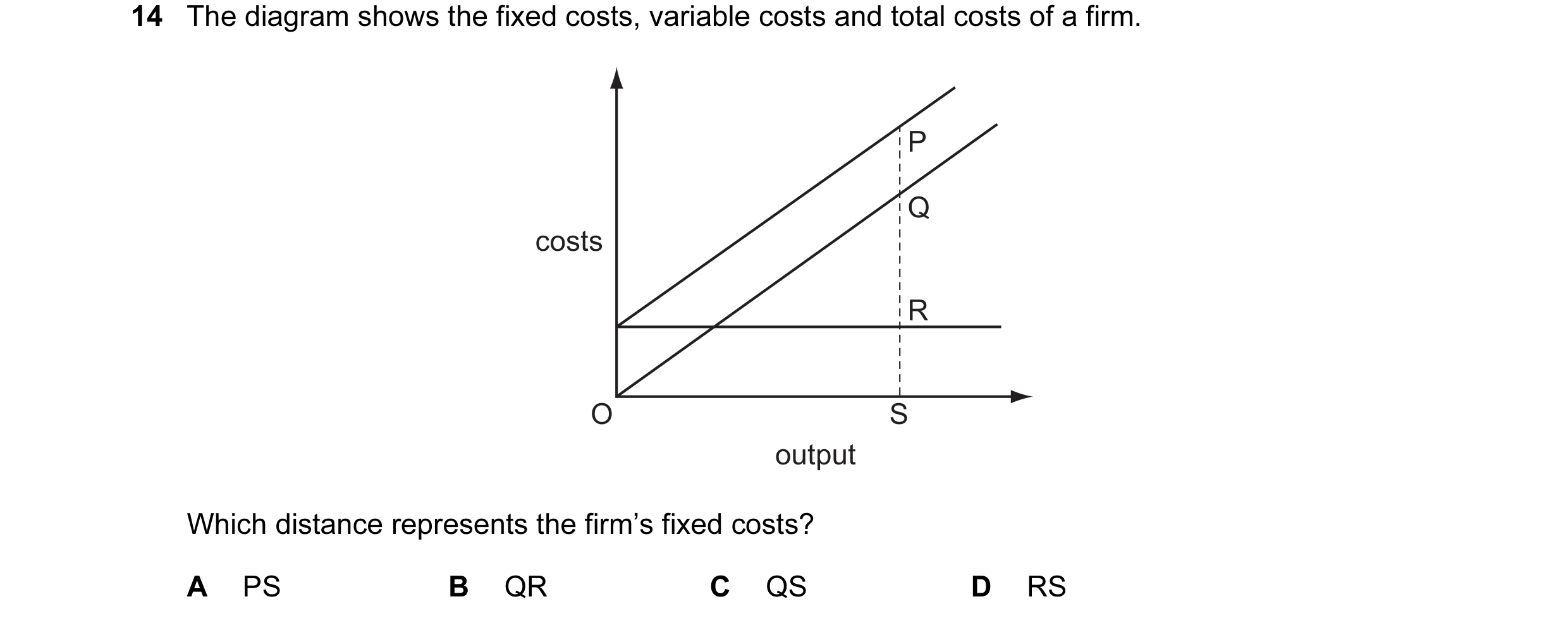

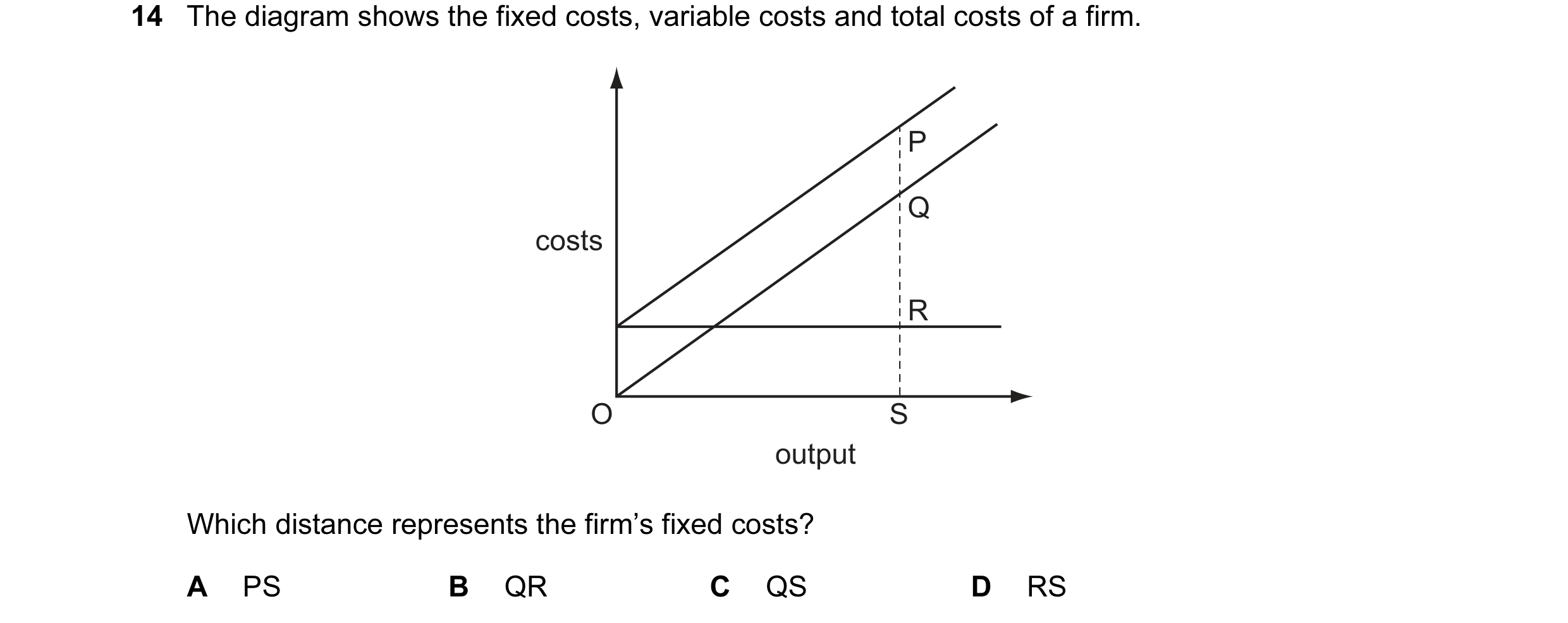

 22 / 64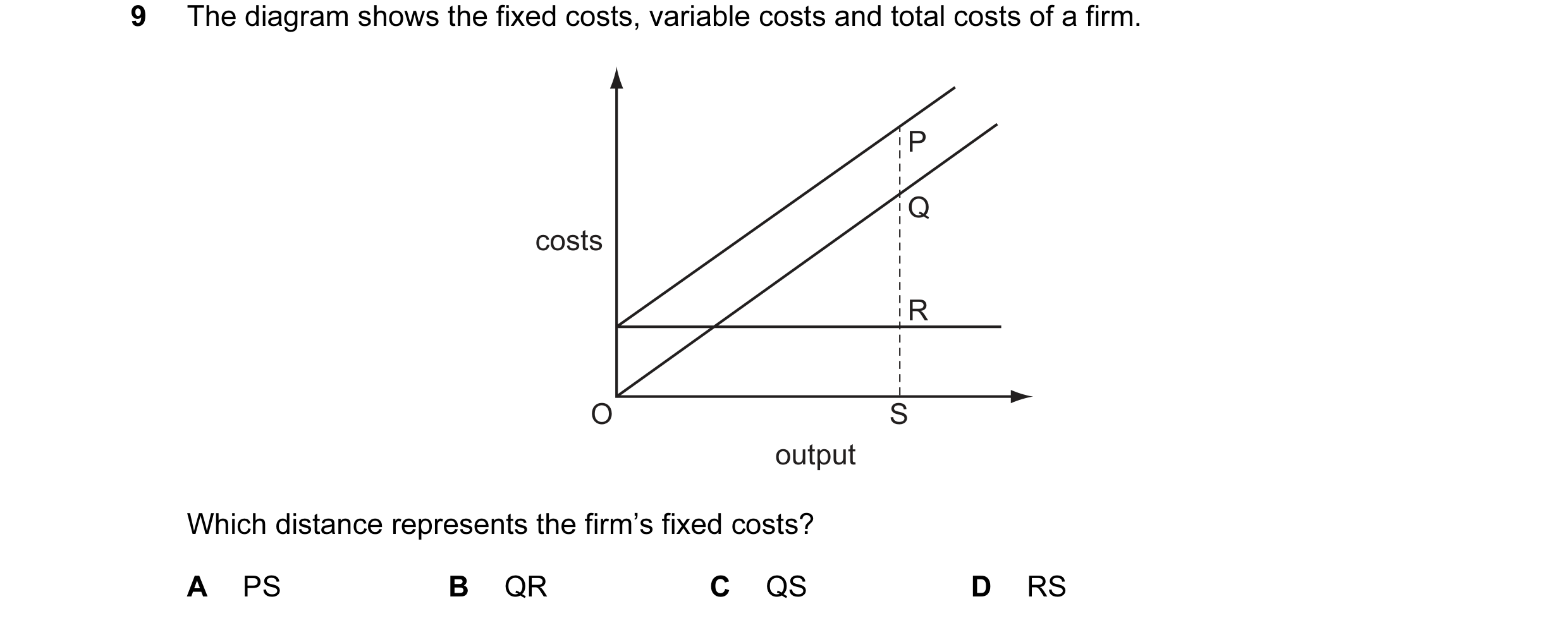
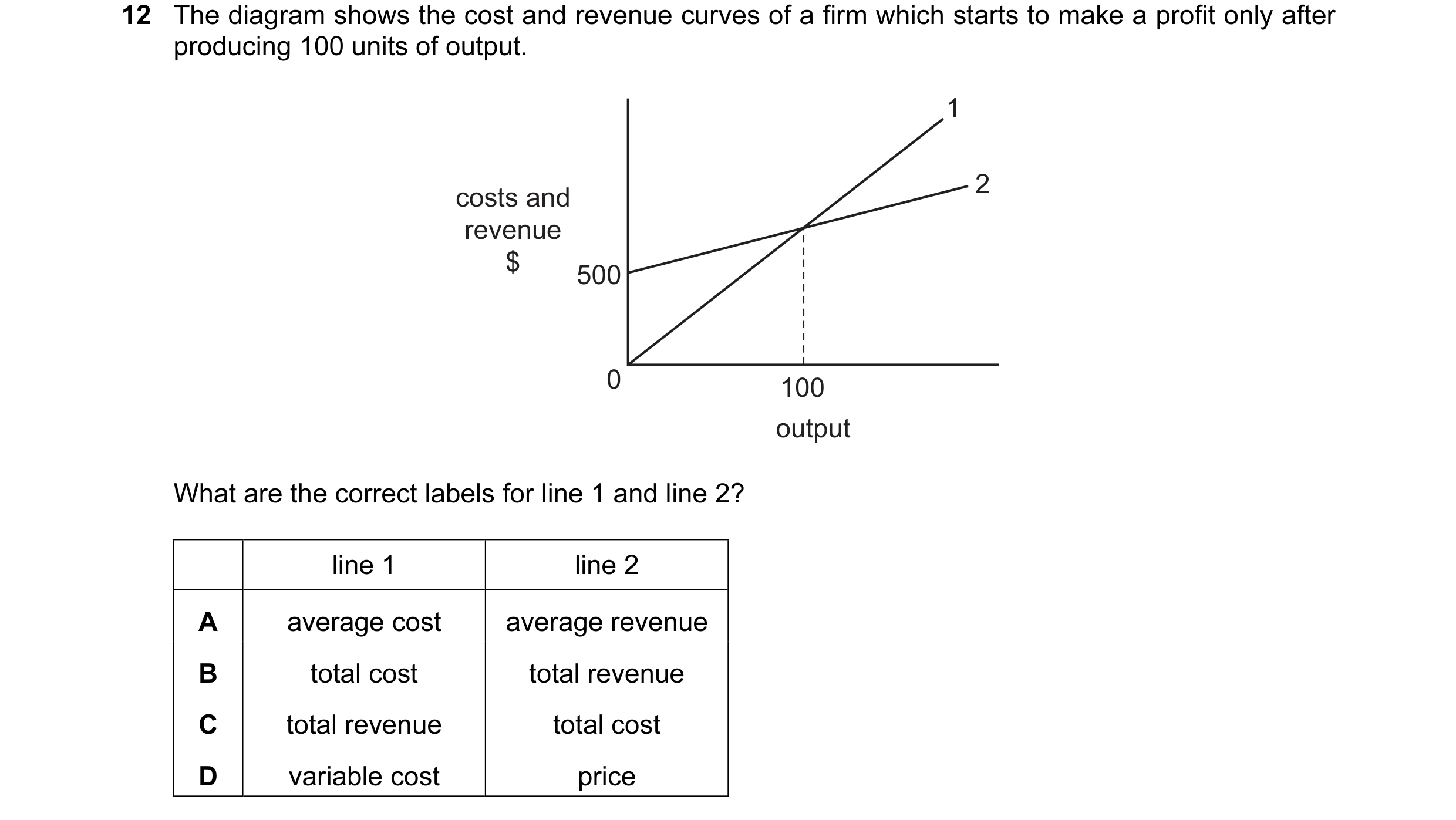 23 / 64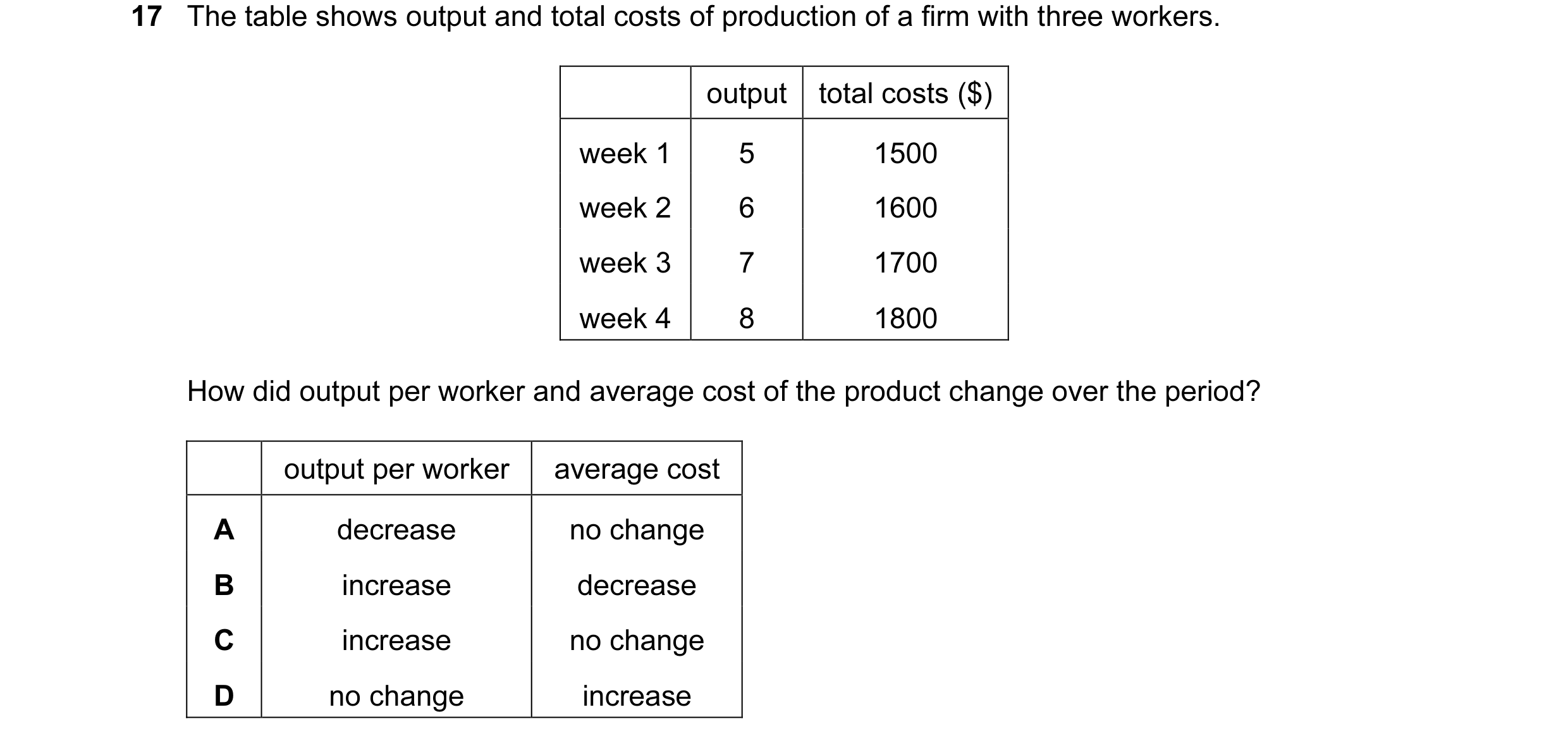
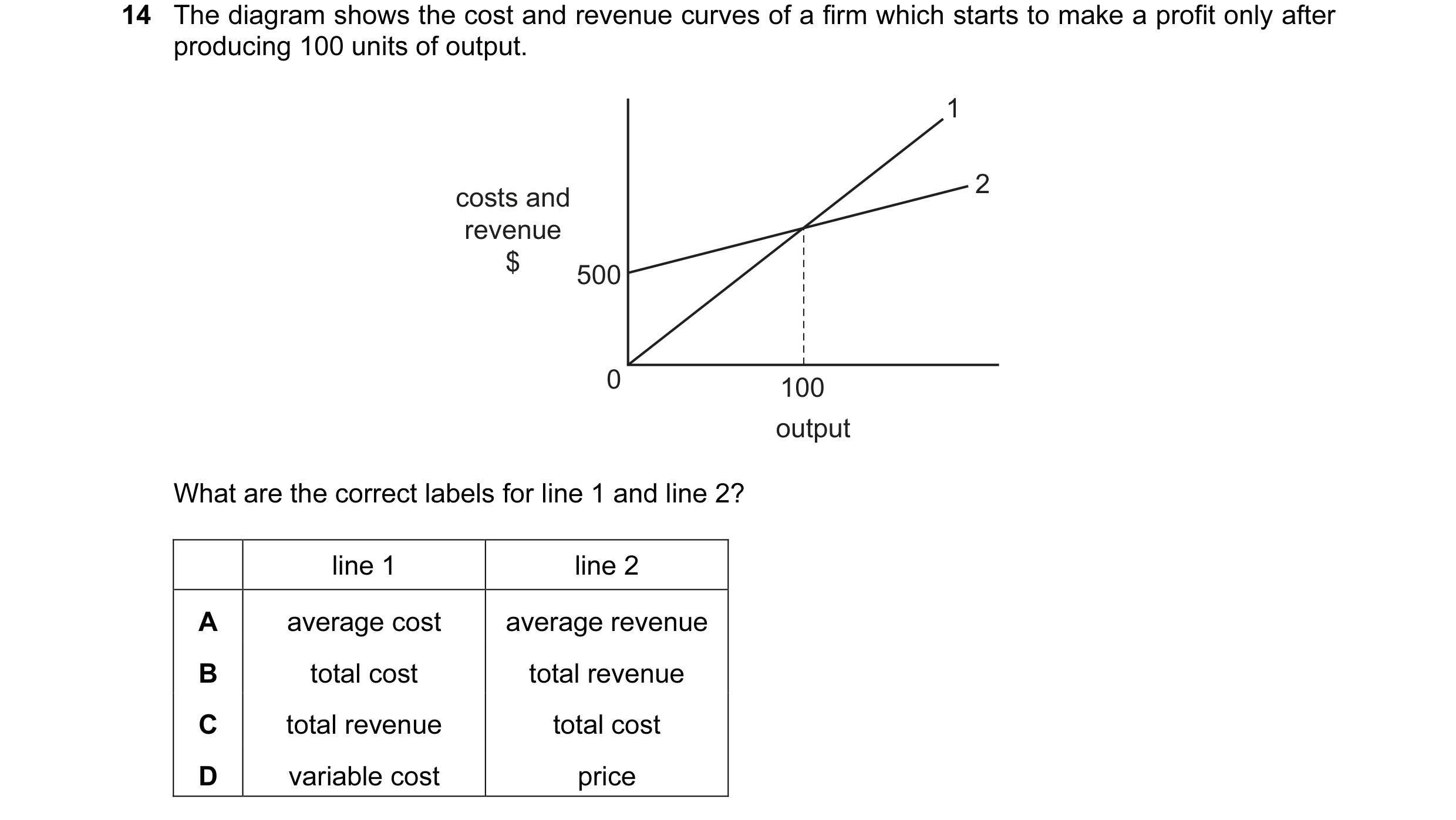 24 / 64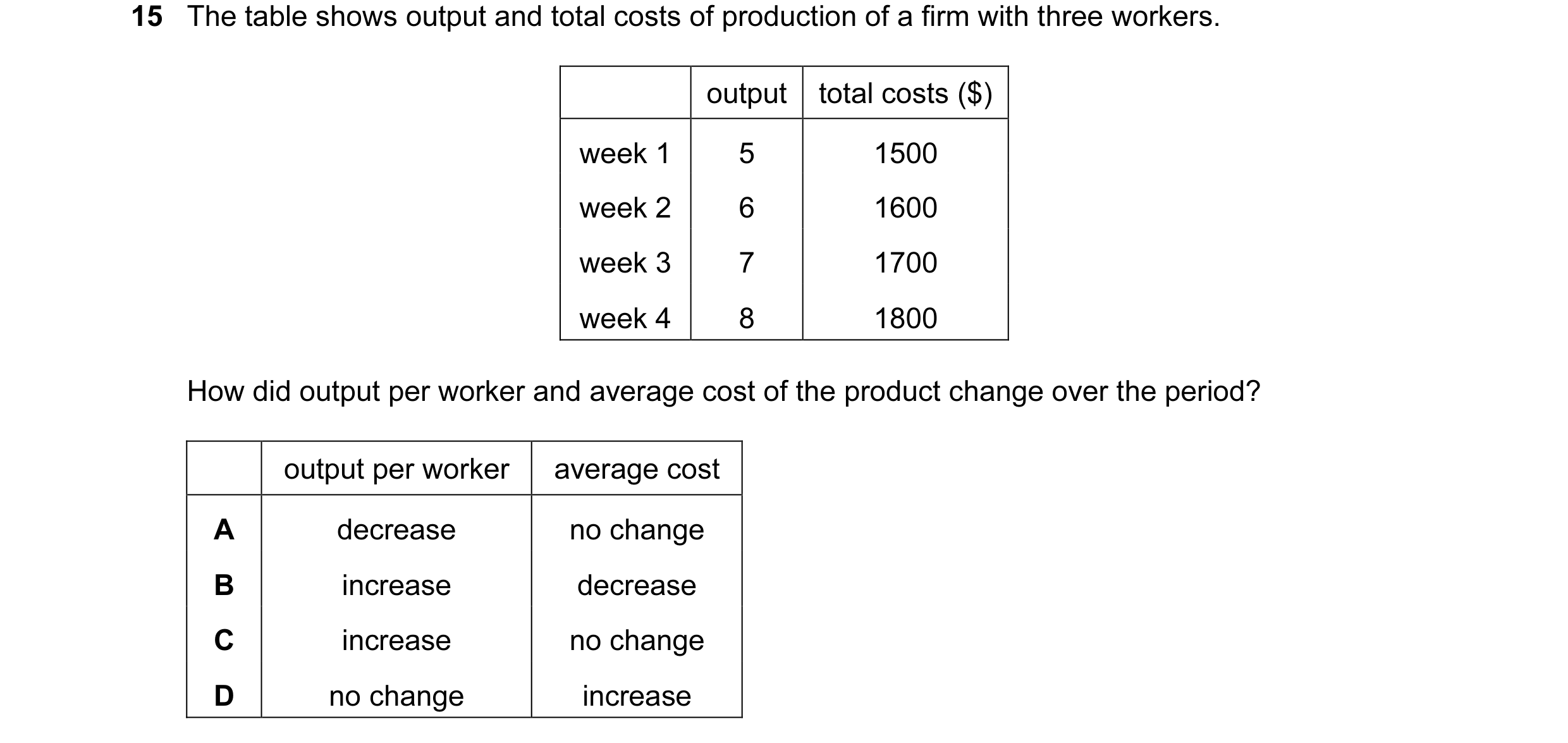

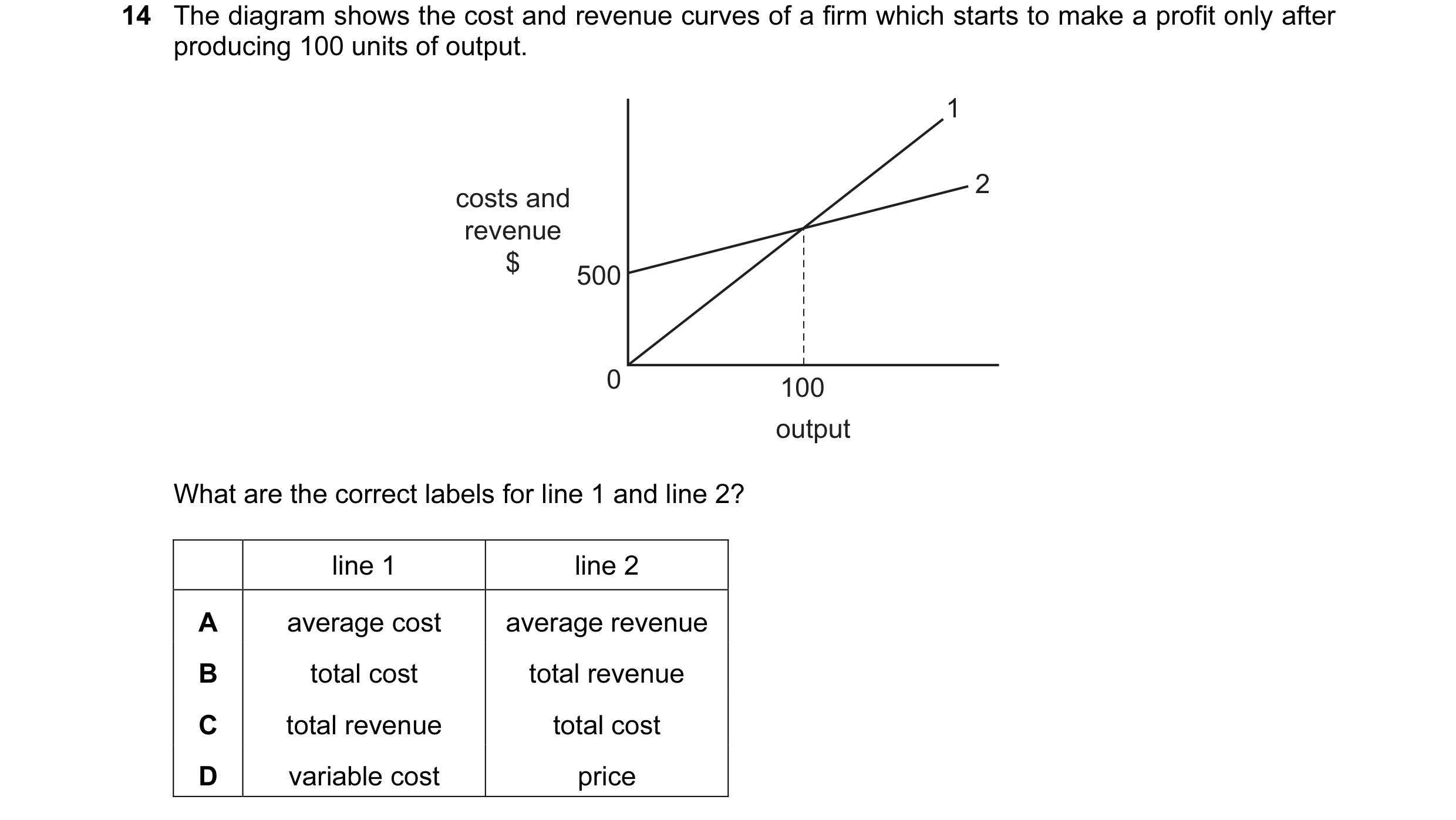 25 / 64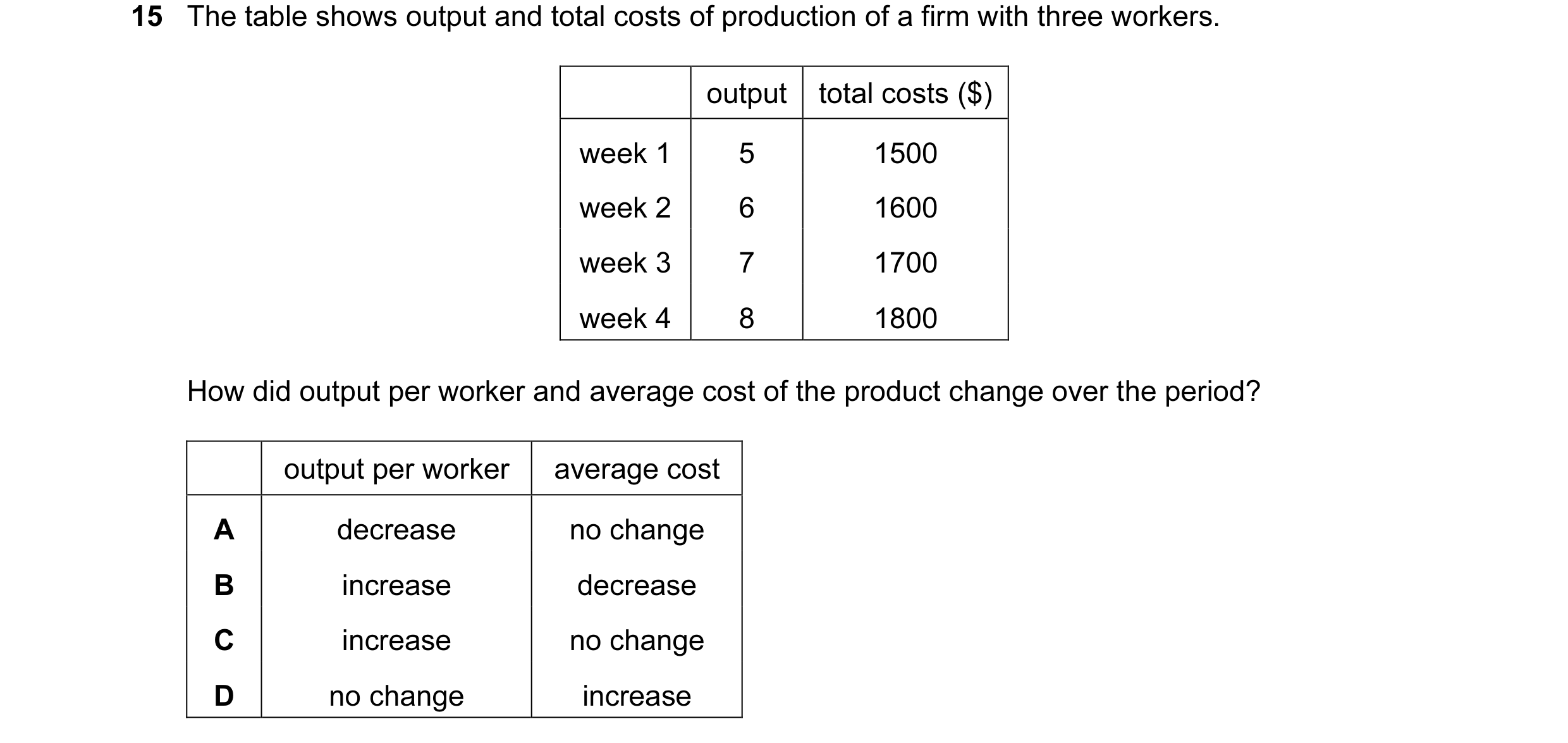
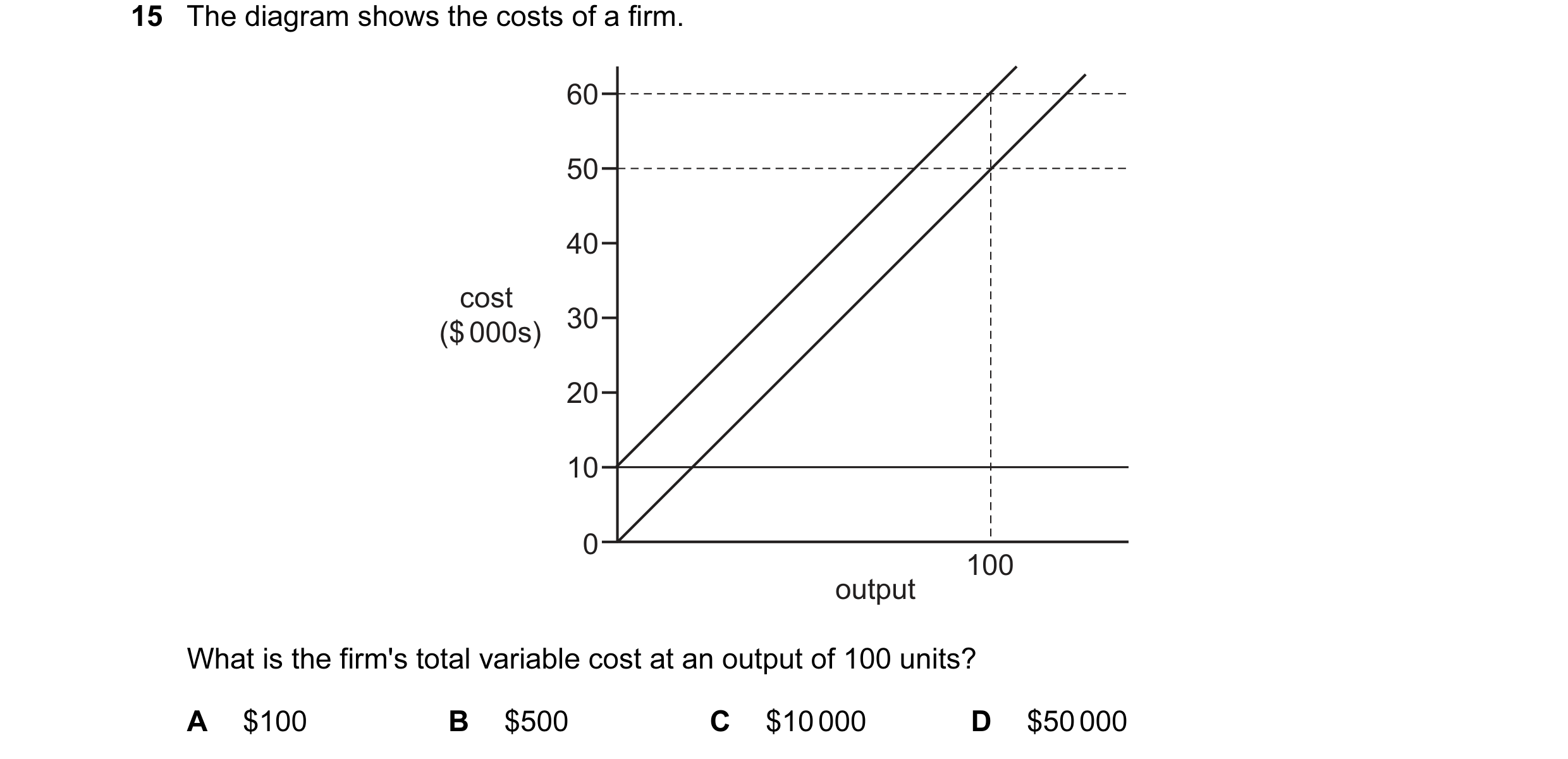 26 / 64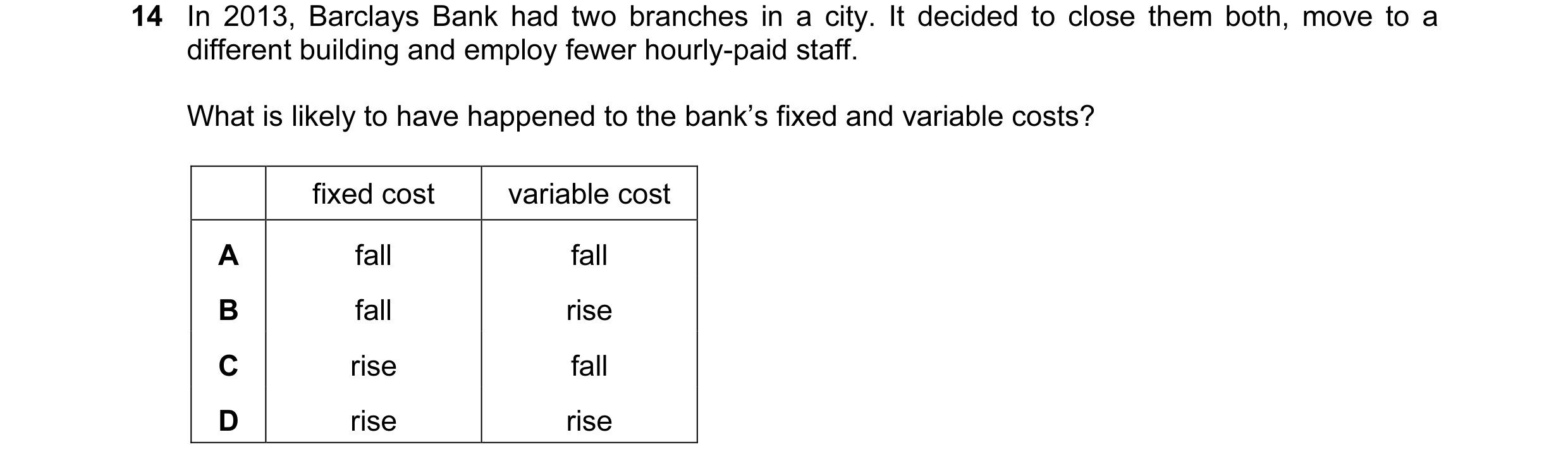
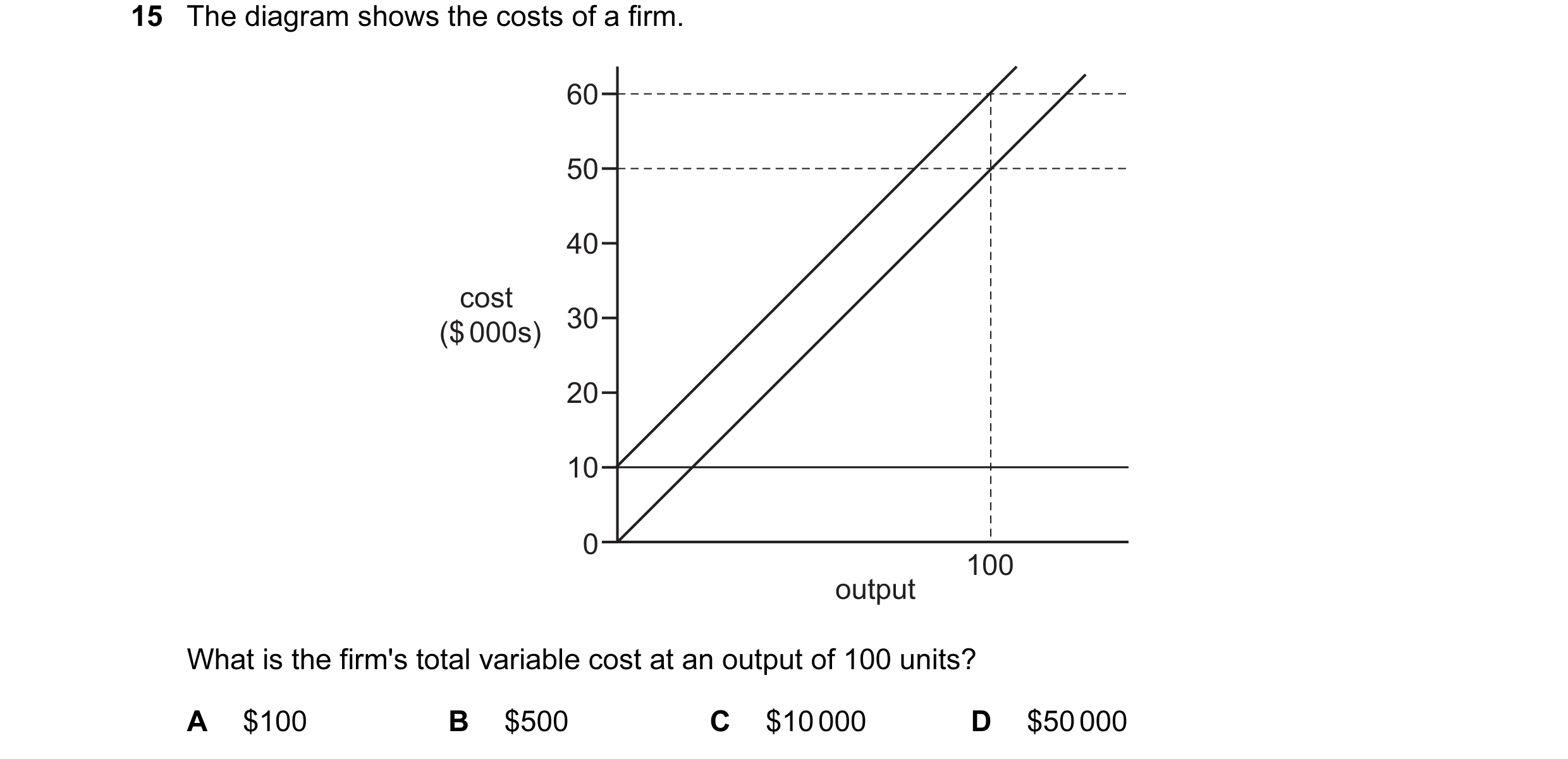
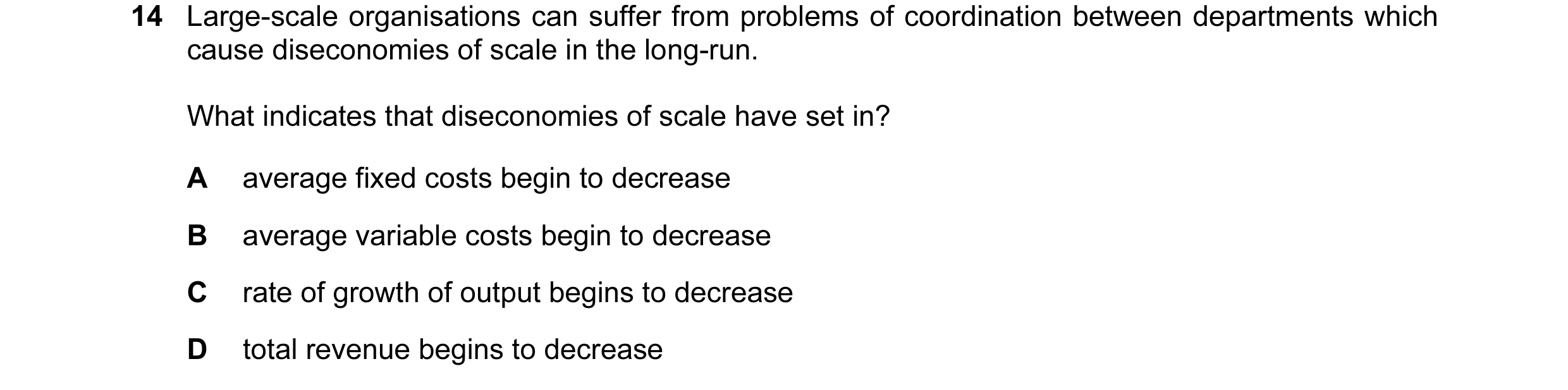 27 / 64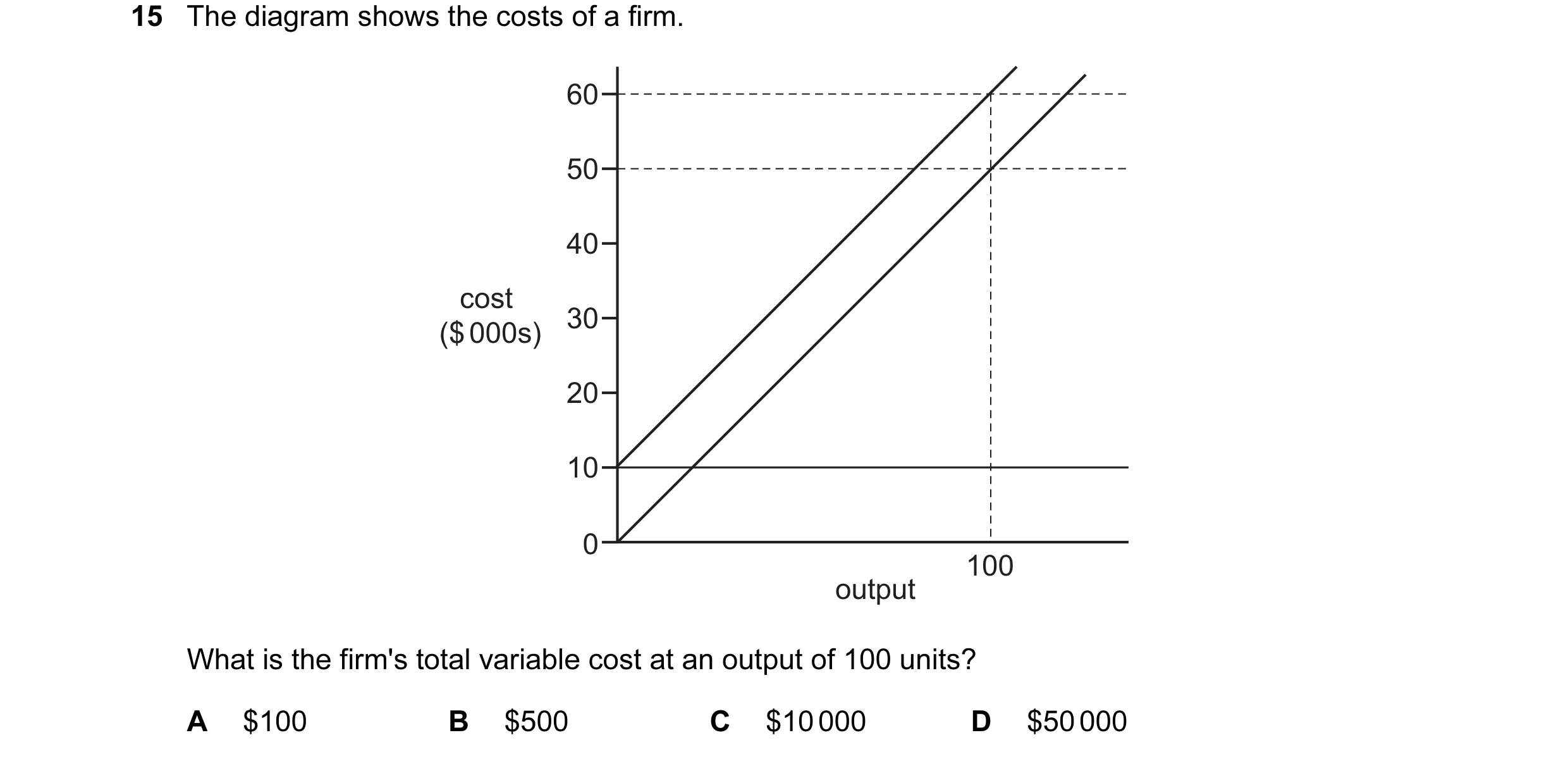
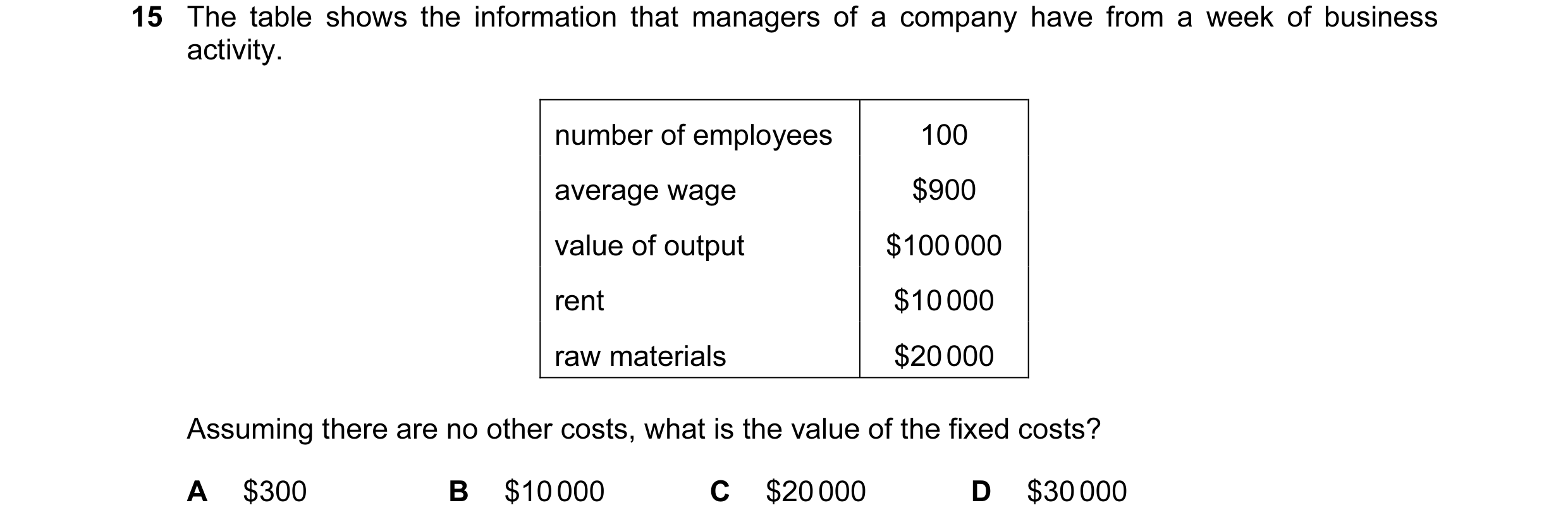
 28 / 64
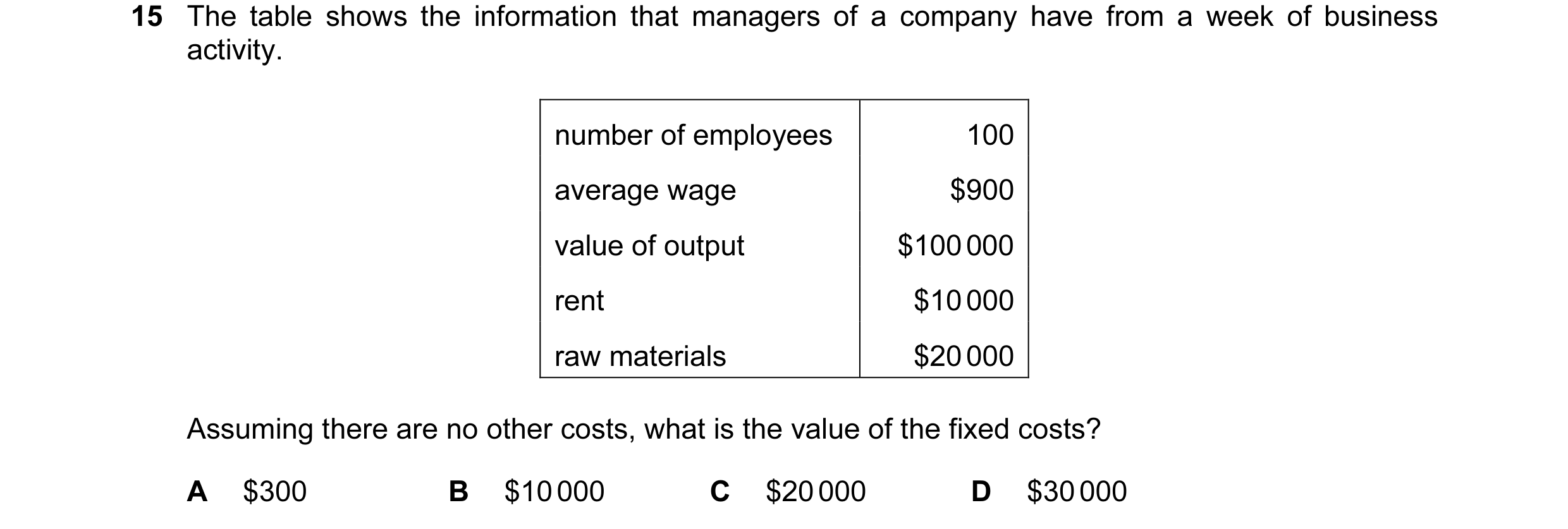

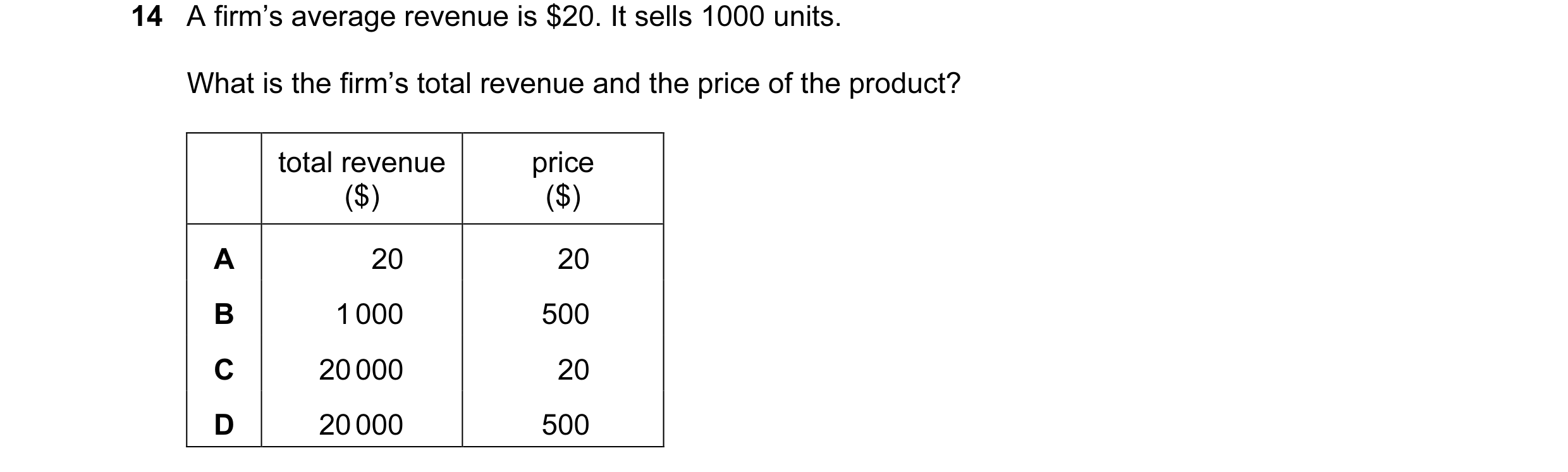 29 / 64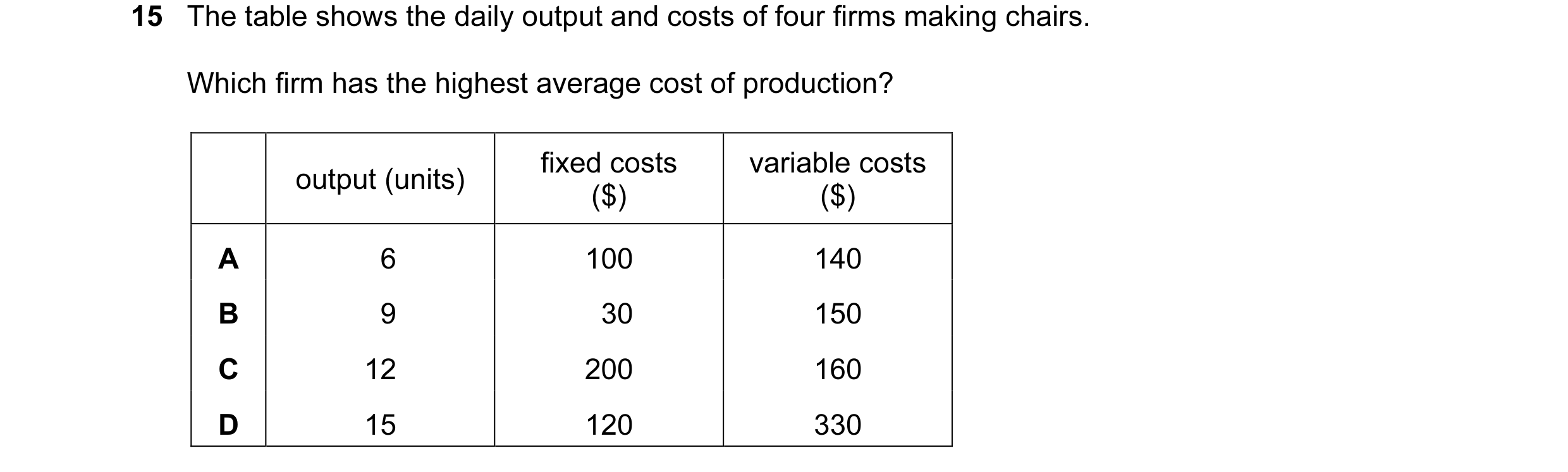



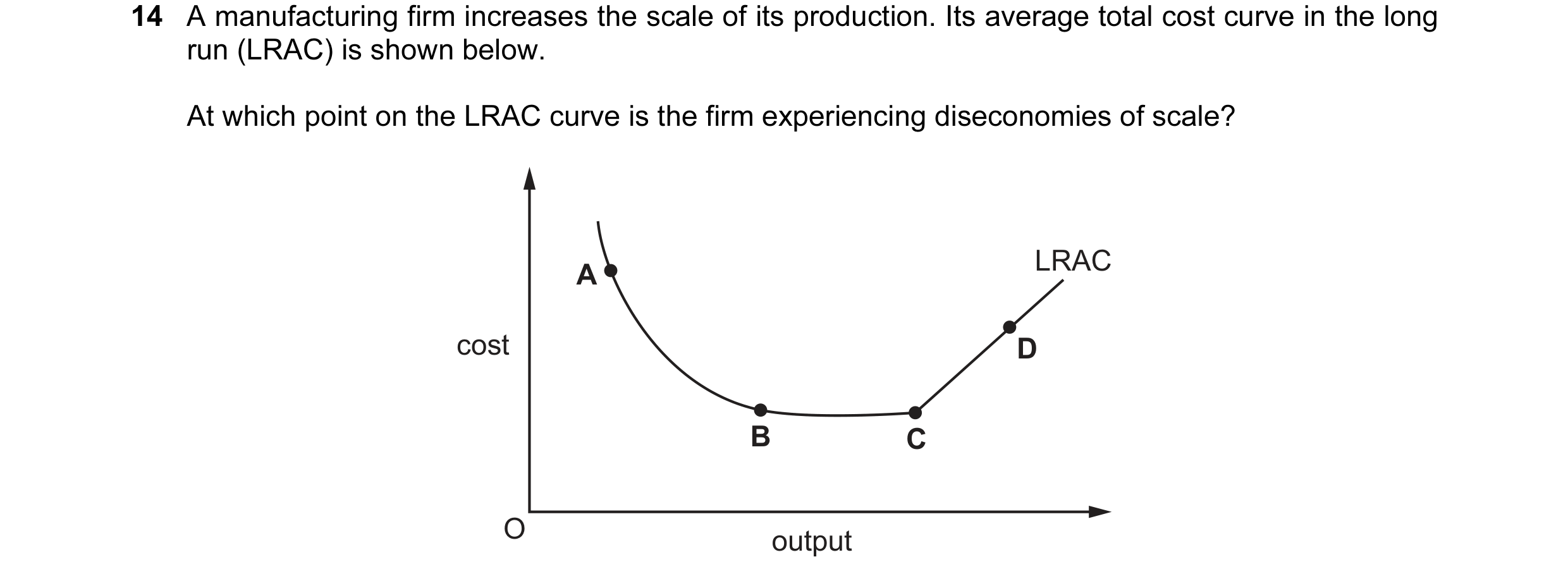 30 / 64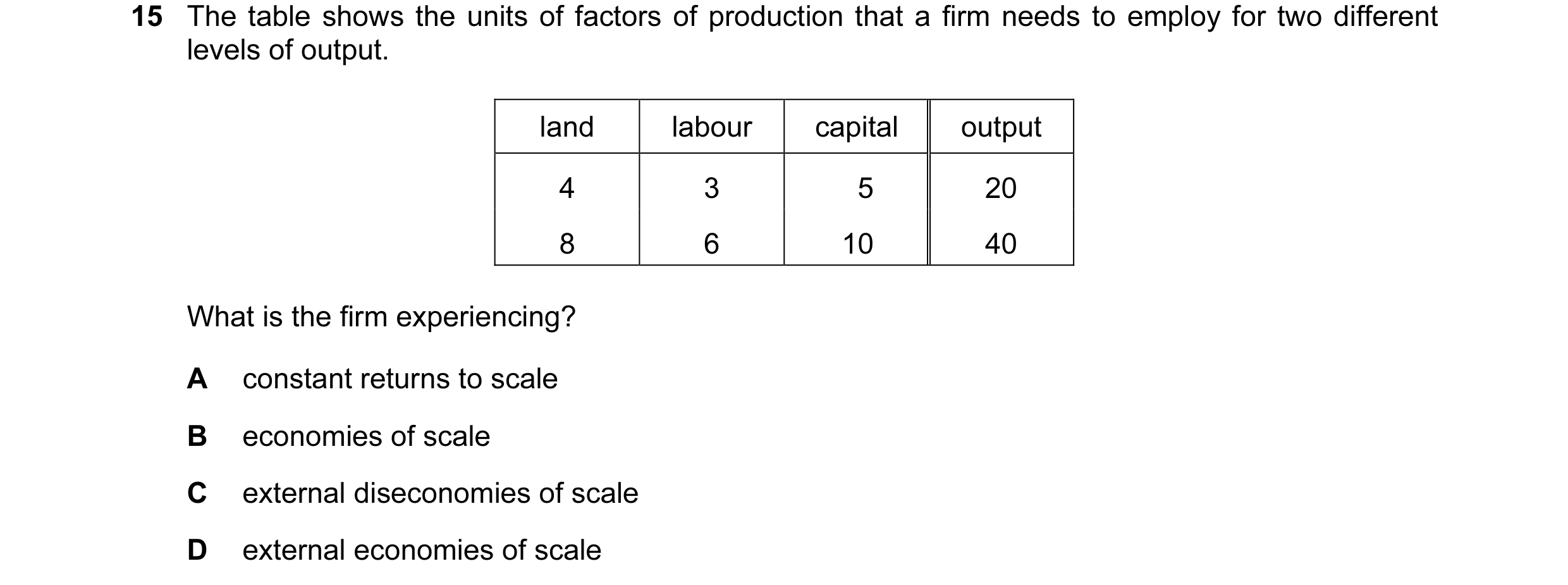
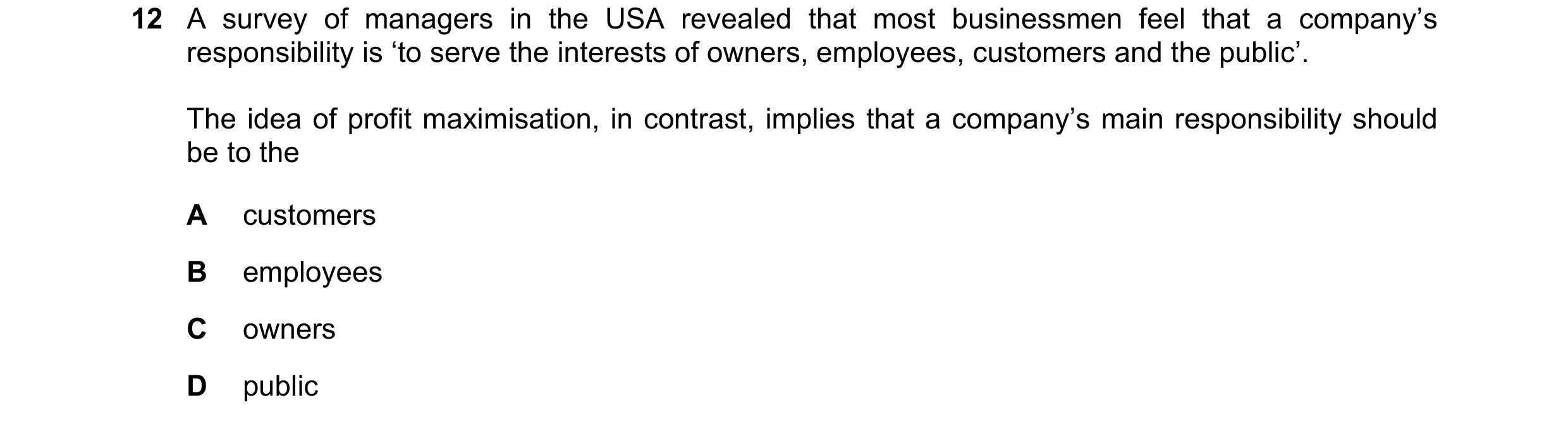
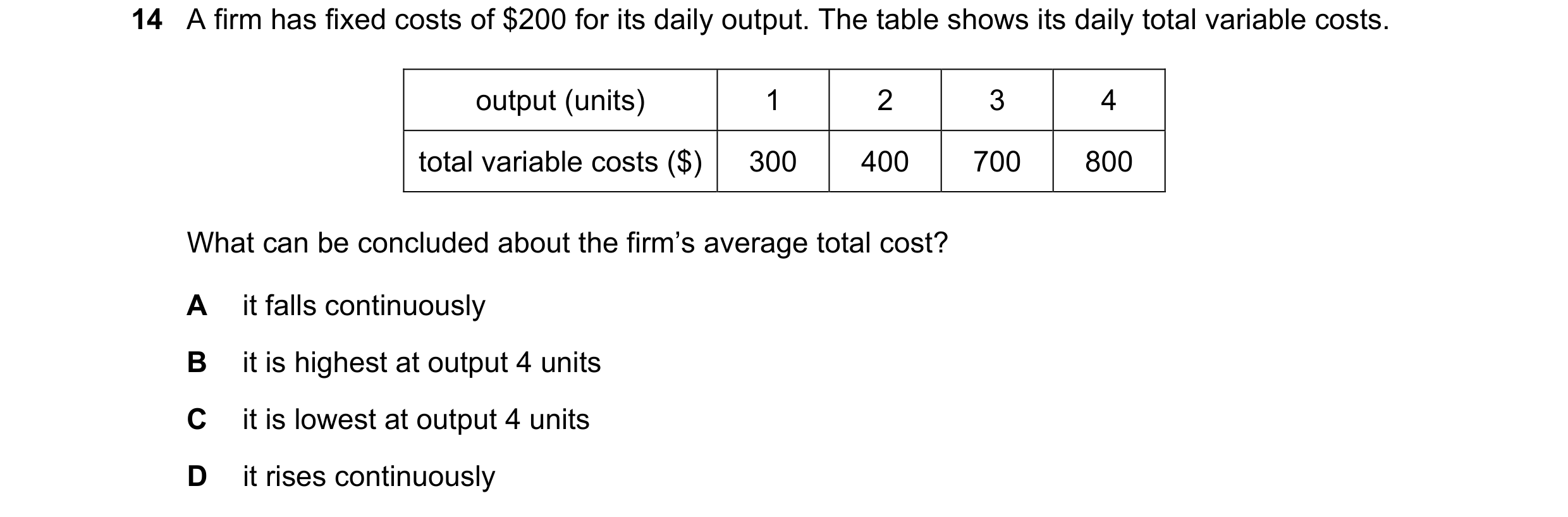
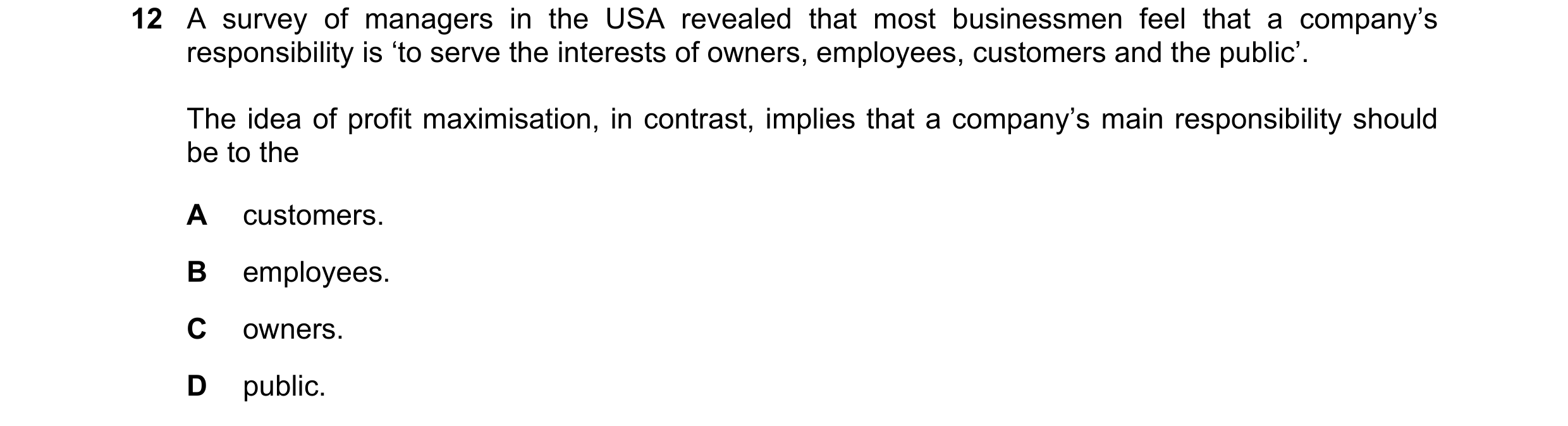 31 / 64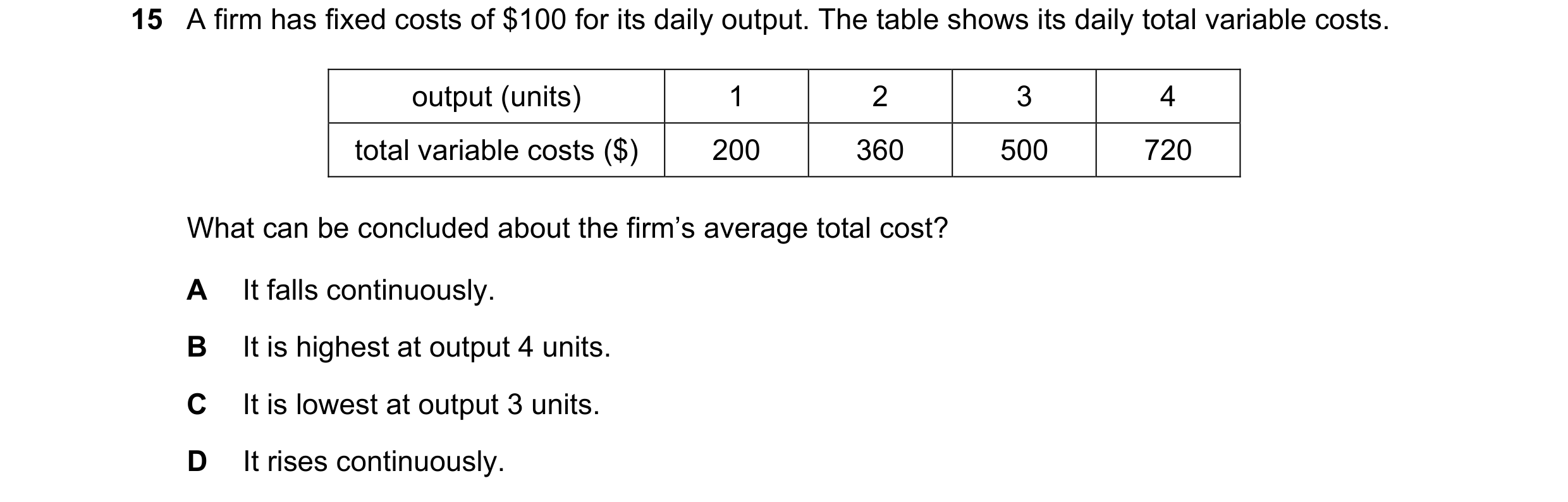
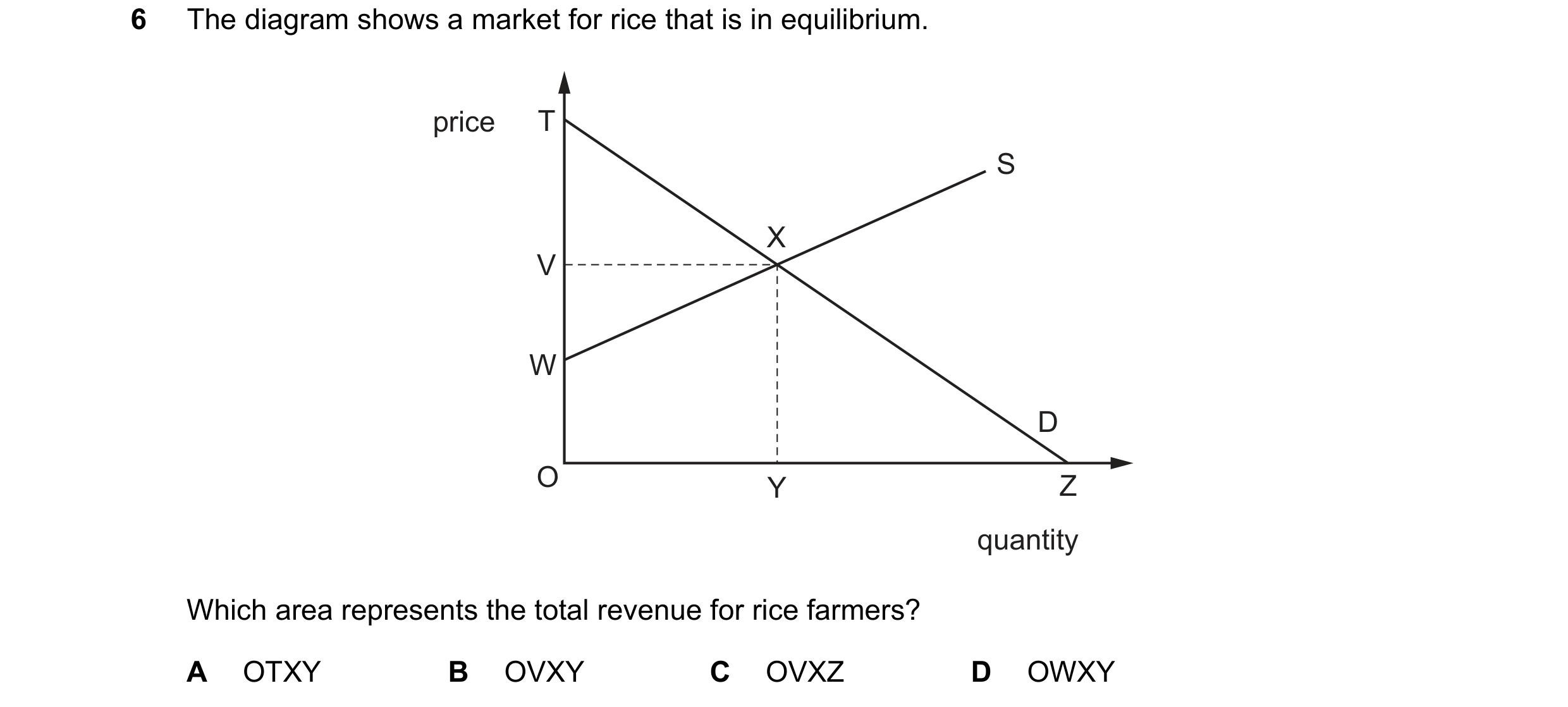

 32 / 64
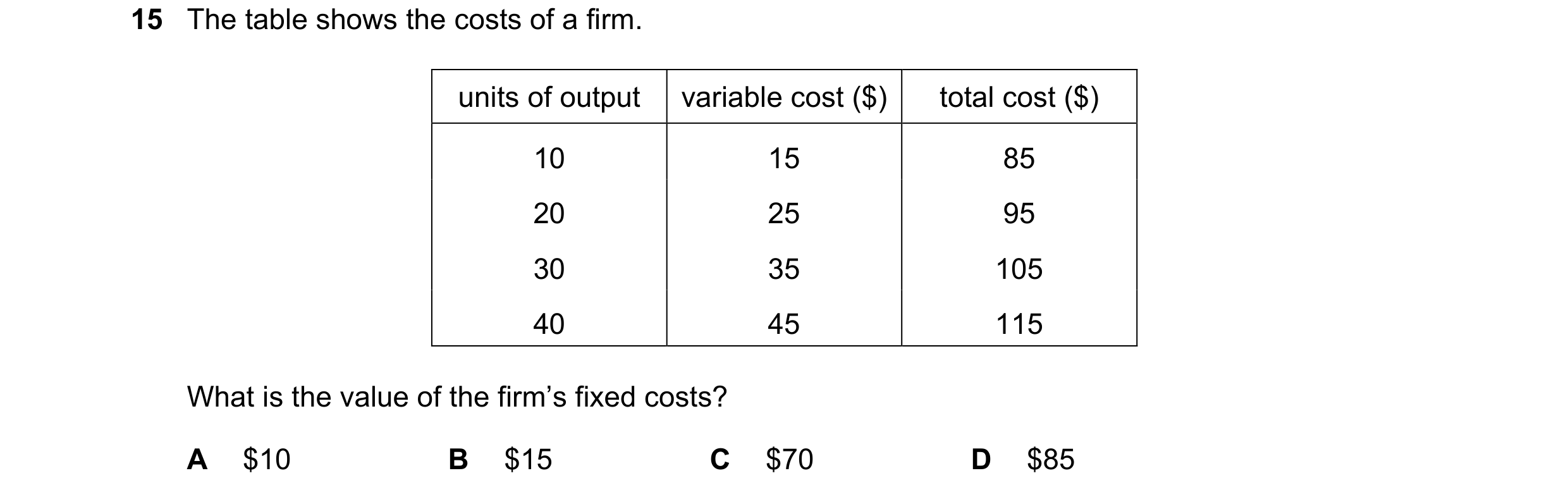
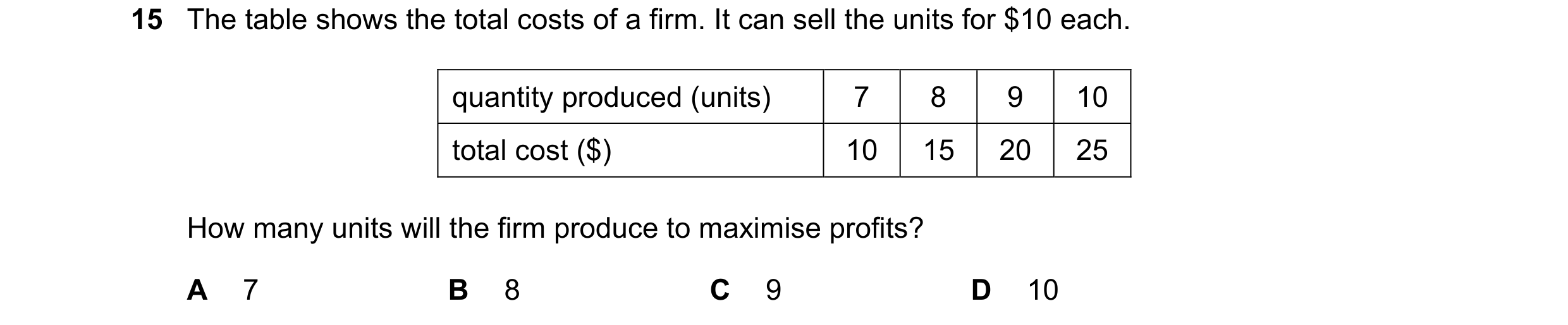
 33 / 64
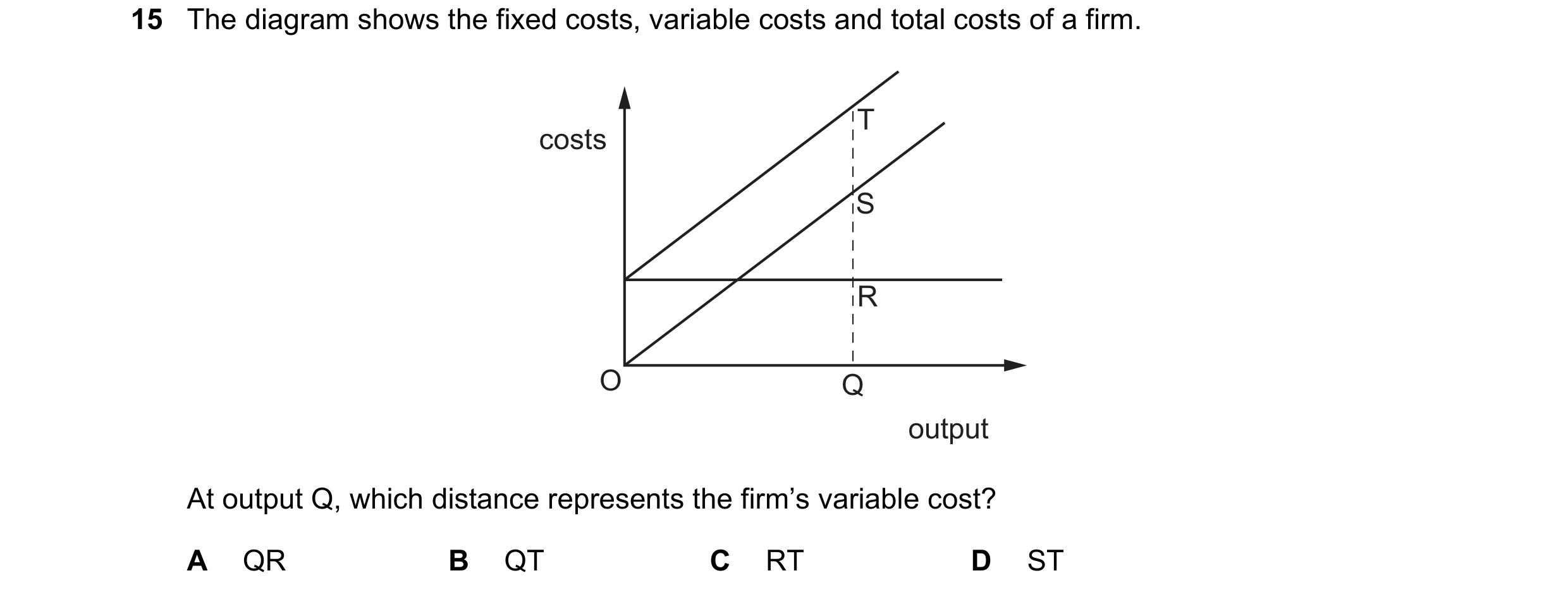
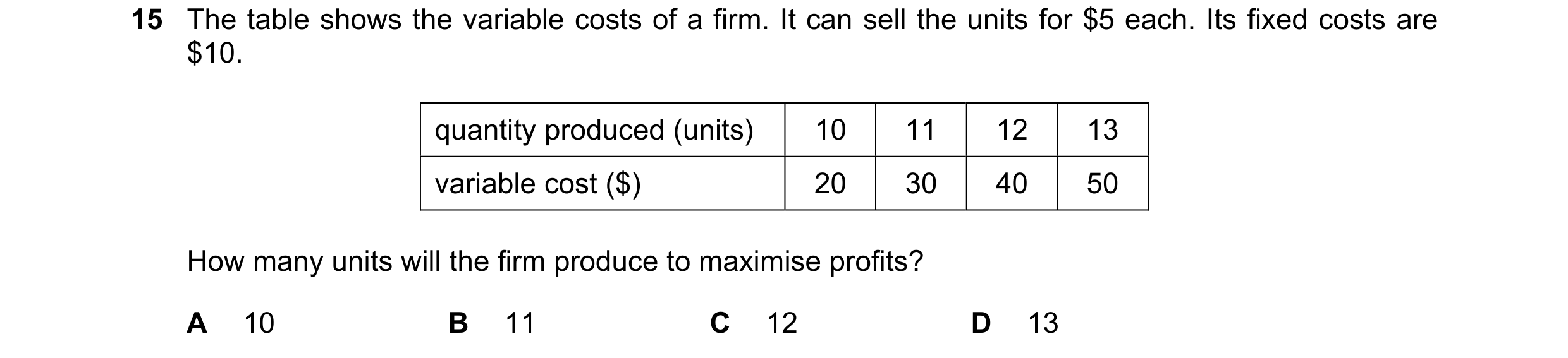
 34 / 64

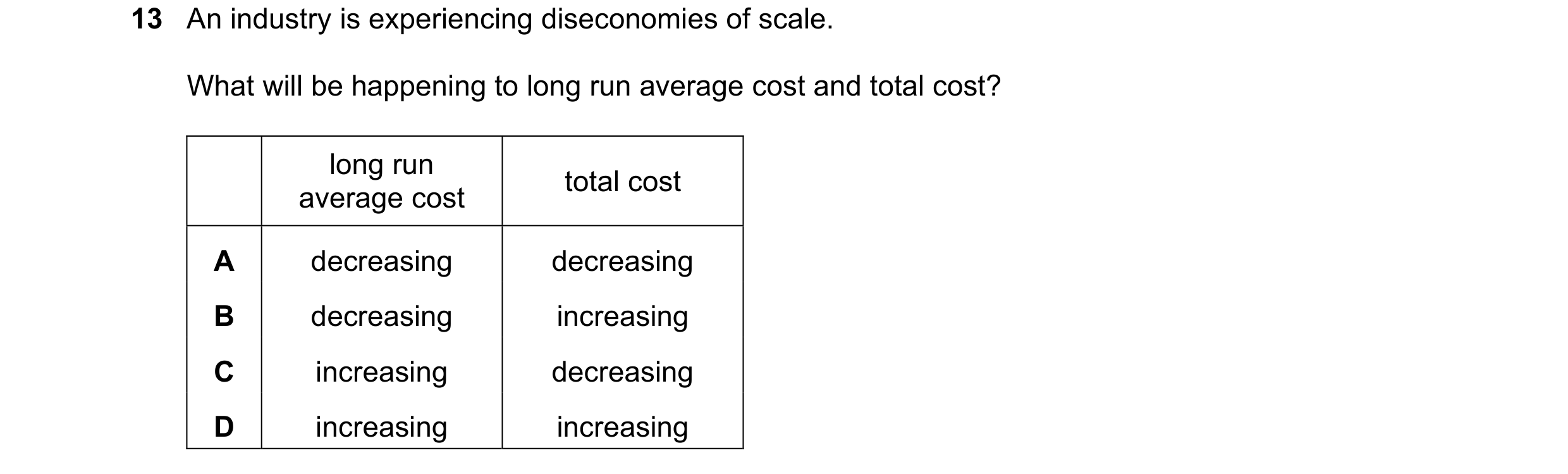
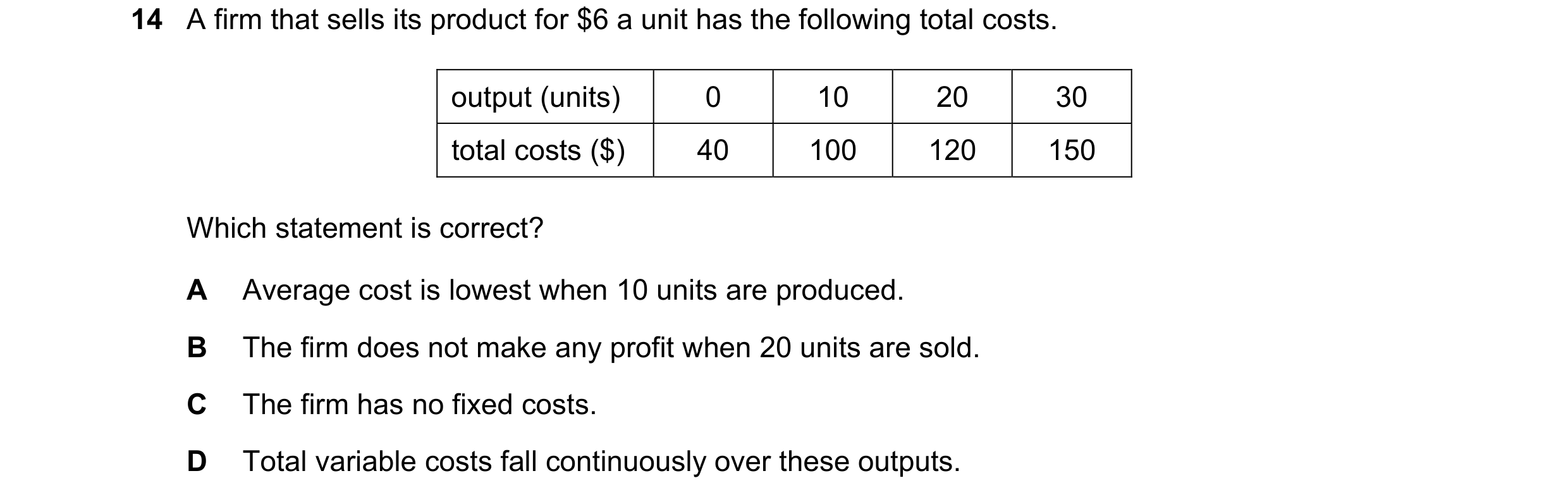
 35 / 64
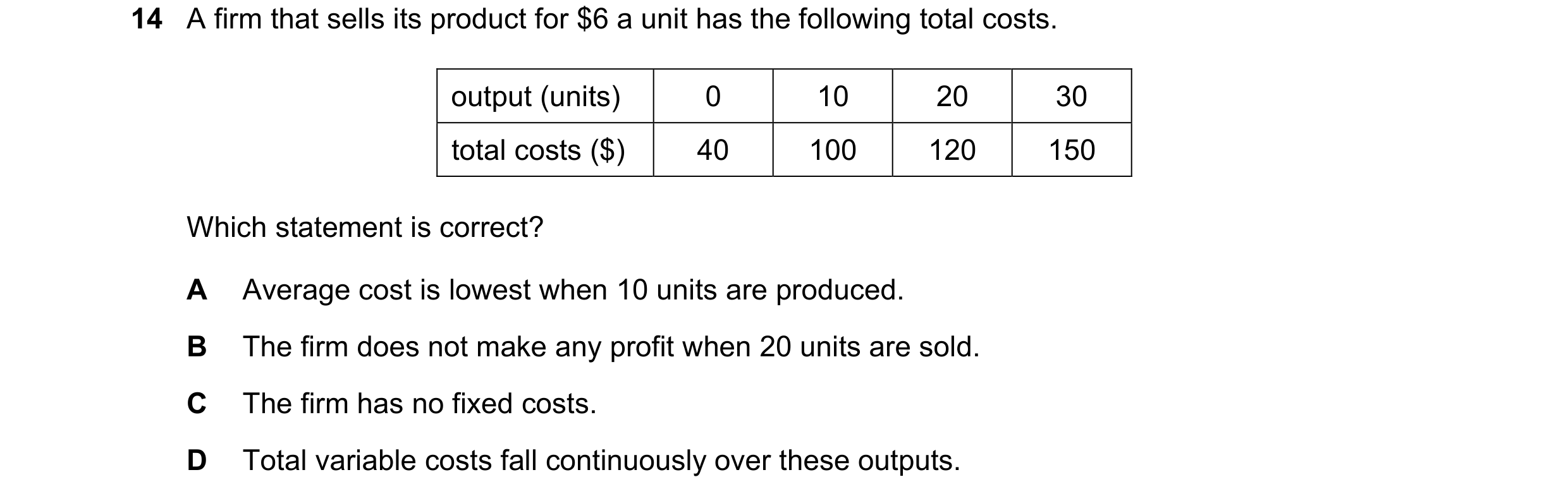

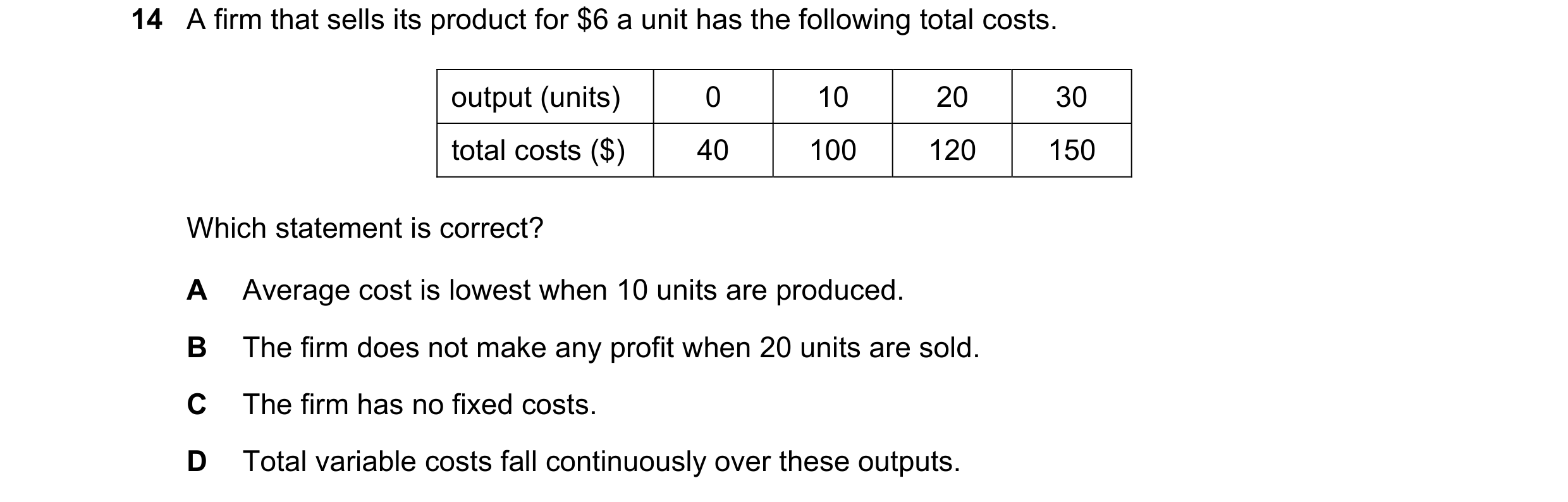
 36 / 64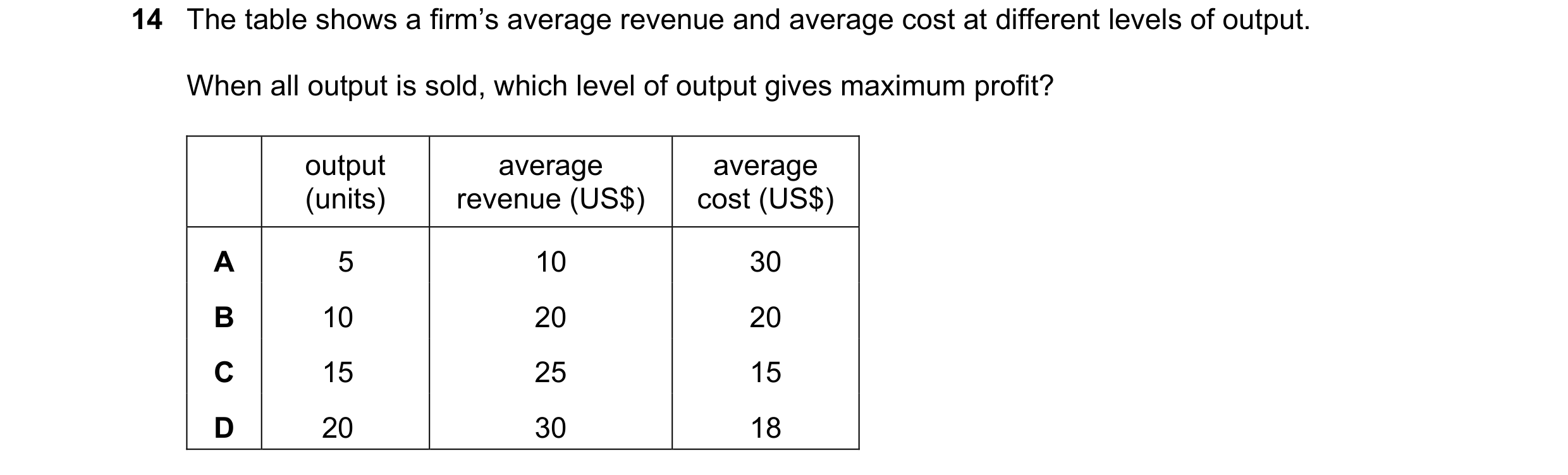

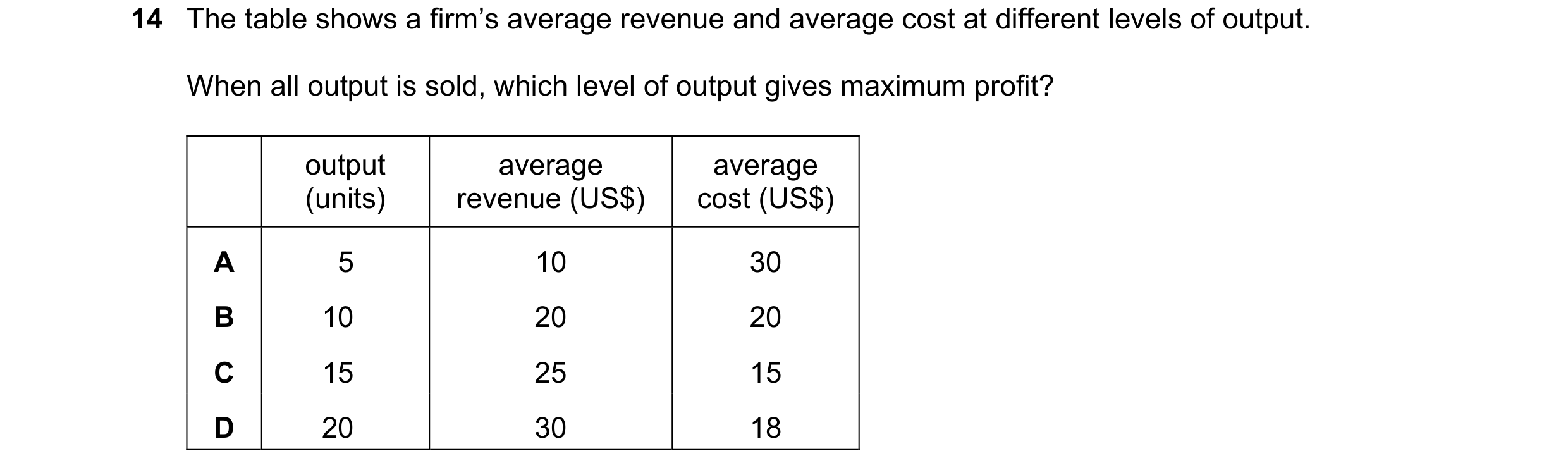

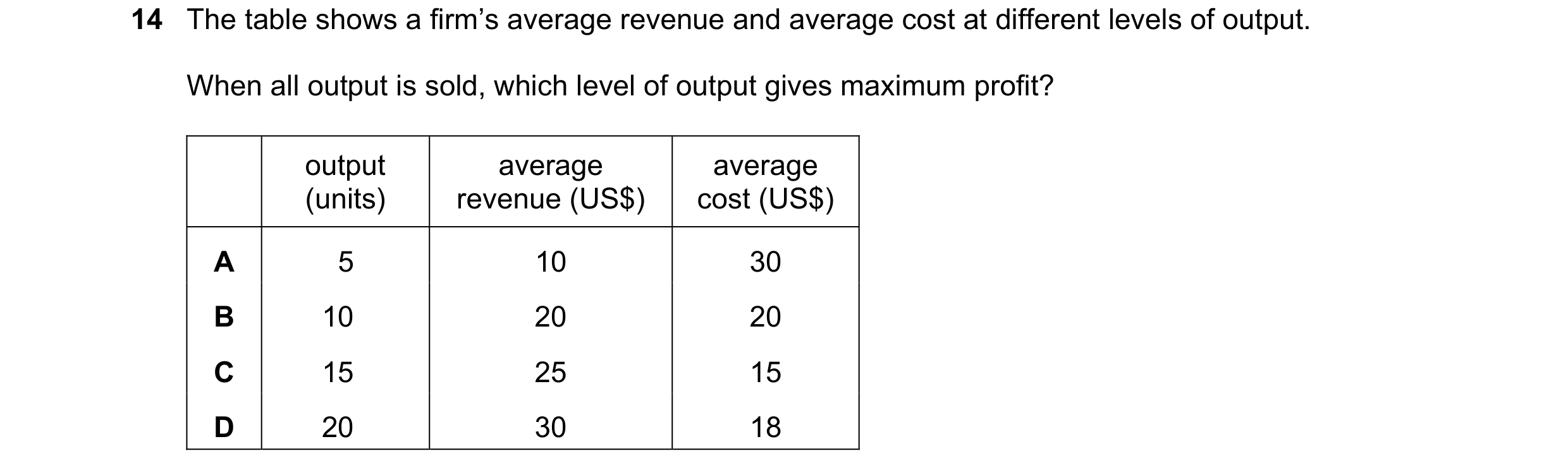 37 / 64

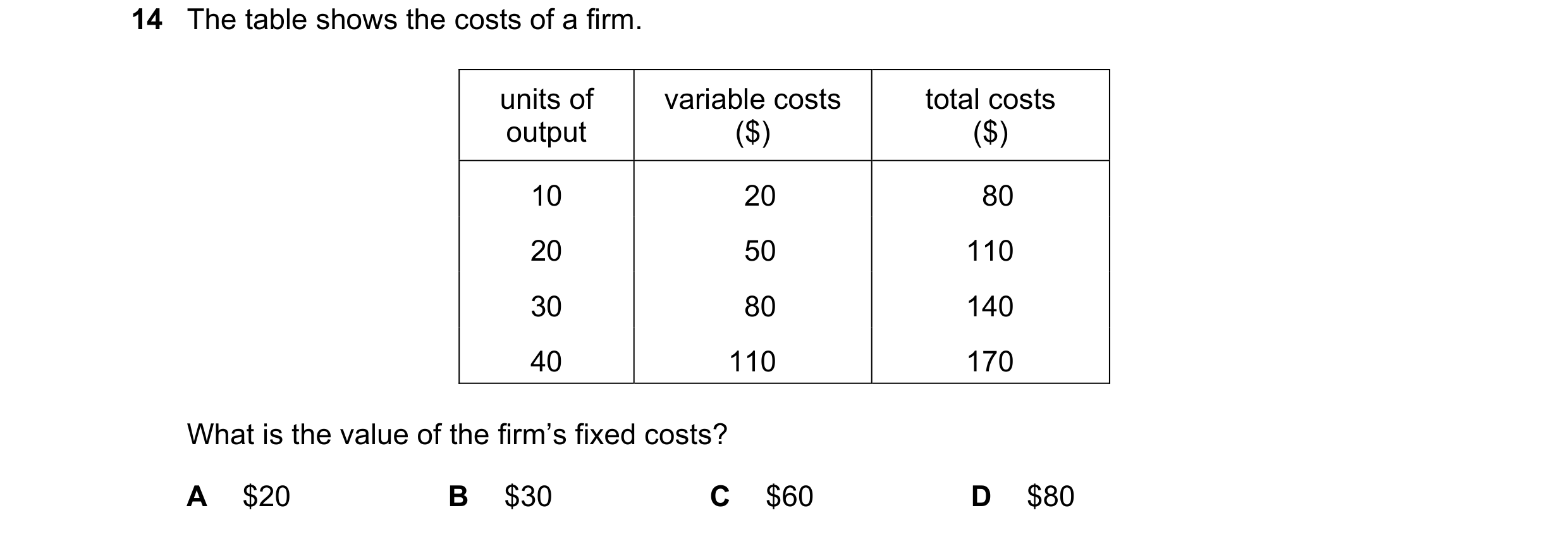
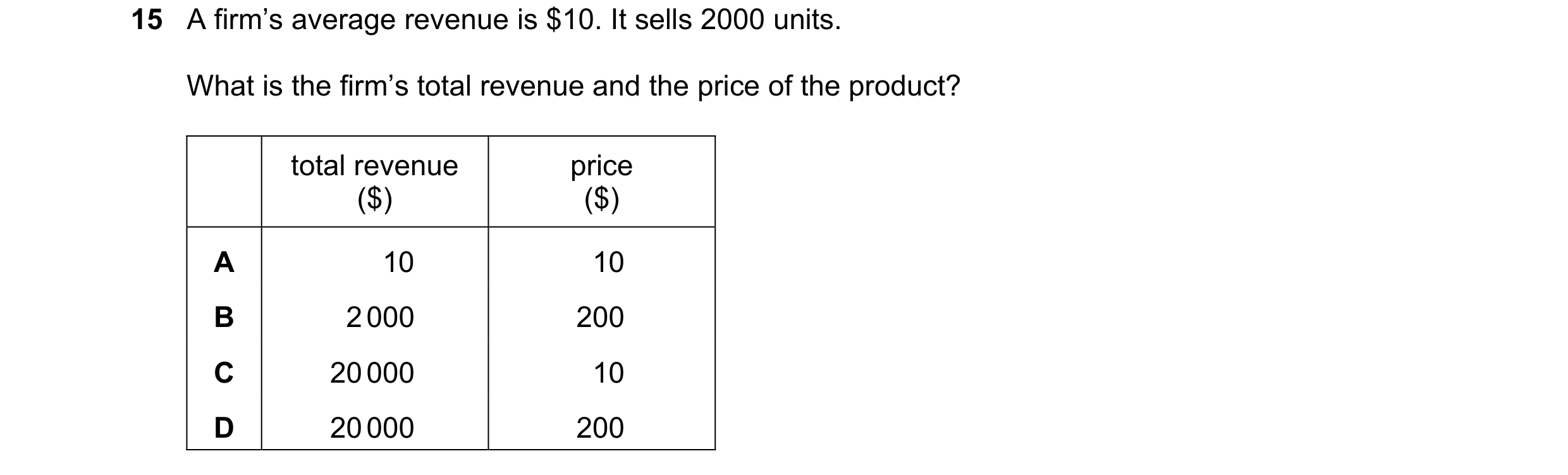
 38 / 64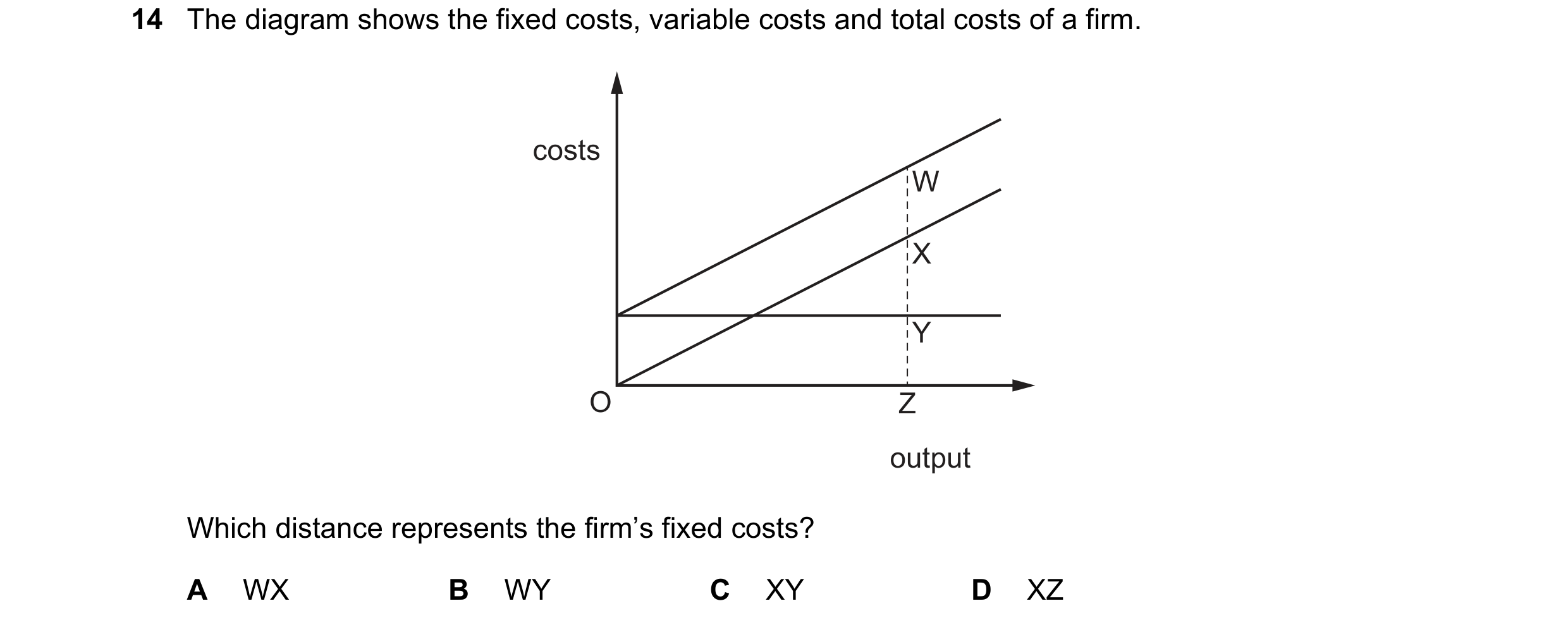

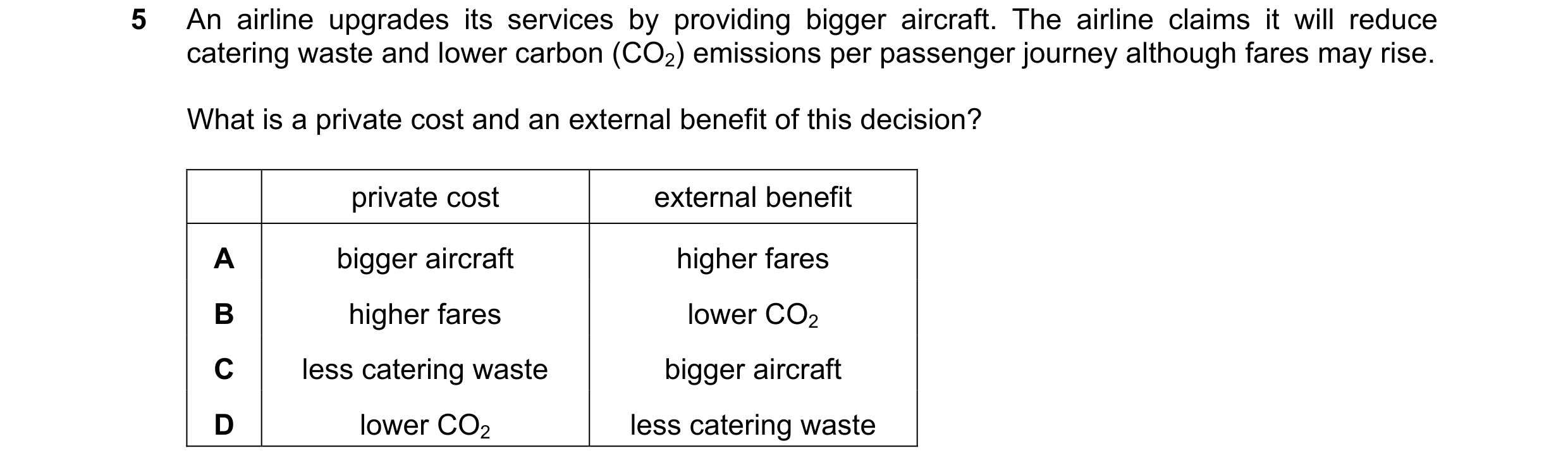
 39 / 64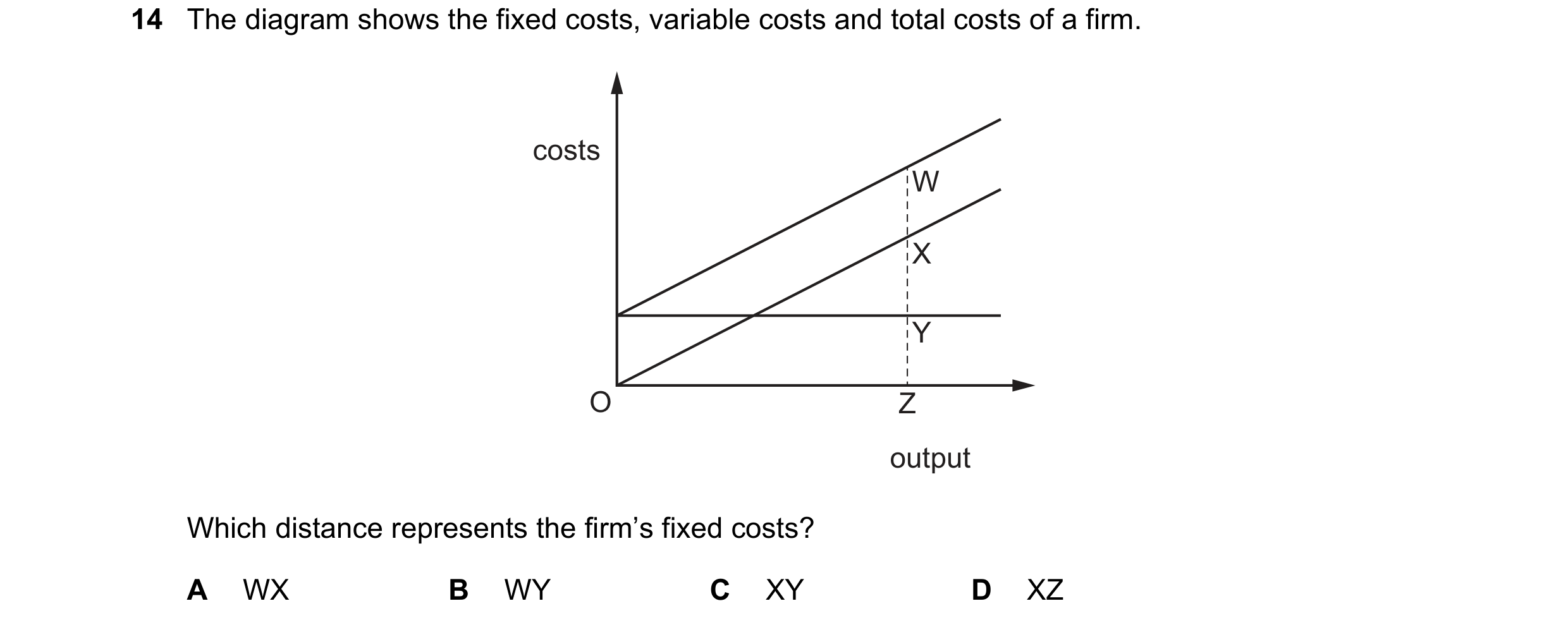

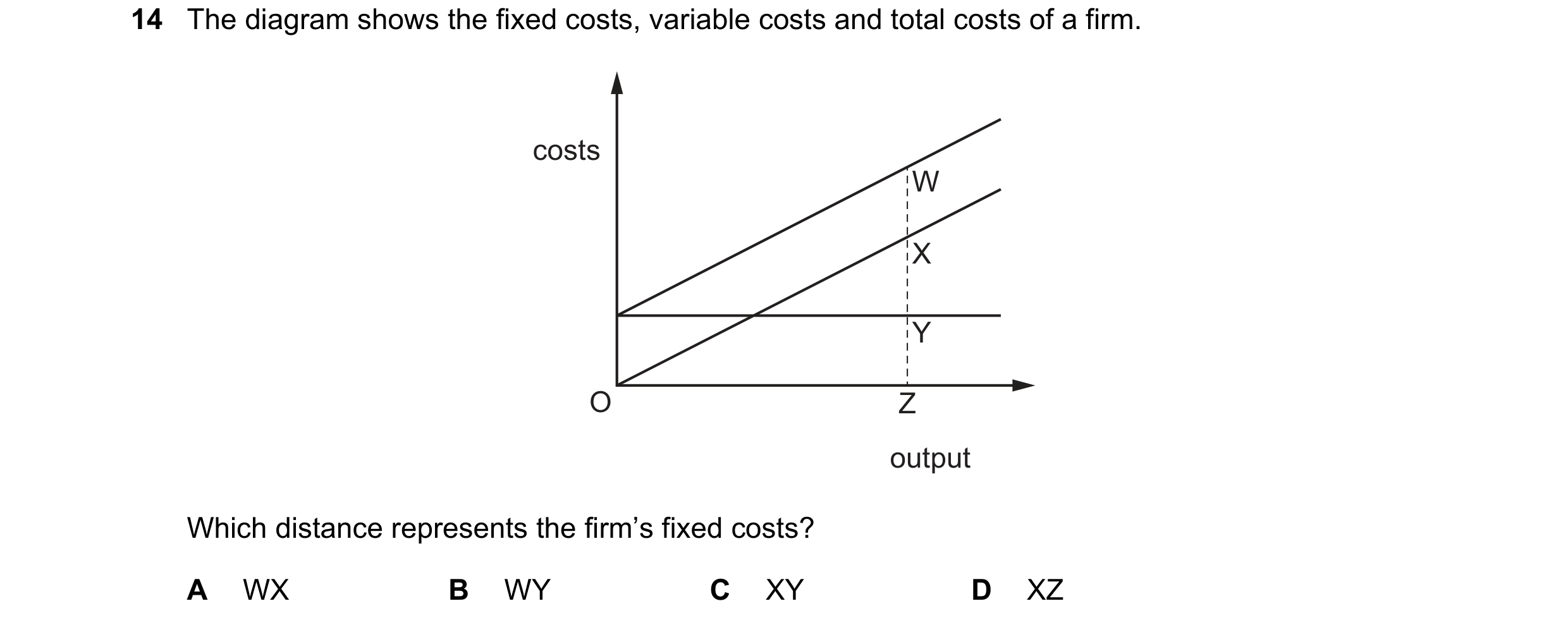

 40 / 64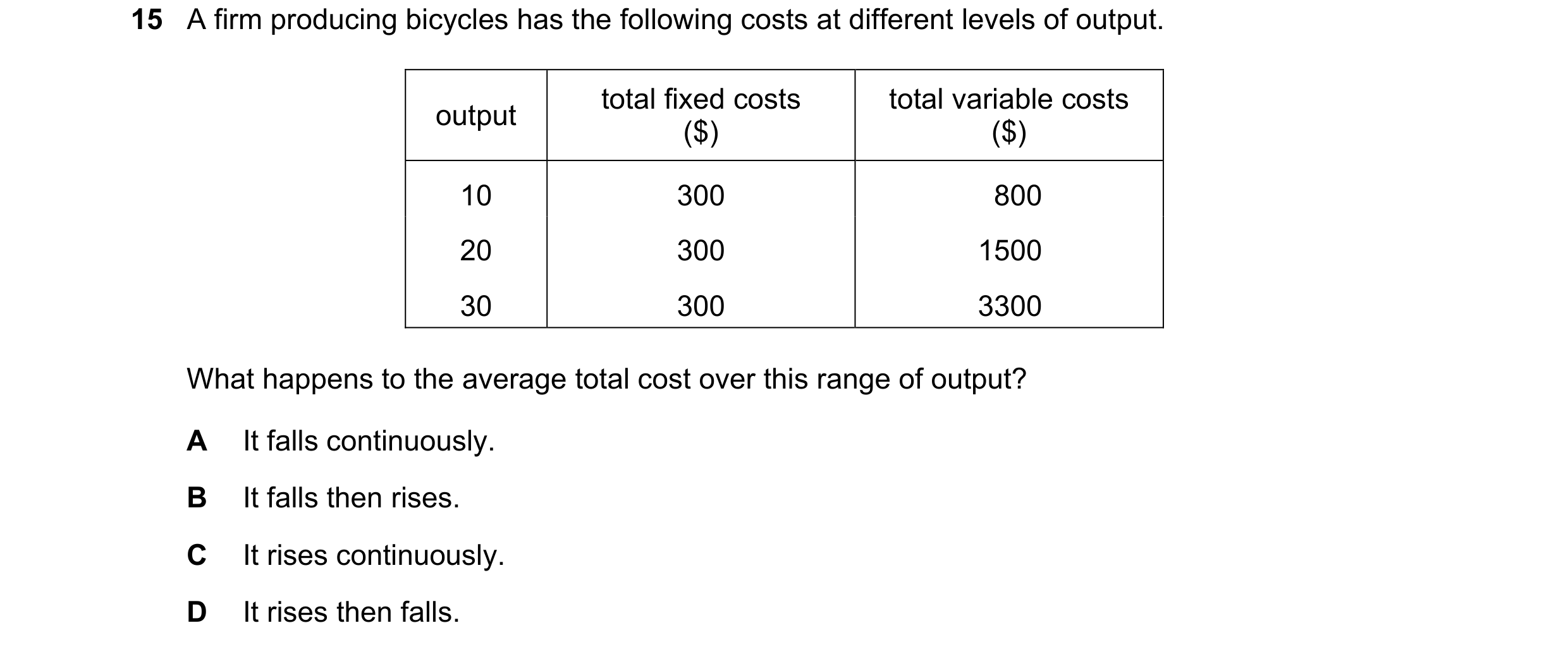
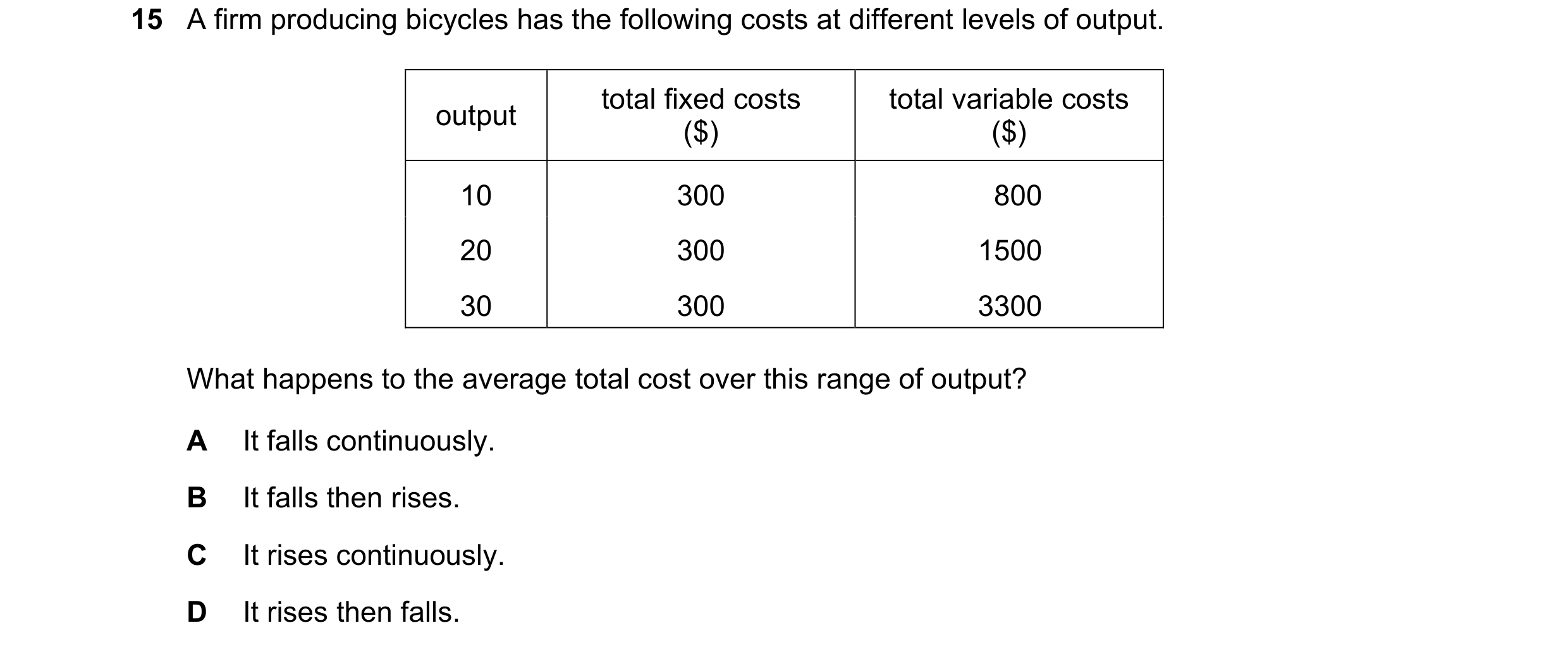
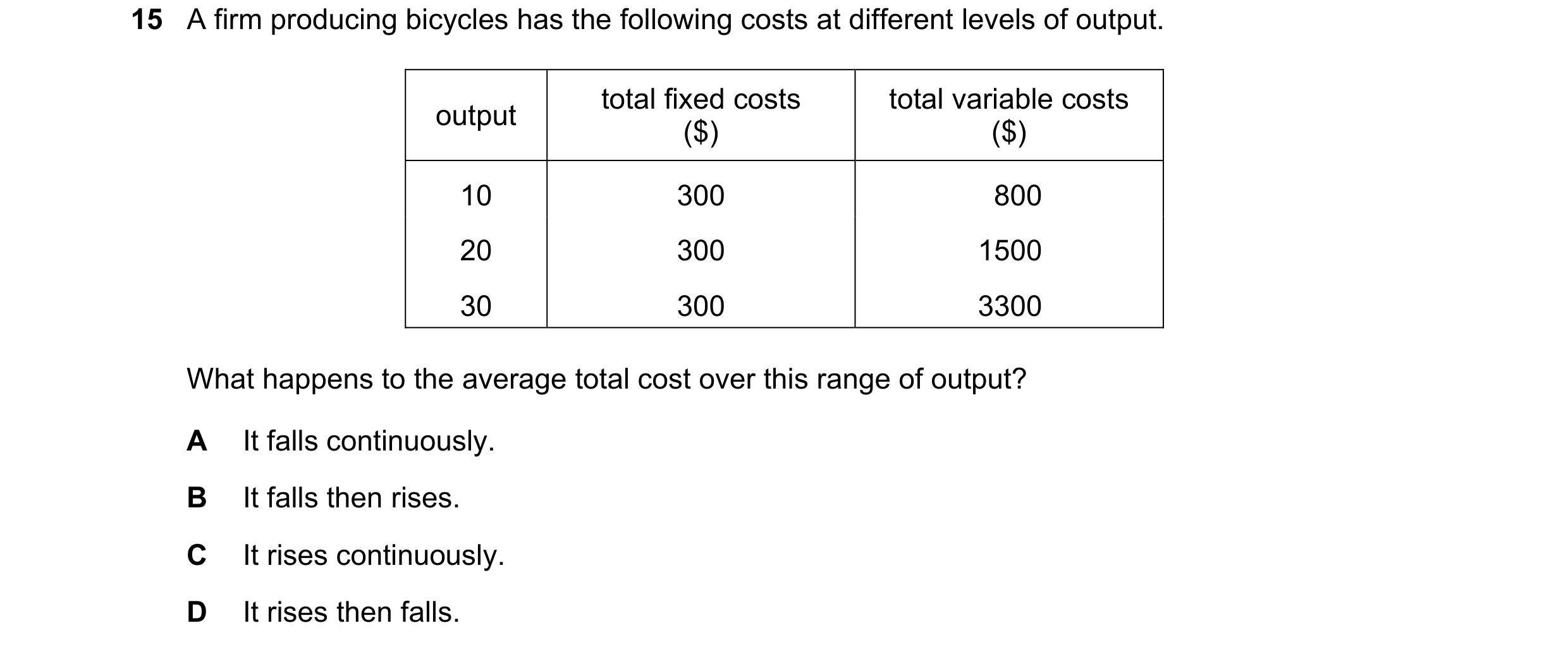 41 / 64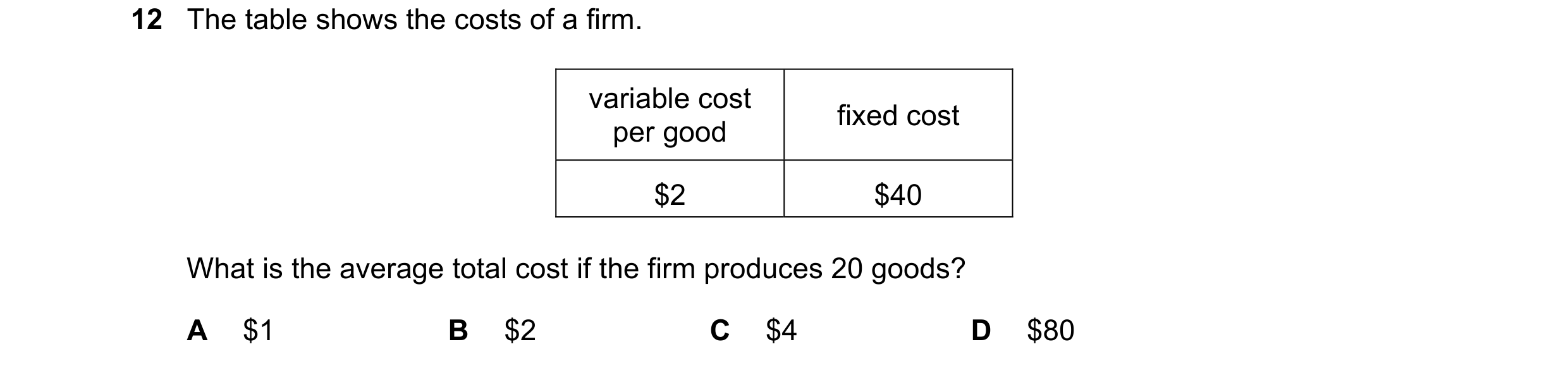

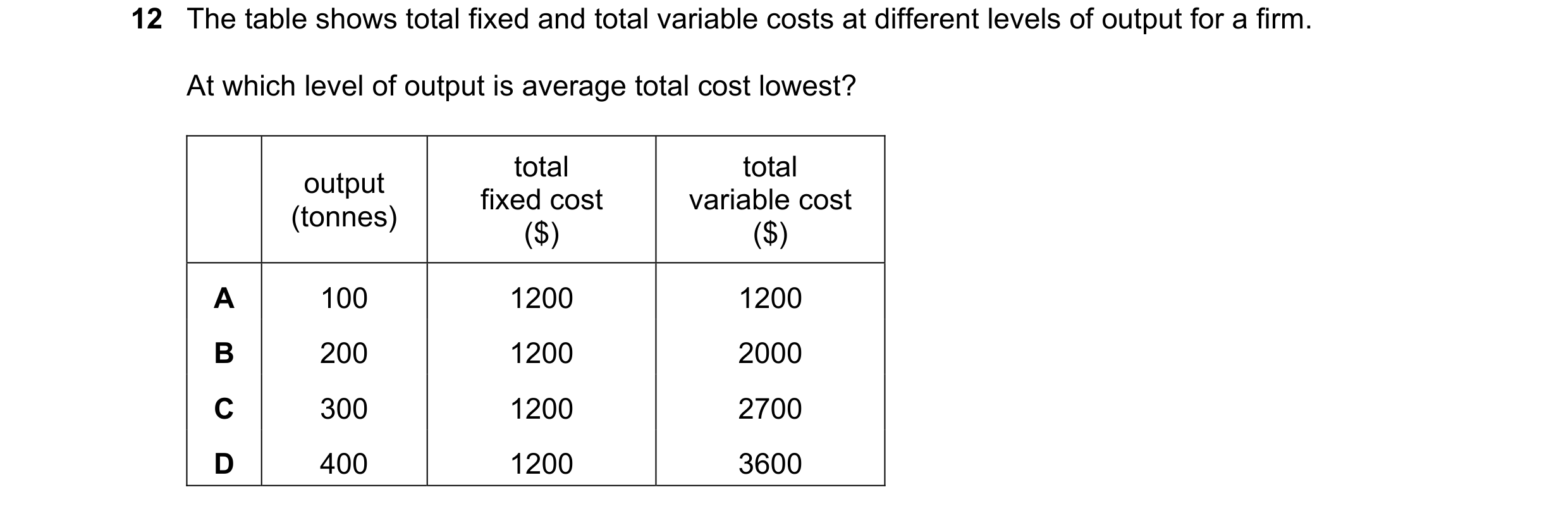
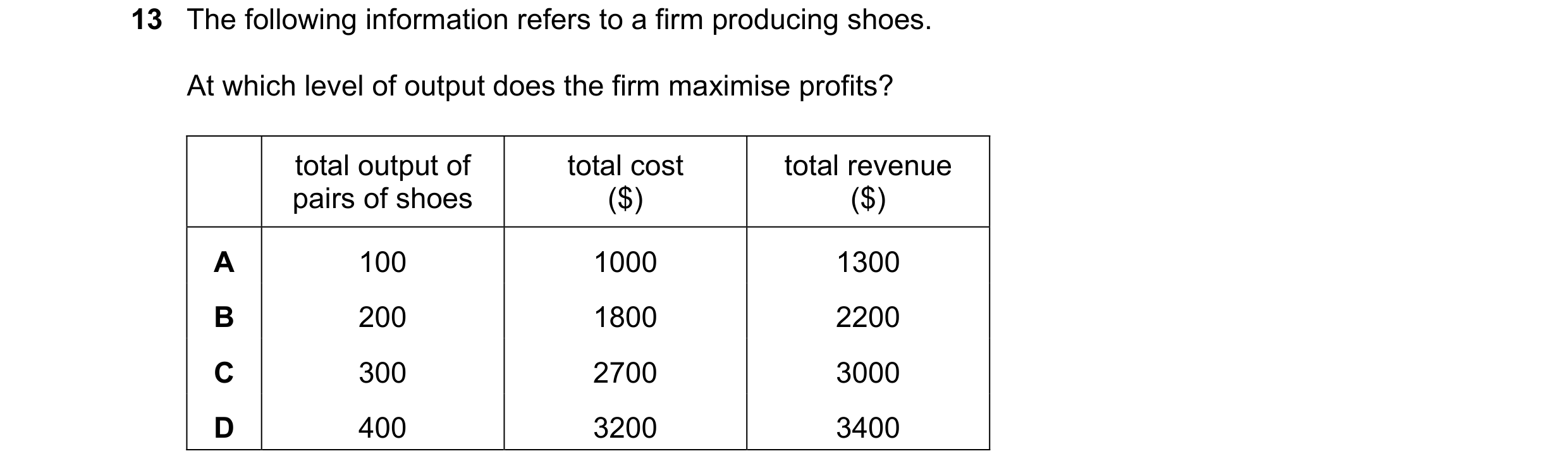 42 / 64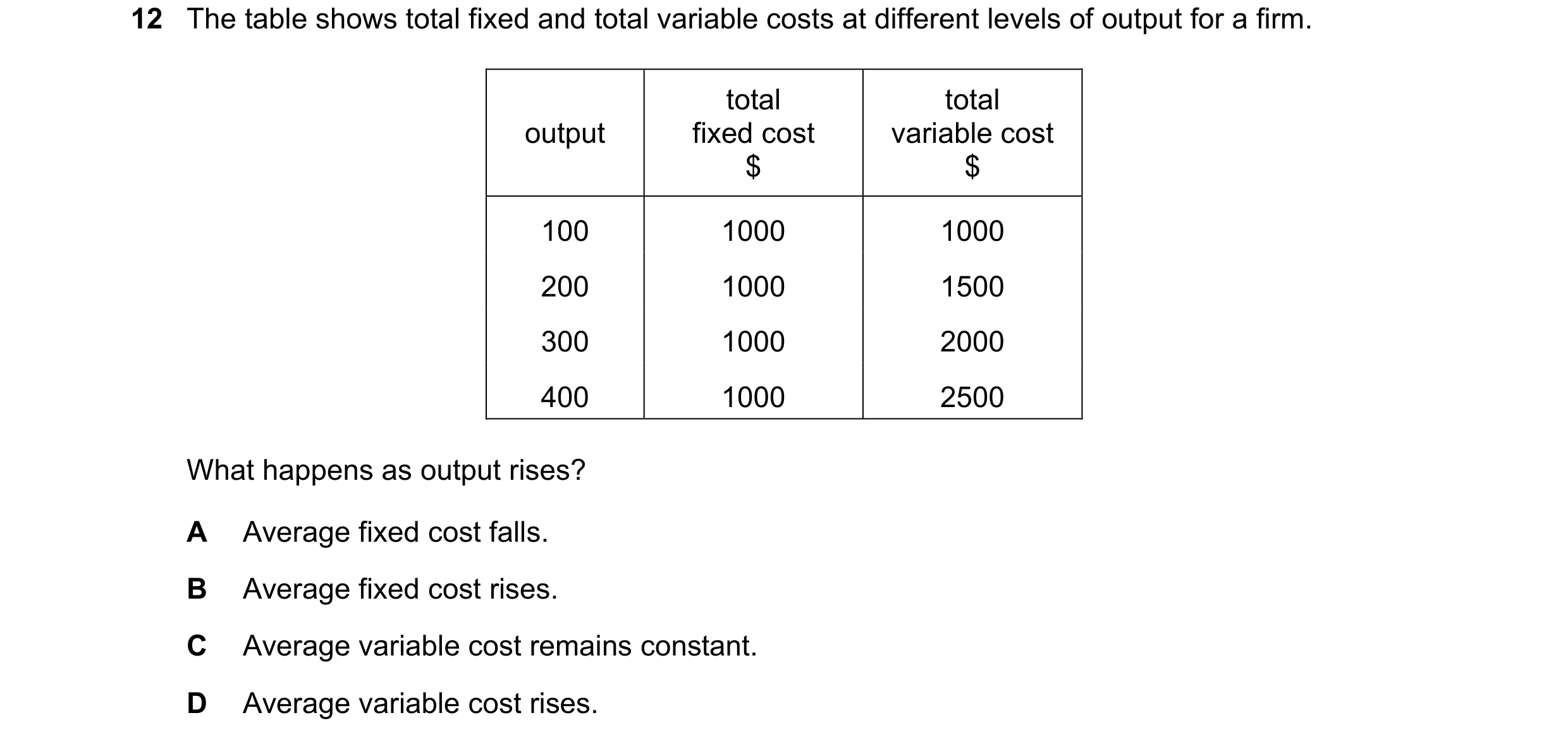
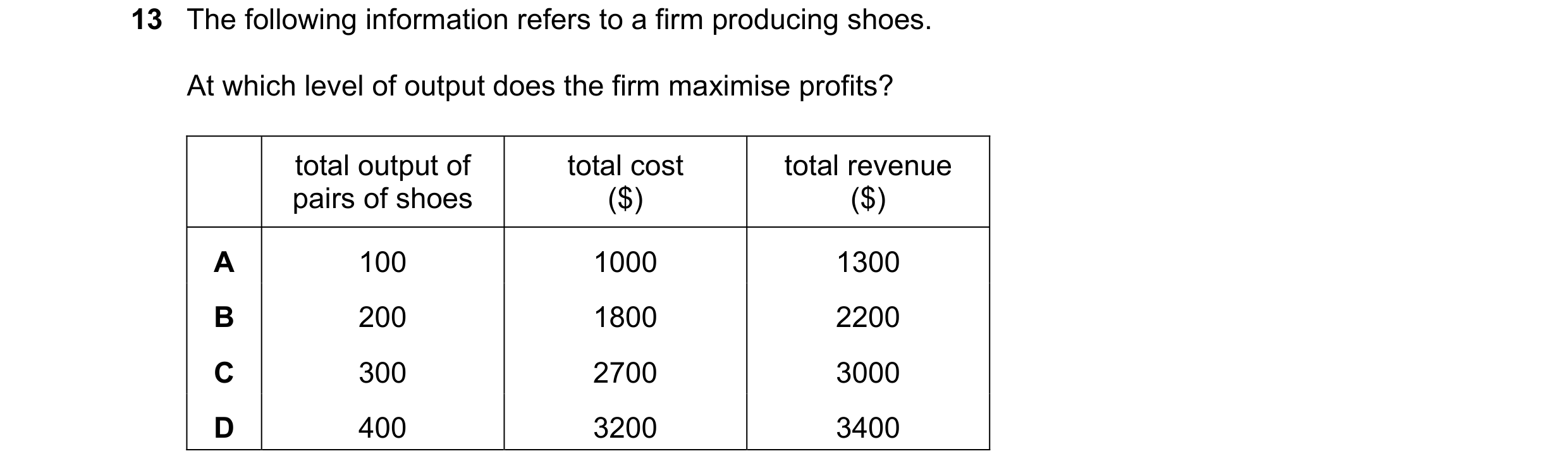

 43 / 64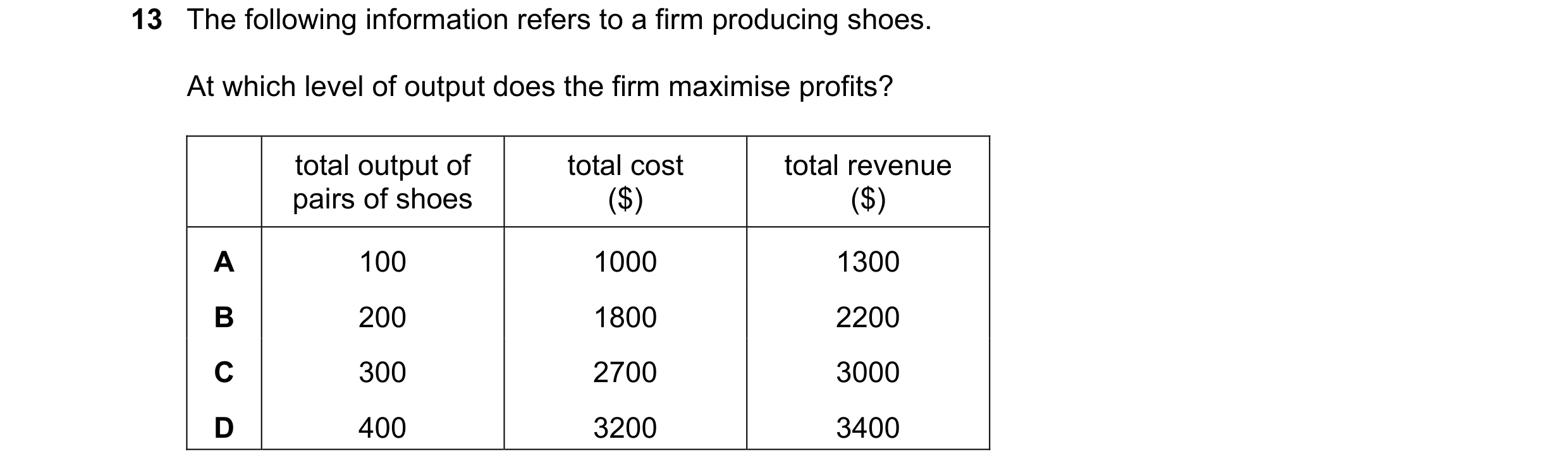
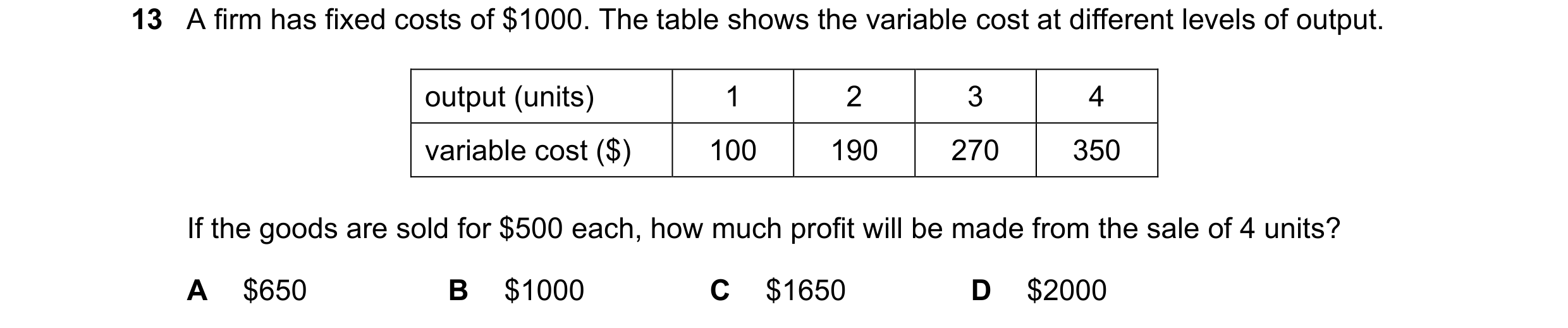
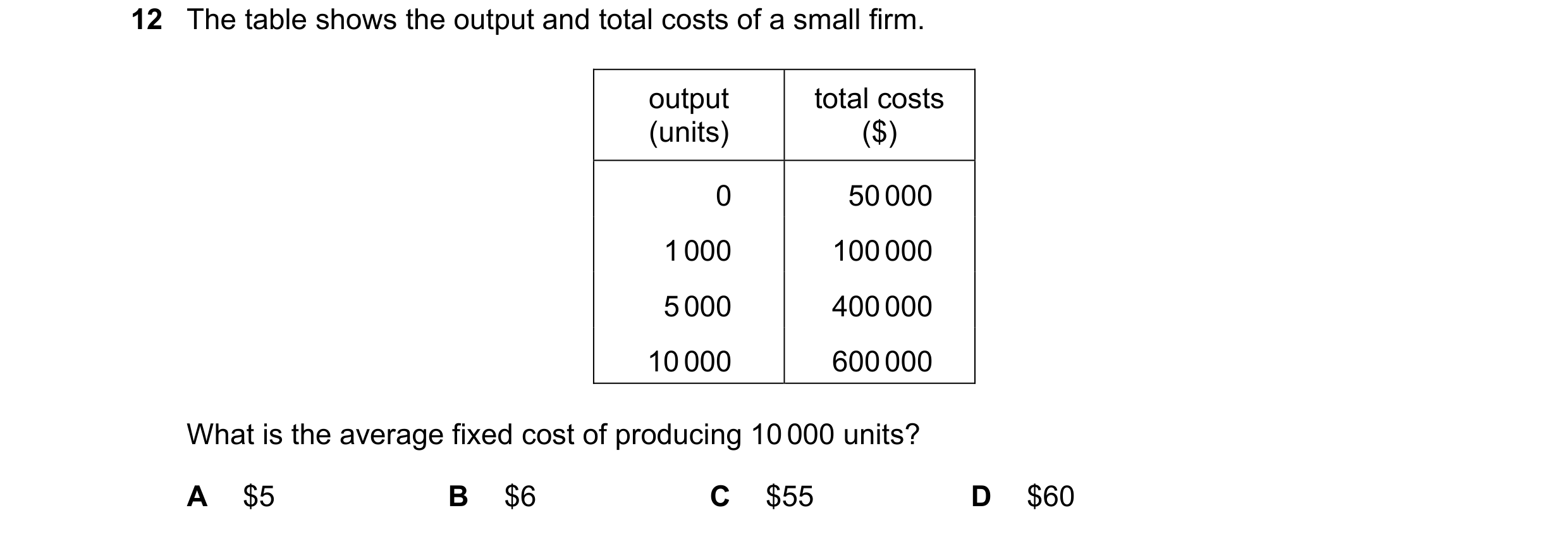
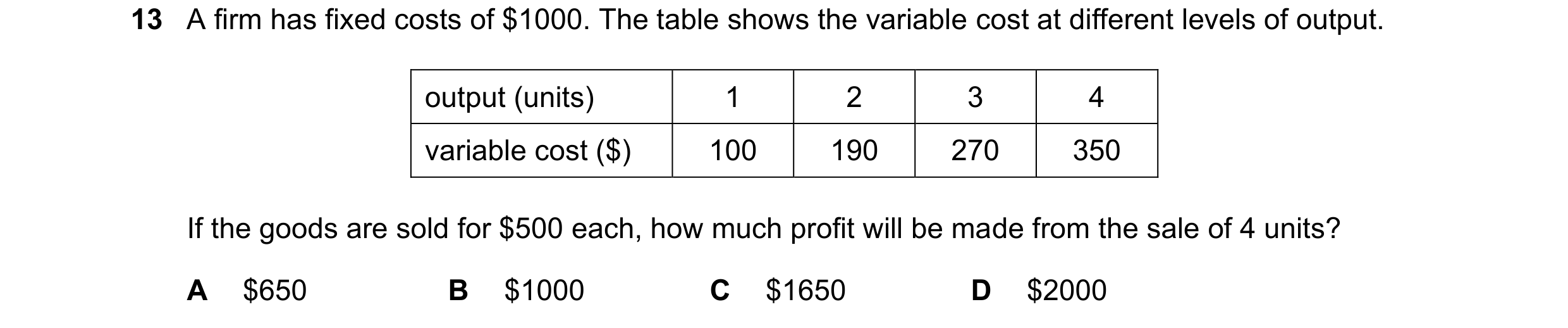 44 / 64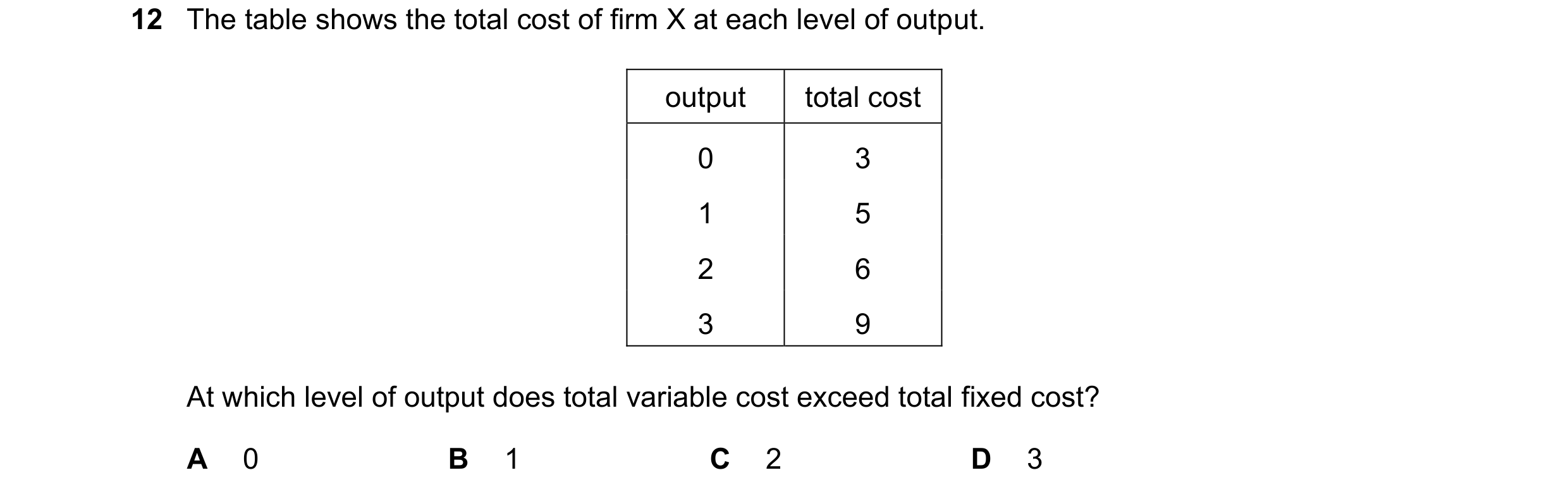
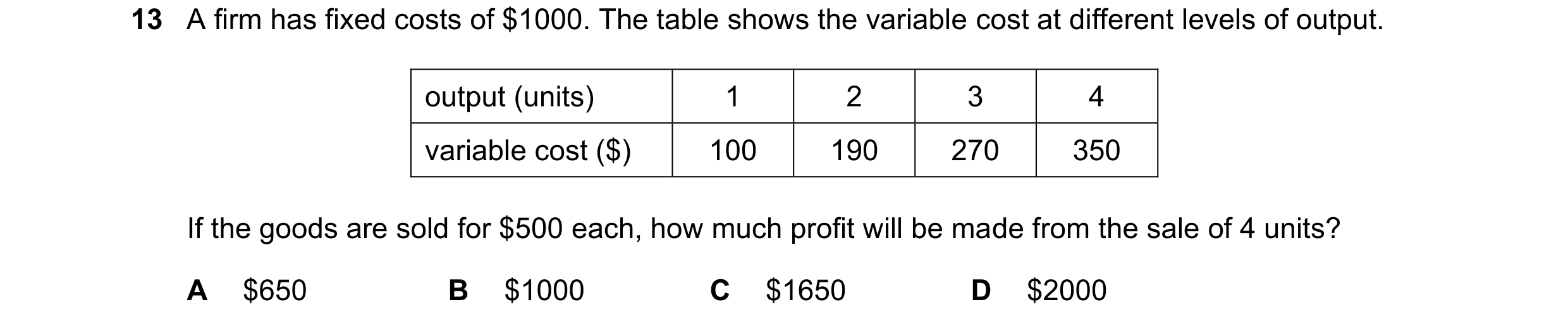
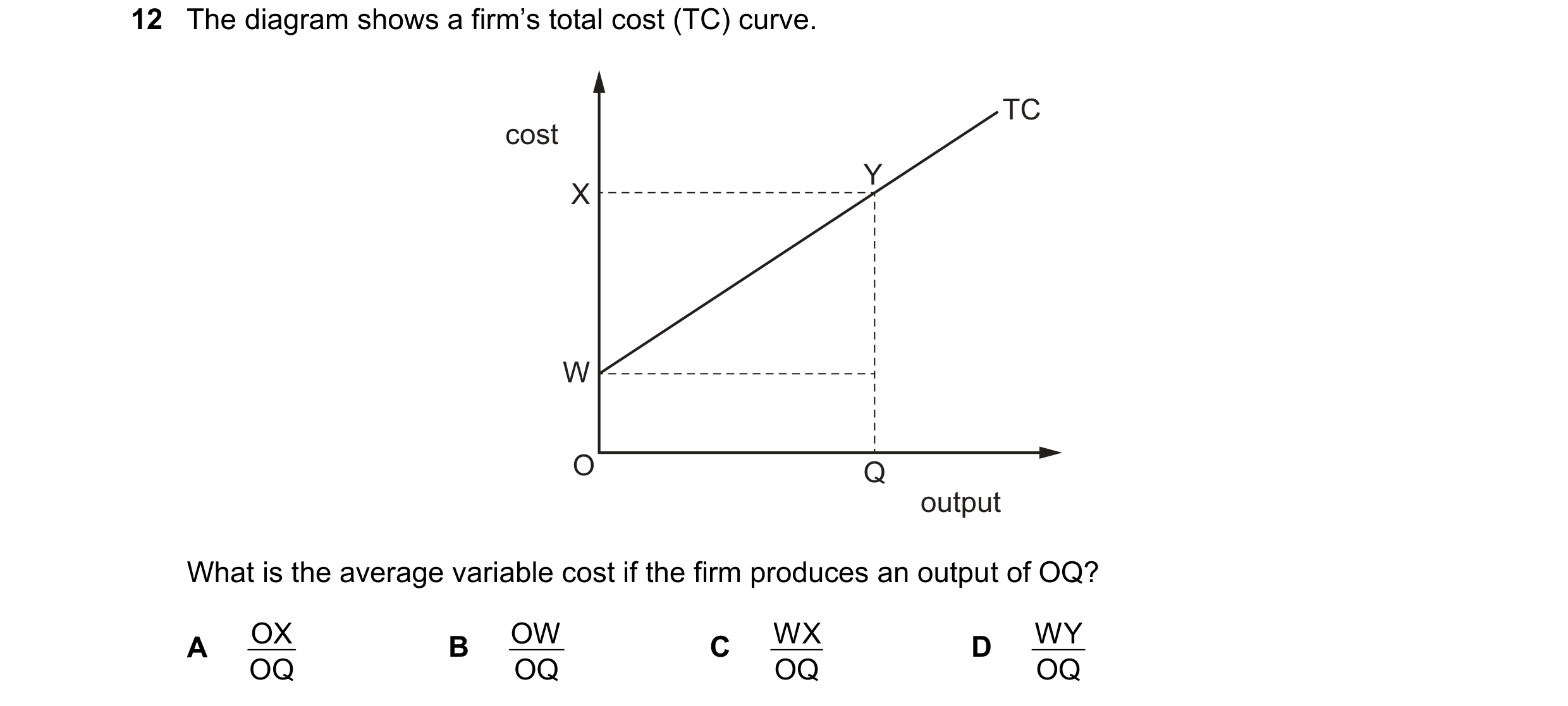
 45 / 64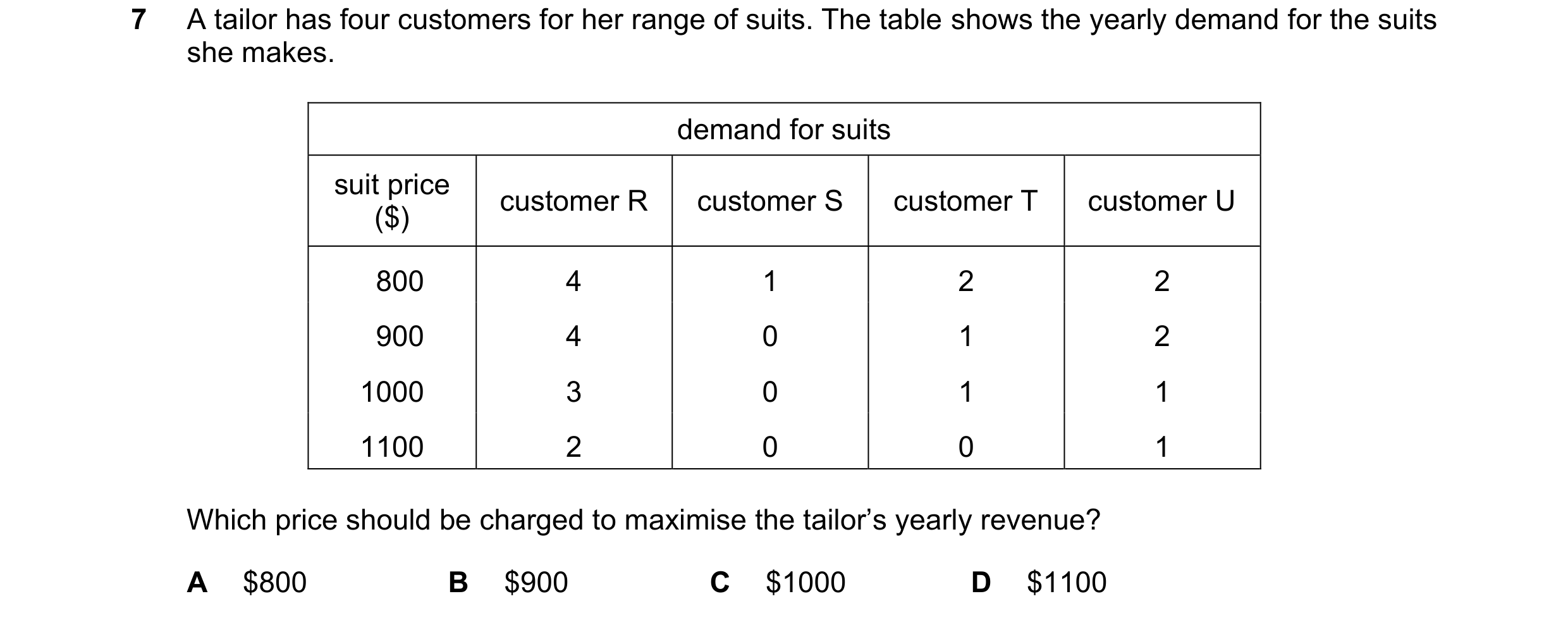

 46 / 64


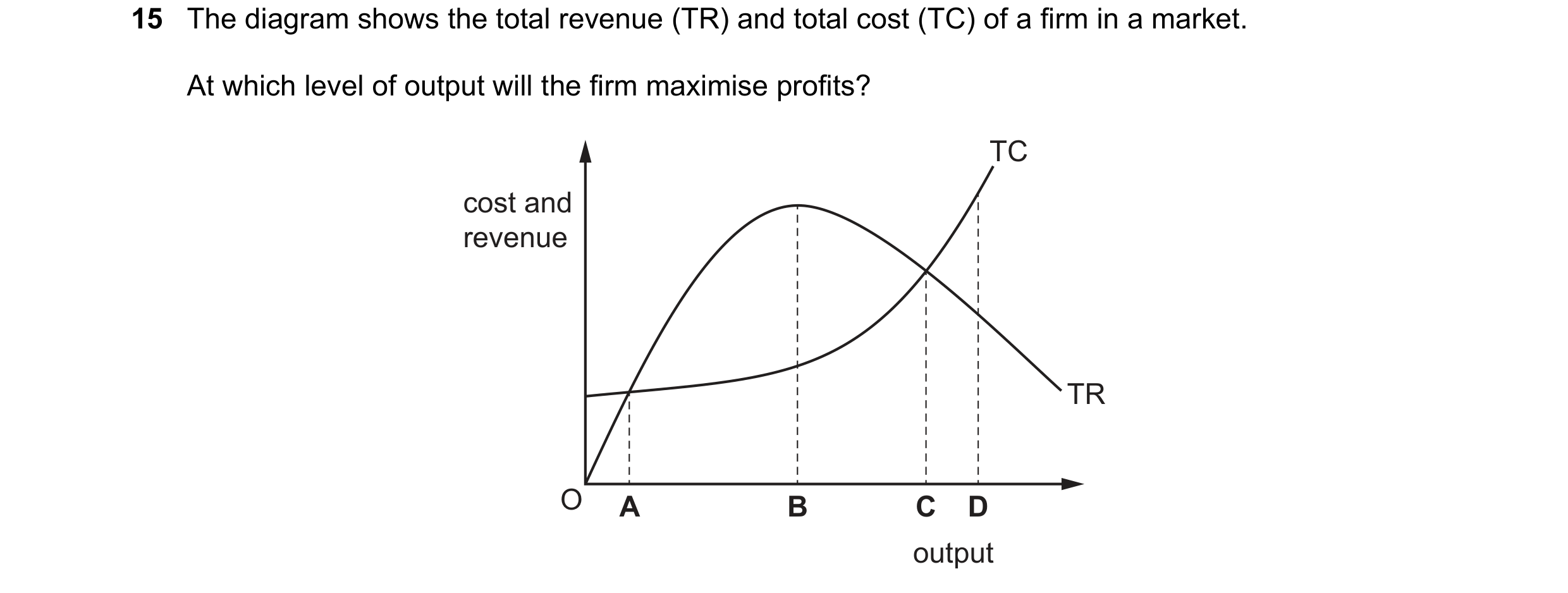 47 / 64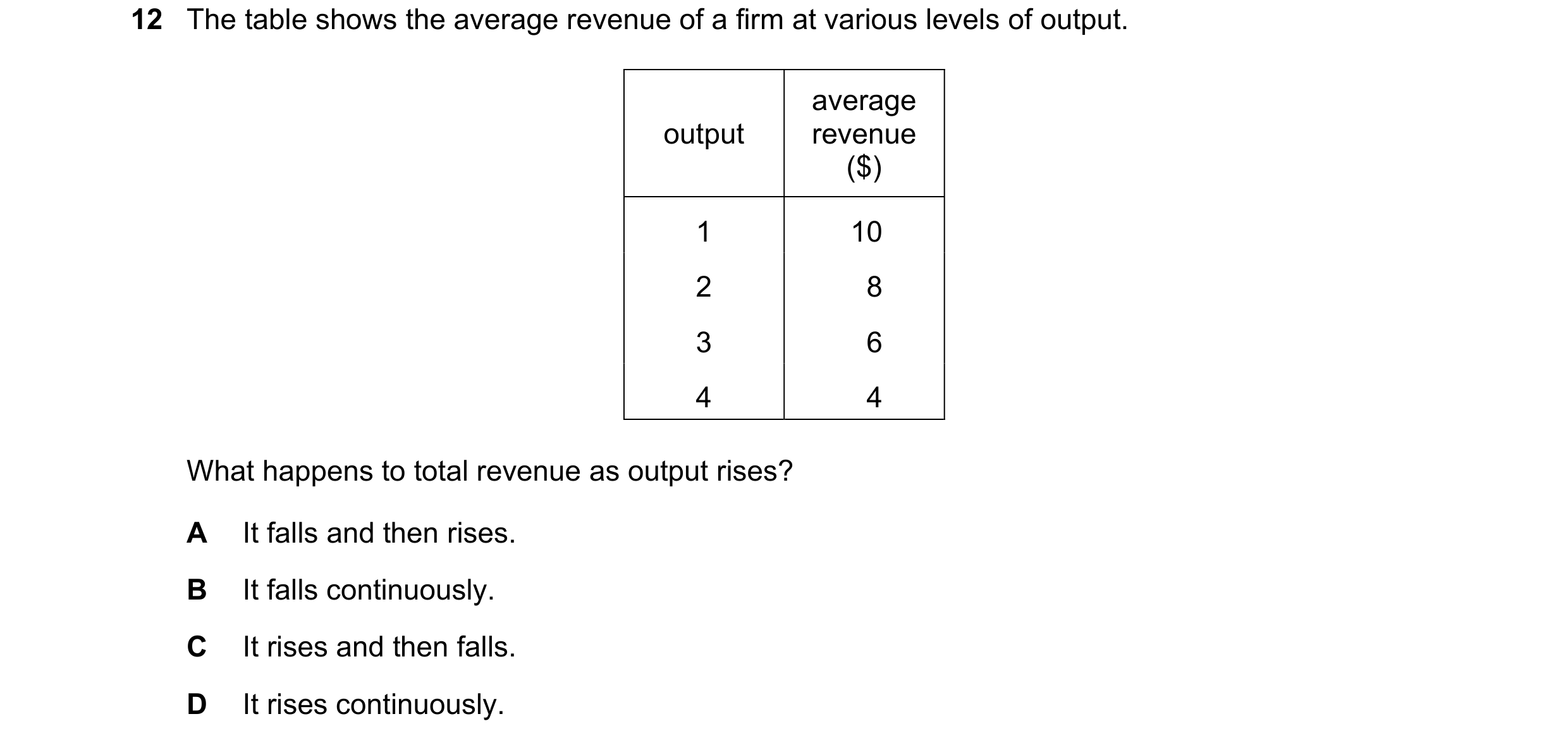
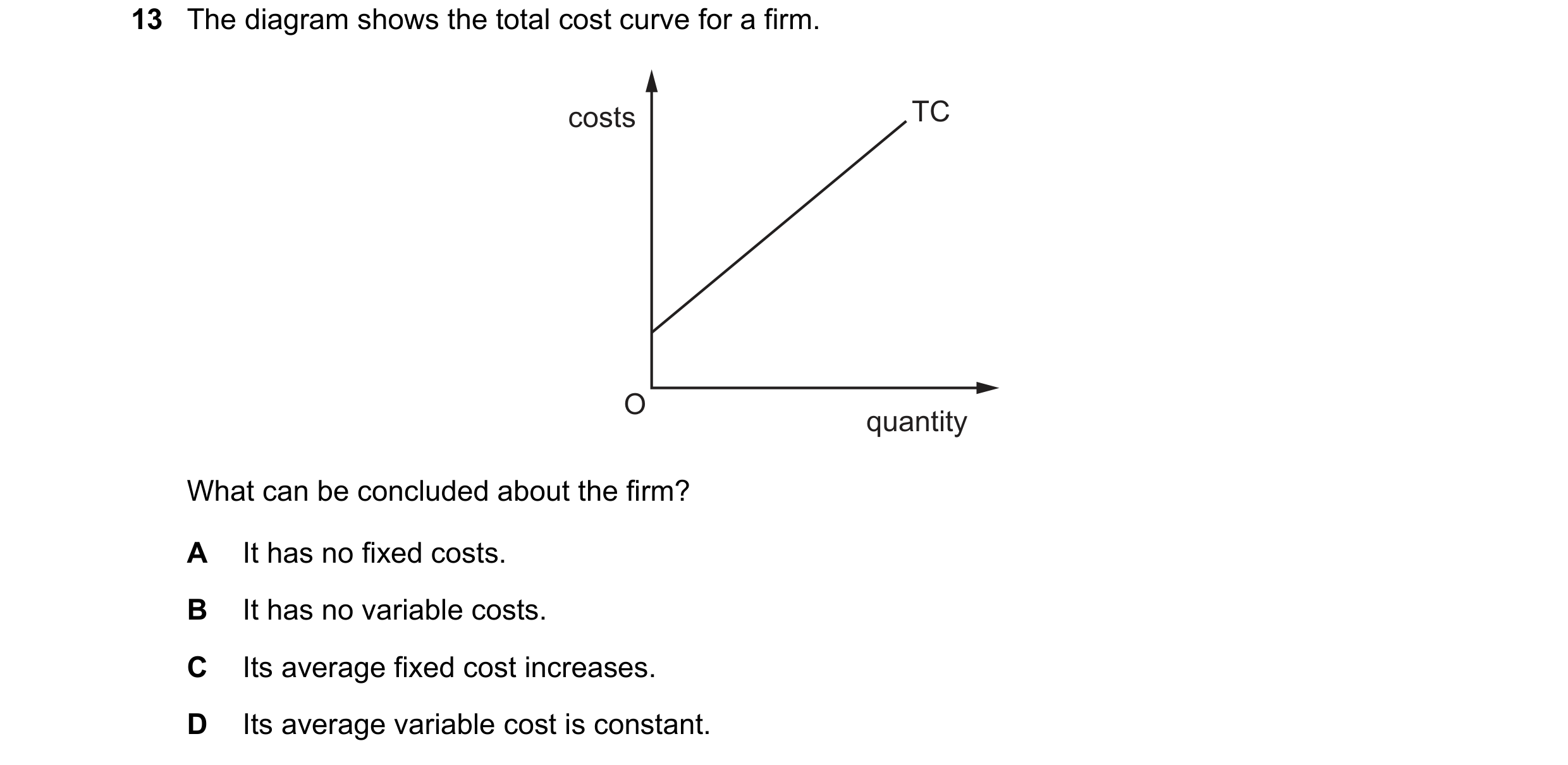 48 / 64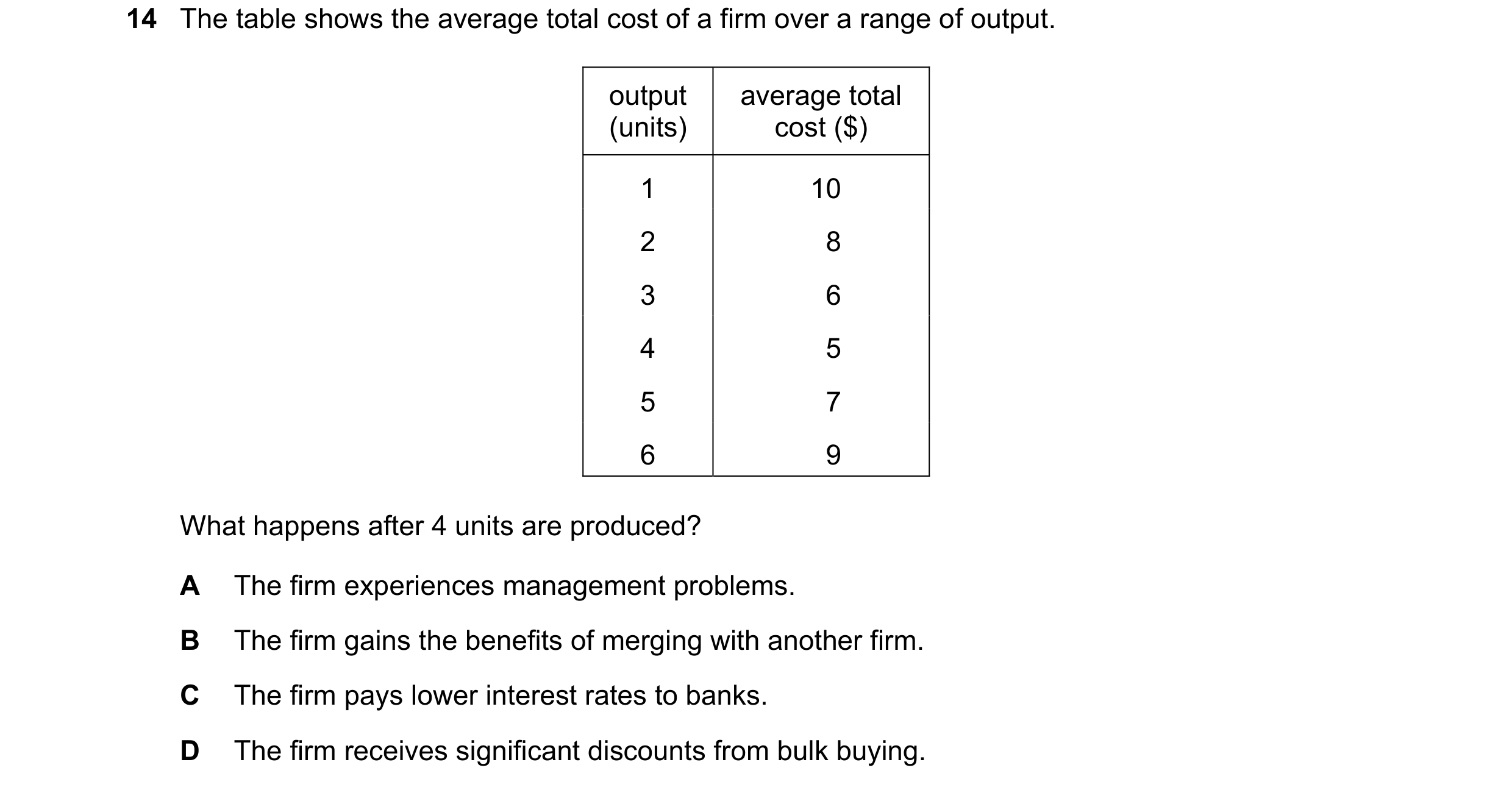

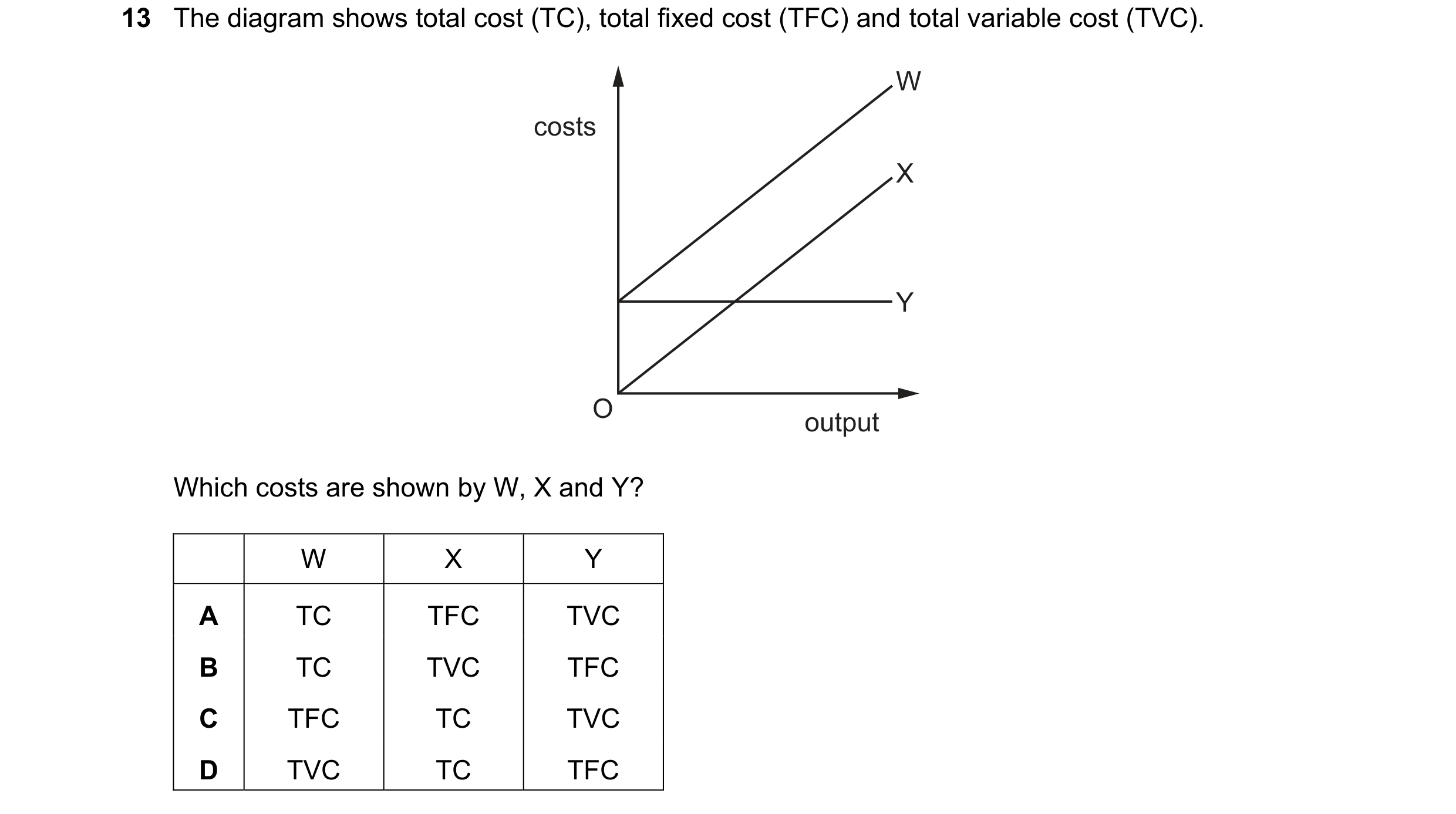 49 / 64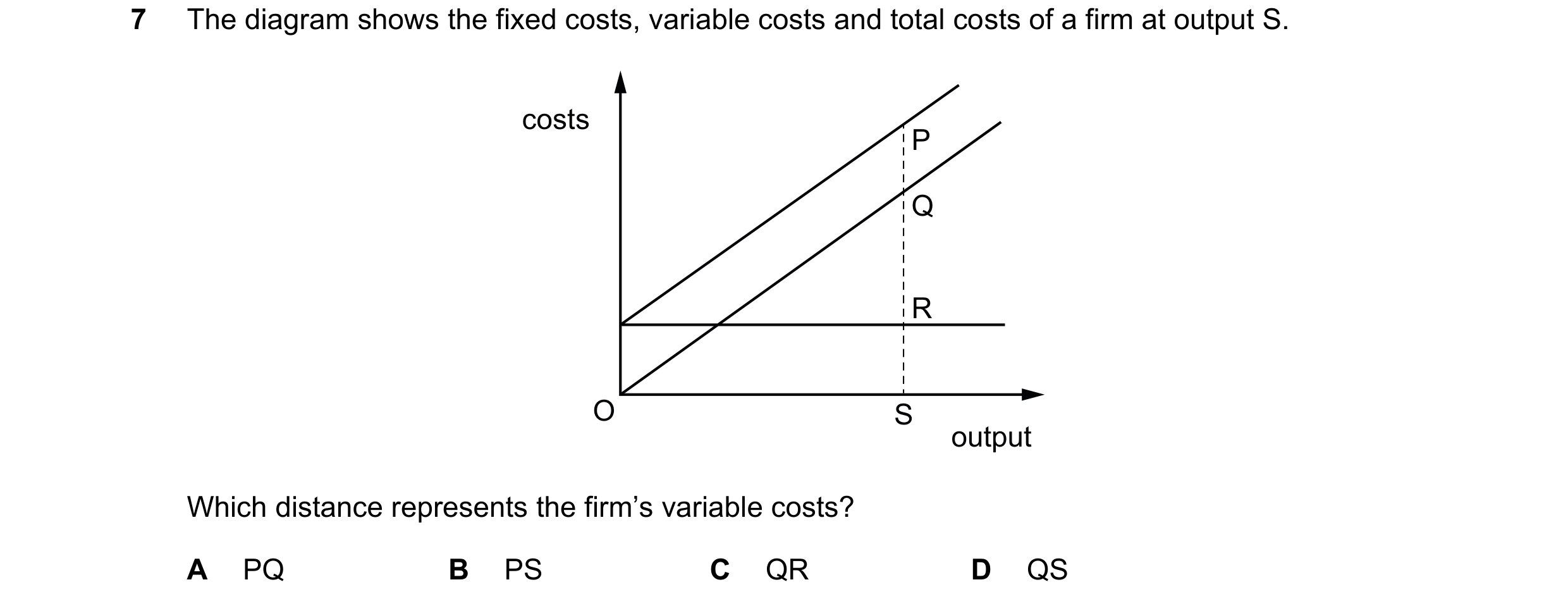
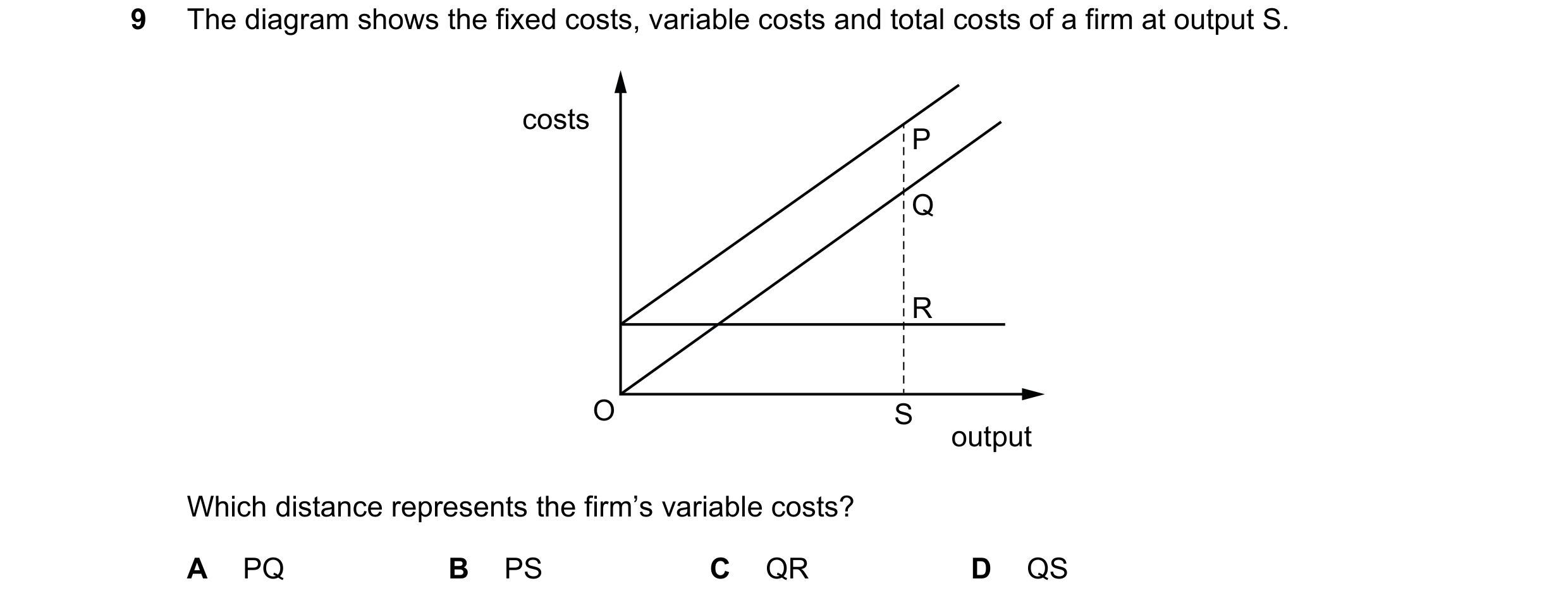

 50 / 64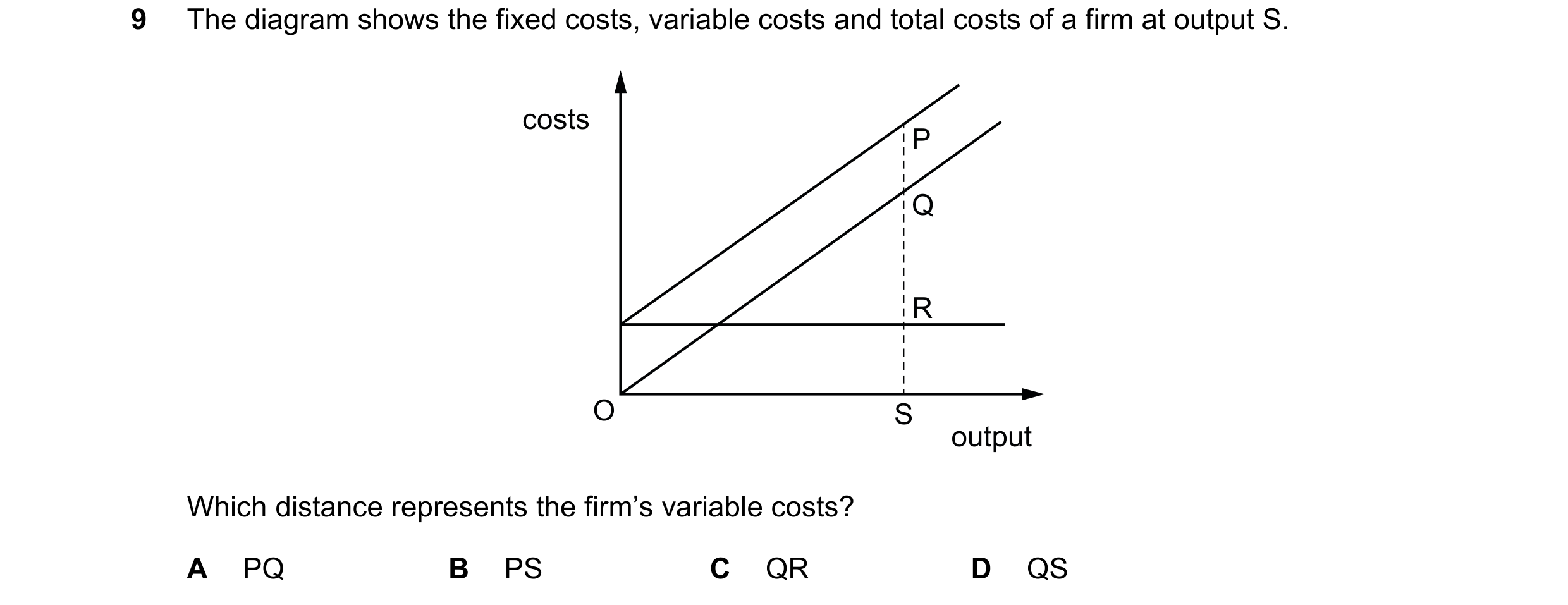

 51 / 64

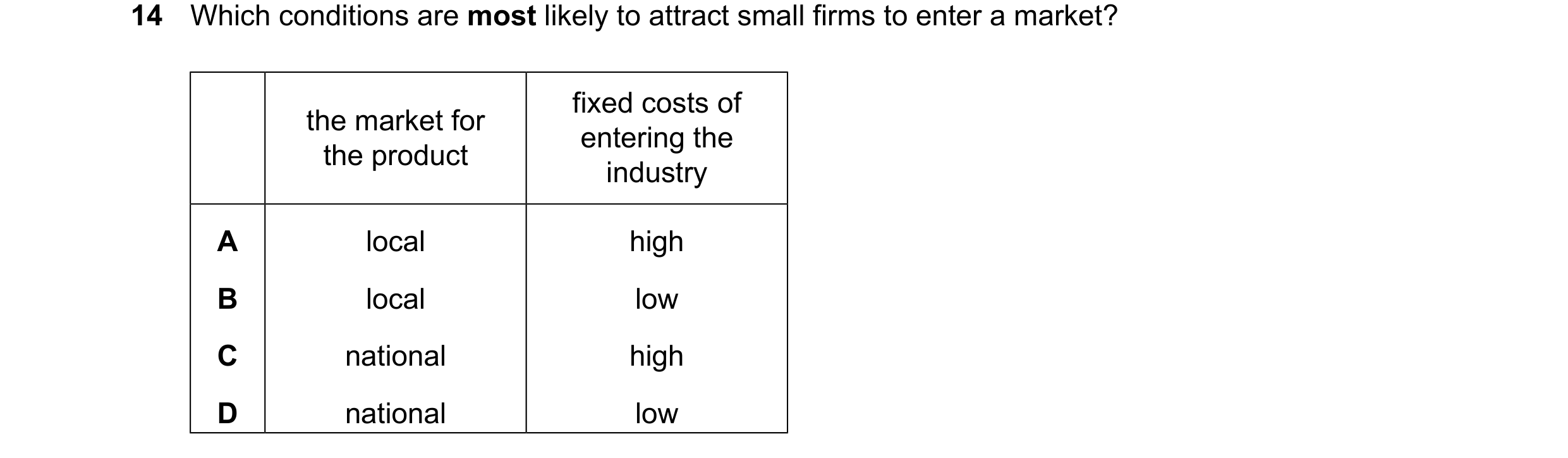 52 / 64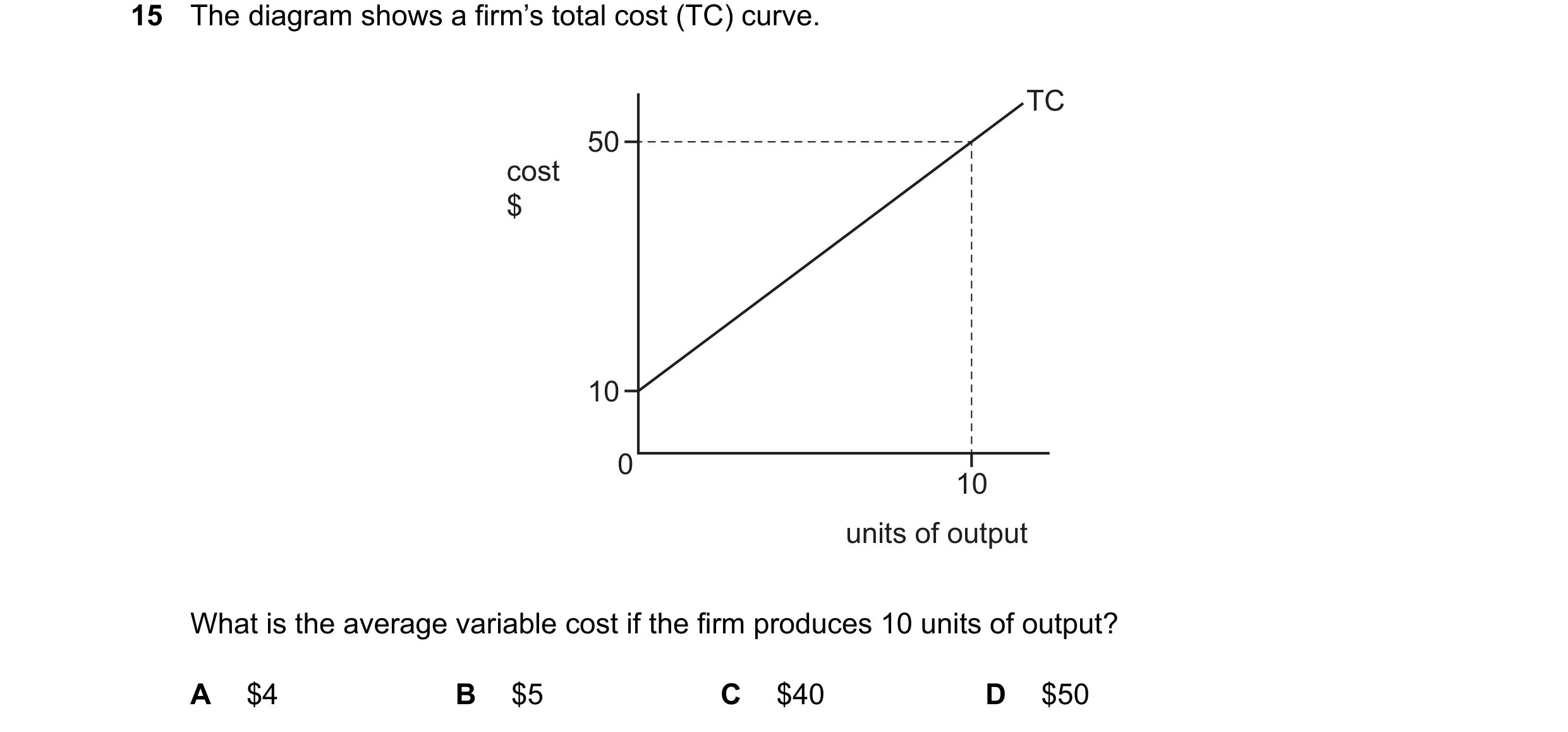
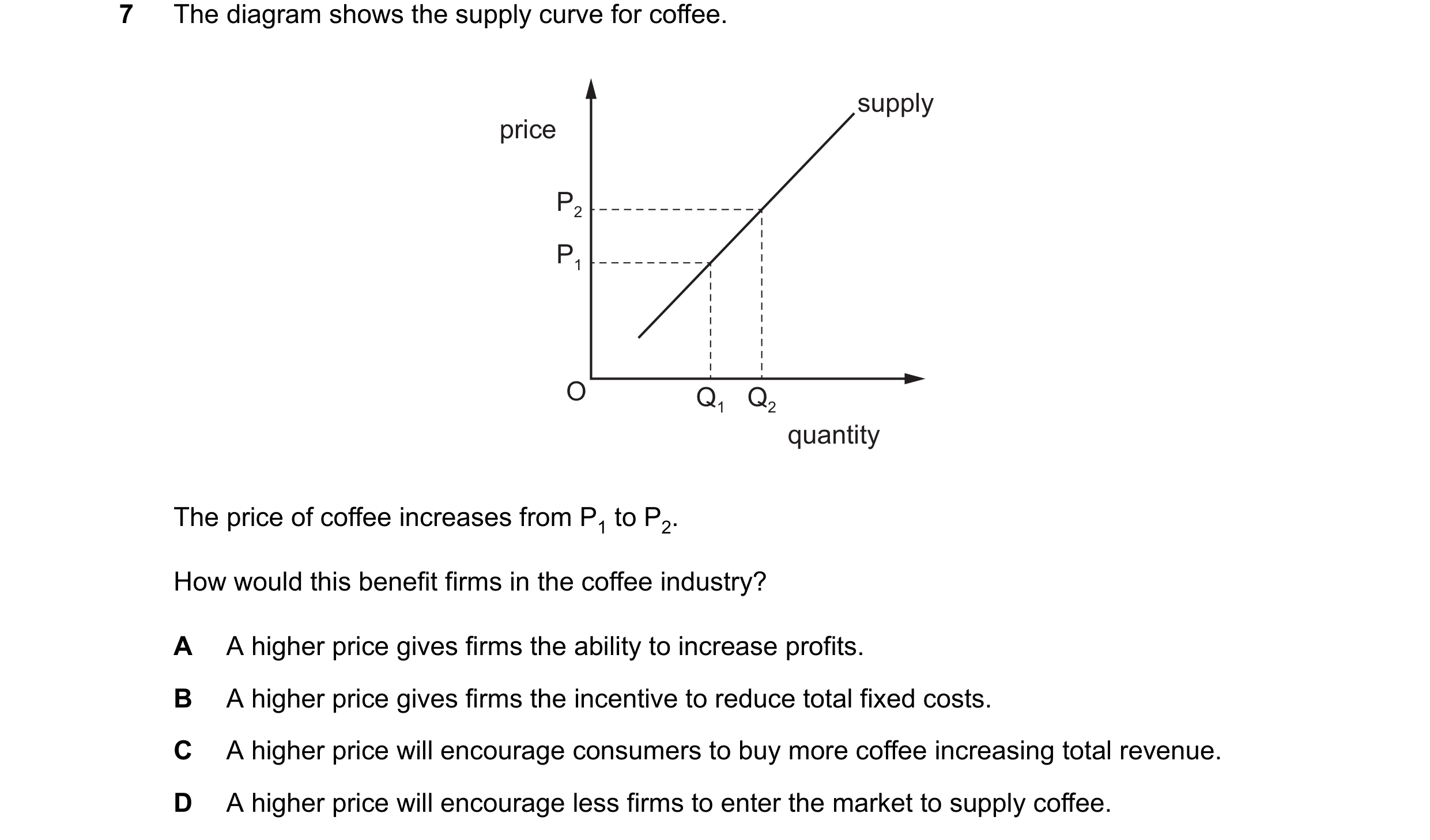
 53 / 64

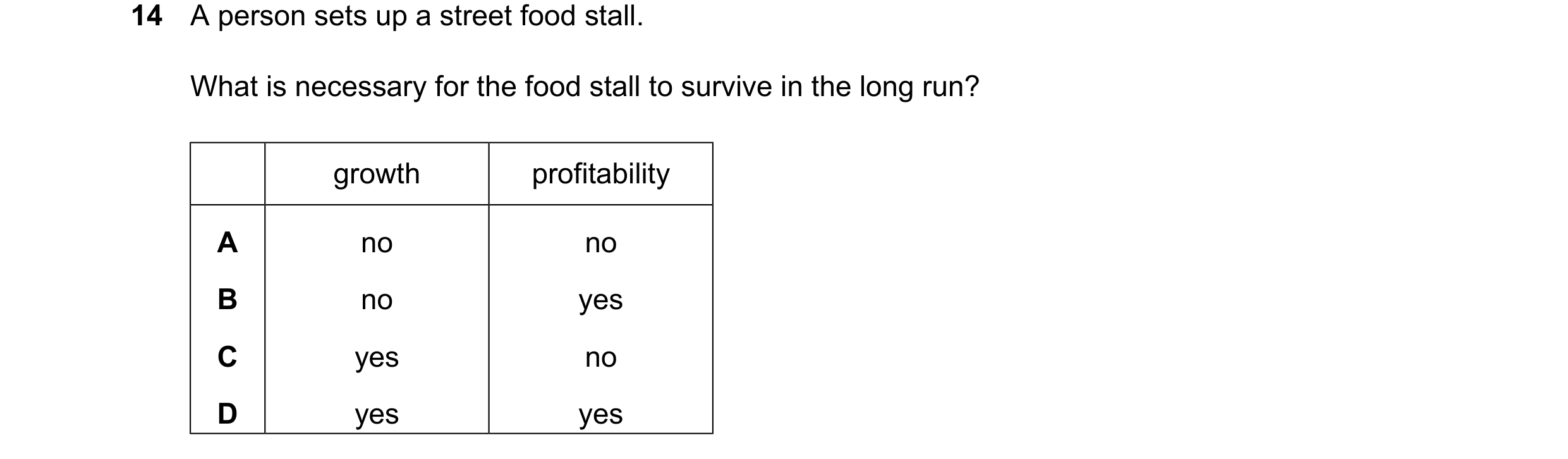

 54 / 64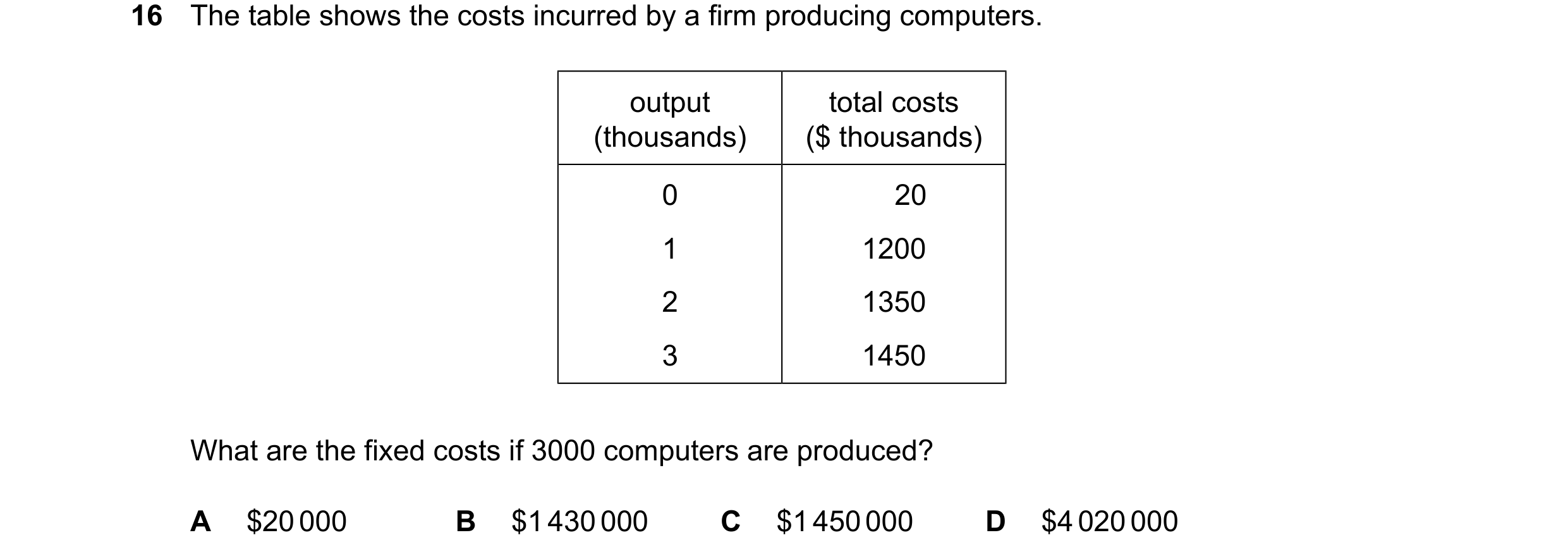

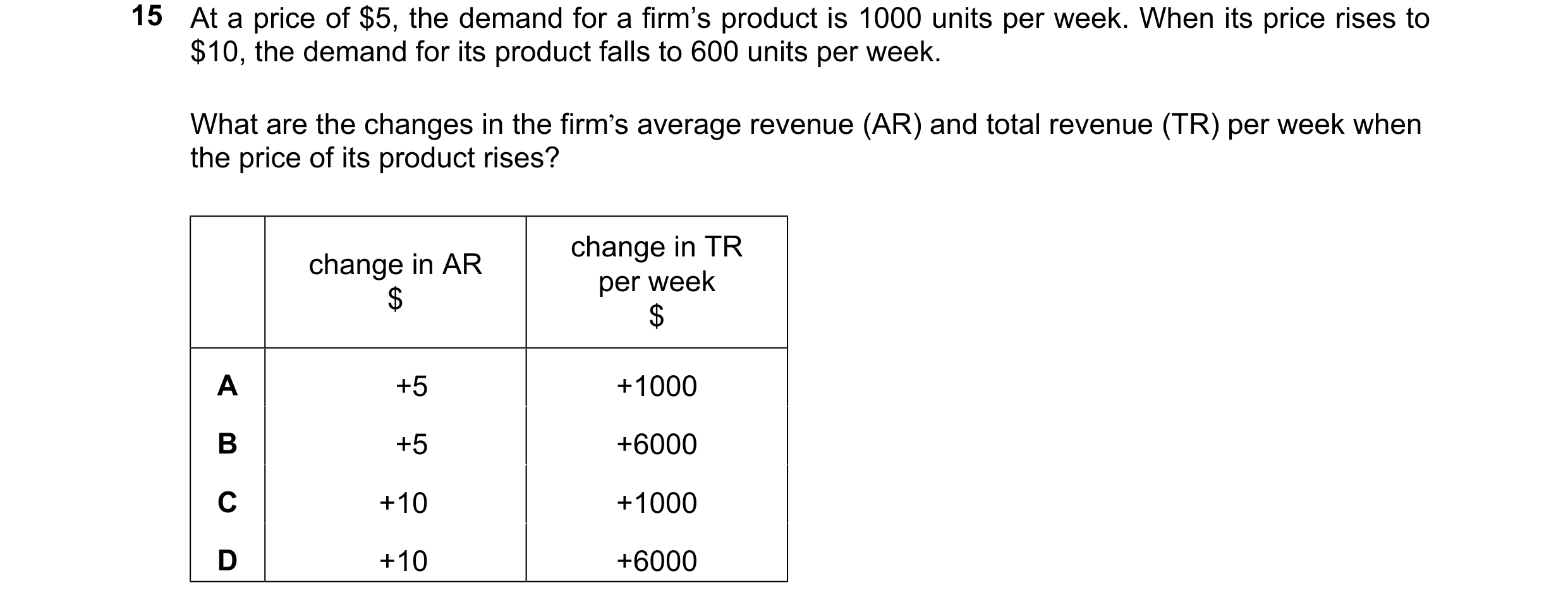
 55 / 64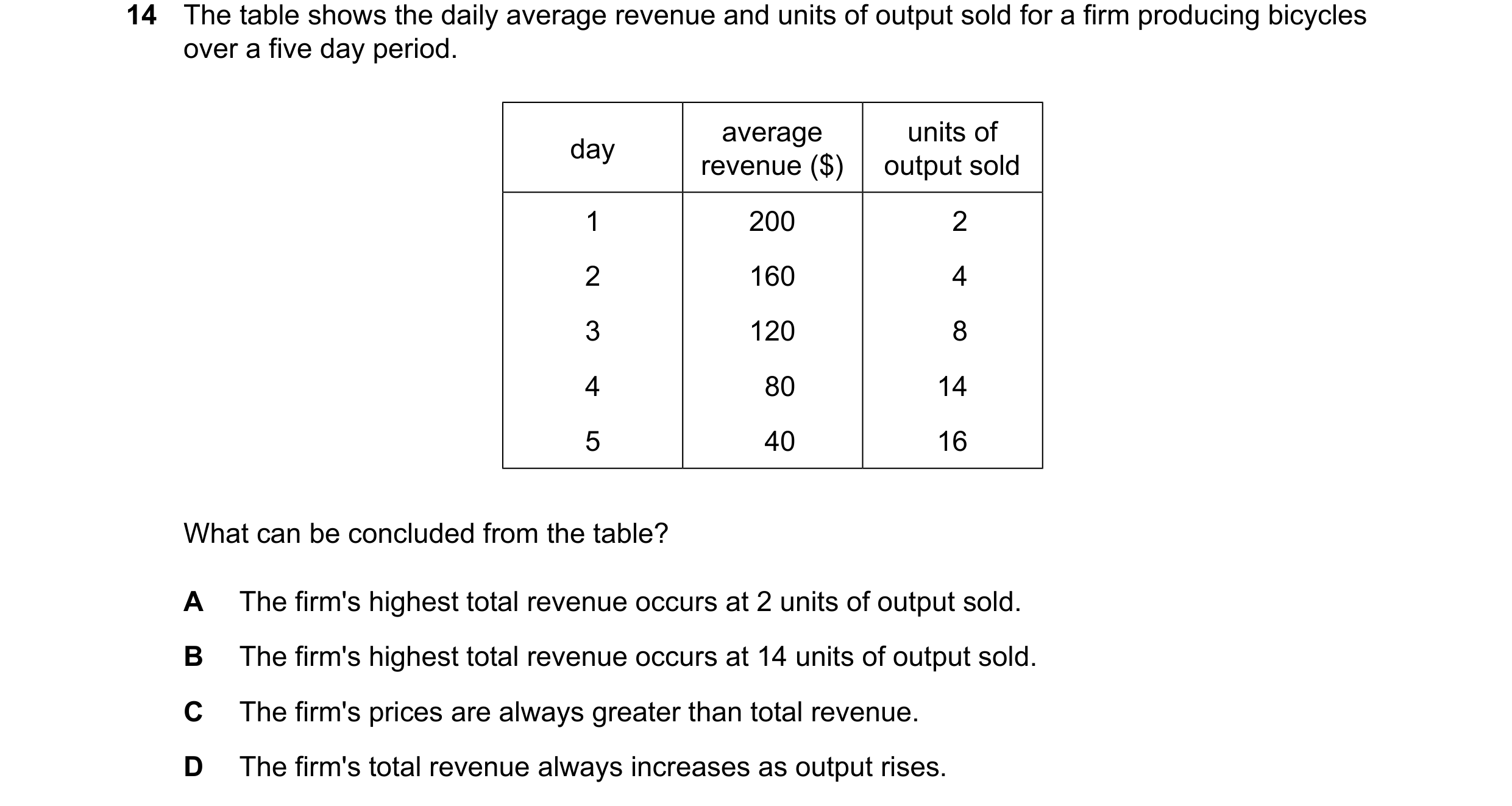
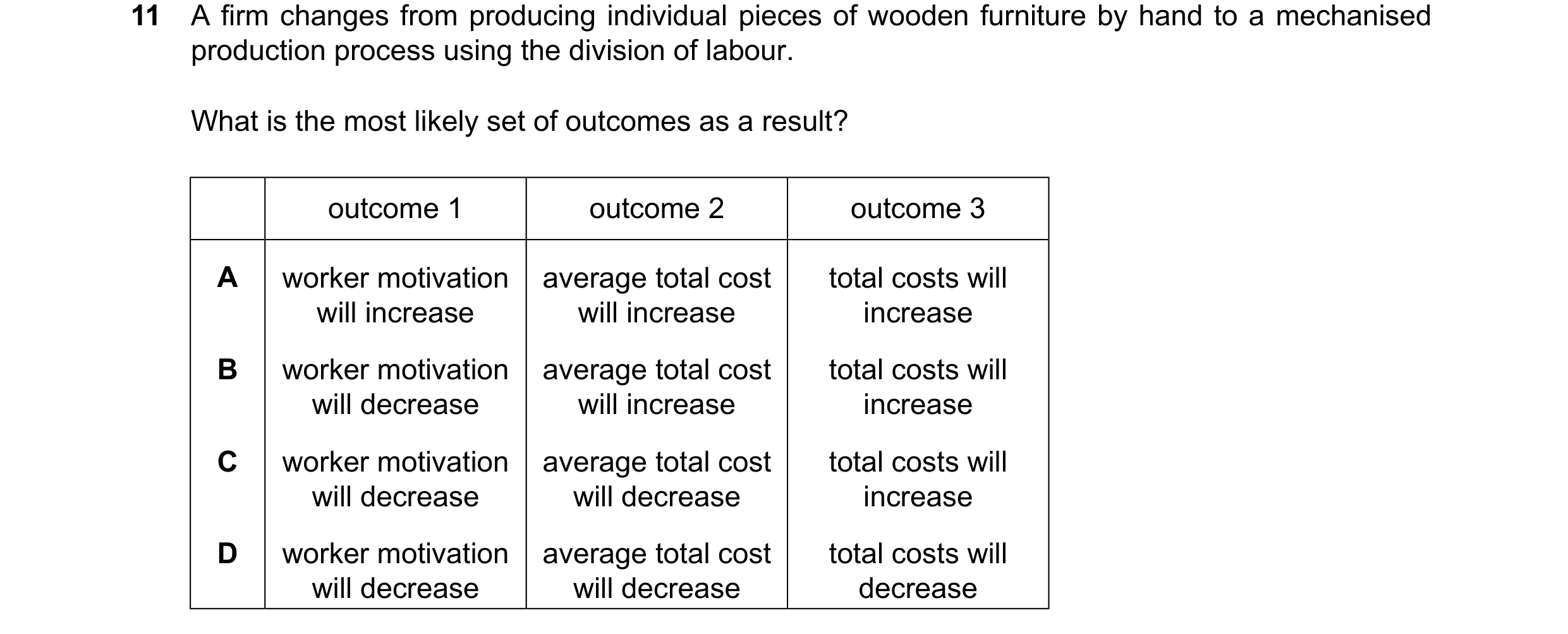
 56 / 64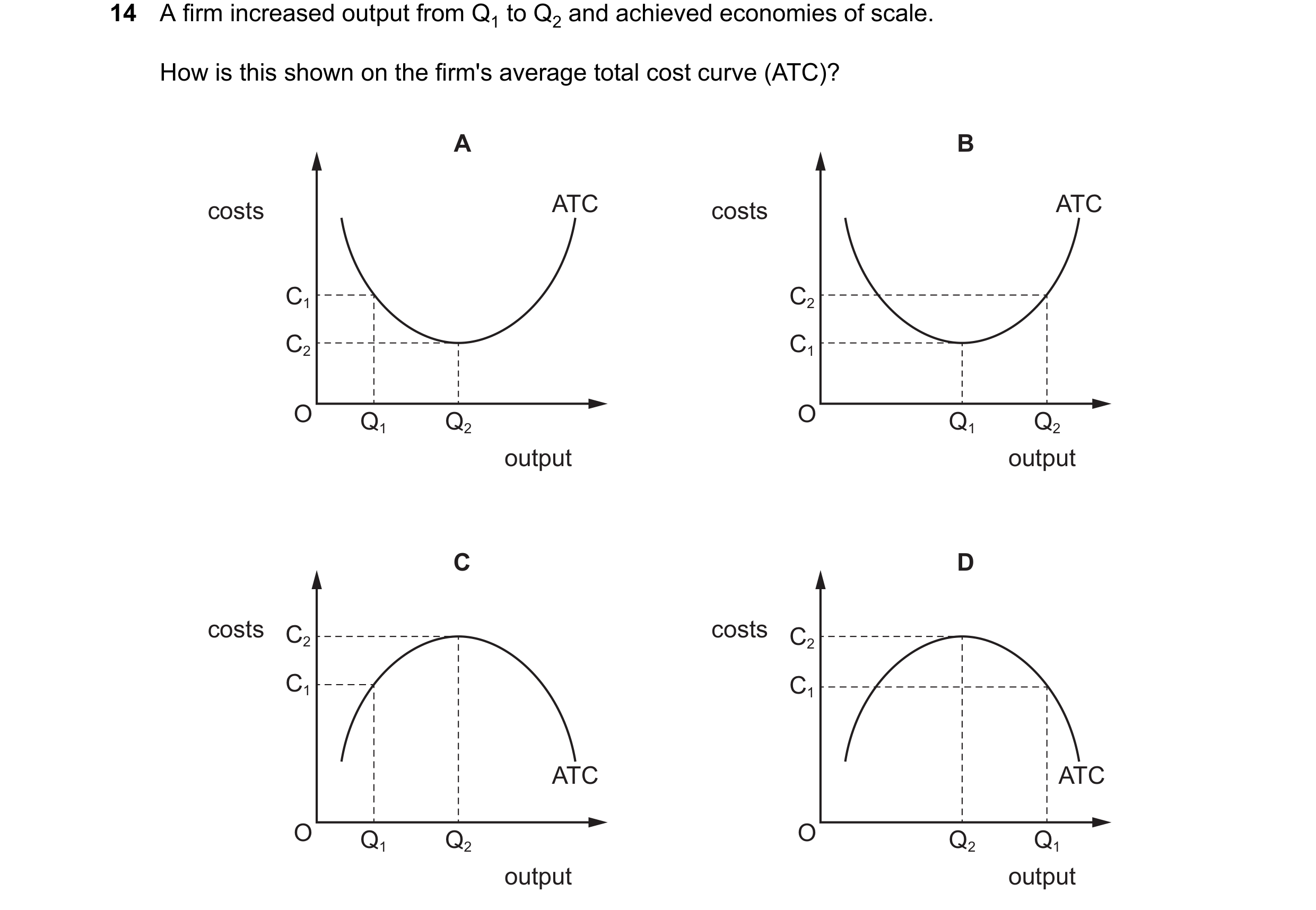


 57 / 64

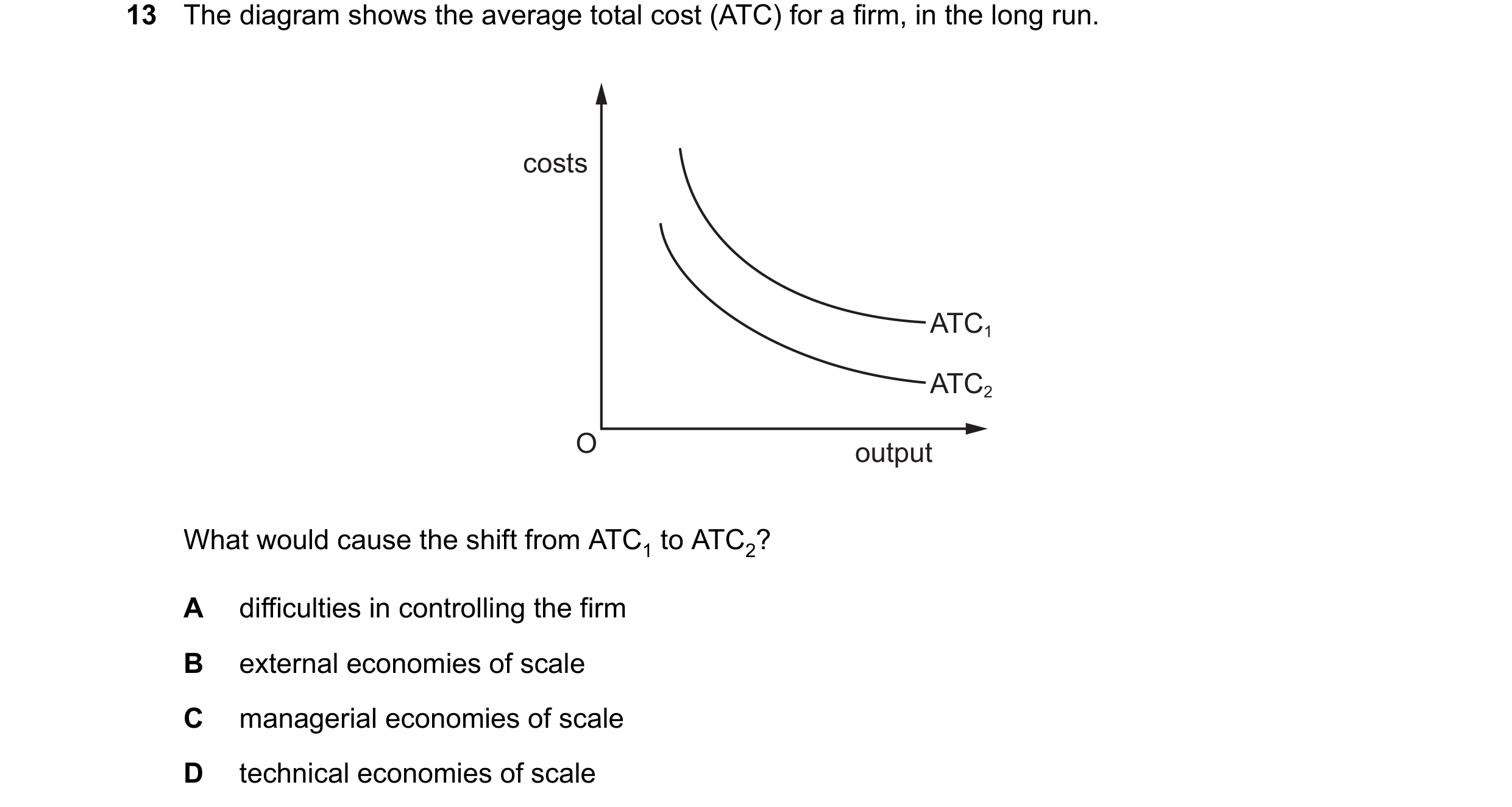
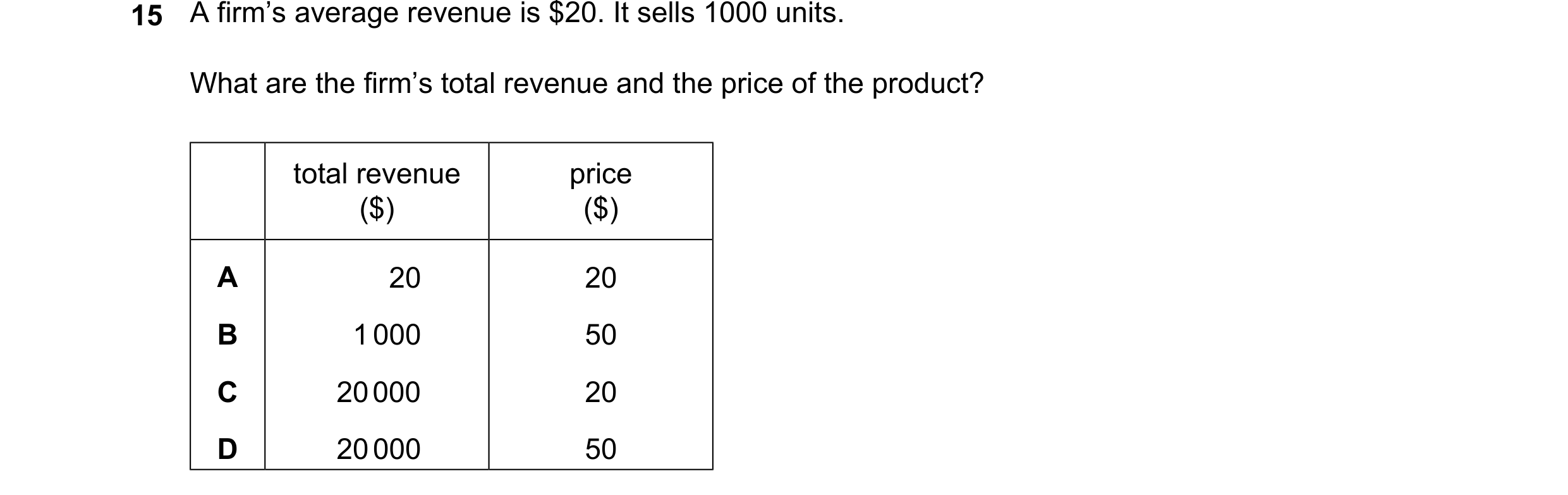 58 / 64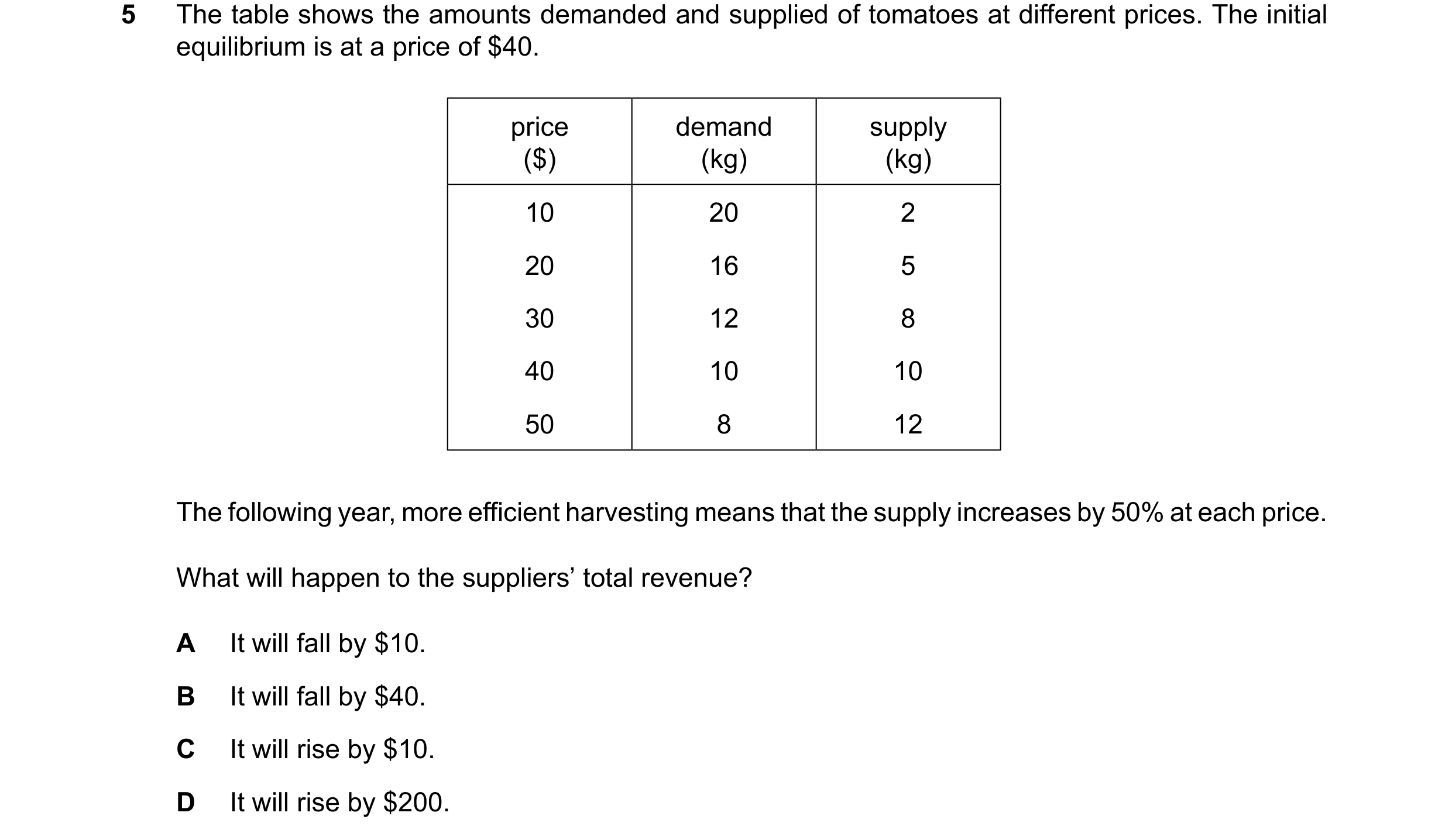

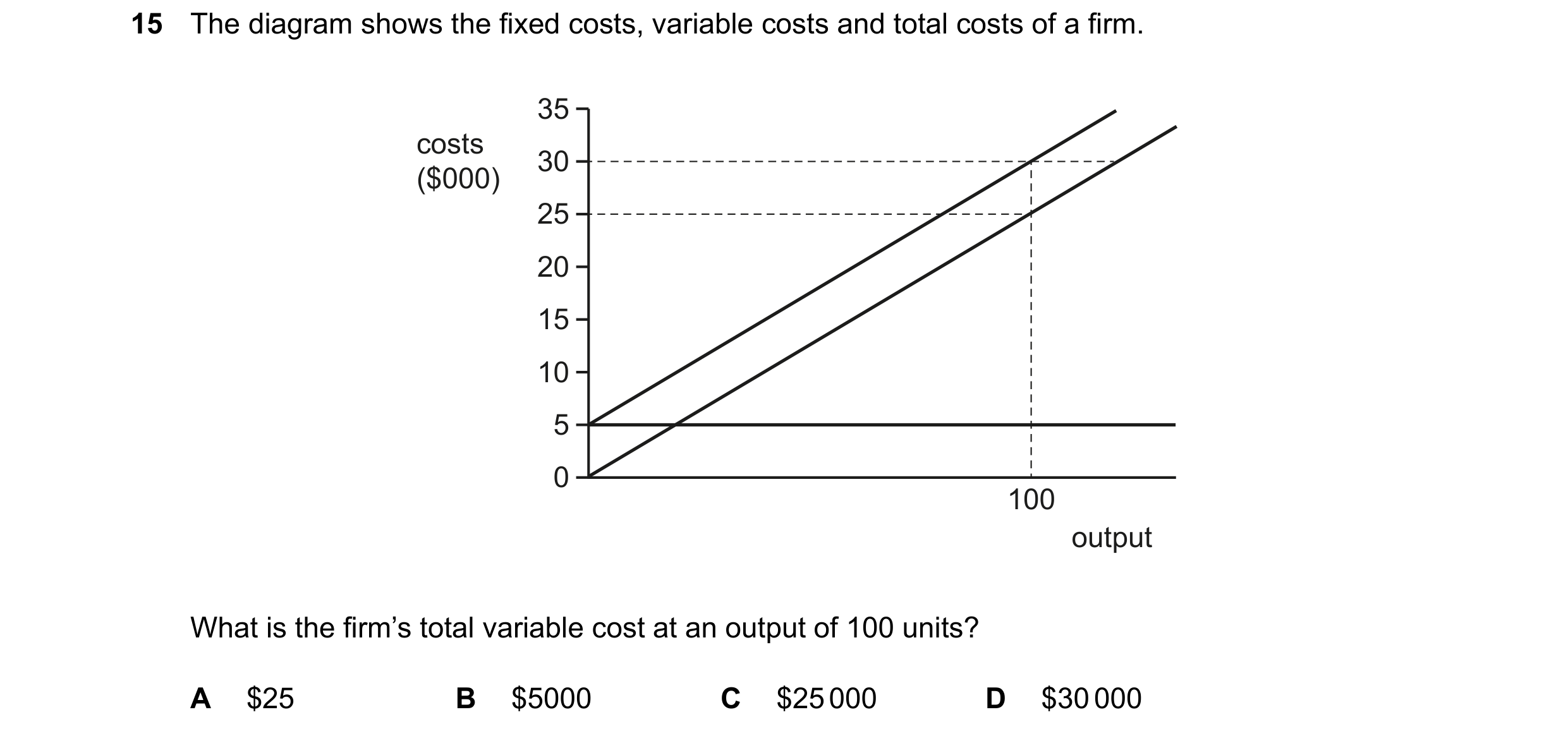 59 / 64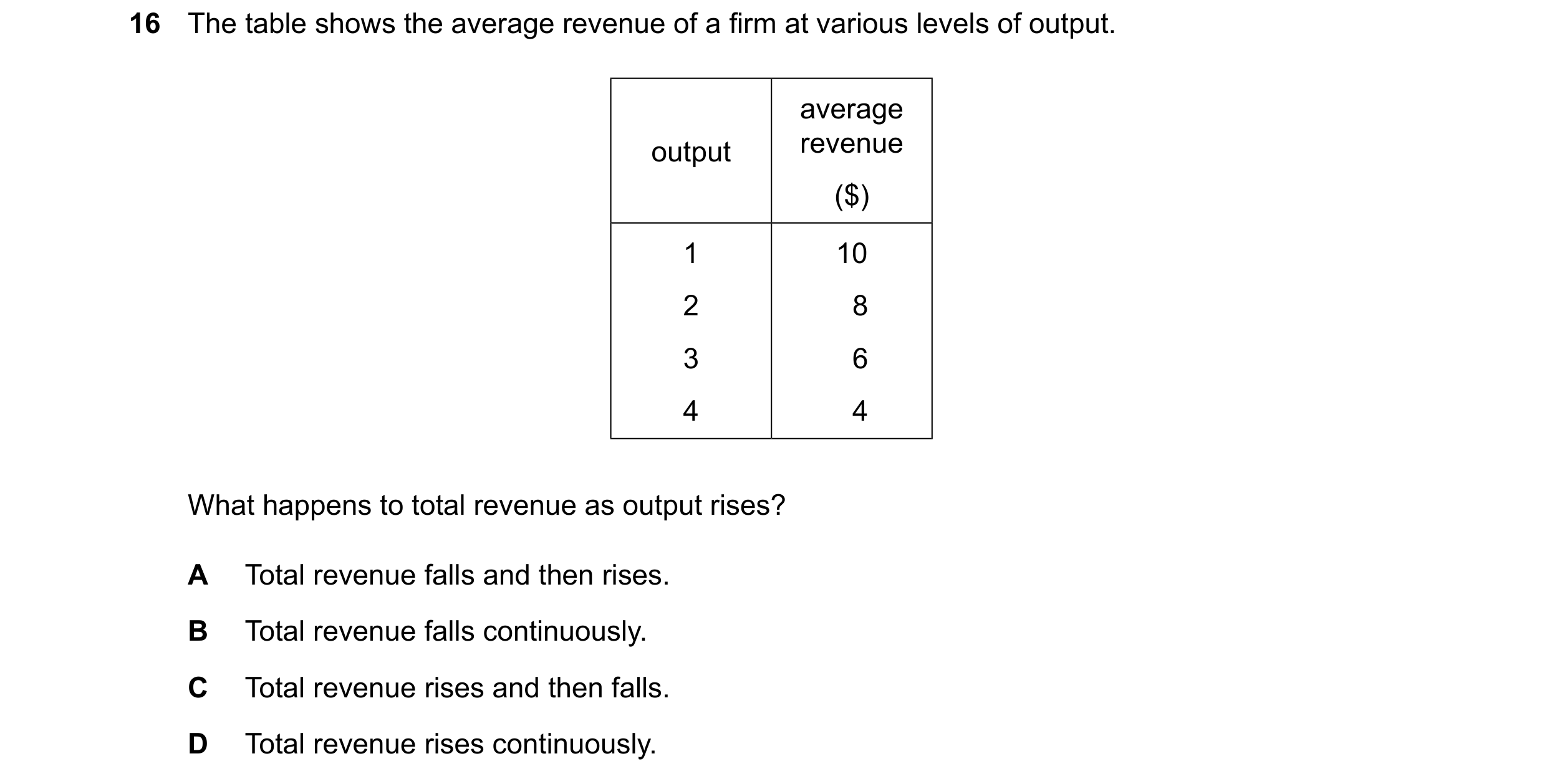
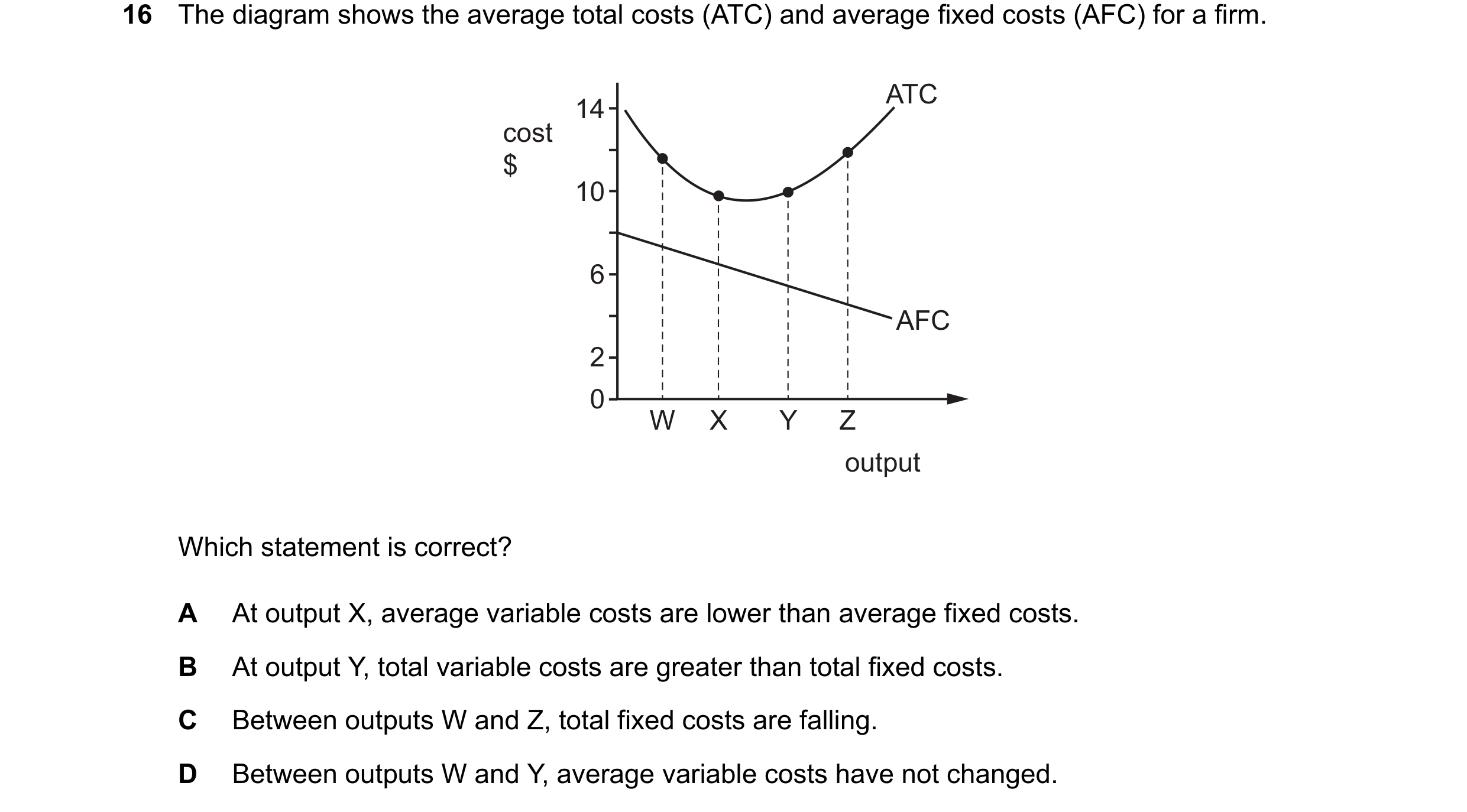 60 / 64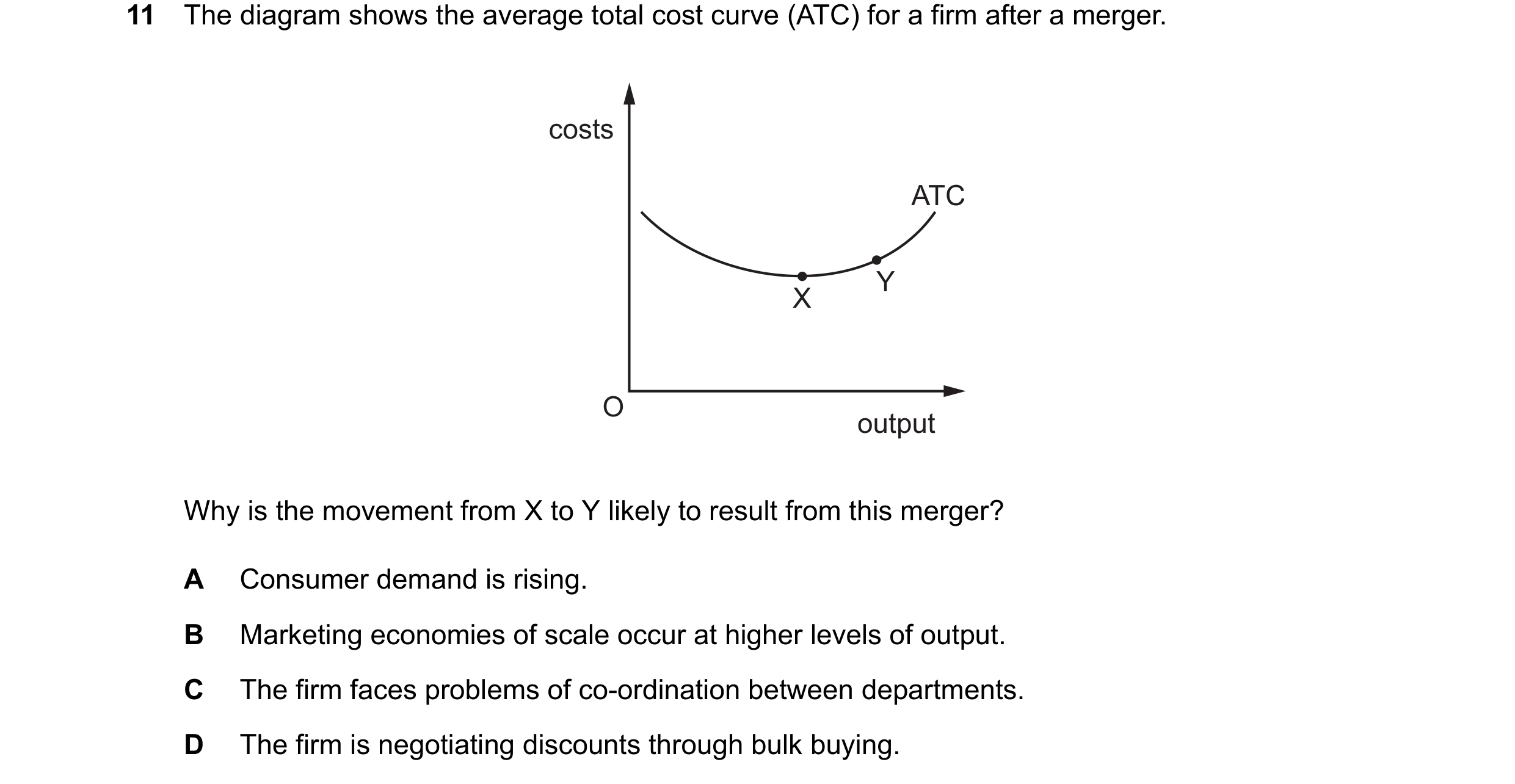

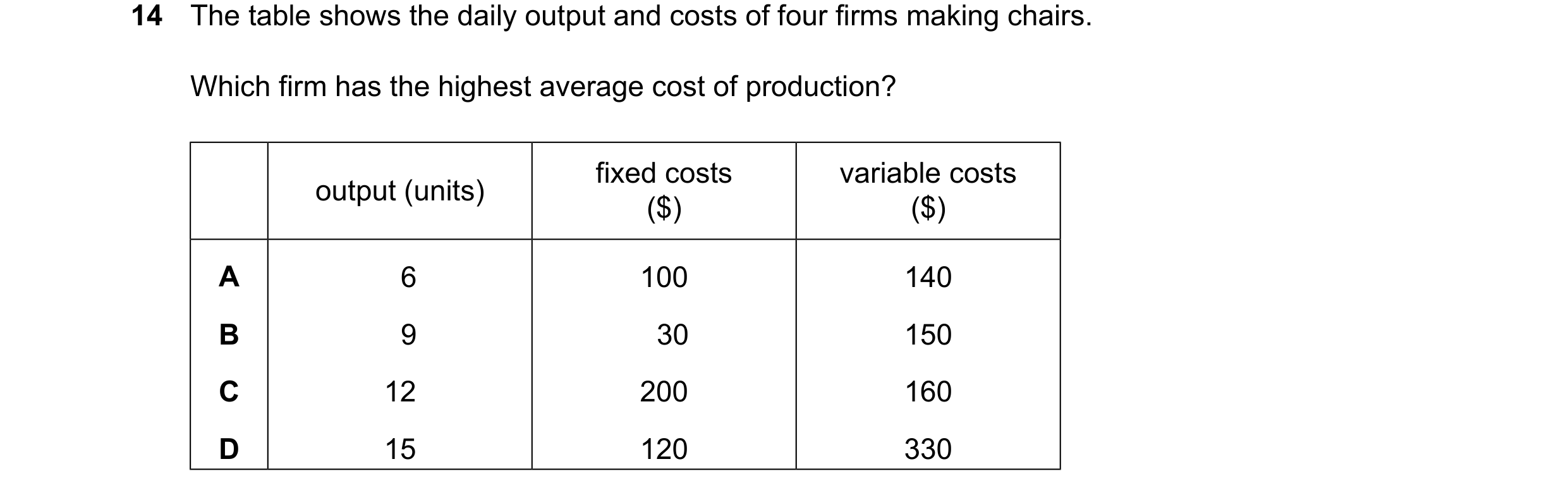
 61 / 64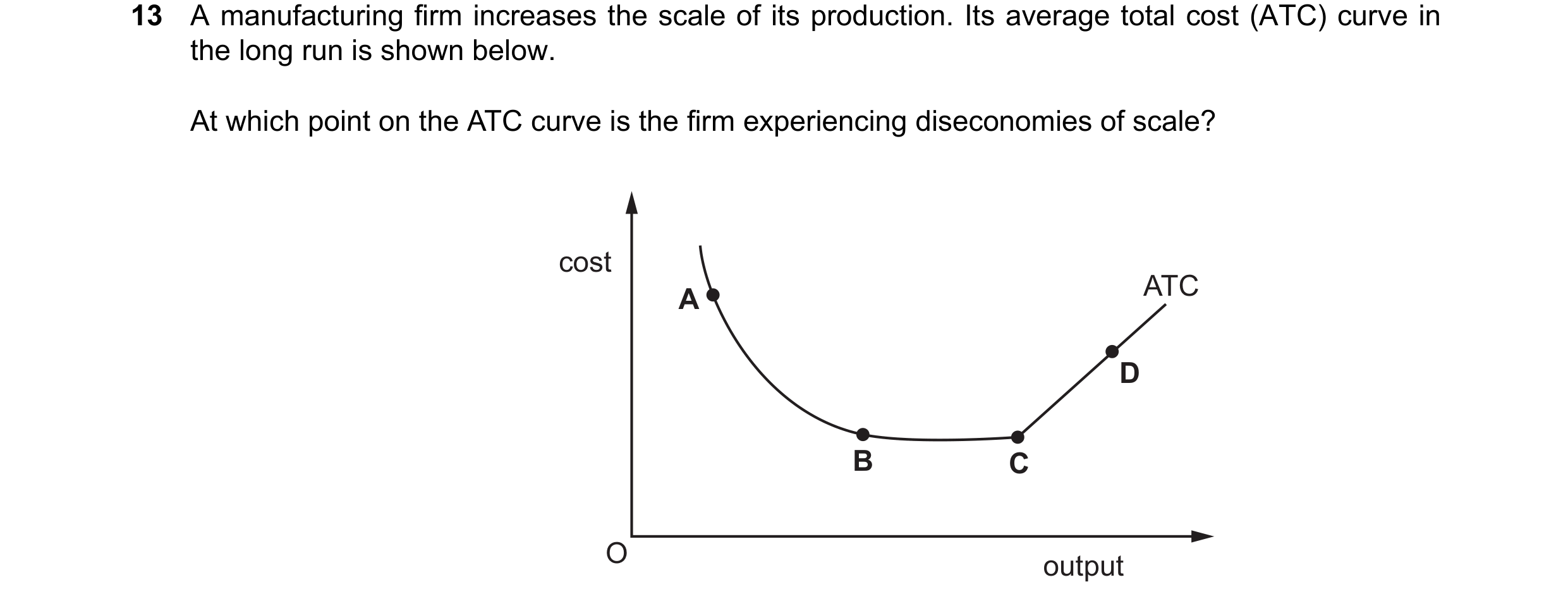
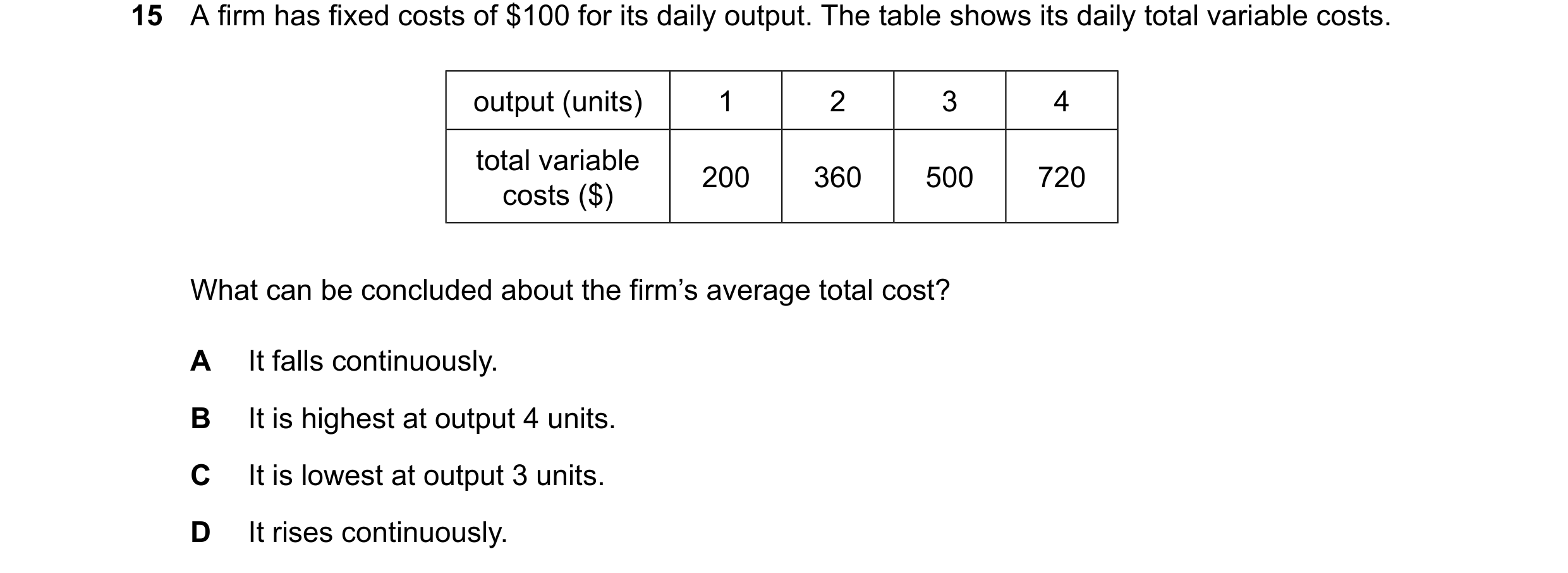
 62 / 64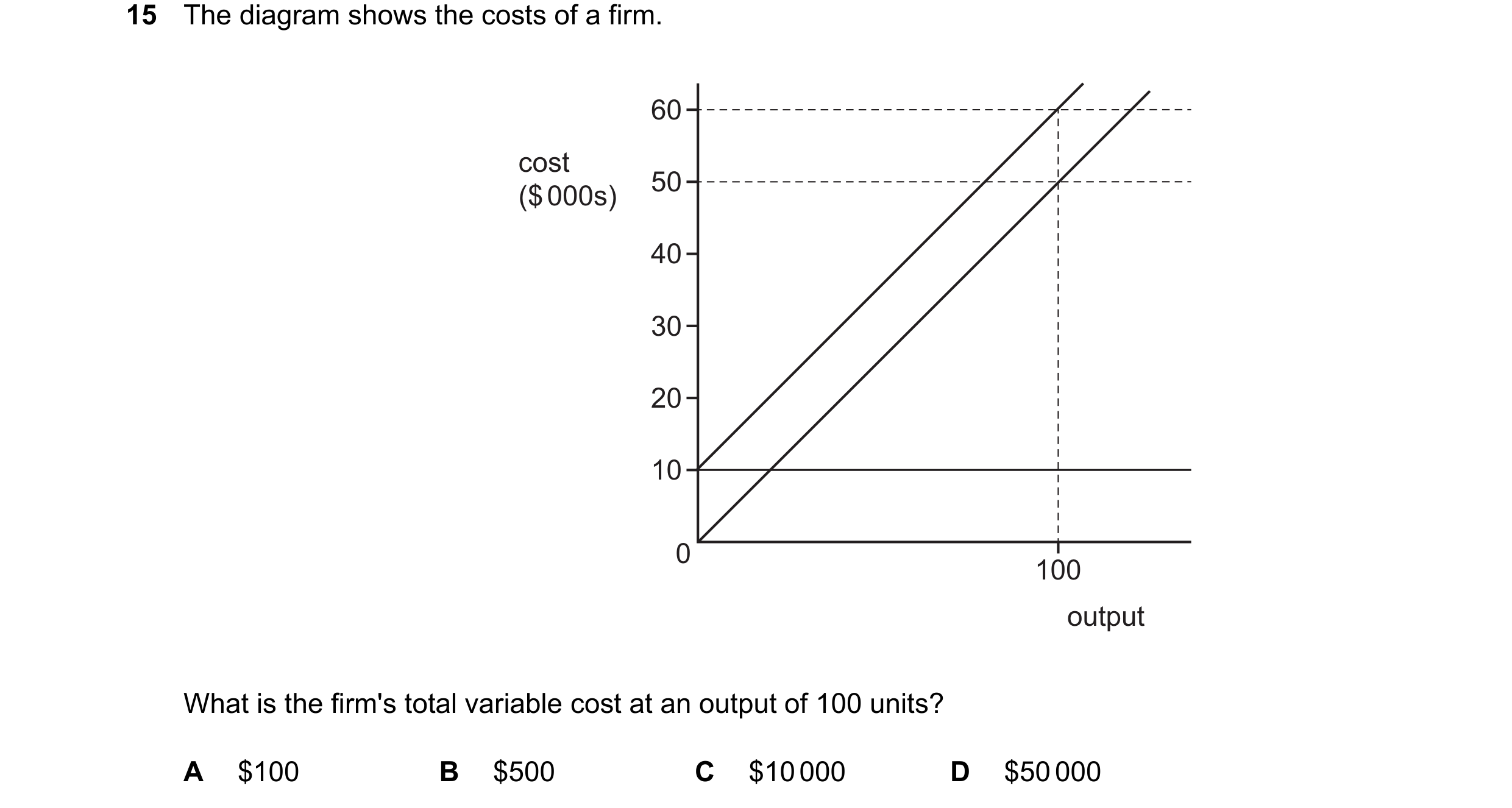

 63 / 64
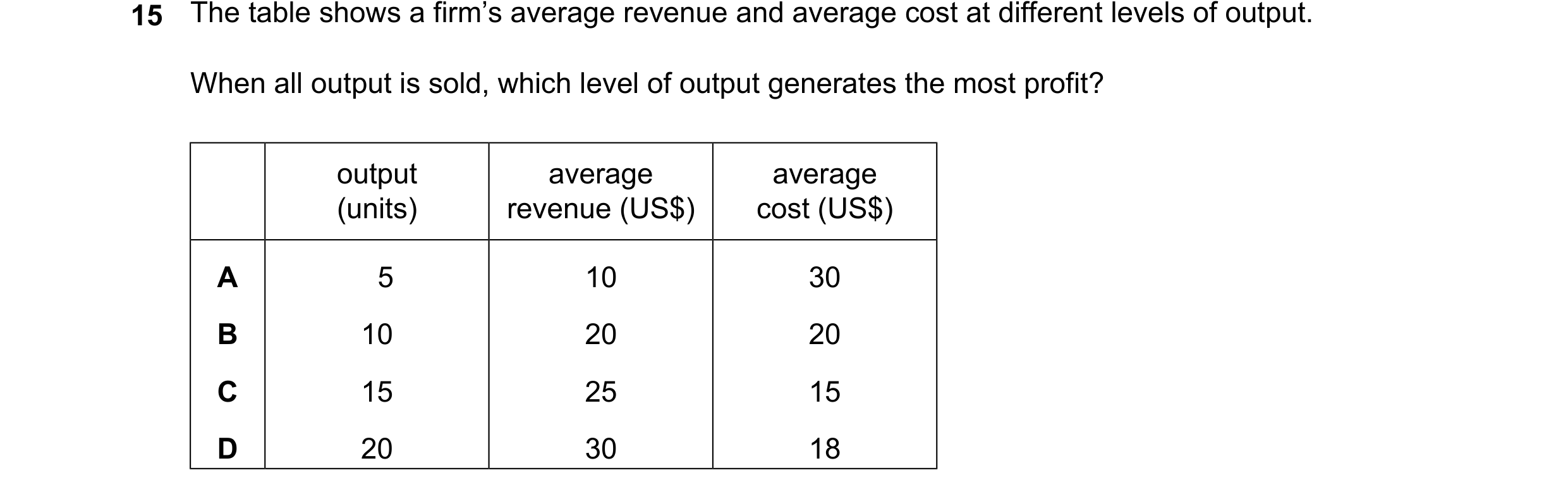 64 / 64