Cambridge IGCSE Economics 0455 — 2006 May/June Paper 1 · Variant 1
0455/11/M/J/06 · 40 questions · 40 marks · ≈45 min
The question paper and its mark scheme, free to read here and free to download. This is Cambridge’s own paper, exactly as it was sat.
Question paper12 pages
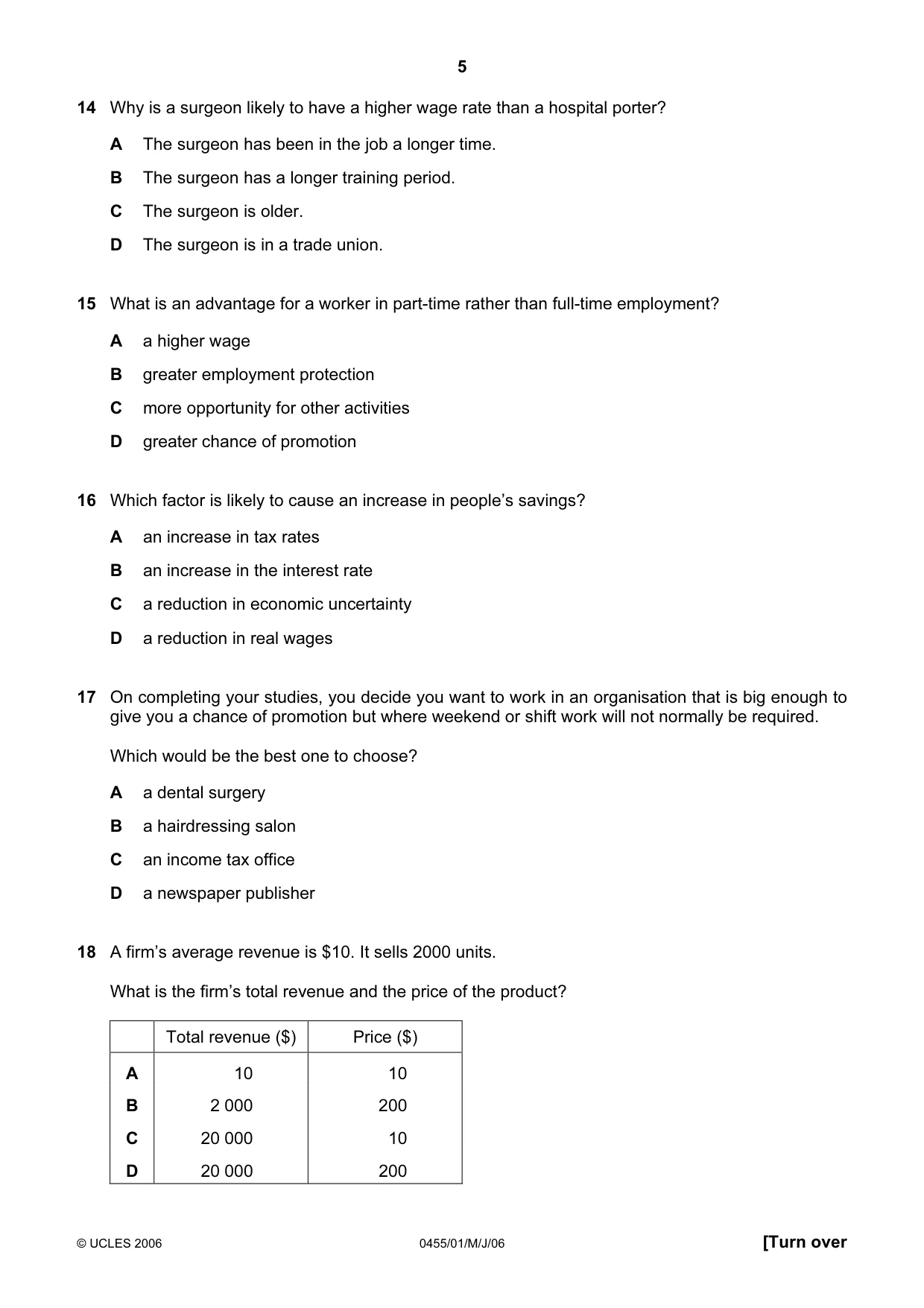
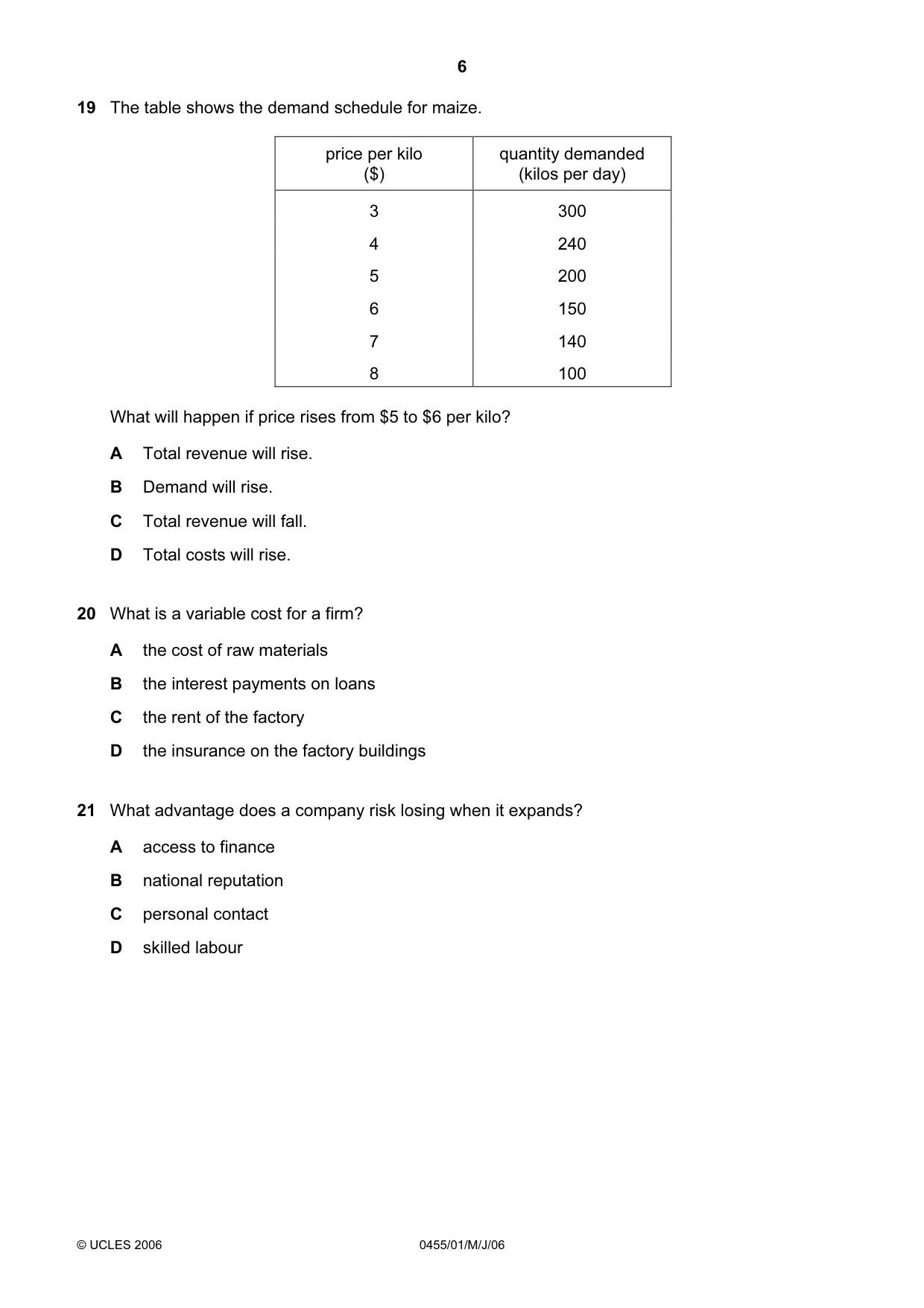
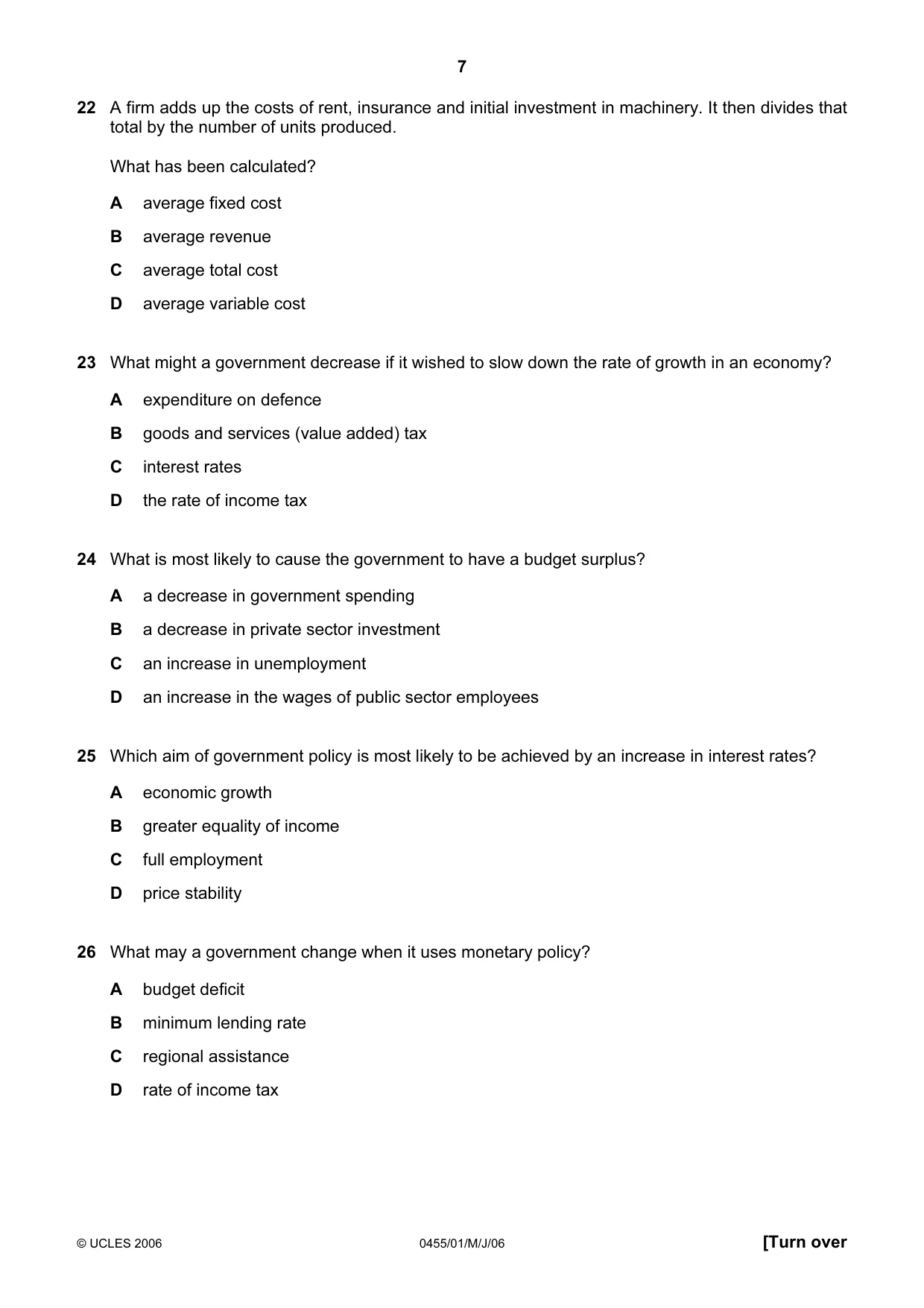
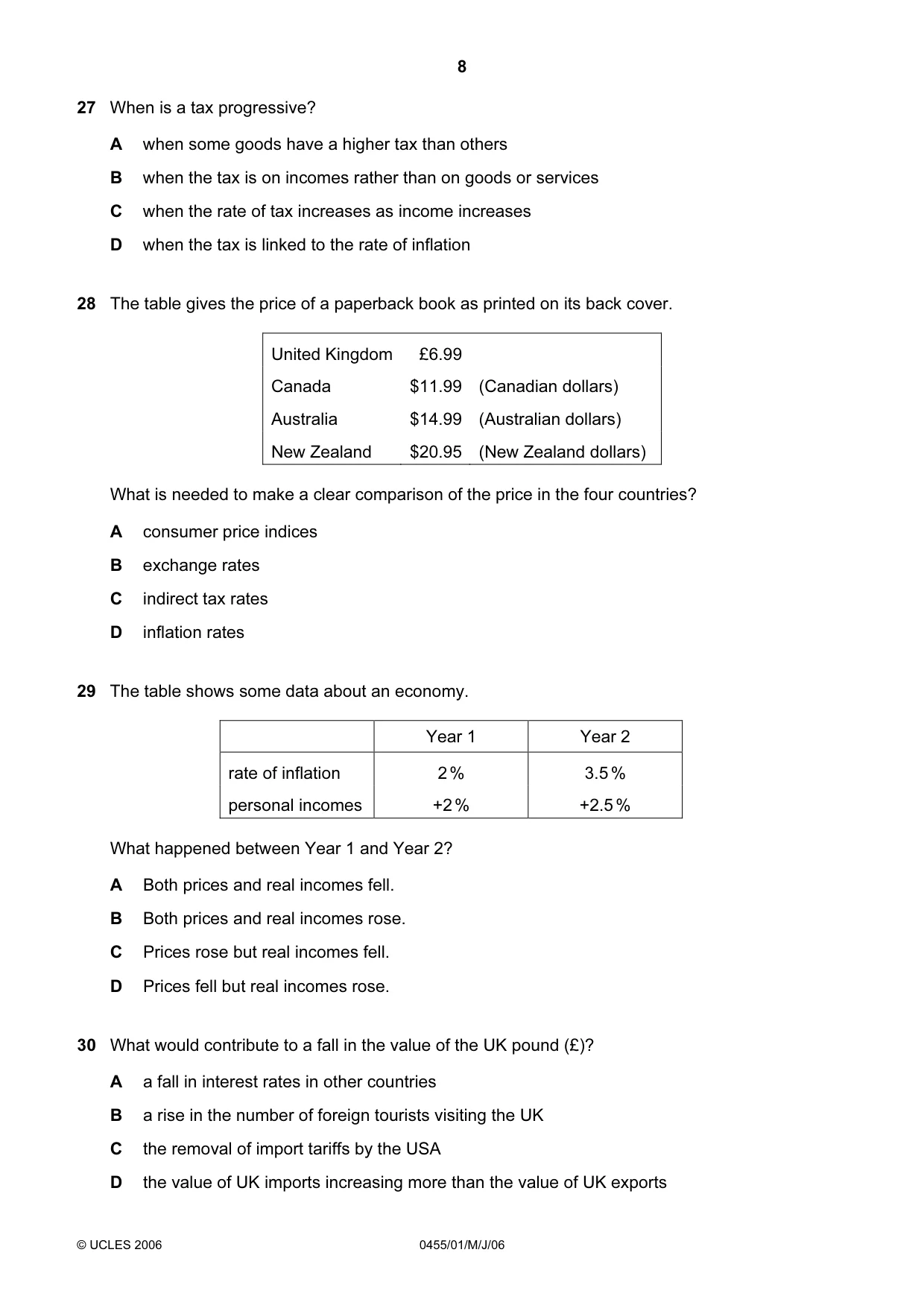
Mark scheme2 pages
Answers below. Sit the paper first if you are practising.
Questions as text
Q1 · Construction companies are building new houses on land previously used for farming
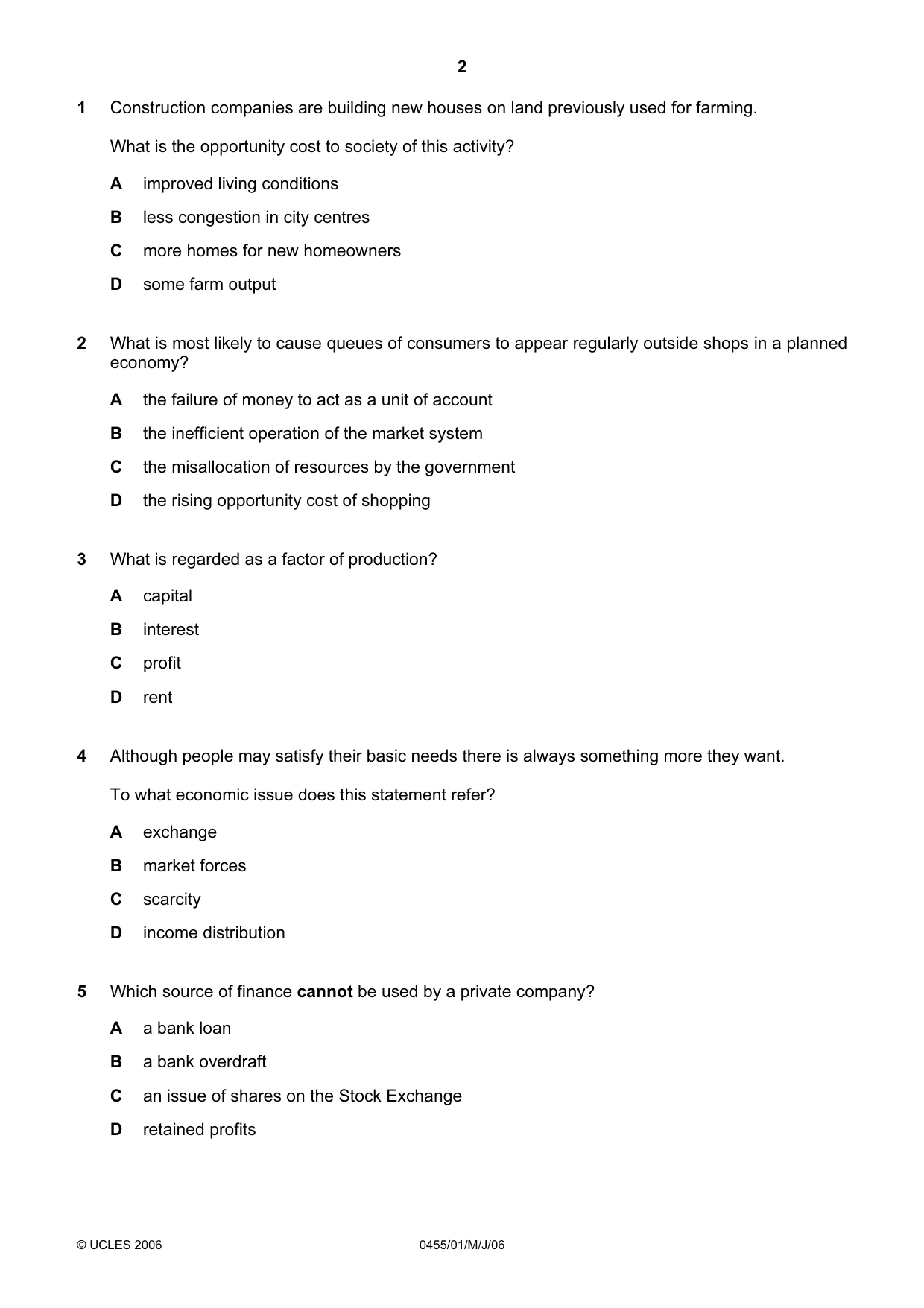
1 Construction companies are building new houses on land previously used for farming. What is the opportunity cost to society of this activity? A improved living conditions B less congestion in city centres C more homes for new homeowners D some farm output
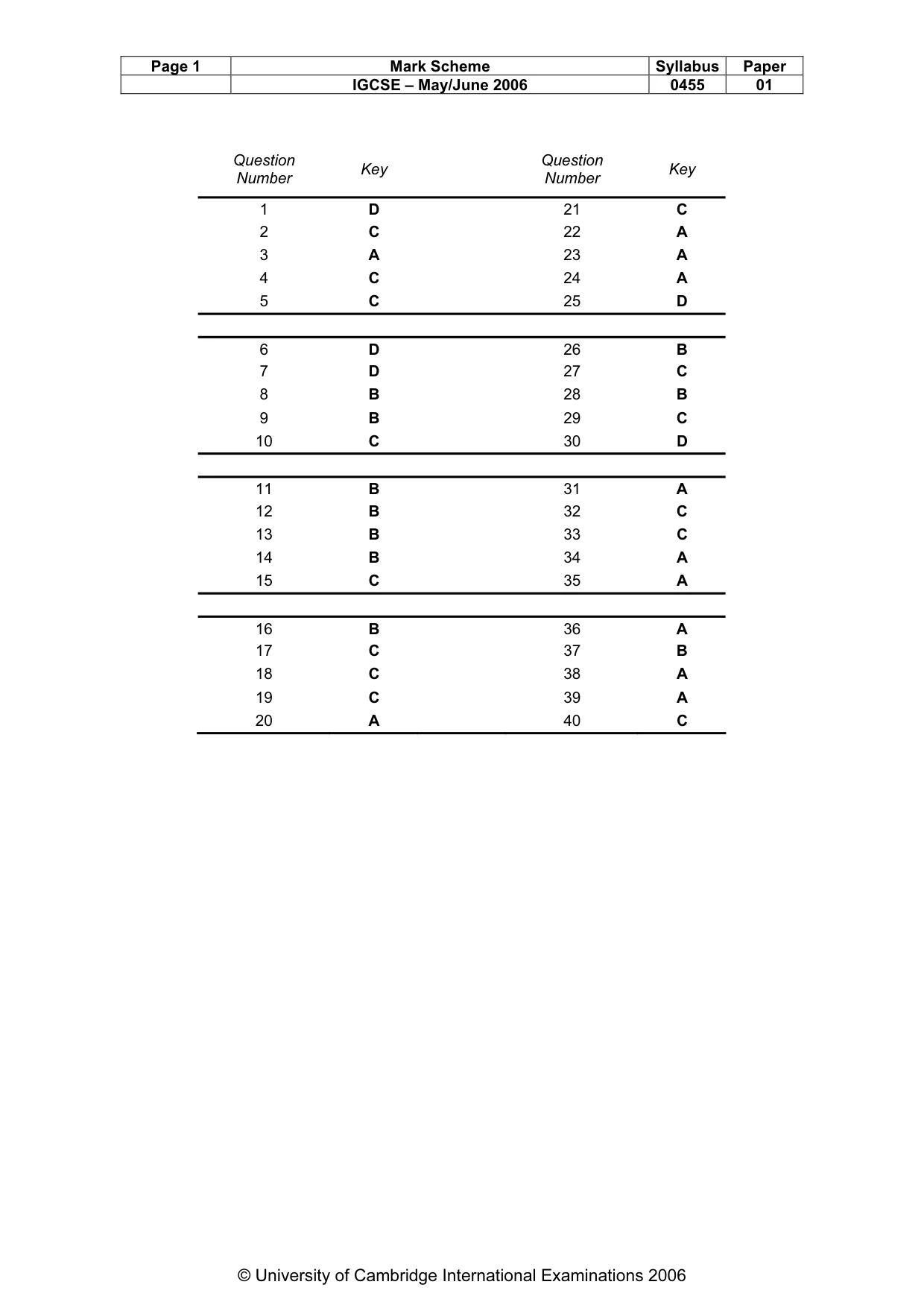
Mark scheme: D
Q2 · What is most likely to cause queues of consumers to appear regularly outside shops in a…
2 What is most likely to cause queues of consumers to appear regularly outside shops in a planned economy? A the failure of money to act as a unit of account B the inefficient operation of the market system C the misallocation of resources by the government D the rising opportunity cost of shopping
Mark scheme: C
Q3 · What is regarded as a factor of production?
3 What is regarded as a factor of production? A capital B interest C profit D rent
Mark scheme: A
Q4 · Although people may satisfy their basic needs there is always something more they want
4 Although people may satisfy their basic needs there is always something more they want. To what economic issue does this statement refer? A exchange B market forces C scarcity D income distribution
Mark scheme: C
Q5 · Which source of finance cannot be used by a private company?
5 Which source of finance cannot be used by a private company? A a bank loan B a bank overdraft C an issue of shares on the Stock Exchange D retained profits
Mark scheme: C
Q6 · What best describes a multi-national company?
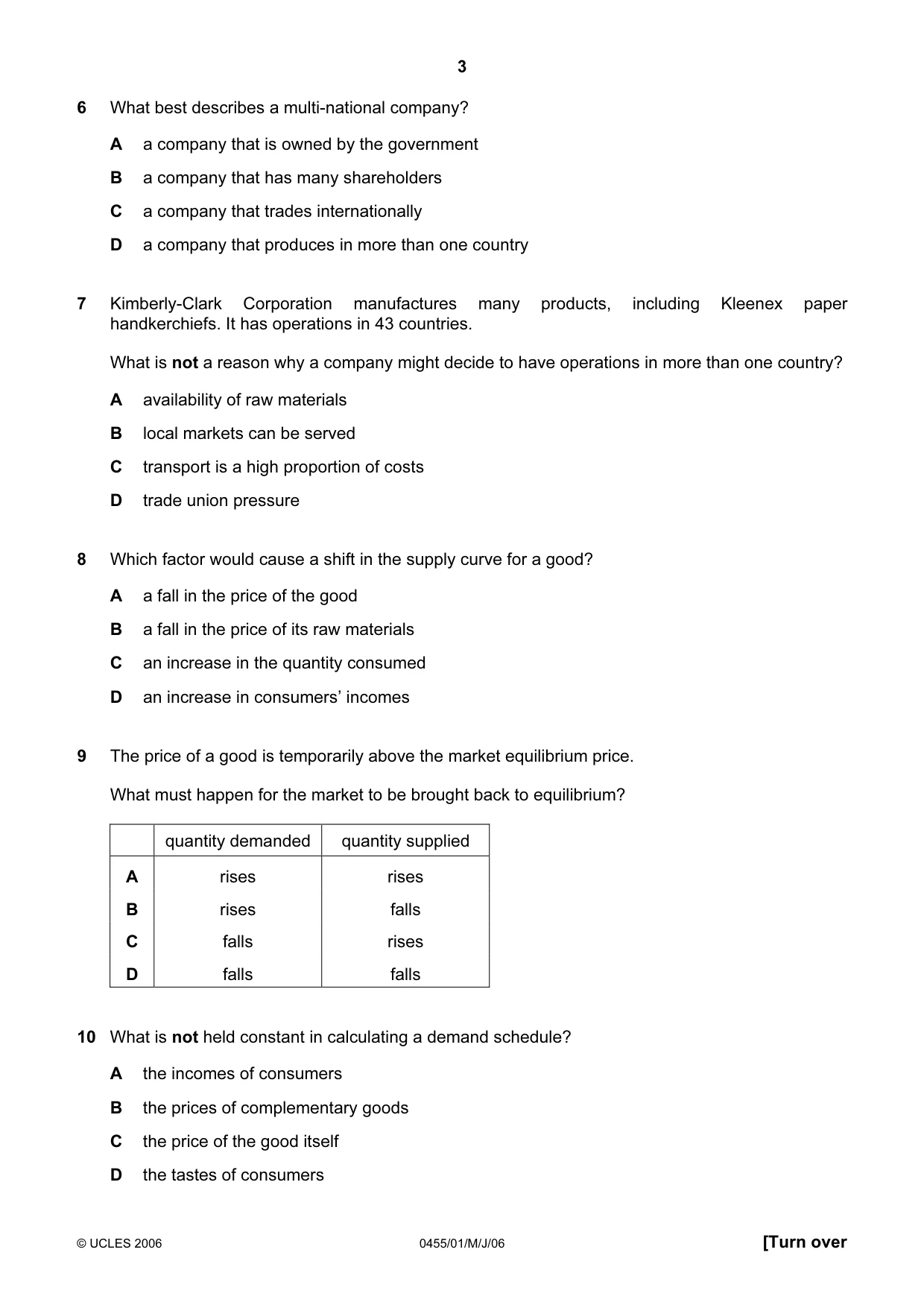
6 What best describes a multi-national company? A a company that is owned by the government B a company that has many shareholders C a company that trades internationally D a company that produces in more than one country
Mark scheme: D
Q7 · Kimberly-Clark Corporation manufactures many products, including Kleenex paper…
7 Kimberly-Clark Corporation manufactures many products, including Kleenex paper handkerchiefs. It has operations in 43 countries. What is not a reason why a company might decide to have operations in more than one country? A availability of raw materials B local markets can be served C transport is a high proportion of costs D trade union pressure
Mark scheme: D
Q8 · Which factor would cause a shift in the supply curve for a good?
8 Which factor would cause a shift in the supply curve for a good? A a fall in the price of the good B a fall in the price of its raw materials C an increase in the quantity consumed D an increase in consumers’ incomes
Mark scheme: B
Q9 · The price of a good is temporarily above the market equilibrium price
9 The price of a good is temporarily above the market equilibrium price. What must happen for the market to be brought back to equilibrium? quantity demanded quantity supplied A rises rises B rises falls C falls rises D falls falls
Mark scheme: B
Q10 · What is not held constant in calculating a demand schedule?
10 What is not held constant in calculating a demand schedule? A the incomes of consumers B the prices of complementary goods C the price of the good itself D the tastes of consumers
Mark scheme: C
Q11 · The diagram shows the supply and demand curves for a good
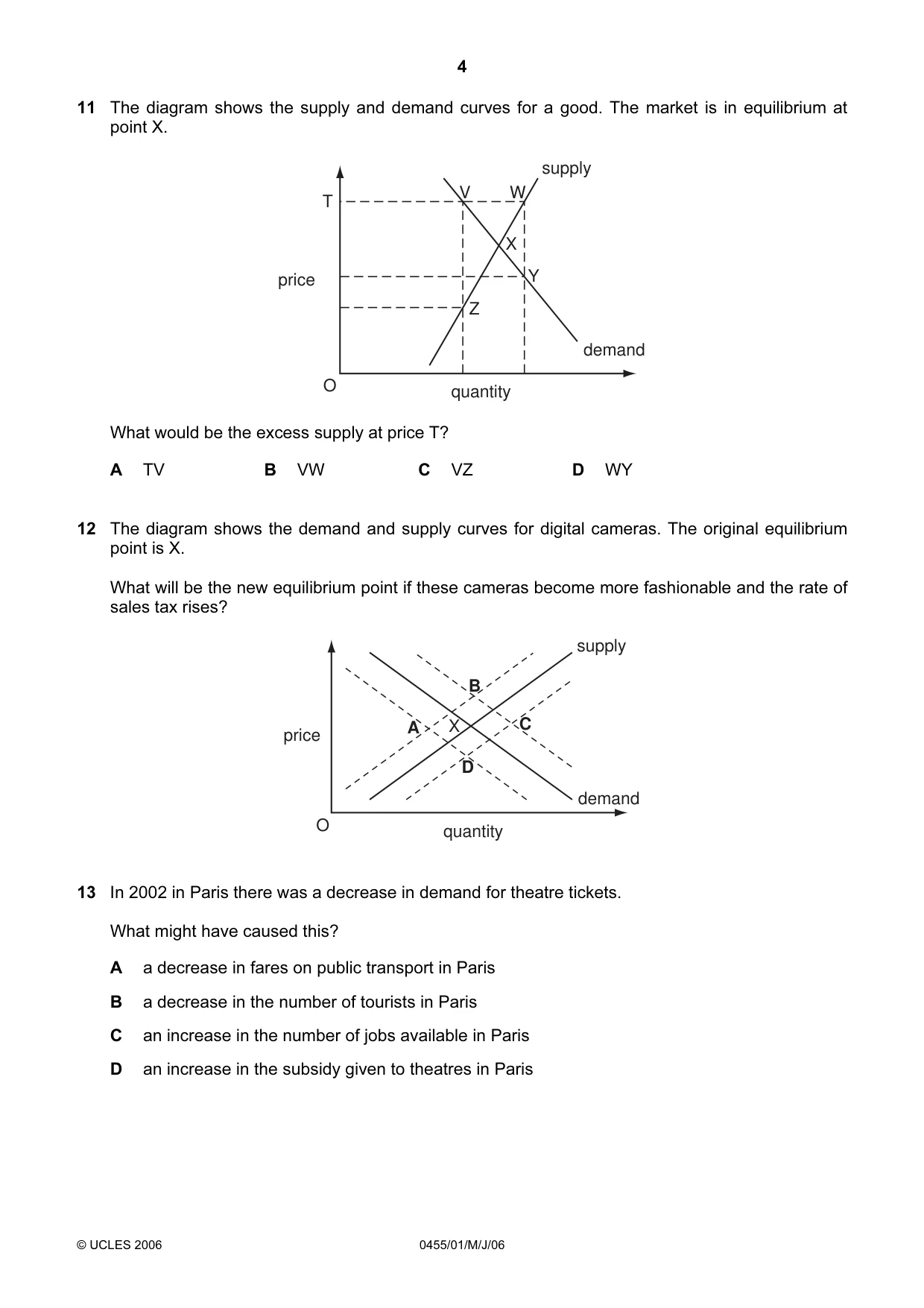
11 The diagram shows the supply and demand curves for a good. The market is in equilibrium at point X. supply V W T X price Y Z demand O quantity What would be the excess supply at price T? A TV B VW C VZ D WY
Mark scheme: B
Q12 · The diagram shows the demand and supply curves for digital cameras
12 The diagram shows the demand and supply curves for digital cameras. The original equilibrium point is X. What will be the new equilibrium point if these cameras become more fashionable and the rate of sales tax rises? supply B A X C price D demand O quantity
Mark scheme: B
Q13 · In 2002 in Paris there was a decrease in demand for theatre tickets
13 In 2002 in Paris there was a decrease in demand for theatre tickets. What might have caused this? A a decrease in fares on public transport in Paris B a decrease in the number of tourists in Paris C an increase in the number of jobs available in Paris D an increase in the subsidy given to theatres in Paris
Mark scheme: B
Q14 · Why is a surgeon likely to have a higher wage rate than a hospital porter?
14 Why is a surgeon likely to have a higher wage rate than a hospital porter? A The surgeon has been in the job a longer time. B The surgeon has a longer training period. C The surgeon is older. D The surgeon is in a trade union.
Mark scheme: B
Q15 · What is an advantage for a worker in part-time rather than full-time employment?
15 What is an advantage for a worker in part-time rather than full-time employment? A a higher wage B greater employment protection C more opportunity for other activities D greater chance of promotion
Mark scheme: C
Q16 · Which factor is likely to cause an increase in people’s savings?
16 Which factor is likely to cause an increase in people’s savings? A an increase in tax rates B an increase in the interest rate C a reduction in economic uncertainty D a reduction in real wages
Mark scheme: B
Q17 · On completing your studies, you decide you want to work in an organisation that is big…
17 On completing your studies, you decide you want to work in an organisation that is big enough to give you a chance of promotion but where weekend or shift work will not normally be required. Which would be the best one to choose? A a dental surgery B a hairdressing salon C an income tax office D a newspaper publisher
Mark scheme: C
Q18 · A firm’s average revenue is $10
18 A firm’s average revenue is $10. It sells 2000 units. What is the firm’s total revenue and the price of the product? Total revenue ($) Price ($) A 10 10 B 2 000 200 C 20 000 10 D 20 000 200
Mark scheme: C
Q19 · The table shows the demand schedule for maize
19 The table shows the demand schedule for maize. price per kilo quantity demanded ($) (kilos per day) 3 300 4 240 5 200 6 150 7 140 8 100 What will happen if price rises from $5 to $6 per kilo? A Total revenue will rise. B Demand will rise. C Total revenue will fall. D Total costs will rise.
Mark scheme: C
Q20 · What is a variable cost for a firm?
20 What is a variable cost for a firm? A the cost of raw materials B the interest payments on loans C the rent of the factory D the insurance on the factory buildings
Mark scheme: A
Q21 · What advantage does a company risk losing when it expands?
21 What advantage does a company risk losing when it expands? A access to finance B national reputation C personal contact D skilled labour
Mark scheme: C
Q22 · A firm adds up the costs of rent, insurance and initial investment in machinery
22 A firm adds up the costs of rent, insurance and initial investment in machinery. It then divides that total by the number of units produced. What has been calculated? A average fixed cost B average revenue C average total cost D average variable cost
Mark scheme: A
Q23 · What might a government decrease if it wished to slow down the rate of growth in an…
23 What might a government decrease if it wished to slow down the rate of growth in an economy? A expenditure on defence B goods and services (value added) tax C interest rates D the rate of income tax
Mark scheme: A
Q24 · What is most likely to cause the government to have a budget surplus?
24 What is most likely to cause the government to have a budget surplus? A a decrease in government spending B a decrease in private sector investment C an increase in unemployment D an increase in the wages of public sector employees
Mark scheme: A
Q25 · Which aim of government policy is most likely to be achieved by an increase in interest…
25 Which aim of government policy is most likely to be achieved by an increase in interest rates? A economic growth B greater equality of income C full employment D price stability
Mark scheme: D
Q26 · What may a government change when it uses monetary policy?
26 What may a government change when it uses monetary policy? A budget deficit B minimum lending rate C regional assistance D rate of income tax
Mark scheme: B
Q27 · When is a tax progressive?
27 When is a tax progressive? A when some goods have a higher tax than others B when the tax is on incomes rather than on goods or services C when the rate of tax increases as income increases D when the tax is linked to the rate of inflation
Mark scheme: C
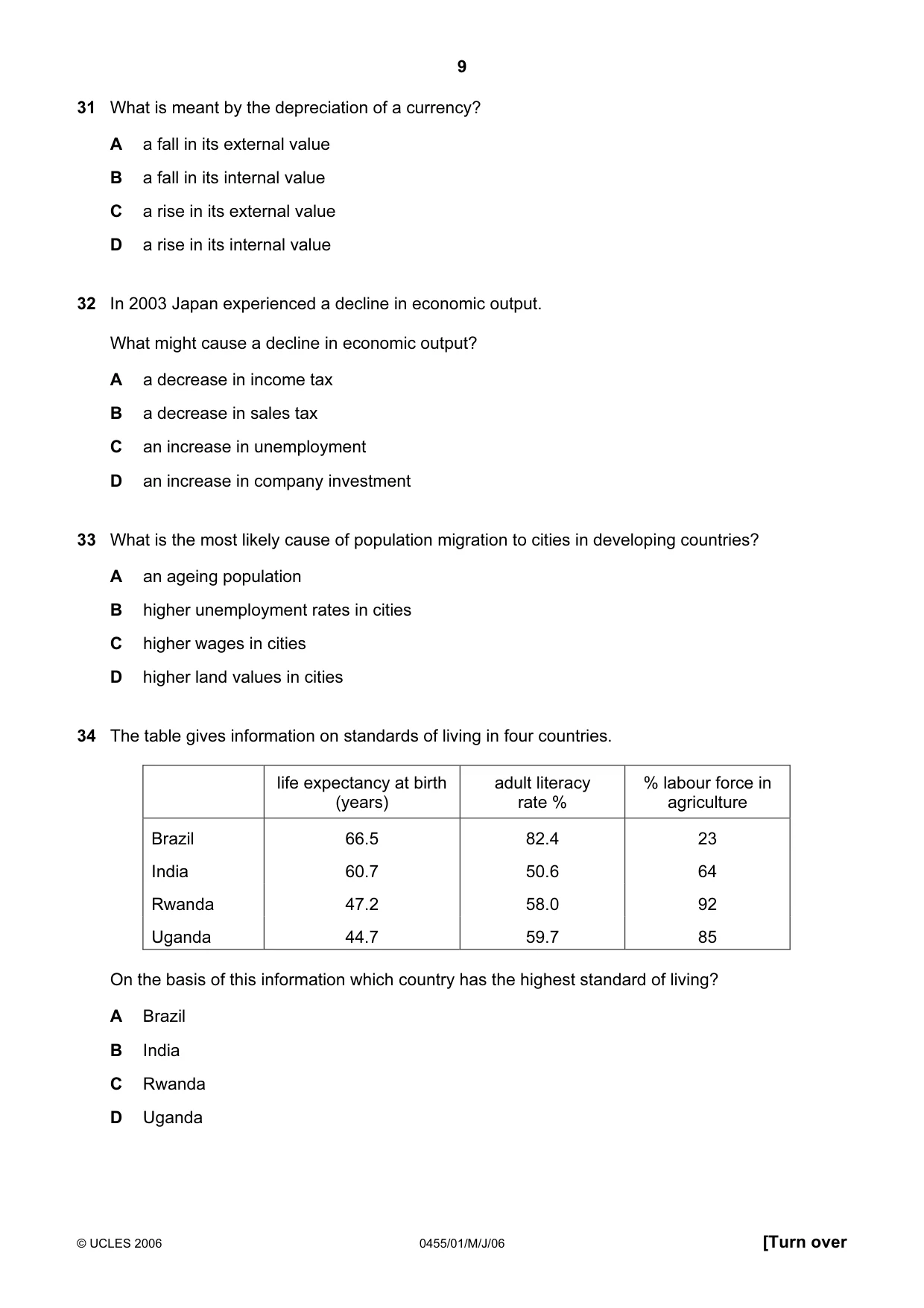
Q28 · The table gives the price of a paperback book as printed on its back cover
28 The table gives the price of a paperback book as printed on its back cover. United Kingdom £6.99 Canada $11.99 (Canadian dollars) Australia $14.99 (Australian dollars) New Zealand $20.95 (New Zealand dollars) What is needed to make a clear comparison of the price in the four countries? A consumer price indices B exchange rates C indirect tax rates D inflation rates
Mark scheme: B
Q29 · The table shows some data about an economy
29 The table shows some data about an economy. Year 1 Year 2 rate of inflation 2 % 3.5 % personal incomes +2 % +2.5 % What happened between Year 1 and Year 2? A Both prices and real incomes fell. B Both prices and real incomes rose. C Prices rose but real incomes fell. D Prices fell but real incomes rose.
Mark scheme: C
Q30 · What would contribute to a fall in the value of the UK pound (£)?
30 What would contribute to a fall in the value of the UK pound (£)? A a fall in interest rates in other countries B a rise in the number of foreign tourists visiting the UK C the removal of import tariffs by the USA D the value of UK imports increasing more than the value of UK exports
Mark scheme: D
Q31 · What is meant by the depreciation of a currency?
31 What is meant by the depreciation of a currency? A a fall in its external value B a fall in its internal value C a rise in its external value D a rise in its internal value
Mark scheme: A
Q32 · In 2003 Japan experienced a decline in economic output
32 In 2003 Japan experienced a decline in economic output. What might cause a decline in economic output? A a decrease in income tax B a decrease in sales tax C an increase in unemployment D an increase in company investment
Mark scheme: C
Q33 · What is the most likely cause of population migration to cities in developing countries?
33 What is the most likely cause of population migration to cities in developing countries? A an ageing population B higher unemployment rates in cities C higher wages in cities D higher land values in cities
Mark scheme: C
Q34 · The table gives information on standards of living in four countries
34 The table gives information on standards of living in four countries. life expectancy at birth adult literacy % labour force in (years) rate % agriculture Brazil 66.5 82.4 23 India 60.7 50.6 64 Rwanda 47.2 58.0 92 Uganda 44.7 59.7 85 On the basis of this information which country has the highest standard of living? A Brazil B India C Rwanda D Uganda
Mark scheme: A
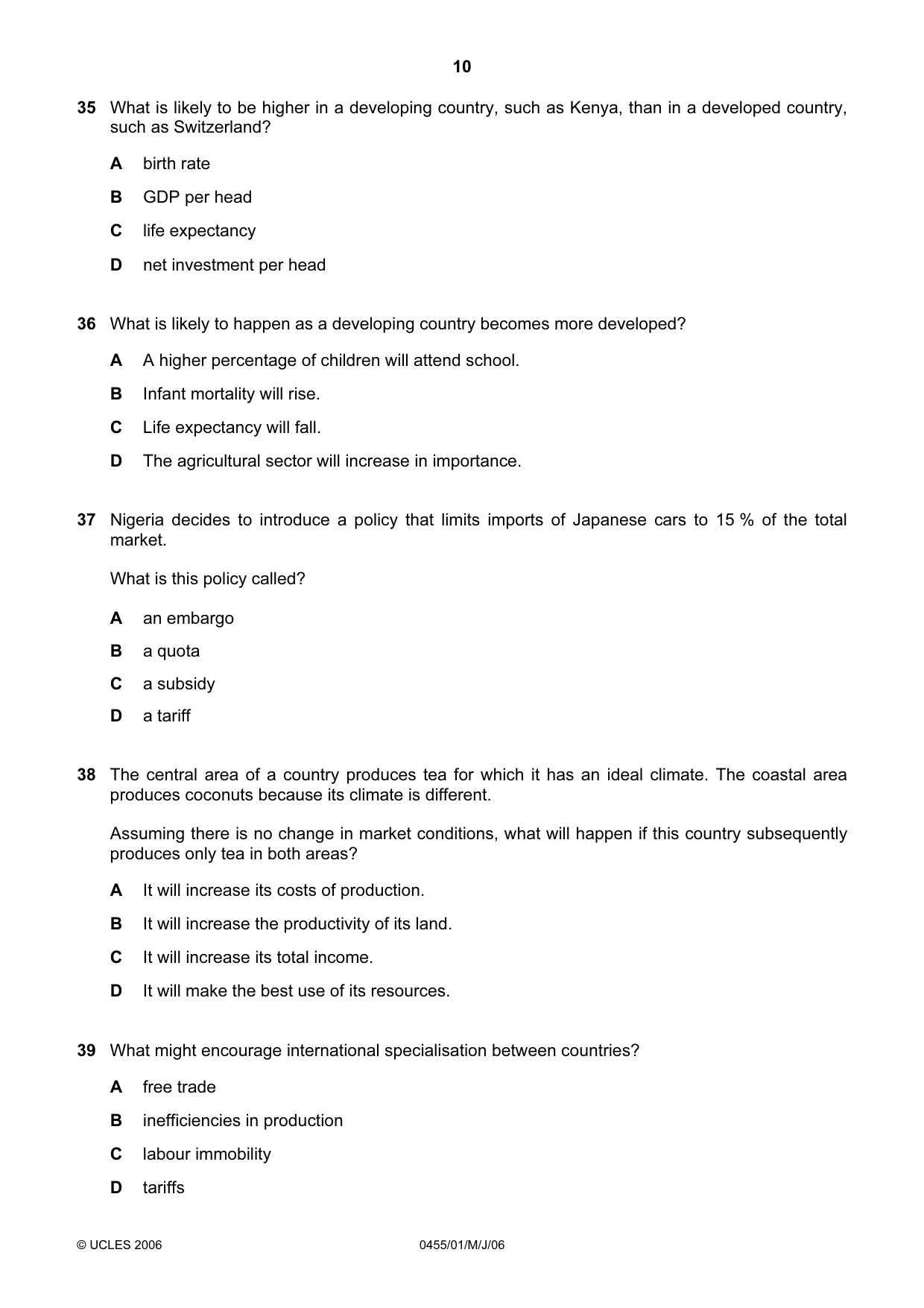
Q35 · What is likely to be higher in a developing country, such as Kenya, than in a developed…
35 What is likely to be higher in a developing country, such as Kenya, than in a developed country, such as Switzerland? A birth rate B GDP per head C life expectancy D net investment per head
Mark scheme: A
More questions on Differences in economic development between countries
Q36 · What is likely to happen as a developing country becomes more developed?
36 What is likely to happen as a developing country becomes more developed? A A higher percentage of children will attend school. B Infant mortality will rise. C Life expectancy will fall. D The agricultural sector will increase in importance.
Mark scheme: A
More questions on Differences in economic development between countries
Q37 · Nigeria decides to introduce a policy that limits imports of Japanese cars to 15 % of the…
37 Nigeria decides to introduce a policy that limits imports of Japanese cars to 15 % of the total market. What is this policy called? A an embargo B a quota C a subsidy D a tariff
Mark scheme: B
Q38 · The central area of a country produces tea for which it has an ideal climate
38 The central area of a country produces tea for which it has an ideal climate. The coastal area produces coconuts because its climate is different. Assuming there is no change in market conditions, what will happen if this country subsequently produces only tea in both areas? A It will increase its costs of production. B It will increase the productivity of its land. C It will increase its total income. D It will make the best use of its resources.
Mark scheme: A
Q39 · What might encourage international specialisation between countries?
39 What might encourage international specialisation between countries? A free trade B inefficiencies in production C labour immobility D tariffs
Mark scheme: A
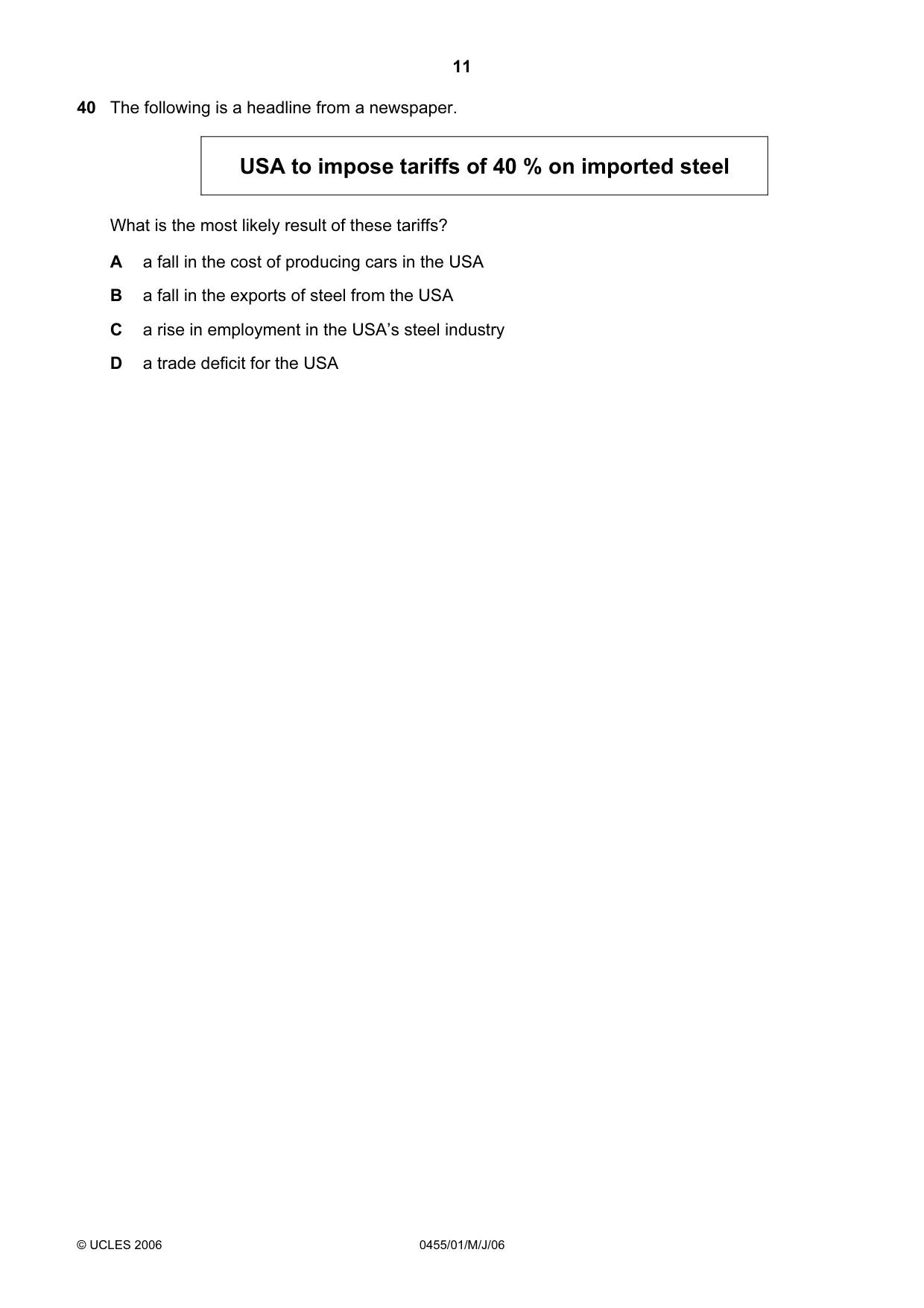
Q40 · The following is a headline from a newspaper
40 The following is a headline from a newspaper. USA to impose tariffs of 40 % on imported steel What is the most likely result of these tariffs? A a fall in the cost of producing cars in the USA B a fall in the exports of steel from the USA C a rise in employment in the USA’s steel industry D a trade deficit for the USA
Mark scheme: C
What was in this paper
The subtopics covered by these 40 questions, and how many questions each got. Open one in a new tab to see every Cambridge question on it.
4Demand3Firms’ costs, revenue and objectives3Fiscal policy3Foreign exchange rates3Differences in economic development between countries2Households2International specialisation2Monetary policy2Price determination2Workers2Economic growth1Firms1Firms and production1Inflation and deflation1Living standards1Market economic system1Opportunity cost1Population1Price changes1Supply1The factors of production1The nature of the economic problem1What you needed in this session
Cambridge’s own grade thresholds for 2006 May/June, Paper 1 · Variant 1. A higher threshold means an easier paper — the bar moves with how the cohort did.