Cambridge IGCSE Economics 0455 — 2023 Oct/Nov Paper 1 · Variant 3
0455/13/O/N/23 · 30 questions · 30 marks · ≈34 min
The question paper and its mark scheme, free to read here and free to download. This is Cambridge’s own paper, exactly as it was sat.
Question paper12 pages

Mark scheme3 pages
Answers below. Sit the paper first if you are practising.
Questions as text
Q1 · A consumer has $10 to spend
1 A consumer has $10 to spend. A meal costs $9 and a drink costs $5. What would describe the situation if the consumer did not have enough money to purchase both the meal and the drink? A excess demand B free goods C market failure D the economic problem
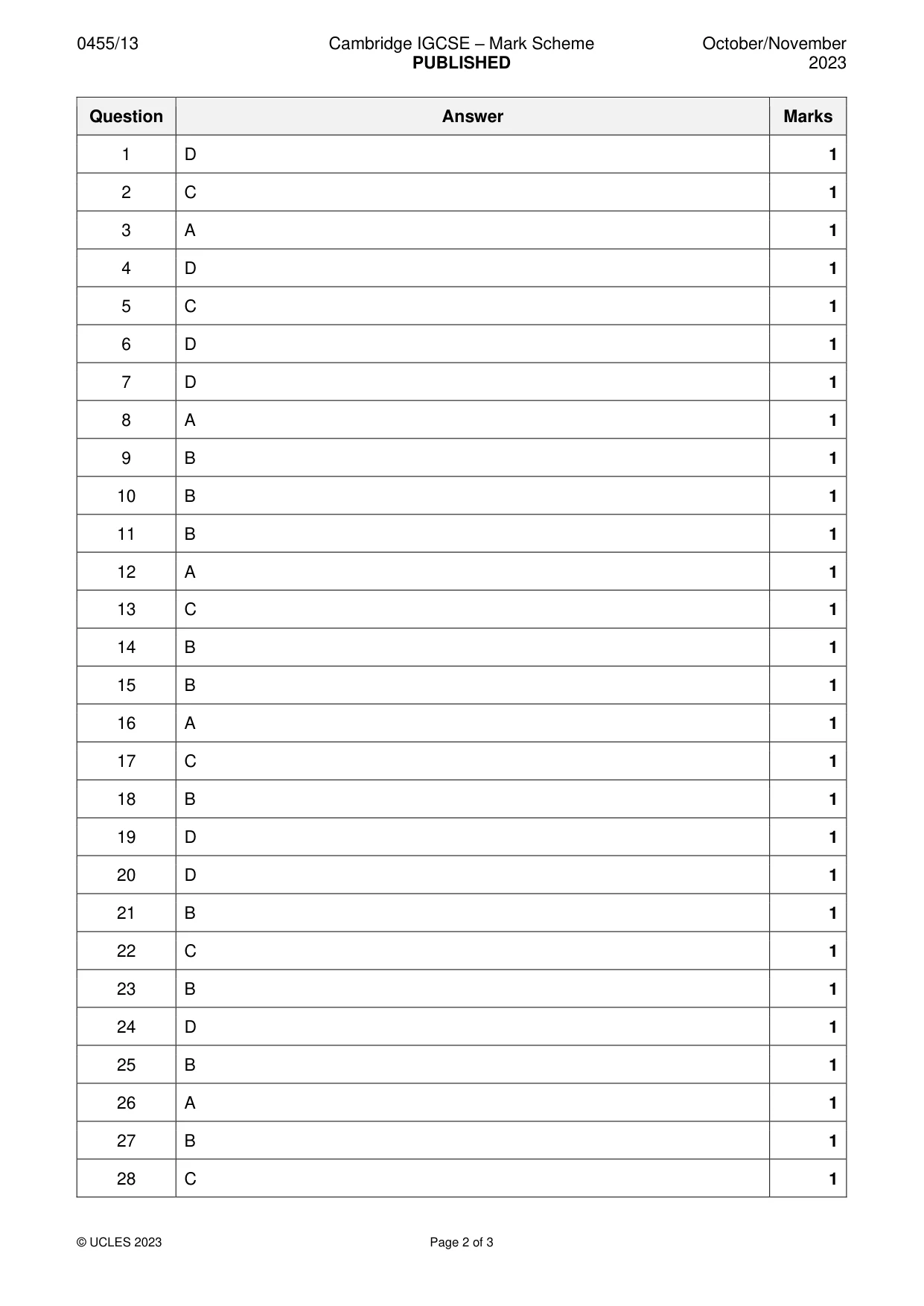
Mark scheme: D
Q2 · The diagram shows a production possibility curve (PPC) for a country
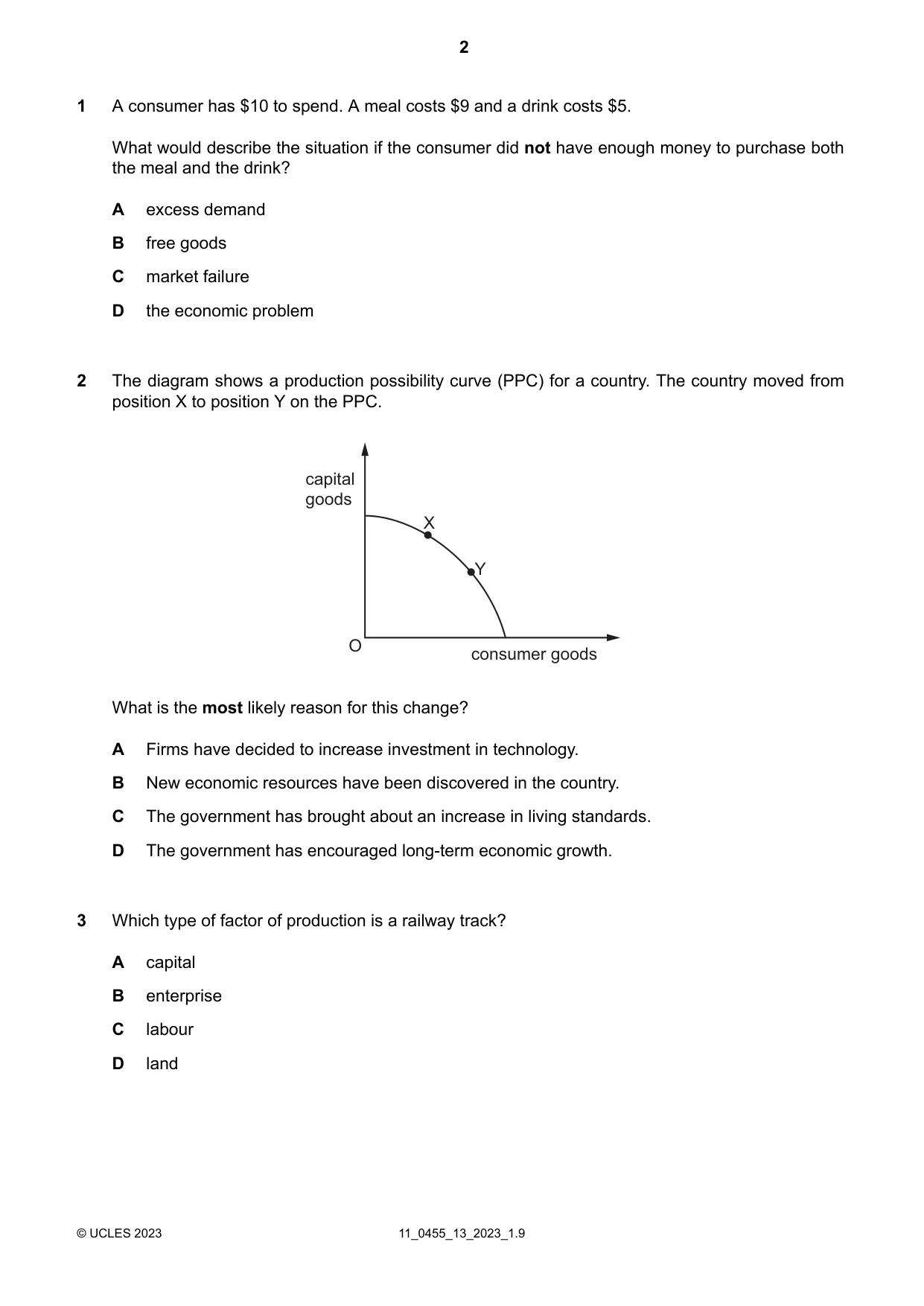
2 The diagram shows a production possibility curve (PPC) for a country. The country moved from position X to position Y on the PPC. capital goods X Y O consumer goods What is the most likely reason for this change? A Firms have decided to increase investment in technology. B New economic resources have been discovered in the country. C The government has brought about an increase in living standards. D The government has encouraged long-term economic growth.
Mark scheme: C
More questions on Production possibility curve (PPC) diagrams
Q3 · Which type of factor of production is a railway track?
3 Which type of factor of production is a railway track? A capital B enterprise C labour D land
Mark scheme: A
Q4 · Which statement must be correct if a market is in disequilibrium?
4 Which statement must be correct if a market is in disequilibrium? A Quantity demanded and quantity supplied are equal. B The government must intervene if anything is to be sold. C There can be no changes to demand or supply. D There is excess supply or excess demand.
Mark scheme: D
Q5 · What is a determinant of price elasticity of demand (PED)?
5 What is a determinant of price elasticity of demand (PED)? A availability of stocks of the product B change in the income of consumers C degree of necessity of the product D existence of monopoly
Mark scheme: C
Q6 · What would cause the supply curve for an agricultural product to shift to the right?
6 What would cause the supply curve for an agricultural product to shift to the right? A an increase in the costs of production B an increase in the price of substitutes C an increase in the price of the good D an increase in the productivity of farms
Mark scheme: D
Q7 · What would increase the price elasticity of supply (PES) of a product?
7 What would increase the price elasticity of supply (PES) of a product? A an increase in the cost of inputs B an increase in the firm’s profits C an increase in the number of close substitutes D an increase in the time a product can be stored
Mark scheme: D
Q8 · The diagram shows a demand curve
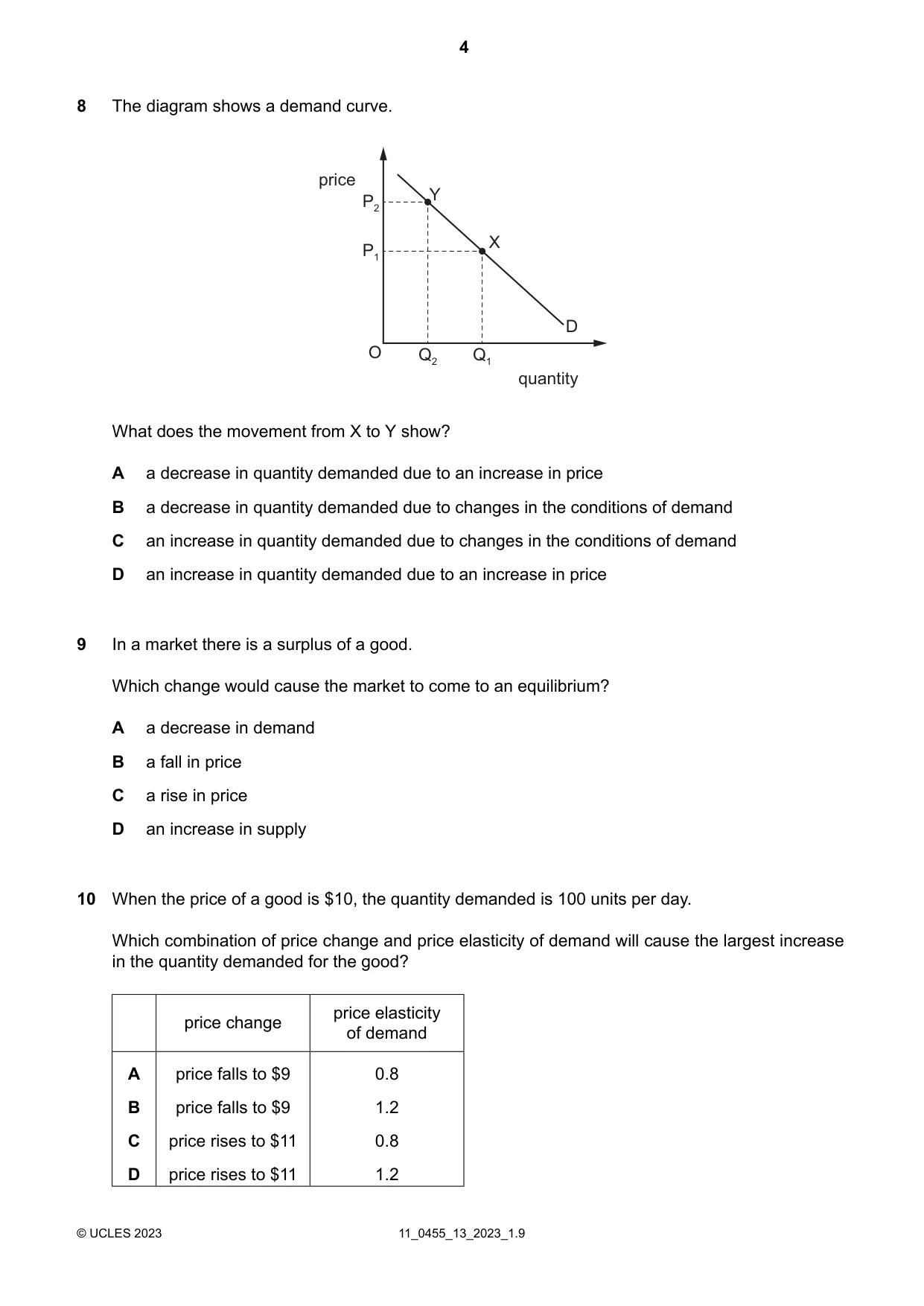
8 The diagram shows a demand curve. price P2 Y X P1 D O Q2 Q1 quantity What does the movement from X to Y show? A a decrease in quantity demanded due to an increase in price B a decrease in quantity demanded due to changes in the conditions of demand C an increase in quantity demanded due to changes in the conditions of demand D an increase in quantity demanded due to an increase in price
Mark scheme: A
Q9 · In a market there is a surplus of a good
9 In a market there is a surplus of a good. Which change would cause the market to come to an equilibrium? A a decrease in demand B a fall in price C a rise in price D an increase in supply
Mark scheme: B
Q10 · When the price of a good is $10, the quantity demanded is 100 units per day
10 When the price of a good is $10, the quantity demanded is 100 units per day. Which combination of price change and price elasticity of demand will cause the largest increase in the quantity demanded for the good? price elasticity price change of demand A price falls to $9 0.8 B price falls to $9 1.2 C price rises to $11 0.8 D price rises to $11 1.2
Mark scheme: B
Q11 · A function of money is to act as a measure of value
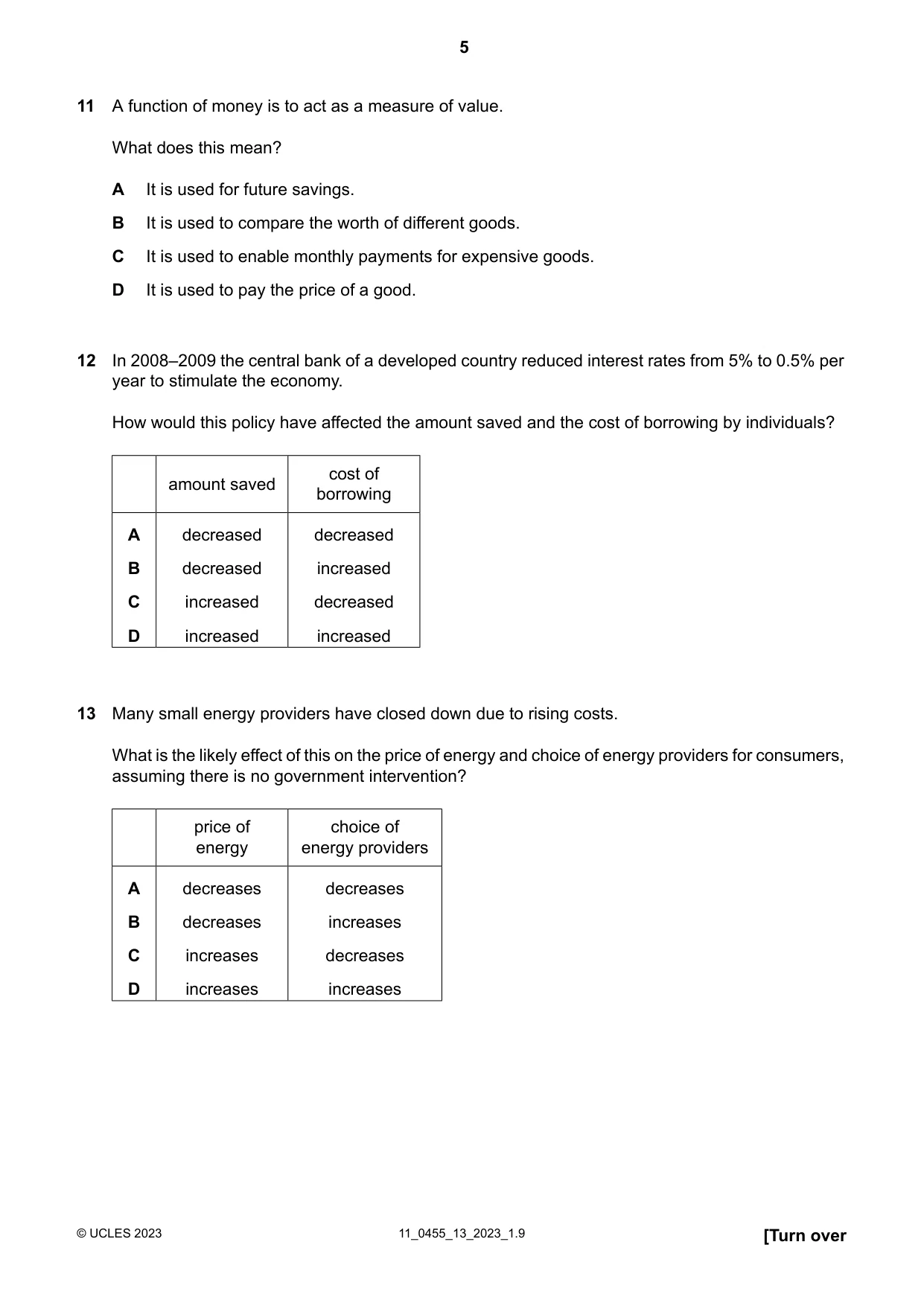
11 A function of money is to act as a measure of value. What does this mean? A It is used for future savings. B It is used to compare the worth of different goods. C It is used to enable monthly payments for expensive goods. D It is used to pay the price of a good.
Mark scheme: B
Q12 · In 2008–2009 the central bank of a developed country reduced interest rates from 5% to…
12 In 2008–2009 the central bank of a developed country reduced interest rates from 5% to 0.5% per year to stimulate the economy. How would this policy have affected the amount saved and the cost of borrowing by individuals? cost of amount saved borrowing A decreased decreased B decreased increased C increased decreased D increased increased
Mark scheme: A
Q13 · Many small energy providers have closed down due to rising costs
13 Many small energy providers have closed down due to rising costs. What is the likely effect of this on the price of energy and choice of energy providers for consumers, assuming there is no government intervention? price of choice of energy energy providers A decreases decreases B decreases increases C increases decreases D increases increases
Mark scheme: C
Q14 · What is the most likely goal of a state-owned enterprise providing health services?
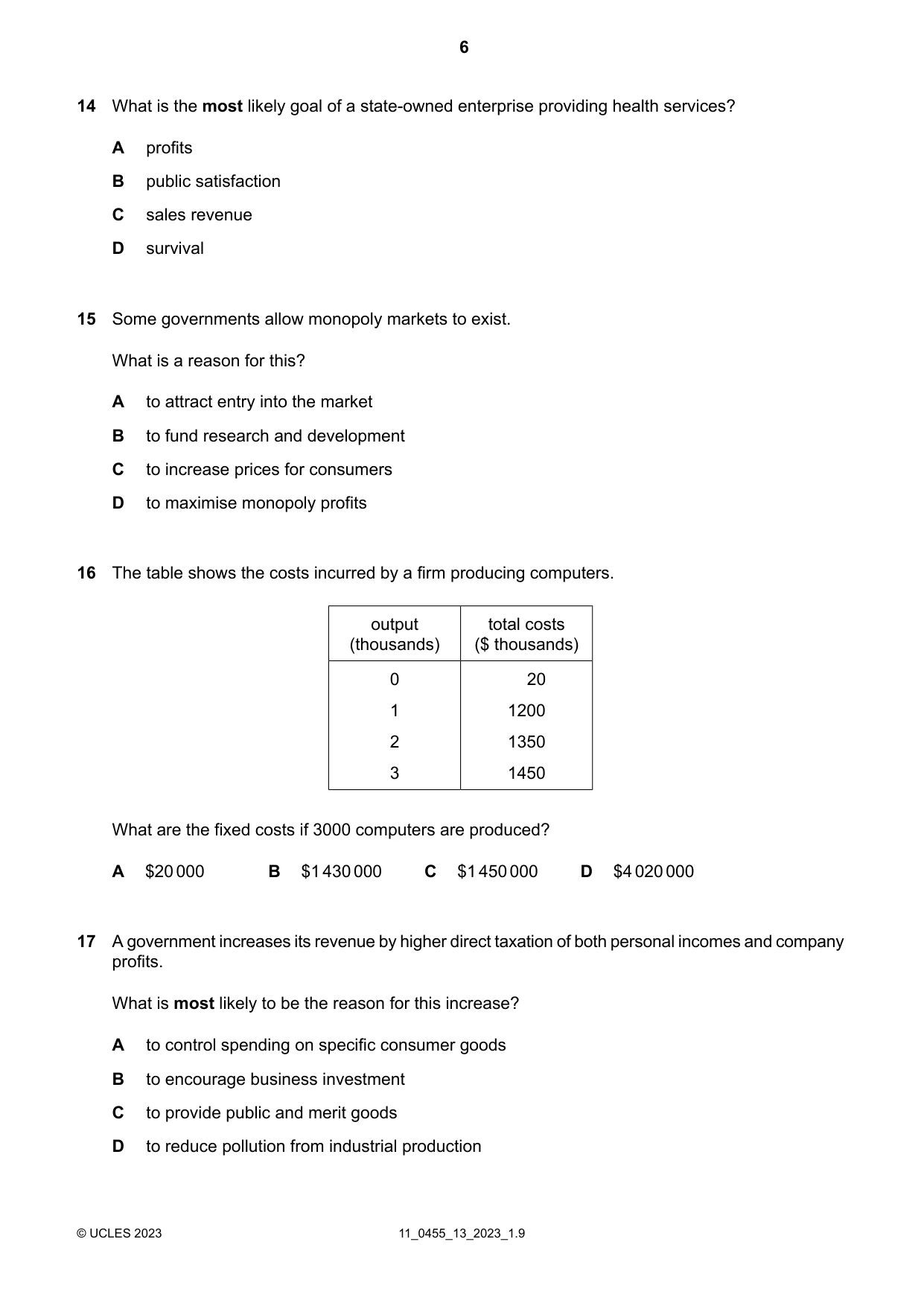
14 What is the most likely goal of a state-owned enterprise providing health services? A profits B public satisfaction C sales revenue D survival
Mark scheme: B
Q15 · Some governments allow monopoly markets to exist
15 Some governments allow monopoly markets to exist. What is a reason for this? A to attract entry into the market B to fund research and development C to increase prices for consumers D to maximise monopoly profits
Mark scheme: B
Q16 · The table shows the costs incurred by a firm producing computers
16 The table shows the costs incurred by a firm producing computers. output total costs (thousands) ($ thousands) 0 20 1 1200 2 1350 3 1450 What are the fixed costs if 3000 computers are produced? A $20000 B $1430000 C $1450000 D $4020000
Mark scheme: A
Q17 · A government increases its revenue by higher direct taxation of both personal incomes and…
17 A government increases its revenue by higher direct taxation of both personal incomes and company profits. What is most likely to be the reason for this increase? A to control spending on specific consumer goods B to encourage business investment C to provide public and merit goods D to reduce pollution from industrial production
Mark scheme: C
Q18 · Income tax in a country gives all individuals an initial tax-free income allowance
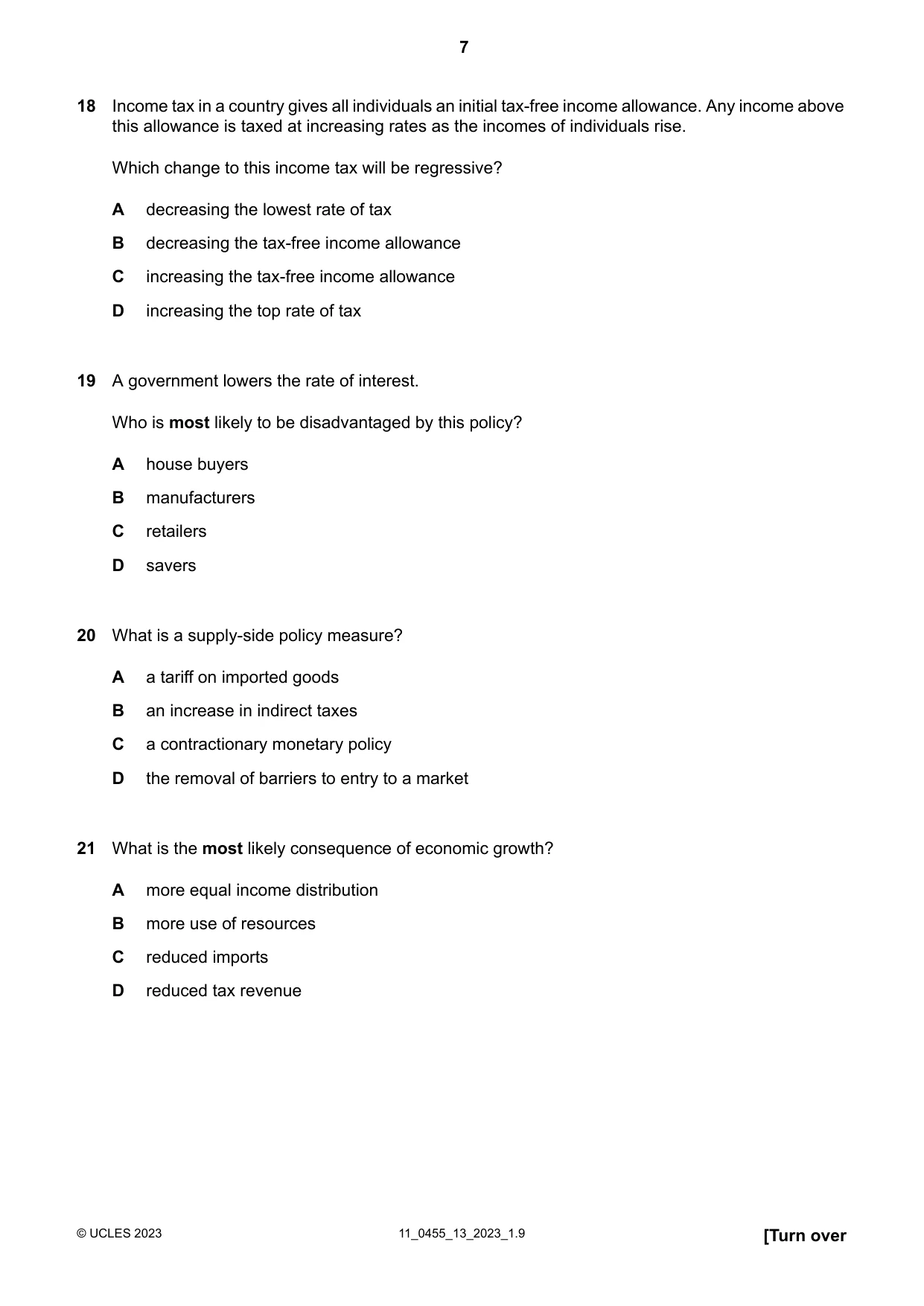
18 Income tax in a country gives all individuals an initial tax-free income allowance. Any income above this allowance is taxed at increasing rates as the incomes of individuals rise. Which change to this income tax will be regressive? A decreasing the lowest rate of tax B decreasing the tax-free income allowance C increasing the tax-free income allowance D increasing the top rate of tax
Mark scheme: B
Q19 · A government lowers the rate of interest
19 A government lowers the rate of interest. Who is most likely to be disadvantaged by this policy? A house buyers B manufacturers C retailers D savers
Mark scheme: D
Q20 · What is a supply-side policy measure?
20 What is a supply-side policy measure? A a tariff on imported goods B an increase in indirect taxes C a contractionary monetary policy D the removal of barriers to entry to a market
Mark scheme: D
Q21 · What is the most likely consequence of economic growth?
21 What is the most likely consequence of economic growth? A more equal income distribution B more use of resources C reduced imports D reduced tax revenue
Mark scheme: B
Q22 · In high-income economies, cereal farming is highly productive but few workers are employed
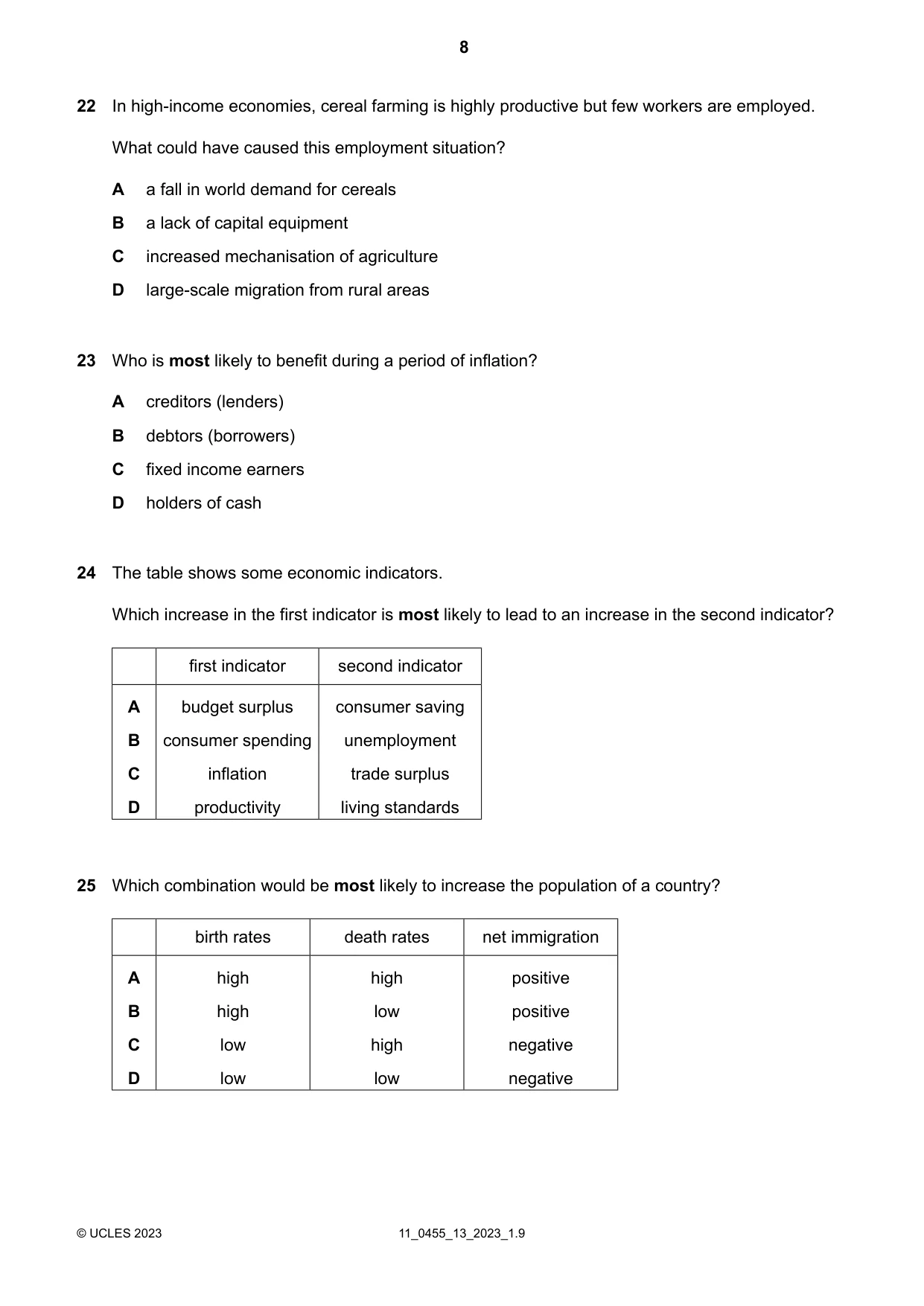
22 In high-income economies, cereal farming is highly productive but few workers are employed. What could have caused this employment situation? A a fall in world demand for cereals B a lack of capital equipment C increased mechanisation of agriculture D large-scale migration from rural areas
Mark scheme: C
Q23 · Who is most likely to benefit during a period of inflation?
23 Who is most likely to benefit during a period of inflation? A creditors (lenders) B debtors (borrowers) C fixed income earners D holders of cash
Mark scheme: B
Q24 · The table shows some economic indicators
24 The table shows some economic indicators. Which increase in the first indicator is most likely to lead to an increase in the second indicator? first indicator second indicator A budget surplus consumer saving B consumer spending unemployment C inflation trade surplus D productivity living standards
Mark scheme: D
Q25 · Which combination would be most likely to increase the population of a country?
25 Which combination would be most likely to increase the population of a country? birth rates death rates net immigration A high high positive B high low positive C low high negative D low low negative
Mark scheme: B
Q26 · Which economic consequence is most likely to result from an increasing proportion of the…
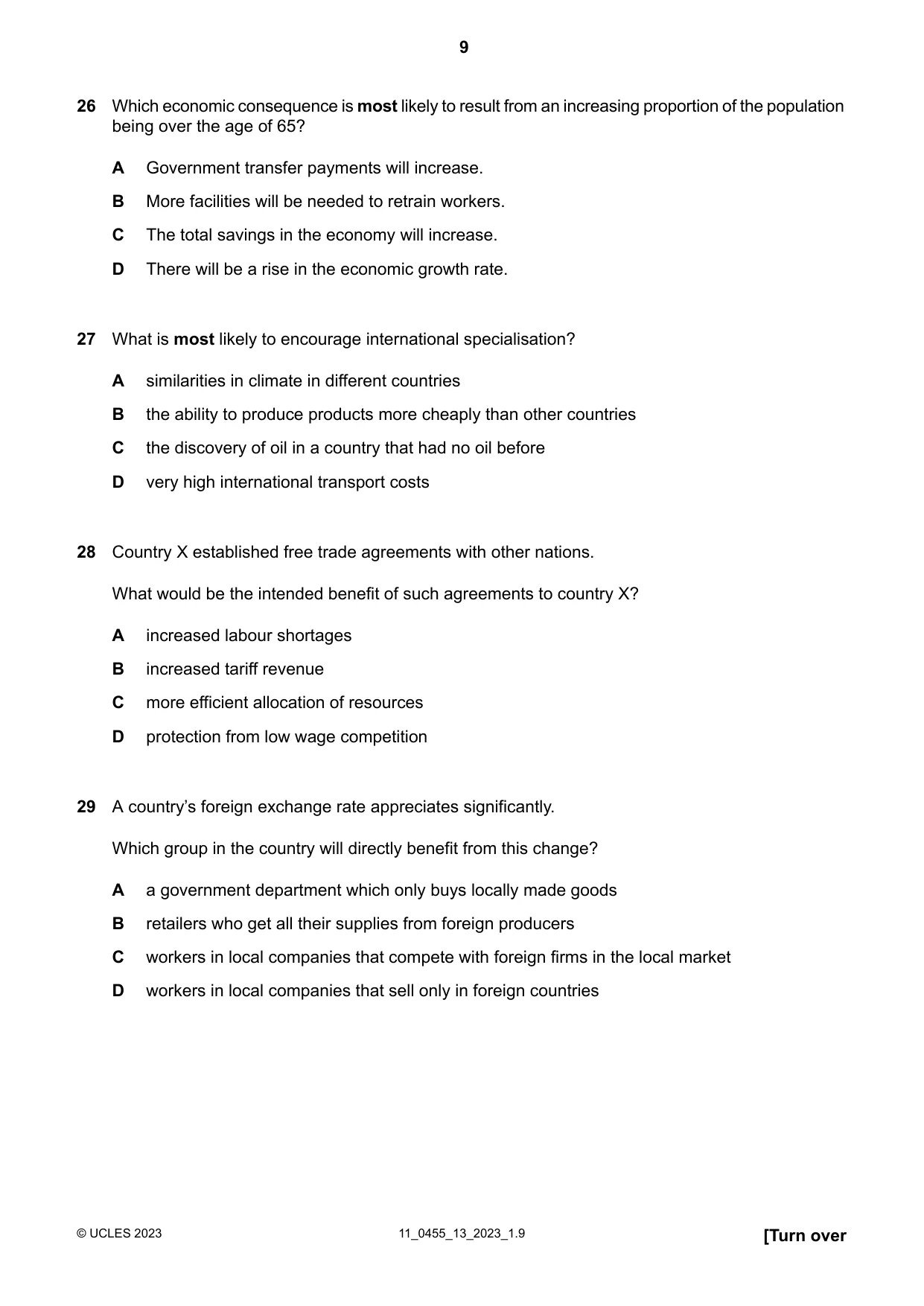
26 Which economic consequence is most likely to result from an increasing proportion of the population being over the age of 65? A Government transfer payments will increase. B More facilities will be needed to retrain workers. C The total savings in the economy will increase. D There will be a rise in the economic growth rate.
Mark scheme: A
Q27 · What is most likely to encourage international specialisation?
27 What is most likely to encourage international specialisation? A similarities in climate in different countries B the ability to produce products more cheaply than other countries C the discovery of oil in a country that had no oil before D very high international transport costs
Mark scheme: B
Q28 · Country X established free trade agreements with other nations
28 Country X established free trade agreements with other nations. What would be the intended benefit of such agreements to country X? A increased labour shortages B increased tariff revenue C more efficient allocation of resources D protection from low wage competition
Mark scheme: C
Q29 · A country’s foreign exchange rate appreciates significantly
29 A country’s foreign exchange rate appreciates significantly. Which group in the country will directly benefit from this change? A a government department which only buys locally made goods B retailers who get all their supplies from foreign producers C workers in local companies that compete with foreign firms in the local market D workers in local companies that sell only in foreign countries
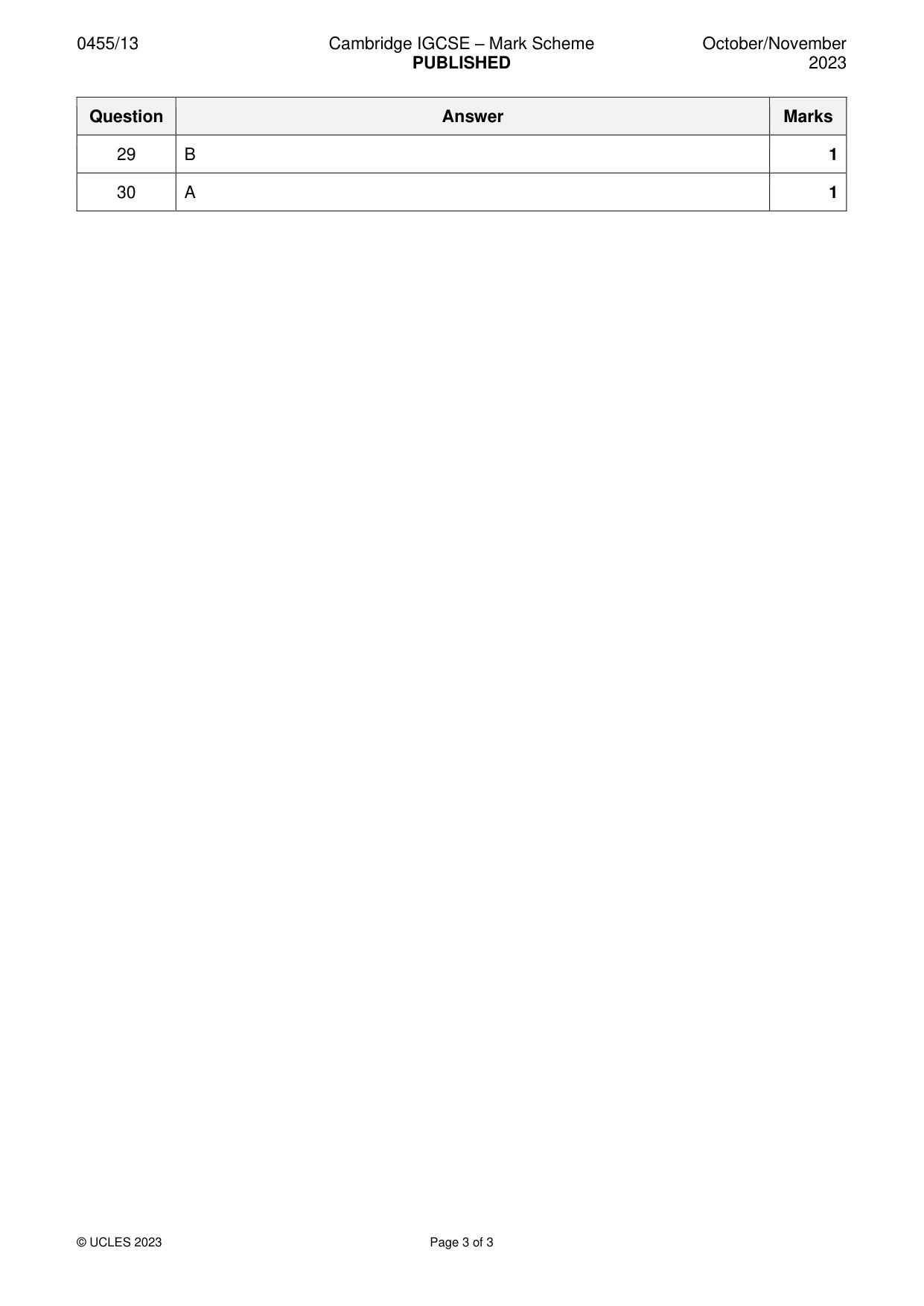
Mark scheme: B
Q30 · What is measured in the secondary income balance in a country’s current account of the…
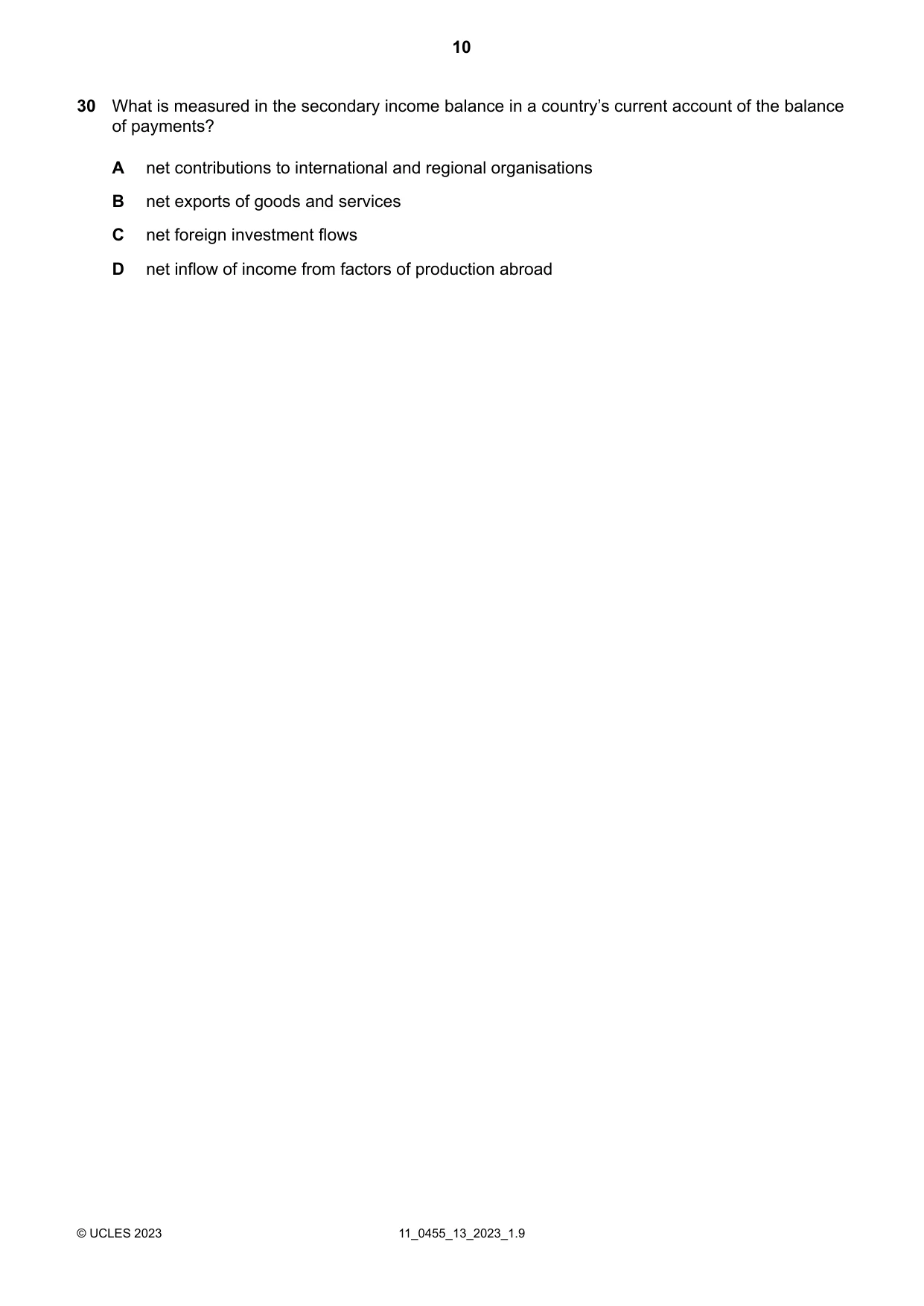
30 What is measured in the secondary income balance in a country’s current account of the balance of payments? A net contributions to international and regional organisations B net exports of goods and services C net foreign investment flows D net inflow of income from factors of production abroad
Mark scheme: A
What was in this paper
The subtopics covered by these 30 questions, and how many questions each got. Open one in a new tab to see every Cambridge question on it.
2Fiscal policy2Monetary policy2Population2Price determination2Price elasticity of demand (PED)2Current account of balance of payments1Demand1Firms and production1Firms’ costs, revenue and objectives1Foreign exchange rates1Globalisation, free trade and protection1Inflation and deflation1International specialisation1Market structure1Money and banking1Price changes1Price elasticity of supply (PES)1Production possibility curve (PPC) diagrams1Supply1Supply-side policy1The factors of production1The nature of the economic problem1The role of government1What you needed in this session
Cambridge’s own grade thresholds for 2023 Oct/Nov, Paper 1 · Variant 3. A higher threshold means an easier paper — the bar moves with how the cohort did.