Cambridge IGCSE Economics 0455 — 2015 May/June Paper 1 · Variant 2
0455/12/M/J/15 · 30 questions · 30 marks · ≈34 min
The question paper and its mark scheme, free to read here and free to download. This is Cambridge’s own paper, exactly as it was sat.
Question paper12 pages

Mark scheme2 pages
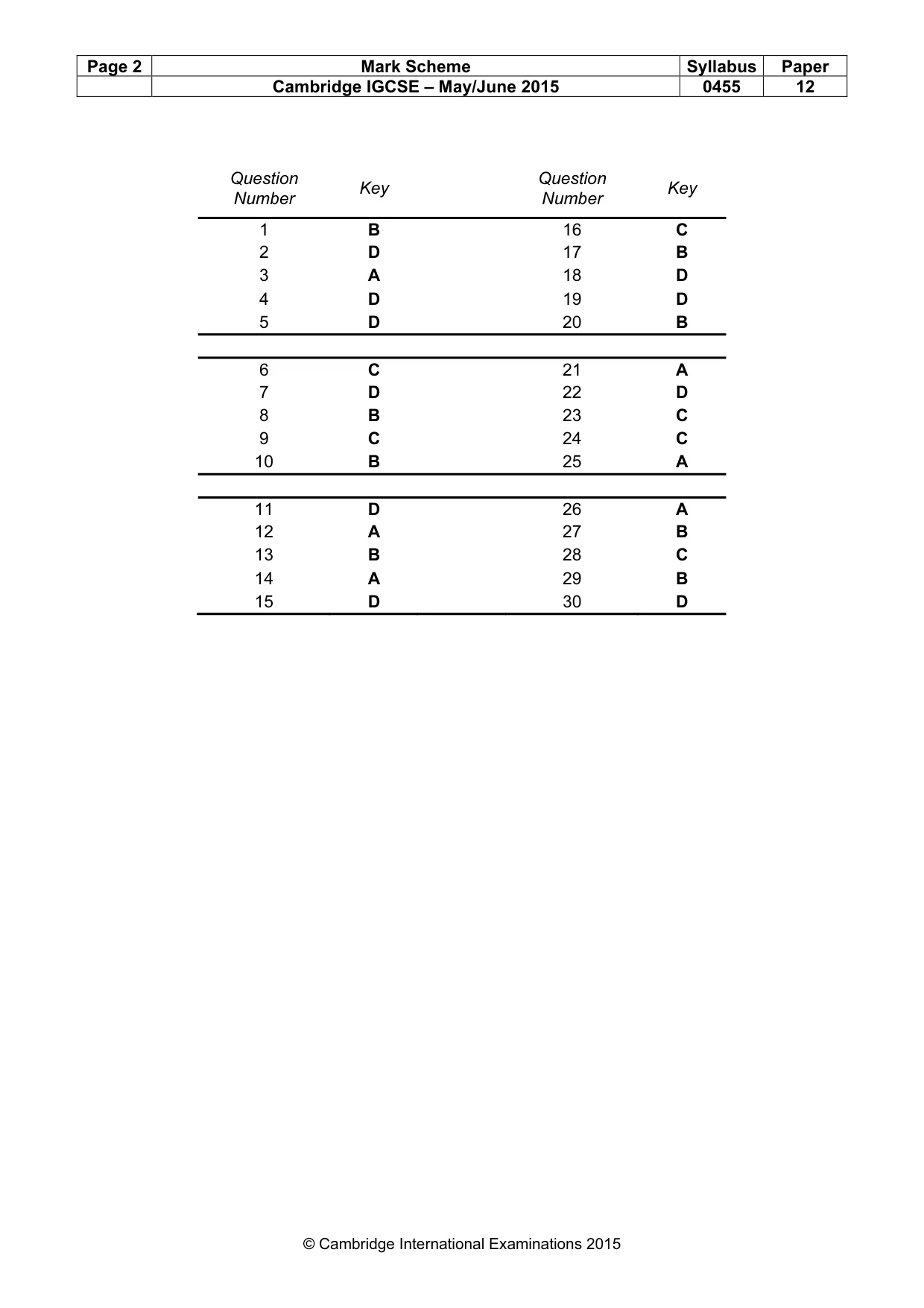
Answers below. Sit the paper first if you are practising.
Questions as text
Q1 · What is the basic economic problem?
1 What is the basic economic problem? A finite resources and limited wants B finite resources and unlimited wants C infinite resources and limited wants D infinite resources and unlimited wants
Mark scheme: B
Q2 · New oil reserves are discovered
2 New oil reserves are discovered. What has increased in supply? A capital B enterprise C labour D land
Mark scheme: D
Q3 · The diagram shows production possibility curves (PPC) for a country that can produce…
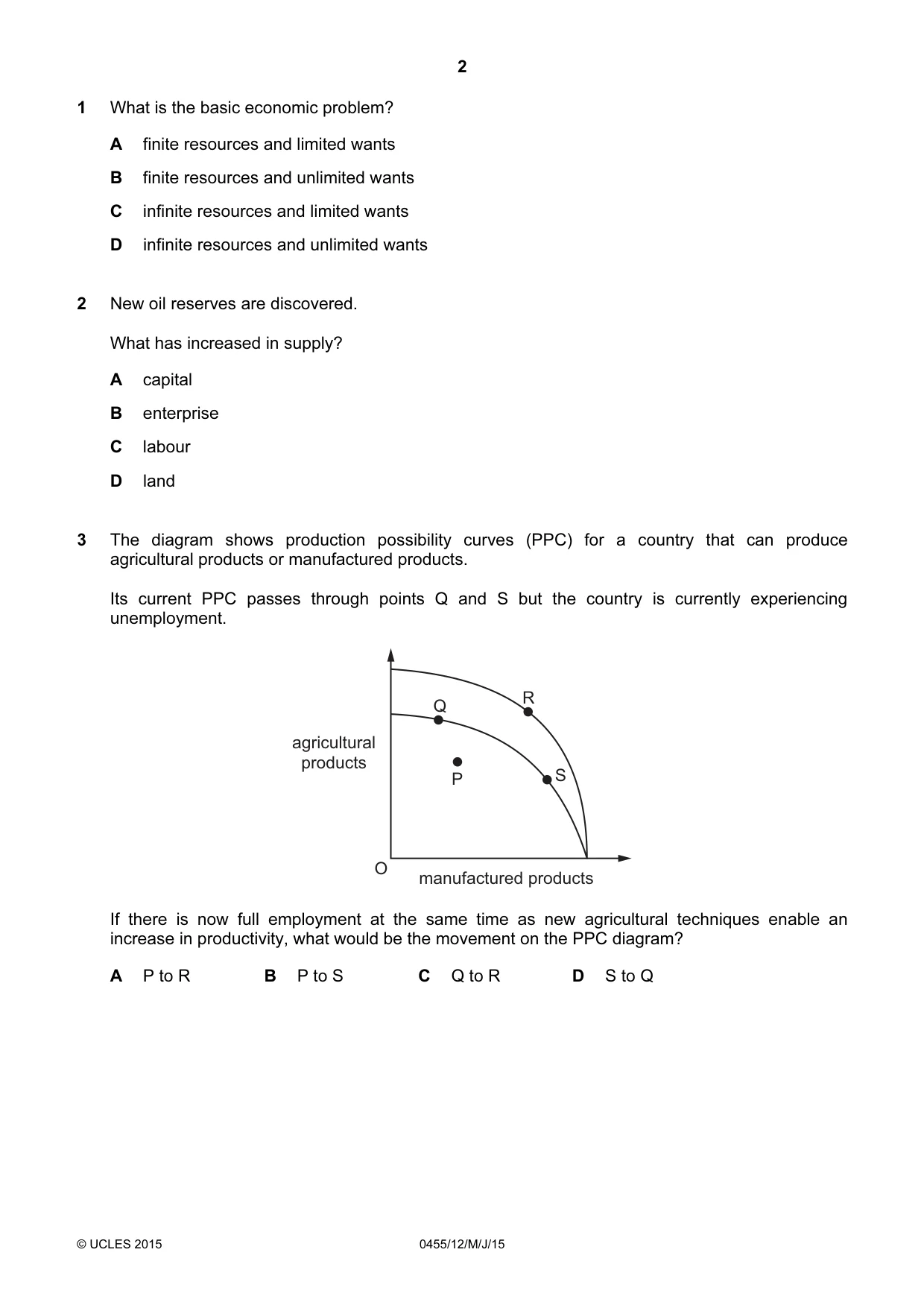
3 The diagram shows production possibility curves (PPC) for a country that can produce agricultural products or manufactured products. Its current PPC passes through points Q and S but the country is currently experiencing unemployment. Q R agricultural products P S O manufactured products If there is now full employment at the same time as new agricultural techniques enable an increase in productivity, what would be the movement on the PPC diagram? A P to R B P to S C Q to R D S to Q
Mark scheme: A
More questions on Production possibility curve (PPC) diagrams
Q4 · A person makes sandwiches at home for five hours each day
4 A person makes sandwiches at home for five hours each day. She makes 20 sandwiches per hour, and she sells each sandwich for $2 each. What is the opportunity cost if she takes a holiday on a working day? A $2 B $40 C 20 sandwiches D 100 sandwiches
Mark scheme: D
Q5 · What would not be an example of the working of a market system?
5 What would not be an example of the working of a market system? A a high price charged because of costly research to produce the good B a high price charged for a well-known painting C a low price charged because of economies of scale D a low price charged for subsidised bus travel
Mark scheme: D
More questions on The role of markets in allocating resources
Q6 · A product has a price elasticity of supply of +2
6 A product has a price elasticity of supply of +2. A change in price causes the quantity supplied to change from 100 units to 120 units. What is the price change? A a fall of 10% B a fall of 40% C a rise of 10% D a rise of 40%
Mark scheme: C
Q7 · The diagram shows the market for fresh fish in the Caribbean with initial equilibrium…
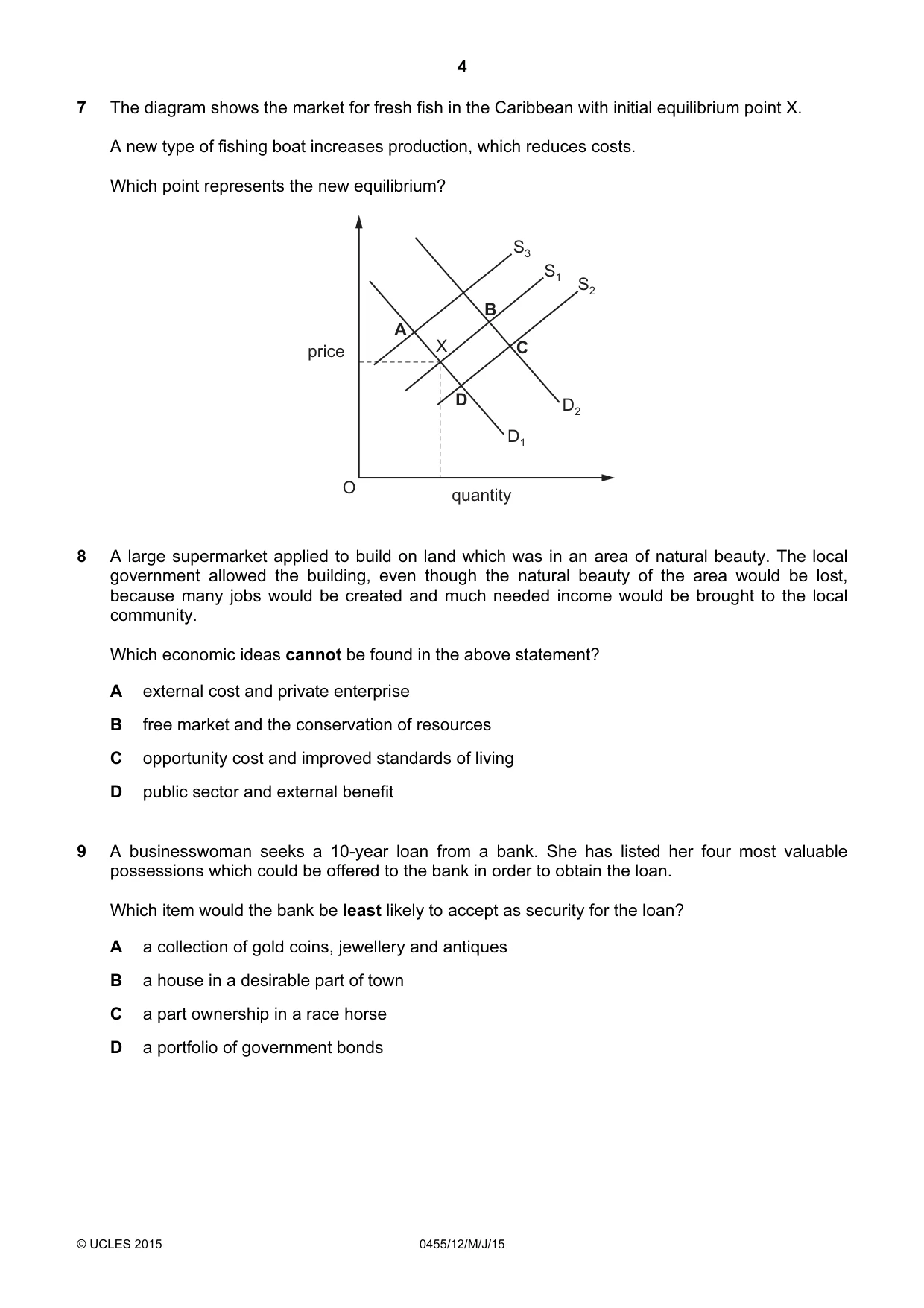
7 The diagram shows the market for fresh fish in the Caribbean with initial equilibrium point X. A new type of fishing boat increases production, which reduces costs. Which point represents the new equilibrium? S3 S1 S2 B A price X C D D2 D1 O quantity
Mark scheme: D
Q8 · A large supermarket applied to build on land which was in an area of natural beauty
8 A large supermarket applied to build on land which was in an area of natural beauty. The local government allowed the building, even though the natural beauty of the area would be lost, because many jobs would be created and much needed income would be brought to the local community. Which economic ideas cannot be found in the above statement? A external cost and private enterprise B free market and the conservation of resources C opportunity cost and improved standards of living D public sector and external benefit
Mark scheme: B
Q9 · A businesswoman seeks a 10-year loan from a bank
9 A businesswoman seeks a 10-year loan from a bank. She has listed her four most valuable possessions which could be offered to the bank in order to obtain the loan. Which item would the bank be least likely to accept as security for the loan? A a collection of gold coins, jewellery and antiques B a house in a desirable part of town C a part ownership in a race horse D a portfolio of government bonds
Mark scheme: C
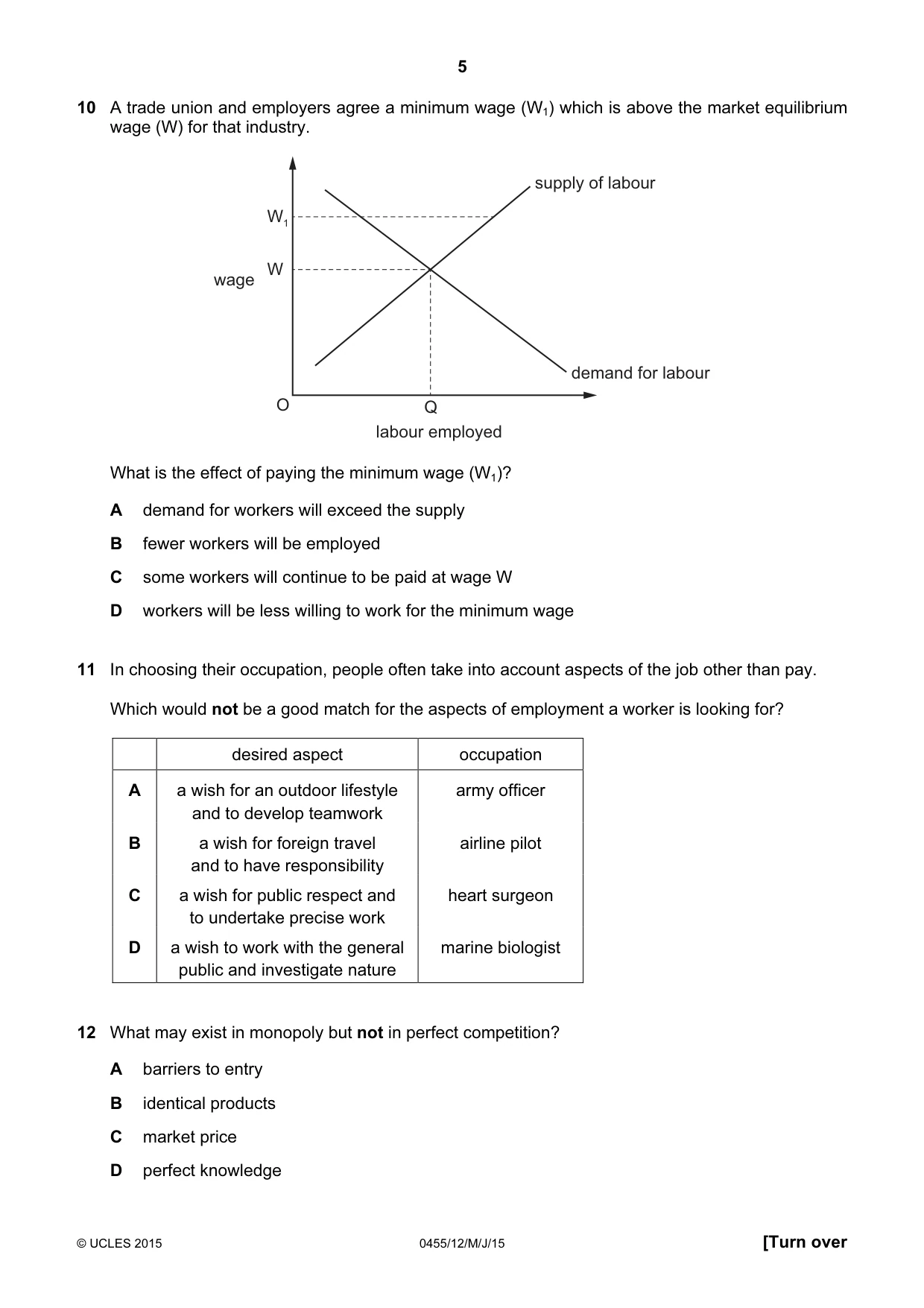
Q10 · A trade union and employers agree a minimum wage (W1) which is above the market…
10 A trade union and employers agree a minimum wage (W1) which is above the market equilibrium wage (W) for that industry. supply of labour W1 W wage demand for labour O Q labour employed What is the effect of paying the minimum wage (W1)? A demand for workers will exceed the supply B fewer workers will be employed C some workers will continue to be paid at wage W D workers will be less willing to work for the minimum wage
Mark scheme: B
Q11 · In choosing their occupation, people often take into account aspects of the job other…
11 In choosing their occupation, people often take into account aspects of the job other than pay. Which would not be a good match for the aspects of employment a worker is looking for? desired aspect occupation A a wish for an outdoor lifestyle army officer and to develop teamwork B a wish for foreign travel airline pilot and to have responsibility C a wish for public respect and heart surgeon to undertake precise work D a wish to work with the general marine biologist public and investigate nature
Mark scheme: D
Q12 · What may exist in monopoly but not in perfect competition?
12 What may exist in monopoly but not in perfect competition? A barriers to entry B identical products C market price D perfect knowledge
Mark scheme: A
Q13 · What is not a reason for the decline in manufacturing industries in developed economies…
13 What is not a reason for the decline in manufacturing industries in developed economies in recent years? A growth of newly industrialised competitor countries B invention of automated production methods C rising costs of factor inputs in the steel industry D considerable skill shortages as school-leavers prefer to work in the service sector
Mark scheme: B
Q14 · In 2013, Barclays Bank had two branches in a city
14 In 2013, Barclays Bank had two branches in a city. It decided to close them both, move to a different building and employ fewer hourly-paid staff. What is likely to have happened to the bank’s fixed and variable costs? fixed cost variable cost A fall fall B fall rise C rise fall D rise rise
Mark scheme: A
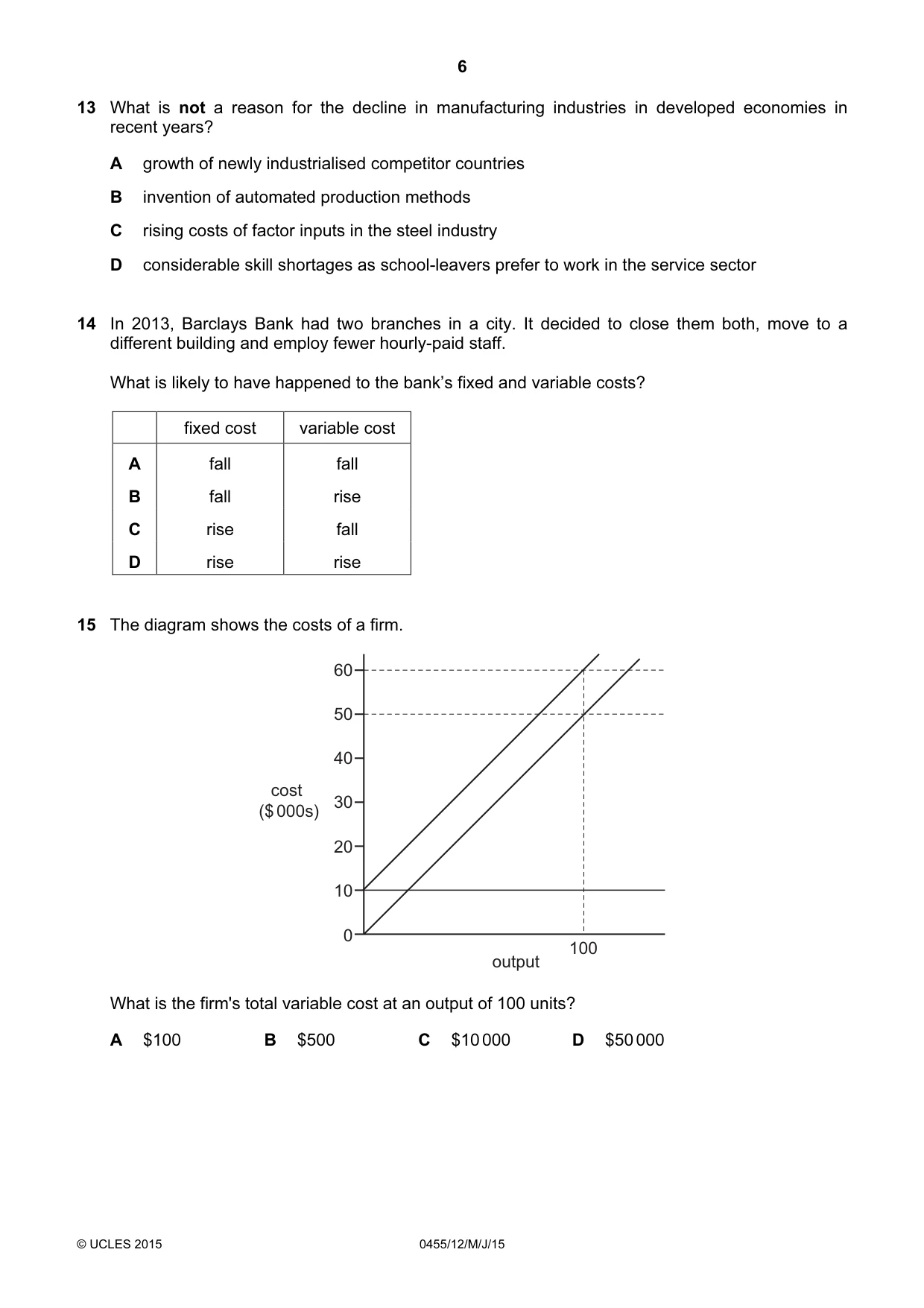
Q15 · The diagram shows the costs of a firm
15 The diagram shows the costs of a firm. 60 50 40 cost 30 ($ 000s) 20 10 0 100 output What is the firm's total variable cost at an output of 100 units? A $100 B $500 C $10 000 D $50 000
Mark scheme: D
Q16 · What is most likely to cause a fall in the rate of inflation?
16 What is most likely to cause a fall in the rate of inflation? A an increase in consumer spending B an increase in import prices C an increase in income tax D an increase in wage rates
Mark scheme: C
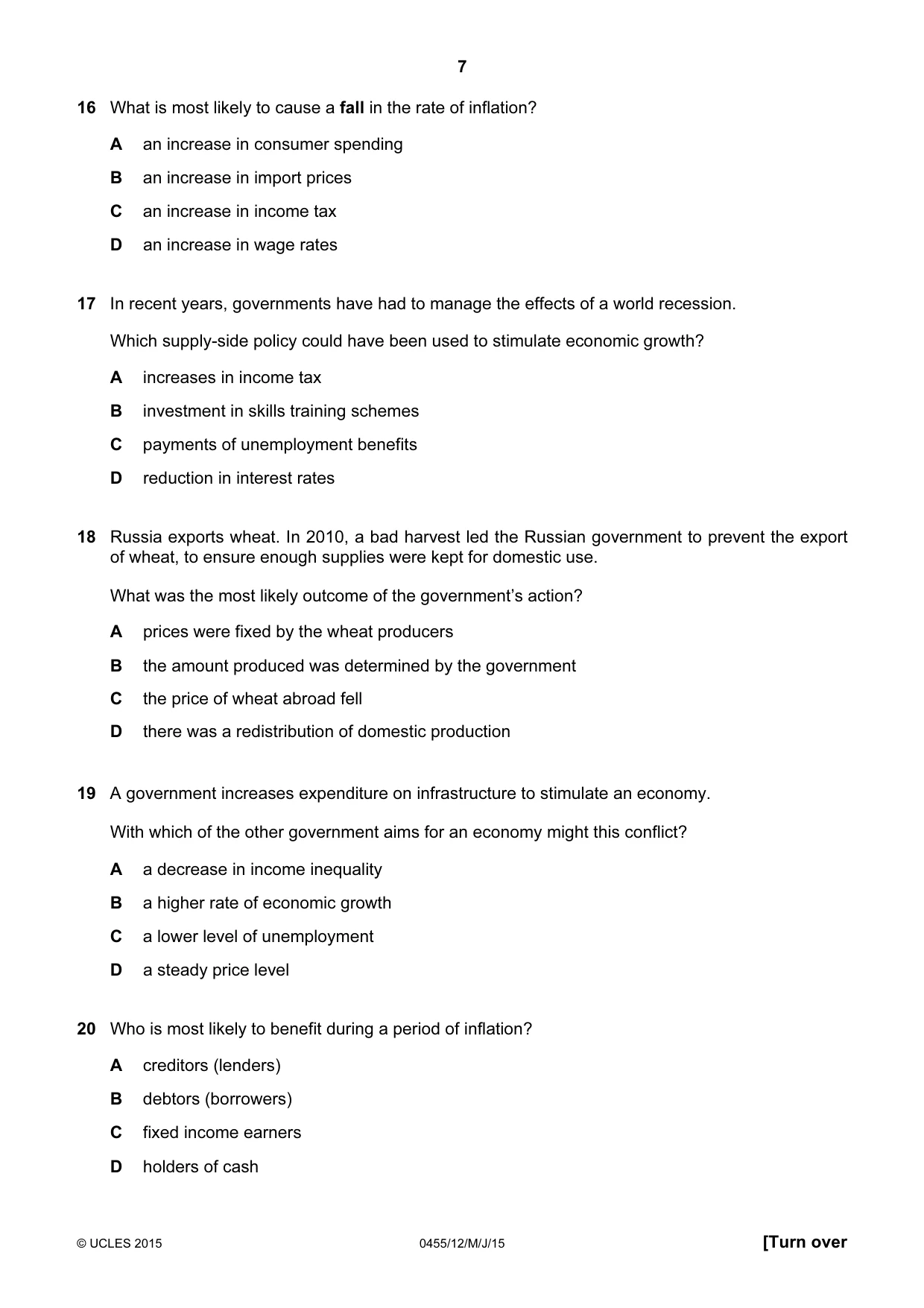
Q17 · In recent years, governments have had to manage the effects of a world recession
17 In recent years, governments have had to manage the effects of a world recession. Which supply-side policy could have been used to stimulate economic growth? A increases in income tax B investment in skills training schemes C payments of unemployment benefits D reduction in interest rates
Mark scheme: B
Question 18
18 Russia exports wheat. In 2010, a bad harvest led the Russian government to prevent the export of wheat, to ensure enough supplies were kept for domestic use. What was the most likely outcome of the government’s action? A prices were fixed by the wheat producers B the amount produced was determined by the government C the price of wheat abroad fell D there was a redistribution of domestic production
Mark scheme: D
Q19 · A government increases expenditure on infrastructure to stimulate an economy
19 A government increases expenditure on infrastructure to stimulate an economy. With which of the other government aims for an economy might this conflict? A a decrease in income inequality B a higher rate of economic growth C a lower level of unemployment D a steady price level
Mark scheme: D
Q20 · Who is most likely to benefit during a period of inflation?
20 Who is most likely to benefit during a period of inflation? A creditors (lenders) B debtors (borrowers) C fixed income earners D holders of cash
Mark scheme: B
Q21 · The Human Development Index (HDI) measures more than just average incomes
21 The Human Development Index (HDI) measures more than just average incomes. What are two additional measures it includes? A life expectancy years of schooling B percentage unemployed number of hospitals C poverty rate years of schooling D years of schooling access to clean water
Mark scheme: A
More questions on Differences in economic development between countries
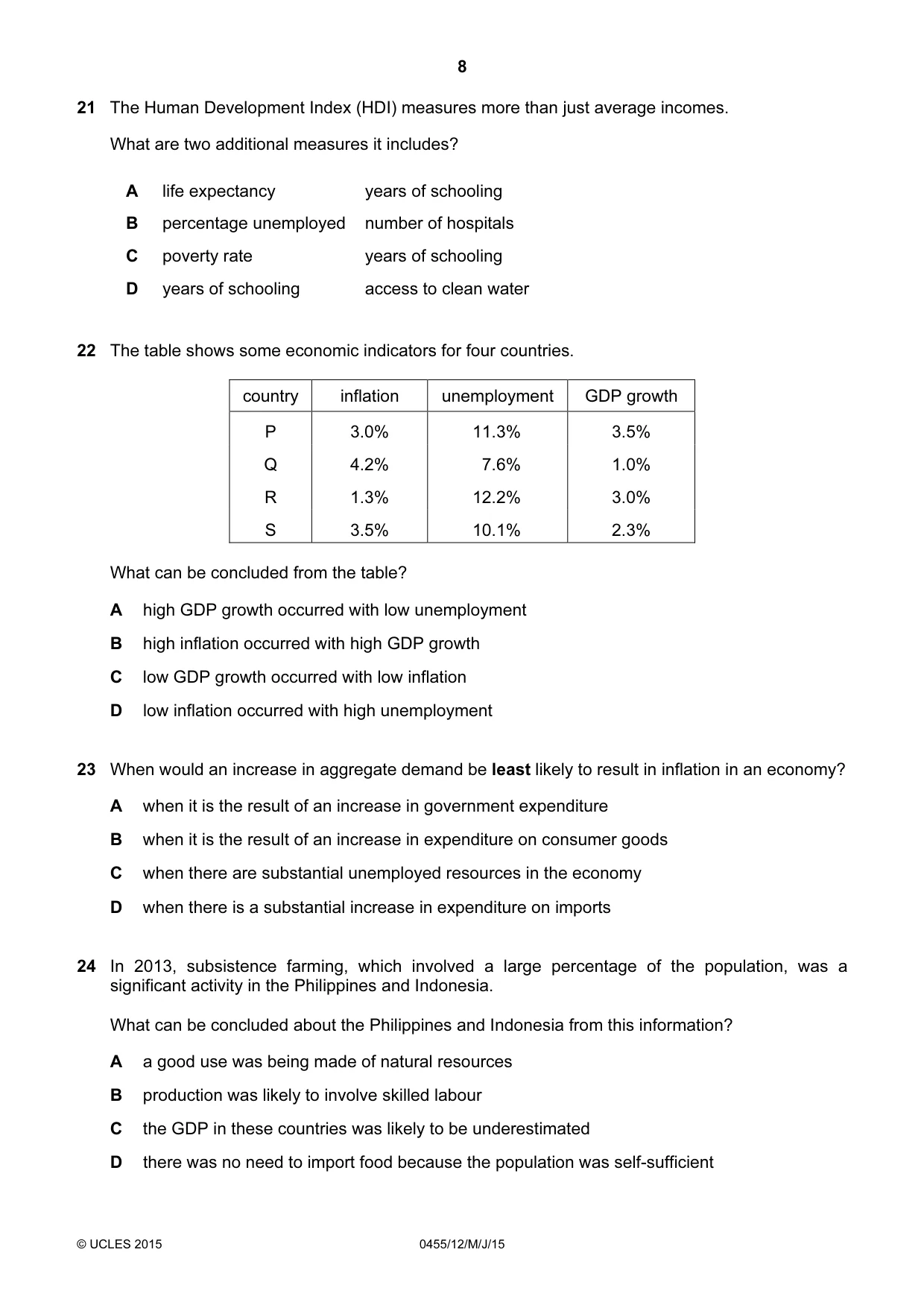
Q22 · The table shows some economic indicators for four countries
22 The table shows some economic indicators for four countries. country inflation unemployment GDP growth P 3.0% 11.3% 3.5% Q 4.2% 7.6% 1.0% R 1.3% 12.2% 3.0% S 3.5% 10.1% 2.3% What can be concluded from the table? A high GDP growth occurred with low unemployment B high inflation occurred with high GDP growth C low GDP growth occurred with low inflation D low inflation occurred with high unemployment
Mark scheme: D
Q23 · When would an increase in aggregate demand be least likely to result in inflation in an…
23 When would an increase in aggregate demand be least likely to result in inflation in an economy? A when it is the result of an increase in government expenditure B when it is the result of an increase in expenditure on consumer goods C when there are substantial unemployed resources in the economy D when there is a substantial increase in expenditure on imports
Mark scheme: C
Q24 · In 2013, subsistence farming, which involved a large percentage of the population, was a…
24 In 2013, subsistence farming, which involved a large percentage of the population, was a significant activity in the Philippines and Indonesia. What can be concluded about the Philippines and Indonesia from this information? A a good use was being made of natural resources B production was likely to involve skilled labour C the GDP in these countries was likely to be underestimated D there was no need to import food because the population was self-sufficient
Mark scheme: C
Q25 · Which feature is not a typical characteristic of a developed country?
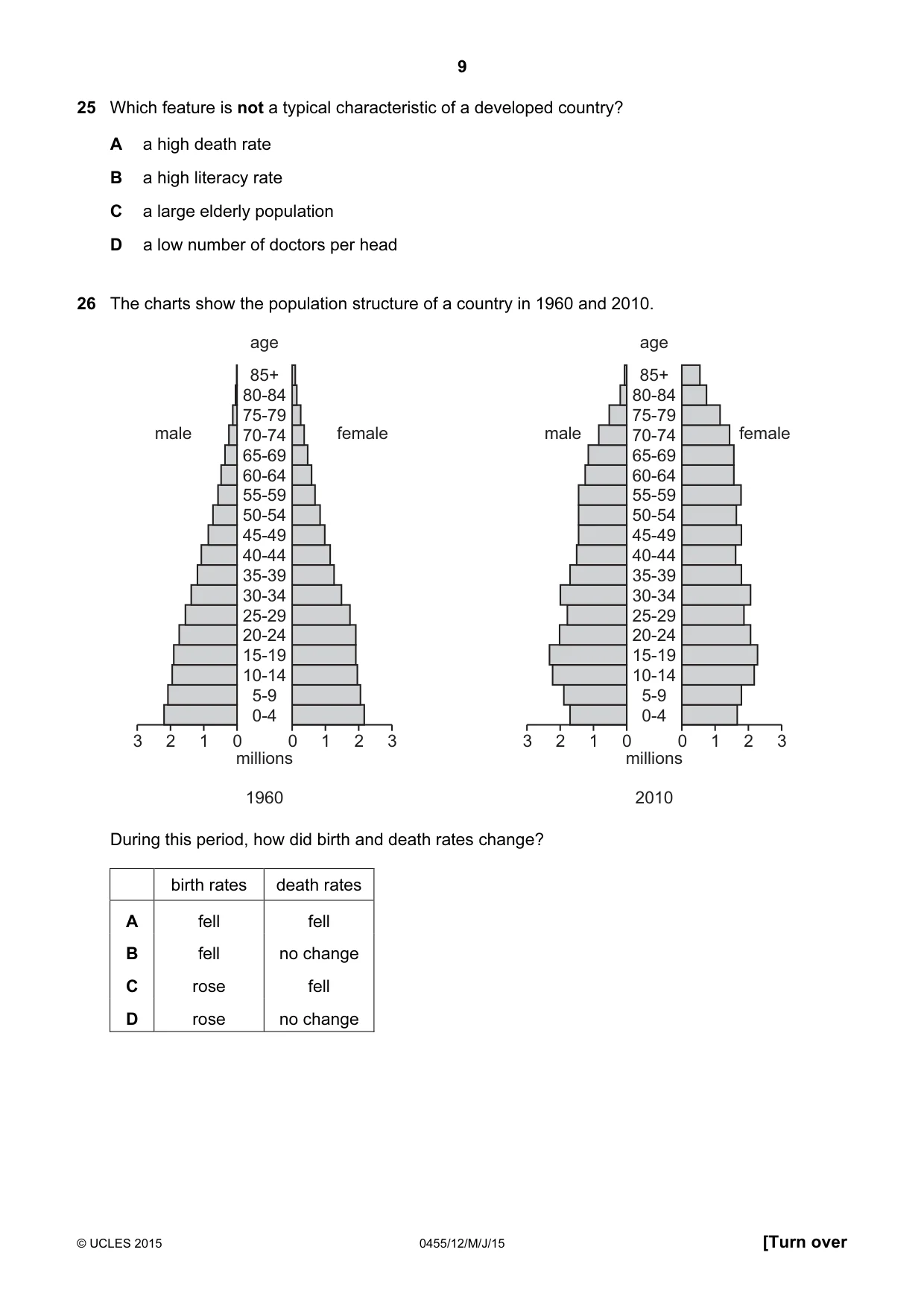
25 Which feature is not a typical characteristic of a developed country? A a high death rate B a high literacy rate C a large elderly population D a low number of doctors per head
Mark scheme: A
More questions on Differences in economic development between countries
Q26 · The charts show the population structure of a country in 1960 and 2010
26 The charts show the population structure of a country in 1960 and 2010. age age 85+ 85+ 80-84 80-84 75-79 75-79 male 70-74 female male 70-74 female 65-69 65-69 60-64 60-64 55-59 55-59 50-54 50-54 45-49 45-49 40-44 40-44 35-39 35-39 30-34 30-34 25-29 25-29 20-24 20-24 15-19 15-19 10-14 10-14 5-9 5-9 0-4 0-4 3 2 1 0 0 1 2 3 3 2 1 0 0 1 2 3 millions millions 1960 2010 During this period, how did birth and death rates change? birth rates death rates A fell fell B fell no change C rose fell D rose no change
Mark scheme: A
Q27 · Which combination of changes is most likely to result in a fall in living standards in a…
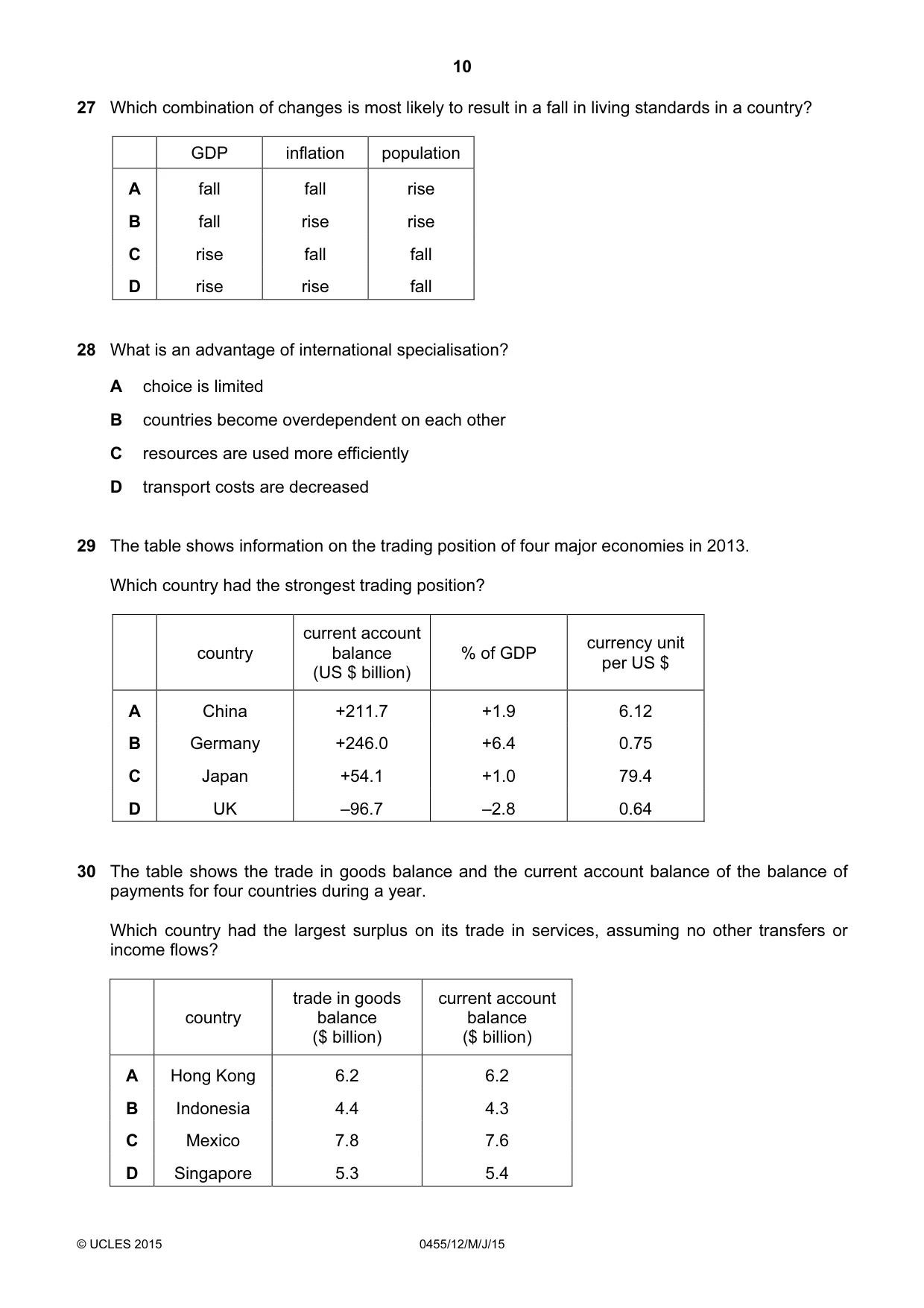
27 Which combination of changes is most likely to result in a fall in living standards in a country? GDP inflation population A fall fall rise B fall rise rise C rise fall fall D rise rise fall
Mark scheme: B
Q28 · What is an advantage of international specialisation?
28 What is an advantage of international specialisation? A choice is limited B countries become overdependent on each other C resources are used more efficiently D transport costs are decreased
Mark scheme: C
Q29 · The table shows information on the trading position of four major economies in 2013
29 The table shows information on the trading position of four major economies in 2013. Which country had the strongest trading position? current account currency unit country balance % of GDP per US $ (US $ billion) A China +211.7 +1.9 6.12 B Germany +246.0 +6.4 0.75 C Japan +54.1 +1.0 79.4 D UK –96.7 –2.8 0.64
Mark scheme: B
Q30 · The table shows the trade in goods balance and the current account balance of the balance…
30 The table shows the trade in goods balance and the current account balance of the balance of payments for four countries during a year. Which country had the largest surplus on its trade in services, assuming no other transfers or income flows? trade in goods current account country balance balance ($ billion) ($ billion) A Hong Kong 6.2 6.2 B Indonesia 4.4 4.3 C Mexico 7.8 7.6 D Singapore 5.3 5.4
Mark scheme: D
What was in this paper
The subtopics covered by these 30 questions, and how many questions each got. Open one in a new tab to see every Cambridge question on it.
3Current account of balance of payments2Differences in economic development between countries2Firms’ costs, revenue and objectives2Living standards2The macroeconomic aims of government2Firms and production1Globalisation, free trade and protection1International specialisation1Market failure1Market structure1Money and banking1Opportunity cost1Population1Price changes1Price determination1Price elasticity of supply (PES)1Production possibility curve (PPC) diagrams1Supply-side policy1The factors of production1The nature of the economic problem1The role of markets in allocating resources1Workers1What you needed in this session
Cambridge’s own grade thresholds for 2015 May/June, Paper 1 · Variant 2. A higher threshold means an easier paper — the bar moves with how the cohort did.