Cambridge IGCSE Economics 0455 — 2023 May/June Paper 1 · Variant 1
0455/11/M/J/23 · 30 questions · 30 marks · ≈34 min
The question paper and its mark scheme, free to read here and free to download. This is Cambridge’s own paper, exactly as it was sat.
Question paper12 pages

Mark scheme3 pages
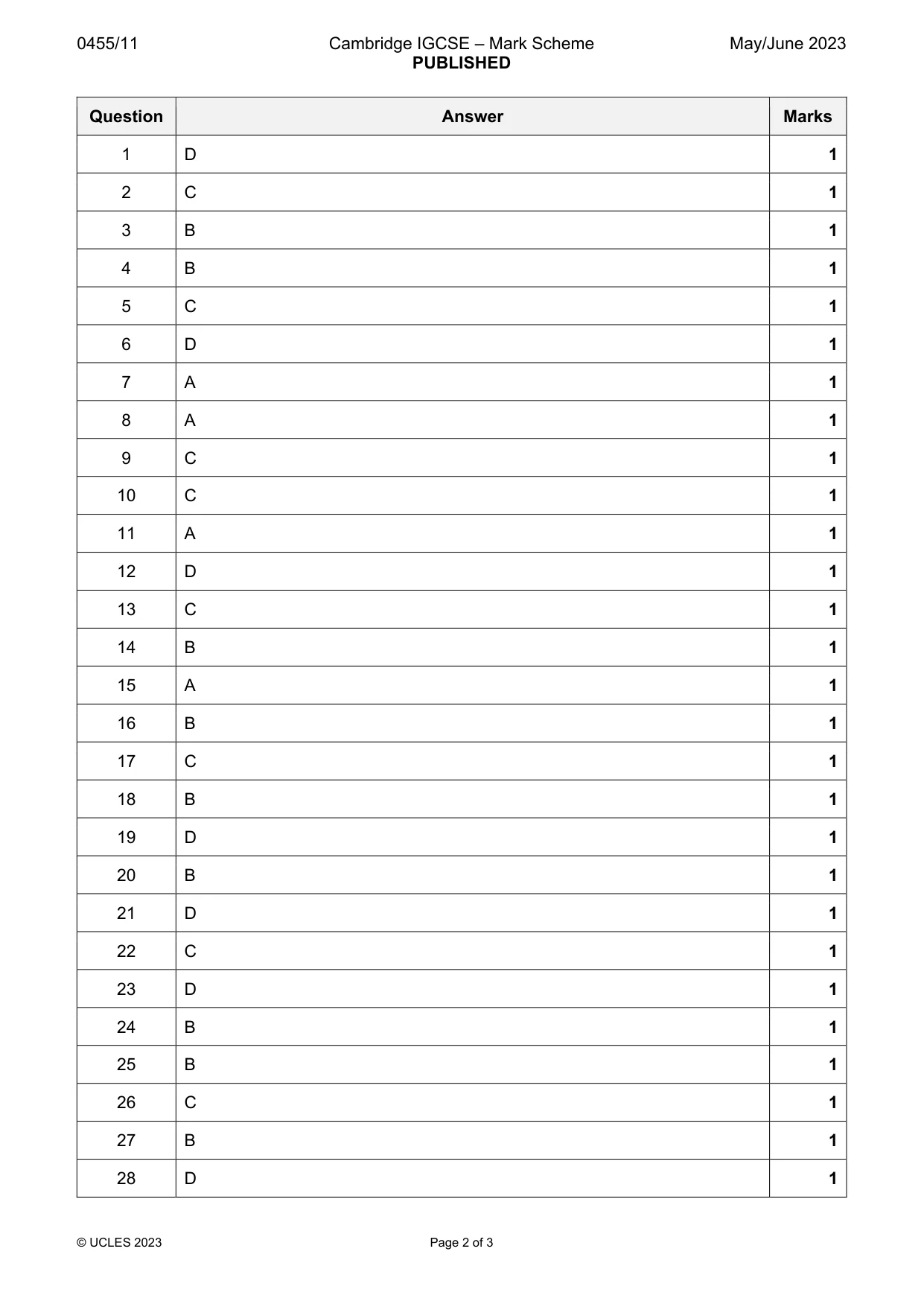
Answers below. Sit the paper first if you are practising.
Questions as text
Q1 · What is the cause of scarcity in an economy?
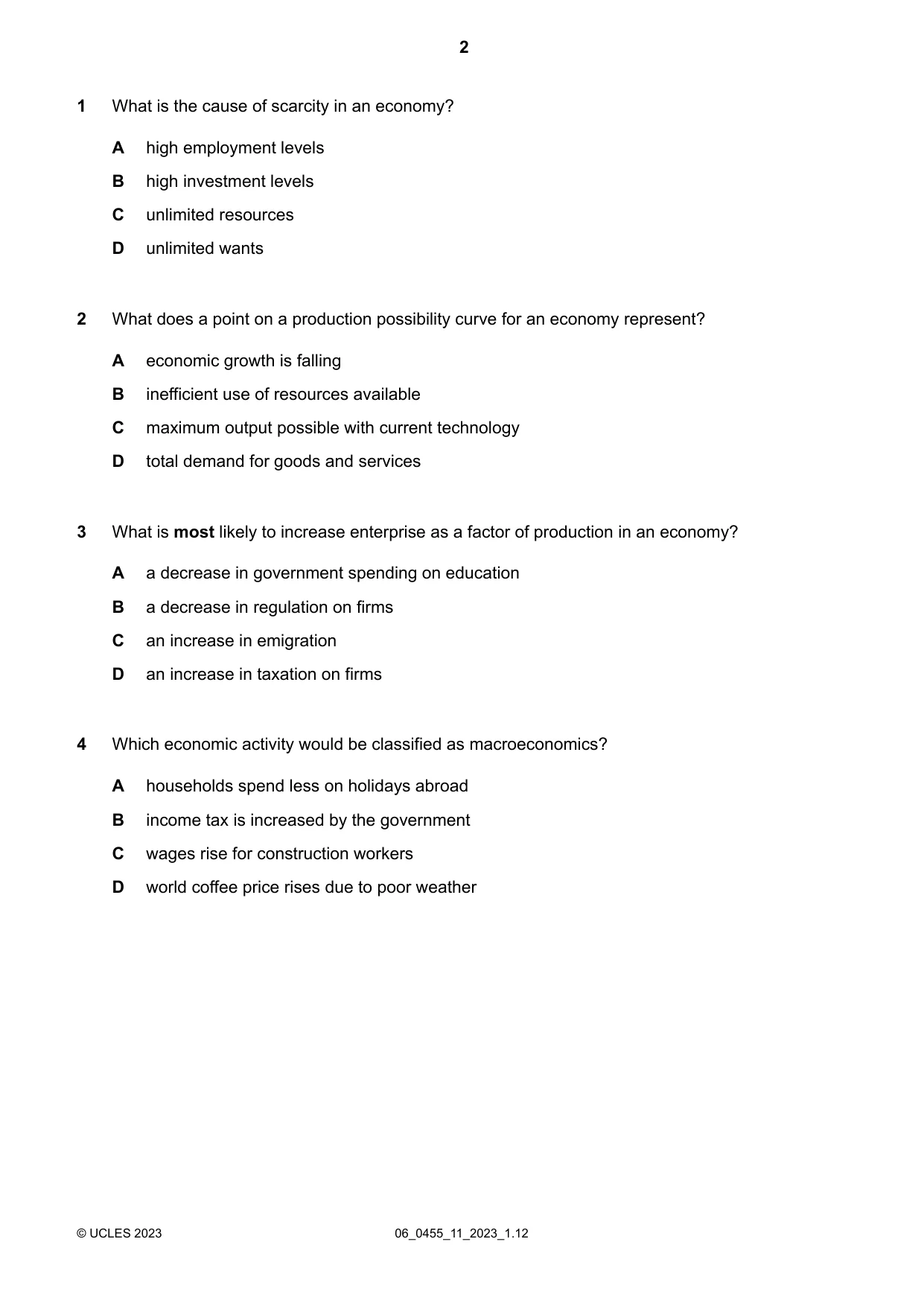
1 What is the cause of scarcity in an economy? A high employment levels B high investment levels C unlimited resources D unlimited wants
Mark scheme: D
Q2 · What does a point on a production possibility curve for an economy represent?
2 What does a point on a production possibility curve for an economy represent? A economic growth is falling B inefficient use of resources available C maximum output possible with current technology D total demand for goods and services
Mark scheme: C
More questions on Production possibility curve (PPC) diagrams
Q3 · What is most likely to increase enterprise as a factor of production in an economy?
3 What is most likely to increase enterprise as a factor of production in an economy? A a decrease in government spending on education B a decrease in regulation on firms C an increase in emigration D an increase in taxation on firms
Mark scheme: B
Q4 · Which economic activity would be classified as macroeconomics?
4 Which economic activity would be classified as macroeconomics? A households spend less on holidays abroad B income tax is increased by the government C wages rise for construction workers D world coffee price rises due to poor weather
Mark scheme: B
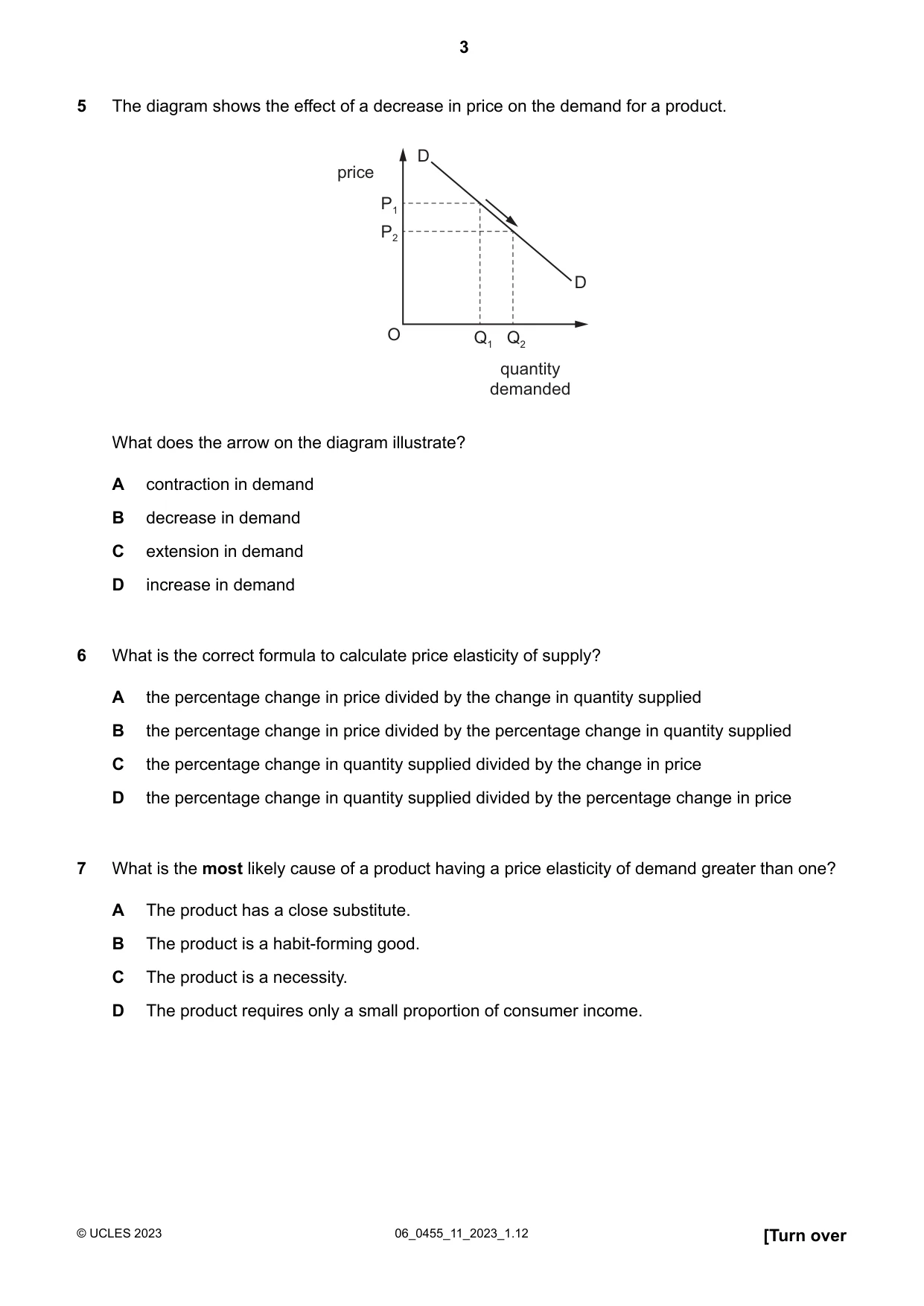
Q5 · The diagram shows the effect of a decrease in price on the demand for a product
5 The diagram shows the effect of a decrease in price on the demand for a product. D price P1 P2 D O Q1 Q2 quantity demanded What does the arrow on the diagram illustrate? A contraction in demand B decrease in demand C extension in demand D increase in demand
Mark scheme: C
Q6 · What is the correct formula to calculate price elasticity of supply?
6 What is the correct formula to calculate price elasticity of supply? A the percentage change in price divided by the change in quantity supplied B the percentage change in price divided by the percentage change in quantity supplied C the percentage change in quantity supplied divided by the change in price D the percentage change in quantity supplied divided by the percentage change in price
Mark scheme: D
Q7 · What is the most likely cause of a product having a price elasticity of demand greater…
7 What is the most likely cause of a product having a price elasticity of demand greater than one? A The product has a close substitute. B The product is a habit-forming good. C The product is a necessity. D The product requires only a small proportion of consumer income.
Mark scheme: A
Q8 · For some illnesses, wearing a face mask has a benefit as it could prevent people from…
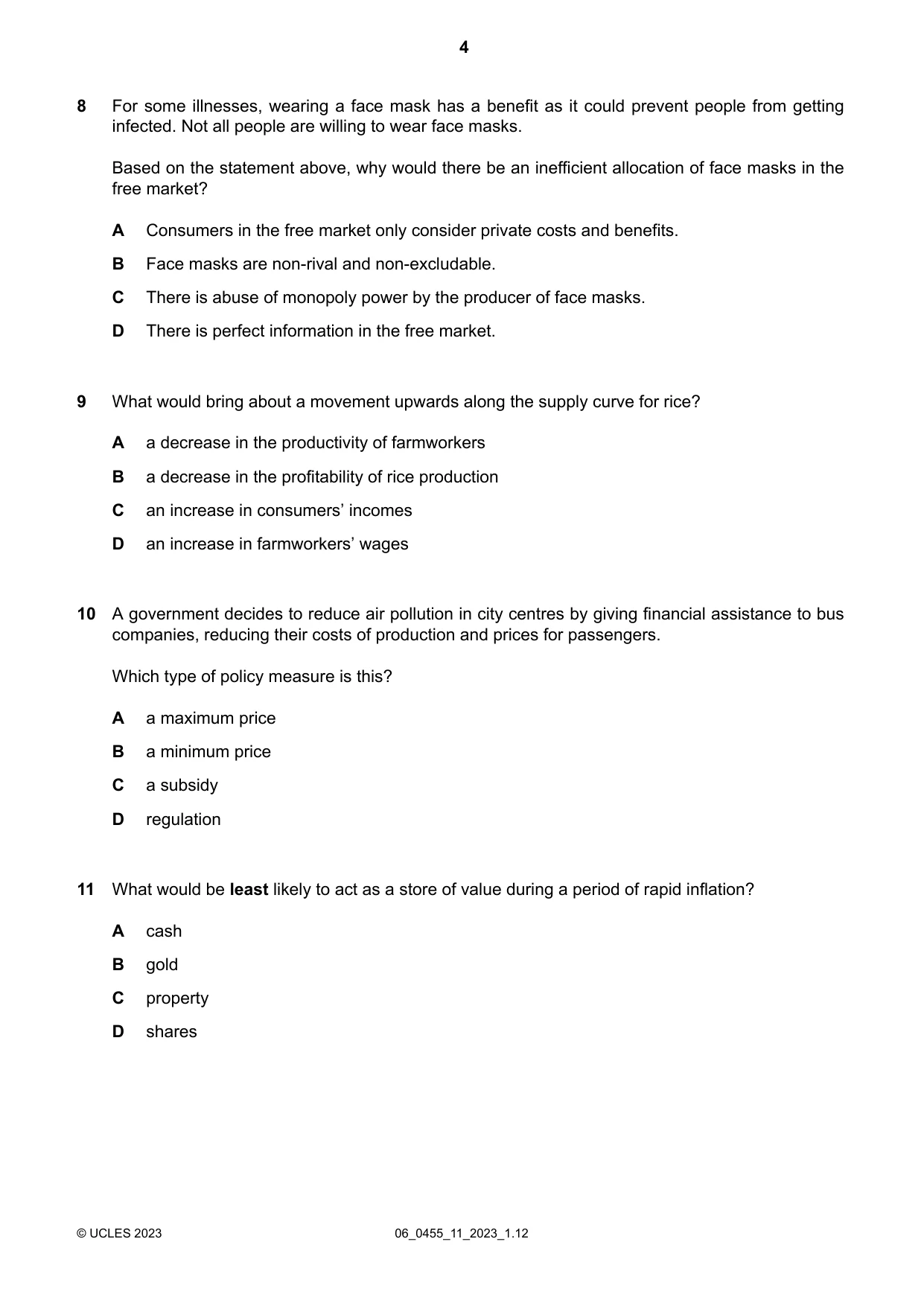
8 For some illnesses, wearing a face mask has a benefit as it could prevent people from getting infected. Not all people are willing to wear face masks. Based on the statement above, why would there be an inefficient allocation of face masks in the free market? A Consumers in the free market only consider private costs and benefits. B Face masks are non-rival and non-excludable. C There is abuse of monopoly power by the producer of face masks. D There is perfect information in the free market.
Mark scheme: A
Q9 · What would bring about a movement upwards along the supply curve for rice?
9 What would bring about a movement upwards along the supply curve for rice? A a decrease in the productivity of farmworkers B a decrease in the profitability of rice production C an increase in consumers’ incomes D an increase in farmworkers’ wages
Mark scheme: C
Q10 · A government decides to reduce air pollution in city centres by giving financial…
10 A government decides to reduce air pollution in city centres by giving financial assistance to bus companies, reducing their costs of production and prices for passengers. Which type of policy measure is this? A a maximum price B a minimum price C a subsidy D regulation
Mark scheme: C
Q11 · What would be least likely to act as a store of value during a period of rapid inflation?
11 What would be least likely to act as a store of value during a period of rapid inflation? A cash B gold C property D shares
Mark scheme: A
Q12 · A country’s central bank raised the rate of interest from 1% to 4% per year
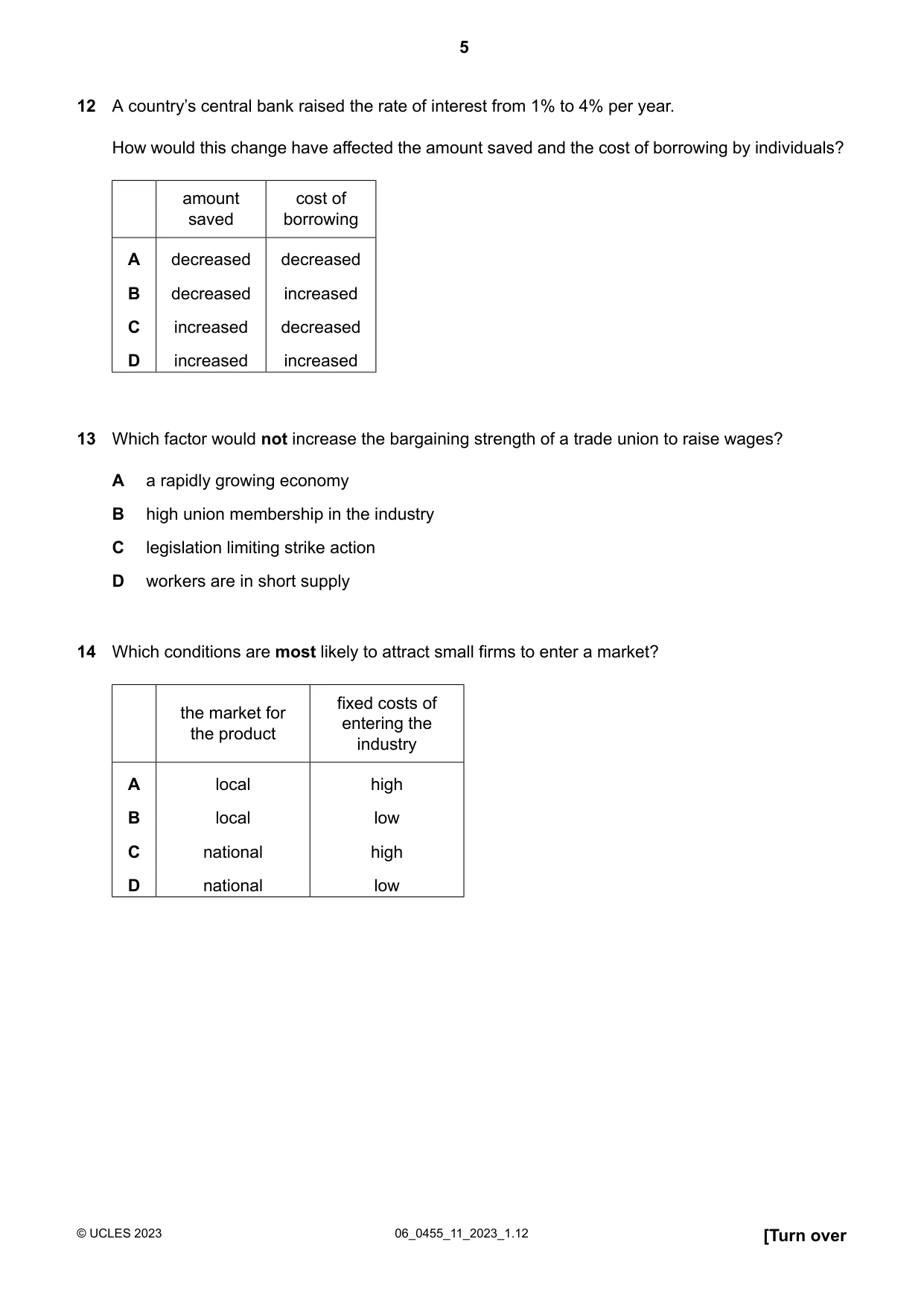
12 A country’s central bank raised the rate of interest from 1% to 4% per year. How would this change have affected the amount saved and the cost of borrowing by individuals? amount cost of saved borrowing A decreased decreased B decreased increased C increased decreased D increased increased
Mark scheme: D
Q13 · Which factor would not increase the bargaining strength of a trade union to raise wages?
13 Which factor would not increase the bargaining strength of a trade union to raise wages? A a rapidly growing economy B high union membership in the industry C legislation limiting strike action D workers are in short supply
Mark scheme: C
Q14 · Which conditions are most likely to attract small firms to enter a market?
14 Which conditions are most likely to attract small firms to enter a market? fixed costs of the market for entering the the product industry A local high B local low C national high D national low
Mark scheme: B
Q15 · The diagram shows a firm’s total cost (TC) curve
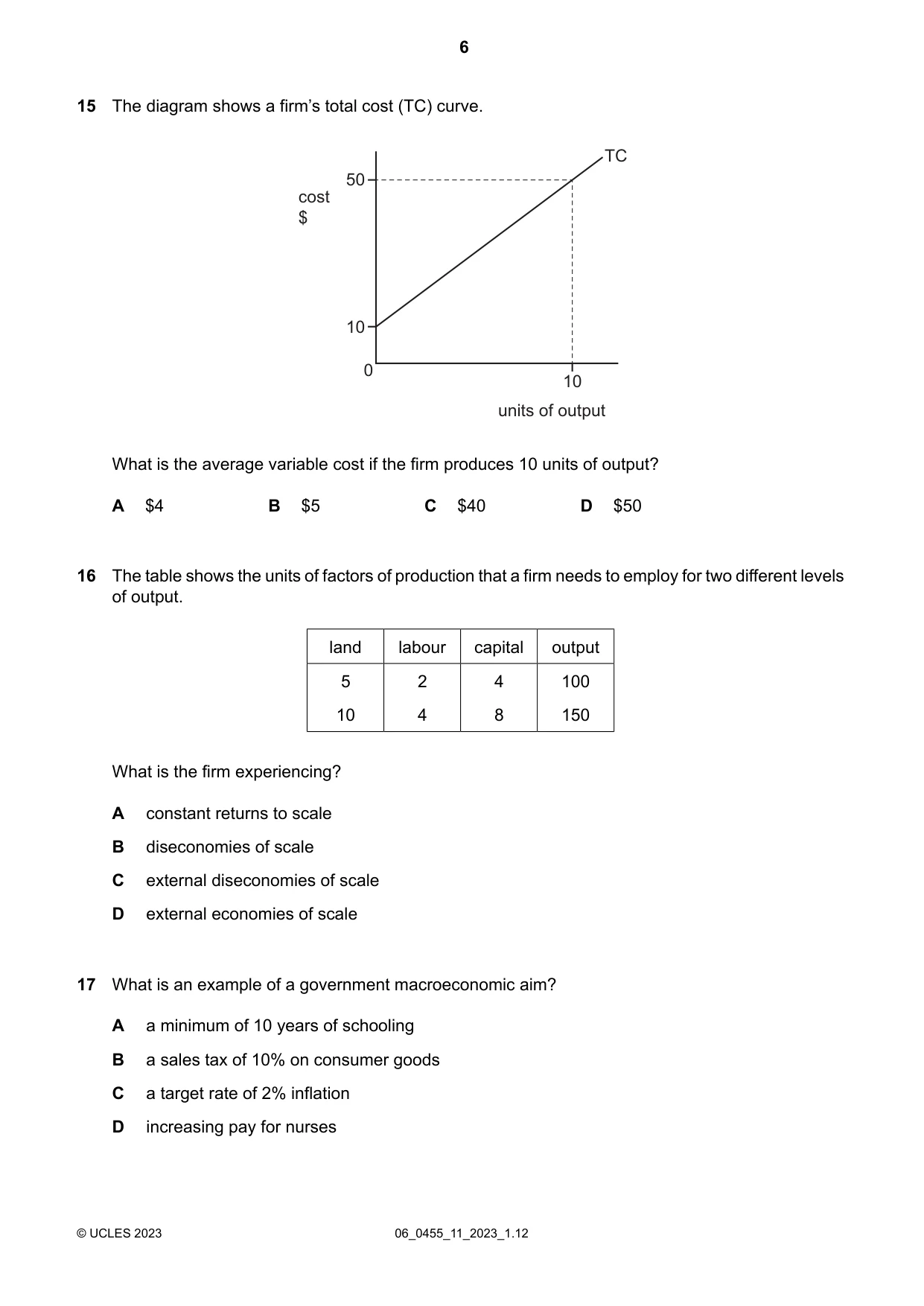
15 The diagram shows a firm’s total cost (TC) curve. TC 50 cost $ 10 0 10 units of output What is the average variable cost if the firm produces 10 units of output? A $4 B $5 C $40 D $50
Mark scheme: A
Q16 · The table shows the units of factors of production that a firm needs to employ for two…
16 The table shows the units of factors of production that a firm needs to employ for two different levels of output. land labour capital output 5 2 4 100 10 4 8 150 What is the firm experiencing? A constant returns to scale B diseconomies of scale C external diseconomies of scale D external economies of scale
Mark scheme: B
Q17 · What is an example of a government macroeconomic aim?
17 What is an example of a government macroeconomic aim? A a minimum of 10 years of schooling B a sales tax of 10% on consumer goods C a target rate of 2% inflation D increasing pay for nurses
Mark scheme: C
Q18 · Government policy measures can affect economic activity in a country
18 Government policy measures can affect economic activity in a country. Which pair of monetary policy measures would be likely to increase employment? A depreciate foreign exchange rates and increase education spending B increase money supply and reduce interest rates C provide subsidies and grants and lower sales tax D reduce income tax and improve infrastructure
Mark scheme: B
Q19 · What would be most likely to encourage saving?
19 What would be most likely to encourage saving? A a rise in the exchange rate B a rise in the goods and services tax rate C a rise in the income tax rate D a rise in the interest rate
Mark scheme: D
Q20 · The government of a country operating at full employment increases its spending on…
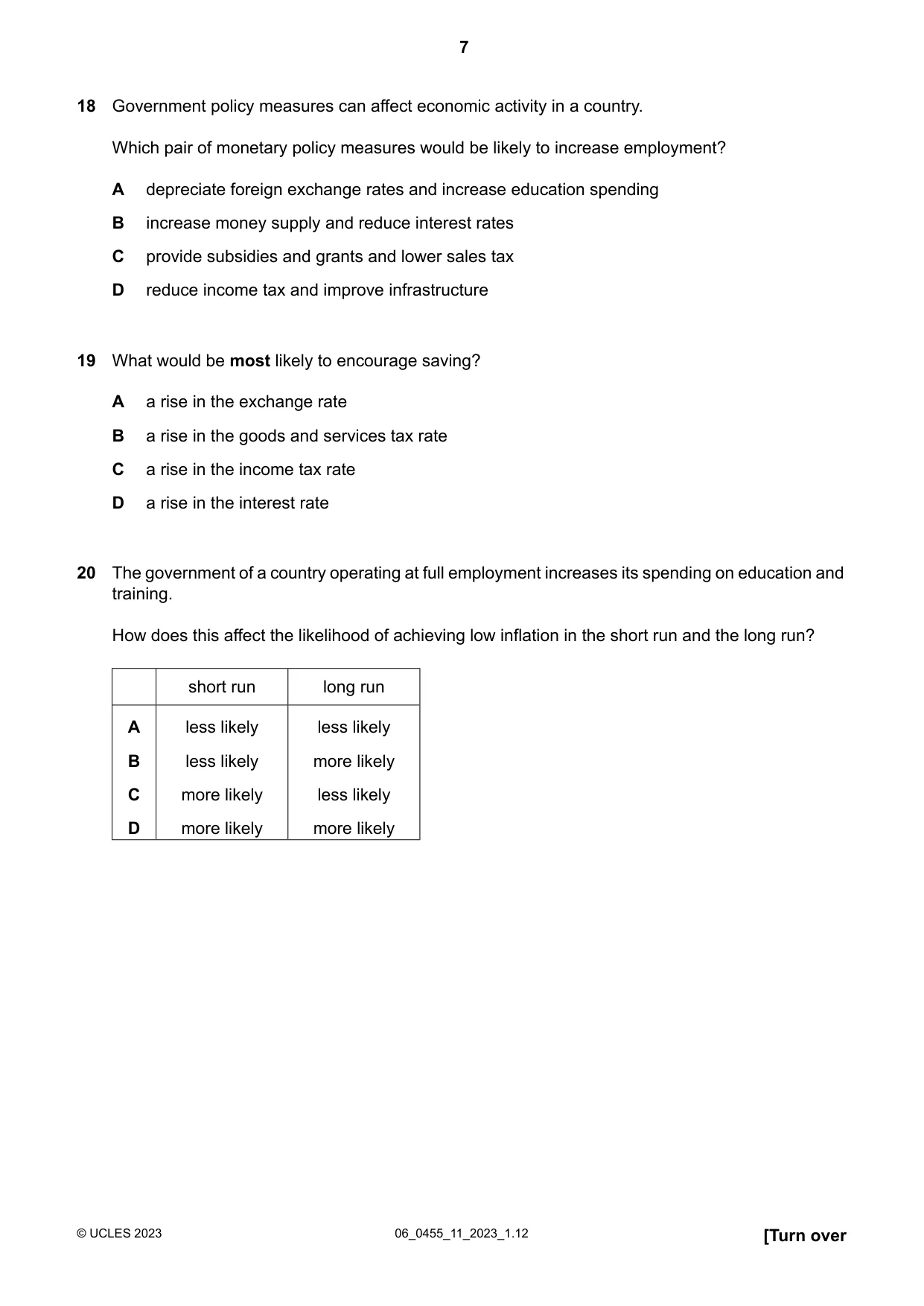
20 The government of a country operating at full employment increases its spending on education and training. How does this affect the likelihood of achieving low inflation in the short run and the long run? short run long run A less likely less likely B less likely more likely C more likely less likely D more likely more likely
Mark scheme: B
Q21 · A government has introduced a tax on a necessity
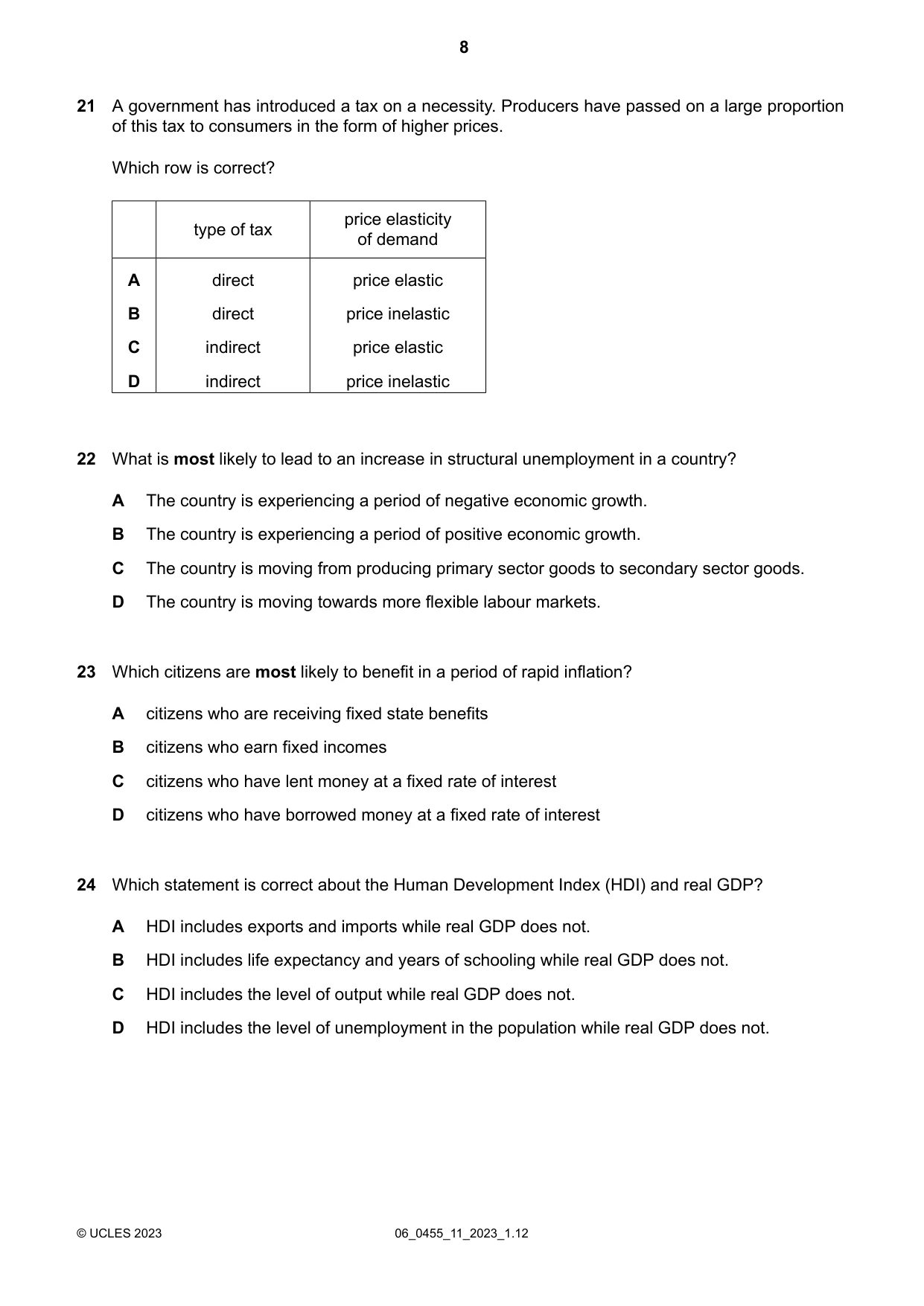
21 A government has introduced a tax on a necessity. Producers have passed on a large proportion of this tax to consumers in the form of higher prices. Which row is correct? price elasticity type of tax of demand A direct price elastic B direct price inelastic C indirect price elastic D indirect price inelastic
Mark scheme: D
Q22 · What is most likely to lead to an increase in structural unemployment in a country?
22 What is most likely to lead to an increase in structural unemployment in a country? A The country is experiencing a period of negative economic growth. B The country is experiencing a period of positive economic growth. C The country is moving from producing primary sector goods to secondary sector goods. D The country is moving towards more flexible labour markets.
Mark scheme: C
Q23 · Which citizens are most likely to benefit in a period of rapid inflation?
23 Which citizens are most likely to benefit in a period of rapid inflation? A citizens who are receiving fixed state benefits B citizens who earn fixed incomes C citizens who have lent money at a fixed rate of interest D citizens who have borrowed money at a fixed rate of interest
Mark scheme: D
Q24 · Which statement is correct about the Human Development Index (HDI) and real GDP?
24 Which statement is correct about the Human Development Index (HDI) and real GDP? A HDI includes exports and imports while real GDP does not. B HDI includes life expectancy and years of schooling while real GDP does not. C HDI includes the level of output while real GDP does not. D HDI includes the level of unemployment in the population while real GDP does not.
Mark scheme: B
More questions on Differences in economic development between countries
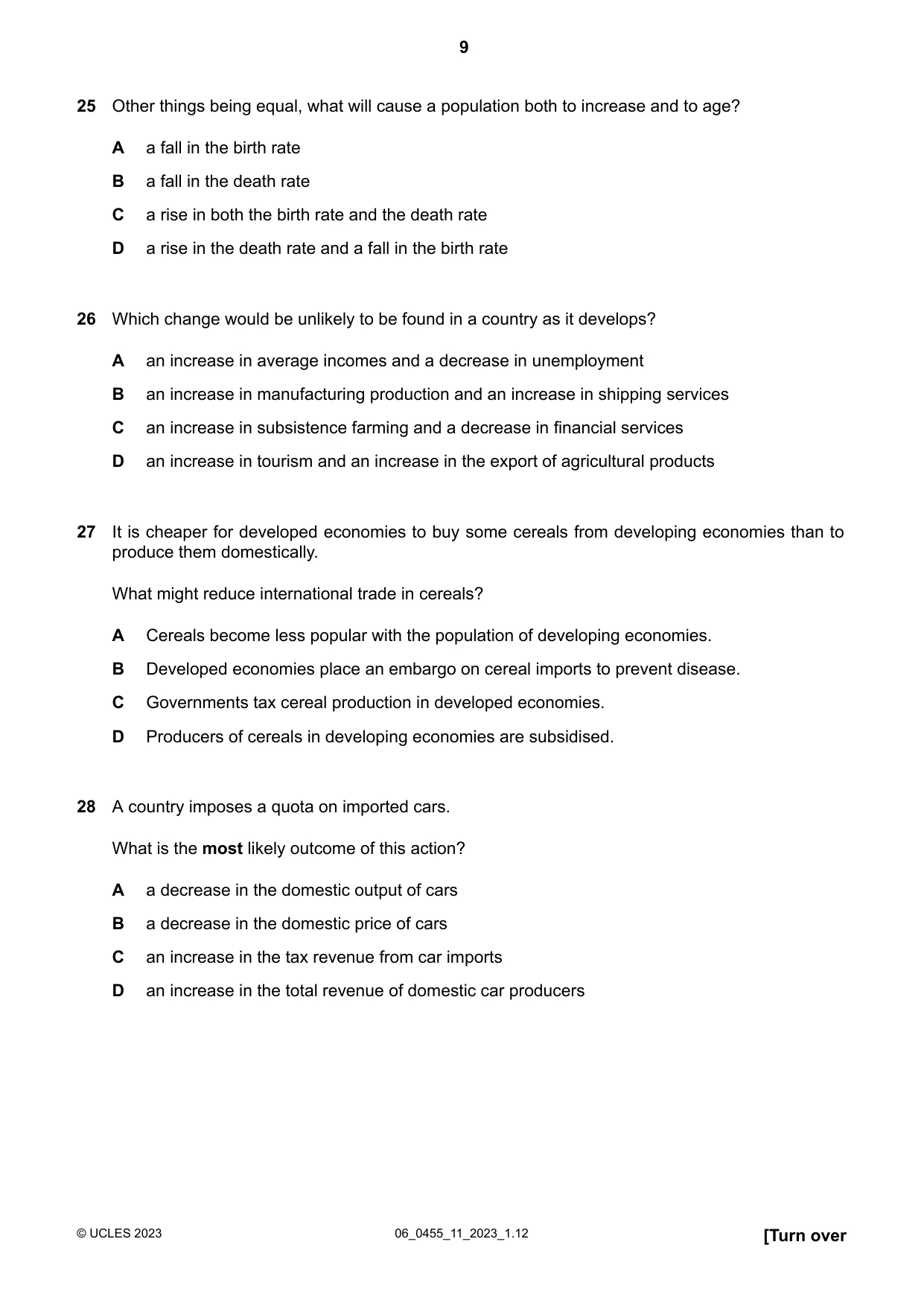
Q25 · Other things being equal, what will cause a population both to increase and to age?
25 Other things being equal, what will cause a population both to increase and to age? A a fall in the birth rate B a fall in the death rate C a rise in both the birth rate and the death rate D a rise in the death rate and a fall in the birth rate
Mark scheme: B
Q26 · Which change would be unlikely to be found in a country as it develops?
26 Which change would be unlikely to be found in a country as it develops? A an increase in average incomes and a decrease in unemployment B an increase in manufacturing production and an increase in shipping services C an increase in subsistence farming and a decrease in financial services D an increase in tourism and an increase in the export of agricultural products
Mark scheme: C
More questions on Differences in economic development between countries
Q27 · It is cheaper for developed economies to buy some cereals from developing economies than…
27 It is cheaper for developed economies to buy some cereals from developing economies than to produce them domestically. What might reduce international trade in cereals? A Cereals become less popular with the population of developing economies. B Developed economies place an embargo on cereal imports to prevent disease. C Governments tax cereal production in developed economies. D Producers of cereals in developing economies are subsidised.
Mark scheme: B
Q28 · A country imposes a quota on imported cars
28 A country imposes a quota on imported cars. What is the most likely outcome of this action? A a decrease in the domestic output of cars B a decrease in the domestic price of cars C an increase in the tax revenue from car imports D an increase in the total revenue of domestic car producers
Mark scheme: D
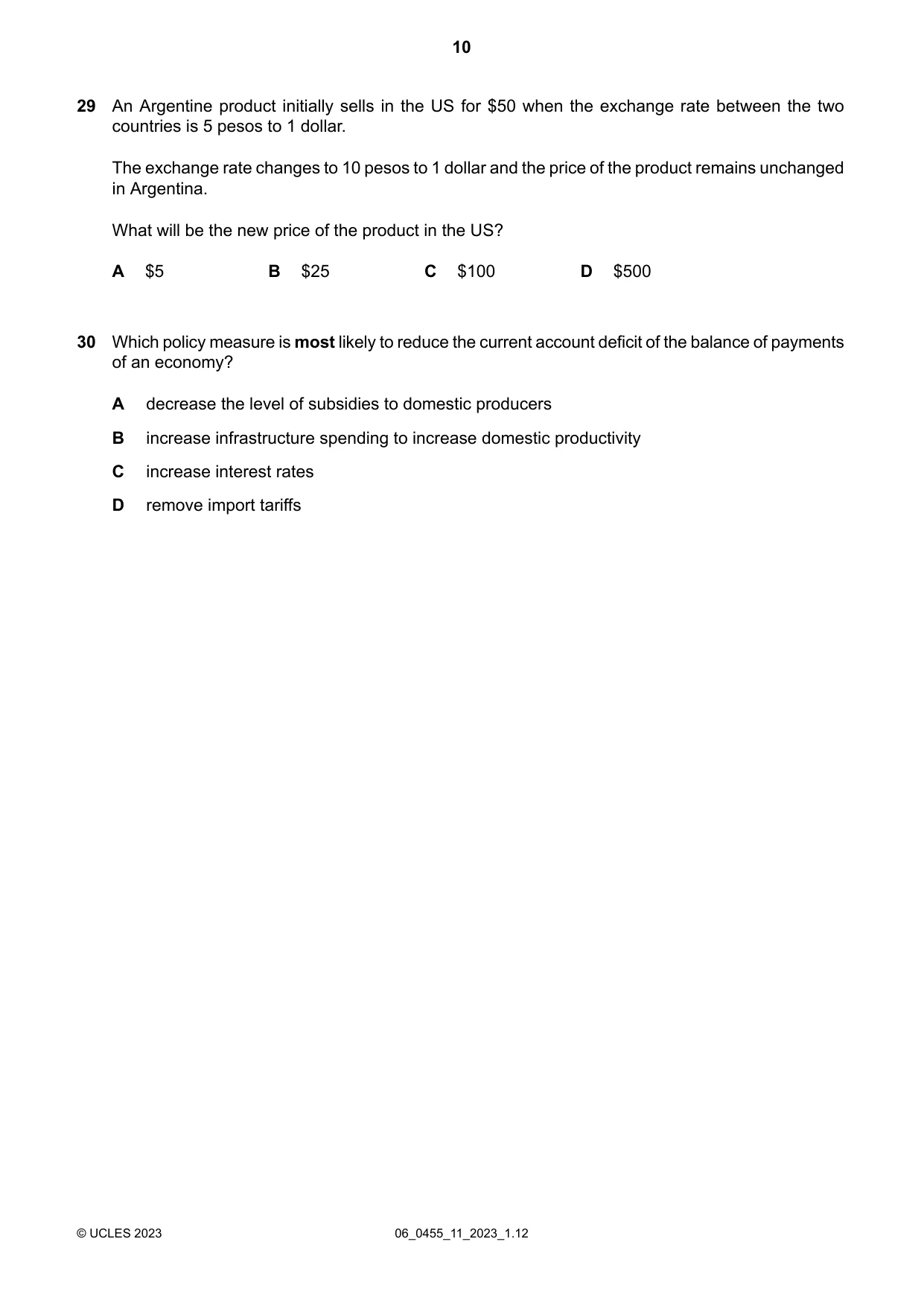
Q29 · An Argentine product initially sells in the US for $50 when the exchange rate between the…
29 An Argentine product initially sells in the US for $50 when the exchange rate between the two countries is 5 pesos to 1 dollar. The exchange rate changes to 10 pesos to 1 dollar and the price of the product remains unchanged in Argentina. What will be the new price of the product in the US? A $5 B $25 C $100 D $500
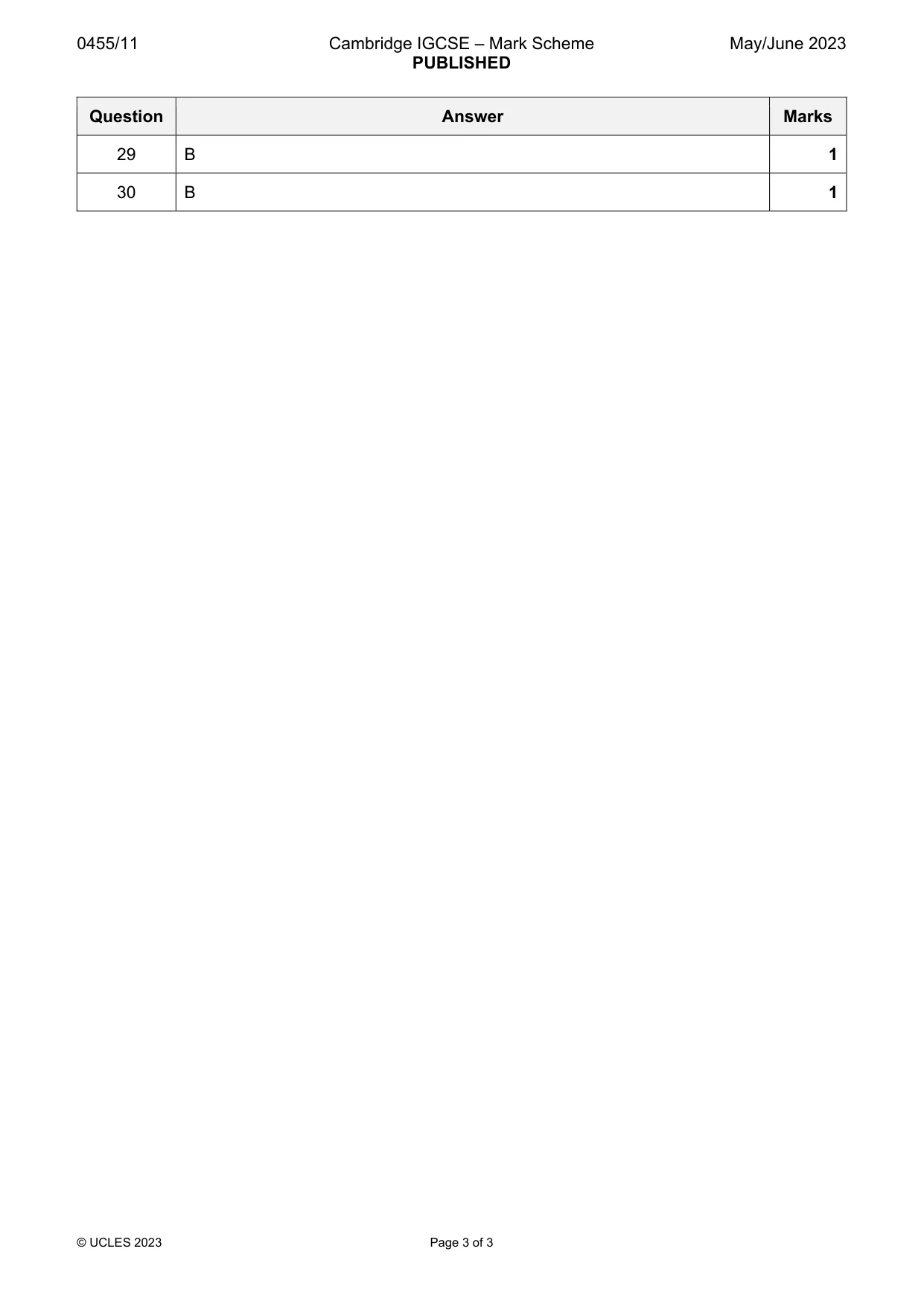
Mark scheme: B
Q30 · Which policy measure is most likely to reduce the current account deficit of the balance…
30 Which policy measure is most likely to reduce the current account deficit of the balance of payments of an economy? A decrease the level of subsidies to domestic producers B increase infrastructure spending to increase domestic productivity C increase interest rates D remove import tariffs
Mark scheme: B
What was in this paper
The subtopics covered by these 30 questions, and how many questions each got. Open one in a new tab to see every Cambridge question on it.
2Globalisation, free trade and protection2Monetary policy2Price elasticity of demand (PED)2Current account of balance of payments1Demand1Employment and unemployment1Firms1Firms and production1Firms’ costs, revenue and objectives1Foreign exchange rates1Households1Inflation and deflation1Market failure1Microeconomics and macroeconomics1Money and banking1Population1Price changes1Price elasticity of supply (PES)1Production possibility curve (PPC) diagrams1Supply-side policy1The factors of production1The macroeconomic aims of government1The nature of the economic problem1The role of government1Trade unions1What you needed in this session
Cambridge’s own grade thresholds for 2023 May/June, Paper 1 · Variant 1. A higher threshold means an easier paper — the bar moves with how the cohort did.