Cambridge IGCSE Economics 0455 — 2021 Oct/Nov Paper 1 · Variant 3
0455/13/O/N/21 · 29 questions · 30 marks · ≈34 min
The question paper and its mark scheme, free to read here and free to download. This is Cambridge’s own paper, exactly as it was sat.
Question paper12 pages

Mark scheme3 pages
Answers below. Sit the paper first if you are practising.
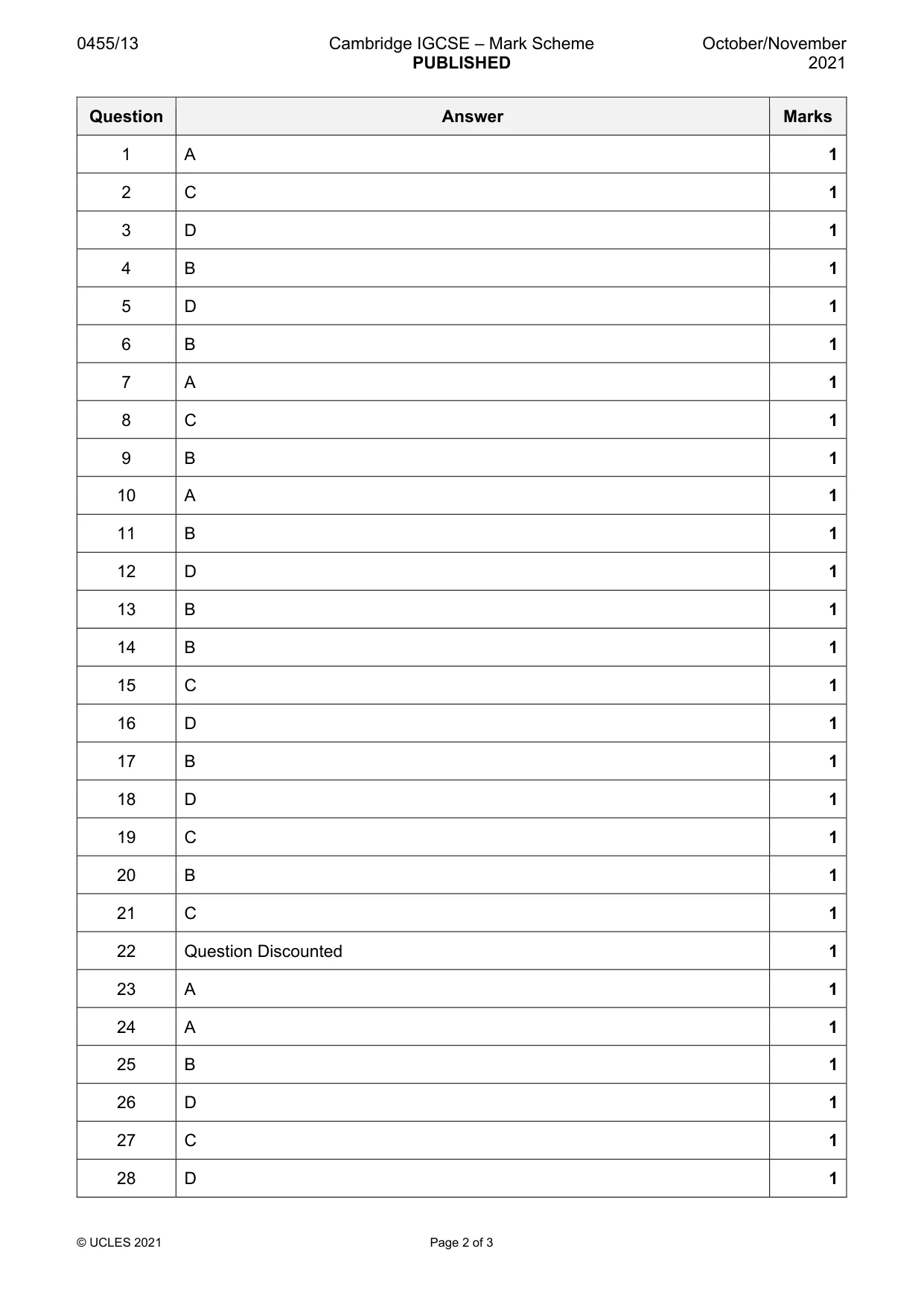
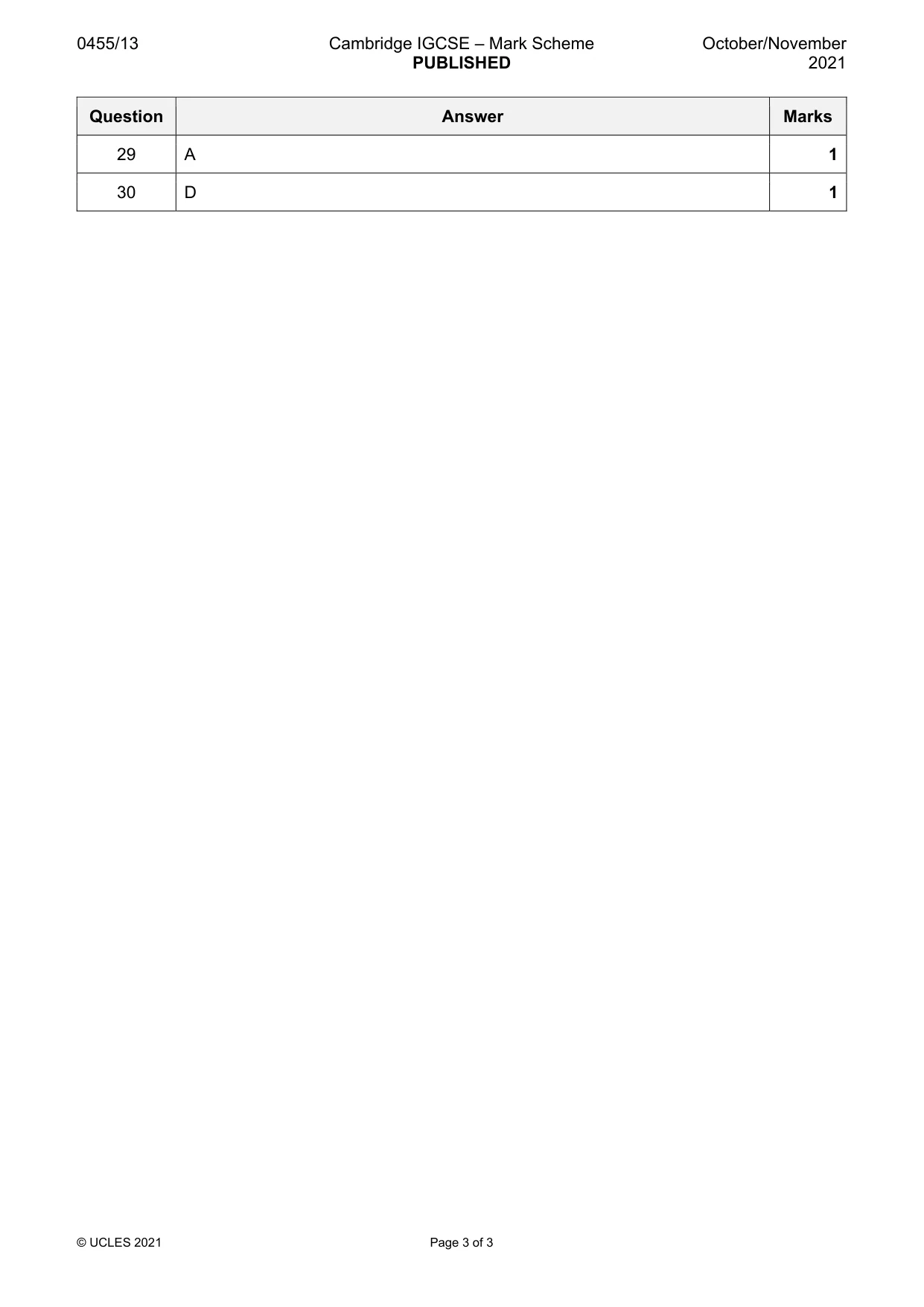
Questions as text
Q1 · To help reduce the price of oil, new supplies are needed
1 To help reduce the price of oil, new supplies are needed. However, objectors oppose exploration of new sites because of the environmental damage it may cause. Why is this statement an example of the basic economic problem? A Oil is a limited resource. B Oil is expensive. C The exploration involves demand and supply. D There are external costs involved in production.
Mark scheme: A
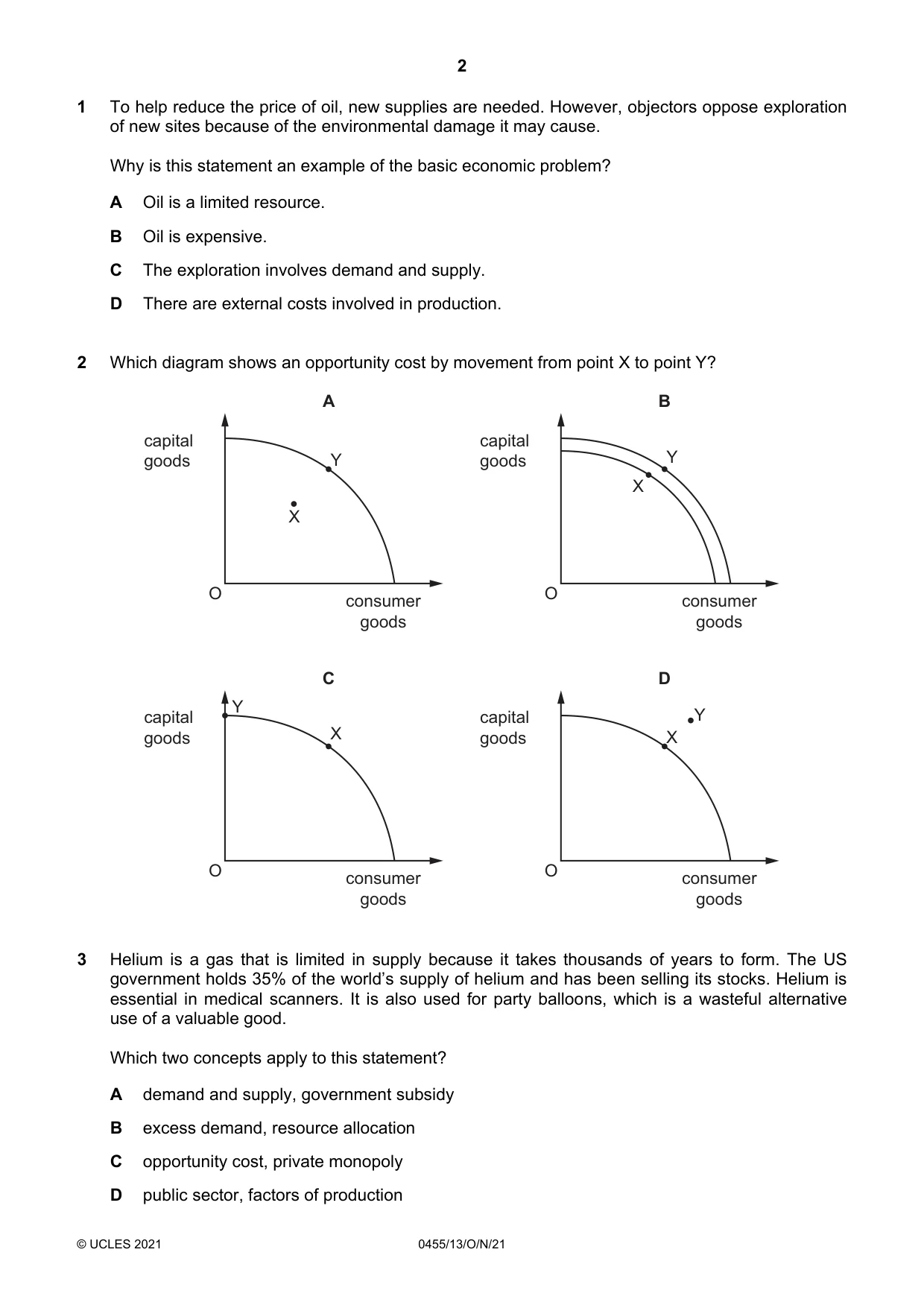
Q2 · Which diagram shows an opportunity cost by movement from point X to point Y?
2 Which diagram shows an opportunity cost by movement from point X to point Y? A B capital capital goods Y goods Y X X O O consumer consumer goods goods C D Y capital capital Y goods X goods X O O consumer consumer goods goods
Mark scheme: C
More questions on Production possibility curve (PPC) diagrams
Q3 · Helium is a gas that is limited in supply because it takes thousands of years to form
3 Helium is a gas that is limited in supply because it takes thousands of years to form. The US government holds 35% of the world’s supply of helium and has been selling its stocks. Helium is essential in medical scanners. It is also used for party balloons, which is a wasteful alternative use of a valuable good. Which two concepts apply to this statement? A demand and supply, government subsidy B excess demand, resource allocation C opportunity cost, private monopoly D public sector, factors of production
Mark scheme: D
Q4 · What is an example of a public good?
4 What is an example of a public good? A healthcare B street lights C unemployment benefits D vaccinations
Mark scheme: B
Q5 · Why does a government provide certain goods and services in a mixed economic system?
5 Why does a government provide certain goods and services in a mixed economic system? A The government always provides goods more cheaply than private firms. B The government considers only private costs and benefits. C The government provides goods to prevent the development of monopolies. D The government provides public goods because private firms cannot charge for them.
Mark scheme: D
Q6 · What is a microeconomic decision?
6 What is a microeconomic decision? A a central bank reducing interest rates B a gas firm reducing its prices C a government increasing income tax D a government increasing the national minimum wage
Mark scheme: B
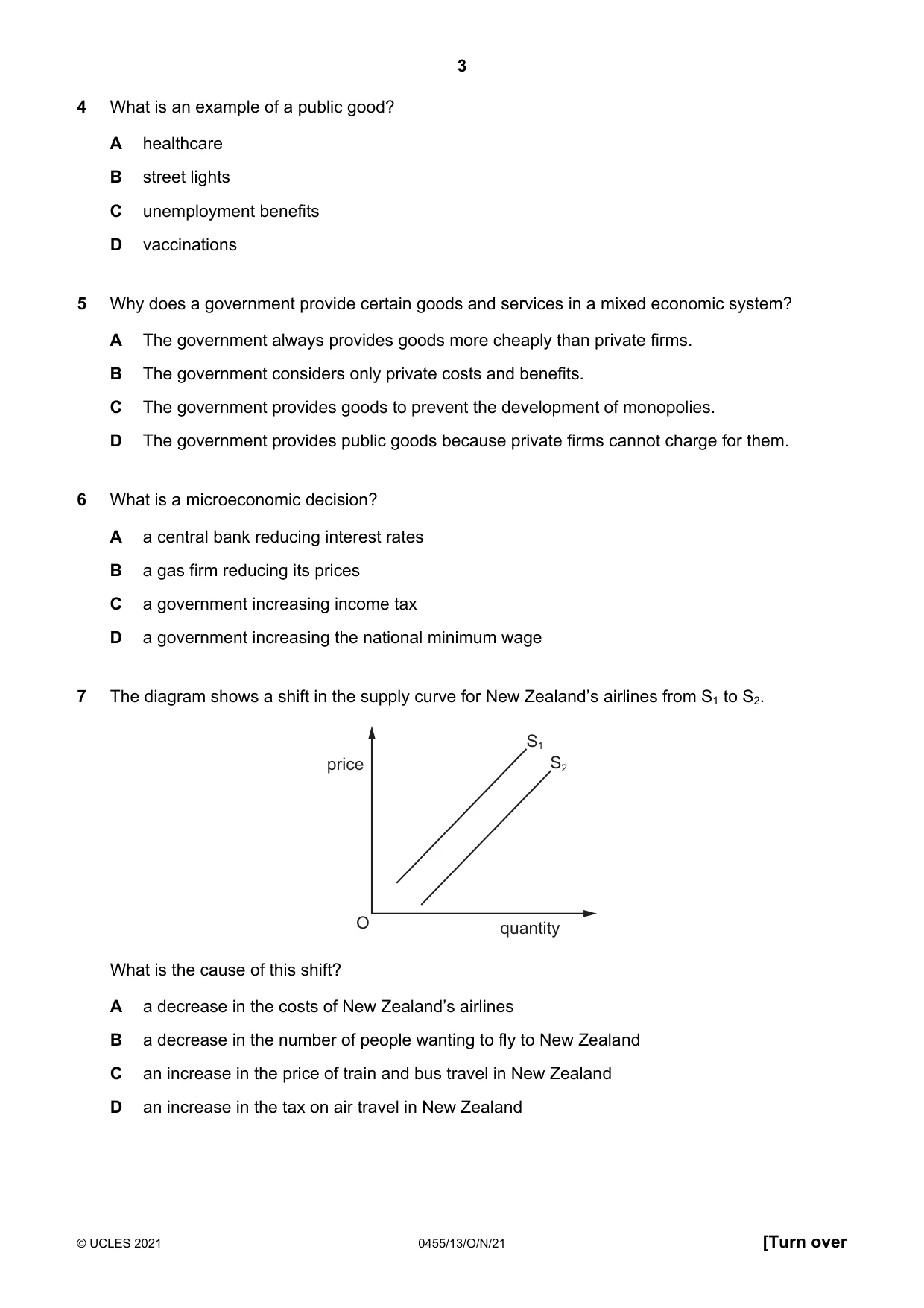
Q7 · The diagram shows a shift in the supply curve for New Zealand’s airlines from S1 to S2
7 The diagram shows a shift in the supply curve for New Zealand’s airlines from S1 to S2. S1 price S2 O quantity What is the cause of this shift? A a decrease in the costs of New Zealand’s airlines B a decrease in the number of people wanting to fly to New Zealand C an increase in the price of train and bus travel in New Zealand D an increase in the tax on air travel in New Zealand
Mark scheme: A
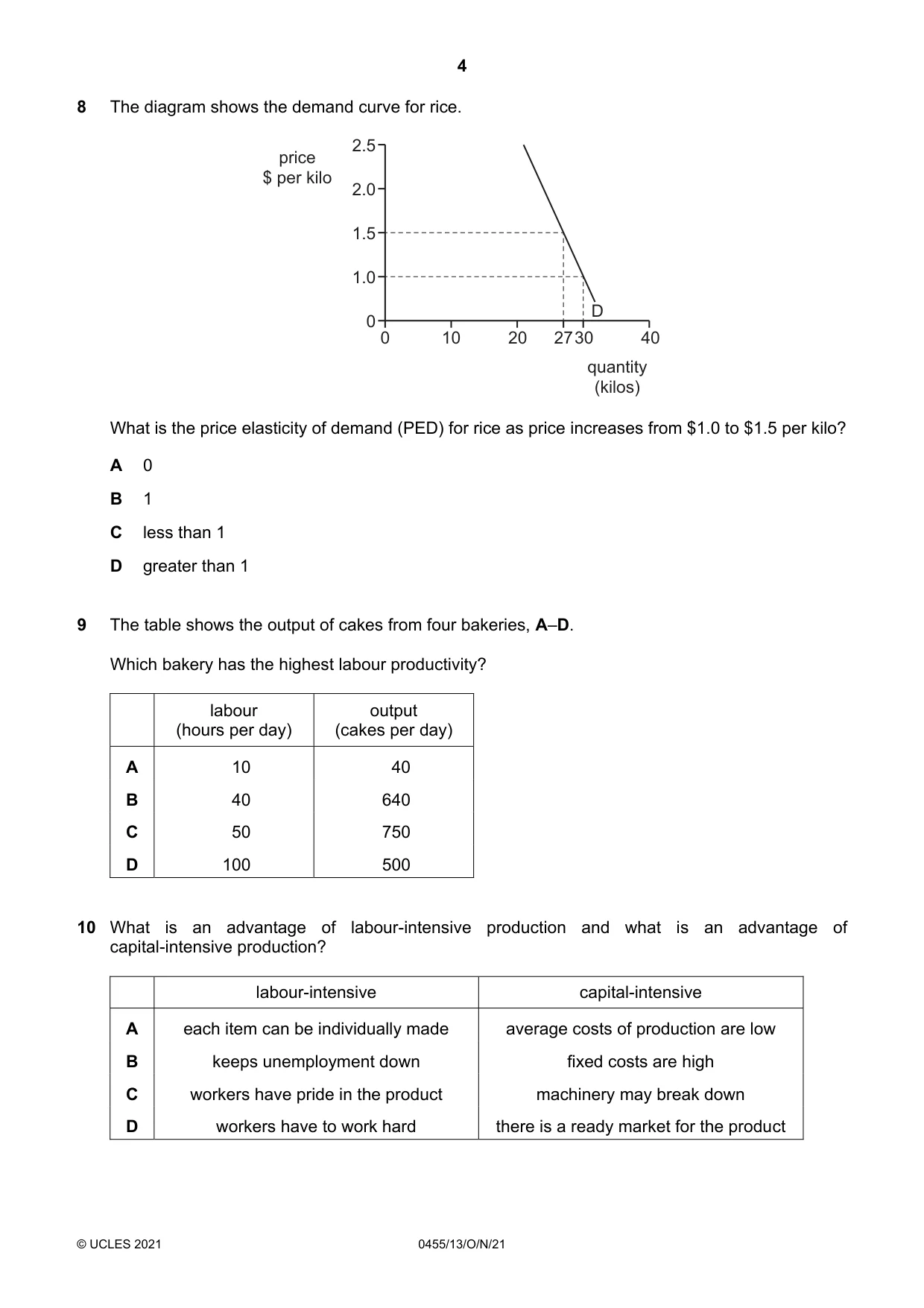
Q8 · The diagram shows the demand curve for rice
8 The diagram shows the demand curve for rice. 2.5 price $ per kilo 2.0 1.5 1.0 D 0 0 10 20 2730 40 quantity (kilos) What is the price elasticity of demand (PED) for rice as price increases from $1.0 to $1.5 per kilo? A 0 B 1 C less than 1 D greater than 1
Mark scheme: C
Q9 · The table shows the output of cakes from four bakeries, A–D
9 The table shows the output of cakes from four bakeries, A–D. Which bakery has the highest labour productivity? labour output (hours per day) (cakes per day) A 10 40 B 40 640 C 50 750 D 100 500
Mark scheme: B
Q10 · What is an advantage of labour-intensive production and what is an advantage of…
10 What is an advantage of labour-intensive production and what is an advantage of capital-intensive production? labour-intensive capital-intensive A each item can be individually made average costs of production are low B keeps unemployment down fixed costs are high C workers have pride in the product machinery may break down D workers have to work hard there is a ready market for the product
Mark scheme: A
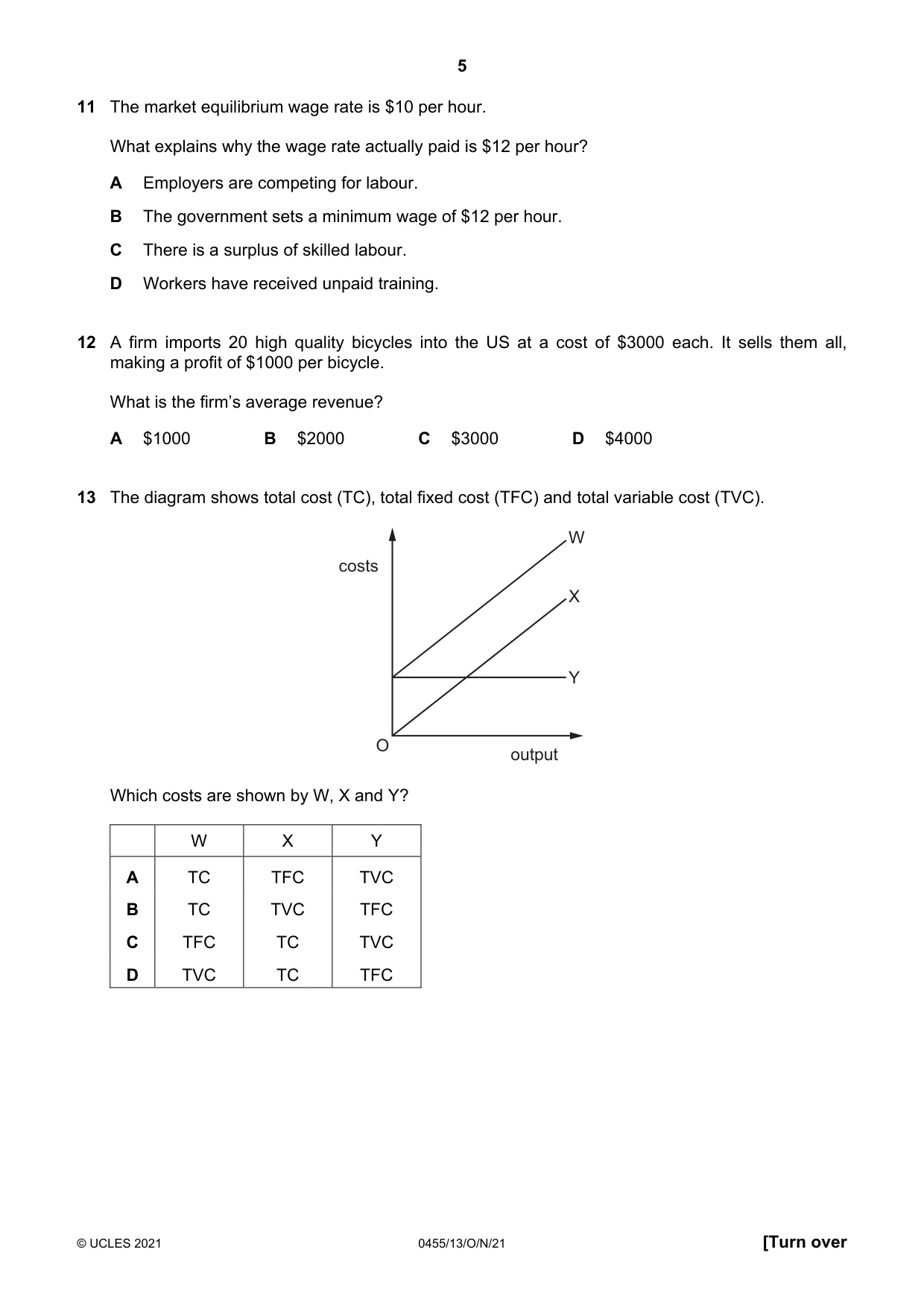
Q11 · The market equilibrium wage rate is $10 per hour
11 The market equilibrium wage rate is $10 per hour. What explains why the wage rate actually paid is $12 per hour? A Employers are competing for labour. B The government sets a minimum wage of $12 per hour. C There is a surplus of skilled labour. D Workers have received unpaid training.
Mark scheme: B
Q12 · A firm imports 20 high quality bicycles into the US at a cost of $3000 each
12 A firm imports 20 high quality bicycles into the US at a cost of $3000 each. It sells them all, making a profit of $1000 per bicycle. What is the firm’s average revenue? A $1000 B $2000 C $3000 D $4000
Mark scheme: D
Q13 · The diagram shows total cost (TC), total fixed cost (TFC) and total variable cost (TVC)
13 The diagram shows total cost (TC), total fixed cost (TFC) and total variable cost (TVC). W costs X Y O output Which costs are shown by W, X and Y? W X Y A TC TFC TVC B TC TVC TFC C TFC TC TVC D TVC TC TFC
Mark scheme: B
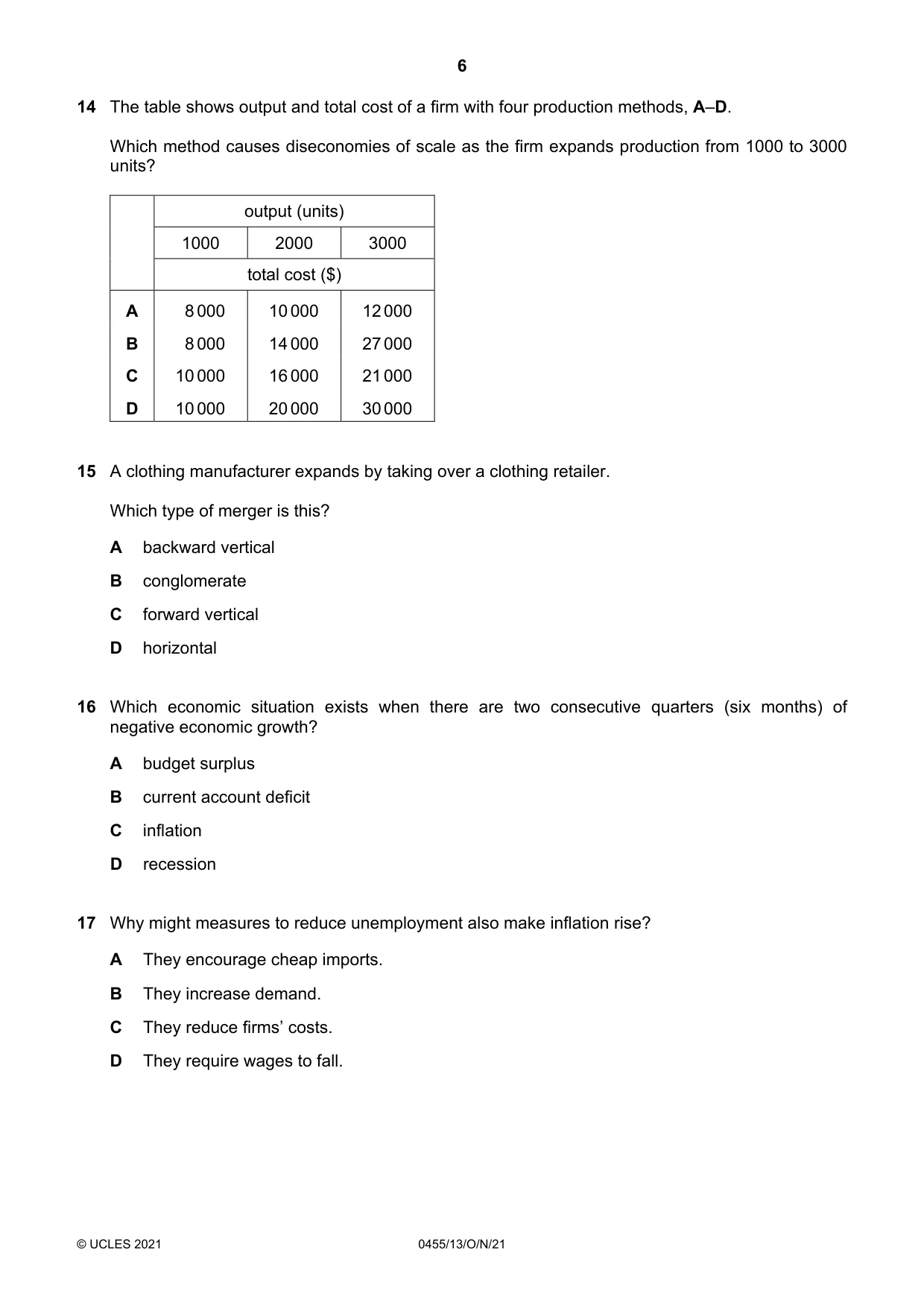
Q14 · The table shows output and total cost of a firm with four production methods, A–D
14 The table shows output and total cost of a firm with four production methods, A–D. Which method causes diseconomies of scale as the firm expands production from 1000 to 3000 units? output (units) 1000 2000 3000 total cost ($) A 8 000 10 000 12 000 B 8 000 14 000 27 000 C 10 000 16 000 21 000 D 10 000 20 000 30 000
Mark scheme: B
Q15 · A clothing manufacturer expands by taking over a clothing retailer
15 A clothing manufacturer expands by taking over a clothing retailer. Which type of merger is this? A backward vertical B conglomerate C forward vertical D horizontal
Mark scheme: C
Q16 · Which economic situation exists when there are two consecutive quarters (six months) of…
16 Which economic situation exists when there are two consecutive quarters (six months) of negative economic growth? A budget surplus B current account deficit C inflation D recession
Mark scheme: D
Q17 · Why might measures to reduce unemployment also make inflation rise?
17 Why might measures to reduce unemployment also make inflation rise? A They encourage cheap imports. B They increase demand. C They reduce firms’ costs. D They require wages to fall.
Mark scheme: B
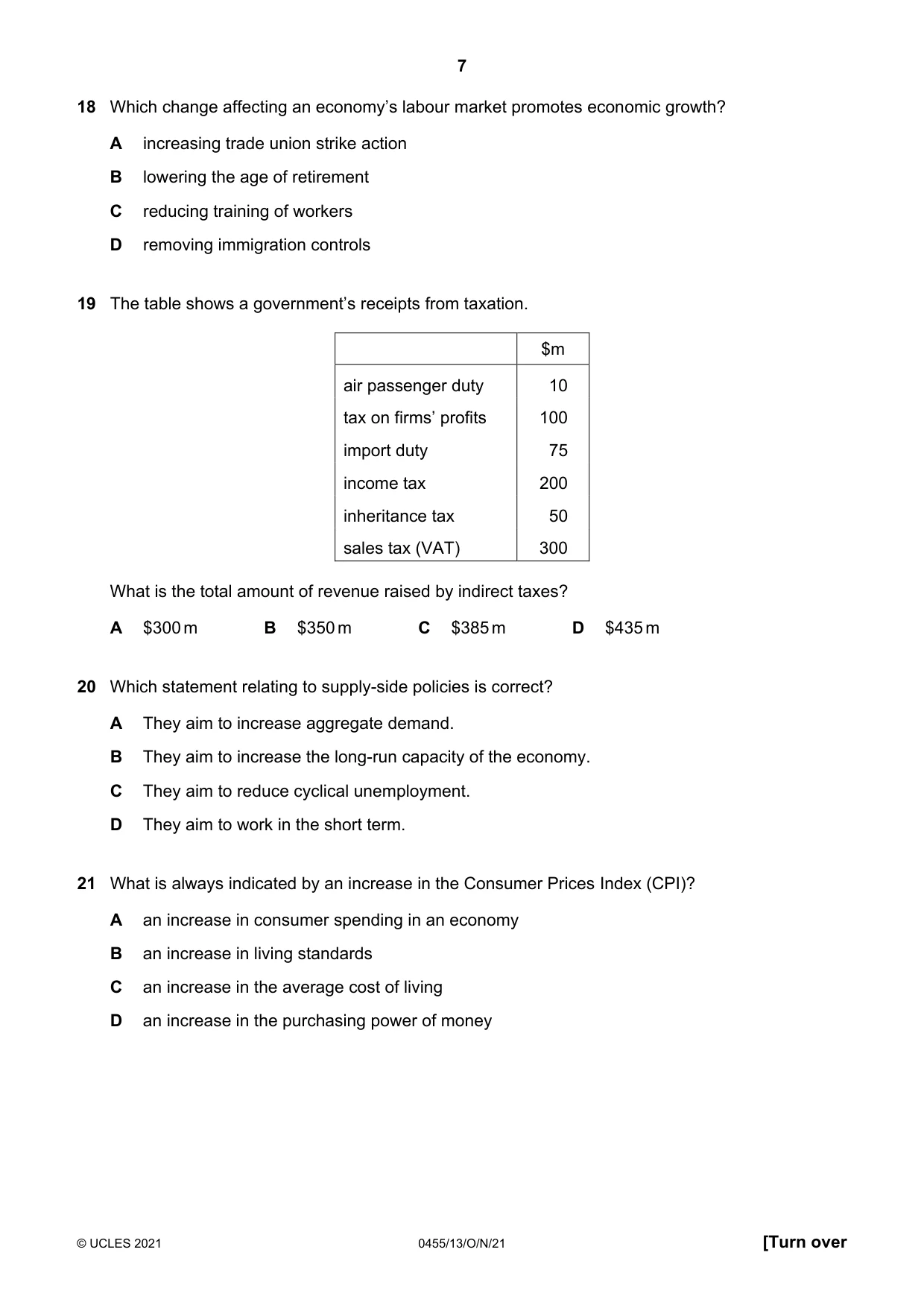
Q18 · Which change affecting an economy’s labour market promotes economic growth?
18 Which change affecting an economy’s labour market promotes economic growth? A increasing trade union strike action B lowering the age of retirement C reducing training of workers D removing immigration controls
Mark scheme: D
Q19 · The table shows a government’s receipts from taxation
19 The table shows a government’s receipts from taxation. $m air passenger duty 10 tax on firms’ profits 100 import duty 75 income tax 200 inheritance tax 50 sales tax (VAT) 300 What is the total amount of revenue raised by indirect taxes? A $300 m B $350 m C $385 m D $435 m
Mark scheme: C
Q20 · Which statement relating to supply-side policies is correct?
20 Which statement relating to supply-side policies is correct? A They aim to increase aggregate demand. B They aim to increase the long-run capacity of the economy. C They aim to reduce cyclical unemployment. D They aim to work in the short term.
Mark scheme: B
Q21 · What is always indicated by an increase in the Consumer Prices Index (CPI)?
21 What is always indicated by an increase in the Consumer Prices Index (CPI)? A an increase in consumer spending in an economy B an increase in living standards C an increase in the average cost of living D an increase in the purchasing power of money Due to an issue with Question 22, the question has been removed from the question paper.
Mark scheme: C
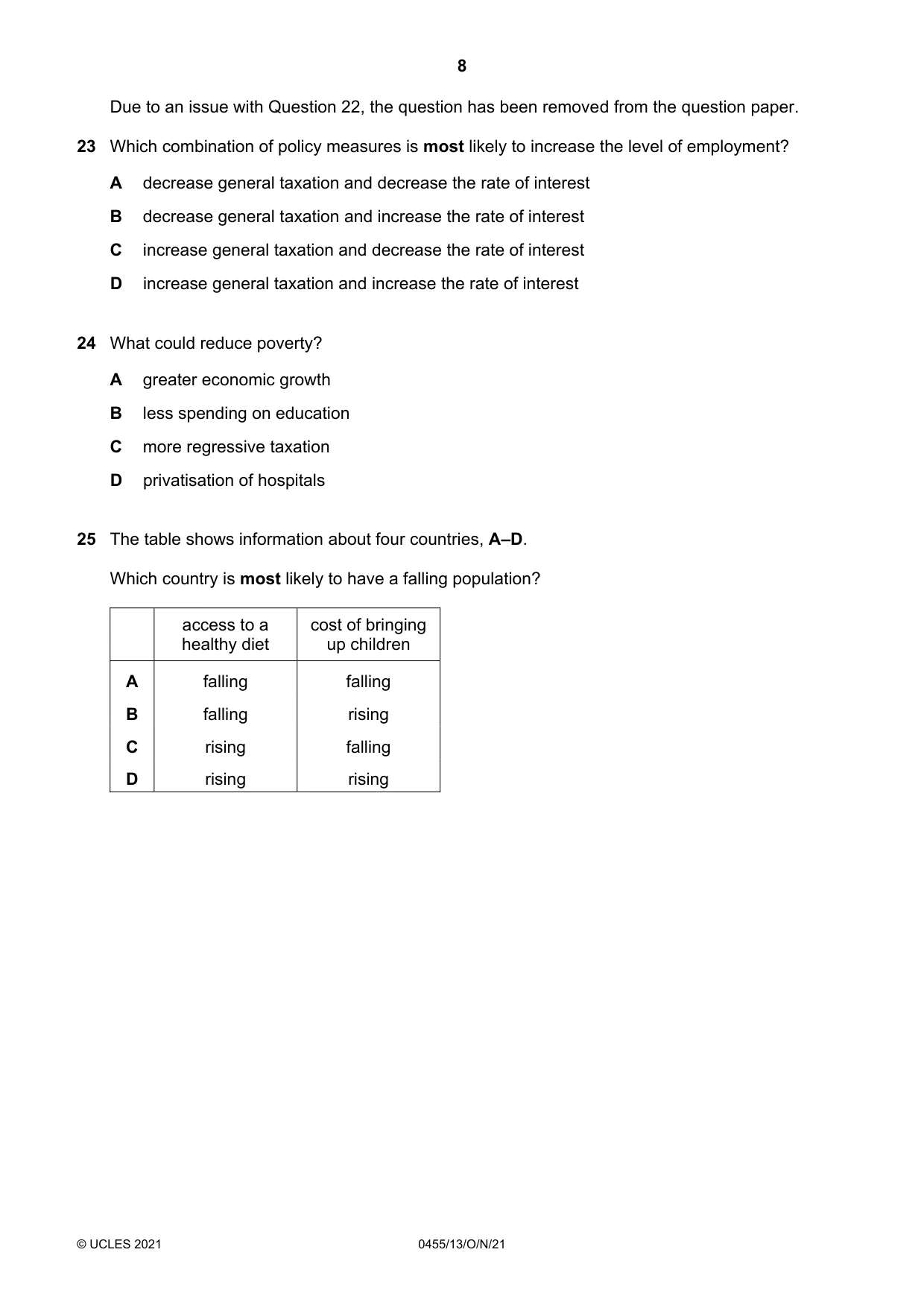
Q23 · Which combination of policy measures is most likely to increase the level of employment?
23 Which combination of policy measures is most likely to increase the level of employment? A decrease general taxation and decrease the rate of interest B decrease general taxation and increase the rate of interest C increase general taxation and decrease the rate of interest D increase general taxation and increase the rate of interest
Mark scheme: A
Q24 · What could reduce poverty?
24 What could reduce poverty? A greater economic growth B less spending on education C more regressive taxation D privatisation of hospitals
Mark scheme: A
Q25 · The table shows information about four countries, A–D
25 The table shows information about four countries, A–D. Which country is most likely to have a falling population? access to a cost of bringing healthy diet up children A falling falling B falling rising C rising falling D rising rising
Mark scheme: B
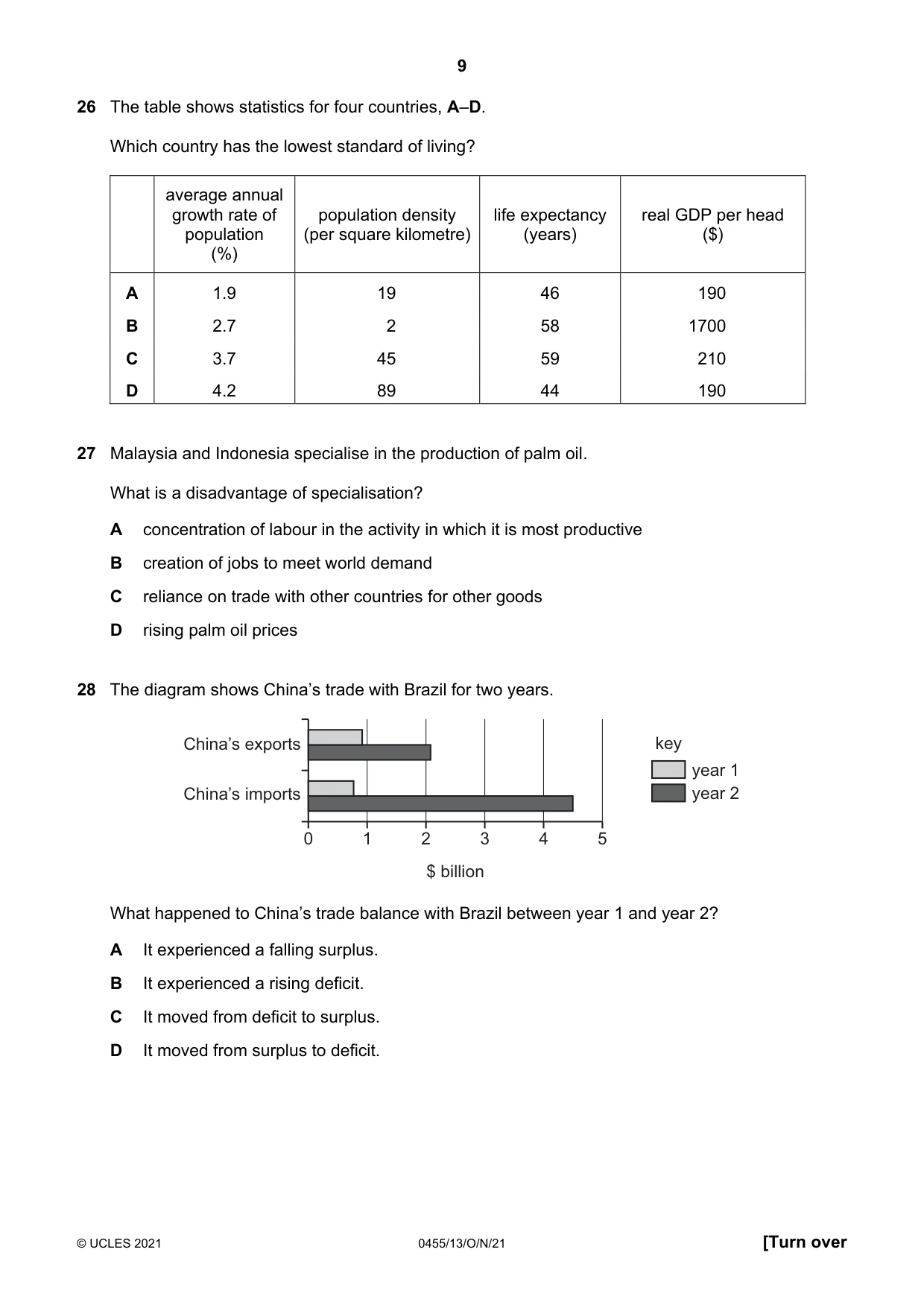
Q26 · The table shows statistics for four countries, A–D
26 The table shows statistics for four countries, A–D. Which country has the lowest standard of living? average annual growth rate of population density life expectancy real GDP per head population (per square kilometre) (years) ($) (%) A 1.9 19 46 190 B 2.7 2 58 1700 C 3.7 45 59 210 D 4.2 89 44 190
Mark scheme: D
Q27 · Malaysia and Indonesia specialise in the production of palm oil
27 Malaysia and Indonesia specialise in the production of palm oil. What is a disadvantage of specialisation? A concentration of labour in the activity in which it is most productive B creation of jobs to meet world demand C reliance on trade with other countries for other goods D rising palm oil prices
Mark scheme: C
Q28 · The diagram shows China’s trade with Brazil for two years
28 The diagram shows China’s trade with Brazil for two years. China’s exports key year 1 China’s imports year 2 0 1 2 3 4 5 $ billion What happened to China’s trade balance with Brazil between year 1 and year 2? A It experienced a falling surplus. B It experienced a rising deficit. C It moved from deficit to surplus. D It moved from surplus to deficit.
Mark scheme: D
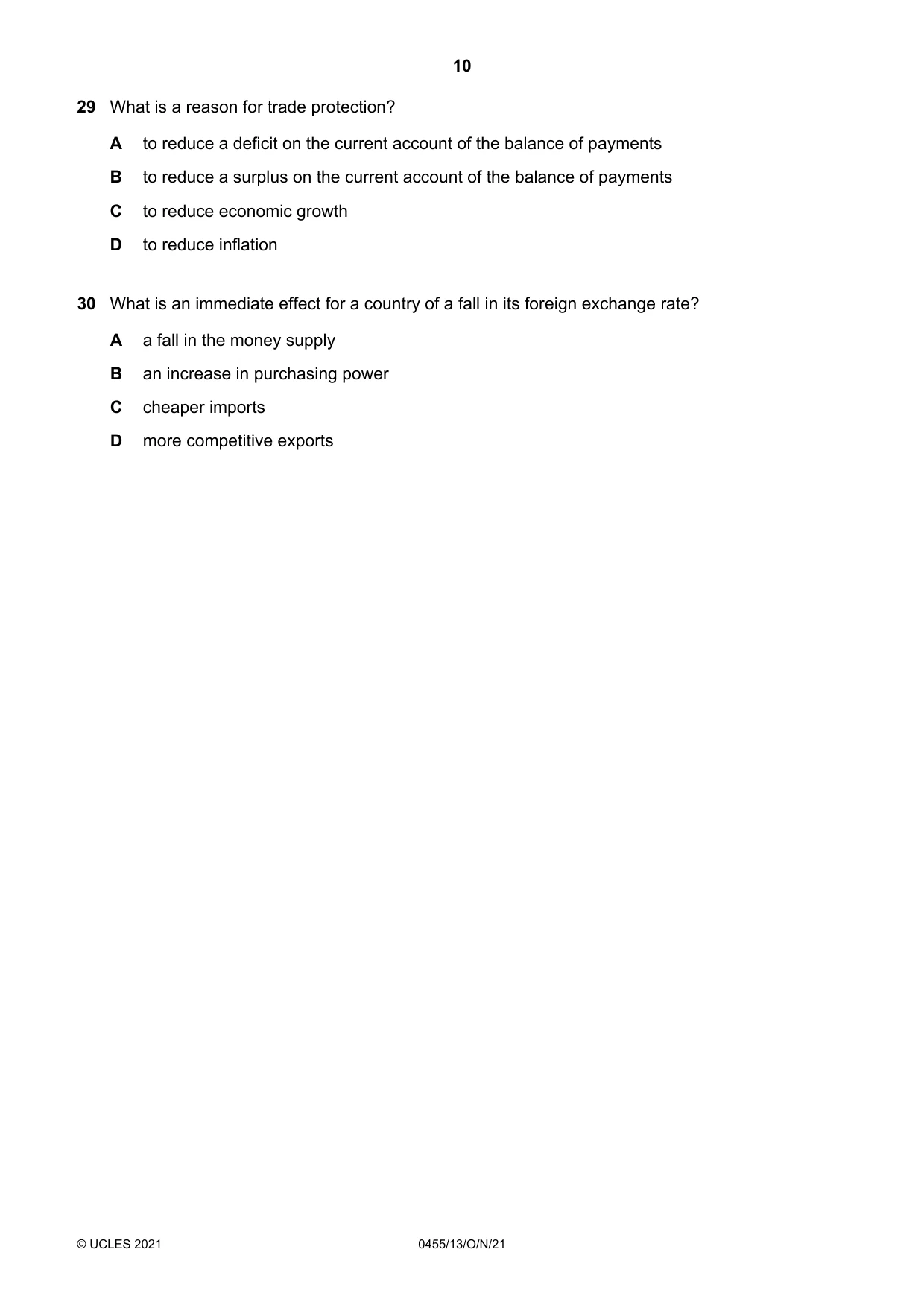
Q29 · What is a reason for trade protection?
29 What is a reason for trade protection? A to reduce a deficit on the current account of the balance of payments B to reduce a surplus on the current account of the balance of payments C to reduce economic growth D to reduce inflation
Mark scheme: A
Q30 · What is an immediate effect for a country of a fall in its foreign exchange rate?
30 What is an immediate effect for a country of a fall in its foreign exchange rate? A a fall in the money supply B an increase in purchasing power C cheaper imports D more competitive exports
Mark scheme: D
What was in this paper
The subtopics covered by these 29 questions, and how many questions each got. Open one in a new tab to see every Cambridge question on it.
3Economic growth2Firms’ costs, revenue and objectives2Fiscal policy2The nature of the economic problem2Current account of balance of payments1Employment and unemployment1Firms1Foreign exchange rates1Globalisation, free trade and protection1Inflation and deflation1International specialisation1Living standards1Market failure1Microeconomics and macroeconomics1Mixed economic system1Population1Poverty1Price determination1Price elasticity of demand (PED)1Production possibility curve (PPC) diagrams1Supply1Supply-side policy1What you needed in this session
Cambridge’s own grade thresholds for 2021 Oct/Nov, Paper 1 · Variant 3. A higher threshold means an easier paper — the bar moves with how the cohort did.