Cambridge IGCSE Economics 0455 — 2011 May/June Paper 1 · Variant 1
0455/11/M/J/11 · 30 questions · 30 marks · ≈34 min
The question paper and its mark scheme, free to read here and free to download. This is Cambridge’s own paper, exactly as it was sat.
Question paper12 pages
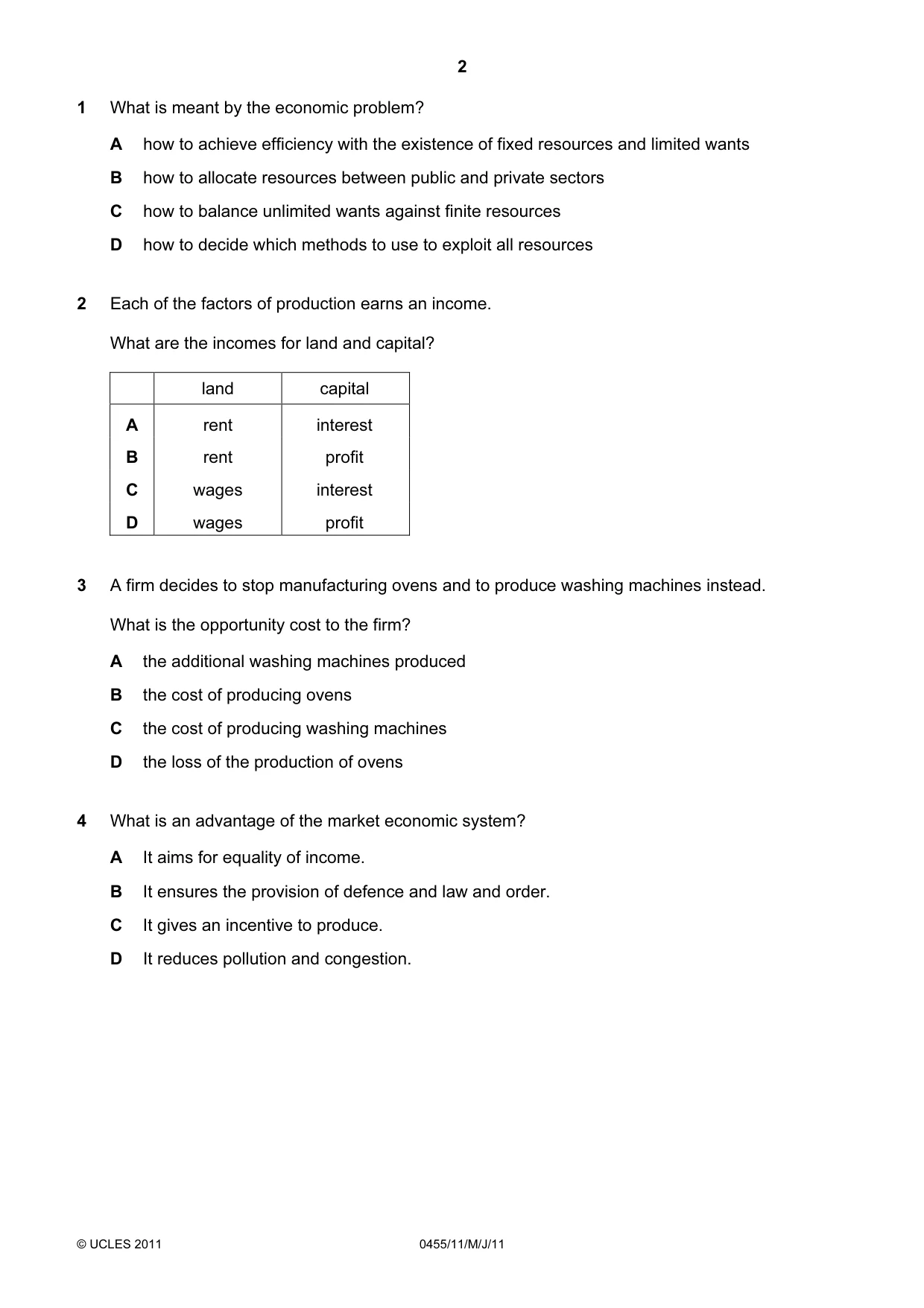
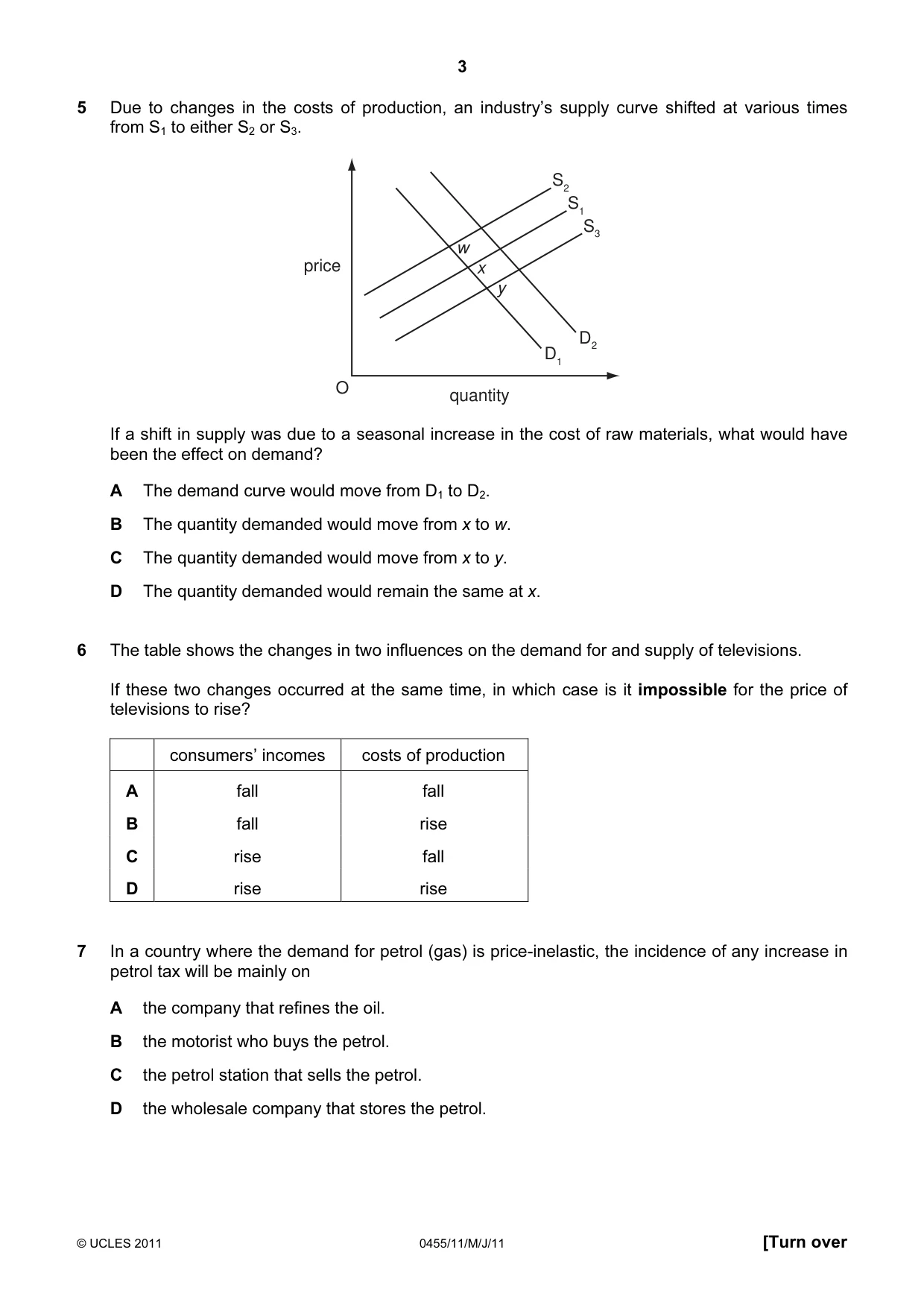
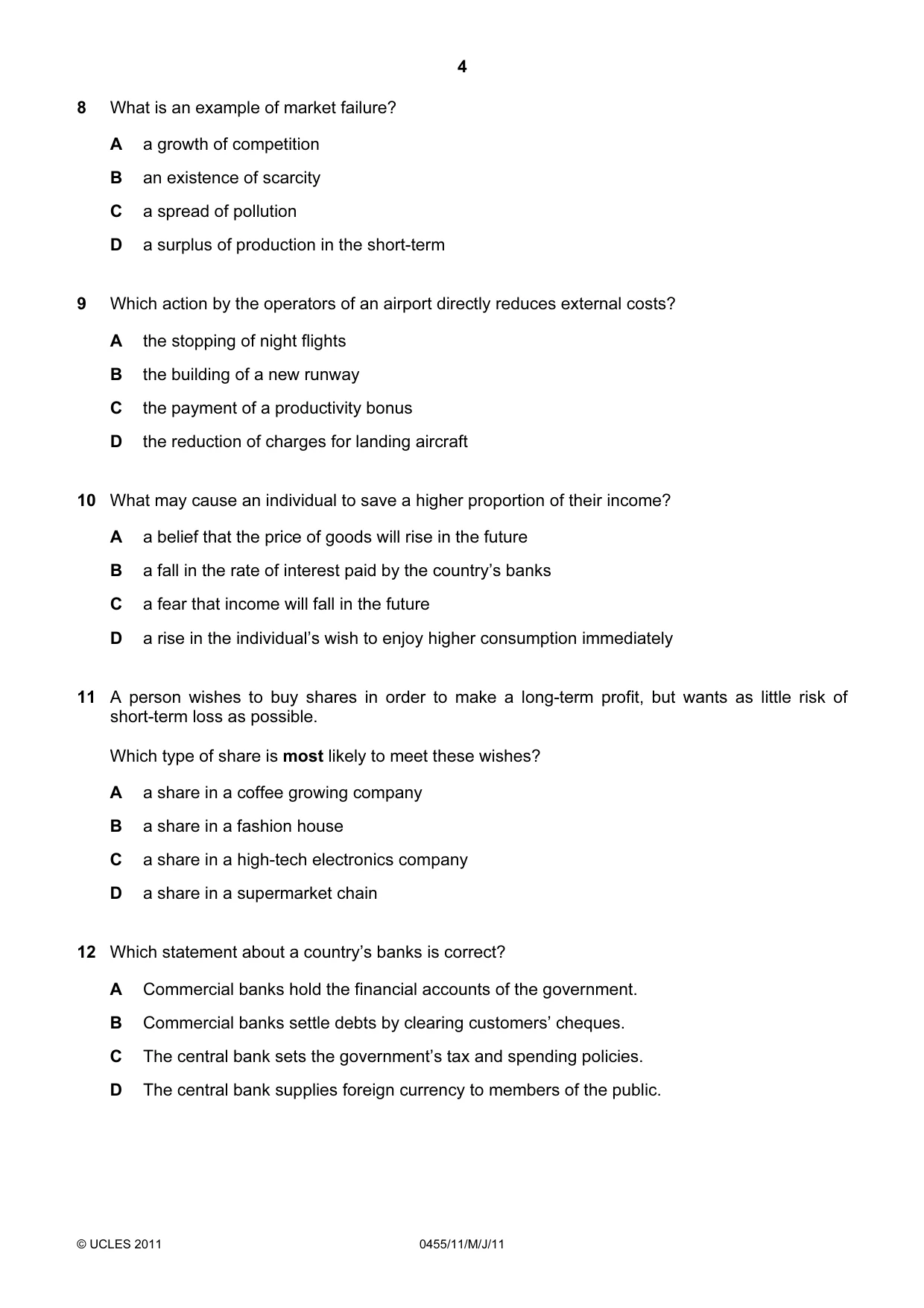
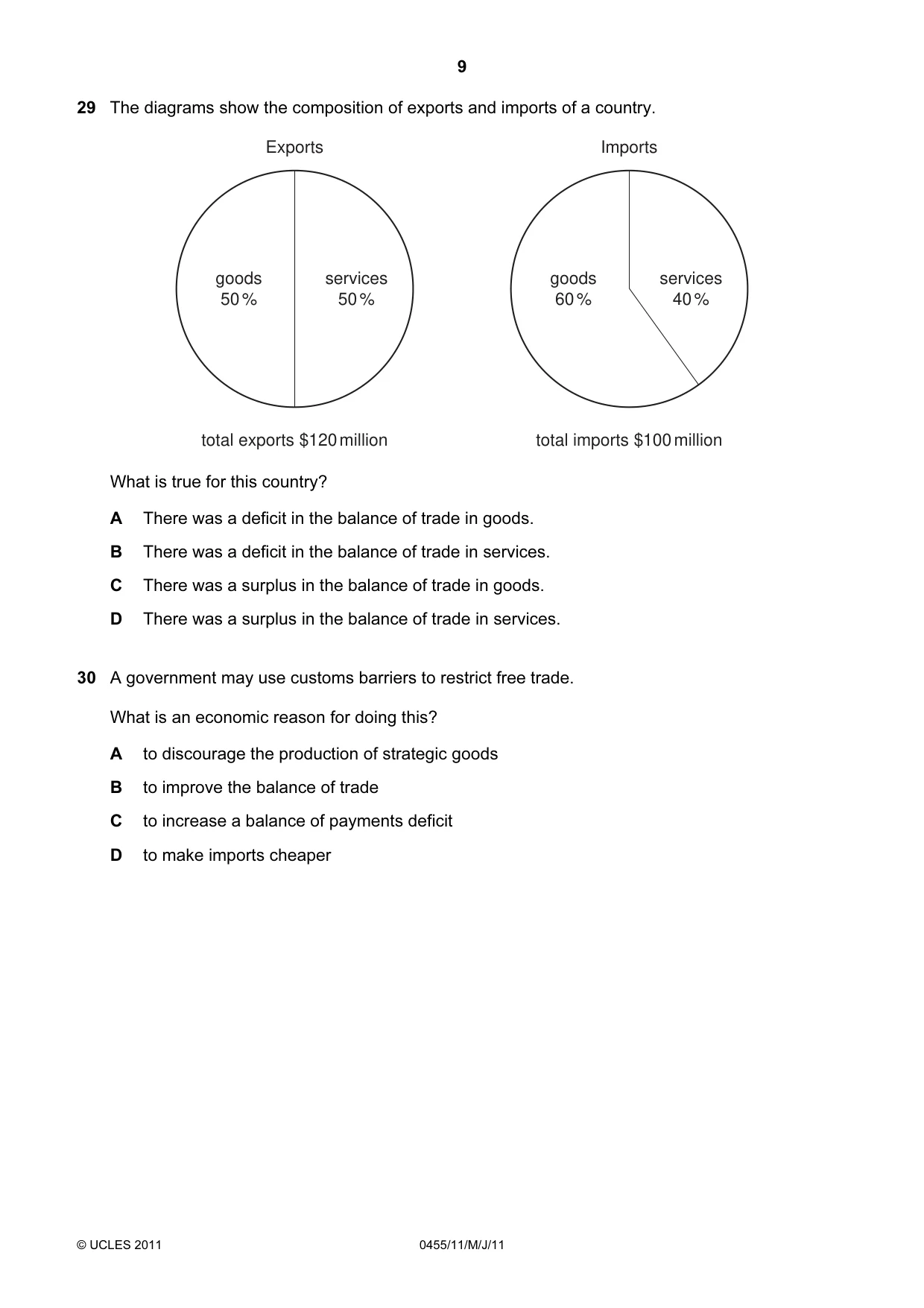


Mark scheme2 pages
Answers below. Sit the paper first if you are practising.
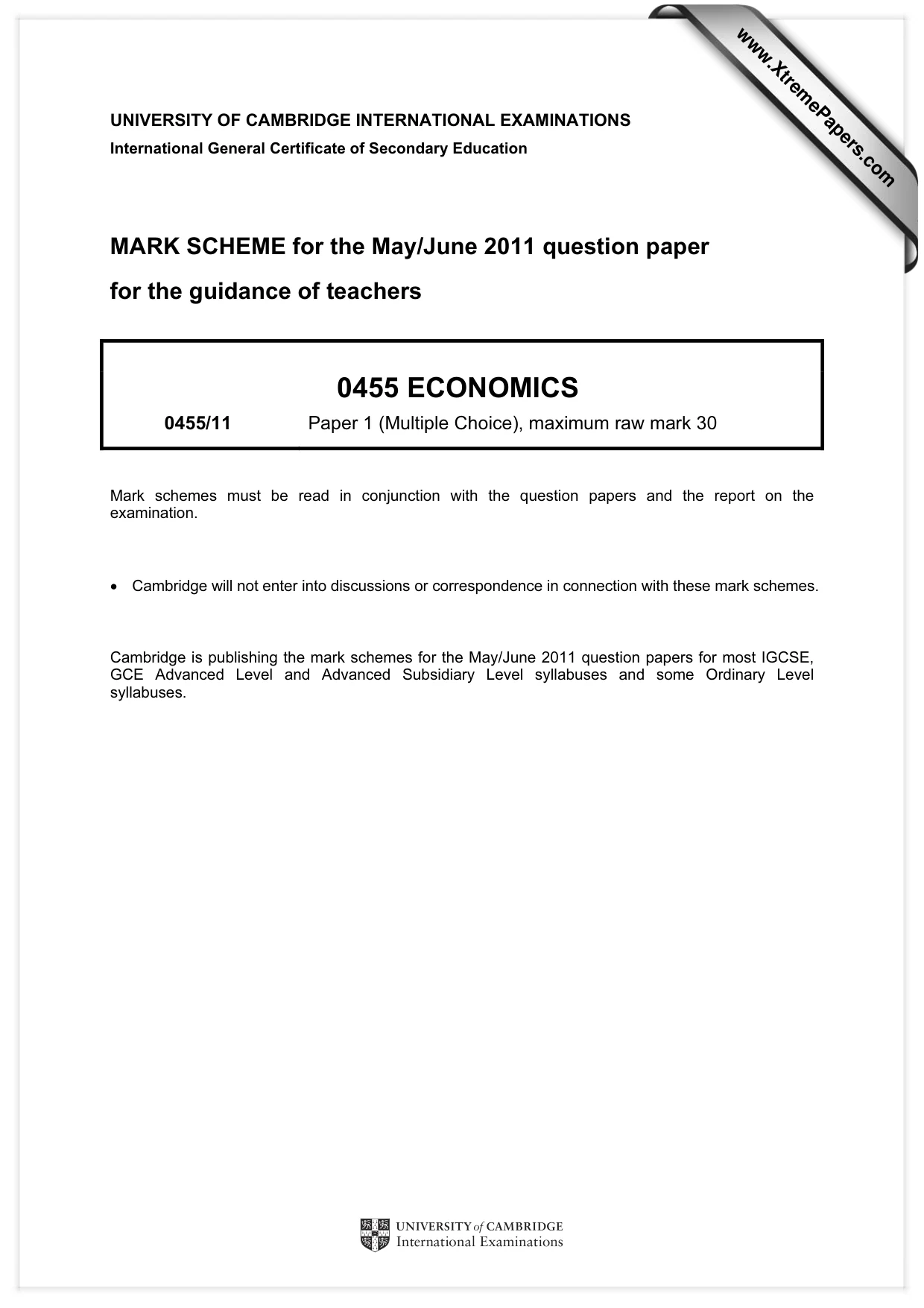
Questions as text
Q1 · What is meant by the economic problem?
1 What is meant by the economic problem? A how to achieve efficiency with the existence of fixed resources and limited wants B how to allocate resources between public and private sectors C how to balance unlimited wants against finite resources D how to decide which methods to use to exploit all resources
Mark scheme: C
Q2 · Each of the factors of production earns an income
2 Each of the factors of production earns an income. What are the incomes for land and capital? land capital A rent interest B rent profit C wages interest D wages profit
Mark scheme: A
Q3 · A firm decides to stop manufacturing ovens and to produce washing machines instead
3 A firm decides to stop manufacturing ovens and to produce washing machines instead. What is the opportunity cost to the firm? A the additional washing machines produced B the cost of producing ovens C the cost of producing washing machines D the loss of the production of ovens
Mark scheme: D
Q4 · What is an advantage of the market economic system?
4 What is an advantage of the market economic system? A It aims for equality of income. B It ensures the provision of defence and law and order. C It gives an incentive to produce. D It reduces pollution and congestion.
Mark scheme: C
Q5 · Due to changes in the costs of production, an industry’s supply curve shifted at various…
5 Due to changes in the costs of production, an industry’s supply curve shifted at various times from S1 to either S2 or S3. S2 S1 S3 w price x y D2 D1 O quantity If a shift in supply was due to a seasonal increase in the cost of raw materials, what would have been the effect on demand? A The demand curve would move from D1 to D2. B The quantity demanded would move from x to w. C The quantity demanded would move from x to y. D The quantity demanded would remain the same at x.
Mark scheme: B
Q6 · The table shows the changes in two influences on the demand for and supply of televisions
6 The table shows the changes in two influences on the demand for and supply of televisions. If these two changes occurred at the same time, in which case is it impossible for the price of televisions to rise? consumers’ incomes costs of production A fall fall B fall rise C rise fall D rise rise
Mark scheme: A
Q7 · In a country where the demand for petrol (gas) is price-inelastic, the incidence of any…
7 In a country where the demand for petrol (gas) is price-inelastic, the incidence of any increase in petrol tax will be mainly on A the company that refines the oil. B the motorist who buys the petrol. C the petrol station that sells the petrol. D the wholesale company that stores the petrol.
Mark scheme: B
Q8 · What is an example of market failure?
8 What is an example of market failure? A a growth of competition B an existence of scarcity C a spread of pollution D a surplus of production in the short-term
Mark scheme: C
Q9 · Which action by the operators of an airport directly reduces external costs?
9 Which action by the operators of an airport directly reduces external costs? A the stopping of night flights B the building of a new runway C the payment of a productivity bonus D the reduction of charges for landing aircraft
Mark scheme: A
Q10 · What may cause an individual to save a higher proportion of their income?
10 What may cause an individual to save a higher proportion of their income? A a belief that the price of goods will rise in the future B a fall in the rate of interest paid by the country’s banks C a fear that income will fall in the future D a rise in the individual’s wish to enjoy higher consumption immediately
Mark scheme: C
Q11 · A person wishes to buy shares in order to make a long-term profit, but wants as little…
11 A person wishes to buy shares in order to make a long-term profit, but wants as little risk of short-term loss as possible. Which type of share is most likely to meet these wishes? A a share in a coffee growing company B a share in a fashion house C a share in a high-tech electronics company D a share in a supermarket chain
Mark scheme: D
Q12 · Which statement about a country’s banks is correct?
12 Which statement about a country’s banks is correct? A Commercial banks hold the financial accounts of the government. B Commercial banks settle debts by clearing customers’ cheques. C The central bank sets the government’s tax and spending policies. D The central bank supplies foreign currency to members of the public.
Mark scheme: B
Q13 · Why might factory workers have higher wage rates than agricultural workers?
13 Why might factory workers have higher wage rates than agricultural workers? A Factory workers are in greater supply. B Factory workers face fewer risks of accidents. C Factory workers have cleaner working conditions. D Factory workers use more productive equipment.
Mark scheme: D
Q14 · A musician has a choice of playing for an orchestra in either England or Germany
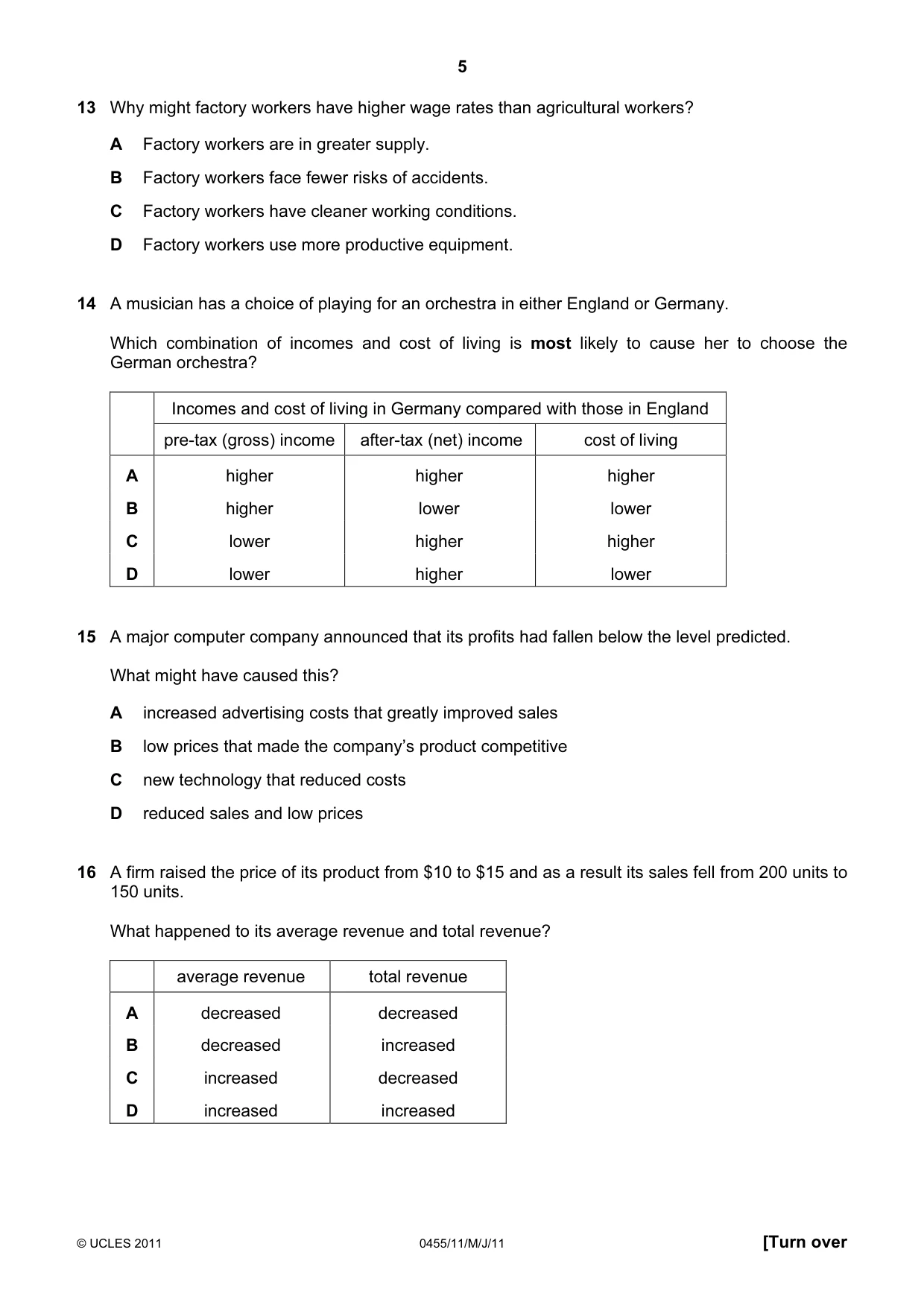
14 A musician has a choice of playing for an orchestra in either England or Germany. Which combination of incomes and cost of living is most likely to cause her to choose the German orchestra? Incomes and cost of living in Germany compared with those in England pre-tax (gross) income after-tax (net) income cost of living A higher higher higher B higher lower lower C lower higher higher D lower higher lower
Mark scheme: D
Q15 · A major computer company announced that its profits had fallen below the level predicted
15 A major computer company announced that its profits had fallen below the level predicted. What might have caused this? A increased advertising costs that greatly improved sales B low prices that made the company’s product competitive C new technology that reduced costs D reduced sales and low prices
Mark scheme: D
Q16 · A firm raised the price of its product from $10 to $15 and as a result its sales fell…
16 A firm raised the price of its product from $10 to $15 and as a result its sales fell from 200 units to 150 units. What happened to its average revenue and total revenue? average revenue total revenue A decreased decreased B decreased increased C increased decreased D increased increased
Mark scheme: D
Q17 · Which change must occur when a firm starts to experience diseconomies of scale?
17 Which change must occur when a firm starts to experience diseconomies of scale? A Average costs begin to rise. B Employees are made redundant. C Profits turn into losses. D Variable costs become fixed.
Mark scheme: A
Q18 · If a firm increases its output in the short run, what will happen to its average fixed…
18 If a firm increases its output in the short run, what will happen to its average fixed cost (AFC)? A AFC will decrease continually. B AFC will equal zero. C AFC will increase then decrease. D AFC will increase continually.
Mark scheme: A
Q19 · Cathay Pacific, Hong Kong’s largest airline, flies to a number of countries
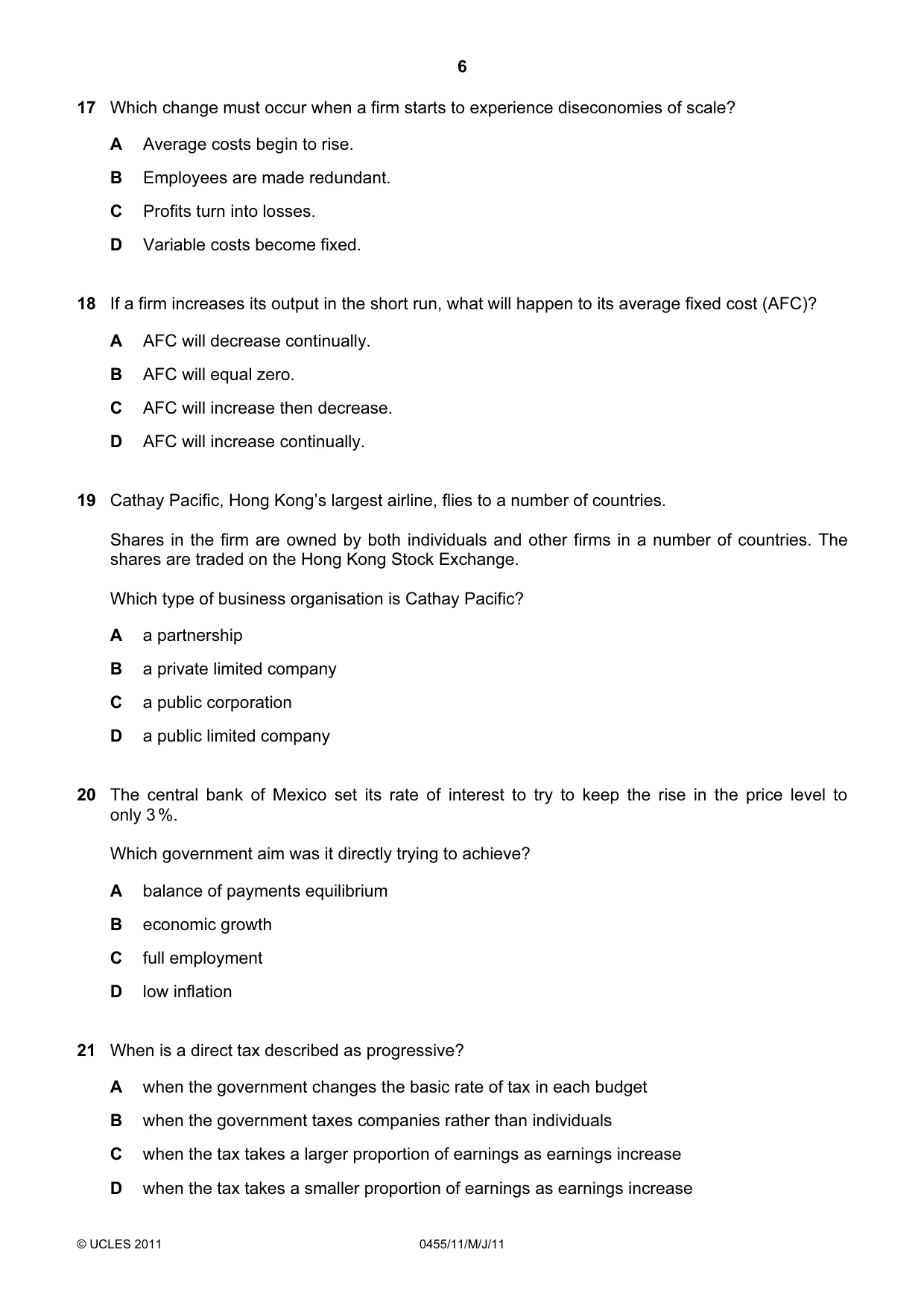
19 Cathay Pacific, Hong Kong’s largest airline, flies to a number of countries. Shares in the firm are owned by both individuals and other firms in a number of countries. The shares are traded on the Hong Kong Stock Exchange. Which type of business organisation is Cathay Pacific? A a partnership B a private limited company C a public corporation D a public limited company
Mark scheme: D
Q20 · The central bank of Mexico set its rate of interest to try to keep the rise in the price…
20 The central bank of Mexico set its rate of interest to try to keep the rise in the price level to only 3 %. Which government aim was it directly trying to achieve? A balance of payments equilibrium B economic growth C full employment D low inflation
Mark scheme: D
Q21 · When is a direct tax described as progressive?
21 When is a direct tax described as progressive? A when the government changes the basic rate of tax in each budget B when the government taxes companies rather than individuals C when the tax takes a larger proportion of earnings as earnings increase D when the tax takes a smaller proportion of earnings as earnings increase
Mark scheme: C
Q22 · In 2008, the government of Argentina imposed a tax on exports of wheat and soya beans
22 In 2008, the government of Argentina imposed a tax on exports of wheat and soya beans. What was the most likely aim of this tax? A to increase agricultural output B to increase exports C to reduce a budget surplus D to reduce the rise in domestic food prices
Mark scheme: D
Q23 · During 2009 some governments adopted policies to try to end the recession in their…
23 During 2009 some governments adopted policies to try to end the recession in their country and increase economic growth. Which combination of policies is most likely to achieve this? A lower taxes and decrease government spending B lower taxes and increase government spending C raise taxes and decrease government spending D raise taxes and increase government spending
Mark scheme: B
Q24 · The table shows the percentage change in employment over a period for a country with…
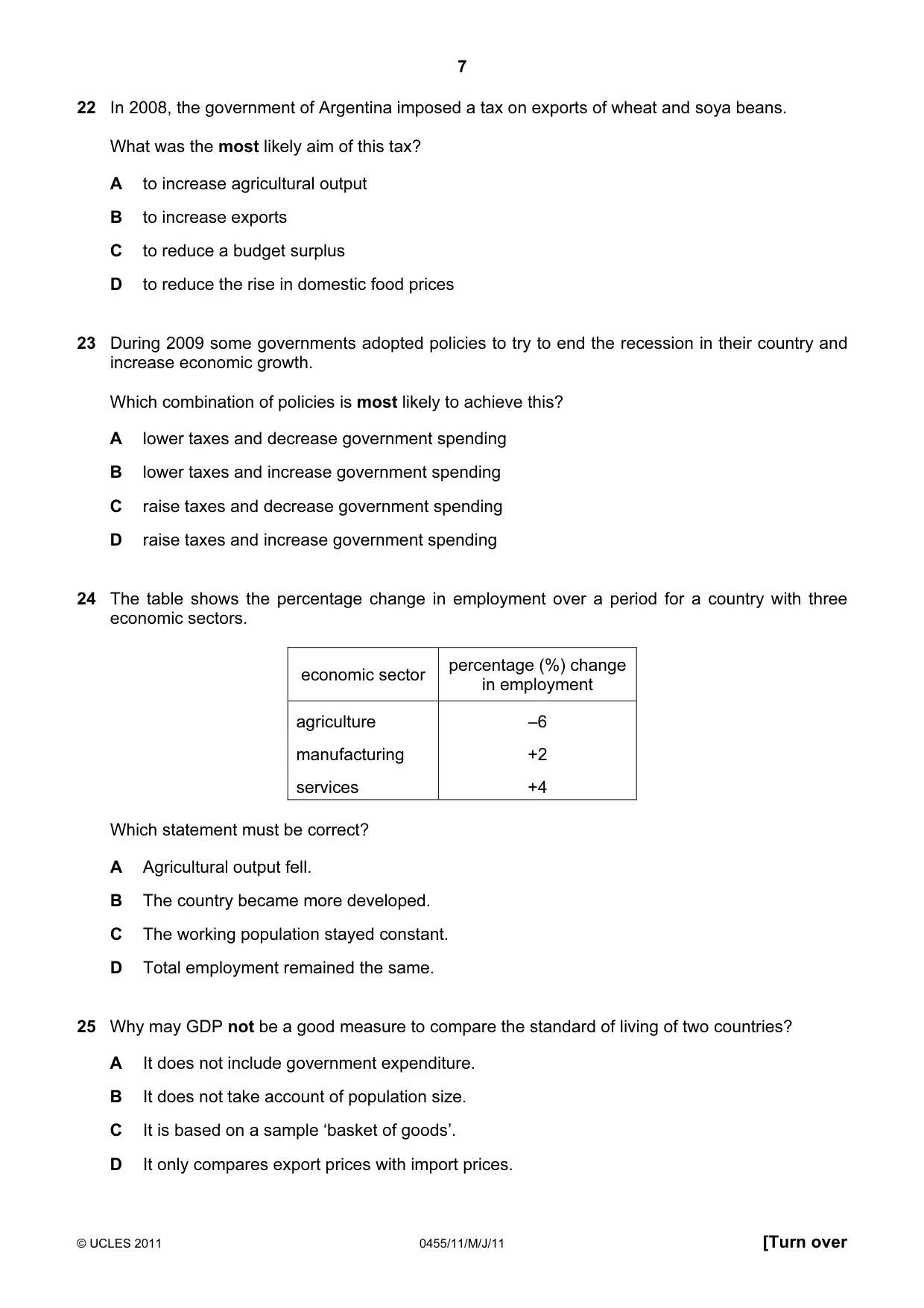
24 The table shows the percentage change in employment over a period for a country with three economic sectors. percentage (%) change economic sector in employment agriculture –6 manufacturing +2 services +4 Which statement must be correct? A Agricultural output fell. B The country became more developed. C The working population stayed constant. D Total employment remained the same.
Mark scheme: B
More questions on Differences in economic development between countries
Q25 · Why may GDP not be a good measure to compare the standard of living of two countries?
25 Why may GDP not be a good measure to compare the standard of living of two countries? A It does not include government expenditure. B It does not take account of population size. C It is based on a sample ‘basket of goods’. D It only compares export prices with import prices.
Mark scheme: B
Q26 · What is likely to happen as a developing country becomes more developed?
26 What is likely to happen as a developing country becomes more developed? A A higher percentage of children will attend school. B Infant mortality will rise. C Life expectancy will fall. D The agricultural sector will increase in importance.
Mark scheme: A
More questions on Differences in economic development between countries
Q27 · Many developed countries are faced with an ageing population
27 Many developed countries are faced with an ageing population. What is the likely result of this? A a reduced dependency ratio B increased mobility of labour C increased spending on medical care D reduced tax levels
Mark scheme: C
Q28 · The table shows statistics for four countries in southern Africa
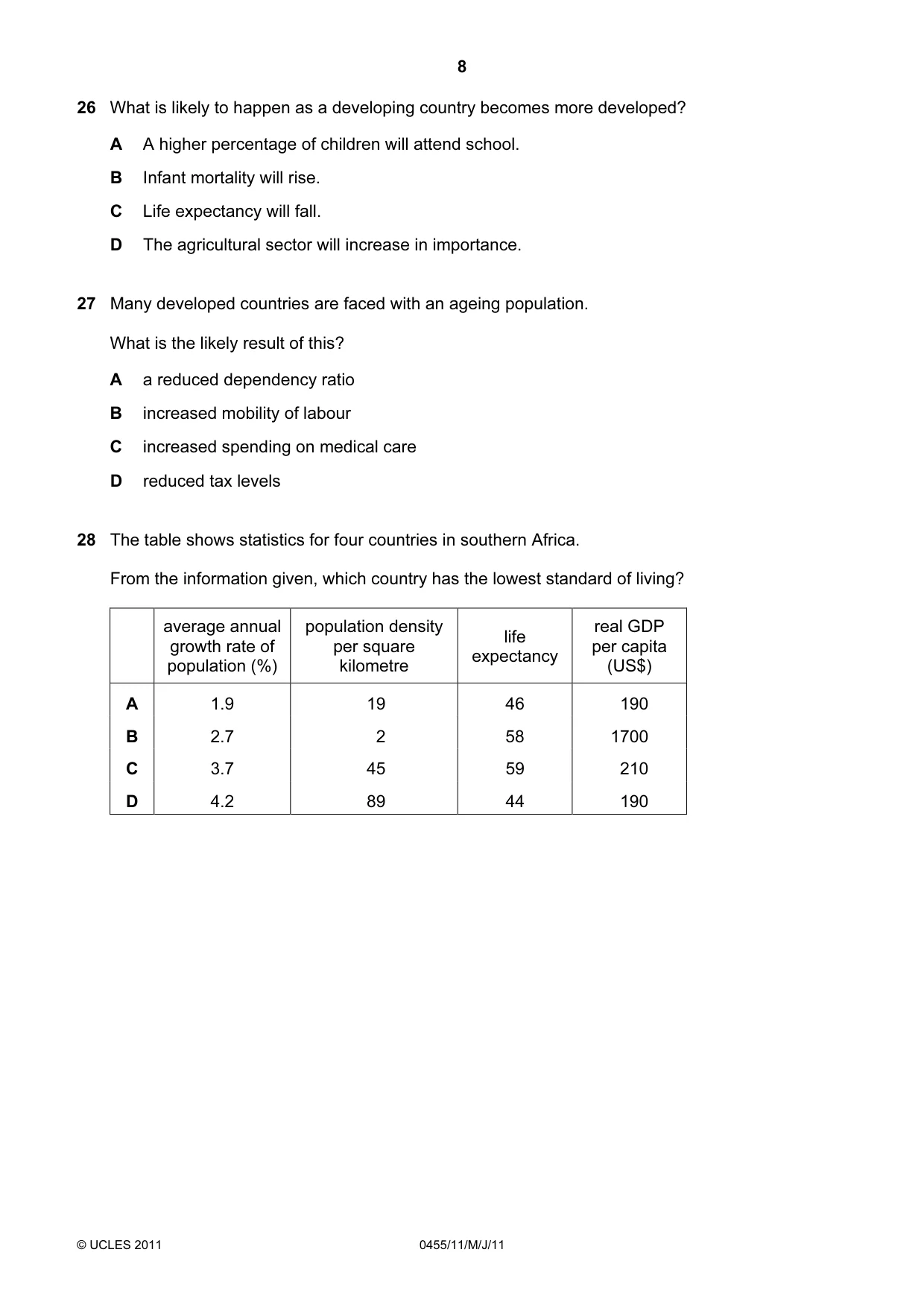
28 The table shows statistics for four countries in southern Africa. From the information given, which country has the lowest standard of living? average annual population density real GDP life growth rate of per square per capita expectancy population (%) kilometre (US$) A 1.9 19 46 190 B 2.7 2 58 1700 C 3.7 45 59 210 D 4.2 89 44 190
Mark scheme: D
Q29 · The diagrams show the composition of exports and imports of a country
29 The diagrams show the composition of exports and imports of a country. Exports Imports goods services goods services 50 % 50 % 60 % 40 % total exports $120 million total imports $100 million What is true for this country? A There was a deficit in the balance of trade in goods. B There was a deficit in the balance of trade in services. C There was a surplus in the balance of trade in goods. D There was a surplus in the balance of trade in services.
Mark scheme: D
Q30 · A government may use customs barriers to restrict free trade
30 A government may use customs barriers to restrict free trade. What is an economic reason for doing this? A to discourage the production of strategic goods B to improve the balance of trade C to increase a balance of payments deficit D to make imports cheaper
Mark scheme: B
What was in this paper
The subtopics covered by these 30 questions, and how many questions each got. Open one in a new tab to see every Cambridge question on it.
3Living standards3Differences in economic development between countries2Fiscal policy2Globalisation, free trade and protection2Market failure2Money and banking2Current account of balance of payments1Firms1Firms and production1Households1Market economic system1Opportunity cost1Population1Price changes1Price elasticity of demand (PED)1Supply1The factors of production1The macroeconomic aims of government1The nature of the economic problem1Workers1What you needed in this session
Cambridge’s own grade thresholds for 2011 May/June, Paper 1 · Variant 1. A higher threshold means an easier paper — the bar moves with how the cohort did.