Cambridge IGCSE Economics 0455 — 2025 Oct/Nov Paper 1 · Variant 3
0455/13/O/N/25 · 30 questions · 30 marks · ≈34 min
The question paper and its mark scheme, free to read here and free to download. This is Cambridge’s own paper, exactly as it was sat.
Question paper12 pages


Mark scheme3 pages
Answers below. Sit the paper first if you are practising.
Questions as text
Q1 · What is least likely to increase the geographical mobility of labour?
1 What is least likely to increase the geographical mobility of labour? A greater provision of information about available jobs B improved roads and communication network C increased opportunities for education and training D strengthened family ties and relationships
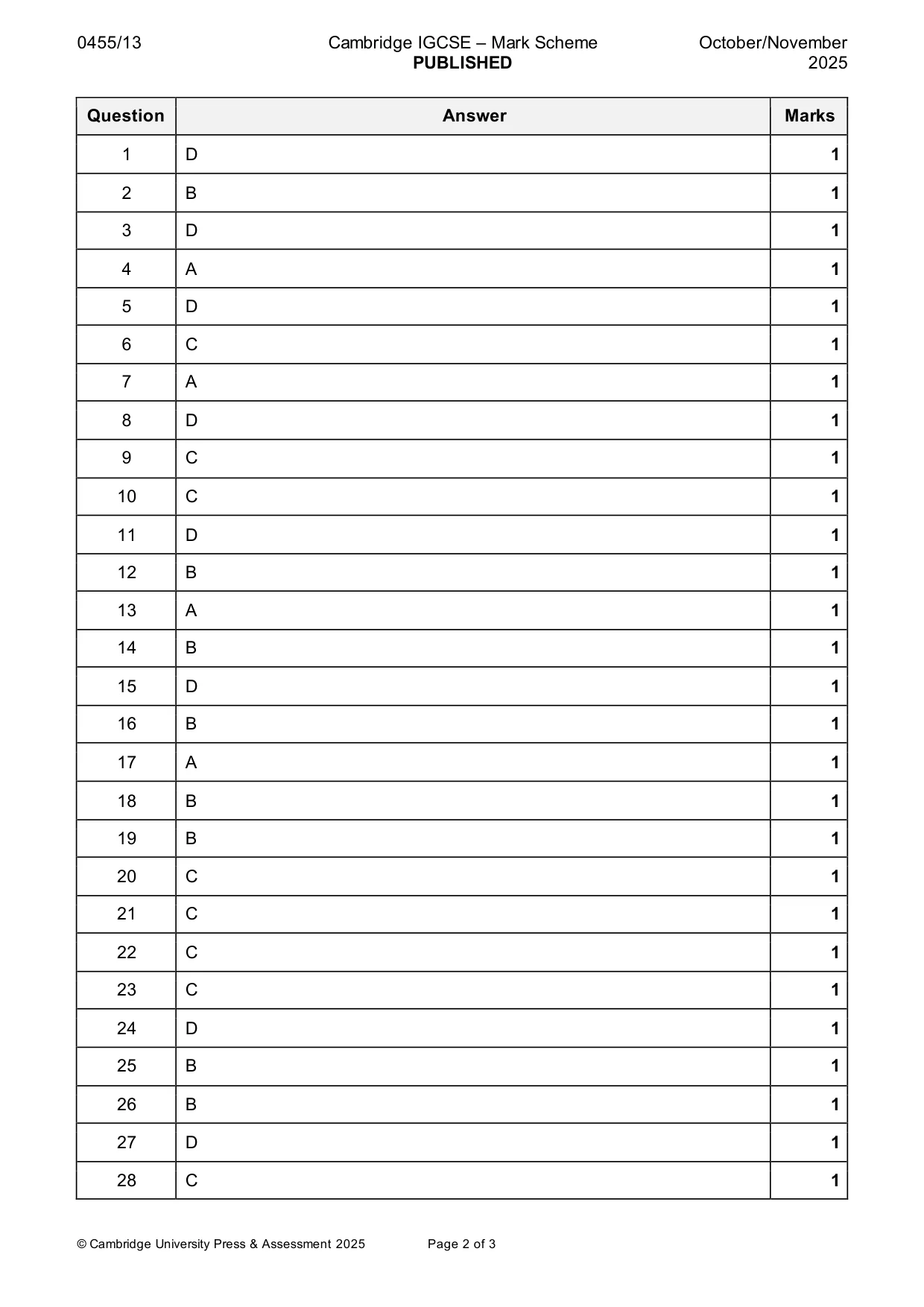
Mark scheme: D
Q2 · Which value does opportunity cost measure?
2 Which value does opportunity cost measure? A environmental damage B next best alternative forgone C output of labour D price paid
Mark scheme: B
Q3 · The diagram shows a production possibility curve (PPC)
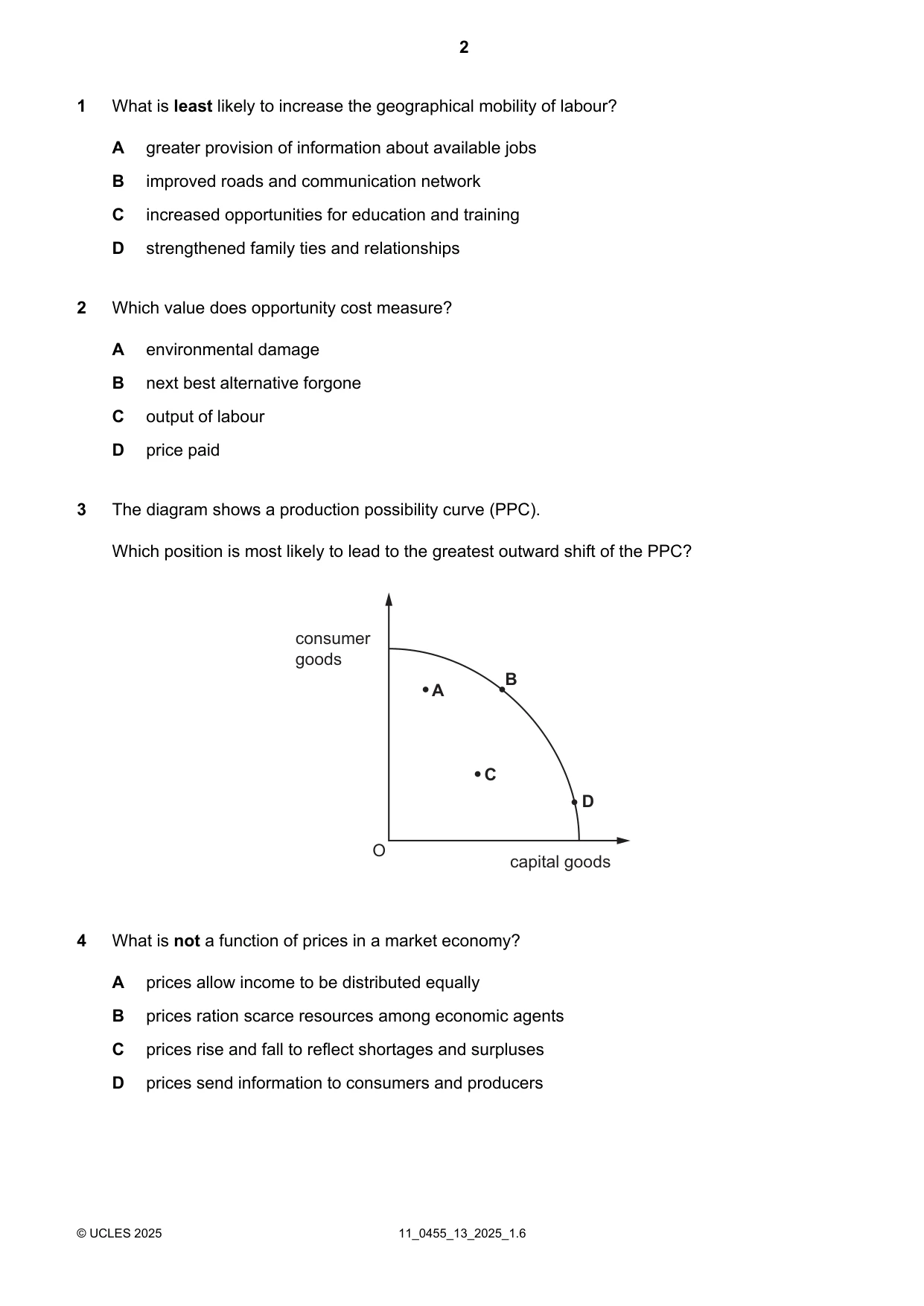
3 The diagram shows a production possibility curve (PPC). Which position is most likely to lead to the greatest outward shift of the PPC? consumer goods B A C D O capital goods
Mark scheme: D
More questions on Production possibility curve (PPC) diagrams
Q4 · What is not a function of prices in a market economy?
4 What is not a function of prices in a market economy? A prices allow income to be distributed equally B prices ration scarce resources among economic agents C prices rise and fall to reflect shortages and surpluses D prices send information to consumers and producers
Mark scheme: A
Q5 · The diagram shows the market for fresh fish in the Caribbean with equilibrium point X
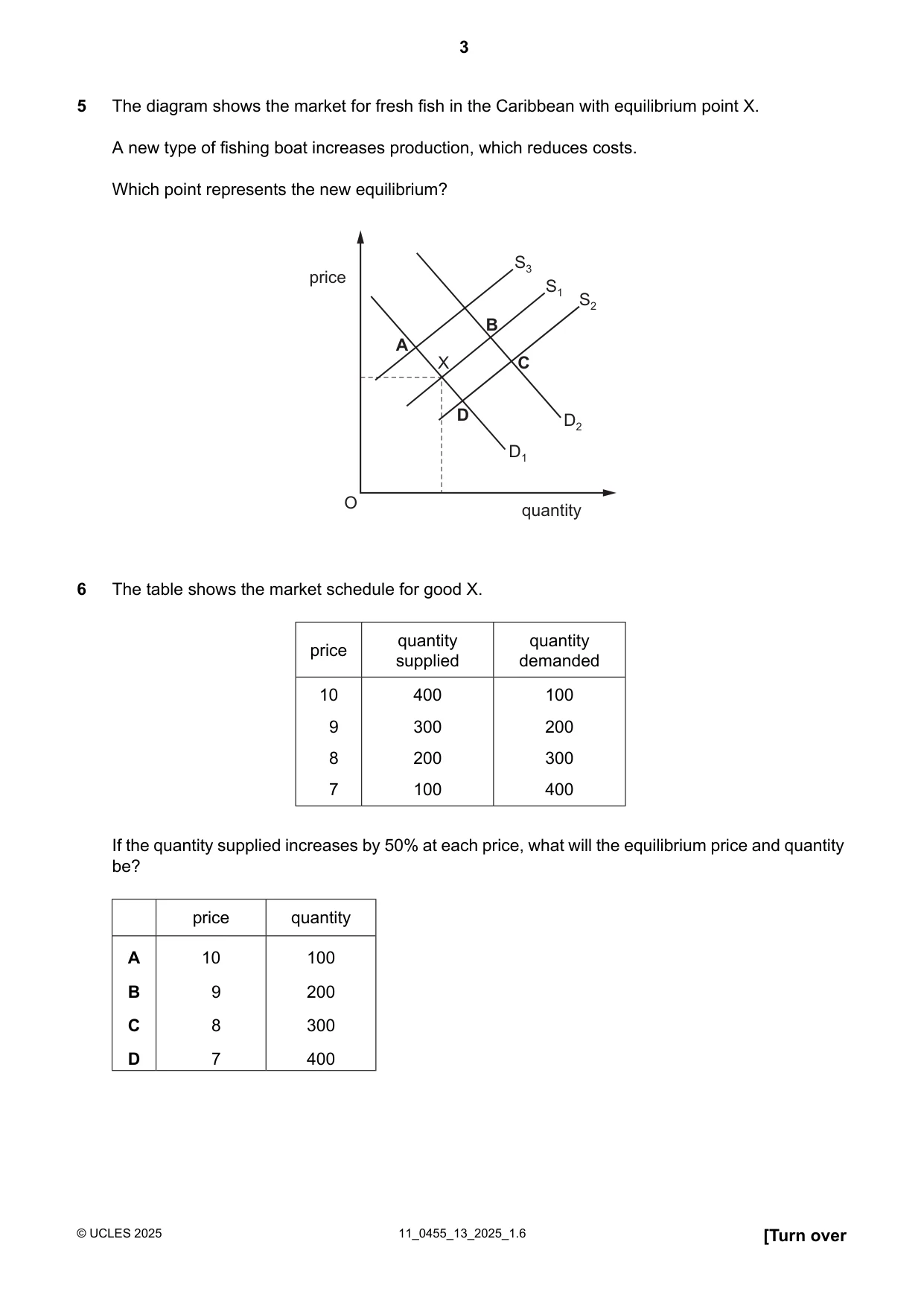
5 The diagram shows the market for fresh fish in the Caribbean with equilibrium point X. A new type of fishing boat increases production, which reduces costs. Which point represents the new equilibrium? S3 price S1 S2 B A X C D D2 D1 O quantity
Mark scheme: D
Q6 · The table shows the market schedule for good X
6 The table shows the market schedule for good X. quantity quantity price supplied demanded 10 400 100 9 300 200 8 200 300 7 100 400 If the quantity supplied increases by 50% at each price, what will the equilibrium price and quantity be? price quantity A 10 100 B 9 200 C 8 300 D 7 400
Mark scheme: C
Q7 · The price of fish has increased from $3.00 to $4.80
7 The price of fish has increased from $3.00 to $4.80. The quantity supplied of fish has increased from 100 units to 130 units. What is the price elasticity of supply (PES) of fish? A 0.5 B 1.3 C 1.8 D 2
Mark scheme: A
Q8 · Which combination shows features of the mixed economic system?
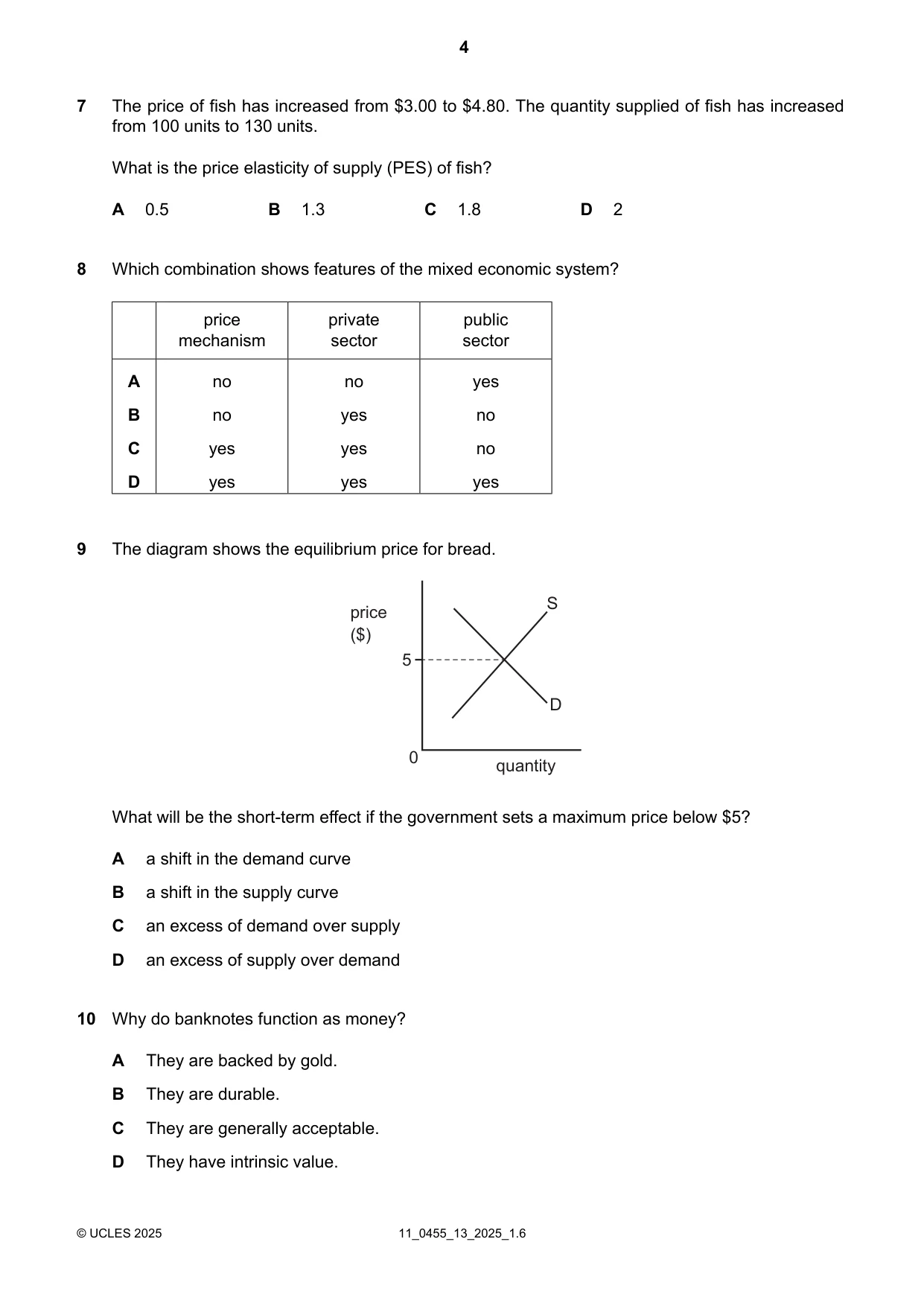
8 Which combination shows features of the mixed economic system? price private public mechanism sector sector A no no yes B no yes no C yes yes no D yes yes yes
Mark scheme: D
Q9 · The diagram shows the equilibrium price for bread
9 The diagram shows the equilibrium price for bread. S price ($) 5 D 0 quantity What will be the short-term effect if the government sets a maximum price below $5? A a shift in the demand curve B a shift in the supply curve C an excess of demand over supply D an excess of supply over demand
Mark scheme: C
Q10 · Why do banknotes function as money?
10 Why do banknotes function as money? A They are backed by gold. B They are durable. C They are generally acceptable. D They have intrinsic value.
Mark scheme: C
Q11 · Worker X earns less than worker Y
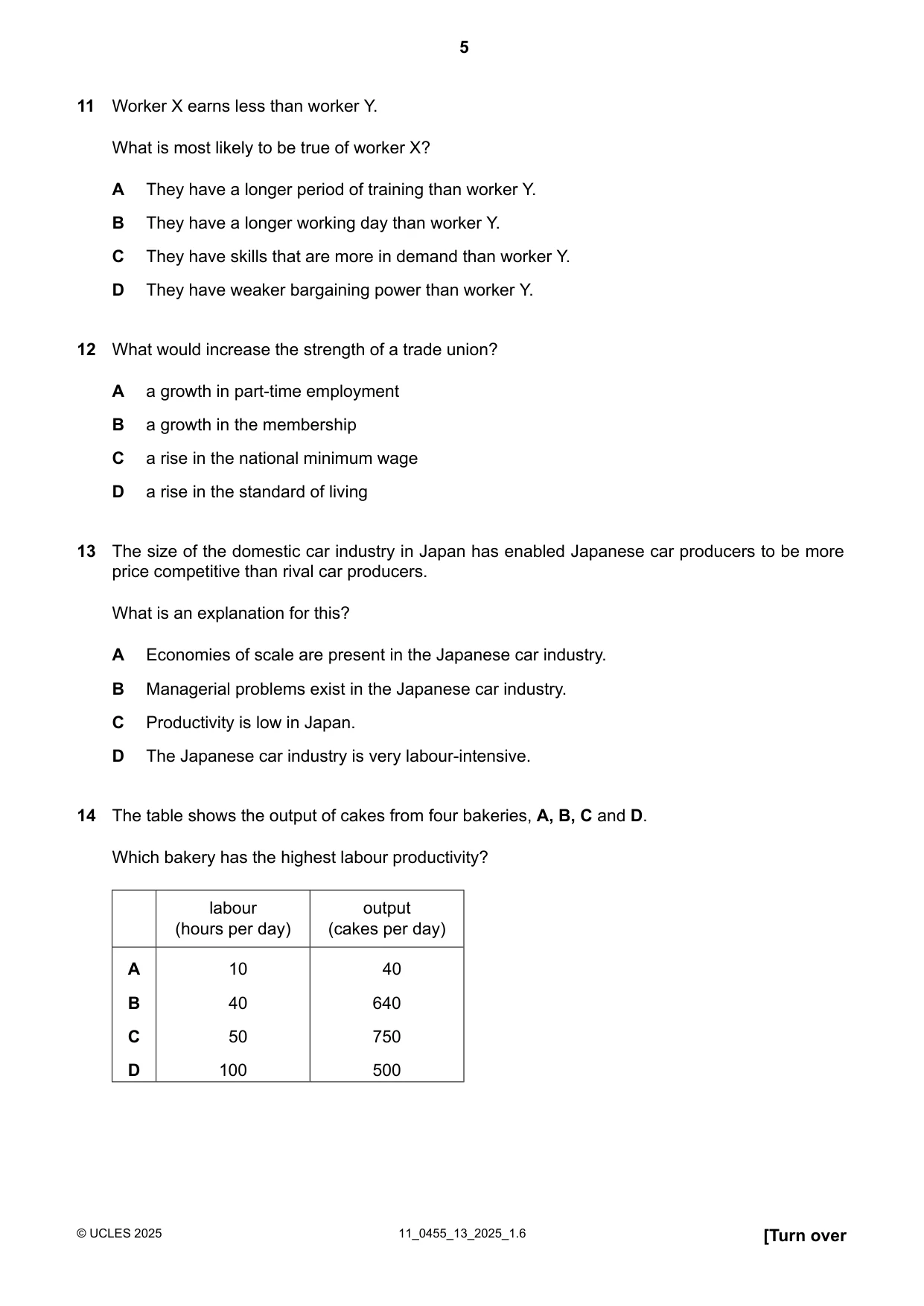
11 Worker X earns less than worker Y. What is most likely to be true of worker X? A They have a longer period of training than worker Y. B They have a longer working day than worker Y. C They have skills that are more in demand than worker Y. D They have weaker bargaining power than worker Y.
Mark scheme: D
Q12 · What would increase the strength of a trade union?
12 What would increase the strength of a trade union? A a growth in part-time employment B a growth in the membership C a rise in the national minimum wage D a rise in the standard of living
Mark scheme: B
Q13 · The size of the domestic car industry in Japan has enabled Japanese car producers to be…
13 The size of the domestic car industry in Japan has enabled Japanese car producers to be more price competitive than rival car producers. What is an explanation for this? A Economies of scale are present in the Japanese car industry. B Managerial problems exist in the Japanese car industry. C Productivity is low in Japan. D The Japanese car industry is very labour-intensive.
Mark scheme: A
Q14 · The table shows the output of cakes from four bakeries, A, B, C and D
14 The table shows the output of cakes from four bakeries, A, B, C and D. Which bakery has the highest labour productivity? labour output (hours per day) (cakes per day) A 10 40 B 40 640 C 50 750 D 100 500 The table shows a firm’s average revenue and average cost at different levels of output.
Mark scheme: B
Q15 · When all output is sold, which level of output generates the most profit?
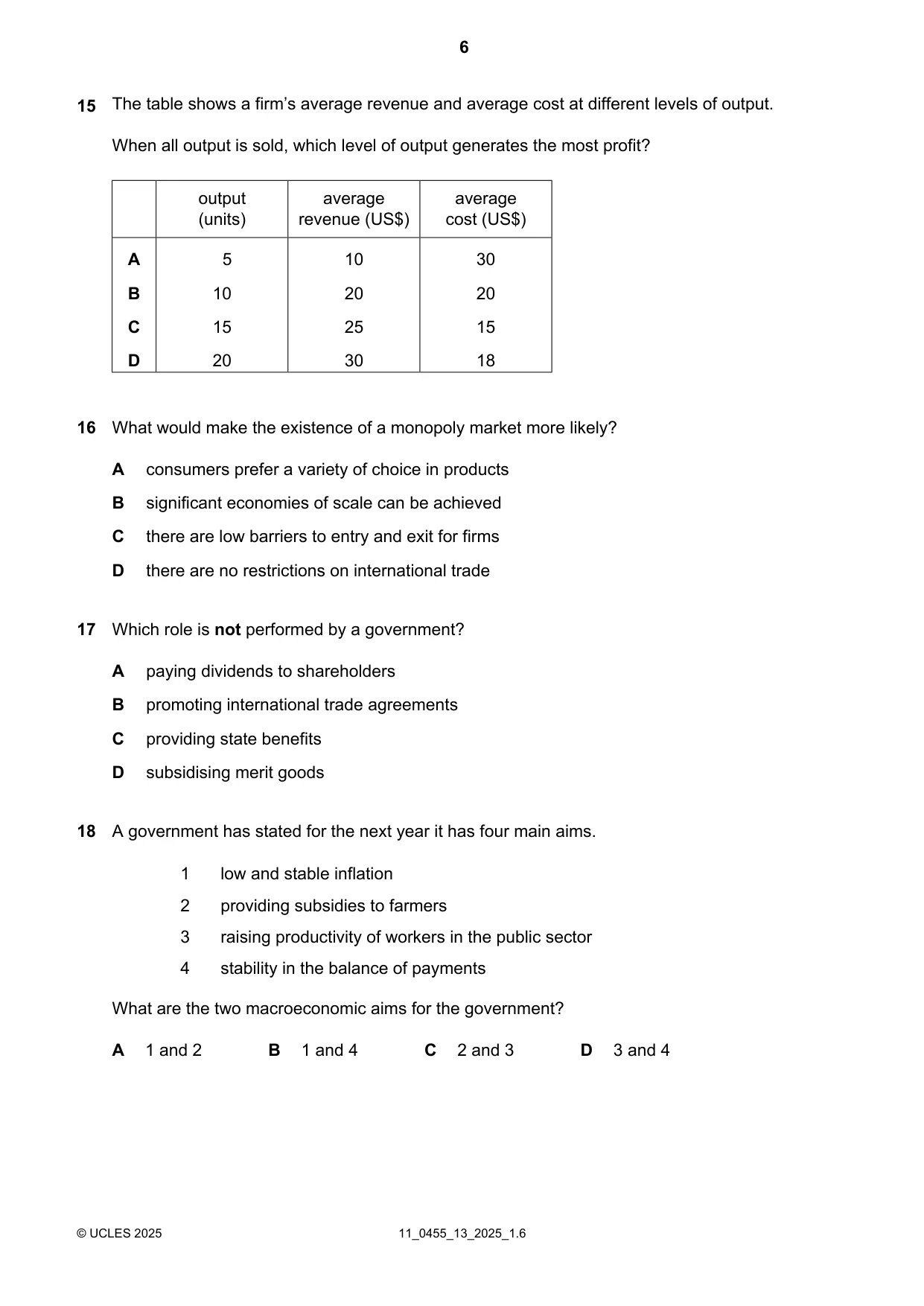
15 When all output is sold, which level of output generates the most profit? output average average (units) revenue (US$) cost (US$) A 5 10 30 B 10 20 20 C 15 25 15 D 20 30 18
Mark scheme: D
Q16 · What would make the existence of a monopoly market more likely?
16 What would make the existence of a monopoly market more likely? A consumers prefer a variety of choice in products B significant economies of scale can be achieved C there are low barriers to entry and exit for firms D there are no restrictions on international trade
Mark scheme: B
Q17 · Which role is not performed by a government?
17 Which role is not performed by a government? A paying dividends to shareholders B promoting international trade agreements C providing state benefits D subsidising merit goods
Mark scheme: A
Q18 · A government has stated for the next year it has four main aims
18 A government has stated for the next year it has four main aims. 1 low and stable inflation 2 providing subsidies to farmers 3 raising productivity of workers in the public sector 4 stability in the balance of payments What are the two macroeconomic aims for the government? A 1 and 2 B 1 and 4 C 2 and 3 D 3 and 4
Mark scheme: B
Q19 · What is not likely to be included in a government budget?
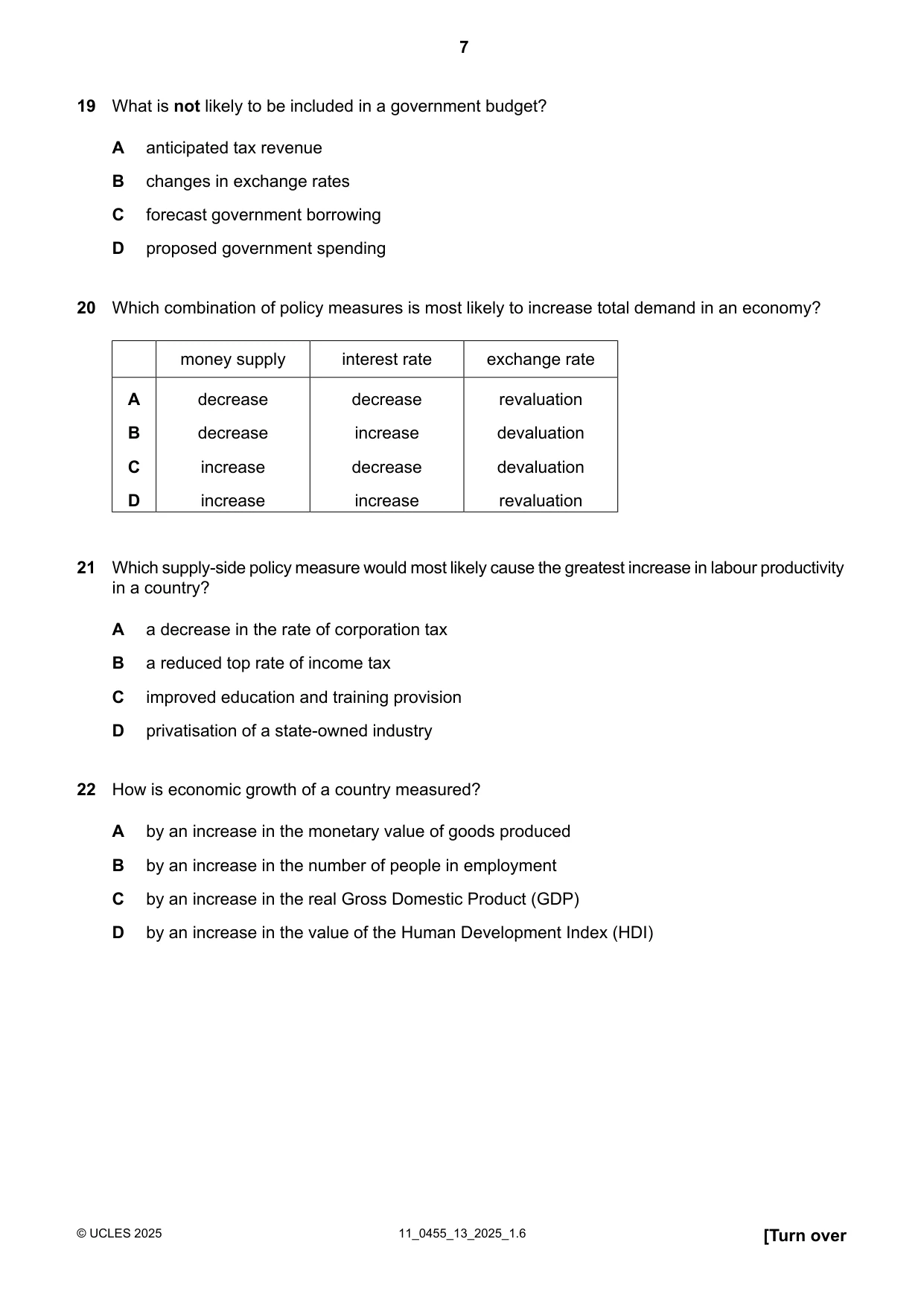
19 What is not likely to be included in a government budget? A anticipated tax revenue B changes in exchange rates C forecast government borrowing D proposed government spending
Mark scheme: B
Q20 · Which combination of policy measures is most likely to increase total demand in an…
20 Which combination of policy measures is most likely to increase total demand in an economy? money supply interest rate exchange rate A decrease decrease revaluation B decrease increase devaluation C increase decrease devaluation D increase increase revaluation
Mark scheme: C
Q21 · Which supply-side policy measure would most likely cause the greatest increase in labour…
21 Which supply-side policy measure would most likely cause the greatest increase in labour productivity in a country? A a decrease in the rate of corporation tax B a reduced top rate of income tax C improved education and training provision D privatisation of a state-owned industry
Mark scheme: C
Q22 · How is economic growth of a country measured?
22 How is economic growth of a country measured? A by an increase in the monetary value of goods produced B by an increase in the number of people in employment C by an increase in the real Gross Domestic Product (GDP) D by an increase in the value of the Human Development Index (HDI)
Mark scheme: C
Q23 · A country experiences a significant fall in unemployment
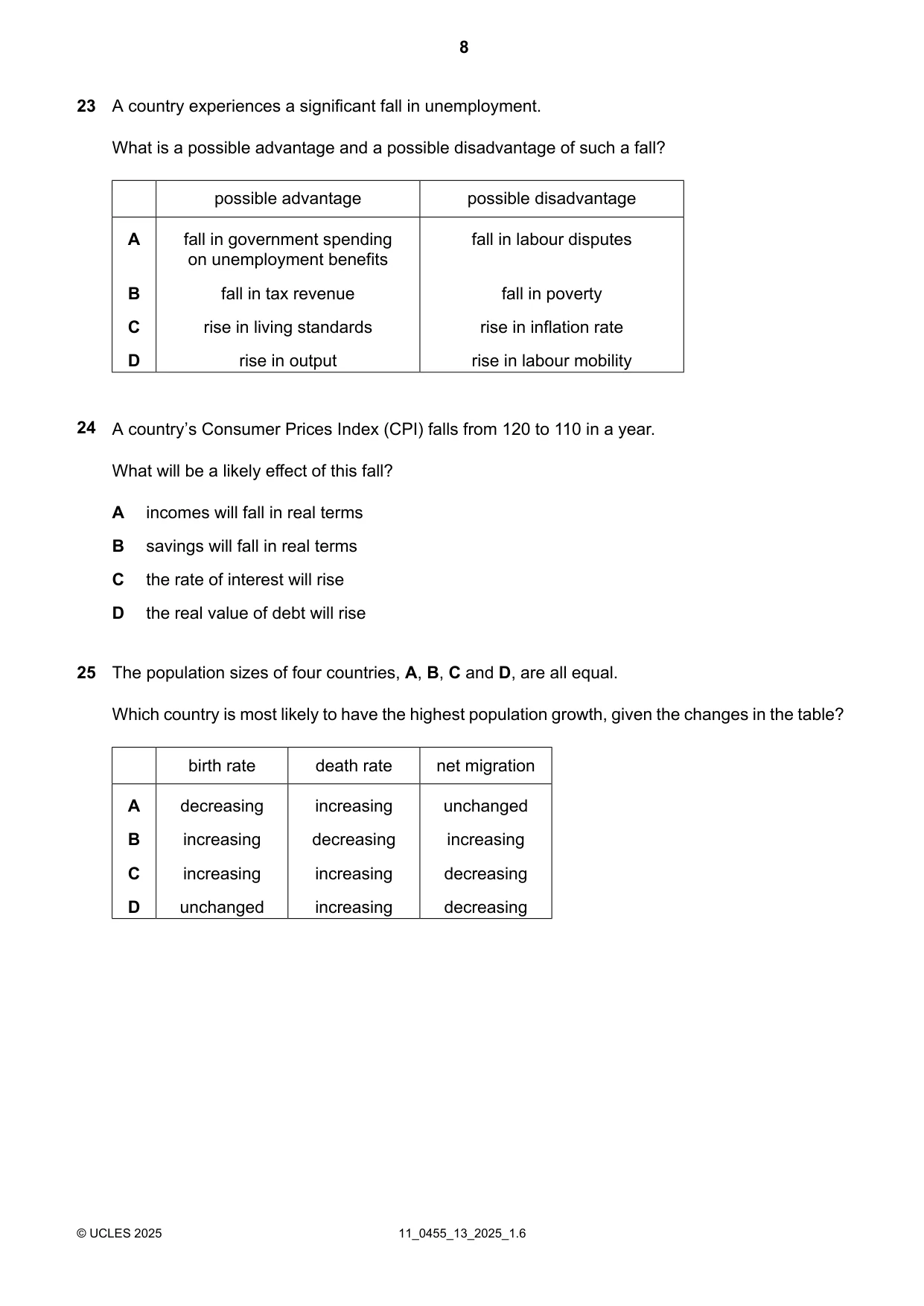
23 A country experiences a significant fall in unemployment. What is a possible advantage and a possible disadvantage of such a fall? possible advantage possible disadvantage A fall in government spending fall in labour disputes on unemployment benefits B fall in tax revenue fall in poverty C rise in living standards rise in inflation rate D rise in output rise in labour mobility
Mark scheme: C
Q24 · A country’s Consumer Prices Index (CPI) falls from 120 to 110 in a year
24 A country’s Consumer Prices Index (CPI) falls from 120 to 110 in a year. What will be a likely effect of this fall? A incomes will fall in real terms B savings will fall in real terms C the rate of interest will rise D the real value of debt will rise
Mark scheme: D
Q25 · The population sizes of four countries, A, B, C and D, are all equal
25 The population sizes of four countries, A, B, C and D, are all equal. Which country is most likely to have the highest population growth, given the changes in the table? birth rate death rate net migration A decreasing increasing unchanged B increasing decreasing increasing C increasing increasing decreasing D unchanged increasing decreasing
Mark scheme: B
Q26 · Which combination of characteristics would be found in a less developed economy?
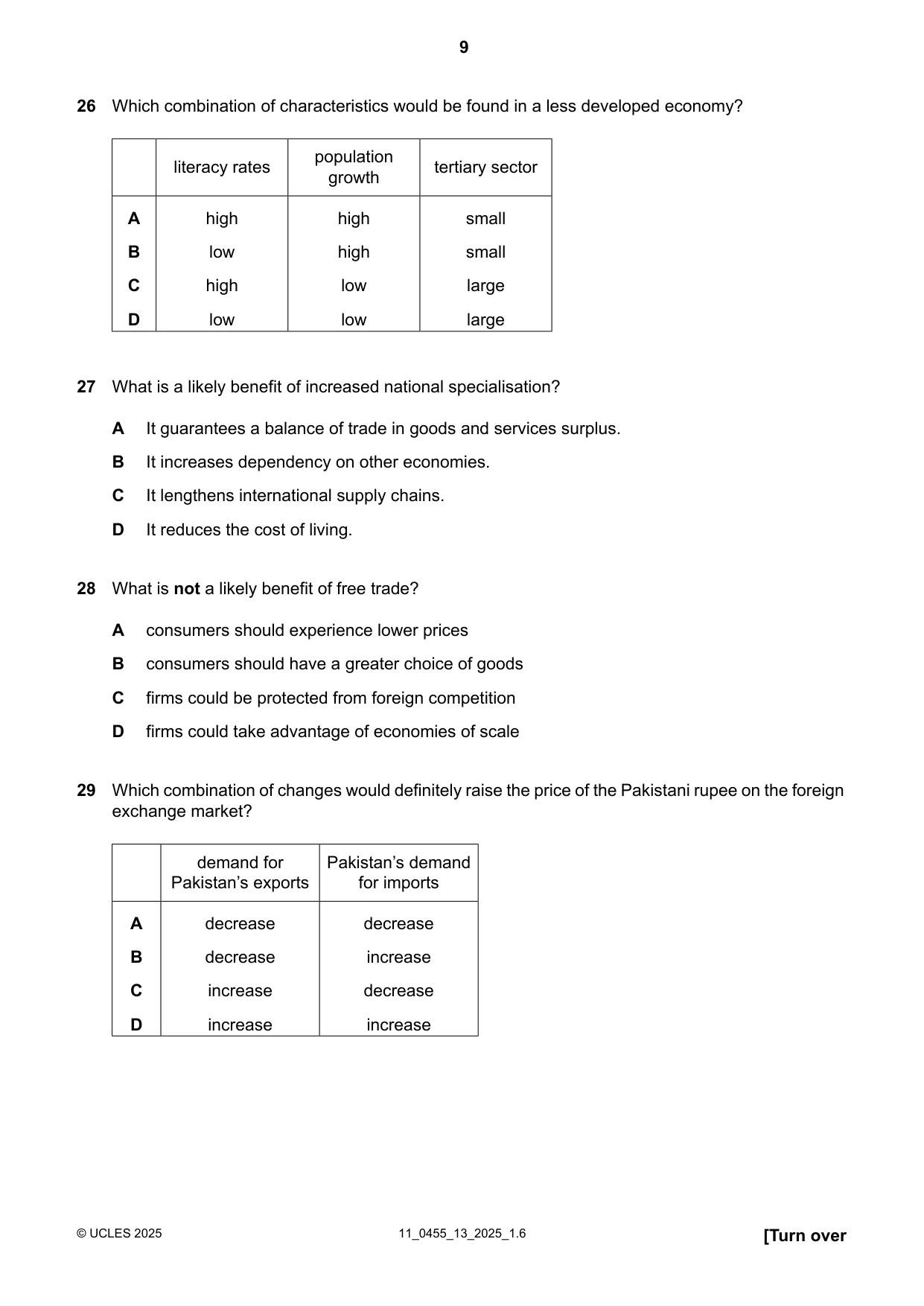
26 Which combination of characteristics would be found in a less developed economy? population literacy rates tertiary sector growth A high high small B low high small C high low large D low low large
Mark scheme: B
More questions on Differences in economic development between countries
Q27 · What is a likely benefit of increased national specialisation?
27 What is a likely benefit of increased national specialisation? A It guarantees a balance of trade in goods and services surplus. B It increases dependency on other economies. C It lengthens international supply chains. D It reduces the cost of living.
Mark scheme: D
Q28 · What is not a likely benefit of free trade?
28 What is not a likely benefit of free trade? A consumers should experience lower prices B consumers should have a greater choice of goods C firms could be protected from foreign competition D firms could take advantage of economies of scale
Mark scheme: C
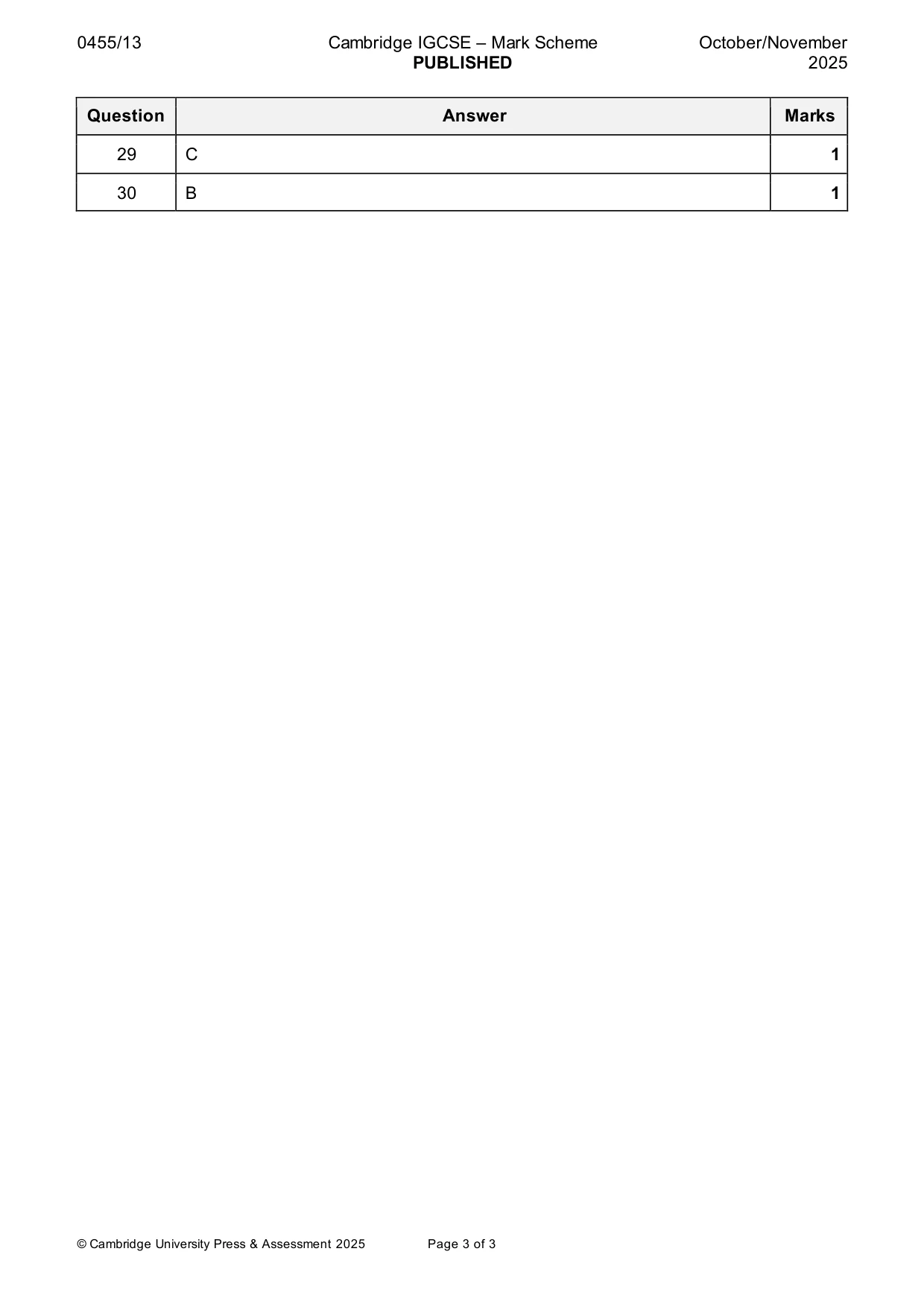
Q29 · Which combination of changes would definitely raise the price of the Pakistani rupee on…
29 Which combination of changes would definitely raise the price of the Pakistani rupee on the foreign exchange market? demand for Pakistan’s demand Pakistan’s exports for imports A decrease decrease B decrease increase C increase decrease D increase increase
Mark scheme: C
Q30 · What is a likely government policy to reduce a deficit on the current account of the…
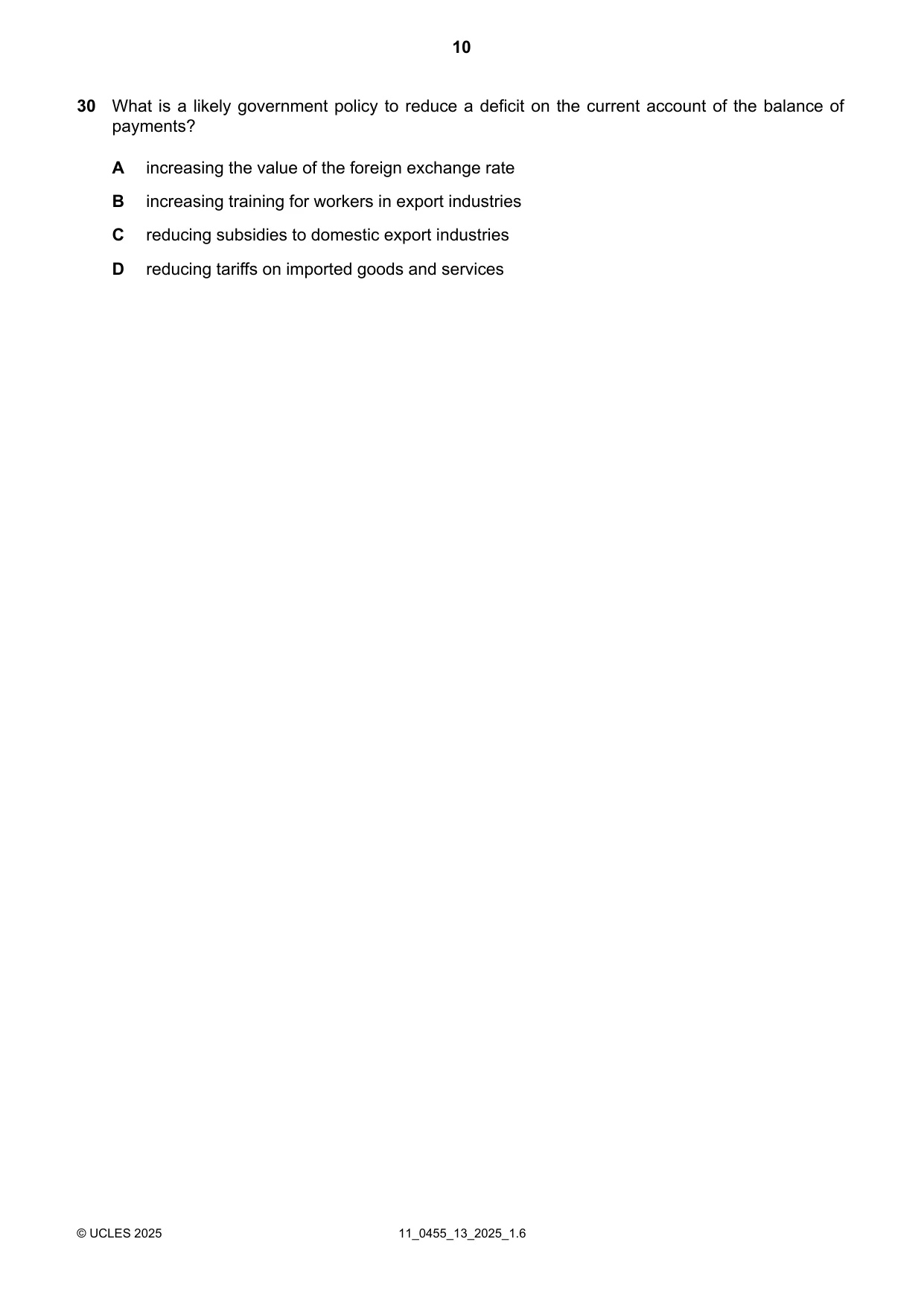
30 What is a likely government policy to reduce a deficit on the current account of the balance of payments? A increasing the value of the foreign exchange rate B increasing training for workers in export industries C reducing subsidies to domestic export industries D reducing tariffs on imported goods and services
Mark scheme: B
What was in this paper
The subtopics covered by these 30 questions, and how many questions each got. Open one in a new tab to see every Cambridge question on it.
2Price changes2Workers2Current account of balance of payments1Differences in economic development between countries1Economic growth1Employment and unemployment1Firms and production1Fiscal policy1Foreign exchange rates1Globalisation, free trade and protection1Inflation and deflation1International specialisation1Market economic system1Market failure1Market structure1Mixed economic system1Monetary policy1Money and banking1Opportunity cost1Population1Price elasticity of supply (PES)1Production possibility curve (PPC) diagrams1Supply-side policy1The macroeconomic aims of government1The role of government1Trade unions1What you needed in this session
Cambridge’s own grade thresholds for 2025 Oct/Nov, Paper 1 · Variant 3. A higher threshold means an easier paper — the bar moves with how the cohort did.