Cambridge IGCSE Economics 0455 — 2012 May/June Paper 1 · Variant 3
0455/13/M/J/12 · 30 questions · 30 marks · ≈34 min
The question paper and its mark scheme, free to read here and free to download. This is Cambridge’s own paper, exactly as it was sat.
Question paper12 pages

Mark scheme2 pages
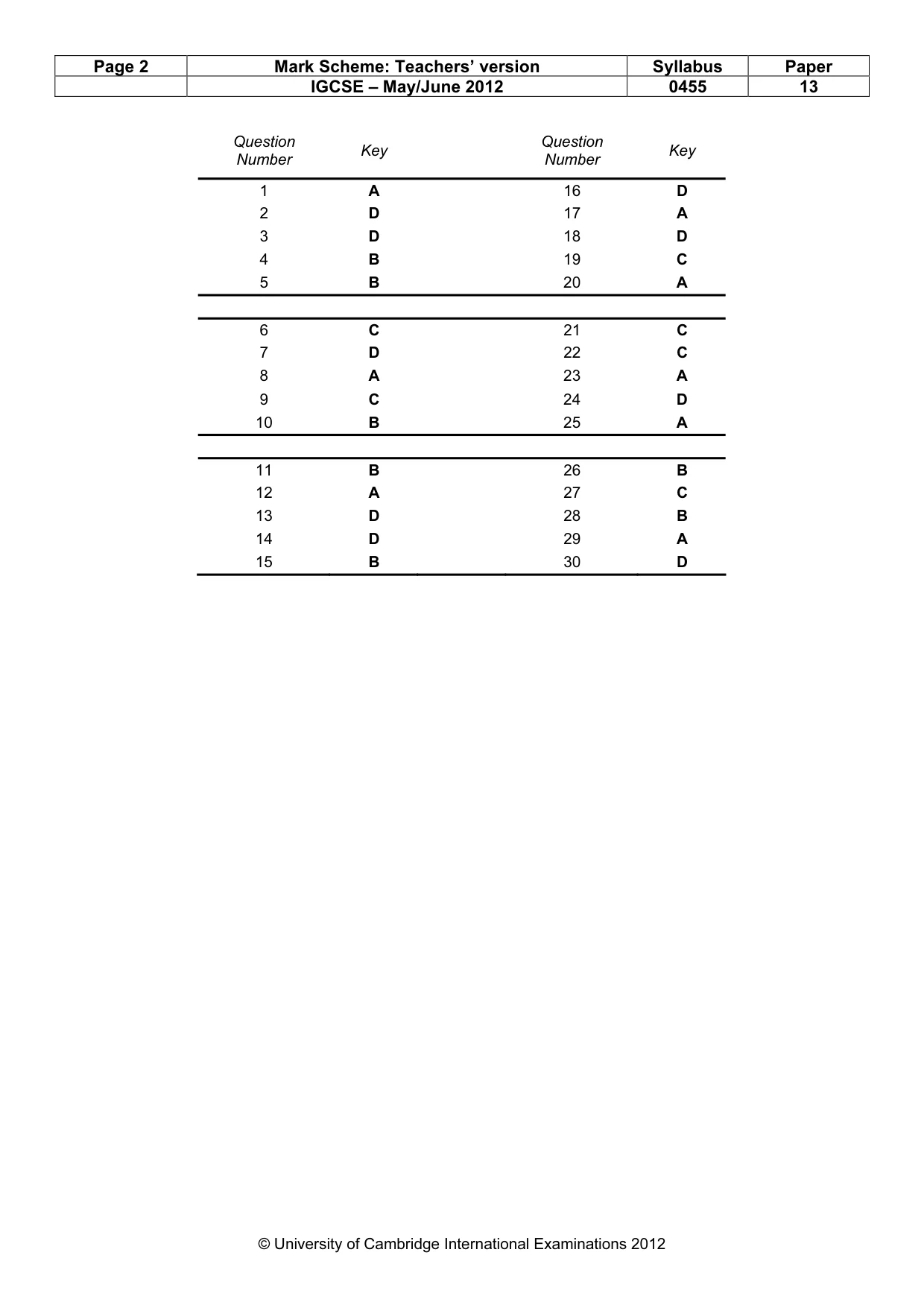
Answers below. Sit the paper first if you are practising.
Questions as text
Q1 · Economics is primarily concerned with A allocating scarce resources for unlimited wants
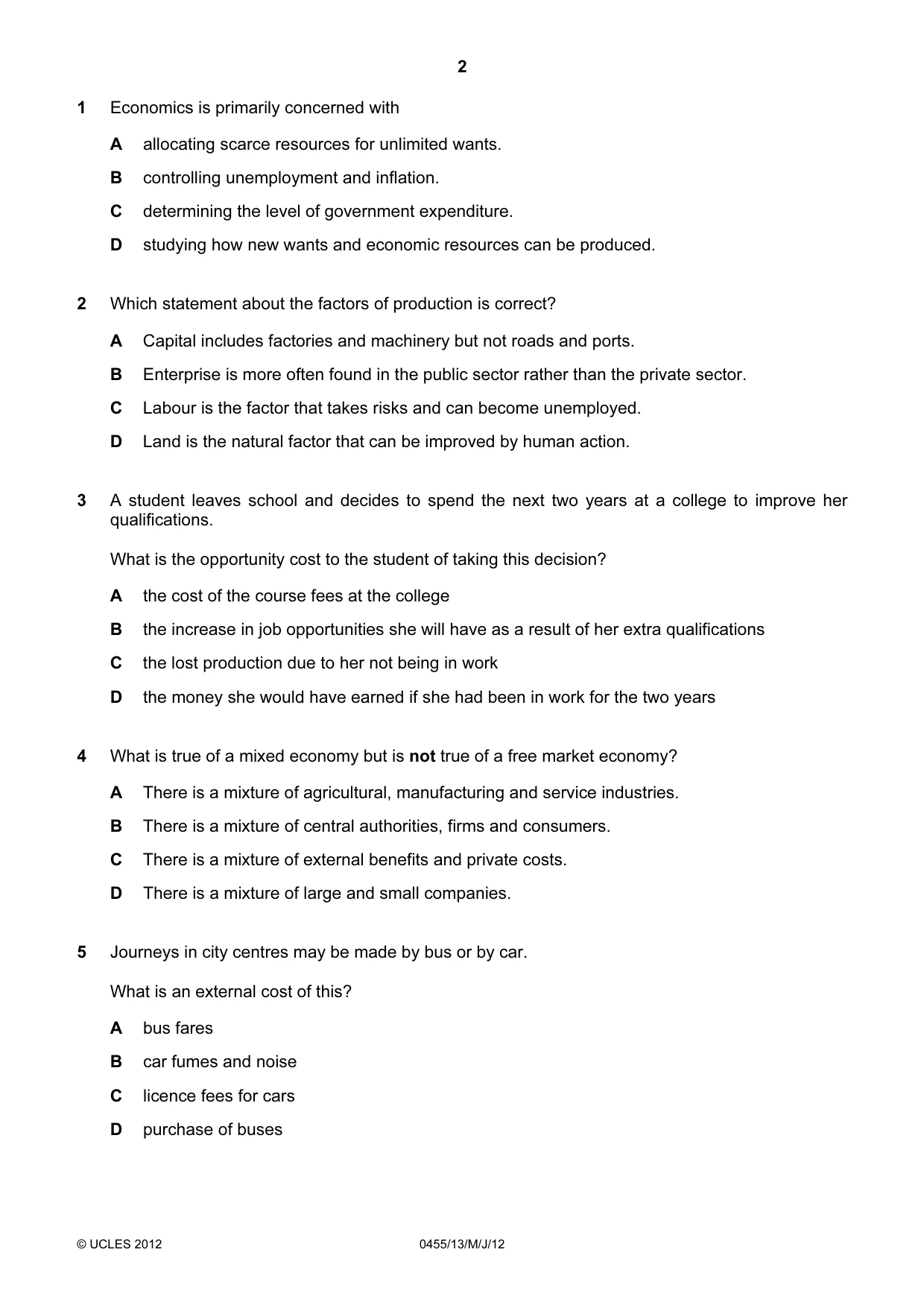
1 Economics is primarily concerned with A allocating scarce resources for unlimited wants. B controlling unemployment and inflation. C determining the level of government expenditure. D studying how new wants and economic resources can be produced.
Mark scheme: A
Q2 · Which statement about the factors of production is correct?
2 Which statement about the factors of production is correct? A Capital includes factories and machinery but not roads and ports. B Enterprise is more often found in the public sector rather than the private sector. C Labour is the factor that takes risks and can become unemployed. D Land is the natural factor that can be improved by human action.
Mark scheme: D
Q3 · A student leaves school and decides to spend the next two years at a college to improve…
3 A student leaves school and decides to spend the next two years at a college to improve her qualifications. What is the opportunity cost to the student of taking this decision? A the cost of the course fees at the college B the increase in job opportunities she will have as a result of her extra qualifications C the lost production due to her not being in work D the money she would have earned if she had been in work for the two years
Mark scheme: D
Q4 · What is true of a mixed economy but is not true of a free market economy?
4 What is true of a mixed economy but is not true of a free market economy? A There is a mixture of agricultural, manufacturing and service industries. B There is a mixture of central authorities, firms and consumers. C There is a mixture of external benefits and private costs. D There is a mixture of large and small companies.
Mark scheme: B
Q5 · Journeys in city centres may be made by bus or by car
5 Journeys in city centres may be made by bus or by car. What is an external cost of this? A bus fares B car fumes and noise C licence fees for cars D purchase of buses
Mark scheme: B
Q6 · What is not held constant in constructing a demand schedule?
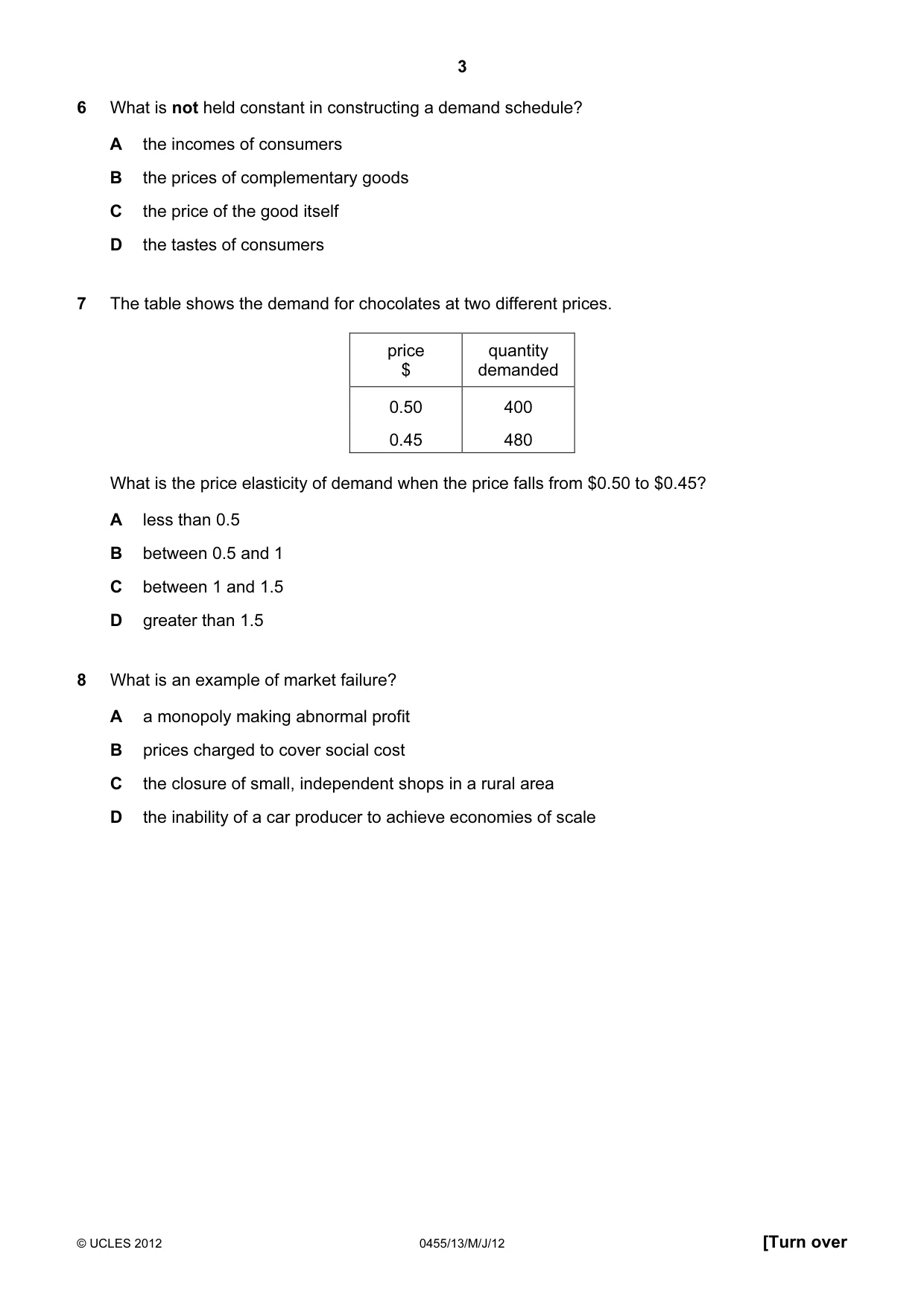
6 What is not held constant in constructing a demand schedule? A the incomes of consumers B the prices of complementary goods C the price of the good itself D the tastes of consumers
Mark scheme: C
Q7 · The table shows the demand for chocolates at two different prices
7 The table shows the demand for chocolates at two different prices. price quantity $ demanded 0.50 400 0.45 480 What is the price elasticity of demand when the price falls from $0.50 to $0.45? A less than 0.5 B between 0.5 and 1 C between 1 and 1.5 D greater than 1.5
Mark scheme: D
Q8 · What is an example of market failure?
8 What is an example of market failure? A a monopoly making abnormal profit B prices charged to cover social cost C the closure of small, independent shops in a rural area D the inability of a car producer to achieve economies of scale
Mark scheme: A
Q9 · What changes would move the equilibrium in the diagram from point X to a new point within…
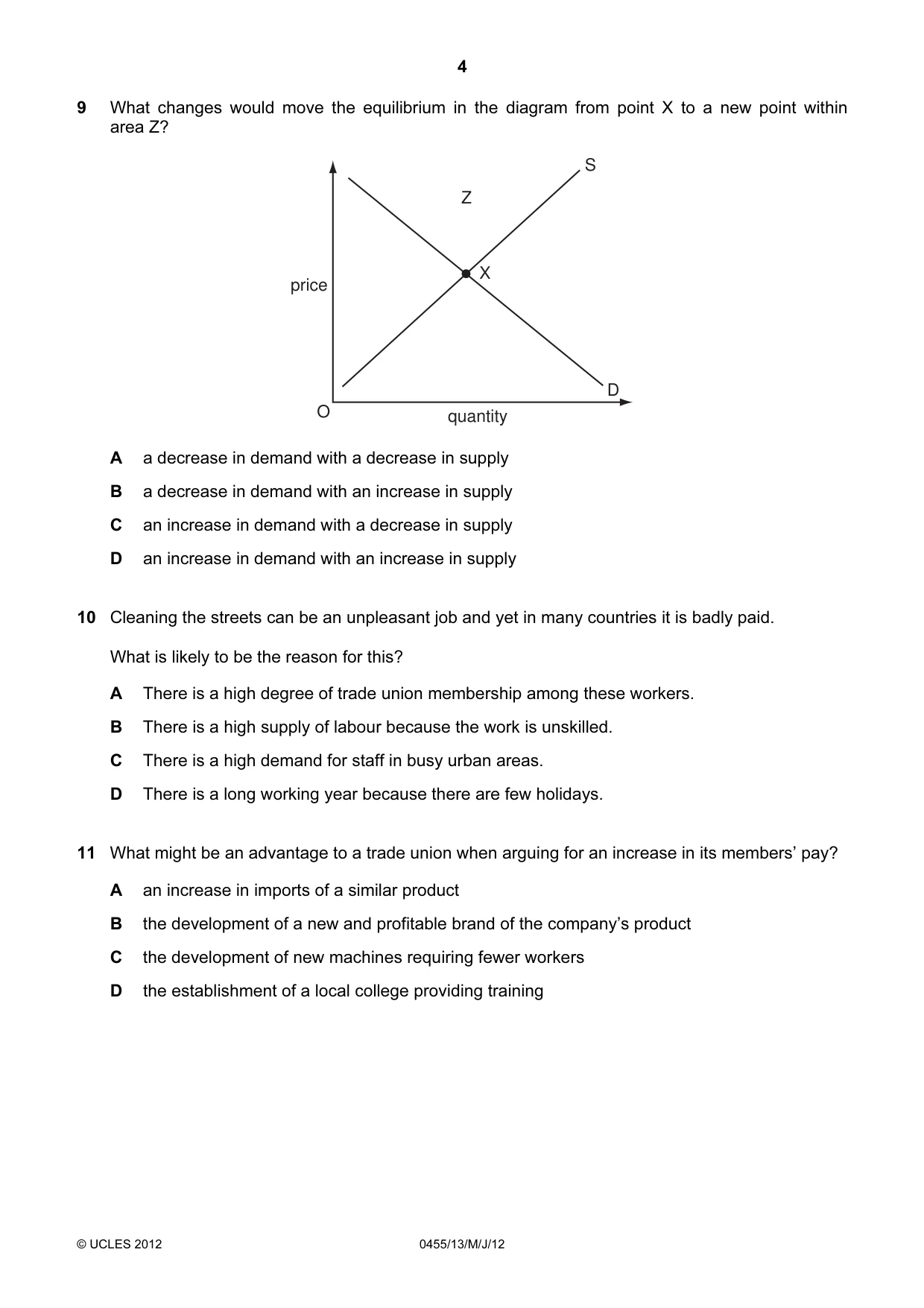
9 What changes would move the equilibrium in the diagram from point X to a new point within area Z? S Z X price D O quantity A a decrease in demand with a decrease in supply B a decrease in demand with an increase in supply C an increase in demand with a decrease in supply D an increase in demand with an increase in supply
Mark scheme: C
Q10 · Cleaning the streets can be an unpleasant job and yet in many countries it is badly paid
10 Cleaning the streets can be an unpleasant job and yet in many countries it is badly paid. What is likely to be the reason for this? A There is a high degree of trade union membership among these workers. B There is a high supply of labour because the work is unskilled. C There is a high demand for staff in busy urban areas. D There is a long working year because there are few holidays.
Mark scheme: B
Q11 · What might be an advantage to a trade union when arguing for an increase in its members’…
11 What might be an advantage to a trade union when arguing for an increase in its members’ pay? A an increase in imports of a similar product B the development of a new and profitable brand of the company’s product C the development of new machines requiring fewer workers D the establishment of a local college providing training
Mark scheme: B
Q12 · In 2008–2009 the central bank of a developed country reduced interest rates from 5 % to…
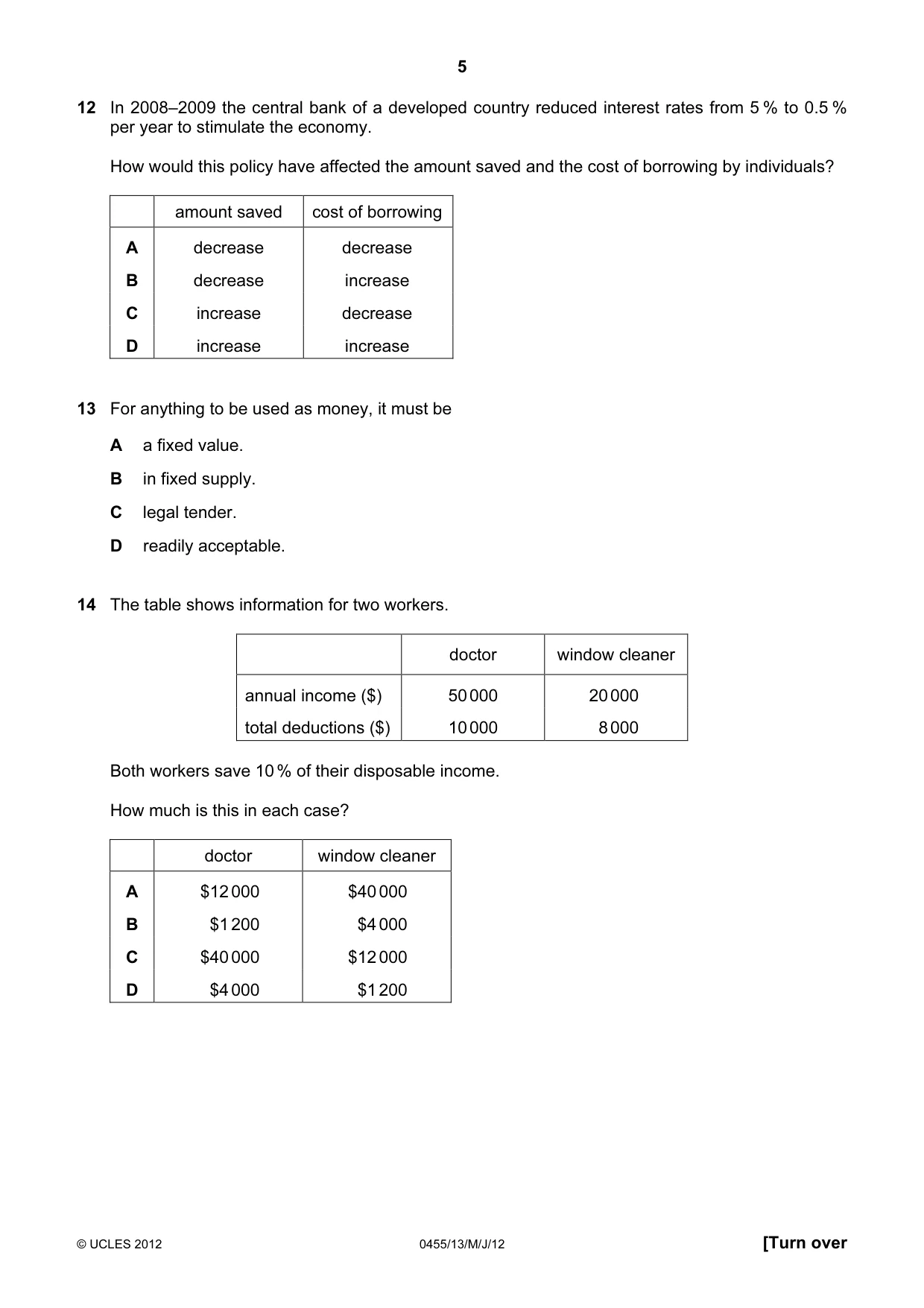
12 In 2008–2009 the central bank of a developed country reduced interest rates from 5 % to 0.5 % per year to stimulate the economy. How would this policy have affected the amount saved and the cost of borrowing by individuals? amount saved cost of borrowing A decrease decrease B decrease increase C increase decrease D increase increase
Mark scheme: A
Q13 · For anything to be used as money, it must be A a fixed value
13 For anything to be used as money, it must be A a fixed value. B in fixed supply. C legal tender. D readily acceptable.
Mark scheme: D
Q14 · The table shows information for two workers
14 The table shows information for two workers. doctor window cleaner annual income ($) 50 000 20 000 total deductions ($) 10 000 8 000 Both workers save 10 % of their disposable income. How much is this in each case? doctor window cleaner A $12 000 $40 000 B $1 200 $4 000 C $40 000 $12 000 D $4 000 $1 200
Mark scheme: D
Q15 · Which is a diseconomy of scale?
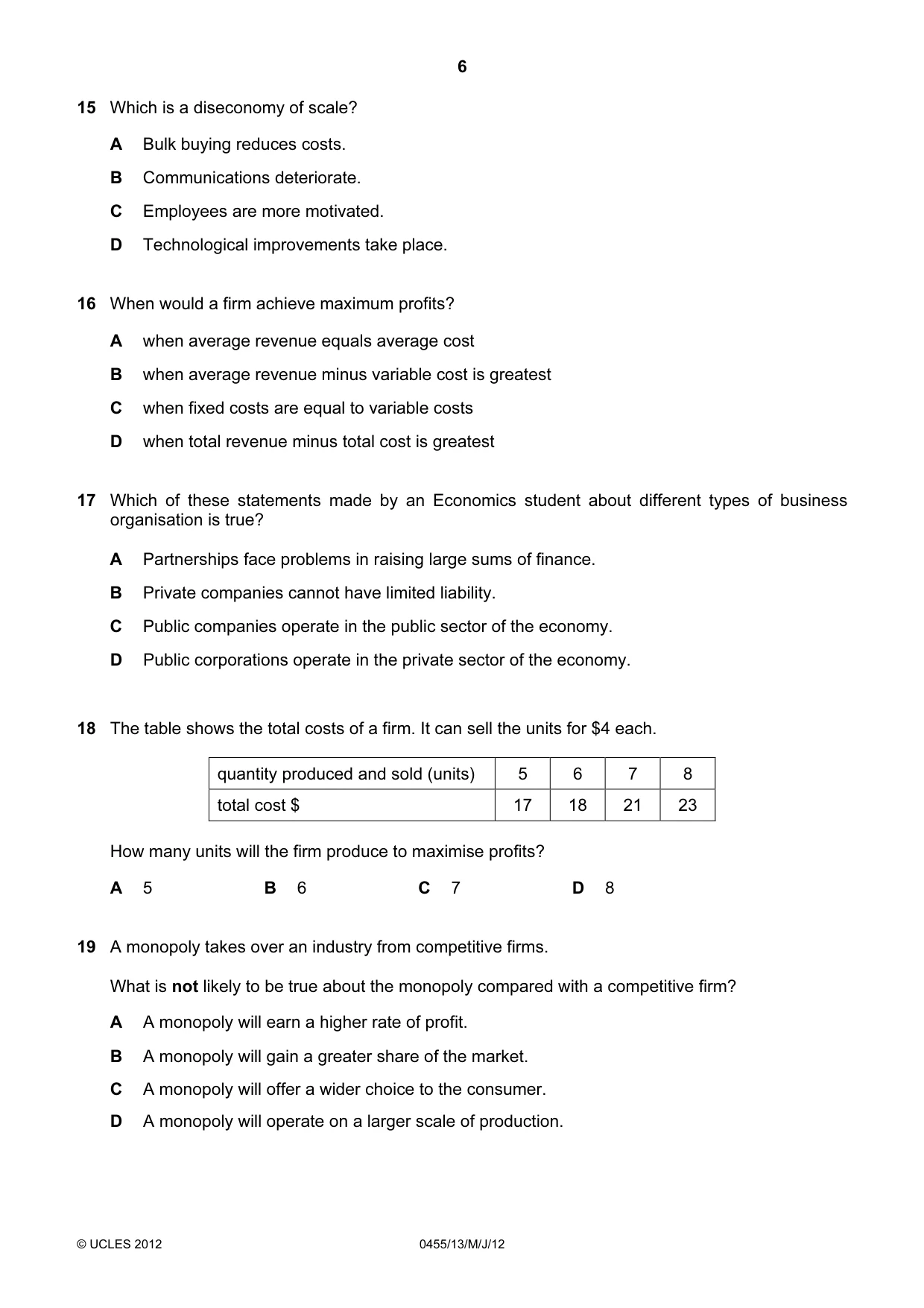
15 Which is a diseconomy of scale? A Bulk buying reduces costs. B Communications deteriorate. C Employees are more motivated. D Technological improvements take place.
Mark scheme: B
Q16 · When would a firm achieve maximum profits?
16 When would a firm achieve maximum profits? A when average revenue equals average cost B when average revenue minus variable cost is greatest C when fixed costs are equal to variable costs D when total revenue minus total cost is greatest
Mark scheme: D
Q17 · Which of these statements made by an Economics student about different types of business…
17 Which of these statements made by an Economics student about different types of business organisation is true? A Partnerships face problems in raising large sums of finance. B Private companies cannot have limited liability. C Public companies operate in the public sector of the economy. D Public corporations operate in the private sector of the economy.
Mark scheme: A
Q18 · The table shows the total costs of a firm
18 The table shows the total costs of a firm. It can sell the units for $4 each. quantity produced and sold (units) 5 6 7 8 total cost $ 17 18 21 23 How many units will the firm produce to maximise profits? A 5 B 6 C 7 D 8
Mark scheme: D
Q19 · A monopoly takes over an industry from competitive firms
19 A monopoly takes over an industry from competitive firms. What is not likely to be true about the monopoly compared with a competitive firm? A A monopoly will earn a higher rate of profit. B A monopoly will gain a greater share of the market. C A monopoly will offer a wider choice to the consumer. D A monopoly will operate on a larger scale of production.
Mark scheme: C
Q20 · What would be most likely to reduce the rate of inflation?
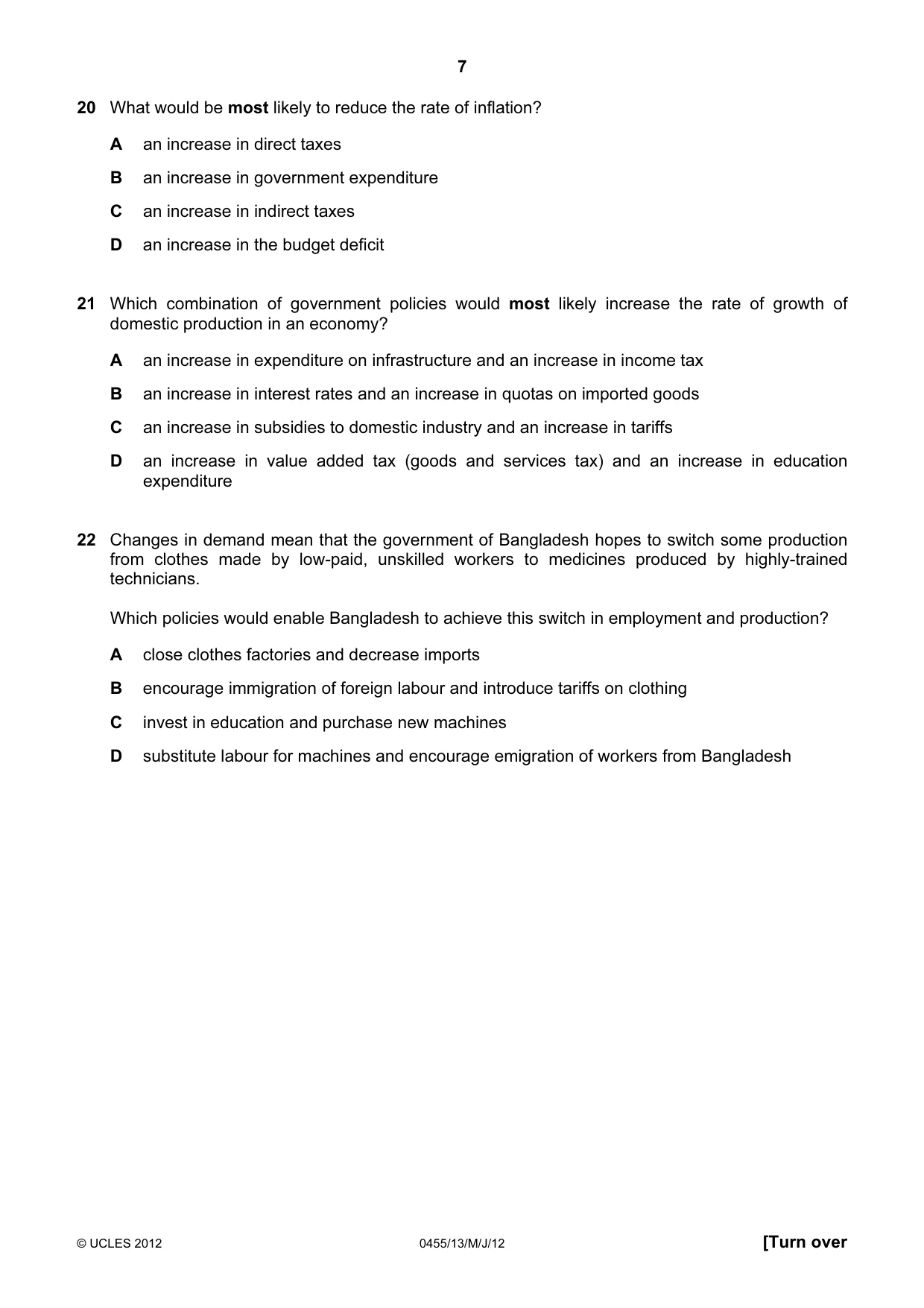
20 What would be most likely to reduce the rate of inflation? A an increase in direct taxes B an increase in government expenditure C an increase in indirect taxes D an increase in the budget deficit
Mark scheme: A
Q21 · Which combination of government policies would most likely increase the rate of growth of…
21 Which combination of government policies would most likely increase the rate of growth of domestic production in an economy? A an increase in expenditure on infrastructure and an increase in income tax B an increase in interest rates and an increase in quotas on imported goods C an increase in subsidies to domestic industry and an increase in tariffs D an increase in value added tax (goods and services tax) and an increase in education expenditure
Mark scheme: C
Q22 · Changes in demand mean that the government of Bangladesh hopes to switch some production…
22 Changes in demand mean that the government of Bangladesh hopes to switch some production from clothes made by low-paid, unskilled workers to medicines produced by highly-trained technicians. Which policies would enable Bangladesh to achieve this switch in employment and production? A close clothes factories and decrease imports B encourage immigration of foreign labour and introduce tariffs on clothing C invest in education and purchase new machines D substitute labour for machines and encourage emigration of workers from Bangladesh
Mark scheme: C
Q23 · A country has a tax system which places no tax on incomes below $5000, is proportional on…
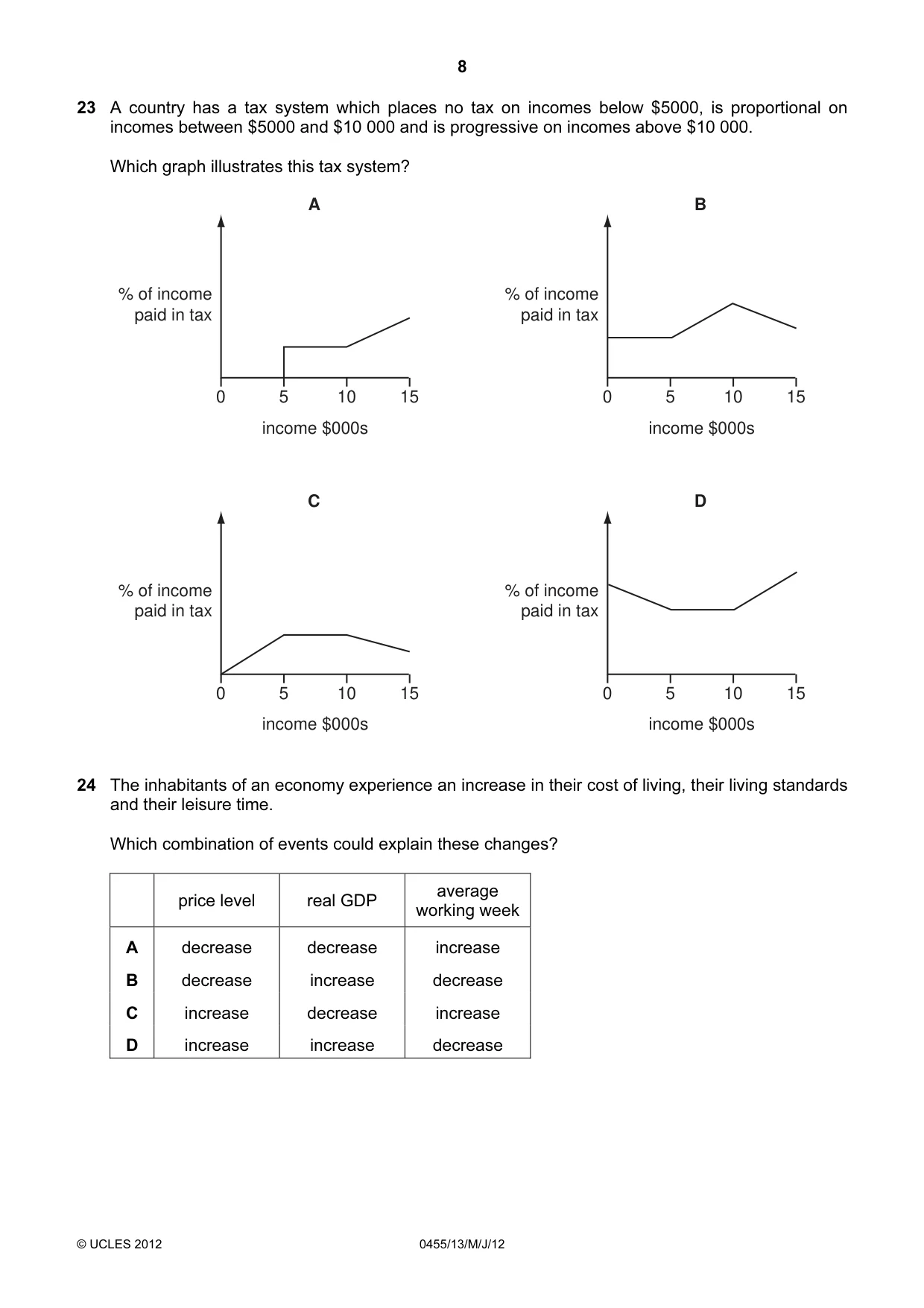
23 A country has a tax system which places no tax on incomes below $5000, is proportional on incomes between $5000 and $10 000 and is progressive on incomes above $10 000. Which graph illustrates this tax system? A B % of income % of income paid in tax paid in tax 0 5 10 15 0 5 10 15 income $000s income $000s C D % of income % of income paid in tax paid in tax 0 5 10 15 0 5 10 15 income $000s income $000s
Mark scheme: A
Q24 · The inhabitants of an economy experience an increase in their cost of living, their…
24 The inhabitants of an economy experience an increase in their cost of living, their living standards and their leisure time. Which combination of events could explain these changes? average price level real GDP working week A decrease decrease increase B decrease increase decrease C increase decrease increase D increase increase decrease
Mark scheme: D
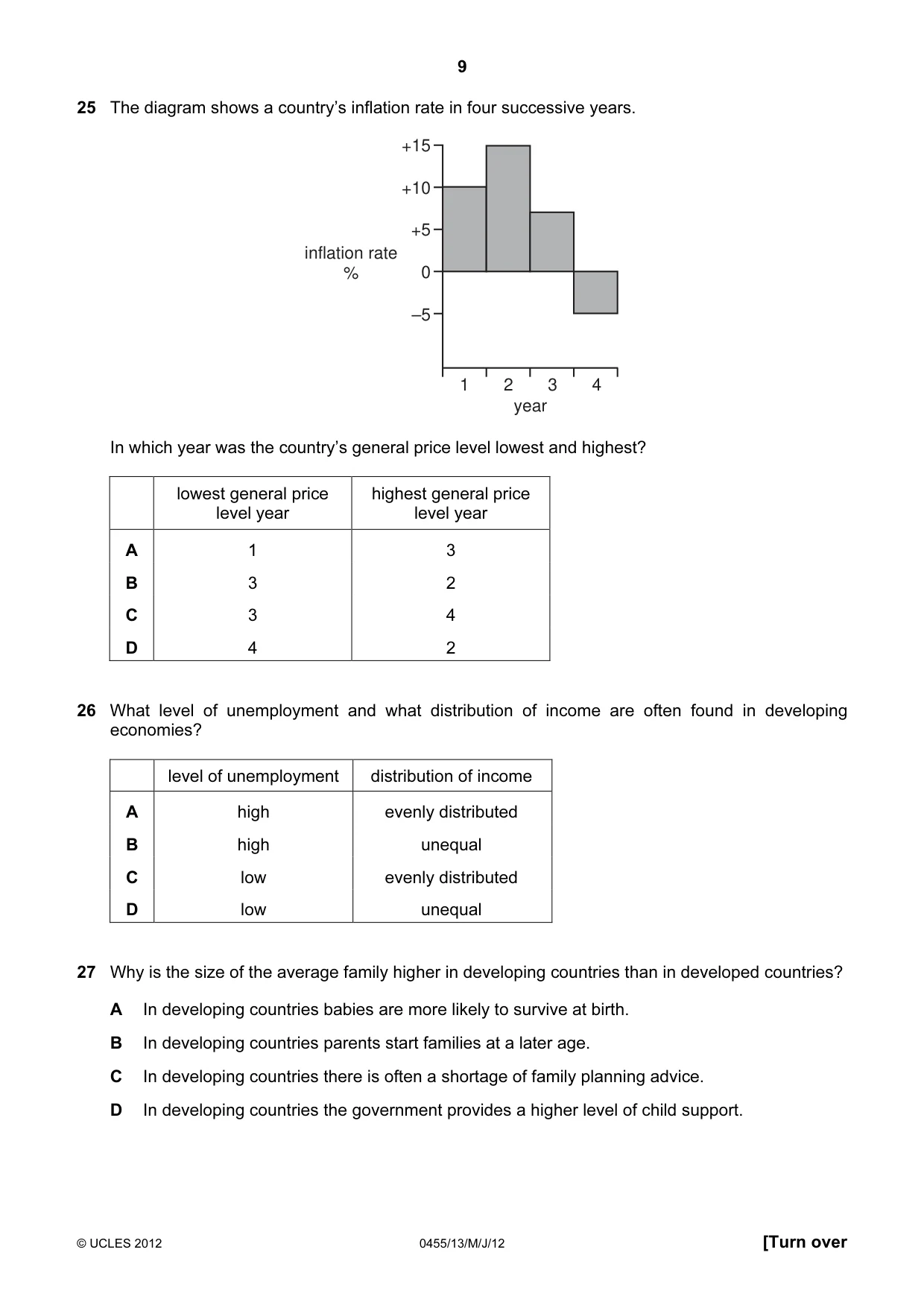
Q25 · The diagram shows a country’s inflation rate in four successive years
25 The diagram shows a country’s inflation rate in four successive years. +15 +10 +5 inflation rate % 0 –5 1 2 3 4 year In which year was the country’s general price level lowest and highest? lowest general price highest general price level year level year A 1 3 B 3 2 C 3 4 D 4 2
Mark scheme: A
Q26 · What level of unemployment and what distribution of income are often found in developing…
26 What level of unemployment and what distribution of income are often found in developing economies? level of unemployment distribution of income A high evenly distributed B high unequal C low evenly distributed D low unequal
Mark scheme: B
More questions on Differences in economic development between countries
Q27 · Why is the size of the average family higher in developing countries than in developed…
27 Why is the size of the average family higher in developing countries than in developed countries? A In developing countries babies are more likely to survive at birth. B In developing countries parents start families at a later age. C In developing countries there is often a shortage of family planning advice. D In developing countries the government provides a higher level of child support.
Mark scheme: C
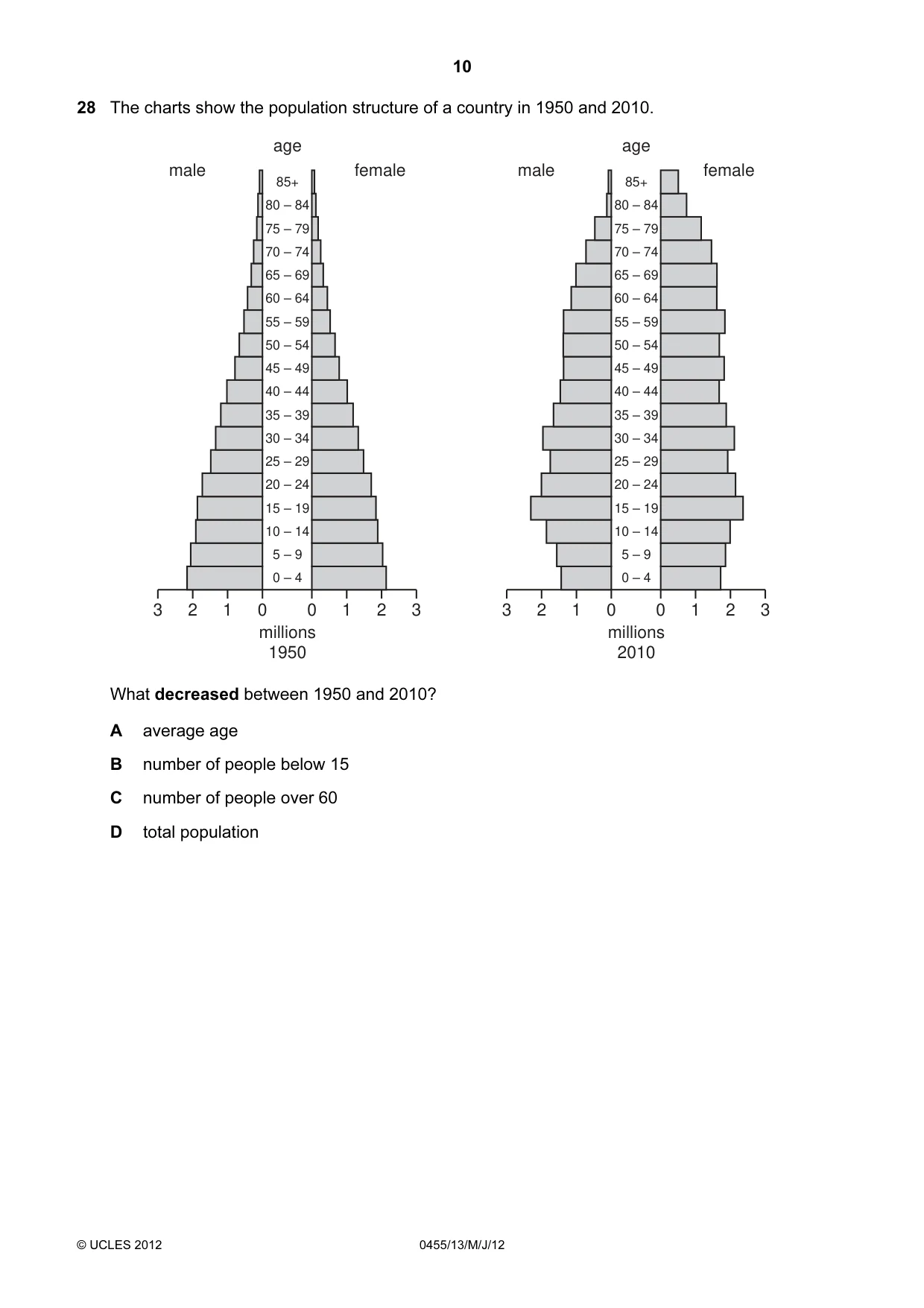
Q28 · The charts show the population structure of a country in 1950 and 2010
28 The charts show the population structure of a country in 1950 and 2010. age age male female male female 85+ 85+ 80 – 84 80 – 84 75 – 79 75 – 79 70 – 74 70 – 74 65 – 69 65 – 69 60 – 64 60 – 64 55 – 59 55 – 59 50 – 54 50 – 54 45 – 49 45 – 49 40 – 44 40 – 44 35 – 39 35 – 39 30 – 34 30 – 34 25 – 29 25 – 29 20 – 24 20 – 24 15 – 19 15 – 19 10 – 14 10 – 14 5 – 9 5 – 9 0 – 4 0 – 4 3 2 1 0 0 1 2 3 3 2 1 0 0 1 2 3 millions millions 1950 2010 What decreased between 1950 and 2010? A average age B number of people below 15 C number of people over 60 D total population
Mark scheme: B
Q29 · A government removed the quota on goods imported into the country
29 A government removed the quota on goods imported into the country. What is the most likely result of this? A a decrease in demand for domestic production B a decrease in domestic unemployment C a decrease in exports D a decrease in the balance of trade deficit
Mark scheme: A
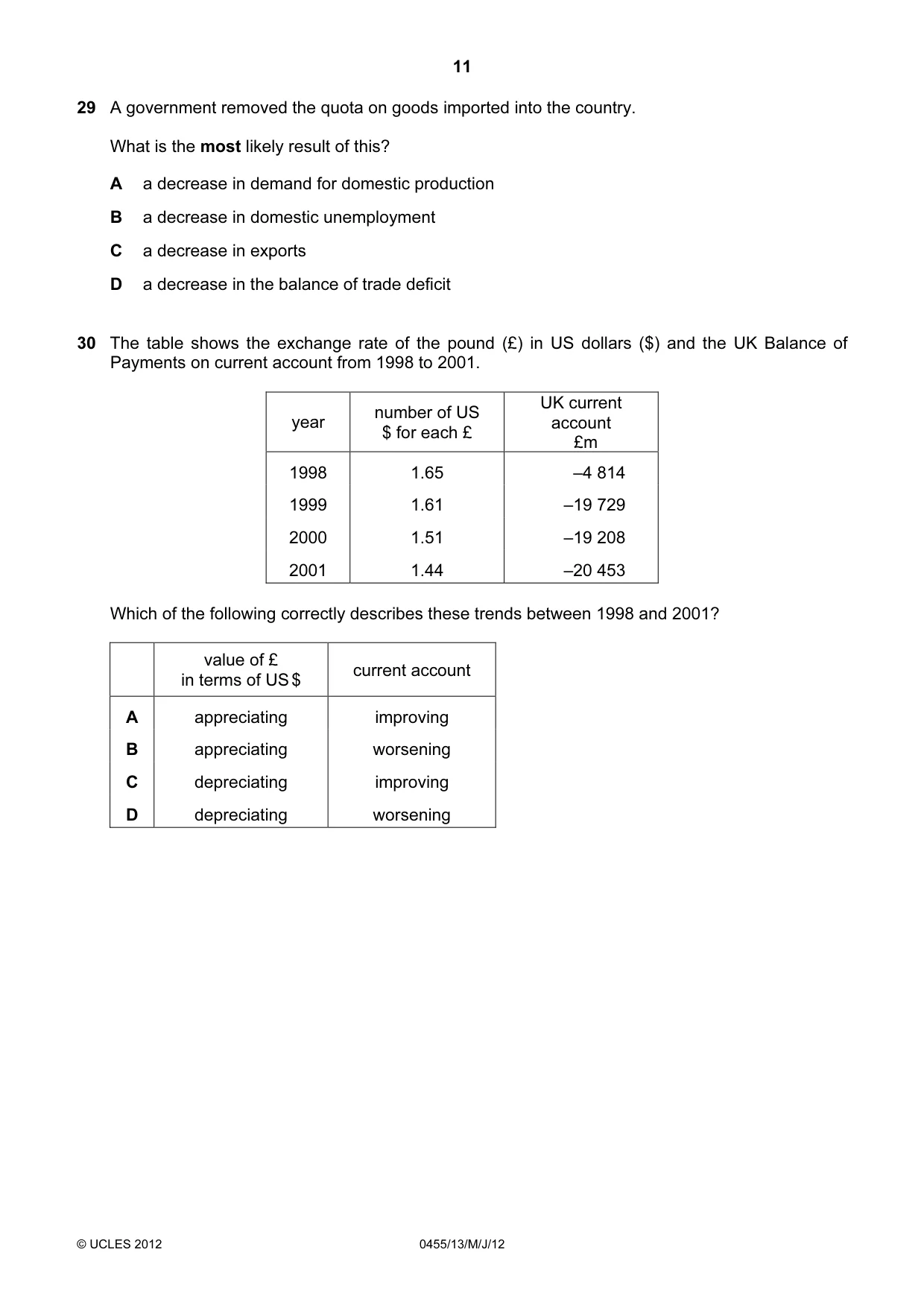
Q30 · The table shows the exchange rate of the pound (£) in US dollars ($) and the UK Balance…
30 The table shows the exchange rate of the pound (£) in US dollars ($) and the UK Balance of Payments on current account from 1998 to 2001. UK current number of US year account $ for each £ £m 1998 1.65 –4 814 1999 1.61 –19 729 2000 1.51 –19 208 2001 1.44 –20 453 Which of the following correctly describes these trends between 1998 and 2001? value of £ current account in terms of US $ A appreciating improving B appreciating worsening C depreciating improving D depreciating worsening
Mark scheme: D
What was in this paper
The subtopics covered by these 30 questions, and how many questions each got. Open one in a new tab to see every Cambridge question on it.
2Firms’ costs, revenue and objectives2Market failure2Population2Demand1Differences in economic development between countries1Firms1Firms and production1Fiscal policy1Foreign exchange rates1Globalisation, free trade and protection1Households1Inflation and deflation1Market structure1Mixed economic system1Monetary policy1Money and banking1Opportunity cost1Price changes1Price elasticity of demand (PED)1Supply-side policy1The factors of production1The nature of the economic problem1The role of government1Trade unions1Workers1What you needed in this session
Cambridge’s own grade thresholds for 2012 May/June, Paper 1 · Variant 3. A higher threshold means an easier paper — the bar moves with how the cohort did.