Cambridge IGCSE Economics 0455 — 2025 May/June Paper 1 · Variant 3
0455/13/M/J/25 · 30 questions · 30 marks · ≈34 min
The question paper and its mark scheme, free to read here and free to download. This is Cambridge’s own paper, exactly as it was sat.
Question paper12 pages
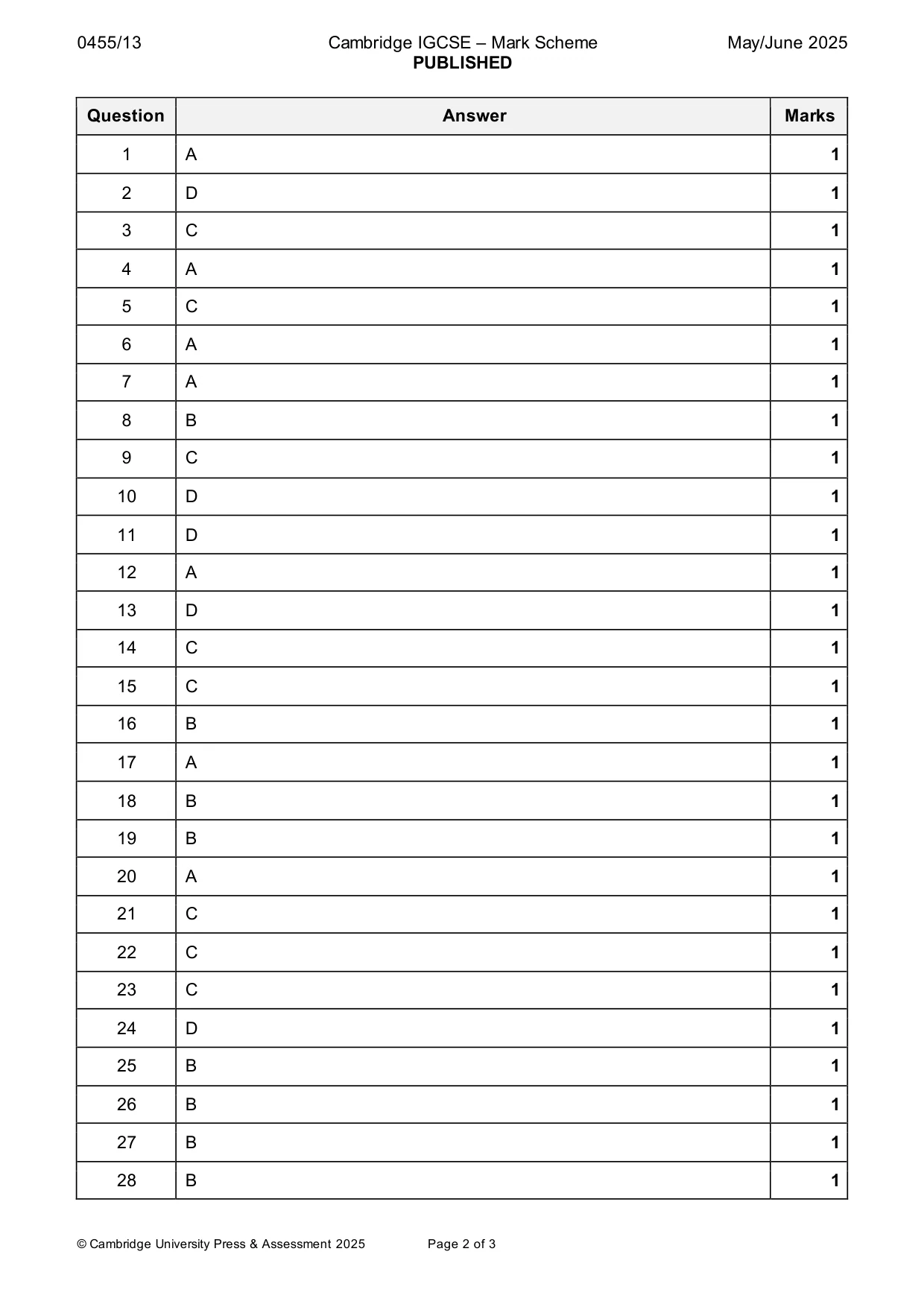
Mark scheme3 pages
Answers below. Sit the paper first if you are practising.

Questions as text
Q1 · What is not a factor of production?
1 What is not a factor of production? A a 10 dollar note B a farm labourer C a farm shop D a tractor
Mark scheme: A
Q2 · A person works at home making small cakes
2 A person works at home making small cakes. She can make 30 cakes an hour and works for four hours a day. The total cost of the ingredients is $50 and she sells the cakes for $2 each. What is the opportunity cost if she takes a working day for a holiday? A $50 B $240 C 30 cakes D 120 cakes
Mark scheme: D
Q3 · An economy produces different types of goods using its limited resources
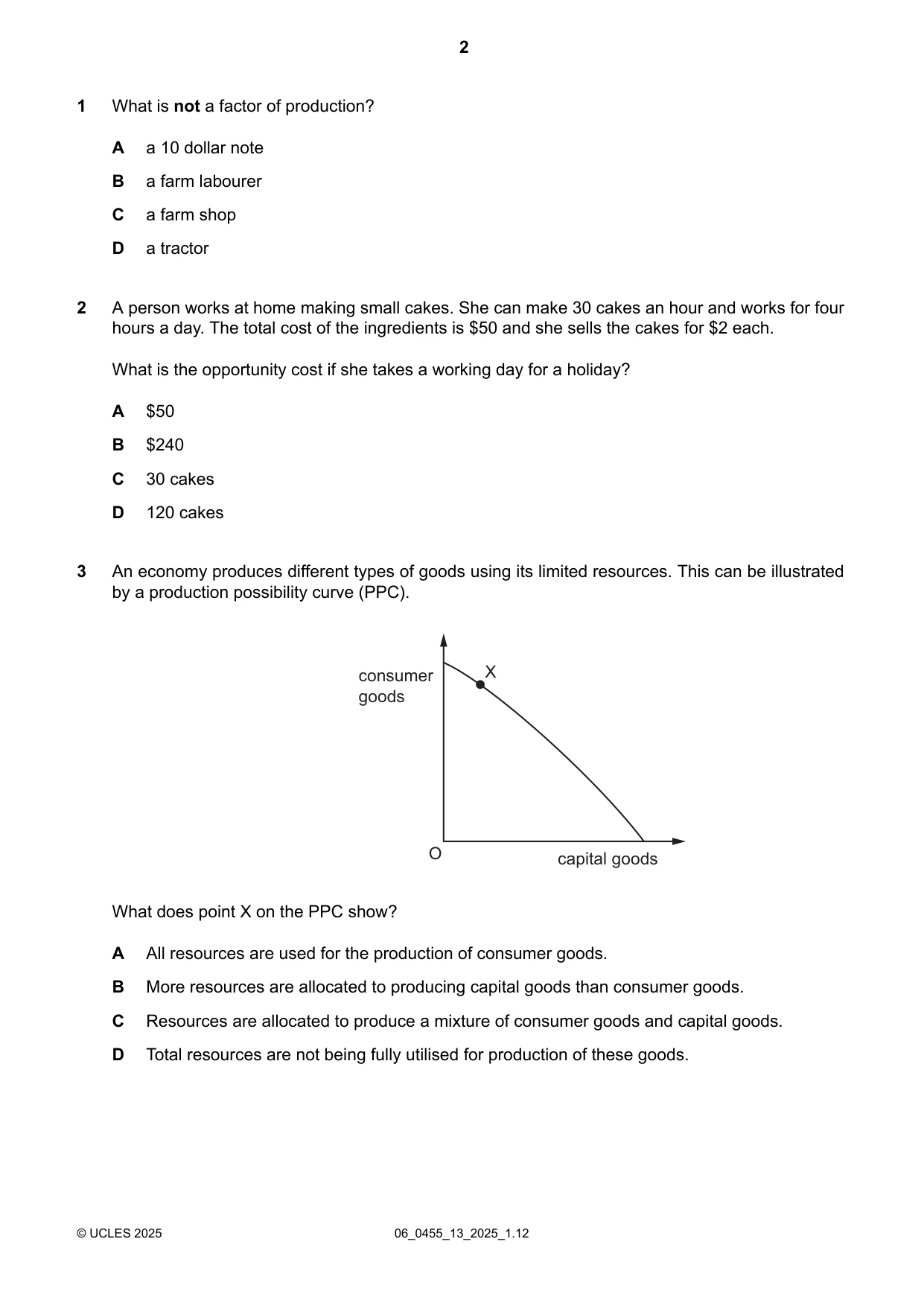
3 An economy produces different types of goods using its limited resources. This can be illustrated by a production possibility curve (PPC). consumer X goods O capital goods What does point X on the PPC show? A All resources are used for the production of consumer goods. B More resources are allocated to producing capital goods than consumer goods. C Resources are allocated to produce a mixture of consumer goods and capital goods. D Total resources are not being fully utilised for production of these goods.
Mark scheme: C
More questions on Production possibility curve (PPC) diagrams
Q4 · What is the function of the price mechanism in a market economy?
4 What is the function of the price mechanism in a market economy? A allocating resources and guiding choices B allowing governments to provide price stability C enabling markets to operate fairly D preventing competitors from entering a market
Mark scheme: A
More questions on The role of markets in allocating resources
Q5 · The table shows the demand and supply schedules for rice
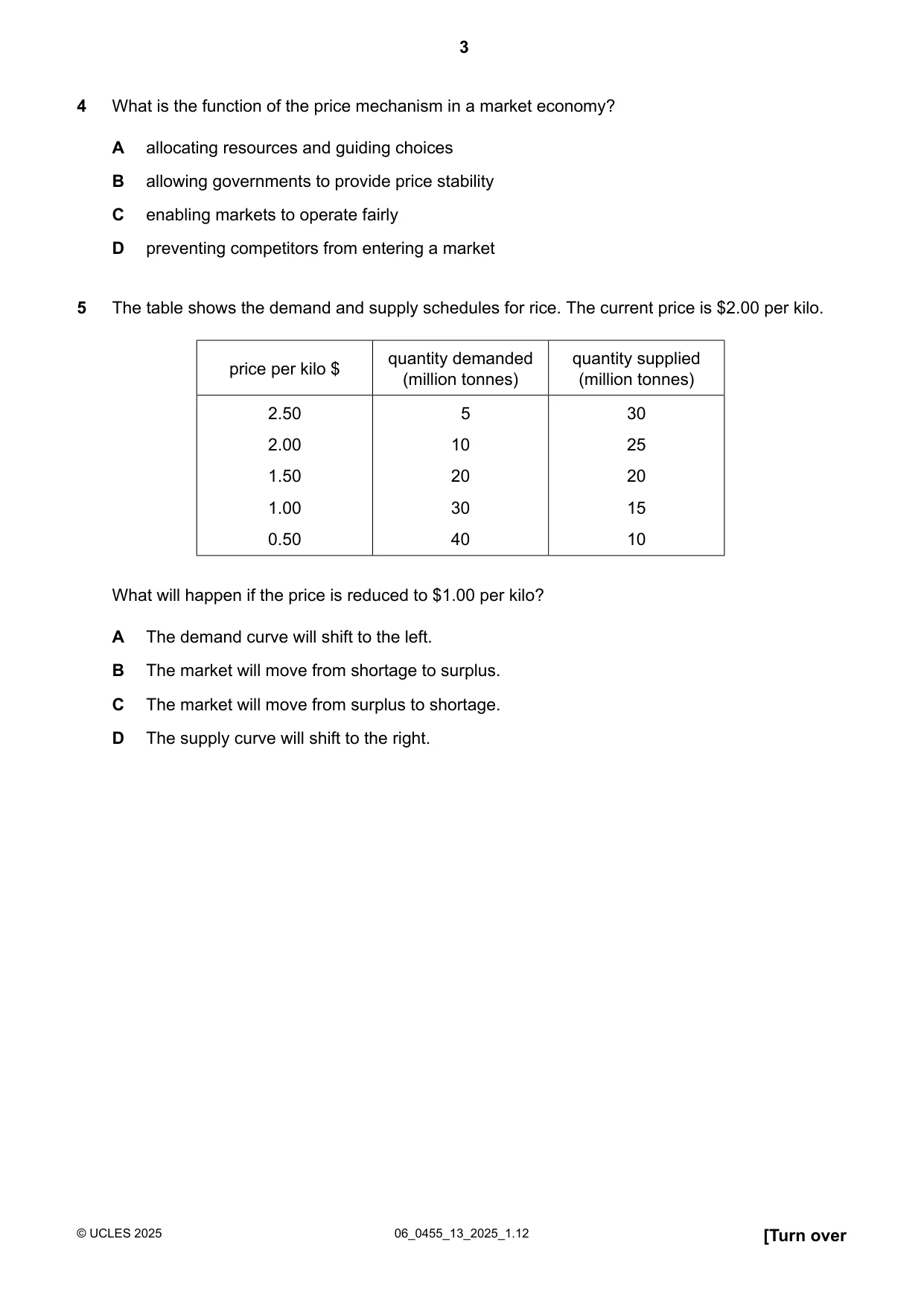
5 The table shows the demand and supply schedules for rice. The current price is $2.00 per kilo. quantity demanded quantity supplied price per kilo $ (million tonnes) (million tonnes) 2.50 5 30 2.00 10 25 1.50 20 20 1.00 30 15 0.50 40 10 What will happen if the price is reduced to $1.00 per kilo? A The demand curve will shift to the left. B The market will move from shortage to surplus. C The market will move from surplus to shortage. D The supply curve will shift to the right.
Mark scheme: C
Q6 · The diagram shows the market for cherries in Chile
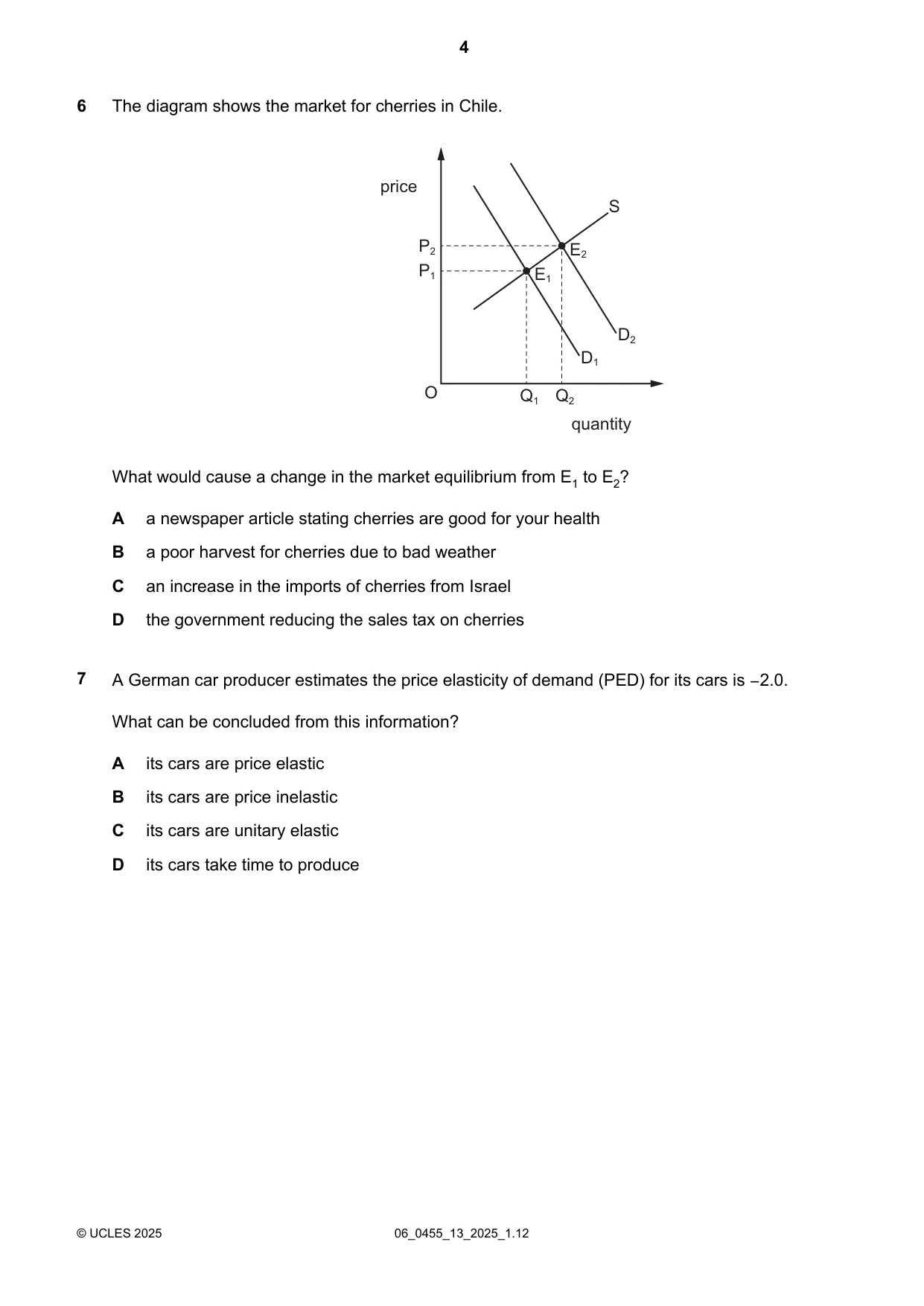
6 The diagram shows the market for cherries in Chile. price S P2 E2 P1 E1 D2 D1 O Q1 Q2 quantity What would cause a change in the market equilibrium from E1 to E2? A a newspaper article stating cherries are good for your health B a poor harvest for cherries due to bad weather C an increase in the imports of cherries from Israel D the government reducing the sales tax on cherries
Mark scheme: A
Q7 · A German car producer estimates the price elasticity of demand (PED) for its cars is −2.0
7 A German car producer estimates the price elasticity of demand (PED) for its cars is −2.0. What can be concluded from this information? A its cars are price elastic B its cars are price inelastic C its cars are unitary elastic D its cars take time to produce
Mark scheme: A
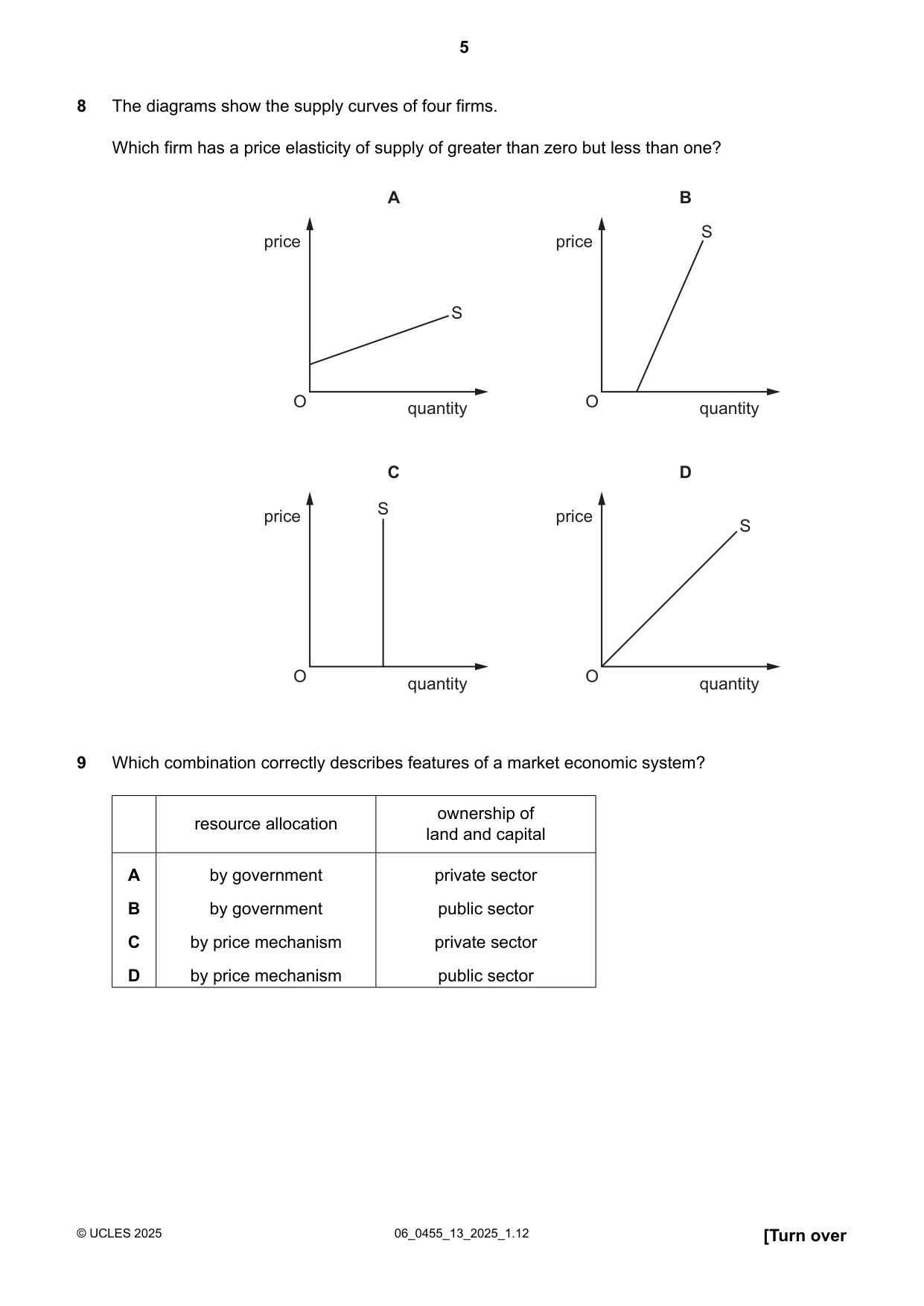
Q8 · The diagrams show the supply curves of four firms
8 The diagrams show the supply curves of four firms. Which firm has a price elasticity of supply of greater than zero but less than one? A B S price price S O quantity O quantity C D price S price S O quantity O quantity
Mark scheme: B
Q9 · Which combination correctly describes features of a market economic system?
9 Which combination correctly describes features of a market economic system? ownership of resource allocation land and capital A by government private sector B by government public sector C by price mechanism private sector D by price mechanism public sector
Mark scheme: C
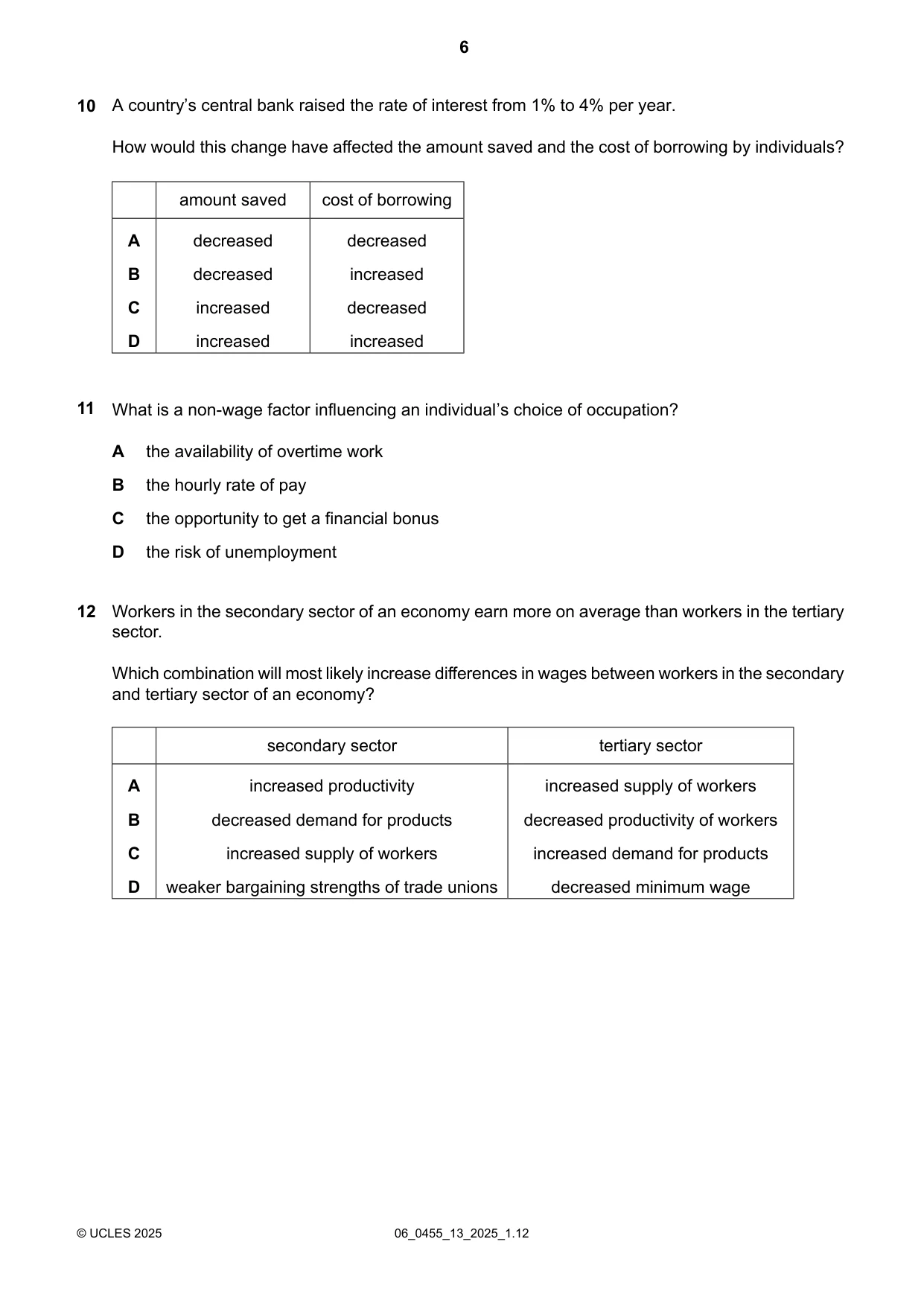
Q10 · A country’s central bank raised the rate of interest from 1% to 4% per year
10 A country’s central bank raised the rate of interest from 1% to 4% per year. How would this change have affected the amount saved and the cost of borrowing by individuals? amount saved cost of borrowing A decreased decreased B decreased increased C increased decreased D increased increased
Mark scheme: D
Q11 · What is a non-wage factor influencing an individual’s choice of occupation?
11 What is a non-wage factor influencing an individual’s choice of occupation? A the availability of overtime work B the hourly rate of pay C the opportunity to get a financial bonus D the risk of unemployment
Mark scheme: D
Q12 · Workers in the secondary sector of an economy earn more on average than workers in the…
12 Workers in the secondary sector of an economy earn more on average than workers in the tertiary sector. Which combination will most likely increase differences in wages between workers in the secondary and tertiary sector of an economy? secondary sector tertiary sector A increased productivity increased supply of workers B decreased demand for products decreased productivity of workers C increased supply of workers increased demand for products D weaker bargaining strengths of trade unions decreased minimum wage
Mark scheme: A
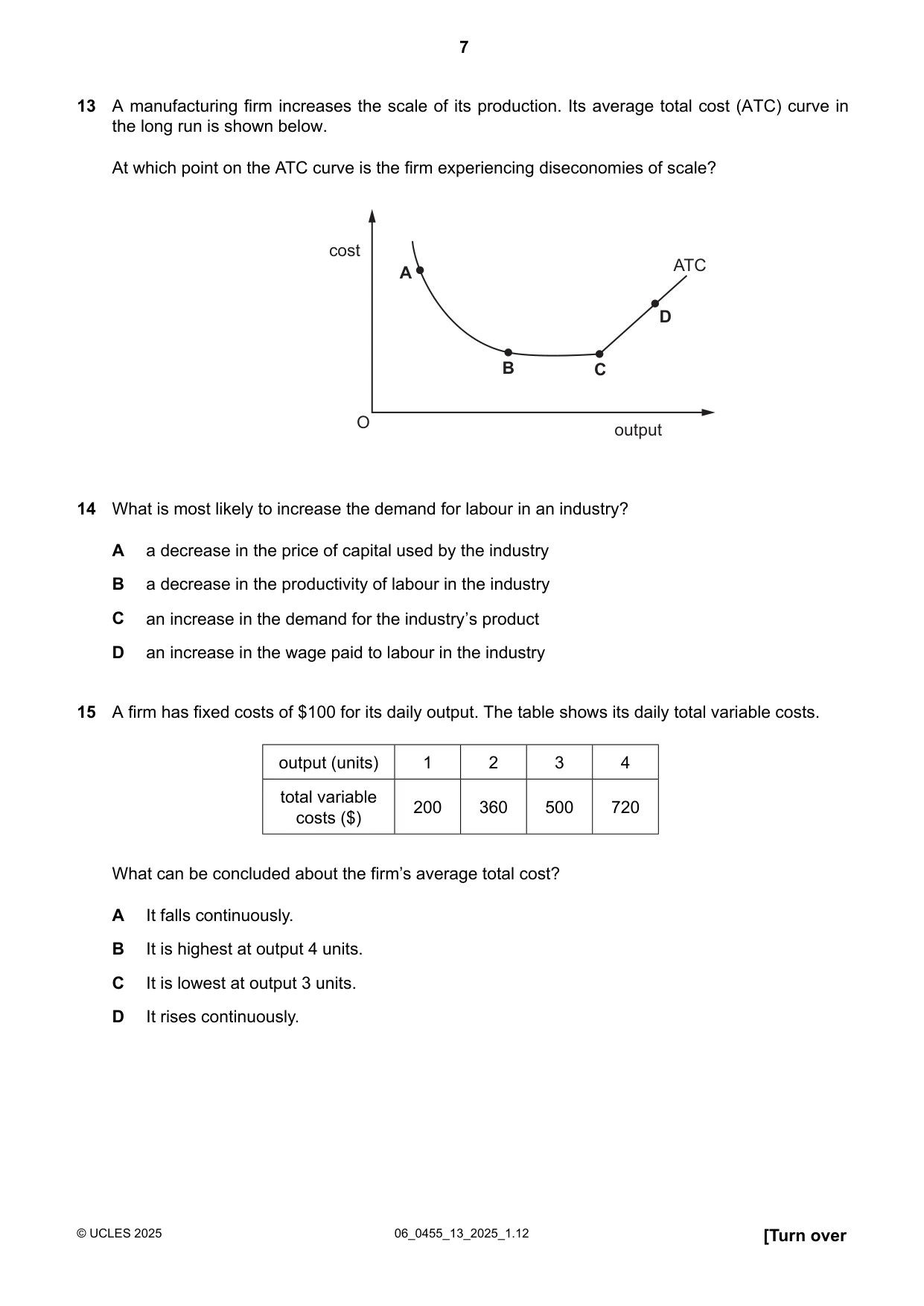
Q13 · A manufacturing firm increases the scale of its production
13 A manufacturing firm increases the scale of its production. Its average total cost (ATC) curve in the long run is shown below. At which point on the ATC curve is the firm experiencing diseconomies of scale? cost A ATC D B C O output
Mark scheme: D
Q14 · What is most likely to increase the demand for labour in an industry?
14 What is most likely to increase the demand for labour in an industry? A a decrease in the price of capital used by the industry B a decrease in the productivity of labour in the industry C an increase in the demand for the industry’s product D an increase in the wage paid to labour in the industry
Mark scheme: C
Q15 · A firm has fixed costs of $100 for its daily output
15 A firm has fixed costs of $100 for its daily output. The table shows its daily total variable costs. output (units) 1 2 3 4 total variable 200 360 500 720 costs ($) What can be concluded about the firm’s average total cost? A It falls continuously. B It is highest at output 4 units. C It is lowest at output 3 units. D It rises continuously.
Mark scheme: C
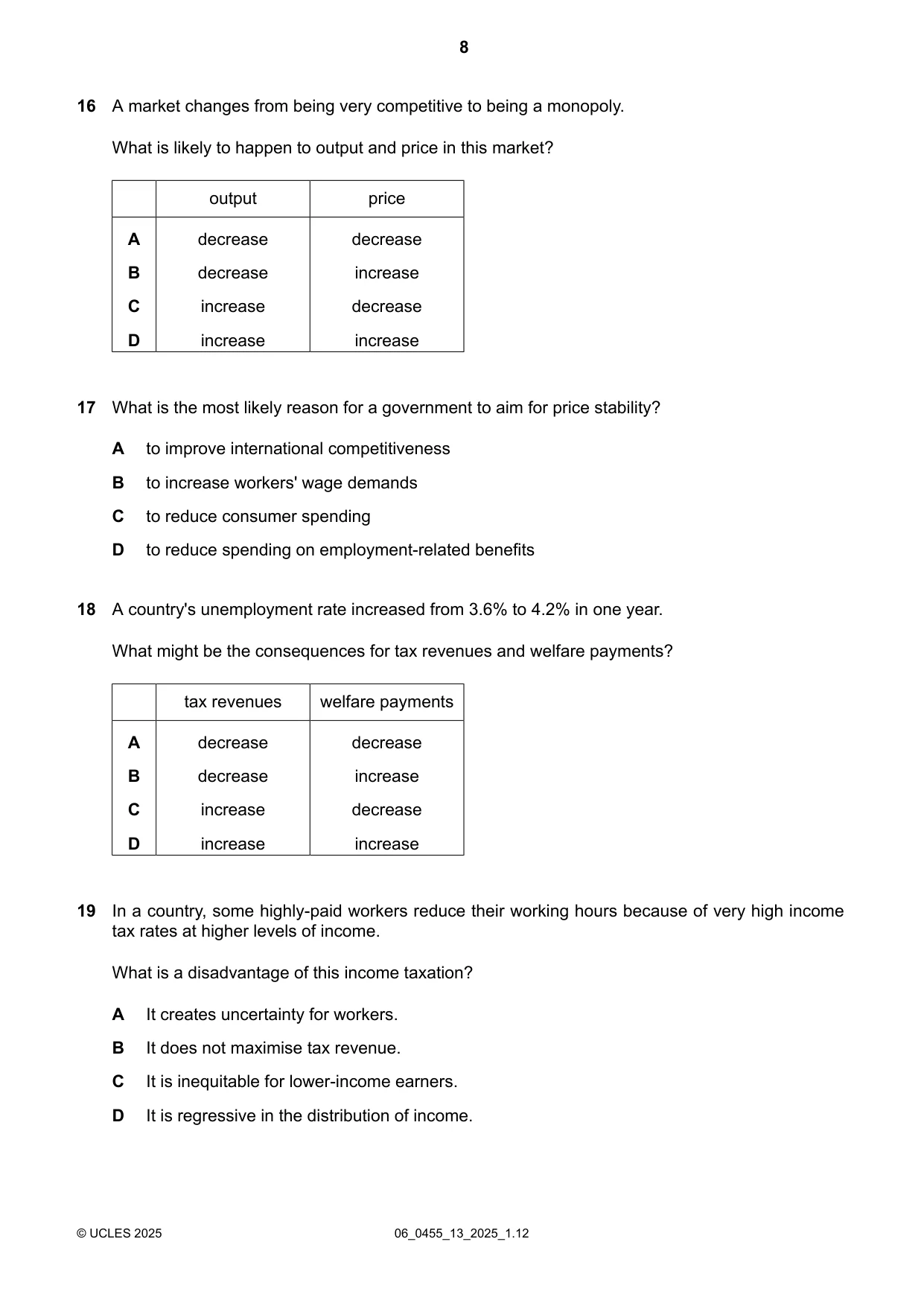
Q16 · A market changes from being very competitive to being a monopoly
16 A market changes from being very competitive to being a monopoly. What is likely to happen to output and price in this market? output price A decrease decrease B decrease increase C increase decrease D increase increase
Mark scheme: B
Q17 · What is the most likely reason for a government to aim for price stability?
17 What is the most likely reason for a government to aim for price stability? A to improve international competitiveness B to increase workers' wage demands C to reduce consumer spending D to reduce spending on employment-related benefits
Mark scheme: A
Q18 · A country's unemployment rate increased from 3.6% to 4.2% in one year
18 A country's unemployment rate increased from 3.6% to 4.2% in one year. What might be the consequences for tax revenues and welfare payments? tax revenues welfare payments A decrease decrease B decrease increase C increase decrease D increase increase
Mark scheme: B
Q19 · In a country, some highly-paid workers reduce their working hours because of very high…
19 In a country, some highly-paid workers reduce their working hours because of very high income tax rates at higher levels of income. What is a disadvantage of this income taxation? A It creates uncertainty for workers. B It does not maximise tax revenue. C It is inequitable for lower-income earners. D It is regressive in the distribution of income.
Mark scheme: B
Q20 · What is most likely to be a reason for taxing oil?
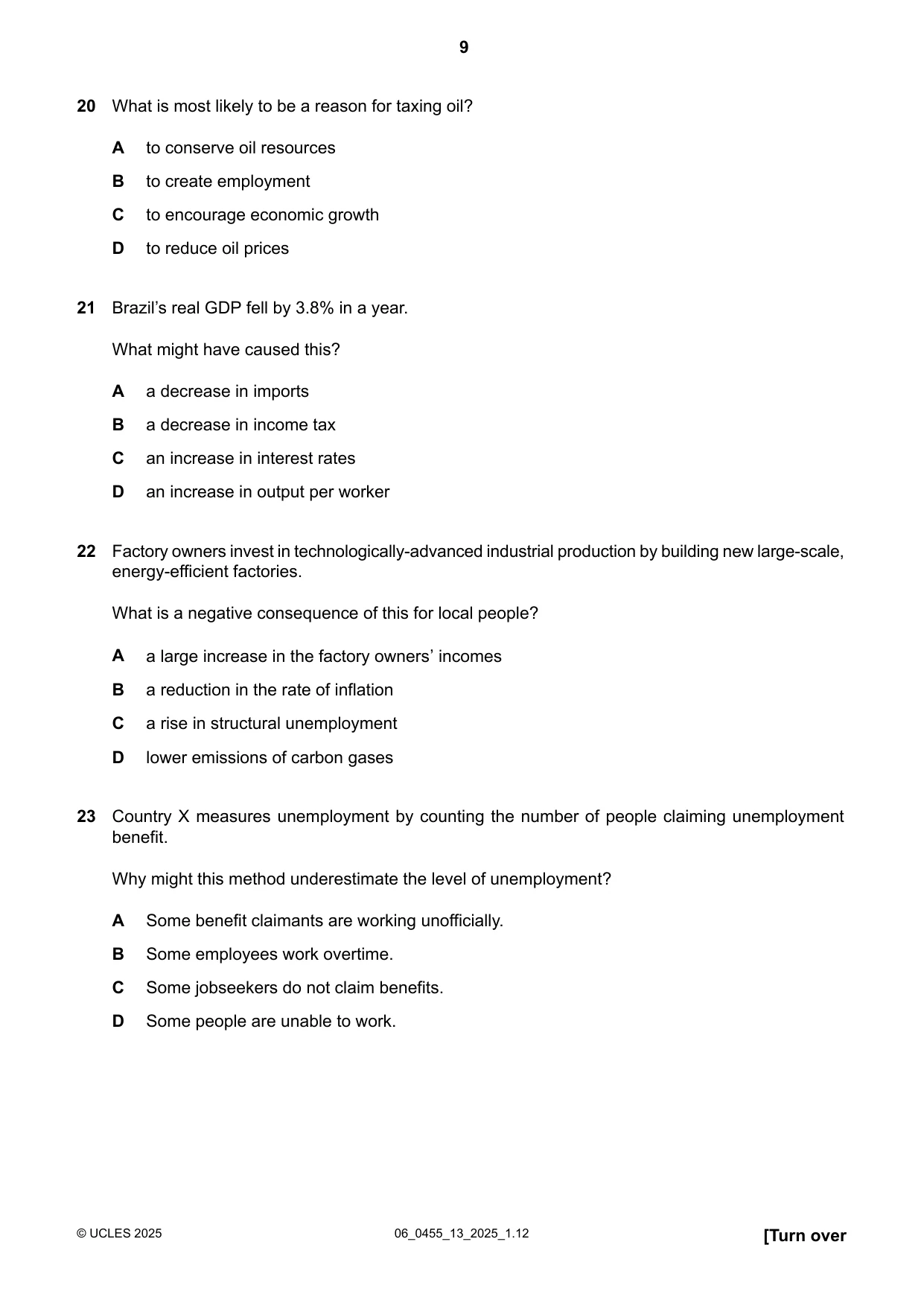
20 What is most likely to be a reason for taxing oil? A to conserve oil resources B to create employment C to encourage economic growth D to reduce oil prices
Mark scheme: A
Q21 · Brazil’s real GDP fell by 3.8% in a year
21 Brazil’s real GDP fell by 3.8% in a year. What might have caused this? A a decrease in imports B a decrease in income tax C an increase in interest rates D an increase in output per worker
Mark scheme: C
Q22 · Factory owners invest in technologically-advanced industrial production by building new…
22 Factory owners invest in technologically-advanced industrial production by building new large-scale, energy-efficient factories. What is a negative consequence of this for local people? A a large increase in the factory owners’ incomes B a reduction in the rate of inflation C a rise in structural unemployment D lower emissions of carbon gases
Mark scheme: C
Q23 · Country X measures unemployment by counting the number of people claiming unemployment…
23 Country X measures unemployment by counting the number of people claiming unemployment benefit. Why might this method underestimate the level of unemployment? A Some benefit claimants are working unofficially. B Some employees work overtime. C Some jobseekers do not claim benefits. D Some people are unable to work.
Mark scheme: C
Q24 · What is likely to cause deflation?
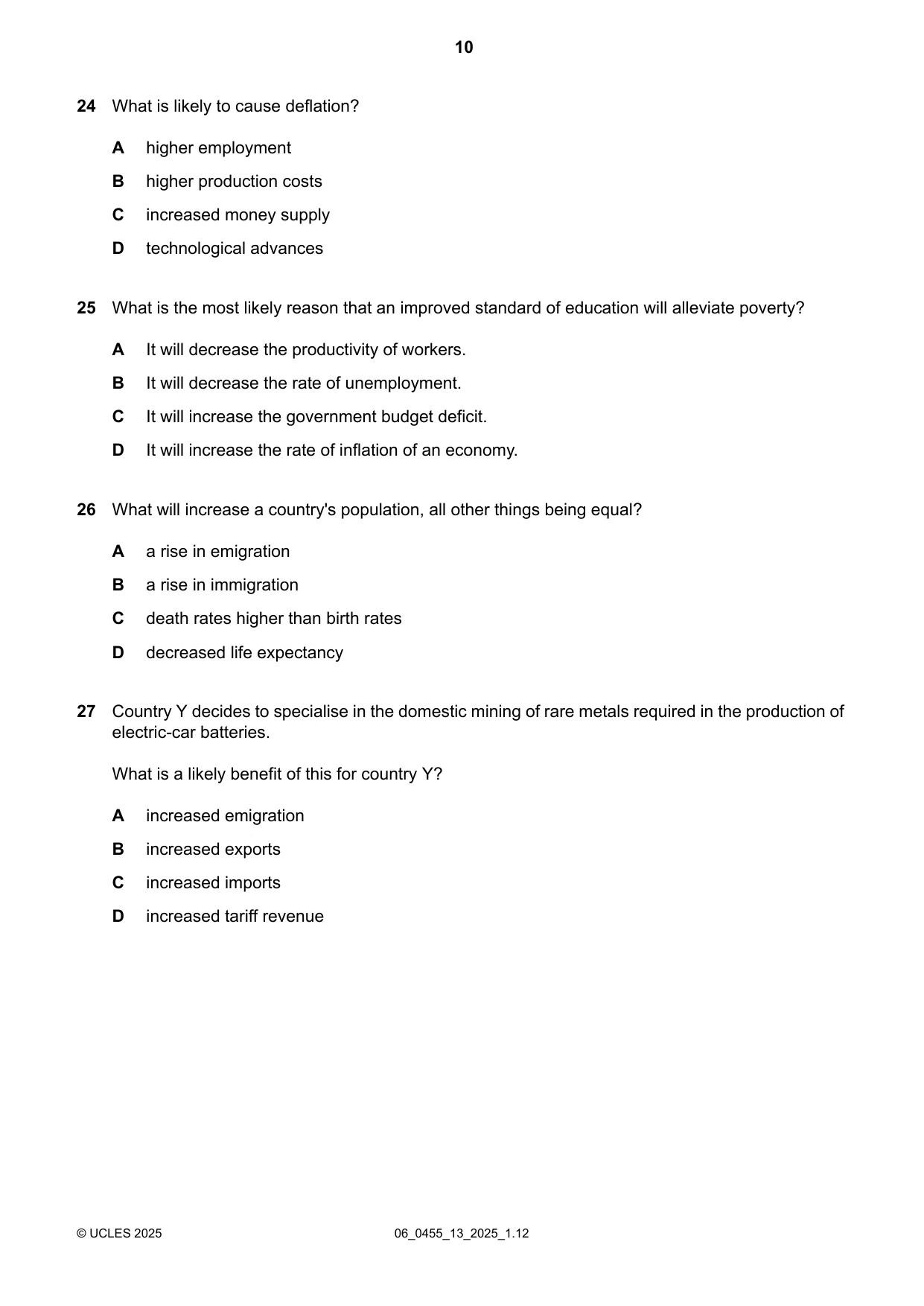
24 What is likely to cause deflation? A higher employment B higher production costs C increased money supply D technological advances
Mark scheme: D
Q25 · What is the most likely reason that an improved standard of education will alleviate…
25 What is the most likely reason that an improved standard of education will alleviate poverty? A It will decrease the productivity of workers. B It will decrease the rate of unemployment. C It will increase the government budget deficit. D It will increase the rate of inflation of an economy.
Mark scheme: B
Q26 · What will increase a country's population, all other things being equal?
26 What will increase a country's population, all other things being equal? A a rise in emigration B a rise in immigration C death rates higher than birth rates D decreased life expectancy
Mark scheme: B
Q27 · Country Y decides to specialise in the domestic mining of rare metals required in the…
27 Country Y decides to specialise in the domestic mining of rare metals required in the production of electric-car batteries. What is a likely benefit of this for country Y? A increased emigration B increased exports C increased imports D increased tariff revenue
Mark scheme: B
Q28 · The UK government increases the price of steel imported from Germany by increasing an…
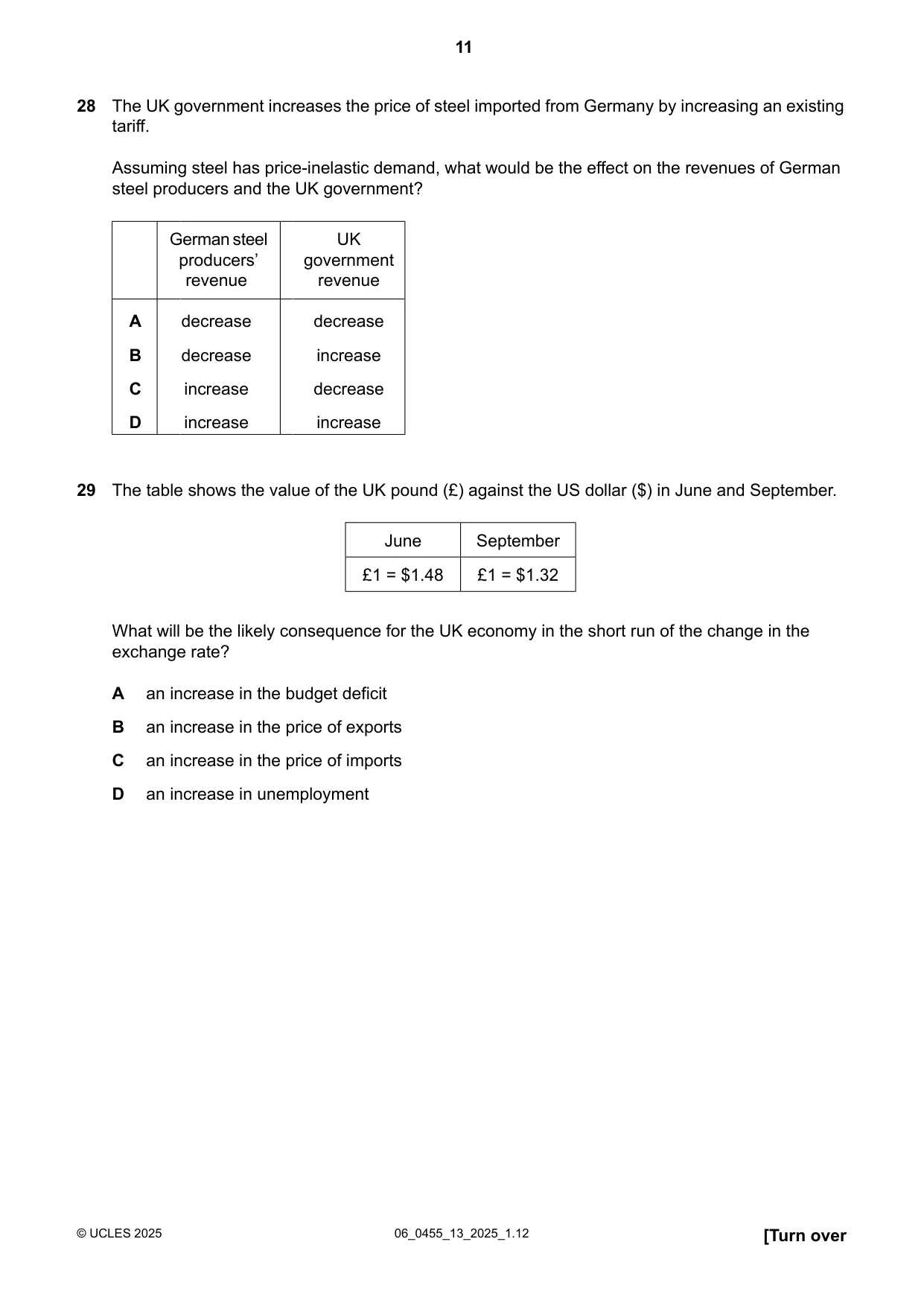
28 The UK government increases the price of steel imported from Germany by increasing an existing tariff. Assuming steel has price-inelastic demand, what would be the effect on the revenues of German steel producers and the UK government? German steel UK producers’ government revenue revenue A decrease decrease B decrease increase C increase decrease D increase increase
Mark scheme: B
Q29 · The table shows the value of the UK pound (£) against the US dollar ($) in June and…
29 The table shows the value of the UK pound (£) against the US dollar ($) in June and September. June September £1 = $1.48 £1 = $1.32 What will be the likely consequence for the UK economy in the short run of the change in the exchange rate? A an increase in the budget deficit B an increase in the price of exports C an increase in the price of imports D an increase in unemployment
Mark scheme: C
Q30 · The table shows a selection of economic data for a country
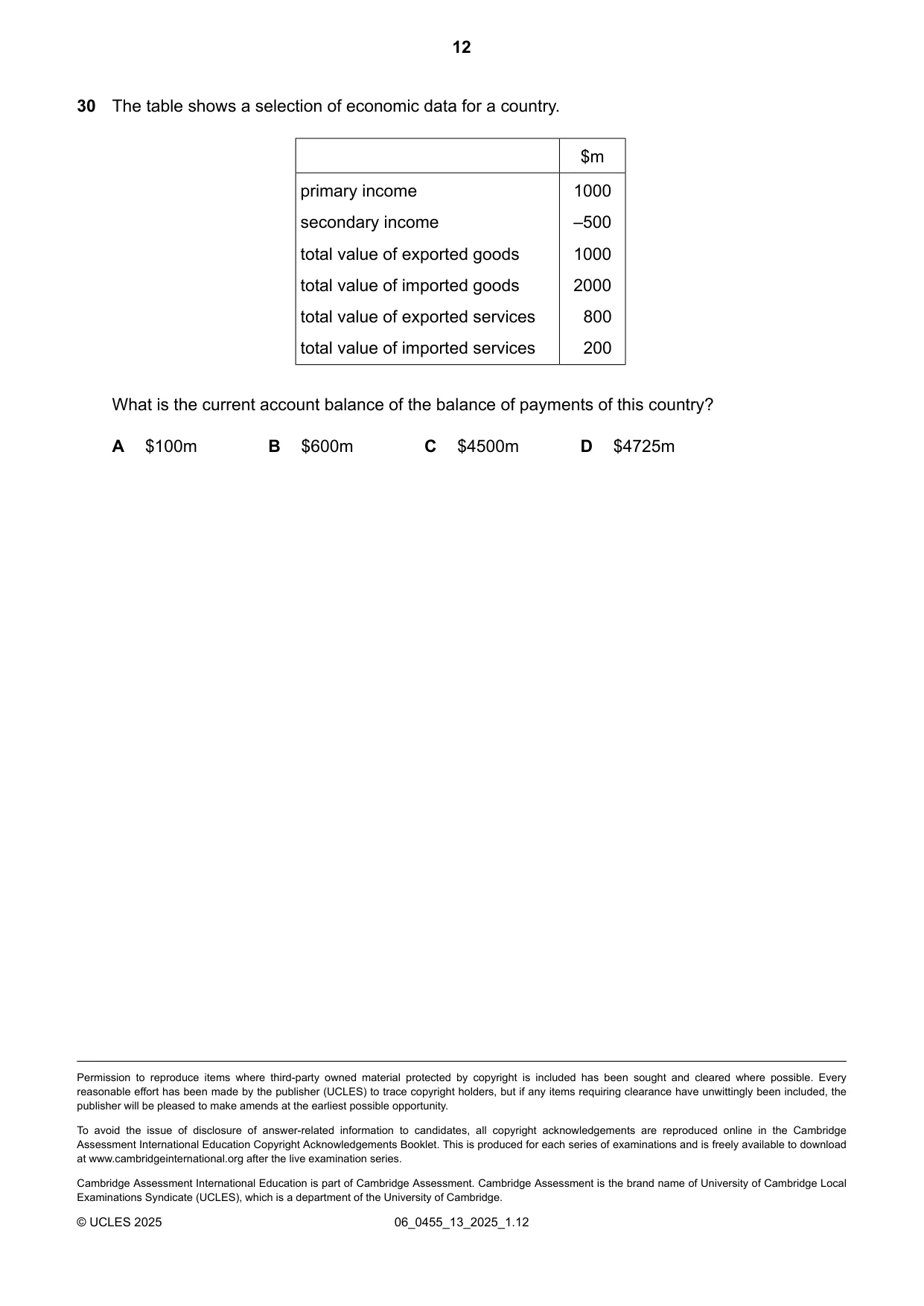
30 The table shows a selection of economic data for a country. $m primary income 1000 secondary income –500 total value of exported goods 1000 total value of imported goods 2000 total value of exported services 800 total value of imported services 200 What is the current account balance of the balance of payments of this country? A $100m B $600m C $4500m D $4725m
Mark scheme: A
What was in this paper
The subtopics covered by these 30 questions, and how many questions each got. Open one in a new tab to see every Cambridge question on it.
3Firms’ costs, revenue and objectives2Workers2Current account of balance of payments1Economic growth1Firms1Fiscal policy1Foreign exchange rates1Globalisation, free trade and protection1Inflation and deflation1International specialisation1Market economic system1Market structure1Monetary policy1Opportunity cost1Population1Poverty1Price changes1Price determination1Price elasticity of demand (PED)1Price elasticity of supply (PES)1Production possibility curve (PPC) diagrams1The factors of production1The macroeconomic aims of government1The role of government1The role of markets in allocating resources1What you needed in this session
Cambridge’s own grade thresholds for 2025 May/June, Paper 1 · Variant 3. A higher threshold means an easier paper — the bar moves with how the cohort did.