Cambridge IGCSE Economics 0455 — 2013 May/June Paper 1 · Variant 2
0455/12/M/J/13 · 30 questions · 30 marks · ≈34 min
The question paper and its mark scheme, free to read here and free to download. This is Cambridge’s own paper, exactly as it was sat.
Question paper12 pages
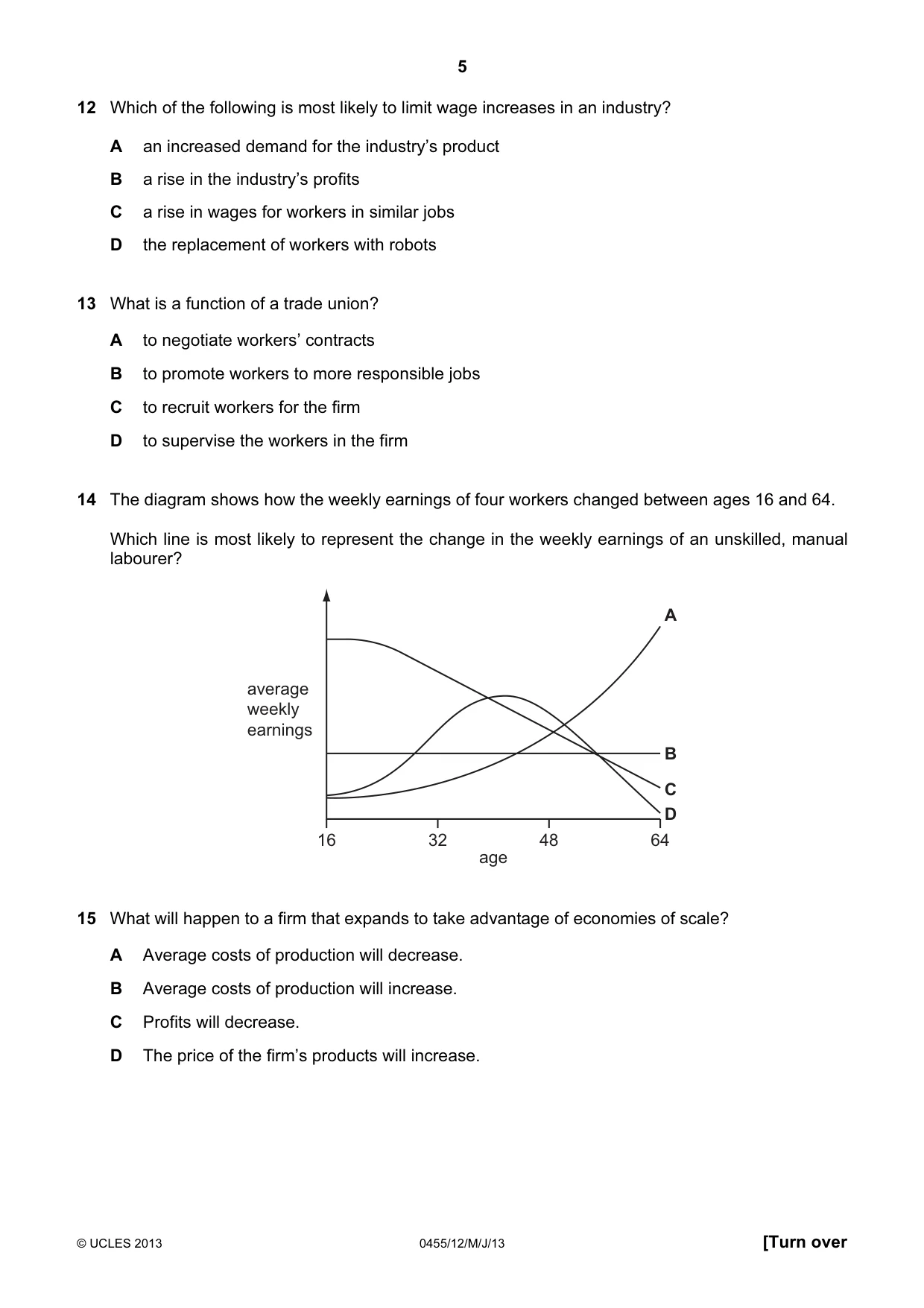
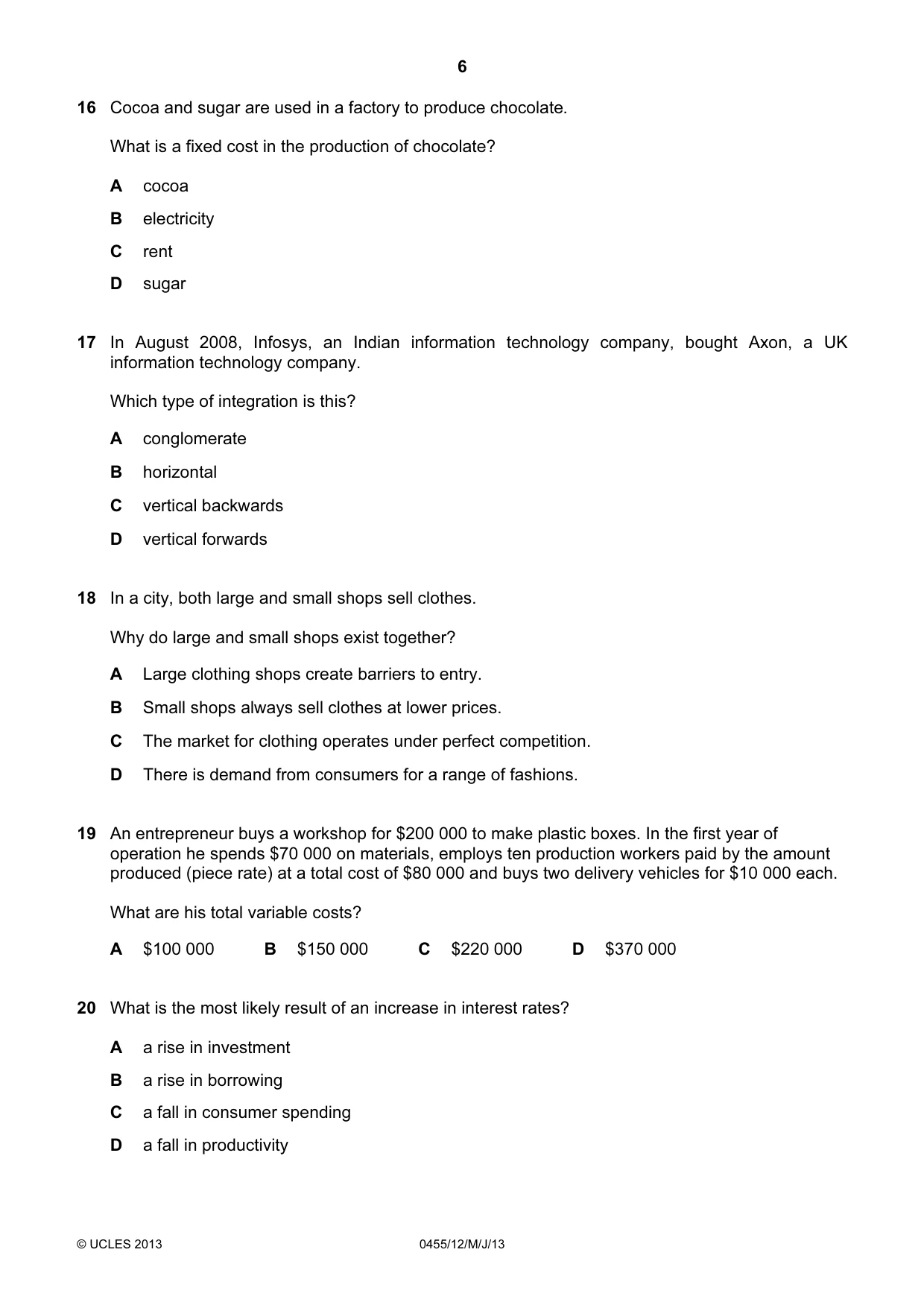
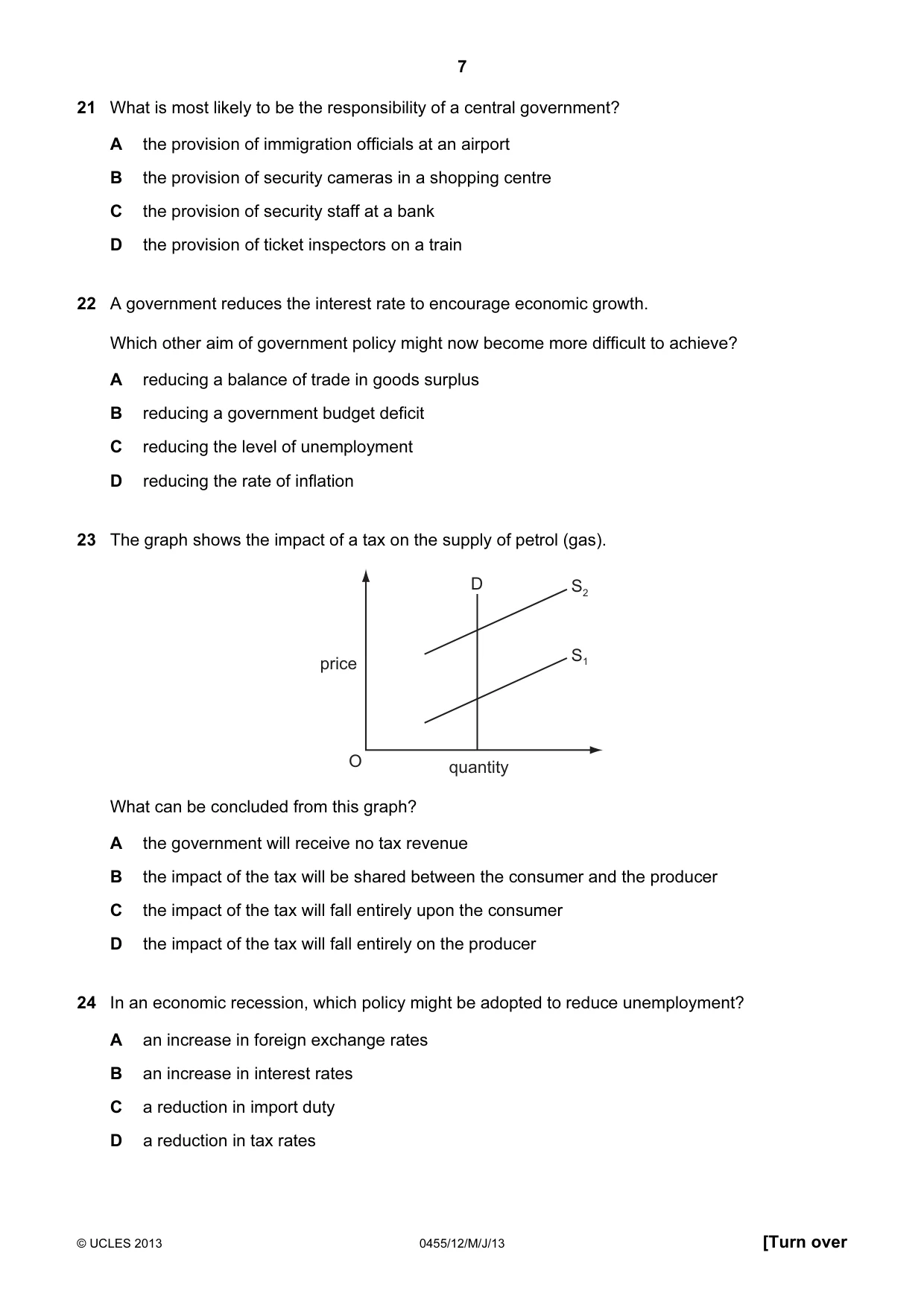
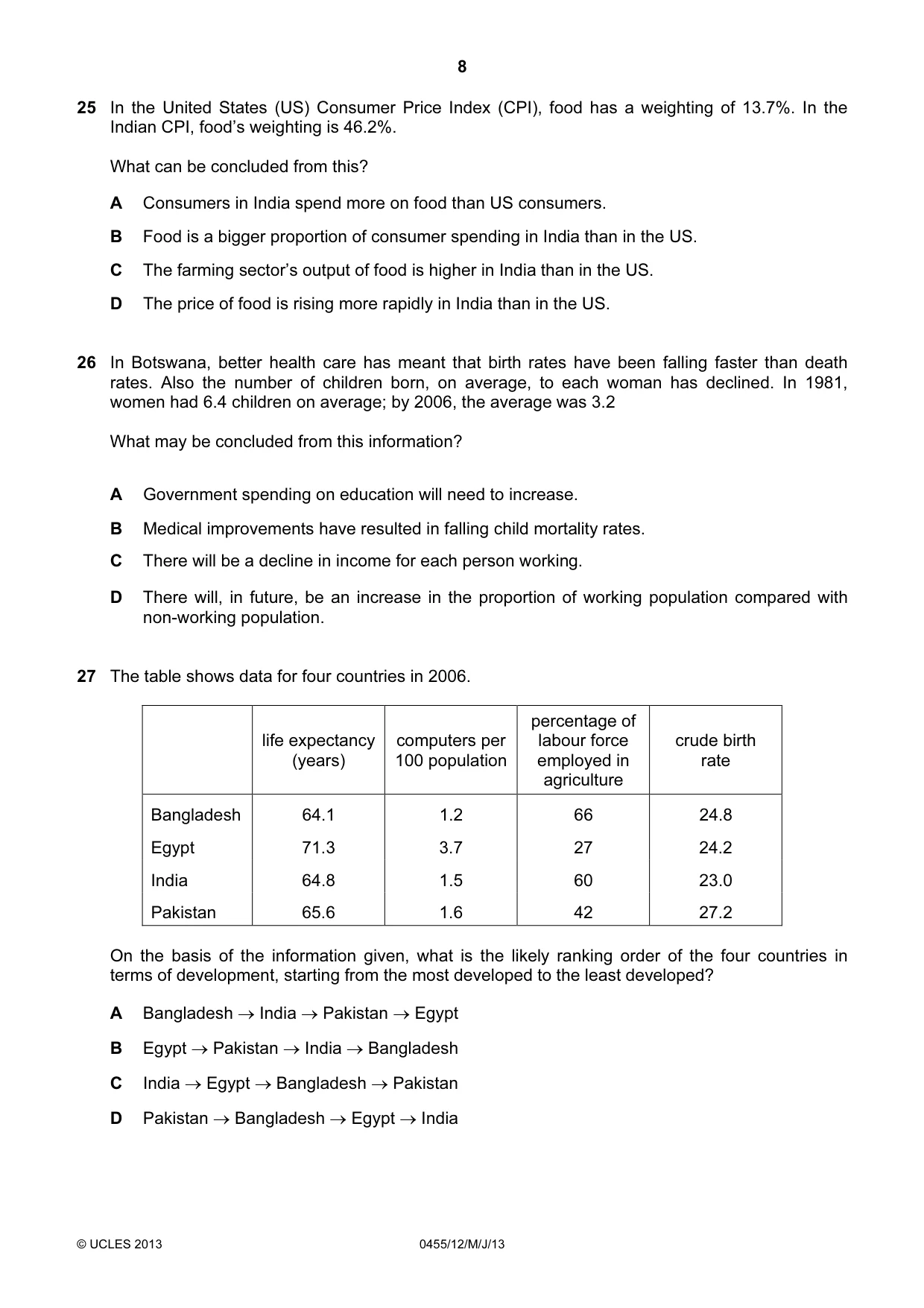


Mark scheme2 pages
Answers below. Sit the paper first if you are practising.
Questions as text
Q1 · Why will the economic problem never be solved?
1 Why will the economic problem never be solved? A People will always want more products than can be produced. B People will never agree on what is the best economic system. C There will always be an uneven distribution of income. D There will always be some people unemployed.
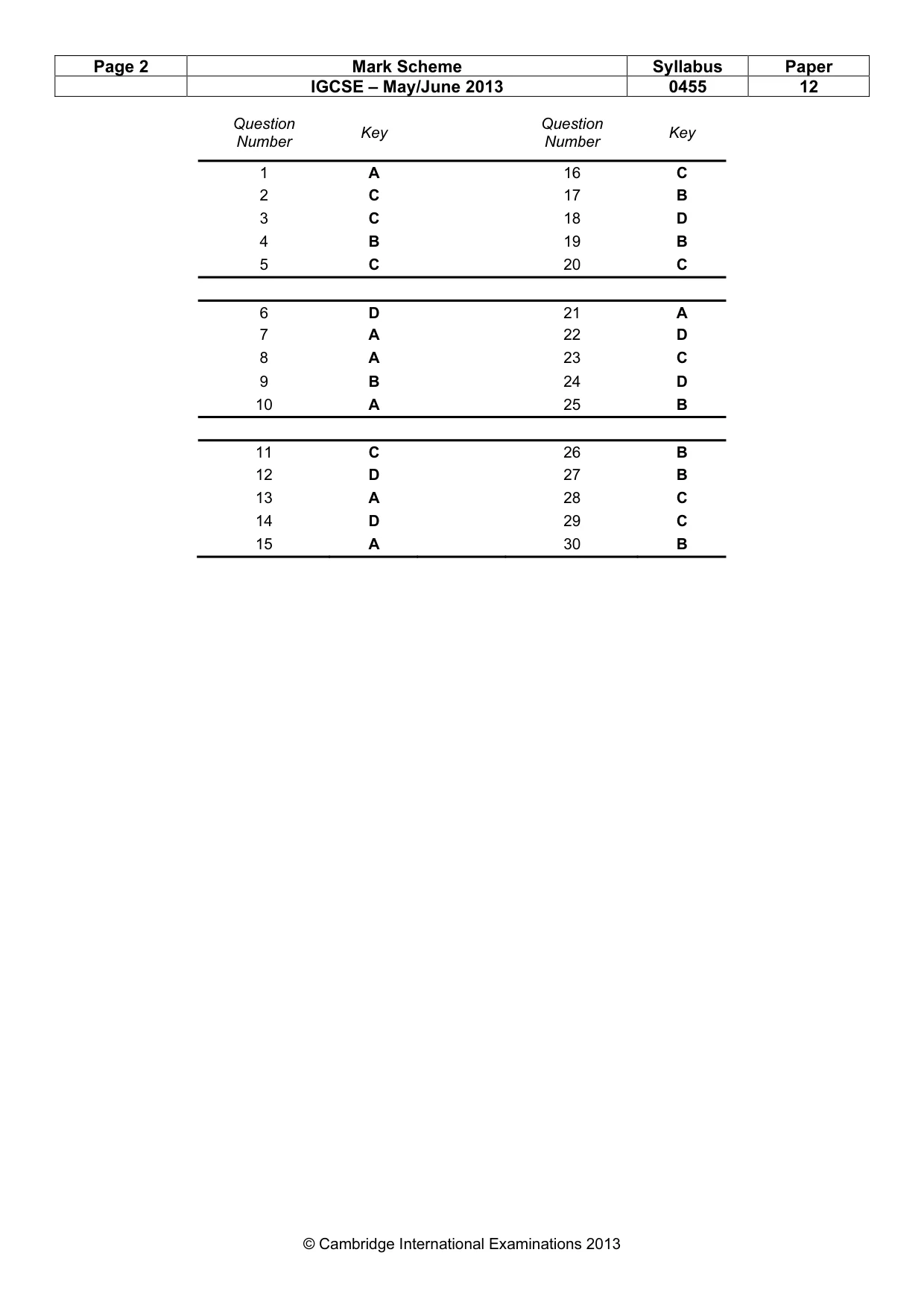
Mark scheme: A
Q2 · A country is producing at point X on its production possibility curve which shows how it…
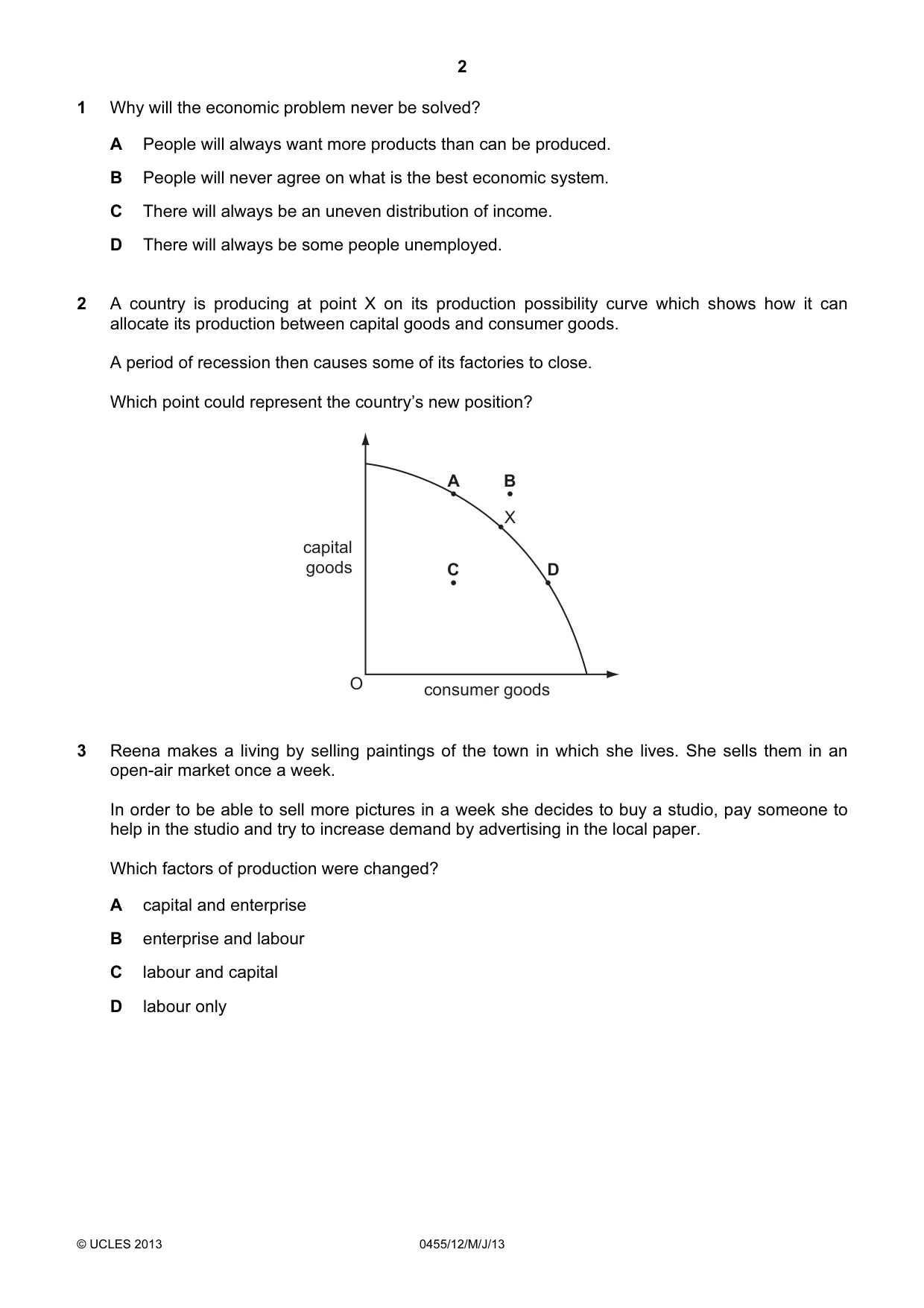
2 A country is producing at point X on its production possibility curve which shows how it can allocate its production between capital goods and consumer goods. A period of recession then causes some of its factories to close. Which point could represent the country’s new position? A B X capital goods C D O consumer goods
Mark scheme: C
More questions on Production possibility curve (PPC) diagrams
Q3 · Reena makes a living by selling paintings of the town in which she lives
3 Reena makes a living by selling paintings of the town in which she lives. She sells them in an open-air market once a week. In order to be able to sell more pictures in a week she decides to buy a studio, pay someone to help in the studio and try to increase demand by advertising in the local paper. Which factors of production were changed? A capital and enterprise B enterprise and labour C labour and capital D labour only
Mark scheme: C
Q4 · A country needs extra nurses
4 A country needs extra nurses. How could this be encouraged in a mixed economy but not in a market economy? A Extra part-time nursing courses could be arranged by private colleges. B Nurses could be given a higher statutory minimum wage. C Nursing students could be asked to pay increased fees. D Nursing training colleges could have their subsidies reduced.
Mark scheme: B
Q5 · There are a fixed number of seats at a concert
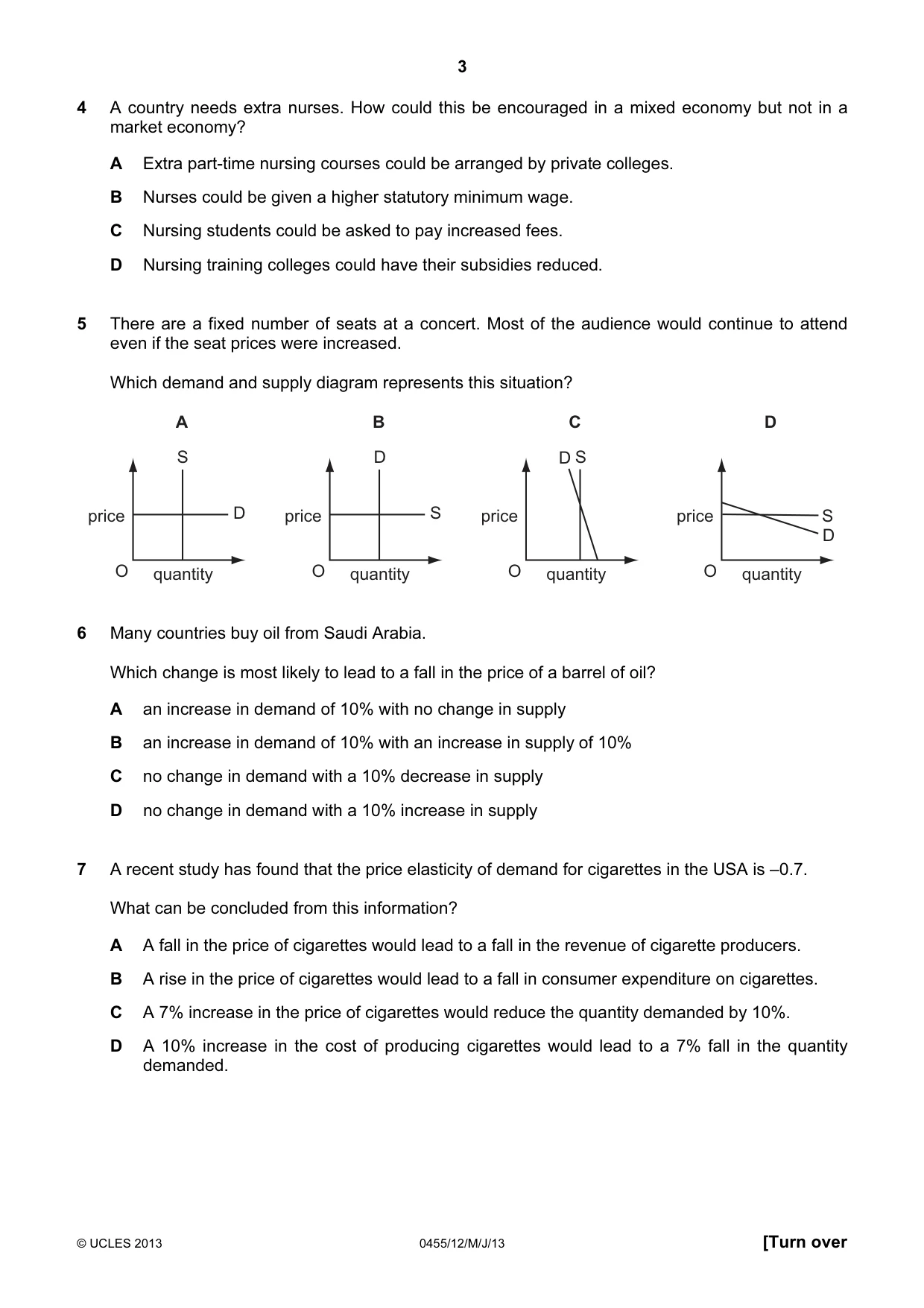
5 There are a fixed number of seats at a concert. Most of the audience would continue to attend even if the seat prices were increased. Which demand and supply diagram represents this situation? A B C D S D D S price D price S price price S D O quantity O quantity O quantity O quantity
Mark scheme: C
Q6 · Many countries buy oil from Saudi Arabia
6 Many countries buy oil from Saudi Arabia. Which change is most likely to lead to a fall in the price of a barrel of oil? A an increase in demand of 10% with no change in supply B an increase in demand of 10% with an increase in supply of 10% C no change in demand with a 10% decrease in supply D no change in demand with a 10% increase in supply
Mark scheme: D
Q7 · A recent study has found that the price elasticity of demand for cigarettes in the USA is…
7 A recent study has found that the price elasticity of demand for cigarettes in the USA is –0.7. What can be concluded from this information? A A fall in the price of cigarettes would lead to a fall in the revenue of cigarette producers. B A rise in the price of cigarettes would lead to a fall in consumer expenditure on cigarettes. C A 7% increase in the price of cigarettes would reduce the quantity demanded by 10%. D A 10% increase in the cost of producing cigarettes would lead to a 7% fall in the quantity demanded.
Mark scheme: A
Q8 · A government makes public transport free to try to reduce car use in a city
8 A government makes public transport free to try to reduce car use in a city. What might explain why people continue to use their own cars? A Cars are less crowded than public transport. B Car use does not cause external costs. C Public transport has a better safety record than cars. D Public transport networks require high capital costs.
Mark scheme: A
Q9 · When the price of a good doubles the demand falls by less than half, and the revenue…
9 When the price of a good doubles the demand falls by less than half, and the revenue received by the seller increases. What does this suggest about the good? A it has substitutes B it is a necessity C it is in fixed supply D it is perfectly elastic in demand
Mark scheme: B
Q10 · A function of money is to act as a measure of value
10 A function of money is to act as a measure of value. What does this mean? A It is used to compare the worth of different goods. B It is used to enable monthly payments for expensive goods. C It is used to pay the price of a good. D It is used for future savings.
Mark scheme: A
Q11 · Each worker in a firm specialises in performing one task
11 Each worker in a firm specialises in performing one task. The firm then decides that each worker should carry out a variety of tasks. Which benefit will the firm be expecting to gain from the change? A a decrease in the equipment workers need to be given B a decrease in the time it takes to train workers C an increase in the ability to cover for absent staff D an increase in the skill gained from repetition
Mark scheme: C
Q12 · Which of the following is most likely to limit wage increases in an industry?
12 Which of the following is most likely to limit wage increases in an industry? A an increased demand for the industry’s product B a rise in the industry’s profits C a rise in wages for workers in similar jobs D the replacement of workers with robots
Mark scheme: D
Q13 · What is a function of a trade union?
13 What is a function of a trade union? A to negotiate workers’ contracts B to promote workers to more responsible jobs C to recruit workers for the firm D to supervise the workers in the firm
Mark scheme: A
Q14 · The diagram shows how the weekly earnings of four workers changed between ages 16 and 64
14 The diagram shows how the weekly earnings of four workers changed between ages 16 and 64. Which line is most likely to represent the change in the weekly earnings of an unskilled, manual labourer? A average weekly earnings B C D 16 32 48 64 age
Mark scheme: D
Q15 · What will happen to a firm that expands to take advantage of economies of scale?
15 What will happen to a firm that expands to take advantage of economies of scale? A Average costs of production will decrease. B Average costs of production will increase. C Profits will decrease. D The price of the firm’s products will increase.
Mark scheme: A
Q16 · Cocoa and sugar are used in a factory to produce chocolate
16 Cocoa and sugar are used in a factory to produce chocolate. What is a fixed cost in the production of chocolate? A cocoa B electricity C rent D sugar
Mark scheme: C
Q17 · In August 2008, Infosys, an Indian information technology company, bought Axon, a UK…
17 In August 2008, Infosys, an Indian information technology company, bought Axon, a UK information technology company. Which type of integration is this? A conglomerate B horizontal C vertical backwards D vertical forwards
Mark scheme: B
Q18 · In a city, both large and small shops sell clothes
18 In a city, both large and small shops sell clothes. Why do large and small shops exist together? A Large clothing shops create barriers to entry. B Small shops always sell clothes at lower prices. C The market for clothing operates under perfect competition. D There is demand from consumers for a range of fashions.
Mark scheme: D
Q19 · An entrepreneur buys a workshop for $200 000 to make plastic boxes
19 An entrepreneur buys a workshop for $200 000 to make plastic boxes. In the first year of operation he spends $70 000 on materials, employs ten production workers paid by the amount produced (piece rate) at a total cost of $80 000 and buys two delivery vehicles for $10 000 each. What are his total variable costs? A $100 000 B $150 000 C $220 000 D $370 000
Mark scheme: B
Q20 · What is the most likely result of an increase in interest rates?
20 What is the most likely result of an increase in interest rates? A a rise in investment B a rise in borrowing C a fall in consumer spending D a fall in productivity
Mark scheme: C
Q21 · What is most likely to be the responsibility of a central government?
21 What is most likely to be the responsibility of a central government? A the provision of immigration officials at an airport B the provision of security cameras in a shopping centre C the provision of security staff at a bank D the provision of ticket inspectors on a train
Mark scheme: A
Q22 · A government reduces the interest rate to encourage economic growth
22 A government reduces the interest rate to encourage economic growth. Which other aim of government policy might now become more difficult to achieve? A reducing a balance of trade in goods surplus B reducing a government budget deficit C reducing the level of unemployment D reducing the rate of inflation
Mark scheme: D
Q23 · The graph shows the impact of a tax on the supply of petrol (gas)
23 The graph shows the impact of a tax on the supply of petrol (gas). D S2 S1 price O quantity What can be concluded from this graph? A the government will receive no tax revenue B the impact of the tax will be shared between the consumer and the producer C the impact of the tax will fall entirely upon the consumer D the impact of the tax will fall entirely on the producer
Mark scheme: C
Q24 · In an economic recession, which policy might be adopted to reduce unemployment?
24 In an economic recession, which policy might be adopted to reduce unemployment? A an increase in foreign exchange rates B an increase in interest rates C a reduction in import duty D a reduction in tax rates
Mark scheme: D
Q25 · In the United States (US) Consumer Price Index (CPI), food has a weighting of 13.7%
25 In the United States (US) Consumer Price Index (CPI), food has a weighting of 13.7%. In the Indian CPI, food’s weighting is 46.2%. What can be concluded from this? A Consumers in India spend more on food than US consumers. B Food is a bigger proportion of consumer spending in India than in the US. C The farming sector’s output of food is higher in India than in the US. D The price of food is rising more rapidly in India than in the US.
Mark scheme: B
Q26 · In Botswana, better health care has meant that birth rates have been falling faster than…
26 In Botswana, better health care has meant that birth rates have been falling faster than death rates. Also the number of children born, on average, to each woman has declined. In 1981, women had 6.4 children on average; by 2006, the average was 3.2 What may be concluded from this information? A Government spending on education will need to increase. B Medical improvements have resulted in falling child mortality rates. C There will be a decline in income for each person working. D There will, in future, be an increase in the proportion of working population compared with non-working population.
Mark scheme: B
Q27 · The table shows data for four countries in 2006
27 The table shows data for four countries in 2006. percentage of life expectancy computers per labour force crude birth (years) 100 population employed in rate agriculture Bangladesh 64.1 1.2 66 24.8 Egypt 71.3 3.7 27 24.2 India 64.8 1.5 60 23.0 Pakistan 65.6 1.6 42 27.2 On the basis of the information given, what is the likely ranking order of the four countries in terms of development, starting from the most developed to the least developed? A Bangladesh → India → Pakistan → Egypt B Egypt → Pakistan → India → Bangladesh C India → Egypt → Bangladesh → Pakistan D Pakistan → Bangladesh → Egypt → India
Mark scheme: B
More questions on Differences in economic development between countries
Q28 · Which combination of changes is most likely to result in a rise in the average living…
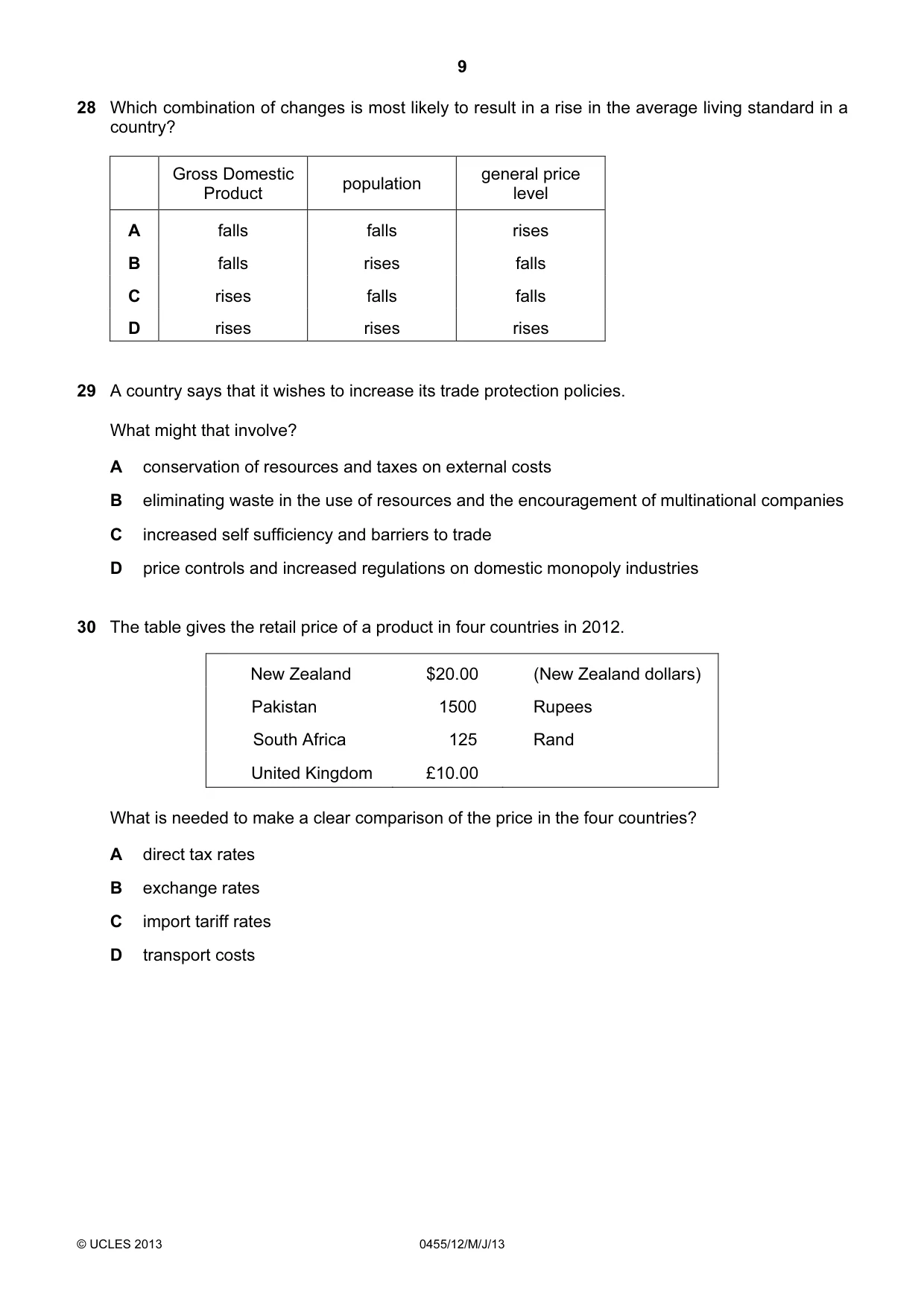
28 Which combination of changes is most likely to result in a rise in the average living standard in a country? Gross Domestic general price population Product level A falls falls rises B falls rises falls C rises falls falls D rises rises rises
Mark scheme: C
Q29 · A country says that it wishes to increase its trade protection policies
29 A country says that it wishes to increase its trade protection policies. What might that involve? A conservation of resources and taxes on external costs B eliminating waste in the use of resources and the encouragement of multinational companies C increased self sufficiency and barriers to trade D price controls and increased regulations on domestic monopoly industries
Mark scheme: C
Q30 · The table gives the retail price of a product in four countries in 2012
30 The table gives the retail price of a product in four countries in 2012. New Zealand $20.00 (New Zealand dollars) Pakistan 1500 Rupees South Africa 125 Rand United Kingdom £10.00 What is needed to make a clear comparison of the price in the four countries? A direct tax rates B exchange rates C import tariff rates D transport costs
Mark scheme: B
What was in this paper
The subtopics covered by these 30 questions, and how many questions each got. Open one in a new tab to see every Cambridge question on it.
3Monetary policy2Price elasticity of demand (PED)2Supply2Trade unions2Workers2Differences in economic development between countries1Firms1Fiscal policy1Foreign exchange rates1Globalisation, free trade and protection1Inflation and deflation1Living standards1Market failure1Market structure1Mixed economic system1Money and banking1Population1Price changes1Production possibility curve (PPC) diagrams1The factors of production1The nature of the economic problem1The role of government1What you needed in this session
Cambridge’s own grade thresholds for 2013 May/June, Paper 1 · Variant 2. A higher threshold means an easier paper — the bar moves with how the cohort did.