Cambridge IGCSE Economics 0455 — 2006 Oct/Nov Paper 1 · Variant 1
0455/11/O/N/06 · 40 questions · 40 marks · ≈45 min
The question paper and its mark scheme, free to read here and free to download. This is Cambridge’s own paper, exactly as it was sat.
Question paper12 pages
Mark scheme2 pages
Answers below. Sit the paper first if you are practising.
Questions as text
Q1 · A government decides to spend more on defence and therefore cannot spend as much on…
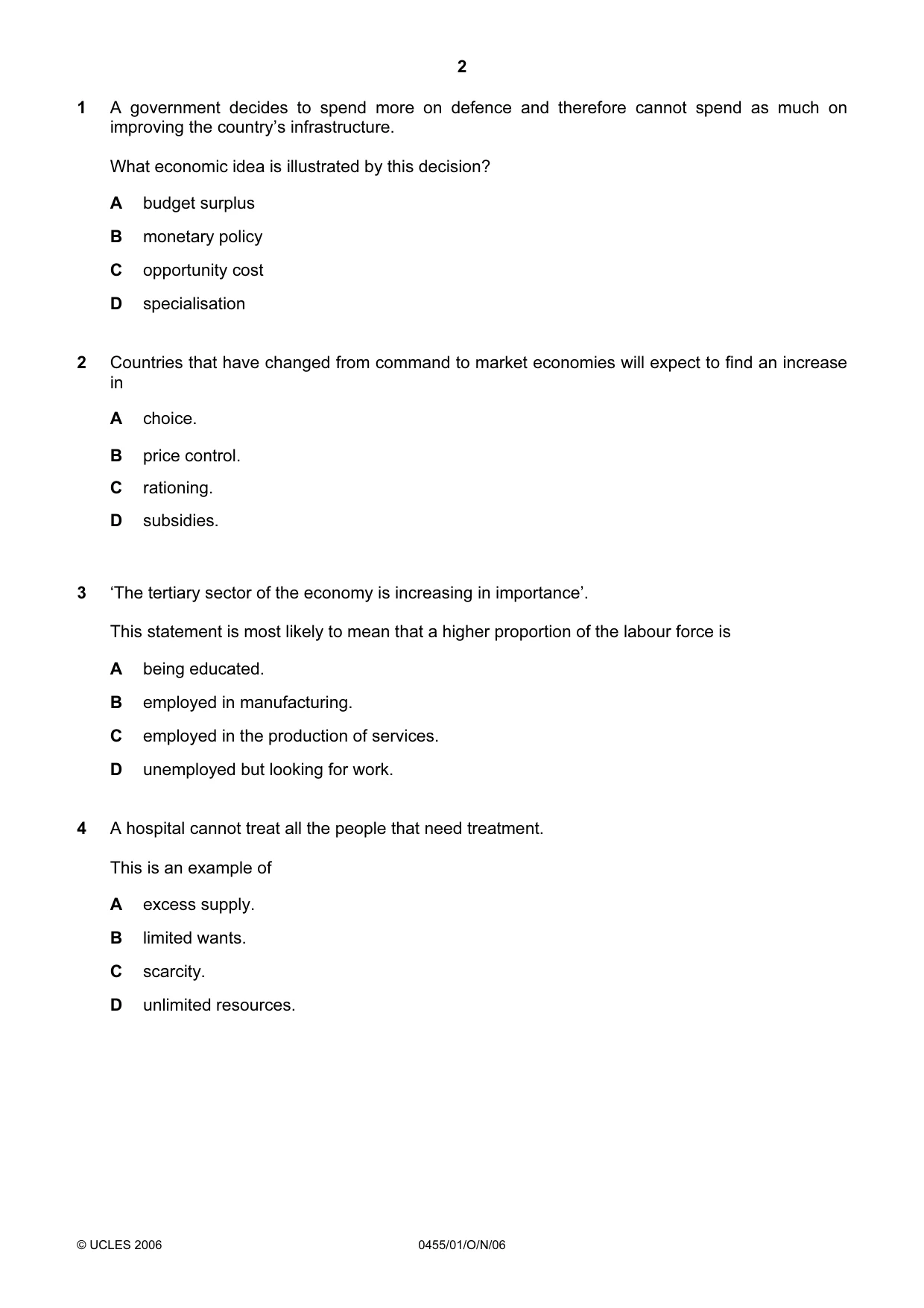
1 A government decides to spend more on defence and therefore cannot spend as much on improving the country’s infrastructure. What economic idea is illustrated by this decision? A budget surplus B monetary policy C opportunity cost D specialisation
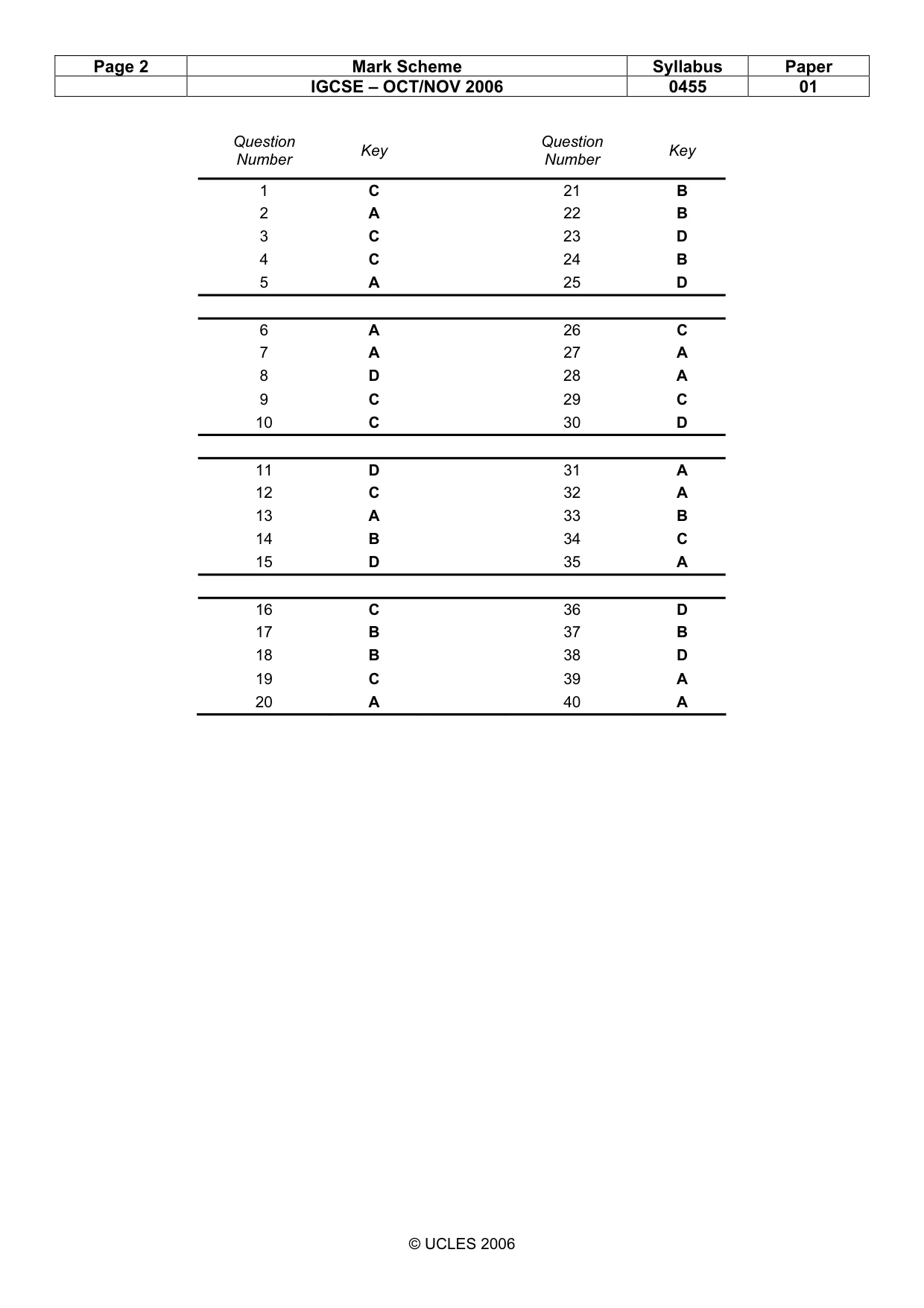
Mark scheme: C
Q2 · Countries that have changed from command to market economies will expect to find an…
2 Countries that have changed from command to market economies will expect to find an increase in A choice. B price control. C rationing. D subsidies.
Mark scheme: A
Q3 · ‘The tertiary sector of the economy is increasing in importance’
3 ‘The tertiary sector of the economy is increasing in importance’. This statement is most likely to mean that a higher proportion of the labour force is A being educated. B employed in manufacturing. C employed in the production of services. D unemployed but looking for work.
Mark scheme: C
Q4 · A hospital cannot treat all the people that need treatment
4 A hospital cannot treat all the people that need treatment. This is an example of A excess supply. B limited wants. C scarcity. D unlimited resources.
Mark scheme: C
Q5 · The following report appeared in a newspaper
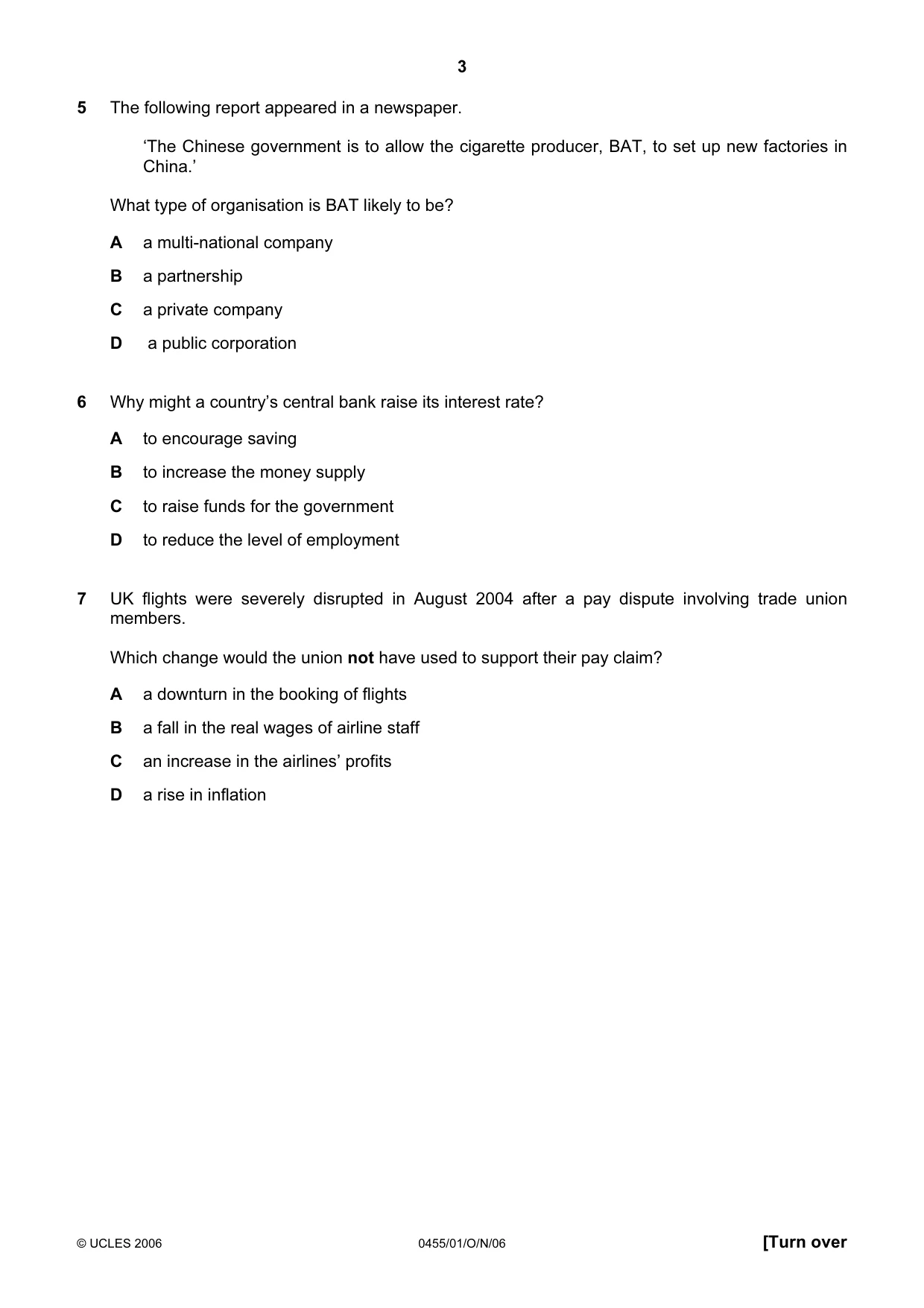
5 The following report appeared in a newspaper. ‘The Chinese government is to allow the cigarette producer, BAT, to set up new factories in China.’ What type of organisation is BAT likely to be? A a multi-national company B a partnership C a private company D a public corporation
Mark scheme: A
Q6 · Why might a country’s central bank raise its interest rate?
6 Why might a country’s central bank raise its interest rate? A to encourage saving B to increase the money supply C to raise funds for the government D to reduce the level of employment
Mark scheme: A
Q7 · UK flights were severely disrupted in August 2004 after a pay dispute involving trade…
7 UK flights were severely disrupted in August 2004 after a pay dispute involving trade union members. Which change would the union not have used to support their pay claim? A a downturn in the booking of flights B a fall in the real wages of airline staff C an increase in the airlines’ profits D a rise in inflation
Mark scheme: A
Q8 · The diagram shows a change in the demand for a company’s products as a result of a change…
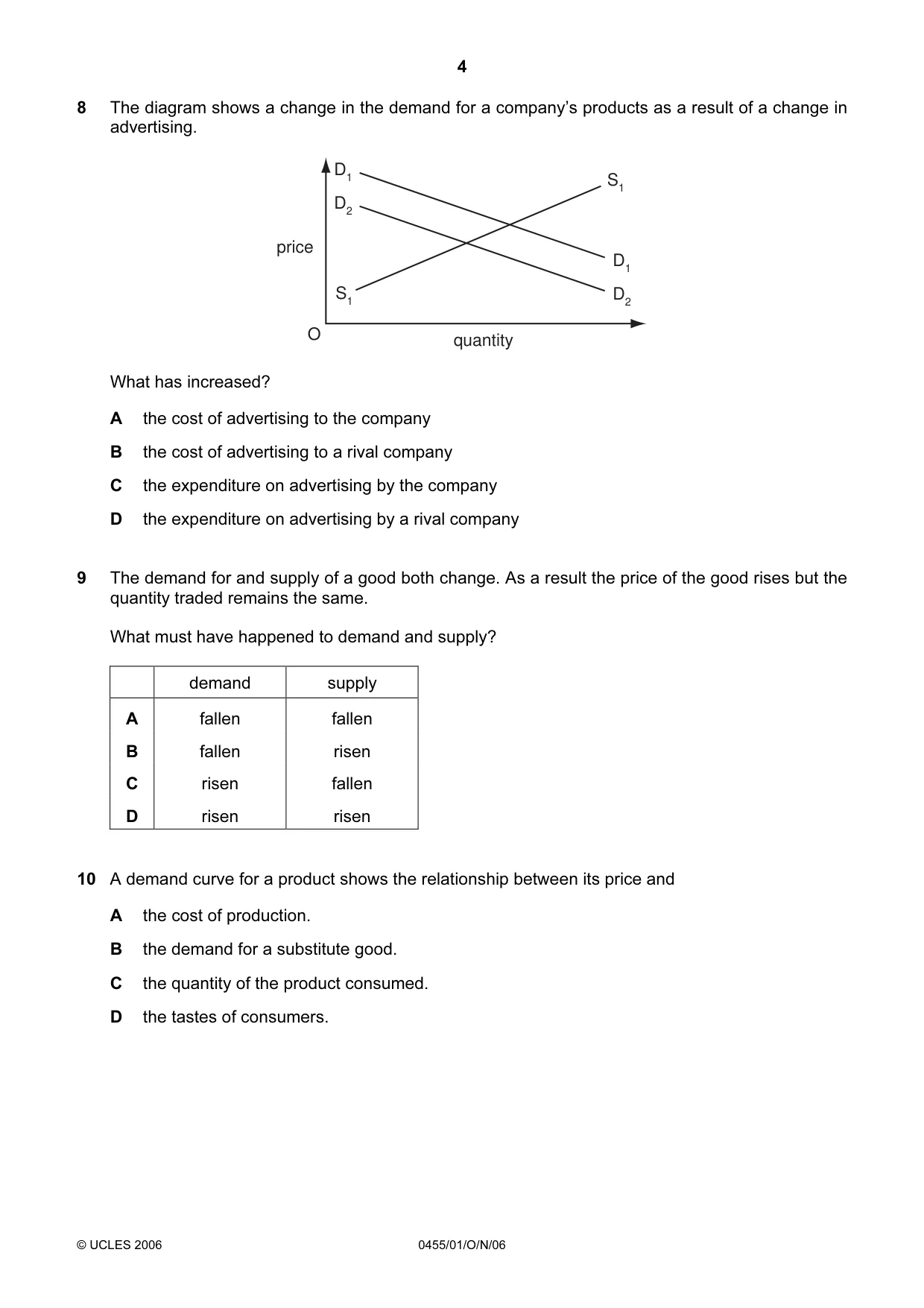
8 The diagram shows a change in the demand for a company’s products as a result of a change in advertising. D1 S1 D2 price D1 S1 D2 O quantity What has increased? A the cost of advertising to the company B the cost of advertising to a rival company C the expenditure on advertising by the company D the expenditure on advertising by a rival company
Mark scheme: D
Q9 · The demand for and supply of a good both change
9 The demand for and supply of a good both change. As a result the price of the good rises but the quantity traded remains the same. What must have happened to demand and supply? demand supply A fallen fallen B fallen risen C risen fallen D risen risen
Mark scheme: C
Q10 · A demand curve for a product shows the relationship between its price and A the cost of…
10 A demand curve for a product shows the relationship between its price and A the cost of production. B the demand for a substitute good. C the quantity of the product consumed. D the tastes of consumers.
Mark scheme: C
Q11 · In January 2005 house prices in the UK fell
11 In January 2005 house prices in the UK fell. What might have caused this? A Average incomes rose. B Interest rates fell. C The number of buyers rose. D The number of houses for sale rose.
Mark scheme: D
Q12 · The diagram shows the demand for and the supply of mobile (cell) phones
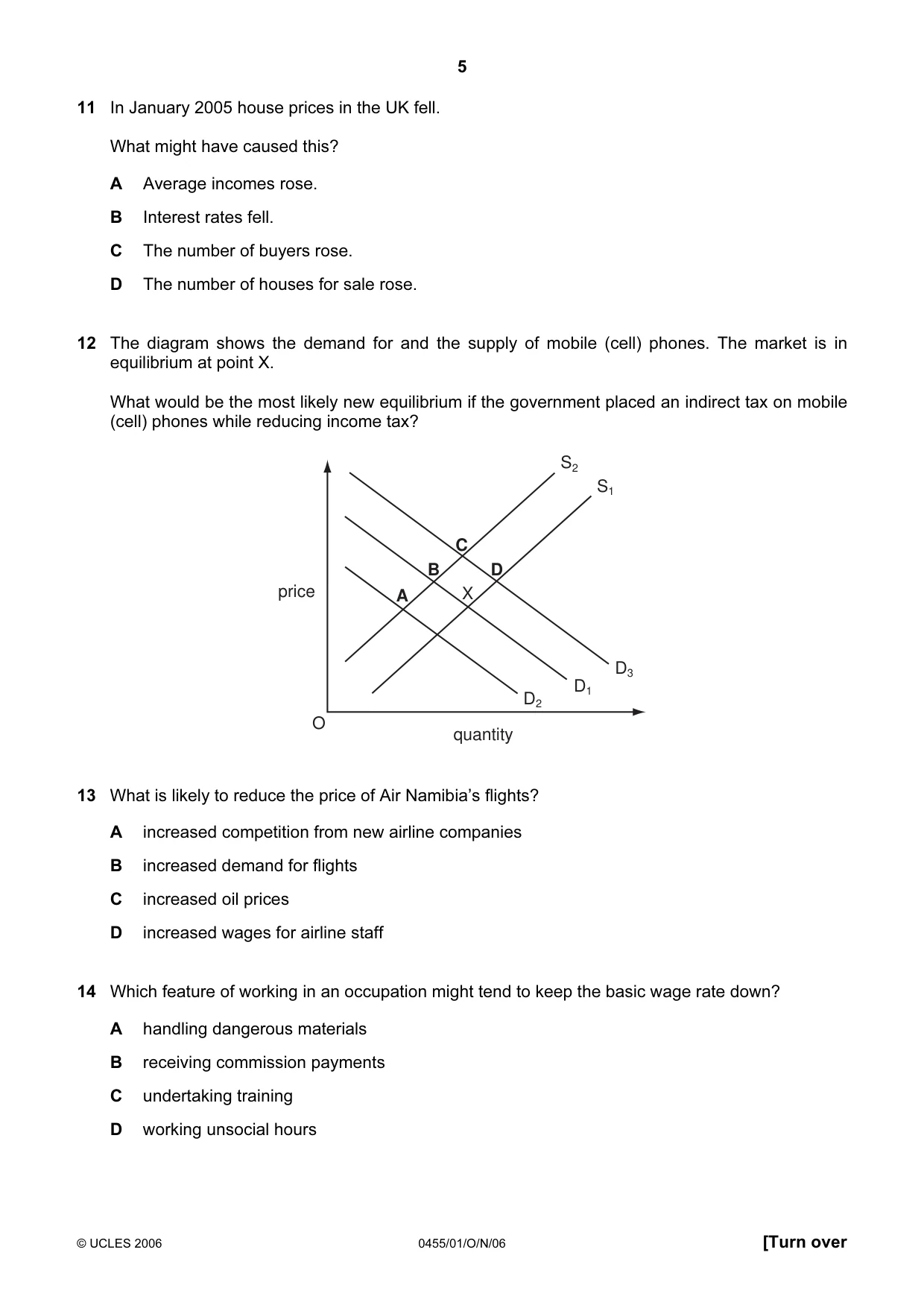
12 The diagram shows the demand for and the supply of mobile (cell) phones. The market is in equilibrium at point X. What would be the most likely new equilibrium if the government placed an indirect tax on mobile (cell) phones while reducing income tax? S2 S1 C B D price A X D3 D1 D2 O quantity
Mark scheme: C
Q13 · What is likely to reduce the price of Air Namibia’s flights?
13 What is likely to reduce the price of Air Namibia’s flights? A increased competition from new airline companies B increased demand for flights C increased oil prices D increased wages for airline staff
Mark scheme: A
Q14 · Which feature of working in an occupation might tend to keep the basic wage rate down?
14 Which feature of working in an occupation might tend to keep the basic wage rate down? A handling dangerous materials B receiving commission payments C undertaking training D working unsocial hours
Mark scheme: B
Q15 · An athlete needs an income and also needs time for training and competitions
15 An athlete needs an income and also needs time for training and competitions. Which occupation is most appropriate for the athlete? A department store manager who is paid a salary B livestock farmer working for profit C assembly-line worker who is paid a wage D self-employed photographer
Mark scheme: D
Q16 · Which change would be most likely to cause the earnings of hotel managers in Mauritius to…
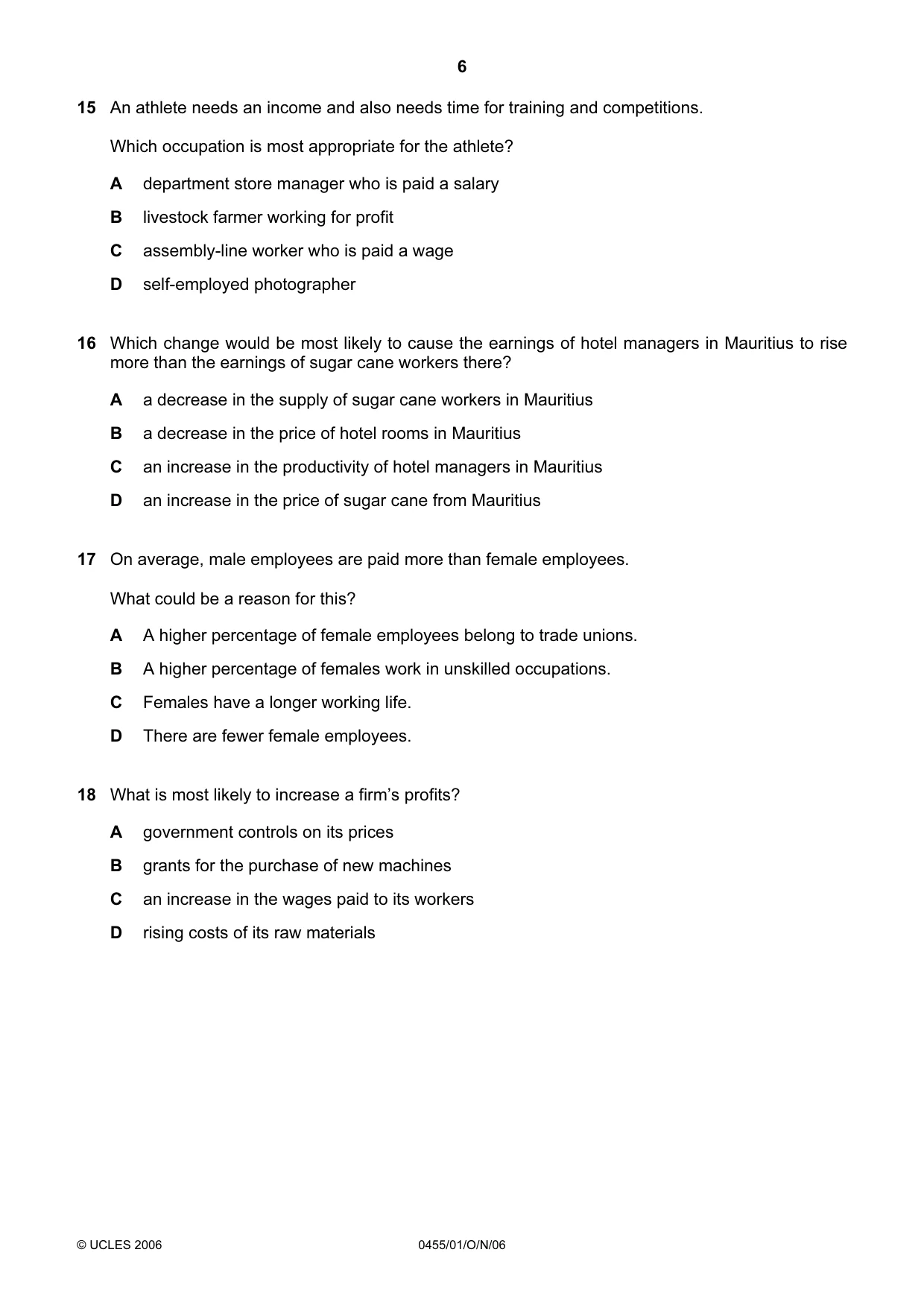
16 Which change would be most likely to cause the earnings of hotel managers in Mauritius to rise more than the earnings of sugar cane workers there? A a decrease in the supply of sugar cane workers in Mauritius B a decrease in the price of hotel rooms in Mauritius C an increase in the productivity of hotel managers in Mauritius D an increase in the price of sugar cane from Mauritius
Mark scheme: C
Q17 · On average, male employees are paid more than female employees
17 On average, male employees are paid more than female employees. What could be a reason for this? A A higher percentage of female employees belong to trade unions. B A higher percentage of females work in unskilled occupations. C Females have a longer working life. D There are fewer female employees.
Mark scheme: B
Q18 · What is most likely to increase a firm’s profits?
18 What is most likely to increase a firm’s profits? A government controls on its prices B grants for the purchase of new machines C an increase in the wages paid to its workers D rising costs of its raw materials
Mark scheme: B
Q19 · The table shows the quantity of coffee demanded per day and the quantity supplied per day
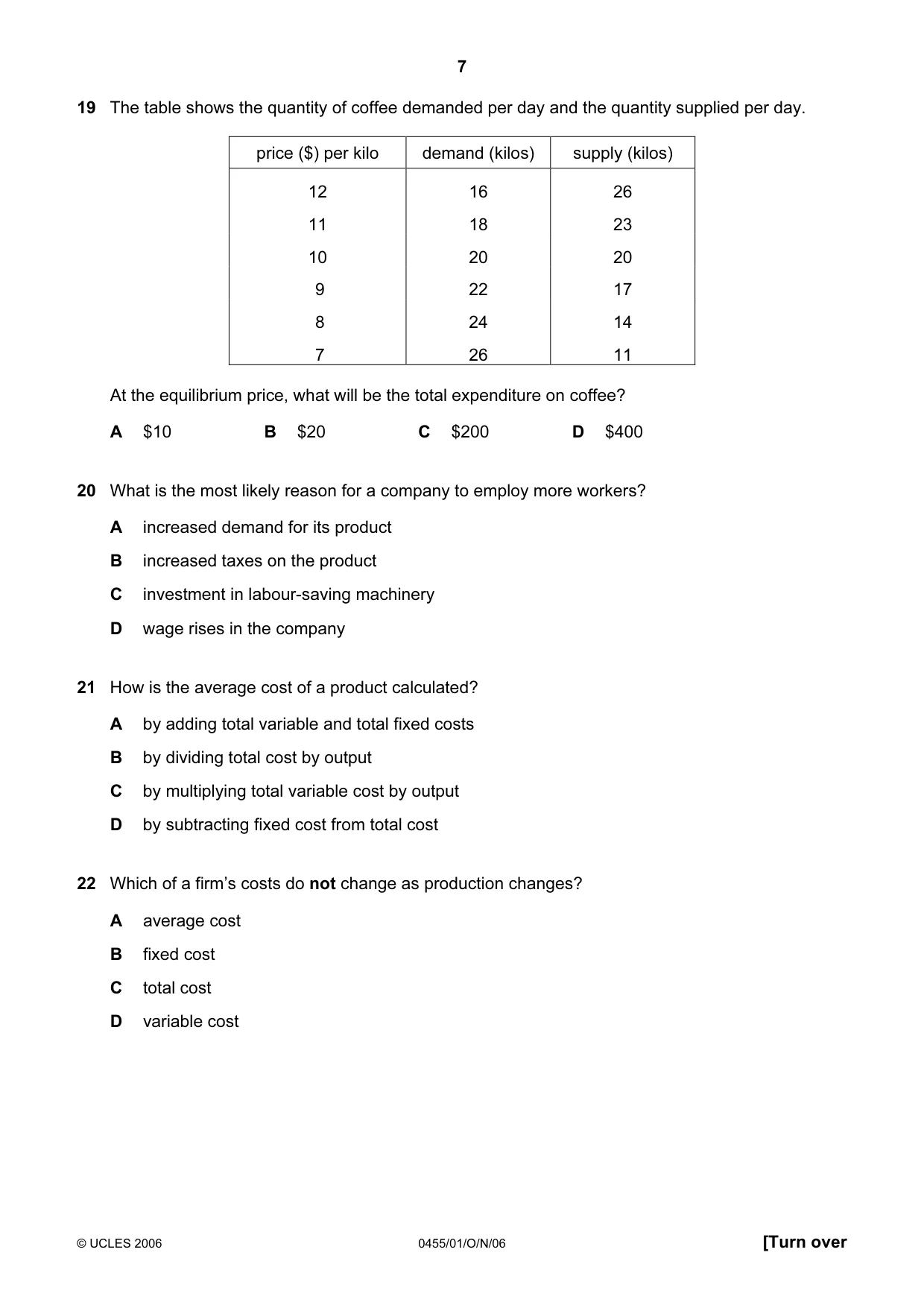
19 The table shows the quantity of coffee demanded per day and the quantity supplied per day. price ($) per kilo demand (kilos) supply (kilos) 12 16 26 11 18 23 10 20 20 9 22 17 8 24 14 7 26 11 At the equilibrium price, what will be the total expenditure on coffee? A $10 B $20 C $200 D $400
Mark scheme: C
Q20 · What is the most likely reason for a company to employ more workers?
20 What is the most likely reason for a company to employ more workers? A increased demand for its product B increased taxes on the product C investment in labour-saving machinery D wage rises in the company
Mark scheme: A
Q21 · How is the average cost of a product calculated?
21 How is the average cost of a product calculated? A by adding total variable and total fixed costs B by dividing total cost by output C by multiplying total variable cost by output D by subtracting fixed cost from total cost
Mark scheme: B
Q22 · Which of a firm’s costs do not change as production changes?
22 Which of a firm’s costs do not change as production changes? A average cost B fixed cost C total cost D variable cost
Mark scheme: B
Q23 · When is a government said to balance its budget?
23 When is a government said to balance its budget? A when all goods and services are taxed equally B when economic growth is the same in all regions of the economy C when total exports equal total imports D when its total income equals its total expenditure
Mark scheme: D
Q24 · What is a long-term advantage of economic growth?
24 What is a long-term advantage of economic growth? A Employment falls. B Incomes rise. C Prices rise. D Savings fall.
Mark scheme: B
Q25 · The governments of many countries raise revenue from a tax on a wide range of essential…
25 The governments of many countries raise revenue from a tax on a wide range of essential goods and services. What is the nature of this tax? A It is direct and proportional. B It is direct and regressive. C It is indirect and proportional. D It is indirect and regressive.
Mark scheme: D
Q26 · A country has a proportional system of taxation
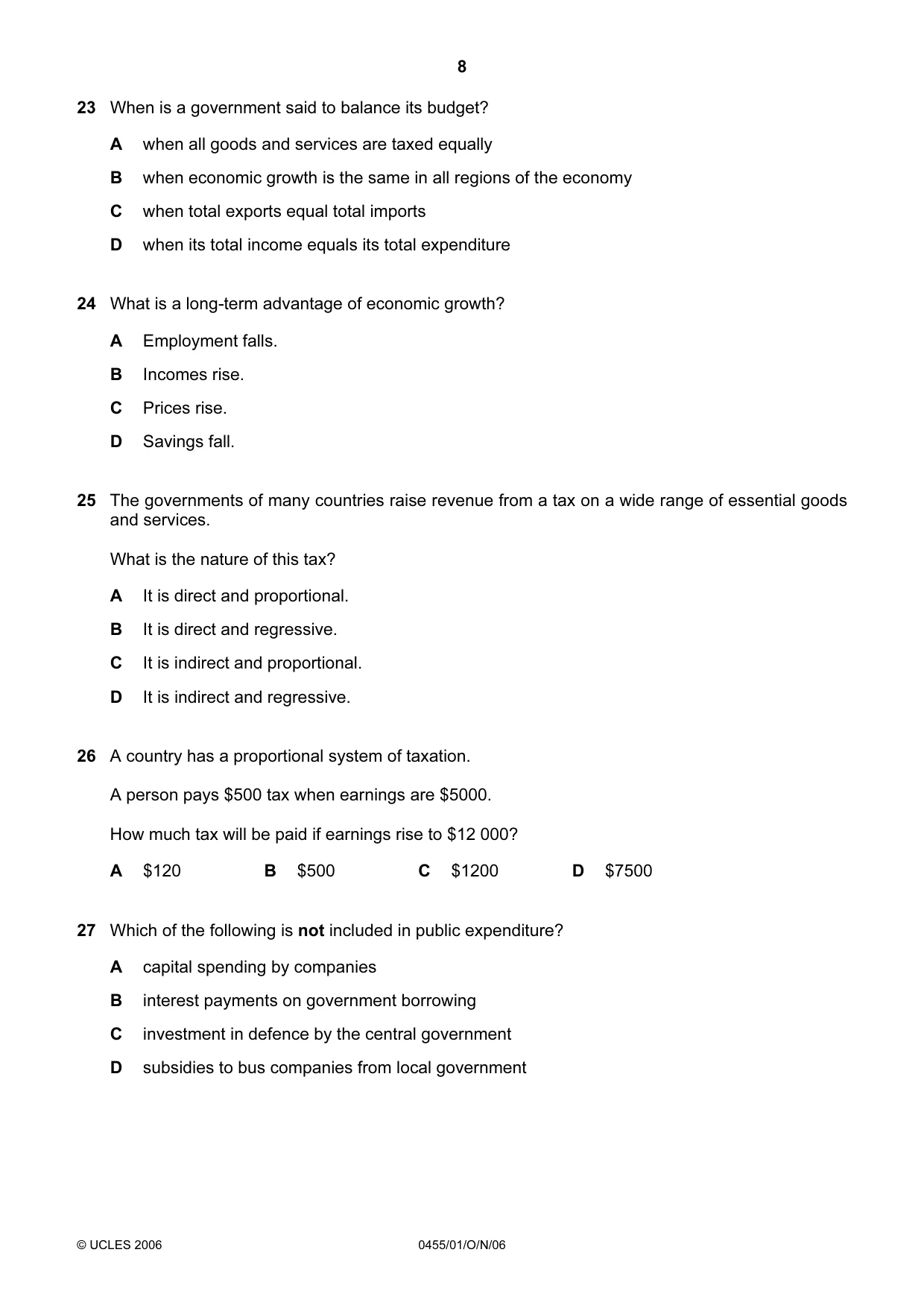
26 A country has a proportional system of taxation. A person pays $500 tax when earnings are $5000. How much tax will be paid if earnings rise to $12 000? A $120 B $500 C $1200 D $7500
Mark scheme: C
Q27 · Which of the following is not included in public expenditure?
27 Which of the following is not included in public expenditure? A capital spending by companies B interest payments on government borrowing C investment in defence by the central government D subsidies to bus companies from local government
Mark scheme: A
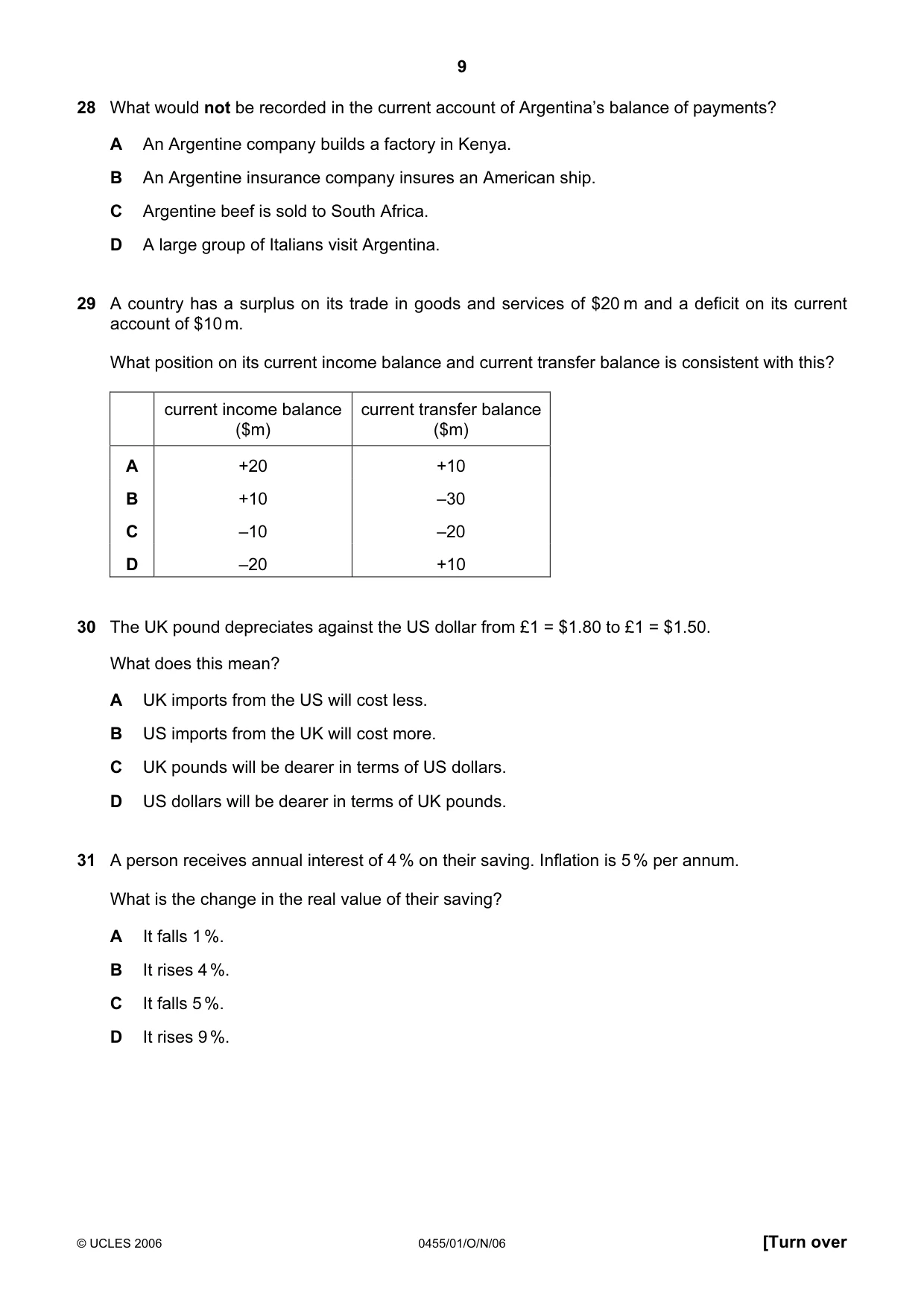
Q28 · What would not be recorded in the current account of Argentina’s balance of payments?
28 What would not be recorded in the current account of Argentina’s balance of payments? A An Argentine company builds a factory in Kenya. B An Argentine insurance company insures an American ship. C Argentine beef is sold to South Africa. D A large group of Italians visit Argentina.
Mark scheme: A
Q29 · A country has a surplus on its trade in goods and services of $20 m and a deficit on its…
29 A country has a surplus on its trade in goods and services of $20 m and a deficit on its current account of $10 m. What position on its current income balance and current transfer balance is consistent with this? current income balance current transfer balance ($m) ($m) A +20 +10 B +10 –30 C –10 –20 D –20 +10
Mark scheme: C
Q30 · The UK pound depreciates against the US dollar from £1 = $1.80 to £1 = $1.50
30 The UK pound depreciates against the US dollar from £1 = $1.80 to £1 = $1.50. What does this mean? A UK imports from the US will cost less. B US imports from the UK will cost more. C UK pounds will be dearer in terms of US dollars. D US dollars will be dearer in terms of UK pounds.
Mark scheme: D
Q31 · A person receives annual interest of 4 % on their saving
31 A person receives annual interest of 4 % on their saving. Inflation is 5 % per annum. What is the change in the real value of their saving? A It falls 1 %. B It rises 4 %. C It falls 5 %. D It rises 9 %.
Mark scheme: A
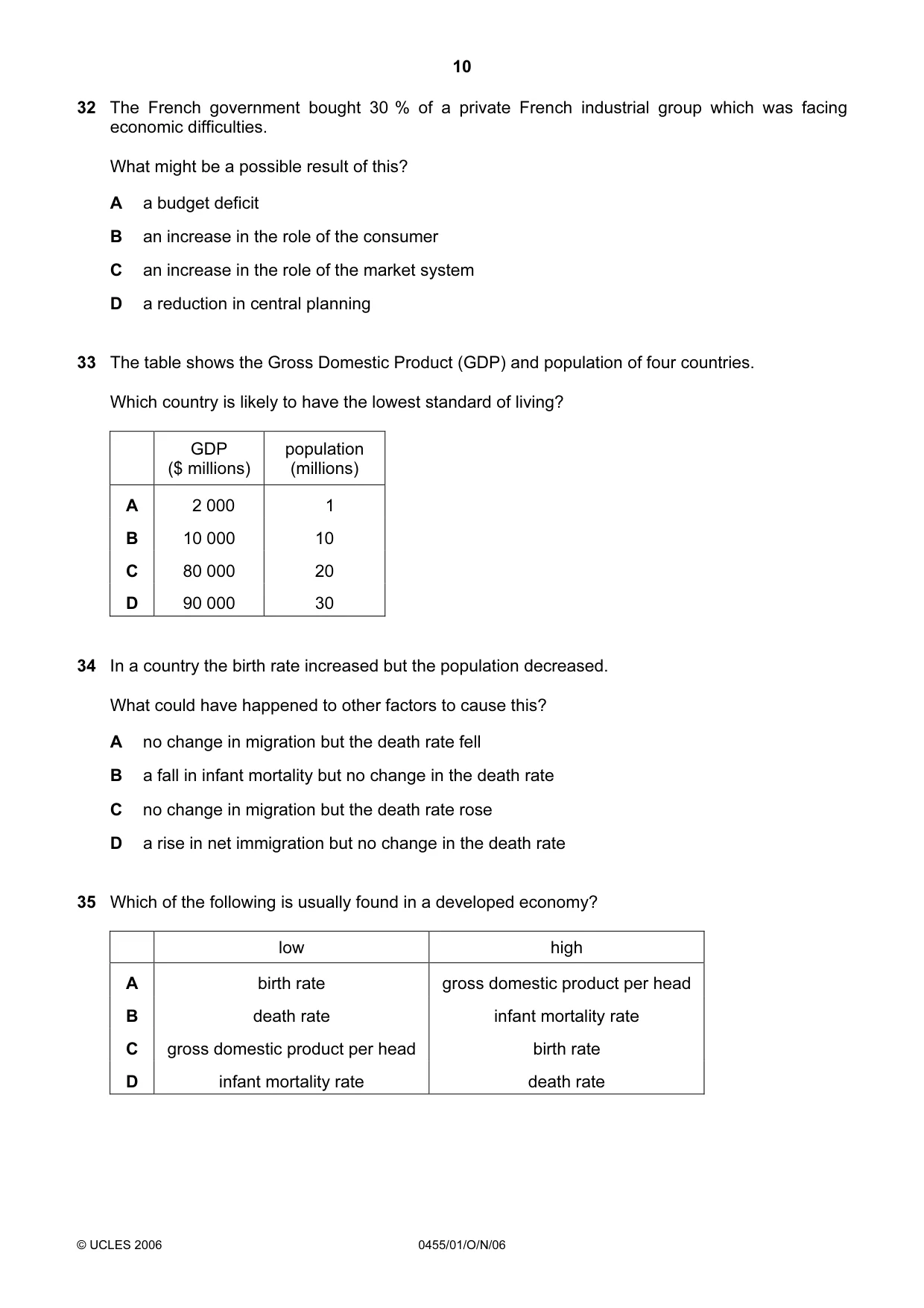
Q32 · The French government bought 30 % of a private French industrial group which was facing…
32 The French government bought 30 % of a private French industrial group which was facing economic difficulties. What might be a possible result of this? A a budget deficit B an increase in the role of the consumer C an increase in the role of the market system D a reduction in central planning
Mark scheme: A
Q33 · The table shows the Gross Domestic Product (GDP) and population of four countries
33 The table shows the Gross Domestic Product (GDP) and population of four countries. Which country is likely to have the lowest standard of living? GDP population ($ millions) (millions) A 2 000 1 B 10 000 10 C 80 000 20 D 90 000 30
Mark scheme: B
Q34 · In a country the birth rate increased but the population decreased
34 In a country the birth rate increased but the population decreased. What could have happened to other factors to cause this? A no change in migration but the death rate fell B a fall in infant mortality but no change in the death rate C no change in migration but the death rate rose D a rise in net immigration but no change in the death rate
Mark scheme: C
Q35 · Which of the following is usually found in a developed economy?
35 Which of the following is usually found in a developed economy? low high A birth rate gross domestic product per head B death rate infant mortality rate C gross domestic product per head birth rate D infant mortality rate death rate
Mark scheme: A
More questions on Differences in economic development between countries
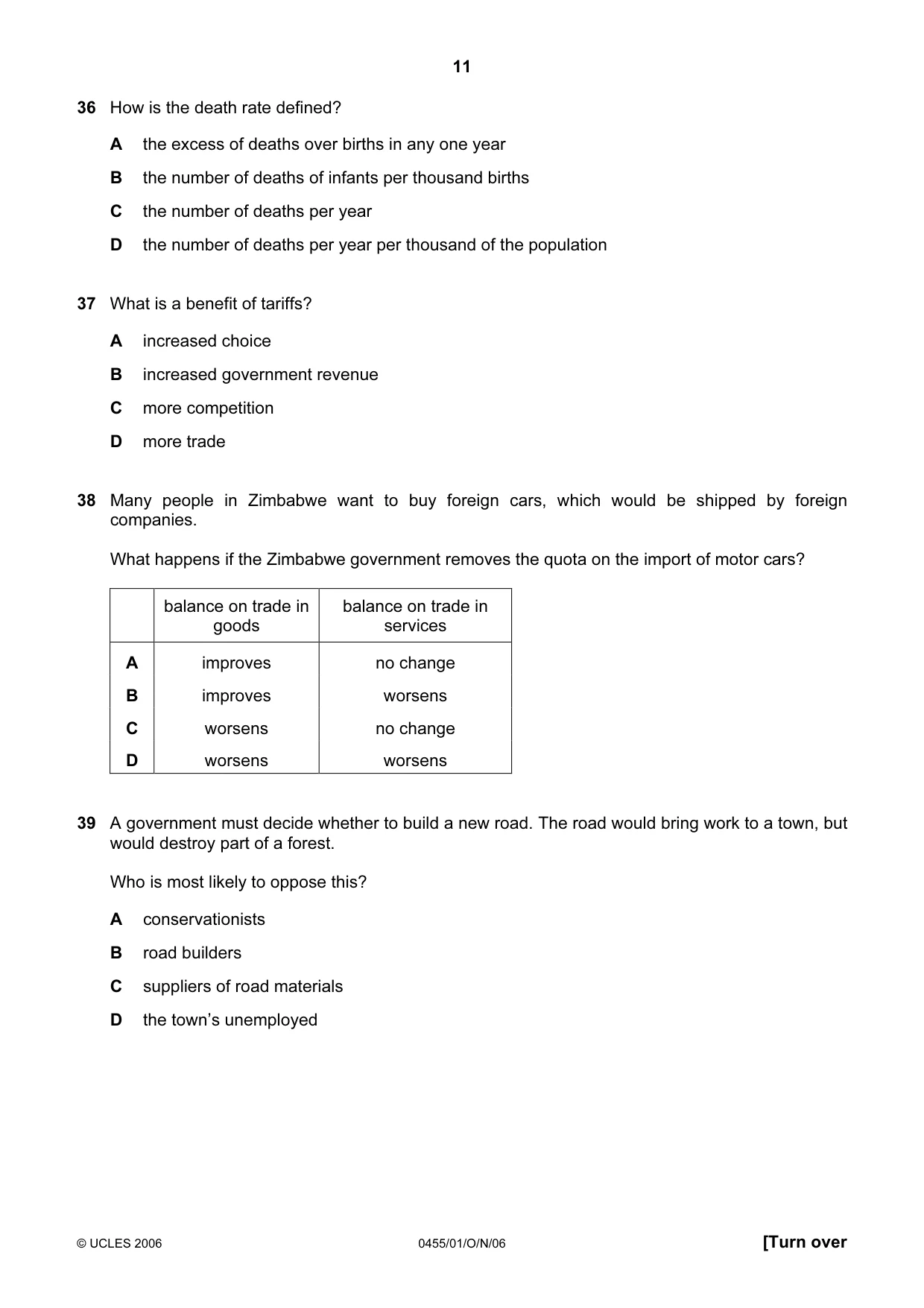
Q36 · How is the death rate defined?
36 How is the death rate defined? A the excess of deaths over births in any one year B the number of deaths of infants per thousand births C the number of deaths per year D the number of deaths per year per thousand of the population
Mark scheme: D
Q37 · What is a benefit of tariffs?
37 What is a benefit of tariffs? A increased choice B increased government revenue C more competition D more trade
Mark scheme: B
Q38 · Many people in Zimbabwe want to buy foreign cars, which would be shipped by foreign…
38 Many people in Zimbabwe want to buy foreign cars, which would be shipped by foreign companies. What happens if the Zimbabwe government removes the quota on the import of motor cars? balance on trade in balance on trade in goods services A improves no change B improves worsens C worsens no change D worsens worsens
Mark scheme: D
Q39 · A government must decide whether to build a new road
39 A government must decide whether to build a new road. The road would bring work to a town, but would destroy part of a forest. Who is most likely to oppose this? A conservationists B road builders C suppliers of road materials D the town’s unemployed
Mark scheme: A
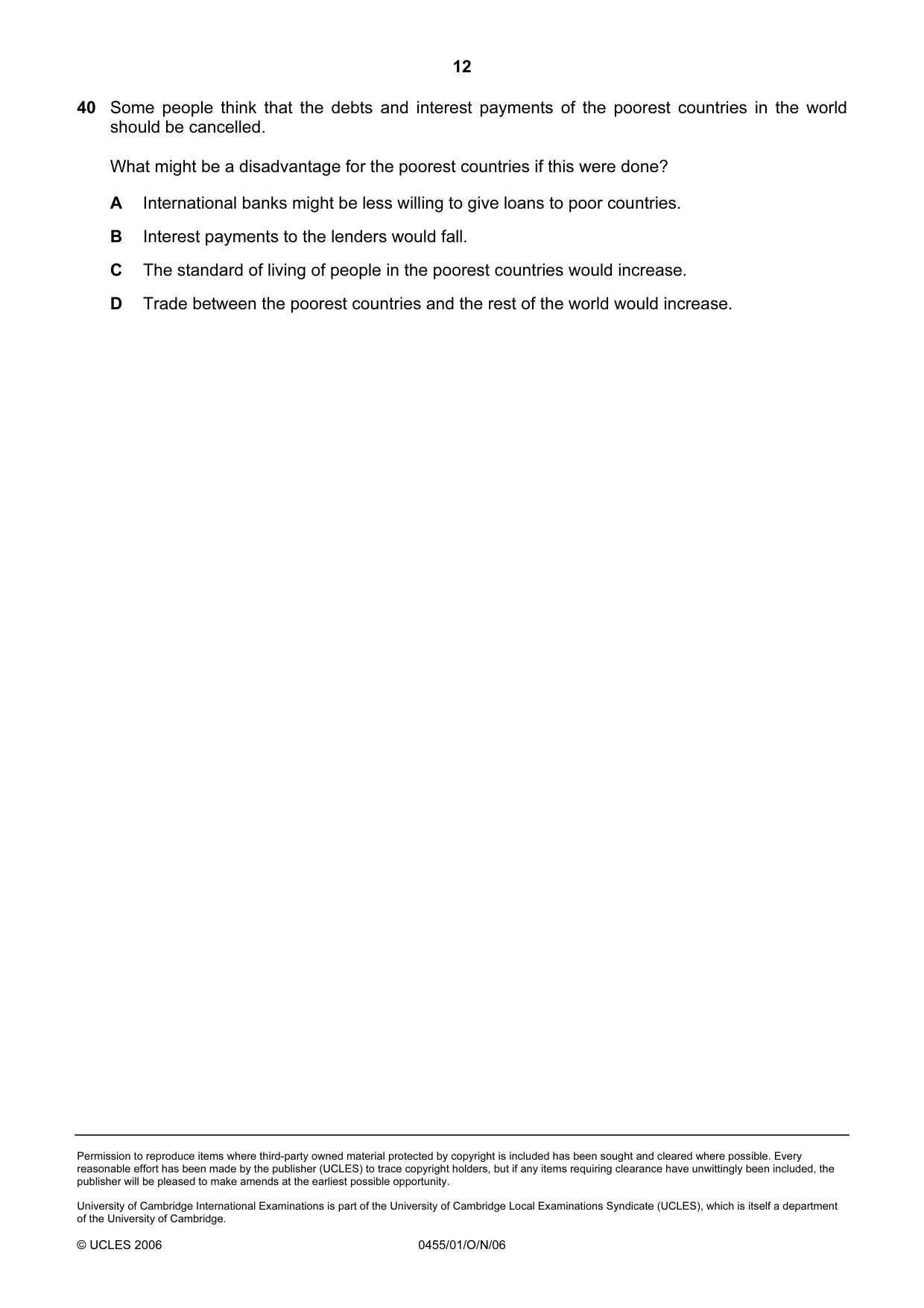
Q40 · Some people think that the debts and interest payments of the poorest countries in the…
40 Some people think that the debts and interest payments of the poorest countries in the world should be cancelled. What might be a disadvantage for the poorest countries if this were done? A International banks might be less willing to give loans to poor countries. B Interest payments to the lenders would fall. C The standard of living of people in the poorest countries would increase. D Trade between the poorest countries and the rest of the world would increase.
Mark scheme: A
More questions on Differences in economic development between countries
What was in this paper
The subtopics covered by these 40 questions, and how many questions each got. Open one in a new tab to see every Cambridge question on it.
4Fiscal policy4Workers4Current account of balance of payments3Firms’ costs, revenue and objectives3Price determination3Differences in economic development between countries2Population2Economic growth1Firms1Firms and production1Foreign exchange rates1Globalisation, free trade and protection1Inflation and deflation1Living standards1Market economic system1Market failure1Monetary policy1Opportunity cost1Supply1The nature of the economic problem1The role of government1Trade unions1What you needed in this session
Cambridge’s own grade thresholds for 2006 Oct/Nov, Paper 1 · Variant 1. A higher threshold means an easier paper — the bar moves with how the cohort did.