Cambridge IGCSE Economics 0455 — 2009 Oct/Nov Paper 1 · Variant 1
0455/11/O/N/09 · 30 questions · 30 marks · ≈34 min
The question paper and its mark scheme, free to read here and free to download. This is Cambridge’s own paper, exactly as it was sat.
Question paper12 pages


Mark scheme2 pages
Answers below. Sit the paper first if you are practising.
Questions as text
Q1 · Nolwazi lived in a rural area in Botswana and made baskets to sell to the tourists
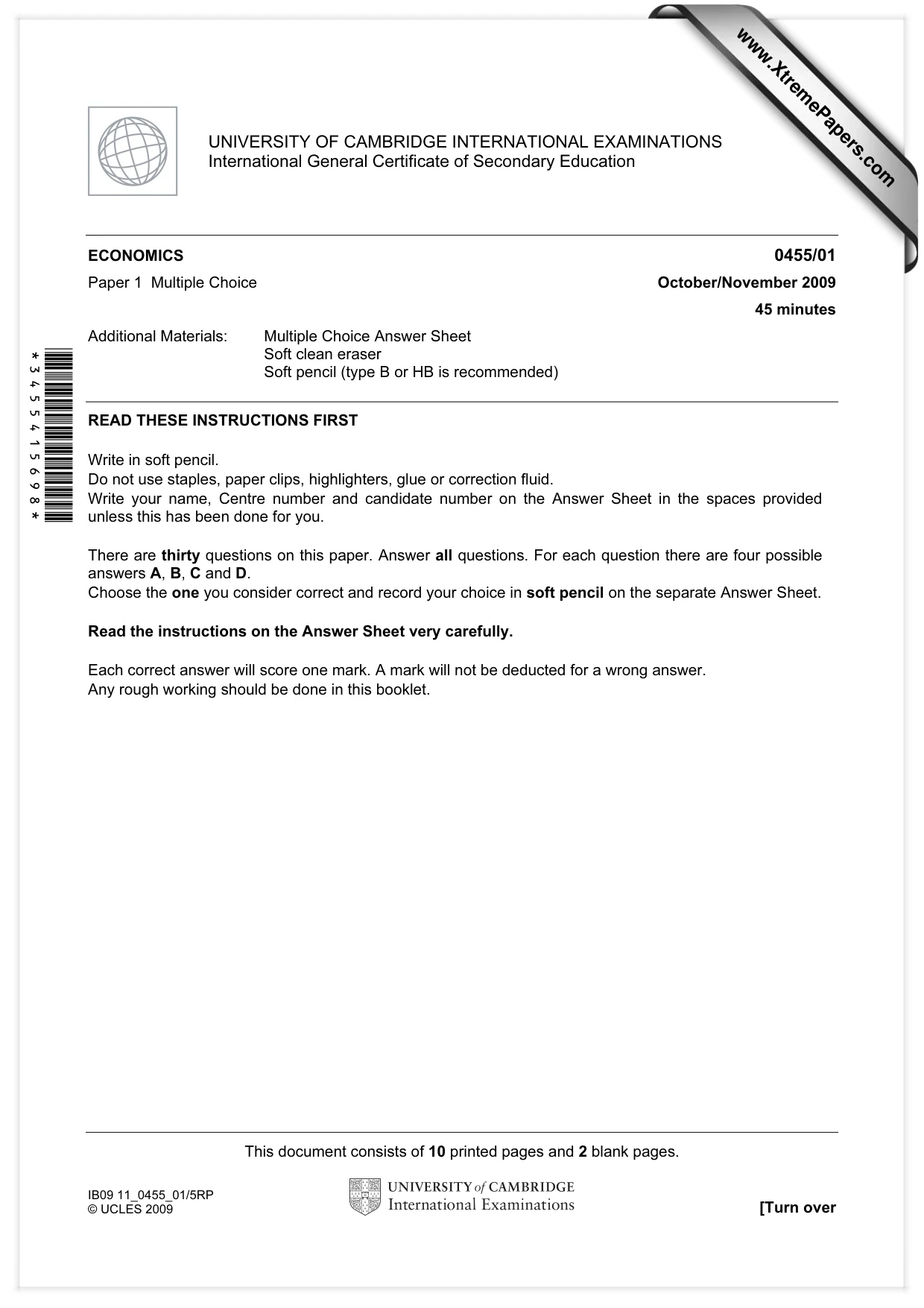
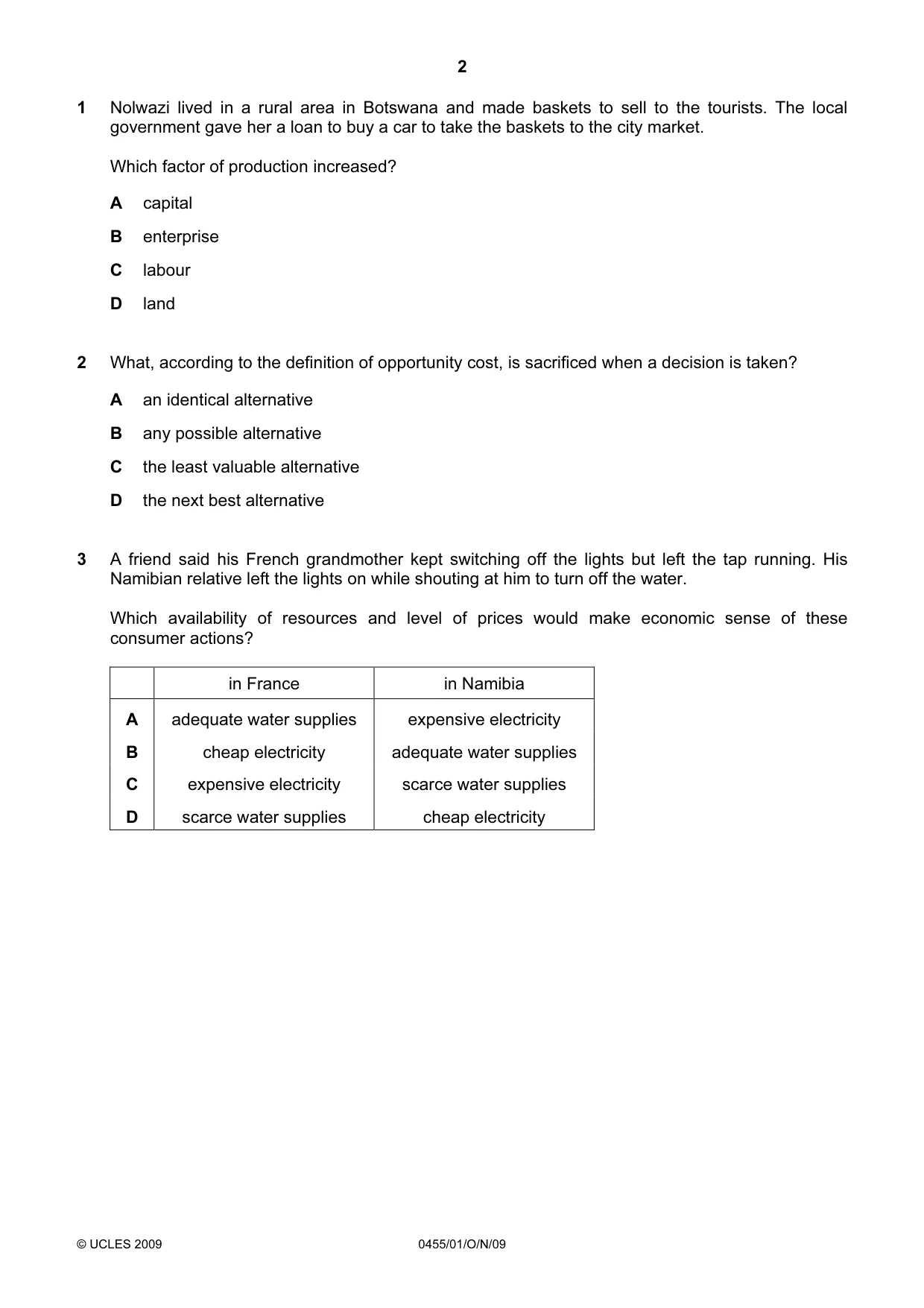
1 Nolwazi lived in a rural area in Botswana and made baskets to sell to the tourists. The local government gave her a loan to buy a car to take the baskets to the city market. Which factor of production increased? A capital B enterprise C labour D land
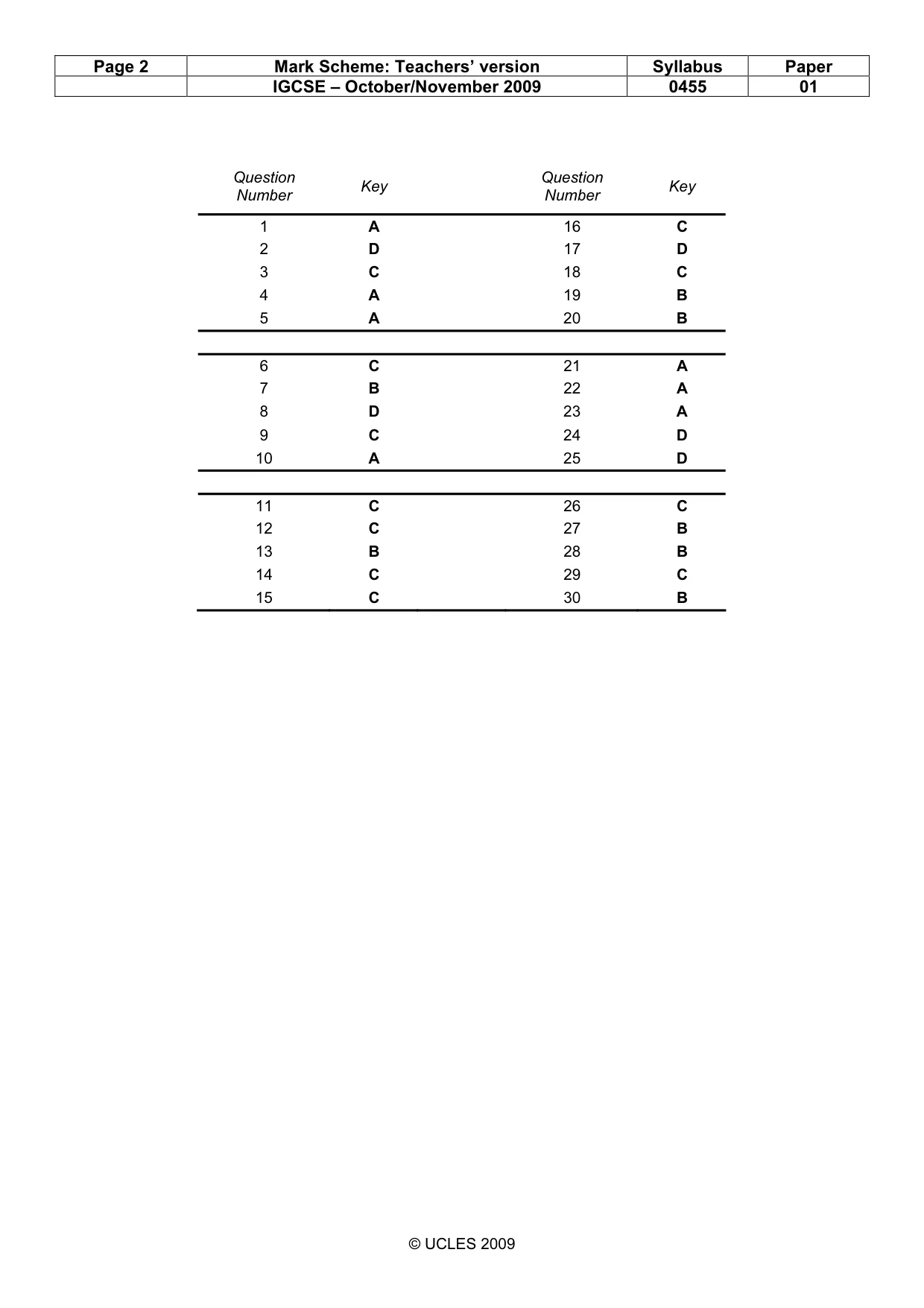
Mark scheme: A
Q2 · What, according to the definition of opportunity cost, is sacrificed when a decision is…
2 What, according to the definition of opportunity cost, is sacrificed when a decision is taken? A an identical alternative B any possible alternative C the least valuable alternative D the next best alternative
Mark scheme: D
Q3 · A friend said his French grandmother kept switching off the lights but left the tap…
3 A friend said his French grandmother kept switching off the lights but left the tap running. His Namibian relative left the lights on while shouting at him to turn off the water. Which availability of resources and level of prices would make economic sense of these consumer actions? in France in Namibia A adequate water supplies expensive electricity B cheap electricity adequate water supplies C expensive electricity scarce water supplies D scarce water supplies cheap electricity
Mark scheme: C
Q4 · The table shows the value of output for some parts of an economy
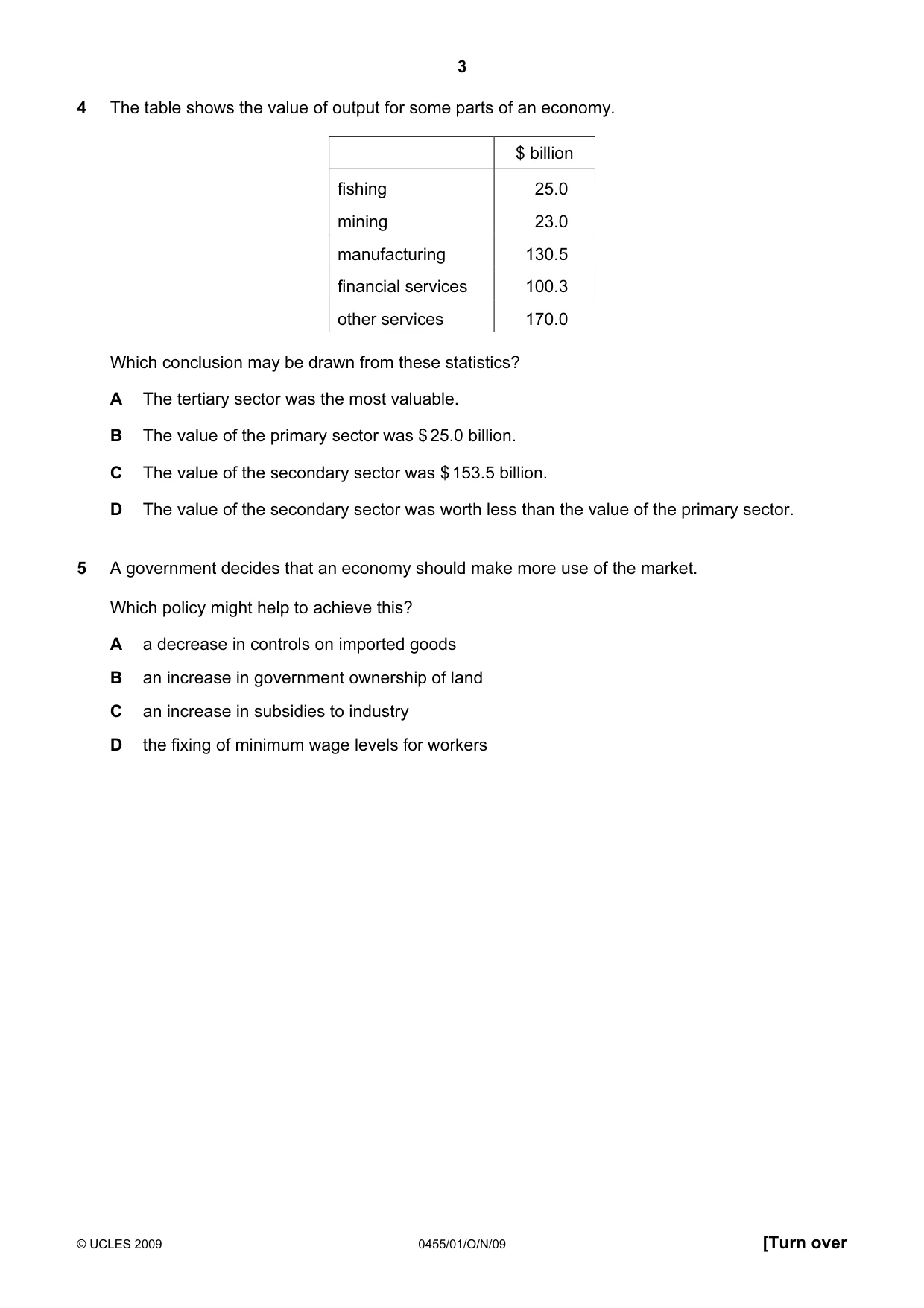
4 The table shows the value of output for some parts of an economy. $ billion fishing 25.0 mining 23.0 manufacturing 130.5 financial services 100.3 other services 170.0 Which conclusion may be drawn from these statistics? A The tertiary sector was the most valuable. B The value of the primary sector was $ 25.0 billion. C The value of the secondary sector was $ 153.5 billion. D The value of the secondary sector was worth less than the value of the primary sector.
Mark scheme: A
More questions on The role of markets in allocating resources
Q5 · A government decides that an economy should make more use of the market
5 A government decides that an economy should make more use of the market. Which policy might help to achieve this? A a decrease in controls on imported goods B an increase in government ownership of land C an increase in subsidies to industry D the fixing of minimum wage levels for workers
Mark scheme: A
Q6 · The diagram shows an initial equilibrium point (X) in a market and a new equilibrium…
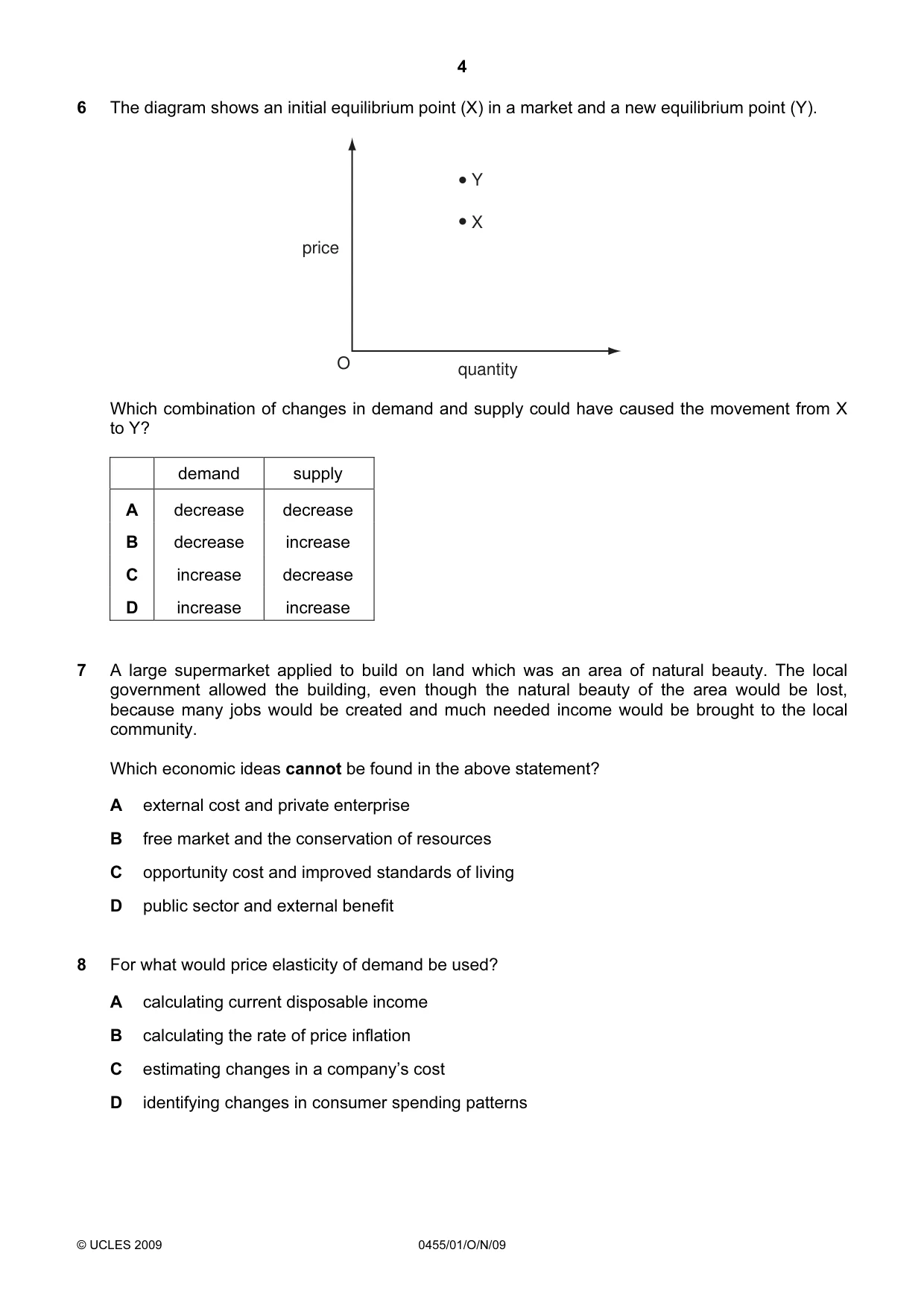
6 The diagram shows an initial equilibrium point (X) in a market and a new equilibrium point (Y). Y X price O quantity Which combination of changes in demand and supply could have caused the movement from X to Y? demand supply A decrease decrease B decrease increase C increase decrease D increase increase
Mark scheme: C
Q7 · A large supermarket applied to build on land which was an area of natural beauty
7 A large supermarket applied to build on land which was an area of natural beauty. The local government allowed the building, even though the natural beauty of the area would be lost, because many jobs would be created and much needed income would be brought to the local community. Which economic ideas cannot be found in the above statement? A external cost and private enterprise B free market and the conservation of resources C opportunity cost and improved standards of living D public sector and external benefit
Mark scheme: B
Q8 · For what would price elasticity of demand be used?
8 For what would price elasticity of demand be used? A calculating current disposable income B calculating the rate of price inflation C estimating changes in a company’s cost D identifying changes in consumer spending patterns
Mark scheme: D
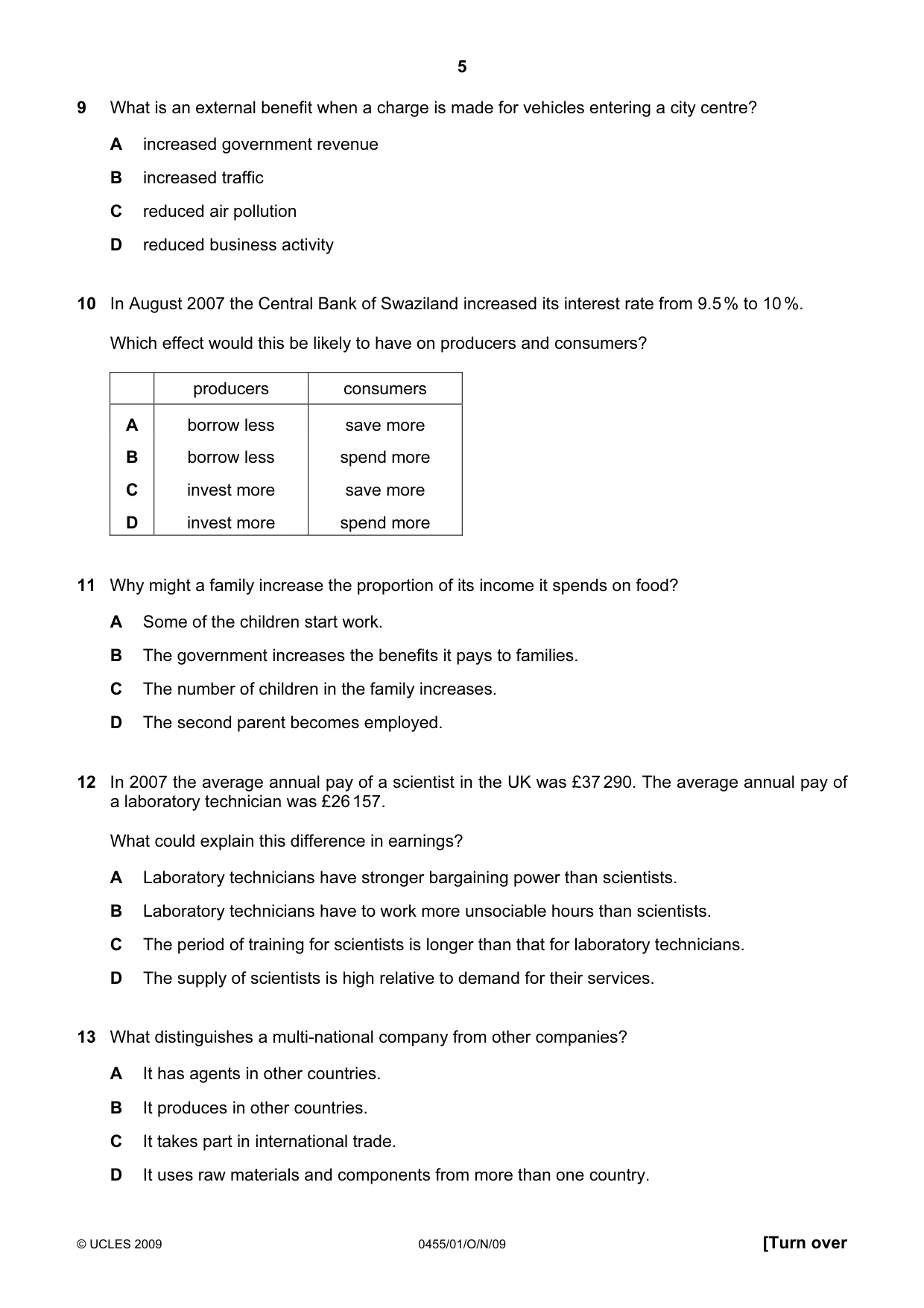
Q9 · What is an external benefit when a charge is made for vehicles entering a city centre?
9 What is an external benefit when a charge is made for vehicles entering a city centre? A increased government revenue B increased traffic C reduced air pollution D reduced business activity
Mark scheme: C
Q10 · In August 2007 the Central Bank of Swaziland increased its interest rate from 9.5 % to 10…
10 In August 2007 the Central Bank of Swaziland increased its interest rate from 9.5 % to 10 %. Which effect would this be likely to have on producers and consumers? producers consumers A borrow less save more B borrow less spend more C invest more save more D invest more spend more
Mark scheme: A
Q11 · Why might a family increase the proportion of its income it spends on food?
11 Why might a family increase the proportion of its income it spends on food? A Some of the children start work. B The government increases the benefits it pays to families. C The number of children in the family increases. D The second parent becomes employed.
Mark scheme: C
Q12 · In 2007 the average annual pay of a scientist in the UK was £37 290
12 In 2007 the average annual pay of a scientist in the UK was £37 290. The average annual pay of a laboratory technician was £26 157. What could explain this difference in earnings? A Laboratory technicians have stronger bargaining power than scientists. B Laboratory technicians have to work more unsociable hours than scientists. C The period of training for scientists is longer than that for laboratory technicians. D The supply of scientists is high relative to demand for their services.
Mark scheme: C
Q13 · What distinguishes a multi-national company from other companies?
13 What distinguishes a multi-national company from other companies? A It has agents in other countries. B It produces in other countries. C It takes part in international trade. D It uses raw materials and components from more than one country.
Mark scheme: B
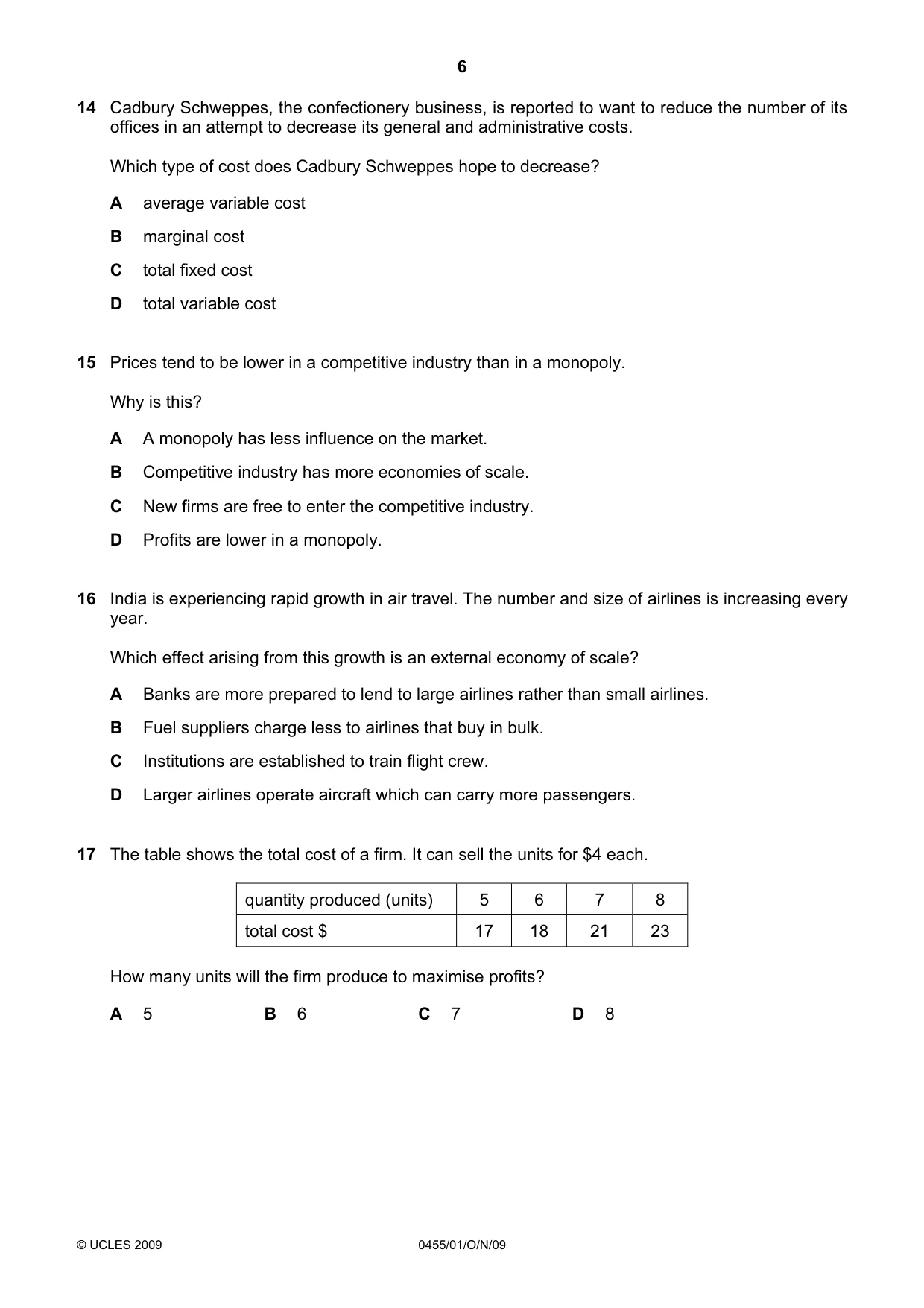
Q14 · Cadbury Schweppes, the confectionery business, is reported to want to reduce the number…
14 Cadbury Schweppes, the confectionery business, is reported to want to reduce the number of its offices in an attempt to decrease its general and administrative costs. Which type of cost does Cadbury Schweppes hope to decrease? A average variable cost B marginal cost C total fixed cost D total variable cost
Mark scheme: C
Q15 · Prices tend to be lower in a competitive industry than in a monopoly
15 Prices tend to be lower in a competitive industry than in a monopoly. Why is this? A A monopoly has less influence on the market. B Competitive industry has more economies of scale. C New firms are free to enter the competitive industry. D Profits are lower in a monopoly.
Mark scheme: C
Q16 · India is experiencing rapid growth in air travel
16 India is experiencing rapid growth in air travel. The number and size of airlines is increasing every year. Which effect arising from this growth is an external economy of scale? A Banks are more prepared to lend to large airlines rather than small airlines. B Fuel suppliers charge less to airlines that buy in bulk. C Institutions are established to train flight crew. D Larger airlines operate aircraft which can carry more passengers.
Mark scheme: C
Q17 · The table shows the total cost of a firm
17 The table shows the total cost of a firm. It can sell the units for $4 each. quantity produced (units) 5 6 7 8 total cost $ 17 18 21 23 How many units will the firm produce to maximise profits? A 5 B 6 C 7 D 8
Mark scheme: D
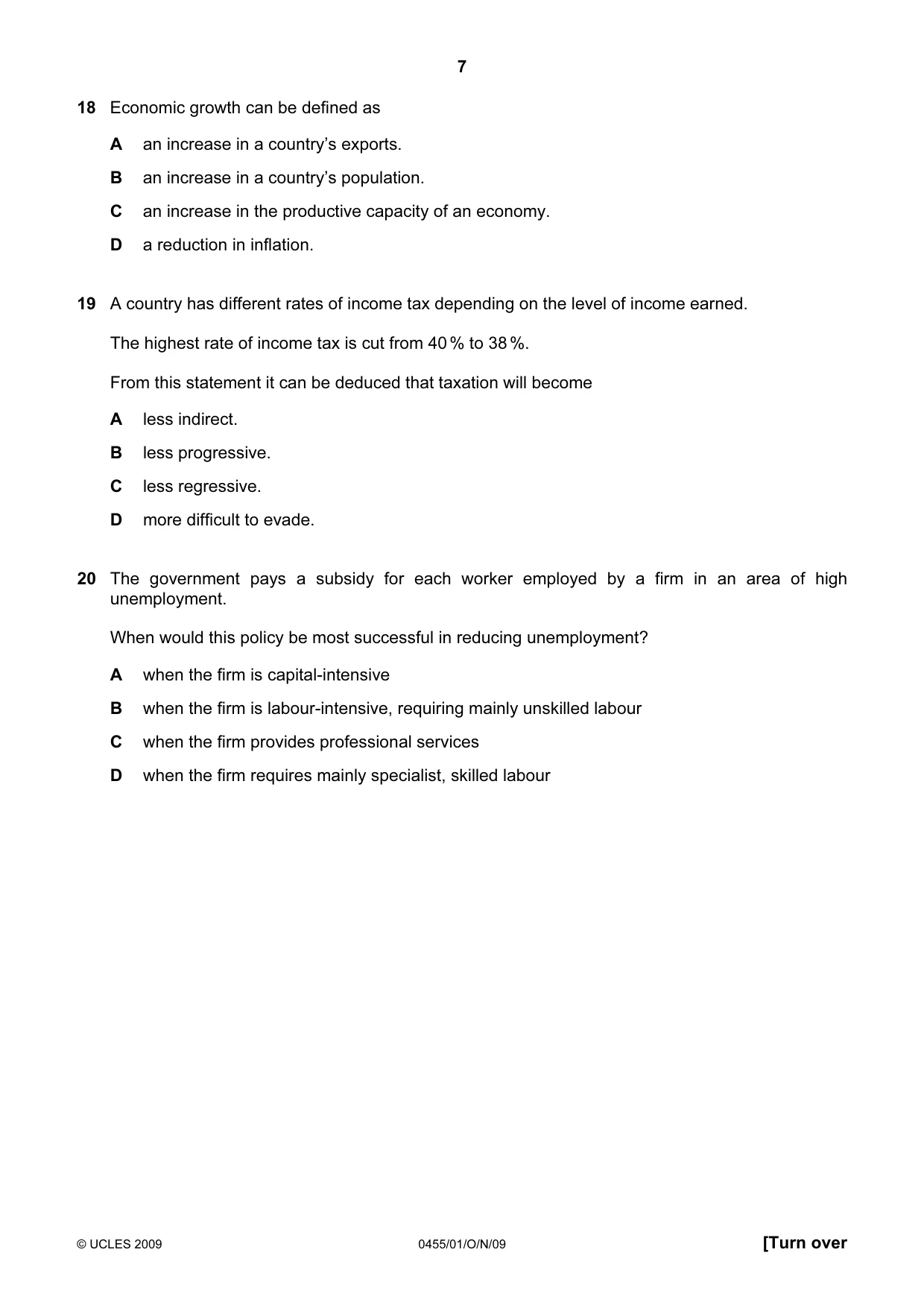
Q18 · Economic growth can be defined as A an increase in a country’s exports
18 Economic growth can be defined as A an increase in a country’s exports. B an increase in a country’s population. C an increase in the productive capacity of an economy. D a reduction in inflation.
Mark scheme: C
Q19 · A country has different rates of income tax depending on the level of income earned
19 A country has different rates of income tax depending on the level of income earned. The highest rate of income tax is cut from 40 % to 38 %. From this statement it can be deduced that taxation will become A less indirect. B less progressive. C less regressive. D more difficult to evade.
Mark scheme: B
Q20 · The government pays a subsidy for each worker employed by a firm in an area of high…
20 The government pays a subsidy for each worker employed by a firm in an area of high unemployment. When would this policy be most successful in reducing unemployment? A when the firm is capital-intensive B when the firm is labour-intensive, requiring mainly unskilled labour C when the firm provides professional services D when the firm requires mainly specialist, skilled labour
Mark scheme: B
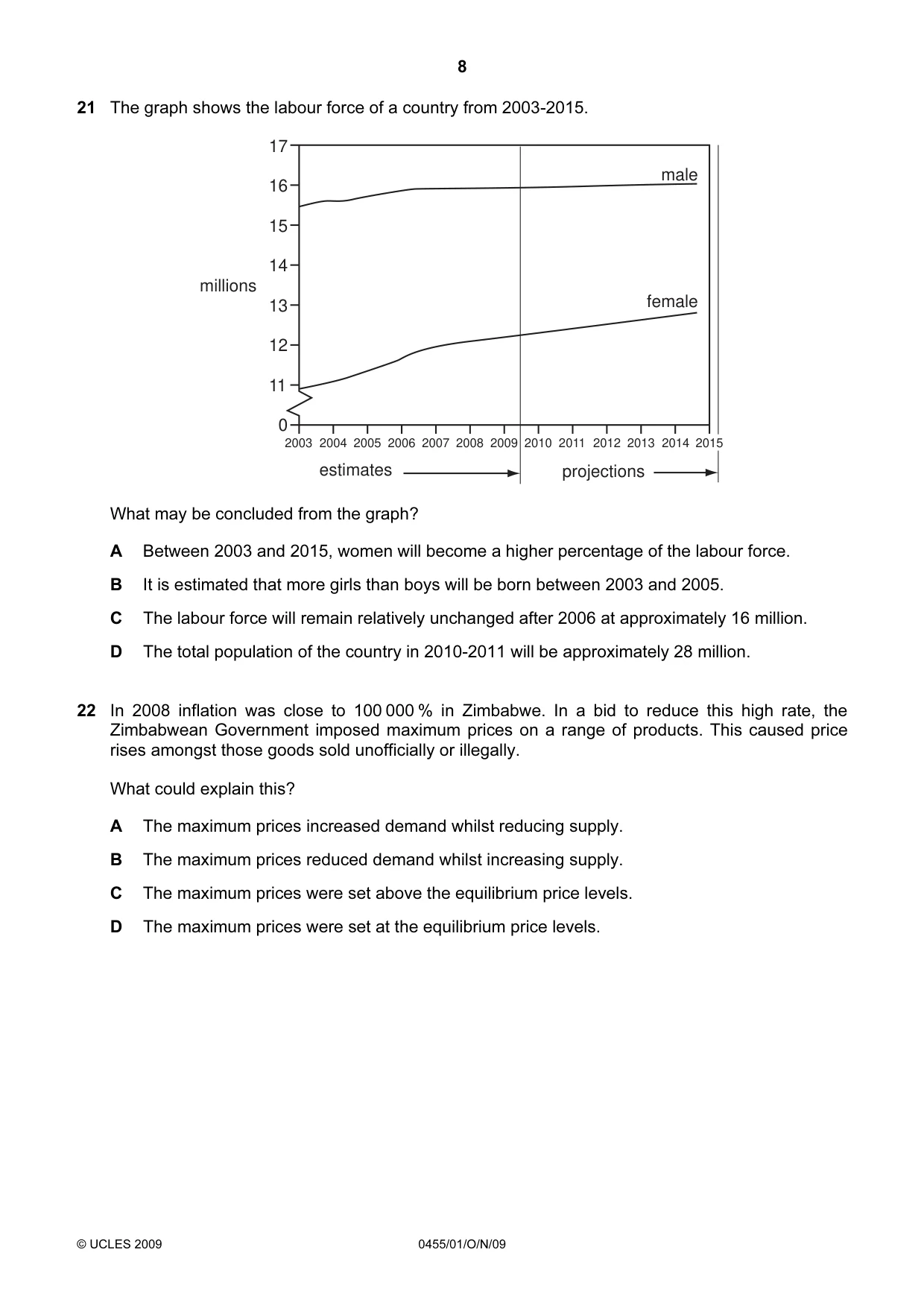
Q21 · The graph shows the labour force of a country from 2003-2015
21 The graph shows the labour force of a country from 2003-2015. 17 male 16 15 14 millions 13 female 12 11 0 2003 2004 2005 2006 2007 2008 2009 2010 2011 2012 2013 2014 2015 estimates projections What may be concluded from the graph? A Between 2003 and 2015, women will become a higher percentage of the labour force. B It is estimated that more girls than boys will be born between 2003 and 2005. C The labour force will remain relatively unchanged after 2006 at approximately 16 million. D The total population of the country in 2010-2011 will be approximately 28 million.
Mark scheme: A
Q22 · In 2008 inflation was close to 100 000 % in Zimbabwe
22 In 2008 inflation was close to 100 000 % in Zimbabwe. In a bid to reduce this high rate, the Zimbabwean Government imposed maximum prices on a range of products. This caused price rises amongst those goods sold unofficially or illegally. What could explain this? A The maximum prices increased demand whilst reducing supply. B The maximum prices reduced demand whilst increasing supply. C The maximum prices were set above the equilibrium price levels. D The maximum prices were set at the equilibrium price levels.
Mark scheme: A
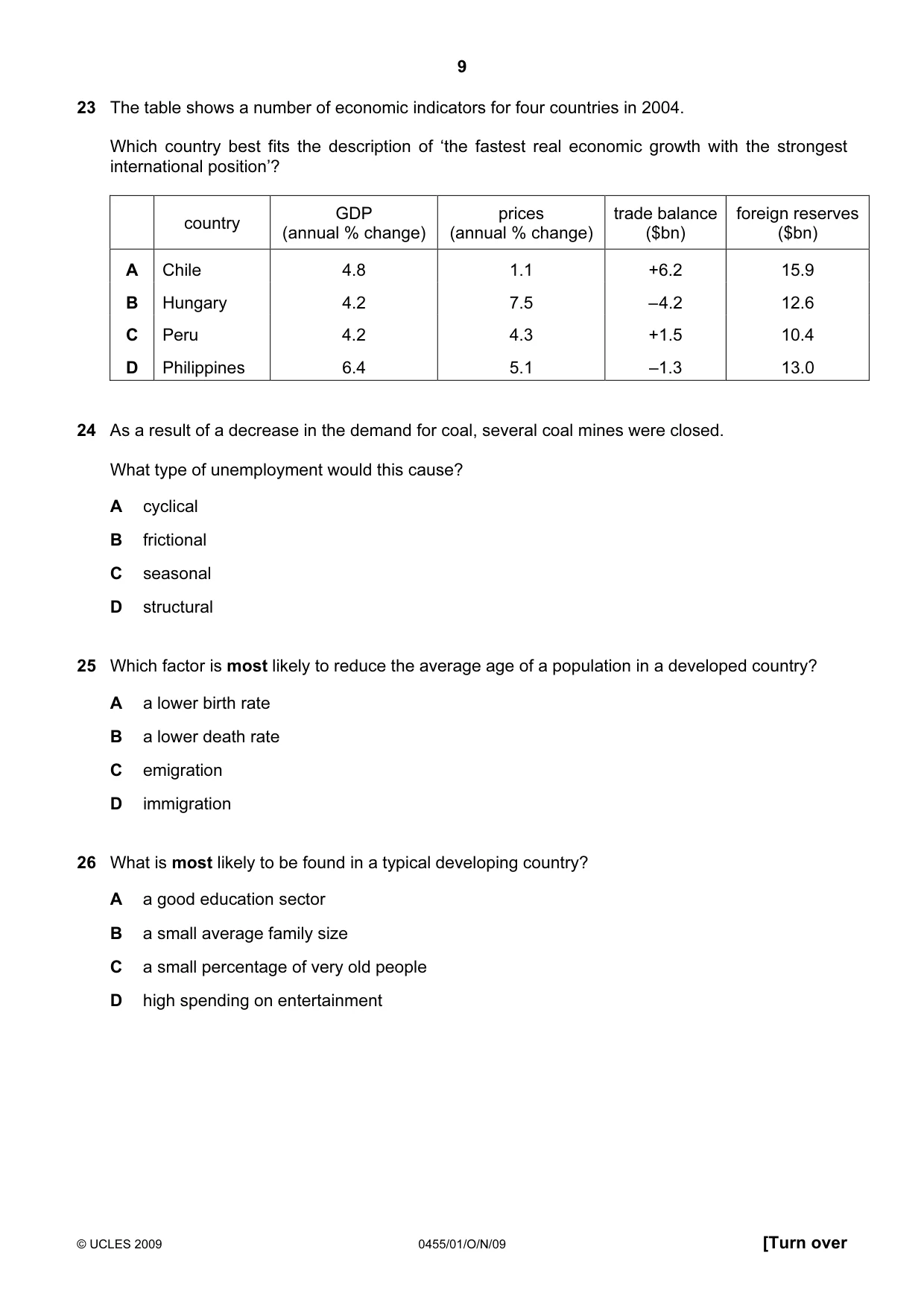
Q23 · The table shows a number of economic indicators for four countries in 2004
23 The table shows a number of economic indicators for four countries in 2004. Which country best fits the description of ‘the fastest real economic growth with the strongest international position’? GDP prices trade balance foreign reserves country (annual % change) (annual % change) ($bn) ($bn) A Chile 4.8 1.1 +6.2 15.9 B Hungary 4.2 7.5 – 4.2 12.6 C Peru 4.2 4.3 +1.5 10.4 D Philippines 6.4 5.1 –1.3 13.0
Mark scheme: A
Q24 · As a result of a decrease in the demand for coal, several coal mines were closed
24 As a result of a decrease in the demand for coal, several coal mines were closed. What type of unemployment would this cause? A cyclical B frictional C seasonal D structural
Mark scheme: D
Q25 · Which factor is most likely to reduce the average age of a population in a developed…
25 Which factor is most likely to reduce the average age of a population in a developed country? A a lower birth rate B a lower death rate C emigration D immigration
Mark scheme: D
Q26 · What is most likely to be found in a typical developing country?
26 What is most likely to be found in a typical developing country? A a good education sector B a small average family size C a small percentage of very old people D high spending on entertainment
Mark scheme: C
More questions on Differences in economic development between countries
Q27 · The Chinese Government is concerned about two population problems – overpopulation and a…
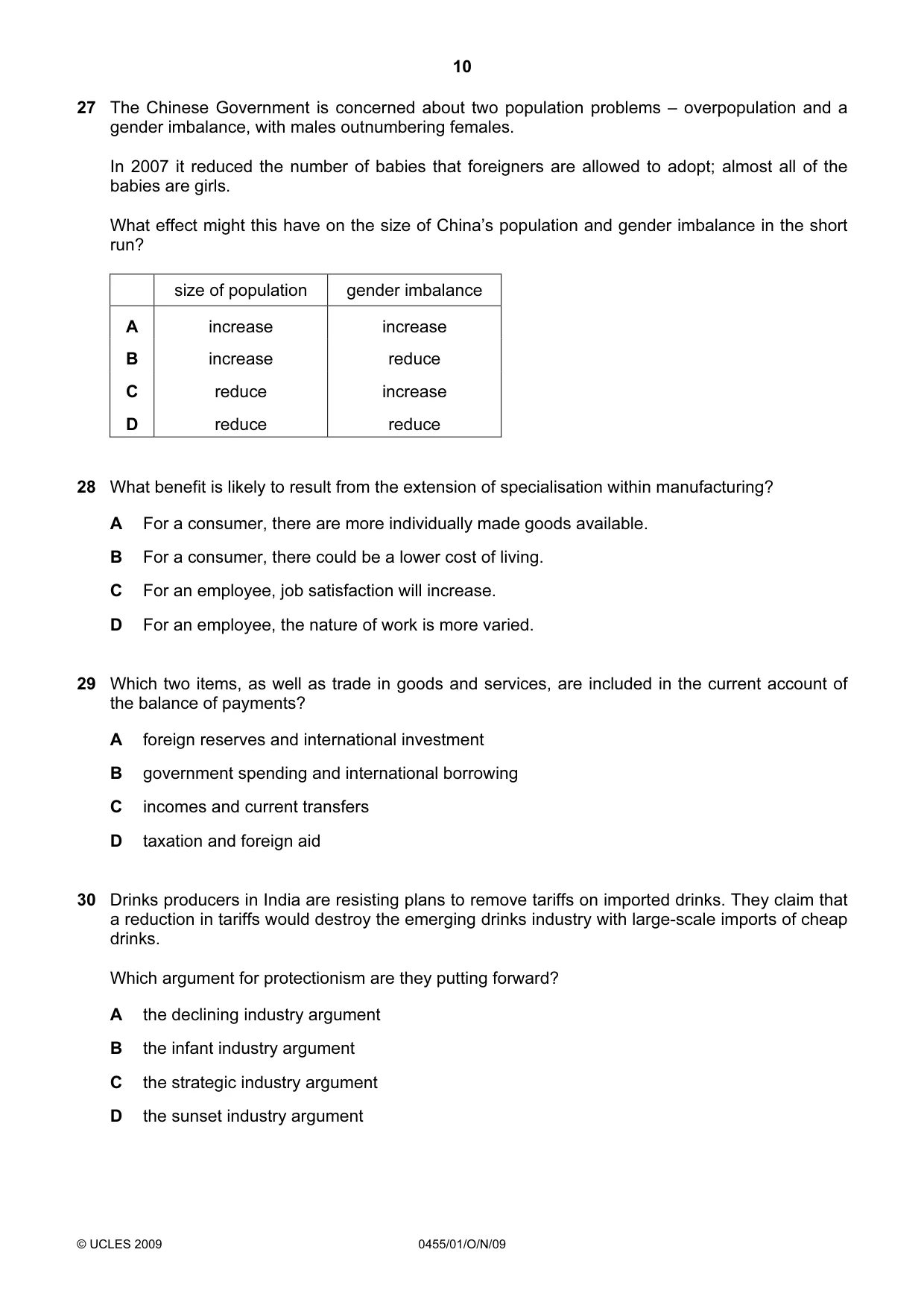
27 The Chinese Government is concerned about two population problems – overpopulation and a gender imbalance, with males outnumbering females. In 2007 it reduced the number of babies that foreigners are allowed to adopt; almost all of the babies are girls. What effect might this have on the size of China’s population and gender imbalance in the short run? size of population gender imbalance A increase increase B increase reduce C reduce increase D reduce reduce
Mark scheme: B
Q28 · What benefit is likely to result from the extension of specialisation within…
28 What benefit is likely to result from the extension of specialisation within manufacturing? A For a consumer, there are more individually made goods available. B For a consumer, there could be a lower cost of living. C For an employee, job satisfaction will increase. D For an employee, the nature of work is more varied.
Mark scheme: B
Q29 · Which two items, as well as trade in goods and services, are included in the current…
29 Which two items, as well as trade in goods and services, are included in the current account of the balance of payments? A foreign reserves and international investment B government spending and international borrowing C incomes and current transfers D taxation and foreign aid
Mark scheme: C
Q30 · Drinks producers in India are resisting plans to remove tariffs on imported drinks
30 Drinks producers in India are resisting plans to remove tariffs on imported drinks. They claim that a reduction in tariffs would destroy the emerging drinks industry with large-scale imports of cheap drinks. Which argument for protectionism are they putting forward? A the declining industry argument B the infant industry argument C the strategic industry argument D the sunset industry argument
Mark scheme: B
What was in this paper
The subtopics covered by these 30 questions, and how many questions each got. Open one in a new tab to see every Cambridge question on it.
3Economic growth2Firms’ costs, revenue and objectives2Opportunity cost2Population2Workers2Current account of balance of payments1Differences in economic development between countries1Employment and unemployment1Firms1Firms and production1Fiscal policy1Globalisation, free trade and protection1Households1International specialisation1Market economic system1Market structure1Monetary policy1Price determination1Price elasticity of demand (PED)1Supply-side policy1The factors of production1The role of markets in allocating resources1What you needed in this session
Cambridge’s own grade thresholds for 2009 Oct/Nov, Paper 1 · Variant 1. A higher threshold means an easier paper — the bar moves with how the cohort did.