Cambridge IGCSE Economics 0455 — 2020 Oct/Nov Paper 1 · Variant 1
0455/11/O/N/20 · 30 questions · 30 marks · ≈34 min
The question paper and its mark scheme, free to read here and free to download. This is Cambridge’s own paper, exactly as it was sat.
Question paper12 pages
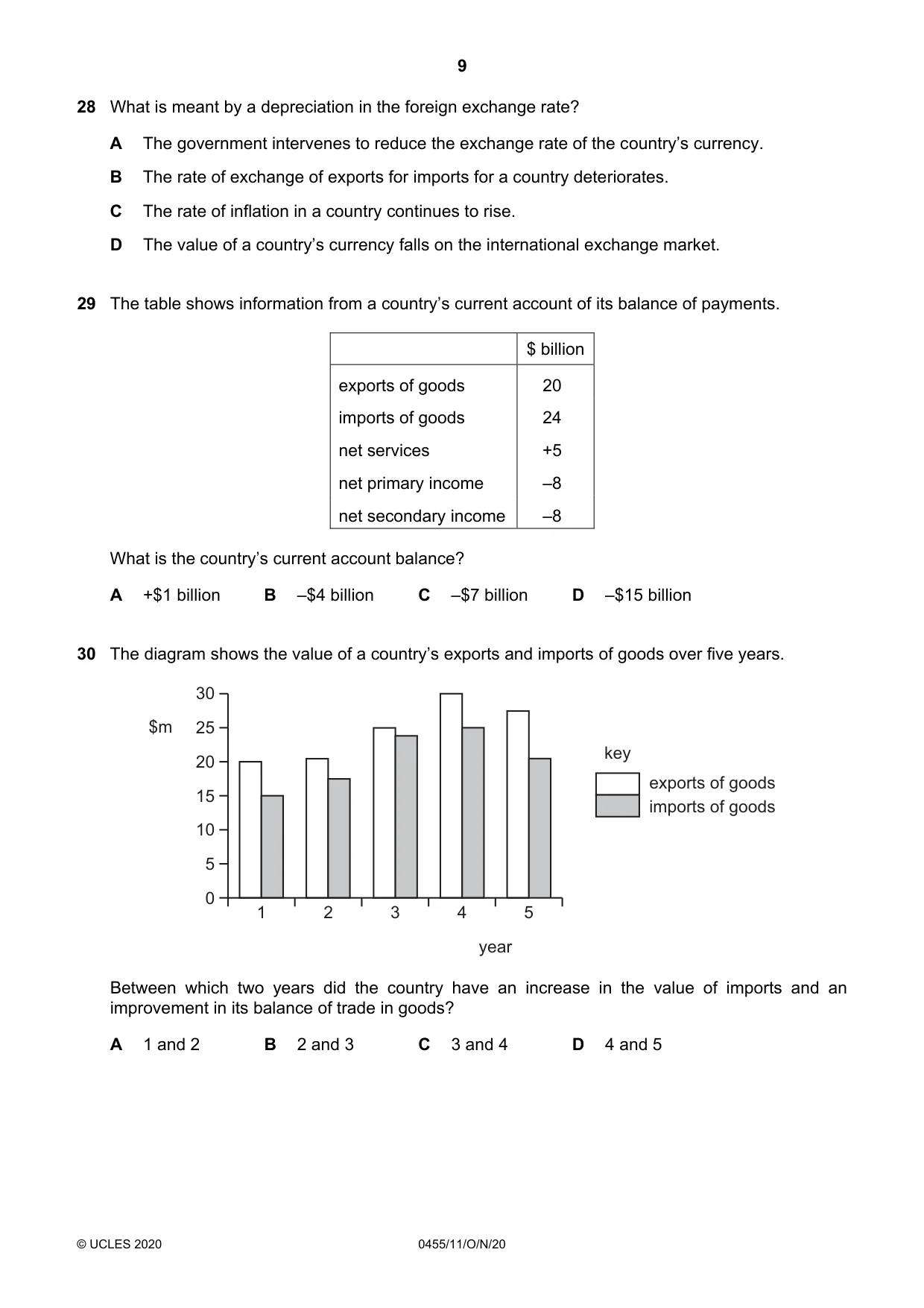


Mark scheme3 pages
Answers below. Sit the paper first if you are practising.
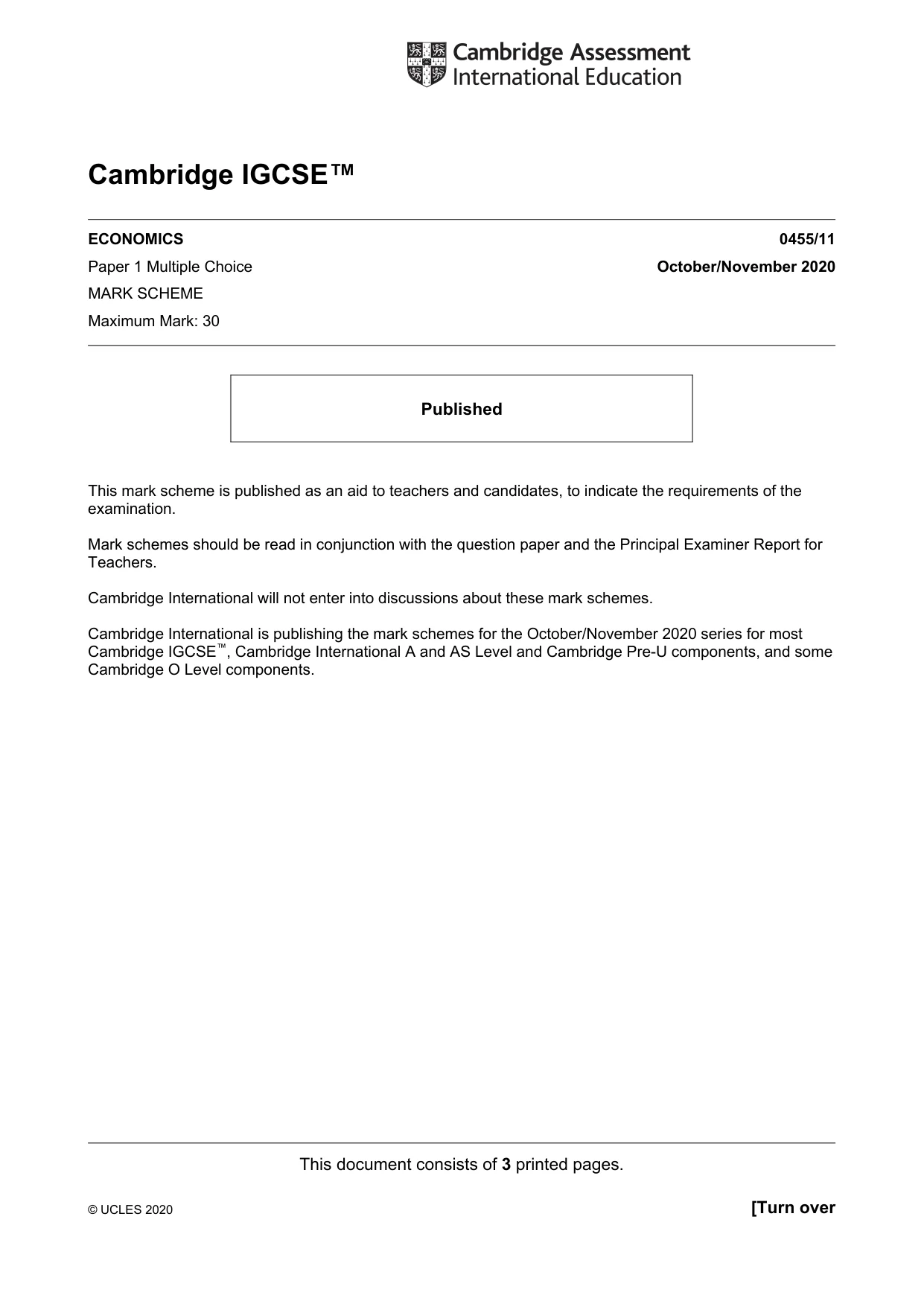
Questions as text
Q1 · What is the basic economic problem?
1 What is the basic economic problem? A excess supply of goods and services B lack of profits C recession D scarcity of resources
Mark scheme: D
Q2 · On which factor of production does innovation directly depend?
2 On which factor of production does innovation directly depend? A decisions of entrepreneurs B high inputs of capital C long hours of manual labour D plentiful supplies of land
Mark scheme: A
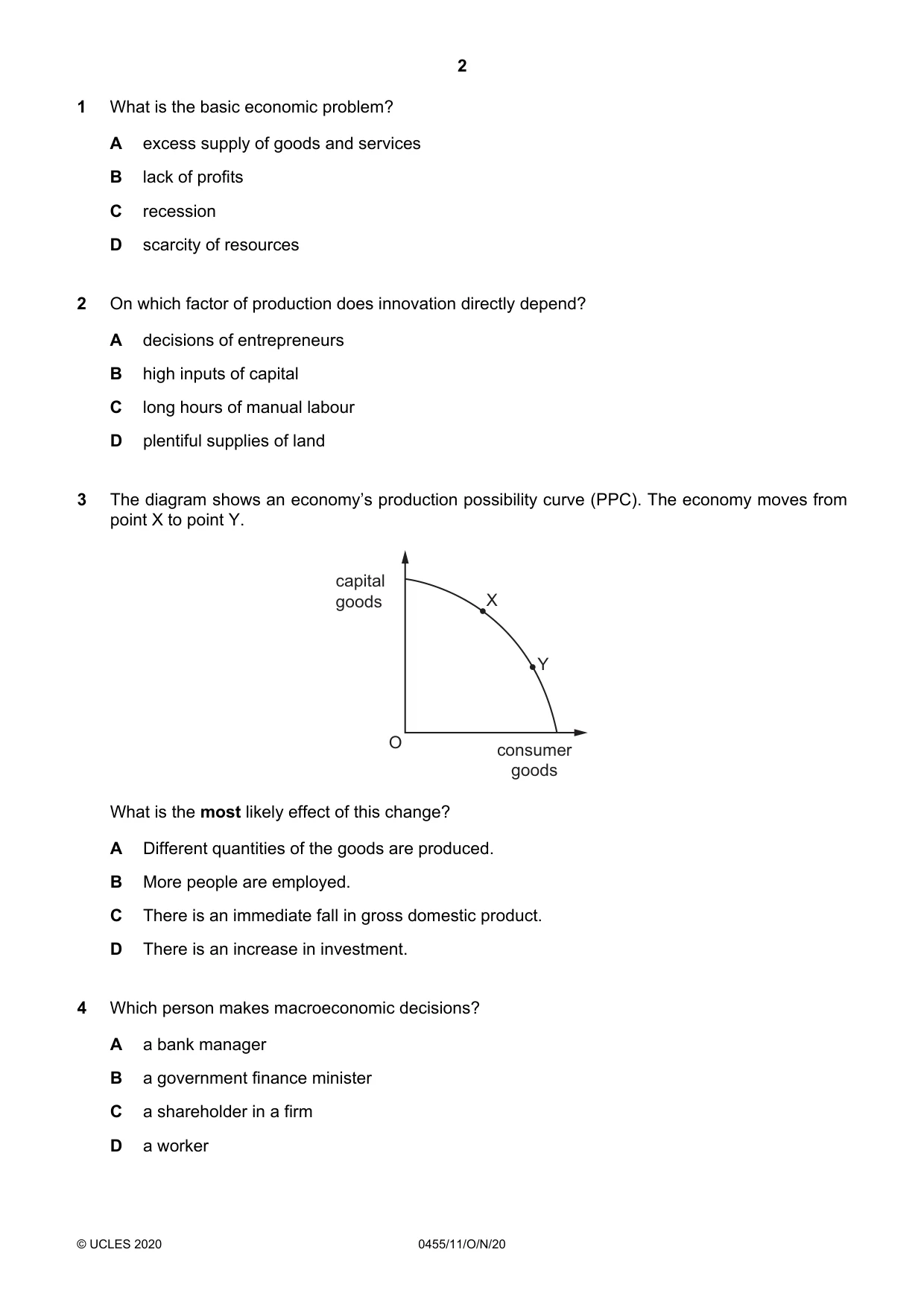
Q3 · The diagram shows an economy’s production possibility curve (PPC)
3 The diagram shows an economy’s production possibility curve (PPC). The economy moves from point X to point Y. capital goods X Y O consumer goods What is the most likely effect of this change? A Different quantities of the goods are produced. B More people are employed. C There is an immediate fall in gross domestic product. D There is an increase in investment.
Mark scheme: A
More questions on Production possibility curve (PPC) diagrams
Q4 · Which person makes macroeconomic decisions?
4 Which person makes macroeconomic decisions? A a bank manager B a government finance minister C a shareholder in a firm D a worker
Mark scheme: B
Q5 · What is a function of the price mechanism?
5 What is a function of the price mechanism? A to allocate goods and services B to calculate national expenditure C to ensure an equal distribution of income D to guide government policy decisions
Mark scheme: A
More questions on The role of markets in allocating resources
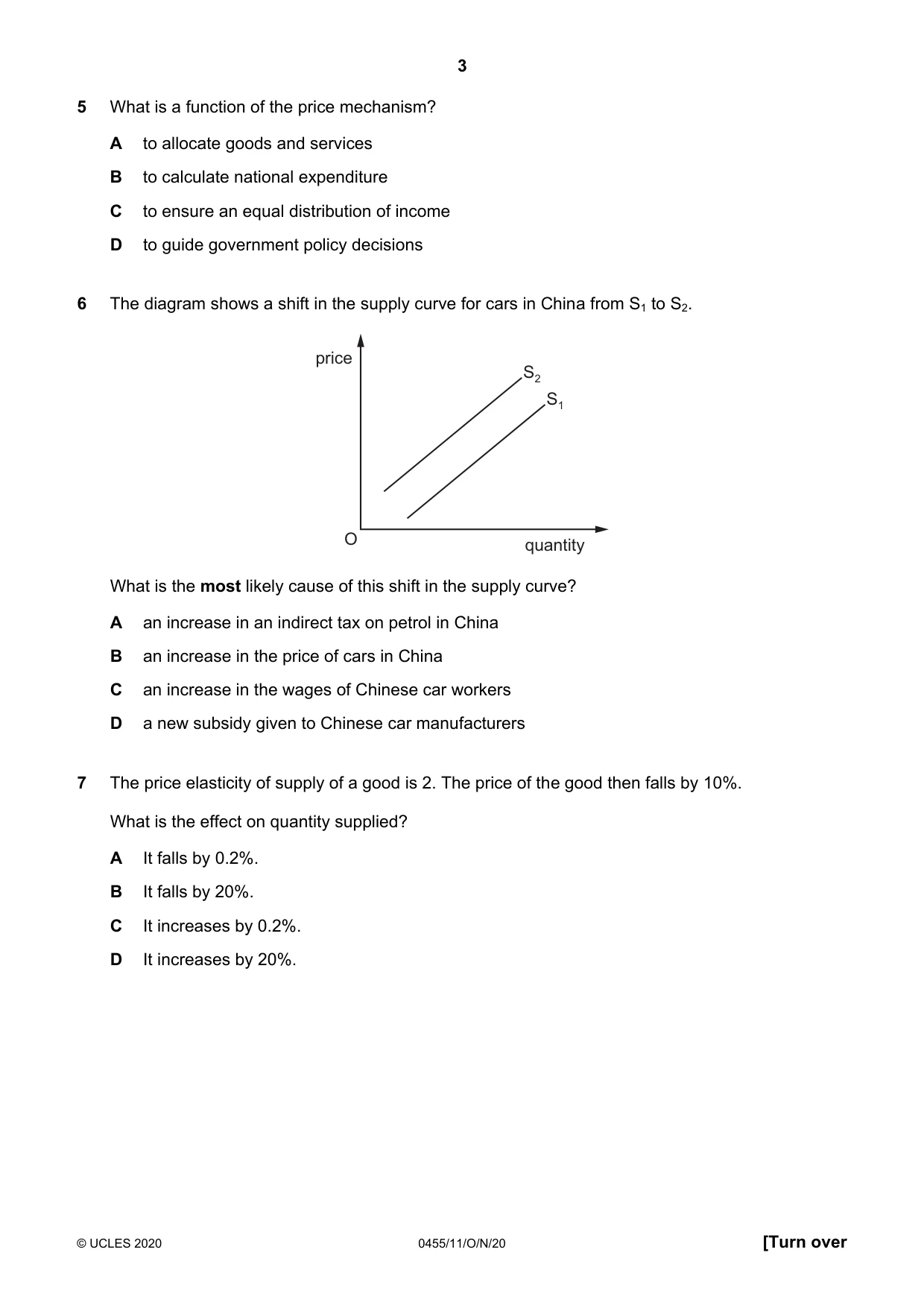
Q6 · The diagram shows a shift in the supply curve for cars in China from S1 to S2
6 The diagram shows a shift in the supply curve for cars in China from S1 to S2. price S2 S1 O quantity What is the most likely cause of this shift in the supply curve? A an increase in an indirect tax on petrol in China B an increase in the price of cars in China C an increase in the wages of Chinese car workers D a new subsidy given to Chinese car manufacturers
Mark scheme: C
Q7 · The price elasticity of supply of a good is 2
7 The price elasticity of supply of a good is 2. The price of the good then falls by 10%. What is the effect on quantity supplied? A It falls by 0.2%. B It falls by 20%. C It increases by 0.2%. D It increases by 20%.
Mark scheme: B
Q8 · A German car manufacturer builds a factory in India
8 A German car manufacturer builds a factory in India. A group of Indian workers at the factory join a trade union. What would this trade union be expected to do for the workers? A Encourage the workers to bargain individually with the employer. B Negotiate with the German government on tariff reductions for Indian-produced cars. C Promote an advertising campaign to sell more Indian cars. D Protect the workers against unfair dismissal by the employer.
Mark scheme: D
Q9 · Why do women, on average, earn less than men?
9 Why do women, on average, earn less than men? A Women may be less able than men. B Women are not eligible for government jobs. C Women may not work as hard as men. D Women often face discrimination in the workplace.
Mark scheme: D
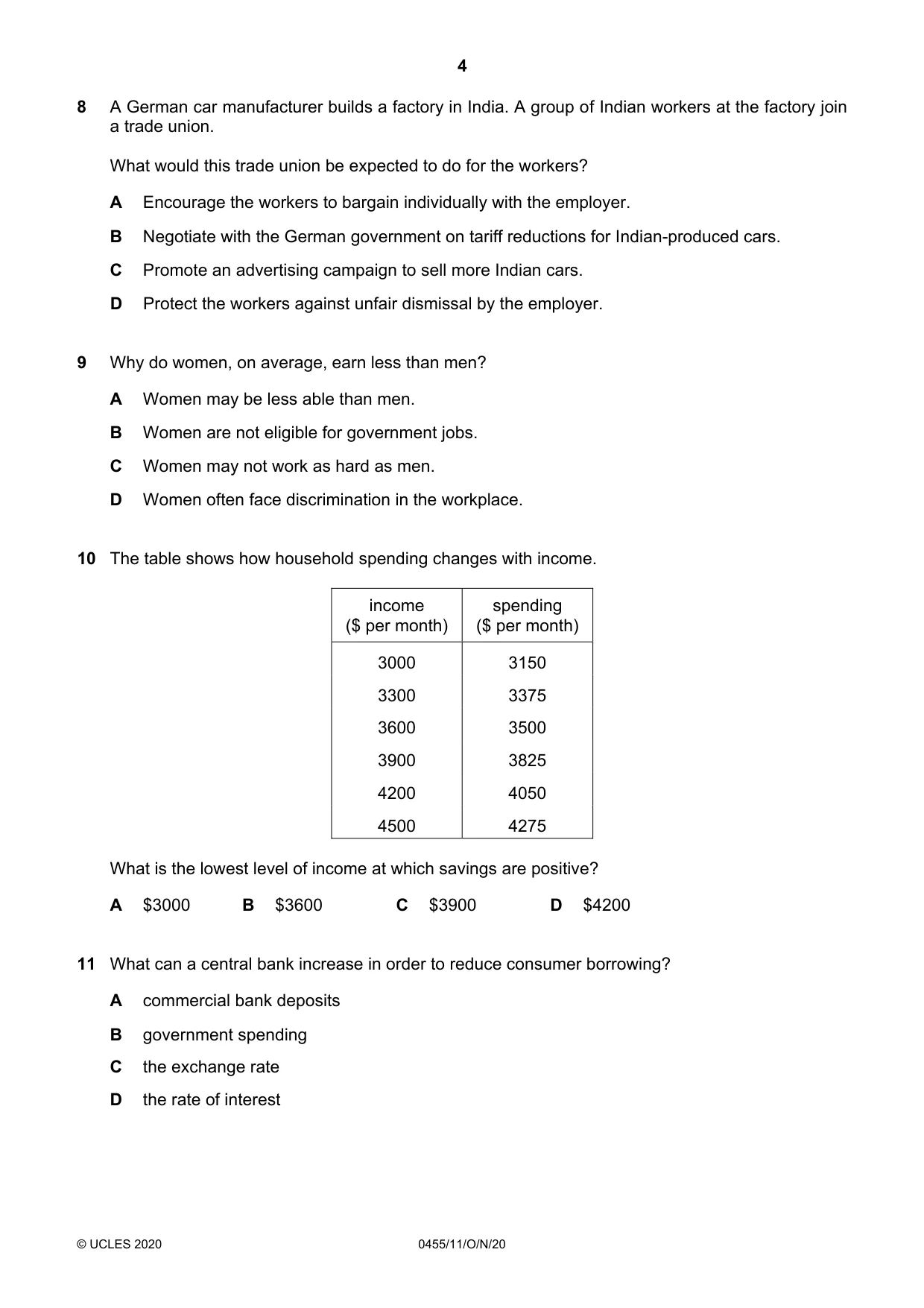
Q10 · The table shows how household spending changes with income
10 The table shows how household spending changes with income. income spending ($ per month) ($ per month) 3000 3150 3300 3375 3600 3500 3900 3825 4200 4050 4500 4275 What is the lowest level of income at which savings are positive? A $3000 B $3600 C $3900 D $4200
Mark scheme: B
Q11 · What can a central bank increase in order to reduce consumer borrowing?
11 What can a central bank increase in order to reduce consumer borrowing? A commercial bank deposits B government spending C the exchange rate D the rate of interest
Mark scheme: D
Q12 · In the short run, a firm calculates its total fixed cost, total variable cost and total…
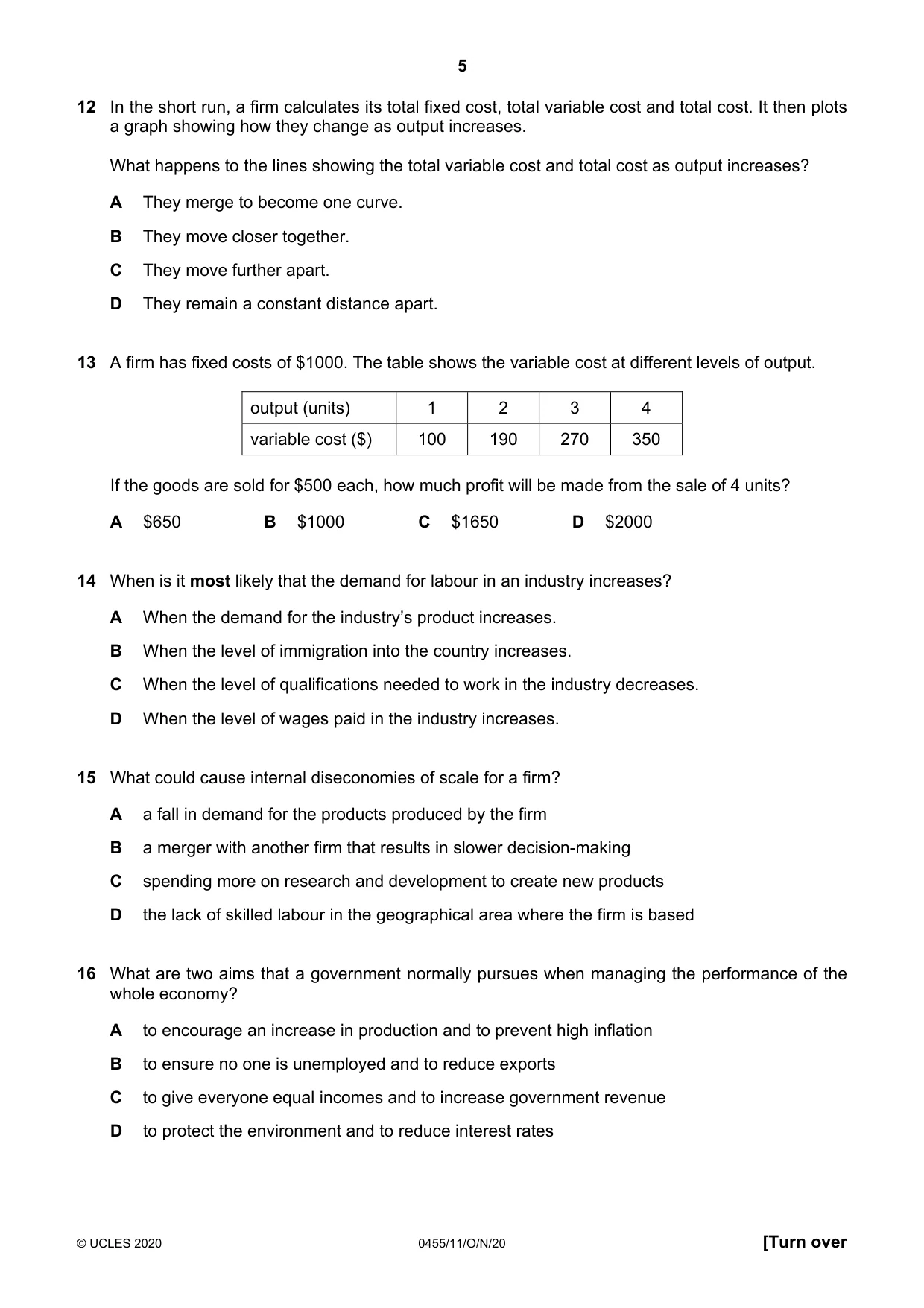
12 In the short run, a firm calculates its total fixed cost, total variable cost and total cost. It then plots a graph showing how they change as output increases. What happens to the lines showing the total variable cost and total cost as output increases? A They merge to become one curve. B They move closer together. C They move further apart. D They remain a constant distance apart.
Mark scheme: D
Q13 · A firm has fixed costs of $1000
13 A firm has fixed costs of $1000. The table shows the variable cost at different levels of output. output (units) 1 2 3 4 variable cost ($) 100 190 270 350 If the goods are sold for $500 each, how much profit will be made from the sale of 4 units? A $650 B $1000 C $1650 D $2000
Mark scheme: A
Q14 · When is it most likely that the demand for labour in an industry increases?
14 When is it most likely that the demand for labour in an industry increases? A When the demand for the industry’s product increases. B When the level of immigration into the country increases. C When the level of qualifications needed to work in the industry decreases. D When the level of wages paid in the industry increases.
Mark scheme: A
Q15 · What could cause internal diseconomies of scale for a firm?
15 What could cause internal diseconomies of scale for a firm? A a fall in demand for the products produced by the firm B a merger with another firm that results in slower decision-making C spending more on research and development to create new products D the lack of skilled labour in the geographical area where the firm is based
Mark scheme: B
Q16 · What are two aims that a government normally pursues when managing the performance of the…
16 What are two aims that a government normally pursues when managing the performance of the whole economy? A to encourage an increase in production and to prevent high inflation B to ensure no one is unemployed and to reduce exports C to give everyone equal incomes and to increase government revenue D to protect the environment and to reduce interest rates
Mark scheme: A
Q17 · What is most likely to be the responsibility of a central government?
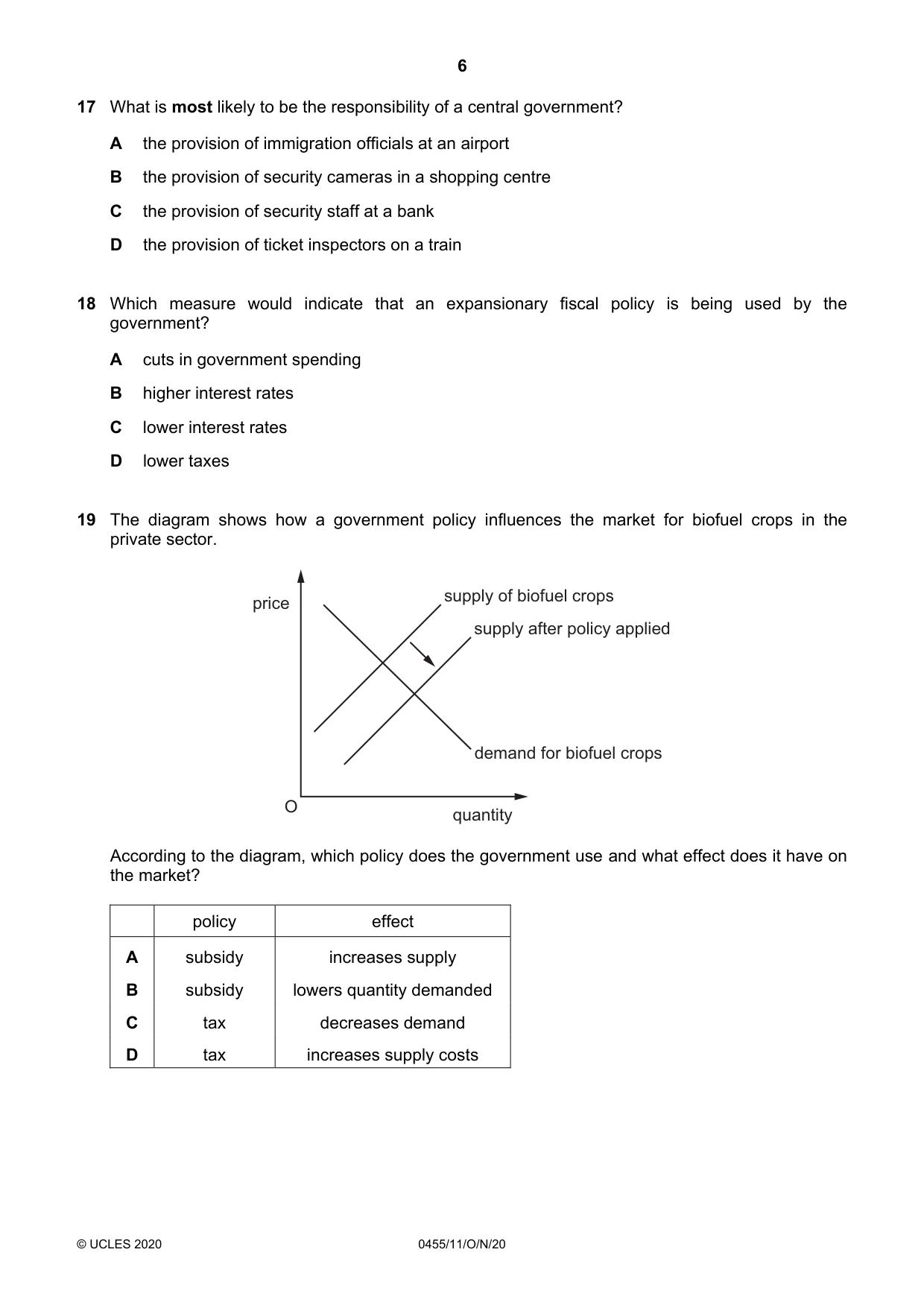
17 What is most likely to be the responsibility of a central government? A the provision of immigration officials at an airport B the provision of security cameras in a shopping centre C the provision of security staff at a bank D the provision of ticket inspectors on a train
Mark scheme: A
Q18 · Which measure would indicate that an expansionary fiscal policy is being used by the…
18 Which measure would indicate that an expansionary fiscal policy is being used by the government? A cuts in government spending B higher interest rates C lower interest rates D lower taxes
Mark scheme: D
Q19 · The diagram shows how a government policy influences the market for biofuel crops in the…
19 The diagram shows how a government policy influences the market for biofuel crops in the private sector. price supply of biofuel crops supply after policy applied demand for biofuel crops O quantity According to the diagram, which policy does the government use and what effect does it have on the market? policy effect A subsidy increases supply B subsidy lowers quantity demanded C tax decreases demand D tax increases supply costs
Mark scheme: A
Q20 · Some governments in the European Union are trying to reduce unemployment
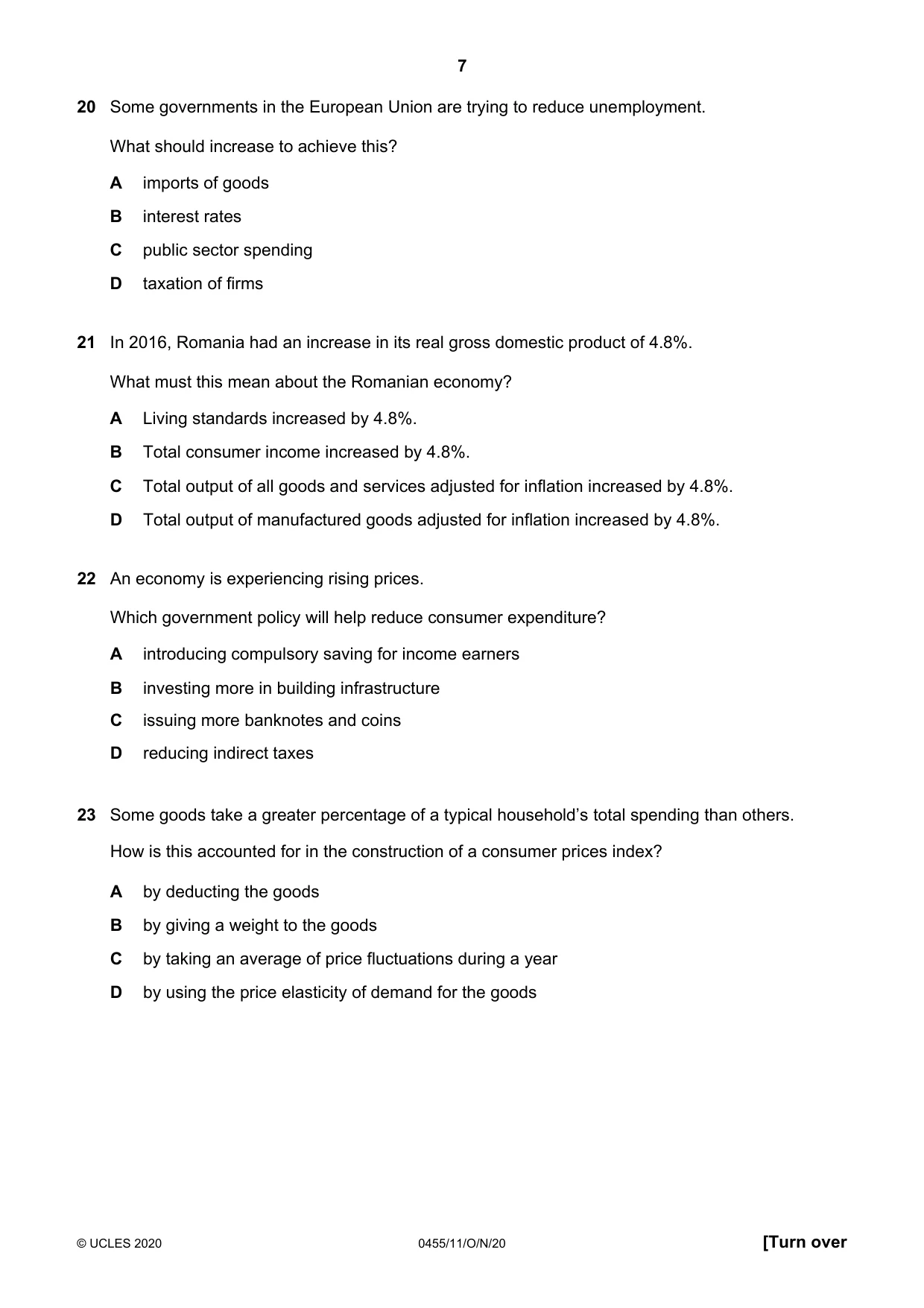
20 Some governments in the European Union are trying to reduce unemployment. What should increase to achieve this? A imports of goods B interest rates C public sector spending D taxation of firms
Mark scheme: C
Q21 · In 2016, Romania had an increase in its real gross domestic product of 4.8%
21 In 2016, Romania had an increase in its real gross domestic product of 4.8%. What must this mean about the Romanian economy? A Living standards increased by 4.8%. B Total consumer income increased by 4.8%. C Total output of all goods and services adjusted for inflation increased by 4.8%. D Total output of manufactured goods adjusted for inflation increased by 4.8%.
Mark scheme: C
Q22 · An economy is experiencing rising prices
22 An economy is experiencing rising prices. Which government policy will help reduce consumer expenditure? A introducing compulsory saving for income earners B investing more in building infrastructure C issuing more banknotes and coins D reducing indirect taxes
Mark scheme: A
Q23 · Some goods take a greater percentage of a typical household’s total spending than others
23 Some goods take a greater percentage of a typical household’s total spending than others. How is this accounted for in the construction of a consumer prices index? A by deducting the goods B by giving a weight to the goods C by taking an average of price fluctuations during a year D by using the price elasticity of demand for the goods
Mark scheme: B
Q24 · A low-income country experiences extreme poverty in its rural areas
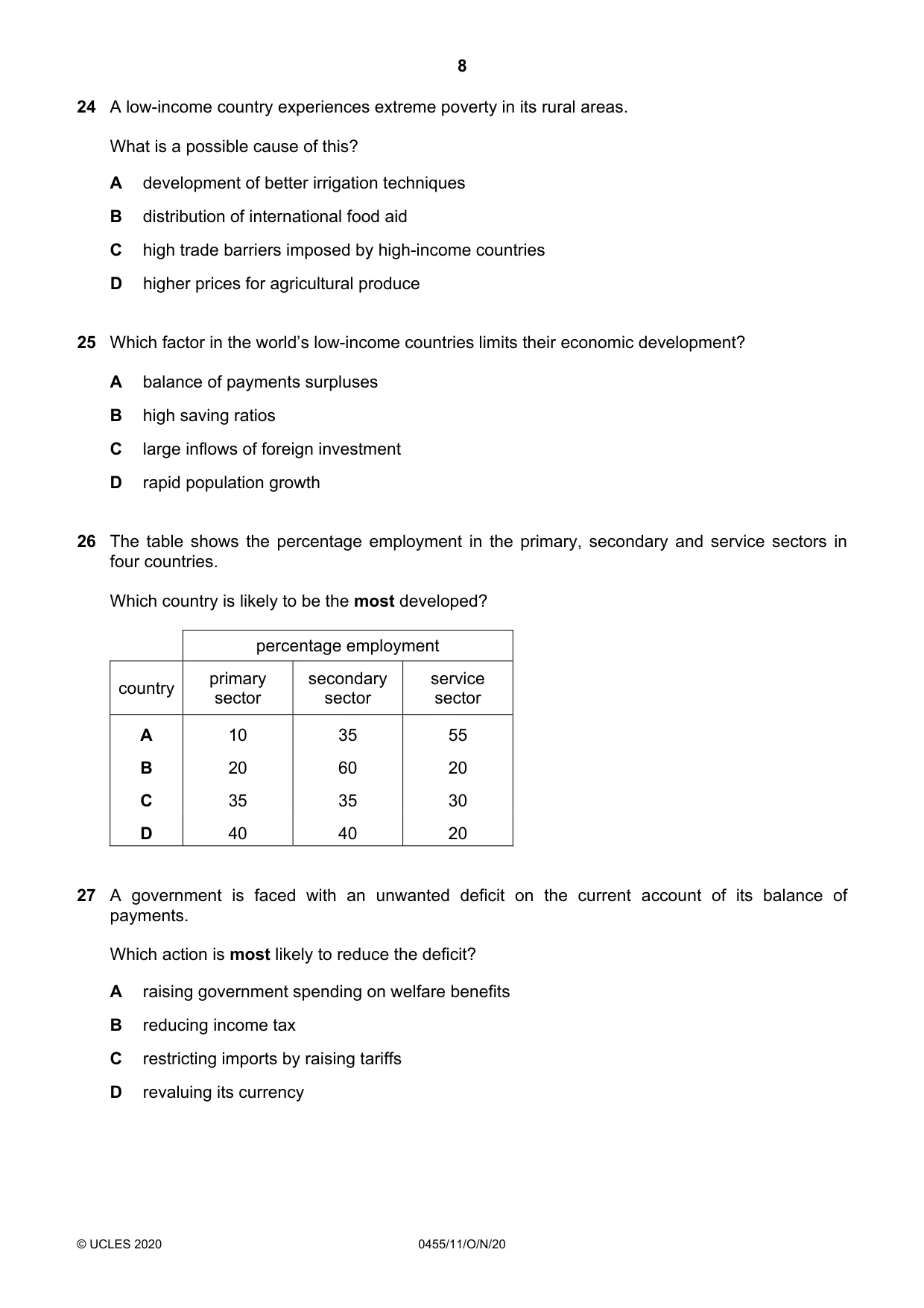
24 A low-income country experiences extreme poverty in its rural areas. What is a possible cause of this? A development of better irrigation techniques B distribution of international food aid C high trade barriers imposed by high-income countries D higher prices for agricultural produce
Mark scheme: C
Q25 · Which factor in the world’s low-income countries limits their economic development?
25 Which factor in the world’s low-income countries limits their economic development? A balance of payments surpluses B high saving ratios C large inflows of foreign investment D rapid population growth
Mark scheme: D
More questions on Differences in economic development between countries
Q26 · The table shows the percentage employment in the primary, secondary and service sectors…
26 The table shows the percentage employment in the primary, secondary and service sectors in four countries. Which country is likely to be the most developed? percentage employment primary secondary service country sector sector sector A 10 35 55 B 20 60 20 C 35 35 30 D 40 40 20
Mark scheme: A
More questions on Differences in economic development between countries
Q27 · A government is faced with an unwanted deficit on the current account of its balance of…
27 A government is faced with an unwanted deficit on the current account of its balance of payments. Which action is most likely to reduce the deficit? A raising government spending on welfare benefits B reducing income tax C restricting imports by raising tariffs D revaluing its currency
Mark scheme: C
Q28 · What is meant by a depreciation in the foreign exchange rate?
28 What is meant by a depreciation in the foreign exchange rate? A The government intervenes to reduce the exchange rate of the country’s currency. B The rate of exchange of exports for imports for a country deteriorates. C The rate of inflation in a country continues to rise. D The value of a country’s currency falls on the international exchange market.
Mark scheme: D
Q29 · The table shows information from a country’s current account of its balance of payments
29 The table shows information from a country’s current account of its balance of payments. $ billion exports of goods 20 imports of goods 24 net services +5 net primary income –8 net secondary income –8 What is the country’s current account balance? A +$1 billion B –$4 billion C –$7 billion D –$15 billion
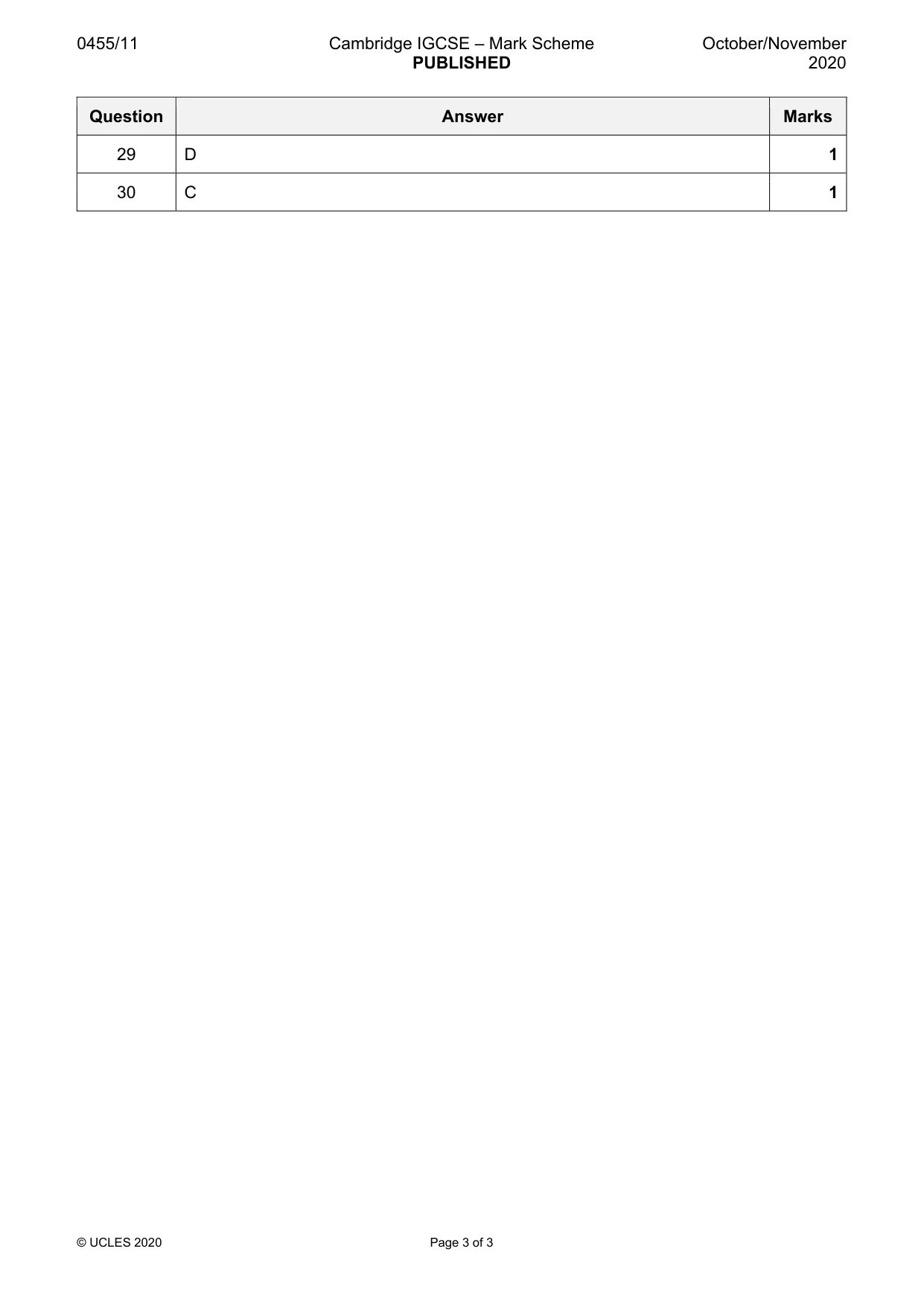
Mark scheme: D
Q30 · The diagram shows the value of a country’s exports and imports of goods over five years
30 The diagram shows the value of a country’s exports and imports of goods over five years. 30 $m 25 key 20 exports of goods 15 imports of goods 10 5 0 1 2 3 4 5 year Between which two years did the country have an increase in the value of imports and an improvement in its balance of trade in goods? A 1 and 2 B 2 and 3 C 3 and 4 D 4 and 5
Mark scheme: C
What was in this paper
The subtopics covered by these 30 questions, and how many questions each got. Open one in a new tab to see every Cambridge question on it.
3Fiscal policy3Differences in economic development between countries2Firms’ costs, revenue and objectives2Supply2Workers2Economic growth1Firms and production1Foreign exchange rates1Households1Inflation and deflation1Microeconomics and macroeconomics1Monetary policy1Poverty1Price elasticity of supply (PES)1Production possibility curve (PPC) diagrams1The factors of production1The macroeconomic aims of government1The nature of the economic problem1The role of government1The role of markets in allocating resources1Trade unions1What you needed in this session
Cambridge’s own grade thresholds for 2020 Oct/Nov, Paper 1 · Variant 1. A higher threshold means an easier paper — the bar moves with how the cohort did.