Cambridge IGCSE Economics 0455 — 2022 May/June Paper 1 · Variant 3
0455/13/M/J/22 · 30 questions · 30 marks · ≈34 min
The question paper and its mark scheme, free to read here and free to download. This is Cambridge’s own paper, exactly as it was sat.
Question paper12 pages

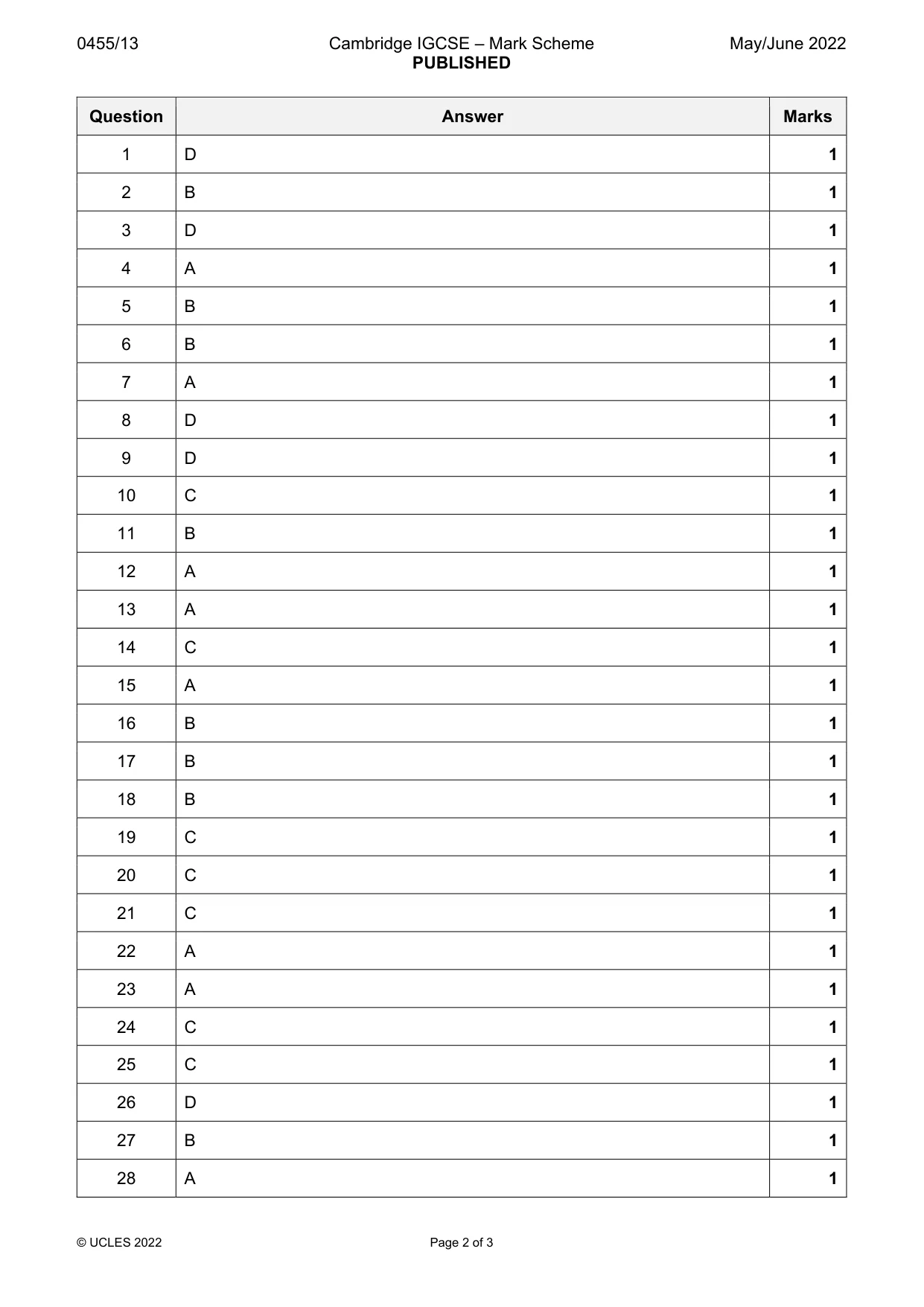
Mark scheme3 pages
Answers below. Sit the paper first if you are practising.
Questions as text
Q1 · Which factor has the correct factor reward identified?
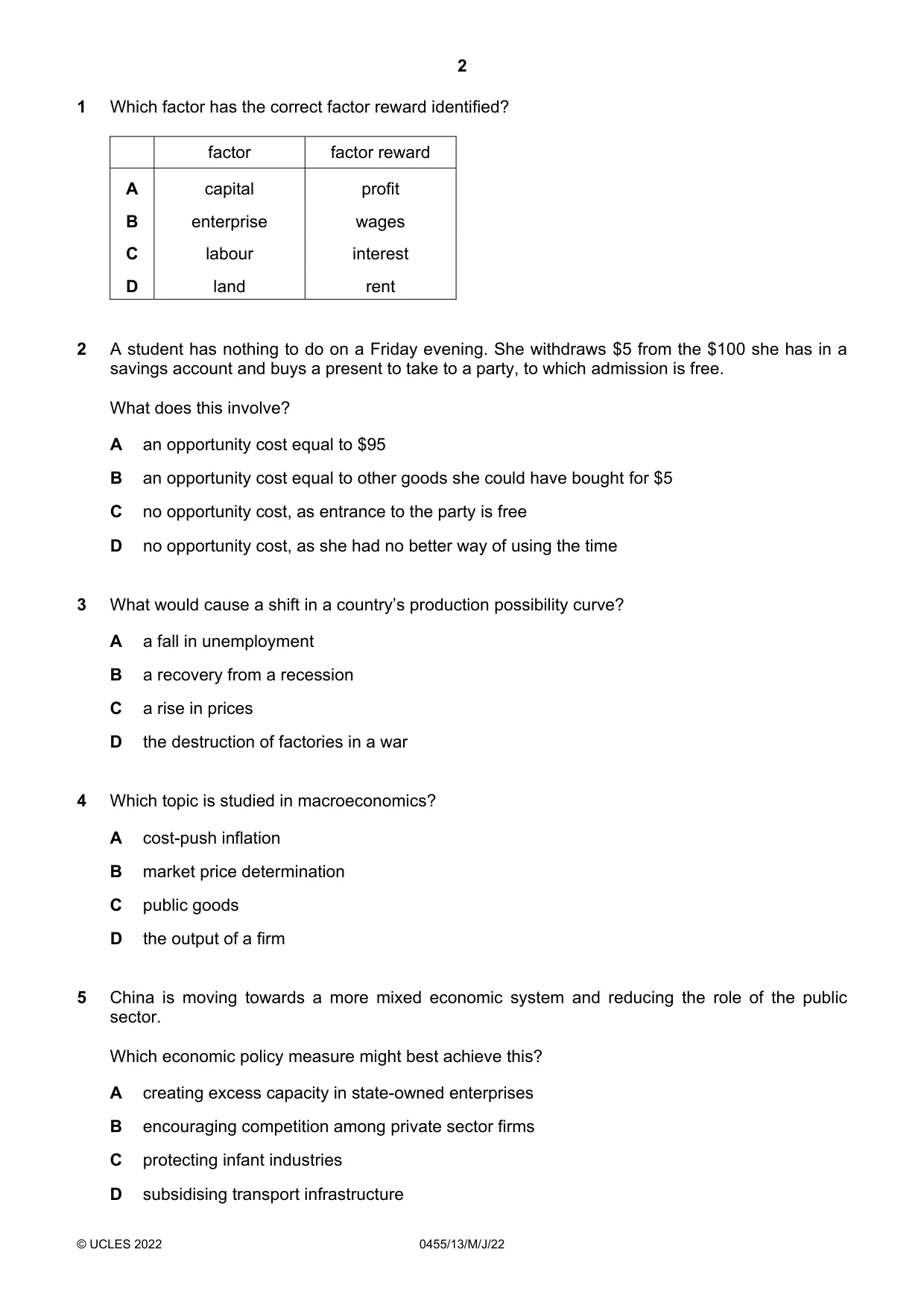
1 Which factor has the correct factor reward identified? factor factor reward A capital profit B enterprise wages C labour interest D land rent
Mark scheme: D
Q2 · A student has nothing to do on a Friday evening
2 A student has nothing to do on a Friday evening. She withdraws $5 from the $100 she has in a savings account and buys a present to take to a party, to which admission is free. What does this involve? A an opportunity cost equal to $95 B an opportunity cost equal to other goods she could have bought for $5 C no opportunity cost, as entrance to the party is free D no opportunity cost, as she had no better way of using the time
Mark scheme: B
Q3 · What would cause a shift in a country’s production possibility curve?
3 What would cause a shift in a country’s production possibility curve? A a fall in unemployment B a recovery from a recession C a rise in prices D the destruction of factories in a war
Mark scheme: D
More questions on Production possibility curve (PPC) diagrams
Q4 · Which topic is studied in macroeconomics?
4 Which topic is studied in macroeconomics? A cost-push inflation B market price determination C public goods D the output of a firm
Mark scheme: A
Q5 · China is moving towards a more mixed economic system and reducing the role of the public…
5 China is moving towards a more mixed economic system and reducing the role of the public sector. Which economic policy measure might best achieve this? A creating excess capacity in state-owned enterprises B encouraging competition among private sector firms C protecting infant industries D subsidising transport infrastructure
Mark scheme: B
Q6 · The diagram shows the supply and demand for a product
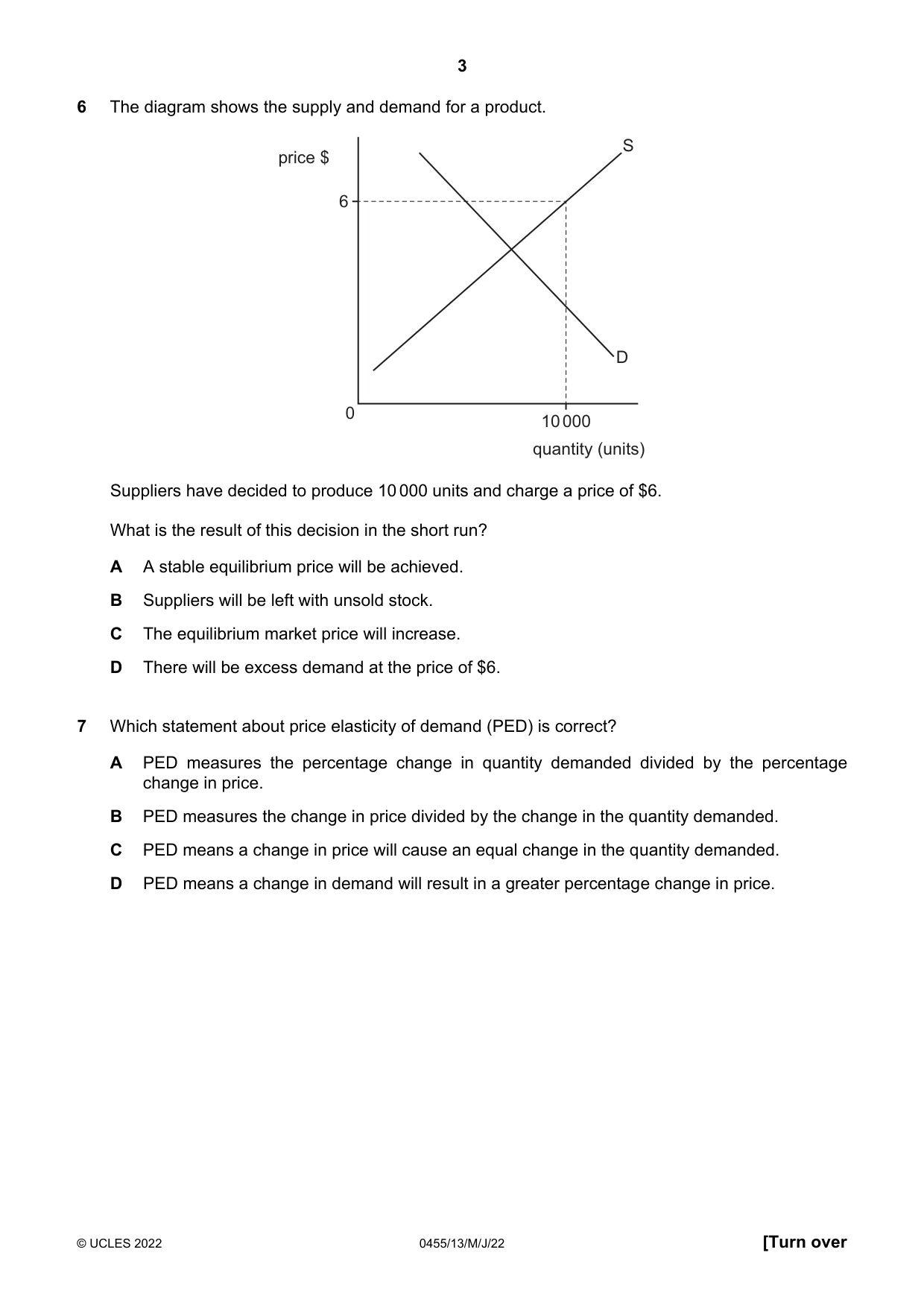
6 The diagram shows the supply and demand for a product. S price $ 6 D 0 10 000 quantity (units) Suppliers have decided to produce 10 000 units and charge a price of $6. What is the result of this decision in the short run? A A stable equilibrium price will be achieved. B Suppliers will be left with unsold stock. C The equilibrium market price will increase. D There will be excess demand at the price of $6.
Mark scheme: B
Q7 · Which statement about price elasticity of demand (PED) is correct?
7 Which statement about price elasticity of demand (PED) is correct? A PED measures the percentage change in quantity demanded divided by the percentage change in price. B PED measures the change in price divided by the change in the quantity demanded. C PED means a change in price will cause an equal change in the quantity demanded. D PED means a change in demand will result in a greater percentage change in price.
Mark scheme: A
Q8 · A manufacturer of tinned beans mechanises its assembly line
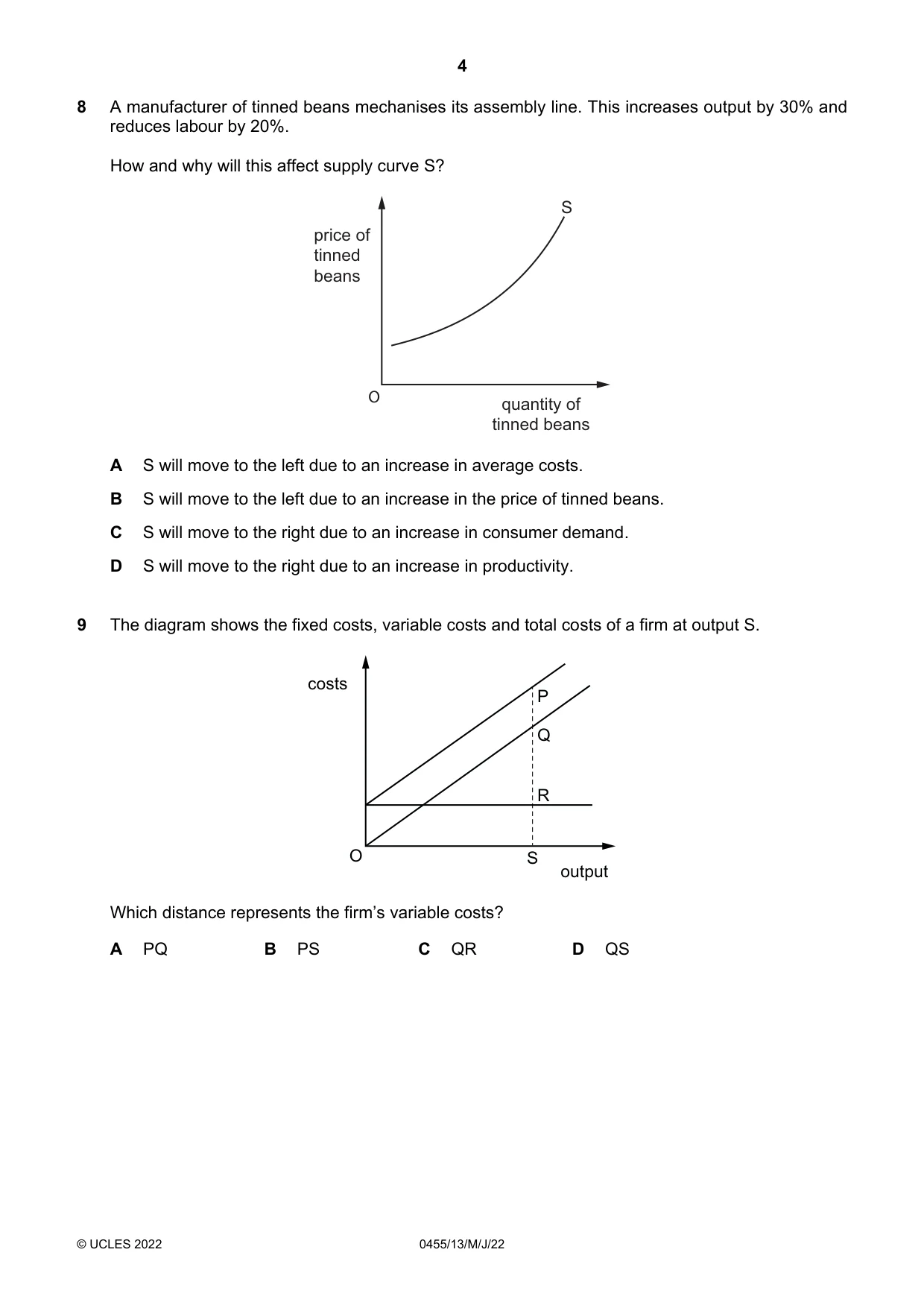
8 A manufacturer of tinned beans mechanises its assembly line. This increases output by 30% and reduces labour by 20%. How and why will this affect supply curve S? S price of tinned beans O quantity of tinned beans A S will move to the left due to an increase in average costs. B S will move to the left due to an increase in the price of tinned beans. C S will move to the right due to an increase in consumer demand. D S will move to the right due to an increase in productivity.
Mark scheme: D
Q9 · The diagram shows the fixed costs, variable costs and total costs of a firm at output S
9 The diagram shows the fixed costs, variable costs and total costs of a firm at output S. costs P Q R O S output Which distance represents the firm’s variable costs? A PQ B PS C QR D QS
Mark scheme: D
Q10 · A cinema has 500 seats
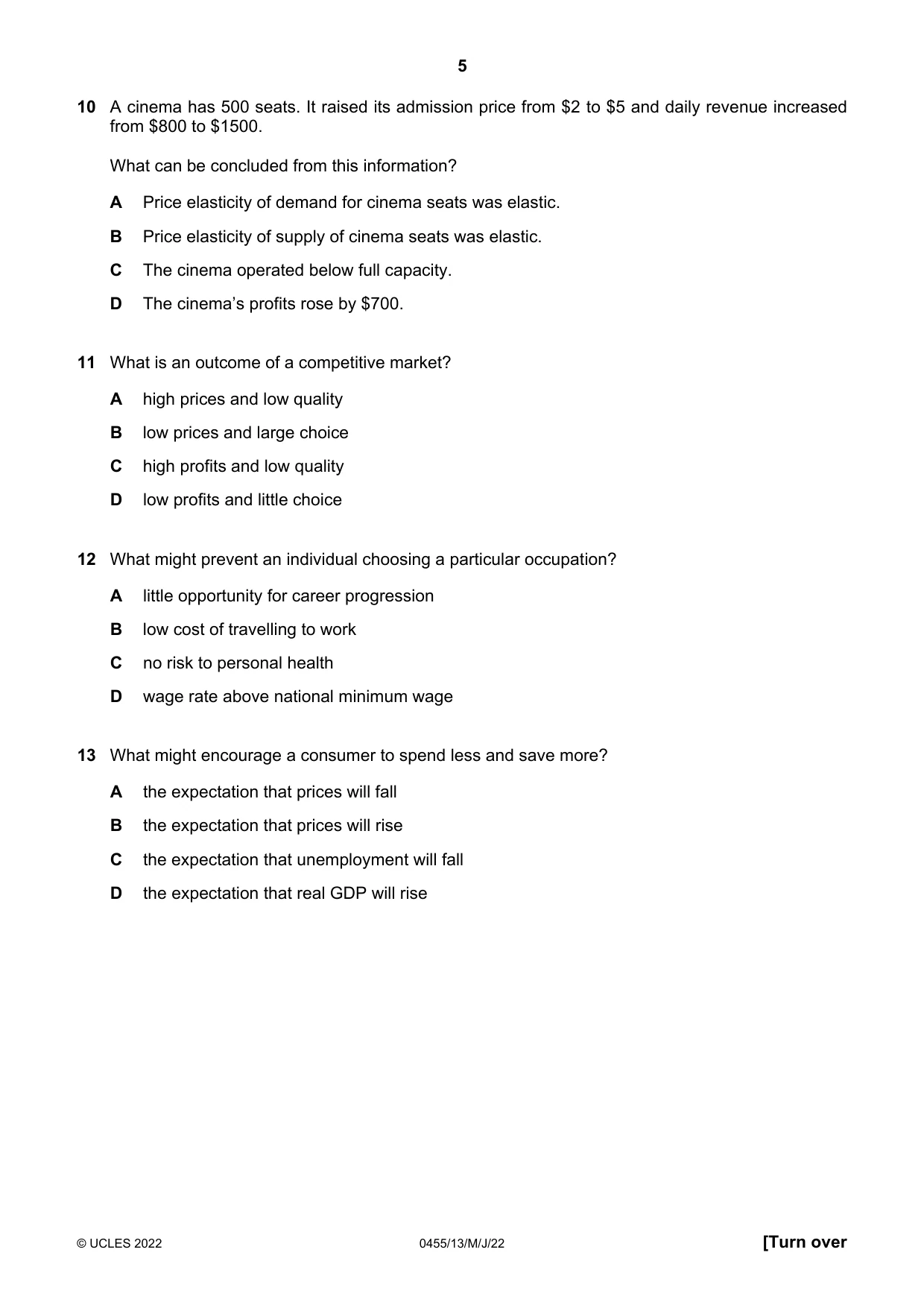
10 A cinema has 500 seats. It raised its admission price from $2 to $5 and daily revenue increased from $800 to $1500. What can be concluded from this information? A Price elasticity of demand for cinema seats was elastic. B Price elasticity of supply of cinema seats was elastic. C The cinema operated below full capacity. D The cinema’s profits rose by $700.
Mark scheme: C
Q11 · What is an outcome of a competitive market?
11 What is an outcome of a competitive market? A high prices and low quality B low prices and large choice C high profits and low quality D low profits and little choice
Mark scheme: B
Q12 · What might prevent an individual choosing a particular occupation?
12 What might prevent an individual choosing a particular occupation? A little opportunity for career progression B low cost of travelling to work C no risk to personal health D wage rate above national minimum wage
Mark scheme: A
Q13 · What might encourage a consumer to spend less and save more?
13 What might encourage a consumer to spend less and save more? A the expectation that prices will fall B the expectation that prices will rise C the expectation that unemployment will fall D the expectation that real GDP will rise
Mark scheme: A
Q14 · The table shows how three people, X, Y and Z, spend their income
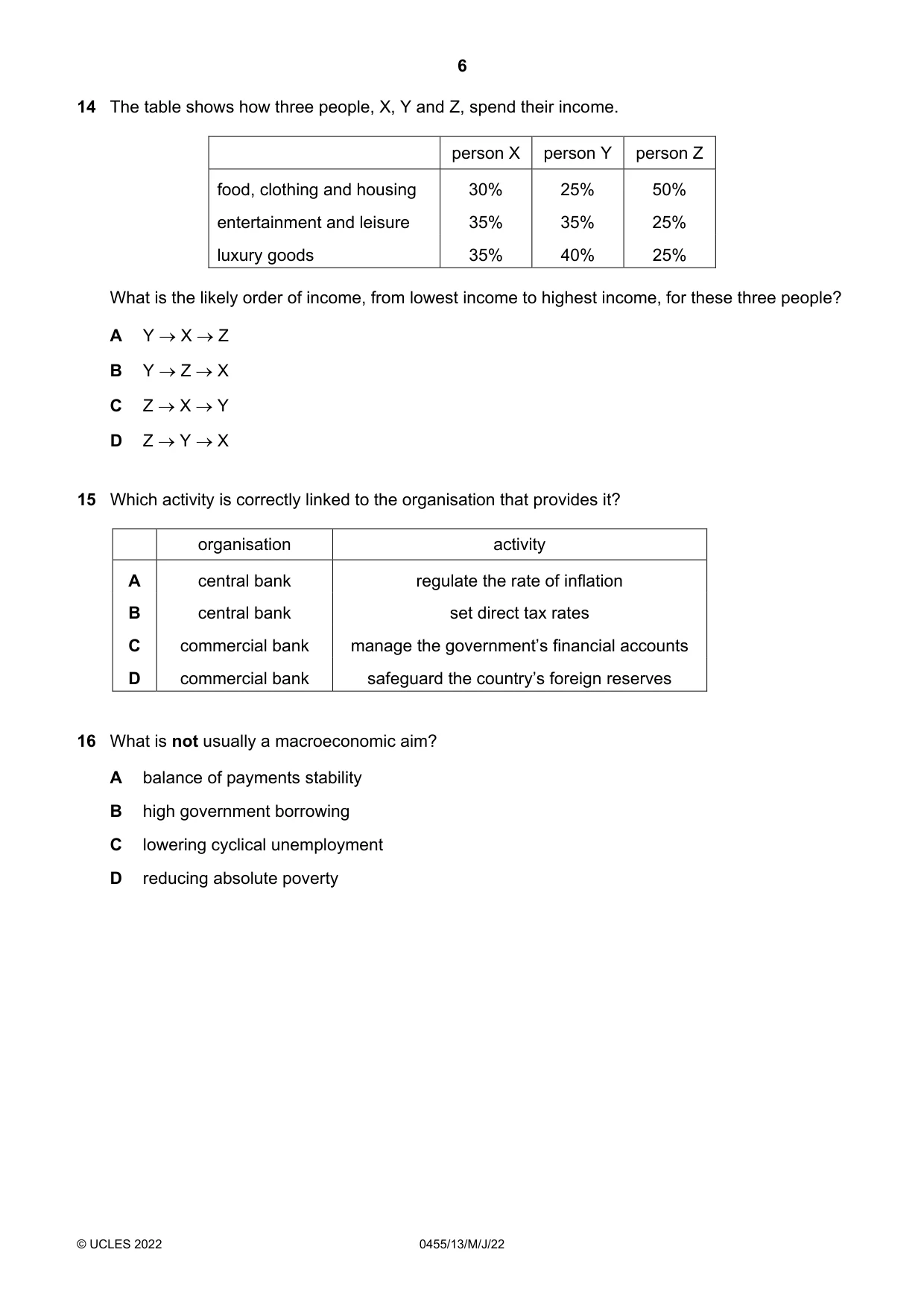
14 The table shows how three people, X, Y and Z, spend their income. person X person Y person Z food, clothing and housing 30% 25% 50% entertainment and leisure 35% 35% 25% luxury goods 35% 40% 25% What is the likely order of income, from lowest income to highest income, for these three people? A Y X Z B Y Z X C Z X Y D Z Y X
Mark scheme: C
Q15 · Which activity is correctly linked to the organisation that provides it?
15 Which activity is correctly linked to the organisation that provides it? organisation activity A central bank regulate the rate of inflation B central bank set direct tax rates C commercial bank manage the government’s financial accounts D commercial bank safeguard the country’s foreign reserves
Mark scheme: A
Q16 · What is not usually a macroeconomic aim?
16 What is not usually a macroeconomic aim? A balance of payments stability B high government borrowing C lowering cyclical unemployment D reducing absolute poverty
Mark scheme: B
Q17 · A government decides to increase the indirect tax on petrol
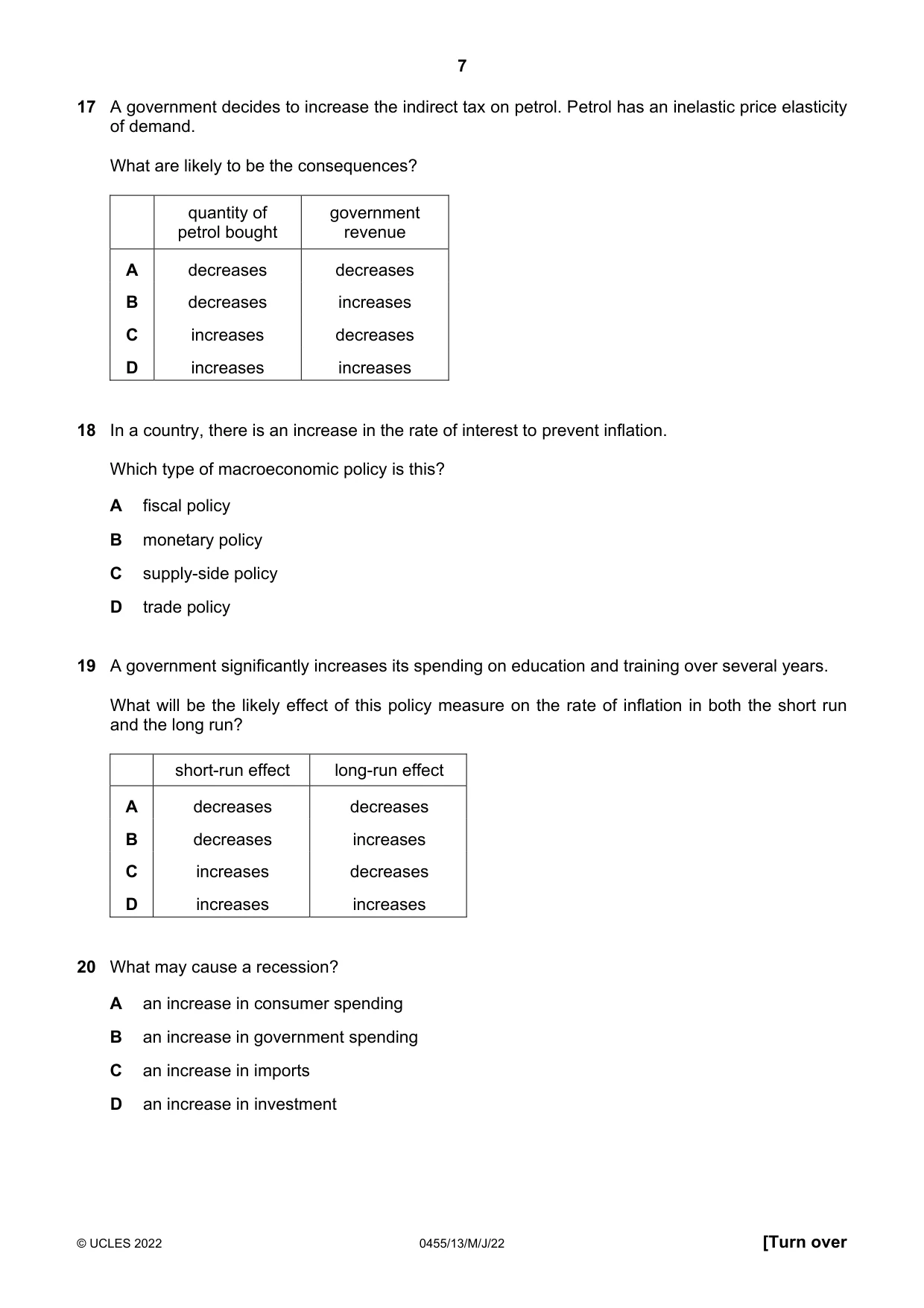
17 A government decides to increase the indirect tax on petrol. Petrol has an inelastic price elasticity of demand. What are likely to be the consequences? quantity of government petrol bought revenue A decreases decreases B decreases increases C increases decreases D increases increases
Mark scheme: B
Q18 · In a country, there is an increase in the rate of interest to prevent inflation
18 In a country, there is an increase in the rate of interest to prevent inflation. Which type of macroeconomic policy is this? A fiscal policy B monetary policy C supply-side policy D trade policy
Mark scheme: B
Q19 · A government significantly increases its spending on education and training over several…
19 A government significantly increases its spending on education and training over several years. What will be the likely effect of this policy measure on the rate of inflation in both the short run and the long run? short-run effect long-run effect A decreases decreases B decreases increases C increases decreases D increases increases
Mark scheme: C
Q20 · What may cause a recession?
20 What may cause a recession? A an increase in consumer spending B an increase in government spending C an increase in imports D an increase in investment
Mark scheme: C
Q21 · Why might the macroeconomic aim of full employment conflict with the aim of stable prices?
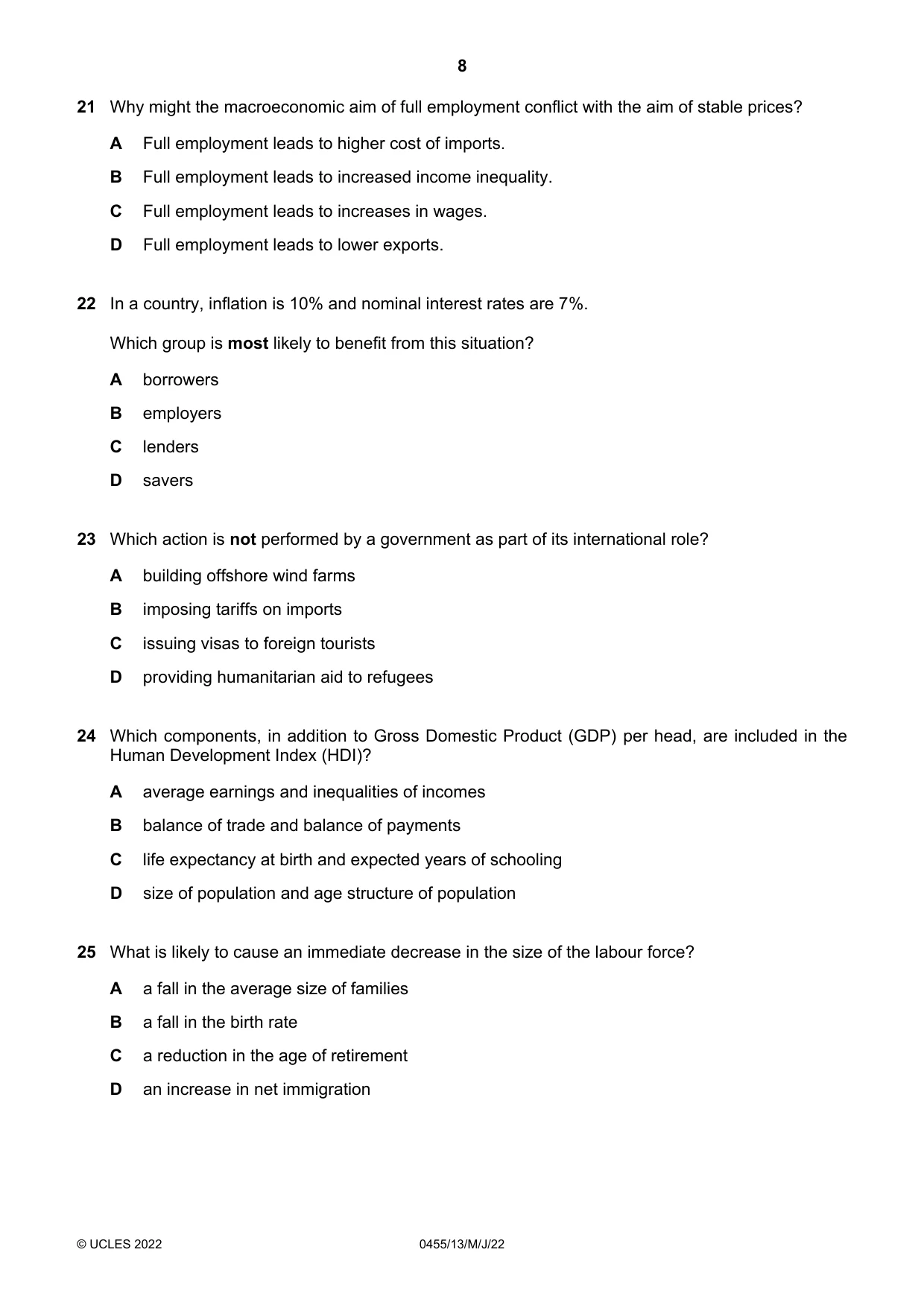
21 Why might the macroeconomic aim of full employment conflict with the aim of stable prices? A Full employment leads to higher cost of imports. B Full employment leads to increased income inequality. C Full employment leads to increases in wages. D Full employment leads to lower exports.
Mark scheme: C
Q22 · In a country, inflation is 10% and nominal interest rates are 7%
22 In a country, inflation is 10% and nominal interest rates are 7%. Which group is most likely to benefit from this situation? A borrowers B employers C lenders D savers
Mark scheme: A
Q23 · Which action is not performed by a government as part of its international role?
23 Which action is not performed by a government as part of its international role? A building offshore wind farms B imposing tariffs on imports C issuing visas to foreign tourists D providing humanitarian aid to refugees
Mark scheme: A
Q24 · Which components, in addition to Gross Domestic Product (GDP) per head, are included in…
24 Which components, in addition to Gross Domestic Product (GDP) per head, are included in the Human Development Index (HDI)? A average earnings and inequalities of incomes B balance of trade and balance of payments C life expectancy at birth and expected years of schooling D size of population and age structure of population
Mark scheme: C
More questions on Differences in economic development between countries
Q25 · What is likely to cause an immediate decrease in the size of the labour force?
25 What is likely to cause an immediate decrease in the size of the labour force? A a fall in the average size of families B a fall in the birth rate C a reduction in the age of retirement D an increase in net immigration
Mark scheme: C
Q26 · The table shows some economic indicators
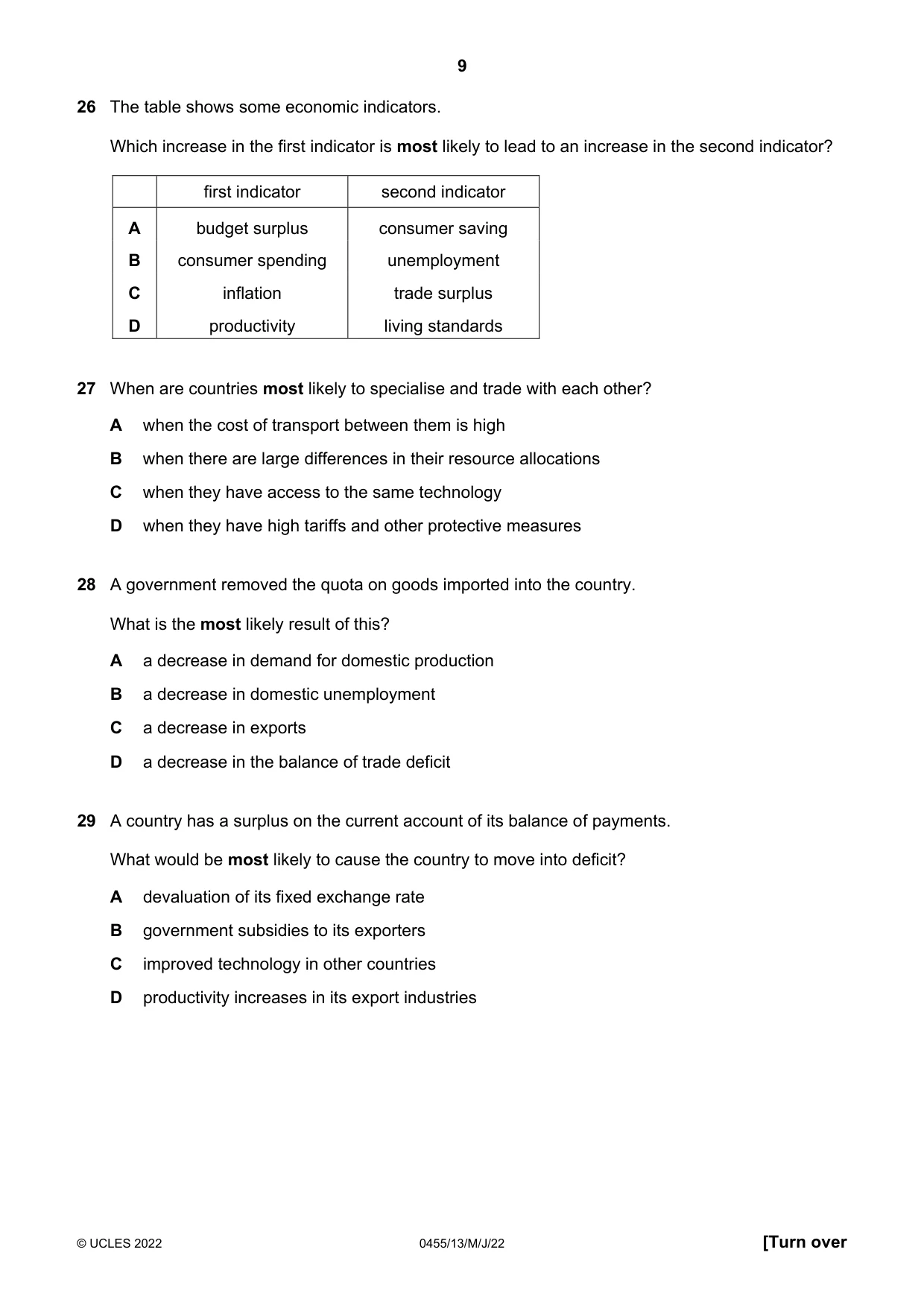
26 The table shows some economic indicators. Which increase in the first indicator is most likely to lead to an increase in the second indicator? first indicator second indicator A budget surplus consumer saving B consumer spending unemployment C inflation trade surplus D productivity living standards
Mark scheme: D
Q27 · When are countries most likely to specialise and trade with each other?
27 When are countries most likely to specialise and trade with each other? A when the cost of transport between them is high B when there are large differences in their resource allocations C when they have access to the same technology D when they have high tariffs and other protective measures
Mark scheme: B
Q28 · A government removed the quota on goods imported into the country
28 A government removed the quota on goods imported into the country. What is the most likely result of this? A a decrease in demand for domestic production B a decrease in domestic unemployment C a decrease in exports D a decrease in the balance of trade deficit
Mark scheme: A
Q29 · A country has a surplus on the current account of its balance of payments
29 A country has a surplus on the current account of its balance of payments. What would be most likely to cause the country to move into deficit? A devaluation of its fixed exchange rate B government subsidies to its exporters C improved technology in other countries D productivity increases in its export industries
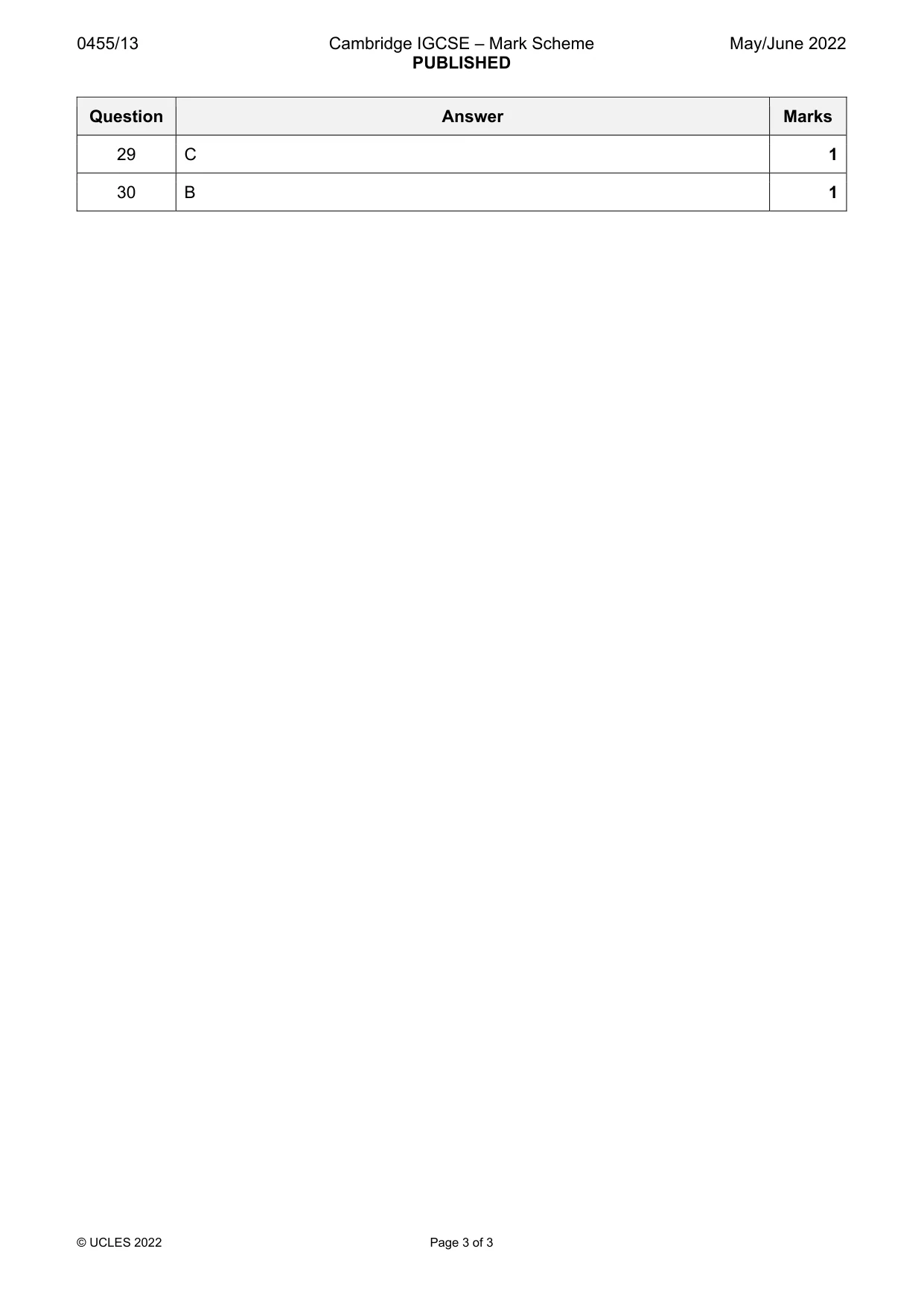
Mark scheme: C
Q30 · The governments of low-income countries often allow foreign multinational companies…
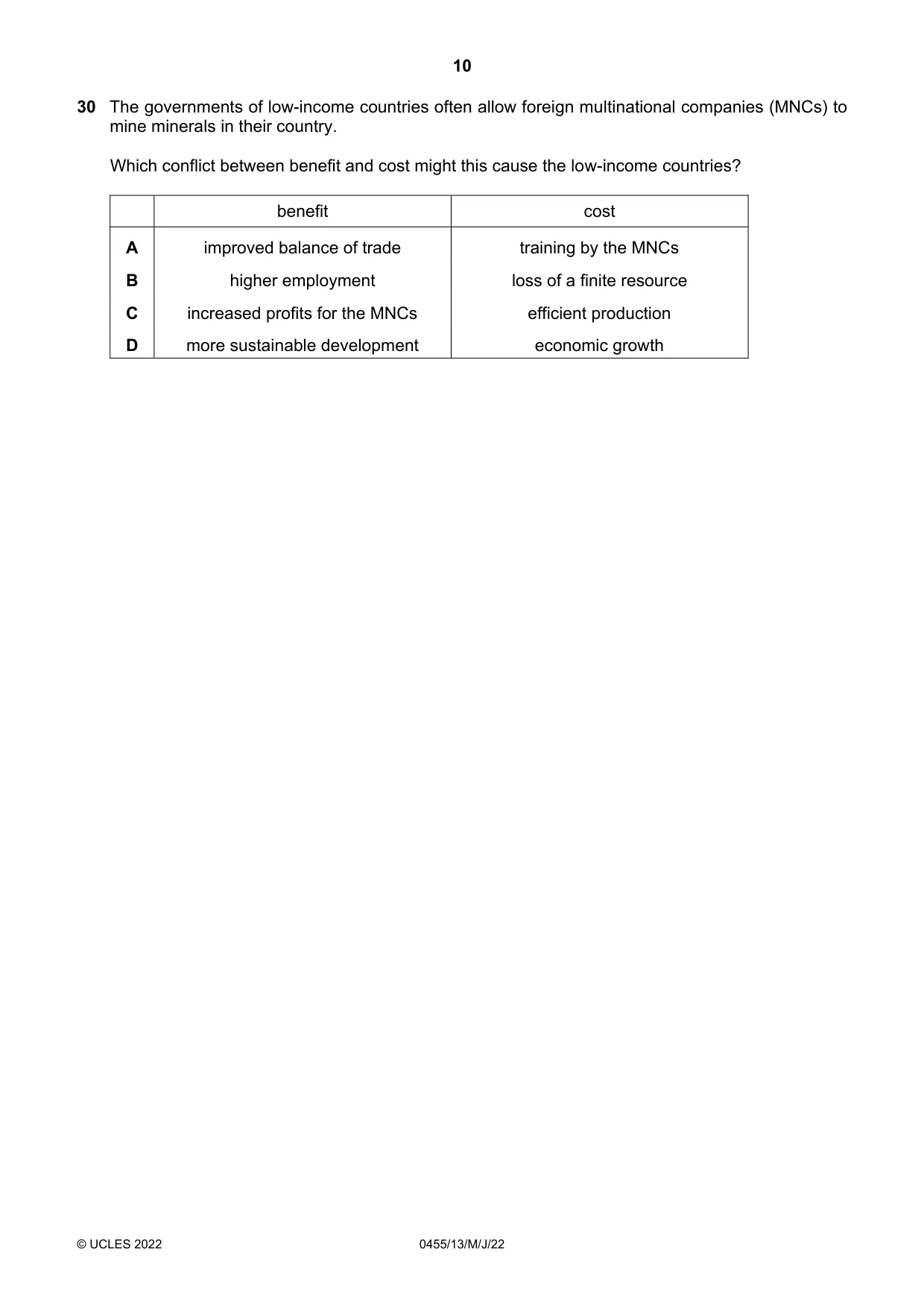
30 The governments of low-income countries often allow foreign multinational companies (MNCs) to mine minerals in their country. Which conflict between benefit and cost might this cause the low-income countries? benefit cost A improved balance of trade training by the MNCs B higher employment loss of a finite resource C increased profits for the MNCs efficient production D more sustainable development economic growth
Mark scheme: B
What was in this paper
The subtopics covered by these 30 questions, and how many questions each got. Open one in a new tab to see every Cambridge question on it.
3Economic growth2Globalisation, free trade and protection2Money and banking2Workers2Current account of balance of payments1Differences in economic development between countries1Firms’ costs, revenue and objectives1Households1Inflation and deflation1International specialisation1Living standards1Market structure1Microeconomics and macroeconomics1Mixed economic system1Monetary policy1Opportunity cost1Price determination1Production possibility curve (PPC) diagrams1Supply1Supply-side policy1The factors of production1The macroeconomic aims of government1The role of government1What you needed in this session
Cambridge’s own grade thresholds for 2022 May/June, Paper 1 · Variant 3. A higher threshold means an easier paper — the bar moves with how the cohort did.