Cambridge IGCSE Economics 0455 — 2020 Feb/March Paper 1 · Variant 2
0455/12/F/M/20 · 30 questions · 30 marks · ≈34 min
The question paper and its mark scheme, free to read here and free to download. This is Cambridge’s own paper, exactly as it was sat.
Question paper8 pages

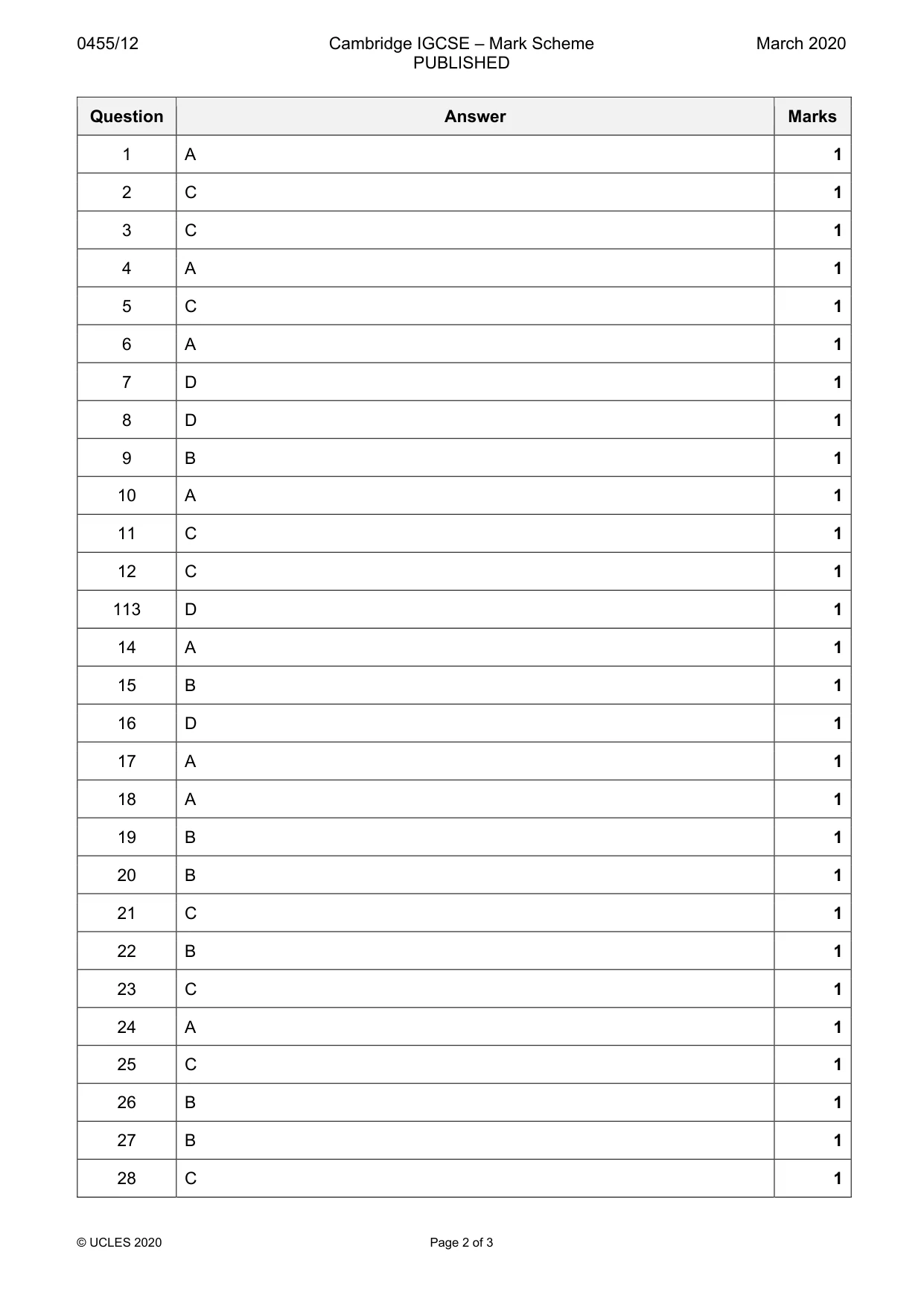
Mark scheme3 pages
Answers below. Sit the paper first if you are practising.

Questions as text
Q1 · What is not a factor of production?
1 What is not a factor of production? A a $20 banknote B an office C a photocopier D a secretary
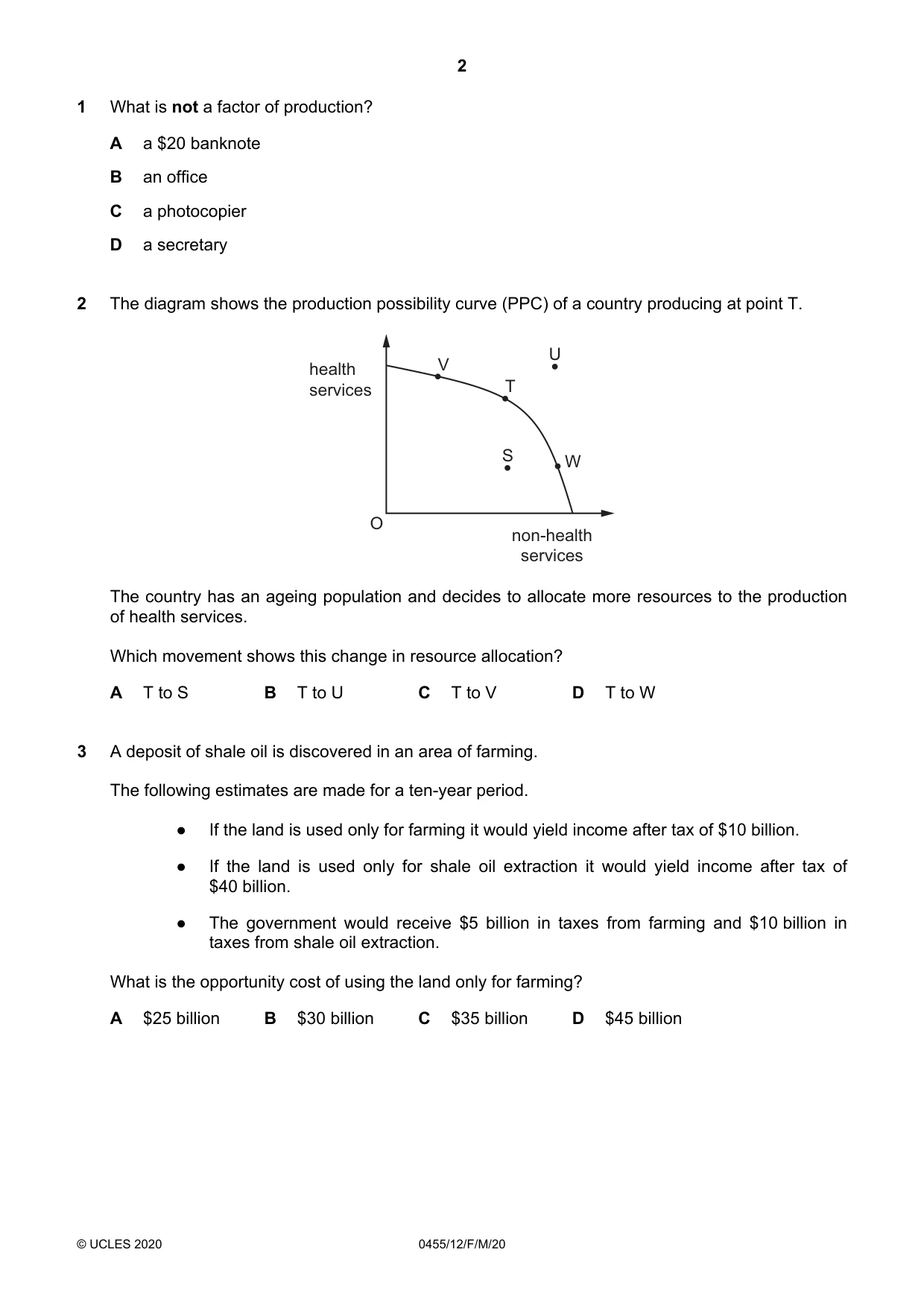
Q2 · The diagram shows the production possibility curve (PPC) of a country producing at point T
2 The diagram shows the production possibility curve (PPC) of a country producing at point T. U health V services T S W O non-health services The country has an ageing population and decides to allocate more resources to the production of health services. Which movement shows this change in resource allocation? A T to S B T to U C T to V D T to W
More questions on Production possibility curve (PPC) diagrams
Q3 · A deposit of shale oil is discovered in an area of farming
3 A deposit of shale oil is discovered in an area of farming. The following estimates are made for a ten-year period. ● If the land is used only for farming it would yield income after tax of $10 billion. ● If the land is used only for shale oil extraction it would yield income after tax of $40 billion. ● The government would receive $5 billion in taxes from farming and $10 billion in taxes from shale oil extraction. What is the opportunity cost of using the land only for farming? A $25 billion B $30 billion C $35 billion D $45 billion
Q4 · A country experiences a long strike by railway workers
4 A country experiences a long strike by railway workers. What would be the macroeconomic impact of such a strike? A National output would fall. B Railway workers would lose income. C The demand for taxi services would rise. D The profits of railway operators would fall.
Q5 · What necessarily describes the market system?
5 What necessarily describes the market system? A an economy with both a private and public sector B limited resources but unlimited wants C resources are allocated through demand and supply D when all resources are used to produce consumer goods
More questions on The role of markets in allocating resources
Q6 · In 2018 the UK government introduced a tax on the production of sugary drinks
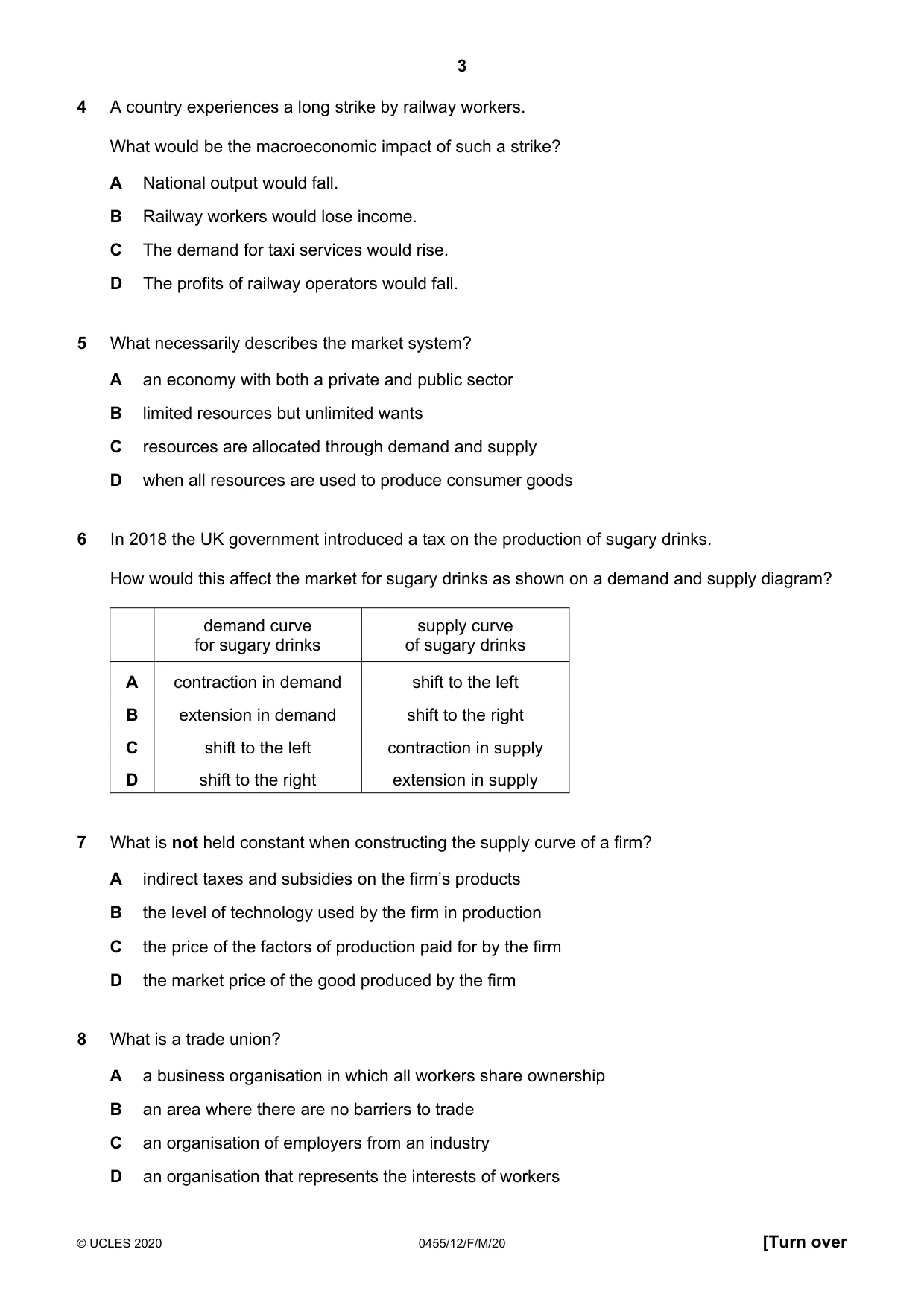
6 In 2018 the UK government introduced a tax on the production of sugary drinks. How would this affect the market for sugary drinks as shown on a demand and supply diagram? demand curve supply curve for sugary drinks of sugary drinks A contraction in demand shift to the left B extension in demand shift to the right C shift to the left contraction in supply D shift to the right extension in supply
Q7 · What is not held constant when constructing the supply curve of a firm?
7 What is not held constant when constructing the supply curve of a firm? A indirect taxes and subsidies on the firm’s products B the level of technology used by the firm in production C the price of the factors of production paid for by the firm D the market price of the good produced by the firm
Q8 · What is a trade union?
8 What is a trade union? A a business organisation in which all workers share ownership B an area where there are no barriers to trade C an organisation of employers from an industry D an organisation that represents the interests of workers
Q9 · What is the most important characteristic of money?
9 What is the most important characteristic of money? A It has intrinsic value. B It is generally acceptable. C It is portable. D It is readily available.
Q10 · Which statement explains why the pay of doctors is usually higher than the pay of…
10 Which statement explains why the pay of doctors is usually higher than the pay of hospital cleaners? A Doctors have a higher opportunity cost in qualifying. B Doctors have a more elastic supply than hospital cleaners. C Hospital cleaners belong to trade unions with stronger bargaining powers. D Hospital cleaners have a more inelastic demand than doctors.
Q11 · Banks decrease interest rates
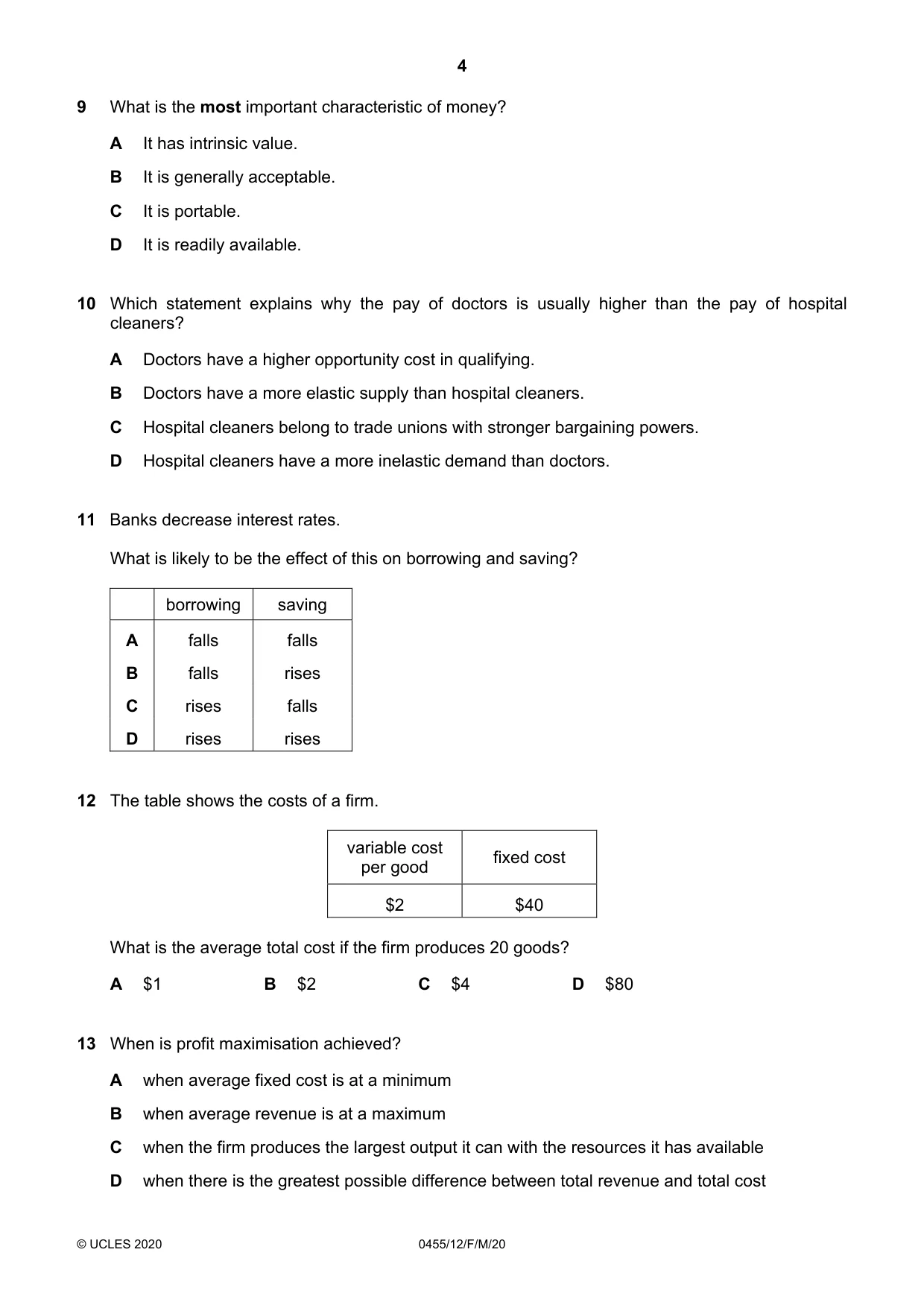
11 Banks decrease interest rates. What is likely to be the effect of this on borrowing and saving? borrowing saving A falls falls B falls rises C rises falls D rises rises
Q12 · The table shows the costs of a firm
12 The table shows the costs of a firm. variable cost fixed cost per good $2 $40 What is the average total cost if the firm produces 20 goods? A $1 B $2 C $4 D $80
Q13 · When is profit maximisation achieved?
13 When is profit maximisation achieved? A when average fixed cost is at a minimum B when average revenue is at a maximum C when the firm produces the largest output it can with the resources it has available D when there is the greatest possible difference between total revenue and total cost
Q14 · In some industries, a monopoly controls output and prices
14 In some industries, a monopoly controls output and prices. What is the most likely impact of this on consumers? A higher prices B higher profits C higher taxes D more choice
Q15 · A mining company bought another mining company
15 A mining company bought another mining company. How may this integration be described? A diversification B horizontal merger C specialisation D vertical merger
Q16 · What is most likely to cause a more even distribution of income?
16 What is most likely to cause a more even distribution of income? A an increase in indirect taxation B an increase in inflation C an increase in managers’ salaries D an increase in progressive taxation
Q17 · What is a monetary policy measure?
17 What is a monetary policy measure? A increasing interest rates B increasing taxation C reducing the power of trade unions D selling state-owned enterprises
Q18 · Why does more emphasis on education and training lead to an increase in national output?
18 Why does more emphasis on education and training lead to an increase in national output? A It improves the productivity of the labour force. B It lowers the inputs of capital investment. C It reduces demands for higher pay. D It reduces the power of trade unions.
Q19 · In the past, governments have adopted policies to try to end a recession in their country…
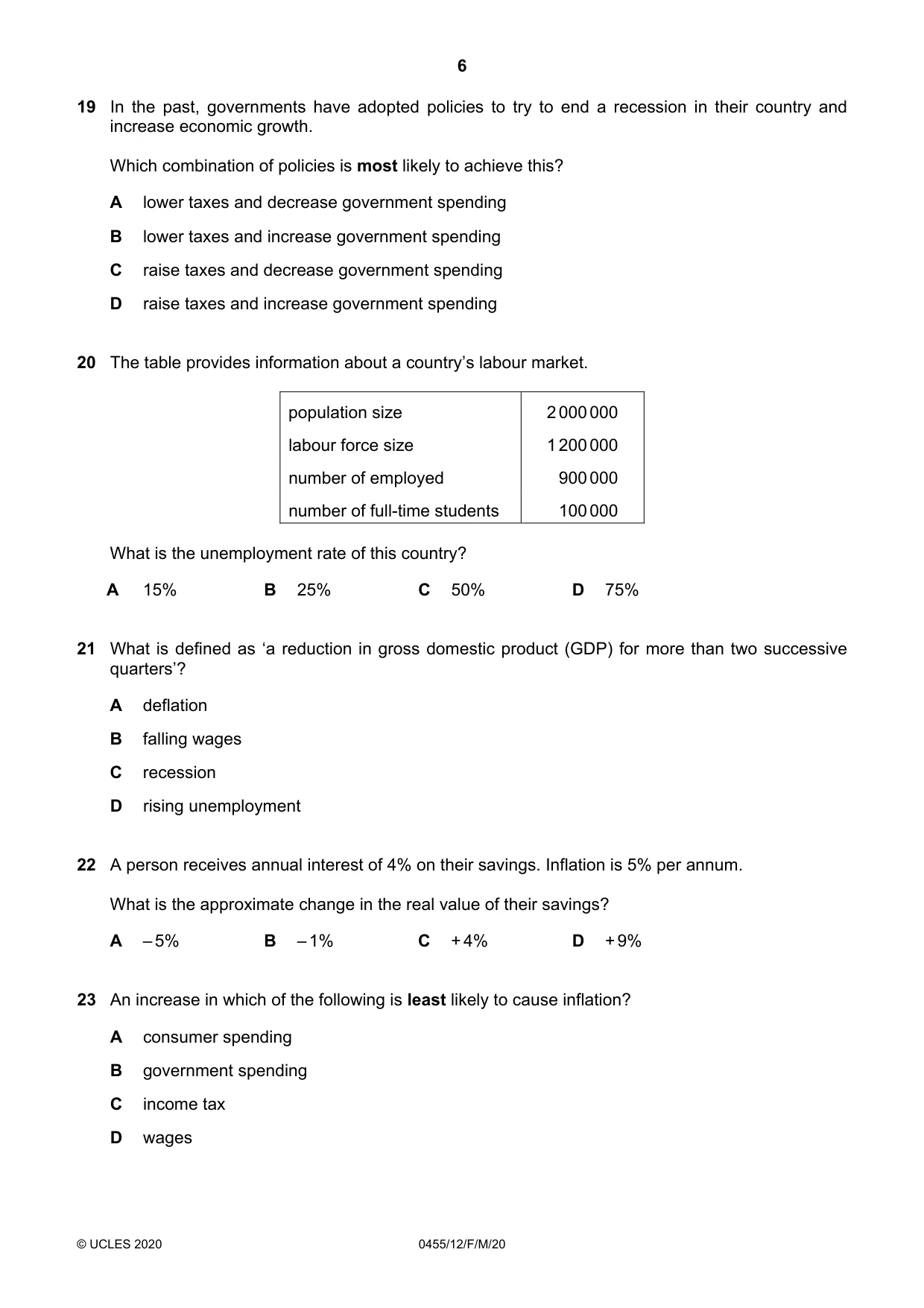
19 In the past, governments have adopted policies to try to end a recession in their country and increase economic growth. Which combination of policies is most likely to achieve this? A lower taxes and decrease government spending B lower taxes and increase government spending C raise taxes and decrease government spending D raise taxes and increase government spending
Q20 · The table provides information about a country’s labour market
20 The table provides information about a country’s labour market. population size 2 000 000 labour force size 1 200 000 number of employed 900 000 number of full-time students 100 000 What is the unemployment rate of this country? A 15% B 25% C 50% D 75%
Q21 · What is defined as ‘a reduction in gross domestic product (GDP) for more than two…
21 What is defined as ‘a reduction in gross domestic product (GDP) for more than two successive quarters’? A deflation B falling wages C recession D rising unemployment
Q22 · A person receives annual interest of 4% on their savings
22 A person receives annual interest of 4% on their savings. Inflation is 5% per annum. What is the approximate change in the real value of their savings? A – 5% B – 1% C + 4% D + 9%
Q23 · An increase in which of the following is least likely to cause inflation?
23 An increase in which of the following is least likely to cause inflation? A consumer spending B government spending C income tax D wages
Q24 · A country has a declining population
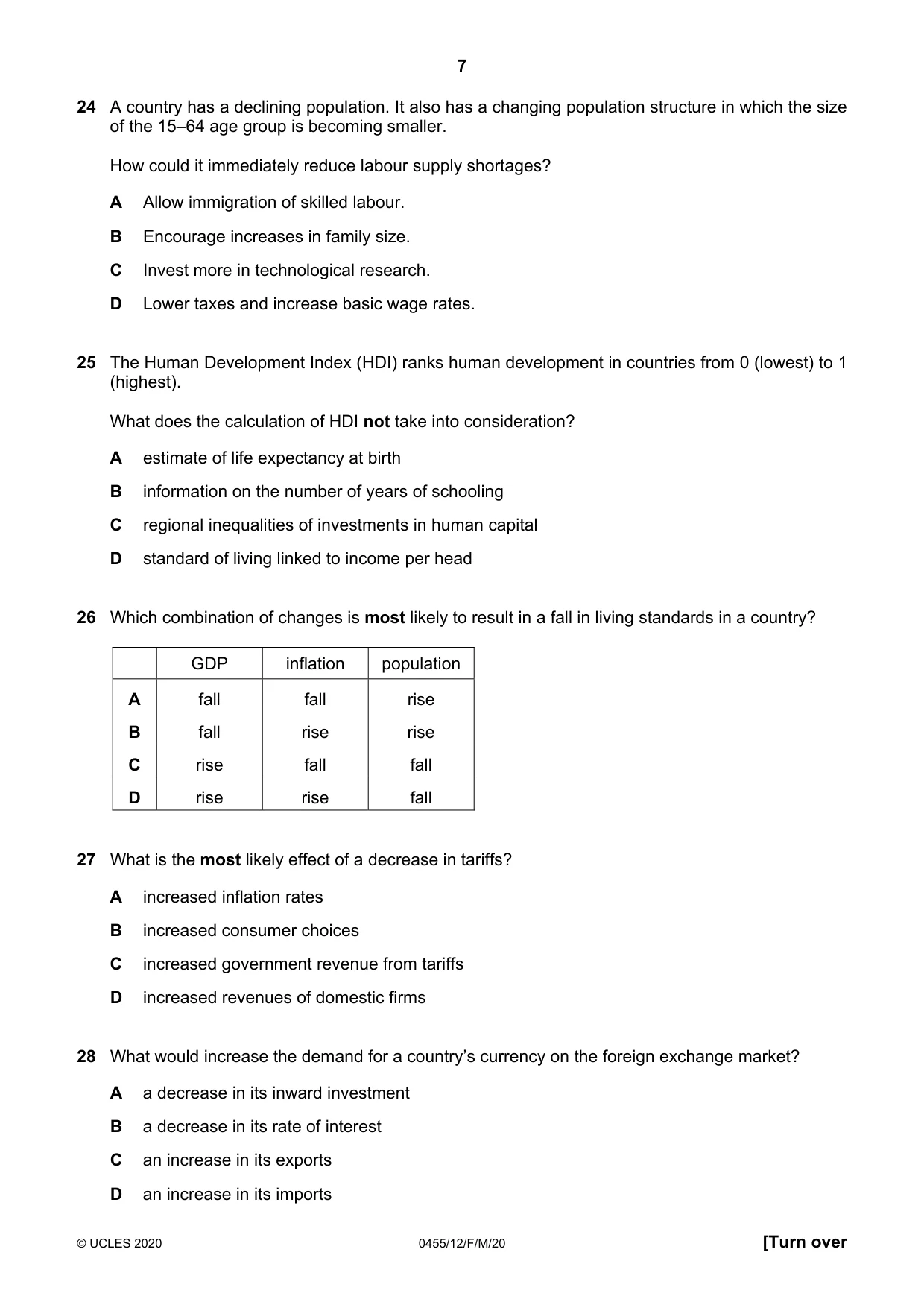
24 A country has a declining population. It also has a changing population structure in which the size of the 15–64 age group is becoming smaller. How could it immediately reduce labour supply shortages? A Allow immigration of skilled labour. B Encourage increases in family size. C Invest more in technological research. D Lower taxes and increase basic wage rates.
Q25 · The Human Development Index (HDI) ranks human development in countries from 0 (lowest) to…
25 The Human Development Index (HDI) ranks human development in countries from 0 (lowest) to 1 (highest). What does the calculation of HDI not take into consideration? A estimate of life expectancy at birth B information on the number of years of schooling C regional inequalities of investments in human capital D standard of living linked to income per head
Q26 · Which combination of changes is most likely to result in a fall in living standards in a…
26 Which combination of changes is most likely to result in a fall in living standards in a country? GDP inflation population A fall fall rise B fall rise rise C rise fall fall D rise rise fall
Q27 · What is the most likely effect of a decrease in tariffs?
27 What is the most likely effect of a decrease in tariffs? A increased inflation rates B increased consumer choices C increased government revenue from tariffs D increased revenues of domestic firms
Q28 · What would increase the demand for a country’s currency on the foreign exchange market?
28 What would increase the demand for a country’s currency on the foreign exchange market? A a decrease in its inward investment B a decrease in its rate of interest C an increase in its exports D an increase in its imports
Q29 · The table shows a selection of economic data for a country
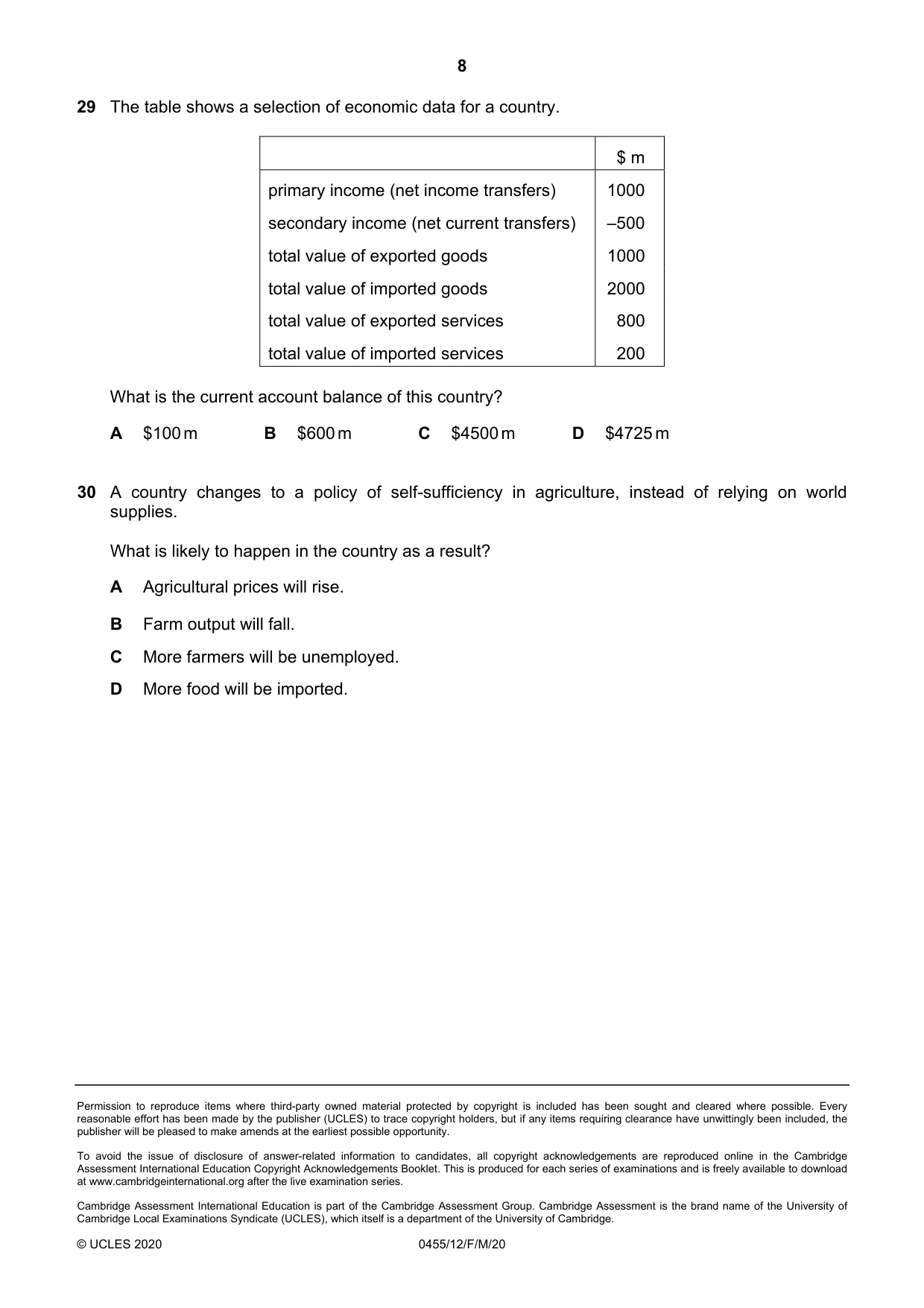
29 The table shows a selection of economic data for a country. $ m primary income (net income transfers) 1000 secondary income (net current transfers) –500 total value of exported goods 1000 total value of imported goods 2000 total value of exported services 800 total value of imported services 200 What is the current account balance of this country? A $100 m B $600 m C $4500 m D $4725 m
Q30 · A country changes to a policy of self-sufficiency in agriculture, instead of relying on…
30 A country changes to a policy of self-sufficiency in agriculture, instead of relying on world supplies. What is likely to happen in the country as a result? A Agricultural prices will rise. B Farm output will fall. C More farmers will be unemployed. D More food will be imported.
What was in this paper
The subtopics covered by these 30 questions, and how many questions each got. Open one in a new tab to see every Cambridge question on it.
2Fiscal policy2Inflation and deflation2Living standards2Money and banking2Supply2Current account of balance of payments1Economic growth1Employment and unemployment1Firms1Foreign exchange rates1Globalisation, free trade and protection1International specialisation1Market structure1Monetary policy1Opportunity cost1Population1Production possibility curve (PPC) diagrams1Supply-side policy1The factors of production1The macroeconomic aims of government1The role of markets in allocating resources1Trade unions1Workers1What you needed in this session
Cambridge’s own grade thresholds for 2020 Feb/March, Paper 1 · Variant 2. A higher threshold means an easier paper — the bar moves with how the cohort did.