Cambridge IGCSE Economics 0455 — 2021 Feb/March Paper 1 · Variant 2
0455/12/F/M/21 · 30 questions · 30 marks · ≈34 min
The question paper and its mark scheme, free to read here and free to download. This is Cambridge’s own paper, exactly as it was sat.
Question paper12 pages
Mark scheme3 pages
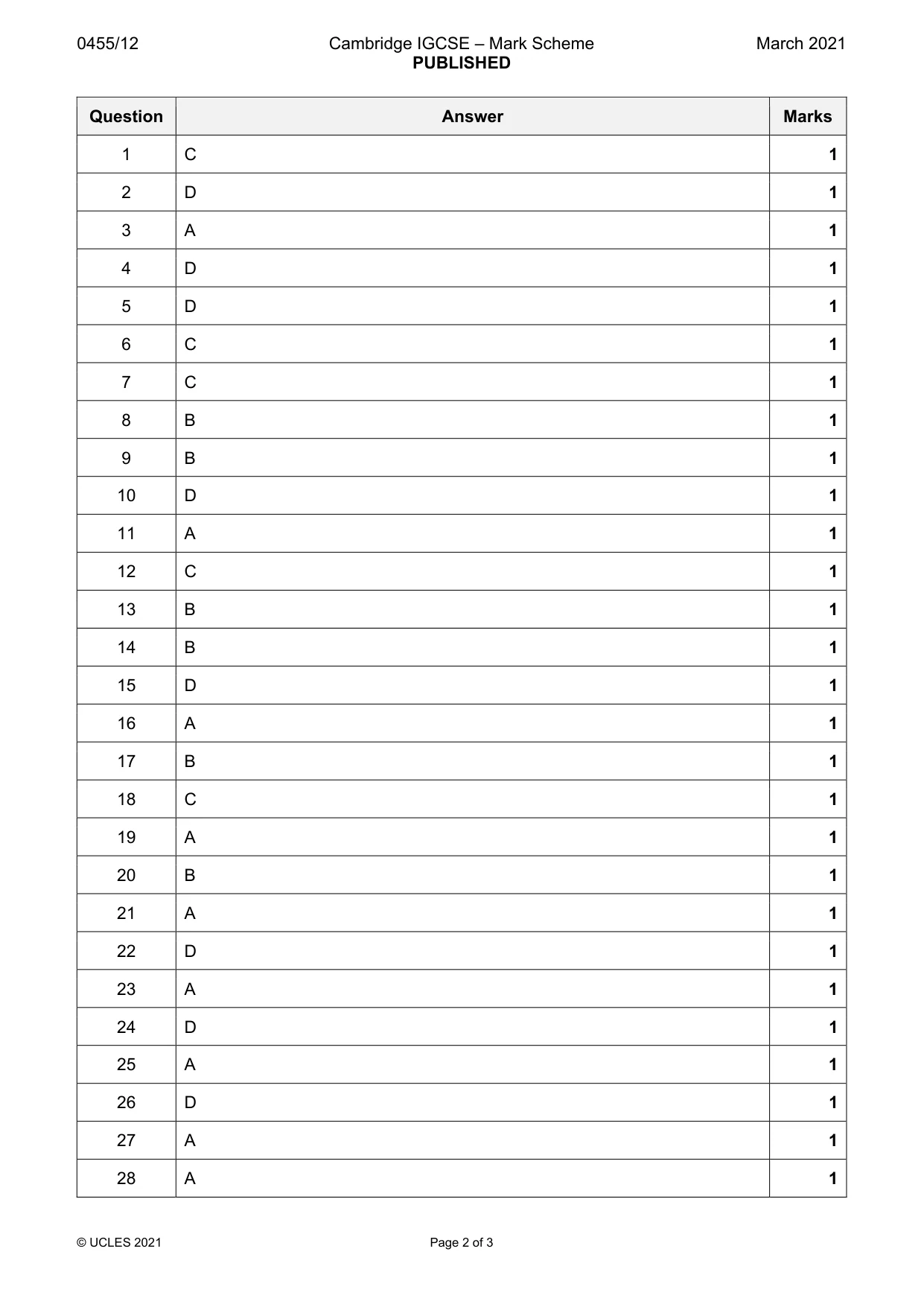
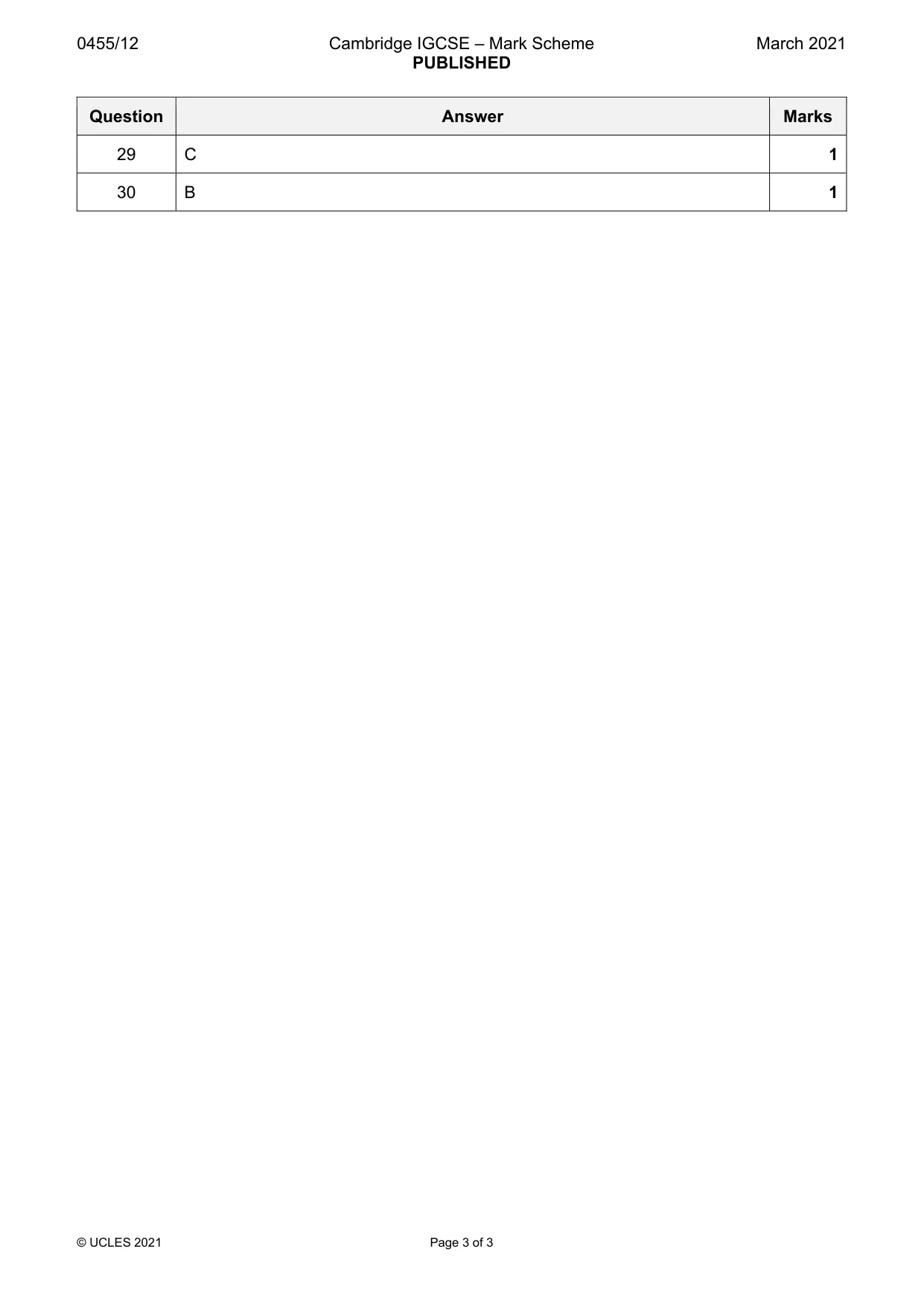
Answers below. Sit the paper first if you are practising.
Questions as text
Q1 · Sanjay is a risk taker and sets up a restaurant in Chennai
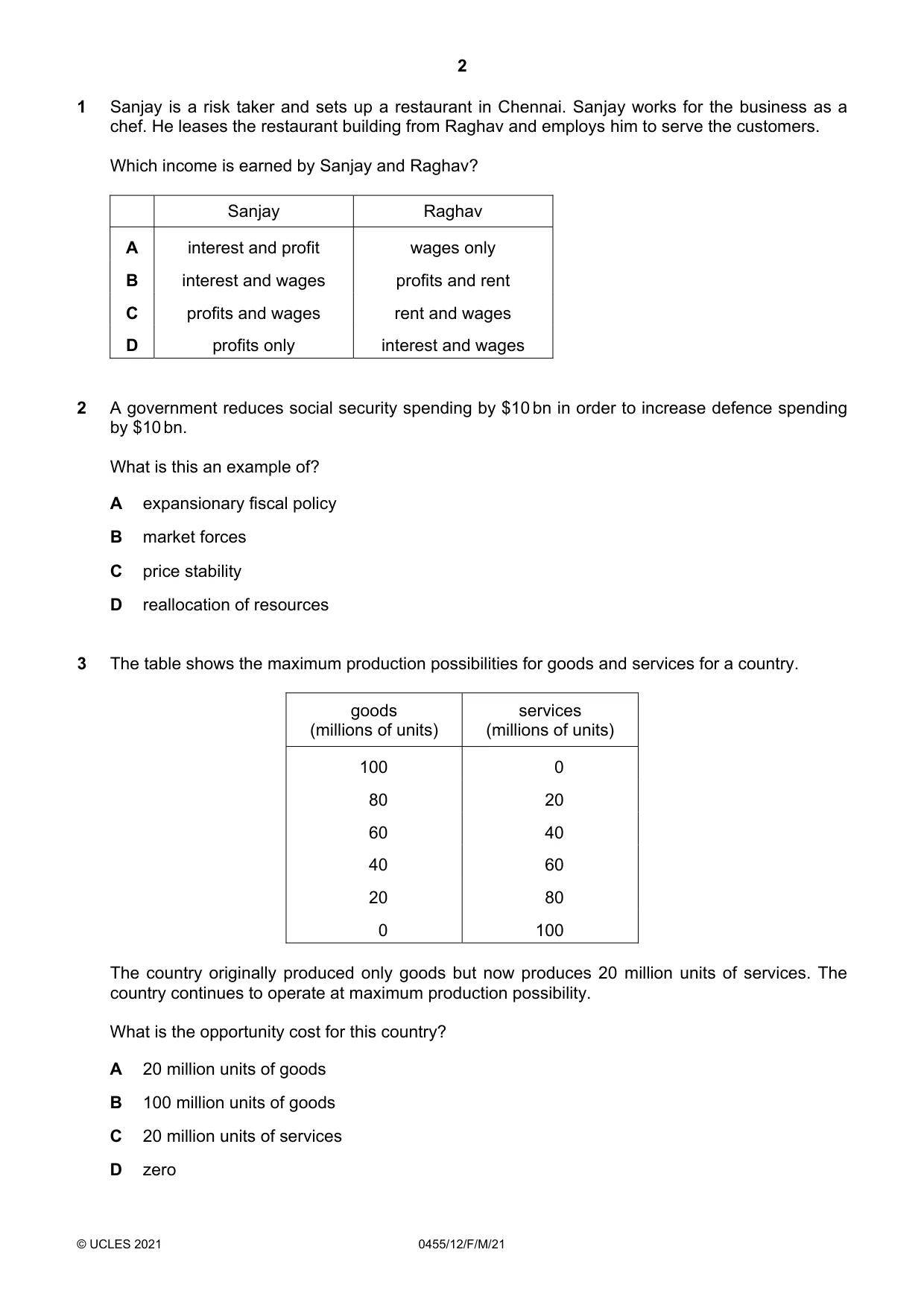
1 Sanjay is a risk taker and sets up a restaurant in Chennai. Sanjay works for the business as a chef. He leases the restaurant building from Raghav and employs him to serve the customers. Which income is earned by Sanjay and Raghav? Sanjay Raghav A interest and profit wages only B interest and wages profits and rent C profits and wages rent and wages D profits only interest and wages
Mark scheme: C
Q2 · A government reduces social security spending by $10 bn in order to increase defence…
2 A government reduces social security spending by $10 bn in order to increase defence spending by $10 bn. What is this an example of? A expansionary fiscal policy B market forces C price stability D reallocation of resources
Mark scheme: D
Q3 · The table shows the maximum production possibilities for goods and services for a country
3 The table shows the maximum production possibilities for goods and services for a country. goods services (millions of units) (millions of units) 100 0 80 20 60 40 40 60 20 80 0 100 The country originally produced only goods but now produces 20 million units of services. The country continues to operate at maximum production possibility. What is the opportunity cost for this country? A 20 million units of goods B 100 million units of goods C 20 million units of services D zero
Mark scheme: A
Q4 · What is included in macroeconomics?
4 What is included in macroeconomics? A the causes of a change in the price of one product B the causes of a market failure C the causes of determinants of price elasticities of supply D the causes of economic growth
Mark scheme: D
Q5 · What is an advantage of a market economy in the allocation of resources?
5 What is an advantage of a market economy in the allocation of resources? A It ensures that all consumers are willing to pay the same price. B It fixes prices based on costs of production. C It guarantees suppliers will make a profit. D It indicates the relative demand for goods and services.
Mark scheme: D
Q6 · Which characteristics of a product will cause market failure?
6 Which characteristics of a product will cause market failure? A Information about the product is known equally by consumers and producers. B The consumption of the product has no external benefits. C The product is non-rival and non-excludable. D The production of the product has no external costs.
Mark scheme: C
Q7 · The diagram shows the market equilibrium E for product X
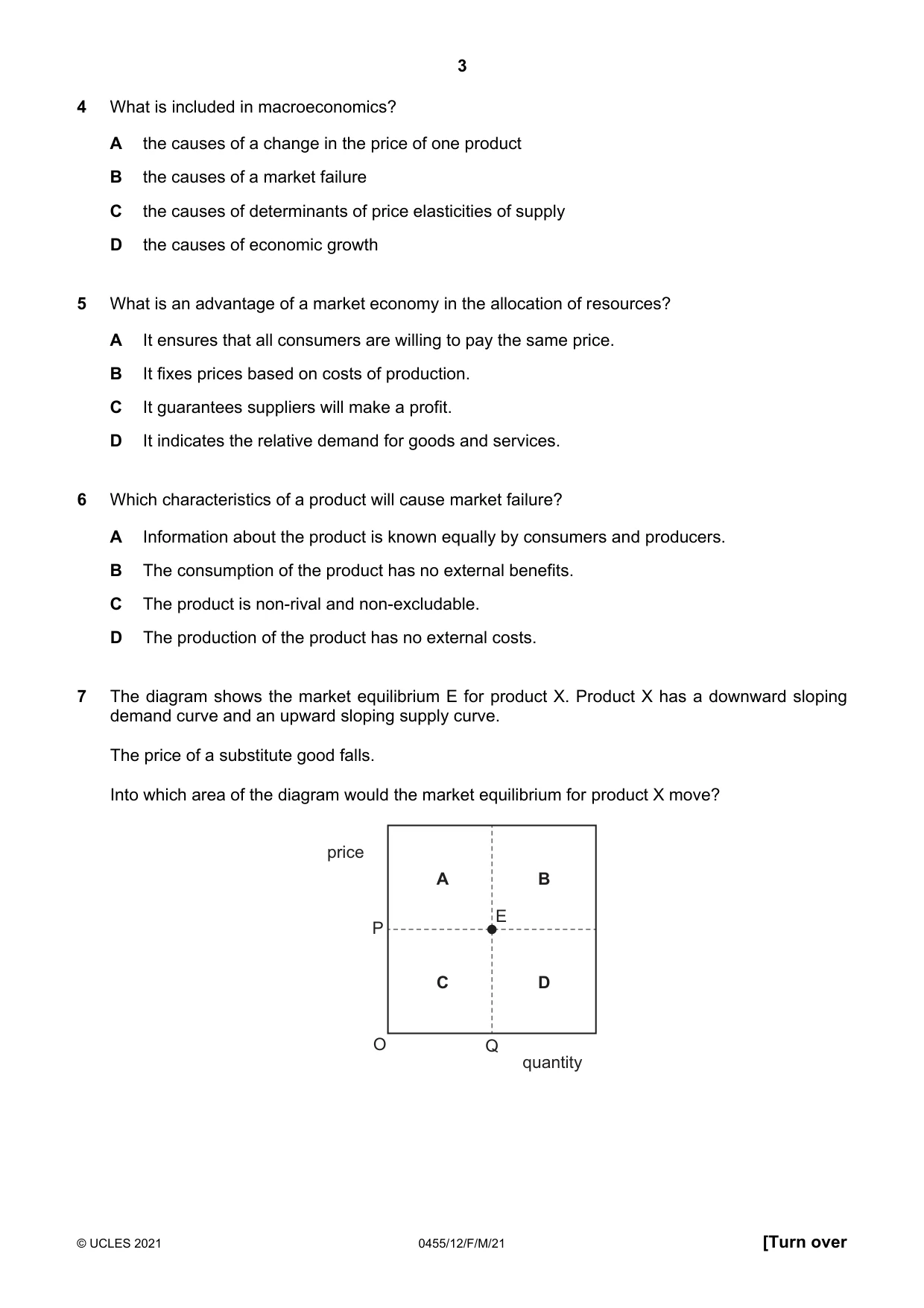
7 The diagram shows the market equilibrium E for product X. Product X has a downward sloping demand curve and an upward sloping supply curve. The price of a substitute good falls. Into which area of the diagram would the market equilibrium for product X move? price A B E P C D O Q quantity
Mark scheme: C
Q8 · The table shows the supply schedule for a good
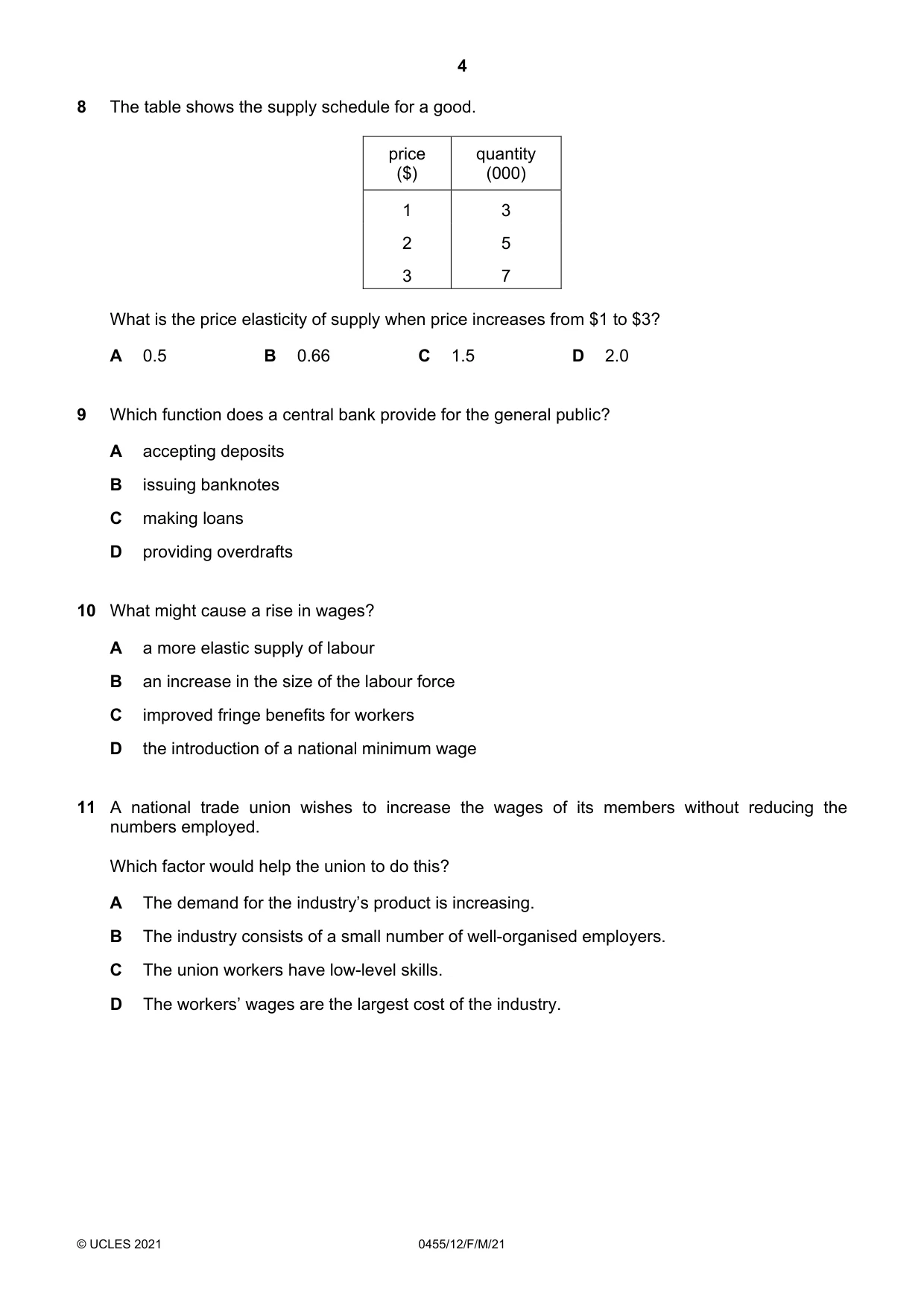
8 The table shows the supply schedule for a good. price quantity ($) (000) 1 3 2 5 3 7 What is the price elasticity of supply when price increases from $1 to $3? A 0.5 B 0.66 C 1.5 D 2.0
Mark scheme: B
Q9 · Which function does a central bank provide for the general public?
9 Which function does a central bank provide for the general public? A accepting deposits B issuing banknotes C making loans D providing overdrafts
Mark scheme: B
Q10 · What might cause a rise in wages?
10 What might cause a rise in wages? A a more elastic supply of labour B an increase in the size of the labour force C improved fringe benefits for workers D the introduction of a national minimum wage
Mark scheme: D
Q11 · A national trade union wishes to increase the wages of its members without reducing the…
11 A national trade union wishes to increase the wages of its members without reducing the numbers employed. Which factor would help the union to do this? A The demand for the industry’s product is increasing. B The industry consists of a small number of well-organised employers. C The union workers have low-level skills. D The workers’ wages are the largest cost of the industry.
Mark scheme: A
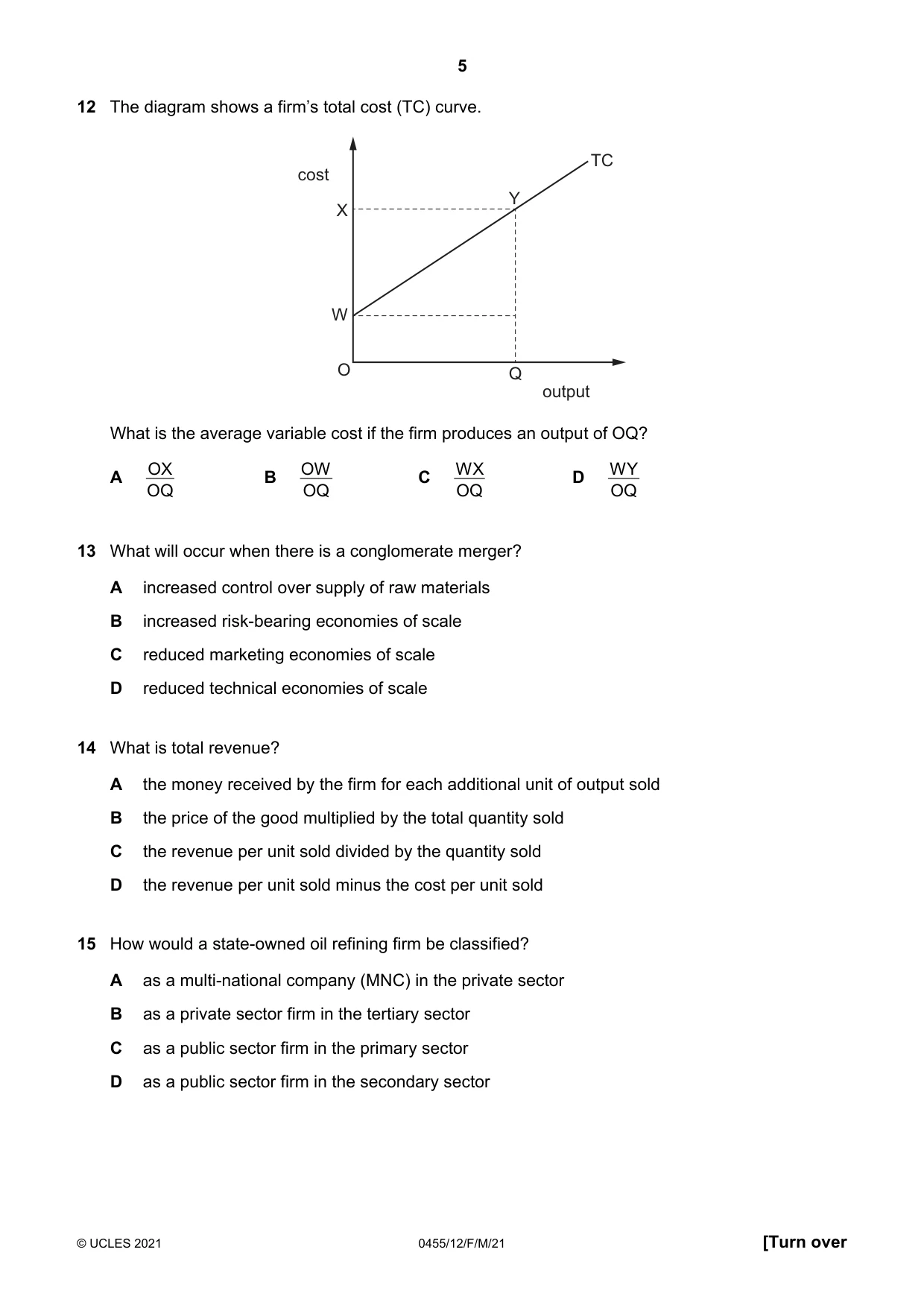
Q12 · The diagram shows a firm’s total cost (TC) curve
12 The diagram shows a firm’s total cost (TC) curve. TC cost Y X W O Q output What is the average variable cost if the firm produces an output of OQ? OX OW WX WY A OQ B OQ C OQ D OQ
Mark scheme: C
Q13 · What will occur when there is a conglomerate merger?
13 What will occur when there is a conglomerate merger? A increased control over supply of raw materials B increased risk-bearing economies of scale C reduced marketing economies of scale D reduced technical economies of scale
Mark scheme: B
Q14 · What is total revenue?
14 What is total revenue? A the money received by the firm for each additional unit of output sold B the price of the good multiplied by the total quantity sold C the revenue per unit sold divided by the quantity sold D the revenue per unit sold minus the cost per unit sold
Mark scheme: B
Q15 · How would a state-owned oil refining firm be classified?
15 How would a state-owned oil refining firm be classified? A as a multi-national company (MNC) in the private sector B as a private sector firm in the tertiary sector C as a public sector firm in the primary sector D as a public sector firm in the secondary sector
Mark scheme: D
Q16 · What is included in a government’s budget?
16 What is included in a government’s budget? A the balance of government revenue and government expenditure B the balance of export revenue and import expenditure C the difference between investment and saving D the difference between social benefits and social costs of production
Mark scheme: A
Q17 · A country has rapidly increasing inflation
17 A country has rapidly increasing inflation. What is an example of a monetary policy measure to reduce this problem? A increasing income tax B increasing interest rates C introducing maximum prices for some products D subsidising key industries
Mark scheme: B
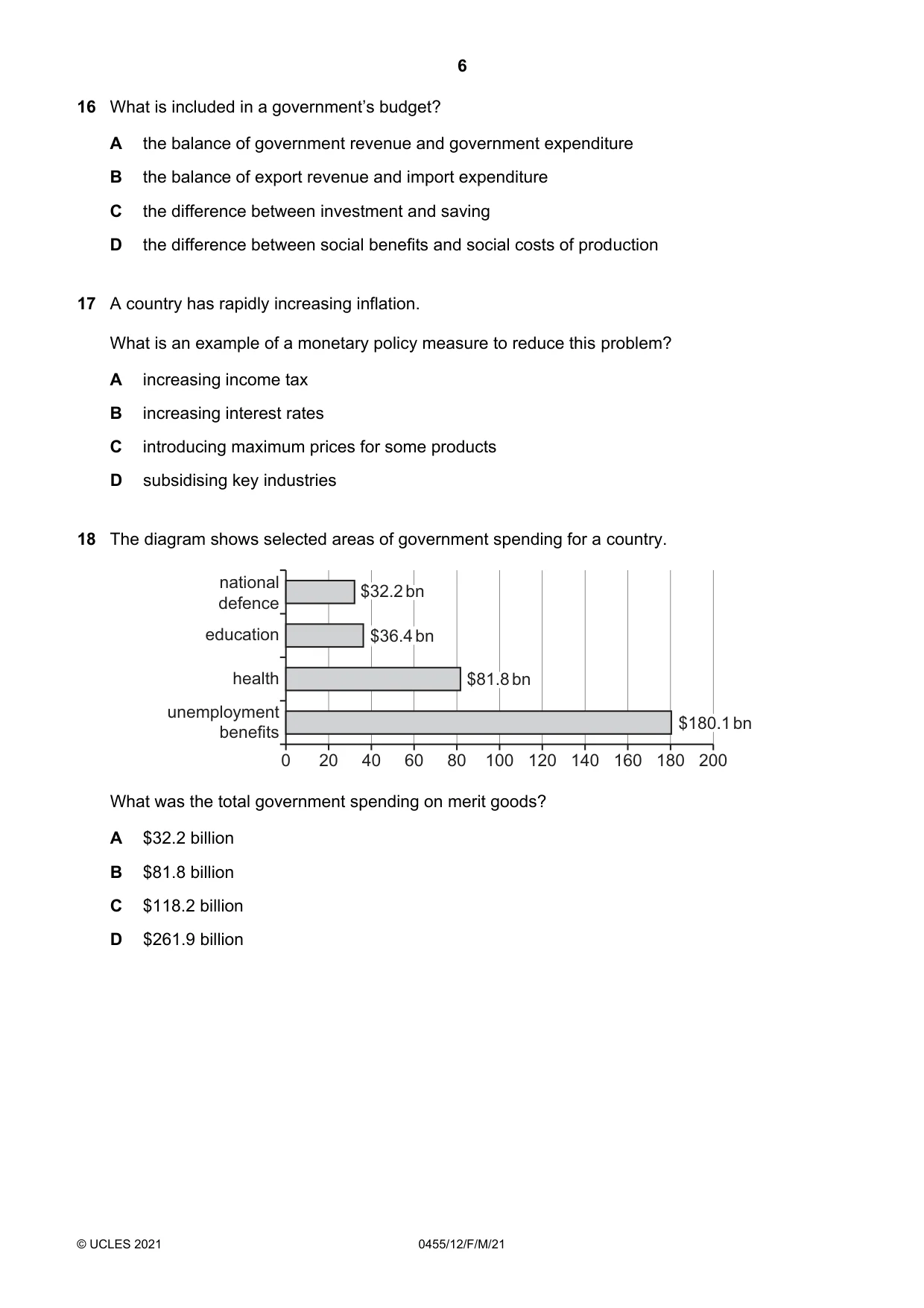
Q18 · The diagram shows selected areas of government spending for a country
18 The diagram shows selected areas of government spending for a country. national $32.2 $32.2 bn $32.2 bn bn defence education $36.4 bn $36.4 $36.4 bn bn health $81.8 bn $81.8 $81.8 bn bn unemployment $180.1 $180.1 bn $180.1 bn bn benefits 0 20 40 60 80 100 120 140 160 180 200 What was the total government spending on merit goods? A $32.2 billion B $81.8 billion C $118.2 billion D $261.9 billion
Mark scheme: C
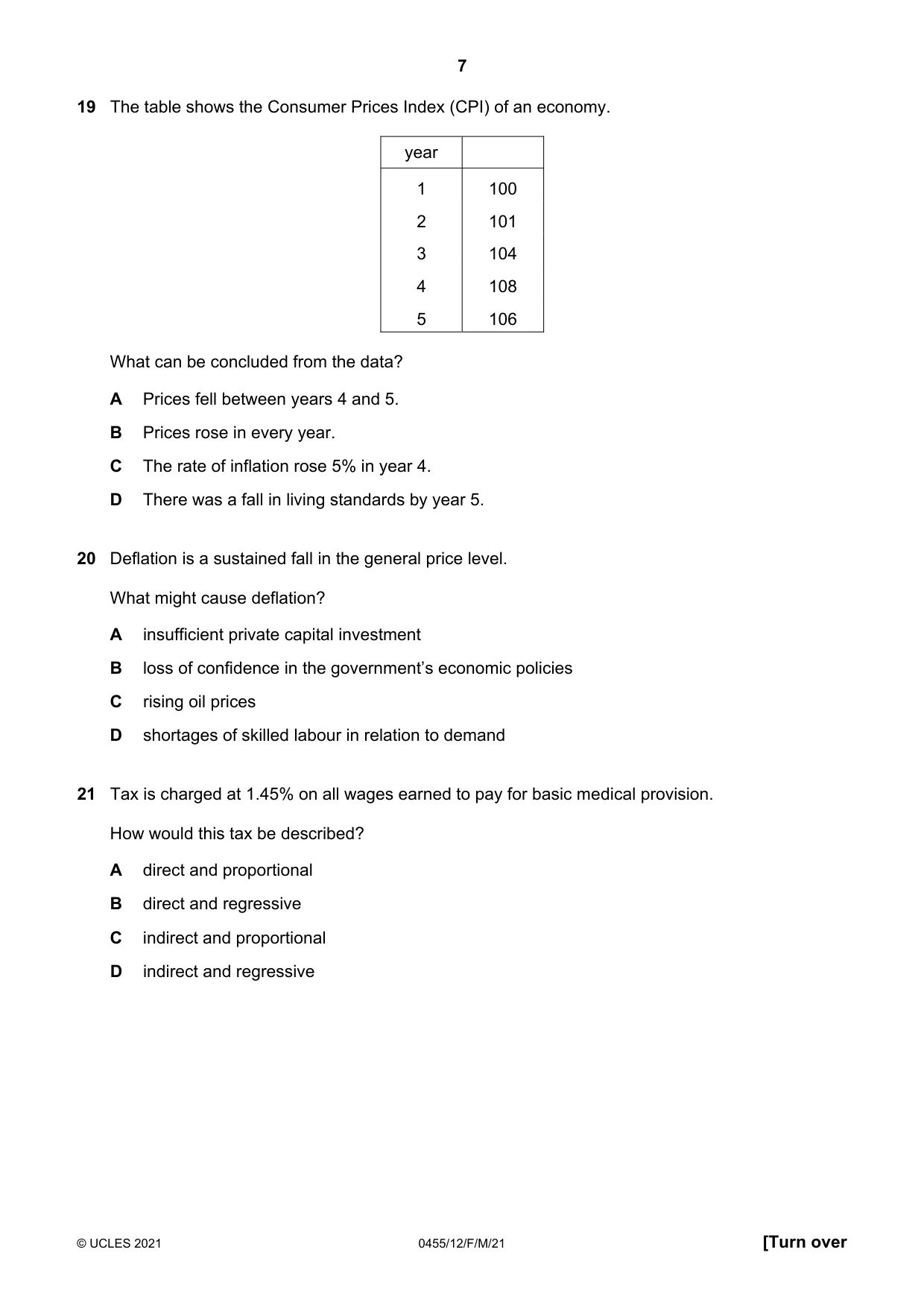
Q19 · The table shows the Consumer Prices Index (CPI) of an economy
19 The table shows the Consumer Prices Index (CPI) of an economy. year 1 100 2 101 3 104 4 108 5 106 What can be concluded from the data? A Prices fell between years 4 and 5. B Prices rose in every year. C The rate of inflation rose 5% in year 4. D There was a fall in living standards by year 5.
Mark scheme: A
Q20 · Deflation is a sustained fall in the general price level
20 Deflation is a sustained fall in the general price level. What might cause deflation? A insufficient private capital investment B loss of confidence in the government’s economic policies C rising oil prices D shortages of skilled labour in relation to demand
Mark scheme: B
Q21 · Tax is charged at 1.45% on all wages earned to pay for basic medical provision
21 Tax is charged at 1.45% on all wages earned to pay for basic medical provision. How would this tax be described? A direct and proportional B direct and regressive C indirect and proportional D indirect and regressive
Mark scheme: A
Q22 · The table shows some data about an economy
22 The table shows some data about an economy. year 1 rate of inflation (%) 3.5 change in personal incomes (%) 2.5 What happened in year 1? A Both prices and real incomes fell. B Both prices and real incomes rose. C Prices fell but real incomes rose. D Prices rose but real incomes fell.
Mark scheme: D
Q23 · What is included in the construction of the Consumer Prices Index (CPI)?
23 What is included in the construction of the Consumer Prices Index (CPI)? A a base year B incomes C price elasticity of demand D quantity supplied
Mark scheme: A
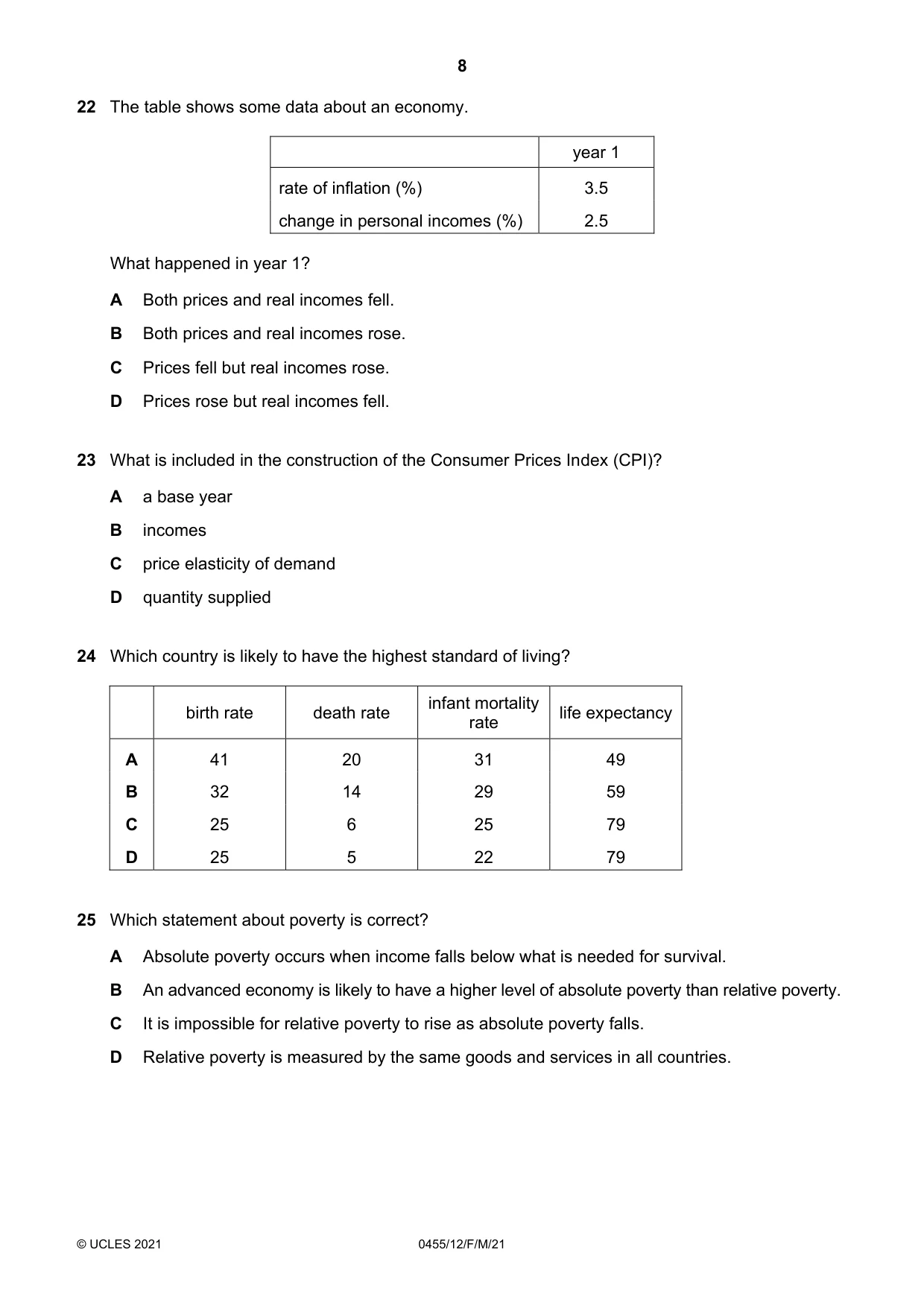
Q24 · Which country is likely to have the highest standard of living?
24 Which country is likely to have the highest standard of living? infant mortality birth rate death rate life expectancy rate A 41 20 31 49 B 32 14 29 59 C 25 6 25 79 D 25 5 22 79
Mark scheme: D
Q25 · Which statement about poverty is correct?
25 Which statement about poverty is correct? A Absolute poverty occurs when income falls below what is needed for survival. B An advanced economy is likely to have a higher level of absolute poverty than relative poverty. C It is impossible for relative poverty to rise as absolute poverty falls. D Relative poverty is measured by the same goods and services in all countries.
Mark scheme: A
Q26 · The United Nations (UN) predicts that the population in low-income countries will increase
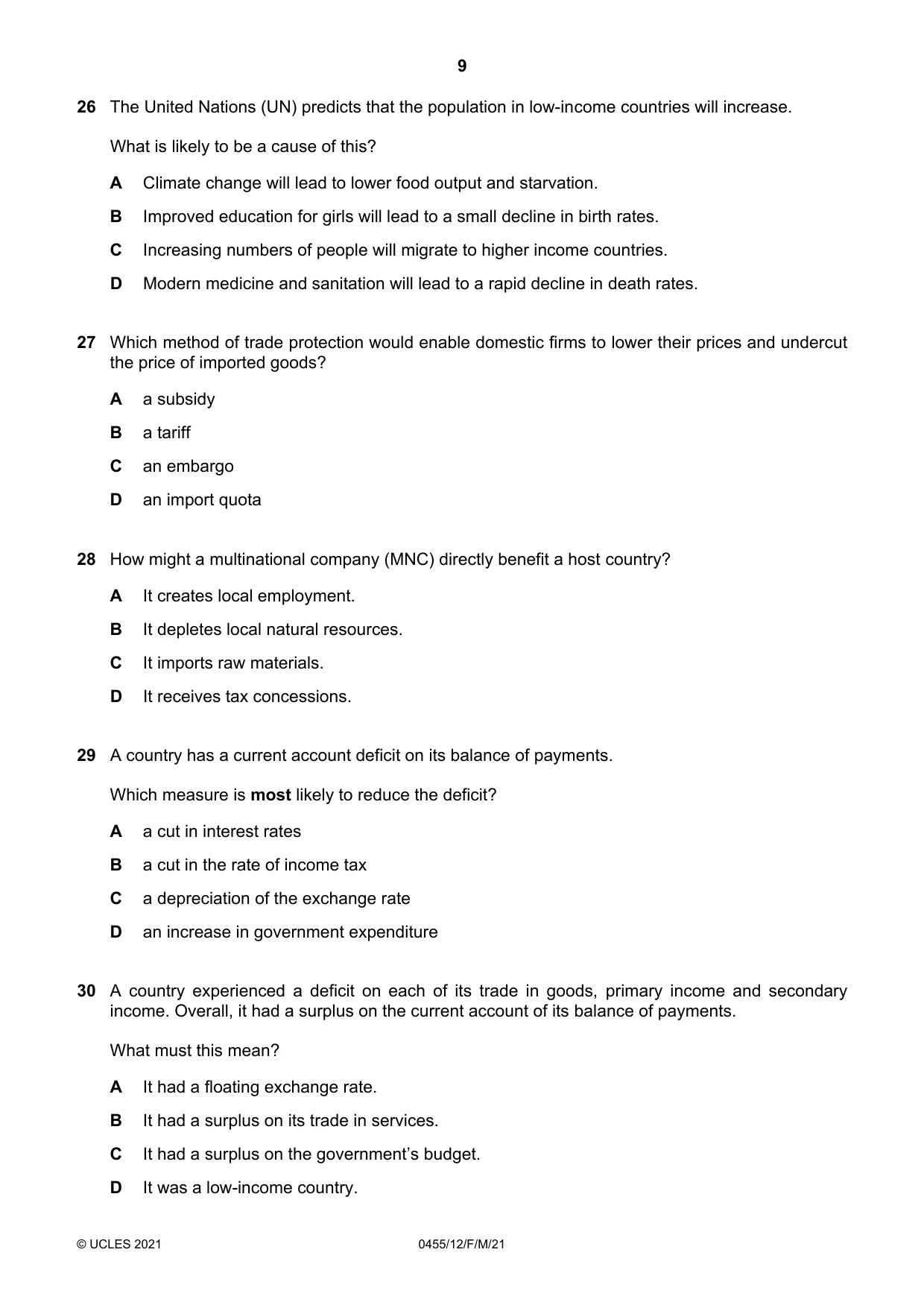
26 The United Nations (UN) predicts that the population in low-income countries will increase. What is likely to be a cause of this? A Climate change will lead to lower food output and starvation. B Improved education for girls will lead to a small decline in birth rates. C Increasing numbers of people will migrate to higher income countries. D Modern medicine and sanitation will lead to a rapid decline in death rates.
Mark scheme: D
Q27 · Which method of trade protection would enable domestic firms to lower their prices and…
27 Which method of trade protection would enable domestic firms to lower their prices and undercut the price of imported goods? A a subsidy B a tariff C an embargo D an import quota
Mark scheme: A
Q28 · How might a multinational company (MNC) directly benefit a host country?
28 How might a multinational company (MNC) directly benefit a host country? A It creates local employment. B It depletes local natural resources. C It imports raw materials. D It receives tax concessions.
Mark scheme: A
Q29 · A country has a current account deficit on its balance of payments
29 A country has a current account deficit on its balance of payments. Which measure is most likely to reduce the deficit? A a cut in interest rates B a cut in the rate of income tax C a depreciation of the exchange rate D an increase in government expenditure
Mark scheme: C
Q30 · A country experienced a deficit on each of its trade in goods, primary income and…
30 A country experienced a deficit on each of its trade in goods, primary income and secondary income. Overall, it had a surplus on the current account of its balance of payments. What must this mean? A It had a floating exchange rate. B It had a surplus on its trade in services. C It had a surplus on the government’s budget. D It was a low-income country.
Mark scheme: B
What was in this paper
The subtopics covered by these 30 questions, and how many questions each got. Open one in a new tab to see every Cambridge question on it.
4Firms’ costs, revenue and objectives2Fiscal policy2Globalisation, free trade and protection2The role of government2Current account of balance of payments1Foreign exchange rates1Living standards1Market economic system1Market failure1Market structure1Microeconomics and macroeconomics1Mixed economic system1Monetary policy1Money and banking1Opportunity cost1Population1Poverty1Price changes1Price elasticity of supply (PES)1Supply1The factors of production1Trade unions1What you needed in this session
Cambridge’s own grade thresholds for 2021 Feb/March, Paper 1 · Variant 2. A higher threshold means an easier paper — the bar moves with how the cohort did.