Cambridge IGCSE Economics 0455 — 2025 Oct/Nov Paper 1 · Variant 1
0455/11/O/N/25 · 30 questions · 30 marks · ≈34 min
The question paper and its mark scheme, free to read here and free to download. This is Cambridge’s own paper, exactly as it was sat.
Question paper12 pages
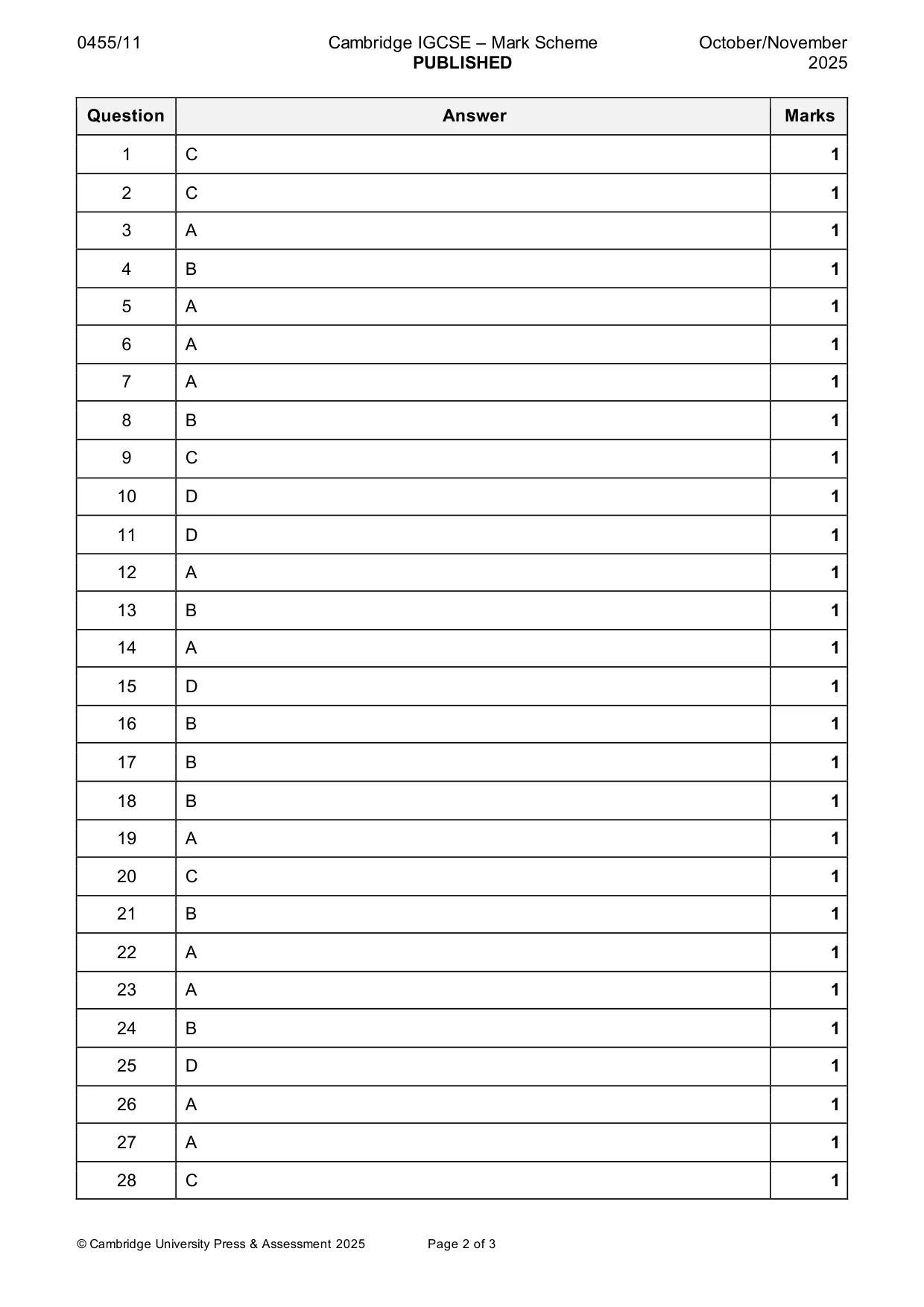
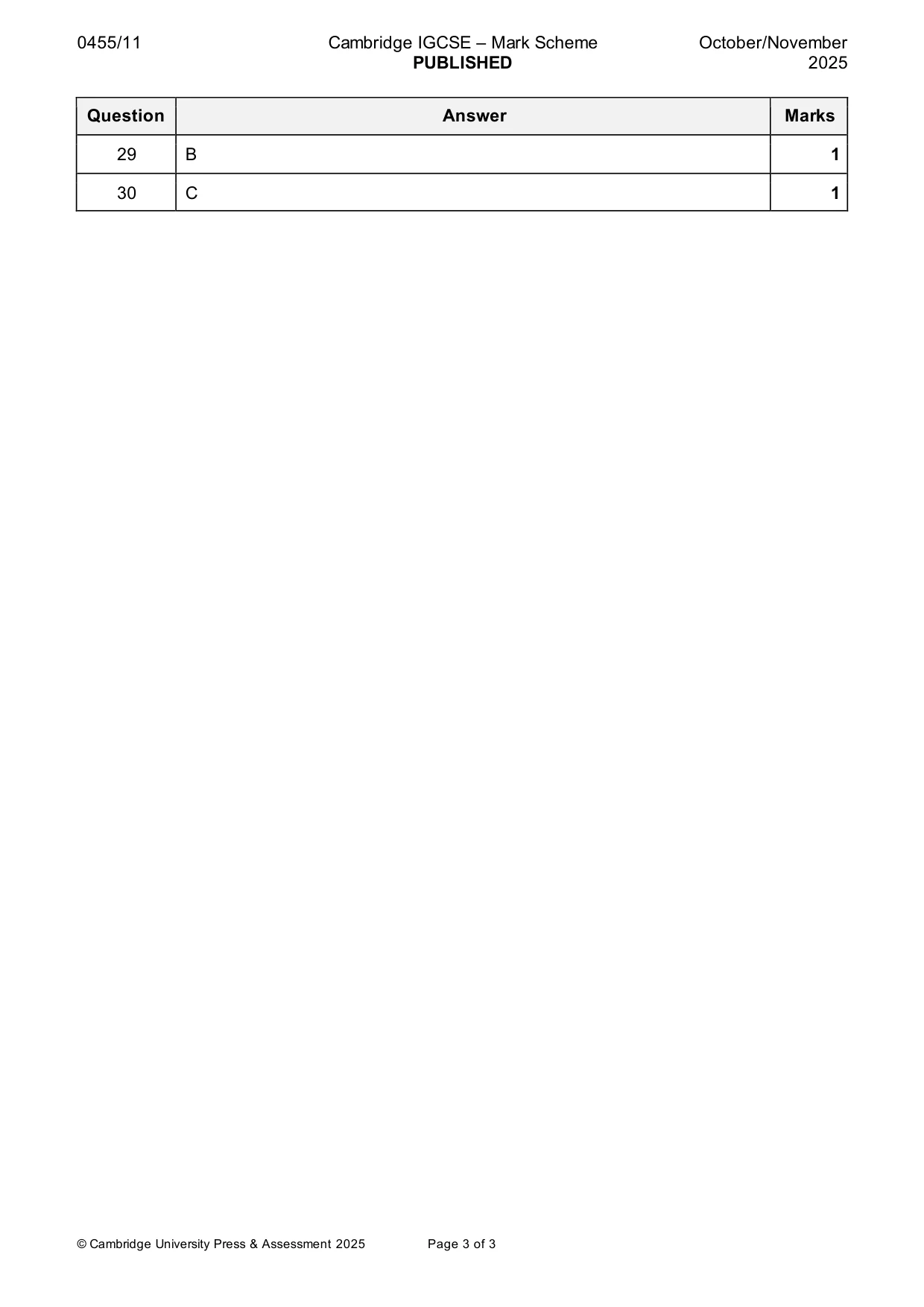
Mark scheme3 pages
Answers below. Sit the paper first if you are practising.
Questions as text
Q1 · Consumers and producers face the same problem of satisfying wants
1 Consumers and producers face the same problem of satisfying wants. What is the most likely reason wants cannot be satisfied? A consumers and producers cannot establish an equilibrium price B consumers have excess choice when producers oversupply C consumers have limited income and producers have finite resources D consumers lack information to buy and producers lack motivation to supply
Mark scheme: C
Q2 · A worker decides to leave their job as a bus driver and take a job as a lorry driver
2 A worker decides to leave their job as a bus driver and take a job as a lorry driver. What will increase the opportunity cost of this decision? A an increase in the holidays for lorry drivers B an increase in the income tax paid by bus drivers C an increase in the wages of bus drivers D an increase in the wages of lorry drivers
Mark scheme: C
Q3 · The diagram shows a country's production possibility curve (PPC)
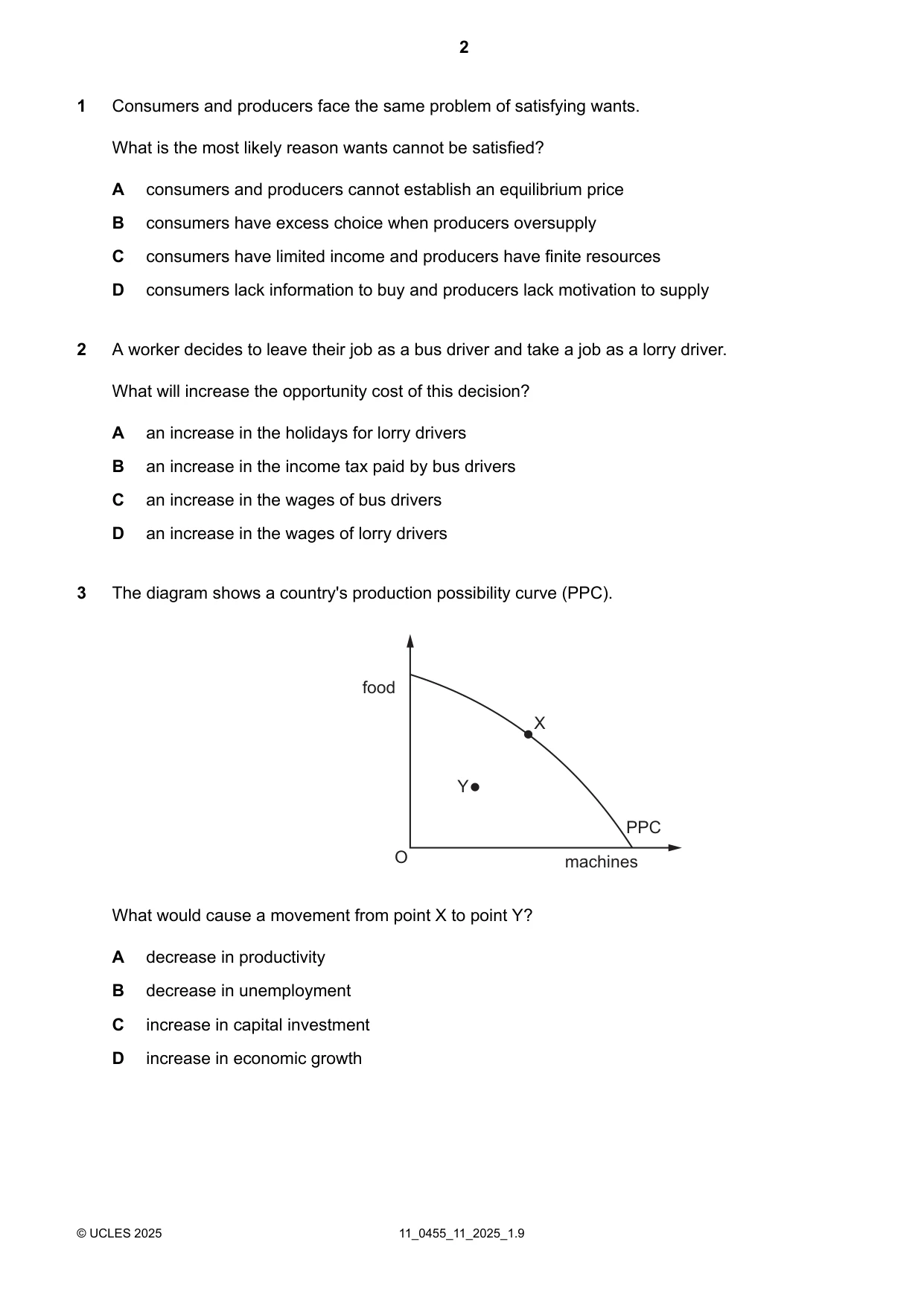
3 The diagram shows a country's production possibility curve (PPC). food X Y PPC O machines What would cause a movement from point X to point Y? A decrease in productivity B decrease in unemployment C increase in capital investment D increase in economic growth
Mark scheme: A
More questions on Production possibility curve (PPC) diagrams
Q4 · The price of petrol increases in a country with a market economic system
4 The price of petrol increases in a country with a market economic system. What is a consequence of this? A More cars are bought. B The costs of road transport increase. C The quantity of petrol supplied falls. D There is a shortage of petrol.
Mark scheme: B
Q5 · What determines a consumer’s demand for a product?
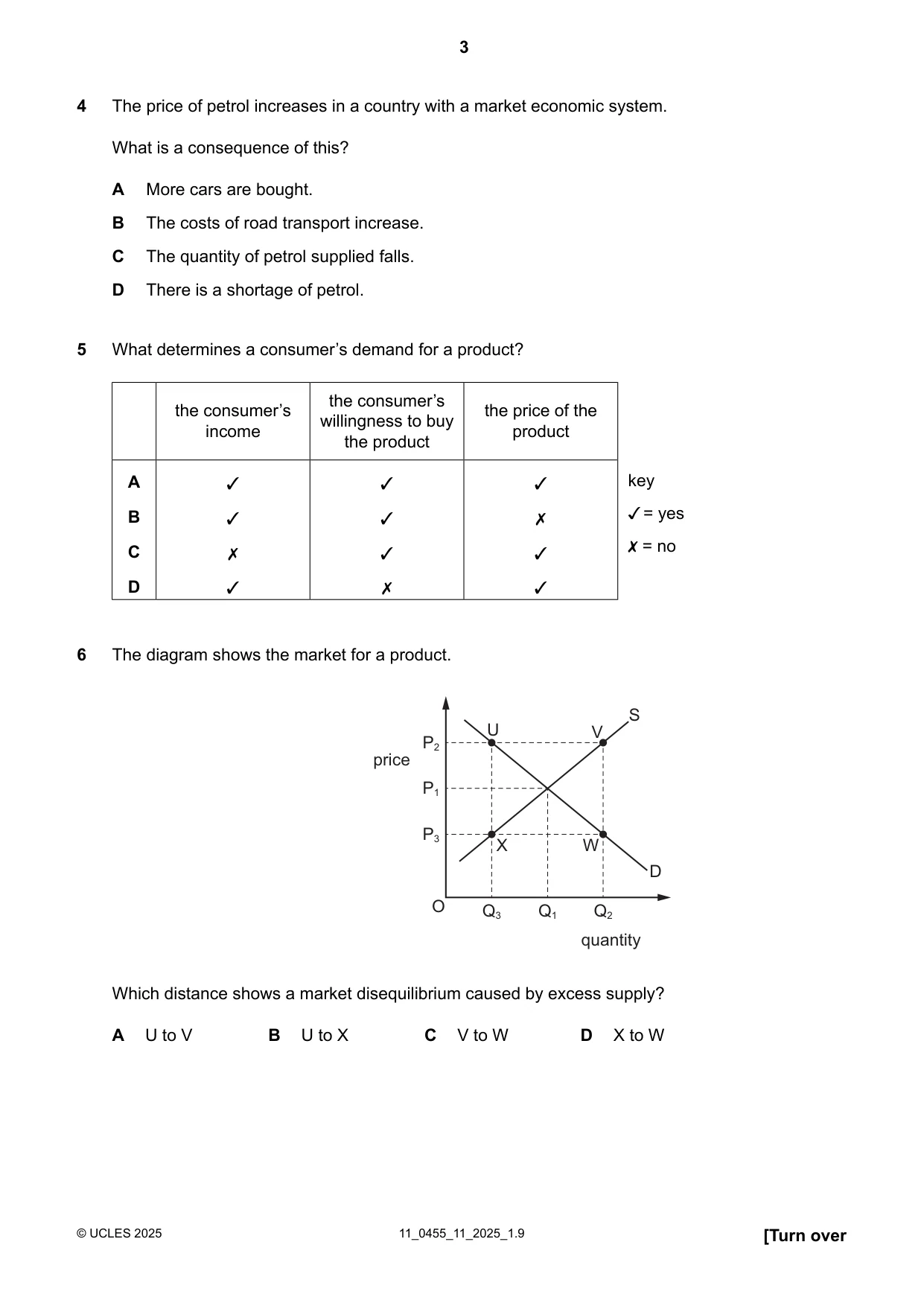
5 What determines a consumer’s demand for a product? the consumer’s income the consumer’s willingness to buy the product the price of the product key /=yes X=n0o
Mark scheme: A
Q6 · The diagram shows the market for a product
6 The diagram shows the market for a product. S U V P2 price P1 P3 X W D O Q3 Q1 Q2 quantity Which distance shows a market disequilibrium caused by excess supply? A U to V B U to X C V to W D X to W
Mark scheme: A
Q7 · The price elasticity of demand (PED) of a good is –1
7 The price elasticity of demand (PED) of a good is –1. What will happen to both demand and total revenue as price increases? A demand will fall and total revenue will not change B demand will fall and total revenue will rise C demand will rise and total revenue will not change D demand will rise and total revenue will rise
Mark scheme: A
Q8 · Which pair of economic institutions can be found in a market economy?
8 Which pair of economic institutions can be found in a market economy? A charities and public sector firms B multinational companies and commercial banks C public sector firms and private sector firms D stock exchanges and government-funded hospitals
Mark scheme: B
Q9 · The table shows the weekly demand for, and supply of, good X at three prices
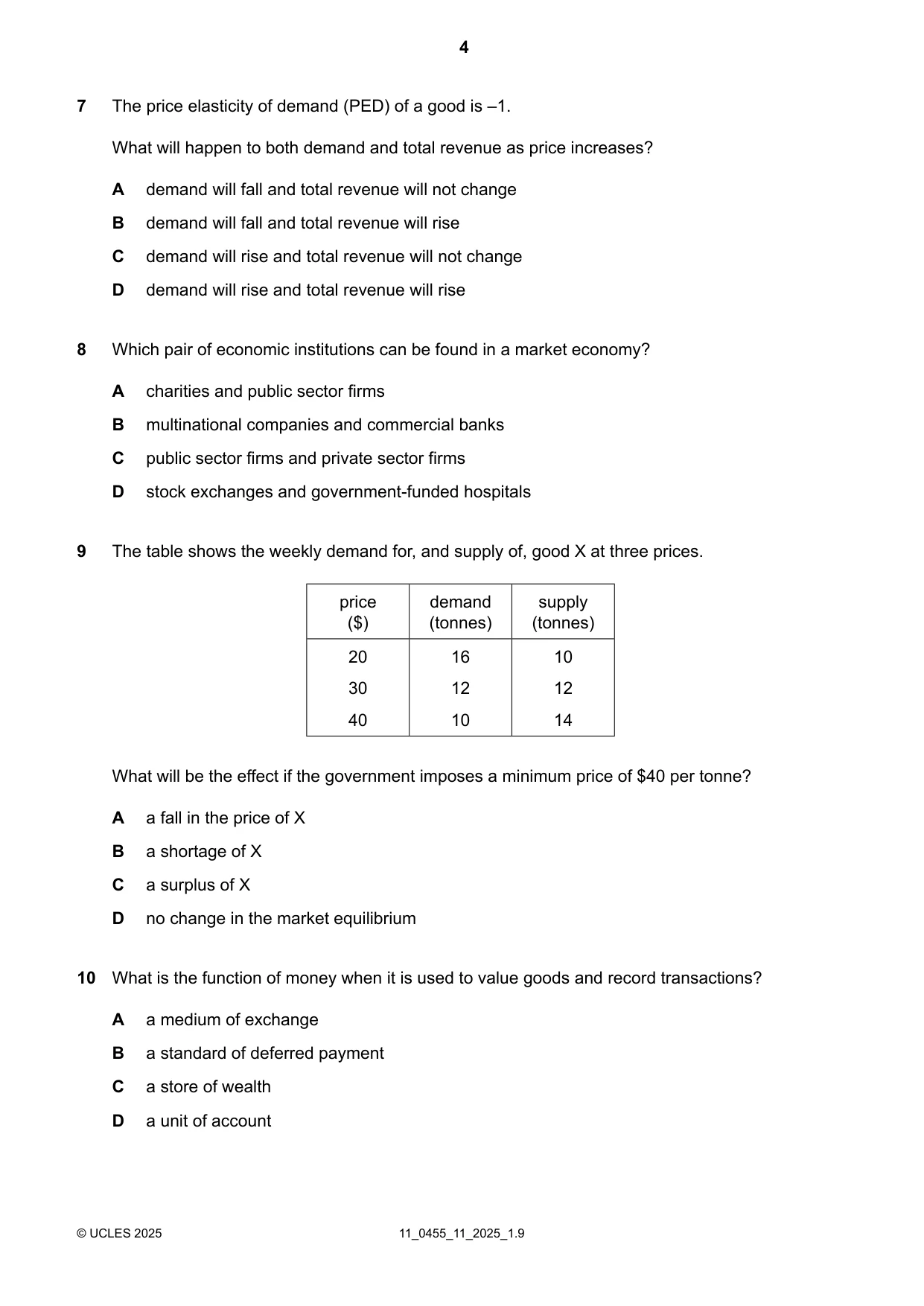
9 The table shows the weekly demand for, and supply of, good X at three prices. price demand supply ($) (tonnes) (tonnes) 20 16 10 30 12 12 40 10 14 What will be the effect if the government imposes a minimum price of $40 per tonne? A a fall in the price of X B a shortage of X C a surplus of X D no change in the market equilibrium
Mark scheme: C
Q10 · What is the function of money when it is used to value goods and record transactions?
10 What is the function of money when it is used to value goods and record transactions? A a medium of exchange B a standard of deferred payment C a store of wealth D a unit of account
Mark scheme: D
Q11 · The table shows how household spending changes with income
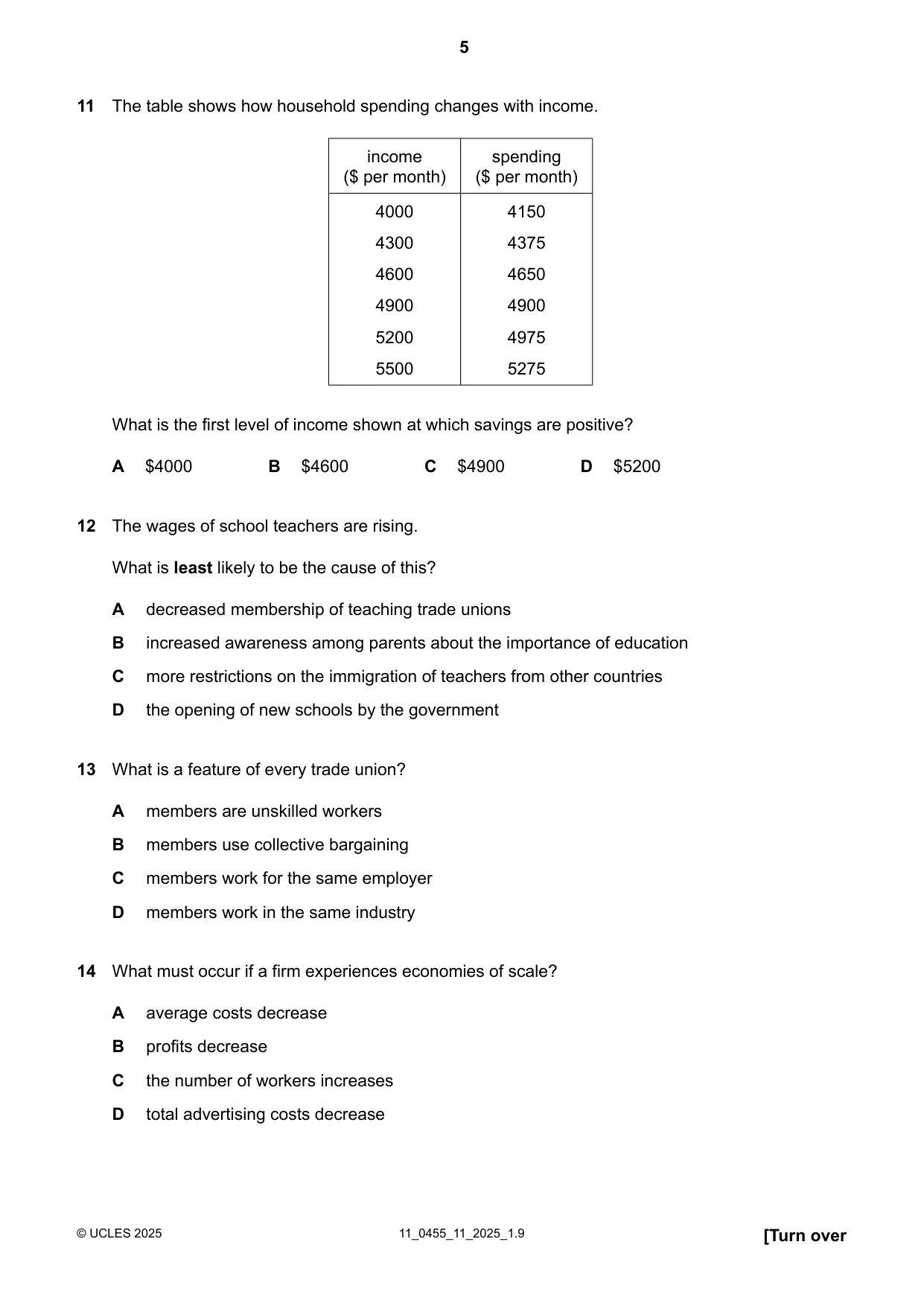
11 The table shows how household spending changes with income. income spending ($ per month) ($ per month) 4000 4150 4300 4375 4600 4650 4900 4900 5200 4975 5500 5275 What is the first level of income shown at which savings are positive? A $4000 B $4600 C $4900 D $5200
Mark scheme: D
Q12 · The wages of school teachers are rising
12 The wages of school teachers are rising. What is least likely to be the cause of this? A decreased membership of teaching trade unions B increased awareness among parents about the importance of education C more restrictions on the immigration of teachers from other countries D the opening of new schools by the government
Mark scheme: A
Q13 · What is a feature of every trade union?
13 What is a feature of every trade union? A members are unskilled workers B members use collective bargaining C members work for the same employer D members work in the same industry
Mark scheme: B
Q14 · What must occur if a firm experiences economies of scale?
14 What must occur if a firm experiences economies of scale? A average costs decrease B profits decrease C the number of workers increases D total advertising costs decrease
Mark scheme: A
Q15 · The diagram shows the costs of a firm
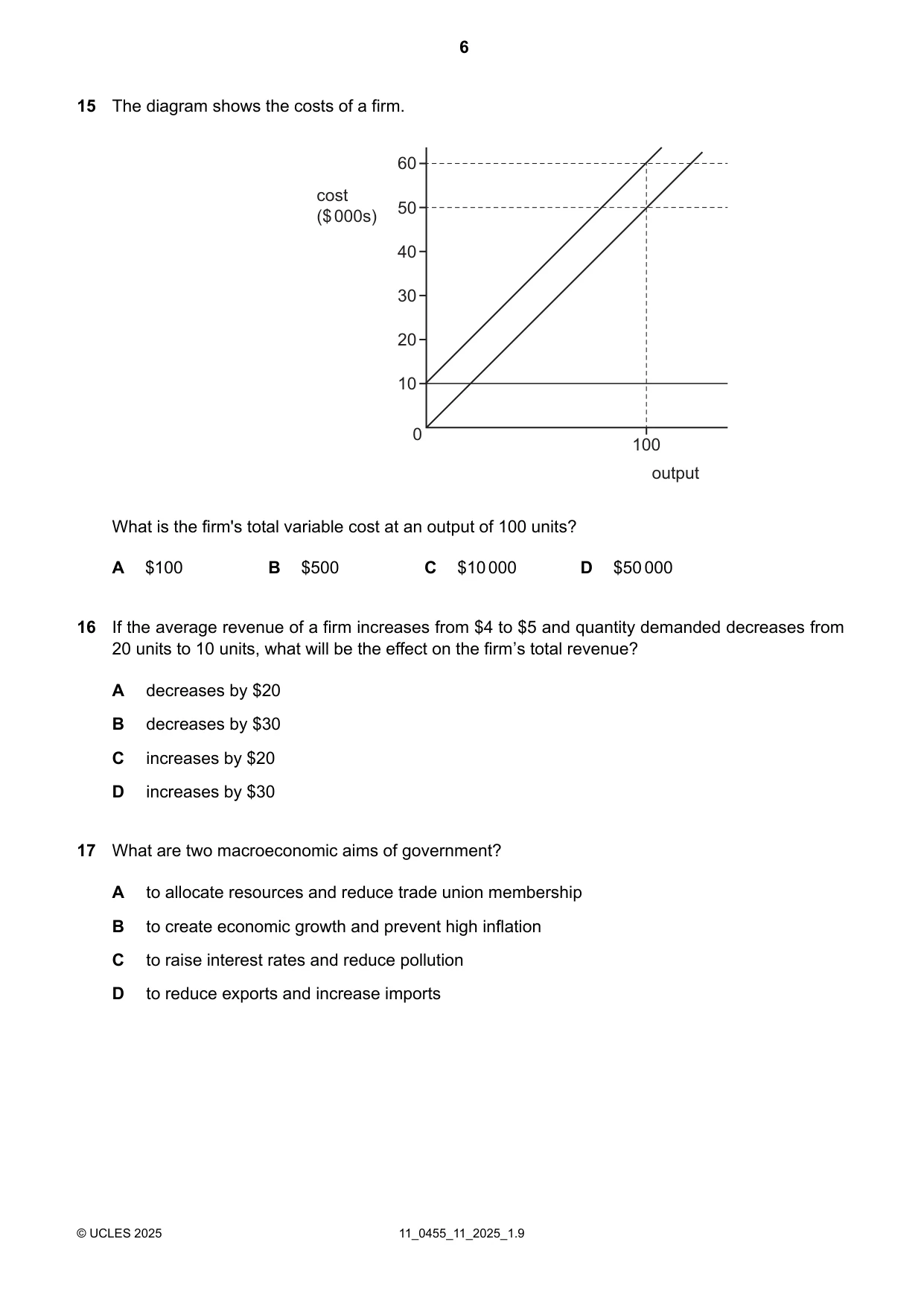
15 The diagram shows the costs of a firm. 60 cost 50 ($ 000s) 40 30 20 10 0 100 output What is the firm's total variable cost at an output of 100 units? A $100 B $500 C $10000 D $50000
Mark scheme: D
Q16 · If the average revenue of a firm increases from $4 to $5 and quantity demanded decreases…
16 If the average revenue of a firm increases from $4 to $5 and quantity demanded decreases from 20 units to 10 units, what will be the effect on the firm’s total revenue? A decreases by $20 B decreases by $30 C increases by $20 D increases by $30
Mark scheme: B
Q17 · What are two macroeconomic aims of government?
17 What are two macroeconomic aims of government? A to allocate resources and reduce trade union membership B to create economic growth and prevent high inflation C to raise interest rates and reduce pollution D to reduce exports and increase imports
Mark scheme: B
Q18 · A government's spending currently equals its revenue
18 A government's spending currently equals its revenue. The government decides to decrease its spending. What is the most likely effect of this in the short run? A a budget deficit B a budget surplus C an increase in output D an increase in tax revenue
Mark scheme: B
Q19 · What is not a monetary policy measure?
19 What is not a monetary policy measure? A changes in income tax rates B changes in interest rates C changes in the exchange rate D changes in the money supply
Mark scheme: A
Q20 · Which government action would not be included as part of a supply-side policy?
20 Which government action would not be included as part of a supply-side policy? A increasing the privatisation of industries B lowering national minimum wage rates C raising tariffs on international trade D reducing state benefits
Mark scheme: C
Q21 · An economy operating on its production possibility curve (PPC) enters a recession that…
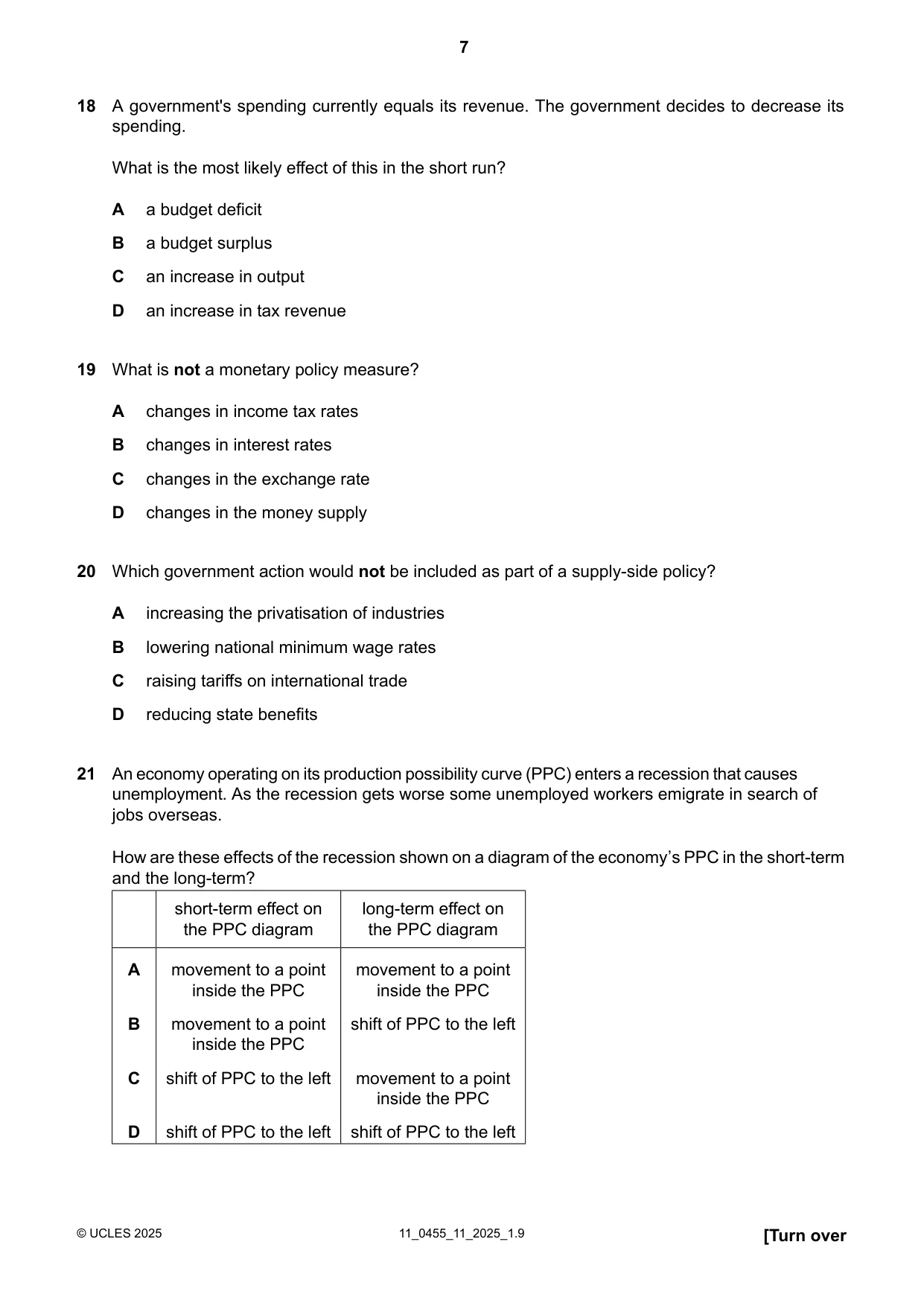
21 An economy operating on its production possibility curve (PPC) enters a recession that causes unemployment. As the recession gets worse some unemployed workers emigrate in search of jobs overseas. How are these effects of the recession shown on a diagram of the economy’s PPC in the short-term and the long-term? short-term effect on long-term effect on the PPC diagram the PPC diagram A movement to a point movement to a point inside the PPC inside the PPC B movement to a point shift of PPC to the left inside the PPC C shift of PPC to the left movement to a point inside the PPC D shift of PPC to the left shift of PPC to the left
Mark scheme: B
More questions on Production possibility curve (PPC) diagrams
Q22 · Chile specialises in the production of copper for export
22 Chile specialises in the production of copper for export. In what way is the Chilean economy likely to be affected by a large rise in the supply of copper from other countries? employment economic growth A fall fall B fall rise C rise fall D rise rise
Mark scheme: A
Q23 · The table shows the patterns of employment in selected industries in two years
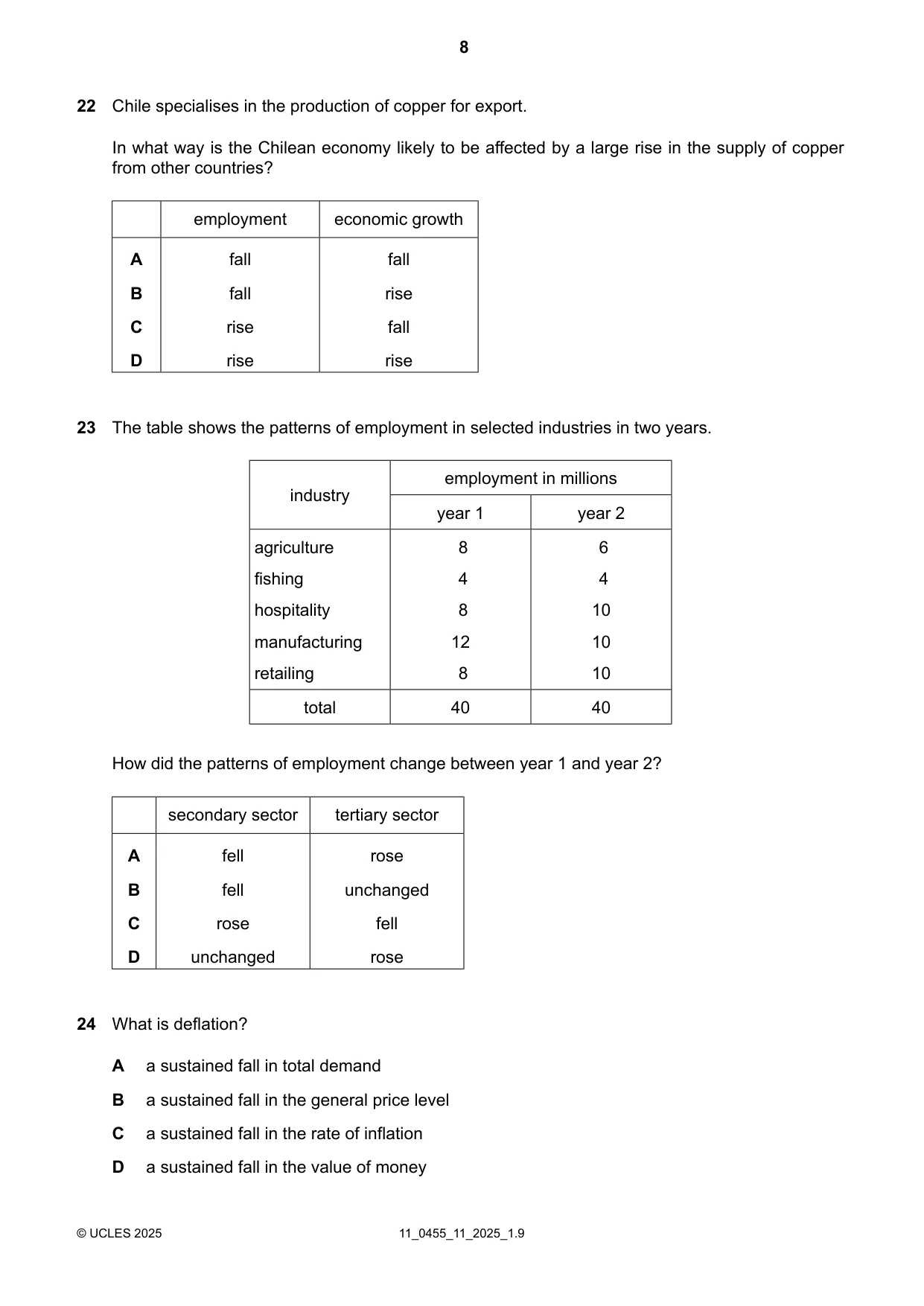
23 The table shows the patterns of employment in selected industries in two years. employment in millions industry year 1 year 2 agriculture 8 6 fishing 4 4 hospitality 8 10 manufacturing 12 10 retailing 8 10 total 40 40 How did the patterns of employment change between year 1 and year 2? secondary sector tertiary sector A fell rose B fell unchanged C rose fell D unchanged rose
Mark scheme: A
Question 24
24 What is deflation? A a sustained fall in total demand B a sustained fall in the general price level C a sustained fall in the rate of inflation D a sustained fall in the value of money
Mark scheme: B
Q25 · What is most likely to cause more poverty in a country?
25 What is most likely to cause more poverty in a country? A a decrease in the general price level B a decrease in the rate of income tax C a decrease in the level of unemployment D a decrease in the level of wages
Mark scheme: D
Q26 · The charts show the population structure of a country in year X and year X + 50
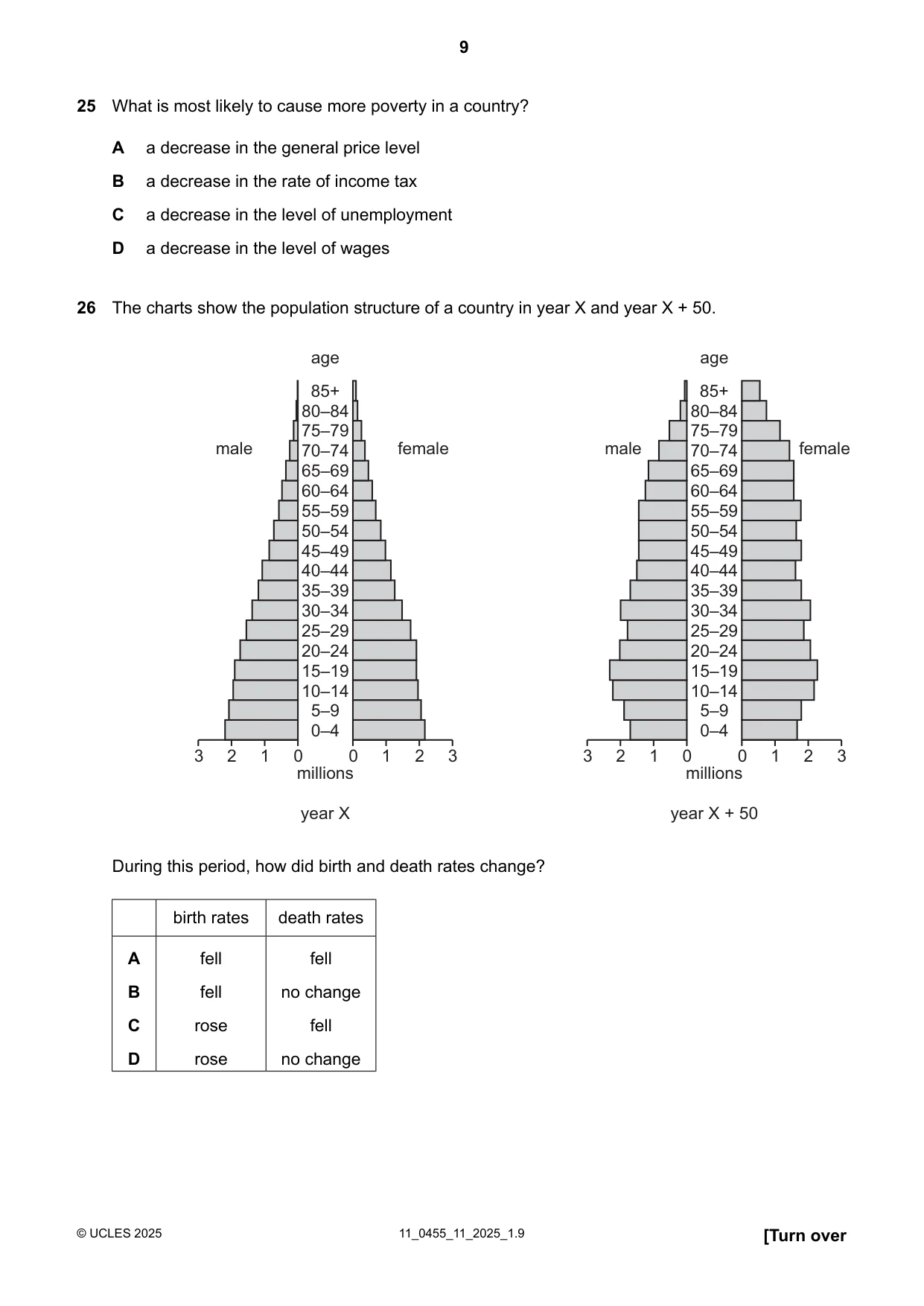
26 The charts show the population structure of a country in year X and year X + 50. age age 85+ 85+ 80–84 80–84 75–79 75–79 male 70–74 female male 70–74 female 65–69 65–69 60–64 60–64 55–59 55–59 50–54 50–54 45–49 45–49 40–44 40–44 35–39 35–39 30–34 30–34 25–29 25–29 20–24 20–24 15–19 15–19 10–14 10–14 5–9 5–9 0–4 0–4 3 2 1 0 0 1 2 3 3 2 1 0 0 1 2 3 millions millions year X year X + 50 During this period, how did birth and death rates change? birth rates death rates A fell fell B fell no change C rose fell D rose no change
Mark scheme: A
Q27 · What is an advantage for consumers from international specialisation?
27 What is an advantage for consumers from international specialisation? A competition between firms results in lower prices B labour can move more freely between countries C less wealth is created throughout the world D multinational companies can increase their profits
Mark scheme: A
Q28 · Which government policy would encourage greater international trade?
28 Which government policy would encourage greater international trade? A an increase in the level of domestic regulation B an increase in the level of tariffs on imports C the abolition of domestic subsidies for declining industries D the abolition of free trade agreements
Mark scheme: C
Q29 · The US currently trades in oil with the UK
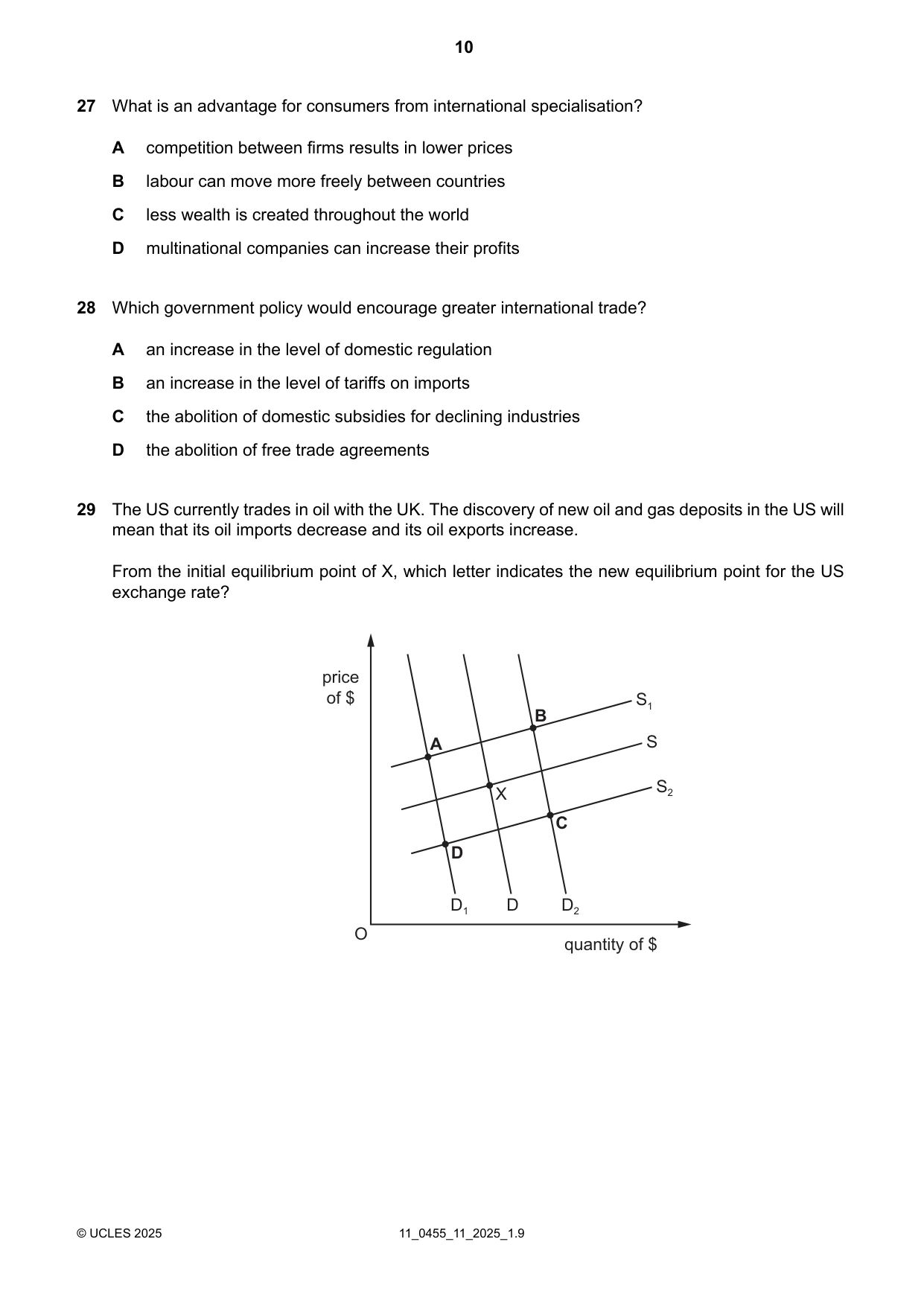
29 The US currently trades in oil with the UK. The discovery of new oil and gas deposits in the US will mean that its oil imports decrease and its oil exports increase. From the initial equilibrium point of X, which letter indicates the new equilibrium point for the US exchange rate? price of $ S1 B A S X S2 C D D1 D D2 O quantity of $
Mark scheme: B
Q30 · What is most likely to directly result from a persistent and large current account…
30 What is most likely to directly result from a persistent and large current account surplus on the balance of payments of a country? A a lower exchange rate B a lower standard of living C an increase in gross domestic product D an increase in the unemployment rate
Mark scheme: C
What was in this paper
The subtopics covered by these 30 questions, and how many questions each got. Open one in a new tab to see every Cambridge question on it.
3Firms’ costs, revenue and objectives2International specialisation2Production possibility curve (PPC) diagrams2Current account of balance of payments1Demand1Firms and production1Fiscal policy1Foreign exchange rates1Globalisation, free trade and protection1Households1Inflation and deflation1Market economic system1Monetary policy1Money and banking1Opportunity cost1Population1Poverty1Price changes1Price elasticity of demand (PED)1Supply-side policy1The macroeconomic aims of government1The nature of the economic problem1Trade unions1Workers1What you needed in this session
Cambridge’s own grade thresholds for 2025 Oct/Nov, Paper 1 · Variant 1. A higher threshold means an easier paper — the bar moves with how the cohort did.