Cambridge IGCSE Economics 0455 — 2008 Oct/Nov Paper 1 · Variant 1
0455/11/O/N/08 · 40 questions · 40 marks · ≈45 min
The question paper and its mark scheme, free to read here and free to download. This is Cambridge’s own paper, exactly as it was sat.
Question paper16 pages





Mark scheme2 pages
Answers below. Sit the paper first if you are practising.
Questions as text
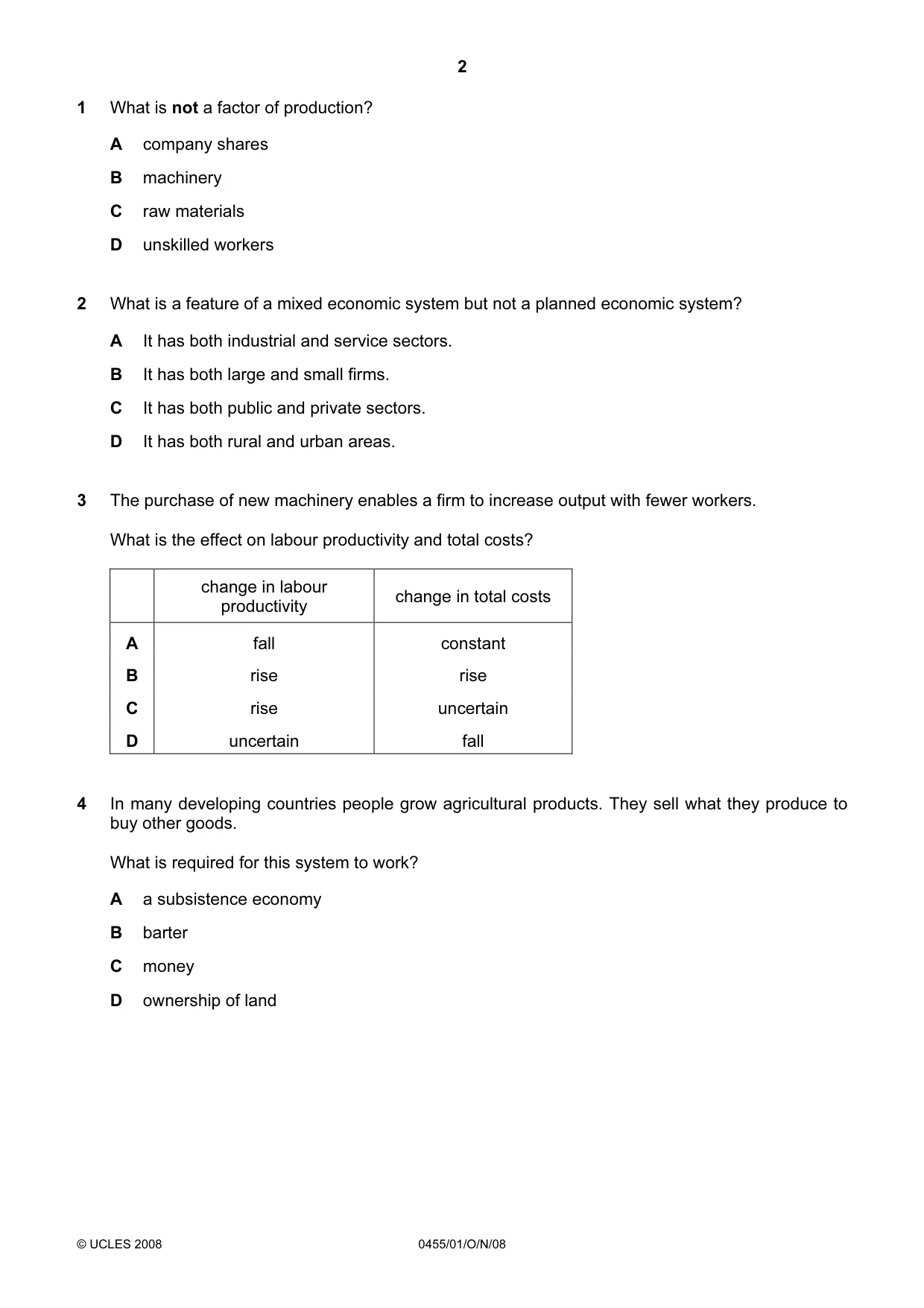
Q1 · What is not a factor of production?
1 What is not a factor of production? A company shares B machinery C raw materials D unskilled workers
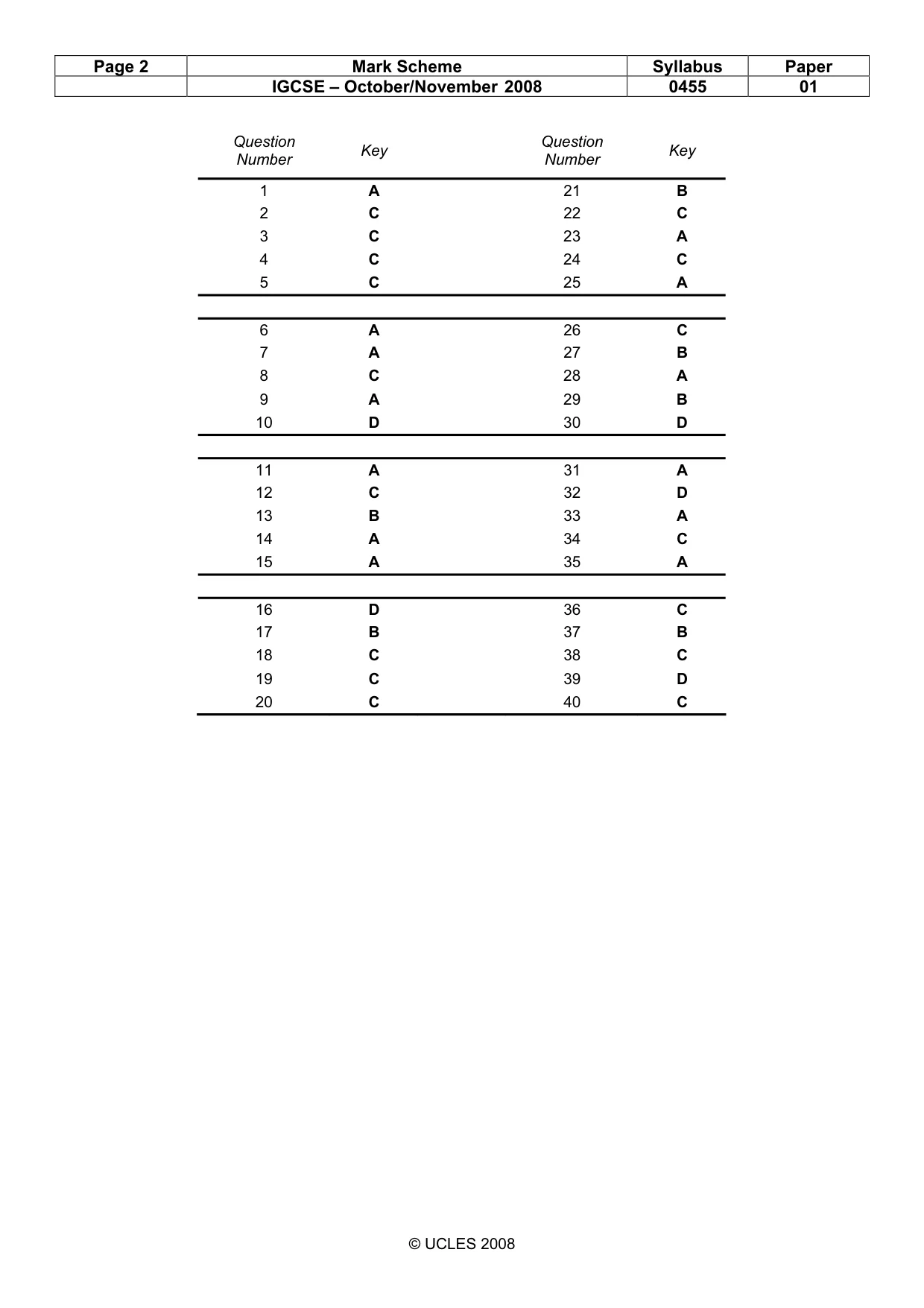
Mark scheme: A
Q2 · What is a feature of a mixed economic system but not a planned economic system?
2 What is a feature of a mixed economic system but not a planned economic system? A It has both industrial and service sectors. B It has both large and small firms. C It has both public and private sectors. D It has both rural and urban areas.
Mark scheme: C
Q3 · The purchase of new machinery enables a firm to increase output with fewer workers
3 The purchase of new machinery enables a firm to increase output with fewer workers. What is the effect on labour productivity and total costs? change in labour change in total costs productivity A fall constant B rise rise C rise uncertain D uncertain fall
Mark scheme: C
Q4 · In many developing countries people grow agricultural products
4 In many developing countries people grow agricultural products. They sell what they produce to buy other goods. What is required for this system to work? A a subsistence economy B barter C money D ownership of land
Mark scheme: C
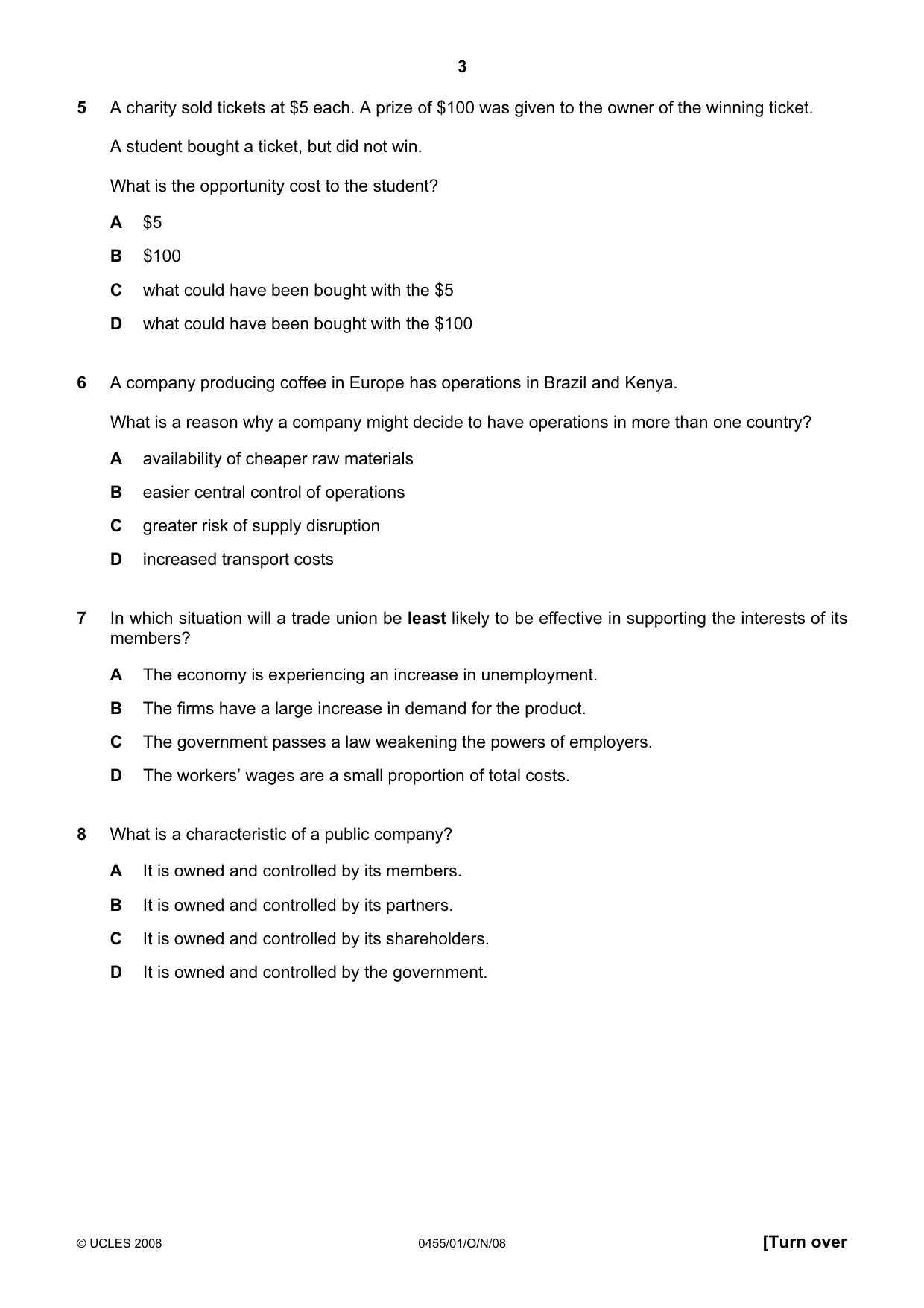
Q5 · A charity sold tickets at $5 each
5 A charity sold tickets at $5 each. A prize of $100 was given to the owner of the winning ticket. A student bought a ticket, but did not win. What is the opportunity cost to the student? A $5 B $100 C what could have been bought with the $5 D what could have been bought with the $100
Mark scheme: C
Q6 · A company producing coffee in Europe has operations in Brazil and Kenya
6 A company producing coffee in Europe has operations in Brazil and Kenya. What is a reason why a company might decide to have operations in more than one country? A availability of cheaper raw materials B easier central control of operations C greater risk of supply disruption D increased transport costs
Mark scheme: A
Q7 · In which situation will a trade union be least likely to be effective in supporting the…
7 In which situation will a trade union be least likely to be effective in supporting the interests of its members? A The economy is experiencing an increase in unemployment. B The firms have a large increase in demand for the product. C The government passes a law weakening the powers of employers. D The workers’ wages are a small proportion of total costs.
Mark scheme: A
Q8 · What is a characteristic of a public company?
8 What is a characteristic of a public company? A It is owned and controlled by its members. B It is owned and controlled by its partners. C It is owned and controlled by its shareholders. D It is owned and controlled by the government.
Mark scheme: C
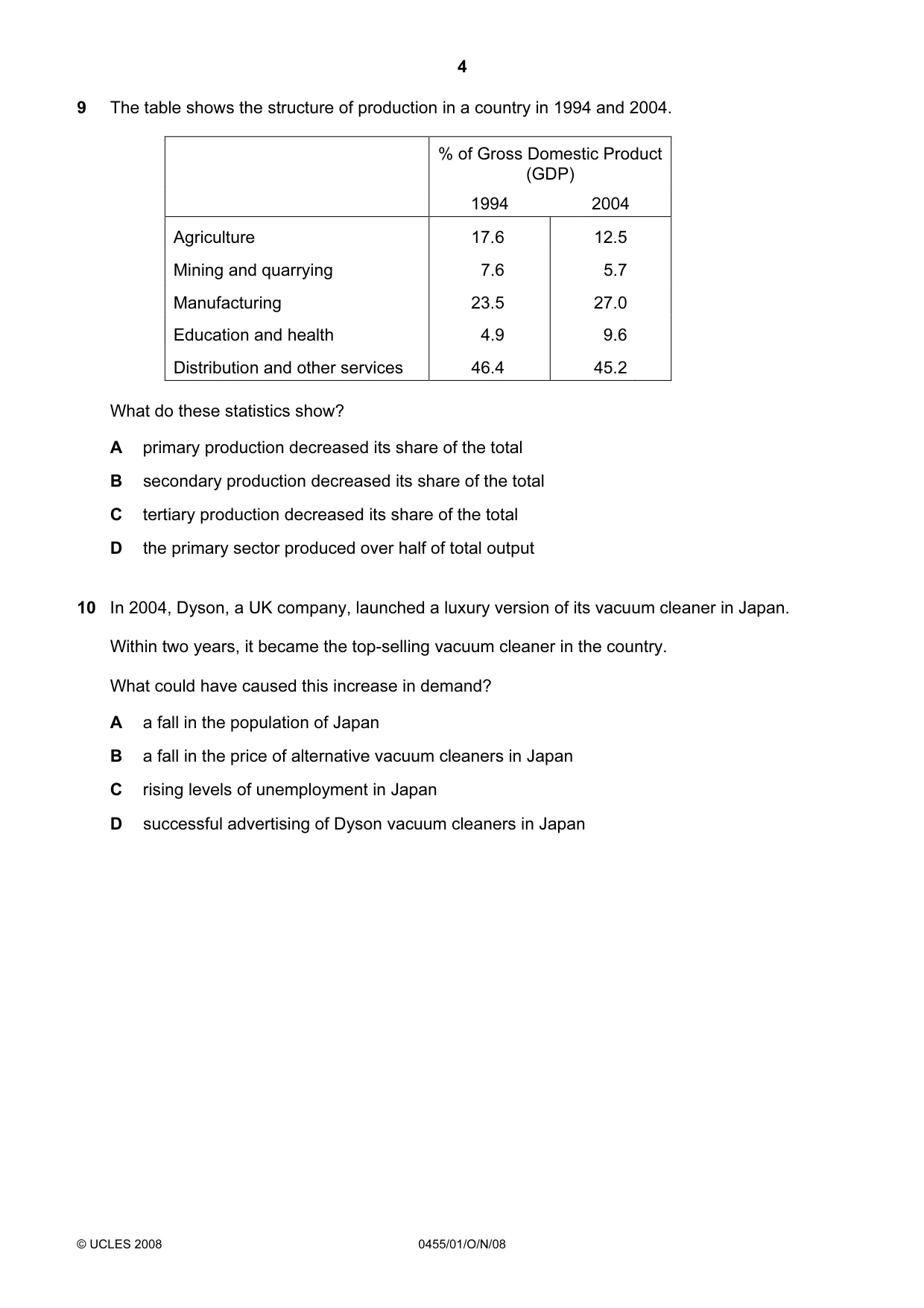
Q9 · The table shows the structure of production in a country in 1994 and 2004
9 The table shows the structure of production in a country in 1994 and 2004. % of Gross Domestic Product (GDP) 1994 2004 Agriculture 17.6 12.5 Mining and quarrying 7.6 5.7 Manufacturing 23.5 27.0 Education and health 4.9 9.6 Distribution and other services 46.4 45.2 What do these statistics show? A primary production decreased its share of the total B secondary production decreased its share of the total C tertiary production decreased its share of the total D the primary sector produced over half of total output
Mark scheme: A
Q10 · In 2004, Dyson, a UK company, launched a luxury version of its vacuum cleaner in Japan
10 In 2004, Dyson, a UK company, launched a luxury version of its vacuum cleaner in Japan. Within two years, it became the top-selling vacuum cleaner in the country. What could have caused this increase in demand? A a fall in the population of Japan B a fall in the price of alternative vacuum cleaners in Japan C rising levels of unemployment in Japan D successful advertising of Dyson vacuum cleaners in Japan
Mark scheme: D
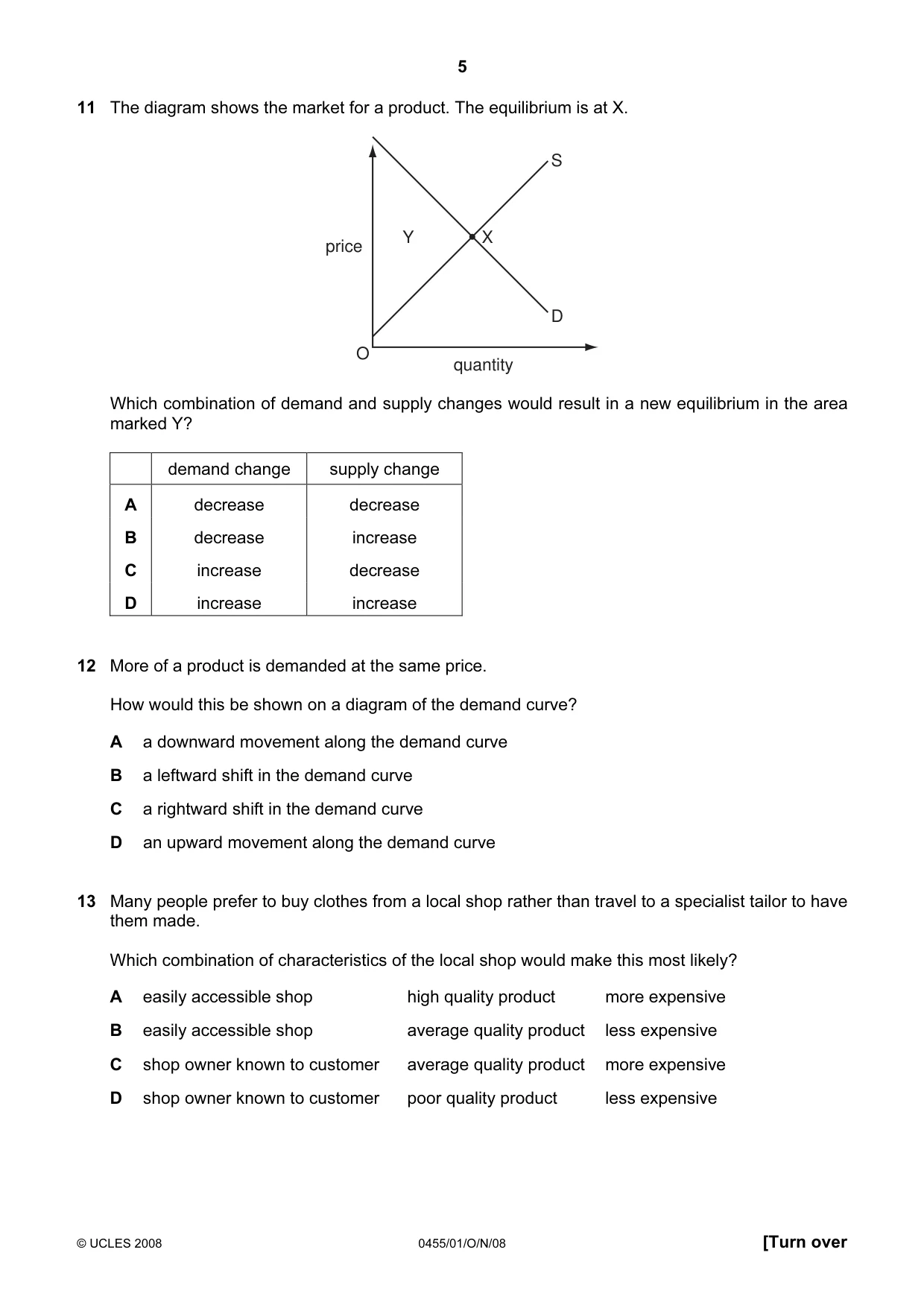
Q11 · The diagram shows the market for a product
11 The diagram shows the market for a product. The equilibrium is at X. S Y X price D O quantity Which combination of demand and supply changes would result in a new equilibrium in the area marked Y? demand change supply change A decrease decrease B decrease increase C increase decrease D increase increase
Mark scheme: A
Q12 · More of a product is demanded at the same price
12 More of a product is demanded at the same price. How would this be shown on a diagram of the demand curve? A a downward movement along the demand curve B a leftward shift in the demand curve C a rightward shift in the demand curve D an upward movement along the demand curve
Mark scheme: C
Q13 · Many people prefer to buy clothes from a local shop rather than travel to a specialist…
13 Many people prefer to buy clothes from a local shop rather than travel to a specialist tailor to have them made. Which combination of characteristics of the local shop would make this most likely? A easily accessible shop high quality product more expensive B easily accessible shop average quality product less expensive C shop owner known to customer average quality product more expensive D shop owner known to customer poor quality product less expensive
Mark scheme: B
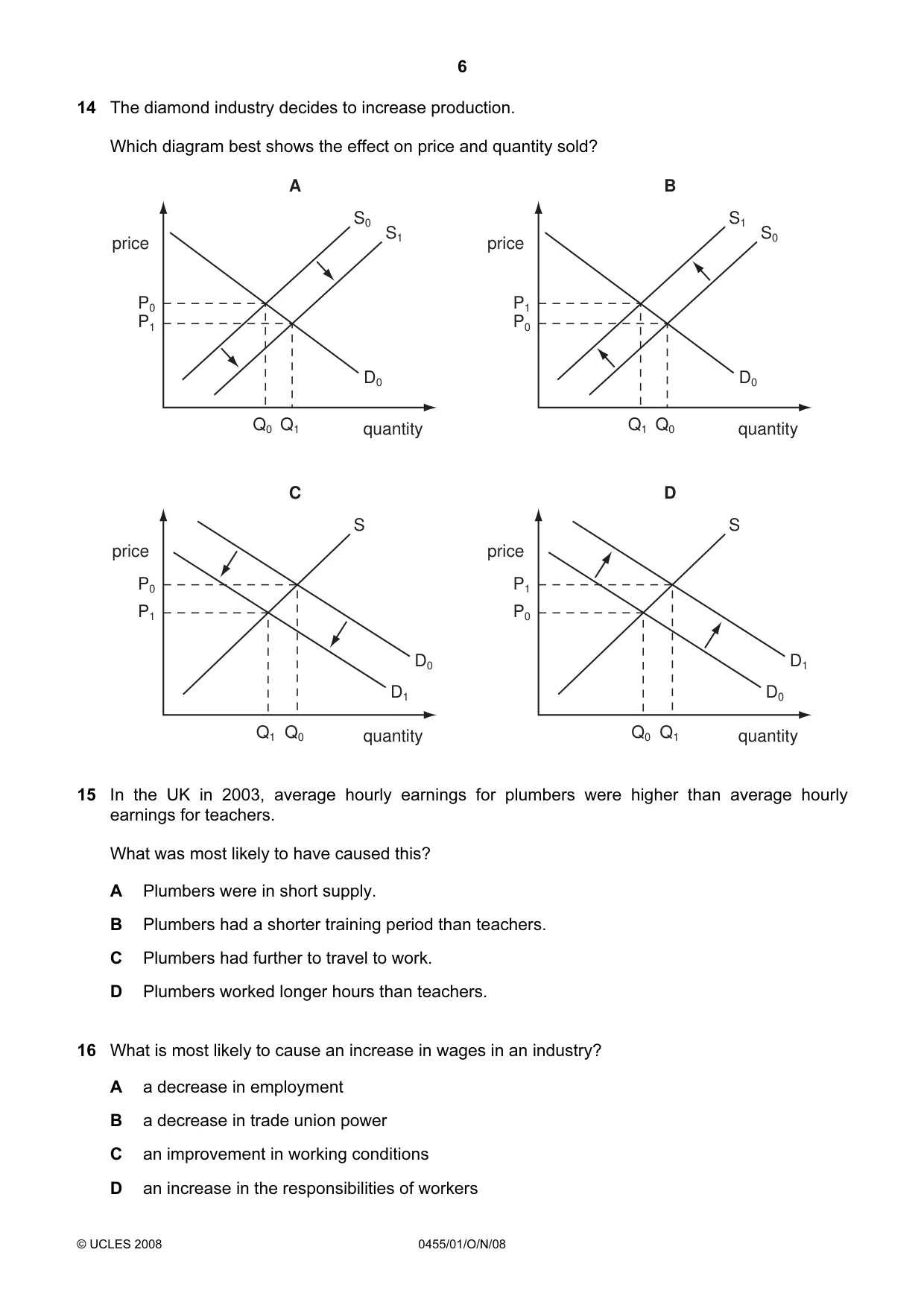
Q14 · The diamond industry decides to increase production
14 The diamond industry decides to increase production. Which diagram best shows the effect on price and quantity sold? A B S0 S1 S1 S0 price price P0 P1 P1 P0 D0 D0 Q0 Q1 quantity Q1 Q0 quantity C D S S price price P0 P1 P1 P0 D0 D1 D1 D0 Q1 Q0 quantity Q0 Q1 quantity
Mark scheme: A
Q15 · In the UK in 2003, average hourly earnings for plumbers were higher than average hourly…
15 In the UK in 2003, average hourly earnings for plumbers were higher than average hourly earnings for teachers. What was most likely to have caused this? A Plumbers were in short supply. B Plumbers had a shorter training period than teachers. C Plumbers had further to travel to work. D Plumbers worked longer hours than teachers.
Mark scheme: A
Q16 · What is most likely to cause an increase in wages in an industry?
16 What is most likely to cause an increase in wages in an industry? A a decrease in employment B a decrease in trade union power C an improvement in working conditions D an increase in the responsibilities of workers
Mark scheme: D
Q17 · Which type of income is earned by the factor of production enterprise?
17 Which type of income is earned by the factor of production enterprise? A interest B profit C rent D wages
Mark scheme: B
Q18 · What might cause an individual to save more?
18 What might cause an individual to save more? A a rise in direct taxation B a rise in insurance premiums C a rise in interest rates D a rise in the prices of foodstuffs
Mark scheme: C
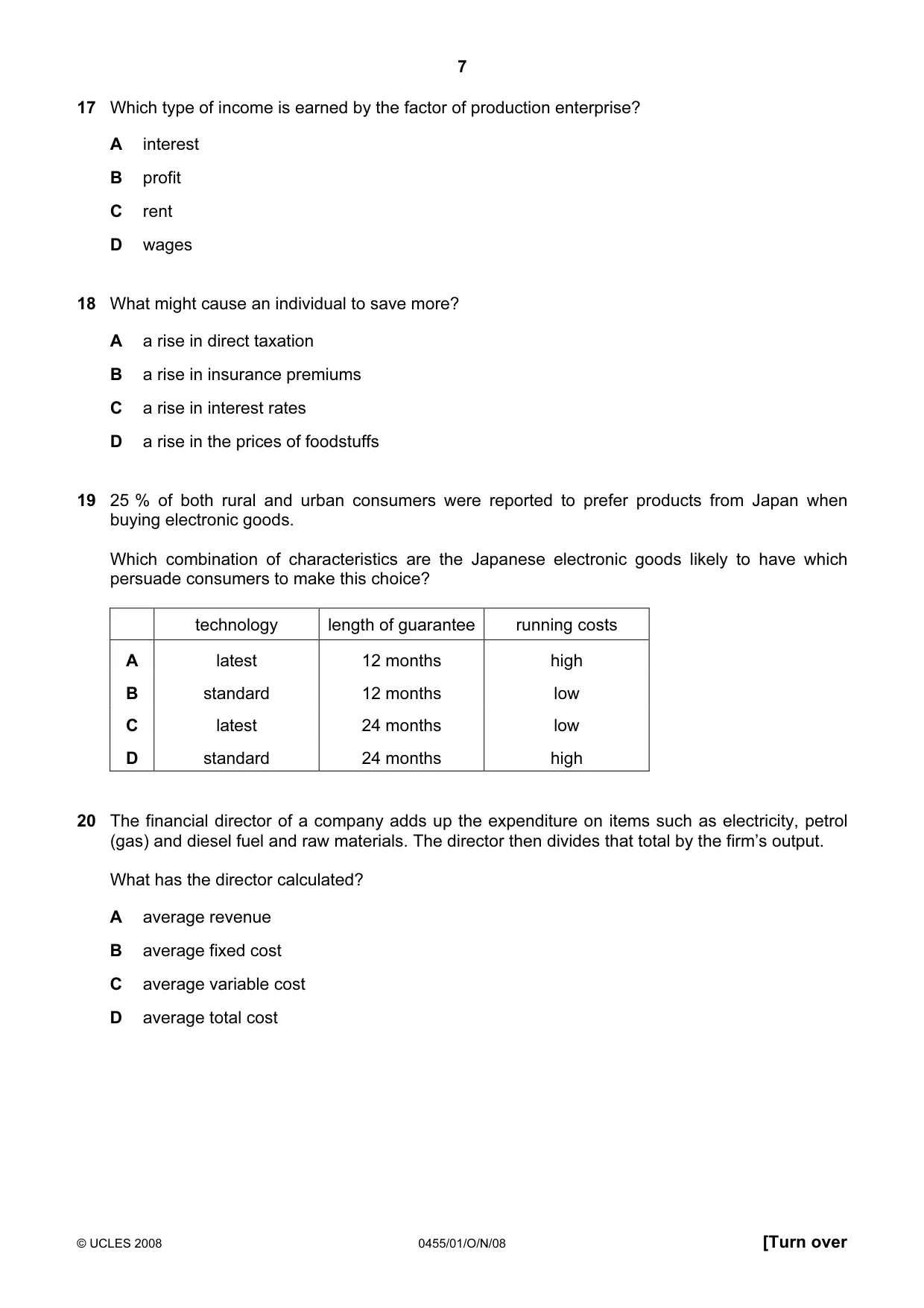
Q19 · 25 % of both rural and urban consumers were reported to prefer products from Japan when…
19 25 % of both rural and urban consumers were reported to prefer products from Japan when buying electronic goods. Which combination of characteristics are the Japanese electronic goods likely to have which persuade consumers to make this choice? technology length of guarantee running costs A latest 12 months high B standard 12 months low C latest 24 months low D standard 24 months high
Mark scheme: C
Q20 · The financial director of a company adds up the expenditure on items such as electricity…
20 The financial director of a company adds up the expenditure on items such as electricity, petrol (gas) and diesel fuel and raw materials. The director then divides that total by the firm’s output. What has the director calculated? A average revenue B average fixed cost C average variable cost D average total cost
Mark scheme: C
Q21 · What must a firm do which aims to make as much profit as possible?
21 What must a firm do which aims to make as much profit as possible? A make revenue and costs equal B maximise the difference between total revenue and total cost C maximise revenue D minimise costs of production
Mark scheme: B
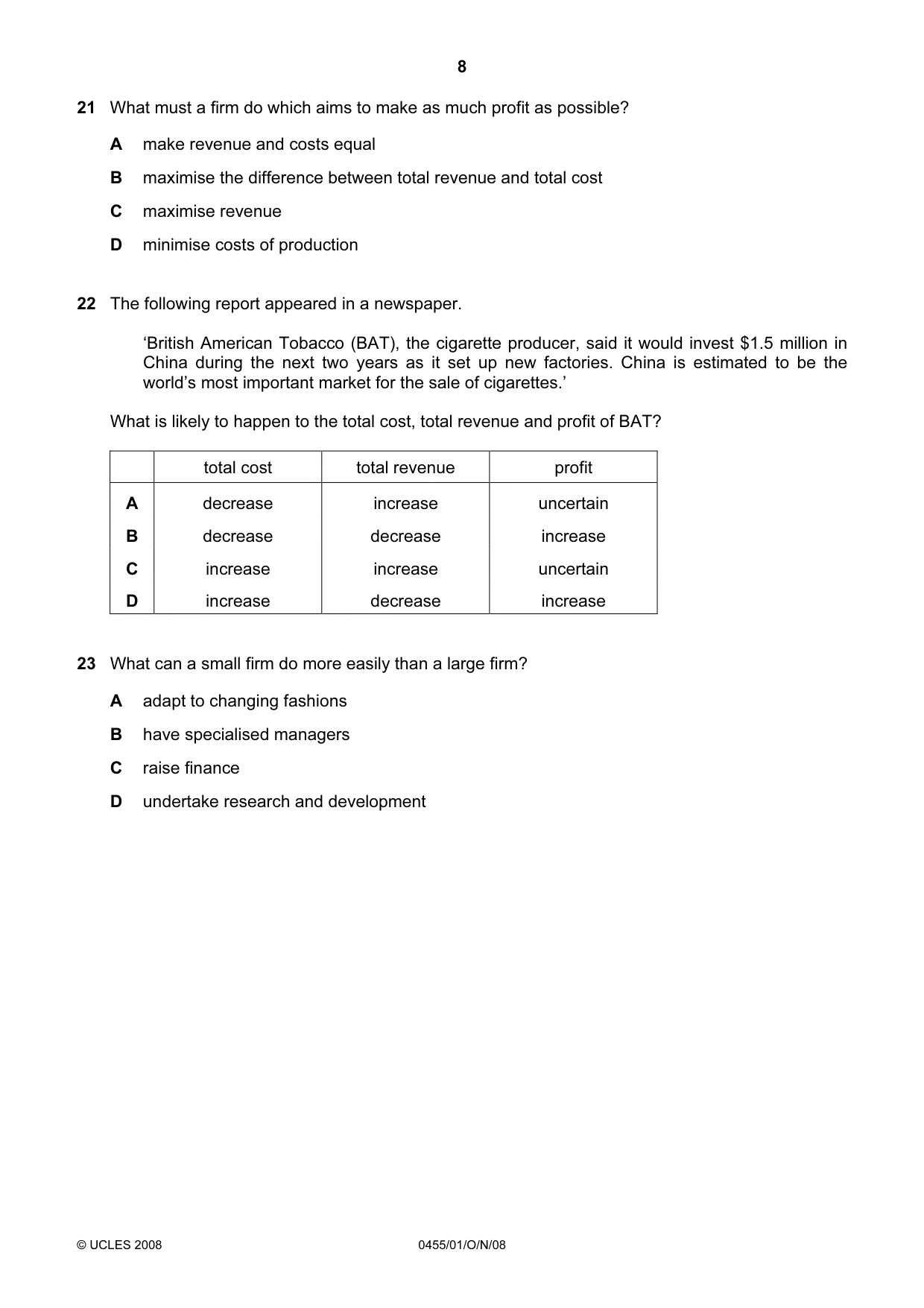
Q22 · The following report appeared in a newspaper
22 The following report appeared in a newspaper. ‘British American Tobacco (BAT), the cigarette producer, said it would invest $1.5 million in China during the next two years as it set up new factories. China is estimated to be the world’s most important market for the sale of cigarettes.’ What is likely to happen to the total cost, total revenue and profit of BAT? total cost total revenue profit A decrease increase uncertain B decrease decrease increase C increase increase uncertain D increase decrease increase
Mark scheme: C
Q23 · What can a small firm do more easily than a large firm?
23 What can a small firm do more easily than a large firm? A adapt to changing fashions B have specialised managers C raise finance D undertake research and development
Mark scheme: A
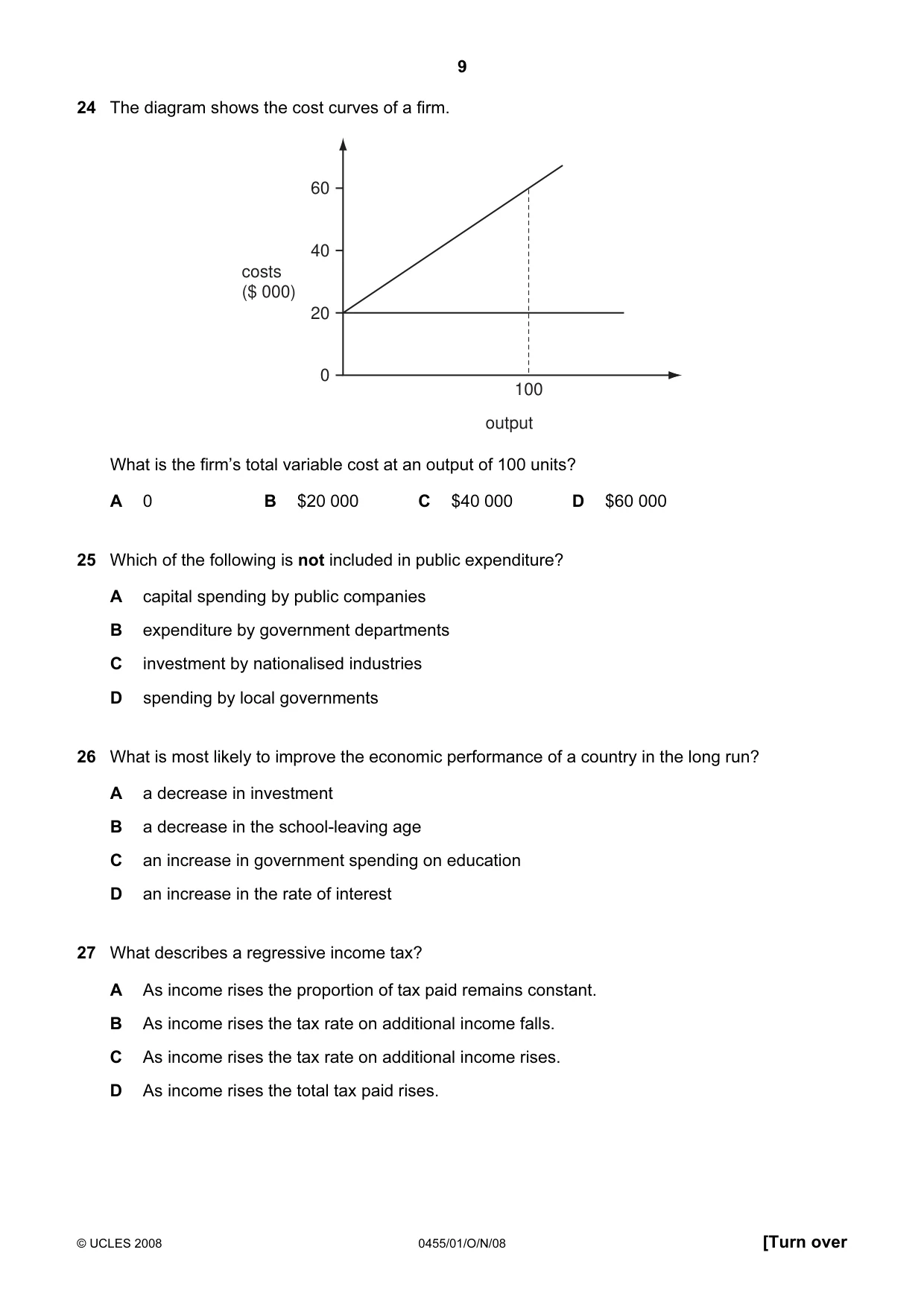
Q24 · The diagram shows the cost curves of a firm
24 The diagram shows the cost curves of a firm. 60 40 costs ($ 000) 20 0 100 output What is the firm’s total variable cost at an output of 100 units? A 0 B $20 000 C $40 000 D $60 000
Mark scheme: C
Q25 · Which of the following is not included in public expenditure?
25 Which of the following is not included in public expenditure? A capital spending by public companies B expenditure by government departments C investment by nationalised industries D spending by local governments
Mark scheme: A
Q26 · What is most likely to improve the economic performance of a country in the long run?
26 What is most likely to improve the economic performance of a country in the long run? A a decrease in investment B a decrease in the school-leaving age C an increase in government spending on education D an increase in the rate of interest
Mark scheme: C
Q27 · What describes a regressive income tax?
27 What describes a regressive income tax? A As income rises the proportion of tax paid remains constant. B As income rises the tax rate on additional income falls. C As income rises the tax rate on additional income rises. D As income rises the total tax paid rises.
Mark scheme: B
Q28 · A high proportion of people in a developing country have very low incomes
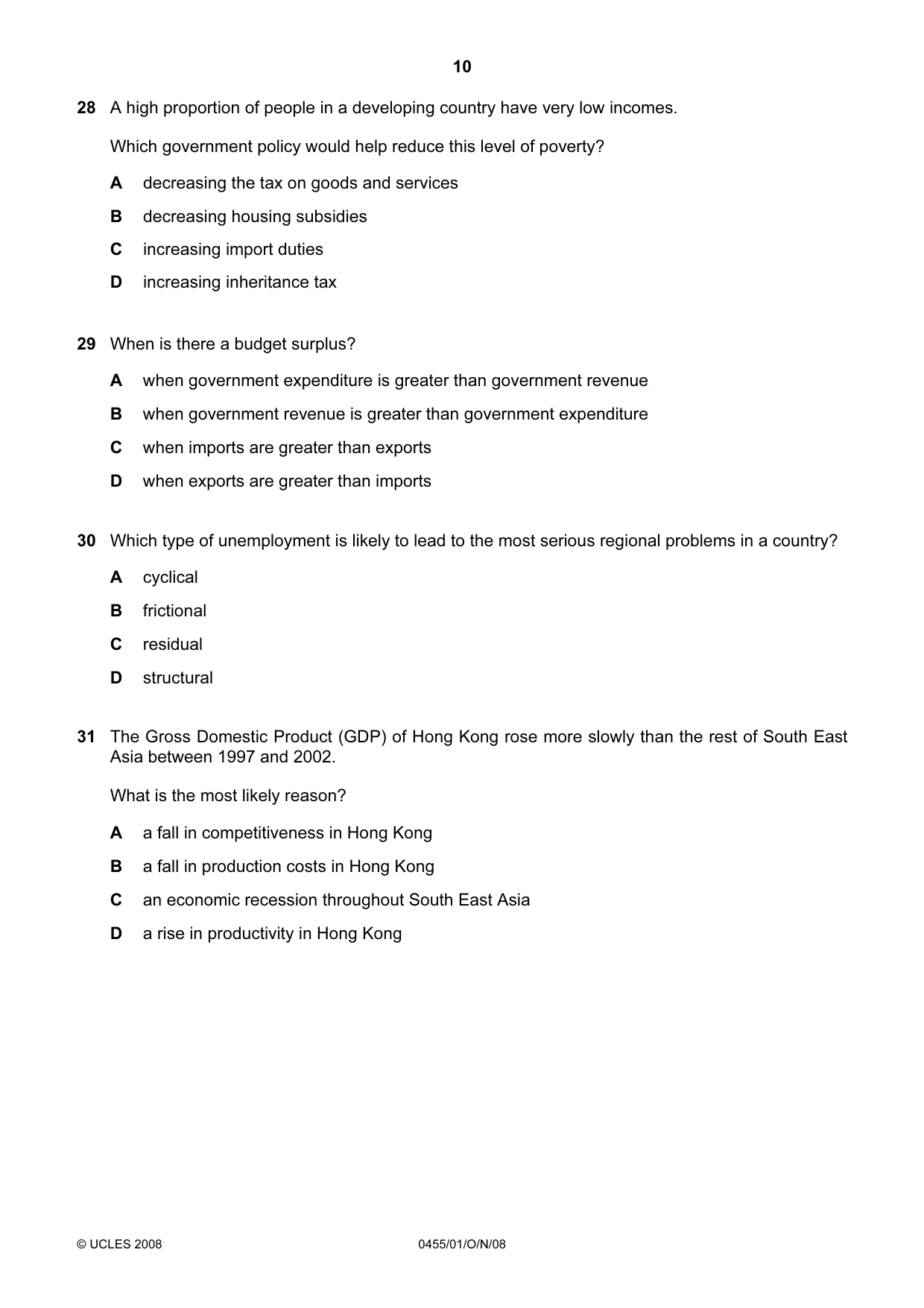
28 A high proportion of people in a developing country have very low incomes. Which government policy would help reduce this level of poverty? A decreasing the tax on goods and services B decreasing housing subsidies C increasing import duties D increasing inheritance tax
Mark scheme: A
Q29 · When is there a budget surplus?
29 When is there a budget surplus? A when government expenditure is greater than government revenue B when government revenue is greater than government expenditure C when imports are greater than exports D when exports are greater than imports
Mark scheme: B
Q30 · Which type of unemployment is likely to lead to the most serious regional problems in a…
30 Which type of unemployment is likely to lead to the most serious regional problems in a country? A cyclical B frictional C residual D structural
Mark scheme: D
Q31 · The Gross Domestic Product (GDP) of Hong Kong rose more slowly than the rest of South…
31 The Gross Domestic Product (GDP) of Hong Kong rose more slowly than the rest of South East Asia between 1997 and 2002. What is the most likely reason? A a fall in competitiveness in Hong Kong B a fall in production costs in Hong Kong C an economic recession throughout South East Asia D a rise in productivity in Hong Kong
Mark scheme: A
Q32 · The table shows the rates of inflation in four countries over a period of four years
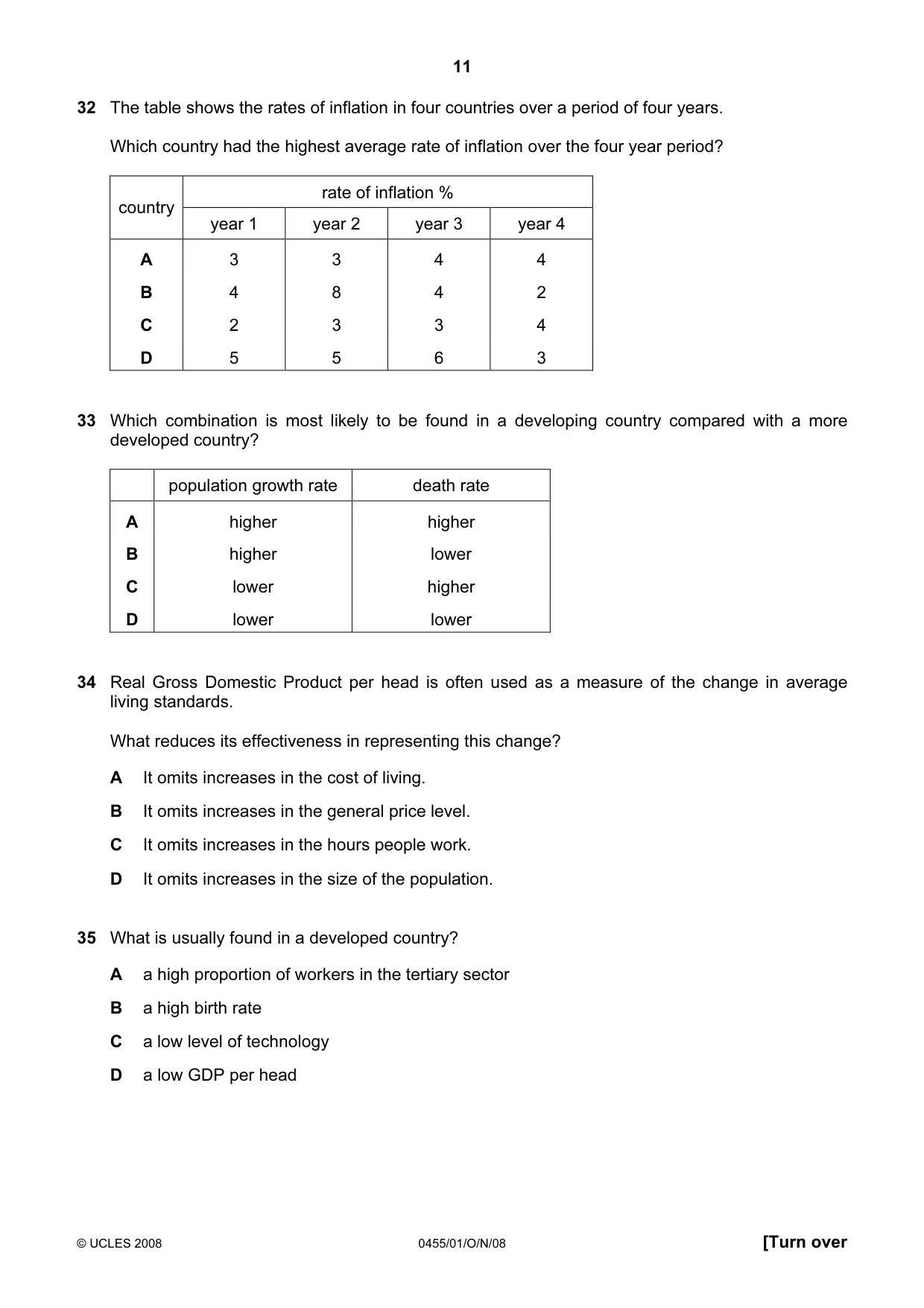
32 The table shows the rates of inflation in four countries over a period of four years. Which country had the highest average rate of inflation over the four year period? rate of inflation % country year 1 year 2 year 3 year 4 A 3 3 4 4 B 4 8 4 2 C 2 3 3 4 D 5 5 6 3
Mark scheme: D
Q33 · Which combination is most likely to be found in a developing country compared with a more…
33 Which combination is most likely to be found in a developing country compared with a more developed country? population growth rate death rate A higher higher B higher lower C lower higher D lower lower
Mark scheme: A
Q34 · Real Gross Domestic Product per head is often used as a measure of the change in average…
34 Real Gross Domestic Product per head is often used as a measure of the change in average living standards. What reduces its effectiveness in representing this change? A It omits increases in the cost of living. B It omits increases in the general price level. C It omits increases in the hours people work. D It omits increases in the size of the population.
Mark scheme: C
Q35 · What is usually found in a developed country?
35 What is usually found in a developed country? A a high proportion of workers in the tertiary sector B a high birth rate C a low level of technology D a low GDP per head
Mark scheme: A
More questions on Differences in economic development between countries
Q36 · Which commercial activity will not destroy the natural environment?
36 Which commercial activity will not destroy the natural environment? A intensive fishing in coastal waters using modern fishing boats B large-scale farming using chemical fertilisers C picking apples from trees using local labour D tree felling by timber companies in tropical forests
Mark scheme: C
Q37 · What lowers the cost of producing goods for export?
37 What lowers the cost of producing goods for export? A a quota B a subsidy C a tariff D foreign exchange control
Mark scheme: B
Q38 · Which of the following increases specialisation?
38 Which of the following increases specialisation? A A farmer decides to convert some of his farm buildings into holiday cottages for rent. B A government decides that a country should be more self-sufficient in food production. C A restaurant owner decides to have only vegetarian meals on his menu. D A taxi driver decides to train for an additional licence to drive a bus.
Mark scheme: C
Q39 · A major market for bananas from Latin America is the European Union (EU)
39 A major market for bananas from Latin America is the European Union (EU). In 2006, the EU imposed a 35 % tariff on banana imports from Latin America but not on substitutes from other regions. What impact is the tax likely to have had on the price of Latin American bananas in the EU and the revenue of Latin American producers? EU price of Latin revenue of Latin American bananas American producers A decrease decrease B decrease increase C increase increase D increase decrease
Mark scheme: D
Q40 · The government of a major oil-exporting country decides to extract more oil and export it…
40 The government of a major oil-exporting country decides to extract more oil and export it as rapidly as possible. What is the likely effect of this on the volume of oil exports and the price of oil? volume of oil exports price of oil A fall immediately fall in the long term B fall in the long term rise immediately C rise immediately fall immediately D rise in the long term rise in the long term
Mark scheme: C
What was in this paper
The subtopics covered by these 40 questions, and how many questions each got. Open one in a new tab to see every Cambridge question on it.
4Firms3Globalisation, free trade and protection3The factors of production3Demand2Economic growth2Fiscal policy2Price changes2Workers2Differences in economic development between countries1Employment and unemployment1Firms and production1Households1Inflation and deflation1International specialisation1Living standards1Market failure1Market structure1Mixed economic system1Money and banking1Opportunity cost1Population1Poverty1Price determination1The role of government1Trade unions1What you needed in this session
Cambridge’s own grade thresholds for 2008 Oct/Nov, Paper 1 · Variant 1. A higher threshold means an easier paper — the bar moves with how the cohort did.