Cambridge IGCSE Economics 0455 — 2023 Oct/Nov Paper 1 · Variant 2
0455/12/O/N/23 · 30 questions · 30 marks · ≈34 min
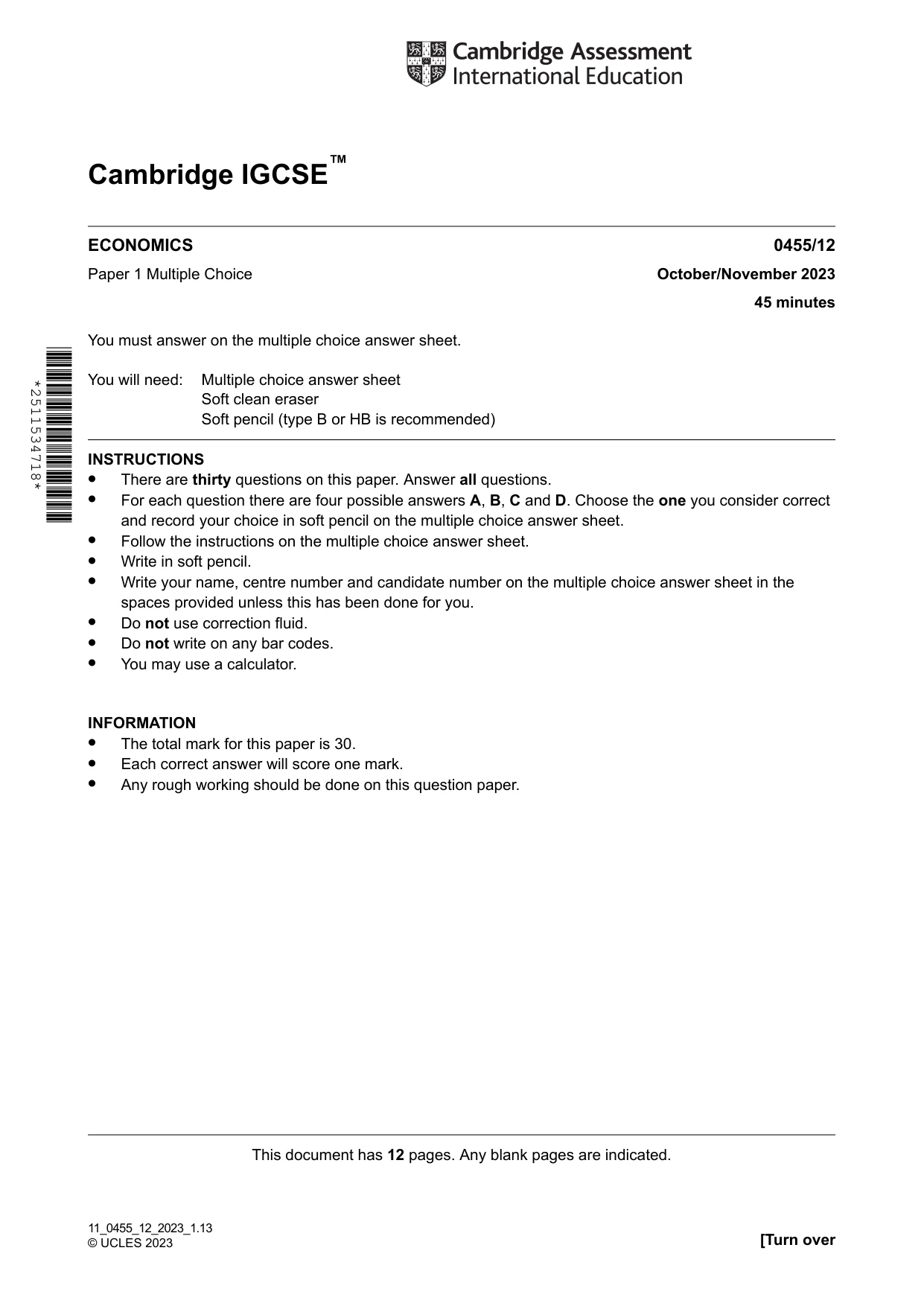
The question paper and its mark scheme, free to read here and free to download. This is Cambridge’s own paper, exactly as it was sat.
Question paper12 pages


Mark scheme3 pages
Answers below. Sit the paper first if you are practising.
Questions as text
Q1 · Which statement is correct?
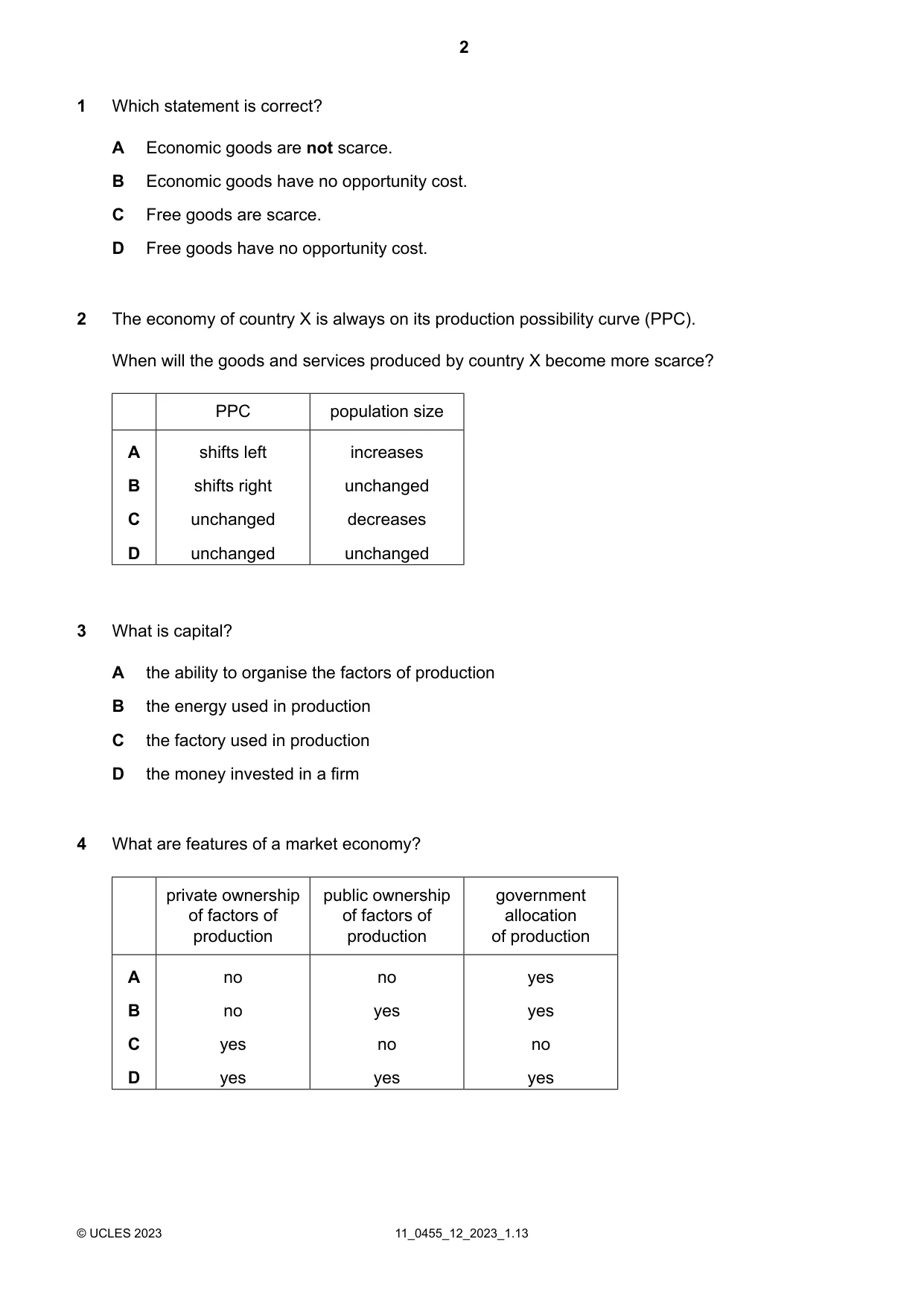
1 Which statement is correct? A Economic goods are not scarce. B Economic goods have no opportunity cost. C Free goods are scarce. D Free goods have no opportunity cost.
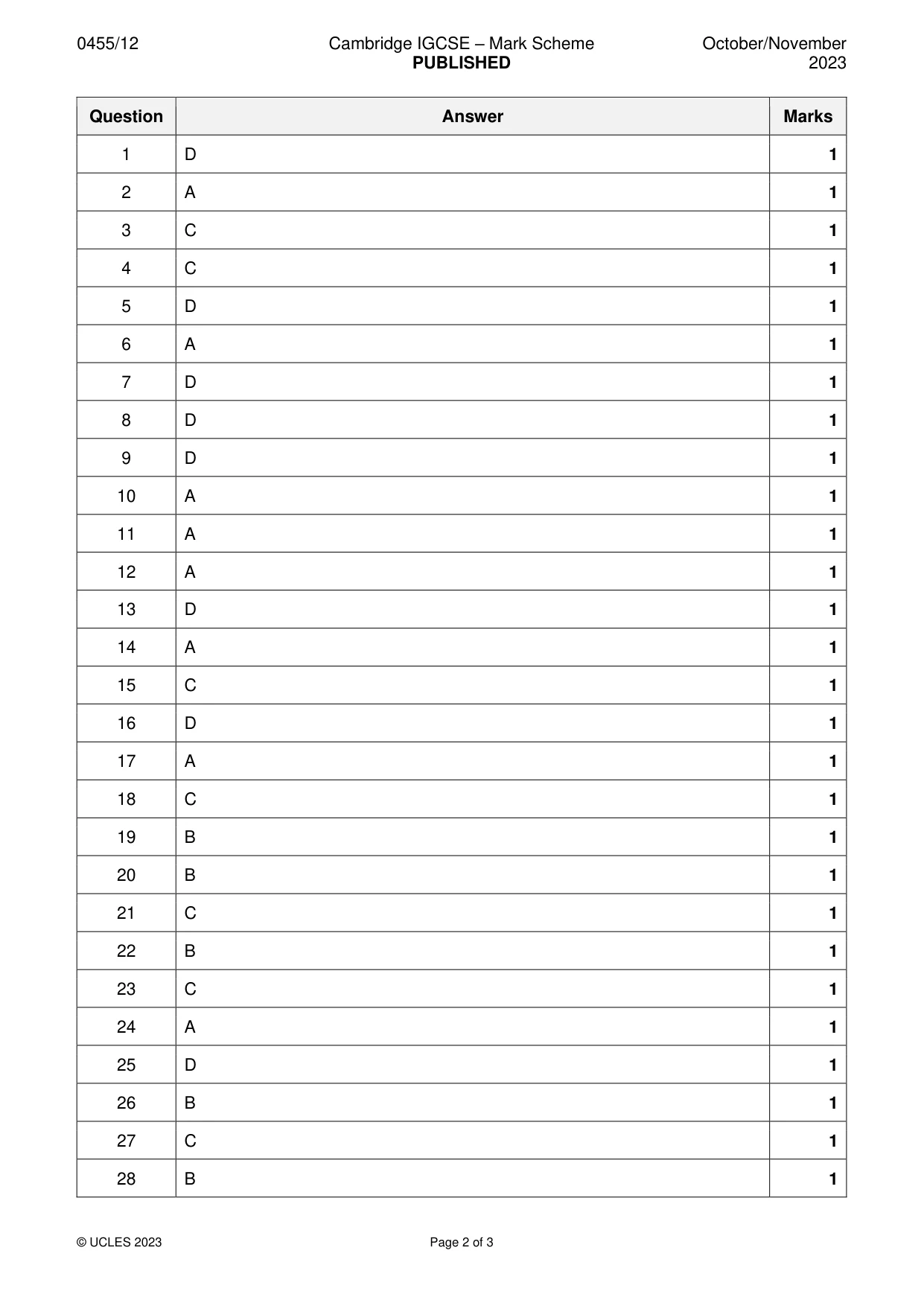
Mark scheme: D
Q2 · The economy of country X is always on its production possibility curve (PPC)
2 The economy of country X is always on its production possibility curve (PPC). When will the goods and services produced by country X become more scarce? PPC population size A shifts left increases B shifts right unchanged C unchanged decreases D unchanged unchanged
Mark scheme: A
More questions on Production possibility curve (PPC) diagrams
Question 3
3 What is capital? A the ability to organise the factors of production B the energy used in production C the factory used in production D the money invested in a firm
Mark scheme: C
Q4 · What are features of a market economy?
4 What are features of a market economy? private ownership public ownership government of factors of of factors of allocation production production of production A no no yes B no yes yes C yes no no D yes yes yes
Mark scheme: C
Q5 · Public transport and cars are substitute goods
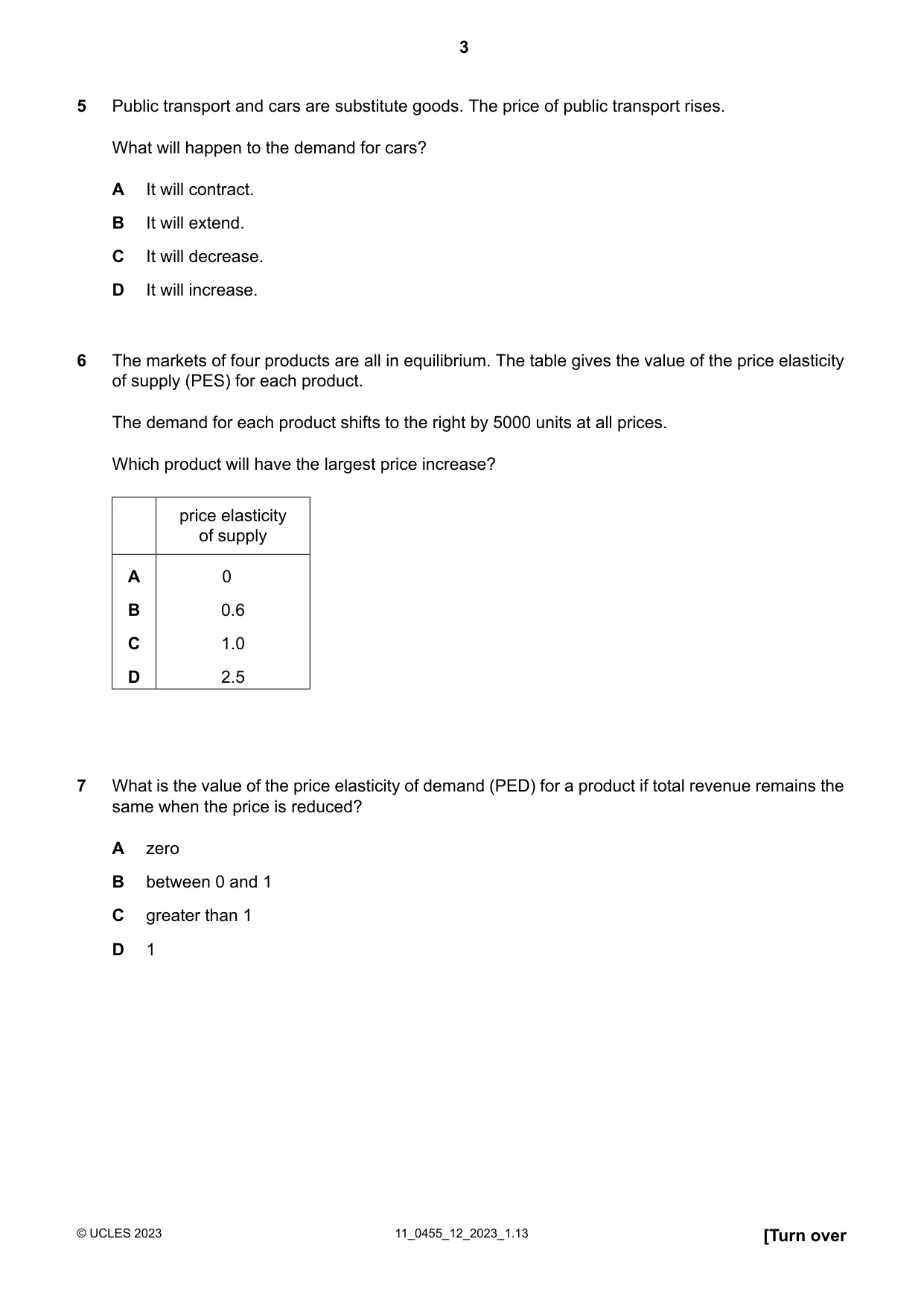
5 Public transport and cars are substitute goods. The price of public transport rises. What will happen to the demand for cars? A It will contract. B It will extend. C It will decrease. D It will increase.
Mark scheme: D
Q6 · The markets of four products are all in equilibrium
6 The markets of four products are all in equilibrium. The table gives the value of the price elasticity of supply (PES) for each product. The demand for each product shifts to the right by 5000 units at all prices. Which product will have the largest price increase? price elasticity of supply A 0 B 0.6 C 1.0 D 2.5
Mark scheme: A
Q7 · What is the value of the price elasticity of demand (PED) for a product if total revenue…
7 What is the value of the price elasticity of demand (PED) for a product if total revenue remains the same when the price is reduced? A zero B between 0 and 1 C greater than 1 D 1
Mark scheme: D
Q8 · The owner of a hotel in Malaysia finds that the price elasticity of demand (PED) for…
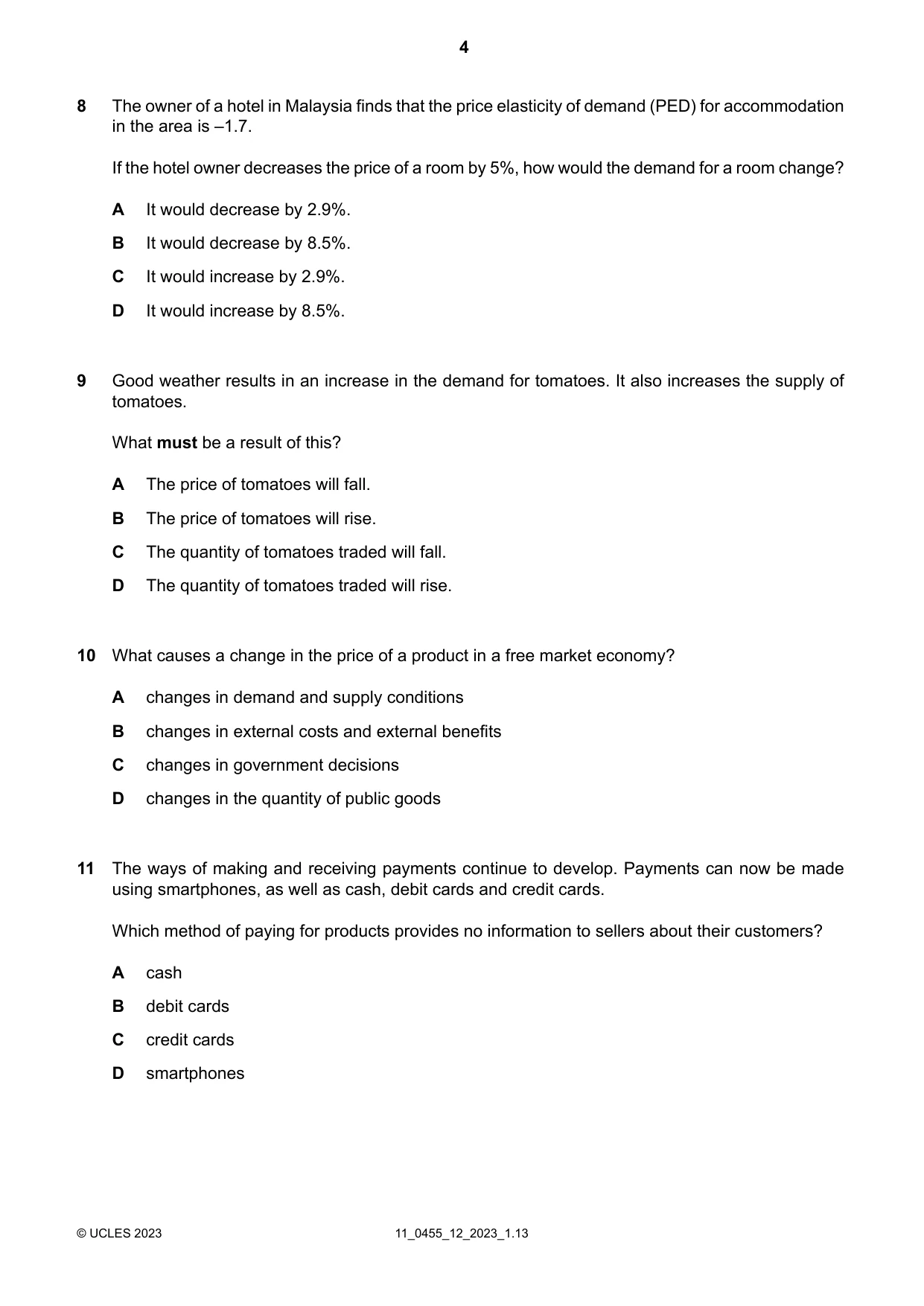
8 The owner of a hotel in Malaysia finds that the price elasticity of demand (PED) for accommodation in the area is –1.7. If the hotel owner decreases the price of a room by 5%, how would the demand for a room change? A It would decrease by 2.9%. B It would decrease by 8.5%. C It would increase by 2.9%. D It would increase by 8.5%.
Mark scheme: D
Q9 · Good weather results in an increase in the demand for tomatoes
9 Good weather results in an increase in the demand for tomatoes. It also increases the supply of tomatoes. What must be a result of this? A The price of tomatoes will fall. B The price of tomatoes will rise. C The quantity of tomatoes traded will fall. D The quantity of tomatoes traded will rise.
Mark scheme: D
Q10 · What causes a change in the price of a product in a free market economy?
10 What causes a change in the price of a product in a free market economy? A changes in demand and supply conditions B changes in external costs and external benefits C changes in government decisions D changes in the quantity of public goods
Mark scheme: A
Q11 · The ways of making and receiving payments continue to develop
11 The ways of making and receiving payments continue to develop. Payments can now be made using smartphones, as well as cash, debit cards and credit cards. Which method of paying for products provides no information to sellers about their customers? A cash B debit cards C credit cards D smartphones
Mark scheme: A
Q12 · In most countries, which organisation controls the banking system?
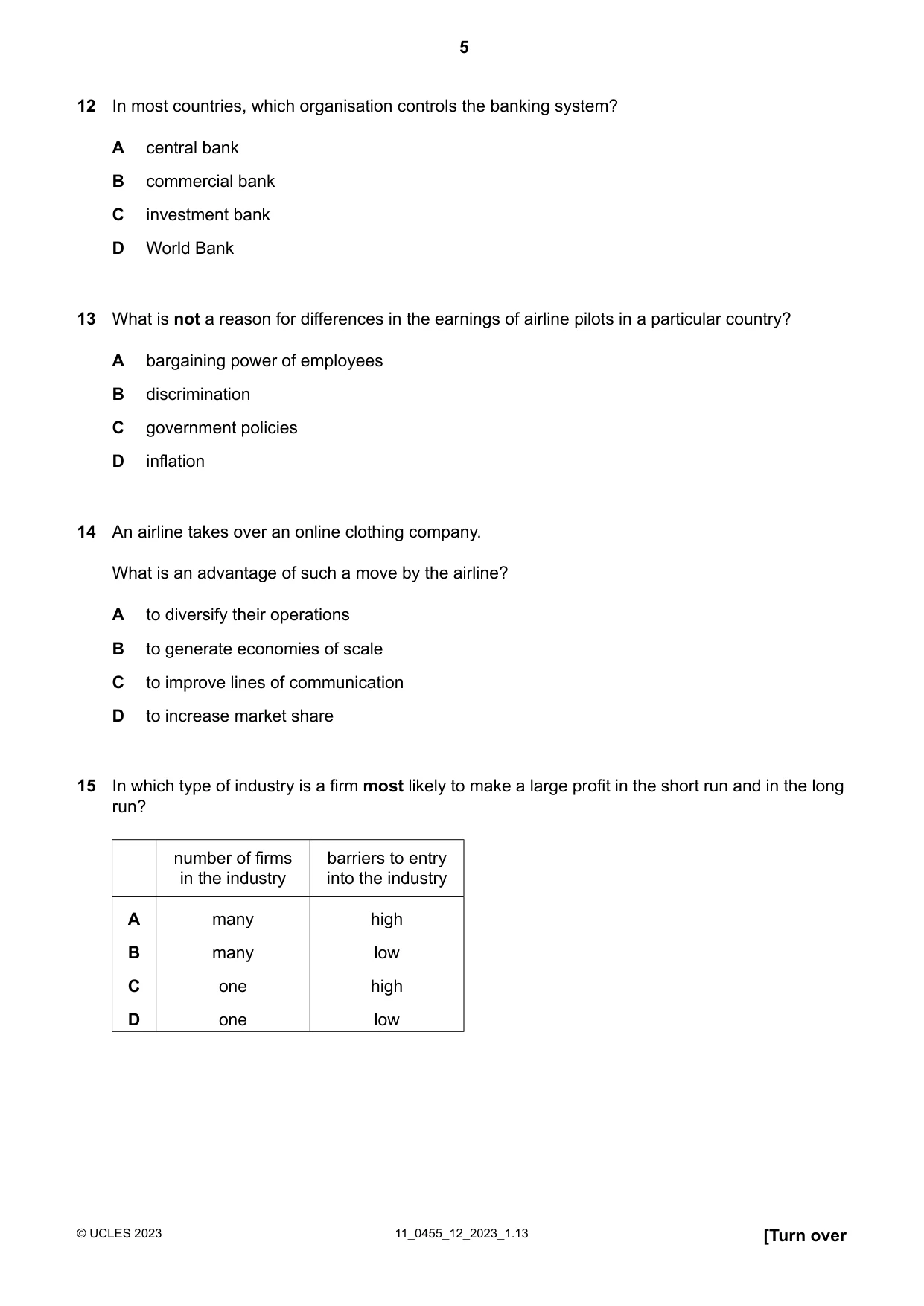
12 In most countries, which organisation controls the banking system? A central bank B commercial bank C investment bank D World Bank
Mark scheme: A
Q13 · What is not a reason for differences in the earnings of airline pilots in a particular…
13 What is not a reason for differences in the earnings of airline pilots in a particular country? A bargaining power of employees B discrimination C government policies D inflation
Mark scheme: D
Q14 · An airline takes over an online clothing company
14 An airline takes over an online clothing company. What is an advantage of such a move by the airline? A to diversify their operations B to generate economies of scale C to improve lines of communication D to increase market share
Mark scheme: A
Q15 · In which type of industry is a firm most likely to make a large profit in the short run…
15 In which type of industry is a firm most likely to make a large profit in the short run and in the long run? number of firms barriers to entry in the industry into the industry A many high B many low C one high D one low
Mark scheme: C
Q16 · A firm produces five units of output at an average cost of $20 per unit
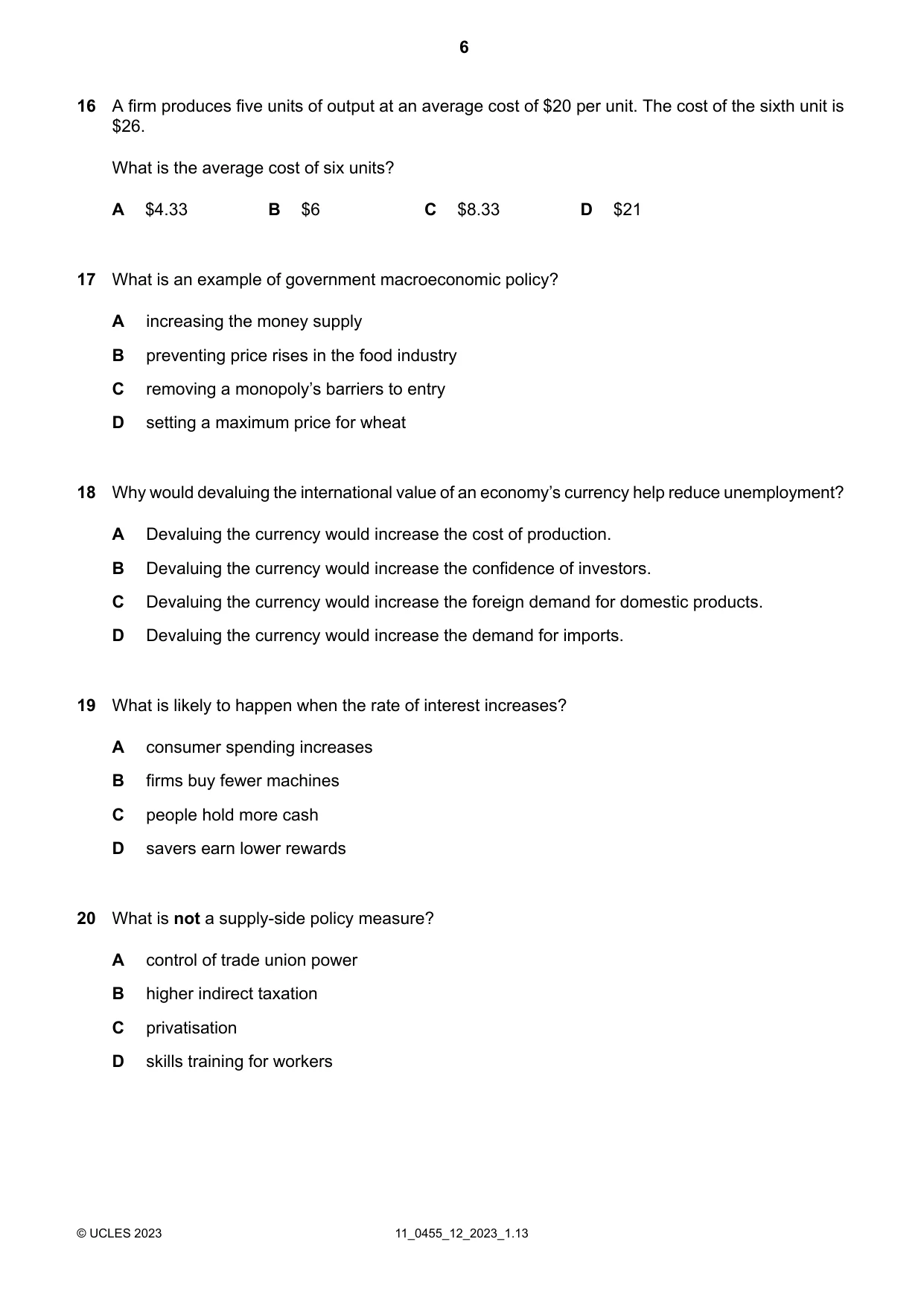
16 A firm produces five units of output at an average cost of $20 per unit. The cost of the sixth unit is $26. What is the average cost of six units? A $4.33 B $6 C $8.33 D $21
Mark scheme: D
Q17 · What is an example of government macroeconomic policy?
17 What is an example of government macroeconomic policy? A increasing the money supply B preventing price rises in the food industry C removing a monopoly’s barriers to entry D setting a maximum price for wheat
Mark scheme: A
Q18 · Why would devaluing the international value of an economy’s currency help reduce…
18 Why would devaluing the international value of an economy’s currency help reduce unemployment? A Devaluing the currency would increase the cost of production. B Devaluing the currency would increase the confidence of investors. C Devaluing the currency would increase the foreign demand for domestic products. D Devaluing the currency would increase the demand for imports.
Mark scheme: C
Q19 · What is likely to happen when the rate of interest increases?
19 What is likely to happen when the rate of interest increases? A consumer spending increases B firms buy fewer machines C people hold more cash D savers earn lower rewards
Mark scheme: B
Q20 · What is not a supply-side policy measure?
20 What is not a supply-side policy measure? A control of trade union power B higher indirect taxation C privatisation D skills training for workers
Mark scheme: B
Q21 · The table shows the real GDP per head for a country in 2021 and 2022
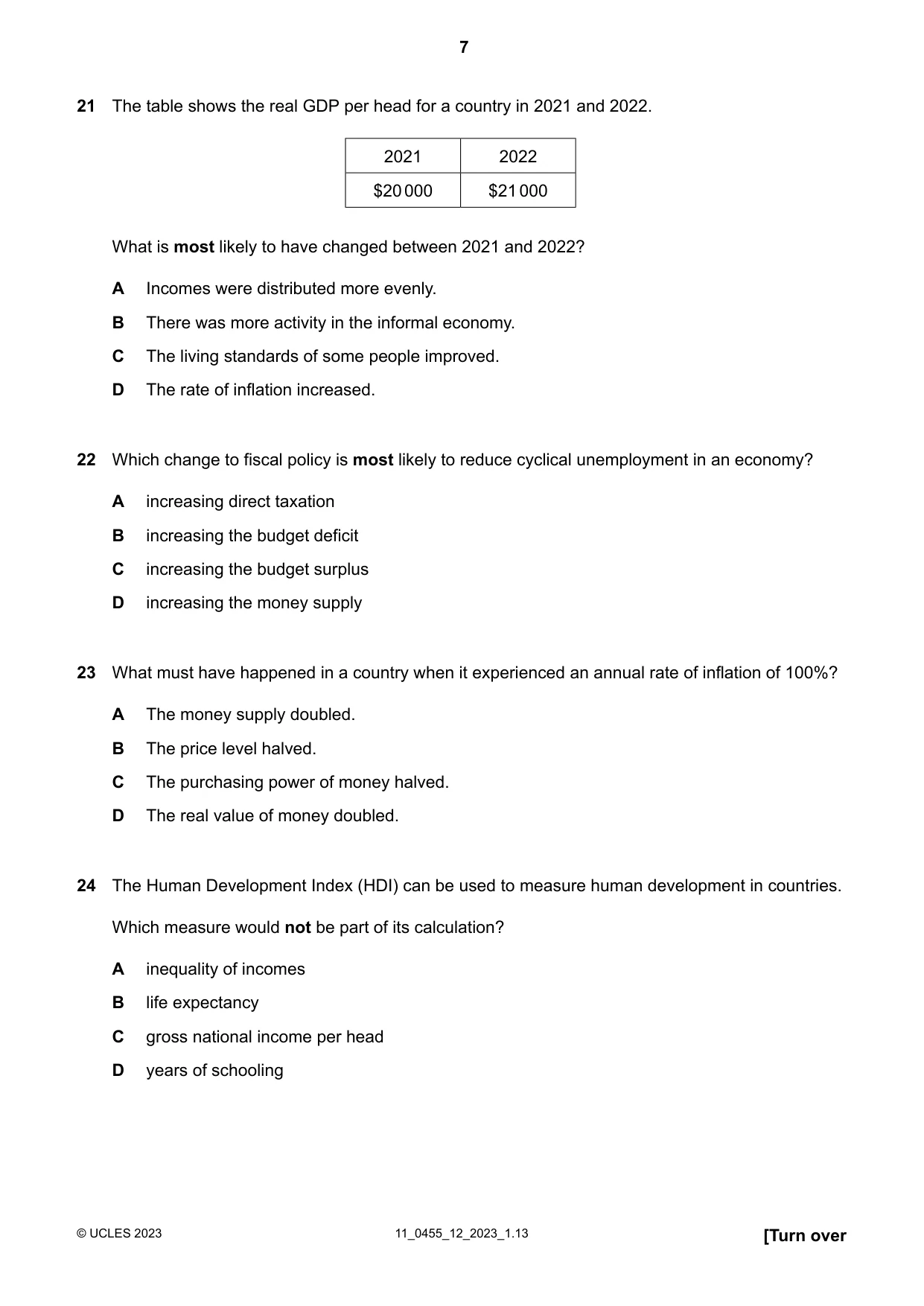
21 The table shows the real GDP per head for a country in 2021 and 2022. 2021 2022 $20000 $21000 What is most likely to have changed between 2021 and 2022? A Incomes were distributed more evenly. B There was more activity in the informal economy. C The living standards of some people improved. D The rate of inflation increased.
Mark scheme: C
Q22 · Which change to fiscal policy is most likely to reduce cyclical unemployment in an…
22 Which change to fiscal policy is most likely to reduce cyclical unemployment in an economy? A increasing direct taxation B increasing the budget deficit C increasing the budget surplus D increasing the money supply
Mark scheme: B
Q23 · What must have happened in a country when it experienced an annual rate of inflation of…
23 What must have happened in a country when it experienced an annual rate of inflation of 100%? A The money supply doubled. B The price level halved. C The purchasing power of money halved. D The real value of money doubled.
Mark scheme: C
Q24 · The Human Development Index (HDI) can be used to measure human development in countries
24 The Human Development Index (HDI) can be used to measure human development in countries. Which measure would not be part of its calculation? A inequality of incomes B life expectancy C gross national income per head D years of schooling
Mark scheme: A
More questions on Differences in economic development between countries
Q25 · What is the most likely consequence of an ageing population for a high-income economy?
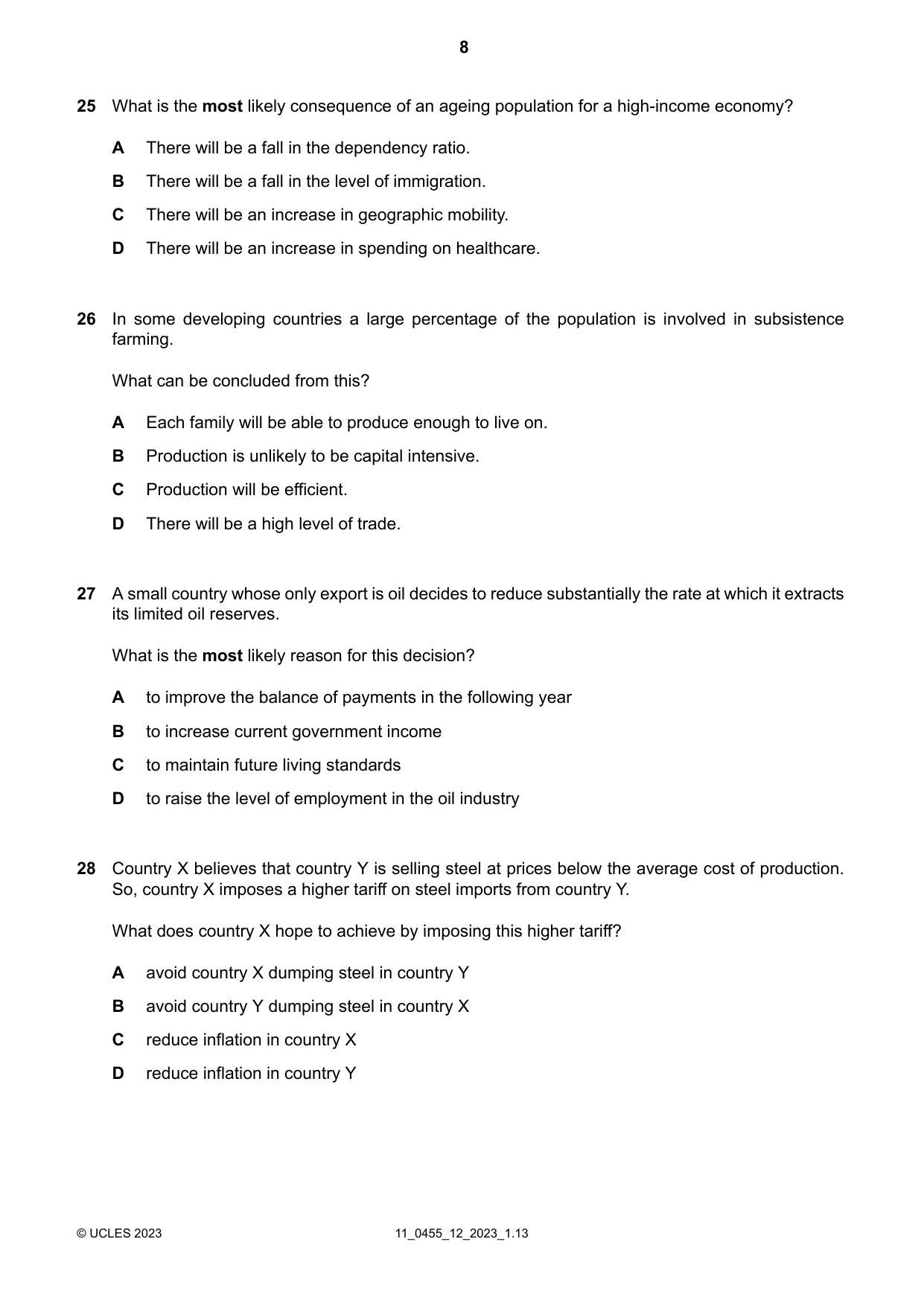
25 What is the most likely consequence of an ageing population for a high-income economy? A There will be a fall in the dependency ratio. B There will be a fall in the level of immigration. C There will be an increase in geographic mobility. D There will be an increase in spending on healthcare.
Mark scheme: D
Q26 · In some developing countries a large percentage of the population is involved in…
26 In some developing countries a large percentage of the population is involved in subsistence farming. What can be concluded from this? A Each family will be able to produce enough to live on. B Production is unlikely to be capital intensive. C Production will be efficient. D There will be a high level of trade.
Mark scheme: B
More questions on Differences in economic development between countries
Q27 · A small country whose only export is oil decides to reduce substantially the rate at…
27 A small country whose only export is oil decides to reduce substantially the rate at which it extracts its limited oil reserves. What is the most likely reason for this decision? A to improve the balance of payments in the following year B to increase current government income C to maintain future living standards D to raise the level of employment in the oil industry
Mark scheme: C
Q28 · Country X believes that country Y is selling steel at prices below the average cost of…
28 Country X believes that country Y is selling steel at prices below the average cost of production. So, country X imposes a higher tariff on steel imports from country Y. What does country X hope to achieve by imposing this higher tariff? A avoid country X dumping steel in country Y B avoid country Y dumping steel in country X C reduce inflation in country X D reduce inflation in country Y
Mark scheme: B
Q29 · Which factor would cause a country’s exchange rate to fall?
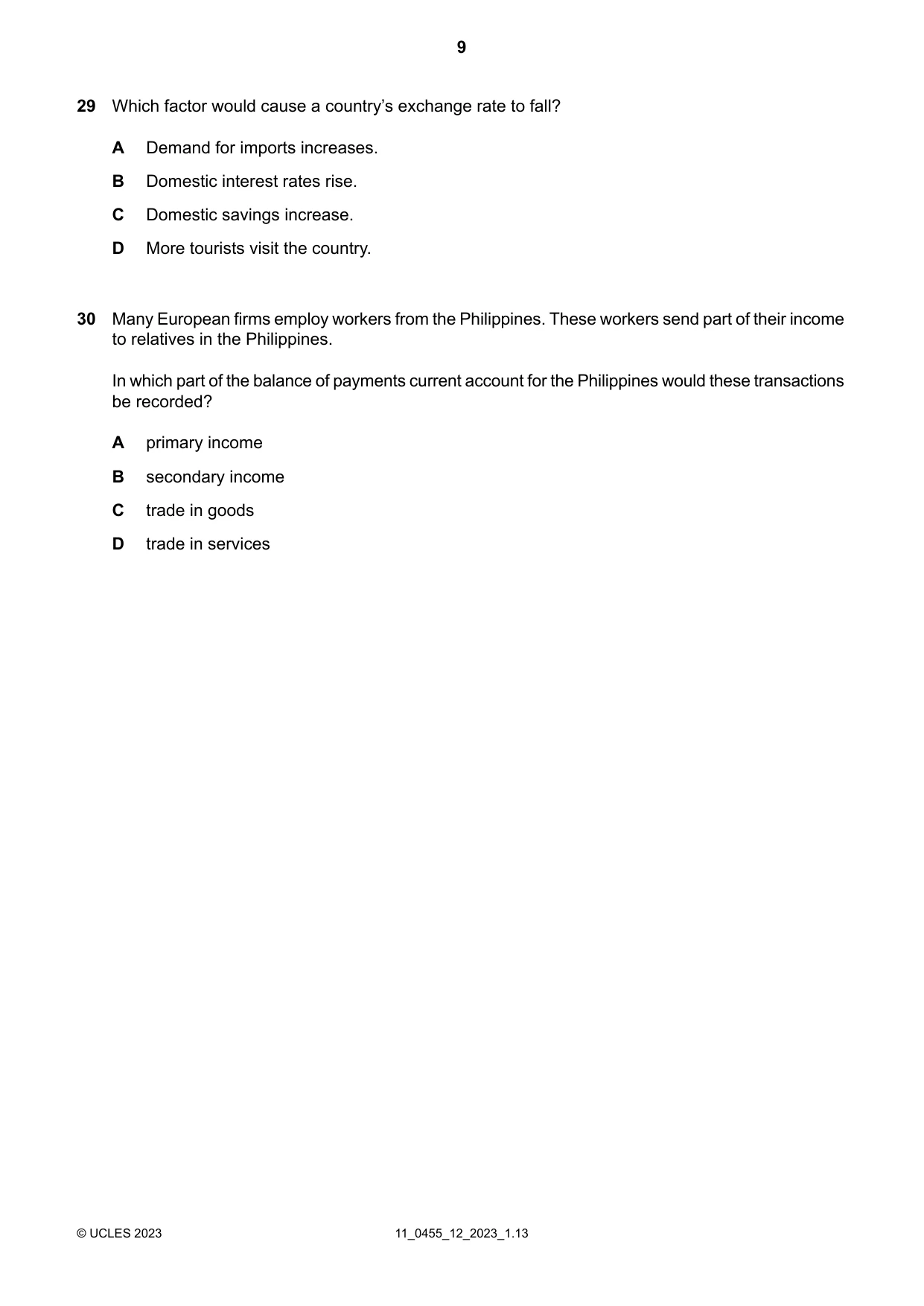
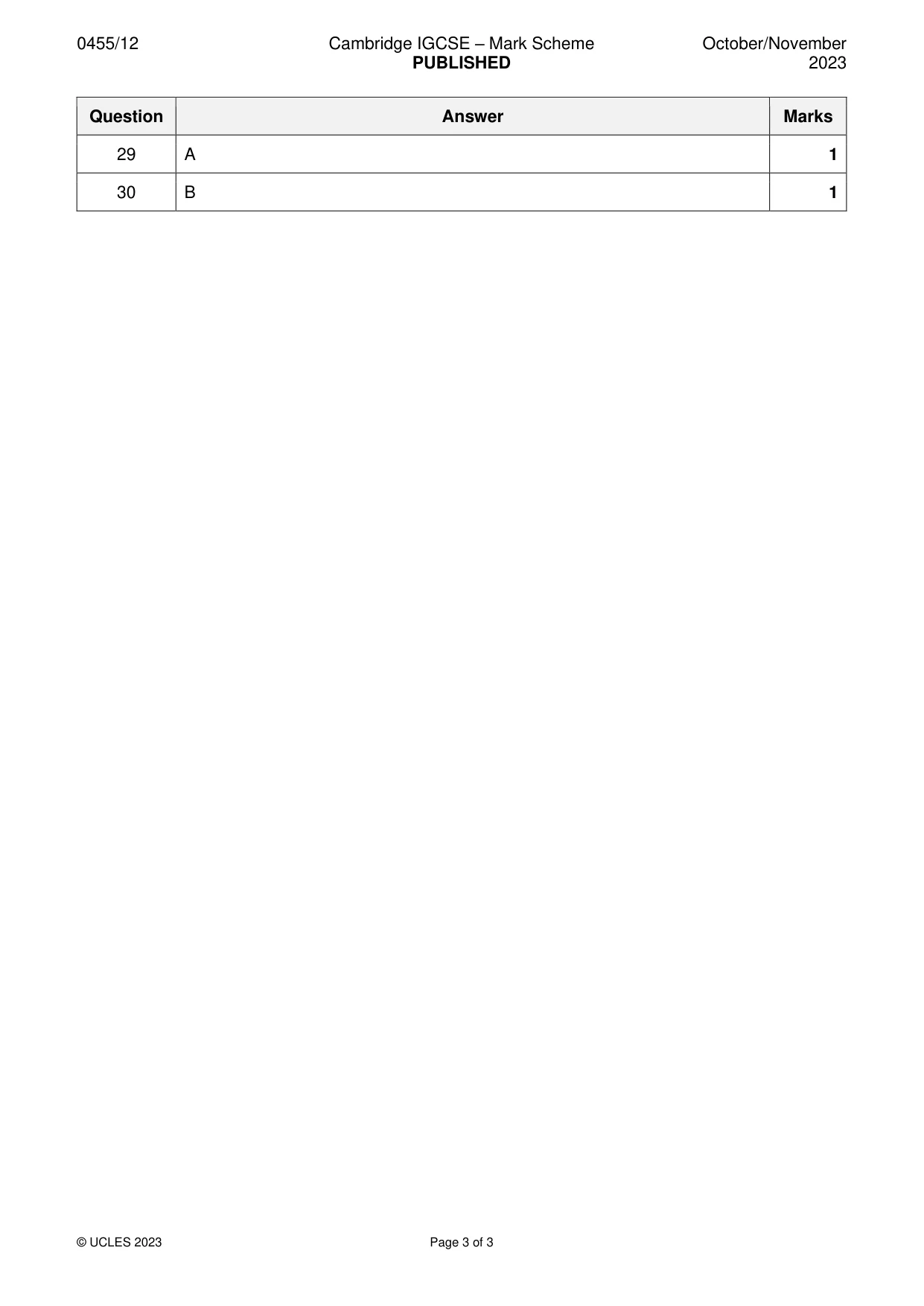
29 Which factor would cause a country’s exchange rate to fall? A Demand for imports increases. B Domestic interest rates rise. C Domestic savings increase. D More tourists visit the country.
Mark scheme: A
Q30 · Many European firms employ workers from the Philippines
30 Many European firms employ workers from the Philippines. These workers send part of their income to relatives in the Philippines. In which part of the balance of payments current account for the Philippines would these transactions be recorded? A primary income B secondary income C trade in goods D trade in services
Mark scheme: B
What was in this paper
The subtopics covered by these 30 questions, and how many questions each got. Open one in a new tab to see every Cambridge question on it.
2Foreign exchange rates2Living standards2Money and banking2Price determination2Price elasticity of demand (PED)2Current account of balance of payments1Demand1Firms1Firms’ costs, revenue and objectives1Fiscal policy1Globalisation, free trade and protection1Inflation and deflation1Market economic system1Market structure1Monetary policy1Population1Price elasticity of supply (PES)1Production possibility curve (PPC) diagrams1Supply-side policy1The factors of production1The nature of the economic problem1The role of government1Workers1What you needed in this session
Cambridge’s own grade thresholds for 2023 Oct/Nov, Paper 1 · Variant 2. A higher threshold means an easier paper — the bar moves with how the cohort did.