Cambridge IGCSE Economics 0455 — 2025 May/June Paper 1 · Variant 2
0455/12/M/J/25 · 30 questions · 30 marks · ≈34 min
The question paper and its mark scheme, free to read here and free to download. This is Cambridge’s own paper, exactly as it was sat.
Question paper12 pages
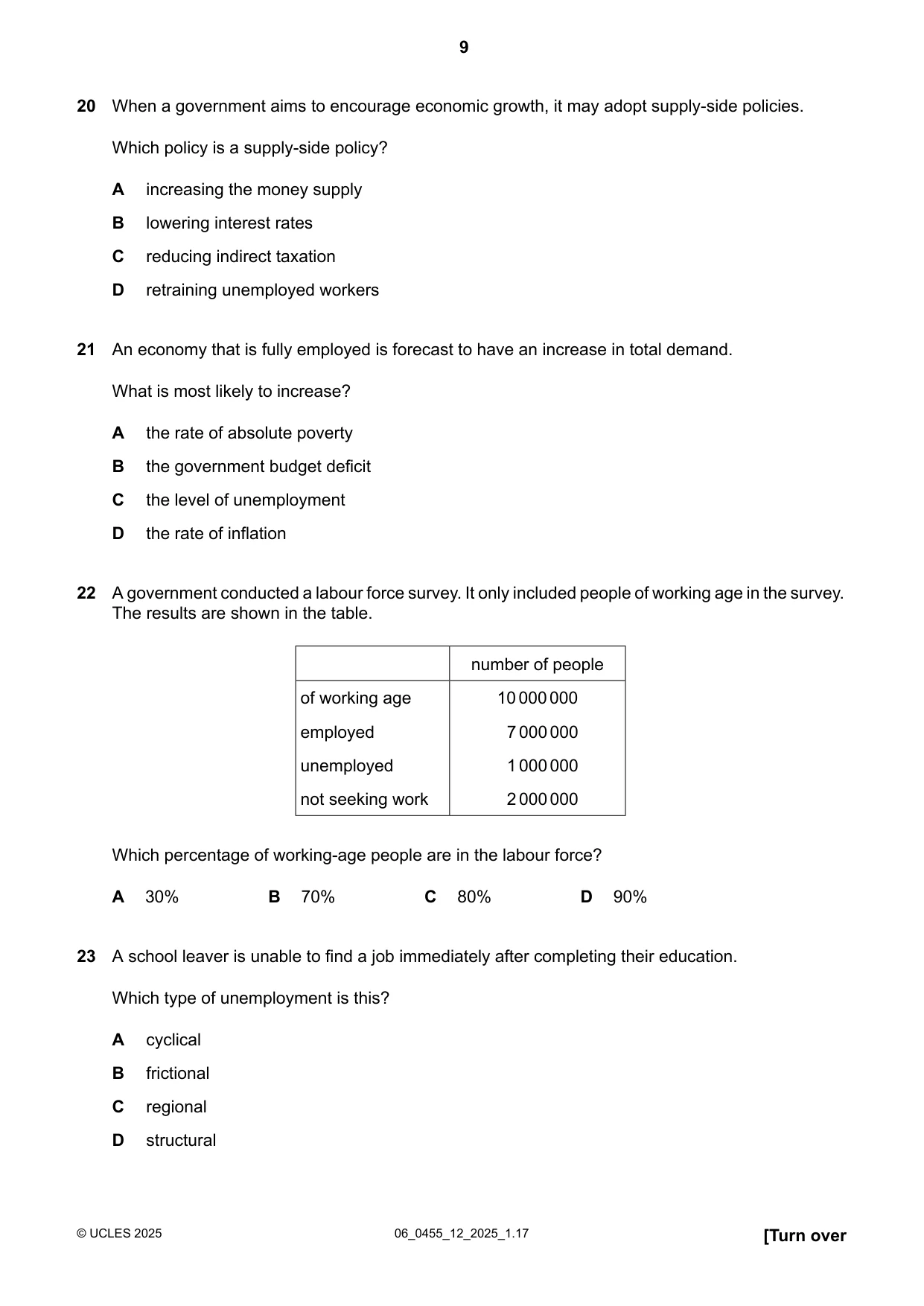
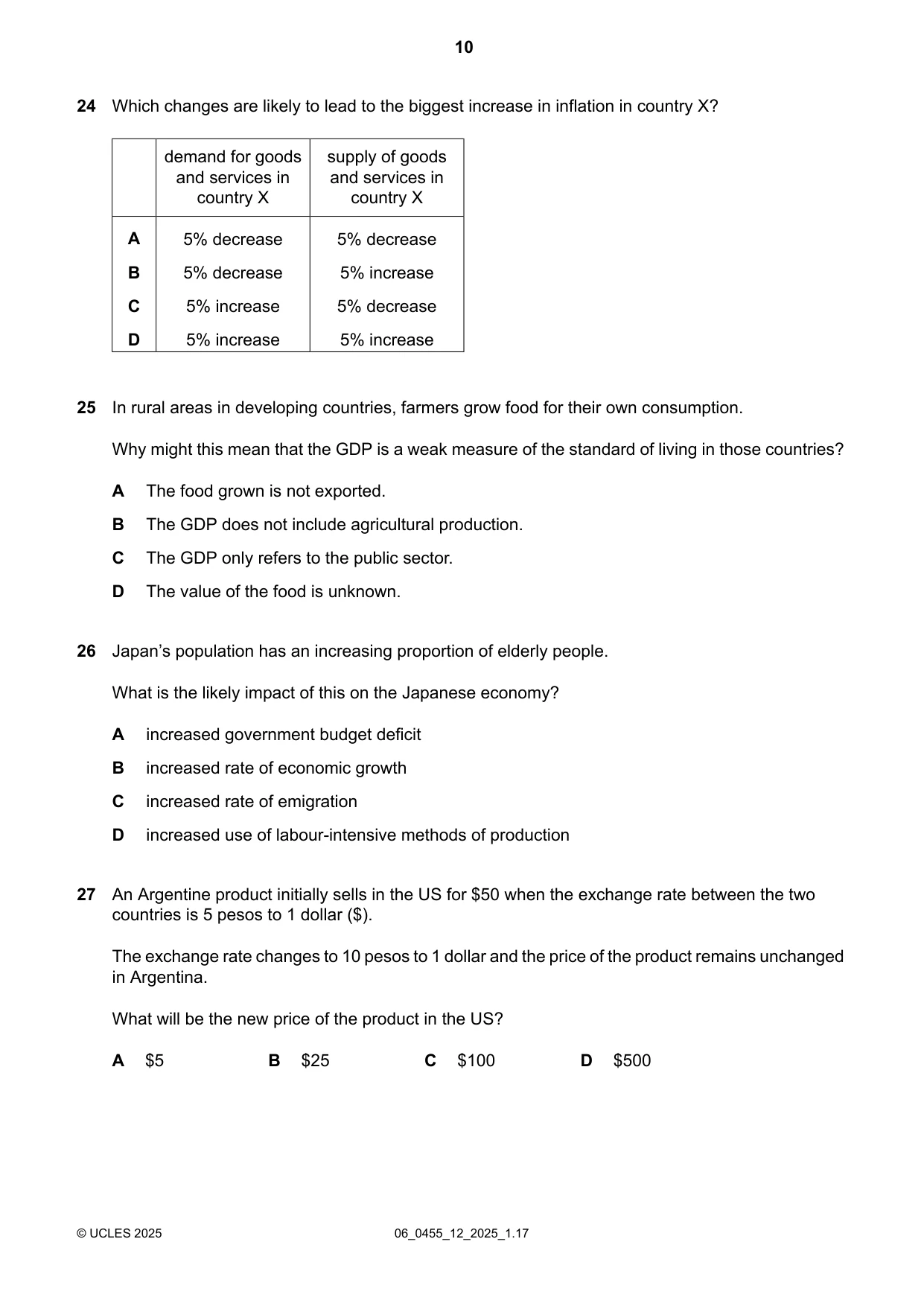
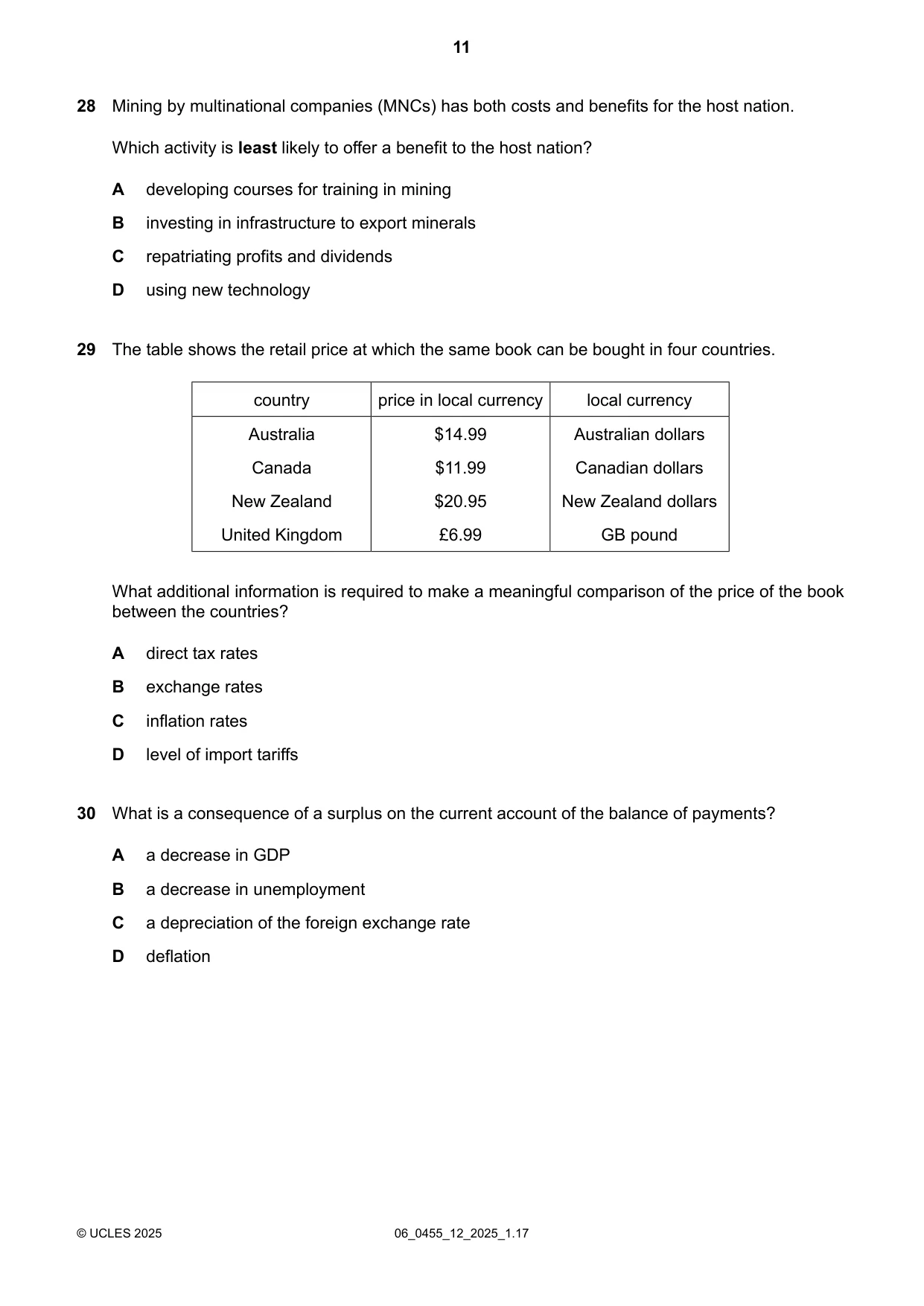

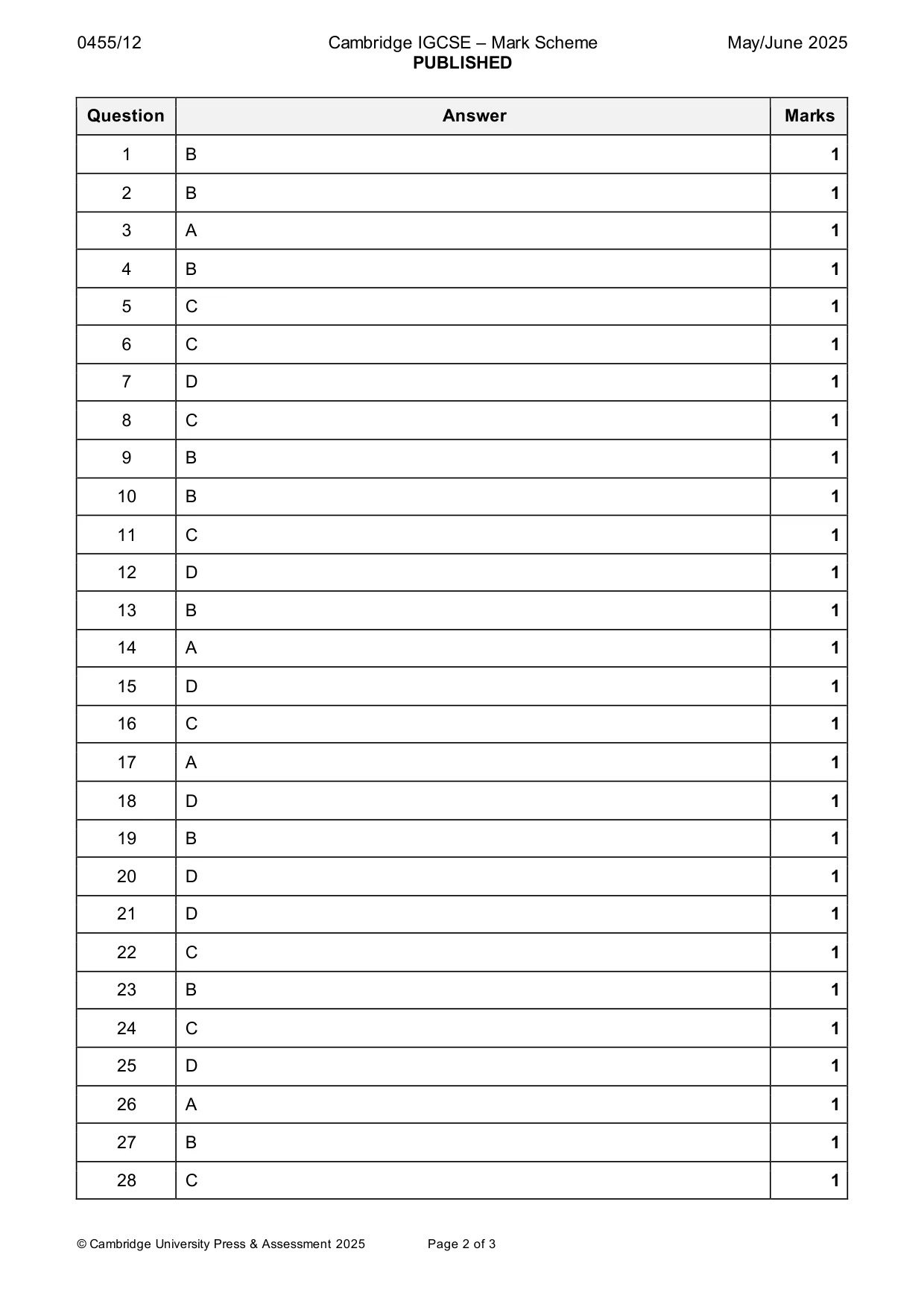
Mark scheme3 pages
Answers below. Sit the paper first if you are practising.

Questions as text
Q1 · A university rejects 2000 qualified applicants who wish to study there
1 A university rejects 2000 qualified applicants who wish to study there. Which factor of production could have caused the university to make this decision? A infinite quantity of capital B scarcity of labour C surplus of land D unlimited supply of enterprise
Mark scheme: B
Q2 · Sanjay, a coal miner, became unemployed when the only local mine closed
2 Sanjay, a coal miner, became unemployed when the only local mine closed. He lives in a village near family and friends and would like to stay in the same village. What is the cause of Sanjay’s occupational immobility? A a desire to live near family and friends B no relevant skills C the cost of travelling for work D unaffordable housing
Mark scheme: B
Q3 · The diagram shows the production possibility curve (PPC) for an economy that is at point X
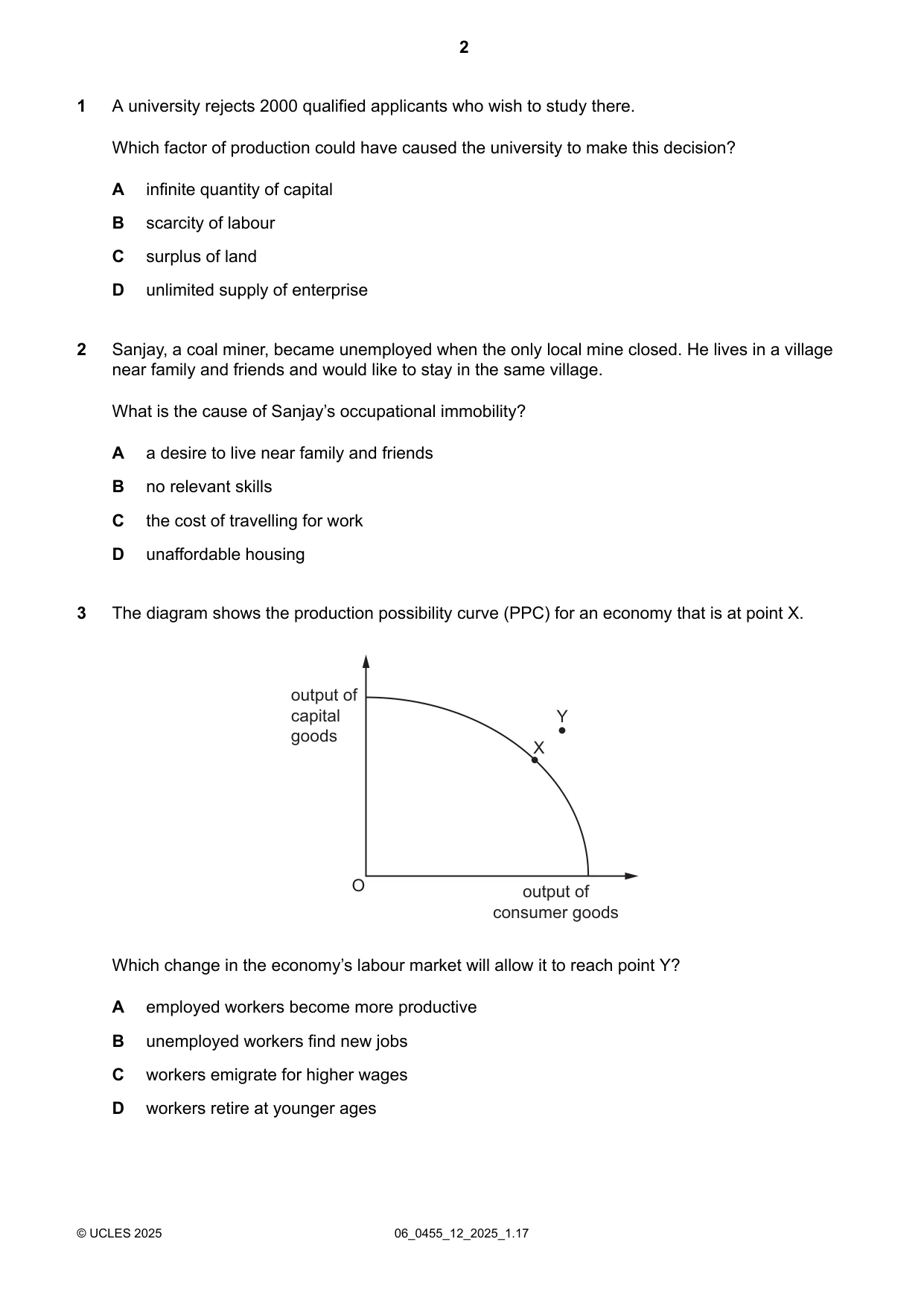
3 The diagram shows the production possibility curve (PPC) for an economy that is at point X. output of capital Y goods X O output of consumer goods Which change in the economy’s labour market will allow it to reach point Y? A employed workers become more productive B unemployed workers find new jobs C workers emigrate for higher wages D workers retire at younger ages
Mark scheme: A
More questions on Production possibility curve (PPC) diagrams
Q4 · What are both macroeconomic decisions?
4 What are both macroeconomic decisions? decision 1 decision 2 A a school recruits more teachers a firm sets the prices for its products B a central bank reduces money supply a government spends more on defence C a government increases tax rates a farmer decides which crops to grow D a household cuts its energy use a worker accepts an offer of overtime
Mark scheme: B
Q5 · The table shows the quantity of coffee demanded per day and the quantity supplied per day
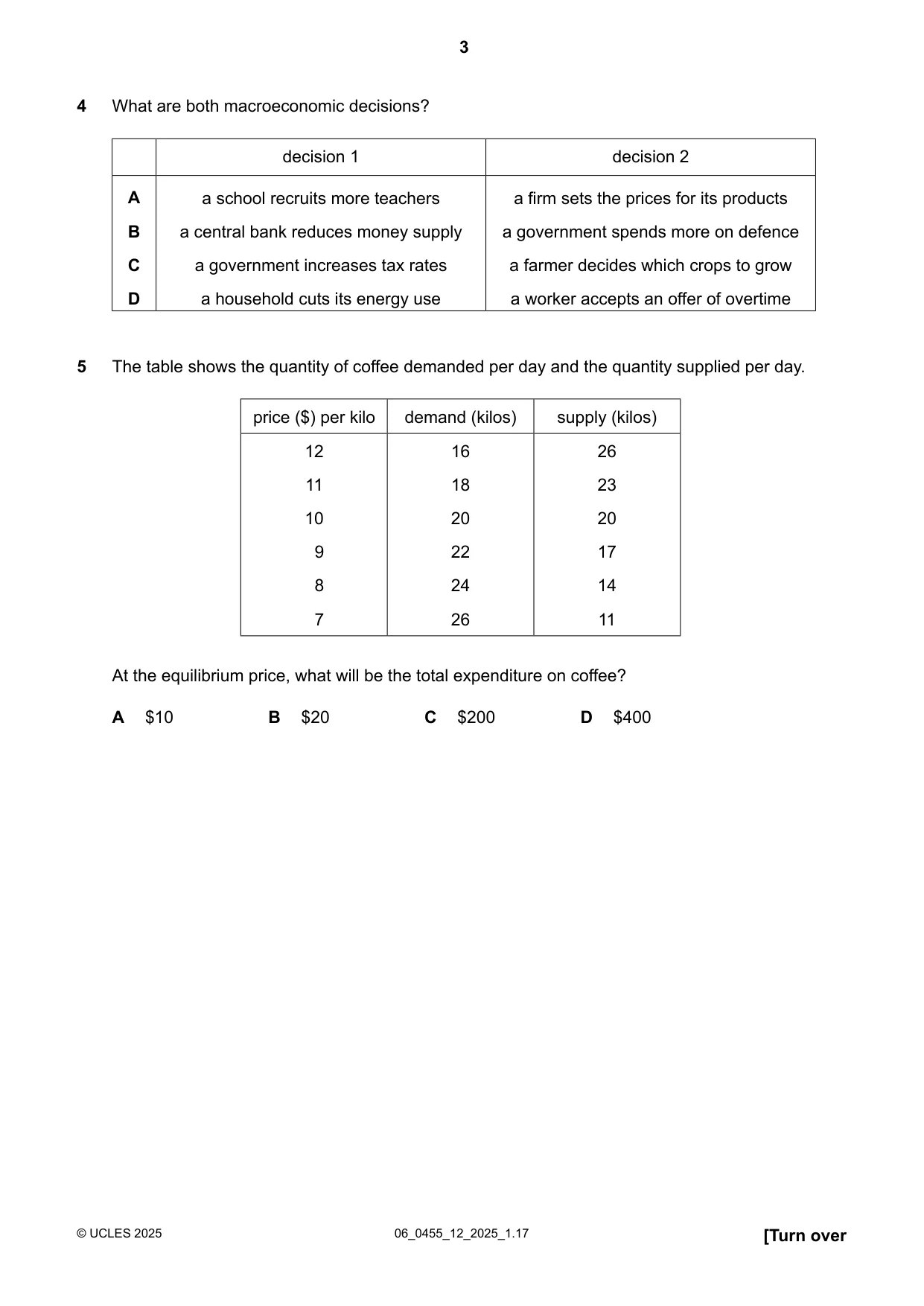
5 The table shows the quantity of coffee demanded per day and the quantity supplied per day. price ($) per kilo demand (kilos) supply (kilos) 12 16 26 11 18 23 10 20 20 9 22 17 8 24 14 7 26 11 At the equilibrium price, what will be the total expenditure on coffee? A $10 B $20 C $200 D $400
Mark scheme: C
Q6 · The diagrams show the demand curves for the only two buyers in a market
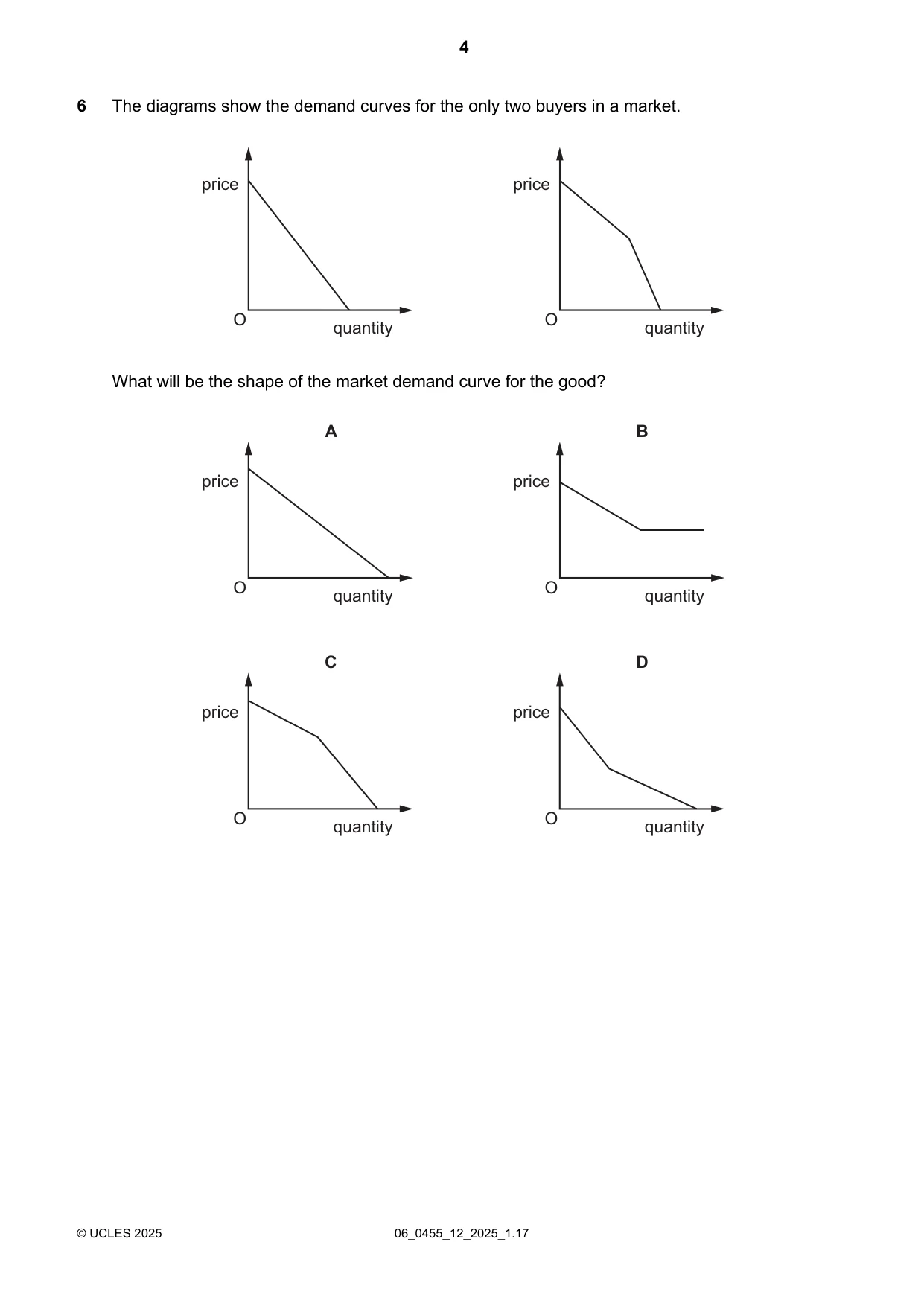
6 The diagrams show the demand curves for the only two buyers in a market. price price O O quantity quantity What will be the shape of the market demand curve for the good? A B price price O O quantity quantity C D price price O O quantity quantity
Mark scheme: C
Q7 · The diagram shows the market for ice cream and the effects of very hot weather
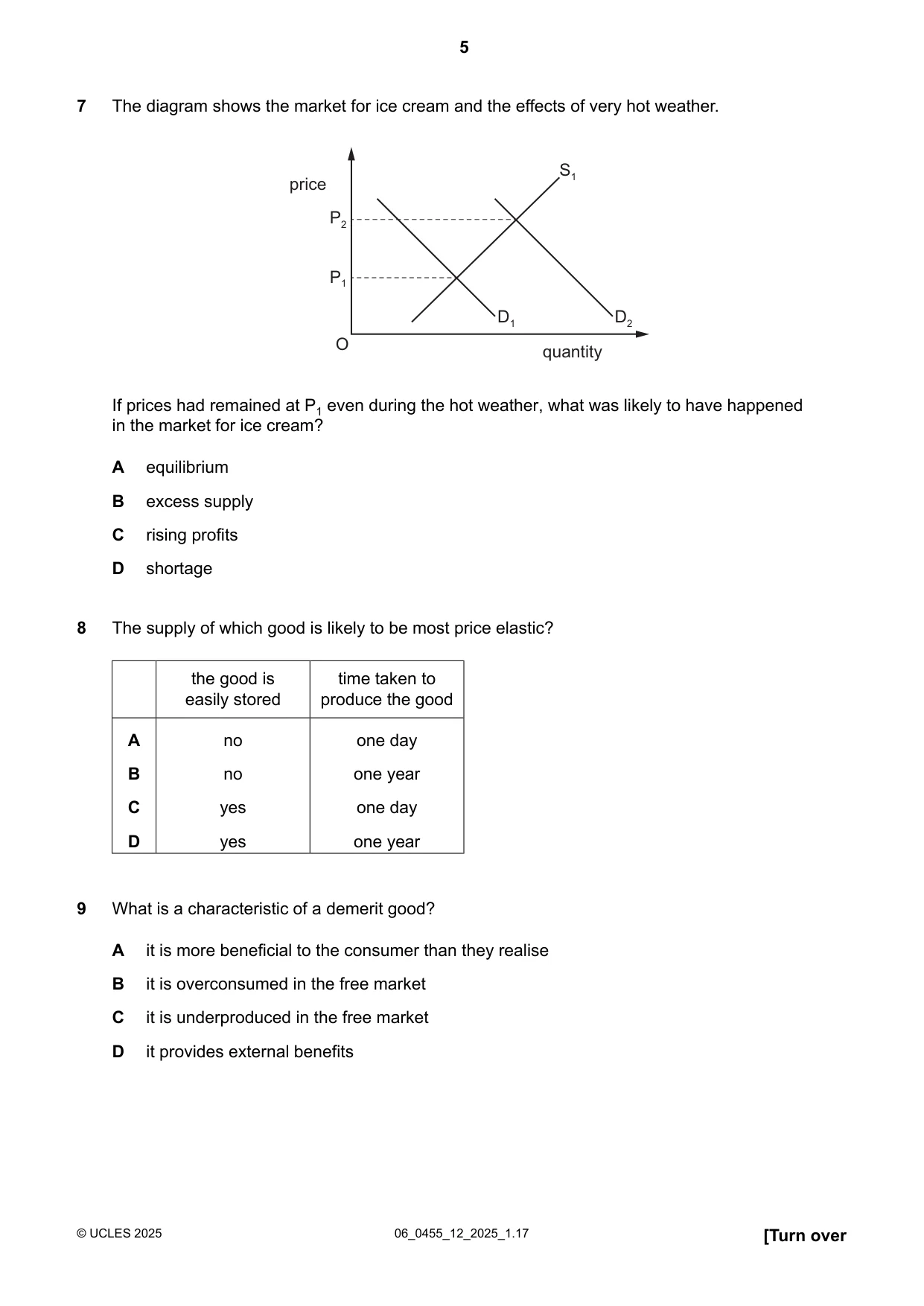
7 The diagram shows the market for ice cream and the effects of very hot weather. S1 price P2 P1 D1 D2 O quantity If prices had remained at P1 even during the hot weather, what was likely to have happened in the market for ice cream? A equilibrium B excess supply C rising profits D shortage
Mark scheme: D
Q8 · The supply of which good is likely to be most price elastic?
8 The supply of which good is likely to be most price elastic? the good is time taken to easily stored produce the good A no one day B no one year C yes one day D yes one year
Mark scheme: C
Q9 · What is a characteristic of a demerit good?
9 What is a characteristic of a demerit good? A it is more beneficial to the consumer than they realise B it is overconsumed in the free market C it is underproduced in the free market D it provides external benefits
Mark scheme: B
Q10 · The table shows the average wage in four countries, A, B, C and D
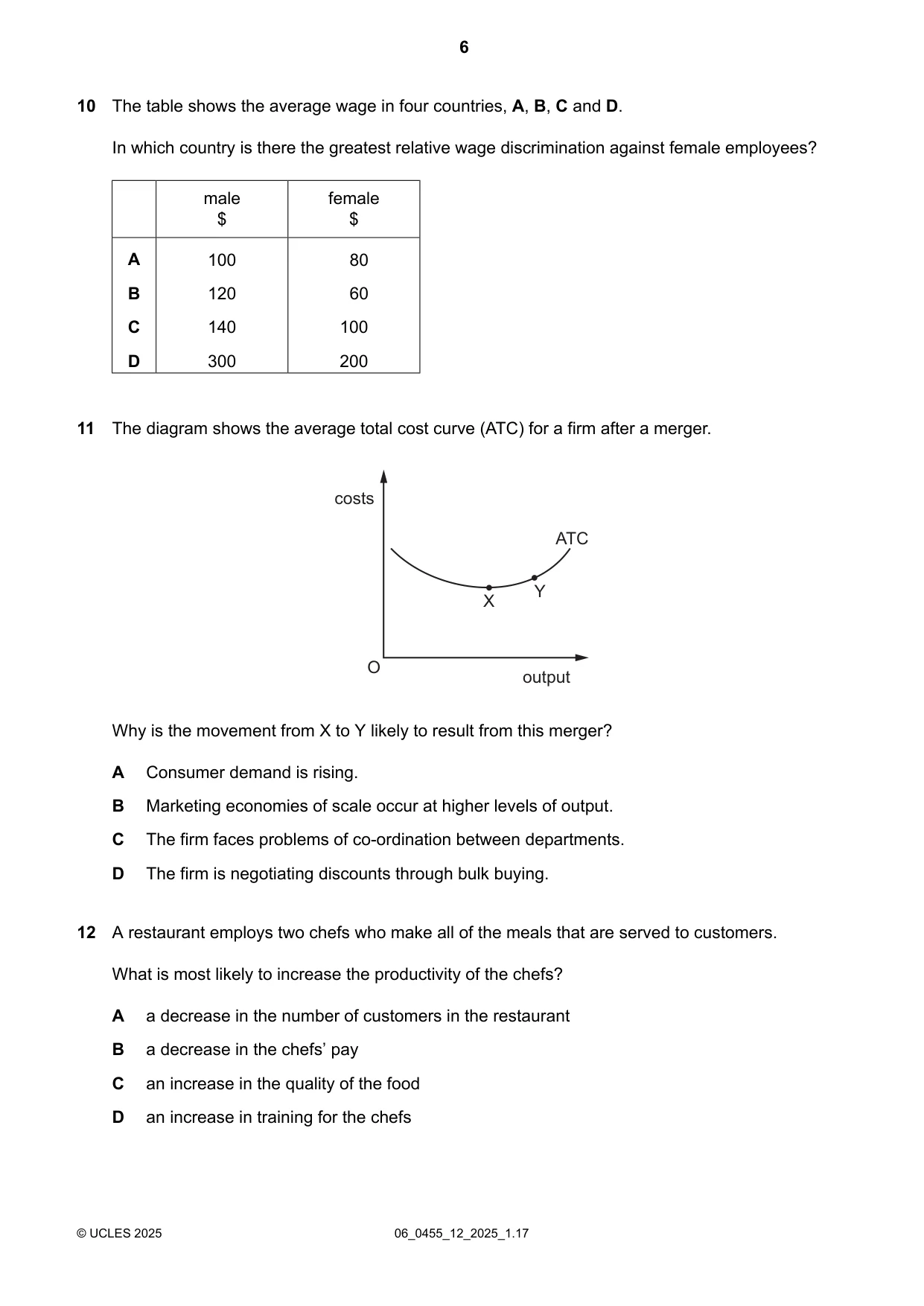
10 The table shows the average wage in four countries, A, B, C and D. In which country is there the greatest relative wage discrimination against female employees? male female $ $ A 100 80 B 120 60 C 140 100 D 300 200
Mark scheme: B
Q11 · The diagram shows the average total cost curve (ATC) for a firm after a merger
11 The diagram shows the average total cost curve (ATC) for a firm after a merger. costs ATC Y X O output Why is the movement from X to Y likely to result from this merger? A Consumer demand is rising. B Marketing economies of scale occur at higher levels of output. C The firm faces problems of co-ordination between departments. D The firm is negotiating discounts through bulk buying.
Mark scheme: C
Q12 · A restaurant employs two chefs who make all of the meals that are served to customers
12 A restaurant employs two chefs who make all of the meals that are served to customers. What is most likely to increase the productivity of the chefs? A a decrease in the number of customers in the restaurant B a decrease in the chefs’ pay C an increase in the quality of the food D an increase in training for the chefs
Mark scheme: D
Q13 · What are fixed costs?
13 What are fixed costs? A costs that are divided by the amount produced B costs that are present when output is zero C costs that change according to the level of output D costs that decrease when output increases
Mark scheme: B
Q14 · The table shows the daily output and costs of four firms making chairs
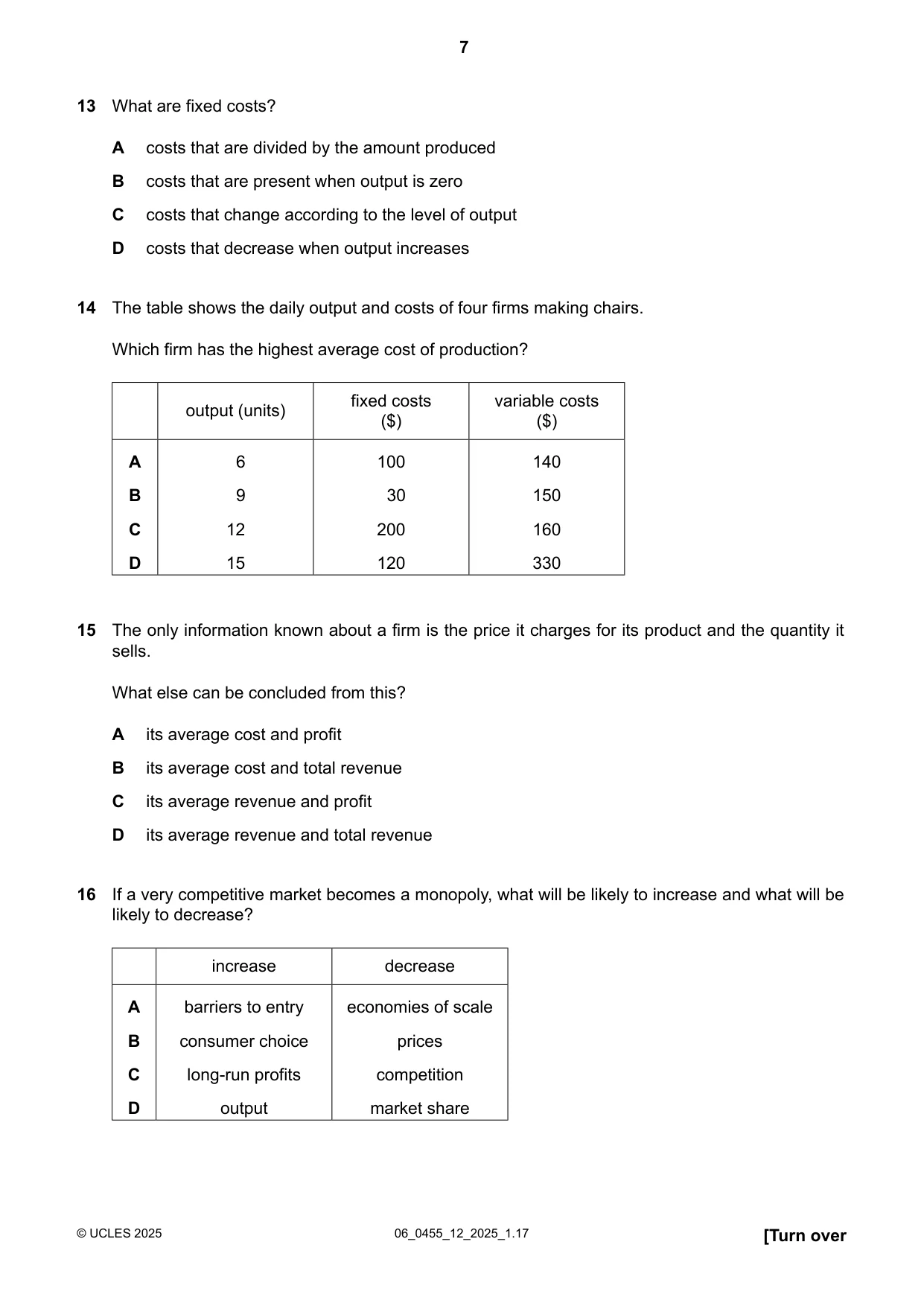
14 The table shows the daily output and costs of four firms making chairs. Which firm has the highest average cost of production? fixed costs variable costs output (units) ($) ($) A 6 100 140 B 9 30 150 C 12 200 160 D 15 120 330
Mark scheme: A
Q15 · The only information known about a firm is the price it charges for its product and the…
15 The only information known about a firm is the price it charges for its product and the quantity it sells. What else can be concluded from this? A its average cost and profit B its average cost and total revenue C its average revenue and profit D its average revenue and total revenue
Mark scheme: D
Q16 · If a very competitive market becomes a monopoly, what will be likely to increase and what…
16 If a very competitive market becomes a monopoly, what will be likely to increase and what will be likely to decrease? increase decrease A barriers to entry economies of scale B consumer choice prices C long-run profits competition D output market share
Mark scheme: C
Q17 · Many central banks around the world decreased interest rates during a recession caused by…
17 Many central banks around the world decreased interest rates during a recession caused by a pandemic. What was the most likely macroeconomic aim of this policy? A economic growth B increase in the current account surplus C low inflation D redistribution of income
Mark scheme: A
Q18 · The diagram shows the percentage of income taken by a tax at different levels of income
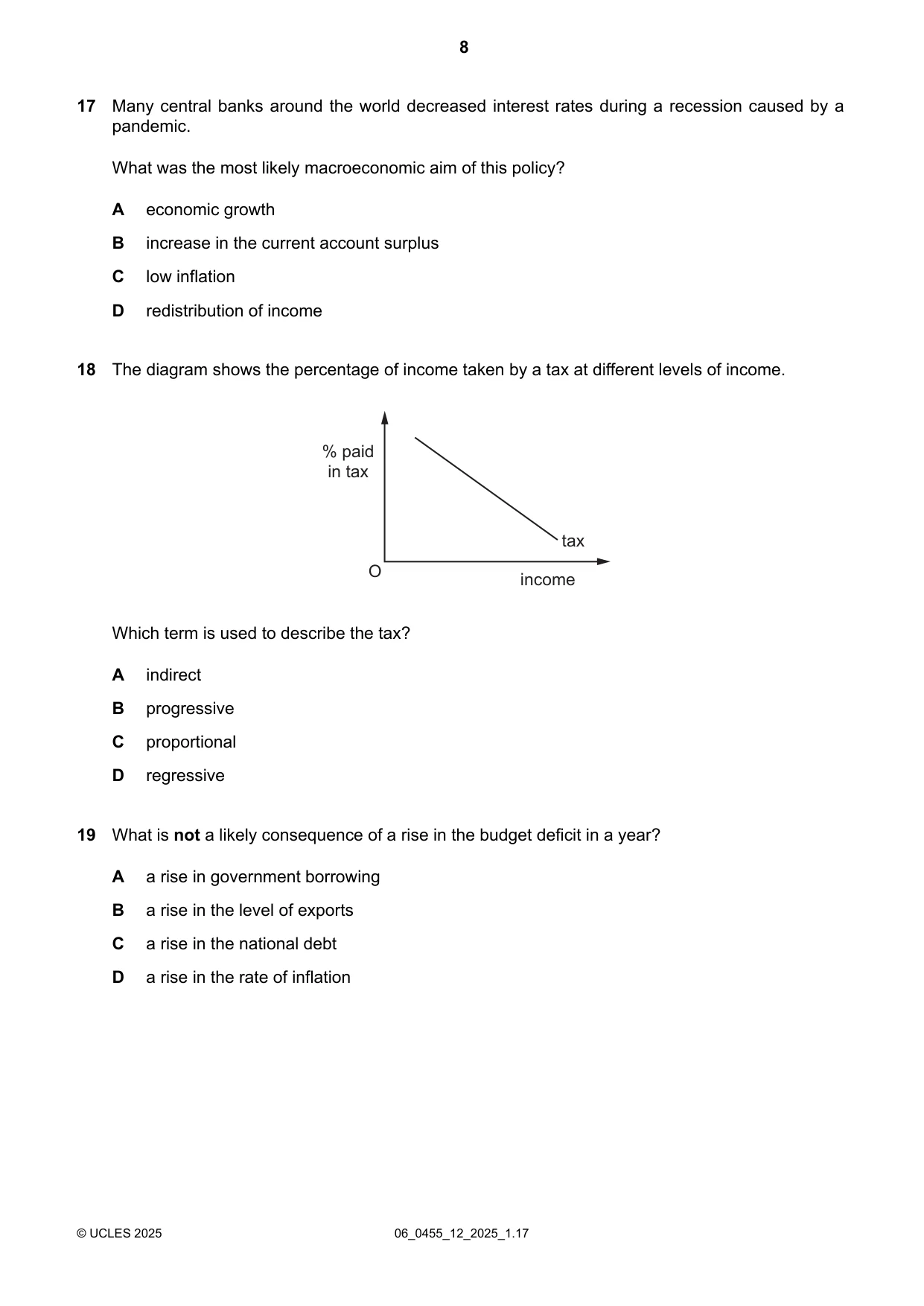
18 The diagram shows the percentage of income taken by a tax at different levels of income. % paid in tax tax O income Which term is used to describe the tax? A indirect B progressive C proportional D regressive
Mark scheme: D
Q19 · What is not a likely consequence of a rise in the budget deficit in a year?
19 What is not a likely consequence of a rise in the budget deficit in a year? A a rise in government borrowing B a rise in the level of exports C a rise in the national debt D a rise in the rate of inflation
Mark scheme: B
Q20 · When a government aims to encourage economic growth, it may adopt supply-side policies
20 When a government aims to encourage economic growth, it may adopt supply-side policies. Which policy is a supply-side policy? A increasing the money supply B lowering interest rates C reducing indirect taxation D retraining unemployed workers
Mark scheme: D
Q21 · An economy that is fully employed is forecast to have an increase in total demand
21 An economy that is fully employed is forecast to have an increase in total demand. What is most likely to increase? A the rate of absolute poverty B the government budget deficit C the level of unemployment D the rate of inflation
Mark scheme: D
Q22 · A government conducted a labour force survey
22 A government conducted a labour force survey. It only included people of working age in the survey. The results are shown in the table. number of people of working age 10000000 employed 7000000 unemployed 1000000 not seeking work 2000000 Which percentage of working-age people are in the labour force? A 30% B 70% C 80% D 90%
Mark scheme: C
Q23 · A school leaver is unable to find a job immediately after completing their education
23 A school leaver is unable to find a job immediately after completing their education. Which type of unemployment is this? A cyclical B frictional C regional D structural
Mark scheme: B
Q24 · Which changes are likely to lead to the biggest increase in inflation in country X?
24 Which changes are likely to lead to the biggest increase in inflation in country X? demand for goods supply of goods and services in and services in country X country X A 5% decrease 5% decrease B 5% decrease 5% increase C 5% increase 5% decrease D 5% increase 5% increase
Mark scheme: C
Q25 · In rural areas in developing countries, farmers grow food for their own consumption
25 In rural areas in developing countries, farmers grow food for their own consumption. Why might this mean that the GDP is a weak measure of the standard of living in those countries? A The food grown is not exported. B The GDP does not include agricultural production. C The GDP only refers to the public sector. D The value of the food is unknown.
Mark scheme: D
Q26 · Japan’s population has an increasing proportion of elderly people
26 Japan’s population has an increasing proportion of elderly people. What is the likely impact of this on the Japanese economy? A increased government budget deficit B increased rate of economic growth C increased rate of emigration D increased use of labour-intensive methods of production
Mark scheme: A
Q27 · An Argentine product initially sells in the US for $50 when the exchange rate between the…
27 An Argentine product initially sells in the US for $50 when the exchange rate between the two countries is 5 pesos to 1 dollar ($). The exchange rate changes to 10 pesos to 1 dollar and the price of the product remains unchanged in Argentina. What will be the new price of the product in the US? A $5 B $25 C $100 D $500
Mark scheme: B
Q28 · Mining by multinational companies (MNCs) has both costs and benefits for the host nation
28 Mining by multinational companies (MNCs) has both costs and benefits for the host nation. Which activity is least likely to offer a benefit to the host nation? A developing courses for training in mining B investing in infrastructure to export minerals C repatriating profits and dividends D using new technology
Mark scheme: C
Q29 · The table shows the retail price at which the same book can be bought in four countries
29 The table shows the retail price at which the same book can be bought in four countries. country price in local currency local currency Australia $14.99 Australian dollars Canada $11.99 Canadian dollars New Zealand $20.95 New Zealand dollars United Kingdom £6.99 GB pound What additional information is required to make a meaningful comparison of the price of the book between the countries? A direct tax rates B exchange rates C inflation rates D level of import tariffs
Mark scheme: B
Q30 · What is a consequence of a surplus on the current account of the balance of payments?
30 What is a consequence of a surplus on the current account of the balance of payments? A a decrease in GDP B a decrease in unemployment C a depreciation of the foreign exchange rate D deflation
Mark scheme: B
What was in this paper
The subtopics covered by these 30 questions, and how many questions each got. Open one in a new tab to see every Cambridge question on it.
4Workers3Employment and unemployment2Fiscal policy2Foreign exchange rates2Inflation and deflation2Current account of balance of payments1Demand1Globalisation, free trade and protection1Living standards1Market failure1Market structure1Microeconomics and macroeconomics1Monetary policy1Population1Price changes1Price determination1Price elasticity of supply (PES)1Production possibility curve (PPC) diagrams1Supply-side policy1The nature of the economic problem1What you needed in this session
Cambridge’s own grade thresholds for 2025 May/June, Paper 1 · Variant 2. A higher threshold means an easier paper — the bar moves with how the cohort did.