Cambridge IGCSE Economics 0455 — 2021 May/June Paper 1 · Variant 2
0455/12/M/J/21 · 30 questions · 30 marks · ≈34 min
The question paper and its mark scheme, free to read here and free to download. This is Cambridge’s own paper, exactly as it was sat.
Question paper12 pages
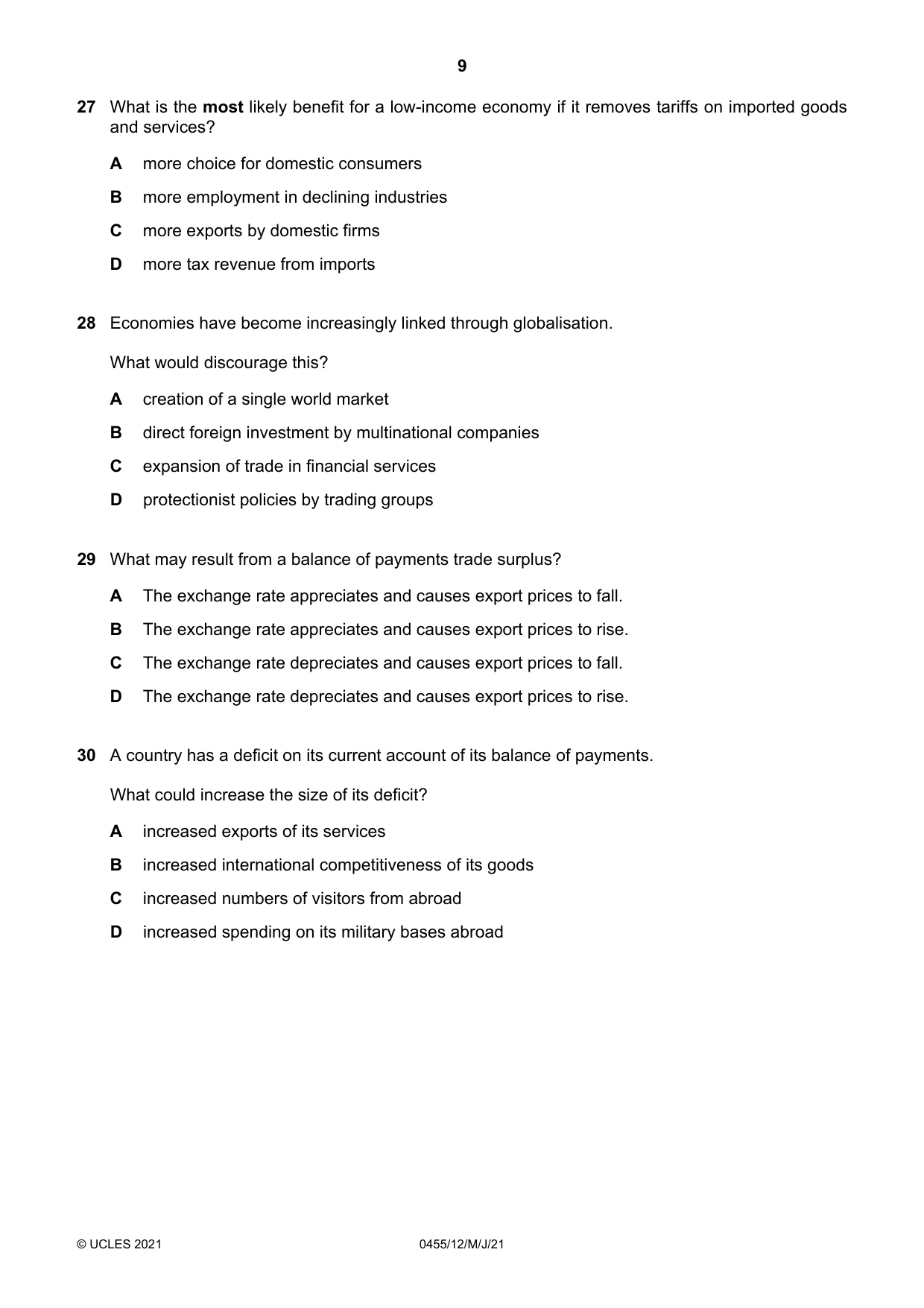


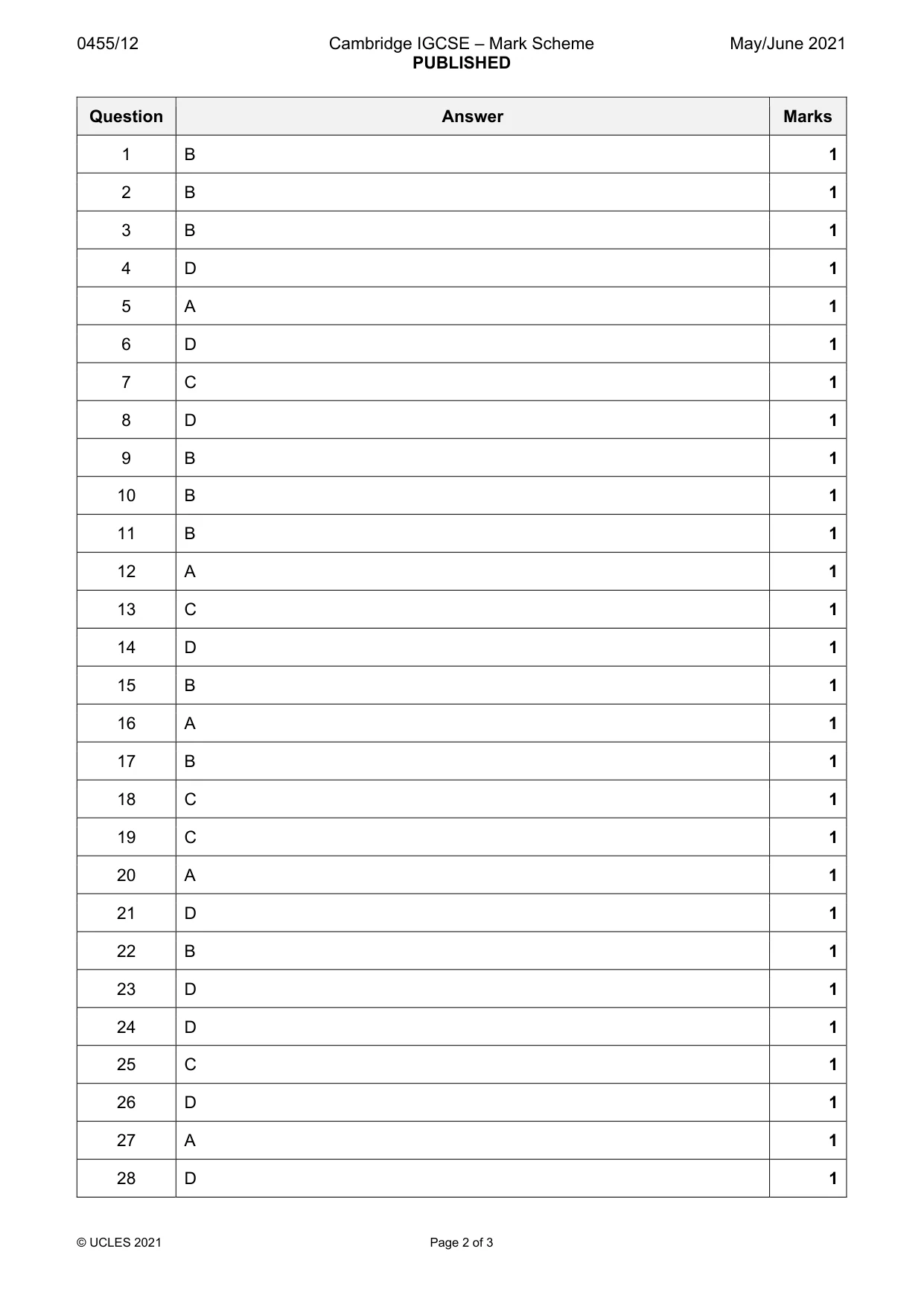
Mark scheme3 pages
Answers below. Sit the paper first if you are practising.
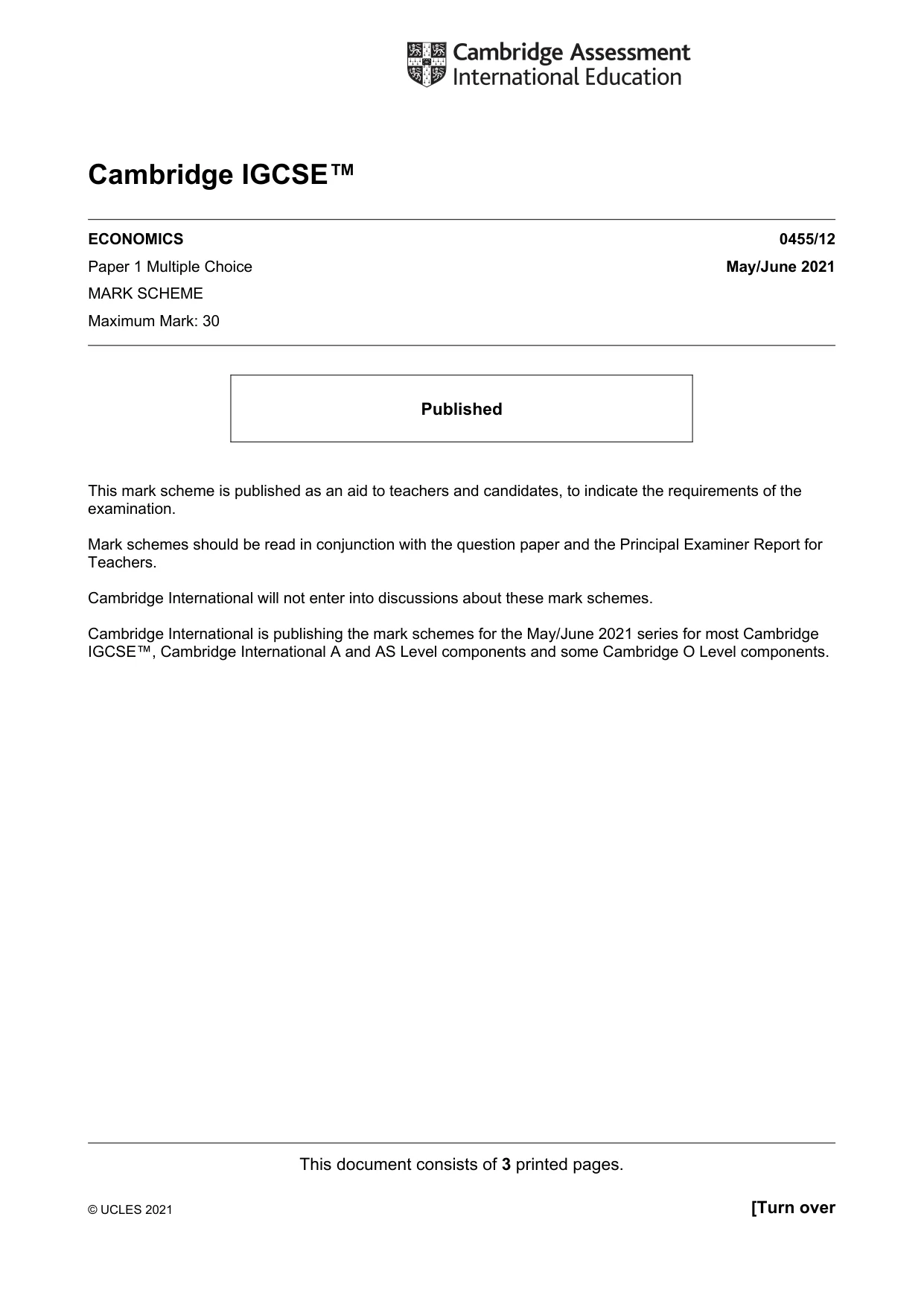
Questions as text
Q1 · What is an advantage of competitive markets?
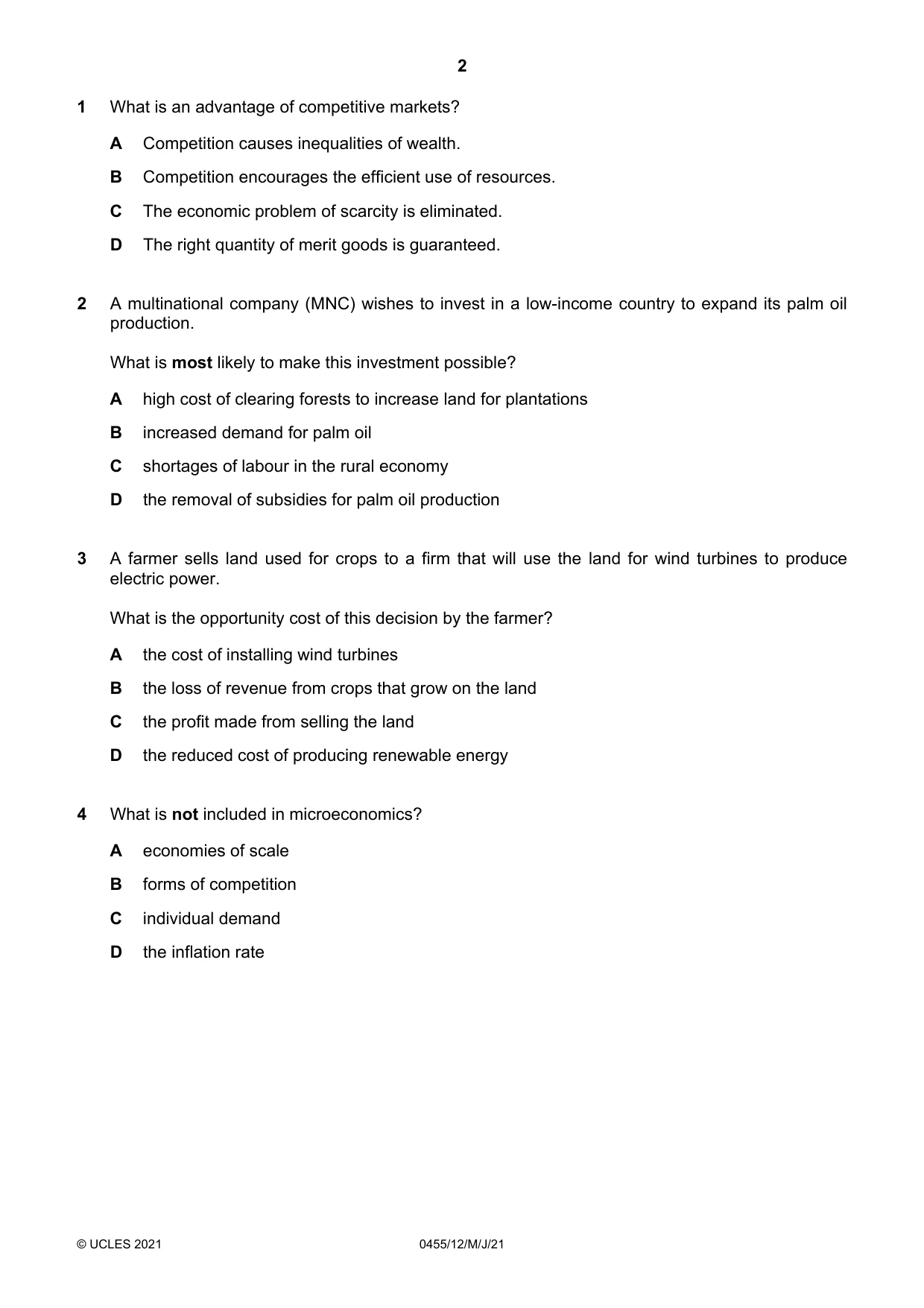
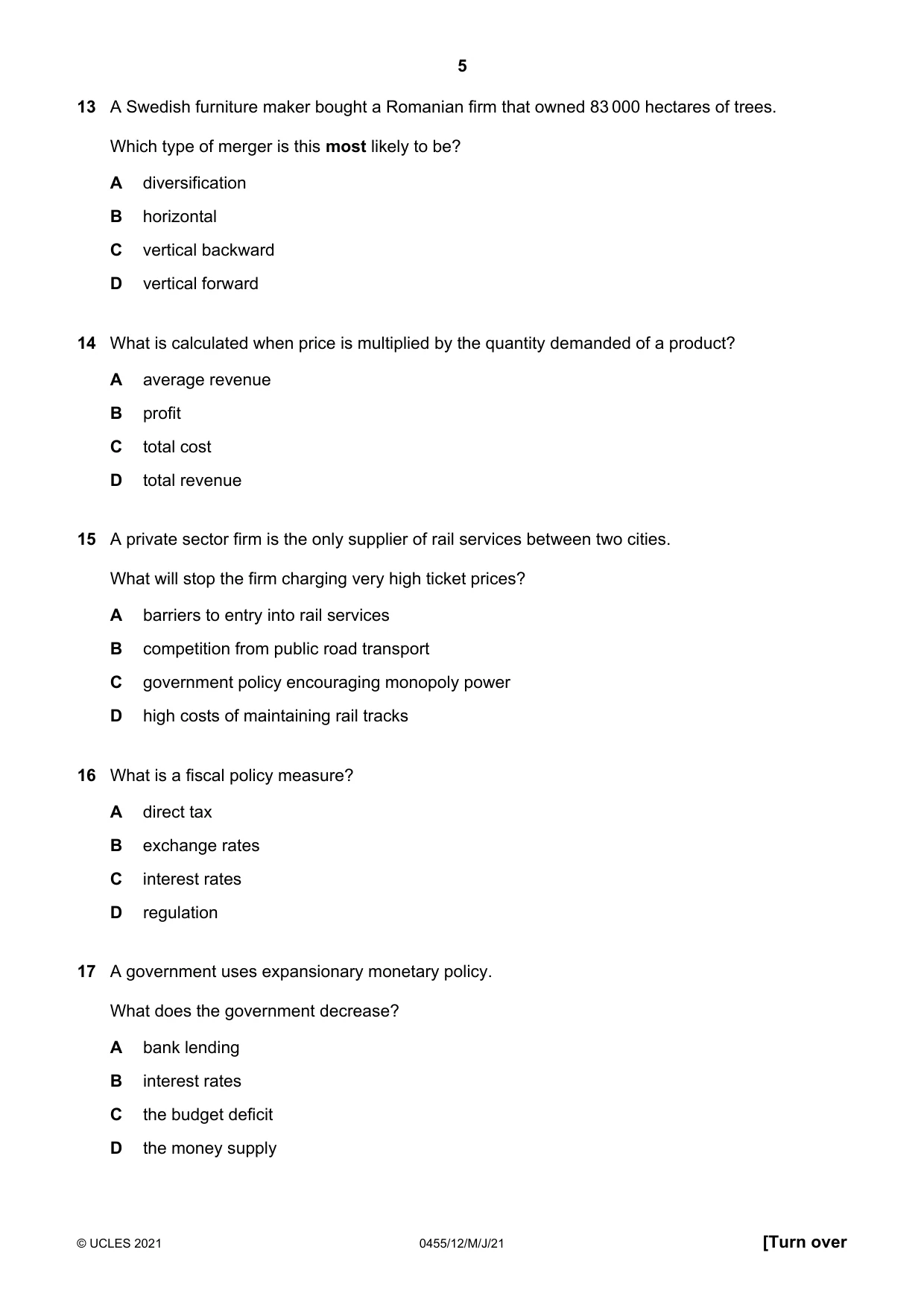
1 What is an advantage of competitive markets? A Competition causes inequalities of wealth. B Competition encourages the efficient use of resources. C The economic problem of scarcity is eliminated. D The right quantity of merit goods is guaranteed.
Mark scheme: B
Q2 · A multinational company (MNC) wishes to invest in a low-income country to expand its palm…
2 A multinational company (MNC) wishes to invest in a low-income country to expand its palm oil production. What is most likely to make this investment possible? A high cost of clearing forests to increase land for plantations B increased demand for palm oil C shortages of labour in the rural economy D the removal of subsidies for palm oil production
Mark scheme: B
More questions on Differences in economic development between countries
Q3 · A farmer sells land used for crops to a firm that will use the land for wind turbines to…
3 A farmer sells land used for crops to a firm that will use the land for wind turbines to produce electric power. What is the opportunity cost of this decision by the farmer? A the cost of installing wind turbines B the loss of revenue from crops that grow on the land C the profit made from selling the land D the reduced cost of producing renewable energy
Mark scheme: B
Q4 · What is not included in microeconomics?
4 What is not included in microeconomics? A economies of scale B forms of competition C individual demand D the inflation rate
Mark scheme: D
Q5 · What determines a consumer’s demand for a product?
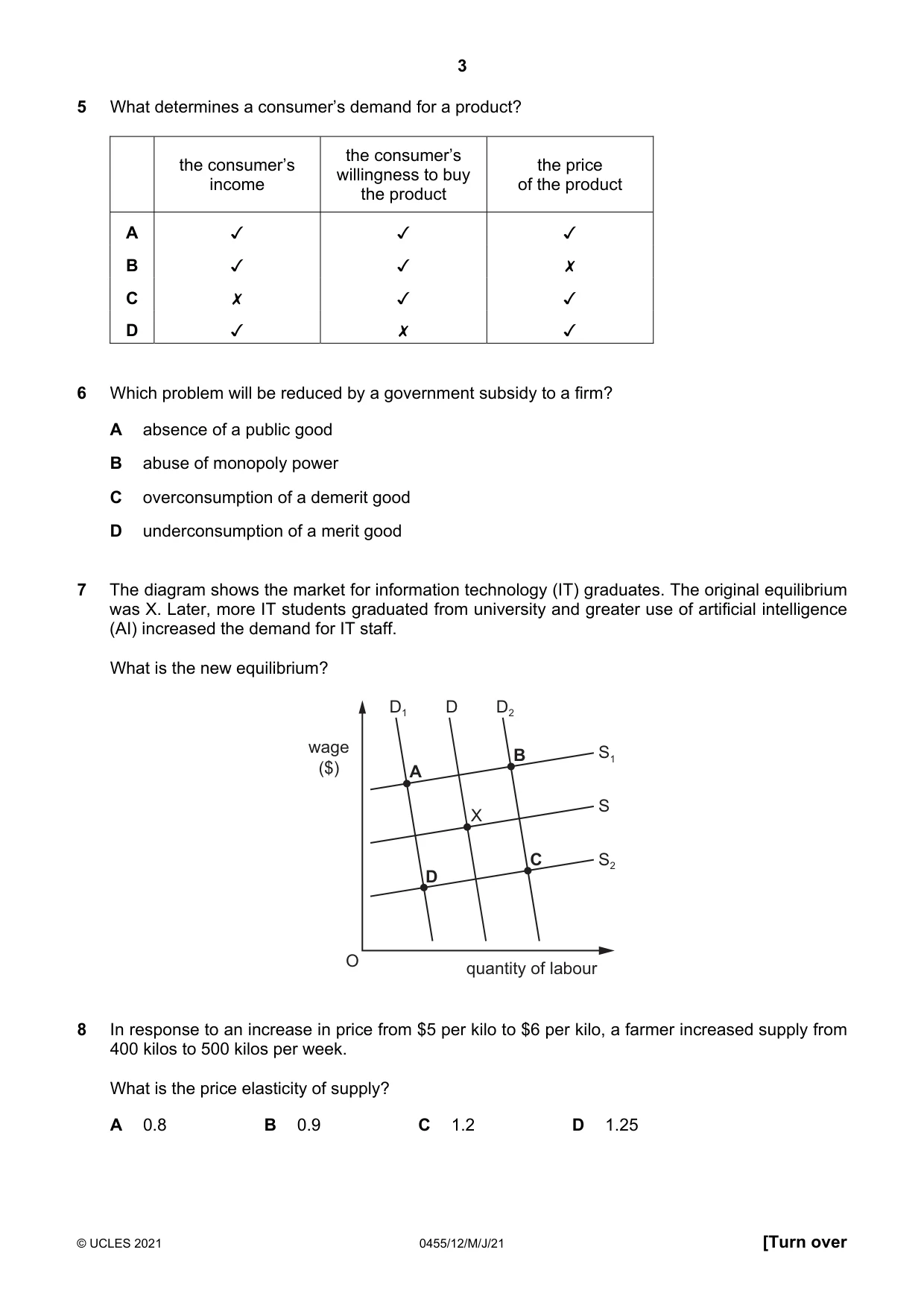
5 What determines a consumer’s demand for a product? the consumer’s the consumer’s willingness to buy the price income the product of the product A J Jv J B J Jv x Cc x Jv J D J x J
Mark scheme: A
Q6 · Which problem will be reduced by a government subsidy to a firm?
6 Which problem will be reduced by a government subsidy to a firm? A absence of a public good B abuse of monopoly power C overconsumption of a demerit good D underconsumption of a merit good
Mark scheme: D
Q7 · The diagram shows the market for information technology (IT) graduates
7 The diagram shows the market for information technology (IT) graduates. The original equilibrium was X. Later, more IT students graduated from university and greater use of artificial intelligence (AI) increased the demand for IT staff. What is the new equilibrium? D1 D D2 wage S1 B ($) A S X C S2 D O quantity of labour
Mark scheme: C
Q8 · In response to an increase in price from $5 per kilo to $6 per kilo, a farmer increased…
8 In response to an increase in price from $5 per kilo to $6 per kilo, a farmer increased supply from 400 kilos to 500 kilos per week. What is the price elasticity of supply? A 0.8 B 0.9 C 1.2 D 1.25
Mark scheme: D
Q9 · What might cause consumers in a high-income economy to both save more and spend more?
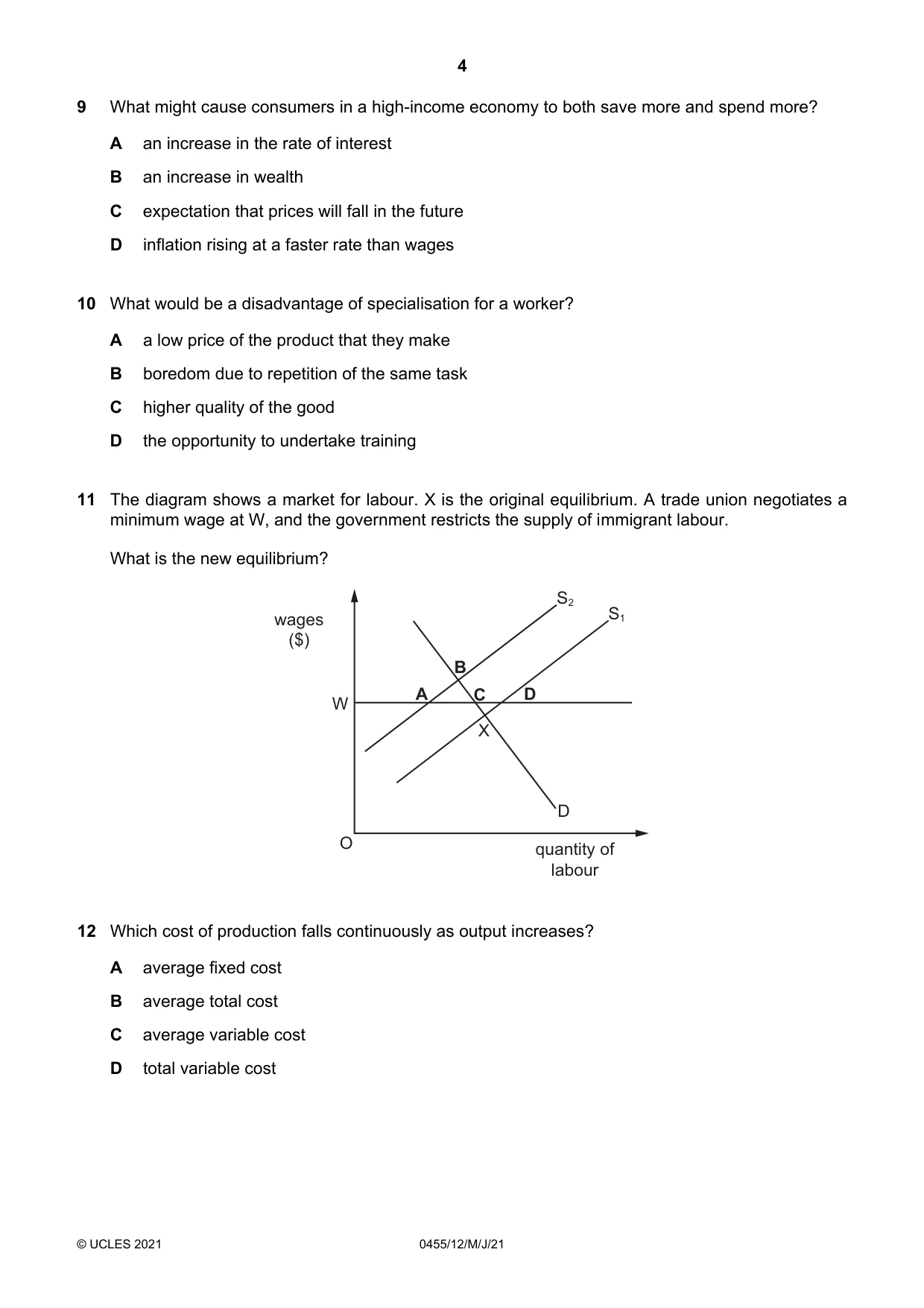
9 What might cause consumers in a high-income economy to both save more and spend more? A an increase in the rate of interest B an increase in wealth C expectation that prices will fall in the future D inflation rising at a faster rate than wages
Mark scheme: B
Q10 · What would be a disadvantage of specialisation for a worker?
10 What would be a disadvantage of specialisation for a worker? A a low price of the product that they make B boredom due to repetition of the same task C higher quality of the good D the opportunity to undertake training
Mark scheme: B
Q11 · The diagram shows a market for labour
11 The diagram shows a market for labour. X is the original equilibrium. A trade union negotiates a minimum wage at W, and the government restricts the supply of immigrant labour. What is the new equilibrium? S2 wages S1 ($) B A C D W X D O quantity of labour
Mark scheme: B
Q12 · Which cost of production falls continuously as output increases?
12 Which cost of production falls continuously as output increases? A average fixed cost B average total cost C average variable cost D total variable cost
Mark scheme: A
Q13 · A Swedish furniture maker bought a Romanian firm that owned 83 000 hectares of trees
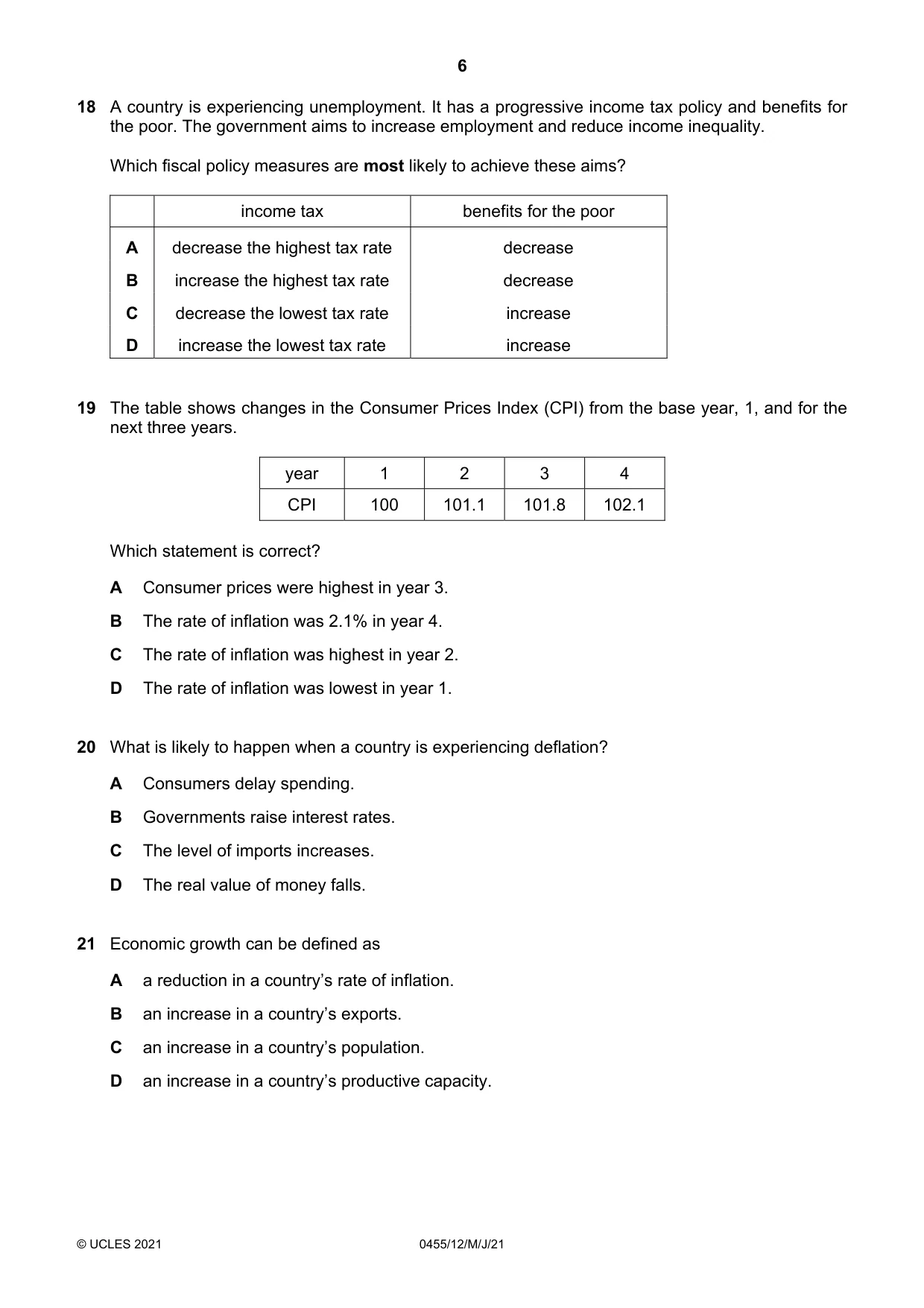
13 A Swedish furniture maker bought a Romanian firm that owned 83 000 hectares of trees. Which type of merger is this most likely to be? A diversification B horizontal C vertical backward D vertical forward
Mark scheme: C
Q14 · What is calculated when price is multiplied by the quantity demanded of a product?
14 What is calculated when price is multiplied by the quantity demanded of a product? A average revenue B profit C total cost D total revenue
Mark scheme: D
Q15 · A private sector firm is the only supplier of rail services between two cities
15 A private sector firm is the only supplier of rail services between two cities. What will stop the firm charging very high ticket prices? A barriers to entry into rail services B competition from public road transport C government policy encouraging monopoly power D high costs of maintaining rail tracks
Mark scheme: B
Q16 · What is a fiscal policy measure?
16 What is a fiscal policy measure? A direct tax B exchange rates C interest rates D regulation
Mark scheme: A
Q17 · A government uses expansionary monetary policy
17 A government uses expansionary monetary policy. What does the government decrease? A bank lending B interest rates C the budget deficit D the money supply
Mark scheme: B
Q18 · A country is experiencing unemployment
18 A country is experiencing unemployment. It has a progressive income tax policy and benefits for the poor. The government aims to increase employment and reduce income inequality. Which fiscal policy measures are most likely to achieve these aims? income tax benefits for the poor A decrease the highest tax rate decrease B increase the highest tax rate decrease C decrease the lowest tax rate increase D increase the lowest tax rate increase
Mark scheme: C
Q19 · The table shows changes in the Consumer Prices Index (CPI) from the base year, 1, and for…
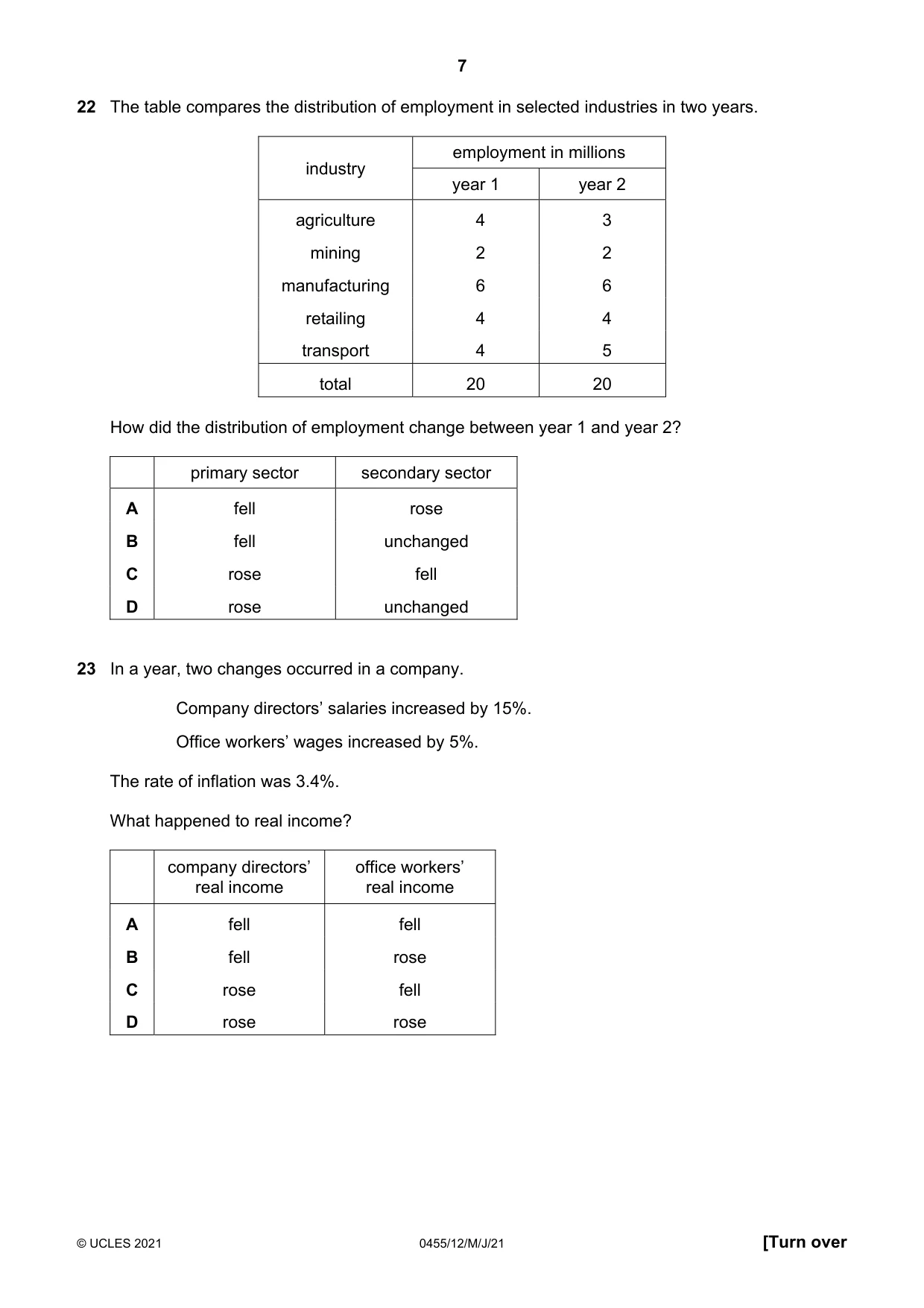
19 The table shows changes in the Consumer Prices Index (CPI) from the base year, 1, and for the next three years. year 1 2 3 4 CPI 100 101.1 101.8 102.1 Which statement is correct? A Consumer prices were highest in year 3. B The rate of inflation was 2.1% in year 4. C The rate of inflation was highest in year 2. D The rate of inflation was lowest in year 1.
Mark scheme: C
Q20 · What is likely to happen when a country is experiencing deflation?
20 What is likely to happen when a country is experiencing deflation? A Consumers delay spending. B Governments raise interest rates. C The level of imports increases. D The real value of money falls.
Mark scheme: A
Q21 · Economic growth can be defined as A a reduction in a country’s rate of inflation
21 Economic growth can be defined as A a reduction in a country’s rate of inflation. B an increase in a country’s exports. C an increase in a country’s population. D an increase in a country’s productive capacity.
Mark scheme: D
Q22 · The table compares the distribution of employment in selected industries in two years
22 The table compares the distribution of employment in selected industries in two years. employment in millions industry year 1 year 2 agriculture 4 3 mining 2 2 manufacturing 6 6 retailing 4 4 transport 4 5 total 20 20 How did the distribution of employment change between year 1 and year 2? primary sector secondary sector A fell rose B fell unchanged C rose fell D rose unchanged
Mark scheme: B
Q23 · In a year, two changes occurred in a company
23 In a year, two changes occurred in a company. Company directors’ salaries increased by 15%. Office workers’ wages increased by 5%. The rate of inflation was 3.4%. What happened to real income? company directors’ office workers’ real income real income A fell fell B fell rose C rose fell D rose rose
Mark scheme: D
Q24 · The diagrams show birth rate (BR) and death rate (DR) in three countries, X, Y and Z, in…
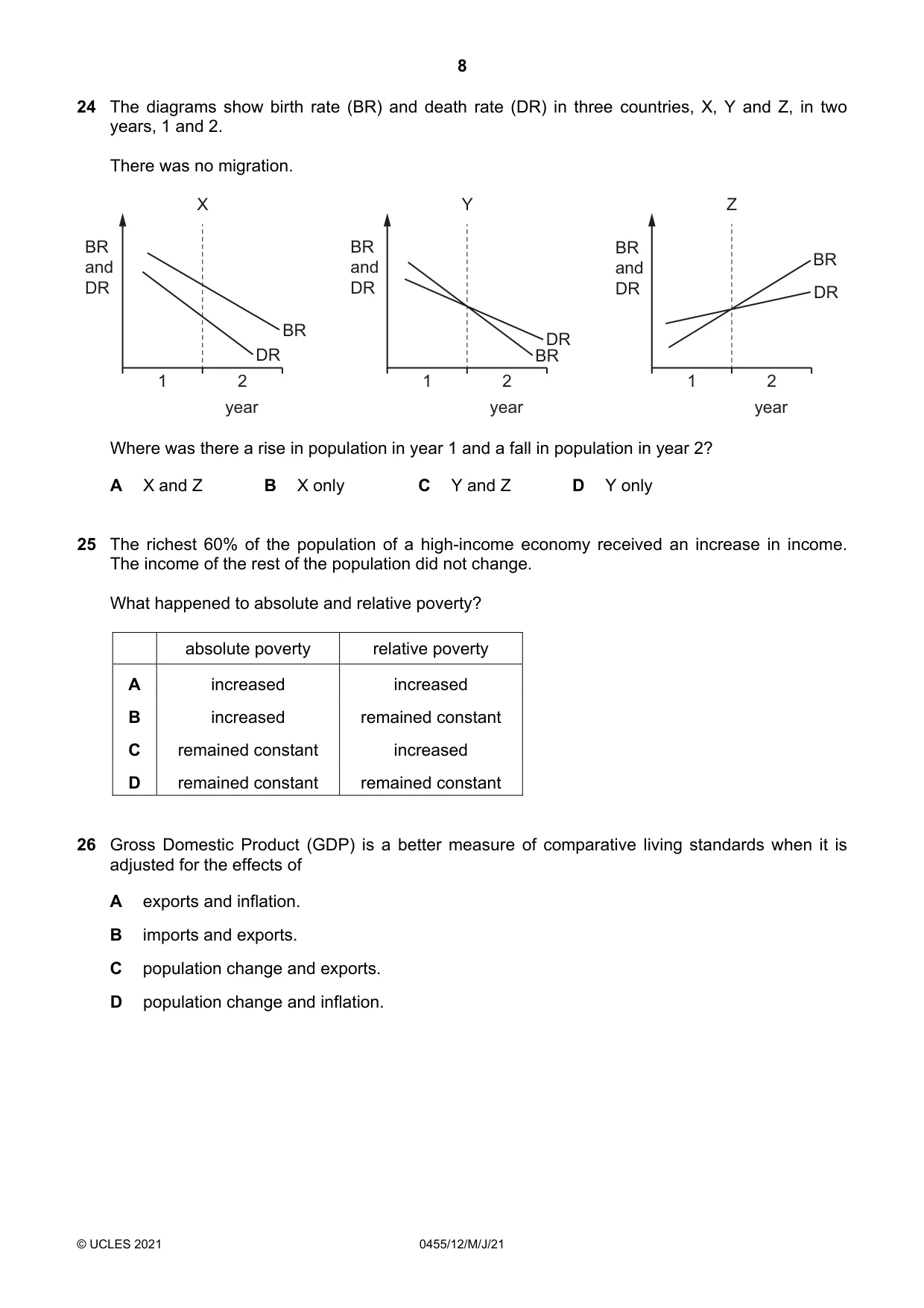
24 The diagrams show birth rate (BR) and death rate (DR) in three countries, X, Y and Z, in two years, 1 and 2. There was no migration. X Y Z BR BR BR and and BR and DR DR DR DR BR DR DR BR 1 2 1 2 1 2 year year year Where was there a rise in population in year 1 and a fall in population in year 2? A X and Z B X only C Y and Z D Y only
Mark scheme: D
Q25 · The richest 60% of the population of a high-income economy received an increase in income
25 The richest 60% of the population of a high-income economy received an increase in income. The income of the rest of the population did not change. What happened to absolute and relative poverty? absolute poverty relative poverty A increased increased B increased remained constant C remained constant increased D remained constant remained constant
Mark scheme: C
Q26 · Gross Domestic Product (GDP) is a better measure of comparative living standards when it…
26 Gross Domestic Product (GDP) is a better measure of comparative living standards when it is adjusted for the effects of A exports and inflation. B imports and exports. C population change and exports. D population change and inflation.
Mark scheme: D
Q27 · What is the most likely benefit for a low-income economy if it removes tariffs on…
27 What is the most likely benefit for a low-income economy if it removes tariffs on imported goods and services? A more choice for domestic consumers B more employment in declining industries C more exports by domestic firms D more tax revenue from imports
Mark scheme: A
Q28 · Economies have become increasingly linked through globalisation
28 Economies have become increasingly linked through globalisation. What would discourage this? A creation of a single world market B direct foreign investment by multinational companies C expansion of trade in financial services D protectionist policies by trading groups
Mark scheme: D
Q29 · What may result from a balance of payments trade surplus?
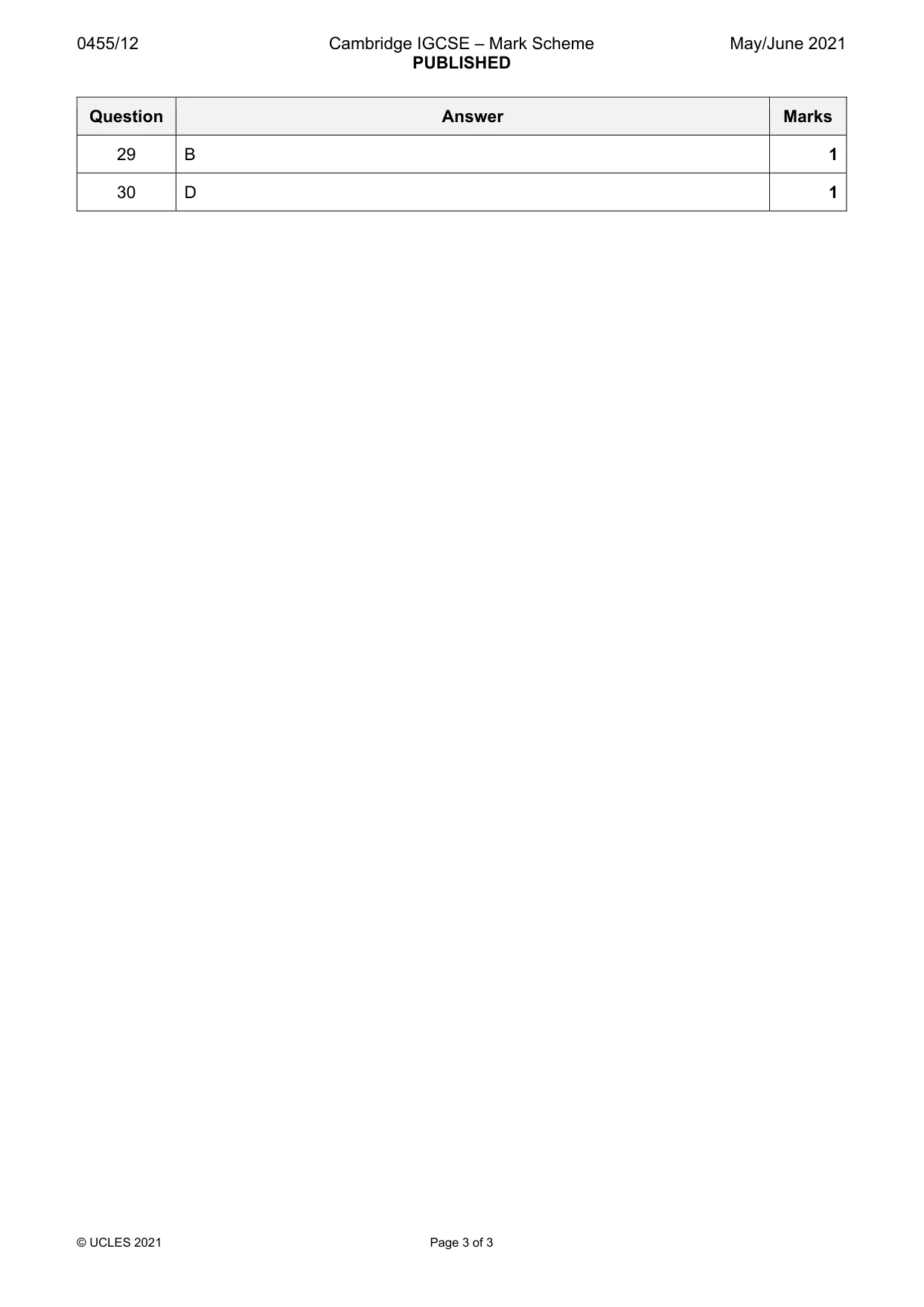
29 What may result from a balance of payments trade surplus? A The exchange rate appreciates and causes export prices to fall. B The exchange rate appreciates and causes export prices to rise. C The exchange rate depreciates and causes export prices to fall. D The exchange rate depreciates and causes export prices to rise.
Mark scheme: B
Q30 · A country has a deficit on its current account of its balance of payments
30 A country has a deficit on its current account of its balance of payments. What could increase the size of its deficit? A increased exports of its services B increased international competitiveness of its goods C increased numbers of visitors from abroad D increased spending on its military bases abroad
Mark scheme: D
What was in this paper
The subtopics covered by these 30 questions, and how many questions each got. Open one in a new tab to see every Cambridge question on it.
3Firms2Firms’ costs, revenue and objectives2Fiscal policy2Globalisation, free trade and protection2Current account of balance of payments1Demand1Differences in economic development between countries1Economic growth1Foreign exchange rates1Households1Living standards1Market economic system1Market failure1Market structure1Microeconomics and macroeconomics1Monetary policy1Opportunity cost1Population1Poverty1Price determination1Price elasticity of supply (PES)1Trade unions1Workers1What you needed in this session
Cambridge’s own grade thresholds for 2021 May/June, Paper 1 · Variant 2. A higher threshold means an easier paper — the bar moves with how the cohort did.